EP2901595B1 - Method and system for generating channel codes, in particular for a frame-header - Google Patents
Method and system for generating channel codes, in particular for a frame-header Download PDFInfo
- Publication number
- EP2901595B1 EP2901595B1 EP13783493.3A EP13783493A EP2901595B1 EP 2901595 B1 EP2901595 B1 EP 2901595B1 EP 13783493 A EP13783493 A EP 13783493A EP 2901595 B1 EP2901595 B1 EP 2901595B1
- Authority
- EP
- European Patent Office
- Prior art keywords
- code
- channel
- words
- codes
- length
- Prior art date
- Legal status (The legal status is an assumption and is not a legal conclusion. Google has not performed a legal analysis and makes no representation as to the accuracy of the status listed.)
- Not-in-force
Links
Images






Classifications
-
- H—ELECTRICITY
- H04—ELECTRIC COMMUNICATION TECHNIQUE
- H04J—MULTIPLEX COMMUNICATION
- H04J13/00—Code division multiplex systems
- H04J13/10—Code generation
-
- H—ELECTRICITY
- H03—ELECTRONIC CIRCUITRY
- H03M—CODING; DECODING; CODE CONVERSION IN GENERAL
- H03M13/00—Coding, decoding or code conversion, for error detection or error correction; Coding theory basic assumptions; Coding bounds; Error probability evaluation methods; Channel models; Simulation or testing of codes
- H03M13/25—Error detection or forward error correction by signal space coding, i.e. adding redundancy in the signal constellation, e.g. Trellis Coded Modulation [TCM]
- H03M13/251—Error detection or forward error correction by signal space coding, i.e. adding redundancy in the signal constellation, e.g. Trellis Coded Modulation [TCM] with block coding
-
- H—ELECTRICITY
- H03—ELECTRONIC CIRCUITRY
- H03M—CODING; DECODING; CODE CONVERSION IN GENERAL
- H03M13/00—Coding, decoding or code conversion, for error detection or error correction; Coding theory basic assumptions; Coding bounds; Error probability evaluation methods; Channel models; Simulation or testing of codes
- H03M13/29—Coding, decoding or code conversion, for error detection or error correction; Coding theory basic assumptions; Coding bounds; Error probability evaluation methods; Channel models; Simulation or testing of codes combining two or more codes or code structures, e.g. product codes, generalised product codes, concatenated codes, inner and outer codes
- H03M13/2906—Coding, decoding or code conversion, for error detection or error correction; Coding theory basic assumptions; Coding bounds; Error probability evaluation methods; Channel models; Simulation or testing of codes combining two or more codes or code structures, e.g. product codes, generalised product codes, concatenated codes, inner and outer codes using block codes
-
- H—ELECTRICITY
- H03—ELECTRONIC CIRCUITRY
- H03M—CODING; DECODING; CODE CONVERSION IN GENERAL
- H03M13/00—Coding, decoding or code conversion, for error detection or error correction; Coding theory basic assumptions; Coding bounds; Error probability evaluation methods; Channel models; Simulation or testing of codes
- H03M13/35—Unequal or adaptive error protection, e.g. by providing a different level of protection according to significance of source information or by adapting the coding according to the change of transmission channel characteristics
- H03M13/356—Unequal error protection [UEP]
-
- H—ELECTRICITY
- H04—ELECTRIC COMMUNICATION TECHNIQUE
- H04L—TRANSMISSION OF DIGITAL INFORMATION, e.g. TELEGRAPHIC COMMUNICATION
- H04L1/00—Arrangements for detecting or preventing errors in the information received
- H04L1/0001—Systems modifying transmission characteristics according to link quality, e.g. power backoff
- H04L1/0002—Systems modifying transmission characteristics according to link quality, e.g. power backoff by adapting the transmission rate
- H04L1/0003—Systems modifying transmission characteristics according to link quality, e.g. power backoff by adapting the transmission rate by switching between different modulation schemes
-
- H—ELECTRICITY
- H04—ELECTRIC COMMUNICATION TECHNIQUE
- H04L—TRANSMISSION OF DIGITAL INFORMATION, e.g. TELEGRAPHIC COMMUNICATION
- H04L1/00—Arrangements for detecting or preventing errors in the information received
- H04L1/0001—Systems modifying transmission characteristics according to link quality, e.g. power backoff
- H04L1/0009—Systems modifying transmission characteristics according to link quality, e.g. power backoff by adapting the channel coding
- H04L1/001—Systems modifying transmission characteristics according to link quality, e.g. power backoff by adapting the channel coding applied to control information
-
- H—ELECTRICITY
- H04—ELECTRIC COMMUNICATION TECHNIQUE
- H04L—TRANSMISSION OF DIGITAL INFORMATION, e.g. TELEGRAPHIC COMMUNICATION
- H04L1/00—Arrangements for detecting or preventing errors in the information received
- H04L1/004—Arrangements for detecting or preventing errors in the information received by using forward error control
- H04L1/0056—Systems characterized by the type of code used
- H04L1/0057—Block codes
-
- H—ELECTRICITY
- H04—ELECTRIC COMMUNICATION TECHNIQUE
- H04L—TRANSMISSION OF DIGITAL INFORMATION, e.g. TELEGRAPHIC COMMUNICATION
- H04L1/00—Arrangements for detecting or preventing errors in the information received
- H04L1/004—Arrangements for detecting or preventing errors in the information received by using forward error control
- H04L1/0056—Systems characterized by the type of code used
- H04L1/0064—Concatenated codes
-
- H—ELECTRICITY
- H04—ELECTRIC COMMUNICATION TECHNIQUE
- H04L—TRANSMISSION OF DIGITAL INFORMATION, e.g. TELEGRAPHIC COMMUNICATION
- H04L69/00—Network arrangements, protocols or services independent of the application payload and not provided for in the other groups of this subclass
- H04L69/22—Parsing or analysis of headers
-
- H—ELECTRICITY
- H04—ELECTRIC COMMUNICATION TECHNIQUE
- H04W—WIRELESS COMMUNICATION NETWORKS
- H04W72/00—Local resource management
- H04W72/04—Wireless resource allocation
- H04W72/044—Wireless resource allocation based on the type of the allocated resource
- H04W72/0466—Wireless resource allocation based on the type of the allocated resource the resource being a scrambling code
-
- H—ELECTRICITY
- H03—ELECTRONIC CIRCUITRY
- H03M—CODING; DECODING; CODE CONVERSION IN GENERAL
- H03M13/00—Coding, decoding or code conversion, for error detection or error correction; Coding theory basic assumptions; Coding bounds; Error probability evaluation methods; Channel models; Simulation or testing of codes
- H03M13/03—Error detection or forward error correction by redundancy in data representation, i.e. code words containing more digits than the source words
- H03M13/05—Error detection or forward error correction by redundancy in data representation, i.e. code words containing more digits than the source words using block codes, i.e. a predetermined number of check bits joined to a predetermined number of information bits
- H03M13/13—Linear codes
- H03M13/136—Reed-Muller [RM] codes
-
- H—ELECTRICITY
- H04—ELECTRIC COMMUNICATION TECHNIQUE
- H04L—TRANSMISSION OF DIGITAL INFORMATION, e.g. TELEGRAPHIC COMMUNICATION
- H04L1/00—Arrangements for detecting or preventing errors in the information received
- H04L1/004—Arrangements for detecting or preventing errors in the information received by using forward error control
- H04L1/0056—Systems characterized by the type of code used
- H04L1/007—Unequal error protection
Definitions
- the present invention relates to a method and a system for generating channel codes, in particular channel codes for a frame-header in an ACM ("Adaptive Coding and Modulation") communication system.
- ACM Adaptive Coding and Modulation
- Real-time adaptation of transmission parameters according to the channel conditions is highly desirable feature in the communication systems where the channel parameters may change in time or from one receiver to another.
- Time and/or user varying channel condition is an important characteristic of most communication systems such as satellite, network and broadcast systems.
- ACM scheme The main idea of an ACM scheme is to increase the capacity of a system communication by avoiding the waste of resources caused by adopting a fixed physical layer scenario by which the spectral efficiency must be sacrificed to guarantee a good performance for the user with the worst channel conditions.
- the transmitter is able to switch between several constellations and codes choosing the largest available modulation and code rate which ensures a target DER ("Detection Error Rate"), therefore insuring maximum spectral efficiency for each user.
- target DER Detection Error Rate
- each user should be able to decide whether the message is intended to him and/or to recognize the parameters of the constellation and code which has been used by the transmitter.
- each packet sent by the transmitter consists of two main parts.
- the first part is called frame-header, or simply header, and contains the informations regarding the modulation and coding, hereinafter called ACMI ("Adaptive Coding and Modulation Indicator").
- ACMI Adaptive Coding and Modulation Indicator
- the second part contains the message which is encoded using the corresponding ACMI parameters.
- each user should first decode the information in the frame-header in order to be able to decode the rest of the message.
- the coding strategy is not trivial due to the wide dynamic range of the SNR ("Signal to Noise Ratio"), typically from -15 dB to 15 dB. Only the use of an ACM scheme may not be sufficient to ensure the radio link, a good spectral efficiency and a target probability of error to the receiver.
- SNR Signal to Noise Ratio
- variable length code consists in the repetition of a single strong Reed-Muller code to cope with the different signal to noise ratio conditions.
- a method for generating a channel code in particular for a frame-header, wherein at least a code-word of said channel code is obtained by means of at least a concatenation of code-words of two constituent codes and such concatenation is performed on subsets of code-words of a first constituent code, having maximum length, with code-words of a second constituent code.
- Each user type i is associated with an available signal to noise ratio SNR i . It is assumed that for any two user types k and m, if k > m, then SNR k > SNR m .
- a set of maximum ACM modes, ACM i are associated to the set of user types.
- Each user type i must be capable of detecting and decoding all packets encoded with ACM modes j ⁇ i, corresponding to signal to noise ratio SNR lower or equal to that associated to the user type i . Consequently, users of higher types, corresponding to high SNR values, must then be able to detect the ACM mode within a larger set than that of users of lower type.
- FIG. 1 it is shown a communication system 10 used as an example of system scenario to explain the detailed description of the present invention.
- a plurality of users is served by a gateway 1 through a satellite transponder 2 and the gateway 1 comprises at least one encoder 3 that generate at least a code.
- the users are divided into M types, for example M ⁇ 64, according to their current radio link quality and this subdivision is created by a designer during the design of the communication system 10.
- Each user type i is associated with an available signal to noise ratio SNR i and it is assumed, with no loss of generality, that SNR i ⁇ SNR i+1 ⁇ bib ⁇ SNR M . This latter condition is typical of satellite communication systems. Thus, signal to noise ratio is different for each user type i. Furthermore, each user type i comprises at least one physical user.
- a set of maximum ACM modes are associated to each user type i.
- Each user type i must be capable of detecting and decoding all packets encoded with modes ACM j with j ⁇ i.
- a feedback channel not represented in Fig.1 , allows the gateway 1 to know the type i of each user.
- the gateway 1 has the possibility of choosing for each user type i an ACM mode with index j ⁇ i. Choosing a value below the maximum allowed i, which in principle is suboptimal for the total system capacity, allows some flexibility at the gateway 1. This additional system flexibility, however, requires that user type i detects and decodes all modes ACM j with j ⁇ i. This requirement then imposes a high detection complexity especially to users associated to high SNR values. In particular, users with the highest user type M must detect and decode all packets from a satellite. The filtering of the packets, according to the true intended destination, is deferred after the decoding process.
- a mode of operation of a receiver 23 comprising an ACMI detector 21 for a user type i, and an input signal y , in the communication system 10 described in Fig. 1 .
- the ACMI detector 21 delivers an index ⁇ in the range [1, ... , i ] denoting an estimation of an ACM index in the allowed range, or the conventional symbol "0" to denote a failure in the detection, freezing a following decoder 22.
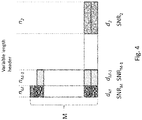
- the set of code-words is generated with variable lengths according to the following algorithm, which is shown in Fig. 4 :
- At least a code-word of constituent codes is encapsulated into a code-word of the channel code and at least a code-word of the channel code has length greater than remaining code-words of such channel code. Furthermore, the concatenation is performed on subsets of code-words of a first constituent code, having maximum length, with code-words of a second constituent code.
- the formula (3) provides the required minimum distance d min for a channel code with M code-words achieving a detection error rate ⁇ at the signal to noise ratio SNR.
- This formula (3) is obtained by using the upper bound: ⁇ ⁇ M ⁇ 1 Q 2 d min ⁇ SNR which is rather accurate for small M and almost perfect codes.
- t is the maximum weight of error vectors that are surely correct from the minimum distance decoding, to find the minimal length n of a code with M code-words and minimum distance d min required in step 6 of the previous algorithm.
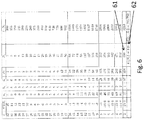
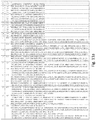
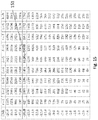
- the columns of the table of Fig. 5 indicate, from left to right, the number of code-words i, that is also the index of the user type, the corresponding signal to noise ratio SNR i , the incremental length of code-word n i of an header with index i, the number of bits k i of code-word of an header at index i, the incremental minimum distance of code-word d i of an header at index i, the total minimum distance d T i.e. the sum, at index i, of preceding d i , the total code-word length N i of an header i.e. the sum, at index i, of preceding n i and, in the last column, i ⁇ N i that indicate the complexity of the decoding.
- the maximal code-word length N i is 464 symbols, indicated with the reference 51, and the average header length E ⁇ N i ⁇ , assuming that all modes have the same probability, is only 119 symbols, indicated with the reference 52.
- Hamming bound is an upper bound to the number of code-words and there are few codes that achieve it.
- the channel code generated using the previous algorithm according to the present invention, is able to minimize the average and the maximal length of a frame-header of a data packet.
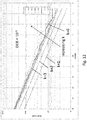
- Fig. 7 it is compared an example of the generated code length according to the present invention for 48 modes with the required header length for the signaling scheme specified in D. Becker, N. Velayudhan, A. Loh, J. O'Neill, and V. Padmanabhan, "Efficient control signaling over shared communication channels with wide dynamic range", described in the US Patent Application no. 12/621.203 .
- the channel code generation proposed according to the present invention allows to reduce considerably the header length for all modes.
- the average of header length E ⁇ N i ⁇ according to the US Patent Application no. 12/621.203 is 750 (reference 71), while the average of the header length E ⁇ N i ⁇ (reference 72) is reduced to 301 according to this example of the present invention; in the same way the maximum header length is reduced from 4416 (reference 73) to 1285 (reference 74).
- At least a code-word of constituent codes is encapsulated into a code-word of the channel code and at least a code-word of the channel code has length greater than remaining code-words of such channel code. Furthermore, the concatenation is performed on subsets of code-words of a first constituent code, having maximum length, with code-words of a second constituent code.
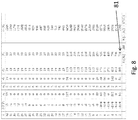
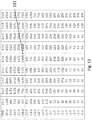
- the maximum length of header of Fig. 9 is 1239 symbols, indicated with the reference 91, which is lower than the maximum length of 1285 symbols of the header of Fig. 7 , indicated with the reference 74; while the average length of header E ⁇ N i ⁇ is reduced from 301 symbols, indicated with the reference 72, to 285 symbols, indicated with the reference 92.
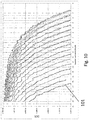
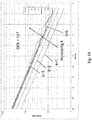
- Fig. 10 there are reported the simulation results relative to Fig. 8 .
- the abscissa of Fig. 10 indicates the gap in dB from the nominal SNR i of each user type i. In this case many codes actually achieve the target DER with a very large margin.
- the same code 39,5,19
- the target DER is achieved with no margin only for the user type 17, corresponding to a nominal SNR of 0 dB.
- the worst case design provides a coding example where all users are able to decode all ACMI headers.
- a Reed-Muller code class is chosen as constituent code and its parameters will be evaluated as a function of the required signal to noise ratio SNR range and number of modes M.
- each user type i can be associated to a code with different code-word lengths or protection.
- the code design is such that each user type i is capable to retrieve the ACMI from the header.
- the user type i decides to proceed with decoding only if the detected ACMI ⁇ is less than or equal to its type, i.e., ⁇ ⁇ i.
- the channel code generation is rather simple and strictly depends on the minimal signal to noise ratio SNR allowed in the system.
- Reed-Muller codes It is considered the class of Reed-Muller codes as a solution for worst case design.
- FIG. 10 there are shown simulation results using a maximum likelihood decoder, i.e. to maximize the probability P ( y
- the decoding complexity is different for each user type i and is equal to N i ⁇ i sums and i comparisons.
- the average decoding complexity can be calculated as E ⁇ N i ⁇ i ⁇ .
- the last column shows N i ⁇ i results with their average values, assuming a uniform distribution over all the users.
- the best optimal decoding strategy is to compute the correlation of the received signal y ( N i sums) with all the i candidate code-words.
- the complexity of the correlations is further reduced by using constituent codes which admit faster decoding algorithms, as the Hadarmard transform used for Reed-Muller or maximal length codes.
- the Hadarmard transform used for Reed-Muller or maximal length codes For a given set of parameters ( n, k, d ) where n and k are sufficiently small, repetition of maximal length codes yields codes with almost optimal performances.
- UEP Unequal Error Protection
- variable length code also has code-words with different error protection capabilities.
- one way to generate a block UEP code is to extend all the code-words of the code obtained for variable length codes by zero to have a fixed length for all code-words (to equalize the length of all code-words), thus at least a code-word comprises a sequence of bits having values equal to zero. In this case all code-words will have the length equal to the longest code-word in the starting code.
- variable length coding it should be considered the average length as the effective length of the code.
- the complexity of the maximum likelihood correlator decoder for the generated code by zero padding it has in principle the same complexity as the corresponding variable length coding and therefore the aforementioned description about decoding complexity is valid also for these codes.
- a first advantage of the method for generating channel codes according to the present invention is that the average and the maximal length of a frame-header of a data packet is minimized.
- a second advantage of the method of the present invention is that the spectral efficiency of a communication system is maximized.
- a further advantage of the method of the present invention is that the correction capability of the generated channel code is improved.
- a further advantage of the method of the present invention is that the computational complexity of a decoder is decreased.
- a further advantage of the method of the present invention is to possibly also obtain a fixed length for all code-words in order to have a same complexity of the maximum likelihood decoder of a variable length code.
- the method and the system for generating channel codes in particular for a frame-header can be applied in any communication system in which it is possible to vary the spectral efficiency and/or in communication systems that do not use an ACM scheme.
Landscapes
- Engineering & Computer Science (AREA)
- Signal Processing (AREA)
- Computer Networks & Wireless Communication (AREA)
- Theoretical Computer Science (AREA)
- Physics & Mathematics (AREA)
- Probability & Statistics with Applications (AREA)
- Quality & Reliability (AREA)
- Computer Security & Cryptography (AREA)
- Error Detection And Correction (AREA)
- Detection And Prevention Of Errors In Transmission (AREA)
- Mobile Radio Communication Systems (AREA)
- Time-Division Multiplex Systems (AREA)
- Data Exchanges In Wide-Area Networks (AREA)
Applications Claiming Priority (2)
| Application Number | Priority Date | Filing Date | Title |
|---|---|---|---|
| IT000829A ITTO20120829A1 (it) | 2012-09-25 | 2012-09-25 | Method and system for generating channel codes, in particular for a frame-header |
| PCT/EP2013/069871 WO2014048928A1 (en) | 2012-09-25 | 2013-09-24 | Method and system for generating channel codes, in particular for a frame-header |
Publications (2)
| Publication Number | Publication Date |
|---|---|
| EP2901595A1 EP2901595A1 (en) | 2015-08-05 |
| EP2901595B1 true EP2901595B1 (en) | 2019-09-11 |
Family
ID=47278459
Family Applications (1)
| Application Number | Title | Priority Date | Filing Date |
|---|---|---|---|
| EP13783493.3A Not-in-force EP2901595B1 (en) | 2012-09-25 | 2013-09-24 | Method and system for generating channel codes, in particular for a frame-header |
Country Status (12)
| Country | Link |
|---|---|
| US (1) | US9692542B2 (it) |
| EP (1) | EP2901595B1 (it) |
| JP (1) | JP2015534761A (it) |
| KR (1) | KR20150060803A (it) |
| CN (1) | CN104937870A (it) |
| BR (1) | BR112015006609A2 (it) |
| CA (1) | CA2886107A1 (it) |
| ES (1) | ES2760700T3 (it) |
| IL (1) | IL237938A0 (it) |
| IT (1) | ITTO20120829A1 (it) |
| RU (1) | RU2015115468A (it) |
| WO (1) | WO2014048928A1 (it) |
Families Citing this family (2)
| Publication number | Priority date | Publication date | Assignee | Title |
|---|---|---|---|---|
| US9735812B2 (en) * | 2015-06-26 | 2017-08-15 | Intel IP Corporation | Digital RF receiver power saving with signal quality dependent word length reduction |
| US11044049B1 (en) * | 2019-12-23 | 2021-06-22 | United States Of America As Represented By The Secretary Of The Navy | Hybrid unequal error protection (UEP) for heterogeneous multi-service provisioning |
Family Cites Families (25)
| Publication number | Priority date | Publication date | Assignee | Title |
|---|---|---|---|---|
| US6381713B1 (en) * | 1999-05-11 | 2002-04-30 | Ericsson Inc. | Method for responding to transmission errors in a digital communication system according to characteristics of flawed information fields |
| IL133896A0 (en) * | 2000-01-06 | 2001-04-30 | Telescicom Ltd | Method and system for encoding data for transmission channels |
| SK12512001A3 (sk) * | 2000-01-07 | 2002-05-09 | Koninklijke Philips Electronics N. V. | Spôsob konverzie toku dátových bitov binárneho informačného signálu na tok dátových bitov obmedzeného binárneho kanálového signálu, zariadenie na kódovanie, signál pozostávajúci z toku dátových bitov obmedzeného binárneho kanálového signálu, nosič záznamu a zariadenie na kódovanie |
| MY136845A (en) | 2000-01-26 | 2008-11-28 | Showa Denko Plastic Prod Co | Propylene polymer composition, film thereof, and multilayer laminate |
| US7230908B2 (en) * | 2000-07-24 | 2007-06-12 | Viasat, Inc. | Dynamic link assignment in a communication system |
| US7032027B1 (en) * | 2000-10-13 | 2006-04-18 | Lucent Technologies Inc. | Method of processing nested message layers |
| US20060218459A1 (en) * | 2004-08-13 | 2006-09-28 | David Hedberg | Coding systems and methods |
| EP1795014B1 (en) * | 2004-09-20 | 2011-10-26 | Silicon Hive B.V. | Programmable data processor for a variable length encoder/decoder |
| JP4836962B2 (ja) * | 2004-12-29 | 2011-12-14 | インテル・コーポレーション | マルチレベル低密度パリティ検査符号化変調 |
| US7660372B2 (en) * | 2005-02-09 | 2010-02-09 | Broadcom Corporation | Efficient header acquisition |
| WO2006130033A1 (en) * | 2005-03-30 | 2006-12-07 | Intel Corporation | Unequal error protection apparatus, systems, and methods |
| CN101350697B (zh) * | 2007-07-19 | 2011-11-16 | 富士通株式会社 | 符号交织信道映射装置和方法以及移动通信系统 |
| KR101518507B1 (ko) * | 2007-07-19 | 2015-05-11 | 한국전자통신연구원 | 영상신호 송수신 장치 및 방법 |
| KR20090117580A (ko) * | 2008-05-08 | 2009-11-12 | 엘지전자 주식회사 | 부호어의 생성 방법 |
| EP2351251B1 (en) | 2008-11-18 | 2018-08-22 | ViaSat, Inc. | Improved mobile satellite communication |
| BRPI0922876A2 (pt) * | 2008-12-10 | 2018-05-29 | Thomson Licensing | metodo e aparelho para a transmissão e recepção de cabeçalhos de quadros de correção fec com modulação de cabeçalho variável |
| US8331483B2 (en) * | 2009-08-06 | 2012-12-11 | Lg Electronics Inc. | Method for transmitting feedback information via a spatial rank index (SRI) channel |
| WO2011087905A1 (en) * | 2010-01-12 | 2011-07-21 | Quantenna Communications, Inc. | Quality of service and rate selection |
| US9667318B2 (en) * | 2010-05-11 | 2017-05-30 | Texas Instruments Corporation | Device and frame structure for powerline communications |
| US9112753B2 (en) * | 2010-05-11 | 2015-08-18 | Texas Instruments Incorporated | Interleaver design and header structure for ITU G.hnem |
| CA2743738A1 (en) * | 2010-06-18 | 2011-12-18 | Her Majesty The Queen In Right Of Canada, As Represented By The Minister Of Industry, Through The Communications Research Centre Canada | Multilayer decoding using persistent bits |
| WO2012110958A1 (en) * | 2011-02-14 | 2012-08-23 | Telefonaktiebolaget L M Ericsson (Publ) | Backwards-compatible approach to fields of a protocol layer |
| WO2012124035A1 (ja) * | 2011-03-11 | 2012-09-20 | 富士通株式会社 | 通信装置および通信方法 |
| US9210446B2 (en) * | 2011-09-12 | 2015-12-08 | San Diego State University Research Foundation | Slice priority prediction system for H.264 video |
| DE102013111730A1 (de) * | 2013-10-24 | 2015-04-30 | Röhm Gmbh | Bohrfutter |
-
2012
- 2012-09-25 IT IT000829A patent/ITTO20120829A1/it unknown
-
2013
- 2013-09-24 US US14/430,865 patent/US9692542B2/en not_active Expired - Fee Related
- 2013-09-24 CN CN201380061051.9A patent/CN104937870A/zh active Pending
- 2013-09-24 RU RU2015115468A patent/RU2015115468A/ru unknown
- 2013-09-24 KR KR1020157010165A patent/KR20150060803A/ko not_active Ceased
- 2013-09-24 JP JP2015532456A patent/JP2015534761A/ja active Pending
- 2013-09-24 ES ES13783493T patent/ES2760700T3/es active Active
- 2013-09-24 BR BR112015006609A patent/BR112015006609A2/pt not_active Application Discontinuation
- 2013-09-24 WO PCT/EP2013/069871 patent/WO2014048928A1/en not_active Ceased
- 2013-09-24 EP EP13783493.3A patent/EP2901595B1/en not_active Not-in-force
- 2013-09-24 CA CA2886107A patent/CA2886107A1/en not_active Abandoned
-
2015
- 2015-03-25 IL IL237938A patent/IL237938A0/en unknown
Non-Patent Citations (1)
| Title |
|---|
| None * |
Also Published As
| Publication number | Publication date |
|---|---|
| US9692542B2 (en) | 2017-06-27 |
| IL237938A0 (en) | 2015-05-31 |
| US20150244491A1 (en) | 2015-08-27 |
| KR20150060803A (ko) | 2015-06-03 |
| EP2901595A1 (en) | 2015-08-05 |
| ITTO20120829A1 (it) | 2014-03-26 |
| JP2015534761A (ja) | 2015-12-03 |
| CN104937870A (zh) | 2015-09-23 |
| WO2014048928A1 (en) | 2014-04-03 |
| ES2760700T3 (es) | 2020-05-14 |
| RU2015115468A (ru) | 2016-11-20 |
| CA2886107A1 (en) | 2014-04-03 |
| BR112015006609A2 (pt) | 2017-07-04 |
Similar Documents
| Publication | Publication Date | Title |
|---|---|---|
| EP2129028B1 (en) | Recovery of transmission errorrs | |
| EP1811709B1 (en) | Apparatus and method for transmitting/receiving data in a communication system | |
| EP2099136B1 (en) | Method and apparatus for channel encoding and decoding in a communication system using low-density parity-check codes | |
| JP5298621B2 (ja) | 送信装置および方法、受信装置および方法 | |
| RU2609067C2 (ru) | Способ и устройство для передачи и приема информации в вещательной системе/системе связи | |
| EP2117149B1 (en) | Recovery of transmission errors | |
| US7817753B2 (en) | Reception quality estimating apparatus, wireless communication system, and reception quality estimating method | |
| CN105515631A (zh) | 用于经由屏蔽来传递天线配置信息的方法和装置 | |
| CN111049621A (zh) | 在极化码中交织分布式crc以用于提前终止的系统和方法 | |
| CN109565371B (zh) | 针对marc/mamrc系统利用全双工中继器和有限反馈对数字信号的动态和选择性fd-dsdf传输 | |
| US7587653B2 (en) | Decoding method for detecting PLSC from frames of satellite broadcasting system | |
| EP2901595B1 (en) | Method and system for generating channel codes, in particular for a frame-header | |
| EP1437853A2 (en) | Receiving apparatus in a radio communication system using at least three transmitter antennas | |
| US9118443B2 (en) | System and method for improved waveform and enhanced receiver algorithm for high penetration alerting in a mobile satellite communications system | |
| US8555138B2 (en) | Symbol error detection method | |
| Huang et al. | LEAD: Leveraging protocol signatures for improving wireless link performance | |
| CN109428678B (zh) | 物理层帧扰码参数搜索方法及电路 | |
| EP2828997B1 (en) | Method for generating a vcm or acm signal having an improved frame | |
| EP2075972A1 (en) | Transmitter | |
| US8775907B2 (en) | Orthogonal frequency division multiplexing symbol diversity combiner for burst interference mitigation | |
| Lim et al. | Nonuniform encoding and hybrid decoding schemes for equal error protection of rateless codes | |
| KR101402903B1 (ko) | 이동통신 시스템의 복호 장치 및 방법 | |
| HK1206514B (en) | Method for generating a vcm or acm signal having an improved frame | |
| Tanaka et al. | Performance of Reed-Solomon Coded MC-DS-CDMA with Bi-orthogonal Modulation |
Legal Events
| Date | Code | Title | Description |
|---|---|---|---|
| PUAI | Public reference made under article 153(3) epc to a published international application that has entered the european phase |
Free format text: ORIGINAL CODE: 0009012 |
|
| 17P | Request for examination filed |
Effective date: 20150423 |
|
| AK | Designated contracting states |
Kind code of ref document: A1 Designated state(s): AL AT BE BG CH CY CZ DE DK EE ES FI FR GB GR HR HU IE IS IT LI LT LU LV MC MK MT NL NO PL PT RO RS SE SI SK SM TR |
|
| AX | Request for extension of the european patent |
Extension state: BA ME |
|
| DAX | Request for extension of the european patent (deleted) | ||
| STAA | Information on the status of an ep patent application or granted ep patent |
Free format text: STATUS: EXAMINATION IS IN PROGRESS |
|
| 17Q | First examination report despatched |
Effective date: 20171208 |
|
| GRAP | Despatch of communication of intention to grant a patent |
Free format text: ORIGINAL CODE: EPIDOSNIGR1 |
|
| STAA | Information on the status of an ep patent application or granted ep patent |
Free format text: STATUS: GRANT OF PATENT IS INTENDED |
|
| INTG | Intention to grant announced |
Effective date: 20190430 |
|
| GRAS | Grant fee paid |
Free format text: ORIGINAL CODE: EPIDOSNIGR3 |
|
| GRAA | (expected) grant |
Free format text: ORIGINAL CODE: 0009210 |
|
| STAA | Information on the status of an ep patent application or granted ep patent |
Free format text: STATUS: THE PATENT HAS BEEN GRANTED |
|
| AK | Designated contracting states |
Kind code of ref document: B1 Designated state(s): AL AT BE BG CH CY CZ DE DK EE ES FI FR GB GR HR HU IE IS IT LI LT LU LV MC MK MT NL NO PL PT RO RS SE SI SK SM TR |
|
| REG | Reference to a national code |
Ref country code: GB Ref legal event code: FG4D |
|
| REG | Reference to a national code |
Ref country code: CH Ref legal event code: EP |
|
| REG | Reference to a national code |
Ref country code: AT Ref legal event code: REF Ref document number: 1179887 Country of ref document: AT Kind code of ref document: T Effective date: 20190915 |
|
| REG | Reference to a national code |
Ref country code: DE Ref legal event code: R096 Ref document number: 602013060415 Country of ref document: DE |
|
| REG | Reference to a national code |
Ref country code: IE Ref legal event code: FG4D |
|
| REG | Reference to a national code |
Ref country code: NL Ref legal event code: MP Effective date: 20190911 |
|
| REG | Reference to a national code |
Ref country code: LT Ref legal event code: MG4D |
|
| PG25 | Lapsed in a contracting state [announced via postgrant information from national office to epo] |
Ref country code: SE Free format text: LAPSE BECAUSE OF FAILURE TO SUBMIT A TRANSLATION OF THE DESCRIPTION OR TO PAY THE FEE WITHIN THE PRESCRIBED TIME-LIMIT Effective date: 20190911 Ref country code: BG Free format text: LAPSE BECAUSE OF FAILURE TO SUBMIT A TRANSLATION OF THE DESCRIPTION OR TO PAY THE FEE WITHIN THE PRESCRIBED TIME-LIMIT Effective date: 20191211 Ref country code: HR Free format text: LAPSE BECAUSE OF FAILURE TO SUBMIT A TRANSLATION OF THE DESCRIPTION OR TO PAY THE FEE WITHIN THE PRESCRIBED TIME-LIMIT Effective date: 20190911 Ref country code: LT Free format text: LAPSE BECAUSE OF FAILURE TO SUBMIT A TRANSLATION OF THE DESCRIPTION OR TO PAY THE FEE WITHIN THE PRESCRIBED TIME-LIMIT Effective date: 20190911 Ref country code: FI Free format text: LAPSE BECAUSE OF FAILURE TO SUBMIT A TRANSLATION OF THE DESCRIPTION OR TO PAY THE FEE WITHIN THE PRESCRIBED TIME-LIMIT Effective date: 20190911 Ref country code: NO Free format text: LAPSE BECAUSE OF FAILURE TO SUBMIT A TRANSLATION OF THE DESCRIPTION OR TO PAY THE FEE WITHIN THE PRESCRIBED TIME-LIMIT Effective date: 20191211 |
|
| PG25 | Lapsed in a contracting state [announced via postgrant information from national office to epo] |
Ref country code: RS Free format text: LAPSE BECAUSE OF FAILURE TO SUBMIT A TRANSLATION OF THE DESCRIPTION OR TO PAY THE FEE WITHIN THE PRESCRIBED TIME-LIMIT Effective date: 20190911 Ref country code: LV Free format text: LAPSE BECAUSE OF FAILURE TO SUBMIT A TRANSLATION OF THE DESCRIPTION OR TO PAY THE FEE WITHIN THE PRESCRIBED TIME-LIMIT Effective date: 20190911 Ref country code: GR Free format text: LAPSE BECAUSE OF FAILURE TO SUBMIT A TRANSLATION OF THE DESCRIPTION OR TO PAY THE FEE WITHIN THE PRESCRIBED TIME-LIMIT Effective date: 20191212 Ref country code: AL Free format text: LAPSE BECAUSE OF FAILURE TO SUBMIT A TRANSLATION OF THE DESCRIPTION OR TO PAY THE FEE WITHIN THE PRESCRIBED TIME-LIMIT Effective date: 20190911 |
|
| REG | Reference to a national code |
Ref country code: AT Ref legal event code: MK05 Ref document number: 1179887 Country of ref document: AT Kind code of ref document: T Effective date: 20190911 |
|
| PG25 | Lapsed in a contracting state [announced via postgrant information from national office to epo] |
Ref country code: PT Free format text: LAPSE BECAUSE OF FAILURE TO SUBMIT A TRANSLATION OF THE DESCRIPTION OR TO PAY THE FEE WITHIN THE PRESCRIBED TIME-LIMIT Effective date: 20200113 Ref country code: RO Free format text: LAPSE BECAUSE OF FAILURE TO SUBMIT A TRANSLATION OF THE DESCRIPTION OR TO PAY THE FEE WITHIN THE PRESCRIBED TIME-LIMIT Effective date: 20190911 Ref country code: AT Free format text: LAPSE BECAUSE OF FAILURE TO SUBMIT A TRANSLATION OF THE DESCRIPTION OR TO PAY THE FEE WITHIN THE PRESCRIBED TIME-LIMIT Effective date: 20190911 Ref country code: PL Free format text: LAPSE BECAUSE OF FAILURE TO SUBMIT A TRANSLATION OF THE DESCRIPTION OR TO PAY THE FEE WITHIN THE PRESCRIBED TIME-LIMIT Effective date: 20190911 Ref country code: EE Free format text: LAPSE BECAUSE OF FAILURE TO SUBMIT A TRANSLATION OF THE DESCRIPTION OR TO PAY THE FEE WITHIN THE PRESCRIBED TIME-LIMIT Effective date: 20190911 Ref country code: NL Free format text: LAPSE BECAUSE OF FAILURE TO SUBMIT A TRANSLATION OF THE DESCRIPTION OR TO PAY THE FEE WITHIN THE PRESCRIBED TIME-LIMIT Effective date: 20190911 |
|
| REG | Reference to a national code |
Ref country code: ES Ref legal event code: FG2A Ref document number: 2760700 Country of ref document: ES Kind code of ref document: T3 Effective date: 20200514 |
|
| PG25 | Lapsed in a contracting state [announced via postgrant information from national office to epo] |
Ref country code: IS Free format text: LAPSE BECAUSE OF FAILURE TO SUBMIT A TRANSLATION OF THE DESCRIPTION OR TO PAY THE FEE WITHIN THE PRESCRIBED TIME-LIMIT Effective date: 20200224 Ref country code: SK Free format text: LAPSE BECAUSE OF FAILURE TO SUBMIT A TRANSLATION OF THE DESCRIPTION OR TO PAY THE FEE WITHIN THE PRESCRIBED TIME-LIMIT Effective date: 20190911 Ref country code: SM Free format text: LAPSE BECAUSE OF FAILURE TO SUBMIT A TRANSLATION OF THE DESCRIPTION OR TO PAY THE FEE WITHIN THE PRESCRIBED TIME-LIMIT Effective date: 20190911 Ref country code: CZ Free format text: LAPSE BECAUSE OF FAILURE TO SUBMIT A TRANSLATION OF THE DESCRIPTION OR TO PAY THE FEE WITHIN THE PRESCRIBED TIME-LIMIT Effective date: 20190911 |
|
| REG | Reference to a national code |
Ref country code: CH Ref legal event code: PL |
|
| REG | Reference to a national code |
Ref country code: DE Ref legal event code: R097 Ref document number: 602013060415 Country of ref document: DE |
|
| PLBE | No opposition filed within time limit |
Free format text: ORIGINAL CODE: 0009261 |
|
| STAA | Information on the status of an ep patent application or granted ep patent |
Free format text: STATUS: NO OPPOSITION FILED WITHIN TIME LIMIT |
|
| PG2D | Information on lapse in contracting state deleted |
Ref country code: IS |
|
| PG25 | Lapsed in a contracting state [announced via postgrant information from national office to epo] |
Ref country code: DK Free format text: LAPSE BECAUSE OF FAILURE TO SUBMIT A TRANSLATION OF THE DESCRIPTION OR TO PAY THE FEE WITHIN THE PRESCRIBED TIME-LIMIT Effective date: 20190911 Ref country code: IE Free format text: LAPSE BECAUSE OF NON-PAYMENT OF DUE FEES Effective date: 20190924 Ref country code: LU Free format text: LAPSE BECAUSE OF NON-PAYMENT OF DUE FEES Effective date: 20190924 Ref country code: LI Free format text: LAPSE BECAUSE OF NON-PAYMENT OF DUE FEES Effective date: 20190930 Ref country code: CH Free format text: LAPSE BECAUSE OF NON-PAYMENT OF DUE FEES Effective date: 20190930 Ref country code: IS Free format text: LAPSE BECAUSE OF FAILURE TO SUBMIT A TRANSLATION OF THE DESCRIPTION OR TO PAY THE FEE WITHIN THE PRESCRIBED TIME-LIMIT Effective date: 20200112 |
|
| REG | Reference to a national code |
Ref country code: BE Ref legal event code: MM Effective date: 20190930 |
|
| 26N | No opposition filed |
Effective date: 20200615 |
|
| PG25 | Lapsed in a contracting state [announced via postgrant information from national office to epo] |
Ref country code: MC Free format text: LAPSE BECAUSE OF FAILURE TO SUBMIT A TRANSLATION OF THE DESCRIPTION OR TO PAY THE FEE WITHIN THE PRESCRIBED TIME-LIMIT Effective date: 20190911 Ref country code: SI Free format text: LAPSE BECAUSE OF FAILURE TO SUBMIT A TRANSLATION OF THE DESCRIPTION OR TO PAY THE FEE WITHIN THE PRESCRIBED TIME-LIMIT Effective date: 20190911 Ref country code: BE Free format text: LAPSE BECAUSE OF NON-PAYMENT OF DUE FEES Effective date: 20190930 |
|
| PGFP | Annual fee paid to national office [announced via postgrant information from national office to epo] |
Ref country code: FR Payment date: 20200930 Year of fee payment: 8 Ref country code: GB Payment date: 20200930 Year of fee payment: 8 |
|
| PGFP | Annual fee paid to national office [announced via postgrant information from national office to epo] |
Ref country code: DE Payment date: 20201022 Year of fee payment: 8 Ref country code: ES Payment date: 20201120 Year of fee payment: 8 Ref country code: IT Payment date: 20200930 Year of fee payment: 8 |
|
| PG25 | Lapsed in a contracting state [announced via postgrant information from national office to epo] |
Ref country code: CY Free format text: LAPSE BECAUSE OF FAILURE TO SUBMIT A TRANSLATION OF THE DESCRIPTION OR TO PAY THE FEE WITHIN THE PRESCRIBED TIME-LIMIT Effective date: 20190911 |
|
| PG25 | Lapsed in a contracting state [announced via postgrant information from national office to epo] |
Ref country code: MT Free format text: LAPSE BECAUSE OF FAILURE TO SUBMIT A TRANSLATION OF THE DESCRIPTION OR TO PAY THE FEE WITHIN THE PRESCRIBED TIME-LIMIT Effective date: 20190911 Ref country code: HU Free format text: LAPSE BECAUSE OF FAILURE TO SUBMIT A TRANSLATION OF THE DESCRIPTION OR TO PAY THE FEE WITHIN THE PRESCRIBED TIME-LIMIT; INVALID AB INITIO Effective date: 20130924 |
|
| REG | Reference to a national code |
Ref country code: DE Ref legal event code: R119 Ref document number: 602013060415 Country of ref document: DE |
|
| GBPC | Gb: european patent ceased through non-payment of renewal fee |
Effective date: 20210924 |
|
| PG25 | Lapsed in a contracting state [announced via postgrant information from national office to epo] |
Ref country code: TR Free format text: LAPSE BECAUSE OF FAILURE TO SUBMIT A TRANSLATION OF THE DESCRIPTION OR TO PAY THE FEE WITHIN THE PRESCRIBED TIME-LIMIT Effective date: 20190911 |
|
| PG25 | Lapsed in a contracting state [announced via postgrant information from national office to epo] |
Ref country code: MK Free format text: LAPSE BECAUSE OF FAILURE TO SUBMIT A TRANSLATION OF THE DESCRIPTION OR TO PAY THE FEE WITHIN THE PRESCRIBED TIME-LIMIT Effective date: 20190911 |
|
| PG25 | Lapsed in a contracting state [announced via postgrant information from national office to epo] |
Ref country code: GB Free format text: LAPSE BECAUSE OF NON-PAYMENT OF DUE FEES Effective date: 20210924 Ref country code: FR Free format text: LAPSE BECAUSE OF NON-PAYMENT OF DUE FEES Effective date: 20210930 Ref country code: DE Free format text: LAPSE BECAUSE OF NON-PAYMENT OF DUE FEES Effective date: 20220401 |
|
| PG25 | Lapsed in a contracting state [announced via postgrant information from national office to epo] |
Ref country code: IT Free format text: LAPSE BECAUSE OF NON-PAYMENT OF DUE FEES Effective date: 20210924 |
|
| REG | Reference to a national code |
Ref country code: ES Ref legal event code: FD2A Effective date: 20221129 |
|
| PG25 | Lapsed in a contracting state [announced via postgrant information from national office to epo] |
Ref country code: ES Free format text: LAPSE BECAUSE OF NON-PAYMENT OF DUE FEES Effective date: 20210925 |