EP2899792A1 - Lithium secondary battery - Google Patents
Lithium secondary battery Download PDFInfo
- Publication number
- EP2899792A1 EP2899792A1 EP14847815.9A EP14847815A EP2899792A1 EP 2899792 A1 EP2899792 A1 EP 2899792A1 EP 14847815 A EP14847815 A EP 14847815A EP 2899792 A1 EP2899792 A1 EP 2899792A1
- Authority
- EP
- European Patent Office
- Prior art keywords
- group
- active material
- lithium secondary
- secondary battery
- carbonate
- Prior art date
- Legal status (The legal status is an assumption and is not a legal conclusion. Google has not performed a legal analysis and makes no representation as to the accuracy of the status listed.)
- Withdrawn
Links
- 229910052744 lithium Inorganic materials 0.000 title claims abstract description 55
- WHXSMMKQMYFTQS-UHFFFAOYSA-N Lithium Chemical compound [Li] WHXSMMKQMYFTQS-UHFFFAOYSA-N 0.000 title claims abstract description 54
- 239000006182 cathode active material Substances 0.000 claims abstract description 44
- 150000001875 compounds Chemical class 0.000 claims abstract description 43
- 125000000391 vinyl group Chemical group [H]C([*])=C([H])[H] 0.000 claims abstract description 33
- -1 ether compound Chemical class 0.000 claims abstract description 23
- 239000011255 nonaqueous electrolyte Substances 0.000 claims abstract description 20
- 125000005678 ethenylene group Chemical group [H]C([*:1])=C([H])[*:2] 0.000 claims abstract description 18
- RTZKZFJDLAIYFH-UHFFFAOYSA-N ether Substances CCOCC RTZKZFJDLAIYFH-UHFFFAOYSA-N 0.000 claims abstract description 17
- 239000000203 mixture Substances 0.000 claims abstract description 12
- 229910003002 lithium salt Inorganic materials 0.000 claims abstract description 9
- 159000000002 lithium salts Chemical class 0.000 claims abstract description 9
- 239000000243 solution Substances 0.000 claims abstract description 7
- 229910001091 LixCoO2 Inorganic materials 0.000 claims abstract description 5
- 229910015836 LixMyO2 Inorganic materials 0.000 claims abstract description 5
- 229910015388 Ni1-a-bMnaCob Inorganic materials 0.000 claims abstract description 4
- 229910015273 Ni1−a−bMnaCob Inorganic materials 0.000 claims abstract description 4
- VAYTZRYEBVHVLE-UHFFFAOYSA-N 1,3-dioxol-2-one Chemical compound O=C1OC=CO1 VAYTZRYEBVHVLE-UHFFFAOYSA-N 0.000 claims description 16
- 239000000126 substance Substances 0.000 claims description 15
- 229910052736 halogen Inorganic materials 0.000 claims description 14
- 150000002367 halogens Chemical class 0.000 claims description 14
- KMTRUDSVKNLOMY-UHFFFAOYSA-N Ethylene carbonate Chemical compound O=C1OCCO1 KMTRUDSVKNLOMY-UHFFFAOYSA-N 0.000 claims description 10
- 239000003960 organic solvent Substances 0.000 claims description 10
- WEVYAHXRMPXWCK-UHFFFAOYSA-N Acetonitrile Chemical compound CC#N WEVYAHXRMPXWCK-UHFFFAOYSA-N 0.000 claims description 9
- 238000002156 mixing Methods 0.000 claims description 9
- YEJRWHAVMIAJKC-UHFFFAOYSA-N 4-Butyrolactone Chemical compound O=C1CCCO1 YEJRWHAVMIAJKC-UHFFFAOYSA-N 0.000 claims description 6
- RUOJZAUFBMNUDX-UHFFFAOYSA-N propylene carbonate Chemical compound CC1COC(=O)O1 RUOJZAUFBMNUDX-UHFFFAOYSA-N 0.000 claims description 6
- OIFBSDVPJOWBCH-UHFFFAOYSA-N Diethyl carbonate Chemical compound CCOC(=O)OCC OIFBSDVPJOWBCH-UHFFFAOYSA-N 0.000 claims description 5
- DHKHKXVYLBGOIT-UHFFFAOYSA-N 1,1-Diethoxyethane Chemical compound CCOC(C)OCC DHKHKXVYLBGOIT-UHFFFAOYSA-N 0.000 claims description 4
- IAZDPXIOMUYVGZ-UHFFFAOYSA-N Dimethylsulphoxide Chemical compound CS(C)=O IAZDPXIOMUYVGZ-UHFFFAOYSA-N 0.000 claims description 4
- WYURNTSHIVDZCO-UHFFFAOYSA-N Tetrahydrofuran Chemical compound C1CCOC1 WYURNTSHIVDZCO-UHFFFAOYSA-N 0.000 claims description 4
- TVPDDKXZHKJUPX-UHFFFAOYSA-N 2-(cyanomethoxy)acetonitrile Chemical compound N#CCOCC#N TVPDDKXZHKJUPX-UHFFFAOYSA-N 0.000 claims description 3
- BCGCCTGNWPKXJL-UHFFFAOYSA-N 3-(2-cyanoethoxy)propanenitrile Chemical compound N#CCCOCCC#N BCGCCTGNWPKXJL-UHFFFAOYSA-N 0.000 claims description 3
- CRMWYBVNBWBTHS-UHFFFAOYSA-N 4-(3-cyanopropoxy)butanenitrile Chemical compound N#CCCCOCCCC#N CRMWYBVNBWBTHS-UHFFFAOYSA-N 0.000 claims description 3
- SZJIJFGCCHVXPQ-UHFFFAOYSA-N 5-(4-cyanobutoxy)pentanenitrile Chemical compound N#CCCCCOCCCCC#N SZJIJFGCCHVXPQ-UHFFFAOYSA-N 0.000 claims description 3
- IUPHXWJKESLUHL-UHFFFAOYSA-N 6-(5-cyanopentoxy)hexanenitrile Chemical compound N#CCCCCCOCCCCCC#N IUPHXWJKESLUHL-UHFFFAOYSA-N 0.000 claims description 3
- QWHQEIKWYAKEJR-UHFFFAOYSA-N 7-(6-cyanohexoxy)heptanenitrile Chemical compound C(#N)CCCCCCOCCCCCCC#N QWHQEIKWYAKEJR-UHFFFAOYSA-N 0.000 claims description 3
- NIXOWILDQLNWCW-UHFFFAOYSA-M Acrylate Chemical compound [O-]C(=O)C=C NIXOWILDQLNWCW-UHFFFAOYSA-M 0.000 claims description 3
- XTHFKEDIFFGKHM-UHFFFAOYSA-N Dimethoxyethane Chemical compound COCCOC XTHFKEDIFFGKHM-UHFFFAOYSA-N 0.000 claims description 3
- 125000003342 alkenyl group Chemical group 0.000 claims description 3
- 125000000217 alkyl group Chemical group 0.000 claims description 3
- 125000003118 aryl group Chemical group 0.000 claims description 3
- IEJIGPNLZYLLBP-UHFFFAOYSA-N dimethyl carbonate Chemical compound COC(=O)OC IEJIGPNLZYLLBP-UHFFFAOYSA-N 0.000 claims description 3
- JBTWLSYIZRCDFO-UHFFFAOYSA-N ethyl methyl carbonate Chemical compound CCOC(=O)OC JBTWLSYIZRCDFO-UHFFFAOYSA-N 0.000 claims description 3
- 229910052739 hydrogen Inorganic materials 0.000 claims description 3
- 239000001257 hydrogen Substances 0.000 claims description 3
- 150000002431 hydrogen Chemical class 0.000 claims description 3
- BDHFUVZGWQCTTF-UHFFFAOYSA-M sulfonate Chemical compound [O-]S(=O)=O BDHFUVZGWQCTTF-UHFFFAOYSA-M 0.000 claims description 3
- 125000001273 sulfonato group Chemical group [O-]S(*)(=O)=O 0.000 claims description 3
- SJHAYVFVKRXMKG-UHFFFAOYSA-N 4-methyl-1,3,2-dioxathiolane 2-oxide Chemical compound CC1COS(=O)O1 SJHAYVFVKRXMKG-UHFFFAOYSA-N 0.000 claims description 2
- 229910005143 FSO2 Inorganic materials 0.000 claims description 2
- 150000001450 anions Chemical class 0.000 claims description 2
- 229910001914 chlorine tetroxide Inorganic materials 0.000 claims description 2
- VUPKGFBOKBGHFZ-UHFFFAOYSA-N dipropyl carbonate Chemical compound CCCOC(=O)OCCC VUPKGFBOKBGHFZ-UHFFFAOYSA-N 0.000 claims description 2
- KKQAVHGECIBFRQ-UHFFFAOYSA-N methyl propyl carbonate Chemical compound CCCOC(=O)OC KKQAVHGECIBFRQ-UHFFFAOYSA-N 0.000 claims description 2
- VLTRZXGMWDSKGL-UHFFFAOYSA-M perchlorate Chemical compound [O-]Cl(=O)(=O)=O VLTRZXGMWDSKGL-UHFFFAOYSA-M 0.000 claims description 2
- 230000008961 swelling Effects 0.000 abstract description 13
- 239000008151 electrolyte solution Substances 0.000 description 22
- 230000000052 comparative effect Effects 0.000 description 16
- 238000004519 manufacturing process Methods 0.000 description 11
- 230000002441 reversible effect Effects 0.000 description 11
- PXHVJJICTQNCMI-UHFFFAOYSA-N nickel Substances [Ni] PXHVJJICTQNCMI-UHFFFAOYSA-N 0.000 description 10
- PYMZYVXDCJXPAM-UHFFFAOYSA-N ethane-1,2-diol;propanenitrile Chemical compound CCC#N.CCC#N.OCCO PYMZYVXDCJXPAM-UHFFFAOYSA-N 0.000 description 9
- 238000000034 method Methods 0.000 description 8
- 229920000642 polymer Polymers 0.000 description 8
- 229910001416 lithium ion Inorganic materials 0.000 description 7
- OKTJSMMVPCPJKN-UHFFFAOYSA-N Carbon Chemical compound [C] OKTJSMMVPCPJKN-UHFFFAOYSA-N 0.000 description 6
- 230000000694 effects Effects 0.000 description 6
- HBBGRARXTFLTSG-UHFFFAOYSA-N Lithium ion Chemical compound [Li+] HBBGRARXTFLTSG-UHFFFAOYSA-N 0.000 description 5
- 239000011230 binding agent Substances 0.000 description 5
- 229910052799 carbon Inorganic materials 0.000 description 5
- 229910017052 cobalt Inorganic materials 0.000 description 5
- 239000010941 cobalt Substances 0.000 description 5
- GUTLYIVDDKVIGB-UHFFFAOYSA-N cobalt atom Chemical compound [Co] GUTLYIVDDKVIGB-UHFFFAOYSA-N 0.000 description 5
- 230000014759 maintenance of location Effects 0.000 description 5
- BJWMSGRKJIOCNR-UHFFFAOYSA-N 4-ethenyl-1,3-dioxolan-2-one Chemical compound C=CC1COC(=O)O1 BJWMSGRKJIOCNR-UHFFFAOYSA-N 0.000 description 4
- 239000003575 carbonaceous material Substances 0.000 description 4
- 150000005676 cyclic carbonates Chemical group 0.000 description 4
- 238000009831 deintercalation Methods 0.000 description 4
- 239000007789 gas Substances 0.000 description 4
- BVKZGUZCCUSVTD-UHFFFAOYSA-L Carbonate Chemical compound [O-]C([O-])=O BVKZGUZCCUSVTD-UHFFFAOYSA-L 0.000 description 3
- ZMXDDKWLCZADIW-UHFFFAOYSA-N N,N-Dimethylformamide Chemical compound CN(C)C=O ZMXDDKWLCZADIW-UHFFFAOYSA-N 0.000 description 3
- 229910052782 aluminium Inorganic materials 0.000 description 3
- XAGFODPZIPBFFR-UHFFFAOYSA-N aluminium Chemical compound [Al] XAGFODPZIPBFFR-UHFFFAOYSA-N 0.000 description 3
- 238000000354 decomposition reaction Methods 0.000 description 3
- 230000006866 deterioration Effects 0.000 description 3
- 238000011156 evaluation Methods 0.000 description 3
- 238000009830 intercalation Methods 0.000 description 3
- 150000002500 ions Chemical class 0.000 description 3
- 230000007774 longterm Effects 0.000 description 3
- 239000011572 manganese Substances 0.000 description 3
- 239000012528 membrane Substances 0.000 description 3
- 229910052759 nickel Inorganic materials 0.000 description 3
- 230000002265 prevention Effects 0.000 description 3
- FSSPGSAQUIYDCN-UHFFFAOYSA-N 1,3-Propane sultone Chemical compound O=S1(=O)CCCO1 FSSPGSAQUIYDCN-UHFFFAOYSA-N 0.000 description 2
- SBLRHMKNNHXPHG-UHFFFAOYSA-N 4-fluoro-1,3-dioxolan-2-one Chemical compound FC1COC(=O)O1 SBLRHMKNNHXPHG-UHFFFAOYSA-N 0.000 description 2
- 229910020784 Co0.2O2 Inorganic materials 0.000 description 2
- SECXISVLQFMRJM-UHFFFAOYSA-N N-Methylpyrrolidone Chemical compound CN1CCCC1=O SECXISVLQFMRJM-UHFFFAOYSA-N 0.000 description 2
- 239000002033 PVDF binder Substances 0.000 description 2
- GWEVSGVZZGPLCZ-UHFFFAOYSA-N Titan oxide Chemical compound O=[Ti]=O GWEVSGVZZGPLCZ-UHFFFAOYSA-N 0.000 description 2
- 239000000654 additive Substances 0.000 description 2
- 239000006183 anode active material Substances 0.000 description 2
- 239000004020 conductor Substances 0.000 description 2
- 239000013078 crystal Substances 0.000 description 2
- 239000003792 electrolyte Substances 0.000 description 2
- 238000004146 energy storage Methods 0.000 description 2
- 238000005516 engineering process Methods 0.000 description 2
- 230000002708 enhancing effect Effects 0.000 description 2
- 238000004880 explosion Methods 0.000 description 2
- 230000020169 heat generation Effects 0.000 description 2
- 230000002687 intercalation Effects 0.000 description 2
- 238000005259 measurement Methods 0.000 description 2
- 229910044991 metal oxide Inorganic materials 0.000 description 2
- 150000004706 metal oxides Chemical class 0.000 description 2
- 238000007254 oxidation reaction Methods 0.000 description 2
- 238000002161 passivation Methods 0.000 description 2
- 229920002981 polyvinylidene fluoride Polymers 0.000 description 2
- 238000012360 testing method Methods 0.000 description 2
- XOLBLPGZBRYERU-UHFFFAOYSA-N tin dioxide Chemical compound O=[Sn]=O XOLBLPGZBRYERU-UHFFFAOYSA-N 0.000 description 2
- 229910052723 transition metal Inorganic materials 0.000 description 2
- 229910000314 transition metal oxide Inorganic materials 0.000 description 2
- 150000003624 transition metals Chemical class 0.000 description 2
- WDXYVJKNSMILOQ-UHFFFAOYSA-N 1,3,2-dioxathiolane 2-oxide Chemical compound O=S1OCCO1 WDXYVJKNSMILOQ-UHFFFAOYSA-N 0.000 description 1
- VZSRBBMJRBPUNF-UHFFFAOYSA-N 2-(2,3-dihydro-1H-inden-2-ylamino)-N-[3-oxo-3-(2,4,6,7-tetrahydrotriazolo[4,5-c]pyridin-5-yl)propyl]pyrimidine-5-carboxamide Chemical compound C1C(CC2=CC=CC=C12)NC1=NC=C(C=N1)C(=O)NCCC(N1CC2=C(CC1)NN=N2)=O VZSRBBMJRBPUNF-UHFFFAOYSA-N 0.000 description 1
- 229920000049 Carbon (fiber) Polymers 0.000 description 1
- 239000006245 Carbon black Super-P Substances 0.000 description 1
- 229910032387 LiCoO2 Inorganic materials 0.000 description 1
- 229910013288 LiNiMO2 Inorganic materials 0.000 description 1
- 229910001290 LiPF6 Inorganic materials 0.000 description 1
- 229910018642 Lix(NiaCobMnc)O4 Inorganic materials 0.000 description 1
- 229910018700 LixCo1-yMnyO2 Inorganic materials 0.000 description 1
- 229910018708 LixCo1−yMnyO2 Inorganic materials 0.000 description 1
- 229910016717 LixCoPO4 Inorganic materials 0.000 description 1
- 229910001246 LixFePO4 Inorganic materials 0.000 description 1
- 229910015237 LixMn2-zCozO4 Inorganic materials 0.000 description 1
- 229910015260 LixMn2-zNizO4 Inorganic materials 0.000 description 1
- 229910015329 LixMn2O4 Inorganic materials 0.000 description 1
- 229910015286 LixMn2−zCozO4 Inorganic materials 0.000 description 1
- 229910015257 LixMn2−zNizO4 Inorganic materials 0.000 description 1
- 229910003007 LixMnO2 Inorganic materials 0.000 description 1
- 229910014212 LixNi1-yCoyO2 Inorganic materials 0.000 description 1
- 229910014220 LixNi1-yMnyO2 Inorganic materials 0.000 description 1
- 229910014322 LixNi1−yCoyO2 Inorganic materials 0.000 description 1
- 229910014344 LixNi1−yMnyO2 Inorganic materials 0.000 description 1
- 229910014149 LixNiO2 Inorganic materials 0.000 description 1
- PWHULOQIROXLJO-UHFFFAOYSA-N Manganese Chemical compound [Mn] PWHULOQIROXLJO-UHFFFAOYSA-N 0.000 description 1
- AFCARXCZXQIEQB-UHFFFAOYSA-N N-[3-oxo-3-(2,4,6,7-tetrahydrotriazolo[4,5-c]pyridin-5-yl)propyl]-2-[[3-(trifluoromethoxy)phenyl]methylamino]pyrimidine-5-carboxamide Chemical compound O=C(CCNC(=O)C=1C=NC(=NC=1)NCC1=CC(=CC=C1)OC(F)(F)F)N1CC2=C(CC1)NN=N2 AFCARXCZXQIEQB-UHFFFAOYSA-N 0.000 description 1
- 239000004698 Polyethylene Substances 0.000 description 1
- FAPWRFPIFSIZLT-UHFFFAOYSA-M Sodium chloride Chemical group [Na+].[Cl-] FAPWRFPIFSIZLT-UHFFFAOYSA-M 0.000 description 1
- UCKMPCXJQFINFW-UHFFFAOYSA-N Sulphide Chemical compound [S-2] UCKMPCXJQFINFW-UHFFFAOYSA-N 0.000 description 1
- ATJFFYVFTNAWJD-UHFFFAOYSA-N Tin Chemical compound [Sn] ATJFFYVFTNAWJD-UHFFFAOYSA-N 0.000 description 1
- 230000000996 additive effect Effects 0.000 description 1
- 125000001931 aliphatic group Chemical group 0.000 description 1
- 229910021383 artificial graphite Inorganic materials 0.000 description 1
- 229910002056 binary alloy Inorganic materials 0.000 description 1
- 239000004917 carbon fiber Substances 0.000 description 1
- 239000006257 cathode slurry Substances 0.000 description 1
- 150000001768 cations Chemical class 0.000 description 1
- 150000005678 chain carbonates Chemical class 0.000 description 1
- 239000011294 coal tar pitch Substances 0.000 description 1
- 239000000571 coke Substances 0.000 description 1
- 238000002485 combustion reaction Methods 0.000 description 1
- 239000002131 composite material Substances 0.000 description 1
- 229920001577 copolymer Polymers 0.000 description 1
- 230000006378 damage Effects 0.000 description 1
- 230000002542 deteriorative effect Effects 0.000 description 1
- 239000010419 fine particle Substances 0.000 description 1
- 238000007429 general method Methods 0.000 description 1
- 229910002804 graphite Inorganic materials 0.000 description 1
- 239000010439 graphite Substances 0.000 description 1
- 150000004820 halides Chemical class 0.000 description 1
- 229910021385 hard carbon Inorganic materials 0.000 description 1
- 239000012535 impurity Substances 0.000 description 1
- 230000016507 interphase Effects 0.000 description 1
- 150000003951 lactams Chemical class 0.000 description 1
- XGZVUEUWXADBQD-UHFFFAOYSA-L lithium carbonate Chemical compound [Li+].[Li+].[O-]C([O-])=O XGZVUEUWXADBQD-UHFFFAOYSA-L 0.000 description 1
- 229910052808 lithium carbonate Inorganic materials 0.000 description 1
- 229910021437 lithium-transition metal oxide Inorganic materials 0.000 description 1
- 229910052748 manganese Inorganic materials 0.000 description 1
- 239000002931 mesocarbon microbead Substances 0.000 description 1
- 239000011302 mesophase pitch Substances 0.000 description 1
- 229910052751 metal Inorganic materials 0.000 description 1
- 239000002184 metal Substances 0.000 description 1
- VNWKTOKETHGBQD-UHFFFAOYSA-N methane Chemical compound C VNWKTOKETHGBQD-UHFFFAOYSA-N 0.000 description 1
- 229910021382 natural graphite Inorganic materials 0.000 description 1
- 230000003647 oxidation Effects 0.000 description 1
- 239000011301 petroleum pitch Substances 0.000 description 1
- 239000011295 pitch Substances 0.000 description 1
- 229920003229 poly(methyl methacrylate) Polymers 0.000 description 1
- 229920002239 polyacrylonitrile Polymers 0.000 description 1
- 229920000573 polyethylene Polymers 0.000 description 1
- 239000004926 polymethyl methacrylate Substances 0.000 description 1
- 239000000843 powder Substances 0.000 description 1
- 239000002296 pyrolytic carbon Substances 0.000 description 1
- 238000012827 research and development Methods 0.000 description 1
- 150000003346 selenoethers Chemical class 0.000 description 1
- 238000007086 side reaction Methods 0.000 description 1
- 239000010703 silicon Substances 0.000 description 1
- 229910052710 silicon Inorganic materials 0.000 description 1
- 239000002002 slurry Substances 0.000 description 1
- 229910021384 soft carbon Inorganic materials 0.000 description 1
- 239000007784 solid electrolyte Substances 0.000 description 1
- IAHFWCOBPZCAEA-UHFFFAOYSA-N succinonitrile Chemical compound N#CCCC#N IAHFWCOBPZCAEA-UHFFFAOYSA-N 0.000 description 1
- YLQBMQCUIZJEEH-UHFFFAOYSA-N tetrahydrofuran Natural products C=1C=COC=1 YLQBMQCUIZJEEH-UHFFFAOYSA-N 0.000 description 1
- 239000011135 tin Substances 0.000 description 1
- 229910052718 tin Inorganic materials 0.000 description 1
Images

Classifications
-
- H—ELECTRICITY
- H01—ELECTRIC ELEMENTS
- H01M—PROCESSES OR MEANS, e.g. BATTERIES, FOR THE DIRECT CONVERSION OF CHEMICAL ENERGY INTO ELECTRICAL ENERGY
- H01M4/00—Electrodes
- H01M4/02—Electrodes composed of, or comprising, active material
- H01M4/36—Selection of substances as active materials, active masses, active liquids
- H01M4/362—Composites
- H01M4/364—Composites as mixtures
-
- H—ELECTRICITY
- H01—ELECTRIC ELEMENTS
- H01M—PROCESSES OR MEANS, e.g. BATTERIES, FOR THE DIRECT CONVERSION OF CHEMICAL ENERGY INTO ELECTRICAL ENERGY
- H01M10/00—Secondary cells; Manufacture thereof
- H01M10/05—Accumulators with non-aqueous electrolyte
- H01M10/056—Accumulators with non-aqueous electrolyte characterised by the materials used as electrolytes, e.g. mixed inorganic/organic electrolytes
- H01M10/0564—Accumulators with non-aqueous electrolyte characterised by the materials used as electrolytes, e.g. mixed inorganic/organic electrolytes the electrolyte being constituted of organic materials only
- H01M10/0566—Liquid materials
- H01M10/0567—Liquid materials characterised by the additives
-
- H—ELECTRICITY
- H01—ELECTRIC ELEMENTS
- H01M—PROCESSES OR MEANS, e.g. BATTERIES, FOR THE DIRECT CONVERSION OF CHEMICAL ENERGY INTO ELECTRICAL ENERGY
- H01M10/00—Secondary cells; Manufacture thereof
- H01M10/05—Accumulators with non-aqueous electrolyte
- H01M10/052—Li-accumulators
-
- H—ELECTRICITY
- H01—ELECTRIC ELEMENTS
- H01M—PROCESSES OR MEANS, e.g. BATTERIES, FOR THE DIRECT CONVERSION OF CHEMICAL ENERGY INTO ELECTRICAL ENERGY
- H01M10/00—Secondary cells; Manufacture thereof
- H01M10/05—Accumulators with non-aqueous electrolyte
- H01M10/056—Accumulators with non-aqueous electrolyte characterised by the materials used as electrolytes, e.g. mixed inorganic/organic electrolytes
- H01M10/0564—Accumulators with non-aqueous electrolyte characterised by the materials used as electrolytes, e.g. mixed inorganic/organic electrolytes the electrolyte being constituted of organic materials only
- H01M10/0566—Liquid materials
- H01M10/0568—Liquid materials characterised by the solutes
-
- H—ELECTRICITY
- H01—ELECTRIC ELEMENTS
- H01M—PROCESSES OR MEANS, e.g. BATTERIES, FOR THE DIRECT CONVERSION OF CHEMICAL ENERGY INTO ELECTRICAL ENERGY
- H01M10/00—Secondary cells; Manufacture thereof
- H01M10/05—Accumulators with non-aqueous electrolyte
- H01M10/056—Accumulators with non-aqueous electrolyte characterised by the materials used as electrolytes, e.g. mixed inorganic/organic electrolytes
- H01M10/0564—Accumulators with non-aqueous electrolyte characterised by the materials used as electrolytes, e.g. mixed inorganic/organic electrolytes the electrolyte being constituted of organic materials only
- H01M10/0566—Liquid materials
- H01M10/0569—Liquid materials characterised by the solvents
-
- H—ELECTRICITY
- H01—ELECTRIC ELEMENTS
- H01M—PROCESSES OR MEANS, e.g. BATTERIES, FOR THE DIRECT CONVERSION OF CHEMICAL ENERGY INTO ELECTRICAL ENERGY
- H01M4/00—Electrodes
- H01M4/02—Electrodes composed of, or comprising, active material
- H01M4/13—Electrodes for accumulators with non-aqueous electrolyte, e.g. for lithium-accumulators; Processes of manufacture thereof
- H01M4/131—Electrodes based on mixed oxides or hydroxides, or on mixtures of oxides or hydroxides, e.g. LiCoOx
-
- H—ELECTRICITY
- H01—ELECTRIC ELEMENTS
- H01M—PROCESSES OR MEANS, e.g. BATTERIES, FOR THE DIRECT CONVERSION OF CHEMICAL ENERGY INTO ELECTRICAL ENERGY
- H01M4/00—Electrodes
- H01M4/02—Electrodes composed of, or comprising, active material
- H01M4/36—Selection of substances as active materials, active masses, active liquids
- H01M4/48—Selection of substances as active materials, active masses, active liquids of inorganic oxides or hydroxides
- H01M4/50—Selection of substances as active materials, active masses, active liquids of inorganic oxides or hydroxides of manganese
- H01M4/505—Selection of substances as active materials, active masses, active liquids of inorganic oxides or hydroxides of manganese of mixed oxides or hydroxides containing manganese for inserting or intercalating light metals, e.g. LiMn2O4 or LiMn2OxFy
-
- H—ELECTRICITY
- H01—ELECTRIC ELEMENTS
- H01M—PROCESSES OR MEANS, e.g. BATTERIES, FOR THE DIRECT CONVERSION OF CHEMICAL ENERGY INTO ELECTRICAL ENERGY
- H01M4/00—Electrodes
- H01M4/02—Electrodes composed of, or comprising, active material
- H01M4/36—Selection of substances as active materials, active masses, active liquids
- H01M4/48—Selection of substances as active materials, active masses, active liquids of inorganic oxides or hydroxides
- H01M4/52—Selection of substances as active materials, active masses, active liquids of inorganic oxides or hydroxides of nickel, cobalt or iron
- H01M4/525—Selection of substances as active materials, active masses, active liquids of inorganic oxides or hydroxides of nickel, cobalt or iron of mixed oxides or hydroxides containing iron, cobalt or nickel for inserting or intercalating light metals, e.g. LiNiO2, LiCoO2 or LiCoOxFy
-
- H—ELECTRICITY
- H01—ELECTRIC ELEMENTS
- H01M—PROCESSES OR MEANS, e.g. BATTERIES, FOR THE DIRECT CONVERSION OF CHEMICAL ENERGY INTO ELECTRICAL ENERGY
- H01M4/00—Electrodes
- H01M4/02—Electrodes composed of, or comprising, active material
- H01M2004/026—Electrodes composed of, or comprising, active material characterised by the polarity
- H01M2004/028—Positive electrodes
-
- H—ELECTRICITY
- H01—ELECTRIC ELEMENTS
- H01M—PROCESSES OR MEANS, e.g. BATTERIES, FOR THE DIRECT CONVERSION OF CHEMICAL ENERGY INTO ELECTRICAL ENERGY
- H01M2300/00—Electrolytes
- H01M2300/0017—Non-aqueous electrolytes
- H01M2300/0025—Organic electrolyte
-
- H—ELECTRICITY
- H01—ELECTRIC ELEMENTS
- H01M—PROCESSES OR MEANS, e.g. BATTERIES, FOR THE DIRECT CONVERSION OF CHEMICAL ENERGY INTO ELECTRICAL ENERGY
- H01M2300/00—Electrolytes
- H01M2300/0017—Non-aqueous electrolytes
- H01M2300/0025—Organic electrolyte
- H01M2300/0028—Organic electrolyte characterised by the solvent
-
- Y—GENERAL TAGGING OF NEW TECHNOLOGICAL DEVELOPMENTS; GENERAL TAGGING OF CROSS-SECTIONAL TECHNOLOGIES SPANNING OVER SEVERAL SECTIONS OF THE IPC; TECHNICAL SUBJECTS COVERED BY FORMER USPC CROSS-REFERENCE ART COLLECTIONS [XRACs] AND DIGESTS
- Y02—TECHNOLOGIES OR APPLICATIONS FOR MITIGATION OR ADAPTATION AGAINST CLIMATE CHANGE
- Y02E—REDUCTION OF GREENHOUSE GAS [GHG] EMISSIONS, RELATED TO ENERGY GENERATION, TRANSMISSION OR DISTRIBUTION
- Y02E60/00—Enabling technologies; Technologies with a potential or indirect contribution to GHG emissions mitigation
- Y02E60/10—Energy storage using batteries
-
- Y—GENERAL TAGGING OF NEW TECHNOLOGICAL DEVELOPMENTS; GENERAL TAGGING OF CROSS-SECTIONAL TECHNOLOGIES SPANNING OVER SEVERAL SECTIONS OF THE IPC; TECHNICAL SUBJECTS COVERED BY FORMER USPC CROSS-REFERENCE ART COLLECTIONS [XRACs] AND DIGESTS
- Y02—TECHNOLOGIES OR APPLICATIONS FOR MITIGATION OR ADAPTATION AGAINST CLIMATE CHANGE
- Y02T—CLIMATE CHANGE MITIGATION TECHNOLOGIES RELATED TO TRANSPORTATION
- Y02T10/00—Road transport of goods or passengers
- Y02T10/60—Other road transportation technologies with climate change mitigation effect
- Y02T10/70—Energy storage systems for electromobility, e.g. batteries
Definitions
- the present disclosure relates to a lithium secondary battery that ensures excellent safety and suppresses a swelling phenomenon at high temperature.
- lithium secondary batteries developed in the early 1990's include an anode made of a carbon material capable of intercalating/deintercalating lithium ions, a cathode made of lithium-containing oxide, and a non-aqueous electrolyte solution in which a proper amount of lithium salts is dissolved in a mixed organic solvent.
- lithium secondary batteries are extensively used in a wide range of applications, the use of lithium secondary batteries in a severe environment such as a high or low temperature environment is on the rise.
- lithium transition metal oxide or composite oxide used as a cathode active material becomes thermally unstable due to demetallization at a cathode.
- an organic solvent currently being widely used as a non-aqueous electrolyte solution includes ethylene carbonate, propylene carbonate, dimethoxyethane, gamma butyrolactone, N,N-dimethylformamide, tetrahydrofuran, or acetonitrile, and generally, during long-term storage at high temperature, these organic solvents may transform a stable structure of a battery due to gas generation caused by oxidation of an electrolyte solution, or in serious instances, may cause an internal short circuit and consequently combustion or explosion of a battery in the event of internal heat generation caused by overcharge or overdischarge.
- the present disclosure is directed to providing a lithium secondary battery with excellent electrochemical performance, in particular, with high capacity.
- the present disclosure is directed to providing a lithium secondary battery with excellent battery performance while significantly suppressing a battery swelling phenomenon caused by gas generated, particularly, during storage at high temperature.
- a lithium secondary battery of the present disclosure includes a cathode, an anode, a separator interposed between the cathode and the anode, and a non-aqueous electrolyte solution
- the compound containing a vinylene group or vinyl group may include a vinylene carbonate-based compound, an acrylate-based compound containing a vinyl group, a sulfonate-based compound containing a vinyl group, and an ethylene carbonate-based compound containing a vinyl group, singularly or in combination.
- the vinylene carbonate-based compound may be, for example, vinylene carbonate
- the compound containing a vinyl group may be represented by the following chemical formula 2: where at least one of R 1 through R 4 contains a vinyl group, and the others are each independently hydrogen, halogen, an alkyl group of C 1 ⁇ C 6 substituted or unsubstituted with halogen, an aryl group of C 6 ⁇ C 12 substituted or unsubstituted with halogen, an alkenyl group of C 2 ⁇ C 6 substituted or unsubstituted with halogen, or a sulfonate group.
- the dinitrile-based ether compound may include, but is limited to, for exaxmple, bis(cyanomethyl)ether, bis(cyanoethyl)ether, bis(cyanopropyl)ether, bis(cyanobutyl)ether, bis(cyanopentyl)ether, and bis(cyanohexyl)ether, singularly or in combination.
- the lithium secondary battery of the present disclosure may achieve a high capacity using two types of particular cathode active materials.
- the lithium secondary battery of the present disclosure may satisfy the high performance battery requirements by maintaining the general battery performance to a high level, for example, in the way of increasing the conductivity of an electrolyte solution using the above particular additives in the electrolyte solution and enhancing an interfacial resistance and an initial capacity of an assembled battery, and may significantly reduce a battery swelling phenomenon by suppressing gas generation during storage at high temperature, particularly, in the presence of a particular film formed on the electrode surface.
- the first cathode active material represented by the above chemical formula Li x CoO 2 is used in which some of cobalt is not substituted (doped) with other element.
- the second cathode active material represented by the above chemical formula Li x M y O 2 may ensure high cycle stability, excellent storage stability, and high temperature stability while achieving high capacity due to having a particular composition ratio defined by the above chemical formula.
- the molar fraction (1-a-b) of the Ni is from 0.4 to 0.7, that is, nickel exists in a larger amount than manganese and cobalt.
- the nickel content is less than 0.4, it is difficult to expect a high capacity, and when the nickel content exceeds 0.7, there is a problem with a significant reduction in safety.
- the cobalt content (b) is from 0.1 to 0.4, when the cobalt content is less than 0.1, it is difficult to achieve sufficient rate characteristics and a high powder density at the same time, and when the cobalt content exceeds 0.4, a reversible capacity reduces to some extent.
- the second cathode active material has a structure that Ni 2+ and Ni 3+ coexist in the MO layer and some Ni 2+ is inserted into the reversible lithium layer. That is, Ni ions inserted into the reversible lithium layer are preferably Ni 2+ . Because Ni 2+ is very similar in size to lithium ions (Li + ), Ni 2+ does not transform a crystal structure when inserted into the reversible lithium layer, and serves to inhibit the structure destruction by the repulsion of the MO layer in the event of deintercalation of lithium ions during charge.
- the inserted Ni 2+ serves to support the MO layer into which Ni 2+ is inserted, and thus, preferably, Ni 2+ needs to be inserted with an amount sufficient to at least stably support the MO layer to improve desired charge stability and cycle stability.
- Ni 2+ needs to be inserted with such an amount that the inserted Ni 2+ does not impede the intercalation and deintercalation of lithium ions in the reversible lithium layer to prevent deteriorate of the rate characteristics. That is, when a molar fraction of Ni 2+ inserted into the reversible lithium layer is too high, cation mixing increases and a rock salt structure electrochemically inactive in part is formed, which hinders the charge and discharge and consequently reduces the discharge capacity.
- the molar fraction of the Ni 2+ inserted and bonded in the reversible lithium layer is preferably from 0.03 to 0.07 based on the total amount of the transition metal in the second cathode active material.
- a ratio of Li:M in the LiNiMO 2 may be 0.95 ⁇ 1.04:1.
- the first cathode active material preferably has a monolithic structure.
- the first cathode active material scarcely has an inner porosity, and with the increasing grain size, stability of crystal grains is improved, which may ease the fabrication of a battery including the same and enhance the efficiency in a manufacturing process.
- the second cathode active material preferably has an agglomerated structure, that is, a structure having an inner porosity in the presence of an agglomerated structure of fine grains.
- the agglomerated grain structure is characterized in extending the reversible capacity of the cathode while achieving high rate characteristics by maximizing the surface area reacting with the electrolyte solution.
- the cathode active material of the present disclosure may further include other cathode active material commonly used in the art without departing from the scope of the present disclosure.
- the cathode active material according to the present disclosure may be, according to a common method in the art, mixed with a conductive material, a binder, and an organic solvent to produce a mixture, which is coated on a current collector, to manufacture a cathode.
- the electrolyte solution may cause a side reaction on the surface of the cathode active material, resulting in a swelling phenomenon of the battery, and this phenomenon gets severer when the battery is kept at high temperature, and does not comply with safety standards of lithium secondary batteries being enforced more strictly now than ever before.
- the present disclosure provides a non-aqueous electrolyte solution including an ionizable lithium salt and an organic solvent, in which the non-aqueous electrolyte solution includes (a) 1 part by weight to 10 parts by weight of a compound containing a vinylene group or vinyl group; and (b) 0.1 parts by weight to 10 parts by weight of a dinitrile-based ether compound of a particular structure, based on 100 parts by weight of the non-aqueous electrolyte solution.
- the compound containing a vinylene group or vinyl group used in the present disclosure forms a passivation membrane called a solid electrolyte interphase (SEI) membrane on the anode surface during charge of the battery, which may impede a micro-or macro thermal short occurring in the battery, and consequently prevent or inhibit ignition of the battery caused by heat inside or outside of the battery when compared toan organic solvent being widely in a non-aqueous electrolyte solution, for example, ethylene carbonate.
- SEI solid electrolyte interphase
- the inventors of the present disclosure has further mixed with the above dinitrile-based ether compound of a particular structure without deteriorating the properties of the compound containing a vinylene group or vinyl group.
- the dinitrile-based ether compound according to the present disclosure is used together, a complex is formed on the surface of the cathode made from the cathode active material according to the present disclosure, which may suppress an oxidation reaction of the electrolyte solution and the cathode and impede heat generation, as a consequence, prevent an internal short circuit caused by a rapid temperature increase of the battery.
- the dinitrile-based ether compound according to the present disclosure has a higher dielectric constant and lower viscosity than a traditional chain carbonate or aliphatic mononitrile compound, and thus, increases the conductivity of the electrolyte solution and improves interfacial resistance and initial capacity of an assembled battery, thereby enhancing the electrochemical performance of the battery.
- the lithium secondary battery of the present disclosure uses the two types of particular cathode active materials according to the present disclosure and the binary system additive together, the battery has excellent performance in general including high capacity and low interfacial resistance and remarkably enhanced safety, particularly, safety during storage at high temperature.
- the dinitrile-based ether compound may be represented by the following chemical formula 1: [Chemical Formula 1] CN-(CH 2 ) n -O-(CH 2 ) m -CN where n and m are each independently an integer from 1 to 6.
- the dinitrile-based ether compound according to the present disclosure may include, but not limited to, bis(cyanomethyl)ether, bis(cyanoethyl)ether, bis(cyanopropyl)ether, bis(cyanobutyl)ether, bis(cyanopentyl)ether, bis(cyanohexyl)ether, and the like, singularly or in combination.
- the content of the dinitrile-based ether compound according to the present disclosure is from 0.1 wt% to 10 wt%, preferably, from 1 wt% to 10 wt%, based on the total weight of the non-aqueous electrolyte solution.
- the content is less than 0.1 wt%, a battery swelling phenomenon prevention effect is insufficient, and when the content exceeds 10 wt%, the viscosity of the electrolyte solution increases and the ion conductivity reduces, resulting in deterioration in battery performance.
- the compound containing a vinylene group or vinyl group according to the present disclosure includes a vinylene carbonate-based compound, an acrylate-based compound containing a vinyl group, a sulfonate-based compound containing a vinyl group, an ethylene carbonate-based compound containing a vinyl group, and the like.
- the vinylene carbonate-based compound may be, for example, vinylene carbonate (VC), and the compound containing a vinyl group may be a compound represented by the following chemical formula 2, for example, vinyl ethylene carbonate (VEC): where at least one of R 1 through R 4 contains a vinyl group, and the others are each independently hydrogen, halogen, an alkyl group of C 1 ⁇ C 6 substituted or unsubstituted with halogen, an aryl group of C 6 ⁇ C 12 substituted or unsubstituted with halogen, an alkenyl group of C 2 ⁇ C 6 substituted or unsubstituted with halogen, or a sulfonate group.
- VEC vinyl ethylene carbonate
- the content of the cyclic carbonate substituted with halogen represented by the above chemical formula 1 according to the present disclosure, and the compound containing a vinylene group or vinyl group is from 1 wt% to 10 wt% based on the total weight of the non-aqueous electrolyte solution.
- the content is less than 1 wt%, a swelling phenomenon prevention effect at high temperature is insufficient, and when the content exceeds 10 wt%, a high temperature life greatly reduces during charge and discharge cycles at high temperature.
- the weight ratio is less than 0.5, a swelling phenomenon prevention effect at high temperature is insufficient, and when the weight ratio exceeds 5, there is a reduction in high rate characteristics caused by a reduction in ion conductivity of the electrolyte solution in the presence of the dinitrile-based ether compound.
- the present disclosure may further include a compound capable of forming a passivation membrane on the anode surface, as needed, without departing from the scope of the present disclosure.
- a compound capable of forming a passivation membrane on the anode surface includes, as a non-limiting example, cyclic carbonate substituted with halogen, an S-based compound such as propane sultone, ethylene sulfite, and 1,3-propane sultone, a lactam-based compound such as N-acetyl lactam, and the like.
- the lithium salt included as an electrolyte in the non-aqueous electrolyte solution of the present disclosure includes, without limitation, those generally used in an electrolyte solution for a lithium secondary battery, and for example, an anion of the lithium salt may be any one selected from the group consisting of F - , Cl - , Br - , I - , NO 3 - , N(CN) 2 - , BF 4 - , ClO 4 - , PF 6 - , (CF 3 ) 2 PF 4 - , (CF 3 ) 3 PF 3 - , (CF 3 ) 4 PF2 - , (CF 3 ) 5 PF - , (CF 3 ) 6 P - , CF 3 SO 3 - , CF 3 CF 2 SO 3 - , (CF 3 SO 2 ) 2 N - , (FSO 2 ) 2 N - , CF 3 CF 2 (CF 3 ) 2 CO - , (CF 3
- the organic solvent included in the non-aqueous electrolyte solution of the present disclosure includes, without limitation, those generally used in an electrolyte solution for a lithium secondary battery, and typically, may include, for example, any one selected from the group consisting of propylene carbonate (PC), ethylene carbonate (EC), diethyl carbonate (DEC), dimethyl carbonate (DMC), ethyl methyl carbonate (EMC), methylpropyl carbonate, dipropyl carbonate, dimethylsulfoxide, acetonitrile, dimethoxyethane, diethoxyethane, vinylene carbonate, sulforane, gamma-butyrolactone, propylene sulfite, and tetrahydrofurane, or mixtures thereof.
- PC propylene carbonate
- EC ethylene carbonate
- DEC diethyl carbonate
- DMC dimethyl carbonate
- EMC ethyl methyl carbonate
- cyclic carbonate such as ethylene carbonate and propylene carbonate among the carbonate-based organic solvents is preferred because it corresponds to a high viscosity organic solvent and thus has a high dielectric constant and dissociates the lithium salt from the electrolyte well, and it is more preferred to mix the cyclic carbonate with linear carbonate having low viscosity and low dielectric constant such as dimethyl carbonate and diethyl carbonate at a proper mixing ratio to prepare an electrolyte solution having high electrical conductivity.
- the non-aqueous electrolyte solution for a lithium secondary battery according to the present disclosure is poured into an electrode assembly including a cathode, an anode, and a separator interposed between the cathode and the anode to manufacture a lithium secondary battery.
- the anode of the electrode assembly may include those generally used to manufacture a lithium secondary battery.
- the anode active material generally includes a carbon material, lithium metal, silicon or tin, which allows intercalation and deintercalation of lithium ions, and may include metal oxide having a potential less than 2V relative to lithium, such as TiO 2 and SnO 2 .
- the carbon material is preferred, and both low crystallity carbon and high crystallity carbon may be used as the carbon material.
- the low crystallity carbon typically includes soft carbon and hard carbon
- the high crystallity carbon typically includes high temperature baked carbon such as natural graphite, Kish graphite, pyrolytic carbon, mesophase pitch based carbon fiber, meso-carbon microbeads, mesophase pitches, petroleum or coal tar pitch derived cokes, and the like.
- the anode may include a binder
- the binder may include various types of binder polymers such as vinylidene fluoride-hexafluoropropylene copolymer (PVDF-co-HFP), polyvinylidenefluoride, polyacrylonitrile, polymethylmethacrylate, and the like.
- the lithium secondary battery of the present disclosure is not limited to a particular outer shape, but may include a cylindrical shape using a can, a prismatic shape, a pouch shape or a coin shape.
- Monolithic LiCoO 2 having D 50 of about 15 ⁇ m ⁇ 20 ⁇ m and LiNi 0.53 Mn 0.27 Co 0.2 O 2 having D 50 of about 5 ⁇ m ⁇ 8 ⁇ m in which fine particles of about 1 ⁇ m ⁇ 2 ⁇ m agglomerate together were mixed at a mixing ratio of 7:3, to manufacture a cathode active material.
- the mixed cathode active material was mixed with Super-P as a conductive material and polyvinylidene fluoride as a binder at a weight ratio of 92:4:4, followed by addition of N-methyl pyrrolidone (NMP), to prepare a slurry.
- NMP N-methyl pyrrolidone
- the prepared cathode slurry was coated on an aluminum current collector and dried at a vacuum oven of 120°C, to manufacture a cathode.
- VC vinylene carbonate
- FEC fluoroethylene carbonate
- ethylene glycol bispropionitrile 3 wt%
- a lithium polymer battery was manufactured by the same method as example 1.
- VEC vinyl ethylene carbonate
- VC vinylene carbonate
- ethyleneglycol bispropionitrile was used with the content of 5 wt%
- a lithium polymer battery was manufactured by the same method as example 1.
- a lithium polymer battery was manufactured by the same method as example 1.
- a lithium polymer battery was manufactured by the same method as example 1.
- a lithium polymer battery was manufactured by the same method as example 1.
- LiNi 0.53 Mn 0.27 Co 0.2 O 2 was used as a cathode active material and 5 wt% of ethyleneglycol bispropionitrile was added to an electrolyte solution, a lithium polymer battery was manufactured by the same method as example 1.
- each battery manufactured in examples 1 and 2 and comparative example 1, 2, 3, and 4 was measured for an initial thickness and a thickness change after storage, and their results are shown in the following Table 1 and FIG. 2 .
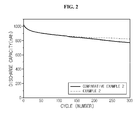
- the battery subjected to the 1st charge cycle was discharged at a constant current of 1C until the battery voltage reaches 3V, and a discharge capacity at the 1st cycle was calculated. Subsequently, charge and discharge was repeated 500 cycles, and as a result, a discharge capacity retention (%), or a ratio of 500th cycle discharge capacity to 1st cycle discharge capacity is shown in the following Table 1. In this instance, high temperature charge and discharge cycle characteristics of example 2 and comparative example 2 are shown in FIG. 2 .
- a thickness change ( ⁇ t) was represented as a relative value to 100% of a thickness increase of comparative example 2, and a discharge capacity retention (%) was calculated by the following equation and its result is shown as below.
- Discharge capacity retention (%) [discharge capacity at 500th cycle]/[discharge capacity at 1st cycle] X 100. Table 1 ⁇ t (%) Discharge capacity retention (%) Example 1 75.3 84 Example 2 63 85 Example 3 66 88 Comparative example 1 100 81 Comparative example 2 98 79 Comparative example 3 55 64 Comparative example 4 70 70
Landscapes
- Chemical & Material Sciences (AREA)
- Electrochemistry (AREA)
- General Chemical & Material Sciences (AREA)
- Chemical Kinetics & Catalysis (AREA)
- Inorganic Chemistry (AREA)
- Engineering & Computer Science (AREA)
- Manufacturing & Machinery (AREA)
- Physics & Mathematics (AREA)
- Condensed Matter Physics & Semiconductors (AREA)
- General Physics & Mathematics (AREA)
- Composite Materials (AREA)
- Materials Engineering (AREA)
- Secondary Cells (AREA)
- Battery Electrode And Active Subsutance (AREA)
Abstract
Description
- The present disclosure relates to a lithium secondary battery that ensures excellent safety and suppresses a swelling phenomenon at high temperature.
- The present application claims priority to Korean Patent Application No.
10-2013-0116487 - Also, the present application claims priority to Korean Patent Application No.
10-2014-0131487 - Recently, there has been growing interest in energy storage technologies. As the application fields of energy storage technologies have been extended to mobile phones, camcorders, lap-top computers and even electric cars, there is an increasing demand for high energy density of batteries being used as a power source of electronic devices. In keeping up with the demand, intensive research and development of lithium secondary batteries considered to be most suitable is being done now.
- Among currently available secondary batteries, lithium secondary batteries developed in the early 1990's include an anode made of a carbon material capable of intercalating/deintercalating lithium ions, a cathode made of lithium-containing oxide, and a non-aqueous electrolyte solution in which a proper amount of lithium salts is dissolved in a mixed organic solvent.
- As lithium secondary batteries are extensively used in a wide range of applications, the use of lithium secondary batteries in a severe environment such as a high or low temperature environment is on the rise.
- However, when a lithium secondary battery is stored at high temperature in a fully charged state, lithium transition metal oxide or composite oxide used as a cathode active material becomes thermally unstable due to demetallization at a cathode.
- Also, an organic solvent currently being widely used as a non-aqueous electrolyte solution includes ethylene carbonate, propylene carbonate, dimethoxyethane, gamma butyrolactone, N,N-dimethylformamide, tetrahydrofuran, or acetonitrile, and generally, during long-term storage at high temperature, these organic solvents may transform a stable structure of a battery due to gas generation caused by oxidation of an electrolyte solution, or in serious instances, may cause an internal short circuit and consequently combustion or explosion of a battery in the event of internal heat generation caused by overcharge or overdischarge.
- To solve these problems, various studies have been made, but no effective solution was proposed so far, and particularly, with the recent increasing demand for high performance lithium secondary batteries, its solution is in an urgent need.
- Therefore, the present disclosure is directed to providing a lithium secondary battery with excellent electrochemical performance, in particular, with high capacity.
- Also, the present disclosure is directed to providing a lithium secondary battery with excellent battery performance while significantly suppressing a battery swelling phenomenon caused by gas generated, particularly, during storage at high temperature.
- To achieve the above object, a lithium secondary battery of the present disclosure includes a cathode, an anode, a separator interposed between the cathode and the anode, and a non-aqueous electrolyte solution, wherein the cathode includes a cathode active material including a mixture of a first cathode active material LixCoO2(0.5<x<1.3) and a second cathode active material LixMyO2(M is Ni1-a-bMnaCob(0.05≤a≤0.4, 0.1≤b≤0.4, 0.4≤1-a-b≤0.7) in which x+y=2 and 0.95≤x≤1.05, and the non-aqueous electrolyte solution includes an ionizable lithium salt and an organic solution, and includes, based on 100 parts by weight of the non-aqueous electrolyte solution, (a) 1 part by weight to 10 parts by weight of a compound containing a vinylene group or vinyl group, and (b) 0.1 parts by weight to 10 parts by weight of a dinitrile-based ether compound represented by the following chemical formula 1:
[Chemical Formula 1] CN-(CH2)n-O-(CH2)m-CN
where n and m are each independently an integer from 1 to 6. - In the present disclosure, the compound containing a vinylene group or vinyl group may include a vinylene carbonate-based compound, an acrylate-based compound containing a vinyl group, a sulfonate-based compound containing a vinyl group, and an ethylene carbonate-based compound containing a vinyl group, singularly or in combination. More specifically, typically, the vinylene carbonate-based compound may be, for example, vinylene carbonate, and the compound containing a vinyl group may be represented by the following chemical formula 2:

- In the present disclosure, the dinitrile-based ether compound may include, but is limited to, for exaxmple, bis(cyanomethyl)ether, bis(cyanoethyl)ether, bis(cyanopropyl)ether, bis(cyanobutyl)ether, bis(cyanopentyl)ether, and bis(cyanohexyl)ether, singularly or in combination.
- In the present disclosure, preferably, a mixing weight ratio of the first cathode active material and the second cathode active material may be first cathode active material : second cathode active material = 1:1 ~ 9:1.
- The lithium secondary battery of the present disclosure may achieve a high capacity using two types of particular cathode active materials.
- The lithium secondary battery of the present disclosure may satisfy the high performance battery requirements by maintaining the general battery performance to a high level, for example, in the way of increasing the conductivity of an electrolyte solution using the above particular additives in the electrolyte solution and enhancing an interfacial resistance and an initial capacity of an assembled battery, and may significantly reduce a battery swelling phenomenon by suppressing gas generation during storage at high temperature, particularly, in the presence of a particular film formed on the electrode surface.
- The accompanying drawing illustrates a preferred embodiment of the present disclosure and together with the foregoing disclosure, serves to provide further understanding of the technical spirit of the present disclosure, and thus, the present disclosure is not construed as being limited to the drawing.
-
FIG. 1 is a graph illustrating measurement of thickness increase during long-term storage at high temperature for secondary batteries manufactured according to examples 1 and 2 and comparative examples 1 and 2. -
FIG. 2 is a graph illustrating measurement of discharge capacity as a function of cycle for secondary batteries manufactured according to example 2 and comparative example 2. - Hereinafter, the present disclosure will be described in detail. Prior to the description, it should be understood that the terms used in the specification and the appended claims should not be construed as limited to general and dictionary meanings, but interpreted based on the meanings and concepts corresponding to technical aspects of the present disclosure on the basis of the principle that the inventor is allowed to define terms appropriately for the best explanation.
- As described in the foregoing, in keeping up with the recent increasing demand for a high performance lithium secondary battery, the present disclosure provides a mixture of a first cathode active material LixCoO2(0.5<x<1.3) and a second cathode active material LixMyO2(M is Ni1-a-bMnaCob(0.05≤a≤0.4, 0.1≤b≤0.4, 0.4≤1-a-b≤0.7), x+y=2, 0.95≤x≤1.05), as a cathode active material for forming a cathode. The two types of cathode active materials according to the present disclosure have a high energy density and contribute to a high capacity. Preferably, such effects are noticeable when mixed at a mixing weight ratio of first cathode active material : second cathode active material = 1:1 ~ 9:1, more preferably, 1:1 ~ 8:2, most preferably, 1:1 ~ 7:3.
- The first cathode active material represented by the above chemical formula LixCoO2 is used in which some of cobalt is not substituted (doped) with other element.
- Also, the second cathode active material represented by the above chemical formula LixMyO2 may ensure high cycle stability, excellent storage stability, and high temperature stability while achieving high capacity due to having a particular composition ratio defined by the above chemical formula.
- A further detailed description of the second cathode active material according to the present disclosure is provided below.
- First, the molar fraction (1-a-b) of the Ni is from 0.4 to 0.7, that is, nickel exists in a larger amount than manganese and cobalt. When the nickel content is less than 0.4, it is difficult to expect a high capacity, and when the nickel content exceeds 0.7, there is a problem with a significant reduction in safety.
- Also, because the cobalt content (b) is from 0.1 to 0.4, when the cobalt content is less than 0.1, it is difficult to achieve sufficient rate characteristics and a high powder density at the same time, and when the cobalt content exceeds 0.4, a reversible capacity reduces to some extent.
- Also, when the lithium content is excessively low (x<0.95), low rate characteristics are displayed and a reversible capacity reduces, and when the content is excessively high (x>1.05), the safety reduces during charge/discharge cycles, particularly, at high temperature and high voltage (for example, temperature: 60°C, voltage: 4.35V).
- Preferably, the second cathode active material has a structure that Ni2+ and Ni3+ coexist in the MO layer and some Ni2+ is inserted into the reversible lithium layer. That is, Ni ions inserted into the reversible lithium layer are preferably Ni2+. Because Ni2+ is very similar in size to lithium ions (Li+), Ni2+ does not transform a crystal structure when inserted into the reversible lithium layer, and serves to inhibit the structure destruction by the repulsion of the MO layer in the event of deintercalation of lithium ions during charge.
- Also, the inserted Ni2+ serves to support the MO layer into which Ni2+ is inserted, and thus, preferably, Ni2+ needs to be inserted with an amount sufficient to at least stably support the MO layer to improve desired charge stability and cycle stability. At the same time, Ni2+ needs to be inserted with such an amount that the inserted Ni2+ does not impede the intercalation and deintercalation of lithium ions in the reversible lithium layer to prevent deteriorate of the rate characteristics. That is, when a molar fraction of Ni2+ inserted into the reversible lithium layer is too high, cation mixing increases and a rock salt structure electrochemically inactive in part is formed, which hinders the charge and discharge and consequently reduces the discharge capacity.
- Taking these into comprehensive consideration, the molar fraction of the Ni2+ inserted and bonded in the reversible lithium layer is preferably from 0.03 to 0.07 based on the total amount of the transition metal in the second cathode active material.
- In this instance, as a ratio (Li/M) of Li to the transition metal (M) reduces, an amount of Ni inserted into the MO layer gradually increases, and when an excessively large amount immigrates to the reversible lithium layer, the movement of Li+ is interrupted during charge and discharge, resulting in a reduced reversible capacity or deteriorated rate characteristics. In contrast, when the ratio of Li/M is too high, an amount of Ni inserted into the MO layer is too low, causing structural unstability, which produces undesirable results such as battery safety reduction and life characteristics deterioration. Further, at an excessively high Li/M value, an amount of unreacted Li2CO3 increases, producing a large amount of impurities, which reduces the chemical resistance and high temperature stability. Thus, in one preferred example, a ratio of Li:M in the LiNiMO2 may be 0.95~1.04:1.
- In the present disclosure, the first cathode active material preferably has a monolithic structure. Thus, the first cathode active material scarcely has an inner porosity, and with the increasing grain size, stability of crystal grains is improved, which may ease the fabrication of a battery including the same and enhance the efficiency in a manufacturing process.
- Also, the second cathode active material preferably has an agglomerated structure, that is, a structure having an inner porosity in the presence of an agglomerated structure of fine grains. The agglomerated grain structure is characterized in extending the reversible capacity of the cathode while achieving high rate characteristics by maximizing the surface area reacting with the electrolyte solution.
- Optionally, the cathode active material of the present disclosure may further include other cathode active material commonly used in the art without departing from the scope of the present disclosure. For example, the cathode active material of the present disclosure may include any one selected from the group consisting of LixNiO2(0.5<x<1.3), LixMnO2(0.5<x<1.3), LixMn2O4(0.5<x<1.3), LixNi1-yCoyO2(0.5<x<1.3, 0<y<1), LixCo1-yMnyO2(0.5<x<1.3, 0≤y<1), LixNi1-yMnyO2(0.5<x<1.3, 0≤y<1), Lix(NiaCobMnc)O4(0.5<x<1.3, 0<a<2, 0<b<2, 0<c<2, a+b+c=2), LixMn2-zNizO4(0.5<x<1.3, 0<z<2), LixMn2-zCozO4(0.5<x<1.3, 0<z<2), LixCoPO4(0.5<x<1.3) and LixFePO4(0.5<x<1.3) or mixtures thereof, and the lithium-containing transition metal oxide may be coated with a metal such as aluminum (Al) or metal oxide. Also, in addition to the lithium-containing transition metal oxide, sulfide, selenide, and halide may be used.
- The cathode active material according to the present disclosure may be, according to a common method in the art, mixed with a conductive material, a binder, and an organic solvent to produce a mixture, which is coated on a current collector, to manufacture a cathode.
- However, in the manufacture of the lithium secondary battery from the two types of cathode active materials according to the present disclosure using the common method, the electrolyte solution may cause a side reaction on the surface of the cathode active material, resulting in a swelling phenomenon of the battery, and this phenomenon gets severer when the battery is kept at high temperature, and does not comply with safety standards of lithium secondary batteries being enforced more strictly now than ever before.
- Accordingly, to solve the problem, , the present disclosure provides a non-aqueous electrolyte solution including an ionizable lithium salt and an organic solvent, in which the non-aqueous electrolyte solution includes (a) 1 part by weight to 10 parts by weight of a compound containing a vinylene group or vinyl group; and (b) 0.1 parts by weight to 10 parts by weight of a dinitrile-based ether compound of a particular structure, based on 100 parts by weight of the non-aqueous electrolyte solution.
- The compound containing a vinylene group or vinyl group used in the present disclosure forms a passivation membrane called a solid electrolyte interphase (SEI) membrane on the anode surface during charge of the battery, which may impede a micro-or macro thermal short occurring in the battery, and consequently prevent or inhibit ignition of the battery caused by heat inside or outside of the battery when compared toan organic solvent being widely in a non-aqueous electrolyte solution, for example, ethylene carbonate.
- However, when the compound containing a vinylene group or vinyl group according to the present disclosure is used in a carbonate electrolyte solution, due to a disadvantage of being very weak thermally and prone to decomposition at high temperature, resulting decomposition gas deforms a pouch-type or can-type battery assembly, causing an internal short circuit, and in serious instances, ignition or explosion of the battery.
- When only the compound containing vinylene group or vinyl group is used as described in the foregoing, it is impossible to ensure safety sufficient to prevent an internal short circuit of the battery, and to solve the problem, the inventors of the present disclosure has further mixed with the above dinitrile-based ether compound of a particular structure without deteriorating the properties of the compound containing a vinylene group or vinyl group. When the dinitrile-based ether compound according to the present disclosure is used together, a complex is formed on the surface of the cathode made from the cathode active material according to the present disclosure, which may suppress an oxidation reaction of the electrolyte solution and the cathode and impede heat generation, as a consequence, prevent an internal short circuit caused by a rapid temperature increase of the battery. Also, during storage at high temperature, there are effects of impeding decomposition of the compound containing a vinylene group or vinyl group and the electrolyte solution and preventing a battery swelling phenomenon. Further, the dinitrile-based ether compound according to the present disclosure has a higher dielectric constant and lower viscosity than a traditional chain carbonate or aliphatic mononitrile compound, and thus, increases the conductivity of the electrolyte solution and improves interfacial resistance and initial capacity of an assembled battery, thereby enhancing the electrochemical performance of the battery.
- Accordingly, as the lithium secondary battery of the present disclosure uses the two types of particular cathode active materials according to the present disclosure and the binary system additive together, the battery has excellent performance in general including high capacity and low interfacial resistance and remarkably enhanced safety, particularly, safety during storage at high temperature.
- In the present disclosure, the dinitrile-based ether compound may be represented by the following chemical formula 1:
[Chemical Formula 1] CN-(CH2)n-O-(CH2)m-CN
where n and m are each independently an integer from 1 to 6. - For example, the dinitrile-based ether compound according to the present disclosure may include, but not limited to, bis(cyanomethyl)ether, bis(cyanoethyl)ether, bis(cyanopropyl)ether, bis(cyanobutyl)ether, bis(cyanopentyl)ether, bis(cyanohexyl)ether, and the like, singularly or in combination.
- Preferably, the content of the dinitrile-based ether compound according to the present disclosure is from 0.1 wt% to 10 wt%, preferably, from 1 wt% to 10 wt%, based on the total weight of the non-aqueous electrolyte solution. When the content is less than 0.1 wt%, a battery swelling phenomenon prevention effect is insufficient, and when the content exceeds 10 wt%, the viscosity of the electrolyte solution increases and the ion conductivity reduces, resulting in deterioration in battery performance.
- For example, the compound containing a vinylene group or vinyl group according to the present disclosure includes a vinylene carbonate-based compound, an acrylate-based compound containing a vinyl group, a sulfonate-based compound containing a vinyl group, an ethylene carbonate-based compound containing a vinyl group, and the like.
- More specifically, the vinylene carbonate-based compound may be, for example, vinylene carbonate (VC), and the compound containing a vinyl group may be a compound represented by the following
chemical formula 2, for example, vinyl ethylene carbonate (VEC):

- Preferably, the content of the cyclic carbonate substituted with halogen represented by the
above chemical formula 1 according to the present disclosure, and the compound containing a vinylene group or vinyl group is from 1 wt% to 10 wt% based on the total weight of the non-aqueous electrolyte solution. When the content is less than 1 wt%, a swelling phenomenon prevention effect at high temperature is insufficient, and when the content exceeds 10 wt%, a high temperature life greatly reduces during charge and discharge cycles at high temperature. - Also, a mixing ratio of the dinitrile-based ether compound represented by the
above chemical formula 1 and the compound containing a vinylene group or vinyl group may be properly employed based on a particular purpose for which the battery is used, and for example, the mixing ratio may include, but not limited to, a weight ratio of the dinitrile-based ether compound: the compound containing a vinylene group or vinyl group= 1 : 0.5 ~ 1:5. When the weight ratio is less than 0.5, a swelling phenomenon prevention effect at high temperature is insufficient, and when the weight ratio exceeds 5, there is a reduction in high rate characteristics caused by a reduction in ion conductivity of the electrolyte solution in the presence of the dinitrile-based ether compound. - Also, in addition to the compound containing a vinylene group or vinyl group, the present disclosure may further include a compound capable of forming a passivation membrane on the anode surface, as needed, without departing from the scope of the present disclosure. Such compound includes, as a non-limiting example, cyclic carbonate substituted with halogen, an S-based compound such as propane sultone, ethylene sulfite, and 1,3-propane sultone, a lactam-based compound such as N-acetyl lactam, and the like.
- The lithium salt included as an electrolyte in the non-aqueous electrolyte solution of the present disclosure includes, without limitation, those generally used in an electrolyte solution for a lithium secondary battery, and for example, an anion of the lithium salt may be any one selected from the group consisting of F-, Cl-, Br-, I-, NO3 -, N(CN)2 -, BF4 -, ClO4 -, PF6 -, (CF3)2PF4 -, (CF3)3PF3 -, (CF3)4PF2-, (CF3)5PF-, (CF3)6P-, CF3SO3 -, CF3CF2SO3 -, (CF3SO2)2N-, (FSO2)2N-, CF3CF2(CF3)2CO-, (CF3SO2)2CH-, (SF5)3C-, (CF3SO2)3C-, CF3(CF2)7SO3 -, CF3CO2 -, CH3CO2 -, SCN-, and (CF3CF2SO2)2N-.
- The organic solvent included in the non-aqueous electrolyte solution of the present disclosure includes, without limitation, those generally used in an electrolyte solution for a lithium secondary battery, and typically, may include, for example, any one selected from the group consisting of propylene carbonate (PC), ethylene carbonate (EC), diethyl carbonate (DEC), dimethyl carbonate (DMC), ethyl methyl carbonate (EMC), methylpropyl carbonate, dipropyl carbonate, dimethylsulfoxide, acetonitrile, dimethoxyethane, diethoxyethane, vinylene carbonate, sulforane, gamma-butyrolactone, propylene sulfite, and tetrahydrofurane, or mixtures thereof. In particular, , cyclic carbonate such as ethylene carbonate and propylene carbonate among the carbonate-based organic solvents is preferred because it corresponds to a high viscosity organic solvent and thus has a high dielectric constant and dissociates the lithium salt from the electrolyte well, and it is more preferred to mix the cyclic carbonate with linear carbonate having low viscosity and low dielectric constant such as dimethyl carbonate and diethyl carbonate at a proper mixing ratio to prepare an electrolyte solution having high electrical conductivity.
- The non-aqueous electrolyte solution for a lithium secondary battery according to the present disclosure is poured into an electrode assembly including a cathode, an anode, and a separator interposed between the cathode and the anode to manufacture a lithium secondary battery. The anode of the electrode assembly may include those generally used to manufacture a lithium secondary battery.
- The anode active material generally includes a carbon material, lithium metal, silicon or tin, which allows intercalation and deintercalation of lithium ions, and may include metal oxide having a potential less than 2V relative to lithium, such as TiO2 and SnO2. The carbon material is preferred, and both low crystallity carbon and high crystallity carbon may be used as the carbon material. The low crystallity carbon typically includes soft carbon and hard carbon, and the high crystallity carbon typically includes high temperature baked carbon such as natural graphite, Kish graphite, pyrolytic carbon, mesophase pitch based carbon fiber, meso-carbon microbeads, mesophase pitches, petroleum or coal tar pitch derived cokes, and the like. In this instance, the anode may include a binder, and the binder may include various types of binder polymers such as vinylidene fluoride-hexafluoropropylene copolymer (PVDF-co-HFP), polyvinylidenefluoride, polyacrylonitrile, polymethylmethacrylate, and the like.
- The lithium secondary battery of the present disclosure is not limited to a particular outer shape, but may include a cylindrical shape using a can, a prismatic shape, a pouch shape or a coin shape.
- Hereinafter, the present disclosure will be described in detail through embodiments. The embodiments of the present disclosure, however, may take several other forms, and the scope of the present disclosure should not be construed as being limited to the following embodiments. The embodiments of the present disclosure are provided to more fully explain the present disclosure to those having ordinary knowledge in the art to which the present disclosure pertains.
- Monolithic LiCoO2 having D50 of about 15 µm~20 µm and LiNi0.53Mn0.27Co0.2O2 having D50 of about 5 µm~8 µm in which fine particles of about 1 µm~2 µm agglomerate together were mixed at a mixing ratio of 7:3, to manufacture a cathode active material.
- The mixed cathode active material was mixed with Super-P as a conductive material and polyvinylidene fluoride as a binder at a weight ratio of 92:4:4, followed by addition of N-methyl pyrrolidone (NMP), to prepare a slurry. The prepared cathode slurry was coated on an aluminum current collector and dried at a vacuum oven of 120°C, to manufacture a cathode.
- 1M LiPF6 solution having a composition of EC: PC: DEC = 3: 2: 5 was used as an electrolyte solution, and 3 wt% of vinylene carbonate (VC), 2 wt% of fluoroethylene carbonate (FEC), and 3 wt% of ethylene glycol bispropionitrile were added to the electrolyte solution.
- After an anode was manufactured using artificial graphite as an anode active material, a polyethylene separator was disposed between the cathode manufactured in example 1-1 and the anode. Subsequently, a lithium polymer battery was manufactured by a general method, the electrolyte solution prepared in example 1-2 was poured into the assembled battery assembled with an aluminum laminate casing.
- Except ethylene glycol bispropionitrile was used with the content of 5 wt%, a lithium polymer battery was manufactured by the same method as example 1.
- Except 2 wt% of vinyl ethylene carbonate (VEC) was used instead of 3 wt% of vinylene carbonate (VC), and ethyleneglycol bispropionitrile was used with the content of 5 wt%, a lithium polymer battery was manufactured by the same method as example 1.
- Except ethyleneglycol bispropionitrile was not added to an electrolyte solution, a lithium polymer battery was manufactured by the same method as example 1.
- Except, instead of ethyleneglycol bispropionitrile, 5 wt% of a dinitrile compound similar thereto, for example, succinonitrile was added to an electrolyte solution, a lithium polymer battery was manufactured by the same method as example 1.
- Except vinylene carbonate (VC) was not added to an electrolyte solution, a lithium polymer battery was manufactured by the same method as example 1.
- Except only LiNi0.53Mn0.27Co0.2O2 was used as a cathode active material and 5 wt% of ethyleneglycol bispropionitrile was added to an electrolyte solution, a lithium polymer battery was manufactured by the same method as example 1.
- While being stored in a 4.2V fully charged state at 90°C for 4 hours, each battery manufactured in examples 1 and 2 and comparative example 1, 2, 3, and 4 was measured for an initial thickness and a thickness change after storage, and their results are shown in the following Table 1 and
FIG. 2 . - Each battery was charged with a constant current of 1C=980 mA in a temperature environment of 45°C, and after the battery voltage reached 4.2V, was charged the 1st cycle at a constant voltage of 4.2V until the charge current value reaches 50 mA. The battery subjected to the 1st charge cycle was discharged at a constant current of 1C until the battery voltage reaches 3V, and a discharge capacity at the 1st cycle was calculated. Subsequently, charge and discharge was repeated 500 cycles, and as a result, a discharge capacity retention (%), or a ratio of 500th cycle discharge capacity to 1st cycle discharge capacity is shown in the following Table 1. In this instance, high temperature charge and discharge cycle characteristics of example 2 and comparative example 2 are shown in
FIG. 2 . - In the following Table 1, a thickness change (Δt) was represented as a relative value to 100% of a thickness increase of comparative example 2, and a discharge capacity retention (%) was calculated by the following equation and its result is shown as below.
- Discharge capacity retention (%) = [discharge capacity at 500th cycle]/[discharge capacity at 1st cycle]
X 100.Table 1 Δt (%) Discharge capacity retention (%) Example 1 75.3 84 Example 2 63 85 Example 3 66 88 Comparative example 1 100 81 Comparative example 2 98 79 Comparative example 3 55 64 Comparative example 4 70 70 - Referring to the above Table 1 and
FIG. 1 , it can be seen that when compared to comparative examples 1 and 2, the battery according to the present disclosure (examples 1, 2, and 3) greatly suppresses an thickness increase (swelling phenomenon) during long-term storage at high temperature. When 3 wt% of ethyleneglycol bispropionitrile was added, high temperature swelling was suppressed about 20% or more, and when 5 wt% of ethyleneglycol bispropionitrile was added, high temperature swelling was suppressed about 35% or more. - Also, according to Table 1, it can be seen that in the case of comparative examples 3 and 4, a swelling phenomenon is not evidently observed, but in terms of the discharge capacity retention, both have a remarkable deterioration in cycle characteristics at high temperature to 70% or less.
- According to
FIG. 2 , it can be seen that when compared to the battery of comparative example 2, the battery of example 2 in which ethylene glycol bispropionitrile was added has excellent cycle characteristics at high temperature.
Claims (8)
- A lithium secondary battery comprising a cathode, an anode, a separator interposed between the cathode and the anode, and a non-aqueous electrolyte solution,
wherein the cathode comprises a cathode active material including a mixture of a first cathode active material LixCoO2(0.5<x<1.3) and a second cathode active material LixMyO2(M is Ni1-a-bMnaCob(0.05≤a≤0.4, 0.1≤b≤0.4, 0.4≤1-a-b≤0.7) in which x+y=2 and 0.95≤x≤1.05, and
the non-aqueous electrolyte solution comprises an ionizable lithium salt and an organic solution, and comprises, based on 100 parts by weight of the non-aqueous electrolyte solution,(a) 1 part by weight to 10 parts by weight of a compound containing a vinylene group or vinyl group; and(b) 0.1 parts by weight to 10 parts by weight of a dinitrile-based ether compound represented by the following chemical formula 1:
[Chemical Formula 1] CN-(CH2)n-O-(CH2)m-CN
where n and m are each independently an integer from 1 to 6. - The lithium secondary battery according to claim 1, wherein the compound containing a vinylene group or vinyl group is any one selected from the group consisting of a vinylene carbonate-based compound, an acrylate-based compound containing a vinyl group, a sulfonate-based compound containing a vinyl group, and an ethylene carbonate-based compound containing a vinyl group, or mixtures thereof.
- The lithium secondary battery according to claim 1, wherein the compound containing a vinyl group is a compound represented by the following chemical formula 2:

- The lithium secondary battery according to claim 1, wherein the dinitrile-based ether compound is any one selected from the group consisting of bis(cyanomethyl)ether, bis(cyanoethyl)ether, bis(cyanopropyl)ether, bis(cyanobutyl)ether, bis(cyanopentyl)ether, and bis(cyanohexyl)ether, or mixtures thereof.
- The lithium secondary battery according to claim 1, wherein a mixing weight ratio of the first cathode active material and the second cathode active material is first cathode active material: second cathode active material = 1:1 ~ 9:1.
- The lithium secondary battery according to claim 1, wherein a mixing weight ratio of the dinitrile-based ether compound and the compound containing a vinylene group or vinyl group is dinitrile-based ether compound : compound containing a vinylene group or vinyl group = 1 : 0.5 ~ 1:5.
- The lithium secondary battery according to claim 1, wherein an anion of the lithium salt is any one selected from the group consisting of F-, Cl-, Br-, I-, NO3 -, N(CN)2 -, BF4 -, ClO4 -, PF6 -, (CF3)2PF4 -, (CF3)3PF3 -, (CF3)4PF2 -, (CF3)5PF-, (CF3)6P-, CF3SO3 -, CF3CF2SO3 -, (CF3SO2)2N-, (FSO2)2N-, CF3CF2(CF3)2CO-, (CF3SO2)2CH-, (SF5)3C-, (CF3SO2)3C-, CF3(CF2)7SO3 -, CF3CO2 -, CH3CO2 -, SCN-, and (CF3CF2SO2)2N-.
- The lithium secondary battery according to claim 1, wherein the organic solvent is any one selected from the group consisting of propylene carbonate, ethylene carbonate, diethyl carbonate, dimethyl carbonate, ethyl methyl carbonate, methylpropyl carbonate, dipropyl carbonate, dimethylsulfoxide, acetonitrile, dimethoxyethane, diethoxyethane, vinylene carbonate, sulforane, gamma-butyrolactone, propylene sulfite, and tetrahydrofurane, or mixtures thereof.
Applications Claiming Priority (2)
| Application Number | Priority Date | Filing Date | Title |
|---|---|---|---|
| KR20130116487 | 2013-09-30 | ||
| PCT/KR2014/009228 WO2015047045A1 (en) | 2013-09-30 | 2014-09-30 | Lithium secondary battery |
Publications (2)
| Publication Number | Publication Date |
|---|---|
| EP2899792A1 true EP2899792A1 (en) | 2015-07-29 |
| EP2899792A4 EP2899792A4 (en) | 2016-05-11 |
Family
ID=53033537
Family Applications (1)
| Application Number | Title | Priority Date | Filing Date |
|---|---|---|---|
| EP14847815.9A Withdrawn EP2899792A4 (en) | 2013-09-30 | 2014-09-30 | Lithium secondary battery |
Country Status (7)
| Country | Link |
|---|---|
| US (1) | US20150249268A1 (en) |
| EP (1) | EP2899792A4 (en) |
| JP (1) | JP6280643B2 (en) |
| KR (1) | KR101630844B1 (en) |
| CN (1) | CN104956536B (en) |
| TW (1) | TWI568058B (en) |
| WO (1) | WO2015047045A1 (en) |
Families Citing this family (8)
| Publication number | Priority date | Publication date | Assignee | Title |
|---|---|---|---|---|
| US10002719B2 (en) * | 2014-04-21 | 2018-06-19 | Lg Chem, Ltd. | Separator having binder layer, and electrochemical device comprising the separator and method of preparing the separator |
| CN105428701B (en) * | 2015-12-21 | 2018-02-09 | 东莞新能源科技有限公司 | A kind of electrolyte and the lithium ion battery including the electrolyte |
| KR102573627B1 (en) | 2017-03-08 | 2023-08-31 | 스미토모 세이카 가부시키가이샤 | Additives for non-aqueous electrolytes, non-aqueous electrolytes and electrical storage devices |
| CN109326823B (en) * | 2017-07-31 | 2020-04-21 | 深圳新宙邦科技股份有限公司 | Lithium-ion battery non-aqueous electrolyte and lithium-ion battery |
| JP7124885B2 (en) * | 2018-11-30 | 2022-08-24 | 株式会社村田製作所 | secondary battery |
| KR102398690B1 (en) * | 2019-01-24 | 2022-05-17 | 주식회사 엘지에너지솔루션 | Lithium secondary battery |
| US11742518B2 (en) | 2019-12-24 | 2023-08-29 | Ningde Amperex Technology Limited | Electrolyte, and electrochemical device and electronic device using the same |
| JP2023044196A (en) * | 2021-09-17 | 2023-03-30 | Tdk株式会社 | Non-aqueous electrolyte and lithium-ion secondary battery |
Family Cites Families (9)
| Publication number | Priority date | Publication date | Assignee | Title |
|---|---|---|---|---|
| JP2000243441A (en) * | 1999-02-19 | 2000-09-08 | Mitsui Chemicals Inc | Nonaqueous electrolytic solution and secondary battery using same |
| JP2000243444A (en) * | 1999-02-19 | 2000-09-08 | Mitsui Chemicals Inc | Nonaqueous electrolytic solution and secondary battery using same |
| JP4867208B2 (en) * | 2005-06-15 | 2012-02-01 | 三菱化学株式会社 | Lithium secondary battery |
| JP5287352B2 (en) * | 2008-02-29 | 2013-09-11 | 株式会社エクォス・リサーチ | Electrolyte for lithium ion battery |
| KR101178554B1 (en) * | 2009-07-09 | 2012-08-30 | 주식회사 엘지화학 | Non-aqueous electrolyte solution for lithium secondary battery and lithium secondary battery comprising the same |
| KR101590086B1 (en) * | 2010-01-27 | 2016-02-01 | 주식회사 엘지화학 | Lithium secondary battery |
| WO2012021029A2 (en) * | 2010-08-13 | 2012-02-16 | 주식회사 엘지화학 | Non-aqueous electrolyte solution for a lithium secondary battery, and lithium secondary battery comprising same |
| JP2013118068A (en) * | 2011-12-02 | 2013-06-13 | Hitachi Maxell Ltd | Lithium secondary battery |
| KR101496511B1 (en) * | 2012-02-08 | 2015-02-27 | 주식회사 엘지화학 | Lithium secondary battery |
-
2014
- 2014-09-30 WO PCT/KR2014/009228 patent/WO2015047045A1/en not_active Ceased
- 2014-09-30 KR KR1020140131487A patent/KR101630844B1/en active Active
- 2014-09-30 CN CN201480002974.1A patent/CN104956536B/en active Active
- 2014-09-30 EP EP14847815.9A patent/EP2899792A4/en not_active Withdrawn
- 2014-09-30 TW TW103134157A patent/TWI568058B/en active
- 2014-09-30 US US14/436,561 patent/US20150249268A1/en not_active Abandoned
- 2014-09-30 JP JP2016523678A patent/JP6280643B2/en active Active
Also Published As
| Publication number | Publication date |
|---|---|
| JP6280643B2 (en) | 2018-02-14 |
| WO2015047045A1 (en) | 2015-04-02 |
| US20150249268A1 (en) | 2015-09-03 |
| TW201535831A (en) | 2015-09-16 |
| KR20150037667A (en) | 2015-04-08 |
| TWI568058B (en) | 2017-01-21 |
| KR101630844B1 (en) | 2016-06-15 |
| JP2016526772A (en) | 2016-09-05 |
| EP2899792A4 (en) | 2016-05-11 |
| CN104956536B (en) | 2017-12-29 |
| CN104956536A (en) | 2015-09-30 |
Similar Documents
| Publication | Publication Date | Title |
|---|---|---|
| US9728805B2 (en) | Nonaqueous electrolyte and lithium secondary battery using the same | |
| EP2206189B1 (en) | Non-aqueous electrolyte lithium secondary battery | |
| US8455143B2 (en) | Non-aqueous electrolyte solution for lithium ion secondary battery and lithium ion secondary battery having the same | |
| EP2424029B1 (en) | Non-aqueous electrolyte for rechargeable lithium batteries and a rechargeable lithium battery comprising the same | |
| KR101511733B1 (en) | Non-aqueous electrolyte solution for lithium secondary battery and lithium secondary battery comprising the same | |
| EP2605324B1 (en) | Non-aqueous electrolyte solution for a lithium secondary battery, and lithium secondary battery comprising same | |
| EP2899792A1 (en) | Lithium secondary battery | |
| KR101437073B1 (en) | Non-aqueous electrolyte solution for lithium secondary battery and lithium secondary battery comprising the same | |
| EP2600460A2 (en) | Nonaqueous electrolyte solution for lithium secondary battery, and lithium secondary battery containing same | |
| KR101538485B1 (en) | Non-aqueous electrolyte solution for lithium secondary battery and lithium secondary battery comprising the same | |
| US8956769B2 (en) | Non-aqueous electrolyte solution for lithium secondary battery and lithium secondary battery including the same | |
| EP3076474B1 (en) | Nonaqueus electrolyte lithium secondary battery | |
| KR101195930B1 (en) | Non-aqueous electrolyte solution for lithium secondary battery and lithium secondary battery comprising the same | |
| KR101279411B1 (en) | Non-aqueous electrolyte solution for lithium secondary battery and lithium secondary battery comprising the same | |
| KR20130135172A (en) | Lithium secondary battery | |
| KR20130009706A (en) | Nonaqueous electrolyte and lithium secondary battery using the same | |
| KR101565533B1 (en) | Non-aqueous electrolyte solution for lithium secondary battery and lithium secondary battery comprising the same | |
| KR101651143B1 (en) | Lithium secondary battery having improved cycle life | |
| KR101614068B1 (en) | Non-aqueous electrolyte solution for lithium secondary battery and lithium secondary battery comprising the same | |
| KR101520146B1 (en) | Lithium secondary battery | |
| KR101656549B1 (en) | Electrolyte solution for lithium secondary battery and lithium secondary battery comprising the same | |
| KR101185535B1 (en) | Lithium secondary battery | |
| KR101236864B1 (en) | Lithium ion secondary battery | |
| KR20150050057A (en) | Non-aqueous electrolyte solution for lithium secondary battery and lithium secondary battery comprising the same | |
| KR20220058014A (en) | Electrolyte for lithium secondary battery and lithium secondary battery comprising the same |
Legal Events
| Date | Code | Title | Description |
|---|---|---|---|
| PUAI | Public reference made under article 153(3) epc to a published international application that has entered the european phase |
Free format text: ORIGINAL CODE: 0009012 |
|
| 17P | Request for examination filed |
Effective date: 20150422 |
|
| AK | Designated contracting states |
Kind code of ref document: A1 Designated state(s): AL AT BE BG CH CY CZ DE DK EE ES FI FR GB GR HR HU IE IS IT LI LT LU LV MC MK MT NL NO PL PT RO RS SE SI SK SM TR |
|
| AX | Request for extension of the european patent |
Extension state: BA ME |
|
| RA4 | Supplementary search report drawn up and despatched (corrected) |
Effective date: 20160413 |
|
| RIC1 | Information provided on ipc code assigned before grant |
Ipc: H01M 4/131 20100101ALI20160407BHEP Ipc: H01M 4/525 20100101ALI20160407BHEP Ipc: H01M 4/02 20060101ALN20160407BHEP Ipc: H01M 10/0568 20100101ALI20160407BHEP Ipc: H01M 10/052 20100101AFI20160407BHEP Ipc: H01M 10/0569 20100101ALI20160407BHEP Ipc: H01M 10/0567 20100101ALI20160407BHEP Ipc: H01M 4/36 20060101ALI20160407BHEP Ipc: H01M 4/505 20100101ALI20160407BHEP |
|
| DAX | Request for extension of the european patent (deleted) | ||
| 17Q | First examination report despatched |
Effective date: 20170203 |
|
| STAA | Information on the status of an ep patent application or granted ep patent |
Free format text: STATUS: THE APPLICATION IS DEEMED TO BE WITHDRAWN |
|
| 18D | Application deemed to be withdrawn |
Effective date: 20170614 |