EP2899785A1 - Electrode catalyst for fuel cell, method of preparing the same, electrode for fuel cell including the electrolyte catalyst, and fuel cell including the electrode - Google Patents
Electrode catalyst for fuel cell, method of preparing the same, electrode for fuel cell including the electrolyte catalyst, and fuel cell including the electrode Download PDFInfo
- Publication number
- EP2899785A1 EP2899785A1 EP14197142.4A EP14197142A EP2899785A1 EP 2899785 A1 EP2899785 A1 EP 2899785A1 EP 14197142 A EP14197142 A EP 14197142A EP 2899785 A1 EP2899785 A1 EP 2899785A1
- Authority
- EP
- European Patent Office
- Prior art keywords
- fuel cell
- amino group
- electrode
- electrode catalyst
- compound
- Prior art date
- Legal status (The legal status is an assumption and is not a legal conclusion. Google has not performed a legal analysis and makes no representation as to the accuracy of the status listed.)
- Withdrawn
Links
Images




Classifications
-
- H—ELECTRICITY
- H01—ELECTRIC ELEMENTS
- H01M—PROCESSES OR MEANS, e.g. BATTERIES, FOR THE DIRECT CONVERSION OF CHEMICAL ENERGY INTO ELECTRICAL ENERGY
- H01M4/00—Electrodes
- H01M4/86—Inert electrodes with catalytic activity, e.g. for fuel cells
- H01M4/90—Selection of catalytic material
- H01M4/92—Metals of platinum group
- H01M4/925—Metals of platinum group supported on carriers, e.g. powder carriers
- H01M4/926—Metals of platinum group supported on carriers, e.g. powder carriers on carbon or graphite
-
- H—ELECTRICITY
- H01—ELECTRIC ELEMENTS
- H01M—PROCESSES OR MEANS, e.g. BATTERIES, FOR THE DIRECT CONVERSION OF CHEMICAL ENERGY INTO ELECTRICAL ENERGY
- H01M4/00—Electrodes
- H01M4/86—Inert electrodes with catalytic activity, e.g. for fuel cells
- H01M4/90—Selection of catalytic material
- H01M4/9041—Metals or alloys
-
- B—PERFORMING OPERATIONS; TRANSPORTING
- B01—PHYSICAL OR CHEMICAL PROCESSES OR APPARATUS IN GENERAL
- B01J—CHEMICAL OR PHYSICAL PROCESSES, e.g. CATALYSIS OR COLLOID CHEMISTRY; THEIR RELEVANT APPARATUS
- B01J31/00—Catalysts comprising hydrides, coordination complexes or organic compounds
- B01J31/26—Catalysts comprising hydrides, coordination complexes or organic compounds containing in addition, inorganic metal compounds not provided for in groups B01J31/02 - B01J31/24
- B01J31/28—Catalysts comprising hydrides, coordination complexes or organic compounds containing in addition, inorganic metal compounds not provided for in groups B01J31/02 - B01J31/24 of the platinum group metals, iron group metals or copper
-
- H—ELECTRICITY
- H01—ELECTRIC ELEMENTS
- H01M—PROCESSES OR MEANS, e.g. BATTERIES, FOR THE DIRECT CONVERSION OF CHEMICAL ENERGY INTO ELECTRICAL ENERGY
- H01M4/00—Electrodes
- H01M4/86—Inert electrodes with catalytic activity, e.g. for fuel cells
- H01M4/90—Selection of catalytic material
- H01M4/9075—Catalytic material supported on carriers, e.g. powder carriers
- H01M4/9083—Catalytic material supported on carriers, e.g. powder carriers on carbon or graphite
-
- H—ELECTRICITY
- H01—ELECTRIC ELEMENTS
- H01M—PROCESSES OR MEANS, e.g. BATTERIES, FOR THE DIRECT CONVERSION OF CHEMICAL ENERGY INTO ELECTRICAL ENERGY
- H01M8/00—Fuel cells; Manufacture thereof
- H01M8/10—Fuel cells with solid electrolytes
- H01M2008/1095—Fuel cells with polymeric electrolytes
-
- H—ELECTRICITY
- H01—ELECTRIC ELEMENTS
- H01M—PROCESSES OR MEANS, e.g. BATTERIES, FOR THE DIRECT CONVERSION OF CHEMICAL ENERGY INTO ELECTRICAL ENERGY
- H01M8/00—Fuel cells; Manufacture thereof
- H01M8/10—Fuel cells with solid electrolytes
- H01M8/1009—Fuel cells with solid electrolytes with one of the reactants being liquid, solid or liquid-charged
- H01M8/1011—Direct alcohol fuel cells [DAFC], e.g. direct methanol fuel cells [DMFC]
-
- Y—GENERAL TAGGING OF NEW TECHNOLOGICAL DEVELOPMENTS; GENERAL TAGGING OF CROSS-SECTIONAL TECHNOLOGIES SPANNING OVER SEVERAL SECTIONS OF THE IPC; TECHNICAL SUBJECTS COVERED BY FORMER USPC CROSS-REFERENCE ART COLLECTIONS [XRACs] AND DIGESTS
- Y02—TECHNOLOGIES OR APPLICATIONS FOR MITIGATION OR ADAPTATION AGAINST CLIMATE CHANGE
- Y02E—REDUCTION OF GREENHOUSE GAS [GHG] EMISSIONS, RELATED TO ENERGY GENERATION, TRANSMISSION OR DISTRIBUTION
- Y02E60/00—Enabling technologies; Technologies with a potential or indirect contribution to GHG emissions mitigation
- Y02E60/30—Hydrogen technology
- Y02E60/50—Fuel cells
Definitions
- the described technology relates to an electrode catalyst for a fuel cell, a method of manufacturing the electrode catalyst for a fuel cell, an electrode for a fuel cell containing the electrode catalyst and a fuel cell including the electrode catalyst.
- a fuel cell may be categorized as a polymer electrolyte membrane fuel cell (PEMFC), a direct methanol fuel cell (DMFC), a phosphoric acid fuel cell (PAFC), a molten carbonate fuel cell (MCFC), a solid oxide fuel cell (SOFC), and the like.
- PEMFC polymer electrolyte membrane fuel cell
- DMFC direct methanol fuel cell
- PAFC phosphoric acid fuel cell
- MCFC molten carbonate fuel cell
- SOFC solid oxide fuel cell
- the PEMFC and the DMFC conventionally include a membrane-electrode assembly (MEA) including an anode, a cathode, and a polymer electrolyte membrane disposed between the anode and the cathode.
- MEA membrane-electrode assembly
- the anode of the fuel cell includes a catalyst layer for oxidizing a fuel and the cathode includes a catalyst layer for reducing an oxidizing agent.
- the electrochemical surface area (ECSA) of a metal catalyst may be reduced due to corrosion and agglomeration of carbonaceous carriers that occur during the operation of a fuel cell. Due to this corrosion and agglomeration the use of an electrode catalyst that includes a metal catalyst may reduce the activity and the durability of the electrode catalyst. Thus, improvements are needed.
- an amino electrode catalyst for a fuel cell including a carbonaceous carrier and a metal catalyst supported in the carbonaceous carrier, wherein the carbonaceous carrier is non-covalently bonded to a C 6 -C 30 polycyclic aromatic hydrocarbon compound having an amino group at an end thereof, on the surface of the carbonaceous carrier.
- an electrode for a fuel cell including the electrode catalyst.
- a fuel cell including a cathode, an anode that is disposed opposite to the cathode, and an electrolyte membrane disposed between the cathode and the anode, wherein at least one of the cathode and the anode includes the electrode catalyst.
- Electrode catalyst for a fuel cell results in a fuel cell having improved durability and activity.
- an electrode catalyst for a fuel cell according to an embodiment, an electrode for a fuel cell including the electrode catalyst, a method of manufacturing the electrode, and a fuel cell including the electrode containing the electrode catalyst will be described in detail.
- the electrode catalyst for a fuel cell includes a carbonaceous carrier and a metal catalyst loaded on the carbonaceous carrier, further wherein the carbonaceous carrier is non-covalently bonded to a C 6 -C 30 polycyclic aromatic hydrocarbon compound having an amino group at an end thereof, on the surface of the carbonaceous carrier.
- the polycyclic aromatic hydrocarbon compound may be a C 8 -C 30 , C 8 -C 28 , C 10 -C 28 , C 10 -C 26 , C 10 -C 24 , or C 10 -C 22 ( e.g. C 10 -C 14 , C 14 -C 18 , or C 18 -C 22 such as C 10 , C 14 , C 18 or C 22 ) polycyclic aromatic hydrocarbon compound.
- a non-covalent bond refers to a ⁇ - ⁇ interaction between one or more phenyl rings of the C 6 -C 30 polycyclic aromatic hydrocarbon compound having an amino group at an end thereof and carbon of the carbonaceous carrier. Due to the non-covalent bond, the amino group of the C 6 -C 30 polycyclic aromatic hydrocarbon compound having an amino group at an end thereof is located far away from the carbonaceous carrier.
- the amino group may be of the formula -L-N(R 1 )(R 2 ), wherein R 1 and R 2 may be each independently a hydrogen, a C 1 -C 10 alkyl group or a C 6 -C 10 aryl group, and L may simply represent a chemical bond or a C 1 -C 10 alkylene group (such as a C 2 -C 10 alkylene group, a C 2 -C 9 alkylene group, a C 2 -C 8 alkylene group, a C 2 -C 7 alkylene group, a C 2 -C 6 alkylene group, a C 2 -C 5 alkylene group, or a C 2 -C 4 alkylene group) or a C 6 -C 10 arylene group.
- R 1 and R 2 may be each independently a hydrogen, a C 1 -C 10 alkyl group or a C 6 -C 10 aryl group
- L may simply represent a chemical bond or a C 1 -C 10
- the amino group may be -NH 2 , -NH(CH 3 ), or -(CH 2 ) n -NH 2 (wherein n is an integer from 1 to 10, e.g. from 2 to 10, from 2 to 9, from 2 to 8, from 2 to 7, from 2 to 6, from 2 to 5 or from 2 to 4).
- the C 6 -C 30 polycyclic aromatic hydrocarbon compound having an amino group at an end thereof is at least one selected from a naphthalene compound having an amino group at an end thereof, a phenanthrene compound having an amino group at an end thereof, a pyrene compound having an amino group at an end thereof, an anthracene compound having an amino group at an end thereof, a tetracene compound having an amino group at an end thereof, a pentacene compound having an amino group at an end thereof and a triphenylene compound having an amino group at an end thereof
- the C 6 -C 30 polycyclic aromatic hydrocarbon compound having an amino group at an end thereof may be, in greater detail, a compound represented by Formula 1 below; a compound represented by Formula 2 below; an anthracene compound including at least one amino group selected from -NH 2 and -(CH 2 ) n NH 2 (wherein n is an integer from 1 to 10 e.g. from 2 to 10, from 2 to 9, from 2 to 8, from 2 to 7, from 2 to 6, from 2 to 5 or from 2 to 4); a phenanthrene compound including at least one amino group selected from -NH 2 and-(CH 2 ) n NH 2 (wherein n is an integer from 1 to 10 e.g.
- n is an integer from 1 to 10 e.g. from 2 to 10, from 2 to 9, from 2 to 8, from 2 to 7, from 2 to 6, from 2 to 5 or from 2 to 4); a pentacene compound including at least one selected from
- n is an integer from 1 to 10 e.g. from 2 to 10, from 2 to 9, from 2 to 8, from 2 to 7, from 2 to 6, from 2 to 5 or from 2 to 4
- a triphenylene compound including at least one amino group selected from -NH 2 and -(CH 2 ) n NH 2 (wherein n is an integer from 1 to 10 e.g. from 2 to 10, from 2 to 9, from 2 to 8, from 2 to 7, from 2 to 6, from 2 to 5 or from 2 to 4).
- n is an integer from 1 to 10 e.g. from 2 to 10, from 2 to 9, from 2 to 8, from 2 to 7, from 2 to 6, from 2 to 5 or from 2 to 4.
- the amount of the C 6 -C 30 polycyclic aromatic hydrocarbon compound having an amino group at an end thereof used in the electrode catalyst is about 0.1 parts by weight to about 50 parts by weight, based on 100 parts by weight of the carbonaceous carrier. In other embodiments, the amount of the C 6 -C 30 polycyclic aromatic hydrocarbon compound having an amino group at an end thereof used in the electrode catalyst may be about 1 part by weight to about 50 parts by weight, 5 parts by weight to about 50 parts by weight, or about 10 parts by weight to about 50 parts by weight based on 100 parts by weight of the carbonaceous carrier.
- the amount of the carbonaceous carrier that is non-covalently bonded to the C 6 -C 30 polycyclic aromatic hydrocarbon compound having an amino group at an end thereof on the surface of the carbonaceous carrier may be about 20 parts by weight to about 80 parts by weight based on 100 parts by weight of the electrode catalyst (weight of the metal catalyst + weight of the carbonaceous carrier + weight of the C 6 -C 30 polycyclic aromatic hydrocarbon compound having an amino group at an end thereof).
- the amount of the carbonaceous carrier that is non-covalently bonded to the C 6 -C 30 polycyclic aromatic hydrocarbon compound having an amino group at an end thereof on the surface of the carbonaceous carrier may be about 30 parts by weight to about 80 parts by weight, 40 parts by weight to about 80 parts by weight, 50 parts by weight to about 80 parts by weight based on 100 parts by weight of the electrode catalyst
- the durability and activity of the electrode catalyst containing them are excellent.
- FIG. 1 illustrates an interaction between a carbonaceous carrier and a C 6 -C 30 polycyclic aromatic compound having an amino group at an end thereof, wherein the compound is non-covalently bonded to a surface of the carbonaceous carrier in an electrode catalyst according to an embodiment.
- the C 6 -C 30 polycyclic aromatic hydrocarbon compounds having an amino group at an end thereof are non-covalently bonded to the carbonaceous carrier and thus, do not alter or deteriorate the structure and properties of the carbonaceous carrier. Accordingly, the metal catalyst may be uniformly dispersed on the carbonaceous carrier without agglomeration of the metal catalyst thus maintaining the stability of the electrode catalyst. As such, problems caused by the deterioration of the catalyst due to the agglomeration of the metal catalyst and electrochemical carbon corrosion, which occur during the operation of the fuel cell, may be prevented.
- the electrode catalyst may be non-covalently functionalized without the deterioration of the properties of the carbonaceous carrier and thus control the surface properties of the electrode catalyst; improving durability and electrochemical activities of the electrode catalyst.
- the fact that the properties of the carbonaceous carrier do not change after the amino polycyclic aromatic hydrocarbon compounds non-covalently bind to the carbonaceous carrier may be observed through Raman and x-ray diffraction (XRD) analyses.
- the carbonaceous carrier is a material formed of highly crystalline carbon such as carbon black (e.g . Ketjen black), heat-treated carbon black, heat-treated acetylene black, activated carbon, graphite, highly pure graphite, carbon nanofibers, carbon fibers, carbon nanotubes, carbon nanowires, carbon nanocages, carbon nanohorns, carbon aerogel, carbon nanorings, mesoporous carbon, ordered mesoporous carbon, graphene, or a combination thereof, but the carbonaceous carrier is not limited thereto and the carbonaceous carrier may be used alone or as a mixture of two or more thereof.
- the carbonaceous carrier may include ordered mesoporous carbon having mesopores. An average diameter of mesopores in such material may be about 6 nm to about 10 nm.
- the ordered mesoporous carbon may be prepared by using a mesoporous silica template (for example, MSU-H or the like).
- the ordered mesoporous carbon has a wide specific surface area and thus, when the ordered mesoporous carbon is used as the carbonaceous carrier, the weight of the metal supported catalyst may be greater than the weight of the carbonaceous carrier.
- an average particle diameter of the metal catalyst may be about 1 nm to about 20 nm, for example, about 1 nm to about 15 nm, about 2 nm to about 12 nm, or about 3 nm to about 10 nm.
- excellent oxygen reduction activity and electrochemical specific surface area may be maintained.
- the activity of the catalyst including the metal catalyst is excellent.
- the amount of the metal catalyst may be about 20 parts by weight to about 80 parts by weight, for example, about 30 parts by weight to about 60 parts by weight, about 30 parts by weight to about 50 parts by weight or about 40 parts by weight to about 50 parts by weight ( e.g . about 45 parts by weight), based on 100 parts by weight of the total weight of the electrode catalyst (weight of the metal catalyst + weight of the carbonaceous carrier).
- the catalyst when the amount of the metal catalyst is in the range described above, the catalyst may have excellent specific surface area and a large amount of metal supported therein and thus, the activity of the catalyst is excellent.
- the metal catalyst may be at least one selected from the group consisting of platinum (Pt), iron (Fe), cobalt (Co), nickel (Ni), ruthenium (Ru), rhodium (Rh), palladium (Pd), osmium (Os), iridium (Ir), copper (Cu), silver (Ag), gold (Au), strontium (Sn), titanium
- the metal catalyst may be Pt or a Pt-Co alloy.
- the electrode catalyst according to an embodiment of the present disclosure may include Pt and a carbonaceous carrier including a crystalline carbon.
- the electrode catalyst may be useful for manufacturing an electrode for a fuel cell of a vehicle.
- the electrode catalyst has a very large specific surface area, on which various gases and/or liquids, which are subject to electrochemical reactions, may contact.
- the electrochemical specific surface area of the electrode catalyst may be 70 m 2 /g or greater, for example, in a range of about 70 m 2 /g to about 100 m 2 /g, but the electrochemical specific surface area is not limited thereto.
- the ratio of the maximum peak intensity of a D band (I D ) at about 1340cm -1 to about 1360cm -1 to a maximum peak intensity of a G band (I G ) at about 1575 cm -1 to about 1600 cm -1 in spectra obtained by Raman spectrometry using a laser having a wavelength of about 514.5 nm may be about 0.1 to about 1.5, for example, about 0.3 to about 1.0, about 0.4 to about 1.0, about 0.5 to about 1.0, about 0.6 to about 1.0, about 0.7 to about 1.0, or about 0.7 to about 0.9.
- a peak with respect to a (002) surface is observed at a Bragg 2 ⁇ angle of 26.4 ⁇ 0.1°, and a half-width of the peak with respect to the (002) surface may be about 0.2° to about 0.7°.
- the carbonaceous carrier has I D /I G or the half-width of the peak with respect to the (002) surface in the ranges described above, the surface structure and electrochemical properties of the carbon do not change.
- a C 6 -C 30 aromatic hydrocarbon compound having an amino group at an end thereof e.g. a C 6 -C 30 aromatic hydrocarbon compound substituted with an amino group or an amino C 6 -C 30 polycyclic aromatic hydrocarbon compound
- a carbonaceous carrier is added thereto to obtain a carbonaceous carrier mixture.
- the solvent at least one selected from the group consisting of methanol, ethanol, water, N,N-dimethyl sulfoxide, and N,N-dimethyl formamide may be used.
- a mixture of water and ethanol is used as the solvent.
- the ratio of the volume of water to the volume of ethanol is about 95:5.
- the crystallinity of carbon of the carbonaceous carrier may be increased to form a stable graphite layer through a heat treatment process.
- the heat treatment process may be performed at a temperature of about 1500°C to about 3000°C (such as about 1500°C to about 2500°C, about 1500°C to about 2500°C or about 2000°C to about 3000°C) in an inert gas atmosphere.
- the heat treatment process may be performed according to different heat treatment temperatures, for example, in multiple stages.
- a carbon having high crystallinity may be obtained.
- the heat treatment of the carbonaceous carrier may be performed according to four stages as described below:
- the heat treatment of the carbonaceous carrier may be performed according to six stages as described below:
- the carbonaceous carrier may be thermally treated at different stages and passed through a stabilization-carbonization-graphitization-high crystallization process to obtain a carbonaceous carrier having a stable and highly crystalline structure.
- a carbonaceous carrier including the highly crystalline carbon obtained through the heat treatment process When a carbonaceous carrier including the highly crystalline carbon obtained through the heat treatment process is used, a ⁇ - ⁇ interaction between one or more phenyl rings of a C 6 -C 30 polycyclic aromatic hydrocarbon compound having an amino group at an end thereof and carbon of a water repellent carbonaceous carrier increases the hydrophilicity of the carbonaceous carrier, and the non-shared electron pair of the nitrogen of the amino group of the C 6 -C 30 polycyclic aromatic hydrocarbon compound having an amino group at an end thereof also increases the hydrophilicity of the carbonaceous carrier, such that loading the electrode catalyst with a metal catalyst (such as platinum) may be improved.
- a metal catalyst such as platinum
- the carbonaceous carrier has a ratio of the maximum peak intensity of a D band at about 1340cm -1 to about 1360cm -1 to a maximum peak intensity of a G band at about 1575cm -1 to about 1600 cm -1 (I D /I G ), in the spectra obtained by Raman spectrometry using a laser having a wavelength of about 514.5 nm, of the carbonaceous carrier may be about 0.1 to about 1.5, for example, about 0.3 to about 1.0 about 0.4 to about 1.0, about 0.5 to about 1.0, about 0.6 to about 1.0, about 0.7 to about 1.0, or about 0.7 to about 0.9.
- a carbonaceous carrier having a specific surface area of about 50 m 2 /g to about 800 m 2 /g, and an electrode catalyst having improved durability may be manufactured by preventing carbon corrosion.
- any method that is generally used in the art may be used.
- the electrode catalyst may be applied to a fuel cell for a mobile and a family use, such as a fuel cell used for notebook computers, portable devices, vehicles, and buses.
- a polymer electrolyte membrane fuel cell PEMFC
- PAFC phosphoric acid fuel cell
- DMFC direct methanol fuel cell
- an electrode for a fuel cell including the electrode catalyst.
- a fuel cell includes a cathode, an anode, and an electrolyte membrane disposed between the cathode and the anode, wherein at least one of the cathode and the anode includes the electrode catalyst.
- the cathode includes the electrode catalyst.
- the anode includes the electrode catalyst.
- the activity of the electrode catalyst is maintained in the fuel cell while using the fuel cell even during long periods of driving or when driving under high temperature conditions, by using the catalyst carrier (i.e. carbonaceous carrier is non-covalently bonded to a C 6 -C 30 polycyclic aromatic hydrocarbon compound having an amino group at an end thereof) or the electrode catalyst.
- the catalyst carrier i.e. carbonaceous carrier is non-covalently bonded to a C 6 -C 30 polycyclic aromatic hydrocarbon compound having an amino group at an end thereof
- the fuel cell may, for example, be a PEMFC or a DMFC cell.
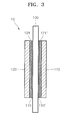
- FIG. 2 is an exploded perspective view showing an embodiment of a fuel cell and FIG. 3 is a schematic view of a cross-section of a membrane electrode assembly (MEA) in a fuel cell of FIG. 2 .
- MEA membrane electrode assembly
- a fuel cell 1 shown in FIG. 2 schematically includes two unit cells 11 and 11' disposed between a pair of holders 12 and 12'.
- the unit cells 11 and 11' include a membrane-electrode assembly (MEA) 10 and bipolar plates 20 and 20', each of which is disposed on each side of the MEA 10 in a width direction.
- the bipolar plates 20 and 20' are formed of a metal having conductivity, carbon, or the like, and each of the bipolar plates 20 and 20' binds to the MEA 10 to function as a current collector while supplying oxygen and fuel to a catalyst layer of the MEA 10.
- the fuel cell 1 shown in FIG. 2 has two unit cells 11 and 11'; however, the number of the unit cells is not limited to two and may be increased to dozens or a few hundred depending on the properties required by the fuel cell.
- the MEA 10, as shown in FIG. 3 may include an electrolyte membrane 100 and catalyst layers 110 and 110' may be disposed on each side of the electrolyte membrane 100 in a width direction, and the MEA 10 may include, the catalyst layers 110 and 110' including an electrode catalyst according to an embodiment of the present invention, first gas diffusion layers 121 and 121', which are respectively disposed on the catalyst layers 110 and 110', and second gas diffusion layers 120 and 120', which are respectively disposed on the first gas diffusion layers 121 and 121'.
- the catalyst layers 110 and 110' function as a fuel electrode and an oxygen electrode, and each of the catalyst layers 110 and 110' include an electrode catalyst and a binder and may further include a material that may increase the electrochemical surface area of the electrode catalyst.
- the catalyst layer includes an electrode catalyst according to an embodiment of the present invention.
- the first gas diffusion layers 121 and 121' and the second gas diffusion layers 120 and 120' may each be formed of a carbon sheet, a carbon paper, or the like, and diffuse oxygen and fuel supplied through the bipolar plates 20 and 20' to the entire surface of the catalyst layers 110 and 110'.
- the fuel cell 1 including the MEA 10 operates at a temperature of about 100°C to about 300°C.
- Fuel such as hydrogen is supplied to one of two catalyst layers through a bipolar plate 20, 20', and an oxidizing agent such as oxygen is supplied to the other catalyst layer through another bipolar plate 20, 20'.
- hydrogen ions (H + ) are generated due to the oxidation of hydrogen, and the hydrogen ions (H + ) are conducted through the electrolyte membrane to reach the other catalyst layer.
- the hydrogen ions (H + ) and oxygen electrochemically react together to generate water (H 2 O) as well as electrical energy.
- hydrogen supplied as a fuel may be hydrogen generated through reformation of hydrocarbon or alcohol, and oxygen supplied as the oxidizing agent may be supplied as included in the air atmosphere.
- Example 1 Manufacturing an electrode catalyst and an electrode
- Ketjen black (product name: ECP 300J, manufactured by: Mitsubishi Chemical, Tokyo, Japan) was heat treated in an inert gas atmosphere according to the stages described below.
- Pt-loaded catalyst 0.03 g of Pt-loaded catalyst (amount of Pt: 44.8 wt%), 500 ml of Nafion (DuPont, Wilmington, Delaware) solution (a solution prepared by diluting a mixture solution of 5 wt% of Nafion, 45 wt% of 1-propanol, and 50 wt% of 3-propanol by 10 times with distilled water) at a concentration of 0.5 wt%, and 4500 ml of isopropyl alcohol were mixed to prepare an electrode catalyst composition. The mixture was sonicated for 20 minutes and then subjected to a conventional stirring process for 1 minute.
- Nafion DuPont, Wilmington, Delaware
- Example 2 Preparing an electrode catalyst and an electrode
- An electrode catalyst and an electrode were prepared in the same manner as in Example 1, except that the amount of the compound represented by Formula 1 was changed to 0.4 g. This procedure yielded an amount of the compound represented by Formula 1 was about 20 parts by weight based on 100 parts by weight of Ketjen black.
- Example 3 Preparing an electrode catalyst and an electrode
- An electrode catalyst and an electrode were prepared in the same manner as in Example 1, except that the amount of the compound represented by Formula 1 was changed to 1.0 g.
- the amount of the compound represented by Formula 1 was about 50 parts by weight based on 100 parts by weight of Ketjen black.
- Comparative Example 1 Preparing an electrode catalyst and an electrode
- Example 2 The same processes as in Example 1 were performed, except that a product obtained from heat-treating Ketjen black (ECP 300J, manufactured by: Mitsubishi Chemical) at a temperature of 2250°C for 1 hour was used as a carbonaceous carrier.
- ECP 300J heat-treating Ketjen black
- Example 2 The same processes as in Example 1 were performed, except that a compound represented by Formula 3 was used instead of the compound represented by Formula 1.
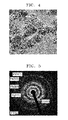
- the electrode catalyst i.e. the Pt-loaded catalyst prepared according to Example 1 was analyzed through high-resolution transmission electron microscopy (HRTEM)/selected area electron diffraction (SAED) and the results obtained therefrom are shown in FIGS. 4 to 6 .
- HRTEM transmission electron microscopy
- SAED selected area electron diffraction
- FIGS. 4 to 6 show the electrode catalyst prepared in Example 1 has Pt thoroughly dispersed on a carbon carrier. Also, a series of concentric rings corresponding to a C(002) surface of crystalline carbon and Pt(111), Pt(200), Pt(220), and Pt(311) surfaces of an fcc crystal lattice of Pt were observed through SAED.
- X-ray diffraction (XRD) analysis (MP-XRD, Xpert PRO, Philips / Power 3Kw) was performed with respect to the electrode catalysts manufactured in Example 1 and Comparative Example 1 and the results obtained therefrom are shown in FIGS. 7 and 8 , and Table 1.
- the carbonaceous electrode catalyst prepared in Example 1 has Pt particles having a face-centered cubic lattice (fcc) thoroughly dispersed on a high crystalline carbon carrier.
- a maximum peak intensity of a G band at about 1575cm -1 to about 1600cm -1 and a maximum peak intensity of a D band at about 1340cm -1 to about 1360cm -1 were measured by Raman spectrometer (a product of JASCO Inc., Oklahoma City, Oklahoma) using a laser having a wavelength of 514.5 nm. The results obtained therefrom are shown in FIG. 9 . It should be noted that the Raman spectrum analysis was performed on the carbonaceous carrier (i.e. Ketjen black) after heat treatment + the amino C 6 -C 30 polycyclic aromatic hydrocarbon (i.e. compound represented by Formula 1) + the metal catalyst (i.e. Pt).
- I G represents the maximum peak intensity of a G band at about 1575 cm -1 to about 1600 cm -1 and I D represents the maximum peak intensity of a D band at about 1340 cm -1 to about 1360 cm -1 .
- FWHM represents a half-width of a G band peak.
- Table 2 FWHM(°) I D /I G I D /I (D+G) Example 1 56.6 0.83 0.49
- Example 2 56.4 0.84 0.48 Comparative Example 1 55.4 0.81 0.48
- the carbonaceous carrier and the electrode catalyst prepared in Examples 1 and 2 have similar crystallinity to the carbonaceous carrier and the electrode catalyst prepared in Comparative Example 1, and the carbonaceous carrier and the electrode catalyst prepared in Examples 1 and 2 maintain a reformed state without deterioration of the properties of the highly crystalline carbonaceous carrier.
- Example 1 and Comparative Examples 1 and 2 i.e. the carbonaceous carrier after heat treatment + the amino C 6 -C 30 polycyclic aromatic hydrocarbon + the metal catalyst
- 500 ml of a Nafion solution a solution prepared by diluting a mixture solution of 5 wt% of Nafion, 45 wt% of 1-propanol, and 50 wt% of 3-propanol by 10 times with distilled water
- a concentration of 0.5 wt% a concentration of isopropyl alcohol
- the electrode catalyst prepared according to the processes described above was subjected to an accelerated life testing.
- the accelerated life testing was performed by repeating 1000 cycles of cyclic voltammetry (CV) using the electrode prepared above, Ag/AgCl as a standard electrode, at a temperature of 25°C, in 0.1M HClO 4 aqueous solution, and a voltage between about 0.6 V to about 1.4 V based on a standard hydrogen potential.
- CV cyclic voltammetry
- Equation 1 was used to calculate a ratio of reduction of an electrochemical surface area and then normalized. The results obtained therefrom are shown in FIG. 10 .
- Ratio of reduction of an electrochemical surface area calculated surface area / initial surface area
- the electrode catalyst for a fuel cell prepared in Example 1 showed a smaller loss of ECSA than the electrode catalysts for a fuel cell prepared in Comparative Examples 1 and 2.
- the extent of deterioration of the electrode catalyst for a fuel cell prepared in Example 1 is smaller than the extent of deterioration of the electrode catalysts for a fuel cell prepared in Comparative Examples 1 and 2.
Landscapes
- Chemical & Material Sciences (AREA)
- Chemical Kinetics & Catalysis (AREA)
- Engineering & Computer Science (AREA)
- Materials Engineering (AREA)
- Electrochemistry (AREA)
- General Chemical & Material Sciences (AREA)
- Inorganic Chemistry (AREA)
- Organic Chemistry (AREA)
- Inert Electrodes (AREA)
- Catalysts (AREA)
- Fuel Cell (AREA)
- Life Sciences & Earth Sciences (AREA)
- Manufacturing & Machinery (AREA)
- Sustainable Development (AREA)
- Sustainable Energy (AREA)
Abstract
Description
- The described technology relates to an electrode catalyst for a fuel cell, a method of manufacturing the electrode catalyst for a fuel cell, an electrode for a fuel cell containing the electrode catalyst and a fuel cell including the electrode catalyst.
- A fuel cell may be categorized as a polymer electrolyte membrane fuel cell (PEMFC), a direct methanol fuel cell (DMFC), a phosphoric acid fuel cell (PAFC), a molten carbonate fuel cell (MCFC), a solid oxide fuel cell (SOFC), and the like.
- The PEMFC and the DMFC conventionally include a membrane-electrode assembly (MEA) including an anode, a cathode, and a polymer electrolyte membrane disposed between the anode and the cathode. The anode of the fuel cell includes a catalyst layer for oxidizing a fuel and the cathode includes a catalyst layer for reducing an oxidizing agent.
- However, the electrochemical surface area (ECSA) of a metal catalyst may be reduced due to corrosion and agglomeration of carbonaceous carriers that occur during the operation of a fuel cell. Due to this corrosion and agglomeration the use of an electrode catalyst that includes a metal catalyst may reduce the activity and the durability of the electrode catalyst. Thus, improvements are needed.
- In some embodiments disclosed herein, there is provided an amino electrode catalyst for a fuel cell including a carbonaceous carrier and a metal catalyst supported in the carbonaceous carrier, wherein the carbonaceous carrier is non-covalently bonded to a C6-C30 polycyclic aromatic hydrocarbon compound having an amino group at an end thereof, on the surface of the carbonaceous carrier.
- In some embodiments there is provided an electrode for a fuel cell including the electrode catalyst.
- In some embodiments there is provided a fuel cell including a cathode, an anode that is disposed opposite to the cathode, and an electrolyte membrane disposed between the cathode and the anode, wherein at least one of the cathode and the anode includes the electrode catalyst.
- Use of the electrode catalyst for a fuel cell according to embodiments herein results in a fuel cell having improved durability and activity.
- At least some of the above and other features of the invention are set out in the claims.
-
-
FIG. 1 illustrates an interaction between a carbonaceous carrier and a polyaromatic compound having an amino group at an end thereof, wherein the compound is non-covalently bonded to a surface of the carbonaceous carrier in an electrode catalyst according to a present embodiment; -
FIG. 2 is an exploded perspective view showing an embodiment of a fuel cell; -
FIG. 3 is a schematic view of a cross-section of a membrane electrode assembly (MEA) in a fuel cell; -
FIG. 4 is an image of high-resolution transmission electron microscopy (HRTEM) analysis of the electrode catalyst manufactured according to Example 1; -
FIG. 5 is an image of selected area electron diffraction (SAED) analysis of the electrode catalyst manufactured according to Example 1; -
FIG. 6 is a chart showing the particle diameter distribution of the electrode catalyst manufactured according to Example 1. The particle diameter was measured using transmission electron microscopy (TEM) and the particle diameter distribution can be calculated, for example, by taking the mean diameter and standard deviations from 300 catalyst particles; -
FIG. 7 shows results of x-ray diffraction (XRD) analysis of the carbonaceous carrier and the electrode catalyst of Example 1 and the carbonaceous carrier and the electrode catalyst Comparative Example 1; -
FIG. 8 shows results of x-ray diffraction (XRD) analysis of the carbonaceous carrier and the electrode catalyst Example 1; -
FIG. 9 shows a Raman spectrum of the carbonaceous carrier used during the manufacturing of the electrode catalyst of Example 1; and -
FIG. 10 shows the extent of reduction of an electrochemical surface area (ECSA) of the electrode catalyst in the negative electrode according to Example 1 and Comparative Examples 1 and 2. - Hereinafter, an electrode catalyst for a fuel cell according to an embodiment, an electrode for a fuel cell including the electrode catalyst, a method of manufacturing the electrode, and a fuel cell including the electrode containing the electrode catalyst will be described in detail.
- The electrode catalyst for a fuel cell includes a carbonaceous carrier and a metal catalyst loaded on the carbonaceous carrier, further wherein the carbonaceous carrier is non-covalently bonded to a C6-C30 polycyclic aromatic hydrocarbon compound having an amino group at an end thereof, on the surface of the carbonaceous carrier. In other embodiments of the invention, the polycyclic aromatic hydrocarbon compound may be a C8-C30, C8-C28, C10-C28, C10-C26, C10-C24, or C10-C22 (e.g. C10-C14, C14-C18, or C18-C22 such as C10, C14, C18 or C22) polycyclic aromatic hydrocarbon compound.
- As used herein, a non-covalent bond refers to a π-π interaction between one or more phenyl rings of the C6-C30 polycyclic aromatic hydrocarbon compound having an amino group at an end thereof and carbon of the carbonaceous carrier. Due to the non-covalent bond, the amino group of the C6-C30 polycyclic aromatic hydrocarbon compound having an amino group at an end thereof is located far away from the carbonaceous carrier.
- The amino group may be of the formula -L-N(R1)(R2), wherein R1 and R2 may be each independently a hydrogen, a C1-C10 alkyl group or a C6-C10 aryl group, and L may simply represent a chemical bond or a C1-C10 alkylene group (such as a C2-C10 alkylene group, a C2-C9 alkylene group, a C2-C8 alkylene group, a C2-C7 alkylene group, a C2-C6 alkylene group, a C2-C5 alkylene group, or a C2-C4 alkylene group) or a C6-C10 arylene group. For example, the amino group may be -NH2, -NH(CH3), or -(CH2) n -NH2 (wherein n is an integer from 1 to 10, e.g. from 2 to 10, from 2 to 9, from 2 to 8, from 2 to 7, from 2 to 6, from 2 to 5 or from 2 to 4).
- The C6-C30 polycyclic aromatic hydrocarbon compound having an amino group at an end thereof is at least one selected from a naphthalene compound having an amino group at an end thereof, a phenanthrene compound having an amino group at an end thereof, a pyrene compound having an amino group at an end thereof, an anthracene compound having an amino group at an end thereof, a tetracene compound having an amino group at an end thereof, a pentacene compound having an amino group at an end thereof and a triphenylene compound having an amino group at an end thereof
- The C6-C30 polycyclic aromatic hydrocarbon compound having an amino group at an end thereof may be, in greater detail, a compound represented by
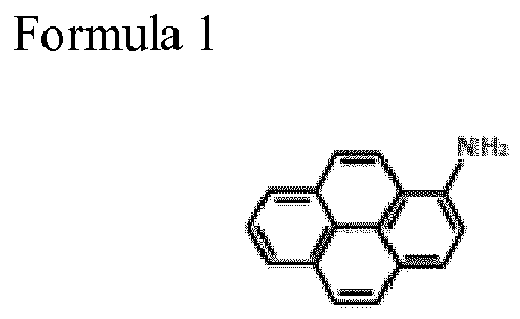
Formula 1 below; a compound represented byFormula 2 below; an anthracene compound including at least one amino group selected from -NH2 and -(CH2)nNH2 (wherein n is an integer from 1 to 10 e.g. from 2 to 10, from 2 to 9, from 2 to 8, from 2 to 7, from 2 to 6, from 2 to 5 or from 2 to 4); a phenanthrene compound including at least one amino group selected from -NH2 and-(CH2)nNH2 (wherein n is an integer from 1 to 10 e.g. from 2 to 10, from 2 to 9, from 2 to 8, from 2 to 7, from 2 to 6, from 2 to 5 or from 2 to 4) group; a tetracene compound including at least one amino group selected from -NH2 and -(CH2)nNH2 (wherein n is an integer from 1 to 10 e.g. from 2 to 10, from 2 to 9, from 2 to 8, from 2 to 7, from 2 to 6, from 2 to 5 or from 2 to 4); a pentacene compound including at least one selected from - -NH2 and -(CH2)nNH2 (wherein n is an integer from 1 to 10 e.g. from 2 to 10, from 2 to 9, from 2 to 8, from 2 to 7, from 2 to 6, from 2 to 5 or from 2 to 4); or a triphenylene compound including at least one amino group selected from -NH2 and -(CH2)nNH2 (wherein n is an integer from 1 to 10 e.g. from 2 to 10, from 2 to 9, from 2 to 8, from 2 to 7, from 2 to 6, from 2 to 5 or from 2 to 4).


- In Formula 2, n is an integer from 1 to 10 e.g. from 2 to 10, from 2 to 9, from 2 to 8, from 2 to 7, from 2 to 6, from 2 to 5 or from 2 to 4.
- In one embodiment, the amount of the C6-C30 polycyclic aromatic hydrocarbon compound having an amino group at an end thereof used in the electrode catalyst is about 0.1 parts by weight to about 50 parts by weight, based on 100 parts by weight of the carbonaceous carrier. In other embodiments, the amount of the C6-C30 polycyclic aromatic hydrocarbon compound having an amino group at an end thereof used in the electrode catalyst may be about 1 part by weight to about 50 parts by weight, 5 parts by weight to about 50 parts by weight, or about 10 parts by weight to about 50 parts by weight based on 100 parts by weight of the carbonaceous carrier.
- In one embodiment, the amount of the carbonaceous carrier that is non-covalently bonded to the C6-C30 polycyclic aromatic hydrocarbon compound having an amino group at an end thereof on the surface of the carbonaceous carrier may be about 20 parts by weight to about 80 parts by weight based on 100 parts by weight of the electrode catalyst (weight of the metal catalyst + weight of the carbonaceous carrier + weight of the C6-C30 polycyclic aromatic hydrocarbon compound having an amino group at an end thereof). In other embodiments, the amount of the carbonaceous carrier that is non-covalently bonded to the C6-C30 polycyclic aromatic hydrocarbon compound having an amino group at an end thereof on the surface of the carbonaceous carrier may be about 30 parts by weight to about 80 parts by weight, 40 parts by weight to about 80 parts by weight, 50 parts by weight to about 80 parts by weight based on 100 parts by weight of the electrode catalyst
- When the amount of the C6-C30 polycyclic aromatic hydrocarbon compound having an amino group at an end thereof and the amount of the carbonaceous carrier are in the ranges described above, the durability and activity of the electrode catalyst containing them are excellent.
-
FIG. 1 illustrates an interaction between a carbonaceous carrier and a C6-C30 polycyclic aromatic compound having an amino group at an end thereof, wherein the compound is non-covalently bonded to a surface of the carbonaceous carrier in an electrode catalyst according to an embodiment. - Carbon atoms of the carbonaceous carrier undergo a π-π stacking interaction with one or more aromatic carbon rings of a C6-C30 polycyclic aromatic hydrocarbon compound having an amino group at an end thereof. The nitrogen of the amino group in the C6-C30 polycyclic aromatic hydrocarbon compound having an amino group at an end thereof, has an unshared electron pair which provides a site for binding to a metal catalyst such as platinum.
- As described above, the C6-C30 polycyclic aromatic hydrocarbon compounds having an amino group at an end thereof are non-covalently bonded to the carbonaceous carrier and thus, do not alter or deteriorate the structure and properties of the carbonaceous carrier. Accordingly, the metal catalyst may be uniformly dispersed on the carbonaceous carrier without agglomeration of the metal catalyst thus maintaining the stability of the electrode catalyst. As such, problems caused by the deterioration of the catalyst due to the agglomeration of the metal catalyst and electrochemical carbon corrosion, which occur during the operation of the fuel cell, may be prevented. Accordingly, the electrode catalyst may be non-covalently functionalized without the deterioration of the properties of the carbonaceous carrier and thus control the surface properties of the electrode catalyst; improving durability and electrochemical activities of the electrode catalyst. The fact that the properties of the carbonaceous carrier do not change after the amino polycyclic aromatic hydrocarbon compounds non-covalently bind to the carbonaceous carrier may be observed through Raman and x-ray diffraction (XRD) analyses.
- The carbonaceous carrier is a material formed of highly crystalline carbon such as carbon black (e.g. Ketjen black), heat-treated carbon black, heat-treated acetylene black, activated carbon, graphite, highly pure graphite, carbon nanofibers, carbon fibers, carbon nanotubes, carbon nanowires, carbon nanocages, carbon nanohorns, carbon aerogel, carbon nanorings, mesoporous carbon, ordered mesoporous carbon, graphene, or a combination thereof, but the carbonaceous carrier is not limited thereto and the carbonaceous carrier may be used alone or as a mixture of two or more thereof.
- The carbonaceous carrier may include ordered mesoporous carbon having mesopores. An average diameter of mesopores in such material may be about 6 nm to about 10 nm. The ordered mesoporous carbon may be prepared by using a mesoporous silica template (for example, MSU-H or the like). The ordered mesoporous carbon has a wide specific surface area and thus, when the ordered mesoporous carbon is used as the carbonaceous carrier, the weight of the metal supported catalyst may be greater than the weight of the carbonaceous carrier.
- In the electrode catalyst, an average particle diameter of the metal catalyst may be about 1 nm to about 20 nm, for example, about 1 nm to about 15 nm, about 2 nm to about 12 nm, or about 3 nm to about 10 nm. When the average particle diameter of the metal catalyst is within the range described above, excellent oxygen reduction activity and electrochemical specific surface area may be maintained.
- In this regard, when the average diameter of the metal catalyst of the electrode catalyst is within the range above, the activity of the catalyst including the metal catalyst is excellent.
- The amount of the metal catalyst may be about 20 parts by weight to about 80 parts by weight, for example, about 30 parts by weight to about 60 parts by weight, about 30 parts by weight to about 50 parts by weight or about 40 parts by weight to about 50 parts by weight (e.g. about 45 parts by weight), based on 100 parts by weight of the total weight of the electrode catalyst (weight of the metal catalyst + weight of the carbonaceous carrier). In the electrode catalyst, when the amount of the metal catalyst is in the range described above, the catalyst may have excellent specific surface area and a large amount of metal supported therein and thus, the activity of the catalyst is excellent.
- The metal catalyst may be at least one selected from the group consisting of platinum (Pt), iron (Fe), cobalt (Co), nickel (Ni), ruthenium (Ru), rhodium (Rh), palladium (Pd), osmium (Os), iridium (Ir), copper (Cu), silver (Ag), gold (Au), strontium (Sn), titanium
- (Ti), chromium (Cr), and a combination thereof. For example, the metal catalyst may be Pt or a Pt-Co alloy.
- The electrode catalyst according to an embodiment of the present disclosure may include Pt and a carbonaceous carrier including a crystalline carbon. The electrode catalyst may be useful for manufacturing an electrode for a fuel cell of a vehicle.
- The electrode catalyst has a very large specific surface area, on which various gases and/or liquids, which are subject to electrochemical reactions, may contact. The electrochemical specific surface area of the electrode catalyst may be 70 m2/g or greater, for example, in a range of about 70 m2/g to about 100 m2/g, but the electrochemical specific surface area is not limited thereto.
- In the carbonaceous carrier, the ratio of the maximum peak intensity of a D band (ID) at about 1340cm-1 to about 1360cm-1 to a maximum peak intensity of a G band (IG) at about 1575 cm-1 to about 1600 cm-1 in spectra obtained by Raman spectrometry using a laser having a wavelength of about 514.5 nm, may be about 0.1 to about 1.5, for example, about 0.3 to about 1.0, about 0.4 to about 1.0, about 0.5 to about 1.0, about 0.6 to about 1.0, about 0.7 to about 1.0, or about 0.7 to about 0.9.
- In the XRD spectrum of the carbonaceous carrier, a peak with respect to a (002) surface is observed at a Bragg 2θ angle of 26.4 ± 0.1°, and a half-width of the peak with respect to the (002) surface may be about 0.2° to about 0.7°.
- When the carbonaceous carrier has ID/IG or the half-width of the peak with respect to the (002) surface in the ranges described above, the surface structure and electrochemical properties of the carbon do not change.
- Hereinafter, a method of manufacturing an electrode catalyst for a fuel cell according to an embodiment of the present invention will be described in greater detail.
- A C6-C30 aromatic hydrocarbon compound having an amino group at an end thereof (e.g. a C6-C30 aromatic hydrocarbon compound substituted with an amino group or an amino C6-C30 polycyclic aromatic hydrocarbon compound) is mixed with a solvent and then a carbonaceous carrier is added thereto to obtain a carbonaceous carrier mixture.
- As the solvent, at least one selected from the group consisting of methanol, ethanol, water, N,N-dimethyl sulfoxide, and N,N-dimethyl formamide may be used. In certain embodiments, as the solvent, a mixture of water and ethanol is used. Preferably the ratio of the volume of water to the volume of ethanol is about 95:5.
- The crystallinity of carbon of the carbonaceous carrier may be increased to form a stable graphite layer through a heat treatment process. In this regard, the heat treatment process may be performed at a temperature of about 1500°C to about 3000°C (such as about 1500°C to about 2500°C, about 1500°C to about 2500°C or about 2000°C to about 3000°C) in an inert gas atmosphere.
- The heat treatment process may be performed according to different heat treatment temperatures, for example, in multiple stages. When the heat treatment process is performed in multiple stages, a carbon having high crystallinity may be obtained.
- When the heat treatment is performed at a temperature of 1500°C or greater, but less than 2000°C, the heat treatment of the carbonaceous carrier may be performed according to four stages as described below:
- Stage 1: adjust temperature to about 900°C to about 1100°C (e.g. about 1000°C) at a heating rate of about 3°C/min to about 7°C/min (e.g. about 5°C/min to about 6°C/min);
- Stage 2: maintain at a temperature of about 900°C to about 1100°C (e.g. about 1000°C) for 5 minutes to about 30 minutes (e.g. 5 minutes to about 20 minutes such as about 10 minutes);
- Stage 3: adjust temperature from about 900°C to about 1100°C to about 1400°C to about 2000°C (e.g. about 1600°C to about 2000°C such as about 1900°C) at a heating rate of about 2°C/min to about 5°C/min (e.g. about 3°C/min); and
- Stage 4: maintain at a temperature of about 1400°C to about 2000°C (e.g. about 1600°C to about 2000°C such as about 1900°C) for 10 minutes to about 60 minutes.
- When the heat treatment is performed at a temperature of about 2000°C to about 3000°C, the heat treatment of the carbonaceous carrier may be performed according to six stages as described below:
- Stage 1: adjust temperature to about 900°C to about 1100°C (e.g. about 1000 °C) at a heating rate of about 3°C/min to about 7°C/min (e.g. about 5°C/min to about 6°C/min);
- Stage 2: maintain at a temperature of about 900°C to about 1100°C (e.g. about 1000°C) for 5 minutes to about 30 minutes (e.g. 5 minutes to about 20 minutes such as about 10 minutes);
- Stage 3: adjust temperature from about 900°C to about 1100°C (e.g. about 1000 °C) to about 1800°C to about 2000°C (e.g. about 1900 °C) at a heating rate of about 2°C/min to about 5°C/min (e.g. about 3°C/min);
- Stage 4: maintain at a temperature of about 1800°C to about 2000°C (e.g. about 1900 °C) for about 5 minutes to about 30 minutes (about 10 minutes to about 30 minutes);
- Stage 5: adjust temperature to about 2000°C to about 3000°C (e.g. about 2100°C to about 2500°C such as about 2250°C) at a heating rate of about 1°C/min to about 3°C/min (e.g. about 1°C/min to 2°C/min such as about 1.7°C/min); and
- Stage 6: maintain at a temperature of about 2000°C to about 3000°C (e.g. about 2100°C to about 2500°C such as about 2250°C) for 10 minutes to about 60 minutes (e.g. about 60 minutes).
- As described above, the carbonaceous carrier may be thermally treated at different stages and passed through a stabilization-carbonization-graphitization-high crystallization process to obtain a carbonaceous carrier having a stable and highly crystalline structure.
- When a carbonaceous carrier including the highly crystalline carbon obtained through the heat treatment process is used, a π-π interaction between one or more phenyl rings of a C6-C30 polycyclic aromatic hydrocarbon compound having an amino group at an end thereof and carbon of a water repellent carbonaceous carrier increases the hydrophilicity of the carbonaceous carrier, and the non-shared electron pair of the nitrogen of the amino group of the C6-C30 polycyclic aromatic hydrocarbon compound having an amino group at an end thereof also increases the hydrophilicity of the carbonaceous carrier, such that loading the electrode catalyst with a metal catalyst (such as platinum) may be improved.
- The carbonaceous carrier has a ratio of the maximum peak intensity of a D band at about 1340cm-1 to about 1360cm-1 to a maximum peak intensity of a G band at about 1575cm-1 to about 1600 cm-1 (ID/IG), in the spectra obtained by Raman spectrometry using a laser having a wavelength of about 514.5 nm, of the carbonaceous carrier may be about 0.1 to about 1.5, for example, about 0.3 to about 1.0 about 0.4 to about 1.0, about 0.5 to about 1.0, about 0.6 to about 1.0, about 0.7 to about 1.0, or about 0.7 to about 0.9. Depending on the heat treatment process, a carbonaceous carrier having a specific surface area of about 50 m2/g to about 800 m2/g, and an electrode catalyst having improved durability may be manufactured by preventing carbon corrosion.
- For the process of manufacturing an electrode catalyst by loading a metal catalyst in the carbonaceous carrier, any method that is generally used in the art may be used.
- The electrode catalyst may be applied to a fuel cell for a mobile and a family use, such as a fuel cell used for notebook computers, portable devices, vehicles, and buses.
- For example, when an electrode catalyst layer is formed by using the electrode catalyst, a polymer electrolyte membrane fuel cell (PEMFC), a phosphoric acid fuel cell (PAFC), or a direct methanol fuel cell (DMFC) may be manufactured utilizing the electrode catalyst layer.
- According to another embodiment of the present invention, there is provided an electrode for a fuel cell including the electrode catalyst.
- Hereinafter, a fuel cell including the electrode catalyst will be described in greater detail.
- A fuel cell includes a cathode, an anode, and an electrolyte membrane disposed between the cathode and the anode, wherein at least one of the cathode and the anode includes the electrode catalyst.
- For example, according to an embodiment of the present invention, the cathode includes the electrode catalyst. In another embodiment of the present invention, the anode includes the electrode catalyst.
- The activity of the electrode catalyst is maintained in the fuel cell while using the fuel cell even during long periods of driving or when driving under high temperature conditions, by using the catalyst carrier (i.e. carbonaceous carrier is non-covalently bonded to a C6-C30 polycyclic aromatic hydrocarbon compound having an amino group at an end thereof) or the electrode catalyst.
- The fuel cell may, for example, be a PEMFC or a DMFC cell.
-
FIG. 2 is an exploded perspective view showing an embodiment of a fuel cell andFIG. 3 is a schematic view of a cross-section of a membrane electrode assembly (MEA) in a fuel cell ofFIG. 2 . - A
fuel cell 1 shown inFIG. 2 schematically includes twounit cells 11 and 11' disposed between a pair ofholders 12 and 12'. Theunit cells 11 and 11' include a membrane-electrode assembly (MEA) 10 andbipolar plates 20 and 20', each of which is disposed on each side of theMEA 10 in a width direction. Thebipolar plates 20 and 20' are formed of a metal having conductivity, carbon, or the like, and each of thebipolar plates 20 and 20' binds to theMEA 10 to function as a current collector while supplying oxygen and fuel to a catalyst layer of theMEA 10. - The
fuel cell 1 shown inFIG. 2 has twounit cells 11 and 11'; however, the number of the unit cells is not limited to two and may be increased to dozens or a few hundred depending on the properties required by the fuel cell. - The
MEA 10, as shown inFIG. 3 , may include anelectrolyte membrane 100 and catalyst layers 110 and 110' may be disposed on each side of theelectrolyte membrane 100 in a width direction, and theMEA 10 may include, the catalyst layers 110 and 110' including an electrode catalyst according to an embodiment of the present invention, first gas diffusion layers 121 and 121', which are respectively disposed on the catalyst layers 110 and 110', and second gas diffusion layers 120 and 120', which are respectively disposed on the first gas diffusion layers 121 and 121'. - The catalyst layers 110 and 110' function as a fuel electrode and an oxygen electrode, and each of the catalyst layers 110 and 110' include an electrode catalyst and a binder and may further include a material that may increase the electrochemical surface area of the electrode catalyst. The catalyst layer includes an electrode catalyst according to an embodiment of the present invention.
- The first gas diffusion layers 121 and 121' and the second gas diffusion layers 120 and 120' may each be formed of a carbon sheet, a carbon paper, or the like, and diffuse oxygen and fuel supplied through the
bipolar plates 20 and 20' to the entire surface of the catalyst layers 110 and 110'. - The
fuel cell 1 including theMEA 10 operates at a temperature of about 100°C to about 300°C. Fuel such as hydrogen is supplied to one of two catalyst layers through abipolar plate 20, 20', and an oxidizing agent such as oxygen is supplied to the other catalyst layer through anotherbipolar plate 20, 20'. Also, with regard to one catalyst layer, hydrogen ions (H+) are generated due to the oxidation of hydrogen, and the hydrogen ions (H+) are conducted through the electrolyte membrane to reach the other catalyst layer. With regard to the other catalyst layer, the hydrogen ions (H+) and oxygen electrochemically react together to generate water (H2O) as well as electrical energy. Also, hydrogen supplied as a fuel may be hydrogen generated through reformation of hydrocarbon or alcohol, and oxygen supplied as the oxidizing agent may be supplied as included in the air atmosphere. - Hereinafter, embodiments of the present disclosure will be described in detail, but the embodiments are not limited thereto.
- Ketjen black (product name: ECP 300J, manufactured by: Mitsubishi Chemical, Tokyo, Japan) was heat treated in an inert gas atmosphere according to the stages described below.
- Stage 1: adjust temperature to 1000°C at a heating rate of 5.4°C/min;
- Stage 2: maintain at a temperature of 1000°C for 10 minutes;
- Stage 3: adjust temperature to 1900°C at a heating rate of 3°C/min;
- Stage 4: maintain at a temperature of 1900°C for 5 minutes;
- Stage 5: adjust temperature to 2250°C at a heating rate of 1.7°C/min; and
- Stage 6: maintain at a temperature of 2250°C for 60 minutes.
- 2.0 g of heat-treated Ketjen black according to the stages described above was dispersed in 250 ml of deionized water/ethanol (95/5, v/v) to prepare a dispersion. 0.2 g of a compound represented by
Formula 1 that was added to the dispersion and mixture was then stirred for 6 hours. This procedure yielded an amount of the compound represented byFormula 1 was about 10 parts by weight based on 100 parts by weight of Ketjen black.

- Thereafter, the resulting product was vacuum filtered, washed sequentially with distilled water, methanol, and acetone, and then vacuum dried for 24 hours to prepare a carbonaceous carrier.
- 25 ml of chloroplatinic acid hexahydrate (H2PtCl6·6H2O) and 2.5 g of the carbonaceous carrier were added to a mixed solvent of ethylene glycol (580 ml) and deionized water (750 ml). The resultant mixture was then stirred to prepare a dispersion. The pH of the dispersion was adjusted to about 11 using sodium hydroxide solution. The resultant mixture was heat treated to a temperature of 60 °C over 30 minutes, then heat treated to a temperature of 140 °C over 30 minutes, and maintained at a temperature of 140 °C for 4 hours. The reaction mixture was then filtered, washed with ultrapure water, and dried in a vacuum at a temperature of 120 °C to furnish the Pt-loaded catalyst (amount of Pt: 44.8 wt%).
- 0.03 g of Pt-loaded catalyst (amount of Pt: 44.8 wt%), 500 ml of Nafion (DuPont, Wilmington, Delaware) solution (a solution prepared by diluting a mixture solution of 5 wt% of Nafion, 45 wt% of 1-propanol, and 50 wt% of 3-propanol by 10 times with distilled water) at a concentration of 0.5 wt%, and 4500 ml of isopropyl alcohol were mixed to prepare an electrode catalyst composition. The mixture was sonicated for 20 minutes and then subjected to a conventional stirring process for 1 minute.
- 6 µl of the electrode catalyst composition was spread on a glassy carbon electrode support having a diameter of 0.5 cm and then dried at room temperature for 5 minutes to prepare a dried product. Thereafter, 7 µl of Nafion solution (solvent: isopropyl alcohol) at 0.05 wt% was added in a drop-wise fashion onto the dried product and then dried for 10 minutes at room temperature to prepare an electrode. As a result, an amount of the loaded catalyst was present in 85 µg/cm2.
- An electrode catalyst and an electrode were prepared in the same manner as in Example 1, except that the amount of the compound represented by
Formula 1 was changed to 0.4 g. This procedure yielded an amount of the compound represented byFormula 1 was about 20 parts by weight based on 100 parts by weight of Ketjen black. - An electrode catalyst and an electrode were prepared in the same manner as in Example 1, except that the amount of the compound represented by
Formula 1 was changed to 1.0 g. In this regard, the amount of the compound represented byFormula 1 was about 50 parts by weight based on 100 parts by weight of Ketjen black. - The same processes as in Example 1 were performed, except that a product obtained from heat-treating Ketjen black (ECP 300J, manufactured by: Mitsubishi Chemical) at a temperature of 2250°C for 1 hour was used as a carbonaceous carrier.
- The same processes as in Example 1 were performed, except that a compound represented by
Formula 3 was used instead of the compound represented byFormula 1.
- The electrode catalyst (i.e. the Pt-loaded catalyst) prepared according to Example 1 was analyzed through high-resolution transmission electron microscopy (HRTEM)/selected area electron diffraction (SAED) and the results obtained therefrom are shown in
FIGS. 4 to 6 . -
FIGS. 4 to 6 show the electrode catalyst prepared in Example 1 has Pt thoroughly dispersed on a carbon carrier. Also, a series of concentric rings corresponding to a C(002) surface of crystalline carbon and Pt(111), Pt(200), Pt(220), and Pt(311) surfaces of an fcc crystal lattice of Pt were observed through SAED. - X-ray diffraction (XRD) analysis (MP-XRD, Xpert PRO, Philips / Power 3Kw) was performed with respect to the electrode catalysts manufactured in Example 1 and Comparative Example 1 and the results obtained therefrom are shown in
FIGS. 7 and8 , and Table 1. - In Table 1 below, LC represents a crystalline domain size and d(002) represents interplanar spacing.
Table 1 LC(Å) d(002)(Å) Comparative Example 1 34.1 3.449 Example 1 33.9 3.451 - It may be concluded from Table 1 and
FIGS. 7 and8 that the carbonaceous electrode catalyst prepared in Example 1 has Pt particles having a face-centered cubic lattice (fcc) thoroughly dispersed on a high crystalline carbon carrier. - With respect to the carbonaceous carrier used for manufacturing the electrode catalysts prepared in Examples 1 and 2 and Comparative Example 1, a maximum peak intensity of a G band at about 1575cm-1 to about 1600cm-1 and a maximum peak intensity of a D band at about 1340cm-1 to about 1360cm-1 were measured by Raman spectrometer (a product of JASCO Inc., Oklahoma City, Oklahoma) using a laser having a wavelength of 514.5 nm. The results obtained therefrom are shown in
FIG. 9 . It should be noted that the Raman spectrum analysis was performed on the carbonaceous carrier (i.e. Ketjen black) after heat treatment + the amino C6-C30 polycyclic aromatic hydrocarbon (i.e. compound represented by Formula 1) + the metal catalyst (i.e. Pt). - Also, a ratio of the maximum peak intensity of a D band at about 1340cm-1 to about 1360cm-1 to the maximum peak intensity of a G band at about 1575cm-1 to about 1600cm-1 was calculated. The results obtained therefrom are shown in Table 2.
- In Table 2 below, IG represents the maximum peak intensity of a G band at about 1575 cm-1 to about 1600 cm-1 and ID represents the maximum peak intensity of a D band at about 1340 cm-1 to about 1360 cm-1.
- FWHM represents a half-width of a G band peak.
Table 2 FWHM(°) ID/IG ID/I(D+G) Example 1 56.6 0.83 0.49 Example 2 56.4 0.84 0.48 Comparative Example 1 55.4 0.81 0.48 - Referring to Table 2 and
FIG. 9 , the carbonaceous carrier and the electrode catalyst prepared in Examples 1 and 2 have similar crystallinity to the carbonaceous carrier and the electrode catalyst prepared in Comparative Example 1, and the carbonaceous carrier and the electrode catalyst prepared in Examples 1 and 2 maintain a reformed state without deterioration of the properties of the highly crystalline carbonaceous carrier. - 0.03 g of the catalyst prepared according to Example 1 and Comparative Examples 1 and 2 (i.e. the carbonaceous carrier after heat treatment + the amino C6-C30 polycyclic aromatic hydrocarbon + the metal catalyst), 500 ml of a Nafion solution (a solution prepared by diluting a mixture solution of 5 wt% of Nafion, 45 wt% of 1-propanol, and 50 wt% of 3-propanol by 10 times with distilled water) at a concentration of 0.5 wt%, and 4500 ml of isopropyl alcohol were mixed to prepare a catalyst composition. The mixture was sonicated for 20 minutes and a conventional stirring process for 1 minute.
- 6 µl of the catalyst composition was spread on a glassy carbon electrode support having a diameter of 0.5 cm and then dried at room temperature for 5 minutes to prepare a dried product. Thereafter, 7 µl of Nafion solution (solvent: isopropyl alcohol) at 0.05 wt% was added to the dried product and then dried for 10 minutes at room temperature to prepare an electrode. In this regard, an amount of the loaded catalyst was about 85 µg/cm2.
- The electrode catalyst prepared according to the processes described above was subjected to an accelerated life testing. The accelerated life testing was performed by repeating 1000 cycles of cyclic voltammetry (CV) using the electrode prepared above, Ag/AgCl as a standard electrode, at a temperature of 25°C, in 0.1M HClO4 aqueous solution, and a voltage between about 0.6 V to about 1.4 V based on a standard hydrogen potential.
- As described above, the accelerated life testing was performed for every 100 cycles at a scan rate of 20 mV/sec.
Equation 1 below was used to calculate a ratio of reduction of an electrochemical surface area and then normalized. The results obtained therefrom are shown inFIG. 10 .
- Referring to
FIG. 10 , it may be concluded that the electrode catalyst for a fuel cell prepared in Example 1 showed a smaller loss of ECSA than the electrode catalysts for a fuel cell prepared in Comparative Examples 1 and 2. Thus, it may be concluded that the extent of deterioration of the electrode catalyst for a fuel cell prepared in Example 1 is smaller than the extent of deterioration of the electrode catalysts for a fuel cell prepared in Comparative Examples 1 and 2. - It should be understood that the embodiments described therein should be considered in a descriptive sense only and not for purposes of limitation. Descriptions of features or aspects within each embodiment should typically be considered as available for other similar features or aspects in other embodiments.
Claims (13)
- An electrode catalyst for a fuel cell comprising:a carbonaceous carrier and a catalyst metal supported in the carbonaceous carrier,wherein the carbonaceous carrier is non-covalently bonded to a C6-C30 polycyclic aromatic hydrocarbon compound having an amino group at an end thereof, on the surface of the carbonaceous carrier.
- An electrode catalyst for a fuel cell according to claim 1, wherein the amino group is -L-N(R1)(R2), and R1 and R2 are each independently a hydrogen, a C1-C10 alkyl group or a C6-C10 aryl group, and L simply represents a chemical bond, or a C1-C10 alkylene group or a C6-C10 arylene group.
- An electrode catalyst for a fuel cell according to claim 1 or claim 2, wherein the C6-C30 polycyclic aromatic hydrocarbon compound having an amino group at an end thereof, is at least one selected from an naphthalene compound having an amino group at an end thereof, phenanthrene compound having an amino group at an end thereof, an pyrene compound having an amino group at an end thereof, an anthracene compound having an amino group at an end thereof, a tetracene compound having an amino group at an end thereof, a pentacene compound having an amino group at an end thereof and a triphenylene compound having an amino group at an end thereof.
- An electrode catalyst for a fuel cell according to any preceding claim, wherein the C6-C30 polycyclic aromatic hydrocarbon compound having an amino group at an end thereof, is a compound represented by Formula 1 below; a compound represented by Formula 2 below; an anthracene compound comprising at least one amino group selected from the group consisting of -NH2, and -(CH2)nNH2, wherein n is an integer from 1 to 10; a phenanthrene compound comprising at least one amino group selected from the group consisting of -NH2 and -(CH2)nNH2 (wherein n is an integer from 1 to 10); a tetracene compound comprising at least one amino group selected from the group consisting of -NH2 and -(CH2)nNH2 wherein n is an integer from 1 to 10; a pentacene compound comprising at least one amino group selected from the group consisting of -NH2 and -(CH2)nNH2 (wherein n is an integer from 1 to 10); or a triphenylene compound comprising at least one amino group selected from the group consisting of-NH2 and -(CH2)nNH2 wherein n is an integer from 1 to 10:

- An electrode catalyst for a fuel cell according to any preceding claim, wherein an amount of the C6-C30 polycyclic aromatic hydrocarbon compound having an amino group at an end thereof, is about 0.1 parts by weight to about 50 parts by weight based on 100 parts by weight of the carbonaceous carrier.
- An electrode catalyst for a fuel cell according to any preceding claim, wherein the carbonaceous carrier is carbon black, heat-treated carbon black, heat-treated acetylene black, activated carbon, graphite, highly pure graphite, carbon nanofibers, carbon fibers, carbon nanotubes, carbon nanowires, carbon nanocages, carbon nanohorns, carbon aerogel, carbon nanorings, mesoporous carbon, ordered mesoporous carbon, graphene, or a combination thereof.
- An electrode catalyst for a fuel cell according to claim, wherein an amount of the carbonaceous carrier that is non-covalently bonded to the C6-C30 polycyclic aromatic hydrocarbon compound having an amino group at an end thereof on the surface of the carbonaceous carrier is about 20 parts by weight to about 80 parts by weight based on 100 parts by weight of the total weight of the electrode catalyst.
- An electrode catalyst for a fuel cell according to any preceding claim, wherein a ratio of the maximum peak intensity of a D band at about 1340cm-1 to about 1360cm-1 to a maximum peak intensity of a G band at about 1575 cm-1 to about 1600 cm-1, which is obtained by Raman spectrometry using a laser having a wavelength of 514.5 nm, is about 0.1 to about 1.5.
- An electrode catalyst for a fuel cell according to any preceding claim, wherein in the XRD spectrum of the carbonaceous carrier, a peak with respect to a (002) surface is observed at a Bragg 2θ angle of 26.4 ± 0.1°, and a half-width of the peak with respect to the (002) surface is about 0.2° to about 0.7°.
- An electrode catalyst for a fuel cell according to any preceding claim, wherein the metal catalyst is at least one selected from the group consisting of platinum (Pt), iron (Fe), cobalt (Co), nickel (Ni), ruthenium (Ru), rhodium (Rh), palladium (Pd), osmium (Os), iridium (Ir), copper (Cu), silver (Ag), gold (Au), strontium (Sn), titanium (Ti), chromium (Cr), and a combination thereof.
- An electrode for a fuel cell comprising the electrode catalyst according to any preceding claim.
- An electrode for a fuel cell according to claim 11, wherein the electrode is a cathode.
- A fuel cell comprising:a cathode,an anode that is disposed opposite to the cathode, andan electrolyte membrane disposed between the cathode and the anode, wherein at least one of the cathode and the anode comprises the electrode catalyst according to any one of claims 1 to 10.
Applications Claiming Priority (1)
| Application Number | Priority Date | Filing Date | Title |
|---|---|---|---|
| KR1020140008295A KR20150088006A (en) | 2014-01-23 | 2014-01-23 | Electrode catalyst for fuel cell, method for preparing the same, electrode for fuel cell including the electrode catalyst, and fuel cell including the same |
Publications (1)
| Publication Number | Publication Date |
|---|---|
| EP2899785A1 true EP2899785A1 (en) | 2015-07-29 |
Family
ID=52146082
Family Applications (1)
| Application Number | Title | Priority Date | Filing Date |
|---|---|---|---|
| EP14197142.4A Withdrawn EP2899785A1 (en) | 2014-01-23 | 2014-12-10 | Electrode catalyst for fuel cell, method of preparing the same, electrode for fuel cell including the electrolyte catalyst, and fuel cell including the electrode |
Country Status (5)
| Country | Link |
|---|---|
| US (1) | US20150207152A1 (en) |
| EP (1) | EP2899785A1 (en) |
| JP (1) | JP2015138780A (en) |
| KR (1) | KR20150088006A (en) |
| CN (1) | CN104810527A (en) |
Families Citing this family (15)
| Publication number | Priority date | Publication date | Assignee | Title |
|---|---|---|---|---|
| KR102195891B1 (en) * | 2015-05-29 | 2020-12-28 | 코오롱인더스트리 주식회사 | CATHOD CATALYST LAYER FOR FUEL CELL, MANUFACTURING METHOD OF THE SAME AND Membrane-Electrode Assembly INCLUDING THE SAME |
| JP6661976B2 (en) * | 2015-10-30 | 2020-03-11 | 日産自動車株式会社 | Electrode catalyst, catalyst layer using the electrode catalyst, and fuel cell |
| US10998550B2 (en) * | 2016-01-14 | 2021-05-04 | Agency For Science, Technology And Research | Free-standing MOF-derived hybrid porous carbon nanofiber mats |
| CN105692607B (en) * | 2016-04-18 | 2017-12-15 | 齐鲁工业大学 | Compressible aeroge of a kind of graphene based on chemical reduction method and preparation method thereof, application |
| KR20180036107A (en) * | 2016-09-30 | 2018-04-09 | 코오롱인더스트리 주식회사 | Support, electrode for fuel cell, and membrane-electrode assembly, and fuel cell comprising the same |
| JP6572416B1 (en) * | 2018-03-26 | 2019-09-11 | 大豊精機株式会社 | Conductive nanofiber member, fuel cell member, fuel cell, and method of manufacturing conductive nanofiber member |
| CN109712742B (en) * | 2018-12-17 | 2021-01-01 | 中国科学院合肥物质科学研究院 | A kind of graphene crystal film with high electrical conductivity and preparation method thereof |
| KR102169124B1 (en) | 2018-12-19 | 2020-10-22 | 주식회사 제이앤티지 | Graphitized carbon substrate for gas diffusion layer and gas diffusion layer emplying the same |
| CN110449147B (en) * | 2019-08-09 | 2023-03-31 | 万华化学(福建)有限公司 | Catalyst for phosgene synthesis and preparation method and application thereof |
| US11145875B2 (en) * | 2019-08-19 | 2021-10-12 | Robert Bosch Gmbh | Fuel cell electrode catalyst layer coating |
| KR102566147B1 (en) * | 2020-12-11 | 2023-08-14 | 영남대학교 산학협력단 | METHOD OF SUBSTITUTING NICKEL(Ni) WITH COPPER(Cu) IN A SPINEL STRUCTURE FOR IMPROVING ELECTROCHEMICAL PERFORMANCE AND OXYGEN REVOLUTION REACTION |
| CN113067002B (en) * | 2021-03-23 | 2022-03-08 | 中国科学院化学研究所 | PEM fuel cell, ball-milling intercalation graphite bipolar plate and preparation method thereof |
| JP7812251B2 (en) * | 2022-03-04 | 2026-02-09 | 日清紡ホールディングス株式会社 | Metal-supported catalysts, electrodes and batteries |
| WO2024014136A1 (en) * | 2022-07-11 | 2024-01-18 | 株式会社キャタラー | Fuel cell electrode catalyst |
| JP7387948B1 (en) * | 2022-07-11 | 2023-11-28 | 株式会社キャタラー | fuel cell electrode catalyst |
Citations (3)
| Publication number | Priority date | Publication date | Assignee | Title |
|---|---|---|---|---|
| US20110129762A1 (en) * | 2009-11-30 | 2011-06-02 | Hyundai Motor Company | Method of increasing hydrophilic property of crystalline carbon using surface modifier and method of preparing platinum catalyst using the same |
| CN102120186A (en) * | 2010-11-22 | 2011-07-13 | 南京大学 | Preparation method of platinum nanoparticle loaded graphene |
| CN103041857A (en) * | 2012-12-17 | 2013-04-17 | 天津大学 | Preparation method of graphite nano-plate-loaded nano-noble metal catalyst |
Family Cites Families (1)
| Publication number | Priority date | Publication date | Assignee | Title |
|---|---|---|---|---|
| CN103380523B (en) * | 2011-02-21 | 2016-12-07 | 昭和电工株式会社 | Method for producing electrode catalyst for fuel cell |
-
2014
- 2014-01-23 KR KR1020140008295A patent/KR20150088006A/en not_active Ceased
- 2014-06-03 US US14/295,139 patent/US20150207152A1/en not_active Abandoned
- 2014-11-05 CN CN201410635684.2A patent/CN104810527A/en not_active Withdrawn
- 2014-11-18 JP JP2014233421A patent/JP2015138780A/en not_active Withdrawn
- 2014-12-10 EP EP14197142.4A patent/EP2899785A1/en not_active Withdrawn
Patent Citations (3)
| Publication number | Priority date | Publication date | Assignee | Title |
|---|---|---|---|---|
| US20110129762A1 (en) * | 2009-11-30 | 2011-06-02 | Hyundai Motor Company | Method of increasing hydrophilic property of crystalline carbon using surface modifier and method of preparing platinum catalyst using the same |
| CN102120186A (en) * | 2010-11-22 | 2011-07-13 | 南京大学 | Preparation method of platinum nanoparticle loaded graphene |
| CN103041857A (en) * | 2012-12-17 | 2013-04-17 | 天津大学 | Preparation method of graphite nano-plate-loaded nano-noble metal catalyst |
Non-Patent Citations (1)
| Title |
|---|
| XIA GAOQIANG ET AL: "Highly uniform platinum nanoparticles supported on graphite nanoplatelets as a catalyst for proton exchange membrane fuel cells", INTERNATIONAL JOURNAL OF HYDROGEN ENERGY, vol. 38, no. 31, 5 September 2013 (2013-09-05), pages 13754 - 13761, XP028730747, ISSN: 0360-3199, DOI: 10.1016/J.IJHYDENE.2013.08.033 * |
Also Published As
| Publication number | Publication date |
|---|---|
| KR20150088006A (en) | 2015-07-31 |
| JP2015138780A (en) | 2015-07-30 |
| CN104810527A (en) | 2015-07-29 |
| US20150207152A1 (en) | 2015-07-23 |
Similar Documents
| Publication | Publication Date | Title |
|---|---|---|
| US20150207152A1 (en) | Electrode catalyst for fuel cell, method of preparing the same, electrode for fuel cell including the electrolyte catalyst, and fuel cell including the electrode | |
| Cheng et al. | A template-free method to synthesis high density iron single atoms anchored on carbon nanotubes for high temperature polymer electrolyte membrane fuel cells | |
| Xie et al. | Ruthenium–platinum core–shell nanocatalysts with substantially enhanced activity and durability towards methanol oxidation | |
| CN105594033B (en) | Catalyst carbon dust and catalyst, electrode catalyst layer, membrane-electrode assembly and the fuel cell using the catalyst carbon dust | |
| KR101679809B1 (en) | Preparation method of N-doped carbon-supported Pt catalyst and N-doped carbon-supported Pt catalyst using the same | |
| US7642217B2 (en) | Pt/Ru alloy catalyst for fuel cell | |
| US20130149632A1 (en) | Electrode catalyst for a fuel cell, method of preparing the same, and membrane electrode assembly and fuel cell including the electrode catalyst | |
| US10003084B2 (en) | Metal nanoparticle-graphene composites and methods for their preparation and use | |
| KR101624641B1 (en) | Electrode catalyst for fuel cell, manufacturing method thereof, membrane electrode assembly and fuel cell including the same | |
| KR20080067554A (en) | Platinum / ruthenium alloy supported catalyst, its manufacturing method and fuel cell using the same | |
| US11450861B2 (en) | Anode catalyst layer for fuel cell and fuel cell using same | |
| JP6727263B2 (en) | Anode catalyst layer for fuel cell and fuel cell using the same | |
| US20070078052A1 (en) | Methanol tolerant catalyst material | |
| JP2016003396A (en) | Synthesis of alloy nanoparticles as a stable core for core-shell electrocatalysts | |
| KR20190129746A (en) | Catalyst layer for fuel cell and production method therefor | |
| US20140154609A1 (en) | Electrode catalyst for fuel cell, method of preparing the same, electrode for fuel cell including the electrode catalyst, and fuel cell including the electrode | |
| WO2017208742A1 (en) | Carbon for supporting catalyst and production process therefor | |
| Al‐Tememy et al. | Development of effective bimetallic catalyst for high‐temperature PEM fuel cell to improve CO tolerance | |
| WO2018116586A1 (en) | Metal supported catalyst | |
| Jung et al. | development of highly active and stable catalyst supports and platinum–free catalysts for PEM fuel cell | |
| US20200112032A1 (en) | Fuel cell catalyst support based on doped titanium suboxides | |
| JP6727265B2 (en) | Anode catalyst layer for fuel cell and fuel cell using the same | |
| KR20230091951A (en) | fuel cell electrode catalyst | |
| JP6727264B2 (en) | Anode catalyst layer for fuel cell and fuel cell using the same | |
| US20140162169A1 (en) | Electrode catalyst for fuel cell, method of preparing the same, and membrane electrode assembly and fuel cell, each including the same |
Legal Events
| Date | Code | Title | Description |
|---|---|---|---|
| PUAI | Public reference made under article 153(3) epc to a published international application that has entered the european phase |
Free format text: ORIGINAL CODE: 0009012 |
|
| 17P | Request for examination filed |
Effective date: 20141210 |
|
| AK | Designated contracting states |
Kind code of ref document: A1 Designated state(s): AL AT BE BG CH CY CZ DE DK EE ES FI FR GB GR HR HU IE IS IT LI LT LU LV MC MK MT NL NO PL PT RO RS SE SI SK SM TR |
|
| AX | Request for extension of the european patent |
Extension state: BA ME |
|
| RIN1 | Information on inventor provided before grant (corrected) |
Inventor name: KIM, JUN-YOUNG Inventor name: KIM, TAE-YOON Inventor name: KIM, HEE-TAK Inventor name: LEE, SUNG-CHUL Inventor name: KIM, YEON-SU |
|
| RIN1 | Information on inventor provided before grant (corrected) |
Inventor name: KIM, HEE-TAK Inventor name: LEE, SUNG-CHUL Inventor name: KIM, TAE-YOON Inventor name: KIM, YEON-SU Inventor name: KIM, JUN-YOUNG |
|
| 17P | Request for examination filed |
Effective date: 20160128 |
|
| RBV | Designated contracting states (corrected) |
Designated state(s): AL AT BE BG CH CY CZ DE DK EE ES FI FR GB GR HR HU IE IS IT LI LT LU LV MC MK MT NL NO PL PT RO RS SE SI SK SM TR |
|
| STAA | Information on the status of an ep patent application or granted ep patent |
Free format text: STATUS: THE APPLICATION HAS BEEN WITHDRAWN |
|
| 18W | Application withdrawn |
Effective date: 20171212 |