EP2899646A2 - Automatische Prüfung eines formulars - Google Patents
Automatische Prüfung eines formulars Download PDFInfo
- Publication number
- EP2899646A2 EP2899646A2 EP15305066.1A EP15305066A EP2899646A2 EP 2899646 A2 EP2899646 A2 EP 2899646A2 EP 15305066 A EP15305066 A EP 15305066A EP 2899646 A2 EP2899646 A2 EP 2899646A2
- Authority
- EP
- European Patent Office
- Prior art keywords
- representation
- actual output
- predicted result
- mask
- generate
- Prior art date
- Legal status (The legal status is an assumption and is not a legal conclusion. Google has not performed a legal analysis and makes no representation as to the accuracy of the status listed.)
- Withdrawn
Links
Images


Classifications
-
- G—PHYSICS
- G06—COMPUTING OR CALCULATING; COUNTING
- G06F—ELECTRIC DIGITAL DATA PROCESSING
- G06F11/00—Error detection; Error correction; Monitoring
- G06F11/36—Prevention of errors by analysis, debugging or testing of software
- G06F11/3668—Testing of software
- G06F11/3672—Test management
- G06F11/3692—Test management for test results analysis
-
- G—PHYSICS
- G06—COMPUTING OR CALCULATING; COUNTING
- G06F—ELECTRIC DIGITAL DATA PROCESSING
- G06F11/00—Error detection; Error correction; Monitoring
- G06F11/36—Prevention of errors by analysis, debugging or testing of software
- G06F11/3668—Testing of software
- G06F11/3672—Test management
- G06F11/3688—Test management for test execution, e.g. scheduling of test suites
-
- G—PHYSICS
- G06—COMPUTING OR CALCULATING; COUNTING
- G06F—ELECTRIC DIGITAL DATA PROCESSING
- G06F40/00—Handling natural language data
- G06F40/10—Text processing
- G06F40/103—Formatting, i.e. changing of presentation of documents
-
- G—PHYSICS
- G06—COMPUTING OR CALCULATING; COUNTING
- G06F—ELECTRIC DIGITAL DATA PROCESSING
- G06F40/00—Handling natural language data
- G06F40/10—Text processing
- G06F40/166—Editing, e.g. inserting or deleting
- G06F40/174—Form filling; Merging
-
- G—PHYSICS
- G06—COMPUTING OR CALCULATING; COUNTING
- G06F—ELECTRIC DIGITAL DATA PROCESSING
- G06F40/00—Handling natural language data
- G06F40/10—Text processing
- G06F40/194—Calculation of difference between files
Definitions
- Testing of a software application with regard to finalized forms creation often is performed by comparing an actual result with a predicted outcome to confirm that the forms generated by the software application comply with the layout and static content requirements.
- Conventional testing methods often involve manual testing, such as human observation that layout and static content of an actual result of a finalized form remain in the same relative location for each of many finalized forms.
- Embodiments of the invention provide systems and techniques for testing an automatically-generated form.
- an original representation of a form may be obtained.
- a predicted result representation of the form may then be generated, which includes a mask that masks a region of the form.
- An actual output representation of the form also may be generated by a system configured to automatically generate a version of the form or otherwise obtain such a version.
- the predicted result representation of the form may then be compared to the actual output representation of the form, excluding each masked region. Based upon the comparison, an identification of an inconsistency, if any, between the predicted result representation and the actual output representation of the form may be provided.
- form templates include fields with dynamic content, such as a date and time when the finalized form is generated, for example. Inclusion of such dynamic content increases a difficulty associated with creating the predicted outcome in advance of generating the actual result of the finalized form.
- dynamic content such as a date and time when the finalized form is generated, for example.
- Inclusion of such dynamic content increases a difficulty associated with creating the predicted outcome in advance of generating the actual result of the finalized form.
- static text from a native format of the finalized form
- it may be difficult to extract the layout of the finalized form Without being able to extract the layout, automated testing cannot be performed.
- many common and/or native formats are used for automatically-generated forms because they provide readily for convenient, flexible, and easily-merged data to create a finalized form.
- such native formats typically employ various types of data elements. Some of these various data elements, such as the layout elements, for example, may not be easily quantifiable with regard to their size and/or location, and therefore may not be readily comparable between a predicted form and actual finalized form. Thus, it may be difficult to compare the output of an automatic form generation system to the format required for the form to be used or accepted in a specific context.
- a finalized form is converted to a raw image representation, such as a bitmap.
- a raw image representation such as a bitmap.
- Other formats in addition to, or instead of, a bitmap format may be used.
- a raw representation format includes any format that allows for rapid comparison of two items represented in the format, such as for pixel-by-pixel comparison. Sections of a raw representation that are not fields or static content of a form may be masked or otherwise ignored, to allow for more accurate and/or efficient comparison with expected form arrangements.
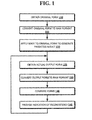
- FIG. 1 shows an example process for generating and testing an automatically created form according to an embodiment of the invention.
- an original representation of an actual form result may be obtained.
- the original representation may be provided by an entity such as a regulatory authority, corporate entity, or the like.
- Original representations may be provided in a native or original format such as PDF.
- the original representation may be converted to a raw format, such as a bitmap.
- a raw representation may be created directly, such as based upon guidelines or requirements of a regulation, a sample or reference form or template, or other source of a form definition. Specific examples of a reference form are provided in further detail below.
- a mask may be applied to the raw representation to generate a predicted result form.
- a bitmap of the form including the mask may be generated, such as by converting from an original or native format such as PDF, to a raw image format such as a bitmap.
- a mask may be applied to the raw representation of the original form.
- the mask may be applied to various parts of the predicted result form, such as portions of the form that contain or are designated to contain dynamic content.
- the mask may include one or more sections that cover or replace the selected portions of the form.
- the mask may include several rectangular regions that are filled with a selected color.
- the mask may define areas of the form that are to be ignored when performing an accuracy comparison as described in further detail below.
- a mask as described herein may or may not be human-visible on the form when the form layout is being tested as disclosed herein.
- the predicted result form also may be generated inclusive of the mask initially, instead of applying the mask after generating the predicted result form and separately applying the mask.
- An actual output of the automated form may then be generated at 125.
- the specific output to be used may be selected by a human, by an automated process, or the like.
- the actual output form may be generated using the same process that ultimately will be used to generate complete forms using arbitrary dynamic content. For example, where a system is designed to generate shipping labels using dynamic information such as sender and recipient addresses, a set of representative sender and recipient addresses may be selected to generate the actual output form.
- specific data may be selected automatically or by hand to test specific cases, such as where a particularly long last name is selected to test layout of a "recipient name" field on the form.
- the selected output form may be converted to a raw format, such as a bitmap.
- the form output may be generated directly in the raw format instead of first being generated in an intermediate format, which typically is the format that will be used for the completed forms outside of the form testing context.
- the masked predicted result form is compared to the actual output form.
- Masked areas are trivially identified as being the same, or are not compared. For example, if a visual mask is used to identify a part of the forms that are not to be compared, a comparison may always return an exact match. As a specific example, if both forms are in a bitmap format, the mask may include rectangular areas of a specific predefined color in specific locations that are the same for each form. When the forms are compared, these regions will necessarily show as exact matches. Thus, only non-masked portions of the forms may be identified as non-matches between the forms. Alternatively or in addition, each masked portion may not be compared.
- the region or regions defined by the mask may be omitted entirely from any comparison between the forms.
- the conversion of forms to a format such as bitmap which allows the insertion of fixed, address and value-assigned visual elements to the forms. This then allows for a pixel-by-pixel comparison of the converted actual form to the masked predicted form result.
- an identification of one or more inconsistencies between the predicted result form and the actual output form may be provided, such as to a user of the system. For example, visible regions where boundaries, text, graphics, or other components of the forms did not align may be provided.
- the identification may include a visual representation of the form with the inconsistent area highlighted, such as by outlining or other visual cues. It also may include a text or other description of the inconsistency. Alternatively, if no inconsistencies are found, an indication that the forms are not inconsistent may be provided.
- a threshold may be set to define what is considered an inconsistency.
- embodiments disclosed herein typically may perform pixel-by-pixel comparisons and thus may be able to identify discrepancies as small as a single pixel, in some cases there may be no need for a form to be modified unless the inconsistency is visible at a certain distance, resolution, scale, output form (e.g., print vs. electronic), or the like. Thus, unless the inconsistency is higher than the threshold, it may not be identified at 145. For example, if a hard copy of the form is ultimately to be provided as a final output and differences less than 3 pixels will not be visually apparent in the final output, inconsistencies of 1 or 2 pixels may not be identified. The process then may be repeated as disclosed herein, such as by altering the process used to generate the actual output form and subsequently repeating some or all of steps 125-145, and/or other steps disclosed herein.
- the process or system that generates the actual output form may be automatically modified to address an inconsistency identified during the comparison process disclosed herein.
- a comparison may identify an inconsistency in the placement of a graphic element of the form, and may determine that the inconsistency includes a shift up and to the right relative to the original form.
- a system that generates the form may be automatically modified to place the graphic element down and to the left relative to its placement in an earlier version of the automatically-generated form, thus moving the element closer to the correct location.
- the form generation and comparison techniques previously described also may be repeated to determine if the same inconsistency is present, whether a new inconsistency has been introduced, or the like.
- FIG. 2 shows an example of an original form.
- the form may be provided initially in a native or original format, such as PDF, and may be converted as disclosed herein to a raw format such as a bitmap.
- the bitmap representation may visually appear identical or essentially identical to the original format.
- the form shown in FIG. 2 is a portion of the U.S. Postal Service's Form 3553 for ease of illustration; however, it will be readily understood by one of skill in the art that any suitable form may be used.
- Forms that may be generated procedurally and automatically while still complying with regulatory, internal, or other requirements for use of the form may be particularly suited for use with the present invention, though any form that may be processed as disclosed herein also may be used.
- FIG. 3 shows an example of an automatically-generated version of the form shown in FIG. 2 , in which a layout element is placed inconsistently relative to the original form.
- the dividing line 310 is offset from other lines with which it is aligned in the original form, and thus is considered inconsistent.
- Such a mis-alignment may occur, for example, when a system that generates the version of the form as shown in FIG. 3 improperly allocates space for dynamic content such as the "Company Name" field, due to an error in placement during development of the form generation routine or system, or the like.
- FIG. 4 shows an example of the predicted output form shown in FIG. 2 with a mask applied. Regions 405, 410, 415, and 420 are covered by the mask and, therefore, will not be compared to an actual result form generated from the original form shown in FIG. 3 . Notably, although a portion 405 of the mask covers part of the mis-aligned dividing line, the inconsistency will still be noted upon comparison to the predicted result form because the predicted result form will include the original dividing line, which is absent from the original location in the actual result form shown in FIG. 3 .
- Embodiments may include or be embodied in the form of computer-implemented processes and apparatuses for practicing those processes.
- Embodiments also may be embodied in the form of a computer program product having computer program code containing instructions embodied in tangible media, such as floppy diskettes, CD-ROMs, hard drives, USB (universal serial bus) drives, or any other machine readable storage medium, wherein, when the computer program code is loaded into and executed by a computer, the computer becomes an apparatus for practicing the invention.
- Embodiments also may be embodied in the form of computer program code, for example, whether stored in a storage medium, loaded into and/or executed by a computer, or transmitted over some transmission medium, such as over electrical wiring or cabling, through fiber optics, or via electromagnetic radiation, wherein when the computer program code is loaded into and executed by a computer, the computer becomes an apparatus for practicing the invention.
- the computer program code segments configure the microprocessor to create specific logic circuits.
- a set of computer-readable instructions stored on a computer-readable storage medium may be implemented by a general-purpose processor, which may transform the general-purpose processor or a device containing the general-purpose processor into a special-purpose device configured to implement or carry out the instructions.
- Embodiments may be implemented using hardware that may include a processor, such as a general purpose microprocessor and/or an Application Specific Integrated Circuit (ASIC) that embodies all or part of the method in accordance with the present invention in hardware and/or firmware.
- the processor may be coupled to memory, such as RAM, ROM, flash memory, a hard disk or any other device capable of storing electronic information.
- the memory may store instructions adapted to be executed by the processor to perform the method in accordance with an embodiment of the present invention.
- FIG. 5 shows a schematic representation of an example computer 40 suitable for implementing embodiments of the invention.
- the computer 40 includes a bus 41 which connects major components of the computer 20, such as a processor 44, one or more memory and/or storage components 43 such as RAM, ROM, flash RAM, hard drive, flash drive, network-attached storage interface, or the like, user input/output components such as an I/O controller, keyboard, touchscreen, or the like, an a communication interface 45 such as an Ethernet, WiFi, Internet, local network, wide area network, or similar connection.
- a bus 41 which connects major components of the computer 20, such as a processor 44, one or more memory and/or storage components 43 such as RAM, ROM, flash RAM, hard drive, flash drive, network-attached storage interface, or the like, user input/output components such as an I/O controller, keyboard, touchscreen, or the like, an a communication interface 45 such as an Ethernet, WiFi, Internet, local network, wide area network, or similar connection.
- the bus 41 allows data communication between the processor 44 and the storage/memory 43.
- the storage and/or memory generally includes the main memory into which an operating system and application programs are loaded.
- the storage also can contain, among other code, software which controls basic hardware operation of the system, such as interactions with peripheral components.
- Applications resident with the computer 20 are generally stored on and accessed via the storage 43.
- the storage 23 may be integral with the computer 40, or may be separate and accessed through other interfaces.
- the communication interface 45 may provide a direct connection to one or more remote computer systems via, for example, the Internet and/or wireless techniques such as WiFi, cellular connections, or the like.
- the communication interface 45 may allow the computer to communicate with other computers via one or more local, wide-area, or other networks, such as illustrated in FIG. 5 .
Landscapes
- Engineering & Computer Science (AREA)
- Theoretical Computer Science (AREA)
- Physics & Mathematics (AREA)
- General Engineering & Computer Science (AREA)
- General Physics & Mathematics (AREA)
- Audiology, Speech & Language Pathology (AREA)
- Computational Linguistics (AREA)
- General Health & Medical Sciences (AREA)
- Health & Medical Sciences (AREA)
- Artificial Intelligence (AREA)
- Computer Hardware Design (AREA)
- Quality & Reliability (AREA)
- Debugging And Monitoring (AREA)
- Test And Diagnosis Of Digital Computers (AREA)
Applications Claiming Priority (1)
| Application Number | Priority Date | Filing Date | Title |
|---|---|---|---|
| US14/160,647 US9218274B2 (en) | 2014-01-22 | 2014-01-22 | Automated form testing |
Publications (2)
| Publication Number | Publication Date |
|---|---|
| EP2899646A2 true EP2899646A2 (de) | 2015-07-29 |
| EP2899646A3 EP2899646A3 (de) | 2015-10-07 |
Family
ID=52465329
Family Applications (1)
| Application Number | Title | Priority Date | Filing Date |
|---|---|---|---|
| EP15305066.1A Withdrawn EP2899646A3 (de) | 2014-01-22 | 2015-01-22 | Automatische Prüfung eines formulars |
Country Status (3)
| Country | Link |
|---|---|
| US (1) | US9218274B2 (de) |
| EP (1) | EP2899646A3 (de) |
| CA (1) | CA2879271C (de) |
Families Citing this family (3)
| Publication number | Priority date | Publication date | Assignee | Title |
|---|---|---|---|---|
| ES2704902T3 (es) | 2013-05-06 | 2019-03-20 | Two Pore Guys Inc | Un método de detección de objetivos biológicos usando un nanoporo y un agente de unión a proteínas de fusión |
| WO2015165112A1 (en) * | 2014-04-30 | 2015-11-05 | Pivotal Software, Inc. | Validating analytics results |
| US12073238B2 (en) * | 2022-12-29 | 2024-08-27 | United Parcel Service Of America, Inc. | Intelligent user interface and computer functionality for overfly and landing charge auditing |
Family Cites Families (14)
| Publication number | Priority date | Publication date | Assignee | Title |
|---|---|---|---|---|
| EP0814425A3 (de) | 1996-06-18 | 1999-08-18 | SCITEX DIGITAL PRINTING, Inc. | Verfahren zum Erzeugen von komplexen Bildanordnungen mit variablen Daten für Hochgeschwindigkeitsdrucksysteme |
| US7092868B2 (en) * | 2001-10-30 | 2006-08-15 | International Business Machines Corporation | Annealing harvest event testcase collection within a batch simulation farm |
| US7379600B2 (en) * | 2004-01-28 | 2008-05-27 | Microsoft Corporation | Method and system for automatically determining differences in a user interface throughout a development cycle |
| US7296184B2 (en) | 2004-01-28 | 2007-11-13 | Microsoft Corporation | Method and system for masking dynamic regions in a user interface to enable testing of user interface consistency |
| US7454325B2 (en) * | 2004-12-07 | 2008-11-18 | International Business Machines Corporation | Method, system and program product for defining and recording threshold-qualified count events of a simulation by testcases |
| US8369981B2 (en) * | 2005-12-14 | 2013-02-05 | Ncr Corporation | Methods and apparatus for managing location information for movable objects |
| US7587661B2 (en) | 2006-01-19 | 2009-09-08 | Microsoft Corporation | Identifying design issues in electronic forms |
| US20080040162A1 (en) | 2006-08-08 | 2008-02-14 | Siemens Medical Solutions Usa, Inc. | System for Processing and Testing of Electronic Forms and Associated Templates |
| US7715045B2 (en) | 2006-10-31 | 2010-05-11 | Pitney Bowes Inc. | System and methods for comparing documents |
| US9298598B2 (en) | 2010-03-22 | 2016-03-29 | Red Hat, Inc. | Automated visual testing |
| US9009669B2 (en) * | 2010-05-07 | 2015-04-14 | Salesforce.Com, Inc. | Visual user interface validator |
| US9330065B2 (en) | 2010-09-26 | 2016-05-03 | Hewlett-Packard Development Company, L.P. | Generating variable document templates |
| WO2012057726A1 (en) | 2010-10-25 | 2012-05-03 | Hewlett-Packard Development Company | Variable template based document generation |
| US9069732B2 (en) * | 2011-12-29 | 2015-06-30 | Chegg, Inc. | Automated document conversion testing |
-
2014
- 2014-01-22 US US14/160,647 patent/US9218274B2/en active Active
-
2015
- 2015-01-21 CA CA2879271A patent/CA2879271C/en active Active
- 2015-01-22 EP EP15305066.1A patent/EP2899646A3/de not_active Withdrawn
Non-Patent Citations (1)
| Title |
|---|
| LUKÁS FRYC: "Visual Testing of Browser Screen Captures", BACHELOR'S THESIS - MASARYKOVA UNIVERZITA FAKULTA INFORMATIKY, 11 February 2011 (2011-02-11), XP055619400, Retrieved from the Internet <URL:https://is.muni.cz/th/207442/fi_b/automated-testing-of-browser-screen-captures.pdf)> [retrieved on 20190906] * |
Also Published As
| Publication number | Publication date |
|---|---|
| EP2899646A3 (de) | 2015-10-07 |
| CA2879271C (en) | 2022-11-08 |
| US9218274B2 (en) | 2015-12-22 |
| CA2879271A1 (en) | 2015-07-22 |
| US20150205710A1 (en) | 2015-07-23 |
Similar Documents
| Publication | Publication Date | Title |
|---|---|---|
| US6490696B1 (en) | System and method for printer output regression testing using display lists | |
| US20190206088A1 (en) | Method, apparatus, and computer readable medium for processing image | |
| CN111222368B (zh) | 一种识别文档段落的方法、装置及电子设备 | |
| CA2879271C (en) | Automated form testing | |
| CN112749649A (zh) | 一种智能识别并生成电子合同的方法及系统 | |
| CN105868320A (zh) | 显示方法、装置和系统 | |
| US20260050639A1 (en) | Modification proposal method, modification proposal system, and non-transitory computer-readable medium | |
| US9747535B2 (en) | Image forming apparatus, image forming method, and non-transitory computer-readable medium | |
| WO2016131276A1 (zh) | 一种文档检查方法及装置 | |
| JP4804443B2 (ja) | 判断画像印刷元データ生成装置 | |
| CN117632869A (zh) | 文档处理方法、装置及电子设备 | |
| US9891871B2 (en) | Image processing apparatus for print job data in PDL format | |
| US20220254003A1 (en) | Data processing system and data processing method | |
| EP2037373A2 (de) | Verfahren und System zur automatischen Extraktion von Anforderungen | |
| US20010046061A1 (en) | Software validation method and system | |
| CN107861931B (zh) | 模板文件处理方法、装置、计算机设备和存储介质 | |
| US20150186758A1 (en) | Image processing device | |
| CN105704347A (zh) | 图像处理设备和图像处理方法 | |
| CN117745629A (zh) | 图像处理装置、存储介质及图像处理方法 | |
| JP2001260498A (ja) | 印刷装置及びその制御方法 | |
| CN101526999A (zh) | 一种图文分离输出装置及其方法 | |
| US20110261392A1 (en) | Method for processing pdf elements | |
| US20110261379A1 (en) | System for processing pdf elements | |
| JP6753090B2 (ja) | Fax送信装置、Fax送信システム、Fax送信方法及びプログラム | |
| US20260112188A1 (en) | Information processing system and control method for information processing system |
Legal Events
| Date | Code | Title | Description |
|---|---|---|---|
| PUAI | Public reference made under article 153(3) epc to a published international application that has entered the european phase |
Free format text: ORIGINAL CODE: 0009012 |
|
| 17P | Request for examination filed |
Effective date: 20150122 |
|
| AK | Designated contracting states |
Kind code of ref document: A2 Designated state(s): AL AT BE BG CH CY CZ DE DK EE ES FI FR GB GR HR HU IE IS IT LI LT LU LV MC MK MT NL NO PL PT RO RS SE SI SK SM TR |
|
| AX | Request for extension of the european patent |
Extension state: BA ME |
|
| PUAL | Search report despatched |
Free format text: ORIGINAL CODE: 0009013 |
|
| AK | Designated contracting states |
Kind code of ref document: A3 Designated state(s): AL AT BE BG CH CY CZ DE DK EE ES FI FR GB GR HR HU IE IS IT LI LT LU LV MC MK MT NL NO PL PT RO RS SE SI SK SM TR |
|
| AX | Request for extension of the european patent |
Extension state: BA ME |
|
| RIC1 | Information provided on ipc code assigned before grant |
Ipc: G06F 17/24 20060101ALI20150902BHEP Ipc: G06F 17/21 20060101ALI20150902BHEP Ipc: G06F 11/36 20060101ALI20150902BHEP Ipc: G06F 17/22 20060101AFI20150902BHEP |
|
| 17P | Request for examination filed |
Effective date: 20160407 |
|
| RBV | Designated contracting states (corrected) |
Designated state(s): AL AT BE BG CH CY CZ DE DK EE ES FI FR GB GR HR HU IE IS IT LI LT LU LV MC MK MT NL NO PL PT RO RS SE SI SK SM TR |
|
| 17Q | First examination report despatched |
Effective date: 20170125 |
|
| RAP1 | Party data changed (applicant data changed or rights of an application transferred) |
Owner name: QUADIENT DATA USA INC. |
|
| RAP1 | Party data changed (applicant data changed or rights of an application transferred) |
Owner name: SATORI SOFTWARE INC. |
|
| STAA | Information on the status of an ep patent application or granted ep patent |
Free format text: STATUS: THE APPLICATION HAS BEEN WITHDRAWN |
|
| 18W | Application withdrawn |
Effective date: 20190930 |