EP2898166B1 - Dual glazing panel system - Google Patents
Dual glazing panel system Download PDFInfo
- Publication number
- EP2898166B1 EP2898166B1 EP13839170.1A EP13839170A EP2898166B1 EP 2898166 B1 EP2898166 B1 EP 2898166B1 EP 13839170 A EP13839170 A EP 13839170A EP 2898166 B1 EP2898166 B1 EP 2898166B1
- Authority
- EP
- European Patent Office
- Prior art keywords
- panel
- panels
- locking engagement
- engagement members
- members
- Prior art date
- Legal status (The legal status is an assumption and is not a legal conclusion. Google has not performed a legal analysis and makes no representation as to the accuracy of the status listed.)
- Active
Links
Images












Classifications
-
- E—FIXED CONSTRUCTIONS
- E04—BUILDING
- E04D—ROOF COVERINGS; SKY-LIGHTS; GUTTERS; ROOF-WORKING TOOLS
- E04D3/00—Roof covering by making use of flat or curved slabs or stiff sheets
- E04D3/24—Roof covering by making use of flat or curved slabs or stiff sheets with special cross-section, e.g. with corrugations on both sides, with ribs, flanges, or the like
- E04D3/28—Roof covering by making use of flat or curved slabs or stiff sheets with special cross-section, e.g. with corrugations on both sides, with ribs, flanges, or the like of glass or other translucent material
-
- E—FIXED CONSTRUCTIONS
- E04—BUILDING
- E04C—STRUCTURAL ELEMENTS; BUILDING MATERIALS
- E04C2/00—Building elements of relatively thin form for the construction of parts of buildings, e.g. sheet materials, slabs, or panels
- E04C2/54—Slab-like translucent elements
- E04C2/543—Hollow multi-walled panels with integrated webs
-
- E—FIXED CONSTRUCTIONS
- E04—BUILDING
- E04D—ROOF COVERINGS; SKY-LIGHTS; GUTTERS; ROOF-WORKING TOOLS
- E04D3/00—Roof covering by making use of flat or curved slabs or stiff sheets
- E04D3/35—Roofing slabs or stiff sheets comprising two or more layers, e.g. for insulation
-
- E—FIXED CONSTRUCTIONS
- E04—BUILDING
- E04D—ROOF COVERINGS; SKY-LIGHTS; GUTTERS; ROOF-WORKING TOOLS
- E04D3/00—Roof covering by making use of flat or curved slabs or stiff sheets
- E04D3/35—Roofing slabs or stiff sheets comprising two or more layers, e.g. for insulation
- E04D3/357—Roofing slabs or stiff sheets comprising two or more layers, e.g. for insulation comprising hollow cavities
-
- E—FIXED CONSTRUCTIONS
- E04—BUILDING
- E04D—ROOF COVERINGS; SKY-LIGHTS; GUTTERS; ROOF-WORKING TOOLS
- E04D3/00—Roof covering by making use of flat or curved slabs or stiff sheets
- E04D3/24—Roof covering by making use of flat or curved slabs or stiff sheets with special cross-section, e.g. with corrugations on both sides, with ribs, flanges, or the like
- E04D3/28—Roof covering by making use of flat or curved slabs or stiff sheets with special cross-section, e.g. with corrugations on both sides, with ribs, flanges, or the like of glass or other translucent material
- E04D2003/285—Roof covering by making use of flat or curved slabs or stiff sheets with special cross-section, e.g. with corrugations on both sides, with ribs, flanges, or the like of glass or other translucent material with specially profiled marginal portions for connecting purposes
Definitions
- Embodiments pertain to modular upstanding seam flange glazing panels and other glazing panels for architectural structures and, more particularly, to systems for assembling such modular upstanding seam flange panels and other panels into unique paired glazing panel units having an airspace between the panels and the ability to efficiently limit air, water and sound infiltration, to perform well under substantial positive and negative panel loads and significant ambient temperature changes, and to methods for attaching the panel units together and installing the units in sloped glazing, skylights, roofs, walls, and other architectural structures in ways not heretofore possible, including in curved or radiused structural configurations, and to new systems for supporting and attaching the panel units to supporting members.
- Extruded modular panels with an internal honeycomb structure and upstanding seam flanges as well as generally flat panels made of polycarbonate and other resins including fiberglas are widely used in the design of various architectural structures because they are a strong, lightweight alternative to traditional materials, like glass, which they often replace.
- current modular glazing panels can be joined along flat panel edges or along unitary upstanding seam flanges that extend along their opposite lateral edges to form glazing panel units that can be used either alone or with a supporting framework of, e.g., purlins or rafters, to form overhead, wall, or roofing structures.
- the ability of such panel units to transmit light has made them particularly useful where it is desired to allow sunlight to pass into a structure such as to illuminate an interior region of a building.
- An additional advantage of these panel units is that they have good energy conservation and sound insulation characteristics.
- the glazing panel units also have greater structural strength than single panels making them useful in applications where single panels could not be used or would require additional supporting structural elements.
- the current extruded modular panels with unitary upstanding seam flanges as well as generally flat panels made of polycarbonate and other resins may be, e.g., up to 45 feet in length, 2-6 feet wide and typically are flexible. It therefore requires substantial skill and is time-consuming to assemble and install the panels into glazing panel units on-site. The challenge to assembling and installing the panel units faced by such skilled workers can be appreciated, for example, by examining Figures 1A and 1B which illustrate representative prior art panel pair assembly systems.
- Figure 1A shows a purlin 1 and one of a series of metal retaining clips 2 spaced and affixed along the purlin.
- the retaining clips include horizontal upstanding flanges 3. Once the series of spaced retaining clips are in place on the purlin (or other supporting member), polycarbonate (or other resin) bottom modular panels 4A and 4B are manipulated into position and slid horizontally under the flanges of the retaining clips.
- an elongated resilient batten joint connector 5 with a downwardly facing elongated bottom cavity 6A is forced down over the adjacent unitary upstanding seam flanges 7A and 7B of modular panels 4A and 4B to lock them onto the retaining clips by way of sawteeth in the bottom cavity that mate with sawteeth on the adjacent pair of unitary flanges of the bottom panels.
- top modular panels 8A and 8B are manipulated into position with their seam flanges 9A and 9B aligned with the upwardly facing elongated top cavity 6B in the batten joining connector and pressed into place with the sawteeth of flanges 9A and 9B of modular panels 8A and 8B held in place by corresponding sawteeth within cavity 6B.
- FIG. 1B shows juxtaposed panel units (or "insulated translucent sandwich panels") 11 each comprising top and bottom generally flat fiberglas panels 13 and 15 with a grid made of up of vertically and/or horizontally disposed metal or resin grid members 19 (only one shown) located in the space between the panels and in abutment with the panels.
- the grid serves to, inter alia, maintain the spacing between the panels.
- the "fiberglas" from which panels 13 and 15 are made is a fiber-reinforced polymer made of a resin matrix reinforced by glass fibers.
- the resin used in the fiberglas may be a polyester, an epoxy, a thermosetting plastic or thermoplastic.
- Shelf supports 21 located at the top and bottom of the grid members are affixed to panels 13 and 15 by adhesive which is located in the interstices between the shelf members and the inner faces 23 and 25 of the top and bottom panels to form glazing panel units.
- adjacent insulated sandwich panel units are laterally attached using a clamp 27 comprising a bottom support 29 and a top support 31.
- a screw 33 is passed through the bottom clamp support and screwed home in a receptacle 35 that projects downwardly from the top clamp support to lock down the clamp.
- the system of Figure 1A also illustrates the conventional metal (retaining clip) to resin skin (flange of panel) contact employed in current modular upstanding seam panel retention systems. Because those skilled in this art have been wed to fixing the panels in place through such direct engagement of an unforgiving hard or high ultimate tensile strength metal retention clip against the resilient low ultimate tensile strength resin skin of the polycarbonate modular panel, it has been necessary to take extra steps to ensure that load specifications are met. For example, skin weight of modular panel flanges is greater than it otherwise would need to be in order to prevent cracking of the polycarbonate or other resin skin of the panel flanges under load. This excess weight results in unnecessary material usage/cost and reduced light transmission. Also, large numbers of closely spaced retention clips are often required to meet wind load and other load specifications by spreading out the load across more clips also to prevent cracking of the resin skin of the flanges under load, again leading to increased weight and material, and labor waste.
- FIG. 1C illustrates a prior art system which does not entail the use of prior assembled modular panel units. Rather, lower panels 711 are fixed in place at the desired installation site after which spacers 712 are applied to the adjacent unitary panel flanges of the lower panels and top panels 713 attached to the spacers. Most significantly, locking clips 714 must be located between the lower panels at regular intervals along the panels. Since the system does not include an armoring or cladding feature, support members to which the clips are attached must be positioned at relatively close intervals to receive fasteners in the clips and support the panels.
- Present embodiments provide systems for readily assembling pairs of such glazing panels into glazing panel units either on-site (but typically in convenient ground level work areas) or off-site, and then readily installing the pre-assembled panel units on-site to erect the sloped glazing, skylights, roofs, walls, and other architectural structures.
- Embodiments of these new systems are particularly elegant in that they provide unique panel engagement members that armor or metal clad the standing seams of the modular panels and the flat panel edges to thereby provide a unique new retention that withstands increased wind and snow loads while making it possible to reduce the thickness and weight of the flat panels or the resin skin of the flanges of the modular panels and optionally to use thinner and lighter bottom or inner panels.
- Embodiments also provide improved dual panel seam flange designs and corresponding further unique attachment members.
- Embodiments of these new systems are also surprisingly economical in terms of materials (e.g., the number of retention clips can be reduced and modular panels with thinner and hence less expensive resin skins and thinner flat resin panels can be used) and in terms of construction costs since they can be erected quickly and generally without special skills, and produce architectural structures that can accommodate longer spans, are surprisingly effective in limiting air, water and sound infiltration, and have outstanding energy conservation characteristics.
- the present systems make it possible to readily insert infill into the airspace between the panels off-site (or on-site) in the form of translucent insulation (e.g., glass fiber), or to add metal screening to flat panel glazing units enhancing the fire resistance of the panel units and helping to resist severe localized impacts on the outer panels of the units. This is another welcome improvement since it is extremely difficult and expensive to add infill or metal grids to prior art panel units which must be assembled on-site.
- Embodiment comprises modular upstanding seam flange glazing panel units. These include panel units with opposed transparent or translucent elongated top and bottom modular upstanding seam flange panels with corresponding elongated upwardly and downwardly directed unitary flanges and an airspace between the panels.
- the unitary seam flanges are disposed at or near opposite lateral edges of the modular panels.
- Interlocking first and second locking engagement member designs are provided, including embodiments having upwardly and downwardly disposed cavities for receiving and retaining corresponding upwardly and downwardly directed flanges of the panels.
- the panel flanges may each have sawteeth and the cavities of the interlocking first and second locking engagement members may have corresponding sawteeth that engage and lock onto the panel flanges.
- new extruded modular panels are provided with dual seam flanges at or near the lateral panel edges and corresponding first and second locking engagement members.
- the engagement members include latching members with sawtooth structures that are received into a cavity between the dual seam flanges to lock the dual flanges of opposing panels together to form panel units.
- glazing panel units comprising opposed transparent or translucent generally flat resin panels.
- Corresponding first and second locking engagement members are applied along the lateral edges of each of the resin panels either with adhesive or in a press-fit structure that captures and armors or metal clads the lateral edges of the resin panels.
- the panel units can be aligned laterally so that the corresponding first and second locking engagement members can be interlocked on-site in a convenient and secure manner.
- first and second locking engagement member embodiments of the two adjoining interlocked panel units may form an air cavity and an internal gutter for collecting and draining away water that infiltrates past the opposed lateral edges of the panel units to enhance moisture management of the system.
- a guide member projects from a first locking engagement member and is received in a walled cavity in a second locking engagement member.
- either the second locking engagement member, the first locking engagement member, or both may include one or more resilient members sized and positioned to sealingly engage the guide member, other selected portions of the locking engagement members, or selected areas along the seam flanges when the first and second engagement members of the adjacent panel units are interlocked.
- a first locking engagement member may include a guide member having a generally downwardly directed nub and a second locking engagement member includes a walled cavity for receiving the guide member with a corresponding generally upwardly directed nub on a wall of the cavity.
- the upwardly directed nub on the wall of the cavity is positioned to engage the nub on the guide member as the first and second locking engagement members are moved into interlocking position.
- FIG. 1 A block diagram illustrating an exemplary computing environment in accordance with the present disclosure.
- FIG. 1 A block diagram illustrating an exemplary computing environment in accordance with the present disclosure.
- FIG. 1 A block diagram illustrating an exemplary computing environment in accordance with the present disclosure.
- FIG. 1 A block diagram illustrating an exemplary computing environment in accordance with the present disclosure.
- FIG. 1 A block diagram illustrating an exemplary computing environment in accordance with the present disclosures.
- FIG. 1 A block diagram illustrating an exemplary computing environment in accordance with the present disclosure.
- FIG. 1 A block diagram illustrating an exemplary computing environment in accordance with the present disclosure.
- FIG. 1 A block diagram illustrating an exemplary computing environment in accordance with the present disclosure.
- FIG. 1 A block diagram illustrating an exemplary computing environment in accordance with the present disclosure.
- FIG. 1 A block diagram illustrating an exemplary computing environment in accordance with the present disclosure.
- FIG. 1 A block diagram illustrating an exemplary computing environment in accordance with the present disclosure.
- the modular panel skins and flat panels have substantially lower ultimate tensile strength than the ultimate tensile strength of interlocking first and second locking engagement members embodiments. This may be achieved by forming the interlocking first and second locking engagement members from metal. Alternatively, however, the interlocking first and second locking engagement members may be made of other higher tensile strength materials such as an engineering plastic like acrylonitrile butadiene styrene (ABS), or of pultruded fiberglas or metal plast.
- ABS acrylonitrile butadiene styrene
- the clips used with interlocking first and second locking engagement members may be themselves made of metal or of such higher tensile strength materials.
- a first panel unit having a first locking engagement member is disposed opposite the corresponding second locking engagement member of a second panel unit and the engagement members are interlocked.
- at least one of the corresponding locking engagement members is first affixed to a supporting structure by retaining clips.
- Embodiments also include retaining clip and locking engagement member designs in which the clips are not present at the interstice between adjacent panel units. For example, clips may not be present in installations that do not require internal support and panel unit retention is provided by perimeter framing.
- the modular panels include resilient areas along their lateral edges.
- the resilient areas accommodate lateral expansion and contraction of the panels in conjunction with the interlocking locking engagement members and also help control air, water and sound infiltration. Additionally, as the resilient areas along the panel edges flex or compress laterally this helps to reduce or avoid buckling of the panels as a result of lateral panel expansion beyond the point of contact between the resilient edges of adjacent panels.
- modular panels with such resilient areas, along their lateral edges may be paired with panels with rigid lateral edges.
- inventions comprise methods of erecting architectural structures for passing sunlight into an interior region of a building while limiting the infiltration of water, air and sound.
- the methods include assembling together transparent or translucent modular panels having opposed elongated top and bottom unitary or dual upstanding seam flanges with corresponding elongated upwardly and downwardly directed flanges or flat panel edges and an airspace disposed between the panels into panel units.
- first and second locking engagement members each having upwardly and downwardly disposed cavities or upwardly and downwardly directed latch members are attached respectively to the corresponding upwardly and downwardly directed unitary or dual flanges of the modular panels.
- the corresponding first and second locking engagement members are interlocked or interconnected to complete the architectural structure.
- at least one of the corresponding first and second locking engagement members is affixed to the supporting structure.
- locking engagement member embodiments are provided in which the locking engagement members may be interconnected at varying angles with respect to each other to enable the erection of radiused or curved panel unit structures.
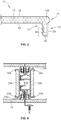
- a single modular upstanding seam flange panel 10 is shown in cross-section, with a seam flange 12 at its distal end 14.
- the seam flange preferably extends along or adjacent the entire length or lateral edge of the panel which may be, for example, up to 45 feet in length and from 2 to 4 feet in width.
- a second flange will be located along the opposite edge of the modular panel parallel to flange 12.
- the panels may be provided in other sizes if desired.
- Modular panel 10 may be extruded from polycarbonate (or other resin) and may have a plurality of internal cells in a honeycomb configuration 17 (or other configuration) disposed in the interior of the panel between its outer surface or wall 16 and its inner surface 18.
- Modular panels 10 with this upstanding seam flange design are known in the art and described for example in U.S. Pat. No. 6,164,024 .
- Modular panels with upstanding seam flanges of the design shown in Figure 2 and modified versions thereof that function generally in the same fashion, made of polycarbonate or other resins, will be referred to herein as "modular panels,” “modular upstanding seam flange panels,” etc.
- the preferred honeycomb cell configuration 17 of modular glazing panels 10 helps control the panel thermal expansion in all directions and gives it resistance to impact and wind and snow loading while maintaining superior light-diffusion capabilities.
- Particularly desirable modular panels 10 are available from CPI Daylighting, Inc., 28662 Ballard Drive, Lake Forest, IL 60045 as PENTAGLAS®NANO-CELL® architectural panels.
- Upstanding seam flanges 12 have a series of sawteeth 20 along their inner surface 22 and generally will be flat along their outer surface 24 optionally with a protruding open resilient bubble corner area 146 to improve sealing between adjacent panels as will be discussed below.
- the surface 26 of the flanges (at the top or bottom of the flanges depending on how the flange is oriented in the panel unit) may also be flat. Additionally, preferably the flanges also include internal cells to give them enhanced strength, resilience, and expansion/contraction properties as described above. Other modular panel designs will be addressed below. In all cases the modular panels have a thin low ultimate tensile strength skin which runs along the entire surface of the panel.
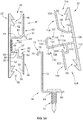
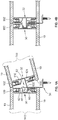
- Figure 3A shows a second locking engagement member 30 and its corresponding first locking engagement member 32 and a metal retention clip 34 juxtaposed between the two locking engagement members.
- Members 30 and 32 are designed to interlock as illustrated in Figure 3B .
- Both locking engagement members may be made, for example, as aluminum extrusions and are each configured for attachment to upstanding seam flanges 12 of corresponding pairs of modular panels to construct a glazing panel unit while armoring or cladding the seam flanges with high tensile strength metal to thereby strengthen and stiffen the panel edges and prevent damage at the points of attachment of retention clips 34.
- metal retention clips are used, a particularly desirable metal-to-metal engagement is achieved.
- the locking engagement members alternatively may be made of engineering plastics, pultruded fiberglas, metal plast, or other appropriate high ultimate tensile strength materials to armor or clad the seam flanges (or panel edges in the examples of Figures 25-26 ) with this high tensile strength material.
- the armoring or cladding of the skin of the modular panel flanges by the locking engagement members protects the flanges (and the panels) from damage at the points of contact by the retention clips and elsewhere that might otherwise occur due to loading and stresses from wind or snow loads and panel expansion and contraction. It also increases the strength of the entire glazing panel unit, making it possible to reduce the weight of the skin of the two panel flanges and to use the glazing panel unit across spans and in other applications in which conventional panel units could not be used without additional retention clips and structural support. Indeed, unlike conventional systems where the bearing load is sustained primarily by the bottom or inner panel, in present examples the load is sustained primarily by the first and second engagement members and the top or outer panel so an overall lighter skinned bottom or inner modular panel can be used.
- second locking engagement member 30 is disposed vertically (as it would be, e.g., at rest in a horizontal roof or skylight installation) and first locking engagement member 32 is angled with respect to the second locking engagement member to correspond to the orientation of the locking engagement members during the course of an on-site or erection process which concludes with the panel units installed in the juxtaposed arrangement of, e.g., Figure 4B .
- the glazing panel units may be installed by directly aligning them rather than angling one of the panels and sliding the two panel units laterally together until the locking engagement members are fully engaged or interlocked.
- Second locking engagement member 30 includes a base 36 which is oriented vertically in the figure and generally U-shaped upwardly and downwardly directed arms 38 and 40 which depend from the back surface 42 of the base.
- Arm 38 includes a generally flat horizontal portion 44 and a generally flat vertical portion 46.
- Horizontal portion 44 includes an optional angled outer corner portion 45 to enhance the resilience and resistance to breakage of arm 38 at this corner.
- the back surface of the base and the U-shaped arm together define an upwardly directed cavity 48 for receiving and locking onto the flange of the top modular panel of glazing panel unit 142 illustrated in Figures 4A and 4B .
- At least one sawtooth and preferably at least two sawteeth 50 project from back surface 42 into cavity 48 to engage sawteeth 20 on upstanding flange 12 of panel 10 in the assembly of the modular panels onto locking engagement member 30.
- Sawteeth 50 include horizontal portions 52 and angled portions 54 which are angled and dimensioned to engage sawteeth 20 of the modular panel flange.
- downwardly directed U-shaped arm 40 includes a generally horizontal portion 56 and a vertical portion 58.
- the horizontal and vertical portions define a downwardly directed cavity 60 which will engage the upstanding flange of a second panel of the modular panel unit assembled on locking engagement member 38.
- Horizontal portion 56 may be stepped downwardly, as shown, to produce a slot 62 having an upwardly directed lip 64 for receiving engagement hook 74 of retention clip 34 and achieving a metal-to-metal retention of the panels and panel unit.
- Other alternative structural arrangements for engagement between the retention clip and the locking engagement member may be used and the engagement members may alternatively be made of engineered plastics, pultruded fiberglas, metal plast, or other appropriate high ultimate tensile strength materials.
- Retention clip 34 includes a base 66 with a hole 68 for receiving a fastener 70 which will be driven or screwed into a purlin, rafter or other support (not shown) to hold adjoining juxtaposed glazing panel units (e.g., units 142 and 144 of Figure 4B ) in place.
- Base 66 supports an upstanding wall 72 and an engagement hook 74.
- the hook includes a ledge 75 and a downwardly directed lip 76 dimensioned to fit within slot 62 (or 126) and engage the inner surface of locking engagement member lip 64 to retain second locking engagement member 30 and the adjoining interlocked first locking engagement member and their modular panels/glazing panel units in place during the on-site erection of the desired sloped glazing, skylights, roofs, walls, and other architectural structures from series of juxtaposed panel units.
- the panel units may be interconnected and erected in place without the use of retention clips.
- Horizontal portions 44 and 56 of upwardly and downwardly directed arms 38 and 40 are spaced from each other to define or wall in a horizontally directed inner cavity 80.
- Inner cavity 80 receives a guide member 82 of first locking engagement member 32 and in doing so helps form an inner gutter 81 ( Figure 3B ) in the final interconnected locking engagement member pair 83, which will be discussed in more detail below.
- the guide member helps resist loads on the interconnected locking engagement members and so must be strong and long enough to accommodate the maximum expected load on the interconnected engagement members.
- a resilient sealing strip 84 will be positioned in cavity 80 along the back surface 42 of base 36 in horizontally directed inner cavity 80 to engage guide member 82.
- Inner gutter 81 in turn carries the water to an open end of the interconnected locking engagement members where a sill and appropriate flashing will be provided to collect escaping water and to carry it away from the slopped glazing, skylight, roof, wall or other architectural structure.
- top corner 85 of step portion 62 may have a nub 86 with front and back inclined surfaces 87 and 88 which facilitate the interlocking process as will be described below.
- an optional water rail 91 projects down and away from the outer surface 92 of vertical portion 46. As will be discussed further below, this rail directs any water that infiltrates or is drawn down between the adjacent top panels of juxtaposed panel units and moves down surface 92 due to surface tension effects or through the gap 96 between vertical portions 46 and 108 away from gutter seal 90 to minimize the likelihood that such infiltrating water will find its way to the gutter seal.
- first locking engagement member 32 in Figure 3A this locking engagement member has a base 100 and U-shaped upwardly and downwardly directed arms 102 and 104 which depend from the back surface 106 of the base.
- Arm 102 includes a generally flat vertical portion 108, and a bottom 110 made up of a first flat portion 112 generally perpendicular to base 100 and a second upwardly angled flat portion 114.
- This bottom configuration is chosen to enhance the resilience and resistance to breakage like the corner on arm 38 described above and is, of course, optional.
- Back surface 106 of base 100 and U-shaped arm 102 together define a generally upwardly directed cavity 116 for receiving the downwardly directed flange of a top modular glazing panel of a glazing panel unit.
- sawteeth 50 project from back surface 106 into cavity 116 to engage sawteeth 20 on upstanding flange 12 of a modular panel 10.
- Sawteeth 50 include horizontal and angled portions that are dimensioned to engage sawteeth 20 of the modular panel flange.
- Downwardly directed U-shaped arm 104 of the first locking member includes a generally horizontal portion 120 and a vertical portion 122. Arm 104 and base back surface 106 define a downwardly directed cavity 124 which will engage the upstanding flange of the second modular glazing panel unit 142 ( Figure 4A ).
- horizontal portion 120 may be stepped downwardly, as shown, to produce a slot 126 having an upwardly directed lip 128 for receiving engagement hook 74 of retention clip 34 to achieve a metal-to-metal engagement.
- Other alternative structural arrangements for metal-to-metal engagement between the retention clip and the locking engagement member may, of course, be used.
- retention clip 34 may be rotated 180 degrees to engage slot 126 and lip 128 of the first locking engagement member rather than step 62 and upwardly directed lip 64 of the second locking engagement member, depending on construction requirements and the desire of the installer erecting the modular glazing panel units in place.
- first and second locking engagement members may be provided with the slot and lip for accommodating the retention clip.
- the resulting metal-to-metal interconnection or interlocking represents a significant advance over prior systems, providing greatly enhanced resistance to wind load and other advantages as discussed earlier.
- Guide member 82 of first locking engagement member 32 includes a spine 83 that projects generally perpendicularly relative to surface 106 of base 90 and in this example extends from portion 120 of downwardly directed U-shaped arm 104.
- Member 82 has a nub 130 adjacent its distal end 132 which projects downwardly from its bottom surface 134 to cooperate with nub 85 on portion 56 of the second locking engagement member when the first and second locking engagement members are interlocked as will be explained below.
- Nub 130 has front and back inclined surfaces 136 and 138 which facilitate the interlocking process and help keep the corresponding locking engagement members together as installation of the glazing panel units proceeds.
- An end flange 140 is located at the distal end of spine 83 of guide member 82.
- Flange 140 has a generally flat outer surface 142 and an optional hook portion 145 which is dimensioned to rest below horizontal portion 44 of the second locking member when the first and second locking engagement members are interconnected as in Figure 3B to help limit water entering the inner gutter from reaching gutter seal 90 and to limit upward movement due to loading on the guide member.
- spine 82 and end flange 140 are dimensioned to ensure that when the first and second locking engagement members are interlocked as in Figure 3B , flat outer surface 141 will abut (and preferably compress) resilient insulating strip 84 in cavity 80 of the second locking member to produce a reliable air, water and sound seal.
- glazing panel units 142 and 144 Such units may be assembled either on-site in a convenient ground level area or off-site and transported to the work site. Once at the worksite the panel units will be erected into sloped glazing, skylights, roofs, walls or other architectural structures.
- the modular panels in glazing panel units 142 and 144 may include optional resilient areas in the form of, e.g., preferably protruding open bubble areas 146 at the lateral edges of the panels. These open bubble areas substantially increase the resilience of the panel edges so that they can deform when the corresponding lateral edges of the panels move in and out due to panel expansion and contraction.
- the adjacent resilient panel areas cooperate with the first and second engagement members which also accommodate lateral movement.
- the panels of glazing panel units 142 and 144 remain flat.
- these resilient edges close the gap between adjacent panels in the panel units to help in limiting or preventing air, water and sound infiltration. Other gap sealing approaches can of course be used.
- the installation method of the invention may proceed as follows:
- Figures 5A and 5B illustrate an alternative example in which first and second engagement locking engagement members 200 and 202 are used to assemble panel units 204 and 206.
- locking engagement members 200 and 202 are taller than locking engagement members 30 and 32 thus establishing a taller and larger airspace between the modular panel pairs of the glazing panel units.
- the airspace of the units of Figures 4A and 4B may be, for example, about 2.5 inches in height whereas the airspace of the units of Figures 5A and 5B may be, for example, about 4.0 inches in height.
- This height difference is achieved by incorporating a second inner cavity 80A and corresponding second guide member 82A spaced a distance "x" from the first inner cavity.
- Smaller and larger inner cavities and guide members as well as more than two pairs of these features may be used. These additional features further enhance the installation process by, e.g., improving the signaling and interlocking operation of the first and second locking engagement members.
- the greater height airspace panel units are also stiffer, further enhancing their ability to withstand loads and the added lower inner gutter (which may optionally be fitted with a gasket strip 81A) further limits water, air and sound infiltration.
- Figure 6 illustrates yet another alternative example in which first and second locking engagement members 250 and 252 are used.
- These locking engagement members generally correspond to locking engagement members 200 and 202 of Figures 5A and 5B except that the locking engagement members are provided with pairs of outer brackets 254 and 256 for holding side stiffener bars 258.
- the side stiffener bars run along the locking engagement member improving the section moment of inertia of the locking engagement members, thereby enhancing the load capacity characteristics of the overall panel unit and its ability to handle longer spans.
- the side stiffener bars are preferably made of solid aluminum or steel although they may be hollow if desired.
- Figure 7 depicts a modular panel 300 having a double flange design comprising an outer flange 302 and an inner standing seam flange 304.
- Such panels are shown installed in first and second locking engagement members 306 and 308 in Figures 8A and 8B forming panel units 310 and 312.
- the locking engagement members are interlocked using the pivoting or sliding interlocking motion of the earlier-described locking engagement members and form an inner gutter 324 in the same way using like structural features.
- Upstanding lip 314 onto which a hook 74 of a retention clip 34 is fit again achieves the metal-to-metal engagement discussed earlier.
- the second locking engagement member includes a ledge 316 (on which outer panel flange 302 rests to provide enhanced load bearing capability) and a downwardly directed shoulder 318.
- First locking engagement member 306 has a corresponding first shelf 320 for supporting the outer flange 302 of the adjacent panel 300 of panel unit 310. Shelf 320 jogs downwardly to provide a second lower shelf 322 which engages downwardly directed shoulder 318 of the second locking engagement member when the panel units are interconnected as depicted in Figure 8B .
- the engagement of shoulder 318 and shelf 322 therefore forms the first line of defense against the infiltration of water into the inner gutter 324 in the interconnected units and also provides enhanced load bearing capabilities ( Figure 8B ).
- Figure 9 is a partial view of the top modular panels of two panel units interconnected using first and second locking engagement members 301 and 303. This Figure is included to illustrate an alternative example in which the lateral edges 305 and 307 of the panels are spaced from each other. In this arrangement, a resilient gasket 309 is fitted into the gap between the panel edges and held in place by a pin 311 affixed to locking engagement member 300.
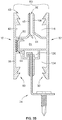
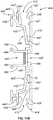
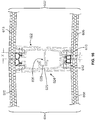
- Figure 10 illustrates another example in which pairs of modular glazing panels 10A and 10B are locked into respective upwardly and downwardly directed cavities 406/408 and 410/412 ( Figures 11A and 11B ) of metal first and second locking engagement members 402 and 404.
- Modular panel units 414 and 416 are formed in this way and then assembled together by interlocking the first and second members as illustrated in Figure 10 .
- first locking engagement member 402 of Figure 10 has a back wall 418 interrupted at its midpoint by a slot 420 which extends along the first locking engagement member and is positioned to open into the area between the paired modular panels of a glazing panel unit as can be seen in Figure 10 .
- Fireproofing, aluminum members, sound proofing or insulation provided with tabs as appropriate may be fixed in the area between the panel pairs by attaching the tabs to this slot as desired.
- Back wall 418 extends between the top edge 422 and the bottom edge 424 of the first locking engagement member.
- a cantilever arm 426 extends from the inner surface 421 of back wall 418.
- Cantilever arm 426 include a base portion 430 that is generally perpendicular to the inner surface of the back wall and has a predetermined width "W.”
- An angled member 432 extends from base 430 and the cavity bottom member 434 extends laterally from upwardly angled member 432.
- a cavity sidewall member 436 extends generally parallel to back wall inner surface 421 to form one side of cavities 406/408.
- the opposite side of the cavities comprises a portion of inner surface 421 and a pair of sawteeth 439 at the top and bottom of the locking engagement member which project into cavities 406 and 408.
- sawteeth 20 of seam flanges 12 of glazing panel 10A or 10B will fit within cavity 406 or 408 with the panel sawteeth engaging sawteeth 439.
- cantilever arms 426 will flex away from back wall inner surface 421 to permit the flanges to enter the cavities after which the cantilever arms will resile back to their original position locking the flanges into place.
- a bevel 440 may be formed on the inner surface of sidewall member 436 ( Figure 11A ) to help guide the panel sawteeth into place in the cavity.
- a "T” shaped member 442 projects from the outer surface 444 of sidewall member 436.
- the T-shaped member presents an outer abutment surface 446 to help ensure proper parallel alignment of the modular panel units when then they are interconnected by way of first and second locking engagement members.
- First locking engagement member 402 also includes slots 449 running behind abutment surface 446 of T-shaped member 442. These slots may receive a locking portion 445 of an elongated gasket 443 ( Figure 10 ). When these gaskets are positioned as illustrated in Figure 10 , they achieve an enhanced sealing at the interface between adjacent panel ends of each modular panel unit.
- the respective inner surfaces 421, 431 and 433 of back wall 418, cantilever arm base 430 and cantilever sidewall member 436 define a cavity 452 for receiving the upper retention portion 464 of a unique clip member 454 which is described immediately below and illustrated in Figures 12A-12C and 14 .
- Inner surface 433 of the cantilever sidewall member also includes a boss 447 that helps insure that the upper retention portion of clip member 454 is firmly retained in cavity 452 and maintained in abutment against inner surface 428.
- First locking engagement member 402 also includes a guide member 470 that is disposed generally perpendicularly with respect to back wall 418 and projects from the inner surface 474 of slot wall 472.
- the guide member includes a spine 476 and a generally rectangular flange 478 at its distal end.
- Flange 478 includes an abutment surface 482 that is generally parallel to back wall 418 and is of a height "H" corresponding to the height of a receiving cavity 490 of second locking engagement member 404 ( Figure 11B ) to insure that the flange fits properly in the receiving cavity of second locking engagement member 404, as will be discussed below.
- flange 478 includes outer corners 484.
- FIG 11B illustrates second locking member 404.
- this locking engagement member includes a back wall 418' interrupted at its midpoint by a slot 420' which extends along the first member and is positioned to open into the area between the paired panels of a modular panel unit. Fireproofing or insulation may be fixed in the area between the panel pairs by way of a tab attached to this slot, as desired, as discussed earlier with respect to locking member engagement 402.
- Back wall 418' extends between the top 422' and the bottom 424' of the first locking engagement member.
- Cantilever arms 426' extend from the inner surface 421' of back wall 418'.
- Cantilever arms 426' include a base portion 430 that is generally perpendicular to the inner surface of the back wall and has a predetermined width "W'.”
- An angled member 432' extends from base 430' and the cavity bottom member 434' extends laterally from upwardly angled member 432'.
- a cavity sidewall member 436' extends generally parallel to back wall inner surface 421' to form one side of cavities 410 and 412. The opposite side of the cavities comprises a portion of inner surface 421 and a pair of sawteeth 438 at the top and bottom of the locking engagement member which project into cavities 410 and 412.
- sawteeth 20 of glazing panel 10A or 10B will fit within cavity 410 or 412 with the panel sawteeth engaging sawteeth 439. Additionally, in order to facilitate the assembly of the panel sawteeth into the cavity, a bevel 440' may be formed on the inner surface of sidewall member 436' to help guide the panel sawteeth into place in the cavity.
- a "T” shaped member 442' projects from the outer surface 444' of sidewall member 436'.
- the T-shaped member presents an outer abutment surface 446' to help ensure proper parallel alignment of the panel units when they are interconnected by way of the first and second members.
- Second locking engagement member 404 also includes slots 449' running behind abutment surface 446' of T-shaped member 442'. These slots may receive a locking portion 445 of an elongated gasket 443 ( Figure 10 ). When these gaskets are positioned as illustrated in Figure 10 , they achieve an enhanced sealing at the interface between adjacent panel ends of each modular panel unit.
- the respective inner surfaces 421', 431' and 433' of back wall 418', cantilever arm base 430' and cantilever sidewall member 436' define a cavity 452' for receiving the upper retention portion 464 of a unique clip member 454 which is described immediately below and illustrated in 12A-12C and 14.
- Inner surface 433' of the cantilever sidewall member also includes a boss 447' that helps insure that the upper retention portion of clip member 454 is firmly retained in cavity 542 and maintained in abutment against inner surface 428'.
- Second locking engagement member 404 has a flange-receiving cavity 490 positioned along the midline of the locking engagement member which opens away from back wall 418'.
- Flange receiving cavity 490 is defined by side members 492 which are oriented generally perpendicularly with respect to back wall 418'.
- Outwardly angled lips 494 are formed at the distal edges of the side members. These lips will engage outer corners 484 of flange 478 of the first locking engagement member to help guide the flange into the flange-receiving cavity when panel units are moved into interlocking position.
- a resilient sealing strip 496 will be applied to the bottom surface 498 of the flange-receiving cavity.
- a resilient strip may be applied to abutment surface 482 of flange 478 of first engagement member 402, or resilient strips may be applied to both the abutment surface of the flange and the inner surface of the cavity bottom.
- Clip member 454 is depicted in Figures 12A-12C .
- the clip member includes a base 456 having an opening 458 for receiving a fastener.
- a sidewall 460 extends generally perpendicularly from base 456.
- Sidewall 460 is slit along 462 so that the upper retention portion 464 of the sidewall can be bent substantially perpendicularly to project in the opposite direction from base 456.
- Upper retention portion 464 which may be radiused at corners 465 to facilitate insertion into cavity 452, is dimensioned to fit snuggly in cavity 452 for locking edge glazing panel units in place from their opposite ends, as will be described below. This is made possible by the enhanced strength/moment of inertia achieved by the armoring or cladding of the flanges of the glazing panels by the clip receiving locking engagement members.
- FIG 13 illustrates a vertical opening 500 into which glazing panel units may be installed.
- sill frames 502 as illustrated in Figure 14 , 538A-538B may be used.
- Sill frames 502 may be generally "L" shaped, as shown, and include a base portion 504 and an upstanding portion 506 that includes gasket holding means 508 at its distal end ( Figure 15 ).
- the gasket holding means include a cavity 510 Figure 510 for receiving the base 514 of a resilient gasket 512.
- gasket 512 presents a generally flat surface 516 generally parallel to the upstanding portion 506.
- Base portion 504 of the seal frame includes a series of spacer legs 518A, 518B and 518C which are designed to rest against a structural support member to which the sill frame is attached.
- Attachment of the sill frame to support frame in 520 may be achieved by passing a screw fastener 522 through pairs of bores 524A and 524B, spaced respectively along base 504 of the support frame and foot 526 of spacer leg 518B and driven into support framing 519.
- a screw fastener 522 may be passed through pairs of bores 524A and 524B, spaced respectively along base 504 of the support frame and foot 526 of spacer leg 518B and driven into support framing 519.
- opening 500 is noted that this opening is framed out with a header 540 at its top, a sill 542 at its bottom and side framing members 544 and 546.
- Installation of a series of glazing panel units 538A-538E may be accomplished as follows.
- first and second locking engagement members greatly enhance the structural characteristics of the panels and hence the modular panel units, substantially enhanced spans may be covered in this fashion in vertical, horizontal and angled applications.
- intermediate structural supports may be provided with clips affixed to the first and second locking engagement members and the intermediate structural elements.
- Figure 16 illustrates an example in which modular panel units 602 and 604 having lower panels 606 and 608 with their flanges 610 and 612 spaced a distance "Y" from the edges of the panels and their upper panels 618 and 620 spaced a larger distance "X" from the edge of the panels to achieve a radiused configuration or circularly disposed assembly of glazing panel units.
- the locking engagement members in this example correspond generally to locking engagement members 402 and 404 of Figures 11A and 11B except that guide member 626 of locking engagement member 622 has a circular leading edge 628 which accommodates the radius configuration since it is able to rest within cavity 629 of locking engagement member 624.
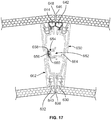
- Figure 17 is another example in which a radiused configuration is achieved.
- the upstanding flanges 630 and 632 of lower panels are located at the lateral edges 638 and 640 of these panels and the flanges 642 and 644 of the upper panels are spaced from the lateral edges 646 and 648 of the upper panels.
- the first locking engagement member 650 includes a flange 652 with a round distal end 654 which facilitates the angled (nonperpendicular) disposition of the first and second interlocking engagement members.
- a gasket 656 may optionally be fitted to the outer edge of the curved flange of the guide member to seal against the bottom surface 658 of the flange receiving cavity 660 of the second locking engagement member 662 as shown.
- the spine 664 of the guide member is designed to be of a length that ensures that the outer surface of the guide member sits properly in the flange receiving cavity.
- FIG 19 illustrates hermaphroditic locking engagement members 700 which may be used to interchangeably because each includes like guide members 702 and flange receiving cavities 704/706.
- receiving cavity 706 includes a gasket 708 which engages the distal end of one of the guide members to produce a seal when the locking engagement members are interlocked.
- This figure also includes gaskets 708 which are fit into the hermaphroditic locking engagement members like, for example, gaskets 443 in Figure 10 to produce a seal as described above.
- Figures 20A-20B illustrate examples in which first and second locking engagement members 730/732 and 760/762 include rigid elongated members or extensions 734/736 and 764/766 which are designed to extend below the lower panels 738 and 768 of the modular panel units (or when single panels are used, below the single panels) to improve the rigidity/moment of inertia of the panel units (or panels), so that they can extend over greater spans without intermediate supports.
- Figure 21 illustrates an example in which single panels 780 are interconnected by first and second locking engagement members 782 and 784 in accordance with an example in which interlocking strengthening extensions 786/788 and 790/792 are provided.
- strengthening extension 790 is fixed onto a purlin or other support member by passing a fastener through a bore in the strengthening extension, as shown in this figure.
- downward movement of the panels due to, e.g., positive pressure of a snow load is resisted by strengthening extension 786 which supports and prevents downward movement of strengthening extension 788.
- upward movement of the panels due to, e.g., wind load is resisted by strengthening extension 790 which abuts strengthening extension 792 and prevents it from moving upwardly.
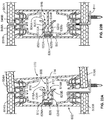
- first and second locking engagement members 800 and 802 are shown with top and bottom modular panels 804A/804B and 806A/806B in place in the locking engagement members.
- Locking engagement members 800 and 802 are constructed generally like first and second locking engagement members 402 and 404 of Figures 11A-11B . However, as will be described below, locking engagement members 800 and 802 differ in the structure of their respective male and female members 808 and 810 which are employed in engagement members 800 and 802 in lieu of guide member 470 and receiving cavity 490 of engagement members 402 and 404.
- Male member 808 includes a spine 812 that projects generally perpendicularly from the front surface 816 of back wall 814.
- Spine 812 (as well as spine 476 of locking engagement member 402 and the spine of locking engagement member 32) optionally may be offset from 90° at an angle sufficient to accommodate the angle between adjacent panel units of curved panel unit installations.
- Spine 812 extends from back wall 816 to a pair of guide, pull-out, and pivot support "T"-shaped rails 818A and 818B which are disposed generally perpendicularly to the rail with the outer faces 820A and 820B of the top of the "T” generally parallel to the corresponding surfaces of spine 812 to help guide the first member into the interlock cavity and to abut the inner surfaces of the cavity sidewalls.
- the leading edges 822A and 822B optionally are radiused as shown to facilitate entry into second member 810.
- a pair of generally flat catch rails 822A and 822B are located and oriented perpendicularly to spine 812.
- the distal edges of the catch rails have bevels 824A and 824B.
- spine 812 projects beyond the catch rails along a distal lip 826. The distal end of the lip may be beveled to present a knife-like leading edge.
- Female member 810 includes sidewalls 826A and 826B which define an interlock cavity 828 for receiving male member 808.
- a series of serrations 830A and 830B are formed along the inside surface of sidewalls 826A and 826B. While three serrations are shown, any desired number may be used.
- Sidewalls 826A and 826B extend to their distal edge 832A/832B where angled walls 834A and 834B are present to facilitate the entrance of member 808 to cavity 828.
- Distal edges 832A and 832B are spaced from the first of serrations 830A/830B a distance "B".
- a gasket 836 is located at the closed distal end of cavity 828.
- a pair of panels 804A/806A are mounted in first locking engagement member 800 and a pair of panels 804B/806B are mounted in second locking engagement member 802 to respectively form panel units 840 and 842.
- panel units 840 and 842 are shown with their locking engagement members interlocked and a retaining clip 844 holding the panel units against a purlin or other support member (not shown).
- a retaining clip 844 holding the panel units against a purlin or other support member (not shown).
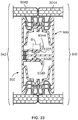
- an internal gutter 846 is formed to receive any water that infiltrates across the space between panels 804A and 804B and moves past gaskets 848A and 848B.
- pressure breaker chambers 850 and 852 are formed between T rails 818A and 818B and catch rails 822A and 822B and the seal formed along lip 826 where it engages gasket 836.
- a particularly efficient sealing is achieved because of the pressure concentrated along the distal edge of the lip which may partially penetrate the gasket. As illustrated in Figure 23 if the lip penetrates far enough into the gasket, a seal will be achieved as well along the interstice between the face of the catch rail and the exposed surface of the gasket. In a less preferred alternative a lip will not be provided but greater force will be required in order to establish a seal.
- Figure 22A shows what happens in this structure when a negative (wind) force is applied along the surface of panels 804A and 804B tending to pivot the first locking engagement member away from the second locking engagement member.
- Some of the wind force may be absorbed by flexure of the panels which are made of flexible resin.
- edge 832A acts as a leverage point where it engages the outer face of T rail 818A so that the portion of spine 812 extending between the T rail and wall 816 acts as a lever arm producing a high downward force along bevel 824B of the catch rail which engages one of serrations 830B to concentrate the force along the outer bevel edges and resist further movement of the first locking engagement member from its engagement with the second locking engagement member.
- Distances "A” and “B” are made generally equal to ensure that the T rail engages edge 832A while the bevel of the catch rail is located adjacent the serrations.
- the orientation of the first engagement member is reversed so that the bevel rests in serrations 830A.
- the serrations may be dispensed with since the substantial force of the bevel edges against one of the inner surfaces of sidewalls 826A or 826B will also resist such separation between the locking engagement members under load.
- the inner surface may be roughened or coated with a non-slip material to resist slippage of the bevels.
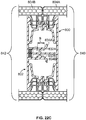
- Figure 22C generally corresponds to Figure 22A except that in this embodiment retaining clips are not used and panels 804A/806A abut the edges of panels 804B/806B.
- the spacing maintained between the bottom surface of the lower panel unit panels and the purlin is determined by the distance of top lip surface 870 and seat surface 876 from the bottom 862 of the base and the bottom surface 882 of foot portion 880. Therefore, these distances may be adjusted in forming retaining clips of this design in order to accommodate different desired spacings.
- panel units 840 and 842 are shown with their locking members interlocked and a retaining clip 844 holding the panel units against a purlin or other support member (not shown).
- a retaining clip 844 holding the panel units against a purlin or other support member (not shown).
- Retaining clip 850 includes a base 854 having a bore 856 through which an appropriate fastener 858 is passed to attach the base of the clip to a supporting purlin 860.
- the base 862 of the clip rests directly onto the top surface 864 of the purlin.
- Clip 850 includes an arm 866 that projects upwardly from base 854.
- a lip 868 projects generally perpendicularly from the arm and has a top surface 870 that is generally parallel to surface 864 of the purlin.
- the clip also includes an upstanding wall 872 along its front edge with a hook 874 in engagement with T-shaped member 442 as shown.
- a clip seat portion 875 projects generally perpendicularly from wall 872.
- the top surface 876 of the seat and top surface 870 of lip 868 are coplanar so that they respectively support adjacent panels of the interlocked panel units at the same spacing from the purlin surface.
- Seat 876 includes a leg 878 that projects downwardly and generally perpendicularly from the seat.
- a foot portion 880 projects generally perpendicularly forward from the leg.
- the bottom surface 882 of the foot portion is coplanar with bottom surface 862 of base 854.
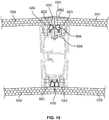
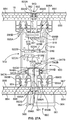
- the modular panels 884 of Figure 27A and 27B are of a new design in which pairs of flanges or "dual flanges" 886A and 886B project from the inner surface 888 of the panels.
- This dual flange design offers advantages over capturing a single panel flange (e.g., flange 12 in Figure 2 ) in a cavity (e.g., cavity 408 in Figure 11A ) of a locking engagement member defined by a back wall (e.g., back wall 418 of Figure 11A ) and a cantilever arm (e.g., member 426 of Figure 11A ), since no flexure of an engagement member cantilever arm will be required.
- the dual flange panel design thus replaces the flexure required of the cantilever arm with flexure in the dual flanges which bend out of the way during the attachment to the locking engagement members and resile back to their initial position to lock the panels to the locking engagement members.
- the engagement member arm may be reduced in length and provided with increased rigidity and ultimate tensile strength. As a result, the spacing between panels of a panel unit may be reduced.
- the span between panel unit supports may be increased reducing the number of support members and clips required in a panel unit installation.
- edges of the distal or outer flange of each pair of dual flanges may be spaced a distance "C" from the distal ends 892 of the panels or they may be generally coplanar with the panel ends (e.g., as in Figure 2B ).
- Distance "C” should be from about 0.5 to about 8 mm. Spacing the flange pairs from the distal ends in this way exposes portions 894A and 894B of the panels which will have enhanced flexure and resilience as a result of this geometry to help accommodate lateral expansion and contraction of the modular panels in conjunction with their interlocking engagement members.
- the degree of flexure may be enhanced by removing the honeycomb structure in this resilient portion as in resilient portion 894A or by reducing the thickness of the panel outer wall 893A or 893B along resilient portions 894A or 894B.
- the degree of flexure may also be enhanced by providing an internal structural wall 897 having a thickness generally equal to the thickness of the panel outer wall 16 to further isolate the resilient portion thereby enhancing its resiliency.
- Figure 27C depicts an alternate modular panel dual flange design in which both distal ends of the panels of the panel units and the distal portions of the outer flanges are structured to have enhanced flexure and resilience.
- panel 999 includes dual seam flanges in the form of a proximal or inner flange 1000 and a distal or outer flange 1002.
- the outer surface 1004 of flange 1002 includes a notch 1006 so that the bottom portion 1008 of the outer surface of flange 1002 is spaced from the distal end 1010 of panel 999 a distance of about 0.5 to 8 mm. This geometry produces flexure and resilience both at the distal end of the panel and at the outer surface of flange 1002.
- facing inner edges 895A and 895B of the dual flanges each have corresponding sawteeth 896A and 896B defining a locking cavity 898 which will be addressed further below.
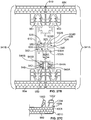
- Locking engagement members 900 and 902 are constructed generally like first and second locking engagement members 402 and 404 of Figures 11A and 11B and locking engagement members 800 and 802 of Figures 22A-22C . However, as will be discussed below, locking engagement members 900 and 902 differ in their structure for attachment to the panel dual flanges and include optional additional gasketing.
- first locking engagement member 900 includes a male member or spine 912 that projects generally perpendicularly from the front surface 916 of back wall 914.
- Spine 912 (as well as the spines of engagement members 32, 402 and 800) optionally may be offset from 90° at an angle sufficient to accommodate the angle between adjacent panel units of curved panel unit installations.
- Spine 912 extends from back wall 916 to a pair of guide, pull-out, and pivot support "T"-shaped rails 918A and 918B which are disposed generally perpendicularly to the rail with the outer faces 920A and 920B of the top of the "T” generally parallel to the corresponding surfaces of spine 912 to help guide the first locking engagement member into the interlock cavity 913 of the second locking engagement member and to abut the inner surfaces of the interlock cavity sidewalls.
- a pair of generally flat catch rails 922A and 922B are located and oriented perpendicularly to spine 912.
- Interlock cavity 910 includes sidewalls 926A and 926B ( Figure 27A ) for receiving first member 908.
- Serrations 930 are formed along the inside surface of sidewalls 926A and 926B. While two serrations are shown on sidewalls 926A and 926B in Figure 27A , any desired number may be used. And, as shown in Figure 27B the serrations may be present on the inside surface of only one of the walls.
- Sidewalls 926A and 926B extend to their distal edges 932A/932B where angled walls 934A and 934B are present to facilitate the entrance of member 908 to cavity 928.
- an elastomeric gasket 936 optionally may be located along a portion of spine 912 distally to T rails 918A and 918B to seal against along the inner surface of one of the sidewalls when the locking engagement members are interlocked. Since gasket(s) 936 extend upwardly and/or downwardly from the spine, when the spine enters interlock cavity 913 of second locking engagement member 902 it will engage the opposed inner surface of the cavity wall to produce a supplemental seal. Alternatively, elastomeric gaskets may be located on both sides of spine 912.
- Panels 884 are mounted in first locking engagement member 900 and a pair of panels 884 are mounted in second locking engagement member 902 to respectively form panel units 941A and 941B.
- Elongated resilient gaskets 940A and 940B with locking engagement members 942A at 942B having distal flexible arrow shapes may be mounted to cavities 944A and 944B in the engagement members.
- the gasket members are dimensioned so that when the locking engagement members are interlocked the gaskets will fill the space between outer surfaces 890A and 890B of the outer flanges of the lower (or inside) panels of adjacent panel units 941A and 941B while the inner surfaces 947A and 947B of the gaskets press up against each other (behind upstanding wall 961 of clip 960) and encapsulate the clip wall to help limit air, water and sound infiltration across the interlocked members.
- the elongated resilient gaskets are shown adjacent the lower panels of the panel units, they may also be included adjacent the upper panels of the panel units.
- Locking engagement members 900 and 902 may include additional gasketing systems to further limit air, water and sound infiltration across the interlocked locking engagement members.
- second locking engagement member 802 may include a first shelf member 915 bearing an upper resilient sealing member 917 having a series of flexible fingers 919 along its top surface and/or a series of flexible fingers 921 along its bottom surface. The sealing member and fingers are positioned so that when the locking engagement members are interlocked, fingers 919 abut the bottom surfaces of the adjacent panel seam flanges and fingers 921 abut the opposed surface of a second shelf member 923 of first locking engagement member 900 producing yet further sealing against air, water and sound infiltration across the interlocked members.
- Figure 27B illustrates an alternative embodiment in which the first and second locking engagement members are designated respectively 908 and 910 and the panels of the adjacent panel units abut up against each other, so that, for example, there is no space to receive gaskets 940A and 940B of the Figure 27A embodiment. Therefore, in this embodiment, gaskets 945A and 945B are used and both abut along their inner surfaces and also abut the top surface of the outer flanges of the dual flanges of the lower panels of the adjacent panel units.
- An internal gutter 946 is formed in the emodiments of both Figures 27A and 27B to receive any water that infiltrates across the space 943 between adjacent top panels of the interlocked panel units ( Figure 27A ) or across the interstice 949 ( Figure 27B ) where the edges of the top panels of the panel units abut. Additionally, pressure breaker chambers 950 and 952 are formed between T rails 918A and 918B and catch rails 922A and 922B.
- locking engagement members 900/902 and 908/910 include opposed surfaces 951 and 953 from which sawtooth-shaped latch members 954 project.
- the latch members have two oppositely directed pairs of sawteeth 956A and 956B along their opposite edges to form a pine-tree shape. As few as a single pair of oppositely directed sawteeth may be used, as shown in Figure 29 , or greater than two pairs of oppositely directed sawteeth may be used.
- Assembly of panel units may proceed by placing panels 884 on a support surface with dual flanges 890A and 890B projecting upwardly and inserting latch members 954 into the locking cavities of the dual flanges. As pressure is applied, the flanges of the flange pairs will resile outwardly and then snap back into position once the latch members are fully seated in the cavities with the corresponding sawteeth of the locking engagement member and the flanges engaged. Once this is completed at both lateral edges of the panel, a second, top panel is applied by locating its flange cavities opposite the top latch members and pressing downwardly, again causing the flanges to resile and snap back into place as described above.
- Locking clip 960 is shown in the embodiment of Figure 27A with spacer legs 962 and 964, shelf members 963 and 965, and feet 966 and 967 which rest against the bottom panel surface (foot 967 and shelf 963) and a purlin or other supporting framing (foot 966 and shelf 965).
- This clip structure maintains a spacing between the panel units and the support framing for example as described above with respect to Figure 14 .
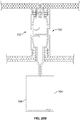
- FIG 28 modular panels 948 with paired upstanding flanges 970A and 970B are shown.
- the inner surfaces 972 of the distal flanges are coplanar with the lateral ends 974 of the panels.
- the outer flange of the dual flanges may, however, be spaced from the panel ends as shown in Figures 27A , if desired.
- distal flanges 970B include sawteeth 976 whereas proximal or inner flanges 970A have a generally flat surface 978 forming a locking cavity 980 with sawteeth along one side only.
- This design may be reversed as required so that the outer flanges include the sawteeth.
- Latch members 982 in this figure differ from latch members 954 in Figures 27A-27B in that the latch members have a generally flat back surface 984 and sawteeth 986 along their opposite surface.
- Figure 29 shows yet another modular panel embodiment 988 with paired upstanding flanges 990A and 990B.
- latch member 992 of first and second locking engagement members 989 and 991 has but a single sawtooth 994 which projects into the locking cavity 994 between the pair of flanges 996A and 996B to engage a single sawtooth 998 located on the inner surface of the distal flanges.
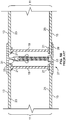
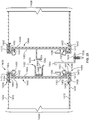
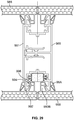
- Figure 24 depicts a pair of fiberglas sandwich panels 1400 and 1402.
- the sandwich panels each include top panels 1404 and bottom panels 1406.
- top and bottom panels are shown to be of the same thickness in this figure, a thinner lower panel may suffice in many applications due to the structural integrity provided by the metal locking engagement members.
- the panels are referred to as being made of fiberglas, panels made of other transparent or translucent resins may be used.
- Sandwich panels 1400 and 1402 are provided with corresponding first and second metal locking rails 1408 and 1410 adjacent the lateral edges 1413 and 1415 of the panels.
- the locking rails are generally "I-beam" shaped and include top and bottom shelf supports 1412 and 1414 which are adhered to the inner surfaces 1416 and 1418 of the top and bottom panels by way of an appropriate adhesive located in the interstices 420 and 422 between inner surfaces 416/418 and top and bottom shelf supports 1412/1414.
- first and second locking engagement members 1424 and 1426 are located generally midway along rails 1408 and 1410.
- the rails are oriented so that the first and second locking engagement members project away from the panels.
- the second locking engagement member is generally U shaped and includes an inner cavity 1427 and outwardly projected lips 1428 which help guide the first locking engagement member into the second locking engagement member.
- the first locking engagement member includes an upstanding rail 1430, an end flange 1432, with an inwardly directed lip 1434.
- Figure 24 illustrates first and second locking engagement member pair examples
- any of the guide members and engaging cavity designs of the locking engagement members as illustrated in the earlier Figures and described above may be used in place of locking engagement members 424 and 426.
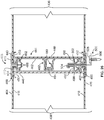
- Figure 25 depicts a pair of laterally disposed sandwich panels 1436 and 1438 in which the lateral edges 1413 and 1415 of the top and bottom Fiberglas panels 1404 and 1406 are captured in first and second metal locking rails 1444 and 1446 where each of these locking rails includes an inner panel support member 1448 with top and bottom shelf supports 1450 and 1452.
- the shelf supports may be adhered to the inner surfaces 1416 and 1418 of the top and bottom resin panels, preferably they are not adhered. Rather, the lateral edges of the panels are captured between the outer surfaces 1454 and 1456 of the top and bottom shelf supports and flanges 1458 and 1460 of first and second outer support members 1462 and 1464.
- the flanges each include an interior cavity 1466 which enables the outer rails to be pressed home against the inner rails trapping the lateral edges of the panels in the space 1468 between the outer surfaces of the inner rails and the inner surfaces 1470 and 1472 of flanges 1458 and 1460.
- first and second locking engagement members 1480 and 1482 are located generally midway along outer support members 1462 and 1464. As can be seen in Figure 25 , these first and second locking engagement members generally correspond to locking engagement members 1424 and 1426 of Figure 24 except that locking engagement member 1482 is provided with a resilient member 1486 at the bottom of cavity 1484 of this locking engagement member.
- Optional compressible gaskets 1488 may be positioned at opposite ends of outer rails 1462 and 1464, above flanges 1458 and 1460. These gaskets are made of an elastic material such as a synthetic rubber and are held in place by locking engagement members 1490 which hook into cavities 1492.
- Outer support members 1462 and 1464 are provided with upwardly opening flanges 1496 and 1498. Similar upwardly opening flanges to receive retention clips may be provided along the inner edge of rails 1408 and 1410 of Figure 24 . Flanges 1496 and 1498 are to be used in conjunction with metal retention clips 1500 which are designed and function much the same as retention clips 34 described earlier.
- Retention clips 1500 include a base 1506 with a hole for receiving a fastener 1508 which will be driven or screwed into a purlin, rafter or other support to hold adjoining sandwich panels in place.
- the clips also include an upstanding wall 1502 and an engagement hook 1504 which is dimensioned to engage flange 1596.
- this retention clip can be used to fix sandwich panel 1438 in place during the onsite erection of glazing, skylights, roofs, walls, etc.
- sandwich panel 1436 can be laterally aligned as shown and moved into place so the first and second locking engagement members engage and the end flange 1494 of locking engagement member 1480 will compress resilient member 1486 at the bottom of cavity 1484 forming an air and water resistant seal at that point and gaskets 1488 will abut forming air and water resistant seals along the gaskets between the adjacent sandwich panels.
- This final construction is illustrated in Figure 24 .
- Installation of the adjacent panels of Figures 24 and 25 may proceed generally as discussed above.
Landscapes
- Engineering & Computer Science (AREA)
- Architecture (AREA)
- Civil Engineering (AREA)
- Structural Engineering (AREA)
- Roof Covering Using Slabs Or Stiff Sheets (AREA)
- Securing Of Glass Panes Or The Like (AREA)
Priority Applications (1)
| Application Number | Priority Date | Filing Date | Title |
|---|---|---|---|
| PL13839170T PL2898166T3 (pl) | 2012-09-21 | 2013-09-20 | System podwójnych szyb zespolonych |
Applications Claiming Priority (5)
| Application Number | Priority Date | Filing Date | Title |
|---|---|---|---|
| US201261704242P | 2012-09-21 | 2012-09-21 | |
| US201261736847P | 2012-12-13 | 2012-12-13 | |
| US13/839,646 US9151056B2 (en) | 2008-04-17 | 2013-03-15 | Dual glazing panel system |
| US201361860545P | 2013-07-31 | 2013-07-31 | |
| PCT/US2013/060974 WO2014047466A1 (en) | 2012-09-21 | 2013-09-20 | Dual glazing panel system |
Publications (3)
| Publication Number | Publication Date |
|---|---|
| EP2898166A1 EP2898166A1 (en) | 2015-07-29 |
| EP2898166A4 EP2898166A4 (en) | 2016-06-22 |
| EP2898166B1 true EP2898166B1 (en) | 2018-10-10 |
Family
ID=50341975
Family Applications (1)
| Application Number | Title | Priority Date | Filing Date |
|---|---|---|---|
| EP13839170.1A Active EP2898166B1 (en) | 2012-09-21 | 2013-09-20 | Dual glazing panel system |
Country Status (6)
| Country | Link |
|---|---|
| EP (1) | EP2898166B1 (es) |
| CA (1) | CA2885428C (es) |
| DK (1) | DK2898166T3 (es) |
| ES (1) | ES2704667T3 (es) |
| PL (1) | PL2898166T3 (es) |
| WO (1) | WO2014047466A1 (es) |
Families Citing this family (1)
| Publication number | Priority date | Publication date | Assignee | Title |
|---|---|---|---|---|
| US20210277658A1 (en) * | 2016-08-19 | 2021-09-09 | Rajeev Moudgil | Extruded convex plastic panel with standing seams for roof structures |
Family Cites Families (7)
| Publication number | Priority date | Publication date | Assignee | Title |
|---|---|---|---|---|
| US5212914A (en) * | 1991-05-28 | 1993-05-25 | Alu Tech Systems, Inc. | Wall paneling system with water guttering device |
| WO1993021400A1 (en) * | 1992-04-16 | 1993-10-28 | Farag F Aziz | A stopless butt-joint curtainwall system |
| US7832160B2 (en) * | 2001-03-22 | 2010-11-16 | Media Curtainwall Corp. | Seismic safe and fire resistant rated edge attached stopless glazing |
| US7441379B2 (en) * | 2003-06-27 | 2008-10-28 | Konvin Associates Limited Partnership | Light transmission panels, retaining clip and a combination thereof |
| US8056289B1 (en) * | 2008-04-17 | 2011-11-15 | Konvin Associates Ltd. | Dual glazing panel system |
| IL193077A0 (en) * | 2008-07-27 | 2009-08-03 | Dan Pal | Double pane panel unit and method of assembling same |
| JP2012526938A (ja) * | 2009-05-13 | 2012-11-01 | サビック イノベーティブ プラスチックス イーペー ベスローテン フェンノートシャップ | パネルを連結するコネクタ組立体 |
-
2013
- 2013-09-20 PL PL13839170T patent/PL2898166T3/pl unknown
- 2013-09-20 CA CA2885428A patent/CA2885428C/en active Active
- 2013-09-20 EP EP13839170.1A patent/EP2898166B1/en active Active
- 2013-09-20 DK DK13839170.1T patent/DK2898166T3/en active
- 2013-09-20 WO PCT/US2013/060974 patent/WO2014047466A1/en not_active Ceased
- 2013-09-20 ES ES13839170T patent/ES2704667T3/es active Active
Non-Patent Citations (1)
| Title |
|---|
| None * |
Also Published As
| Publication number | Publication date |
|---|---|
| EP2898166A1 (en) | 2015-07-29 |
| EP2898166A4 (en) | 2016-06-22 |
| ES2704667T3 (es) | 2019-03-19 |
| WO2014047466A1 (en) | 2014-03-27 |
| DK2898166T3 (en) | 2019-01-28 |
| PL2898166T3 (pl) | 2019-05-31 |
| CA2885428C (en) | 2020-07-07 |
| CA2885428A1 (en) | 2014-03-27 |
Similar Documents
| Publication | Publication Date | Title |
|---|---|---|
| US8056289B1 (en) | Dual glazing panel system | |
| US9151056B2 (en) | Dual glazing panel system | |
| RU2471932C2 (ru) | Модульные щитовые элементы строительного назначения | |
| US5058333A (en) | Foam panel roof mounting system | |
| US9528266B2 (en) | Dual glazing panel system | |
| US5560155A (en) | Modular solarium | |
| US9255407B2 (en) | Truss system | |
| WO2010013233A2 (en) | Double pane panel unit and method of assembling same | |
| EP4419760B1 (en) | Roofing and covering device | |
| EP1111153A2 (en) | Glazing system | |
| CZ20022345A3 (cs) | Stavební prvek | |
| US20200149276A1 (en) | Cross laminated timber wall panel system | |
| EP2898166B1 (en) | Dual glazing panel system | |
| AU8272387A (en) | Panel mounting system | |
| WO2019009467A1 (ko) | 조립식 돔 하우스 | |
| EP0750080B1 (en) | Structures | |
| US20140090326A1 (en) | Aesthetic wall facade systems, devices, and methods | |
| RU71998U1 (ru) | Направляющая для узла стыковки облицовочных панелей на фасадной поверхности | |
| EP0277226B1 (en) | Improved panel unit | |
| US20250376890A1 (en) | Fenestration panels and systems | |
| CN112663785B (zh) | 一种拼装房屋 | |
| JPH0433301Y2 (es) | ||
| WO2000023672A1 (en) | Screwless covering system | |
| JP2005299301A (ja) | 波板の取付構造及びこれに用いる合成樹脂製波板 | |
| JPH051526Y2 (es) |
Legal Events
| Date | Code | Title | Description |
|---|---|---|---|
| PUAI | Public reference made under article 153(3) epc to a published international application that has entered the european phase |
Free format text: ORIGINAL CODE: 0009012 |
|
| 17P | Request for examination filed |
Effective date: 20150327 |
|
| AK | Designated contracting states |
Kind code of ref document: A1 Designated state(s): AL AT BE BG CH CY CZ DE DK EE ES FI FR GB GR HR HU IE IS IT LI LT LU LV MC MK MT NL NO PL PT RO RS SE SI SK SM TR |
|
| AX | Request for extension of the european patent |
Extension state: BA ME |
|
| DAX | Request for extension of the european patent (deleted) | ||
| REG | Reference to a national code |
Ref country code: DE Ref legal event code: R079 Ref document number: 602013045010 Country of ref document: DE Free format text: PREVIOUS MAIN CLASS: E06B0003640000 Ipc: E04D0003280000 |
|
| RA4 | Supplementary search report drawn up and despatched (corrected) |
Effective date: 20160523 |
|
| RIC1 | Information provided on ipc code assigned before grant |
Ipc: E04D 3/28 20060101AFI20160517BHEP |
|
| STAA | Information on the status of an ep patent application or granted ep patent |
Free format text: STATUS: EXAMINATION IS IN PROGRESS |
|
| 17Q | First examination report despatched |
Effective date: 20170329 |
|
| RAP1 | Party data changed (applicant data changed or rights of an application transferred) |
Owner name: KONVIN ASSOCIATES LIMITED PARTNERSHIP |
|
| RIN1 | Information on inventor provided before grant (corrected) |
Inventor name: KONSTANTIN, MOSHE |
|
| GRAP | Despatch of communication of intention to grant a patent |
Free format text: ORIGINAL CODE: EPIDOSNIGR1 |
|
| STAA | Information on the status of an ep patent application or granted ep patent |
Free format text: STATUS: GRANT OF PATENT IS INTENDED |
|
| INTG | Intention to grant announced |
Effective date: 20180221 |
|
| GRAS | Grant fee paid |
Free format text: ORIGINAL CODE: EPIDOSNIGR3 |
|
| GRAA | (expected) grant |
Free format text: ORIGINAL CODE: 0009210 |
|
| STAA | Information on the status of an ep patent application or granted ep patent |
Free format text: STATUS: THE PATENT HAS BEEN GRANTED |
|
| AK | Designated contracting states |
Kind code of ref document: B1 Designated state(s): AL AT BE BG CH CY CZ DE DK EE ES FI FR GB GR HR HU IE IS IT LI LT LU LV MC MK MT NL NO PL PT RO RS SE SI SK SM TR |
|
| RAP1 | Party data changed (applicant data changed or rights of an application transferred) |
Owner name: CPI DAYLIGHTING, INC. |
|
| REG | Reference to a national code |
Ref country code: GB Ref legal event code: FG4D |
|
| REG | Reference to a national code |
Ref country code: CH Ref legal event code: EP Ref country code: AT Ref legal event code: REF Ref document number: 1051429 Country of ref document: AT Kind code of ref document: T Effective date: 20181015 |
|
| REG | Reference to a national code |
Ref country code: IE Ref legal event code: FG4D |
|
| REG | Reference to a national code |
Ref country code: DE Ref legal event code: R096 Ref document number: 602013045010 Country of ref document: DE |
|
| REG | Reference to a national code |
Ref country code: CH Ref legal event code: NV Representative=s name: DR. LUSUARDI AG, CH |
|
| REG | Reference to a national code |
Ref country code: DK Ref legal event code: T3 Effective date: 20190122 |
|
| REG | Reference to a national code |
Ref country code: NL Ref legal event code: FP |
|
| REG | Reference to a national code |
Ref country code: SE Ref legal event code: TRGR |
|
| REG | Reference to a national code |
Ref country code: LT Ref legal event code: MG4D |
|
| REG | Reference to a national code |
Ref country code: ES Ref legal event code: FG2A Ref document number: 2704667 Country of ref document: ES Kind code of ref document: T3 Effective date: 20190319 |
|
| PG25 | Lapsed in a contracting state [announced via postgrant information from national office to epo] |
Ref country code: FI Free format text: LAPSE BECAUSE OF FAILURE TO SUBMIT A TRANSLATION OF THE DESCRIPTION OR TO PAY THE FEE WITHIN THE PRESCRIBED TIME-LIMIT Effective date: 20181010 Ref country code: IS Free format text: LAPSE BECAUSE OF FAILURE TO SUBMIT A TRANSLATION OF THE DESCRIPTION OR TO PAY THE FEE WITHIN THE PRESCRIBED TIME-LIMIT Effective date: 20190210 Ref country code: BG Free format text: LAPSE BECAUSE OF FAILURE TO SUBMIT A TRANSLATION OF THE DESCRIPTION OR TO PAY THE FEE WITHIN THE PRESCRIBED TIME-LIMIT Effective date: 20190110 Ref country code: LT Free format text: LAPSE BECAUSE OF FAILURE TO SUBMIT A TRANSLATION OF THE DESCRIPTION OR TO PAY THE FEE WITHIN THE PRESCRIBED TIME-LIMIT Effective date: 20181010 Ref country code: HR Free format text: LAPSE BECAUSE OF FAILURE TO SUBMIT A TRANSLATION OF THE DESCRIPTION OR TO PAY THE FEE WITHIN THE PRESCRIBED TIME-LIMIT Effective date: 20181010 Ref country code: LV Free format text: LAPSE BECAUSE OF FAILURE TO SUBMIT A TRANSLATION OF THE DESCRIPTION OR TO PAY THE FEE WITHIN THE PRESCRIBED TIME-LIMIT Effective date: 20181010 Ref country code: NO Free format text: LAPSE BECAUSE OF FAILURE TO SUBMIT A TRANSLATION OF THE DESCRIPTION OR TO PAY THE FEE WITHIN THE PRESCRIBED TIME-LIMIT Effective date: 20190110 |
|
| PG25 | Lapsed in a contracting state [announced via postgrant information from national office to epo] |
Ref country code: PT Free format text: LAPSE BECAUSE OF FAILURE TO SUBMIT A TRANSLATION OF THE DESCRIPTION OR TO PAY THE FEE WITHIN THE PRESCRIBED TIME-LIMIT Effective date: 20190210 Ref country code: GR Free format text: LAPSE BECAUSE OF FAILURE TO SUBMIT A TRANSLATION OF THE DESCRIPTION OR TO PAY THE FEE WITHIN THE PRESCRIBED TIME-LIMIT Effective date: 20190111 Ref country code: RS Free format text: LAPSE BECAUSE OF FAILURE TO SUBMIT A TRANSLATION OF THE DESCRIPTION OR TO PAY THE FEE WITHIN THE PRESCRIBED TIME-LIMIT Effective date: 20181010 Ref country code: AL Free format text: LAPSE BECAUSE OF FAILURE TO SUBMIT A TRANSLATION OF THE DESCRIPTION OR TO PAY THE FEE WITHIN THE PRESCRIBED TIME-LIMIT Effective date: 20181010 |
|
| REG | Reference to a national code |
Ref country code: DE Ref legal event code: R097 Ref document number: 602013045010 Country of ref document: DE |
|
| PG25 | Lapsed in a contracting state [announced via postgrant information from national office to epo] |
Ref country code: CZ Free format text: LAPSE BECAUSE OF FAILURE TO SUBMIT A TRANSLATION OF THE DESCRIPTION OR TO PAY THE FEE WITHIN THE PRESCRIBED TIME-LIMIT Effective date: 20181010 |
|
| PLBE | No opposition filed within time limit |
Free format text: ORIGINAL CODE: 0009261 |
|
| STAA | Information on the status of an ep patent application or granted ep patent |
Free format text: STATUS: NO OPPOSITION FILED WITHIN TIME LIMIT |
|
| PG25 | Lapsed in a contracting state [announced via postgrant information from national office to epo] |
Ref country code: SK Free format text: LAPSE BECAUSE OF FAILURE TO SUBMIT A TRANSLATION OF THE DESCRIPTION OR TO PAY THE FEE WITHIN THE PRESCRIBED TIME-LIMIT Effective date: 20181010 Ref country code: RO Free format text: LAPSE BECAUSE OF FAILURE TO SUBMIT A TRANSLATION OF THE DESCRIPTION OR TO PAY THE FEE WITHIN THE PRESCRIBED TIME-LIMIT Effective date: 20181010 Ref country code: SM Free format text: LAPSE BECAUSE OF FAILURE TO SUBMIT A TRANSLATION OF THE DESCRIPTION OR TO PAY THE FEE WITHIN THE PRESCRIBED TIME-LIMIT Effective date: 20181010 Ref country code: EE Free format text: LAPSE BECAUSE OF FAILURE TO SUBMIT A TRANSLATION OF THE DESCRIPTION OR TO PAY THE FEE WITHIN THE PRESCRIBED TIME-LIMIT Effective date: 20181010 |
|
| 26N | No opposition filed |
Effective date: 20190711 |
|
| PG25 | Lapsed in a contracting state [announced via postgrant information from national office to epo] |
Ref country code: SI Free format text: LAPSE BECAUSE OF FAILURE TO SUBMIT A TRANSLATION OF THE DESCRIPTION OR TO PAY THE FEE WITHIN THE PRESCRIBED TIME-LIMIT Effective date: 20181010 |
|
| PG25 | Lapsed in a contracting state [announced via postgrant information from national office to epo] |
Ref country code: TR Free format text: LAPSE BECAUSE OF FAILURE TO SUBMIT A TRANSLATION OF THE DESCRIPTION OR TO PAY THE FEE WITHIN THE PRESCRIBED TIME-LIMIT Effective date: 20181010 |
|
| PG25 | Lapsed in a contracting state [announced via postgrant information from national office to epo] |
Ref country code: MC Free format text: LAPSE BECAUSE OF FAILURE TO SUBMIT A TRANSLATION OF THE DESCRIPTION OR TO PAY THE FEE WITHIN THE PRESCRIBED TIME-LIMIT Effective date: 20181010 |
|
| PG25 | Lapsed in a contracting state [announced via postgrant information from national office to epo] |
Ref country code: LU Free format text: LAPSE BECAUSE OF NON-PAYMENT OF DUE FEES Effective date: 20190920 |
|
| PG25 | Lapsed in a contracting state [announced via postgrant information from national office to epo] |
Ref country code: CY Free format text: LAPSE BECAUSE OF FAILURE TO SUBMIT A TRANSLATION OF THE DESCRIPTION OR TO PAY THE FEE WITHIN THE PRESCRIBED TIME-LIMIT Effective date: 20181010 |
|
| PG25 | Lapsed in a contracting state [announced via postgrant information from national office to epo] |
Ref country code: HU Free format text: LAPSE BECAUSE OF FAILURE TO SUBMIT A TRANSLATION OF THE DESCRIPTION OR TO PAY THE FEE WITHIN THE PRESCRIBED TIME-LIMIT; INVALID AB INITIO Effective date: 20130920 Ref country code: MT Free format text: LAPSE BECAUSE OF FAILURE TO SUBMIT A TRANSLATION OF THE DESCRIPTION OR TO PAY THE FEE WITHIN THE PRESCRIBED TIME-LIMIT Effective date: 20181010 |
|
| REG | Reference to a national code |
Ref country code: AT Ref legal event code: UEP Ref document number: 1051429 Country of ref document: AT Kind code of ref document: T Effective date: 20181010 |
|
| PG25 | Lapsed in a contracting state [announced via postgrant information from national office to epo] |
Ref country code: MK Free format text: LAPSE BECAUSE OF FAILURE TO SUBMIT A TRANSLATION OF THE DESCRIPTION OR TO PAY THE FEE WITHIN THE PRESCRIBED TIME-LIMIT Effective date: 20181010 |
|
| PGFP | Annual fee paid to national office [announced via postgrant information from national office to epo] |
Ref country code: FR Payment date: 20250617 Year of fee payment: 13 |
|
| PGFP | Annual fee paid to national office [announced via postgrant information from national office to epo] |
Ref country code: IE Payment date: 20250613 Year of fee payment: 13 |
|
| PGFP | Annual fee paid to national office [announced via postgrant information from national office to epo] |
Ref country code: SE Payment date: 20250624 Year of fee payment: 13 |
|
| REG | Reference to a national code |
Ref country code: CH Ref legal event code: U11 Free format text: ST27 STATUS EVENT CODE: U-0-0-U10-U11 (AS PROVIDED BY THE NATIONAL OFFICE) Effective date: 20251001 |
|
| PGFP | Annual fee paid to national office [announced via postgrant information from national office to epo] |
Ref country code: DK Payment date: 20250704 Year of fee payment: 13 Ref country code: DE Payment date: 20250610 Year of fee payment: 13 |
|
| PGFP | Annual fee paid to national office [announced via postgrant information from national office to epo] |
Ref country code: PL Payment date: 20250826 Year of fee payment: 13 Ref country code: IT Payment date: 20250922 Year of fee payment: 13 Ref country code: NL Payment date: 20250925 Year of fee payment: 13 |
|
| PGFP | Annual fee paid to national office [announced via postgrant information from national office to epo] |
Ref country code: BE Payment date: 20250925 Year of fee payment: 13 Ref country code: GB Payment date: 20250704 Year of fee payment: 13 |
|
| PGFP | Annual fee paid to national office [announced via postgrant information from national office to epo] |
Ref country code: AT Payment date: 20250917 Year of fee payment: 13 |
|
| PGFP | Annual fee paid to national office [announced via postgrant information from national office to epo] |
Ref country code: CH Payment date: 20251001 Year of fee payment: 13 |
|
| PGFP | Annual fee paid to national office [announced via postgrant information from national office to epo] |
Ref country code: ES Payment date: 20251015 Year of fee payment: 13 |