EP2897281A2 - Method for controlling synchronous switch change in medium voltage inverter - Google Patents
Method for controlling synchronous switch change in medium voltage inverter Download PDFInfo
- Publication number
- EP2897281A2 EP2897281A2 EP14198236.3A EP14198236A EP2897281A2 EP 2897281 A2 EP2897281 A2 EP 2897281A2 EP 14198236 A EP14198236 A EP 14198236A EP 2897281 A2 EP2897281 A2 EP 2897281A2
- Authority
- EP
- European Patent Office
- Prior art keywords
- lamp
- switch
- lighting
- switching
- medium voltage
- Prior art date
- Legal status (The legal status is an assumption and is not a legal conclusion. Google has not performed a legal analysis and makes no representation as to the accuracy of the status listed.)
- Granted
Links
Images




Classifications
-
- H—ELECTRICITY
- H02—GENERATION; CONVERSION OR DISTRIBUTION OF ELECTRIC POWER
- H02M—APPARATUS FOR CONVERSION BETWEEN AC AND AC, BETWEEN AC AND DC, OR BETWEEN DC AND DC, AND FOR USE WITH MAINS OR SIMILAR POWER SUPPLY SYSTEMS; CONVERSION OF DC OR AC INPUT POWER INTO SURGE OUTPUT POWER; CONTROL OR REGULATION THEREOF
- H02M7/00—Conversion of AC power input into DC power output; Conversion of DC power input into AC power output
- H02M7/42—Conversion of DC power input into AC power output without possibility of reversal
- H02M7/44—Conversion of DC power input into AC power output without possibility of reversal by static converters
- H02M7/48—Conversion of DC power input into AC power output without possibility of reversal by static converters using discharge tubes with control electrode or semiconductor devices with control electrode
-
- H—ELECTRICITY
- H02—GENERATION; CONVERSION OR DISTRIBUTION OF ELECTRIC POWER
- H02P—CONTROL OR REGULATION OF ELECTRIC MOTORS, ELECTRIC GENERATORS OR DYNAMO-ELECTRIC CONVERTERS; CONTROLLING TRANSFORMERS, REACTORS OR CHOKE COILS
- H02P4/00—Arrangements specially adapted for regulating or controlling the speed or torque of electric motors that can be connected to two or more different electric power supplies
-
- H—ELECTRICITY
- H02—GENERATION; CONVERSION OR DISTRIBUTION OF ELECTRIC POWER
- H02M—APPARATUS FOR CONVERSION BETWEEN AC AND AC, BETWEEN AC AND DC, OR BETWEEN DC AND DC, AND FOR USE WITH MAINS OR SIMILAR POWER SUPPLY SYSTEMS; CONVERSION OF DC OR AC INPUT POWER INTO SURGE OUTPUT POWER; CONTROL OR REGULATION THEREOF
- H02M1/00—Details of apparatus for conversion
- H02M1/20—Contact mechanisms of dynamic converters
-
- H—ELECTRICITY
- H02—GENERATION; CONVERSION OR DISTRIBUTION OF ELECTRIC POWER
- H02M—APPARATUS FOR CONVERSION BETWEEN AC AND AC, BETWEEN AC AND DC, OR BETWEEN DC AND DC, AND FOR USE WITH MAINS OR SIMILAR POWER SUPPLY SYSTEMS; CONVERSION OF DC OR AC INPUT POWER INTO SURGE OUTPUT POWER; CONTROL OR REGULATION THEREOF
- H02M7/00—Conversion of AC power input into DC power output; Conversion of DC power input into AC power output
- H02M7/42—Conversion of DC power input into AC power output without possibility of reversal
-
- H—ELECTRICITY
- H02—GENERATION; CONVERSION OR DISTRIBUTION OF ELECTRIC POWER
- H02P—CONTROL OR REGULATION OF ELECTRIC MOTORS, ELECTRIC GENERATORS OR DYNAMO-ELECTRIC CONVERTERS; CONTROLLING TRANSFORMERS, REACTORS OR CHOKE COILS
- H02P27/00—Arrangements or methods for the control of AC motors characterised by the kind of supply voltage
- H02P27/04—Arrangements or methods for the control of AC motors characterised by the kind of supply voltage using variable-frequency supply voltage, e.g. inverter or converter supply voltage
- H02P27/06—Arrangements or methods for the control of AC motors characterised by the kind of supply voltage using variable-frequency supply voltage, e.g. inverter or converter supply voltage using DC to AC converters or inverters
-
- H—ELECTRICITY
- H02—GENERATION; CONVERSION OR DISTRIBUTION OF ELECTRIC POWER
- H02J—ELECTRIC POWER NETWORKS; CIRCUIT ARRANGEMENTS OR SYSTEMS FOR SUPPLYING OR DISTRIBUTING ELECTRIC POWER; SYSTEMS FOR STORING ELECTRIC ENERGY
- H02J9/00—Circuit arrangements for emergency or stand-by power supply, e.g. for emergency lighting
- H02J9/04—Circuit arrangements for emergency or stand-by power supply, e.g. for emergency lighting in which the distribution system is disconnected from the normal source and connected to a standby source
- H02J9/06—Circuit arrangements for emergency or stand-by power supply, e.g. for emergency lighting in which the distribution system is disconnected from the normal source and connected to a standby source with automatic change-over, e.g. UPS systems
- H02J9/068—Electronic means for switching from one power supply to another power supply, e.g. to avoid parallel connection
Definitions
- the present disclosure relates to a synchronous switching control method of a medium voltage inverter.
- the electrical impact is generated by the instantaneous intermittence section which is generated in a section which the switches of the commercial power source and the inverter are both opened during the switching action.
- the magnitude and phase of the inverter output and the commercial power source should be adjusted as identical to each other.
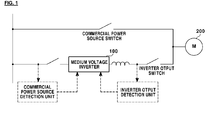
- FIG. 1 is an exemplary view illustrating synchronous switching of a conventional medium voltage inverter.
- the conventional medium inverter synchronous switching as illustrated in FIG. 1 is to control ON or OFF of switches in a situation where the high-voltage power source is applied, the malfunction of switching operation may lead to a high-voltage accident.
- both of the power sources are applied to both ends of the reactor, and then a current is generated by the voltage difference between both of the power sources, which may lead to an accident in the medium voltage inverter and the commercial power source.
- problems such as overcurrent cutoff of the commercial power source, overcurrent malfunction of the medium voltage inverter, etc.
- the technical challenge which the present disclosure intends to achieve is, to provide a medium voltage inverter synchronous switching control method to safely control the synchronous switching of the medium voltage inverter, by providing pilot lamps to notify a user of synchronous switching operation status of the medium voltage inverter.
- a method for controlling a system configured to supply an electric power to a motor by switching a first switch connected to a medium voltage inverter to a second switch connected to a commercial power source, the method comprising: lighting on a first lamp to notify that a switching operation is ready, by ascertaining that the medium voltage inverter is in a normal operation, and ascertaining that the first switch is turned on and the second switch is turned off; receiving an input of a third switch to notify that a switching to a bypass mode is made and an input of a fourth switch to request to start a switching operation; lighting on a second lamp to notify that a switching operation is under way; synchronizing a current of the medium voltage inverter with that of the motor; turning on the second switch, and turning off the first switch; and lighting on a third lamp to notify that the switching operation is completed.
- the method may further comprise stopping an operation of the medium voltage inverter along with lighting-on of the third lamp.
- the method may further comprise lighting off the third lamp when receiving an input of the third switch to turn off the switching operation.
- the lighting-on of the second lamp may include turning off the first lamp along with lighting-on of the second lamp.
- the lighting-on of the third lamp may include turning off the second lamp along with lighting-on of the third lamp.
- a method for controlling a system configured to supply an electric power to a motor by switching a first switch connected to a commercial power source to a second switch connected to a medium voltage inverter, the method comprising: lighting on a first lamp to notify that a switching action is ready, by ascertaining that the medium voltage inverter is in a normal operation, and ascertaining that the first switch is turned on and the second switch is turned off; receiving an input of a third switch to notify that a switching to an inverter mode is made and an input of a fourth switch to request to start a switching operation; lighting on a second lamp to notify that a switching operation is under way; synchronizing a current of the medium voltage inverter with that of the motor; turning on the second switch, and turning off the first switch; and lighting on a third lamp to notify that the switching operation is completed.
- the method may further comprise lighting off the third lamp, when receiving an input of the third switch to turn off the switching operation.
- the lighting-on of the second lamp may include turning off the first lamp along with lighting-on the second lamp.
- the lighting-on of the third lamp may include turning off the second lamp along with lighting-on of the third lamp.
- a malfunction of the synchronous switching may be prevented in advance and the synchronous switching may be safely controlled, by notifying a user of the synchronous switching operation status such as 'ready', 'underway', and 'completed'.
- FIG. 2 is an exemplary view briefly illustrating a structure of a medium voltage inverter synchronous switching system according to an exemplary embodiment of the present disclosure.
- the motor (10) is in an inverter mode, when the switch K2 is ON and the switch K3 is OFF, to receive an input of power source from the medium inverter (20).
- the switch K2 is OFF and the switch K3 is ON, the motor (10) is in a bypass mode to receive an input of the commercial power source.
- the controller (1) may visibly notify a user of the synchronous switching operation status by receiving a selection signal according to the user's switch selection from the operation switch (40) and then controlling the synchronous switching between the inverter mode and the bypass mode along with controlling lighting-on of the lamp (30). The operations of the controller (1) will be described later with more details.
- controller (1) is illustrated as being arranged outside of the medium voltage inverter (20), the controller (1) may be also arranged inside of the medium voltage inverter (20).
- the lamp (30) and the switch (40) may be arranged in the exterior case of the medium voltage inverter (20).
- FIG. 3 is an exemplary view illustrating lamps and operation switches to notify the synchronous switching operation status arranged outside of a medium voltage inverter according to an exemplary embodiment of the present disclosure. This is for description of detailed structure of the lamp (30) and the operation switch (40) illustrated in FIG. 2 .
- the lamp (30) to notify the synchronous switching operation status may include a first lamp (31) to notify that the synchronous switching operation is ready, a second lamp (32) to notify that the synchronous switching operation is under way, and a third lamp (33) to notify that the synchronous switching operation is completed.
- Each of the first to third lamps (31 to 33) are may be turned on in different colors.
- the first lamp (31) may be turned on in yellow; the second lamp (32) may be turned on in red; and the third lamp (33) may be turned on in green.
- the method for synchronous switching control may prevent accidents caused by malfunctions relating to the synchronous switching and enable the user to easily recognize the synchronous switching operation status, by defining the synchronous operation sequences.
- the operation sequences according to an exemplary embodiment of the present disclosure is defined as a bypass mode switching and a inverter mode switching, and the operation of each sequence may be expressed in a way for the user to easily recognize through the lamp (30).
- the operation sequence may be switched from a 'READY' status where the synchronous switching function is initiated and waiting for a user command to a 'RUN' status after the user inputs a functional operation command.
- the synchronous switching switching between the bypass mode and the inverter mode
- the status may be switched to an 'END' status and the synchronous switching function may be completed.
- the 'READY' operation, the 'RUN' operation, and the 'END' operation may be displayed for the user to recognize, by the first lamp (31), by the second lamp (32), and by the third lamp (33), respectively.
- the synchronous switching operation switch (40) may include a first operation switch (41) to select the bypass mode or the inverter mode and a second operation switch (42) to select a start of the synchronous switching operation.
- the first operation switch (41) may be formed so as to be able to select one mode among the three of a bypass mode (BYPASS), an off mode (OFF), and an inverter mode (INV).
- the second operation switch (42) as a start switch of the synchronous switching operation in a push-button type, may be formed to be inputted only when in a situation where one of the bypass mode or the inverter mode is selected.
- the switching type of the first and the second switch is exemplary, therefore it is apparent that the present is not limited hereto. That is to say, the second operation switch (42) may not be formed in a push-button type, but in other various types including a touch-button type.
- the lamp (30) and the operation switch (40) may be formed in a single panel simultaneously to be adhered exteriorly on the motor (10) or the inverter (20), or may be formed in separate panels.
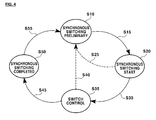
- FIG. 4 is an exemplary brief flow chart illustrating synchronous switching control according to an exemplary embodiment of the present disclosure.
- the controller (1) performs the following preliminary inspection (S10) relating to the synchronous switching.
- the controller (1) may light on the first lamp (31), and the user may turn the first operation switch (41) to select a mode and select the second operation switch (42) to start the synchronous switching , to enable the synchronous switching to be performed (S15). At this time, the controller (1) may start the synchronous switching (S20). When any one of the (i) to (iii) is not satisfied, the user input may be ignored and the operation may be maintained to be in the synchronous switching preliminary inspection (S10).
- the controller (1) may perform the synchronization and light on the second lamp (32).
- the controller (1) may synchronize the commercial power source with an output voltage of the medium voltage inverter (20) and operate the switches K2 and K3 in the start of the synchronous switching (S20).
- the switch K2 is ON and the switch K3 is OFF and the medium voltage inverter (20) is in a normal operation in S10
- the medium voltage inverter (20) may perform the synchronous switching to the bypass mode.
- the medium voltage inverter (20) may perform the synchronous switching to the inverter mode.
- the controller (1) may regard this as a synchronization failure and change the status (S25) into the initial synchronous switching preliminary inspection (S10), and notify the user of a synchronization failure alarm.
- the controller (1) may further include a notifying unit (for example, a displaying unit).
- the controller (1) may change the status into a switch control status (S30). At this time, the controller (1) may prepare for the switch control.
- the controller (1) may control the switches K2 and K3 to change the status (S35).
- the second lamp (32) may be lighted on also in this stage.
- the controller (1) may turn on the switch K3 and turn off the switch K2 when switching to the bypass mode. Otherwise, the controller (1) may turn on the switch K2 and turn off the switch K3 when switching to the inverter mode.
- the controller (1) may regard this as a synchronous switching failure and change the status into the initial synchronous switching preliminary inspection (S10) (S40), and notify the user of a synchronous switching failure alarm.
- the controller may be changed into the status of synchronous switching completed (S45).
- the controller may process the synchronous switching completion (S50), and may turn back to the initialization (S10). At this moment, the controller (1) may light on the third lamp (33).
- the controller (1) may stop the medium voltage inverter (2) when the mode is switched to the bypass mode. Otherwise, when the mode is switched to the inverter mode, the controller (1) may ascertain that the medium voltage inverter (2) is driving the motor (10).
- the controller (1) may notify the user that a failure has occurred.
- the controller (1) may light on the third lamp (33) and maintain the light-on-status of the third lamp (33) until the user changes the first operation switch (41) to OFF.
- the controller (1) may return to S10 and turn off the third lamp (33).
- FIGS. 5 and 6 are exemplary views illustrating time charts for describing synchronous switching control according to an exemplary embodiment of the present disclosure.
- FIG. 5 is illustrating the synchronous switching to the bypass mode
- FIG. 6 is illustrating the synchronous switching to the inverter mode.
- the controller (1) may ascertain whether the use of synchronous switching of the medium inverter is permitted.
- the controller (1) may light on the first lamp (31) (5D) to notify the user that the switching operation is ready.
- the controller (1) may turn off the first lamp (31) and light on the second lamp (32) (5G) to perform synchronization of currents of the medium voltage inverter (20) and the motor (10) (5H).
- the controller (1) may turn on switch K3 (5I) and turn off the switch K2 (5J). And then the controller (1) may stop the operation of the medium voltage inverter (20) (5K), and turn off the second lamp (32) and light on the third lamp (33) (5L).
- the controller (1) may turn off the third lamp (33) (5N).
- controller (1) may perform the switching action from the inverter mode to the bypass mode.
- the controller (1) when performing the synchronous switching from the bypass mode to the inverter mode, the controller (1) may ascertain whether the use of synchronous switching of the medium inverter is permitted.
- the controller (1) may light on the first lamp (31) (6D) to notify the user that the switching operation is ready.
- the controller (1) may turn off the first lamp (31) and light on the second lamp (32) (6G) to perform synchronization of currents of the medium voltage inverter (20) and the motor (10) (6H).
- the controller (1) may turn on the switch K2 (6I) and turn off the switch K3 (6J). And then the controller (1) may turn off the second lamp (32) and light on the third lamp (33) (6K).
- the controller (1) may turn off the third lamp (33) (6M).
- controller (1) may perform the switching action from the bypass mode to the inverter mode.
- the system which is able to perform the synchronous switching automatically controls the medium inverter output switch K2 and the commercial power source switch K3. In case the control is malfunctioning, it may lead a serious accident.
- An exemplary embodiment of the present disclosure is to prevent this accident.
- the user may start the synchronous switching only when the signal is 'READY'.
- the user may confirm the status of synchronous switching action.
- the synchronous switching may be controlled safely, by displaying the synchronous switching status such as 'ready', 'underway', or 'completed' to the user.
Landscapes
- Engineering & Computer Science (AREA)
- Power Engineering (AREA)
- Inverter Devices (AREA)
- Control Of Electric Motors In General (AREA)
- Control Of Ac Motors In General (AREA)
- Circuit Arrangements For Discharge Lamps (AREA)
- Stand-By Power Supply Arrangements (AREA)
Abstract
Description
- The present disclosure relates to a synchronous switching control method of a medium voltage inverter.
- In a medium voltage inverter, electrical impacts by various causes are applied to a motor, an inverter, and a commercial power source, during the switching action between an inverter output power source and a commercial power source.
- The electrical impact is generated by the instantaneous intermittence section which is generated in a section which the switches of the commercial power source and the inverter are both opened during the switching action. In order to reduce the electrical impact caused by the voltage generated while the voltage inputted to the motor is switched from the invert output to the commercial power source, the magnitude and phase of the inverter output and the commercial power source should be adjusted as identical to each other.
-
FIG. 1 is an exemplary view illustrating synchronous switching of a conventional medium voltage inverter. - In a conventional medium voltage inverter system, an output voltage is measured at a back end of the reactor, and the medium voltage inverter (100) compensates the phase delay of the voltage generated by the reactor. As such, when the switching operation is made after the commercial power source and the inverter output voltage are in synchronization, the electrical impacts generated by the voltage difference may be considerably reduced.
- However, because the conventional medium inverter synchronous switching as illustrated in
FIG. 1 is to control ON or OFF of switches in a situation where the high-voltage power source is applied, the malfunction of switching operation may lead to a high-voltage accident. - In addition, when the switch of the commercial power source is maintained in a ON status while the medium inverter is driving the motor, both of the power sources are applied to both ends of the reactor, and then a current is generated by the voltage difference between both of the power sources, which may lead to an accident in the medium voltage inverter and the commercial power source. And in the situation where a large amount of current is flowing due to a large voltage difference, there may be generated problems such as overcurrent cutoff of the commercial power source, overcurrent malfunction of the medium voltage inverter, etc.
- The technical challenge which the present disclosure intends to achieve is, to provide a medium voltage inverter synchronous switching control method to safely control the synchronous switching of the medium voltage inverter, by providing pilot lamps to notify a user of synchronous switching operation status of the medium voltage inverter.
- In order to complete the aforementioned technical challenge, in one general aspect of the present disclosure, there may be provided a method for controlling a system configured to supply an electric power to a motor by switching a first switch connected to a medium voltage inverter to a second switch connected to a commercial power source, the method comprising: lighting on a first lamp to notify that a switching operation is ready, by ascertaining that the medium voltage inverter is in a normal operation, and ascertaining that the first switch is turned on and the second switch is turned off; receiving an input of a third switch to notify that a switching to a bypass mode is made and an input of a fourth switch to request to start a switching operation; lighting on a second lamp to notify that a switching operation is under way; synchronizing a current of the medium voltage inverter with that of the motor; turning on the second switch, and turning off the first switch; and lighting on a third lamp to notify that the switching operation is completed.
- In some exemplary embodiment of the present disclosure, the method may further comprise stopping an operation of the medium voltage inverter along with lighting-on of the third lamp.
- In some exemplary embodiment of the present disclosure, the method may further comprise lighting off the third lamp when receiving an input of the third switch to turn off the switching operation.
- In some exemplary embodiment of the present disclosure, the lighting-on of the second lamp may include turning off the first lamp along with lighting-on of the second lamp.
- In some exemplary embodiment of the present disclosure, the lighting-on of the third lamp may include turning off the second lamp along with lighting-on of the third lamp.
- In another general aspect of the present disclosure, there is provided a method for controlling a system configured to supply an electric power to a motor by switching a first switch connected to a commercial power source to a second switch connected to a medium voltage inverter, the method comprising: lighting on a first lamp to notify that a switching action is ready, by ascertaining that the medium voltage inverter is in a normal operation, and ascertaining that the first switch is turned on and the second switch is turned off; receiving an input of a third switch to notify that a switching to an inverter mode is made and an input of a fourth switch to request to start a switching operation; lighting on a second lamp to notify that a switching operation is under way; synchronizing a current of the medium voltage inverter with that of the motor; turning on the second switch, and turning off the first switch; and lighting on a third lamp to notify that the switching operation is completed.
- In some exemplary embodiment of the present disclosure, the method may further comprise lighting off the third lamp, when receiving an input of the third switch to turn off the switching operation.
- In some exemplary embodiment of the present disclosure, the lighting-on of the second lamp may include turning off the first lamp along with lighting-on the second lamp.
- In some exemplary embodiment of the present disclosure, the lighting-on of the third lamp may include turning off the second lamp along with lighting-on of the third lamp.
- According an exemplary embodiment of the present disclosure, a malfunction of the synchronous switching may be prevented in advance and the synchronous switching may be safely controlled, by notifying a user of the synchronous switching operation status such as 'ready', 'underway', and 'completed'.
-
-
FIG. 1 is an exemplary view illustrating synchronous switching of a conventional medium voltage inverter. -
FIG. 2 is an exemplary view briefly illustrating a structure of a medium voltage inverter synchronous switching system according to an exemplary embodiment of the present disclosure. -
FIG. 3 is an exemplary view illustrating lamps and operation switches to notify the synchronous switching operation status arranged outside of a medium voltage inverter according to an exemplary embodiment of the present disclosure. -
FIG. 4 is an exemplary brief flow chart illustrating synchronous switching control according to an exemplary embodiment of the present disclosure. -
FIGs. 5 and6 are exemplary views illustrating time charts for describing synchronous switching control according to an exemplary embodiment of the present disclosure. - Various exemplary embodiments will be described more fully hereinafter with reference to the accompanying drawings, in which some exemplary embodiments are shown. The present inventive concept may, however, be embodied in many different forms and should not be construed as limited to the exemplary embodiments set forth herein. Rather, the described aspect is intended to embrace all such alterations, modifications, variations, and equivalents that fall within the scope and novel idea of the present disclosure.
- Hereinafter, referring to enclosed figures, an exemplary embodiment of the present disclosure will be described in detail.
-
FIG. 2 is an exemplary view briefly illustrating a structure of a medium voltage inverter synchronous switching system according to an exemplary embodiment of the present disclosure. - As illustrated in
FIG. 2 , the motor (10) is in an inverter mode, when the switch K2 is ON and the switch K3 is OFF, to receive an input of power source from the medium inverter (20). When the switch K2 is OFF and the switch K3 is ON, the motor (10) is in a bypass mode to receive an input of the commercial power source. According to an exemplary embodiment of the present disclosure, the controller (1) may visibly notify a user of the synchronous switching operation status by receiving a selection signal according to the user's switch selection from the operation switch (40) and then controlling the synchronous switching between the inverter mode and the bypass mode along with controlling lighting-on of the lamp (30). The operations of the controller (1) will be described later with more details. - Meanwhile, to describe an exemplary embodiment of the present disclosure, although the controller (1) is illustrated as being arranged outside of the medium voltage inverter (20), the controller (1) may be also arranged inside of the medium voltage inverter (20). In addition, the lamp (30) and the switch (40) may be arranged in the exterior case of the medium voltage inverter (20).
-
FIG. 3 is an exemplary view illustrating lamps and operation switches to notify the synchronous switching operation status arranged outside of a medium voltage inverter according to an exemplary embodiment of the present disclosure. This is for description of detailed structure of the lamp (30) and the operation switch (40) illustrated inFIG. 2 . - As illustrated in
FIG. 3 , according to an exemplary embodiment of the present disclosure, the lamp (30) to notify the synchronous switching operation status may include a first lamp (31) to notify that the synchronous switching operation is ready, a second lamp (32) to notify that the synchronous switching operation is under way, and a third lamp (33) to notify that the synchronous switching operation is completed. - Each of the first to third lamps (31 to 33) are may be turned on in different colors. For example, the first lamp (31) may be turned on in yellow; the second lamp (32) may be turned on in red; and the third lamp (33) may be turned on in green.
- The method for synchronous switching control according to an exemplary embodiment of the present disclosure may prevent accidents caused by malfunctions relating to the synchronous switching and enable the user to easily recognize the synchronous switching operation status, by defining the synchronous operation sequences.
- As described in the above, the operation sequences according to an exemplary embodiment of the present disclosure is defined as a bypass mode switching and a inverter mode switching, and the operation of each sequence may be expressed in a way for the user to easily recognize through the lamp (30). In addition, the operation sequence may be switched from a 'READY' status where the synchronous switching function is initiated and waiting for a user command to a 'RUN' status after the user inputs a functional operation command. In the 'RUN' status, the synchronous switching (switching between the bypass mode and the inverter mode) may be performed. In addition, when the operation of the switch is completed by completion of the synchronous switching, the status may be switched to an 'END' status and the synchronous switching function may be completed. Here, the 'READY' operation, the 'RUN' operation, and the 'END' operation may be displayed for the user to recognize, by the first lamp (31), by the second lamp (32), and by the third lamp (33), respectively.
- Meanwhile, the synchronous switching operation switch (40) may include a first operation switch (41) to select the bypass mode or the inverter mode and a second operation switch (42) to select a start of the synchronous switching operation.
- The first operation switch (41) may be formed so as to be able to select one mode among the three of a bypass mode (BYPASS), an off mode (OFF), and an inverter mode (INV). The second operation switch (42), as a start switch of the synchronous switching operation in a push-button type, may be formed to be inputted only when in a situation where one of the bypass mode or the inverter mode is selected. However, because the switching type of the first and the second switch is exemplary, therefore it is apparent that the present is not limited hereto. That is to say, the second operation switch (42) may not be formed in a push-button type, but in other various types including a touch-button type.
- In addition, as illustrated in
FIG. 3 , according to an exemplary embodiment of the present disclosure, the lamp (30) and the operation switch (40) may be formed in a single panel simultaneously to be adhered exteriorly on the motor (10) or the inverter (20), or may be formed in separate panels. -
FIG. 4 is an exemplary brief flow chart illustrating synchronous switching control according to an exemplary embodiment of the present disclosure. - As illustrated in
FIG. 4 , according to an exemplary embodiment of the present disclosure, at first, the controller (1) performs the following preliminary inspection (S10) relating to the synchronous switching. - (i) The controller (1) may ascertain whether the use of synchronous switching is permitted in the setting of the medium voltage inverter.
- (ii) The controller (1) may determine the mode of synchronous switching by ascertaining what the power to the motor is and whether ON or OFF status of the switch. Here, when the switch K2 is ON and the switch K3 is OFF, the synchronous switching may be performed to the bypass mode. On the other hand, when the switch K2 is OFF and the switch K3 is ON, the synchronous switching may be performed to the inverter mode.
- (iii) The controller (1) may ascertain whether the medium voltage inverter (20) is in a normal operation and may perform the synchronous switching.
- When all of (i) to (iii) in the above are satisfied, the controller (1) may light on the first lamp (31), and the user may turn the first operation switch (41) to select a mode and select the second operation switch (42) to start the synchronous switching , to enable the synchronous switching to be performed (S15). At this time, the controller (1) may start the synchronous switching (S20). When any one of the (i) to (iii) is not satisfied, the user input may be ignored and the operation may be maintained to be in the synchronous switching preliminary inspection (S10).
- When the synchronous switching is started (S20), the controller (1) may perform the synchronization and light on the second lamp (32).
- That is, the controller (1) may synchronize the commercial power source with an output voltage of the medium voltage inverter (20) and operate the switches K2 and K3 in the start of the synchronous switching (S20). When the switch K2 is ON and the switch K3 is OFF and the medium voltage inverter (20) is in a normal operation in S10, when the user turns the first operation switch (41) to the bypass mode and pushes the second operation switch (42), the medium voltage inverter (20) may perform the synchronous switching to the bypass mode. In addition, when the switch K2 is OFF and the switch K3 is ON and the medium voltage inverter (20) is in a normal operation in S10, and when the user turns the first operation switch (41) to the inverter mode and pushes the second operation switch (42), the medium voltage inverter (20) may perform the synchronous switching to the inverter mode.
- When the synchronization consumes more time than a predetermined time(for example, 10 seconds), the controller (1) may regard this as a synchronization failure and change the status (S25) into the initial synchronous switching preliminary inspection (S10), and notify the user of a synchronization failure alarm. For this purpose, the controller (1) may further include a notifying unit (for example, a displaying unit).
- In addition, when the synchronization is completed within a predetermined time, the controller (1) may change the status into a switch control status (S30). At this time, the controller (1) may prepare for the switch control.
- When the medium voltage inverter (20) completes the synchronization in S20, the controller (1) may control the switches K2 and K3 to change the status (S35). The second lamp (32) may be lighted on also in this stage.
- That is, the controller (1) may turn on the switch K3 and turn off the switch K2 when switching to the bypass mode. Otherwise, the controller (1) may turn on the switch K2 and turn off the switch K3 when switching to the inverter mode. At this moment, when the switch status changing consumes more time than a predetermined time (for example, 200ms), the controller (1) may regard this as a synchronous switching failure and change the status into the initial synchronous switching preliminary inspection (S10) (S40), and notify the user of a synchronous switching failure alarm.
- When the statuses of the switches K2 and K3 are properly changed, the controller may be changed into the status of synchronous switching completed (S45).
- In the status of synchronous switching completed, the controller may process the synchronous switching completion (S50), and may turn back to the initialization (S10). At this moment, the controller (1) may light on the third lamp (33).
- That is, when the synchronous switching is completed, by ascertaining the operation status of the medium voltage inverter (2) and according to the ascertained mode, the controller (1) may stop the medium voltage inverter (2) when the mode is switched to the bypass mode. Otherwise, when the mode is switched to the inverter mode, the controller (1) may ascertain that the medium voltage inverter (2) is driving the motor (10).
- In the result of ascertaining, when the driving status is not normal, the controller (1) may notify the user that a failure has occurred. When the ascertained driving status is normal, the controller (1) may light on the third lamp (33) and maintain the light-on-status of the third lamp (33) until the user changes the first operation switch (41) to OFF. When the user changes the first operation switch (41) to OFF, the controller (1) may return to S10 and turn off the third lamp (33).
-
FIGS. 5 and6 are exemplary views illustrating time charts for describing synchronous switching control according to an exemplary embodiment of the present disclosure.FIG. 5 is illustrating the synchronous switching to the bypass mode, andFIG. 6 is illustrating the synchronous switching to the inverter mode. - As illustrated in
FIG. 5 , the controller (1) may ascertain whether the use of synchronous switching of the medium inverter is permitted. When the controller (1) ascertains that the switch K2 is ON (5A) and the switch K3 is OFF (5B) and the medium voltage inverter (20) is normally operating (5C), the controller (1) may light on the first lamp (31) (5D) to notify the user that the switching operation is ready. - When the user changes the first operation switch (41) to the bypass mode (5E) and selects the second operation switch (42) (5F), the controller (1) may turn off the first lamp (31) and light on the second lamp (32) (5G) to perform synchronization of currents of the medium voltage inverter (20) and the motor (10) (5H).
- When the synchronization is completed, the controller (1) may turn on switch K3 (5I) and turn off the switch K2 (5J). And then the controller (1) may stop the operation of the medium voltage inverter (20) (5K), and turn off the second lamp (32) and light on the third lamp (33) (5L).
- Afterwards, when the user changes the first operation switch (41) from the bypass mode to OFF (5M), the controller (1) may turn off the third lamp (33) (5N).
- Thus, the controller (1) may perform the switching action from the inverter mode to the bypass mode.
- Meanwhile, as illustrated in
FIG. 6 , when performing the synchronous switching from the bypass mode to the inverter mode, the controller (1) may ascertain whether the use of synchronous switching of the medium inverter is permitted. When the controller (1) ascertains that the switch K2 is OFF (6A) and the switch K3 is ON (6B) and the medium voltage inverter (20) is normally operating (6C), the controller (1) may light on the first lamp (31) (6D) to notify the user that the switching operation is ready. - When the user changes the first operation switch (41) to the bypass mode (6E) and selects the second operation switch (42) (6F), the controller (1) may turn off the first lamp (31) and light on the second lamp (32) (6G) to perform synchronization of currents of the medium voltage inverter (20) and the motor (10) (6H).
- When the synchronization is completed, the controller (1) may turn on the switch K2 (6I) and turn off the switch K3 (6J). And then the controller (1) may turn off the second lamp (32) and light on the third lamp (33) (6K).
- Afterwards, when the user changes the first operation switch (41) from the inverter mode to OFF (6L), the controller (1) may turn off the third lamp (33) (6M).
- Thus, the controller (1) may perform the switching action from the bypass mode to the inverter mode.
- The system which is able to perform the synchronous switching automatically controls the medium inverter output switch K2 and the commercial power source switch K3. In case the control is malfunctioning, it may lead a serious accident. An exemplary embodiment of the present disclosure is to prevent this accident.
- The user may start the synchronous switching only when the signal is 'READY'. When the signal is 'RUN', the user may confirm the status of synchronous switching action.
- That is, according to an exemplary embodiment of the present disclosure, the synchronous switching may be controlled safely, by displaying the synchronous switching status such as 'ready', 'underway', or 'completed' to the user.
- The abovementioned exemplary embodiments are intended to be illustrative, and not to limit the scope of the claims. Many alternatives, modifications, variations, and equivalents will be apparent to those skilled in the art. The features, structures, methods, and other characteristics of the exemplary embodiments described herein may be combined in various ways to obtain additional and/or alternative exemplary embodiments. Therefore, the technical scope of the rights for the present disclosure shall be decided by the claims.
Claims (9)
- A method for controlling a system configured to supply an electric power to a motor (10) by switching a first switch (K2) connected to a medium voltage inverter (20) to a second switch (K3) connected to a commercial power source, the method comprising:lighting on a first lamp (31) to notify that a switching operation is ready, by ascertaining that the medium voltage inverter (20) is in a normal operation, and ascertaining that the first switch (K2) is turned on and the second switch (K3) is turned off;receiving an input of a third switch (41) to notify that a switching to a bypass mode is made and an input of a fourth switch (42) to request to start a switching operation;lighting on a second lamp (32) to notify that a switching operation is under way;synchronizing a current of the medium voltage inverter (20) with that of the motor (10);turning on the second switch (K3), and turning off the first switch (K3); andlighting on a third lamp (33) to notify that the switching operation is completed.
- The method of claim 1, further comprising:stopping an operation of the medium voltage inverter (20) along with lighting-on of the third lamp (33).
- The method of claim 1 or 2, further comprising:lighting off the third lamp (33) when receiving an input of the third switch (41) to turn off the switching operation.
- The method of any one of claims 1 to 3, wherein the lighting-on of the second lamp (32) includes turning off the first lamp (31) along with lighting-on of the second lamp (32).
- The method of any one of claims 1 to 4, wherein the lighting-on of the third lamp (33) includes turning off the second lamp (32) along with lighting-on of the third lamp (33).
- A method for controlling a system configured to supply an electric power to a motor by switching a first switch (K3) connected to a commercial power source to a second switch (K2) connected to a medium voltage inverter (20), the method comprising:lighting on a first lamp (31) to notify that a switching action is ready, by ascertaining that the medium voltage inverter (20) is in a normal operation, and ascertaining that the first switch (K3) is turned on and the second switch (K2) is turned off;receiving an input of a third switch (410) to notify that a switching to an inverter mode is made and an input of a fourth switch (42) to request to start a switching operation;lighting on a second lamp (32) to notify that a switching operation is under way;synchronizing a current of the medium voltage inverter with that of the motor;turning on the second switch (K2), and turning off the first switch (K3); andlighting on a third lamp (33) to notify that the switching operation is completed.
- The method of claim 6, further comprising:lighting off the third lamp (33), when receiving an input of the third switch (41) to turn off the switching operation.
- The method of claim 6 or 7, wherein the lighting-on of the second lamp (32) includes turning off the first lamp (31) along with lighting-on the second lamp (32).
- The method of any one of claims 6 to 8, wherein the lighting-on of the third (33) lamp includes turning off the second lamp (32) along with lighting-on of the third lamp (33).
Applications Claiming Priority (1)
| Application Number | Priority Date | Filing Date | Title |
|---|---|---|---|
| KR1020130168392A KR101605592B1 (en) | 2013-12-31 | 2013-12-31 | Method for controlling synchronous switch change in medium voltage inverter |
Publications (3)
| Publication Number | Publication Date |
|---|---|
| EP2897281A2 true EP2897281A2 (en) | 2015-07-22 |
| EP2897281A3 EP2897281A3 (en) | 2016-03-23 |
| EP2897281B1 EP2897281B1 (en) | 2021-01-20 |
Family
ID=52101188
Family Applications (1)
| Application Number | Title | Priority Date | Filing Date |
|---|---|---|---|
| EP14198236.3A Active EP2897281B1 (en) | 2013-12-31 | 2014-12-16 | Method for controlling change of a power source between an inverter and a utility power |
Country Status (6)
| Country | Link |
|---|---|
| US (1) | US9331611B2 (en) |
| EP (1) | EP2897281B1 (en) |
| JP (1) | JP6023160B2 (en) |
| KR (1) | KR101605592B1 (en) |
| CN (1) | CN104753405B (en) |
| ES (1) | ES2861955T3 (en) |
Cited By (1)
| Publication number | Priority date | Publication date | Assignee | Title |
|---|---|---|---|---|
| EP3823158A4 (en) * | 2018-07-09 | 2022-03-30 | Hitachi Mitsubishi Hydro Corporation | VARIABLE SPEED MOTOR/GENERATOR DEVICE |
Families Citing this family (4)
| Publication number | Priority date | Publication date | Assignee | Title |
|---|---|---|---|---|
| CN108266398B (en) * | 2017-01-03 | 2019-08-16 | 新疆知信科技有限公司 | The Stable Operation Method of Primary Fan Frequency Conversion Switching to Power Frequency |
| CN110797968B (en) * | 2019-11-06 | 2021-04-27 | 漳州科华技术有限责任公司 | Uninterruptible power supply anti-power failure method, system and terminal equipment |
| CN112436759A (en) * | 2020-11-23 | 2021-03-02 | 顿汉布什(中国)工业有限公司 | Double-starting device of centrifugal water chilling unit and control method thereof |
| CN115663989B (en) * | 2022-10-20 | 2023-04-28 | 上海山源电子科技股份有限公司 | Commercial power inversion switching control method and circuit |
Family Cites Families (8)
| Publication number | Priority date | Publication date | Assignee | Title |
|---|---|---|---|---|
| US3982170A (en) * | 1975-11-28 | 1976-09-21 | Borg-Warner Corporation | Variable speed, constant frequency induction generator system |
| JPH0783635B2 (en) | 1985-01-10 | 1995-09-06 | 株式会社日立製作所 | Inverter device |
| JPS6311090A (en) | 1986-07-02 | 1988-01-18 | Mitsubishi Electric Corp | Controller for power saving operation of induction motor |
| JP3201641B2 (en) | 1992-04-15 | 2001-08-27 | 松下電工株式会社 | Induction motor control device |
| US7598628B2 (en) * | 2002-12-20 | 2009-10-06 | Siemens Building Technologies, Inc. | Automated bypass method and apparatus |
| US9018882B2 (en) | 2011-01-26 | 2015-04-28 | Yaskawa America, Inc. | Variable frequency drive bypass energy savings |
| US20130235494A1 (en) * | 2011-09-06 | 2013-09-12 | Kent Jeffrey Holce | Integrated Bypass Apparatus, System, and/or Method for Variable-Frequency Drives |
| CN102751919A (en) * | 2012-07-07 | 2012-10-24 | 浙江利欧股份有限公司 | Double-voltage automatic switchover switch and processing method |
-
2013
- 2013-12-31 KR KR1020130168392A patent/KR101605592B1/en active Active
-
2014
- 2014-12-15 US US14/570,929 patent/US9331611B2/en active Active
- 2014-12-16 EP EP14198236.3A patent/EP2897281B1/en active Active
- 2014-12-16 ES ES14198236T patent/ES2861955T3/en active Active
- 2014-12-25 JP JP2014263237A patent/JP6023160B2/en not_active Expired - Fee Related
- 2014-12-30 CN CN201410858197.2A patent/CN104753405B/en active Active
Non-Patent Citations (1)
| Title |
|---|
| None |
Cited By (1)
| Publication number | Priority date | Publication date | Assignee | Title |
|---|---|---|---|---|
| EP3823158A4 (en) * | 2018-07-09 | 2022-03-30 | Hitachi Mitsubishi Hydro Corporation | VARIABLE SPEED MOTOR/GENERATOR DEVICE |
Also Published As
| Publication number | Publication date |
|---|---|
| CN104753405A (en) | 2015-07-01 |
| ES2861955T3 (en) | 2021-10-06 |
| US20150188460A1 (en) | 2015-07-02 |
| JP2015130790A (en) | 2015-07-16 |
| EP2897281B1 (en) | 2021-01-20 |
| KR101605592B1 (en) | 2016-03-22 |
| CN104753405B (en) | 2017-05-17 |
| KR20150078732A (en) | 2015-07-08 |
| JP6023160B2 (en) | 2016-11-09 |
| EP2897281A3 (en) | 2016-03-23 |
| US9331611B2 (en) | 2016-05-03 |
Similar Documents
| Publication | Publication Date | Title |
|---|---|---|
| EP2897281B1 (en) | Method for controlling change of a power source between an inverter and a utility power | |
| US9796279B2 (en) | Charge and discharge system for vehicle with interlock mechanism | |
| JP2017104000A (en) | Vehicle power supply control method and system for jump start | |
| KR20120060662A (en) | Method for Charging External Device and Displaying Apparatus using thereof | |
| KR20140142598A (en) | Multi-channel electric power charging system for EV(Eletric Vehicle) | |
| JP5220585B2 (en) | Traffic signal control system and signal control method | |
| CN103672148A (en) | Method and system for detecting main steam isolation valve of nuclear power plant | |
| JP2017192172A (en) | Charge state display device | |
| US9780699B2 (en) | Motor protection relay and method for starting motor of motor protection relay | |
| CN104192149B (en) | The control method of vehicle operation and device | |
| CN103407576A (en) | Method for triggering engine backup control mode and engine backup control system | |
| JP2013175110A (en) | Traffic signal system and traffic signal controller | |
| JP5656396B2 (en) | Traffic signal system | |
| JP6312781B1 (en) | Charging apparatus, charging control method and program | |
| KR101681592B1 (en) | Selective setting and saving apparatus of protection for electronic motor protection relay | |
| JP2015139313A (en) | converter device | |
| KR102167703B1 (en) | Traffic signal Controller for using both AC and DC | |
| JP2007244167A (en) | Power supply control device and power supply control method | |
| KR101782169B1 (en) | Automatic load transfer switch and control method thereof | |
| JP2013073382A (en) | Traffic signal controller | |
| JP6296933B2 (en) | Hall indicator control device and hall indicator control method | |
| CN203761029U (en) | Switching power supply circuit of firefighting emergency power supply | |
| JP5831094B2 (en) | Traffic signal controller | |
| JP3893786B2 (en) | Traffic signal controller | |
| JP2013073380A (en) | Traffic signal controller |
Legal Events
| Date | Code | Title | Description |
|---|---|---|---|
| PUAI | Public reference made under article 153(3) epc to a published international application that has entered the european phase |
Free format text: ORIGINAL CODE: 0009012 |
|
| 17P | Request for examination filed |
Effective date: 20141216 |
|
| AK | Designated contracting states |
Kind code of ref document: A2 Designated state(s): AL AT BE BG CH CY CZ DE DK EE ES FI FR GB GR HR HU IE IS IT LI LT LU LV MC MK MT NL NO PL PT RO RS SE SI SK SM TR |
|
| AX | Request for extension of the european patent |
Extension state: BA ME |
|
| PUAL | Search report despatched |
Free format text: ORIGINAL CODE: 0009013 |
|
| AK | Designated contracting states |
Kind code of ref document: A3 Designated state(s): AL AT BE BG CH CY CZ DE DK EE ES FI FR GB GR HR HU IE IS IT LI LT LU LV MC MK MT NL NO PL PT RO RS SE SI SK SM TR |
|
| AX | Request for extension of the european patent |
Extension state: BA ME |
|
| RIC1 | Information provided on ipc code assigned before grant |
Ipc: H02P 4/00 20060101AFI20160216BHEP Ipc: H02J 3/40 20060101ALN20160216BHEP Ipc: G08B 5/36 20060101ALN20160216BHEP Ipc: H02J 9/06 20060101ALN20160216BHEP |
|
| 17P | Request for examination filed |
Effective date: 20160920 |
|
| RBV | Designated contracting states (corrected) |
Designated state(s): AL AT BE BG CH CY CZ DE DK EE ES FI FR GB GR HR HU IE IS IT LI LT LU LV MC MK MT NL NO PL PT RO RS SE SI SK SM TR |
|
| RIC1 | Information provided on ipc code assigned before grant |
Ipc: H02J 9/06 20060101ALN20200806BHEP Ipc: H02J 3/40 20060101ALN20200806BHEP Ipc: H02P 4/00 20060101AFI20200806BHEP Ipc: G08B 5/36 20060101ALN20200806BHEP |
|
| GRAP | Despatch of communication of intention to grant a patent |
Free format text: ORIGINAL CODE: EPIDOSNIGR1 |
|
| STAA | Information on the status of an ep patent application or granted ep patent |
Free format text: STATUS: GRANT OF PATENT IS INTENDED |
|
| INTG | Intention to grant announced |
Effective date: 20200914 |
|
| GRAS | Grant fee paid |
Free format text: ORIGINAL CODE: EPIDOSNIGR3 |
|
| GRAA | (expected) grant |
Free format text: ORIGINAL CODE: 0009210 |
|
| STAA | Information on the status of an ep patent application or granted ep patent |
Free format text: STATUS: THE PATENT HAS BEEN GRANTED |
|
| AK | Designated contracting states |
Kind code of ref document: B1 Designated state(s): AL AT BE BG CH CY CZ DE DK EE ES FI FR GB GR HR HU IE IS IT LI LT LU LV MC MK MT NL NO PL PT RO RS SE SI SK SM TR |
|
| REG | Reference to a national code |
Ref country code: GB Ref legal event code: FG4D |
|
| REG | Reference to a national code |
Ref country code: CH Ref legal event code: EP |
|
| REG | Reference to a national code |
Ref country code: DE Ref legal event code: R096 Ref document number: 602014074353 Country of ref document: DE |
|
| REG | Reference to a national code |
Ref country code: AT Ref legal event code: REF Ref document number: 1357223 Country of ref document: AT Kind code of ref document: T Effective date: 20210215 |
|
| REG | Reference to a national code |
Ref country code: IE Ref legal event code: FG4D |
|
| REG | Reference to a national code |
Ref country code: NL Ref legal event code: MP Effective date: 20210120 |
|
| REG | Reference to a national code |
Ref country code: LT Ref legal event code: MG9D |
|
| REG | Reference to a national code |
Ref country code: AT Ref legal event code: MK05 Ref document number: 1357223 Country of ref document: AT Kind code of ref document: T Effective date: 20210120 |
|
| PG25 | Lapsed in a contracting state [announced via postgrant information from national office to epo] |
Ref country code: LT Free format text: LAPSE BECAUSE OF FAILURE TO SUBMIT A TRANSLATION OF THE DESCRIPTION OR TO PAY THE FEE WITHIN THE PRESCRIBED TIME-LIMIT Effective date: 20210120 Ref country code: PT Free format text: LAPSE BECAUSE OF FAILURE TO SUBMIT A TRANSLATION OF THE DESCRIPTION OR TO PAY THE FEE WITHIN THE PRESCRIBED TIME-LIMIT Effective date: 20210520 Ref country code: GR Free format text: LAPSE BECAUSE OF FAILURE TO SUBMIT A TRANSLATION OF THE DESCRIPTION OR TO PAY THE FEE WITHIN THE PRESCRIBED TIME-LIMIT Effective date: 20210421 Ref country code: FI Free format text: LAPSE BECAUSE OF FAILURE TO SUBMIT A TRANSLATION OF THE DESCRIPTION OR TO PAY THE FEE WITHIN THE PRESCRIBED TIME-LIMIT Effective date: 20210120 Ref country code: HR Free format text: LAPSE BECAUSE OF FAILURE TO SUBMIT A TRANSLATION OF THE DESCRIPTION OR TO PAY THE FEE WITHIN THE PRESCRIBED TIME-LIMIT Effective date: 20210120 Ref country code: BG Free format text: LAPSE BECAUSE OF FAILURE TO SUBMIT A TRANSLATION OF THE DESCRIPTION OR TO PAY THE FEE WITHIN THE PRESCRIBED TIME-LIMIT Effective date: 20210420 Ref country code: NL Free format text: LAPSE BECAUSE OF FAILURE TO SUBMIT A TRANSLATION OF THE DESCRIPTION OR TO PAY THE FEE WITHIN THE PRESCRIBED TIME-LIMIT Effective date: 20210120 Ref country code: NO Free format text: LAPSE BECAUSE OF FAILURE TO SUBMIT A TRANSLATION OF THE DESCRIPTION OR TO PAY THE FEE WITHIN THE PRESCRIBED TIME-LIMIT Effective date: 20210420 |
|
| PG25 | Lapsed in a contracting state [announced via postgrant information from national office to epo] |
Ref country code: PL Free format text: LAPSE BECAUSE OF FAILURE TO SUBMIT A TRANSLATION OF THE DESCRIPTION OR TO PAY THE FEE WITHIN THE PRESCRIBED TIME-LIMIT Effective date: 20210120 Ref country code: LV Free format text: LAPSE BECAUSE OF FAILURE TO SUBMIT A TRANSLATION OF THE DESCRIPTION OR TO PAY THE FEE WITHIN THE PRESCRIBED TIME-LIMIT Effective date: 20210120 Ref country code: RS Free format text: LAPSE BECAUSE OF FAILURE TO SUBMIT A TRANSLATION OF THE DESCRIPTION OR TO PAY THE FEE WITHIN THE PRESCRIBED TIME-LIMIT Effective date: 20210120 Ref country code: AT Free format text: LAPSE BECAUSE OF FAILURE TO SUBMIT A TRANSLATION OF THE DESCRIPTION OR TO PAY THE FEE WITHIN THE PRESCRIBED TIME-LIMIT Effective date: 20210120 Ref country code: SE Free format text: LAPSE BECAUSE OF FAILURE TO SUBMIT A TRANSLATION OF THE DESCRIPTION OR TO PAY THE FEE WITHIN THE PRESCRIBED TIME-LIMIT Effective date: 20210120 |
|
| PG25 | Lapsed in a contracting state [announced via postgrant information from national office to epo] |
Ref country code: IS Free format text: LAPSE BECAUSE OF FAILURE TO SUBMIT A TRANSLATION OF THE DESCRIPTION OR TO PAY THE FEE WITHIN THE PRESCRIBED TIME-LIMIT Effective date: 20210520 |
|
| REG | Reference to a national code |
Ref country code: ES Ref legal event code: FG2A Ref document number: 2861955 Country of ref document: ES Kind code of ref document: T3 Effective date: 20211006 |
|
| REG | Reference to a national code |
Ref country code: DE Ref legal event code: R097 Ref document number: 602014074353 Country of ref document: DE |
|
| PG25 | Lapsed in a contracting state [announced via postgrant information from national office to epo] |
Ref country code: EE Free format text: LAPSE BECAUSE OF FAILURE TO SUBMIT A TRANSLATION OF THE DESCRIPTION OR TO PAY THE FEE WITHIN THE PRESCRIBED TIME-LIMIT Effective date: 20210120 Ref country code: CZ Free format text: LAPSE BECAUSE OF FAILURE TO SUBMIT A TRANSLATION OF THE DESCRIPTION OR TO PAY THE FEE WITHIN THE PRESCRIBED TIME-LIMIT Effective date: 20210120 Ref country code: SM Free format text: LAPSE BECAUSE OF FAILURE TO SUBMIT A TRANSLATION OF THE DESCRIPTION OR TO PAY THE FEE WITHIN THE PRESCRIBED TIME-LIMIT Effective date: 20210120 |
|
| PLBE | No opposition filed within time limit |
Free format text: ORIGINAL CODE: 0009261 |
|
| STAA | Information on the status of an ep patent application or granted ep patent |
Free format text: STATUS: NO OPPOSITION FILED WITHIN TIME LIMIT |
|
| PG25 | Lapsed in a contracting state [announced via postgrant information from national office to epo] |
Ref country code: DK Free format text: LAPSE BECAUSE OF FAILURE TO SUBMIT A TRANSLATION OF THE DESCRIPTION OR TO PAY THE FEE WITHIN THE PRESCRIBED TIME-LIMIT Effective date: 20210120 Ref country code: RO Free format text: LAPSE BECAUSE OF FAILURE TO SUBMIT A TRANSLATION OF THE DESCRIPTION OR TO PAY THE FEE WITHIN THE PRESCRIBED TIME-LIMIT Effective date: 20210120 Ref country code: SK Free format text: LAPSE BECAUSE OF FAILURE TO SUBMIT A TRANSLATION OF THE DESCRIPTION OR TO PAY THE FEE WITHIN THE PRESCRIBED TIME-LIMIT Effective date: 20210120 |
|
| 26N | No opposition filed |
Effective date: 20211021 |
|
| PG25 | Lapsed in a contracting state [announced via postgrant information from national office to epo] |
Ref country code: AL Free format text: LAPSE BECAUSE OF FAILURE TO SUBMIT A TRANSLATION OF THE DESCRIPTION OR TO PAY THE FEE WITHIN THE PRESCRIBED TIME-LIMIT Effective date: 20210120 |
|
| PG25 | Lapsed in a contracting state [announced via postgrant information from national office to epo] |
Ref country code: SI Free format text: LAPSE BECAUSE OF FAILURE TO SUBMIT A TRANSLATION OF THE DESCRIPTION OR TO PAY THE FEE WITHIN THE PRESCRIBED TIME-LIMIT Effective date: 20210120 |
|
| PG25 | Lapsed in a contracting state [announced via postgrant information from national office to epo] |
Ref country code: IS Free format text: LAPSE BECAUSE OF FAILURE TO SUBMIT A TRANSLATION OF THE DESCRIPTION OR TO PAY THE FEE WITHIN THE PRESCRIBED TIME-LIMIT Effective date: 20210520 |
|
| PG25 | Lapsed in a contracting state [announced via postgrant information from national office to epo] |
Ref country code: MC Free format text: LAPSE BECAUSE OF FAILURE TO SUBMIT A TRANSLATION OF THE DESCRIPTION OR TO PAY THE FEE WITHIN THE PRESCRIBED TIME-LIMIT Effective date: 20210120 |
|
| REG | Reference to a national code |
Ref country code: CH Ref legal event code: PL |
|
| REG | Reference to a national code |
Ref country code: BE Ref legal event code: MM Effective date: 20211231 |
|
| PG25 | Lapsed in a contracting state [announced via postgrant information from national office to epo] |
Ref country code: LU Free format text: LAPSE BECAUSE OF NON-PAYMENT OF DUE FEES Effective date: 20211216 Ref country code: IE Free format text: LAPSE BECAUSE OF NON-PAYMENT OF DUE FEES Effective date: 20211216 |
|
| PG25 | Lapsed in a contracting state [announced via postgrant information from national office to epo] |
Ref country code: BE Free format text: LAPSE BECAUSE OF NON-PAYMENT OF DUE FEES Effective date: 20211231 |
|
| PG25 | Lapsed in a contracting state [announced via postgrant information from national office to epo] |
Ref country code: LI Free format text: LAPSE BECAUSE OF NON-PAYMENT OF DUE FEES Effective date: 20211231 Ref country code: CH Free format text: LAPSE BECAUSE OF NON-PAYMENT OF DUE FEES Effective date: 20211231 |
|
| PGFP | Annual fee paid to national office [announced via postgrant information from national office to epo] |
Ref country code: GB Payment date: 20221005 Year of fee payment: 9 |
|
| PGFP | Annual fee paid to national office [announced via postgrant information from national office to epo] |
Ref country code: ES Payment date: 20230113 Year of fee payment: 9 |
|
| PG25 | Lapsed in a contracting state [announced via postgrant information from national office to epo] |
Ref country code: HU Free format text: LAPSE BECAUSE OF FAILURE TO SUBMIT A TRANSLATION OF THE DESCRIPTION OR TO PAY THE FEE WITHIN THE PRESCRIBED TIME-LIMIT; INVALID AB INITIO Effective date: 20141216 |
|
| PG25 | Lapsed in a contracting state [announced via postgrant information from national office to epo] |
Ref country code: CY Free format text: LAPSE BECAUSE OF FAILURE TO SUBMIT A TRANSLATION OF THE DESCRIPTION OR TO PAY THE FEE WITHIN THE PRESCRIBED TIME-LIMIT Effective date: 20210120 |
|
| P01 | Opt-out of the competence of the unified patent court (upc) registered |
Effective date: 20230625 |
|
| PG25 | Lapsed in a contracting state [announced via postgrant information from national office to epo] |
Ref country code: MK Free format text: LAPSE BECAUSE OF FAILURE TO SUBMIT A TRANSLATION OF THE DESCRIPTION OR TO PAY THE FEE WITHIN THE PRESCRIBED TIME-LIMIT Effective date: 20210120 |
|
| GBPC | Gb: european patent ceased through non-payment of renewal fee |
Effective date: 20231216 |
|
| PG25 | Lapsed in a contracting state [announced via postgrant information from national office to epo] |
Ref country code: MT Free format text: LAPSE BECAUSE OF FAILURE TO SUBMIT A TRANSLATION OF THE DESCRIPTION OR TO PAY THE FEE WITHIN THE PRESCRIBED TIME-LIMIT Effective date: 20210120 |
|
| PG25 | Lapsed in a contracting state [announced via postgrant information from national office to epo] |
Ref country code: GB Free format text: LAPSE BECAUSE OF NON-PAYMENT OF DUE FEES Effective date: 20231216 |
|
| PG25 | Lapsed in a contracting state [announced via postgrant information from national office to epo] |
Ref country code: GB Free format text: LAPSE BECAUSE OF NON-PAYMENT OF DUE FEES Effective date: 20231216 |
|
| REG | Reference to a national code |
Ref country code: ES Ref legal event code: FD2A Effective date: 20250131 |
|
| PG25 | Lapsed in a contracting state [announced via postgrant information from national office to epo] |
Ref country code: ES Free format text: LAPSE BECAUSE OF NON-PAYMENT OF DUE FEES Effective date: 20231217 |
|
| PGFP | Annual fee paid to national office [announced via postgrant information from national office to epo] |
Ref country code: IT Payment date: 20250909 Year of fee payment: 12 |
|
| PGFP | Annual fee paid to national office [announced via postgrant information from national office to epo] |
Ref country code: FR Payment date: 20250909 Year of fee payment: 12 |
|
| PG25 | Lapsed in a contracting state [announced via postgrant information from national office to epo] |
Ref country code: TR Free format text: LAPSE BECAUSE OF FAILURE TO SUBMIT A TRANSLATION OF THE DESCRIPTION OR TO PAY THE FEE WITHIN THE PRESCRIBED TIME-LIMIT Effective date: 20210120 |
|
| PGFP | Annual fee paid to national office [announced via postgrant information from national office to epo] |
Ref country code: DE Payment date: 20250908 Year of fee payment: 12 |