EP2895015B1 - Device and method for providing a high voltage pulsed electric field to a fluid - Google Patents
Device and method for providing a high voltage pulsed electric field to a fluid Download PDFInfo
- Publication number
- EP2895015B1 EP2895015B1 EP13767146.7A EP13767146A EP2895015B1 EP 2895015 B1 EP2895015 B1 EP 2895015B1 EP 13767146 A EP13767146 A EP 13767146A EP 2895015 B1 EP2895015 B1 EP 2895015B1
- Authority
- EP
- European Patent Office
- Prior art keywords
- treatment zone
- sectional area
- cross sectional
- ring
- inlet
- Prior art date
- Legal status (The legal status is an assumption and is not a legal conclusion. Google has not performed a legal analysis and makes no representation as to the accuracy of the status listed.)
- Active
Links
Images


Classifications
-
- A—HUMAN NECESSITIES
- A23—FOODS OR FOODSTUFFS; TREATMENT THEREOF, NOT COVERED BY OTHER CLASSES
- A23B—PRESERVATION OF FOODS, FOODSTUFFS OR NON-ALCOHOLIC BEVERAGES; CHEMICAL RIPENING OF FRUIT OR VEGETABLES
- A23B70/00—Preservation of non-alcoholic beverages
- A23B70/50—Preservation of non-alcoholic beverages by irradiation or electric treatment, without heating
-
- A—HUMAN NECESSITIES
- A23—FOODS OR FOODSTUFFS; TREATMENT THEREOF, NOT COVERED BY OTHER CLASSES
- A23B—PRESERVATION OF FOODS, FOODSTUFFS OR NON-ALCOHOLIC BEVERAGES; CHEMICAL RIPENING OF FRUIT OR VEGETABLES
- A23B2/00—Preservation of foods or foodstuffs, in general
- A23B2/001—Details of apparatus, e.g. pressure feed valves or for transport, or loading or unloading manipulation
-
- A—HUMAN NECESSITIES
- A23—FOODS OR FOODSTUFFS; TREATMENT THEREOF, NOT COVERED BY OTHER CLASSES
- A23B—PRESERVATION OF FOODS, FOODSTUFFS OR NON-ALCOHOLIC BEVERAGES; CHEMICAL RIPENING OF FRUIT OR VEGETABLES
- A23B2/00—Preservation of foods or foodstuffs, in general
- A23B2/60—Preservation of foods or foodstuffs, in general by treatment with electric currents without heating effect
-
- A—HUMAN NECESSITIES
- A23—FOODS OR FOODSTUFFS; TREATMENT THEREOF, NOT COVERED BY OTHER CLASSES
- A23B—PRESERVATION OF FOODS, FOODSTUFFS OR NON-ALCOHOLIC BEVERAGES; CHEMICAL RIPENING OF FRUIT OR VEGETABLES
- A23B2/00—Preservation of foods or foodstuffs, in general
- A23B2/60—Preservation of foods or foodstuffs, in general by treatment with electric currents without heating effect
- A23B2/605—Preservation of foods or foodstuffs, in general by treatment with electric currents without heating effect by electrolysis
-
- C—CHEMISTRY; METALLURGY
- C02—TREATMENT OF WATER, WASTE WATER, SEWAGE, OR SLUDGE
- C02F—TREATMENT OF WATER, WASTE WATER, SEWAGE, OR SLUDGE
- C02F1/00—Treatment of water, waste water, or sewage
- C02F1/46—Treatment of water, waste water, or sewage by electrochemical methods
- C02F1/4608—Treatment of water, waste water, or sewage by electrochemical methods using electrical discharges
-
- C—CHEMISTRY; METALLURGY
- C02—TREATMENT OF WATER, WASTE WATER, SEWAGE, OR SLUDGE
- C02F—TREATMENT OF WATER, WASTE WATER, SEWAGE, OR SLUDGE
- C02F1/00—Treatment of water, waste water, or sewage
- C02F1/46—Treatment of water, waste water, or sewage by electrochemical methods
- C02F1/461—Treatment of water, waste water, or sewage by electrochemical methods by electrolysis
- C02F1/46104—Devices therefor; Their operating or servicing
-
- C—CHEMISTRY; METALLURGY
- C02—TREATMENT OF WATER, WASTE WATER, SEWAGE, OR SLUDGE
- C02F—TREATMENT OF WATER, WASTE WATER, SEWAGE, OR SLUDGE
- C02F1/00—Treatment of water, waste water, or sewage
- C02F1/46—Treatment of water, waste water, or sewage by electrochemical methods
- C02F1/461—Treatment of water, waste water, or sewage by electrochemical methods by electrolysis
- C02F1/46104—Devices therefor; Their operating or servicing
- C02F1/46109—Electrodes
- C02F2001/46152—Electrodes characterised by the shape or form
-
- C—CHEMISTRY; METALLURGY
- C02—TREATMENT OF WATER, WASTE WATER, SEWAGE, OR SLUDGE
- C02F—TREATMENT OF WATER, WASTE WATER, SEWAGE, OR SLUDGE
- C02F2201/00—Apparatus for treatment of water, waste water or sewage
- C02F2201/46—Apparatus for electrochemical processes
- C02F2201/461—Electrolysis apparatus
- C02F2201/46105—Details relating to the electrolytic devices
- C02F2201/4616—Power supply
- C02F2201/46175—Electrical pulses
-
- C—CHEMISTRY; METALLURGY
- C02—TREATMENT OF WATER, WASTE WATER, SEWAGE, OR SLUDGE
- C02F—TREATMENT OF WATER, WASTE WATER, SEWAGE, OR SLUDGE
- C02F2301/00—General aspects of water treatment
- C02F2301/02—Fluid flow conditions
- C02F2301/022—Laminar
-
- C—CHEMISTRY; METALLURGY
- C02—TREATMENT OF WATER, WASTE WATER, SEWAGE, OR SLUDGE
- C02F—TREATMENT OF WATER, WASTE WATER, SEWAGE, OR SLUDGE
- C02F2303/00—Specific treatment goals
- C02F2303/04—Disinfection
Definitions
- the invention relates to a device for applying a pulsed high voltage electric field (PEF) treatment to a fluid flow, especially a flow of a liquid food product.
- the invention also relates to a method for a pulsed high voltage electric field (PEF) treatment of such fluid flow, especially with such device.
- PEF pulsed high voltage electric field
- US5,690,978 describes a pulsed electric field treatment device for the sterilization and preservation of pumpable food products having at least two electrodes and an insulator and particularly suited for the inactivation of vegetative and bacterial spore microorganisms.
- Each electrode includes an electrode flow chamber for making electrical contact with the pumpable food product and for allowing the pumpable food product to flow through the treatment device.
- the insulator is situated between the electrodes and includes an insulator flow chamber positioned between the electrode flow chambers and provides for the flow of pumpable food product from one electrode flow chamber to the other.
- a high voltage pulse generator applies a high voltage signal of variable voltage, frequency and pulse duration to the electrodes.
- the electrode and insulator flow chambers may employ a variety of sectional and cross-sectional geometries including tubular, cylindrical, rectangular, elliptical and non-uniform design.
- WO2011/092247 describes a device comprising an electrode array, wherein a first and a second electrode surface are disposed in spaced axial wall sections of a treatment space, or in axially spaced sections along the treatment space, which forms the flow path of a pumpable medium, and an isolator is disposed between the electrodes.
- the flow channel through which the pumpable medium flows has a substantially annular cross-section, which in the outer and/or inner radii is sectionally delimited by the radially spaced electrode surfaces and isolator, which is disposed in the region which is located parallel to the longitudinal axis and around which the electrode surfaces are axially spaced.
- CN201830844 describes a high intensity pulsed electric field sterilization processing chamber for online monitoring electric-field strength and temperature.
- Two coaxial type processing cavities are formed by two tubular high voltage electrodes and a tubular grounding electrode, the two tubular high voltage electrodes are separated by an insulation tube, and the two ends of the tubular grounding electrode are respectively sheathed with an insulation protecting jacket, so a coaxial type continuous type high intensity pulsed electric field processing chamber is formed.
- the processing chamber is internally provided with Hall elements and one-line type digital thermal sensors, signals are sent into a single chip after being conditioned, amplified and A/D converted, and each parameter is displayed by a liquid crystal display module.
- the high intensity pulsed electric field sterilization processing chamber for online monitoring electric-field strength and temperature provided by the utility model, not only can the uniformity of electric-field distribution be ensured, but also the flow characteristic of liquid materials and the processing flow rate are improved, the occurrence of 'dead zone' is avoided, the process effect is - according to CN201830844 - remarkably improved, the online real-time quantitative monitoring of electric-field strength and temperature values in the processing chamber is realized, and data support is provided for a simulation model of a processing system.
- US4695472 describes methods and apparatus for preserving fluid food products by subjecting the fluid foodstuffs such as dairy products, fruit juices and fluid egg products to controlled, pulsed, high voltage electric field treatment.
- the methods and apparatus further contemplate the utilization of treatment for storage temperature control in the preservation of perishable fluid foodstuffs.
- US2002155611 describes a method for treating an aqueous flow colonized by cells with a pulsed electric field applied to a flow, characterized in that the applied field is substantially parallel to the direction of flow and to its application to the transfer of nucleic acids (RNA, DNA, oligonucleotides) into cells, to the transfer of proteins to cells, to the extraction of cytoplasmic macromolecules and molecules contained in the cells, to cell fusion and the production of hybrids and/or to insertion of membrane proteins.
- US2002155611 also concerns an electro pulsing chamber, a method for destroying cells and a membrane permeabilization method.
- EP2052743 describes a device for sterilisation of beverages by means of an electrical field, i.e. PEF inactivation.
- the beverage is led through a nonconductive fluid path where at least two sets of electrodes are provided in particular configurations along the path to form capacitors with specific capacitances.
- One feature involves electrodes which contain perpendicular parts.
- the device comprises a pair of trigger points and an electrical activation circuit for short-circuiting said pair of trigger points and for causing an electric field to propagate from said first trigger point and along said fluid path.
- WO0000044 describes a deactivation approach for deactivating microorganisms in a high-strength-electric field treatment system, can be characterized as an apparatus for reducing microorganism levels in products.
- the apparatus has an inlet tube of substantially uniform cross-sectional area extending from a distance before a treatment zone to at least into the treatment zone, the treatment zone is located between electrodes; a substantially ogival electrode nose positioned in the treatment zone; an outer electrode forming an interior of the inlet tube in the treatment zone.
- the treatment system can be employed in a method having steps of flowing the product through an inlet tube of substantially uniform cross-sectional area extending from a distance before a treatment zone to at least into the treatment zone; flowing the product between a substantially ogival electrode nose position in the treatment zone, and an outer electrode forming an interior of the inlet tube in the treatment zone; and applying at least one high strength electric field pulse to the product during transit through the treatment zone.
- US6030538 describes a pulsed electric-field system, apparatus and method for the effective disinfecting and dewatering previously-dewatered, biologically active waste-water sludges (e.g., municipal waste-water sewage sludge) in an efficient manner, so as to dramatically reduce the resulting volume of the inert waste material which has to be disposed of by the municipality.
- the method employed sequentially consists of hydraulically pressurizing the previously dewatered sludge, pre-heating the previously dewatered sludge to a predetermined temperature range, exposing the previously dewatered sludge to a high energy pulsing electrical discharges, pressure separation of the resulting solids and liquid fraction, and final pressure extrusion of the separated solids through nozzles.
- US20040238348 describes a device for treating a substance containing at least one undesirable organism by applying an axial, pulsed, high-voltage electrical field to substance flowing in a treatment zone comprising an insulating rounded cone, which facilitates smooth flow of the substance by minimizing pressure losses inside the flow zone of this substance.
- a disadvantage of prior art is that it was found that there is little control of the effect of the operation of the device. In particular, the control was insufficient when high killing rates (or low bacterial counts) were targeted. Further, it was found that prior art devices led in some instance to beverages with substantially reduced beverage characteristics, like e.g. fresh perception in the case of fruit juices.
- the invention provides a device as defined in claim 1 for applying a pulsed high voltage electric field (PEF) treatment to a fluid flow, said device comprising a chamber comprising an inlet with an inlet cross sectional area, an outlet, a treatment zone, and at least a first and a second electrode positioned for providing an axial electric field in said treatment zone, wherein especially the cross sectional area of the treatment zone is at least as large as the cross sectional area of the inlet, as further defined in the accompanying claims.
- PEF pulsed high voltage electric field
- the invention provides a device for applying a pulsed high voltage electric field (PEF) treatment to a fluid flow of a liquid food product, said device comprising a chamber comprising an inlet with an inlet cross sectional area (A1), an outlet, a ring-shaped treatment zone arranged between the inlet and the outlet, a widening part between said inlet and said treatment zone, a flow body in said chamber providing in said chamber the ring-shaped treatment zone, and at least a first electrode (V1) and a second electrode (V2) positioned for providing an axial electric field in said treatment zone, wherein especially a cross sectional area of the treatment zone is at least as large as the cross sectional area (A1) of the inlet, as further defined in the accompanying claims.
- PEF pulsed high voltage electric field
- the device may especially be used in a pasteurization or sterilization (treatment) of a fluid food product.
- the device can be operated continuously (on a continuous flow of the fluid).
- the ratio of the invention makes it possible to provide the fluid that needs to be treated in a laminar flow in the treatment zone.
- the term fluid especially refers to a liquid food product (see also below).
- the feature 'cross sectional area' is used.
- the cross sectional area can also be indicated as the flow-through cross-sectional area.
- This cross sectional area can be rectangular, elliptic, or round (such as a ring), for instance.
- said treatment zone is ring-shaped, in particular circle-ring shaped. It was found that this allows constructional advantages and good control over the fluid flow when said device is in operation.
- Such a cross sections area can for instance result from concentric tubes, where the treatment zone is defined by the inner wall of the outer tube and the outer wall of the inner tube.
- Such arrangement may provide a treatment zone between two (substantially) parallel plates.
- Said chamber has a ring-shaped region upstream (herein also indicated as “ring-shaped upstream region” or “upstream ring-shaped region”) of, and connecting to, said treatment zone.
- the ring-shaped region connects to the treatment zone.
- the upstream ring-shaped region has a circle-ring-shaped cross sectional flow-through passage.
- 'axial' can be defined as a line connecting the inlet and the outlet.
- the axial direction can be defined as a line parallel to the rotational axis of a circle-ring-shaped treatment zone. It can furthermore be defined in that the axial direction is parallel to the flow direction of fluid flowing through the device from the inlet to the outlet of the device in use.
- the electrical field is substantially parallel to the flow of fluid.
- Said upstream ring-shaped region has an axial length (L1) of at least five times a treatment zone height (H).
- said upstream ring-shaped region has an axial length (L1) of at least ten times a treatment zone height (H).
- the treatment zone height in general can be defined as a distance between opposite bounding walls which have the smallest mutual distance.
- the treatment zone may have a rectangular cross section.
- the treatment zone height (H) is the distance between concentric bounding walls.
- said upstream ring-shaped region has a cross sectional area (A3 minus A4) substantially equal to the cross sectional area of said treatment zone.
- Said chamber has a ring-shaped region downstream of, and connecting to, said treatment zone.
- This ring-shaped region is herein also indicated as downstream ring-shaped region.
- Said downstream ring-shaped region (herein also indicated as "ring-shaped downstream region”) has an axial length (L2) of at least two times a treatment zone height (H).
- said downstream ring-shaped region has an axial length (L2) of at least five times a treatment zone height (H).
- said downstream ring-shaped region has a cross sectional area substantially equal to the cross sectional area of said treatment zone.
- a ratio of said cross sectional area of said treatment zone to the cross sectional area of said inlet is selected to reduce a flow speed of incoming fluid to a laminar flow speed region in an operational flow speed region of said device.
- Said cross sectional area of said treatment zone is at least 1.5 times the cross sectional area of said inlet. More in particular, said cross sectional area of said treatment zone is at least three times the cross sectional area of said inlet.
- the length (L) of the treatment zone is between 2 and 5 times a height (H) of the treatment zone.
- the length of the treatment zone is defined as a zone between the inlet and the outlet where a substantially homogeneous alternating electrical field is present.
- the treatment zone length is defined by the distance (in axial direction) between the first and second electrode.
- the length of the treatment zone is defined by the length (defined in flow direction) of an electrically isolating part that separates the first electrode and the second electrode. Especially with one or more of such conditions, such as one or more of the herein indicated ratio, treated products may be obtained with better characteristics than with apparatus according to the prior art.
- said chamber comprises a widening part, in particular a cone-shaped widening part, between said inlet and said treatment zone.
- said widening part is situated between said inlet and said ring-shaped region when present.
- Said widening part gradually widens in cross sectional area from said inlet in downstream direction.
- a cross sectional area widens up to between 1.5 and 10 times the cross sectional area of the inlet. In particular, it widens between 2 and 10 times the cross sectional area of the inlet.
- the device comprises a flow body in said chamber, providing in said chamber the ring-shaped treatment zone that is defined by the inner surface of the chamber and the outer surface of the flow body. Said flow body at its upstream end is provided with a tip.
- said cross sectional area of said inlet in a downstream direction gradually flares out until the cross sectional area is at least 5 times larger with respect to said inlet cross sectional area, subsequently said chamber comprises said flow body which continues said cross section into a ring-shape with a smooth and gradual reduction of the cross sectional area subsequently with at least 1.5 times and up to a ring-shaped treatment zone.
- Said cross sectional area of said ring-shaped region is substantially constant over an axial length that is equal to at least 5 times the height (H) of the treatment zone before said treatment zone.
- said cross sectional area is substantially constant over an axial length which is at least 2 times the height (H) of the treatment zone after said treatment zone.
- the device further comprises a fluid displacement unit, such as a pump, arranged for displacing a fluid through said treatment chamber and provided with a setting to provide a rate of flow with a laminar flow at said treatment zone.
- a fluid displacement unit such as a pump
- the term "fluid displacement unit” may also relate to a plurality of fluid displacement units. The fluid may thus be guided through the device by the fluid displacement unit. The fluid displacement unit generates the flow of the fluid (through the device).
- said second electrode is positioned downstream of said first electrode for providing said axial, pulsed electric field with field lines substantially parallel to a flow direction (F) of fluid in said treatment zone when said device is in operation, in particular said first electrode is positioned upstream of said treatment zone and said second electrode is positioned downstream of said treatment zone.
- said treatment zone comprises said first electrode comprising a pair of concentric electrodes.
- said second electrode comprises a pair of concentric electrodes.
- the pairs of concentric electrodes are also ring-shaped and provided adjacent to the treatment zone. The setting may provide a homogeneous electric field.
- the device comprises at least one replaceable electrode part upstream of said treatment zone, and a second replaceable electrode part downstream of said treatment zone.
- the replaceable electrode parts are adjacent to the treatment zone.
- said treatment zone is circle-ring-shaped and said first electrode comprises a pair of concentric electrodes and said second electrode comprises a pair of concentric electrodes, wherein at least part of said electrodes are formed by replaceable concentric rings adjacent to said treatment zone. It was found, in use, that in particular the surface of the electrodes closest to the treatment zone could degrade. In particular when the device is used in treatment of for instance food products, thus when the surface of that part erodes, that part of the device can be replaced easily.
- the chamber of the device as well as the flow body have a circular transverse cross section.
- the flow body and the chamber are concentric.
- the chamber comprises two transverse chamber halves. Between these chamber halves, a ring made from an electrically isolating material is fitted, in order to provide the treatment zone.
- the flow body can also comprise two transverse parts, such as two transverse halves with a ring from an electrically isolating material fitted between these parts or halves, respectively. Both rings forming the electrically isolating material are concentric, and provide bounding walls of the treatment zone.
- the replaceable rings that form at least part of the electrodes can be two sets of concentric rings fitted between the parts, such as halves, of the chamber and the parts, such as halves, of the flow body on one side and the electrically isolating, concentric rings forming the treatment zone walls on the other side.
- said chamber has a ring-shaped region (or "upstream ring-shaped region") upstream of, and connecting to, said treatment zone, wherein said upstream ring-shaped region has an axial length (L1) of at least five times a treatment zone height (H), in particular said upstream ring-shaped region has an axial length (L1) of at least ten times a treatment zone height (H), wherein said upstream ring-shaped region has a cross sectional area (A3 minus A4) between 0.9 and 2.0 times to the cross sectional area of said treatment zone, and wherein said treatment zone is circle-ring shaped, wherein the length (L) of the treatment zone is between 2 and 5 times a height (H) of the treatment zone, and wherein said chamber has further a downstream ring-shaped region downstream of, and connecting to, said treatment zone, wherein said downstream ring-shaped region has an axial length (L2) of at least two times a treatment zone height (H), in particular said downstream
- the upstream ring-shaped region and the downstream ring-shaped region may each independently be regions between two substantially parallel plates, like an (elongated) ring shaped region, i.e. each independently with a constant height.
- the treatment zone may especially be a region or zone between two substantially parallel plates, i.e. with a constant height (H).
- H constant height
- each independently the upstream ring-shaped region and the downstream ring-shaped region and the treatment zone may have constant heights (or widths) (over their respective entire lengths).
- the upstream ring-shaped region may include some tapering, such as 15° or less, such as 10° or less, even more especially, as 5° or less, especially with a decreasing height in a direction from the inlet to the treatment zone.
- the upstream ring-shaped region has a constant height (over its entire length). Even more especially, the height of the upstream ring-shaped region (over its entire length L1) is substantially the same as the height of the treatment zone, such as in the range of 0.9H - 1.1H, especially 0.95H - 1.05H, especially the height of the upstream ring-shaped region (over its entire length) is identical to the height of the treatment zone (over its entire length).
- the height of the downstream ring-shaped region (over its entire length L2) is substantially the same as the height of the treatment zone, such as in the range of 0.9H - 1.1H, especially 0.95H - 1.05H, especially the height of the downstream ring-shaped region (over its entire length) is identical to the height of the treatment zone (over its entire length).
- a ratio of said cross sectional area of said treatment zone to the cross sectional area (A1) of said inlet is selected to reduce a flow speed of incoming fluid to a laminar flow speed region in an operational flow speed region of said device, in particular said cross sectional area of said treatment zone is at least 1.5 times the cross sectional area (A1) of said inlet, more in particular said cross sectional area of said treatment zone is at least three times the cross sectional area (A1) of said inlet.
- said chamber comprises said widening part, in particular a cone-shaped widening part, between said inlet and said treatment zone, in particular between said inlet and said ring-shaped region when present, wherein said widening part gradually widens in cross sectional area from said inlet (A1) in downstream direction, in particular a cross sectional area widens up to between 1.5 and 10 times the cross sectional area of the inlet (A1), in particular between 2 and 10 times the cross sectional area of the inlet (A1), the device further comprising said flow body in said chamber, providing in said chamber the ring-shaped treatment zone that is defined by the inner surface of the chamber and the outer surface of the flow body, wherein said flow body at its upstream end is provided with a tip.
- said cross sectional area of said inlet (A1) in a downstream direction gradually flares out until the cross sectional area is especially at least 5 times larger with respect to said inlet cross sectional area (A1)
- further downstream said chamber comprises said flow body which continues said cross section into a ring-shape with a smooth and gradual reduction of the cross sectional area in further downstream direction with especially at least 1.5 times and up to a ring-shaped treatment zone.
- the axial length (L1) of the upstream ring-shaped region, the axial length (L3) of the (entire) upstream region that starts with the tip (especially up to its (upstream) extremity or tip of the cone shaped tip) from the flow body up to te treatment zone, and the axial length (L4) of the widening part may each independently especially be at least 2*L, especially at least 4*L, such as at least 8*L.
- the axial length (L5) of the widening part up to the tip, especially up to its (upstream) extremity or tip of the cone shaped tip may in general be ⁇ L1 and/or ⁇ L3.
- This axial length of the flow body may especially be in the range of 30-95% of the total axial length between the inlet 2 and the outlet 3, such as at least 50%.
- the freshness perception of juices treated with the present device and/or present method is in general higher than with prior art devices or with geometries of the device not according to the presently claimed conditions (e.g. tube system without flow body with turbulent uniform plug flow). It further appears that it is advantageous in terms of bacterial reduction and/or taste conservation that said upstream ring-shaped region has an axial length of at least five times a treatment zone height, or even more. It (thus) also appears that the flow body has positive effects on the outcome of the process. Without such flow body, freshness perception of the treated juice seems to be lower. Likewise, when increasing the flow speed and pulse frequency, one may suppose that the effectiveness of the method is the same. However, it appears that worse results may be obtained. Without wishing to be bound to any theory, the laminar flow seems advantageous.
- a uniform flow may not be a laminar flow.
- a uniform flow may in the prior art indicate a turbulent flow.
- even what is called in the art to be a plug flow can be turbulent.
- the temperature range of the liquid food product in general has to be in the range of 30-65 °C, especially 35-60 °C, even more especially 40-55 °C. Outside these ranges the properties of the product, in terms of bacterial reduction and/or taste conservation, is inferior to temperatures of the liquid food product within the temperature range as herein indicated.
- the invention provides a method for treating a liquid food product, wherein said liquid food product is guided through a device for applying a pulsed high voltage electric field (PEF) treatment to a fluid flow, said device comprising a chamber comprising an inlet with an inlet cross sectional area (A1), an outlet, a ring-shaped treatment zone arranged between the inlet and the outlet, especially a widening part between said inlet and said treatment zone, especially a flow body in said chamber providing in said chamber the ring-shaped treatment zone, and at least a first electrode (V1) and a second electrode (V2) positioned for providing an axial electric field in said treatment zone, wherein a cross sectional area of the treatment zone is especially at least as large as the cross sectional area (A1) of the inlet, the method further comprising providing the liquid food product, especially in a laminar flow, in the (ring-shaped) treatment zone, and applying a pulsed electric field between said first electrode and second electrode, wherein a potential difference is applied to
- PEF pulsed high
- the method further comprises providing said liquid food product with a temperature selected from the range of 35-55 °C, even more especially 40-55 °C, such as 40-50 °C, in said treatment zone.
- the invention further pertains to a method for treating a liquid, in particular a liquid food product, wherein said liquid is guided through a PEF device, especially the device described above, and wherein the flow speed of the liquid to be treated is selected with respect the liquid properties and to the cross sectional area of the treatment zone to result in laminar flow.
- a pulse length, and pulse frequency of the electric field are set with respect to the flow speed of the fluid that each fluid volume receives between 1 and 8 pulses, such as between 1 and 6 pulses, like between 1 and 2 pulses, in particular 1.05-1.2 pulses. Good results may however also be obtained with at least 1.5 pulse.
- said device is further provided with a pulsed electric field generator for applying a pulsed (high) electric field between said first and second electrodes, wherein a potential difference is applied to said electrodes to result in an electrical field of 20-60 kV/cm in said treatment zone.
- a potential difference is applied to said electrodes with a pulse frequency of less than 100 Hz, and with a pulse width of 1-5 microseconds.
- pulsed electric field generator is able to provide variable potential differences (to the electrodes, to provide also variable electrical fields) and/or able to provide pulses with variable pulse width and/or able to provide pulses with different pulse frequencies.
- the treatment conditions may be controlled and flow speed and electrical field may be optimized with respect to each other (see also below).
- the device described above is used in a method described above for treating food products.
- the device is used for lowering the bacterial count (CFU/ml) by a factor 1.000 or higher. In fact, this can be achieved without deterioration of the quality, like smell or taste, of the food products.
- the invention also provides the use of the method as described herein and/or the device as described herein for pasteurizing or sterilizing a liquid food product, especially for lowering the bacterial count (CFU/ml) by a factor 1000 or higher in said liquid food product.
- the liquid food product as described herein especially comprises (or consists of) a juice, such as a fruit juice. Other liquids that may be treated are vegetable juices.
- characteristic juices examples include orange juice, grapefruit juice, grape juice, melon juice, strawberry juice, blackberry juice, tomato juice, etc. etc.
- other beverages may be treated with the device and/or method as described herein.
- Other examples of the liquid food product may e.g. include milk, whey, a smoothie, ice tea, ice coffee, beer, wine, etc.
- the liquid food product may include a fruit juice or a fruit nectar.
- examples of juices that can also be treated may include one or more of orange nectar, grapefruit nectar, grape nectar, melon nectar, strawberry nectar, blackberry nectar, etc. etc.
- upstream and downstream relate to an arrangement of items or features relative to the propagation of a fluid through the device.
- the fluid travels from the upstream end of the device, at the inlet, to the downstream end of the device, the outlet.
- substantially herein, such as in “substantially parallel”, “substantially equal” or in “substantially consists”, will be understood by the person skilled in the art.
- the term “substantially” may also include embodiments with “entirely”, “completely”, “all”, etc. Hence, in embodiments the adjective substantially may also be removed.
- the term “substantially” may also relate to 90% or higher, such as 95% or higher, especially 99% or higher, even more especially 99.5% or higher, including 100%. In fact, in many instances it may be used to cover embodiments that are functionally the same.
- the term “and/or” especially relates to one or more of the items mentioned before and after "and/or”.
- a phrase “item 1 and/or item 2" and similar phrases may relate to one or more of item 1 and item 2.
- the term “comprising” may in an embodiment refer to “consisting of' but may in another embodiment also refer to "containing at least the defined species and optionally one or more other species”.
- the term “comprise” includes also embodiments wherein the term “comprises” means “consists of”.
- the invention further applies to a device comprising one or more of the characterizing features described in the description and/or shown in the attached drawings.
- the invention further pertains to a method or process comprising one or more of the characterizing features described in the description and/or shown in the attached drawings.
- Figure 1 depicts an axial cross section of an embodiment of a device 1 for applying a pulsed electric field to a fluid.
- the device of figure 1 has an inlet 2 and an outlet 3. It further has a treatment zone 4 where a fluid is subjected to a pulsed electrical field while passing through that treatment zone 4.
- the treatment zone 4 is arranged between the inlet 2 and the outlet 3.
- a fluid flow direction F is indicated.
- the inlet 2 and outlet 3 are in line. This provides the best option for a flow through the device that has as little as possible disturbance. In fact, in this way a flow through device is provided.
- a skilled person may find alternative positioning or dimensioning or both of the inlet and outlet that may provide the same result.
- Device 1 comprises a chamber 7.
- chamber 7 in this embodiment a flow body 8 is positioned.
- the longitudinal axes of the chamber 7 and the flow body 8 fall together.
- Reference 23 indicates a pump as embodiment of a displacement means.
- both the chamber 7 and the flow body 8 have circular cross section. This was found to be the easiest way to provide a device in which the chamber 7 and the flow body 8 can be mutually aligned to provide the claimed features, and to provide a fluid flow that can be laminar. Again, skilled persons understands that small deviations can be made from “exactly round”, “exactly aligned", that still are functionally equivalent to the shown embodiment.
- a ring shaped flow-through cross section is obtained by providing a concentric outer tube and inner tube, more specifically here, an inner tube and an outer tube having a circular cross section.
- the device 1 at the inlet 2 has a cross sectional area A1. In downstream direction, the cross sectional area increases. Continuing further downstream, the device 1 here has a decreasing cross sectional area. Continuing further downstream, the device 1 has a constant cross sectional area. In this embodiment, the cross sectional area of the outlet 3 is substantially equal to the cross sectional area A1 of the inlet 2. In this way, in operation, the flow speed of a liquid first slows down, then comes in a region where the flow enters a laminar flowing state with as little turbulence as possible, and then exits the device 1 at outlet 3.
- chamber 7 Starting from inlet 2 and going in downstream direction (the flow direction is indicated with arrow F), chamber 7 first widens to a cross sectional area A2 at the location where the flow body 8 starts. After that, that cross sectional area of chamber 7 widens further up to a cross sectional area A3.
- the widening part has the shape of a cone.
- such a cone can have a top angle of between 15° - 45°. More in particular, the cone has a top angle of between 20°-35°.
- the chamber 7 here has a circle cylindrical shaped chamber part 9.
- the cross section and cross sectional area which is the difference between cross sectional area A3 and cross sectional area A4, are constant when continuing in downstream direction.
- the flow body 8 in this embodiment also has a circle cylindrical part 10.
- the circle cylindrical part 10 has a cross sectional area A4.
- the flow body 8 is positioned in the chamber 9 using struts 11 located at a distance and downstream of the treatment zone 4 in order to avoid any disturbance of a fluid flow when the device 1 is in operation.
- flow body 8 At its upstream end, flow body 8 comprises a tip 12 that is shaped in such a way that it disturbs a fluid flow through chamber 7 as little as possible, causing in operation as little turbulence as possible, in particular at the treatment chamber 4.
- the tip 12 is cone-shaped.
- Such a cone-shaped tip 12 can have a top angle of 30°-80°.
- the tip 12 can have a top angle of 40°-65°.
- the tip 12 and the cone-shaped part can in fact have any shape, as long as the cross sectional area of the inlet, A1, and the cross sectional area of the treatment zone fulfill the requirements of the claims. For instance, instead of a cone the cross sectional area can increase stepwise, over a long length and using several steps.
- a widened inlet channel, tubing or pipe may be used.
- a skilled person can think of other, similar embodiments that functionally have the same effect. It was found that the current embodiment is mechanically a simple way of providing a treatment zone according to the invention, but with a relatively small distance between opposite treatment zone walls bounding the treatment zone 4.
- the device for applying a pulsed electric field to a fluid of the current type has a first electrode and a second electrode, electrically and spatially separated from one another.
- the device 1 has a first electrode and a second electrode which are positioned in such a way that they result in an axial electric field in the treatment zone 4.
- the first electrode is positioned upstream of the treatment zone
- the second electrode is positioned downstream of the treatment zone.
- an axial electric field means the field lines run parallel to vector F which indicates the flow direction.
- the inside of the outer chamber wall upstream of the treatment zone is placed at a voltage VI
- the inside of the outer chamber wall downstream of the treatment zone 4 is placed at a voltage V2.
- the treatment chamber 4 comprises an inner ring 13 and an outer ring 14. Both the inner ring 13 and the outer ring 14 are made from an electrically isolating material.
- the isolating material is food compliant.
- the electrically isolating material is a polymer material. Suitable polymer materials are nylon, polyethylene (PE), polypropylene (PP), or Poly-Ether-Imide (PEI), etc..
- the first and second electrodes in fact flank the isolating rings 13, 14 and thus width of the isolating rings 13, 14 here in fact define the length (L) of the treatment zone 4, as indicated in the drawings.
- chamber 7 comprises two chamber parts, such as two chamber halves.
- the two chamber halves are electrically isolated from one another through isolating ring 14.
- the two halves are transverse halves. They fit together at a transverse plane that has the longitudinal axis of the device as mathematical normal. The two halves of chamber 7 are in fact separated by the electrically isolating ring.
- the flow body 8 also comprises two flow body halves.
- the two flow body halves are electrically isolated from one another by the inner ring 13.
- the device 1 has a first electrode upstream of the inner ring 13 and the outer ring 14.
- the second electrode is located downstream of the inner ring 13 and outer ring 14.
- the inner surfaces of the chamber 7 and of flow body 8 are adapted to function as first and second electrodes. At least the surfaces of the flow body 8 and the inner surface of chamber 7 are conductive at least adjacent the electrically isolating inner ring 13 and outer ring 14.
- the first electrode has an inner first electrode, formed by the inner surface of the flow body 8 upstream of the inner ring 13.
- the first electrode further comprises an outer electrode formed by the inner surface of the chamber 7 upstream of outer ring 14.
- the second, downstream electrode has in inner second electrode formed by the surface of the flow body 8 downstream of the inner ring 13, and an outer electrode formed by the surface of the chamber 7 downstream of the outer ring 14.
- the inner first electrode and outer first electrode can be placed at the same voltage VI, while the inner second electrode and outer second electrode can be placed at the same voltage V2. In that way, an axial electric field can be created at the treatment zone.
- replaceable rings 5, 5' and 6, 6' are introduced. These rings, with inner rings 5', 6' and outer rings 5, 6 can be replaced easily.
- the rings are conductive and conductively coupled to the first and second electrodes, respectively.
- the rings 5-6' in fact form a replaceable part of the first and second electrodes.
- these rings 5-6' are the first and second electrodes.
- the further inner surface of the chamber 7 and the further outer surface of the flow body 8 may be electrically isolating.
- the rings 5, 5' and rings 6, 6' may thus form respectively the first and second electrode.
- the first and second electrode thus comprise pairs of concentric electrodes.
- the dimensions of the device of figures 1-3 are as follows:
- the dynamic viscosity ⁇ of the fluid to be treated usually is 0.5 - 10.000 mPa ⁇ s (measured via Brookfield).
- a liquid In operation, a liquid, often a food product, is passed through the device 1.
- the flow speed and flow rate of the liquid and the dimensions of the device are selected to provide a laminar flow of the liquid through the treatment zone.
- Re vL ⁇ / ⁇
- the pulse frequency that is applied in operation is selected in such a way that all the liquid receives at least one pulse during its passing through the treatment zone 4.
- the pulse frequency is selected in such a way that all the liquid receives exactly one pulse/dose of electrical field. This prevents heating of the liquid as much as possible.
- the pulse width is also adjusted to provide a minimum duration of the electrical field for all the liquid. In particular in increasing storage life or shelf life of the liquid, like a food product, this is important.
- a defined level of killing of organisms is required, or a specific limit of bacterial count is to be attained, it is important that all the liquid receives a predefined "dose" of electrical field in view of level and duration, in order to attain a certain level of killing.
- low levels of remaining organisms low bacterial count, for instance
- bacteria, fungi, spores it was found that homogeneous treatment is even more important.
- reference L3 indicates an axial length of the upstream region that starts with the tip from the flow body 8 up to the treatment zone.
- the axial length L3 is at least five times a treatment zone height (H).
- L1 and L3 are each independently at least 2*L, especially at least 4*L, such as at least 8*L.
- Reference L4 refers to the axial length of the widening part 22.
- the axial length L4 of the widening part is especially at least 2*L, especially at least 4*L, such as at least 8*L.
- Reference L5 indicates the axial length of the widening part up to the tip 12, especially up to its (upstream) extremity or tip of the cone shaped tip. This extremity is indicated with reference 112.
- the axial length L5 of the widening part up to this tip may in general by ⁇ L1 and/or ⁇ L3.
- Reference 120 indicates the entire upstream region from the inlet 2 to the treatment zone 4; reference 121 indicates the entire downstream region from the treatment zone 4 up to the outlet 3. As indicated above, reference 112 indicates the upstream extremity; reference 113 indicates the downstream extremity of the flow body 8.
- the axial length of the flow body between the upstream extremity 112 and downstream extremity. This axial length of the flow body may be in the range of 30-95% of the total axial length between the inlet 2 and the outlet 3, such as at least 50%.
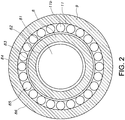
- Reference 86 indicates the (outer) wall of the device 1.
- reference 81 indicates a (hollow) interior of the flow body 8.
- References 82, 83, 84, and 85 respectively indicate a part (82) with a diameter difference, as can also be seen in fig. 1 , a (circumferential) wall of the flow body (83), a part (84) with a diameter difference, as can also be seen in fig. 1 , the part 85 including a connection of the flow body with the surrounding, especially the outer wall 86, wherein here the connection includes struts 11, which are designed to form a plurality of channels 11b.
- Reference 86 indicates the wall of the device 1. Struts 11 may be arranged in such a way, that they provide channels 11b. The struts allow the arrangement of the flow body 8 in the device 1.
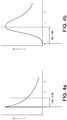
- Figs. 4a-4b schematically depict frequency (f) (y-axis) vs. residence time (t) (x-axis) plots for a laminar flow and turbulent flow respectively.
- the dotted lines within the graphs indicate the mean or average residence times; the differences indicated below the graphs indicate the difference of the residence time of the fastest particles / fluid packages within the flow relative to the average flow speed. This difference is much smaller for a laminar flow than for a turbulent flow.
- the frequency of the pulsed electric field can be set with respect to a flow speed of the fluid such that the fastest fluid fraction receives between especially 1 and 8 pulses.
- Orange juice was treated in order to lengthen its the shelf life.
- Orange juice was used that had a dynamic viscosity of 1 mPa ⁇ s (Brookfield dynamic viscosity).
- the orange juice was provided at an average flow speed of 0.16 m/s.
- a device of figures 1-3 was used, in which H was 5 mm.
- the cross sectional area of the treatment zone was 345 mm 2 , the treatment zone length L was 15 mm, L1 was 200 mm, L2 was 54 mm.
- Operational settings of the device were as follows.
- the pulse generator was set to obtain an electric field of 30 kV/cm.
- the pulse frequency was set at 50 Hz, and the pulse duration was 2.5 microseconds.
- Inlet temperature was 40°C. In these conditions, the shelf life of the orange juice was extended from 7 days to 21 days.
- the Reynolds number in this case was 1768, with v being 0,16 m/s, the hydraulic diameter being 0.01 m (here about two times the height of 5 mm, as two parallel plates form a ring shaped treatment zone), ⁇ being 1100 kg/m 3 , and ⁇ being 0.001 Pa.s.
- Diameter(s) (mm) at cross section Length(s) (mm): A1 A2 A3 A4 L1 L L2 L3 L4 L5 H 1 28 94 125 115 160 15 51 300 230 156 5 2 28 27 27 17 200 15 54 300 0 0 5
- Examples 3a and 3b were performed at constant electrical field strength and starting temperature. The flow speed was varied.
- Sample 1 Sample 2 Sample3 Average hours hours hours hours hours hours Untreated - 35 35 35 Flow 100 l/h 114 115 118 116 Flow 200 1/h 108 112 - 109 Flow 300 l/h (non-laminar) 99 105 - 102 Conditions of yeast experiment 1 (Y7) Flow (l/h) Frequency (Hz) # pulses fastest particle # pulses average particle Starting temp (°C) Reynolds number 100 20 2.5 3.7 30 884 200 40 2.5 3.7 30 1768 300 (non-laminar) 60 3.7 30 2653
- Example 4b Experiment 2 - duplicate experiment of condition 500 l / h and 45 °C (apparatus 1)
- Example 4d Experiment 4 - duplicate experiment conditions 400 l / h and 40 °C (apparatus 1)
- Example 5 further microbiological data
- a round treatment zone (like a tubular treatment zone) was compared with a ring-shaped treatment zone (such as especially defined herein). Both were compared with a laminar flow through the treatment zone and with a turbulent flow through the treatment zone.
- the fastest liquid unit is about 1.5 times faster than the mean flow speed.
- turbulent flow this is in the order of at least 3-10 times.
- the frequency in turbulent systems has to be in the order of at least 2-6 times the frequency of laminar systems.
- a treatment efficiency can be deduced as follows: treatment efficiency under the conditions chosen for these simulations and these geometries, wherein the efficiency of the laminar flow through the ring-based system (such as schematically depicted in figs. 1-3 ) is defines as 100%: Type Round Round Ring Ring Flow Laminar Turbulent Laminar Turbulent Efficiency 75% 15% 100% 20%
- ring systems e.g. purely tubed shapes systems (without flow body) (hence, no parallel plates).
- the flow patterns - the velocity and the direction of the velocity of each fluid particle - of product inside tubes may strongly depend on the Reynolds number (Re). Models can be used to calculate the residence time distribution curves of each situation, whereby in general can be discriminated between turbulent and laminar. Controlling the exact flow pattern is specific aspect of this invention.
- Inactivation of micro organisms is expressed by the log-reduction of a particular treatment or process.
- 5-log reduction is often seen as a minimal process objective.
- 5-log reduction means that 99.999% of the initial population of micro organisms is inactivated by the treatment. Hence not the average fluid particle but the fastest fluid particle in the treatment zone determines whether the log-reduction target is obtained (or not).
- the residence time distribution curve can be controlled to be a laminar flow pattern and as a result a very low temperature rise of only 5-10°C is obtained.
- the latter may provide a true fresh tasting food product as experienced by an typical consumer.
- the laminar flow pattern is realized by the dimensions of the treatment zone and the dimensions of the inlet to the treatment zone.
- the invention provides a method and device that can be used to reduce bacterial count with a factor 1,000 or more, even a factor 10,000, yet even more a factor of 100,000 or more while keeping the temperature of the liquid food product at a temperature of 20 °C or lower above the temperature with which it enters the treatment zone. Especially, this may allow the above mentioned use while keeping the temperature of the liquid food product at a temperature of 15 °C or lower above the temperature with which it enters a treatment zone. Especially, the temperature rise can even only be 10 °C or lower.
Landscapes
- Life Sciences & Earth Sciences (AREA)
- Engineering & Computer Science (AREA)
- Chemical & Material Sciences (AREA)
- Wood Science & Technology (AREA)
- Polymers & Plastics (AREA)
- Food Science & Technology (AREA)
- Zoology (AREA)
- General Chemical & Material Sciences (AREA)
- Water Supply & Treatment (AREA)
- Organic Chemistry (AREA)
- Environmental & Geological Engineering (AREA)
- Hydrology & Water Resources (AREA)
- Electrochemistry (AREA)
- Chemical Kinetics & Catalysis (AREA)
- Food Preservation Except Freezing, Refrigeration, And Drying (AREA)
Priority Applications (1)
| Application Number | Priority Date | Filing Date | Title |
|---|---|---|---|
| PL13767146T PL2895015T3 (pl) | 2012-09-11 | 2013-09-11 | Urządzenie i sposób dostarczania do płynu wysokonapięciowego pulsacyjnego pola elektrycznego |
Applications Claiming Priority (2)
| Application Number | Priority Date | Filing Date | Title |
|---|---|---|---|
| NL2009443A NL2009443C2 (en) | 2012-09-11 | 2012-09-11 | Device and method for providing high voltage pulsed electric field to a fluid. |
| PCT/NL2013/050655 WO2014042526A1 (en) | 2012-09-11 | 2013-09-11 | Device and method for providing a high voltage pulsed electric field to a fluid |
Publications (2)
| Publication Number | Publication Date |
|---|---|
| EP2895015A1 EP2895015A1 (en) | 2015-07-22 |
| EP2895015B1 true EP2895015B1 (en) | 2019-04-10 |
Family
ID=46939965
Family Applications (1)
| Application Number | Title | Priority Date | Filing Date |
|---|---|---|---|
| EP13767146.7A Active EP2895015B1 (en) | 2012-09-11 | 2013-09-11 | Device and method for providing a high voltage pulsed electric field to a fluid |
Country Status (10)
| Country | Link |
|---|---|
| US (1) | US20150245648A1 (pl) |
| EP (1) | EP2895015B1 (pl) |
| AU (1) | AU2013316183B2 (pl) |
| DK (1) | DK2895015T3 (pl) |
| ES (1) | ES2728461T3 (pl) |
| NL (1) | NL2009443C2 (pl) |
| PL (1) | PL2895015T3 (pl) |
| PT (1) | PT2895015T (pl) |
| WO (1) | WO2014042526A1 (pl) |
| ZA (1) | ZA201501972B (pl) |
Families Citing this family (3)
| Publication number | Priority date | Publication date | Assignee | Title |
|---|---|---|---|---|
| CN108079324B (zh) * | 2018-02-26 | 2023-07-25 | 中国工程物理研究院流体物理研究所 | 一种用于高压脉冲电场灭菌的同轴结构式匀流腔体 |
| KR102808325B1 (ko) * | 2022-06-15 | 2025-05-14 | 이동후 | 고전압 펄스 전기장 처리 장치 |
| CN115748176B (zh) * | 2022-11-16 | 2024-08-13 | 珠海格力电器股份有限公司 | 洗衣机除菌控制方法、装置、洗衣机级存储介质 |
Citations (1)
| Publication number | Priority date | Publication date | Assignee | Title |
|---|---|---|---|---|
| US20040238348A1 (en) * | 2001-10-18 | 2004-12-02 | Daniel Chatroux | Device and method for treating a substance containing undesirable organisms using a pulsed electrical field |
Family Cites Families (11)
| Publication number | Priority date | Publication date | Assignee | Title |
|---|---|---|---|---|
| US4838154A (en) * | 1985-05-31 | 1989-06-13 | Maxwell Laboratories, Inc. | Apparatus for extending the shelf life of fluid food products |
| US4695472A (en) * | 1985-05-31 | 1987-09-22 | Maxwell Laboratories, Inc. | Methods and apparatus for extending the shelf life of fluid food products |
| US5690978A (en) * | 1996-09-30 | 1997-11-25 | Ohio State University | High voltage pulsed electric field treatment chambers for the preservation of liquid food products |
| TW355668B (en) * | 1998-02-06 | 1999-04-11 | Purepulse Technologies Inc | A process for preparing/preserving a pumpable foodstuff to provide a foodstuff with significantly reduced microbial levels with minimal, changes in the flavor, appearance, odor, or function |
| US6027754A (en) * | 1998-06-30 | 2000-02-22 | Purepulse Technologies, Inc. | Uniform product flow in a high-electric-field treatment cell |
| FR2792207B1 (fr) * | 1999-04-15 | 2001-06-08 | Electricite De France | Procede de traitement d'un flux aqueux par electropulsation a champ parallele a l'ecoulement, chambre de pulsation et applications |
| NL1014266C2 (nl) * | 2000-02-02 | 2001-08-03 | Stork Food & Dairy Systems Bv | Behandelingsinrichting en werkwijze voor het verduurzamen van verpompbare voedselproducten in een pulserend elektrisch veld. |
| JP2004055199A (ja) * | 2002-07-17 | 2004-02-19 | Yamamoto Vinita Co Ltd | 流動性食品の高周波による連続加熱装置 |
| EP2052743A1 (en) * | 2007-10-25 | 2009-04-29 | Carlsberg Breweries A/S | A beverage sterilisation device |
| DE102010001279A1 (de) | 2010-01-27 | 2011-07-28 | Deutsches Institut für Lebensmitteltechnik e.V., 49610 | Vorrichtung und Verfahren zur Hochspannungsimpulsbehandlung im Ringspalt |
| CN201830844U (zh) * | 2010-09-14 | 2011-05-18 | 浙江大学 | 一种在线监测电场强度和温度的高压脉冲电场灭菌处理室 |
-
2012
- 2012-09-11 NL NL2009443A patent/NL2009443C2/en active
-
2013
- 2013-09-11 ES ES13767146T patent/ES2728461T3/es active Active
- 2013-09-11 PT PT13767146T patent/PT2895015T/pt unknown
- 2013-09-11 WO PCT/NL2013/050655 patent/WO2014042526A1/en not_active Ceased
- 2013-09-11 AU AU2013316183A patent/AU2013316183B2/en not_active Ceased
- 2013-09-11 US US14/427,366 patent/US20150245648A1/en not_active Abandoned
- 2013-09-11 PL PL13767146T patent/PL2895015T3/pl unknown
- 2013-09-11 EP EP13767146.7A patent/EP2895015B1/en active Active
- 2013-09-11 DK DK13767146.7T patent/DK2895015T3/da active
-
2015
- 2015-03-23 ZA ZA2015/01972A patent/ZA201501972B/en unknown
Patent Citations (1)
| Publication number | Priority date | Publication date | Assignee | Title |
|---|---|---|---|---|
| US20040238348A1 (en) * | 2001-10-18 | 2004-12-02 | Daniel Chatroux | Device and method for treating a substance containing undesirable organisms using a pulsed electrical field |
Also Published As
| Publication number | Publication date |
|---|---|
| US20150245648A1 (en) | 2015-09-03 |
| PL2895015T3 (pl) | 2019-09-30 |
| AU2013316183B2 (en) | 2016-11-10 |
| PT2895015T (pt) | 2019-06-04 |
| NL2009443C2 (en) | 2014-03-12 |
| WO2014042526A1 (en) | 2014-03-20 |
| ES2728461T3 (es) | 2019-10-24 |
| DK2895015T3 (da) | 2019-05-27 |
| ZA201501972B (en) | 2017-01-25 |
| EP2895015A1 (en) | 2015-07-22 |
| AU2013316183A1 (en) | 2015-04-30 |
Similar Documents
| Publication | Publication Date | Title |
|---|---|---|
| Huang et al. | Designs of pulsed electric fields treatment chambers for liquid foods pasteurization process: A review | |
| US5690978A (en) | High voltage pulsed electric field treatment chambers for the preservation of liquid food products | |
| Barbosa‐Canovas et al. | Pulsed electric fields | |
| AU669725B2 (en) | High pulsed voltage systems for extending the shelf life of pumpable food products | |
| Eveke et al. | Inactivation of in apple juice by radio frequency electric fields | |
| US20040005242A1 (en) | Method and device for sterilising a liquid | |
| Geveke et al. | Radio frequency electric fields inactivation of Escherichia coli in apple cider | |
| US6027754A (en) | Uniform product flow in a high-electric-field treatment cell | |
| EP0594566B1 (en) | High pulsed voltage systems for extending the shelf life of pumpable food products | |
| KR20100015776A (ko) | 밀폐형 폐쇄 용기 내 액체의 살균 | |
| EP2895015B1 (en) | Device and method for providing a high voltage pulsed electric field to a fluid | |
| JP5768040B2 (ja) | パルス電場を用いる生体細胞の膜透過化のための方法 | |
| CN101674736B (zh) | 用于对液体进行杀菌的方法和设备 | |
| WO1999039752A1 (en) | High-strength-electric-field pumpable-food-product treatment in a serial-electrode treatment cell | |
| Geveke et al. | Inactivation of Saccharomyces cerevisiae with radio frequency electric fields | |
| US20100112151A1 (en) | High-voltage pulsed electrical field for antimicrobial treatment | |
| JP6418649B2 (ja) | 電気穿孔用の反応器装置 | |
| EP1742671B1 (en) | Electric field fluid treatment chamber | |
| NL1015898C2 (nl) | Pulssterilisatie-inrichting. | |
| RU2157649C2 (ru) | Устройство для электрообработки жидких и текучих продуктов | |
| Geveke | Non-thermal processing by radio frequency electric fields | |
| Saito et al. | Difference of Treatment Efficiency by Pulse Applying Interval in Pulsed Electric Field Sterilization of Vegetable Drink | |
| Rezaeimotlagh et al. | Radio Frequency Electric Fields as a Nonthermal Process | |
| Rezaeimotlagh | Non-thermal processing of liquid food products by using Radio Frequency Electric Fields (RFEF) technology | |
| Li et al. | Bacteria inactivation by PEF with coaxial treatment chamber and tube-plate treatment chamber |
Legal Events
| Date | Code | Title | Description |
|---|---|---|---|
| PUAI | Public reference made under article 153(3) epc to a published international application that has entered the european phase |
Free format text: ORIGINAL CODE: 0009012 |
|
| 17P | Request for examination filed |
Effective date: 20150326 |
|
| AK | Designated contracting states |
Kind code of ref document: A1 Designated state(s): AL AT BE BG CH CY CZ DE DK EE ES FI FR GB GR HR HU IE IS IT LI LT LU LV MC MK MT NL NO PL PT RO RS SE SI SK SM TR |
|
| AX | Request for extension of the european patent |
Extension state: BA ME |
|
| DAX | Request for extension of the european patent (deleted) | ||
| 17Q | First examination report despatched |
Effective date: 20160503 |
|
| STAA | Information on the status of an ep patent application or granted ep patent |
Free format text: STATUS: EXAMINATION IS IN PROGRESS |
|
| GRAP | Despatch of communication of intention to grant a patent |
Free format text: ORIGINAL CODE: EPIDOSNIGR1 |
|
| STAA | Information on the status of an ep patent application or granted ep patent |
Free format text: STATUS: GRANT OF PATENT IS INTENDED |
|
| INTG | Intention to grant announced |
Effective date: 20181112 |
|
| GRAS | Grant fee paid |
Free format text: ORIGINAL CODE: EPIDOSNIGR3 |
|
| GRAA | (expected) grant |
Free format text: ORIGINAL CODE: 0009210 |
|
| STAA | Information on the status of an ep patent application or granted ep patent |
Free format text: STATUS: THE PATENT HAS BEEN GRANTED |
|
| AK | Designated contracting states |
Kind code of ref document: B1 Designated state(s): AL AT BE BG CH CY CZ DE DK EE ES FI FR GB GR HR HU IE IS IT LI LT LU LV MC MK MT NL NO PL PT RO RS SE SI SK SM TR |
|
| REG | Reference to a national code |
Ref country code: GB Ref legal event code: FG4D |
|
| REG | Reference to a national code |
Ref country code: CH Ref legal event code: EP Ref country code: AT Ref legal event code: REF Ref document number: 1117453 Country of ref document: AT Kind code of ref document: T Effective date: 20190415 |
|
| REG | Reference to a national code |
Ref country code: IE Ref legal event code: FG4D |
|
| REG | Reference to a national code |
Ref country code: DE Ref legal event code: R096 Ref document number: 602013053735 Country of ref document: DE |
|
| REG | Reference to a national code |
Ref country code: DK Ref legal event code: T3 Effective date: 20190522 |
|
| REG | Reference to a national code |
Ref country code: PT Ref legal event code: SC4A Ref document number: 2895015 Country of ref document: PT Date of ref document: 20190604 Kind code of ref document: T Free format text: AVAILABILITY OF NATIONAL TRANSLATION Effective date: 20190521 |
|
| REG | Reference to a national code |
Ref country code: SE Ref legal event code: TRGR |
|
| REG | Reference to a national code |
Ref country code: NL Ref legal event code: FP |
|
| REG | Reference to a national code |
Ref country code: NO Ref legal event code: T2 Effective date: 20190410 |
|
| REG | Reference to a national code |
Ref country code: LT Ref legal event code: MG4D |
|
| REG | Reference to a national code |
Ref country code: AT Ref legal event code: MK05 Ref document number: 1117453 Country of ref document: AT Kind code of ref document: T Effective date: 20190410 |
|
| REG | Reference to a national code |
Ref country code: ES Ref legal event code: FG2A Ref document number: 2728461 Country of ref document: ES Kind code of ref document: T3 Effective date: 20191024 |
|
| PG25 | Lapsed in a contracting state [announced via postgrant information from national office to epo] |
Ref country code: HR Free format text: LAPSE BECAUSE OF FAILURE TO SUBMIT A TRANSLATION OF THE DESCRIPTION OR TO PAY THE FEE WITHIN THE PRESCRIBED TIME-LIMIT Effective date: 20190410 Ref country code: LT Free format text: LAPSE BECAUSE OF FAILURE TO SUBMIT A TRANSLATION OF THE DESCRIPTION OR TO PAY THE FEE WITHIN THE PRESCRIBED TIME-LIMIT Effective date: 20190410 Ref country code: AL Free format text: LAPSE BECAUSE OF FAILURE TO SUBMIT A TRANSLATION OF THE DESCRIPTION OR TO PAY THE FEE WITHIN THE PRESCRIBED TIME-LIMIT Effective date: 20190410 Ref country code: FI Free format text: LAPSE BECAUSE OF FAILURE TO SUBMIT A TRANSLATION OF THE DESCRIPTION OR TO PAY THE FEE WITHIN THE PRESCRIBED TIME-LIMIT Effective date: 20190410 |
|
| PG25 | Lapsed in a contracting state [announced via postgrant information from national office to epo] |
Ref country code: GR Free format text: LAPSE BECAUSE OF FAILURE TO SUBMIT A TRANSLATION OF THE DESCRIPTION OR TO PAY THE FEE WITHIN THE PRESCRIBED TIME-LIMIT Effective date: 20190711 Ref country code: BG Free format text: LAPSE BECAUSE OF FAILURE TO SUBMIT A TRANSLATION OF THE DESCRIPTION OR TO PAY THE FEE WITHIN THE PRESCRIBED TIME-LIMIT Effective date: 20190710 Ref country code: RS Free format text: LAPSE BECAUSE OF FAILURE TO SUBMIT A TRANSLATION OF THE DESCRIPTION OR TO PAY THE FEE WITHIN THE PRESCRIBED TIME-LIMIT Effective date: 20190410 Ref country code: LV Free format text: LAPSE BECAUSE OF FAILURE TO SUBMIT A TRANSLATION OF THE DESCRIPTION OR TO PAY THE FEE WITHIN THE PRESCRIBED TIME-LIMIT Effective date: 20190410 |
|
| PG25 | Lapsed in a contracting state [announced via postgrant information from national office to epo] |
Ref country code: AT Free format text: LAPSE BECAUSE OF FAILURE TO SUBMIT A TRANSLATION OF THE DESCRIPTION OR TO PAY THE FEE WITHIN THE PRESCRIBED TIME-LIMIT Effective date: 20190410 Ref country code: IS Free format text: LAPSE BECAUSE OF FAILURE TO SUBMIT A TRANSLATION OF THE DESCRIPTION OR TO PAY THE FEE WITHIN THE PRESCRIBED TIME-LIMIT Effective date: 20190810 |
|
| REG | Reference to a national code |
Ref country code: DE Ref legal event code: R097 Ref document number: 602013053735 Country of ref document: DE |
|
| PG25 | Lapsed in a contracting state [announced via postgrant information from national office to epo] |
Ref country code: SK Free format text: LAPSE BECAUSE OF FAILURE TO SUBMIT A TRANSLATION OF THE DESCRIPTION OR TO PAY THE FEE WITHIN THE PRESCRIBED TIME-LIMIT Effective date: 20190410 Ref country code: RO Free format text: LAPSE BECAUSE OF FAILURE TO SUBMIT A TRANSLATION OF THE DESCRIPTION OR TO PAY THE FEE WITHIN THE PRESCRIBED TIME-LIMIT Effective date: 20190410 Ref country code: CZ Free format text: LAPSE BECAUSE OF FAILURE TO SUBMIT A TRANSLATION OF THE DESCRIPTION OR TO PAY THE FEE WITHIN THE PRESCRIBED TIME-LIMIT Effective date: 20190410 Ref country code: EE Free format text: LAPSE BECAUSE OF FAILURE TO SUBMIT A TRANSLATION OF THE DESCRIPTION OR TO PAY THE FEE WITHIN THE PRESCRIBED TIME-LIMIT Effective date: 20190410 |
|
| PLBE | No opposition filed within time limit |
Free format text: ORIGINAL CODE: 0009261 |
|
| STAA | Information on the status of an ep patent application or granted ep patent |
Free format text: STATUS: NO OPPOSITION FILED WITHIN TIME LIMIT |
|
| PG25 | Lapsed in a contracting state [announced via postgrant information from national office to epo] |
Ref country code: SM Free format text: LAPSE BECAUSE OF FAILURE TO SUBMIT A TRANSLATION OF THE DESCRIPTION OR TO PAY THE FEE WITHIN THE PRESCRIBED TIME-LIMIT Effective date: 20190410 |
|
| 26N | No opposition filed |
Effective date: 20200113 |
|
| PG25 | Lapsed in a contracting state [announced via postgrant information from national office to epo] |
Ref country code: TR Free format text: LAPSE BECAUSE OF FAILURE TO SUBMIT A TRANSLATION OF THE DESCRIPTION OR TO PAY THE FEE WITHIN THE PRESCRIBED TIME-LIMIT Effective date: 20190410 |
|
| PG25 | Lapsed in a contracting state [announced via postgrant information from national office to epo] |
Ref country code: MC Free format text: LAPSE BECAUSE OF FAILURE TO SUBMIT A TRANSLATION OF THE DESCRIPTION OR TO PAY THE FEE WITHIN THE PRESCRIBED TIME-LIMIT Effective date: 20190410 Ref country code: SI Free format text: LAPSE BECAUSE OF FAILURE TO SUBMIT A TRANSLATION OF THE DESCRIPTION OR TO PAY THE FEE WITHIN THE PRESCRIBED TIME-LIMIT Effective date: 20190410 |
|
| REG | Reference to a national code |
Ref country code: CH Ref legal event code: PL |
|
| PG25 | Lapsed in a contracting state [announced via postgrant information from national office to epo] |
Ref country code: LU Free format text: LAPSE BECAUSE OF NON-PAYMENT OF DUE FEES Effective date: 20190911 Ref country code: LI Free format text: LAPSE BECAUSE OF NON-PAYMENT OF DUE FEES Effective date: 20190930 Ref country code: CH Free format text: LAPSE BECAUSE OF NON-PAYMENT OF DUE FEES Effective date: 20190930 |
|
| PG25 | Lapsed in a contracting state [announced via postgrant information from national office to epo] |
Ref country code: CY Free format text: LAPSE BECAUSE OF FAILURE TO SUBMIT A TRANSLATION OF THE DESCRIPTION OR TO PAY THE FEE WITHIN THE PRESCRIBED TIME-LIMIT Effective date: 20190410 |
|
| PG25 | Lapsed in a contracting state [announced via postgrant information from national office to epo] |
Ref country code: MT Free format text: LAPSE BECAUSE OF FAILURE TO SUBMIT A TRANSLATION OF THE DESCRIPTION OR TO PAY THE FEE WITHIN THE PRESCRIBED TIME-LIMIT Effective date: 20190410 Ref country code: HU Free format text: LAPSE BECAUSE OF FAILURE TO SUBMIT A TRANSLATION OF THE DESCRIPTION OR TO PAY THE FEE WITHIN THE PRESCRIBED TIME-LIMIT; INVALID AB INITIO Effective date: 20130911 |
|
| PG25 | Lapsed in a contracting state [announced via postgrant information from national office to epo] |
Ref country code: MK Free format text: LAPSE BECAUSE OF FAILURE TO SUBMIT A TRANSLATION OF THE DESCRIPTION OR TO PAY THE FEE WITHIN THE PRESCRIBED TIME-LIMIT Effective date: 20190410 |
|
| P01 | Opt-out of the competence of the unified patent court (upc) registered |
Effective date: 20230527 |
|
| PGFP | Annual fee paid to national office [announced via postgrant information from national office to epo] |
Ref country code: IE Payment date: 20240927 Year of fee payment: 12 |
|
| PGFP | Annual fee paid to national office [announced via postgrant information from national office to epo] |
Ref country code: DK Payment date: 20240925 Year of fee payment: 12 |
|
| PGFP | Annual fee paid to national office [announced via postgrant information from national office to epo] |
Ref country code: PT Payment date: 20240902 Year of fee payment: 12 |
|
| PGFP | Annual fee paid to national office [announced via postgrant information from national office to epo] |
Ref country code: BE Payment date: 20240927 Year of fee payment: 12 |
|
| PGFP | Annual fee paid to national office [announced via postgrant information from national office to epo] |
Ref country code: FR Payment date: 20240925 Year of fee payment: 12 |
|
| PGFP | Annual fee paid to national office [announced via postgrant information from national office to epo] |
Ref country code: PL Payment date: 20240905 Year of fee payment: 12 |
|
| PGFP | Annual fee paid to national office [announced via postgrant information from national office to epo] |
Ref country code: NO Payment date: 20240927 Year of fee payment: 12 Ref country code: SE Payment date: 20240927 Year of fee payment: 12 |
|
| REG | Reference to a national code |
Ref country code: DE Ref legal event code: R079 Ref document number: 602013053735 Country of ref document: DE Free format text: PREVIOUS MAIN CLASS: A23L0003260000 Ipc: A23B0002500000 |
|
| PGFP | Annual fee paid to national office [announced via postgrant information from national office to epo] |
Ref country code: ES Payment date: 20241001 Year of fee payment: 12 |
|
| PGFP | Annual fee paid to national office [announced via postgrant information from national office to epo] |
Ref country code: DE Payment date: 20250929 Year of fee payment: 13 |
|
| PGFP | Annual fee paid to national office [announced via postgrant information from national office to epo] |
Ref country code: IT Payment date: 20250919 Year of fee payment: 13 Ref country code: NL Payment date: 20250915 Year of fee payment: 13 |
|
| PGFP | Annual fee paid to national office [announced via postgrant information from national office to epo] |
Ref country code: GB Payment date: 20250929 Year of fee payment: 13 |