EP2894811A2 - Verfahren zur Sicherstellung von Authentizität, Integrität und Anonymität einer Datenverknüpfung, insbesondere bei Präsentation der Datenverknüpfung in Form eines zweidimensionalen optischen Codes - Google Patents
Verfahren zur Sicherstellung von Authentizität, Integrität und Anonymität einer Datenverknüpfung, insbesondere bei Präsentation der Datenverknüpfung in Form eines zweidimensionalen optischen Codes Download PDFInfo
- Publication number
- EP2894811A2 EP2894811A2 EP14198205.8A EP14198205A EP2894811A2 EP 2894811 A2 EP2894811 A2 EP 2894811A2 EP 14198205 A EP14198205 A EP 14198205A EP 2894811 A2 EP2894811 A2 EP 2894811A2
- Authority
- EP
- European Patent Office
- Prior art keywords
- hash
- data
- token
- signature
- value
- Prior art date
- Legal status (The legal status is an assumption and is not a legal conclusion. Google has not performed a legal analysis and makes no representation as to the accuracy of the status listed.)
- Granted
Links
Images

Classifications
-
- H—ELECTRICITY
- H04—ELECTRIC COMMUNICATION TECHNIQUE
- H04L—TRANSMISSION OF DIGITAL INFORMATION, e.g. TELEGRAPHIC COMMUNICATION
- H04L9/00—Cryptographic mechanisms or cryptographic arrangements for secret or secure communications; Network security protocols
- H04L9/32—Cryptographic mechanisms or cryptographic arrangements for secret or secure communications; Network security protocols including means for verifying the identity or authority of a user of the system or for message authentication, e.g. authorization, entity authentication, data integrity or data verification, non-repudiation, key authentication or verification of credentials
- H04L9/3247—Cryptographic mechanisms or cryptographic arrangements for secret or secure communications; Network security protocols including means for verifying the identity or authority of a user of the system or for message authentication, e.g. authorization, entity authentication, data integrity or data verification, non-repudiation, key authentication or verification of credentials involving digital signatures
-
- G—PHYSICS
- G09—EDUCATION; CRYPTOGRAPHY; DISPLAY; ADVERTISING; SEALS
- G09C—CIPHERING OR DECIPHERING APPARATUS FOR CRYPTOGRAPHIC OR OTHER PURPOSES INVOLVING THE NEED FOR SECRECY
- G09C5/00—Ciphering apparatus or methods not provided for in the preceding groups, e.g. involving the concealment or deformation of graphic data such as designs, written or printed messages
Definitions
- Optical codes such.
- B. Barcodes are common in many areas, especially the identification of products. They enable the fast and reliable recording of the data encoded in them with optical scanners, for example in logistics processes or when selling goods at POS systems.
- NFC or similar optical codes are very inexpensive and very easy to apply in common printing on almost any goods and documents. Often, even different process steps are glued over the previous one by stickers with corresponding code per level.
- the codes are used in closed systems, i. H. confidence in the authenticity and integrity of the optical code at the scanner, be it through knowledge of the product range and "release" of the product by the cashier / clerk and customer in the typical retail environment or within logistics chains or within manufacturing plants; where it is otherwise ensured that the object bearing the code can not be altered or forged.
- optical codes have also been used in combination with electronic communications, payment systems, voucher or ticket systems to confirm transactions in a second way independent of the data communication or references to electronic information (eg on the Internet). to present on printed matter or billboards.
- QR codes Quick Response Codes
- 2D optical codes are used in advertisements, on products or in printed matter used to refer to additional information on the Internet.
- coded data links preferably a typical Internet link in the form of URLs (Uniform Resource Locators).
- the codes can be easily scanned by a modern mobile device, such as a modern telecommunications terminal in the form of a smartphone, with a camera and software that can evaluate such codes.
- the scanner software calls - in the case that it is a coded Internet link - the corresponding website in a mobile web browser on the mobile device.
- the object of the present application is to make such attacks more difficult.
- it is proposed to provide an authenticity and integrity check for the user data contained in the optical code.
- the inventive method allows forgery-proof optical codes, in particular 2D codes, which the user can recognize as an integer and authentically even without an online connection, ie without direct comparison with a database or an Internet service. It requires software running on the mobile device that checks integrity and authenticity of the data prior to calling a link or outputting data encoded in the 2D code.
- the method according to the invention does not modify the known coding methods of the optical codes, but secures the contained information in a manner similar to the method of the digital signature. Checksums or other additional data introduced by the coding process are disregarded and oblige this procedure.
- the inventive method is applied to the payload data contained in the optical code.
- the payload From the point of view of the optical code, the security features should additionally contain and for the sake of simplicity, are referred to below as "trust codes”.
- a trust code for presentation in an optical code can be constructed schematically in the following way:
- client means the unit of user, mobile device for scanning and software, which decodes an optical code with security feature "Trustcode” and with "server” the unit of service provider, technical devices / instances and Certification Authority, which the optical Code encoded with security feature "Trustcode” encoded.
- the server generates the trust code from the data DATA transferred from the trusted side by first calculating the hash value HASH according to the server-side configured cryptographic hashing algorithm HALG.
- the hash value HASH is appended with a high value entropy TOKEN (preferably determined by a cryptographically accepted method as a sufficiently random random value) according to the format configured on the server side.
- the random value TOKEN is stored on the server side linked to the trustcode to be issued for future server-side verification.
- a padding procedure defined for the algorithm is applied to the union of HASH and TOKEN.
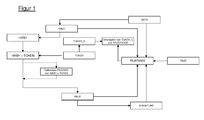
- the server outputs the elements of the trust code determined in this way and preferably separated from each other by the configured separator # as trust code. These process steps are exemplified in FIG. 1 shown.
- a client having the Certification Authority public key can check the integrity code and authenticity of the trust code contained in an optical code by calculating a hash value HASH 2 in accordance with the cryptographic hashing algorithm HALG coded in TRUS code and using the in SIGNATURE encrypted HASH compares. If the values are identical, then the trustcode is unadulterated and has been scanned by the trusted issuer.
- the client determines the value HASH pre-calculated by the server in SIGNATURE, by decrypting SIGNATURE according to the truncated-code asymmetric encryption algorithm KALG with the known, public key of the trusted certification authority Certification Authority.
- a padding of the decrypted data must be removed depending on the selected asymmetric encryption method.
- the cryptographic hashing algorithm encoded in the trustcode provides a unique, fixed-length result, it can be easily isolated from SIGNATURE's association of HASH and TOKEN compared to the client's calculated value.
- the client also determines the value TOKEN, which it then uses to identify the client and for possible further communication Trustcode on the server side can use.
- the determined TOKEN value can be used to signal to the server the successful recognition and relationship to a particular trust code.
- the client encrypts the TOKEN using the asymmetric encryption algorithm KALG encoded in the trust code and the public key of the certification authority and inserts the calculated value as a REPLY in a predefined syntax for the communication in the return channel.
- the server can decrypt the REPLY value using the Certification Authority private key, isolating the TOKEN, which it compares with the TOKEN_C value that it generates and stores when creating trustcodes. If the server finds the TOKEN, it can unambiguously assign the feedback to a previously created trustcode and at the same time recognize that the client has successfully recognized the trustcode.
- a data link encoded in an OR code in particular as an Internet link in the form of a URL, can be secured very easily with the method according to the invention if the desired link URL is regarded as DATA and treated accordingly.
- the link URL is designed to return to the server of the trustcode communication and the client uses the full trustcode as the URL when invoked after successfully checking for authenticity and integrity, as well as using the delimiter defined in the trustcode With the value REPLY appended, the server can detect the success of the client-side validation and membership of a previously-generated trustcode, and present the client with a different result than when invoked without the REPLY, as exemplified in FIG FIG. 2 shown.
- the syntax described in the method according to the invention is suitable so that even clients who can not recognize and verify trustcodes can call a contained link.
- the server can then recognize that the call came from a client without a security check and present this client with a different result, in particular other information.
Landscapes
- Engineering & Computer Science (AREA)
- Computer Security & Cryptography (AREA)
- Computer Networks & Wireless Communication (AREA)
- Signal Processing (AREA)
- Physics & Mathematics (AREA)
- General Physics & Mathematics (AREA)
- Theoretical Computer Science (AREA)
- Storage Device Security (AREA)
- Collating Specific Patterns (AREA)
- Credit Cards Or The Like (AREA)
Abstract
Description
- Optische Codes wie z. B. Barcodes sind in vielen Bereichen, insbesondere der Identifikation von Produkten, verbreitet. Sie ermöglichen die schnelle und zuverlässige Erfassung der in ihnen kodierten Daten mit optischen Scannern, etwa in Logistikprozessen oder beim Verkauf von Waren an Kassensystemen. Im Gegensatz zu vielen anderen modernen Verfahren der berührungslosen Identifikation wie RFID, NFC o. ä. sind optische Codes sehr preisgünstig und sehr einfach in gängigen Druckverfahren auf nahezu beliebigen Gütern und Dokumenten aufzubringen. Häufig werden sogar verschiedene Verfahrensstufen durch Aufkleber mit entsprechendem Code pro Stufe über den vorhergehenden geklebt.
- Im typischen Produktumfeld und der Logistik werden die Codes in geschlossenen Systemen verwendet, d. h. dass ein Vertrauen gegenüber der Authentizität und Integrität des optischen Codes beim Erfassenden (Scanner) besteht - sei es durch Kenntnis der Warenpalette und "Freigabe" des Produkts durch Kassierer/Kassiererin und Kunden/Kundin im typischen Einzelhandelsumfeld oder innerhalb von Logistikketten oder innerhalb von Produktionsbetrieben, bei denen auf andere Weise gewährleistet ist, dass der Gegenstand, welcher den Code trägt, nicht verändert oder gefälscht sein kann.
- In den letzten Jahren werden optische Codes aber auch in Kombination mit der elektronischen Kommunikation, Bezahlsystemen, Voucher- oder Ticketsystemen genutzt, um Transaktionen auf einem zweiten, von der Datenkommunikation unabhängigen Weg zu bestätigen oder Verweise auf elektronische Informationen (z. B. im Internet) auf Drucksachen oder Werbetafeln zu präsentieren. Besondere Verbreitung außerhalb der Produktidentifikation und Logistikprozesse hat dabei die Variante der Quick Response Codes (QR-Codes) der Firma Denso, Japan, gewonnen. Diese optischen 2D Codes werden in Werbeanzeigen, auf Produkten oder in Drucksachen genutzt, um auf zusätzliche Informationen im Internet zu verweisen.
- Sie enthalten dazu kodiert eine Datenverknüpfung, vorzugsweise einen typischen Internetlink in der Form von URLs (Uniform Resource Locators). Die Codes können durch ein modernes Mobilgerät, beispielsweise ein modernes Telekommunikations-Endgerät in Form eines Smartphones, mit Kamera und einer Software, welche solche Codes auswerten kann, auf einfache Weise gescannt werden. Die Scannersoftware ruft - für den Fall, dass es sich um eine kodierten Internetlink handelt - die entsprechende Webseite in einem mobilen Webbrowser auf dem Mobilgerät auf.
- Durch die zunehmende Verbreitung dieser Codes in allen Lebensbereichen, werden sie interessant für verbrecherische Angriffe auf Anwender, die zum Ziel haben, an wertvolle Informationen zum Beispiel zum Login auf Bankkonten o. ä. zu gelangen (sogenanntes "Phishing").
- Aufgabe der vorliegenden Anmeldung ist es, solche Angriffe zu erschweren. Hierzu wird vorgeschlagen, eine Authentizitäts- und Integritätsprüfung für die in dem optischen Code enthaltenen Nutzdaten bereit zu stellen.
- Das erfindungsgemäße Verfahren ermöglicht fälschungssichere optische Codes, insbesondere 2D Codes, welche der Anwender auch ohne Online-Verbindung, also ohne direkten Abgleich mit einer Datenbank oder einem Internetservice, als integer und authentisch erkennen kann. Es setzt eine auf dem Mobilgerät laufende Software voraus, welche vor dem Aufruf eines Links oder der Ausgabe von im 2D Code kodierten Daten Integrität und Authentizität der Daten prüft.
- Das erfindungsgemäße Verfahren modifiziert nicht die bekannten Kodierverfahren der optischen Codes, sondern sichert die enthaltenen Informationen in einer Weise, die dem Verfahren der digitalen Signatur ähnelt. Prüfsummen oder weitere zusätzliche durch das Kodierverfahren eingebrachte Daten bleiben unberücksichtigt und obligen diesen Verfahren. Das erfindungsgemäße Verfahren wird auf die Nutzdaten, welche in dem optischen Code enthalten sind, angewandt. Die Nutzdaten aus Sicht des optischen Codes sollen zusätzlich die Sicherheitseigenschaften enthalten und werden zur Vereinfachung im Folgenden als "Trustcode" bezeichnet. Ein Trustcode zur Präsentation in einem optischen Code kann in der folgender Weise schematisch aufgebaut sein:
- Dabei seien die Elemente definiert zu:
- # : Trennzeichen, welches kein erlaubtes Zeichen der zulässigen Menge an Zeichen, welche die anderen Elemente repräsentieren sein darf;
- DATA : Daten/Information, die vom Trustcode repräsentiert wird und deren Authentizität und Integrität gesichert wird;
- CAID : Für das Verfahren festgelegte und allen Parteien bekannte Kodierung einer vertrauenswürdigen Beglaubigungsinstanz, welche die Authentizität des vorliegenden Trustcodes bestätigt, sogenannte Certification Authority. Um den geringen Speichermengen optischer Codes Rechnung zu tragen, werde eine komprimierte Darstellung einer eindeutigen Enumeration der möglichen Certification Authorities verwendet;
- HALG : Komprimierte, eindeutige Kodierung des zur Feststellung der Integrität von DATA verwendeten kryptografischen Hashing-Algorithmus;
- KALG : Komprimierte, eindeutige Kodierung des zur Feststellung der Authentizität von DATA verwendeten asymmetrischen Verschlüsselungs-Algorithmus;
- SIGNATURE : Die mit dem mit KALG bezeichneten asymmetrischen Verschlüsselungs-Algorithmus verschlüsselte Vereinigung von Hashwert HASH, welcher mittels des mit HALG bestimmten kryptografischen Hashing-Algorithmus über DATA berechnet wurde, und
- TOKEN, einem Zufallswert, der zum Zeitpunkt der Generierung des Trustcode von einer vertrauenswürdigen Instanz auf Seite der Certification Authority bestimmt wurde, gegebenenfalls erweitert um ein sogenanntes Padding-Verfahren, wenn dieses für die Sicherheit des asymmetrischen Verschlüsselungs-Algorithmus KALG notwendig sind.
- Im Folgenden sei mit "Client" die Einheit aus Nutzer, Mobilgerät zum Scan und Software gemeint, welche einen optischen Code mit Sicherheitsmerkmal "Trustcode" dekodiert und mit "Server" die Einheit aus Dienstleister, technischen Geräten/Instanzen und Certification Authority, welche den optischen Code mit enthaltenem Sicherheitsmerkmal "Trustcode" kodiert.
- Der Server generiert den Trustcode aus ihm von vertrauenswürdiger Seite übergebenen Daten DATA, indem er zunächst den Hashwert HASH gemäß des auf Server-Seite konfigurierten kryptografischen Hashing-Algorithmus HALG berechnet. An den Hashwert HASH wird ein Zufallswert TOKEN hoher Entropie (vorzugsweise nach einem kryptografisch anerkannten Verfahren als ausreichend zufälliger Zufallswert ermittelt) entsprechend des auf Server-Seite konfigurierten Formats angehängt. Der Zufallswert TOKEN wird auf der Server-Seite verknüpft mit dem auszugebenden Trustcode für die zukünftige server-seitige Verifikation gespeichert.
- Wenn der auf der Server-Seite konfigurierte asymmetrische Verschlüsselungs-Algorithmus KALG dies erfordert, wird auf die Vereinigung von HASH und TOKEN ein für den Algorithmus definiertes Padding-Verfahren angewandt.
- Dieses Ergebnis oder die Vereinigung von HASH und TOKEN wird dann entsprechend des konfigurierten asymmetrischen Verschlüsselungs-Algorithmus unter Anwendung des privaten Schlüssels der Certification Authority verschlüsselt zu SIGNATURE.
- Der Server gibt die so ermittelten Elemente des Trustcode aneinandergereiht und vorzugsweise durch das konfigurierte Trennzeichen # voneinander separiert als Trustcode aus. Diese Verfahrensschritte werden beispielhaft in
Figur 1 gezeigt. - Ein Client, welcher über den öffentlichen Schlüssel der Certification Authority verfügt, kann den in einem optischen Code enthaltenen Trustcode auf Integrität und Authentizität prüfen, indem er seinerseits einen Hashwert HASH 2 gemäß des im Truscode kodierten kryptografischen Hashing-Algorithmus HALG über DATA berechnet und mit dem in SIGNATURE verschlüsselten HASH vergleicht. Sind die Werte identisch, so ist der Trustcode unverfälscht und vom vertrauenswürdigen Aussteller gescannt worden.
- Den in SIGNATURE enthaltenen, vom Server vorberechneten Wert HASH ermittelt der Client, indem er SIGNATURE entsprechend des im Truscode kodierten asymmetrischen Verschlüsselungs-Algorithmus KALG mit dem bekannten, öffentlichen Schlüssel der vertrauenswürdigen Beglaubigungsinstanz Certification Authority entschlüsselt.
- Gegebenenfalls muss in Abhängigkeit vom gewählten asymmetrischen Verschlüsselungsverfahren noch ein Padding der entschlüsselten Daten entfernt werden.
- Da der im Trustcode einkodierte kryptografische Hashing-Algorithmus ein eindeutiges Ergebnis fester Länge liefert, kann dieser im Vergleich zum vom Client berechneten Wert aus der Vereinigung von HASH und TOKEN innerhalb von SIGNATURE leicht isoliert werden.
- Bei diesem Vorgang ermittelt der Client zugleich den Wert TOKEN, welchen er für eine mögliche weitere Kommunikation dem Server zur Identifikation von Client und Trustcode auf der Server-Seite nutzen kann.
- Wenn der Client aufgrund eines erfolgreich erkannten und auf Authentizität und Integrität erfolgreich geprüften Trustcodes einen Rückkanal bzw. eine Kommunikation mit dem Server aufbaut, kann der ermittelte Wert TOKEN genutzt werden, um dem Server die erfolgreichen Erkennung und Beziehung zu einem bestimmten Trustcode zu signalisieren.
- Dazu verschlüsselt der Client den TOKEN mit Hilfe des im Trustcode kodierten asymmetrischen Verschlüsselungs-Algorithmus KALG und dem öffentlichen Schlüssel der Certification Authority und fügt den berechneten Wert als REPLY in einer vordefinierte Syntax für die Kommunikation im Rückkanal ein.
- Der Server kann den Wert REPLY mittels des privaten Schlüssels der Certification Authority entschlüsseln und so den TOKEN isolieren, welchen er mit den für die von ihm bei der Erstellung von Trustcodes erzeugten und gespeicherten Wert TOKEN_C vergleicht. Findet der Server den TOKEN, kann er die Rückmeldung eindeutig einem zuvor erzeugten Trustcode zuordnen und gleichzeitig erkennen, dass der Client den Trustcode erfolgreich erkannt hat. Diese Verfahrensschritte werden beispielhaft in
Figur 2 gezeigt. - Ein in einen OR-Code einkodierte Datenverknüpfung, insbesondere als Internetlink in Form eines URL kann mit dem erfindungsgemäßen Verfahren sehr leicht abgesichert werden, wenn der gewünschte Link URL als DATA betrachtet und entsprechend behandelt wird. Wenn der Link URL zusätzlich so gestaltet ist, dass er zum Server der Trustcode-Kommunikation zurückführt und der Client beim Aufruf nach erfolgreicher Prüfung auf Authentizität und Integrität den vollständigen Trustcode als URL verwendet, sowie mit dem im Trustcode definierten Trennzeichen noch den Wert REPLY anfügt, kann der Server den Erfolg der Prüfung auf Client-Seite und die Zugehörigkeit zu einem zuvor generierten Trustcode erkennen und dem Client ein anderes Ergebnis präsentieren als bei Aufruf ohne die REPLY, wie beispielhaft in
Figur 2 gezeigt. - Insbesondere ist die im erfindungsgemäßen Verfahren beschriebene Syntax geeignet, dass auch Clients, welche Trustcodes nicht erkennen und verifizieren können, einen enthaltenen Link aufrufen können. Der Server kann dann am Fehlen der REPLY erkennen, dass der Aufruf von einem Client ohne Sicherheitsprüfung stammt und diesem Client ein anderes Ergebnis, insbesondere andere Informationen präsentieren.
Claims (11)
- Verfahren zum Erzeugen einer Signatur (SIGNATURE) für einen Trustcode, der zur Sicherstellung von Authentizität und Integrität einer in einem optischen Code präsentierten Daten (DATA) dient, wobei die Daten (DATA) eine Datenverknüpfung, insbesondere einen Link umfassen, wobei- für die Daten (DATA) mittels eines kryptographischen Hashing-Algoritmus (HALG) ein Hashwert (HASH) berechnet wird,- dem Hashwert (HASH) ein Zufallswert (TOKEN) zugefügt wird und- die Vereinigung von Hashwert (HASH) und Zufallswert (TOKEN) mittels des des privaten Schlüssels eines asymetrischen Verschlüsselungs-Algorithmus (KALG) verschlüsselt wird.
- Verfahren nach Anspruch 1,
dadurch gekennzeichnet,
dass vor der Verschlüsselung der Vereinigung von Hashwert (HASH) und Zufallswert (TOKEN) ein für den verwendeten asymetrischen Verschlüsselungs-Algorithmus (KALG) definiertes Padding-Verfahren (PADDING) angewandt wird. - Trustcode zur Präsentation in einem optischen Code, insbesondere einem 2D-Code, wobei der Trustcode die folgenden Informationen umfasst:- die Daten (DATA),- eine Information über eine Beglaubigungsinstanz (CAID),- eine Information über den verwendeten Hashing-Algorithmus (HALG),- eine Information über den verwendeten asymetrischen Verschlüsselungs-Algorithmus (KALG) und- die gemäß einem der Ansprüche 1 oder 2 erzeugte Signatur (SIGNATURE).
- Verfahren zur Sicherstellung von Authentizität und Integrität einer Datenverknüpfung, insbesondere eines Link, wobei ein Trustcode gemäß Anspruch 3 präsentiert wird und mittels eines mobilen Telekommunikationsendgeräts, insbesondere eines Smartphones, ausgelesen, verarbeitet und die im Trustcode enthaltene Datenverknüpfung aufgerufen wird.
- Verfahren nach Anspruch 4,
dadurch gekennzeichnet,
dass der verwendete Hashing-Algorithmus (HALG) bestimmt wird und anhand des bestimmten Hashing-Algorithmus (HALG) ein zweiter Hashwert (HASH 2) über Daten (DATA) berechnet wird. - Verfahren nach Anspruch 5,
dadurch gekennzeichnet,
dass der öffentliche Schlüssel zum verwendeten asymetrischen Verschlüsselungs-Algorithmus (KALG) bestimmt wird,
dass mittels des öffentlichen Schlüssels die Signatur (SIGNATURE) entschlüsselt wird, dass der Hashwert (HASH) aus der entschlüsselten Signatur (SIGNATURE) isoliert wird, dass der Hashwert (HASH) mit dem zweiten Hashwert (HASH 2) verglichen wird und dass bei übereinstimmenden Wert von Hashwert (HASH) und zweiten Hashwert (HASH 2) die in der Datenverknüfung enthaltene Netz-Adresse aufgerufen wird. - Verfahren nach Anspruch 6,
dadurch gekennzeichnet,
dass der Zufallswert (TOKEN) aus der entschlüsselten Signatur (SIGNATURE) isoliert wird und mittels des öffentlichen Schlüssels verschlüsselt wird und dass der verschlüsselte Zufallswert (TOKEN_V) in einer vorgegebenen Syntax der Kommunikation mit einem Server beigefügt wird. - Verfahren nach Anspruch 7,
dadurch gekennzeichnet,
dass der von dem Server emfangen verschlüsselte Zufallswert (TOKEN_V) mittels des privaten Schlüssels des verwendeten asymetrischen Verschlüsselungs-Algorithmus (KALG) entschlüsselt und mit einer zur Verifikation des Trustcodes mit einer gespeicherten Kopie des Zufallswerts (TOKEN_C) verglichen wird. - Verfahren nach Anspruch 8,
dadurch gekennzeichnet,
dass bei fehlender Übereinstimmung von Zufallswert (TOKEN) und der Kopie des Zufallswerts (TOKEN_C) oder bei nicht empfangenen verschlüsselten Zufallswert (TOKEN_V) ein anderes Ergebnis ausgegeben wird als bei Übereinstimmung von Zufallswert (TOKEN) und der Kopie des Zufallswerts (TOKEN_C). - Software zur Durchführung eines Verfahren nach einem der Ansprüche 4 bis 7, ablaufend auf einem mobilen Telekommunikations-Endgerät, insbesondere einem Smartphone.
- Software zur Durchführung eines Verfahren nach einem der Ansprüche 8 oder 9, ablaufend auf einem Server.
Applications Claiming Priority (1)
| Application Number | Priority Date | Filing Date | Title |
|---|---|---|---|
| DE102013114493.4A DE102013114493A1 (de) | 2013-12-19 | 2013-12-19 | Verfahren zur Sicherstellung von Authentizität, Integrität und Anonymität einer Datenverknüpfung, insbesondere bei Präsentation der Datenverknüpfung in Form eines zweidimensionalen optischen Codes |
Publications (3)
| Publication Number | Publication Date |
|---|---|
| EP2894811A2 true EP2894811A2 (de) | 2015-07-15 |
| EP2894811A3 EP2894811A3 (de) | 2015-10-14 |
| EP2894811B1 EP2894811B1 (de) | 2019-05-22 |
Family
ID=52102577
Family Applications (1)
| Application Number | Title | Priority Date | Filing Date |
|---|---|---|---|
| EP14198205.8A Active EP2894811B1 (de) | 2013-12-19 | 2014-12-16 | Verfahren zur Sicherstellung von Authentizität, Integrität und Anonymität einer Datenverknüpfung, insbesondere bei Präsentation der Datenverknüpfung in Form eines zweidimensionalen optischen Codes |
Country Status (3)
| Country | Link |
|---|---|
| EP (1) | EP2894811B1 (de) |
| DE (1) | DE102013114493A1 (de) |
| ES (1) | ES2743047T3 (de) |
Cited By (2)
| Publication number | Priority date | Publication date | Assignee | Title |
|---|---|---|---|---|
| CN113595743A (zh) * | 2021-08-04 | 2021-11-02 | 中国银行股份有限公司 | 一种授权令牌处理方法及装置 |
| CN122120026A (zh) * | 2026-04-27 | 2026-05-29 | 中电科大数据研究院有限公司 | 标签数据传输方法及装置、标签数据一致性校验方法及装置 |
Families Citing this family (2)
| Publication number | Priority date | Publication date | Assignee | Title |
|---|---|---|---|---|
| CN107067056A (zh) * | 2017-02-14 | 2017-08-18 | 阿里巴巴集团控股有限公司 | 二维码生成方法及其设备和二维码识别方法及其设备 |
| CN110781140B (zh) * | 2019-09-06 | 2023-08-18 | 平安科技(深圳)有限公司 | 区块链中数据签名的方法、装置、计算机设备及存储介质 |
Family Cites Families (4)
| Publication number | Priority date | Publication date | Assignee | Title |
|---|---|---|---|---|
| US6453416B1 (en) * | 1997-12-19 | 2002-09-17 | Koninklijke Philips Electronics N.V. | Secure proxy signing device and method of use |
| US7093130B1 (en) * | 2000-01-24 | 2006-08-15 | The Regents Of The University Of California | System and method for delivering and examining digital tickets |
| US20120308003A1 (en) * | 2011-05-31 | 2012-12-06 | Verisign, Inc. | Authentic barcodes using digital signatures |
| DE102012004580A1 (de) * | 2012-03-09 | 2013-09-12 | Oliver Sonntag | Verfahren und Internet-Plattform zur Feststellung der Zuordnung von Kontaktdaten zu einer bestimmten Person |
-
2013
- 2013-12-19 DE DE102013114493.4A patent/DE102013114493A1/de not_active Withdrawn
-
2014
- 2014-12-16 EP EP14198205.8A patent/EP2894811B1/de active Active
- 2014-12-16 ES ES14198205T patent/ES2743047T3/es active Active
Non-Patent Citations (1)
| Title |
|---|
| None |
Cited By (3)
| Publication number | Priority date | Publication date | Assignee | Title |
|---|---|---|---|---|
| CN113595743A (zh) * | 2021-08-04 | 2021-11-02 | 中国银行股份有限公司 | 一种授权令牌处理方法及装置 |
| CN113595743B (zh) * | 2021-08-04 | 2022-10-21 | 中国银行股份有限公司 | 一种授权令牌处理方法及装置 |
| CN122120026A (zh) * | 2026-04-27 | 2026-05-29 | 中电科大数据研究院有限公司 | 标签数据传输方法及装置、标签数据一致性校验方法及装置 |
Also Published As
| Publication number | Publication date |
|---|---|
| EP2894811A3 (de) | 2015-10-14 |
| ES2743047T3 (es) | 2020-02-18 |
| EP2894811B1 (de) | 2019-05-22 |
| DE102013114493A1 (de) | 2015-06-25 |
Similar Documents
| Publication | Publication Date | Title |
|---|---|---|
| EP3574610B1 (de) | Verfahren zum durchführen einer zweifaktorauthentifizierung | |
| DE112011100182B4 (de) | Datensicherheitsvorrichtung, Rechenprogramm, Endgerät und System für Transaktionsprüfung | |
| DE60211841T2 (de) | Vorrichtung zur Aktualisierung und zum Entzug der Gültigkeit einer Marke in einer Infrastruktur mit öffentlichen Schlüsseln | |
| DE10328328B4 (de) | Produktschutz-Portal und Verfahren zur Echtheitsprüfung von Produkten | |
| EP2368207B1 (de) | Authentisierte übertragung von daten | |
| DE60127747T2 (de) | Verfahren und System zur reversiblen Markierung eines Textdokuments mit einem Muster der zusätzlichen Leerzeichen für Beglaubigung | |
| DE60015757T2 (de) | Verfahren und vorrichtung um ein programmcode zu beglaubigen | |
| EP2735129B1 (de) | Verfahren zum absichern einer transaktion | |
| EP2894811B1 (de) | Verfahren zur Sicherstellung von Authentizität, Integrität und Anonymität einer Datenverknüpfung, insbesondere bei Präsentation der Datenverknüpfung in Form eines zweidimensionalen optischen Codes | |
| EP1374189B1 (de) | Verfahren zum sichern von digitalen waren beim verkauf über ein computernetzwerk | |
| EP2512090A1 (de) | Verfahren zur Authentifizierung eines Teilnehmers | |
| DE102011089579A1 (de) | Verfahren zur Durchführung authentifizierter Zahlungen | |
| EP3734478A1 (de) | Verfahren zur vergabe von zertifikaten, leitsystem, verwendung eines solchen, technische anlage, anlagenkomponente und verwendung eines identitätsproviders | |
| WO2016016023A1 (de) | Verfahren zur erzeugung einer digitalen signatur | |
| EP3767513B1 (de) | Verfahren zur sicheren durchführung einer fernsignatur sowie sicherheitssystem | |
| EP3483770B1 (de) | Verfahren zur speicherung elektronisch signierter dokumente | |
| EP2477352B1 (de) | Verfahren zur Verifikation von Ausweisdaten im Kundenverkehr | |
| DE602005006407T2 (de) | Methode und System zur Signierung von physischen Dokumenten und zur Authentisierung von Signaturen auf physischen Dokumenten | |
| DE102015211615A1 (de) | Verfahren und System zur Authentifizierung eines Dokumentes sowie Verfahren zur Herstellung und/oder Personalisierung eines Dokumentes | |
| DE102007046102B4 (de) | Verfahren zum Schutz vor Veränderung von Daten und zur Authentifizierung des Datensenders bei der Datenübertragung durch Verwendung von Verschlüsselungsverfahren, bei denen mit Kenntnis von verschlüsselten und unverschlüsselten Daten andere Daten nicht mehr als zufällig richtig verschlüsselt werden können. | |
| EP3629542B1 (de) | Ausgeben von vertraulichen daten über ein festnetztelefons | |
| EP4092656A1 (de) | Authentifizierung von etiketten oder sonstiger identifikator eines anbieters | |
| WO2005010810A1 (de) | Verfahren zur ausgabe eines tragbaren datenträgers | |
| WO2018091703A1 (de) | Verfahren und vorrichtung zum sichern einer elektronischen datenübertragung | |
| EP2194499A1 (de) | Verfahren zur Transaktionssicherung |
Legal Events
| Date | Code | Title | Description |
|---|---|---|---|
| PUAI | Public reference made under article 153(3) epc to a published international application that has entered the european phase |
Free format text: ORIGINAL CODE: 0009012 |
|
| 17P | Request for examination filed |
Effective date: 20141216 |
|
| AK | Designated contracting states |
Kind code of ref document: A2 Designated state(s): AL AT BE BG CH CY CZ DE DK EE ES FI FR GB GR HR HU IE IS IT LI LT LU LV MC MK MT NL NO PL PT RO RS SE SI SK SM TR |
|
| AX | Request for extension of the european patent |
Extension state: BA ME |
|
| PUAL | Search report despatched |
Free format text: ORIGINAL CODE: 0009013 |
|
| AK | Designated contracting states |
Kind code of ref document: A3 Designated state(s): AL AT BE BG CH CY CZ DE DK EE ES FI FR GB GR HR HU IE IS IT LI LT LU LV MC MK MT NL NO PL PT RO RS SE SI SK SM TR |
|
| AX | Request for extension of the european patent |
Extension state: BA ME |
|
| RIC1 | Information provided on ipc code assigned before grant |
Ipc: H04L 9/32 20060101AFI20150908BHEP Ipc: G09C 5/00 20060101ALI20150908BHEP |
|
| R17P | Request for examination filed (corrected) |
Effective date: 20160413 |
|
| RBV | Designated contracting states (corrected) |
Designated state(s): AL AT BE BG CH CY CZ DE DK EE ES FI FR GB GR HR HU IE IS IT LI LT LU LV MC MK MT NL NO PL PT RO RS SE SI SK SM TR |
|
| 17Q | First examination report despatched |
Effective date: 20160902 |
|
| STAA | Information on the status of an ep patent application or granted ep patent |
Free format text: STATUS: EXAMINATION IS IN PROGRESS |
|
| GRAP | Despatch of communication of intention to grant a patent |
Free format text: ORIGINAL CODE: EPIDOSNIGR1 |
|
| STAA | Information on the status of an ep patent application or granted ep patent |
Free format text: STATUS: GRANT OF PATENT IS INTENDED |
|
| INTG | Intention to grant announced |
Effective date: 20181206 |
|
| GRAS | Grant fee paid |
Free format text: ORIGINAL CODE: EPIDOSNIGR3 |
|
| GRAA | (expected) grant |
Free format text: ORIGINAL CODE: 0009210 |
|
| STAA | Information on the status of an ep patent application or granted ep patent |
Free format text: STATUS: THE PATENT HAS BEEN GRANTED |
|
| AK | Designated contracting states |
Kind code of ref document: B1 Designated state(s): AL AT BE BG CH CY CZ DE DK EE ES FI FR GB GR HR HU IE IS IT LI LT LU LV MC MK MT NL NO PL PT RO RS SE SI SK SM TR |
|
| REG | Reference to a national code |
Ref country code: GB Ref legal event code: FG4D Free format text: NOT ENGLISH |
|
| REG | Reference to a national code |
Ref country code: CH Ref legal event code: EP |
|
| REG | Reference to a national code |
Ref country code: IE Ref legal event code: FG4D Free format text: LANGUAGE OF EP DOCUMENT: GERMAN |
|
| REG | Reference to a national code |
Ref country code: DE Ref legal event code: R096 Ref document number: 502014011758 Country of ref document: DE |
|
| REG | Reference to a national code |
Ref country code: AT Ref legal event code: REF Ref document number: 1137400 Country of ref document: AT Kind code of ref document: T Effective date: 20190615 |
|
| REG | Reference to a national code |
Ref country code: NL Ref legal event code: FP |
|
| REG | Reference to a national code |
Ref country code: LT Ref legal event code: MG4D |
|
| PG25 | Lapsed in a contracting state [announced via postgrant information from national office to epo] |
Ref country code: AL Free format text: LAPSE BECAUSE OF FAILURE TO SUBMIT A TRANSLATION OF THE DESCRIPTION OR TO PAY THE FEE WITHIN THE PRESCRIBED TIME-LIMIT Effective date: 20190522 Ref country code: SE Free format text: LAPSE BECAUSE OF FAILURE TO SUBMIT A TRANSLATION OF THE DESCRIPTION OR TO PAY THE FEE WITHIN THE PRESCRIBED TIME-LIMIT Effective date: 20190522 Ref country code: HR Free format text: LAPSE BECAUSE OF FAILURE TO SUBMIT A TRANSLATION OF THE DESCRIPTION OR TO PAY THE FEE WITHIN THE PRESCRIBED TIME-LIMIT Effective date: 20190522 Ref country code: PT Free format text: LAPSE BECAUSE OF FAILURE TO SUBMIT A TRANSLATION OF THE DESCRIPTION OR TO PAY THE FEE WITHIN THE PRESCRIBED TIME-LIMIT Effective date: 20190922 Ref country code: NO Free format text: LAPSE BECAUSE OF FAILURE TO SUBMIT A TRANSLATION OF THE DESCRIPTION OR TO PAY THE FEE WITHIN THE PRESCRIBED TIME-LIMIT Effective date: 20190822 Ref country code: FI Free format text: LAPSE BECAUSE OF FAILURE TO SUBMIT A TRANSLATION OF THE DESCRIPTION OR TO PAY THE FEE WITHIN THE PRESCRIBED TIME-LIMIT Effective date: 20190522 Ref country code: LT Free format text: LAPSE BECAUSE OF FAILURE TO SUBMIT A TRANSLATION OF THE DESCRIPTION OR TO PAY THE FEE WITHIN THE PRESCRIBED TIME-LIMIT Effective date: 20190522 |
|
| PG25 | Lapsed in a contracting state [announced via postgrant information from national office to epo] |
Ref country code: LV Free format text: LAPSE BECAUSE OF FAILURE TO SUBMIT A TRANSLATION OF THE DESCRIPTION OR TO PAY THE FEE WITHIN THE PRESCRIBED TIME-LIMIT Effective date: 20190522 Ref country code: RS Free format text: LAPSE BECAUSE OF FAILURE TO SUBMIT A TRANSLATION OF THE DESCRIPTION OR TO PAY THE FEE WITHIN THE PRESCRIBED TIME-LIMIT Effective date: 20190522 Ref country code: BG Free format text: LAPSE BECAUSE OF FAILURE TO SUBMIT A TRANSLATION OF THE DESCRIPTION OR TO PAY THE FEE WITHIN THE PRESCRIBED TIME-LIMIT Effective date: 20190822 Ref country code: GR Free format text: LAPSE BECAUSE OF FAILURE TO SUBMIT A TRANSLATION OF THE DESCRIPTION OR TO PAY THE FEE WITHIN THE PRESCRIBED TIME-LIMIT Effective date: 20190823 |
|
| PG25 | Lapsed in a contracting state [announced via postgrant information from national office to epo] |
Ref country code: DK Free format text: LAPSE BECAUSE OF FAILURE TO SUBMIT A TRANSLATION OF THE DESCRIPTION OR TO PAY THE FEE WITHIN THE PRESCRIBED TIME-LIMIT Effective date: 20190522 Ref country code: SK Free format text: LAPSE BECAUSE OF FAILURE TO SUBMIT A TRANSLATION OF THE DESCRIPTION OR TO PAY THE FEE WITHIN THE PRESCRIBED TIME-LIMIT Effective date: 20190522 Ref country code: EE Free format text: LAPSE BECAUSE OF FAILURE TO SUBMIT A TRANSLATION OF THE DESCRIPTION OR TO PAY THE FEE WITHIN THE PRESCRIBED TIME-LIMIT Effective date: 20190522 Ref country code: CZ Free format text: LAPSE BECAUSE OF FAILURE TO SUBMIT A TRANSLATION OF THE DESCRIPTION OR TO PAY THE FEE WITHIN THE PRESCRIBED TIME-LIMIT Effective date: 20190522 Ref country code: RO Free format text: LAPSE BECAUSE OF FAILURE TO SUBMIT A TRANSLATION OF THE DESCRIPTION OR TO PAY THE FEE WITHIN THE PRESCRIBED TIME-LIMIT Effective date: 20190522 |
|
| REG | Reference to a national code |
Ref country code: ES Ref legal event code: FG2A Ref document number: 2743047 Country of ref document: ES Kind code of ref document: T3 Effective date: 20200218 |
|
| REG | Reference to a national code |
Ref country code: DE Ref legal event code: R097 Ref document number: 502014011758 Country of ref document: DE |
|
| PG25 | Lapsed in a contracting state [announced via postgrant information from national office to epo] |
Ref country code: SM Free format text: LAPSE BECAUSE OF FAILURE TO SUBMIT A TRANSLATION OF THE DESCRIPTION OR TO PAY THE FEE WITHIN THE PRESCRIBED TIME-LIMIT Effective date: 20190522 Ref country code: IT Free format text: LAPSE BECAUSE OF FAILURE TO SUBMIT A TRANSLATION OF THE DESCRIPTION OR TO PAY THE FEE WITHIN THE PRESCRIBED TIME-LIMIT Effective date: 20190522 |
|
| PLBE | No opposition filed within time limit |
Free format text: ORIGINAL CODE: 0009261 |
|
| STAA | Information on the status of an ep patent application or granted ep patent |
Free format text: STATUS: NO OPPOSITION FILED WITHIN TIME LIMIT |
|
| PG25 | Lapsed in a contracting state [announced via postgrant information from national office to epo] |
Ref country code: TR Free format text: LAPSE BECAUSE OF FAILURE TO SUBMIT A TRANSLATION OF THE DESCRIPTION OR TO PAY THE FEE WITHIN THE PRESCRIBED TIME-LIMIT Effective date: 20190522 |
|
| 26N | No opposition filed |
Effective date: 20200225 |
|
| PG25 | Lapsed in a contracting state [announced via postgrant information from national office to epo] |
Ref country code: PL Free format text: LAPSE BECAUSE OF FAILURE TO SUBMIT A TRANSLATION OF THE DESCRIPTION OR TO PAY THE FEE WITHIN THE PRESCRIBED TIME-LIMIT Effective date: 20190522 |
|
| PG25 | Lapsed in a contracting state [announced via postgrant information from national office to epo] |
Ref country code: SI Free format text: LAPSE BECAUSE OF FAILURE TO SUBMIT A TRANSLATION OF THE DESCRIPTION OR TO PAY THE FEE WITHIN THE PRESCRIBED TIME-LIMIT Effective date: 20190522 |
|
| REG | Reference to a national code |
Ref country code: CH Ref legal event code: PL |
|
| REG | Reference to a national code |
Ref country code: BE Ref legal event code: MM Effective date: 20191231 |
|
| PG25 | Lapsed in a contracting state [announced via postgrant information from national office to epo] |
Ref country code: MC Free format text: LAPSE BECAUSE OF FAILURE TO SUBMIT A TRANSLATION OF THE DESCRIPTION OR TO PAY THE FEE WITHIN THE PRESCRIBED TIME-LIMIT Effective date: 20190522 |
|
| PG25 | Lapsed in a contracting state [announced via postgrant information from national office to epo] |
Ref country code: LU Free format text: LAPSE BECAUSE OF NON-PAYMENT OF DUE FEES Effective date: 20191216 Ref country code: IE Free format text: LAPSE BECAUSE OF NON-PAYMENT OF DUE FEES Effective date: 20191216 |
|
| PG25 | Lapsed in a contracting state [announced via postgrant information from national office to epo] |
Ref country code: CH Free format text: LAPSE BECAUSE OF NON-PAYMENT OF DUE FEES Effective date: 20191231 Ref country code: LI Free format text: LAPSE BECAUSE OF NON-PAYMENT OF DUE FEES Effective date: 20191231 Ref country code: BE Free format text: LAPSE BECAUSE OF NON-PAYMENT OF DUE FEES Effective date: 20191231 |
|
| REG | Reference to a national code |
Ref country code: AT Ref legal event code: MM01 Ref document number: 1137400 Country of ref document: AT Kind code of ref document: T Effective date: 20191216 |
|
| PG25 | Lapsed in a contracting state [announced via postgrant information from national office to epo] |
Ref country code: CY Free format text: LAPSE BECAUSE OF FAILURE TO SUBMIT A TRANSLATION OF THE DESCRIPTION OR TO PAY THE FEE WITHIN THE PRESCRIBED TIME-LIMIT Effective date: 20190522 Ref country code: AT Free format text: LAPSE BECAUSE OF NON-PAYMENT OF DUE FEES Effective date: 20191216 |
|
| PG25 | Lapsed in a contracting state [announced via postgrant information from national office to epo] |
Ref country code: IS Free format text: LAPSE BECAUSE OF FAILURE TO SUBMIT A TRANSLATION OF THE DESCRIPTION OR TO PAY THE FEE WITHIN THE PRESCRIBED TIME-LIMIT Effective date: 20190922 |
|
| PG25 | Lapsed in a contracting state [announced via postgrant information from national office to epo] |
Ref country code: MT Free format text: LAPSE BECAUSE OF FAILURE TO SUBMIT A TRANSLATION OF THE DESCRIPTION OR TO PAY THE FEE WITHIN THE PRESCRIBED TIME-LIMIT Effective date: 20190522 Ref country code: HU Free format text: LAPSE BECAUSE OF FAILURE TO SUBMIT A TRANSLATION OF THE DESCRIPTION OR TO PAY THE FEE WITHIN THE PRESCRIBED TIME-LIMIT; INVALID AB INITIO Effective date: 20141216 |
|
| PG25 | Lapsed in a contracting state [announced via postgrant information from national office to epo] |
Ref country code: MK Free format text: LAPSE BECAUSE OF FAILURE TO SUBMIT A TRANSLATION OF THE DESCRIPTION OR TO PAY THE FEE WITHIN THE PRESCRIBED TIME-LIMIT Effective date: 20190522 |
|
| PGFP | Annual fee paid to national office [announced via postgrant information from national office to epo] |
Ref country code: GB Payment date: 20251218 Year of fee payment: 12 |
|
| PGFP | Annual fee paid to national office [announced via postgrant information from national office to epo] |
Ref country code: FR Payment date: 20251218 Year of fee payment: 12 Ref country code: NL Payment date: 20251217 Year of fee payment: 12 |
|
| PGFP | Annual fee paid to national office [announced via postgrant information from national office to epo] |
Ref country code: ES Payment date: 20260119 Year of fee payment: 12 |
|
| PGFP | Annual fee paid to national office [announced via postgrant information from national office to epo] |
Ref country code: DE Payment date: 20251222 Year of fee payment: 12 |