EP2894291A2 - Novel activating mechanism for controlling the operation of a downhole tool - Google Patents
Novel activating mechanism for controlling the operation of a downhole tool Download PDFInfo
- Publication number
- EP2894291A2 EP2894291A2 EP15155067.0A EP15155067A EP2894291A2 EP 2894291 A2 EP2894291 A2 EP 2894291A2 EP 15155067 A EP15155067 A EP 15155067A EP 2894291 A2 EP2894291 A2 EP 2894291A2
- Authority
- EP
- European Patent Office
- Prior art keywords
- seat
- flow
- ball
- tool
- activator
- Prior art date
- Legal status (The legal status is an assumption and is not a legal conclusion. Google has not performed a legal analysis and makes no representation as to the accuracy of the status listed.)
- Ceased
Links
Images

Classifications
-
- E—FIXED CONSTRUCTIONS
- E21—EARTH OR ROCK DRILLING; MINING
- E21B—EARTH OR ROCK DRILLING; OBTAINING OIL, GAS, WATER, SOLUBLE OR MELTABLE MATERIALS OR A SLURRY OF MINERALS FROM WELLS
- E21B21/00—Methods or apparatus for flushing boreholes, e.g. by use of exhaust air from motor
- E21B21/10—Valve arrangements in drilling-fluid circulation systems
- E21B21/103—Down-hole by-pass valve arrangements, i.e. between the inside of the drill string and the annulus
-
- E—FIXED CONSTRUCTIONS
- E21—EARTH OR ROCK DRILLING; MINING
- E21B—EARTH OR ROCK DRILLING; OBTAINING OIL, GAS, WATER, SOLUBLE OR MELTABLE MATERIALS OR A SLURRY OF MINERALS FROM WELLS
- E21B10/00—Drill bits
- E21B10/26—Drill bits with leading portion, i.e. drill bits with a pilot cutter; Drill bits for enlarging the borehole, e.g. reamers
- E21B10/32—Drill bits with leading portion, i.e. drill bits with a pilot cutter; Drill bits for enlarging the borehole, e.g. reamers with expansible cutting tools
- E21B10/322—Drill bits with leading portion, i.e. drill bits with a pilot cutter; Drill bits for enlarging the borehole, e.g. reamers with expansible cutting tools cutter shifted by fluid pressure
-
- E—FIXED CONSTRUCTIONS
- E21—EARTH OR ROCK DRILLING; MINING
- E21B—EARTH OR ROCK DRILLING; OBTAINING OIL, GAS, WATER, SOLUBLE OR MELTABLE MATERIALS OR A SLURRY OF MINERALS FROM WELLS
- E21B34/00—Valve arrangements for boreholes or wells
- E21B34/06—Valve arrangements for boreholes or wells in wells
- E21B34/14—Valve arrangements for boreholes or wells in wells operated by movement of tools, e.g. sleeve valves operated by pistons or wire line tools
- E21B34/142—Valve arrangements for boreholes or wells in wells operated by movement of tools, e.g. sleeve valves operated by pistons or wire line tools unsupported or free-falling elements, e.g. balls, plugs, darts or pistons
-
- E—FIXED CONSTRUCTIONS
- E21—EARTH OR ROCK DRILLING; MINING
- E21B—EARTH OR ROCK DRILLING; OBTAINING OIL, GAS, WATER, SOLUBLE OR MELTABLE MATERIALS OR A SLURRY OF MINERALS FROM WELLS
- E21B2200/00—Special features related to earth drilling for obtaining oil, gas or water
- E21B2200/06—Sleeve valves
Definitions
- This invention relates to a novel activating mechanism for controlling the operation of a downhole tool.
- a large deformable (activating) ball is launched down the drill string to come into engagement with a ball seat of an axially shiftable sleeve, and which then blocks flow of drilling fluid downwardly through the sleeve (in its through-flow mode) with consequent increase in pressure upstream of the ball seat.
- This increase in pressure acts on the ball which then acts downwardly on the sleeve to move it to a by-pass mode in which fluid flow is diverted laterally through one or more by-pass ports in a surrounding main hollow body in which the sleeve is mounted.
- a small hard ball is launched down the drill string, and which blocks access to the by-pass port and which results in a further increase in pressure above the ball seat and which eventually becomes sufficient to deform the large deformable ball as it is forced downwardly through the ball seat. This then allows the sleeve to return under spring or other biassing back to its normal through-flow mode.
- the present invention has been developed with a view to provide a novel activating mechanism (which controls the operation of the downhole tool) which can be activated by launching down the drill string at least one non-deformable activator ball.
- the invention provides a novel mechanism utilising a cluster of non-deformable activator balls.
- a method of controlling the operation of a downhole tool in a drill string via an activating mechanism which is housed in a portion of the drill string upstream of the downhole tool in which:
- a method according to the invention therefore enables the operation of a downhole tool readily to be controlled, by launching a number or "cluster" of small hard activator balls from the surface and down the drill string in order that the mouth of each port can receive a respective ball which thereby blocks flow though the port.
- the activating mechanism is operative to adjust the downhole tool e.g. an under-reamer tool between an operative condition and an inoperative condition.
- the inoperative condition obtains when the reamer blades are in a withdrawn position relative to the body of the tool, and in the operative condition the reamer blades are in a radially projected position relative to the axis of the drill string so as to be engageable with the surrounding formation.
- the activating mechanism takes the form of a ball-activated tool, which comprises:
- the activating sleeve is engageable with an internal shoulder provided on the main body to form said stop.
- the collet may be coupled with the activating sleeve for movement therewith via said valve seat.
- the ball-activating tool is coupled with a related hydraulically operated device, and preferably an under reamer.
- the main body may therefore include a top sub in which the tool is incorporated, and a bottom sub in which the under reamer device is mounted.
- the under reamer includes one or more cutter movably mounted in the bottom sub for movement between a withdrawn inoperative position, and an outwardly projecting operative position.
- a flat spring arrangement may be provided to engage via its outer side with said cutter, and on its inner side is exposed to fluid flow through the main body when the tool is activated, such that the spring arrangement can operate to press the cutter outwardly to the operative position.
- the retainer and the spring means comprise an assembly of a retainer ring, a set of spacers and spring washers.
- the retainer ring is therefore preferably a rigid retaining ring, which pre-loads the spring washers and also retains the collet.
- the retainer ring holds the collet in place, and fluid dynamics will not affect it.
- the ball-activated tool may be activated by launching a single large (non-deformable) ball down the drill string to engage a dedicated seat for the large ball.
- the tool may be activated by launching a cluster of small hard (non-deformable) balls down the drill string to engage a seat which is provided with a number of ports each dedicated to be engaged by a respective one of the small balls.
- the first preferred example therefore involves use of a ball-activated tool which is caused to "pressure-up" the drill string upstream of the seat (which is activated by launch of the large ball, or the cluster of small balls), so that by-pass flow of fluid is conveyed to the downhole tool via the activating mechanism and at an increased pressure sufficient to adjust the downhole tool from its inoperative condition to its operative condition.
- a ball-activated by-pass tool forms the activating mechanism and which is operative in a first operating mode to allow through-flow passage of fluid to lubricate and cool a drilling bit arranged downstream of the by-pass tool, and in a second operating mode to allow by-pass flow of fluid into the surrounding formation, and said tool comprising:
- the by-pass seat port therefore allows continued, but limited flow of fluid through the sleeve when the latter has been adjusted to its second end position corresponding to the second operating mode of the tool (by-pass flow of fluid).
- This enables drilling fluid, usually drilling mud, to continue to flow to the drilling bit, (despite the fact that the tool has been activated to the by-pass mode), and therefore there is continued lubrication and cooling of the drill bit so as to prevent, or at least minimise, the risk of permanent damage by over heating of the drilling bit in high temperature applications.
- control sleeve has a side port which is communicable with the by-pass port in the wall of the casing when the tool is in its second operating mode. Then, upon launching of the second deactivating ball, it comes to rest in a position blocking access to the side port, and thereby interrupts further by-pass flow of fluid. The pressure therefore increases in the sleeve upstream of the ball-receiving seat, and when a predetermined threshold pressure is exceeded, the first deactivating ball is deformed so as to pass downwardly through the seat. It may be arranged also that this action is assisted by downward pressure of the second deactivating ball on the first activating ball. The sleeve is thus free to return under the action of its biassing means to the first end position so that the tool takes up again its first operating mode.
- a third type of ball(s) is provided, to be used (in addition to the second deactivating ball) when it is required to revert the tool back to its first operating mode from its second operating mode.
- the first deformable activating ball is engaged with the ball-receiving seat and main by-pass of fluid is conveyed into the surrounding formation via the by-pass port in the wall of the casing, whereas limited flow of fluid continues to be conveyed to the drill bit via the by-pass seat port.
- the third type of ball is launched from the surface and down the drill string, and it is of a size such that it can block flow of fluid through the by-pass seat port. This enables the pressure upstream of the ball-receiving seat to increase still further (in addition to the pressurisation caused by launching of the second deactivating ball), and ensures deformation of the first ball and subsequent movement of the control sleeve back to its first operating position.
- a set of circumferentially spaced seat ports is provided, and therefore a corresponding cluster of the third type of balls may be provided to be launched from the surface and to close most, if not all access to the seat ports.
- a ball catcher device may be arranged down stream of the ball-receiving seat, to catch at least the first (larger) deformable ball and preferably also the second de-activating ball, which is preferably a hard steel ball.
- the third type of ball will usually be smaller than the first and second balls, since the seat ports which they have to close off will usually be small in diameter, to permit required amount of limited continued flow of fluid through the sleeve, and therefore it will be acceptable for these smaller third type of balls to be discharged through the drilling bit and into the surrounding formation which is being drilled.
- the small type of third balls may return with the return flow of the drilling mud.
- the hollow body has at least one by-pass port to direct fluid flow laterally of the sleeve and the body, when the mechanism is in its by-pass mode.
- the sleeve is moved by the deformable activator so as to allow access to the by-pass port.
- At least one hard non-deformable activator preferably a small hard steel ball, is launched down the drill string and moves to a blocking position which blocks by-pass flow of fluid to the by-pass port, thereby causing increase in pressure upstream of the seat, but generally not to a level sufficient to move the deformable activator downwardly through the seat and through the sleeve.
- a set of small non-deformable activators is preferably provided, e.g. in the form of small hard balls, and which is launched down the drill string, and the arrangement of the seat and the deformable activator (defining limited through-flow passages for fluid when they inter-engage) is such that the small activators block the limited through-flow passages.
- the pressure upstream of the seat thus increases further, and eventually causes downward movement (accompanied by sufficient inward deformation of the deformable activator) through the seat and the sleeve.
- the sleeve then is returned (under its biassing) to its position corresponding to the through-flow mode, and the mechanism then reverts to its original mode of operation.
- Any suitable downhole tool can have its operation controlled by a mechanism according to the invention, and can be actuated and de-actuated by the mechanism in any required way.
- through-flow of fluid to the tool and via the mechanism can operate a linearly displaceable mandrel and/or a laterally outwardly moving actuator, which acts on the tool to control its operation. Return movement of the mandrel or the laterally moving actuator can then revert the tool to its original mode of operation.
- one of the modes of the downhole tool may be an inactive mode.
- the deformable activator comprises a ball-dart combination, in which a ball-like portion at least is deformable and is capable of seating on the seat, and a dart-like portion can project downwardly through the seat.
- a ball-dart combination can readily be launched down a drill string, and with suitable weighting of the combination, the dart can pull the ball downwardly, under gravity, and with the dart eventually projecting downwardly through the seat and the "ball" engaging the seat.
- the activator is hollow and is provided with an internal flow control device. This may comprise a number of separate restricted passageways, conveniently formed by separate ports in a carrier ring.
- FIG. 10 a first example of an activating mechanism for carrying out a method according to the invention is designated generally by reference 10 and comprises a hollow main body 11 (forming a "top sub") which is adapted for mounting in a drill string in order to activate a related hydraulically operated device (shown in more detail in Figures 4 and 5 ).
- the device shown in Figures 4 and 5 is an under reamer, but it should be understood that this is merely one example of a related hydraulically operated device which can be activated by the ball-activated tool of the invention.
- the hollow main body 11 permits through flow of fluid to take place when the tool is in a de-activated mode, as shown in Figure 1 .
- a tubular collet 12 is slidably mounted in the main body 11 for movement between a retained inactive position (as shown in Figure 1 ), and a released position (as shown in Figure 2 ) corresponding respectively to the de-activated mode of the tool and the activated mode.
- a ball-receiving seat 13 is coupled with the collet 12 and is arranged to receive an activating ball launched from the surface and down the drill string to activate the tool.
- a ball 14 is shown in Figure 2 in engagement with the seat 13, and with the tool components adjusted to a released active position, which causes activation of the tool.
- Spring means 15 in the form of a set of spring washers is arranged in the main body 11 and which act to maintain the collet 12 in the retained position shown in Figure 1 .
- the spring means 15 cooperate with a retainer, in the form of a rigid retainer ring 16, and two end spacers 17, in order to retain the tubular collet 12 in the inactive position.
- the collet 12 upon activation of the tool, as will be described in more detail below, the collet 12 is released by the retainer ring 16, and against the opposition of the spring means 15, in order that the collet 12 can move to a released position which initiates adjustment of the tool to the activated mode.
- An activating sleeve 18 is coupled with the collet 12 for movement therewith to an activating position of engagement with a stop provided on the main body, as shown in Figure 2 .
- the stop is provided by an internal shoulder 19 which limits the movement of the sleeve 18 and collet 12 to the active position shown in Figure 2 .
- a first by-pass port is provided in the collet 12, and which communicates internally with the interior of the collet and externally with the space defined between the outer surface of the collet 12 and the inner surface of the main body 11 when the tool is activated. This will be described in more detail below with reference to Figure 3 .
- a second by-pass port provided in the activating sleeve 18 (also not shown in Figures 1 and 2 ), and which communicates externally with the space defined between the outer surface of the sleeve 18 and the inner surface of the main body 11, and internally with the interior of the sleeve, when the sleeve reaches its activating position shown in Figure 2 .
- the four views a, b, c and d show successive stages of adjustment of the tool between the deactivated mode and the fully activated mode of the tool.
- Figure 3b shows initiation of adjustment of the tool to its activated mode, which is caused by launching activating ball 14 from the surface and down the drill string, to engage seat 13.
- Figure 3c shows the components of the tool still in the deactivated positions, but with the ball 14 engaged with the seat 13, pressure builds-up upstream of the ball and pressures up the system until such time as the fluid pressure force acting on the ball 14 causes the collet 12 to be released by the retainer ring 16, so that the assembly of components 12, 13 and 18 move as a unit to the position shown in Figure 3d , such position being defined by inter-engagement between the outer end 20 of activating sleeve 18 with shoulder 19.
- Figure 3c the potential flow of fluid through the system, shown by arrow 21, is initially prevented by virtue of the seating of ball 14 on the seat 13, until such time as the pressure build-up is sufficient to cause the collet 12 to be released by the retaining ring 16.
- Figure 3d shows the fluid flow path through the system, which is at a higher pressure than the through flow in the deactivated mode of Figure 3a , and such pressure is sufficient to trigger operation of the under reamer.
- the fluid flow effectively by-passes the ball 14 engaged with seat 13, by first passing outwardly from the interior of collet 12 through one or more first by-pass ports 21 to the space 22 between the outer surface of collet 12 and the inner surface of main body 11.
- the by-pass flow then returns to the interior of the main body 11 via one or more second by-pass ports 23 in the activating sleeve 18.
- a hydraulically operated downhole tool preferably an under-reamer
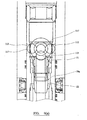
- Figure 4 illustrates schematically a top sub 25 in which the tool 10 is mounted, and a bottom sub 26 in which a hydraulically operated tool 27, such as an under reamer can be mounted.
- Figure 4 shows the tool in its de-activated position
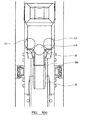
- Figure 5 is a similar view to Figure 4 , but showing the tool 10 in its activated position in which it can route pressurised fluid to operate the tool 27 e.g. an under reamer.
- Figure 6 is a longitudinal sectional view, to an enlarged scale, showing the engagement of a large non-deformable activation ball 14 with an internal ball receiving seat 13 of the axially shiftable sleeve 12 which is described above and shown in more detail in Figures 1 to 5 .
- Figure 7 shows an alternative arrangement of ball-receiving seat 13a, which is provided with an internal flow control device comprising a set of small through-flow ports, each of which is capable of having access to it blocked following launch of a cluster of small non-deformable activator balls 14a down the drill string.
- Figures 8 and 9 show another example of an activator system for activating, and deactivating, a mechanism which controls the operation of the downhole tool.
- the activator system shown in Figures 8 and 9 is being used in relation to activation of the mechanism and downhole tool described above with reference to Figures 1 to 5 .
- Figures 8 and 9 are longitudinal sectional views of a deformable activator in the form of ball-dart combination, which takes the place of the large non-deformable ball 14 described above.
- a deformable activator which is designated generally by reference 50 having a ball-like portion 51 which engages the seat 13, and a dart-like portion 52 projecting downwardly therefrom.
- the ball-like portion 51 engages the seat 13, and the dart-like projection 52 projects downwardly therefrom and through the seat.
- the activator 50 is hollow, defining a limited or restricted through-flow passage, so that when the activator engages the seat, it causes pressure upstream of the seat to increase so that the activator moves the sleeve 12 downwardly to a position corresponding to the by-pass mode of the mechanism.
- the activator 50 and the seat 13 are arranged to cooperate with each other, when the activator 50 engages the seat, in such a way that restrictive flow of fluid through the sleeve 12 is maintained when the mechanism is in its by-pass mode.
- the activator 50 incorporates a flow control device 53 arranged internally thereof, and comprising a ring formed with a number of ports forming separate restricted passageways.
- Figure 8 shows the activator 50 before employment of any activating and de-activating devices.
- At least one hard non-deformable activator is used, preferably a small hard steel ball, and which is launched down the drill string and moves to a blocking position which blocks by-pass flow to the by-pass port. This causes increase in pressure upstream of the seat 13, but generally not to a level sufficient to move the deformable activator 50 downwardly through the seat 13 and through the sleeve 12.
- a set of small non-deformable (pressure-up) actuators is provided, e.g. in the form of small hard balls 54 launched down the drill string.
- the arrangement of the seat 13 and the deformable actuator 50 is such that the balls 54 block the limited through-flow passages.
- the pressure upstream of the seat 13 therefore increases further, and eventually causes downward movement (accompanied by sufficient inward deformation of actuator 50) through the seat 13 and the sleeve 12.
- outlet ports 55 are provided in a nose portion of the dart-like portion 52.
- the activator 50 therefore incorporates a ball-port ring within the dart-like portion, which allows a split flow situation for the drilling fluid used, in that a main part of the fluid passes via the by-pass port upon activation, whereas limited flow can be maintained via the flow control device in the activator.
- deactivation ball or balls are dropped down the drill string, followed by a cluster of non-deformable pressure-up balls. Two larger deactivation balls will plug up the main bypass port, whereas the smaller non-deformable (pressure-up) balls will come down into the ports in the dart-like portion, allowing the pressure above the dart to build up.
- the dart may also be adapted to utilise a flap of valve or retention mechanism, to retain the small balls within the dart.
- FIG. 9a and 9b this shows further embodiments of deformable activators 50a and 50b respectively, and which are generally similar to the deformable activator 50 described above with reference to Figures 8 and 9 . Corresponding parts are given the same reference numerals.
- the deformable activators 50a and 50b can be launched down a drill string to engage the valve seat, and launch of a large activator ball 115 can block downward flow of fluid through the activator, and thereby pressure upstream of the activator increases thereby shifting the mechanism axially to an alternative mode of operation, whereby through flow of fluid is blocked.
- small bleed passages maybe provided, to allow limited through flow of fluid to cool and lubricate the drilling bit arranged downstream thereof. However, the main portion of the drilling fluid can then pass transversely through outlet ports 112.
- the deformable activators 50, 50a, 50b disclosed herein effectively are a form of deformable dart, and having an external resilient ring, which may be made of the same material as the plastics material from which deformable activator balls are usually made, so that the deformable ring can shear under load, to allow the dart to pass downwardly through the valve seat.
- the ring therefore forms a seal on the outer circumference of the dart, and is assembled this way so as to allow for a large area of bypass through the tool when the latter is in the activated mode. This allows a large volume to be pumped downwardly to the operating drill bit, as well as still a large volume laterally through the nozzles in the side port(s) of the tool.
- a ball activated by-pass tool designated generally by reference 110, and comprises an outer tubular casing 111 provided with at least one by-pass port 112 in its side wall, and an axially shiftable control sleeve 113 provided with a ball-receiving seat 114.
- the by-pass tool 110 is insertable into a drill string, and is operative in a first operating mode to allow through flow passage of fluid to lubricate and cool a drilling bit provided downstream of the by-pass tool, and in a second operating mode to allow by-pass flow of fluid into the surrounding formation.
- the general construction and operation of the by-pass tool 110 maybe as disclosed in more detail in US 5 499 687 , and WO01/90529 , the disclosure of which is incorporated herein by this reference.
- the tubular casing 111 defines a through flow passage to allow drilling fluid, usually drilling mud, to flow lengthwise of the tool 110 between inlet and outlet ends of the casing, and each being communicable with the drill string.
- the control sleeve 113 is mounted in the casing 111 for axial movement between first and second end positions corresponding to the first and second operating modes of the tool.
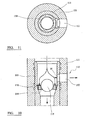
- Figure 10 shows the tool in its second operating mode, permitting by-pass flow of fluid, following activation of the tool by launching of a first large activating ball, as described in more detail below.
- Biassing means is provided (not shown), preferably in the form of a compression spring, which biasses the control sleeve 113 towards the first end position so as to block communication with the by-pass port 112 and allow through flow passage of fluid in the first operating mode.
- the ball-receiving seat 114 provided in the tool 110 can receive a first deformable activating ball 115, launched from the surface and down the drill string, when it is required to adjust the tool from its first operating mode to its second operating mode.
- the seat 114 is operative when it receives the activating ball 115, as shown in Figure 10 , to move the sleeve 113 from the first end position to the second end position and against the action of the biassing means.
- a side port 116 in the wall of the sleeve 113 communicates with the by-pass port 112, to allow by-pass flow of fluid when required. Only a single by-pass port 112 and side port 116 are shown, but evidently more than one port may be provided, and other means of communication may be used.
- a second deactivating ball 117 (see Figure 12 ) is launched down the drill string, with the result that the first ball 115 can move lengthwise of the tool 110, preferably to be received by a ball catcher device (not shown), and thereby allow the sleeve to move back to its first end position under the action of the biassing means.
- the second deactivating ball 117 blocks communication to the side port 116, and therefore interrupts by-pass flow via the by-pass port 112, and therefore the pressure upstream of the seat 114 increases, and when a threshold pressure is exceeded, the large deformable ball 115 deforms under the pressure load so as to move downwardly through the ball seat 114.
- an additional by-pass arrangement is provided. This enables drilling fluid, usually drilling mud, to continue to flow to the drilling bit, and thereby continue lubrication and cooling of the drilling bit and prevent, or at least minimise, the risk of permanent damage by overheating to the drilling bit in high temperature applications.
- the additional by-pass arrangement takes the form of at least one by-pass seat port 118 provided in the ball-receiving seat 114.
- a circumferentially spaced set of arcuate slots are formed in the seat 114, to form the means providing continued, but limited flow of by-pass fluid, when the tool is operating in its by-pass mode shown in Figure 10 .
- the subsequent launching of the deactivating ball 117 will still interrupt main by-pass flow via by-pass port 112, and subsequent increase in pressure upstream of the large deformable ball 115, and which can increase to a sufficient extent to allow deformation of the ball 115 and downward movement through the seat 114, to deactivate the tool, despite the fact that some of the fluid will be flowing downwardly through the tool, in limited manner, via the by-pass seat ports 118.
- a third type of ball for use with the tool 110.
- This third type of ball is to be used, in addition to the second deactivating ball 117, when it is required to revert the tool 110 back to its first operating mode from its second operating mode.
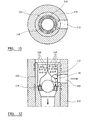
- the third type of ball is a small non-deformable ball, and preferably supplied in a cluster of balls 119, as shown in Figures 12 and 13 .
- the balls 119 are of such a size that, when used together in a cluster, they can block flow of fluid through the by-pass ports 118, and therefore enable the pressure upstream of the seat 114 to increase still further (in addition to the pressurisation caused by launching of the second deactivating ball 117), and thereby ensure the deformation of the first activation ball 115 and subsequent downward movement through the seat 118 and followed by upward movement of the control sleeve 113 under the action of its spring biassing back to the first operating position.
- more than one of the balls 119 is used in order to close off each of the by-pass seat ports 118.
- other arrangements are possible, including single balls 119 each closing off a respective by-pass port, although this is not shown in the illustrated embodiment.
- a ball catcher device (not shown) is arranged downstream of the seat 114, to catch at least the first (larger) ball 115, and preferably also the second deactivating ball 117, which is a hard steel ball.
- the third type of ball 119 is smaller in diameter than the other balls, in view of the size and shape of the by-pass ports 118, and therefore it will be acceptable for the balls 119 to be discharged through the drilling bit and into the surrounding formation being drilled, or to be returned to surface with the return flow of drilling mud.
- the by-pass tool 110 as described above therefore enables the tool to be activated by dropping the first activation ball 115, to initiate main by-pass flow via the by-pass port 112 in the casing, while still allowing a limited flow of fluid to pass around the activation ball 115 and through the seat ports 118. There is therefore a split flow situation, in which the main by-pass flow is conveyed via the by-pass port 112, while a smaller proportion of the fluid passes downwardly through the valve seat 114 via the seat ports 118.
- the provision of the seat ports 118 does mean that some of the pressure above the seat is bled-off, and therefore this reduces the pressure available to deform the activation ball 115, after launch of the de-activating ball 117. It is for this reason that the third type of balls 119 are provided, which are able to blank-off at least the major part of the access to the seat ports 118.
- the typical sequence of operations therefore would be as follows: drop the plastics activation ball 115, to open up the tool, and pump main by-pass fluid for as long as the operator requires, but with split flow and some of the flow going down through the sleeve to lubricate and cool the drilling bit, in addition to the main by-pass flow via the circulating ports above the ball 115.
- the steel deactivation ball 117 is dropped down the drill string, in the case of a single ported tool, or two deactivation balls are dropped in the case of a dual ported tool. Thereafter, the non-deformable pressure-up balls (the third balls 119) are dropped down the drill string.
- the steel deactivation ball(s) 117 closes access to the side port 16 above the ball 115, the system starts to pressure-up, and further flow now only continues around the deformable activation ball 115, and via the seat ports 118.
- the smaller, non-deformable and pressure-up balls 119 are sufficiently small that they can be displaced downwardly through the drilling tool and through the drilling bit, and out into the surrounding formation. Alternatively, balls 119 can return to surface via the return flow of drilling mud.
Landscapes
- Engineering & Computer Science (AREA)
- Geology (AREA)
- Life Sciences & Earth Sciences (AREA)
- Mining & Mineral Resources (AREA)
- Environmental & Geological Engineering (AREA)
- Fluid Mechanics (AREA)
- Physics & Mathematics (AREA)
- General Life Sciences & Earth Sciences (AREA)
- Geochemistry & Mineralogy (AREA)
- Mechanical Engineering (AREA)
- Earth Drilling (AREA)
- Gripping On Spindles (AREA)
- Percussive Tools And Related Accessories (AREA)
Abstract
Description
- This invention relates to a novel activating mechanism for controlling the operation of a downhole tool.
- The use of a ball-activated mechanism to actuate a downhole tool is well known in the exploitation of gaseous and liquid hydrocarbon reserves, and examples include
US patent numbers 5499687 and4889199 , to which reference is made for a fuller disclosure of this technology. - In this known technology, a large deformable (activating) ball is launched down the drill string to come into engagement with a ball seat of an axially shiftable sleeve, and which then blocks flow of drilling fluid downwardly through the sleeve (in its through-flow mode) with consequent increase in pressure upstream of the ball seat. This increase in pressure acts on the ball which then acts downwardly on the sleeve to move it to a by-pass mode in which fluid flow is diverted laterally through one or more by-pass ports in a surrounding main hollow body in which the sleeve is mounted.
- To deactivate the mechanism, a small hard ball is launched down the drill string, and which blocks access to the by-pass port and which results in a further increase in pressure above the ball seat and which eventually becomes sufficient to deform the large deformable ball as it is forced downwardly through the ball seat. This then allows the sleeve to return under spring or other biassing back to its normal through-flow mode.
- In one aspect the present invention has been developed with a view to provide a novel activating mechanism (which controls the operation of the downhole tool) which can be activated by launching down the drill string at least one non-deformable activator ball.
- In a further aspect the invention provides a novel mechanism utilising a cluster of non-deformable activator balls.
- According to the invention there is provided a method of controlling the operation of a downhole tool in a drill string via an activating mechanism which is housed in a portion of the drill string upstream of the downhole tool, in which:
- (a) the activating mechanism has a first mode in which it allows through-flow of drilling fluid to the downhole tool and a second mode in which a through flow of fluid is blocked; and
- (b) the activating mechanism has a number of through-flow ports permitting through-flow of drilling fluid in said first mode of the mechanism and which are capable of being blocked in order to activate the mechanism to the second mode:
- in which a number of flow blocking activator balls are launched down the drill string and which each are of such a size and shape that they can block access to said through-flow ports in order to activate the mechanism to the second mode and thereby adjust the downhole tool from one mode of operation to another.
- A method according to the invention therefore enables the operation of a downhole tool readily to be controlled, by launching a number or "cluster" of small hard activator balls from the surface and down the drill string in order that the mouth of each port can receive a respective ball which thereby blocks flow though the port.
- In a first preferred example according to the invention, the activating mechanism is operative to adjust the downhole tool e.g. an under-reamer tool between an operative condition and an inoperative condition. In the case of an under-reamer tool, the inoperative condition obtains when the reamer blades are in a withdrawn position relative to the body of the tool, and in the operative condition the reamer blades are in a radially projected position relative to the axis of the drill string so as to be engageable with the surrounding formation.
- Preferably, the activating mechanism takes the form of a ball-activated tool, which comprises:
- a hollow main body adapted for mounting in a drill string and through which fluid can flow when the tool is an a de-activated mode;
- a tubular collet slidably mounted in the main body for movement between a retained inactive position and a released position corresponding respectively to the deactivated mode of the tool and an activated mode;
- a ball-receiving seat coupled with the collet and arranged to receive an activating ball launched from the surface and down the drill string to activate the tool;
- spring means arranged in the main body to maintain the collet in the retained position;
- a retainer arranged in the main body to engage with and to retain the tubular collet in the inactive position, and to release the collet when the tool is activated;
- an activating sleeve coupled with the collet for movement therewith to an activating position of engagement with a stop on the main body;
- a first by-pass port provided in the collet and communicable internally with the interior of the collet and externally with the space defined between the outer surface of the collet and the inner surface of the main body when the tool is activated; and
- a second by-pass port provided in the activating sleeve and communicable externally with the space defined between the outer surface of the sleeve and the inner surface of the main body, and internally with the interior of the sleeve, when the sleeve reaches its activating position;
- whereby, upon engagement of an activating ball with the seat to activate the tool, the following sequence takes place:
- a. fluid pressure builds-up upstream of the seat;
- b. subsequent release of the collet by the retainer;
- c. movement of the collet, the ball and the seat, and the activating sleeve until the sleeve reaches its activating position; and
- d. by-pass flow of fluid around the ball and valve seat via the first and second by-pass ports so that pressurised fluid can flow via the main body to activate the related hydraulically operated device.
- Conveniently, the activating sleeve is engageable with an internal shoulder provided on the main body to form said stop.
- The collet may be coupled with the activating sleeve for movement therewith via said valve seat.
- Conveniently, the ball-activating tool is coupled with a related hydraulically operated device, and preferably an under reamer. The main body may therefore include a top sub in which the tool is incorporated, and a bottom sub in which the under reamer device is mounted.
- The under reamer includes one or more cutter movably mounted in the bottom sub for movement between a withdrawn inoperative position, and an outwardly projecting operative position.
- A flat spring arrangement may be provided to engage via its outer side with said cutter, and on its inner side is exposed to fluid flow through the main body when the tool is activated, such that the spring arrangement can operate to press the cutter outwardly to the operative position.
- Conveniently, the retainer and the spring means comprise an assembly of a retainer ring, a set of spacers and spring washers.
- The retainer ring is therefore preferably a rigid retaining ring, which pre-loads the spring washers and also retains the collet. The retainer ring holds the collet in place, and fluid dynamics will not affect it.
- The ball-activated tool may be activated by launching a single large (non-deformable) ball down the drill string to engage a dedicated seat for the large ball. Alternatively, the tool may be activated by launching a cluster of small hard (non-deformable) balls down the drill string to engage a seat which is provided with a number of ports each dedicated to be engaged by a respective one of the small balls.
- The first preferred example therefore involves use of a ball-activated tool which is caused to "pressure-up" the drill string upstream of the seat (which is activated by launch of the large ball, or the cluster of small balls), so that by-pass flow of fluid is conveyed to the downhole tool via the activating mechanism and at an increased pressure sufficient to adjust the downhole tool from its inoperative condition to its operative condition.
- In a second preferred example according to the invention, a ball-activated by-pass tool forms the activating mechanism and which is operative in a first operating mode to allow through-flow passage of fluid to lubricate and cool a drilling bit arranged downstream of the by-pass tool, and in a second operating mode to allow by-pass flow of fluid into the surrounding formation, and said tool comprising:
- a tubular casing defining a through-flow passage to allow fluid to flow lengthwise of the tool between inlet and outlet ends of the casing and each being communicable with the drill string;
- a transverse by-pass port in the wall of the casing;
- a control sleeve mounted in the casing for axial movement between first and second end positions corresponding to the first and second operating modes of the tool;
- means biassing the control sleeve towards the first end position so as to block communication with the by-pass port and allow through-flow passage of fluid in the first operating mode;
- a ball-receiving seat provided in the tool to receive a first deformable activating ball to be launched down the drill-string when it is required to adjust the tool from its first operating mode to its second operating mode, said seat being operative when it receives the activating ball to move the sleeve from its first end position to its second end position against the action of the biassing means, and in which the first activating ball is deformable by the action of a second de-activating ball launched down the drill string so that the first ball can move lengthwise of the tool and thereby allow the sleeve to move back to its first end position under the action of the biassing means when it is required to adjust the tool from its second operating mode to its first operating mode; and
- at least one by-pass seat port provided in the ball-receiving seat and which is operative to permit limited flow of fluid through the sleeve when the latter is in its second end position.
- The by-pass seat port therefore allows continued, but limited flow of fluid through the sleeve when the latter has been adjusted to its second end position corresponding to the second operating mode of the tool (by-pass flow of fluid). This enables drilling fluid, usually drilling mud, to continue to flow to the drilling bit, (despite the fact that the tool has been activated to the by-pass mode), and therefore there is continued lubrication and cooling of the drill bit so as to prevent, or at least minimise, the risk of permanent damage by over heating of the drilling bit in high temperature applications.
- Conveniently, the control sleeve has a side port which is communicable with the by-pass port in the wall of the casing when the tool is in its second operating mode. Then, upon launching of the second deactivating ball, it comes to rest in a position blocking access to the side port, and thereby interrupts further by-pass flow of fluid. The pressure therefore increases in the sleeve upstream of the ball-receiving seat, and when a predetermined threshold pressure is exceeded, the first deactivating ball is deformed so as to pass downwardly through the seat. It may be arranged also that this action is assisted by downward pressure of the second deactivating ball on the first activating ball. The sleeve is thus free to return under the action of its biassing means to the first end position so that the tool takes up again its first operating mode.
- Preferably, a third type of ball(s) is provided, to be used (in addition to the second deactivating ball) when it is required to revert the tool back to its first operating mode from its second operating mode. Thus, in the second operating mode, the first deformable activating ball is engaged with the ball-receiving seat and main by-pass of fluid is conveyed into the surrounding formation via the by-pass port in the wall of the casing, whereas limited flow of fluid continues to be conveyed to the drill bit via the by-pass seat port.
- The third type of ball is launched from the surface and down the drill string, and it is of a size such that it can block flow of fluid through the by-pass seat port. This enables the pressure upstream of the ball-receiving seat to increase still further (in addition to the pressurisation caused by launching of the second deactivating ball), and ensures deformation of the first ball and subsequent movement of the control sleeve back to its first operating position.
- Conveniently, a set of circumferentially spaced seat ports is provided, and therefore a corresponding cluster of the third type of balls may be provided to be launched from the surface and to close most, if not all access to the seat ports.
- Upon deformation of the first activating ball and its movement through the seat, this is then followed by the second deactivating ball and the one or more third type of balls.
- Conveniently, a ball catcher device may be arranged down stream of the ball-receiving seat, to catch at least the first (larger) deformable ball and preferably also the second de-activating ball, which is preferably a hard steel ball. The third type of ball will usually be smaller than the first and second balls, since the seat ports which they have to close off will usually be small in diameter, to permit required amount of limited continued flow of fluid through the sleeve, and therefore it will be acceptable for these smaller third type of balls to be discharged through the drilling bit and into the surrounding formation which is being drilled. Alternatively, the small type of third balls may return with the return flow of the drilling mud.
- In a third preferred example according to the invention, the activating mechanism (preferably ball-activated) to actuate a downhole tool comprises:
- a hollow main body adapted for mounting in a drill string and through which flow of fluid to the tool can be routed;
- an actuating sleeve defining a through-flow passage and slidably mounted in the main body for movement between positions corresponding to a through-flow mode and a by-pass mode of the mechanism;
- biassing means acting on the sleeve to urge it to its position corresponding to the through-flow mode of the mechanism;
- a seat providing access to said passage in the through-flow mode of the mechanism; and
- a deformable activator capable of being launched down the drill string to engage the seat and thereby cause pressure upstream of the seat to increase so that the activator moves the sleeve to its position corresponding to the by-pass mode of the mechanism;
- in which the activator and the seat are arranged to co-operate with each other, when the activator engages the seat, in such a way that restricted flow of fluid through the sleeve is maintained when the mechanism is in its by-pass mode.
- Therefore, in the by-pass mode of the mechanism, continued though restricted flow of fluid can be maintained to the drilling tool to prevent it from overheating.
- Preferably, the hollow body has at least one by-pass port to direct fluid flow laterally of the sleeve and the body, when the mechanism is in its by-pass mode. The sleeve is moved by the deformable activator so as to allow access to the by-pass port.
- However, to deactivate the mechanism, at least one hard non-deformable activator, preferably a small hard steel ball, is launched down the drill string and moves to a blocking position which blocks by-pass flow of fluid to the by-pass port, thereby causing increase in pressure upstream of the seat, but generally not to a level sufficient to move the deformable activator downwardly through the seat and through the sleeve.
- To deactivate the mechanism, a set of small non-deformable activators is preferably provided, e.g. in the form of small hard balls, and which is launched down the drill string, and the arrangement of the seat and the deformable activator (defining limited through-flow passages for fluid when they inter-engage) is such that the small activators block the limited through-flow passages.
- The pressure upstream of the seat thus increases further, and eventually causes downward movement (accompanied by sufficient inward deformation of the deformable activator) through the seat and the sleeve.
- The sleeve then is returned (under its biassing) to its position corresponding to the through-flow mode, and the mechanism then reverts to its original mode of operation.
- Any suitable downhole tool can have its operation controlled by a mechanism according to the invention, and can be actuated and de-actuated by the mechanism in any required way. By way of example only, through-flow of fluid to the tool and via the mechanism can operate a linearly displaceable mandrel and/or a laterally outwardly moving actuator, which acts on the tool to control its operation. Return movement of the mandrel or the laterally moving actuator can then revert the tool to its original mode of operation. It should be understood that one of the modes of the downhole tool may be an inactive mode.
- Preferably, the deformable activator comprises a ball-dart combination, in which a ball-like portion at least is deformable and is capable of seating on the seat, and a dart-like portion can project downwardly through the seat. A ball-dart combination can readily be launched down a drill string, and with suitable weighting of the combination, the dart can pull the ball downwardly, under gravity, and with the dart eventually projecting downwardly through the seat and the "ball" engaging the seat.
- To provide limited through-flow of fluid in the by-pass mode, it is preferred that the activator is hollow and is provided with an internal flow control device. This may comprise a number of separate restricted passageways, conveniently formed by separate ports in a carrier ring.
- Examples of an activating mechanism according to the invention for controlling the operation of the downhole tool will now be described in detail with reference to the accompanying drawings, in which:
-
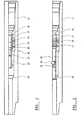
Figure 1 is a detailed longitudinal sectional view of a ball-activated tool for use in a drill string, in order to activate a related hydraulically operated device, such as an under-reamer, and showing the tool in a de-activated mode in which fluid flow through the main body of the device is permitted. -
Figure 2 is a similar view, but showing the adjustment of the components of the tool following launching of an activating ball from the surface down the drill string to activate the tool; -
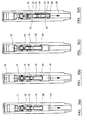
Figure 3 shows, in the separate views, a, b, c, d thereof, fluid flow relative to the tool in, respectively,- (1) the deactivated mode of the tool,
- (2) the launching of an activating ball to initiate activation of the tool,
- (3) the build-up of fluid pressure on the activating ball after it has been received by a ball seat and to pressure-up the system, and
- (4) adjustment of the components of the tool under the action of the pressure build-up in order to activate the hydraulically operated device;
-
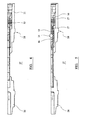
Figure 4 is a longitudinal sectional view of a top sub and a bottom sub of a drill string, in which the ball activated tool is mounted in the top sub, and a hydraulically activated downhole tool (e.g. an under-reamer) can be mounted in the bottom sub, and the figure showing the ball activated tool in its deactivated mode; -
Figure 5 , is similar toFigure 4 , but showing the ball activated tool in its activated mode, in which it can route pressurised fluid to operate the related downhole tool (not shown in detail); -
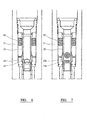
Figure 6 is a longitudinal sectional view, to an enlarged scale, showing the engagement of a single large deformable ball with the ball seat of the axially shiftable sleeve shown inFigures 1 to 5 ; -
Figure 7 is a view, similar toFigure 6 , but showing an alternative arrangement in which the seat incorporates internally a series of small through-flow ports, to be blocked each following launching of a cluster of small non-deformable activator balls down the drill string; -
Figure 8 is a longitudinal view of an alternative example of a deformable activator which may be launched down the drill string to engage a seat provided in the axially shiftable sleeve; -
Figure 9 is a view, similar toFigure 8 , showing the internal ports of the activator ofFigure 8 blocked following launching of the cluster of small non-deformable activator balls down the drill string; -
Figure 9a is a view, similar toFigure 9 , showing an alternative arrangement of deformable activator, which is capable of being activated by launch of a large activator ball, and which can subsequently be deactivated by launch of two further large balls which block access to by-pass ports, thereby to cause increase in pressure upstream of the deformable activator, causing the latter to deform and pass downwardly through the valve seat and deactivate the mechanism; -
Figure 9b is a view, similar toFigure 9a , showing a similar arrangement; -
Figure 10 is a detailed longitudinal sectional view of a further example of a by-pass tool mechanism for use in carrying out a method according to the invention; -
Figure 11 is a horizontal cross sectional view of the part of the tool shown inFigure 10 , and showing in more detail by-pass ports provided in a ball-receiving seat of a control sleeve of the tool, to permit limited continued flow of fluid to a drilling bit downstream of the tool when the tool has been activated to a by-pass mode; -
Figure 12 is a view, similar toFigure 10 , showing three different types of ball for use in activating and deactivating the tool, namely a first large deformable activation ball, a second smaller hard steel deactivation ball, and a third type of non-deformable (pressure-up) small ball forming a cluster, all for use in a manner to be described in more detail below; and -
Figure 13 is a view, similar toFigure 11 , showing the third type of balls closing-off access to the by-pass seat ports shown inFigure 11 , during controlled adjustment of the tool back to its deactivated mode when normal through-flow supply of fluid to the drilling tool is resumed. - Referring now to
Figures 1 to 5 of the drawings, a first example of an activating mechanism for carrying out a method according to the invention is designated generally byreference 10 and comprises a hollow main body 11 (forming a "top sub") which is adapted for mounting in a drill string in order to activate a related hydraulically operated device (shown in more detail inFigures 4 and 5 ). The device shown inFigures 4 and 5 is an under reamer, but it should be understood that this is merely one example of a related hydraulically operated device which can be activated by the ball-activated tool of the invention. - The hollow
main body 11 permits through flow of fluid to take place when the tool is in a de-activated mode, as shown inFigure 1 . Atubular collet 12 is slidably mounted in themain body 11 for movement between a retained inactive position (as shown inFigure 1 ), and a released position (as shown inFigure 2 ) corresponding respectively to the de-activated mode of the tool and the activated mode. - A ball-receiving
seat 13 is coupled with thecollet 12 and is arranged to receive an activating ball launched from the surface and down the drill string to activate the tool. Aball 14 is shown inFigure 2 in engagement with theseat 13, and with the tool components adjusted to a released active position, which causes activation of the tool. - Spring means 15 in the form of a set of spring washers is arranged in the
main body 11 and which act to maintain thecollet 12 in the retained position shown inFigure 1 . The spring means 15 cooperate with a retainer, in the form of arigid retainer ring 16, and twoend spacers 17, in order to retain thetubular collet 12 in the inactive position. However, upon activation of the tool, as will be described in more detail below, thecollet 12 is released by theretainer ring 16, and against the opposition of the spring means 15, in order that thecollet 12 can move to a released position which initiates adjustment of the tool to the activated mode. - An activating
sleeve 18 is coupled with thecollet 12 for movement therewith to an activating position of engagement with a stop provided on the main body, as shown inFigure 2 . In the embodiment ofFigure 2 , the stop is provided by aninternal shoulder 19 which limits the movement of thesleeve 18 andcollet 12 to the active position shown inFigure 2 . - Although not shown in detail in
Figures 1 and 2 , a first by-pass port is provided in thecollet 12, and which communicates internally with the interior of the collet and externally with the space defined between the outer surface of thecollet 12 and the inner surface of themain body 11 when the tool is activated. This will be described in more detail below with reference toFigure 3 . - There is also a second by-pass port provided in the activating sleeve 18 (also not shown in
Figures 1 and 2 ), and which communicates externally with the space defined between the outer surface of thesleeve 18 and the inner surface of themain body 11, and internally with the interior of the sleeve, when the sleeve reaches its activating position shown inFigure 2 . - Referring now to
Figure 3 , the four views a, b, c and d show successive stages of adjustment of the tool between the deactivated mode and the fully activated mode of the tool. - In
Figure 3a , normal fluid flow down the drill string and through the interior of themain body 11 is permitted, and during this time the related hydraulically operated device (the under reamer) remains inoperative. -
Figure 3b shows initiation of adjustment of the tool to its activated mode, which is caused by launching activatingball 14 from the surface and down the drill string, to engageseat 13. -
Figure 3c shows the components of the tool still in the deactivated positions, but with theball 14 engaged with theseat 13, pressure builds-up upstream of the ball and pressures up the system until such time as the fluid pressure force acting on theball 14 causes thecollet 12 to be released by theretainer ring 16, so that the assembly ofcomponents Figure 3d , such position being defined by inter-engagement between theouter end 20 of activatingsleeve 18 withshoulder 19. - As shown in
Figure 3c , the potential flow of fluid through the system, shown byarrow 21, is initially prevented by virtue of the seating ofball 14 on theseat 13, until such time as the pressure build-up is sufficient to cause thecollet 12 to be released by the retainingring 16.Figure 3d then shows the fluid flow path through the system, which is at a higher pressure than the through flow in the deactivated mode ofFigure 3a , and such pressure is sufficient to trigger operation of the under reamer. - As can be seen in
Figure 3d , the fluid flow effectively by-passes theball 14 engaged withseat 13, by first passing outwardly from the interior ofcollet 12 through one or more first by-pass ports 21 to thespace 22 between the outer surface ofcollet 12 and the inner surface ofmain body 11. The by-pass flow then returns to the interior of themain body 11 via one or more second by-pass ports 23 in the activatingsleeve 18. This resumed through-flow of fluid, at enhanced pressure, and shown byarrow 24, then passes to a hydraulically operated downhole tool (preferably an under-reamer), arranged below thetool 10, to initiate operation of the latter. -
Figure 4 illustrates schematically a top sub 25 in which thetool 10 is mounted, and abottom sub 26 in which a hydraulically operatedtool 27, such as an under reamer can be mounted.Figure 4 shows the tool in its de-activated position, andFigure 5 is a similar view toFigure 4 , but showing thetool 10 in its activated position in which it can route pressurised fluid to operate thetool 27 e.g. an under reamer. -
Figure 6 is a longitudinal sectional view, to an enlarged scale, showing the engagement of a largenon-deformable activation ball 14 with an internalball receiving seat 13 of the axiallyshiftable sleeve 12 which is described above and shown in more detail inFigures 1 to 5 . -
Figure 7 shows an alternative arrangement of ball-receivingseat 13a, which is provided with an internal flow control device comprising a set of small through-flow ports, each of which is capable of having access to it blocked following launch of a cluster of smallnon-deformable activator balls 14a down the drill string. -
Figures 8 and 9 show another example of an activator system for activating, and deactivating, a mechanism which controls the operation of the downhole tool. By way of example only, it will be assumed that the activator system shown inFigures 8 and 9 is being used in relation to activation of the mechanism and downhole tool described above with reference toFigures 1 to 5 . -
Figures 8 and 9 are longitudinal sectional views of a deformable activator in the form of ball-dart combination, which takes the place of the largenon-deformable ball 14 described above. There is therefore shown inFigures 8 and 9 a deformable activator which is designated generally byreference 50 having a ball-like portion 51 which engages theseat 13, and a dart-like portion 52 projecting downwardly therefrom. The ball-like portion 51 engages theseat 13, and the dart-like projection 52 projects downwardly therefrom and through the seat. Theactivator 50 is hollow, defining a limited or restricted through-flow passage, so that when the activator engages the seat, it causes pressure upstream of the seat to increase so that the activator moves thesleeve 12 downwardly to a position corresponding to the by-pass mode of the mechanism. - However, the
activator 50 and theseat 13 are arranged to cooperate with each other, when theactivator 50 engages the seat, in such a way that restrictive flow of fluid through thesleeve 12 is maintained when the mechanism is in its by-pass mode. - Therefore, in the by-pass mode of the mechanism, continued though restricted flow of fluid can be maintained to the drilling tool to lubricate and prevent it from overheating.
- The
activator 50 incorporates aflow control device 53 arranged internally thereof, and comprising a ring formed with a number of ports forming separate restricted passageways. -
Figure 8 shows theactivator 50 before employment of any activating and de-activating devices. When engaged with theseat 13, limited through-flow of fluid is allowed, even though the mechanism is in the by-pass mode. However, to commence the deactivation of the mechanism, at least one hard non-deformable activator is used, preferably a small hard steel ball, and which is launched down the drill string and moves to a blocking position which blocks by-pass flow to the by-pass port. This causes increase in pressure upstream of theseat 13, but generally not to a level sufficient to move thedeformable activator 50 downwardly through theseat 13 and through thesleeve 12. - To complete the deactivation of the mechanism, a set of small non-deformable (pressure-up) actuators is provided, e.g. in the form of small
hard balls 54 launched down the drill string. The arrangement of theseat 13 and thedeformable actuator 50 is such that theballs 54 block the limited through-flow passages. The pressure upstream of theseat 13 therefore increases further, and eventually causes downward movement (accompanied by sufficient inward deformation of actuator 50) through theseat 13 and thesleeve 12. - The
sleeve 12 is then returned to its position corresponding to the through-flow mode, and the mechanism then reverts to its original mode of operation. In addition to the provision of restricted passages in theflow control device 53,outlet ports 55 are provided in a nose portion of the dart-like portion 52. - The
activator 50 therefore incorporates a ball-port ring within the dart-like portion, which allows a split flow situation for the drilling fluid used, in that a main part of the fluid passes via the by-pass port upon activation, whereas limited flow can be maintained via the flow control device in the activator. When it is necessary to close the tool, deactivation ball or balls are dropped down the drill string, followed by a cluster of non-deformable pressure-up balls. Two larger deactivation balls will plug up the main bypass port, whereas the smaller non-deformable (pressure-up) balls will come down into the ports in the dart-like portion, allowing the pressure above the dart to build up. Pressure will increase above the small balls until such time as the plastics material from which at least the ball-like portion of theactivator 50 is formed can deform and allow the entire activator to blow downwardly through the seat and the sleeve, and be caught within a suitable "ball catcher" device (now shown) arranged downstream thereof. The balls fall through on top of the dart, and this operation can be repeated when required. - The dart may also be adapted to utilise a flap of valve or retention mechanism, to retain the small balls within the dart.
- Referring now to
Figures 9a and9b , this shows further embodiments ofdeformable activators deformable activator 50 described above with reference toFigures 8 and 9 . Corresponding parts are given the same reference numerals. - The
deformable activators large activator ball 115 can block downward flow of fluid through the activator, and thereby pressure upstream of the activator increases thereby shifting the mechanism axially to an alternative mode of operation, whereby through flow of fluid is blocked. Alternatively, small bleed passages maybe provided, to allow limited through flow of fluid to cool and lubricate the drilling bit arranged downstream thereof. However, the main portion of the drilling fluid can then pass transversely throughoutlet ports 112. - When it is required to revert the activating mechanism to the deactivated mode, e.g. for normal operation of the downhole tool, further deactivating ball(s) 117 is launched down the drill string, to block access to the respective outlet port(s) 112. This then causes the pressure upstream of the
activator deformable portion 51 of the activator then yields under this load, thereby allowing the entire activator to pass downwardly through the valve seat, and allow the mechanism to revert to its deactivated mode. - The
deformable activators - The ring therefore forms a seal on the outer circumference of the dart, and is assembled this way so as to allow for a large area of bypass through the tool when the latter is in the activated mode. This allows a large volume to be pumped downwardly to the operating drill bit, as well as still a large volume laterally through the nozzles in the side port(s) of the tool.
- Referring now to
Figures 10 to 13 , a still further example of ball activated mechanism will now be described, for use in carrying out a method according to the invention. There is show in detail only part of a ball activated by-pass tool, designated generally byreference 110, and comprises an outertubular casing 111 provided with at least one by-pass port 112 in its side wall, and an axiallyshiftable control sleeve 113 provided with a ball-receivingseat 114. - The by-
pass tool 110 is insertable into a drill string, and is operative in a first operating mode to allow through flow passage of fluid to lubricate and cool a drilling bit provided downstream of the by-pass tool, and in a second operating mode to allow by-pass flow of fluid into the surrounding formation. The general construction and operation of the by-pass tool 110 maybe as disclosed in more detail inUS 5 499 687 , andWO01/90529 - The
tubular casing 111 defines a through flow passage to allow drilling fluid, usually drilling mud, to flow lengthwise of thetool 110 between inlet and outlet ends of the casing, and each being communicable with the drill string. Thecontrol sleeve 113 is mounted in thecasing 111 for axial movement between first and second end positions corresponding to the first and second operating modes of the tool.Figure 10 shows the tool in its second operating mode, permitting by-pass flow of fluid, following activation of the tool by launching of a first large activating ball, as described in more detail below. - Biassing means is provided (not shown), preferably in the form of a compression spring, which biasses the
control sleeve 113 towards the first end position so as to block communication with the by-pass port 112 and allow through flow passage of fluid in the first operating mode. - The ball-receiving
seat 114 provided in thetool 110 can receive a firstdeformable activating ball 115, launched from the surface and down the drill string, when it is required to adjust the tool from its first operating mode to its second operating mode. Theseat 114 is operative when it receives the activatingball 115, as shown inFigure 10 , to move thesleeve 113 from the first end position to the second end position and against the action of the biassing means. - In the second end position of the
control sleeve 113, a side port 116 in the wall of thesleeve 113 communicates with the by-pass port 112, to allow by-pass flow of fluid when required. Only a single by-pass port 112 and side port 116 are shown, but evidently more than one port may be provided, and other means of communication may be used. - When it is required to deactivate the tool, a second deactivating ball 117 (see
Figure 12 ) is launched down the drill string, with the result that thefirst ball 115 can move lengthwise of thetool 110, preferably to be received by a ball catcher device (not shown), and thereby allow the sleeve to move back to its first end position under the action of the biassing means. Thus, thesecond deactivating ball 117 blocks communication to the side port 116, and therefore interrupts by-pass flow via the by-pass port 112, and therefore the pressure upstream of theseat 114 increases, and when a threshold pressure is exceeded, the largedeformable ball 115 deforms under the pressure load so as to move downwardly through theball seat 114. - The description thus far generally corresponds to that which is disclosed in more detail in
US 5 499 687 , andWO01/09529 - Thus, to provide limited, but continued flow of fluid through the
sleeve 113, when the latter has been adjusted to its second end position corresponding to the second operating mode of the tool (by-pass flow of fluid), an additional by-pass arrangement is provided. This enables drilling fluid, usually drilling mud, to continue to flow to the drilling bit, and thereby continue lubrication and cooling of the drilling bit and prevent, or at least minimise, the risk of permanent damage by overheating to the drilling bit in high temperature applications. - The additional by-pass arrangement takes the form of at least one by-
pass seat port 118 provided in the ball-receivingseat 114. In the illustrated arrangement, a circumferentially spaced set of arcuate slots are formed in theseat 114, to form the means providing continued, but limited flow of by-pass fluid, when the tool is operating in its by-pass mode shown inFigure 10 . - The subsequent launching of the deactivating
ball 117 will still interrupt main by-pass flow via by-pass port 112, and subsequent increase in pressure upstream of the largedeformable ball 115, and which can increase to a sufficient extent to allow deformation of theball 115 and downward movement through theseat 114, to deactivate the tool, despite the fact that some of the fluid will be flowing downwardly through the tool, in limited manner, via the by-pass seat ports 118. - However, to ensure that the pressure being bled-off via the by-
pass seat port 118 does not prevent deactivation of the tool by launching of thesecond deactivating ball 117, it is preferred to provide a third type of ball for use with thetool 110. This third type of ball is to be used, in addition to thesecond deactivating ball 117, when it is required to revert thetool 110 back to its first operating mode from its second operating mode. The third type of ball is a small non-deformable ball, and preferably supplied in a cluster ofballs 119, as shown inFigures 12 and 13 . - The
balls 119 are of such a size that, when used together in a cluster, they can block flow of fluid through the by-pass ports 118, and therefore enable the pressure upstream of theseat 114 to increase still further (in addition to the pressurisation caused by launching of the second deactivating ball 117), and thereby ensure the deformation of thefirst activation ball 115 and subsequent downward movement through theseat 118 and followed by upward movement of thecontrol sleeve 113 under the action of its spring biassing back to the first operating position. - In the illustrated embodiment, more than one of the
balls 119 is used in order to close off each of the by-pass seat ports 118. However, other arrangements are possible, includingsingle balls 119 each closing off a respective by-pass port, although this is not shown in the illustrated embodiment. - Upon deformation of the first activating
ball 115 and its movement through theseat 114, this is then followed by thesecond deactivating ball 117 and the third type ofballs 119. - Conveniently, a ball catcher device (not shown) is arranged downstream of the
seat 114, to catch at least the first (larger)ball 115, and preferably also thesecond deactivating ball 117, which is a hard steel ball. The third type ofball 119 is smaller in diameter than the other balls, in view of the size and shape of the by-pass ports 118, and therefore it will be acceptable for theballs 119 to be discharged through the drilling bit and into the surrounding formation being drilled, or to be returned to surface with the return flow of drilling mud. - The by-
pass tool 110 as described above therefore enables the tool to be activated by dropping thefirst activation ball 115, to initiate main by-pass flow via the by-pass port 112 in the casing, while still allowing a limited flow of fluid to pass around theactivation ball 115 and through theseat ports 118. There is therefore a split flow situation, in which the main by-pass flow is conveyed via the by-pass port 112, while a smaller proportion of the fluid passes downwardly through thevalve seat 114 via theseat ports 118. - However the provision of the
seat ports 118 does mean that some of the pressure above the seat is bled-off, and therefore this reduces the pressure available to deform theactivation ball 115, after launch of thede-activating ball 117. It is for this reason that the third type ofballs 119 are provided, which are able to blank-off at least the major part of the access to theseat ports 118. - The typical sequence of operations therefore would be as follows: drop the
plastics activation ball 115, to open up the tool, and pump main by-pass fluid for as long as the operator requires, but with split flow and some of the flow going down through the sleeve to lubricate and cool the drilling bit, in addition to the main by-pass flow via the circulating ports above theball 115. - To deactivate the tool, the
steel deactivation ball 117 is dropped down the drill string, in the case of a single ported tool, or two deactivation balls are dropped in the case of a dual ported tool. Thereafter, the non-deformable pressure-up balls (the third balls 119) are dropped down the drill string. When the steel deactivation ball(s) 117 closes access to theside port 16 above theball 115, the system starts to pressure-up, and further flow now only continues around thedeformable activation ball 115, and via theseat ports 118. When the non-deformable pressure-upthird balls 119 reach theseat 114, they plug-up theseat ports 118, allowing the operator, or allowing the system, to pressure-up to a greater extent and thereby ensure deformation of themain activation ball 115.Ball 115 then passes downwardly, upon deformation, through theseat 114, and this is followed by the spring biassing urging thecontrol sleeve 113 to its first end position (sleeve closed position), and the steel deactivation ball(s) 117 can then fall downwardly through theball seat 114, following thedeformable activation ball 115, and both of these can be caught by a ball catcher device (not shown). However, the smaller, non-deformable and pressure-upballs 119 are sufficiently small that they can be displaced downwardly through the drilling tool and through the drilling bit, and out into the surrounding formation. Alternatively,balls 119 can return to surface via the return flow of drilling mud. - In particular, the herein disclosed subject matter includes the following embodiments:
- 1. An activating mechanism for controlling the operation of a downhole tool in a drill string and which is intended to be housed in a portion of the drill string upstream of the downhole tool, in which:
- (a) the activating mechanism has a first mode in which it allows through-flow of drilling fluid to the downhole tool and a second mode in which through-flow of fluid is blocked; and
- (b) the activating mechanism has a number of through-flow ports permitting through-flow of drilling fluid in said first mode of the mechanism and which are capable of being blocked by launching a number of flow blocking activator balls down the drill string and which each are of such size and shape that they can block access to said through-flow ports in order to activate the mechanism to the second mode and thereby adjust the downhole tool from one mode of operation to another.
- 2. A mechanism according to
embodiment 1, in which the activating mechanism is operable to adjust the downhole tool (e.g. an under-reamer tool) between an operative condition and an inoperative condition. - 3. A mechanism according to
embodiment 2, in which the downhole tool is an under-reamer tool, and the inoperative condition obtains when the reamer blades are in a withdrawn position relative to the body of the tool, and in the operative condition the reamer blades are in a radially projected position relative to the axis of the drill string so as to be engageable with the surrounding formation. - 4. A mechanism according to
embodiment 1, and taking the form of a ball-activatedtool 10 for use in a drill string in order to activate a related hydraulically operated device, such as an underreamer 27, and which comprises:- a hollow
main body 11 adapted for mounting in a drill string and through which fluid can flow when the tool is an a de-activated mode; - a
tubular collet 12 slidably mounted in themain body 11 for movement between a retained inactive position (Figure 1 ) and a released position (Figure 2 ) corresponding respectively to the de-activated mode of the tool and an activated mode; - a ball-receiving
seat 13 coupled with thecollet 12 and arranged to receive an activatingball 14 launched from the surface and down the drill string to activate the tool; - spring means 15 arranged in the
main body 11 to maintain the collet in the retained position; - a
retainer 16 arranged in themain body 11 to engage with and to retain thetubular collet 12 in the inactive position, and to release thecollet 12 when the tool is activated; - an activating
sleeve 18 coupled with thecollet 12 for movement therewith to an activating position of engagement with astop 19 on themain body 11; - a first by-
pass port 21 provided in thecollet 12 and communicable internally with the interior of thecollet 12 and externally with thespace 22 defined between the outer surface of thecollet 12 and the inner surface of themain body 11 when the tool is activated; and - a second by-
pass port 23 provided in the activatingsleeve 18 and communicable externally with thespace 22 defined between the outer surface of thesleeve 18 and the inner surface of themain body 11, and internally with the interior of thesleeve 18 , when the sleeve reaches its activating position (Figure 2 ,3a and5 ); - whereby, upon engagement of the activating
ball 14 with theseat 13 to activate thetool 10, the following sequence takes place:- a. fluid pressure builds-up upstream of the
seat 13; - b. subsequent release of the
collet 12 by theretainer 16; - c. movement of the
collet 12, theball 14 and theseat 13, and the activatingsleeve 18 until thesleeve 18 reaches its activating position of engagement withstop 19; and - d. by-pass flow of fluid around the
ball 14 andvalve seat 13 via the first and second by-pass ports main body 11 to activate the related hydraulically operateddevice 27.
- a. fluid pressure builds-up upstream of the
- a hollow
- 5. A mechanism according to
embodiment 4, in which the activatingsleeve 18 is engageable with ashoulder 19 provided internally of themain body 11 to form said stop. - 6. A mechanism according to
embodiment 4 or 5, in which thecollet 12 is coupled with the activatingsleeve 18 for movement therewith via saidvalve seat 13. - 7. A mechanism according to any one of
embodiments 4 to 6, in which themain body 11 includes a top sub 25 in which thetool 10 is incorporated, and abottom sub 26 in which a tool, such as an under-reamer device 27 is mounted. - 8. A mechanism according to any one of
embodiments 4 to 7, in which the ball-activated tool is capable of being activated by launching a single largenon-deformable ball 14 down the drill string to engage the seat dedicated to the large ball. - 9. A mechanism according to any one of
embodiments 4 to 7, in which the ball activated tool is capable of being activated by launching a cluster of small hard non deformable balls down the drill string to engage a seat which is provided with a number of ports each dedicated to be engaged by a respective one of the small balls. - 10. A ball-activated by-
pass tool 110 for use in a drilling operation, and which is insertable into a drill string and which is operative in a first operating mode to allow through-flow passage of fluid to lubricate and cool a drilling bit arranged downstream of the by-pass tool, and in a second operating mode to allow by-pass flow of fluid, and said tool comprising:- a
tubular casing 111 defining a through-flow passage to allow fluid to flow lengthwise of the tool between inlet and outlet ends of the casing and each being communicable with the drill string; - a transverse by-
pass port 112 in the wall of thecasing 111; - a
control sleeve 113 mounted in thecasing 111 for axial movement between first and second end positions corresponding to the first and second operating modes of the tool; - means biassing the
control sleeve 113 towards the first end position so as to block communication with the by-pass port 112 and allow through-flow passage of fluid in the first operating mode; - a ball-receiving
seat 114 provided in thetool 110 to receive a firstdeformable activating ball 115 to be launched down the drill-string when it is required to adjust the tool from its first operating mode to its second operating mode, saidseat 114 being operative when it receives the activatingball 115 to move thesleeve 113 from its first end position to its second end position against the action of the biassing means, and in which the first activatingball 115 is deformable by the action of asecond de-activating ball 117 launched down the drill string so that thefirst ball 115 can move lengthwise of thetool 110 and thereby allow thesleeve 113 to move back to its first end position under the action of the biassing means when it is required to adjust the tool from its second operating mode to its first operating mode; and - at least one by-
pass seat port 118 provided in the ball-receivingseat 114 and which is operative to permit limited flow of fluid through thesleeve 113 when the latter is in its second end position.
- a
- 11. A tool according to
embodiment 10, in which thecontrol sleeve 113 has a side port 116 which is communicable with the by-pass port 112 in the wall of thecasing 111, when thetool 110 is in its second operating mode. - 12. A tool according to
embodiment ball 119 for use, in addition to thesecond de-activating ball 117 when it is required to revert thetool 110 back to its first operating mode from its second operating mode. - 13. A tool according to
embodiment 12, in which a set of circurnferentially spaced slots are formed in theball seat 114, to form saidseat port 118, and a cluster of said third type ofballs 119 is provided to be launched from the surface, to close-off at least a major part of access to said slots. - 14. A tool according to any one of
embodiments 10 to 13, in which a ball catcher device is arranged downstream of theball receiving seat 114, to catch at least saidfirst activation ball 115 and preferably also saidsecond de-activating ball 117. - 15. An activating mechanism for controlling the operation of a downhole tool and which comprises:
- a hollow
main body 11 adapted for mounting in a drill-string and through which fluid to the tool can be routed; - an
actuating sleeve 12 defining a through-flow passage and slidably mounted in themain body 11 for movement between positions corresponding to a through-flow mode and a by-pass mode of the mechanism; - biassing means 15 acting on the
sleeve 12 to urge it to its position corresponding to the through-flow mode of the mechanism; - a
seat 13 providing access to said passage in the through-flow mode of the mechanism; and - a
deformable activator 50 capable of being launched down the drill-string to engage theseat 13 and thereby cause pressure upstream of the seat to increase so that theactivator 50 moves thesleeve 12 to its position corresponding to the by-pass mode of the mechanism; - in which the
activator 50 and theseat 13 are arranged to co-operate with each other, when theactivator 50 engages theseat 13, in such a way that restricted flow of fluid through thesleeve 13 is maintained when the mechanism is in its by-pass mode.
- a hollow
- 16. A mechanism according to
embodiment 15, in which thehollow body 11 has at least one by-pass port to direct fluid flow laterally of thesleeve 12 and thebody 11 when the mechanism is in its by-pass mode, and with thesleeve 12 being moved by thedeformable actuator 15 so as to allow access to the by-pass port. - 17. A mechanism according to
embodiment seat 13. - 18. A mechanism according to any one of
embodiments 15 to 17, including a set of small non-deformable pressure-upactivators 54, capable of being launched down the drill string, and the arrangement of theseat 13 and thedeformable activator 15 is such that the pressure-upactivators 54 are then capable of blocking the limited through-flow passages. - 19. A mechanism according to any one of
embodiments 15 to 18, in which thedeformable activator 50 comprises a ball-dart combination, in which a ball-like portion 51 at least is deformable and is capable of seating on saidseat 13, and a dart-like portion 52 is capable of projecting downwardly through the seat. - 20. A mechanism according to
embodiment 19, in which theactivator 50 is hollow and is provided with an internalflow control device 53. - 21. A mechanism according to
embodiment 20, in which theflow control device 53 comprises a carrier ring provided with a number of separate ports. - 22. A mechanism according to any one of
embodiments 15 to 21, in which:- the
deformable activator 50 is capable of being launched down the drill string to engage theseat 13, so that pressure upstream of the seat increases and theactivator 50 moves thesleeve 12 so that the mechanism takes up its by-pass mode, while allowing limited flow of fluid to the tool to be maintained in one of its modes of operation, and said mechanism also including:- a small hard balls capable of being launched down the drill string when it is required to provide by-pass flow of fluid; and
- one or more de-activator ball(s) 54 capable of being launched down the drill string to block limited flow of fluid through the
sleeve 12, when it is required to revert the tool to another of its modes, such that the pressure upstream of theseat 13 increases and causes downward displacement, accompanied by inward deformation, of thedeformable activator 50 through theseat 13 so that the mechanism reverts to its through-flow mode.
- the
- 23. An activating mechanism for controlling the operation of a downhole tool and which comprises:
- a hollow
main body 11 adapted for mounting in a drill string and through which fluid to the tool can be routed; - an
actuating sleeve 12 defining a through-flow passage and slidably mounted in themain body 11 for movement between positions corresponding to a through-flow mode and a by-pass mode with a mechanism; - biassing means 15 acting on the
sleeve 12 to urge it to its position corresponding to the through-flow mode of the mechanism; - a
seat 13 providing access to said passage in the through-flow mode of the mechanism; - a
deformable activator seat 13 and thereby cause pressure upstream of the seat to increase; - an
activator ball 115 capable of being launched down the drill string to engage a through-flow seat at an upstream end of theactivator sleeve 12 to move to its position corresponding to the by-pass mode of the mechanism; and - at least one
deactivating ball 117 capable of being launched down the drill string to block access to anoutlet port 112 thereby to increase the pressure upstream of thedeformable activator seat 13 to allow the mechanism to revert to its through-flow mode.
- a hollow
Claims (9)
- An activating mechanism for controlling the operation of a downhole tool and which comprises:a hollow main body (11) adapted for mounting in a drill-string and through which fluid to the tool can be routed;an actuating sleeve (12) defining a through-flow passage and slidably mounted in the main body (11) for movement between positions corresponding to a through-flow mode and a by-pass mode of the mechanism;biassing means (15) acting on the sleeve (12) to urge it to its position corresponding to the through-flow mode of the mechanism;a seat (13) providing access to said passage in the through-flow mode of the mechanism; anda deformable activator (50) capable of being launched down the drill-string to engage the seat (13) and thereby cause pressure upstream of the seat to increase so that the activator (50) moves the sleeve (12) to its position corresponding to the by-pass mode of the mechanism;in which the activator (50) and the seat (13) are arranged to co-operate with each other, when the activator (50) engages the seat (13), in such a way that restricted flow of fluid through the sleeve (12) is maintained when the mechanism is in its by-pass mode.
- A mechanism according to claim 1, in which the hollow body (11) has at least one by-pass port to direct fluid flow laterally of the sleeve (12) and the body (11) when the mechanism is in its by-pass mode, and with the sleeve (12) being moved by the deformable actuator (15) so as to allow access to the by-pass port.
- A mechanism according to claim 1 or 2, in which a non-deformable activator is provided, which is capable of being launched down the drill string and to move to a blocking position which blocks by-pass flow of fluid, and thereby causes increase in pressure upstream of the seat (13).
- A mechanism according to any one of claims 1 to 3, including a set of small non-deformable pressure-up activators (54), capable of being launched down the drill string, and the arrangement of the seat (13) and the deformable activator (50) is such that the pressure-up activators (54) are then capable of blocking the limited through-flow passages.
- A mechanism according to any one of claims 1 to 4, in which the deformable activator (50) comprises a ball-dart combination, in which a ball-like portion (51) at least is deformable and is capable of seating on said seat (13), and a dart-like portion (52) is capable of projecting downwardly through the seat.
- A mechanism according to claim 5, in which the activator (50) is hollow and is provided with an internal flow control device (53).
- A mechanism according to claim 6, in which the flow control device (53) comprises a carrier ring provided with a number of separate ports.
- A mechanism according to any one of claims 1 to 7, in which:the deformable activator (50) is capable of being launched down the drill string to engage the seat (13), so that pressure upstream of the seat increases and the activator (50) moves the sleeve (12) so that the mechanism takes up its by-pass mode, while allowing limited flow of fluid to the tool to be maintained in one of its modes of operation, and said mechanism also including:a small hard ball(s) capable of being launched down the drill string when it is required to provide by-pass flow of fluid; andone or more de-activator ball(s) (54) capable of being launched down the drill string to block limited flow of fluid through the sleeve (12), when it is required to revert the tool to another of its modes, such that the pressure upstream of the seat (13) increases and causes downward displacement, accompanied by inward deformation, of the entire deformable activator (50) through the seat (13) so that the mechanism reverts to its through-flow mode.
- The mechanism according to claim 5, wherein the ball-like portion (51) is formed from plastics material.
Applications Claiming Priority (5)
| Application Number | Priority Date | Filing Date | Title |
|---|---|---|---|
| GB0512125A GB0512125D0 (en) | 2005-06-15 | 2005-06-15 | Ball-activated by-pass tool for use in a drilling operation |
| GB0512391A GB0512391D0 (en) | 2005-06-20 | 2005-06-20 | Ball-activated mechanism for actuating downhole tool |
| GBGB0513140.4A GB0513140D0 (en) | 2005-06-15 | 2005-06-29 | Novel method of controlling the operation of a downhole tool |
| EP12164514A EP2484863A3 (en) | 2005-06-15 | 2006-06-09 | Novel activating mechanism for controlling the operation of a downhole tool |
| EP06765495A EP1891297A4 (en) | 2005-06-15 | 2006-06-09 | Novel activating mechanism for controlling the operation of a downhole tool |
Related Parent Applications (2)
| Application Number | Title | Priority Date | Filing Date |
|---|---|---|---|
| EP12164514A Division EP2484863A3 (en) | 2005-06-15 | 2006-06-09 | Novel activating mechanism for controlling the operation of a downhole tool |
| EP06765495A Division EP1891297A4 (en) | 2005-06-15 | 2006-06-09 | Novel activating mechanism for controlling the operation of a downhole tool |
Publications (2)
| Publication Number | Publication Date |
|---|---|
| EP2894291A2 true EP2894291A2 (en) | 2015-07-15 |
| EP2894291A3 EP2894291A3 (en) | 2016-02-24 |
Family
ID=37532669
Family Applications (3)
| Application Number | Title | Priority Date | Filing Date |
|---|---|---|---|
| EP12164514A Ceased EP2484863A3 (en) | 2005-06-15 | 2006-06-09 | Novel activating mechanism for controlling the operation of a downhole tool |
| EP06765495A Withdrawn EP1891297A4 (en) | 2005-06-15 | 2006-06-09 | Novel activating mechanism for controlling the operation of a downhole tool |
| EP15155067.0A Ceased EP2894291A3 (en) | 2005-06-15 | 2006-06-09 | Novel activating mechanism for controlling the operation of a downhole tool |
Family Applications Before (2)
| Application Number | Title | Priority Date | Filing Date |
|---|---|---|---|
| EP12164514A Ceased EP2484863A3 (en) | 2005-06-15 | 2006-06-09 | Novel activating mechanism for controlling the operation of a downhole tool |
| EP06765495A Withdrawn EP1891297A4 (en) | 2005-06-15 | 2006-06-09 | Novel activating mechanism for controlling the operation of a downhole tool |
Country Status (6)
| Country | Link |
|---|---|
| US (2) | US7866397B2 (en) |
| EP (3) | EP2484863A3 (en) |
| AU (1) | AU2006257625C1 (en) |
| CA (1) | CA2612285C (en) |
| GB (1) | GB0513140D0 (en) |
| WO (1) | WO2006134446A2 (en) |
Families Citing this family (60)
| Publication number | Priority date | Publication date | Assignee | Title |
|---|---|---|---|---|
| US9127521B2 (en) * | 2009-02-24 | 2015-09-08 | Schlumberger Technology Corporation | Downhole tool actuation having a seat with a fluid by-pass |
| DK2427628T3 (en) * | 2009-05-07 | 2016-03-21 | Churchill Drilling Tools Ltd | TOOL FOR borehole |
| US20100314126A1 (en) | 2009-06-10 | 2010-12-16 | Baker Hughes Incorporated | Seat apparatus and method |
| US8555983B2 (en) * | 2009-11-16 | 2013-10-15 | Smith International, Inc. | Apparatus and method for activating and deactivating a downhole tool |
| GB2475477A (en) * | 2009-11-18 | 2011-05-25 | Paul Bernard Lee | Circulation bypass valve apparatus and method |
| GB0921440D0 (en) * | 2009-12-08 | 2010-01-20 | Corpro Systems Ltd | Apparatus and method |
| US9181778B2 (en) | 2010-04-23 | 2015-11-10 | Smith International, Inc. | Multiple ball-ball seat for hydraulic fracturing with reduced pumping pressure |
| RU2543011C2 (en) | 2010-04-23 | 2015-02-27 | Смит Интернэшнл, Инк. | Ball seat for high pressure and high temperature |
| RU2013104186A (en) * | 2010-07-01 | 2014-08-10 | Смит Интернэшнл, Инк. | MULTI-BALL BALL NEST FOR HYDRAULIC RIPPING WITH REDUCED INJECTION PRESSURE |
| US20120006562A1 (en) | 2010-07-12 | 2012-01-12 | Tracy Speer | Method and apparatus for a well employing the use of an activation ball |
| US9121248B2 (en) * | 2011-03-16 | 2015-09-01 | Raymond Hofman | Downhole system and apparatus incorporating valve assembly with resilient deformable engaging element |
| NO333111B1 (en) * | 2010-12-13 | 2013-03-04 | I Tec As | System and method for handling a group of valves |
| US8720561B2 (en) | 2011-04-12 | 2014-05-13 | Saudi Arabian Oil Company | Sliding stage cementing tool and method |
| US8844635B2 (en) * | 2011-05-26 | 2014-09-30 | Baker Hughes Incorporated | Corrodible triggering elements for use with subterranean borehole tools having expandable members and related methods |
| GB201117800D0 (en) * | 2011-10-14 | 2011-11-30 | Nov Downhole Eurasia Ltd | Downhole tool actuator |
| EP2713005A1 (en) * | 2011-12-21 | 2014-04-02 | Schoeller Bleckmann Oilfield Equipment AG | Drillstring valve |
| BR112014018645A8 (en) * | 2012-02-16 | 2017-07-11 | Halliburton Energy Services Inc | INFLUX CONTROL DEVICE |
| US9404331B2 (en) * | 2012-07-31 | 2016-08-02 | Smith International, Inc. | Extended duration section mill and methods of use |
| US9677380B2 (en) * | 2012-12-13 | 2017-06-13 | Weatherford Technology Holdings, Llc | Sliding sleeve having inverting ball seat |
| WO2014099206A1 (en) * | 2012-12-21 | 2014-06-26 | Exxonmobil Upstream Research Company | Flow control assemblies for downhole operations and systems and methods inclucding the same |
| US10161217B2 (en) * | 2013-01-13 | 2018-12-25 | Weatherford Technology Holdings, Llc | Ball seat apparatus and method |
| WO2014116934A1 (en) * | 2013-01-25 | 2014-07-31 | Halliburton Energy Services, Inc. | Hydraulic activation of mechanically operated bottom hole assembly tool |
| US9926746B2 (en) * | 2013-06-19 | 2018-03-27 | Smith International, Inc. | Actuating a downhole tool |
| US9458698B2 (en) | 2013-06-28 | 2016-10-04 | Team Oil Tools Lp | Linearly indexing well bore simulation valve |
| US8863853B1 (en) | 2013-06-28 | 2014-10-21 | Team Oil Tools Lp | Linearly indexing well bore tool |
| US10422202B2 (en) | 2013-06-28 | 2019-09-24 | Innovex Downhole Solutions, Inc. | Linearly indexing wellbore valve |
| US9441467B2 (en) | 2013-06-28 | 2016-09-13 | Team Oil Tools, Lp | Indexing well bore tool and method for using indexed well bore tools |
| US9896908B2 (en) | 2013-06-28 | 2018-02-20 | Team Oil Tools, Lp | Well bore stimulation valve |
| US9970279B2 (en) | 2013-09-12 | 2018-05-15 | Utex Industries, Inc. | Apparatus and methods for inhibiting a screen-out condition in a subterranean well fracturing operation |
| WO2015099885A1 (en) * | 2013-12-23 | 2015-07-02 | Exxonmobil Upstream Research Company | Systems and methods for stimulating a subterranean formation |
| MX369817B (en) | 2014-03-05 | 2019-11-22 | Halliburton Energy Services Inc | Flow control mechanism for downhole tool. |
| RU2599119C1 (en) * | 2015-03-10 | 2016-10-10 | Общество с ограниченной ответственностью "Фирма "Радиус-Сервис" | Circulation valve of drill column |
| RU2599120C1 (en) * | 2015-06-05 | 2016-10-10 | Общество с ограниченной ответственностью "Фирма "Радиус-Сервис" | Circulation valve of drill column |
| GB2553834A (en) | 2016-09-16 | 2018-03-21 | Schoeller Bleckmann Oilfield Equipment Ag | Splitflow valve |
| US10309196B2 (en) * | 2016-10-25 | 2019-06-04 | Baker Hughes, A Ge Company, Llc | Repeatedly pressure operated ported sub with multiple ball catcher |
| RU170177U1 (en) * | 2016-11-30 | 2017-04-18 | Управляющая компания общество с ограниченной ответственностью "ТМС групп" | CIRCULATION ADAPTER |
| RU2658851C1 (en) * | 2017-08-14 | 2018-06-25 | Общество с ограниченной ответственностью "Гидробур-сервис" | Circulation adapter |
| GB2569330B (en) * | 2017-12-13 | 2021-01-06 | Nov Downhole Eurasia Ltd | Downhole devices and associated apparatus and methods |
| GB2569587B (en) * | 2017-12-20 | 2022-06-15 | Schoeller Bleckmann Oilfield Equipment Ag | Catcher device for downhole tool |
| US11299953B2 (en) * | 2019-04-30 | 2022-04-12 | Baker Hughes Oilfield Operations Llc | Seating assembly including a convertible landing seat |
| GB201916285D0 (en) | 2019-11-08 | 2019-12-25 | Coretrax Tech Limited | Apparatus & method |
| GB2605062B (en) | 2020-01-17 | 2024-09-25 | Halliburton Energy Services Inc | Voltage to accelerate/decelerate expandable metal |
| MX2022006306A (en) | 2020-01-17 | 2022-06-22 | Halliburton Energy Services Inc | Heaters to accelerate setting of expandable metal. |
| GB2606899B (en) | 2020-02-28 | 2024-01-17 | Halliburton Energy Services Inc | Textured surfaces of expanding metal for centralizer, mixing, and differential sticking |
| GB2592427A (en) | 2020-02-28 | 2021-09-01 | Schoeller Bleckmann Oilfield Equipment Ag | Downhole tool with improved nozzles and method of operating a downhole tool |
| AU2021324947B2 (en) * | 2020-08-13 | 2025-11-20 | Halliburton Energy Services, Inc. | A valve including an expandable metal seal |
| US11834919B2 (en) * | 2021-01-14 | 2023-12-05 | Thru Tubing Solutions, Inc. | Downhole plug deployment |
| AU2021440755A1 (en) | 2021-04-12 | 2023-08-24 | Halliburton Energy Services, Inc. | Expandable metal as backup for elastomeric elements |
| US12326060B2 (en) | 2021-05-21 | 2025-06-10 | Halliburton Energy Services, Inc. | Wellbore anchor including one or more activation chambers |
| BR112023020428A2 (en) | 2021-05-28 | 2023-12-12 | Halliburton Energy Services Inc | BOTTOM WELL TOOL, METHOD FOR SEALING, AND WELL SYSTEM |
| NO20231086A1 (en) | 2021-05-28 | 2023-10-13 | Halliburton Energy Services Inc | Rapid setting expandable metal |
| NO20231085A1 (en) | 2021-05-29 | 2023-10-13 | Halliburton Energy Services Inc | Using expandable metal as an alternate to existing metal to metal seals |
| WO2022255988A1 (en) | 2021-06-01 | 2022-12-08 | Halliburton Energy Services, Inc. | Expanding metal used in forming support structures |
| US12378832B2 (en) | 2021-10-05 | 2025-08-05 | Halliburton Energy Services, Inc. | Expandable metal sealing/anchoring tool |
| US12258828B2 (en) | 2022-06-15 | 2025-03-25 | Halliburton Energy Services, Inc. | Sealing/anchoring tool employing a hydraulically deformable member and an expandable metal circlet |
| US12385340B2 (en) | 2022-12-05 | 2025-08-12 | Halliburton Energy Services, Inc. | Reduced backlash sealing/anchoring assembly |
| GB2626931A (en) * | 2023-02-02 | 2024-08-14 | Bernard Lee Paul | Downhole circulation apparatus |
| US12152454B1 (en) | 2023-10-31 | 2024-11-26 | Proshale Llc | Down-hole extended reach tool generating variable shock wave amplitudes |
| US20250249550A1 (en) | 2024-02-05 | 2025-08-07 | Proshale Llc | Fluid-Driven Dual-Mode Abrasive Perforation Tool |
| US12378831B1 (en) | 2024-02-05 | 2025-08-05 | Proshale Llc | Fluid-driven dual-mode circulation tool |
Citations (4)
| Publication number | Priority date | Publication date | Assignee | Title |
|---|---|---|---|---|
| US3814180A (en) * | 1972-08-31 | 1974-06-04 | Cities Service Oil Co | Well fishing apparatus |
| US4310050A (en) * | 1980-04-28 | 1982-01-12 | Otis Engineering Corporation | Well drilling apparatus |
| US4889199A (en) | 1987-05-27 | 1989-12-26 | Lee Paul B | Downhole valve for use when drilling an oil or gas well |
| WO2001009529A1 (en) | 1999-07-29 | 2001-02-08 | Koyo Seiko Co., Ltd. | Controller of magnetic bearing |
Family Cites Families (38)
| Publication number | Priority date | Publication date | Assignee | Title |
|---|---|---|---|---|
| CA904741A (en) * | 1972-07-11 | Byron Jackson Inc. | Cementing plug launching mandrel | |
| US2633916A (en) | 1948-01-12 | 1953-04-07 | Baker Oil Tools Inc | Side ported cementing apparatus |
| US2638988A (en) * | 1951-02-12 | 1953-05-19 | Welton J Williams | Well drilling apparatus |
| US2647727A (en) * | 1951-04-20 | 1953-08-04 | Edwards Frances Robertha | Pipe releasing means |
| US2998075A (en) | 1957-07-29 | 1961-08-29 | Baker Oil Tools Inc | Subsurface well apparatus |
| US3799278A (en) | 1972-08-31 | 1974-03-26 | Cities Service Oil Co | Well circulation tool |
| US4645006A (en) | 1984-12-07 | 1987-02-24 | Tinsley Paul J | Annulus access valve system |
| CA2101329A1 (en) | 1991-01-24 | 1992-07-25 | Bruno H. Walter | Flow pulsing apparatus for drill string |
| GB9215218D0 (en) | 1992-07-17 | 1992-09-02 | Pbl Drilling Tools Limited | A valve |
| US5484107A (en) * | 1994-05-13 | 1996-01-16 | The Babcock & Wilcox Company | Three-fluid atomizer |
| GB9508803D0 (en) | 1995-05-01 | 1995-06-21 | Pbl Drilling Systems Limited | Tubular actuator component for use in a drill-string |
| US5960881A (en) | 1997-04-22 | 1999-10-05 | Jerry P. Allamon | Downhole surge pressure reduction system and method of use |
| GB9708294D0 (en) | 1997-04-24 | 1997-06-18 | Anderson Charles A | Downhole apparatus |
| US6253861B1 (en) * | 1998-02-25 | 2001-07-03 | Specialised Petroleum Services Limited | Circulation tool |
| EP1064451B1 (en) | 1998-03-14 | 2002-12-11 | CHURCHILL, Andrew Philip | Pressure actuated downhole tool |
| GB9915885D0 (en) | 1999-07-08 | 1999-09-08 | Lee Paul B | Downhole valve for use with a drillstring |
| GB9916513D0 (en) | 1999-07-15 | 1999-09-15 | Churchill Andrew P | Bypass tool |
| US6390200B1 (en) | 2000-02-04 | 2002-05-21 | Allamon Interest | Drop ball sub and system of use |
| GB0012124D0 (en) | 2000-05-20 | 2000-07-12 | Lee Paul B | By-pass tool for use in a drill string |
| WO2002014650A1 (en) * | 2000-08-12 | 2002-02-21 | Paul Bernard Lee | Activating ball assembly for use with a by-pass tool in a drill string |
| US6520257B2 (en) | 2000-12-14 | 2003-02-18 | Jerry P. Allamon | Method and apparatus for surge reduction |
| GB0102485D0 (en) * | 2001-01-31 | 2001-03-14 | Sps Afos Group Ltd | Downhole Tool |
| GB0104380D0 (en) * | 2001-02-22 | 2001-04-11 | Lee Paul B | Ball activated tool for use in downhole drilling |
| US6491103B2 (en) | 2001-04-09 | 2002-12-10 | Jerry P. Allamon | System for running tubular members |
| US6752209B2 (en) | 2001-10-01 | 2004-06-22 | Bj Services Company | Cementing system and method for wellbores |
| GB0220445D0 (en) | 2002-09-03 | 2002-10-09 | Lee Paul B | Dart-operated big bore by-pass tool |
| GB0220447D0 (en) | 2002-09-03 | 2002-10-09 | Lee Paul B | Ball operated by-pass tool for use in drilling |
| CA2401813C (en) | 2002-09-06 | 2007-02-13 | Halliburton Energy Services, Inc. | Combined casing expansion/ casing while drilling method and apparatus |
| GB2428719B (en) * | 2003-04-01 | 2007-08-29 | Specialised Petroleum Serv Ltd | Method of Circulating Fluid in a Borehole |
| CA2521033C (en) | 2003-04-04 | 2012-11-06 | Churchill Drilling Tools Limited | Drifting tubing |
| GB0312180D0 (en) | 2003-05-28 | 2003-07-02 | Specialised Petroleum Serv Ltd | Drilling sub |
| EP1689968A1 (en) | 2003-11-17 | 2006-08-16 | Churchill Drilling Tools Limited | Downhole tool |
| US7416026B2 (en) | 2004-02-10 | 2008-08-26 | Halliburton Energy Services, Inc. | Apparatus for changing flowbore fluid temperature |
| GB0407449D0 (en) | 2004-04-01 | 2004-05-05 | Lee Paul B | A ball-activated tool for use in a drill string |
| US7387165B2 (en) | 2004-12-14 | 2008-06-17 | Schlumberger Technology Corporation | System for completing multiple well intervals |
| US7640991B2 (en) * | 2005-09-20 | 2010-01-05 | Schlumberger Technology Corporation | Downhole tool actuation apparatus and method |
| GB2432376B (en) | 2005-11-17 | 2010-02-24 | Paul Bernard Lee | Ball-activated mechanism for controlling the operation of a downhole tool |
| RU2448233C2 (en) | 2006-06-10 | 2012-04-20 | Пол Бернард ЛИ | Extension-type well tool |
-
2005
- 2005-06-29 GB GBGB0513140.4A patent/GB0513140D0/en not_active Ceased
-
2006
- 2006-06-09 WO PCT/IB2006/001536 patent/WO2006134446A2/en not_active Ceased
- 2006-06-09 EP EP12164514A patent/EP2484863A3/en not_active Ceased
- 2006-06-09 CA CA2612285A patent/CA2612285C/en active Active
- 2006-06-09 EP EP06765495A patent/EP1891297A4/en not_active Withdrawn
- 2006-06-09 AU AU2006257625A patent/AU2006257625C1/en active Active
- 2006-06-09 EP EP15155067.0A patent/EP2894291A3/en not_active Ceased
- 2006-06-09 US US11/917,621 patent/US7866397B2/en not_active Ceased
- 2006-06-09 US US14/745,324 patent/USRE47269E1/en active Active
Patent Citations (5)
| Publication number | Priority date | Publication date | Assignee | Title |
|---|---|---|---|---|
| US3814180A (en) * | 1972-08-31 | 1974-06-04 | Cities Service Oil Co | Well fishing apparatus |
| US4310050A (en) * | 1980-04-28 | 1982-01-12 | Otis Engineering Corporation | Well drilling apparatus |
| US4889199A (en) | 1987-05-27 | 1989-12-26 | Lee Paul B | Downhole valve for use when drilling an oil or gas well |
| US5499687A (en) | 1987-05-27 | 1996-03-19 | Lee; Paul B. | Downhole valve for oil/gas well |
| WO2001009529A1 (en) | 1999-07-29 | 2001-02-08 | Koyo Seiko Co., Ltd. | Controller of magnetic bearing |
Non-Patent Citations (1)
| Title |
|---|
| ERIC W. WEISSTEIN: "Spherical Ring", 4 April 2005 (2005-04-04), XP055117261, Retrieved from the Internet <URL:http://mathworld.wolfram.com/SphericalRing.html> [retrieved on 20140509] * |
Also Published As
| Publication number | Publication date |
|---|---|
| CA2612285A1 (en) | 2006-12-21 |
| WO2006134446A2 (en) | 2006-12-21 |
| EP1891297A2 (en) | 2008-02-27 |
| EP1891297A4 (en) | 2011-12-28 |
| US20090084555A1 (en) | 2009-04-02 |
| US7866397B2 (en) | 2011-01-11 |
| CA2612285C (en) | 2013-07-30 |
| EP2484863A2 (en) | 2012-08-08 |
| USRE47269E1 (en) | 2019-03-05 |
| EP2484863A3 (en) | 2012-08-29 |
| EP2894291A3 (en) | 2016-02-24 |
| GB0513140D0 (en) | 2005-08-03 |
| AU2006257625A1 (en) | 2006-12-21 |
| WO2006134446A3 (en) | 2007-03-08 |
| AU2006257625B2 (en) | 2011-12-08 |
| AU2006257625C1 (en) | 2013-01-10 |
Similar Documents
| Publication | Publication Date | Title |
|---|---|---|
| CA2612285C (en) | Novel activating mechanism for controlling the operation of a downhole tool | |
| EP1537292B1 (en) | Ball operated by-pass tool for use in drillstring | |
| US6820697B1 (en) | Downhole bypass valve | |
| US8555983B2 (en) | Apparatus and method for activating and deactivating a downhole tool | |
| US7438125B2 (en) | Variable orifice bypass plunger | |
| CA2568053C (en) | Ball-activated mechanism for controlling the operation of a downhole tool | |
| WO2002068793A1 (en) | Ball activated tool for use in downhole drilling | |
| NO332055B1 (en) | Downhole tool and method for controlling a flow between a downhole rudder string and a surrounding annulus | |
| EA009636B1 (en) | Downhole tool | |
| CA2781468A1 (en) | Downhole circulation apparatus | |
| WO2008146012A2 (en) | Downhole apparatus | |
| WO2014025797A1 (en) | Switchable fluid circulation tool | |
| US20090145605A1 (en) | Staged Actuation Shear Sub for Use Downhole | |
| CA2504503C (en) | Variable orifice bypass plunger |
Legal Events
| Date | Code | Title | Description |
|---|---|---|---|
| PUAI | Public reference made under article 153(3) epc to a published international application that has entered the european phase |
Free format text: ORIGINAL CODE: 0009012 |
|
| 17P | Request for examination filed |
Effective date: 20150213 |
|
| AC | Divisional application: reference to earlier application |
Ref document number: 1891297 Country of ref document: EP Kind code of ref document: P Ref document number: 2484863 Country of ref document: EP Kind code of ref document: P |
|
| AK | Designated contracting states |
Kind code of ref document: A2 Designated state(s): AT BE BG CH CY CZ DE DK EE ES FI FR GB GR HU IE IS IT LI LT LU LV MC NL PL PT RO SE SI SK TR |
|
| PUAL | Search report despatched |
Free format text: ORIGINAL CODE: 0009013 |
|
| AK | Designated contracting states |
Kind code of ref document: A3 Designated state(s): AT BE BG CH CY CZ DE DK EE ES FI FR GB GR HU IE IS IT LI LT LU LV MC NL PL PT RO SE SI SK TR |
|
| RIC1 | Information provided on ipc code assigned before grant |
Ipc: E21B 21/00 20060101ALI20160118BHEP Ipc: E21B 10/26 20060101ALI20160118BHEP Ipc: E21B 21/10 20060101ALI20160118BHEP Ipc: E21B 41/00 20060101AFI20160118BHEP Ipc: E21B 4/00 20060101ALI20160118BHEP Ipc: F03B 13/02 20060101ALI20160118BHEP Ipc: E21B 34/14 20060101ALI20160118BHEP |
|
| R17P | Request for examination filed (corrected) |
Effective date: 20160822 |
|
| RBV | Designated contracting states (corrected) |
Designated state(s): AT BE BG CH CY CZ DE DK EE ES FI FR GB GR HU IE IS IT LI LT LU LV MC NL PL PT RO SE SI SK TR |
|
| STAA | Information on the status of an ep patent application or granted ep patent |
Free format text: STATUS: EXAMINATION IS IN PROGRESS |
|
| 17Q | First examination report despatched |
Effective date: 20200124 |
|
| STAA | Information on the status of an ep patent application or granted ep patent |
Free format text: STATUS: THE APPLICATION HAS BEEN REFUSED |
|
| 18R | Application refused |
Effective date: 20221127 |