EP2894233B1 - Method for leaching valuable metals contained in waste denitrification catalyst by using roasting and water leaching - Google Patents
Method for leaching valuable metals contained in waste denitrification catalyst by using roasting and water leaching Download PDFInfo
- Publication number
- EP2894233B1 EP2894233B1 EP13834863.6A EP13834863A EP2894233B1 EP 2894233 B1 EP2894233 B1 EP 2894233B1 EP 13834863 A EP13834863 A EP 13834863A EP 2894233 B1 EP2894233 B1 EP 2894233B1
- Authority
- EP
- European Patent Office
- Prior art keywords
- leaching
- roasting
- denitrification catalyst
- alkali metal
- waste denitrification
- Prior art date
- Legal status (The legal status is an assumption and is not a legal conclusion. Google has not performed a legal analysis and makes no representation as to the accuracy of the status listed.)
- Active
Links
- 238000002386 leaching Methods 0.000 title claims description 66
- 239000003054 catalyst Substances 0.000 title claims description 63
- 239000002699 waste material Substances 0.000 title claims description 61
- XLYOFNOQVPJJNP-UHFFFAOYSA-N water Substances O XLYOFNOQVPJJNP-UHFFFAOYSA-N 0.000 title claims description 40
- 238000000034 method Methods 0.000 title claims description 27
- 229910052751 metal Inorganic materials 0.000 title claims description 23
- 239000002184 metal Substances 0.000 title claims description 23
- 150000002739 metals Chemical class 0.000 title claims description 23
- HEMHJVSKTPXQMS-UHFFFAOYSA-M Sodium hydroxide Chemical compound [OH-].[Na+] HEMHJVSKTPXQMS-UHFFFAOYSA-M 0.000 claims description 42
- 150000001339 alkali metal compounds Chemical class 0.000 claims description 40
- CDBYLPFSWZWCQE-UHFFFAOYSA-L Sodium Carbonate Chemical compound [Na+].[Na+].[O-]C([O-])=O CDBYLPFSWZWCQE-UHFFFAOYSA-L 0.000 claims description 27
- WFKWXMTUELFFGS-UHFFFAOYSA-N tungsten Chemical compound [W] WFKWXMTUELFFGS-UHFFFAOYSA-N 0.000 claims description 22
- LEONUFNNVUYDNQ-UHFFFAOYSA-N vanadium atom Chemical compound [V] LEONUFNNVUYDNQ-UHFFFAOYSA-N 0.000 claims description 21
- 229910052721 tungsten Inorganic materials 0.000 claims description 20
- 239000010937 tungsten Substances 0.000 claims description 20
- 239000002245 particle Substances 0.000 claims description 15
- CMZUMMUJMWNLFH-UHFFFAOYSA-N sodium metavanadate Chemical compound [Na+].[O-][V](=O)=O CMZUMMUJMWNLFH-UHFFFAOYSA-N 0.000 claims description 14
- 229910000029 sodium carbonate Inorganic materials 0.000 claims description 13
- XMVONEAAOPAGAO-UHFFFAOYSA-N sodium tungstate Chemical compound [Na+].[Na+].[O-][W]([O-])(=O)=O XMVONEAAOPAGAO-UHFFFAOYSA-N 0.000 claims description 11
- -1 vanadate ions Chemical class 0.000 claims description 11
- 238000001914 filtration Methods 0.000 claims description 8
- 238000002156 mixing Methods 0.000 claims description 8
- 239000000203 mixture Substances 0.000 claims description 8
- 229910000166 zirconium phosphate Inorganic materials 0.000 claims description 8
- 229910019501 NaVO3 Inorganic materials 0.000 claims description 5
- 238000000498 ball milling Methods 0.000 claims description 3
- 229910052720 vanadium Inorganic materials 0.000 description 13
- 230000000694 effects Effects 0.000 description 9
- GWEVSGVZZGPLCZ-UHFFFAOYSA-N Titan oxide Chemical compound O=[Ti]=O GWEVSGVZZGPLCZ-UHFFFAOYSA-N 0.000 description 7
- MWUXSHHQAYIFBG-UHFFFAOYSA-N Nitric oxide Chemical compound O=[N] MWUXSHHQAYIFBG-UHFFFAOYSA-N 0.000 description 6
- 238000002474 experimental method Methods 0.000 description 5
- 238000004626 scanning electron microscopy Methods 0.000 description 5
- VEXZGXHMUGYJMC-UHFFFAOYSA-N Hydrochloric acid Chemical compound Cl VEXZGXHMUGYJMC-UHFFFAOYSA-N 0.000 description 4
- 235000017550 sodium carbonate Nutrition 0.000 description 4
- 238000003756 stirring Methods 0.000 description 4
- 229910001935 vanadium oxide Inorganic materials 0.000 description 4
- 229910020350 Na2WO4 Inorganic materials 0.000 description 3
- 230000001965 increasing effect Effects 0.000 description 3
- 238000001556 precipitation Methods 0.000 description 3
- 238000005245 sintering Methods 0.000 description 3
- QAOWNCQODCNURD-UHFFFAOYSA-N Sulfuric acid Chemical compound OS(O)(=O)=O QAOWNCQODCNURD-UHFFFAOYSA-N 0.000 description 2
- RTAQQCXQSZGOHL-UHFFFAOYSA-N Titanium Chemical compound [Ti] RTAQQCXQSZGOHL-UHFFFAOYSA-N 0.000 description 2
- 230000008901 benefit Effects 0.000 description 2
- 238000010531 catalytic reduction reaction Methods 0.000 description 2
- 238000006243 chemical reaction Methods 0.000 description 2
- 230000006866 deterioration Effects 0.000 description 2
- GNTDGMZSJNCJKK-UHFFFAOYSA-N divanadium pentaoxide Chemical compound O=[V](=O)O[V](=O)=O GNTDGMZSJNCJKK-UHFFFAOYSA-N 0.000 description 2
- 239000007788 liquid Substances 0.000 description 2
- JKQOBWVOAYFWKG-UHFFFAOYSA-N molybdenum trioxide Chemical compound O=[Mo](=O)=O JKQOBWVOAYFWKG-UHFFFAOYSA-N 0.000 description 2
- QGLKJKCYBOYXKC-UHFFFAOYSA-N nonaoxidotritungsten Chemical compound O=[W]1(=O)O[W](=O)(=O)O[W](=O)(=O)O1 QGLKJKCYBOYXKC-UHFFFAOYSA-N 0.000 description 2
- 238000006722 reduction reaction Methods 0.000 description 2
- 239000001117 sulphuric acid Substances 0.000 description 2
- 235000011149 sulphuric acid Nutrition 0.000 description 2
- PBYZMCDFOULPGH-UHFFFAOYSA-N tungstate Chemical compound [O-][W]([O-])(=O)=O PBYZMCDFOULPGH-UHFFFAOYSA-N 0.000 description 2
- 229910001930 tungsten oxide Inorganic materials 0.000 description 2
- NLXLAEXVIDQMFP-UHFFFAOYSA-N Ammonia chloride Chemical compound [NH4+].[Cl-] NLXLAEXVIDQMFP-UHFFFAOYSA-N 0.000 description 1
- 229910004647 CaMoO4 Inorganic materials 0.000 description 1
- 229910004829 CaWO4 Inorganic materials 0.000 description 1
- UXVMQQNJUSDDNG-UHFFFAOYSA-L Calcium chloride Chemical compound [Cl-].[Cl-].[Ca+2] UXVMQQNJUSDDNG-UHFFFAOYSA-L 0.000 description 1
- ZOKXTWBITQBERF-UHFFFAOYSA-N Molybdenum Chemical compound [Mo] ZOKXTWBITQBERF-UHFFFAOYSA-N 0.000 description 1
- 229910003206 NH4VO3 Inorganic materials 0.000 description 1
- 230000002411 adverse Effects 0.000 description 1
- 239000003513 alkali Substances 0.000 description 1
- 229910052783 alkali metal Inorganic materials 0.000 description 1
- PNEYBMLMFCGWSK-UHFFFAOYSA-N aluminium oxide Inorganic materials [O-2].[O-2].[O-2].[Al+3].[Al+3] PNEYBMLMFCGWSK-UHFFFAOYSA-N 0.000 description 1
- 238000004458 analytical method Methods 0.000 description 1
- 239000011230 binding agent Substances 0.000 description 1
- 239000001110 calcium chloride Substances 0.000 description 1
- 229910001628 calcium chloride Inorganic materials 0.000 description 1
- 239000003795 chemical substances by application Substances 0.000 description 1
- 229910052593 corundum Inorganic materials 0.000 description 1
- 230000002708 enhancing effect Effects 0.000 description 1
- 239000012535 impurity Substances 0.000 description 1
- 238000002354 inductively-coupled plasma atomic emission spectroscopy Methods 0.000 description 1
- 229910044991 metal oxide Inorganic materials 0.000 description 1
- 150000004706 metal oxides Chemical class 0.000 description 1
- 229910052750 molybdenum Inorganic materials 0.000 description 1
- 239000011733 molybdenum Substances 0.000 description 1
- 239000011941 photocatalyst Substances 0.000 description 1
- 238000002360 preparation method Methods 0.000 description 1
- 238000010298 pulverizing process Methods 0.000 description 1
- 238000011084 recovery Methods 0.000 description 1
- 238000004064 recycling Methods 0.000 description 1
- 159000000000 sodium salts Chemical class 0.000 description 1
- 229910000693 sodium vanadium oxide Inorganic materials 0.000 description 1
- OGIDPMRJRNCKJF-UHFFFAOYSA-N titanium oxide Inorganic materials [Ti]=O OGIDPMRJRNCKJF-UHFFFAOYSA-N 0.000 description 1
- ZNOKGRXACCSDPY-UHFFFAOYSA-N tungsten trioxide Chemical compound O=[W](=O)=O ZNOKGRXACCSDPY-UHFFFAOYSA-N 0.000 description 1
- 238000005406 washing Methods 0.000 description 1
- 229910001845 yogo sapphire Inorganic materials 0.000 description 1
Images



Classifications
-
- C—CHEMISTRY; METALLURGY
- C22—METALLURGY; FERROUS OR NON-FERROUS ALLOYS; TREATMENT OF ALLOYS OR NON-FERROUS METALS
- C22B—PRODUCTION AND REFINING OF METALS; PRETREATMENT OF RAW MATERIALS
- C22B34/00—Obtaining refractory metals
- C22B34/30—Obtaining chromium, molybdenum or tungsten
- C22B34/36—Obtaining tungsten
- C22B34/365—Obtaining tungsten from spent catalysts
-
- C—CHEMISTRY; METALLURGY
- C22—METALLURGY; FERROUS OR NON-FERROUS ALLOYS; TREATMENT OF ALLOYS OR NON-FERROUS METALS
- C22B—PRODUCTION AND REFINING OF METALS; PRETREATMENT OF RAW MATERIALS
- C22B34/00—Obtaining refractory metals
- C22B34/20—Obtaining niobium, tantalum or vanadium
- C22B34/22—Obtaining vanadium
-
- C—CHEMISTRY; METALLURGY
- C22—METALLURGY; FERROUS OR NON-FERROUS ALLOYS; TREATMENT OF ALLOYS OR NON-FERROUS METALS
- C22B—PRODUCTION AND REFINING OF METALS; PRETREATMENT OF RAW MATERIALS
- C22B1/00—Preliminary treatment of ores or scrap
- C22B1/005—Preliminary treatment of scrap
-
- C—CHEMISTRY; METALLURGY
- C22—METALLURGY; FERROUS OR NON-FERROUS ALLOYS; TREATMENT OF ALLOYS OR NON-FERROUS METALS
- C22B—PRODUCTION AND REFINING OF METALS; PRETREATMENT OF RAW MATERIALS
- C22B3/00—Extraction of metal compounds from ores or concentrates by wet processes
- C22B3/04—Extraction of metal compounds from ores or concentrates by wet processes by leaching
- C22B3/12—Extraction of metal compounds from ores or concentrates by wet processes by leaching in inorganic alkaline solutions
-
- C—CHEMISTRY; METALLURGY
- C22—METALLURGY; FERROUS OR NON-FERROUS ALLOYS; TREATMENT OF ALLOYS OR NON-FERROUS METALS
- C22B—PRODUCTION AND REFINING OF METALS; PRETREATMENT OF RAW MATERIALS
- C22B3/00—Extraction of metal compounds from ores or concentrates by wet processes
- C22B3/20—Treatment or purification of solutions, e.g. obtained by leaching
- C22B3/22—Treatment or purification of solutions, e.g. obtained by leaching by physical processes, e.g. by filtration, by magnetic means, or by thermal decomposition
-
- C—CHEMISTRY; METALLURGY
- C22—METALLURGY; FERROUS OR NON-FERROUS ALLOYS; TREATMENT OF ALLOYS OR NON-FERROUS METALS
- C22B—PRODUCTION AND REFINING OF METALS; PRETREATMENT OF RAW MATERIALS
- C22B34/00—Obtaining refractory metals
- C22B34/20—Obtaining niobium, tantalum or vanadium
- C22B34/22—Obtaining vanadium
- C22B34/225—Obtaining vanadium from spent catalysts
-
- C—CHEMISTRY; METALLURGY
- C22—METALLURGY; FERROUS OR NON-FERROUS ALLOYS; TREATMENT OF ALLOYS OR NON-FERROUS METALS
- C22B—PRODUCTION AND REFINING OF METALS; PRETREATMENT OF RAW MATERIALS
- C22B34/00—Obtaining refractory metals
- C22B34/30—Obtaining chromium, molybdenum or tungsten
- C22B34/36—Obtaining tungsten
-
- C—CHEMISTRY; METALLURGY
- C22—METALLURGY; FERROUS OR NON-FERROUS ALLOYS; TREATMENT OF ALLOYS OR NON-FERROUS METALS
- C22B—PRODUCTION AND REFINING OF METALS; PRETREATMENT OF RAW MATERIALS
- C22B7/00—Working up raw materials other than ores, e.g. scrap, to produce non-ferrous metals and compounds thereof; Methods of a general interest or applied to the winning of more than two metals
-
- C—CHEMISTRY; METALLURGY
- C22—METALLURGY; FERROUS OR NON-FERROUS ALLOYS; TREATMENT OF ALLOYS OR NON-FERROUS METALS
- C22B—PRODUCTION AND REFINING OF METALS; PRETREATMENT OF RAW MATERIALS
- C22B7/00—Working up raw materials other than ores, e.g. scrap, to produce non-ferrous metals and compounds thereof; Methods of a general interest or applied to the winning of more than two metals
- C22B7/009—General processes for recovering metals or metallic compounds from spent catalysts
-
- Y—GENERAL TAGGING OF NEW TECHNOLOGICAL DEVELOPMENTS; GENERAL TAGGING OF CROSS-SECTIONAL TECHNOLOGIES SPANNING OVER SEVERAL SECTIONS OF THE IPC; TECHNICAL SUBJECTS COVERED BY FORMER USPC CROSS-REFERENCE ART COLLECTIONS [XRACs] AND DIGESTS
- Y02—TECHNOLOGIES OR APPLICATIONS FOR MITIGATION OR ADAPTATION AGAINST CLIMATE CHANGE
- Y02P—CLIMATE CHANGE MITIGATION TECHNOLOGIES IN THE PRODUCTION OR PROCESSING OF GOODS
- Y02P10/00—Technologies related to metal processing
- Y02P10/20—Recycling
Definitions
- the present invention relates to a method for leaching valuable metals from a waste denitrification catalyst, and, more particularly, to a method for leaching valuable metals such as vanadium (V) and tungsten (W) from a waste denitrification catalyst in an eco-friendly and economical manner.
- V vanadium
- W tungsten
- An exhaust apparatus in a power plant and the like contains a selective catalytic reduction (SCR) catalyst which effectively removes nitrogen oxide (NO x ).
- SCR selective catalytic reduction
- NO x nitrogen oxide
- Such a selective catalytic reduction catalyst is used for three to four years and recycled twice to three times. Thereafter, the catalyst is discarded in the form of a waste denitrification catalyst.
- a waste denitrification catalyst contains valuable metals, such as vanadium (V) and tungsten (W), in the form of oxides.
- V vanadium
- W tungsten
- vanadium oxide (V 2 O 5 ) is present in an amount of about 1% by weight (wt%) to about 3 wt%
- tungsten oxide WO 3 is present in an amount of about 7 wt% to about 10 wt%.
- Korean Patent Publication No. 10-2004-0067396 A discloses a method wherein a waste denitrification catalyst is treated to be used as a photocatalyst based on the fact that a large amount of titanium oxide is contained in the waste denitrification catalyst.
- CN 101 921 916 A discloses a method for recycling a metal oxide from a waste denitrification catalyst, comprising the steps of: crushing the waste denitrification catalyst to carry out pre-roasting pretreatment at high temperature; adding Na2CO3 into the waste denitrification catalyst, mixing, pulverizing and roasting at high temperature to obtain a sintering block; crushing the sintering block and putting the crushed sintering block into hot water, and stirring and lixiviating to obtain titanate; adding sulphuric acid into the titanate, filtering, water-washing and roasting to obtain TiO2; adding the sulphuric acid into the lixiviated filtering liquid to regulate a pH value to 8.0-9.0; adding excessive NH 4 Cl for vanadium precipitation; decomposing NH 4 VO 3 obtained from filtering at high temperature to prepare a V 2 O 5 product; adding hydrochloric acid into the filtering liquid subjected to the vanadium precipitation to regulate a pH value to 4.5 to
- valuable metals such as vanadium (V) and tungsten (W)
- a method for leaching valuable metals from a waste denitrification catalyst includes: (a) mixing a waste denitrification catalyst containing vanadium (V) and tungsten (W) in the form of oxides with an alkali metal compound to form a mixture; (b) roasting the mixture to produce a roasted product containing sodium vanadate (NaVO 3 ) and sodium tungstate (Na 2 WO 4 ); and (c) introducing the roasted product into water to water leach sodium vanadate and sodium tungstate in the form of a vanadate ion (VO 3 - ) and a tungstate ion (WO 4 2- ).
- the alkali metal compound may include sodium carbonate (Na 2 CO 3 ) or sodium hydroxide (NaOH).
- step (a) the alkali metal compound is mixed in an amount of 5 wt% to 40 wt% based on 100 wt% of the waste denitrification catalyst, preferably in an amount of 15 wt% to 30 wt% based on 100 wt% of the waste denitrification catalyst.
- Step (b) may be performed at 800°C to 900°C.
- the method may further include, after step (b), ball milling the roasted product to reduce a particle size of the roasted product.
- the roasted product may be introduced in an amount of 10 wt% to 30 wt% based on 100 wt% of water.
- Step (c) may be performed at 40°C to 60°C.
- the method may further include (d) filtering a leachate containing the vanadate ion and the tungstate ion.
- the method for leaching valuable metals from a waste denitrification catalyst according to the present invention can efficiently leach valuable metals, such as vanadium (V), tungsten (W), and the like, contained in a waste denitrification catalyst in an eco-friendly and economical manner by roasting at high temperature and water leaching.
- valuable metals such as vanadium (V), tungsten (W), and the like
- Fig. 1 is a schematic flowchart showing a method for leaching valuable metals contained in waste denitrification catalysts according to one embodiment of the present invention.
- the method for leaching valuable metals includes mixing a waste denitrification catalyst with an alkali metal compound (S110), roasting (S120), and water leaching (S130).
- the waste denitrification catalyst containing valuable metals is mixed with the alkali metal compound to form a mixture. More specifically, the waste denitrification catalyst containing vanadium (V) and tungsten (W) in the form of an oxide (V 2 O 5 , WO 3 is mixed with the alkali metal compound to form a mixture.
- Vanadium (V) and tungsten (W) have very low solubility in water and are present in the form of vanadium oxide (V 2 O 5 ) and tungsten oxide (WO 3 ), which are difficult to water leach.
- vanadium and tungsten be in the form of an alkali metal salt, such as a sodium salt, having high solubility in water to facilitate water leaching.
- the waste denitrification catalyst is mixed with the alkali metal compound, whereby sodium vanadate (NaVO 3 ) and sodium tungstate (Na 2 WO 4 ) having relatively high solubility in water can be formed by roasting at high temperature.
- alkali metal compound sodium carbonate (Na 2 CO 3 ) or sodium hydroxide (NaOH) may be used in terms of reaction rate, although various alkali metal compounds may be used.
- roasting the mixture of the waste denitrification catalyst and the alkali metal compound is subject to roasting at high temperature, thereby producing a roasted product, more particularly, a roasted product containing sodium vanadate (NaVO 3 ) and sodium tungstate (Na 2 WO 4 ) having high solubility in water.
- Roasting may be performed at 800°C to 900°C. If roasting is performed at a temperature of less than 800°C, there is a possibility of insufficient roasting. If roasting is performed at a temperature of higher than 900°C, this can reduce leaching rate of valuable metals without enhancing roasting, depending upon kind of the alkali metal compound.
- the method may further include ball milling the roasted product to reduce a particle size of the roasted product.
- a particle size of the roasted product According to experimental results, as the roasted product was reduced in particle size, i.e. average particle diameter, the roasted product was increased in surface area, which led to higher leaching rate.
- the roasted product is introduced into water to leach valuable metals from the roasted product. More specifically, the roasted product is introduced into water, thereby leaching sodium vanadate and sodium tungstate in the form of vanadate ions (VO 3 - ) and tungstate ions (WO 4 2- ).
- Water leaching reactions of sodium vanadate and sodium tungstate may be represented as follows, respectively: NaVO 3 + H 2 O ⁇ Na + + VO 3 - + H 2 O Na 2 WO 4 + H 2 O ⁇ 2Na + + WO 4 2- + H 2 O
- the roasted product may be introduced in an amount of 10 wt% to 30 wt% based on 100 wt% of water. If the amount of the roasted product is less than 10 wt%, leached valuable metals can be too small. On the contrary, if the amount of the roasted product is higher than 30 wt%, there is a possibility of deterioration in overall leaching efficiency of valuable metals due to inability to further enhance leaching.
- Water leaching may be performed at 40°C to 60°C. If water leaching is performed at a temperature of less than 40°C, there is a possibility of reduction in water leaching rate, and if water leaching is performed at a temperature of higher than 60°C, there is a possibility of deterioration in stability of a leachate.
- the method may further include, after water leaching, filtering a leachate containing the vanadate ions and the tungstate ions to remove unnecessary impurities.
- a waste denitrification catalyst used in Example was obtained from Samcheon Thermal Power Generation Center (Korea) and was subjected to coarse crushing and fine crushing.
- tungsten and vanadium, as valuable metals to be recovered were present in an amount of about 7.7 wt% and about 1.2 wt%, respectively, in terms of oxide thereof; a main component was TiO 2 present in an amount of 70 wt% or more; and CaO, Al 2 O 3 , MgO, and the like, as binders, were present in a small amount.
- Example 2 in order to leach valuable metals from a waste denitrification catalyst, mixing a waste denitrification catalyst with an alkali metal compound, roasting at high temperature, and water leaching were performed, under varying conditions.
- roasting at high temperature amount of the alkali metal compound, roasting temperature, and particle size of waste catalyst particles were set as parameters.
- roasting at high temperature was performed using a muffle furnace (HM-1204, Hanmi High Tech Co., Ltd.), and water leaching after roasting at high temperature was performed using a leaching bath manufacturd in house.
- HM-1204 Hanmi High Tech Co., Ltd.
- roasting was conducted while changing the amount of the alkali metal compound from 2.5 wt% to 40 wt% based on 100 wt% of the waste denitrification catalyst.
- Roasting was performed under conditions of a roasting temperature of 900°C, a waste catalyst particle size of 140 mesh, and a roasting time of 120 minutes. 20 wt% of a roasted product was introduced into 100 wt% of water, followed by water leaching at a leaching temperature of 50°C.
- Fig. 2 is a graph depicting changes in leaching rate of vanadium as a function of the amount of the alkali metal compound
- Fig. 3 is graph depicting changes in leaching rate of tungsten as a function of the amount of the alkali metal compound.
- Figs. 2 and 3 it can be seen that, when the alkali metal compound is added in an amount of about 10 wt% or more based on 100 wt% of the waste denitrification catalyst, a substantially good leaching rate is obtained. Particularly, as shown in Figs. 2 and 3 , leaching rates of vanadium and tungsten are both about 50% or higher when the alkali metal compound is present in an amount of 15 wt% to 30 wt% based on 100 wt% of the waste denitrification catalyst. Within this range, the most preferable results can be obtained.
- Fig. 4 is a graph depicting equilibrium pH of a leachate upon water leaching.
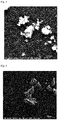
- Fig. 5 shows a result of SEM analysis on the waste denitrification catalyst
- Fig. 6 shows a result of SEM analysis of the roasted product.
- a product after roasting at high temperature exhibits a crystalline form ( Fig. 6 ) which changes into a bar shape, unlike a crystalline form ( Fig. 5 ) of an original waste denitrification catalyst sample.
- roasting temperature on leaching rate was a roasting experiment was conducted while varying the roasting temperature from 800°C to 900°C. Roasting was performed under conditions of an amount of the alkali metal compound of 20 wt% based on 100 wt% of the waste denitrification catalyst, a waste catalyst particle size of 140 mesh, and a roasting time of 120 minutes. 20 wt% of a roasted product was introduced into 100 wt% of water, followed by water leaching at a leaching temperature of 50°C.
- Fig. 7 is a graph depicting changes in leaching rate of vanadium and tungsten as a function of roasting temperature.
- leaching rate was higher than or equal to 50% at any roasting temperature within the range of 800°C to 900°C.
- roasting was performed under conditions of an amount of the alkali metal compound of 20 wt% based on 100 wt% of the waste denitrification catalyst, a roasting temperature of 900°C, and a roasting time of 120 minutes. 20 wt% of a roasted product was introduced into 100 wt% of water, followed by water leaching at a leaching temperature of 50°C.
- Fig. 8 is a graph depicting changes in leaching rate of vanadium and tungsten as a function of particle size of the waste denitrification catalyst.
- Na 2 CO 3 exhibited better leaching properties than NaOH under the same conditions, and, in particular, exhibited properties advantageous to water leaching in terms of curing degree of a roasted product.
- Na 2 CO 3 is more advantageous to operation than NaOH, which is highly corrosive.
Landscapes
- Chemical & Material Sciences (AREA)
- Engineering & Computer Science (AREA)
- Manufacturing & Machinery (AREA)
- Materials Engineering (AREA)
- Mechanical Engineering (AREA)
- Metallurgy (AREA)
- Organic Chemistry (AREA)
- Life Sciences & Earth Sciences (AREA)
- Environmental & Geological Engineering (AREA)
- General Life Sciences & Earth Sciences (AREA)
- Geology (AREA)
- Chemical Kinetics & Catalysis (AREA)
- Geochemistry & Mineralogy (AREA)
- Inorganic Chemistry (AREA)
- Manufacture And Refinement Of Metals (AREA)
- Processing Of Solid Wastes (AREA)
- Catalysts (AREA)
Description
- The present invention relates to a method for leaching valuable metals from a waste denitrification catalyst, and, more particularly, to a method for leaching valuable metals such as vanadium (V) and tungsten (W) from a waste denitrification catalyst in an eco-friendly and economical manner.
- An exhaust apparatus in a power plant and the like contains a selective catalytic reduction (SCR) catalyst which effectively removes nitrogen oxide (NOx). Typically, such a selective catalytic reduction catalyst is used for three to four years and recycled twice to three times. Thereafter, the catalyst is discarded in the form of a waste denitrification catalyst.
- A waste denitrification catalyst contains valuable metals, such as vanadium (V) and tungsten (W), in the form of oxides. Generally, in the waste denitrification catalyst, vanadium oxide (V2O5) is present in an amount of about 1% by weight (wt%) to about 3 wt%, and tungsten oxide WO3 is present in an amount of about 7 wt% to about 10 wt%.
- Thus, if a waste denitrification catalyst is discarded without additional use, this results in not only a burden of waste disposal costs but also loss of valuable natural resources.
- However, until now, there have been few studies on recovery of valuable metals from a waste denitrification catalyst and thus such a waste denitrification catalyst has, traditionally, simply been abandoned. Therefore, there is a need for a method of recovering valuable metals from a waste denitrification catalyst.
- Korean Patent Publication No.
10-2004-0067396 A -
CN 101 921 916 A discloses a method for recycling a metal oxide from a waste denitrification catalyst, comprising the steps of: crushing the waste denitrification catalyst to carry out pre-roasting pretreatment at high temperature; adding Na2CO3 into the waste denitrification catalyst, mixing, pulverizing and roasting at high temperature to obtain a sintering block; crushing the sintering block and putting the crushed sintering block into hot water, and stirring and lixiviating to obtain titanate; adding sulphuric acid into the titanate, filtering, water-washing and roasting to obtain TiO2; adding the sulphuric acid into the lixiviated filtering liquid to regulate a pH value to 8.0-9.0; adding excessive NH4Cl for vanadium precipitation; decomposing NH4VO3 obtained from filtering at high temperature to prepare a V2O5 product; adding hydrochloric acid into the filtering liquid subjected to the vanadium precipitation to regulate a pH value to 4.5 to 5.0; adding CaCl2 for molybdenum and tungsten precipitation; treating the CaMoO4 and CaWO4 obtained from filtering with the hydrochloric acid and roasting to obtain MoO3 and WO3. - It is an aspect of the present invention to provide a method for leaching valuable metals, such as vanadium (V) and tungsten (W), from a waste denitrification catalyst in an efficient manner.
- In accordance with one embodiment of the present invention, a method for leaching valuable metals from a waste denitrification catalyst includes: (a) mixing a waste denitrification catalyst containing vanadium (V) and tungsten (W) in the form of oxides with an alkali metal compound to form a mixture; (b) roasting the mixture to produce a roasted product containing sodium vanadate (NaVO3) and sodium tungstate (Na2WO4); and (c) introducing the roasted product into water to water leach sodium vanadate and sodium tungstate in the form of a vanadate ion (VO3 -) and a tungstate ion (WO4 2-).
- The alkali metal compound may include sodium carbonate (Na2CO3) or sodium hydroxide (NaOH).
- In step (a), the alkali metal compound is mixed in an amount of 5 wt% to 40 wt% based on 100 wt% of the waste denitrification catalyst, preferably in an amount of 15 wt% to 30 wt% based on 100 wt% of the waste denitrification catalyst.
- Step (b) may be performed at 800°C to 900°C.
- The method may further include, after step (b), ball milling the roasted product to reduce a particle size of the roasted product.
- In step (c), the roasted product may be introduced in an amount of 10 wt% to 30 wt% based on 100 wt% of water.
- Step (c) may be performed at 40°C to 60°C.
- The method may further include (d) filtering a leachate containing the vanadate ion and the tungstate ion.
- The method for leaching valuable metals from a waste denitrification catalyst according to the present invention can efficiently leach valuable metals, such as vanadium (V), tungsten (W), and the like, contained in a waste denitrification catalyst in an eco-friendly and economical manner by roasting at high temperature and water leaching.
-
-
Fig. 1 is a schematic flowchart showing a method for leaching valuable metals from a waste denitrification catalyst according to one embodiment of the present invention. -
Fig. 2 is a graph depicting changes in leaching rate of vanadium as a function of the amount of an alkali metal compound. -
Fig. 3 is a graph depicting changes in leaching rate of tungsten as a function of the amount of an alkali metal compound. -
Fig. 4 is a graph depicting equilibrium pH of a leachate upon water leaching. -
Fig. 5 shows a result of SEM analysis on a waste denitrification catalyst, andFig. 6 shows a result of SEM analysis on a roasted product. -
Fig. 6 shows a result of SEM analysis on a roasted product. -
Fig. 7 is a graph depicting changes in leaching rate of vanadium and tungsten as a function of roasting temperature. -
Fig. 8 is a graph depicting changes in leaching rate of vanadium and tungsten as a function of particle size of a waste denitrification catalyst. - The above and other aspects, features, and advantages of the present invention will become apparent from the detailed description of the following embodiments in conjunction with the accompanying drawings.
- It should be understood that the present invention is not limited to the following embodiments and may be embodied in different ways, and that the embodiments are provided for complete disclosure and thorough understanding of the present invention by those skilled in the art. The scope of the present invention is defined only by the claims.
- Hereinafter, a method for leaching valuable metals from a waste denitrification catalyst using roasting and water leaching according to the present invention will be described in detail.
-
Fig. 1 is a schematic flowchart showing a method for leaching valuable metals contained in waste denitrification catalysts according to one embodiment of the present invention. - Referring to
Fig. 1 , the method for leaching valuable metals includes mixing a waste denitrification catalyst with an alkali metal compound (S110), roasting (S120), and water leaching (S130). - First, in mixing the waste denitrification catalyst with the alkali metal compound (S110), the waste denitrification catalyst containing valuable metals is mixed with the alkali metal compound to form a mixture. More specifically, the waste denitrification catalyst containing vanadium (V) and tungsten (W) in the form of an oxide (V2O5, WO3 is mixed with the alkali metal compound to form a mixture.
- Vanadium (V) and tungsten (W) have very low solubility in water and are present in the form of vanadium oxide (V2O5) and tungsten oxide (WO3), which are difficult to water leach. Thus, it is desirable that vanadium and tungsten be in the form of an alkali metal salt, such as a sodium salt, having high solubility in water to facilitate water leaching.
- For this reason, in this operation, the waste denitrification catalyst is mixed with the alkali metal compound, whereby sodium vanadate (NaVO3) and sodium tungstate (Na2WO4) having relatively high solubility in water can be formed by roasting at high temperature.
- Here, as the alkali metal compound, sodium carbonate (Na2CO3) or sodium hydroxide (NaOH) may be used in terms of reaction rate, although various alkali metal compounds may be used.
- In addition, experimental results show that mixing the alkali metal compound in an amount of 5 wt% to 40 wt% based on 100 wt% of the waste denitrification catalyst is advantageous in terms of leaching rate, and mixing the alkali metal compound in an amount of 15 wt% to 30 wt% based on 100 wt% of the waste denitrification catalyst is more advantageous in terms of securing high leaching rate of both vanadium and tungsten.
- Next, in roasting (S120), the mixture of the waste denitrification catalyst and the alkali metal compound is subject to roasting at high temperature, thereby producing a roasted product, more particularly, a roasted product containing sodium vanadate (NaVO3) and sodium tungstate (Na2WO4) having high solubility in water.
- In roasting using sodium carbonate and sodium hydroxide, vanadium oxide and tungsten oxide react as follows:
V2O5(s) + Na2CO3(s) = 2NaVO3(s) + CO2(g) (1)
WO3(s) + Na2CO3(s) = Na2WO4(s) + CO2(g) (2)
V2O5(s) + 2NaOH = 2NaVO3 + H2O(g) (3)
WO3(s) + 2NaOH = Na2WO4 + H2O(g) (4)
- Roasting may be performed at 800°C to 900°C. If roasting is performed at a temperature of less than 800°C, there is a possibility of insufficient roasting. If roasting is performed at a temperature of higher than 900°C, this can reduce leaching rate of valuable metals without enhancing roasting, depending upon kind of the alkali metal compound.
- The method may further include ball milling the roasted product to reduce a particle size of the roasted product. According to experimental results, as the roasted product was reduced in particle size, i.e. average particle diameter, the roasted product was increased in surface area, which led to higher leaching rate.
- Next, the roasted product is introduced into water to leach valuable metals from the roasted product. More specifically, the roasted product is introduced into water, thereby leaching sodium vanadate and sodium tungstate in the form of vanadate ions (VO3 -) and tungstate ions (WO4 2-).
- Water leaching reactions of sodium vanadate and sodium tungstate may be represented as follows, respectively:
NaVO3 + H2O → Na+ + VO3 - + H2O
Na2WO4 + H2O → 2Na+ + WO4 2- + H2O
- In water leaching, the roasted product may be introduced in an amount of 10 wt% to 30 wt% based on 100 wt% of water. If the amount of the roasted product is less than 10 wt%, leached valuable metals can be too small. On the contrary, if the amount of the roasted product is higher than 30 wt%, there is a possibility of deterioration in overall leaching efficiency of valuable metals due to inability to further enhance leaching.
- Water leaching may be performed at 40°C to 60°C. If water leaching is performed at a temperature of less than 40°C, there is a possibility of reduction in water leaching rate, and if water leaching is performed at a temperature of higher than 60°C, there is a possibility of deterioration in stability of a leachate.
- The method may further include, after water leaching, filtering a leachate containing the vanadate ions and the tungstate ions to remove unnecessary impurities.
- Hereinafter, the present invention will be described in more detail with reference to a preferred example. It should be understood that these examples are not to be construed in any way as limiting the present invention.
- A description of details apparent to those skilled in the art will be omitted.
- A waste denitrification catalyst used in Example was obtained from Samcheon Thermal Power Generation Center (Korea) and was subjected to coarse crushing and fine crushing.
- Thereafter, component analysis was performed on the waste denitrification catalyst, thereby obtaining results as listed in Table 1.
Table 1 Co mp. Al 2O3 W O3 V 2O5 C aO M gO Si O2 W O3 Fe 2O3 TiO2 Wt % 5. 57 7. 73 1. 23 2. 45 0. 55 9. 80 0. 10 0. 77 Remai nder - As shown in Table 1, tungsten and vanadium, as valuable metals to be recovered, were present in an amount of about 7.7 wt% and about 1.2 wt%, respectively, in terms of oxide thereof; a main component was TiO2 present in an amount of 70 wt% or more; and CaO, Al2O3, MgO, and the like, as binders, were present in a small amount.
- In Example, in order to leach valuable metals from a waste denitrification catalyst, mixing a waste denitrification catalyst with an alkali metal compound, roasting at high temperature, and water leaching were performed, under varying conditions.
- Here, in roasting at high temperature, amount of the alkali metal compound, roasting temperature, and particle size of waste catalyst particles were set as parameters.
- Roasting at high temperature was performed using a muffle furnace (HM-1204, Hanmi High Tech Co., Ltd.), and water leaching after roasting at high temperature was performed using a leaching bath manufacturd in house.
- After soda roasting, valuable metals in a leachate were analyzed using an ICP-AES (iCAP6300 DUO, ThermoElectron Corp.), thereby calculating leaching rate.
- In order to investigate roasting properties of the waste denitrification catalyst according to changes in amount of the alkali metal compound (NaOH, NaCO3), a roasting experiment was conducted while changing the amount of the alkali metal compound from 2.5 wt% to 40 wt% based on 100 wt% of the waste denitrification catalyst. Roasting was performed under conditions of a roasting temperature of 900°C, a waste catalyst particle size of 140 mesh, and a roasting time of 120 minutes. 20 wt% of a roasted product was introduced into 100 wt% of water, followed by water leaching at a leaching temperature of 50°C.
-
Fig. 2 is a graph depicting changes in leaching rate of vanadium as a function of the amount of the alkali metal compound, andFig. 3 is graph depicting changes in leaching rate of tungsten as a function of the amount of the alkali metal compound. - As shown in
Figs. 2 and3 , experimental results given varying amounts of the alkali metal compound show that leaching rates of vanadium and tungsten increase with increasing amount of the alkali metal compound. However, when NaOH was added in an amount of 40 wt% based on 100 wt% of the waste denitrification catalyst, the roasted product was excessively hardened, such that normal water leaching was impossible. This is because, such a muffle type roasting furnace cannot benefit from a stirring effect. Thus, when a rotary kiln furnace, which allows stirring, is used, it is possible to increase the amount of NaOH. - In addition, referring to
Figs. 2 and3 , it can be seen that, when the alkali metal compound is added in an amount of about 10 wt% or more based on 100 wt% of the waste denitrification catalyst, a substantially good leaching rate is obtained. Particularly, as shown inFigs. 2 and3 , leaching rates of vanadium and tungsten are both about 50% or higher when the alkali metal compound is present in an amount of 15 wt% to 30 wt% based on 100 wt% of the waste denitrification catalyst. Within this range, the most preferable results can be obtained. -
Fig. 4 is a graph depicting equilibrium pH of a leachate upon water leaching. - Referring to
Fig. 4 , it can be seen that pH increases with increasing amount of added alkali. However, this result is not proportional to the leaching rates inFigs. 2 and3 . It is understood that increase in amount of the alkali metal compound causes the roasted product to crystallize, thereby adversely affecting water leaching while allowing increase in leaching agents. -
Fig. 5 shows a result of SEM analysis on the waste denitrification catalyst, andFig. 6 shows a result of SEM analysis of the roasted product. - Referring to
Figs. 5 and 6 , it can be seen that a product after roasting at high temperature exhibits a crystalline form (Fig. 6 ) which changes into a bar shape, unlike a crystalline form (Fig. 5 ) of an original waste denitrification catalyst sample. - This can be indirect evidence accounting for a phenomenon that an excess of the alkali metal compound causes reduction in leaching rate.
- In order to identify effect of roasting temperature on leaching rate, a roasting experiment was conducted while varying the roasting temperature from 800°C to 900°C. Roasting was performed under conditions of an amount of the alkali metal compound of 20 wt% based on 100 wt% of the waste denitrification catalyst, a waste catalyst particle size of 140 mesh, and a roasting time of 120 minutes. 20 wt% of a roasted product was introduced into 100 wt% of water, followed by water leaching at a leaching temperature of 50°C.
-
Fig. 7 is a graph depicting changes in leaching rate of vanadium and tungsten as a function of roasting temperature. - Experimental results show that, when Na2CO3 was used as the alkali metal compound, effect of roasting temperature was insignificant. However, when NaOH was used as the alkali metal compound, leaching rate had a maximum value at 850°C. After the experiment, through comparison of curing degree of roasted products, it was confirmed that products obtained by roasting a mixture containing NaOH were harder. Thus, it is understood that such properties of the roasted products affects leaching efficiency.
- However, when the alkali metal compound was added in an amount of 20 wt%, leaching rate was higher than or equal to 50% at any roasting temperature within the range of 800°C to 900°C.
- In order to identify effect of particle size of a waste denitrification catalyst on leaching rate, a roasting experiment was conducted while varying particle size of the waste denitrification catalyst. Here, roasting was performed under conditions of an amount of the alkali metal compound of 20 wt% based on 100 wt% of the waste denitrification catalyst, a roasting temperature of 900°C, and a roasting time of 120 minutes. 20 wt% of a roasted product was introduced into 100 wt% of water, followed by water leaching at a leaching temperature of 50°C.
-
Fig. 8 is a graph depicting changes in leaching rate of vanadium and tungsten as a function of particle size of the waste denitrification catalyst. - Referring to
Fig. 8 , it was confirmed that effect of particle size on leaching rate was insignificant. - On the other hand, referring to
Figs. 2 to 8 , as the alkali metal compound, Na2CO3 exhibited better leaching properties than NaOH under the same conditions, and, in particular, exhibited properties advantageous to water leaching in terms of curing degree of a roasted product. - In addition, in a continuous roasting process using a rotary kiln furnace, which allows stirring, Na2CO3 is more advantageous to operation than NaOH, which is highly corrosive.
Claims (9)
- A method for leaching valuable metals from a waste denitrification catalyst, comprising:(a) mixing a waste denitrification catalyst containing vanadium (V) and tungsten (W) in the form of oxides with an alkali metal compound to form a mixture, wherein the alkali metal compound is mixed in an amount of 5 wt% to 40 wt% based on 100 wt% of the waste denitrification catalyst;(b) roasting the mixture to produce a roasted product containing sodium vanadate (NaVO3) and sodium tungstate (Na2WO4); and(c) introducing the roasted product into water to water leach sodium vanadate and sodium tungstate in the form of vanadate ions (VO3 -) and tungstate ions (WO4 2-).
- The method according to claim 1, wherein the alkali metal compound is sodium carbonate (Na2CO3) or sodium hydroxide (NaOH).
- The method according to claim 1, wherein, in step (a), the alkali metal compound is mixed in an amount of 15 wt% to 30 wt% based on 100 wt% of the waste denitrification catalyst.
- The method according to claim 1, wherein step (b) is performed at 800°C to 900°C.
- The method according to claim 1, wherein, in step (a), the alkali metal compound is mixed in an amount of 15 wt% to 30 wt% based on 100 wt% of the waste denitrification catalyst, and in step (b), roasting is performed at 800°C to 900°C.
- The method according to claim 1, further comprising, after step (b), ball milling the roasted product to reduce a particle size of the roasted product.
- The method according to claim 1, wherein, in step (c), the roasted product is introduced in an amount of 10 wt% to 30 wt% based on 100 wt% of water.
- The method according to claim 1, wherein step (c) is performed at 40°C to 60°C.
- The method according to claim 1, further comprising, after step (c), filtering a leachate containing the vanadate ions and the tungstate ions.
Applications Claiming Priority (2)
| Application Number | Priority Date | Filing Date | Title |
|---|---|---|---|
| KR20120099496A KR101281579B1 (en) | 2012-09-07 | 2012-09-07 | Method of leaching valuable metal in spent catalyst of denitrification using roasting water leaching |
| PCT/KR2013/000421 WO2014038762A1 (en) | 2012-09-07 | 2013-01-18 | Method for leaching valuable metals contained in waste denitrification catalyst by using roasting and water leaching |
Publications (3)
| Publication Number | Publication Date |
|---|---|
| EP2894233A1 EP2894233A1 (en) | 2015-07-15 |
| EP2894233A4 EP2894233A4 (en) | 2015-11-18 |
| EP2894233B1 true EP2894233B1 (en) | 2018-04-04 |
Family
ID=48996445
Family Applications (1)
| Application Number | Title | Priority Date | Filing Date |
|---|---|---|---|
| EP13834863.6A Active EP2894233B1 (en) | 2012-09-07 | 2013-01-18 | Method for leaching valuable metals contained in waste denitrification catalyst by using roasting and water leaching |
Country Status (5)
| Country | Link |
|---|---|
| US (1) | US10017839B2 (en) |
| EP (1) | EP2894233B1 (en) |
| KR (1) | KR101281579B1 (en) |
| CN (1) | CN104603306A (en) |
| WO (1) | WO2014038762A1 (en) |
Families Citing this family (16)
| Publication number | Priority date | Publication date | Assignee | Title |
|---|---|---|---|---|
| KR101466928B1 (en) * | 2014-03-05 | 2014-12-03 | 한국지질자원연구원 | Leaching method of valuable metal in spent catalyst of denitrification using high pressured leaching process |
| CN105112691A (en) * | 2015-10-10 | 2015-12-02 | 江西理工大学 | Method for extracting tungsten from tungsten minerals through alkaline decomposition |
| KR101813233B1 (en) * | 2017-07-27 | 2017-12-28 | 한국지질자원연구원 | Selective recovery method for valuable metal from spent SCR catalyst using alkali fusion |
| CN107502746A (en) * | 2017-08-22 | 2017-12-22 | 河钢股份有限公司承德分公司 | A kind of method for efficiently leaching vanadium tungsten in denitrating catalyst |
| CN107720826A (en) * | 2017-09-14 | 2018-02-23 | 湖南力天高新材料股份有限公司 | A kind of method that sodium tungstate is extracted from tungsten waste |
| KR101996425B1 (en) * | 2017-12-20 | 2019-07-05 | 오영복 | Method for recovering valuable metals from denitrification waste catalysts |
| KR101957705B1 (en) * | 2018-10-24 | 2019-03-13 | 한국지질자원연구원 | Manufacturing method of titania from scr catalyst |
| CN109897962B (en) * | 2019-03-14 | 2020-11-17 | 厦门钨业股份有限公司 | Method and device for recovering tungsten in tungsten-containing waste by adopting oxidation smelting method |
| CN110468290B (en) * | 2019-08-06 | 2021-10-22 | 湖南懋天世纪新材料有限公司 | Application and method of sodium polyacrylate in treatment of waste tungsten material |
| CN111778398A (en) * | 2019-10-22 | 2020-10-16 | 广东省资源综合利用研究所 | Method for extracting vanadium and tungsten from waste SCR denitration catalyst |
| CN113387387A (en) * | 2021-08-03 | 2021-09-14 | 崇义章源钨业股份有限公司 | Method for preparing sodium tungstate solution by utilizing tungsten-containing waste in short process |
| KR102445476B1 (en) | 2021-09-15 | 2022-09-21 | 주식회사 한내포티 | Valuable metal extraction method containing denitrification spent catalyst using alkali sintered compact |
| CN116139851B (en) * | 2023-01-18 | 2024-09-10 | 国家能源集团科技环保有限公司 | Resource utilization method of waste denitration catalyst |
| CN120037995A (en) * | 2023-11-24 | 2025-05-27 | 中国石油天然气股份有限公司 | A method for regenerating a deactivated hydrogenation catalyst |
| CN119553101B (en) * | 2025-01-24 | 2025-05-27 | 湖南紫金锂多金属新材料有限公司 | A method for recovering tungsten from lithium mica concentrate |
| CN120132873B (en) * | 2025-02-24 | 2025-10-17 | 云南民族大学 | NH (NH)3Preparation method, product and application of SCR catalyst |
Family Cites Families (10)
| Publication number | Priority date | Publication date | Assignee | Title |
|---|---|---|---|---|
| US4554138A (en) * | 1984-10-30 | 1985-11-19 | Chevron Research Company | Leaching metals from spent hydroprocessing catalysts with ammonium sulfate |
| JPH11172343A (en) * | 1997-12-10 | 1999-06-29 | Mitsui Mining & Smelting Co Ltd | Scintillator crystal scrap treatment method |
| JP2000309828A (en) * | 1999-04-23 | 2000-11-07 | Shimizu Corp | Method for extracting and separating valuable metal components contained in catalyst waste for petroleum refining |
| JP2001316732A (en) * | 2000-05-11 | 2001-11-16 | Nippon Cms Kk | Method for recovering useful metals from nickel and vanadium-containing materials |
| KR100367710B1 (en) * | 2000-05-29 | 2003-01-10 | 희성엥겔하드주식회사 | Recovery method of platinum group metals from spent active carbon catalyst |
| EP1283274B1 (en) * | 2001-08-04 | 2007-10-31 | Umicore AG & Co. KG | low chlorine platinum and platinum alloy powders with increased specific surface area and process for the preparation thereof using a nitrate salt melt |
| KR20040067396A (en) | 2003-01-23 | 2004-07-30 | 장영옥 | Method using waste catalysts supported on titanium oxide as photo catalyst |
| FR2889843B1 (en) | 2005-08-16 | 2007-10-19 | Valdi Soc Par Actions Simplifi | PROCESS FOR THE PREPARATION OF CALCIUM SALTS |
| KR20070033122A (en) * | 2005-09-20 | 2007-03-26 | (주)성일엔지컴 | How to recover valuable metals from spent catalyst |
| CN101921916B (en) * | 2010-08-16 | 2014-05-28 | 华电电力科学研究院 | Method for recycling metal oxide from waste flue gas denitration catalyst |
-
2012
- 2012-09-07 KR KR20120099496A patent/KR101281579B1/en active Active
-
2013
- 2013-01-18 EP EP13834863.6A patent/EP2894233B1/en active Active
- 2013-01-18 US US14/425,129 patent/US10017839B2/en active Active
- 2013-01-18 CN CN201380046598.1A patent/CN104603306A/en active Pending
- 2013-01-18 WO PCT/KR2013/000421 patent/WO2014038762A1/en not_active Ceased
Non-Patent Citations (1)
| Title |
|---|
| None * |
Also Published As
| Publication number | Publication date |
|---|---|
| EP2894233A4 (en) | 2015-11-18 |
| CN104603306A (en) | 2015-05-06 |
| WO2014038762A1 (en) | 2014-03-13 |
| US10017839B2 (en) | 2018-07-10 |
| KR101281579B1 (en) | 2013-07-03 |
| EP2894233A1 (en) | 2015-07-15 |
| US20150203938A1 (en) | 2015-07-23 |
Similar Documents
| Publication | Publication Date | Title |
|---|---|---|
| US10017839B2 (en) | Method for leaching valuable metals contained in waste denitrification catalyst by using roasting and water leaching | |
| EP3660175B1 (en) | Method for selective recovery of valuable metals from denitrification catalyst waste through alkaline digestion | |
| EP2584055B1 (en) | Method for removal of copper ions from copper-containing nickel chloride solution, and process for production of electrolytic nickel | |
| KR101452179B1 (en) | Recovery method of vanadium and tungsten from leaching solution of spent catalyst of denitrification | |
| CN100594246C (en) | Method for recovering high-purity molybdenum from molybdenum-containing dead catalyst | |
| CN110028092A (en) | A method of calcium aluminate is prepared using aluminium ash and carbide slag | |
| EP2450312A1 (en) | Recovery of tungsten from waste material by ammonium leaching | |
| TWI411581B (en) | Method for recovering ruthenium from waste containing ruthenium | |
| CN101549882A (en) | Method for preparing high-purity cupric oxide powder from acid cupriferous waste liquid | |
| EP3115108A1 (en) | Method for leaching precious metals contained in waste denitrification catalyst using pressure leaching process | |
| EP2740711A1 (en) | Nickel oxide micropowder and method for producing same | |
| CN104611564A (en) | Method for recycling metal oxides from waste SCR (selective catalytic reduction) catalyst | |
| CN104630483A (en) | Alkaline leaching vanadium precipitation method for comprehensive waste denitration catalyst utilization | |
| JP6159306B2 (en) | Nickel oxide powder | |
| CN104818395B (en) | A kind of method for processing wolframite or Scheelite-Wolframite Mixed Mine | |
| WO2023246080A1 (en) | Method for recycling industrial waste salt and waste denitration catalyst | |
| CN110468278A (en) | A method of handling useless denitrating catalyst | |
| JP2012166967A (en) | Nickel oxide fine powder and method for producing the same | |
| JP5504750B2 (en) | Nickel oxide fine powder and method for producing the same | |
| CN106276985A (en) | A kind of preparation method of potassium nitrate | |
| JP5733101B2 (en) | Method for producing nickel oxide powder | |
| CN114682307A (en) | Treatment method of waste denitration catalyst, titanium-tungsten powder, denitration catalyst and preparation method thereof | |
| JP4183926B2 (en) | Method for recovering tantalum / niobium from tantalum / niobium-containing carbide materials | |
| JP5790292B2 (en) | Method for producing nickel oxide powder | |
| Zhang et al. | Understanding the leaching behavior of calcium molybdate through the construction of lg c—pH diagrams |
Legal Events
| Date | Code | Title | Description |
|---|---|---|---|
| PUAI | Public reference made under article 153(3) epc to a published international application that has entered the european phase |
Free format text: ORIGINAL CODE: 0009012 |
|
| 17P | Request for examination filed |
Effective date: 20150304 |
|
| AK | Designated contracting states |
Kind code of ref document: A1 Designated state(s): AL AT BE BG CH CY CZ DE DK EE ES FI FR GB GR HR HU IE IS IT LI LT LU LV MC MK MT NL NO PL PT RO RS SE SI SK SM TR |
|
| AX | Request for extension of the european patent |
Extension state: BA ME |
|
| RIC1 | Information provided on ipc code assigned before grant |
Ipc: C22B 7/00 20060101ALI20151006BHEP Ipc: C22B 1/00 20060101ALI20151006BHEP Ipc: C22B 3/12 20060101ALI20151006BHEP Ipc: C22B 34/22 20060101AFI20151006BHEP Ipc: C22B 34/36 20060101ALI20151006BHEP |
|
| RA4 | Supplementary search report drawn up and despatched (corrected) |
Effective date: 20151021 |
|
| RIC1 | Information provided on ipc code assigned before grant |
Ipc: C22B 34/22 20060101AFI20151014BHEP Ipc: C22B 34/36 20060101ALI20151014BHEP Ipc: C22B 3/12 20060101ALI20151014BHEP Ipc: C22B 7/00 20060101ALI20151014BHEP Ipc: C22B 1/00 20060101ALI20151014BHEP |
|
| DAX | Request for extension of the european patent (deleted) | ||
| 17Q | First examination report despatched |
Effective date: 20160614 |
|
| GRAP | Despatch of communication of intention to grant a patent |
Free format text: ORIGINAL CODE: EPIDOSNIGR1 |
|
| STAA | Information on the status of an ep patent application or granted ep patent |
Free format text: STATUS: GRANT OF PATENT IS INTENDED |
|
| INTG | Intention to grant announced |
Effective date: 20171103 |
|
| GRAS | Grant fee paid |
Free format text: ORIGINAL CODE: EPIDOSNIGR3 |
|
| GRAA | (expected) grant |
Free format text: ORIGINAL CODE: 0009210 |
|
| STAA | Information on the status of an ep patent application or granted ep patent |
Free format text: STATUS: THE PATENT HAS BEEN GRANTED |
|
| AK | Designated contracting states |
Kind code of ref document: B1 Designated state(s): AL AT BE BG CH CY CZ DE DK EE ES FI FR GB GR HR HU IE IS IT LI LT LU LV MC MK MT NL NO PL PT RO RS SE SI SK SM TR |
|
| REG | Reference to a national code |
Ref country code: GB Ref legal event code: FG4D |
|
| REG | Reference to a national code |
Ref country code: CH Ref legal event code: EP |
|
| REG | Reference to a national code |
Ref country code: AT Ref legal event code: REF Ref document number: 985665 Country of ref document: AT Kind code of ref document: T Effective date: 20180415 |
|
| REG | Reference to a national code |
Ref country code: IE Ref legal event code: FG4D |
|
| REG | Reference to a national code |
Ref country code: DE Ref legal event code: R096 Ref document number: 602013035520 Country of ref document: DE |
|
| REG | Reference to a national code |
Ref country code: NL Ref legal event code: MP Effective date: 20180404 |
|
| REG | Reference to a national code |
Ref country code: LT Ref legal event code: MG4D |
|
| PG25 | Lapsed in a contracting state [announced via postgrant information from national office to epo] |
Ref country code: NL Free format text: LAPSE BECAUSE OF FAILURE TO SUBMIT A TRANSLATION OF THE DESCRIPTION OR TO PAY THE FEE WITHIN THE PRESCRIBED TIME-LIMIT Effective date: 20180404 |
|
| PG25 | Lapsed in a contracting state [announced via postgrant information from national office to epo] |
Ref country code: ES Free format text: LAPSE BECAUSE OF FAILURE TO SUBMIT A TRANSLATION OF THE DESCRIPTION OR TO PAY THE FEE WITHIN THE PRESCRIBED TIME-LIMIT Effective date: 20180404 Ref country code: SE Free format text: LAPSE BECAUSE OF FAILURE TO SUBMIT A TRANSLATION OF THE DESCRIPTION OR TO PAY THE FEE WITHIN THE PRESCRIBED TIME-LIMIT Effective date: 20180404 Ref country code: AL Free format text: LAPSE BECAUSE OF FAILURE TO SUBMIT A TRANSLATION OF THE DESCRIPTION OR TO PAY THE FEE WITHIN THE PRESCRIBED TIME-LIMIT Effective date: 20180404 Ref country code: BG Free format text: LAPSE BECAUSE OF FAILURE TO SUBMIT A TRANSLATION OF THE DESCRIPTION OR TO PAY THE FEE WITHIN THE PRESCRIBED TIME-LIMIT Effective date: 20180704 Ref country code: FI Free format text: LAPSE BECAUSE OF FAILURE TO SUBMIT A TRANSLATION OF THE DESCRIPTION OR TO PAY THE FEE WITHIN THE PRESCRIBED TIME-LIMIT Effective date: 20180404 Ref country code: NO Free format text: LAPSE BECAUSE OF FAILURE TO SUBMIT A TRANSLATION OF THE DESCRIPTION OR TO PAY THE FEE WITHIN THE PRESCRIBED TIME-LIMIT Effective date: 20180704 Ref country code: LT Free format text: LAPSE BECAUSE OF FAILURE TO SUBMIT A TRANSLATION OF THE DESCRIPTION OR TO PAY THE FEE WITHIN THE PRESCRIBED TIME-LIMIT Effective date: 20180404 Ref country code: PL Free format text: LAPSE BECAUSE OF FAILURE TO SUBMIT A TRANSLATION OF THE DESCRIPTION OR TO PAY THE FEE WITHIN THE PRESCRIBED TIME-LIMIT Effective date: 20180404 |
|
| PG25 | Lapsed in a contracting state [announced via postgrant information from national office to epo] |
Ref country code: GR Free format text: LAPSE BECAUSE OF FAILURE TO SUBMIT A TRANSLATION OF THE DESCRIPTION OR TO PAY THE FEE WITHIN THE PRESCRIBED TIME-LIMIT Effective date: 20180705 Ref country code: HR Free format text: LAPSE BECAUSE OF FAILURE TO SUBMIT A TRANSLATION OF THE DESCRIPTION OR TO PAY THE FEE WITHIN THE PRESCRIBED TIME-LIMIT Effective date: 20180404 Ref country code: LV Free format text: LAPSE BECAUSE OF FAILURE TO SUBMIT A TRANSLATION OF THE DESCRIPTION OR TO PAY THE FEE WITHIN THE PRESCRIBED TIME-LIMIT Effective date: 20180404 Ref country code: RS Free format text: LAPSE BECAUSE OF FAILURE TO SUBMIT A TRANSLATION OF THE DESCRIPTION OR TO PAY THE FEE WITHIN THE PRESCRIBED TIME-LIMIT Effective date: 20180404 |
|
| REG | Reference to a national code |
Ref country code: AT Ref legal event code: MK05 Ref document number: 985665 Country of ref document: AT Kind code of ref document: T Effective date: 20180404 |
|
| PG25 | Lapsed in a contracting state [announced via postgrant information from national office to epo] |
Ref country code: PT Free format text: LAPSE BECAUSE OF FAILURE TO SUBMIT A TRANSLATION OF THE DESCRIPTION OR TO PAY THE FEE WITHIN THE PRESCRIBED TIME-LIMIT Effective date: 20180806 |
|
| REG | Reference to a national code |
Ref country code: DE Ref legal event code: R097 Ref document number: 602013035520 Country of ref document: DE |
|
| PG25 | Lapsed in a contracting state [announced via postgrant information from national office to epo] |
Ref country code: RO Free format text: LAPSE BECAUSE OF FAILURE TO SUBMIT A TRANSLATION OF THE DESCRIPTION OR TO PAY THE FEE WITHIN THE PRESCRIBED TIME-LIMIT Effective date: 20180404 Ref country code: CZ Free format text: LAPSE BECAUSE OF FAILURE TO SUBMIT A TRANSLATION OF THE DESCRIPTION OR TO PAY THE FEE WITHIN THE PRESCRIBED TIME-LIMIT Effective date: 20180404 Ref country code: EE Free format text: LAPSE BECAUSE OF FAILURE TO SUBMIT A TRANSLATION OF THE DESCRIPTION OR TO PAY THE FEE WITHIN THE PRESCRIBED TIME-LIMIT Effective date: 20180404 Ref country code: AT Free format text: LAPSE BECAUSE OF FAILURE TO SUBMIT A TRANSLATION OF THE DESCRIPTION OR TO PAY THE FEE WITHIN THE PRESCRIBED TIME-LIMIT Effective date: 20180404 Ref country code: SK Free format text: LAPSE BECAUSE OF FAILURE TO SUBMIT A TRANSLATION OF THE DESCRIPTION OR TO PAY THE FEE WITHIN THE PRESCRIBED TIME-LIMIT Effective date: 20180404 Ref country code: DK Free format text: LAPSE BECAUSE OF FAILURE TO SUBMIT A TRANSLATION OF THE DESCRIPTION OR TO PAY THE FEE WITHIN THE PRESCRIBED TIME-LIMIT Effective date: 20180404 |
|
| PLBE | No opposition filed within time limit |
Free format text: ORIGINAL CODE: 0009261 |
|
| STAA | Information on the status of an ep patent application or granted ep patent |
Free format text: STATUS: NO OPPOSITION FILED WITHIN TIME LIMIT |
|
| PG25 | Lapsed in a contracting state [announced via postgrant information from national office to epo] |
Ref country code: IT Free format text: LAPSE BECAUSE OF FAILURE TO SUBMIT A TRANSLATION OF THE DESCRIPTION OR TO PAY THE FEE WITHIN THE PRESCRIBED TIME-LIMIT Effective date: 20180404 Ref country code: SM Free format text: LAPSE BECAUSE OF FAILURE TO SUBMIT A TRANSLATION OF THE DESCRIPTION OR TO PAY THE FEE WITHIN THE PRESCRIBED TIME-LIMIT Effective date: 20180404 |
|
| 26N | No opposition filed |
Effective date: 20190107 |
|
| PG25 | Lapsed in a contracting state [announced via postgrant information from national office to epo] |
Ref country code: SI Free format text: LAPSE BECAUSE OF FAILURE TO SUBMIT A TRANSLATION OF THE DESCRIPTION OR TO PAY THE FEE WITHIN THE PRESCRIBED TIME-LIMIT Effective date: 20180404 |
|
| PG25 | Lapsed in a contracting state [announced via postgrant information from national office to epo] |
Ref country code: MC Free format text: LAPSE BECAUSE OF FAILURE TO SUBMIT A TRANSLATION OF THE DESCRIPTION OR TO PAY THE FEE WITHIN THE PRESCRIBED TIME-LIMIT Effective date: 20180404 |
|
| REG | Reference to a national code |
Ref country code: CH Ref legal event code: PL |
|
| PG25 | Lapsed in a contracting state [announced via postgrant information from national office to epo] |
Ref country code: LU Free format text: LAPSE BECAUSE OF NON-PAYMENT OF DUE FEES Effective date: 20190118 |
|
| REG | Reference to a national code |
Ref country code: BE Ref legal event code: MM Effective date: 20190131 |
|
| REG | Reference to a national code |
Ref country code: IE Ref legal event code: MM4A |
|
| PG25 | Lapsed in a contracting state [announced via postgrant information from national office to epo] |
Ref country code: BE Free format text: LAPSE BECAUSE OF NON-PAYMENT OF DUE FEES Effective date: 20190131 |
|
| PG25 | Lapsed in a contracting state [announced via postgrant information from national office to epo] |
Ref country code: LI Free format text: LAPSE BECAUSE OF NON-PAYMENT OF DUE FEES Effective date: 20190131 Ref country code: CH Free format text: LAPSE BECAUSE OF NON-PAYMENT OF DUE FEES Effective date: 20190131 |
|
| PG25 | Lapsed in a contracting state [announced via postgrant information from national office to epo] |
Ref country code: IE Free format text: LAPSE BECAUSE OF NON-PAYMENT OF DUE FEES Effective date: 20190118 |
|
| PG25 | Lapsed in a contracting state [announced via postgrant information from national office to epo] |
Ref country code: TR Free format text: LAPSE BECAUSE OF FAILURE TO SUBMIT A TRANSLATION OF THE DESCRIPTION OR TO PAY THE FEE WITHIN THE PRESCRIBED TIME-LIMIT Effective date: 20180404 |
|
| PG25 | Lapsed in a contracting state [announced via postgrant information from national office to epo] |
Ref country code: MT Free format text: LAPSE BECAUSE OF NON-PAYMENT OF DUE FEES Effective date: 20190118 |
|
| PG25 | Lapsed in a contracting state [announced via postgrant information from national office to epo] |
Ref country code: CY Free format text: LAPSE BECAUSE OF FAILURE TO SUBMIT A TRANSLATION OF THE DESCRIPTION OR TO PAY THE FEE WITHIN THE PRESCRIBED TIME-LIMIT Effective date: 20180404 |
|
| PG25 | Lapsed in a contracting state [announced via postgrant information from national office to epo] |
Ref country code: IS Free format text: LAPSE BECAUSE OF FAILURE TO SUBMIT A TRANSLATION OF THE DESCRIPTION OR TO PAY THE FEE WITHIN THE PRESCRIBED TIME-LIMIT Effective date: 20180804 |
|
| PG25 | Lapsed in a contracting state [announced via postgrant information from national office to epo] |
Ref country code: HU Free format text: LAPSE BECAUSE OF FAILURE TO SUBMIT A TRANSLATION OF THE DESCRIPTION OR TO PAY THE FEE WITHIN THE PRESCRIBED TIME-LIMIT; INVALID AB INITIO Effective date: 20130118 |
|
| PG25 | Lapsed in a contracting state [announced via postgrant information from national office to epo] |
Ref country code: MK Free format text: LAPSE BECAUSE OF FAILURE TO SUBMIT A TRANSLATION OF THE DESCRIPTION OR TO PAY THE FEE WITHIN THE PRESCRIBED TIME-LIMIT Effective date: 20180404 |
|
| PGFP | Annual fee paid to national office [announced via postgrant information from national office to epo] |
Ref country code: DE Payment date: 20221220 Year of fee payment: 11 |
|
| REG | Reference to a national code |
Ref country code: DE Ref legal event code: R119 Ref document number: 602013035520 Country of ref document: DE |
|
| PG25 | Lapsed in a contracting state [announced via postgrant information from national office to epo] |
Ref country code: DE Free format text: LAPSE BECAUSE OF NON-PAYMENT OF DUE FEES Effective date: 20240801 |
|
| PG25 | Lapsed in a contracting state [announced via postgrant information from national office to epo] |
Ref country code: DE Free format text: LAPSE BECAUSE OF NON-PAYMENT OF DUE FEES Effective date: 20240801 |
|
| PGFP | Annual fee paid to national office [announced via postgrant information from national office to epo] |
Ref country code: FR Payment date: 20250227 Year of fee payment: 13 |
|
| PGFP | Annual fee paid to national office [announced via postgrant information from national office to epo] |
Ref country code: GB Payment date: 20250227 Year of fee payment: 13 |