EP2893929B1 - Ceftolozane antibiotic compositions - Google Patents
Ceftolozane antibiotic compositions Download PDFInfo
- Publication number
- EP2893929B1 EP2893929B1 EP14199792.4A EP14199792A EP2893929B1 EP 2893929 B1 EP2893929 B1 EP 2893929B1 EP 14199792 A EP14199792 A EP 14199792A EP 2893929 B1 EP2893929 B1 EP 2893929B1
- Authority
- EP
- European Patent Office
- Prior art keywords
- ceftolozane
- tazobactam
- sodium chloride
- composition
- sodium
- Prior art date
- Legal status (The legal status is an assumption and is not a legal conclusion. Google has not performed a legal analysis and makes no representation as to the accuracy of the status listed.)
- Active
Links
Images






Classifications
-
- A—HUMAN NECESSITIES
- A61—MEDICAL OR VETERINARY SCIENCE; HYGIENE
- A61K—PREPARATIONS FOR MEDICAL, DENTAL OR TOILETRY PURPOSES
- A61K31/00—Medicinal preparations containing organic active ingredients
- A61K31/33—Heterocyclic compounds
- A61K31/395—Heterocyclic compounds having nitrogen as a ring hetero atom, e.g. guanethidine or rifamycins
- A61K31/54—Heterocyclic compounds having nitrogen as a ring hetero atom, e.g. guanethidine or rifamycins having six-membered rings with at least one nitrogen and one sulfur as the ring hetero atoms, e.g. sulthiame
- A61K31/542—Heterocyclic compounds having nitrogen as a ring hetero atom, e.g. guanethidine or rifamycins having six-membered rings with at least one nitrogen and one sulfur as the ring hetero atoms, e.g. sulthiame ortho- or peri-condensed with heterocyclic ring systems
- A61K31/545—Compounds containing 5-thia-1-azabicyclo [4.2.0] octane ring systems, i.e. compounds containing a ring system of the formula:, e.g. cephalosporins, cefaclor, or cephalexine
- A61K31/546—Compounds containing 5-thia-1-azabicyclo [4.2.0] octane ring systems, i.e. compounds containing a ring system of the formula:, e.g. cephalosporins, cefaclor, or cephalexine containing further heterocyclic rings, e.g. cephalothin
-
- A—HUMAN NECESSITIES
- A61—MEDICAL OR VETERINARY SCIENCE; HYGIENE
- A61K—PREPARATIONS FOR MEDICAL, DENTAL OR TOILETRY PURPOSES
- A61K31/00—Medicinal preparations containing organic active ingredients
- A61K31/33—Heterocyclic compounds
- A61K31/395—Heterocyclic compounds having nitrogen as a ring hetero atom, e.g. guanethidine or rifamycins
- A61K31/41—Heterocyclic compounds having nitrogen as a ring hetero atom, e.g. guanethidine or rifamycins having five-membered rings with two or more ring hetero atoms, at least one of which being nitrogen, e.g. tetrazole
- A61K31/425—Thiazoles
- A61K31/429—Thiazoles condensed with heterocyclic ring systems
- A61K31/43—Compounds containing 4-thia-1-azabicyclo [3.2.0] heptane ring systems, i.e. compounds containing a ring system of the formula, e.g. penicillins, penems
- A61K31/431—Compounds containing 4-thia-1-azabicyclo [3.2.0] heptane ring systems, i.e. compounds containing a ring system of the formula, e.g. penicillins, penems containing further heterocyclic rings, e.g. ticarcillin, azlocillin, oxacillin
-
- A—HUMAN NECESSITIES
- A61—MEDICAL OR VETERINARY SCIENCE; HYGIENE
- A61K—PREPARATIONS FOR MEDICAL, DENTAL OR TOILETRY PURPOSES
- A61K31/00—Medicinal preparations containing organic active ingredients
- A61K31/33—Heterocyclic compounds
- A61K31/395—Heterocyclic compounds having nitrogen as a ring hetero atom, e.g. guanethidine or rifamycins
- A61K31/41—Heterocyclic compounds having nitrogen as a ring hetero atom, e.g. guanethidine or rifamycins having five-membered rings with two or more ring hetero atoms, at least one of which being nitrogen, e.g. tetrazole
- A61K31/433—Thidiazoles
-
- A—HUMAN NECESSITIES
- A61—MEDICAL OR VETERINARY SCIENCE; HYGIENE
- A61K—PREPARATIONS FOR MEDICAL, DENTAL OR TOILETRY PURPOSES
- A61K47/00—Medicinal preparations characterised by the non-active ingredients used, e.g. carriers or inert additives; Targeting or modifying agents chemically bound to the active ingredient
- A61K47/02—Inorganic compounds
-
- A—HUMAN NECESSITIES
- A61—MEDICAL OR VETERINARY SCIENCE; HYGIENE
- A61K—PREPARATIONS FOR MEDICAL, DENTAL OR TOILETRY PURPOSES
- A61K47/00—Medicinal preparations characterised by the non-active ingredients used, e.g. carriers or inert additives; Targeting or modifying agents chemically bound to the active ingredient
- A61K47/06—Organic compounds, e.g. natural or synthetic hydrocarbons, polyolefins, mineral oil, petrolatum or ozokerite
- A61K47/16—Organic compounds, e.g. natural or synthetic hydrocarbons, polyolefins, mineral oil, petrolatum or ozokerite containing nitrogen, e.g. nitro-, nitroso-, azo-compounds, nitriles, cyanates
- A61K47/18—Amines; Amides; Ureas; Quaternary ammonium compounds; Amino acids; Oligopeptides having up to five amino acids
- A61K47/183—Amino acids, e.g. glycine, EDTA or aspartame
-
- A—HUMAN NECESSITIES
- A61—MEDICAL OR VETERINARY SCIENCE; HYGIENE
- A61K—PREPARATIONS FOR MEDICAL, DENTAL OR TOILETRY PURPOSES
- A61K47/00—Medicinal preparations characterised by the non-active ingredients used, e.g. carriers or inert additives; Targeting or modifying agents chemically bound to the active ingredient
- A61K47/06—Organic compounds, e.g. natural or synthetic hydrocarbons, polyolefins, mineral oil, petrolatum or ozokerite
- A61K47/26—Carbohydrates, e.g. sugar alcohols, amino sugars, nucleic acids, mono-, di- or oligo-saccharides; Derivatives thereof, e.g. polysorbates, sorbitan fatty acid esters or glycyrrhizin
-
- A—HUMAN NECESSITIES
- A61—MEDICAL OR VETERINARY SCIENCE; HYGIENE
- A61K—PREPARATIONS FOR MEDICAL, DENTAL OR TOILETRY PURPOSES
- A61K47/00—Medicinal preparations characterised by the non-active ingredients used, e.g. carriers or inert additives; Targeting or modifying agents chemically bound to the active ingredient
- A61K47/30—Macromolecular organic or inorganic compounds, e.g. inorganic polyphosphates
- A61K47/36—Polysaccharides; Derivatives thereof, e.g. gums, starch, alginate, dextrin, hyaluronic acid, chitosan, inulin, agar or pectin
-
- A—HUMAN NECESSITIES
- A61—MEDICAL OR VETERINARY SCIENCE; HYGIENE
- A61K—PREPARATIONS FOR MEDICAL, DENTAL OR TOILETRY PURPOSES
- A61K9/00—Medicinal preparations characterised by special physical form
- A61K9/0012—Galenical forms characterised by the site of application
- A61K9/0019—Injectable compositions; Intramuscular, intravenous, arterial, subcutaneous administration; Compositions to be administered through the skin in an invasive manner
-
- A—HUMAN NECESSITIES
- A61—MEDICAL OR VETERINARY SCIENCE; HYGIENE
- A61K—PREPARATIONS FOR MEDICAL, DENTAL OR TOILETRY PURPOSES
- A61K9/00—Medicinal preparations characterised by special physical form
- A61K9/14—Particulate form, e.g. powders, Processes for size reducing of pure drugs or the resulting products, Pure drug nanoparticles
- A61K9/19—Particulate form, e.g. powders, Processes for size reducing of pure drugs or the resulting products, Pure drug nanoparticles lyophilised, i.e. freeze-dried, solutions or dispersions
-
- A—HUMAN NECESSITIES
- A61—MEDICAL OR VETERINARY SCIENCE; HYGIENE
- A61P—SPECIFIC THERAPEUTIC ACTIVITY OF CHEMICAL COMPOUNDS OR MEDICINAL PREPARATIONS
- A61P31/00—Antiinfectives, i.e. antibiotics, antiseptics, chemotherapeutics
-
- A—HUMAN NECESSITIES
- A61—MEDICAL OR VETERINARY SCIENCE; HYGIENE
- A61P—SPECIFIC THERAPEUTIC ACTIVITY OF CHEMICAL COMPOUNDS OR MEDICINAL PREPARATIONS
- A61P31/00—Antiinfectives, i.e. antibiotics, antiseptics, chemotherapeutics
- A61P31/04—Antibacterial agents
-
- A—HUMAN NECESSITIES
- A61—MEDICAL OR VETERINARY SCIENCE; HYGIENE
- A61P—SPECIFIC THERAPEUTIC ACTIVITY OF CHEMICAL COMPOUNDS OR MEDICINAL PREPARATIONS
- A61P31/00—Antiinfectives, i.e. antibiotics, antiseptics, chemotherapeutics
- A61P31/12—Antivirals
-
- A—HUMAN NECESSITIES
- A61—MEDICAL OR VETERINARY SCIENCE; HYGIENE
- A61P—SPECIFIC THERAPEUTIC ACTIVITY OF CHEMICAL COMPOUNDS OR MEDICINAL PREPARATIONS
- A61P43/00—Drugs for specific purposes, not provided for in groups A61P1/00-A61P41/00
-
- A—HUMAN NECESSITIES
- A61—MEDICAL OR VETERINARY SCIENCE; HYGIENE
- A61K—PREPARATIONS FOR MEDICAL, DENTAL OR TOILETRY PURPOSES
- A61K47/00—Medicinal preparations characterised by the non-active ingredients used, e.g. carriers or inert additives; Targeting or modifying agents chemically bound to the active ingredient
- A61K47/06—Organic compounds, e.g. natural or synthetic hydrocarbons, polyolefins, mineral oil, petrolatum or ozokerite
- A61K47/08—Organic compounds, e.g. natural or synthetic hydrocarbons, polyolefins, mineral oil, petrolatum or ozokerite containing oxygen, e.g. ethers, acetals, ketones, quinones, aldehydes, peroxides
- A61K47/12—Carboxylic acids; Salts or anhydrides thereof
-
- Y—GENERAL TAGGING OF NEW TECHNOLOGICAL DEVELOPMENTS; GENERAL TAGGING OF CROSS-SECTIONAL TECHNOLOGIES SPANNING OVER SEVERAL SECTIONS OF THE IPC; TECHNICAL SUBJECTS COVERED BY FORMER USPC CROSS-REFERENCE ART COLLECTIONS [XRACs] AND DIGESTS
- Y02—TECHNOLOGIES OR APPLICATIONS FOR MITIGATION OR ADAPTATION AGAINST CLIMATE CHANGE
- Y02A—TECHNOLOGIES FOR ADAPTATION TO CLIMATE CHANGE
- Y02A50/00—TECHNOLOGIES FOR ADAPTATION TO CLIMATE CHANGE in human health protection, e.g. against extreme weather
- Y02A50/30—Against vector-borne diseases, e.g. mosquito-borne, fly-borne, tick-borne or waterborne diseases whose impact is exacerbated by climate change
Definitions
- compositions comprising tazobactam sodium and ceftolozane sulfate, methods of preparing those compositions, and related methods and uses thereof.
- Ceftolozane is a cephalosporin antibacterial agent.
- the antibacterial activity of ceftolozane is believed to result from its interaction with penicillin binding proteins (PBPs) to inhibit the biosynthesis of the bacterial cell wall which acts to stop bacterial replication.
- PBPs penicillin binding proteins
- Ceftolozane is also referred to as "CXA-101", FR264205, (6R,7R)-3-[(5-amino-4- ⁇ [(2-aminoethyl)carbamoyl]amino ⁇ -1-methyl-1H-pyrazol-2-ium-2-yl)methyl]-7-( ⁇ (2Z)-2-(5-amino-1,2,4-thiadiazol-3-yl)-2-[(1-carboxy-1-methylethoxy)imino]acetyl ⁇ amino)-8-oxo-5-thia-l-azabicyclo[4.2.0]oct-2-ene-2-carboxylate, or (6R,7R)-3-[5-Amino-4-[3-(2-aminoethyl)ureido]-1-methyl-1H-pyrazol-2-ium-2-ylmethyl]-7-[2-(5-amino-1,2,4-thiadiazol-3-yl)-2-
- ceftolozane means (6R,7R)-3-[(5-amino-4- ⁇ [(2-aminoethyl)carbamoyl]amino ⁇ -1-methyl-1H-pyrazol-2-ium-2-yl)methyl]-7-( ⁇ (2Z)-2-(5-amino-1,2,4-thiadiazol-3-yl)-2-[(1-carboxy-1-methylethoxy)imino]acetyl ⁇ amino)-8-oxo-5-thia-1-azabicyclo[4.2.0]oct-2-ene-2-carboxylate or (6R,7R)-3-[5-Amino-4-[3-(2-aminoethyl)ureido]-1-methyl-1H-pyrazol-2-ium-2-ylmethyl]-7-[2-(5-amino-1,2,4-thiadiazol-3-yl)-2-[(Z)-1-carboxy-1-
- CXA-101 means ceftolozane in any of these forms, i.e. ceftolozane in its free-base or salt form, including a sulfate form.
- Ceftolozane sulfate is a pharmaceutically acceptable salt of ceftolozane that can be combined with sodium chloride and other components to obtain an antibiotic composition suitable for administration by injection or infusion.
- Antibacterial pharmaceutical compositions can include ceftolozane as a pharmaceutically acceptable salt formulated for intravenous administration.
- Ceftolozane sulfate is a pharmaceutically acceptable ceftolozane salt of formula (I) that can be formulated for intravenous administration or infusion.
- U.S. Patent No. 7,129,232 discloses ceftolozane and various ceftolozane salts.
- a ceftolozane hydrogen sulfate salt is disclosed among ceftolozane salts that can be formed "with a base or an acid addition salt such as a salt with an inorganic base, for example, an alkali metal salt [e.g., sodium salt, potassium salt, etc.], an alkaline earth metal salt [e.g., calcium salt, magnesium salt, etc.], an ammonium salt; a salt with an organic base, for example, an organic amine salt [e.g., trimethylamine salt, triethylamine salt, pyridine salt, picoline salt, ethanolamine salt, triethanolamine salt, dicyclohexylamine salt, N,N'-dibenzylethylenediamine salt, etc.]; an inorganic acid addition salt [e.g., hydrochloride, hydrobromide, sulfate,
- Antibiotic pharmaceutical compositions comprising a beta-lactam antibiotic compound (e.g., a cephalosporin) (i.e., an antibiotic compound possessing one or more beta-lactam moieties) can be administered with a beta-lactamase inhibitor (BLI) compound.
- a beta-lactam antibiotic compound e.g., a cephalosporin
- BBI beta-lactamase inhibitor
- beta-lactam antibiotic compounds such as ceftolozane or other cephalosporin antibiotic compounds can be formulated with, and/or administered in combination with beta-lactamase inhibiting compounds (e.g., tazobactam and salts thereof) in order to mitigate the effects of bacterial beta-lactamase enzymes that can lead to bacterial resistance to antibiotic therapy.
- Tazobactam is a BLI compound approved for use in fixed dose combination with piperacillin in an injectable antibacterial product available under commercial names ZOSYN (U.S.) and TAZOCIN (e.g., in Canada, and the United Kingdom).
- Tazobactam sodium a derivative of the penicillin nucleus, is a penicillanic acid sulfone having the chemical name sodium (2 S ,3 S ,5 R )-3-methyl-7-oxo-3-(1 H -1,2,3-triazol-1-ylmethyl)-4-thia-lazabicyclo[3.2.0]heptane-2-carboxylate-4,4-dioxide.
- the chemical formula is C 10 H 11 N 4 NaO 5 S and the molecular weight is 322.3.
- the chemical structure of tazobactam sodium is:
- CXA-201 ceftolozane/tazobactam
- ceftolozane/tazobactam comprises ceftolozane and tazobactam in a 2:1 weight ratio, where the weight ratio between ceftolozane and tazobactam refers to the weight ratio of ceftolozane free base equivalent and tazobactam free acid equivalent, regardless of whether ceftolozane and tazobactam are present in these free forms or in salt forms.
- CXA-201 may be administered intravenously.
- CXA-201 compositions may include an amount of tazobactam in a pharmaceutically acceptable form providing 500 mg of tazobactam acid per 1000 mg of ceftolozane active as a composition formulated for injection, or for reconstitution prior to parenteral administration.
- CXA-201 can be provided in a single container comprising ceftolozane sulfate and tazobactam sodium, administered by reconstituting solid CXA-201 in a unit dosage form container to form a reconstituted injectable formulation.
- each unit dosage form container of CXA-201 can contain 1000 mg of ceftolozane active (free base equivalent weight, e.g., provided as a pharmaceutically acceptable salt such as ceftolozane sulfate) and sterile tazobactam sodium at a quantity equivalent of 500 mg of tazobactam free acid, in a solid form.
- ceftolozane active free base equivalent weight, e.g., provided as a pharmaceutically acceptable salt such as ceftolozane sulfate
- sterile tazobactam sodium at a quantity equivalent of 500 mg of tazobactam free acid, in a solid form.
- a CXA-201 product can include a unit dosage form container providing 2,000 mg of ceftolozane active (e.g., as an equivalent amount of ceftolozane sulfate) and 1,000 mg of tazobactam acid (e.g., as an equivalent amount of tazobactam sodium).
- CXA-201 compositions display potent antibacterial activity against various gram-negative infections such as, for example, complicated intra-abdominal infection (cIAI), complicated urinary tract infection (cUTI), or hospital acquired/ventilator-associated bacterial pneumonia (HABP/VABP).
- cIAI complex intra-abdominal infection
- cUTI complicated urinary tract infection
- WO 2013/036783 and WO 2014/052799 disclose other CXA-201 compositions.
- ceftolozane was initially found to be chemically unstable in certain lyophilized compositions evaluated during the development of CXA-101 and CXA-201 pharmaceutical compositions.
- ceftolozane had a residual rate of about 51% in the absence of a stabilizing agent during both a 3 day stability test at 70 degrees C, indicating loss of almost half of the ceftolozane during the test (Example 2, Table 2 control sample), and a 5.88% reduction in ceftolozane purity during a 7 day stability test at 60 degrees C in the absence of a stabilizing agent (Example 2, Table 2a control sample).
- compositions comprising ceftolozane in absence of tazobactam, such as those disclosed in section I of the detailed description below are not according to the claims but are useful for understanding the claimed invention.
- the references to methods of treatment in the subsequent paragraphs of this description are to be interpreted as references to the compounds, pharmaceutical compositions and medicaments of the present invention for use in a method for treatment of the human (or animal) body by therapy (or for diagnosis).
- ceftolozane can be stabilized in pharmaceutical composition
- ceftolozane pharmaceutical compositions comprising these stabilizing agents demonstrate improved ceftolozane residual rates (e.g., % ceftolozane remaining after 3 days at 70 °C as measured by HPLC, for example using HPLC according to the method described in Example 1) and/or chemical stability (e.g., lower reduction in ceftolozane purity measured by HPLC after 7 days at 60 °C in a stability test) compared to control samples comprising ceftolozane without a stabilizing agent.
- ceftolozane pharmaceutical compositions comprising these stabilizing agents demonstrate improved ceftolozane residual rates (e.g., % ceftolozane remaining after 3 days at 70 °C as measured by HPLC, for example using HPLC according to the method described in Example 1) and/or chemical stability (e.g., lower reduction in ceftolozane purity measured by HPLC after 7 days at 60 °C in a stability test) compared to control samples comprising ceftol
- pharmaceutical antibiotic compositions can include ceftolozane sulfate and a stabilizing agent (e.g., 300 to 500 mg of a stabilizing agent per 1,000 mg ceftolozane active) in a lyophilized unit dosage form (e.g., powder in a container).
- a lyophilized unit dosage form e.g., powder in a container.
- the unit dosage form can be dissolved with a pharmaceutically acceptable carrier (e.g., 0.9% sodium chloride aqueous isotonic saline and/or water for injection), and then intravenously administered.
- a pharmaceutically acceptable carrier e.g. 0.9% sodium chloride aqueous isotonic saline and/or water for injection
- the stabilizing agent can be selected from the group consisting of: sodium chloride, lactose, maltose and dextran 40, and/or selected from the group consisting of: sodium chloride, trehalose and sucrose.
- ceftolozane pharmaceutical compositions based in part on the surprising discovery that ceftolozane pharmaceutical compositions comprising about 1000 mg of ceftolozane active per 189 mg sodium from sodium chloride demonstrate improved chemical stability and purity compared with pharmaceutical compositions comprising ceftolozane with comparatively less sodium chloride.
- the invention is based in part on the discovery of the absence of the "RT63 Impurity" (also referred to herein as RRT 1.22 and "Formula III”) in HPLC analysis of pharmaceutical compositions comprising about 1,000 mg of ceftolozane and 189 mg sodium from sodium chloride.
- Ceftolozane formulations containing about 1,000 mg of ceftolozane effective per stabilizing-effective amount of sodium from sodium chloride maintained the level of RT63 Impurity (also referred to herein as RRT 1.22 and "Formula III") below the detection limit (e.g., 0.03%) measured by HPLC using a Develosil column ODS-UG-5; 5 micrometers; 250 x 4.6 mm, a mobile phase of sodium perchlorate buffer solution (pH 2.5)/CH 3 CN 90:10 (v/v) at a 1.0 mL/min flow rate and oven temperature of 45 °C.
- RT63 Impurity also referred to herein as RRT 1.22 and "Formula III
- the detection limit e.g., 0.03%
- compositions comprising ceftolozane and tazobactam with reduced and even undetectable amounts of the compound RRT 1.22, and methods of manufacturing these compositions. This is based in part on the discovery that the formation of RRT 1.22 can be reduced if not completely suppressed by lyophilizing ceftolozane in the absence of tazobactam and then blending the lyophilized ceftolozane with a dry tazobactam composition, such as a tazobactam composition lyophilized in the absence of ceftolozane (See Example 10 and the results reported in Tables 23 and 24).
- the present invention relates to pharmaceutical compositions comprising ceftolozane sulfate and tazobactam sodium, and pharmaceutical compositions prepared using ceftolozane sulfate and tazobactam sodium, as set out in the appended claims.
- these pharmaceutical compositions can include ceftolozane sulfate and/or tazobactam sodium with reduced or even undetectable amounts of the compound RRT 1.22 (also referred to herein as formula (III)):
- a pharmaceutical composition can include ceftolozane sulfate and tazobactam sodium with less than 0.15%, 0.10%, 0.05% or 0.03% by weight; or from 0.03-0.05%, 0.03-0.1% or 0.03-0.15% by HPLC or even undectable amounts of RRT 1.22 (e.g., less than about 0.03% of the compound RRT 1.22 measured by HPLC).
- compositions can be obtained by a process comprising the steps of (a) lyophilizing ceftolozane sulfate in the absence of tazobactam to obtain a lyophilized ceftolozane composition; and (b) combining the lyophilized ceftolozane with lyophilized tazobactam sodium under conditions suitable to obtain said pharmaceutical composition with the aforementioned purity levels.
- a pharmaceutical composition comprising a blend of separately lyophilized tazobactam sodium and ceftolozane sulfate in an amount providing 1,000 mg of ceftolozane active per 500 mg of tazobactam active, further comprising less than 0.15%, 0.10%, 0.05% or 0.03% by weight; from 0.03-0.05%, 0.03-0.1% or 0.03-0.15% by HPLC; or even undectable amounts (e.g., less than about 0.03% by HPLC) of a compound of formula (III) (also referred to herein as compound RRT 1.22) detectable at a retention time relative to ceftolozane of 1.22 by high performance liquid chromatography (HPLC) using a Develosil column ODS-UG-5; 5 micrometers; 250 x 4.6 mm, a mobile phase of sodium perchlorate buffer solution (pH 2.5)/CH 3 CN 90:10 (v/v) at a 1.0 mL/min
- stabilized ceftolozane compositions comprise ceftolozane (e.g., ceftolozane sulfate) and a stabilizing effective amount of a stabilizing agent selected from the group consisting of: sodium chloride, trehalose and sucrose, where the stabilizing effective amount provides a reduction in ceftolozane purity of not more than about 5% (e.g, not more than about 4%) for the ceftolozane in the stabilized ceftolozane composition after 3 days at 70 degrees C.
- a stabilizing agent selected from the group consisting of: sodium chloride, trehalose and sucrose
- the stabilizing effective amount provides a reduction in ceftolozane purity of not more than about 5% (e.g, not more than about 4%) for the ceftolozane in the stabilized ceftolozane composition after 3 days at 70 degrees C.
- purity of the ceftolozane in the compositions is measured using HPLC, for example
- a pharmaceutical composition comprising stabilized ceftolozane obtained by a process comprising lyophilizing a composition including ceftolozane and a stabilizing agent selected from the group consisting of: sodium chloride, dextran 40, lactose, maltose, tehalose and sucrose, to obtain a lyophilized stabilized ceftolozane pharmaceutical composition.
- the stabilizing agent is selected from the group consisting of: sodium chloride, trehalose and sucrose.
- a pharmaceutical composition comprising stabilized ceftolozane and a stabilizing agent selected from the group consisting of: sodium chloride, dextran 40, lactose, maltose, tehalose and sucrose, wherein the pharmaceutical composition after 3 days at 70 degrees C comprises at least about 70% of an initial amount of the stabilized ceftolozane in the pharmaceutical composition.
- ceftolozane compositions are described herein.
- One stabilized ceftolozane composition comprises ceftolozane (e.g., ceftolozane sulfate), L-arginine, citric acid, and a stabilizing agent.
- the stabilized ceftolozane composition comprises 1,000 mg of ceftolozane active, L-arginine and stabilizing-effective amount of the stabilizing agent.
- the stabilizing effective amount can be readily determined using HPLC and a stability test as disclosed herein.
- the stabilizing-effective amount can be effective to provide: (1) a residual rate measured by HPLC of ceftolozane of at least about 51.2% (including, e.g., at least about 70%, and at least about 80%) after 3 days at 70 degrees C and/or (2) a reduction in ceftolozane purity measured by HPLC of not more than about 5.11% (including, e.g., reductions of not more than about 5%, or 4%) after 7 days at 60 degrees C.
- Examples of stabilizing effective amounts include 100mg - 500 mg of the stabilizing agent per 1,000 mg of the ceftolozane active, more preferably about 300-500 mg of the stabilizing agent per 1,000 mg of the ceftolozane active.
- ceftolozane stabilizing agents In the screening of ceftolozane stabilizing agents, it has been found that, surprisingly, a preferred amount of sodium chloride can improve the stability of ceftolozane, including ceftolozane in the ceftolozane sulfate form.
- a ceftolozane composition comprising about 100 mg (about 1.71 mmol) sodium chloride per 100 mg (about 0.15 mmol) of ceftolozane was more stable compared to many ceftolozane compositions comprising known stabilizing sugars, such as fructose, xylitol, sorbitol, glucose, and D-mannitol, and as stable as other ceftolozane compositions comprising the same amount of certain sugars, such as dextran 40, lactose, and maltose (see Example 2).
- stabilizing sugars such as fructose, xylitol, sorbitol, glucose, and D-mannitol
- other ceftolozane compositions comprising the same amount of certain sugars, such as dextran 40, lactose, and maltose
- additional experiments demonstrated that the use of maltose in a ceftolozane composition resulted in a significant amount of additional compounds
- compositions comprising ceftolozane and 125 to 1000 mg sodium chloride per 1000 mg of ceftolozane have been observed to exhibit better chemical stability over the course of time and/or in the presence of heat, and fewer additional compounds than those pharmaceutical compositions comprising ceftolozane and less sodium chloride (i.e., less than 125 mg sodium chloride per 1000 mg of ceftolozane) (see, e.g., Example 5).
- the pharmaceutical compositions comprising ceftolozane and 125 to 500 mg sodium chloride per 1000 mg of ceftolozane have been found to be more stable than the compositions comprising ceftolozane and less than 125 mg sodium chloride per 1000 mg of ceftolozane.
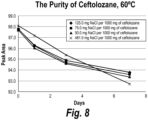
- Ceftolozane compositions having 50-481 mg of sodium chloride per 1,000 mg ceftolozane active were prepared as described in Table 5 and tested for stability as described in Example 5.
- Ceftolozane was more stable in compositions containing at least 125 mg of sodium chloride per 1,000 mg of ceftolozane active, as measured by high performance liquid chromatography (HPLC) analysis by detecting the ratio of peak areas obtained for ceftolozane compared to peaks for other substances.
- HPLC high performance liquid chromatography
- ceftolozane samples containing 125 mg, 190 mg and 481 mg of sodium chloride per 1,000 mg of ceftolozane active showed a decrease in ceftolozane total purity measured by HPLC that was at least about 35% less than reductions in ceftolozane total purity observed for formulations containing 50 mg or 75 mg sodium chloride per 1,000 mg ceftolozane active.
- ceftolozane compositions having at least 125 mg or more sodium chloride relative to the fixed amount of ceftolozane were about 35-90% more stable than comparable ceftolozane compositions having less than 125 mg sodium chloride (e.g., the % decrease in ceftolozane for the sample containing 75 mg sodium chloride was about 35% greater than the comparable % decrease in ceftolozane for the sample containing 190 mg sodium chloride).
- samples obtained from ceftolozane compositions containing 125 mg, 190 mg and 481 mg of sodium chloride per 1,000 mg of ceftolozane active showed a decrease in ceftolozane that was up to about 90% less than reductions in ceftolozane observed for formulations containing 50 mg or 75 mg sodium chloride per (e.g., the % decrease in ceftolozane for the sample containing 50 mg sodium chloride was about 90% greater than the comparable % decrease in ceftolozane for the sample containing 481 mg sodium chloride).
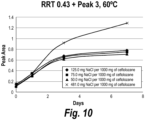
- ceftolozane sodium-stabilized compositions having 125 mg or more sodium chloride relative to the fixed amount of 1,000 mg ceftolozane active also had lower quantities of additional substances identified by peaks 1 and 7 having characteristic retention times measured by HPLC (see Table 1, indicating retention times of about 0.1 for peak 1 and about 1.3 for peak 7 relative to ceftolozane measured according to the HPLC method of Example 1).
- these sodium chloride stabilized ceftolozane compositions were characterized by about 37-94% less of the material of peak 1 and about 38-306% less of the material of peak 7 (measured by corresponding HPLC peak areas) than comparable ceftolozane compositions having less than 125 mg sodium chloride (e.g., see 7-day stability study in Example 5).
- the amount of the composition of peak 1 was measured by the % increase in the peak 1 HPLC peak during the 7-day stability test of Example 5.
- samples containing 125 mg, 190 mg and 481 mg of sodium chloride per 1,000 mg of ceftolozane active showed at least a 37% reduction in the amount of the peak 1 composition observed for these formulations containing at least 125 mg sodium chloride per 1,000 mg ceftolozane active, compared to the compositions with 50 mg or 75 mg sodium chloride per 1,000 mg of ceftolozane active (e.g., the % increase in peak 1 for the sample containing 75 mg sodium chloride was about 37% greater than the comparable % decrease in ceftolozane for the sample containing 190 mg sodium chloride).
- a pharmaceutical composition comprising ceftolozane and 125 mg sodium chloride per 1000 mg of ceftolozane, e.g., 125 to 500 mg sodium chloride per 1000 mg of ceftolozane, 200-500 mg sodium chloride per 1000 mg of ceftolozane, 300-500 mg sodium chloride per 1000 mg of ceftolozane, 400-500 mg sodium chloride per 1000 mg of ceftolozane, 450-500 mg sodium chloride per 1000 mg of ceftolozane, 460-500 mg sodium chloride per 1000 mg of ceftolozane, or about 476 mg sodium chloride per 1000 mg of ceftolozane, wherein the purity of the ceftolozane in the composition is 94.8% or greater after 3 days at 60°C.
- a pharmaceutical composition comprising ceftolozane and about 487 mg sodium chloride per 1000 mg of ceftolozane, wherein the purity of the ceftolozane in the composition is 94.8% or greater after 3 days at 60°C. In certain embodiments, the purity of the ceftolozane in the composition is 95% or greater, 96% or greater, 97% or greater, 98% or greater, or 99% or greater after 3 days at 60°C. Typically, purity of the ceftolozane in the compositions is measured using HPLC, for example using HPLC according to the method described in Example 1.
- a pharmaceutical composition comprising ceftolozane and 125 mg sodium chloride per 1000 mg of ceftolozane, e.g., 125 to 500 mg sodium chloride per 1000 mg of ceftolozane, 200-500 mg sodium chloride per 1000 mg of ceftolozane, 300-500 mg sodium chloride per 1000 mg of ceftolozane, 400-500 mg sodium chloride per 1000 mg of ceftolozane, 450-500 mg sodium chloride per 1000 mg of ceftolozane, 460-500 mg sodium chloride per 1000 mg of ceftolozane, or about 476 mg sodium chloride per 1000 mg of ceftolozane, wherein the purity of the ceftolozane in the composition decreases by 3.1% or less after 3 days at 60°C.
- a pharmaceutical composition comprising about 1,000 mg of ceftolozane active per 189 mg sodium from sodium chloride, and not more than 0.03% by high performance liquid chromatography (HPLC) of a RT63 Impurity at a retention time of about 63 minutes observed by HPLC using a Develosil column ODS-UG-5; 5 micrometers; 250 x 4.6 mm, a mobile phase of sodium perchlorate buffer solution (pH 2.5)/CH 3 CN 90:10 (v/v) at a 1.0 mL/min flow rate and oven temperature of 45 °C., the pharmaceutical composition obtained by a process comprising the step of lyophilizing an aqueous solution comprising 189 mg sodium from sodium chloride per 1,000 mg of ceftolozane active in the form of ceftolozane sulfate to obtain a lyophilized ceftolozane composition, and formulating the pharmaceutical composition from the lyophilized ceftolozane composition.
- HPLC high performance liquid
- the pH of the aqueous solution is 5.0 to 7.0, e.g., 6.0 to 7.0, and the aqueous solution further comprises L-arginine.
- the pharmaceutical composition is formulated for parenteral administration and further comprises citric acid.
- the composition is a unit dosage form in a container comprising tazobactam and 189 mg sodium from sodium chloride per 1,000 mg of ceftolozane active in the form of ceftolozane sulfate.
- the aqueous solution further comprises L-arginine and citric acid; the pH of the aqueous solution is 6.0 to 7.0 prior to lyophilization; and the pharmaceutical composition further comprises tazobactam blended with the lyophilized ceftolozane composition.
- a container containing a unit dosage form of a pharmaceutical composition formulated for parenteral administration for the treatment of complicated intra-abdominal infections or complicated urinary tract infections the pharmaceutical composition comprising 189 mg sodium from sodium chloride, and 1,000 mg ceftolozane active in the form of ceftolozane sulfate.
- the container comprises the ceftolozane sulfate, tazobactam and the sodium chloride and not more than 0.03% by high performance liquid chromatography (HPLC) of a RT63 Impurity (RRT 1.22) at a retention time of about 63 minutes observed by HPLC using a Develosil column ODS-UG-5; 5 micrometers; 250 x 4.6 mm, a mobile phase of sodium perchlorate buffer solution (pH 2.5)/CH 3 CN 90:10 (v/v) at a 1.0 mL/min flow rate and oven temperature of 45 °C.
- HPLC high performance liquid chromatography
- antibiotic compositions do not contain sodium chloride or contain only a small amount of sodium chloride.
- Maxipime ® which is approved for pneumonia, empiric therapy for febrile neutropenic patients, uncomplicated and complicated urinary tract infections, uncomplicated skin and skin structure infections, and complicated intra-abdominal infections, is a dry mixture of cefepime hydrochloride and L-arginine, wherein the mixture does not contain sodium chloride.
- Cefazolin ® for injection which is approved for respiratory tract infections, urinary tract infections, skin and skin structure infections, biliary tract infections, bone and joint infections, genital infections, septicemia, and endocarditis and perioperative prophylaxis, comprises lyophilized cefazolin sodium that does not contain additional sodium salt.
- Rocephin ® which is approved for lower respiratory tract infections, acute bacterial otitis media, skin and skin structure infections, urinary tract infections, uncomplicated gonorrhea, pelvic inflammatory disease, bacterial septicemia, bone and joint infections, intra-abdominal infections, meningitis, and surgical prophylaxis, comprises ceftriaxone sodium that only comprises 13.5 mg of free sodium per 1000 mg of ceftriaxone sodium, which equals about 34 mg sodium chloride per 1000 mg of ceftriaxone sodium if the free sodium is in sodium chloride form.
- compositions comprising ceftolozane and sodium chloride have high amounts of sodium chloride, e.g., 125-1000 mg sodium chloride per 1000 mg of ceftolozane.
- Ceftolozane has the chemical formula below and CAS registry number 689293-68-3 . "Ceftolozane” can be provided as the salt, ceftolozane sulfate.
- the phrase "1000 mg ceftolozane” or "1 g ceftolozane” refers to an amount of ceftolozane provided in the free base form or any suitable salt form containing 1000 mg free base equivalent.
- a composition containing 1000 mg of ceftolozane in the ceftolozane sulfate solid form will include greater than 1000 mg of material (e.g., due to at least the additional weight of the sulfate counter ion).
- the ceftolozane is present as ceftolozane sulfate.
- any amount of ceftolozane referred to in the aspects and embodiments of the invention refers to an amount that is considered a bioequivalent amount by the United States Food and Drug Administration (FDA), i.e. for which 90% CI of the relative mean Cmax, AUC(0-t) and AUC(0- ⁇ ) is within 80.00% to 125.00% of the reference formulation in the fasting state (see: " Guidance for Industry: Bioavailability and Bioequivalence Studies for Orally Administered Drug Products - General Considerations". Center for Drug Evaluation and Research, United States Food and Drug Administration, 2003 ).
- FDA United States Food and Drug Administration
- 125 to 1000 mg sodium chloride per 1000 mg of ceftolozane refers to a ratio of sodium chloride to ceftolozane free base equivalent.
- 125 to 1000 mg sodium chloride per 1000 mg of ceftolozane includes, for example, 62.5 to 500 mg sodium chloride per 500 mg of ceftolozane, as well as, for example, 25 to 200 mg sodium chloride per 200 mg ceftolozane, etc.
- compositions comprising ceftolozane, tazobactam, and 125 to 1000 mg sodium chloride per gram of ceftolozane exhibit better chemical stability and fewer additional compounds than those pharmaceutical compositions comprising ceftolozane and tazobactam, but less sodium chloride (see, e.g., Example 8).
- the pharmaceutical compositions comprising ceftolozane sulfate, tazobactam sodium, and 125 to 500 mg sodium chloride per 1000 mg of ceftolozane have been found to be more stable than the compositions comprising ceftolozane, tazobactam, and less than 125 mg sodium chloride per gram of ceftolozane.
- CXA-201 compositions comprising 125-481 mg sodium chloride per 1000 mg ceftolozane developed a reduced amount of a composition having a retention time of 63 minutes ("RT 63", also referred to herein as a compound of formula (III) and "RRT 1.22") after three months at 25 °C (see the HPLC measurements shown in Example 8A).
- RT 63 also referred to herein as a compound of formula (III) and "RRT 1.22”
- a pharmaceutical composition comprising ceftolozane sulfate, tazobactam sodium, and 125-650 mg sodium chloride per 1000 mg of ceftolozane, e.g., 125-500 mg sodium chloride per 1000 mg of ceftolozane, 200-500 mg sodium chloride per 1000 mg of ceftolozane, 300-500 mg sodium chloride per 1000 mg of ceftolozane, 400-500 mg sodium chloride per 1000 mg of ceftolozane, 450-500 mg sodium chloride per 1000 mg of ceftolozane, 460-500 mg sodium chloride per 1000 mg of ceftolozane, or about 476 mg sodium chloride per 1000 mg of ceftolozane.
- a pharmaceutical composition comprising ceftolozane sulfate, tazobactam sodium, and about 487 mg sodium chloride per 1000 mg of ceftolozane.
- a pharmaceutical composition comprising ceftolozane sulfate, tazobactam sodium, and 125-650 mg sodium chloride per 1000 mg of ceftolozane, e.g., 125-500 mg sodium chloride per 1000 mg of ceftolozane, 200-500 mg sodium chloride per 1000 mg of ceftolozane, 300-500 mg sodium chloride per 1000 mg of ceftolozane, 400-500 mg sodium chloride per 1000 mg of ceftolozane, 450-500 mg sodium chloride per 1000 mg of ceftolozane, 460-500 mg sodium chloride per 1000 mg of ceftolozane, or about 476 mg sodium chloride per 1000 mg of ceftolozane, where
- a pharmaceutical composition comprising ceftolozane sulfate, tazobactam sodium, and about 487 mg sodium chloride per 1000 mg of ceftolozane, wherein the purity of the ceftolozane in the composition is 94.9% or greater after 3 days at 60°C. In certain embodiments, the purity of the ceftolozane in the composition is 95% or greater, 96% or greater, 97% or greater, 98% or greater, or 99% or greater after 3 days at 60°C. Typically, purity of the ceftolozane in the compositions is measured using HPLC, for example using HPLC according to the method described in Example 1.
- tazobactam can be a free acid, a sodium salt, an arginine salt, or a hydrate or solvate thereof.
- a composition containing 500 mg of tazobactam in the tazobactam sodium solid form will include greater than 500 mg of material (e.g., due to at least the additional weight of the sodium counter ion).
- 500 mg of material e.g., due to at least the additional weight of the sodium counter ion.
- 537 mg tazobactam sodium corresponds to 500 mg of tazobactam free acid.
- the tazobactam is present as tazobactam sodium. If a tazobactam sodium composition contains "500 mg of tazobactam" then it includes an amount of tazobactam sodium comprising 500 mg of the tazobactam molecule in free acid equivalent form.
- the liquid pharmaceutical composition (e.g., an intravenous infusion solution) comprising 2,000 mg ceftolozane active and 1000 mg of tazobactam active (as pharmaceutically acceptable salts thereof) has an osmolality that is between about 500 mOsm/kg and 650 mOsm/kg.
- the liquid pharmaceutical composition (e.g., an intravenous infusion solution) has an osmolality that is less than about 600 mOsm/kg (e.g, 290-610 mOsm/kg, 350-605 mOsm/kg, 550-605 mOsm/kg, 589-604 mOsm/kg).
- ceftolozane and tazobactam of the liquid pharmaceutical composition are controlled to pH 5 to 7. In a further embodiment, the ceftolozane and tazobactam of the liquid pharmaceutical composition (e.g., an intravenous infusion solution) are controlled to about pH 6.
- the methods further comprise reconstituting the lyophilized mixture in an aqueous solvent, such that the resulting solution is suitable for infusion.
- the mixture can be reconstituted in saline and/or sterile water for injection.
- compositions comprising ceftolozane and stabilizing-effective amount of a stabilizing agent can be obtained by lyophilization.
- lyophilization is a process of freeze-drying in which water is sublimed from a frozen solution of one or more solutes. Specific methods of lyophilization are described in Remington's Pharmaceutical Sciences, Chapter 84, page 1565, Eighteenth Edition, A. R. Gennaro, (Mack Publishing Co., Easton, Pa., 1990 ).
- a pharmaceutical composition comprising ceftolozane can be prepared by adding a stabilizing amount of sodium chloride in a fixed ratio to ceftolozane in an aqueous solution prior to lyophilization, then lyophilizing the solution to obtain a lyophilized composition comprising sodium chloride and ceftolozane.
- the pharmaceutical antibiotic compositions can include stabilized ceftolozane sulfate obtained by a process comprising the steps of lyophilizing an aqueous solution containing ceftolozane and a stabilizing-effective amount of a stabilizing agent, where the stabilizing-effective amount of the stabilizing agent is about 100 to 500 mg (preferably 300-500 mg) of the stabilizing agent per 1,000 mg ceftolozane active in the aqueous solution prior to lyophilization.
- a therapeutically effective amount of ceftolozane (e.g., ceftolozane sulfate) and a stabilizing-effective amount of the stabilizing agent can dissolved in an aqueous solution that can be lyophilized to obtain a stabilized ceftolozane pharmaceutical composition.
- the method can further comprise the steps of: (1) forming a solution comprising sodium chloride and ceftolozane or a salt thereof followed by lyophilizing the solution; and (2) combining the lyophilized ceftolozane with other components (e.g., a ⁇ -lactamase inhibitor, such as tazobactam, or a lyophilized ⁇ -lactamase inhibitor, such as a lyophilized tazobactam) to obtain the pharmaceutical composition.
- the resulting pharmaceutical composition can be a powder for reconstitution to obtain an injectable pharmaceutical composition that can be intravenously administered to a patient.
- the method comprises adding 189 mg sodium from sodium chloride per 1000 mg of ceftolozane active in an aqueous solution, then lyophilizing the solution to obtain a lyophilized material comprising sodium chloride and ceftolozane sulfate in a ratio effective to provide a product with less than 0.03% of the RT63 Impurity as detected by HPLC in Example 2.
- compositions comprising ceftolozane can be obtained by methods that include the steps of: (1) adding a stabilizing amount of sodium chloride to ceftolozane optionally followed by co-lyophilizing or spray drying the ceftolozane and sodium chloride; and (2) combining the product of step (1) with other components.
- the product of step (1) can be combined with a ⁇ -lactamase inhibitor, such as tazobactam ( CAS#: 89786-04-9 ), avibactam ( CAS# 1192500-31-4 ), Sulbactam ( CAS# 68373-14-8 ) and/or clavulanate ( CAS# 58001-44-8 ).
- the beta lactamase inhibitor can be included in a crystalline or amorpous form, such as a lyophilized tazobactam or crystalline tazobactam (e.g., US Patent Nos. 8,476,425 and 5,763,603 ) to obtain the pharmaceutical composition.
- a lyophilized tazobactam or crystalline tazobactam e.g., US Patent Nos. 8,476,425 and 5,763,603
- the (second) tazobactam composition can be prepared in the absence of ceftolozane by forming a second solution comprising tazobactam.
- the tazobactam can be included in an amount providing about 500 mg of tazobactam active per 1,000 mg ceftolozane active (i.e., a 1:2 weight ratio of tazobactam active to ceftolozane active).
- tazobactam can be a free acid, a sodium salt, an arginine salt, or a hydrate or solvate thereof.
- antibiotic pharmaceutical compositions comprising ceftolozane sulfate and tazobactam sodium and less than about 0.15%, 0.10%, 0.05% or 0.03% by weight; or from 0.03-0.05%, 0.03-0.1% or 0.03-0.15% by HPLC of the compound of formula (III) are obtained by a process comprising the steps of: (a) lyophilizing tazobactam sodium in the absence of ceftolozane to obtain a lyophilized tazobactam composition, (b) lyophilizing ceftolozane sulfate in the absence of tazobactam to obtain a lyophilized ceftolozane composition, and (c) blending the lyophilized tazobactam composition with the lyophilized ceftolozane composition.
- compositions comprising the compound of formula (III), ceftolozane sulfate and tazobactam sodium can be formulated to treat infections by parenteral administration (including subcutaneous, intramuscular, and intravenous) administration.
- Pharmaceutical compositions may additionally comprise excipients, stabilizers, pH adjusting additives (e.g., buffers) and the like.
- pH adjusting additives e.g., buffers
- Non-limiting examples of these additives include sodium chloride, citric acid and L-arginine.
- the use of sodium chloride results in greater stability; L-arginine is used to adjust pH and to increase the solubility of ceftolozane; and citric acid is used to prevent discoloration of the product, due to its ability to chelate metal ions.
- the pharmaceutical compositions described herein are formulated for administration by intravenous injection or infusion.
- the pharmaceutical composition in the container can also be a Ceftolozane/Tazobactam for Injection Drug Product, 1000 mg/500 mg. It is presented as a combination of two sterile active powders in a single container intended for reconstitution and intravenous infusion.
- the drug product is prepared by converting ceftolozane sulfate to a sterile drug product intermediate (composition) powder with excipients citric acid, sodium chloride and L-arginine by lyophilization, as described herein.
- Tazobactam sodium drug substance can be presented as a sterile powder without any excipients.
- the tazobactam sodium drug substance is lyophilized.
- the drug product is then prepared by aseptically filling the two powders (e.g., the two separately lyophilized drug powders) sequentially into a single container.
- the container of ceftolozane/tazobactam for injection contains approximately 2255 mg ceftolozane-containing sterile composition powder that contains 1147 mg ceftolozane sulfate, which is equivalent to 1000 mg ceftolozane free base, as well as approximately 537 mg tazobactam sodium sterile drug substance, equivalent to 500 mg tazobactam free acid.
- the container is reconstituted with 10 mL vehicle, sterile 5% Dextrose Injection USP, Water for Injection or 0.9% Sodium Chloride Injection USP, then the container contents further diluted in an infusion bag of 0.9% Sodium Chloride Injection USP or 5% Dextrose Injection USP, for administration.
- the constituents are shown in Table 29.
- a pharmaceutical composition can include ceftolozane sulfate and tazobactam sodium in an amount providing 1,000 mg of ceftolozane active per 500 mg of tazobactam active, and 0.03% to 0.15% by HPLC of a compound of formula (III) (compound RRT 1.22) detectable at a retention time relative to ceftolozane of 1.22 by high performance liquid chromatography using a Develosil column ODS-UG-5; 5 micrometers; 250 x 4.6 mm, a mobile phase of sodium perchlorate buffer solution (pH 2.5)/CH 3 CN 90:10 (v/v) at a 1.0 mL/min flow rate and oven temperature of 45 °C.
- the pharmaceutical composition further includes 125 mg to 500 mg of sodium chloride per 1,000 mg of ceftolozane active, and can optionally include L-arginine.
- 125-500 mg sodium chloride per 1000 mg of ceftolozane is combined.
- the amount of the sodium chloride combined is 200-500 mg sodium chloride per 1000 mg of ceftolozane, 300-500 mg sodium chloride per 1000 mg of ceftolozane, 400-500 mg sodium chloride per 1000 mg of ceftolozane, 450-500 mg sodium chloride per 1000 mg of ceftolozane, 460-500 mg sodium chloride per 1000 mg of ceftolozane, or about 476 mg sodium chloride per 1000 mg of ceftolozane.
- the amount of the sodium chloride combined is about 487 mg sodium chloride per 1000 mg of ceftolozane.
- the method further comprises lyophilizing the ceftolozane sulfate in the absence of the tazobactam. and lyophilizing the tazobactam sodium in the absence of the ceftolozane.
- a pharmaceutical composition comprising ceftolozane sulfate and tazobactam sodium, wherein the composition comprises less than 0.5%, 0.4% 0.3%, 0.25%, 0.2%, 0.15%, 0.1%, or 0.05% by weight of the compound RRT 1.22.
- a pharmaceutical composition comprising ceftolozane sulfate and tazobactam sodium, wherein the composition comprises less than 0.1% by weight of the compound RRT 1.22.
- the pharmaceutical composition comprises less than 0.05% by weight of the compound RRT 1.22.
- the pharmaceutical composition comprises less than 0.15% by weight of the compound RRT 1.22.
- the pharmaceutical composition comprises no detectable amount of the compound RRT 1.22 as measured by HPLC.
- compositions of ceftolozane and tazobactam wherein the compositions were formed through co-lyophilization, i.e., the ceftolozane and tazobactam were combined and co-lyophilized together, as opposed to being individually lyophilized and blended together (see, e.g., Examples 7 and 10).
- an antibacterial pharmaceutical composition comprising ceftolozane sulfate and tazobactam sodium in a ratio of 1,000 mg ceftolozane active per 500 mg of tazobactam active, the pharmaceutical composition obtained by a process comprising the steps of: lyophilizing a first aqueous solution in the absence of tazobactam, the first aqueous solution comprising ceftolozane sulfate prior to lyophilization to obtain a first lyophilized ceftolozane composition; and blending the first lyophilized ceftolozane composition with lyophilized tazobactam sodium to obtain an antibacterial composition comprising less than 0.13% by HPLC of a compound of formula (III) (compound RRT 1.22) detectable at a retention time relative to ceftolozane of 1.22 by high performance liquid chromatography using a Develosil column ODS-UG-5; 5 micrometers; 250 x
- the antibacterial composition comprises less than 0.03% of the compound of formula (III) (compound RRT 1.22) detected by HPLC.
- the first aqueous solution further comprises L-arginine in an amount effective to adjust the pH of the first aqueous solution to 6-7 prior to lyophilization to obtain a first lyophilized ceftolozane composition.
- the antibacterial pharmaceutical composition is obtained by a process further comprising the steps of: lyophilizing a second solution comprising tazobactam sodium in the absence of ceftolozane to form a second lyophilized tazobactam composition; and blending the first lyophilized ceftolozane composition and the second lyophilized tazobactam composition to obtain the antibacterial composition.
- the first aqueous solution comprises L-arginine in an amount effective to provide a pH of about 5-7, e.g., 6-7. In another embodiment, the first aqueous solution comprises 125 mg to 500 mg of sodium chloride per 1,000 mg of ceftolozane active.
- the first aqueous solution further comprises citric acid.
- the first aqueous solution consists of ceftolozane sulfate, citric acid, sodium chloride, L-arginine, and water.
- a unit dosage form of a pharmaceutical composition formulated for parenteral administration for the treatment of complicated intra-abdominal infections or complicated urinary tract infections the pharmaceutical composition comprising ceftolozane sulfate and tazobactam sodium in a ratio of 1,000 mg ceftolozane active per 500 mg of tazobactam active
- the pharmaceutical composition obtained by a process comprising the steps of: lyophilizing a first aqueous solution in the absence of tazobactam, the first aqueous solution comprising ceftolozane sulfate, 125 mg to 500 mg of sodium chloride per 1,000 mg of ceftolozane active, at a pH of 6-7 prior to lyophilization to obtain a first lyophilized ceftolozane composition; lyophilizing a second solution comprising tazobactam sodium in the absence of ceftolozane to form a second lyophilized tazobactam composition; and
- the unit dosage form comprises a total of not more than 0.03% by HPLC of a compound of formula (III) (compound RRT 1.22) detectable at a retention time relative to ceftolozane of 1.22 by high performance liquid chromatography using a Develosil column ODS-UG-5; 5 micrometers; 250 x 4.6 mm, a mobile phase of sodium perchlorate buffer solution (pH 2.5)/CH 3 CN 90:10 (v/v) at a 1.0 mL/min flow rate and oven temperature of 45 °C
- the unit dosage form comprises a total of 1,000 mg of ceftolozane active and a total of 500 mg of tazobactam active.
- the unit dosage form comprises a total of not more than 0.03% by HPLC of a compound of formula (III) (compound RRT 1.22) detectable at a retention time relative to ceftolozane of 1.22 by high performance liquid chromatography using a Develosil column ODS-UG-5; 5 micrometers; 250 x 4.6 mm, a mobile phase of sodium perchlorate buffer solution (pH 2.5)/CH 3 CN 90:10 (v/v) at a 1.0 mL/min flow rate and oven temperature of 45 °C
- compositions containing two or more beta-lactam compounds in accordance with FDA Guidance, as well as pharmaceutical compositions manufactured in compliance with FDA Guidance. Specifically, certain manufacturing methods are provided herein that conform to standards recommended by FDA Guidance for the avoidance of cross-contamination of non-penicillin beta-lactam drugs.
- an antibacterial pharmaceutical composition formulated for parenteral administration for the treatment of infections, the pharmaceutical composition comprising a therapeutically effective amount of ceftolozane sulfate and tazobactam in a ratio of 1,000 mg ceftolozane active per 500 mg of tazobactam active, the pharmaceutical composition obtained by a process comprising the steps of:
- a unit dosage form of a pharmaceutical composition formulated for parenteral administration for the treatment of complicated intra-abdominal infections or complicated urinary tract infections the pharmaceutical composition comprising ceftolozane sulfate and tazobactam sodium in a ratio of 1,000 mg ceftolozane active per 500 mg of tazobactam active, the pharmaceutical composition obtained by a process comprising the steps of
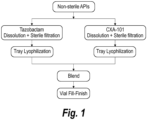
- FIG. 13a is a flowchart showing the process for preparing a CXA-201 composition comprising ceftolozane (referred to as CXA-101) and tazobactam using a blending process in a dedicated production area according to FDA Guidance.
- CXA-101 ceftolozane
- tazobactam tazobactam
- Figure 13b is a flowchart showing the process for preparing a ceftolozane/tazobactam composition via co-filling in a dedicated production area according to FDA Guidance.
- compositions comprising ceftolozane/tazobactam are being developed as an intravenous (IV) formulation for the treatment of complicated urinary tract infections (cUTIs) and complicated intra-abdominal infections (cIAIs).
- IV intravenous
- cUTIs complicated urinary tract infections
- cIAIs complicated intra-abdominal infections
- Ceftolozane/tazobactam is an antibacterial composition including ceftolozane, a cephalosporin with potent antipseudomonal cephalosporinactivity, in combination with tazobactam, a beta ( ⁇ )-lactamase inhibitor (BLI).
- ceftolozane is believed to exert its bactericidal activity by inhibiting essential penicillin-binding proteins (PBPs), resulting in inhibition of cell wall synthesis and subsequent cell death.
- PBPs penicillin-binding proteins
- Ceftolozane has activity against Pseudomonas aeruginosa including strains that are resistant to carbapenems, cephalosporins, fluoroquinolones, and aminoglycosides, and other common Gram-negative pathogens, including most extended-spectrum ⁇ -lactamase (ESBL)-producing Enterobacteriaceae.
- Tazobactam inhibits chromosomal- and plasmid-mediated bacterial class A and C ⁇ lactamases.
- Tazobactam is believed to protect ceftolozane from hydrolysis by covalently binding these enzymes, and broadens coverage to include most ESBL-producing Escherichia coli, Klebsiella pneumoniae, and other Enterobacteriaceae, including some Enterobacteriaceae overexpressing AmpC.
- Tazobactam inhibits or decreases the activity of beta-lactamases (e.g., bacterial beta-lactamases), and can be combined with beta-lactam compounds (e.g., antibiotics), thereby broadening the spectrum of the beta-lactam compound and increasing the beta-lactam compound's efficacy against organisms that produce beta-lactamase.
- a compound or a composition possesses efficacy against an organism if it kills or weakens the organism, or inhibits or prevents reproduction the organism.
- the CXA-201 product (ceftolozane/tazobactam for injection) is undergoing regulatory review for the treatment of complicated intra-abdominal infections(cIAI) caused by susceptible isolates of the Gram-negative and Gram-positive microorganisms such as: Citerobacter freundii, Escherichia coli, Enterobacter cloacae, Klebsiella pneumonia, Klebsiella oxytoca, Proteus mirabilis, and Pseudomonas aeruginosa. In patients who are at risk of mixed aerobic-anaerobic infection, concurrent therapy with an anti-anaerobic agent can also be used.
- cIAI complex intra-abdominal infections
- the CXA-201 product (ceftolozane/tazobactam for injection) is undergoing regulatory review for the treatment of complicated urinary tract infections (cUTI), including pyelonephritis caused by susceptible isolates of the following Gram-negative microorganisms: Enterobacter spp, Escherichia coli, Klebsiella pneumonia, Proteus mirabilis andPseudomonas aeruginosa.
- cUTI complicated urinary tract infections
- a pharmaceutical composition comprising a CXA-201 product (e.g, the unit dosage container of Table 29 below) is reconstituted in a pharmaceutically acceptable carrier (e.g., a total volume of about 90-150 mL, preferably about 110 mL, of 0.9% aqueous sodium chloride for injection or in initial volume of 10-20 mL of water for injection or 0.9% aqueous sodium chloride for injection, followed by dilution of this solution into a 100 mL volume of 0.9% aqueous sodium chloride for injection).
- a pharmaceutically acceptable carrier e.g., a total volume of about 90-150 mL, preferably about 110 mL, of 0.9% aqueous sodium chloride for injection or in initial volume of 10-20 mL of water for injection or 0.9% aqueous sodium chloride for injection, followed by dilution of this solution into a 100 mL volume of 0.9% aqueous sodium chloride for injection).
- the resulting pharmaceutical composition can be infused into a patient in need thereof for treatment of a complicated intra-abdominal infection (e.g, using 1 hour infusion times) three times per day (e.g., once every 8 hours) for a recommended duration of treatment (e.g. 4-10 days).
- a complicated intra-abdominal infection e.g, using 1 hour infusion times
- three times per day e.g., once every 8 hours
- a recommended duration of treatment e.g. 4-10 days.
- the preferred dosage of (ceftolozane/tazobactam for injection) for cUTI and cIAI is 1.5 g administered every 8 hours by intravenous (IV) infusion over 1 hour in patients ⁇ 18 years of age.
- IV intravenous
- the duration of therapy should be guided by the severity and site of infection and the patient's clinical and bacteriological progress.
- a pharmaceutical composition comprising a CXA-201 product (e.g, the unit dosage container of Table 29 below) is reconstituted in a pharmaceutically acceptable carrier (e.g., a total volume of about 90-150 mL, preferably about 110 mL, of 0.9% aqueous sodium chloride for injection or in initial volume of 10-20 mL of water for injection or 0.9% aqueous sodium chloride for injection, followed by dilution of this solution into a 100 mL volume of 0.9% aqueous sodium chloride for injection).
- a pharmaceutically acceptable carrier e.g., a total volume of about 90-150 mL, preferably about 110 mL, of 0.9% aqueous sodium chloride for injection or in initial volume of 10-20 mL of water for injection or 0.9% aqueous sodium chloride for injection, followed by dilution of this solution into a 100 mL volume of 0.9% aqueous sodium chloride for injection).
- the resulting pharmaceutical composition can be infused into a patient in need thereof for treatment of a Complicated Urinary Tract Infections (cUTI), Including Pyelonephritis (e.g, using 1 hour infusion times) three times per day (e.g., once every 8 hours) for a recommended duration of treatment (e.g. 7 days).
- cUTI Complicated Urinary Tract Infections
- Pyelonephritis e.g, using 1 hour infusion times
- three times per day e.g., once every 8 hours
- a recommended duration of treatment e.g. 7 days.
- Ceftolozane/tazobactam displays potent antibacterial activity against common Gram-negative organisms, including Enterobacteriaceae and Pseudomonas aeruginosa; select Gram-positive organisms, including streptococci; the majority of pathogenic enteric bacilli and select Gram-positive anaerobic species, thus making ceftolozane/tazobactam a potentially practical choice for pathogens involved in gastro-intestinal, urinary and community acquired as well as nosocomial respiratory infections.
- ceftolozane In general, the Gram-positive and Gram-negative spectrum of ceftolozane is similar to ceftazidime, but its antipseudomonal activity is the most potent among all currently available ⁇ -lactams, including the cephalosporins and carbapenems. Most importantly, ceftolozane has been shown to be active against strains of P. aeruginosa that are resistant to carbapenems, cephalosporins, fluoroquinolones, and aminoglycosides, including the majority of multi-drug resistant isolates. Indeed, the minimum inhibitory concentration (MIC) required to inhibit the growth of 90% of organisms (MIC90) for P. aeruginosa (MIC90 ⁇ 2 ⁇ g/mL) is the lowest among all systemically administered antipseudomonal antibiotics.
- MIC minimum inhibitory concentration
- a method for the treatment of bacterial infections in a mammal comprising administering to said mammal a therapeutically effective amount of a pharmaceutical composition prepared according to the methods described herein.
- a method for the treatment of bacterial infections in a mammal comprising administering to said mammal a therapeutically effective amount of tazobactam and ceftolozane.
- the bacterial infection is caused by an extended-spectrum beta-lactamase-producing organism.
- the bacterial infection is caused by an antibiotic-resistant organism.
- the invention is a method for the treatment of bacterial infections in a mammal, comprising administering to said mammal a therapeutically effective amount of a pharmaceutical composition comprising both tazobactam and ceftolozane.
- a pharmaceutical composition comprising both tazobactam and ceftolozane.
- the bacterial infection is caused by an extended-spectrum beta-lactamase-producing organism.
- the bacterial infection is caused by an antibiotic-resistant organism.
- a method for the treatment of bacterial infections in a mammal comprising administering to said mammal a therapeutically effective amount of a pharmaceutical composition according to the claims.
- Non-limiting examples of the bacterial infections that can be treated by the methods of the invention include infections caused by: aerobic and facultative gram-positive microorganisms (e.g., Staphylococcus aureus, Enterococcus faecalis, Staphylococcus epidermidis, Streptococcus agalactiae, Streptococcus pneumonia, Streptococcus pyogenes, Viridans group streptococci), aerobic and facultative gram-negative microorganisms (e.g., Acinetobacter baumanii, Escherichia coli, Haemophilus influenza, Klebsiella pneumonia, Pseudomonas aeruginosa, Citrobacter koseri, Moraxella catarrhalis, Morganella morganii, Neisseria gonorrhoeae, Proteus mirabilis, Proteus vulgaris, Serratia marcescens, Providencia stuartii
- the bacterial infections resulting from beta-lactamase-producing organisms are treated or controlled.
- beta-lactamase-producing organisms include:
- the bacterial infection is associated with one or more of the following conditions:
- tazobactam and hydrates and solvates thereof, in combination with ceftolozane, for the preparation of a medicament for the treatment of bacterial infections.
- the bacterial infections can result from either gram-negative or gram-positive organisms.
- the bacterial infections are Gram-negative bacterial infections.
- the gram-negative infections are complicated Urinary Tract Infections (cUTI) and complicated intra-abdominal infections (cIAI).
- the gram-negative bacterial infections are caused by Pseudomonas aeruginosa, E. coli, and/or Klebsiella pneumonia.
- a pharmaceutical composition comprising approximately 1147mg ceftolozane sulfate; approximately 537mg tazobactam sodium; and further comprising 400-500 mg sodium chloride, for use in a method of treating an infection in a mammal, wherein the infection is caused by Pseudomonas aeruginosa, Serratia marcescens, Escherichia coli, Klebsiella pneumoniae, Haemophilus influenzae, or Streptococcus pneumoniae.
- the pharmaceutical composition further comprises 500-650 mg L-arginine and 15-30 mg anhydrous citric acid.
- a pharmaceutical composition comprising approximately 1147 mg ceftolozane sulfate; approximately 537 mg tazobactam sodium; and further comprising 400-500 mg sodium chloride, for use in a method of treating a urinary tract infection, intra-abdominal infection, or nosocomial pneumonia in a mammal.
- the pharmaceutical composition further comprises 487mg sodium chloride.
- the pharmaceutical composition further comprises 500-650 mg L-arginine and 15-30 mg anhydrous citric acid.
- a pharmaceutical composition comprising approximately 1147 mg ceftolozane sulfate; approximately 537 mg tazobactam sodium; and further comprising approximately 487 mg sodium chloride; and approximately 600 mg L-arginine, for use in a method of treating an infection in a mammal, wherein the infection is caused by Pseudomonas aeruginosa, Serratia marcescens, Escherichia coli, Klebsiella pneumoniae, Haemophilus influenzae, or Streptococcus pneumoniae.
- the pharmaceutical composition further comprises 15-30 mg anhydrous citric acid.
- a pharmaceutical composition comprising approximately 1147 mg ceftolozane sulfate; approximately 537 mg tazobactam sodium; and further comprising approximately 487 mg sodium chloride; and approximately 600 mg L-arginine, for use in a method of treating a urinary tract infection, intra-abdominal infection, or nosocomial pneumonia.
- the pharmaceutical composition further comprises 15-30 mg anhydrous citric acid.
- the pharmaceutical composition comprises less than 0.1% such as less than 0.05% by weight of the compound RRT 1.22.
- the pharmaceutical composition further comprises sodium bicarbonate in an amount such that the pH of the composition is 4.8-7.0.
- the pharmaceutical composition comprises no more than 4% by weight of water.
- treating describes the management and care of a patient for the purpose of combating a disease, condition, or disorder and includes the administration of a pharmaceutical composition of the present invention to alleviate the symptoms or complications of a disease, condition or disorder, or to eliminate the disease, condition or disorder.
- the term “treat” can also include treatment of a cell in vitro or an animal model.
- a “therapeutically effective amount” of a compound of the invention is meant a sufficient amount of the compound to treat the disorder (e.g., bacterial infection).
- the specific therapeutically effective amount that is required for the treatment of any particular patient or organism will depend upon a variety of factors including the disorder being treated and the severity of the disorder; the activity of the specific compound or composition employed; the specific composition employed; the age, body weight, general health, sex and diet of the patient; the time of administration, route of administration, and rate of excretion of the specific compound employed; the duration of the treatment; drugs used in combination or coincidental with the specific compound employed; and like factors well known in the medical arts (see, for example, Goodman and Gilman's, "The Pharmacological Basis of Therapeutics", Tenth Edition, A. Gilman, J.Hardman and L. Limbird, eds., McGraw-Hill Press, 155-173, 2001 ).
- the therapeutically effective amount for a given situation can be readily determined by routine experimentation and is within the skill and judgment of the ordinary clinician.
- 189 mg sodium from sodium chloride per 1000 mg of ceftolozane refers to a ratio of sodium from the sodium chloride to ceftolozane active.
- 189 mg sodium from sodium chloride per 1000 mg of ceftolozane includes, for example, 94.5 mg sodium from sodium chloride per 500 mg of ceftolozane, as well as, for example, 47.25 mg sodium from sodium chloride per 250 mg ceftolozane.
- 1,000 mg of ceftolozane as ceftolozane sulfate refers to an amount of ceftolozane sulfate effective to provide 1,000 mg of ceftolozane.
- 189 mg sodium from sodium chloride refers to the amount of sodium chloride (e.g., 480 mg) effective to provide 189 mg of sodium.
- the amount of sodium from sodium chloride per gram of ceftolozane activity in a pharmaceutical composition containing ceftolozane sulfate, chloride and sodium chloride can be calculated using the relevant molecular weights of ceftolozane, ceftolozane sulfate, sodium chloride and sodium.
- a composition comprising about 1,147 mg ceftolozane sulfate and 189 mg sodium from sodium chloride contains 480 mg sodium chloride per 1,000 mg ceftolozane active.
- the term “Related Substances” with respect to HPLC detection refers to all the ceftolozane related process impurities and degradation products other than ceftolozane separated and detected by HPLC according to Example 1.
- the term “% Related Substances” refers to the % of the total HPLC peak area obtained by Example 1 attributed to all the ceftolozane related process impurities and degradation products other than ceftolozane.
- composition comprising X may consist exclusively of X or may include something additional e.g. X + Y.
- Example 1 HPLC analysis of Compositions Comprising Ceftolozane .
- HPLC methodologies described herein were used to acquire the data provided in Examples 5 and 8.
- Sodium perchlorate buffer solution was made by dissolving 14.05 g of sodium perchlorate monohydrate in 1000.0 mL of water followed by adjusting pH to 2.5 with diluted perchloric acid (1 in 20).
- Sodium acetate buffer solution pH 5.5 (diluent) was made by dissolving 1.36 g of sodium acetate trihydrate in 1000.0 mL of water followed by adjusting to pH 5.5 with diluted acetic acid (1 in 10).
- Sample solution dissolve 20.0 mg, exactly weighed, of the Sample, in 20.0 mL of water (Prepare just before injection into HPLC system).
- System suitability solution (1 %): take 1.0 mL of the sample solution (the first sample if more are present) and transfer into a 100.0 mL volumetric flask, dilute with water to volume and mix.
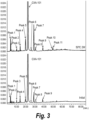
- Figure 3 is a reference HPLC chromatogram showing the peaks of ceftolozane (CXA-101) and related composition peaks.
- ceftolozane compositions were prepared, the components of which are shown in Table 3. These compositions were put in a stressed stability study at 70°C for 3 days and 6 days. The purity of the ceftolozane in the compositions was analyzed using the HPLC method described in Example 1. Table 3.
- composition comprising maltose (CEF/maltose) contained a significantly large amount of the composition P12 peak, which was identified as having the following formula:
- ceftolozane composition comprising sodium chloride (CEF/sodium chloride) was much more stable than the ceftolozane composition comprising maltose or the ceftolozane composition comprising no stabilizing agent. Therefore, sodium chloride was, unexpectedly, a better stabilizing agent for ceftolozane compositions. Table 4.
- Example 4a Manufacturing Procedure of Mono Product for Injection
- HPLC measurements on day 3 were used to analyze the stability of the CXA-101 compositions.
- Table 6 shows that, by day 3 of heating at 60 °C, sample A3, which contains a lower salt concentration within the limits of the invention at 125 mg, is still significantly more stable than A4, a composition containing 75.0 mg of the salt.
- A3 has a ⁇ t0-t3 of 3.1, while A4 has a ⁇ t0-t3 of 3.9, meaning that A4 has degraded 26% more than A3.
- composition peak 1 is considered “diagnostic" for formulation failure because it is the first peak to go out of trend or specification (1.5%).
- stability of these CXA-101 compositions was also measured by the length of storage until formulation failure as indicated by the composition peak 1.
- the data in Table 9a were extrapolated from data collected after 4 months.
- the composition with about 480 mg sodium chloride per 1 gram ceftolozane active was significantly more stable than the compositions containing 125 mg or 62.5 mg sodium chloride per 1 gram of active ceftolozane (i.e., stability of ceftolozane compositions: 480>>125 mg>62.5 mg).
- Table 9a Table 9a.
- Reference Example 6 Manufacturing Process of a CXA-201 Composition Comprising Tazobactam and CXA-101 / Ceftolozane by Co-lyophilization
- CXA-201 composition comprising tazobactam and ceftolozane by co-lyophilization
- Figure 2 The manufacturing process of a CXA-201 composition comprising tazobactam and ceftolozane by co-lyophilization is shown in Figure 2 .
- Non-sterile bulk tazobactam and bulk ceftolozane were mixed, followed by dissolution and sterile filtration.
- the filtrate was then tray-lyophilized to obtain the CXA-201 composition.
- the CXA-201 composition can be container-filled as a final drug product.
- Table 10 The components of a CXA-201 composition prepared by co-lyophilization are shown in Table 10. Table 10.
- Components of a CXA-201 Composition Prepared by Co-lyophilization Component Function Amount (mg/ container) ceftolozane Active pharmaceutical ingredient 1000 (potency) L-arginine Alkalization reagent 587 Citric acid (anhydrous) Buffer 21 Sodium chloride Stabilizer 476 Tazobactam (free acid) Active pharmaceutical ingredient 500 Sodium bicarbonate Alkalization reagent Quantity sufficient 1 for pH 4.8 to 7.0 water Dissolution solvent Not more than 4% by weight 2 Nitrogen Inert gas Sufficient quantity 1. Sodium content is approximately 78 mg/g of tazobactam in drug product after lyophilization. 2. Water is removed during the lyophilization process and is controlled at no more than 4% by weight.
- Reference Example 7 Assessment of Co-Lyophilized Combo Drug Product (i.e., a CXA-201 Composition)
- the components of the co-lyophilized CXA-201 composition are shown in Table 11. This composition was prepared, as described above in Reference Example 6. Table 11: Components of the CXA-201 Composition Prepared by Co-Lyophilization CXA-201 Comp. 16.3 g active ceftolozane 8.1 g active Tazobactam free ac. 15.5 g L-Arginine 350 mg Citric acid 7.9 g NaCl 6.1 pH compounded solution
- RRT 1.22 was identified as a compound formed by a reaction between ceftolozane and formylacetic acid, which was a by-product of tazobactam as illustrated in Marunaka et al. (Chem. Pharm. Bull. 1988, Vol. 36 (11), pp. 4478-4487 ).
- the stability data at 25 °C and at 40 °C have confirmed the continued formation of the compound RRT 1.22 over the course of time.
- the Co-Lyophilized Combo Drug Product was prepared as described above in Reference Example 6.
- the compound of formula (III) is believed to be formed by a reaction between ceftolozane and formylacetic acid, which was a degradation product of tazobactam.
- the amount of the compound of formula (III) in a composition comprising ceftolozane and tazobactam can be increased over time at 25 °C and at 40 °C.
- a test sample prepared from ceftolozane and tazobactam acid co-compounding solution containing RRT 1.22 impurity was used on the LC/MS experiment.
- Liquid chromatography separation was performed on a Zorbax SB C8, 3.5 ⁇ m, 3.0mm x 150mm column, using gradient elution with 20mM ammonium formate containing 0.1% Heptofluorobutyric acid pH 3.2 as mobile phase A and 0.1% Heptofluorobutyric acid in acetonitrile as mobile phase B.
- the gradient starts from 3% (initial) to 15% mobile phase B in 20 minutes (with RRT 1.22 eluting at about 10.7 minutes).
- Mass detection was performed using electrospray ionization technique under positive mode.
- the column effluent was also monitored at 254 nm using a photodiode-array detector.
- MS/MS fragmentation was performed on m/z 737.3 positive ion using nitrogen as collision gas, with collision energy set at 35V.
- CXA-201 compositions comprise ceftolozane and tazobactam, further comprising high, mid, or low amounts of sodium chloride (480, 125, or 62.5 mg NaCl per 1000 mg of ceftolozane, respectively). Comparison of the compositions are listed in Table 14. The amounts of the composition RT 63', as measured by the HPLC method, are summarized in Table 15. Table 14. Comparison of the CXA-201 Compositions Lot CXA-101 NaCl Tazobactam C1 10% High Na C2 20% Mid Na C3 20% Low Na C4 20% Mid Arginate C5 20% Low Arginate Table 15.
- RT 63' Peak Area at t 3 months, 25 °C/60% RH storage 1 st data collection 2nd data collection 3rd data collection Sample Summary RT Area % RT Area % RT Area % C1 High salt + Tazo Na 63.90 0.03 63.30 0.08 62.49 0.14 C2 Mid salt + Tazo Na 63.78 0.06 63.12 0.12 62.45 0.28 C3 Low salt + Tazo Na 63.75 0.12 63.11 0.14 62.46 0.29 C4 Mid salt + Tazo Arg 63.76 0.10 63.16 0.13 62.44 0.28 C5 Low salt + Tazo Arg 63.72 0.08 63.14 0.16 62.46 0.33
- the compositions comprising 480 mg NaCl per 1000 mg of ceftolozane had the least amount of the composition RT 63' after 3 months at 25 °C.
- the amount of the composition RT 63' in the compositions comprising 125 mg NaCl per 1000 mg of ceftolozane was 1.5-fold or greater than the amount of the composition 63' in the compositions comprising 480 mg NaCl per 1000 mg of ceftolozane.
- the amount of the composition RT 63' in the compositions comprising 62.5 mg NaCl per 1000 mg of ceftolozane was 2-fold or greater than the amount of the composition RT 63' in the compositions comprising 480 mg NaCl per 1000 mg of ceftolozane.
- the CXA-201 compositions comprising high amounts of sodium chloride e.g., 125-1000 mg sodium chloride per 1000 mg of ceftolozane
- the Sodium Chloride Content in the CXA-201 Compositions Samples NaCl content B1 481.0 mg sodium chloride per 1000 mg of ceftolozane B2 125.0 mg sodium chloride per 1000 mg of ceftolozane B3 75.0 mg sodium chloride per 1000 mg of ceftolozane B4 50.0 mg sodium chloride per 1000 mg of ceftolozane Table 17.
- CXA-201 compositions comprising high amounts of sodium chloride (e.g., 125-1000 mg sodium chloride per 1000 mg of ceftolozane) were found to be more chemically stable than CXA-201 compositions comprising low amounts of sodium chloride (e.g., less than 125 mg sodium chloride per 1000 mg of ceftolozane).
- Table 17 shows that, by day 3 of heating at 60 °C, sample B1 containing the highest salt concentration is most stable, i.e., has the lowest ⁇ t0-13 of all samples. By day 3, the sample with the lowest salt concentration, B4, has the highest ⁇ t0-t3 indicating the most degradation. Overall, B4 has degraded 15% more than B1.
- Example 9 Manufacturing Process of a CXA-201 Composition (Comprising tazobactam and ceftolozane) by Blending
- a low energy drum blender that agitates the material by tumbling and also moving the bed up and down is used.
- a representative process of blending is described as follows, also shown in Figure 1 .
- the blender was charged with 23.4 kg of CXA-101 bulk product, and 5.4 kg of tazobactam bulk product. Both the CXA-101 and tazobactam were individually lyophilized beforehand. The material was blended for 180 minutes. In-process tests of content assay for both CXA-101 and tazobactam were performed to assess the homogeneity using the samples of blend materials taken from three places.
- the relative standard deviation (RSD) for each of CXA-101 and tazobactam content assay was no greater than 2% and the RSD for the ratio of CXA-101/ tazobactam was no greater than 2% (See Table 21). Table 21.
- the blended powder is then discharged into Sterbags ® .
- a fill and finish process is utilized for the final drug product, which is a pharmaceutical composition comprising CXA-101 and tazobactam at a ratio of 1000 mg/ 500 mg.
- Glass containers are washed with WFI and depyrogenated in a Class 100 depyrogenation tunnel at a temperature of 320°C.
- Pre-washed and pre-siliconized stoppers are autoclaved for 40 minutes at 121°C.
- the bulk drug product is packaged in a Sterbag ® system comprised of three bags.
- the outer bag is cleaned with disinfectant in a Class 10,000 clean room.
- the bag system is placed in a pass-through UV box where it is subjected to UV radiation (> 20 ⁇ W/cm 2 ) for 20 minutes to sterilize the surface of the outer bag.
- the outer bag is removed and left in the UV box.
- the middle bag is placed in a Class A laminar airflow (LAF) hood.
- LAF laminar airflow
- the sterile middle bag is removed under LAF.
- the sterile, bottleshaped inner bag is then placed in a sterile stainless steel carrier and attached to the filling machine.
- Sterile bulk CXA-101/ tazobactam drug product is filled under a nitrogen blanket into 30-mL, Type I clear glass containers.
- the sterile drug product is gravity-fed into the filling machine under LAF.
- container fill weights are periodically checked throughout the filling operation to ensure proper operation of the filling line.
- Filling and stoppering operations are performed under Class 100 LAF conditions. Capping and container washing are done in the Class 10,000 clean room.
- the blend drug product was prepared, as described above in Example 9, on lab scale using a small blender.
- the components of the blend composition are shown in Table 22.
- CXA-201 Comp. CXA-101 for Injection Bulk (25 g) Ceftolozane 10.8 g L-Arginine 6.7 g Citric acid 233 mg Sodium chloride 5.2 g Tazobactam sodium sterile Bulk (6 g) 5.4 g (as Tazo free acid)
- compositions for intravenous administration should be formulated to resemble the and pH of human blood to reduce vascular complications.
- the recommended pH is between 5 and 9 (ideal pH is as close to 7.4 as possible). Departing from this recommended pH ranges of an intravenously administered composition can result in the development of complications such as phlebitis, or inflammation of the veins.
- Unfortunately, few drug infusions are stable at a suitable pH for intravenous administration.
- a drug is most stable or has the best solubility at a particular pH range (e.g., pH ⁇ 6) and divergence from this pH range may lead to increased drug decomposition. It is thus challenging to find a balance between the safe limits of pH and optimum drug stability in compositions for intravenous administration.
- pH ⁇ 6 a particular pH range
- Marc Stranz The Implications of Osmolality, Osmolarity and pH in Infusion Therapy, INS Annual Conference (May 2005 ).
- Ceftolozane recovery was consistently above 90% in the presence of sodium hydroxide, L-arginine, or sodium bicarbonate.
- sodium hydroxide performed well, as a strong base, it could promote base hydrolysis of the active more readily during scale up and be more difficult to dry during lyophilization than other alkalizing agents. Accordingly sodium hydroxide was not considered for further formulation development. L-arginine was thus chosen as the alkalizing agent for the formulation.
- Table 26 Effect of L-Arginine and Sodium Bicarbonate on Ceftolozane Related Substances during Storage, pH 6 Bulk solution composition per 1000 mg ceftolozane free base 632 mg L-arginine 485 mg sodium chloride 21 mg citric acid 288 mg sodium bicarbonate 481 mg sodium chloride 21 mg citric acid Storage condition Total Related Substances Sample pH Total Related Substances Sample pH Initial 1.42 % 5.8 2.12% 5.8 5 °C, 1 month 1.38% 5.8 2.66% 5.6 25 °C, 1 month 1.74% 5.5 4.99% 4.8 40 °C, 1 month 2.32% 5.0 5.93% 4.5
- Example 12 Components of a CXA-201 composition
- ceftolozane composition compounding of ceftolozane substance with excipients such as citric acid, sodium chloride, and L-arginine followed by sterile lyophilization
- Table 27 An example of a batch formulae for ceftolozane composition (compounding of ceftolozane substance with excipients such as citric acid, sodium chloride, and L-arginine followed by sterile lyophilization) is found below in Table 27.
- Table 27 Batch Formula for Ceftolozane composition Component Target Composition mg/g Amount per Batch (kg) 1 2 Ceftolozane Sulfate i) 172.1 114.0 202.6 Citric Acid, Anhydrous, USP 3.2 2.1 3.7 Sodium Chloride, USP 73.1 48.3 86.0 L-Arginine, USP ⁇ 90 QS to achieve target pH ii) 59.7 106.0 Water for Injection, USP QS to 1000 QS QS Total Batch Size 660 1175 1) Ceftolozane sulfate is charged based on its measured potency to obtain 150 mg free base/g solution. 2) L-arginine is added as needed to obtain pH 6.5 ⁇ 0.5 in the bulk solution; 90 mg per gram solution is considered a representative amount.
- Table 28 An example of a batch formula for the ceftolozane/tazobactam drug product is presented in Table 28 below.
- Table 28 Batch Formula Ceftolozane/Tazobactam Drug Product Component Amount per container, mg Amount per Batch, kg Ceftolozane composition i) 2255 112.8 Tazobactam ii) 537 26.9 Nitrogen, NF iii) - - Total 2792 139.7 Total Batch Size, kg 139.7 Total container Quantity 50,000 compositioni)
- the target fill for ceftolozane is 1000 mg free base, added to the container as the composition.
- the amount 2255 mg is based on 100% theoretical potency of the composition. Actual weight will vary based on composition measured potency.
- the target fill for tazobactam is 500 mg free acid, added to the container as its sodium salt form. The amount 537 mg is based on 100% theoretical potency.
- Nitrogen is used as a processing aid to blanket containers after powder filling and prior to insertion of stopper.
- Table 29 The unit composition of a dosage for reconstitution is described in Table 29.
- Table 29 Unit Compositions of Ceftolozane/Tazobactam for Injection, 1000 mg/ 500 mg Component Function Nominal Composition mg per container Ceftolozane composition 1) Ceftolozane Sulfate Active 1147 Citric Acid, Anhydrous Chelating Agent 21 Sodium Chloride Stabilizing Agent 487 L-Arginine Alkalizing Agent 600 2 ) Q.S. for pH adjustment Tazobactam Sodium 3) Active 537 Nitrogen Processing Aid (a) Q.S. Total Weight 2792 1) Actual amount of ceftolozane composition will vary based on the measured potency.
- Ceftolozane sulfate 1147 mg, corresponds to 1000 mg ceftolozane free base.
- L-arginine is added as needed to achieve pH 6.5 ⁇ 0.5; 600 mg per container is considered a representative total amount.
- Actual weight of tazobactam sodium will vary based on the measured potency.
- Tazobactam sodium 537 mg, corresponds to 500 mg tazobactam free acid 4) Nitrogen blanket is applied after powders are dispensed to the container and prior to insertion of stopper.
- Example 12a Development and Implementation of a System to Prevent Cross-Contamination in Accordance with FDA Guidance
- a CGMP Framework for Preventing Cross-Contamination provides direction on prevention of cross-contamination for facilities that manufacture non-penicillin beta-lactam drugs.
- Segregation steps to conform with FDA Guidance can include, but are not limited to:
- Example 13 Physicochemical and Biological Properties Ceftolozane / Tazobactam for Injection, 1000 mg / 500 mg
- the ceftolozane/tazobactam drug product is controlled to approximately pH 6, to provide physiological comfort, while still assuring adequate stability for the drug substances.
- the ceftolozane drug product intermediate is controlled during compounding to pH 6.5 ⁇ 0.5 and is controlled at release to pH 5 to 7.
- the tazobactam sodium is controlled at release to pH 5 to 7.
- Ceftolozane/tazobactam following reconstitution with normal saline and dilution for infusion also in normal saline (10 mg/mL ceftolozane; 5 mg/mL tazobactam) is slightly hypertonic, with osmolality approximately 500 mOsm/kg.
- slightly hypertonic intravenous infusion solutions are not uncommon as drug products are commonly prepared and diluted with already-isotonic solutions, such as normal saline.
- the generally accepted maximum upper limit for peripheral intravenous administration is approximately 900 mOsm/kg, though admixtures 600 to 900 mOsm/kg are typically administered through a central line. Therefore, to be within the limits of this range, the infusion product is less than 600 mOsm/kg.
- CXA-101 and Tazobactam Sodium samples were reconstituted as follows: Sample#1: Weighed 0.103g of Tazobactam Sodium and 0.462g of CXA-101dissolved in 4mL of WFI Water and 6mL of USP Normal Saline. Sample#2: Weighed 0.103g of Tazobactam Sodium and 0.462g of CXA-101dissolved in 4mL of WFI Water added 10mL of USP Normal Saline. Sample#3: Weighed 0.103g of Tazobactam Sodium dissolved in 1mL of WFI Water and 0.462g of CXA-101dissolved in 1mL of WFI Water then mixed together added 10mL of USP Normal Saline.
- a unit dosage form composition of Table 29 was reconstituted with 10mL of Sterile WFI or USP Normal Saline then added into 100mL 5% Dextrose Injection (D5W) or 0.9% Sodium Chloride (NS) bags and the osmolality of the resulting bag solution was determined as shown in table Table 30a below.
- Table 30a Osmolarity of Ceftolozane Bag Solution (mOsm/kg) Time Point sWFI - D5W NS - D5W sWFI - NS NS - NS RT T0 446 470 449 478
- excipients in exemplary ceftolozane compositions were chosen to ensure stability and processability of the ceftolozane drug substance into the drug product.
- the specific excipients, their quantities and functions are provided in Table 31. All excipients are compendial and typical for sterile pharmaceutical dosage forms, requiring no additional treatment prior to use in the formulation.
- the excipients are used in levels within the range established in other FDA approved products as described in the Inactive Ingredients Database (IID).
- Table 31 Excipients Used in Ceftolozane Composition Component Function Amount, mg/ container Concentration in Infusion Solution, % Rationale for Inclusion Inactive Ingredients Database (IID) Range Citric acid Chelating agent 21 0.02 Used to prevent discoloration and degradation 0.0025 to 50% Sodium Chloride Stabilizing agent 487 0.49 Used as a stabilizing agent for ceftolozane sulfate 0.187 to 45% L-arginine Alkalizing agent 600 (a) Q.S. for pH adjustment 0.60 Used to adjust ceftolozane solution pH 0.29 to 88% (a) L-arginine is added as needed to achieve pH 6.5 ⁇ 0.5; 600 mg per container is considered a representative total amount.
- IID Range Citric acid Chelating agent 21 0.02 Used to prevent discoloration and degradation 0.0025 to 50% Sodium Chloride Stabilizing agent 487 0.49 Used as a stabilizing agent for ceftolozane sulfate 0.187 to 45% L-arg
- Example 16 Manufacturing Process of a CXA-201 Composition (Comprising tazobactam and ceftolozane) by Co-Filling
- the ceftolozane /tazobactam finished drug product is a sterile powder fill of lyophilized active ingredients ceftolozane drug product intermediate (composition) and tazobactam sodium together into a sterile single container.
- the lyophilized form of the sterile tazobactam sodium contains no excipients.
- Ceftolozane sulfate drug substance is converted first into a sterile drug product intermediate, composition, by formulation with citric acid, sodium chloride and L-arginine, followed by lyophilization.
- the full manufacturing process includes unit operations typical of an aseptic lyophilization process and aseptic powder filling process.
- the overall process can be outlined in two stages, as presented in the manufacturing flow chart of Figure 12 .
- the first stage is the manufacturing of the sterile ceftolozane composition.
- the second stage is the filling of the sterile drug powders into containers for the final drug product.
- the major process steps are:
Landscapes
- Health & Medical Sciences (AREA)
- Chemical & Material Sciences (AREA)
- Life Sciences & Earth Sciences (AREA)
- Medicinal Chemistry (AREA)
- Veterinary Medicine (AREA)
- Pharmacology & Pharmacy (AREA)
- Animal Behavior & Ethology (AREA)
- General Health & Medical Sciences (AREA)
- Public Health (AREA)
- Epidemiology (AREA)
- Engineering & Computer Science (AREA)
- Chemical Kinetics & Catalysis (AREA)
- General Chemical & Material Sciences (AREA)
- Oil, Petroleum & Natural Gas (AREA)
- Inorganic Chemistry (AREA)
- Bioinformatics & Cheminformatics (AREA)
- Organic Chemistry (AREA)
- Nuclear Medicine, Radiotherapy & Molecular Imaging (AREA)
- Dermatology (AREA)
- Proteomics, Peptides & Aminoacids (AREA)
- Communicable Diseases (AREA)
- Oncology (AREA)
- Biochemistry (AREA)
- Molecular Biology (AREA)
- Virology (AREA)
- Pharmaceuticals Containing Other Organic And Inorganic Compounds (AREA)
- Medicinal Preparation (AREA)
- Agricultural Chemicals And Associated Chemicals (AREA)
- Cephalosporin Compounds (AREA)
Description
- This application claims priority to
U.S. Provisional Application No. 61/792,092, filed March 15, 2013 U.S. Provisional Application No. 61/793,007, filed March 15, 2013 U.S. Provisional Application No. 61/882,936, filed September 26, 2013 U.S. Provisional Application No. 61/893,436, filed October 21, 2013 - This disclosure relates to pharmaceutical compositions comprising tazobactam sodium and ceftolozane sulfate, methods of preparing those compositions, and related methods and uses thereof.
- Ceftolozane is a cephalosporin antibacterial agent. The antibacterial activity of ceftolozane is believed to result from its interaction with penicillin binding proteins (PBPs) to inhibit the biosynthesis of the bacterial cell wall which acts to stop bacterial replication. Ceftolozane is also referred to as "CXA-101", FR264205, (6R,7R)-3-[(5-amino-4-{[(2-aminoethyl)carbamoyl]amino}-1-methyl-1H-pyrazol-2-ium-2-yl)methyl]-7-({(2Z)-2-(5-amino-1,2,4-thiadiazol-3-yl)-2-[(1-carboxy-1-methylethoxy)imino]acetyl}amino)-8-oxo-5-thia-l-azabicyclo[4.2.0]oct-2-ene-2-carboxylate, or (6R,7R)-3-[5-Amino-4-[3-(2-aminoethyl)ureido]-1-methyl-1H-pyrazol-2-ium-2-ylmethyl]-7-[2-(5-amino-1,2,4-thiadiazol-3-yl)-2-[(Z)-1-carboxy-1-methylethoxyimino]acetamido]-3-cephem-4-carboxylic acid). As used herein, the term "ceftolozane" means (6R,7R)-3-[(5-amino-4-{[(2-aminoethyl)carbamoyl]amino}-1-methyl-1H-pyrazol-2-ium-2-yl)methyl]-7-({(2Z)-2-(5-amino-1,2,4-thiadiazol-3-yl)-2-[(1-carboxy-1-methylethoxy)imino]acetyl}amino)-8-oxo-5-thia-1-azabicyclo[4.2.0]oct-2-ene-2-carboxylate or (6R,7R)-3-[5-Amino-4-[3-(2-aminoethyl)ureido]-1-methyl-1H-pyrazol-2-ium-2-ylmethyl]-7-[2-(5-amino-1,2,4-thiadiazol-3-yl)-2-[(Z)-1-carboxy-1-methylethoxyimino]acetamido]-3-cephem-4-carboxylic acid in its free-base or salt form, including a sulfate form. Unless otherwise indicated, the term "CXA-101" means ceftolozane in any of these forms, i.e. ceftolozane in its free-base or salt form, including a sulfate form. Ceftolozane sulfate is a pharmaceutically acceptable salt of ceftolozane that can be combined with sodium chloride and other components to obtain an antibiotic composition suitable for administration by injection or infusion.
- Antibacterial pharmaceutical compositions can include ceftolozane as a pharmaceutically acceptable salt formulated for intravenous administration. Ceftolozane sulfate is a pharmaceutically acceptable ceftolozane salt of formula (I) that can be formulated for intravenous administration or infusion.

-
U.S. Patent No. 7,129,232 discloses ceftolozane and various ceftolozane salts. For example, a ceftolozane hydrogen sulfate salt is disclosed among ceftolozane salts that can be formed "with a base or an acid addition salt such as a salt with an inorganic base, for example, an alkali metal salt [e.g., sodium salt, potassium salt, etc.], an alkaline earth metal salt [e.g., calcium salt, magnesium salt, etc.], an ammonium salt; a salt with an organic base, for example, an organic amine salt [e.g., trimethylamine salt, triethylamine salt, pyridine salt, picoline salt, ethanolamine salt, triethanolamine salt, dicyclohexylamine salt, N,N'-dibenzylethylenediamine salt, etc.]; an inorganic acid addition salt [e.g., hydrochloride, hydrobromide, sulfate, hydrogen sulfate, phosphate, etc.]; an organic carboxylic or sulfonic acid addition salt [e.g., formate, acetate, trifluoroacetate, maleate, tartrate, citrate, fumarate, methanesulfonate, benzenesulfonate, toluenesulfonate, etc.]; and a salt with a basic or acidic amino acid [e.g., arginine, aspartic acid, glutamic acid, etc.]." - Antibiotic pharmaceutical compositions comprising a beta-lactam antibiotic compound (e.g., a cephalosporin) (i.e., an antibiotic compound possessing one or more beta-lactam moieties) can be administered with a beta-lactamase inhibitor (BLI) compound. For example, beta-lactam antibiotic compounds such as ceftolozane or other cephalosporin antibiotic compounds can be formulated with, and/or administered in combination with beta-lactamase inhibiting compounds (e.g., tazobactam and salts thereof) in order to mitigate the effects of bacterial beta-lactamase enzymes that can lead to bacterial resistance to antibiotic therapy. Tazobactam is a BLI compound approved for use in fixed dose combination with piperacillin in an injectable antibacterial product available under commercial names ZOSYN (U.S.) and TAZOCIN (e.g., in Canada, and the United Kingdom). Tazobactam sodium, a derivative of the penicillin nucleus, is a penicillanic acid sulfone having the chemical name sodium (2S,3S,5R)-3-methyl-7-oxo-3-(1H-1,2,3-triazol-1-ylmethyl)-4-thia-lazabicyclo[3.2.0]heptane-2-carboxylate-4,4-dioxide. The chemical formula is C10H11N4NaO5S and the molecular weight is 322.3. The chemical structure of tazobactam sodium is:
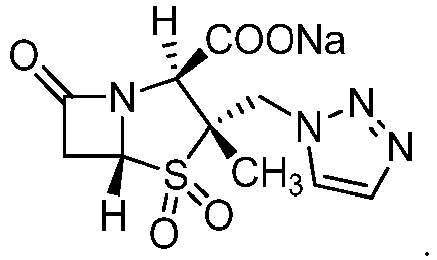
- Another antibiotic composition, called CXA-201 (ceftolozane/tazobactam), comprises ceftolozane and tazobactam in a 2:1 weight ratio, where the weight ratio between ceftolozane and tazobactam refers to the weight ratio of ceftolozane free base equivalent and tazobactam free acid equivalent, regardless of whether ceftolozane and tazobactam are present in these free forms or in salt forms. CXA-201 may be administered intravenously. CXA-201 compositions may include an amount of tazobactam in a pharmaceutically acceptable form providing 500 mg of tazobactam acid per 1000 mg of ceftolozane active as a composition formulated for injection, or for reconstitution prior to parenteral administration. In one product presentation, CXA-201 can be provided in a single container comprising ceftolozane sulfate and tazobactam sodium, administered by reconstituting solid CXA-201 in a unit dosage form container to form a reconstituted injectable formulation. In one presentation (e.g., for treatment of certain urinary tract infections and/or certain intra-abdominal infections), each unit dosage form container of CXA-201 can contain 1000 mg of ceftolozane active (free base equivalent weight, e.g., provided as a pharmaceutically acceptable salt such as ceftolozane sulfate) and sterile tazobactam sodium at a quantity equivalent of 500 mg of tazobactam free acid, in a solid form. In another presentation (e.g., for treatment of hospital acquired/ventilator-associated bacterial pneumonia (HABP/VABP)), a CXA-201 product can include a unit dosage form container providing 2,000 mg of ceftolozane active (e.g., as an equivalent amount of ceftolozane sulfate) and 1,000 mg of tazobactam acid (e.g., as an equivalent amount of tazobactam sodium). CXA-201 compositions display potent antibacterial activity against various gram-negative infections such as, for example, complicated intra-abdominal infection (cIAI), complicated urinary tract infection (cUTI), or hospital acquired/ventilator-associated bacterial pneumonia (HABP/VABP).
WO 2013/036783 andWO 2014/052799 disclose other CXA-201 compositions. - As disclosed herein, ceftolozane was initially found to be chemically unstable in certain lyophilized compositions evaluated during the development of CXA-101 and CXA-201 pharmaceutical compositions. For example, ceftolozane had a residual rate of about 51% in the absence of a stabilizing agent during both a 3 day stability test at 70 degrees C, indicating loss of almost half of the ceftolozane during the test (Example 2, Table 2 control sample), and a 5.88% reduction in ceftolozane purity during a 7 day stability test at 60 degrees C in the absence of a stabilizing agent (Example 2, Table 2a control sample). Second, the formation of a number of additional ceftolozane degradation products formed during the preparation of initial compositions were observed by additional peaks using high performance liquid chromatography (HPLC) during stability tests of ceftolozane alone (e.g., Peak P12 in Table 3 of Example 4), and testing of compositions with tazobactam and ceftolozane formed by co-lyophilization of ceftolozane and tazobactam (e.g., RRT1.22 peak in Tables 12 and 13 of Reference Example 7). Accordingly, there remains an unmet need to identify formulations and manufacturing methods that effectively stabilize ceftolozane both in a solid and liquid form to provide suitably stable pharmaceutical compositions comprising ceftolozane and tazobactam (both in a powder form for reconstitution and in a reconstituted form for parenteral delivery). These formulations should address the need to provide pharmaceutical compositions having desired levels of ceftolozane and tazobactam potency, as well as levels of impurities that are therapeutically acceptable for parenteral administration.
- This specification relates to pharmaceutical compositions and methods for preparing the said compositions as defined in the appended claims. Compositions comprising ceftolozane in absence of tazobactam, such as those disclosed in section I of the detailed description below are not according to the claims but are useful for understanding the claimed invention. The references to methods of treatment in the subsequent paragraphs of this description are to be interpreted as references to the compounds, pharmaceutical compositions and medicaments of the present invention for use in a method for treatment of the human (or animal) body by therapy (or for diagnosis).
- As provided herein, but not according to the claims, ceftolozane can be stabilized in pharmaceutical composition comprising ceftolozane and a stabilizing effective amount of a stabilizing agent selected from the group consisting of: sodium chloride,
dextran 40, lactose, maltose, trehalose and sucrose. The pharmaceutical compositions provided herein are based in part on the surprising discovery that ceftolozane pharmaceutical compositions comprising these stabilizing agents demonstrate improved ceftolozane residual rates (e.g., % ceftolozane remaining after 3 days at 70 °C as measured by HPLC, for example using HPLC according to the method described in Example 1) and/or chemical stability (e.g., lower reduction in ceftolozane purity measured by HPLC after 7 days at 60 °C in a stability test) compared to control samples comprising ceftolozane without a stabilizing agent. - Accordingly, pharmaceutical antibiotic compositions can include ceftolozane sulfate and a stabilizing agent (e.g., 300 to 500 mg of a stabilizing agent per 1,000 mg ceftolozane active) in a lyophilized unit dosage form (e.g., powder in a container). The unit dosage form can be dissolved with a pharmaceutically acceptable carrier (e.g., 0.9% sodium chloride aqueous isotonic saline and/or water for injection), and then intravenously administered. In certain ceftolozane compositions, the stabilizing agent can be selected from the group consisting of: sodium chloride, lactose, maltose and
dextran 40, and/or selected from the group consisting of: sodium chloride, trehalose and sucrose. - In addition, the present disclosure provides ceftolozane pharmaceutical compositions based in part on the surprising discovery that ceftolozane pharmaceutical compositions comprising about 1000 mg of ceftolozane active per 189 mg sodium from sodium chloride demonstrate improved chemical stability and purity compared with pharmaceutical compositions comprising ceftolozane with comparatively less sodium chloride. For example, the invention is based in part on the discovery of the absence of the "RT63 Impurity" (also referred to herein as RRT 1.22 and "Formula III") in HPLC analysis of pharmaceutical compositions comprising about 1,000 mg of ceftolozane and 189 mg sodium from sodium chloride. By comparison, reducing the amount of sodium chloride relative to ceftolozane in tested compositions resulted in at least 1.5-fold greater impurity at RT= 63 minutes (observed by HPLC using a Develosil column ODS-UG-5; 5 micrometers; 250 x 4.6 mm, a mobile phase of sodium perchlorate buffer solution (pH 2.5)/CH3CN 90:10 (v/v) at a 1.0 mL/min flow rate and oven temperature of 45 °C). The ceftolozane formulations with reduced levels of sodium were not as stable as the ceftolozane formulation containing about1,000 mg of ceftolozane per 189 mg sodium from sodium chloride per. Ceftolozane formulations containing about 1,000 mg of ceftolozane effective per stabilizing-effective amount of sodium from sodium chloride maintained the level of RT63 Impurity (also referred to herein as RRT 1.22 and "Formula III") below the detection limit (e.g., 0.03%) measured by HPLC using a Develosil column ODS-UG-5; 5 micrometers; 250 x 4.6 mm, a mobile phase of sodium perchlorate buffer solution (pH 2.5)/CH3CN 90:10 (v/v) at a 1.0 mL/min flow rate and oven temperature of 45 °C.
- Applicants have further discovered pharmaceutical compositions comprising ceftolozane and tazobactam with reduced and even undetectable amounts of the compound RRT 1.22, and methods of manufacturing these compositions. This is based in part on the discovery that the formation of RRT 1.22 can be reduced if not completely suppressed by lyophilizing ceftolozane in the absence of tazobactam and then blending the lyophilized ceftolozane with a dry tazobactam composition, such as a tazobactam composition lyophilized in the absence of ceftolozane (See Example 10 and the results reported in Tables 23 and 24). Based on these results, the present invention relates to pharmaceutical compositions comprising ceftolozane sulfate and tazobactam sodium, and pharmaceutical compositions prepared using ceftolozane sulfate and tazobactam sodium, as set out in the appended claims. In particular, these pharmaceutical compositions can include ceftolozane sulfate and/or tazobactam sodium with reduced or even undetectable amounts of the compound RRT 1.22 (also referred to herein as formula (III)):

- In one embodiment, a pharmaceutical composition can include ceftolozane sulfate and tazobactam sodium with less than 0.15%, 0.10%, 0.05% or 0.03% by weight; or from 0.03-0.05%, 0.03-0.1% or 0.03-0.15% by HPLC or even undectable amounts of RRT 1.22 (e.g., less than about 0.03% of the compound RRT 1.22 measured by HPLC). These pharmaceutical compositions can be obtained by a process comprising the steps of (a) lyophilizing ceftolozane sulfate in the absence of tazobactam to obtain a lyophilized ceftolozane composition; and (b) combining the lyophilized ceftolozane with lyophilized tazobactam sodium under conditions suitable to obtain said pharmaceutical composition with the aforementioned purity levels.
- Also provided herein is a pharmaceutical composition comprising a blend of separately lyophilized tazobactam sodium and ceftolozane sulfate in an amount providing 1,000 mg of ceftolozane active per 500 mg of tazobactam active, further comprising less than 0.15%, 0.10%, 0.05% or 0.03% by weight; from 0.03-0.05%, 0.03-0.1% or 0.03-0.15% by HPLC; or even undectable amounts (e.g., less than about 0.03% by HPLC) of a compound of formula (III) (also referred to herein as compound RRT 1.22) detectable at a retention time relative to ceftolozane of 1.22 by high performance liquid chromatography (HPLC) using a Develosil column ODS-UG-5; 5 micrometers; 250 x 4.6 mm, a mobile phase of sodium perchlorate buffer solution (pH 2.5)/CH3CN 90:10 (v/v) at a 1.0 mL/min flow rate and oven temperature of 45 °C (hereinafter referred to as the "method of Example 1").
- CXA-201 compositions comprising less than about 0.15%, 0.10%, 0.05% or 0.03% by weight; or from 0.03-0.05%, 0.03-0.1% or 0.03-0.15% by HPLC of the compound of formula (III) can be obtained by a process comprising the steps of: (a) forming a first aqueous solution comprising ceftolozane (e.g., in a pharmaceutically acceptable salt such as formula (I)), (b) lyophilizing the first aqueous solution to obtain a lyophilized ceftolozane composition, and (c) blending the lyophilized ceftolozane composition with a lyophilized tazobactam sodium composition (e.g., tazobactam sodium lyophilized in the absence of ceftolozane) in an amount that provides a 2:1 weight ratio between the amount of ceftolozane active and tazobactam active.
- In yet another aspect, provided herein is a method for the treatment of a bacterial infection in a mammal, comprising administering to said mammal a therapeutically effective amount of any one of the pharmaceutical compositions provided herein. In an embodiment, the bacterial infection is caused by the bacterial infection is caused by bacteria selected from the group consisting of: Staphylococcus aureus, Escherichia coli, Acinetobacter baumanii, Haemophilus influenzae, Klebsiella pneumonia, and Pseudomonas aeruginosa. In another embodiment, the bacterial infection is selected from the group consisting of nosocomial pneumonia, complicated intra-abdominal infection and complicated urinary tract infection.
- In yet another aspect, any of the pharmaceutical compositions provided herein may be used for the manufacture of a medicament for the treatment of complicated intra-abdominal infection (cIAI), complicated urinary tract infection (cUTI), or hospital acquired/ventilator-associated bacterial pneumonia (HABP/VABP).
-
-
Figure 1 is a flowchart showing the steps for preparing a CXA-201 composition comprising ceftolozane (referred to as CXA-101) and tazobactam using a blending process, wherein the ceftolozane and tazobactam are lyophilized separately prior to blending as described herein. -
Figure 2 is a flowchart showing the steps for preparing a CXA-201 composition comprising ceftolozane (referred to as CXA-101) and tazobactam using a co-lyophilization process, as described herein. -
Figure 3 is a reference HPLC chromatogram showing the peaks of ceftolozane (CXA-101) and related composition peaks. -
Figure 4 is a plot of the data points from Table 6, showing the purity of the ceftolozane in CXA-101 compositions at 60°C onday 0,day 1,day 3, andday 7, as measured by HPLC, wherein the CXA-101 compositions comprise ceftolozane and sodium chloride. -
Figure 5 is a plot of the data points from Table 7, showing the peak area of thecomposition peak 1 in CXA-101 compositions at 60 °C onday 0,day 1,day 3, andday 7, as measured by HPLC, wherein the CXA-101 compositions comprise ceftolozane and sodium chloride. -
Figure 6 is a plot of the data points from Table 8, showing the total peak area of the composition with a RRT of 0.43 and thecomposition peak 3 in CXA-101 compositions at 60 °C onday 0,day 1,day 3, andday 7, as measured by HPLC, wherein the CXA-101 compositions comprise ceftolozane and sodium chloride. -
Figure 7 is a plot of the data points from Table 9, showing the peak area of thecomposition peak 7 in CXA-101 compositions at 60 °C onday 0,day 1,day 3, andday 7, as measured by HPLC, wherein the CXA-101 compositions comprise ceftolozane and sodium chloride. -
Figure 8 is a plot of the data points from Table 17, showing the purity of ceftolozane in CXA-201 compositions at 60 °C onday 0,day 1,day 3, andday 7, as measured by HPLC, wherein the CXA-201 compositions comprise ceftolozane, tazobactam, and sodium chloride. -
Figure 9 is a plot of the data points from Table 18, showing the peak area of thecomposition peak 1 in CXA-201 compositions at 60 °C onday 0,day 1,day 3, andday 7, as measured by HPLC, wherein the CXA-201 compositions comprise ceftolozane, tazobactam, and sodium chloride. -
Figure 10 is a plot of the data points from Table 19, showing the total peak area of the composition with a RRT of 0.43 and thecomposition peak 3 in CXA-201 compositions at 60 °C onday 0,day 1,day 3, andday 7, as measured by HPLC, wherein the CXA-201 compositions comprise ceftolozane, tazobactam, and sodium chloride. -
Figure 11 is a plot of the data points from Table 20, showing the peak area of thecomposition peak 7 in CXA-201 compositions at 60 °C onday 0,day 1,day 3, andday 7, as measured by HPLC, wherein the CXA-201 compositions comprise ceftolozane, tazobactam, and sodium chloride. -
Figure 12 is a flowchart showing the manufacturing process for a ceftolozane/tazobactam composition via co-filling. -
Figure 13a is a flowchart showing the process for preparing a CXA-201 composition comprising ceftolozane (referred to as CXA-101) and tazobactam using a blending process in a dedicated production area according to FDA Guidance. -
Figure 13b is a flowchart showing the process for preparing a ceftolozane/tazobactam composition via co-filling in a dedicated production area according to FDA Guidance. -
Figure 14 shows the mass spectra obtained for the RRT 1.22 compound. -
Figure 15 shows the chemical structures for certain peaks in the spectra inFigure 14 . - Ceftolozane can be stabilized in a pharmaceutical composition comprising ceftolozane and a stabilizing effective amount of a stabilizing agent selected from the group consisting of: sodium chloride,
dextran 40, lactose, maltose, trehalose and sucrose. The stabilizing agent and the stabilizing effective amount of the stabilizing agent for combination with ceftolozane were determined by high performance liquid chromatography (HPLC) analysis, for example by detecting the ratio of peak areas obtained for ceftolozane compared to peaks for other substances. - Preferred stabilized ceftolozane compositions have a ceftolozane residual rate of greater than the residual rate measured for a comparable ceftolozane composition without the stabilizing agent. Unless otherwise indicated, the residual rate is measured by detecting the amount of ceftolozane in a sample before and after a stability test using HPLC, and determining the percentage of ceftolozane last during the stability test.
- Referring to Example 2 (including Table 2), the residual rate of ceftolozane in the control sample without a stabilizing agent (i.e., 100 mg of ceftolozane) after 3 days at 70 degrees C was 51.2%, meaning that the HPLC peak area after the stability test for ceftolozane was about 51.2% of the HPLC peak area for ceftolozane at the start of the stability test (i.e., 3 days at 70 degrees C). Sodium chloride,
dextran 40, lactose and maltose all showed higher ceftolozane residual rates than the control in Example 2, while ceftolozane was less stable than the control when combined with fructose, xylitol, sorbitol and glucose (e.g., as evidenced by a residual rate lower than that of the control). In one embodiment, stabilized ceftolozane compositions comprise ceftolozane (e.g., ceftolozane sulfate) and a stabilizing effective amount of a stabilizing agent selected from the group consisting of: sodium chloride,dextran 40, lactose and maltose, where the stabilizing effective amount provides a residual rate of at least 51.2% for the ceftolozane in the stabilized ceftolozane composition after 3 days at 70 degrees C. Preferably, the stabilized ceftolozane pharmaceutical compositions after 3 days at 70 degrees C can comprise at least about 70% of an initial amount of the stabilized ceftolozane in the pharmaceutical composition (i.e., a residual rate of about 70% or greater, as shown in Example 2), where the % of ceftolozane is measured by high performance liquid chromatography (HPLC) according to Example 1. - Referring to Example 2 (Table 2a), stabilized ceftolozane compositions are characterized by a reduction in ceftolozane of less than about 5% after 7 days at 60 degrees C, where the % reduction of ceftolozane is measured by HPLC according to Example 1. The stabilized ceftolozane pharmaceutical composition comprising ceftolozane and a stabilizing agent selected from the group consisting of: sodium chloride, trehalose and sucrose can lose less than 5% of the amount of ceftolozane after 7 days at 60 degrees C, where the % loss of ceftolozane is measured by HPLC according to Example 1. Sodium chloride, trehalose and sucrose all showed reduced reductions in ceftolozane purity after a 7 day stability test at 60 degrees C (as measured by the % HPLC peak corresponding to ceftolozane before and after the stability test). In one embodiment, stabilized ceftolozane compositions comprise ceftolozane (e.g., ceftolozane sulfate) and a stabilizing effective amount of a stabilizing agent selected from the group consisting of: sodium chloride, trehalose and sucrose, where the stabilizing effective amount provides a reduction in ceftolozane purity of not more than about 5% (e.g, not more than about 4%) for the ceftolozane in the stabilized ceftolozane composition after 3 days at 70 degrees C. Typically, purity of the ceftolozane in the compositions is measured using HPLC, for example using HPLC according to the method described in Example 1.
- Accordingly, in one aspect, provided herein is a pharmaceutical composition comprising stabilized ceftolozane obtained by a process comprising lyophilizing a composition including ceftolozane and a stabilizing agent selected from the group consisting of: sodium chloride,
dextran 40, lactose, maltose, tehalose and sucrose, to obtain a lyophilized stabilized ceftolozane pharmaceutical composition. In an embodiment, the stabilizing agent is selected from the group consisting of: sodium chloride, trehalose and sucrose. In another aspect, provided herein is a pharmaceutical composition comprising stabilized ceftolozane and a stabilizing agent selected from the group consisting of: sodium chloride,dextran 40, lactose, maltose, tehalose and sucrose, wherein the pharmaceutical composition after 3 days at 70 degrees C comprises at least about 70% of an initial amount of the stabilized ceftolozane in the pharmaceutical composition. - In another aspect, provided herein is a container containing a unit dosage form of a pharmaceutical composition formulated for parenteral administration for the treatment of complicated intra-abdominal infections or complicated urinary tract infections, the pharmaceutical composition comprising 1,000 mg of ceftolozane active, L-arginine, citric acid and about 300-500 mg of a stabilizing agent selected from the group consisting of: sodium chloride, trehalose, and sucrose, wherein the pharmaceutical composition after 3 days at 70 degrees C comprises at least about 70% of an initial amount of the ceftolozane active in the pharmaceutical composition.
- Various ceftolozane compositions are described herein. One stabilized ceftolozane composition comprises ceftolozane (e.g., ceftolozane sulfate), L-arginine, citric acid, and a stabilizing agent. Preferably, the stabilized ceftolozane composition comprises 1,000 mg of ceftolozane active, L-arginine and stabilizing-effective amount of the stabilizing agent. The stabilizing effective amount can be readily determined using HPLC and a stability test as disclosed herein. The stabilizing-effective amount can be effective to provide: (1) a residual rate measured by HPLC of ceftolozane of at least about 51.2% (including, e.g., at least about 70%, and at least about 80%) after 3 days at 70 degrees C and/or (2) a reduction in ceftolozane purity measured by HPLC of not more than about 5.11% (including, e.g., reductions of not more than about 5%, or 4%) after 7 days at 60 degrees C. Examples of stabilizing effective amounts include 100mg - 500 mg of the stabilizing agent per 1,000 mg of the ceftolozane active, more preferably about 300-500 mg of the stabilizing agent per 1,000 mg of the ceftolozane active.
- In the screening of ceftolozane stabilizing agents, it has been found that, surprisingly, a preferred amount of sodium chloride can improve the stability of ceftolozane, including ceftolozane in the ceftolozane sulfate form. For example, in one experiment, a ceftolozane composition comprising about 100 mg (about 1.71 mmol) sodium chloride per 100 mg (about 0.15 mmol) of ceftolozane was more stable compared to many ceftolozane compositions comprising known stabilizing sugars, such as fructose, xylitol, sorbitol, glucose, and D-mannitol, and as stable as other ceftolozane compositions comprising the same amount of certain sugars, such as
dextran 40, lactose, and maltose (see Example 2). Interestingly, additional experiments demonstrated that the use of maltose in a ceftolozane composition resulted in a significant amount of additional compounds (see Example 3). - Surprisingly, pharmaceutical compositions comprising ceftolozane and 125 to 1000 mg sodium chloride per 1000 mg of ceftolozane have been observed to exhibit better chemical stability over the course of time and/or in the presence of heat, and fewer additional compounds than those pharmaceutical compositions comprising ceftolozane and less sodium chloride (i.e., less than 125 mg sodium chloride per 1000 mg of ceftolozane) (see, e.g., Example 5). In particular embodiments described herein, the pharmaceutical compositions comprising ceftolozane and 125 to 500 mg sodium chloride per 1000 mg of ceftolozane have been found to be more stable than the compositions comprising ceftolozane and less than 125 mg sodium chloride per 1000 mg of ceftolozane.
- Ceftolozane compositions having 50-481 mg of sodium chloride per 1,000 mg ceftolozane active were prepared as described in Table 5 and tested for stability as described in Example 5. Ceftolozane was more stable in compositions containing at least 125 mg of sodium chloride per 1,000 mg of ceftolozane active, as measured by high performance liquid chromatography (HPLC) analysis by detecting the ratio of peak areas obtained for ceftolozane compared to peaks for other substances. (Unless otherwise indicated, HPLC measurements reported herein are obtained using a Develosil column ODS-UG-5; 5 micrometers; 250 x 4.6 mm, a mobile phase of sodium perchlorate buffer solution (pH 2.5)/CH3CN 90:10 (v/v) at a 1.0 mL/min flow rate and oven temperature of 45 °C.)
- During the stability test of Example 5, ceftolozane samples containing 125 mg, 190 mg and 481 mg of sodium chloride per 1,000 mg of ceftolozane active showed a decrease in ceftolozane total purity measured by HPLC that was at least about 35% less than reductions in ceftolozane total purity observed for formulations containing 50 mg or 75 mg sodium chloride per 1,000 mg ceftolozane active. Thus, ceftolozane compositions having at least 125 mg or more sodium chloride relative to the fixed amount of ceftolozane were about 35-90% more stable than comparable ceftolozane compositions having less than 125 mg sodium chloride (e.g., the % decrease in ceftolozane for the sample containing 75 mg sodium chloride was about 35% greater than the comparable % decrease in ceftolozane for the sample containing 190 mg sodium chloride). In addition, samples obtained from ceftolozane compositions containing 125 mg, 190 mg and 481 mg of sodium chloride per 1,000 mg of ceftolozane active showed a decrease in ceftolozane that was up to about 90% less than reductions in ceftolozane observed for formulations containing 50 mg or 75 mg sodium chloride per (e.g., the % decrease in ceftolozane for the sample containing 50 mg sodium chloride was about 90% greater than the comparable % decrease in ceftolozane for the sample containing 481 mg sodium chloride).
- The ceftolozane sodium-stabilized compositions having 125 mg or more sodium chloride relative to the fixed amount of 1,000 mg ceftolozane active also had lower quantities of additional substances identified by
peaks peak 1 and about 1.3 forpeak 7 relative to ceftolozane measured according to the HPLC method of Example 1). In particular, these sodium chloride stabilized ceftolozane compositions were characterized by about 37-94% less of the material ofpeak 1 and about 38-306% less of the material of peak 7 (measured by corresponding HPLC peak areas) than comparable ceftolozane compositions having less than 125 mg sodium chloride (e.g., see 7-day stability study in Example 5). Referring to the data in Table 7 (Figure 5 ), the amount of the composition of peak 1 (measured by HPLC according to Example 1) was measured by the % increase in thepeak 1 HPLC peak during the 7-day stability test of Example 5. - In particular, samples containing 125 mg, 190 mg and 481 mg of sodium chloride per 1,000 mg of ceftolozane active showed at least a 37% reduction in the amount of the
peak 1 composition observed for these formulations containing at least 125 mg sodium chloride per 1,000 mg ceftolozane active, compared to the compositions with 50 mg or 75 mg sodium chloride per 1,000 mg of ceftolozane active (e.g., the % increase inpeak 1 for the sample containing 75 mg sodium chloride was about 37% greater than the comparable % decrease in ceftolozane for the sample containing 190 mg sodium chloride). In addition, compositions containing 125 mg, 190 mg and 481 mg of sodium chloride per 1,000 mg of ceftolozane active showed up to a 94% reduction in the amount of thepeak 1 composition observed for these formulations containing at least 125 mg sodium chloride per 1,000 mg ceftolozane active, compared to the compositions with 50 mg or 75 mg sodium chloride per 1,000 mg of ceftolozane active (e.g., the % increase inpeak 1 for the sample containing 50 mg sodium chloride was about 94% greater than the comparable % decrease in ceftolozane for the sample containing 481 mg sodium chloride). - The formulation of pharmaceutical compositions can be selected to minimize decomposition of the constituent drug substances and to produce a composition that is stable under a variety of storage conditions.
- Provided herein are pharmaceutical compositions useful for the treatment of bacterial infections comprising ceftolozane and sodium chloride, wherein the sodium chloride is present in an amount sufficient to stabilize the ceftolozane. Also provided herein are pharmaceutical compositions comprising ceftolozane, tazobactam, and sodium chloride, wherein the sodium chloride is present in an amount sufficient to stabilize the ceftolozane. Advantageously, these pharmaceutical compositions have fewer additional compounds and are more chemically stable, and can therefore be stored for longer periods of time.
- In one embodiment, provided herein is a pharmaceutical composition comprising ceftolozane and 125 mg sodium chloride per 1000 mg of ceftolozane, e.g., 125 to 500 mg sodium chloride per 1000 mg of ceftolozane, 200-500 mg sodium chloride per 1000 mg of ceftolozane, 300-500 mg sodium chloride per 1000 mg of ceftolozane, 400-500 mg sodium chloride per 1000 mg of ceftolozane, 450-500 mg sodium chloride per 1000 mg of ceftolozane, 460-500 mg sodium chloride per 1000 mg of ceftolozane, or about 476 mg sodium chloride per 1000 mg of ceftolozane, wherein the purity of the ceftolozane in the composition is 75% or greater after 3 days at 70°C. In another embodiment, provided herein is a pharmaceutical composition comprising ceftolozane and about 487 mg sodium chloride per 1000 mg of ceftolozane, wherein the purity of the ceftolozane in the composition is 75% or greater after 3 days at 70°C. In certain embodiments, the purity of the ceftolozane in the composition is 80% or greater, 85% or greater, 90% or greater, 95% or greater, 97% or greater, or 99% or greater after 3 days at 70°C. Typically, purity of the ceftolozane in the compositions is measured using HPLC, for example using HPLC according to the method described in Example 1.
- In another embodiment, provided herein is a pharmaceutical composition comprising ceftolozane and 125 mg sodium chloride per 1000 mg of ceftolozane, e.g., 125 to 500 mg sodium chloride per 1000 mg of ceftolozane, 200-500 mg sodium chloride per 1000 mg of ceftolozane, 300-500 mg sodium chloride per 1000 mg of ceftolozane, 400-500 mg sodium chloride per 1000 mg of ceftolozane, 450-500 mg sodium chloride per 1000 mg of ceftolozane, 460-500 mg sodium chloride per 1000 mg of ceftolozane, or about 476 mg sodium chloride per 1000 mg of ceftolozane, wherein the purity of the ceftolozane in the composition is 94.8% or greater after 3 days at 60°C. In another embodiment, provided herein is a pharmaceutical composition comprising ceftolozane and about 487 mg sodium chloride per 1000 mg of ceftolozane, wherein the purity of the ceftolozane in the composition is 94.8% or greater after 3 days at 60°C. In certain embodiments, the purity of the ceftolozane in the composition is 95% or greater, 96% or greater, 97% or greater, 98% or greater, or 99% or greater after 3 days at 60°C. Typically, purity of the ceftolozane in the compositions is measured using HPLC, for example using HPLC according to the method described in Example 1.
- In still another embodiment, provided herein is a pharmaceutical composition comprising ceftolozane and 125 mg sodium chloride per 1000 mg of ceftolozane, e.g., 125 to 500 mg sodium chloride per 1000 mg of ceftolozane, 200-500 mg sodium chloride per 1000 mg of ceftolozane, 300-500 mg sodium chloride per 1000 mg of ceftolozane, 400-500 mg sodium chloride per 1000 mg of ceftolozane, 450-500 mg sodium chloride per 1000 mg of ceftolozane, 460-500 mg sodium chloride per 1000 mg of ceftolozane, or about 476 mg sodium chloride per 1000 mg of ceftolozane, wherein the purity of the ceftolozane in the composition decreases by 3.1% or less after 3 days at 60°C. In another embodiment, provided herein is a pharmaceutical composition comprising ceftolozane and about 487 mg sodium chloride per 1000 mg of ceftolozane, wherein the purity of the ceftolozane in the composition decreases by 3.1% or less after 3 days at 60°C. In certain embodiments, the purity of the ceftolozane in the composition decreases by 3.0% or less, 2.5% or less, 2.0% or less, 1.5% or less, or 1% or less after 3 days at 60°C. Typically, purity of the ceftolozane in the compositions is measured using HPLC, for example using HPLC according to the method described in Example 1.
- In another aspect, provided herein is a pharmaceutical composition comprising about 1,000 mg of ceftolozane active per 189 mg sodium from sodium chloride, and not more than 0.03% by high performance liquid chromatography (HPLC) of a RT63 Impurity at a retention time of about 63 minutes observed by HPLC using a Develosil column ODS-UG-5; 5 micrometers; 250 x 4.6 mm, a mobile phase of sodium perchlorate buffer solution (pH 2.5)/CH3CN 90:10 (v/v) at a 1.0 mL/min flow rate and oven temperature of 45 °C., the pharmaceutical composition obtained by a process comprising the step of lyophilizing an aqueous solution comprising 189 mg sodium from sodium chloride per 1,000 mg of ceftolozane active in the form of ceftolozane sulfate to obtain a lyophilized ceftolozane composition, and formulating the pharmaceutical composition from the lyophilized ceftolozane composition.
- In one embodiment, the pharmaceutical composition comprises a total of 1,000 mg of ceftolozane active. In another aspect, provided herein is a pharmaceutical composition obtained by a process comprising the step of lyophilizing an aqueous solution comprising 189 mg sodium from sodium chloride per 1,000 mg of ceftolozane in the form of ceftolozane sulfate to obtain a lyophilized ceftolozane composition.
- In one embodiment, the pH of the aqueous solution is 5.0 to 7.0, e.g., 6.0 to 7.0, and the aqueous solution further comprises L-arginine. In another embodiment, the pharmaceutical composition is formulated for parenteral administration and further comprises citric acid. In another embodiment, the composition is a unit dosage form in a container comprising tazobactam and 189 mg sodium from sodium chloride per 1,000 mg of ceftolozane active in the form of ceftolozane sulfate.
- In another embodiment, the aqueous solution further comprises L-arginine and citric acid; the pH of the aqueous solution is 6.0 to 7.0 prior to lyophilization; and the pharmaceutical composition further comprises tazobactam blended with the lyophilized ceftolozane composition.
- In still another aspect, provided herein is a container containing a unit dosage form of a pharmaceutical composition formulated for parenteral administration for the treatment of complicated intra-abdominal infections or complicated urinary tract infections, the pharmaceutical composition comprising 189 mg sodium from sodium chloride, and 1,000 mg ceftolozane active in the form of ceftolozane sulfate.
- In one embodiment, the container comprises the ceftolozane sulfate, tazobactam and the sodium chloride and not more than 0.03% by high performance liquid chromatography (HPLC) of a RT63 Impurity (RRT 1.22) at a retention time of about 63 minutes observed by HPLC using a Develosil column ODS-UG-5; 5 micrometers; 250 x 4.6 mm, a mobile phase of sodium perchlorate buffer solution (pH 2.5)/CH3CN 90:10 (v/v) at a 1.0 mL/min flow rate and oven temperature of 45 °C.
- Typically, antibiotic compositions do not contain sodium chloride or contain only a small amount of sodium chloride. For example, Maxipime®, which is approved for pneumonia, empiric therapy for febrile neutropenic patients, uncomplicated and complicated urinary tract infections, uncomplicated skin and skin structure infections, and complicated intra-abdominal infections, is a dry mixture of cefepime hydrochloride and L-arginine, wherein the mixture does not contain sodium chloride. Cefazolin® for injection, which is approved for respiratory tract infections, urinary tract infections, skin and skin structure infections, biliary tract infections, bone and joint infections, genital infections, septicemia, and endocarditis and perioperative prophylaxis, comprises lyophilized cefazolin sodium that does not contain additional sodium salt. Furthermore, Rocephin®, which is approved for lower respiratory tract infections, acute bacterial otitis media, skin and skin structure infections, urinary tract infections, uncomplicated gonorrhea, pelvic inflammatory disease, bacterial septicemia, bone and joint infections, intra-abdominal infections, meningitis, and surgical prophylaxis, comprises ceftriaxone sodium that only comprises 13.5 mg of free sodium per 1000 mg of ceftriaxone sodium, which equals about 34 mg sodium chloride per 1000 mg of ceftriaxone sodium if the free sodium is in sodium chloride form. In contrast, the pharmaceutical compositions provided herein (compositions comprising ceftolozane and sodium chloride, and compositions comprising ceftolozane, tazobactam, and sodium chloride), have high amounts of sodium chloride, e.g., 125-1000 mg sodium chloride per 1000 mg of ceftolozane.
- The compound 5-amino-4-{[(2-aminoethyl)carbamoyl]amino}-2-{[(6R,7R)-7-({(2Z)-2-(5-amino-1,2,4- thiadiazol-3-yl)-2-[(1-carboxy-1-methylethoxy)imino]acetyl}amino)-2-carboxy-8-oxo-5-thia-1-azabicyclo[4.2.0]oct-2-en-3-yl]methyl}-1-methyl-1H-pyrazolium monosulfate (also known also as ceftolozane, FR264205, "CXA-101", in its sulfate form) is a cephalosporin compound (shown below), the synthesis of which is described in
U.S. Patent No. 7,129,232 . Ceftolozane has the chemical formula below and CAS registry number 689293-68-3. "Ceftolozane" can be provided as the salt, ceftolozane sulfate.
-
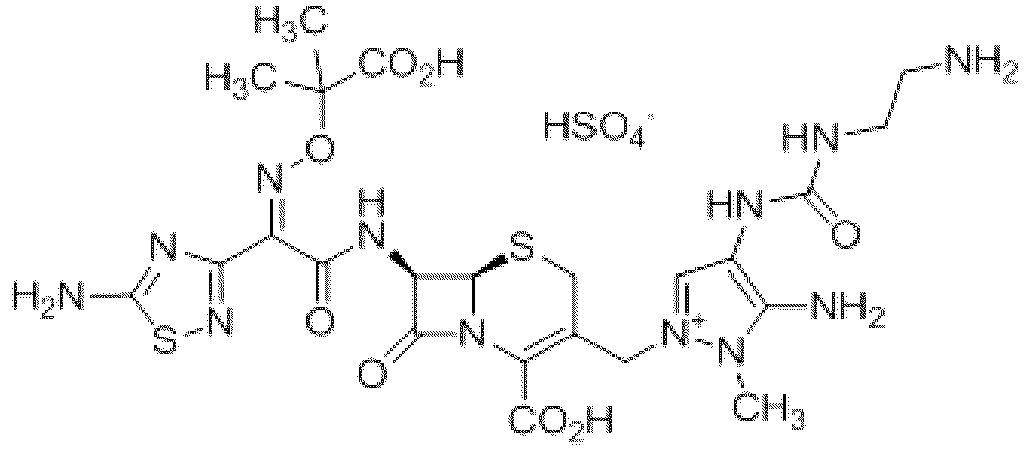
- Unless otherwise indicated herein, the phrase "1000 mg ceftolozane" or "1 g ceftolozane" refers to an amount of ceftolozane provided in the free base form or any suitable salt form containing 1000 mg free base equivalent. For example, a composition containing 1000 mg of ceftolozane in the ceftolozane sulfate solid form will include greater than 1000 mg of material (e.g., due to at least the additional weight of the sulfate counter ion). Preferably, the ceftolozane is present as ceftolozane sulfate. If a ceftolozane sulfate composition contains "1000 mg of ceftolozane" then it includes an amount of ceftolozane sulfate comprising 1000 mg of the ceftolozane molecule in free base equivalent form. For example, as shown in Table 29, 1147 mg ceftolozane sulfate corresponds to 1000 mg of ceftolozane free base.
- Unless otherwise stated, any amount of ceftolozane referred to in the aspects and embodiments of the invention refers to an amount that is considered a bioequivalent amount by the United States Food and Drug Administration (FDA), i.e. for which 90% CI of the relative mean Cmax, AUC(0-t) and AUC(0-∞) is within 80.00% to 125.00% of the reference formulation in the fasting state (see: "Guidance for Industry: Bioavailability and Bioequivalence Studies for Orally Administered Drug Products - General Considerations". Center for Drug Evaluation and Research, United States Food and Drug Administration, 2003). In an alternative embodiment, the qualification in the previous sentence regarding any amount of ceftolozane referred to in the aspects and embodiments of the invention does not apply.
- "Ceftolozane active" in the context of a salt form of ceftolozane, such as a sulfate form, refers to the active portion of a salt form of ceftolozane, i.e., the free base form of ceftolozane.
- As used herein, "125 to 1000 mg sodium chloride per 1000 mg of ceftolozane" refers to a ratio of sodium chloride to ceftolozane free base equivalent. For example, "125 to 1000 mg sodium chloride per 1000 mg of ceftolozane" includes, for example, 62.5 to 500 mg sodium chloride per 500 mg of ceftolozane, as well as, for example, 25 to 200 mg sodium chloride per 200 mg ceftolozane, etc.
- In another aspect, provided herein is a method for the treatment of bacterial infections in a mammal, comprising administering to said mammal a therapeutically effective amount of a pharmaceutical composition comprising ceftolozane as described herein.
- It has also been observed that pharmaceutical compositions comprising ceftolozane, tazobactam, and 125 to 1000 mg sodium chloride per gram of ceftolozane exhibit better chemical stability and fewer additional compounds than those pharmaceutical compositions comprising ceftolozane and tazobactam, but less sodium chloride (see, e.g., Example 8). In particular embodiments described herein, the pharmaceutical compositions comprising ceftolozane sulfate, tazobactam sodium, and 125 to 500 mg sodium chloride per 1000 mg of ceftolozane have been found to be more stable than the compositions comprising ceftolozane, tazobactam, and less than 125 mg sodium chloride per gram of ceftolozane.
- Adding high amounts of sodium chloride to CXA-201 compositions (e.g., 125-650 mg sodium chloride per 1000 mg of ceftolozane, 125-500 mg sodium chloride per 1000 mg of ceftolozane, 200-500 mg sodium chloride per 1000 mg of ceftolozane, 300-500 mg sodium chloride per 1000 mg of ceftolozane, 400-500 mg sodium chloride per 1000 mg of ceftolozane, 450-500 mg sodium chloride per 1000 mg of ceftolozane, 460-500 mg sodium chloride per 1000 mg of ceftolozane, or about 476 mg sodium chloride per 1000 mg of ceftolozane) also inhibits the formation of certain additional compounds. Adding about 487 mg sodium chloride per 1000 mg of ceftolozane to CXA-201 composition can also inhibit the formation of certain additional compounds. For example, in one experiment, CXA-201 compositions comprising 125-481 mg sodium chloride per 1000 mg ceftolozane developed a reduced amount of a composition having a retention time of 63 minutes ("RT 63", also referred to herein as a compound of formula (III) and "RRT 1.22") after three months at 25 °C (see the HPLC measurements shown in Example 8A).
- Accordingly, in one aspect, provided herein is a pharmaceutical composition comprising ceftolozane sulfate, tazobactam sodium, and 125-650 mg sodium chloride per 1000 mg of ceftolozane, e.g., 125-500 mg sodium chloride per 1000 mg of ceftolozane, 200-500 mg sodium chloride per 1000 mg of ceftolozane, 300-500 mg sodium chloride per 1000 mg of ceftolozane, 400-500 mg sodium chloride per 1000 mg of ceftolozane, 450-500 mg sodium chloride per 1000 mg of ceftolozane, 460-500 mg sodium chloride per 1000 mg of ceftolozane, or about 476 mg sodium chloride per 1000 mg of ceftolozane. In another embodiment, provided herein is a pharmaceutical composition comprising ceftolozane sulfate, tazobactam sodium, and about 487 mg sodium chloride per 1000 mg of ceftolozane. In another embodiment, provided herein is a pharmaceutical composition comprising ceftolozane sulfate, tazobactam sodium, and 125-650 mg sodium chloride per 1000 mg of ceftolozane, e.g., 125-500 mg sodium chloride per 1000 mg of ceftolozane, 200-500 mg sodium chloride per 1000 mg of ceftolozane, 300-500 mg sodium chloride per 1000 mg of ceftolozane, 400-500 mg sodium chloride per 1000 mg of ceftolozane, 450-500 mg sodium chloride per 1000 mg of ceftolozane, 460-500 mg sodium chloride per 1000 mg of ceftolozane, or about 476 mg sodium chloride per 1000 mg of ceftolozane, wherein the purity of the ceftolozane in the composition is 94.9% or greater after 3 days at 60°C. In another embodiment, provided herein is a pharmaceutical composition comprising ceftolozane sulfate, tazobactam sodium, and about 487 mg sodium chloride per 1000 mg of ceftolozane, wherein the purity of the ceftolozane in the composition is 94.9% or greater after 3 days at 60°C. In certain embodiments, the purity of the ceftolozane in the composition is 95% or greater, 96% or greater, 97% or greater, 98% or greater, or 99% or greater after 3 days at 60°C. Typically, purity of the ceftolozane in the compositions is measured using HPLC, for example using HPLC according to the method described in Example 1.
- The compound (2S,3S,5R)-3-methyl-7-oxo-3-(1H-1,2,3-triazol-1-ylmethyl)-4-thia-1-azabicyclo[3.2.0]heptane-2-
carboxylic acid 4,4-dioxide (also known as tazobactam) is a β-lactamase inhibitor of the following structure:
- As used herein, tazobactam can be a free acid, a sodium salt, an arginine salt, or a hydrate or solvate thereof. The phrases "250-750 mg tazobactam", "250-700 mg tazobactam", "300-700 mg tazobactam", "300-650 mg tazobactam", "350-650 mg tazobactam", "350-600 mg tazobactam", "400-600 mg tazobactam", "400-550 mg tazobactam", "450-550 mg tazobactam" or "about 500 mg tazobactam" refer to an amount of tazobactam provided in the free acid form or any suitable salt form containing 250-750 mg, 250-700 mg, 300-700 mg, 300-650 mg, 350-650 mg, 350-600 mg, 400-600 mg, 400-550 mg, 450-550 mg or about 500 mg free acid equivalent, respectively. For example, a composition containing 500 mg of tazobactam in the tazobactam sodium solid form will include greater than 500 mg of material (e.g., due to at least the additional weight of the sodium counter ion). For example, as shown in Table 29, 537 mg tazobactam sodium corresponds to 500 mg of tazobactam free acid. Preferably, the tazobactam is present as tazobactam sodium. If a tazobactam sodium composition contains "500 mg of tazobactam" then it includes an amount of tazobactam sodium comprising 500 mg of the tazobactam molecule in free acid equivalent form.
- Unless otherwise stated, any amount of tazobactam referred to in the aspects and embodiments of the invention refers to an amount that is considered a bioequivalent amount by the United States Food and Drug Administration (FDA), i.e. for which 90% CI of the relative mean Cmax, AUC(0-t) and AUC(0-∞) is within 80.00% to 125.00% of the reference formulation in the fasting state (see: "Guidance for Industry: Bioavailability and Bioequivalence Studies for Orally Administered Drug Products - General Considerations". Center for Drug Evaluation and Research, United States Food and Drug Administration, 2003). In alternative embodiment, the qualification in the previous sentence regarding any amount of tazobactam referred to in the aspects and embodiments of the invention does not apply.
- In an embodiment, the tazobactam is tazobactam sodium sterile powder. In yet a further embodiment, the tazobactam sodium sterile powder is generated by neutralizing tazobactam acid with sodium bicarbonate followed by lyophilization.
- As used herein, the term "tazobactam active", in the context of a salt form of tazobactam, refers to the active portion of a salt form of tazobactam, i.e., tazobactam free acid.
- In certain embodiments, the pharmaceutical compositions further comprise tazobactam sodium at a quantity equivalent of 500 mg of tazobactam free acid in a lyophilized powder form per 1000 mg of ceftolozane (anhydrous, free base equivalent).
- In another aspect disclosed herein but not according to the claims, provided herein is a liquid pharmaceutical composition (e.g., an intravenous infusion solution) comprising ceftolozane and tazobactam, wherein the composition is suitable for intravenous administration. In one embodiment, the composition further comprises 125-1000 mg sodium chloride per 1000 mg of ceftolozane. In another embodiment, the composition further comprises 125-500 mg sodium chloride per 1000 mg of ceftolozane. In an embodiment, the liquid pharmaceutical composition (e.g., an intravenous infusion solution) is prepared by reconstitution of a ceftolozane and tazobactam composition with sterile water and/or normal sterile saline, followed by dilution with sterile water and/or normal sterile saline. In an embodiment, the liquid pharmaceutical composition (e.g., an intravenous infusion solution) is prepared by reconstitution of a ceftolozane and tazobactam composition with normal sterile saline, followed by dilution with normal sterile saline. In another embodiment, the liquid pharmaceutical composition (e.g., an intravenous infusion solution) has an osmolality between about 300 mOsm/kg and 900 mOsm/kg, including injectable formulations with an osmolality of 350-900 mOsm/kg to 350-800 mOsm/kg, 400-500 mOsm/kg and 500-600 mOsm/kg. In a further embodiment, the liquid pharmaceutical composition (e.g., an intravenous infusion solution) comprising 1,000 mg ceftolozane active and 500 mg of tazobactam active (as pharmaceutically acceptable salts thereof) has an osmolality that is between about 400 mOsm/kg and 500 mOsm/kg (e.g, 446-478 mOsm/kg, 440-480 mOsm/kg, 420-490 mOsm/kg). In a further embodiment, the liquid pharmaceutical composition (e.g., an intravenous infusion solution) comprising 2,000 mg ceftolozane active and 1000 mg of tazobactam active (as pharmaceutically acceptable salts thereof) has an osmolality that is between about 500 mOsm/kg and 650 mOsm/kg. In yet a further embodiment, the liquid pharmaceutical composition (e.g., an intravenous infusion solution) has an osmolality that is less than about 600 mOsm/kg (e.g, 290-610 mOsm/kg, 350-605 mOsm/kg, 550-605 mOsm/kg, 589-604 mOsm/kg). In another embodiment, the ceftolozane and tazobactam of the liquid pharmaceutical composition (e.g., an intravenous infusion solution) are controlled to
pH 5 to 7. In a further embodiment, the ceftolozane and tazobactam of the liquid pharmaceutical composition (e.g., an intravenous infusion solution) are controlled to aboutpH 6. - In one embodiment, the methods further comprise reconstituting the lyophilized mixture in an aqueous solvent, such that the resulting solution is suitable for infusion. The mixture can be reconstituted in saline and/or sterile water for injection.
- Pharmaceutical compositions comprising ceftolozane and stabilizing-effective amount of a stabilizing agent can be obtained by lyophilization. As is known to those skilled in the art, lyophilization is a process of freeze-drying in which water is sublimed from a frozen solution of one or more solutes. Specific methods of lyophilization are described in Remington's Pharmaceutical Sciences, Chapter 84, page 1565, Eighteenth Edition, A. R. Gennaro, (Mack Publishing Co., Easton, Pa., 1990). A pharmaceutical composition comprising ceftolozane can be prepared by adding a stabilizing amount of sodium chloride in a fixed ratio to ceftolozane in an aqueous solution prior to lyophilization, then lyophilizing the solution to obtain a lyophilized composition comprising sodium chloride and ceftolozane.
- In particular, the pharmaceutical antibiotic compositions can include stabilized ceftolozane sulfate obtained by a process comprising the steps of lyophilizing an aqueous solution containing ceftolozane and a stabilizing-effective amount of a stabilizing agent, where the stabilizing-effective amount of the stabilizing agent is about 100 to 500 mg (preferably 300-500 mg) of the stabilizing agent per 1,000 mg ceftolozane active in the aqueous solution prior to lyophilization. A therapeutically effective amount of ceftolozane (e.g., ceftolozane sulfate) and a stabilizing-effective amount of the stabilizing agent can dissolved in an aqueous solution that can be lyophilized to obtain a stabilized ceftolozane pharmaceutical composition.
- The method can further comprise the steps of: (1) forming a solution comprising sodium chloride and ceftolozane or a salt thereof followed by lyophilizing the solution; and (2) combining the lyophilized ceftolozane with other components (e.g., a β-lactamase inhibitor, such as tazobactam, or a lyophilized β-lactamase inhibitor, such as a lyophilized tazobactam) to obtain the pharmaceutical composition. The resulting pharmaceutical composition can be a powder for reconstitution to obtain an injectable pharmaceutical composition that can be intravenously administered to a patient. In yet a further embodiment, the method comprises adding 189 mg sodium from sodium chloride per 1000 mg of ceftolozane active in an aqueous solution, then lyophilizing the solution to obtain a lyophilized material comprising sodium chloride and ceftolozane sulfate in a ratio effective to provide a product with less than 0.03% of the RT63 Impurity as detected by HPLC in Example 2.
- In other embodiments, pharmaceutical compositions comprising ceftolozane can be obtained by methods that include the steps of: (1) adding a stabilizing amount of sodium chloride to ceftolozane optionally followed by co-lyophilizing or spray drying the ceftolozane and sodium chloride; and (2) combining the product of step (1) with other components. For example, the product of step (1) can be combined with a β-lactamase inhibitor, such as tazobactam (CAS#: 89786-04-9), avibactam (CAS# 1192500-31-4), Sulbactam (CAS# 68373-14-8) and/or clavulanate (CAS# 58001-44-8). The beta lactamase inhibitor can be included in a crystalline or amorpous form, such as a lyophilized tazobactam or crystalline tazobactam (e.g.,
US Patent Nos. 8,476,425 and5,763,603 ) to obtain the pharmaceutical composition. - Pharmaceutical compositions according to the invention comprising ceftolozane sulfate and tazobactam sodium with reduced or even undectable levels of the compound of RRT 1.22 (e.g., including levels of RRT 1.22 that are not detectable by HPLC according to Example 1 and/or comprise less than 0.15%, 0.10%, 0.05% or 0.03% by weight; or from 0.03-0.05%, 0.03-0.1% or 0.03-0.15% by HPLC according to Example 1) can be obtained by blending a first composition comprising a therapeutically effective amount of ceftolozane sulfate in the absence of tazobactam with a second composition comprising a therapeutically effective amount of tazobactam sodium in the absence of ceftolozane to form a blended pharmaceutical composition.
- Without being bound by theory, the compound RRT 1.22 can be formed by a reaction between ceftolozane and formylacetic acid, a by-product of tazobactam as illustrated in Marunaka et al. (Chem. Pharm. Bull. 1988, Vol. 36 (11), pp. 4478-4487.
-
Figure 1 is a flowchart showing the steps for preparing a CXA-201 composition comprising ceftolozane (referred to as CXA-101) and tazobactam using a blending process, wherein the ceftolozane and tazobactam are lyophilized separately prior to blending as described herein. - The (first) ceftolozane composition can be prepared in the absence of tazobactam by forming a first aqueous solution comprising ceftolozane sulfate and other components including excipients, stabilizers, pH adjusting additives (e.g., buffers) and the like. Non-limiting examples of these additives include sodium chloride, citric acid and L-arginine. For example, the use of sodium chloride results in greater stability; L-arginine is used to adjust pH of the aqueous solution (e.g., to pH 6-7) and to increase the solubility of ceftolozane; and citric acid is used to prevent discoloration of the product, due to its ability to chelate metal ions. Preferably, the first aqueous solution comprises about 125 mg - 500 mg sodium chloride per 1,000 mg of ceftolozane active. The ceftolozane can be included as an amount of ceftolozane sulfate of formula (I) containing at least about 1,000 mg ceftolozane active. The (first) aqueous solution is then lyophilized to form a first lyophilized ceftolozane composition, which is combined with tazobactam, e.g., the lyophilized tazobactam (e.g., lyophilized tazobactam sodium) or crystalline tazobactam
- The (second) tazobactam composition can be prepared in the absence of ceftolozane by forming a second solution comprising tazobactam. The tazobactam can be included in an amount providing about 500 mg of tazobactam active per 1,000 mg ceftolozane active (i.e., a 1:2 weight ratio of tazobactam active to ceftolozane active). Unless otherwise indicated, tazobactam can be a free acid, a sodium salt, an arginine salt, or a hydrate or solvate thereof. In one embodiment, the tazobactam in the (second) tazobactam composition is tazobactam acid and the second composition further comprises sodium bicarbonate or sodium hydroxide. Lyophilizing tazobactam in the presence of sodium bicarbonate or sodium hydroxide forms a lyophilized tazobactam sodium, which can then be further blended with the (first) lyophilized ceftolozane composition.
- Pharmaceutical compositions with reduced or undectable amounts of the compound of RRT 1.22 can be obtained by lyophilizing ceftolozane without formylacetic acid and/or tazobactam under conditions that prevent formation of RRT 1.22 (e.g., Example 9). The presence of RRT 1.22 can be detected by HPLC (e.g., Examples 1, 6 and 7). Specific methods of lyophilization are described in Remington's Pharmaceutical Sciences, Chapter 84, page 1565, Eighteenth Edition, A. R. Gennaro, (Mack Publishing Co., Easton, Pa., 1990). The formation of the compound of formula (III) can be avoided by preventing the reaction of ceftolozane and formylacetic acid. In one embodiment, the compound of formula (III) can be suppressed by separately lyophlizing ceftolozane sulfate and tazobactam in separate solutions, and then blending the lyophilized compositions to form a pharmaceutical composition.
- In one aspect, antibiotic pharmaceutical compositions comprising ceftolozane sulfate and tazobactam sodium with less than about 0.15%, 0.10%, 0.05% or 0.03% by weight; or from 0.03-0.05%, 0.03-0.1% or 0.03-0.15% by HPLC of the compound of formula (III) are obtained by a process comprising the steps of: (a) lyophilizing ceftolozane sulfate in the absence of tazobactam to obtain a lyophilized ceftolozane composition, and (b) blending the lyophilized ceftolozane composition with a composition comprising lyophilized tazobactam sodium.
- In another aspect, antibiotic pharmaceutical compositions comprising ceftolozane and tazobactam and less than about 0.15%, 0.10%, 0.05% or 0.03% by weight; or from 0.03-0.05%, 0.03-0.1% or 0.03-0.15% by HPLC of the compound of formula (III) are obtained by a process comprising the steps of: (a) lyophilizing tazobactam sodium in the absence of ceftolozane to obtain a lyophilized tazobactam composition, and (b) blending the lyophilized tazobactam composition with a composition comprising lyophilized ceftolozane sulfate.
- In a third aspect, antibiotic pharmaceutical compositions comprising ceftolozane sulfate and tazobactam sodium and less than about 0.15%, 0.10%, 0.05% or 0.03% by weight; or from 0.03-0.05%, 0.03-0.1% or 0.03-0.15% by HPLC of the compound of formula (III) are obtained by a process comprising the steps of: (a) lyophilizing tazobactam sodium in the absence of ceftolozane to obtain a lyophilized tazobactam composition, (b) lyophilizing ceftolozane sulfate in the absence of tazobactam to obtain a lyophilized ceftolozane composition, and (c) blending the lyophilized tazobactam composition with the lyophilized ceftolozane composition.
- Pharmaceutical compositions comprising the compound of formula (III), ceftolozane sulfate and tazobactam sodium can be formulated to treat infections by parenteral administration (including subcutaneous, intramuscular, and intravenous) administration. Pharmaceutical compositions may additionally comprise excipients, stabilizers, pH adjusting additives (e.g., buffers) and the like. Non-limiting examples of these additives include sodium chloride, citric acid and L-arginine. For example, the use of sodium chloride results in greater stability; L-arginine is used to adjust pH and to increase the solubility of ceftolozane; and citric acid is used to prevent discoloration of the product, due to its ability to chelate metal ions. In one particular embodiment, the pharmaceutical compositions described herein are formulated for administration by intravenous injection or infusion.
- The pharmaceutical antibiotic compositions can be provided in a unit dosage form (e.g., in a container). The unit dosage form can be dissolved with a pharmaceutically acceptable carrier, and then intravenously administered. The unit dosage form comprises 1000 mg of ceftolozane active and 500 mg tazobactam active, specifically 1000 mg ceftolozane active as ceftolozane sulfate and 500 mg of tazobactam active as tazobactam sodium. The unit dosage forms are commonly stored in containers.
- In another aspect, provided herein is a unit dosage form of a pharmaceutical composition comprising 1,000 mg ceftolozane and 500 mg tazobactam, the pharmaceutical composition formulated for parenteral administration for the treatment of complicated intra-abdominal infections or complicated urinary tract infections, the pharmaceutical composition comprising ceftolozane sulfate and tazobactam, obtained by a process comprising the steps of: lyophlizing an aqueous solution to obtain a lyophilized ceftolozane composition, wherein the aqueous solution comprises water, ceftolozane sulfate, 125-500 mg sodium chloride per 1,000 mg ceftolozane active in the aqueous solution, an amount of L-arginine to provide a pH of 6-7 in the solution prior to lyophilization; and blending the lyophilized ceftolozane composition with a lyophilized tazobactam composition in an amount providing the ratio of about 500 mg tazobactam free acid per 1,000 mg of ceftolozane active to obtain the unit dosage form.
- Another embodiment of the invention is a container containing a unit dosage form of a pharmaceutical composition formulated for parenteral administration for the treatment of complicated intra-abdominal infections or complicated urinary tract infections. The container can be obtained by a process comprising the steps of: a) lyophilizing an aqueous solution comprising 189 mg sodium from sodium chloride per 1000 mg ceftolozane active in the form of ceftolozane sulfate and further comprising citric acid, and L-arginine to obtain a lyophilized ceftolozane composition; and b) filling a sufficient quantity of the lyophilized composition into a container to obtain a unit dosage form comprising 189 mg sodium from sodium chloride and 1,000 mg of ceftolozane active in the form of ceftolozane sulfate. In one aspect, the pH of the aqueous solution is 6.0 to 7.0. In another aspect the pharmaceutical composition is formulated for parenteral administration by reconstituting the pharmaceutical composition in the container (e.g., with 10 mL of diluent such as water for injection or isotonic saline) followed by addition of the reconstituted pharmaceutical composition to a carrier for injection (e.g., about 100 mL of isotonic saline or other pharmaceutically acceptable carrier for intravenous administration). The container is also filled with lyophilized tazobactam sodium.
- The pharmaceutical composition in the container can also be a Ceftolozane/Tazobactam for Injection Drug Product, 1000 mg/500 mg. It is presented as a combination of two sterile active powders in a single container intended for reconstitution and intravenous infusion. The drug product is prepared by converting ceftolozane sulfate to a sterile drug product intermediate (composition) powder with excipients citric acid, sodium chloride and L-arginine by lyophilization, as described herein. Tazobactam sodium drug substance can be presented as a sterile powder without any excipients. The tazobactam sodium drug substance is lyophilized. The drug product is then prepared by aseptically filling the two powders (e.g., the two separately lyophilized drug powders) sequentially into a single container.
- In an embodiment, the container of ceftolozane/tazobactam for injection contains approximately 2255 mg ceftolozane-containing sterile composition powder that contains 1147 mg ceftolozane sulfate, which is equivalent to 1000 mg ceftolozane free base, as well as approximately 537 mg tazobactam sodium sterile drug substance, equivalent to 500 mg tazobactam free acid. At the time of administration, the container is reconstituted with 10 mL vehicle, sterile 5% Dextrose Injection USP, Water for Injection or 0.9% Sodium Chloride Injection USP, then the container contents further diluted in an infusion bag of 0.9% Sodium Chloride Injection USP or 5% Dextrose Injection USP, for administration. The constituents are shown in Table 29.
- A pharmaceutical composition can include ceftolozane sulfate and tazobactam sodium in an amount providing 1,000 mg of ceftolozane active per 500 mg of tazobactam active, and 0.03% to 0.15% by HPLC of a compound of formula (III) (compound RRT 1.22) detectable at a retention time relative to ceftolozane of 1.22 by high performance liquid chromatography using a Develosil column ODS-UG-5; 5 micrometers; 250 x 4.6 mm, a mobile phase of sodium perchlorate buffer solution (pH 2.5)/CH3CN 90:10 (v/v) at a 1.0 mL/min flow rate and oven temperature of 45 °C. The pharmaceutical composition further includes 125 mg to 500 mg of sodium chloride per 1,000 mg of ceftolozane active, and can optionally include L-arginine.
- In one embodiment of these methods of preparing, 125-500 mg sodium chloride per 1000 mg of ceftolozane is combined. In another embodiment of these methods of preparing, the amount of the sodium chloride combined is 200-500 mg sodium chloride per 1000 mg of ceftolozane, 300-500 mg sodium chloride per 1000 mg of ceftolozane, 400-500 mg sodium chloride per 1000 mg of ceftolozane, 450-500 mg sodium chloride per 1000 mg of ceftolozane, 460-500 mg sodium chloride per 1000 mg of ceftolozane, or about 476 mg sodium chloride per 1000 mg of ceftolozane. In another embodiment of these methods of preparing, the amount of the sodium chloride combined is about 487 mg sodium chloride per 1000 mg of ceftolozane.
- In the claimed methods of preparing, the method further comprises lyophilizing the ceftolozane sulfate in the absence of the tazobactam. and lyophilizing the tazobactam sodium in the absence of the ceftolozane.
- Accordingly, in one aspect, provided herein is a pharmaceutical composition comprising ceftolozane sulfate and tazobactam sodium, wherein the composition comprises less than 0.5%, 0.4% 0.3%, 0.25%, 0.2%, 0.15%, 0.1%, or 0.05% by weight of the compound RRT 1.22. In another aspect, provided herein is a pharmaceutical composition comprising ceftolozane sulfate and tazobactam sodium, wherein the composition comprises less than 0.1% by weight of the compound RRT 1.22. In one embodiment, the pharmaceutical composition comprises less than 0.05% by weight of the compound RRT 1.22. In another embodiment, the pharmaceutical composition comprises less than 0.15% by weight of the compound RRT 1.22. In yet another embodiment, the pharmaceutical composition comprises no detectable amount of the compound RRT 1.22 as measured by HPLC.
- In contrast, a greater amount of compound RRT 1.22 was found in compositions of ceftolozane and tazobactam, wherein the compositions were formed through co-lyophilization, i.e., the ceftolozane and tazobactam were combined and co-lyophilized together, as opposed to being individually lyophilized and blended together (see, e.g., Examples 7 and 10).
- In one aspect, provided herein is an antibacterial pharmaceutical composition comprising ceftolozane sulfate and tazobactam sodium in a ratio of 1,000 mg ceftolozane active per 500 mg of tazobactam active, the pharmaceutical composition obtained by a process comprising the steps of: lyophilizing a first aqueous solution in the absence of tazobactam, the first aqueous solution comprising ceftolozane sulfate prior to lyophilization to obtain a first lyophilized ceftolozane composition; and blending the first lyophilized ceftolozane composition with lyophilized tazobactam sodium to obtain an antibacterial composition comprising less than 0.13% by HPLC of a compound of formula (III) (compound RRT 1.22) detectable at a retention time relative to ceftolozane of 1.22 by high performance liquid chromatography using a Develosil column ODS-UG-5; 5 micrometers; 250 x 4.6 mm, a mobile phase of sodium perchlorate buffer solution (pH 2.5)/CH3CN 90:10 (v/v) at a 1.0 mL/min flow rate and oven temperature of 45 °C.
- In one embodiment, the antibacterial composition comprises less than 0.03% of the compound of formula (III) (compound RRT 1.22) detected by HPLC. In another embodiment, the first aqueous solution further comprises L-arginine in an amount effective to adjust the pH of the first aqueous solution to 6-7 prior to lyophilization to obtain a first lyophilized ceftolozane composition.
- In the claimed method, the antibacterial pharmaceutical composition is obtained by a process further comprising the steps of: lyophilizing a second solution comprising tazobactam sodium in the absence of ceftolozane to form a second lyophilized tazobactam composition; and blending the first lyophilized ceftolozane composition and the second lyophilized tazobactam composition to obtain the antibacterial composition.
- In another embodiment, the first aqueous solution comprises L-arginine in an amount effective to provide a pH of about 5-7, e.g., 6-7. In another embodiment, the first aqueous solution comprises 125 mg to 500 mg of sodium chloride per 1,000 mg of ceftolozane active.
- In another embodiment, the first aqueous solution further comprises citric acid. In another embodiment, the first aqueous solution consists of ceftolozane sulfate, citric acid, sodium chloride, L-arginine, and water.
- In another aspect, provided herein is a unit dosage form of a pharmaceutical composition formulated for parenteral administration for the treatment of complicated intra-abdominal infections or complicated urinary tract infections, the pharmaceutical composition comprising ceftolozane sulfate and tazobactam sodium in a ratio of 1,000 mg ceftolozane active per 500 mg of tazobactam active, the pharmaceutical composition obtained by a process comprising the steps of: lyophilizing a first aqueous solution in the absence of tazobactam, the first aqueous solution comprising ceftolozane sulfate, 125 mg to 500 mg of sodium chloride per 1,000 mg of ceftolozane active, at a pH of 6-7 prior to lyophilization to obtain a first lyophilized ceftolozane composition; lyophilizing a second solution comprising tazobactam sodium in the absence of ceftolozane to form a second lyophilized tazobactam composition; and blending the first lyophilized ceftolozane composition and the second lyophilized tazobactam composition to obtain the antibacterial composition.
- In another embodiment, the unit dosage form comprises a total of not more than 0.03% by HPLC of a compound of formula (III) (compound RRT 1.22) detectable at a retention time relative to ceftolozane of 1.22 by high performance liquid chromatography using a Develosil column ODS-UG-5; 5 micrometers; 250 x 4.6 mm, a mobile phase of sodium perchlorate buffer solution (pH 2.5)/CH3CN 90:10 (v/v) at a 1.0 mL/min flow rate and oven temperature of 45 °C

- In another embodiment, the unit dosage form comprises a total of 1,000 mg of ceftolozane active and a total of 500 mg of tazobactam active.
- In another embodiment, the unit dosage form comprises a total of not more than 0.03% by HPLC of a compound of formula (III) (compound RRT 1.22) detectable at a retention time relative to ceftolozane of 1.22 by high performance liquid chromatography using a Develosil column ODS-UG-5; 5 micrometers; 250 x 4.6 mm, a mobile phase of sodium perchlorate buffer solution (pH 2.5)/CH3CN 90:10 (v/v) at a 1.0 mL/min flow rate and oven temperature of 45 °C

- Recent FDA manufacturing guidance (published in April 2013) states that manufacturing facilities dedicated to manufacturing a sensitizing non-penicillin beta-lactam compound should be "completely and comprehensively separated" from areas in the facility in which any class of sensitizing beta-lactam is manufactured. See U.S. Department of Health and Human Services Food and Drug Administration, Center for Drug Evaluation and Research, Non-Penicillin Beta-Lactam Drugs: A CGMP Framework for Preventing Cross-Contamination (April 2013) ("FDA Guidance"). The FDA also considers separation of production facilities for penicillins to be good manufacturing practice. The FDA Guidance can be understood to require the use of a dedicated facility to manufacture antibiotic compounds comprising a non-penicillin beta-lactam compound (e.g., a cephalosporin) and a BLI compound with a beta-lactam ring (e.g., tazobactam). Accordingly, a facility that manufactures a product containing both cephalosporin and a beta-lactam containing BLI such as tazobactam for sale in the United States cannot be subsequently used to manufacture any other products containing beta-lactam ring,other than additional combinations of other cephalosporins with the same BLI compound (e.g., other non-penicillin beta-lactam compounds including other cephalosporin antibitoics cannot be subsequently manufactured in the facility).
- Beta-lactam antibiotics, including penicillin and the non-penicillin classes, share a basic chemical structure that includes a three-carbon, one-nitrogen cyclic amine structure known as the beta-lactam ring. The side chain associated with the beta-lactam ring is a variable group attached to the core structure by a peptide bond; the side chain variability contributes to antibacterial activity. As of the date of this publication, FDA has approved over 34 beta-lactam compounds as active ingredients in drugs for human use. (see, e.g., FDA's Approved Drug Products with Therapeutic Equivalence Evaluations, generally known as the Orange Book) Beta-lactam antibiotics include the following five classes: penicillins (e.g., ampicillin, oxacillin); cephalosporins (e.g., cephalexin, cefaclor); penems (e.g., imipenem, meropenem); carbacephems (e.g., loracarbef); and monobactams (e.g., aztreonam). (Yao, JDC, and RC Moellering, Jr., Antibacterial agents, in Manual of Clinical Microbiology, 9th edition, edited by PR Murray et al., Washington D.C., ASM Press, 2007.)
- Under the FDA Guidance, a manufacturing facility handling a product for sale in the United States containing both a cephalosporin (e.g, ceftolozane) and a penicillin nucleus (e.g., tazobactam) cannot be subsequently used in the manufacture of any other class of beta-lactam products, including all other penicillins, cephalosporins, penems, carbacephems and monobactams or in the manufacture of other finished pharmaceuticals or active pharmaceutical ingredients. The FDA Guidance states that (non-penicillin) cephalosporin beta-lactam compounds (e.g., such as ceftolozane) for sale in the United States must be "completely and comprehensively separated from" manufacturing areas that handle any other class of beta-lactam compound (e.g., compounds in the penicillin class).
- A product containing ceftolozane and tazobactam includes both a non-penicillin beta-lactam cephalosporin (ceftolozane) and a beta-lactamase inhibitor with a beta-lactam moiety (tazobactam). Under the FDA Guidance, these two compounds must be "completely and comprehensively separated." Accordingly, there is a need for methods of manufacturing antibiotic compositions comprising ceftolozane and tazobactam for sale in the United States in compliance with the FDA Guidance, as well as antibiotic compositions manufactured in accordance with the FDA Guidance without affecting the purity, stability, and safety of the resulting composition.
- Provided herein are methods of manufacturing or preparing pharmaceutical compositions containing two or more beta-lactam compounds in accordance with FDA Guidance, as well as pharmaceutical compositions manufactured in compliance with FDA Guidance. Specifically, certain manufacturing methods are provided herein that conform to standards recommended by FDA Guidance for the avoidance of cross-contamination of non-penicillin beta-lactam drugs.
- In one aspect, provided herein is an antibacterial pharmaceutical composition formulated for parenteral administration for the treatment of infections, the pharmaceutical composition comprising a therapeutically effective amount of ceftolozane sulfate and tazobactam in a ratio of 1,000 mg ceftolozane active per 500 mg of tazobactam active, the pharmaceutical composition obtained by a process comprising the steps of:
- a. lyophilizing a first aqueous solution in the absence of tazobactam, the first aqueous solution comprising ceftolozane sulfate, to obtain a first lyophilized ceftolozane composition;
- b. blending the lyophilized ceftolozane composition with a tazobactam composition comprising tazobactam sodium prepared and provided in the absence of ceftolozane;
- In another aspect, provided herein is a unit dosage form of a pharmaceutical composition formulated for parenteral administration for the treatment of complicated intra-abdominal infections or complicated urinary tract infections, the pharmaceutical composition comprising ceftolozane sulfate and tazobactam sodium in a ratio of 1,000 mg ceftolozane active per 500 mg of tazobactam active, the pharmaceutical composition obtained by a process comprising the steps of
- a. lyophilizing a first aqueous solution in the absence of tazobactam, the first aqueous solution comprising ceftolozane sulfate, 125 mg to 500 mg of sodium chloride per 1,000 mg of ceftolozane active, to obtain a first lyophilized ceftolozane composition,
- b. lyophilizing a second solution comprising tazobactam sodium in the absence of ceftolozane to form a second lyophilized tazobactam composition; and
- c. blending the first lyophilized ceftolozane composition and the second lyophilized tazobactam composition to obtain the antibacterial composition;
-
Figure 13a is a flowchart showing the process for preparing a CXA-201 composition comprising ceftolozane (referred to as CXA-101) and tazobactam using a blending process in a dedicated production area according to FDA Guidance. -
Figure 13b is a flowchart showing the process for preparing a ceftolozane/tazobactam composition via co-filling in a dedicated production area according to FDA Guidance. - Pharmaceutical compositions comprising ceftolozane/tazobactam are being developed as an intravenous (IV) formulation for the treatment of complicated urinary tract infections (cUTIs) and complicated intra-abdominal infections (cIAIs).
- Ceftolozane/tazobactam is an antibacterial composition including ceftolozane, a cephalosporin with potent antipseudomonal cephalosporinactivity, in combination with tazobactam, a beta (β)-lactamase inhibitor (BLI). Like other members of the cephalosporin class, ceftolozane is believed to exert its bactericidal activity by inhibiting essential penicillin-binding proteins (PBPs), resulting in inhibition of cell wall synthesis and subsequent cell death. Ceftolozane has activity against Pseudomonas aeruginosa including strains that are resistant to carbapenems, cephalosporins, fluoroquinolones, and aminoglycosides, and other common Gram-negative pathogens, including most extended-spectrum β-lactamase (ESBL)-producing Enterobacteriaceae. Tazobactam inhibits chromosomal- and plasmid-mediated bacterial class A and C β lactamases. Tazobactam is believed to protect ceftolozane from hydrolysis by covalently binding these enzymes, and broadens coverage to include most ESBL-producing Escherichia coli, Klebsiella pneumoniae, and other Enterobacteriaceae, including some Enterobacteriaceae overexpressing AmpC. Tazobactam inhibits or decreases the activity of beta-lactamases (e.g., bacterial beta-lactamases), and can be combined with beta-lactam compounds (e.g., antibiotics), thereby broadening the spectrum of the beta-lactam compound and increasing the beta-lactam compound's efficacy against organisms that produce beta-lactamase. A compound or a composition possesses efficacy against an organism if it kills or weakens the organism, or inhibits or prevents reproduction the organism.
- The CXA-201 product (ceftolozane/tazobactam for injection) is undergoing regulatory review for the treatment of complicated intra-abdominal infections(cIAI) caused by susceptible isolates of the Gram-negative and Gram-positive microorganisms such as: Citerobacter freundii, Escherichia coli, Enterobacter cloacae, Klebsiella pneumonia, Klebsiella oxytoca, Proteus mirabilis, and Pseudomonas aeruginosa. In patients who are at risk of mixed aerobic-anaerobic infection, concurrent therapy with an anti-anaerobic agent can also be used.
- The CXA-201 product (ceftolozane/tazobactam for injection) is undergoing regulatory review for the treatment of complicated urinary tract infections (cUTI), including pyelonephritis caused by susceptible isolates of the following Gram-negative microorganisms: Enterobacter spp, Escherichia coli, Klebsiella pneumonia, Proteus mirabilis andPseudomonas aeruginosa. In one embodiment, a pharmaceutical composition comprising a CXA-201 product (e.g, the unit dosage container of Table 29 below) is reconstituted in a pharmaceutically acceptable carrier (e.g., a total volume of about 90-150 mL, preferably about 110 mL, of 0.9% aqueous sodium chloride for injection or in initial volume of 10-20 mL of water for injection or 0.9% aqueous sodium chloride for injection, followed by dilution of this solution into a 100 mL volume of 0.9% aqueous sodium chloride for injection). The resulting pharmaceutical composition can be infused into a patient in need thereof for treatment of a complicated intra-abdominal infection (e.g, using 1 hour infusion times) three times per day (e.g., once every 8 hours) for a recommended duration of treatment (e.g. 4-10 days).
- The preferred dosage of (ceftolozane/tazobactam for injection) for cUTI and cIAI is 1.5 g administered every 8 hours by intravenous (IV) infusion over 1 hour in patients ≥18 years of age. The duration of therapy should be guided by the severity and site of infection and the patient's clinical and bacteriological progress. In one embodiment, a pharmaceutical composition comprising a CXA-201 product (e.g, the unit dosage container of Table 29 below) is reconstituted in a pharmaceutically acceptable carrier (e.g., a total volume of about 90-150 mL, preferably about 110 mL, of 0.9% aqueous sodium chloride for injection or in initial volume of 10-20 mL of water for injection or 0.9% aqueous sodium chloride for injection, followed by dilution of this solution into a 100 mL volume of 0.9% aqueous sodium chloride for injection). The resulting pharmaceutical composition can be infused into a patient in need thereof for treatment of a Complicated Urinary Tract Infections (cUTI), Including Pyelonephritis (e.g, using 1 hour infusion times) three times per day (e.g., once every 8 hours) for a recommended duration of treatment (e.g. 7 days).
- Ceftolozane/tazobactam displays potent antibacterial activity against common Gram-negative organisms, including Enterobacteriaceae and Pseudomonas aeruginosa; select Gram-positive organisms, including streptococci; the majority of pathogenic enteric bacilli and select Gram-positive anaerobic species, thus making ceftolozane/tazobactam a potentially practical choice for pathogens involved in gastro-intestinal, urinary and community acquired as well as nosocomial respiratory infections. In general, the Gram-positive and Gram-negative spectrum of ceftolozane is similar to ceftazidime, but its antipseudomonal activity is the most potent among all currently available β-lactams, including the cephalosporins and carbapenems. Most importantly, ceftolozane has been shown to be active against strains of P. aeruginosa that are resistant to carbapenems, cephalosporins, fluoroquinolones, and aminoglycosides, including the majority of multi-drug resistant isolates. Indeed, the minimum inhibitory concentration (MIC) required to inhibit the growth of 90% of organisms (MIC90) for P. aeruginosa (MIC90 ≤ 2 µg/mL) is the lowest among all systemically administered antipseudomonal antibiotics.
- In vitro studies have demonstrated that ceftolozane/tazobactam has a broad spectrum of activity against Gram-negative bacteria. The in vitro activity of ceftolozane and ceftolozane/tazobactam was evaluated against a broad range of Gram-positive and Gram-negative bacteria. It was observed that tazobactam potentiated the activity of ceftolozane against Acinetobacter spp. and common species of Enterobacteriaceae, including Citrobacter spp., Enterobacter cloacae, E. coli, K. pneumoniae, Proteus mirabilis, and Serratia marcescens. These surveillance data demonstrate that 88% to 100% of these Enterobacteriaceae species are inhibited at < 8 µg/mL.
- In one aspect, provided herein is a method for the treatment of bacterial infections in a mammal, comprising administering to said mammal a therapeutically effective amount of a pharmaceutical composition prepared according to the methods described herein. In another aspect, provided herein is a method for the treatment of bacterial infections in a mammal, comprising administering to said mammal a therapeutically effective amount of tazobactam and ceftolozane. In certain embodiments of the above methods, the bacterial infection is caused by an extended-spectrum beta-lactamase-producing organism. In certain embodiments, the bacterial infection is caused by an antibiotic-resistant organism. In yet another aspect, the invention is a method for the treatment of bacterial infections in a mammal, comprising administering to said mammal a therapeutically effective amount of a pharmaceutical composition comprising both tazobactam and ceftolozane. In certain embodiments of the above methods, the bacterial infection is caused by an extended-spectrum beta-lactamase-producing organism. In certain embodiments, the bacterial infection is caused by an antibiotic-resistant organism.
- In another aspect, provided herein is a method for the treatment of bacterial infections in a mammal, comprising administering to said mammal a therapeutically effective amount of a pharmaceutical composition according to the claims.
- Non-limiting examples of the bacterial infections that can be treated by the methods of the invention include infections caused by: aerobic and facultative gram-positive microorganisms (e.g., Staphylococcus aureus, Enterococcus faecalis, Staphylococcus epidermidis, Streptococcus agalactiae, Streptococcus pneumonia, Streptococcus pyogenes, Viridans group streptococci), aerobic and facultative gram-negative microorganisms (e.g., Acinetobacter baumanii, Escherichia coli, Haemophilus influenza, Klebsiella pneumonia, Pseudomonas aeruginosa, Citrobacter koseri, Moraxella catarrhalis, Morganella morganii, Neisseria gonorrhoeae, Proteus mirabilis, Proteus vulgaris, Serratia marcescens, Providencia stuartii, Providencia rettgeri, Salmonella enterica), gram-positive anaerobes (Clostridium perfringens), and gram-negative anaerobes (e.g., Bacteroides fragilis group (e.g., B. fragilis, B. ovatus, B. thetaiotaomicron, and B. vulgates), Bacteroides distasonis, Prevotella melaninogenica).
- In certain embodiments of the methods described herein, the bacterial infections resulting from beta-lactamase-producing organisms are treated or controlled. Non-limiting examples of beta-lactamase-producing organisms include:
- (1) ESBL (extended-spectrum beta-lactamase)-producing organisms selected from the group consisting of Enterobacteriaceae spp.: Escherichia coli, Klebsiella spp. (including K. pneumoniae and K. oxytoca), Proteus mirabilis, Proteus vulgaris, Enterobacter spp., Serratia spp., Citrobacter spp., Pseudomonas spp., Acinetobacter spp.) and Bacteroides spp.;
- (2) CSBL (conventional-spectrum beta-lactamase)-producing organisms, known to those of skill in the art; and
- (3) Inducible-AmpC-type beta-lactamases, such as Citrobacter spp., Serratia spp., Morganella morganii, Proteus vulgaris, and Enterobacter cloacae.
- In certain embodiments of the methods described herein, the bacterial infection is associated with one or more of the following conditions:
- Appendicitis (complicated by rupture or abscess) and peritonitis caused by piperacillin-resistant beta-lactamase producing strains of Escherichia coli or the following members of the Bacteroides fragilis group: B. fragilis, B. ovatus, B. thetaiotaomicron, or B. vulgates;
- Uncomplicated and complicated skin and skin structure infections, including cellulitis, cutaneous abscesses, and ischemic/diabetic foot infections caused by piperacillin-resistant, beta-lactamase producing strains of Staphylococcus aureus;
- Postpartum endometritis or pelvic inflammatory disease caused by piperacillin-resistant, beta-lactamase producing strains of Escherichia coli;
- Community-acquired pneumonia (moderate severity only) caused by piperacillin-resistant, beta-lactamase producing strains of Haemophilus influenza;
- Nosocomial pneumonia (moderate to severe) caused by piperacillin-resistant, beta-lactamase producing strains of Staphylococcus aureus and by Acinetobacter baumanii, Haemophilus influenzae, Klebsiella pneumoniae, and Pseudomonas aeruginosa. Nosocomial pneumonia is also known as hospital acquired/ventilator-associated bacterial pneumonia (HABP/VABP);
- Complicated intra-abdominal infections (cIAI);
- Complicated urinary tract infections (cUTIs);
- Acute Pyelonephritis; and
- Systemic Inflammatory Response Syndrome (SIRS).
- Also provided herein is the use of tazobactam, and hydrates and solvates thereof, in combination with ceftolozane, for the preparation of a medicament for the treatment of bacterial infections. The bacterial infections can result from either gram-negative or gram-positive organisms.
- The compositions provided herein can be used in the treatment of infections caused by Pseudomonas aeruginosa, Serratia marcescens, Escherichia coli, Klebsiella pneumoniae, Haemophilus influenzae, or Streptococcus pneumonia.
- In one embodiment of the treatment methods, the bacterial infections are Gram-negative bacterial infections. In one embodiment, the gram-negative infections are complicated Urinary Tract Infections (cUTI) and complicated intra-abdominal infections (cIAI). In another embodiment, the gram-negative bacterial infections are caused by Pseudomonas aeruginosa, E. coli, and/or Klebsiella pneumonia.
- In one embodiment, provided herein is a pharmaceutical composition comprising approximately 1147mg ceftolozane sulfate; approximately 537mg tazobactam sodium; and further comprising 400-500 mg sodium chloride, for use in a method of treating an infection in a mammal, wherein the infection is caused by Pseudomonas aeruginosa, Serratia marcescens, Escherichia coli, Klebsiella pneumoniae, Haemophilus influenzae, or Streptococcus pneumoniae. In one embodiment, the pharmaceutical composition further comprises 500-650 mg L-arginine and 15-30 mg anhydrous citric acid.
- In one embodiment, provided herein is a pharmaceutical composition comprising approximately 1147 mg ceftolozane sulfate; approximately 537 mg tazobactam sodium; and further comprising 400-500 mg sodium chloride, for use in a method of treating a urinary tract infection, intra-abdominal infection, or nosocomial pneumonia in a mammal. In one embodiment, the pharmaceutical composition further comprises 487mg sodium chloride. In one embodiment, the pharmaceutical composition further comprises 500-650 mg L-arginine and 15-30 mg anhydrous citric acid.
- In one embodiment, provided herein is a pharmaceutical composition comprising approximately 1147 mg ceftolozane sulfate; approximately 537 mg tazobactam sodium; and further comprising approximately 487 mg sodium chloride; and approximately 600 mg L-arginine, for use in a method of treating an infection in a mammal, wherein the infection is caused by Pseudomonas aeruginosa, Serratia marcescens, Escherichia coli, Klebsiella pneumoniae, Haemophilus influenzae, or Streptococcus pneumoniae. In one embodiment, the pharmaceutical composition further comprises 15-30 mg anhydrous citric acid.
- In one embodiment, provided herein is a pharmaceutical composition comprising approximately 1147 mg ceftolozane sulfate; approximately 537 mg tazobactam sodium; and further comprising approximately 487 mg sodium chloride; and approximately 600 mg L-arginine, for use in a method of treating a urinary tract infection, intra-abdominal infection, or nosocomial pneumonia. In one embodiment, the pharmaceutical composition further comprises 15-30 mg anhydrous citric acid.
- In certain embodiments, the pharmaceutical composition comprises less than 0.1% such as less than 0.05% by weight of the compound RRT 1.22. In some embodiments, the pharmaceutical composition further comprises sodium bicarbonate in an amount such that the pH of the composition is 4.8-7.0. In some embodiments, the pharmaceutical composition comprises no more than 4% by weight of water.
- As used herein, "treating", "treat" or "treatment" describes the management and care of a patient for the purpose of combating a disease, condition, or disorder and includes the administration of a pharmaceutical composition of the present invention to alleviate the symptoms or complications of a disease, condition or disorder, or to eliminate the disease, condition or disorder. The term "treat" can also include treatment of a cell in vitro or an animal model.
- By a "therapeutically effective amount" of a compound of the invention is meant a sufficient amount of the compound to treat the disorder (e.g., bacterial infection). The specific therapeutically effective amount that is required for the treatment of any particular patient or organism (e.g., a mammal) will depend upon a variety of factors including the disorder being treated and the severity of the disorder; the activity of the specific compound or composition employed; the specific composition employed; the age, body weight, general health, sex and diet of the patient; the time of administration, route of administration, and rate of excretion of the specific compound employed; the duration of the treatment; drugs used in combination or coincidental with the specific compound employed; and like factors well known in the medical arts (see, for example, Goodman and Gilman's, "The Pharmacological Basis of Therapeutics", Tenth Edition, A. Gilman, J.Hardman and L. Limbird, eds., McGraw-Hill Press, 155-173, 2001).
- The therapeutically effective amount for a given situation can be readily determined by routine experimentation and is within the skill and judgment of the ordinary clinician.
- As used herein, "189 mg sodium from sodium chloride per 1000 mg of ceftolozane" refers to a ratio of sodium from the sodium chloride to ceftolozane active. For example, "189 mg sodium from sodium chloride per 1000 mg of ceftolozane" includes, for example, 94.5 mg sodium from sodium chloride per 500 mg of ceftolozane, as well as, for example, 47.25 mg sodium from sodium chloride per 250 mg ceftolozane. In addition, "1,000 mg of ceftolozane as ceftolozane sulfate" refers to an amount of ceftolozane sulfate effective to provide 1,000 mg of ceftolozane. "189 mg sodium from sodium chloride" refers to the amount of sodium chloride (e.g., 480 mg) effective to provide 189 mg of sodium. The amount of sodium from sodium chloride per gram of ceftolozane activity in a pharmaceutical composition containing ceftolozane sulfate, chloride and sodium chloride can be calculated using the relevant molecular weights of ceftolozane, ceftolozane sulfate, sodium chloride and sodium. For example, a composition comprising about 1,147 mg ceftolozane sulfate and 189 mg sodium from sodium chloride contains 480 mg sodium chloride per 1,000 mg ceftolozane active.
- Unless otherwise indicated, as used herein, the term "Related Substances" with respect to HPLC detection refers to all the ceftolozane related process impurities and degradation products other than ceftolozane separated and detected by HPLC according to Example 1. Unless otherwise indicated, as used herein, the term "% Related Substances" refers to the % of the total HPLC peak area obtained by Example 1 attributed to all the ceftolozane related process impurities and degradation products other than ceftolozane.
- As used herein, the term "about" in relation to a numerical value x is optional and means, for example, x±10%.
- The term "comprising" encompasses "including" as well as "consisting" e.g. a composition "comprising" X may consist exclusively of X or may include something additional e.g. X + Y.
- The purity of ceftolozane in the pharmaceutical compositions was measured using the analytical HPLC method described below.
- The HPLC methodologies described herein were used to acquire the data provided in Examples 5 and 8.
-
Column Develosil ODS-UG-5; 5 µm, 250 x 4.6 mm (Nomura Chemical, Japan) Mobile phase Sodium perchlorate buffer solution (PH 2.5)/CH3CN 90 : 10 (v/v) Flow rate 1.0 mL/min Wavelength 254 nm Injection volume 10 µL Oven Temperature 45 °C Run Time 85 minutes -
Time (min) A % B% 0 75 25 30 70 30 60 0 100 85 0 100 85.1 75 25 110 75 25 - Sodium perchlorate buffer solution was made by dissolving 14.05 g of sodium perchlorate monohydrate in 1000.0 mL of water followed by adjusting pH to 2.5 with diluted perchloric acid (1 in 20).
- Mobile phase was then made by mixing sodium perchlorate buffer solution (pH 2.5) and acetonitrile in the ratio 90: 10 (v/v).
- Sodium acetate buffer solution pH 5.5 (diluent) was made by dissolving 1.36 g of sodium acetate trihydrate in 1000.0 mL of water followed by adjusting to pH 5.5 with diluted acetic acid (1 in 10).
- Sample solution: dissolve 20.0 mg, exactly weighed, of the Sample, in 20.0 mL of water (Prepare just before injection into HPLC system).
- System suitability solution (1 %): take 1.0 mL of the sample solution (the first sample if more are present) and transfer into a 100.0 mL volumetric flask, dilute with water to volume and mix.
-
- 1. Inject blank (water)
- 2. Inject system suitability solution and check for tailing factor and theoretical plate number for the CXA-101 peak:
- The tailing factor must not be greater than 1.5
- Theoretical plates number must not be less than 10000
- 3. Inject sample solution
- 4. Inject system suitability solution and check for tailing factor and theoretical plate number for the CXA-101 peak.
- The tailing factor must not be greater than 1.5
- Theoretical plates number must not be less than 10000
- 5. Identify the peaks of related substances in the sample chromatogram based on the reference chromatogram reported in
Figure 3 or, alternatively, on the basis of the following RRT values listed in Table 1. -
- I. Report for each related substance its amount as expressed by area percent.

- Ci = Amount of related substance i in the sample, area %
- Ai = Peak area of related substance i in the sample chromatogram
- At = Area of CXA-101 peak in the sample chromatogram
- At + Σ Ai = Total peaks area in the sample chromatogram
- Consider as any unspecified compound, each peak in the chromatogram except CXA-101, peaks from 1 to 11 and every peak present in the blank chromatogram and report the largest.
- II. Report the total composition content as expressed by the following formula:

- CT = total composition content in the sample, area%
- At = area of CXA-101 peak in the sample chromatogram
- Σ Ai = total peak areas of composition in the sample chromatogram
-
Figure 3 is a reference HPLC chromatogram showing the peaks of ceftolozane (CXA-101) and related composition peaks. - Nine stabilizing agents were screened, including sodium chloride, fructose, xylitol, sorbitol,
dextran 40, lactose, glucose, maltose, and D-mannitol. The purity of the ceftolozane in a composition comprising 100 mg ceftolozane and 100 mg of one of the stabilizing agents after 3 days at 70 °C was compared to a composition comprising 100 mg ceftolozane but no stabilizing agent. - As shown in Table 2, the ceftolozane compositions comprising sodium chloride,
dextran 40, lactose, or maltose were demonstrated to be more stable than the other ceftolozane compositions comprising the other stabilizing agents, or no stabilizing agent. Sodium chloride and maltose were selected for further investigation.Table 2. Screening of Stabilizing Agents Stabilizing agent Sodium chloride Fructose Xylitol Sorbitol Dextran 40 Storage Initial 70°C 3days Initial 70°C 3days Initial 70°C 3days Initial 70°C 3days Initial 70°C 3days Appearance White mass Pale yellow mass White mass Orange paste White mass Orange paste White mass Pale yellow paste White mass Pale yellow mass Color and clarity Pale yellow and clear Pale yellow and clear Pale yellow and clear Orange and clear Pale yellow and clear Orange and clear Pale yellow and clear Yellow and clear Pale yellow and clear Yellow and clear pH 5.58 4.23 6.04 3.81 5.96 4.18 6.01 4.00 5.60 4.36 Residual rate (%) 100.0 75.7 100.0 4.29 100.0 0.41 100.0 0.00 100.0 72.2 Reconstitution time(s) 15 30 20 40 15 180< 15 160 170 160 Stabilizing agent Lactose Glucose Maltose D-Mannitol No stabilizing agent (Control) Storage Initial 70°C 3days Initial 70°C 3days Initial 70°C 3days Initial 70°C 3days Initial 70°C 3days Appearance Pale yellow mass Pale yellow mass White mass Pale yellow mass White mass Pale yellow mass White mass Pale yellow mass Pale yellow mass Pale yellow mass Color and clarity Pale yellow and clear Pale yellow and clear Pale yellow and clear Pale yellow and clear Pale yellow and clear Pale yellow and clear Pale yellow and clear Yellow and clear Pale yellow and clear Yellow and clear pH 5.86 4.70 6.23 4.32 6.08 5.06 6.13 3.97 5.10 4.02 Residual rate (%) 100.0 80.5 100.0 37.3 100.0 80.9 100.0 1.38 100.0 51.2 Reconstitution time(s) 15 15 15 15 15 15 30 50 15 15 - The stabilizing effect of other non-reducing sugars such as sucrose and trehalose, as well as polyvinylpyrrolidone (PVP), was also evaluated in a ceftolozane formulation.
- Five samples were prepared, the components of which are shown in Table 2a below. Each sample contained 1000 mg of ceftolozane active, 40 mg citric acid monohydrate (equivalent of 36 mg citric acid anhydrous), and the same amount of L-arginine. Stabilizing reagents in four samples are 480 mg sodium chloride, 300 mg of trehalose, 300 mg of sucrose, and 300 mg of PVP, respectively. One sample was a control that contained no stabilizing reagent. The samples were in lyophilized form and stored at 60 °C for 7 days. The purities of the samples were monitored by HPLC on
day 0,day 1,day 3 andday 7.Table 2a. Comparison between stabilizing reagents Excipient NaCl Trehalose Sucrose PVP None Ceftolozane amount 1000 1000 1000 1000 1000 Excipient amount 480 300 300 300 N/A Purity: t0 98.42 98.09 98.14 97.89 97.94 60 °C/1d 97.85 96.73 96.97 96.05 96.15 60 °C/3d 97.21 95.36 95.81 94.57 94.53 60 °C/7d 95.65 94.21 94.19 92.78 92.06 Purity Δ (0-7 d) - 2.77% -3.88% - 3.95% - 5.11% - 5.88% - As shown in Table 2a, the sample containing sodium chloride exhibited the best stability. The purity of ceftolozane in the sample containing sodium chloride had the slightest purity drop over 7 days. This experiment further supports the discovery that sodium chloride provides surprisingly better stabilizing effect than the other reagents.
- Three ceftolozane compositions were prepared, the components of which are shown in Table 3. These compositions were put in a stressed stability study at 70°C for 3 days and 6 days. The purity of the ceftolozane in the compositions was analyzed using the HPLC method described in Example 1.
Table 3. Ceftolozane Compositions CEF/no stabilizer 9.5 g active Ceftolozane 5.7 g L-Arginine 200 mg Citric acid CEF/maltose 9.5 g active Ceftolozane 5.7 g L-Arginine 200 mg Citric acid 5 g Maltose H2O CEF/sodium chloride 9.5 g active Ceftolozane 5.7 g L-Arginine 200 mg Citric acid 4.6 g Sodium Chloride - The results are shown in Table 4 where only the most significant composition peaks (P1, P7, and P12) are shown. It was found that the composition comprising maltose (CEF/maltose) contained a significantly large amount of the composition P12 peak, which was identified as having the following formula:
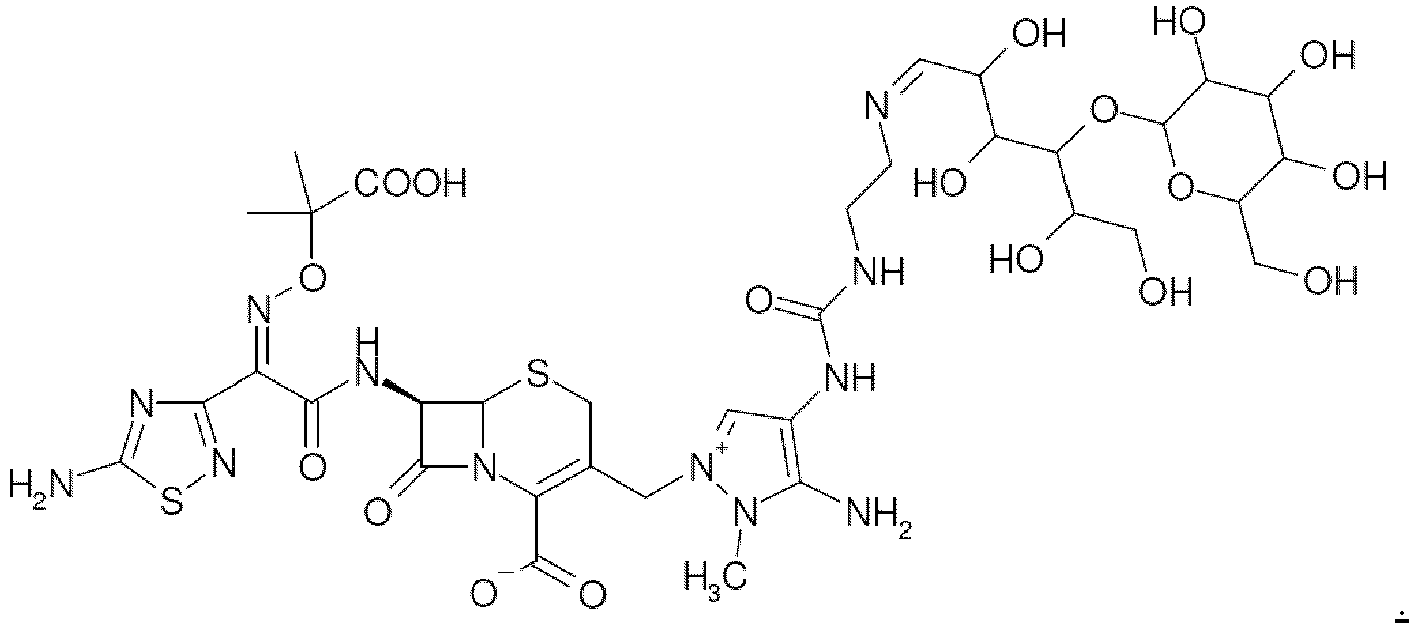
- In addition, the presence of maltose produced a particularly aggregated powder after lyophilization, which has a potentially negative impact to manufacturing ceftolozane compositions.
- In contrast, the ceftolozane composition comprising sodium chloride (CEF/sodium chloride) was much more stable than the ceftolozane composition comprising maltose or the ceftolozane composition comprising no stabilizing agent. Therefore, sodium chloride was, unexpectedly, a better stabilizing agent for ceftolozane compositions.
Table 4. Stability Study of Ceftolozane Compositions Comprising Sodium Chloride, or Maltose, or No Stabilizing Agent CEF/no stabilizer P1 P7 P12 Total Time (days) 0 0.49 0.69 0.00 1.98 3 3.06 1.29 0.00 8.48 6 4.11 1.49 0.00 10.83 CEF/maltose P1 P7 P12 Total Time (days) 0 0.41 0.65 0.15 1.91 3 2.85 1.02 3.44 10.08 6 3.45 1.12 4.01 11.65 CEF/sodium chloride P1 P7 P12 Total Time (days) 0 0.20 0.62 0.00 1.64 3 1.70 0.85 0.00 4.29 6 2.86 1.05 0.00 6.70 -
- 1) Weigh 30 kg of water for injection into the compounding vessel;
- 2) Add 100 g of citric acid, anhydrous and 150 g of sodium bicarbonate into the compounding vessel and dissolve them with mixing;
- 3) Weigh 5,000 g potency of CXA-101 drug substance and suspend it with mixing. (Note any generation of carbon dioxide.)
- 4) Slowly add 1,100 g of sodium bicarbonate and dissolve CXA-101 with mixing. (Again, note any generation of carbon dioxide..)
- 5) Add 1,146 g of sodium chloride and 10,000 g of maltose, dissolve with mixing.
- 6) Purge dissolved carbon dioxide in the solution with nitrogen until the pH of the solution does not change.
- 7) Adjust the pH of the solution to 6.0 ± 0.1 with 5%-sodium bicarbonate solution.
- 8) Adjust the total weight to 56,850 g (D20 = 1.137) with water for injection.
- 9) Confirm the pH of the compounded solution within the range 6.0 ± 0.1.
- 10) Filtrate the compounded solution with a sterile tilter-set which consists of a 0.2 um polyvinylidene fluoride membrane filter (Durapore®, Millipore) and a 0.1 urn polyvinylidene fluoride membrane filter (Durapore®, Millipore) connected in tandem. Confirm the integrity of each filter before and after the filtration. Take approximately 100 mL of the filtrate in order to check bioburden.
- 11) Filter the prefiltered compounded solution through a sterile filter-set which consists of a 0.2 um polyvinylidene fluoride membrane filter and a 0.1 urn polyvinylidene fluoride membrane filter connected in tandem, and introduce the final filtrate into an aseptic room. Confirm the integrity of each filter before and after the filtration.
- 12) Wash a sufficient quantity of 28 mL containers with water for injection and sterilize the washed containers by a dry-heat sterilizer. Then transfer the sterilized containers into a Grade A area located in an aseptic room.
- 13) Wash a sufficient quantity of stoppers with, water for injection. Sterilize and dry the washed stoppers by steam sterilizer. Then transfer the sterilized stoppers into a Grade A area located in an aseptic room.
- 14) Sterilize a sufficient quantity of flip-off caps by steam sterilizer. Then transfer the sterilized flip-off caps into a Grade A or B area located in an aseptic room.
- 15) Adjust the fill weight of the filtered compounded solution to 11.37 g (corresponds to 10 mL of the compounded solution), then start filling operation. Check the filled weight in sufficient frequency and confirm it is in target range (11.37 g ± 1%, 11.26 to 11.43 g). When deviation from the control range (11.37 g ± 2%, 11.14 to 11.59 g) is occurred, re-adjust the filling weight.
- 16) Immediately after a container is filled, partially stopper the container with a sterilized stopper. Load the filled and partially stoppered containers onto the shelves of a lyophilizer aseptically.
- 17) After all filled and partially stoppered containers are loaded into a lyophilizer, start the lyophilization program shown in
Figure 4 . Freeze the loaded containers at -40°C and keep until all containers freeze. Forward the program to primary drying step (shelf temperature; - 20°C, chamber pressure; 100 to 150 mTorr). Primary drying time should be determined by monitoring the product temperature. Forward the program to secondary drying step (shelf temperature; 30°C, chamber pressure; not more than 10 mTorr) after completion of the primary drying step. After all containers are dried completely, return the chamber pressure to atmospheric pressure with sterilized nitrogen. Then stopper containers completely. - There are four main steps in the manufacture of a CXA-101 pharmaceutical composition: dissolution, sterile filtration, bulk lyophilization, and packaging into Sterbags®. These four main steps are composed of a total of 20 minor steps. The flowchart of the manufacturing process is described below.
- I. Dissolution
- 1. A prescribed amount of WFI (e.g., 81 kg WFI) is charged into a dissolution reactor.
- 2. A prescribed amount of citric acid (e.g., 20.7 mg anhydrous citric acid per ceftolozane active ) is added.
- 3. The solution is cooled to 5°C to 10°C.
- 4. A prescribed amount of CXA-101 drug substance (e.g., referenced to 1000 mg ceftolozane active) is added to the solution.
- 5. A prescribed amount of L-arginine (e.g., 587 mg L-arginine per 1000 mg ceftolozane active) is slowly added to the solution.
- 6. A check for complete dissolution is performed. Solution pH is verified to be in the target range of 6.5 to 7.0.
- 7. A prescribed amount of sodium chloride (e.g., 476 mg sodium chloride per 1000 mg ceftolozane active) is added to the solution.
- 8. A check for complete dissolution is performed. Solution pH is verified to be in the target range of 6.0 to 7.0. If the pH is out of this range, adjust with either L-Arginine or citric acid.
- 9. WFI is added to bring the net weight to 13.1 g and the solution is mixed well.
- 10. Samples are withdrawn for testing of final pH.
- II. Sterile filtration
- 11. The solution is passed through a filter (pore size 0.45 µm) followed by two more filters (pore size 0.22 µm) onto a shelf on the Criofarma lyophilizer.
- 12. The line is washed with WFI.
- 13. The washing solution from Step 12 is passed through sterile filtration.
- III. Bulk lyophilization
- 14. The washing solution is loaded onto a separate shelf on the lyophilizer (and later discarded).
- 15. The solution is lyophilized until dry.
- 16. The product shelf is cooled to 20°C ± 5°C.
- IV. Packaging into Sterbags®
- 17. The lyophilized pharmaceutical composition is milled.
- 18. The milled powder is sieved.
- 19. The sieved powder is blended for 30 minutes.
- 20. The powder is then discharged into Sterbags®
- A stability study was carried out at 30 °C and 60 °C and analyzed by HPLC. The sodium chloride content in the CXA-101 compositions is described in Table 5. The HPLC data are summarized in Tables 6-9. The data are also plotted in
Figures 4-7 to show the trends of the purity, and the amounts of thecomposition peak 1, the composition with a RRT of 0.43 and thecomposition peak 3, and thecomposition peak 7 in the CXA-101 compositions with respect to NaCl.Table 5. Sodium Chloride Content in the CXA-101 Compositions Samples NaCl content A1 481.0 mg NaCl per 1000 mg of ceftolozane A2 190.0 mg NaCl per 1000 mg of ceftolozane A3 125.0 mg NaCl per 1000 mg of ceftolozane A4 75.0 mg NaCl per 1000 mg of ceftolozane A5 50.0 mg NaCl per 1000 mg of ceftolozane 


Table 8. HPLC Peak Area of the Composition with a RRT of 0.43 and Composition Peak 3 in CXA-101 Compositions with Varying Amounts of Sodium ChlorideDay A1 A2 A3 A4 A5 t0/60° C 0 0.28 0.10 0.09 0.10 0.11 t0/30° C 0 0.15 0.10 0.10 0.11 1day/60° C 1 0.37 0.13 0.16 0.35 0.36 1day/30° C 1 0.13 0.09 0.09 0.10 3days/60° C 3 0.68 0.21 0.31 0.71 0.71 3 day/30° C 3 0.17 0.13 0.13 0.14 7days/60° C 7 1.04 0.36 0.30 0.81 0.81 7day/30° C 7 0.19 0.16 0.16 0.17 INCREASE % /60 °C 0.76 0.26 0.21 0.71 0.7 INCREASE % /30 °C 0.04 0.06 0.06 0.06 Table 9. The HPLC Peak Area of Composition Peak 7 in CXA-101 Compositions with Varying Amounts of Sodium ChlorideDay A1 A2 A3 A4 A5 t0/60° C 0 1.31 0.95 0.96 1.01 1.02 t0/30° C 0 0.69 1.00 1.01 1.02 1day/60° C 1 1.37 1.10 1.10 1.23 1.29 1day/30° C 1 0.68 0.99 1.01 1.02 3days/60° C 3 1.43 1.19 1.27 1.41 1.46 3day/30° C 3 0.68 1.03 1.01 1.05 7days/60° C 7 1.49 1.31 1.35 1.55 1.57 7day/30° C 7 0.68 1.01 1.03 1.07 INCREASE % /60 °C 0.18 0.36 0.39 0.54 0.55 INCREASE % /30 °C NC 0.01 0.02 0.05 - Conclusion: The stability test demonstrates that high sodium chloride content enhances stability of CXA-101 Compositions.
- The HPLC measurements on
day 3 were used to analyze the stability of the CXA-101 compositions. - CXA-101 compositions comprising high amounts of sodium chloride (e.g., 125-1000 mg sodium chloride per 1000 mg of ceftolozane) were found to be more chemically stable than CXA-101 compositions comprising low amounts of sodium chloride (e.g., less than 125 mg sodium chloride per 1000 mg of ceftolozane). Table 6 shows that, by
day 3 of heating at 60 °C, sample A1, which has the highest salt concentration, is most stable, i.e., has the lowest Δt0-t3 of all samples. Byday 3, the sample with the lowest salt concentration, A5, has the highest At0-13 indicating the most degradation. Overall, A5 has degraded 141% more than A1. Further, Table 6 shows that, byday 3 of heating at 60 °C, sample A3, which contains a lower salt concentration within the limits of the invention at 125 mg, is still significantly more stable than A4, a composition containing 75.0 mg of the salt. A3 has a Δt0-t3 of 3.1, while A4 has a Δt0-t3 of 3.9, meaning that A4 has degraded 26% more than A3. - Another stability study was carried out at 5 °C and 25 °C. The sodium chloride content in the CXA-101 compositions is described in Table 9a. The amounts of citric acid and L-arginine in each composition were the same. These samples were in lyophilized form and were placed on long-term (24-36 months), real time stability programs.
- The
composition peak 1 is considered "diagnostic" for formulation failure because it is the first peak to go out of trend or specification (1.5%). Thus, the stability of these CXA-101 compositions was also measured by the length of storage until formulation failure as indicated by thecomposition peak 1. The data in Table 9a were extrapolated from data collected after 4 months. Clearly, based on the amount of thecomposition peak 1 in the compositions, the composition with about 480 mg sodium chloride per 1 gram ceftolozane active was significantly more stable than the compositions containing 125 mg or 62.5 mg sodium chloride per 1 gram of active ceftolozane (i.e., stability of ceftolozane compositions: 480>>125 mg>62.5 mg).Table 9a. The Peak 1 Failure Points of CXA-101 Compositions with Varying Amounts of Sodium ChlorideCeftolozane active, 1g + Peak 1 failure point at 5 °C Peak 1 failure point at 25 °C 480 mg NaCl 245 months 15 months 125 mg NaCl 70 months 5 months 62.5 mg NaCl 25 months 3 months* *Results at 3 months = 1.34%, 4 months = 1.15% - The manufacturing process of a CXA-201 composition comprising tazobactam and ceftolozane by co-lyophilization is shown in
Figure 2 . Non-sterile bulk tazobactam and bulk ceftolozane were mixed, followed by dissolution and sterile filtration. The filtrate was then tray-lyophilized to obtain the CXA-201 composition. The CXA-201 composition can be container-filled as a final drug product. The components of a CXA-201 composition prepared by co-lyophilization are shown in Table 10.Table 10. Components of a CXA-201 Composition Prepared by Co-lyophilization Component Function Amount (mg/ container) ceftolozane Active pharmaceutical ingredient 1000 (potency) L-arginine Alkalization reagent 587 Citric acid (anhydrous) Buffer 21 Sodium chloride Stabilizer 476 Tazobactam (free acid) Active pharmaceutical ingredient 500 Sodium bicarbonate Alkalization reagent Quantity sufficient1 for pH 4.8 to 7.0 water Dissolution solvent Not more than 4% by weight2 Nitrogen Inert gas Sufficient quantity 1. Sodium content is approximately 78 mg/g of tazobactam in drug product after lyophilization.
2. Water is removed during the lyophilization process and is controlled at no more than 4% by weight. - The components of the co-lyophilized CXA-201 composition are shown in Table 11. This composition was prepared, as described above in Reference Example 6.
Table 11: Components of the CXA-201 Composition Prepared by Co-Lyophilization CXA-201 Comp. 16.3 g active ceftolozane 8.1 g active Tazobactam free ac. 15.5 g L-Arginine 350 mg Citric acid 7.9 g NaCl 6.1 pH compounded solution - Stability studies of this CXA-201 composition prepared by co-lyophilization were carried out at 25 °C and 40 °C. The composition was analyzed using HPLC. The following Tables 12 and 13 are summaries of the HPLC measurements at time zero, after one month (T1), and after three months (T2).
Table 12: Stability Data of Co-Lyophilized CXA-201 Composition at 25 °C/RH=60% Test items Spec. D.P. T0 T1 25°C T2 25°C Related Substances -Peak1 ≤ 1.50% 0.31% 0.54% 0.71% -Peak2 ≤ 0.40% 0.07% 0.07% 0.09% -Peak3 ≤ 0.30% <0.03% <0.03% <0.03% -Peak4 ≤ 0.80% 0.08% 0.08% 0.09% -Peak5 ≤ 1.00% 0.27% 0.26% 0.29% -Peak6 ≤ 0.15% <0.03% <0.03% <0.03% -Peak7 ≤ 2.00% 0.64% 0.65% 0.66% -Peak8 ≤ 0.15% <0.03% <0.03% <0.03% -Peak9 ≤ 0.60% 0.05% 0.11% 0.10% -Peak10,11 ≤ 0.15% each 0.04% 0.04% 0.04% -Peak12 ≤ 2.00% <0.03% <0.03% <0.03% Others (RRT 0.43) ≤ 0.15% <0.03% <0.03% 0.04% Others (RRT 1.22) ≤ 0.15% 0.13% 0.30% 0.38% Others (RRT 2.18) ≤ 0.15% 0.03% <0.03% 0.05% Others (RRT 2.77) ≤ 0.15% <0.03% 0.03% 0.03% Sing. Unk. ≤ 0.15% 0.05% 0.07% 0.05% Total ≤ 5.00% 1.67% 2.19% 2.77% pH report value 5.5 4.83 Table 13: Stability Data of Co-Lyophilized CXA-201 Composition at 40 °C/RH=75% Test items Spec. D.P. T0 T1 40° C T2 40°C Related Substances -Peak1 ≤ 1.50% 0.31% 1.77% 2.22% -Peak2 ≤ 0.40% 0.07% 0.10% 0.16% -Peak3 ≤ 0.30% <0.03% <0.03% 0.06% -Peak4 ≤ 0.80% 0.08% 0.09% 0.09% -Peak5 ≤ 1.00% 0.27% 0.27% 0.30% -Peak6 ≤ 0.15% <0.03% <0.03% <0.03% -Peak7 ≤ 2.00% 0.64% 0.69% 0.78% -Peak8 ≤ 0.15% <0.03% <0.03% 0.10% -Peak9 ≤ 0.60% 0.05% 0.09% 0.09% -Peak10,11 ≤ 0.15% each 0.04% 0.04% 0.05% -Peak12 ≤ 2.00% <0.03% <0.03% <0.03% Others (RRT 0.43) ≤ 0.15% <0.03% 0.09% 0.15% Others (RRT 1.22) ≤ 0.15% 0.13% 0.74% 0.97% Others (RRT 2.18) ≤ 0.15% 0.03% <0.03% 0.08% Others (RRT 2.77) ≤ 0.15% <0.03% <0.03% 0.04% Sing. Unk. ≤ 0.15% 0.05% 0.11% 0.25% Total ≤ 5.00% 1.67% 4.49% 6.32% pH report value 5.5 4.09 - A new compound having RRT=1.22 was observed in the co-lyophilized CXA-201 compositions. While not wishing to be bound by theory, the compound RRT 1.22 was identified as a compound formed by a reaction between ceftolozane and formylacetic acid, which was a by-product of tazobactam as illustrated in Marunaka et al. (Chem. Pharm. Bull. 1988, Vol. 36 (11), pp. 4478-4487).The stability data at 25 °C and at 40 °C have confirmed the continued formation of the compound RRT 1.22 over the course of time.
- The Co-Lyophilized Combo Drug Product was prepared as described above in Reference Example 6. The formulation composition of the Co-Lyophilized Combo drug product is shown in Table 11 (Reference Example 7). This sample maintained at 25 °C/RH=60% and 40 °C/RH=75% after one month (T1) and three months (T2). Samples were analyzed using a HPLC method as described in Example 1. The data for analysis of the samples by HPLC is shown in Example 10 in Table 23 (Stability data of Co-Lyo Combo Drug Product at 25 °C) and Table 24 (Stability data Co-Lyo Combo Drug Product at 40 °C). The presence of the compound of Formula (III) was identified has having a retention time of about 1.22 as measured by HPLC (see Example 2). RRT=1.22 was observed in co-lyophilized drug product. The compound of formula (III) is believed to be formed by a reaction between ceftolozane and formylacetic acid, which was a degradation product of tazobactam. The amount of the compound of formula (III) in a composition comprising ceftolozane and tazobactam can be increased over time at 25 °C and at 40 °C.
- The material obtained from the RRT 1.22 peak was analyzed by LC/MS, providing the spectra shown in
Figure 14 .Figure 15 (below) is the corresponding structures for the peaks shown inFigure 14 . - A test sample prepared from ceftolozane and tazobactam acid co-compounding solution containing RRT 1.22 impurity was used on the LC/MS experiment. Liquid chromatography separation was performed on a Zorbax SB C8, 3.5µm, 3.0mm x 150mm column, using gradient elution with 20mM ammonium formate containing 0.1% Heptofluorobutyric acid pH 3.2 as mobile phase A and 0.1% Heptofluorobutyric acid in acetonitrile as mobile phase B. The gradient starts from 3% (initial) to 15% mobile phase B in 20 minutes (with RRT 1.22 eluting at about 10.7 minutes). Mass detection was performed using electrospray ionization technique under positive mode. The column effluent was also monitored at 254 nm using a photodiode-array detector. MS/MS fragmentation was performed on m/z 737.3 positive ion using nitrogen as collision gas, with collision energy set at 35V.
- A stability study was carried out at 25°C and analyzed by HPLC. CXA-201 compositions comprise ceftolozane and tazobactam, further comprising high, mid, or low amounts of sodium chloride (480, 125, or 62.5 mg NaCl per 1000 mg of ceftolozane, respectively). Comparison of the compositions are listed in Table 14. The amounts of the composition RT 63', as measured by the HPLC method, are summarized in Table 15.
Table 14. Comparison of the CXA-201 Compositions Lot CXA-101 NaCl Tazobactam C1 10% High Na C2 20% Mid Na C3 20% Low Na C4 20% Mid Arginate C5 20% Low Arginate Table 15. RT 63' Peak Area at t = 3 months, 25 °C/60 % RH storage 1st data collection 2nd data collection 3rd data collection Sample Summary RT Area % RT Area % RT Area % C1 High salt + Tazo Na 63.90 0.03 63.30 0.08 62.49 0.14 C2 Mid salt + Tazo Na 63.78 0.06 63.12 0.12 62.45 0.28 C3 Low salt + Tazo Na 63.75 0.12 63.11 0.14 62.46 0.29 C4 Mid salt + Tazo Arg 63.76 0.10 63.16 0.13 62.44 0.28 C5 Low salt + Tazo Arg 63.72 0.08 63.14 0.16 62.46 0.33 - Conclusion: At the three month time point, the reduced salt formulations were observed to be not as stable as the full salt formulation; and trends indicate that reduction in salt causes at least 1.5-fold greater composition at RT= 63 minutes, as measured by HPLC. The compositions comprising 480 mg NaCl per 1000 mg of ceftolozane had the least amount of the composition RT 63' after 3 months at 25 °C. The amount of the composition RT 63' in the compositions comprising 125 mg NaCl per 1000 mg of ceftolozane was 1.5-fold or greater than the amount of the composition 63' in the compositions comprising 480 mg NaCl per 1000 mg of ceftolozane. The amount of the composition RT 63' in the compositions comprising 62.5 mg NaCl per 1000 mg of ceftolozane was 2-fold or greater than the amount of the composition RT 63' in the compositions comprising 480 mg NaCl per 1000 mg of ceftolozane. Thus, the CXA-201 compositions comprising high amounts of sodium chloride (e.g., 125-1000 mg sodium chloride per 1000 mg of ceftolozane) were more chemically stable than the compositions comprising low amounts of sodium chloride (e.g., less than 125 mg sodium chloride per 1000 mg of ceftolozane).
- A stability study was carried out at 30 °C and 60 °C analyzed by HPLC. The sodium chloride content in the CXA-201 compositions is described in Table 16. The HPLC data at 60 °C are summarized in Tables 17-20. The data are also plotted in
Figures 8-11 to show the trends of the purity, and the amounts of thecomposition peak 1, the composition with a RRT of 0.43 and thecomposition peak 3, and thecomposition peak 7 in the CXA-201 compositions with respect to NaCl.Table 16. The Sodium Chloride Content in the CXA-201 Compositions Samples NaCl content B1 481.0 mg sodium chloride per 1000 mg of ceftolozane B2 125.0 mg sodium chloride per 1000 mg of ceftolozane B3 75.0 mg sodium chloride per 1000 mg of ceftolozane B4 50.0 mg sodium chloride per 1000 mg of ceftolozane Table 17. The Purity of Ceftolozane in CXA-201 Compositions with Varying Amounts of Sodium Chloride Day B1 B2 B3 B4 t0 0 98.1 97.8 97.8 97.7 1day/60° C 1 97.2 96.3 96.2 96.0 1day/30° C 1 98.2 97.7 97.6 97.6 3days/60°C (Δt0-t3) 3 95.4 (2.7) 94.9 (2.9) 94.7 (3.1) 94.6 (3.1) 3day/30° C 3 98.0 97.5 97.4 97.3 7days/60° C 7 92.7 93.8 93.6 93.4 7day/30° C 7 97.8 97.2 97.0 96.9 Total Δ /60 °C 5.3 4.0 4.2 4.3 Total Δ /30 °C 0.3 0.6 0.8 0.8 
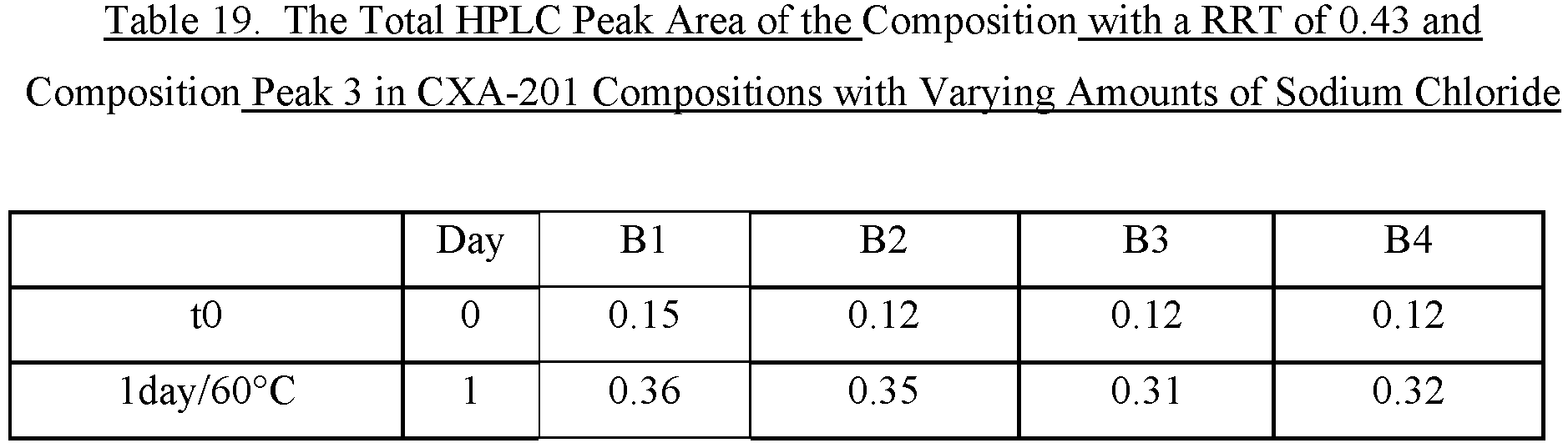


- Similarly to CXA-101 compositions, CXA-201 compositions comprising high amounts of sodium chloride (e.g., 125-1000 mg sodium chloride per 1000 mg of ceftolozane) were found to be more chemically stable than CXA-201 compositions comprising low amounts of sodium chloride (e.g., less than 125 mg sodium chloride per 1000 mg of ceftolozane). Table 17 shows that, by
day 3 of heating at 60 °C, sample B1 containing the highest salt concentration is most stable, i.e., has the lowest Δt0-13 of all samples. Byday 3, the sample with the lowest salt concentration, B4, has the highest Δt0-t3 indicating the most degradation. Overall, B4 has degraded 15% more than B1. - A low energy drum blender that agitates the material by tumbling and also moving the bed up and down is used. A representative process of blending is described as follows, also shown in
Figure 1 . The blender was charged with 23.4 kg of CXA-101 bulk product, and 5.4 kg of tazobactam bulk product. Both the CXA-101 and tazobactam were individually lyophilized beforehand. The material was blended for 180 minutes. In-process tests of content assay for both CXA-101 and tazobactam were performed to assess the homogeneity using the samples of blend materials taken from three places. The relative standard deviation (RSD) for each of CXA-101 and tazobactam content assay was no greater than 2% and the RSD for the ratio of CXA-101/ tazobactam was no greater than 2% (See Table 21).Table 21. In-Process Testing of Blending Samples of a CXA-201 Composition at Three Places Test Acceptance Limits (expected value) Results Sampling 60 minute 120 minute 180 minute Content: Ceftolozane1 30.4%-37.2% 1 34.24 34.07 34.42 2 34.62 34.21 34.66 3 34.71 34.60 34.85 Mean3 34.52 34.30 34.64 RSD% 0.72 0.80 0.63 Content: Tazobactam2 15.2%-18.6% 1 17.96 18.20 17.12 2 16.90 18.26 16.51 3 17.27 16.93 17.02 Mean3 17.38 17.80 16.89 RSD% 3.10 4.22 1.96 Ratio of Content (w/w) ceftolozane/tazobactam 2.004 1 1.91 1.87 2.01 2 2.05 1.87 2.10 3 2.01 2.04 2.05 Mean3 1.99 1.93 2.05 RSD% 3.69 5.12 2.2 RSD = relative standard deviation
1 Theoretical value: 33.96% Acceptance limits are 90% - 110% of the theoretical value.
2 Theoretical value: 16.99% Acceptance limits are 90% - 110% of the theoretical value.
3 Three samples are taken at each time point at three places to measure the percentage by weight of ceftolozane and tazobactam. The "Mean" is the average of the percentages or the weight ratios of Ceftolozane/tazobactam.
4 Acceptance limits were established based on batch history. - The blended powder is then discharged into Sterbags®.
- A fill and finish process is utilized for the final drug product, which is a pharmaceutical composition comprising CXA-101 and tazobactam at a ratio of 1000 mg/ 500 mg. Glass containers are washed with WFI and depyrogenated in a
Class 100 depyrogenation tunnel at a temperature of 320°C. Pre-washed and pre-siliconized stoppers are autoclaved for 40 minutes at 121°C. The bulk drug product is packaged in a Sterbag® system comprised of three bags. The outer bag is cleaned with disinfectant in a Class 10,000 clean room. The bag system is placed in a pass-through UV box where it is subjected to UV radiation (> 20 µW/cm2) for 20 minutes to sterilize the surface of the outer bag. The outer bag is removed and left in the UV box. The middle bag is placed in a Class A laminar airflow (LAF) hood. The sterile middle bag is removed under LAF. The sterile, bottleshaped inner bag is then placed in a sterile stainless steel carrier and attached to the filling machine. - Sterile bulk CXA-101/ tazobactam drug product is filled under a nitrogen blanket into 30-mL, Type I clear glass containers. The sterile drug product is gravity-fed into the filling machine under LAF. container fill weights are periodically checked throughout the filling operation to ensure proper operation of the filling line. Filling and stoppering operations are performed under
Class 100 LAF conditions. Capping and container washing are done in the Class 10,000 clean room. - The blend drug product was prepared, as described above in Example 9, on lab scale using a small blender. The components of the blend composition are shown in Table 22.
Table 22: Components of the Blend Composition Component Composition Quantity as active components CXA-201 Comp. CXA-101 for Injection Bulk (25 g) Ceftolozane 10.8 g L-Arginine 6.7 g Citric acid 233 mg Sodium chloride 5.2 g Tazobactam sodium sterile Bulk (6 g) 5.4 g (as Tazo free acid) - Stability studies of this CXA-201 composition prepared by the blending process were carried out at 25 °C and 40 °C. The composition was analyzed using HPLC method described in Example 1. The following Tables 23 and 24 are summaries of the HPLC measurements at time zero, after one month (T1), and after three months (T2).
Table 23: Stability Data of Blend CXA-201 Composition at 25 °C/RH=60% Test items Specifications T0 T1 25°C T2 25°C Related Substances -Peak1 ≤ 1.50% 0.61% 0.93% 1.08% -Peak2 ≤ 0.40% <0.03% <0.03% <0.03% -Peak3 ≤ 0.30% <0.03% <0.03% <0.03% -Peak4 ≤ 0.80% 0.03% 0.03% 0.04% -Peak5 ≤ 1.00% 0.09% 0.12% 0.13% -Peak6 ≤ 0.15% <0.03% <0.03% <0.03% -Peak7 ≤ 2.00% 1.28% 1.34% 1.35% -Peak8 ≤ 0.15% <0.03% <0.03% <0.03% -Peak9 ≤ 0.60% 0.03% <0.03% 0.03% -Peak10,11 ≤ 0.30% <0.03% 0.04% 0.05% Sing. Unk. ≤ 0.15% 0.13% 0.13% 0.14% Total ≤ 5.00% 2.49% 3.03% 3.28% Assay CXA-101 Teor. %=32.6% 32.5% n.a. n.a. Assay Tazobactam Teor. %=17.4% 18.2% n.a. n.a. Tazobactam Related Compound A ≤ 4.0% 0.07% 0.12% 0.14% K.F. ≤ 4.0% 2.6% n.a. n.a. pH 5.0-7.0 6.0 5.6 5.1 Table 24: Stability Data of Blend CXA-201 Composition at 40 °C/RH=75% Test items Specifications T0 T1 40° C T2 40°C Related Substances -Peak1 ≤ 1.50% 0.61% 1.66% 2.28% -Peak2 ≤ 0.40% <0.03% <0.03% <0.03% -Peak3 ≤ 0.30% <0.03% <0.03% 0.04% -Peak4 ≤ 0.80% 0.03% 0.04% 0.05% -Peak5 ≤ 1.00% 0.09% 0.13% 0.14% -Peak6 ≤ 0.15% <0.03% <0.03% <0.03% -Peak7 ≤ 2.00% 1.28% 1.41% 1.46% -Peak8 ≤ 0.15% <0.03% <0.03% <0.03% -Peak9 ≤ 0.60% 0.03% <0.03% 0.03% -Peak10,11 ≤ 0.30% <0.03% 0.08% 0.09% Sing. Unk. ≤ 0.15% 0.13% 0.14% 0.13% Total ≤ 5.00% 2.49% 4.21% 5.27% Assay CXA-101 Teor. %=32.6% 32.5% n.a. n.a. Assay Tazobactam Teor. %=17.4% 18.2% n.a. n.a Tazobactam Related Compound A ≤ 4.0% 0.07% 0.35% 0.54% K.F. ≤ 4.0% 2.6% n.a. n.a. pH 5.0-7.0 6.0 5.0 4.4 - The data at both 25 °C and at 40 °C have shown that the blending process completely inhibits formation of the compound RRT=1.22.
- Compositions for intravenous administration should be formulated to resemble the and pH of human blood to reduce vascular complications. The recommended pH is between 5 and 9 (ideal pH is as close to 7.4 as possible). Departing from this recommended pH ranges of an intravenously administered composition can result in the development of complications such as phlebitis, or inflammation of the veins. Marc Stranz, A Review of pH and Osmolarity, 6 Int'l J. of Pharm. Compounding 216, 218 (May/June 2002). Unfortunately, few drug infusions are stable at a suitable pH for intravenous administration. Depending on the molecular structure, a drug is most stable or has the best solubility at a particular pH range (e.g., pH< 6) and divergence from this pH range may lead to increased drug decomposition. It is thus challenging to find a balance between the safe limits of pH and optimum drug stability in compositions for intravenous administration. Marc Stranz, The Implications of Osmolality, Osmolarity and pH in Infusion Therapy, INS Annual Conference (May 2005).
- A formulation close to physiologic pH was targeted. This necessitates an alkalizing agent due to intrinsic pH 1.92 of ceftolozane in solution (2%). The initial study of alkalizing agents included sodium hydroxide, L-arginine, tris, sodium bicarbonate, meglumine, diethanolamine, and triethanolamine. Samples containing 100 mg ceftolozane sulfate, 22.9 mg sodium chloride, 200 mg maltose, and 2 mg citric acid anhydrous were prepared and adjusted to ~
pH 4. The samples were lyophilized and powders stored at 70 °C for 3 days, 60 °C for 3, 6 and 9 days and at 40 °C for one month. The stored samples were then analyzed for ceftolozane content. Results are reported below in Table 25:
- Ceftolozane recovery was consistently above 90% in the presence of sodium hydroxide, L-arginine, or sodium bicarbonate. Although sodium hydroxide performed well, as a strong base, it could promote base hydrolysis of the active more readily during scale up and be more difficult to dry during lyophilization than other alkalizing agents. Accordingly sodium hydroxide was not considered for further formulation development. L-arginine was thus chosen as the alkalizing agent for the formulation.
- To ensure suitability of L-arginine as an alkalizing agent, a study was conducted to compare L-arginine against sodium bicarbonate. In this study, solutions were prepared to contain ceftolozane in the presence of sodium chloride and citric acid adjusted to approximately
pH 6 with either L-arginine or sodium bicarbonate. The solutions were then lyophilized and samples distributed for accelerated and regular storage. A summary of the total additional compounds and pH for the various conditions after 1 month is presented in Table 26.Table 26: Effect of L-Arginine and Sodium Bicarbonate on Ceftolozane Related Substances during Storage, pH 6Bulk solution composition per 1000 mg ceftolozane free base 632 mg L-arginine 485 mg sodium chloride 21 mg citric acid 288 mg sodium bicarbonate 481 mg sodium chloride 21 mg citric acid Storage condition Total Related Substances Sample pH Total Related Substances Sample pH Initial 1.42 % 5.8 2.12% 5.8 5 °C, 1 month 1.38% 5.8 2.66% 5.6 25 °C, 1 month 1.74% 5.5 4.99% 4.8 40 °C, 1 month 2.32% 5.0 5.93% 4.5 - As seen in the table the bicarbonate-adjusted sample showed a larger increase in related substances and a less stable pH profile. Accordingly, it was decided to maintain L-arginine as the alkalizing agent in the formulation.
- An example of a batch formulae for ceftolozane composition (compounding of ceftolozane substance with excipients such as citric acid, sodium chloride, and L-arginine followed by sterile lyophilization) is found below in Table 27.
Table 27: Batch Formula for Ceftolozane composition Component Target Composition mg/g Amount per Batch (kg) 1 2 Ceftolozane Sulfatei) 172.1 114.0 202.6 Citric Acid, Anhydrous, USP 3.2 2.1 3.7 Sodium Chloride, USP 73.1 48.3 86.0 L-Arginine, USP ~90 QS to achieve target pH ii) 59.7 106.0 Water for Injection, USP QS to 1000 QS QS Total Batch Size 660 1175 1) Ceftolozane sulfate is charged based on its measured potency to obtain 150 mg free base/g solution.
2) L-arginine is added as needed to obtain pH 6.5 ± 0.5 in the bulk solution; 90 mg per gram solution is considered a representative amount. - An example of a batch formula for the ceftolozane/tazobactam drug product is presented in Table 28 below.
Table 28: Batch Formula Ceftolozane/Tazobactam Drug Product Component Amount per container, mg Amount per Batch, kg Ceftolozane compositioni) 2255 112.8 Tazobactamii) 537 26.9 Nitrogen, NFiii) - - Total 2792 139.7 Total Batch Size, kg 139.7 Total container Quantity 50,000 compositioni) The target fill for ceftolozane is 1000 mg free base, added to the container as the composition. The amount 2255 mg is based on 100% theoretical potency of the composition. Actual weight will vary based on composition measured potency.
ii)The target fill for tazobactam is 500 mg free acid, added to the container as its sodium salt form. The amount 537 mg is based on 100% theoretical potency.
iii) Nitrogen is used as a processing aid to blanket containers after powder filling and prior to insertion of stopper. - The unit composition of a dosage for reconstitution is described in Table 29.
Table 29: Unit Compositions of Ceftolozane/Tazobactam for Injection, 1000 mg/ 500 mg Component Function Nominal Composition mg per container Ceftolozane composition1) Ceftolozane Sulfate Active 1147 Citric Acid, Anhydrous Chelating Agent 21 Sodium Chloride Stabilizing Agent 487 L-Arginine Alkalizing Agent 6002) Q.S. for pH adjustment Tazobactam Sodium3) Active 537 Nitrogen Processing Aid(a) Q.S. Total Weight 2792 1) Actual amount of ceftolozane composition will vary based on the measured potency. Ceftolozane sulfate, 1147 mg, corresponds to 1000 mg ceftolozane free base. 2) L-arginine is added as needed to achieve pH 6.5 ± 0.5; 600 mg per container is considered a representative total amount. 3) Actual weight of tazobactam sodium will vary based on the measured potency. Tazobactam sodium 537 mg, corresponds to 500 mg tazobactam free acid 4) Nitrogen blanket is applied after powders are dispensed to the container and prior to insertion of stopper. - A recently published (April 2013) Food and Drug Administration Guidance for Industry Non-Penicillin Beta-Lactam Drugs: A CGMP Framework for Preventing Cross-Contamination provides direction on prevention of cross-contamination for facilities that manufacture non-penicillin beta-lactam drugs. Provided herein are steps for the development and implementation of a system to prevent cross-contamination due to the introduction of both sterile ceftolozane drug product intermediate and tazobactam sodium into a facility that is in conformance with FDA Guidance.
- Segregation steps to conform with FDA Guidance can include, but are not limited to:
- Relocation all other drug products to other sites
- Separating the ceftolozane/tazobactam product filling line and the veterinary cephapirin product filling line
- Creating separate HVAC systems
- Establishing separate warehouse areas
- Formalizing separate material, waste and personnel flows
- Constructing temporary facilities for gowning and entrance to the line used for the ceftolozane/tazobactam drug product.
- Constructing new walls, modifying and reinforcing existing walls
- Equipping the existing emergency egress with alarms and gaskets to completely separate both lines throughout all the floors of the building
- Creating the permanent separation of locker, rest and break rooms for both lines of the facility:
- Dedicated maintenance and operations personnel for each part of the facility including different uniform colors for each part of the facility
- Dedicated equipment and tools for each part of the facility
- An Emergency Recovery plan
- As a product intended for intravenous use, several properties are important for physiological compatibility. These include particulate matter, sterility, endotoxin limit, pH, and osmolality. Particulate matter and sterility are controlled at the point of manufacture. The drug product is processed aseptically throughout the entire manufacturing process, inclusive of ceftolozane, tazobactam sodium, and ceftolozane/tazobactam in- container drug product.
- The ceftolozane/tazobactam drug product is controlled to approximately
pH 6, to provide physiological comfort, while still assuring adequate stability for the drug substances. The ceftolozane drug product intermediate is controlled during compounding to pH 6.5 ± 0.5 and is controlled at release topH 5 to 7. The tazobactam sodium is controlled at release topH 5 to 7. - Ceftolozane/tazobactam following reconstitution with normal saline and dilution for infusion also in normal saline (10 mg/mL ceftolozane; 5 mg/mL tazobactam) is slightly hypertonic, with osmolality approximately 500 mOsm/kg. However, slightly hypertonic intravenous infusion solutions are not uncommon as drug products are commonly prepared and diluted with already-isotonic solutions, such as normal saline. The generally accepted maximum upper limit for peripheral intravenous administration is approximately 900 mOsm/kg, though admixtures 600 to 900 mOsm/kg are typically administered through a central line. Therefore, to be within the limits of this range, the infusion product is less than 600 mOsm/kg.
- CXA-101 and Tazobactam Sodium samples (#1 - #3) were reconstituted as follows:
Sample#1: Weighed 0.103g of Tazobactam Sodium and 0.462g of CXA-101dissolved in 4mL of WFI Water and 6mL of USP Normal Saline. Sample#2: Weighed 0.103g of Tazobactam Sodium and 0.462g of CXA-101dissolved in 4mL of WFI Water added 10mL of USP Normal Saline. Sample#3: Weighed 0.103g of Tazobactam Sodium dissolved in 1mL of WFI Water and 0.462g of CXA-101dissolved in 1mL of WFI Water then mixed together added 10mL of USP Normal Saline. - Tazobactam Sodium (Potency: 97.5%)
- CXA-101 (Potency: 43.3%)
- WFI Water
- USP Normal Saline
- The osmolality of CXA-101 and Tazobactam Sodium samples (#1 - #3) was then determined using a freezing point depression Osmometer (available from Advanced Instruments, Inc.).
Table 30: Osmolality of Reconstituted Solutions Sample# CXA-101 Conc. (mg/mL) Tazobactam Sodium Conc. (mg/mL) WFI Water Saline Osmoliallity (mOsm/kg) 1 20.0 10.0 40% (40mL) 60% (60ml) 589 2 14.3 7.1 29% (40mL) 71% (100mL) 512 3 16.7 8.3 17% (20mL) 83% (100mL) 604 - A unit dosage form composition of Table 29 was reconstituted with 10mL of Sterile WFI or USP Normal Saline then added into
100mL 5% Dextrose Injection (D5W) or 0.9% Sodium Chloride (NS) bags and the osmolality of the resulting bag solution was determined as shown in table Table 30a below.Table 30a: Osmolarity of Ceftolozane Bag Solution (mOsm/kg) Time Point sWFI - D5W NS - D5W sWFI - NS NS - NS RT T0 446 470 449 478 - In Table 30a, data for osmolality of the following product reconstitution scenarios was determined using the composition from Table 29
- 5% Dextrose Injection USP, 100mL Bag (Baxter)
- 0.9% Sodium Chloride Injection USP, 100mL Bag (Baxter)
- sWFI - D5W: reconstituted with Sterile WFI then added into 5% Dextrose Injection bag
- NS - D5W: reconstituted with USP Normal Saline then added into 5% Dextrose Injection bag
- sWFI - NS: reconstituted with Sterile WFI then added into 0.9% Sodium Chloride Injection Bag
- NS - NS: reconstituted with USP Normal Saline then added into 0.9% Sodium Chloride Injection bag
- The excipients in exemplary ceftolozane compositionswere chosen to ensure stability and processability of the ceftolozane drug substance into the drug product. The specific excipients, their quantities and functions are provided in Table 31. All excipients are compendial and typical for sterile pharmaceutical dosage forms, requiring no additional treatment prior to use in the formulation. The excipients are used in levels within the range established in other FDA approved products as described in the Inactive Ingredients Database (IID).
Table 31: Excipients Used in Ceftolozane Composition Component Function Amount, mg/ container Concentration in Infusion Solution, % Rationale for Inclusion Inactive Ingredients Database (IID) Range Citric acid Chelating agent 21 0.02 Used to prevent discoloration and degradation 0.0025 to 50% Sodium Chloride Stabilizing agent 487 0.49 Used as a stabilizing agent for ceftolozane sulfate 0.187 to 45% L-arginine Alkalizing agent 600(a) Q.S. for pH adjustment 0.60 Used to adjust ceftolozane solution pH 0.29 to 88% (a) L-arginine is added as needed to achieve pH 6.5 ± 0.5; 600 mg per container is considered a representative total amount. - The ceftolozane /tazobactam finished drug product is a sterile powder fill of lyophilized active ingredients ceftolozane drug product intermediate (composition) and tazobactam sodium together into a sterile single container. The lyophilized form of the sterile tazobactam sodium contains no excipients. Ceftolozane sulfate drug substance is converted first into a sterile drug product intermediate, composition, by formulation with citric acid, sodium chloride and L-arginine, followed by lyophilization.
- The full manufacturing process includes unit operations typical of an aseptic lyophilization process and aseptic powder filling process. The overall process can be outlined in two stages, as presented in the manufacturing flow chart of
Figure 12 . The first stage is the manufacturing of the sterile ceftolozane composition. The second stage is the filling of the sterile drug powders into containers for the final drug product. The major process steps are: - Preparation of the sterile ceftolozane composition comprises
- compounding the bulk solution for lyophilization;
- sterile filtering the bulk solution;
- lyophilizing the bulk solution into bulk powder;
- grinding and sieving of the sterile bulk powder; and
- aseptic packaging of the sterile bulk powder in Sterbags ®.
- Filling of the sterile bulk powders comprises
- receipt of ceftolozane and tazobactam sterile powders at site;
- aseptic filling both sterile powders into the container sequentially;
- blanketing the container with a nitrogen headspace;
- stoppering and crimping the container; and
- inspecting the container prior to secondary packaging.
| Compound | RRT |
Proposed | Source |
| Peak | |||
| 1 | ~ 0.14 |
 |
Degradation product and process product |
| 3- | |||
| Peak | |||
| 2 | ~ 0.16 | Unidentified | |
| Peak | |||
| 3 | ~ 0.4 | Unidentified | |
| Peak | |||
| 4 | ~ 0.6 | Unidentified | |
| Peak | |||
| 5 |
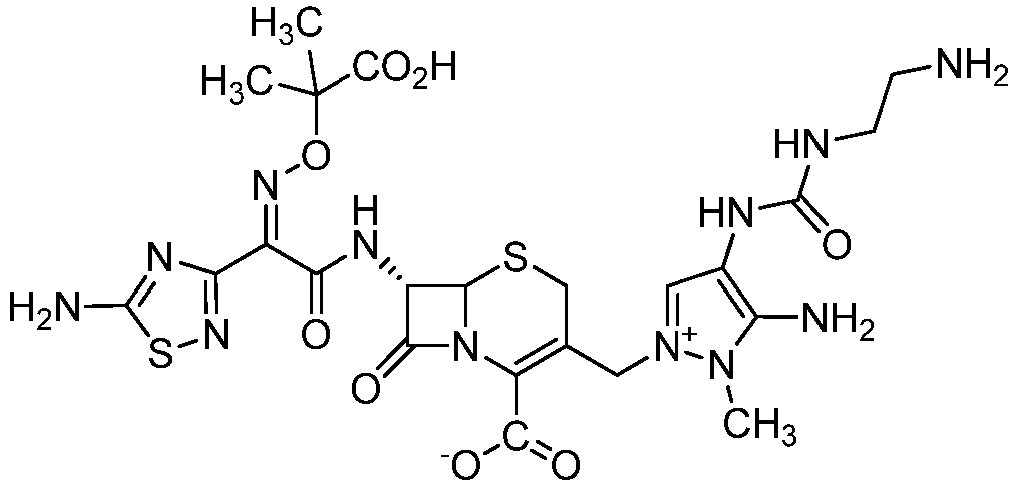 |
Degradation product and process product | |
| 7-Epimer type | ~ 0.9 | ||
| |
~ 1.1 | NA | |
| Peak | |||
| 7 |
 |
Degradation product and process product | |
| Δ3 Isomer type | ~ 1.30 | ||
| Peak 8 | ~ 1.37 | Unidentified | |
| Peak | |||
| 9 | ~ 1.7 |
 |
Process product and Degradation product |
| | |||
| Peaks | |||
| 10, 11 | ~ 2.3 | Unidentified | Process product |
Claims (9)
- A pharmaceutical composition comprising ceftolozane sulfate, 125-650 mg inorganic salt per 1000 mg of ceftolozane free base equivalent, and tazobactam sodium in an amount of 400-550 mg tazobactam free acid equivalent per 1000 mg of ceftolozane free base equivalent, wherein the composition is obtainable by lyophilizing the ceftolozane sulfate in the absence of tazobactam and then blending the lyophilized ceftolozane sulfate with a tazobactam sodium composition that was lyophilized in the absence of ceftolozane.
- The pharmaceutical composition of claim 1, wherein the 125-650 mg inorganic salt per 1000 mg of ceftolozane free base equivalent is 125-650 mg sodium chloride per 1000 mg of ceftolozane free base equivalent, preferably 125-500 mg sodium chloride per 1000 mg of ceftolozane free base equivalent, or even more preferably 300-500 mg sodium chloride per 1000 mg of ceftolozane free base equivalent.
- The pharmaceutical composition of claim 1 or 2, wherein the tazobactam sodium is present in an amount of about 500 mg tazobactam free acid equivalent per 1000 mg of ceftolozane free base equivalent.
- The pharmaceutical composition of any one of claims 1 to 3, wherein the pharmaceutical composition further comprises citric acid.
- The pharmaceutical composition of any one of claims 1 to 4, wherein the pharmaceutical composition further comprises L-arginine.
- The pharmaceutical composition of claim 5, wherein the L-arginine is present in an amount of about 600 mg L-arginine per 1000 mg of ceftolozane free base equivalent.
- The pharmaceutical composition of claim 5 or claim 6, wherein the pharmaceutical composition is obtainable by lyophilizing sodium chloride and ceftolozane sulfate with L-arginine.
- The pharmaceutical composition of any one of claims 1 to 7, wherein the pharmaceutical composition comprises less than 0.1% by weight of the compound RRT = 1.22:
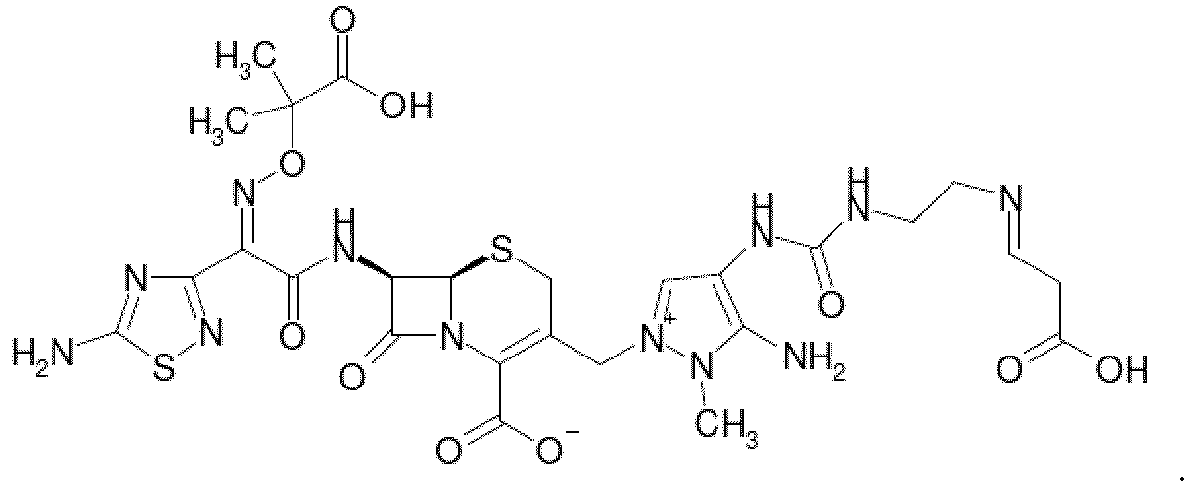
- A method of preparing a pharmaceutical composition of any one of 1 to 8, wherein the method comprises:(A) blending ceftolozane sulfate and tazobactam sodium, and wherein the ceftolozane sulfate and tazobactam sodium are individually lyophilized prior to blending, or(B) blending ceftolozane sulfate and tazobactam sodium, and wherein the ceftolozane and tazobactam are individually lyophilized in separate, dedicated production areas prior to blending.
Priority Applications (4)
| Application Number | Priority Date | Filing Date | Title |
|---|---|---|---|
| SI201432109T SI2893929T1 (en) | 2013-03-15 | 2014-03-14 | Ceftolozane antibiotic compositions |
| EP16161871.5A EP3100732A1 (en) | 2013-03-15 | 2014-03-14 | Ceftolozane antibiotic compositions |
| HRP20250690TT HRP20250690T1 (en) | 2013-03-15 | 2014-03-14 | ANTIBIOTIC MIXTURES WITH CEFTOLOZANE |
| RS20250620A RS66933B1 (en) | 2013-03-15 | 2014-03-14 | Ceftolozane antibiotic compositions |
Applications Claiming Priority (5)
| Application Number | Priority Date | Filing Date | Title |
|---|---|---|---|
| US201361792092P | 2013-03-15 | 2013-03-15 | |
| US201361793007P | 2013-03-15 | 2013-03-15 | |
| US201361882936P | 2013-09-26 | 2013-09-26 | |
| US201361893436P | 2013-10-21 | 2013-10-21 | |
| EP14160151.8A EP2777705A1 (en) | 2013-03-15 | 2014-03-14 | Ceftolozane antibiotic compositions |
Related Parent Applications (1)
| Application Number | Title | Priority Date | Filing Date |
|---|---|---|---|
| EP14160151.8A Division EP2777705A1 (en) | 2013-03-15 | 2014-03-14 | Ceftolozane antibiotic compositions |
Related Child Applications (2)
| Application Number | Title | Priority Date | Filing Date |
|---|---|---|---|
| EP16161871.5A Division-Into EP3100732A1 (en) | 2013-03-15 | 2014-03-14 | Ceftolozane antibiotic compositions |
| EP16161871.5A Division EP3100732A1 (en) | 2013-03-15 | 2014-03-14 | Ceftolozane antibiotic compositions |
Publications (2)
| Publication Number | Publication Date |
|---|---|
| EP2893929A1 EP2893929A1 (en) | 2015-07-15 |
| EP2893929B1 true EP2893929B1 (en) | 2025-04-16 |
Family
ID=50280243
Family Applications (3)
| Application Number | Title | Priority Date | Filing Date |
|---|---|---|---|
| EP16161871.5A Withdrawn EP3100732A1 (en) | 2013-03-15 | 2014-03-14 | Ceftolozane antibiotic compositions |
| EP14199792.4A Active EP2893929B1 (en) | 2013-03-15 | 2014-03-14 | Ceftolozane antibiotic compositions |
| EP14160151.8A Withdrawn EP2777705A1 (en) | 2013-03-15 | 2014-03-14 | Ceftolozane antibiotic compositions |
Family Applications Before (1)
| Application Number | Title | Priority Date | Filing Date |
|---|---|---|---|
| EP16161871.5A Withdrawn EP3100732A1 (en) | 2013-03-15 | 2014-03-14 | Ceftolozane antibiotic compositions |
Family Applications After (1)
| Application Number | Title | Priority Date | Filing Date |
|---|---|---|---|
| EP14160151.8A Withdrawn EP2777705A1 (en) | 2013-03-15 | 2014-03-14 | Ceftolozane antibiotic compositions |
Country Status (27)
| Country | Link |
|---|---|
| US (7) | US20140274995A1 (en) |
| EP (3) | EP3100732A1 (en) |
| JP (3) | JP6543611B2 (en) |
| KR (2) | KR102329764B1 (en) |
| CN (2) | CN110279698B (en) |
| AU (1) | AU2014227660B2 (en) |
| BR (1) | BR112015023523B8 (en) |
| CA (1) | CA2906151A1 (en) |
| CL (1) | CL2015002755A1 (en) |
| DK (1) | DK2893929T3 (en) |
| EA (1) | EA029090B1 (en) |
| ES (1) | ES3026983T3 (en) |
| FI (1) | FI2893929T3 (en) |
| HR (1) | HRP20250690T1 (en) |
| HU (1) | HUE072320T2 (en) |
| IL (1) | IL241581B (en) |
| LT (1) | LT2893929T (en) |
| MX (2) | MX387913B (en) |
| NZ (1) | NZ700372A (en) |
| PE (1) | PE20160048A1 (en) |
| PL (1) | PL2893929T3 (en) |
| PT (1) | PT2893929T (en) |
| RS (1) | RS66933B1 (en) |
| SI (1) | SI2893929T1 (en) |
| TN (1) | TN2015000411A1 (en) |
| UA (1) | UA121298C2 (en) |
| WO (1) | WO2014144295A1 (en) |
Families Citing this family (13)
| Publication number | Priority date | Publication date | Assignee | Title |
|---|---|---|---|---|
| US8513305B2 (en) | 2007-05-14 | 2013-08-20 | Research Foundation Of State University Of New York | Induction of a physiological dispersion response in bacterial cells in a biofilm |
| PT3616695T (en) | 2011-09-09 | 2024-11-18 | Merck Sharp & Dohme | Methods for treating intrapulmonary infections |
| US9872906B2 (en) | 2013-03-15 | 2018-01-23 | Merck Sharp & Dohme Corp. | Ceftolozane antibiotic compositions |
| PE20160048A1 (en) * | 2013-03-15 | 2016-02-12 | Merck Sharp & Dohme | ANTIBIOTIC COMPOSITIONS OF CEFTOLOZANE |
| US20140274996A1 (en) | 2013-03-15 | 2014-09-18 | Cubist Pharmaceuticals, Inc. | Tazobactam and ceftolozane antibiotic compositions |
| WO2015035376A2 (en) | 2013-09-09 | 2015-03-12 | Calixa Therapeutics, Inc. | Treating infections with ceftolozane/tazobactam in subjects having impaired renal function |
| US8906898B1 (en) * | 2013-09-27 | 2014-12-09 | Calixa Therapeutics, Inc. | Solid forms of ceftolozane |
| CN104721190B (en) * | 2015-03-26 | 2017-01-11 | 新乡医学院 | Ceftezole sodium injection and preparation method thereof |
| MY198774A (en) * | 2016-03-31 | 2023-09-26 | Wockhardt Ltd | Antibacterial compositions |
| BR112017022864A2 (en) * | 2016-03-31 | 2018-07-17 | Wockhardt Ltd | antibacterial compositions |
| US11541105B2 (en) | 2018-06-01 | 2023-01-03 | The Research Foundation For The State University Of New York | Compositions and methods for disrupting biofilm formation and maintenance |
| CN114025767B (en) * | 2021-09-18 | 2026-01-30 | 湘北威尔曼制药股份有限公司 | A pharmaceutical composition containing cefoperazone sodium and tazobactam sodium for use in renal insufficiency complicated by bacterial infection. |
| US20250107553A1 (en) * | 2022-02-01 | 2025-04-03 | Inaba Shokuhin Co., Ltd. | Pharmaceutical or food composition for animals |
Citations (8)
| Publication number | Priority date | Publication date | Assignee | Title |
|---|---|---|---|---|
| EP0097446B1 (en) | 1982-06-21 | 1986-02-26 | Taiho Pharmaceutical Company Limited | Penicillin derivatives and process for preparation of the same |
| US4822785A (en) | 1986-07-10 | 1989-04-18 | Eisai Co., Ltd. | Cephalosporin injection |
| EP0421297A2 (en) | 1989-09-30 | 1991-04-10 | Eisai Co., Ltd. | Injectable preparations containing cephalosporin medicament and the use thereof |
| WO1999067255A1 (en) | 1998-06-22 | 1999-12-29 | F. Hoffmann-La Roche Ag | Propenyl cephalosporin derivatives |
| US7129232B2 (en) | 2002-10-30 | 2006-10-31 | Astellas Pharma Inc. | Cephem compounds |
| CN101265263A (en) | 2008-05-12 | 2008-09-17 | 海南百那医药发展有限公司 | Method for producing piperacillin sodium tazobactam sodium compound injection |
| WO2013036783A2 (en) | 2011-09-09 | 2013-03-14 | Cubist Pharmaceuticals, Inc. | Methods for treating intrapulmonary infections |
| WO2014052799A1 (en) * | 2012-09-27 | 2014-04-03 | Cubist Pharmaceuticals, Inc. | Tazobactam arginine antibiotic compositions |
Family Cites Families (243)
| Publication number | Priority date | Publication date | Assignee | Title |
|---|---|---|---|---|
| IL37879A (en) | 1970-10-27 | 1974-12-31 | Ciba Geigy Ag | 3-unsubstituted cephalosporin derivatives,process for their manufacture and compositions containing them |
| US4299829A (en) | 1976-03-12 | 1981-11-10 | Fujisawa Pharmaceutical Co., Ltd. | 2-Lower alkyl-7-substituted-2 or 3-cephem 4-carboxylic acid compounds |
| PH17188A (en) | 1977-03-14 | 1984-06-14 | Fujisawa Pharmaceutical Co | New cephem and cepham compounds and their pharmaceutical compositions and method of use |
| US4496562A (en) | 1977-03-14 | 1985-01-29 | Fujisawa Pharmaceutical Co., Ltd. | 7-Substituted-3-cephem-4-carboxylic acid esters |
| US4464369A (en) | 1977-03-14 | 1984-08-07 | Fujisawa Pharmaceutical Co., Ltd. | 7-Acylamino-3-cephem-4-carboxylic acid derivatives and pharmaceutical compositions |
| US4409217A (en) | 1977-03-14 | 1983-10-11 | Fujisawa Pharmaceutical Co., Ltd. | Cephem compounds |
| JPS543087A (en) | 1977-06-03 | 1979-01-11 | Fujisawa Pharmaceut Co Ltd | Preparation of cephalosporin compound |
| GB1604738A (en) | 1977-07-28 | 1981-12-16 | Yamanouchi Pharma Co Ltd | 1,3-dithietane-2-carboxylic acid derivatives and the preparation thereof |
| JPS609719B2 (en) | 1977-08-06 | 1985-03-12 | 武田薬品工業株式会社 | Cephalosporin derivatives and their production method |
| US4370326A (en) | 1977-09-13 | 1983-01-25 | Fujisawa Pharmaceutical Co., Ltd. | Cephem compounds and composition |
| IT1192287B (en) | 1977-11-14 | 1988-03-31 | Fujisawa Pharmaceutical Co | PHARMACEUTICAL ACTION DERIVATIVES OF CEPHALOSPORANIC ACID AND RELATED PREPARATION PROCEDURE |
| US4363807A (en) | 1978-04-06 | 1982-12-14 | Fujisawa Pharmaceutical Company, Limited | Cepham compounds |
| SE7804231L (en) | 1978-04-14 | 1979-10-15 | Haessle Ab | Gastric acid secretion |
| AR228726A1 (en) | 1978-05-26 | 1983-04-15 | Glaxo Group Ltd | PROCEDURE FOR THE PREPARATION OF ANTIBIOTIC (6R, 7R) -7 - ((Z) -2- (2-AMINOTIAZOL-4-IL) -2- (2-CARBOXIPROP-2-OXIIMINO) ACETAMIDO) -3- (1- PIRIDINIOMETIL) CEF-3-EM-4-CARBOXILATO |
| US4264597A (en) | 1978-06-06 | 1981-04-28 | Masashi Hashimoto | Cephalosporin analogues and processes for the preparation thereof |
| US4268509A (en) | 1978-07-10 | 1981-05-19 | Fujisawa Pharmaceutical Co., Ltd. | New cephem compounds and processes for preparation thereof |
| US4284631A (en) | 1978-07-31 | 1981-08-18 | Fujisawa Pharmaceutical Co., Ltd. | 7-Substituted cephem compounds and pharmaceutical antibacterial compositions containing them |
| US4305937A (en) | 1978-08-17 | 1981-12-15 | Fujisawa Pharmaceutical Co., Ltd. | 2-Lower alkyl-7-substituted-2 or 3-cephem-4-carboxylic acid compounds and antibacterial pharmaceutical compositions containing them |
| US4703046A (en) | 1978-09-08 | 1987-10-27 | Fujisawa Pharmaceutical Co., Ltd. | Cephem compounds and processes for preparation thereof |
| EP0009671B1 (en) | 1978-09-12 | 1984-06-13 | Fujisawa Pharmaceutical Co., Ltd. | Starting compounds for preparing cephem compounds and processes for their preparation |
| US4327093A (en) | 1978-10-24 | 1982-04-27 | Fujisawa Pharmaceutical Co., Ltd. | 3,7-Disubstituted-2 or 3-cephem-4-carboxylic acid compounds |
| DE2945248A1 (en) | 1978-11-13 | 1980-05-22 | Fujisawa Pharmaceutical Co | CEPHEM COMPOUNDS, METHOD FOR THEIR PRODUCTION AND ANTIBACTERIAL PHARMACEUTICAL AGENTS CONTAINING THE SAME |
| US4332798A (en) | 1978-12-29 | 1982-06-01 | Fujisawa Pharmaceutical Co., Ltd. | 7-Amino-thia-diazole oxyimino derivatives of cephem and cephem compounds |
| US4390534A (en) | 1978-12-29 | 1983-06-28 | Fujisawa Pharmaceutical Co., Ltd. | Cephem and cepham compounds |
| AU536842B2 (en) | 1978-12-29 | 1984-05-24 | Fujisawa Pharmaceutical Co., Ltd. | Cephalosporin antibiotics |
| US4291031A (en) | 1979-02-19 | 1981-09-22 | Fujisawa Pharmaceutical Co., Ltd. | 3-Phosphonocephalosporanic acid derivatives, and pharmaceutical composition comprising the same |
| US4339449A (en) | 1979-03-27 | 1982-07-13 | Fujisawa Pharmaceutical Company, Limited | Analogous compounds of cephalosporins, and pharmaceutical composition comprising the same |
| FR2462439A1 (en) | 1979-07-26 | 1981-02-13 | Roussel Uclaf | NOVEL PROCESS FOR THE PREPARATION OF PRODUCTS DERIVED FROM 7 - / (2-ARYL) 2-HYDROXYIMINO ACETAMIDO / CEPHALOSPORANIC ACID |
| EP0025199B1 (en) | 1979-09-03 | 1984-10-31 | Fujisawa Pharmaceutical Co., Ltd. | Cephem compounds, processes for their preparation and pharmaceutical compositions containing them |
| US4338313A (en) | 1979-10-12 | 1982-07-06 | Fujisawa Pharmaceutical Co., Ltd. | Cephem compounds |
| US4332800A (en) | 1979-10-12 | 1982-06-01 | Fujisawa Pharmaceutical Co., Ltd. | Cephem compounds |
| US4381299A (en) | 1980-03-07 | 1983-04-26 | Fujisawa Pharmaceutical Co., Ltd. | 7-Amino-thiadiazole oxyimino derivatives of cephem and cepham compounds |
| US4409215A (en) | 1979-11-19 | 1983-10-11 | Fujisawa Pharmaceutical Co., Ltd. | 7-Acylamino-3-substituted cephalosporanic acid derivatives and processes for the preparation thereof |
| US4409214A (en) | 1979-11-19 | 1983-10-11 | Fujisawa Pharmaceutical, Co., Ltd. | 7-Acylamino-3-vinylcephalosporanic acid derivatives and processes for the preparation thereof |
| US4420477A (en) | 1979-11-30 | 1983-12-13 | Fujisawa Pharmaceutical Co., Ltd. | Cephem compounds |
| US4443443A (en) | 1979-12-17 | 1984-04-17 | Fujisawa Pharmaceutical Co., Ltd. | Cephem compounds |
| US4405617A (en) | 1980-02-11 | 1983-09-20 | Fujisawa Pharmaceutical Co., Ltd. | 3-(Propynyltetrazol)thiomethyl-3-cephems |
| JPS56125392A (en) | 1980-03-06 | 1981-10-01 | Fujisawa Pharmaceut Co Ltd | Cepham and cephem compound and preparation thereof |
| US4470980A (en) | 1980-03-07 | 1984-09-11 | Interx Research Corp. | Method of increasing oral absorption of β-lactam antibiotics |
| JPS5711909A (en) | 1980-06-23 | 1982-01-21 | Shionogi & Co Ltd | Stable freeze-dried preparation of beta-lactam |
| DE3173613D1 (en) | 1980-07-04 | 1986-03-13 | Fujisawa Pharmaceutical Co | 7-oxo-cephalosporins and 6-oxo-penicillins, their analogues and process for their preparation |
| US4443444A (en) | 1980-08-11 | 1984-04-17 | Fujisawa Pharmaceutical Co., Ltd. | Cephem compounds |
| EP0156118A1 (en) | 1980-08-29 | 1985-10-02 | Fujisawa Pharmaceutical Co., Ltd. | New starting compounds for the preparation of cephem compounds and processes for preparation thereof |
| US4416879A (en) | 1980-09-08 | 1983-11-22 | Fujisawa Pharmaceutical Co., Ltd. | Cephem compounds |
| US4367228A (en) | 1980-10-29 | 1983-01-04 | Fujisawa Pharmaceutical Co., Ltd. | Cephem compound and composition |
| US4431642A (en) | 1980-12-01 | 1984-02-14 | Fujisawa Pharmaceutical Co., Ltd. | Cephem compounds |
| IT1142096B (en) | 1980-12-15 | 1986-10-08 | Fujisawa Pharmaceutical Co | 7-ACHYLAMINE CEPHALOSPORANIC ACID DERIVATIVES AND PROCEDURES FOR THEIR PREPARATION |
| US4427677A (en) | 1980-12-31 | 1984-01-24 | Fujisawa Pharmaceutical Co., Ltd. | Cephem compounds |
| EP0055465B1 (en) | 1980-12-31 | 1989-08-23 | Fujisawa Pharmaceutical Co., Ltd. | 7-acylaminocephalosporanic acid derivatives and processes for the preparation thereof |
| GR76342B (en) | 1981-02-02 | 1984-08-06 | Fujisawa Pharmaceutical Co | |
| US4336253A (en) | 1981-03-11 | 1982-06-22 | Eli Lilly And Company | Cephalosporin antibiotics |
| JPS6011917B2 (en) | 1981-04-09 | 1985-03-28 | 山之内製薬株式会社 | Novel cephalosporin compounds |
| DE3118732A1 (en) | 1981-05-12 | 1982-12-02 | Hoechst Ag, 6000 Frankfurt | CEPHALOSPORINE DERIVATIVES AND METHOD FOR THEIR PRODUCTION |
| JPS57193489A (en) | 1981-05-21 | 1982-11-27 | Fujisawa Pharmaceut Co Ltd | Syn-isomer of 7-substituted-3-cephem-4-carboxylic acid ester and its preparation |
| GR75487B (en) | 1981-06-22 | 1984-07-23 | Fujisawa Pharmaceutical Co | |
| IE53429B1 (en) | 1981-08-03 | 1988-11-09 | Fujisawa Pharmaceutical Co | New cephem compounds and processes for preparation thereof |
| US4436912A (en) | 1981-09-08 | 1984-03-13 | Eli Lilly And Company | 7-[2-(2-Aminooxazol-4-yl)-2-(oximino)acetamido cephalosporin antibiotics and intermediates therefor |
| US4577014A (en) | 1981-09-08 | 1986-03-18 | Eli Lilly And Company | Thieno and furopyridinium-substituted cephalosporins |
| US4430499A (en) | 1981-09-08 | 1984-02-07 | Eli Lilly And Company | 7-[2-(2-Aminooxazol-4-yl)-2-(oximino)acetamido]cephalosporin antibiotics |
| JPS5859991A (en) | 1981-09-14 | 1983-04-09 | Fujisawa Pharmaceut Co Ltd | Novel cephem compound and its preparation |
| US4521413A (en) | 1981-09-14 | 1985-06-04 | Fujisawa Pharmaceutical Co., Ltd. | Cephem compounds |
| US4450270A (en) | 1981-10-02 | 1984-05-22 | Eli Lilly And Company | Dioximino cephalosporin antibiotics |
| US4402955A (en) | 1981-10-02 | 1983-09-06 | Eli Lilly And Company | Dioximino cephalosporin antibiotics |
| US4501739A (en) | 1982-01-19 | 1985-02-26 | Eli Lilly And Company | Thieno and furopyridinium-substituted cephalosporins |
| DE3207840A1 (en) | 1982-03-04 | 1983-09-15 | Hoechst Ag, 6230 Frankfurt | "CEPHALOSPORINE DERIVATIVES AND METHOD FOR THE PRODUCTION THEREOF" |
| JPS58154547A (en) | 1982-03-09 | 1983-09-14 | Nippon Shinyaku Co Ltd | Stabilization of azulene derivative |
| US4640915A (en) | 1982-03-29 | 1987-02-03 | Fujisawa Pharmaceutical Co., Ltd. | 1-azabicyclo[3.2.0]hept-2-ene-2-carboxylic acid derivatives |
| JPS58225091A (en) | 1982-06-21 | 1983-12-27 | Taiho Yakuhin Kogyo Kk | Penicillin derivative and its preparation |
| US4563449A (en) | 1982-07-19 | 1986-01-07 | Fujisawa Pharmaceutical Co., Ltd. | Cephem compounds |
| US4546101A (en) | 1982-09-10 | 1985-10-08 | Fujisawa Pharmaceutical Co., Ltd. | New cephem compounds useful for treating infectious diseases in human being and animals and processes for preparation thereof |
| GB8323034D0 (en) | 1983-08-26 | 1983-09-28 | Fujisawo Pharmaceutical Co Ltd | 7-substituted-3-vinyl-3-cephem compounds |
| US4609730A (en) | 1982-11-22 | 1986-09-02 | Fujisawa Pharmaceutical Co., Ltd. | 7-[substituted imino-2-(2-aminothiazol-4-yl)-acetamido]-3(2,2-dihalovinyl or ethynyl)-3-cephem-4-carboxylic acid (syn isomers), having antimicrobial activities |
| GR79043B (en) | 1982-12-06 | 1984-10-02 | Fujisawa Pharmaceutical Co | |
| US4608373A (en) | 1982-12-13 | 1986-08-26 | Yamanouchi Pharmaceutical Co., Ltd. | Cephem compounds |
| US4463003A (en) | 1982-12-22 | 1984-07-31 | Fujisawa Pharmaceutical Co., Ltd. | Cephem compounds |
| US4487768A (en) | 1982-12-22 | 1984-12-11 | Fujisawa Pharmaceutical Co., Ltd. | Cephem compounds |
| DE3247613A1 (en) | 1982-12-23 | 1984-07-05 | Hoechst Ag, 6230 Frankfurt | CEPHALOSPORINE DERIVATIVES AND METHOD FOR THEIR PRODUCTION |
| US4562073A (en) | 1982-12-24 | 1985-12-31 | Taiho Pharmaceutical Company Limited | Penicillin derivatives |
| US4499088A (en) | 1983-01-04 | 1985-02-12 | Fujisawa Pharmaceutical Co., Ltd. | Cephem compounds |
| DE3316798A1 (en) | 1983-05-07 | 1984-11-08 | Hoechst Ag, 6230 Frankfurt | METHOD FOR PRODUCING CEPHEM COMPOUNDS |
| FR2550200B1 (en) | 1983-08-01 | 1988-04-08 | Fujisawa Pharmaceutical Co | PROCESS FOR THE PREPARATION OF CEPHEM COMPOUNDS WITH ANTIMICROBIAL ACTIVITY AND NOVEL PRODUCTS THUS OBTAINED |
| JPS6045514A (en) | 1983-08-22 | 1985-03-12 | Shionogi & Co Ltd | Stable antibacterial lyophilized pharmactical preparation |
| DE3409431A1 (en) | 1983-10-08 | 1985-04-18 | Hoechst Ag, 6230 Frankfurt | CEPHALOSPORINE DERIVATIVES AND METHOD FOR THEIR PRODUCTION |
| EP0137442A3 (en) | 1983-10-08 | 1986-01-15 | Hoechst Aktiengesellschaft | Cephalosporin derivatives and process for their preparation |
| US4690921A (en) | 1983-10-11 | 1987-09-01 | Yamanouchi Pharmaceutical Co., Ltd. | Cephalosporin compounds and salts thereof |
| US4692443A (en) | 1983-10-17 | 1987-09-08 | Eli Lilly And Company | 3-bicyclicpyridinium-methyl cephalosporins |
| US4748172A (en) | 1983-10-17 | 1988-05-31 | Eli Lilly And Company | 3-bicyclicpyridinium-methyl cephalosporins |
| ZA847926B (en) | 1983-10-17 | 1986-05-28 | Lilly Co Eli | 3-bicyclicpyridinium-methyl cephalosporins |
| GB8329030D0 (en) | 1983-10-31 | 1983-11-30 | Fujisawa Pharmaceutical Co | Cephem compounds |
| GB8401093D0 (en) | 1984-01-16 | 1984-02-15 | Fujisawa Pharmaceutical Co | Cephem compounds |
| JPS60169486A (en) | 1984-02-10 | 1985-09-02 | Yamanouchi Pharmaceut Co Ltd | Preparation of 7-amino-3-substituted methyl-3-cephem-4- carboxylic acid and lower alkylsilyl derivative thereof |
| GB8406231D0 (en) | 1984-03-09 | 1984-04-11 | Fujisawa Pharmaceutical Co | Cephem compounds |
| JPS60214792A (en) | 1984-04-06 | 1985-10-28 | Taiho Yakuhin Kogyo Kk | Penamic acid ester derivatives |
| US4705851A (en) | 1984-09-28 | 1987-11-10 | Fujisawa Pharmaceutical Co., Ltd. | Process for the preparation of 3-phosphoniummethyl-3-cephem compounds |
| US4761410A (en) | 1985-01-14 | 1988-08-02 | Fujisawa Pharmaceutical Co., Ltd. | Cephem Compounds |
| AU586215B2 (en) | 1985-01-21 | 1989-07-06 | Nippon Pharmaceutical Development Institute Company Limited | Novel ```-lactam antibiotics |
| GB8504072D0 (en) | 1985-02-18 | 1985-03-20 | Fujisawa Pharmaceutical Co | Cephem compounds |
| JPS62103092A (en) | 1985-07-18 | 1987-05-13 | Sagami Chem Res Center | Beta-lactam derivative |
| JPS6230789A (en) | 1985-08-01 | 1987-02-09 | Yamanouchi Pharmaceut Co Ltd | 7-formylaminocephalosporin compound and production thereof |
| CN86107947A (en) | 1985-11-22 | 1987-05-27 | 藤沢药品工业株式会社 | New cephem compounds and preparation method thereof |
| US5194432A (en) | 1985-11-22 | 1993-03-16 | Fujisawa Pharmaceutical Co., Ltd. | Cephem compounds |
| US4808617A (en) | 1985-12-18 | 1989-02-28 | Bristol-Myers Company | Lyophilized or precipitated cephalosporin zwitterion and salt combination |
| JPS62158290A (en) | 1985-12-28 | 1987-07-14 | Banyu Pharmaceut Co Ltd | Novel cephalosporin derivative |
| DE3789466T2 (en) | 1986-03-17 | 1994-07-28 | Fujisawa Pharmaceutical Co | 3,7-disubstituted-3-cephem compounds and process for their preparation. |
| US4833134A (en) | 1986-08-19 | 1989-05-23 | Takeda Chemical Industries, Ltd. | Cephem compounds |
| JPS6351388A (en) | 1986-08-22 | 1988-03-04 | Teijin Ltd | Cephalosporin derivative, production thereof and composition having antimicrobial activity |
| JPS6351389A (en) | 1986-08-22 | 1988-03-04 | Teijin Ltd | Cephalosporin derivative, production thereof and composition having antimicrobial activity |
| US5162520A (en) | 1986-09-22 | 1992-11-10 | Fujisawa Pharmaceutical Co., Ltd. | Intermediates for cephem compounds |
| CA1293719C (en) | 1986-09-22 | 1991-12-31 | Takao Takaya | Cephem compounds and processes for preparation thereof |
| US4882434A (en) | 1986-10-29 | 1989-11-21 | Takeda Chemical Industries, Ltd. | Gamma-lactonecarboxylic acid derivatives and their use as antibacterial agents or intermediates |
| KR880006244A (en) | 1986-11-24 | 1988-07-22 | 후지사와 도모 기찌 로 | 3-Pyrrolidinylthio-1-azabibischloro [3.2.0] hapt2-ene-2-carboxylic acid compound and preparation method thereof |
| EP0272455B1 (en) | 1986-11-24 | 1993-02-10 | Fujisawa Pharmaceutical Co., Ltd. | 3-Pyrrolidinylthio-1-azabicyclo [3.2.0] hept-2-ene-2-carboxylic acid compounds |
| AU1630988A (en) | 1987-05-30 | 1988-12-01 | Kyoto Pharmaceutical Industries, Ltd. | Cephalosporin compound and pharmaceutical composition thereof |
| IE61679B1 (en) | 1987-08-10 | 1994-11-16 | Fujisawa Pharmaceutical Co | Water-soluble antibiotic composition and water-soluble salts of new cephem compounds |
| US5073550A (en) | 1987-08-14 | 1991-12-17 | Hoffmann-La Roche Inc. | Cephalosphorins with sulfur-containing oxyimino side chain |
| EP0303172A3 (en) | 1987-08-14 | 1991-05-15 | F. Hoffmann-La Roche Ag | Oxyimino-cephalosporins |
| US5138066A (en) | 1987-08-14 | 1992-08-11 | Hoffmann-La Roche, Inc. | Intermediates for cephalosporins with sulfur-containing oxyimino side chain |
| ZA885709B (en) | 1987-08-19 | 1989-04-26 | Fujisawa Pharmaceutical Co | Novel crystalline 7-(2-(2-aminothiazol-4-yl)-2-hydroxyiminoacetamido)-3-vinyl-3-cephem-4-carboxylic acid(syn isomer) |
| US5210080A (en) | 1987-09-07 | 1993-05-11 | Fujisawa Pharmaceutical Co., Ltd. | Cephem compounds |
| US5663163A (en) | 1987-09-07 | 1997-09-02 | Fujisawa Pharmaceutical Co., Ltd. | Cephem compounds and processes for preparation thereof |
| IE63094B1 (en) | 1987-09-14 | 1995-03-22 | Fujisawa Pharmaceutical Co | Cephem compound and a process for preparation thereof |
| DK637888A (en) | 1987-11-24 | 1989-05-25 | Hoffmann La Roche | carboxylic esters |
| GB8804058D0 (en) | 1988-02-22 | 1988-03-23 | Fujisawa Pharmaceutical Co | 3-alkenyl-1-azabicyclo(3 2 0)hept-2-ene-2-carboxylic acid compounds |
| JP2648750B2 (en) | 1988-03-02 | 1997-09-03 | 大塚化学株式会社 | Method for producing β-lactam derivative |
| US5173485A (en) | 1988-03-09 | 1992-12-22 | Fujisawa Pharmaceutical Company, Ltd. | Cephem compounds |
| US5336768A (en) | 1988-05-24 | 1994-08-09 | Hoffmann-La Roche Inc. | Antibacterial cephalosporin compounds |
| CS273349B2 (en) | 1988-03-31 | 1991-03-12 | Hoffmann La Roche | Method of cephalosporin's new derivatives production |
| KR900006811B1 (en) | 1988-05-11 | 1990-09-21 | 주식회사 럭 키 | Cephalosphorin derivatives and its process |
| US4963544A (en) | 1988-05-23 | 1990-10-16 | Fujisawa Pharmaceutical Company, Ltd. | 3-pyrrolidinylthio-1-azabicyclo[3.2.0]-hept-2-ene-2-carboxylic acid compounds |
| US5244890A (en) | 1988-06-06 | 1993-09-14 | Fujisawa Pharmaceutical Co., Ltd. | Cephem compounds |
| EP0997466A1 (en) | 1988-10-24 | 2000-05-03 | PROCTER & GAMBLE PHARMACEUTICALS, INC. | Novel antimicrobial lactam-quinolones |
| JP2785195B2 (en) | 1989-01-11 | 1998-08-13 | ソニー株式会社 | Optical encoder for disk drive |
| GB8905301D0 (en) | 1989-03-08 | 1989-04-19 | Fujisawa Pharmaceutical Co | New cephem compound and a process for preparation thereof |
| JPH0347187A (en) | 1989-04-12 | 1991-02-28 | Yamanouchi Pharmaceut Co Ltd | New cephalosporin derivative |
| US5102877A (en) | 1989-04-28 | 1992-04-07 | Fujisawa Pharmaceutical Co., Ltd. | 1-azabicyclo[3.2.0]hept-2-ene-2-carboxylic acid compounds |
| NO903360L (en) | 1989-08-11 | 1991-02-12 | Ici Pharma | ANTIBIOTIC COMPOUNDS. |
| GB8923844D0 (en) | 1989-10-23 | 1989-12-13 | Fujisawa Pharmaceutical Co | Carbapenem compounds |
| US5215982A (en) | 1989-11-10 | 1993-06-01 | Fujisawa Pharmaceutical Co., Ltd. | Cephem compounds |
| US4982596A (en) | 1990-01-26 | 1991-01-08 | Buell Industries, Inc. | Die for manufacturing a fastener blank |
| KR910015587A (en) | 1990-02-27 | 1991-09-30 | 후지사와 토모키치로 | Cefem compound |
| US5234920A (en) | 1990-08-23 | 1993-08-10 | Bristol-Myers Squibb Company | Antibiotic C-7 catechol-substituted cephalosporin compounds, compositions, and method of use thereof |
| US5095012A (en) | 1990-08-23 | 1992-03-10 | Bristol-Myers Squibb Company | Antibiotic c-7 catechol-substituted cephalosporin compounds, compositions, and method of use thereof |
| US5286721A (en) | 1990-10-15 | 1994-02-15 | Fujisawa Pharmaceutical Co., Ltd. | 1-azabicyclo[3.2.0]hept-2-ene-2-carboxylic acid compounds |
| US5281589A (en) | 1991-06-15 | 1994-01-25 | Cheil Foods & Chemicals, Inc. | 3-fused pyridiniummethyl cephalosporins |
| US5523400A (en) | 1993-04-16 | 1996-06-04 | Hoffmann-La Roche Inc. | Cephalosporin antibiotics |
| KR100194994B1 (en) | 1993-06-05 | 1999-06-15 | 손경식 | New cefem compound |
| EP0678095A1 (en) | 1993-11-06 | 1995-10-25 | Taiho Pharmaceutical Co., Ltd. | Crystalline penicillin derivative, and its production and use |
| EP0664117A1 (en) | 1994-01-25 | 1995-07-26 | F. Hoffmann-La Roche Ag | Liposome solutions |
| TW293010B (en) | 1994-04-20 | 1996-12-11 | Hui-Po Wang | Method for preparing cephalosporin derivatives |
| EP0723966A4 (en) | 1994-08-16 | 1997-01-29 | Meiji Seika Co | Novel cephem derivative |
| DE4440141A1 (en) | 1994-11-10 | 1996-05-15 | Hoechst Ag | Novel crystalline cephem acid addition salts and process for their preparation |
| JPH09110877A (en) | 1995-10-17 | 1997-04-28 | Katayama Seiyakushiyo:Kk | Cephem compound, its production and antibacterial agent containing the compound |
| CN1088711C (en) | 1996-04-04 | 2002-08-07 | 盐野义制药株式会社 | Cephem compound and medicine containing the compound |
| AUPN955596A0 (en) | 1996-04-30 | 1996-05-23 | Fujisawa Pharmaceutical Co., Ltd. | New compound |
| WO1999028308A1 (en) | 1997-11-29 | 1999-06-10 | Truett William L | Antibiotics and process for preparation |
| AU4543899A (en) | 1998-06-08 | 1999-12-30 | Advanced Medicine, Inc. | Multibinding inhibitors of microsomal triglyceride transferase protein |
| WO2000004915A1 (en) | 1998-07-23 | 2000-02-03 | Intrabiotics Pharmaceuticals, Inc. | Compositions and methods for the treatment or prevention of pulmonary infections |
| TW526202B (en) | 1998-11-27 | 2003-04-01 | Shionogi & Amp Co | Broad spectrum cephem having benzo[4,5-b]pyridium methyl group of antibiotic activity |
| US6207661B1 (en) | 1999-02-22 | 2001-03-27 | Baxter International Inc. | Premixed formulation of piperacillin sodium and tazobactam sodium injection |
| TWI233805B (en) | 1999-07-01 | 2005-06-11 | Fujisawa Pharmaceutical Co | Stabilized pharmaceutical composition in lyophilized form as antifungal agent |
| US6610681B1 (en) | 1999-08-16 | 2003-08-26 | Revaax Pharmaceuticals, Llc | Neurotherapeutic clavulanate composition and method |
| ATE396729T1 (en) | 2000-04-24 | 2008-06-15 | Daiichi Sankyo Co Ltd | STABLE LIQUID PREPARATION CONTAINING SITAFLOXACIN |
| JP3743822B2 (en) | 2000-08-11 | 2006-02-08 | 大塚化学ホールディングス株式会社 | Penicillin crystals and production method thereof |
| JP3743823B2 (en) | 2000-08-11 | 2006-02-08 | 大塚化学ホールディングス株式会社 | Penicillin crystals and production method thereof |
| US6599893B2 (en) | 2000-08-29 | 2003-07-29 | Essential Therapeutics, Inc. | Cephalosporin antibiotics and prodrugs thereof |
| JP3306473B1 (en) | 2001-05-01 | 2002-07-24 | 大塚化学株式会社 | Anhydrous crystal of β-lactam compound and method for producing the same |
| MXPA03010002A (en) | 2001-05-01 | 2004-06-30 | Fujisawa Pharmaceutical Co | Cephem compounds. |
| JP2002338578A (en) | 2001-05-14 | 2002-11-27 | Otsuka Chem Co Ltd | Hydrate crystals of β-lactam compounds |
| WO2002102378A1 (en) | 2001-06-18 | 2002-12-27 | Revaax Pharmaceuticals, Llc | Therapeutic treatment for sexual dysfunction |
| TWI335332B (en) | 2001-10-12 | 2011-01-01 | Theravance Inc | Cross-linked vancomycin-cephalosporin antibiotics |
| US7378408B2 (en) * | 2001-11-30 | 2008-05-27 | Pfizer Inc. | Methods of treatment and formulations of cephalosporin |
| WO2003066053A1 (en) | 2002-02-07 | 2003-08-14 | Rutgers, The State University | Antibiotic polymers |
| TW200305422A (en) | 2002-03-18 | 2003-11-01 | Shionogi & Co | Broad spectrum cefem compounds |
| TWI325323B (en) | 2002-05-24 | 2010-06-01 | Theravance Inc | Cross-linked glycopeptide-cephalosporin antibiotics |
| JP2005534662A (en) | 2002-06-07 | 2005-11-17 | オーキッド ケミカルズ アンド ファーマシューティカルズ リミテッド | Process for producing penum derivatives from cefam derivatives |
| US9211259B2 (en) | 2002-11-29 | 2015-12-15 | Foamix Pharmaceuticals Ltd. | Antibiotic kit and composition and uses thereof |
| AU2002952355A0 (en) * | 2002-10-30 | 2002-11-14 | Fujisawa Pharmaceutical Co., Ltd. | Cephem compounds |
| AU2003274518A1 (en) | 2002-11-01 | 2004-05-25 | Orchid Chemicals And Pharmaceuticals Ltd | A process for the preparation of benzyl 2-oxo-4- (heteroaryl) dithio-alpha-isoprenyl-1- azetidineazetate derivatives |
| NZ540288A (en) | 2002-11-22 | 2009-06-26 | Univ Johns Hopkins | Target for therapy of cognitive impairment |
| DE10304403A1 (en) | 2003-01-28 | 2004-08-05 | Röhm GmbH & Co. KG | Process for the preparation of an oral dosage form with immediate disintegration and drug release |
| JP2004269401A (en) * | 2003-03-07 | 2004-09-30 | Sawai Pharmaceutical Co Ltd | Lyophilized preparation |
| ES2298672T3 (en) | 2003-04-14 | 2008-05-16 | Wyeth Holdings Corporation | COMPOSITIONS CONTAINING PIPERACILIN AND TAZOBACTAM USEFUL FOR INJECTION. |
| WO2004098643A1 (en) | 2003-04-14 | 2004-11-18 | Wyeth Holdings Corporation | Compositions containing piperacillin and tazobactam useful for injection |
| AU2003902380A0 (en) | 2003-05-16 | 2003-06-05 | Fujisawa Pharmaceutical Co., Ltd. | Cephem compounds |
| US7067481B2 (en) | 2003-05-23 | 2006-06-27 | Theravance, Inc. | Cross-linked glycopeptide-cephalosporin antibiotics |
| ATE388153T1 (en) | 2003-07-11 | 2008-03-15 | Theravance Inc | CROSS-LINKED GLYCOPEPTIDE CEPHALOSPORIN ANTIBIOTICS |
| US7589233B2 (en) | 2003-07-29 | 2009-09-15 | Signature R&D Holdings, Llc | L-Threonine derivatives of high therapeutic index |
| US8173840B2 (en) | 2003-07-29 | 2012-05-08 | Signature R&D Holdings, Llc | Compounds with high therapeutic index |
| US7273935B2 (en) | 2003-08-21 | 2007-09-25 | Orchid Chemicals & Pharmaceuticals, Ltd. | Process for the preparation of 3-methylcepham derivatives |
| WO2005027909A1 (en) | 2003-09-18 | 2005-03-31 | Astellas Pharma Inc. | Cephem compounds |
| FR2860235A1 (en) | 2003-09-29 | 2005-04-01 | Yang Ji Chemical Company Ltd | USE OF A COMPOUND OF FORMULA (I) INHIBITOR OF AROMATASE FOR THERAPEUTIC PURPOSES AND COMPOUNDS OF FORMULA (I) AS SUCH |
| TW200523264A (en) | 2003-10-09 | 2005-07-16 | Otsuka Chemical Co Ltd | CMPB crystal and method for producing the same |
| TW200519119A (en) | 2003-10-10 | 2005-06-16 | Otsuka Chemical Co Ltd | PENAM crystal and process for producing the same |
| JP4535366B2 (en) | 2003-12-03 | 2010-09-01 | 塩野義製薬株式会社 | Method for producing cephem agent |
| CA2553038A1 (en) | 2004-01-30 | 2005-08-18 | Wyeth | Compositions substantially free of galactomannan containing piperacillin and tazobactam |
| CN1922190A (en) | 2004-03-05 | 2007-02-28 | 盐野义制药株式会社 | 3-pyridylmethyl cephalosporins |
| US7417143B2 (en) | 2004-04-07 | 2008-08-26 | Orchid Chemicals & Pharmaceuticals Limited | Process for the preparation of Tazobactam in pure form |
| EP1799209A1 (en) | 2004-10-14 | 2007-06-27 | Wyeth | Compositions containing piperacillin, tazobactam and a aminocarboxilic acid in a sodium lactate diluent |
| US20060099253A1 (en) | 2004-10-20 | 2006-05-11 | Wyeth | Antibiotic product formulation |
| US20060173177A1 (en) | 2005-01-28 | 2006-08-03 | Gego Csaba L | Process for preparation of penam derivatives |
| PT1848413E (en) * | 2005-02-14 | 2014-07-18 | Venus Remedies Ltd | Parenteral combination therapy for infective conditions with drug resistant bacterium |
| KR100822519B1 (en) | 2005-02-15 | 2008-04-16 | 주식회사종근당 | Single Matrix Tablets Controlled in the Gastrointestinal tract |
| WO2007099396A2 (en) | 2005-06-07 | 2007-09-07 | Foamix Ltd. | Antibiotic kit and composition and uses thereof |
| ITMI20051630A1 (en) | 2005-09-02 | 2007-03-03 | Acs Dobfar Spa | INJECTABLE STERILE PHARMACEUTICAL FORMULATION CONTAINING AT LEAST TWO ACTIVE PRINCIPLES |
| WO2007041156A2 (en) * | 2005-09-29 | 2007-04-12 | Nektar Therapeutics | Antibiotic formulations, unit doses, kits, and methods |
| EP1787641A1 (en) | 2005-11-22 | 2007-05-23 | Helm AG | Tazobactam-piperacillin lyophilisate |
| US20090186865A1 (en) | 2005-12-05 | 2009-07-23 | Sandoz Ag | Lyophilization Process |
| WO2007086013A1 (en) | 2006-01-25 | 2007-08-02 | Jegannathan Srinivas | Formulation comprising of ceftazidime, tazobactam and linezolid |
| WO2007086011A1 (en) * | 2006-01-25 | 2007-08-02 | Jegannathan Srinivas | Formulation comprising cefepime, tazobactam and linezolid |
| WO2007086014A1 (en) | 2006-01-25 | 2007-08-02 | Jegannathan Srinivas | Formulation comprising cefpirome, tazobactam and linezolid |
| WO2008075207A2 (en) | 2006-04-04 | 2008-06-26 | Foamix Ltd. | Anti-infection augmentation foamable compositions and kit and uses thereof |
| US20090275552A1 (en) | 2006-04-28 | 2009-11-05 | Mahesh Vithalbhai Patel | Therapy for Treating Resistant Bacterial Infections |
| WO2007145868A1 (en) | 2006-06-07 | 2007-12-21 | Wyeth | Treating cystic fibrosis with antibiotics via an aerosol drug |
| US20070286818A1 (en) | 2006-06-07 | 2007-12-13 | Wyeth | Treating cystic fibrosis with antibiotics via an aerosol drug |
| PE20080712A1 (en) | 2006-06-07 | 2008-05-22 | Wyeth Corp | TREATMENT OF CYYSTIC FIBROSIS WITH ANTIBIOTICS BY SUPPLYING A WHIRLPOOL |
| US20070286817A1 (en) | 2006-06-07 | 2007-12-13 | Wyeth | Treating cystic fibrosis with antibiotics via a swirler delivery |
| US7687488B2 (en) | 2006-07-12 | 2010-03-30 | Orchid Chemicals & Pharmaceuticals Ltd. | 2-substituted methyl penam derivatives |
| CN101129382B (en) * | 2006-08-25 | 2013-12-25 | 天津和美生物技术有限公司 | Antibiotic compound containing beta-lactam antibiotic and buffering component |
| CN101129383B (en) | 2006-08-25 | 2014-04-02 | 天津和美生物技术有限公司 | Antibiotic compound containing aminoglycoside antibiotic |
| CN101129381B (en) | 2006-08-25 | 2012-02-01 | 天津和美生物技术有限公司 | Combination of Antibiotics Containing β-Lactam Antibiotics and Ion Chelating Agents |
| CA2662827C (en) | 2006-09-07 | 2015-04-07 | Merial Limited | Soft chewable, tablet, and long-acting injectable veterinary antibiotic formulations |
| US20080103121A1 (en) * | 2006-10-30 | 2008-05-01 | Gole Dilip J | Cephalosporin derivative formulation |
| FI119678B (en) | 2006-11-28 | 2009-02-13 | Ipsat Therapies Oy | Use of beta-lactamase |
| ES2633020T3 (en) | 2006-12-10 | 2017-09-18 | Yu, Chongxi-Techfields Biochem | Systems for transdermal administration of beta-lactam antibiotics |
| DE102007009242A1 (en) | 2007-02-22 | 2008-09-18 | Evonik Röhm Gmbh | Pellets with enteric-coated matix |
| EP2136844B1 (en) | 2007-03-20 | 2018-10-31 | SCF Pharma Inc. | Compositions comprising polyunsaturated fatty acid monoglycerides or derivatives thereof and uses thereof |
| ITMI20070568A1 (en) | 2007-03-22 | 2008-09-23 | Acs Dobfar Spa | INJECTABLE STERILE PHARMACEUTICAL COMOSIATION HAVING PIPERACILLIN SODIUM AND TAZOBACTAM SODIUM AS ACTIVE PRINCIPLES |
| US20090098088A1 (en) | 2007-10-10 | 2009-04-16 | The Procter & Gamble Company | Methods And Kits For The Treatment Of Diverticular Conditions |
| EP2285216A4 (en) | 2008-02-21 | 2012-09-19 | Sequoia Pharmaceuticals Inc | Hiv protease inhibitor and cytochrome p450 inhibitor combinations |
| TW200940552A (en) * | 2008-03-04 | 2009-10-01 | Elan Pharm Inc | Stable liquid formulations of anti-infective agents and adjusted anti-infective agent dosing regimens |
| ITPI20080025A1 (en) | 2008-03-31 | 2009-10-01 | Italmed S R L | COMPOSITION FOR DENTAL USE FOR THE TREATMENT OF PERIMPLANTS |
| EP2280713A1 (en) | 2008-05-01 | 2011-02-09 | The Procter & Gamble Company | Methods and kits for the treatment of inflammatory bowel disorder conditions |
| JP2011520866A (en) * | 2008-05-14 | 2011-07-21 | オーキッド ケミカルズ アンド ファーマシューティカルズ リミテッド | Improved production method of cefozopran |
| WO2010014285A1 (en) | 2008-07-30 | 2010-02-04 | Estabrook Pharmaceuticals, Inc. | Compositions including clavulanic acid and related methods of use |
| KR102102972B1 (en) | 2009-06-10 | 2020-04-22 | 테크필즈 바이오켐 코., 엘티디. | High penetration compositions or prodrugs of antimicrobials and antimicrobial-related compounds |
| KR20130031233A (en) | 2009-07-28 | 2013-03-28 | 아나코르 파마슈티칼스 인코포레이티드 | Trisubstituted boron-containing molecules |
| EP2536408A1 (en) | 2010-02-16 | 2012-12-26 | Wockhardt Research Centre | Efflux pump inhibitors |
| WO2011112435A1 (en) | 2010-03-09 | 2011-09-15 | Merck Sharp & Dohme Corp. | FtsZ INHIBITORS AS POTENTIATORS OF BETA-LACTAM ANTIBIOTICS AGAINST METHICILLIN-RESISTANT STAPHYLOCOCCUS |
| JP2013523830A (en) | 2010-04-06 | 2013-06-17 | プリサイエンス ラブス, エルエルシー | Methods of treatment with 3-bromopyruvate and other selective inhibitors of ATP production |
| MX362683B (en) * | 2011-07-26 | 2019-01-31 | Wockhardt Ltd | Pharmaceutical compositions comprising beta-lactam antibiotic, sulbactam and beta-lactamase inhibitor. |
| US8476425B1 (en) | 2012-09-27 | 2013-07-02 | Cubist Pharmaceuticals, Inc. | Tazobactam arginine compositions |
| US20140274996A1 (en) | 2013-03-15 | 2014-09-18 | Cubist Pharmaceuticals, Inc. | Tazobactam and ceftolozane antibiotic compositions |
| PE20160048A1 (en) | 2013-03-15 | 2016-02-12 | Merck Sharp & Dohme | ANTIBIOTIC COMPOSITIONS OF CEFTOLOZANE |
-
2014
- 2014-03-14 PE PE2015002033A patent/PE20160048A1/en unknown
- 2014-03-14 JP JP2016502857A patent/JP6543611B2/en active Active
- 2014-03-14 HU HUE14199792A patent/HUE072320T2/en unknown
- 2014-03-14 ES ES14199792T patent/ES3026983T3/en active Active
- 2014-03-14 DK DK14199792.4T patent/DK2893929T3/en active
- 2014-03-14 KR KR1020217006695A patent/KR102329764B1/en active Active
- 2014-03-14 LT LTEP14199792.4T patent/LT2893929T/en unknown
- 2014-03-14 EA EA201591712A patent/EA029090B1/en not_active IP Right Cessation
- 2014-03-14 CA CA2906151A patent/CA2906151A1/en not_active Abandoned
- 2014-03-14 US US14/214,324 patent/US20140274995A1/en not_active Abandoned
- 2014-03-14 PL PL14199792.4T patent/PL2893929T3/en unknown
- 2014-03-14 MX MX2020004205A patent/MX387913B/en unknown
- 2014-03-14 RS RS20250620A patent/RS66933B1/en unknown
- 2014-03-14 BR BR112015023523A patent/BR112015023523B8/en active IP Right Grant
- 2014-03-14 UA UAA201510086A patent/UA121298C2/en unknown
- 2014-03-14 EP EP16161871.5A patent/EP3100732A1/en not_active Withdrawn
- 2014-03-14 KR KR1020157029504A patent/KR102226197B1/en active Active
- 2014-03-14 CN CN201910642287.0A patent/CN110279698B/en active Active
- 2014-03-14 AU AU2014227660A patent/AU2014227660B2/en active Active
- 2014-03-14 SI SI201432109T patent/SI2893929T1/en unknown
- 2014-03-14 MX MX2015012833A patent/MX373309B/en active IP Right Grant
- 2014-03-14 EP EP14199792.4A patent/EP2893929B1/en active Active
- 2014-03-14 US US14/212,625 patent/US20140274989A1/en not_active Abandoned
- 2014-03-14 FI FIEP14199792.4T patent/FI2893929T3/en active
- 2014-03-14 US US14/214,260 patent/US20140274994A1/en not_active Abandoned
- 2014-03-14 CN CN201480026917.7A patent/CN105392485B/en active Active
- 2014-03-14 PT PT141997924T patent/PT2893929T/en unknown
- 2014-03-14 NZ NZ700372A patent/NZ700372A/en unknown
- 2014-03-14 WO PCT/US2014/028642 patent/WO2014144295A1/en not_active Ceased
- 2014-03-14 EP EP14160151.8A patent/EP2777705A1/en not_active Withdrawn
- 2014-03-14 US US14/213,997 patent/US20140274992A1/en not_active Abandoned
- 2014-03-14 HR HRP20250690TT patent/HRP20250690T1/en unknown
- 2014-04-11 US US14/251,372 patent/US9044485B2/en active Active
- 2014-04-11 US US14/251,381 patent/US20140309205A1/en not_active Abandoned
-
2015
- 2015-09-10 IL IL241581A patent/IL241581B/en active IP Right Grant
- 2015-09-11 TN TN2015000411A patent/TN2015000411A1/en unknown
- 2015-09-15 CL CL2015002755A patent/CL2015002755A1/en unknown
-
2016
- 2016-03-31 US US15/086,479 patent/US20160279140A1/en not_active Abandoned
-
2019
- 2019-06-11 JP JP2019108761A patent/JP6870029B2/en active Active
-
2021
- 2021-04-08 JP JP2021065813A patent/JP7177314B2/en active Active
Patent Citations (9)
| Publication number | Priority date | Publication date | Assignee | Title |
|---|---|---|---|---|
| EP0097446B1 (en) | 1982-06-21 | 1986-02-26 | Taiho Pharmaceutical Company Limited | Penicillin derivatives and process for preparation of the same |
| US4822785A (en) | 1986-07-10 | 1989-04-18 | Eisai Co., Ltd. | Cephalosporin injection |
| EP0421297A2 (en) | 1989-09-30 | 1991-04-10 | Eisai Co., Ltd. | Injectable preparations containing cephalosporin medicament and the use thereof |
| US5254545A (en) | 1989-09-30 | 1993-10-19 | Eisai Co., Ltd. | Injectable preparations containing cephalosporin medicament |
| WO1999067255A1 (en) | 1998-06-22 | 1999-12-29 | F. Hoffmann-La Roche Ag | Propenyl cephalosporin derivatives |
| US7129232B2 (en) | 2002-10-30 | 2006-10-31 | Astellas Pharma Inc. | Cephem compounds |
| CN101265263A (en) | 2008-05-12 | 2008-09-17 | 海南百那医药发展有限公司 | Method for producing piperacillin sodium tazobactam sodium compound injection |
| WO2013036783A2 (en) | 2011-09-09 | 2013-03-14 | Cubist Pharmaceuticals, Inc. | Methods for treating intrapulmonary infections |
| WO2014052799A1 (en) * | 2012-09-27 | 2014-04-03 | Cubist Pharmaceuticals, Inc. | Tazobactam arginine antibiotic compositions |
Non-Patent Citations (6)
| Title |
|---|
| ANONYMOUS: "Guidance for Industry Non-Penicillin Beta-Lactam Drugs: A CGMP Framework for Preventing Cross-Contamination", U.S. DEPARTMENT OF HEALTH AND HUMAN SERVICES FOOD AND DRUG ADMINISTRATION CENTER FOR DRUG EVALUATION AND RESEARCH (CDER), 1 April 2013 (2013-04-01), XP093359008, Retrieved from the Internet <URL:https://www.fda.gov/files/drugs/published/Non-Penicillin-Beta-Lactam-Drugs--A-CGMP-Framework-for-Preventing-Cross-Contamination.pdf> |
| ANONYMOUS: "ZOSYN (Piperacillin and Tazobactam for Injection, USP)", WYETH PIPERACILLIN DIVISION OF WYETH HOLDINGS CORPORATION, 1 September 2012 (2012-09-01), XP093359013, Retrieved from the Internet <URL:https://labeling.pfizer.com/showlabeling.aspx?id=502> |
| D6 - WATERMAN ET AL.: "Hydrolysis in Pharmaceutical Formulations, Pharmaceutical Development and Technology", PHARMACEUTICAL DEVELOPMENT AND TECHNOLOGY, vol. 7, no. 2, 29 May 2002 (2002-05-29), pages 113 - 146 |
| MARUNAKA TERUYOSHI, JI MATSUSHIMA,YOSHINORI MINAMI, KEN-ICHIRO YOSHIDA AND RYOTARO AZUMA: "Degradation of β-lactamase inhibitor, (2S,3R,5S)-3- methyl-7-oxo-3-(1H-1,2,3-triazol-1-yl-methyl)-4-thia-1- azabicyclo[3.2.0]heptane-2-carboxylic acid 4,4-dioxide (YTR-830H), in aqueous solutions and alkaline methanol solution: pathway and structural elucidation of products", CHEM PHARM BULL (TOKYO), vol. 36, no. 11, 1 January 1988 (1988-01-01), pages 4478 - 4487, XP093358999, DOI: 10.1248/cpb.36.4478 |
| RAYMOND C ROWE; PAUL J SHESKEY; MARIAN E QUINN (EDS.): "Handbook of Pharmaceutical Excipients, Sixth Edition", 1 January 2009, APHA, (PHP) PHARMACEUTICAL PRESS, ISBN: 978-0-85369-792-3, article AMIDON G E: "Citric Acid Monohydrate", pages: 181 - 183, XP093271850 |
| SANDEEP NEMA, JOHN D. LUDWIG: "Pharmaceutical Dosage Forms, Parenteral Medications, Third Edition, Facility Design, Sterilization and Processing", vol. 2, 1 January 2010, INFORMA HEALTHCARE, ISBN: 978-1-4200-8645-4, article STEVEN L. NAIL, LARRY A. GATLIN: "15 Freeze-drying: principles and practice", pages: 353 - 381, XP009565753 |
Also Published As
Similar Documents
| Publication | Publication Date | Title |
|---|---|---|
| JP7177314B2 (en) | Ceftolozane antibiotic composition | |
| US11278622B2 (en) | Ceftolozane antibiotic compositions | |
| US20140274996A1 (en) | Tazobactam and ceftolozane antibiotic compositions | |
| AU2015200599B2 (en) | Ceftolozane Antibiotic Compositions | |
| NZ711823B2 (en) | Ceftolozane antibiotic compositions |
Legal Events
| Date | Code | Title | Description |
|---|---|---|---|
| REG | Reference to a national code |
Ref country code: HR Ref legal event code: TUEP Ref document number: P20250690T Country of ref document: HR |
|
| PUAI | Public reference made under article 153(3) epc to a published international application that has entered the european phase |
Free format text: ORIGINAL CODE: 0009012 |
|
| 17P | Request for examination filed |
Effective date: 20141222 |
|
| AC | Divisional application: reference to earlier application |
Ref document number: 2777705 Country of ref document: EP Kind code of ref document: P |
|
| AK | Designated contracting states |
Kind code of ref document: A1 Designated state(s): AL AT BE BG CH CY CZ DE DK EE ES FI FR GB GR HR HU IE IS IT LI LT LU LV MC MK MT NL NO PL PT RO RS SE SI SK SM TR |
|
| AX | Request for extension of the european patent |
Extension state: BA ME |
|
| RAP1 | Party data changed (applicant data changed or rights of an application transferred) |
Owner name: CALIXA THERAPEUTICS, INC. |
|
| RAP1 | Party data changed (applicant data changed or rights of an application transferred) |
Owner name: MERCK SHARP & DOHME CORP. |
|
| R17P | Request for examination filed (corrected) |
Effective date: 20160115 |
|
| RBV | Designated contracting states (corrected) |
Designated state(s): AL AT BE BG CH CY CZ DE DK EE ES FI FR GB GR HR HU IE IS IT LI LT LU LV MC MK MT NL NO PL PT RO RS SE SI SK SM TR |
|
| STAA | Information on the status of an ep patent application or granted ep patent |
Free format text: STATUS: EXAMINATION IS IN PROGRESS |
|
| 17Q | First examination report despatched |
Effective date: 20200630 |
|
| RAP1 | Party data changed (applicant data changed or rights of an application transferred) |
Owner name: MERCK SHARP & DOHME LLC |
|
| GRAP | Despatch of communication of intention to grant a patent |
Free format text: ORIGINAL CODE: EPIDOSNIGR1 |
|
| STAA | Information on the status of an ep patent application or granted ep patent |
Free format text: STATUS: GRANT OF PATENT IS INTENDED |
|
| INTG | Intention to grant announced |
Effective date: 20241104 |
|
| GRAS | Grant fee paid |
Free format text: ORIGINAL CODE: EPIDOSNIGR3 |
|
| GRAA | (expected) grant |
Free format text: ORIGINAL CODE: 0009210 |
|
| STAA | Information on the status of an ep patent application or granted ep patent |
Free format text: STATUS: THE PATENT HAS BEEN GRANTED |
|
| P01 | Opt-out of the competence of the unified patent court (upc) registered |
Free format text: CASE NUMBER: APP_9424/2025 Effective date: 20250225 |
|
| AC | Divisional application: reference to earlier application |
Ref document number: 2777705 Country of ref document: EP Kind code of ref document: P |
|
| AK | Designated contracting states |
Kind code of ref document: B1 Designated state(s): AL AT BE BG CH CY CZ DE DK EE ES FI FR GB GR HR HU IE IS IT LI LT LU LV MC MK MT NL NO PL PT RO RS SE SI SK SM TR |
|
| REG | Reference to a national code |
Ref country code: GB Ref legal event code: FG4D |
|
| REG | Reference to a national code |
Ref country code: CH Ref legal event code: EP |
|
| REG | Reference to a national code |
Ref country code: IE Ref legal event code: FG4D |
|
| REG | Reference to a national code |
Ref country code: DE Ref legal event code: R096 Ref document number: 602014091804 Country of ref document: DE |
|
| REG | Reference to a national code |
Ref country code: PT Ref legal event code: SC4A Ref document number: 2893929 Country of ref document: PT Date of ref document: 20250519 Kind code of ref document: T Free format text: AVAILABILITY OF NATIONAL TRANSLATION Effective date: 20250513 |
|
| REG | Reference to a national code |
Ref country code: ES Ref legal event code: FG2A Ref document number: 3026983 Country of ref document: ES Kind code of ref document: T3 Effective date: 20250612 |
|
| REG | Reference to a national code |
Ref country code: FI Ref legal event code: FGE |
|
| REG | Reference to a national code |
Ref country code: NL Ref legal event code: FP |
|
| REG | Reference to a national code |
Ref country code: DK Ref legal event code: T3 Effective date: 20250701 |
|
| REG | Reference to a national code |
Ref country code: SE Ref legal event code: TRGR |
|
| REG | Reference to a national code |
Ref country code: SK Ref legal event code: T3 Ref document number: E 46511 Country of ref document: SK |
|
| REG | Reference to a national code |
Ref country code: HR Ref legal event code: T1PR Ref document number: P20250690 Country of ref document: HR |
|
| REG | Reference to a national code |
Ref country code: EE Ref legal event code: FG4A Ref document number: E025087 Country of ref document: EE Effective date: 20250617 |
|
| REG | Reference to a national code |
Ref country code: GR Ref legal event code: EP Ref document number: 20250401078 Country of ref document: GR Effective date: 20250613 |
|
| REG | Reference to a national code |
Ref country code: HU Ref legal event code: AG4A Ref document number: E072320 Country of ref document: HU |
|
| PG25 | Lapsed in a contracting state [announced via postgrant information from national office to epo] |
Ref country code: SM Free format text: LAPSE BECAUSE OF FAILURE TO SUBMIT A TRANSLATION OF THE DESCRIPTION OR TO PAY THE FEE WITHIN THE PRESCRIBED TIME-LIMIT Effective date: 20250416 |
|
| PGFP | Annual fee paid to national office [announced via postgrant information from national office to epo] |
Ref country code: FI Payment date: 20251230 Year of fee payment: 13 |
|
| REG | Reference to a national code |
Ref country code: DE Ref legal event code: R026 Ref document number: 602014091804 Country of ref document: DE |
|
| PLBI | Opposition filed |
Free format text: ORIGINAL CODE: 0009260 |
|
| REG | Reference to a national code |
Ref country code: CH Ref legal event code: L10 Free format text: ST27 STATUS EVENT CODE: U-0-0-L10-L00 (AS PROVIDED BY THE NATIONAL OFFICE) Effective date: 20260121 |
|
| PGFP | Annual fee paid to national office [announced via postgrant information from national office to epo] |
Ref country code: MT Payment date: 20251222 Year of fee payment: 13 |
|
| PGFP | Annual fee paid to national office [announced via postgrant information from national office to epo] |
Ref country code: PL Payment date: 20251219 Year of fee payment: 13 |
|
| PGFP | Annual fee paid to national office [announced via postgrant information from national office to epo] |
Ref country code: BG Payment date: 20251219 Year of fee payment: 13 |
|
| PLAX | Notice of opposition and request to file observation + time limit sent |
Free format text: ORIGINAL CODE: EPIDOSNOBS2 |
|
| 26 | Opposition filed |
Opponent name: COPA COPENHAGEN PATENTS K/S Effective date: 20260114 |
|
| PGFP | Annual fee paid to national office [announced via postgrant information from national office to epo] |
Ref country code: LU Payment date: 20260210 Year of fee payment: 13 Ref country code: NL Payment date: 20260211 Year of fee payment: 13 |
|
| REG | Reference to a national code |
Ref country code: HR Ref legal event code: ODRP Ref document number: P20250690 Country of ref document: HR Payment date: 20260219 Year of fee payment: 13 |
|
| REG | Reference to a national code |
Ref country code: CH Ref legal event code: U11 Free format text: ST27 STATUS EVENT CODE: U-0-0-U10-U11 (AS PROVIDED BY THE NATIONAL OFFICE) Effective date: 20260401 |
|
| PGFP | Annual fee paid to national office [announced via postgrant information from national office to epo] |
Ref country code: SE Payment date: 20260310 Year of fee payment: 13 |
|
| PGFP | Annual fee paid to national office [announced via postgrant information from national office to epo] |
Ref country code: LT Payment date: 20260209 Year of fee payment: 13 Ref country code: GB Payment date: 20260211 Year of fee payment: 13 |
|
| PGFP | Annual fee paid to national office [announced via postgrant information from national office to epo] |
Ref country code: DE Payment date: 20260213 Year of fee payment: 13 Ref country code: NO Payment date: 20260223 Year of fee payment: 13 Ref country code: DK Payment date: 20260224 Year of fee payment: 13 Ref country code: IE Payment date: 20260209 Year of fee payment: 13 |
|
| PGFP | Annual fee paid to national office [announced via postgrant information from national office to epo] |
Ref country code: HR Payment date: 20260219 Year of fee payment: 13 Ref country code: AT Payment date: 20260220 Year of fee payment: 13 |
|
| PGFP | Annual fee paid to national office [announced via postgrant information from national office to epo] |
Ref country code: RO Payment date: 20260227 Year of fee payment: 13 Ref country code: BE Payment date: 20260211 Year of fee payment: 13 Ref country code: IT Payment date: 20260311 Year of fee payment: 13 |
|
| PGFP | Annual fee paid to national office [announced via postgrant information from national office to epo] |
Ref country code: HU Payment date: 20260225 Year of fee payment: 13 |
|
| PGFP | Annual fee paid to national office [announced via postgrant information from national office to epo] |
Ref country code: RS Payment date: 20260113 Year of fee payment: 13 |
|
| PGFP | Annual fee paid to national office [announced via postgrant information from national office to epo] |
Ref country code: IS Payment date: 20260305 Year of fee payment: 13 Ref country code: FR Payment date: 20260209 Year of fee payment: 13 |
|
| PGFP | Annual fee paid to national office [announced via postgrant information from national office to epo] |
Ref country code: TR Payment date: 20260220 Year of fee payment: 13 |
|
| PGFP | Annual fee paid to national office [announced via postgrant information from national office to epo] |
Ref country code: PT Payment date: 20260223 Year of fee payment: 13 Ref country code: CZ Payment date: 20260213 Year of fee payment: 13 |
|
| PGFP | Annual fee paid to national office [announced via postgrant information from national office to epo] |
Ref country code: GR Payment date: 20260227 Year of fee payment: 13 Ref country code: CY Payment date: 20260217 Year of fee payment: 13 |
|
| PGFP | Annual fee paid to national office [announced via postgrant information from national office to epo] |
Ref country code: LV Payment date: 20260209 Year of fee payment: 13 Ref country code: EE Payment date: 20260217 Year of fee payment: 13 Ref country code: SK Payment date: 20260209 Year of fee payment: 13 |
|
| PGFP | Annual fee paid to national office [announced via postgrant information from national office to epo] |
Ref country code: SI Payment date: 20260211 Year of fee payment: 13 |
|
| PGFP | Annual fee paid to national office [announced via postgrant information from national office to epo] |
Ref country code: MK Payment date: 20260220 Year of fee payment: 13 |