EP2892085A2 - Slide battery and power tool for use with both slide and post batteries - Google Patents
Slide battery and power tool for use with both slide and post batteries Download PDFInfo
- Publication number
- EP2892085A2 EP2892085A2 EP14198219.9A EP14198219A EP2892085A2 EP 2892085 A2 EP2892085 A2 EP 2892085A2 EP 14198219 A EP14198219 A EP 14198219A EP 2892085 A2 EP2892085 A2 EP 2892085A2
- Authority
- EP
- European Patent Office
- Prior art keywords
- battery
- power tool
- slide
- tabs
- post
- Prior art date
- Legal status (The legal status is an assumption and is not a legal conclusion. Google has not performed a legal analysis and makes no representation as to the accuracy of the status listed.)
- Withdrawn
Links
- 230000037361 pathway Effects 0.000 description 4
- 239000006096 absorbing agent Substances 0.000 description 1
- 238000013459 approach Methods 0.000 description 1
- 238000005516 engineering process Methods 0.000 description 1
- 239000000463 material Substances 0.000 description 1
- 238000000034 method Methods 0.000 description 1
- 238000012986 modification Methods 0.000 description 1
- 230000004048 modification Effects 0.000 description 1
- 230000001737 promoting effect Effects 0.000 description 1
- 230000009993 protective function Effects 0.000 description 1
- 230000035939 shock Effects 0.000 description 1
Images


Classifications
-
- H—ELECTRICITY
- H01—ELECTRIC ELEMENTS
- H01R—ELECTRICALLY-CONDUCTIVE CONNECTIONS; STRUCTURAL ASSOCIATIONS OF A PLURALITY OF MUTUALLY-INSULATED ELECTRICAL CONNECTING ELEMENTS; COUPLING DEVICES; CURRENT COLLECTORS
- H01R27/00—Coupling parts adapted for co-operation with two or more dissimilar counterparts
-
- B—PERFORMING OPERATIONS; TRANSPORTING
- B25—HAND TOOLS; PORTABLE POWER-DRIVEN TOOLS; MANIPULATORS
- B25F—COMBINATION OR MULTI-PURPOSE TOOLS NOT OTHERWISE PROVIDED FOR; DETAILS OR COMPONENTS OF PORTABLE POWER-DRIVEN TOOLS NOT PARTICULARLY RELATED TO THE OPERATIONS PERFORMED AND NOT OTHERWISE PROVIDED FOR
- B25F5/00—Details or components of portable power-driven tools not particularly related to the operations performed and not otherwise provided for
- B25F5/02—Construction of casings, bodies or handles
-
- H—ELECTRICITY
- H01—ELECTRIC ELEMENTS
- H01M—PROCESSES OR MEANS, e.g. BATTERIES, FOR THE DIRECT CONVERSION OF CHEMICAL ENERGY INTO ELECTRICAL ENERGY
- H01M50/00—Constructional details or processes of manufacture of the non-active parts of electrochemical cells other than fuel cells, e.g. hybrid cells
- H01M50/20—Mountings; Secondary casings or frames; Racks, modules or packs; Suspension devices; Shock absorbers; Transport or carrying devices; Holders
- H01M50/267—Mountings; Secondary casings or frames; Racks, modules or packs; Suspension devices; Shock absorbers; Transport or carrying devices; Holders having means for adapting to batteries or cells of different types or different sizes
-
- H—ELECTRICITY
- H02—GENERATION; CONVERSION OR DISTRIBUTION OF ELECTRIC POWER
- H02K—DYNAMO-ELECTRIC MACHINES
- H02K7/00—Arrangements for handling mechanical energy structurally associated with dynamo-electric machines, e.g. structural association with mechanical driving motors or auxiliary dynamo-electric machines
- H02K7/14—Structural association with mechanical loads, e.g. with hand-held machine tools or fans
- H02K7/145—Hand-held machine tool
-
- H—ELECTRICITY
- H01—ELECTRIC ELEMENTS
- H01M—PROCESSES OR MEANS, e.g. BATTERIES, FOR THE DIRECT CONVERSION OF CHEMICAL ENERGY INTO ELECTRICAL ENERGY
- H01M2220/00—Batteries for particular applications
- H01M2220/30—Batteries in portable systems, e.g. mobile phone, laptop
-
- H—ELECTRICITY
- H01—ELECTRIC ELEMENTS
- H01R—ELECTRICALLY-CONDUCTIVE CONNECTIONS; STRUCTURAL ASSOCIATIONS OF A PLURALITY OF MUTUALLY-INSULATED ELECTRICAL CONNECTING ELEMENTS; COUPLING DEVICES; CURRENT COLLECTORS
- H01R29/00—Coupling parts for selective co-operation with a counterpart in different ways to establish different circuits, e.g. for voltage selection, for series-parallel selection, programmable connectors
Definitions
- Various embodiments relate to batteries, and more particularly, to power tool batteries and the power tools that use them.
- Apparatus and methods of promoting the sale of products in an e-commerce environment are substantially shown in and/or described in connection with at least one of the figures, and are set forth more completely in the claims.
- aspects of the present invention are related to power tools and batteries used by such tools. More specifically, certain embodiments of the present invention relate to power tools that may use batteries having a new form factor (e.g., slide batteries) and batteries having an existing form factor (e.g., post batteries).
- a power tool vendor may introduce a new battery form factor into the market without alienating their existing customers who may continue to use their stock of existing batteries with the new power tools.
- FIGS. 1A and 1B show a power tool 10 such as an impact drill, impact wrench, circular saw, etc. with a battery 20 having a first form factor.
- FIG. 1B depicts a post battery 20 detached from the power tool 10
- FIG. 1A depicts the post battery 20 attached to the power tool 10.
- the power tool 10 may having a battery compartment 11.
- the battery compartment 11 may include a cavity 12 configured to receive a post portion 22 of the post battery 20.
- the post portion 22 may be inserted into a proximal end of the cavity 12.
- the post portion 22 may slide longitudinally into the cavity 12 and toward a distal end of the cavity 12 until properly seated and attached to power tool 10.
- a base portion 24 and possibly part of the post portion 22 may remain visible beyond a base portion 13 of the battery compartment 11.
- FIGS. 2A and 2B depict the same power tool 10 with a battery 30 having a second form factor.
- FIG. 2B depicts a slide battery 30 detached from the power tool 10
- FIG. 2A depicts the slide battery 30 attached to the power tool 10.
- the slide battery 30 does not have a post portion 22 to be inserted into the cavity 12 of the power tool 10.
- the power tool 10 and the battery 30 include tabs 14, 34 that engage one another and permit the slide battery 30 to be attached to the battery compartment 11 by sliding the battery 30 transversely across the base portion 13 and the cavity 12.
- Figs. 3A and 3B depict a battery charger 50 with a cavity 52 configured to receive the post portion 22 of the post battery 20. See, Fig. 1B .
- the battery charger 50 is configured to charge the post battery 20 when the post portion 22 is inserted in cavity 52 and the post battery 20 is properly seated in the battery charger 50.
- Figs. 3A and 3B further depict an adapter 70 having a post portion 72.
- the post portion 72 is dimensioned and configured in a manner similar to the post portion 22 of the post battery 20.
- the post portion 72 includes first electrical contacts (not shown) that are configured to electrically couple to electrical contacts (not shown) in the cavity 52 of the battery charger 50 when the post portion 72 is properly inserted and seated in the cavity 52.
- the adapter 70 may further include a base portion 74 having channels/tabs 76 that are configured to slidably engage the channels/tabs 34 of the slide battery 30.
- the adapter 70 may include second electrical contacts (not shown) positioned toward the base portion 74 that are configured to electrically couple with contacts of the slide battery 30 when the slide battery 30 is properly engaged with the adapter 70.
- the adapter 70 may provides electrical pathways between the first and second contacts in order to permit the battery charger 50 to charge the battery 30 when the battery 30 is properly engaged to the adapter 70 and the adapter 70 is properly seated in the cavity 52 of the charger 50.
- FIG. 4A provides a cutaway, side view of the power tool 10 with the slide battery 30 in a disengaged position.
- the power tool 10 includes a battery compartment 11 having the cavity 12 despite not needing the cavity 12 to accommodate the slide battery 30.
- a power block 60 and one of its male, electrical spade connectors 62 are shown in the battery compartment 11 of the power tool 10.
- the connectors 62 are positioned to engage corresponding connectors of slide battery 30 when the slide battery 30 is in an engaged position.
- FIG. 4B provides a cutaway, side view of the power tool 10 with the post battery 20 in a disengaged position.
- FIG. 4B clarifies the relationship between electrical contacts 26 of the post battery 20 and the electrical contacts 16 of the power tool 10 that are positioned toward a distal end of the cavity 12.
- the post battery electrical contacts 26 engage the power tool electrical contacts 16 when the post portion 22 is inserted into the cavity 12.
- Such engagement of contacts provides an electrical pathway between battery cells in the base portion 24 of the post battery 20 and thus permits the battery cells to power various electrical components of the power tool 10 such as motors, lights, circuitry, controllers, etc.
- FIG. 4C provides a cutaway, side view of the power tool 10 with the slide battery 30 in an engaged position.
- a male, electrical spade connector 62 of the power block 60 is shown extended through a front portion 41 of the engaged slide battery 30 and engaged with a female, electrical spade connector 45 of the slide battery 30.
- a first set of wires 80 are coupled to the power block 60 and the connectors 62 to provide an electrical pathway between electrical components of the power tool 10 and battery cells 29 of the engaged slide battery 30.
- a second set of wires 82 are coupled to connectors 16 to provide an electrical pathway between electrical components of the power tool 10 and battery cells of an engaged post battery 20.
- the slide battery 30 includes one or more battery cells 29 in a housing 31.
- the housing 31 may include a base portion 32, a rear portion 33, and a mechanical/electrical connector portion 36.
- the base portion 32 generally houses the one or more battery cells 29.
- the connector portion 36 generally provides a mechanical/electrical interface between the battery 30 and the power tool 10.
- the rear portion 33 may provide a mechanical stop that prevents the slide battery 30 from being slid too far along the battery compartment 11. As such, the rear portion 33 may prevent possible damage to the power tool 10 and/or slide battery 30.
- the rear portion 33 may also extend above the connector portion 36.
- the base portion 13 of the battery compartment 11 may include an opening 67 to receive the slide battery 30.
- Such a configuration of the rear portion 33 may permit the rear portion 33 to cover the opening 67 when the slide battery 30 is in an engaged positioned.
- the connector portion 36 includes a shallow, central projection 38 that extends upward from an upper surface 40 of the base portion 32.
- the central projection 38 further includes tabs 34 that outwardly extend from opposite sides 39 of the projection 38.
- each side 39 includes several tabs 34 relatively evenly spaced from the front portion 41 of the central projection 38 to the back portion 43 of the central projection 38.
- each tab 34 generally extends outwardly from the sides 39 and parallel to the upper surface 40. Accordingly, lower surfaces 35 of the tabs 34 and the upper surface 40 of the base portion 32 define a channel 42. Openings 44 between the tabs 34 may receive corresponding tabs 14 of the power tool 10. Such received tabs 14 may slidably traverse the channels 42 as the slide battery 30 is slid into an engaged position.
- each side 39 may include a single tab 34 that runs the length or nearly the length of the central projection 38 from the front portion 41 to the back portion 43 of the central projection 38.
- openings 44 between spaced apart tabs 34 are not present.
- each channel 42 still has an opening 47 toward the front portion 41 of the central projection 38.
- each channel 42 may receive tabs 14 of the power tool 10 via its respective opening 47 and permit the tabs 14 to slidably traverse the channel 42.
- the slide battery 30 may further include detents 48 and release buttons 49.
- a left and right side of the slide battery 30 may each include a detent 48 and corresponding release button 49. See, e.g., FIG. 5B .
- the detents 48 are configured to engage corresponding recesses or catches 69 of the power tool 10 and secure the battery 30 to the power tool 10. See, e.g., FIGS. 4A and 5C .
- the release buttons 49 may actuate correspond detents 48 and cause such detents 48 to disengage the recesses 69, thus permitting the slide battery 30 to be slid into a disengaged position and removed from the power tool 10.
- the post battery 20 may likewise include detents and release buttons to secure the post battery 20 to the power tool 10.
- FIGS. 5A and 5B show the power block 60, the spring 63, and the battery indicator 64 (e.g., an LED) detached from the power tool 10 for illustrative purposes.
- the power block 60 includes male, electrical spade connectors 62 that engage female, electrical spade connectors 45 of the slide battery 30.
- the front portion 41 may include openings 51 that receive the male, electrical spade connectors 62 of the power block 60 and the female, electrical spade connectors 45 may be aligned with openings 51 to receive the male, electrical spade connectors 62. While FIGS.
- 5A and 5B depict the power block 60 with male spade connectors 62 that engage female, electrical spade connectors 45 of the slide battery 30, the slide battery 30 in other embodiments may include male connectors that engage female connectors of the power tool 10. In other embodiments, the power tool 10 and slide battery 30 may include electrical connectors that are not spade connectors, female connectors, and/or male connectors.
- the spring 63 is positioned such that it exerts a force on the power block 60 that is normal to the front portion 41 of the connector 36. Such force may act as a shock absorber as the slide battery 30 is slid into the engaged position. As such, the spring 63 may help to prevent damage to the electrical connectors 62 as the front portion 41 of the connector 36 engages the power block 60. Besides providing a protective function, the spring 63 may cause the slide battery 30 to slide toward a disengaged position when a user actuates the release buttons 49. Such exerted movement may provide tactile feedback to the user that the battery being removed is a slide battery 30 that is removed via a sliding motion that traverses the battery compartment 11 and not a post battery 20 that is removed via a motion directed longitudinally away from the battery compartment 11.
- the base portion 13 includes tabs 14 that are similar to the tabs 34 of the slide battery 30.
- tabs 14 extend inwardly from opposite sides 17 of the battery compartment 11.
- each side 17 includes several tabs 14 relatively evenly spaced from the front portion 15 of the battery compartment to a back portion 19 of the battery compartment 11.
- each tab 14 generally extends inwardly from the sides 17 and parallel to inner surface 21 of the battery compartment 11. Accordingly, upper surfaces 23 of the tabs 14 and the inner surface 21 define a channel 25. Openings 27 between the tabs 14 may receive corresponding tabs 34 of the slide battery 30. Such received tabs 34 may slidably traverse the channels 25 in each side 17 as the slide battery 30 is slid into an engaged position.
- each side 17 may include a single tab 14 that runs the length or nearly the length of the battery compartment 11 from the front portion 15 to the back portion 19 of the battery compartment 11.
- openings 27 between spaced apart tabs 14 are not present.
- each channel 25 still has an opening 28 toward the back portion 19 of the battery compartment 11.
- each channel 25 may receive tabs 34 of the slide battery 30 via its respective opening 28 and permit the tabs 34 to slidably traverse the battery compartment 11.
- each side of the power tool 10 and slide battery 30 may include a single tab 14, 34 that substantially runs the length of each side. Such an embodiment may permit engaging the slide battery 30 to the power tool 10 by sliding the slide battery 30 along the length of the battery compartment 11.
- embodiments in which each side of the power tool 10 and the slide battery 30 have multiple tabs 14, 34 may permit use of the slide battery 30 even when the battery compartment 11 is in a confined space.
- the tabs 14, 34 along with their respective openings 27, 44 may permit the slide battery 30 to engage the power tool 10 with a sliding motion that does not slide the length of the battery compartment 11 but only the length of the tabs 14, 34 or shorter.
- the battery compartment 11 may be placed in a confined space that would not permit the slide battery 30 to slide the length of the battery compartment 11.
Landscapes
- Engineering & Computer Science (AREA)
- Mechanical Engineering (AREA)
- Chemical & Material Sciences (AREA)
- Chemical Kinetics & Catalysis (AREA)
- Electrochemistry (AREA)
- General Chemical & Material Sciences (AREA)
- Power Engineering (AREA)
- Battery Mounting, Suspending (AREA)
- Secondary Cells (AREA)
Abstract
Description
- Various embodiments relate to batteries, and more particularly, to power tool batteries and the power tools that use them.
- Many homeowners, technicians, contractors, businesses, etc. own a vast array of battery-powered tools. Many of these power tools utilize rechargeable batteries that have been specifically designed for such power tools. Moreover, a line of power tools commonly uses the same specifically designed batteries. Thus, power tool owners may share batteries between power tools of the same line (e.g., an impact drill, impact wrench, circular saw, etc.). However, despite sharing batteries between power tools, power tool owners are still likely to acquire a large number of rechargeable batteries. As such, power tool owners may consider their inventory of batteries as a significant investment in the line of tools. Such investment may aid a power tool vendor in retaining current customers. Unfortunately, such investment may also impede an power tool vendor from adopting and introducing improved battery technology that happens to use a different form factor than the batteries currently in use. In particular, power tool vendors may fear that introducing batteries with a new form factor may alienate their existing customers who have a significant collection of batteries of the current form factor.
- Limitations and disadvantages of conventional and traditional approaches should become apparent to one of skill in the art, through comparison of such systems with aspects of the present invention as set forth in the remainder of the present application.
- Apparatus and methods of promoting the sale of products in an e-commerce environment are substantially shown in and/or described in connection with at least one of the figures, and are set forth more completely in the claims.
- These and other advantages, aspects and novel features of the present invention, as well as details of an illustrated embodiment thereof, will be more fully understood from the following description and drawings.
-
-
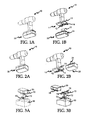
FIGS. 1A and 1B show a power tool with battery having a first form factor in accordance with an embodiment of the present invention. -
FIGS. 2A and 2B show the power tool ofFIGS. 1A and 1B with battery having a second form factor in accordance with an embodiment of the present invention. -
FIGS. 3A and 3B show the battery ofFIGS. 2A and 2B with an adapter that permits a battery of the second form factor to be used with a battery charger designed for charging batteries of the first form factor in accordance with an embodiment of the present invention. -
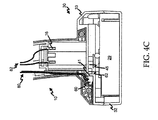
FIGS. 4A-4C show cutaway side views of a power tool and batteries in accordance with an embodiment of the present invention. -
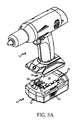
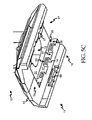
FIGS. 5A-5C show perspective views of a power tool and a slide battery in accordance with an embodiment of the present invention. - Aspects of the present invention are related to power tools and batteries used by such tools. More specifically, certain embodiments of the present invention relate to power tools that may use batteries having a new form factor (e.g., slide batteries) and batteries having an existing form factor (e.g., post batteries). Thus, a power tool vendor may introduce a new battery form factor into the market without alienating their existing customers who may continue to use their stock of existing batteries with the new power tools.
-
FIGS. 1A and 1B show apower tool 10 such as an impact drill, impact wrench, circular saw, etc. with abattery 20 having a first form factor. In particular,FIG. 1B depicts apost battery 20 detached from thepower tool 10 andFIG. 1A depicts thepost battery 20 attached to thepower tool 10. As shown inFIGS. 1A and 1B , thepower tool 10 may having abattery compartment 11. Thebattery compartment 11 may include acavity 12 configured to receive apost portion 22 of thepost battery 20. In particular, thepost portion 22 may be inserted into a proximal end of thecavity 12. Thepost portion 22 may slide longitudinally into thecavity 12 and toward a distal end of thecavity 12 until properly seated and attached topower tool 10. When properly seated, abase portion 24 and possibly part of thepost portion 22 may remain visible beyond abase portion 13 of thebattery compartment 11. -
FIGS. 2A and 2B depict thesame power tool 10 with abattery 30 having a second form factor. In particular,FIG. 2B depicts aslide battery 30 detached from thepower tool 10 andFIG. 2A depicts theslide battery 30 attached to thepower tool 10. Unlike thebattery 20, theslide battery 30 does not have apost portion 22 to be inserted into thecavity 12 of thepower tool 10. Instead, thepower tool 10 and thebattery 30 includetabs slide battery 30 to be attached to thebattery compartment 11 by sliding thebattery 30 transversely across thebase portion 13 and thecavity 12. -
Figs. 3A and 3B depict abattery charger 50 with acavity 52 configured to receive thepost portion 22 of thepost battery 20. See,Fig. 1B . Thebattery charger 50 is configured to charge thepost battery 20 when thepost portion 22 is inserted incavity 52 and thepost battery 20 is properly seated in thebattery charger 50.Figs. 3A and 3B further depict anadapter 70 having apost portion 72. Thepost portion 72 is dimensioned and configured in a manner similar to thepost portion 22 of thepost battery 20. In particular, thepost portion 72 includes first electrical contacts (not shown) that are configured to electrically couple to electrical contacts (not shown) in thecavity 52 of thebattery charger 50 when thepost portion 72 is properly inserted and seated in thecavity 52. - The
adapter 70 may further include abase portion 74 having channels/tabs 76 that are configured to slidably engage the channels/tabs 34 of theslide battery 30. Theadapter 70 may include second electrical contacts (not shown) positioned toward thebase portion 74 that are configured to electrically couple with contacts of theslide battery 30 when theslide battery 30 is properly engaged with theadapter 70. Moreover, theadapter 70 may provides electrical pathways between the first and second contacts in order to permit thebattery charger 50 to charge thebattery 30 when thebattery 30 is properly engaged to theadapter 70 and theadapter 70 is properly seated in thecavity 52 of thecharger 50. -
FIG. 4A provides a cutaway, side view of thepower tool 10 with theslide battery 30 in a disengaged position. As shown, thepower tool 10 includes abattery compartment 11 having thecavity 12 despite not needing thecavity 12 to accommodate theslide battery 30. Moreover, apower block 60 and one of its male,electrical spade connectors 62 are shown in thebattery compartment 11 of thepower tool 10. As explained in further detail below, theconnectors 62 are positioned to engage corresponding connectors ofslide battery 30 when theslide battery 30 is in an engaged position. -
FIG. 4B provides a cutaway, side view of thepower tool 10 with thepost battery 20 in a disengaged position.FIG. 4B clarifies the relationship between electrical contacts 26 of thepost battery 20 and theelectrical contacts 16 of thepower tool 10 that are positioned toward a distal end of thecavity 12. In particular, the post battery electrical contacts 26 engage the power toolelectrical contacts 16 when thepost portion 22 is inserted into thecavity 12. Such engagement of contacts provides an electrical pathway between battery cells in thebase portion 24 of thepost battery 20 and thus permits the battery cells to power various electrical components of thepower tool 10 such as motors, lights, circuitry, controllers, etc. -
FIG. 4C provides a cutaway, side view of thepower tool 10 with theslide battery 30 in an engaged position. In particular, a male,electrical spade connector 62 of thepower block 60 is shown extended through afront portion 41 of the engagedslide battery 30 and engaged with a female,electrical spade connector 45 of theslide battery 30. Moreover, a first set ofwires 80 are coupled to thepower block 60 and theconnectors 62 to provide an electrical pathway between electrical components of thepower tool 10 andbattery cells 29 of the engagedslide battery 30. Similarly, a second set ofwires 82 are coupled toconnectors 16 to provide an electrical pathway between electrical components of thepower tool 10 and battery cells of an engagedpost battery 20. - Referring now to the cutaway and perspective views of
FIGS 4A-4C andFIGS. 5A-5C , aspects of the mechanical and electrical interface between thepower tool 10 and theslide battery 30 are described in greater detail. Theslide battery 30 includes one ormore battery cells 29 in ahousing 31. Thehousing 31 may include abase portion 32, arear portion 33, and a mechanical/electrical connector portion 36. Thebase portion 32 generally houses the one ormore battery cells 29. Theconnector portion 36 generally provides a mechanical/electrical interface between thebattery 30 and thepower tool 10. Therear portion 33 may provide a mechanical stop that prevents theslide battery 30 from being slid too far along thebattery compartment 11. As such, therear portion 33 may prevent possible damage to thepower tool 10 and/or slidebattery 30. As shown, therear portion 33 may also extend above theconnector portion 36. As shown inFIG. 5C , thebase portion 13 of thebattery compartment 11 may include anopening 67 to receive theslide battery 30. Such a configuration of therear portion 33 may permit therear portion 33 to cover theopening 67 when theslide battery 30 is in an engaged positioned. - The
connector portion 36 includes a shallow,central projection 38 that extends upward from anupper surface 40 of thebase portion 32. Thecentral projection 38 further includestabs 34 that outwardly extend fromopposite sides 39 of theprojection 38. In particular, eachside 39 includesseveral tabs 34 relatively evenly spaced from thefront portion 41 of thecentral projection 38 to theback portion 43 of thecentral projection 38. Moreover, eachtab 34 generally extends outwardly from thesides 39 and parallel to theupper surface 40. Accordingly,lower surfaces 35 of thetabs 34 and theupper surface 40 of thebase portion 32 define achannel 42. Openings 44 between thetabs 34 may receive correspondingtabs 14 of thepower tool 10. Such receivedtabs 14 may slidably traverse thechannels 42 as theslide battery 30 is slid into an engaged position. - In another embodiment, each
side 39 may include asingle tab 34 that runs the length or nearly the length of thecentral projection 38 from thefront portion 41 to theback portion 43 of thecentral projection 38. In such an embodiment, openings 44 between spaced aparttabs 34 are not present. However, eachchannel 42 still has anopening 47 toward thefront portion 41 of thecentral projection 38. As such, eachchannel 42 may receivetabs 14 of thepower tool 10 via itsrespective opening 47 and permit thetabs 14 to slidably traverse thechannel 42. - The
slide battery 30 may further includedetents 48 andrelease buttons 49. In particular, a left and right side of theslide battery 30 may each include adetent 48 andcorresponding release button 49. See, e.g.,FIG. 5B . Thedetents 48 are configured to engage corresponding recesses or catches 69 of thepower tool 10 and secure thebattery 30 to thepower tool 10. See, e.g.,FIGS. 4A and5C . When pressed, therelease buttons 49 may actuatecorrespond detents 48 and causesuch detents 48 to disengage therecesses 69, thus permitting theslide battery 30 to be slid into a disengaged position and removed from thepower tool 10. It should be appreciated that thepost battery 20 may likewise include detents and release buttons to secure thepost battery 20 to thepower tool 10. -
FIGS. 5A and5B show thepower block 60, thespring 63, and the battery indicator 64 (e.g., an LED) detached from thepower tool 10 for illustrative purposes. In normal operation, thepower block 60, thespring 63, and thebattery indicator 64 are not intended to be removed or otherwise detached from thepower tool 10. As explained above, thepower block 60 includes male,electrical spade connectors 62 that engage female,electrical spade connectors 45 of theslide battery 30. As shown, thefront portion 41 may includeopenings 51 that receive the male,electrical spade connectors 62 of thepower block 60 and the female,electrical spade connectors 45 may be aligned withopenings 51 to receive the male,electrical spade connectors 62. WhileFIGS. 5A and5B depict thepower block 60 withmale spade connectors 62 that engage female,electrical spade connectors 45 of theslide battery 30, theslide battery 30 in other embodiments may include male connectors that engage female connectors of thepower tool 10. In other embodiments, thepower tool 10 andslide battery 30 may include electrical connectors that are not spade connectors, female connectors, and/or male connectors. - The
spring 63 is positioned such that it exerts a force on thepower block 60 that is normal to thefront portion 41 of theconnector 36. Such force may act as a shock absorber as theslide battery 30 is slid into the engaged position. As such, thespring 63 may help to prevent damage to theelectrical connectors 62 as thefront portion 41 of theconnector 36 engages thepower block 60. Besides providing a protective function, thespring 63 may cause theslide battery 30 to slide toward a disengaged position when a user actuates therelease buttons 49. Such exerted movement may provide tactile feedback to the user that the battery being removed is aslide battery 30 that is removed via a sliding motion that traverses thebattery compartment 11 and not apost battery 20 that is removed via a motion directed longitudinally away from thebattery compartment 11. - Referring now to
FIG. 5C , details regarding thebase portion 13 of thebattery compartment 11 are shown. As shown, thebase portion 13 includestabs 14 that are similar to thetabs 34 of theslide battery 30. In particular,tabs 14 extend inwardly fromopposite sides 17 of thebattery compartment 11. In particular, eachside 17 includesseveral tabs 14 relatively evenly spaced from thefront portion 15 of the battery compartment to aback portion 19 of thebattery compartment 11. Moreover, eachtab 14 generally extends inwardly from thesides 17 and parallel toinner surface 21 of thebattery compartment 11. Accordingly,upper surfaces 23 of thetabs 14 and theinner surface 21 define achannel 25.Openings 27 between thetabs 14 may receive correspondingtabs 34 of theslide battery 30. Such receivedtabs 34 may slidably traverse thechannels 25 in eachside 17 as theslide battery 30 is slid into an engaged position. - In another embodiment, each
side 17 may include asingle tab 14 that runs the length or nearly the length of thebattery compartment 11 from thefront portion 15 to theback portion 19 of thebattery compartment 11. In such an embodiment,openings 27 between spaced aparttabs 14 are not present. However, eachchannel 25 still has anopening 28 toward theback portion 19 of thebattery compartment 11. As such, eachchannel 25 may receivetabs 34 of theslide battery 30 via itsrespective opening 28 and permit thetabs 34 to slidably traverse thebattery compartment 11. - As explained above, each side of the
power tool 10 andslide battery 30 may include asingle tab slide battery 30 to thepower tool 10 by sliding theslide battery 30 along the length of thebattery compartment 11. However, embodiments in which each side of thepower tool 10 and theslide battery 30 havemultiple tabs slide battery 30 even when thebattery compartment 11 is in a confined space. In particular, thetabs respective openings 27, 44 may permit theslide battery 30 to engage thepower tool 10 with a sliding motion that does not slide the length of thebattery compartment 11 but only the length of thetabs battery compartment 11 may be placed in a confined space that would not permit theslide battery 30 to slide the length of thebattery compartment 11. - Various embodiments of the invention have been described herein by way of example and not by way of limitation in the accompanying figures. For clarity of illustration, exemplary elements illustrated in the figures may not necessarily be drawn to scale. In this regard, for example, the dimensions of some of the elements may be exaggerated relative to other elements to provide clarity. Furthermore, where considered appropriate, reference labels have been repeated among the figures to indicate corresponding or analogous elements.
- While the present invention has been described with reference to certain embodiments, it will be understood by those skilled in the art that various changes may be made and equivalents may be substituted without departing from the scope of the present invention. In addition, many modifications may be made to adapt a particular situation or material to the teachings of the present invention without departing from its scope. Therefore, it is intended that the present invention not be limited to the particular embodiment or embodiments disclosed, but that the present invention encompasses all embodiments falling within the scope of the appended claims.
Claims (15)
- For use with a power tool have channels leading toward male, electrical connectors, a battery comprising:one or more battery cells;a housing comprising a base portion in which are housed the one or more battery cells and a connector portion that extends upward from an upper surface of the base portion; andfemale, electrical connectors aligned with openings in the connector portion and electrically coupled to the one or more battery cells;wherein the connector portion includes tabs that extend outwardly from opposite sides of the connector portion to form channels between the upper surface of the base portion and lower surfaces of the tabs such that the channels run along the opposite sides of the connector;wherein the tabs are configured to slide along the channels of the power tool, align the male, electrical connectors with the female, electrical connectors, and cause the female, electrical connectors to receive the male, electrical connectors via the openings in the connector portion as the battery is slid into an engaged position in the power tool.
- The battery of claim 1, wherein the opposite sides of the central portion each include a plurality of tabs that are spaced apart to form openings to receive corresponding tabs of the power tool.
- The battery of claim 1, further comprising at least one detent to engage the power tool and secure the battery to the power tool when the battery is slid into the engaged position.
- The battery of claim 3, further comprising at least one release button that disengages the at least on detent to permit disengaging the battery from the power tool.
- The battery of claim 1, wherein the female, electrical connectors are female, electrical spade connectors that are configured to received male, electrical spade connectors of the power tool.
- The battery of claim 1, wherein a rear portion of the housing extends above the connector portion.
- A power tool capable of using a post battery or a slide battery, the power tool comprising one or more battery powered components, and a battery compartment that includes:a cavity to receive and guide a post portion of a post battery;first electrical connectors positioned toward a distal end of the cavity and configured to electrically couple the post battery to the one or more battery powered components when the post battery is engaged with the power tool;second electrical connectors positioned toward a proximal end of the cavity and configured to electrically couple a slide battery to the one or more battery powered components;channels configured to slidably engage tabs of the slide battery and cause electrical connectors of the slide battery to electrical couple with the second electrical connectors as the slide battery is slid into an engaged position.
- The power tool of claim 7, wherein the battery compartment further comprises tabs that extend inwardly from opposite sides of the battery compartment portion to form channels between a base surface of the battery compartment and an upper surface of the tabs such that the channels run along the opposite sides of the battery compartment.
- The power tool of claim 8, wherein the opposite sides of the battery compartment each include a plurality of tabs that are spaced apart to form openings via which corresponding tabs of the slide battery are received.
- The power tool of claim 7, further comprising at least one recess that receives a corresponding detent of the post battery and secures the post battery to the power tool when the post battery is in the engaged position.
- The power tool of claim 7, further comprising at least one recess that receives a corresponding detent of the slide battery and secures the slide battery to the power tool when the slide battery is slid into the engaged position.
- The power tool of claim 7, further comprising:a power block that includes the second electrical connectors; anda spring that exerts a force against the slide battery via the power block as the slide battery is slid into the engaged position.
- The power tool of claim 12, further comprising:at least one recess that receives a corresponding detent of the slide battery and secures the slide battery to the power tool when the slide battery is slid into the engaged position;wherein the force exerted by the spring causes the slide battery to slide toward a disengaged position when the detent of the slide battery is released from the recess.
- The power tool of claim 7, wherein the second connectors are male, electrical spade connectors that are configured to engage female, electrical spade connectors of the slide battery.
- The power tool of claim 7, battery of claim 1, wherein the channels include an opening at one end to permit receipt of corresponding tabs of the slide battery.
Applications Claiming Priority (1)
| Application Number | Priority Date | Filing Date | Title |
|---|---|---|---|
| US14/146,450 US10027078B2 (en) | 2014-01-02 | 2014-01-02 | Slide battery and power tool for use with both slide and post batteries |
Publications (2)
| Publication Number | Publication Date |
|---|---|
| EP2892085A2 true EP2892085A2 (en) | 2015-07-08 |
| EP2892085A3 EP2892085A3 (en) | 2015-09-02 |
Family
ID=52338833
Family Applications (1)
| Application Number | Title | Priority Date | Filing Date |
|---|---|---|---|
| EP14198219.9A Withdrawn EP2892085A3 (en) | 2014-01-02 | 2014-12-16 | Slide battery and power tool for use with both slide and post batteries |
Country Status (2)
| Country | Link |
|---|---|
| US (4) | US10027078B2 (en) |
| EP (1) | EP2892085A3 (en) |
Cited By (6)
| Publication number | Priority date | Publication date | Assignee | Title |
|---|---|---|---|---|
| CN108206307A (en) * | 2016-12-16 | 2018-06-26 | 东莞辰达电器有限公司 | Method and system for operatively connecting a battery pack to a machine |
| CN112454238A (en) * | 2019-09-06 | 2021-03-09 | 施耐宝公司 | Electronic torque wrench with interchangeable battery |
| WO2021184044A1 (en) * | 2020-03-10 | 2021-09-16 | Black & Decker Inc. | Cordless power tool system compatible with multiple battery packs |
| US11145929B2 (en) | 2019-08-09 | 2021-10-12 | Techtronic Cordless Gp | Battery pack |
| USD961519S1 (en) | 2019-09-09 | 2022-08-23 | Techtronic Cordless Gp | Interface of a charger |
| USD1012646S1 (en) | 2019-06-12 | 2024-01-30 | Techtronic Cordless Gp | Interface of a power tool |
Families Citing this family (12)
| Publication number | Priority date | Publication date | Assignee | Title |
|---|---|---|---|---|
| DE102015218447B4 (en) * | 2014-12-16 | 2025-01-23 | Robert Bosch Gmbh | Battery pack for a hand tool with light element |
| US10363614B2 (en) * | 2015-04-02 | 2019-07-30 | Stanley Black & Decker Inc. | Laser level, battery pack and system |
| US10553843B2 (en) | 2016-03-28 | 2020-02-04 | Transform Sr Brands Llc | Portable power tool, battery pack, and cell configurations for same |
| US10581038B2 (en) | 2017-12-18 | 2020-03-03 | Irobot Corporation | Battery assembly for autonomous mobile robot |
| WO2022146229A1 (en) | 2020-12-31 | 2022-07-07 | Razer (Asia-Pacific) Pte. Ltd. | Battery-operated handheld device |
| CN114914755B (en) * | 2021-02-10 | 2023-08-11 | 苏州宝时得电动工具有限公司 | Adapter, electrical equipment system and method of operation thereof |
| CN113510666A (en) * | 2021-04-16 | 2021-10-19 | 苏州大可投资咨询有限公司 | Electric tool |
| CN113346184B (en) * | 2021-07-30 | 2021-11-16 | 深圳市沃尔德新能源有限公司 | Lithium battery module for garden tool |
| US12570507B2 (en) | 2022-06-07 | 2026-03-10 | Vis, Llc | Floor service jack |
| US12573861B2 (en) | 2022-06-14 | 2026-03-10 | Kyocera Senco Industrial Tools, Inc. | Battery adapter for power tools |
| US12427595B2 (en) | 2022-10-26 | 2025-09-30 | Vis, Llc | Soldering tool with orientation safety control |
| US12609500B2 (en) * | 2023-07-27 | 2026-04-21 | Phihong Technology Co., Ltd. | Power supply with interchangeable plugs |
Family Cites Families (43)
| Publication number | Priority date | Publication date | Assignee | Title |
|---|---|---|---|---|
| US4352052A (en) | 1980-11-03 | 1982-09-28 | Opper Ray C | Adaptor for charging small cells in large-cell charger |
| US4963812A (en) | 1989-10-02 | 1990-10-16 | Motorola, Inc. | Battery charger housing for batteries of differing dimensions |
| US5316873A (en) | 1990-10-09 | 1994-05-31 | Scrivano Thomas J | Position adjustable battery adapter |
| US5076805A (en) | 1991-02-11 | 1991-12-31 | Welch Thomas F | Adaptor for hand held power tool |
| US5656914A (en) | 1995-10-31 | 1997-08-12 | Motorola, Inc. | Battery charger having pocket with multiple sets of charging contacts |
| US6308577B1 (en) | 1996-09-30 | 2001-10-30 | Motorola, Inc. | Circuit and method of compensating for membrane stress in a sensor |
| US6057608A (en) * | 1998-08-13 | 2000-05-02 | Black & Decker Inc. | Cordless power tool system |
| US7183745B2 (en) | 2000-08-11 | 2007-02-27 | Milwaukee Electric Tool Corporation | Adapter for a power tool battery |
| US7443137B2 (en) | 2000-08-11 | 2008-10-28 | Milwaukee Electric Tool Corporation | Adapter for a power tool battery |
| US6525511B2 (en) | 2000-08-11 | 2003-02-25 | Milwaukee Electric Tool Corporation | Adapter for a power tool battery |
| US20020125857A1 (en) | 2001-03-09 | 2002-09-12 | Thomas Mastaler | Battery adapter for a cordless power tool system and related method |
| US6729413B2 (en) * | 2001-08-24 | 2004-05-04 | Black & Decker Inc. | Power tool with battery pack ejector |
| US6902293B2 (en) | 2001-11-19 | 2005-06-07 | Techtronic Industrial Co., Ltd. | Battery-operated lighting device |
| US6617824B1 (en) | 2002-02-27 | 2003-09-09 | Motorola, Inc. | Battery charger pocket apparatus for receiving multiple battery |
| DE10212750B4 (en) | 2002-03-22 | 2006-04-20 | Robert Bosch Gmbh | Battery pack system for hand tool machines |
| US7018233B1 (en) | 2002-11-18 | 2006-03-28 | Griffin Iii Ralph W | Adapter socket for a rechargeable battery |
| US7253585B2 (en) * | 2002-11-22 | 2007-08-07 | Milwaukee Electric Tool Corporation | Battery pack |
| TWM243342U (en) * | 2003-08-06 | 2004-09-11 | Mobiletron Electronics Co Ltd | Electric tool |
| WO2005038954A2 (en) | 2003-10-14 | 2005-04-28 | Black & Decker Inc. | Power driver and charger with flexible mounting system for battery pack |
| DE102004044331B4 (en) * | 2004-09-09 | 2019-05-09 | Robert Bosch Gmbh | Device for locking an electrical appliance with an accessory |
| US7435508B2 (en) | 2004-09-30 | 2008-10-14 | Symbol Technologies, Inc. | Multiple battery assembly for portable devices |
| US7468596B2 (en) | 2004-11-18 | 2008-12-23 | Jeckson Electric Company Limited | Battery charger for various sizes of batteries with selection of appropriate charging power |
| JP4462112B2 (en) * | 2005-05-26 | 2010-05-12 | パナソニック電工株式会社 | Electric tool |
| US7695853B2 (en) | 2005-09-28 | 2010-04-13 | Arris Group, Inc. | Frameless multi-size battery compartment with passive capture mechanism |
| US20070090796A1 (en) | 2005-10-14 | 2007-04-26 | Waatani Norris | Power adapter for power tools |
| US7514172B2 (en) | 2006-01-25 | 2009-04-07 | Eveready Battery Company, Inc. | Battery controlled device that can operate with alternative size batteries |
| US20070210744A1 (en) * | 2006-03-10 | 2007-09-13 | Watson James B | Adapter for a power tool battery |
| US7531915B2 (en) * | 2006-05-23 | 2009-05-12 | Continental Automotive Systems Us, Inc. | System and method for controlling power flow in a power system |
| US7629766B2 (en) * | 2006-07-17 | 2009-12-08 | Bbs Licensing, Inc. | Adapter system for battery-powered tools |
| JP4415280B2 (en) | 2007-06-15 | 2010-02-17 | ソニー株式会社 | Electronics |
| US7897276B2 (en) | 2007-07-30 | 2011-03-01 | Hewlett-Packard Development Company, L.P. | Intersecting battery cavities |
| US8646624B2 (en) * | 2007-12-04 | 2014-02-11 | Clairson, Inc. | Standard and track shelving systems |
| JP4216898B1 (en) * | 2008-03-28 | 2009-01-28 | 和征 榊原 | Battery pack |
| JP5496489B2 (en) | 2008-11-06 | 2014-05-21 | 三洋電機株式会社 | Two types of battery pack chargers |
| TWM358755U (en) | 2009-02-06 | 2009-06-11 | J D Components Co Ltd | Composite battery connection system for bicycle |
| US7857658B1 (en) | 2009-10-26 | 2010-12-28 | Microsoft Corporation | Multiple orientation battery connector |
| US7884573B1 (en) | 2009-11-19 | 2011-02-08 | Microsoft Corporation | Flexible size and orientation battery system |
| JP5491925B2 (en) * | 2010-03-26 | 2014-05-14 | パナソニック株式会社 | Electric tool |
| EP2739440B1 (en) * | 2011-08-01 | 2016-10-05 | Ingersoll-Rand Company | Electric device with non-binding linear rails |
| JP2014038720A (en) | 2012-08-10 | 2014-02-27 | Hitachi Koki Co Ltd | Battery pack |
| EP2885113B1 (en) * | 2012-08-14 | 2024-11-20 | Koki Holdings Co., Ltd. | Electric device, battery pack, and electric apparatus |
| JP6048192B2 (en) * | 2013-02-13 | 2016-12-21 | 日立工機株式会社 | Electrical equipment and electrical equipment |
| JP2014216284A (en) * | 2013-04-30 | 2014-11-17 | 日立工機株式会社 | Battery pack and electric device |
-
2014
- 2014-01-02 US US14/146,450 patent/US10027078B2/en active Active
- 2014-12-16 EP EP14198219.9A patent/EP2892085A3/en not_active Withdrawn
-
2018
- 2018-07-09 US US16/029,902 patent/US10608391B2/en active Active
-
2020
- 2020-03-26 US US16/830,957 patent/US11258217B2/en active Active
-
2022
- 2022-02-22 US US17/677,322 patent/US20220255274A1/en active Pending
Non-Patent Citations (1)
| Title |
|---|
| None |
Cited By (12)
| Publication number | Priority date | Publication date | Assignee | Title |
|---|---|---|---|---|
| CN108206307A (en) * | 2016-12-16 | 2018-06-26 | 东莞辰达电器有限公司 | Method and system for operatively connecting a battery pack to a machine |
| USD1012646S1 (en) | 2019-06-12 | 2024-01-30 | Techtronic Cordless Gp | Interface of a power tool |
| US11145929B2 (en) | 2019-08-09 | 2021-10-12 | Techtronic Cordless Gp | Battery pack |
| CN112454238A (en) * | 2019-09-06 | 2021-03-09 | 施耐宝公司 | Electronic torque wrench with interchangeable battery |
| GB2587705A (en) * | 2019-09-06 | 2021-04-07 | Snap On Tools Corp | Electronic torque wrench with interchangeable battery |
| GB2587705B (en) * | 2019-09-06 | 2022-01-12 | Snap On Tools Corp | Electronic torque wrench with interchangeable battery |
| US11705600B2 (en) | 2019-09-06 | 2023-07-18 | Snap-On Incorporated | Electronic torque wrench with interchangeable battery |
| USD961519S1 (en) | 2019-09-09 | 2022-08-23 | Techtronic Cordless Gp | Interface of a charger |
| USD1060248S1 (en) | 2019-09-09 | 2025-02-04 | Techtronic Cordless Gp | Interface of a charger |
| WO2021184044A1 (en) * | 2020-03-10 | 2021-09-16 | Black & Decker Inc. | Cordless power tool system compatible with multiple battery packs |
| US11217856B2 (en) | 2020-03-10 | 2022-01-04 | Black And Decker Inc. | Cordless power tool system compatible with multiple battery packs |
| US12062806B2 (en) | 2020-03-10 | 2024-08-13 | Black & Decker Inc. | Cordless power tool system compatible with multiple battery packs |
Also Published As
| Publication number | Publication date |
|---|---|
| US10608391B2 (en) | 2020-03-31 |
| EP2892085A3 (en) | 2015-09-02 |
| US20220255274A1 (en) | 2022-08-11 |
| US10027078B2 (en) | 2018-07-17 |
| US20150188270A1 (en) | 2015-07-02 |
| US11258217B2 (en) | 2022-02-22 |
| US20200295517A1 (en) | 2020-09-17 |
| US20180316147A1 (en) | 2018-11-01 |
Similar Documents
| Publication | Publication Date | Title |
|---|---|---|
| US20220255274A1 (en) | Slide battery and power tool for use with both slide and post batteries | |
| US9923393B2 (en) | Energy storage and power supply system | |
| US9847517B2 (en) | Battery pack for a hand-held power tool | |
| US11097409B2 (en) | Power tool assembly with selectable-voltage battery pack | |
| EP2625006B1 (en) | Battery retention system for a power tool | |
| EP3051658B1 (en) | Battery pack & power tool system | |
| CN201032642Y (en) | Adapter for power tool battery | |
| US4032806A (en) | Battery powered power tools | |
| US20110121782A1 (en) | Powering a Cordless Drill from AC Line Power | |
| TW201408451A (en) | Cordless power tool with USB charging | |
| US11864720B2 (en) | Rechargeable battery for powering a vacuum cleaner | |
| US8360795B2 (en) | Power connection system and method | |
| AU2017351400B2 (en) | Connection apparatus of an electrical device or of a stored energy source | |
| US20130334898A1 (en) | Ac power systems for powering cordless power tools | |
| JP5858526B2 (en) | Power tool battery mounting adapter and power tool | |
| WO2016059065A1 (en) | Method and system for configuring electrical contacts in electrical device | |
| JP2017174683A (en) | Battery pack and power tool | |
| US20130141046A1 (en) | Charger with Multi-sided Arrangement | |
| KR20190079918A (en) | A compatible bluetooth adapter for battery of electrically drive tool | |
| WO2019076416A1 (en) | Power interface system |
Legal Events
| Date | Code | Title | Description |
|---|---|---|---|
| PUAI | Public reference made under article 153(3) epc to a published international application that has entered the european phase |
Free format text: ORIGINAL CODE: 0009012 |
|
| 17P | Request for examination filed |
Effective date: 20141216 |
|
| AK | Designated contracting states |
Kind code of ref document: A2 Designated state(s): AL AT BE BG CH CY CZ DE DK EE ES FI FR GB GR HR HU IE IS IT LI LT LU LV MC MK MT NL NO PL PT RO RS SE SI SK SM TR |
|
| AX | Request for extension of the european patent |
Extension state: BA ME |
|
| PUAL | Search report despatched |
Free format text: ORIGINAL CODE: 0009013 |
|
| AK | Designated contracting states |
Kind code of ref document: A3 Designated state(s): AL AT BE BG CH CY CZ DE DK EE ES FI FR GB GR HR HU IE IS IT LI LT LU LV MC MK MT NL NO PL PT RO RS SE SI SK SM TR |
|
| AX | Request for extension of the european patent |
Extension state: BA ME |
|
| RIC1 | Information provided on ipc code assigned before grant |
Ipc: H01M 2/10 20060101ALI20150727BHEP Ipc: H01M 2/02 20060101AFI20150727BHEP |
|
| STAA | Information on the status of an ep patent application or granted ep patent |
Free format text: STATUS: THE APPLICATION IS DEEMED TO BE WITHDRAWN |
|
| 18D | Application deemed to be withdrawn |
Effective date: 20160303 |