EP2892007A2 - Personenidentifikation auf Grundlage der statischen Haltung - Google Patents
Personenidentifikation auf Grundlage der statischen Haltung Download PDFInfo
- Publication number
- EP2892007A2 EP2892007A2 EP15150047.7A EP15150047A EP2892007A2 EP 2892007 A2 EP2892007 A2 EP 2892007A2 EP 15150047 A EP15150047 A EP 15150047A EP 2892007 A2 EP2892007 A2 EP 2892007A2
- Authority
- EP
- European Patent Office
- Prior art keywords
- joint
- posture
- skeleton
- unknown person
- person
- Prior art date
- Legal status (The legal status is an assumption and is not a legal conclusion. Google has not performed a legal analysis and makes no representation as to the accuracy of the status listed.)
- Withdrawn
Links
Images

Classifications
-
- G—PHYSICS
- G06—COMPUTING OR CALCULATING; COUNTING
- G06N—COMPUTING ARRANGEMENTS BASED ON SPECIFIC COMPUTATIONAL MODELS
- G06N5/00—Computing arrangements using knowledge-based models
- G06N5/04—Inference or reasoning models
-
- G—PHYSICS
- G06—COMPUTING OR CALCULATING; COUNTING
- G06N—COMPUTING ARRANGEMENTS BASED ON SPECIFIC COMPUTATIONAL MODELS
- G06N20/00—Machine learning
- G06N20/10—Machine learning using kernel methods, e.g. support vector machines [SVM]
-
- G—PHYSICS
- G06—COMPUTING OR CALCULATING; COUNTING
- G06F—ELECTRIC DIGITAL DATA PROCESSING
- G06F21/00—Security arrangements for protecting computers, components thereof, programs or data against unauthorised activity
- G06F21/30—Authentication, i.e. establishing the identity or authorisation of security principals
- G06F21/31—User authentication
- G06F21/32—User authentication using biometric data, e.g. fingerprints, iris scans or voiceprints
-
- G—PHYSICS
- G06—COMPUTING OR CALCULATING; COUNTING
- G06N—COMPUTING ARRANGEMENTS BASED ON SPECIFIC COMPUTATIONAL MODELS
- G06N20/00—Machine learning
-
- G—PHYSICS
- G06—COMPUTING OR CALCULATING; COUNTING
- G06V—IMAGE OR VIDEO RECOGNITION OR UNDERSTANDING
- G06V40/00—Recognition of biometric, human-related or animal-related patterns in image or video data
- G06V40/10—Human or animal bodies, e.g. vehicle occupants or pedestrians; Body parts, e.g. hands
- G06V40/103—Static body considered as a whole, e.g. static pedestrian or occupant recognition
-
- G—PHYSICS
- G06—COMPUTING OR CALCULATING; COUNTING
- G06V—IMAGE OR VIDEO RECOGNITION OR UNDERSTANDING
- G06V2201/00—Indexing scheme relating to image or video recognition or understanding
- G06V2201/03—Recognition of patterns in medical or anatomical images
- G06V2201/033—Recognition of patterns in medical or anatomical images of skeletal patterns
Definitions
- the present subject matter relates, in general, to person identification and, in particular, to a system and a method for identification of an unknown person based on his static posture.
- skeleton data of a person includes information of skeleton joints of the person while in motion or in specific static poses.
- the skeleton data of a person includes information of skeleton joints of the person.
- skeleton data of a person can be captured at a distance and is hard to hide or to imitate which makes the identification of the person unobtrusive.
- the identification of a person based on the skeleton data does not require cooperation and attention of the person.
- the static posture may be understood as a posture that is held for several seconds.
- the static posture may be understood as a posture with minimum body movements.
- the static posture may be one of many possible static postures, such as a sitting posture, a standing posture, a lying posture, a bending posture, and a leaning posture.
- the system of the present subject matter is trained initially over a plurality of known persons. Then the unknown person, from amongst the plurality of known persons, can be identified through the system. The unknown person may be identified based on the training of the identification system. If features pertaining to the unknown person are not present in identification system, the identification system may classify the unknown person to nearest match that may be available based on the similarity of the features. In an implementation, the identification system may be re-trained if number of occurrences of such mismatch are more. In an implementation, identification of an unknown person is performed in real-time; however, the training of the system may or may not be performed in real-time.
- data of N skeleton joints of each of the known persons is received for at least one predefined static posture at different position and predefined poses in each of the position.
- the predefined static posture may include one of the sitting posture, the standing posture, the bending posture, the leaning posture, and the lying posture. Further, the posture may have multiple poses.
- a pose may be understood as orientation or variation of human body parts or whole human body with respect to some reference point while being in the static posture.
- a skeleton recording device such as a Kinect®, may be considered as the reference point for determining the pose of the person in the static posture.
- the data of N skeleton joints of each of the known persons is received from a skeleton recording device.
- the skeleton recording device may be a Kinect® device or a RGB-D sensor that can record skeleton joints of any person.
- the static posture of the unknown person by dividing a skeleton structure of the unknown person in a plurality of body parts based on joint types of the skeleton structure.
- the set of feature is feature vectors for each of the joint types from each of the plurality of body parts, which is characteristic of a respective known person and a respective static posture.
- the joint types comprise static joints, dynamic joints, and noisy joints.
- the feature vector for each known person is referred to as a training static posture feature set, based on which the system is trained so as to identify an unknown person, from the known persons, based on his static posture.
- joint coordinates of the N skeleton joints for the predefined static posture of that known person are determined.
- Cartesian joint coordinates and spherical joint coordinates of each of the N skeleton joints are determined from the data of the N skeleton joints.
- the training static posture feature set for the predefined static posture of the known person is extracted based on the joint coordinates of the N skeleton joints.
- the training static posture feature vector for each of the known persons is extracted in a similar manner.
- a training sitting feature vector is extracted for the known person.
- the training sitting feature vector includes a first set of static features having a first set of angle related static features, area related static features, and distance related static features.
- the first set of angle related static features, the area static related features, and the distance static related features include static features that are unique for the sitting posture of the known person.
- the first vector of static features comprises angle between a shoulder left joint, a shoulder centre joint, and a spine joint, angle between a shoulder right joint, the shoulder centre joint, and a spine joint, angle between the shoulder centre joint and the spine with respect to a vertical axis, area occupied by a polygon formed by the shoulder left joint, the shoulder centre joint, and the shoulder right joint, and a distance between two joints in each of a Cartesian co-ordinate system and a spherical co-ordinate system.
- a training standing feature vector is extracted for the known person.
- the training standing feature vector includes a second set of static features having a second set of angle related static features, area related static features, and distance related static features.
- the second set of angle related static features, the area related static features, and the distance related static features include static features that are unique for the standing posture of the known person.
- the second set of static features comprises an angle between a shoulder left joint, a shoulder centre joint, and a spine joint, an angle between a shoulder right joint, the shoulder centre joint, and the spine joint, an angle between the shoulder centre joint and the spine with respect to a vertical axis, an angle between a hip left joint, a hip centre joint, and a hip right joint, an area occupied by a polygon formed by the shoulder left joint, the shoulder centre joint, and the shoulder right joint, an area occupied by a polygon formed by the hip left joint, the hip centre joint, and the hip right joint, and a distance between two joints in each of a Cartesian co-ordinate system and a spherical co-ordinate system.
- the training static posture feature vectors are extracted for a plurality of known persons, the training static feature vectors are populated in a training dataset and the system is trained for the training dataset using a classifier.
- the classifier may be a Support Vector Machine (SVM) classifier with Radial Basis Function (RBF) as kernel using which a training model is generated for the training static posture feature sets.
- the SVM classifier is a supervised learning classifier having learning algorithms which are used for classification of data.
- a training model is generated based on the training sitting feature vectors for training the system and for the predefined static posture being the standing posture, a training model is generated based on the training standing feature vector for training the system.
- the training model based on the training sitting feature vectors may be referred to as a sitting training model and the training model based on the training standing feature vectors may be referred to as a standing training model.
- data of N skeleton joints of the unknown person is received from the skeleton recording device.
- the unknown person to be identified may be from amongst the known persons for which the system is trained. Thereafter, Cartesian joint coordinates and spherical joint coordinates of each of the N skeleton joints are determined from the data of the N skeleton joints of the unknown person.
- a static posture of the unknown person is identified by dividing the skeleton structure of the unknown person in the plurality of body parts based on joint types of the skeleton structure; further feature vectors are extracted for each of the joint types from each of the plurality of body parts, corresponding to the static posture of the unknown person for identification of the unknown person, wherein the feature vectors are extracted based on the data of the N skeleton joints of the unknown person.
- the joint types comprise static joints, dynamic joints, and noisy joints.
- the static posture of the unknown person is identified as a predefined static posture based on range and mean of joint coordinates of predefined skeleton joints, from amongst the N skeleton joints, of the unknown person.
- the predefined skeleton joints may include the head joint, the shoulder center joint, the shoulder left joint, and the shoulder right joint, and the joint coordinates may include Cartesian coordinates of the predefined skeleton joints.
- the predefined static posture is one of the sitting posture, the standing posture, the lying posture, the bending posture, and the leaning posture.
- a static posture feature vector corresponding to the static posture of the unknown person is extracted, wherein the feature vectors are extracted for each of the joint types from each of the plurality of body parts.
- the static posture feature vector for the unknown person may be extracted based on the data of the N skeleton joints of the unknown person. According to an example, if it is identified that the unknown person is in the sitting posture, then a sitting feature vector for the unknown person is extracted.
- the sitting feature vector for the unknown person comprises a first set of static vector.
- the first set of static features includes angle related static features, area related static features, and distance related static features.
- a standing feature vector for the unknown person is extracted.
- the standing feature vector for the unknown person comprises a second set of static features. In an example, the second set of static features includes angle related static features, area related static features, and distance related static features.
- the unknown person is identified based on comparison of the feature vectors for the unknown person with one of a constrained feature dataset and an unconstrained feature dataset for a plurality of known persons, wherein the constrained and the unconstrained feature datasets comprise at least one feature set for each of the plurality of known persons.
- the unknown person is identified based on comparison of the static posture feature vector for the unknown person with the training static posture feature vectors for the plurality of known persons and corresponding to the static posture. In one example, if the unknown person is in the sitting posture, then the sitting feature vector for the unknown person is compared with the sitting training model. In other example, if the unknown person is in the standing posture, then the standing feature vector for the unknown person is compared with the standing training model.
- comparison of the standing feature set for the unknown person and the standing training model is done using a supervised learning based classification technique.
- the SVM classifier with RBF kernel may map the standing feature set for the unknown person in the standing training model of known persons.
- the identification of the unknown person is unobtrusive and cooperation and awareness of the unknown person is not required. Further, since only one type of static posture feature vector corresponding to the static posture that is unique for person identification in the same static posture is extracted for the unknown person and compared with the training static posture feature vectors for the known persons and corresponding to the same static posture, the processing load and the processing time for the identification of the unknown person, from amongst the known persons, are substantially reduced. Further, with the training dataset having the training static posture feature vectors corresponding to predefined static postures according to the present subject matter, the size of training dataset is substantially small. With this the memory space consumed by the training dataset is substantially reduced.
- the following disclosure describes system and method for identification of an unknown person based on a static posture of the unknown person. While aspects of the described system and method can be implemented in any number of different computing systems, environments, and/or configurations, embodiments for identification of an unknown person based on a static posture of the unknown person are described in the context of the following exemplary systems and methods.
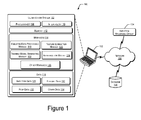
- FIG. 1 illustrates a network environment 100 implementing an identification system 102, in accordance with an embodiment of the present subject matter.
- the identification system 102 is for identification of an unknown person.
- the person may be from amongst a plurality of known persons.
- the unknown person may be identified based on a pose in a static posture at any position.
- the static posture may be understood as a posture that is held for several seconds or a posture with minimum body movements.
- the static posture may be one of the sitting posture, the standing posture, the lying posture, the bending posture, and the leaning posture.
- the pose may be understood as orientation or variation of human body parts or whole human body in the posture with respect to some reference point.
- the position may be understood as a spatial location of the person within the field of view (FOV) of a skeleton recording device 104.
- FOV field of view
- the network environment 100 can be a public network environment, including thousands of individual computers, laptops, various servers, such as blade servers, and other computing devices. In another implementation, the network environment 100 can be a private network environment with a limited number of computing devices, such as individual computers, servers, and laptops.
- the identification system 102 may be implemented in a variety of computing systems, such as a laptop computer, a desktop computer, a notebook, a smart phone, a tablet, a workstation, a mainframe computer, a server, a network server, and the like.
- the identification system 102 is communicatively coupled with the skeleton recording device 104 through a network 106.
- the network 106 may be a wireless network, a wired network, or a combination thereof.
- the network 106 may also be an individual network or a collection of many such individual networks, interconnected with each other and functioning as a single large network, e.g., the Internet or an intranet.
- the network 106 may be implemented as one of the different types of networks, such as intranet, local area network (LAN), wide area network (WAN), the internet, and the like.
- the network 106 may either be a dedicated network or a shared network, which represents an association of the different types of networks that use a variety of protocols, for example, Hypertext Transfer Protocol (HTTP), Transmission Control Protocol/Internet Protocol (TCP/IP), etc., to communicate with each other.
- the network 106 may include a variety of network devices, including routers, bridges, servers, computing devices, storage devices, and the like.
- the identification system 102 includes processor(s) 108, interface(s) 110, and a memory 112 coupled to the processor(s) 108.
- the processor(s) 108 may be implemented as one or more microprocessors, microcomputers, microcontrollers, digital signal processors, central processing units, state machines, logic circuitries, and/or any devices that manipulate signals based on operational instructions.
- the processor(s) 108 may be configured to fetch and execute computer-readable instructions stored in the memory 112.
- the memory 112 may include any computer-readable medium known in the art including, for example, volatile memory, such as static random access memory (SRAM) and dynamic random access memory (DRAM) and/or nonvolatile memory, such as read only memory (ROM), erasable programmable ROM, flash memories, hard disks, optical disks, and magnetic tapes.
- volatile memory such as static random access memory (SRAM) and dynamic random access memory (DRAM)
- nonvolatile memory such as read only memory (ROM), erasable programmable ROM, flash memories, hard disks, optical disks, and magnetic tapes.
- the interface(s) 110 may include a variety of software and hardware interfaces, for example, interfaces for peripheral device(s), such as a product board, a mouse, an external memory, and a printer. Additionally, the interface(s) 110 may enable the identification system 102 to communicate with other devices, such as web servers and external repositories. The interface(s) 110 may also facilitate multiple communications within a wide variety of networks and protocol types, including wired networks, for example, LAN, cable, etc., and wireless networks, such as WLAN, cellular, or satellite. For the purpose, the interface(s) 110 may include one or more ports.
- the identification system 102 also includes module(s) 114 and data 116.
- the module(s) 114 include, for example, a skeleton data processing module 118, a feature extraction module 120, a training model generating module 122, an identification module 124, and other module(s) 126.
- the other module(s) 126 may include programs or coded instructions that supplement applications or functions performed by the identification system 102.
- the data 116 may include skeleton data 128, feature data 130, pose data 132, and other data 134.
- the skeleton data 128 may include data relating to skeleton joints of an unknown person
- the feature data 130 may include data related to feature vectors of the unknown person
- the pose data 132 may include data relating to a pose of the unknown person.
- the other data 134 may serve as a repository for storing data that is processed, received, or generated as a result of the execution of one or more modules in the module(s) 114.
- the network environment 100 may include a training database 136 for training the identification system 102.
- the training database 136 may include a training dataset comprising features vectors pertaining to a plurality of known persons in different poses of the static posture.
- the training database 136 is shown external to the identification system 102, it will be appreciated by a person skilled in the art that the training database 136 can also be implemented internal to the identification system 102.
- the training database 136 may be accessed whenever an unknown person is to be identified by the identification system 102.
- the training database 136 may be periodically updated. For example, new data may be added into the training database 136, existing data in the training database 136 may be modified, or non-useful data may be deleted from the training database 136.
- the identification system 102 for the purpose of identification of the unknown person, is initially trained over the plurality of known persons for one or more pre-defined static postures and poses at different positions within the FOV of the skeleton recording device 104. Thereafter, the unknown person is identified through the identification system 102.
- the identification system 102 may be pre-trained, i.e., may not be trained in real-time; however, the identification of the unknown person is performed in real-time through the identification system 102.
- the description below describes the procedure to train the identification system 102 for a plurality of known persons and for one pre-defined static posture at different positions within the FOV of the skeleton recording device 104.
- the procedure can be repeated to train the identification system 102 for the plurality of known persons and for multiple pre-defined static postures.
- the pre-defined static postures may include the sitting posture, the standing posture, the lying posture, the leaning posture, the bending posture, and the like.
- the skeleton data processing module 118 may receive an input from a user, such as an administrator.
- the input may include a count of known persons and their respective unique identifiers.
- a unique identifier of a known person uniquely defines and identifies the known person.
- the unique identifier may be a name of the known person.
- the unique identifier may be person A, person B, person C, Person D, and so on.
- the skeleton data processing module 118 may receive data pertaining to skeleton joints of each of the known persons from the skeleton recording device 104.
- the data pertaining to the skeleton joints is obtained when each of the known persons is in the pre-defined static posture at different positions in the FOV of the skeleton recording device 104.
- the FOV may be divided into 9 blocks, such that the 9 blocks over the entire FOV of the skeleton recording device 104. Accordingly, the skeleton data processing module 118 may capture intra-person variation of different features for different positions.
- the skeleton data processing module 118 receives 20 skeleton joints for each of the known person in the pre-defined static posture.
- the 20 skeleton joints may include a head joint, a shoulder centre joint, a shoulder left joint, a shoulder right joint, a spine joint, a hand left joint, a hand right joint, an elbow right joint, an elbow left joint, a wrist right joint, a wrist left joint, a hip left joint, a hip right joint, a hip centre joint, a knee right joint, a knee left joint, a foot left joint, a foot right joint, an ankle right joint, and an ankle left joint.
- the skeleton data processing module 118 may determine angles formed by some joints with respect to the skeleton recording device 104. In an example, whether the person is in a bending or leaning posture may be determined based on an angle made by spine, hip center, and the skeleton recording device 104. In another example, the standing or the sitting posture may be identified based on the angle made by the knee joints and hip joints with the skeleton recording device 104. Accordingly, based on the angles formed by certain joints of the skeleton structure with respect to the skeleton recording device 104 in X-Y or Y-Z plane may facilitate in differentiating the posture of the person.
- the skeleton data processing module 118 may identify the static posture of the known person.
- the static posture may be identified as a pre-defined static posture based on range and mean of joint coordinates of the pre-defined skeleton joints, from amongst the skeleton joints, of the known person.
- range may be understood as upper and lower value of a particular variable. For instance, if 'x' co-ordinate of Knee varies from 1.2 m to 1.31m; then in this case, range is equal to 1.31-1.2m. Further, mean is average value of the joint co-ordinates.
- the feature extraction module 120 may divide entire skeleton structure of the known persons in different parts based on a plurality of joint types.
- the skeleton structure may be divided into four parts, namely, static joints, dynamic upper joints, dynamic lower joints, and noisy joints.
- the static joints may be understood as those joints in the skeleton structure that are fixed for any pose in a particular static posture. Examples of the static joints may include spine, hip center, and the like. Further, in a single pose, there may exist certain joints that may be moved by the person. Such joints may be referred to as the dynamic joints.
- the dynamic joints are further divided into two parts as dynamic upper and dynamic lower.
- Examples of the dynamic joints may include Knee left, Wrist left, Foot left, and the like.
- joints that are prone to noise due to occlusion effect For example, in a sitting posture, hip left and hip right are occluded with knee left and knee right respectively. These types of joints may be referred to as the noisy joints.
- the feature extraction module 120 may divide the skeleton structure of the known persons in four parts by employing density based clustering techniques.
- the feature extraction module 120 may employ a Density Based Spatial Clustering of Applications with Noise (DBSCAN). DBSCAN relies on density-based clustering to identify clusters of arbitrary shape.
- the feature extraction module 120 may employ a K-means clustering technique to for creating three clusters based on the joint types.
- the feature extraction module 120 may extract feature vectors F cu , F c , F y from the joint coordinates.
- the feature vector F cu represents various unique combinations of the 20 skeleton joints whether physically connected or not.
- the feature vector Fc represents various physically connected pairs of skeleton joints
- the feature vector Fy represents difference of 'y' co-ordinate between every physically connected pair of the skeleton joints.
- j , k connected F y ⁇ R CP , and F y C F cu , where CP 19
- the feature extraction module 120 may determine angular features, such as the angles formed by shoulder joints of the human skeleton.
- the angular features along with the feature vectors may be indicative of the pose of the person in the static posture.
- the feature extraction module 120 may further compute various combinations of the feature vectors F cu , F c , F y for the different parts of the skeleton structure.
- the different combinations may be 255. Based on these combinations of the feature vectors, the training model generating module 122 may assess the training dataset to evaluate its performance for identification of the unknown persons. In an implementation, to do so, the training model generating module 122 may divide the entire training dataset into two sets, for each of the constrained poses and the unconstrained poses.
- the constrained poses may be understood as limited or pre-defined poses when the person is in the static posture.
- the unconstrained poses may be understood as natural poses in the static posture.
- a first set of feature vectors may be used for training the identification system 102 and a second set of feature vectors may be used for validating accuracy of the identification system 102. Accordingly, for each of the constrained poses and the unconstrained poses, the training model generating module 122 may create two sets of the feature vectors for training and testing the identification system 102.
- the training model generating module 122 may compute identification accuracy in terms of F-score for each of the combinations.
- the F-score may be understood as harmonic mean of precision and recall.
- the training model generating module 122 may select an optimal set of feature vectors for the constrained poses as well as the unconstrained poses and obtain the optimal feature vector for the plurality of body parts for each posture and for all positions and poses.
- the optimal set of feature vectors for the constrained poses may be referred to as the constrained feature dataset and the optimal set of feature vectors for the unconstrained poses may be referred to as the unconstrained feature dataset.
- the constrained and the unconstrained feature datasets may include a plurality of feature sets corresponding to various static postures with the constrained and the unconstrained poses respectively.
- the constrained feature dataset may include a standing feature set, a sitting feature set, a lying feature set, a leaning feature set, a bending feature set, and the like.
- Each of these feature sets may include feature vectors pertaining to various constrained poses that may be taken by each of the known persons for corresponding static postures.
- the unconstrained feature dataset may include a plurality of feature sets corresponding to various static postures with the unconstrained poses that may be taken by each of the plurality of known persons.
- the training model generating module 122 may populate these datasets in the training database 136.
- the identification system 102 is then trained for the training database 136 using a classifier.
- the classifier may be a Support Vector Machine (SVM) classifier with Radial Basis Function (RBF) as kernel using which at least one training model is generated for the constrained and the unconstrained feature datasets.
- SVM Support Vector Machine
- RBF Radial Basis Function
- the SVM classifier is a supervised learning classifier having learning algorithms which are used for classification of data.
- the training model generating module 122 may generate training model based on the feature vectors of the constrained feature dataset for training the identification system 102.
- training model generating module 122 may generate training model based on the feature vectors of the unconstrained feature dataset for training the identification system 102.
- the training model based on the constrained poses may be referred to as a constrained training models and the training model based on the unconstrained poses may be referred to as unconstrained training models.
- the constrained and the unconstrained training models are generated to train the identification system for the different positions of the known person within the FOV of the skeleton recording device.
- the constrained and the unconstrained training models may include separate training models independent of the position of a person within the FOV of the skeleton recording device 104 for different static postures, such as the sitting posture, the standing posture, the lying posture, the bending posture, and the leaning posture.
- the constrained training model in each posture may be generated by using frontal pose data at multiple positions of the plurality of known persons.
- the unconstrained training model may be generated from different poses collected from multiple positions.
- the procedure described above can be repeated for training the identification system 102 for the plurality of known persons and for multiple pre-defined static postures in different poses and at different positions.
- the identification system 102 computes the feature datasets for all the known persons for all static postures; however, in an implementation, the feature datasets may be computed by an external computing device and stored in an external memory, such as the training database 136.
- the identification system 102 may obtain the training feature datasets from the external memory whenever an unknown person is to be identified. The manner in which the identification system 102 identifies the unknown person is described henceforth.
- the skeleton data processing module 118 may receive data of skeleton joints of the unknown person from the skeleton recording device 104.
- the unknown person may be identified based on the known persons for which the identification system 102 was trained.
- the skeleton data processing module 118 obtains the joint coordinates of each of the skeleton joints of the unknown person.
- the skeleton data processing module 118 obtains x, y, and z Cartesian joint coordinates of each of the skeleton joints.
- the skeleton data processing module 118 may determine the static posture of the unknown person.
- the skeleton data processing module 118 may determine the static posture of the unknown person based on range and mean of joint coordinates of pre-defined skeleton joints, from amongst the skeleton joints, of the unknown person.
- the static posture may be from amongst the known static postures for which the identification system 102 was trained.
- the static posture may be one of the sitting posture, the standing posture, the lying posture, the bending posture, and the leaning posture, the leaning posture, and the standing posture.
- the unknown person may be at any position in the FOV of the skeleton recording device 104.
- the pre-defined skeleton joints may include the head joint, the shoulder centre joint, the shoulder left joint, and the shoulder right joint.
- the skeleton data processing module 118 may store the joint coordinates of the unknown person as the skeleton data 128.
- the feature extraction module 120 may divide the skeleton structure of the unknown person into four parts based on the joint types. For each of the four parts, the feature extraction module 120 may extract the feature vectors F cu , F c , F y for all the four parts. In addition to the feature vectors, the feature extraction module 120 may determine angular features, such as the angles formed by the shoulder joints of the unknown person. The feature extraction module 120 may store the feature vectors and the angular features of the unknown person as the feature data 130. Based on the feature vectors, the feature extraction module 120 may determine whether the pose of the unknown person is a constrained pose or an unconstrained pose. For example, the feature extraction module 120 may determine orientation of the unknown person with respect to the skeleton recording device 104 in the Z-X plane. The feature extraction module 120 may store the orientation of the unknown person as the pose data 132.
- the identification module 124 may extract a feature set from the training database 136 corresponding to the pose of the unknown person. According to one implementation, if it is identified that the unknown person is in the constrained pose, then the identification module 124 extracts the constrained feature dataset for the unknown person from the training database 136.
- the constrained feature dataset for the unknown person includes different feature sets for multiple predefined static postures. Further, each of the static feature set includes a first set of angle related static features, area related static features, and distance related features that are unique for the constrained pose for identification of the unknown person.
- the identification module 124 extracts the unconstrained feature dataset for the unknown person.
- the unconstrained feature dataset for the unknown person includes different feature sets for multiple pre-defined static postures. Further, each of the static feature set includes a second set of angle related static features, area related static features, and distance related features that are unique for the unconstrained pose for identification of the unknown person.
- the identification module 124 identifies the unknown person based on comparison of the feature set for the unknown person with either the constrained or the unconstrained feature datasets for the plurality of known persons and corresponding to the same static posture as that of the unknown person. In one example, if the unknown person is in the sitting posture with a constrained pose, then the identification module 124 identifies the unknown person based on comparison of the sitting feature set for the unknown person with the sitting feature set from the constrained feature dataset of the known persons.
- the identification system 102 provides accurate results while identifying the unknown person.
- the memory space consumed by the constrained and the unconstrained feature datasets is substantially reduced.
- Figure 2 illustrates a method 200 for identification of an unknown person based on a pose of the unknown person in a static posture, according to an embodiment of the present subject matter.
- the method 200 is implemented in a computing device, such as the identification system 102.
- the method may be described in the general context of computer executable instructions.
- computer executable instructions can include routines, programs, objects, components, data structures, procedures, modules, functions, etc., that perform particular functions or implement particular abstract data types.
- the method may also be practiced in a distributed computing environment where functions are performed by remote processing devices that are linked through a communications network.
- the method 200 includes receiving data pertaining to skeleton joints of the unknown person from a skeleton recording device 104.
- the skeleton data processing module 118 of the person identification system 102 receives the data pertaining to the skeleton joints of an unknown person from the skeleton recording device 104.
- the method 200 includes determining j oint coordinates of each of the skeleton joints of the unknown person.
- x, y, and z Cartesian joint coordinates of each of the skeleton joints are determined.
- the skeleton data processing module 118 determines the joint coordinates of the skeleton joints.
- the method 200 includes identifying a static posture of the unknown person based on the joint coordinates.
- the skeleton data processing module 118 identifies the static posture of the unknown person.
- the static posture may be one of a sitting posture, a standing posture, a lying posture, a bending posture, and a leaning posture.
- the static posture of the unknown person is identified as a pre-defined static posture based on range and mean of the joint coordinates of pre-defined skeleton joints, from amongst the skeleton joints, of the unknown person. Examples of the pre-defined skeleton joints include the head joint, the shoulder centre joint, the shoulder left joint, and the shoulder right joint.
- the method 200 includes dividing a skeleton structure of the unknown person in a plurality of body parts based on joint types, of the skeleton structure.
- the feature extraction module 120 may divide the skeleton structure of the unknown person in the four parts, namely, static upper body, dynamic upper limbs, dynamic lower limbs, and noisy middle hip.
- the feature extraction module 120 may employ a density based clustering technique to divide the skeleton structure in the four parts.
- the method 200 may include extracting feature vectors pertaining to each of the plurality of body parts of the skeleton structure of the unknown person.
- the feature extraction module 120 may extract the feature vectors F cu , F c , F y for each of the four parts.
- the feature vector F cu represents various unique combinations of the 20 skeleton joints whether physically connected or not.
- the feature vector Fc represents various physically connected pairs of skeleton joints, and the feature vector Fy represents difference of 'y' co-ordinate between every physically connected pair of the skeleton joints.
- the feature vectors may facilitate in determining the pose of the unknown person in the static posture.
- the method 200 may include extracting a feature set from a training database 136 corresponding to the pose of the unknown person.
- the identification module 124 may extract the feature set from the training database 136. In an example, if it is identified that the unknown person is in the constrained pose, then the identification module 124 extracts the constrained feature dataset for the unknown person from the training database 136.
- the method 200 includes identifying the unknown person based on comparison of the feature vectors for the unknown person with the extracted feature set.
- the identification module 124 may identify the unknown person by comparing the feature vectors of the unknown person with either the constrained feature dataset or the unconstrained feature dataset.
- the identification system 102 is trained initially over the plurality of known persons.
- data of skeleton joints of each of the known persons is received from the skeleton recording device 104, while each known person is in a pre-defined static posture at different positions within the FOV of the skeleton recording device 104.
- the FOV of the skeleton recording device 104 may be divided into 9 blocks that cover the FOV completely.
- joint coordinates of the skeleton joints for the pre-defined static posture of that known person are determined.
- the joint coordinates facilitate in determining the posture of the unknown person.
- the skeleton structure of each of the known persons is divided into four parts and for each of the four parts, feature vectors F cu , F c , F y are extracted.
- the feature vectors facilitate in determining the pose of the known persons in the static posture.
- different combinations of the feature vectors may be computed for each of the four body parts.
- the different combinations may form a training dataset that may referred for identification of the unknown person.
- the training dataset is evaluated to assess its performance while identifying an unknown person. Based on the evaluation, an optimal set of feature vectors is selected for identification of the unknown person.
- These optimal set of feature vectors for constrained poses may be referred to as the constrained feature dataset and for the unconstrained poses may be referred to as the unconstrained feature dataset.
- the optimal feature vector is obtained the plurality of body parts for each posture and for all positions and poses.
- the constrained and the unconstrained feature datasets are populated in the training database 136 and the identification system 102 is trained for these datasets using a classifier.
- the classifier may be a Support Vector Machine (SVM) classifier.
- SVM Support Vector Machine
Landscapes
- Engineering & Computer Science (AREA)
- Theoretical Computer Science (AREA)
- Software Systems (AREA)
- Physics & Mathematics (AREA)
- General Physics & Mathematics (AREA)
- General Engineering & Computer Science (AREA)
- Computer Security & Cryptography (AREA)
- Mathematical Physics (AREA)
- Data Mining & Analysis (AREA)
- Evolutionary Computation (AREA)
- Artificial Intelligence (AREA)
- Computing Systems (AREA)
- Medical Informatics (AREA)
- Computer Vision & Pattern Recognition (AREA)
- Computer Hardware Design (AREA)
- Human Computer Interaction (AREA)
- Multimedia (AREA)
- Computational Linguistics (AREA)
- Image Analysis (AREA)
- Spectroscopy & Molecular Physics (AREA)
- Collating Specific Patterns (AREA)
Applications Claiming Priority (2)
| Application Number | Priority Date | Filing Date | Title |
|---|---|---|---|
| IN31MU2014 IN2014MU00031A (de) | 2014-01-03 | 2014-01-03 | |
| IN2551DE2014 | 2014-09-05 |
Publications (2)
| Publication Number | Publication Date |
|---|---|
| EP2892007A2 true EP2892007A2 (de) | 2015-07-08 |
| EP2892007A3 EP2892007A3 (de) | 2015-08-26 |
Family
ID=52139288
Family Applications (1)
| Application Number | Title | Priority Date | Filing Date |
|---|---|---|---|
| EP15150047.7A Withdrawn EP2892007A3 (de) | 2014-01-03 | 2015-01-02 | Personenidentifikation auf Grundlage der statischen Haltung |
Country Status (2)
| Country | Link |
|---|---|
| US (1) | US10198694B2 (de) |
| EP (1) | EP2892007A3 (de) |
Cited By (3)
| Publication number | Priority date | Publication date | Assignee | Title |
|---|---|---|---|---|
| CN112906667A (zh) * | 2021-04-07 | 2021-06-04 | 南开大学 | 基于三维人体关键点的人体姿态分层分类方法 |
| CN113598756A (zh) * | 2021-07-27 | 2021-11-05 | 中科全联科技(北京)有限公司 | 脊柱健康情况监测方法 |
| CN114187665A (zh) * | 2021-12-20 | 2022-03-15 | 长讯通信服务有限公司 | 一种基于人体骨架热图的多人步态识别方法 |
Families Citing this family (11)
| Publication number | Priority date | Publication date | Assignee | Title |
|---|---|---|---|---|
| CN109960962B (zh) * | 2017-12-14 | 2022-10-21 | 腾讯科技(深圳)有限公司 | 图像识别方法、装置、电子设备以及可读存储介质 |
| CN108319930B (zh) * | 2018-03-09 | 2021-04-06 | 百度在线网络技术(北京)有限公司 | 身份认证方法、系统、终端和计算机可读存储介质 |
| CN113950457A (zh) * | 2019-06-03 | 2022-01-18 | Tk 电梯创新中心股份公司 | 用于乘客移动系统的乘客检测系统 |
| CN110334609B (zh) * | 2019-06-14 | 2023-09-26 | 斯坦福启天联合(广州)研究院有限公司 | 一种智能实时体感捕捉方法 |
| JP7312079B2 (ja) * | 2019-10-07 | 2023-07-20 | 株式会社東海理化電機製作所 | 画像処理装置、およびコンピュータプログラム |
| CN112541421B (zh) * | 2020-12-08 | 2024-07-26 | 浙江科技学院 | 一种开放空间的行人换装重识别方法 |
| JP7605298B2 (ja) * | 2021-04-26 | 2024-12-24 | 日本電気株式会社 | 画像処理装置 |
| CN113288122B (zh) * | 2021-05-21 | 2023-12-19 | 河南理工大学 | 一种可穿戴坐姿监测装置和坐姿监测方法 |
| TWI866176B (zh) * | 2023-04-20 | 2024-12-11 | 緯創資通股份有限公司 | 虛擬人物的骨架校正方法、虛擬實境系統及電腦可讀取媒體 |
| FR3161969A1 (fr) | 2024-09-30 | 2025-11-07 | Idemia Identity & Security France | Procédé de détermination de correctifs aux écarts statistiques d’identification d’un système d’identification biométrique |
| FR3165513A1 (fr) | 2024-10-31 | 2026-02-13 | Idemia Identity & Security France | Procédé de sélection d’une personne dans une image d’une scène |
Family Cites Families (5)
| Publication number | Priority date | Publication date | Assignee | Title |
|---|---|---|---|---|
| US8170306B2 (en) * | 2007-04-25 | 2012-05-01 | Siemens Aktiengesellschaft | Automatic partitioning and recognition of human body regions from an arbitrary scan coverage image |
| US8355543B2 (en) * | 2008-06-02 | 2013-01-15 | The Hong Kong Polytechnic University | Method and system for identifying a person based on their tongue |
| US8488888B2 (en) | 2010-12-28 | 2013-07-16 | Microsoft Corporation | Classification of posture states |
| US9448636B2 (en) | 2012-04-18 | 2016-09-20 | Arb Labs Inc. | Identifying gestures using gesture data compressed by PCA, principal joint variable analysis, and compressed feature matrices |
| CN102867112B (zh) | 2012-08-24 | 2016-02-17 | 黄敏 | 一种应用在基于Kinect的三维仿真试衣中的人体姿态跟踪方法 |
-
2015
- 2015-01-02 US US14/588,595 patent/US10198694B2/en active Active
- 2015-01-02 EP EP15150047.7A patent/EP2892007A3/de not_active Withdrawn
Non-Patent Citations (1)
| Title |
|---|
| None |
Cited By (5)
| Publication number | Priority date | Publication date | Assignee | Title |
|---|---|---|---|---|
| CN112906667A (zh) * | 2021-04-07 | 2021-06-04 | 南开大学 | 基于三维人体关键点的人体姿态分层分类方法 |
| CN113598756A (zh) * | 2021-07-27 | 2021-11-05 | 中科全联科技(北京)有限公司 | 脊柱健康情况监测方法 |
| CN113598756B (zh) * | 2021-07-27 | 2024-04-02 | 中科全联科技(北京)有限公司 | 脊柱健康情况监测方法 |
| CN114187665A (zh) * | 2021-12-20 | 2022-03-15 | 长讯通信服务有限公司 | 一种基于人体骨架热图的多人步态识别方法 |
| CN114187665B (zh) * | 2021-12-20 | 2023-10-20 | 长讯通信服务有限公司 | 一种基于人体骨架热图的多人步态识别方法 |
Also Published As
| Publication number | Publication date |
|---|---|
| US20150193686A1 (en) | 2015-07-09 |
| EP2892007A3 (de) | 2015-08-26 |
| US10198694B2 (en) | 2019-02-05 |
Similar Documents
| Publication | Publication Date | Title |
|---|---|---|
| US10198694B2 (en) | Static posture based person identification | |
| Zou et al. | Deep learning-based gait recognition using smartphones in the wild | |
| Chaudhry et al. | Bio-inspired dynamic 3d discriminative skeletal features for human action recognition | |
| Chaaraoui et al. | Evolutionary joint selection to improve human action recognition with RGB-D devices | |
| Li et al. | Classification of gait anomalies from kinect | |
| CA2843343C (en) | Systems and methods of detecting body movements using globally generated multi-dimensional gesture data | |
| Nelson et al. | Large-scale tests of a keyed, appearance-based 3-D object recognition system | |
| Patruno et al. | People re-identification using skeleton standard posture and color descriptors from RGB-D data | |
| Wang et al. | Human posture recognition based on images captured by the kinect sensor | |
| Liu et al. | Online RGB-D person re-identification based on metric model update | |
| US9208376B2 (en) | Identification of people using multiple skeleton recording devices | |
| CN114495241B (zh) | 一种图像识别方法及装置、电子设备、存储介质 | |
| Ravì et al. | Real-time food intake classification and energy expenditure estimation on a mobile device | |
| Chellappa et al. | Recognition of humans and their activities using video | |
| Reddy et al. | Human activity recognition from kinect captured data using stick model | |
| EP3039600B1 (de) | Identifizierung von personen auf basis von haltungs- und subhaltungsgruppierung | |
| Luo et al. | Multi-set canonical correlation analysis for 3D abnormal gait behaviour recognition based on virtual sample generation | |
| Yeoh et al. | On the effectiveness of feature selection methods for gait classification under different covariate factors | |
| CN106611158A (zh) | 人体3d特征信息的获取方法及设备 | |
| Agab et al. | New combined DT-CWT and HOG descriptor for static and dynamic hand gesture recognition | |
| CN116884045B (zh) | 身份识别方法、装置、计算机设备和存储介质 | |
| Nava et al. | Recognizing activities using a kinect skeleton tracking and hidden markov models | |
| Ma et al. | Sports competition assistant system based on fuzzy big data and health exercise recognition algorithm | |
| Switonski et al. | Dynamic time warping in gait classification of motion capture data | |
| CN119339444A (zh) | 老年患者基于MediaPipe Hands实现视频帧图像手势训练动作异常处理方法及系统 |
Legal Events
| Date | Code | Title | Description |
|---|---|---|---|
| PUAI | Public reference made under article 153(3) epc to a published international application that has entered the european phase |
Free format text: ORIGINAL CODE: 0009012 |
|
| 17P | Request for examination filed |
Effective date: 20150102 |
|
| AK | Designated contracting states |
Kind code of ref document: A2 Designated state(s): AL AT BE BG CH CY CZ DE DK EE ES FI FR GB GR HR HU IE IS IT LI LT LU LV MC MK MT NL NO PL PT RO RS SE SI SK SM TR |
|
| AX | Request for extension of the european patent |
Extension state: BA ME |
|
| PUAL | Search report despatched |
Free format text: ORIGINAL CODE: 0009013 |
|
| AK | Designated contracting states |
Kind code of ref document: A3 Designated state(s): AL AT BE BG CH CY CZ DE DK EE ES FI FR GB GR HR HU IE IS IT LI LT LU LV MC MK MT NL NO PL PT RO RS SE SI SK SM TR |
|
| AX | Request for extension of the european patent |
Extension state: BA ME |
|
| RIC1 | Information provided on ipc code assigned before grant |
Ipc: G06K 9/00 20060101AFI20150721BHEP |
|
| RIN1 | Information on inventor provided before grant (corrected) |
Inventor name: VEMPADA, RAMU REDDY Inventor name: CHAKRAVARTY, KINGSHUK Inventor name: SINHA, ANIRUDDHA Inventor name: PAL, ARPAN Inventor name: CHATTOPADHYAY, TANUSHYAM |
|
| R17P | Request for examination filed (corrected) |
Effective date: 20160225 |
|
| RBV | Designated contracting states (corrected) |
Designated state(s): AL AT BE BG CH CY CZ DE DK EE ES FI FR GB GR HR HU IE IS IT LI LT LU LV MC MK MT NL NO PL PT RO RS SE SI SK SM TR |
|
| STAA | Information on the status of an ep patent application or granted ep patent |
Free format text: STATUS: EXAMINATION IS IN PROGRESS |
|
| 17Q | First examination report despatched |
Effective date: 20190425 |
|
| STAA | Information on the status of an ep patent application or granted ep patent |
Free format text: STATUS: THE APPLICATION IS DEEMED TO BE WITHDRAWN |
|
| 18D | Application deemed to be withdrawn |
Effective date: 20230503 |