EP2887293A1 - Profitorientierte Reisebelohnungen - Google Patents
Profitorientierte Reisebelohnungen Download PDFInfo
- Publication number
- EP2887293A1 EP2887293A1 EP13290328.7A EP13290328A EP2887293A1 EP 2887293 A1 EP2887293 A1 EP 2887293A1 EP 13290328 A EP13290328 A EP 13290328A EP 2887293 A1 EP2887293 A1 EP 2887293A1
- Authority
- EP
- European Patent Office
- Prior art keywords
- travel
- award
- availability
- customer
- fare
- Prior art date
- Legal status (The legal status is an assumption and is not a legal conclusion. Google has not performed a legal analysis and makes no representation as to the accuracy of the status listed.)
- Withdrawn
Links
Images

Classifications
-
- G—PHYSICS
- G06—COMPUTING OR CALCULATING; COUNTING
- G06Q—INFORMATION AND COMMUNICATION TECHNOLOGY [ICT] SPECIALLY ADAPTED FOR ADMINISTRATIVE, COMMERCIAL, FINANCIAL, MANAGERIAL OR SUPERVISORY PURPOSES; SYSTEMS OR METHODS SPECIALLY ADAPTED FOR ADMINISTRATIVE, COMMERCIAL, FINANCIAL, MANAGERIAL OR SUPERVISORY PURPOSES, NOT OTHERWISE PROVIDED FOR
- G06Q30/00—Commerce
- G06Q30/02—Marketing; Price estimation or determination; Fundraising
- G06Q30/0207—Discounts or incentives, e.g. coupons or rebates
- G06Q30/0226—Incentive systems for frequent usage, e.g. frequent flyer miles programs or point systems
Definitions
- Embodiments of the invention relate generally to loyalty rewards in the travel and tourism industry and data processing systems for determining same.
- Conventional loyalty programs generally have a number of benefits, including increasing existing customer loyalty and attracting new customers, providing access to information about members and member trends, increasing average sales (e.g., by offering mileage programs only on selected flights, upselling by offering services/goods for the miles, etc.), and providing an ability to target specific consumer segments.
- the invention addresses these and other problems associated with the prior art by providing in one aspect a method, apparatus and program product that utilize a revenue driven approach for determining a travel loyalty reward.
- Both the availability and fare for a travel loyalty award may be determined dynamically based on inventory data, revenue data, and in some embodiments, customer loyalty data.
- travel loyalty awards may utilize inventory management and revenue management techniques as well as customer loyalty management techniques to improve both the revenue realized from travel loyalty programs and customer satisfaction. Customer satisfaction may be attained both by the flexibility offered in the award booking process and by the personalization of the net fares according to the individual loyalty member characteristics.
- a travel loyalty award is determined by, in response to receiving a request for a travel loyalty award including at least one travel inventory item, accessing inventory and revenue data for the at least one travel inventory item, dynamically determining availability of the travel loyalty award based at least in part on the accessed inventory data, and dynamically generating a fare for the travel loyalty award based at least in part on the accessed revenue data.
- Embodiments consistent with the invention utilize a revenue-driven approach for determining a travel loyalty award, such that both availability and a fare for the travel loyalty award are dynamically generated based on inventory and revenue data, e.g., current or real-time inventory and revenue data accessible through inventory and revenue management systems.
- a travel loyalty award may include any number of different types of travel products, including, for example, awards for air travel, hotels, car rental, taxis, rail travel, cruises, ferries, entertainment, etc., as well as various ancillary services such as meals, upgrades, baggage allocations, etc.
- a travel loyalty award may also include combinations of such travel products, e.g., a travel package including both air travel and a stay at a resort. Travel loyalty awards are generally offered in connection with a travel loyalty program such as a frequent flyer program (FPP), and are generally based on miles/points accumulation based on purchases, allowing later redemption and service based recognition.
- FPP frequent flyer program
- travel products may be referred to herein as travel inventory items, representing travel-related goods and/or services for which inventory data is maintained and capable of being accessed.
- travel inventory items may include flight segments that are capable of being purchased alone or in combination with other flight segments for the purpose of traveling between an origin and one or more destinations.
- a travel loyalty award is determined by, in response to receiving a request for a travel loyalty award including at least one travel inventory item, accessing inventory and revenue data for the at least one travel inventory item, dynamically determining availability of the travel loyalty award based at least in part on the accessed inventory data, and dynamically generating a fare for the travel loyalty award based at least in part on the accessed revenue data.
- the inventory data may be accessed, for example, from an inventory system, and in some embodiments, may be based on inventory data for commercial travel inventory items.
- the revenue data may be accessed, for example, from a revenue management system, and in some embodiments, may be based on revenue data for commercial travel inventory items.
- the availability for a travel loyalty award may be based on availability in at least one product type associated with the travel inventory item (e.g., for a flight, a cabin), or based on availability for the travel inventory item, capacity for the travel inventory item, and existing bookings for the travel inventory item.
- the availability may be determined in some embodiments based upon a maximum proportion of awards that may be booked in at least one cabin associated with the travel inventory item, and in some embodiments, may include applying at least one business rule that is based on at least one of departure date, departure market, arrival market, travel vehicle/service type, travel vehicle cabin/product type, current/expected car stock usage rate, current/expected entertainment item usage rate, current/expected load factor, etc.
- the availability may be determined in part by determining an availability count for at least one travel inventory item.
- Availability at a request level may be determined in some embodiments as a minimum of determined availability counts for a plurality of travel inventory items associated with the travel loyalty award.
- a fare may be dynamically generated based at least in part on an expected unused capacity at a time of departure for a travel product or travel vehicle (e.g., an airplane) associated with the travel loyalty award.
- the fare may be determined by generating a fare for each of a plurality of travel inventory items and summing the fares for the plurality of travel inventory items.
- a fare may also be based at least in part on loyalty data for a customer associated with the travel loyalty award.
- Displacement cost may also be used in some embodiments to generate a fare.
- a displacement cost may be determined from revenue data, and may be associated with an opportunity cost for allocating the travel inventory item to the travel loyalty award instead of to a standard booking.
- the revenue data may include yield data, and determining the displacement cost may include determining the displacement cost for at least one booking class among a plurality of booking classes based upon the yield data.
- the revenue data may include bid price data, and determining the displacement cost may include determining the displacement cost based upon the bid price data.
- the displacement cost may be adjusted in some embodiments by applying at least one business rule that is based on at least one of departure date, departure market, arrival market, travel vehicle cabin, travel product type, point of commencement, point of sale, current load factor, or expected load factor.
- a minimum revenue constraint may be applied in some embodiments based upon at least one business rule that is based on at least one of departure date, departure market, arrival market, travel product type, or travel vehicle cabin.
- a fare may be customized in some embodiments based on loyalty data associated with a customer associated with the travel loyalty reward, e.g., by accessing the loyalty data from one of a customer relationship management system, a loyalty program system, a frequent flyer program system, or a customer experience management system.
- a business rule may be used to customize the fare, based on at least one of customer tier, customer value, customer churn risk, customer ancillary revenues, customer disruption, customer miles breakage, request date or travel vehicle cabin.
- the business rule may be based on a customer value determined using a Recency-Frequency-Monetary (RFM) or Customer Lifetime Value (CLV) algorithm.
- RFM Recency-Frequency-Monetary
- CLV Customer Lifetime Value
- a fare may be customized based on a manually entered fare.
- a currency-based value may take the form of a currency such as dollars, Euros, etc.
- a points-based value may take the form of frequent flier miles, loyalty points, or another form understood in the art.
- Travel inventory item a unit or item from the saleable inventory of a travel provider.
- a travel inventory item may be referred to as a seat, but it is typically not associated with any particular physical location on an airplane (e.g., seatA17).
- Segment a leg or a group of consecutive legs from a boarding point to the off point on a given flight (i.e. same flight number).
- a segment may be mono leg or multi-leg.
- Leg the space between two consecutive scheduled stops on any given flight, i.e., a physical transfer of an aircraft from an airport to another.
- Cabin Physical section of a transport apparatus (aircraft, train, bus, boat, etc.) usually for isolating different types of on-board services (e.g., first, business, economy).
- Booking Class a marketing segmentation used for reservation control (typically related to expected revenue). Traditionally a booking class gathers bookings made for the same kind of product (e.g., 14 days advance purchase booking, non-refundable bookings, etc.), and is designated by a one letter code.
- Carrying cost An airline cost associated with servicing a passenger. In the context of the present invention, this value may be defined at the segment/cabin level and may be used as a displacement cost when a passenger is accepted in a forecasted empty seat.
- Yield a value typically defined for each booking class of a given segment.
- the yield is an estimation of how much revenue the carrier (e.g., airline) receives from a sale in the associated booking class and segment.
- Bid price/bid price vector a net value (bid price) for an incremental seat, spot or place (hereinafter, an inventory item) on a particular flight/leg/cabin in an airline network.
- the bid price is the marginal value of a given flight/cabin/leg, also referred to as minimum acceptable net revenue, hurdle price, shadow price or dual cost.
- the bid price is typically the minimum revenue at which an airline wishes to sell the inventory item, and is typically provided as a list of pairs ⁇ bid price value, item index> meaning that for selling the next remaining inventory item equal to the item index value, the minimum revenue of the bid price value is expected.
- the current item index corresponds to the number of remaining inventory items for a given leg and cabin at a given time.
- Leg/cabin capacity the total number or quantity of saleable inventory items in a cabin for a given leg. It includes the inventory items already sold.
- Leg/cabin availability the amount of remaining places that can be sold on a given leg and cabin at a given time by taking into account the bookings already made.
- Segment/cabin capacity the minimum of the leg/cabin capacities of the legs included in the segment and for a given cabin.
- Segment/cabin availability the minimum of the leg/cabin availabilities of the legs included in the segment and for a given cabin.
- Segment class availability the number of seats that can be sold on a segment for a given class.
- Forecasted empty seats an amount of seats per cabin forecasted as empty at departure time and for which a revenue management system does not expect revenue.
- the expected to board counter may be stored at leg-cabin level and may be calculated in some embodiments as the number of booked passengers with an overbooking factor applied, plus the number of future expected forecasted bookings.
- the expected load factor may be calculated at the leg/cabin level as the ratio between the expected to board counter and the cabin capacity in percentage.
- the expected load factor at segment cabin level may be calculated as the maximum of the expected load factors of the included leg cabins.
- the load factor may be calculated at leg/cabin level as the ratio between the number of confirmed bookings and the cabin capacity in percentage.
- the load factor at segment cabin level may be calculated as the maximum of the load factors of the included leg cabins.
- Revenue management system a computerized system that attempts to optimize revenues through continual monitoring of passenger demand, market trends and pricing activity, providing optimum inventory allocation.
- the revenue management system provides data such as yields, bid price, expected to board etc.
- Inventory system a computerized system that includes flight inventories with information on different capacities, reservations, availabilities etc. It also defines the cabins and booking classes.
- Reservation system a computerized system including information about schedules, availability, fares and related services, and through which reservations can be made and/or tickets issued, and which makes some or all of these facilities available to subscribers. May be used by airlines and travel agencies in order to make reservations on flights, hotels, car rentals, etc.
- FIG. 1 illustrates an example data processing system 10 in which a revenue driven travel loyalty reward determination operation may be implemented.
- System 10 is illustrated as including a central service implemented by an award calculator computer system 12, which is configured to exchange award computation requests and responses 14 with a reservation system 16, e.g., in response to queries initiated by an end user via an end user system 18.
- Award calculator computer system 12 may be interfaced with various additional travel-related computer services, e.g., an inventory system 20, a revenue management system 22 and a business rules engine 24.
- Inventory system 20 primarily provides flight inventory information such as capacity, availability and flight structure (cabins, booking classes, legs) of the flights that are present in the database, and revenue management system 22 provides revenue data such as bid price values and/or yield values that may be utilized to dynamically generate fares for travel loyalty awards.
- Business rules engine 24 provides and manages the business rules that enable a revenue driven travel loyalty reward determination operation to be customized for a particular travel provider.
- inventory system 20 and revenue management system 22 are not dedicated to award calculations, and as such, are utilized for standard bookings, such as individual and/or group bookings.
- the flight inventory information in inventory system 20 may be considered to incorporate inventory data for various commercial travel inventory items
- revenue management system 22 may be considered to incorporate revenue data for calculating fares for commercial travel inventory items.
- Reservation system 16 submits award computation requests to computer system 12 and receives responses therefrom. For example, reservation system 16 may issue requests to determine availability and a fare for one or more travel loyalty awards in response to an end user performing a search in the reservation system to book a travel loyalty award. In one example embodiment, an end user may perform a search for air travel between an origin and a destination on particular dates, and receive back a list of matching flights having suitable availability for booking a travel loyalty award, with the displayed fares for such flights generated in the manner discussed herein.
- Reservation system 16 in addition to accessing computer system 12, may also have access to additional systems, such as a tax computation system 26, a miles conversion system 28 and a customer management system 30.
- Tax computation system 26 is used to determine the taxes to charge for particular net fares, while miles conversion system 28 converts between miles or other points-based values and currency, as per a particular travel provider's travel loyalty program.
- Customer management system 30 tracks and analyzes a customer's interaction history with a travel provider, and may include, for example, a Customer Relationship Management (CRM) component, a travel loyalty program component, a frequent flyer program management component, a Customer Experience Management (CEM) component and/or a customer data warehouse component, among other functionality.
- CRM Customer Relationship Management
- CEM Customer Experience Management
- requests to system 12 may be initiated through customer management system 30, e.g., in response to a customer interacting with a frequent flier website.
- systems 12, 14, 16, 20, 22, 24, 26, 28 and/or 30 may be combined in some implementations and may be implemented within the same or in different computer systems. Moreover, these various systems may be operated and/or managed by the same or different entities, e.g., a travel provider or a third party that supports multiple travel providers.
- Engine 24 may be dedicated to system 12 or may support additional systems, or may be integrated into system 12. Furthermore, the functionality supported by engine 20 may be implemented without the use of a business rules-based methodology.
- System 12 may be implemented in a number of manners consistent with the invention.
- Fig. 2 illustrates an example apparatus 50 within which various steps from a revenue driven travel loyalty reward determination operation may be implemented in a manner consistent with the invention.
- computer 50 may represent practically any type of computer, computer system or other programmable electronic device.
- computer 50 may be implemented using one or more networked computers, e.g., in a cluster or other distributed computing system, or may be implemented within a single computer or other programmable electronic device, e.g., a desktop computer, laptop computer, handheld computer, cell phone, set top box, etc.
- Computer 50 typically includes a central processing unit 52 including at least one microprocessor coupled to a memory 54, which may represent the random access memory (RAM) devices comprising the main storage of computer 50, as well as any supplemental levels of memory, e.g., cache memories, non-volatile or backup memories (e.g., programmable or flash memories), read-only memories, etc.
- memory 54 may be considered to include memory storage physically located elsewhere in computer 50, e.g., any cache memory in a processor in CPU 52, as well as any storage capacity used as a virtual memory, e.g., as stored on a mass storage device 56 or on another computer coupled to computer 50.
- Computer 50 also typically receives a number of inputs and outputs for communicating information externally.
- computer 50 For interface with a user or operator, computer 50 typically includes a user interface 58 incorporating one or more user input devices (e.g., a keyboard, a mouse, a trackball, a joystick, a touchpad, and/or a microphone, among others) and a display (e.g., a CRT monitor, an LCD display panel, and/or a speaker, among others). Otherwise, user input may be received via another computer or terminal.
- user input devices e.g., a keyboard, a mouse, a trackball, a joystick, a touchpad, and/or a microphone, among others
- a display e.g., a CRT monitor, an LCD display panel, and/or a speaker, among others.
- computer 50 may also include one or more mass storage devices 56, e.g., a floppy or other removable disk drive, a hard disk drive, a direct access storage device (DASD), an optical drive (e.g., a CD drive, a DVD drive, etc.), and/or a tape drive, among others.
- computer 50 may include an interface 60 with one or more networks 62 (e.g., a LAN, a WAN, a wireless network, and/or the Internet, among others) to permit the communication of information with other computers and electronic devices, e.g., one or more client computers 64 and one or more servers 66 (e.g., implementing the various systems discussed above in connection with Fig. 1 ).
- network 62 e.g., a LAN, a WAN, a wireless network, and/or the Internet, among others
- client computers 64 and one or more servers 66 e.g., implementing the various systems discussed above in connection with Fig. 1 .
- server 66 e
- Computer 50 operates under the control of an operating system 68 and executes or otherwise relies upon various computer software applications, components, programs, objects, modules, data structures, etc., e.g., an award calculator component 70. Moreover, various applications, components, programs, objects, modules, etc. may also execute on one or more processors in another computer coupled to computer 50 via network 62, e.g., in a distributed or client-server computing environment, whereby the processing required to implement the functions of a computer program may be allocated to multiple computers over a network.
- routines executed to implement the embodiments of the invention will be referred to herein as "computer program code,” or simply "program code.”
- Program code typically comprises one or more instructions that are resident at various times in various memory and storage devices in a computer, and that, when read and executed by one or more processors in a computer, cause that computer to perform the steps necessary to execute steps or elements embodying the various aspects of the invention.
- Computer readable media may include computer readable storage media and communication media.
- Computer readable storage media is non-transitory in nature, and may include volatile and non-volatile, and removable and non-removable media implemented in any method or technology for storage of information, such as computer-readable instructions, data structures, program modules or other data.
- Computer readable storage media may further include RAM, ROM, erasable programmable read-only memory (EPROM), electrically erasable programmable read-only memory (EEPROM), flash memory or other solid state memory technology, CD-ROM, digital versatile disks (DVD), or other optical storage, magnetic cassettes, magnetic tape, magnetic disk storage or other magnetic storage devices, or any other medium that can be used to store the desired information and which can be accessed by computer 50.
- Communication media may embody computer readable instructions, data structures or other program modules.
- communication media may include wired media such as a wired network or direct-wired connection, and wireless media such as acoustic, RF, infrared and other wireless media. Combinations of any of the above may also be included within the scope of computer readable media.
- Redemption fares are generally either calculated from redemption published fares or directly by airline loyalty systems without interaction with the airline inventory system and the revenue management system. In other cases, redemption availability and fares may be based on commercial individual classes. In these cases, revenue management considerations such as the expected load factor or the customer value to the airline are not considered.
- Embodiments consistent with the invention utilize a revenue driven methodology to interactively compute redemption net fares and availability using availability and revenue data, e.g., as may be accessed from an inventory system and a revenue management system. Some embodiments additionally provide the ability to adapt availability and net fares depending on a customer's value linked to an airline policy. Among the benefits to a travel provider, such embodiments allow for increasing the amount of redemption seats that can be sold by still considering the revenue management recommendations, potentially leading to increased revenue. In addition, such embodiments provide travel providers with a method and a system that allows them to reduce their miles liabilities while still offering more seats to frequent flyers, thereby offering a competitive advantage over other competitors.
- greater availability and lower customized award net fares may be offered on flights with lower expected load factor, e.g., as are common for many travelers.
- redemption may still be still possible with a customized award net fare that is dynamically computed to reflect the demand, thereby addressing the needs of travelers who still wish to use their miles during the peak season, and who are willing to pay more for that ability.
- Embodiments consistent with the invention may determine a travel loyalty award, such as a flight, by generating an award availability based on inventory data, and optionally using business rules that take into account request characteristics as well as revenue management data, and by generating a customized award net fare in the currency of the airline by taking into account one or more of request characteristics, flight characteristics, revenue management data, and customer value.
- Customized award net fares may be computed in currency, e.g., based on yields corresponding to individual classes, on bid price vectors, or in other manners utilizing revenue management principles.
- currency to miles conversion rules may be received in input and used to convert net fares to miles, points or other forms of value implemented in a travel loyalty program. If no rules have been provided or are used, a customized award net fare may be returned in currency and converted later.
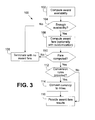
- Fig. 3 illustrates a process 100 utilizing an example implementation of a revenue driven travel loyalty reward determination operation consistent with the invention.
- Process 100 may be initiated in response to a request initiated by a reservation system, and may begin by computing award availability, , e.g., by accessing inventory data from an inventory system, in block 102.
- Block 104 determines whether enough availability exists, and if not, control passes to block 106 to terminate process 100 with no award fare being offered in response to the request. Otherwise, block 104 passes control to block 108 to compute a fare for the award, e.g., by accessing revenue management data from a revenue management system, and optionally, including customizations based upon customer loyalty concerns.
- block 110 passes control to block 106 to terminate process 100, otherwise block 110 passes control to block 112 to determine whether any conversion rules have been provided or are otherwise accessible for use in converting between currency and miles (or other travel loyalty program values). If so, block 112 passes control to block 114 to convert the computed fare, which is generally determined as a currency, to miles or another suitable value, and then to block 116 to return the award fare results as a response to the initial request. If no rules are available, however, block 112 passes control directly to block 116, bypassing block 112. Process 100 is then complete.
- An input request to an award calculator consistent with the invention may include various types of data, including, for example, point of commencement (i.e., departure location), an originator of the request (e.g., a city/country code corresponding to the originator, and potentially additional information about the system, organization or sales channel from which the request is initiated), segments to be priced (including the requested cabin) and/or number of passengers to be priced.
- point of commencement i.e., departure location
- an originator of the request e.g., a city/country code corresponding to the originator, and potentially additional information about the system, organization or sales channel from which the request is initiated
- segments to be priced including the requested cabin
- number of passengers to be priced e.g., number of passengers to be priced.
- customer relationship data may be provided with a request or otherwise made available to the award calculator component, e.g., customer tier, customer value, customer churn risk level, customer average ancillary revenue, customer disruption level and/or customer miles breakage ratio.
- Customer tier generally refers to a level in a loyalty program (e.g., silver, gold, platinum), while customer value is generally finer grained than customer tier and generally refers to the manner in which a customer uses the program and how "valuable" the customer is to the airline, e.g., based on how frequently the customer purchases flights, the costs of such flights, and how recently those flights were purchased.
- customer value may be a continuous metric, computed for example with Recency-Frequency-Monetary (RFM) or Customer Lifetime Value (CLV) algorithms, or in other manners that will be appreciated to one of ordinary skill in the art having the benefit of the instant disclosure.
- RFM Recency-Frequency-Monetary
- CLV Customer Lifetime Value
- Customer churn risk level which may also be referred to as customer attrition risk, relates to the risk that a customer will choose to go to the competition, and may be determined based on analysis of the customer's activity on the airline and in other airline's programs.
- Customer average ancillary revenue refers to non-ticket revenues calculated over the customer purchase history
- customer disruption level refers to the relative amount of disruptions to which the customer has been subjected (e.g., due to late or canceled flights) and is based on the disruption occurrences severity with time attenuation effects.
- Customer miles breakage ratio refers to customer miles that could be lost due to expiration, and allows for giving a bonus to customers having expired miles, to show the program value, and thus reinforce customer loyalty.
- the customer relationship data discussed above may be used to adjust fares to provide more attractive offers to customers who are perceived as being valuable to an airline, but who may not feel as great of a loyalty to the airline, e.g., due to poor traveling experiences, relationships with other airlines, etc. Consequently, such data may be used to reinforce customer loyalty and potentially strengthen the bond between the customer and the airline.
- a response is generated and returned to the reservation system, as discussed above.
- a response may include a customized award net fare per traveler and per request in the currency of the airline, as well as optional data such as an award availability for the request, a customized award net fare per traveler and per request in miles, a customized award net fare per traveler and by segment in the currency of the airline and/or a customized award net fare per traveler and by segment in miles.
- award availability may be determined as follows. First, award availability by segment may be computed based on inventory system data, e.g., segment capacity for the requested cabin, segment availability for the requested cabin, and number of already existing award bookings on the requested segment and in the requested cabin. In addition, one or more business rules may be defined and applied, e.g., to control a maximum award availability proportion for the requested segment and cabin.
- inventory system data e.g., segment capacity for the requested cabin, segment availability for the requested cabin, and number of already existing award bookings on the requested segment and in the requested cabin.
- one or more business rules may be defined and applied, e.g., to control a maximum award availability proportion for the requested segment and cabin.
- the award calculator system may compare request, flight and revenue data with rules data as presented in Table I: Table I Award calculator data Rule data Comparison Segment departure date Start date Check if departure date is between start and end dates, inclusive. End date Board point Departure market Check if board point belongs to departure market and off point belongs to arrival market. Off point Arrival market Aircraft (travel vehicle) type for segment (in case of multi-leg segment, if the aircraft changes then the aircraft type may not be set). Leg structure and associated aircraft types may be retrieved from inventory system. Aircraft (travel vehicle) type Check if the aircraft type matches rule. In case the aircraft type in rule has not been entered, all aircraft types match, including null value.
- Segment cabin Cabin Check if cabin code from award calculator matches cabin code from rule.
- Segment cabin load factor (may be retrieved from inventory system).
- Minimum load factor Check if segment cabin load factor is between minimum and maximum load factors.
- Maximum load factor Segment cabin expected load factor. (may be retrieved from revenue management system).
- Minimum expected load factor Check if segment cabin expected load factor is between minimum and maximum expected load factors.
- Maximum expected load factor if segment cabin expected load factor is between minimum and maximum expected load factors.
- the award calculator system checks if the availability is sufficient for the requested number of passengers. In case the availability is insufficient, the process is stopped with no customized award net fare computed, otherwise, the process continues with computing a customized award net fare computation, as noted above in connection with Fig. 3 .
- segment A-B As an example, consider an award including two segments, segment A-B and segment B-C. If the award availability on segment A-B is 10 seats, and the award availability on segment B-C is 20 seats, the award availability returned for the requested trip would be the minimum of these values, or 10 seats.
- award fare may be determined as follows. First, award fare by segment may be computed. Second, the segment fares may be aggregated at the request level.
- Award fare by segment may be computed as a custom award net fare.
- a custom award net fare is determined by determining a displacement cost and, calculating an adjusted award net fare from the displacement cost, and thereafter calculating a customized award net fare from the adjusted award net fare.
- additional data may also be used in calculating an award net fare computation.
- flight characteristics e.g., segment cabin capacity, cabin booking classes with availability and/or segment cabin load factor
- revenue management data e.g., segment cabin expected load factor, segment cabin forecasted empty seats, carrying cost, segment booking class yields and/or leg cabin bid price vectors may be used.
- a displacement cost principle may be used: an award traveler, by being accepted, can potentially displace individual and/or group travelers booking under standard bookings such as individual or group bookings. Therefore, when computing the displacement cost for an award traveler, the revenue that could be expected from standard bookings may be taken into account, noting additionally that an award traveler does not displace individual or group travelers in case forecasted empty seats are used (as the forecasted empty seats are forecasted to remain empty at departure).
- displacement cost may be determined based on bid price vectors, yields associated with segments and booking classes, or in other manners that will be appreciated by one of ordinary skill in the art having the benefit of the instant disclosure.
- the displacement cost over a segment and for the number of requested award passengers may be computed as the sum of the displacement costs for each leg cabin included in the segment.
- the displacement cost over a leg cabin for the number of the requested award passengers may be considered as the sum of the bid price values starting from the current seat index and up to the number of award passengers to price.
- Table II An example for two award passengers to price is provided in Table II: Table II Seat index A-B Bid price A-B Seat index B-C Bid price B-C 1 500 664 400 2 350 347 300 3 300 230 210 4 190 152 165 5 130 103 110 6 100 74 80 7 90 54 60 8 70 36 39 9 60 23 26 10 45 13 14 11 34 (current seat index) 7 6 12 25 13 20 (current seat index) 14 0 Displacement cost: 20 20 20
- the displacement cost for two passengers on leg A-B is equal to 0 (passenger 1) + 20 (passenger 2) currency units while on leg B-C it is equal to 6 (passenger 1) + 14 (passenger 2) currency units.
- the displacement cost over the segment A-C and for all the award passengers is then equal to the sum between the displacement cost over A-B and B-C which is equal to 40 currency units.
- the pricing process may be stopped and an error message may be sent back to the calling system.
- the displacement cost per passenger may be determined. In the illustrated embodiment, this cost is pro-rated between passengers, so in this example, the displacement cost per passenger would be equal to 40/2, or 20 currency units.
- yields and forecasted empty seats may be used.
- displacement cost is computed by taking into account the forecasted empty seats and/or booking classes with their associated availability and yields.
- special booking classes as promotion booking classes can be excluded from the displacement process.
- Displacement generally begins by displacing in the forecasted empty seats and then displacing in the booking classes ordered by increasing yield value until all award passengers to be priced have been displaced.
- the carrying cost is used in order to cover the costs induced by the servicing of the traveler.
- loyalty travelers actually do not displace individuals.
- an award passenger has displaced an individual in a booking class, its displacement cost is considered to be the value of the yield.
- Table III illustrates an example of segment displacement cost calculation based on yields for 3 redemption passengers: Table III Booking class Yield Availability Displaced M 600 100 B 452 50 O 400 30 G 220 10 1 X 210 1 1 Z 156 Promotional booking class not used for the displacement 1 Not used Forecasted empty seats Carrying cost: 50 1 1
- the segment displacement cost for the 3 award passengers is equal to 50 (carrying cost) + 210 (booking class X) + 220 (booking class G), or 480 currency units.
- displacement cost per passenger may be determined, e.g., on a pro-rata fashion.
- the displacement cost per passenger would be equal to 480/3, or 160 currency units.
- a segment award net fare may be calculated using adjustment rules to generate an adjusted award net fare.
- the award calculator system may compare various data with rules data as presented in Table IV to retrieve an adjustment factor for the rule: Table IV Award calculator data Rule data Comparison Segment departure date Start date Check if departure date is between start and end dates, inclusive. End date Board point Departure market Check if board point belongs to departure market and off point belongs to arrival market. Off point Arrival market Segment cabin code Cabin code Check if cabin code from award calculator matches cabin code from rule. Point of commencement Point of commencement Check if request departure point geographical location belongs to rule point of commencement. Request originator Request originator point of sale Check if request point of sale, including geographical and sales channel info, belongs to rule point of sale. Segment cabin load factor Minimum load factor Check if segment cabin load factor is between minimum/ maximum load factors. Maximum load factor Segment cabin expected load factor Minimum expected load factor Check if segment cabin expected load factor is between minimum/maximum expected load factors. Maximum expected load factor
- the adjustment factor associated with that business rule may be retrieved. In case no rule is found the adjustment factor may be considered to be 100%. Thus, for every segment and cabin an adjustment factor is retrieved based on any applicable business rules.
- a request award net fare per passenger may then be computed as the sum of the segment adjusted award net fares.
- a business rule may be used at the segment level, defining for each segment a minimum acceptable revenue.
- the system may compare request, flight and revenue data with rules data as presented in Table V: Table V Award calculator data Rule data Comparison Segment departure date Start date Check if departure date is between start and end dates, inclusive. End date Board point Departure market Check if board point belongs to departure market and off point belongs to arrival market. Off point Arrival market Segment cabin code Cabin code Check if cabin code from award calculator matches cabin code from rule.
- a minimum acceptable revenue associated with that business rule may be retrieved. In case no rule is found the minimum acceptable revenue may be considered to be 0. The minimum acceptable revenue on the entire request may then be calculated as the sum of the minimum acceptable revenues on the associated segments.
- segment A-B with a minimum acceptable revenue of 100
- segment B-C with no rule
- segment C-D with a minimum acceptable revenue of 50. Summing these three minimums together would result in a minimum acceptable revenue for a request including all three segments would be 150 currency units.
- the request minimum acceptable revenue may be compared to the adjusted award net fare per passenger. If the adjusted award net fare is lower than the minimum acceptable value then the adjusted award net fares for all the segments are overridden by the minimum acceptable revenue values by segment.
- additional customizations may be made to an award net fare, or to an adjusted award net fare, whether on a segment-by-segment basis or on the basis of an entire request.
- the fare reflects pricing primarily from a revenue management point of view, and in some embodiments, it may also be desirable to customize an award fare to take into account a customer loyalty point of view.
- Customization in this regard, may be used to personalize an award net fare based on customer knowledge and to desirably enhance customer loyalty.
- the customer knowledge may be provided by a customer management system, e.g., customer management system 30 of Fig. 1 , which as noted above, may include one or more components such as loyalty, frequent flyer program management, CRM, CEM or customer data warehouse components.
- Rules may be defined and applied on an award net fare or adjusted award net fare (and optionally configurable per cabin and request date), e.g., as shown in Table VI: Table VI Award calculator data Rule data Comparison Customer tier Customer tier Check if customer tier corresponds to rule customer tier. Customer value Customer min value Check if customer value is between min and max values. Customer max value Customer churn risk level Min risk level Check if customer churn risk is between min and max values. Max risk level Customer average ancillary revenues Min Ancillary Revenue Check if customer ancillary revenue is between min and max values. Max Ancillary Revenue Customer disruption level Min disruption level Check if customer disruption level is between min and max values.
- Max disruption level Customer miles breakage ratio Min ratio level Check if miles breakage ratio is between min and max values.
- CustomizedAwardNetFare AwardNetFare * AdjustmentFactor .
- loyalty data e.g., as provided by a customer management system or otherwise, may be used to customize a fare calculation to address travel loyalty program goals or concerns.
- conversion rules may be provided to calculate a customized award net fare in miles from currency (i.e., to convert between a currency-based value and a points-based value).
- a conversion rule may be based on an exchange rate that may be applied on the customized award net fare calculated in the airline currency and/or may be based on a correction function that may be applied at either the segment level or the request level.
- both an exchange rate and a correction function may be used, with the correction function may defining mile/point/value levels or ranges to which an award net fare in miles should be adjusted.
- the function may have as input a net fare interval in miles and a mile level to convert to.
- One example conversion function is shown in Table VII: Table VII Interval (miles) New value (miles) [0,5000] 5000 [5001-10000] 10 000 [10001-15000] 15 000 [15001-open] 30 000
- a customized award net fare per passenger may be returned in the currency of the airline.
- one or more of an award availability for the request, a customized net fare per passenger and per request in miles/points/value, a customized net fare per passenger and by segment in the currency of the airline and/or a customized net fare per passenger and by segment in miles may be returned to the reservation system in response to the initial request.
- Embodiments of the invention may provide a number of benefits.
- award pricing logic may be combined with revenue management logic such that a revenue management policy may be directly applied to award pricing and availability.
- a revenue management policy may influence the award pricing directly by ensuring that a level of revenue is ensured for the airline.
- a loyalty system may influence revenue management award pricing by personalizing the price in miles for each customer, which may permit an airline to achieve an optimal balance between maximizing revenue on a flight (revenue management objective) and revenue over a customer lifetime (loyalty system objective).
- expected unused capacity e.g., forecasted empty seats usage
- expected unused capacity may be used to increase the offer for award passengers at a low net fare, which is beneficial to the extent that it allows filling seats that are forecasted to be empty while at the same time providing advantageous net fares to award customers.
- airlines may be able to reduce their miles liabilities more quickly, and by increasing award offers and providing lower net fares when defaulting on forecasted empty seats, airlines may be able to attract new customers, retain more customers, and therefore secure more revenue.
- Some embodiments may implement award availability calculation based on inventory and/or revenue management data, enabling travel providers to utilize a dedicated computation for award availability based on current flight counters and on an expected load factor computed by a revenue management system.
- availability is not limited to a redemption booking class, yet is still controllable depending on an award availability proportion that depends on current and expected bookings and capacity of requested segments and cabins.
- Some embodiments may implement customized award dynamic net fare computation to provide dynamic pricing capabilities that adapt a customized award net fare to revenue management recommendations.
- a customized award net fare may be a continuous fine level value that better reflects the characteristics of a requested trip (rather than having the same fare levels for an entire region as it is often the case in conventional designs).
- net fares may be offered in a manner that is optimized for loyalty customers, while remaining compliant with airline revenue management policies, and in many cases providing award availability up to the capacity of a flight cabin while still maintaining expected revenue levels.
- Additional embodiments may implement a currency to miles conversion mechanism, accompanied by an adjustment function that computes discrete customized award net fares. This may be of benefit to travel providers that prefer the use of discrete customized award net fares.
Landscapes
- Business, Economics & Management (AREA)
- Engineering & Computer Science (AREA)
- Accounting & Taxation (AREA)
- Development Economics (AREA)
- Strategic Management (AREA)
- Finance (AREA)
- Game Theory and Decision Science (AREA)
- Entrepreneurship & Innovation (AREA)
- Economics (AREA)
- Marketing (AREA)
- Physics & Mathematics (AREA)
- General Business, Economics & Management (AREA)
- General Physics & Mathematics (AREA)
- Theoretical Computer Science (AREA)
- Management, Administration, Business Operations System, And Electronic Commerce (AREA)
Priority Applications (1)
| Application Number | Priority Date | Filing Date | Title |
|---|---|---|---|
| EP13290328.7A EP2887293A1 (de) | 2013-12-23 | 2013-12-23 | Profitorientierte Reisebelohnungen |
Applications Claiming Priority (1)
| Application Number | Priority Date | Filing Date | Title |
|---|---|---|---|
| EP13290328.7A EP2887293A1 (de) | 2013-12-23 | 2013-12-23 | Profitorientierte Reisebelohnungen |
Publications (1)
| Publication Number | Publication Date |
|---|---|
| EP2887293A1 true EP2887293A1 (de) | 2015-06-24 |
Family
ID=50023395
Family Applications (1)
| Application Number | Title | Priority Date | Filing Date |
|---|---|---|---|
| EP13290328.7A Withdrawn EP2887293A1 (de) | 2013-12-23 | 2013-12-23 | Profitorientierte Reisebelohnungen |
Country Status (1)
| Country | Link |
|---|---|
| EP (1) | EP2887293A1 (de) |
-
2013
- 2013-12-23 EP EP13290328.7A patent/EP2887293A1/de not_active Withdrawn
Non-Patent Citations (1)
| Title |
|---|
| "STATEMENT IN ACCORDANCE WITH THE NOTICE FROM THE EUROPEAN PATENT OFFICE DATED 1 OCTOBER 2007 CONCERNING BUSINESS METHODS - EPC / ERKLAERUNG GEMAESS DER MITTEILUNG DES EUROPAEISCHEN PATENTAMTS VOM 1.OKTOBER 2007 UEBER GESCHAEFTSMETHODEN - EPU / DECLARATION CONFORMEMENT AU COMMUNIQUE DE L'OFFICE EUROP", 20071101, 1 November 2007 (2007-11-01), XP007905525 * |
Similar Documents
| Publication | Publication Date | Title |
|---|---|---|
| US20150178763A1 (en) | Revenue driven travel rewards | |
| US7472080B2 (en) | Methods and associated systems for an airline to enhance customer experience and provide options on flights | |
| US8145536B1 (en) | System for concurrent optimization of business economics and customer value | |
| US8527336B2 (en) | Payment method decision engine | |
| US20140067435A1 (en) | Revenue driven splitting of group travel requests into multiple subgroups | |
| US20130103438A1 (en) | System and method for facilitating the purchase of a travel itinerary subject to destination uncertainty | |
| Oh et al. | Reservation policies in queues: Advance deposits, spot prices, and capacity allocation | |
| US20120010912A1 (en) | Systems and methods for optimizing the scheduling of resources on an airplane | |
| US20120010910A1 (en) | Systems and methods for optimizing the scheduling of resources on an airplane | |
| US20090030741A1 (en) | Consumer booking engine and method | |
| US20120010911A1 (en) | Systems and methods for optimizing the scheduling of resources on an airplane | |
| US20090222279A1 (en) | Rate quote generation for optimization of travel agency profitability | |
| US20140136247A1 (en) | Use of group materialization rate to release inventory space | |
| CA2793186A1 (en) | Global maximization of time limit revenues by a travel provider | |
| Vinod et al. | Promoting branded fare families and ancillary services: Merchandising and its impacts on the travel value chain | |
| Li et al. | Airlines seat pricing with seat upgrading | |
| US20120123812A1 (en) | Evaluating customers | |
| Duduke et al. | Airline revenue management with preference based flexible products | |
| Vinod | The expanding role of revenue management in the airline industry | |
| Shugan | Service marketing and management: capacity as a strategic marketing variable | |
| Gunther et al. | Airline distribution | |
| EP2733649A1 (de) | Verwendung einer Gruppenmaterialisierungsrate zur Freigabe von Inventarraum | |
| AU2007285460A1 (en) | System for concurrent optimization of business economics and customer value | |
| Vinod | Revenue Management of the Base Fare | |
| Gallego et al. | Service engineering: The future of service feature design and pricing |
Legal Events
| Date | Code | Title | Description |
|---|---|---|---|
| PUAI | Public reference made under article 153(3) epc to a published international application that has entered the european phase |
Free format text: ORIGINAL CODE: 0009012 |
|
| 17P | Request for examination filed |
Effective date: 20131223 |
|
| AK | Designated contracting states |
Kind code of ref document: A1 Designated state(s): AL AT BE BG CH CY CZ DE DK EE ES FI FR GB GR HR HU IE IS IT LI LT LU LV MC MK MT NL NO PL PT RO RS SE SI SK SM TR |
|
| AX | Request for extension of the european patent |
Extension state: BA ME |
|
| STAA | Information on the status of an ep patent application or granted ep patent |
Free format text: STATUS: THE APPLICATION IS DEEMED TO BE WITHDRAWN |
|
| 18D | Application deemed to be withdrawn |
Effective date: 20160105 |