EP2887262B1 - Punktwolkenvereinfachung - Google Patents
Punktwolkenvereinfachung Download PDFInfo
- Publication number
- EP2887262B1 EP2887262B1 EP14195530.2A EP14195530A EP2887262B1 EP 2887262 B1 EP2887262 B1 EP 2887262B1 EP 14195530 A EP14195530 A EP 14195530A EP 2887262 B1 EP2887262 B1 EP 2887262B1
- Authority
- EP
- European Patent Office
- Prior art keywords
- point
- contraction
- points
- pair
- cluster
- Prior art date
- Legal status (The legal status is an assumption and is not a legal conclusion. Google has not performed a legal analysis and makes no representation as to the accuracy of the status listed.)
- Active
Links
Images





Classifications
-
- G—PHYSICS
- G06—COMPUTING OR CALCULATING; COUNTING
- G06T—IMAGE DATA PROCESSING OR GENERATION, IN GENERAL
- G06T19/00—Manipulating three-dimensional [3D] models or images for computer graphics
- G06T19/20—Editing of three-dimensional [3D] images, e.g. changing shapes or colours, aligning objects or positioning parts
-
- G—PHYSICS
- G06—COMPUTING OR CALCULATING; COUNTING
- G06V—IMAGE OR VIDEO RECOGNITION OR UNDERSTANDING
- G06V10/00—Arrangements for image or video recognition or understanding
- G06V10/70—Arrangements for image or video recognition or understanding using pattern recognition or machine learning
- G06V10/74—Image or video pattern matching; Proximity measures in feature spaces
- G06V10/761—Proximity, similarity or dissimilarity measures
-
- G—PHYSICS
- G06—COMPUTING OR CALCULATING; COUNTING
- G06F—ELECTRIC DIGITAL DATA PROCESSING
- G06F18/00—Pattern recognition
- G06F18/20—Analysing
- G06F18/23—Clustering techniques
- G06F18/231—Hierarchical techniques, i.e. dividing or merging pattern sets so as to obtain a dendrogram
-
- G—PHYSICS
- G06—COMPUTING OR CALCULATING; COUNTING
- G06T—IMAGE DATA PROCESSING OR GENERATION, IN GENERAL
- G06T17/00—Three-dimensional [3D] modelling for computer graphics
- G06T17/20—Finite element generation, e.g. wire-frame surface description, tesselation
- G06T17/205—Re-meshing
-
- G—PHYSICS
- G06—COMPUTING OR CALCULATING; COUNTING
- G06V—IMAGE OR VIDEO RECOGNITION OR UNDERSTANDING
- G06V10/00—Arrangements for image or video recognition or understanding
- G06V10/40—Extraction of image or video features
- G06V10/42—Global feature extraction by analysis of the whole pattern, e.g. using frequency domain transformations or autocorrelation
- G06V10/422—Global feature extraction by analysis of the whole pattern, e.g. using frequency domain transformations or autocorrelation for representing the structure of the pattern or shape of an object therefor
- G06V10/426—Graphical representations
-
- G—PHYSICS
- G06—COMPUTING OR CALCULATING; COUNTING
- G06V—IMAGE OR VIDEO RECOGNITION OR UNDERSTANDING
- G06V10/00—Arrangements for image or video recognition or understanding
- G06V10/70—Arrangements for image or video recognition or understanding using pattern recognition or machine learning
- G06V10/762—Arrangements for image or video recognition or understanding using pattern recognition or machine learning using clustering, e.g. of similar faces in social networks
- G06V10/7625—Hierarchical techniques, i.e. dividing or merging patterns to obtain a tree-like representation; Dendograms
-
- G—PHYSICS
- G06—COMPUTING OR CALCULATING; COUNTING
- G06V—IMAGE OR VIDEO RECOGNITION OR UNDERSTANDING
- G06V20/00—Scenes; Scene-specific elements
- G06V20/60—Type of objects
- G06V20/64—Three-dimensional [3D] objects
Definitions
- the present invention relates to methods and apparatus for simplification of a point cloud, wherein a point cloud comprises a plurality of data points each of which is defined by a set of coordinates.
- a point cloud typically comprises a massive data set that defines a large number of data points in some coordinate system.
- a laser scan of a physical object will typically produce a data set that contains millions of data points, each specified by a 3-tuple using orthogonal coordinates that represent 3D space (e.g. x, y, z).
- the present invention provides a method of point cloud simplification (i.e. reducing the number of data points in a point cloud) that provides improved sample selection, thereby preserving key features and minimizing distortions, whilst also being computationally efficient.
- a computer implemented method for simplification of a point cloud that represents one or more three-dimensional surfaces or objects, the point cloud comprising a set of points.
- the method comprises implementing recursive spatial partitioning of the set of points into a hierarchy of clusters, identifying representative points within each cluster in the hierarchy and, for each representative point, defining a point-pair that consists of the representative point and a representative point of an immediate parent cluster.
- the method further comprises calculating a contraction error metric for each point-pair, and, until a predefined stop criterion is met iterating the steps of iteratively contracting the point-pair with the lowest contraction error metric, updating remaining point-pairs as a result of the contraction, and revising the contraction error metric of the updated point-pairs accordingly
- the contraction of the point-pair comprises replacing both of the points in the point-pair with a new point which could either be located at the position of whichever one of the points in the point-pair to be contracted that results in the lowest contraction error metric for the corresponding contraction, or at a position that minimises the contraction error metric for the corresponding contraction; and wherein the step of updating remaining point-pairs as a result of the contraction comprises identifying other point-pairs that include either of the points that were included in the contracted point-pair, and updating the identified point-pairs to include the new point generated as a result of the contraction.
- the recursive spatial partitioning of the set of points into a hierarchy of clusters may comprise implementing divisive hierarchical clustering of the set of points.
- the recursive spatial partitioning of the set of points into a hierarchy of clusters may comprise partitioning an initial root cluster comprising the set of points into a number of clusters, and recursively partitioning each cluster into further clusters until either each cluster contains a single point or a predefined depth is reached.
- the step of identifying representative points within each cluster in the hierarchy can comprises, for a branch cluster, identifying the point that is closest to the mean of the points within the cluster as a representative point, and, for a leaf cluster, identifying each point within the cluster as a representative point.
- the method may further comprise generating a logical tree by defining the representative points as nodes of the logical tree, and, for each representative point, defining an edge of the logical tree as a point-pair that consists of the representative point and a representative point of an immediate parent cluster.
- the step of updating remaining point-pairs as a result of the contraction can comprise updating the logical tree as a result of the contraction of the point-pair.
- the method may further comprise defining a contraction queue in which the point-pair with the lowest contraction error metric is first in the contraction queue and, after each contraction, updating the contraction queue to reflect updates in the calculated contraction error metrics of the updated point-pairs.
- the step of updating remaining point-pairs as a result of the contraction may comprise identifying other point-pairs that include either of the points that were included in the contracted point-pair, and replacing the identified point-pairs with a new point generated as a result of the contraction.
- the step of revising the contraction error metric of the updated point-pairs accordingly may comprise, for each of the point-pairs that are updated to include a new point generated as a result of the contraction, recalculating the contraction error metric using the new point.
- the iterative contraction of the point-pair with the lowest contraction error metric can continue until a predefined stop criteria is met.
- the contraction of the point-pair with the lowest contraction error metric comprises replacing the point-pair with a new point.
- the step of replacing the point-pair with a new point then comprises selecting a position of one of the points in the point-pair that results in the lowest contraction error metric for the corresponding contraction and generating a new point at the selected position.
- the step of replacing the point-pair with a new point can comprise determining a position that minimises the contraction error metric for the corresponding contraction and generating a new point at the determined position.
- a computer system for implementing simplification of a point cloud that represents one or more three-dimensional surfaces or objects, the point cloud comprising a set of points.
- the system comprises a memory configured to store the point cloud, and a processor.
- the processor is configured to implement recursive spatial partitioning of the set of points into a hierarchy of clusters, to identify representative points within each cluster in the hierarchy and, for each representative point, to define a point-pair that consists of the representative point and a representative point of an immediate parent cluster.
- the processor is further configured to calculate a contraction error metric for each point-pair, and ,until a predefined stop criteria is met, iterating the steps of iteratively contracting the point-pair with the lowest contraction error metric so as to reduce the number of points in the point cloud, updating remaining point-pairs as a result of the contraction, and revising the contraction error metric of the updated point-pairs accordingly.
- the contraction of the point-pair comprises replacing both of the points in the point-pair with a new point which could either be located at the position of whichever one of the points in the point-pair to be contracted that results in the lowest contraction error metric for the corresponding contraction, or at a position that minimises the contraction error metric for the corresponding contraction; and wherein updating remaining point-pairs as a result of the contraction comprises identifying other point-pairs that include either of the points that were included in the contracted point-pair, and updating the identified point-pairs to include the new point generated as a result of the contraction.
- FIG. 1 is a flow diagram illustrating the method of point cloud simplification.
- the method involves using divisive hierarchical clustering (S1) as means for identifying point-pairs (i.e. pairs of points) as candidates for contraction (S2), calculating a contraction error metric for each point-pair (S3), and iteratively contracting the point-pair with the lowest contraction error metric (S4).
- S1 divisive hierarchical clustering
- S3 means for identifying point-pairs (i.e. pairs of points) as candidates for contraction
- S4 iteratively contracting the point-pair with the lowest contraction error metric
- the iterative contraction of the point-pair with the lowest contraction error metric then continues until a predefined stop criteria is met (S5).
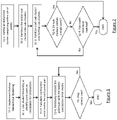
- FIG. 2 is a flow diagram illustrating an exemplary process of recursive spatial partitioning of a set of points into a hierarchy of clusters, which would typically involve defining the entire set of points as an initial root cluster (S2-1), partitioning the initial root cluster into a number of separate clusters (e.g. sub-clusters that each contain a subset of the points in the entire set) (S2-2), and recursively partitioning each cluster into further clusters (S2-3) until either a further cluster contains a single point (S2-4) or a predefined depth is reached (S2-5).
- This hierarchical clustering therefore recursively divides each cluster into smaller clusters containing fewer points.
- Point-pairs can then be identified by identifying representative points within each cluster in the hierarchy and, for each representative point, defining a point-pair that consists of the representative point and a representative point of an immediate parent cluster.
- the representative point of a branch/internal cluster could be the point that is closest to the mean of the points within the cluster (i.e. a centre point of the cluster), whilst for a leaf/external cluster, each point within the cluster could be considered to be a representative point of that cluster. Consequently, where a branch/internal cluster is the immediate parent of multiple further clusters, then the representative point of that cluster will be included within multiple point-pairs of the point-pairs that are defined for the hierarchy of clusters. Conversely, each representative point within a leaf/external cluster will only be included within a single point-pair of the point-pairs that are defined for the hierarchy of clusters; however, each leaf/external cluster could include multiple representative points.
- Figure 3a illustrates schematically a tree representation of a simple example of a cluster hierarchy formed as a result of divisive hierarchical clustering of a set of points.
- the initial root cluster (C 1 ) includes all of the points in the set to be simplified.
- Each sub-cluster (C 2 to C 17 ) then includes a subset of the points that are part of the initial root cluster (C 1 ).
- the representative point(s) (RP n ) within each cluster (C n ) illustrated in Figure 3a have been identified, and a point-pair has then been defined as the combination of each representative point with the representative point of the immediate parent cluster.
- each of the point-pairs present in Figure 3b are shown as encircled by a dashed line.
- the point-pairs of the example of Figure 3b therefore include: RP 1 -RP 2 RP 1 -RP 3 RP 2 -RP 4 RP 2 -RP 5 RP 3 -RP 6 RP 3 -RP 7 RP 3 -RP 8 RP 4 -RP 9 RP 4 -RP10 RP 5 -RP11 RP 5 -RP12 RP 6 -RP13 RP 6 -RP14 RP 6 -RP15 RP 8 -RP 16 RP 8 -RP17
- each leaf/external cluster contains only a single representative point. However, if one or more of the leaf/external clusters includes more than one representative point, then further point-pairs would be defined. For example, if cluster C 9 were to contain two representative points (i.e. RP 9-1 and RP 9-2 ), then the point-pairs that are defined for the hierarchy of clusters would include both RP 4 -RP 9-1 and RP 4 -RP 9-2 .
- the divisive hierarchical clustering has resulted in a cluster hierarchy in which there are leaf/external clusters at different depths within the hierarchy, as leaf/external cluster C 7 occurs at a depth of 2 whilst the remaining leaf/external clusters occur at a depth of 3.
- leaf/external cluster C 7 occurs at a depth of 2 whilst the remaining leaf/external clusters occur at a depth of 3.
- the divisive hierarchical clustering process resulted in cluster C 7 containing only a single point, such that there would be no further spatial partitioning of this cluster, whilst further spatial partitioning of the other clusters at that depth is still possible. For example, this could occur for parts of point cloud that are sparse relative to other parts.
- the divisive hierarchical clustering process would result in a cluster hierarchy in which the leaf/external clusters are all at the same depth within the hierarchy.
- the contraction error metric of each point-pair is calculated.
- the contraction of the point-pair with the lowest contraction error metric then comprises replacing both of the points in the point-pair with a new, replacement point.
- the replacement point could either be located at the position of whichever one of the points in the point-pair to be contracted that results in the lowest contraction error metric for the corresponding contraction, or at a position that minimises the contraction error metric for the corresponding contraction.
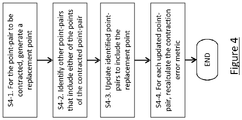
- FIG. 4 is a flow diagram illustrating an example of a process that could occur for each point-pair contraction.
- a replacement point is generated that will replace both points in the point-pair (S4-1).
- any other point-pairs that include either of the points that are included in the contracted point-pair are identified (S4-2), and these identified point-pairs are updated to include the replacement point generated as a result of the contraction (i.e. in place of the point that was involved in the contraction) (S4-3).
- the contraction error metric is recalculated using the replacement point (S4-4).
- a contraction priority queue is defined in which the point-pair with the lowest contraction error metric is first in the contraction priority queue.
- the contraction priority queue would then be updated after each contraction in order to reflect updates in the calculated contraction error metrics of the updated point-pairs, such that the point-pair with the lowest contraction error metric is again first in the contraction priority queue even if the contraction error metrics have changed as a result of the preceding contraction. Consequently, the contraction priority queue should be implemented in such a way that it can be efficiently updated following changes to the calculated contraction error metrics of any updated point-pairs.
- the contraction priority queue comprises a Fibonacci heap, which comprises a collection of trees that satisfy the minimum-heap property. This results in O(N log(N)) overall complexity for average case (when each point is connected only to limited percent of all points).
- this is merely an example, and other methods could also be used to implement the contraction priority queue.
- a logical tree is generated by identifying representative points within each cluster in the hierarchy, defining the representative points as nodes of the logical tree, and, for each representative point, defining an edge of the logical tree as a point-pair that consists of the representative point and a representative point of an immediate parent cluster.
- the tree representation of Figure 3b effectively illustrates an example of a logical tree in which the nodes are the representative points (RP n ) of each cluster, and the edges comprise the point-pairs defined for the hierarchy, as illustrated by the lines connecting the representative points within each cluster with the representative point within it's immediate parent cluster.
- Figure 5a illustrates an unprocessed point cloud representation of the well-known Stanford bunny
- Figure 5b then illustrates the pseudo-connectivity of the points of this point cloud generated when a logical tree is formed in accordance with the methods described herein.
- Figure 6a illustrates a tree representation of the result of an exemplary first contraction of point-pair RP 2 -RP 4 of Figure 3b .
- This example contraction results in a new, replacement point RP 2,4 that replaces both RP 2 and RP 4 .
- the edges of the logical tree that involved either of RP 2 and RP 4 are updated to include replacement point RP 2,4 instead. This updating of the edges of the logical tree is illustrated by the dashed lines in Figure 6a .
- Figure 6b then illustrates a tree representation of the result of an exemplary second contraction of the tree illustrated in Figure 3b .
- the updated point pair RP 1 -RP 2,4 resulting from the first contraction is contracted such that replacement point RP 1,2,4 replaces both RP 1 and RP 2,4 (which replaced RP 2 and RP 4 ).
- the edges of the logical tree that involved either of the points in the contracted point-pair i.e. RP 1 and RP 2,4
- This updating of the edges of the logical tree is illustrated by the dashed lines in Figure 6b .
- a logical tree comprising the representative points of each cluster within a cluster hierarchy (i.e. generated by the spatial hierarchal clustering of a point cloud) provides an efficient means for identifying candidate point-pairs for contraction.
- a logical tree comprising the representative points of each cluster within a cluster hierarchy (i.e. generated by the spatial hierarchal clustering of a point cloud)
- all of the points will eventually become a representative point of a cluster. Therefore, as there is an edge defined between each representative point and the representative point of it's immediate parent cluster (other than for the representative point of the root cluster), the number of edges in such a logical tree is linearly dependent on number of points in the point cloud.
- a logical tree provides a path (i.e.
- any point cloud could be simplified to a single point by traversing this path.
- the tree structure of such a logical tree maintains the relative distance between points in the point cloud, as the closer any two points are in the point cloud the fewer edges (i.e. a shorter sequence of contractions) there will be in the path between the two points in the logical tree.
- the use of such a logical tree therefore captures simplification bias, whilst also providing good computational performance.
- k-dimensional (k-d) tree spatial partitioning recursively splits space into two half-spaces by generating a splitting hyperplane that divides a space into two parts.
- octree tree spatial partitioning recursively subdivides space into eight octants.
- a recursive spatial partitioning method that uses a variable pattern of partitioning, thereby giving a high-level of control over the depth of the hierarchy and the number of points in each cluster.
- a fixed pattern of partitioning involves splitting space into a fixed number of sub-spaces at each recurrence, whereas for a variable pattern of partitioning the number of sub-spaces generated can vary at each recurrence
- the set of data points that make up the point cloud are placed into an array, effectively defining the initial root cluster.
- This array can be viewed as left-closed right-open range, i.e. [first, last).
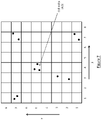
- FIG. 7 illustrates a simple example of a two-dimensional space that has been partitioned into a grid of cells.
- the tuple of indices of a cell comprises a 2-tuple, wherein the numbers in the 2-tuple index the position of the cell in the x-coordinate and y-coordinate directions respectively. Therefore, within each level of the hierarchy, each point can be mapped to the tuple of indices of the cell in which the point is located, with the cell representing the cluster in which the point has been placed.
- Clustering can then be achieved by performing an in-place partition of the set of points in the array into groups which fall into the same cell, i.e. which have the same tuple of indices.
- this in-place partitioning could be implemented using a comparison-based sorting algorithm such as Introsort, wherein the ordering relationship uses a lexicographical comparison of tuple indices.
- the in-place partitioning could be implemented using an integer-based sorting algorithm such as radix sort or counting sort. In this case, the indices in the tuple are mapped to one integer which is then used as sorting key.
- O(kN) complexity for the clustering of one cell with N points into sub-cells, where k is number of digits used during sorting. For many practical applications k is small and fixed such that complexity then becomes O(N).
- the recursive clustering method stops when it is determined that a cluster has only one point, or if a predefined traversal depth level is reached.
- Such a divide-and-conquer hierarchical clustering method exposes an important performance property, in that it is an optimal cache-oblivious algorithm, i.e. it uses the memory/cache hierarchy optimally, in an asymptotic sense.
- the cluster will fit fully into the highest level of processor cache (e.g. such as the L3 cache of modern CPUs), which means that all processing of its points, within all of its sub-clusters within hierarchy will happen within that cache level.
- points of deeper levels will fully fit into lower cache levels, such as L2, and so on.
- the contraction error metric would be a sum of the squared distances between a new, replacement point generated as a result of the contraction and each point in an affiliated set of points arising from the contraction of the point-pair.
- each point can be considered to have an implicit set of affiliated points that comprises all of the points of the original point cloud that the point has replaced (i.e. as a result of a contraction of a point-pair). Therefore, in the initial point cloud, the affiliated set of each point includes only the point itself, as no contractions have taken place. For a replacement point that has been generated as the result of the contraction of one or more point-pairs, the affiliated set will include all of the points of the original point cloud that have been contracted to generate that replacement point.
- affiliated set of P n P n
- affiliated set of P n,m P n , P m
- the error is initially zero, as the affiliated set of each point includes only itself. Then, as the simplification process proceeds, the error increases as the affiliated sets associated with the points in the simplified point cloud grow with each contraction.
- the distances between points can be measured in n-dimensional space, which allows the simplification process to respect additional attributes of the point cloud.
- the coordinate set of each point in the point cloud could include both colour and texture coordinates, such that each point would be represented by a 6-tuple (i.e. x, y, z, r, g, b, u, v).
- the simplification method can therefore take into account dimensions that are configurable according to application requirements, from pure geometry (x,y,z) to multiple attributes weighted by application-specific factors.
- quadric (Q) defined by equation 3 evaluates to the squared distance between given point x and p, and this quadric (Q) can be stored as tuple of matrix, vector and scalar:
- the sum of a plurality of quadrics is therefore another quadric which represents sum of squared distances to each underlying point.
- the matrix component A will always be of form nl, and can then be stored as one scalar n.
- quadrics can be used to represent distances to arbitrary simplexes, and such quadrics will have more complicated structure of A matrix (i.e. non-identity).
- the quadric of a plane can be added to the affiliated sets by a user or extracted automatically by domain specific heuristics. Such a plane can represent useful model features and will bias the simplification process to preserve points around that plane.
- each point can be represented by a quadric Q, which also represents a set of affiliated points associated with the point (i.e. by summed quadrics)
- quadrics can also be used to determine the location of the replacement point that is generated as a result of a point-pair contraction. For example, for the point-pair (P 1 -P 2 ) that is to be contracted, if the replacement point is to be located at the position of whichever one of the points in the point-pair that results in the lowest contraction error metric, then these can be determined using the quadrics of each point (i.e. (Q 1 + Q 2 )(P 1 ) and (Q 1 + Q 2 )(P 2 )) and the results compared to determine which results in the lowest error.
- the stop criteria could comprise one or more of the following:
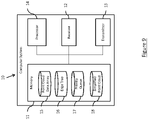
- FIG. 9 illustrates schematically an embodiment of a computer system 10 suitable for implementing the methods described herein.
- the system 10 can be implemented as a combination of computer hardware and software, and comprises a memory 11, a receiver 12, a transmitter 13, and a processor 14. Whilst the system 10 has been illustrated schematically as single device (e.g. server or computer) comprising a single occurrence of each of the functional elements listed above, the system could equally comprise multiple occurrences of each functional element and could equally be provided by a plurality of separate devices that cooperate to provide the required functionality.
- the memory 11 typically stores the various programs/executable files that are implemented by the processor 14, an array of point cloud data 15, a table defining the edges of a logical tree formed by the point cloud data (i.e. defining the candidate point pairs) 16, a contraction priority queue 17, the resulting simplified point cloud data 18, and any other data that may be of use to the system 10.
- the processor 14 is configured to processing requires to implement the simplification of the point cloud data in accordance method for simplification of a point cloud.
- the processor 14 is configured to implement recursive spatial partitioning of the set of points into a hierarchy of clusters, to identify representative points within each cluster in the hierarchy, and to define point-pairs that consist of a representative point within a cluster and a representative point of an immediate parent cluster.
- the processor 14 is further configured to calculate a contraction error metric for each point-pair, and to implement the iterative contraction of the point-pair with the lowest contraction error metric, update remaining point-pairs as a result of the contraction, and revise the contraction error metric of the updated point-pairs accordingly.
- the processor 14 can implement one or more programs/executable files that has been provided by a computer readable medium storing computer interpretable instructions which when interpreted by the computer system cause the computer to perform the methods described herein.
- the point cloud simplification method described herein provides a number of advantages.
- the method achieves optimum sample selection minimizing distortions and preserving features which may be lost when using conventional clustering or decimation.
- the method also provides high performance for large point clouds, achieving O(N*log(N)) scaling with the number of points, and also allows for an arbitrary level of simplification that is not constrained by a lattice.
- the method requires little control from users through the use of scale-independent parameters.
- the embodiments of the invention described with reference to the drawings comprise computer apparatus and processes performed in computer apparatus, the invention also extends to computer programs, particularly computer programs on or in a carrier, adapted for putting the invention into practice.
- the program may be in the form of source or object code or in any other form suitable for use in the implementation of the processes according to the invention.
- the carrier could be any entity or device capable of carrying the program.
- the carrier may comprise a storage medium, such as a ROM, for example a CD ROM or a semiconductor ROM, or a magnetic recording medium, for example a floppy disc or hard disk.
- a storage medium such as a ROM, for example a CD ROM or a semiconductor ROM, or a magnetic recording medium, for example a floppy disc or hard disk.
- the carrier may be a transmissible carrier such as an electrical or optical signal which may be conveyed via electrical or optical cable or by radio or other means.
- the carrier When a program is embodied in a signal which may be conveyed directly by a cable or other device or means, the carrier may be constituted by such cable or other device or means.
- the carrier may be an integrated circuit in which the program is embedded, the integrated circuit being adapted for performing, or for use in the performance of, the relevant processes.
Landscapes
- Engineering & Computer Science (AREA)
- Theoretical Computer Science (AREA)
- Physics & Mathematics (AREA)
- General Physics & Mathematics (AREA)
- Computer Vision & Pattern Recognition (AREA)
- Multimedia (AREA)
- Software Systems (AREA)
- Artificial Intelligence (AREA)
- Evolutionary Computation (AREA)
- Medical Informatics (AREA)
- General Health & Medical Sciences (AREA)
- Databases & Information Systems (AREA)
- Computing Systems (AREA)
- Health & Medical Sciences (AREA)
- Data Mining & Analysis (AREA)
- General Engineering & Computer Science (AREA)
- Computer Graphics (AREA)
- Evolutionary Biology (AREA)
- Life Sciences & Earth Sciences (AREA)
- Bioinformatics & Computational Biology (AREA)
- Architecture (AREA)
- Bioinformatics & Cheminformatics (AREA)
- Computer Hardware Design (AREA)
- Geometry (AREA)
- Image Analysis (AREA)
- Image Generation (AREA)
- Information Retrieval, Db Structures And Fs Structures Therefor (AREA)
- Image Processing (AREA)
Claims (9)
- Computerimplementiertes Verfahren zur Vereinfachung einer Punktwolke, welche ein oder mehrere dreidimensionale Objekte oder Oberflächen repräsentiert, wobei die Punktwolke eine Punktmenge repräsentiert, das Verfahren Folgendes umfassend:
Implementieren eines rekursiven räumlichen Unterteilens der Punktmenge in eine Hierarchie von Gruppen;Identifizieren von repräsentativen Punkten innerhalb jeder Gruppe in der Hierarchie; und,für jeden repräsentativen Punkt, Definieren eines Punktpaares, welches aus dem repräsentativen Punkt und einem repräsentativen Punkt einer unmittelbaren Muttergruppe besteht; Berechnen einer Kontraktionsfehlermetrik für jedes Punktpaar; und, bis ein vordefiniertes Stopkriterium erfüllt ist, Iterieren der Schritte des iterativen Kontrahierens des Punktpaares mit der niedrigsten Kontraktionsfehlermetrik, um so die Anzahl von Punkten in der Punktwolke zu reduzieren, Aktualisieren von verbleibenden Punktpaaren als ein Ergebnis der Kontraktion, und dementsprechendes Revidieren der Kontraktionsfehlermetrik der aktualisierten Punktpaare;wobei die Kontraktion des Punktpaares Ersetzen der beiden Punkte in dem Punktpaar durch einen neuen Punkt umfasst, welcher entweder an der Position von einem der Punkte in dem Punktpaar, welches kontrahiert werden soll, angeordnet sein kann, welche zu der niedrigsten Kontraktionsfehlermetrik für die entsprechende Kontraktion führt, oder an einer Position angeordnet sein kann, welche die Kontraktionsfehlermetrik für die entsprechende Kontraktion minimiert;und wobei der Schritt des Aktualisierens von verbleibenden Punktpaaren als ein Ergebnis der Kontraktion Identifizieren anderer Punktpaare umfasst, welche einen der Punkte umfassen, welche in dem kontrahierten Punktpaar enthalten sind, und Aktualisieren der identifizierten Punktpaare, um den neuen Punkt einzubeziehen, welcher als ein Ergebnis der Kontraktion erzeugt wurde. - Verfahren nach Anspruch 1, wobei das rekursive räumliche Unterteilen der Punktmenge in eine Hierarchie von Gruppen Implementieren von teilendem hierarchischem Gruppieren der Punktmenge umfasst.
- Verfahren nach einem der Ansprüche 1 oder 2, wobei das rekursive räumliche Unterteilen der Punktmenge in eine Hierarchie von Gruppen Folgendes umfasst: Unterteilen einer anfänglichen Stammgruppe, welche die Punktmenge umfasst, in eine Anzahl von Gruppen; rekursives Unterteilen jeder Gruppe in weitere Gruppen, bis entweder jede Gruppe einen einzelnen Punkt enthält oder eine vordefinierte Tiefe erreicht wird.
- Verfahren nach einem der vorhergehenden Ansprüche, wobei der Schritt des Identifizierens von repräsentativen Punkten innerhalb jeder Gruppe in der Hierarchie Folgendes umfasst:
für eine Zweiggruppe, Identifizieren des Punkts, welcher am nächsten am Mittelwert der Punkte innerhalb der Gruppe ist, als einen repräsentativen Punkt; und für eine Blattgruppe, Identifizieren von jedem Punkt innerhalb der Gruppe als einen repräsentativen Punkt. - Verfahren nach einem der vorhergehenden Ansprüche, und weiterhin Folgendes umfassend:
Erzeugen eines logischen Baums durch Definieren der repräsentativen Punkte als Knoten des logischen Baums, und, für jeden repräsentativen Punkt, Definieren eines Rands des logischen Baums als ein Punktpaar, welches aus dem repräsentativen Punkt und einem repräsentativen Punkt einer unmittelbaren Muttergruppe besteht. - Verfahren nach Anspruch 5, wobei der Schritt des Aktualisierens von verbleibenden Punktpaaren als ein Ergebnis der Kontraktion Folgendes umfasst:
Aktualisieren des logischen Baums als ein Ergebnis der Kontraktion des Punktpaares. - Verfahren nach einem vorhergehenden Anspruch, und weiterhin Folgendes umfassend:
Definieren einer Kontraktionswarteschlange, in welcher das Punktpaar mit der niedrigsten Kontraktionsfehlermetrik das erste in der Kontraktionswarteschlange ist; und, nach jeder Kontraktion, Aktualisieren der Kontraktionswarteschlange, um Aktualisierungen der berechneten Kontraktionsfehlermetriken der aktualisierten Punktpaare wiederzugeben. - Verfahren nach Anspruch 1, wobei der Schritt des Revidierens der Kontraktionsfehlermetrik der aktualisierten Punktpaare dementsprechend Folgendes umfasst:
für jedes der Punktpaare, welche aktualisiert werden, um einen neuen Punkt zu umfassen, welcher als ein Ergebnis der Kontraktion erzeugt wurde, Neuberechnen der Kontraktionsfehlermetrik unter Verwendung des neuen Punkts. - Computersystem (10) zum Implementieren einer Vereinfachung einer Punktwolke, welche ein oder mehrere dreidimensionale Objekte oder Oberflächen repräsentiert, wobei die Punktwolke eine Punktmenge repräsentiert, das System Folgendes umfassend:einen Speicher (11), welcher eingerichtet ist, um die Punktwolke zu speichern; und einen Prozessor (14), welcher eingerichtet ist, um: rekursives räumliches Unterteilen der Punktmenge in eine Hierarchie von Gruppen zu implementieren;repräsentative Punkte innerhalb jeder Gruppe in der Hierarchie zu identifizieren und, für jeden repräsentativen Punkt, ein Punktpaar zu definieren, welches aus dem repräsentativen Punkt und einem repräsentativen Punkt einer unmittelbaren Muttergruppe besteht; eine Kontraktionsfehlermetrik für jedes Punktpaar zu berechnen; und, bis ein vordefiniertes Stopkriterium erfüllt ist, Iterieren der Schritte des iterativen Kontrahierens des Punktpaares mit der niedrigsten Kontraktionsfehlermetrik, um so die Anzahl von Punkten in der Punktwolke zu reduzieren, Aktualisieren von verbleibenden Punktpaaren als ein Ergebnis der Kontraktion, und dementsprechendes Revidieren der Kontraktionsfehlermetrik der aktualisierten Punktpaare;wobei die Kontraktion des Punktpaares Ersetzen der beiden Punkte in dem Punktpaar durch einen neuen Punkt umfasst, welcher entweder an der Position von einem der Punkte in dem Punktpaar, welches kontrahiert werden soll, angeordnet sein kann, welche zu der niedrigsten Kontraktionsfehlermetrik für die entsprechende Kontraktion führt, oder an einer Position angeordnet sein kann, welche die Kontraktionsfehlermetrik für die entsprechende Kontraktion minimiert;wobei Aktualisieren von verbleibenden Punktpaaren als ein Ergebnis der Kontraktion Identifizieren anderer Punktpaare umfasst, welche einen der Punkte umfassen, welche in dem kontrahierten Punktpaar enthalten sind, und Aktualisieren der identifizierten Punktpaare, um den neuen Punkt einzubeziehen, welcher als ein Ergebnis der Kontraktion erzeugt wurde.
Applications Claiming Priority (1)
| Application Number | Priority Date | Filing Date | Title |
|---|---|---|---|
| GB1322711.1A GB2521452B (en) | 2013-12-20 | 2013-12-20 | Point Cloud Simplification |
Publications (3)
| Publication Number | Publication Date |
|---|---|
| EP2887262A2 EP2887262A2 (de) | 2015-06-24 |
| EP2887262A3 EP2887262A3 (de) | 2015-12-02 |
| EP2887262B1 true EP2887262B1 (de) | 2022-08-10 |
Family
ID=50071249
Family Applications (1)
| Application Number | Title | Priority Date | Filing Date |
|---|---|---|---|
| EP14195530.2A Active EP2887262B1 (de) | 2013-12-20 | 2014-11-28 | Punktwolkenvereinfachung |
Country Status (4)
| Country | Link |
|---|---|
| US (1) | US10019649B2 (de) |
| EP (1) | EP2887262B1 (de) |
| DK (1) | DK2887262T3 (de) |
| GB (1) | GB2521452B (de) |
Families Citing this family (12)
| Publication number | Priority date | Publication date | Assignee | Title |
|---|---|---|---|---|
| JP2018507639A (ja) * | 2015-01-28 | 2018-03-15 | アンブラ テクノロジーズ リミテッドUmbra Technologies Ltd. | グローバル仮想ネットワークについてのシステム及び方法 |
| CN113872855B (zh) | 2015-04-07 | 2024-06-18 | 安博科技有限公司 | 用于全局虚拟网络中的虚拟接口和高级智能路由的系统和方法 |
| GB2537413A (en) * | 2015-04-17 | 2016-10-19 | Visual Tech Services Ltd | Point cloud simplification |
| CN105184789B (zh) * | 2015-08-31 | 2017-12-05 | 中国科学院自动化研究所 | 一种基于点云约减的相机定位系统及方法 |
| US10216478B2 (en) * | 2016-03-30 | 2019-02-26 | International Business Machines Corporation | Increasing radix sorting efficiency utilizing a crossover point |
| EP3315906B1 (de) * | 2016-10-27 | 2023-05-31 | Leica Geosystems AG | Verfahren zur verarbeitung von scandaten |
| EP3315907B1 (de) * | 2016-10-27 | 2025-03-26 | Leica Geosystems AG | Verfahren zur visuellen darstellung von scandaten |
| CN108303037B (zh) * | 2018-01-31 | 2020-05-08 | 广东工业大学 | 一种基于点云分析的工件表面形状差异的检测方法及装置 |
| CN109101892B (zh) * | 2018-07-17 | 2021-08-10 | 南京航空航天大学 | 基于栅格和密度聚类算法的激光雷达目标物检测方法 |
| US11250551B2 (en) | 2019-03-28 | 2022-02-15 | Canon Virginia, Inc. | Devices, systems, and methods for limited-size divisive clustering |
| WO2021001186A1 (en) | 2019-07-03 | 2021-01-07 | Interdigital Vc Holdings France, Sas | Processing a point cloud |
| US11544419B1 (en) | 2021-07-26 | 2023-01-03 | Pointlab, Inc. | Subsampling method for converting 3D scan data of an object for marine, civil, and architectural works into smaller densities for processing without CAD processing |
Family Cites Families (5)
| Publication number | Priority date | Publication date | Assignee | Title |
|---|---|---|---|---|
| US10289802B2 (en) * | 2010-12-27 | 2019-05-14 | The Board Of Trustees Of The Leland Stanford Junior University | Spanning-tree progression analysis of density-normalized events (SPADE) |
| WO2013123636A1 (en) * | 2012-02-20 | 2013-08-29 | Thomson Licensing | Method and apparatus for mesh simplification |
| US20140089834A1 (en) * | 2012-03-07 | 2014-03-27 | Willow Garage Inc. | Point cloud data hierarchy |
| US9460553B2 (en) * | 2012-06-18 | 2016-10-04 | Dreamworks Animation Llc | Point-based global illumination directional importance mapping |
| US9552668B2 (en) * | 2012-12-12 | 2017-01-24 | Microsoft Technology Licensing, Llc | Generation of a three-dimensional representation of a user |
-
2013
- 2013-12-20 GB GB1322711.1A patent/GB2521452B/en not_active Expired - Fee Related
-
2014
- 2014-11-28 EP EP14195530.2A patent/EP2887262B1/de active Active
- 2014-11-28 DK DK14195530.2T patent/DK2887262T3/da active
- 2014-12-19 US US14/577,625 patent/US10019649B2/en active Active
Non-Patent Citations (1)
| Title |
|---|
| SONG ET AL: "A global clustering approach to point cloud simplification with a specified data reduction ratio", COMPUTER AIDED DESIGN, ELSEVIER PUBLISHERS BV., BARKING, GB, vol. 40, no. 3, 5 November 2007 (2007-11-05), pages 281 - 292, XP022510969, ISSN: 0010-4485 * |
Also Published As
| Publication number | Publication date |
|---|---|
| DK2887262T3 (da) | 2022-10-31 |
| US20150178594A1 (en) | 2015-06-25 |
| US10019649B2 (en) | 2018-07-10 |
| GB2521452A (en) | 2015-06-24 |
| GB2521452B (en) | 2015-12-09 |
| EP2887262A3 (de) | 2015-12-02 |
| GB201322711D0 (en) | 2014-02-05 |
| EP2887262A2 (de) | 2015-06-24 |
Similar Documents
| Publication | Publication Date | Title |
|---|---|---|
| EP2887262B1 (de) | Punktwolkenvereinfachung | |
| US9691006B2 (en) | Point cloud simplification | |
| Garland et al. | Fast polygonal approximation of terrains and height fields | |
| Yang et al. | A Point Cloud Simplification Method Based on Modified Fuzzy C‐Means Clustering Algorithm with Feature Information Reserved | |
| Zhang et al. | Dual contouring with topology-preserving simplification using enhanced cell representation | |
| CN111090712A (zh) | 一种数据处理方法、装置、设备及计算机存储介质 | |
| Silva et al. | Automatic generation of triangular irregular networks using greedy cuts | |
| Fellegara et al. | Terrain trees: a framework for representing, analyzing and visualizing triangulated terrains | |
| Azri et al. | Review of spatial indexing techniques for large urban data management | |
| Song et al. | Efficient topology-aware simplification of large triangulated terrains | |
| EP3091512B1 (de) | Punkt-cloud-vereinfachung | |
| Zhou et al. | A feature-preserving simplification method for dense point clouds based on voxel priority filtering | |
| Merry et al. | Moving least-squares reconstruction of large models with GPUs | |
| CN120707771B (zh) | 基于模型重建的地图数据处理方法、装置、设备及介质 | |
| Danovaro et al. | Level-of-detail for data analysis and exploration: A historical overview and some new perspectives | |
| Chica et al. | Pressing: Smooth isosurfaces with flats from binary grids | |
| Balázs | Efficient trimmed NURBS tessellation | |
| Bajaj et al. | Seed sets and search structures for optimal isocontour extraction | |
| Bajaj et al. | Accelerated isocontouring of scalar fields | |
| Zhou | 3D urban modeling from city-scale aerial LiDAR data | |
| Schmitz et al. | Efficient and quality contouring algorithms on the GPU | |
| Cioaca et al. | Graph‐Based Wavelet Representation of Multi‐Variate Terrain Data | |
| Fei et al. | An Adaptive Sampling Scheme for Out‐of‐Core Simplification | |
| Bevilacqua et al. | An evolutionary optimization method for parameter search in 3d points cloud reconstruction | |
| KR101155689B1 (ko) | 프리미티브 트리에 기반한 거리장 계산장치 및 방법 |
Legal Events
| Date | Code | Title | Description |
|---|---|---|---|
| PUAI | Public reference made under article 153(3) epc to a published international application that has entered the european phase |
Free format text: ORIGINAL CODE: 0009012 |
|
| 17P | Request for examination filed |
Effective date: 20141128 |
|
| AK | Designated contracting states |
Kind code of ref document: A2 Designated state(s): AL AT BE BG CH CY CZ DE DK EE ES FI FR GB GR HR HU IE IS IT LI LT LU LV MC MK MT NL NO PL PT RO RS SE SI SK SM TR |
|
| AX | Request for extension of the european patent |
Extension state: BA ME |
|
| PUAL | Search report despatched |
Free format text: ORIGINAL CODE: 0009013 |
|
| AK | Designated contracting states |
Kind code of ref document: A3 Designated state(s): AL AT BE BG CH CY CZ DE DK EE ES FI FR GB GR HR HU IE IS IT LI LT LU LV MC MK MT NL NO PL PT RO RS SE SI SK SM TR |
|
| AX | Request for extension of the european patent |
Extension state: BA ME |
|
| RIC1 | Information provided on ipc code assigned before grant |
Ipc: G06K 9/46 20060101ALI20151026BHEP Ipc: G06K 9/00 20060101AFI20151026BHEP Ipc: G06K 9/62 20060101ALI20151026BHEP |
|
| R17P | Request for examination filed (corrected) |
Effective date: 20160405 |
|
| RBV | Designated contracting states (corrected) |
Designated state(s): AL AT BE BG CH CY CZ DE DK EE ES FI FR GB GR HR HU IE IS IT LI LT LU LV MC MK MT NL NO PL PT RO RS SE SI SK SM TR |
|
| STAA | Information on the status of an ep patent application or granted ep patent |
Free format text: STATUS: EXAMINATION IS IN PROGRESS |
|
| 17Q | First examination report despatched |
Effective date: 20180406 |
|
| REG | Reference to a national code |
Ref country code: DE Ref legal event code: R079 Ref document number: 602014084552 Country of ref document: DE Free format text: PREVIOUS MAIN CLASS: G06K0009000000 Ipc: G06V0010740000 |
|
| GRAP | Despatch of communication of intention to grant a patent |
Free format text: ORIGINAL CODE: EPIDOSNIGR1 |
|
| STAA | Information on the status of an ep patent application or granted ep patent |
Free format text: STATUS: GRANT OF PATENT IS INTENDED |
|
| RIC1 | Information provided on ipc code assigned before grant |
Ipc: G06T 17/20 20060101ALI20220419BHEP Ipc: G06V 10/426 20220101ALI20220419BHEP Ipc: G06V 20/64 20220101ALI20220419BHEP Ipc: G06V 10/762 20220101ALI20220419BHEP Ipc: G06V 10/74 20220101AFI20220419BHEP |
|
| INTG | Intention to grant announced |
Effective date: 20220519 |
|
| GRAS | Grant fee paid |
Free format text: ORIGINAL CODE: EPIDOSNIGR3 |
|
| GRAA | (expected) grant |
Free format text: ORIGINAL CODE: 0009210 |
|
| STAA | Information on the status of an ep patent application or granted ep patent |
Free format text: STATUS: THE PATENT HAS BEEN GRANTED |
|
| AK | Designated contracting states |
Kind code of ref document: B1 Designated state(s): AL AT BE BG CH CY CZ DE DK EE ES FI FR GB GR HR HU IE IS IT LI LT LU LV MC MK MT NL NO PL PT RO RS SE SI SK SM TR |
|
| REG | Reference to a national code |
Ref country code: AT Ref legal event code: REF Ref document number: 1511119 Country of ref document: AT Kind code of ref document: T Effective date: 20220815 Ref country code: CH Ref legal event code: EP |
|
| REG | Reference to a national code |
Ref country code: SE Ref legal event code: TRGR |
|
| REG | Reference to a national code |
Ref country code: DE Ref legal event code: R096 Ref document number: 602014084552 Country of ref document: DE |
|
| REG | Reference to a national code |
Ref country code: IE Ref legal event code: FG4D |
|
| REG | Reference to a national code |
Ref country code: NL Ref legal event code: FP |
|
| REG | Reference to a national code |
Ref country code: DK Ref legal event code: T3 Effective date: 20221026 |
|
| REG | Reference to a national code |
Ref country code: LT Ref legal event code: MG9D Ref country code: NO Ref legal event code: T2 Effective date: 20220810 |
|
| PG25 | Lapsed in a contracting state [announced via postgrant information from national office to epo] |
Ref country code: RS Free format text: LAPSE BECAUSE OF FAILURE TO SUBMIT A TRANSLATION OF THE DESCRIPTION OR TO PAY THE FEE WITHIN THE PRESCRIBED TIME-LIMIT Effective date: 20220810 Ref country code: PT Free format text: LAPSE BECAUSE OF FAILURE TO SUBMIT A TRANSLATION OF THE DESCRIPTION OR TO PAY THE FEE WITHIN THE PRESCRIBED TIME-LIMIT Effective date: 20221212 Ref country code: LV Free format text: LAPSE BECAUSE OF FAILURE TO SUBMIT A TRANSLATION OF THE DESCRIPTION OR TO PAY THE FEE WITHIN THE PRESCRIBED TIME-LIMIT Effective date: 20220810 Ref country code: LT Free format text: LAPSE BECAUSE OF FAILURE TO SUBMIT A TRANSLATION OF THE DESCRIPTION OR TO PAY THE FEE WITHIN THE PRESCRIBED TIME-LIMIT Effective date: 20220810 Ref country code: FI Free format text: LAPSE BECAUSE OF FAILURE TO SUBMIT A TRANSLATION OF THE DESCRIPTION OR TO PAY THE FEE WITHIN THE PRESCRIBED TIME-LIMIT Effective date: 20220810 Ref country code: ES Free format text: LAPSE BECAUSE OF FAILURE TO SUBMIT A TRANSLATION OF THE DESCRIPTION OR TO PAY THE FEE WITHIN THE PRESCRIBED TIME-LIMIT Effective date: 20220810 |
|
| PGFP | Annual fee paid to national office [announced via postgrant information from national office to epo] |
Ref country code: SE Payment date: 20221116 Year of fee payment: 9 Ref country code: NO Payment date: 20221108 Year of fee payment: 9 Ref country code: NL Payment date: 20221114 Year of fee payment: 9 Ref country code: IT Payment date: 20221111 Year of fee payment: 9 Ref country code: IE Payment date: 20221108 Year of fee payment: 9 Ref country code: GB Payment date: 20221117 Year of fee payment: 9 Ref country code: FR Payment date: 20221110 Year of fee payment: 9 Ref country code: DK Payment date: 20221122 Year of fee payment: 9 Ref country code: DE Payment date: 20221117 Year of fee payment: 9 |
|
| REG | Reference to a national code |
Ref country code: AT Ref legal event code: MK05 Ref document number: 1511119 Country of ref document: AT Kind code of ref document: T Effective date: 20220810 |
|
| PG25 | Lapsed in a contracting state [announced via postgrant information from national office to epo] |
Ref country code: PL Free format text: LAPSE BECAUSE OF FAILURE TO SUBMIT A TRANSLATION OF THE DESCRIPTION OR TO PAY THE FEE WITHIN THE PRESCRIBED TIME-LIMIT Effective date: 20220810 Ref country code: IS Free format text: LAPSE BECAUSE OF FAILURE TO SUBMIT A TRANSLATION OF THE DESCRIPTION OR TO PAY THE FEE WITHIN THE PRESCRIBED TIME-LIMIT Effective date: 20221210 Ref country code: HR Free format text: LAPSE BECAUSE OF FAILURE TO SUBMIT A TRANSLATION OF THE DESCRIPTION OR TO PAY THE FEE WITHIN THE PRESCRIBED TIME-LIMIT Effective date: 20220810 Ref country code: GR Free format text: LAPSE BECAUSE OF FAILURE TO SUBMIT A TRANSLATION OF THE DESCRIPTION OR TO PAY THE FEE WITHIN THE PRESCRIBED TIME-LIMIT Effective date: 20221111 |
|
| PGFP | Annual fee paid to national office [announced via postgrant information from national office to epo] |
Ref country code: CH Payment date: 20221121 Year of fee payment: 9 Ref country code: BE Payment date: 20221114 Year of fee payment: 9 |
|
| PG25 | Lapsed in a contracting state [announced via postgrant information from national office to epo] |
Ref country code: SM Free format text: LAPSE BECAUSE OF FAILURE TO SUBMIT A TRANSLATION OF THE DESCRIPTION OR TO PAY THE FEE WITHIN THE PRESCRIBED TIME-LIMIT Effective date: 20220810 Ref country code: RO Free format text: LAPSE BECAUSE OF FAILURE TO SUBMIT A TRANSLATION OF THE DESCRIPTION OR TO PAY THE FEE WITHIN THE PRESCRIBED TIME-LIMIT Effective date: 20220810 Ref country code: CZ Free format text: LAPSE BECAUSE OF FAILURE TO SUBMIT A TRANSLATION OF THE DESCRIPTION OR TO PAY THE FEE WITHIN THE PRESCRIBED TIME-LIMIT Effective date: 20220810 Ref country code: AT Free format text: LAPSE BECAUSE OF FAILURE TO SUBMIT A TRANSLATION OF THE DESCRIPTION OR TO PAY THE FEE WITHIN THE PRESCRIBED TIME-LIMIT Effective date: 20220810 |
|
| REG | Reference to a national code |
Ref country code: DE Ref legal event code: R097 Ref document number: 602014084552 Country of ref document: DE |
|
| PG25 | Lapsed in a contracting state [announced via postgrant information from national office to epo] |
Ref country code: SK Free format text: LAPSE BECAUSE OF FAILURE TO SUBMIT A TRANSLATION OF THE DESCRIPTION OR TO PAY THE FEE WITHIN THE PRESCRIBED TIME-LIMIT Effective date: 20220810 Ref country code: EE Free format text: LAPSE BECAUSE OF FAILURE TO SUBMIT A TRANSLATION OF THE DESCRIPTION OR TO PAY THE FEE WITHIN THE PRESCRIBED TIME-LIMIT Effective date: 20220810 |
|
| PLBE | No opposition filed within time limit |
Free format text: ORIGINAL CODE: 0009261 |
|
| STAA | Information on the status of an ep patent application or granted ep patent |
Free format text: STATUS: NO OPPOSITION FILED WITHIN TIME LIMIT |
|
| PG25 | Lapsed in a contracting state [announced via postgrant information from national office to epo] |
Ref country code: MC Free format text: LAPSE BECAUSE OF FAILURE TO SUBMIT A TRANSLATION OF THE DESCRIPTION OR TO PAY THE FEE WITHIN THE PRESCRIBED TIME-LIMIT Effective date: 20220810 Ref country code: AL Free format text: LAPSE BECAUSE OF FAILURE TO SUBMIT A TRANSLATION OF THE DESCRIPTION OR TO PAY THE FEE WITHIN THE PRESCRIBED TIME-LIMIT Effective date: 20220810 |
|
| 26N | No opposition filed |
Effective date: 20230511 |
|
| PG25 | Lapsed in a contracting state [announced via postgrant information from national office to epo] |
Ref country code: SI Free format text: LAPSE BECAUSE OF FAILURE TO SUBMIT A TRANSLATION OF THE DESCRIPTION OR TO PAY THE FEE WITHIN THE PRESCRIBED TIME-LIMIT Effective date: 20220810 Ref country code: LU Free format text: LAPSE BECAUSE OF NON-PAYMENT OF DUE FEES Effective date: 20221128 |
|
| PG25 | Lapsed in a contracting state [announced via postgrant information from national office to epo] |
Ref country code: HU Free format text: LAPSE BECAUSE OF FAILURE TO SUBMIT A TRANSLATION OF THE DESCRIPTION OR TO PAY THE FEE WITHIN THE PRESCRIBED TIME-LIMIT; INVALID AB INITIO Effective date: 20141128 |
|
| PG25 | Lapsed in a contracting state [announced via postgrant information from national office to epo] |
Ref country code: CY Free format text: LAPSE BECAUSE OF FAILURE TO SUBMIT A TRANSLATION OF THE DESCRIPTION OR TO PAY THE FEE WITHIN THE PRESCRIBED TIME-LIMIT Effective date: 20220810 |
|
| PG25 | Lapsed in a contracting state [announced via postgrant information from national office to epo] |
Ref country code: MK Free format text: LAPSE BECAUSE OF FAILURE TO SUBMIT A TRANSLATION OF THE DESCRIPTION OR TO PAY THE FEE WITHIN THE PRESCRIBED TIME-LIMIT Effective date: 20220810 |
|
| REG | Reference to a national code |
Ref country code: DE Ref legal event code: R119 Ref document number: 602014084552 Country of ref document: DE |
|
| REG | Reference to a national code |
Ref country code: DK Ref legal event code: EBP Effective date: 20231130 |
|
| REG | Reference to a national code |
Ref country code: CH Ref legal event code: PL |
|
| REG | Reference to a national code |
Ref country code: SE Ref legal event code: EUG |
|
| REG | Reference to a national code |
Ref country code: NL Ref legal event code: MM Effective date: 20231201 |
|
| PG25 | Lapsed in a contracting state [announced via postgrant information from national office to epo] |
Ref country code: CH Free format text: LAPSE BECAUSE OF NON-PAYMENT OF DUE FEES Effective date: 20231130 |
|
| GBPC | Gb: european patent ceased through non-payment of renewal fee |
Effective date: 20231128 |
|
| PG25 | Lapsed in a contracting state [announced via postgrant information from national office to epo] |
Ref country code: NO Free format text: LAPSE BECAUSE OF NON-PAYMENT OF DUE FEES Effective date: 20231130 Ref country code: CH Free format text: LAPSE BECAUSE OF NON-PAYMENT OF DUE FEES Effective date: 20231130 Ref country code: BG Free format text: LAPSE BECAUSE OF FAILURE TO SUBMIT A TRANSLATION OF THE DESCRIPTION OR TO PAY THE FEE WITHIN THE PRESCRIBED TIME-LIMIT Effective date: 20220810 |
|
| REG | Reference to a national code |
Ref country code: BE Ref legal event code: MM Effective date: 20231130 |
|
| PG25 | Lapsed in a contracting state [announced via postgrant information from national office to epo] |
Ref country code: SE Free format text: LAPSE BECAUSE OF NON-PAYMENT OF DUE FEES Effective date: 20231129 |
|
| PG25 | Lapsed in a contracting state [announced via postgrant information from national office to epo] |
Ref country code: NL Free format text: LAPSE BECAUSE OF NON-PAYMENT OF DUE FEES Effective date: 20231201 |
|
| REG | Reference to a national code |
Ref country code: IE Ref legal event code: MM4A |
|
| PG25 | Lapsed in a contracting state [announced via postgrant information from national office to epo] |
Ref country code: NL Free format text: LAPSE BECAUSE OF NON-PAYMENT OF DUE FEES Effective date: 20231201 Ref country code: MT Free format text: LAPSE BECAUSE OF FAILURE TO SUBMIT A TRANSLATION OF THE DESCRIPTION OR TO PAY THE FEE WITHIN THE PRESCRIBED TIME-LIMIT Effective date: 20220810 |
|
| PG25 | Lapsed in a contracting state [announced via postgrant information from national office to epo] |
Ref country code: DE Free format text: LAPSE BECAUSE OF NON-PAYMENT OF DUE FEES Effective date: 20240601 Ref country code: IE Free format text: LAPSE BECAUSE OF NON-PAYMENT OF DUE FEES Effective date: 20231128 |
|
| PG25 | Lapsed in a contracting state [announced via postgrant information from national office to epo] |
Ref country code: DK Free format text: LAPSE BECAUSE OF NON-PAYMENT OF DUE FEES Effective date: 20231130 |
|
| PG25 | Lapsed in a contracting state [announced via postgrant information from national office to epo] |
Ref country code: GB Free format text: LAPSE BECAUSE OF NON-PAYMENT OF DUE FEES Effective date: 20231128 |
|
| PG25 | Lapsed in a contracting state [announced via postgrant information from national office to epo] |
Ref country code: BE Free format text: LAPSE BECAUSE OF NON-PAYMENT OF DUE FEES Effective date: 20231130 |
|
| PG25 | Lapsed in a contracting state [announced via postgrant information from national office to epo] |
Ref country code: FR Free format text: LAPSE BECAUSE OF NON-PAYMENT OF DUE FEES Effective date: 20231130 |
|
| PG25 | Lapsed in a contracting state [announced via postgrant information from national office to epo] |
Ref country code: IE Free format text: LAPSE BECAUSE OF NON-PAYMENT OF DUE FEES Effective date: 20231128 Ref country code: GB Free format text: LAPSE BECAUSE OF NON-PAYMENT OF DUE FEES Effective date: 20231128 Ref country code: FR Free format text: LAPSE BECAUSE OF NON-PAYMENT OF DUE FEES Effective date: 20231130 Ref country code: DK Free format text: LAPSE BECAUSE OF NON-PAYMENT OF DUE FEES Effective date: 20231130 Ref country code: DE Free format text: LAPSE BECAUSE OF NON-PAYMENT OF DUE FEES Effective date: 20240601 Ref country code: BE Free format text: LAPSE BECAUSE OF NON-PAYMENT OF DUE FEES Effective date: 20231130 |
|
| PG25 | Lapsed in a contracting state [announced via postgrant information from national office to epo] |
Ref country code: IT Free format text: LAPSE BECAUSE OF NON-PAYMENT OF DUE FEES Effective date: 20231128 |
|
| PG25 | Lapsed in a contracting state [announced via postgrant information from national office to epo] |
Ref country code: IT Free format text: LAPSE BECAUSE OF NON-PAYMENT OF DUE FEES Effective date: 20231128 |
|
| PG25 | Lapsed in a contracting state [announced via postgrant information from national office to epo] |
Ref country code: TR Free format text: LAPSE BECAUSE OF FAILURE TO SUBMIT A TRANSLATION OF THE DESCRIPTION OR TO PAY THE FEE WITHIN THE PRESCRIBED TIME-LIMIT Effective date: 20220810 |