EP2887207B1 - Architektur für Operationen mit langer Latenzzeit in emulierten gemeinsam genutzten Speicherarchitekturen - Google Patents
Architektur für Operationen mit langer Latenzzeit in emulierten gemeinsam genutzten Speicherarchitekturen Download PDFInfo
- Publication number
- EP2887207B1 EP2887207B1 EP13198516.0A EP13198516A EP2887207B1 EP 2887207 B1 EP2887207 B1 EP 2887207B1 EP 13198516 A EP13198516 A EP 13198516A EP 2887207 B1 EP2887207 B1 EP 2887207B1
- Authority
- EP
- European Patent Office
- Prior art keywords
- latency
- memory access
- memory
- pipeline
- processor architecture
- Prior art date
- Legal status (The legal status is an assumption and is not a legal conclusion. Google has not performed a legal analysis and makes no representation as to the accuracy of the status listed.)
- Active
Links
Images



Classifications
-
- G—PHYSICS
- G06—COMPUTING OR CALCULATING; COUNTING
- G06F—ELECTRIC DIGITAL DATA PROCESSING
- G06F9/00—Arrangements for program control, e.g. control units
- G06F9/06—Arrangements for program control, e.g. control units using stored programs, i.e. using an internal store of processing equipment to receive or retain programs
- G06F9/30—Arrangements for executing machine instructions, e.g. instruction decode
- G06F9/38—Concurrent instruction execution, e.g. pipeline or look ahead
- G06F9/3867—Concurrent instruction execution, e.g. pipeline or look ahead using instruction pipelines
-
- G—PHYSICS
- G06—COMPUTING OR CALCULATING; COUNTING
- G06F—ELECTRIC DIGITAL DATA PROCESSING
- G06F9/00—Arrangements for program control, e.g. control units
- G06F9/06—Arrangements for program control, e.g. control units using stored programs, i.e. using an internal store of processing equipment to receive or retain programs
- G06F9/30—Arrangements for executing machine instructions, e.g. instruction decode
- G06F9/30003—Arrangements for executing specific machine instructions
- G06F9/30007—Arrangements for executing specific machine instructions to perform operations on data operands
- G06F9/3001—Arithmetic instructions
-
- G—PHYSICS
- G06—COMPUTING OR CALCULATING; COUNTING
- G06F—ELECTRIC DIGITAL DATA PROCESSING
- G06F9/00—Arrangements for program control, e.g. control units
- G06F9/06—Arrangements for program control, e.g. control units using stored programs, i.e. using an internal store of processing equipment to receive or retain programs
- G06F9/30—Arrangements for executing machine instructions, e.g. instruction decode
- G06F9/30003—Arrangements for executing specific machine instructions
- G06F9/30007—Arrangements for executing specific machine instructions to perform operations on data operands
- G06F9/30029—Logical and Boolean instructions, e.g. XOR, NOT
-
- G—PHYSICS
- G06—COMPUTING OR CALCULATING; COUNTING
- G06F—ELECTRIC DIGITAL DATA PROCESSING
- G06F9/00—Arrangements for program control, e.g. control units
- G06F9/06—Arrangements for program control, e.g. control units using stored programs, i.e. using an internal store of processing equipment to receive or retain programs
- G06F9/30—Arrangements for executing machine instructions, e.g. instruction decode
- G06F9/30003—Arrangements for executing specific machine instructions
- G06F9/3004—Arrangements for executing specific machine instructions to perform operations on memory
-
- G—PHYSICS
- G06—COMPUTING OR CALCULATING; COUNTING
- G06F—ELECTRIC DIGITAL DATA PROCESSING
- G06F9/00—Arrangements for program control, e.g. control units
- G06F9/06—Arrangements for program control, e.g. control units using stored programs, i.e. using an internal store of processing equipment to receive or retain programs
- G06F9/30—Arrangements for executing machine instructions, e.g. instruction decode
- G06F9/38—Concurrent instruction execution, e.g. pipeline or look ahead
- G06F9/3867—Concurrent instruction execution, e.g. pipeline or look ahead using instruction pipelines
- G06F9/3873—Variable length pipelines, e.g. elastic pipeline
-
- G—PHYSICS
- G06—COMPUTING OR CALCULATING; COUNTING
- G06F—ELECTRIC DIGITAL DATA PROCESSING
- G06F9/00—Arrangements for program control, e.g. control units
- G06F9/06—Arrangements for program control, e.g. control units using stored programs, i.e. using an internal store of processing equipment to receive or retain programs
- G06F9/30—Arrangements for executing machine instructions, e.g. instruction decode
- G06F9/38—Concurrent instruction execution, e.g. pipeline or look ahead
- G06F9/3885—Concurrent instruction execution, e.g. pipeline or look ahead using a plurality of independent parallel functional units
- G06F9/3893—Concurrent instruction execution, e.g. pipeline or look ahead using a plurality of independent parallel functional units controlled in tandem, e.g. multiplier-accumulator
- G06F9/3895—Concurrent instruction execution, e.g. pipeline or look ahead using a plurality of independent parallel functional units controlled in tandem, e.g. multiplier-accumulator for complex operations, e.g. multidimensional or interleaved address generators, macros
Definitions
- the present invention pertains to computer science and computer architectures.
- the invention relates to the execution of long latency operations in connection with emulated shared memory architectures.
- SMAs shared memory architecture
- data and program partitioning is typically carried out by placing data requiring processing by multiple threads into the shared memory and splitting program more independently to processors, thus making programming easier compared to message passing (MPA) architectures in which processing happens always locally and the programmer is responsible for moving data around accordingly.
- MPA message passing
- SMAs use a distributed shared memory architecture consisting of multiple interconnected processor-cache pairs, which makes cache coherency (and therefore latency tolerance) and synchronicity maintenance very expensive. This may even ruin their performance in communication intensive problems.
- ESM emulated shared memory
- shared memory emulation architectures have been introduced. They incorporate a set of multithreaded processors that are connected via a high-throughput intercommunication network to a common uniformly and synchronously accessible shared memory.
- the memory system latency is hidden by overlapping on-going memory references and a special low-cost synchronization mechanism is established guaranteeing synchronicity at machine instruction level.
- the ESM systems provide the user with perception of ideal shared memory even though the actual hardware architecture comprises a physically distributed memory.
- PRAM parallel random access machine
- ESM is a feasible technique to address programmability and performance scalability concerns of chip multiprocessors (CMP) as it yields implied synchrony in the execution of machine instructions, efficient latency hiding technique, and sufficient bandwidth to route all the memory references even with heavy random and concurrent access workloads.
- CMP chip multiprocessors
- Synchronous execution is considered to make programming easier as a programmer does not need to synchronize the threads of execution explicitly after each global memory access but can rely on the hardware to take care of that automatically, whereas e.g. in message passing architectures (MPA), a programmer is responsible for explicitly defining communication, synchronizing subtasks, and describing data and program partitioning between threads making MPAs difficult to program.
- MPA message passing architectures
- Latency hiding used in shared memory emulation makes use of the high-throughput computing scheme, where other threads are executed while a thread refers to the global shared memory. Since the throughput computing scheme employs parallel slackness extracted from the available thread-level parallelism, it is considered to provide enhanced scalability in contrast to traditional symmetric multiprocessors and non-uniform memory access (NUMA) systems relying on snooping or directory-based cache coherence mechanisms and therefore suffering from limited bandwidth or directory access delays and heavy coherence traffic maintenance.
- NUMA non-uniform memory access
- Step Caches-a Novel Approach to Concurrent Memory Access on Shared Memory MP-SOCs In the Proceedings of the 23th IEEE NORCHIP Conference, November 21-22, 2005, Oulu, Finland, 74-77 , 2: M.
- Multi(-prefix)operations can be defined for many basic operations, e.g. ADD, SUB, MAX etc., and considered as parallel primitives due to the capability to express parallel algorithms. They can be used for synchronization and parallel data structures simultaneously accessed by several processors without race conditions and other anomalies of architectures executing threads asynchronously.
- a high-level illustration of a scalable architecture to emulate shared memory on a silicon platform comprises a set of processors (cores) PI, P2, P3,...,Pp 102 connected to a physically distributed, but logically shared (data) memory M1, M2, M3,...,Mp 112 via a physically scalable high bandwidth interconnection network 108.
- Active memory units 110 in connection with data memory 112 can be considered as memory control logic units utilized to process the memory references.
- the active memory units 110 are arranged to manage computation related to cases in which multiple memory references are targeted to the same memory location during e.g. multi(-prefix) operations, for instance.
- Instruction memory modules 11, 12, 13,..., Ip 104 are configured to carry the program code for each processor 102.
- the processors 102 are multithreaded utilizing a Tp-stage cyclic, interleaved inter-thread pipeline (Tp ⁇ the average latency of the network).
- Tp the average latency of the network.
- the PRAM model is linked to the architecture such that a full cycle in the pipeline corresponds typically to a single PRAM step.
- each thread of each processor of the CMP executes an instruction including at most one shared memory reference sub-instruction. Therefore a step lasts for multiple, at least Tp+1 clock cycles.
- step caches are generally associative memory buffers in which data stays valid only to the end of ongoing step of multithreaded execution.
- the main contribution of step caches to concurrent accesses is that they stepwisely filter out everything but the first reference for each referenced memory location. This reduces the number of requests per location from P Tp down to P allowing them to be processed sequentially on a single ported memory module assuming Tp ⁇ P.
- Scratchpads are addressable memory buffers that are used to store memory access data to keep the associativity of step caches limited in implementing multioperations with the help of step caches and minimal on-core and off-core ALUs (arithmetic logic unit) that take care of actual intra-processor and inter-processor computation for multioperations. Scratchpads may be coupled with step caches to establish so-called scratchpad step cache units S1, S2, S3,...,Sp 106.
- Fig. 2 shows, at 200, one illustration of an ESM CMP architecture incorporating e.g. the aforementioned active memory units 112B (with ALU and fetcher) in connection with data memory modules 112 and scratchpads 206B.
- the network 108 may be a mesh-like interconnection network acting as a high-bandwidth pipelined memory system with switches 108B.
- the memory access latency is hidden by executing other threads while a thread is referencing the uniformly accessible distributed shared memory via the network 108.
- Congestion of references and hot spots in communication can be avoided with an efficient dead-lock free intercommunication architecture featuring high bandwidth (bisection BW ⁇ P/4) and randomized hashing of memory locations over the distributed memory modules. Execution of instructions happens in steps corresponding to a single PRAM step during which each thread executes a single instruction.
- a physically feasible memory unit making use of step cache and scratchpad techniques to support strong concurrent memory access and multi(-prefix)operations is easily comprehensible as one key component of powerful emulated shared memory architecture like REPLICA (REmoving Performance and programmability LImitations of Chip multiprocessor Architectures), which is basically a configurable ESM.
- REPLICA REmoving Performance and programmability LImitations of Chip multiprocessor Architectures
- Such MU may be configured to send the outgoing memory references to the shared memory system as well as wait and receive possible replies therefrom, for example.
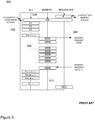
- Fig. 3 represents, at 300, a high-level block diagram and pipeline of a typical MCRCW ESM processor making use of e.g. step caches.
- a processor in a step cache-based MCRCW (C)ESM CMP comprises A ALUs, M memory units (MU), a distributed or unified register block, a sequencer and some glue logic.
- Ax 302 refers to ALU x
- IF 308 refers to instruction fetch logic
- MEM 304 refers to memory unit stage
- OS 306 refers to operand selection logic
- SEQ 310 refers to sequencer.
- there are ALUs 302 logically positioned prior to and after the memory unit wait segment.
- integer-based arithmetic operations taken care of by ALUs in the modern processor architectures include addition, subtraction, multiplication and division.
- the ALUs are often responsible for performing logical operations that may incorporate comparing e.g. two data elements to each other to sort out which was smaller/bigger or whether they were equal, and making related decisions based on the outcome of such comparisons.
- specialized functional units may be allocated for executing certain specific tasks and operations involving calculations of particular complexity, for instance. Execution of such complex or otherwise special operations could require additional logic or hardware, and take a greater number of clock cycles or generally just take longer, i.e. cause a longer latency, to complete in contrast to e.g. basic ALU operations.
- processor architectures In processor architectures, several parallel processing paths may be provided, each potentially provided with special purpose or specific task to be performed using the hardware disposed on that particular path. Nevertheless, the latency caused by the associated elements and related processing taking place in the paths often adds to the overall execution time of instructions proceeding in the processor pipeline structure.
- Publication US2008/0313438 discloses a superscalar processor architecture incorporating a cascaded delayed pipeline construction wherein multiple dependent instructions are first identified, then grouped and subsequently simultaneously allocated to different parallel pipelines so that each instruction of the group is directed to a certain pipeline, and wherein pipelines are delayed with respect to each other so that an execution unit of one pipeline may provide its output to the input of an execution unit of adjacent delayed pipeline through chaining.
- the disclosure discusses the use of instruction predecoders for optimizing the distribution of instructions to the groups.
- EP1367485 presents a processor for executing VLIW instructions using pipeline execution wherein each VLIW instruction consists of a plurality of instructions and the pipeline consists of various stages.
- the processor is intended to provide a solution where fetched VLIW instructions may be executed so that NOP (No Operations), i.e., operations that are not carried out e.g. due to insufficient instruction level parallelism are eliminated.
- NOP No Operations
- the objective is to at least alleviate one or more problems described hereinabove not yet fully satisfactorily addressed by the known ESM arrangements, and to provide a feasible solution for executing long latency operations, such as division or application-specific operations, effectively thereat.
- a processor architecture arrangement for emulated shared memory (ESM) architectures comprises a plurality of multi-threaded processors each provided with interleaved inter-thread pipeline, multiple threads being executed in interleaved manner by the pipeline and a number of other threads being executed while a thread refers to a common physically distributed and logically shared data memory of the ESM architecture, wherein the pipeline comprises a branch of a memory access segment and at least one other branch comprising a plurality of functional units arranged in series for executing arithmetic, logical and optionally further operations on data, wherein one or more functional units of lower latency belonging to said plurality are positioned prior to the memory access segment in said pipeline and one or more long latency units belonging to said plurality for executing more complex operations associated with longer latency are positioned operatively in parallel with the memory access segment so that the more complex operations associated with longer latency are executed simultaneously with the memory access operation.
- ESM emulated shared memory
- one or more functional units in the plurality functionally located after the memory access segment which units are preferably at least generally, i.e. regarding at least most such units, of lower latency.
- the plurality of functional units comprises a number of ALUs.
- a further number of long latency units including at least one unit are positioned operatively in parallel with the aforementioned one or more long latency units.
- the pipeline may thereby contain two or more branches or branch portions at least during the memory access segment (in parallel therewith) wherein each branch incorporates at least one dedicated long latency unit configured to operate during memory access.
- these mutually parallel branches may be located in series with the remaining functional units preceding and following the memory access segment.
- At least two or more of the included long latency units are chained together into at least one chain, wherein data may be passed from one unit to another.
- the chained functional units may be configured to execute mutually different operations on the input data (operands), for example.
- At least part of the functional units are controlled through predetermined (sub-)instruction operation field(s) and associated values provided in the instruction, or 'instruction word'.
- an operand for a functional unit is determined in the operand select stage of pipeline in accordance with the operand selection field(s) (values) given in the instruction (word).
- Operand for a functional unit may also be inherited from a previous functional unit connected thereto in the same chain. Connections between functional units may be enabled by a number of multiplexers controlled by the instruction words.
- At least one long latency unit is configured to execute division, square-root or application-specific operations.
- the long latency units may supplement (more traditional) ALU(s) in bringing in versatile arithmetics or generally operation support to the pipeline and overall processor architecture in question.
- At least one long latency unit is internally pipelined.
- the utility of the present invention is due to several issues depending on the embodiment. It basically allows the execution of long latency operations such as divisions in emulated shared memory computers within a single step of multithreaded execution even though such operations typically take multiple execution steps. Because the memory wait segment of the pipeline may be practically merged with the logic implementing long latency operations, the programmer sees the long latency operations executing in a single step, and the latency arising from the execution is hidden within the latency in any case caused by the memory access. The obtained benefits in terms of performance increase are evident in the context of e.g. multicore processor-based computers and their programming.
- a number of' refers herein to any positive integer starting from one (1), e.g. to one, two, or three.
- a plurality of' refers herein to any positive integer starting from two (2), e.g. to two, three, or four.
- Figs. 1-3 were already contemplated hereinbefore in connection with the description of both background and historical data relating to the origin of the present invention.
- Fig. 4 illustrates one embodiment of the present invention incorporating ESM pipeline architecture 400 with a plurality (N) of long latency units (LLU) 402b as well as other functional units (FU) such as (ordinary or lower latency) ALUs 402, 402c.
- LLU long latency units
- FU functional units
- the layout of the functional units 402, 402b, 402c is merely exemplary in the figure and in other embodiments, the positioning, number and nature/latency thereof may diverge from the illustrated one.
- the functional units 402, 402b, 402c have been provided with unique identifiers in connection with general identifiers A(LU) and LLU to bring forward the fact that the units 402, 402b, 402c may mutually differ, also within the same general type (A/LLU) in terms of structure and/or functionality. However, at least some of the units 402, 402b, 402c may be mutually similar in terms of structure and/or operation.
- IF 408 refers to instruction fetch logic
- MEM 412a refers to a single memory unit stage typically lasting for a clock cycle
- OS 406 refers to operand selection logic with register file read/write access actions.
- SEQ 410 refers to a sequencer.
- the operands are selected by the responsible logic 406 in the beginning of the pipeline according to the corresponding operand selection field(s) in the instruction words.
- the operands may be passed to the functional units via a number of register pipes.
- the long latency units 402b may have been designed for executing more complex operations, e.g. division and application-specific operations, and potentially organized as one or more chains of units residing in parallel with the memory unit wait segment and connected in the middle of the overall ALU chain or pipeline structure 414.
- the execution time of long latency operations may be scaled down to a single ESM step.
- the LLUs 402b may advantageously execute their tasks simultaneously with the memory access operation.
- the LLUs 402b are preferably controlled with dedicated field(s) in the instruction word just like the rest of the functional units in the ESM. Operands for these operations may be selected in the operand select (OS) stage 406 of the pipeline, or they can alternatively be inherited from the results produced by the ALUs 402 residing in the chain before the memory wait segment 412.
- OS operand select
- the long latency operations are then executed in the order specified by the placement of and/or connections between the LLUs 402b.
- two or more functional units 402, 402b, 402c (mutually similar or different) such as LLUs or e.g. a combination of ALUs 402, 402c and LLUs 402b may be chained together such that data may be passed from one unit to another.
- the chained functional units may be configured to execute mutually different operations on the input data (operands).
- LLUs 402b shall be internally pipelined.
- the varying physical dimensions of the depicted entities representing functional units such as LLUs 402b and ALUs 402, 402c indicate the fact that the complexity or latency of the LLUs 402b and/or other functional units 402, 402c applied may mutually vary as well. Areas covered by the rectangles/lengths of the rectangles in vertical direction imply the execution time or latency of the corresponding units, i.e. ALUs 402, 402c associated with shorter latency are depicted as shorter/smaller rectangles as the LLUs 402b.
- a number of functional units such as LLUs 402b may be introduced to the pipeline such that more complex/more latency-causing unit(s) are located therein later (considering the execution flow) than the unit(s) of lesser complexity/latency.
- the more complex unit(s) may be disposed substantially in parallel with the end portion of the segment preceded by the simpler ones, for example.
- Fig. 5 illustrates another embodiment of the pipeline architecture 500 in accordance with the present invention.
- IF 408 refers to instruction fetch logic
- MEM 412a refers to a single memory unit stage typically lasting for a clock cycle
- OS 406 refers to operand selection logic with register file read/write access actions
- SEQ 410 refers to a sequencer.
- the pipeline comprises separate, functionally and logically parallel, branches 500a, 500b of long latency units (LLU) 502a, 502b respectively for performing related long latency operations.
- a branch 502a, 502b may comprise only one LLU or a plurality of LLUs and optionally one or more other functional units (FU) such as multiple ALUs for carrying out operations such as predetermined arithmetic and logical operations on the data provided thereto.
- the branches may be of limited length and be preceded and/or followed by common, shared, pipeline segment(s).
- the parallel branches 500a, 500b of the pipeline may exist in parallel with the memory access segment 412 only (the visualized case), or extend beyond that, thus potentially also preceding or following the memory access segment 412.
- the branches may, on the other hand, define a pipeline segment that is shorter than the memory access segment 412.
- the actual functional units such as LLUs located in the parallel branches 500a may also be configured as mutually substantially (functionally/temporally) parallel as indicated in the figure, wherein LLUs 502a, 502b have been depicted as fully parallel relative to the pipeline.
- each particular functional unit is again depicted in the figure by the size, or length, of the corresponding block.
- the branches contain equal number of equally complex (same or similar latency-causing) LLUs 502, but a person skilled in the art certainly realizes that in various other feasible embodiments, a number of LLUs within a branch and/or between branches may be of mutually different complexity/latency.
- the LLUs positioned in the branches are selected so that the latencies caused by the parallel branches are substantially equal and/or remain within the overall duration of the memory access segment 412.
- LLU with longer latency is disposed later in the pipeline than LLU with shorter latency.
- LLUs 502a, 502b disposed in each branch 500a, 500b may have been chained according to the principles set forth hereinbefore to pass data therebetween, etc. Chaining may increase the obtained performance through exploitation of available virtual instruction-level parallelism.
- the functional units 402, 402b, 402c, 502a, 502b may be controlled by VLIW-style sub-instruction operation fields, for instance. After the target operation has been executed by a functional unit, the result may be made available to the functional unit(s) situated after that unit in the respective chain via elements including e.g. multiplexers controlled by the current instruction word.
Landscapes
- Engineering & Computer Science (AREA)
- Software Systems (AREA)
- Theoretical Computer Science (AREA)
- Physics & Mathematics (AREA)
- General Physics & Mathematics (AREA)
- General Engineering & Computer Science (AREA)
- Computational Mathematics (AREA)
- Mathematical Analysis (AREA)
- Mathematical Optimization (AREA)
- Pure & Applied Mathematics (AREA)
- Advance Control (AREA)
- Multi Processors (AREA)
- Memory System Of A Hierarchy Structure (AREA)
Claims (13)
- Prozessorarchitekturanordnung für Architekturen mit emuliertem geteiltem Speicher, ESM, umfassend:mehrere Prozessoren, die Multithread-Prozessoren sind, die eine zyklische Tp-Stufen interleavte Interthreadpipeline (400, 500) verwenden, wobei Tp > der durchschnittlichen Latenz des Netzwerks ist, wobei während eines Schrittes von Multithread-Ausführung jeder Thread jedes Prozessors eine Anweisung ausführt, die maximal eine geteilte Speicherreferenzunteranweisung umfasst, sodass ein Schritt daher mehrere, mindestens tp+1, Taktzyklen dauert, und wobei ein Satz Threads in interleavter Weise ausgeführt wird, und der ausgeführte Thread geändert wird und ein nächster Thread aktiviert wird, um seine Speicheranfrage zu stellen, wenn ein Thread eine Speicherreferenz zu einem gemeinsamen physisch verteilten und logisch geteilten Datenspeicher der ESM-Architektur vornimmt,wobei die Pipeline (400, 500) einen Verarbeitungspfad bereitstellt, der ein Speicherzugriffssegment und mindestens einen anderen Verarbeitungspfad umfasst, der mehrere Funktionseinheiten (402, 402b, 402c, 502a, 502b) umfasst, die in Reihe angeordnet sind, um arithmetische, logische und optional weitere Operationen auf Daten ausführt, wobei eine oder mehr Funktionseinheiten niedrigerer Latenz (402), die zu den mehreren Funktionseinheiten gehören, operativ, einschließlich temporal, vor dem Speicherzugriffssegment (412) in der Pipeline angeordnet sind,dadurch gekennzeichnet, dass in eine oder mehr Einheiten mit langer Latenz, die zu den mehreren Funktionseinheiten (402b, 502a) gehören, um komplexere Operationen auszuführen, die mit längerer Latenz assoziiert sind, operativ, einschließlich temporal, parallel zu dem Speicherzugriffssegmnet (412) angeordnet sind, sodass die komplexeren Operationen, die mit längerer Latenz assoziiert sind, gleichzeitig mit der Speicherzugriffsoperation ausgeführt werden, und wobei die Speicherzugriffsoperation unabhängig von den ausgeführten komplexeren Operationen ist, die mit der längeren Latenz assoziiert sind.
- Prozessorarchitekturanordnung nach Anspruch 1, wobei eine Anzahl von Funktionseinheiten (402c) funktional hinter dem Speicherzugriffssegment (412) in der Pipeline angeordnet ist.
- Prozessorarchitekturanordnung nach einem vorhergehenden Anspruch, wobei mindestens zwei Einheiten mit langer Latenz zusammengekettet sind, wobei eine Einheit mit langer Latenz konfiguriert ist, das Betriebsergebnis als Operanden an eine in der Kette nachfolgende Einheit weiterzugeben.
- Prozessorarchitekturanordnung nach einem vorhergehenden Anspruch, wobei eine oder mehr Funktionseinheiten der niedrigeren Latenz mindestens ein ALU für ganzzahlige Arithmetik enthält.
- Prozessorarchitektur nach einem vorhergehenden Anspruch, wobei die Pipeline mindestens zwei parallele Verarbeitungspfade (500a, 500b) integriert, von denen jeder Verarbeitungspfad mindestens eine Einheit (502a, 502b) mit langer Latenz umfasst, die parallel zu dem Speicherzugriffssegment (412) liegt.
- Prozessorarchitekturanordnung nach Anspruch 5, wobei sich mindestens zwei Verarbeitungspfade relativ zur Pipeline über das Speicherzugriffssegment hinaus erstrecken, und die Erweiterungen vor und/oder hinter dem Speicherzugriffssegment liegen.
- Prozessorarchitekturanordnung nach Anspruch 6, wobei eine Anzahl von Funktionseinheiten in einem Verarbeitungspfad funktional vor und/oder hinter dem Speicherzugriffssegment platziert sind.
- Prozessorarchitekturanordnung nach einem vorhergehenden Anspruch, wobei die einen oder mehr Einheiten mit langer Latenz, die operativ parallel zu dem Speicherzugriffssegment sind, mindestens zwei Einheiten (402b) mit langer Latenz umfassen, die zueinander eine unterschiedliche Komplexität bezüglich der Ausführungslatenz aufweisen.
- Prozessorarchitekturanordnung nach Anspruch 8, wobei eine Einheit mit langer Latenz, die mit einer längeren Latenz assoziiert ist, logisch parallel zu dem Endabschnitt des Speicherzugriffssegments und hinter einer Einheit mit langer Latenz, die mit einer kürzeren Latenz assoziiert ist, platziert ist.
- Prozessorarchitekturanordnung nach einem der vorhergehenden Ansprüche, wobei eine oder mehr Funktionseinheiten durch eine Anzahl von Operationsauswahlfeldern von Anweisungswörtern (408) angeordnet sind.
- Prozessorarchitekturanordnung nach einem der vorhergehenden Ansprüche, wobei eine Anzahl von Operanden für eine Funktionseinheit in der Operandenauswahlstufe (406) der Pipeline nach einer Anzahl von Operandenauswahlfeldern bestimmt wird, die in einem Anweisungswort angegeben wird.
- Prozessorarchitekturanordnung nach einem vorhergehenden Anspruch, wobei mindestens eine Einheit mit langer Latenz für die Division, Wurzelberechnung oder einen anwendungsspezifischen Zweck entworfen ist.
- Prozessorarchitekturanordnung nach einem vorhergehenden Anspruch, umfassend eine andere strukturell unterschiedliche Einheit mit langer Latenz, die konfiguriert ist, eine oder mehr andere Operationen auf Eingabe Daten auszuführen, an einer Einheit mit langer Latenz, die konfiguriert ist, eine oder mehr Operationen auf Eingabedaten auszuführen.
Priority Applications (6)
| Application Number | Priority Date | Filing Date | Title |
|---|---|---|---|
| EP13198516.0A EP2887207B1 (de) | 2013-12-19 | 2013-12-19 | Architektur für Operationen mit langer Latenzzeit in emulierten gemeinsam genutzten Speicherarchitekturen |
| CN201480070278.4A CN106030517B (zh) | 2013-12-19 | 2014-12-16 | 用于仿真共享内存架构中的长延迟操作的架构 |
| KR1020167019720A KR102269157B1 (ko) | 2013-12-19 | 2014-12-16 | 에뮬레이팅된 공유 메모리 아키텍처에서 긴 지연 연산을 위한 아키텍처 |
| PCT/FI2014/051002 WO2015092131A1 (en) | 2013-12-19 | 2014-12-16 | Architecture for long latency operations in emulated shared memory architectures |
| JP2016541138A JP6568859B2 (ja) | 2013-12-19 | 2014-12-16 | エミュレートされた共有メモリアーキテクチャにおける長レイテンシ演算のアーキテクチャ |
| US15/105,583 US10127048B2 (en) | 2013-12-19 | 2014-12-16 | Architecture for long latency operations in emulated shared memory architectures |
Applications Claiming Priority (1)
| Application Number | Priority Date | Filing Date | Title |
|---|---|---|---|
| EP13198516.0A EP2887207B1 (de) | 2013-12-19 | 2013-12-19 | Architektur für Operationen mit langer Latenzzeit in emulierten gemeinsam genutzten Speicherarchitekturen |
Publications (2)
| Publication Number | Publication Date |
|---|---|
| EP2887207A1 EP2887207A1 (de) | 2015-06-24 |
| EP2887207B1 true EP2887207B1 (de) | 2019-10-16 |
Family
ID=49916857
Family Applications (1)
| Application Number | Title | Priority Date | Filing Date |
|---|---|---|---|
| EP13198516.0A Active EP2887207B1 (de) | 2013-12-19 | 2013-12-19 | Architektur für Operationen mit langer Latenzzeit in emulierten gemeinsam genutzten Speicherarchitekturen |
Country Status (6)
| Country | Link |
|---|---|
| US (1) | US10127048B2 (de) |
| EP (1) | EP2887207B1 (de) |
| JP (1) | JP6568859B2 (de) |
| KR (1) | KR102269157B1 (de) |
| CN (1) | CN106030517B (de) |
| WO (1) | WO2015092131A1 (de) |
Families Citing this family (2)
| Publication number | Priority date | Publication date | Assignee | Title |
|---|---|---|---|---|
| EP3188025A1 (de) * | 2015-12-29 | 2017-07-05 | Teknologian Tutkimuskeskus VTT Oy | Speicherknoten mit zwischenspeicher für computer mit emuliertem gemeinsamem speicher |
| CN111797107B (zh) * | 2020-07-08 | 2024-02-09 | 贵州易鲸捷信息技术有限公司 | 混合乐观锁和悲观锁的数据库事务并发控制方法 |
Citations (2)
| Publication number | Priority date | Publication date | Assignee | Title |
|---|---|---|---|---|
| WO2000008555A1 (en) * | 1998-08-06 | 2000-02-17 | Koninklijke Philips Electronics N.V. | Data processing device |
| EP1367485A1 (de) * | 2002-05-31 | 2003-12-03 | STMicroelectronics Limited | Pipeline-Verarbeitung |
Family Cites Families (14)
| Publication number | Priority date | Publication date | Assignee | Title |
|---|---|---|---|---|
| US506512A (en) | 1893-10-10 | Territory | ||
| US5867649A (en) * | 1996-01-23 | 1999-02-02 | Multitude Corporation | Dance/multitude concurrent computation |
| AU6586898A (en) * | 1997-03-21 | 1998-10-20 | University Of Maryland | Spawn-join instruction set architecture for providing explicit multithreading |
| US6279100B1 (en) * | 1998-12-03 | 2001-08-21 | Sun Microsystems, Inc. | Local stall control method and structure in a microprocessor |
| US6895479B2 (en) * | 2000-11-15 | 2005-05-17 | Texas Instruments Incorporated | Multicore DSP device having shared program memory with conditional write protection |
| JP2002333978A (ja) * | 2001-05-08 | 2002-11-22 | Nec Corp | Vliw型プロセッサ |
| US7131114B2 (en) * | 2001-07-16 | 2006-10-31 | Texas Instruments Incorporated | Debugger breakpoint management in a multicore DSP device having shared program memory |
| CN101359284B (zh) * | 2006-02-06 | 2011-05-11 | 威盛电子股份有限公司 | 处理数个不同数据格式的乘法累加单元及其方法 |
| US8756404B2 (en) * | 2006-12-11 | 2014-06-17 | International Business Machines Corporation | Cascaded delayed float/vector execution pipeline |
| CN101021832A (zh) * | 2007-03-19 | 2007-08-22 | 中国人民解放军国防科学技术大学 | 支持局部寄存和条件执行的64位浮点整数融合运算群 |
| US20080313438A1 (en) * | 2007-06-14 | 2008-12-18 | David Arnold Luick | Unified Cascaded Delayed Execution Pipeline for Fixed and Floating Point Instructions |
| JP2012128791A (ja) * | 2010-12-17 | 2012-07-05 | Toyota Motor Corp | マルチスレッド・プロセッサ |
| CN103150146B (zh) * | 2013-01-31 | 2015-11-25 | 西安电子科技大学 | 基于可扩展处理器架构的专用指令集处理器及其实现方法 |
| US9898303B2 (en) * | 2013-08-28 | 2018-02-20 | Via Technologies, Inc. | Multi-core hardware semaphore in non-architectural address space |
-
2013
- 2013-12-19 EP EP13198516.0A patent/EP2887207B1/de active Active
-
2014
- 2014-12-16 WO PCT/FI2014/051002 patent/WO2015092131A1/en not_active Ceased
- 2014-12-16 JP JP2016541138A patent/JP6568859B2/ja active Active
- 2014-12-16 KR KR1020167019720A patent/KR102269157B1/ko active Active
- 2014-12-16 CN CN201480070278.4A patent/CN106030517B/zh active Active
- 2014-12-16 US US15/105,583 patent/US10127048B2/en active Active
Patent Citations (2)
| Publication number | Priority date | Publication date | Assignee | Title |
|---|---|---|---|---|
| WO2000008555A1 (en) * | 1998-08-06 | 2000-02-17 | Koninklijke Philips Electronics N.V. | Data processing device |
| EP1367485A1 (de) * | 2002-05-31 | 2003-12-03 | STMicroelectronics Limited | Pipeline-Verarbeitung |
Non-Patent Citations (2)
| Title |
|---|
| FORSELL M J ED - HSU CHING-HSIEN: "Architectural differences of efficient sequential and parallel computers", JOURNAL OF SYSTEMS ARCHITEC, ELSEVIER BV, NL, vol. 47, no. 13, 1 July 2002 (2002-07-01), pages 1017 - 1041, XP004369968, ISSN: 1383-7621, DOI: 10.1016/S1383-7621(02)00064-4 * |
| MARTTI FORSELL ET AL: "TOTAL ECLIPSE-An Efficient Architectural Realization of the Parallel Random Access Machine", 1 January 2010 (2010-01-01), pages 39 - 64, XP055089190, ISBN: 978-9-53-307057-5, Retrieved from the Internet <URL:http://cdn.intechopen.com/pdfs/10755/InTech-Total_eclipse_an_efficient_architectural_realization_of_the_parallel_random_access_machine.pdf> [retrieved on 20131119], DOI: 10.5772/56724 * |
Also Published As
| Publication number | Publication date |
|---|---|
| JP2017500657A (ja) | 2017-01-05 |
| KR20170013196A (ko) | 2017-02-06 |
| CN106030517B (zh) | 2020-02-28 |
| KR102269157B1 (ko) | 2021-06-24 |
| CN106030517A (zh) | 2016-10-12 |
| WO2015092131A1 (en) | 2015-06-25 |
| EP2887207A1 (de) | 2015-06-24 |
| JP6568859B2 (ja) | 2019-08-28 |
| US10127048B2 (en) | 2018-11-13 |
| US20160314001A1 (en) | 2016-10-27 |
Similar Documents
| Publication | Publication Date | Title |
|---|---|---|
| US20240004666A1 (en) | Floating-point supportive pipeline for emulated shared memory architectures | |
| EP2806361A1 (de) | Speichereinheit für emulierte gemeinsam genutzte Speicherarchitekturen | |
| CN118796277B (zh) | 基于gpgpu的指令流水线优化及动态规划方法及系统 | |
| Kovačević et al. | RISC-V vector processor for acceleration of machine learning algorithms | |
| Wong et al. | Pumice: Processing-using-memory integration with a scalar pipeline for symbiotic execution | |
| EP2887207B1 (de) | Architektur für Operationen mit langer Latenzzeit in emulierten gemeinsam genutzten Speicherarchitekturen | |
| Uhrig et al. | A two-dimensional superscalar processor architecture | |
| Meredith et al. | Analysis of a computational biology simulation technique on emerging processing architectures | |
| US11061817B2 (en) | Memory node with cache for emulated shared memory computers | |
| Forsell | Architectural differences of efficient sequential and parallel computers | |
| Gray et al. | VIPER: A 25-MHz, 100-MIPS peak VLIW microprocessor | |
| Duric et al. | Evx: Vector execution on low power edge cores | |
| EP3671457B1 (de) | Verfahren und anordnung zur handhabung des speicherzugriffs für einen tcf-bewussten prozessor | |
| Takodara et al. | Enhancing performance in heterogeneous computing: A comparative study of cuda on gpus and cpus | |
| Midoes | UVE Streaming Engine: Hardware Implementation and Evaluation | |
| Beck et al. | Automatic dataflow execution with reconfiguration and dynamic instruction merging | |
| Soliman et al. | FPGA implementation and performance evaluation of a simultaneous multithreaded matrix processor | |
| Bagga et al. | Overview of Pipelining Computing | |
| Chen et al. | Embedded Processor Design |
Legal Events
| Date | Code | Title | Description |
|---|---|---|---|
| PUAI | Public reference made under article 153(3) epc to a published international application that has entered the european phase |
Free format text: ORIGINAL CODE: 0009012 |
|
| 17P | Request for examination filed |
Effective date: 20131219 |
|
| AK | Designated contracting states |
Kind code of ref document: A1 Designated state(s): AL AT BE BG CH CY CZ DE DK EE ES FI FR GB GR HR HU IE IS IT LI LT LU LV MC MK MT NL NO PL PT RO RS SE SI SK SM TR |
|
| AX | Request for extension of the european patent |
Extension state: BA ME |
|
| R17P | Request for examination filed (corrected) |
Effective date: 20151217 |
|
| RBV | Designated contracting states (corrected) |
Designated state(s): AL AT BE BG CH CY CZ DE DK EE ES FI FR GB GR HR HU IE IS IT LI LT LU LV MC MK MT NL NO PL PT RO RS SE SI SK SM TR |
|
| RAP1 | Party data changed (applicant data changed or rights of an application transferred) |
Owner name: TEKNOLOGIAN TUTKIMUSKESKUS VTT OY |
|
| STAA | Information on the status of an ep patent application or granted ep patent |
Free format text: STATUS: EXAMINATION IS IN PROGRESS |
|
| 17Q | First examination report despatched |
Effective date: 20180821 |
|
| GRAP | Despatch of communication of intention to grant a patent |
Free format text: ORIGINAL CODE: EPIDOSNIGR1 |
|
| STAA | Information on the status of an ep patent application or granted ep patent |
Free format text: STATUS: GRANT OF PATENT IS INTENDED |
|
| INTG | Intention to grant announced |
Effective date: 20190703 |
|
| GRAS | Grant fee paid |
Free format text: ORIGINAL CODE: EPIDOSNIGR3 |
|
| GRAA | (expected) grant |
Free format text: ORIGINAL CODE: 0009210 |
|
| STAA | Information on the status of an ep patent application or granted ep patent |
Free format text: STATUS: THE PATENT HAS BEEN GRANTED |
|
| AK | Designated contracting states |
Kind code of ref document: B1 Designated state(s): AL AT BE BG CH CY CZ DE DK EE ES FI FR GB GR HR HU IE IS IT LI LT LU LV MC MK MT NL NO PL PT RO RS SE SI SK SM TR |
|
| REG | Reference to a national code |
Ref country code: GB Ref legal event code: FG4D |
|
| REG | Reference to a national code |
Ref country code: CH Ref legal event code: EP |
|
| REG | Reference to a national code |
Ref country code: DE Ref legal event code: R096 Ref document number: 602013061739 Country of ref document: DE |
|
| REG | Reference to a national code |
Ref country code: IE Ref legal event code: FG4D |
|
| REG | Reference to a national code |
Ref country code: AT Ref legal event code: REF Ref document number: 1191953 Country of ref document: AT Kind code of ref document: T Effective date: 20191115 |
|
| REG | Reference to a national code |
Ref country code: NL Ref legal event code: MP Effective date: 20191016 |
|
| REG | Reference to a national code |
Ref country code: LT Ref legal event code: MG4D |
|
| REG | Reference to a national code |
Ref country code: AT Ref legal event code: MK05 Ref document number: 1191953 Country of ref document: AT Kind code of ref document: T Effective date: 20191016 |
|
| PG25 | Lapsed in a contracting state [announced via postgrant information from national office to epo] |
Ref country code: PT Free format text: LAPSE BECAUSE OF FAILURE TO SUBMIT A TRANSLATION OF THE DESCRIPTION OR TO PAY THE FEE WITHIN THE PRESCRIBED TIME-LIMIT Effective date: 20200217 Ref country code: FI Free format text: LAPSE BECAUSE OF FAILURE TO SUBMIT A TRANSLATION OF THE DESCRIPTION OR TO PAY THE FEE WITHIN THE PRESCRIBED TIME-LIMIT Effective date: 20191016 Ref country code: BG Free format text: LAPSE BECAUSE OF FAILURE TO SUBMIT A TRANSLATION OF THE DESCRIPTION OR TO PAY THE FEE WITHIN THE PRESCRIBED TIME-LIMIT Effective date: 20200116 Ref country code: LV Free format text: LAPSE BECAUSE OF FAILURE TO SUBMIT A TRANSLATION OF THE DESCRIPTION OR TO PAY THE FEE WITHIN THE PRESCRIBED TIME-LIMIT Effective date: 20191016 Ref country code: AT Free format text: LAPSE BECAUSE OF FAILURE TO SUBMIT A TRANSLATION OF THE DESCRIPTION OR TO PAY THE FEE WITHIN THE PRESCRIBED TIME-LIMIT Effective date: 20191016 Ref country code: NL Free format text: LAPSE BECAUSE OF FAILURE TO SUBMIT A TRANSLATION OF THE DESCRIPTION OR TO PAY THE FEE WITHIN THE PRESCRIBED TIME-LIMIT Effective date: 20191016 Ref country code: SE Free format text: LAPSE BECAUSE OF FAILURE TO SUBMIT A TRANSLATION OF THE DESCRIPTION OR TO PAY THE FEE WITHIN THE PRESCRIBED TIME-LIMIT Effective date: 20191016 Ref country code: GR Free format text: LAPSE BECAUSE OF FAILURE TO SUBMIT A TRANSLATION OF THE DESCRIPTION OR TO PAY THE FEE WITHIN THE PRESCRIBED TIME-LIMIT Effective date: 20200117 Ref country code: LT Free format text: LAPSE BECAUSE OF FAILURE TO SUBMIT A TRANSLATION OF THE DESCRIPTION OR TO PAY THE FEE WITHIN THE PRESCRIBED TIME-LIMIT Effective date: 20191016 Ref country code: NO Free format text: LAPSE BECAUSE OF FAILURE TO SUBMIT A TRANSLATION OF THE DESCRIPTION OR TO PAY THE FEE WITHIN THE PRESCRIBED TIME-LIMIT Effective date: 20200116 Ref country code: ES Free format text: LAPSE BECAUSE OF FAILURE TO SUBMIT A TRANSLATION OF THE DESCRIPTION OR TO PAY THE FEE WITHIN THE PRESCRIBED TIME-LIMIT Effective date: 20191016 Ref country code: PL Free format text: LAPSE BECAUSE OF FAILURE TO SUBMIT A TRANSLATION OF THE DESCRIPTION OR TO PAY THE FEE WITHIN THE PRESCRIBED TIME-LIMIT Effective date: 20191016 |
|
| PG25 | Lapsed in a contracting state [announced via postgrant information from national office to epo] |
Ref country code: HR Free format text: LAPSE BECAUSE OF FAILURE TO SUBMIT A TRANSLATION OF THE DESCRIPTION OR TO PAY THE FEE WITHIN THE PRESCRIBED TIME-LIMIT Effective date: 20191016 Ref country code: RS Free format text: LAPSE BECAUSE OF FAILURE TO SUBMIT A TRANSLATION OF THE DESCRIPTION OR TO PAY THE FEE WITHIN THE PRESCRIBED TIME-LIMIT Effective date: 20191016 Ref country code: IS Free format text: LAPSE BECAUSE OF FAILURE TO SUBMIT A TRANSLATION OF THE DESCRIPTION OR TO PAY THE FEE WITHIN THE PRESCRIBED TIME-LIMIT Effective date: 20200224 |
|
| PG25 | Lapsed in a contracting state [announced via postgrant information from national office to epo] |
Ref country code: AL Free format text: LAPSE BECAUSE OF FAILURE TO SUBMIT A TRANSLATION OF THE DESCRIPTION OR TO PAY THE FEE WITHIN THE PRESCRIBED TIME-LIMIT Effective date: 20191016 |
|
| REG | Reference to a national code |
Ref country code: DE Ref legal event code: R097 Ref document number: 602013061739 Country of ref document: DE |
|
| PG2D | Information on lapse in contracting state deleted |
Ref country code: IS |
|
| PG25 | Lapsed in a contracting state [announced via postgrant information from national office to epo] |
Ref country code: DK Free format text: LAPSE BECAUSE OF FAILURE TO SUBMIT A TRANSLATION OF THE DESCRIPTION OR TO PAY THE FEE WITHIN THE PRESCRIBED TIME-LIMIT Effective date: 20191016 Ref country code: EE Free format text: LAPSE BECAUSE OF FAILURE TO SUBMIT A TRANSLATION OF THE DESCRIPTION OR TO PAY THE FEE WITHIN THE PRESCRIBED TIME-LIMIT Effective date: 20191016 Ref country code: CZ Free format text: LAPSE BECAUSE OF FAILURE TO SUBMIT A TRANSLATION OF THE DESCRIPTION OR TO PAY THE FEE WITHIN THE PRESCRIBED TIME-LIMIT Effective date: 20191016 Ref country code: RO Free format text: LAPSE BECAUSE OF FAILURE TO SUBMIT A TRANSLATION OF THE DESCRIPTION OR TO PAY THE FEE WITHIN THE PRESCRIBED TIME-LIMIT Effective date: 20191016 Ref country code: IS Free format text: LAPSE BECAUSE OF FAILURE TO SUBMIT A TRANSLATION OF THE DESCRIPTION OR TO PAY THE FEE WITHIN THE PRESCRIBED TIME-LIMIT Effective date: 20200216 |
|
| REG | Reference to a national code |
Ref country code: CH Ref legal event code: PL |
|
| PLBE | No opposition filed within time limit |
Free format text: ORIGINAL CODE: 0009261 |
|
| STAA | Information on the status of an ep patent application or granted ep patent |
Free format text: STATUS: NO OPPOSITION FILED WITHIN TIME LIMIT |
|
| REG | Reference to a national code |
Ref country code: BE Ref legal event code: MM Effective date: 20191231 |
|
| PG25 | Lapsed in a contracting state [announced via postgrant information from national office to epo] |
Ref country code: MC Free format text: LAPSE BECAUSE OF FAILURE TO SUBMIT A TRANSLATION OF THE DESCRIPTION OR TO PAY THE FEE WITHIN THE PRESCRIBED TIME-LIMIT Effective date: 20191016 Ref country code: SK Free format text: LAPSE BECAUSE OF FAILURE TO SUBMIT A TRANSLATION OF THE DESCRIPTION OR TO PAY THE FEE WITHIN THE PRESCRIBED TIME-LIMIT Effective date: 20191016 Ref country code: SM Free format text: LAPSE BECAUSE OF FAILURE TO SUBMIT A TRANSLATION OF THE DESCRIPTION OR TO PAY THE FEE WITHIN THE PRESCRIBED TIME-LIMIT Effective date: 20191016 |
|
| 26N | No opposition filed |
Effective date: 20200717 |
|
| PG25 | Lapsed in a contracting state [announced via postgrant information from national office to epo] |
Ref country code: LU Free format text: LAPSE BECAUSE OF NON-PAYMENT OF DUE FEES Effective date: 20191219 Ref country code: IE Free format text: LAPSE BECAUSE OF NON-PAYMENT OF DUE FEES Effective date: 20191219 |
|
| PG25 | Lapsed in a contracting state [announced via postgrant information from national office to epo] |
Ref country code: BE Free format text: LAPSE BECAUSE OF NON-PAYMENT OF DUE FEES Effective date: 20191231 Ref country code: SI Free format text: LAPSE BECAUSE OF FAILURE TO SUBMIT A TRANSLATION OF THE DESCRIPTION OR TO PAY THE FEE WITHIN THE PRESCRIBED TIME-LIMIT Effective date: 20191016 Ref country code: CH Free format text: LAPSE BECAUSE OF NON-PAYMENT OF DUE FEES Effective date: 20191231 Ref country code: LI Free format text: LAPSE BECAUSE OF NON-PAYMENT OF DUE FEES Effective date: 20191231 |
|
| PG25 | Lapsed in a contracting state [announced via postgrant information from national office to epo] |
Ref country code: CY Free format text: LAPSE BECAUSE OF FAILURE TO SUBMIT A TRANSLATION OF THE DESCRIPTION OR TO PAY THE FEE WITHIN THE PRESCRIBED TIME-LIMIT Effective date: 20191016 |
|
| PG25 | Lapsed in a contracting state [announced via postgrant information from national office to epo] |
Ref country code: HU Free format text: LAPSE BECAUSE OF FAILURE TO SUBMIT A TRANSLATION OF THE DESCRIPTION OR TO PAY THE FEE WITHIN THE PRESCRIBED TIME-LIMIT; INVALID AB INITIO Effective date: 20131219 Ref country code: MT Free format text: LAPSE BECAUSE OF FAILURE TO SUBMIT A TRANSLATION OF THE DESCRIPTION OR TO PAY THE FEE WITHIN THE PRESCRIBED TIME-LIMIT Effective date: 20191016 |
|
| PG25 | Lapsed in a contracting state [announced via postgrant information from national office to epo] |
Ref country code: TR Free format text: LAPSE BECAUSE OF FAILURE TO SUBMIT A TRANSLATION OF THE DESCRIPTION OR TO PAY THE FEE WITHIN THE PRESCRIBED TIME-LIMIT Effective date: 20191016 |
|
| PG25 | Lapsed in a contracting state [announced via postgrant information from national office to epo] |
Ref country code: MK Free format text: LAPSE BECAUSE OF FAILURE TO SUBMIT A TRANSLATION OF THE DESCRIPTION OR TO PAY THE FEE WITHIN THE PRESCRIBED TIME-LIMIT Effective date: 20191016 |
|
| P01 | Opt-out of the competence of the unified patent court (upc) registered |
Effective date: 20230613 |
|
| PGFP | Annual fee paid to national office [announced via postgrant information from national office to epo] |
Ref country code: DE Payment date: 20251211 Year of fee payment: 13 |
|
| PGFP | Annual fee paid to national office [announced via postgrant information from national office to epo] |
Ref country code: GB Payment date: 20251219 Year of fee payment: 13 |
|
| PGFP | Annual fee paid to national office [announced via postgrant information from national office to epo] |
Ref country code: IT Payment date: 20251222 Year of fee payment: 13 |
|
| PGFP | Annual fee paid to national office [announced via postgrant information from national office to epo] |
Ref country code: FR Payment date: 20251223 Year of fee payment: 13 |