EP2885282B1 - Process for producing dihydro-2h-pyran derivatives - Google Patents
Process for producing dihydro-2h-pyran derivatives Download PDFInfo
- Publication number
- EP2885282B1 EP2885282B1 EP13845790.8A EP13845790A EP2885282B1 EP 2885282 B1 EP2885282 B1 EP 2885282B1 EP 13845790 A EP13845790 A EP 13845790A EP 2885282 B1 EP2885282 B1 EP 2885282B1
- Authority
- EP
- European Patent Office
- Prior art keywords
- alkyl
- formula
- alkoxy
- polyhalo
- mono
- Prior art date
- Legal status (The legal status is an assumption and is not a legal conclusion. Google has not performed a legal analysis and makes no representation as to the accuracy of the status listed.)
- Active
Links
- 0 *C(C1)C=C(C(O)=O)OC1(*)C(O*)=O Chemical compound *C(C1)C=C(C(O)=O)OC1(*)C(O*)=O 0.000 description 10
- STWKUBYAFRFOQW-UHFFFAOYSA-N CCOC(C(C1)(O)OC(C(OCC)=O)=CC1c(cc1)ccc1C#N)=O Chemical compound CCOC(C(C1)(O)OC(C(OCC)=O)=CC1c(cc1)ccc1C#N)=O STWKUBYAFRFOQW-UHFFFAOYSA-N 0.000 description 2
- YUIHWBYISHEBEB-UHFFFAOYSA-N CCOC(C(C1)(O)OC(C(OCC)=O)=CC1c(cc1)ccc1Cl)=O Chemical compound CCOC(C(C1)(O)OC(C(OCC)=O)=CC1c(cc1)ccc1Cl)=O YUIHWBYISHEBEB-UHFFFAOYSA-N 0.000 description 2
- KDNOQKJDTHOCFO-UHFFFAOYSA-N CCOC(C(C1)(O)OC(C(OCC)=O)=CC1c(cc1)ccc1F)=O Chemical compound CCOC(C(C1)(O)OC(C(OCC)=O)=CC1c(cc1)ccc1F)=O KDNOQKJDTHOCFO-UHFFFAOYSA-N 0.000 description 2
- YLYVHVJUWCPGPB-UHFFFAOYSA-N CCOC(C(C1)(O)OC(C(OCC)=O)=CC1c1ccc(C(F)(F)F)cc1)=O Chemical compound CCOC(C(C1)(O)OC(C(OCC)=O)=CC1c1ccc(C(F)(F)F)cc1)=O YLYVHVJUWCPGPB-UHFFFAOYSA-N 0.000 description 2
- XWNWUABDQGQUJV-UHFFFAOYSA-N CCOC(C(C1)(O)OC(C(OCC)=O)=CC1C1CCCCC1)=O Chemical compound CCOC(C(C1)(O)OC(C(OCC)=O)=CC1C1CCCCC1)=O XWNWUABDQGQUJV-UHFFFAOYSA-N 0.000 description 1
- FVPCHXUNLOKIPG-UHFFFAOYSA-N CCOC(C(C1)(O)OC(C(OCC)=O)=CC1c(cc1)ccc1Br)=O Chemical compound CCOC(C(C1)(O)OC(C(OCC)=O)=CC1c(cc1)ccc1Br)=O FVPCHXUNLOKIPG-UHFFFAOYSA-N 0.000 description 1
- HLPYSSVEVGIXLR-UHFFFAOYSA-N CCOC(C(C1)(O)OC(C(OCC)=O)=CC1c(cc1)ccc1[N+]([O-])=O)=O Chemical compound CCOC(C(C1)(O)OC(C(OCC)=O)=CC1c(cc1)ccc1[N+]([O-])=O)=O HLPYSSVEVGIXLR-UHFFFAOYSA-N 0.000 description 1
- LNHMDYVOFYDHSG-UHFFFAOYSA-N CCOC(C(C1)(OC(C(OCC)=O)=CC1c1ccc[o]1)F)=O Chemical compound CCOC(C(C1)(OC(C(OCC)=O)=CC1c1ccc[o]1)F)=O LNHMDYVOFYDHSG-UHFFFAOYSA-N 0.000 description 1
- UGTGZHNRNIWEFY-UHFFFAOYSA-N CCOC(C(OC(C1)(C([O](C)CC)=O)F)=CC1C(OC)OC)=O Chemical compound CCOC(C(OC(C1)(C([O](C)CC)=O)F)=CC1C(OC)OC)=O UGTGZHNRNIWEFY-UHFFFAOYSA-N 0.000 description 1
- FSPRLQNDOYJXEY-WQUBNMAQSA-N CCOC([C@@](C[C@H](C[C@]1(C(OCC)=O)O)c(cc2)ccc2C#C)([C@H]1N)O)=O Chemical compound CCOC([C@@](C[C@H](C[C@]1(C(OCC)=O)O)c(cc2)ccc2C#C)([C@H]1N)O)=O FSPRLQNDOYJXEY-WQUBNMAQSA-N 0.000 description 1
- HYPXGYAPQHJOBE-WMRATWDDSA-N CCOC([C@@](C[C@H](C[C@]1(C(OCC)=O)O)c(cc2)ccc2C#N)([C@H]1N)O)=O Chemical compound CCOC([C@@](C[C@H](C[C@]1(C(OCC)=O)O)c(cc2)ccc2C#N)([C@H]1N)O)=O HYPXGYAPQHJOBE-WMRATWDDSA-N 0.000 description 1
- XNDMDLMKOYZPEK-GSMUUWCKSA-N CCOC([C@@](C[C@H](C[C@]1(C(OCC)=O)O)c(cc2)ccc2Cl)([C@H]1[N+]([O-])=O)O)=O Chemical compound CCOC([C@@](C[C@H](C[C@]1(C(OCC)=O)O)c(cc2)ccc2Cl)([C@H]1[N+]([O-])=O)O)=O XNDMDLMKOYZPEK-GSMUUWCKSA-N 0.000 description 1
- ZUYHBPXCOQXNJF-WQUBNMAQSA-N CCOC([C@@](C[C@H](C[C@]1(C(OCC)=O)O)c2ccc(C)cc2)([C@H]1[NH+](C)[O-])O)=O Chemical compound CCOC([C@@](C[C@H](C[C@]1(C(OCC)=O)O)c2ccc(C)cc2)([C@H]1[NH+](C)[O-])O)=O ZUYHBPXCOQXNJF-WQUBNMAQSA-N 0.000 description 1
- NRLKZYIMEITSKH-ZWUBXUQBSA-N CCOC([C@](C[C@@H](C[C@]12OC3[O](CC)C3C1=O)c1ccc[o]1)([C@@H]2N)O)=O Chemical compound CCOC([C@](C[C@@H](C[C@]12OC3[O](CC)C3C1=O)c1ccc[o]1)([C@@H]2N)O)=O NRLKZYIMEITSKH-ZWUBXUQBSA-N 0.000 description 1
- HSKWWQYIJMHWFG-UHFFFAOYSA-N COC(C(C1)(O)OC(C(OC)=O)=CC1c(cc1)ccc1[N+]([O-])=O)=O Chemical compound COC(C(C1)(O)OC(C(OC)=O)=CC1c(cc1)ccc1[N+]([O-])=O)=O HSKWWQYIJMHWFG-UHFFFAOYSA-N 0.000 description 1
Classifications
-
- C—CHEMISTRY; METALLURGY
- C07—ORGANIC CHEMISTRY
- C07D—HETEROCYCLIC COMPOUNDS
- C07D309/00—Heterocyclic compounds containing six-membered rings having one oxygen atom as the only ring hetero atom, not condensed with other rings
- C07D309/16—Heterocyclic compounds containing six-membered rings having one oxygen atom as the only ring hetero atom, not condensed with other rings having one double bond between ring members or between a ring member and a non-ring member
- C07D309/28—Heterocyclic compounds containing six-membered rings having one oxygen atom as the only ring hetero atom, not condensed with other rings having one double bond between ring members or between a ring member and a non-ring member with hetero atoms or with carbon atoms having three bonds to hetero atoms with at the most one bond to halogen, e.g. ester or nitrile radicals, directly attached to ring carbon atoms
-
- A—HUMAN NECESSITIES
- A61—MEDICAL OR VETERINARY SCIENCE; HYGIENE
- A61P—SPECIFIC THERAPEUTIC ACTIVITY OF CHEMICAL COMPOUNDS OR MEDICINAL PREPARATIONS
- A61P35/00—Antineoplastic agents
-
- C—CHEMISTRY; METALLURGY
- C07—ORGANIC CHEMISTRY
- C07C—ACYCLIC OR CARBOCYCLIC COMPOUNDS
- C07C201/00—Preparation of esters of nitric or nitrous acid or of compounds containing nitro or nitroso groups bound to a carbon skeleton
- C07C201/06—Preparation of nitro compounds
- C07C201/14—Preparation of nitro compounds by formation of nitro groups together with reactions not involving the formation of nitro groups
-
- C—CHEMISTRY; METALLURGY
- C07—ORGANIC CHEMISTRY
- C07C—ACYCLIC OR CARBOCYCLIC COMPOUNDS
- C07C205/00—Compounds containing nitro groups bound to a carbon skeleton
- C07C205/49—Compounds containing nitro groups bound to a carbon skeleton the carbon skeleton being further substituted by carboxyl groups
- C07C205/55—Compounds containing nitro groups bound to a carbon skeleton the carbon skeleton being further substituted by carboxyl groups having nitro groups or carboxyl groups bound to carbon atoms of rings other than six-membered aromatic rings of the carbon skeleton
-
- C—CHEMISTRY; METALLURGY
- C07—ORGANIC CHEMISTRY
- C07D—HETEROCYCLIC COMPOUNDS
- C07D241/00—Heterocyclic compounds containing 1,4-diazine or hydrogenated 1,4-diazine rings
- C07D241/36—Heterocyclic compounds containing 1,4-diazine or hydrogenated 1,4-diazine rings condensed with carbocyclic rings or ring systems
- C07D241/38—Heterocyclic compounds containing 1,4-diazine or hydrogenated 1,4-diazine rings condensed with carbocyclic rings or ring systems with only hydrogen or carbon atoms directly attached to the ring nitrogen atoms
- C07D241/40—Benzopyrazines
- C07D241/44—Benzopyrazines with hetero atoms or with carbon atoms having three bonds to hetero atoms with at the most one bond to halogen, e.g. ester or nitrile radicals, directly attached to carbon atoms of the hetero ring
-
- C—CHEMISTRY; METALLURGY
- C07—ORGANIC CHEMISTRY
- C07D—HETEROCYCLIC COMPOUNDS
- C07D243/00—Heterocyclic compounds containing seven-membered rings having two nitrogen atoms as the only ring hetero atoms
- C07D243/02—Heterocyclic compounds containing seven-membered rings having two nitrogen atoms as the only ring hetero atoms having the nitrogen atoms in positions 1 and 2
-
- C—CHEMISTRY; METALLURGY
- C07—ORGANIC CHEMISTRY
- C07D—HETEROCYCLIC COMPOUNDS
- C07D307/00—Heterocyclic compounds containing five-membered rings having one oxygen atom as the only ring hetero atom
- C07D307/02—Heterocyclic compounds containing five-membered rings having one oxygen atom as the only ring hetero atom not condensed with other rings
- C07D307/34—Heterocyclic compounds containing five-membered rings having one oxygen atom as the only ring hetero atom not condensed with other rings having two or three double bonds between ring members or between ring members and non-ring members
- C07D307/38—Heterocyclic compounds containing five-membered rings having one oxygen atom as the only ring hetero atom not condensed with other rings having two or three double bonds between ring members or between ring members and non-ring members with substituted hydrocarbon radicals attached to ring carbon atoms
- C07D307/54—Radicals substituted by carbon atoms having three bonds to hetero atoms with at the most one bond to halogen, e.g. ester or nitrile radicals
-
- C—CHEMISTRY; METALLURGY
- C07—ORGANIC CHEMISTRY
- C07D—HETEROCYCLIC COMPOUNDS
- C07D309/00—Heterocyclic compounds containing six-membered rings having one oxygen atom as the only ring hetero atom, not condensed with other rings
- C07D309/16—Heterocyclic compounds containing six-membered rings having one oxygen atom as the only ring hetero atom, not condensed with other rings having one double bond between ring members or between a ring member and a non-ring member
- C07D309/28—Heterocyclic compounds containing six-membered rings having one oxygen atom as the only ring hetero atom, not condensed with other rings having one double bond between ring members or between a ring member and a non-ring member with hetero atoms or with carbon atoms having three bonds to hetero atoms with at the most one bond to halogen, e.g. ester or nitrile radicals, directly attached to ring carbon atoms
- C07D309/30—Oxygen atoms, e.g. delta-lactones
-
- C—CHEMISTRY; METALLURGY
- C07—ORGANIC CHEMISTRY
- C07D—HETEROCYCLIC COMPOUNDS
- C07D317/00—Heterocyclic compounds containing five-membered rings having two oxygen atoms as the only ring hetero atoms
- C07D317/08—Heterocyclic compounds containing five-membered rings having two oxygen atoms as the only ring hetero atoms having the hetero atoms in positions 1 and 3
- C07D317/10—Heterocyclic compounds containing five-membered rings having two oxygen atoms as the only ring hetero atoms having the hetero atoms in positions 1 and 3 not condensed with other rings
- C07D317/14—Heterocyclic compounds containing five-membered rings having two oxygen atoms as the only ring hetero atoms having the hetero atoms in positions 1 and 3 not condensed with other rings with substituted hydrocarbon radicals attached to ring carbon atoms
- C07D317/30—Radicals substituted by carbon atoms having three bonds to hetero atoms with at the most one bond to halogen, e.g. ester or nitrile radicals
-
- C—CHEMISTRY; METALLURGY
- C07—ORGANIC CHEMISTRY
- C07D—HETEROCYCLIC COMPOUNDS
- C07D407/00—Heterocyclic compounds containing two or more hetero rings, at least one ring having oxygen atoms as the only ring hetero atoms, not provided for by group C07D405/00
- C07D407/02—Heterocyclic compounds containing two or more hetero rings, at least one ring having oxygen atoms as the only ring hetero atoms, not provided for by group C07D405/00 containing two hetero rings
- C07D407/04—Heterocyclic compounds containing two or more hetero rings, at least one ring having oxygen atoms as the only ring hetero atoms, not provided for by group C07D405/00 containing two hetero rings directly linked by a ring-member-to-ring-member bond
-
- C—CHEMISTRY; METALLURGY
- C07—ORGANIC CHEMISTRY
- C07C—ACYCLIC OR CARBOCYCLIC COMPOUNDS
- C07C2601/00—Systems containing only non-condensed rings
- C07C2601/12—Systems containing only non-condensed rings with a six-membered ring
- C07C2601/14—The ring being saturated
Definitions
- the present invention relates to one-pot amino acid-catalyzed construction of functionalized dihydro-2 H- pyran derivatives via aldol condensation-Michael addition-cyclization cascade reactions starting from pyruvates (or 2-oxopropanoates) and aldehydes (Scheme 1).
- This invention provides a new system to access the dihydro-2H-pyran derivatives as new compounds.
- Dihydropyran is an important core structure as often found in bioactive natural products, pharmaceuticals and intermediates thereof. These dihydropyran compounds can be obtained by hetero Diels-Alder reaction.
- the hetero Diels-Alder reaction with inverse electron demand, catalyzed by Cr III -Schiff base complexes is reported to synthesize 3,4-dihydro-2 H -pyran compounds from vinyl ether compounds and ⁇ , ⁇ -unsaturated aldehydes (see Non-Patent Literature 1).
- One-pot formation of chiral polysubstituted 3,4-dihydropyrans via a novel organocatalytic domino sequence involving alkynal self-condensation is also reported (see Non-Patent Literature 2).
- pyruvates can act as nucleophiles and electrophiles, and these features could be harnessed through use of appropriate catalysis and conditions to provide dihydropyran derivatives via an aldol condensation-Michael addition-cyclization cascade reaction in one pot, which have led to the completion of the present invention.
- the present invention relates to a process for preparing dihydro-2 H- pyran derivatives of formula I: wherein R 1 is alkyl, cycloalkyl, aryl or heteroaryl, which is optionally substituted with one or more substituent selected from the group consisting of alkyl, alkenyl, alkynyl, alkoxy, nitro, cyano, halogen, hydroxyl, mono- or polyhalo alkyl, mono- or polyhalo alkoxy and phenyl; and R 2 is alkyl or benzyl; which process comprises reacting aldehydes of the following formula: R 1 -CHO wherein R 1 is as defined in the above; with pyruvates of the following formula: wherein R 2 is as defined in the above; in the presence of catalytic amount of ⁇ -proline.
- R 1 is alkyl, cycloalkyl, aryl or heteroaryl, which is optionally substituted with one or more substituent selected from the group consisting of al
- the present invention relates to a compound of formula II: wherein R 1 and R 2 are as defined above, and R 4 is hydroxyl or halogen; or racemate, enantiomer, diastereomer, mixture thereof, or pharmaceutically acceptable salt thereof.
- the present invention also relates to further transformation derivatives from the compounds of formula I and II, or their pharmaceutically acceptable salts, medicaments containing the said compounds or their pharmaceutically acceptable salts, to the use of the said compounds or their pharmaceutically acceptable salts for the treatment or prophylaxis of illnesses, especially in the treatment or prophylaxis of proliferative diseases.
- halogen and "halo" are used interchangeably herein and denote fluoro, chloro, bromo, or iodo. Particular halogens are chloro and fluoro.
- alkyl denotes a monovalent linear or branched saturated hydrocarbon group of 1 to 24 carbon atoms, in particular of 1 to 18 carbon atoms, more particular of 1 to 12 carbon atoms, for example, methyl, ethyl, n-propyl, isopropyl, n-butyl, iso-butyl, sec-butyl, and tert-butyl.
- lower alkyl intends an alkyl group of one to six carbon atoms, and includes, for example, methyl, ethyl, n-propyl and isopropyl. More particular alkyl group is methyl.
- cycloalkyl denotes a monovalent saturated monocyclic or bicyclic hydrocarbon group of 3 to 18 ring carbon atoms, particularly a monovalent saturated monocyclic hydrocarbon group of 3 to 8 ring carbon atoms.
- monocyclic cycloalkyl are cyclopropyl, cyclobutanyl, cyclopentyl, cyclohexyl or cycloheptyl.
- alkoxy denotes a group of the formula -O-R', wherein R' is an alkyl group.
- alkoxy group include methoxy, ethoxy, n-propoxy, isopropoxy, n-butoxy, isobutoxy and tert-butoxy.
- Particular alkoxy group include methoxy, ethoxy, n-propoxy and isopropoxy.
- halo-alkyl denotes an alkyl group wherein at least one of the hydrogen atoms of the alkyl group has been replaced by same or different halogen atoms.
- haloalkyl include fluoromethyl, difluoromethyl, trifluoromethyl, 1,1,1-trifluoroethyl, 1,1,1-trifluoropropyl and pentafluoroethyl.
- Particular haloalkyl group is trifluoromethyl.
- halo-alkoxy denotes an alkoxy group wherein at least one of the hydrogen atoms of the alkoxy group has been replaced by same or different halogen atoms.
- haloalkoxy include fluoromethoxy, difluoromethoxy, trifluoromethoxy, 1,1,1-trifluoroethoxy, 1,1,1-trifluoropropoxy, and pentafluoroethoxy.
- Particular haloalkoxy groups are trifluoromethoxy and 1,1,1-trifluoroethoxy.
- alkenyl denotes a branched, unbranched or cyclic (e.g. in the case of C5 and C6) hydrocarbon group of 2 to 18, or 2 to 12 in some embodiments, carbon atoms containing at least one double bond, such as vinyl, allyl, octenyl, decenyl, dodecenyl, cyclohexenyl and the like.
- lower alkenyl intends an alkenyl group of two to six carbon atoms, and specifically includes vinyl and allyl.
- cycloalkenyl refers to cyclic alkenyl groups.
- alkynyl denotes a branched or unbranched hydrocarbon group of 2 to 18, or 2 to 12 in some embodiments, carbon atoms containing at least one triple bond, such as acetylenyl, n-propynyl, n-butynyl, isobutynyl, octynyl, decynyl and the like.
- lower alkynyl intends an alkynyl group of two to six carbon atoms, and includes, for example, acetylenyl and propynyl.
- cycloalkynyl refers to cyclic alkynyl groups.
- hydroxyl alone or in combination with other groups, refers to -OH.
- aryl refers to an aromatic carbocyclic group comprising 6 to 14, preferably 6 to 10, carbon atoms and having at least one aromatic ring or multiple condensed rings in which at least one ring is aromatic.
- aryl include benzyl, biphenyl, indanyl, naphthyl, phenyl (Ph) and the like.
- Preferred “aryl” is phenyl.
- aryl substituted by refers to an aryl which is substituted by one or multiple substituents, preferably 1-4 substituents, whereby substitution at each ring atom individually is possible, with a substituent individually selected from the group as specified for each specific "aryl substituted by", e.g. from halogen, cyano, halogen-lower alkoxy, halogen-lower alkyl, lower alkoxy, and lower alkyl. Examples are halogen-aryl, chloro-phenyl. fiuoro-phenyl, lower alkyl-aryl, methyl-phenyl, lower alkoxy-aryl, methoxy-phenyl and the like.
- heteroaryl refers to an aromatic carbocyclic group of having a single 4 to 8 membered ring or multiple condensed rings comprising 6 to 14, more preferably 6 to 10, ring atoms and containing 1, 2 or 3 heteroatoms individually selected from N, O and S, in particular N and O, in which group at least one heterocyclic ring is aromatic.
- heteroaryl examples include benzofuryl, benzoimidazolyl, benzooxazinyl, benzo thiazinyl, benzo thiazolyl, benzo thienyl, benzo triazolyl, furyl, imidazolyl, indazolyl, indolyl, isoquinolinyl, isothiazolyl, isoxazolyl, oxazolyl, pyrazinyl, pyrazolyl (pyrazyl), pyrazolo[1,5-a]pyridinyl, pyridazinyl, pyridinyl, pyrimidinyl, pyrrolyl, quinolinyl, tetrazolyl, thiazolyl, thienyl, triazolyl and the like.
- heteroaryl substituted by refers to a heteroaryl which is substituted by one or multiple substituents, preferably 1-4 substituents, whereby substitution at each ring atom individually is possible, the substituent is individually selected from the group as specified for each specific "heteroaryl substituted by", i.e. for example from cyano, halogen, halogen-lower alkoxy, halogen-lower alkyl, lower alkoxy, and lower alkyl.
- Preferred "heteroaryl substituted by” are heteroaryl substituted by 1-2 substituents individually selected from cyano, halogen, halogen- lower alkoxy, halogen-lower alkyl and lower alkyl.
- salts refers to those salts which retain the biological effectiveness and properties of the free bases or free acids, which are not biologically or otherwise undesirable.
- the salts are formed with inorganic acids such as hydrochloric acid, hydrobromic acid, sulfuric acid, nitric acid, phosphoric acid and the like, in particular hydrochloric acid, and organic acids such as acetic acid, propionic acid, glycolic acid, pyruvic acid, oxalic acid, maleic acid, malonic acid, succinic acid, fumaric acid, tartaric acid, citric acid, benzoic acid, cinnamic acid, mandelic acid, methanesulfonic acid, ethanesulfonic acid, p-toluenesulfonic acid, salicylic acid, N-acetylcystein and the like.
- salts derived from an inorganic base include, but are not limited to, the sodium, potassium, lithium, ammonium, calcium, magnesium salts and the like.
- Salts derived from organic bases include, but are not limited to salts of primary, secondary, and tertiary amines, substituted amines including naturally occurring substituted amines, cyclic amines and basic ion exchange resins, such as isopropylamine, trimethylamine, diethylamine, triethylamine, tripropylamine, ethanolamine, lysine, arginine, N- ethylpiperidine, piperidine, polyimine resins and the like.
- Particular pharmaceutically acceptable salts of compounds of formula (I) are the hydrochloride salts , methanesulfonic acid salts and citric acid salts.
- the compounds of the present invention can contain several asymmetric centers and can be present in the form of optically pure enantiomers, mixtures of enantiomers such as, for example, racemates, optically pure diastereioisomers, mixtures of diastereoisomers, diastereoisomeric racemates or mixtures of diastereoisomeric racemates.
- the asymmetric carbon atom can be of the "R” or "S” configuration.
- R 1 is alkyl, cycloalkyl, aryl, heterocycloalkyl or heteroaryl, which is optionally substituted with one or more substituent selected from the group consisting of alkyl, alkenyl, alkynyl, alkoxy, nitro, cyano, halogen, hydroxyl, mono- or polyhalo alkyl, mono- or polyhalo alkoxy and phenyl; and R 2 is alkyl or benzyl; which process comprises reacting aldehydes of the following formula: R 1 -CHO wherein R 1 is as defined in the above; with pyruvates of the following formula: wherein R 2 is as defined in the above; in the presence of catalytic amount of ⁇ -proline.
- the present invention relates to a compound of formula II: wherein R 1 and R 2 are as defined above, and R 4 is hydroxyl or halogen; or racemate, enantiomer, diastereomer, mixture thereof, or pharmaceutically acceptable salt thereof.
- R 1 is C 1 -C 18 -alkyl, C 3 -C 18 -cycloalkyl, phenyl, naphthyl or 5- or 6-membered heteroaryl containing at least one hetero atom selected from nitrogen, oxygen and sulfur, which is optionally substituted with one or more substituents selected from consisting of C 1 -C 18 -alkyl, C 2 -C 18 -alkenyl, C 2 -C 18 -alkynyl, C 1 -C 18 -alkoxy, nitro, cyano, halogen, hydroxyl, mono- or polyhalo-C 1 -C 18 -alkyl, mono- or polyhalo-C 1 -C 18 -alkoxy and phenyl; R 2 is C 1 -C 18 -alkyl or benzyl; and R 4 is hydroxyl or halogen.
- a solvent screen of the reaction using ⁇ -proline as catalyst shows that CH 3 CN is a preferable solvent among tested (see Example 2).
- the reaction can be performed using various conditions, preferably using ethyl pyruvate (3.0 mmol), p -nitrobenzaldehyde (1.0 mmol), and ⁇ -proline (0.2 mmol) in CH 3 CN at room temperature (25 °C) for 24 hours, thereby obtaining the dihydropyran derivative in at least 72% yield.
- the compound of formula I of the present invention can be obtained by the reaction of aldehyde and two equivalent of pyruvate in the presence of ⁇ -proline as a catalyst, in suitable solvent such as CH 3 CN, at ambient temperature as shown in below scheme: wherein R 1 and R 2 are as defined above.
- Aldehyde used in the present invention is either commercially available or easily prepared according to method and starting material well known in the art.
- Pyruvate used in the present invention is either commercially available or easily prepared by the reaction of pyruvate and corresponding alcohol. Pyruvate should be used in an amount of two or more equivalent, preferably in the range of 2.1 to 3 equivalents based on aldehyde.
- ⁇ -Proline as a catalyst can be used in an amount of 5 to 50 mol%, preferably 10 to 25 mol% based on aldehyde. Both (S)- and (R)- enantiomer and racemate of ⁇ -proline can be used as a catalyst.
- reaction can be carried out in a solvent, preferably acetonitrile in the view of conversion.
- Reaction temperature is from ambient temperature to boiling point of solvent.
- ambient temperature is preferred.
- the reaction time is more than one hour, preferably in the range of 24 to 48 hours.
- the object compound can be obtained in sufficient purity.
- following compound can be prepared:
- Dihydropyran derivatives of formula I obtained by the cascade reactions were used for further transformations.
- the base is (-)-cinchonidine, DMAP, or triethylamine.
- the isolated cyclohexane product is also a single diastereomer.
- the present invention relates to a compound of formula IV or racemate, enantiomer, diastereomer, mixture thereof, or pharmaceutically acceptable salt thereof: wherein R 1 and R 2 are as defined above; and R 4 is hydroxyl or halogen.
- R 1 is C 1 -C 18 -alkyl, C 3 -C 18 -cycloalkyl, phenyl, naphthyl or 5- or 6-membered heteroaryl containing at least one hetero atom selected from nitrogen, oxygen and sulfur, which is optionally substituted with one or more substituents selected from consisting of C 1 -C 18 -alkyl, C 2 -C 18 -alkenyl, C 2 -C 18 -alkynyl, C 1 -C 18 -alkoxy nitro, cyano, halogen, hydroxyl, mono- or polyhalo-C 1 -C 18 -alkyl, mono- or polyhalo-C 1 -C 18 -alkoxy and phenyl.
- R 2 is C 1 -C 18 -alkyl or benzyl.
- a process for preparing dihydropyran derivatives of formula V wherein R 1 and R 2 are as defined above; and R 3 is alkyl, cycloalkyl, aryl or heteroaryl, which is optionally substituted with one or more substituents selected from the group consisting of alkyl, alkenyl, alkynyl, alkoxy, nitro, cyano, halogen, hydroxyl, mono- or polyhalo alkyl, mono- or polyhalo alkoxy and phenyl; which process comprises reacting the dihydro-2 H -pyran derivatives of formula I with amines of the following formula: R 3 -NH 2 wherein R 3 is as defined in the above.
- the present invention relates to a compound of formula V or a racemate, enantiomer, diastereomer, mixture thereof, or pharmaceutically acceptable salt thereof: wherein R 1 to R 3 are as defined above.
- R 1 is C 1 -C 18 -alkyl, C 3 -C 18 -cycloalkyl, phenyl, naphthyl or 5- or 6-membered heteroaryl containing at least one hetero atom selected from nitrogen, oxygen and sulfur, which is optionally substituted with one or more substituents selected from consisting of C 1 -C 18 -alkyl, C 2 -C 18 -alkenyl, C 2 -C 18 -alkynyl, C 1 -C 18 -alkoxy, nitro, cyano, halogen, mono- or polyhalo-C 1 -C 18 -alkyl, mono- or polyhalo-C 1 -C 18 -alkoxy and phenyl.
- R 2 is C 1 -C 18 -alkyl or benzyl.
- R 3 is C 1 -C 18 -alkyl, C 3 -C 18 -cycloalkyl, phenyl, naphthyl or 5- or 6-membered heteroaryl containing at least one hetero atom selected from nitrogen, oxygen and sulfur, which is optionally substituted with one or more substituents selected from consisting of C 1 -C 18 -alkyl, C 2 -C 18 -alkenyl, C 2 -C 18 -alkynyl, C 1 -C 18 -alkoxy, nitro, cyano, halogen, mono- or polyhalo-C 1 -C 18 -alkyl, mono- or polyhalo-C 1 -C 18 -alkoxy and phenyl.
- Particular examples of a compound of the present invention is selected from the group consisting of:
- the compounds of formula II, IV and V and their pharmaceutically acceptable salts possess valuable pharmacological properties. It has been found that the compounds of the present invention are associated with anti-cancer activity. The compounds were investigated in accordance with the test given hereinafter.
- K562 cells (American Type Culture Collection) were cultured in a culture medium containing 10% (v/v) fetal calf serum (FCS) (manufactures by Sigma) to logarithmic phase.
- FCS fetal calf serum
- the cells were seeded in 96-well microtiter plate at a density of 5000 cells/well in 100 ⁇ L cell culture medium and incubated at 37°C and 5% CO 2 in a humidified incubator overnight.
- the test compounds of various concentrations were added in a well at 10 fold concentration in 1/10 volume of medium without FCS.
- the assay readout is correlated with the viable cell numbers. Small values correspond to high inhibition and larger values to low inhibition of the cell growth.
- IC 50 values i.e. the concentration inhibiting the cell growth by 50%
- several assays were made with a range of concentrations chosen empirically to give low, high and intermediate inhibition of the growth and determined using the curve fitting software.
- the exemplified compounds according to formula II, IV and V have an inhibitory activity in this assays (IC 50 ) particular less than 1000 ⁇ M, more particular less than 100 ⁇ M.
- IC 50 values can be converted logarithmically to pIC 50 values (-log IC 50 ), in which higher values indicate exponentially greater potency.
- the IC 50 value is not an absolute value but depends on experimental conditions e.g. concentrations employed.
- the compounds of formula II, IV and V as well as their pharmaceutical acceptable salts can be used as medicaments, e.g. in the form of pharmaceutical preparations.
- the pharmaceutical preparations can be administered orally, e.g. in the form of tablets, coated tablets, dragees, hard and soft capsules, solutions, emulsions or suspensions.
- the administration can however, also be effected rectally, e.g. in the form of suppositories, or parenterally, e.g. in the form of injection solutions.
- the compounds of formula II, IV and V and their pharmaceutical acceptable salts can be processed with pharmaceutically inert, inorganic or organic excipients for the production of tablets, coated tablets, dragees and hard gelatine capsules. Lactose, corn starch or derivatives thereof, talc, stearic acid or its salts etc can be used as such excipients e.g. for tablets, dragees and hard gelatine capsules.
- Suitable excipients for soft gelatine capsules are e.g. vegetable oils, waxes, fats, semisolid and liquid polyols etc.
- Suitable excipients for the manufacture of solutions and syrups are e.g. water, polyols, saccharose, invert sugar, glucose etc.
- Suitable excipients for injection solutions are e.g. water, alcohols, polyols, glycerol, vegetable oils etc.
- Suitable excipients for suppositories are e.g. natural or hardened oils, waxes, fats, semi-liquid or liquid polyols etc.
- the pharmaceutical preparations can contain preservatives, solubilizers, stabilizers, wetting agents, emulsifiers, sweeteners, colorants, flavorants, salts for varying the osmotic pressure, buffers, masking agents or antioxidants. They can also contain still other therapeutically valuable substances.
- the dosage can be vary within wide limits and will, of course, be fitted to the individual requirements in each particular case.
- a daily dosage of about 10 to 1000 mg per person of a compound of general formula II, IV and V should be appropriate, although the above upper limit can be exceeded when necessary.
- the effect of the added catalyst was assayed to illustrate the effect of various catalysts on the overall percent yield of the reaction.
- a solution of aldehyde (1.0 mmol) and ethyl pyravate (348 mg, 3.0 mmol) in CH 3 CN (1 mL) was added the selected catalysts (10 mol%) and the mixture was stirred at 25 °C for 24 h or 48 h.
- the mixture was poured into aqueous saturated NH 4 Cl solution and extracted with ethyl acetate.
- reaction conditions were assayed to determine the affects of reaction conditions on overall percent yield.
- a solution of aldehyde (1.0 mmol) and ethyl pyravate (348 mg, 3.0 mmol) in a selected solvent (1 mL) was added (-)- ⁇ -proline (10 mol%) and the mixture was stirred at 25 °C for 48 h.
- the mixture was poured into aqueous saturated NH 4 Cl solution and extracted with ethyl acetate.
- Example 1 The reaction product of Example 1 was further reacted in a second reaction step in order to prepare the corresponding cyclohexane derivative.
- a solution of the dihydropyran (0.1 mmol) and nitromethane (1.0 mmol) in CH 2 Cl 2 (0.5 mL) was added (-)-cinchonidine (0.015 mmol) and the mixture was stirred at 25 °C for 15 h.
- the mixture was poured into aqueous saturated NH 4 Cl solution and extracted with CH 2 Cl 2 .
- Reaction using DMAP (0.1 mmol) or triethylamine (0.015 mmol) instead of (-)-cinchonidine also afforded the same product.
- the overall reaction scheme is illustrated as follows:
- Example 1 The reaction product of Example 1 was further reacted in a second reaction step in order to prepare the corresponding amino substituted dihydropyran derivatives.
- a solution of 4-substituted dihydropyran (0.05 mmol) in CH 2 Cl 2 (0.5, mL) was added amine (0.75 mmol) and the mixture was stirred at 25 °C for 24 h.
- the mixture was poured into aqueous saturated NH 4 Cl solution and extracted with CH 2 Cl 2 .
- the overall reaction scheme is illustrated as follows:
Landscapes
- Chemical & Material Sciences (AREA)
- Organic Chemistry (AREA)
- Chemical Kinetics & Catalysis (AREA)
- Health & Medical Sciences (AREA)
- General Health & Medical Sciences (AREA)
- Medicinal Chemistry (AREA)
- Nuclear Medicine, Radiotherapy & Molecular Imaging (AREA)
- Pharmacology & Pharmacy (AREA)
- Life Sciences & Earth Sciences (AREA)
- Animal Behavior & Ethology (AREA)
- General Chemical & Material Sciences (AREA)
- Public Health (AREA)
- Veterinary Medicine (AREA)
- Pharmaceuticals Containing Other Organic And Inorganic Compounds (AREA)
- Furan Compounds (AREA)
- Pyrane Compounds (AREA)
- Plural Heterocyclic Compounds (AREA)
- Low-Molecular Organic Synthesis Reactions Using Catalysts (AREA)
- Acyclic And Carbocyclic Compounds In Medicinal Compositions (AREA)
- Organic Low-Molecular-Weight Compounds And Preparation Thereof (AREA)
- Nitrogen Condensed Heterocyclic Rings (AREA)
Description
- The present invention relates to one-pot amino acid-catalyzed construction of functionalized dihydro-2H-pyran derivatives via aldol condensation-Michael addition-cyclization cascade reactions starting from pyruvates (or 2-oxopropanoates) and aldehydes (Scheme 1). This invention provides a new system to access the dihydro-2H-pyran derivatives as new compounds.

- Dihydropyran is an important core structure as often found in bioactive natural products, pharmaceuticals and intermediates thereof. These dihydropyran compounds can be obtained by hetero Diels-Alder reaction. For example, the hetero Diels-Alder reaction with inverse electron demand, catalyzed by CrIII-Schiff base complexes is reported to synthesize 3,4-dihydro-2H-pyran compounds from vinyl ether compounds and α, β-unsaturated aldehydes (see Non-Patent Literature 1). One-pot formation of chiral polysubstituted 3,4-dihydropyrans via a novel organocatalytic domino sequence involving alkynal self-condensation is also reported (see Non-Patent Literature 2).
-
- [Non-Patent Literature 1] Gademann K, Chavez DE, and Jacobsen EN, Angew. Chem. Int. Ed., 2002, vol.41, No.16, p3059-3061
- [Non-Patent Literature 2] Dong LJ, Fan TT, and Sun J, Org. Lett. 2013, vol.15, No.1, p204-207
- However, there is still a need for synthetic methods that allow access to diverse functionalized dihydropyrans in concise route under mild conditions, which are important in the search for new biofunctional molecules and their leads. Thus, it is an object of the present invention to provide a process for concise cascade reactions to generate functionalized dihydropyran derivatives in one pot.
- The present inventors hypothesized that pyruvates can act as nucleophiles and electrophiles, and these features could be harnessed through use of appropriate catalysis and conditions to provide dihydropyran derivatives via an aldol condensation-Michael addition-cyclization cascade reaction in one pot, which have led to the completion of the present invention.
- In one aspect, the present invention relates to a process for preparing dihydro-2H-pyran derivatives of formula I:
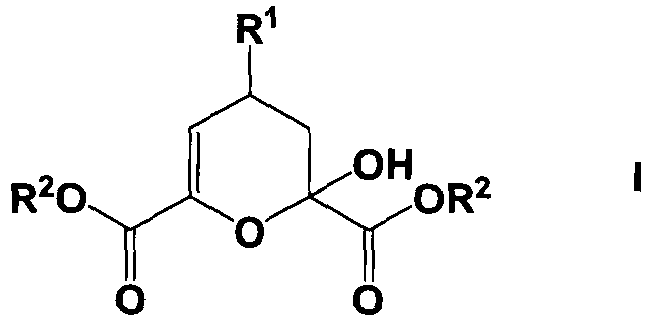
which process comprises reacting aldehydes of the following formula:
R1-CHO
wherein R1 is as defined in the above;
with pyruvates of the following formula:
in the presence of catalytic amount of β-proline. - In another aspect, the present invention relates to a compound of formula II:

or racemate, enantiomer, diastereomer, mixture thereof, or pharmaceutically acceptable salt thereof. The present invention also relates to further transformation derivatives from the compounds of formula I and II, or their pharmaceutically acceptable salts, medicaments containing the said compounds or their pharmaceutically acceptable salts, to the use of the said compounds or their pharmaceutically acceptable salts for the treatment or prophylaxis of illnesses, especially in the treatment or prophylaxis of proliferative diseases. - Further aspects of the invention are described below.
- In the present disclosure, certain details are set forth such as specific quantities, concentrations, sizes, etc. so as to provide a through understanding of the various embodiments disclosed herein. However, it will be apparent to those skilled in the art that the present disclosure may be practiced without such specific details. In many cases, details concerning such considerations and the like have been omitted inasmuch as such details are not necessary to obtain a complete understanding of the present disclosure and are within the skills of persons of ordinary skill in the relevant art.
- While most of the terms used herein will be recognizable to those of skill in the art, the following definitions are nevertheless put forth to aid in the understanding of the present disclosure. It should be understood, however, that when not explicitly defined, terms should be interpreted as adopting a meaning present accepted by those of skill in the art.
- The term "halogen" and "halo" are used interchangeably herein and denote fluoro, chloro, bromo, or iodo. Particular halogens are chloro and fluoro.
- The term "alkyl" denotes a monovalent linear or branched saturated hydrocarbon group of 1 to 24 carbon atoms, in particular of 1 to 18 carbon atoms, more particular of 1 to 12 carbon atoms, for example, methyl, ethyl, n-propyl, isopropyl, n-butyl, iso-butyl, sec-butyl, and tert-butyl. The term "lower alkyl" intends an alkyl group of one to six carbon atoms, and includes, for example, methyl, ethyl, n-propyl and isopropyl. More particular alkyl group is methyl.
- The term "cycloalkyl", alone or in combination with other groups, denotes a monovalent saturated monocyclic or bicyclic hydrocarbon group of 3 to 18 ring carbon atoms, particularly a monovalent saturated monocyclic hydrocarbon group of 3 to 8 ring carbon atoms. Examples for monocyclic cycloalkyl are cyclopropyl, cyclobutanyl, cyclopentyl, cyclohexyl or cycloheptyl.
- The term "alkoxy" denotes a group of the formula -O-R', wherein R' is an alkyl group. Examples of alkoxy group include methoxy, ethoxy, n-propoxy, isopropoxy, n-butoxy, isobutoxy and tert-butoxy. Particular alkoxy group include methoxy, ethoxy, n-propoxy and isopropoxy.
- The term "halo-alkyl" denotes an alkyl group wherein at least one of the hydrogen atoms of the alkyl group has been replaced by same or different halogen atoms. Examples of haloalkyl include fluoromethyl, difluoromethyl, trifluoromethyl, 1,1,1-trifluoroethyl, 1,1,1-trifluoropropyl and pentafluoroethyl. Particular haloalkyl group is trifluoromethyl.
- The term "halo-alkoxy" denotes an alkoxy group wherein at least one of the hydrogen atoms of the alkoxy group has been replaced by same or different halogen atoms. Examples of haloalkoxy include fluoromethoxy, difluoromethoxy, trifluoromethoxy, 1,1,1-trifluoroethoxy, 1,1,1-trifluoropropoxy, and pentafluoroethoxy. Particular haloalkoxy groups are trifluoromethoxy and 1,1,1-trifluoroethoxy.
- The term "alkenyl" denotes a branched, unbranched or cyclic (e.g. in the case of C5 and C6) hydrocarbon group of 2 to 18, or 2 to 12 in some embodiments, carbon atoms containing at least one double bond, such as vinyl, allyl, octenyl, decenyl, dodecenyl, cyclohexenyl and the like. The term "lower alkenyl" intends an alkenyl group of two to six carbon atoms, and specifically includes vinyl and allyl. The term "cycloalkenyl" refers to cyclic alkenyl groups.
- The term "alkynyl" denotes a branched or unbranched hydrocarbon group of 2 to 18, or 2 to 12 in some embodiments, carbon atoms containing at least one triple bond, such as acetylenyl, n-propynyl, n-butynyl, isobutynyl, octynyl, decynyl and the like. The term "lower alkynyl" intends an alkynyl group of two to six carbon atoms, and includes, for example, acetylenyl and propynyl. The term "cycloalkynyl" refers to cyclic alkynyl groups.
- The term "hydroxyl", alone or in combination with other groups, refers to -OH.
- The term "aryl", alone or in combination with other groups, refers to an aromatic carbocyclic group comprising 6 to 14, preferably 6 to 10, carbon atoms and having at least one aromatic ring or multiple condensed rings in which at least one ring is aromatic. Examples of "aryl" include benzyl, biphenyl, indanyl, naphthyl, phenyl (Ph) and the like. Preferred "aryl" is phenyl.
- The phrase "aryl substituted by", alone or in combination with other groups, refers to an aryl which is substituted by one or multiple substituents, preferably 1-4 substituents, whereby substitution at each ring atom individually is possible, with a substituent individually selected from the group as specified for each specific "aryl substituted by", e.g. from halogen, cyano, halogen-lower alkoxy, halogen-lower alkyl, lower alkoxy, and lower alkyl. Examples are halogen-aryl, chloro-phenyl. fiuoro-phenyl, lower alkyl-aryl, methyl-phenyl, lower alkoxy-aryl, methoxy-phenyl and the like.
- The term "heteroaryl", alone or in combination with other groups, refers to an aromatic carbocyclic group of having a single 4 to 8 membered ring or multiple condensed rings comprising 6 to 14, more preferably 6 to 10, ring atoms and containing 1, 2 or 3 heteroatoms individually selected from N, O and S, in particular N and O, in which group at least one heterocyclic ring is aromatic. Examples of "heteroaryl" include benzofuryl, benzoimidazolyl, benzooxazinyl, benzo thiazinyl, benzo thiazolyl, benzo thienyl, benzo triazolyl, furyl, imidazolyl, indazolyl, indolyl, isoquinolinyl, isothiazolyl, isoxazolyl, oxazolyl, pyrazinyl, pyrazolyl (pyrazyl), pyrazolo[1,5-a]pyridinyl, pyridazinyl, pyridinyl, pyrimidinyl, pyrrolyl, quinolinyl, tetrazolyl, thiazolyl, thienyl, triazolyl and the like. Preferred are 1H-pyrazolyl, furyl, isoxazolyl, oxazolyl, pyrazinyl, pyrazolyl, pyridazinyl, pyridinyl, pyridinyl-N-oxide and pyrimidinyl. More preferred heteroaryls are pyridinyl, pyrazolyl, pyrazinyl and pyrimidinyl. Most preferred are pyridin-2-yl, pyrazin-2-yl, 1H-pyrazol-3-yl and pyrimidin-2-yl.
- The phrase "heteroaryl substituted by", alone or in combination with other groups, refers to a heteroaryl which is substituted by one or multiple substituents, preferably 1-4 substituents, whereby substitution at each ring atom individually is possible, the substituent is individually selected from the group as specified for each specific "heteroaryl substituted by", i.e. for example from cyano, halogen, halogen-lower alkoxy, halogen-lower alkyl, lower alkoxy, and lower alkyl. Preferred "heteroaryl substituted by" are heteroaryl substituted by 1-2 substituents individually selected from cyano, halogen, halogen- lower alkoxy, halogen-lower alkyl and lower alkyl.
- The term "pharmaceutically acceptable salts" refers to those salts which retain the biological effectiveness and properties of the free bases or free acids, which are not biologically or otherwise undesirable. The salts are formed with inorganic acids such as hydrochloric acid, hydrobromic acid, sulfuric acid, nitric acid, phosphoric acid and the like, in particular hydrochloric acid, and organic acids such as acetic acid, propionic acid, glycolic acid, pyruvic acid, oxalic acid, maleic acid, malonic acid, succinic acid, fumaric acid, tartaric acid, citric acid, benzoic acid, cinnamic acid, mandelic acid, methanesulfonic acid, ethanesulfonic acid, p-toluenesulfonic acid, salicylic acid, N-acetylcystein and the like. In addition these salts may be prepared by addition of an inorganic base or an organic base to the free acid. Salts derived from an inorganic base include, but are not limited to, the sodium, potassium, lithium, ammonium, calcium, magnesium salts and the like. Salts derived from organic bases include, but are not limited to salts of primary, secondary, and tertiary amines, substituted amines including naturally occurring substituted amines, cyclic amines and basic ion exchange resins, such as isopropylamine, trimethylamine, diethylamine, triethylamine, tripropylamine, ethanolamine, lysine, arginine, N- ethylpiperidine, piperidine, polyimine resins and the like. Particular pharmaceutically acceptable salts of compounds of formula (I) are the hydrochloride salts , methanesulfonic acid salts and citric acid salts.
- The compounds of the present invention can contain several asymmetric centers and can be present in the form of optically pure enantiomers, mixtures of enantiomers such as, for example, racemates, optically pure diastereioisomers, mixtures of diastereoisomers, diastereoisomeric racemates or mixtures of diastereoisomeric racemates.
- According to the Cahn-Ingold-Prelog Convention the asymmetric carbon atom can be of the "R" or "S" configuration.
- In the first aspect of the invention, there is provided a process for preparing dihydro-2H-pyran derivatives of formula I:

which process comprises reacting aldehydes of the following formula:
R1-CHO
wherein R1 is as defined in the above;
with pyruvates of the following formula:
in the presence of catalytic amount of β-proline. - In one embodiment, the present invention relates to a compound of formula II:

or racemate, enantiomer, diastereomer, mixture thereof, or pharmaceutically acceptable salt thereof. - In a preferable embodiment of the compound of formula II above, R1 is C1-C18-alkyl, C3-C18-cycloalkyl, phenyl, naphthyl or 5- or 6-membered heteroaryl containing at least one hetero atom selected from nitrogen, oxygen and sulfur, which is optionally substituted with one or more substituents selected from consisting of C1-C18-alkyl, C2-C18-alkenyl, C2-C18-alkynyl, C1-C18-alkoxy, nitro, cyano, halogen, hydroxyl, mono- or polyhalo-C1-C18-alkyl, mono- or polyhalo-C1-C18-alkoxy and phenyl; R2 is C1-C18-alkyl or benzyl; and R4 is hydroxyl or halogen.
- Catalysts and reaction conditions are evaluated in the reaction of ethyl pyruvate and p-nitrobenzaldehyde to yield dihydro-2H-pyran derivative. Detailed conditions and results are shown in Example 1. The reaction in the presence of pyrrolidine in CH3CN gives the product in only trace yield (entry 6). Use of triethylamine, DBU, or DMAP as the catalyst does not afford the dihydro-2H-pyran derivative (entries 1-3). Reaction in the presence of pyrrolidine and acetic acid (1:1) gives the dihydro-2H-pyran derivative in a moderate yield (entry 13). β-Proline may be the best catalyst among tested (entry 5). A solvent screen of the reaction using β-proline as catalyst shows that CH3CN is a preferable solvent among tested (see Example 2). With further optimization, the reaction can be performed using various conditions, preferably using ethyl pyruvate (3.0 mmol), p-nitrobenzaldehyde (1.0 mmol), and β-proline (0.2 mmol) in CH3CN at room temperature (25 °C) for 24 hours, thereby obtaining the dihydropyran derivative in at least 72% yield.
- As a general procedure, the compound of formula I of the present invention can be obtained by the reaction of aldehyde and two equivalent of pyruvate in the presence of β-proline as a catalyst, in suitable solvent such as CH3CN, at ambient temperature as shown in below scheme:

- Aldehyde used in the present invention is either commercially available or easily prepared according to method and starting material well known in the art. Pyruvate used in the present invention is either commercially available or easily prepared by the reaction of pyruvate and corresponding alcohol. Pyruvate should be used in an amount of two or more equivalent, preferably in the range of 2.1 to 3 equivalents based on aldehyde. β-Proline as a catalyst can be used in an amount of 5 to 50 mol%, preferably 10 to 25 mol% based on aldehyde. Both (S)- and (R)- enantiomer and racemate of β-proline can be used as a catalyst.
- The reaction can be carried out in a solvent, preferably acetonitrile in the view of conversion. Reaction temperature is from ambient temperature to boiling point of solvent. In order to obtain the object product selectively, in mild condition, in particular ambient temperature is preferred. The reaction time is more than one hour, preferably in the range of 24 to 48 hours.
- By well known purification technique, such as extract, concentration and column chromatography, the object compound can be obtained in sufficient purity. According to the process of the present invention, for example, following compound can be prepared:


- Dihydropyran derivatives of formula I obtained by the cascade reactions were used for further transformations. Thus, in a second aspect of the present invention, there is provided a process for preparing cyclohexane derivatives of formula III:

which process comprises reacting the dihydro-2H-pyran derivatives of formula I above with nitromethane in the presence of base. - In a preferable embodiment, the base is (-)-cinchonidine, DMAP, or triethylamine. In case a diastereomeric dihydro-2H-pyran derivative is used, the isolated cyclohexane product is also a single diastereomer.
- In one embodiment, the present invention relates to a compound of formula IV or racemate, enantiomer, diastereomer, mixture thereof, or pharmaceutically acceptable salt thereof:

- In a preferable embodiment, R1 is C1-C18-alkyl, C3-C18-cycloalkyl, phenyl, naphthyl or 5- or 6-membered heteroaryl containing at least one hetero atom selected from nitrogen, oxygen and sulfur, which is optionally substituted with one or more substituents selected from consisting of C1-C18-alkyl, C2-C18-alkenyl, C2-C18-alkynyl, C1-C18-alkoxy nitro, cyano, halogen, hydroxyl, mono- or polyhalo-C1-C18-alkyl, mono- or polyhalo-C1-C18-alkoxy and phenyl.
- In another preferable embodiment, R2 is C1-C18-alkyl or benzyl.
- Further, the following cyclohexane derivative can be debenzylated to diacid as shown in below scheme:

- Reduction of the nitro group of the cyclohexane derivative may give corresponding amine as shown in below scheme: The highly functionalized amino acid derivative was easily accessed in a short route using the cascade reaction.

- Reactions of dihydropyran derivatives of formula I with N,N-diethylaminosulfur trifluoride (DAST) will afford fluorinated products as shown below. Fluoropyran derivatives are often inhibitors and biofunctional molecules.

- In a still other embodiment of the present invention, there is provided a process for preparing dihydropyran derivatives of formula V:

which process comprises reacting the dihydro-2H-pyran derivatives of formula I with amines of the following formula:
R3-NH2
wherein R3 is as defined in the above. - In yet another embodiment, the present invention relates to a compound of formula V or a racemate, enantiomer, diastereomer, mixture thereof, or pharmaceutically acceptable salt thereof:

- In a preferable embodiment, R1 is C1-C18-alkyl, C3-C18-cycloalkyl, phenyl, naphthyl or 5- or 6-membered heteroaryl containing at least one hetero atom selected from nitrogen, oxygen and sulfur, which is optionally substituted with one or more substituents selected from consisting of C1-C18-alkyl, C2-C18-alkenyl, C2-C18-alkynyl, C1-C18-alkoxy, nitro, cyano, halogen, mono- or polyhalo-C1-C18-alkyl, mono- or polyhalo-C1-C18-alkoxy and phenyl.
- In another preferable embodiment, R2 is C1-C18-alkyl or benzyl.
- In a further preferable embodiment, R3 is C1-C18-alkyl, C3-C18-cycloalkyl, phenyl, naphthyl or 5- or 6-membered heteroaryl containing at least one hetero atom selected from nitrogen, oxygen and sulfur, which is optionally substituted with one or more substituents selected from consisting of C1-C18-alkyl, C2-C18-alkenyl, C2-C18-alkynyl, C1-C18-alkoxy, nitro, cyano, halogen, mono- or polyhalo-C1-C18-alkyl, mono- or polyhalo-C1-C18-alkoxy and phenyl.
- As described above, various amines can be used to react with the dihydro-2H-pyran derivatives of formula I for preparing compounds of formula V. In addition, when hydrazine or 1,2-diaminobenzene are used for reacting with the dihydro-2H-pyran derivatives of formula I, the following compounds can be obtained:

- Particular examples of a compound of the present invention is selected from the group consisting of:


- The compounds of formula II, IV and V and their pharmaceutically acceptable salts possess valuable pharmacological properties. It has been found that the compounds of the present invention are associated with anti-cancer activity. The compounds were investigated in accordance with the test given hereinafter.
- K562 cells (American Type Culture Collection) were cultured in a culture medium containing 10% (v/v) fetal calf serum (FCS) (manufactures by Sigma) to logarithmic phase. The cells were seeded in 96-well microtiter plate at a density of 5000 cells/well in 100 µL cell culture medium and incubated at 37°C and 5% CO2 in a humidified incubator overnight. The test compounds of various concentrations were added in a well at 10 fold concentration in 1/10 volume of medium without FCS. After 6-48 hrs incubation at 37°C in the CO2 incubator, 10 µL solution of the viable cell counting reagent, Cell counting Kit-8 (5mmol/L WST-8, 0.2mmol/L 1-Methoxy PMS, 150mmol/L NaCl) (manufactured by Dojindo) was added to each well, and reacted for 1 to 4 hours in the CO2 incubator. After the incubation, an absorbance of formazan, generated by reduction of WST-8 was determined at 450 nm using a microplate reader.
- The assay readout is correlated with the viable cell numbers. Small values correspond to high inhibition and larger values to low inhibition of the cell growth. To determine IC50 values (i.e. the concentration inhibiting the cell growth by 50%) of the compounds of formula II, IV and V, several assays were made with a range of concentrations chosen empirically to give low, high and intermediate inhibition of the growth and determined using the curve fitting software.
- The exemplified compounds according to formula II, IV and V have an inhibitory activity in this assays (IC50) particular less than 1000 µM, more particular less than 100 µM. IC50 values can be converted logarithmically to pIC50 values (-log IC50), in which higher values indicate exponentially greater potency. The IC50 value is not an absolute value but depends on experimental conditions e.g. concentrations employed.
- The results are shown in Table 1.
Table 1 Structure Cytotoxicity K562 Structure Cytotoxicity K562 IC50 (µM) IC50 (µM) 
149 µM 
135 µM 
58 µM 
148 µM 
80 µM 
54 µM 
81 µM 
90 µM 
12 µM 
144 µM 
11 µM 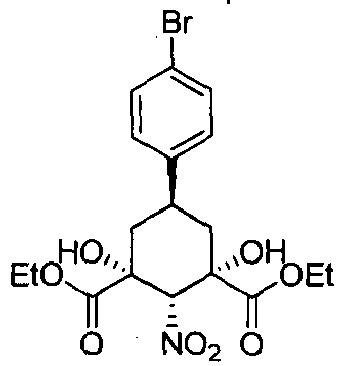
144 µM 
52 µM 
105 µM 
53 µM - The compounds of formula II, IV and V as well as their pharmaceutical acceptable salts can be used as medicaments, e.g. in the form of pharmaceutical preparations. The pharmaceutical preparations can be administered orally, e.g. in the form of tablets, coated tablets, dragees, hard and soft capsules, solutions, emulsions or suspensions. The administration can however, also be effected rectally, e.g. in the form of suppositories, or parenterally, e.g. in the form of injection solutions.
- The compounds of formula II, IV and V and their pharmaceutical acceptable salts can be processed with pharmaceutically inert, inorganic or organic excipients for the production of tablets, coated tablets, dragees and hard gelatine capsules. Lactose, corn starch or derivatives thereof, talc, stearic acid or its salts etc can be used as such excipients e.g. for tablets, dragees and hard gelatine capsules.
- Suitable excipients for soft gelatine capsules are e.g. vegetable oils, waxes, fats, semisolid and liquid polyols etc.
- Suitable excipients for the manufacture of solutions and syrups are e.g. water, polyols, saccharose, invert sugar, glucose etc.
- Suitable excipients for injection solutions are e.g. water, alcohols, polyols, glycerol, vegetable oils etc.
- Suitable excipients for suppositories are e.g. natural or hardened oils, waxes, fats, semi-liquid or liquid polyols etc.
- Moreover, the pharmaceutical preparations can contain preservatives, solubilizers, stabilizers, wetting agents, emulsifiers, sweeteners, colorants, flavorants, salts for varying the osmotic pressure, buffers, masking agents or antioxidants. They can also contain still other therapeutically valuable substances.
- The dosage can be vary within wide limits and will, of course, be fitted to the individual requirements in each particular case. In general, in the case of oral administration a daily dosage of about 10 to 1000 mg per person of a compound of general formula II, IV and V should be appropriate, although the above upper limit can be exceeded when necessary.
- The invention is illustrated hereinafter by Examples, which have no limiting character. In case the preparative examples are obtained as a mixture of enantiomers and diastereomers, the pure enantiomer, or diastereomers can be separated by methods described herein or by methods known to the person skilled in the art, such as e. g. chiral chromatography or crystallization.
- In the following example, the effect of the added catalyst was assayed to illustrate the effect of various catalysts on the overall percent yield of the reaction. To a solution of aldehyde (1.0 mmol) and ethyl pyravate (348 mg, 3.0 mmol) in CH3CN (1 mL) was added the selected catalysts (10 mol%) and the mixture was stirred at 25 °C for 24 h or 48 h. The mixture was poured into aqueous saturated NH4Cl solution and extracted with ethyl acetate. The organic layers were combined, dried over Na2SO4, filtered, concentrated, and purified by flash column chromatography (hexane/EtOAc = 7:3) to afford the 4-substituted dihydropyran derivative. The overall reaction scheme and the experimental results are illustrated below:

Entry Catalyst (10 mol%) Yield (%)a 1 Et3N 0 2 DBU 0 3 DMAP 0 4 β-Alanine 0 5 (S)-β-Proline 49 6 Pyrrolidine 4 7 3-(Trifluoromethanesulfonylamino)pyrrolidine 9 8 L-Histidine 0 9 L-Tryptophan 0 10 L-Valine 0 11 O-t-Butyl threonine 0 12 (S)-β-Proline (10 mol%) + Et3N (10 mol%) 0 13 Pyrrolidine (10 mol%) + CH3COOH (15 mol%) 27 Reaction was conducted on the aldehyde 1 mmol scale in 1 mL solvent at r.t. for 48h.
a Isolated product yield after column chromatography. - In the following example, the reaction conditions were assayed to determine the affects of reaction conditions on overall percent yield. To a solution of aldehyde (1.0 mmol) and ethyl pyravate (348 mg, 3.0 mmol) in a selected solvent (1 mL) was added (-)-β-proline (10 mol%) and the mixture was stirred at 25 °C for 48 h. The mixture was poured into aqueous saturated NH4Cl solution and extracted with ethyl acetate. The organic layers were combined, dried over Na2SO4, filtered, concentrated, and purified by flash column chromatography (hexane/EtOAc = 7:3) to afford the 4-substituted dihydropyran derivative. The overall reaction scheme and tabulated experimental results are illustrated below.

Entry Solvent Yield (%)a 1 Toluene 6 2 i-PrOH 11 3 DMF 15 4 1,4-Dioxane 6 5 DMSO Not clean (formation of many byproducts) 6 THF 7b 7 CH2Cl2 5b 8 CHCl3 5b 9 CH3CN 19bc 10 CH3CN 25b 10 CH3CN 49 10 CH3CN 72d 11 CH3CN/H2O (3:1) 0 Reaction was conducted on the aldehyde 1 mmol scale in 1 mL solvent 1 mL at r.t. for 48h.
a Isolated product yield after column chromatography.
b Catalyst 5 mol% was used.
c Pyruvate 1 equiv was used.
d Catalyst 20 mol% and pyruvate 3 equiv were used. - The reaction product of Example 1 was further reacted in a second reaction step in order to prepare the corresponding cyclohexane derivative. To a solution of the dihydropyran (0.1 mmol) and nitromethane (1.0 mmol) in CH2Cl2 (0.5 mL) was added (-)-cinchonidine (0.015 mmol) and the mixture was stirred at 25 °C for 15 h. The mixture was poured into aqueous saturated NH4Cl solution and extracted with CH2Cl2. The organic layers were combined, dried over Na2SO4, filtered, concentrated, and purified by flash column chromatography (hexane/EtOAc=7:3) to afford the cyclohexane derivative. Reaction using DMAP (0.1 mmol) or triethylamine (0.015 mmol) instead of (-)-cinchonidine also afforded the same product. The overall reaction scheme is illustrated as follows:


- The reaction product of Example 1 was further reacted in a second reaction step in order to prepare the corresponding amino substituted dihydropyran derivatives. To a solution of 4-substituted dihydropyran (0.05 mmol) in CH2Cl2 (0.5, mL) was added amine (0.75 mmol) and the mixture was stirred at 25 °C for 24 h. The mixture was poured into aqueous saturated NH4Cl solution and extracted with CH2Cl2. The organic layers were combined, dried over Na2SO4, filtered, concentrated, and purified by flash column chromatography (hexane/EtOAc=7:3) to afford the amino substituted dihydropyran derivative. The overall reaction scheme is illustrated as follows:


Claims (15)
- A process for preparing dihydro-2H-pyran derivatives of formula I:
 R1 is alkyl, cycloalkyl, aryl, heterocycloalkyl or heteroaryl, which is optionally substituted with one or more substituent selected from the group consisting of alkyl, alkenyl, alkynyl, alkoxy, nitro, cyano, halogen, hydroxyl, mono- or polyhalo alkyl, mono- or polyhalo alkoxy and phenyl; andR2 is alkyl or benzyl;which process comprises reacting aldehydes of the following formula:
R1-CHO
wherein
R1 is as defined in the above;
with pyruvates of the following formula:
R2 is as defined in the above;
in the presence of catalytic amount of β-proline. - The process according to claim 1, wherein the reaction is carried out in a solvent, preferably acetonitrile.
- The process according to claim 1, wherein the catalytic amount is about 5 mol% to about 50 mol%, preferably about 10 mol% to about 25 mol%, based on the aldehydes.
- A compound of formula II:
 R1 and R2 are as defined in claim 1; andR4 is hydroxyl or halogen;or racemate, enantiomer, diastereomer, mixture thereof, or pharmaceutically acceptable salt thereof.
 - The compounds of formula II according to claim 4,
wherein
R1 is C1-C18-alkyl, C3-C18-cycloalkyl, phenyl, naphthyl or 5- or 6-membered heteroaryl containing at least one hetero atom selected from nitrogen, oxygen and sulfur, which is optionally substituted with one or more substituents selected from the group consisting of C1-C18-alkyl, C2-C18-alkenyl, C2-C18-alkynyl, C1-C18-alkoxy nitro, cyano, halogen, hydroxyl, mono- or polyhalo-C1-C18-alkyl, mono- or polyhalo-C1-C18-alkoxy and phenyl;
R2 is C1-C18-alkyl or benzyl; and
R4 is hydroxyl or halogen;
or racemate, enantiomer, diastereomer, mixture thereof, or pharmaceutically acceptable salt thereof. - A process for preparing cyclohexane derivatives of formula III:

which process comprises reacting the dihydro-2H-pyran derivatives of formula I according to claim 1 with nitromethane in the presence of a base. - The process according to claim 6, wherein the base is (-)-cinchonidine, DMAP, or triethylamine.
- A compound of formula IV:
 R1 and R2 are as defined in claim 1; andR4 is hydroxyl or halogen;or racemate, enantiomer, diastereomer, mixture thereof, or pharmaceutically acceptable salt thereof.
 - The compounds of formula IV according to claim 8,
wherein
R1, R2 and R4 are as defined in claim 5,
or racemate, enantiomer, diastereomer, mixture thereof, or pharmaceutically acceptable salt thereof. - A process for preparing dihydro-2H-pyran derivatives of formula V:
 R1 and R2 are as defined in claim 1; andR3 is alkyl, cycloalkyl, aryl or heteroaryl, which is optionally substituted with one or more substituents selected from the group consisting of alkyl, alkenyl, alkynyl, alkoxy, nitro, cyano, halogen, hydroxyl, mono- or polyhalo alkyl, mono- or polyhalo alkoxy and phenyl;which process comprises reacting the dihydro-2H-pyran derivatives of formula I according to claim 1 with amines of the following formula:
R3-NH2
wherein R3 is as defined in the above. - A compound of formula V:

R1 to R3 are as defined in claim 10,
or racemate, enantiomer, diastereomer, mixture thereof, or pharmaceutically acceptable salt thereof. - The compounds of formula V according to claim 11,
wherein
R1 is C1-C18-alkyl, C3-C18-cycloalkyl, phenyl, naphthyl or 5- or 6-membered heteroaryl containing at least one hetero atom selected from nitrogen, oxygen and sulfur, which is optionally substituted with one or more substituents selected from consisting of C1-C18-alkyl, C2-C18-alkenyl, C2-C18-alkynyl, C1-C18-alkoxy, nitro, cyano, halogen, mono- or polyhalo-C1-C18-alkyl, mono- or polyhalo-C1-C18-alkoxy and phenyl;
R2 is C1-C18-alkyl or benzyl; and
R3 is C1-C18-alkyl, C3-C18-cycloalkyl, phenyl, naphthyl or 5- or 6-membered heteroaryl containing at least one hetero atom selected from nitrogen, oxygen and sulfur, which is optionally substituted with one or more substituents selected from consisting of C1-C18-alkyl, C1-C18-alkoxy, nitro, cyano, halogen, mono- or polyhalo-C1-C18-alkyl, mono- or polyhalo-C1-C18-alkoxy and phenyl,
or racemate, enantiomer, diastereomer, mixture thereof, or pharmaceutically acceptable salt thereof. - A compound according to claims 4, 8 or 11 selected from the group consisting of:


- A pharmaceutical composition comprising a compound according to any one of claims 4, 5, 8, 9, 11 to 13, and a pharmaceutically acceptable adjuvant.
- The pharmaceutical composition according to claim 14 for the treatment of proliferative diseases.
Applications Claiming Priority (2)
| Application Number | Priority Date | Filing Date | Title |
|---|---|---|---|
| US201261713198P | 2012-10-12 | 2012-10-12 | |
| PCT/JP2013/078249 WO2014058078A1 (en) | 2012-10-12 | 2013-10-10 | Process for producing dihydro-2h-pyran derivatives |
Publications (3)
| Publication Number | Publication Date |
|---|---|
| EP2885282A1 EP2885282A1 (en) | 2015-06-24 |
| EP2885282A4 EP2885282A4 (en) | 2016-01-27 |
| EP2885282B1 true EP2885282B1 (en) | 2017-03-15 |
Family
ID=50477534
Family Applications (1)
| Application Number | Title | Priority Date | Filing Date |
|---|---|---|---|
| EP13845790.8A Active EP2885282B1 (en) | 2012-10-12 | 2013-10-10 | Process for producing dihydro-2h-pyran derivatives |
Country Status (5)
| Country | Link |
|---|---|
| US (2) | US9346780B2 (en) |
| EP (1) | EP2885282B1 (en) |
| JP (1) | JP6161136B2 (en) |
| CN (1) | CN104781245B (en) |
| WO (1) | WO2014058078A1 (en) |
Families Citing this family (6)
| Publication number | Priority date | Publication date | Assignee | Title |
|---|---|---|---|---|
| EP2885282B1 (en) * | 2012-10-12 | 2017-03-15 | Okinawa Institute of Science and Technology School Corporation | Process for producing dihydro-2h-pyran derivatives |
| JP6567654B2 (en) * | 2014-09-09 | 2019-08-28 | 学校法人沖縄科学技術大学院大学学園 | 4-Substituted pyridine-2,6-dicarboxylic acid derivative and process for producing the same |
| US10982736B2 (en) | 2015-02-17 | 2021-04-20 | Oshkosh Corporation | Multi-mode electromechanical variable transmission |
| CN105541770B (en) * | 2016-03-08 | 2017-10-03 | 怀化学院 | A kind of aqueous synthesis method of the dihydropyran of 5 acyl group 3,4 |
| CN107312168A (en) * | 2017-06-15 | 2017-11-03 | 温州大学 | The monomer initiator and its synthetic method of hydroxyl synthesis are protected with 3,4 dihydro 2H pyrans |
| CN112920149B (en) * | 2021-01-29 | 2022-12-02 | 中山大学 | A kind of chiral dihydropyran ring derivative and its preparation method and application |
Family Cites Families (5)
| Publication number | Priority date | Publication date | Assignee | Title |
|---|---|---|---|---|
| DE3536956A1 (en) | 1985-10-17 | 1987-04-23 | Basf Ag | PYRAN DERIVATIVES AND A METHOD FOR THEIR PRODUCTION |
| DE3622599A1 (en) * | 1986-07-05 | 1988-01-14 | Basf Ag | PYRANE DERIVATIVES, METHOD FOR THE PRODUCTION THEREOF AND THEIR USE FOR CONTROLLING Pests |
| US7186709B2 (en) * | 2002-08-27 | 2007-03-06 | President And Fellows Of Harvard College | Dihydropyrancarboxamides and uses thereof |
| CN100582101C (en) * | 2003-10-28 | 2010-01-20 | 日本淀粉工业株式会社 | antineoplastic agent |
| EP2885282B1 (en) * | 2012-10-12 | 2017-03-15 | Okinawa Institute of Science and Technology School Corporation | Process for producing dihydro-2h-pyran derivatives |
-
2013
- 2013-10-10 EP EP13845790.8A patent/EP2885282B1/en active Active
- 2013-10-10 US US14/431,945 patent/US9346780B2/en active Active
- 2013-10-10 JP JP2015516365A patent/JP6161136B2/en active Active
- 2013-10-10 WO PCT/JP2013/078249 patent/WO2014058078A1/en not_active Ceased
- 2013-10-10 CN CN201380051379.2A patent/CN104781245B/en active Active
-
2016
- 2016-05-06 US US15/148,716 patent/US9630940B2/en active Active
Non-Patent Citations (1)
| Title |
|---|
| None * |
Also Published As
| Publication number | Publication date |
|---|---|
| JP2016500646A (en) | 2016-01-14 |
| US9630940B2 (en) | 2017-04-25 |
| US20160251328A1 (en) | 2016-09-01 |
| US20150246896A1 (en) | 2015-09-03 |
| JP6161136B2 (en) | 2017-07-12 |
| EP2885282A1 (en) | 2015-06-24 |
| WO2014058078A1 (en) | 2014-04-17 |
| CN104781245A (en) | 2015-07-15 |
| US9346780B2 (en) | 2016-05-24 |
| EP2885282A4 (en) | 2016-01-27 |
| CN104781245B (en) | 2017-07-04 |
Similar Documents
| Publication | Publication Date | Title |
|---|---|---|
| US9630940B2 (en) | Process for producing dihydro-2H-pyran derivatives | |
| US20190225580A1 (en) | Process for production of glycopyrronium tosylate | |
| EP1713801B1 (en) | Process for preparation of 1-(2s,3s)-2-benzhydr yl-n-(5-tert-butyl-2-methoxybenzyl)quinuclidin-3-amine | |
| KR20200117952A (en) | Highly enantioselective bifunctional chiral organocatalytic compound, method for preparing the same, and method for preparing non-natural gamma-amino acid from nitrocompound using thereof | |
| DK166584B1 (en) | SUBSTITUTED 4-BENZYL-1H-IMIDAZOLES, PROCEDURES FOR THEIR PREPARATION AND PHARMACEUTICAL PREPARATIONS CONTAINING THEM | |
| Konosu et al. | Triazole antifungals. IV. Synthesis and antifungal activities of 3-acylamino-2-aryl-2-butanol derivatives | |
| US20230250121A1 (en) | Method for preparing glucopyranosyl derivatives and intermediates thereof | |
| AU775861B2 (en) | 1-trifluoromethyl-4-hydroxy-7-piperidinyl-aminomethylchroman derivatives | |
| US20220371995A1 (en) | Synthesis method for halofuginone and halofuginone intermediates | |
| EP3741744B1 (en) | A pharmaceutical intermediate for preparing pimavanserin | |
| RU2729074C2 (en) | Method of purifying a benzopyran derivative, its crystalline form and a method of producing a crystalline form | |
| EP3191451B1 (en) | 4-substituted pyridine-2,6-dicarboxylic acid derivatives and method of preparing same | |
| EP2197273B1 (en) | Process for preparing r-gossypol l-phenylalaninol dienamine | |
| CN117105878A (en) | A kind of preparation method of key intermediate of plerixafor | |
| US8357803B2 (en) | Process for the preparation of 2,3,4,9-tetrahydro-1H-β-carbolin-3-carboxylic acid esters | |
| RU2799639C1 (en) | 4-(3,4-dibromothiophenecarbonyl)-10-isonicotinyl-2,6,8,12-tetraacetyl-2,4,6,8,10,12-hexaazatetra-cyclo[5,5,0,03.11,05.9]dodecane as an analgesic and a method of its obtaining | |
| US6906197B2 (en) | Process for the preparation of optically active amines or salts thereof | |
| WO2026087677A1 (en) | Enantioselective synthesis of (s)-afoxolaner and solid forms of (s)-afoxolaner | |
| EP3725774B1 (en) | Process for the preparation of a pharmaceutical agent | |
| US20100174073A1 (en) | Process for the preparation of alfuzosin and salts thereof | |
| CN117736211A (en) | Synthetic method of rebaudinib intermediate | |
| JP2003026672A (en) | New method of production for 3-aminooxetan and intermediate | |
| JP2007320855A (en) | Process for producing 5-methylisoxazole | |
| CA2023019A1 (en) | 1-oxa-2-oxo-8-azaspiro/4,5/decane derivatives, pharmaceutical compositions containing them and process for preparing the same |
Legal Events
| Date | Code | Title | Description |
|---|---|---|---|
| PUAI | Public reference made under article 153(3) epc to a published international application that has entered the european phase |
Free format text: ORIGINAL CODE: 0009012 |
|
| 17P | Request for examination filed |
Effective date: 20150317 |
|
| AK | Designated contracting states |
Kind code of ref document: A1 Designated state(s): AL AT BE BG CH CY CZ DE DK EE ES FI FR GB GR HR HU IE IS IT LI LT LU LV MC MK MT NL NO PL PT RO RS SE SI SK SM TR |
|
| AX | Request for extension of the european patent |
Extension state: BA ME |
|
| DAX | Request for extension of the european patent (deleted) | ||
| RA4 | Supplementary search report drawn up and despatched (corrected) |
Effective date: 20160107 |
|
| RIC1 | Information provided on ipc code assigned before grant |
Ipc: C07D 243/02 20060101ALI20151222BHEP Ipc: A61K 31/351 20060101ALI20151222BHEP Ipc: C07C 201/14 20060101ALI20151222BHEP Ipc: A61K 31/215 20060101ALI20151222BHEP Ipc: A61K 31/551 20060101ALI20151222BHEP Ipc: C07D 407/04 20060101ALI20151222BHEP Ipc: C07C 205/55 20060101ALI20151222BHEP Ipc: A61K 31/498 20060101ALI20151222BHEP Ipc: C07D 309/30 20060101AFI20151222BHEP Ipc: C07D 317/30 20060101ALI20151222BHEP Ipc: C07D 307/54 20060101ALI20151222BHEP Ipc: C07D 241/44 20060101ALI20151222BHEP Ipc: A61K 31/357 20060101ALI20151222BHEP Ipc: C07D 309/28 20060101ALI20151222BHEP Ipc: A61P 35/00 20060101ALI20151222BHEP |
|
| RAP1 | Party data changed (applicant data changed or rights of an application transferred) |
Owner name: OKINAWA INSTITUTE OF SCIENCE AND TECHNOLOGY SCHOOL |
|
| GRAP | Despatch of communication of intention to grant a patent |
Free format text: ORIGINAL CODE: EPIDOSNIGR1 |
|
| INTG | Intention to grant announced |
Effective date: 20161011 |
|
| STAA | Information on the status of an ep patent application or granted ep patent |
Free format text: STATUS: GRANT OF PATENT IS INTENDED |
|
| GRAS | Grant fee paid |
Free format text: ORIGINAL CODE: EPIDOSNIGR3 |
|
| GRAA | (expected) grant |
Free format text: ORIGINAL CODE: 0009210 |
|
| STAA | Information on the status of an ep patent application or granted ep patent |
Free format text: STATUS: THE PATENT HAS BEEN GRANTED |
|
| AK | Designated contracting states |
Kind code of ref document: B1 Designated state(s): AL AT BE BG CH CY CZ DE DK EE ES FI FR GB GR HR HU IE IS IT LI LT LU LV MC MK MT NL NO PL PT RO RS SE SI SK SM TR |
|
| REG | Reference to a national code |
Ref country code: CH Ref legal event code: EP Ref country code: GB Ref legal event code: FG4D |
|
| REG | Reference to a national code |
Ref country code: IE Ref legal event code: FG4D |
|
| REG | Reference to a national code |
Ref country code: AT Ref legal event code: REF Ref document number: 875396 Country of ref document: AT Kind code of ref document: T Effective date: 20170415 |
|
| REG | Reference to a national code |
Ref country code: DE Ref legal event code: R096 Ref document number: 602013018734 Country of ref document: DE |
|
| REG | Reference to a national code |
Ref country code: CH Ref legal event code: NV Representative=s name: LATSCHA SCHOELLHORN PARTNER AG, CH |
|
| REG | Reference to a national code |
Ref country code: NL Ref legal event code: MP Effective date: 20170315 |
|
| REG | Reference to a national code |
Ref country code: LT Ref legal event code: MG4D |
|
| PG25 | Lapsed in a contracting state [announced via postgrant information from national office to epo] |
Ref country code: NO Free format text: LAPSE BECAUSE OF FAILURE TO SUBMIT A TRANSLATION OF THE DESCRIPTION OR TO PAY THE FEE WITHIN THE PRESCRIBED TIME-LIMIT Effective date: 20170615 Ref country code: FI Free format text: LAPSE BECAUSE OF FAILURE TO SUBMIT A TRANSLATION OF THE DESCRIPTION OR TO PAY THE FEE WITHIN THE PRESCRIBED TIME-LIMIT Effective date: 20170315 Ref country code: GR Free format text: LAPSE BECAUSE OF FAILURE TO SUBMIT A TRANSLATION OF THE DESCRIPTION OR TO PAY THE FEE WITHIN THE PRESCRIBED TIME-LIMIT Effective date: 20170616 Ref country code: LT Free format text: LAPSE BECAUSE OF FAILURE TO SUBMIT A TRANSLATION OF THE DESCRIPTION OR TO PAY THE FEE WITHIN THE PRESCRIBED TIME-LIMIT Effective date: 20170315 Ref country code: HR Free format text: LAPSE BECAUSE OF FAILURE TO SUBMIT A TRANSLATION OF THE DESCRIPTION OR TO PAY THE FEE WITHIN THE PRESCRIBED TIME-LIMIT Effective date: 20170315 |
|
| REG | Reference to a national code |
Ref country code: AT Ref legal event code: MK05 Ref document number: 875396 Country of ref document: AT Kind code of ref document: T Effective date: 20170315 |
|
| PG25 | Lapsed in a contracting state [announced via postgrant information from national office to epo] |
Ref country code: BG Free format text: LAPSE BECAUSE OF FAILURE TO SUBMIT A TRANSLATION OF THE DESCRIPTION OR TO PAY THE FEE WITHIN THE PRESCRIBED TIME-LIMIT Effective date: 20170615 Ref country code: RS Free format text: LAPSE BECAUSE OF FAILURE TO SUBMIT A TRANSLATION OF THE DESCRIPTION OR TO PAY THE FEE WITHIN THE PRESCRIBED TIME-LIMIT Effective date: 20170315 Ref country code: SE Free format text: LAPSE BECAUSE OF FAILURE TO SUBMIT A TRANSLATION OF THE DESCRIPTION OR TO PAY THE FEE WITHIN THE PRESCRIBED TIME-LIMIT Effective date: 20170315 Ref country code: LV Free format text: LAPSE BECAUSE OF FAILURE TO SUBMIT A TRANSLATION OF THE DESCRIPTION OR TO PAY THE FEE WITHIN THE PRESCRIBED TIME-LIMIT Effective date: 20170315 |
|
| PG25 | Lapsed in a contracting state [announced via postgrant information from national office to epo] |
Ref country code: NL Free format text: LAPSE BECAUSE OF FAILURE TO SUBMIT A TRANSLATION OF THE DESCRIPTION OR TO PAY THE FEE WITHIN THE PRESCRIBED TIME-LIMIT Effective date: 20170315 |
|
| REG | Reference to a national code |
Ref country code: FR Ref legal event code: PLFP Year of fee payment: 5 |
|
| PG25 | Lapsed in a contracting state [announced via postgrant information from national office to epo] |
Ref country code: EE Free format text: LAPSE BECAUSE OF FAILURE TO SUBMIT A TRANSLATION OF THE DESCRIPTION OR TO PAY THE FEE WITHIN THE PRESCRIBED TIME-LIMIT Effective date: 20170315 Ref country code: RO Free format text: LAPSE BECAUSE OF FAILURE TO SUBMIT A TRANSLATION OF THE DESCRIPTION OR TO PAY THE FEE WITHIN THE PRESCRIBED TIME-LIMIT Effective date: 20170315 Ref country code: AT Free format text: LAPSE BECAUSE OF FAILURE TO SUBMIT A TRANSLATION OF THE DESCRIPTION OR TO PAY THE FEE WITHIN THE PRESCRIBED TIME-LIMIT Effective date: 20170315 Ref country code: IT Free format text: LAPSE BECAUSE OF FAILURE TO SUBMIT A TRANSLATION OF THE DESCRIPTION OR TO PAY THE FEE WITHIN THE PRESCRIBED TIME-LIMIT Effective date: 20170315 Ref country code: ES Free format text: LAPSE BECAUSE OF FAILURE TO SUBMIT A TRANSLATION OF THE DESCRIPTION OR TO PAY THE FEE WITHIN THE PRESCRIBED TIME-LIMIT Effective date: 20170315 Ref country code: CZ Free format text: LAPSE BECAUSE OF FAILURE TO SUBMIT A TRANSLATION OF THE DESCRIPTION OR TO PAY THE FEE WITHIN THE PRESCRIBED TIME-LIMIT Effective date: 20170315 Ref country code: SK Free format text: LAPSE BECAUSE OF FAILURE TO SUBMIT A TRANSLATION OF THE DESCRIPTION OR TO PAY THE FEE WITHIN THE PRESCRIBED TIME-LIMIT Effective date: 20170315 |
|
| PG25 | Lapsed in a contracting state [announced via postgrant information from national office to epo] |
Ref country code: PL Free format text: LAPSE BECAUSE OF FAILURE TO SUBMIT A TRANSLATION OF THE DESCRIPTION OR TO PAY THE FEE WITHIN THE PRESCRIBED TIME-LIMIT Effective date: 20170315 Ref country code: SM Free format text: LAPSE BECAUSE OF FAILURE TO SUBMIT A TRANSLATION OF THE DESCRIPTION OR TO PAY THE FEE WITHIN THE PRESCRIBED TIME-LIMIT Effective date: 20170315 Ref country code: IS Free format text: LAPSE BECAUSE OF FAILURE TO SUBMIT A TRANSLATION OF THE DESCRIPTION OR TO PAY THE FEE WITHIN THE PRESCRIBED TIME-LIMIT Effective date: 20170715 Ref country code: PT Free format text: LAPSE BECAUSE OF FAILURE TO SUBMIT A TRANSLATION OF THE DESCRIPTION OR TO PAY THE FEE WITHIN THE PRESCRIBED TIME-LIMIT Effective date: 20170717 |
|
| REG | Reference to a national code |
Ref country code: DE Ref legal event code: R097 Ref document number: 602013018734 Country of ref document: DE |
|
| PLBE | No opposition filed within time limit |
Free format text: ORIGINAL CODE: 0009261 |
|
| STAA | Information on the status of an ep patent application or granted ep patent |
Free format text: STATUS: NO OPPOSITION FILED WITHIN TIME LIMIT |
|
| PG25 | Lapsed in a contracting state [announced via postgrant information from national office to epo] |
Ref country code: DK Free format text: LAPSE BECAUSE OF FAILURE TO SUBMIT A TRANSLATION OF THE DESCRIPTION OR TO PAY THE FEE WITHIN THE PRESCRIBED TIME-LIMIT Effective date: 20170315 |
|
| 26N | No opposition filed |
Effective date: 20171218 |
|
| PG25 | Lapsed in a contracting state [announced via postgrant information from national office to epo] |
Ref country code: SI Free format text: LAPSE BECAUSE OF FAILURE TO SUBMIT A TRANSLATION OF THE DESCRIPTION OR TO PAY THE FEE WITHIN THE PRESCRIBED TIME-LIMIT Effective date: 20170315 |
|
| PG25 | Lapsed in a contracting state [announced via postgrant information from national office to epo] |
Ref country code: MC Free format text: LAPSE BECAUSE OF FAILURE TO SUBMIT A TRANSLATION OF THE DESCRIPTION OR TO PAY THE FEE WITHIN THE PRESCRIBED TIME-LIMIT Effective date: 20170315 |
|
| REG | Reference to a national code |
Ref country code: IE Ref legal event code: MM4A |
|
| PG25 | Lapsed in a contracting state [announced via postgrant information from national office to epo] |
Ref country code: LU Free format text: LAPSE BECAUSE OF NON-PAYMENT OF DUE FEES Effective date: 20171010 |
|
| PG25 | Lapsed in a contracting state [announced via postgrant information from national office to epo] |
Ref country code: MT Free format text: LAPSE BECAUSE OF NON-PAYMENT OF DUE FEES Effective date: 20171010 |
|
| REG | Reference to a national code |
Ref country code: FR Ref legal event code: PLFP Year of fee payment: 6 |
|
| PG25 | Lapsed in a contracting state [announced via postgrant information from national office to epo] |
Ref country code: IE Free format text: LAPSE BECAUSE OF NON-PAYMENT OF DUE FEES Effective date: 20171010 |
|
| REG | Reference to a national code |
Ref country code: CH Ref legal event code: PCAR Free format text: NEW ADDRESS: GRELLINGERSTRASSE 60, 4052 BASEL (CH) |
|
| PG25 | Lapsed in a contracting state [announced via postgrant information from national office to epo] |
Ref country code: HU Free format text: LAPSE BECAUSE OF FAILURE TO SUBMIT A TRANSLATION OF THE DESCRIPTION OR TO PAY THE FEE WITHIN THE PRESCRIBED TIME-LIMIT; INVALID AB INITIO Effective date: 20131010 |
|
| PG25 | Lapsed in a contracting state [announced via postgrant information from national office to epo] |
Ref country code: CY Free format text: LAPSE BECAUSE OF FAILURE TO SUBMIT A TRANSLATION OF THE DESCRIPTION OR TO PAY THE FEE WITHIN THE PRESCRIBED TIME-LIMIT Effective date: 20170315 |
|
| PG25 | Lapsed in a contracting state [announced via postgrant information from national office to epo] |
Ref country code: MK Free format text: LAPSE BECAUSE OF FAILURE TO SUBMIT A TRANSLATION OF THE DESCRIPTION OR TO PAY THE FEE WITHIN THE PRESCRIBED TIME-LIMIT Effective date: 20170315 |
|
| PG25 | Lapsed in a contracting state [announced via postgrant information from national office to epo] |
Ref country code: TR Free format text: LAPSE BECAUSE OF FAILURE TO SUBMIT A TRANSLATION OF THE DESCRIPTION OR TO PAY THE FEE WITHIN THE PRESCRIBED TIME-LIMIT Effective date: 20170315 |
|
| PG25 | Lapsed in a contracting state [announced via postgrant information from national office to epo] |
Ref country code: AL Free format text: LAPSE BECAUSE OF FAILURE TO SUBMIT A TRANSLATION OF THE DESCRIPTION OR TO PAY THE FEE WITHIN THE PRESCRIBED TIME-LIMIT Effective date: 20170315 |
|
| PGFP | Annual fee paid to national office [announced via postgrant information from national office to epo] |
Ref country code: GB Payment date: 20240829 Year of fee payment: 12 |
|
| PGFP | Annual fee paid to national office [announced via postgrant information from national office to epo] |
Ref country code: BE Payment date: 20240917 Year of fee payment: 12 |
|
| PGFP | Annual fee paid to national office [announced via postgrant information from national office to epo] |
Ref country code: FR Payment date: 20240909 Year of fee payment: 12 |
|
| PGFP | Annual fee paid to national office [announced via postgrant information from national office to epo] |
Ref country code: DE Payment date: 20240828 Year of fee payment: 12 |
|
| PGFP | Annual fee paid to national office [announced via postgrant information from national office to epo] |
Ref country code: CH Payment date: 20241101 Year of fee payment: 12 |