EP2885120B1 - Method of making a plastic film with integrated zipper closure, and plastic bag having an integrated zipper closure - Google Patents
Method of making a plastic film with integrated zipper closure, and plastic bag having an integrated zipper closure Download PDFInfo
- Publication number
- EP2885120B1 EP2885120B1 EP13756749.1A EP13756749A EP2885120B1 EP 2885120 B1 EP2885120 B1 EP 2885120B1 EP 13756749 A EP13756749 A EP 13756749A EP 2885120 B1 EP2885120 B1 EP 2885120B1
- Authority
- EP
- European Patent Office
- Prior art keywords
- film
- closure
- conglomerating
- layer portion
- bag
- Prior art date
- Legal status (The legal status is an assumption and is not a legal conclusion. Google has not performed a legal analysis and makes no representation as to the accuracy of the status listed.)
- Active
Links
Images



Classifications
-
- B—PERFORMING OPERATIONS; TRANSPORTING
- B29—WORKING OF PLASTICS; WORKING OF SUBSTANCES IN A PLASTIC STATE IN GENERAL
- B29C—SHAPING OR JOINING OF PLASTICS; SHAPING OF MATERIAL IN A PLASTIC STATE, NOT OTHERWISE PROVIDED FOR; AFTER-TREATMENT OF THE SHAPED PRODUCTS, e.g. REPAIRING
- B29C53/00—Shaping by bending, folding, twisting, straightening or flattening; Apparatus therefor
- B29C53/36—Bending and joining, e.g. for making hollow articles
-
- B—PERFORMING OPERATIONS; TRANSPORTING
- B29—WORKING OF PLASTICS; WORKING OF SUBSTANCES IN A PLASTIC STATE IN GENERAL
- B29C—SHAPING OR JOINING OF PLASTICS; SHAPING OF MATERIAL IN A PLASTIC STATE, NOT OTHERWISE PROVIDED FOR; AFTER-TREATMENT OF THE SHAPED PRODUCTS, e.g. REPAIRING
- B29C53/00—Shaping by bending, folding, twisting, straightening or flattening; Apparatus therefor
- B29C53/36—Bending and joining, e.g. for making hollow articles
- B29C2053/362—Bending and joining, e.g. for making hollow articles for making hems
-
- B—PERFORMING OPERATIONS; TRANSPORTING
- B31—MAKING ARTICLES OF PAPER, CARDBOARD OR MATERIAL WORKED IN A MANNER ANALOGOUS TO PAPER; WORKING PAPER, CARDBOARD OR MATERIAL WORKED IN A MANNER ANALOGOUS TO PAPER
- B31B—MAKING CONTAINERS OF PAPER, CARDBOARD OR MATERIAL WORKED IN A MANNER ANALOGOUS TO PAPER
- B31B2150/00—Flexible containers made from sheets or blanks, e.g. from flattened tubes
-
- B—PERFORMING OPERATIONS; TRANSPORTING
- B31—MAKING ARTICLES OF PAPER, CARDBOARD OR MATERIAL WORKED IN A MANNER ANALOGOUS TO PAPER; WORKING PAPER, CARDBOARD OR MATERIAL WORKED IN A MANNER ANALOGOUS TO PAPER
- B31B—MAKING CONTAINERS OF PAPER, CARDBOARD OR MATERIAL WORKED IN A MANNER ANALOGOUS TO PAPER
- B31B2160/00—Shape of flexible containers
- B31B2160/10—Shape of flexible containers rectangular and flat, i.e. without structural provision for thickness of contents
- B31B2160/102—Shape of flexible containers rectangular and flat, i.e. without structural provision for thickness of contents obtained from essentially rectangular sheets
-
- B—PERFORMING OPERATIONS; TRANSPORTING
- B31—MAKING ARTICLES OF PAPER, CARDBOARD OR MATERIAL WORKED IN A MANNER ANALOGOUS TO PAPER; WORKING PAPER, CARDBOARD OR MATERIAL WORKED IN A MANNER ANALOGOUS TO PAPER
- B31B—MAKING CONTAINERS OF PAPER, CARDBOARD OR MATERIAL WORKED IN A MANNER ANALOGOUS TO PAPER
- B31B70/00—Making flexible containers, e.g. envelopes or bags
- B31B70/74—Auxiliary operations
- B31B70/81—Forming or attaching accessories, e.g. opening devices, closures or tear strings
- B31B70/813—Applying closures
- B31B70/8131—Making bags having interengaging closure elements
Definitions
- the present disclosure relates to a method of manipulating thermoplastic film to create integrated features and particularly relates to a method of manufacturing a packaging bag that is reclosable after initial opening.
- a typical reclosable packaging bag comprises a bag body with a linear closure device, which forms a reclosable opening.
- Various approaches to manufacturing such bags have been developed or proposed, which generally entail forming the bag body from a plastic film to which a separately formed closure device is affixed.
- the bag body may be fabricated by a number of methods, including heat-sealing two sheets of thermoplastic film together to form a bottom seal and opposite side seals, or folding a single thermoplastic film to form the bottom of the bag and sealing the two opposing portions of film together at their side edges. The sealing is done so as to leave one side of the bag open, at which the closure device is provided.
- the closure devices are typically composed of two interlocking strips, which allow the bag to be closed and reopened repeatedly.
- this closure has been attached to the plastic film of the bag in one of several ways.
- the two strips of the closure device are formed separately and are attached to the film by heat-sealing.
- the strips are injection molded onto the film.
- Yet another approach extrudes the closure strips onto the thermoplastic film.
- the present disclosure relates to a method of manipulating thermoplastic film to create integrated features, and particularly relates to an improved method of manufacturing a packaging bag that is reclosable after initial opening.
- multiple sections of thermoplastic film are layered on top of themselves to form a multi-layer portion of the thermoplastic film.
- the layering may be accomplished by folding the film in alternating opposite directions in an accordion style or by folding or rolling the film multiple times in the same direction.
- the multi-layer portion is then conglomerated into a unitary thicker portion of the film.
- the conglomerating step is accomplished by heating and applying pressure to the layered sections to form the thicker portion of the thermoplastic film.
- the thicker portion may then be formed into a closure strip either concurrently with or after the conglomeration process.
- the process of shaping the closure strip may be performed using heat and either pressure or vacuum.
- the strip can be shaped by heated dies operating in either a continuous or an intermittent, discrete manner.
- a second such closure strip may be made that interlocks with the first closure strip.
- the second strip may either be on the opposite side of the same piece of thermoplastic film as the first closure strip, or it may be part of a separate discrete piece of film.
- the piece of thermoplastic film is folded in a C-fold configuration so as to align the closure strips, and in the latter case, the two pieces of thermoplastic film are aligned such that the closure strips are aligned.
- the remaining open portions of the bag are then sealed such that the closure strips form a reclosable opening that may be opened and closed repeatedly.
- a peel seal optionally may be provided adjacent to the closure device to give the bag a tamper-evident feature.
- the following description of certain preferred embodiments of the invention relate to a reclosable bag formed out of a thermoplastic film and having a closure device to allow the bag to be opened and reclosed repeatedly.
- the object of the present invention is to create the closure device out of the thermoplastic film itself, as opposed to manufacturing it separately and attaching it to the film afterwards.
- the closure device is formed from two interlocking strips positioned on opposite sides of a reclosable opening in the bag.
- each of the strips of the closure is formed out of the thermoplastic film itself.
- Each of the strips of the closure can be formed by layering sections of the thermoplastic film onto itself, and conglomerating the layers of the film together to form a unitary thickened portion of the film.
- Each thickened portion is then shaped, using heat with either pressure or vacuum, to form the thickened portions into interlocking closure strips.
- the process finally entails forming a bag out of the film material in such a manner that the closure strips can close an open end of the bag. While it is preferable to provide a linear closure device, nonlinear variations are also envisioned.
- the present invention can be practiced using numerous combinations, configurations, and sequences to manufacture the reclosable bag. Certain preferred embodiments are described below.
- FIG. 1 is a process diagram showing the steps of the process
- FIGS. 2-10 illustrate the configuration of the film at each of various steps during the process.
- a thermoplastic film 100 initially has a generally flat configuration.
- an edge portion of the film 100 is processed to form a closure strip, but it will be recognized that the described process could be used to form a closure strip in a location other than adjacent to an edge of the film.
- FIG. 1 is a process diagram showing the steps of the process
- FIGS. 2-10 illustrate the configuration of the film at each of various steps during the process.
- a thermoplastic film 100 initially has a generally flat configuration.
- an edge portion of the film 100 is processed to form a closure strip, but it will be recognized that the described process could be used to form a closure strip in a location other than adjacent to an edge of the film.
- a first step S1 of the process is to layer the film 100 onto itself, which generally entails folding the film to form a multi-layer portion 120 as shown in FIG. 4 .
- the multi-layer portion 120 is shown as having three layers of film, formed by first folding the film once in a given direction ( FIG. 3 ) and then folding those resulting two layers again in the same direction ( FIG. 4 ), which may also be regarded as essentially rolling up the film.
- a three-layer portion 120' can be formed by folding the film 100 back and forth (or in accordion fashion) in opposite directions.
- multi-layer portions of more than three layers can be formed in a similar rolling or back-and-forth fashion.
- the number of layers in the multi-layer portion 120 is the manufacturer's choice, depending on the needs of the particular application.
- the next step S2 of the process is to conglomerate the layers of the multi-layer portion 120 so that they form a unitary thickened portion.
- the multi-layer portion 120 is heated by one or more suitable heating devices 122 to soften the thermoplastic, and the heating devices exert pressure on the multi-layer portion to cause the softened layers of the multi-layer portion to be conglomerated into a substantially unitary thickened portion 125 as shown in FIG. 7 .
- FIG. 6 depicts a single conglomerating step in which the three layers of the multi-layer portion 120 are simultaneously conglomerated, alternatively the two-layer portion of FIG.
- FIG. 3 can be conglomerated, followed by folding or rolling to form the further-thickened multi-layer portion 120 or 120' of FIG. 4 or FIG. 5 , followed by a second conglomerating step generally as shown in FIG. 6 . More than two separate conglomerating steps can be used if the multi-layer portion has four or more layers.
- FIGS. 8 and 9 illustrate the shaping step.
- one or more heating devices 124 are employed to heat and soften the thermoplastic of the thickened portion 125
- shaping dies 128 and 130 FIG. 9
- the very same devices could serve as both the heating devices 124 and the shaping devices 128, 130 -i.e., the shaping dies 128, 130 could also be heated to effectively heat/soften the thermoplastic and shape it simultaneously.
- the conglomerating step S2 and the shaping step S3 can be performed simultaneously by the same set of heated tools that simultaneously conglomerate the layers of the multi-layer portion 120 and shape the resulting thickened portion 125 into a closure strip 126.
- the layering, conglomerating, and shaping step(s) can be performed in a continuous fashion on a long length of thermoplastic film as it is advanced along a path without stopping, so as to create a continuous length of closure strip 126 in the film.
- the film can be intermittently advanced and stopped (or "indexed") so that the heating/shaping tools then engage the stationary film to heat and shape a discrete lengthwise portion of the thickened portion 125, with that process being repeated to create discrete closure strips 126 arranged end-to-end along the lengthwise direction of the film.
- the resulting closure strip 126 as shown in FIG. 10 has a female closure element 140.
- a similar process can be used to form a closure strip 127 having a male closure element 141 ( FIG. 11 ), for example on another portion of the same thermoplastic film, or alternatively on another separate thermoplastic film, as further described below.
- FIGS. 12-18 illustrate the formation of a bag from a single piece of thermoplastic film 100 having interlocking closure strips 126, 127 along opposite parallel edges thereof.
- the film 100 is folded along a fold line 150 located centrally between the closure strips to form a C-fold configuration as depicted in FIGS. 13 and 14 .
- the resulting two opposing portions of the film are sealed together along their side edges 152 to form side seals 154 ( FIG. 18 ).
- the two closure strips 126, 127 are interlocked with each other to close the top end of the bag.
- the top end of the bag can also include a peelable heat seal or cold seal 156 located either outward or inward of the interlocked closure elements 140, 141, as depicted in FIG. 19 .
- the product can be introduced into the interior of the bag in any of various ways (e.g., through a side opening before it is closed by formation of the side seal 154 at that side).
- the consumer can open the top by peeling apart the peel seal 156 and detaching the closure strips 126, 127 from each other.
- the bag is then reclosed by re-engaging the closure strips.
- the bag can be sold in an empty condition, for use by end users to contain any of various items.
- FIGS. 15-17 An alternative type of bag construction is shown in FIGS. 15-17 .
- the bag is formed from two discrete pieces 102 and 104 of thermoplastic film.
- the film piece 102 has a closure strip 126 along one edge
- the film piece 104 has a closure strip 127 along a corresponding edge thereof.
- the two film pieces 102, 104 are placed in opposing generally parallel relation and are sealed together along their side edges 152 to form side seals 154 ( FIG. 18 ), similar to the previous embodiment, and along their bottom edges 151 to form a bottom seal.
- the closure strips 126, 127 are engaged (and optionally a peel seal 156 is formed) in the same manner as the previous embodiment.
- the closure elements 140, 141 of the closure strips 126, 127 may have any of a number of shapes that can interlock. Reclosable bags are used in applications that usually require their contents to be sealed so as to prevent leakage or contamination of the bag's contents. It is therefore preferred to provide interlocking closure strips 126, 127 that conform closely to each other's dimensions in order to provide a good seal.
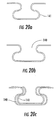
- One exemplary interlocking closure device utilizing male 141 and female 140 closure elements of simple profiles is depicted in FIGS. 20a-c .
- FIGS. 21a-c depict a more-complex variation on the shape of the closure elements 140', 141'.
- the film 100 used for making a rollstock with integral closure strip(s) in accordance with the invention can be a monolayer film or can be a laminate of two or more separate layers.
- the adhesive should be flexible and extensible to allow the necessary deformations to occur during formation of the integral closure strip without delamination occurring between the layers.
- a non-cross-linked adhesive can be used.
- An exemplary laminate that may be used in the practice of the invention comprises a cast oriented polypropylene (cast OPP) adhesively laminated to another cast OPP, optionally including an ink layer, such as cOPP/ink/adhesive/cOPP.
- the ink layer would be omitted of a transparent reclosable bag is desired.
Landscapes
- Engineering & Computer Science (AREA)
- Mechanical Engineering (AREA)
- Making Paper Articles (AREA)
Description
- The present disclosure relates to a method of manipulating thermoplastic film to create integrated features and particularly relates to a method of manufacturing a packaging bag that is reclosable after initial opening.
- The document
US4235653 is showing a similar method. - A typical reclosable packaging bag comprises a bag body with a linear closure device, which forms a reclosable opening. Various approaches to manufacturing such bags have been developed or proposed, which generally entail forming the bag body from a plastic film to which a separately formed closure device is affixed. The bag body may be fabricated by a number of methods, including heat-sealing two sheets of thermoplastic film together to form a bottom seal and opposite side seals, or folding a single thermoplastic film to form the bottom of the bag and sealing the two opposing portions of film together at their side edges. The sealing is done so as to leave one side of the bag open, at which the closure device is provided.
- The closure devices are typically composed of two interlocking strips, which allow the bag to be closed and reopened repeatedly. Typically this closure has been attached to the plastic film of the bag in one of several ways. In one approach, the two strips of the closure device are formed separately and are attached to the film by heat-sealing. In another approach, the strips are injection molded onto the film. Yet another approach extrudes the closure strips onto the thermoplastic film.
- It can be difficult to ensure reliability of placement of separately formed or extruded closure strips onto the film, and the mechanisms required for doing so are relatively complex.
- The present disclosure relates to a method of manipulating thermoplastic film to create integrated features, and particularly relates to an improved method of manufacturing a packaging bag that is reclosable after initial opening. In accordance with one aspect of the invention, multiple sections of thermoplastic film are layered on top of themselves to form a multi-layer portion of the thermoplastic film. The layering may be accomplished by folding the film in alternating opposite directions in an accordion style or by folding or rolling the film multiple times in the same direction.
- The multi-layer portion is then conglomerated into a unitary thicker portion of the film. In one embodiment, the conglomerating step is accomplished by heating and applying pressure to the layered sections to form the thicker portion of the thermoplastic film. The thicker portion may then be formed into a closure strip either concurrently with or after the conglomeration process. The process of shaping the closure strip may be performed using heat and either pressure or vacuum. Typically the strip can be shaped by heated dies operating in either a continuous or an intermittent, discrete manner.
- In order to form a bag, a second such closure strip may be made that interlocks with the first closure strip. The second strip may either be on the opposite side of the same piece of thermoplastic film as the first closure strip, or it may be part of a separate discrete piece of film. In the first case, the piece of thermoplastic film is folded in a C-fold configuration so as to align the closure strips, and in the latter case, the two pieces of thermoplastic film are aligned such that the closure strips are aligned. The remaining open portions of the bag are then sealed such that the closure strips form a reclosable opening that may be opened and closed repeatedly. A peel seal optionally may be provided adjacent to the closure device to give the bag a tamper-evident feature.
- Having thus described the disclosure in general terms, reference will now be made to the accompanying drawings, which are not necessarily drawn to scale, and wherein:
-
FIG. 1 is a block diagram illustrating a process in accordance with one embodiment of the present invention; -
FIG. 2 is a cross-sectional view of an unlayered thermoplastic film in accordance with a starting configuration; -
FIG. 3 is a cross-sectional view of the thermoplastic film after having been layered on top of itself once to form a two-layer portion; -
FIG. 4 is a cross-sectional view of the film after having been layered twice to form a three-layer portion; -
FIG. 5 is similar toFIG. 4 but shows an alternative way to form a three-layer portion; -
FIG. 6 depicts the three-layer portion ofFIG. 4 being heated, so as to conglomerate the layers into one continuous thicker portion; -
FIG. 7 is a cross-sectional view of one embodiment of the continuous thicker portion of thermoplastic film after being conglomerated; -
FIG. 8 illustrates the thicker portion of the thermoplastic film being heated so as to facilitate a subsequent shaping process; -
FIG. 9 depicts one embodiment of shaping dies being used to shape the thicker portion of thermoplastic film into a closure strip; -
FIG. 10 is a cross-sectional view of one embodiment of a closure strip formed by the dies ofFIG. 9 ; -
FIG. 11 is a perspective view of two interlocking closure strips formed by the process shown inFIGS. 8, 9, and 10 ; -
FIG. 12 is a perspective view of a single sheet of thermoplastic film having closure strips formed on opposing edges by the process inFIGS. 8, 9, and 10 ; -
FIG. 13 is a perspective view of the sheet inFIG. 12 having been folded so as to align the closure strips; -
FIG. 14 is an edge-on view of the sheet depicted inFIG. 13 ; -
FIG. 15 is a perspective view of two sheets of thermoplastic film having closure strips formed on one edge of each sheet; -
FIG. 16 is a perspective view of the sheets inFIG. 15 having been positioned so as to align the closure strips; -
FIG. 17 is an edge-on view of the sheets depicted inFIG. 16 ; -
FIG. 18 is a perspective view of a completed bag in accordance with one embodiment of the invention; -
FIG. 19 shows a top seal and closure area of a bag in accordance with an embodiment of the invention; -
FIGS. 20a and 20b are cross-sectional views of interlocking male and female closure elements, respectively, in accordance with one embodiment of the invention; -
FIG. 20c shows the closure elements ofFIGS. 20a and 20b interlockingly engaged with each other; -
FIG. 21 a and 21 b are cross-sectional views of another embodiment of the interlocking male and female closure elements, respectively, in accordance with one embodiment of the invention; -
FIG. 21c shows the closure elements ofFIGS. 21a and 21b interlockingly engaged with each other. - The present invention now will be described more fully hereinafter with reference to the accompanying drawings in which some but not all embodiments of the inventions are shown. Indeed, these inventions may be embodied in many different forms and should not be construed as limited to the embodiments set forth herein; rather, these embodiments are provided so that this disclosure will satisfy applicable legal requirements. Like numbers refer to like elements throughout.
- The following description of certain preferred embodiments of the invention relate to a reclosable bag formed out of a thermoplastic film and having a closure device to allow the bag to be opened and reclosed repeatedly. The object of the present invention is to create the closure device out of the thermoplastic film itself, as opposed to manufacturing it separately and attaching it to the film afterwards. In one preferred embodiment, the closure device is formed from two interlocking strips positioned on opposite sides of a reclosable opening in the bag. In a preferred embodiment, each of the strips of the closure is formed out of the thermoplastic film itself. Each of the strips of the closure can be formed by layering sections of the thermoplastic film onto itself, and conglomerating the layers of the film together to form a unitary thickened portion of the film. Each thickened portion is then shaped, using heat with either pressure or vacuum, to form the thickened portions into interlocking closure strips. The process finally entails forming a bag out of the film material in such a manner that the closure strips can close an open end of the bag. While it is preferable to provide a linear closure device, nonlinear variations are also envisioned. The present invention can be practiced using numerous combinations, configurations, and sequences to manufacture the reclosable bag. Certain preferred embodiments are described below.
- With reference to
FIGS. 1-10 , one embodiment of a process for forming a closure strip in a thermoplastic film is now described.FIG. 1 is a process diagram showing the steps of the process, andFIGS. 2-10 illustrate the configuration of the film at each of various steps during the process. As shown inFIG. 2 , athermoplastic film 100 initially has a generally flat configuration. In the embodiment described below, an edge portion of thefilm 100 is processed to form a closure strip, but it will be recognized that the described process could be used to form a closure strip in a location other than adjacent to an edge of the film. As indicated inFIG. 1 , a first step S1 of the process is to layer thefilm 100 onto itself, which generally entails folding the film to form amulti-layer portion 120 as shown inFIG. 4 . Themulti-layer portion 120 is shown as having three layers of film, formed by first folding the film once in a given direction (FIG. 3 ) and then folding those resulting two layers again in the same direction (FIG. 4 ), which may also be regarded as essentially rolling up the film. Alternatively, as shown inFIG. 5 , a three-layer portion 120' can be formed by folding thefilm 100 back and forth (or in accordion fashion) in opposite directions. Additionally, as will be recognized, multi-layer portions of more than three layers can be formed in a similar rolling or back-and-forth fashion. The number of layers in themulti-layer portion 120 is the manufacturer's choice, depending on the needs of the particular application. - As further indicated in
FIG. 1 , the next step S2 of the process is to conglomerate the layers of themulti-layer portion 120 so that they form a unitary thickened portion. This is illustrated inFIGS. 6 and 7 . Themulti-layer portion 120 is heated by one or moresuitable heating devices 122 to soften the thermoplastic, and the heating devices exert pressure on the multi-layer portion to cause the softened layers of the multi-layer portion to be conglomerated into a substantially unitary thickenedportion 125 as shown inFIG. 7 . WhileFIG. 6 depicts a single conglomerating step in which the three layers of themulti-layer portion 120 are simultaneously conglomerated, alternatively the two-layer portion ofFIG. 3 can be conglomerated, followed by folding or rolling to form the further-thickenedmulti-layer portion 120 or 120' ofFIG. 4 or FIG. 5 , followed by a second conglomerating step generally as shown inFIG. 6 . More than two separate conglomerating steps can be used if the multi-layer portion has four or more layers. - As further indicated in
FIG. 1 , the next step S3 of the process is to shape the thickenedportion 125 to form a closure strip.FIGS. 8 and 9 illustrate the shaping step. As shown inFIG. 8 , one ormore heating devices 124 are employed to heat and soften the thermoplastic of the thickenedportion 125, and then shaping dies 128 and 130 (FIG. 9 ) are employed to shape the softened thickenedportion 125, followed by cooling of the thermoplastic to set the shape, thereby forming aclosure strip 126 as illustrated inFIG. 10 . It will be appreciated that the very same devices could serve as both theheating devices 124 and theshaping devices 128, 130-i.e., the shaping dies 128, 130 could also be heated to effectively heat/soften the thermoplastic and shape it simultaneously. It is also within the scope of the present invention for the conglomerating step S2 and the shaping step S3 to be performed simultaneously by the same set of heated tools that simultaneously conglomerate the layers of themulti-layer portion 120 and shape the resulting thickenedportion 125 into aclosure strip 126. The layering, conglomerating, and shaping step(s) can be performed in a continuous fashion on a long length of thermoplastic film as it is advanced along a path without stopping, so as to create a continuous length ofclosure strip 126 in the film. Alternatively, the film can be intermittently advanced and stopped (or "indexed") so that the heating/shaping tools then engage the stationary film to heat and shape a discrete lengthwise portion of the thickenedportion 125, with that process being repeated to create discrete closure strips 126 arranged end-to-end along the lengthwise direction of the film. In any case, the resultingclosure strip 126 as shown inFIG. 10 has afemale closure element 140. A similar process can be used to form aclosure strip 127 having a male closure element 141 (FIG. 11 ), for example on another portion of the same thermoplastic film, or alternatively on another separate thermoplastic film, as further described below. - When two portions of thermoplastic film have respective female and male (or otherwise interlocking) closure strips 126, 127 as shown in
FIG. 11 , the two portions can be connected by interlocking engagement of the twoclosure elements FIGS. 12-18 . As a first example,FIGS. 12-14 illustrate the formation of a bag from a single piece ofthermoplastic film 100 having interlocking closure strips 126, 127 along opposite parallel edges thereof. Thefilm 100 is folded along afold line 150 located centrally between the closure strips to form a C-fold configuration as depicted inFIGS. 13 and 14 . The resulting two opposing portions of the film are sealed together along theirside edges 152 to form side seals 154 (FIG. 18 ). The two closure strips 126, 127 are interlocked with each other to close the top end of the bag. Optionally, the top end of the bag can also include a peelable heat seal orcold seal 156 located either outward or inward of the interlockedclosure elements FIG. 19 . If the bag is to be filled with a product and then sealed closed and shipped to a retailer for sale to consumers, the product can be introduced into the interior of the bag in any of various ways (e.g., through a side opening before it is closed by formation of theside seal 154 at that side). Once the consumer receives the filled and sealed bag, the consumer can open the top by peeling apart thepeel seal 156 and detaching the closure strips 126, 127 from each other. The bag is then reclosed by re-engaging the closure strips. Alternatively, the bag can be sold in an empty condition, for use by end users to contain any of various items. - An alternative type of bag construction is shown in
FIGS. 15-17 . The bag is formed from twodiscrete pieces film piece 102 has aclosure strip 126 along one edge, and thefilm piece 104 has aclosure strip 127 along a corresponding edge thereof. The twofilm pieces side edges 152 to form side seals 154 (FIG. 18 ), similar to the previous embodiment, and along theirbottom edges 151 to form a bottom seal. The closure strips 126, 127 are engaged (and optionally apeel seal 156 is formed) in the same manner as the previous embodiment. - The
closure elements FIGS. 20a-c .FIGS. 21a-c depict a more-complex variation on the shape of theclosure elements 140', 141'. These two exemplary profiles are illustrated only for explanatory purposes, and the invention is not limited to any particular profiles. - The
film 100 used for making a rollstock with integral closure strip(s) in accordance with the invention can be a monolayer film or can be a laminate of two or more separate layers. In the case of a laminate that uses an adhesive for joining together adjacent layers, the adhesive should be flexible and extensible to allow the necessary deformations to occur during formation of the integral closure strip without delamination occurring between the layers. For example, a non-cross-linked adhesive can be used. An exemplary laminate that may be used in the practice of the invention comprises a cast oriented polypropylene (cast OPP) adhesively laminated to another cast OPP, optionally including an ink layer, such as cOPP/ink/adhesive/cOPP. The ink layer would be omitted of a transparent reclosable bag is desired. - Many modifications and other embodiments of the inventions set forth herein will come to mind to one skilled in the art to which these inventions pertain having the benefit of the teachings presented in the foregoing descriptions and the associated drawings. Therefore, it is to be understood that the inventions are not to be limited to the specific embodiments disclosed and that modifications and other embodiments are intended to be included within the scope of the appended claims. Although specific terms are employed herein, they are used in a generic and descriptive sense only and not for purposes of limitation.
Claims (15)
- A method comprising:layering multiple sections of thermoplastic film, wherein said multiple sections are continuous and integral parts of said film, to form a first multi-layer portion;conglomerating said multiple sections of said first multi-layer portion together to form a unitary first thicker portion of said film; andshaping a first closure strip into said first thicker portion.
- The method of claim 1 further comprising:layering multiple sections of thermoplastic film, wherein said multiple sections are continuous and integral parts of said film, to form a second multi-layer portion;conglomerating said multiple sections of said second multi-layer portion together to form a unitary second thicker portion of said film; andshaping a second closure strip into said second thicker portion.
- The method of claim 2, wherein the first and second closure strips are integral parts of the same single piece of thermoplastic film, and further comprising:folding the piece of thermoplastic film into a C-fold configuration that places the first and second closure strips in aligned positions allowing the closure strips to be engaged with each other to form a reclosable closure device.
- The method of claim 3, further comprising:sealing opposing portions of said film together along opposite side edges thereof so as to form a bag.
- The method of claim 2, wherein the first and second closure strips are integral parts of two discrete pieces of thermoplastic film, and further comprising:placing the first and second closure strips in aligned positions allowing the closure strips to be engaged with each other to form a reclosable closure device.
- The method of claim 5, further comprising:sealing opposing portions of said film together along opposite side edges thereof so as to form a bag.
- The method of claim 1, wherein the layering step comprises:folding the film multiple times in the same direction to provide three or more layers in the first multi-layer portion, orfolding the film multiple times in alternating opposite directions to form an accordion-folded second multi-layer portion having three or more layers.
- The method of claim 1 wherein the conglomerating step comprises:heating and applying pressure to said multiple sections of said first multi-layer portion.
- The method of claim 2 wherein the conglomerating step comprises:heating and applying pressure to said multiple sections of said second multi-layer portion.
- The method of claim 1 wherein:said first closure strip is shaped by heating said first thicker portion andusing vacuum or pressure, or said first closure strip is shaped with heated dies.
- The method of claim 2 wherein:said second closure strip is shaped by heating said second thicker portion and using vacuum or pressure,or said second closure strip is shaped with heated dies.
- The method of claim 1, wherein:the conglomerating and shaping steps are performed on the first thicker portion of said film simultaneously, or the conglomerating and shaping steps are performed on the first thicker portion of said film separately and sequentially.
- The method of claim 2, wherein:the conglomerating and shaping steps are performed on the second thicker portion of said film simultaneously, or the conglomerating andshaping steps are performed on the second thicker portion of said film separately and sequentially.
- The method of claim 4, further comprising:forming a peel seal adjacent to the reclosable closure device.
- The method of claim 6, further comprising:forming a peel seal adjacent to the reclosable closure device.
Applications Claiming Priority (2)
| Application Number | Priority Date | Filing Date | Title |
|---|---|---|---|
| US13/584,931 US10926450B2 (en) | 2012-08-14 | 2012-08-14 | Method of making a plastic film with integrated zipper closure, and plastic bag having an integrated zipper closure |
| PCT/US2013/054668 WO2014028447A1 (en) | 2012-08-14 | 2013-08-13 | Method of making a plastic film with integrated zipper closure, and plastic bag having an integrated zipper closure |
Publications (2)
| Publication Number | Publication Date |
|---|---|
| EP2885120A1 EP2885120A1 (en) | 2015-06-24 |
| EP2885120B1 true EP2885120B1 (en) | 2016-10-05 |
Family
ID=49111535
Family Applications (1)
| Application Number | Title | Priority Date | Filing Date |
|---|---|---|---|
| EP13756749.1A Active EP2885120B1 (en) | 2012-08-14 | 2013-08-13 | Method of making a plastic film with integrated zipper closure, and plastic bag having an integrated zipper closure |
Country Status (4)
| Country | Link |
|---|---|
| US (2) | US10926450B2 (en) |
| EP (1) | EP2885120B1 (en) |
| CA (1) | CA2881791C (en) |
| WO (1) | WO2014028447A1 (en) |
Families Citing this family (2)
| Publication number | Priority date | Publication date | Assignee | Title |
|---|---|---|---|---|
| US10926450B2 (en) * | 2012-08-14 | 2021-02-23 | Sonoco Development, Inc. | Method of making a plastic film with integrated zipper closure, and plastic bag having an integrated zipper closure |
| US11338538B2 (en) * | 2016-08-17 | 2022-05-24 | Les Emballages Trium Inc. | Process for manufacturing bags for packaging items, and bag produced therefrom |
Family Cites Families (17)
| Publication number | Priority date | Publication date | Assignee | Title |
|---|---|---|---|---|
| US4235653A (en) * | 1978-06-28 | 1980-11-25 | Minigrip, Inc. | Method for making reclosable bags |
| US5405561A (en) * | 1993-08-31 | 1995-04-11 | Dowbrands L.P. | Process for microperforating zippered film useful for manufacturing a reclosable zippered bag |
| AU3416595A (en) * | 1994-08-26 | 1996-03-22 | Dowbrands Inc. | A freezer storage bag |
| US6550966B1 (en) * | 1995-08-28 | 2003-04-22 | S.C. Johnson Home Storage, Inc. | Freezer storage bag |
| GB9708541D0 (en) | 1997-04-25 | 1997-06-18 | Hanlex Ltd | Manufacture of plastic bags |
| US5944425A (en) * | 1997-05-22 | 1999-08-31 | Forman; Harold M | Packages with unitarilly formed resealable closure |
| US6350057B1 (en) * | 1997-05-22 | 2002-02-26 | Sealstrip Corp. | Reinforced reclosable package seals |
| US6977109B1 (en) * | 1998-07-24 | 2005-12-20 | 3M Innovative Properties Company | Microperforated polymeric film for sound absorption and sound absorber using same |
| JP4194229B2 (en) | 2000-03-07 | 2008-12-10 | 株式会社細川洋行 | Reclosable packaging bag and manufacturing method thereof |
| US6899460B2 (en) | 2001-10-23 | 2005-05-31 | S.C. Johnson Home Storage, Inc. | Storage bag with openly biased mouth |
| US7087130B2 (en) | 2003-03-05 | 2006-08-08 | Tilia International, Inc. | Method for manufacturing a sealable bag having an integrated zipper for use in vacuum packaging |
| US8122687B2 (en) | 2003-07-31 | 2012-02-28 | Kraft Foods Global Brands Llc | Method of making flexible packages having slide closures |
| US8096022B2 (en) | 2005-10-31 | 2012-01-17 | Global Packaging Solutions Limited | Reclosable container and method of manufacture |
| US7712962B1 (en) * | 2006-01-27 | 2010-05-11 | The Glad Produts Company | Storage bag |
| JP2010195459A (en) | 2009-02-27 | 2010-09-09 | Sekisui Film Kk | Method for manufacturing synthetic resin bag |
| US10926450B2 (en) * | 2012-08-14 | 2021-02-23 | Sonoco Development, Inc. | Method of making a plastic film with integrated zipper closure, and plastic bag having an integrated zipper closure |
| JP6126457B2 (en) * | 2013-05-22 | 2017-05-10 | 株式会社細川洋行 | Chuck molded product |
-
2012
- 2012-08-14 US US13/584,931 patent/US10926450B2/en active Active
-
2013
- 2013-08-13 CA CA2881791A patent/CA2881791C/en active Active
- 2013-08-13 EP EP13756749.1A patent/EP2885120B1/en active Active
- 2013-08-13 WO PCT/US2013/054668 patent/WO2014028447A1/en not_active Ceased
-
2021
- 2021-01-15 US US17/150,062 patent/US11338498B2/en active Active
Also Published As
| Publication number | Publication date |
|---|---|
| US20140051560A1 (en) | 2014-02-20 |
| EP2885120A1 (en) | 2015-06-24 |
| CA2881791C (en) | 2016-12-20 |
| US10926450B2 (en) | 2021-02-23 |
| US20210129413A1 (en) | 2021-05-06 |
| WO2014028447A1 (en) | 2014-02-20 |
| US11338498B2 (en) | 2022-05-24 |
| CA2881791A1 (en) | 2014-02-20 |
Similar Documents
| Publication | Publication Date | Title |
|---|---|---|
| US11305916B2 (en) | Zipper tape, bag, and method for producing bag | |
| US7036988B2 (en) | Zipper for vacuum storage bag | |
| US7674040B2 (en) | Reclosable bag having double closure | |
| US20080118189A1 (en) | Easy-open shrouded slider-zipper assembly for reclosable bag | |
| JP2007008589A (en) | Reclosable storing bag | |
| JP2001322187A (en) | Reclosable packaging bag and manufacturing method thereof | |
| JP2017517456A (en) | Easy-open and recloseable gusseted package with die cut web and reclose mechanism | |
| US8360643B2 (en) | Package having a resealable pour spout | |
| JP5694852B2 (en) | Zipper tape heat sealing method, zipper tape film roll manufacturing method, and zipper tape packaging bag manufacturing method | |
| US12030696B2 (en) | Package having a lap or fin seal gap elimination feature | |
| US11338498B2 (en) | Method of making a plastic film with integrated zipper closure, and plastic bag having an integrated zipper closure | |
| JP5969449B2 (en) | Self-supporting packaging bag with side gusset and manufacturing method thereof | |
| EP1844925A1 (en) | Method and device for manufacturing bag with clamping device | |
| EP0930240A1 (en) | Closure mechanism with a heat-insulating layer | |
| CN103395227B (en) | The manufacture method of organ zippered bag and the organ zippered bag of manufacture thereof | |
| US6361211B1 (en) | Closure mechanism with a heat-insulating filler | |
| CN107848668B (en) | Bag with zipper seal and side gussets and method for making such a bag | |
| JP4678625B1 (en) | Double bag with chuck and manufacturing method thereof | |
| JP2011042398A (en) | Bag with zipper and method for manufacturing the same | |
| US20090097783A1 (en) | High-burst, easy-opening slider zipper for reclosable packages or bags | |
| JP5635651B1 (en) | Bag making machine | |
| JP7374827B2 (en) | Bag-shaped container and method for manufacturing bag-shaped container | |
| JP7451204B2 (en) | pouch container | |
| WO2020262477A1 (en) | Bag-like container and bag-like container production method | |
| JP2011173419A (en) | Laminated sheet engaging mutually and releasably, of packaging material, and method and equipment of manufacturing the same |
Legal Events
| Date | Code | Title | Description |
|---|---|---|---|
| PUAI | Public reference made under article 153(3) epc to a published international application that has entered the european phase |
Free format text: ORIGINAL CODE: 0009012 |
|
| 17P | Request for examination filed |
Effective date: 20150212 |
|
| AK | Designated contracting states |
Kind code of ref document: A1 Designated state(s): AL AT BE BG CH CY CZ DE DK EE ES FI FR GB GR HR HU IE IS IT LI LT LU LV MC MK MT NL NO PL PT RO RS SE SI SK SM TR |
|
| AX | Request for extension of the european patent |
Extension state: BA ME |
|
| DAX | Request for extension of the european patent (deleted) | ||
| GRAP | Despatch of communication of intention to grant a patent |
Free format text: ORIGINAL CODE: EPIDOSNIGR1 |
|
| INTG | Intention to grant announced |
Effective date: 20160506 |
|
| GRAS | Grant fee paid |
Free format text: ORIGINAL CODE: EPIDOSNIGR3 |
|
| GRAA | (expected) grant |
Free format text: ORIGINAL CODE: 0009210 |
|
| AK | Designated contracting states |
Kind code of ref document: B1 Designated state(s): AL AT BE BG CH CY CZ DE DK EE ES FI FR GB GR HR HU IE IS IT LI LT LU LV MC MK MT NL NO PL PT RO RS SE SI SK SM TR |
|
| REG | Reference to a national code |
Ref country code: GB Ref legal event code: FG4D |
|
| REG | Reference to a national code |
Ref country code: CH Ref legal event code: EP |
|
| REG | Reference to a national code |
Ref country code: AT Ref legal event code: REF Ref document number: 834234 Country of ref document: AT Kind code of ref document: T Effective date: 20161015 |
|
| REG | Reference to a national code |
Ref country code: IE Ref legal event code: FG4D |
|
| REG | Reference to a national code |
Ref country code: DE Ref legal event code: R096 Ref document number: 602013012480 Country of ref document: DE |
|
| REG | Reference to a national code |
Ref country code: NL Ref legal event code: MP Effective date: 20161005 |
|
| REG | Reference to a national code |
Ref country code: LT Ref legal event code: MG4D |
|
| PG25 | Lapsed in a contracting state [announced via postgrant information from national office to epo] |
Ref country code: LV Free format text: LAPSE BECAUSE OF FAILURE TO SUBMIT A TRANSLATION OF THE DESCRIPTION OR TO PAY THE FEE WITHIN THE PRESCRIBED TIME-LIMIT Effective date: 20161005 |
|
| REG | Reference to a national code |
Ref country code: AT Ref legal event code: MK05 Ref document number: 834234 Country of ref document: AT Kind code of ref document: T Effective date: 20161005 |
|
| PG25 | Lapsed in a contracting state [announced via postgrant information from national office to epo] |
Ref country code: SE Free format text: LAPSE BECAUSE OF FAILURE TO SUBMIT A TRANSLATION OF THE DESCRIPTION OR TO PAY THE FEE WITHIN THE PRESCRIBED TIME-LIMIT Effective date: 20161005 Ref country code: LT Free format text: LAPSE BECAUSE OF FAILURE TO SUBMIT A TRANSLATION OF THE DESCRIPTION OR TO PAY THE FEE WITHIN THE PRESCRIBED TIME-LIMIT Effective date: 20161005 Ref country code: NO Free format text: LAPSE BECAUSE OF FAILURE TO SUBMIT A TRANSLATION OF THE DESCRIPTION OR TO PAY THE FEE WITHIN THE PRESCRIBED TIME-LIMIT Effective date: 20170105 Ref country code: GR Free format text: LAPSE BECAUSE OF FAILURE TO SUBMIT A TRANSLATION OF THE DESCRIPTION OR TO PAY THE FEE WITHIN THE PRESCRIBED TIME-LIMIT Effective date: 20170106 |
|
| PG25 | Lapsed in a contracting state [announced via postgrant information from national office to epo] |
Ref country code: IS Free format text: LAPSE BECAUSE OF FAILURE TO SUBMIT A TRANSLATION OF THE DESCRIPTION OR TO PAY THE FEE WITHIN THE PRESCRIBED TIME-LIMIT Effective date: 20170205 Ref country code: NL Free format text: LAPSE BECAUSE OF FAILURE TO SUBMIT A TRANSLATION OF THE DESCRIPTION OR TO PAY THE FEE WITHIN THE PRESCRIBED TIME-LIMIT Effective date: 20161005 Ref country code: RS Free format text: LAPSE BECAUSE OF FAILURE TO SUBMIT A TRANSLATION OF THE DESCRIPTION OR TO PAY THE FEE WITHIN THE PRESCRIBED TIME-LIMIT Effective date: 20161005 Ref country code: BE Free format text: LAPSE BECAUSE OF FAILURE TO SUBMIT A TRANSLATION OF THE DESCRIPTION OR TO PAY THE FEE WITHIN THE PRESCRIBED TIME-LIMIT Effective date: 20161005 Ref country code: PL Free format text: LAPSE BECAUSE OF FAILURE TO SUBMIT A TRANSLATION OF THE DESCRIPTION OR TO PAY THE FEE WITHIN THE PRESCRIBED TIME-LIMIT Effective date: 20161005 Ref country code: AT Free format text: LAPSE BECAUSE OF FAILURE TO SUBMIT A TRANSLATION OF THE DESCRIPTION OR TO PAY THE FEE WITHIN THE PRESCRIBED TIME-LIMIT Effective date: 20161005 Ref country code: FI Free format text: LAPSE BECAUSE OF FAILURE TO SUBMIT A TRANSLATION OF THE DESCRIPTION OR TO PAY THE FEE WITHIN THE PRESCRIBED TIME-LIMIT Effective date: 20161005 Ref country code: PT Free format text: LAPSE BECAUSE OF FAILURE TO SUBMIT A TRANSLATION OF THE DESCRIPTION OR TO PAY THE FEE WITHIN THE PRESCRIBED TIME-LIMIT Effective date: 20170206 Ref country code: HR Free format text: LAPSE BECAUSE OF FAILURE TO SUBMIT A TRANSLATION OF THE DESCRIPTION OR TO PAY THE FEE WITHIN THE PRESCRIBED TIME-LIMIT Effective date: 20161005 Ref country code: ES Free format text: LAPSE BECAUSE OF FAILURE TO SUBMIT A TRANSLATION OF THE DESCRIPTION OR TO PAY THE FEE WITHIN THE PRESCRIBED TIME-LIMIT Effective date: 20161005 |
|
| REG | Reference to a national code |
Ref country code: DE Ref legal event code: R097 Ref document number: 602013012480 Country of ref document: DE |
|
| REG | Reference to a national code |
Ref country code: FR Ref legal event code: PLFP Year of fee payment: 5 |
|
| PG25 | Lapsed in a contracting state [announced via postgrant information from national office to epo] |
Ref country code: EE Free format text: LAPSE BECAUSE OF FAILURE TO SUBMIT A TRANSLATION OF THE DESCRIPTION OR TO PAY THE FEE WITHIN THE PRESCRIBED TIME-LIMIT Effective date: 20161005 Ref country code: CZ Free format text: LAPSE BECAUSE OF FAILURE TO SUBMIT A TRANSLATION OF THE DESCRIPTION OR TO PAY THE FEE WITHIN THE PRESCRIBED TIME-LIMIT Effective date: 20161005 Ref country code: DK Free format text: LAPSE BECAUSE OF FAILURE TO SUBMIT A TRANSLATION OF THE DESCRIPTION OR TO PAY THE FEE WITHIN THE PRESCRIBED TIME-LIMIT Effective date: 20161005 Ref country code: RO Free format text: LAPSE BECAUSE OF FAILURE TO SUBMIT A TRANSLATION OF THE DESCRIPTION OR TO PAY THE FEE WITHIN THE PRESCRIBED TIME-LIMIT Effective date: 20161005 Ref country code: SK Free format text: LAPSE BECAUSE OF FAILURE TO SUBMIT A TRANSLATION OF THE DESCRIPTION OR TO PAY THE FEE WITHIN THE PRESCRIBED TIME-LIMIT Effective date: 20161005 |
|
| PLBE | No opposition filed within time limit |
Free format text: ORIGINAL CODE: 0009261 |
|
| STAA | Information on the status of an ep patent application or granted ep patent |
Free format text: STATUS: NO OPPOSITION FILED WITHIN TIME LIMIT |
|
| PG25 | Lapsed in a contracting state [announced via postgrant information from national office to epo] |
Ref country code: BG Free format text: LAPSE BECAUSE OF FAILURE TO SUBMIT A TRANSLATION OF THE DESCRIPTION OR TO PAY THE FEE WITHIN THE PRESCRIBED TIME-LIMIT Effective date: 20170105 Ref country code: SM Free format text: LAPSE BECAUSE OF FAILURE TO SUBMIT A TRANSLATION OF THE DESCRIPTION OR TO PAY THE FEE WITHIN THE PRESCRIBED TIME-LIMIT Effective date: 20161005 |
|
| 26N | No opposition filed |
Effective date: 20170706 |
|
| PG25 | Lapsed in a contracting state [announced via postgrant information from national office to epo] |
Ref country code: SI Free format text: LAPSE BECAUSE OF FAILURE TO SUBMIT A TRANSLATION OF THE DESCRIPTION OR TO PAY THE FEE WITHIN THE PRESCRIBED TIME-LIMIT Effective date: 20161005 |
|
| REG | Reference to a national code |
Ref country code: CH Ref legal event code: PL |
|
| PG25 | Lapsed in a contracting state [announced via postgrant information from national office to epo] |
Ref country code: MC Free format text: LAPSE BECAUSE OF FAILURE TO SUBMIT A TRANSLATION OF THE DESCRIPTION OR TO PAY THE FEE WITHIN THE PRESCRIBED TIME-LIMIT Effective date: 20161005 |
|
| PG25 | Lapsed in a contracting state [announced via postgrant information from national office to epo] |
Ref country code: LI Free format text: LAPSE BECAUSE OF NON-PAYMENT OF DUE FEES Effective date: 20170831 Ref country code: CH Free format text: LAPSE BECAUSE OF NON-PAYMENT OF DUE FEES Effective date: 20170831 |
|
| REG | Reference to a national code |
Ref country code: IE Ref legal event code: MM4A |
|
| PG25 | Lapsed in a contracting state [announced via postgrant information from national office to epo] |
Ref country code: LU Free format text: LAPSE BECAUSE OF NON-PAYMENT OF DUE FEES Effective date: 20170813 |
|
| REG | Reference to a national code |
Ref country code: FR Ref legal event code: PLFP Year of fee payment: 6 |
|
| PG25 | Lapsed in a contracting state [announced via postgrant information from national office to epo] |
Ref country code: IE Free format text: LAPSE BECAUSE OF NON-PAYMENT OF DUE FEES Effective date: 20170813 |
|
| PG25 | Lapsed in a contracting state [announced via postgrant information from national office to epo] |
Ref country code: MT Free format text: LAPSE BECAUSE OF NON-PAYMENT OF DUE FEES Effective date: 20170813 |
|
| PG25 | Lapsed in a contracting state [announced via postgrant information from national office to epo] |
Ref country code: HU Free format text: LAPSE BECAUSE OF FAILURE TO SUBMIT A TRANSLATION OF THE DESCRIPTION OR TO PAY THE FEE WITHIN THE PRESCRIBED TIME-LIMIT; INVALID AB INITIO Effective date: 20130813 |
|
| PG25 | Lapsed in a contracting state [announced via postgrant information from national office to epo] |
Ref country code: CY Free format text: LAPSE BECAUSE OF FAILURE TO SUBMIT A TRANSLATION OF THE DESCRIPTION OR TO PAY THE FEE WITHIN THE PRESCRIBED TIME-LIMIT Effective date: 20161005 |
|
| PG25 | Lapsed in a contracting state [announced via postgrant information from national office to epo] |
Ref country code: MK Free format text: LAPSE BECAUSE OF FAILURE TO SUBMIT A TRANSLATION OF THE DESCRIPTION OR TO PAY THE FEE WITHIN THE PRESCRIBED TIME-LIMIT Effective date: 20161005 |
|
| PG25 | Lapsed in a contracting state [announced via postgrant information from national office to epo] |
Ref country code: TR Free format text: LAPSE BECAUSE OF FAILURE TO SUBMIT A TRANSLATION OF THE DESCRIPTION OR TO PAY THE FEE WITHIN THE PRESCRIBED TIME-LIMIT Effective date: 20161005 |
|
| PG25 | Lapsed in a contracting state [announced via postgrant information from national office to epo] |
Ref country code: AL Free format text: LAPSE BECAUSE OF FAILURE TO SUBMIT A TRANSLATION OF THE DESCRIPTION OR TO PAY THE FEE WITHIN THE PRESCRIBED TIME-LIMIT Effective date: 20161005 |
|
| PGFP | Annual fee paid to national office [announced via postgrant information from national office to epo] |
Ref country code: DE Payment date: 20250827 Year of fee payment: 13 |
|
| PGFP | Annual fee paid to national office [announced via postgrant information from national office to epo] |
Ref country code: IT Payment date: 20250820 Year of fee payment: 13 |
|
| PGFP | Annual fee paid to national office [announced via postgrant information from national office to epo] |
Ref country code: GB Payment date: 20250827 Year of fee payment: 13 |
|
| PGFP | Annual fee paid to national office [announced via postgrant information from national office to epo] |
Ref country code: FR Payment date: 20250825 Year of fee payment: 13 |
|
| REG | Reference to a national code |
Ref country code: GB Ref legal event code: 732E Free format text: REGISTERED BETWEEN 20251211 AND 20251217 |
|
| REG | Reference to a national code |
Ref country code: DE Ref legal event code: R081 Ref document number: 602013012480 Country of ref document: DE Owner name: TOPPAN PACKAGING AMERICAS HOLDINGS, INC., CHAR, US Free format text: FORMER OWNER: SONOCO DEVELOPMENT, INC., HARTSVILLE, S.C., US Ref country code: DE Ref legal event code: R082 Ref document number: 602013012480 Country of ref document: DE Representative=s name: PFENNING, MEINIG & PARTNER MBB PATENTANWAELTE, DE |