EP2884790A1 - Method for traffic steering in multi layer radio networks - Google Patents
Method for traffic steering in multi layer radio networks Download PDFInfo
- Publication number
- EP2884790A1 EP2884790A1 EP13005739.1A EP13005739A EP2884790A1 EP 2884790 A1 EP2884790 A1 EP 2884790A1 EP 13005739 A EP13005739 A EP 13005739A EP 2884790 A1 EP2884790 A1 EP 2884790A1
- Authority
- EP
- European Patent Office
- Prior art keywords
- traffic
- cells
- cell
- radio access
- access technologies
- Prior art date
- Legal status (The legal status is an assumption and is not a legal conclusion. Google has not performed a legal analysis and makes no representation as to the accuracy of the status listed.)
- Granted
Links
Images


Classifications
-
- H—ELECTRICITY
- H04—ELECTRIC COMMUNICATION TECHNIQUE
- H04W—WIRELESS COMMUNICATION NETWORKS
- H04W28/00—Network traffic management; Network resource management
- H04W28/02—Traffic management, e.g. flow control or congestion control
- H04W28/08—Load balancing or load distribution
- H04W28/086—Load balancing or load distribution among access entities
- H04W28/0861—Load balancing or load distribution among access entities between base stations
- H04W28/0865—Load balancing or load distribution among access entities between base stations of different Radio Access Technologies [RATs], e.g. LTE® or Wi-Fi®
-
- H—ELECTRICITY
- H04—ELECTRIC COMMUNICATION TECHNIQUE
- H04W—WIRELESS COMMUNICATION NETWORKS
- H04W16/00—Network planning, e.g. coverage or traffic planning tools; Network deployment, e.g. resource partitioning or cells structures
- H04W16/18—Network planning tools
-
- H—ELECTRICITY
- H04—ELECTRIC COMMUNICATION TECHNIQUE
- H04W—WIRELESS COMMUNICATION NETWORKS
- H04W16/00—Network planning, e.g. coverage or traffic planning tools; Network deployment, e.g. resource partitioning or cells structures
- H04W16/22—Traffic simulation tools or models
Definitions
- the invention relates to a method for distributing an amount of traffic in a radio network among different layers and/or radio access technologies (RAT) of a multi layer radio network in a radio network planning tool.
- RAT radio access technologies
- GSM Global System for Mobile communication
- UMTS Universal Mobile Telecommunications System
- an amount of traffic within each RAT may be shared among different layers of a particular RAT.
- the idea of multi layer / inter RAT traffic steering is to extend the concept of "PegaPlan ® " and to distribute traffic between different layers and/or RAT.
- the proposed traffic steering method takes into account coverage, cell load and capacity, and a traffic steering policy.
- the gain of traffic steering is a better utilization of all network layers and to serve a traffic demand of customers with a best appropriate network layer.
- RAT means in the context of the present invention a radio access technology such as for example TETRA (Trans European trunked Radio), GSM, UMTS or LTE, wherein every technically suitable radio access technology may also be used.
- TETRA Trans European trunked Radio
- GSM Global System for Mobile communications
- UMTS Universal Mobile Telecommunications
- LTE Long Term Evolution
- the present invention provides a method for traffic steering in a radio network planning tool for multiple traffic types in a multi layer radio network comprising a number of layers of one or several different radio access technologies, the method comprising at least the following steps:
- the main idea of the present method is that in a first step sub areas which are covered by several cells of different network layers with optionally also different RAT are calculated. Further, their amount of traffic i.e. the amount of data that is sent and/or received by a particular cell is calculated. For every sub area, this traffic can be potentially shifted between the covering cells. For this traffic shift, the cell capacity has to be taken into account.
- the absolute capacity for the different traffic types has to be estimated.
- [Erlang] and/or [kbit/sec] may be used as unit.
- the capacity estimation has to be done for each layer and each RAT used in a respective pre-defined steering policy.
- a rough estimation of the cell capacity can be done for example by:
- a maximum traffic in [Erlang] is calculated which corresponds with a configured "threshold Max. Voice Blocking".
- a traffic type capacity is estimated using the results of this pre-calculation.
- the number of transceivers also determines available static and dynamic packet data channels of a particular cell. Together with a pre-calculated average time slot throughput the maximum available throughput can be calculated. The result of this calculation may be used to derive a capacity of another traffic type in [kbit/sec].
- Examples for traffic types may be real time traffic (RT), such as voice and non real time traffic (NRT), such as browsing or FTP.
- UMTS services use bearers with a fixed data rate for uplink and downlink. Every bearer data rate corresponds with a cell load factor. These load factors can be taken into account for a real time (RT) cell capacity estimation. For this estimation also a certain amount of inter cell interference is assumed. For non real time (NRT) services a similar approximation has to be used.
- RT real time
- NRT non real time
- a configured cell bandwith is taken into account. With an assumption about an average data rate per resource block an absolute cell capacity for non real time traffic in [kbit/sec] can be estimated. For real time traffic service bearers with fixed data rates are used which allows an estimation of a cell capacity for real time traffic in [Erlang].
- inter RAT traffic steering is that one traffic type, e.g. voice can be served by different RAT.
- service specific parameters may be traffic subscriber values, and real time traffic (RT) activity or a non real time traffic (NRT) overhead because these parameters influence an amount of total traffic offered by the particular subscribers.
- RT real time traffic
- NRT non real time traffic
- a traffic database of one single radio access technology is selected for deriving a database that is used by all radio access technologies of the cells of the network.
- traffic is modified for each cell by using individual traffic weight coefficients in following coverage and capacity calculations for all involved network layers and RAT.
- calculation of traffic weight coefficients takes into account the pre-defined traffic steering policy, wherein the traffic steering policy distinguishes between different traffic types and defines certain load thresholds and priorities for all network layers of all radio access technologies.
- a traffic steering policy consists of at least two parts. First of all, certain traffic types and their priorities have to be defined. In the next step, for the different network layers and RAT a set of load thresholds and priorities have to be defined for each traffic type. These load thresholds and priorities are used for shifting traffic between cells of different RAT in areas where several RAT have coverage. Thus, traffic of each type becomes balanced between different RAT and their respective layers.
- the overlapping coverage areas and the respective traffic weight coefficients of the cells have to be calculated.
- the area which is covered by the multi layer radio network is decomposed in sub areas where one or several cells have coverage.
- a maximum size of such a set is determined by a number of layers which are considered in a particular calculation.
- Cell numbers of a particular set should be ordered.
- a set with only one cell number means that in the respective sub area only one cell has coverage.
- To every traffic type X one single traffic value t x (s"(n)) belongs.
- To a set s x (n) of size n there belong n traffic weight coefficients with numbers of the particular set as indices. The first index of one of these coefficients denotes the serving cell number to which the traffic t x (s x (n)) contributes with its particular coefficient.
- the contribution of the traffic t x (s x (n)) to cell i 1 is described by the traffic weight coefficient: a X i ⁇ 1 , i ⁇ 2 , ... , in
- the contribution of the traffic t x (s x (n)) to cell i 2 is described by the traffic weight coefficient: a X i ⁇ 2 , i ⁇ 3 , ... , in , i ⁇ 1
- n traffic coefficients of one set s x (n) can be generated by performing cyclic permutations of length n of n indices.
- T i 1 X ⁇ s k n with i 1 ⁇ s X n a X i 1 , i 2 , ... , i n ⁇ t X s X n
- Traffic steering calculations have to be performed for every traffic type separately. An order for these calculations is given by a pre-defined traffic steering policy via pre-defined priorities of the traffic types.
- a calculation for balancing traffic of two types RT and NRT among cells, wherein RT has the higher priority, may consist of the following steps:
- traffic weight coefficients are available for every traffic type.
- the traffic weight coefficients can be used in further RAT specific calculations, such as RAT specific coverage and capacity calculations.
- traffic steering is taken into account by capacity and coverage calculations of at least one radio access technology of at least one cell.
- Traffic steering is used if a network contains cells of different layers of one and/or different RAT.
- a network which contains GSM, UMTS, and LTE cells is considered. It is assumed that an UMTS calculation result is requested by a user.
- a first traffic steering pixel calculation considers all cells of all RAT. Afterwards, traffic weight coefficients are calculated. The calculated traffic weight coefficients are used for calculating the UMTS result.
- the field strength of cells of other RAT always have to be considered in order to determine at every unit area the set of covering layers and/or RAT and their traffic weight coefficients.
- Traffic policy rules are shown in Figure 1 .
- An aim of a traffic steering policy is to reach pre-defined load thresholds and priorities for different traffic types such as for example real time (RT) traffic which is for example a call and non real time (NRT) traffic such as browsing or FTP usage.
- RT real time
- NRT non real time
- This differentiation may be extended by introducing QoS classes for the mentioned traffic types.
- RT traffic always has a higher priority than NRT traffic.
- a traffic steering policy consists of two parts that have to be defined by for example a technician or a supervisor of a particular radio network.
- the steering policy table 11 as shown in Figure 1 comprises one column 13 containing the different layers of different RAT and two columns for every traffic type, wherein thresholds are given in columns 15, 19 and priorities are given in columns 17, 18 for every traffic type.
- An overview of respective radio access technologies (RAT) and their underlying layers that are part of the respective traffic steering policy is given in column 13.
- a traffic steering algorithm uses the steering policy table 11 for shifting traffic between cells of different layers of one or different RAT in areas where several layers of one and/or of different RAT have coverage. Firstly, RT traffic is balanced between the particular layers according to the load thresholds and priorities defined in columns 15 and 17. In a second step NRT traffic which has a lower priority is balanced.
- the RAT GSM900 has the highest priority for RT traffic. In areas where several layers have coverage, a GSM 900 cell should serve up to 90% of their capacity. Only if more RT traffic is offered by the remaining traffic, the remaining traffic is served, i.e. processed by other layers and/or RAT according to their particular priorities and load thresholds defined in the traffic steering policy shown in table 11.
- FIG 2 an example is shown for voice RT traffic type. There are two cells 1 and 2 considered.
- Cell 1 is a GSM 900 cell and cell 2 an UMTS 1 st carrier cell. Priorities and load thresholds are assumed according to traffic steering policy shown in table 11 of Figure 1 .
- GSM cell 1 has a RT capacity of 20 [Erlang] and the UMTS cell 2 has a RT capacity of 30 [Erlang]. Furthermore, it is assumed that the two cells 1 and 2 have coverage in common in an area 1_2 with 10 [Erlang] RT traffic. Additionally both cells 1 and 2 cover alone respectively 10 [Erlang]. The respective RT traffic is indicated by arrows 10, 12 and 20, respectively.
- T 1 RT t 1 RT + a 12 RT . ⁇ t 12 RT .
- T 2 RT t 2 RT + a 21 RT . ⁇ t 21 RT .
- t 12 RT t 21 RT and wherein T means absolute traffic, t means a traffic contribution and a is a respective traffic weight coefficient.
- GSM 900 cell 1 has the highest priority for RT traffic
- the traffic distribution which is given by these coefficients is used for the following GSM and UMTS coverage and capacity calculations for the RT traffic type.
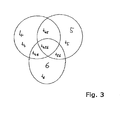
- FIG 3 the example shown in Figure 2 is now extended.
- the three cells 4, 5 and 6 include each a layer of optionally different RAT.
- the three cells denoted with cell number 4, 5 and 6 have sub areas where only one cell has coverage, sub areas where two cells have simultaneously coverage and one sub area where all three cells have coverage for a traffic type X.
- T 4 X t 4 X + a 45 X . ⁇ t 45 X + a 46 X . ⁇ t 46 X + a 456 X . ⁇ t 456 X
- T 5 X t 5 X + a 54 X . ⁇ t 54 X + a 56 X . ⁇ t 56 X + a 564 X . ⁇ t 564 X
- T 6 X t 6 X + a 64 X . ⁇ t 64 X + a 65 X .
Landscapes
- Engineering & Computer Science (AREA)
- Computer Networks & Wireless Communication (AREA)
- Signal Processing (AREA)
- Mobile Radio Communication Systems (AREA)
Abstract
a) dividing a network planning area by a grid into unit areas;
b) calculating for each unit area which layers and/or radio access technologies cover this particular unit area;
c) subdividing the network planning area in sub areas each consisting of at least one unit area and being covered by either one single cell or by a set of cells, the cells belonging to different layers or radio access technologies in case that the set of cells comprises more than one cell;
d) calculating an offered traffic for several service groups of every of these sub areas;
e) calculating a corresponding set of traffic weight coefficients, whose sum is normalized to one, for the set of cells, the traffic weight coefficients being used for assigning fractions of traffic of the set of cells to all cells of different layers or radio access technologies of the set of cells, wherein for all cells of the set of cells a traffic per cell for each service group fits as best as possible to a pre-defined traffic steering policy.
Description
- The invention relates to a method for distributing an amount of traffic in a radio network among different layers and/or radio access technologies (RAT) of a multi layer radio network in a radio network planning tool.
- Today many radio network areas are covered by several layers probably of different RAT. For example, in most countries exist homogeneous network layers of a so-called "Global System for Mobile communication" (GSM)-standard, sometimes consisting of
GSM 900 andGSM 1800 layers, and in addition one or two layers of a so called "Universal Mobile Telecommunications System" (UMTS)-standard for a whole area in which the particular radio network is present. In many countries, the rollout of the so-called "Long Term Evolution" (LTE)-standard has started, mostly using different layers with different propagation frequencies. - As one RAT standard can comprise more than one layer, an amount of traffic within each RAT may be shared among different layers of a particular RAT.
- In a radio network planning tool called "PegaPlan®" of Deutsche Telekom already exists a possibility for using one common traffic database for all layers of one RAT. In "PegaPlan®", a traffic offered by subscribers is automatically shared between all layers of one RAT by using multi layer cell models. These multi layer cell models have only a very rough consideration of an available cell capacity and cell load. For example, a LTE multi layer cell model takes a different bandwidth of cells of different layers into account in order to determine traffic split coefficients in terms of assignment probabilities.
- The idea of multi layer / inter RAT traffic steering is to extend the concept of "PegaPlan®" and to distribute traffic between different layers and/or RAT. The proposed traffic steering method takes into account coverage, cell load and capacity, and a traffic steering policy. The gain of traffic steering is a better utilization of all network layers and to serve a traffic demand of customers with a best appropriate network layer.
- The term "RAT" means in the context of the present invention a radio access technology such as for example TETRA (Trans European trunked Radio), GSM, UMTS or LTE, wherein every technically suitable radio access technology may also be used.
- In order to achieve the above mentioned gain, the present invention provides a method for traffic steering in a radio network planning tool for multiple traffic types in a multi layer radio network comprising a number of layers of one or several different radio access technologies, the method comprising at least the following steps:
- a) dividing a network planning area by a grid into unit areas;
- b) calculating for each unit area which layers and/or radio access technologies cover this particular unit area;
- c) subdividing the network planning area in sub areas each consisting of at least one unit area and being covered by either one single cell or by a set of cells, the cells belonging to different layers or radio access technologies in case that the set of cells comprises more than one cell;
- d) calculating an offered traffic for several service groups of every of these sub areas;
- e) calculating a corresponding set of traffic weight coefficients, whose sum is normalized to one, for the set of cells, the traffic weight coefficients being used for assigning fractions of traffic of the set of cells to all cells of different layers or radio access technologies of the set of cells, wherein for all cells of the set of cells a traffic per cell for each service group fits as best as possible to a pre-defined traffic steering policy.
- The main idea of the present method is that in a first step sub areas which are covered by several cells of different network layers with optionally also different RAT are calculated. Further, their amount of traffic i.e. the amount of data that is sent and/or received by a particular cell is calculated. For every sub area, this traffic can be potentially shifted between the covering cells. For this traffic shift, the cell capacity has to be taken into account.
- That means for every cell, the absolute capacity for the different traffic types has to be estimated. For the estimation of the absolute capacity, [Erlang] and/or [kbit/sec] may be used as unit. The capacity estimation has to be done for each layer and each RAT used in a respective pre-defined steering policy.
- A rough estimation of the cell capacity can be done for example by:
- for GSM: using a number of transceivers (TRX) of a particular cell,
- for UMTS: using load factors of bearers of particular services,
- for LTE: using the fact that cell capacity is proportional to a cell bandwidth.
- In a pre-calculation for every transceiver number a maximum traffic in [Erlang] is calculated which corresponds with a configured "threshold Max. Voice Blocking". For one cell with a certain number of transceivers a traffic type capacity is estimated using the results of this pre-calculation. The number of transceivers also determines available static and dynamic packet data channels of a particular cell. Together with a pre-calculated average time slot throughput the maximum available throughput can be calculated. The result of this calculation may be used to derive a capacity of another traffic type in [kbit/sec]. Examples for traffic types may be real time traffic (RT), such as voice and non real time traffic (NRT), such as browsing or FTP.
- UMTS services use bearers with a fixed data rate for uplink and downlink. Every bearer data rate corresponds with a cell load factor. These load factors can be taken into account for a real time (RT) cell capacity estimation. For this estimation also a certain amount of inter cell interference is assumed. For non real time (NRT) services a similar approximation has to be used.
- For LTE cells, a configured cell bandwith is taken into account. With an assumption about an average data rate per resource block an absolute cell capacity for non real time traffic in [kbit/sec] can be estimated. For real time traffic service bearers with fixed data rates are used which allows an estimation of a cell capacity for real time traffic in [Erlang].
- The idea of inter RAT traffic steering is that one traffic type, e.g. voice can be served by different RAT.
- Therefore, at least some service specific parameters have to be defined for all RAT in common. Such service specific parameters may be traffic subscriber values, and real time traffic (RT) activity or a non real time traffic (NRT) overhead because these parameters influence an amount of total traffic offered by the particular subscribers.
- It is further necessary that all RAT use the same RT and NRT database. A simple approach is to derive the total traffic for all RAT at one file by summing up traffic generated by the RAT specific traffic data base and services. The result of this summing process is the total RT and NRT traffic in subscribers/km2 in one file.
- In yet another embodiment of the present invention, a traffic database of one single radio access technology is selected for deriving a database that is used by all radio access technologies of the cells of the network.
- In the last calculation step, traffic is modified for each cell by using individual traffic weight coefficients in following coverage and capacity calculations for all involved network layers and RAT.
- In another embodiment of the present invention, calculation of traffic weight coefficients takes into account the pre-defined traffic steering policy, wherein the traffic steering policy distinguishes between different traffic types and defines certain load thresholds and priorities for all network layers of all radio access technologies.
- The aim of the traffic steering policy is to reach pre-defined load thresholds for different traffic types. Thus, a traffic steering policy consists of at least two parts. First of all, certain traffic types and their priorities have to be defined. In the next step, for the different network layers and RAT a set of load thresholds and priorities have to be defined for each traffic type. These load thresholds and priorities are used for shifting traffic between cells of different RAT in areas where several RAT have coverage. Thus, traffic of each type becomes balanced between different RAT and their respective layers.
- In the case of two or more overlapping cells of RAT of the same or different kind covering one sub area, the overlapping coverage areas and the respective traffic weight coefficients of the cells have to be calculated.
- The area which is covered by the multi layer radio network is decomposed in sub areas where one or several cells have coverage. One sub area where n cells have coverage for traffic type X is denoted by the set sx(n) of n cell numbers ik according to the following formula:

- A maximum size of such a set is determined by a number of layers which are considered in a particular calculation. Cell numbers of a particular set should be ordered. A set with only one cell number means that in the respective sub area only one cell has coverage. To every traffic type X one single traffic value tx(s"(n)) belongs. To a set sx(n) of size n there belong n traffic weight coefficients with numbers of the particular set as indices. The first index of one of these coefficients denotes the serving cell number to which the traffic tx(sx(n)) contributes with its particular coefficient. For example for the considered set sx(n) the contribution of the traffic tx(sx(n)) to cell i1 is described by the traffic weight coefficient:

- The contribution of the traffic tx(sx(n)) to cell i2 is described by the traffic weight coefficient:

- The two examples above show, that the n traffic coefficients of one set sx(n) can be generated by performing cyclic permutations of length n of n indices. For set sx(n) a cyclic permutation π of length n is defined in a two row notation:

- In a representation notation cyclic permutation π of length n is described by:

- A repetition of k times of this cyclic permutation is denoted with πk. With this notation the necessary normalization condition of all the n traffic weight coefficients of set sx(n) can be described by:

- The whole traffic of type X of cell i1 is the sum over all sets which contain a particular cell number with the corresponding traffic weight coefficients:

- Traffic steering calculations have to be performed for every traffic type separately. An order for these calculations is given by a pre-defined traffic steering policy via pre-defined priorities of the traffic types.
- A calculation for balancing traffic of two types RT and NRT among cells, wherein RT has the higher priority, may consist of the following steps:
- 1. For balancing the RT traffic as the traffic with highest priority the whole absolute RT cell capacity in [Erlang] is considered to be available for the RT traffic.
- 2. For every set of cells set all traffic weight coefficients of the set initially equal to 1 / (size of set).
- 3. Determine for every cell i of the network the relative RT traffic load Treli RT using the initial traffic weight coefficients, wherein Treli RT equals Ti RT divided by (RT capacity of cell i)·(RT load threshold of layer (cell i)).
- 4. The cells are ordered by their relative RT traffic load. The algorithm starts with the highest loaded cell which is assumed to have the cell number i. The cell i is assumed to have a priority p(i) for RT traffic. For this cell i all sets which contain this cell i are considered. For all cells j of these sets which have a higher RT traffic priority than cell i, which means p(j) < p(i), the amount of possible additional RT traffic of them is calculated according to their load thresholds.
- 5. The RT traffic of cell i is reduced by this amount of traffic, and this traffic is assigned to all these cells j of all sets which contain cell i. The RT traffic coefficients are re-calculated for all involved cells.
- 6. These steps are repeated for all cells of the network. At the end of this procedure, the RT traffic is assigned to the cells in the network according to the steering policy as best as possible.
- 7. In the second run the same algorithm is repeated for NRT traffic. For this step, the RT traffic of the cells is converted from [Erlang] to [kbit/sec]. The absolute NRT capacity of the cells is reduced by this RT traffic in [kbit/sec] of the cells. This reduced NRT capacity is available for NRT traffic and is used for the calculation of the NRT traffic steering coefficients. This calculation itself uses the same steps as described above for the RT traffic coefficient calculation.
- At the end of such an algorithm for all sets of overlapping cells traffic weight coefficients are available for every traffic type. The traffic weight coefficients can be used in further RAT specific calculations, such as RAT specific coverage and capacity calculations.
- In yet another embodiment of the present invention traffic steering is taken into account by capacity and coverage calculations of at least one radio access technology of at least one cell.
- For usage of the above mentioned balancing method in a radio network planning tool, several calculation steps have to be modified in order to use inter RAT traffic steering. Traffic steering is used if a network contains cells of different layers of one and/or different RAT. As an example a network which contains GSM, UMTS, and LTE cells is considered. It is assumed that an UMTS calculation result is requested by a user. A first traffic steering pixel calculation considers all cells of all RAT. Afterwards, traffic weight coefficients are calculated. The calculated traffic weight coefficients are used for calculating the UMTS result. Thus, it is necessary that also during the following UMTS result calculation the field strength of cells of other RAT always have to be considered in order to determine at every unit area the set of covering layers and/or RAT and their traffic weight coefficients.
- It will be understood that the features mentioned above and those described hereinafter can be used not only in the combination specified but also in other combinations or on their own, without departing from the scope of the present disclosure.
- Various implementations are schematically illustrated in the drawings by means of an embodiment by way of example and are hereinafter explained in detail with reference to the drawings. It is understood that the description is in no way limiting on the scope of the present disclosure and is merely an illustration of a preferred embodiment.
- Further advantages arise from the subject matter of the dependent claims.
-
-
Figure 1 is an exemplary table of traffic priorities and load thresholds according to a pre-defined traffic steering policy. -
Figure 2 shows an example of an algorithm using the present method by considering overlap of two cells. -
Figure 3 shows an example of an algorithm using the present method by considering overlap of three cells. - Traffic policy rules are shown in
Figure 1 . An aim of a traffic steering policy is to reach pre-defined load thresholds and priorities for different traffic types such as for example real time (RT) traffic which is for example a call and non real time (NRT) traffic such as browsing or FTP usage. This differentiation may be extended by introducing QoS classes for the mentioned traffic types. In the example shown inFigure 1 , RT traffic always has a higher priority than NRT traffic. - A traffic steering policy consists of two parts that have to be defined by for example a technician or a supervisor of a particular radio network. For each layer of each RAT there are a respective load threshold and a respective priority for each traffic type, namely RT and NRT respectively. Thus, the steering policy table 11 as shown in
Figure 1 comprises onecolumn 13 containing the different layers of different RAT and two columns for every traffic type, wherein thresholds are given incolumns columns column 13. - A traffic steering algorithm uses the steering policy table 11 for shifting traffic between cells of different layers of one or different RAT in areas where several layers of one and/or of different RAT have coverage. Firstly, RT traffic is balanced between the particular layers according to the load thresholds and priorities defined in
columns - In the example shown in
Figure 1 , the RAT GSM900 has the highest priority for RT traffic. In areas where several layers have coverage, aGSM 900 cell should serve up to 90% of their capacity. Only if more RT traffic is offered by the remaining traffic, the remaining traffic is served, i.e. processed by other layers and/or RAT according to their particular priorities and load thresholds defined in the traffic steering policy shown in table 11. - In
Figure 2 , an example is shown for voice RT traffic type. There are twocells Cell 1 is aGSM 900 cell andcell 2 anUMTS 1st carrier cell. Priorities and load thresholds are assumed according to traffic steering policy shown in table 11 ofFigure 1 . - It is assumed that
GSM cell 1 has a RT capacity of 20 [Erlang] and theUMTS cell 2 has a RT capacity of 30 [Erlang]. Furthermore, it is assumed that the twocells cells arrows - The RT traffic of
cells 

wherein
and wherein T means absolute traffic, t means a traffic contribution and a is a respective traffic weight coefficient. - Because
GSM 900cell 1 has the highest priority for RT traffic, a traffic steering algorithm tries firstly to fill up theGSM 900 cell to the capacity limit of 90%·20 [Erlang] = 18 [Erlang] which can be reached with a12=0.8. Thus, the solution is:

- The traffic distribution which is given by these coefficients is used for the following GSM and UMTS coverage and capacity calculations for the RT traffic type.
- In
Figure 3 , the example shown inFigure 2 is now extended. There are threecells cells - In the example shown in
Figure 3 , the three cells denoted withcell number - With the notation introduced in the example shown in
Figure 2 , the traffic of type X of the three cells is given by the equations:


wherein
t45 = t54, t64 = t46, t56 = t65 and t456 = t564 = t645. - In this example the following conditions must be fulfilled for the particular traffic weight coefficients:


Claims (13)
- Method for traffic steering in a radio network planning tool for multiple traffic types in a multi layer radio network comprising a number of layers of one or several different radio access technologies, the method comprising the following steps:a) dividing a network planning area by a grid into unit areas;b) calculating for each unit area which layers and/or radio access technologies cover this particular unit area;c) subdividing the network planning area in sub areas each consisting of at least one unit area and being covered by either one single cell or by a set of cells, the cells belonging to different layers or radio access technologies in case that the set of cells comprises more than one cell;d) calculating an offered traffic for several service groups of every of these sub areas;e) calculating a corresponding set of traffic weight coefficients, whose sum is normalized to one, for the set of cells, the traffic weight coefficients being used for assigning fractions of traffic of the set of cells to all cells of different layers or radio access technologies of the set of cells, wherein for all cells of the set of cells a traffic per cell for each service group fits as best as possible to a pre-defined traffic steering policy.
- Method according to claim 1, wherein the traffic steering policy consists of service priorities and load thresholds for the service groups and for the network layers and/or radio access technologies.
- Method according to any of the preceding claims, wherein different radio access technologies are chosen out of the following list of radio access technologies: TETRA, GSM, UMTS and LTE.
- Method according to any of the preceding claims, wherein traffic types are chosen out of the following list of traffic types: real time traffic and non real time traffic.
- Method according to any of the preceding claims, wherein the absolute capacity is calculated in [Erlang] and/or [kbit/second].
- Method according to any of the preceding claims, wherein the calculations of the absolute capacity, the amount of traffic and the individual weight coefficients are performed and determined for each radio access technology in each cell separately.
- Method according to claim 6, wherein the calculation of the absolute capacity is done for GSM by using a number of transceivers of a particular cell, for UMTS by using load factors of bearers of services and for LTE by using the fact that cell capacity is proportional to a bandwidth of a particular cell.
- Method according to any of the preceding claims, wherein at least one service parameter is defined for all radio access technologies of one cell in common.
- Method according to any of the preceding claims, wherein one traffic database is used for all radio access technologies of the particular cell.
- Method according to any of the preceding claims, wherein the traffic weight coefficients are calculated for every traffic type separately by balancing the traffic for every traffic type between overlapping cells.
- Method according to any of the preceding claims, wherein traffic steering is taken into account by capacity and coverage calculations of at least one radio access technology of at least one cell.
- Multi layer radio network comprising a number of layers of one or several different radio access technologies, wherein the multi layer radio network is configured for steering traffic according to the method described in any of claims 1 to 11.
- System for steering traffic in a multi layer radio network, wherein the system is configured for steering traffic according to the method described in any of claims 1 to 11.
Priority Applications (4)
| Application Number | Priority Date | Filing Date | Title |
|---|---|---|---|
| HUE13005739A HUE052618T2 (en) | 2013-12-10 | 2013-12-10 | Traffic steering in multi layer radio networks |
| EP13005739.1A EP2884790B1 (en) | 2013-12-10 | 2013-12-10 | Traffic steering in multi layer radio networks |
| ES13005739T ES2832398T3 (en) | 2013-12-10 | 2013-12-10 | Traffic routing in multilayer radiocommunication networks |
| PL13005739T PL2884790T3 (en) | 2013-12-10 | 2013-12-10 | Traffic steering in multi layer radio networks |
Applications Claiming Priority (1)
| Application Number | Priority Date | Filing Date | Title |
|---|---|---|---|
| EP13005739.1A EP2884790B1 (en) | 2013-12-10 | 2013-12-10 | Traffic steering in multi layer radio networks |
Publications (2)
| Publication Number | Publication Date |
|---|---|
| EP2884790A1 true EP2884790A1 (en) | 2015-06-17 |
| EP2884790B1 EP2884790B1 (en) | 2020-08-19 |
Family
ID=49765261
Family Applications (1)
| Application Number | Title | Priority Date | Filing Date |
|---|---|---|---|
| EP13005739.1A Active EP2884790B1 (en) | 2013-12-10 | 2013-12-10 | Traffic steering in multi layer radio networks |
Country Status (4)
| Country | Link |
|---|---|
| EP (1) | EP2884790B1 (en) |
| ES (1) | ES2832398T3 (en) |
| HU (1) | HUE052618T2 (en) |
| PL (1) | PL2884790T3 (en) |
Cited By (3)
| Publication number | Priority date | Publication date | Assignee | Title |
|---|---|---|---|---|
| CN106535204A (en) * | 2015-09-10 | 2017-03-22 | 中国移动通信集团上海有限公司 | Service coverage quality evaluation method and device |
| CN107682865A (en) * | 2017-07-13 | 2018-02-09 | 国网浙江省电力公司嘉兴供电公司 | A kind of coverage optimization system of wireless network base station |
| WO2022089761A1 (en) * | 2020-10-30 | 2022-05-05 | Telefonaktiebolaget Lm Ericsson (Publ) | Method and apparatus for designing a radio access network |
Citations (2)
| Publication number | Priority date | Publication date | Assignee | Title |
|---|---|---|---|---|
| US6069894A (en) * | 1995-06-12 | 2000-05-30 | Telefonaktiebolaget Lm Ericsson | Enhancement of network operation and performance |
| WO2006119743A1 (en) * | 2005-05-13 | 2006-11-16 | T-Mobile International Ag & Co. Kg | Generation of a space-related traffic database in a radio network |
-
2013
- 2013-12-10 EP EP13005739.1A patent/EP2884790B1/en active Active
- 2013-12-10 ES ES13005739T patent/ES2832398T3/en active Active
- 2013-12-10 PL PL13005739T patent/PL2884790T3/en unknown
- 2013-12-10 HU HUE13005739A patent/HUE052618T2/en unknown
Patent Citations (2)
| Publication number | Priority date | Publication date | Assignee | Title |
|---|---|---|---|---|
| US6069894A (en) * | 1995-06-12 | 2000-05-30 | Telefonaktiebolaget Lm Ericsson | Enhancement of network operation and performance |
| WO2006119743A1 (en) * | 2005-05-13 | 2006-11-16 | T-Mobile International Ag & Co. Kg | Generation of a space-related traffic database in a radio network |
Non-Patent Citations (3)
| Title |
|---|
| ANONYMOUS: "LTE-Radio Network Planning with PegaPlan", INTERNET CITATION, 5 December 2010 (2010-12-05), pages 1 - 9, XP007919823, Retrieved from the Internet <URL:http://www.pegaware.com/fileadmin/PegaWeb/content/autoren/data/news/LTE_radio_network_planning_english.pdf> [retrieved on 20111128] * |
| DANISH NISAR, M ET AL: "Multi-RAT Traffic Steering - Why, when, and how could it be beneficial?", December 2011 (2011-12-01), pages 1 - 7, XP055119796, Retrieved from the Internet <URL:http://www.nomor.de/uploads/94/e2/94e2822c75480373b78b73c5adf862b6/WhitePaperNomor_MultiRAT_TS_2011-10.pdf> [retrieved on 20140523] * |
| VANHATUPA ET AL: "Performance model for IEEE 802.11s wireless mesh network deployment design", JOURNAL OF PARALLEL AND DISTRIBUTED COMPUTING, ELSEVIER, AMSTERDAM, NL, vol. 68, no. 3, 13 May 2007 (2007-05-13), pages 291 - 305, XP022450222, ISSN: 0743-7315, DOI: 10.1016/J.JPDC.2007.05.001 * |
Cited By (6)
| Publication number | Priority date | Publication date | Assignee | Title |
|---|---|---|---|---|
| CN106535204A (en) * | 2015-09-10 | 2017-03-22 | 中国移动通信集团上海有限公司 | Service coverage quality evaluation method and device |
| CN106535204B (en) * | 2015-09-10 | 2019-08-02 | 中国移动通信集团上海有限公司 | A kind of service coverage method for evaluating quality and device |
| CN107682865A (en) * | 2017-07-13 | 2018-02-09 | 国网浙江省电力公司嘉兴供电公司 | A kind of coverage optimization system of wireless network base station |
| CN107682865B (en) * | 2017-07-13 | 2020-12-25 | 国网浙江省电力公司嘉兴供电公司 | Coverage optimization system of wireless network base station |
| WO2022089761A1 (en) * | 2020-10-30 | 2022-05-05 | Telefonaktiebolaget Lm Ericsson (Publ) | Method and apparatus for designing a radio access network |
| US12627996B2 (en) | 2020-10-30 | 2026-05-12 | Telefonaktiebolaget Lm Ericsson (Publ) | Method and apparatus for designing a radio access network |
Also Published As
| Publication number | Publication date |
|---|---|
| ES2832398T3 (en) | 2021-06-10 |
| HUE052618T2 (en) | 2021-05-28 |
| EP2884790B1 (en) | 2020-08-19 |
| PL2884790T3 (en) | 2021-03-08 |
Similar Documents
| Publication | Publication Date | Title |
|---|---|---|
| US10028149B2 (en) | Method and apparatus for managing network sharing | |
| US20150358829A1 (en) | Communication system | |
| US20180242165A1 (en) | Spectrum sharing between primary users and co-existence groups of secondary users | |
| EP2517518B1 (en) | Method and apparatus for ensuring access in a communication system for a plurality of groups | |
| EP3128778B1 (en) | Network sharing method, apparatus and computer storage medium | |
| HU216039B (en) | A method for assigning frequencies to base stations of a mobile radiotelephone network | |
| CA2864198C (en) | Spectrum management system and method | |
| CN108243498B (en) | Method and device for distributing satellite system resources | |
| KR20070049244A (en) | A system for calculating an optimal slot for cell allocation in a time division duplex cellular system | |
| AlQahtani | Users’ classification-based call admission control with adaptive resource reservation for LTE-A networks | |
| KR20040101308A (en) | Method and system for performing call admission control in the uplink for third generation wireless communication systems | |
| EP2884790B1 (en) | Traffic steering in multi layer radio networks | |
| US8170574B2 (en) | Method and apparatus for controlling interference between cells in mobile communication network | |
| Koo et al. | Erlang capacity of multiaccess systems with service-based access selection | |
| KR101009724B1 (en) | Load-based service zone change method considering intercell interference in 802.16 / WiBro system | |
| US20130190030A1 (en) | A Method of Allocating Resources in a Radio Access Network (RAN) Shared by Different Network Operators | |
| WO2009004661A2 (en) | Method and computer system for performance analysis and for dimensioning a gsm access network | |
| Balapuwaduge et al. | Significance of channel failures on network performance in CRNs with reserved spectrum | |
| CN109862619B (en) | Multi-channel distribution method | |
| Fadel et al. | Qos-aware multi-rat resource allocation with minimum transmit power in multiuser ofdm system | |
| US20110249556A1 (en) | Cell selection method and controller | |
| Rahman et al. | A new guard-band call admission control policy based on acceptance factor for wireless cellular networks | |
| Castellanos-Lopez et al. | Erlang capacity in coordinated cognitive radio networks with stringent-delay applications | |
| US20230337215A1 (en) | Radio Access Network (RAN) Slice Scheduler Methods and Apparatus | |
| EP2359633A1 (en) | Systems and methods for adapting network capacity assigned to a partition |
Legal Events
| Date | Code | Title | Description |
|---|---|---|---|
| PUAI | Public reference made under article 153(3) epc to a published international application that has entered the european phase |
Free format text: ORIGINAL CODE: 0009012 |
|
| 17P | Request for examination filed |
Effective date: 20131210 |
|
| AK | Designated contracting states |
Kind code of ref document: A1 Designated state(s): AL AT BE BG CH CY CZ DE DK EE ES FI FR GB GR HR HU IE IS IT LI LT LU LV MC MK MT NL NO PL PT RO RS SE SI SK SM TR |
|
| AX | Request for extension of the european patent |
Extension state: BA ME |
|
| R17P | Request for examination filed (corrected) |
Effective date: 20151217 |
|
| RBV | Designated contracting states (corrected) |
Designated state(s): AL AT BE BG CH CY CZ DE DK EE ES FI FR GB GR HR HU IE IS IT LI LT LU LV MC MK MT NL NO PL PT RO RS SE SI SK SM TR |
|
| STAA | Information on the status of an ep patent application or granted ep patent |
Free format text: STATUS: EXAMINATION IS IN PROGRESS |
|
| 17Q | First examination report despatched |
Effective date: 20171010 |
|
| RIC1 | Information provided on ipc code assigned before grant |
Ipc: H04W 16/22 20090101ALN20200213BHEP Ipc: H04W 28/08 20090101ALN20200213BHEP Ipc: H04W 16/18 20090101AFI20200213BHEP |
|
| GRAP | Despatch of communication of intention to grant a patent |
Free format text: ORIGINAL CODE: EPIDOSNIGR1 |
|
| STAA | Information on the status of an ep patent application or granted ep patent |
Free format text: STATUS: GRANT OF PATENT IS INTENDED |
|
| INTG | Intention to grant announced |
Effective date: 20200320 |
|
| GRAS | Grant fee paid |
Free format text: ORIGINAL CODE: EPIDOSNIGR3 |
|
| GRAA | (expected) grant |
Free format text: ORIGINAL CODE: 0009210 |
|
| STAA | Information on the status of an ep patent application or granted ep patent |
Free format text: STATUS: THE PATENT HAS BEEN GRANTED |
|
| AK | Designated contracting states |
Kind code of ref document: B1 Designated state(s): AL AT BE BG CH CY CZ DE DK EE ES FI FR GB GR HR HU IE IS IT LI LT LU LV MC MK MT NL NO PL PT RO RS SE SI SK SM TR |
|
| REG | Reference to a national code |
Ref country code: GB Ref legal event code: FG4D |
|
| REG | Reference to a national code |
Ref country code: CH Ref legal event code: EP |
|
| REG | Reference to a national code |
Ref country code: DE Ref legal event code: R096 Ref document number: 602013071697 Country of ref document: DE |
|
| REG | Reference to a national code |
Ref country code: AT Ref legal event code: REF Ref document number: 1305343 Country of ref document: AT Kind code of ref document: T Effective date: 20200915 |
|
| REG | Reference to a national code |
Ref country code: IE Ref legal event code: FG4D |
|
| REG | Reference to a national code |
Ref country code: LT Ref legal event code: MG4D |
|
| REG | Reference to a national code |
Ref country code: NL Ref legal event code: MP Effective date: 20200819 |
|
| PG25 | Lapsed in a contracting state [announced via postgrant information from national office to epo] |
Ref country code: LT Free format text: LAPSE BECAUSE OF FAILURE TO SUBMIT A TRANSLATION OF THE DESCRIPTION OR TO PAY THE FEE WITHIN THE PRESCRIBED TIME-LIMIT Effective date: 20200819 Ref country code: HR Free format text: LAPSE BECAUSE OF FAILURE TO SUBMIT A TRANSLATION OF THE DESCRIPTION OR TO PAY THE FEE WITHIN THE PRESCRIBED TIME-LIMIT Effective date: 20200819 Ref country code: SE Free format text: LAPSE BECAUSE OF FAILURE TO SUBMIT A TRANSLATION OF THE DESCRIPTION OR TO PAY THE FEE WITHIN THE PRESCRIBED TIME-LIMIT Effective date: 20200819 Ref country code: BG Free format text: LAPSE BECAUSE OF FAILURE TO SUBMIT A TRANSLATION OF THE DESCRIPTION OR TO PAY THE FEE WITHIN THE PRESCRIBED TIME-LIMIT Effective date: 20201119 Ref country code: NO Free format text: LAPSE BECAUSE OF FAILURE TO SUBMIT A TRANSLATION OF THE DESCRIPTION OR TO PAY THE FEE WITHIN THE PRESCRIBED TIME-LIMIT Effective date: 20201119 Ref country code: PT Free format text: LAPSE BECAUSE OF FAILURE TO SUBMIT A TRANSLATION OF THE DESCRIPTION OR TO PAY THE FEE WITHIN THE PRESCRIBED TIME-LIMIT Effective date: 20201221 Ref country code: FI Free format text: LAPSE BECAUSE OF FAILURE TO SUBMIT A TRANSLATION OF THE DESCRIPTION OR TO PAY THE FEE WITHIN THE PRESCRIBED TIME-LIMIT Effective date: 20200819 Ref country code: GR Free format text: LAPSE BECAUSE OF FAILURE TO SUBMIT A TRANSLATION OF THE DESCRIPTION OR TO PAY THE FEE WITHIN THE PRESCRIBED TIME-LIMIT Effective date: 20201120 |
|
| PG25 | Lapsed in a contracting state [announced via postgrant information from national office to epo] |
Ref country code: IS Free format text: LAPSE BECAUSE OF FAILURE TO SUBMIT A TRANSLATION OF THE DESCRIPTION OR TO PAY THE FEE WITHIN THE PRESCRIBED TIME-LIMIT Effective date: 20201219 Ref country code: NL Free format text: LAPSE BECAUSE OF FAILURE TO SUBMIT A TRANSLATION OF THE DESCRIPTION OR TO PAY THE FEE WITHIN THE PRESCRIBED TIME-LIMIT Effective date: 20200819 Ref country code: LV Free format text: LAPSE BECAUSE OF FAILURE TO SUBMIT A TRANSLATION OF THE DESCRIPTION OR TO PAY THE FEE WITHIN THE PRESCRIBED TIME-LIMIT Effective date: 20200819 Ref country code: RS Free format text: LAPSE BECAUSE OF FAILURE TO SUBMIT A TRANSLATION OF THE DESCRIPTION OR TO PAY THE FEE WITHIN THE PRESCRIBED TIME-LIMIT Effective date: 20200819 |
|
| PG25 | Lapsed in a contracting state [announced via postgrant information from national office to epo] |
Ref country code: SM Free format text: LAPSE BECAUSE OF FAILURE TO SUBMIT A TRANSLATION OF THE DESCRIPTION OR TO PAY THE FEE WITHIN THE PRESCRIBED TIME-LIMIT Effective date: 20200819 Ref country code: RO Free format text: LAPSE BECAUSE OF FAILURE TO SUBMIT A TRANSLATION OF THE DESCRIPTION OR TO PAY THE FEE WITHIN THE PRESCRIBED TIME-LIMIT Effective date: 20200819 Ref country code: CZ Free format text: LAPSE BECAUSE OF FAILURE TO SUBMIT A TRANSLATION OF THE DESCRIPTION OR TO PAY THE FEE WITHIN THE PRESCRIBED TIME-LIMIT Effective date: 20200819 Ref country code: EE Free format text: LAPSE BECAUSE OF FAILURE TO SUBMIT A TRANSLATION OF THE DESCRIPTION OR TO PAY THE FEE WITHIN THE PRESCRIBED TIME-LIMIT Effective date: 20200819 Ref country code: DK Free format text: LAPSE BECAUSE OF FAILURE TO SUBMIT A TRANSLATION OF THE DESCRIPTION OR TO PAY THE FEE WITHIN THE PRESCRIBED TIME-LIMIT Effective date: 20200819 |
|
| REG | Reference to a national code |
Ref country code: DE Ref legal event code: R097 Ref document number: 602013071697 Country of ref document: DE |
|
| REG | Reference to a national code |
Ref country code: HU Ref legal event code: AG4A Ref document number: E052618 Country of ref document: HU |
|
| PG25 | Lapsed in a contracting state [announced via postgrant information from national office to epo] |
Ref country code: AL Free format text: LAPSE BECAUSE OF FAILURE TO SUBMIT A TRANSLATION OF THE DESCRIPTION OR TO PAY THE FEE WITHIN THE PRESCRIBED TIME-LIMIT Effective date: 20200819 |
|
| REG | Reference to a national code |
Ref country code: ES Ref legal event code: FG2A Ref document number: 2832398 Country of ref document: ES Kind code of ref document: T3 Effective date: 20210610 |
|
| PLBE | No opposition filed within time limit |
Free format text: ORIGINAL CODE: 0009261 |
|
| STAA | Information on the status of an ep patent application or granted ep patent |
Free format text: STATUS: NO OPPOSITION FILED WITHIN TIME LIMIT |
|
| PG25 | Lapsed in a contracting state [announced via postgrant information from national office to epo] |
Ref country code: SK Free format text: LAPSE BECAUSE OF FAILURE TO SUBMIT A TRANSLATION OF THE DESCRIPTION OR TO PAY THE FEE WITHIN THE PRESCRIBED TIME-LIMIT Effective date: 20200819 |
|
| 26N | No opposition filed |
Effective date: 20210520 |
|
| PG25 | Lapsed in a contracting state [announced via postgrant information from national office to epo] |
Ref country code: SI Free format text: LAPSE BECAUSE OF FAILURE TO SUBMIT A TRANSLATION OF THE DESCRIPTION OR TO PAY THE FEE WITHIN THE PRESCRIBED TIME-LIMIT Effective date: 20200819 Ref country code: MC Free format text: LAPSE BECAUSE OF FAILURE TO SUBMIT A TRANSLATION OF THE DESCRIPTION OR TO PAY THE FEE WITHIN THE PRESCRIBED TIME-LIMIT Effective date: 20200819 |
|
| REG | Reference to a national code |
Ref country code: BE Ref legal event code: MM Effective date: 20201231 |
|
| PG25 | Lapsed in a contracting state [announced via postgrant information from national office to epo] |
Ref country code: IE Free format text: LAPSE BECAUSE OF NON-PAYMENT OF DUE FEES Effective date: 20201210 Ref country code: LU Free format text: LAPSE BECAUSE OF NON-PAYMENT OF DUE FEES Effective date: 20201210 |
|
| REG | Reference to a national code |
Ref country code: AT Ref legal event code: UEP Ref document number: 1305343 Country of ref document: AT Kind code of ref document: T Effective date: 20200819 |
|
| PG25 | Lapsed in a contracting state [announced via postgrant information from national office to epo] |
Ref country code: TR Free format text: LAPSE BECAUSE OF FAILURE TO SUBMIT A TRANSLATION OF THE DESCRIPTION OR TO PAY THE FEE WITHIN THE PRESCRIBED TIME-LIMIT Effective date: 20200819 Ref country code: MT Free format text: LAPSE BECAUSE OF FAILURE TO SUBMIT A TRANSLATION OF THE DESCRIPTION OR TO PAY THE FEE WITHIN THE PRESCRIBED TIME-LIMIT Effective date: 20200819 Ref country code: CY Free format text: LAPSE BECAUSE OF FAILURE TO SUBMIT A TRANSLATION OF THE DESCRIPTION OR TO PAY THE FEE WITHIN THE PRESCRIBED TIME-LIMIT Effective date: 20200819 |
|
| PG25 | Lapsed in a contracting state [announced via postgrant information from national office to epo] |
Ref country code: MK Free format text: LAPSE BECAUSE OF FAILURE TO SUBMIT A TRANSLATION OF THE DESCRIPTION OR TO PAY THE FEE WITHIN THE PRESCRIBED TIME-LIMIT Effective date: 20200819 |
|
| PG25 | Lapsed in a contracting state [announced via postgrant information from national office to epo] |
Ref country code: BE Free format text: LAPSE BECAUSE OF NON-PAYMENT OF DUE FEES Effective date: 20201231 |
|
| REG | Reference to a national code |
Ref country code: CH Ref legal event code: U11 Free format text: ST27 STATUS EVENT CODE: U-0-0-U10-U11 (AS PROVIDED BY THE NATIONAL OFFICE) Effective date: 20260101 |
|
| PGFP | Annual fee paid to national office [announced via postgrant information from national office to epo] |
Ref country code: GB Payment date: 20251218 Year of fee payment: 13 |
|
| PGFP | Annual fee paid to national office [announced via postgrant information from national office to epo] |
Ref country code: AT Payment date: 20251215 Year of fee payment: 13 |
|
| PGFP | Annual fee paid to national office [announced via postgrant information from national office to epo] |
Ref country code: HU Payment date: 20251207 Year of fee payment: 13 Ref country code: FR Payment date: 20251218 Year of fee payment: 13 |
|
| PGFP | Annual fee paid to national office [announced via postgrant information from national office to epo] |
Ref country code: PL Payment date: 20251128 Year of fee payment: 13 |
|
| PGFP | Annual fee paid to national office [announced via postgrant information from national office to epo] |
Ref country code: ES Payment date: 20260119 Year of fee payment: 13 |
|
| PGFP | Annual fee paid to national office [announced via postgrant information from national office to epo] |
Ref country code: DE Payment date: 20251222 Year of fee payment: 13 |
|
| PGFP | Annual fee paid to national office [announced via postgrant information from national office to epo] |
Ref country code: IT Payment date: 20251231 Year of fee payment: 13 |
|
| PGFP | Annual fee paid to national office [announced via postgrant information from national office to epo] |
Ref country code: CH Payment date: 20260101 Year of fee payment: 13 |