EP2884296A2 - System and method of battery life estimation - Google Patents
System and method of battery life estimation Download PDFInfo
- Publication number
- EP2884296A2 EP2884296A2 EP14189813.0A EP14189813A EP2884296A2 EP 2884296 A2 EP2884296 A2 EP 2884296A2 EP 14189813 A EP14189813 A EP 14189813A EP 2884296 A2 EP2884296 A2 EP 2884296A2
- Authority
- EP
- European Patent Office
- Prior art keywords
- batteries
- sensor
- battery
- remaining
- circuitry
- Prior art date
- Legal status (The legal status is an assumption and is not a legal conclusion. Google has not performed a legal analysis and makes no representation as to the accuracy of the status listed.)
- Granted
Links
Images
Classifications
-
- G—PHYSICS
- G01—MEASURING; TESTING
- G01R—MEASURING ELECTRIC VARIABLES; MEASURING MAGNETIC VARIABLES
- G01R31/00—Arrangements for testing electric properties; Arrangements for locating electric faults; Arrangements for electrical testing characterised by what is being tested not provided for elsewhere
- G01R31/36—Arrangements for testing, measuring or monitoring the electrical condition of accumulators or electric batteries, e.g. capacity or state of charge [SoC]
- G01R31/382—Arrangements for monitoring battery or accumulator variables, e.g. SoC
- G01R31/3835—Arrangements for monitoring battery or accumulator variables, e.g. SoC involving only voltage measurements
-
- G—PHYSICS
- G01—MEASURING; TESTING
- G01R—MEASURING ELECTRIC VARIABLES; MEASURING MAGNETIC VARIABLES
- G01R31/00—Arrangements for testing electric properties; Arrangements for locating electric faults; Arrangements for electrical testing characterised by what is being tested not provided for elsewhere
- G01R31/36—Arrangements for testing, measuring or monitoring the electrical condition of accumulators or electric batteries, e.g. capacity or state of charge [SoC]
- G01R31/392—Determining battery ageing or deterioration, e.g. state of health
-
- G—PHYSICS
- G01—MEASURING; TESTING
- G01R—MEASURING ELECTRIC VARIABLES; MEASURING MAGNETIC VARIABLES
- G01R31/00—Arrangements for testing electric properties; Arrangements for locating electric faults; Arrangements for electrical testing characterised by what is being tested not provided for elsewhere
- G01R31/36—Arrangements for testing, measuring or monitoring the electrical condition of accumulators or electric batteries, e.g. capacity or state of charge [SoC]
- G01R31/396—Acquisition or processing of data for testing or for monitoring individual cells or groups of cells within a battery
-
- G—PHYSICS
- G08—SIGNALLING
- G08B—SIGNALLING SYSTEMS, e.g. PERSONAL CALLING SYSTEMS; ORDER TELEGRAPHS; ALARM SYSTEMS
- G08B29/00—Checking or monitoring of signalling or alarm systems; Prevention or correction of operating errors, e.g. preventing unauthorised operation
- G08B29/18—Prevention or correction of operating errors
- G08B29/181—Prevention or correction of operating errors due to failing power supply
-
- H—ELECTRICITY
- H02—GENERATION; CONVERSION OR DISTRIBUTION OF ELECTRIC POWER
- H02J—ELECTRIC POWER NETWORKS; CIRCUIT ARRANGEMENTS OR SYSTEMS FOR SUPPLYING OR DISTRIBUTING ELECTRIC POWER; SYSTEMS FOR STORING ELECTRIC ENERGY
- H02J7/00—Circuit arrangements for charging or discharging batteries or for supplying loads from batteries
- H02J7/855—Circuit arrangements for charging or discharging batteries or for supplying loads from batteries with circuits adapted for supplying loads from the battery
-
- H—ELECTRICITY
- H02—GENERATION; CONVERSION OR DISTRIBUTION OF ELECTRIC POWER
- H02J—ELECTRIC POWER NETWORKS; CIRCUIT ARRANGEMENTS OR SYSTEMS FOR SUPPLYING OR DISTRIBUTING ELECTRIC POWER; SYSTEMS FOR STORING ELECTRIC ENERGY
- H02J7/00—Circuit arrangements for charging or discharging batteries or for supplying loads from batteries
- H02J7/90—Regulation of charging or discharging current or voltage
- H02J7/96—Regulation of charging or discharging current or voltage in response to battery voltage
-
- G—PHYSICS
- G01—MEASURING; TESTING
- G01R—MEASURING ELECTRIC VARIABLES; MEASURING MAGNETIC VARIABLES
- G01R31/00—Arrangements for testing electric properties; Arrangements for locating electric faults; Arrangements for electrical testing characterised by what is being tested not provided for elsewhere
- G01R31/36—Arrangements for testing, measuring or monitoring the electrical condition of accumulators or electric batteries, e.g. capacity or state of charge [SoC]
- G01R31/371—Arrangements for testing, measuring or monitoring the electrical condition of accumulators or electric batteries, e.g. capacity or state of charge [SoC] with remote indication, e.g. on external chargers
-
- H—ELECTRICITY
- H01—ELECTRIC ELEMENTS
- H01M—PROCESSES OR MEANS, e.g. BATTERIES, FOR THE DIRECT CONVERSION OF CHEMICAL ENERGY INTO ELECTRICAL ENERGY
- H01M10/00—Secondary cells; Manufacture thereof
- H01M10/42—Methods or arrangements for servicing or maintenance of secondary cells or secondary half-cells
- H01M10/48—Accumulators combined with arrangements for measuring, testing or indicating the condition of cells, e.g. the level or density of the electrolyte
- H01M10/482—Accumulators combined with arrangements for measuring, testing or indicating the condition of cells, e.g. the level or density of the electrolyte for several batteries or cells simultaneously or sequentially
-
- Y—GENERAL TAGGING OF NEW TECHNOLOGICAL DEVELOPMENTS; GENERAL TAGGING OF CROSS-SECTIONAL TECHNOLOGIES SPANNING OVER SEVERAL SECTIONS OF THE IPC; TECHNICAL SUBJECTS COVERED BY FORMER USPC CROSS-REFERENCE ART COLLECTIONS [XRACs] AND DIGESTS
- Y02—TECHNOLOGIES OR APPLICATIONS FOR MITIGATION OR ADAPTATION AGAINST CLIMATE CHANGE
- Y02E—REDUCTION OF GREENHOUSE GAS [GHG] EMISSIONS, RELATED TO ENERGY GENERATION, TRANSMISSION OR DISTRIBUTION
- Y02E60/00—Enabling technologies; Technologies with a potential or indirect contribution to GHG emissions mitigation
- Y02E60/10—Energy storage using batteries
Definitions
- the application pertains to management of multiple batteries in electrical devices. More particularly, the application pertains to systems and methods for estimating remaining battery life.
- One of the problems associated with battery powered devices is correctly estimating the remaining battery life. It is useful to be able to correctly estimate this parameter because it facilitates programming the replacement of the batteries. Such programs are particularly useful when the battery powered devices are part of a more complex system where more than one device is to be monitored. For example, wireless fire detection systems can include hundreds of installed devices and it is important to correctly program the maintenance activities.
- Battery performance can strongly depend on the environmental condition, especially temperature (the battery life is strongly reduced at low temperatures).
- the performance of a battery strongly depends on the type of usage. For example, high current sink for short periods, constant sink for long periods. Battery life depends on the aging of the battery. A battery can stay on the shelf an undetermined period before being installed.
- Additional problems include, output voltage characteristics. The voltage output of some types of batteries, such as lithium ion types, is constant for most of their life, having a rapid fall of voltage with a sharp knee at the end of their life.
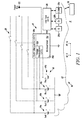
- Fig. 1 is a block diagram of an apparatus in accordance herewith.
- battery life estimation can be incorporated into devices that are powered by two or more independent identical batteries in combination with control circuits.
- a microcontroller in combination with interface circuits can be used to implement the present method.
- different batteries can be used for different percentages of time.
- all the batteries are used routinely. This is desirable given the characteristics of battery contacts.
- One of the batteries is used more extensively than the others. When this battery becomes discharged, the output voltage can be measured. Knowing the period for which it has been used, the remaining life of the other batteries can be estimated.
- the method will give reliable results since the battery life is measured in real conditions of use. Additionally, supposing the batteries have come from the same batch, highly probable in commercial systems, "on the shelf” aging can be taken into account.
- the present method differs from the current methods which estimate the remaining life by only measure the voltage on the batteries. An assumption is then made as to the relationship between the voltage and the remaining battery life.
- this time has been measured and is a duration of twelve months and we want the process to finish with two batteries completely exhausted and one with six months of remaining life.
- we have a total available life of 12x3 36 months.
- Fig. 1 illustrates an exemplary apparatus 10 which implements the above described process.
- Apparatus 10 can, for example implement a wireless ambient condition detector of smoke, gas, flame or the like all without limitation.
- Apparatus 10 can be carried by a housing 12.
- Housing 12 can carry a plurality of identical batteries 16 having members 16a, b, c, and d. It will be understood that the use of four batteries is exemplary only and is not a limitation hereof.
- Housing 12 can also carry control circuits 18.
- Control circuits 18 can include battery switch management circuits 18a which, via switching elements indicated at 20, can couple one or more of the batteries 16 to a power bus, indicated at 22, for the apparatus 10.
- the control circuits 18 can include voltage measurement circuits 18b which can be used to measure operating parameters, for example output voltage of each of the batteries 16a, b...n.
- the control circuits 18 can be implemented at least in part by a programmed processor 18c and local control circuitry 18d which is executed by processor 18c.
- Interface circuits 26, coupled to control circuits 18 can be used to couple signals to/from one or more ambient condition sensors 28a, output devices 28b or communication interfaces 28c. All of the elements 18, 26 and 28 can be powered off of the bus 22.
- apparatus 10 can carry out analysis of battery performance, on a per apparatus, or device, basis, as described above. Results can be coupled via wireless interface 28c to a displaced monitoring system 30. It will be understood that the monitoring system 30 can be in communication and control a plurality of devices, 10-1, -2, -3...-n such as the device 10 without limitation.
- a battery management program can be implemented using system 30 across a plurality of devices 10, 10-1, -2...-n.
- the devices 10-1, -2...-n can be installed in a region R which the system 30 is monitoring.
- a device and a method are provided in which a plurality of substantially identical batteries are coupled via switching circuits to a power bus.
- Control circuits coupled to the batteries and the switching circuits provide electrical energy to the bus from each of the batteries during a sequence of predetermined time intervals wherein one of the batteries provides electrical energy to the bus during a greater percentage of each tie intervals than the others of the plurality. Remaining battery life of the others of the plurality is estimated in response to sensing that the one battery is substantial discharged.
Landscapes
- Physics & Mathematics (AREA)
- General Physics & Mathematics (AREA)
- Engineering & Computer Science (AREA)
- Power Engineering (AREA)
- Computer Security & Cryptography (AREA)
- Secondary Cells (AREA)
- Tests Of Electric Status Of Batteries (AREA)
- Charge And Discharge Circuits For Batteries Or The Like (AREA)
Abstract
Description
- The application pertains to management of multiple batteries in electrical devices. More particularly, the application pertains to systems and methods for estimating remaining battery life.
- One of the problems associated with battery powered devices is correctly estimating the remaining battery life. It is useful to be able to correctly estimate this parameter because it facilitates programming the replacement of the batteries. Such programs are particularly useful when the battery powered devices are part of a more complex system where more than one device is to be monitored. For example, wireless fire detection systems can include hundreds of installed devices and it is important to correctly program the maintenance activities.
- Various problems are present in determining the remaining battery life of a system. Common problems can include one or more of the following. Battery performance can strongly depend on the environmental condition, especially temperature (the battery life is strongly reduced at low temperatures). The performance of a battery strongly depends on the type of usage. For example, high current sink for short periods, constant sink for long periods. Battery life depends on the aging of the battery. A battery can stay on the shelf an undetermined period before being installed. Additional problems include, output voltage characteristics. The voltage output of some types of batteries, such as lithium ion types, is constant for most of their life, having a rapid fall of voltage with a sharp knee at the end of their life.
- These above noted characteristics make it difficult to estimate the battery life by only measuring the output voltage or simply measuring the time from the installation. It is obvious that being too conservative in battery life estimation has a negative impact on the frequency of maintenance services as well as a negative impact on the environment. It is preferable that batteries that are not completely exhausted are not replaced too soon.
-
Fig. 1 is a block diagram of an apparatus in accordance herewith. - While disclosed embodiments can take many different forms, specific embodiments hereof are shown in the drawings and will be described herein in detail with the understanding that the present disclosure is to be considered as an exemplification of the principles hereof, as well as the best mode of practicing same, and is not intended to limit the claims hereof to the specific embodiment illustrated.
- In one aspect hereof, battery life estimation can be incorporated into devices that are powered by two or more independent identical batteries in combination with control circuits. For example, a microcontroller in combination with interface circuits can be used to implement the present method.
- An example with four independent batteries is described subsequently. Those of skill will understand that the apparatus and methods hereof can be used with any number of batteries, depending on the characteristics of the devices being powered by the batteries.
- In accordance herewith, different batteries can be used for different percentages of time. In another aspect, all the batteries are used routinely. This is desirable given the characteristics of battery contacts. One of the batteries is used more extensively than the others. When this battery becomes discharged, the output voltage can be measured. Knowing the period for which it has been used, the remaining life of the other batteries can be estimated.
- It will be also be possible to calculate the percentage of use of remaining batteries in order to make a determination as to when only one battery will be charged. The remaining life for this battery can then be determined.
- The method will give reliable results since the battery life is measured in real conditions of use. Additionally, supposing the batteries have come from the same batch, highly probable in commercial systems, "on the shelf" aging can be taken into account.
- Advantageously, the present method differs from the current methods which estimate the remaining life by only measure the voltage on the batteries. An assumption is then made as to the relationship between the voltage and the remaining battery life.
- By way of an example using four batteries, we can use battery number one for 100% of the time and to not use the others at all. When this battery reaches the end of its life (determined by measuring the output voltage), we can say that we have three times this duration of battery life left in the remaining batteries.
- Suppose that this time has been measured and is a duration of twelve months and we want the process to finish with two batteries completely exhausted and one with six months of remaining life. In this instance, we have a total available life of 12x3=36 months. In 36-6=30 months we want to use all the power of two batteries and just half the power of the other one. This means that we have an estimated battery life of twenty four months for the 2 batteries (24/30 = 80% of the time) while the third one is to be used for half of the estimated battery (6/30 = 20% of the time).
- This calculation can be extended to a generic number n of batteries (n>=2), with a generic estimated life (Tlife) from the first part of the method, and for a generic remaining life of the last battery (Tleft <= Tlife).
- In accordance with the above:


- It is understood that the percentage of use must be distributed in time in order to have all the batteries working in all conditions. For example, not having one battery working during daytime and the other only at night because the environmental conditions and workload could be different.
-
Fig. 1 illustrates anexemplary apparatus 10 which implements the above described process.Apparatus 10 can, for example implement a wireless ambient condition detector of smoke, gas, flame or the like all without limitation. -
Apparatus 10 can be carried by ahousing 12.Housing 12 can carry a plurality ofidentical batteries 16 havingmembers 16a, b, c, and d. It will be understood that the use of four batteries is exemplary only and is not a limitation hereof. -
Housing 12 can also carrycontrol circuits 18.Control circuits 18 can include batteryswitch management circuits 18a which, via switching elements indicated at 20, can couple one or more of thebatteries 16 to a power bus, indicated at 22, for theapparatus 10. Thecontrol circuits 18 can include voltage measurement circuits 18b which can be used to measure operating parameters, for example output voltage of each of thebatteries 16a, b...n. Thecontrol circuits 18 can be implemented at least in part by a programmedprocessor 18c andlocal control circuitry 18d which is executed byprocessor 18c. -
Interface circuits 26, coupled tocontrol circuits 18 can be used to couple signals to/from one or moreambient condition sensors 28a, output devices 28b orcommunication interfaces 28c. All of theelements bus 22. - In operation,
apparatus 10 can carry out analysis of battery performance, on a per apparatus, or device, basis, as described above. Results can be coupled viawireless interface 28c to a displacedmonitoring system 30. It will be understood that themonitoring system 30 can be in communication and control a plurality of devices, 10-1, -2, -3...-n such as thedevice 10 without limitation. - In accordance herewith a battery management program can be implemented using
system 30 across a plurality ofdevices 10, 10-1, -2...-n. The devices 10-1, -2...-n can be installed in a region R which thesystem 30 is monitoring. - In summary, a device and a method are provided in which a plurality of substantially identical batteries are coupled via switching circuits to a power bus. Control circuits coupled to the batteries and the switching circuits provide electrical energy to the bus from each of the batteries during a sequence of predetermined time intervals wherein one of the batteries provides electrical energy to the bus during a greater percentage of each tie intervals than the others of the plurality. Remaining battery life of the others of the plurality is estimated in response to sensing that the one battery is substantial discharged.
- From the foregoing, it will be observed that numerous variations and modifications may be effected without departing from the spirit and scope of the invention. It is to be understood that no limitation with respect to the specific apparatus illustrated herein is intended or should be inferred. It is, of course, intended to cover by the appended claims all such modifications as fall within the scope of the claims.
- Further, logic flows depicted in the figures do not require the particular order shown, or sequential order, to achieve desirable results. Other steps may be provided, or steps may be eliminated, from the described flows, and other components may be add to, or removed from the described embodiments.
Claims (15)
- An apparatus comprising:first circuitry to sense voltage output from a plurality of batteries, so as to use all of the batteries at least intermittently, and to selectively switch among the members of the plurality wherein one of the batteries is used to provide energy to local elements wherein a selected battery is used for a greater percentage of a predetermined time interval;second circuitry to determine when the selected battery has been discharged in accordance with a predetermined discharge parameter; andthird circuitry to estimate a remaining lifetime of the other members of the plurality.
- An apparatus as in claim 1 further comprising a housing that carries the circuitry along with at least one ambient condition sensor.
- An apparatus as in claim 1 which includes a programmable processor and battery switching circuits coupled to the circuitry.
- An apparatus as in claim 3 where the second circuitry establishes a life-time parameter for the selected battery.
- An apparatus as in claim 4 which includes establishing a remaining life-time parameter for the rest of the batteries.
- An apparatus as in claim 2 which includes a programmable processor and battery switching circuits coupled to the circuitry and which determines when the selected battery is substantially discharged.
- An apparatus as in claim 6 which determines a usable remaining operating interval for the remaining batteries.
- An apparatus as in claim 7 with circuitry to transmit an indicator as to the remaining operating interval to a displaced location.
- An apparatus as in claim 2 where the sensor is selected from a class which includes at least a smoke sensor, a gas sensor, a fire sensor, a temperature sensor, a humidity sensor, a motion sensor, a radiant energy sensor, and a position sensor.
- An ambient condition detector comprising:at least one sensor;a plurality of batteries;control circuits coupled to the battery switching circuits to provide electrical energy intermittently from the members of the plurality of batteries and where the batteries are switched such that all of the batteries are used to provide energy to the control circuits on an intermittent basis, during a sequence of predetermined time intervals.
- An apparatus as in claim 10 where one of the batteries is used for a greater percentage of each of the predetermined time intervals than are the remaining batteries.
- An apparatus as in claim 11 wherein the one battery is intermittently tested to determine an output characteristic, and in response thereto, generating an indicator to provide an indicium of remaining life of all other members of the plurality.
- An apparatus as in claim 10 which includes at least one of a smoke sensor, a gas sensor, a fire sensor, a temperature sensor, a humidity sensor, a motion sensor, a radiant energy sensor, and a position sensor.
- An apparatus as in claim 12 which includes at least one of a smoke sensor, a gas sensor, a fire sensor, a temperature sensor, a humidity sensor, a motion sensor, a radiant energy sensor, and a position sensor.
- A method of estimating remaining life of a group of batteries comprising:providing a group of batteries;using all of the batteries intermittently during each of a sequence of predetermined time intervals to provide electrical energy to a load wherein a selected battery is used for a greater percentage of time than each of the other members of the group during each predetermined time interval;determining when the selected battery is substantially discharged;determining a remaining life parameter for the remaining batteries; andusing the determined remaining life parameter in carrying out a battery replacement process.
Applications Claiming Priority (1)
| Application Number | Priority Date | Filing Date | Title |
|---|---|---|---|
| US14/085,096 US9658290B2 (en) | 2013-11-20 | 2013-11-20 | System and method of battery life estimation |
Publications (3)
| Publication Number | Publication Date |
|---|---|
| EP2884296A2 true EP2884296A2 (en) | 2015-06-17 |
| EP2884296A3 EP2884296A3 (en) | 2015-10-21 |
| EP2884296B1 EP2884296B1 (en) | 2019-09-18 |
Family
ID=51830191
Family Applications (1)
| Application Number | Title | Priority Date | Filing Date |
|---|---|---|---|
| EP14189813.0A Active EP2884296B1 (en) | 2013-11-20 | 2014-10-21 | System and method of battery life estimation |
Country Status (3)
| Country | Link |
|---|---|
| US (1) | US9658290B2 (en) |
| EP (1) | EP2884296B1 (en) |
| AU (1) | AU2014253513B2 (en) |
Cited By (1)
| Publication number | Priority date | Publication date | Assignee | Title |
|---|---|---|---|---|
| IT201900022467A1 (en) * | 2019-11-29 | 2021-05-29 | Argus Security S R L | DEVICE FOR SAFETY SYSTEMS, PREFERABLY FOR FIRE ALARM SYSTEMS, AND METHOD OF MANAGING THE POWER SUPPLY OF THIS DEVICE |
Families Citing this family (4)
| Publication number | Priority date | Publication date | Assignee | Title |
|---|---|---|---|---|
| US10788538B2 (en) * | 2017-09-12 | 2020-09-29 | General Electric Company | Predictive battery test systems and methods |
| CN109671997B (en) * | 2017-10-13 | 2021-10-19 | 神讯电脑(昆山)有限公司 | Electronic device and charging method |
| JP6881356B2 (en) * | 2018-03-08 | 2021-06-02 | 東芝三菱電機産業システム株式会社 | Battery system |
| CN116632392A (en) * | 2023-04-07 | 2023-08-22 | 北京新能源汽车股份有限公司 | Method, device and equipment for determining battery cells in battery system development |
Family Cites Families (11)
| Publication number | Priority date | Publication date | Assignee | Title |
|---|---|---|---|---|
| US4968942A (en) * | 1988-10-14 | 1990-11-06 | Allied-Signal Inc. | Method for monitoring aircraft battery status |
| US4937528A (en) * | 1988-10-14 | 1990-06-26 | Allied-Signal Inc. | Method for monitoring automotive battery status |
| US5281919A (en) * | 1988-10-14 | 1994-01-25 | Alliedsignal Inc. | Automotive battery status monitor |
| US5483165A (en) * | 1994-01-14 | 1996-01-09 | Heartstream, Inc. | Battery system and method for determining a battery condition |
| EP0992100B1 (en) | 1997-07-03 | 2007-04-25 | R.V. Holdings Corp. in Trust | System and method for management of battery back up power source |
| JP2001086656A (en) | 1999-07-09 | 2001-03-30 | Fujitsu Ltd | Battery monitoring device |
| US6650089B1 (en) * | 2002-10-16 | 2003-11-18 | Texas Instruments Incorporated | Control circuit for multiple battery systems with capacity gauge on end equipment |
| US7683576B2 (en) | 2007-05-01 | 2010-03-23 | Jenn-Yang Tien | Smart lead acid battery charging/discharging management system |
| KR101294025B1 (en) | 2011-08-02 | 2013-08-08 | 숭실대학교산학협력단 | Mobile terminal, battery pack, apparatus and method for controlling battery unit |
| US9146595B2 (en) | 2011-08-05 | 2015-09-29 | Qualcomm Incorporated | Systems and methods for remotely monitoring or controlling a battery |
| FR2979220B1 (en) * | 2011-08-30 | 2014-06-27 | Gen Electric | APPARATUS FOR MAMMOGRAPHY AND TOMOSYNTHESIS WITH REMOVABLE SOURCE AND PUPITRE |
-
2013
- 2013-11-20 US US14/085,096 patent/US9658290B2/en active Active
-
2014
- 2014-10-21 EP EP14189813.0A patent/EP2884296B1/en active Active
- 2014-10-23 AU AU2014253513A patent/AU2014253513B2/en not_active Ceased
Non-Patent Citations (1)
| Title |
|---|
| None |
Cited By (2)
| Publication number | Priority date | Publication date | Assignee | Title |
|---|---|---|---|---|
| IT201900022467A1 (en) * | 2019-11-29 | 2021-05-29 | Argus Security S R L | DEVICE FOR SAFETY SYSTEMS, PREFERABLY FOR FIRE ALARM SYSTEMS, AND METHOD OF MANAGING THE POWER SUPPLY OF THIS DEVICE |
| WO2021105935A1 (en) * | 2019-11-29 | 2021-06-03 | Argus Security S.R.L. | Device for security systems, preferably for fire alarm systems, and management method for the power supply for such device |
Also Published As
| Publication number | Publication date |
|---|---|
| US20150142351A1 (en) | 2015-05-21 |
| EP2884296A3 (en) | 2015-10-21 |
| AU2014253513A1 (en) | 2015-06-04 |
| AU2014253513B2 (en) | 2016-04-21 |
| US9658290B2 (en) | 2017-05-23 |
| EP2884296B1 (en) | 2019-09-18 |
Similar Documents
| Publication | Publication Date | Title |
|---|---|---|
| EP2884296A2 (en) | System and method of battery life estimation | |
| US10101789B2 (en) | Battery management in wireless mesh networks | |
| JP6924861B2 (en) | Battery monitoring system for batteries with multiple cells | |
| US10295608B2 (en) | Non-intrusive correlating battery monitoring system and method | |
| CN103884942B (en) | A kind of degradation system and method for photoelectrical coupler | |
| CN203798927U (en) | Aging test system of photoelectric coupler | |
| CN204044255U (en) | A kind of test unit for photoelectrical coupler | |
| CN104345232A (en) | Method and apparatus for predicting lifetime of a solenoid coil | |
| KR101796841B1 (en) | Building monitoring system and the operating method therefor | |
| US8274394B2 (en) | Faulted circuit indicator with end-of-life display and discharge | |
| EP3170346B1 (en) | Method and system for calculating accurate battery percentage usage in wireless field devices | |
| JP6793376B2 (en) | Life reaction detection system, life reaction detection device and life reaction detection method | |
| JP6983125B2 (en) | Wireless terminal, sensor data collection system and sensor data collection method | |
| US20170279304A1 (en) | Wireless transmitting device and wireless transmitting system | |
| RU130143U1 (en) | REMOTE CONTROL DEVICE FOR CHEMICAL CHOICE SOURCES BATTERIES | |
| KR102798049B1 (en) | System for managing soh of battery | |
| JP6738896B2 (en) | Detecting error conditions by monitoring resource flow within the facility | |
| CN107238754B (en) | A method and device for detecting electricity | |
| KR20180055449A (en) | Chargeable Battery Lifetime Detector | |
| JP6743722B2 (en) | Battery system | |
| RU84592U1 (en) | TEST EQUIPMENT KIT FOR PRIMARY AND RECHARGEABLE CHEMICAL CURRENT SOURCES | |
| CN214202626U (en) | Device for monitoring two-wire lines | |
| JP2006080032A (en) | Storage battery monitoring device | |
| CN118209769A (en) | System and method for regulating power consumption | |
| Kurczveil et al. | Energy measurement for consumer loads in buildings using field bus system for home automation |
Legal Events
| Date | Code | Title | Description |
|---|---|---|---|
| PUAI | Public reference made under article 153(3) epc to a published international application that has entered the european phase |
Free format text: ORIGINAL CODE: 0009012 |
|
| 17P | Request for examination filed |
Effective date: 20141021 |
|
| AK | Designated contracting states |
Kind code of ref document: A2 Designated state(s): AL AT BE BG CH CY CZ DE DK EE ES FI FR GB GR HR HU IE IS IT LI LT LU LV MC MK MT NL NO PL PT RO RS SE SI SK SM TR |
|
| AX | Request for extension of the european patent |
Extension state: BA ME |
|
| PUAL | Search report despatched |
Free format text: ORIGINAL CODE: 0009013 |
|
| AK | Designated contracting states |
Kind code of ref document: A3 Designated state(s): AL AT BE BG CH CY CZ DE DK EE ES FI FR GB GR HR HU IE IS IT LI LT LU LV MC MK MT NL NO PL PT RO RS SE SI SK SM TR |
|
| AX | Request for extension of the european patent |
Extension state: BA ME |
|
| RIC1 | Information provided on ipc code assigned before grant |
Ipc: H01M 6/50 20060101ALI20150916BHEP Ipc: G08B 29/18 20060101ALI20150916BHEP Ipc: G01R 31/36 20060101AFI20150916BHEP |
|
| RAP1 | Party data changed (applicant data changed or rights of an application transferred) |
Owner name: LIFE SAFETY DISTRIBUTION GMBH |
|
| GRAP | Despatch of communication of intention to grant a patent |
Free format text: ORIGINAL CODE: EPIDOSNIGR1 |
|
| STAA | Information on the status of an ep patent application or granted ep patent |
Free format text: STATUS: GRANT OF PATENT IS INTENDED |
|
| INTG | Intention to grant announced |
Effective date: 20190506 |
|
| GRAS | Grant fee paid |
Free format text: ORIGINAL CODE: EPIDOSNIGR3 |
|
| GRAA | (expected) grant |
Free format text: ORIGINAL CODE: 0009210 |
|
| STAA | Information on the status of an ep patent application or granted ep patent |
Free format text: STATUS: THE PATENT HAS BEEN GRANTED |
|
| AK | Designated contracting states |
Kind code of ref document: B1 Designated state(s): AL AT BE BG CH CY CZ DE DK EE ES FI FR GB GR HR HU IE IS IT LI LT LU LV MC MK MT NL NO PL PT RO RS SE SI SK SM TR |
|
| REG | Reference to a national code |
Ref country code: GB Ref legal event code: FG4D |
|
| REG | Reference to a national code |
Ref country code: CH Ref legal event code: EP |
|
| REG | Reference to a national code |
Ref country code: DE Ref legal event code: R096 Ref document number: 602014053758 Country of ref document: DE |
|
| REG | Reference to a national code |
Ref country code: AT Ref legal event code: REF Ref document number: 1181977 Country of ref document: AT Kind code of ref document: T Effective date: 20191015 |
|
| REG | Reference to a national code |
Ref country code: IE Ref legal event code: FG4D |
|
| REG | Reference to a national code |
Ref country code: NL Ref legal event code: MP Effective date: 20190918 |
|
| PG25 | Lapsed in a contracting state [announced via postgrant information from national office to epo] |
Ref country code: FI Free format text: LAPSE BECAUSE OF FAILURE TO SUBMIT A TRANSLATION OF THE DESCRIPTION OR TO PAY THE FEE WITHIN THE PRESCRIBED TIME-LIMIT Effective date: 20190918 Ref country code: NO Free format text: LAPSE BECAUSE OF FAILURE TO SUBMIT A TRANSLATION OF THE DESCRIPTION OR TO PAY THE FEE WITHIN THE PRESCRIBED TIME-LIMIT Effective date: 20191218 Ref country code: HR Free format text: LAPSE BECAUSE OF FAILURE TO SUBMIT A TRANSLATION OF THE DESCRIPTION OR TO PAY THE FEE WITHIN THE PRESCRIBED TIME-LIMIT Effective date: 20190918 Ref country code: BG Free format text: LAPSE BECAUSE OF FAILURE TO SUBMIT A TRANSLATION OF THE DESCRIPTION OR TO PAY THE FEE WITHIN THE PRESCRIBED TIME-LIMIT Effective date: 20191218 Ref country code: SE Free format text: LAPSE BECAUSE OF FAILURE TO SUBMIT A TRANSLATION OF THE DESCRIPTION OR TO PAY THE FEE WITHIN THE PRESCRIBED TIME-LIMIT Effective date: 20190918 Ref country code: LT Free format text: LAPSE BECAUSE OF FAILURE TO SUBMIT A TRANSLATION OF THE DESCRIPTION OR TO PAY THE FEE WITHIN THE PRESCRIBED TIME-LIMIT Effective date: 20190918 |
|
| REG | Reference to a national code |
Ref country code: LT Ref legal event code: MG4D |
|
| PG25 | Lapsed in a contracting state [announced via postgrant information from national office to epo] |
Ref country code: AL Free format text: LAPSE BECAUSE OF FAILURE TO SUBMIT A TRANSLATION OF THE DESCRIPTION OR TO PAY THE FEE WITHIN THE PRESCRIBED TIME-LIMIT Effective date: 20190918 Ref country code: LV Free format text: LAPSE BECAUSE OF FAILURE TO SUBMIT A TRANSLATION OF THE DESCRIPTION OR TO PAY THE FEE WITHIN THE PRESCRIBED TIME-LIMIT Effective date: 20190918 Ref country code: RS Free format text: LAPSE BECAUSE OF FAILURE TO SUBMIT A TRANSLATION OF THE DESCRIPTION OR TO PAY THE FEE WITHIN THE PRESCRIBED TIME-LIMIT Effective date: 20190918 Ref country code: GR Free format text: LAPSE BECAUSE OF FAILURE TO SUBMIT A TRANSLATION OF THE DESCRIPTION OR TO PAY THE FEE WITHIN THE PRESCRIBED TIME-LIMIT Effective date: 20191219 |
|
| REG | Reference to a national code |
Ref country code: AT Ref legal event code: MK05 Ref document number: 1181977 Country of ref document: AT Kind code of ref document: T Effective date: 20190918 |
|
| PG25 | Lapsed in a contracting state [announced via postgrant information from national office to epo] |
Ref country code: IT Free format text: LAPSE BECAUSE OF FAILURE TO SUBMIT A TRANSLATION OF THE DESCRIPTION OR TO PAY THE FEE WITHIN THE PRESCRIBED TIME-LIMIT Effective date: 20190918 Ref country code: RO Free format text: LAPSE BECAUSE OF FAILURE TO SUBMIT A TRANSLATION OF THE DESCRIPTION OR TO PAY THE FEE WITHIN THE PRESCRIBED TIME-LIMIT Effective date: 20190918 Ref country code: PL Free format text: LAPSE BECAUSE OF FAILURE TO SUBMIT A TRANSLATION OF THE DESCRIPTION OR TO PAY THE FEE WITHIN THE PRESCRIBED TIME-LIMIT Effective date: 20190918 Ref country code: NL Free format text: LAPSE BECAUSE OF FAILURE TO SUBMIT A TRANSLATION OF THE DESCRIPTION OR TO PAY THE FEE WITHIN THE PRESCRIBED TIME-LIMIT Effective date: 20190918 Ref country code: ES Free format text: LAPSE BECAUSE OF FAILURE TO SUBMIT A TRANSLATION OF THE DESCRIPTION OR TO PAY THE FEE WITHIN THE PRESCRIBED TIME-LIMIT Effective date: 20190918 Ref country code: PT Free format text: LAPSE BECAUSE OF FAILURE TO SUBMIT A TRANSLATION OF THE DESCRIPTION OR TO PAY THE FEE WITHIN THE PRESCRIBED TIME-LIMIT Effective date: 20200120 Ref country code: EE Free format text: LAPSE BECAUSE OF FAILURE TO SUBMIT A TRANSLATION OF THE DESCRIPTION OR TO PAY THE FEE WITHIN THE PRESCRIBED TIME-LIMIT Effective date: 20190918 Ref country code: AT Free format text: LAPSE BECAUSE OF FAILURE TO SUBMIT A TRANSLATION OF THE DESCRIPTION OR TO PAY THE FEE WITHIN THE PRESCRIBED TIME-LIMIT Effective date: 20190918 |
|
| PG25 | Lapsed in a contracting state [announced via postgrant information from national office to epo] |
Ref country code: CZ Free format text: LAPSE BECAUSE OF FAILURE TO SUBMIT A TRANSLATION OF THE DESCRIPTION OR TO PAY THE FEE WITHIN THE PRESCRIBED TIME-LIMIT Effective date: 20190918 Ref country code: SM Free format text: LAPSE BECAUSE OF FAILURE TO SUBMIT A TRANSLATION OF THE DESCRIPTION OR TO PAY THE FEE WITHIN THE PRESCRIBED TIME-LIMIT Effective date: 20190918 Ref country code: IS Free format text: LAPSE BECAUSE OF FAILURE TO SUBMIT A TRANSLATION OF THE DESCRIPTION OR TO PAY THE FEE WITHIN THE PRESCRIBED TIME-LIMIT Effective date: 20200224 Ref country code: SK Free format text: LAPSE BECAUSE OF FAILURE TO SUBMIT A TRANSLATION OF THE DESCRIPTION OR TO PAY THE FEE WITHIN THE PRESCRIBED TIME-LIMIT Effective date: 20190918 |
|
| REG | Reference to a national code |
Ref country code: CH Ref legal event code: PL |
|
| REG | Reference to a national code |
Ref country code: DE Ref legal event code: R097 Ref document number: 602014053758 Country of ref document: DE |
|
| PLBE | No opposition filed within time limit |
Free format text: ORIGINAL CODE: 0009261 |
|
| STAA | Information on the status of an ep patent application or granted ep patent |
Free format text: STATUS: NO OPPOSITION FILED WITHIN TIME LIMIT |
|
| PG2D | Information on lapse in contracting state deleted |
Ref country code: IS |
|
| PG25 | Lapsed in a contracting state [announced via postgrant information from national office to epo] |
Ref country code: LI Free format text: LAPSE BECAUSE OF NON-PAYMENT OF DUE FEES Effective date: 20191031 Ref country code: CH Free format text: LAPSE BECAUSE OF NON-PAYMENT OF DUE FEES Effective date: 20191031 Ref country code: DK Free format text: LAPSE BECAUSE OF FAILURE TO SUBMIT A TRANSLATION OF THE DESCRIPTION OR TO PAY THE FEE WITHIN THE PRESCRIBED TIME-LIMIT Effective date: 20190918 Ref country code: LU Free format text: LAPSE BECAUSE OF NON-PAYMENT OF DUE FEES Effective date: 20191021 Ref country code: IS Free format text: LAPSE BECAUSE OF FAILURE TO SUBMIT A TRANSLATION OF THE DESCRIPTION OR TO PAY THE FEE WITHIN THE PRESCRIBED TIME-LIMIT Effective date: 20200119 |
|
| REG | Reference to a national code |
Ref country code: BE Ref legal event code: MM Effective date: 20191031 |
|
| 26N | No opposition filed |
Effective date: 20200619 |
|
| PG25 | Lapsed in a contracting state [announced via postgrant information from national office to epo] |
Ref country code: MC Free format text: LAPSE BECAUSE OF FAILURE TO SUBMIT A TRANSLATION OF THE DESCRIPTION OR TO PAY THE FEE WITHIN THE PRESCRIBED TIME-LIMIT Effective date: 20190918 Ref country code: BE Free format text: LAPSE BECAUSE OF NON-PAYMENT OF DUE FEES Effective date: 20191031 Ref country code: SI Free format text: LAPSE BECAUSE OF FAILURE TO SUBMIT A TRANSLATION OF THE DESCRIPTION OR TO PAY THE FEE WITHIN THE PRESCRIBED TIME-LIMIT Effective date: 20190918 |
|
| PG25 | Lapsed in a contracting state [announced via postgrant information from national office to epo] |
Ref country code: IE Free format text: LAPSE BECAUSE OF NON-PAYMENT OF DUE FEES Effective date: 20191021 |
|
| PG25 | Lapsed in a contracting state [announced via postgrant information from national office to epo] |
Ref country code: CY Free format text: LAPSE BECAUSE OF FAILURE TO SUBMIT A TRANSLATION OF THE DESCRIPTION OR TO PAY THE FEE WITHIN THE PRESCRIBED TIME-LIMIT Effective date: 20190918 |
|
| PG25 | Lapsed in a contracting state [announced via postgrant information from national office to epo] |
Ref country code: HU Free format text: LAPSE BECAUSE OF FAILURE TO SUBMIT A TRANSLATION OF THE DESCRIPTION OR TO PAY THE FEE WITHIN THE PRESCRIBED TIME-LIMIT; INVALID AB INITIO Effective date: 20141021 Ref country code: MT Free format text: LAPSE BECAUSE OF FAILURE TO SUBMIT A TRANSLATION OF THE DESCRIPTION OR TO PAY THE FEE WITHIN THE PRESCRIBED TIME-LIMIT Effective date: 20190918 |
|
| PG25 | Lapsed in a contracting state [announced via postgrant information from national office to epo] |
Ref country code: TR Free format text: LAPSE BECAUSE OF FAILURE TO SUBMIT A TRANSLATION OF THE DESCRIPTION OR TO PAY THE FEE WITHIN THE PRESCRIBED TIME-LIMIT Effective date: 20190918 |
|
| PG25 | Lapsed in a contracting state [announced via postgrant information from national office to epo] |
Ref country code: MK Free format text: LAPSE BECAUSE OF FAILURE TO SUBMIT A TRANSLATION OF THE DESCRIPTION OR TO PAY THE FEE WITHIN THE PRESCRIBED TIME-LIMIT Effective date: 20190918 |
|
| P01 | Opt-out of the competence of the unified patent court (upc) registered |
Effective date: 20230523 |
|
| PGFP | Annual fee paid to national office [announced via postgrant information from national office to epo] |
Ref country code: DE Payment date: 20251028 Year of fee payment: 12 |
|
| PGFP | Annual fee paid to national office [announced via postgrant information from national office to epo] |
Ref country code: GB Payment date: 20251023 Year of fee payment: 12 |
|
| PGFP | Annual fee paid to national office [announced via postgrant information from national office to epo] |
Ref country code: FR Payment date: 20251027 Year of fee payment: 12 |