EP2883590B1 - Transition-metal vanadate or mixed transition-metal / rare earth vanadate based catalyst composition for selective catalytic reduction of exhaust gases - Google Patents
Transition-metal vanadate or mixed transition-metal / rare earth vanadate based catalyst composition for selective catalytic reduction of exhaust gases Download PDFInfo
- Publication number
- EP2883590B1 EP2883590B1 EP14192654.3A EP14192654A EP2883590B1 EP 2883590 B1 EP2883590 B1 EP 2883590B1 EP 14192654 A EP14192654 A EP 14192654A EP 2883590 B1 EP2883590 B1 EP 2883590B1
- Authority
- EP
- European Patent Office
- Prior art keywords
- catalyst
- tio
- vanadate
- none
- catalyst composition
- Prior art date
- Legal status (The legal status is an assumption and is not a legal conclusion. Google has not performed a legal analysis and makes no representation as to the accuracy of the status listed.)
- Active
Links
Images
Classifications
-
- B—PERFORMING OPERATIONS; TRANSPORTING
- B01—PHYSICAL OR CHEMICAL PROCESSES OR APPARATUS IN GENERAL
- B01J—CHEMICAL OR PHYSICAL PROCESSES, e.g. CATALYSIS OR COLLOID CHEMISTRY; THEIR RELEVANT APPARATUS
- B01J21/00—Catalysts comprising the elements, oxides, or hydroxides of magnesium, boron, aluminium, carbon, silicon, titanium, zirconium, or hafnium
- B01J21/06—Silicon, titanium, zirconium or hafnium; Oxides or hydroxides thereof
- B01J21/063—Titanium; Oxides or hydroxides thereof
-
- B—PERFORMING OPERATIONS; TRANSPORTING
- B01—PHYSICAL OR CHEMICAL PROCESSES OR APPARATUS IN GENERAL
- B01D—SEPARATION
- B01D53/00—Separation of gases or vapours; Recovering vapours of volatile solvents from gases; Chemical or biological purification of waste gases, e.g. engine exhaust gases, smoke, fumes, flue gases, aerosols
- B01D53/34—Chemical or biological purification of waste gases
- B01D53/92—Chemical or biological purification of waste gases of engine exhaust gases
- B01D53/94—Chemical or biological purification of waste gases of engine exhaust gases by catalytic processes
- B01D53/9404—Removing only nitrogen compounds
- B01D53/9409—Nitrogen oxides
- B01D53/9413—Processes characterised by a specific catalyst
- B01D53/9418—Processes characterised by a specific catalyst for removing nitrogen oxides by selective catalytic reduction [SCR] using a reducing agent in a lean exhaust gas
-
- B—PERFORMING OPERATIONS; TRANSPORTING
- B01—PHYSICAL OR CHEMICAL PROCESSES OR APPARATUS IN GENERAL
- B01J—CHEMICAL OR PHYSICAL PROCESSES, e.g. CATALYSIS OR COLLOID CHEMISTRY; THEIR RELEVANT APPARATUS
- B01J23/00—Catalysts comprising metals or metal oxides or hydroxides, not provided for in group B01J21/00
- B01J23/002—Mixed oxides other than spinels, e.g. perovskite
-
- B—PERFORMING OPERATIONS; TRANSPORTING
- B01—PHYSICAL OR CHEMICAL PROCESSES OR APPARATUS IN GENERAL
- B01J—CHEMICAL OR PHYSICAL PROCESSES, e.g. CATALYSIS OR COLLOID CHEMISTRY; THEIR RELEVANT APPARATUS
- B01J23/00—Catalysts comprising metals or metal oxides or hydroxides, not provided for in group B01J21/00
- B01J23/70—Catalysts comprising metals or metal oxides or hydroxides, not provided for in group B01J21/00 of the iron group metals or copper
- B01J23/76—Catalysts comprising metals or metal oxides or hydroxides, not provided for in group B01J21/00 of the iron group metals or copper combined with metals, oxides or hydroxides provided for in groups B01J23/02 - B01J23/36
- B01J23/84—Catalysts comprising metals or metal oxides or hydroxides, not provided for in group B01J21/00 of the iron group metals or copper combined with metals, oxides or hydroxides provided for in groups B01J23/02 - B01J23/36 with arsenic, antimony, bismuth, vanadium, niobium, tantalum, polonium, chromium, molybdenum, tungsten, manganese, technetium or rhenium
- B01J23/847—Vanadium, niobium or tantalum or polonium
- B01J23/8472—Vanadium
-
- B—PERFORMING OPERATIONS; TRANSPORTING
- B01—PHYSICAL OR CHEMICAL PROCESSES OR APPARATUS IN GENERAL
- B01J—CHEMICAL OR PHYSICAL PROCESSES, e.g. CATALYSIS OR COLLOID CHEMISTRY; THEIR RELEVANT APPARATUS
- B01J37/00—Processes, in general, for preparing catalysts; Processes, in general, for activation of catalysts
- B01J37/02—Impregnation, coating or precipitation
- B01J37/03—Precipitation; Co-precipitation
-
- B—PERFORMING OPERATIONS; TRANSPORTING
- B01—PHYSICAL OR CHEMICAL PROCESSES OR APPARATUS IN GENERAL
- B01J—CHEMICAL OR PHYSICAL PROCESSES, e.g. CATALYSIS OR COLLOID CHEMISTRY; THEIR RELEVANT APPARATUS
- B01J37/00—Processes, in general, for preparing catalysts; Processes, in general, for activation of catalysts
- B01J37/04—Mixing
-
- B—PERFORMING OPERATIONS; TRANSPORTING
- B01—PHYSICAL OR CHEMICAL PROCESSES OR APPARATUS IN GENERAL
- B01J—CHEMICAL OR PHYSICAL PROCESSES, e.g. CATALYSIS OR COLLOID CHEMISTRY; THEIR RELEVANT APPARATUS
- B01J37/00—Processes, in general, for preparing catalysts; Processes, in general, for activation of catalysts
- B01J37/08—Heat treatment
-
- B—PERFORMING OPERATIONS; TRANSPORTING
- B01—PHYSICAL OR CHEMICAL PROCESSES OR APPARATUS IN GENERAL
- B01J—CHEMICAL OR PHYSICAL PROCESSES, e.g. CATALYSIS OR COLLOID CHEMISTRY; THEIR RELEVANT APPARATUS
- B01J37/00—Processes, in general, for preparing catalysts; Processes, in general, for activation of catalysts
- B01J37/08—Heat treatment
- B01J37/082—Decomposition and pyrolysis
- B01J37/088—Decomposition of a metal salt
-
- B—PERFORMING OPERATIONS; TRANSPORTING
- B01—PHYSICAL OR CHEMICAL PROCESSES OR APPARATUS IN GENERAL
- B01D—SEPARATION
- B01D2251/00—Reactants
- B01D2251/20—Reductants
- B01D2251/206—Ammonium compounds
- B01D2251/2062—Ammonia
-
- B—PERFORMING OPERATIONS; TRANSPORTING
- B01—PHYSICAL OR CHEMICAL PROCESSES OR APPARATUS IN GENERAL
- B01D—SEPARATION
- B01D2255/00—Catalysts
- B01D2255/20—Metals or compounds thereof
- B01D2255/206—Rare earth metals
-
- B—PERFORMING OPERATIONS; TRANSPORTING
- B01—PHYSICAL OR CHEMICAL PROCESSES OR APPARATUS IN GENERAL
- B01D—SEPARATION
- B01D2255/00—Catalysts
- B01D2255/20—Metals or compounds thereof
- B01D2255/207—Transition metals
- B01D2255/20707—Titanium
-
- B—PERFORMING OPERATIONS; TRANSPORTING
- B01—PHYSICAL OR CHEMICAL PROCESSES OR APPARATUS IN GENERAL
- B01D—SEPARATION
- B01D2255/00—Catalysts
- B01D2255/20—Metals or compounds thereof
- B01D2255/207—Transition metals
- B01D2255/20715—Zirconium
-
- B—PERFORMING OPERATIONS; TRANSPORTING
- B01—PHYSICAL OR CHEMICAL PROCESSES OR APPARATUS IN GENERAL
- B01D—SEPARATION
- B01D2255/00—Catalysts
- B01D2255/20—Metals or compounds thereof
- B01D2255/207—Transition metals
- B01D2255/20723—Vanadium
-
- B—PERFORMING OPERATIONS; TRANSPORTING
- B01—PHYSICAL OR CHEMICAL PROCESSES OR APPARATUS IN GENERAL
- B01D—SEPARATION
- B01D2255/00—Catalysts
- B01D2255/20—Metals or compounds thereof
- B01D2255/207—Transition metals
- B01D2255/2073—Manganese
-
- B—PERFORMING OPERATIONS; TRANSPORTING
- B01—PHYSICAL OR CHEMICAL PROCESSES OR APPARATUS IN GENERAL
- B01D—SEPARATION
- B01D2255/00—Catalysts
- B01D2255/20—Metals or compounds thereof
- B01D2255/207—Transition metals
- B01D2255/20738—Iron
-
- B—PERFORMING OPERATIONS; TRANSPORTING
- B01—PHYSICAL OR CHEMICAL PROCESSES OR APPARATUS IN GENERAL
- B01D—SEPARATION
- B01D2255/00—Catalysts
- B01D2255/20—Metals or compounds thereof
- B01D2255/207—Transition metals
- B01D2255/20776—Tungsten
-
- B—PERFORMING OPERATIONS; TRANSPORTING
- B01—PHYSICAL OR CHEMICAL PROCESSES OR APPARATUS IN GENERAL
- B01D—SEPARATION
- B01D2255/00—Catalysts
- B01D2255/30—Silica
-
- B—PERFORMING OPERATIONS; TRANSPORTING
- B01—PHYSICAL OR CHEMICAL PROCESSES OR APPARATUS IN GENERAL
- B01D—SEPARATION
- B01D2258/00—Sources of waste gases
- B01D2258/01—Engine exhaust gases
- B01D2258/012—Diesel engines and lean burn gasoline engines
-
- B—PERFORMING OPERATIONS; TRANSPORTING
- B01—PHYSICAL OR CHEMICAL PROCESSES OR APPARATUS IN GENERAL
- B01D—SEPARATION
- B01D2258/00—Sources of waste gases
- B01D2258/01—Engine exhaust gases
- B01D2258/014—Stoichiometric gasoline engines
-
- B—PERFORMING OPERATIONS; TRANSPORTING
- B01—PHYSICAL OR CHEMICAL PROCESSES OR APPARATUS IN GENERAL
- B01J—CHEMICAL OR PHYSICAL PROCESSES, e.g. CATALYSIS OR COLLOID CHEMISTRY; THEIR RELEVANT APPARATUS
- B01J2523/00—Constitutive chemical elements of heterogeneous catalysts
-
- Y—GENERAL TAGGING OF NEW TECHNOLOGICAL DEVELOPMENTS; GENERAL TAGGING OF CROSS-SECTIONAL TECHNOLOGIES SPANNING OVER SEVERAL SECTIONS OF THE IPC; TECHNICAL SUBJECTS COVERED BY FORMER USPC CROSS-REFERENCE ART COLLECTIONS [XRACs] AND DIGESTS
- Y02—TECHNOLOGIES OR APPLICATIONS FOR MITIGATION OR ADAPTATION AGAINST CLIMATE CHANGE
- Y02A—TECHNOLOGIES FOR ADAPTATION TO CLIMATE CHANGE
- Y02A50/00—TECHNOLOGIES FOR ADAPTATION TO CLIMATE CHANGE in human health protection, e.g. against extreme weather
- Y02A50/20—Air quality improvement or preservation, e.g. vehicle emission control or emission reduction by using catalytic converters
-
- Y—GENERAL TAGGING OF NEW TECHNOLOGICAL DEVELOPMENTS; GENERAL TAGGING OF CROSS-SECTIONAL TECHNOLOGIES SPANNING OVER SEVERAL SECTIONS OF THE IPC; TECHNICAL SUBJECTS COVERED BY FORMER USPC CROSS-REFERENCE ART COLLECTIONS [XRACs] AND DIGESTS
- Y02—TECHNOLOGIES OR APPLICATIONS FOR MITIGATION OR ADAPTATION AGAINST CLIMATE CHANGE
- Y02T—CLIMATE CHANGE MITIGATION TECHNOLOGIES RELATED TO TRANSPORTATION
- Y02T10/00—Road transport of goods or passengers
- Y02T10/10—Internal combustion engine [ICE] based vehicles
- Y02T10/12—Improving ICE efficiencies
Definitions
- the present invention relates to a catalyst composition for selective catalytic reduction of exhaust gases, in the following "catalyst composition", and a process for its preparation.
- a catalyst composition may be used in catalyst application for the removal of NO x , particularly in exhaust gas aftertreatment of diesel- and lean burn engines of automotives.
- the catalyst composition may also be used in stationary applications (e.g. removal of NO x in power plant stations).
- V 2 O 5 doped TiO 2 /WO 3 compositions are used commercially since 1970 to remove nitrogen oxide emissions of fossil fuel power plants.
- a typical SCR system consists of a reduction catalyst, urea injection and dosing components, pipes and a storage tank.
- a huge number of modern catalysts are extruded substrates or coated substrates with Vanadium Pentaoxide (V 2 O 5 ) as the catalytically active component.
- Titania-tungsten oxide based catalysts containing V 2 O 5 as active component are applied for making automotive catalysts in a huge number (approx. 4 Mio. Catalysts/year).
- V 2 O 5 containing materials based on TiO 2 /WO 3 which additionally may contain oxides out of transition metals, Rare Earths and other elements and the application in SCR is widely disclosed in numerous publications, patent applications and patents.
- GB 1 495 396 describes a catalyst composition containing as active ingredients oxides from titanium, at least one of molybdenum, tungsten, iron, vanadium, nickel, cobalt, copper, chromium and uranium, and as optional component(s) tin and/or at least one of silver, beryllium, magnesium, zinc, boron, aluminium, yttrium, rare earth metal, silicon, niobium, antimony, bismuth, manganese, thorium and zirconium, which oxides are present as an intimate mixture.
- EP 787 521 describes the preparation of several V-containing catalysts based on TiO 2 /WO 3 containing additional dopants such as Y 2 O 3 , B 2 O 3 , PbO, SnO 2 the vanadium being present as Vanadiumpentaoxide V 2 O 5 .
- V 2 O 5 containing materials which contain TiO 2 , SiO 2 , S and Oxides of Ce, Sn, Mo and W are reported in UK Appl. GB 2 149 680 .
- EP 1 145 762 A1 describes a process for the preparation of a vanadia SCR-catalyst supported on titania.
- the main disadvantage of the V-based catalyst type is the limited stability at temperatures above 600°C.
- a TiO 2 /WO 3 /V 2 O 5 suitable SCR catalyst for NO x removal of Diesel-powered vehicles is described in US 6 805 849 B1 , column 2. Although such a catalyst has shown good performance it was found that sustained high temperature operation can cause catalyst deactivation. Heavy duty diesel engines, which are almost exclusively charged, can produce exhaust gases at greater than 500°C. Under conditions of high load and/or high speed, and such temperatures deactivation of the catalyst may occur.
- Vanadium based systems with improved thermal stability are also reported by James. W. Girard et al., "Technical Advantages of Vanadium SCR Systems for Diesel NOx Control in Emerging Markets", SAE technical paper 2008-01-132, SAE World Congress Detroit, Michigan Apr 14-17, 2008 . After ageing at 600°C/50 hrs the catalyst is still active. However, because of high exhaust gas temperatures possible during active Diesel Particulate Filter (DPF) regeneration, vanadium SCR catalysts are usually not considered for these applications.
- DPF Diesel Particulate Filter
- NO 2 diesel oxidation catalyst
- DOC diesel oxidation catalyst
- the NO 2 can be used to burn up particulates and to improve the low temperature activity (in the range 180 - 350°C), see M. Rice, R. Mueller at al., Development of an Integrated NOx and PM Reduction Aftertreatment System: SCRi for Advanced Diesel Engines, SAE technical paper 2008-01-132, SAE World Congress Detroit, Michigan Apr 14-17, 2008 .
- the second concept comprises an engine concept which will lead to low concentrations of PM and low NO x concentrations.
- the SCR catalyst may consist of a vanadium based material or a zeolite. Both concepts will use a diesel oxidation catalyst (DOC) prior to the SCR treatment.
- DOC diesel oxidation catalyst
- the problem of low temperature activity of SCR catalysts is also addressed in US 2008/0234126 A1 . It is described a method for the preparation of a vanadium/titania based catalyst with enhanced low temperature activity for removing nitrogen oxides at a window of 300°C and lower. However, US 2008/0234126 A1 does not address the problem of stability of the catalyst > 600°C.
- the vanadium in the formulations based on TiO 2 /WO 3 /(SiO 2 ) is present not in form of Vanadiumpentaoxide (V 2 O 5 ) but in form of a Rare Earth Vanadate (REVO 4 ).
- the Rare Earth vanadate may be introduced to the support material (TiO 2 /WO 3 /(SiO 2 )) as a powder by simple mixing route (of the support and the Rare Earth Vanadate) following by calcination of the mixture.
- the Rare Earth Vanadates may be formed in the composition also in situ during the preparation (calcination) of the catalyst composition from precursors eg. Rare Earth acetate and Ammoniummetavanadate. The presence of the Rare Earth Vanadates in the catalyst is proved by XRD.
- the catalyst compositions referred in WO 2005/046864 A1 exhibit good NO x conversion activity after being heat treated at 750°C / 10 hrs, whereas in contrast the reference material containing V 2 O 5 on the TiO 2 /WO 3 /SiO 2 support may be considered to be almost inactive after being heat treated (aged) at 750°C / 10 hrs.
- WO 2005/046864 A1 does not describe any NO x conversion rates below 250°C, eg at 230°C and 200 °C which is important for the automotive SCR systems.
- an ErVO 4 doped TiO 2 /WO 3 /SiO 2 composition which refers to Example 18, Table 2b in WO 2005/046864 A1 , was subjected to NO x conversion test at temperatures at 200°C and 230°C. NO x conversion was found to be zero at 200° and 230°C and 25 % at 250°C for the "fresh" material.
- Comparative example 1 refers to a commercially available catalyst containing V 2 O 5 supported on TiO 2 /WO 3 /SiO 2 which is currently applied in heavy duty diesel SCR. After heat treatment at 650°C / 2 hrs the material still exhibits activities. However the activity in the range 200 - 250°C is already less than 50%; the activity drops significantly after heat treatment 700°C/10 hrs.
- RE-Vanadate doped TiO 2 /WO 3 /SiO 2 materials are more heat stable compared to the V2O5 doped materials but show a weakness in NO x conversion at operating temperatures below 300°C.
- V 2 O 5 containing TiO 2 /WO 3 /SiO 2 materials seem to be operable up to 650°C but loose already activity.
- the catalyst composition according to the invention is defined in claim 1.
- catalyst compositions comprising TransitionMetal Vanadates and mixed TransitionMetal/RareEarth Vanadates and a support S comprising TiO 2 .
- RareEarth means a RareEarth element or a mixture thereof, i.e. more than one RareEarth element.
- the RareEarth elements are Sc, Y and the fifteen Lanthanides La, Ce, Pr, Nd, Pm, Sm, Eu, Gd, Tb, Dy, Ho, Er, Tm Yb and Lu.
- TransitionMetal means a TransitionMetal element or a mixture thereof, i.e. more than one TransitionMetal element.
- a TransitionMetal is an element whose atom has an incomplete d sub-shell, or which can give rise to cations with an incomplete d sub-shell.
- the term TransitionMetal shall only comprise the elements of groups 4-11 on the periodic table and Zn.
- the present invention is based on the surprising finding that the new compositions based on TiO 2 /WO 3 (TW) or TiO 2 /WO 3 /SiO 2 (TWS) have enhanced heat resistance and enhanced NO x conversion activity when compared to the state of the art materials.
- these new catalyst compositions contain dopants based on Fe-Vanadate. Hence, such compounds may be useful for exhaust gas after treatment of diesel and lean burn engines in combination with a particulate filter in future SCR systems.
- a preferred embodiment is characterized in that S contains SiO 2 in an amount of 4-15 wt.-%, particularly in an amount of 5-10 wt.-%.
- the present invention is also directed to a process for the preparation of the catalyst composition as defined in claim 3.
- a further preferred embodiment is characterized in that the Fe-Vanadate prior to the mixing to the support is pre-heattreated separately, preferably in the range of higher than 350°C and below its melting point, which pre-heattreatment results in a significant increase of the catalytic activity of the catalysts.
- compositions based on the support TiO 2 /WO 3 (TW) and TiO 2 /WO 3 /SiO 2 (TWS) which are doped with Fe-Vanadate according to the invention are preferably produced by a process comprising
- the content of the dopant introduced to the support material is typically 8.4 % by weight but may be applied in lower (0.2 %) and higher concentrations (up to 25 %) also.
- compositions prepared according to the invention were calculated on the content of Vanadium out of the amounts of support and dopant (both analytically well characterised) used for the preparation of the compositions.
- the invention is also directed to a catalyst comprising a catalyst composition as described above and a binder which typically may comprise Al 2 O 3 or Silica.
- compositions were characterised on specific surface area and partly in terms of XRD structure.
- the specific surface area of the materials were measured by BET method using N 2 adsorption/desorption at 77 K employing a Micromeritics Tristar apparatus, after pretreatment under vacuum at 150°C for 1.5 hours.
- compositions were subjected to catalytic testing.
- test A standard test on powder
- test B test with real catalyst
- Powders yielded by the process according to the invention were pressed into pellets, crushed and sieved in the range 355-425 ⁇ m.
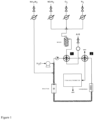
- the test was carried out in the apparatus described in figure 1 .
- a model feed gas for NO x component there was used NO only. More in detail the feed consisted of NH 3 /N 2 , NO/N 2 , O 2 , N 2 .
- Mass flow meters were used to measure and control the single gaseous stream while an injection pump was used to introduce water.
- the feed stream was preheated and premixed and ammonia was added to the gaseous mixture immediately before entering the reactor to avoid side reactions.
- a tubular quartz reactor was employed inserted in a furnace. Temperature was controlled by a thermocouple inserted in the catalyst bed. Activity of the catalysts was measured under stationary as well as dynamic conditions (ramp 5°C /min) in a temperature range of 200°C to 480°C. There were no major differences in the results between the 2 methods applied.
- Powders prepared by the process according to the invention were mixed with approx. 20 weight % of Al 2 O 3 binder (pseudo-boehmit) to an aqueous slurry, the slurry coated on a cordierite substrate (honeycomb) and the water removed by hot air.
- the present invention provides compositions based on TiO 2 /WO 3 /SiO 2 (TWS) comprising Fe-Vanadate.
- Fe/Er Vanadate dopants with different molar ratios of Fe/Er in the dopants.
- catalyst mixtures based on TWS with the dopant FeVO 4 exhibit an improved catalytic activity when compared to the reference materials described in comparative example 1 (commercial catalyst based on TWS containing V 2 O 5 ) and in comparative example 2 (TWS containing ErVO 4 ) when prepared under the same conditions as the comparative materials. More of the details are disclosed in table 9.
- compositions based on TWS in which the dopant comprises Fe, Metals of Rare Earths other than Er eg. Sm, Gd or Y; additionally the Fe/Rare Earth Vanadates may contain other transition metals, eg Mn and Zr.
- a FeVO 4 containing catalyst increases the activity dramatically when the dopant is pre-heattreated at 550°C or 700°C prior to the mixing with the support.
- TiO 2 /WO 3 is a well known state of the art process.
- the compound may be prepared applying a description disclosed in US 4 466 947 , example 1, in which Titanic acid is impregnated with ammoniumparatungstate. On drying and calcination of the mixture the TiO 2 /WO 3 compound will be formed.
- ammonium metavanadate (AMV, containing 76.1% V 2 O 5 ) was dissolved in 1100 mL deionised water at 80°C. After mixing the two solutions under continuous stirring, the pH was adjusted to 7.25 by adding 24% ammonia solution. The precipitate so formed was stirred for another half an hour, filtered, washed several times with deionised water and dried at 120°C overnight yielding 50 g of compound 1.
- the Fe 0.5 Er 0.5 VO 4 was analytically characterized by elemental analysis applying X-Ray Fluorescence method (XRF). Table 3- Elemental analysis of Fe 0.5 Er 0.5 VO 4 V (wt%) Fe (wt%) Er (wt%) Calculated 22.49 12.33 36.92 Found 21.52 13.42 36.67
- Compounds 1-5 and 7-15 are vanadates not employed according to the invention.
- Compound 6 (FeVO 4 ) is a vanadate employed according to the present invention.
- the compounds 2-15 were analytically characterized by elemental analysis using XRF-technique and the software program "Uniquant". Due to lack of standardized reference samples the analytical method will have an uncertainty of approx. +/- 5 % in the reported values.
- Metal -Vanadates (compounds 1, 6 and 13 and Comp 2 as listed in table 5) were also subjected to heat treatment in a muffle furnace at temperatures from 500 - 850°C prior to the mixing with the support material TWS (DT 58) for making the catalyst.
- the compounds prepared (Heat treated Metal-Vanadates) and the conditions applied in the heat treatment step are listed in table 5a.
- Two slurries were formed by suspending 0.2523 g of Fe 0.5 Er 0.5 VO 4 in 5 mL deionised water and 2.7477 g of TiO 2 /WO 3 /SiO 2 support material in 10 mL deionised water. The two slurries were mixed and heated up to 90°C while stirring. The slurry was brought to dryness under continuous stirring at 80-100°C and the residue finally dried overnight at 120°C followed by calcinations at 650°C/2h under air in a muffle furnace. Ultimately the so obtained dried mixture was pressed into pellets, crushed and sieved in range 355-425 ⁇ m.
- This material is considered as "fresh” material.
- Aging of sample was carried out by calcination of the material at a temperature of 700°C for 10 hrs and 100 hrs and at 750°C, and at 800°C for 10 hours in air in a muffle furnace.
- the composition refers to a calculated V content of 1.9 %.
- BET of the catalyst composition was measured after calcination at 650°C/ 2 hrs (fresh material), 700°C/ 10 hrs (aged), 700°C/100 hrs, 750°C/10 hrs (aged) and 800°C/10 hrs (aged) and showed a value of 72 m 2 /g, 60 m 2 /g, 39 m 2 /g, 31 m 2 /g and 19 m 2 /g respectiveley.
- Aging of sample was carried out by calcination of the material at a temperature of 700°C for 10 hours in air.
- Aging of sample was carried out by calcination of the material at a temperature of 750°C for 10 hours in air.
- Two slurries were formed by dissolving 0.2523 g of ErVO 4 in 5 mL deionised water and 2.7477 g of TiO 2 /WO 3 /SiO 2 support material in 10 mL deionised water.
- the two slurries were mixed and heated up to 90°C while stirring.
- the slurry was brought to dryness under continuous stirring at 80-100°C and the residue finally dried overnight at 120°C followed by calcinations at 650°C/2h under air in a muffle furnace.
- the so obtained dried mixture was pressed into pellets, crushed and sieved in range 355-425 ⁇ m.
- This material is considered as "fresh” material.
- Aging of sample was carried out by calcination of the material at a temperature of 700°C for 10 hours in air.
- V-content of the catalyst compositions prepared in examples 1a - 15 as well as for the comparative examples 1 and 2 is given in table 7. There are also listed several BET values reported for the materials calcined at different temperatures (range from 650°C up to 800°C) Table 7, Example 1a - 15 and comparative example 1,2; TWS based catalyst compositions, species of dopant, V-content of catalyst compositions and BET values after heat treatment Example Vanadate Species Preheattreatment of Vanadate [°C/hrs] V-content Cat. Comp.
- Standard Test A was performed according to the parameters disclosed in the table 8 Table 8: Reaction condition and gas composition Catalyst weight 100.0 mg Particle size 355-425 ⁇ m Total flow 0.3 l/min Space velocity 180000 h -1 Temperature 200-480°C NO conc. 200 ppm NH 3 conc. 220 ppm O 2 conc. 20000 ppm H 2 O conc. 10% N 2 conc. balance
- Table 9 shows the NO x removal efficiency of the compositions prepared in the examples 1-15 as well as for the comparative example 1 and 2 after heat treatment of the powder at 650°C/ 2hrs.
- Table 10 shows the NO x removal efficiency of the compositions prepared in the examples listed as well as for the comparative example 1 and 2 after heat treatment of the powder at 700°C/ 10 hrs.
Landscapes
- Chemical & Material Sciences (AREA)
- Engineering & Computer Science (AREA)
- Materials Engineering (AREA)
- Chemical Kinetics & Catalysis (AREA)
- Organic Chemistry (AREA)
- Physics & Mathematics (AREA)
- Thermal Sciences (AREA)
- Health & Medical Sciences (AREA)
- Combustion & Propulsion (AREA)
- Biomedical Technology (AREA)
- Environmental & Geological Engineering (AREA)
- Analytical Chemistry (AREA)
- General Chemical & Material Sciences (AREA)
- Oil, Petroleum & Natural Gas (AREA)
- Catalysts (AREA)
- Exhaust Gas Treatment By Means Of Catalyst (AREA)
- Exhaust Gas After Treatment (AREA)
Description
- The present invention relates to a catalyst composition for selective catalytic reduction of exhaust gases, in the following "catalyst composition", and a process for its preparation. Such a catalyst composition may be used in catalyst application for the removal of NOx, particularly in exhaust gas aftertreatment of diesel- and lean burn engines of automotives. In addition the catalyst composition may also be used in stationary applications (e.g. removal of NOx in power plant stations).
- The most widely employed technology for removal of NOx out of exhaust gases is S(elective) C(atalytic) R(eduction), e.g. O. Kröcher, Chapter 9 in « Past and Present in DeNOx Catalysis », edited by P. Granger et al., published by Elsevier 2007 . Accordingly, NOx is removed by Ammonia into Nitrogen and water according to the reaction:
4 NO + 4 NH3 + O2 = 4 N2 + 6 H2O
- For the stationary application mainly V2O5 doped TiO2/WO3 compositions are used commercially since 1970 to remove nitrogen oxide emissions of fossil fuel power plants.
- Already 15 years ago, the idea was discussed to apply SCR also on mobile diesel engines, which is now an emerging technology for the NOx reduction from heavy duty diesel vehicles, passenger cars and off road machines.
- A typical SCR system consists of a reduction catalyst, urea injection and dosing components, pipes and a storage tank. A huge number of modern catalysts are extruded substrates or coated substrates with Vanadium Pentaoxide (V2O5) as the catalytically active component.
- Catalytic coatings of zeolite based SCR are currently being developed because of the limited temperature stability of the vanadium catalysts and the fact that Vanadium Pentaoxide (V2O5) has been classified as a health risk in some countries. Increased temperature stability is especially important in SCR catalysts installed downstream a particulate filter since relatively high temperatures are generated during filter regeneration ( M. Rice, R. Mueller at al., Development of an Integrated NOx and PM Reduction Aftertreatment System: SCRi for Advanced Diesel Engines, SAE technical paper 2008-01-132, SAE World Congress Detroit, Michigan Apr 14-17, 2008)
- There are further reports on the commercially applied well known V2O5/WO3-TiO2 material for exhaust gas aftertreatment of automotives by O. Kröcher in Chapter 9, p. 267f in « Past and Present in DeNOx Catalysis », edited by P. Granger et al.
- According to the presentation given by Dirk Vatareck (Catalysts Automotive Applications, Argillon) at the 3rd CTI Forum SCR Systems (Bonn 09 Apr 2008) Titania-tungsten oxide based catalysts containing V2O5 as active component are applied for making automotive catalysts in a huge number (approx. 4 Mio. Catalysts/year).
- The preparation of V2O5 containing materials based on TiO2/WO3 which additionally may contain oxides out of transition metals, Rare Earths and other elements and the application in SCR is widely disclosed in numerous publications, patent applications and patents. For example
GB 1 495 396 -
EP 787 521 -
US 4221 768 reports on V2O5 containing materials based on TiO2 as a support material and additional oxides out of transition metals as dopants. Additional SCR-Materials which contains V2O5 supported on TiO2 are also described inGB 1 430 730 - V2O5 containing materials which contain TiO2, SiO2, S and Oxides of Ce, Sn, Mo and W are reported in UK Appl.
GB 2 149 680 -
US 4 466 947 describes V-containing denitration catalysts in which the vanadium is present in form of an oxide or a sulfate. -
EP 1 145 762 A1 describes a process for the preparation of a vanadia SCR-catalyst supported on titania. - The main disadvantage of the V-based catalyst type is the limited stability at temperatures above 600°C.
- A report on the stability of a SCR system based on TiO2/WO3/V2O5 is given by Jan MT et al. in Chemical Engineering & Technology, Vol. 30, No10, 1440 -1444, 2007. Accordingly a deactivation of the catalyst occurs since V2O5 melts at approx. 650°C.
- A TiO2/WO3/V2O5 suitable SCR catalyst for NOx removal of Diesel-powered vehicles is described in
US 6 805 849 B1 ,column 2. Although such a catalyst has shown good performance it was found that sustained high temperature operation can cause catalyst deactivation. Heavy duty diesel engines, which are almost exclusively charged, can produce exhaust gases at greater than 500°C. Under conditions of high load and/or high speed, and such temperatures deactivation of the catalyst may occur. - In the presentation of Dirk Vatareck (Catalysts Automotive Applications, Argillon) at the 3rd CTI Forum SCR Systems (Bonn 09 Apr 2008) there were reported maximum operation temperatures for a TiO2/WO3/V2O5 catalyst of 550°C and 580° C for short term basis.
- In view of the application under EURO 6 an improvement in thermal stability of a V2O5 containing TiO2/WO3 based catalyst was reported in the presentation of Dirk Vatareck (Catalysts Automotive Applications, Argillon) at the 3rd CTI Forum SCR Systems (Bonn 09 Apr 2008). Accordingly a catalyst containing V2O5 as active component and a support material consisting of TiO2/WO3 and additionally containing Si may be operated at max. temp. of 600°C and 650° on a short term basis.
- Vanadium based systems with improved thermal stability are also reported by James. W. Girard et al., "Technical Advantages of Vanadium SCR Systems for Diesel NOx Control in Emerging Markets", SAE technical paper 2008-01-132, SAE World Congress Detroit, Michigan Apr 14-17, 2008. After ageing at 600°C/50 hrs the catalyst is still active. However, because of high exhaust gas temperatures possible during active Diesel Particulate Filter (DPF) regeneration, vanadium SCR catalysts are usually not considered for these applications.
- With increasingly stringent automobile exhaust emission regulations for Diesel vehicles (US 2010 and EURO 6 regulations) aftertreatment systems containing a Diesel Particulate Filter (DPF) as well as a SCR catalyst will be required in future. Such systems will demand a higher temperature stability of the SCR catalyst and V2O5 based systems are not considered to be viable for such an application as additionally to the problem of heat stability V2O5 may be exhausted also to the environment (J. Münch et al "Extruded Zeolite based Honeycomb Catalyst for NOx Removal from Diesel Exhaust, SAE Paper 2008-01-1024).
- Since the activity of SCR catalysts in the temperature range of 180 - 350°C is important in the diesel application there have been established systems to improve catalytic activity in the low temperature range.
- For example with the aid of a diesel oxidation catalyst (DOC) attached in front of the SCR system (NO being present as a majority (= more than 90%) in the raw emission of the diesel engine) is oxidized to form NO2. The NO2 can be used to burn up particulates and to improve the low temperature activity (in the range 180 - 350°C), see M. Rice, R. Mueller at al., Development of an Integrated NOx and PM Reduction Aftertreatment System: SCRi for Advanced Diesel Engines, SAE technical paper 2008-01-132, SAE World Congress Detroit, Michigan Apr 14-17, 2008.
- In the same publication there are summarized the design parameters of two engine/aftertreatment scenarios for US 2010 / Euro 6. One concept will lead to high particulate matters flow NOx with active regeneration of the PM-filter. The SCR catalyst proposed for the described scenario is a zeolite. Zeolites must be used since higher heat resistance of the SCR system is required due to the active regeneration of the PM filter.
- The second concept comprises an engine concept which will lead to low concentrations of PM and low NOx concentrations. The SCR catalyst may consist of a vanadium based material or a zeolite. Both concepts will use a diesel oxidation catalyst (DOC) prior to the SCR treatment. The problem of low temperature activity of SCR catalysts is also addressed in
US 2008/0234126 A1 . It is described a method for the preparation of a vanadium/titania based catalyst with enhanced low temperature activity for removing nitrogen oxides at a window of 300°C and lower. However,US 2008/0234126 A1 does not address the problem of stability of the catalyst > 600°C. - An improvement in terms of the thermal stability of a V-containing TiO2/WO3/SiO2 "SCR catalyst" is reported in the
WO 2005/046864 A1 . According to a preferred embodiment the vanadium in the formulations based on TiO2/WO3/(SiO2) is present not in form of Vanadiumpentaoxide (V2O5) but in form of a Rare Earth Vanadate (REVO4). The Rare Earth vanadate may be introduced to the support material (TiO2/WO3/(SiO2)) as a powder by simple mixing route (of the support and the Rare Earth Vanadate) following by calcination of the mixture. - Alternatively the Rare Earth Vanadates may be formed in the composition also in situ during the preparation (calcination) of the catalyst composition from precursors eg. Rare Earth acetate and Ammoniummetavanadate. The presence of the Rare Earth Vanadates in the catalyst is proved by XRD.
- The catalyst compositions referred in
WO 2005/046864 A1 exhibit good NOx conversion activity after being heat treated at 750°C / 10 hrs, whereas in contrast the reference material containing V2O5 on the TiO2/WO3/SiO2 support may be considered to be almost inactive after being heat treated (aged) at 750°C / 10 hrs. - However,
WO 2005/046864 A1 does not describe any NOx conversion rates below 250°C, eg at 230°C and 200 °C which is important for the automotive SCR systems. As shown in comparative example 2 an ErVO4 doped TiO2/WO3/SiO2 composition, which refers to Example 18, Table 2b inWO 2005/046864 A1 , was subjected to NOx conversion test at temperatures at 200°C and 230°C. NOx conversion was found to be zero at 200° and 230°C and 25 % at 250°C for the "fresh" material. - After heat treatment of the compound at 700°C/ 10 hrs there was found an increase of catalytic activity exhibiting a relatively low NOx conversion at 200°C and 230 °C being 6 % at and 20% respectively; at 250°C there was measured a conversion rate of 55 %.
- Comparative example 1 refers to a commercially available catalyst containing V2O5 supported on TiO2/WO3/SiO2 which is currently applied in heavy duty diesel SCR. After heat treatment at 650°C / 2 hrs the material still exhibits activities. However the activity in the range 200 - 250°C is already less than 50%; the activity drops significantly after heat treatment 700°C/10 hrs.
- In addition in comparative example 1.1 it is shown, that a TiO2/WO3/SiO2: V2O5 catalyst is almost inactive after being heat treated at 750°C/10 hrs.
- As a summary out of the state of the art review it may be concluded that RE-Vanadate doped TiO2/WO3/SiO2 materials are more heat stable compared to the V2O5 doped materials but show a weakness in NOx conversion at operating temperatures below 300°C. V2O5 containing TiO2/WO3/SiO2 materials seem to be operable up to 650°C but loose already activity.
- Keeping in mind the above problems occurring in the prior art the objective of the invention is to provide
- a) V-based compositions with improved heat resistance up to 700°C when compared to V2O5 containing state of the art materials
- b) V-based compositions with improved heat resistance up to 800°C and improved NOx activity below 300°C when compared to RE-Vanadate state of the art materials.
- The catalyst composition according to the invention is defined in claim 1.
- Disclosed herein are also catalyst compositions comprising TransitionMetal Vanadates and mixed TransitionMetal/RareEarth Vanadates and a support S comprising TiO2.
- For the purpose of the present specification and claims the term "RareEarth" means a RareEarth element or a mixture thereof, i.e. more than one RareEarth element. According to IUPAC the RareEarth elements are Sc, Y and the fifteen Lanthanides La, Ce, Pr, Nd, Pm, Sm, Eu, Gd, Tb, Dy, Ho, Er, Tm Yb and Lu.
- For the purpose of the present specification and claims the term "TransitionMetal" means a TransitionMetal element or a mixture thereof, i.e. more than one TransitionMetal element. According to IUPAC a TransitionMetal is an element whose atom has an incomplete d sub-shell, or which can give rise to cations with an incomplete d sub-shell. However, for the purpose of the present specification and claims, the term TransitionMetal shall only comprise the elements of groups 4-11 on the periodic table and Zn.
- The present invention is based on the surprising finding that the new compositions based on TiO2/WO3 (TW) or TiO2/WO3/SiO2 (TWS) have enhanced heat resistance and enhanced NOx conversion activity when compared to the state of the art materials. According to the present invention, these new catalyst compositions contain dopants based on Fe-Vanadate. Hence, such compounds may be useful for exhaust gas after treatment of diesel and lean burn engines in combination with a particulate filter in future SCR systems.
- A preferred embodiment is characterized in that S contains SiO2 in an amount of 4-15 wt.-%, particularly in an amount of 5-10 wt.-%.
- The present invention is also directed to a process for the preparation of the catalyst composition as defined in claim 3.
- A further preferred embodiment is characterized in that the Fe-Vanadate prior to the mixing to the support is pre-heattreated separately, preferably in the range of higher than 350°C and below its melting point, which pre-heattreatment results in a significant increase of the catalytic activity of the catalysts.
- For the preparation of the Fe-Vanadate, there was applied a wet chemical process which in principle is based on the method described in
WO 2005/046864 and applies precipitation and co-precipitation method. - The compositions based on the support TiO2/WO3 (TW) and TiO2/WO3/SiO2 (TWS) which are doped with Fe-Vanadate according to the invention are preferably produced by a process comprising
- (a) suspending the support material TW, TWS and the Fe-Vanadate in water forming an intimate mixture between the support (TW, TWS) and the Vanadate, the Vanadate optionally being pre-heattreated > 350°C below its melting point prior to its mixing with the support
- (b) evaporating the excess of water over several hours
- (c) drying the mixture at approx. 120°C for approx. 10 -16 hrs
- (d) calcining the mixture under air at 650°C / 2 hrs, optionally (depending on the heat resistance of the compound) also at lower (eg 500°C) or higher temperatures, eg in a range between 650°C and 850°C up to 120 hours
- (e) optionally transforming the calcined powder into a shaped form
- (f) optionally coating the calcined powder on a ceramic or metallic honeycomb.
- The content of the dopant introduced to the support material is typically 8.4 % by weight but may be applied in lower (0.2 %) and higher concentrations (up to 25 %) also.
- The compositions prepared according to the invention were calculated on the content of Vanadium out of the amounts of support and dopant (both analytically well characterised) used for the preparation of the compositions.
- The invention is also directed to a catalyst comprising a catalyst composition as described above and a binder which typically may comprise Al2O3 or Silica.
- The compositions were characterised on specific surface area and partly in terms of XRD structure.
- The specific surface area of the materials were measured by BET method using N2 adsorption/desorption at 77 K employing a Micromeritics Tristar apparatus, after pretreatment under vacuum at 150°C for 1.5 hours.
- XRD Measurements were made by using a Philips X'Pert diffractometer using a Ni-filtered Cu Kα radiation at 40 KV and 40 mA.
- For catalytic testing on NOx removal efficiency the compositions were subjected to catalytic testing.
- There were applied two tests, test A (standard test on powder) and test B (test with real catalyst).
- Conditions for catalytic testing:
- Powders yielded by the process according to the invention were pressed into pellets, crushed and sieved in the range 355-425 µm.
- For the measurement of the catalytic activity after heat treatment the sieved powders were subjected to calcination (ageing) in a static muffle furnace under air atmosphere at 700°C/ 10, 750°C/10 and partly at 800°C/10 hrs.
- The test was carried out in the apparatus described in
figure 1 . As a model feed gas for NOx component there was used NO only. More in detail the feed consisted of NH3/N2, NO/N2, O2, N2. Mass flow meters were used to measure and control the single gaseous stream while an injection pump was used to introduce water. The feed stream was preheated and premixed and ammonia was added to the gaseous mixture immediately before entering the reactor to avoid side reactions. A tubular quartz reactor was employed inserted in a furnace. Temperature was controlled by a thermocouple inserted in the catalyst bed. Activity of the catalysts was measured under stationary as well as dynamic conditions (ramp 5°C /min) in a temperature range of 200°C to 480°C. There were no major differences in the results between the 2 methods applied. - Gas composition analysis was carried out with an FT-IR spectrometer (MKS Multigas Analyzer 2030) equipped with a heated multi-pass gas cell (5.11m).
Table 1: Reaction conditions and gas composition for catalytic test A Catalyst weight 100.0 mg Particle size 355-425 µm Total flow 0.3 l/min Space velocity 180000 h-1 Temperature 200-480°C (Stationary or with ramp 3°C/ min) NO conc. 200 ppm NH3 conc. 220 ppm O2 conc. 20000 ppm H2O conc. 10% N2 conc. balance - Powders prepared by the process according to the invention were mixed with approx. 20 weight % of Al2O3 binder (pseudo-boehmit) to an aqueous slurry, the slurry coated on a cordierite substrate (honeycomb) and the water removed by hot air.
- The catalyst was subjected to calcination (ageing) in a 200 l/h airflow containing 10% H2O at 750°/ 8 hrs (= Hydrothermal Ageing). Additional ageing was performed at 750° / 8hrs additionally at 750°C for 20 hrs and partly in a further step at 800°C for 20 hrs in the presence of 10% water.
- Unless otherwise reported the reaction conditions given in Table 2 were used.
Table 2: Reaction conditions and gas composition Reactor 2.54 cm Catalyst Cordierite honeycomb 400cpsi, h = 5.08 cm, Vol = 25 cm3 Coating Approx. 120 - 160 g /Liter ( 20 % binder included) Space velocity 30 000 h-1 Temperature 200-550°C / ramp of 5°C/ min NOx conc. 400 ppm at different conditions (a) NO, more than 90% (b) NO2 about 75% (c) NO:NO2 = 1:0.9 to 1.1 NH3 : NOx 1 O2 conc. 6% H2O conc. 7 % N2 conc. balance - In one aspect the present invention provides compositions based on TiO2/WO3/SiO2 (TWS) comprising Fe-Vanadate.
- Disclosed herein are also Fe/Er Vanadate dopants with different molar ratios of Fe/Er in the dopants.
- In another aspect of the present invention it was found, that catalyst mixtures based on TWS with the dopant FeVO4 exhibit an improved catalytic activity when compared to the reference materials described in comparative example 1 (commercial catalyst based on TWS containing V2O5) and in comparative example 2 (TWS containing ErVO4) when prepared under the same conditions as the comparative materials. More of the details are disclosed in table 9.
- Disclosed herein are also compositions based on TWS in which the dopant comprises Fe, Metals of Rare Earths other than Er eg. Sm, Gd or Y; additionally the Fe/Rare Earth Vanadates may contain other transition metals, eg Mn and Zr.
- In another aspect of the present invention it was surprisingly found that a pre-heattreatment of the Vanadate prior to the mixing with the support will give a significant contribution to the catalytic activity of the mixtures, particularly after ageing of the catalysts at 700°C and 750°C respectiveley.
- As shown in examples 6, 6b and 6d in table 10 a FeVO4 containing catalyst increases the activity dramatically when the dopant is pre-heattreated at 550°C or 700°C prior to the mixing with the support.
- In the following preferred embodiments the invention is described more in detail.
- There were used 2 different support materials based on Titaniumoxide which are doped with tungstenoxide. In addition the support material used for the major number of experiments is doped with SiO2. Both materials are commercially available and were sourced from Cristal Global. They are known under the Trade names Tiona DT58 (SiO2 doped material) and DT 52 (TiO2/WO3 material).
- For the preparation of the catalyst compositions there was used a material having the following characteristics:
- Specific surface area (BET): 114 m2/g
- WO3: 8.8 %
- SiO2: 9.9 %
- TiO2: remainder
- SO3: 0.16 %
- P2O5: 0.05 %
- A synthesis for the support material is described in
WO 2005/046864 A1 . -
- Specific surface area (BET): 90 m2/g
- WO3: 10 %
- TiO2: remainder
- SO3: 1.35 %
- The preparation of TiO2/WO3 is a well known state of the art process. For example the compound may be prepared applying a description disclosed in
US 4 466 947 , example 1, in which Titanic acid is impregnated with ammoniumparatungstate. On drying and calcination of the mixture the TiO2/WO3 compound will be formed. - The stoichiometric amount of iron (III) nitrate nonahydrate (45.2 g; containing 19.5 % Fe2O3) and erbium nitrate hexahydrate (50.4 g; containing 41.9% Er2O3) were dissolved in deionised water (318.5 mL) to yield a Mixed Metal Nitrate Solution.
- On the other hand, 25.9 g of ammonium metavanadate (AMV, containing 76.1% V2O5) was dissolved in 1100 mL deionised water at 80°C. After mixing the two solutions under continuous stirring, the pH was adjusted to 7.25 by adding 24% ammonia solution. The precipitate so formed was stirred for another half an hour, filtered, washed several times with deionised water and dried at 120°C overnight yielding 50 g of compound 1. The Fe0.5Er0.5VO4 was analytically characterized by elemental analysis applying X-Ray Fluorescence method (XRF).
Table 3- Elemental analysis of Fe0.5Er0.5VO4 V (wt%) Fe (wt%) Er (wt%) Calculated 22.49 12.33 36.92 Found 21.52 13.42 36.67 - Similarly the other Metal- and Mixed Metal Vanadates (compounds 2 - 17) as shown in table 4 were prepared following the same procedure as referred to for compound 1.
- Compounds 1-5 and 7-15 are vanadates not employed according to the invention. Compound 6 (FeVO4) is a vanadate employed according to the present invention.
- The species and quantities of feedstock materials applied for making the Vanadates (50 g each) are given in Table 4. Erbiumvanadate (ErVO4) which was used in the comparative examples 2 and 3 was prepared according to the description disclosed under 1.4.1 in
WO 2005/046864 .Table 4, Preparation of Metal Vanadates - Species and quantities of feedstockmaterials applied Comp Vanadate AMV (V2O5: 77.6%) Fe(NO3)3 × 9H2O (Fe2O3 : 19.5%) Er(NO3)3 × 6H2O (Er2O3 : 41.9%) Sm(NO3)3 × 6H2O (Sm2O3 : 39.02%) Ce(NO3)3 × 6H2O (CeO2 : 39.6%) Y(NO3)3 × 6H2O (Y2O3 : 23.9%) Mn(NO3)2 × 6H2O (MnO2: 34.6%) ZrNitrate Solution (ZrO2 : 21.4%) Gd(NO3)3 × 6H2O (Gd2O3 : 40%) [g Mat] [g Mat] [g Mat] [g Mat] [g Mat] [g Mat] [g Mat] [g Mat] [g Mat] 2 Fe0.9Er0.1VO4 32.2 101.2 12.6 3 Fe0.8Er0.2VO4 31.2 92.7 18.3 4 Fe0.75Er0.25VO4 29.5 77.2 28.7 5 Fe0.65Er0.15VO4 27.9 63.4 38.1 6 FeVO4 34.3 119.7 7 Fe0.3Sm0.2Mn0.5VO4 34.1 40.7 13.6 38.3 8 Fe0.5Y0.02Zr0.48VO4 36 62.9 2.3 42.5 9 Fe0.1Ce0.5Mn0.4VO4 36.8 14.6 36 33 10 Fe0.8Gd0.2VO4 30.5 85.6 23.7 11 Fe0.5Gd0.5VO4 26.3 46.2 51.2 12 Fe0.3Sm0.7VO4 24.6 30.1 66.0 13 Fe0.2Er0..8VO4 13 15.8 70.2 14 Fe0.1Er0.9VO4 22.1 7.6 75.8 15 Fe0.5Er0.25Gd0.25VO4 26.7 46.4 25.8 25.3 - The compounds 2-15 were analytically characterized by elemental analysis using XRF-technique and the software program "Uniquant". Due to lack of standardized reference samples the analytical method will have an uncertainty of approx. +/- 5 % in the reported values.
- Data of elemental analysis are referred to in Table 5.
Table 5, Elemental analysis of Vanadates prepared Comp Vanadate-Dopant V (wt%) Fe (wt%) RE **) (wt%) Calc. found Calc. found Calc. found 2 Fe 0.9 Er 0.1 VO4 28.0 26.4 27.6 29.2 9.2 9.4 3 Fe 0.8 Er 0.2 VO4 26.4 25.5 23.1 23.6 17.3 17.7 4 Fe 0.75 Er 0.25 VO4 25.6 23.5 21.1 22.8 21.1 21.7 5 Fe 0.65 Er 0.15 VO4 24.2 22.5 17.3 18.8 27.9 28.5 6 FeVO4 29.8 27.2 32.7 35.4 7 Fe 0.3 Sm 0.2 Mn 0.5 VO4 29.7 28.3 11.1 11.5 9.15 9.15 8*) Fe 0.5 Y 0.02 Zr 0.48 VO4 31.3 26.6 17.1 19.9 1.5 1.1 9*) Fe 0.1 Ce 0.5 Mn 0.4 VO4 31.9 27.8 4.0 3.8 23.2 21.5 10 Fe 0.8 Gd 0.2 VO4 26.6 25.4 23.4 24.8 16.5 16.4 11 Fe 0.5 Gd 0.5 VO4 23.0 21.5 12.6 13.7 35.5 35.7 12 Fe 0.3 Sm 0.7 VO4 21.5 21.5 7.1 7.3 44.4 43.6 13 Fe0.2 Er0.8VO4 19.6 19 4.3 4.7 51.5 51.5 14 Fe 0.1 Er 0.9 VO4 18.8 20.0 2.1 2.1 55.5 52.8 15 Fe 0.5 Er 0.25 Gd 0.25 VO4 22.7 22.5 12.5 13.2 36.2 35.5 Comp 2ErVO4 17.0 17.2 - - 55.7 56.5 *) according to XRD in the compounds 8 -9 there were detected ZrV2O7 and MnV2O7 phases
** ) RE = Er, Sm, Gd, Y, Ce - Metal -Vanadates (compounds 1, 6 and 13 and
Comp 2 as listed in table 5) were also subjected to heat treatment in a muffle furnace at temperatures from 500 - 850°C prior to the mixing with the support material TWS (DT 58) for making the catalyst. The compounds prepared (Heat treated Metal-Vanadates) and the conditions applied in the heat treatment step are listed in table 5a.Table 5a - Heat treated Metal Vanadates and conditions applied in the heat treatment step Comp Metal -Vanadate Heat Treatment Conditions [°C / hrs] 1a Fe 0.5 Er 0.5 VO4 500 / 20 1c Fe 0.5 Er 0.5 VO4 600 / 20 1d Fe 0.5 Er 0.5 VO4 700 / 20 1e Fe 0.5 Er 0.5 VO4 800 / 20 6b FeVO4 550 / 24 6d FeVO4 700 / 20 13d Fe 0.1 Er 0..9 VO4 700 / 20 13f Fe 0.1 Er 0..9 VO4 850 / 20 Comp 2d ErVO4 700 / 20 Comp 2f ErVO4 850 / 20 - Two slurries were formed by suspending 0.2523 g of Fe0.5Er0.5VO4 in 5 mL deionised water and 2.7477 g of TiO2/WO3/SiO2 support material in 10 mL deionised water. The two slurries were mixed and heated up to 90°C while stirring. The slurry was brought to dryness under continuous stirring at 80-100°C and the residue finally dried overnight at 120°C followed by calcinations at 650°C/2h under air in a muffle furnace. Ultimately the so obtained dried mixture was pressed into pellets, crushed and sieved in range 355-425 µm.
- This material is considered as "fresh" material.
- Aging of sample was carried out by calcination of the material at a temperature of 700°C for 10 hrs and 100 hrs and at 750°C, and at 800°C for 10 hours in air in a muffle furnace.
- The composition refers to a calculated V content of 1.9 %.
- BET of the catalyst composition was measured after calcination at 650°C/ 2 hrs (fresh material), 700°C/ 10 hrs (aged), 700°C/100 hrs, 750°C/10 hrs (aged) and 800°C/10 hrs (aged) and showed a value of 72 m2/g, 60 m2/g, 39 m2/g, 31 m2/g and 19 m2/g respectiveley.
- Preparation of catalyst compositions TiO2/WO3/SiO2 : MeVO4 as listed in table 7.
- The catalyst compositions referred to in examples 1a-15 and as disclosed in table 7 were prepared according to the same procedure as disclosed in example 1.
- The quantities of the support material (TiO2/WO3/SiO2), the species and the quantities of Me-Vanadates used for the preparation of the catalyst compositions as well as the applied ageing temperatures and ageing times are listed in table 6.
Table 6, Examples 1a -15 - Quantities of TWS and Vanadates used for preparation of catalyst compositions and ageing conditions applied prior to catalytic testing Example Vanadate Species Preheat-treatment of Vanadate [°C/hrs] TWS [g] MeVO4 [g] Ageing °C / hrs 1a Fe0.5Er0.5VO4 500 / 20 2.7477 0.2523 700/10; 750/10; 800/10 1c Fe0.5Er0.5VO4 600 / 20 2.7477 0.2523 700/10; 750/10; 800/10 1d Fe0.5Er0.5VO4 700 / 20 2.7477 0.2523 700/10; 750/10; 800/10 1e Fe0.5Er0.5VO4 800 / 20 2.7477 0.2523 700/10; 750/10; 800/10 2 Fe0.9Er0.1VO4 none 2.7477 0.2523 3 Fe0.8Er0.2VO4 none 2.7477 0.2523 700/10 4 Fe0.75Er0.25VO4 none 2.7477 0.2523 700/10; 750/10; 5 Fe0.65Er0.35VO4 none 2.7477 0.2523 6 FeVO4 none 2.7477 0.2523 700/10 6b FeVO4 550 / 24 2.7477 0.2523 700/10; 750/10; 6d FeVO4 700 / 20 2.7477 0.2523 700/10 7 Fe0.3Sm0.2Mn0.5VO4 none 2.7477 0.2523 8 Fe0.5Y0.02Zr0.48VO4 none 2.7477 0.2523 9 Fe0.1Ce0.5Mn0.4VO4 none 2.7477 0.2523 10 Fe0.8Gd0.2VO4 none 2.7477 0.2523 700/10 11 Fe 0.5 Gd 0.5 VO4 none 2.7477 0.2523 700/10; 700/50; 700/100; 750/10; 12 Fe0..3Sm0.7VO4 none 2.7477 0.2523 700/10; 750/10; 13 Fe0.2 Er0.8VO4 none 14d Fe0.1 Er0.9VO4 700 / 20 2.7477 0.2523 800/10; 14f Fe0.1 Er0.9VO4 850 / 20 2.7477 0.2523 800/10; 15 Fe 0.5 Er 0.25 Gd 0.25 VO4 none 2.7477 0.2523 700/10; 750/10 -
- Commercial Catalyst composition based on TiO2/WO3/SiO2: V2O5
- A commercial available catalyst (monolith) based on the composition TiO2/WO3/SiO2 : V2O5 was crushed and sieved over 450µm and 250µm. The fraction between 250 µm and 450 µm was heat treated at 650°C/2 hrs
- Aging of sample was carried out by calcination of the material at a temperature of 700°C for 10 hours in air.
- 77.2 mg of Ammoniummetavanadate were dissolved in 10 ml of 1N Oxalic Acid to form the blue complex of Ammoniumvanadyloxalate (NH4)2[VO(C2O4)2] . Then 1940 g of TWS support was added. The slurry was brought to dryness under continuous stirring at 80 -100°C. Finally the solid was dried at 120°C overnight and calcined at 650°C for 2 hrs, pressed into pellet, crushed and sieved in the range 355 -425 µm.
- Aging of sample was carried out by calcination of the material at a temperature of 750°C for 10 hours in air.
- Two slurries were formed by dissolving 0.2523 g of ErVO4 in 5 mL deionised water and 2.7477 g of TiO2/WO3/SiO2 support material in 10 mL deionised water. The two slurries were mixed and heated up to 90°C while stirring. The slurry was brought to dryness under continuous stirring at 80-100°C and the residue finally dried overnight at 120°C followed by calcinations at 650°C/2h under air in a muffle furnace. Ultimately the so obtained dried mixture was pressed into pellets, crushed and sieved in range 355-425 µm.
- This material is considered as "fresh" material.
- Aging of sample was carried out by calcination of the material at a temperature of 700°C for 10 hours in air.
- The calculated V-content of the catalyst compositions prepared in examples 1a - 15 as well as for the comparative examples 1 and 2 is given in table 7. There are also listed several BET values reported for the materials calcined at different temperatures (range from 650°C up to 800°C)
Table 7, Example 1a - 15 and comparative example 1,2; TWS based catalyst compositions, species of dopant, V-content of catalyst compositions and BET values after heat treatment Example Vanadate Species Preheattreatment of Vanadate [°C/hrs] V-content Cat. Comp. [%] BET 650°/2 hrs [m2/g] BET 700°/10 hrs [m2/g] BET 750°/10 hrs [m2/g] BET 800°/10 hrs [m2/g] 1a Fe0.5Er0.5VO4 500 / 20 1.9 86 60 45 14 1c Fe0.5Er0.5VO4 600 / 20 1.9 84 60 46 15 1d Fe0.5Er0.5VO4 700 / 20 1.9 86 60,5 47 21 1e Fe0.5Er0.5VO4 800 / 20 1.9 91 64 51 28 2 Fe0.9Er0.1VO4 none 2.4 60 10 6 3 Fe0.8Er0.2VO4 none 2.2 66 31 7 4 Fe0.75Er0.25VO4 none 2.2 68 26 8 5 Fe0.65Er0.35VO4 none 2.1 70 43 13 6 FeVO4 none 2.5 63 15 4 6b FeVO4 550 / 24 2.5 81 38 6d FeVO4 700 / 20 2.5 86 44 7 Fe0.3Sm0.2Mn0.5VO4 none 2.3 38 3 3 8 Fe0.5Y0.02Zr0.48VO4 none 2.3 66 6 5 9 Fe0.1Ce0.5Mn0.4VO4 none 2.0 36 2.5 2.4 10 Fe0.8Gd0.2VO4 none 2.2 68 17 11 Fe 0.5 Gd 0.5 VO4 none 1.9 77 54 (53 at 700°C/50 hrs) 12 Fe0..3Sm0.7VO4 none 1.8 83 54 13 Fe0.2 Er0.8Vo4 none 1.6 14d Fe0.1 Er0.9VO4 700 / 20 1.6 90 48 15 Fe 0.5 Er 0.25 Gd 0.25 VO4 none 1.9 82 57 39 Comp 1 V2O5 none 1.7 44 23 7 Comp 2 ErVO4 none 1.5 92 68 55 Comp 2d ErVO4 700 / 20 1.5 91 52 - Standard Test A was performed according to the parameters disclosed in the table 8
Table 8: Reaction condition and gas composition Catalyst weight 100.0 mg Particle size 355-425 µm Total flow 0.3 l/min Space velocity 180000 h-1 Temperature 200-480°C NO conc. 200 ppm NH3 conc. 220 ppm O2 conc. 20000 ppm H2O conc. 10% N2 conc. balance - Table 9 shows the NOx removal efficiency of the compositions prepared in the examples 1-15 as well as for the comparative example 1 and 2 after heat treatment of the powder at 650°C/ 2hrs.
- The catalytic test results showed that all the materials in the examples 1-15 showed a better activity against the comparative example 2.
- Some of the materials, particularly the FeVO4 containing composition referred to in example 6 exhibited a significant better catalytic activity when compared to comparative example 1.
Table 9, NOx conversion in % of catalyst compositions (examples 1-15 and comparative example 1 and 2) heat treated 650°C /2 hrs Example Species V-dopant Preheat-treatment of Vanadate [°C/ hrs] [%] at 200 °C [%] at 230 °C [%] at 250 °C [%] at 270 °C [%] at 300 °C [%] at 320 °C [%] at 350 °C [%] at 380 °C [%] at 420 °C [%] at 450 °C [%] at 480 °C 1 Fe0.5Er0.5VO4 none 19 34 57 74 82 1a Fe0.5Er0.5VO4 500/20 15 41 60 77 91 95 97 96 95 91 80 1b Fe0.5Er0.5VO4 600/20 17 38 56 72 86 90 93 94 92 87 78 1d Fe0.5Er0.5VO4 700/20 9 29 48 67 86 91 93 93 88 77 64 1e Fe0.5Er0.5VO4 800/20 2 6 11 18 32 42 58 68 73 74 73 2 Fe0.9Er0.1VO4 none 30 43 64 75 89 3 Fe0.8Er0.2VO4 none 30 35 54 67 98 4 Fe0.75Er0.25VO4 none 33 65 75 93 97 5 Fe0.65Er0.35VO4 none 21 34 49 65 80 6 FeVO4 none 40 74 72 88 93 6b FeVO4 550/24 35 66 82 91 96 97 97 97 96 87 73 6d FeVO4 700/20 31 62 77 88 95 97 96 96 87 74 58 7 Fe0.3Sm0.2Mn0.5VO 4 none 21 46 66 79 87 8 Fe0.5Y0.02Zr0.48VO4 none 19 46 62 88 91 9 Fe0.1Ce0.5Mn0.4VO4 none 26 60 73 66 76 10 Fe0.8Gd0.2VO4 none 36 41 58 72 84 11 Fe 0.5 Gd 0.5 VO4 none 11 25 55 55 71 12 Fe0..3Sm0.7VO4 none 5 15 28 37 65 13 Fe0.2Er0.8VO4 none 0 17 32 49 74 84 92 94 93 90 84 15 Fe 0.5 Er 0.25 Gd 0.25 VO4 none 14 37 57 74 90 94 97 97 96 95 87 Comp 1 V2O5 34 41 50 72 83 Comp 2 ErVO4 none 0 0 25 41 69 Comp 2d ErVO4 700/20 1 4 8 13 22 29 34 38 42 42 42 - Table 10 shows the NOx removal efficiency of the compositions prepared in the examples listed as well as for the comparative example 1 and 2 after heat treatment of the powder at 700°C/ 10 hrs.
- All examples with the exception of example 6 show better activity in view of the comparative example 1 and 2.
Table 10, NOx conversion in % of catalyst compositions heat treated 700°C /10 hrs Example Species V-dopant Preheat-treatment of Vanadate [°C/ hrs] [%] at 200 °C [%] at 230 °C [%] at 250 °C [%] at 270 °C [%] at 300 °C [%] at 320 °C [%] at 350 °C [%] at 380 °C [%] at 420 °C [%] at 450 °C [%] at 480 °C 1 Fe0.5Er0.5VO4 none 8 24 41 57 71 81 88 91 91 90 86 1a Fe0.5Er0.5VO4 500/20 25 43 56 69 84 91 97 98 98 97 94 1b Fe0.5Er0.5VO4 600/20 22 50 70 85 95 97 98 99 98 93 83 1d Fe0.5Er0.5VO4 700/20 23 53 74 89 98 99 99 99 98 91 81 1e Fe0.5Er0.5VO4 800/20 15 35 53 71 86 91 95 96 94 88 80 3 Fe0.8Er0.2VO4 none 29 62 81 96 4 Fe0.75Er0.25VO4 none 42 45 50 65 6 FeVO4 none 2 13 19 28 39 6b FeVO4 550/24 21 62 80 92 98 99 99 99 94 81 64 6d FeVO4 700/20 54 86 96 98 98 96 97 96 77 60 42 10 Fe0.8Gd0.2VO4 none 9 25 33 44 61 11 Fe 0.5 Gd 0.5 VO4 none 10 28 44 62 78 12 Fe0..3Sm0.7VO4 none 14 36 54 74 87 13 Fe0.2Er0.8VO4 none 9 26 44 64 86 94 98 98 99 97 95 15 Fe0.5Er0.25Gd0.25 VO4 none 39 72 86 93 98 99 99 99 99 95 84 Comp 1 V2O5 none 6 22 31 45 58 Comp 2 ErVO4 none 7 21 56 70 82 Comp 2d ErVO4 700/20 2 6 12 20 38 50 65 72 73 71 69
Claims (5)
- A catalyst composition represented by the general formula
XVO4/S
whereinX stands for Fe andS is a support comprising TiO2, characterized in that said support contains TiO2 in an amount of at least 55 wt.-%, WO3 in an amount of 1-20 wt.-%, and optionally SiO2 in an amount of up to 20 wt.-%, said catalyst composition containing XVO4 in an amount between 0.2 % by weight and 25 % by weight. - The catalyst composition according to claim 1, characterized in that S contains SiO2 in an amount of 4-15 wt.-%, particularly in an amount of 5-10 wt.-%.
- A process for the preparation of a catalyst composition according to any one of claims 1 to 2, comprisinga) suspending said support material containing TiO2 and XVO4 in water forming an intimate mixture comprising said support material and said XVO4,b) evaporating the excess of water,c) drying the mixture (preferably at a temperature between 80 and 150 °C, andd) calcining the dried mixture under air at a temperature between 500 and 850 °C.
- A process for the preparation of a catalyst composition according to claim 3, characterized in that XVO4 is pre-heattreated at a temperature in the range of higher than 350 °C and below its melting point prior to the mixing with the support.
- The use of a composition according to any one of claims 1 to 2, for exhaust gas after treatment.
Applications Claiming Priority (3)
| Application Number | Priority Date | Filing Date | Title |
|---|---|---|---|
| AT6262009 | 2009-04-23 | ||
| EP10715483.3A EP2349531B1 (en) | 2009-04-23 | 2010-04-16 | Mixed iron/rare earth vanadate based catalyst composition for selective catalytic reduction of exhaust gases |
| PCT/AT2010/000116 WO2010121280A1 (en) | 2009-04-23 | 2010-04-16 | Transition-metal vanadate or mixed transition-metal / rare earth vanadate based catalyst composition for selective catalytic reduction of exhaust gases |
Related Parent Applications (2)
| Application Number | Title | Priority Date | Filing Date |
|---|---|---|---|
| EP10715483.3A Division EP2349531B1 (en) | 2009-04-23 | 2010-04-16 | Mixed iron/rare earth vanadate based catalyst composition for selective catalytic reduction of exhaust gases |
| EP10715483.3A Division-Into EP2349531B1 (en) | 2009-04-23 | 2010-04-16 | Mixed iron/rare earth vanadate based catalyst composition for selective catalytic reduction of exhaust gases |
Publications (3)
| Publication Number | Publication Date |
|---|---|
| EP2883590A1 EP2883590A1 (en) | 2015-06-17 |
| EP2883590B1 true EP2883590B1 (en) | 2024-06-05 |
| EP2883590C0 EP2883590C0 (en) | 2024-06-05 |
Family
ID=42674655
Family Applications (2)
| Application Number | Title | Priority Date | Filing Date |
|---|---|---|---|
| EP10715483.3A Active EP2349531B1 (en) | 2009-04-23 | 2010-04-16 | Mixed iron/rare earth vanadate based catalyst composition for selective catalytic reduction of exhaust gases |
| EP14192654.3A Active EP2883590B1 (en) | 2009-04-23 | 2010-04-16 | Transition-metal vanadate or mixed transition-metal / rare earth vanadate based catalyst composition for selective catalytic reduction of exhaust gases |
Family Applications Before (1)
| Application Number | Title | Priority Date | Filing Date |
|---|---|---|---|
| EP10715483.3A Active EP2349531B1 (en) | 2009-04-23 | 2010-04-16 | Mixed iron/rare earth vanadate based catalyst composition for selective catalytic reduction of exhaust gases |
Country Status (15)
| Country | Link |
|---|---|
| US (1) | US8465713B2 (en) |
| EP (2) | EP2349531B1 (en) |
| JP (2) | JP5982280B2 (en) |
| KR (1) | KR101735851B1 (en) |
| CN (1) | CN102421505B (en) |
| AR (1) | AR076404A1 (en) |
| BR (1) | BRPI1015531B1 (en) |
| CA (1) | CA2756736C (en) |
| DK (1) | DK2349531T3 (en) |
| MX (1) | MX2011010613A (en) |
| MY (1) | MY157440A (en) |
| RU (1) | RU2531195C2 (en) |
| TW (1) | TWI478767B (en) |
| WO (1) | WO2010121280A1 (en) |
| ZA (1) | ZA201107159B (en) |
Families Citing this family (38)
| Publication number | Priority date | Publication date | Assignee | Title |
|---|---|---|---|---|
| TWI478767B (en) * | 2009-04-23 | 2015-04-01 | 崔貝克工業股份有限公司 | Catalyst composition for subjecting exhaust gas to selective catalytic reduction reaction |
| EP2558196B1 (en) | 2010-04-16 | 2020-10-14 | Treibacher Industrie AG | Use of a catalyst composition for selective catalytic reduction of exhaust gases |
| JP5490074B2 (en) | 2010-12-28 | 2014-05-14 | トヨタ自動車株式会社 | Sulfur trioxide decomposition catalyst and hydrogen generation method |
| JP5497688B2 (en) | 2011-05-25 | 2014-05-21 | トヨタ自動車株式会社 | Sulfur trioxide decomposition catalyst and hydrogen generation method |
| US9242211B2 (en) * | 2011-05-30 | 2016-01-26 | The Babcock & Wilcox Company | Catalysts possessing an improved resistance to poisoning |
| CN104334514B (en) * | 2012-05-24 | 2016-04-27 | 沙特基础工业公司 | Process for the non-oxidative dehydrogenation of alkanes |
| KR20150023543A (en) * | 2012-06-01 | 2015-03-05 | 존슨 맛쎄이 퍼블릭 리미티드 컴파니 | Selective catalytic reduction wall flow filter incorporating a vanadate |
| EP2755764B1 (en) * | 2012-08-17 | 2016-07-27 | Johnson Matthey Public Limited Company | Zeolite promoted v/ti/w catalysts |
| EP2719454A1 (en) * | 2012-10-11 | 2014-04-16 | Treibacher Industrie AG | Thermostable Vanadia SCR catalyst and a process of preparation thereof |
| CN102989467B (en) * | 2012-12-13 | 2015-08-26 | 中国科学院生态环境研究中心 | A kind of titania oxide supported type ferric vandate catalyst, preparation method and its usage |
| JP6157916B2 (en) * | 2013-04-30 | 2017-07-05 | 三菱日立パワーシステムズ株式会社 | NOx removal catalyst and method for producing the same |
| CN103316684B (en) * | 2013-05-20 | 2016-01-27 | 东莞上海大学纳米技术研究院 | A kind of nano V hydrochlorate low-temperature denitration catalyst, preparation method and application thereof |
| JP6261260B2 (en) * | 2013-09-26 | 2018-01-17 | 株式会社日本触媒 | Ship exhaust gas treatment catalyst and exhaust gas treatment method |
| EP2878359B1 (en) * | 2013-11-29 | 2016-04-13 | Umicore Ag & Co. Kg | Use of mixed oxides as oxygen storage components |
| CN103706390B (en) * | 2014-01-08 | 2015-08-19 | 安徽工业大学 | A kind of titanium base carrier loaded vanadium-phosphor oxide catalyst for catalytic oxidation NO and preparation method thereof |
| CN103736497B (en) * | 2014-01-22 | 2016-01-27 | 无锡威孚力达催化净化器有限责任公司 | The vanadia-based SCR catalysts and preparation method thereof of nitrogen oxide in efficient process diesel engine vent gas |
| CN104209115A (en) * | 2014-09-01 | 2014-12-17 | 东南大学 | Vanadium-series loading type high-temperature SCR catalyst and preparation method thereof |
| WO2016188989A1 (en) | 2015-05-26 | 2016-12-01 | Treibacher Industrie Ag | Process for the preparation of titania/metal vanadate based catalyst compositions |
| CN105126822A (en) * | 2015-07-10 | 2015-12-09 | 上海纳米技术及应用国家工程研究中心有限公司 | Preparation method of monolithic low-concentration nitrogen monoxide normal-temperature manganese oxide catalyst |
| CN105214482A (en) * | 2015-11-14 | 2016-01-06 | 华玉叶 | A kind of domestic briquet stove flue gas purifying method |
| CN105879879B (en) * | 2016-05-23 | 2018-09-21 | 东南大学 | A kind of high sulfur resistive ultralow temperature SCR denitration and preparation method thereof |
| WO2018047356A1 (en) | 2016-09-12 | 2018-03-15 | 中国電力株式会社 | Denitration catalyst and production method for denitration catalyst |
| EP3296015A1 (en) | 2016-09-15 | 2018-03-21 | Treibacher Industrie AG | Use of vanadates in oxidation catalysts |
| CN108355672B (en) * | 2018-02-08 | 2020-12-04 | 北京科技大学 | Method for preparing denitration catalyst from waste rare earth phosphor |
| US11268420B2 (en) | 2018-02-19 | 2022-03-08 | Basf Corporation | Exhaust gas treatment system with upstream SCR catalyst |
| GB201805312D0 (en) * | 2018-03-29 | 2018-05-16 | Johnson Matthey Plc | Catalyst article for use in emission treatment system |
| CN108435196A (en) * | 2018-05-02 | 2018-08-24 | 河北国创环境科技有限公司 | A kind of purifying internal combustion engine tail gas SCR denitration and preparation method |
| KR102045919B1 (en) * | 2019-01-04 | 2019-11-19 | 한국과학기술연구원 | NOx Reduction Catalysts Enabling Their Regenerations at Low Temperatures |
| JP7556875B2 (en) * | 2019-03-08 | 2024-09-26 | ジョンソン、マッセイ、パブリック、リミテッド、カンパニー | SCR catalyst containing iron vanadate |
| CN110252323B (en) * | 2019-05-31 | 2021-08-17 | 南京工业大学 | A kind of double-effect catalyst for denitration and mercury removal and preparation method thereof |
| CN110624560B (en) * | 2019-09-17 | 2020-08-04 | 吉林师范大学 | A FeVO4/TiO2 porous catalyst film layer material for photo-Fenton combined catalysis and preparation method thereof |
| WO2021126935A1 (en) | 2019-12-19 | 2021-06-24 | Basf Corporation | Exhaust treatment system for ammonia-fueled vehicles |
| EP4288186A1 (en) | 2021-02-02 | 2023-12-13 | BASF Corporation | Exhaust gas treatment system for reducing ammonia emissions from mobile gasoline applications |
| CN114377670B (en) * | 2021-12-10 | 2023-06-20 | 浙江大学 | Composite metal oxide catalyst for low-temperature SCR denitrification and preparation method thereof |
| EP4511157A1 (en) | 2022-06-17 | 2025-02-26 | BASF Mobile Emissions Catalysts LLC | Exhaust treatment system for ammonia-fueled vehicles |
| EP4637974A1 (en) | 2022-12-21 | 2025-10-29 | BASF Corporation | Ammonia oxidation catalyst with zoned scr inlet and pgm outlet for gasoline applications |
| CN117531518A (en) * | 2023-10-16 | 2024-02-09 | 中煤科工西安研究院(集团)有限公司 | SCR denitration catalyst, preparation method and application thereof |
| EP4653085A1 (en) | 2024-05-24 | 2025-11-26 | Treibacher Industrie AG | Catalyst composition useful for selective catalytic reduction |
Citations (2)
| Publication number | Priority date | Publication date | Assignee | Title |
|---|---|---|---|---|
| US6198005B1 (en) * | 1998-04-23 | 2001-03-06 | Lehigh University | Treating methanol containing waste gas streams |
| EP0787521B1 (en) * | 1995-08-08 | 2002-11-20 | Ebara Corporation | Method and apparatus for treating combustion exhaust gases |
Family Cites Families (26)
| Publication number | Priority date | Publication date | Assignee | Title |
|---|---|---|---|---|
| BE792196A (en) * | 1971-12-01 | 1973-06-01 | Basf Ag | CATALYSTS ON SUPPORT CONTAINING VANADIC ANHYDRIDE AND ZIRCONIUM OXIDE |
| GB1430730A (en) | 1973-09-10 | 1976-04-07 | Mitsubishi Chem Ind | Reductive decomposition of oxides of nitrogen |
| US4085193A (en) | 1973-12-12 | 1978-04-18 | Mitsubishi Petrochemical Co. Ltd. | Catalytic process for reducing nitrogen oxides to nitrogen |
| JPS52122293A (en) | 1976-04-08 | 1977-10-14 | Nippon Shokubai Kagaku Kogyo Co Ltd | Catalyst for purifying nox |
| DE2626887B2 (en) * | 1976-06-16 | 1978-06-29 | Basf Ag, 6700 Ludwigshafen | Catalyst for the oxadation of (methacrolein to (meth) acrylic acid |
| US4351811A (en) * | 1977-07-20 | 1982-09-28 | Hitachi, Ltd. | Process for reducing an eliminating nitrogen oxides in an exhaust gas |
| JPS56168835A (en) * | 1980-05-31 | 1981-12-25 | Mitsubishi Petrochem Co Ltd | Denitrating catalyst and denitrating method |
| JPS6090043A (en) | 1983-10-21 | 1985-05-21 | Nippon Shokubai Kagaku Kogyo Co Ltd | Catalyst for purifying nitrogen oxide |
| US4518710A (en) * | 1984-01-25 | 1985-05-21 | Uop Inc. | Catalyst for the reduction of nitrogen oxides in gaseous mixtures and method of making the catalyst |
| US4582912A (en) * | 1984-10-01 | 1986-04-15 | Exxon Research & Engineering Co. | Process for preparing carboxylic anhydride using improved catalysts |
| DE3532226A1 (en) * | 1985-08-13 | 1987-03-19 | Sued Chemie Ag | CATALYST FOR REDUCING THE NITROGEN OXIDE CONTENT OF COMBUSTION EXHAUST GASES |
| DE3740289A1 (en) * | 1987-11-27 | 1989-06-08 | Degussa | CATALYST FOR THE SELECTIVE REDUCTION OF NITROGEN OXIDES WITH AMMONIA |
| JP2682628B2 (en) * | 1987-12-28 | 1997-11-26 | バブコツク日立株式会社 | Nitrogen oxide removal method and removal catalyst |
| US5176897A (en) * | 1989-05-01 | 1993-01-05 | Allied-Signal Inc. | Catalytic destruction of organohalogen compounds |
| DE3940758A1 (en) * | 1989-12-09 | 1991-06-13 | Degussa | METHOD FOR PURIFYING THE EXHAUST GAS FROM DIESEL ENGINES |
| FR2684899B1 (en) * | 1991-12-16 | 1994-03-25 | Rhone Poulenc Chimie | CATALYST FOR SELECTIVE REDUCTION OF NITROGEN OXIDES CONTAINED IN A GAS STREAM AND APPLICATION OF SAID CATALYSTS. |
| JP3229324B2 (en) * | 1994-05-30 | 2001-11-19 | シーメンス アクチエンゲゼルシヤフト | Catalyst for reducing nitrogen oxides in flowing medium and method for producing the same |
| GB9802504D0 (en) | 1998-02-06 | 1998-04-01 | Johnson Matthey Plc | Improvements in emission control |
| DE19851786A1 (en) * | 1998-11-10 | 2000-05-11 | Basf Ag | Multimetal oxide containing silver and vanadium oxide and its use |
| EP1145762A1 (en) | 2000-04-11 | 2001-10-17 | dmc2 Degussa Metals Catalysts Cerdec AG | Process for the preparation of a vanadia SCR-catalyst supported on titania |
| US7138358B2 (en) * | 2001-11-13 | 2006-11-21 | Sud-Chemie Inc. | Catalyzed diesel particulate matter filter with improved thermal stability |
| US7820590B2 (en) * | 2003-09-27 | 2010-10-26 | Korea Power Engineering Company, Inc. | Method for preparing vanadium/titania-based catalyst for removing nitrogen oxide at low temperature |
| AT412846B (en) * | 2003-11-13 | 2005-08-25 | Treibacher Ind Ag | EXHAUST CATALYST COMPOSITION |
| US7960307B2 (en) * | 2006-03-15 | 2011-06-14 | Basf Corporation | Catalyst composition for reducing gasoline sulfur content in catalytic cracking process |
| WO2008035773A1 (en) * | 2006-09-22 | 2008-03-27 | Babcock-Hitachi Kabushiki Kaisha | Catalyst for oxidation of metal mercury |
| TWI478767B (en) * | 2009-04-23 | 2015-04-01 | 崔貝克工業股份有限公司 | Catalyst composition for subjecting exhaust gas to selective catalytic reduction reaction |
-
2010
- 2010-04-15 TW TW099111832A patent/TWI478767B/en not_active IP Right Cessation
- 2010-04-16 KR KR1020117027992A patent/KR101735851B1/en not_active Expired - Fee Related
- 2010-04-16 RU RU2011147474/05A patent/RU2531195C2/en active
- 2010-04-16 DK DK10715483.3T patent/DK2349531T3/en active
- 2010-04-16 MX MX2011010613A patent/MX2011010613A/en active IP Right Grant
- 2010-04-16 JP JP2012506277A patent/JP5982280B2/en active Active
- 2010-04-16 MY MYPI2011004925A patent/MY157440A/en unknown
- 2010-04-16 CA CA2756736A patent/CA2756736C/en active Active
- 2010-04-16 CN CN201080018352.XA patent/CN102421505B/en active Active
- 2010-04-16 US US13/002,900 patent/US8465713B2/en active Active
- 2010-04-16 WO PCT/AT2010/000116 patent/WO2010121280A1/en not_active Ceased
- 2010-04-16 BR BRPI1015531-7A patent/BRPI1015531B1/en not_active IP Right Cessation
- 2010-04-16 EP EP10715483.3A patent/EP2349531B1/en active Active
- 2010-04-16 EP EP14192654.3A patent/EP2883590B1/en active Active
- 2010-04-23 AR ARP100101370A patent/AR076404A1/en active IP Right Grant
-
2011
- 2011-09-30 ZA ZA2011/07159A patent/ZA201107159B/en unknown
-
2015
- 2015-02-05 JP JP2015021419A patent/JP2015134350A/en active Pending
Patent Citations (2)
| Publication number | Priority date | Publication date | Assignee | Title |
|---|---|---|---|---|
| EP0787521B1 (en) * | 1995-08-08 | 2002-11-20 | Ebara Corporation | Method and apparatus for treating combustion exhaust gases |
| US6198005B1 (en) * | 1998-04-23 | 2001-03-06 | Lehigh University | Treating methanol containing waste gas streams |
Also Published As
| Publication number | Publication date |
|---|---|
| WO2010121280A8 (en) | 2010-12-29 |
| CA2756736C (en) | 2017-10-10 |
| CN102421505A (en) | 2012-04-18 |
| AR076404A1 (en) | 2011-06-08 |
| BRPI1015531B1 (en) | 2020-04-28 |
| EP2883590C0 (en) | 2024-06-05 |
| MX2011010613A (en) | 2012-01-20 |
| MY157440A (en) | 2016-06-15 |
| JP5982280B2 (en) | 2016-08-31 |
| CN102421505B (en) | 2015-01-07 |
| RU2011147474A (en) | 2013-05-27 |
| JP2012524646A (en) | 2012-10-18 |
| TWI478767B (en) | 2015-04-01 |
| ZA201107159B (en) | 2012-05-30 |
| RU2531195C2 (en) | 2014-10-20 |
| BRPI1015531A2 (en) | 2016-04-26 |
| EP2349531A1 (en) | 2011-08-03 |
| DK2349531T3 (en) | 2015-09-28 |
| EP2883590A1 (en) | 2015-06-17 |
| WO2010121280A1 (en) | 2010-10-28 |
| HK1165353A1 (en) | 2012-10-05 |
| EP2349531B1 (en) | 2015-07-01 |
| US20110150731A1 (en) | 2011-06-23 |
| KR20120007062A (en) | 2012-01-19 |
| CA2756736A1 (en) | 2010-10-28 |
| TW201114487A (en) | 2011-05-01 |
| JP2015134350A (en) | 2015-07-27 |
| US8465713B2 (en) | 2013-06-18 |
| KR101735851B1 (en) | 2017-05-24 |
Similar Documents
| Publication | Publication Date | Title |
|---|---|---|
| EP2349531B1 (en) | Mixed iron/rare earth vanadate based catalyst composition for selective catalytic reduction of exhaust gases | |
| EP2558196B1 (en) | Use of a catalyst composition for selective catalytic reduction of exhaust gases | |
| EP1682266B1 (en) | Exhaust gas catalyst | |
| CA2666550A1 (en) | Vanadium-free catalyst for selective catalytic reduction and method of production thereof | |
| EP2170490A1 (en) | Non-zeolite base metal scr catalyst | |
| EP1875954A1 (en) | Catalyst for catalytically reducing nitrogen oxide, catalyst structure, and method of catalytically reducing nitrogen oxide | |
| EP2719454A1 (en) | Thermostable Vanadia SCR catalyst and a process of preparation thereof | |
| Sagar et al. | A new class of environmental friendly vanadate based NH 3 SCR catalysts exhibiting good low temperature activity and high temperature stability | |
| HK1176328B (en) | Catalyst composition for selective catalytic reduction of exhaust gases | |
| HK1165353B (en) | Catalyst composition for selective catalytic reduction of exhaust gases | |
| CN118462358A (en) | Enhanced DeNOx SCR performance of vanadium-based SCR catalysts by using washcoats with different vanadium contents |
Legal Events
| Date | Code | Title | Description |
|---|---|---|---|
| PUAI | Public reference made under article 153(3) epc to a published international application that has entered the european phase |
Free format text: ORIGINAL CODE: 0009012 |
|
| 17P | Request for examination filed |
Effective date: 20141111 |
|
| AC | Divisional application: reference to earlier application |
Ref document number: 2349531 Country of ref document: EP Kind code of ref document: P |
|
| AK | Designated contracting states |
Kind code of ref document: A1 Designated state(s): AT BE BG CH CY CZ DE DK EE ES FI FR GB GR HR HU IE IS IT LI LT LU LV MC MK MT NL NO PL PT RO SE SI SK SM TR |
|
| AX | Request for extension of the european patent |
Extension state: AL BA ME RS |
|
| STAA | Information on the status of an ep patent application or granted ep patent |
Free format text: STATUS: EXAMINATION IS IN PROGRESS |
|
| 17Q | First examination report despatched |
Effective date: 20190125 |
|
| GRAP | Despatch of communication of intention to grant a patent |
Free format text: ORIGINAL CODE: EPIDOSNIGR1 |
|
| STAA | Information on the status of an ep patent application or granted ep patent |
Free format text: STATUS: GRANT OF PATENT IS INTENDED |
|
| INTG | Intention to grant announced |
Effective date: 20231109 |
|
| GRAS | Grant fee paid |
Free format text: ORIGINAL CODE: EPIDOSNIGR3 |
|
| GRAA | (expected) grant |
Free format text: ORIGINAL CODE: 0009210 |
|
| STAA | Information on the status of an ep patent application or granted ep patent |
Free format text: STATUS: THE PATENT HAS BEEN GRANTED |
|
| AC | Divisional application: reference to earlier application |
Ref document number: 2349531 Country of ref document: EP Kind code of ref document: P |
|
| AK | Designated contracting states |
Kind code of ref document: B1 Designated state(s): AT BE BG CH CY CZ DE DK EE ES FI FR GB GR HR HU IE IS IT LI LT LU LV MC MK MT NL NO PL PT RO SE SI SK SM TR |
|
| REG | Reference to a national code |
Ref country code: GB Ref legal event code: FG4D |
|
| REG | Reference to a national code |
Ref country code: CH Ref legal event code: EP |
|
| REG | Reference to a national code |
Ref country code: DE Ref legal event code: R096 Ref document number: 602010069413 Country of ref document: DE |
|
| REG | Reference to a national code |
Ref country code: IE Ref legal event code: FG4D |
|
| U01 | Request for unitary effect filed |
Effective date: 20240701 |
|
| U07 | Unitary effect registered |
Designated state(s): AT BE BG DE DK EE FI FR IT LT LU LV MT NL PT RO SE SI Effective date: 20240902 |
|
| PG25 | Lapsed in a contracting state [announced via postgrant information from national office to epo] |
Ref country code: HR Free format text: LAPSE BECAUSE OF FAILURE TO SUBMIT A TRANSLATION OF THE DESCRIPTION OR TO PAY THE FEE WITHIN THE PRESCRIBED TIME-LIMIT Effective date: 20240605 |
|
| PG25 | Lapsed in a contracting state [announced via postgrant information from national office to epo] |
Ref country code: GR Free format text: LAPSE BECAUSE OF FAILURE TO SUBMIT A TRANSLATION OF THE DESCRIPTION OR TO PAY THE FEE WITHIN THE PRESCRIBED TIME-LIMIT Effective date: 20240906 |
|
| PG25 | Lapsed in a contracting state [announced via postgrant information from national office to epo] |
Ref country code: ES Free format text: LAPSE BECAUSE OF FAILURE TO SUBMIT A TRANSLATION OF THE DESCRIPTION OR TO PAY THE FEE WITHIN THE PRESCRIBED TIME-LIMIT Effective date: 20240605 |
|
| PG25 | Lapsed in a contracting state [announced via postgrant information from national office to epo] |
Ref country code: NO Free format text: LAPSE BECAUSE OF FAILURE TO SUBMIT A TRANSLATION OF THE DESCRIPTION OR TO PAY THE FEE WITHIN THE PRESCRIBED TIME-LIMIT Effective date: 20240905 Ref country code: HR Free format text: LAPSE BECAUSE OF FAILURE TO SUBMIT A TRANSLATION OF THE DESCRIPTION OR TO PAY THE FEE WITHIN THE PRESCRIBED TIME-LIMIT Effective date: 20240605 Ref country code: GR Free format text: LAPSE BECAUSE OF FAILURE TO SUBMIT A TRANSLATION OF THE DESCRIPTION OR TO PAY THE FEE WITHIN THE PRESCRIBED TIME-LIMIT Effective date: 20240906 Ref country code: ES Free format text: LAPSE BECAUSE OF FAILURE TO SUBMIT A TRANSLATION OF THE DESCRIPTION OR TO PAY THE FEE WITHIN THE PRESCRIBED TIME-LIMIT Effective date: 20240605 |
|
| PG25 | Lapsed in a contracting state [announced via postgrant information from national office to epo] |
Ref country code: PL Free format text: LAPSE BECAUSE OF FAILURE TO SUBMIT A TRANSLATION OF THE DESCRIPTION OR TO PAY THE FEE WITHIN THE PRESCRIBED TIME-LIMIT Effective date: 20240605 |
|
| PG25 | Lapsed in a contracting state [announced via postgrant information from national office to epo] |
Ref country code: IS Free format text: LAPSE BECAUSE OF FAILURE TO SUBMIT A TRANSLATION OF THE DESCRIPTION OR TO PAY THE FEE WITHIN THE PRESCRIBED TIME-LIMIT Effective date: 20241005 |
|
| PG25 | Lapsed in a contracting state [announced via postgrant information from national office to epo] |
Ref country code: CZ Free format text: LAPSE BECAUSE OF FAILURE TO SUBMIT A TRANSLATION OF THE DESCRIPTION OR TO PAY THE FEE WITHIN THE PRESCRIBED TIME-LIMIT Effective date: 20240605 |
|
| PG25 | Lapsed in a contracting state [announced via postgrant information from national office to epo] |
Ref country code: SK Free format text: LAPSE BECAUSE OF FAILURE TO SUBMIT A TRANSLATION OF THE DESCRIPTION OR TO PAY THE FEE WITHIN THE PRESCRIBED TIME-LIMIT Effective date: 20240605 |
|
| PG25 | Lapsed in a contracting state [announced via postgrant information from national office to epo] |
Ref country code: SM Free format text: LAPSE BECAUSE OF FAILURE TO SUBMIT A TRANSLATION OF THE DESCRIPTION OR TO PAY THE FEE WITHIN THE PRESCRIBED TIME-LIMIT Effective date: 20240605 |
|
| PG25 | Lapsed in a contracting state [announced via postgrant information from national office to epo] |
Ref country code: SM Free format text: LAPSE BECAUSE OF FAILURE TO SUBMIT A TRANSLATION OF THE DESCRIPTION OR TO PAY THE FEE WITHIN THE PRESCRIBED TIME-LIMIT Effective date: 20240605 Ref country code: SK Free format text: LAPSE BECAUSE OF FAILURE TO SUBMIT A TRANSLATION OF THE DESCRIPTION OR TO PAY THE FEE WITHIN THE PRESCRIBED TIME-LIMIT Effective date: 20240605 Ref country code: PL Free format text: LAPSE BECAUSE OF FAILURE TO SUBMIT A TRANSLATION OF THE DESCRIPTION OR TO PAY THE FEE WITHIN THE PRESCRIBED TIME-LIMIT Effective date: 20240605 Ref country code: IS Free format text: LAPSE BECAUSE OF FAILURE TO SUBMIT A TRANSLATION OF THE DESCRIPTION OR TO PAY THE FEE WITHIN THE PRESCRIBED TIME-LIMIT Effective date: 20241005 Ref country code: CZ Free format text: LAPSE BECAUSE OF FAILURE TO SUBMIT A TRANSLATION OF THE DESCRIPTION OR TO PAY THE FEE WITHIN THE PRESCRIBED TIME-LIMIT Effective date: 20240605 |
|
| PLBE | No opposition filed within time limit |
Free format text: ORIGINAL CODE: 0009261 |
|
| STAA | Information on the status of an ep patent application or granted ep patent |
Free format text: STATUS: NO OPPOSITION FILED WITHIN TIME LIMIT |
|
| 26N | No opposition filed |
Effective date: 20250306 |
|
| U20 | Renewal fee for the european patent with unitary effect paid |
Year of fee payment: 16 Effective date: 20250424 |
|
| REG | Reference to a national code |
Ref country code: CH Ref legal event code: H13 Free format text: ST27 STATUS EVENT CODE: U-0-0-H10-H13 (AS PROVIDED BY THE NATIONAL OFFICE) Effective date: 20251125 |
|
| PG25 | Lapsed in a contracting state [announced via postgrant information from national office to epo] |
Ref country code: MC Free format text: LAPSE BECAUSE OF FAILURE TO SUBMIT A TRANSLATION OF THE DESCRIPTION OR TO PAY THE FEE WITHIN THE PRESCRIBED TIME-LIMIT Effective date: 20240605 |
|
| PG25 | Lapsed in a contracting state [announced via postgrant information from national office to epo] |
Ref country code: CH Free format text: LAPSE BECAUSE OF NON-PAYMENT OF DUE FEES Effective date: 20250430 |
|
| PGFP | Annual fee paid to national office [announced via postgrant information from national office to epo] |
Ref country code: GB Payment date: 20260324 Year of fee payment: 17 |
|
| PG25 | Lapsed in a contracting state [announced via postgrant information from national office to epo] |
Ref country code: IE Free format text: LAPSE BECAUSE OF NON-PAYMENT OF DUE FEES Effective date: 20250416 |