EP2881425A1 - Polytetrafluoroethylene black porous membrane, method for producing same, and breathable membrane and breathable material using same - Google Patents
Polytetrafluoroethylene black porous membrane, method for producing same, and breathable membrane and breathable material using same Download PDFInfo
- Publication number
- EP2881425A1 EP2881425A1 EP13825359.6A EP13825359A EP2881425A1 EP 2881425 A1 EP2881425 A1 EP 2881425A1 EP 13825359 A EP13825359 A EP 13825359A EP 2881425 A1 EP2881425 A1 EP 2881425A1
- Authority
- EP
- European Patent Office
- Prior art keywords
- membrane
- black
- porous ptfe
- gas
- black porous
- Prior art date
- Legal status (The legal status is an assumption and is not a legal conclusion. Google has not performed a legal analysis and makes no representation as to the accuracy of the status listed.)
- Granted
Links
Images



Classifications
-
- B—PERFORMING OPERATIONS; TRANSPORTING
- B01—PHYSICAL OR CHEMICAL PROCESSES OR APPARATUS IN GENERAL
- B01D—SEPARATION
- B01D71/00—Semi-permeable membranes for separation processes or apparatus characterised by the material; Manufacturing processes specially adapted therefor
- B01D71/06—Organic material
- B01D71/30—Polyalkenyl halides
- B01D71/32—Polyalkenyl halides containing fluorine atoms
- B01D71/36—Polytetrafluoroethylene
-
- B—PERFORMING OPERATIONS; TRANSPORTING
- B01—PHYSICAL OR CHEMICAL PROCESSES OR APPARATUS IN GENERAL
- B01D—SEPARATION
- B01D39/00—Filtering material for liquid or gaseous fluids
- B01D39/14—Other self-supporting filtering material ; Other filtering material
- B01D39/16—Other self-supporting filtering material ; Other filtering material of organic material, e.g. synthetic fibres
-
- B—PERFORMING OPERATIONS; TRANSPORTING
- B01—PHYSICAL OR CHEMICAL PROCESSES OR APPARATUS IN GENERAL
- B01D—SEPARATION
- B01D39/00—Filtering material for liquid or gaseous fluids
- B01D39/14—Other self-supporting filtering material ; Other filtering material
- B01D39/16—Other self-supporting filtering material ; Other filtering material of organic material, e.g. synthetic fibres
- B01D39/1692—Other shaped material, e.g. perforated or porous sheets
-
- B—PERFORMING OPERATIONS; TRANSPORTING
- B01—PHYSICAL OR CHEMICAL PROCESSES OR APPARATUS IN GENERAL
- B01D—SEPARATION
- B01D67/00—Processes specially adapted for manufacturing semi-permeable membranes for separation processes or apparatus
- B01D67/0002—Organic membrane manufacture
- B01D67/002—Organic membrane manufacture from melts
-
- B—PERFORMING OPERATIONS; TRANSPORTING
- B01—PHYSICAL OR CHEMICAL PROCESSES OR APPARATUS IN GENERAL
- B01D—SEPARATION
- B01D67/00—Processes specially adapted for manufacturing semi-permeable membranes for separation processes or apparatus
- B01D67/0002—Organic membrane manufacture
- B01D67/0023—Organic membrane manufacture by inducing porosity into non porous precursor membranes
- B01D67/0025—Organic membrane manufacture by inducing porosity into non porous precursor membranes by mechanical treatment, e.g. pore-stretching
- B01D67/0027—Organic membrane manufacture by inducing porosity into non porous precursor membranes by mechanical treatment, e.g. pore-stretching by stretching
-
- B—PERFORMING OPERATIONS; TRANSPORTING
- B01—PHYSICAL OR CHEMICAL PROCESSES OR APPARATUS IN GENERAL
- B01D—SEPARATION
- B01D69/00—Semi-permeable membranes for separation processes or apparatus characterised by their form, structure or properties; Manufacturing processes specially adapted therefor
- B01D69/02—Semi-permeable membranes for separation processes or apparatus characterised by their form, structure or properties; Manufacturing processes specially adapted therefor characterised by their properties
-
- B—PERFORMING OPERATIONS; TRANSPORTING
- B29—WORKING OF PLASTICS; WORKING OF SUBSTANCES IN A PLASTIC STATE IN GENERAL
- B29C—SHAPING OR JOINING OF PLASTICS; SHAPING OF MATERIAL IN A PLASTIC STATE, NOT OTHERWISE PROVIDED FOR; AFTER-TREATMENT OF THE SHAPED PRODUCTS, e.g. REPAIRING
- B29C55/00—Shaping by stretching, e.g. drawing through a die; Apparatus therefor
- B29C55/005—Shaping by stretching, e.g. drawing through a die; Apparatus therefor characterised by the choice of materials
-
- B—PERFORMING OPERATIONS; TRANSPORTING
- B29—WORKING OF PLASTICS; WORKING OF SUBSTANCES IN A PLASTIC STATE IN GENERAL
- B29C—SHAPING OR JOINING OF PLASTICS; SHAPING OF MATERIAL IN A PLASTIC STATE, NOT OTHERWISE PROVIDED FOR; AFTER-TREATMENT OF THE SHAPED PRODUCTS, e.g. REPAIRING
- B29C55/00—Shaping by stretching, e.g. drawing through a die; Apparatus therefor
- B29C55/02—Shaping by stretching, e.g. drawing through a die; Apparatus therefor of plates or sheets
- B29C55/10—Shaping by stretching, e.g. drawing through a die; Apparatus therefor of plates or sheets multiaxial
- B29C55/12—Shaping by stretching, e.g. drawing through a die; Apparatus therefor of plates or sheets multiaxial biaxial
- B29C55/14—Shaping by stretching, e.g. drawing through a die; Apparatus therefor of plates or sheets multiaxial biaxial successively
-
- C—CHEMISTRY; METALLURGY
- C08—ORGANIC MACROMOLECULAR COMPOUNDS; THEIR PREPARATION OR CHEMICAL WORKING-UP; COMPOSITIONS BASED THEREON
- C08L—COMPOSITIONS OF MACROMOLECULAR COMPOUNDS
- C08L27/00—Compositions of homopolymers or copolymers of compounds having one or more unsaturated aliphatic radicals, each having only one carbon-to-carbon double bond, and at least one being terminated by a halogen; Compositions of derivatives of such polymers
- C08L27/02—Compositions of homopolymers or copolymers of compounds having one or more unsaturated aliphatic radicals, each having only one carbon-to-carbon double bond, and at least one being terminated by a halogen; Compositions of derivatives of such polymers not modified by chemical after-treatment
- C08L27/12—Compositions of homopolymers or copolymers of compounds having one or more unsaturated aliphatic radicals, each having only one carbon-to-carbon double bond, and at least one being terminated by a halogen; Compositions of derivatives of such polymers not modified by chemical after-treatment containing fluorine atoms
- C08L27/18—Homopolymers or copolymers or tetrafluoroethene
-
- D—TEXTILES; PAPER
- D06—TREATMENT OF TEXTILES OR THE LIKE; LAUNDERING; FLEXIBLE MATERIALS NOT OTHERWISE PROVIDED FOR
- D06P—DYEING OR PRINTING TEXTILES; DYEING LEATHER, FURS OR SOLID MACROMOLECULAR SUBSTANCES IN ANY FORM
- D06P3/00—Special processes of dyeing or printing textiles, or dyeing leather, furs, or solid macromolecular substances in any form, classified according to the material treated
-
- D—TEXTILES; PAPER
- D06—TREATMENT OF TEXTILES OR THE LIKE; LAUNDERING; FLEXIBLE MATERIALS NOT OTHERWISE PROVIDED FOR
- D06P—DYEING OR PRINTING TEXTILES; DYEING LEATHER, FURS OR SOLID MACROMOLECULAR SUBSTANCES IN ANY FORM
- D06P7/00—Dyeing or printing processes combined with mechanical treatment
- D06P7/005—Dyeing combined with texturising or drawing treatments
-
- B—PERFORMING OPERATIONS; TRANSPORTING
- B01—PHYSICAL OR CHEMICAL PROCESSES OR APPARATUS IN GENERAL
- B01D—SEPARATION
- B01D2325/00—Details relating to properties of membranes
- B01D2325/38—Hydrophobic membranes
-
- B—PERFORMING OPERATIONS; TRANSPORTING
- B29—WORKING OF PLASTICS; WORKING OF SUBSTANCES IN A PLASTIC STATE IN GENERAL
- B29K—INDEXING SCHEME ASSOCIATED WITH SUBCLASSES B29B, B29C OR B29D, RELATING TO MOULDING MATERIALS OR TO MATERIALS FOR MOULDS, REINFORCEMENTS, FILLERS OR PREFORMED PARTS, e.g. INSERTS
- B29K2027/00—Use of polyvinylhalogenides or derivatives thereof as moulding material
- B29K2027/12—Use of polyvinylhalogenides or derivatives thereof as moulding material containing fluorine
- B29K2027/18—PTFE, i.e. polytetrafluoroethylene, e.g. ePTFE, i.e. expanded polytetrafluoroethylene
-
- B—PERFORMING OPERATIONS; TRANSPORTING
- B29—WORKING OF PLASTICS; WORKING OF SUBSTANCES IN A PLASTIC STATE IN GENERAL
- B29K—INDEXING SCHEME ASSOCIATED WITH SUBCLASSES B29B, B29C OR B29D, RELATING TO MOULDING MATERIALS OR TO MATERIALS FOR MOULDS, REINFORCEMENTS, FILLERS OR PREFORMED PARTS, e.g. INSERTS
- B29K2105/00—Condition, form or state of moulded material or of the material to be shaped
- B29K2105/0005—Condition, form or state of moulded material or of the material to be shaped containing compounding ingredients
- B29K2105/0032—Pigments, colouring agents or opacifiyng agents
-
- B—PERFORMING OPERATIONS; TRANSPORTING
- B29—WORKING OF PLASTICS; WORKING OF SUBSTANCES IN A PLASTIC STATE IN GENERAL
- B29K—INDEXING SCHEME ASSOCIATED WITH SUBCLASSES B29B, B29C OR B29D, RELATING TO MOULDING MATERIALS OR TO MATERIALS FOR MOULDS, REINFORCEMENTS, FILLERS OR PREFORMED PARTS, e.g. INSERTS
- B29K2105/00—Condition, form or state of moulded material or of the material to be shaped
- B29K2105/04—Condition, form or state of moulded material or of the material to be shaped cellular or porous
-
- B—PERFORMING OPERATIONS; TRANSPORTING
- B29—WORKING OF PLASTICS; WORKING OF SUBSTANCES IN A PLASTIC STATE IN GENERAL
- B29K—INDEXING SCHEME ASSOCIATED WITH SUBCLASSES B29B, B29C OR B29D, RELATING TO MOULDING MATERIALS OR TO MATERIALS FOR MOULDS, REINFORCEMENTS, FILLERS OR PREFORMED PARTS, e.g. INSERTS
- B29K2995/00—Properties of moulding materials, reinforcements, fillers, preformed parts or moulds
- B29K2995/0018—Properties of moulding materials, reinforcements, fillers, preformed parts or moulds having particular optical properties, e.g. fluorescent or phosphorescent
- B29K2995/002—Coloured
-
- B—PERFORMING OPERATIONS; TRANSPORTING
- B29—WORKING OF PLASTICS; WORKING OF SUBSTANCES IN A PLASTIC STATE IN GENERAL
- B29L—INDEXING SCHEME ASSOCIATED WITH SUBCLASS B29C, RELATING TO PARTICULAR ARTICLES
- B29L2007/00—Flat articles, e.g. films or sheets
- B29L2007/008—Wide strips, e.g. films, webs
Definitions
- the present invention relates to a porous polytetrafluoroethylene membrane that is black (black porous polytetrafluoroethylene membrane) and that is less subject to color fading caused by heat and/or light than conventional ones.
- the present invention also relates to a gas-permeable membrane and a ventilation member using the porous membrane.
- the waterproof sound-transmitting membrane is a thin membrane made of a material that causes less disturbance in the transmission of sound. With the membrane disposed to the opening, it is possible to prevent entry of water into the interior of the housing while assuring good sound transmitting properties.
- a gas-permeable membrane that blocks entry of water and allows permeation of gases is suitable as the waterproof sound-transmitting membrane; more specifically, a gas-permeable membrane including a porous polytetrafluoroethylene (PTFE) membrane is suitable (see Patent Literature 1).
- porous PTFE membranes The intrinsic color of porous PTFE membranes is white.
- a waterproof sound-transmitting membrane is usually disposed in the interior of a housing so as to cover an opening. If the membrane is white, the membrane is conspicuous. Conspicuity of the membrane may be a defect in terms of the design quality of an electronic device, and is likely to stimulate the curiosity of a user and lead to damage to the membrane caused by stabbing with a writing instrument or the like. Therefore, a porous PTFE membrane that is black (black porous PTFE membrane) and that is thus less conspicuous when disposed on a housing has been demanded.
- Patent Literature 2 A black porous PTFE membrane is disclosed in Patent Literature 2.
- a porous PTFE membrane that is not black but colored gray or pink is described in Patent Literature 3.
- a gas-permeable membrane including a porous PTFE membrane can be used not only as a waterproof sound-transmitting membrane but also as a waterproof and/or dustproof gas-permeable membrane that blocks entry of water and/or dust and that allows permeation of gases
- the present invention aims to provide a black porous PTFE membrane that is excellent in color fading resistance and that is less subject to color fading caused by heat and/or light than conventional colored porous PTFE membranes.
- the present invention provides a black porous PTFE membrane including a porous PTFE membrane dyed black.
- a whiteness of a principal face of the black porous PTFE membrane as measured according to JIS L 1015 (Hunter method) is 18.0 to 23.0%, and the whiteness of the principal face falls within a range of 18.0 and 25.0% after heating at 350°C for 1 minute.
- the present invention provides a method for producing the black porous PTFE membrane, the method including: a forming step of forming a sheet-shaped body from a mixture containing PTFE; a first stretching step of stretching the sheet-shaped body in a first direction to form a porous membrane; a dyeing step of dyeing black the sheet-shaped body stretched in the first direction; and a second stretching step of stretching the sheet-shaped body in a second direction different from the first direction to form a black porous membrane.
- the present invention provides a gas-permeable membrane that blocks entry of water and/or dust and allows permeation of gases, the gas-permeable membrane having a multilayer structure including the black porous PTFE membrane and a gas-permeable supporting member.
- the black porous PTFE membrane is exposed on at least one principal face of the gas-permeable membrane.
- the present invention provides a ventilation member including: the black porous polytetrafluoroethylene membrane or the gas-permeable membrane; and a supporting member supporting the black porous polytetrafluoroethylene membrane or the gas-permeable membrane.
- a black porous PTFE membrane is formed in which a whiteness of its principal face is 18.0 to 23.0% and the whiteness of the principal face falls within a range of 18.0 and 25.0% after heating at 350°C for 1 minute; therefore, it is possible to provide a black porous PTFE membrane that is excellent in color fading resistance and that is less subject to color fading caused by heat and/or light than conventional colored porous PTFE membranes.
- the black porous PTFE membrane of the present invention is a porous PTFE membrane dyed black.
- a whiteness of its principal face as measured according to JIS L 1015 is 18.0 to 23.0%. After heating at 350°C for 1 minute, the whiteness of the principal face falls within a range of 18.0 and 25.0%.
- a higher whiteness indicates that the membrane is whiter. If the whiteness is 0%, this means that the membrane is completely black.
- a black porous PTFE membrane can be formed, for example, by immersing a porous PTFE membrane in a dye solution containing a dye or applying a dye solution containing a dye to a porous PTFE membrane, and then by removing the dye solvent contained in the dye solution by drying or the like.
- the methods for the immersion and application are not particularly limited.
- the dye is a dye that allows a white porous PTFE membrane not subjected to any coloring treatment to be dyed in such a manner that the whiteness of the principal face of the membrane is 18.0 to 23.0%, and that the whiteness of the principal face falls within a range of 18.0 and 25.0% after heating at 350°C for 1 minute.
- an azine-based dye having a phenazine ring is suitable.
- the dye is preferably a dye having a higher melting point than PTFE.
- the melting point of the dye is preferably higher than 360°C which is a temperature above the melting point of PTFE, and is more preferably higher than 400°C.
- the dye solution usually contains the dye and a solvent for diluting the dye and improving the efficiency of the dyeing operation.
- a porous PTFE membrane is chemically stable; therefore, the type of the solvent is not particularly limited, and can be selected as appropriate in view of the type of the dye, the efficiency of the dyeing operation, etc.
- the concentration of the dye in the dye solution needs to be such that a white porous PTFE membrane not subjected to any coloring treatment can be dyed in such a manner that the whiteness of the principal face of the membrane is 18.0 to 23.0%, and that the whiteness of the principal face falls within a range of 18.0 and 25.0% after heating at 350°C for 1 minute.
- the concentration is usually 5 weight% or more.
- a porous PTFE membrane to be dyed black can be obtained by a commonly-known technique.
- the porous PTFE membrane can be formed as follows: a mixture of a PTFE fine powder and a forming aid is formed into a sheet shape by extrusion molding and rolling; the forming aid is removed to obtain a sheet of the formed body; and then the obtained sheet is further stretched.
- a black porous PTFE membrane of the present invention obtained from the thus-fabricated porous PTFE membrane has a porous structure in which voids between a huge number of fine PTFE fibers (fibrils) formed are present as pores.
- the average pore diameter and the porosity of this porous structure can be adjusted by changing the conditions of stretching of the sheet, and the specific values of the average pore diameter and the porosity may be selected depending on the intended use of the black porous PTFE membrane of the present invention.
- the black porous PTFE membrane of the present invention may be subjected to liquid-repellent treatment.
- the porous membrane can be provided with excellent water repellency and oil repellency.
- Such a porous membrane is suitable for use as a gas-permeable membrane such as a waterproof sound-transmitting membrane.
- the liquid-repellent treatment can be carried out by a commonly-known method after the porous PTFE membrane is dyed black.
- the liquid-repellent agent used in the liquid-repellent treatment is not particularly limited, and is typically a material containing a polymer having a perfluoroalkyl group.
- the configuration of the gas-permeable membrane of the present invention is not particularly limited as long as the gas-permeable membrane includes the black porous PTFE membrane of the present invention.
- FIG. 1 shows an example of the gas-permeable membrane of the present invention.
- a gas-permeable membrane 1 of FIG. 1 consists of a black porous PTFE membrane 11 of the present invention.
- the gas-permeable membrane 1 has the property of blocking entry of water and/or dust and allowing permeation of gases, by virtue of the above-described porous structure of the black porous PTFE membrane 11.
- the gas-permeable membrane 1 is black, and is less conspicuous than a white porous PTFE membrane, for example, when disposed at an opening of a housing of an electronic device.
- the gas-permeable membrane 1 since the gas-permeable membrane 1 has a single-layer structure consisting of the black porous PTFE membrane 11, a low surface density can be achieved.
- the gas-permeable membrane 1 is particularly suitable for use as a waterproof sound-transmitting membrane that is disposed at an opening of a housing of an electronic device having a sound emitter and/or a sound receiver and that is intended to ensure the sound transmitting properties and the waterproof properties at the opening.
- the gas-permeable membrane 1 is suitable for uses other than use as a waterproof sound-transmitting membrane, such as use as a waterproof and/or dustproof gas-permeable membrane that utilizes the property of blocking entry of water and/or dust and allowing permeation of gases.
- the waterproof gas-permeable membrane dustproof gas-permeable membrane
- the waterproof gas-permeable membrane is disposed on a housing of an electric component for vehicles such as a lamp, a motor, a sensor, and an ECU, and is used for ensuring ventilation between the inside and outside of the housing and reducing a pressure change in the housing due to a temperature change.
- the average pore diameter of the black porous PTFE membrane 11 in the gas-permeable membrane 1 is generally 0.01 to 20 ⁇ m, and is preferably 0.05 to 5 ⁇ m.
- the average pore diameter of the black porous PTFE membrane 11 is preferably 1 ⁇ m or less, more preferably 0.7 ⁇ m or less, and even more preferably 0.5 ⁇ m or less, from the viewpoint of ensuring both the waterproof properties and the sound transmitting properties.
- the lower limit of the average pore diameter is not particularly specified, and is, for example, 0.1 ⁇ m.
- the average pore diameter of the porous PTFE membrane can be measured according to the standards specified in ASTM F 316-86. For example, a commercially-available measurement apparatus capable of performing automatic measurement according to the above standards (Perm-Porometer available from Porous Material Inc. in the United States) can be used for the measurement of the average pore diameter of the porous PTFE membrane.
- the surface density of the gas-permeable membrane 1 is preferably 1 to 10 g/m 2 , more preferably 2 to 8 g/m 2 , and even more preferably 3 to 6 g/m 2 , from the viewpoint of ensuring both the physical strength and the transmitting properties of the membrane.
- the surface density of the gas-permeable membrane 1 is not particularly limited.
- the black porous PTFE membrane 11 may be subjected to liquid-repellent treatment. In this case, the water repellency and oil repellency of the gas-permeable membrane 1 are improved.
- the effect obtained by using the black porous PTFE membrane 11 subjected to liquid-repellent treatment is the same for gas-permeable membranes 2, 3, and 4 shown in the subsequent FIGS. 2 and 3 .
- FIG. 2 shows another example of the gas-permeable membrane of the present invention.
- a gas-permeable membrane 2 of FIG. 2 has a multilayer structure including the black porous PTFE membrane 11 of the present invention and a gas-permeable supporting member 12 supporting the porous membrane 11.
- the gas-permeable membrane 2 has the property of blocking entry of water and/or dust and allowing permeation of gases, by virtue of the above-described porous structure of the black porous PTFE membrane 11.
- the black porous PTFE membrane 11 is exposed to the outside.
- the gas-permeable membrane 2 is disposed at an opening of a housing of an electronic device in such a manner that the black porous PTFE membrane 11 faces the outside of the housing, the gas-permeable membrane 2 is less conspicuous than a white porous PTFE membrane.
- the gas-permeable membrane 2 is not particularly limited in use, and can be suitably used as a waterproof sound-transmitting membrane, a waterproof gas-permeable membrane, or a dustproof gas-permeable membrane.
- the gas-permeable supporting member 12 is not particularly limited in material and structure, but is preferably superior in gas-permeability to the black porous PTFE membrane 11.
- the gas-permeable supporting member 12 is, for example, a woven fabric, a non-woven fabric, a mesh, a net, a sponge, a foam, or a porous body made of a metal, a resin, or a composite material thereof.
- the resin is, for example, polyolefin, polyester, polyamide, polyimide, aramid, fluorine resin, or ultrahigh molecular weight polyethylene.
- the gas-permeable membrane 2 may have two or more black porous PTFE membranes 11 and/or two or more gas-permeable supporting members 12.
- the order in which they are stacked is not particularly limited.
- the black porous PTFE membrane 11 be exposed on at least one principal face as shown in FIG. 2 .
- the gas-permeable membrane of the present invention may have a multilayer structure including the black porous PTFE membrane of the present invention and the gas-permeable supporting member, and in this case, it is preferable that the black porous PTFE membrane be exposed on at least one principal face.
- the average pore diameter of the black porous PTFE membrane 11 in the gas-permeable membrane 2 is as indicated in the description of the gas-permeable membrane 1 shown in FIG. 1 .
- the average pore diameter of the black porous PTFE membrane 11 in the case of using the gas-permeable membrane 2 as a waterproof sound-transmitting membrane is also as indicated in the description of the gas-permeable membrane 1 shown in FIG. 1 .
- the gas-permeable membrane 2 has two or more black porous PTFE membranes 11, it is sufficient that at least one of the black porous PTFE membranes 11 have an average pore diameter as indicated above.
- the surface density of the gas-permeable membrane 2 (the total of the surface densities of a plurality of layers including the black porous PTFE membrane 11 and the gas-permeable supporting member 12) is preferably 1 to 10 g/m 2 , more preferably 2 to 8 g/m 2 , and even more preferably 3 to 6 g/m 2 , from the viewpoint of ensuring both the physical strength and the sound transmitting properties of the membrane.
- FIG. 3 shows another example of the gas-permeable membrane of the present invention.
- a gas-permeable membrane 3 of FIG. 3 has a multilayer structure including the black porous PTFE membrane 11 of the present invention and another porous PTFE membrane 13 other than the black porous PTFE membrane 11.
- the porous PTFE membrane 13 may be uncolored (that is, white), may be colored in any given color (e.g., black), or may be dyed black in such a manner that the whiteness of the principal face of the membrane is 18.0 to 23.0%, and that the whiteness of the principal face falls within a range of 18.0 and 25.0% after heating at 350°C for 1 minute (that is, the porous PTFE membrane 13 may be the black porous PTFE membrane of the present invention).
- the whiteness of the principal face of the porous PTFE membrane 13 may be 23.0% or more.
- the porous PTFE membrane 13 has a porous structure in which voids between a huge number of fine PTFE fibers (fibrils) formed are present as pores.
- the gas-permeable membrane 3 has the property of blocking entry of water and/or dust and allowing permeation of gases, by virtue of the above-described porous structure of at least one porous PTFE membrane selected from the black porous PTFE membrane 11 and the porous PTFE membrane 13.
- the porous membrane 11 which is black is exposed to the outside.
- the gas-permeable membrane 3 is disposed at an opening of a housing of an electronic device in such a manner that the black porous PTFE membrane 11 faces the outside of the housing, the gas-permeable membrane 3 is less conspicuous than a white porous PTFE membrane.
- the gas-permeable membrane of the present invention may have a multilayer structure including the black porous PTFE membrane 11 of the present invention and another porous PTFE membrane 13 other than the black porous PTFE membrane 11, and in this case, it is preferable that the black porous PTFE membrane be exposed on at least one principal face.
- the gas-permeable membrane 3 may have two or more black porous PTFE membranes 11 and/or two or more porous PTFE membranes 13. In this case, the order in which they are stacked is not particularly limited.
- the gas-permeable membrane 3 is not particularly limited in use, and can be suitably used as a waterproof sound-transmitting membrane, a waterproof gas-permeable membrane, or a dustproof gas-permeable membrane.
- the average pore diameter of at least one porous PTFE membrane selected from the black porous PTFE membrane 11 and the porous PTFE membrane 13 is as indicated in the description of the gas-permeable membrane 1 shown in FIG. 1 . Also when the gas-permeable membrane 3 is used as a waterproof sound-transmitting membrane, the average pore diameter of at least one porous PTFE membrane selected from the black porous PTFE membrane 11 and the porous PTFE membrane 13 is as indicated in the description of the gas-permeable membrane 1 shown in FIG. 1 .
- the gas-permeable membrane 3 has two or more black porous PTFE membranes 11 and/or two or more porous PTFE membranes 13, it is sufficient that at least one of the black porous PTFE membranes 11 and the porous PTFE membranes 13 have an average pore diameter as indicated above.
- the average pore diameter of the black porous PTFE membrane 11 and the average pore diameter of the porous PTFE membrane 13 may be equal to or different from each other.
- the surface density of the gas-permeable membrane 3 (the total of the surface densities of a plurality of layers including the black porous PTFE membrane 11 and the porous PTFE membrane 13) is preferably 1 to 10 g/m 2 , more preferably 2 to 8 g/m 2 , and even more preferably 3 to 6 g/m 2 , from the viewpoint of ensuring both the physical strength and the sound transmitting properties of the membrane.
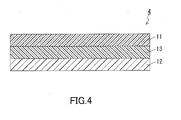
- FIG. 4 shows another example of the gas-permeable membrane of the present invention.
- a gas-permeable membrane 4 of FIG. 4 includes the gas-permeable membrane 3 shown in FIG. 3 , and further has the gas-permeable supporting member 12.
- the porous membrane 11 which is black is exposed to the outside.
- the gas-permeable supporting member 12 is as described for the gas-permeable membrane 2 shown in FIG. 2 .
- the gas-permeable membrane of the present invention may have any other member than the black porous PTFE membrane 11, the gas-permeable supporting member 12, and the porous PTFE membrane 13. In this case, it is preferable that the black porous PTFE membrane 11 be exposed on at least one principal face of the gas-permeable membrane of the present invention.
- FIG. 5 An example of the ventilation member of the present invention is shown in FIG. 5 .
- a ventilation member 5 shown in FIG. 5 includes the gas-permeable membrane 1 of the present invention.
- the gas-permeable membrane 1 is disk-shaped, and a supporting member 14 in the shape of a ring is attached to an edge region of the gas-permeable membrane 1.
- the gas-permeable membrane 1 can be reinforced, and can be handled more easily.
- the supporting member 14 functions as a part to be attached to a housing of an electrical appliance, the efficiency of the operation of attachment of the gas-permeable membrane 1 to the housing is improved.
- the black porous PTFE membrane 11 may be used instead of the gas-permeable membrane 1.
- the supporting member is not particularly limited in shape as long as it can support the gas-permeable membrane of the present invention.
- the supporting member is not particularly limited in material, and is typically made of a resin, a metal, or a composite material thereof.
- the method of bonding the gas-permeable membrane 1 and the supporting member 14 together is not particularly limited.
- a method such as heat welding, ultrasonic welding, bonding using an adhesive agent, or bonding using a double-faced tape, can be employed.
- the gas permeability of each porous PTFE membrane was evaluated according to JIS P 8117 (Gurley method).
- the water entry pressure of each porous PTFE membrane was determined using a water penetration testing apparatus (high hydraulic pressure method) specified in JIS L 1092.
- a water penetration testing apparatus high hydraulic pressure method
- a sheet of copy paper and each porous PTFE membrane were stacked together in such a manner that the sheet of copy paper was placed under the porous PTFE membrane.
- One drop of a lamp oil was applied to the porous PTFE membrane using a dropper, and then the stack was left for 1 minute. Thereafter, the porous membrane was removed, and the condition of the sheet of copy paper was checked. In the case where the sheet of copy paper was wet with the oil lamp, it was determined that the liquid repellency of the porous PTFE membrane was absent, while in the case where the sheet of copy paper was not wet, it was determined that the liquid repellency was present.
- a PTFE fine powder F 104 manufactured by DAIKIN INDUSTRIES, LTD.
- 20 parts by weight of n-dodecane (manufactured by Japan Energy Corporation) serving as a forming aid were uniformly mixed.
- the obtained mixture was compressed using a cylinder, and then formed into a sheet-shaped mixture by ram extrusion.
- the sheet-shaped mixture obtained was rolled to a thickness of 0.2 mm by passing the mixture through a pair of metal rolls. Furthermore, the mixture was dried by heating at 150°C to remove the forming aid, and thus a sheet-shaped body of PTFE was obtained.
- the sheet-shaped body obtained was stretched in the longitudinal direction (rolling direction) at a stretching temperature of 260°C at a stretching ratio of 10.
- the black dye (SP BLACK 91-L) is sold in the form of a mixture containing "Solvent Black 7 (also known as Nigrosine)" as a black color component.
- Solvent Black 7 is an azine-based dye having a phenazine ring.
- “Solvent Black 7” has a melting point of 450°C.
- the black porous PTFE membrane fabricated as described above was immersed in a liquid-repellent agent for several seconds, and then the entire black porous PTFE membrane was heated to 100°C and dried to remove the solvent. Thus, a black porous PTFE membrane subjected to liquid-repellent treatment was obtained.
- the liquid-repellent agent was prepared by the following procedures.
- the fluorine-containing polymer was diluted with a diluent ("FS thinner" manufactured by Shin-Etsu Chemical Co., Ltd.) to a concentration of 3.0%, and thus the liquid-repellent agent was prepared.
- the membrane was stretched in the width direction at a stretching temperature of 150°C at a stretching ratio of 10, and in addition, the entire membrane was calcined at 360°C which is a temperature above the melting point of PTFE.
- a porous PTFE membrane was obtained.
- the obtained porous PTFE membrane had an average pore diameter of 0.5 ⁇ m and a surface density of 6 g/m 2 .
- the whiteness of the black porous PTFE membrane as thus obtained was 20.0%, its gas permeability was 1.0 second/100 mL, its water entry pressure was 150 kPa, and its liquid repellency was "Present".
- the black porous PTFE membrane does not undergo color fading even when heated at 400°C.
- Black porous PTFE membranes fabricated according to Example 1 were heated at 350°C for 1 minute or 5 minutes. The heating was performed in a situation where each porous membrane was fixed in a metal frame so as to prevent contraction. As shown in Table 2, the whiteness of the principal face of the black porous PTFE membrane heated at 350°C for 1 minute was 21.0%, and the whiteness of the principal face of the black porous PTFE membrane heated at 350°C for 5 minutes was 21.0%. [Table 2] Whiteness Example 1 Example 2 Example 3 Example 4 Comp. Example 1 Comp. Example 2 Unheated 20.0 22.8 18.1 19.2 52.1 21.4 At 350°C for 1 minute 21.0 23.1 18.5 19.3 57.7 40.3 At 350°C for 5 minutes 21.0 23.2 18.5 20.1 62.5 62.8
- Black porous PTFE membranes fabricated according to Example 1 were respectively washed by immersion in alcohols for 1 minute.
- alcohols methanol, ethanol, IPA (isopropyl alcohol), and MEK (methyl ethyl ketone) were used.
- Table 3 the whiteness of the principal face of the black porous PTFE membrane washed with methanol was 23.8%, the whiteness of the principal face of the black porous PTFE membrane washed with ethanol was 23.5%, the whiteness of the principal face of the black porous PTFE membrane washed with IPA was 21.3%, and the whiteness of the principal face of the black porous PTFE membrane washed with MEK was 22.9%.
- the alcohols may be mixed liquids of two or more of methanol, ethanol, IPA (isopropyl alcohol), and MEK (methyl ethyl ketone).
- methanol ethanol
- IPA isopropyl alcohol
- MEK methyl ethyl ketone
- Black porous PTFE membranes subjected to liquid-repellent treatment were obtained in the same manner as in Example 1, except that the concentration of the treatment agent in the dye solution was 3.0 weight%.
- the whiteness of the black porous PTFE membrane as thus obtained was 22.8%
- its gas permeability was 1.1 seconds/100 mL
- its water entry pressure was 155 kPa
- its liquid repellency was "Present”.
- the whiteness of the principal face of the black porous PTFE membrane heated at 350°C for 1 minute was 23.1%
- the whiteness of the principal face of the black porous PTFE membrane heated at 350°C for 5 minutes was 23.2%.
- black porous PTFE membranes fabricated according to Example 2 were respectively washed by immersion in alcohols for 1 minute.
- Table 3 the whiteness of the principal face of the black porous PTFE membrane washed with methanol was 24.1%, the whiteness of the principal face of the black porous PTFE membrane washed with ethanol was 24.8%, the whiteness of the principal face of the black porous PTFE membrane washed with IPA was 22.9%, and the whiteness of the principal face of the black porous PTFE membrane washed with MEK was 23.8%.
- Black porous PTFE membranes subjected to liquid-repellent treatment were obtained in the same manner as in Example 1, except that the concentration of the treatment agent in the dye solution was 8.0 weight%.
- the whiteness of the black porous PTFE membrane as thus obtained was 18.1%
- its gas permeability was 1.0 second/100 mL
- its water entry pressure was 140 kPa
- its liquid repellency was "Present”.
- the whiteness of the principal face of the black porous PTFE membrane heated at 350°C for 1 minute was 18.5%
- the whiteness of the principal face of the black porous PTFE membrane heated at 350°C for 5 minutes was 18.5%.
- black porous PTFE membranes fabricated according to Example 3 were respectively washed by immersion in alcohols for 1 minute.
- Table 3 the whiteness of the principal face of the black porous PTFE membrane washed with methanol was 18.7%, the whiteness of the principal face of the black porous PTFE membrane washed with ethanol was 18.4%, the whiteness of the principal face of the black porous PTFE membrane washed with IPA was 18.2%, and the whiteness of the principal face of the black porous PTFE membrane washed with MEK was 18.8%.
- Black porous PTFE membranes subjected to liquid-repellent treatment were obtained in the same manner as in Example 1, except that the concentration of the treatment agent in the dye solution was 0.5 weight% and that the black dyeing and the treatment with the liquid-repellent agent were performed after the stretching in the width direction and the calcining.
- the whiteness of the black porous PTFE membrane as thus obtained was 19.2%, its gas permeability was 1.1 seconds/100 mL, its water entry pressure was 150 kPa, and its liquid repellency was "Present".
- the whiteness of the principal face of the black porous PTFE membrane washed with methanol was 62.1%
- the whiteness of the principal face of the black porous PTFE membrane washed with ethanol was 60.1%
- the whiteness of the principal face of the black porous PTFE membrane washed with IPA was 52.5%
- the whiteness of the principal face of the black porous PTFE membrane washed with MEK was 61.1%.
- Black porous PTFE membranes subjected to liquid-repellent treatment were obtained in the same manner as in Example 1, except that the black dye in the dye solution was "VALIFAST BLACK 3810” manufactured by ORIENT CHEMICAL INDUSTRIES CO., LTD.
- "VALIFAST BLACK 3810” is an azo-based chromium-containing dye (also known as an azo-chromium complex).
- the melting point of "VALIFAST BLACK 3810” is 359°C, and is about 100°C lower than 450°C which is the melting point of "Solvent Black 7" used in Examples 1 to 4.
- the whiteness of the black porous PTFE membrane as thus obtained was 52.1%, its gas permeability was 1.1 seconds/100 mL, its water entry pressure was 140 kPa, and its liquid repellency was "Present".
- the whiteness of the principal face of the black porous PTFE membrane heated at 350°C for 1 minute was 57.7%, and the whiteness of the principal face of the black porous PTFE membrane heated at 350°C for 5 minutes was 62.5%.
- black porous PTFE membranes fabricated according to Comparative Example 1 were respectively washed by immersion in alcohols for 1 minute.
- the whiteness of the principal face of the black porous PTFE membrane washed with methanol was 63.3%
- the whiteness of the principal face of the black porous PTFE membrane washed with ethanol was 62.2%
- the whiteness of the principal face of the black porous PTFE membrane washed with IPA was 63.9%
- the whiteness of the principal face of the black porous PTFE membrane washed with MEK was 62.0%.
- Black porous PTFE membranes subjected to liquid-repellent treatment were obtained in the same manner as in Example 1, except that the black dye in the dye solution was "VALIFAST BLACK 3810" manufactured by ORIENT CHEMICAL INDUSTRIES CO., LTD, the concentration of the treatment agent in the dye solution was 0.5 weight%, and the black dyeing and the treatment with the liquid-repellent agent were performed after the stretching in the width direction and the calcining.
- the whiteness of the black porous PTFE membrane as thus obtained was 21.4%
- its gas permeability was 1.2 seconds/100 mL
- its water entry pressure was 150 kPa
- its liquid repellency was "Present”.
- the whiteness of the principal face of the black porous PTFE membrane washed with methanol was 63.2%
- the whiteness of the principal face of the black porous PTFE membrane washed with ethanol was 63.5%
- the whiteness of the principal face of the black porous PTFE membrane washed with IPA was 63.1%
- the whiteness of the principal face of the black porous PTFE membrane washed with MEK was 62.4%.
- the black porous PTFE membranes fabricated in Comparative Examples 1 and 2 developed color fading by heating at 350°C, and the black porous PTFE membranes fabricated in Comparative Examples 1 and 2 and Example 4 underwent color fading by alcohols.
- the black porous PTFE membranes fabricated in Examples 1 to 3 did not undergo color fading by heating at 350°C or by alcohols.
- the present inventors infer that the reason why color fading was not caused by heating at 350°C in Examples 1 to 4 is that the dye has high heat resistance.
- the present inventors infer that the reason why color fading was not caused by alcohols in Examples 1 to 3 is as follows. If black coloring treatment is merely performed, the black dye settles on the peripheries of the fibers of the porous PTFE membrane. The dye is caused to attach to the porous PTFE membrane by performing the black coloring treatment before stretching, the porous PTFE membrane is heated to the melting point or higher and melted in the calcining step after the stretching step, so that the dye reaches and settles in the interior of the fibers of the porous PTFE membrane. Alcohols cannot penetrate into PTFE; therefore, it is thought that color fading caused by alcohols could be prevented as a result of the black dye settling in the interior of the fibers of the porous PTFE membrane.
- the black porous PTFE membrane of the present invention can be used in the same applications as conventional porous PTFE membranes, such as uses as a waterproof sound-transmitting membrane, a waterproof gas-permeable membrane, and a dustproof gas-permeable membrane.
Landscapes
- Chemical & Material Sciences (AREA)
- Chemical Kinetics & Catalysis (AREA)
- Engineering & Computer Science (AREA)
- Manufacturing & Machinery (AREA)
- Mechanical Engineering (AREA)
- Textile Engineering (AREA)
- Health & Medical Sciences (AREA)
- Medicinal Chemistry (AREA)
- Polymers & Plastics (AREA)
- Organic Chemistry (AREA)
- Manufacture Of Porous Articles, And Recovery And Treatment Of Waste Products (AREA)
- Separation Using Semi-Permeable Membranes (AREA)
- Shaping By String And By Release Of Stress In Plastics And The Like (AREA)
- Coloring (AREA)
- Filtering Materials (AREA)
Abstract
Description
- The present invention relates to a porous polytetrafluoroethylene membrane that is black (black porous polytetrafluoroethylene membrane) and that is less subject to color fading caused by heat and/or light than conventional ones. The present invention also relates to a gas-permeable membrane and a ventilation member using the porous membrane.
- In recent years, it has been common for electronic devices, such as mobile phones, laptop computers, electronic notebooks, digital cameras, and video-game instruments, to have an audio function. These devices are desired to have a waterproof structure. However, a housing of an electronic device having an audio function is usually provided with openings located at positions corresponding to those of a sound emitter and a sound receiver such as a speaker, a microphone, and a buzzer, and sound needs to be transmitted through these openings, which makes it difficult to form a waterproof structure while ensuring the audio function. Hitherto, it has been attempted to ensure both the sound transmitting properties and the waterproof properties at an opening of a housing by covering the opening with a waterproof sound-transmitting membrane. The waterproof sound-transmitting membrane is a thin membrane made of a material that causes less disturbance in the transmission of sound. With the membrane disposed to the opening, it is possible to prevent entry of water into the interior of the housing while assuring good sound transmitting properties. A gas-permeable membrane that blocks entry of water and allows permeation of gases is suitable as the waterproof sound-transmitting membrane; more specifically, a gas-permeable membrane including a porous polytetrafluoroethylene (PTFE) membrane is suitable (see Patent Literature 1).
- The intrinsic color of porous PTFE membranes is white. A waterproof sound-transmitting membrane is usually disposed in the interior of a housing so as to cover an opening. If the membrane is white, the membrane is conspicuous. Conspicuity of the membrane may be a defect in terms of the design quality of an electronic device, and is likely to stimulate the curiosity of a user and lead to damage to the membrane caused by stabbing with a writing instrument or the like. Therefore, a porous PTFE membrane that is black (black porous PTFE membrane) and that is thus less conspicuous when disposed on a housing has been demanded.
- A black porous PTFE membrane is disclosed in Patent Literature 2. In addition, a porous PTFE membrane that is not black but colored gray or pink is described in Patent Literature 3.
- A gas-permeable membrane including a porous PTFE membrane can be used not only as a waterproof sound-transmitting membrane but also as a waterproof and/or dustproof gas-permeable membrane that blocks entry of water and/or dust and that allows permeation of gases
-
- Patent Literature 1:
JP 2004-83811 A - Patent Literature 2:
JP H8(1996)-27304 A - Patent Literature 3:
JP H7(1995)-289865 A - Conventional colored porous PTFE membranes are prone to fading of the imparted color caused by exposure to a high-temperature atmosphere or irradiation with light (typically, irradiation with sunlight).
- The present invention aims to provide a black porous PTFE membrane that is excellent in color fading resistance and that is less subject to color fading caused by heat and/or light than conventional colored porous PTFE membranes.
- The present invention provides a black porous PTFE membrane including a porous PTFE membrane dyed black. A whiteness of a principal face of the black porous PTFE membrane as measured according to JIS L 1015 (Hunter method) is 18.0 to 23.0%, and the whiteness of the principal face falls within a range of 18.0 and 25.0% after heating at 350°C for 1 minute.
- The present invention provides a method for producing the black porous PTFE membrane, the method including: a forming step of forming a sheet-shaped body from a mixture containing PTFE; a first stretching step of stretching the sheet-shaped body in a first direction to form a porous membrane; a dyeing step of dyeing black the sheet-shaped body stretched in the first direction; and a second stretching step of stretching the sheet-shaped body in a second direction different from the first direction to form a black porous membrane.
- The present invention provides a gas-permeable membrane that blocks entry of water and/or dust and allows permeation of gases, the gas-permeable membrane having a multilayer structure including the black porous PTFE membrane and a gas-permeable supporting member. The black porous PTFE membrane is exposed on at least one principal face of the gas-permeable membrane.
- The present invention provides a ventilation member including: the black porous polytetrafluoroethylene membrane or the gas-permeable membrane; and a supporting member supporting the black porous polytetrafluoroethylene membrane or the gas-permeable membrane.
- According to the present invention, a black porous PTFE membrane is formed in which a whiteness of its principal face is 18.0 to 23.0% and the whiteness of the principal face falls within a range of 18.0 and 25.0% after heating at 350°C for 1 minute; therefore, it is possible to provide a black porous PTFE membrane that is excellent in color fading resistance and that is less subject to color fading caused by heat and/or light than conventional colored porous PTFE membranes.
-
-
FIG. 1 is a cross-sectional view schematically showing an example of the gas-permeable membrane of the present invention. -
FIG. 2 is a cross-sectional view schematically showing another example of the gas-permeable membrane of the present invention. -
FIG. 3 is a cross-sectional view schematically showing still another example of the gas-permeable membrane of the present invention. -
FIG. 4 is a cross-sectional view schematically showing still another example of the gas-permeable membrane of the present invention. -
FIG. 5 is a perspective view schematically showing an example of the ventilation member of the present invention. - The black porous PTFE membrane of the present invention is a porous PTFE membrane dyed black. A whiteness of its principal face as measured according to JIS L 1015 is 18.0 to 23.0%. After heating at 350°C for 1 minute, the whiteness of the principal face falls within a range of 18.0 and 25.0%. This whiteness W is determined from the following formula by measuring lightness L, hue a, and chroma b with a Hunter color-difference meter.

- A higher whiteness indicates that the membrane is whiter. If the whiteness is 0%, this means that the membrane is completely black. Such a black porous PTFE membrane can be formed, for example, by immersing a porous PTFE membrane in a dye solution containing a dye or applying a dye solution containing a dye to a porous PTFE membrane, and then by removing the dye solvent contained in the dye solution by drying or the like. The methods for the immersion and application are not particularly limited. The dye is a dye that allows a white porous PTFE membrane not subjected to any coloring treatment to be dyed in such a manner that the whiteness of the principal face of the membrane is 18.0 to 23.0%, and that the whiteness of the principal face falls within a range of 18.0 and 25.0% after heating at 350°C for 1 minute. For example, an azine-based dye having a phenazine ring is suitable. The dye is preferably a dye having a higher melting point than PTFE. The melting point of the dye is preferably higher than 360°C which is a temperature above the melting point of PTFE, and is more preferably higher than 400°C. The dye solution usually contains the dye and a solvent for diluting the dye and improving the efficiency of the dyeing operation. A porous PTFE membrane is chemically stable; therefore, the type of the solvent is not particularly limited, and can be selected as appropriate in view of the type of the dye, the efficiency of the dyeing operation, etc. The concentration of the dye in the dye solution needs to be such that a white porous PTFE membrane not subjected to any coloring treatment can be dyed in such a manner that the whiteness of the principal face of the membrane is 18.0 to 23.0%, and that the whiteness of the principal face falls within a range of 18.0 and 25.0% after heating at 350°C for 1 minute. The concentration is usually 5 weight% or more.
- A porous PTFE membrane to be dyed black can be obtained by a commonly-known technique. For example, the porous PTFE membrane can be formed as follows: a mixture of a PTFE fine powder and a forming aid is formed into a sheet shape by extrusion molding and rolling; the forming aid is removed to obtain a sheet of the formed body; and then the obtained sheet is further stretched. A black porous PTFE membrane of the present invention obtained from the thus-fabricated porous PTFE membrane has a porous structure in which voids between a huge number of fine PTFE fibers (fibrils) formed are present as pores. The average pore diameter and the porosity of this porous structure can be adjusted by changing the conditions of stretching of the sheet, and the specific values of the average pore diameter and the porosity may be selected depending on the intended use of the black porous PTFE membrane of the present invention.
- The black porous PTFE membrane of the present invention may be subjected to liquid-repellent treatment. In this case, the porous membrane can be provided with excellent water repellency and oil repellency. Such a porous membrane is suitable for use as a gas-permeable membrane such as a waterproof sound-transmitting membrane. The liquid-repellent treatment can be carried out by a commonly-known method after the porous PTFE membrane is dyed black. The liquid-repellent agent used in the liquid-repellent treatment is not particularly limited, and is typically a material containing a polymer having a perfluoroalkyl group.
- The configuration of the gas-permeable membrane of the present invention is not particularly limited as long as the gas-permeable membrane includes the black porous PTFE membrane of the present invention.
-
FIG. 1 shows an example of the gas-permeable membrane of the present invention. A gas-permeable membrane 1 ofFIG. 1 consists of a blackporous PTFE membrane 11 of the present invention. The gas-permeable membrane 1 has the property of blocking entry of water and/or dust and allowing permeation of gases, by virtue of the above-described porous structure of the blackporous PTFE membrane 11. The gas-permeable membrane 1 is black, and is less conspicuous than a white porous PTFE membrane, for example, when disposed at an opening of a housing of an electronic device. In addition, since the gas-permeable membrane 1 has a single-layer structure consisting of the blackporous PTFE membrane 11, a low surface density can be achieved. The lower the surface density of the gas-permeable membrane is, the smaller the sound transmission loss at the membrane is, and thus the better the sound transmitting properties are. Therefore, the gas-permeable membrane 1 is particularly suitable for use as a waterproof sound-transmitting membrane that is disposed at an opening of a housing of an electronic device having a sound emitter and/or a sound receiver and that is intended to ensure the sound transmitting properties and the waterproof properties at the opening. - Naturally, the gas-permeable membrane 1 is suitable for uses other than use as a waterproof sound-transmitting membrane, such as use as a waterproof and/or dustproof gas-permeable membrane that utilizes the property of blocking entry of water and/or dust and allowing permeation of gases. For example, the waterproof gas-permeable membrane (dustproof gas-permeable membrane) is disposed on a housing of an electric component for vehicles such as a lamp, a motor, a sensor, and an ECU, and is used for ensuring ventilation between the inside and outside of the housing and reducing a pressure change in the housing due to a temperature change.
- The average pore diameter of the black
porous PTFE membrane 11 in the gas-permeable membrane 1 is generally 0.01 to 20 µm, and is preferably 0.05 to 5 µm. When the gas-permeable membrane 1 is used as a waterproof sound-transmitting membrane, the average pore diameter of the blackporous PTFE membrane 11 is preferably 1 µm or less, more preferably 0.7 µm or less, and even more preferably 0.5 µm or less, from the viewpoint of ensuring both the waterproof properties and the sound transmitting properties. The lower limit of the average pore diameter is not particularly specified, and is, for example, 0.1 µm. The average pore diameter of the porous PTFE membrane can be measured according to the standards specified in ASTM F 316-86. For example, a commercially-available measurement apparatus capable of performing automatic measurement according to the above standards (Perm-Porometer available from Porous Material Inc. in the United States) can be used for the measurement of the average pore diameter of the porous PTFE membrane. - When the gas-permeable membrane 1 is used as a waterproof sound-transmitting membrane, the surface density of the gas-permeable membrane 1 is preferably 1 to 10 g/m2, more preferably 2 to 8 g/m2, and even more preferably 3 to 6 g/m2, from the viewpoint of ensuring both the physical strength and the transmitting properties of the membrane. When the gas-permeable membrane is used as a waterproof gas-permeable membrane or a dustproof gas-permeable membrane which is not required to have good sound transmitting properties, the surface density of the gas-permeable membrane 1 is not particularly limited.
- The black
porous PTFE membrane 11 may be subjected to liquid-repellent treatment. In this case, the water repellency and oil repellency of the gas-permeable membrane 1 are improved. The effect obtained by using the blackporous PTFE membrane 11 subjected to liquid-repellent treatment is the same for gas-permeable membranes 2, 3, and 4 shown in the subsequentFIGS. 2 and3 . -
FIG. 2 shows another example of the gas-permeable membrane of the present invention. A gas-permeable membrane 2 ofFIG. 2 has a multilayer structure including the blackporous PTFE membrane 11 of the present invention and a gas-permeable supportingmember 12 supporting theporous membrane 11. The gas-permeable membrane 2 has the property of blocking entry of water and/or dust and allowing permeation of gases, by virtue of the above-described porous structure of the blackporous PTFE membrane 11. In the gas-permeable membrane 2, the blackporous PTFE membrane 11 is exposed to the outside. For example, if the gas-permeable membrane 2 is disposed at an opening of a housing of an electronic device in such a manner that the blackporous PTFE membrane 11 faces the outside of the housing, the gas-permeable membrane 2 is less conspicuous than a white porous PTFE membrane. The gas-permeable membrane 2 is not particularly limited in use, and can be suitably used as a waterproof sound-transmitting membrane, a waterproof gas-permeable membrane, or a dustproof gas-permeable membrane. - The gas-permeable supporting
member 12 is not particularly limited in material and structure, but is preferably superior in gas-permeability to the blackporous PTFE membrane 11. The gas-permeable supportingmember 12 is, for example, a woven fabric, a non-woven fabric, a mesh, a net, a sponge, a foam, or a porous body made of a metal, a resin, or a composite material thereof. The resin is, for example, polyolefin, polyester, polyamide, polyimide, aramid, fluorine resin, or ultrahigh molecular weight polyethylene. When the blackporous PTFE membrane 11 and the gas-permeable supportingmember 12 are stacked together, they may be joined together using any of various joining methods such as thermal lamination, heat welding, and ultrasonic welding. - The gas-permeable membrane 2 may have two or more black
porous PTFE membranes 11 and/or two or more gas-permeable supportingmembers 12. In this case, the order in which they are stacked is not particularly limited. However, in order for the gas-permeable membrane 2 to be less conspicuous than a white porous PTFE membrane when disposed at an opening of a housing of an electronic device, it is preferable that the blackporous PTFE membrane 11 be exposed on at least one principal face as shown inFIG. 2 . In other words, the gas-permeable membrane of the present invention may have a multilayer structure including the black porous PTFE membrane of the present invention and the gas-permeable supporting member, and in this case, it is preferable that the black porous PTFE membrane be exposed on at least one principal face. - The average pore diameter of the black
porous PTFE membrane 11 in the gas-permeable membrane 2 is as indicated in the description of the gas-permeable membrane 1 shown inFIG. 1 . The average pore diameter of the blackporous PTFE membrane 11 in the case of using the gas-permeable membrane 2 as a waterproof sound-transmitting membrane is also as indicated in the description of the gas-permeable membrane 1 shown inFIG. 1 . When the gas-permeable membrane 2 has two or more blackporous PTFE membranes 11, it is sufficient that at least one of the blackporous PTFE membranes 11 have an average pore diameter as indicated above. - When the gas-permeable membrane 2 is used as a waterproof sound-transmitting membrane, the surface density of the gas-permeable membrane 2 (the total of the surface densities of a plurality of layers including the black
porous PTFE membrane 11 and the gas-permeable supporting member 12) is preferably 1 to 10 g/m2, more preferably 2 to 8 g/m2, and even more preferably 3 to 6 g/m2, from the viewpoint of ensuring both the physical strength and the sound transmitting properties of the membrane. -
FIG. 3 shows another example of the gas-permeable membrane of the present invention. A gas-permeable membrane 3 ofFIG. 3 has a multilayer structure including the blackporous PTFE membrane 11 of the present invention and anotherporous PTFE membrane 13 other than the blackporous PTFE membrane 11. Theporous PTFE membrane 13 may be uncolored (that is, white), may be colored in any given color (e.g., black), or may be dyed black in such a manner that the whiteness of the principal face of the membrane is 18.0 to 23.0%, and that the whiteness of the principal face falls within a range of 18.0 and 25.0% after heating at 350°C for 1 minute (that is, theporous PTFE membrane 13 may be the black porous PTFE membrane of the present invention). The whiteness of the principal face of theporous PTFE membrane 13 may be 23.0% or more. Similarly to the blackporous PTFE membrane 11, theporous PTFE membrane 13 has a porous structure in which voids between a huge number of fine PTFE fibers (fibrils) formed are present as pores. The gas-permeable membrane 3 has the property of blocking entry of water and/or dust and allowing permeation of gases, by virtue of the above-described porous structure of at least one porous PTFE membrane selected from the blackporous PTFE membrane 11 and theporous PTFE membrane 13. - In the gas-permeable membrane 3, the
porous membrane 11 which is black is exposed to the outside. For example, if the gas-permeable membrane 3 is disposed at an opening of a housing of an electronic device in such a manner that the blackporous PTFE membrane 11 faces the outside of the housing, the gas-permeable membrane 3 is less conspicuous than a white porous PTFE membrane. That is, the gas-permeable membrane of the present invention may have a multilayer structure including the blackporous PTFE membrane 11 of the present invention and anotherporous PTFE membrane 13 other than the blackporous PTFE membrane 11, and in this case, it is preferable that the black porous PTFE membrane be exposed on at least one principal face. - The gas-permeable membrane 3 may have two or more black
porous PTFE membranes 11 and/or two or moreporous PTFE membranes 13. In this case, the order in which they are stacked is not particularly limited. - The gas-permeable membrane 3 is not particularly limited in use, and can be suitably used as a waterproof sound-transmitting membrane, a waterproof gas-permeable membrane, or a dustproof gas-permeable membrane.
- In the gas-permeable membrane 3, the average pore diameter of at least one porous PTFE membrane selected from the black
porous PTFE membrane 11 and theporous PTFE membrane 13 is as indicated in the description of the gas-permeable membrane 1 shown inFIG. 1 . Also when the gas-permeable membrane 3 is used as a waterproof sound-transmitting membrane, the average pore diameter of at least one porous PTFE membrane selected from the blackporous PTFE membrane 11 and theporous PTFE membrane 13 is as indicated in the description of the gas-permeable membrane 1 shown inFIG. 1 . When the gas-permeable membrane 3 has two or more blackporous PTFE membranes 11 and/or two or moreporous PTFE membranes 13, it is sufficient that at least one of the blackporous PTFE membranes 11 and theporous PTFE membranes 13 have an average pore diameter as indicated above. The average pore diameter of the blackporous PTFE membrane 11 and the average pore diameter of theporous PTFE membrane 13 may be equal to or different from each other. - When the gas-permeable membrane 3 is used as a waterproof sound-transmitting membrane, the surface density of the gas-permeable membrane 3 (the total of the surface densities of a plurality of layers including the black
porous PTFE membrane 11 and the porous PTFE membrane 13) is preferably 1 to 10 g/m2, more preferably 2 to 8 g/m2, and even more preferably 3 to 6 g/m2, from the viewpoint of ensuring both the physical strength and the sound transmitting properties of the membrane. -
FIG. 4 shows another example of the gas-permeable membrane of the present invention. A gas-permeable membrane 4 ofFIG. 4 includes the gas-permeable membrane 3 shown inFIG. 3 , and further has the gas-permeable supportingmember 12. In the gas-permeable membrane 4, theporous membrane 11 which is black is exposed to the outside. The gas-permeable supportingmember 12 is as described for the gas-permeable membrane 2 shown inFIG. 2 . - The gas-permeable membrane of the present invention may have any other member than the black
porous PTFE membrane 11, the gas-permeable supportingmember 12, and theporous PTFE membrane 13. In this case, it is preferable that the blackporous PTFE membrane 11 be exposed on at least one principal face of the gas-permeable membrane of the present invention. - An example of the ventilation member of the present invention is shown in
FIG. 5 . A ventilation member 5 shown inFIG. 5 includes the gas-permeable membrane 1 of the present invention. The gas-permeable membrane 1 is disk-shaped, and a supportingmember 14 in the shape of a ring is attached to an edge region of the gas-permeable membrane 1. According to the embodiment in which the supportingmember 14 in the shape of a ring is provided, the gas-permeable membrane 1 can be reinforced, and can be handled more easily. In addition, since the supportingmember 14 functions as a part to be attached to a housing of an electrical appliance, the efficiency of the operation of attachment of the gas-permeable membrane 1 to the housing is improved. In this ventilation member, the blackporous PTFE membrane 11 may be used instead of the gas-permeable membrane 1. - The supporting member is not particularly limited in shape as long as it can support the gas-permeable membrane of the present invention. The supporting member is not particularly limited in material, and is typically made of a resin, a metal, or a composite material thereof.
- The method of bonding the gas-permeable membrane 1 and the supporting
member 14 together is not particularly limited. For example, a method such as heat welding, ultrasonic welding, bonding using an adhesive agent, or bonding using a double-faced tape, can be employed. - First, methods of evaluating black porous PTFE membranes and uncolored porous PTFE membranes fabricated as examples will be described.
- The whiteness of each porous PTFE membrane was evaluated using a color-difference meter according to JIS L 1015 (Hunter method).
- The gas permeability of each porous PTFE membrane was evaluated according to JIS P 8117 (Gurley method).
- The water entry pressure of each porous PTFE membrane was determined using a water penetration testing apparatus (high hydraulic pressure method) specified in JIS L 1092. However, when the membrane has an area specified in JIS L 1092, the membrane undergoes a marked change in shape. Therefore, a stainless steel mesh (opening diameter = 2 mm) was provided on the opposite side of the membrane to a surface subjected to a pressure in order to reduce the change in shape, and in this state the measurement was performed.
- A sheet of copy paper and each porous PTFE membrane were stacked together in such a manner that the sheet of copy paper was placed under the porous PTFE membrane. One drop of a lamp oil was applied to the porous PTFE membrane using a dropper, and then the stack was left for 1 minute. Thereafter, the porous membrane was removed, and the condition of the sheet of copy paper was checked. In the case where the sheet of copy paper was wet with the oil lamp, it was determined that the liquid repellency of the porous PTFE membrane was absent, while in the case where the sheet of copy paper was not wet, it was determined that the liquid repellency was present.
- An amount of 100 parts by weight of a PTFE fine powder (F 104 manufactured by DAIKIN INDUSTRIES, LTD.) and 20 parts by weight of n-dodecane (manufactured by Japan Energy Corporation) serving as a forming aid were uniformly mixed. The obtained mixture was compressed using a cylinder, and then formed into a sheet-shaped mixture by ram extrusion. Next, the sheet-shaped mixture obtained was rolled to a thickness of 0.2 mm by passing the mixture through a pair of metal rolls. Furthermore, the mixture was dried by heating at 150°C to remove the forming aid, and thus a sheet-shaped body of PTFE was obtained. Next, the sheet-shaped body obtained was stretched in the longitudinal direction (rolling direction) at a stretching temperature of 260°C at a stretching ratio of 10.
- Next, the porous PTFE membrane fabricated as described above was immersed for several seconds in a dye solution obtained by mixing 20 parts by weight of a black dye (SP BLACK 91-L manufactured by ORIENT CHEMICAL INDUSTRIES CO., LTD., a 25 weight% solution diluted with ethanol) and 80 parts by weight of ethanol (purity = 95%) which was a solvent for the dye. Thereafter, the entire porous PTFE membrane was heated to 100°C and thereby dried to remove the solvent. Thus, a porous PTFE membrane dyed black was obtained. The black dye (SP BLACK 91-L) is sold in the form of a mixture containing "Solvent Black 7 (also known as Nigrosine)" as a black color component. "Solvent Black 7" is an azine-based dye having a phenazine ring. "Solvent Black 7" has a melting point of 450°C. Next, the black porous PTFE membrane fabricated as described above was immersed in a liquid-repellent agent for several seconds, and then the entire black porous PTFE membrane was heated to 100°C and dried to remove the solvent. Thus, a black porous PTFE membrane subjected to liquid-repellent treatment was obtained. The liquid-repellent agent was prepared by the following procedures. An amount of 100 g of a compound having a linear fluoroalkyl chain and represented by CH2=CHCOOCH2CH2C6F13, 0.1 g of azobisisobutyronitrile serving as a polymerization initiator, and 300 g of a solvent ("FS thinner" manufactured by Shin-Etsu Chemical Co., Ltd.) were put into a flask fitted with a nitrogen introducing pipe, a thermometer, and a stirrer. A nitrogen gas was introduced to allow addition polymerization to proceed under stirring at 70°C for 16 hours. Thus, 80 g of a fluorine-containing polymer was obtained. This fluorine-containing polymer had a number average molecular weight of 100,000. The fluorine-containing polymer was diluted with a diluent ("FS thinner" manufactured by Shin-Etsu Chemical Co., Ltd.) to a concentration of 3.0%, and thus the liquid-repellent agent was prepared.
- Next, the membrane was stretched in the width direction at a stretching temperature of 150°C at a stretching ratio of 10, and in addition, the entire membrane was calcined at 360°C which is a temperature above the melting point of PTFE. Thus, a porous PTFE membrane was obtained. The obtained porous PTFE membrane had an average pore diameter of 0.5 µm and a surface density of 6 g/m2. As shown in Table 1, the whiteness of the black porous PTFE membrane as thus obtained was 20.0%, its gas permeability was 1.0 second/100 mL, its water entry pressure was 150 kPa, and its liquid repellency was "Present". The black porous PTFE membrane does not undergo color fading even when heated at 400°C. Therefore, the black porous PTFE membrane does not undergo color fading even when calcined at 360°C.
[Table 1] Type of black color agent Concentration of black color agent *Solid content [weight%] Treatment Whiteness Gas permeability [s/100 mL] Water entry pressure [kPa] Liquid repellency Example 1 SP BLACK 91-L 5.0 Before stretching 20.0 1.0 150 Present Example 2 SP BLACK 91-L 3.0 Before stretching 22.8 1.1 155 Present Example 3 SP BLACK 91-L 8.0 Before stretching 18.1 1.0 140 Present Example 4 SP BLACK 91-L 0.5 After stretching 19.2 1.1 150 Present Comp. Example 1 VALIFAST BLACK 3810 5.0 Before stretching 52.1 1.1 140 Present Comp. Example 2 VALIFAST BLACK 3810 0.5 After stretching 21.4 1.2 150 Present - Black porous PTFE membranes fabricated according to Example 1 were heated at 350°C for 1 minute or 5 minutes. The heating was performed in a situation where each porous membrane was fixed in a metal frame so as to prevent contraction. As shown in Table 2, the whiteness of the principal face of the black porous PTFE membrane heated at 350°C for 1 minute was 21.0%, and the whiteness of the principal face of the black porous PTFE membrane heated at 350°C for 5 minutes was 21.0%.
[Table 2] Whiteness Example 1 Example 2 Example 3 Example 4 Comp. Example 1 Comp. Example 2 Unheated 20.0 22.8 18.1 19.2 52.1 21.4 At 350°C for 1 minute 21.0 23.1 18.5 19.3 57.7 40.3 At 350°C for 5 minutes 21.0 23.2 18.5 20.1 62.5 62.8 - Black porous PTFE membranes fabricated according to Example 1 were respectively washed by immersion in alcohols for 1 minute. As the alcohols, methanol, ethanol, IPA (isopropyl alcohol), and MEK (methyl ethyl ketone) were used. As shown in Table 3, the whiteness of the principal face of the black porous PTFE membrane washed with methanol was 23.8%, the whiteness of the principal face of the black porous PTFE membrane washed with ethanol was 23.5%, the whiteness of the principal face of the black porous PTFE membrane washed with IPA was 21.3%, and the whiteness of the principal face of the black porous PTFE membrane washed with MEK was 22.9%. The alcohols may be mixed liquids of two or more of methanol, ethanol, IPA (isopropyl alcohol), and MEK (methyl ethyl ketone).
[Table 3] Whiteness Example 1 Example 2 Example 3 Example 4 Comp. Example 1 Comp. Example 2 Unwashed 20.0 22.3 18.1 19.2 52.1 21.4 Washed with methanol 23.8 24.1 18.7 62.1 63.3 63.2 Washed with ethanol 23.5 24.8 18.4 60.1 62.2 63.5 Washed with IPA 21.3 22.9 18.2 52.5 63.9 63.1 Washed with MEK 22.9 23.8 18.8 61.1 62.0 62.4 - Black porous PTFE membranes subjected to liquid-repellent treatment were obtained in the same manner as in Example 1, except that the concentration of the treatment agent in the dye solution was 3.0 weight%. As shown in Table 1, the whiteness of the black porous PTFE membrane as thus obtained was 22.8%, its gas permeability was 1.1 seconds/100 mL, its water entry pressure was 155 kPa, and its liquid repellency was "Present". As shown in Table 2, the whiteness of the principal face of the black porous PTFE membrane heated at 350°C for 1 minute was 23.1%, and the whiteness of the principal face of the black porous PTFE membrane heated at 350°C for 5 minutes was 23.2%. Next, black porous PTFE membranes fabricated according to Example 2 were respectively washed by immersion in alcohols for 1 minute. As shown in Table 3, the whiteness of the principal face of the black porous PTFE membrane washed with methanol was 24.1%, the whiteness of the principal face of the black porous PTFE membrane washed with ethanol was 24.8%, the whiteness of the principal face of the black porous PTFE membrane washed with IPA was 22.9%, and the whiteness of the principal face of the black porous PTFE membrane washed with MEK was 23.8%.
- Black porous PTFE membranes subjected to liquid-repellent treatment were obtained in the same manner as in Example 1, except that the concentration of the treatment agent in the dye solution was 8.0 weight%. As shown in Table 1, the whiteness of the black porous PTFE membrane as thus obtained was 18.1%, its gas permeability was 1.0 second/100 mL, its water entry pressure was 140 kPa, and its liquid repellency was "Present". As shown in Table 2, the whiteness of the principal face of the black porous PTFE membrane heated at 350°C for 1 minute was 18.5%, and the whiteness of the principal face of the black porous PTFE membrane heated at 350°C for 5 minutes was 18.5%. Next, black porous PTFE membranes fabricated according to Example 3 were respectively washed by immersion in alcohols for 1 minute. As shown in Table 3, the whiteness of the principal face of the black porous PTFE membrane washed with methanol was 18.7%, the whiteness of the principal face of the black porous PTFE membrane washed with ethanol was 18.4%, the whiteness of the principal face of the black porous PTFE membrane washed with IPA was 18.2%, and the whiteness of the principal face of the black porous PTFE membrane washed with MEK was 18.8%.
- Black porous PTFE membranes subjected to liquid-repellent treatment were obtained in the same manner as in Example 1, except that the concentration of the treatment agent in the dye solution was 0.5 weight% and that the black dyeing and the treatment with the liquid-repellent agent were performed after the stretching in the width direction and the calcining. As shown in Table 1, the whiteness of the black porous PTFE membrane as thus obtained was 19.2%, its gas permeability was 1.1 seconds/100 mL, its water entry pressure was 150 kPa, and its liquid repellency was "Present". As shown in Table 2, the whiteness of the principal face of the black porous PTFE membrane heated at 350°C for 1 minute was 19.3%, and the whiteness of the principal face of the black porous PTFE membrane heated at 350°C for 5 minutes was 20.1%. Next, black porous PTFE membranes fabricated according to Example 4 were respectively washed by immersion in alcohols for 1 minute. As shown in Table 3, the whiteness of the principal face of the black porous PTFE membrane washed with methanol was 62.1%, the whiteness of the principal face of the black porous PTFE membrane washed with ethanol was 60.1%, the whiteness of the principal face of the black porous PTFE membrane washed with IPA was 52.5%, and the whiteness of the principal face of the black porous PTFE membrane washed with MEK was 61.1%.
- Black porous PTFE membranes subjected to liquid-repellent treatment were obtained in the same manner as in Example 1, except that the black dye in the dye solution was "VALIFAST BLACK 3810" manufactured by ORIENT CHEMICAL INDUSTRIES CO., LTD. "VALIFAST BLACK 3810" is an azo-based chromium-containing dye (also known as an azo-chromium complex). The melting point of "VALIFAST BLACK 3810" is 359°C, and is about 100°C lower than 450°C which is the melting point of "Solvent Black 7" used in Examples 1 to 4. As shown in Table 1, the whiteness of the black porous PTFE membrane as thus obtained was 52.1%, its gas permeability was 1.1 seconds/100 mL, its water entry pressure was 140 kPa, and its liquid repellency was "Present". As shown in Table 2, the whiteness of the principal face of the black porous PTFE membrane heated at 350°C for 1 minute was 57.7%, and the whiteness of the principal face of the black porous PTFE membrane heated at 350°C for 5 minutes was 62.5%. Next, black porous PTFE membranes fabricated according to Comparative Example 1 were respectively washed by immersion in alcohols for 1 minute. As shown in Table 3, the whiteness of the principal face of the black porous PTFE membrane washed with methanol was 63.3%, the whiteness of the principal face of the black porous PTFE membrane washed with ethanol was 62.2%, the whiteness of the principal face of the black porous PTFE membrane washed with IPA was 63.9%, and the whiteness of the principal face of the black porous PTFE membrane washed with MEK was 62.0%.
- Black porous PTFE membranes subjected to liquid-repellent treatment were obtained in the same manner as in Example 1, except that the black dye in the dye solution was "VALIFAST BLACK 3810" manufactured by ORIENT CHEMICAL INDUSTRIES CO., LTD, the concentration of the treatment agent in the dye solution was 0.5 weight%, and the black dyeing and the treatment with the liquid-repellent agent were performed after the stretching in the width direction and the calcining. As shown in Table 1, the whiteness of the black porous PTFE membrane as thus obtained was 21.4%, its gas permeability was 1.2 seconds/100 mL, its water entry pressure was 150 kPa, and its liquid repellency was "Present". As shown in Table 2, the whiteness of the principal face of the black porous PTFE membrane heated at 350°C for 1 minute was 40.3%, and the whiteness of the principal face of the black porous PTFE membrane heated at 350°C for 5 minutes was 62.8%. Next, black porous PTFE membranes fabricated according to Comparative Example 2 were respectively washed by immersion in alcohols for 1 minute. As shown in Table 3, the whiteness of the principal face of the black porous PTFE membrane washed with methanol was 63.2%, the whiteness of the principal face of the black porous PTFE membrane washed with ethanol was 63.5%, the whiteness of the principal face of the black porous PTFE membrane washed with IPA was 63.1%, and the whiteness of the principal face of the black porous PTFE membrane washed with MEK was 62.4%.
- As shown in Table 1, there was scarcely a difference in properties between the porous PTFE membranes fabricated in Examples 1 to 4 and Comparative Examples 1 and 2, except for the difference in whiteness. As shown in Table 2, the black porous PTFE membranes fabricated in Comparative Examples 1 and 2 developed color fading by heating, while the black porous PTFE membranes fabricated in Examples 1 to 4 did not undergo color fading. As shown in Table 3, the black porous PTFE membranes fabricated in Comparative Examples 1 and 2 and Example 4 developed color fading by alcohols, while the black porous PTFE membranes fabricated in the other examples did not undergo color fading. As shown in Tables 2 and 3, the black porous PTFE membranes fabricated in Comparative Examples 1 and 2 developed color fading by heating at 350°C, and the black porous PTFE membranes fabricated in Comparative Examples 1 and 2 and Example 4 underwent color fading by alcohols. However, the black porous PTFE membranes fabricated in Examples 1 to 3 did not undergo color fading by heating at 350°C or by alcohols.
- The present inventors infer that the reason why color fading was not caused by heating at 350°C in Examples 1 to 4 is that the dye has high heat resistance. The present inventors infer that the reason why color fading was not caused by alcohols in Examples 1 to 3 is as follows. If black coloring treatment is merely performed, the black dye settles on the peripheries of the fibers of the porous PTFE membrane. The dye is caused to attach to the porous PTFE membrane by performing the black coloring treatment before stretching, the porous PTFE membrane is heated to the melting point or higher and melted in the calcining step after the stretching step, so that the dye reaches and settles in the interior of the fibers of the porous PTFE membrane. Alcohols cannot penetrate into PTFE; therefore, it is thought that color fading caused by alcohols could be prevented as a result of the black dye settling in the interior of the fibers of the porous PTFE membrane.
- The black porous PTFE membrane of the present invention can be used in the same applications as conventional porous PTFE membranes, such as uses as a waterproof sound-transmitting membrane, a waterproof gas-permeable membrane, and a dustproof gas-permeable membrane.
Claims (6)
- A black porous polytetrafluoroethylene membrane comprising a porous polytetrafluoroethylene membrane dyed black, wherein
a whiteness of a principal face of the black porous polytetrafluoroethylene membrane as measured according to JIS L 1015 (Hunter method) is 18.0 to 23.0%, and
the whiteness of the principal face falls within a range of 18.0 and 25.0% after heating at 350°C for 1 minute. - The black porous polytetrafluoroethylene membrane according to claim 1, wherein the whiteness of the principal face falls within a range of 18.0 and 25.0% after washing by immersion in at least one of methanol, ethanol, isopropyl alcohol, and methyl ethyl ketone for 1 minute.
- A method for producing the black porous polytetrafluoroethylene membrane according to claim 1, comprising:a forming step of forming a sheet-shaped body from a mixture containing polytetrafluoroethylene;a first stretching step of stretching the sheet-shaped body in a first direction to form a porous membrane;a dyeing step of dyeing black the sheet-shaped body stretched in the first direction; anda second stretching step of stretching the sheet-shaped body in a second direction different from the first direction to form a black porous membrane.
- The method according to claim 3 for producing the black porous polytetrafluoroethylene membrane, further comprising a liquid-repellent treatment step of subjecting the black porous polytetrafluoroethylene membrane to liquid-repellent treatment, the liquid-repellent treatment step being performed after the second stretching step.
- A gas-permeable membrane that blocks entry of water and/or dust and allows permeation of gases, the gas-permeable membrane having a multilayer structure comprising:the black porous polytetrafluoroethylene membrane according to claim 1; anda gas-permeable supporting member, whereinthe black porous polytetrafluoroethylene membrane is exposed on at least one principal face of the gas-permeable membrane.
- A ventilation member comprising:the black porous polytetrafluoroethylene membrane according to claim 1 or the gas-permeable membrane according to claim 5; anda supporting member supporting the black porous polytetrafluoroethylene membrane or the gas-permeable membrane.
Applications Claiming Priority (2)
| Application Number | Priority Date | Filing Date | Title |
|---|---|---|---|
| JP2012171794A JP5854948B2 (en) | 2012-08-02 | 2012-08-02 | Polytetrafluoroethylene black porous membrane, method for producing the same, vent membrane and vent member using the same |
| PCT/JP2013/003494 WO2014020812A1 (en) | 2012-08-02 | 2013-06-03 | Polytetrafluoroethylene black porous membrane, method for producing same, and breathable membrane and breathable material using same |
Publications (3)
| Publication Number | Publication Date |
|---|---|
| EP2881425A1 true EP2881425A1 (en) | 2015-06-10 |
| EP2881425A4 EP2881425A4 (en) | 2016-04-13 |
| EP2881425B1 EP2881425B1 (en) | 2021-07-28 |
Family
ID=50027529
Family Applications (1)
| Application Number | Title | Priority Date | Filing Date |
|---|---|---|---|
| EP13825359.6A Active EP2881425B1 (en) | 2012-08-02 | 2013-06-03 | Black porous polytetrafluoroethylene membrane, method for producing same, gas-permeable membrane and ventilation member using same |
Country Status (7)
| Country | Link |
|---|---|
| US (1) | US9616391B2 (en) |
| EP (1) | EP2881425B1 (en) |
| JP (1) | JP5854948B2 (en) |
| KR (1) | KR101971761B1 (en) |
| CN (1) | CN104540887B (en) |
| TW (1) | TWI596145B (en) |
| WO (1) | WO2014020812A1 (en) |
Cited By (2)
| Publication number | Priority date | Publication date | Assignee | Title |
|---|---|---|---|---|
| CN111448850A (en) * | 2017-12-11 | 2020-07-24 | 日东电工株式会社 | Internal pressure adjusting member and electric component for transportation equipment |
| CN111941977A (en) * | 2020-08-07 | 2020-11-17 | 常州浩文塑料新材料有限公司 | Waterproof breathable film and production process thereof |
Families Citing this family (14)
| Publication number | Priority date | Publication date | Assignee | Title |
|---|---|---|---|---|
| JPH0653332B2 (en) | 1988-12-02 | 1994-07-20 | キヤノン株式会社 | Moving mechanism |
| EP3363529A1 (en) | 2011-02-28 | 2018-08-22 | Nitto Denko Corporation | Oil-repellant ventilation filter |
| CN104220141B (en) * | 2012-04-06 | 2016-01-20 | 日东电工株式会社 | Impart the breathable filter of the band adhesive layer of oil repellent |
| EP2835396B1 (en) * | 2012-04-06 | 2016-11-02 | Nitto Denko Corporation | Breathable sheet imparted with oil repellent properties |
| US9317068B2 (en) | 2012-09-24 | 2016-04-19 | Donaldson Company, Inc. | Venting assembly and microporous membrane composite |
| WO2017196101A2 (en) * | 2016-05-13 | 2017-11-16 | 주식회사 아모그린텍 | Waterproof sound-transmitting sheet |
| JP6920042B2 (en) * | 2016-09-30 | 2021-08-18 | 日東電工株式会社 | Air filter filter media, air filter pack and air filter unit |
| CN109107395A (en) * | 2017-06-26 | 2019-01-01 | 中国科学院苏州纳米技术与纳米仿生研究所 | The anti-pernicious gas air filter film of anti-haze, preparation method and application |
| US10741160B1 (en) | 2019-09-25 | 2020-08-11 | W. L. Gore & Associates, Inc. | Acoustically resistive supported membrane assemblies |
| KR102776171B1 (en) | 2019-10-14 | 2025-03-04 | 더블유. 엘. 고어 앤드 어소시에이트스, 인코포레이티드 | Acoustic composites, devices, and assemblies comprising reinforced polymers |
| KR20230034339A (en) * | 2020-07-03 | 2023-03-09 | 닛토덴코 가부시키가이샤 | Polytetrafluoroethylene porous membrane, gas-permeable membrane and gas-permeable member |
| US11417311B2 (en) * | 2020-08-03 | 2022-08-16 | W. L. Gore & Associates, Inc. | Acoustically resistive supported membrane assemblies including at least one support structure |
| JP7822596B2 (en) * | 2021-12-13 | 2026-03-03 | 中興化成工業株式会社 | Self-fusing tape and method for manufacturing self-fusing tape |
| WO2025143678A1 (en) * | 2023-12-27 | 2025-07-03 | 코오롱인더스트리 주식회사 | Nanomembrane, waterproof ventilation sheet comprising same, and method for manufacturing nanomembrane |
Family Cites Families (13)
| Publication number | Priority date | Publication date | Assignee | Title |
|---|---|---|---|---|
| JPS5968374A (en) * | 1982-10-13 | 1984-04-18 | Orient Kagaku Kogyo Kk | Nigrosine dye and its preparation |
| JPH03199475A (en) * | 1989-12-26 | 1991-08-30 | Nishikawa Rubber Co Ltd | Dyeing method for PTFE porous sheet |
| JP3702968B2 (en) | 1994-04-28 | 2005-10-05 | ジャパンゴアテックス株式会社 | Colored vent filter |
| JPH0827304A (en) * | 1994-07-19 | 1996-01-30 | Nitto Denko Corp | Colored fluororesin porous material |
| JPH10165787A (en) * | 1996-12-11 | 1998-06-23 | Nitto Denko Corp | Polytetrafluoroethylene porous membrane and method for producing the same |
| JP2001011779A (en) * | 1999-06-25 | 2001-01-16 | Japan Gore Tex Inc | Camouflage laminated fabric |
| JP2004083811A (en) | 2002-08-28 | 2004-03-18 | Nitto Denko Corp | Waterproof sound-permeable membrane |
| WO2009072568A1 (en) * | 2007-12-06 | 2009-06-11 | Nitto Denko Corporation | Air filter |
| WO2010048496A1 (en) * | 2008-10-24 | 2010-04-29 | Porex Corporation | Composite ptfe material and applications thereof |
| EP2351647B1 (en) * | 2009-01-21 | 2018-08-08 | Nitto Denko Corporation | Waterproofing sound-transmitting film, process for producing same, and electrical product employing same |
| US8946101B2 (en) * | 2009-02-10 | 2015-02-03 | Honeywell International Inc. | Enhanced barrier multifunctional coatings for nylon films |
| JP5329350B2 (en) * | 2009-09-04 | 2013-10-30 | 日東電工株式会社 | Polytetrafluoroethylene black porous membrane, and ventilation membrane, ventilation member and waterproof sound-permeable membrane using the same |
| US10099182B2 (en) * | 2010-02-02 | 2018-10-16 | EF-Materials Industries Inc. | Water-proof and dust-proof membrane assembly and applications thereof |
-
2012
- 2012-08-02 JP JP2012171794A patent/JP5854948B2/en active Active
-
2013
- 2013-06-03 EP EP13825359.6A patent/EP2881425B1/en active Active
- 2013-06-03 CN CN201380041005.2A patent/CN104540887B/en active Active
- 2013-06-03 WO PCT/JP2013/003494 patent/WO2014020812A1/en not_active Ceased
- 2013-06-03 KR KR1020157004771A patent/KR101971761B1/en active Active
- 2013-06-03 US US14/415,905 patent/US9616391B2/en active Active
- 2013-06-10 TW TW102120501A patent/TWI596145B/en not_active IP Right Cessation
Cited By (2)
| Publication number | Priority date | Publication date | Assignee | Title |
|---|---|---|---|---|
| CN111448850A (en) * | 2017-12-11 | 2020-07-24 | 日东电工株式会社 | Internal pressure adjusting member and electric component for transportation equipment |
| CN111941977A (en) * | 2020-08-07 | 2020-11-17 | 常州浩文塑料新材料有限公司 | Waterproof breathable film and production process thereof |
Also Published As
| Publication number | Publication date |
|---|---|
| CN104540887B (en) | 2017-10-24 |
| US9616391B2 (en) | 2017-04-11 |
| JP2014031411A (en) | 2014-02-20 |
| TW201406839A (en) | 2014-02-16 |
| WO2014020812A1 (en) | 2014-02-06 |
| TWI596145B (en) | 2017-08-21 |
| CN104540887A (en) | 2015-04-22 |
| EP2881425B1 (en) | 2021-07-28 |
| US20150165386A1 (en) | 2015-06-18 |
| KR20150039787A (en) | 2015-04-13 |
| EP2881425A4 (en) | 2016-04-13 |
| KR101971761B1 (en) | 2019-04-23 |
| JP5854948B2 (en) | 2016-02-09 |
Similar Documents
| Publication | Publication Date | Title |
|---|---|---|
| EP2881425B1 (en) | Black porous polytetrafluoroethylene membrane, method for producing same, gas-permeable membrane and ventilation member using same | |
| EP2881427B1 (en) | Polytetrafluoroethylene porous membrane, method for producing same, and breathable membrane and breathable material using same | |
| EP2914015B1 (en) | Waterproof sound-transmitting film, waterproof sound-transmitting member provided with same, electronic equipment, electronic equipment case, and waterproof sound-transmitting structure | |
| US9578402B2 (en) | Waterproof sound-transmitting membrane, sound-transmitting member, and electrical device | |
| EP2925014B1 (en) | Sound-transmitting membrane and electronic device equipped with sound-transmitting membrane | |
| CN105706459B (en) | Waterproof sound-permeable membrane and electronic equipment | |
| JP5329350B2 (en) | Polytetrafluoroethylene black porous membrane, and ventilation membrane, ventilation member and waterproof sound-permeable membrane using the same | |
| JPH10165787A (en) | Polytetrafluoroethylene porous membrane and method for producing the same | |
| CN106029757A (en) | Manufacturing method of waterproof and sound-permeable membrane, waterproof and sound-permeable membrane, and electronic device | |
| JP2013227588A (en) | Polytetrafluoroethylene black porous membrane, and air permeable membrane, air permeable member and waterproof sound passing membrane using the same | |
| JP7106726B2 (en) | Polytetrafluoroethylene porous membrane, ventilation membrane and ventilation member |
Legal Events
| Date | Code | Title | Description |
|---|---|---|---|
| PUAI | Public reference made under article 153(3) epc to a published international application that has entered the european phase |
Free format text: ORIGINAL CODE: 0009012 |
|
| 17P | Request for examination filed |
Effective date: 20150224 |
|
| AK | Designated contracting states |
Kind code of ref document: A1 Designated state(s): AL AT BE BG CH CY CZ DE DK EE ES FI FR GB GR HR HU IE IS IT LI LT LU LV MC MK MT NL NO PL PT RO RS SE SI SK SM TR |
|
| AX | Request for extension of the european patent |
Extension state: BA ME |
|
| DAX | Request for extension of the european patent (deleted) | ||
| RA4 | Supplementary search report drawn up and despatched (corrected) |
Effective date: 20160316 |
|
| RIC1 | Information provided on ipc code assigned before grant |
Ipc: B29K 105/04 20060101ALI20160308BHEP Ipc: B29C 55/14 20060101ALI20160308BHEP Ipc: B29K 27/18 20060101ALI20160308BHEP Ipc: B29L 7/00 20060101ALI20160308BHEP Ipc: B01D 69/02 20060101ALN20160308BHEP Ipc: B01D 39/16 20060101ALI20160308BHEP Ipc: C08L 27/18 20060101ALN20160308BHEP Ipc: B01D 67/00 20060101ALN20160308BHEP Ipc: D06P 3/00 20060101ALI20160308BHEP Ipc: C08J 9/00 20060101AFI20160308BHEP Ipc: B29K 105/00 20060101ALN20160308BHEP Ipc: B29C 55/00 20060101ALN20160308BHEP Ipc: B01D 71/36 20060101ALI20160308BHEP Ipc: D06P 7/00 20060101ALN20160308BHEP |
|
| STAA | Information on the status of an ep patent application or granted ep patent |
Free format text: STATUS: EXAMINATION IS IN PROGRESS |
|
| 17Q | First examination report despatched |
Effective date: 20190128 |
|
| GRAP | Despatch of communication of intention to grant a patent |
Free format text: ORIGINAL CODE: EPIDOSNIGR1 |
|
| RIC1 | Information provided on ipc code assigned before grant |
Ipc: B01D 69/02 20060101ALN20201215BHEP Ipc: D06P 7/00 20060101ALN20201215BHEP Ipc: B01D 39/16 20060101ALI20201215BHEP Ipc: D06P 3/00 20060101ALI20201215BHEP Ipc: B29K 27/18 20060101ALI20201215BHEP Ipc: B01D 71/36 20060101ALI20201215BHEP Ipc: B29L 7/00 20060101ALI20201215BHEP Ipc: B29C 55/14 20060101ALI20201215BHEP Ipc: B29K 105/04 20060101ALI20201215BHEP Ipc: B01D 67/00 20060101ALN20201215BHEP Ipc: C08L 27/18 20060101ALN20201215BHEP Ipc: B29C 55/00 20060101ALN20201215BHEP Ipc: C08J 9/00 20060101AFI20201215BHEP Ipc: B29K 105/00 20060101ALN20201215BHEP |
|
| STAA | Information on the status of an ep patent application or granted ep patent |
Free format text: STATUS: GRANT OF PATENT IS INTENDED |
|
| RIN1 | Information on inventor provided before grant (corrected) |
Inventor name: HORIE, YURI Inventor name: MORI, MASAAKI |
|
| INTG | Intention to grant announced |
Effective date: 20210121 |
|
| GRAS | Grant fee paid |
Free format text: ORIGINAL CODE: EPIDOSNIGR3 |
|
| GRAA | (expected) grant |
Free format text: ORIGINAL CODE: 0009210 |
|
| STAA | Information on the status of an ep patent application or granted ep patent |
Free format text: STATUS: THE PATENT HAS BEEN GRANTED |
|
| AK | Designated contracting states |
Kind code of ref document: B1 Designated state(s): AL AT BE BG CH CY CZ DE DK EE ES FI FR GB GR HR HU IE IS IT LI LT LU LV MC MK MT NL NO PL PT RO RS SE SI SK SM TR |
|
| REG | Reference to a national code |
Ref country code: GB Ref legal event code: FG4D |
|
| REG | Reference to a national code |
Ref country code: CH Ref legal event code: EP |
|
| REG | Reference to a national code |
Ref country code: AT Ref legal event code: REF Ref document number: 1414710 Country of ref document: AT Kind code of ref document: T Effective date: 20210815 |
|
| REG | Reference to a national code |
Ref country code: IE Ref legal event code: FG4D |
|
| REG | Reference to a national code |
Ref country code: DE Ref legal event code: R096 Ref document number: 602013078557 Country of ref document: DE |
|
| REG | Reference to a national code |
Ref country code: LT Ref legal event code: MG9D |
|
| REG | Reference to a national code |
Ref country code: NL Ref legal event code: MP Effective date: 20210728 |
|
| REG | Reference to a national code |
Ref country code: AT Ref legal event code: MK05 Ref document number: 1414710 Country of ref document: AT Kind code of ref document: T Effective date: 20210728 |
|
| PG25 | Lapsed in a contracting state [announced via postgrant information from national office to epo] |
Ref country code: HR Free format text: LAPSE BECAUSE OF FAILURE TO SUBMIT A TRANSLATION OF THE DESCRIPTION OR TO PAY THE FEE WITHIN THE PRESCRIBED TIME-LIMIT Effective date: 20210728 Ref country code: RS Free format text: LAPSE BECAUSE OF FAILURE TO SUBMIT A TRANSLATION OF THE DESCRIPTION OR TO PAY THE FEE WITHIN THE PRESCRIBED TIME-LIMIT Effective date: 20210728 Ref country code: SE Free format text: LAPSE BECAUSE OF FAILURE TO SUBMIT A TRANSLATION OF THE DESCRIPTION OR TO PAY THE FEE WITHIN THE PRESCRIBED TIME-LIMIT Effective date: 20210728 Ref country code: LT Free format text: LAPSE BECAUSE OF FAILURE TO SUBMIT A TRANSLATION OF THE DESCRIPTION OR TO PAY THE FEE WITHIN THE PRESCRIBED TIME-LIMIT Effective date: 20210728 Ref country code: AT Free format text: LAPSE BECAUSE OF FAILURE TO SUBMIT A TRANSLATION OF THE DESCRIPTION OR TO PAY THE FEE WITHIN THE PRESCRIBED TIME-LIMIT Effective date: 20210728 Ref country code: BG Free format text: LAPSE BECAUSE OF FAILURE TO SUBMIT A TRANSLATION OF THE DESCRIPTION OR TO PAY THE FEE WITHIN THE PRESCRIBED TIME-LIMIT Effective date: 20211028 Ref country code: NO Free format text: LAPSE BECAUSE OF FAILURE TO SUBMIT A TRANSLATION OF THE DESCRIPTION OR TO PAY THE FEE WITHIN THE PRESCRIBED TIME-LIMIT Effective date: 20211028 Ref country code: NL Free format text: LAPSE BECAUSE OF FAILURE TO SUBMIT A TRANSLATION OF THE DESCRIPTION OR TO PAY THE FEE WITHIN THE PRESCRIBED TIME-LIMIT Effective date: 20210728 Ref country code: PT Free format text: LAPSE BECAUSE OF FAILURE TO SUBMIT A TRANSLATION OF THE DESCRIPTION OR TO PAY THE FEE WITHIN THE PRESCRIBED TIME-LIMIT Effective date: 20211129 Ref country code: ES Free format text: LAPSE BECAUSE OF FAILURE TO SUBMIT A TRANSLATION OF THE DESCRIPTION OR TO PAY THE FEE WITHIN THE PRESCRIBED TIME-LIMIT Effective date: 20210728 Ref country code: FI Free format text: LAPSE BECAUSE OF FAILURE TO SUBMIT A TRANSLATION OF THE DESCRIPTION OR TO PAY THE FEE WITHIN THE PRESCRIBED TIME-LIMIT Effective date: 20210728 |
|
| PG25 | Lapsed in a contracting state [announced via postgrant information from national office to epo] |
Ref country code: PL Free format text: LAPSE BECAUSE OF FAILURE TO SUBMIT A TRANSLATION OF THE DESCRIPTION OR TO PAY THE FEE WITHIN THE PRESCRIBED TIME-LIMIT Effective date: 20210728 Ref country code: LV Free format text: LAPSE BECAUSE OF FAILURE TO SUBMIT A TRANSLATION OF THE DESCRIPTION OR TO PAY THE FEE WITHIN THE PRESCRIBED TIME-LIMIT Effective date: 20210728 Ref country code: GR Free format text: LAPSE BECAUSE OF FAILURE TO SUBMIT A TRANSLATION OF THE DESCRIPTION OR TO PAY THE FEE WITHIN THE PRESCRIBED TIME-LIMIT Effective date: 20211029 |
|
| PG25 | Lapsed in a contracting state [announced via postgrant information from national office to epo] |
Ref country code: DK Free format text: LAPSE BECAUSE OF FAILURE TO SUBMIT A TRANSLATION OF THE DESCRIPTION OR TO PAY THE FEE WITHIN THE PRESCRIBED TIME-LIMIT Effective date: 20210728 |
|
| REG | Reference to a national code |
Ref country code: DE Ref legal event code: R097 Ref document number: 602013078557 Country of ref document: DE |
|
| PG25 | Lapsed in a contracting state [announced via postgrant information from national office to epo] |
Ref country code: SM Free format text: LAPSE BECAUSE OF FAILURE TO SUBMIT A TRANSLATION OF THE DESCRIPTION OR TO PAY THE FEE WITHIN THE PRESCRIBED TIME-LIMIT Effective date: 20210728 Ref country code: SK Free format text: LAPSE BECAUSE OF FAILURE TO SUBMIT A TRANSLATION OF THE DESCRIPTION OR TO PAY THE FEE WITHIN THE PRESCRIBED TIME-LIMIT Effective date: 20210728 Ref country code: RO Free format text: LAPSE BECAUSE OF FAILURE TO SUBMIT A TRANSLATION OF THE DESCRIPTION OR TO PAY THE FEE WITHIN THE PRESCRIBED TIME-LIMIT Effective date: 20210728 Ref country code: EE Free format text: LAPSE BECAUSE OF FAILURE TO SUBMIT A TRANSLATION OF THE DESCRIPTION OR TO PAY THE FEE WITHIN THE PRESCRIBED TIME-LIMIT Effective date: 20210728 Ref country code: CZ Free format text: LAPSE BECAUSE OF FAILURE TO SUBMIT A TRANSLATION OF THE DESCRIPTION OR TO PAY THE FEE WITHIN THE PRESCRIBED TIME-LIMIT Effective date: 20210728 Ref country code: AL Free format text: LAPSE BECAUSE OF FAILURE TO SUBMIT A TRANSLATION OF THE DESCRIPTION OR TO PAY THE FEE WITHIN THE PRESCRIBED TIME-LIMIT Effective date: 20210728 |
|
| PLBE | No opposition filed within time limit |
Free format text: ORIGINAL CODE: 0009261 |
|
| STAA | Information on the status of an ep patent application or granted ep patent |
Free format text: STATUS: NO OPPOSITION FILED WITHIN TIME LIMIT |
|
| 26N | No opposition filed |
Effective date: 20220429 |
|
| PG25 | Lapsed in a contracting state [announced via postgrant information from national office to epo] |
Ref country code: IT Free format text: LAPSE BECAUSE OF FAILURE TO SUBMIT A TRANSLATION OF THE DESCRIPTION OR TO PAY THE FEE WITHIN THE PRESCRIBED TIME-LIMIT Effective date: 20210728 |
|
| PG25 | Lapsed in a contracting state [announced via postgrant information from national office to epo] |
Ref country code: MC Free format text: LAPSE BECAUSE OF FAILURE TO SUBMIT A TRANSLATION OF THE DESCRIPTION OR TO PAY THE FEE WITHIN THE PRESCRIBED TIME-LIMIT Effective date: 20210728 |
|
| REG | Reference to a national code |
Ref country code: CH Ref legal event code: PL |
|
| REG | Reference to a national code |
Ref country code: BE Ref legal event code: MM Effective date: 20220630 |
|
| GBPC | Gb: european patent ceased through non-payment of renewal fee |
Effective date: 20220603 |
|
| REG | Reference to a national code |
Ref country code: DE Ref legal event code: R082 Ref document number: 602013078557 Country of ref document: DE Representative=s name: CBDL PATENTANWAELTE GBR, DE |
|
| PG25 | Lapsed in a contracting state [announced via postgrant information from national office to epo] |
Ref country code: LU Free format text: LAPSE BECAUSE OF NON-PAYMENT OF DUE FEES Effective date: 20220603 Ref country code: LI Free format text: LAPSE BECAUSE OF NON-PAYMENT OF DUE FEES Effective date: 20220630 Ref country code: IE Free format text: LAPSE BECAUSE OF NON-PAYMENT OF DUE FEES Effective date: 20220603 Ref country code: FR Free format text: LAPSE BECAUSE OF NON-PAYMENT OF DUE FEES Effective date: 20220630 Ref country code: CH Free format text: LAPSE BECAUSE OF NON-PAYMENT OF DUE FEES Effective date: 20220630 |
|
| PG25 | Lapsed in a contracting state [announced via postgrant information from national office to epo] |
Ref country code: GB Free format text: LAPSE BECAUSE OF NON-PAYMENT OF DUE FEES Effective date: 20220603 Ref country code: BE Free format text: LAPSE BECAUSE OF NON-PAYMENT OF DUE FEES Effective date: 20220630 |
|
| PGFP | Annual fee paid to national office [announced via postgrant information from national office to epo] |
Ref country code: DE Payment date: 20230502 Year of fee payment: 11 |
|
| PG25 | Lapsed in a contracting state [announced via postgrant information from national office to epo] |
Ref country code: HU Free format text: LAPSE BECAUSE OF FAILURE TO SUBMIT A TRANSLATION OF THE DESCRIPTION OR TO PAY THE FEE WITHIN THE PRESCRIBED TIME-LIMIT; INVALID AB INITIO Effective date: 20130603 |
|
| PG25 | Lapsed in a contracting state [announced via postgrant information from national office to epo] |
Ref country code: MK Free format text: LAPSE BECAUSE OF FAILURE TO SUBMIT A TRANSLATION OF THE DESCRIPTION OR TO PAY THE FEE WITHIN THE PRESCRIBED TIME-LIMIT Effective date: 20210728 Ref country code: CY Free format text: LAPSE BECAUSE OF FAILURE TO SUBMIT A TRANSLATION OF THE DESCRIPTION OR TO PAY THE FEE WITHIN THE PRESCRIBED TIME-LIMIT Effective date: 20210728 |
|
| PG25 | Lapsed in a contracting state [announced via postgrant information from national office to epo] |
Ref country code: TR Free format text: LAPSE BECAUSE OF FAILURE TO SUBMIT A TRANSLATION OF THE DESCRIPTION OR TO PAY THE FEE WITHIN THE PRESCRIBED TIME-LIMIT Effective date: 20210728 |
|
| PG25 | Lapsed in a contracting state [announced via postgrant information from national office to epo] |
Ref country code: MT Free format text: LAPSE BECAUSE OF FAILURE TO SUBMIT A TRANSLATION OF THE DESCRIPTION OR TO PAY THE FEE WITHIN THE PRESCRIBED TIME-LIMIT Effective date: 20210728 |
|
| REG | Reference to a national code |
Ref country code: DE Ref legal event code: R119 Ref document number: 602013078557 Country of ref document: DE |
|
| PG25 | Lapsed in a contracting state [announced via postgrant information from national office to epo] |
Ref country code: DE Free format text: LAPSE BECAUSE OF NON-PAYMENT OF DUE FEES Effective date: 20250101 |