EP2880218B1 - Hochvoluminöses gewebe mit dehnbaren mikrokugeln - Google Patents
Hochvoluminöses gewebe mit dehnbaren mikrokugeln Download PDFInfo
- Publication number
- EP2880218B1 EP2880218B1 EP13825681.3A EP13825681A EP2880218B1 EP 2880218 B1 EP2880218 B1 EP 2880218B1 EP 13825681 A EP13825681 A EP 13825681A EP 2880218 B1 EP2880218 B1 EP 2880218B1
- Authority
- EP
- European Patent Office
- Prior art keywords
- web
- tissue
- percent
- tissue web
- weight
- Prior art date
- Legal status (The legal status is an assumption and is not a legal conclusion. Google has not performed a legal analysis and makes no representation as to the accuracy of the status listed.)
- Active
Links
Images
Classifications
-
- D—TEXTILES; PAPER
- D21—PAPER-MAKING; PRODUCTION OF CELLULOSE
- D21H—PULP COMPOSITIONS; PREPARATION THEREOF NOT COVERED BY SUBCLASSES D21C OR D21D; IMPREGNATING OR COATING OF PAPER; TREATMENT OF FINISHED PAPER NOT COVERED BY CLASS B31 OR SUBCLASS D21G; PAPER NOT OTHERWISE PROVIDED FOR
- D21H17/00—Non-fibrous material added to the pulp, characterised by its constitution; Paper-impregnating material characterised by its constitution
- D21H17/20—Macromolecular organic compounds
- D21H17/33—Synthetic macromolecular compounds
- D21H17/34—Synthetic macromolecular compounds obtained by reactions only involving carbon-to-carbon unsaturated bonds
- D21H17/37—Polymers of unsaturated acids or derivatives thereof, e.g. polyacrylates
-
- D—TEXTILES; PAPER
- D21—PAPER-MAKING; PRODUCTION OF CELLULOSE
- D21H—PULP COMPOSITIONS; PREPARATION THEREOF NOT COVERED BY SUBCLASSES D21C OR D21D; IMPREGNATING OR COATING OF PAPER; TREATMENT OF FINISHED PAPER NOT COVERED BY CLASS B31 OR SUBCLASS D21G; PAPER NOT OTHERWISE PROVIDED FOR
- D21H17/00—Non-fibrous material added to the pulp, characterised by its constitution; Paper-impregnating material characterised by its constitution
- D21H17/20—Macromolecular organic compounds
- D21H17/33—Synthetic macromolecular compounds
- D21H17/34—Synthetic macromolecular compounds obtained by reactions only involving carbon-to-carbon unsaturated bonds
- D21H17/36—Polyalkenyalcohols; Polyalkenylethers; Polyalkenylesters
-
- D—TEXTILES; PAPER
- D21—PAPER-MAKING; PRODUCTION OF CELLULOSE
- D21H—PULP COMPOSITIONS; PREPARATION THEREOF NOT COVERED BY SUBCLASSES D21C OR D21D; IMPREGNATING OR COATING OF PAPER; TREATMENT OF FINISHED PAPER NOT COVERED BY CLASS B31 OR SUBCLASS D21G; PAPER NOT OTHERWISE PROVIDED FOR
- D21H21/00—Non-fibrous material added to the pulp, characterised by its function, form or properties; Paper-impregnating or coating material, characterised by its function, form or properties
- D21H21/14—Non-fibrous material added to the pulp, characterised by its function, form or properties; Paper-impregnating or coating material, characterised by its function, form or properties characterised by function or properties in or on the paper
- D21H21/22—Agents rendering paper porous, absorbent or bulky
-
- D—TEXTILES; PAPER
- D21—PAPER-MAKING; PRODUCTION OF CELLULOSE
- D21H—PULP COMPOSITIONS; PREPARATION THEREOF NOT COVERED BY SUBCLASSES D21C OR D21D; IMPREGNATING OR COATING OF PAPER; TREATMENT OF FINISHED PAPER NOT COVERED BY CLASS B31 OR SUBCLASS D21G; PAPER NOT OTHERWISE PROVIDED FOR
- D21H21/00—Non-fibrous material added to the pulp, characterised by its function, form or properties; Paper-impregnating or coating material, characterised by its function, form or properties
- D21H21/50—Non-fibrous material added to the pulp, characterised by its function, form or properties; Paper-impregnating or coating material, characterised by its function, form or properties characterised by form
- D21H21/52—Additives of definite length or shape
- D21H21/54—Additives of definite length or shape being spherical, e.g. microcapsules, beads
-
- D—TEXTILES; PAPER
- D21—PAPER-MAKING; PRODUCTION OF CELLULOSE
- D21H—PULP COMPOSITIONS; PREPARATION THEREOF NOT COVERED BY SUBCLASSES D21C OR D21D; IMPREGNATING OR COATING OF PAPER; TREATMENT OF FINISHED PAPER NOT COVERED BY CLASS B31 OR SUBCLASS D21G; PAPER NOT OTHERWISE PROVIDED FOR
- D21H23/00—Processes or apparatus for adding material to the pulp or to the paper
- D21H23/02—Processes or apparatus for adding material to the pulp or to the paper characterised by the manner in which substances are added
- D21H23/22—Addition to the formed paper
- D21H23/50—Spraying or projecting
-
- D—TEXTILES; PAPER
- D21—PAPER-MAKING; PRODUCTION OF CELLULOSE
- D21H—PULP COMPOSITIONS; PREPARATION THEREOF NOT COVERED BY SUBCLASSES D21C OR D21D; IMPREGNATING OR COATING OF PAPER; TREATMENT OF FINISHED PAPER NOT COVERED BY CLASS B31 OR SUBCLASS D21G; PAPER NOT OTHERWISE PROVIDED FOR
- D21H27/00—Special paper not otherwise provided for, e.g. made by multi-step processes
- D21H27/002—Tissue paper; Absorbent paper
-
- D—TEXTILES; PAPER
- D21—PAPER-MAKING; PRODUCTION OF CELLULOSE
- D21H—PULP COMPOSITIONS; PREPARATION THEREOF NOT COVERED BY SUBCLASSES D21C OR D21D; IMPREGNATING OR COATING OF PAPER; TREATMENT OF FINISHED PAPER NOT COVERED BY CLASS B31 OR SUBCLASS D21G; PAPER NOT OTHERWISE PROVIDED FOR
- D21H27/00—Special paper not otherwise provided for, e.g. made by multi-step processes
- D21H27/002—Tissue paper; Absorbent paper
- D21H27/004—Tissue paper; Absorbent paper characterised by specific parameters
Definitions
- an aqueous suspension of papermaking fibers is deposited onto a forming fabric from a headbox.
- the newly-formed web is thereafter dewatered and dried, and in certain instances creped to form a soft tissue sheet.
- the trend in premium tissue manufacture has been to provide softer, bulkier, less stiff sheets by layering, throughdrying and basis weight reductions.
- Layering which requires a headbox equipped with headbox dividers, enables the tissue manufacturer to engineer the tissue by placing softer feeling fibers in the outer layers while placing the stronger fibers, which generally do not feel as soft, in the middle of the tissue sheet.
- Throughdrying enables the manufacturer to produce a bulky sheet by drying the sheet with air in a noncompressive state. Reducing the basis weight of the sheet reduces its stiffness and, when used in conjunction with throughdrying, a single-ply tissue sheet of adequate caliper and performance for a premium product can be attained.
- WO01/14641 discloses a tissue product containing a cellulosic fibrous material and less than about 10 wt. % of a superabsorbent material.
- US2002/104632 discloses an opaque tissue product comprising thermally expandable microspheres which impart opacity to the tissue product.
- expandable microspheres may be mixed with polyvinyl alcohol stabilized vinyl acetate-ethylene copolymer dispersion, and added to the tissue web to improve bulk.
- the present disclosure provides a tissue web comprising cellulosic fibers, expandable microspheres, and a polyvinyl alcohol stabilized vinyl acetate-ethylene copolymer and a nonionic surfactant, wherein the web has a basis weight of at least 10 gsm and a bulk of at least 10 cc/g.
- the present disclosure provides a tissue web comprising cellulosic fibers, pre-expanded thermoplastic microspheres, a polyvinyl alcohol stabilized vinyl acetate-ethylene copolymer and a nonionic surfactant, wherein the web has a basis weight of at least 10 gsm and a bulk of at least 10 cc/g.
- the disclosure provides a uncreped tissue web comprising cellulosic fibers, expandable microspheres, a polyvinyl alcohol stabilized vinyl acetate-ethylene copolymer, and a nonionic surfactant, wherein the uncreped web has a basis weight from 10 to 30 gsm and a bulk of at least 15 cc/g.
- the disclosure provides a creped tissue web comprising cellulosic fibers, expandable microspheres, a polyvinyl alcohol stabilized vinyl acetate-ethylene copolymer, and a nonionic surfactant, wherein the creped web has a basis weight from 10 to 30 gsm and a bulk of at least 10 cc/g.
- the vinyl acetate-ethylene copolymer is provided as an aqueous dispersion comprising a vinyl acetate-ethylene copolymer dispersed in an aqueous medium comprising a polyvinyl alcohol stabilizer.
- the vinyl acetate-ethylene copolymer is prepared by the copolymerization of vinyl acetate and ethylene monomers in the presence of about 4 to 10 weight percent polyvinyl alcohol, based on vinyl acetate monomer.
- the present disclosure provides a method of forming a tissue web comprising the steps of forming an nonionic polymer dispersion comprising a vinyl acetate-ethylene copolymer, polyvinyl alcohol and a nonionic surfactant; mixing expandable microspheres with the nonionic polymer dispersion to form an aqueous dispersion; forming a slurry of cellulosic fibers; mixing the aqueous dispersion and the cellulosic fiber slurry to form a mixture; disposing the mixture on a forming fabric to form a tissue web; and drying the tissue web.
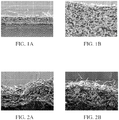
- FIGS. 1A and 1B Illustrated in FIGS. 1A and 1B are SEM micrographs of a control tissue handsheet ( FIG. 1A ) and a tissue handsheet comprising expandable microspheres ( FIG. 1B ).
- FIGS. 2A and 2B Illustrated in FIGS. 2A and 2B are SEM micrographs of a control UCTAD tissue web ( FIG. 2A ) and an UCTAD tissue web comprising expandable microspheres ( FIG. 2B ).
- dispersion generally refers to a polymer dispersed in an aqueous continuous phase.
- the polymer is dispersed in an aqueous continuous phase by the addition of one or more stabilizers, such as a polyvinyl alcohol.
- stabilizers such as a polyvinyl alcohol.
- nonionic dispersion polymer means polymer dispersed in an aqueous continuous phase wherein the dispersed polymer possesses a net neutral charge.
- Basis weight generally refers to the bone dry weight per unit area of a tissue. Basis weight is measured herein using TAPPI test method T-220.
- tissue product generally refers to various paper products, such as facial tissue, bath tissue, paper towels, napkins, and the like.
- basis weight of a tissue product of the present invention is less than about 80 grams per square meter (gsm), in some embodiments less than about 60 gsm, and in some embodiments, from about 10 to about 60 gsm.
- tissue refers to the volume per unit basis of a tissue product and is calculated as the quotient of the caliper expressed in microns, divided by the basis weight, expressed in grams per square meter. The resulting bulk is expressed as cubic centimeters per gram.
- the term "layer” refers to a plurality of strata of fibers, chemical treatments, or the like, within a ply.
- layered tissue web As used herein, the terms “layered tissue web,” “multi-layered tissue web,” “multi-layered web,” and “multi-layered paper sheet,” generally refer to sheets of paper prepared from two or more layers of aqueous papermaking furnish which are preferably comprised of different fiber types.
- the layers are preferably formed from the deposition of separate streams of dilute fiber slurries, upon one or more endless foraminous screens. If the individual layers are initially formed on separate foraminous screens, the layers are subsequently combined (while wet) to form a layered composite web.
- plies refers to a discrete product element. Individual plies may be arranged in juxtaposition to each other. The term may refer to a plurality of web-like components such as in a multi-ply facial tissue, bath tissue, paper towel, wipe, or napkin.
- microspheres are mixed with a nonionic polymer dispersion comprising at least one vinyl acetate-ethylene copolymer, and incorporated into a tissue web to increase sheet bulk.
- a nonionic polymer dispersion comprising at least one vinyl acetate-ethylene copolymer
- the bulk of the sheet is increased by about at least 10 percent compared to sheets prepared without microspheres.
- the improvement in bulk is achieved without the use of a cationic retention aid, which has been previously used to facilitate retention of the microspheres within the web.
- the disclosure provides a method of producing a tissue web comprising adding microspheres to a nonionic polymer dispersion to form a mixture, adding the mixture to an aqueous suspension of cellulosic fibers and then dewatering the obtained suspension to form a tissue web.
- the addition of the microsphere-nonionic polymer dispersion mixture to the fiber slurry yields a tissue web wherein the microspheres are substantially uniformly distributed throughout the tissue web.
- the nonionic polymer dispersion comprises at least one vinyl acetate-ethylene copolymer, which comprises vinyl acetate and ethylene monomers polymerized to form the dispersion.
- the vinyl acetate-ethylene copolymer preferably comprises from 75 to 99 percent by weight vinyl acetate, and from 1 to 25 percent by weight ethylene. Still more preferably the level of vinyl acetate is from 85 to 95 percent by weight and the level of ethylene incorporated is from 5 to 15 percent by weight.
- the copolymer comprises 65 to 90 percent by weight vinyl acetate and 10 to 35 percent by weight ethylene, on a monomer basis, to provide a glass transition temperature (T g ) ranging from about 10°C to 20°C, and still more preferably from about 15°C to about 17°C.
- T g glass transition temperature
- one or more other ethylenically unsaturated monomers may also be present in the monomer mixture at up to 15 percent by weight, preferably from 5 to 10 percent by weight of the total polymer solids.
- said comonomers include, but are not limited to, comonomers conventionally used in compositions with ethylene and vinyl esters such as acrylates and maleates, e.g. butyl acrylate, and 2-ethylhexyl acrylate.
- Functional monomers may also be included at up to 10 percent by weight, and preferably from 1 to 5 percent by weight.
- Suitable functional monomers are carboxylic acids, such as acrylic, methacrylic and maleic acid as well as hydroxyl and amide functional monomers, e.g., hydroxyethylacrylate, hydroxypropylacrylate, acrylamide, N-vinyl formamide, N-vinyl acetamide, and the like.
- Crosslinking monomers can also be present, such as N-methylol acrylamide, and the n-alkyl esters thereof.
- certain copolymerizable monomers that assist in the stability of the copolymer dispersion e.g., vinyl sulfonic acid and 2-acrylamido-2-methylpropane sulfonic acid or their salts may be used herein as latex stabilizers. If present, these stabilizers are added in amounts of from about 0.2 to 1 percent by weight of the monomer mixture.
- the initiator is any free radical initiator, or initiator system known in the art.
- Suitable as polymerization initiators are the water-soluble free-radical-formers generally used in emulsion polymerization, such as hydrogen peroxide, sodium persulfate, potassium persulfate and ammonium persulfate, as well as t-butyl hydroperoxide, in amounts of between 0.01 and 3 percent by weight, preferably 0.1 and 1 percent by weight based on the total amount of the polymer dispersion.
- reducing agents such as sodium formaldehyde-sulfoxylate, iron-II-salts, sodium dithionite, sodium hydrogen sulfite, sodium sulfite, sodium thiosulfate, ascorbic acid, erythorbic acid as redox catalysts in amounts of 0.01 to 3 percent by weight, preferably 0.1 to 1 percent by weight, based on the total amount of the polymer dispersion.
- the free-radical-formers can be charged in the aqueous emulsifier solution or be added during the polymerization in doses. Oil soluble initiators such as t-butyl hydrogen peroxide are preferred.
- the vinyl acetate-ethylene copolymer is preferably produced in the presence of a polyvinyl alcohol stabilizer.
- the stabilizer also comprises a nonionic surfactant.
- Suitable polyvinyl alcohols have a degree of polymerization ranging from 200 to 4,000, preferably 500 to 2,500. In certain embodiments the polyvinyl alcohols may be either partially or fully hydrolyzed, or mixtures of both.
- the polyvinyl alcohol component of the stabilizing system comprises a fully (at least 98 mol %) hydrolyzed polyvinyl alcohol and a partially (86 to 90 mol %) hydrolyzed polyvinyl alcohol in a weight ratio of fully hydrolyzed polyvinyl alcohol to partially hydrolyze polyvinyl alcohol ranging from 3:1 to 1:3.
- the amount of stabilizer used in the polymerization reaction is about 4 to about 10 percent based on the weight of vinyl acetate monomer.
- the stabilizer preferably is added to the polymerization reaction medium all at once prior to initiation, or may be added incrementally during the course of the polymerization, provided a sufficient amount is present initially to provide emulsion stability.
- the stabilizer comprises a mixture of fully hydrolyzed polyvinyl alcohol and partially polyvinyl alcohol, preferably 86 to 88 mole % hydrolyzed.
- the fully and partially hydrolyzed polyvinyl alcohols preferably have a degree of polymerization ranging from 100 to 600, although small amounts of polyvinyl alcohol having a higher degree of polymerization can also be present.
- the relative amount of each type of polyvinyl alcohol that is used is in the range of 3:1 to 1:3 weight ratio of fully hydrolyzed polyvinyl alcohol to partially hydrolyzed polyvinyl alcohol, desirably at a 1:1 weight ratio.
- the stabilizer includes a nonionic surfactant.
- the surfactant may be provided in an amount between about 0.01 and 3 percent by weight, preferably 0.1 and 1 percent by weight, based on the total amount of the polymer dispersion.
- the surfactant may comprise a single surfactant or a blend of surfactants.
- the surfactants contemplated for the invention include any of the known and conventional nonionic surfactants.
- Preferred nonionic surfactants include compounds selected from the group consisting of straight chain fatty alcohols containing from about 6 to about 20 carbon atoms, branched chain fatty alcohols containing from about 6 to about 20 carbon atoms, secondary fatty alcohols containing from about 6 to about 20 carbon atoms, branched alcohol ethoxylates condensed with an average of from about 6 to about 15 moles of ethylene oxide per mole of alcohol, secondary alcohol ethoxylates condensed with an average of from about 6 to about 15 moles of ethylene oxide per mole of alcohol, and mixtures thereof.
- the nonionic surfactant component of the stabilizing system may comprise an oxyalkylated product of an alkyl phenol, an aliphatic alcohol, an aliphatic carboxylic acid, or an acetylenic glycol or block copolymers of ethylene oxide and propylene oxide.
- nonionic surfactants are alkoxylated alkylphenols, such as those sold under the trade name Lutensol® (BASF) and octylphenol ethoxylates, such as those sold under the trade name Triton (Dow).
- Other preferred nonionic surfactants are alkylphenoxy-poly(ethyleneoxy)ethanols having alkyl groups containing from about 7 to 18 carbon atoms, and having from about 4 to 100 ethyleneoxy units, such as the octylphenoxy poly(ethyleneoxy)ethanols, nonylphenoxy poly(ethyleneoxy)ethanols, and dodecylphenoxy poly(ethyleneoxy)ethanols.
- nonionic surfactants include polyoxyalkylene derivatives of hexitol (including sorbitans, sorbides, manitans, and mannides) anhydride, partial long-chain fatty acid esters, such as polyoxyalkylene derivatives of sorbitan monolaurate, sorbitan monopalmitate, sorbitan monostearate, sorbitan tristearate, sorbitan monooleate and sorbitan trioleate.
- the polymerization process is a batch process, involving a single reactor with all monomer added prior to commencing the reaction.
- the process includes charging the reactor initially with vinyl acetate, ethylene, water and any other suitable components. This initial charge represents 100 percent of the total monomer charge.
- the ingredients may be added in any order without affecting the resultant dispersion.
- the reactor is then heated to from 40 to 60°C, preferably about 50°C.
- the reactor is agitated by any suitable means to facilitate dissolution of the ethylene.
- a portion of the initiator is added to the initial charge, with the remainder added gradually during the reaction to maintain the reaction.
- the reaction will last several hours, preferably up to 10 hours and most preferably from 1 to 4 hours.
- Polymerization is carried out at a pH of between 2 and 7, preferably between 3 and 5. In order to maintain the pH range, it may be useful to work in the presence of customary buffer systems, for example, in the presence of alkali metal acetates, alkali metal carbonates, alkali metal phosphates.
- Polymerization regulators including mercaptans such as mercaptoacetic acid and mercaptoethanol; aldehydes; chloroform; methylene chloride and trichloroethylene, may also be added.
- the dispersion produced has a high solids level, without the need for an additional concentration step.
- High solids means that the polymer particles are present in the dispersion at a level of 60 percent by weight or greater, preferably 65 percent by weight or greater, and most preferably greater than 70 percent by weight, based on the dispersion.
- vinyl acetate-ethylene copolymer dispersions are commercially available and may be useful in preparation of the compositions set forth herein.
- Suitable commercially available vinyl acetate-ethylene polymers include vinyl alcohol stabilized vinyl acetate-ethylene copolymer dispersions sold under the name VinnapasTM from Wacker Chemie, AG, Germany, such as VinnapasTM 323, VinnapasTM 400, VinnapasTM 400 H, and VinnapasTM EF 811, and vinyl acetate ethylene copolymer emulsions from Forbo Adhesives, sold under the name ElvaceTM, such as ElvaceTM 722, ElvaceTM 725, ElvaceTM 731 and ElvaceTM 732.
- Additional suitable commercially available vinyl acetate ethylene copolymer emulsions include those from Air Products Polymers under the name AirflexTM, such as AirflexTM 320, AirflexTM 323, and AirflexTM 400, and those from Celanase under the names Dur-O-SetTM and ResynTM, such as Dur-O-SetTM E-150, Dur-O-SetTM E-200, Dur-O-SetTM E-230, Dur-O-SetTM E-130, Dur-O-SetTM E-200HV, Dur-O-SetTM E-260, Dur-O-SetTM E-100, Dur-O-SetTM E-220, Dur-O-SetTM E-171HS, Dur-O-SetTM C-325, and ResynTM 1025, ResynTM 1072, ResynTM 1601, and ResynTM SB-321.
- two or more of the foregoing commercially available vinyl acetate ethylene copolymers may be blended together to form a nonionic polymer dispersion in which the
- microspheres may be introduced to by mixing or the like.
- the microspheres may be expandable microspheres and may be provided as either expanded or unexpanded.
- the microspheres are expanded and mixed with the nonionic polymer dispersion prior to being added to the fiber slurry.
- the expandable microspheres preferably comprise a thermoplastic polymer shell encapsulating a propellant.
- the propellant is preferably a liquid having a boiling temperature not higher than the softening temperature of the thermoplastic polymer shell. Upon heating of thermally expandable microspheres, the propellant increases the internal pressure at the same time as the shell softens, resulting in significant expansion of the microspheres.
- Both expandable and pre-expanded microspheres are commercially available under the trade name ExpancelTM (Akzo Nobel).
- Suitable expandable microspheres preferably have a volume median diameter from about 1 to about 500 ⁇ m, more preferably from about 5 to about 100 ⁇ m, most preferably from about 10 to about 50 ⁇ m.
- microspheres may be incorporated into the web by any process of paper formation, including single or multilayered web constructions, and are typically added prior to the headbox during formation of the tissue web. However, they may be added anywhere in the wet end prior to forming the web. In a particularly preferred embodiment the microspheres are added to the middle layer of a three layered web, where they are more readily retained and provide the greatest increase in sheet bulk.
- the microspheres may be added to the pulp slurry in an amount from about 5 to about 20 weight percent (based on the weight of pulp fibers) and more preferably from about 10 to about 15 weight percent (based on the weight of pulp fibers).
- the microspheres may be added to the pulp slurry in an amount from about 0.5 to about 5 weight percent (based on the weight of pulp fibers) and more preferably from about 1 to about 3 weight percent (based on the weight of pulp fibers).
- microspheres may be incorporated into any suitable fibrous tissue web.
- the base sheet can be a tissue product, such as a bath tissue, a facial tissue, a paper towel, a napkin, and the like.
- Fibrous tissue webs can be made from any suitable types of fiber.
- the fibrous webs may be incorporated into single-ply fibrous products or multiple-ply fibrous products.
- the product may include two plies, three plies, or more.
- Fibers suitable for making fibrous webs comprise any natural or synthetic fibers including both nonwoody fibers and woody or pulp fibers.
- Pulp fibers can be prepared in high-yield or low-yield forms and can be pulped in any known method, including kraft, sulfite, high-yield pulping methods and other known pulping methods. Fibers prepared from organosolv pulping methods can also be used, including the fibers and methods disclosed in US Patent Nos. 4,793,898 , 4,594,130 , 3,585,104 .
- Useful fibers can also be produced by anthraquinone pulping, exemplified by US Patent No. 5,595,628 .
- the fibrous webs of the present disclosure can also include synthetic fibers.
- the fibrous webs can include up to about 10 percent, such as up to about 30 percent or up to about 50 percent or up to about 70 percent or more by dry weight, to provide improved benefits.
- Suitable synthetic fibers include rayon, polyolefin fibers, polyester fibers, bicomponent sheath-core fibers, multi-component binder fibers, and the like.
- Synthetic cellulose fiber types include rayon in all its varieties and other fibers derived from viscose or chemically-modified cellulose.
- Chemically treated natural cellulosic fibers can be used, for example, mercerized pulps, chemically stiffened or crosslinked fibers, or sulfonated fibers.
- the fibers For good mechanical properties in using web forming fibers, it can be desirable that the fibers be relatively undamaged and largely unrefined or only lightly refined.
- recycled fibers can be used, virgin fibers are generally useful for their mechanical properties and lack of contaminants.
- Mercerized fibers, regenerated cellulosic fibers, cellulose produced by microbes, rayon, and other cellulosic material or cellulosic derivatives can be used.
- Suitable web forming fibers can also include recycled fibers, virgin fibers, or mixes thereof.
- any process capable of forming a web can also be utilized in the present disclosure.
- a web forming process of the present disclosure can utilize creping, wet creping, double creping, recreping, double recreping, embossing, wet pressing, air pressing, through-air drying, hydroentangling, creped through-air drying, co-forming, air laying, as well as other processes known in the art.
- the percentage of pulp is about 70 to 85 percent.
- fibrous sheets that are pattern densified or imprinted, such as the fibrous sheets disclosed in any of the following US Patent Nos. 4,514,345 , 4,528,239 , 5,098,522 , 5,260,171 , and 5,624,790 .
- Such imprinted fibrous sheets may have a network of densified regions that have been imprinted against a drum dryer by an imprinting fabric, and regions that are relatively less densified (e.g., "domes" in the fibrous sheet) corresponding to deflection conduits in the imprinting fabric, wherein the fibrous sheet superposed over the deflection conduits was deflected by an air pressure differential across the deflection conduit to form a lower-density pillow-like region or dome in the fibrous sheet.
- regions that are relatively less densified e.g., "domes" in the fibrous sheet
- Tissue webs prepared according to the present disclosure may include a single homogenous layer of fibers or may include a stratified or layered construction.
- the fibrous web ply may include two or three layers of fibers.
- Each layer may have a different fiber composition.
- a three-layered headbox generally includes an upper head box wall and a lower head box wall. Headbox further includes a first divider and a second divider, which separate three fiber stock layers.
- Each of the fiber layers comprises a dilute aqueous suspension of papermaking fibers.
- the particular fibers contained in each layer generally depend upon the product being formed and the desired results. For instance, the fiber composition of each layer may vary depending upon whether a bath tissue product, facial tissue product or paper towel product is being produced.
- the middle layer contains southern softwood kraft fibers either alone or in combination with other fibers such as high yield fibers.
- Outer layers contain softwood fibers, such as northern softwood kraft.
- the middle layer may contain softwood fibers for strength, while the outer layers may comprise hardwood fibers, such as eucalyptus fibers, for a perceived softness.
- any process capable of forming a base sheet may be utilized in the present disclosure.
- an endless traveling forming fabric suitably supported and driven by rolls receives the layered papermaking stock issuing from the headbox. Once retained on the fabric, the layered fiber suspension passes water through the fabric. Water removal is achieved by combinations of gravity, centrifugal force and vacuum suction depending on the forming configuration. Forming multi-layered paper webs is also described and disclosed in US Patent No. 5,129,988 ,
- the formed web is dried by transfer to the surface of a rotatable heated dryer drum, such as a Yankee dryer.
- the creping composition of the present disclosure may be applied topically to the tissue web while the web is traveling on the fabric or may be applied to the surface of the dryer drum for transfer onto one side of the tissue web.
- the creping composition is used to adhere the tissue web to the dryer drum.
- the web is carried through a portion of the rotational path of the dryer surface, heat is imparted to the web causing most of the moisture contained within the web to be evaporated.
- the web is then removed from the dryer drum by a creping blade.
- the creping web as it is formed further reduces internal bonding within the web and increases softness. Applying the creping composition to the web during creping, on the other hand, may increase the strength of the web.
- the formed web is transferred to the surface of the rotatable heated dryer drum, which may be a Yankee dryer.
- the press roll may, in one embodiment, comprise a suction pressure roll.
- a creping adhesive may be applied to the surface of the dryer drum by a spraying device.
- the spraying device may emit a creping composition made in accordance with the present disclosure or may emit a conventional creping adhesive.
- the web is adhered to the surface of the dryer drum and then creped from the drum using the creping blade.
- the dryer drum may be associated with a hood. The hood may be used to force air against or through the web.
- the web may be adhered to a second dryer drum.
- the second dryer drum may comprise, for instance, a heated drum surrounded by a hood.
- the drum may be heated from about 25°C to about 200°C, such as from about 100°C to about 150°C.
- a second spray device may emit an adhesive onto the surface of the dryer drum.
- the second spray device may emit a creping composition as described above.
- the creping composition not only assists in adhering the tissue web to the dryer drum, but also is transferred to the surface of the web as the web is creped from the dryer drum by the creping blade.
- the web may, optionally, be fed around a cooling reel drum and cooled prior to being wound on a reel.
- the creping composition may also be used in post-forming processes.
- the creping composition may be used during a print-creping process. Specifically, once topically applied to a fibrous web, the creping composition has been found well-suited to adhering the fibrous web to a creping surface, such as in a print-creping operation.
- the creping composition may be applied to at least one side of the web and the at least one side of the web may then be creped.
- the creping composition may be applied to only one side of the web and only one side of the web may be creped, the creping composition may be applied to both sides of the web and only one side of the web is creped, or the creping composition may be applied to each side of the web and each side of the web may be creped.
- the creping composition may be added to one side of the web by creping, using either an in-line or off-line process.
- a tissue web is passed through a first creping composition application station that includes a nip formed by a smooth rubber press roll and a patterned rotogravure roll.
- the rotogravure roll is in communication with a reservoir containing a first creping composition.
- the rotogravure roll applies the creping composition to one side of web in a preselected pattern.
- the web is then contacted with a heated roll, which can be heated to a temperature, for instance, up to about 200°C, and more preferably from about 100°C to about 150°C. In general, the web can be heated to a temperature sufficient to dry the web and evaporate any water.
- any suitable heating device can be used to dry the web.
- the web can be placed in communication with an infra-red heater in order to dry the web.
- other heating devices can include, for instance, any suitable convective oven or microwave oven.
- the web can be advanced by pull rolls to a second creping composition application station, which includes a transfer roll in contact with a rotogravure roll, which is in communication with a reservoir containing a second creping composition.
- the second creping composition may be applied to the opposite side of the web in a preselected pattern.
- the first and second creping compositions may contain the same ingredients or may contain different ingredients. Alternatively, the creping compositions may contain the same ingredients in different amounts as desired.
- the creping blade performs a controlled pattern creping operation on the second side of the tissue web.
- the creping composition is being applied to each side of the tissue web, only one side of the web undergoes a creping process. It should be understood, however, that in other embodiments both sides of the web may be creped.
- the drying station can include any form of a heating unit, such as an oven energized by infra-red heat, microwave energy, hot air, or the like.
- a drying station may be necessary in some applications to dry the web and/or cure the creping composition. Depending upon the creping composition selected, however, in other applications a drying station may not be needed.
- the creping compositions of the present disclosure are typically transferred to the web at high levels, such that at least about 30 percent of the creping composition applied to the Yankee dryer is transferred to the web, more preferably at least about 45 percent is transferred and still more preferably at least about 60 percent is transferred. Generally from about 45 to about 65 percent of the creping composition applied to the Yankee dryer is transferred to the web.
- the amount of creping additive transferred to the sheet is a function of the amount of creping additive applied to the Yankee dryer.
- the basis weight of webs made in accordance with the present disclosure can vary depending upon the final product. In general, the basis weight of the web may vary from about 15 to about 60 gsm, such as from about 15 to about 30 gsm.
- fibrous webs made according to the present disclosure can be incorporated into multiple-ply products.
- a fibrous web made according to the present disclosure can be attached to one or more other fibrous webs for forming a wiping product having desired characteristics.
- the other webs laminated to the fibrous web of the present disclosure can be, for instance, a wet-creped web, a calendered web, an embossed web, a through-air dried web, a creped through-air dried web, an uncreped through-air dried web, an airlaid web, and the like.
- a fibrous web made according to the present disclosure when incorporating a fibrous web made according to the present disclosure into a multiple-ply product, it may be desirable to only apply the creping composition to one side of the fibrous web and to thereafter crepe the treated side of the web.
- the creped side of the web is then used to form an exterior surface of a multiple-ply product.
- the untreated and uncreped side of the web is attached by any suitable means to one or more plies.
- the basis weight of each fibrous web present in the product can also vary.
- the total basis weight of a multiple-ply product will generally be from 30 to 80 gsm, such as from 32 to 45 gsm and more preferably from 35 to 40 gsm.
- the tissue product is a multi-ply facial tissue wherein each ply has a basis weight from 15 gsm to 20 gsm and more particularly from 16 gsm to 18 gsm.
- tissue webs have a bulk of at least 10 cc/g, more preferably at least 12 cc/g and still more preferably at least 15 cc/g, such as from 10 cc/g to 25 cc/g.
- bulk may depend on the method of manufacture. Accordingly, creped tissue webs may have a bulk of from 10 to 15 cc/g, and uncreped through-air dried webs may have a bulk of from 15 to 25 cc/g.
- Tissue handsheets comprising Eucalyptus Kraft Pulp and a nonionic polymer dispersion comprising microspheres were prepared as described below. From about 20 to about 320 weight percent (based on dry weight of pulp) of the nonionic polymer dispersion comprising microspheres was added to the pulp diluted slurry inside the head box of the handsheet former and mixed uniformly before the handsheets were formed by removing water.
- a nonionic polymer dispersion comprising microspheres having the composition set forth below, was prepared by mixing a poly(vinyl alcohol) stabilized vinyl acetate-ethylene copolymer dispersion with water for 15 minutes, followed by the addition of nonionic surfactant, biocide and defoamer and mixing for an additional 15 minutes. Microspheres were then added with mixing for an additional 15 minutes. The weight percentages of individual components are set forth below.
- Vinyl Acetate-Ethylene Copolymer with unexpanded ExpancelTM (VAE - UE) Component Weight % Poly(vinyl alcohol) stabilized Vinyl Acetate-Ethylene Copolymer Dispersion 40% Water 25% Nonionic Surfactant 2% Biocide 0.5% Defoamer 0.5% Unexpanded ExpancelTM Microspheres (031 WUF40, Akzo Nobel) 32%
- Handsheets were prepared by first measuring the appropriate amount of fiber (0.3 percent consistency) slurry required to obtain the desired basis weight. The slurry was then poured from the graduated cylinder into an 8.5-inch by 8.5-inch (21.6cm by 21.6cm) Valley handsheet mold (Valley Laboratory Equipment, Voith, Inc., Appleton, WI) that had been pre-filled to the appropriate level with water. After pouring the slurry into the mold, a predetermined amount of the nonionic polymer dispersion comprising microspheres was added to the mold and then the mold completely filled with water. The slurry was then agitated gently with a standard perforated mixing plate that was inserted into the slurry and moved up and down seven times, then removed.
- a standard perforated mixing plate that was inserted into the slurry and moved up and down seven times, then removed.
- the water was then drained from the mold through a wire assembly at the bottom of the mold that retained the fibers to form an embryonic web.
- the forming wire was a 90 mesh, stainless-steel wire cloth.
- the web was couched from the mold wire with two blotter papers placed on top of the web with the smooth side of the blotter contacting the web.
- the blotters were removed and the embryonic web was lifted with the lower blotter paper, to which it was attached.
- the lower blotter was separated from the other blotter, keeping the embryonic web attached to the lower blotter.
- the blotter was positioned with the embryonic web face up, and the blotter was placed on top of two other dry blotters.
- Two more dry blotters were also placed on top of the embryonic web.
- the stack of blotters with the embryonic web was placed in a Valley hydraulic press and pressed for one minute with 100 psi (43.1 kPa) applied to the web.
- the pressed web was removed from the blotters and placed on a Valley steam dryer containing steam at 2.5 pounds per square inch (psig) (1.08 kPag) and heated for 2 minutes, with the wire-side surface of the web next to the metal drying surface and a felt under tension on the opposite side of the web.
- Felt tension was provided by 17.5 lbs. (7.9 kg) of weight pulling downward on an end of the felt that extends beyond the edge of the curved metal dryer surface.
- the dried handsheet was trimmed to 7.5 inches square (19.05cm square) with a paper cutter and then weighed in a heated balance with the temperature maintained at 105°C to obtain the oven dry weight of the web.
- Scanning electron microscopy (SEM) images of select handsheets were obtained using the JSM-6490LV scanning electron microscope under the following operating conditions: accelerating voltage is 10 kilovolts; spot size is 40, working distance 20 millimeters, and magnification from 100X to 500X.
- Handsheet cross-sections were prepared by cleaving the sheet with a fresh, razor blade at liquid nitrogen temperatures. The handsheet samples were mounted with double-stick tape and metalized with gold using a vacuum sputter for proper imaging in the SEM.
- the physical properties of the handsheets are set forth below.
- Tissue basesheets were made using either a creped tissue making process or a throughdried papermaking processes, commonly referred to as “uncreped throughdried” (“UCTAD").
- UTAD creped throughdried
- NSWK northern softwood kraft
- the NSWK pulp was refined with a refiner built into the pulper for 3 to 15 minutes.
- the NSWK pulp was then transferred to a machine chest and subsequently diluted to approximately 0.27 percent consistency.
- Two kilograms KymeneTM 920A (12.5 percent solids) per metric ton of wood fiber was added to the NSWK pulp prior to the headbox in the machine chest.
- the softwood fibers were used as the inner strength layer in a 3-layer tissue structure.
- the NSWK layer contributed approximately about 30 percent of the final sheet weight.
- Eucalyptus hardwood Kraft (EHWK) pulp was dispersed in a pulper for 30 minutes at about 1.6 percent consistency at about 100°F (37.8°C). The EHWK pulp was then transferred to a machine chest and subsequently diluted to about 0.14 percent consistency. The EHWK pulp fibers were used in the two outer layers of the 3-layered tissue structure. The EHWK layers contributed about 70 percent of the final sheet weight.
- pulp fibers from the machine chests were pumped to the headbox at a consistency of about 0.02 percent. Pulp fibers from each machine chest were sent through separate manifolds in the headbox to create a 3-layered tissue structure. The fibers were deposited onto a felt in a fourdrenier type of former like that shown in FIG 2 .
- the wet sheet about 10 to 20 percent consistency, was adhered to a Yankee dryer, traveling at about 50 to about 60 fpm (15 to 18 mpm) through a nip via a pressure roll.
- the consistency of the wet sheet after the pressure roll nip post-pressure roll consistency or PPRC) was approximately 40 percent.
- the wet sheet is adhered to the Yankee dryer due to the creping composition that is applied to the dryer surface.
- the sheet was dried to about 98 to 99 percent consistency as it traveled on the Yankee dryer and to the creping blade.
- the creping blade subsequently scraped the tissue sheet and a portion of the creping composition off of the Yankee dryer.
- the creped tissue basesheet was then wound onto a core traveling at about 47 to about 52 fpm (15 to 17 mpm) into soft rolls for converting.
- the resulting tissue basesheet had a bone dry basis weight of about 14 gsm.
- Two soft rolls of the creped tissue were then rewound, calendared, and plied together so that both creped sides were on the outside of the 2-ply structure. Mechanical crimping on the edges of the structure held the plies together.
- the plied sheet was then slit on the edges to a standard width of approximately 8.5 inches (21.6 cm) and folded, and cut to facial tissue length. Tissue samples were conditioned and tested.
- UCTAD webs were prepared as generally described in US Patent No. 5,607,551 . Prior to forming, each stock was diluted to approximately 0.1 percent consistency and transferred to a 3-layered headbox in such a manner as to provide a layered web comprising about 70 percent EHWK and 35 percent NSWK, where the outer layers comprised EHWK and the center layer comprised NSWK. The formed web was non-compressively dewatered and rush-transferred to a transfer fabric traveling at a speed about 25 percent slower than the forming fabric. The web was then transferred to a throughdrying fabric, dried and calendered. The resulting tissue basesheet had a bone dry basis weight of about 30 gsm.
- microsphere compositions were prepared by mixing the poly(vinyl alcohol) stabilized vinyl acetate-ethylene copolymer dispersion with water for 15 minutes, followed by the addition of nonionic surfactant, biocide and defoamer and mixing for an additional 15 minutes. Microspheres were then added with mixing for an additional 15 minutes. The weight percentages of individual components are set forth below. In instances where microspheres were added to the tissue web, the microspheres were added to the machine chest containing the NSWK slurry and mixed with the NSWK slurry for at least 15 minutes. Thus, when incorporated into the tissue web, the microspheres were added to the center layer of the three layered tissue web.
- Vinyl Acetate-Ethylene Copolymer with unexpanded (VAE - UE) Component Weight % Poly(vinyl alcohol) stabilized Vinyl Acetate-Ethylene Copolymer Dispersion 40% Water 25% Nonionic Surfactant 2% Biocide 0.5% Defoamer 0.5% Unexpanded Microspheres (031 WUF40, Akzo Nobel) 32% Vinyl Acetate-Ethylene Copolymer with expanded (VAE - E) Component Weight % Poly(vinyl alcohol) stabilized Vinyl Acetate-Ethylene Copolymer Dispersion 30% Water 62% Nonionic Surfactant 2% Biocide 0.5% Defoamer 0.5% Expanded ExpancelTM Microspheres (920WE40D24 Akzo Nobel) 5% The physical properties of tissue webs are summarized below.
Landscapes
- Chemical & Material Sciences (AREA)
- Chemical Kinetics & Catalysis (AREA)
- Paper (AREA)
- Manufacture Of Porous Articles, And Recovery And Treatment Of Waste Products (AREA)
- Materials For Medical Uses (AREA)
- Treatments For Attaching Organic Compounds To Fibrous Goods (AREA)
- Chemical Or Physical Treatment Of Fibers (AREA)
Claims (11)
- Gewebebahn, umfassend Zellulosefasern, dehnbare Mikrokugeln, ein mit Polyvinylalkohol stabilisiertes VinylAcetat-Ethylen-Copolymer und ein nicht-ionisches Tensid, wobei die Bahn ein Flächengewicht von mindestens 10 g/m2 und ein Volumen von mindestens 10 cm3/g hat.
- Gewebebahn nach Anspruch 1, wobei die Bahn durchluftgetrocknet ist.
- Gewebebahn nach Anspruch 2, wobei die Bahn ungekreppt ist, bevorzugt wobei das Volumen der Bahn mindestens 18 cm3/g ist.
- Gewebebahn nach Anspruch 1, wobei die Bahn durch Zusammenpressen entwässert und gekreppt ist.
- Gewebebahn, umfassend Zellulosefasern, vorgedehnte Mikrokugeln, ein mit Polyvinylalkohol stabilisiertes VinylAcetat-Ethylen-Copolymer und ein nicht-ionisches Tensid, wobei die Gewebebahn ein Flächengewicht von mindestens 10 g/m2 und ein Volumen von mindestens 10 cm3/g hat.
- Gewebebahn nach Anspruch 5, wobei die Bahn eine ungekreppte, durchgetrocknete Bahn mit einem Flächengewicht von mindestens 20 g/m2 und einem Volumen von mindestens 15 cm3/g ist und/oder wobei die Bahn eine gekreppte Bahn ist.
- Gewebebahn nach einem der Ansprüche 1 bis 4, wobei die Bahn weniger als 10 Prozent, in Bezug auf das Gesamtgewicht der Bahn, dehnbare Mikrokugeln umfasst.
- Verfahren zum Ausbilden einer Gewebebahn gemäß Anspruch 1, das Verfahren folgende Schritte umfassend:a. Mischen dehnbarer Mikrokugeln, eines Vinyl-Acetat-Ethylen-Copolymers, Polyvinylalkohol und eines nicht-ionischen Tensids, um ein nicht-ionisches Dispersionspolymer auszubilden;b. Ausbilden einer Zellulosefasersuspension;c. Mischen des nicht-ionischen Dispersionspolymers und der Zellulosefasersuspension, um ein Gemisch auszubilden;d. Verteilen des Gemischs auf einem Formiergewebe, um eine Gewebebahn auszubilden; unde. Trocknen der Gewebebahn,wobei die Gewebebahn ein Basisgewicht von mindestens 10 g/m2 und ein Volumen von mindestens 10 m3/g hat.
- Verfahren nach Anspruch 8, wobei die Gewebebahn weniger als 10 Prozent, in Bezug auf das Gesamtgewicht der Bahn, dehnbare Mikrokugeln umfasst.
- Verfahren nach Anspruch 8 oder 9, wobei der Trocknungsschritt das Durchlufttrocknen der Gewebebahn umfasst.
- Verfahren nach Anspruch 10, ferner umfassend die Schritte des Kreppens der Gewebebahn.
Applications Claiming Priority (2)
| Application Number | Priority Date | Filing Date | Title |
|---|---|---|---|
| US13/562,710 US8679296B2 (en) | 2012-07-31 | 2012-07-31 | High bulk tissue comprising expandable microspheres |
| PCT/IB2013/056227 WO2014020524A2 (en) | 2012-07-31 | 2013-07-29 | High bulk tissue comprising expandable microspheres |
Publications (3)
| Publication Number | Publication Date |
|---|---|
| EP2880218A2 EP2880218A2 (de) | 2015-06-10 |
| EP2880218A4 EP2880218A4 (de) | 2016-05-25 |
| EP2880218B1 true EP2880218B1 (de) | 2018-06-13 |
Family
ID=50024321
Family Applications (1)
| Application Number | Title | Priority Date | Filing Date |
|---|---|---|---|
| EP13825681.3A Active EP2880218B1 (de) | 2012-07-31 | 2013-07-29 | Hochvoluminöses gewebe mit dehnbaren mikrokugeln |
Country Status (6)
| Country | Link |
|---|---|
| US (1) | US8679296B2 (de) |
| EP (1) | EP2880218B1 (de) |
| AU (1) | AU2013298190B2 (de) |
| BR (1) | BR112015001920B1 (de) |
| MX (1) | MX337237B (de) |
| WO (1) | WO2014020524A2 (de) |
Families Citing this family (3)
| Publication number | Priority date | Publication date | Assignee | Title |
|---|---|---|---|---|
| RU2017117504A (ru) | 2014-12-25 | 2019-01-25 | Дзе Проктер Энд Гэмбл Компани | Комплект носимых изделий |
| CA3042436A1 (en) * | 2016-11-01 | 2018-05-11 | Essity Hygiene And Health Aktiebolag | Napkin for wrapping cutlery |
| WO2019120514A1 (en) | 2017-12-20 | 2019-06-27 | Essity Hygiene And Health Aktiebolag | Napkin with adhering portion for wrapping cutlery |
Family Cites Families (56)
| Publication number | Priority date | Publication date | Assignee | Title |
|---|---|---|---|---|
| BE661981A (de) | 1964-04-03 | |||
| BE758373A (fr) | 1967-11-27 | 1971-05-03 | Dow Chemical Co | Procede de fabrication de papier |
| JPS545325B2 (de) | 1971-08-30 | 1979-03-15 | ||
| US4133688A (en) | 1975-01-24 | 1979-01-09 | Felix Schoeller, Jr. | Photographic carrier material containing thermoplastic microspheres |
| SE8204595L (sv) | 1982-08-05 | 1984-02-06 | Kema Nord Ab | Forfarande for framstellning av hartsimpregnerade fiberkompositmaterial |
| US4514345A (en) | 1983-08-23 | 1985-04-30 | The Procter & Gamble Company | Method of making a foraminous member |
| US4528239A (en) | 1983-08-23 | 1985-07-09 | The Procter & Gamble Company | Deflection member |
| SE453206B (sv) | 1983-10-21 | 1988-01-18 | Valmet Paper Machinery Inc | Hygienpappersbana, forfarande for framstellning derav samt anvendning av expanderbara mikrosferer av termoplast vid framstellning av hygienpappersbana |
| US5075153A (en) * | 1989-07-24 | 1991-12-24 | Xerox Corporation | Coated paper containing a plastic supporting substrate |
| US5260171A (en) | 1990-06-29 | 1993-11-09 | The Procter & Gamble Company | Papermaking belt and method of making the same using a textured casting surface |
| US5098522A (en) | 1990-06-29 | 1992-03-24 | The Procter & Gamble Company | Papermaking belt and method of making the same using a textured casting surface |
| CA2083600C (en) | 1990-06-29 | 1996-11-12 | Paul Dennis Trokhan | Papermaking belt and method of making the same using differential light transmission techniques |
| US5129988A (en) | 1991-06-21 | 1992-07-14 | Kimberly-Clark Corporation | Extended flexible headbox slice with parallel flexible lip extensions and extended internal dividers |
| US5264467A (en) * | 1991-09-24 | 1993-11-23 | Air Products And Chemicals, Inc. | High performance solvent-free contact adhesive |
| JP2611612B2 (ja) | 1992-11-18 | 1997-05-21 | 王子製紙株式会社 | クッション性紙管 |
| US5607551A (en) | 1993-06-24 | 1997-03-04 | Kimberly-Clark Corporation | Soft tissue |
| US5830317A (en) * | 1995-04-07 | 1998-11-03 | The Procter & Gamble Company | Soft tissue paper with biased surface properties containing fine particulate fillers |
| US5723021A (en) * | 1995-04-12 | 1998-03-03 | Betzdearborn Inc. | Method for inhibiting deposition in pulp and papermaking systems using a composition comprising of polyvinyl alcohol, gelatin and cationic polymer |
| US6379497B1 (en) | 1996-09-20 | 2002-04-30 | Fort James Corporation | Bulk enhanced paperboard and shaped products made therefrom |
| US6740373B1 (en) * | 1997-02-26 | 2004-05-25 | Fort James Corporation | Coated paperboards and paperboard containers having improved tactile and bulk insulation properties |
| US6919111B2 (en) | 1997-02-26 | 2005-07-19 | Fort James Corporation | Coated paperboards and paperboard containers having improved tactile and bulk insulation properties |
| ES2386805T3 (es) * | 1998-09-03 | 2012-08-31 | Stora Enso Aktiebolag | Laminado de papel o cartón y método para producir dicho laminado |
| AU7064300A (en) * | 1999-08-23 | 2001-03-19 | Kimberly-Clark Worldwide, Inc. | Tissue products having increased absorbency |
| US6365641B1 (en) | 1999-09-29 | 2002-04-02 | Matsumoto Yushi-Seiyaku Co Ltd | Process for producing heat-expandable microcapsules |
| US20020104632A1 (en) * | 1999-12-16 | 2002-08-08 | Graciela Jimenez | Opacity enhancement of tissue products with thermally expandable microspheres |
| US6866906B2 (en) | 2000-01-26 | 2005-03-15 | International Paper Company | Cut resistant paper and paper articles and method for making same |
| AU3306601A (en) | 2000-01-26 | 2001-08-07 | Int Paper Co | Low density paperboard articles |
| KR100615930B1 (ko) | 2000-03-27 | 2006-08-28 | 마쓰모토유시세이야쿠 가부시키가이샤 | 열팽창성 마이크로캡슐의 제조 방법 |
| JP4393377B2 (ja) | 2002-05-24 | 2010-01-06 | 松本油脂製薬株式会社 | 熱膨張性マイクロカプセルおよびその利用 |
| US20040043139A1 (en) | 2002-09-04 | 2004-03-04 | Daniels John James | Printer and method for manufacturing electronic circuits and displays |
| US7566498B2 (en) | 2002-12-25 | 2009-07-28 | Matsumoto Yushi-Seiyaku Co., Ltd. | Thermo-expansive microcapsule, production process of expanded product and expanded product thereof |
| KR101004337B1 (ko) | 2003-02-24 | 2010-12-28 | 마쓰모토유시세이야쿠 가부시키가이샤 | 열팽창성 미소구, 그 제조 방법 및 그 사용 방법 |
| JP2007521410A (ja) | 2003-06-26 | 2007-08-02 | アクゾ ノーベル エヌ.ブイ. | 微小球 |
| US20060000569A1 (en) * | 2004-07-02 | 2006-01-05 | Anna Kron | Microspheres |
| US20060134010A1 (en) | 2004-12-22 | 2006-06-22 | Akzo Nobel N.V. | Chemical composition and process |
| ATE531735T1 (de) | 2004-12-22 | 2011-11-15 | Akzo Nobel Nv | Chemische zusammensetzung und verfahren |
| US20060131362A1 (en) | 2004-12-22 | 2006-06-22 | Akzo Nobel N.V. | Chemical composition and process |
| KR100894011B1 (ko) | 2004-12-22 | 2009-04-17 | 악조 노벨 엔.브이. | 화학적 조성물 및 공정 |
| KR101192031B1 (ko) | 2005-03-11 | 2012-10-16 | 인터내셔널 페이퍼 컴퍼니 | 팽창성 미소구체 및 이온성 화합물을 함유하는 조성물, 및이의 제조 및 사용 방법 |
| US20070023141A1 (en) | 2005-07-29 | 2007-02-01 | Tyco Electronics Corporation | Hot melt adhesive for PTFE |
| FR2891837B1 (fr) | 2005-10-07 | 2012-03-30 | Cgp Ind | Composition aqueuse pour la realisation de bains d'enduction aux fins de realiser des supports doues de proprietes anti-glisse, procede pour realiser de tels supports et supports ainsi obtenus |
| US7842163B2 (en) * | 2005-12-15 | 2010-11-30 | Kimberly-Clark Worldwide, Inc. | Embossed tissue products |
| US20090165976A1 (en) | 2006-02-03 | 2009-07-02 | Nanopaper, Llc | Expansion agents for paper-based materials |
| US7956096B2 (en) | 2006-02-10 | 2011-06-07 | Akzo Nobel N.V. | Microspheres |
| PL1981630T3 (pl) | 2006-02-10 | 2016-03-31 | Akzo Nobel Chemicals Int Bv | Mikrosfery |
| US8388809B2 (en) | 2006-02-10 | 2013-03-05 | Akzo Nobel N.V. | Microspheres |
| RU2432989C2 (ru) | 2006-02-10 | 2011-11-10 | Акцо Нобель Н.В. | Микросферы |
| CA2651264C (en) | 2006-05-05 | 2014-07-08 | International Paper Company | Paperboard material with expanded polymeric microspheres |
| US20070287776A1 (en) | 2006-06-08 | 2007-12-13 | Akzo Nobel N.V. | Microspheres |
| ES2605418T3 (es) * | 2006-06-08 | 2017-03-14 | Akzo Nobel N.V. | Microesferas |
| CA2671102A1 (en) | 2006-12-01 | 2008-06-05 | Akzo Nobel N.V. | Packaging laminate |
| US20090018517A1 (en) * | 2007-07-11 | 2009-01-15 | Riccardo Cecconi | Composite absorbent material with water-soluble bonding agents, products made of said material nad method for its manufacture |
| RU2011101414A (ru) * | 2008-06-17 | 2012-07-27 | Акцо Нобель Н.В. (NL) | Целлюлозный продукт |
| WO2010025383A1 (en) | 2008-08-28 | 2010-03-04 | International Paper Company | Expandable microspheres and methods of making and using the same |
| US20110155338A1 (en) | 2009-12-28 | 2011-06-30 | Zhang Jun G | Bulk Enhancement For Airlaid Material |
| US8916012B2 (en) * | 2010-12-28 | 2014-12-23 | Kimberly-Clark Worldwide, Inc. | Method of making substrates comprising frothed benefit agents |
-
2012
- 2012-07-31 US US13/562,710 patent/US8679296B2/en active Active
-
2013
- 2013-07-29 BR BR112015001920-0A patent/BR112015001920B1/pt active IP Right Grant
- 2013-07-29 MX MX2015001024A patent/MX337237B/es active IP Right Grant
- 2013-07-29 WO PCT/IB2013/056227 patent/WO2014020524A2/en not_active Ceased
- 2013-07-29 AU AU2013298190A patent/AU2013298190B2/en active Active
- 2013-07-29 EP EP13825681.3A patent/EP2880218B1/de active Active
Non-Patent Citations (1)
| Title |
|---|
| None * |
Also Published As
| Publication number | Publication date |
|---|---|
| BR112015001920B1 (pt) | 2021-05-25 |
| AU2013298190B2 (en) | 2015-10-08 |
| MX337237B (es) | 2016-02-18 |
| EP2880218A2 (de) | 2015-06-10 |
| US20140034254A1 (en) | 2014-02-06 |
| WO2014020524A2 (en) | 2014-02-06 |
| MX2015001024A (es) | 2015-05-12 |
| EP2880218A4 (de) | 2016-05-25 |
| WO2014020524A3 (en) | 2014-04-17 |
| US8679296B2 (en) | 2014-03-25 |
| AU2013298190A1 (en) | 2015-02-19 |
| WO2014020524A4 (en) | 2014-05-30 |
| BR112015001920A2 (pt) | 2017-07-04 |
Similar Documents
| Publication | Publication Date | Title |
|---|---|---|
| US6911114B2 (en) | Tissue with semi-synthetic cationic polymer | |
| US9410291B2 (en) | Tissue product comprising bamboo | |
| KR101454177B1 (ko) | 티슈 제품 제조방법 | |
| KR101340717B1 (ko) | 중합체 분산액을 함유하는 티슈 제품 | |
| WO2014200456A1 (en) | Soft and strong engineered tissue | |
| US9499942B2 (en) | High basis weight creped tissue | |
| EP2659066B1 (de) | Gekrepptes seidenpapier mit verbesserter haltekapazität | |
| US12043963B2 (en) | Fibrous sheet with improved properties | |
| CN104937169B (zh) | 氢键合减少的多层薄纸 | |
| WO2010070473A2 (en) | Water-dispersible creping materials | |
| EP2880218B1 (de) | Hochvoluminöses gewebe mit dehnbaren mikrokugeln |
Legal Events
| Date | Code | Title | Description |
|---|---|---|---|
| PUAI | Public reference made under article 153(3) epc to a published international application that has entered the european phase |
Free format text: ORIGINAL CODE: 0009012 |
|
| 17P | Request for examination filed |
Effective date: 20150217 |
|
| AK | Designated contracting states |
Kind code of ref document: A2 Designated state(s): AL AT BE BG CH CY CZ DE DK EE ES FI FR GB GR HR HU IE IS IT LI LT LU LV MC MK MT NL NO PL PT RO RS SE SI SK SM TR |
|
| AX | Request for extension of the european patent |
Extension state: BA ME |
|
| RIN1 | Information on inventor provided before grant (corrected) |
Inventor name: QIN, JIAN Inventor name: CALEWARTS, DEBORAH, JOY |
|
| DAX | Request for extension of the european patent (deleted) | ||
| A4 | Supplementary search report drawn up and despatched |
Effective date: 20160422 |
|
| RIC1 | Information provided on ipc code assigned before grant |
Ipc: D21H 11/00 20060101AFI20160418BHEP Ipc: D21H 27/00 20060101ALI20160418BHEP Ipc: D21H 21/22 20060101ALI20160418BHEP Ipc: D21H 21/54 20060101ALI20160418BHEP Ipc: D21H 23/50 20060101ALI20160418BHEP Ipc: D21H 17/33 20060101ALI20160418BHEP Ipc: D21H 17/37 20060101ALI20160418BHEP Ipc: D21H 17/36 20060101ALI20160418BHEP |
|
| STAA | Information on the status of an ep patent application or granted ep patent |
Free format text: STATUS: EXAMINATION IS IN PROGRESS |
|
| 17Q | First examination report despatched |
Effective date: 20170719 |
|
| GRAP | Despatch of communication of intention to grant a patent |
Free format text: ORIGINAL CODE: EPIDOSNIGR1 |
|
| STAA | Information on the status of an ep patent application or granted ep patent |
Free format text: STATUS: GRANT OF PATENT IS INTENDED |
|
| INTG | Intention to grant announced |
Effective date: 20171214 |
|
| GRAS | Grant fee paid |
Free format text: ORIGINAL CODE: EPIDOSNIGR3 |
|
| GRAA | (expected) grant |
Free format text: ORIGINAL CODE: 0009210 |
|
| STAA | Information on the status of an ep patent application or granted ep patent |
Free format text: STATUS: THE PATENT HAS BEEN GRANTED |
|
| AK | Designated contracting states |
Kind code of ref document: B1 Designated state(s): AL AT BE BG CH CY CZ DE DK EE ES FI FR GB GR HR HU IE IS IT LI LT LU LV MC MK MT NL NO PL PT RO RS SE SI SK SM TR |
|
| REG | Reference to a national code |
Ref country code: GB Ref legal event code: FG4D |
|
| REG | Reference to a national code |
Ref country code: CH Ref legal event code: EP Ref country code: AT Ref legal event code: REF Ref document number: 1008649 Country of ref document: AT Kind code of ref document: T Effective date: 20180615 |
|
| REG | Reference to a national code |
Ref country code: IE Ref legal event code: FG4D |
|
| REG | Reference to a national code |
Ref country code: DE Ref legal event code: R096 Ref document number: 602013039002 Country of ref document: DE |
|
| REG | Reference to a national code |
Ref country code: NL Ref legal event code: MP Effective date: 20180613 |
|
| REG | Reference to a national code |
Ref country code: LT Ref legal event code: MG4D |
|
| PG25 | Lapsed in a contracting state [announced via postgrant information from national office to epo] |
Ref country code: BG Free format text: LAPSE BECAUSE OF FAILURE TO SUBMIT A TRANSLATION OF THE DESCRIPTION OR TO PAY THE FEE WITHIN THE PRESCRIBED TIME-LIMIT Effective date: 20180913 Ref country code: FI Free format text: LAPSE BECAUSE OF FAILURE TO SUBMIT A TRANSLATION OF THE DESCRIPTION OR TO PAY THE FEE WITHIN THE PRESCRIBED TIME-LIMIT Effective date: 20180613 Ref country code: LT Free format text: LAPSE BECAUSE OF FAILURE TO SUBMIT A TRANSLATION OF THE DESCRIPTION OR TO PAY THE FEE WITHIN THE PRESCRIBED TIME-LIMIT Effective date: 20180613 Ref country code: CY Free format text: LAPSE BECAUSE OF FAILURE TO SUBMIT A TRANSLATION OF THE DESCRIPTION OR TO PAY THE FEE WITHIN THE PRESCRIBED TIME-LIMIT Effective date: 20180613 Ref country code: SE Free format text: LAPSE BECAUSE OF FAILURE TO SUBMIT A TRANSLATION OF THE DESCRIPTION OR TO PAY THE FEE WITHIN THE PRESCRIBED TIME-LIMIT Effective date: 20180613 Ref country code: NO Free format text: LAPSE BECAUSE OF FAILURE TO SUBMIT A TRANSLATION OF THE DESCRIPTION OR TO PAY THE FEE WITHIN THE PRESCRIBED TIME-LIMIT Effective date: 20180913 Ref country code: ES Free format text: LAPSE BECAUSE OF FAILURE TO SUBMIT A TRANSLATION OF THE DESCRIPTION OR TO PAY THE FEE WITHIN THE PRESCRIBED TIME-LIMIT Effective date: 20180613 |
|
| PGFP | Annual fee paid to national office [announced via postgrant information from national office to epo] |
Ref country code: IT Payment date: 20180727 Year of fee payment: 6 |
|
| PG25 | Lapsed in a contracting state [announced via postgrant information from national office to epo] |
Ref country code: GR Free format text: LAPSE BECAUSE OF FAILURE TO SUBMIT A TRANSLATION OF THE DESCRIPTION OR TO PAY THE FEE WITHIN THE PRESCRIBED TIME-LIMIT Effective date: 20180914 Ref country code: LV Free format text: LAPSE BECAUSE OF FAILURE TO SUBMIT A TRANSLATION OF THE DESCRIPTION OR TO PAY THE FEE WITHIN THE PRESCRIBED TIME-LIMIT Effective date: 20180613 Ref country code: HR Free format text: LAPSE BECAUSE OF FAILURE TO SUBMIT A TRANSLATION OF THE DESCRIPTION OR TO PAY THE FEE WITHIN THE PRESCRIBED TIME-LIMIT Effective date: 20180613 Ref country code: RS Free format text: LAPSE BECAUSE OF FAILURE TO SUBMIT A TRANSLATION OF THE DESCRIPTION OR TO PAY THE FEE WITHIN THE PRESCRIBED TIME-LIMIT Effective date: 20180613 |
|
| REG | Reference to a national code |
Ref country code: AT Ref legal event code: MK05 Ref document number: 1008649 Country of ref document: AT Kind code of ref document: T Effective date: 20180613 |
|
| PG25 | Lapsed in a contracting state [announced via postgrant information from national office to epo] |
Ref country code: NL Free format text: LAPSE BECAUSE OF FAILURE TO SUBMIT A TRANSLATION OF THE DESCRIPTION OR TO PAY THE FEE WITHIN THE PRESCRIBED TIME-LIMIT Effective date: 20180613 |
|
| PG25 | Lapsed in a contracting state [announced via postgrant information from national office to epo] |
Ref country code: SK Free format text: LAPSE BECAUSE OF FAILURE TO SUBMIT A TRANSLATION OF THE DESCRIPTION OR TO PAY THE FEE WITHIN THE PRESCRIBED TIME-LIMIT Effective date: 20180613 Ref country code: EE Free format text: LAPSE BECAUSE OF FAILURE TO SUBMIT A TRANSLATION OF THE DESCRIPTION OR TO PAY THE FEE WITHIN THE PRESCRIBED TIME-LIMIT Effective date: 20180613 Ref country code: CZ Free format text: LAPSE BECAUSE OF FAILURE TO SUBMIT A TRANSLATION OF THE DESCRIPTION OR TO PAY THE FEE WITHIN THE PRESCRIBED TIME-LIMIT Effective date: 20180613 Ref country code: RO Free format text: LAPSE BECAUSE OF FAILURE TO SUBMIT A TRANSLATION OF THE DESCRIPTION OR TO PAY THE FEE WITHIN THE PRESCRIBED TIME-LIMIT Effective date: 20180613 Ref country code: AT Free format text: LAPSE BECAUSE OF FAILURE TO SUBMIT A TRANSLATION OF THE DESCRIPTION OR TO PAY THE FEE WITHIN THE PRESCRIBED TIME-LIMIT Effective date: 20180613 Ref country code: IS Free format text: LAPSE BECAUSE OF FAILURE TO SUBMIT A TRANSLATION OF THE DESCRIPTION OR TO PAY THE FEE WITHIN THE PRESCRIBED TIME-LIMIT Effective date: 20181013 Ref country code: PL Free format text: LAPSE BECAUSE OF FAILURE TO SUBMIT A TRANSLATION OF THE DESCRIPTION OR TO PAY THE FEE WITHIN THE PRESCRIBED TIME-LIMIT Effective date: 20180613 |
|
| REG | Reference to a national code |
Ref country code: DE Ref legal event code: R119 Ref document number: 602013039002 Country of ref document: DE |
|
| PG25 | Lapsed in a contracting state [announced via postgrant information from national office to epo] |
Ref country code: SM Free format text: LAPSE BECAUSE OF FAILURE TO SUBMIT A TRANSLATION OF THE DESCRIPTION OR TO PAY THE FEE WITHIN THE PRESCRIBED TIME-LIMIT Effective date: 20180613 |
|
| REG | Reference to a national code |
Ref country code: CH Ref legal event code: PL |
|
| PG25 | Lapsed in a contracting state [announced via postgrant information from national office to epo] |
Ref country code: MC Free format text: LAPSE BECAUSE OF FAILURE TO SUBMIT A TRANSLATION OF THE DESCRIPTION OR TO PAY THE FEE WITHIN THE PRESCRIBED TIME-LIMIT Effective date: 20180613 Ref country code: LU Free format text: LAPSE BECAUSE OF NON-PAYMENT OF DUE FEES Effective date: 20180729 |
|
| REG | Reference to a national code |
Ref country code: BE Ref legal event code: MM Effective date: 20180731 |
|
| PLBE | No opposition filed within time limit |
Free format text: ORIGINAL CODE: 0009261 |
|
| STAA | Information on the status of an ep patent application or granted ep patent |
Free format text: STATUS: NO OPPOSITION FILED WITHIN TIME LIMIT |
|
| PG25 | Lapsed in a contracting state [announced via postgrant information from national office to epo] |
Ref country code: DE Free format text: LAPSE BECAUSE OF NON-PAYMENT OF DUE FEES Effective date: 20190201 Ref country code: CH Free format text: LAPSE BECAUSE OF NON-PAYMENT OF DUE FEES Effective date: 20180731 Ref country code: LI Free format text: LAPSE BECAUSE OF NON-PAYMENT OF DUE FEES Effective date: 20180731 |
|
| REG | Reference to a national code |
Ref country code: IE Ref legal event code: MM4A |
|
| 26N | No opposition filed |
Effective date: 20190314 |
|
| PG25 | Lapsed in a contracting state [announced via postgrant information from national office to epo] |
Ref country code: DK Free format text: LAPSE BECAUSE OF FAILURE TO SUBMIT A TRANSLATION OF THE DESCRIPTION OR TO PAY THE FEE WITHIN THE PRESCRIBED TIME-LIMIT Effective date: 20180613 Ref country code: BE Free format text: LAPSE BECAUSE OF NON-PAYMENT OF DUE FEES Effective date: 20180731 Ref country code: SI Free format text: LAPSE BECAUSE OF FAILURE TO SUBMIT A TRANSLATION OF THE DESCRIPTION OR TO PAY THE FEE WITHIN THE PRESCRIBED TIME-LIMIT Effective date: 20180613 |
|
| PG25 | Lapsed in a contracting state [announced via postgrant information from national office to epo] |
Ref country code: IE Free format text: LAPSE BECAUSE OF NON-PAYMENT OF DUE FEES Effective date: 20180729 |
|
| PG25 | Lapsed in a contracting state [announced via postgrant information from national office to epo] |
Ref country code: FR Free format text: LAPSE BECAUSE OF NON-PAYMENT OF DUE FEES Effective date: 20180813 |
|
| PG25 | Lapsed in a contracting state [announced via postgrant information from national office to epo] |
Ref country code: AL Free format text: LAPSE BECAUSE OF FAILURE TO SUBMIT A TRANSLATION OF THE DESCRIPTION OR TO PAY THE FEE WITHIN THE PRESCRIBED TIME-LIMIT Effective date: 20180613 |
|
| PG25 | Lapsed in a contracting state [announced via postgrant information from national office to epo] |
Ref country code: MT Free format text: LAPSE BECAUSE OF NON-PAYMENT OF DUE FEES Effective date: 20180729 |
|
| PG25 | Lapsed in a contracting state [announced via postgrant information from national office to epo] |
Ref country code: TR Free format text: LAPSE BECAUSE OF FAILURE TO SUBMIT A TRANSLATION OF THE DESCRIPTION OR TO PAY THE FEE WITHIN THE PRESCRIBED TIME-LIMIT Effective date: 20180613 |
|
| PG25 | Lapsed in a contracting state [announced via postgrant information from national office to epo] |
Ref country code: PT Free format text: LAPSE BECAUSE OF FAILURE TO SUBMIT A TRANSLATION OF THE DESCRIPTION OR TO PAY THE FEE WITHIN THE PRESCRIBED TIME-LIMIT Effective date: 20180613 Ref country code: HU Free format text: LAPSE BECAUSE OF FAILURE TO SUBMIT A TRANSLATION OF THE DESCRIPTION OR TO PAY THE FEE WITHIN THE PRESCRIBED TIME-LIMIT; INVALID AB INITIO Effective date: 20130729 |
|
| PG25 | Lapsed in a contracting state [announced via postgrant information from national office to epo] |
Ref country code: MK Free format text: LAPSE BECAUSE OF NON-PAYMENT OF DUE FEES Effective date: 20180613 |
|
| PG25 | Lapsed in a contracting state [announced via postgrant information from national office to epo] |
Ref country code: IT Free format text: LAPSE BECAUSE OF NON-PAYMENT OF DUE FEES Effective date: 20190729 |
|
| PGFP | Annual fee paid to national office [announced via postgrant information from national office to epo] |
Ref country code: GB Payment date: 20250728 Year of fee payment: 13 |