EP2876523A1 - Adaptive battery protection - Google Patents
Adaptive battery protection Download PDFInfo
- Publication number
- EP2876523A1 EP2876523A1 EP14191038.0A EP14191038A EP2876523A1 EP 2876523 A1 EP2876523 A1 EP 2876523A1 EP 14191038 A EP14191038 A EP 14191038A EP 2876523 A1 EP2876523 A1 EP 2876523A1
- Authority
- EP
- European Patent Office
- Prior art keywords
- battery
- timer
- current
- current threshold
- threshold
- Prior art date
- Legal status (The legal status is an assumption and is not a legal conclusion. Google has not performed a legal analysis and makes no representation as to the accuracy of the status listed.)
- Granted
Links
Images



Classifications
-
- G—PHYSICS
- G06—COMPUTING OR CALCULATING; COUNTING
- G06F—ELECTRIC DIGITAL DATA PROCESSING
- G06F1/00—Details not covered by groups G06F3/00 - G06F13/00 and G06F21/00
- G06F1/16—Constructional details or arrangements
- G06F1/20—Cooling means
- G06F1/206—Cooling means comprising thermal management
-
- H—ELECTRICITY
- H01—ELECTRIC ELEMENTS
- H01M—PROCESSES OR MEANS, e.g. BATTERIES, FOR THE DIRECT CONVERSION OF CHEMICAL ENERGY INTO ELECTRICAL ENERGY
- H01M10/00—Secondary cells; Manufacture thereof
- H01M10/42—Methods or arrangements for servicing or maintenance of secondary cells or secondary half-cells
- H01M10/425—Structural combination with electronic components, e.g. electronic circuits integrated to the outside of the casing
-
- H—ELECTRICITY
- H01—ELECTRIC ELEMENTS
- H01M—PROCESSES OR MEANS, e.g. BATTERIES, FOR THE DIRECT CONVERSION OF CHEMICAL ENERGY INTO ELECTRICAL ENERGY
- H01M10/00—Secondary cells; Manufacture thereof
- H01M10/42—Methods or arrangements for servicing or maintenance of secondary cells or secondary half-cells
- H01M10/44—Methods for charging or discharging
-
- H—ELECTRICITY
- H02—GENERATION; CONVERSION OR DISTRIBUTION OF ELECTRIC POWER
- H02H—EMERGENCY PROTECTIVE CIRCUIT ARRANGEMENTS
- H02H3/00—Emergency protective circuit arrangements for automatic disconnection directly responsive to an undesired change from normal electric working condition with or without subsequent reconnection ; integrated protection
- H02H3/08—Emergency protective circuit arrangements for automatic disconnection directly responsive to an undesired change from normal electric working condition with or without subsequent reconnection ; integrated protection responsive to excess current
- H02H3/093—Emergency protective circuit arrangements for automatic disconnection directly responsive to an undesired change from normal electric working condition with or without subsequent reconnection ; integrated protection responsive to excess current with timing means
- H02H3/0935—Emergency protective circuit arrangements for automatic disconnection directly responsive to an undesired change from normal electric working condition with or without subsequent reconnection ; integrated protection responsive to excess current with timing means the timing being determined by numerical means
-
- H—ELECTRICITY
- H02—GENERATION; CONVERSION OR DISTRIBUTION OF ELECTRIC POWER
- H02H—EMERGENCY PROTECTIVE CIRCUIT ARRANGEMENTS
- H02H7/00—Emergency protective circuit arrangements specially adapted for specific types of electric machines or apparatus or for sectionalised protection of cable or line systems, and effecting automatic switching in the event of an undesired change from normal working conditions
- H02H7/18—Emergency protective circuit arrangements specially adapted for specific types of electric machines or apparatus or for sectionalised protection of cable or line systems, and effecting automatic switching in the event of an undesired change from normal working conditions for batteries; for accumulators
-
- H—ELECTRICITY
- H02—GENERATION; CONVERSION OR DISTRIBUTION OF ELECTRIC POWER
- H02J—ELECTRIC POWER NETWORKS; CIRCUIT ARRANGEMENTS OR SYSTEMS FOR SUPPLYING OR DISTRIBUTING ELECTRIC POWER; SYSTEMS FOR STORING ELECTRIC ENERGY
- H02J50/00—Circuit arrangements or systems for wireless supply or distribution of electric power
- H02J50/20—Circuit arrangements or systems for wireless supply or distribution of electric power using microwaves or radio frequency waves
-
- H—ELECTRICITY
- H02—GENERATION; CONVERSION OR DISTRIBUTION OF ELECTRIC POWER
- H02J—ELECTRIC POWER NETWORKS; CIRCUIT ARRANGEMENTS OR SYSTEMS FOR SUPPLYING OR DISTRIBUTING ELECTRIC POWER; SYSTEMS FOR STORING ELECTRIC ENERGY
- H02J7/00—Circuit arrangements for charging or discharging batteries or for supplying loads from batteries
- H02J7/60—Circuit arrangements for charging or discharging batteries or for supplying loads from batteries including safety or protection arrangements
- H02J7/62—Circuit arrangements for charging or discharging batteries or for supplying loads from batteries including safety or protection arrangements against overcurrent
-
- H—ELECTRICITY
- H02—GENERATION; CONVERSION OR DISTRIBUTION OF ELECTRIC POWER
- H02J—ELECTRIC POWER NETWORKS; CIRCUIT ARRANGEMENTS OR SYSTEMS FOR SUPPLYING OR DISTRIBUTING ELECTRIC POWER; SYSTEMS FOR STORING ELECTRIC ENERGY
- H02J7/00—Circuit arrangements for charging or discharging batteries or for supplying loads from batteries
- H02J7/90—Regulation of charging or discharging current or voltage
- H02J7/94—Regulation of charging or discharging current or voltage in response to battery current
- H02J7/953—Regulation of charging or discharging current or voltage in response to battery current in response to charge current gradient
-
- H—ELECTRICITY
- H02—GENERATION; CONVERSION OR DISTRIBUTION OF ELECTRIC POWER
- H02J—ELECTRIC POWER NETWORKS; CIRCUIT ARRANGEMENTS OR SYSTEMS FOR SUPPLYING OR DISTRIBUTING ELECTRIC POWER; SYSTEMS FOR STORING ELECTRIC ENERGY
- H02J7/00—Circuit arrangements for charging or discharging batteries or for supplying loads from batteries
- H02J7/60—Circuit arrangements for charging or discharging batteries or for supplying loads from batteries including safety or protection arrangements
- H02J7/65—Circuit arrangements for charging or discharging batteries or for supplying loads from batteries including safety or protection arrangements against overtemperature
-
- Y—GENERAL TAGGING OF NEW TECHNOLOGICAL DEVELOPMENTS; GENERAL TAGGING OF CROSS-SECTIONAL TECHNOLOGIES SPANNING OVER SEVERAL SECTIONS OF THE IPC; TECHNICAL SUBJECTS COVERED BY FORMER USPC CROSS-REFERENCE ART COLLECTIONS [XRACs] AND DIGESTS
- Y02—TECHNOLOGIES OR APPLICATIONS FOR MITIGATION OR ADAPTATION AGAINST CLIMATE CHANGE
- Y02E—REDUCTION OF GREENHOUSE GAS [GHG] EMISSIONS, RELATED TO ENERGY GENERATION, TRANSMISSION OR DISTRIBUTION
- Y02E60/00—Enabling technologies; Technologies with a potential or indirect contribution to GHG emissions mitigation
- Y02E60/10—Energy storage using batteries
Definitions
- the subject matter described herein relates to protecting a battery-powered device from over-current conditions that could cause damage to the battery-powered device or injury to a user of the device.
- a method in one aspect, includes disabling a timer, when a current drawn by a battery-powered device from a battery is less than or equal to a lower current threshold. When the timer is disabled, the battery may remain connected to the battery-powered device. The method further includes enabling the timer when the current drawn from the battery is greater than the lower current threshold and less than an extended current threshold. When the timer is enabled, the timer may allow the battery to remain connected to the battery-powered device until the timer expires. The method further includes disconnecting the battery when the timer expires or when the current drawn from the battery exceeds the extended current threshold.
- the method may further include enabling the timer, when the current drawn from the battery is greater than the lower current threshold and less than a normal current threshold, wherein the enabled timer allows the battery to remain connected until the timer expires; and disconnecting the battery, when the timer expires or the current drawn from the battery exceeds the normal current threshold.
- the method may further include resetting the timer to prevent the expiration of the timer based on a first received indication.
- the first received indication may represent use of an apparatus drawing current from the battery.
- the timer may be disabled based on a second received indication.
- the method may include determining to send at least one reset signal comprising instructions to reset a timer at a battery pack.
- the method may further include determining to send at least one enable signal comprising instructions to enable the timer at the battery pack.
- the determining to send the at least one reset signal or determining to send the at least one enable signal may further include determining whether the battery pack supports an extended current mode or a normal current mode.
- the at least one enable signal or the at least one reset signal may be sent if the battery pack supports the extended current mode.
- the least one reset signal may be sent periodically.
- Embodiments consistent with the subject matter disclosed herein may allow high current levels to be drawn from a battery in a battery-powered device while protecting the device from over current conditions that could cause damage or injury.
- Battery-powered devices also referred to herein as a devices or battery-powered apparatuses
- a devices or battery-powered apparatuses may include a wide range of consumer and industrial devices, such as cellular telephones, smart phones, personal digital assistants (PDAs), netbooks, notebook computers, laptop computers, custom designed computing devices, industrial control devices, remote sensing devices, and any other battery-powered device.
- PDAs personal digital assistants
- netbooks notebook computers, laptop computers, custom designed computing devices, industrial control devices, remote sensing devices, and any other battery-powered device.
- FIG. 1 illustrates a block diagram of an example of a battery-powered apparatus 10, in accordance with some embodiments.
- FIG. 1 depicts a battery-powered apparatus 10 comprising a user equipment, such as a cellular telephone, a smartphone, and the like.
- the apparatus 10 may include battery protection circuit 103 coupled or capable of coupling to a battery (or battery pack) 101.
- Battery protection circuit 103 and/or battery pack 101 may determine whether to connect a battery cell in the battery pack 101 to the battery powered device (or apparatus 10) based on the current being drawn by the battery powered device from the battery pack 101 and based on a watchdog timer.
- the watchdog timer is included in battery pack 101 and in some embodiments the watchdog timer is included in battery protection circuit 103.
- the battery protection circuitry 103 is depicted separate from processor 20, in some example embodiments, the battery protection circuit 103 may be implemented at processor circuitry 20.
- the battery protection circuitry 103 may be used with any other battery-powered device as well.
- the apparatus 10 may include at least one antenna 12 in communication with a transmitter 14 and/or a receiver 16. Alternatively transmit and receive antennas may be separate.
- the apparatus 10 may also include a processor 20 configured to provide signals to and from the transmitter and/or receiver, respectively, and to control the functioning of the apparatus.
- Processor 20 may be configured to control the functioning of the transmitter and receiver by effecting control signaling via electrical leads to the transmitter and receiver.
- processor 20 may be configured to control other elements of apparatus 10 by effecting control signaling via electrical leads connecting processor 20 to the other elements, such as a display or a memory.
- the processor 20 may, for example, be embodied in a variety of ways including circuitry, at least one processing core, one or more microprocessors with accompanying digital signal processor(s), one or more processor(s) without an accompanying digital signal processor, one or more coprocessors, one or more multi-core processors, one or more controllers, processing circuitry, one or more computers, various other processing elements including integrated circuits (for example, an application specific integrated circuit (ASIC), a field programmable gate array (FPGA), and/or the like), or some combination thereof.
- Apparatus 10 may include a location processor and/or an interface to obtain location information, such as positioning and/or navigation information. Accordingly, although illustrated in FIG. 1 as a single processor, in some example embodiments the processor 20 may comprise a plurality of processors or processing cores.
- Signals sent and received by the processor 20 may include signaling information in accordance with an air interface standard of an applicable cellular system, and/or any number of different wireline or wireless networking techniques, comprising but not limited to Wi-Fi, wireless local access network (WLAN) techniques, such as, Institute of Electrical and Electronics Engineers (IEEE) 802.11, 802.16, and/or the like.
- these signals may include speech data, user generated data, user requested data, and/or the like.
- the apparatus 10 may be capable of operating with one or more air interface standards, communication protocols, modulation types, access types, and/or the like.
- the apparatus 10 and/or a cellular modem therein may be capable of operating in accordance with various first generation (1G) communication protocols, second generation (2G or 2.5G) communication protocols, third-generation (3G) communication protocols, fourth-generation (4G) communication protocols, Internet Protocol Multimedia Subsystem (IMS) communication protocols (for example, session initiation protocol (SIP) and/or the like.
- IMS Internet Protocol Multimedia Subsystem
- the apparatus 10 may be capable of operating in accordance with 2G wireless communication protocols IS-136, Time Division Multiple Access TDMA, Global System for Mobile communications, GSM, IS-95, Code Division Multiple Access, CDMA, and/or the like.
- the apparatus 10 may be capable of operating in accordance with 2.5G wireless communication protocols General Packet Radio Service (GPRS), Enhanced Data GSM Environment (EDGE), and/or the like. Further, for example, the apparatus 10 may be capable of operating in accordance with 3G wireless communication protocols, such as, Universal Mobile Telecommunications System (UMTS), Code Division Multiple Access 2000 (CDMA2000), Wideband Code Division Multiple Access (WCDMA), Time Division-Synchronous Code Division Multiple Access (TD-SCDMA), and/or the like. The apparatus 10 may be additionally capable of operating in accordance with 3.9G wireless communication protocols, such as, Long Term Evolution (LTE), Evolved Universal Terrestrial Radio Access Network (E-UTRAN), and/or the like. Additionally, for example, the apparatus 10 may be capable of operating in accordance with 4G wireless communication protocols, such as LTE Advanced and/or the like as well as similar wireless communication protocols that may be subsequently developed.
- GPRS General Packet Radio Service
- EDGE Enhanced Data GSM Environment
- the processor 20 may include circuitry for implementing audio/video and logic functions of apparatus 10.
- the processor 20 may comprise a digital signal processor device, a microprocessor device, an analog-to-digital converter, a digital-to-analog converter, and/or the like. Control and signal processing functions of the apparatus 10 may be allocated between these devices according to their respective capabilities.
- the processor 20 may additionally comprise an internal voice coder (VC) 20a, an internal data modem (DM) 20b, and/or the like.
- the processor 20 may include functionality to operate one or more software programs, which may be stored in memory.
- processor 20 and stored software instructions may be configured to cause apparatus 10 to perform actions.
- processor 20 may be capable of operating a connectivity program, such as, a web browser.
- the connectivity program may allow the apparatus 10 to transmit and receive web content, such as location-based content, according to a protocol, such as, wireless application protocol, WAP, hypertext transfer protocol, HTTP, and/or the like.
- Apparatus 10 may also comprise a user interface including, for example, an earphone or speaker 24, a ringer 22, a microphone 26, a display 28, a user input interface, and/or the like, which may be operationally coupled to the processor 20.
- the display 28 may, as noted above, include a touch sensitive display, where a user may touch and/or gesture to make selections, enter values, and/or the like.
- the processor 20 may also include user interface circuitry configured to control at least some functions of one or more elements of the user interface, such as, the speaker 24, the ringer 22, the microphone 26, the display 28, and/or the like.
- the processor 20 and/or user interface circuitry comprising the processor 20 may be configured to control one or more functions of one or more elements of the user interface through computer program instructions, for example, software and/or firmware, stored on a memory accessible to the processor 20, for example, volatile memory 40, non-volatile memory 42, and/or the like.
- the apparatus 10 may include a battery for powering various circuits related to the mobile terminal, for example, a circuit to provide mechanical vibration as a detectable output.
- the user input interface may comprise devices allowing the apparatus 10 to receive data, such as, a keypad 30 (which can be a virtual keyboard presented on display 28 or an externally coupled keyboard) and/or other input devices.
- the apparatus 10 may include a short-range radio frequency (RF) transceiver and/or interrogator 64, so data may be shared with and/or obtained from electronic devices in accordance with RF techniques.
- the apparatus 10 may include other short-range transceivers, such as an infrared (IR) transceiver 66, a Bluetooth (BT) transceiver 68 operating using Bluetooth wireless technology, a wireless universal serial bus (USB) transceiver 70, and/or the like.
- the Bluetooth transceiver 68 may be capable of operating according to low power or ultra-low power Bluetooth technology, for example, Wibree, radio standards.
- the apparatus 10 and, in particular, the short-range transceiver may be capable of transmitting data to and/or receiving data from electronic devices within a proximity of the apparatus, such as within 10 meters.
- the apparatus 10 including the WiFi or wireless local area networking modem may also be capable of transmitting and/or receiving data from electronic devices according to various wireless networking techniques, including 6LoWpan, Wi-Fi, Wi-Fi low power, WLAN techniques such as IEEE 802.11 techniques, IEEE 802.15 techniques, IEEE 802.16 techniques, and/or the like.
- the apparatus 10 may comprise memory, such as, a subscriber identity module (SIM) 38, a removable user identity module (R-UIM), and/or the like, which may store information elements related to a mobile subscriber. In addition to the SIM, the apparatus 10 may include other removable and/or fixed memory.
- the apparatus 10 may include volatile memory 40 and/or non-volatile memory 42.
- volatile memory 40 may include Random Access Memory (RAM) including dynamic and/or static RAM, on-chip or off-chip cache memory, and/or the like.
- RAM Random Access Memory
- Non-volatile memory 42 which may be embedded and/or removable, may include, for example, read-only memory, flash memory, magnetic storage devices, for example, hard disks, floppy disk drives, magnetic tape, optical disc drives and/or media, non-volatile random access memory (NVRAM), and/or the like. Like volatile memory 40, non-volatile memory 42 may include a cache area for temporary storage of data. At least part of the volatile and/or non-volatile memory may be embedded in processor 20. The memories may store one or more software programs, instructions, pieces of information, data, and/or the like which may be used by the apparatus for performing functions of the user equipment/mobile terminal.
- NVRAM non-volatile random access memory
- the memories may comprise an identifier, such as an international mobile equipment identification (IMEI) code, capable of uniquely identifying apparatus 10.
- the functions may include one or more of the operations disclosed herein with respect to battery protection disclosed herein including the process flow of FIG. 4 .
- the memories may comprise an identifier, such as, an international mobile equipment identification (IMEI) code, capable of uniquely identifying apparatus 10.
- the processor 20 may be configured using computer code stored at memory 40 and/or 42 to provide the operations disclosed with respect to the process shown in FIG. 4 .
- FIG. 2 depicts an example block diagram of a system 200 for protecting a battery-powered device from over-current conditions, in accordance with some example embodiments.
- the system 200 may include a battery protection circuit 103 and a battery pack 101.
- the battery protection circuit 103 may be included in a battery-powered device, such as battery-powered device 10, although battery protection circuit 103 may be included in any other battery-powered device to provide over-current protection and the like.
- battery protection circuit 103 may further include a system-on-chip 252 and power management integrated circuit 246.
- battery pack 101 may further include a power protection integrated circuit 224 and battery interface integrated circuit 236 to allow the connection/disconnection of battery cell 206 from the battery-powered device such as battery-powered device 10.
- the battery pack 101 may, in some example embodiments, interface via interface logic 234 and data interface 238 to system-on-chip 252, which may control whether battery cell 206 is connected or disconnected to battery terminal 210.
- Battery pack 101 may include battery cell 206 connected in series with transistor 208 and/or fuse 204 to battery pack terminals 202 and 210. If very high current levels flowing into, or out of, battery cell 206 have caused fuse 204 to trigger or "blow" (for example, the fuse has become an open circuit) then battery cell 206 is disconnected from battery terminal 202 thus forcing the battery-powered device to be shut off until the fuse is replaced (or reset if a circuit breaker is used instead of a fuse).
- protection transistor 208 If protection transistor 208 is turned-off, battery cell 206 is disconnected from battery terminal 210 thus forcing the battery-powered device to be shut off until protection transistor 208 is turned on.
- protection transistor 208 may be replaced with a mechanical switch such as a relay or another solid-state device.
- protection integrated circuit 224 may control protection transistor 208.
- Protection integrated circuit 224 may include over current controller 220. Over current controller 220 may monitor the drain (or collector) voltage 214/218 as well as the source (or emitter) voltage 218/214. Over current controller 220 may control the protection transistor 208 by controlling the gate (or base) voltage 216 of protection transistor 208 relative to the source (or emitter) voltage. The gate-source (base-emitter) voltage required to turn-on and turn-off protection transistor 208 varies over temperature conditions and across production runs of protection transistor 208. Measuring the source (emitter) and drain (collector) voltages may allow for improved control of protection transistor 208. Protection integrated circuit 224 also includes watchdog timer 212 and configuration information 222.
- watchdog timer 212 may control over circuit controller 220, and watchdog timer 212 may be contained in protection integrated circuit 224.
- Watchdog timer 212 may receive configuration information from configuration 222. This configuration information may include one or more watchdog timer durations, such as 2 seconds, 4 seconds, 6 seconds, and so on, although other values for the timer may be used as well.
- watchdog timer 212 may cause over current controller 220 to disconnect battery cell 206 from the battery powered device via protection transistor 208. Watchdog timer 212 may thus be enabled and disabled via enable/disable 226. Watchdog timer 212 may be reset by watchdog update 228.
- watchdog timer 212 may cause over current controller 220 to disconnect battery cell 206 from the battery-powered device via transistor 208.
- protection integrated circuit 224 may provide fuel gauge information (for example, fuel gauge data 230) indicating the state of the charge in battery cell 206.
- the fuel gauge information may be provided to interface logic 234 in battery interface integrated circuit (Battery IF IC) 236.
- Input/output control (I/O Ctrl) 232 may provide a watchdog enable/disable 226 and watchdog update 228.
- Input/output control 232 may receive watchdog enable/disable 226 and watchdog update information from interface logic 234, which may be contained in battery interface integrated circuit (labeled Battery IF IC) 236.
- Battery interface integrated circuit 236 may provide another interface 238 accessible from the exterior of battery pack 101. And, interface 238 may couple to system-on-chip 252.
- system-on-chip 252 may include interface (IF) logic 244 associated with interface 238, input/output control (I/O Ctrl) 242, and operating system central processing unit (OS CPU) 240.
- IF interface
- I/O Ctrl input/output control
- OS CPU operating system central processing unit
- IF interface
- OS CPU operating system central processing unit
- operating system central processing unit 240 may provide periodic reset commands or signals to cause the reset of watchdog timer 212, allowing battery-powered device 10 to continue to operate without the battery being disconnected. If an error/bug, in executable instructions executed by OS CPU 240 or a hardware failure in the battery-powered device prevents the watchdog timer reset signal or command from being applied to watchdog timer 212, the battery-powered device will, in some example embodiments, be shut down. Shutting down the battery-powered device under these circumstances may prevent damage from occurring to the battery-powered device or injury to the user due to the hardware failure or the erroneous instructions executed by OS CPU 240.
- the battery protection circuitry 103 at the battery-powered device may determine to send a reset signal or an enable signal via interface 238.
- the reset signal may comprise instructions or otherwise indicate that battery pack 101 should update watchdog timer 212.
- the enable signal may comprise instructions to enable watchdog timer 226.
- Interface logic 234 may then instruct I/O control 232 to apply watchdog update 228 or enable/disable 226 signals accordingly.
- Battery-powered device may determine whether battery pack 101 supports an extended mode with an extended current threshold or a normal mode with a lower current threshold.
- Battery pack 101 may for example send a battery identifier or a battery type signal via interface 238 to the battery-powered device.
- Battery-powered device may determine the mode supported by the battery pack 101 based on the received battery identification and/or battery type information.
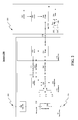
- FIG. 3 depicts an example of a plot 300 showing an electrical current drawn from a battery over a period of time.
- the system 200 in FIG. 2 may provide at least two current modes; a normal mode allowing a lower range of current levels, and extended mode allowing higher current levels to be drawn from the battery.
- battery pack 101 and battery protection circuit 103 allow the battery-powered device to draw current without condition or restriction below a lower threshold 324 value.
- over current control 220 of the protection integrated circuit 224 in FIG. 2 may allow the battery-powered device to draw current without condition or restriction below a lower threshold.
- Current values above the lower threshold value 324 but below a normal threshold 322 may be allowed subject to the watchdog timer not expiring. If the current value is above the lower threshold 324 but below the normal threshold 322 and the watchdog timer expires, the power supply to the battery-powered device may be terminated or the current to the battery-powered device may be restricted below the lower threshold.
- over current control 220 may activate protection transistor 208 to disconnect battery cell 206 from battery terminal 210.
- the upper limit may be an extended threshold 312.
- apparatus 200 may allow the device to draw current without condition or restriction below a lower threshold 324.
- Current values above the lower threshold value 324 but below an extended threshold 324 may be allowed subject to the watchdog timer not expiring. If the current value is above the lower threshold value 322 but below the extended threshold 312 and the watchdog timer expires, power supply from battery pack 101 to the battery-powered device may be terminated or current supplied from the battery pack 101 to the battery-powered device may be restricted below the lower threshold.
- over current control 220 may activate protection transistor 208 to disconnect battery cell 206 from battery terminal 210.
- 340A shows a region below the lower threshold 324.
- the watchdog timer may be disabled.
- the device is drawing low levels of current that may be expected during normal operation of the battery-powered device.
- the watchdog timer may be enabled. If the watchdog timer expires while the current is in this region, the power delivery from battery pack 101 may be terminated or restricted. If the watchdog timer is periodically reset so that it does not expire, current levels in region 340B may continue to be allowed.
- region 340C the current is above the normal threshold value. If the device were in the normal mode instead of the extended mode, the power delivery from battery pack may be terminated or restricted because region 340C is above the normal threshold 322.
- the current profile 340 in FIG. 3 illustrates an example current profile in an extended mode (because current levels above the normal threshold 322 are allowed). In extended mode, the watchdog timer may be enabled. The current values shown in 340C may be allowed unless the watchdog timer expires.
- region 340D the current is above the extended threshold. In both the normal mode and in the extended mode, current at and above the extended threshold are not allowed and cause the power delivery from battery pack 101 to be terminated or restricted. This is shown in FIG. 3 as the current dropping to zero just beyond the time when the current profile 340 exceeds extended threshold 340D.
- FIG. 3 depicts an example plot, other forms and profiles of plots may be realized as well.
- FIG. 4 depicts a process 400 for protecting battery-powered devices from over-current conditions, in accordance with some example embodiments.
- the electrical current drawn by a device may be determined.
- the current level, the normal threshold 322 and the watchdog timer 212 may determine whether the battery is connected or disconnected from the battery-powered device.
- the device is in extended mode 430, the current level, the extended threshold 312, and the watchdog timer 212 may determine whether the battery is connected or disconnected from the battery-powered device.
- the electrical current drawn by the battery-powered device may be determined, in accordance with some example embodiments.
- the current may be determined by a power management integrated circuit and sensing resistor, such as the FIG. 2 power management integrated circuit 246 and resistor 248.
- the current flowing out of the battery through a resistor such as resistor 248, may be determined by measuring the voltage across the resistor, although other methods may also be used to determine the current flowing out of a battery.
- the current flowing out of battery cell 206 may be determined inside battery pack 101.
- Resistor 248 may be located inside battery pack 101, for example, in series with transistor 208 and/or fuse 204 to battery pack terminals 202 and 210.
- Over current control 220 may determine current flow through resistor 248, for example, by measuring the voltage across the resistor or by other methods.
- the watchdog timer may be disabled, in accordance with some example embodiments.
- the battery may be connected to the battery-powered device, as normal. At these current levels, the battery-powered device will not overheat or cause injury.
- the power level may be used to identify problems with the device, possibly even specifically identifying a problem if certain failures are known to cause particular current levels.
- the battery-powered device may be in the normal mode, in accordance with some example embodiments. If the current is above the lower threshold, such as lower threshold 324, but below the normal threshold 322, the watchdog timer may be enabled by a command or signal such as enable/disable signal 226. If the watchdog timer expires, protection transistor 208 may disconnect battery cell 206 from the battery-powered device. If the current rises above the normal threshold, the battery may be disconnected form the battery-powered device independently of the watchdog timer.
- the battery-powered device may, in some example embodiments, reset the watchdog timer periodically.
- the watchdog timer may be reset by a signal such as watchdog update signal 228.
- the watchdog timer may run for a predetermined amount of time before expiring.
- the battery-powered device may operate while the timer is running but if the timer expires, the battery-powered device may be disconnected from the battery.
- the watchdog timer is reset via a signal, such as watchdog update signal 228.
- the watchdog timer may be set to a predetermined but configurable starting value such as, for example, 2 seconds.
- the watchdog timer expires causing the battery pack 101 to be disconnected from, for example, battery-powered device 10.
- the battery-powered device resets the watchdog timer before it expires, another 2 seconds may pass before the watchdog timer may time-out. In this way, the battery-powered device must periodically reset the watchdog timer to prevent the battery from being disconnected from the battery-powered device. If the battery-powered device "crashes,” “freezes,” “locks-up,” or otherwise fails, the periodic reset signal, such as watchdog update 228, may stop causing the watchdog timer to expire and the battery to be disconnected from the battery-powered device. This may prevent overheating and potential injury to the user.
- the battery-powered device may be in the extended mode, in accordance with some example embodiments. If the current determined at 410 is less than or equal to the lower threshold, the watchdog timer 212 may be disabled and the battery-powered device operates normally. If the current is above the lower threshold, such as lower threshold 324, but below the extended threshold 322, the watchdog timer may be enabled by a command or signal such as enable/disable signal 226. The watchdog timer may operate as described above but use the extended threshold as the limiting value. As long as the watchdog timer is periodically reset by a command or signal such as watchdog update 228, the battery-powered device may remain connected to the battery pack 101. If the watchdog timer expires or the current level rises above the extended threshold, protection transistor 208 may disconnect battery cell 206 from the battery-powered device.
- an apparatus comprises means for disabling a timer, when a current drawn from a battery is one of below and equal to a lower current threshold, wherein the disabled timer allows the battery to remain connected, means for enabling the timer, when the current drawn from the battery is greater than the lower current threshold and less than an extended current threshold, wherein the enabled timer allows the battery to remain connected until the timer expires; and means for disconnecting the battery, when the timer expires or the current drawn from the battery exceeds the extended current threshold.
- a method comprises determining to send at least one reset signal comprising instructions to reset a timer at a battery pack, and/or determining to send at least one enable signal comprising instructions to enable the timer at the battery pack, and/or wherein determining to send the reset signal or the enable signal comprises determining whether the battery pack supports an extended current mode or a normal current mode, and wherein the enable signal or the reset signal is sent if the battery pack supports the extended current mode.
- Some of the embodiments disclosed herein may be implemented in software, hardware, application logic, or a combination of software, hardware, and application logic.
- the software, application logic, and/or hardware may reside in memory 40, the control apparatus 20, protection integrated circuit 224, operating system central processing unit 240, or electronic components disclosed herein, for example.
- the application logic, software or an instruction set is maintained on any one of various conventional computer-readable media.
- a "computer-readable medium" may be any non-transitory media that can contain, store, communicate, propagate or transport the instructions for use by or in connection with an instruction execution system, apparatus, or device, such as a computer or data processor circuitry, with examples depicted at FIG.1 .
- a computer-readable medium may comprise a non-transitory computer-readable storage medium that may be any media that can contain or store the instructions for use by or in connection with an instruction execution system, apparatus, or device, such as a computer.
- some of the embodiments disclosed herein include computer programs configured to cause methods as disclosed herein (see, for example, the process of FIG. 4 and/or the like).
- the subject matter described herein may be embodied in systems, apparatus, methods, and/or articles depending on the desired configuration.
- the systems, apparatus, methods, and/or articles described herein can be implemented using one or more of the following: electronic components such as transistors, inductors, capacitors, resistors, and the like, a processor executing program code, an application-specific integrated circuit (ASIC), a digital signal processor (DSP), an embedded processor, a field programmable gate array (FPGA), and/or combinations thereof.
- electronic components such as transistors, inductors, capacitors, resistors, and the like, a processor executing program code, an application-specific integrated circuit (ASIC), a digital signal processor (DSP), an embedded processor, a field programmable gate array (FPGA), and/or combinations thereof.
- ASIC application-specific integrated circuit
- DSP digital signal processor
- FPGA field programmable gate array
- These various example embodiments may include implementations in one or more computer programs that are executable and/or interpretable on a programmable system including at least one programmable processor, which may be special or general purpose, coupled to receive data and instructions from, and to transmit data and instructions to, a storage system, at least one input device, and at least one output device.
- These computer programs also known as programs, software, software applications, applications, components, program code, or code
- machine-readable medium refers to any computer program product, computer-readable medium, computer-readable storage medium, apparatus and/or device (for example, magnetic discs, optical disks, memory, Programmable Logic Devices (PLDs)) used to provide machine instructions and/or data to a programmable processor, including a machine-readable medium that receives machine instructions.
- PLDs Programmable Logic Devices
- systems are also described herein that may include a processor and a memory coupled to the processor.
- the memory may include one or more programs that cause the processor to perform one or more of the operations described herein.
Landscapes
- Engineering & Computer Science (AREA)
- Power Engineering (AREA)
- Electrochemistry (AREA)
- Manufacturing & Machinery (AREA)
- Chemical & Material Sciences (AREA)
- Chemical Kinetics & Catalysis (AREA)
- General Chemical & Material Sciences (AREA)
- Theoretical Computer Science (AREA)
- Computer Networks & Wireless Communication (AREA)
- Microelectronics & Electronic Packaging (AREA)
- Human Computer Interaction (AREA)
- Physics & Mathematics (AREA)
- General Engineering & Computer Science (AREA)
- General Physics & Mathematics (AREA)
- Charge And Discharge Circuits For Batteries Or The Like (AREA)
Abstract
Description
- The subject matter described herein relates to protecting a battery-powered device from over-current conditions that could cause damage to the battery-powered device or injury to a user of the device.
- Many modem electronic devices are battery powered. Mobile devices are almost always battery-powered including a wide variety of consumer and industrial products, such as cell phones, handheld computing devices, laptops, and many other portable devices. As the features available in portable devices have increased, the power consumption of these devices has also increased. Increased power consumption has led to the possibility of overheating, which could result in damage to the device or injury to the user. For example, a hand-held cellular telephone that overheats could destroy the phone and/or injure the user's hand or face. Moreover, the increased complexity and capability of these devices has caused the normal power consumption to increase to a level where if the same amount of power were consumed due to a hardware or software failure, overheating could result and the overheating could cause injury.
- Methods and apparatuses, including computer program code are disclosed herein that provide adaptive battery protection.
- In one aspect, there is provided a method. The method includes disabling a timer, when a current drawn by a battery-powered device from a battery is less than or equal to a lower current threshold. When the timer is disabled, the battery may remain connected to the battery-powered device. The method further includes enabling the timer when the current drawn from the battery is greater than the lower current threshold and less than an extended current threshold. When the timer is enabled, the timer may allow the battery to remain connected to the battery-powered device until the timer expires. The method further includes disconnecting the battery when the timer expires or when the current drawn from the battery exceeds the extended current threshold.
- In some variations, one or more of the features disclosed herein including the following features can optionally be included in any feasible combination. The method may further include enabling the timer, when the current drawn from the battery is greater than the lower current threshold and less than a normal current threshold, wherein the enabled timer allows the battery to remain connected until the timer expires; and disconnecting the battery, when the timer expires or the current drawn from the battery exceeds the normal current threshold. The method may further include resetting the timer to prevent the expiration of the timer based on a first received indication. The first received indication may represent use of an apparatus drawing current from the battery. The timer may be disabled based on a second received indication.
- In another aspect, there is provided a method. The method may include determining to send at least one reset signal comprising instructions to reset a timer at a battery pack.
- In some variations, one or more of the features disclosed herein including the following features can optionally be included in any feasible combination. The method may further include determining to send at least one enable signal comprising instructions to enable the timer at the battery pack. The determining to send the at least one reset signal or determining to send the at least one enable signal may further include determining whether the battery pack supports an extended current mode or a normal current mode. The at least one enable signal or the at least one reset signal may be sent if the battery pack supports the extended current mode. The least one reset signal may be sent periodically.
- The above-noted aspects and features may be implemented in systems, apparatuses, methods, and/or computer-readable media depending on the desired configuration. The details of one or more variations of the subject matter described herein are set forth in the accompanying drawings and the description below. Features and advantages of the subject matter described herein will be apparent from the description and drawings, and from the claims. In some exemplary embodiments, one of more variations may be made as well as described in the detailed description below and/or as described in the following features.
- In the drawings,
-
FIG. 1 depicts an example of a battery-powered device, in accordance with some example embodiments; -
FIG. 2 depicts a schematic diagram of an apparatus for protecting battery-powered devices from over-current conditions, in accordance with some example embodiments; -
FIG. 3 depicts an example plot showing the current drawn by a battery-powered device, in accordance with some example embodiments; and -
FIG. 4 depicts process for protecting battery-powered devices from over-current conditions, in accordance with some example embodiments. - Like labels are used to refer to same or similar items in the drawings.
- The current available from many modem batteries is sufficient to cause damage to plastic components, injury to a user, or damage to the environment if a failure occurs that allows excessive current and/or overheating. For example, a short-circuit in a battery-powered mobile device could cause plastic components to melt, damage to the overheating electronic components, and in the worst case, a fire. Embodiments consistent with the subject matter disclosed herein may allow high current levels to be drawn from a battery in a battery-powered device while protecting the device from over current conditions that could cause damage or injury. Battery-powered devices (also referred to herein as a devices or battery-powered apparatuses) utilizing the subject matter disclosed herein may include a wide range of consumer and industrial devices, such as cellular telephones, smart phones, personal digital assistants (PDAs), netbooks, notebook computers, laptop computers, custom designed computing devices, industrial control devices, remote sensing devices, and any other battery-powered device.
-
FIG. 1 illustrates a block diagram of an example of a battery-poweredapparatus 10, in accordance with some embodiments.FIG. 1 depicts a battery-poweredapparatus 10 comprising a user equipment, such as a cellular telephone, a smartphone, and the like. - In some example embodiments, the
apparatus 10 may includebattery protection circuit 103 coupled or capable of coupling to a battery (or battery pack) 101.Battery protection circuit 103 and/orbattery pack 101 may determine whether to connect a battery cell in thebattery pack 101 to the battery powered device (or apparatus 10) based on the current being drawn by the battery powered device from thebattery pack 101 and based on a watchdog timer. In some embodiments, the watchdog timer is included inbattery pack 101 and in some embodiments the watchdog timer is included inbattery protection circuit 103. - Although the
battery protection circuitry 103 is depicted separate fromprocessor 20, in some example embodiments, thebattery protection circuit 103 may be implemented atprocessor circuitry 20. - Moreover, although some of the examples disclosed herein refer to the
battery protection circuitry 103 being used with user equipment, such as theapparatus 10, thebattery protection circuitry 103 may be used with any other battery-powered device as well. - Before providing additional details regarding the
battery protection circuitry 103 andbattery pack 101, the following provides an example of anapparatus 10, which may be used in some embodiments. - The
apparatus 10 may include at least oneantenna 12 in communication with atransmitter 14 and/or areceiver 16. Alternatively transmit and receive antennas may be separate. - The
apparatus 10 may also include aprocessor 20 configured to provide signals to and from the transmitter and/or receiver, respectively, and to control the functioning of the apparatus.Processor 20 may be configured to control the functioning of the transmitter and receiver by effecting control signaling via electrical leads to the transmitter and receiver. Likewiseprocessor 20 may be configured to control other elements ofapparatus 10 by effecting control signaling via electricalleads connecting processor 20 to the other elements, such as a display or a memory. Theprocessor 20 may, for example, be embodied in a variety of ways including circuitry, at least one processing core, one or more microprocessors with accompanying digital signal processor(s), one or more processor(s) without an accompanying digital signal processor, one or more coprocessors, one or more multi-core processors, one or more controllers, processing circuitry, one or more computers, various other processing elements including integrated circuits (for example, an application specific integrated circuit (ASIC), a field programmable gate array (FPGA), and/or the like), or some combination thereof.Apparatus 10 may include a location processor and/or an interface to obtain location information, such as positioning and/or navigation information. Accordingly, although illustrated inFIG. 1 as a single processor, in some example embodiments theprocessor 20 may comprise a plurality of processors or processing cores. - Signals sent and received by the
processor 20 may include signaling information in accordance with an air interface standard of an applicable cellular system, and/or any number of different wireline or wireless networking techniques, comprising but not limited to Wi-Fi, wireless local access network (WLAN) techniques, such as, Institute of Electrical and Electronics Engineers (IEEE) 802.11, 802.16, and/or the like. In addition, these signals may include speech data, user generated data, user requested data, and/or the like. - The
apparatus 10 may be capable of operating with one or more air interface standards, communication protocols, modulation types, access types, and/or the like. For example, theapparatus 10 and/or a cellular modem therein may be capable of operating in accordance with various first generation (1G) communication protocols, second generation (2G or 2.5G) communication protocols, third-generation (3G) communication protocols, fourth-generation (4G) communication protocols, Internet Protocol Multimedia Subsystem (IMS) communication protocols (for example, session initiation protocol (SIP) and/or the like. For example, theapparatus 10 may be capable of operating in accordance with 2G wireless communication protocols IS-136, Time Division Multiple Access TDMA, Global System for Mobile communications, GSM, IS-95, Code Division Multiple Access, CDMA, and/or the like. In addition, for example, theapparatus 10 may be capable of operating in accordance with 2.5G wireless communication protocols General Packet Radio Service (GPRS), Enhanced Data GSM Environment (EDGE), and/or the like. Further, for example, theapparatus 10 may be capable of operating in accordance with 3G wireless communication protocols, such as, Universal Mobile Telecommunications System (UMTS), Code Division Multiple Access 2000 (CDMA2000), Wideband Code Division Multiple Access (WCDMA), Time Division-Synchronous Code Division Multiple Access (TD-SCDMA), and/or the like. Theapparatus 10 may be additionally capable of operating in accordance with 3.9G wireless communication protocols, such as, Long Term Evolution (LTE), Evolved Universal Terrestrial Radio Access Network (E-UTRAN), and/or the like. Additionally, for example, theapparatus 10 may be capable of operating in accordance with 4G wireless communication protocols, such as LTE Advanced and/or the like as well as similar wireless communication protocols that may be subsequently developed. - It is understood that the
processor 20 may include circuitry for implementing audio/video and logic functions ofapparatus 10. For example, theprocessor 20 may comprise a digital signal processor device, a microprocessor device, an analog-to-digital converter, a digital-to-analog converter, and/or the like. Control and signal processing functions of theapparatus 10 may be allocated between these devices according to their respective capabilities. Theprocessor 20 may additionally comprise an internal voice coder (VC) 20a, an internal data modem (DM) 20b, and/or the like. Further, theprocessor 20 may include functionality to operate one or more software programs, which may be stored in memory. In general,processor 20 and stored software instructions may be configured to causeapparatus 10 to perform actions. For example,processor 20 may be capable of operating a connectivity program, such as, a web browser. The connectivity program may allow theapparatus 10 to transmit and receive web content, such as location-based content, according to a protocol, such as, wireless application protocol, WAP, hypertext transfer protocol, HTTP, and/or the like. -
Apparatus 10 may also comprise a user interface including, for example, an earphone orspeaker 24, aringer 22, amicrophone 26, adisplay 28, a user input interface, and/or the like, which may be operationally coupled to theprocessor 20. Thedisplay 28 may, as noted above, include a touch sensitive display, where a user may touch and/or gesture to make selections, enter values, and/or the like. Theprocessor 20 may also include user interface circuitry configured to control at least some functions of one or more elements of the user interface, such as, thespeaker 24, theringer 22, themicrophone 26, thedisplay 28, and/or the like. Theprocessor 20 and/or user interface circuitry comprising theprocessor 20 may be configured to control one or more functions of one or more elements of the user interface through computer program instructions, for example, software and/or firmware, stored on a memory accessible to theprocessor 20, for example,volatile memory 40,non-volatile memory 42, and/or the like. Theapparatus 10 may include a battery for powering various circuits related to the mobile terminal, for example, a circuit to provide mechanical vibration as a detectable output. The user input interface may comprise devices allowing theapparatus 10 to receive data, such as, a keypad 30 (which can be a virtual keyboard presented ondisplay 28 or an externally coupled keyboard) and/or other input devices. - Moreover, the
apparatus 10 may include a short-range radio frequency (RF) transceiver and/orinterrogator 64, so data may be shared with and/or obtained from electronic devices in accordance with RF techniques. Theapparatus 10 may include other short-range transceivers, such as an infrared (IR)transceiver 66, a Bluetooth (BT)transceiver 68 operating using Bluetooth wireless technology, a wireless universal serial bus (USB)transceiver 70, and/or the like. TheBluetooth transceiver 68 may be capable of operating according to low power or ultra-low power Bluetooth technology, for example, Wibree, radio standards. In this regard, theapparatus 10 and, in particular, the short-range transceiver may be capable of transmitting data to and/or receiving data from electronic devices within a proximity of the apparatus, such as within 10 meters. Theapparatus 10 including the WiFi or wireless local area networking modem may also be capable of transmitting and/or receiving data from electronic devices according to various wireless networking techniques, including 6LoWpan, Wi-Fi, Wi-Fi low power, WLAN techniques such as IEEE 802.11 techniques, IEEE 802.15 techniques, IEEE 802.16 techniques, and/or the like. - The
apparatus 10 may comprise memory, such as, a subscriber identity module (SIM) 38, a removable user identity module (R-UIM), and/or the like, which may store information elements related to a mobile subscriber. In addition to the SIM, theapparatus 10 may include other removable and/or fixed memory. Theapparatus 10 may includevolatile memory 40 and/ornon-volatile memory 42. For example,volatile memory 40 may include Random Access Memory (RAM) including dynamic and/or static RAM, on-chip or off-chip cache memory, and/or the like.Non-volatile memory 42, which may be embedded and/or removable, may include, for example, read-only memory, flash memory, magnetic storage devices, for example, hard disks, floppy disk drives, magnetic tape, optical disc drives and/or media, non-volatile random access memory (NVRAM), and/or the like. Likevolatile memory 40,non-volatile memory 42 may include a cache area for temporary storage of data. At least part of the volatile and/or non-volatile memory may be embedded inprocessor 20. The memories may store one or more software programs, instructions, pieces of information, data, and/or the like which may be used by the apparatus for performing functions of the user equipment/mobile terminal. The memories may comprise an identifier, such as an international mobile equipment identification (IMEI) code, capable of uniquely identifyingapparatus 10. The functions may include one or more of the operations disclosed herein with respect to battery protection disclosed herein including the process flow ofFIG. 4 . The memories may comprise an identifier, such as, an international mobile equipment identification (IMEI) code, capable of uniquely identifyingapparatus 10. In the example embodiment, theprocessor 20 may be configured using computer code stored atmemory 40 and/or 42 to provide the operations disclosed with respect to the process shown inFIG. 4 . -
FIG. 2 depicts an example block diagram of asystem 200 for protecting a battery-powered device from over-current conditions, in accordance with some example embodiments. In some example embodiments, thesystem 200 may include abattery protection circuit 103 and abattery pack 101. - The
battery protection circuit 103 may be included in a battery-powered device, such as battery-powereddevice 10, althoughbattery protection circuit 103 may be included in any other battery-powered device to provide over-current protection and the like. In some example embodiments,battery protection circuit 103 may further include a system-on-chip 252 and power management integratedcircuit 246. In some example embodiments,battery pack 101 may further include a power protection integratedcircuit 224 and battery interface integratedcircuit 236 to allow the connection/disconnection ofbattery cell 206 from the battery-powered device such as battery-powereddevice 10. - The
battery pack 101 may, in some example embodiments, interface viainterface logic 234 and data interface 238 to system-on-chip 252, which may control whetherbattery cell 206 is connected or disconnected tobattery terminal 210.Battery pack 101 may includebattery cell 206 connected in series withtransistor 208 and/or fuse 204 tobattery pack terminals battery cell 206 have causedfuse 204 to trigger or "blow" (for example, the fuse has become an open circuit) thenbattery cell 206 is disconnected frombattery terminal 202 thus forcing the battery-powered device to be shut off until the fuse is replaced (or reset if a circuit breaker is used instead of a fuse). Ifprotection transistor 208 is turned-off,battery cell 206 is disconnected frombattery terminal 210 thus forcing the battery-powered device to be shut off untilprotection transistor 208 is turned on. In some embodiments,protection transistor 208 may be replaced with a mechanical switch such as a relay or another solid-state device. - In some example embodiments, protection integrated
circuit 224 may controlprotection transistor 208. Protection integratedcircuit 224 may include overcurrent controller 220. Overcurrent controller 220 may monitor the drain (or collector)voltage 214/218 as well as the source (or emitter)voltage 218/214. Overcurrent controller 220 may control theprotection transistor 208 by controlling the gate (or base)voltage 216 ofprotection transistor 208 relative to the source (or emitter) voltage. The gate-source (base-emitter) voltage required to turn-on and turn-off protection transistor 208 varies over temperature conditions and across production runs ofprotection transistor 208. Measuring the source (emitter) and drain (collector) voltages may allow for improved control ofprotection transistor 208. Protection integratedcircuit 224 also includeswatchdog timer 212 and configuration information 222. - In some example embodiments,
watchdog timer 212 may control overcircuit controller 220, andwatchdog timer 212 may be contained in protection integratedcircuit 224.Watchdog timer 212 may receive configuration information from configuration 222. This configuration information may include one or more watchdog timer durations, such as 2 seconds, 4 seconds, 6 seconds, and so on, although other values for the timer may be used as well. In some embodiments, whenwatchdog timer 212 expires at the end of a selected duration from the configuration information,watchdog timer 212 may cause overcurrent controller 220 to disconnectbattery cell 206 from the battery powered device viaprotection transistor 208.Watchdog timer 212 may thus be enabled and disabled via enable/disable 226.Watchdog timer 212 may be reset by watchdog update 228. For example, ifwatchdog timer 212 is configured for 4 seconds, a watchdog update signal may be applied after 0.1, 1, or 3.9 seconds causing the watchdog timer to reset to 4 seconds again. After being reset, the watchdog timer runs again for the configured time period (e.g., 4 seconds) or until another watchdog update signal or commandresets watchdog timer 212. If no reset is applied at 228, after the configured time period,watchdog timer 212 may cause overcurrent controller 220 to disconnectbattery cell 206 from the battery-powered device viatransistor 208. - In some example embodiments, protection integrated
circuit 224 may provide fuel gauge information (for example, fuel gauge data 230) indicating the state of the charge inbattery cell 206. The fuel gauge information may be provided tointerface logic 234 in battery interface integrated circuit (Battery IF IC) 236. Input/output control (I/O Ctrl) 232 may provide a watchdog enable/disable 226 and watchdog update 228. Input/output control 232 may receive watchdog enable/disable 226 and watchdog update information frominterface logic 234, which may be contained in battery interface integrated circuit (labeled Battery IF IC) 236. Battery interface integratedcircuit 236 may provide anotherinterface 238 accessible from the exterior ofbattery pack 101. And,interface 238 may couple to system-on-chip 252. - In some example embodiments, system-on-
chip 252 may include interface (IF)logic 244 associated withinterface 238, input/output control (I/O Ctrl) 242, and operating system central processing unit (OS CPU) 240. Through the various interfaces detailed above, operating systemcentral processing unit 240 may provide periodic reset commands or signals to cause the reset ofwatchdog timer 212, allowing battery-powereddevice 10 to continue to operate without the battery being disconnected. If an error/bug, in executable instructions executed byOS CPU 240 or a hardware failure in the battery-powered device prevents the watchdog timer reset signal or command from being applied towatchdog timer 212, the battery-powered device will, in some example embodiments, be shut down. Shutting down the battery-powered device under these circumstances may prevent damage from occurring to the battery-powered device or injury to the user due to the hardware failure or the erroneous instructions executed byOS CPU 240. - In some example embodiments, the
battery protection circuitry 103 at the battery-powered device may determine to send a reset signal or an enable signal viainterface 238. The reset signal may comprise instructions or otherwise indicate thatbattery pack 101 should updatewatchdog timer 212. The enable signal may comprise instructions to enablewatchdog timer 226.Interface logic 234 may then instruct I/O control 232 to apply watchdog update 228 or enable/disable 226 signals accordingly. - Battery-powered device may determine whether
battery pack 101 supports an extended mode with an extended current threshold or a normal mode with a lower current threshold.Battery pack 101 may for example send a battery identifier or a battery type signal viainterface 238 to the battery-powered device. Battery-powered device may determine the mode supported by thebattery pack 101 based on the received battery identification and/or battery type information. -
FIG. 3 depicts an example of aplot 300 showing an electrical current drawn from a battery over a period of time. Thesystem 200 inFIG. 2 may provide at least two current modes; a normal mode allowing a lower range of current levels, and extended mode allowing higher current levels to be drawn from the battery. - In normal mode,
battery pack 101 andbattery protection circuit 103, allow the battery-powered device to draw current without condition or restriction below alower threshold 324 value. For example, overcurrent control 220 of the protection integratedcircuit 224 inFIG. 2 may allow the battery-powered device to draw current without condition or restriction below a lower threshold. Current values above thelower threshold value 324 but below anormal threshold 322 may be allowed subject to the watchdog timer not expiring. If the current value is above thelower threshold 324 but below thenormal threshold 322 and the watchdog timer expires, the power supply to the battery-powered device may be terminated or the current to the battery-powered device may be restricted below the lower threshold. For example, overcurrent control 220 may activateprotection transistor 208 to disconnectbattery cell 206 frombattery terminal 210. If the watchdog timer is periodically reset so that it does not expire, current values between thelower threshold 324 and thenormal threshold 322 may continue to be allowed. Current values above the normal threshold may not be allowed and may cause the overcurrent control 220 to activateprotection transistor 208 to disconnectbattery cell 206 frombattery terminal 210, or, to restrict the current supplied frombattery pack 101 below the lower threshold. - In extended mode, instead of the upper current limit being the
normal threshold 322, the upper limit may be anextended threshold 312. In the extended mode,apparatus 200 may allow the device to draw current without condition or restriction below alower threshold 324. Current values above thelower threshold value 324 but below anextended threshold 324 may be allowed subject to the watchdog timer not expiring. If the current value is above thelower threshold value 322 but below theextended threshold 312 and the watchdog timer expires, power supply frombattery pack 101 to the battery-powered device may be terminated or current supplied from thebattery pack 101 to the battery-powered device may be restricted below the lower threshold. For example, overcurrent control 220 may activateprotection transistor 208 to disconnectbattery cell 206 frombattery terminal 210. If the watchdog timer is periodically reset so that it does not expire, current values between thelower threshold 324 and theextended threshold 312 may continue to be allowed. Current values above the extended threshold may not be allowed and may cause overcurrent control 220 to activateprotection transistor 208 to disconnectbattery cell 206 frombattery terminal 210. - In the example of
FIG. 3 , 340A shows a region below thelower threshold 324. In normal mode and extended mode, at the current levels in this region, the watchdog timer may be disabled. In this region, the device is drawing low levels of current that may be expected during normal operation of the battery-powered device. - In
region 340B, the current is between thelower threshold 324 and thenormal threshold 322. In normal mode and extended mode, the watchdog timer may be enabled. If the watchdog timer expires while the current is in this region, the power delivery frombattery pack 101 may be terminated or restricted. If the watchdog timer is periodically reset so that it does not expire, current levels inregion 340B may continue to be allowed. - In
region 340C, the current is above the normal threshold value. If the device were in the normal mode instead of the extended mode, the power delivery from battery pack may be terminated or restricted becauseregion 340C is above thenormal threshold 322. Thecurrent profile 340 inFIG. 3 illustrates an example current profile in an extended mode (because current levels above thenormal threshold 322 are allowed). In extended mode, the watchdog timer may be enabled. The current values shown in 340C may be allowed unless the watchdog timer expires. - In
region 340D, the current is above the extended threshold. In both the normal mode and in the extended mode, current at and above the extended threshold are not allowed and cause the power delivery frombattery pack 101 to be terminated or restricted. This is shown inFIG. 3 as the current dropping to zero just beyond the time when thecurrent profile 340 exceeds extendedthreshold 340D. - Although
FIG. 3 depicts an example plot, other forms and profiles of plots may be realized as well. -
FIG. 4 depicts aprocess 400 for protecting battery-powered devices from over-current conditions, in accordance with some example embodiments. At 410, the electrical current drawn by a device may be determined. When the device is innormal mode 420, the current level, thenormal threshold 322 and thewatchdog timer 212 may determine whether the battery is connected or disconnected from the battery-powered device. When the device is inextended mode 430, the current level, theextended threshold 312, and thewatchdog timer 212 may determine whether the battery is connected or disconnected from the battery-powered device. - At 410, the electrical current drawn by the battery-powered device may be determined, in accordance with some example embodiments. For example, the current may be determined by a power management integrated circuit and sensing resistor, such as the
FIG. 2 power management integratedcircuit 246 andresistor 248. In some example embodiments, the current flowing out of the battery through a resistor, such asresistor 248, may be determined by measuring the voltage across the resistor, although other methods may also be used to determine the current flowing out of a battery. In some embodiments, the current flowing out ofbattery cell 206 may be determined insidebattery pack 101.Resistor 248 may be located insidebattery pack 101, for example, in series withtransistor 208 and/or fuse 204 tobattery pack terminals current control 220 may determine current flow throughresistor 248, for example, by measuring the voltage across the resistor or by other methods. - At 420, if the current determined at 410 is less than or equal to a lower threshold value, the watchdog timer may be disabled, in accordance with some example embodiments. At current levels below the lower threshold value, the battery may be connected to the battery-powered device, as normal. At these current levels, the battery-powered device will not overheat or cause injury. In some example embodiments, the power level may be used to identify problems with the device, possibly even specifically identifying a problem if certain failures are known to cause particular current levels.
- At 430, the battery-powered device may be in the normal mode, in accordance with some example embodiments. If the current is above the lower threshold, such as
lower threshold 324, but below thenormal threshold 322, the watchdog timer may be enabled by a command or signal such as enable/disablesignal 226. If the watchdog timer expires,protection transistor 208 may disconnectbattery cell 206 from the battery-powered device. If the current rises above the normal threshold, the battery may be disconnected form the battery-powered device independently of the watchdog timer. - To prevent the watchdog timer from expiring, the battery-powered device may, in some example embodiments, reset the watchdog timer periodically. For example, the watchdog timer may be reset by a signal such as watchdog update signal 228. The watchdog timer may run for a predetermined amount of time before expiring. The battery-powered device may operate while the timer is running but if the timer expires, the battery-powered device may be disconnected from the battery. In some example embodiments, the watchdog timer is reset via a signal, such as watchdog update signal 228. When reset, the watchdog timer may be set to a predetermined but configurable starting value such as, for example, 2 seconds. In this example, if two seconds pass without the update signal 228 resetting the watchdog timer, the watchdog timer expires causing the
battery pack 101 to be disconnected from, for example, battery-powereddevice 10. In this example, if the battery-powered device resets the watchdog timer before it expires, another 2 seconds may pass before the watchdog timer may time-out. In this way, the battery-powered device must periodically reset the watchdog timer to prevent the battery from being disconnected from the battery-powered device. If the battery-powered device "crashes," "freezes," "locks-up," or otherwise fails, the periodic reset signal, such as watchdog update 228, may stop causing the watchdog timer to expire and the battery to be disconnected from the battery-powered device. This may prevent overheating and potential injury to the user. - At 440, the battery-powered device may be in the extended mode, in accordance with some example embodiments. If the current determined at 410 is less than or equal to the lower threshold, the
watchdog timer 212 may be disabled and the battery-powered device operates normally. If the current is above the lower threshold, such aslower threshold 324, but below theextended threshold 322, the watchdog timer may be enabled by a command or signal such as enable/disablesignal 226. The watchdog timer may operate as described above but use the extended threshold as the limiting value. As long as the watchdog timer is periodically reset by a command or signal such as watchdog update 228, the battery-powered device may remain connected to thebattery pack 101. If the watchdog timer expires or the current level rises above the extended threshold,protection transistor 208 may disconnectbattery cell 206 from the battery-powered device. - In some example embodiments an apparatus comprises means for disabling a timer, when a current drawn from a battery is one of below and equal to a lower current threshold, wherein the disabled timer allows the battery to remain connected, means for enabling the timer, when the current drawn from the battery is greater than the lower current threshold and less than an extended current threshold, wherein the enabled timer allows the battery to remain connected until the timer expires; and means for disconnecting the battery, when the timer expires or the current drawn from the battery exceeds the extended current threshold.
- In some example embodiments a method comprises determining to send at least one reset signal comprising instructions to reset a timer at a battery pack, and/or determining to send at least one enable signal comprising instructions to enable the timer at the battery pack, and/or wherein determining to send the reset signal or the enable signal comprises determining whether the battery pack supports an extended current mode or a normal current mode, and wherein the enable signal or the reset signal is sent if the battery pack supports the extended current mode.
- Some of the embodiments disclosed herein may be implemented in software, hardware, application logic, or a combination of software, hardware, and application logic. The software, application logic, and/or hardware may reside in
memory 40, thecontrol apparatus 20, protection integratedcircuit 224, operating systemcentral processing unit 240, or electronic components disclosed herein, for example. In some example embodiment, the application logic, software or an instruction set is maintained on any one of various conventional computer-readable media. In the context of this document, a "computer-readable medium" may be any non-transitory media that can contain, store, communicate, propagate or transport the instructions for use by or in connection with an instruction execution system, apparatus, or device, such as a computer or data processor circuitry, with examples depicted atFIG.1 . A computer-readable medium may comprise a non-transitory computer-readable storage medium that may be any media that can contain or store the instructions for use by or in connection with an instruction execution system, apparatus, or device, such as a computer. Furthermore, some of the embodiments disclosed herein include computer programs configured to cause methods as disclosed herein (see, for example, the process ofFIG. 4 and/or the like). - The subject matter described herein may be embodied in systems, apparatus, methods, and/or articles depending on the desired configuration. For example, the systems, apparatus, methods, and/or articles described herein can be implemented using one or more of the following: electronic components such as transistors, inductors, capacitors, resistors, and the like, a processor executing program code, an application-specific integrated circuit (ASIC), a digital signal processor (DSP), an embedded processor, a field programmable gate array (FPGA), and/or combinations thereof. These various example embodiments may include implementations in one or more computer programs that are executable and/or interpretable on a programmable system including at least one programmable processor, which may be special or general purpose, coupled to receive data and instructions from, and to transmit data and instructions to, a storage system, at least one input device, and at least one output device. These computer programs (also known as programs, software, software applications, applications, components, program code, or code) include machine instructions for a programmable processor, and may be implemented in a high-level procedural and/or object-oriented programming language, and/or in assembly/machine language. As used herein, the term "machine-readable medium" refers to any computer program product, computer-readable medium, computer-readable storage medium, apparatus and/or device (for example, magnetic discs, optical disks, memory, Programmable Logic Devices (PLDs)) used to provide machine instructions and/or data to a programmable processor, including a machine-readable medium that receives machine instructions. Similarly, systems are also described herein that may include a processor and a memory coupled to the processor. The memory may include one or more programs that cause the processor to perform one or more of the operations described herein.
- Although some of the examples described herein refer to the use of specific technologies, such as LTE, WiFi, and the like, the subject matter described herein is not limited to those technologies, and, as such, can be used with other radio technologies as well.
- Although a few variations have been described in detail above, other modifications or additions are possible. In particular, further features and/or variations may be provided in addition to those set forth herein. Moreover, the example embodiments described above may be directed to various combinations and subcombinations of the disclosed features and/or combinations and subcombinations of several further features disclosed above. In addition, the logic flow depicted in the accompanying figures and/or described herein does not require the particular order shown, or sequential order, to achieve desirable results. Other embodiments may be within the scope of the following claims.
Claims (15)
- A method comprising:disabling a timer, when a current drawn from a battery is one of below and equal to a lower current threshold, wherein the disabled timer allows the battery to remain connected;enabling the timer, when the current drawn from the battery is greater than the lower current threshold and less than an extended current threshold, wherein the enabled timer allows the battery to remain connected until the timer expires; anddisconnecting the battery, when the timer expires or the current drawn from the battery exceeds the extended current threshold.
- The method of claim 1 further comprising:enabling the timer, when the current drawn from the battery is greater than the lower current threshold and less than a normal current threshold, wherein the enabled timer allows the battery to remain connected until the timer expires; anddisconnecting the battery, when the timer expires or the current drawn from the battery exceeds the normal current threshold.
- The method of claim 1 or 2 further comprising resetting, based on a first received indication, the timer to prevent the expiration of the timer.
- An apparatus comprising:means for disabling a timer, when a current drawn from a battery is one of below and equal to a lower current threshold, wherein the disabled timer allows the battery to remain connected;means for enabling the timer, when the current drawn from the battery is greater than the lower current threshold and less than an extended current threshold, wherein the enabled timer allows the battery to remain connected until the timer expires; andmeans for disconnecting the battery, when the timer expires or the current drawn from the battery exceeds the extended current threshold.
- The apparatus of claim 4, further comprising:means for enabling the timer, when the current drawn from the battery is greater than the lower current threshold and less than a normal current threshold, wherein the enabled timer allows the battery to remain connected until the timer expires; andmeans for disconnecting the battery, when the timer expires or the current drawn from the battery exceeds the normal current threshold.
- The apparatus of claim 4 or 5, further comprisingmeans for resetting, based on a first received indication, the timer to prevent the expiration of the timer.
- The apparatus of claim 6, wherein the first received indication represents a battery-powered device drawing current from the battery.
- The apparatus of any of claims 4 to 7, wherein the apparatus is further configured to at least disable the timer based on a second received indication.
- A computer program configured to:disable a timer, when a current drawn from a battery is one of below and equal to a lower current threshold, wherein the disabled timer allows the battery to remain connected;enable the timer, when the current drawn from the battery is greater than the lower current threshold and less than an extended current threshold, wherein the enabled timer allows the battery to remain connected until the timer expires; anddisconnect the battery, when the timer expires or the current drawn from the battery exceeds the extended current threshold.
- A method comprising:determining to send at least one reset signal comprising instructions to reset a timer at a battery pack.
- An apparatus comprising:at least one processor; andat least one memory including computer program code, the at least one processor, the at least one memory, and the computer program code configured to cause the apparatus to at least:determine to send at least one reset signal comprising instructions to reset a timer at a battery pack.
- The apparatus of claim 11, wherein the apparatus is further configured to at least determine to send an enable signal comprising instructions to enable the timer at the battery pack.
- The apparatus of claim 12, wherein the apparatus is further configured to at least determine whether the battery pack supports an extended current mode or a normal current mode, and wherein the at least one enable signal or the at least one reset signal is sent if the battery pack supports the extended current mode.
- The apparatus of any of claims 11 to 13, wherein the at least one reset signal is sent periodically.
- A computer program configured to:determine to send at least one reset signal comprising instructions to reset a timer at a battery pack.
Applications Claiming Priority (1)
| Application Number | Priority Date | Filing Date | Title |
|---|---|---|---|
| US14/085,378 US10291013B2 (en) | 2013-11-20 | 2013-11-20 | Adaptive battery protection |
Publications (2)
| Publication Number | Publication Date |
|---|---|
| EP2876523A1 true EP2876523A1 (en) | 2015-05-27 |
| EP2876523B1 EP2876523B1 (en) | 2019-07-24 |
Family
ID=51897074
Family Applications (1)
| Application Number | Title | Priority Date | Filing Date |
|---|---|---|---|
| EP14191038.0A Active EP2876523B1 (en) | 2013-11-20 | 2014-10-30 | Adaptive battery protection |
Country Status (4)
| Country | Link |
|---|---|
| US (1) | US10291013B2 (en) |
| EP (1) | EP2876523B1 (en) |
| CN (1) | CN104659754B (en) |
| ES (1) | ES2746156T3 (en) |
Families Citing this family (10)
| Publication number | Priority date | Publication date | Assignee | Title |
|---|---|---|---|---|
| KR102218242B1 (en) * | 2014-03-18 | 2021-02-22 | 삼성전자 주식회사 | Method for controlling I/O interface and Electronic Device for the same |
| US10019602B2 (en) * | 2014-08-28 | 2018-07-10 | Qualcomm Incorporated | System and method for improved security for a processor in a portable computing device (PCD) |
| US10283982B2 (en) * | 2016-01-27 | 2019-05-07 | Gm Global Technology Operations Llc. | Voltage disconnect architecture |
| EP3296063B1 (en) | 2016-06-24 | 2020-03-25 | Black & Decker Inc. | Control scheme for power tool having a brushless motor |
| WO2018037260A1 (en) * | 2016-08-23 | 2018-03-01 | Pismo Labs Technology Ltd. | Methods and systems for supplying electricity to multiple loads with current measurements |
| US10593927B2 (en) | 2017-04-28 | 2020-03-17 | Microsoft Technology Licensing, Llc | Battery output disable when unconnected |
| RU2740512C1 (en) * | 2017-08-09 | 2021-01-15 | Бейджин Сяоми Мобайл Софтвеа Ко., Лтд. | Overheating protection method and device of user equipment, user equipment and base station |
| JP7136175B2 (en) * | 2020-12-22 | 2022-09-13 | カシオ計算機株式会社 | Data processing device, electronic equipment, data processing method and program |
| JP7723498B2 (en) * | 2021-05-17 | 2025-08-14 | キヤノン株式会社 | Electronic device, control method thereof, and remote control system |
| WO2024026066A1 (en) * | 2022-07-28 | 2024-02-01 | Microchip Technology Incorporated | Poe pse mps support for pse voltage transients |
Citations (4)
| Publication number | Priority date | Publication date | Assignee | Title |
|---|---|---|---|---|
| US20080304199A1 (en) * | 2007-06-07 | 2008-12-11 | Black & Decker Inc. | Software-implemented overcurrent protection embedded in a battery pack |
| US20100176764A1 (en) * | 2009-01-13 | 2010-07-15 | Sony Corporation | Battery pack and method of controlling the same |
| EP2400368A2 (en) * | 2010-06-24 | 2011-12-28 | Research in Motion Limited | Power cut-off based on current |
| WO2012029982A2 (en) * | 2010-08-31 | 2012-03-08 | Hitachi Koki Co., Ltd. | Power tool and battery pack for use in the power tool |
Family Cites Families (5)
| Publication number | Priority date | Publication date | Assignee | Title |
|---|---|---|---|---|
| US4020440A (en) * | 1975-11-25 | 1977-04-26 | Moerman Nathan A | Conversion and control of electrical energy by electromagnetic induction |
| CN101416330A (en) | 2003-10-14 | 2009-04-22 | 布莱克和戴克公司 | Protection method, protection circuit and protection device for secondary battery, electric tool, charger and battery pack suitable for providing protection against fault conditions in battery pack |
| CN102570398A (en) | 2010-12-27 | 2012-07-11 | 东莞市妙达电动工具制造有限公司 | Lithium battery charging drill current limiting delay protection circuit |
| CN102916456B (en) | 2011-08-05 | 2015-11-18 | 京信通信系统(中国)有限公司 | A kind of charging and discharging lithium battery management system and method |
| TWI450081B (en) | 2011-08-11 | 2014-08-21 | Wistron Corp | Over-current protection system of and method thereof |
-
2013
- 2013-11-20 US US14/085,378 patent/US10291013B2/en active Active
-
2014
- 2014-10-30 ES ES14191038T patent/ES2746156T3/en active Active
- 2014-10-30 EP EP14191038.0A patent/EP2876523B1/en active Active
- 2014-11-19 CN CN201410663062.0A patent/CN104659754B/en active Active
Patent Citations (4)
| Publication number | Priority date | Publication date | Assignee | Title |
|---|---|---|---|---|
| US20080304199A1 (en) * | 2007-06-07 | 2008-12-11 | Black & Decker Inc. | Software-implemented overcurrent protection embedded in a battery pack |
| US20100176764A1 (en) * | 2009-01-13 | 2010-07-15 | Sony Corporation | Battery pack and method of controlling the same |
| EP2400368A2 (en) * | 2010-06-24 | 2011-12-28 | Research in Motion Limited | Power cut-off based on current |
| WO2012029982A2 (en) * | 2010-08-31 | 2012-03-08 | Hitachi Koki Co., Ltd. | Power tool and battery pack for use in the power tool |
Also Published As
| Publication number | Publication date |
|---|---|
| US10291013B2 (en) | 2019-05-14 |
| ES2746156T3 (en) | 2020-03-04 |
| CN104659754B (en) | 2019-01-04 |
| CN104659754A (en) | 2015-05-27 |
| US20150137618A1 (en) | 2015-05-21 |
| EP2876523B1 (en) | 2019-07-24 |
Similar Documents
| Publication | Publication Date | Title |
|---|---|---|
| EP2876523B1 (en) | Adaptive battery protection | |
| EP3087644B1 (en) | Protection of cables and connectors | |
| US11128154B2 (en) | Charging method and related device | |
| CN102882241B (en) | Wireless charging of mobile device | |
| CN106340925B (en) | A charging control method, device and terminal | |
| CN106537720B (en) | Charging method and electronic device | |
| US10139893B2 (en) | Method and system for controlling intelligent wearable device, and apparatus | |
| US9325189B2 (en) | Battery, and method, device, and system for battery protection | |
| CN107332208B (en) | A protection circuit, a main board protection method and a terminal | |
| US12487290B2 (en) | Charging/discharging protection circuit, terminal device, and battery discharging control method | |
| CN106549464A (en) | A charging control method, device and computer equipment | |
| CN111313500A (en) | Charging management method and device, electronic equipment and computer readable storage medium | |
| KR20150080446A (en) | Method, apparatus, equipment and system for controlling turn-on and turn-off of wireless network | |
| US20140191712A1 (en) | Power delivery including out-of-band communication | |
| CN106129969A (en) | Battery protecting circuit, battery and mobile terminal | |
| CN105680504A (en) | Protection method, protection circuit and electronic equipment | |
| CN106655381A (en) | Wireless charging method and device | |
| EP3570404A1 (en) | Power supply control method and apparatus, storage medium, and electronic device | |
| CN106849263A (en) | A kind of power supply unit, electric power system, method of supplying power to | |
| CN111478378B (en) | Protection circuit, charging control device and method, and electronic device | |
| CN117543774B (en) | Battery charging method and chip circuit | |
| CN103683340A (en) | Power management equipment and method of device using battery as power supply | |
| WO2012003736A1 (en) | Switch device of data card with battery and realization method for saving power thereof | |
| CN104167786A (en) | Method for controlling output current of charger based on mobile terminal and mobile terminal | |
| CN104330998B (en) | The portable terminal and its method of Auto Power On under overvoltage condition can be prevented |
Legal Events
| Date | Code | Title | Description |
|---|---|---|---|
| PUAI | Public reference made under article 153(3) epc to a published international application that has entered the european phase |
Free format text: ORIGINAL CODE: 0009012 |
|
| 17P | Request for examination filed |
Effective date: 20141030 |
|
| AK | Designated contracting states |
Kind code of ref document: A1 Designated state(s): AL AT BE BG CH CY CZ DE DK EE ES FI FR GB GR HR HU IE IS IT LI LT LU LV MC MK MT NL NO PL PT RO RS SE SI SK SM TR |
|
| AX | Request for extension of the european patent |
Extension state: BA ME |
|
| RAP1 | Party data changed (applicant data changed or rights of an application transferred) |
Owner name: NOKIA TECHNOLOGIES OY |
|
| R17P | Request for examination filed (corrected) |
Effective date: 20151123 |
|
| RBV | Designated contracting states (corrected) |
Designated state(s): AL AT BE BG CH CY CZ DE DK EE ES FI FR GB GR HR HU IE IS IT LI LT LU LV MC MK MT NL NO PL PT RO RS SE SI SK SM TR |
|
| STAA | Information on the status of an ep patent application or granted ep patent |
Free format text: STATUS: EXAMINATION IS IN PROGRESS |
|
| 17Q | First examination report despatched |
Effective date: 20180612 |
|
| GRAP | Despatch of communication of intention to grant a patent |
Free format text: ORIGINAL CODE: EPIDOSNIGR1 |
|
| STAA | Information on the status of an ep patent application or granted ep patent |
Free format text: STATUS: GRANT OF PATENT IS INTENDED |
|
| RIC1 | Information provided on ipc code assigned before grant |
Ipc: H02J 7/02 20060101ALI20181025BHEP Ipc: H01M 10/42 20060101ALI20181025BHEP Ipc: H02J 7/00 20060101ALN20181025BHEP Ipc: H02J 50/20 20150527ALI20181025BHEP Ipc: H01M 10/44 20060101ALI20181025BHEP Ipc: G06F 1/20 20060101AFI20181025BHEP |
|
| RIC1 | Information provided on ipc code assigned before grant |
Ipc: H01M 10/42 20060101ALI20181030BHEP Ipc: H02J 7/02 20060101ALI20181030BHEP Ipc: H02J 7/00 20060101ALN20181030BHEP Ipc: H01M 10/44 20060101ALI20181030BHEP Ipc: H02J 50/20 20150527ALI20181030BHEP Ipc: G06F 1/20 20060101AFI20181030BHEP |
|
| INTG | Intention to grant announced |
Effective date: 20181119 |
|
| RIC1 | Information provided on ipc code assigned before grant |
Ipc: H02J 7/00 20060101ALN20181030BHEP Ipc: H02J 50/20 20160101ALI20181030BHEP Ipc: G06F 1/20 20060101AFI20181030BHEP Ipc: H01M 10/44 20060101ALI20181030BHEP Ipc: H02J 7/02 20160101ALI20181030BHEP Ipc: H01M 10/42 20060101ALI20181030BHEP |
|
| GRAJ | Information related to disapproval of communication of intention to grant by the applicant or resumption of examination proceedings by the epo deleted |
Free format text: ORIGINAL CODE: EPIDOSDIGR1 |
|
| STAA | Information on the status of an ep patent application or granted ep patent |
Free format text: STATUS: EXAMINATION IS IN PROGRESS |
|
| GRAP | Despatch of communication of intention to grant a patent |
Free format text: ORIGINAL CODE: EPIDOSNIGR1 |
|
| STAA | Information on the status of an ep patent application or granted ep patent |
Free format text: STATUS: GRANT OF PATENT IS INTENDED |
|
| INTC | Intention to grant announced (deleted) | ||
| RIC1 | Information provided on ipc code assigned before grant |
Ipc: G06F 1/20 20060101AFI20181030BHEP Ipc: H02J 7/00 20060101ALN20181030BHEP Ipc: H01M 10/42 20060101ALI20181030BHEP Ipc: H01M 10/44 20060101ALI20181030BHEP Ipc: H02J 50/20 20160101ALI20181030BHEP Ipc: H02J 7/02 20160101ALI20181030BHEP |
|
| RIC1 | Information provided on ipc code assigned before grant |
Ipc: H01M 10/44 20060101ALI20190115BHEP Ipc: G06F 1/20 20060101AFI20190115BHEP Ipc: H02J 7/00 20060101ALN20190115BHEP Ipc: H01M 10/42 20060101ALI20190115BHEP Ipc: H02J 50/20 20160101ALI20190115BHEP Ipc: H02J 7/02 20160101ALI20190115BHEP |
|
| INTG | Intention to grant announced |
Effective date: 20190206 |
|
| GRAS | Grant fee paid |
Free format text: ORIGINAL CODE: EPIDOSNIGR3 |
|
| GRAA | (expected) grant |
Free format text: ORIGINAL CODE: 0009210 |
|
| STAA | Information on the status of an ep patent application or granted ep patent |
Free format text: STATUS: THE PATENT HAS BEEN GRANTED |
|
| AK | Designated contracting states |
Kind code of ref document: B1 Designated state(s): AL AT BE BG CH CY CZ DE DK EE ES FI FR GB GR HR HU IE IS IT LI LT LU LV MC MK MT NL NO PL PT RO RS SE SI SK SM TR |
|
| REG | Reference to a national code |
Ref country code: GB Ref legal event code: FG4D |
|
| REG | Reference to a national code |
Ref country code: CH Ref legal event code: EP |
|
| REG | Reference to a national code |
Ref country code: DE Ref legal event code: R096 Ref document number: 602014050385 Country of ref document: DE |
|
| REG | Reference to a national code |
Ref country code: AT Ref legal event code: REF Ref document number: 1158945 Country of ref document: AT Kind code of ref document: T Effective date: 20190815 |
|
| REG | Reference to a national code |
Ref country code: IE Ref legal event code: FG4D |
|
| RAP2 | Party data changed (patent owner data changed or rights of a patent transferred) |
Owner name: NOKIA TECHNOLOGIES OY |
|
| REG | Reference to a national code |
Ref country code: NL Ref legal event code: MP Effective date: 20190724 |
|
| REG | Reference to a national code |
Ref country code: LT Ref legal event code: MG4D |
|
| REG | Reference to a national code |
Ref country code: AT Ref legal event code: MK05 Ref document number: 1158945 Country of ref document: AT Kind code of ref document: T Effective date: 20190724 |
|
| PG25 | Lapsed in a contracting state [announced via postgrant information from national office to epo] |
Ref country code: LT Free format text: LAPSE BECAUSE OF FAILURE TO SUBMIT A TRANSLATION OF THE DESCRIPTION OR TO PAY THE FEE WITHIN THE PRESCRIBED TIME-LIMIT Effective date: 20190724 Ref country code: PT Free format text: LAPSE BECAUSE OF FAILURE TO SUBMIT A TRANSLATION OF THE DESCRIPTION OR TO PAY THE FEE WITHIN THE PRESCRIBED TIME-LIMIT Effective date: 20191125 Ref country code: NL Free format text: LAPSE BECAUSE OF FAILURE TO SUBMIT A TRANSLATION OF THE DESCRIPTION OR TO PAY THE FEE WITHIN THE PRESCRIBED TIME-LIMIT Effective date: 20190724 Ref country code: SE Free format text: LAPSE BECAUSE OF FAILURE TO SUBMIT A TRANSLATION OF THE DESCRIPTION OR TO PAY THE FEE WITHIN THE PRESCRIBED TIME-LIMIT Effective date: 20190724 Ref country code: BG Free format text: LAPSE BECAUSE OF FAILURE TO SUBMIT A TRANSLATION OF THE DESCRIPTION OR TO PAY THE FEE WITHIN THE PRESCRIBED TIME-LIMIT Effective date: 20191024 Ref country code: NO Free format text: LAPSE BECAUSE OF FAILURE TO SUBMIT A TRANSLATION OF THE DESCRIPTION OR TO PAY THE FEE WITHIN THE PRESCRIBED TIME-LIMIT Effective date: 20191024 Ref country code: AT Free format text: LAPSE BECAUSE OF FAILURE TO SUBMIT A TRANSLATION OF THE DESCRIPTION OR TO PAY THE FEE WITHIN THE PRESCRIBED TIME-LIMIT Effective date: 20190724 Ref country code: HR Free format text: LAPSE BECAUSE OF FAILURE TO SUBMIT A TRANSLATION OF THE DESCRIPTION OR TO PAY THE FEE WITHIN THE PRESCRIBED TIME-LIMIT Effective date: 20190724 Ref country code: FI Free format text: LAPSE BECAUSE OF FAILURE TO SUBMIT A TRANSLATION OF THE DESCRIPTION OR TO PAY THE FEE WITHIN THE PRESCRIBED TIME-LIMIT Effective date: 20190724 |
|
| PG25 | Lapsed in a contracting state [announced via postgrant information from national office to epo] |
Ref country code: IS Free format text: LAPSE BECAUSE OF FAILURE TO SUBMIT A TRANSLATION OF THE DESCRIPTION OR TO PAY THE FEE WITHIN THE PRESCRIBED TIME-LIMIT Effective date: 20191124 Ref country code: LV Free format text: LAPSE BECAUSE OF FAILURE TO SUBMIT A TRANSLATION OF THE DESCRIPTION OR TO PAY THE FEE WITHIN THE PRESCRIBED TIME-LIMIT Effective date: 20190724 Ref country code: RS Free format text: LAPSE BECAUSE OF FAILURE TO SUBMIT A TRANSLATION OF THE DESCRIPTION OR TO PAY THE FEE WITHIN THE PRESCRIBED TIME-LIMIT Effective date: 20190724 Ref country code: GR Free format text: LAPSE BECAUSE OF FAILURE TO SUBMIT A TRANSLATION OF THE DESCRIPTION OR TO PAY THE FEE WITHIN THE PRESCRIBED TIME-LIMIT Effective date: 20191025 Ref country code: AL Free format text: LAPSE BECAUSE OF FAILURE TO SUBMIT A TRANSLATION OF THE DESCRIPTION OR TO PAY THE FEE WITHIN THE PRESCRIBED TIME-LIMIT Effective date: 20190724 |
|
| REG | Reference to a national code |
Ref country code: ES Ref legal event code: FG2A Ref document number: 2746156 Country of ref document: ES Kind code of ref document: T3 Effective date: 20200304 |
|
| PG25 | Lapsed in a contracting state [announced via postgrant information from national office to epo] |
Ref country code: RO Free format text: LAPSE BECAUSE OF FAILURE TO SUBMIT A TRANSLATION OF THE DESCRIPTION OR TO PAY THE FEE WITHIN THE PRESCRIBED TIME-LIMIT Effective date: 20190724 Ref country code: DK Free format text: LAPSE BECAUSE OF FAILURE TO SUBMIT A TRANSLATION OF THE DESCRIPTION OR TO PAY THE FEE WITHIN THE PRESCRIBED TIME-LIMIT Effective date: 20190724 Ref country code: IT Free format text: LAPSE BECAUSE OF FAILURE TO SUBMIT A TRANSLATION OF THE DESCRIPTION OR TO PAY THE FEE WITHIN THE PRESCRIBED TIME-LIMIT Effective date: 20190724 Ref country code: EE Free format text: LAPSE BECAUSE OF FAILURE TO SUBMIT A TRANSLATION OF THE DESCRIPTION OR TO PAY THE FEE WITHIN THE PRESCRIBED TIME-LIMIT Effective date: 20190724 Ref country code: PL Free format text: LAPSE BECAUSE OF FAILURE TO SUBMIT A TRANSLATION OF THE DESCRIPTION OR TO PAY THE FEE WITHIN THE PRESCRIBED TIME-LIMIT Effective date: 20190724 |
|
| PG25 | Lapsed in a contracting state [announced via postgrant information from national office to epo] |
Ref country code: CZ Free format text: LAPSE BECAUSE OF FAILURE TO SUBMIT A TRANSLATION OF THE DESCRIPTION OR TO PAY THE FEE WITHIN THE PRESCRIBED TIME-LIMIT Effective date: 20190724 Ref country code: SK Free format text: LAPSE BECAUSE OF FAILURE TO SUBMIT A TRANSLATION OF THE DESCRIPTION OR TO PAY THE FEE WITHIN THE PRESCRIBED TIME-LIMIT Effective date: 20190724 Ref country code: MC Free format text: LAPSE BECAUSE OF FAILURE TO SUBMIT A TRANSLATION OF THE DESCRIPTION OR TO PAY THE FEE WITHIN THE PRESCRIBED TIME-LIMIT Effective date: 20190724 Ref country code: IS Free format text: LAPSE BECAUSE OF FAILURE TO SUBMIT A TRANSLATION OF THE DESCRIPTION OR TO PAY THE FEE WITHIN THE PRESCRIBED TIME-LIMIT Effective date: 20200224 Ref country code: SM Free format text: LAPSE BECAUSE OF FAILURE TO SUBMIT A TRANSLATION OF THE DESCRIPTION OR TO PAY THE FEE WITHIN THE PRESCRIBED TIME-LIMIT Effective date: 20190724 |
|
| REG | Reference to a national code |
Ref country code: CH Ref legal event code: PL |
|
| REG | Reference to a national code |
Ref country code: DE Ref legal event code: R097 Ref document number: 602014050385 Country of ref document: DE |
|
| PLBE | No opposition filed within time limit |
Free format text: ORIGINAL CODE: 0009261 |
|
| STAA | Information on the status of an ep patent application or granted ep patent |
Free format text: STATUS: NO OPPOSITION FILED WITHIN TIME LIMIT |
|
| PG2D | Information on lapse in contracting state deleted |
Ref country code: IS |
|
| PG25 | Lapsed in a contracting state [announced via postgrant information from national office to epo] |
Ref country code: LU Free format text: LAPSE BECAUSE OF NON-PAYMENT OF DUE FEES Effective date: 20191030 Ref country code: CH Free format text: LAPSE BECAUSE OF NON-PAYMENT OF DUE FEES Effective date: 20191031 Ref country code: LI Free format text: LAPSE BECAUSE OF NON-PAYMENT OF DUE FEES Effective date: 20191031 |
|
| 26N | No opposition filed |
Effective date: 20200603 |
|
| REG | Reference to a national code |
Ref country code: BE Ref legal event code: MM Effective date: 20191031 |
|
| PG25 | Lapsed in a contracting state [announced via postgrant information from national office to epo] |
Ref country code: BE Free format text: LAPSE BECAUSE OF NON-PAYMENT OF DUE FEES Effective date: 20191031 Ref country code: SI Free format text: LAPSE BECAUSE OF FAILURE TO SUBMIT A TRANSLATION OF THE DESCRIPTION OR TO PAY THE FEE WITHIN THE PRESCRIBED TIME-LIMIT Effective date: 20190724 |
|
| PG25 | Lapsed in a contracting state [announced via postgrant information from national office to epo] |
Ref country code: FR Free format text: LAPSE BECAUSE OF NON-PAYMENT OF DUE FEES Effective date: 20191031 Ref country code: IE Free format text: LAPSE BECAUSE OF NON-PAYMENT OF DUE FEES Effective date: 20191030 |
|
| PG25 | Lapsed in a contracting state [announced via postgrant information from national office to epo] |
Ref country code: CY Free format text: LAPSE BECAUSE OF FAILURE TO SUBMIT A TRANSLATION OF THE DESCRIPTION OR TO PAY THE FEE WITHIN THE PRESCRIBED TIME-LIMIT Effective date: 20190724 |
|
| PG25 | Lapsed in a contracting state [announced via postgrant information from national office to epo] |
Ref country code: HU Free format text: LAPSE BECAUSE OF FAILURE TO SUBMIT A TRANSLATION OF THE DESCRIPTION OR TO PAY THE FEE WITHIN THE PRESCRIBED TIME-LIMIT; INVALID AB INITIO Effective date: 20141030 Ref country code: MT Free format text: LAPSE BECAUSE OF FAILURE TO SUBMIT A TRANSLATION OF THE DESCRIPTION OR TO PAY THE FEE WITHIN THE PRESCRIBED TIME-LIMIT Effective date: 20190724 |
|
| PG25 | Lapsed in a contracting state [announced via postgrant information from national office to epo] |
Ref country code: MK Free format text: LAPSE BECAUSE OF FAILURE TO SUBMIT A TRANSLATION OF THE DESCRIPTION OR TO PAY THE FEE WITHIN THE PRESCRIBED TIME-LIMIT Effective date: 20190724 |
|
| P01 | Opt-out of the competence of the unified patent court (upc) registered |
Effective date: 20230527 |
|
| PGFP | Annual fee paid to national office [announced via postgrant information from national office to epo] |
Ref country code: GB Payment date: 20250911 Year of fee payment: 12 |
|
| PGFP | Annual fee paid to national office [announced via postgrant information from national office to epo] |
Ref country code: DE Payment date: 20250902 Year of fee payment: 12 |
|
| PGFP | Annual fee paid to national office [announced via postgrant information from national office to epo] |
Ref country code: TR Payment date: 20251024 Year of fee payment: 12 |
|
| PGFP | Annual fee paid to national office [announced via postgrant information from national office to epo] |
Ref country code: ES Payment date: 20251104 Year of fee payment: 12 |