EP2876136A1 - Aqueous Silane Coupling Agent Composition, Making Method, Surface Treating Agent, and Article - Google Patents
Aqueous Silane Coupling Agent Composition, Making Method, Surface Treating Agent, and Article Download PDFInfo
- Publication number
- EP2876136A1 EP2876136A1 EP14179388.5A EP14179388A EP2876136A1 EP 2876136 A1 EP2876136 A1 EP 2876136A1 EP 14179388 A EP14179388 A EP 14179388A EP 2876136 A1 EP2876136 A1 EP 2876136A1
- Authority
- EP
- European Patent Office
- Prior art keywords
- silane coupling
- coupling agent
- composition
- surface treating
- substrate
- Prior art date
- Legal status (The legal status is an assumption and is not a legal conclusion. Google has not performed a legal analysis and makes no representation as to the accuracy of the status listed.)
- Withdrawn
Links
- 239000000203 mixture Substances 0.000 title claims abstract description 67
- 239000006087 Silane Coupling Agent Substances 0.000 title claims abstract description 64
- 239000003795 chemical substances by application Substances 0.000 title claims description 35
- 238000000034 method Methods 0.000 title claims description 9
- XLYOFNOQVPJJNP-UHFFFAOYSA-N water Substances O XLYOFNOQVPJJNP-UHFFFAOYSA-N 0.000 claims abstract description 22
- 238000006460 hydrolysis reaction Methods 0.000 claims abstract description 20
- 230000007062 hydrolysis Effects 0.000 claims abstract description 19
- 239000007787 solid Substances 0.000 claims abstract description 18
- 239000012855 volatile organic compound Substances 0.000 claims abstract description 17
- 229920005989 resin Polymers 0.000 claims abstract description 10
- 239000011347 resin Substances 0.000 claims abstract description 10
- 239000003607 modifier Substances 0.000 claims abstract description 9
- 238000003988 headspace gas chromatography Methods 0.000 claims abstract description 8
- 239000000758 substrate Substances 0.000 claims description 25
- 239000011521 glass Substances 0.000 claims description 18
- LFQSCWFLJHTTHZ-UHFFFAOYSA-N Ethanol Chemical compound CCO LFQSCWFLJHTTHZ-UHFFFAOYSA-N 0.000 claims description 16
- 230000003301 hydrolyzing effect Effects 0.000 claims description 15
- 125000004432 carbon atom Chemical group C* 0.000 claims description 9
- 239000011256 inorganic filler Substances 0.000 claims description 6
- 229910003475 inorganic filler Inorganic materials 0.000 claims description 6
- FALRKNHUBBKYCC-UHFFFAOYSA-N 2-(chloromethyl)pyridine-3-carbonitrile Chemical compound ClCC1=NC=CC=C1C#N FALRKNHUBBKYCC-UHFFFAOYSA-N 0.000 claims description 5
- 229940014800 succinic anhydride Drugs 0.000 claims description 5
- 238000004821 distillation Methods 0.000 claims description 4
- 239000003365 glass fiber Substances 0.000 claims description 4
- 239000000654 additive Substances 0.000 claims description 3
- 239000000919 ceramic Substances 0.000 claims description 3
- 239000004744 fabric Substances 0.000 claims description 3
- 229910052751 metal Inorganic materials 0.000 claims description 3
- 239000002184 metal Substances 0.000 claims description 3
- 239000000123 paper Substances 0.000 claims description 3
- 239000003963 antioxidant agent Substances 0.000 claims description 2
- 238000010790 dilution Methods 0.000 claims description 2
- 239000012895 dilution Substances 0.000 claims description 2
- 238000002845 discoloration Methods 0.000 claims description 2
- 239000003755 preservative agent Substances 0.000 claims description 2
- 230000003449 preventive effect Effects 0.000 claims description 2
- 239000004094 surface-active agent Substances 0.000 claims description 2
- 150000002430 hydrocarbons Chemical group 0.000 claims 2
- 150000001875 compounds Chemical class 0.000 abstract description 6
- 238000003860 storage Methods 0.000 abstract description 6
- 150000001298 alcohols Chemical class 0.000 abstract description 5
- 125000001142 dicarboxylic acid group Chemical group 0.000 abstract description 5
- RINCXYDBBGOEEQ-UHFFFAOYSA-N succinic anhydride Chemical group O=C1CCC(=O)O1 RINCXYDBBGOEEQ-UHFFFAOYSA-N 0.000 abstract 1
- OKKJLVBELUTLKV-UHFFFAOYSA-N Methanol Chemical compound OC OKKJLVBELUTLKV-UHFFFAOYSA-N 0.000 description 18
- 230000000052 comparative effect Effects 0.000 description 16
- 229920000647 polyepoxide Polymers 0.000 description 15
- 239000003822 epoxy resin Substances 0.000 description 14
- 238000006243 chemical reaction Methods 0.000 description 11
- 239000000463 material Substances 0.000 description 10
- ZADOWCXTUZWAKL-UHFFFAOYSA-N 3-(3-trimethoxysilylpropyl)oxolane-2,5-dione Chemical compound CO[Si](OC)(OC)CCCC1CC(=O)OC1=O ZADOWCXTUZWAKL-UHFFFAOYSA-N 0.000 description 8
- 239000007795 chemical reaction product Substances 0.000 description 8
- 229910010272 inorganic material Inorganic materials 0.000 description 7
- 239000011147 inorganic material Substances 0.000 description 7
- 239000000047 product Substances 0.000 description 7
- BQCADISMDOOEFD-UHFFFAOYSA-N Silver Chemical compound [Ag] BQCADISMDOOEFD-UHFFFAOYSA-N 0.000 description 6
- 239000003054 catalyst Substances 0.000 description 6
- 239000011248 coating agent Substances 0.000 description 6
- 238000000576 coating method Methods 0.000 description 6
- 125000001183 hydrocarbyl group Chemical group 0.000 description 6
- 229910052709 silver Inorganic materials 0.000 description 6
- 239000004332 silver Substances 0.000 description 6
- 239000007864 aqueous solution Substances 0.000 description 5
- 125000002843 carboxylic acid group Chemical group 0.000 description 4
- 239000008367 deionised water Substances 0.000 description 4
- 229910021641 deionized water Inorganic materials 0.000 description 4
- 125000001495 ethyl group Chemical group [H]C([H])([H])C([H])([H])* 0.000 description 4
- 238000011156 evaluation Methods 0.000 description 4
- 239000007789 gas Substances 0.000 description 4
- 239000007788 liquid Substances 0.000 description 4
- 125000002496 methyl group Chemical group [H]C([H])([H])* 0.000 description 4
- 238000002360 preparation method Methods 0.000 description 4
- SCPYDCQAZCOKTP-UHFFFAOYSA-N silanol Chemical compound [SiH3]O SCPYDCQAZCOKTP-UHFFFAOYSA-N 0.000 description 4
- 125000003808 silyl group Chemical group [H][Si]([H])([H])[*] 0.000 description 4
- VYPSYNLAJGMNEJ-UHFFFAOYSA-N Silicium dioxide Chemical compound O=[Si]=O VYPSYNLAJGMNEJ-UHFFFAOYSA-N 0.000 description 3
- 239000002131 composite material Substances 0.000 description 3
- 230000000694 effects Effects 0.000 description 3
- 125000000524 functional group Chemical group 0.000 description 3
- 230000005484 gravity Effects 0.000 description 3
- LNEPOXFFQSENCJ-UHFFFAOYSA-N haloperidol Chemical compound C1CC(O)(C=2C=CC(Cl)=CC=2)CCN1CCCC(=O)C1=CC=C(F)C=C1 LNEPOXFFQSENCJ-UHFFFAOYSA-N 0.000 description 3
- 238000005259 measurement Methods 0.000 description 3
- 150000007524 organic acids Chemical class 0.000 description 3
- 239000011368 organic material Substances 0.000 description 3
- 239000003960 organic solvent Substances 0.000 description 3
- 239000005011 phenolic resin Substances 0.000 description 3
- 229920001568 phenolic resin Polymers 0.000 description 3
- 239000012508 resin bead Substances 0.000 description 3
- 229910000077 silane Inorganic materials 0.000 description 3
- 239000000243 solution Substances 0.000 description 3
- 238000004381 surface treatment Methods 0.000 description 3
- 239000002023 wood Substances 0.000 description 3
- AZQWKYJCGOJGHM-UHFFFAOYSA-N 1,4-benzoquinone Chemical compound O=C1C=CC(=O)C=C1 AZQWKYJCGOJGHM-UHFFFAOYSA-N 0.000 description 2
- KXGFMDJXCMQABM-UHFFFAOYSA-N 2-methoxy-6-methylphenol Chemical compound [CH]OC1=CC=CC([CH])=C1O KXGFMDJXCMQABM-UHFFFAOYSA-N 0.000 description 2
- YJLZKCFLUIMDRW-UHFFFAOYSA-N 3-[3-[dimethoxy(methyl)silyl]propyl]oxolane-2,5-dione Chemical compound CO[Si](C)(OC)CCCC1CC(=O)OC1=O YJLZKCFLUIMDRW-UHFFFAOYSA-N 0.000 description 2
- XEEYBQQBJWHFJM-UHFFFAOYSA-N Iron Chemical compound [Fe] XEEYBQQBJWHFJM-UHFFFAOYSA-N 0.000 description 2
- FYYHWMGAXLPEAU-UHFFFAOYSA-N Magnesium Chemical compound [Mg] FYYHWMGAXLPEAU-UHFFFAOYSA-N 0.000 description 2
- BLRPTPMANUNPDV-UHFFFAOYSA-N Silane Chemical compound [SiH4] BLRPTPMANUNPDV-UHFFFAOYSA-N 0.000 description 2
- RTAQQCXQSZGOHL-UHFFFAOYSA-N Titanium Chemical compound [Ti] RTAQQCXQSZGOHL-UHFFFAOYSA-N 0.000 description 2
- QCWXUUIWCKQGHC-UHFFFAOYSA-N Zirconium Chemical compound [Zr] QCWXUUIWCKQGHC-UHFFFAOYSA-N 0.000 description 2
- 125000004018 acid anhydride group Chemical group 0.000 description 2
- 150000008065 acid anhydrides Chemical class 0.000 description 2
- 125000005370 alkoxysilyl group Chemical group 0.000 description 2
- 125000000217 alkyl group Chemical group 0.000 description 2
- 229910052782 aluminium Inorganic materials 0.000 description 2
- XAGFODPZIPBFFR-UHFFFAOYSA-N aluminium Chemical compound [Al] XAGFODPZIPBFFR-UHFFFAOYSA-N 0.000 description 2
- 125000000484 butyl group Chemical group [H]C([*])([H])C([H])([H])C([H])([H])C([H])([H])[H] 0.000 description 2
- 239000012159 carrier gas Substances 0.000 description 2
- 239000003086 colorant Substances 0.000 description 2
- 239000007822 coupling agent Substances 0.000 description 2
- 230000001808 coupling effect Effects 0.000 description 2
- 238000001035 drying Methods 0.000 description 2
- 238000005516 engineering process Methods 0.000 description 2
- 230000007613 environmental effect Effects 0.000 description 2
- 238000009472 formulation Methods 0.000 description 2
- 238000004817 gas chromatography Methods 0.000 description 2
- 238000010438 heat treatment Methods 0.000 description 2
- 239000000413 hydrolysate Substances 0.000 description 2
- 125000000959 isobutyl group Chemical group [H]C([H])([H])C([H])(C([H])([H])[H])C([H])([H])* 0.000 description 2
- 125000001449 isopropyl group Chemical group [H]C([H])([H])C([H])(*)C([H])([H])[H] 0.000 description 2
- 229910052749 magnesium Inorganic materials 0.000 description 2
- 239000011777 magnesium Substances 0.000 description 2
- 235000005985 organic acids Nutrition 0.000 description 2
- 125000001997 phenyl group Chemical group [H]C1=C([H])C([H])=C(*)C([H])=C1[H] 0.000 description 2
- 229920001721 polyimide Polymers 0.000 description 2
- 239000009719 polyimide resin Substances 0.000 description 2
- 125000001436 propyl group Chemical group [H]C([*])([H])C([H])([H])C([H])([H])[H] 0.000 description 2
- 230000009257 reactivity Effects 0.000 description 2
- 238000010992 reflux Methods 0.000 description 2
- 239000002904 solvent Substances 0.000 description 2
- 239000003381 stabilizer Substances 0.000 description 2
- 239000000126 substance Substances 0.000 description 2
- 125000000999 tert-butyl group Chemical group [H]C([H])([H])C(*)(C([H])([H])[H])C([H])([H])[H] 0.000 description 2
- 239000010936 titanium Substances 0.000 description 2
- 229910052719 titanium Inorganic materials 0.000 description 2
- RIOQSEWOXXDEQQ-UHFFFAOYSA-N triphenylphosphine Chemical compound C1=CC=CC=C1P(C=1C=CC=CC=1)C1=CC=CC=C1 RIOQSEWOXXDEQQ-UHFFFAOYSA-N 0.000 description 2
- 125000000391 vinyl group Chemical group [H]C([*])=C([H])[H] 0.000 description 2
- 229920002554 vinyl polymer Polymers 0.000 description 2
- 229910052726 zirconium Inorganic materials 0.000 description 2
- VILCJCGEZXAXTO-UHFFFAOYSA-N 2,2,2-tetramine Chemical compound NCCNCCNCCN VILCJCGEZXAXTO-UHFFFAOYSA-N 0.000 description 1
- WBHAUHHMPXBZCQ-UHFFFAOYSA-N 2-methoxy-6-methylphenol Chemical compound COC1=CC=CC(C)=C1O WBHAUHHMPXBZCQ-UHFFFAOYSA-N 0.000 description 1
- 125000003903 2-propenyl group Chemical group [H]C([*])([H])C([H])=C([H])[H] 0.000 description 1
- GXDMUOPCQNLBCZ-UHFFFAOYSA-N 3-(3-triethoxysilylpropyl)oxolane-2,5-dione Chemical compound CCO[Si](OCC)(OCC)CCCC1CC(=O)OC1=O GXDMUOPCQNLBCZ-UHFFFAOYSA-N 0.000 description 1
- RMSIYQPGLJEZLW-UHFFFAOYSA-N 3-[3-[diethoxy(methyl)silyl]propyl]oxolane-2,5-dione Chemical compound CCO[Si](C)(OCC)CCCC1CC(=O)OC1=O RMSIYQPGLJEZLW-UHFFFAOYSA-N 0.000 description 1
- KJIFTCAXIJGGAS-UHFFFAOYSA-N 3-[3-[methoxy(dimethyl)silyl]propyl]oxolane-2,5-dione Chemical compound CO[Si](C)(C)CCCC1CC(=O)OC1=O KJIFTCAXIJGGAS-UHFFFAOYSA-N 0.000 description 1
- LLQHSBBZNDXTIV-UHFFFAOYSA-N 6-[5-[[4-[2-(2,3-dihydro-1H-inden-2-ylamino)pyrimidin-5-yl]piperazin-1-yl]methyl]-4,5-dihydro-1,2-oxazol-3-yl]-3H-1,3-benzoxazol-2-one Chemical compound C1C(CC2=CC=CC=C12)NC1=NC=C(C=N1)N1CCN(CC1)CC1CC(=NO1)C1=CC2=C(NC(O2)=O)C=C1 LLQHSBBZNDXTIV-UHFFFAOYSA-N 0.000 description 1
- OKTJSMMVPCPJKN-UHFFFAOYSA-N Carbon Chemical compound [C] OKTJSMMVPCPJKN-UHFFFAOYSA-N 0.000 description 1
- RYGMFSIKBFXOCR-UHFFFAOYSA-N Copper Chemical compound [Cu] RYGMFSIKBFXOCR-UHFFFAOYSA-N 0.000 description 1
- 239000004971 Cross linker Substances 0.000 description 1
- 239000004593 Epoxy Substances 0.000 description 1
- OFOBLEOULBTSOW-UHFFFAOYSA-N Malonic acid Chemical compound OC(=O)CC(O)=O OFOBLEOULBTSOW-UHFFFAOYSA-N 0.000 description 1
- 239000004820 Pressure-sensitive adhesive Substances 0.000 description 1
- XUIMIQQOPSSXEZ-UHFFFAOYSA-N Silicon Chemical compound [Si] XUIMIQQOPSSXEZ-UHFFFAOYSA-N 0.000 description 1
- ATJFFYVFTNAWJD-UHFFFAOYSA-N Tin Chemical compound [Sn] ATJFFYVFTNAWJD-UHFFFAOYSA-N 0.000 description 1
- 239000002253 acid Substances 0.000 description 1
- NIXOWILDQLNWCW-UHFFFAOYSA-N acrylic acid group Chemical group C(C=C)(=O)O NIXOWILDQLNWCW-UHFFFAOYSA-N 0.000 description 1
- 239000000853 adhesive Substances 0.000 description 1
- 230000001070 adhesive effect Effects 0.000 description 1
- 230000002411 adverse Effects 0.000 description 1
- 125000003342 alkenyl group Chemical group 0.000 description 1
- 125000003277 amino group Chemical group 0.000 description 1
- 238000004458 analytical method Methods 0.000 description 1
- 125000003710 aryl alkyl group Chemical group 0.000 description 1
- 125000003118 aryl group Chemical group 0.000 description 1
- 125000001797 benzyl group Chemical group [H]C1=C([H])C([H])=C(C([H])=C1[H])C([H])([H])* 0.000 description 1
- 229910052799 carbon Inorganic materials 0.000 description 1
- 239000006229 carbon black Substances 0.000 description 1
- 125000003178 carboxy group Chemical group [H]OC(*)=O 0.000 description 1
- 239000011093 chipboard Substances 0.000 description 1
- 238000009833 condensation Methods 0.000 description 1
- 230000005494 condensation Effects 0.000 description 1
- 229910052802 copper Inorganic materials 0.000 description 1
- 239000010949 copper Substances 0.000 description 1
- 238000005260 corrosion Methods 0.000 description 1
- 230000007797 corrosion Effects 0.000 description 1
- 125000000753 cycloalkyl group Chemical group 0.000 description 1
- 125000000113 cyclohexyl group Chemical group [H]C1([H])C([H])([H])C([H])([H])C([H])(*)C([H])([H])C1([H])[H] 0.000 description 1
- 239000003085 diluting agent Substances 0.000 description 1
- 238000007598 dipping method Methods 0.000 description 1
- KPUWHANPEXNPJT-UHFFFAOYSA-N disiloxane Chemical class [SiH3]O[SiH3] KPUWHANPEXNPJT-UHFFFAOYSA-N 0.000 description 1
- 239000008393 encapsulating agent Substances 0.000 description 1
- 230000001747 exhibiting effect Effects 0.000 description 1
- 239000011152 fibreglass Substances 0.000 description 1
- 239000005350 fused silica glass Substances 0.000 description 1
- 238000001879 gelation Methods 0.000 description 1
- PCHJSUWPFVWCPO-UHFFFAOYSA-N gold Chemical compound [Au] PCHJSUWPFVWCPO-UHFFFAOYSA-N 0.000 description 1
- 229910052737 gold Inorganic materials 0.000 description 1
- 239000010931 gold Substances 0.000 description 1
- 125000004051 hexyl group Chemical group [H]C([H])([H])C([H])([H])C([H])([H])C([H])([H])C([H])([H])C([H])([H])* 0.000 description 1
- 230000001771 impaired effect Effects 0.000 description 1
- 229910052738 indium Inorganic materials 0.000 description 1
- APFVFJFRJDLVQX-UHFFFAOYSA-N indium atom Chemical compound [In] APFVFJFRJDLVQX-UHFFFAOYSA-N 0.000 description 1
- 230000001939 inductive effect Effects 0.000 description 1
- 229910052742 iron Inorganic materials 0.000 description 1
- 150000004658 ketimines Chemical group 0.000 description 1
- 238000004898 kneading Methods 0.000 description 1
- 238000004519 manufacturing process Methods 0.000 description 1
- 238000000691 measurement method Methods 0.000 description 1
- 238000002156 mixing Methods 0.000 description 1
- 238000012986 modification Methods 0.000 description 1
- 230000004048 modification Effects 0.000 description 1
- KBJFYLLAMSZSOG-UHFFFAOYSA-N n-(3-trimethoxysilylpropyl)aniline Chemical compound CO[Si](OC)(OC)CCCNC1=CC=CC=C1 KBJFYLLAMSZSOG-UHFFFAOYSA-N 0.000 description 1
- SPIGUVVOJXSWNX-UHFFFAOYSA-N n-(oxomethylidene)thiohydroxylamine Chemical compound SN=C=O SPIGUVVOJXSWNX-UHFFFAOYSA-N 0.000 description 1
- 125000001624 naphthyl group Chemical group 0.000 description 1
- 125000001971 neopentyl group Chemical group [H]C([*])([H])C(C([H])([H])[H])(C([H])([H])[H])C([H])([H])[H] 0.000 description 1
- 125000002347 octyl group Chemical group [H]C([*])([H])C([H])([H])C([H])([H])C([H])([H])C([H])([H])C([H])([H])C([H])([H])C([H])([H])[H] 0.000 description 1
- 150000002902 organometallic compounds Chemical class 0.000 description 1
- 150000003961 organosilicon compounds Chemical class 0.000 description 1
- 235000013873 oxidized polyethylene wax Nutrition 0.000 description 1
- 239000004209 oxidized polyethylene wax Substances 0.000 description 1
- 239000003973 paint Substances 0.000 description 1
- 239000011087 paperboard Substances 0.000 description 1
- 239000002245 particle Substances 0.000 description 1
- 125000001147 pentyl group Chemical group C(CCCC)* 0.000 description 1
- 125000000286 phenylethyl group Chemical group [H]C1=C([H])C([H])=C(C([H])=C1[H])C([H])([H])C([H])([H])* 0.000 description 1
- 125000004344 phenylpropyl group Chemical group 0.000 description 1
- 239000004033 plastic Substances 0.000 description 1
- 229920003023 plastic Polymers 0.000 description 1
- 125000002924 primary amino group Chemical group [H]N([H])* 0.000 description 1
- 230000001737 promoting effect Effects 0.000 description 1
- 125000004368 propenyl group Chemical group C(=CC)* 0.000 description 1
- 239000000376 reactant Substances 0.000 description 1
- 238000007789 sealing Methods 0.000 description 1
- 238000000926 separation method Methods 0.000 description 1
- -1 silane compound Chemical class 0.000 description 1
- 150000004756 silanes Chemical class 0.000 description 1
- RMAQACBXLXPBSY-UHFFFAOYSA-N silicic acid Chemical compound O[Si](O)(O)O RMAQACBXLXPBSY-UHFFFAOYSA-N 0.000 description 1
- 229910052710 silicon Inorganic materials 0.000 description 1
- 239000010703 silicon Substances 0.000 description 1
- 239000000377 silicon dioxide Substances 0.000 description 1
- 238000004528 spin coating Methods 0.000 description 1
- 125000005504 styryl group Chemical group 0.000 description 1
- 238000012360 testing method Methods 0.000 description 1
- 229910052718 tin Inorganic materials 0.000 description 1
- 125000003944 tolyl group Chemical group 0.000 description 1
- 229960001124 trientine Drugs 0.000 description 1
- 229920006337 unsaturated polyester resin Polymers 0.000 description 1
- 238000005292 vacuum distillation Methods 0.000 description 1
- 125000005023 xylyl group Chemical group 0.000 description 1
Classifications
-
- C—CHEMISTRY; METALLURGY
- C08—ORGANIC MACROMOLECULAR COMPOUNDS; THEIR PREPARATION OR CHEMICAL WORKING-UP; COMPOSITIONS BASED THEREON
- C08K—Use of inorganic or non-macromolecular organic substances as compounding ingredients
- C08K5/00—Use of organic ingredients
- C08K5/54—Silicon-containing compounds
- C08K5/541—Silicon-containing compounds containing oxygen
- C08K5/5415—Silicon-containing compounds containing oxygen containing at least one Si—O bond
- C08K5/5419—Silicon-containing compounds containing oxygen containing at least one Si—O bond containing at least one Si—C bond
-
- C—CHEMISTRY; METALLURGY
- C08—ORGANIC MACROMOLECULAR COMPOUNDS; THEIR PREPARATION OR CHEMICAL WORKING-UP; COMPOSITIONS BASED THEREON
- C08K—Use of inorganic or non-macromolecular organic substances as compounding ingredients
- C08K5/00—Use of organic ingredients
- C08K5/54—Silicon-containing compounds
- C08K5/541—Silicon-containing compounds containing oxygen
- C08K5/5435—Silicon-containing compounds containing oxygen containing oxygen in a ring
-
- Y—GENERAL TAGGING OF NEW TECHNOLOGICAL DEVELOPMENTS; GENERAL TAGGING OF CROSS-SECTIONAL TECHNOLOGIES SPANNING OVER SEVERAL SECTIONS OF THE IPC; TECHNICAL SUBJECTS COVERED BY FORMER USPC CROSS-REFERENCE ART COLLECTIONS [XRACs] AND DIGESTS
- Y10—TECHNICAL SUBJECTS COVERED BY FORMER USPC
- Y10T—TECHNICAL SUBJECTS COVERED BY FORMER US CLASSIFICATION
- Y10T428/00—Stock material or miscellaneous articles
- Y10T428/29—Coated or structually defined flake, particle, cell, strand, strand portion, rod, filament, macroscopic fiber or mass thereof
- Y10T428/2913—Rod, strand, filament or fiber
- Y10T428/2933—Coated or with bond, impregnation or core
- Y10T428/2964—Artificial fiber or filament
-
- Y—GENERAL TAGGING OF NEW TECHNOLOGICAL DEVELOPMENTS; GENERAL TAGGING OF CROSS-SECTIONAL TECHNOLOGIES SPANNING OVER SEVERAL SECTIONS OF THE IPC; TECHNICAL SUBJECTS COVERED BY FORMER USPC CROSS-REFERENCE ART COLLECTIONS [XRACs] AND DIGESTS
- Y10—TECHNICAL SUBJECTS COVERED BY FORMER USPC
- Y10T—TECHNICAL SUBJECTS COVERED BY FORMER US CLASSIFICATION
- Y10T428/00—Stock material or miscellaneous articles
- Y10T428/31504—Composite [nonstructural laminate]
- Y10T428/31551—Of polyamidoester [polyurethane, polyisocyanate, polycarbamate, etc.]
- Y10T428/31609—Particulate metal or metal compound-containing
- Y10T428/31612—As silicone, silane or siloxane
-
- Y—GENERAL TAGGING OF NEW TECHNOLOGICAL DEVELOPMENTS; GENERAL TAGGING OF CROSS-SECTIONAL TECHNOLOGIES SPANNING OVER SEVERAL SECTIONS OF THE IPC; TECHNICAL SUBJECTS COVERED BY FORMER USPC CROSS-REFERENCE ART COLLECTIONS [XRACs] AND DIGESTS
- Y10—TECHNICAL SUBJECTS COVERED BY FORMER USPC
- Y10T—TECHNICAL SUBJECTS COVERED BY FORMER US CLASSIFICATION
- Y10T428/00—Stock material or miscellaneous articles
- Y10T428/31504—Composite [nonstructural laminate]
- Y10T428/31652—Of asbestos
- Y10T428/31663—As siloxane, silicone or silane
Definitions
- This invention relates to an aqueous silane coupling agent composition based on a dicarboxylic acid-containing silane compound, a method of preparing and using the same, a surface treating agent, and an article treated therewith.
- Organosilicon compounds having a hydrolysable silyl group and an organic reactive group are generally known as silane coupling agents and often used as adhesives, paint additives and resin modifiers, for example, since they are capable of forming bonds between inorganic materials and organic materials.
- silane coupling agent in hydrolysate form is that it contains a high proportion of a volatile organic solvent which is added as the stabilizer/diluent for an alcohol and silanol resulting from hydrolysis of hydrolysable silyl groups as typified by alkoxysilyl groups.
- silane sol-gel coating materials having a certain level of storage stability may be prepared using partial hydrolysates of alkoxysilanes and acid-based hydrolytic catalysts.
- these coating materials are limited to alcohol and organic solvent based systems. If the system uses a sufficient amount of water to complete hydrolysis of alkoxysilanes and has a high solid content, then the system undergoes a substantial loss of storage stability and becomes difficult to control hydrolytic condensation of alkoxysilanes in the course of coating material preparation, leading to a molecular weight buildup or gelation.
- JP-A 2009-524709 discloses a water-dilutable sol-gel composition essentially comprising glycidyloxypropylalkoxysilane, aqueous silica sol, organic acid, and organometallic compound of titanium or zirconium, which serves as a low alcohol content, aqueous siloxane coating material.
- aqueous silica sol essentially comprising glycidyloxypropylalkoxysilane, aqueous silica sol, organic acid, and organometallic compound of titanium or zirconium, which serves as a low alcohol content, aqueous siloxane coating material.
- This coating material leaves a concern that organic acids may remain as the volatile organic compound.
- Typical organic reactive groups on silane coupling agents include vinyl, amino, epoxy, (meth)acrylic, mercapto, isocyanate, ketimine structure, and styryl groups. Silane coupling agents having such groups are well known and used in a variety of applications.
- silane coupling agents having an amino group contributing to water solubility have not only a high water solubility, but also a high aqueous solution stability so that an alcohol-free aqueous silane solution may be prepared by removing the alcohol resulting from hydrolysis. They are expected as less environmental load material.
- the preparation and application of alcohol-free aqueous solutions of silane coupling agents having a carboxylic acid group exhibiting similarly high water solubility have not been reported in the art.
- Silane coupling agents having an acid anhydride group capable of generating a carboxylic acid group upon hydrolysis as the functional group and hydrolytic condensates thereof find typical applications as adhesion modifier in pressure-sensitive adhesive compositions ( JP-A H08-302320 ) and crosslinker in curable epoxy resin compositions ( JP-A 2006-022158 ). They are also used as modifier for polyimide resins and in other applications.
- JP-A 2012-046576 discloses that a silanol type silane coupling agent having a dicarboxylic acid structure which is obtained from hydrolysis of the acid anhydride-containing silane coupling agent is useful as modifier for encapsulant epoxy resins. No reference is made to the alcohol generated from the coupling agent. This technology falls in the range that silane coupling agents are used in hydrolytic aqueous solution form.
- silane coupling agents having an acid anhydride group or carboxylic acid group as the functional group are effective in a wide variety of applications. Materials having similar effects, but not generating volatile organic compounds on use are desired in the related field since they are environment friendly.
- An object of the invention is to provide new and useful aqueous silane coupling agent compositions, comprising a silane coupling agent having a dicarboxylic acid group as the functional group. Desirably they are free or substantially free of volatile organic compounds such as alcohols, do not release volatile compounds with the lapse of time, have good or improved storage stability under high-temperature conditions, and are promising as modifiers. Methods of preparing and using such compositions are a further aspect. Other aspects are to provide a surface treating agent comprising the composition and an article treated therewith.
- an aqueous silane coupling agent composition comprising (i) a silane coupling agent having the general formula (1), defined below, and (ii) water is designed such that a solids content is 0.5 to 50% by weight of the entire composition and the content of volatile organic compounds is up to 10% by weight of volatile components in the composition, this composition is free of volatile organic compounds such as alcohols, does not release volatile compounds with the lapse of time, has improved storage stability under high-temperature conditions, and has promising properties as a modifier.
- the invention provides an aqueous silane coupling agent composition
- a silane coupling agent composition comprising (i) a silane coupling agent having the general formula (1): wherein R is a monovalent hydrocarbon group of 1 to 10 carbon atoms and n is 2 or 3, and (ii) water.
- the composition has a solid content of 0.5 to 50% by weight and contains volatile components which are detectable by headspace gas chromatography, the content of volatile organic compounds being up to 10% by weight of the volatile components.
- the aqueous silane coupling agent composition has a solid content of 30 to 50% by weight and experiences a viscosity buildup of less than 10% when stored at 50°C for one month.
- the invention provides a method for preparing an aqueous silane coupling agent composition, such as any proposed herein, comprising the steps of hydrolysing a succinic anhydride-containing silane coupling agent having the general formula (2): wherein R and n are as defined above, and X is a monovalent hydrocarbon group of 1 to 4 carbon atoms, and removing the alcohol generated.
- the invention provides a surface treating agent consisting of or comprising the aqueous silane coupling agent composition defined above, and the use thereof as or in a surface treating agent e.g. for forming a composite of an inorganic substrate and an organic resin.
- the invention provides an article comprising a substrate treated with the surface treating agent defined above.
- the substrate is a glass fiber member selected from among glass cloth, glass tape, glass mat and glass paper.
- the substrate is an inorganic filler, ceramic or metal.
- the aqueous silane coupling agent composition is based on a silane coupling agent having a dicarboxylic acid group in a molecule, it exhibits high water solubility and improved stability even in high concentrations.
- the silane coupling agent used in the aqueous silane coupling agent composition can be characterised by substantial completion of hydrolysis, whereby the reactivity of silyl group with inorganic materials is high, and the hydrolysis step that prior art silane coupling agents undergo during use can be avoided. Therefore, productivity on actual use is high. In the event that substantially no volatile organic compounds are contained or released, the composition poses minimal burdens to the workers and the working environment. Resins modified with the inventive surface treating agent are tightly bondable to various inorganic materials including glass.
- the invention provides a stable aqueous silane coupling agent composition
- a silane coupling agent composition comprising (i) a silane coupling agent having the general formula (1): wherein R is a monovalent hydrocarbon group of 1 to 10 carbon atoms, and n is 2 or 3, and (ii) water.
- R is a monovalent hydrocarbon group of 1 to 10 carbon atoms, preferably 1 to 6 carbon atoms.
- alkyl groups such as methyl, ethyl, propyl, isopropyl, butyl, isobutyl, tert-butyl, pentyl, neopentyl, hexyl, and octyl, cycloalkyl groups such as cyclohexyl, alkenyl groups such as vinyl, allyl, and propenyl, aryl groups such as phenyl, tolyl, xylyl, and naphthyl, and aralkyl groups such as benzyl, phenylethyl and phenylpropyl. Inter alia, methyl, ethyl and phenyl are preferred.
- n 2 or 3.
- the aqueous silane coupling agent composition contains volatile components. These are detectable by known headspace gas chromatography.
- the content of volatile organic compounds should be up to 10% by weight, preferably up to 5% by weight of the volatile components, and most preferably nil. If the content of volatile organic compounds exceeds 10% by weight, the composition poses substantial burdens to the workers and the surrounding environment and fails to attain the objects of the invention. Suitable measurement methods are known to the skilled person and exemplified below.
- Volatile organic compounds refers primarily to alcohol resulting from hydrolysis of alkoxysilyl groups on the silane coupling agent. Also, water-miscible organic solvents such as alcohols which are intentionally added as a stabilizer to a silane coupling agent aqueous solution, as alluded to previously, and organic acids which are known to be used as hydrolytic catalyst for silanes, would be included in the "volatile organic compounds" category.
- the aqueous silane coupling agent composition should have a solid content of 0.5 to 50% by weight, preferably 30 to 50% by weight, and more preferably 30 to 40% by weight based on the entire composition. Specifically, the amount (g) of solids remaining when the composition is heated and dried, divided by the total amount (g) of the initial composition should range from 0.005 to 0.5. If the solid content is less than 0.5% by weight, the composition forms a film which does not exhibit sufficient water resistance and primer effect. If the solid content exceeds 50% by weight, the composition becomes difficult to prepare because of a substantial loss of stability.
- the aqueous silane coupling agent composition has a solids content of at least 30% by weight based on the entire composition, and experiences a viscosity buildup of less than 10% when stored at 50°C for one month.
- the viscosity is measured at 25°C by a capillary kinematic viscometer.
- the aqueous silane coupling agent composition may be prepared by hydrolysing a succinic anhydride-containing silane coupling agent having the general formula (2) and removing the alcohol generated.
- R and n are as defined above, and X is a monovalent hydrocarbon group of 1 to 4 carbon atoms.
- the step of removing the alcohol generated from hydrolysis ensures that the content of volatile organic compounds (mainly alcohols) is not more than 10% by weight of the volatile components which are detectable by headspace gas chromatography (GC).
- X is a monovalent hydrocarbon group of 1 to 4 carbon atoms, examples of which include alkyl groups such as methyl, ethyl, propyl, isopropyl, butyl, isobutyl, and tert-butyl. Inter alia, methyl and ethyl are preferred.
- succinic anhydride-containing silane coupling agent examples include (trimethoxysilyl)propylsuccinic anhydride, (triethoxysilyl)propylsuccinic anhydride, (methyldimethoxysilyl)propylsuccinic anhydride, and (methyldiethoxysilyl)propylsuccinic anhydride, but are not limited thereto.
- a stable aqueous silane coupling agent composition is prepared from any silane coupling agents.
- the dicarboxylic acid structure created by hydrolysis becomes a key skeleton in obtaining the desired aqueous material.
- Suitable hydrolysis conditions include a temperature of 30 to 110°C and a reduced pressure of 60 hPa to atmospheric pressure, but are not limited thereto as long as the stability of the resulting composition is not adversely affected. If the reaction temperature exceeds 110°C, the composition may become difficult to prepare because of a substantial loss of stability. If the reaction temperature is lower than 30°C, hydrolysis reaction may not fully proceed, leaving the risk of alcohol release with the lapse of time.
- the step of removing the generated alcohol after the hydrolytic reaction may be conducted, for example, by atmospheric distillation and vacuum distillation.
- the distillation step may be conducted subsequently to or concurrently with the hydrolytic reaction step. From the standpoint of production efficiency, the distillation step concurrent with the hydrolytic reaction step is preferred.
- the temperature and pressure conditions during the concurrent step are the same as those during the hydrolytic reaction step.
- the amount of water used in hydrolytic reaction is at least 4 moles per mole of the reactant, succinic anhydride-containing silane coupling agent. Any excess of water may be present in the hydrolytic reaction system because the inventive composition is substantially based on water as solvent.
- hydrolysis of the silane coupling agent it is particularly desirable that no hydrolytic catalyst, such as are known in the art, is used. On use of such a catalyst, it may be left at the end of alcohol removal step subsequent to hydrolysis.
- the composition containing residual catalyst is undesirable from the aspect of environmental load because the catalyst can be a volatile organic compound.
- the aqueous silane coupling agent composition functions by itself as a surface treating agent, for example, a primer or a modifier for composites of inorganic material and organic resin.
- the surface treating agent should preferably contain the main component or silane coupling agent in a concentration of 0.1 to 50%, more preferably 0.5 to 30% by weight of the entire surface treating agent.
- additives such as surfactants, preservatives, discoloration preventive agents and antioxidants may be blended in the surface treating agent as long as the objects of the invention are not impaired.
- the surface treating agent is used for surface treatment of substrates.
- the substrates may be made of inorganic materials which form bonds by reacting with hydrolysable silyl groups and organic materials such as organic resins which form bonds by reacting with carboxylic acid groups.
- the shape of substrates is not particularly limited.
- Typical inorganic materials include inorganic fillers of silicon, titanium, zirconium, magnesium, aluminum, indium, tin, and single, double or complex oxides thereof, fiber glass members such as glass fibers, glass cloth, glass tape, glass mat, and glass paper, ceramics, and metal substrates such as iron, aluminum, copper, silver, gold and magnesium.
- Typical organic materials include epoxy resins, phenolic resins, polyimide resins, unsaturated polyester resins, paper boards, wood, solid wood boards, laminated wood boards, and chip boards.
- the substrate is not limited to the materials illustrated herein.
- the treatment mode and curing conditions are not particularly limited.
- the surface treating agent may be directly applied to the substrate by flow coating, dipping or spin coating.
- a kneading treatment wherein the surface treating agent is added to and mixed with a compound composed of an untreated inorganic filler and a resin as dispersing medium.
- Typical curing conditions include heating and drying.
- the surface treatment is followed by heating and drying at 60 to 180°C, more preferably 80 to 150°C for 5 minutes to 2 hours, for thereby removing the solvent and inducing chemical reaction between the silane coupling agent, which is the main component of the surface treating agent, and the substrate surface.
- the alcohol (volatile organic component) content was measured using a headspace autosampler TurboMatrix HS40 (Perkin Elmer Inc.), charging a vial having a volume of 20 mL with 1 g of a sample, and sealing the vial with a septum. The sample was held at 60°C until gas-liquid equilibrium was reached (10 minutes), and the gas component collected.
- GC system HP7820A by Agilent Technologies Detector: thermal conductivity detector (TCD)
- TCD thermal conductivity detector
- Detector temperature 250°C
- Carrier gas He Carrier gas flow rate: 1.4 mL/min
- a 1-L separable flask equipped with a stirrer, reflux condenser, dropping funnel and thermometer was charged with 262.3 parts of (trimethoxysilyl)propylsuccinic anhydride (X-12-967C by Shin-Etsu Chemical Co., Ltd.), to which 1,000 parts of deionized water was admitted.
- the contents were stirred and heated.
- Methanol formed by reaction and water were distilled off under atmospheric pressure, until an internal temperature of about 100°C was reached. The amount of methanol and water distilled off at this point totaled to 500 parts.
- Deionized water was added to the reaction product to form a composition having a solid content of 30 wt%, which was a pale yellow clear liquid having a viscosity of 4.1 mm 2 /s, a specific gravity of 1.10, a refractive index of 1.374, pH 1.9, and a methanol content of less than 0.1 wt% of the gas component as measured by the headspace GC.
- the reaction product is represented by the following formula.
- a reaction product was prepared as in Example 1 except that (methyldimethoxysilyl)propylsuccinic anhydride was used instead of (trimethoxysilyl)propylsuccinic anhydride.
- Deionized water was added to the reaction product to form a composition having a solid content of 30 wt%, which was a pale yellow clear liquid having a viscosity of 8.4 mm 2 /s, a specific gravity of 1.06, a refractive index of 1.351, pH 1.9, and a methanol content of less than 0.1 wt% of the gas component as measured by said headspace GC.
- the reaction product is represented by the following formula.
- Example 1 The procedure of Example 1 was repeated except that (dimethylmethoxysilyl)propylsuccinic anhydride was used instead of (trimethoxysilyl)propylsuccinic anhydride.
- the reaction solution was uniform during hydrolysis. In the subsequent alcohol removal step, the solution increased its viscosity in proportion to methanol removal and eventually lost fluidity, failing to yield the desired material.
- the reaction product obtained above or (trimethoxysilyl)propylsuccinic anhydride was diluted with water to form a 1 wt% dilution, which was used as surface treating agent. Glass filaments having a diameter of 20 ⁇ m were treated with the agent and dried at 100°C for 30 minutes, yielding surface treated glass filaments.
- a heat curable composition consisting of an epoxy resin (JER828 by Japan Epoxy Resin Co., Ltd.) and a curing agent (triethylene tetramine) was applied as droplets having a diameter of several tens to several hundreds of microns such that the droplets might not contact with each other, and heat cured (specifically heated at 80°C for 1.5 hours and at 100°C for further 2 hours) to form a spherical resin bead.
- the shear strength between surface treated glass filament and epoxy resin was measured by the micro-droplet method using an analyzer for evaluation of interfacial properties of composite materials (HM410 by Tohei Sangyo Co., Ltd.).
- Table 1 shows the main component of the surface treating agent and the measurements of shear strength.
- Table 1 Surface treating agent's main component Shear strength (MPa) Example 3 Product of Example 1 38.9 4 Product of Example 2 36.3 Comparative Example 3 not added (untreated) 33.7 4 X-12-967C 33.1 5 Product of Comparative Example 1 25.6 X-12-967C: (trimethoxysilyl)propylsuccinic anhydride
- test results of Examples and Comparative Examples demonstrate that the surface modified with the surface treating agents embodying the invention was effective for promoting adhesion to epoxy resins, and the efficiency of treatment of glass filaments is improved owing to thorough hydrolysis, exerting a satisfactory coupling effect.
- An encapsulating epoxy resin compound having the formulation shown in Table 2 was prepared according to the Example of JP-A 2012-046576 .
- a tablet of the resin compound was integrally molded to a silver substrate at 175°C and 6.9 MPa for 2 minutes to form a frustoconical epoxy resin part (top diameter 3 mm, bottom diameter 3.6 mm, height 3 mm, interface area 10 mm 2 ) on the silver substrate (diameter 3.6 mm, thickness 0.5 mm). With the silver substrate fixedly secured, a torque needed to force the epoxy resin part at its side until separation was measured. The results are shown in Table 2.
- Example Comparative Example 5 6 6 7 8 Product of Example 1 0.2 Product of Example 2 0.2 Product of Comparative Example 1 0.2 X-12-967C 0.2 Epoxy resin 5.6 5.6 5.6 5.6 Phenolic resin curing agent 5.5 5.5 5.5 5.5 5.5 5.5 Inorganic filler 88 88 88 88 88 Silane coupling agent 0.1 0.1 0.1 0.1 0.1 Cure promoter 0.2 0.2 0.2 0.2 0.2 Parting agent 0.2 0.2 0.2 0.2 0.2 0.2 0.2 0.2 0.2 0.2 Coloring agent 0.3 0.3 0.3 0.3 0.3 0.3 0.3 Adhesion to Ag substrate (N) 12 11 9 7 4
- compositions of Examples 1 and 2 and the composition of Comparative Example 9 which was obtained by adjusting the composition of Example 1 to a solid content of 60% by weight, in sealed state, were stored in a thermostat chamber at 50°C.
- Table 3 shows a percent buildup of viscosity from the initial viscosity with passage of time.
- Viscosity buildup (%) during 50°C storage After 10 days After 30 days After 60 days
- Example 2 0.5 0.7 1.1 Comparative Example 9 3.1 22.6 gelled Comparative Example 9: obtained by adjusting the composition of Example 1 to a solid content of 60% by weight
- aqueous silane coupling agent compositions of the invention maintained satisfactory stability even at a high temperature of 50°C.
Landscapes
- Chemical & Material Sciences (AREA)
- Health & Medical Sciences (AREA)
- Chemical Kinetics & Catalysis (AREA)
- Medicinal Chemistry (AREA)
- Polymers & Plastics (AREA)
- Organic Chemistry (AREA)
- Paints Or Removers (AREA)
- Surface Treatment Of Glass Fibres Or Filaments (AREA)
- Compositions Of Macromolecular Compounds (AREA)
Abstract
Description
- This invention relates to an aqueous silane coupling agent composition based on a dicarboxylic acid-containing silane compound, a method of preparing and using the same, a surface treating agent, and an article treated therewith.
- Organosilicon compounds having a hydrolysable silyl group and an organic reactive group are generally known as silane coupling agents and often used as adhesives, paint additives and resin modifiers, for example, since they are capable of forming bonds between inorganic materials and organic materials. The problem associated with the use of a silane coupling agent in hydrolysate form is that it contains a high proportion of a volatile organic solvent which is added as the stabilizer/diluent for an alcohol and silanol resulting from hydrolysis of hydrolysable silyl groups as typified by alkoxysilyl groups.
- In general, silane sol-gel coating materials having a certain level of storage stability may be prepared using partial hydrolysates of alkoxysilanes and acid-based hydrolytic catalysts. However, these coating materials are limited to alcohol and organic solvent based systems. If the system uses a sufficient amount of water to complete hydrolysis of alkoxysilanes and has a high solid content, then the system undergoes a substantial loss of storage stability and becomes difficult to control hydrolytic condensation of alkoxysilanes in the course of coating material preparation, leading to a molecular weight buildup or gelation.
-
JP-A 2009-524709 - Typical organic reactive groups on silane coupling agents include vinyl, amino, epoxy, (meth)acrylic, mercapto, isocyanate, ketimine structure, and styryl groups. Silane coupling agents having such groups are well known and used in a variety of applications.
- Among others, silane coupling agents having an amino group contributing to water solubility have not only a high water solubility, but also a high aqueous solution stability so that an alcohol-free aqueous silane solution may be prepared by removing the alcohol resulting from hydrolysis. They are expected as less environmental load material. On the other hand, the preparation and application of alcohol-free aqueous solutions of silane coupling agents having a carboxylic acid group exhibiting similarly high water solubility have not been reported in the art.
- Silane coupling agents having an acid anhydride group capable of generating a carboxylic acid group upon hydrolysis as the functional group and hydrolytic condensates thereof find typical applications as adhesion modifier in pressure-sensitive adhesive compositions (
JP-A H08-302320 JP-A 2006-022158 -
JP-A 2012-046576 - It has been demonstrated that silane coupling agents having an acid anhydride group or carboxylic acid group as the functional group are effective in a wide variety of applications. Materials having similar effects, but not generating volatile organic compounds on use are desired in the related field since they are environment friendly.
-
- Patent Document 1:
JP-A 2009-524709 WO 2007/085320 ) - Patent Document 2:
JP-A H08-302320 - Patent Document 3:
JP-A 2006-022158 - Patent Document 4:
JP-A 2012-046576 - An object of the invention is to provide new and useful aqueous silane coupling agent compositions, comprising a silane coupling agent having a dicarboxylic acid group as the functional group. Desirably they are free or substantially free of volatile organic compounds such as alcohols, do not release volatile compounds with the lapse of time, have good or improved storage stability under high-temperature conditions, and are promising as modifiers. Methods of preparing and using such compositions are a further aspect. Other aspects are to provide a surface treating agent comprising the composition and an article treated therewith.
- The inventor has found that if an aqueous silane coupling agent composition comprising (i) a silane coupling agent having the general formula (1), defined below, and (ii) water is designed such that a solids content is 0.5 to 50% by weight of the entire composition and the content of volatile organic compounds is up to 10% by weight of volatile components in the composition, this composition is free of volatile organic compounds such as alcohols, does not release volatile compounds with the lapse of time, has improved storage stability under high-temperature conditions, and has promising properties as a modifier.
- In a first aspect, the invention provides an aqueous silane coupling agent composition comprising (i) a silane coupling agent having the general formula (1):

- Preferably the aqueous silane coupling agent composition has a solid content of 30 to 50% by weight and experiences a viscosity buildup of less than 10% when stored at 50°C for one month.
- In a second aspect, the invention provides a method for preparing an aqueous silane coupling agent composition, such as any proposed herein, comprising the steps of hydrolysing a succinic anhydride-containing silane coupling agent having the general formula (2):

- In a third aspect, the invention provides a surface treating agent consisting of or comprising the aqueous silane coupling agent composition defined above, and the use thereof as or in a surface treating agent e.g. for forming a composite of an inorganic substrate and an organic resin.
- In a fourth aspect, the invention provides an article comprising a substrate treated with the surface treating agent defined above. Preferably, the substrate is a glass fiber member selected from among glass cloth, glass tape, glass mat and glass paper. Also preferably, the substrate is an inorganic filler, ceramic or metal.
- Since the aqueous silane coupling agent composition is based on a silane coupling agent having a dicarboxylic acid group in a molecule, it exhibits high water solubility and improved stability even in high concentrations. The silane coupling agent used in the aqueous silane coupling agent composition can be characterised by substantial completion of hydrolysis, whereby the reactivity of silyl group with inorganic materials is high, and the hydrolysis step that prior art silane coupling agents undergo during use can be avoided. Therefore, productivity on actual use is high. In the event that substantially no volatile organic compounds are contained or released, the composition poses minimal burdens to the workers and the working environment. Resins modified with the inventive surface treating agent are tightly bondable to various inorganic materials including glass.
- The invention provides a stable aqueous silane coupling agent composition comprising (i) a silane coupling agent having the general formula (1):

- In formula (1), R is a monovalent hydrocarbon group of 1 to 10 carbon atoms, preferably 1 to 6 carbon atoms. Examples include alkyl groups such as methyl, ethyl, propyl, isopropyl, butyl, isobutyl, tert-butyl, pentyl, neopentyl, hexyl, and octyl, cycloalkyl groups such as cyclohexyl, alkenyl groups such as vinyl, allyl, and propenyl, aryl groups such as phenyl, tolyl, xylyl, and naphthyl, and aralkyl groups such as benzyl, phenylethyl and phenylpropyl. Inter alia, methyl, ethyl and phenyl are preferred.
- The subscript n is 2 or 3. The silane coupling agent of formula (1) wherein n=1 is inadequate because it generates less silanol upon hydrolysis and thus exhibits low water solubility, insufficient stability in aqueous solution, and low reactivity to inorganic materials.
- The aqueous silane coupling agent composition contains volatile components. These are detectable by known headspace gas chromatography. The content of volatile organic compounds should be up to 10% by weight, preferably up to 5% by weight of the volatile components, and most preferably nil. If the content of volatile organic compounds exceeds 10% by weight, the composition poses substantial burdens to the workers and the surrounding environment and fails to attain the objects of the invention. Suitable measurement methods are known to the skilled person and exemplified below.
- "Volatile organic compounds" refers primarily to alcohol resulting from hydrolysis of alkoxysilyl groups on the silane coupling agent. Also, water-miscible organic solvents such as alcohols which are intentionally added as a stabilizer to a silane coupling agent aqueous solution, as alluded to previously, and organic acids which are known to be used as hydrolytic catalyst for silanes, would be included in the "volatile organic compounds" category.
- The aqueous silane coupling agent composition should have a solid content of 0.5 to 50% by weight, preferably 30 to 50% by weight, and more preferably 30 to 40% by weight based on the entire composition. Specifically, the amount (g) of solids remaining when the composition is heated and dried, divided by the total amount (g) of the initial composition should range from 0.005 to 0.5. If the solid content is less than 0.5% by weight, the composition forms a film which does not exhibit sufficient water resistance and primer effect. If the solid content exceeds 50% by weight, the composition becomes difficult to prepare because of a substantial loss of stability.
- In a preferred embodiment, the aqueous silane coupling agent composition has a solids content of at least 30% by weight based on the entire composition, and experiences a viscosity buildup of less than 10% when stored at 50°C for one month. Notably, the viscosity is measured at 25°C by a capillary kinematic viscometer.
- The aqueous silane coupling agent composition may be prepared by hydrolysing a succinic anhydride-containing silane coupling agent having the general formula (2) and removing the alcohol generated.
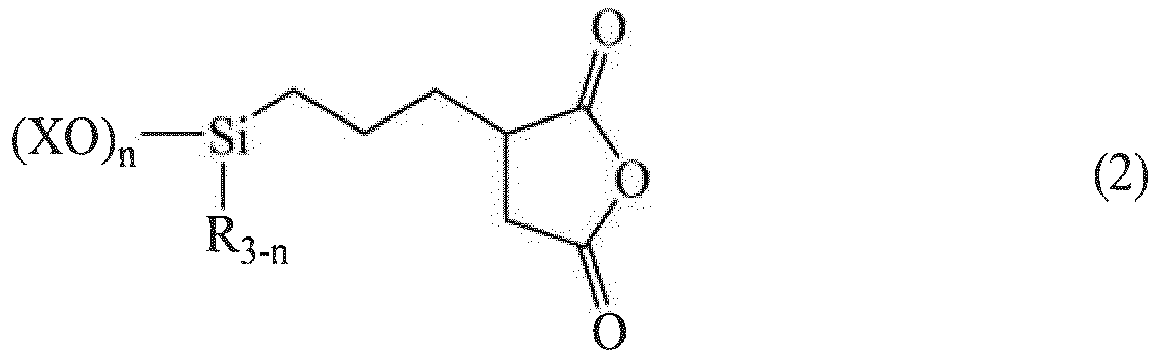
- In formula (2), X is a monovalent hydrocarbon group of 1 to 4 carbon atoms, examples of which include alkyl groups such as methyl, ethyl, propyl, isopropyl, butyl, isobutyl, and tert-butyl. Inter alia, methyl and ethyl are preferred.
- Examples of the succinic anhydride-containing silane coupling agent include (trimethoxysilyl)propylsuccinic anhydride, (triethoxysilyl)propylsuccinic anhydride, (methyldimethoxysilyl)propylsuccinic anhydride, and (methyldiethoxysilyl)propylsuccinic anhydride, but are not limited thereto.
- It is not always true that a stable aqueous silane coupling agent composition is prepared from any silane coupling agents. In the practice of the invention, the dicarboxylic acid structure created by hydrolysis becomes a key skeleton in obtaining the desired aqueous material.
- Suitable hydrolysis conditions include a temperature of 30 to 110°C and a reduced pressure of 60 hPa to atmospheric pressure, but are not limited thereto as long as the stability of the resulting composition is not adversely affected. If the reaction temperature exceeds 110°C, the composition may become difficult to prepare because of a substantial loss of stability. If the reaction temperature is lower than 30°C, hydrolysis reaction may not fully proceed, leaving the risk of alcohol release with the lapse of time.
- The step of removing the generated alcohol after the hydrolytic reaction may be conducted, for example, by atmospheric distillation and vacuum distillation. The distillation step may be conducted subsequently to or concurrently with the hydrolytic reaction step. From the standpoint of production efficiency, the distillation step concurrent with the hydrolytic reaction step is preferred. The temperature and pressure conditions during the concurrent step are the same as those during the hydrolytic reaction step.
- The amount of water used in hydrolytic reaction is at least 4 moles per mole of the reactant, succinic anhydride-containing silane coupling agent. Any excess of water may be present in the hydrolytic reaction system because the inventive composition is substantially based on water as solvent.
- On hydrolysis of the silane coupling agent it is particularly desirable that no hydrolytic catalyst, such as are known in the art, is used. On use of such a catalyst, it may be left at the end of alcohol removal step subsequent to hydrolysis. The composition containing residual catalyst is undesirable from the aspect of environmental load because the catalyst can be a volatile organic compound.
- Since the main component has a silanol-containing structure as alluded to previously, the aqueous silane coupling agent composition functions by itself as a surface treating agent, for example, a primer or a modifier for composites of inorganic material and organic resin. The surface treating agent should preferably contain the main component or silane coupling agent in a concentration of 0.1 to 50%, more preferably 0.5 to 30% by weight of the entire surface treating agent.
- Besides the aqueous silane coupling agent composition, additives such as surfactants, preservatives, discoloration preventive agents and antioxidants may be blended in the surface treating agent as long as the objects of the invention are not impaired.
- The surface treating agent is used for surface treatment of substrates. The substrates may be made of inorganic materials which form bonds by reacting with hydrolysable silyl groups and organic materials such as organic resins which form bonds by reacting with carboxylic acid groups. The shape of substrates is not particularly limited. Typical inorganic materials include inorganic fillers of silicon, titanium, zirconium, magnesium, aluminum, indium, tin, and single, double or complex oxides thereof, fiber glass members such as glass fibers, glass cloth, glass tape, glass mat, and glass paper, ceramics, and metal substrates such as iron, aluminum, copper, silver, gold and magnesium. Typical organic materials include epoxy resins, phenolic resins, polyimide resins, unsaturated polyester resins, paper boards, wood, solid wood boards, laminated wood boards, and chip boards. The substrate is not limited to the materials illustrated herein.
- In the surface treatment of a substrate with the surface treating agent, the treatment mode and curing conditions are not particularly limited. For example, the surface treating agent may be directly applied to the substrate by flow coating, dipping or spin coating. Also applicable is a kneading treatment wherein the surface treating agent is added to and mixed with a compound composed of an untreated inorganic filler and a resin as dispersing medium.
- Typical curing conditions include heating and drying. Preferably, the surface treatment is followed by heating and drying at 60 to 180°C, more preferably 80 to 150°C for 5 minutes to 2 hours, for thereby removing the solvent and inducing chemical reaction between the silane coupling agent, which is the main component of the surface treating agent, and the substrate surface.
- Examples and Comparative Examples are given below for illustrating the invention, but the invention is not limited thereto. In Examples, all parts are by weight; viscosity is measured at 25°C according to JIS Z 8803, specific gravity measured at 25°C according to JIS Z 8804, and refractive index measured at 25°C according to JIS K 0062.
- The alcohol (volatile organic component) content was measured using a headspace autosampler TurboMatrix HS40 (Perkin Elmer Inc.), charging a vial having a volume of 20 mL with 1 g of a sample, and sealing the vial with a septum. The sample was held at 60°C until gas-liquid equilibrium was reached (10 minutes), and the gas component collected.
GC system: HP7820A by Agilent Technologies Detector: thermal conductivity detector (TCD) Column: HP Innowax 19091N-033 (length 30 m x inner diameter 0.25 mm x film thickness 0.15 µm) Column temperature: 40°C (1.5 min holding) □ 15°C/min □ 80°C (4 min holding), total measurement time 8.2 min Injector temperature: 250°C Detector temperature: 250°C Carrier gas: He Carrier gas flow rate: 1.4 mL/min - A 1-L separable flask equipped with a stirrer, reflux condenser, dropping funnel and thermometer was charged with 262.3 parts of (trimethoxysilyl)propylsuccinic anhydride (X-12-967C by Shin-Etsu Chemical Co., Ltd.), to which 1,000 parts of deionized water was admitted. The contents were stirred and heated. Methanol formed by reaction and water were distilled off under atmospheric pressure, until an internal temperature of about 100°C was reached. The amount of methanol and water distilled off at this point totaled to 500 parts. Deionized water was added to the reaction product to form a composition having a solid content of 30 wt%, which was a pale yellow clear liquid having a viscosity of 4.1 mm2/s, a specific gravity of 1.10, a refractive index of 1.374, pH 1.9, and a methanol content of less than 0.1 wt% of the gas component as measured by the headspace GC.
- The reaction product is represented by the following formula.

- A reaction product was prepared as in Example 1 except that (methyldimethoxysilyl)propylsuccinic anhydride was used instead of (trimethoxysilyl)propylsuccinic anhydride. Deionized water was added to the reaction product to form a composition having a solid content of 30 wt%, which was a pale yellow clear liquid having a viscosity of 8.4 mm2/s, a specific gravity of 1.06, a refractive index of 1.351, pH 1.9, and a methanol content of less than 0.1 wt% of the gas component as measured by said headspace GC.
- The reaction product is represented by the following formula.

- A 1-L separable flask equipped with a stirrer, reflux condenser, and thermometer was charged with 262.3 parts of (trimethoxysilyl)propylsuccinic anhydride (X-12-967C by Shin-Etsu Chemical Co., Ltd.), to which 144 parts of deionized water was admitted. The contents were thoroughly stirred until the mixture ceased to separate into two layers. The end product was obtained as a pale yellow clear liquid. The end product had a methanol content of 15 wt% of the gas component by said 60°C headspace GC measurement. On IR analysis, peaks assigned to carboxyl group were observed while peaks assigned to acid anhydride vanished.
- The procedure of Example 1 was repeated except that (dimethylmethoxysilyl)propylsuccinic anhydride was used instead of (trimethoxysilyl)propylsuccinic anhydride. The reaction solution was uniform during hydrolysis. In the subsequent alcohol removal step, the solution increased its viscosity in proportion to methanol removal and eventually lost fluidity, failing to yield the desired material.
- The reaction product obtained above or (trimethoxysilyl)propylsuccinic anhydride was diluted with water to form a 1 wt% dilution, which was used as surface treating agent. Glass filaments having a diameter of 20 µm were treated with the agent and dried at 100°C for 30 minutes, yielding surface treated glass filaments. Onto the surface treated glass filaments, a heat curable composition consisting of an epoxy resin (JER828 by Japan Epoxy Resin Co., Ltd.) and a curing agent (triethylene tetramine) was applied as droplets having a diameter of several tens to several hundreds of microns such that the droplets might not contact with each other, and heat cured (specifically heated at 80°C for 1.5 hours and at 100°C for further 2 hours) to form a spherical resin bead. The shear strength between surface treated glass filament and epoxy resin was measured by the micro-droplet method using an analyzer for evaluation of interfacial properties of composite materials (HM410 by Tohei Sangyo Co., Ltd.). The shear strength τ (MPa) per unit area is given as τ = F/πDL wherein D (µm) is the diameter of a filament, L (µm) is the length of a portion of the filament buried in the resin bead, and F (mN) is the load required to withdraw the resin bead in filament axial direction. Table 1 shows the main component of the surface treating agent and the measurements of shear strength.
Table 1 Surface treating agent's main component Shear strength (MPa) Example 3 Product of Example 1 38.9 4 Product of Example 2 36.3 Comparative Example 3 not added (untreated) 33.7 4 X-12-967C 33.1 5 Product of Comparative Example 1 25.6 X-12-967C: (trimethoxysilyl)propylsuccinic anhydride - The test results of Examples and Comparative Examples demonstrate that the surface modified with the surface treating agents embodying the invention was effective for promoting adhesion to epoxy resins, and the efficiency of treatment of glass filaments is improved owing to thorough hydrolysis, exerting a satisfactory coupling effect.
- An encapsulating epoxy resin compound having the formulation shown in Table 2 was prepared according to the Example of
JP-A 2012-046576 - In Table 2, the amount of the aqueous silane coupling agent composition added is expressed in terms of the amount of its main component, that is, solid content.
Table 2 Formulation (pbw) Example Comparative Example 5 6 6 7 8 Product of Example 1 0.2 Product of Example 2 0.2 Product of Comparative Example 1 0.2 X-12-967C 0.2 Epoxy resin 5.6 5.6 5.6 5.6 5.6 Phenolic resin curing agent 5.5 5.5 5.5 5.5 5.5 Inorganic filler 88 88 88 88 88 Silane coupling agent 0.1 0.1 0.1 0.1 0.1 Cure promoter 0.2 0.2 0.2 0.2 0.2 Parting agent 0.2 0.2 0.2 0.2 0.2 Coloring agent 0.3 0.3 0.3 0.3 0.3 Adhesion to Ag substrate (N) 12 11 9 7 4 - X-12-967C:
- (trimethoxysilyl)propylsuccinic anhydride
- Epoxy resin:
- YX-400K by Mitsubishi Chemical Corp.
- Phenolic resin curing agent:
- MEH-7851SS by Meiwa Plastic Industries, Ltd.
- Inorganic filler:
- spherical fused silica, average particle size 10.8 µm, BET surface area 5.1 m2/g
- Silane coupling agent:
- KBM-573 by Shin-Etsu Chemical Co., Ltd.
- Cure promoter:
- addition product of triphenylphosphine and p-benzoquinone
- Parting agent:
- oxidized polyethylene wax PED 191 by Clariant
- Coloring agent:
- carbon black Carbon #5 by Mitsubishi Chemical Corp.
- The results of the Examples and Comparative Examples demonstrate that the surface modification by integral blending of the surface treating agents embodying the invention is effective for improving adhesion to epoxy resin, and the efficiency of treatment of silica and silver substrate is improved owing to thorough hydrolysis, exerting a satisfactory coupling effects.
- The compositions of Examples 1 and 2 and the composition of Comparative Example 9 which was obtained by adjusting the composition of Example 1 to a solid content of 60% by weight, in sealed state, were stored in a thermostat chamber at 50°C. Table 3 shows a percent buildup of viscosity from the initial viscosity with passage of time.
Table 3 Viscosity buildup (%) during 50°C storage After 10 days After 30 days After 60 days Example 1 0.5 0.4 0.5 Example 2 0.5 0.7 1.1 Comparative Example 9 3.1 22.6 gelled Comparative Example 9: obtained by adjusting the composition of Example 1 to a solid content of 60% by weight - As seen from the results of Examples and Comparative Examples, aqueous silane coupling agent compositions of the invention maintained satisfactory stability even at a high temperature of 50°C.
- For the avoidance of doubt it is confirmed that in the general description above, in the usual way the proposal of general preferences and options in respect of different features of the coupling agent composition, preparing method, use, surface treating agent and article constitutes the proposal of general combinations of those general preferences and options for the different features, insofar as they are combinable and compatible and are put forward in the same context.
- In respect of numerical ranges disclosed in the present description it will of course be understood that in the normal way the technical criterion for the upper limit is different from the technical criterion for the lower limit, i.e. the upper and lower limits are intrinsically distinct proposals.
Claims (13)
- An aqueous silane coupling agent composition comprising (i) a silane coupling agent having the general formula (1):

the composition having a solids content of 0.5 to 50% by weight and containing volatile components which are detectable by headspace gas chromatography, the content of volatile organic compounds being not more than 10% by weight of the volatile components. - An aqueous silane coupling agent composition of claim 1 which has a solids content of 30 to 50% by weight and experiences a viscosity buildup of less than 10% when stored at 50°C for one month.
- An aqueous silane coupling agent composition of claim 1 or 2 in which the content of volatile organic compounds is not more than 5% by weight of the volatile components.
- A method for preparing an aqueous silane coupling agent composition of claim 1, 2 or 3, comprising the steps of hydrolysing a succinic anhydride-containing silane coupling agent having the general formula (2):

- A method of claim 5 in which the alcohol is removed by distillation subsequent to or concurrent with the hydrolysis.
- Use of an aqueous silane coupling agent composition of any one of claims 1 to 3 as or in a surface treating agent for the bonding of a substrate, such as an inorganic substrate, to organic resin.
- Use according to claim 6 in which the surface treating agent is applied to the surface of the substrate or is included as a modifier in the organic resin.
- A surface treating agent consisting of or comprising an aqueous silane coupling agent composition of claim 1, 2 or 3.
- A surface treating agent of claim 8 which is an aqueous dilution of the aqueous silane coupling agent composition, containing 0.5 to 30% by weight of the silane coupling agent, and optionally one or more additives selected from surfactants, preservatives, discoloration preventive agents and antioxidants.
- An article comprising a substrate treated with a surface treating agent of claim 8 or 9.
- The article of claim 10 wherein the substrate is a glass fiber member selected from the group consisting of glass cloth, glass tape, glass mat and glass paper.
- The article of claim 10 wherein the substrate is an inorganic filler.
- The article of claim 10 wherein the substrate is ceramic or metal.
Applications Claiming Priority (1)
| Application Number | Priority Date | Filing Date | Title |
|---|---|---|---|
| JP2013164336A JP2015034097A (en) | 2013-08-07 | 2013-08-07 | Aqueous silane coupling agent composition and production method thereof, surface treatment agent and article |
Publications (1)
| Publication Number | Publication Date |
|---|---|
| EP2876136A1 true EP2876136A1 (en) | 2015-05-27 |
Family
ID=51260692
Family Applications (1)
| Application Number | Title | Priority Date | Filing Date |
|---|---|---|---|
| EP14179388.5A Withdrawn EP2876136A1 (en) | 2013-08-07 | 2014-07-31 | Aqueous Silane Coupling Agent Composition, Making Method, Surface Treating Agent, and Article |
Country Status (5)
| Country | Link |
|---|---|
| US (1) | US20150044466A1 (en) |
| EP (1) | EP2876136A1 (en) |
| JP (1) | JP2015034097A (en) |
| KR (1) | KR20150017671A (en) |
| CN (1) | CN104342924A (en) |
Families Citing this family (8)
| Publication number | Priority date | Publication date | Assignee | Title |
|---|---|---|---|---|
| JP6665964B2 (en) * | 2017-03-08 | 2020-03-13 | Dic株式会社 | Colorant and aqueous pigment dispersion |
| CN111072711B (en) * | 2019-12-19 | 2023-06-02 | 湖北新蓝天新材料股份有限公司 | Water-based silane coupling agent and preparation method and application thereof |
| CN118871546A (en) * | 2022-03-02 | 2024-10-29 | 株式会社力森诺科 | Antifogging agent, antifogging method for vehicle lamp structure, and vehicle lamp structure |
| CN114773376B (en) * | 2022-03-17 | 2022-12-23 | 江苏中新瑞光学材料有限公司 | The preparation method of three (methyleneoxypropyltrimethoxysilyl) aminomethane |
| KR20250096733A (en) | 2022-10-24 | 2025-06-27 | 신에쓰 가가꾸 고교 가부시끼가이샤 | Organopolysiloxane, adhesion imparting agent, water-based paint composition and primer composition |
| JP7761164B2 (en) | 2022-10-24 | 2025-10-28 | 信越化学工業株式会社 | Organopolysiloxane, its production method, adhesion promoter, aqueous coating composition, and primer composition |
| CN116640261B (en) * | 2023-05-10 | 2024-10-15 | 华南农业大学 | Silicon-containing vegetable oil-based dual UV curing material and preparation method and application thereof |
| US20250125194A1 (en) * | 2023-10-11 | 2025-04-17 | Taiwan Semiconductor Manufacturing Company Limited | Improved surface pre-treatment for semiconductor device bonding structures and methods of forming the same |
Citations (7)
| Publication number | Priority date | Publication date | Assignee | Title |
|---|---|---|---|---|
| JPH08302320A (en) | 1995-05-12 | 1996-11-19 | Nippon Synthetic Chem Ind Co Ltd:The | Adhesive composition |
| US20050171318A1 (en) * | 2004-02-03 | 2005-08-04 | The Yokohama Rubber Co., Ltd. | Curable resin composition |
| EP1584648A1 (en) * | 2004-04-07 | 2005-10-12 | Shin-Etsu Chemical Co., Ltd. | Organopolysiloxane composition for bonding to magnesium alloy |
| JP2006022158A (en) | 2004-07-06 | 2006-01-26 | Yokohama Rubber Co Ltd:The | Curable resin composition |
| US20070104872A1 (en) * | 2005-11-08 | 2007-05-10 | Shin -Etsu Chemical Co., Ltd. | Method of sealing semiconductor element mounted on gold-plated printed circuit board |
| WO2007085320A2 (en) | 2006-01-26 | 2007-08-02 | Evonik Degussa Gmbh | Water-dilutable sol-gel composition |
| JP2012046576A (en) | 2010-08-25 | 2012-03-08 | Sumitomo Bakelite Co Ltd | Epoxy resin composition for sealing and electronic component apparatus |
Family Cites Families (6)
| Publication number | Priority date | Publication date | Assignee | Title |
|---|---|---|---|---|
| US5196467A (en) * | 1991-12-19 | 1993-03-23 | Owens-Corning Fiberglas Corporation | Glass size compositions, coated glass fibers and reinforced thermoplastics |
| US6512132B2 (en) * | 2000-09-27 | 2003-01-28 | Chisso Corporation | Aqueous solution of aminated silanol compound, use thereof, and process for producing the same |
| EP1425353B1 (en) * | 2001-09-11 | 2005-10-19 | Akzo Nobel Coatings International B.V. | Coating composition for metal substrates |
| DE60232942D1 (en) * | 2001-10-09 | 2009-08-27 | Mitsubishi Chem Corp | Radiation curable coating composition |
| JP2006213958A (en) * | 2005-02-02 | 2006-08-17 | Nippon Parkerizing Co Ltd | Metal material surface treatment composition and treatment method |
| US20080319125A1 (en) * | 2005-11-16 | 2008-12-25 | Lisa Marie Boswell | Organosilanes and Their Preparation and Use in Elastomer Compositions |
-
2013
- 2013-08-07 JP JP2013164336A patent/JP2015034097A/en active Pending
-
2014
- 2014-07-31 EP EP14179388.5A patent/EP2876136A1/en not_active Withdrawn
- 2014-08-04 KR KR1020140099679A patent/KR20150017671A/en not_active Withdrawn
- 2014-08-06 US US14/453,000 patent/US20150044466A1/en not_active Abandoned
- 2014-08-07 CN CN201410384520.7A patent/CN104342924A/en active Pending
Patent Citations (8)
| Publication number | Priority date | Publication date | Assignee | Title |
|---|---|---|---|---|
| JPH08302320A (en) | 1995-05-12 | 1996-11-19 | Nippon Synthetic Chem Ind Co Ltd:The | Adhesive composition |
| US20050171318A1 (en) * | 2004-02-03 | 2005-08-04 | The Yokohama Rubber Co., Ltd. | Curable resin composition |
| EP1584648A1 (en) * | 2004-04-07 | 2005-10-12 | Shin-Etsu Chemical Co., Ltd. | Organopolysiloxane composition for bonding to magnesium alloy |
| JP2006022158A (en) | 2004-07-06 | 2006-01-26 | Yokohama Rubber Co Ltd:The | Curable resin composition |
| US20070104872A1 (en) * | 2005-11-08 | 2007-05-10 | Shin -Etsu Chemical Co., Ltd. | Method of sealing semiconductor element mounted on gold-plated printed circuit board |
| WO2007085320A2 (en) | 2006-01-26 | 2007-08-02 | Evonik Degussa Gmbh | Water-dilutable sol-gel composition |
| JP2009524709A (en) | 2006-01-26 | 2009-07-02 | エボニック デグサ ゲーエムベーハー | Sol-gel composition dilutable with water |
| JP2012046576A (en) | 2010-08-25 | 2012-03-08 | Sumitomo Bakelite Co Ltd | Epoxy resin composition for sealing and electronic component apparatus |
Also Published As
| Publication number | Publication date |
|---|---|
| US20150044466A1 (en) | 2015-02-12 |
| KR20150017671A (en) | 2015-02-17 |
| JP2015034097A (en) | 2015-02-19 |
| CN104342924A (en) | 2015-02-11 |
Similar Documents
| Publication | Publication Date | Title |
|---|---|---|
| EP2990452B1 (en) | Aqueous silane coupling agent composition, making method, and surface treating agent | |
| US20150044466A1 (en) | Aqueous silane coupling agent composition, making method, surface treating agent, and article | |
| KR101527231B1 (en) | The room temperature curable organopolysiloxane composition | |
| CN1228400C (en) | Olefine base function siloxane copolymer of fog-proof additive as polysiloxane paint composition | |
| JP5112579B2 (en) | Silicone composition and conductive silicone adhesive formed therefrom | |
| TWI403558B (en) | Room temperature hardened organopolysiloxane composition | |
| CA2855993C (en) | Mixtures, particularly low in volatile organic compounds (voc), of olefinically functionalised siloxane oligomers based on alkoxy silanes | |
| CN102083924B (en) | Adhesion-promoting additive for an ink for imprinting glass | |
| US20020010251A1 (en) | Room temperature rapid-curable silicone composition | |
| EP3119847B1 (en) | Alkoxy group-containing silicones with reactive functional groups of defined reactivity | |
| KR20140116848A (en) | Epoxy-containing polysiloxane oligomer compositions, process for making same and uses thereof | |
| TW444042B (en) | Latex sealants containing epoxysilanes | |
| CA2855999C (en) | Low-chloride compositions of olefinically functionalized siloxane oligomers based on alkoxysilanes | |
| Gubbels | An overview of the chemistry of condensation curing silicone sealants and adhesives | |
| CN1286886C (en) | Siloxane copolymers containing silicon-bonded hydrogen atoms for use as anti-fog additives in silicone coating compositions | |
| TWI757308B (en) | Formulation containing a metal aprotic organosilanoxide compound | |
| CN109796595B (en) | High-refractive-index phenolic hydroxyl-containing organic silicon tackifier and preparation method thereof | |
| EP2060597B1 (en) | Method for bonding polyamide resin and fluoroelastomer | |
| WO2019022087A1 (en) | Coating-forming composition | |
| CN109054725A (en) | A kind of one-component heat cure glue that temperature tolerance is good | |
| US12624056B2 (en) | Organic titanium compound and curing catalyst | |
| JP2009137050A (en) | Release agent composition | |
| CN114958246A (en) | Multifunctional auxiliary agent and preparation method thereof | |
| US20250368825A1 (en) | Temperature resistant moisture curable silicone compositions | |
| CN118510856A (en) | Primer composition for glass adhesives |
Legal Events
| Date | Code | Title | Description |
|---|---|---|---|
| PUAI | Public reference made under article 153(3) epc to a published international application that has entered the european phase |
Free format text: ORIGINAL CODE: 0009012 |
|
| 17P | Request for examination filed |
Effective date: 20140731 |
|
| AK | Designated contracting states |
Kind code of ref document: A1 Designated state(s): AL AT BE BG CH CY CZ DE DK EE ES FI FR GB GR HR HU IE IS IT LI LT LU LV MC MK MT NL NO PL PT RO RS SE SI SK SM TR |
|
| AX | Request for extension of the european patent |
Extension state: BA ME |
|
| R17P | Request for examination filed (corrected) |
Effective date: 20150615 |
|
| RBV | Designated contracting states (corrected) |
Designated state(s): AL AT BE BG CH CY CZ DE DK EE ES FI FR GB GR HR HU IE IS IT LI LT LU LV MC MK MT NL NO PL PT RO RS SE SI SK SM TR |
|
| 17Q | First examination report despatched |
Effective date: 20151030 |
|
| STAA | Information on the status of an ep patent application or granted ep patent |
Free format text: STATUS: THE APPLICATION IS DEEMED TO BE WITHDRAWN |
|
| 18D | Application deemed to be withdrawn |
Effective date: 20160510 |