EP2871176A1 - Method for producing optically active bicyclic -amino acid derivative - Google Patents
Method for producing optically active bicyclic -amino acid derivative Download PDFInfo
- Publication number
- EP2871176A1 EP2871176A1 EP14823864.5A EP14823864A EP2871176A1 EP 2871176 A1 EP2871176 A1 EP 2871176A1 EP 14823864 A EP14823864 A EP 14823864A EP 2871176 A1 EP2871176 A1 EP 2871176A1
- Authority
- EP
- European Patent Office
- Prior art keywords
- compound represented
- general formula
- formula
- group
- enantiomer
- Prior art date
- Legal status (The legal status is an assumption and is not a legal conclusion. Google has not performed a legal analysis and makes no representation as to the accuracy of the status listed.)
- Granted
Links
- 0 CCC(CC1CC2=C(*)C(F)(F)F)=C[C@]12N=C Chemical compound CCC(CC1CC2=C(*)C(F)(F)F)=C[C@]12N=C 0.000 description 4
- NGFGCCPBCQKRRN-CKYFFXLPSA-N CCC(C[C@@H]1C2)=C[C@H]1[C@]2(CC(O)=O)C#N Chemical compound CCC(C[C@@H]1C2)=C[C@H]1[C@]2(CC(O)=O)C#N NGFGCCPBCQKRRN-CKYFFXLPSA-N 0.000 description 2
- NPFOLTHIKZSVPQ-UHFFFAOYSA-N C=CCCC[N+]([O-])=O Chemical compound C=CCCC[N+]([O-])=O NPFOLTHIKZSVPQ-UHFFFAOYSA-N 0.000 description 1
- VHYCMXUYENSZSH-UHFFFAOYSA-N CC(CCCN=O)C(O)=O Chemical compound CC(CCCN=O)C(O)=O VHYCMXUYENSZSH-UHFFFAOYSA-N 0.000 description 1
- XATPPBJITVSGAP-UYXKVSBOSA-N CC1[C@H](C)[C@@H]2OCC[C@H]2C1 Chemical compound CC1[C@H](C)[C@@H]2OCC[C@H]2C1 XATPPBJITVSGAP-UYXKVSBOSA-N 0.000 description 1
- QEGONAXSXKFDLY-UHFFFAOYSA-N CCC(CC1C2)=CC1C2=O Chemical compound CCC(CC1C2)=CC1C2=O QEGONAXSXKFDLY-UHFFFAOYSA-N 0.000 description 1
- GSAHINUDEYKZTC-KEJGKJRFSA-N CCC(C[C@@H]1C2)=CC1[C@]2(C(C(O)=O)C(O)=O)C#N Chemical compound CCC(C[C@@H]1C2)=CC1[C@]2(C(C(O)=O)C(O)=O)C#N GSAHINUDEYKZTC-KEJGKJRFSA-N 0.000 description 1
Classifications
-
- C—CHEMISTRY; METALLURGY
- C07—ORGANIC CHEMISTRY
- C07D—HETEROCYCLIC COMPOUNDS
- C07D319/00—Heterocyclic compounds containing six-membered rings having two oxygen atoms as the only ring hetero atoms
- C07D319/04—1,3-Dioxanes; Hydrogenated 1,3-dioxanes
- C07D319/06—1,3-Dioxanes; Hydrogenated 1,3-dioxanes not condensed with other rings
-
- C—CHEMISTRY; METALLURGY
- C07—ORGANIC CHEMISTRY
- C07C—ACYCLIC OR CARBOCYCLIC COMPOUNDS
- C07C201/00—Preparation of esters of nitric or nitrous acid or of compounds containing nitro or nitroso groups bound to a carbon skeleton
- C07C201/06—Preparation of nitro compounds
- C07C201/12—Preparation of nitro compounds by reactions not involving the formation of nitro groups
-
- C—CHEMISTRY; METALLURGY
- C07—ORGANIC CHEMISTRY
- C07C—ACYCLIC OR CARBOCYCLIC COMPOUNDS
- C07C201/00—Preparation of esters of nitric or nitrous acid or of compounds containing nitro or nitroso groups bound to a carbon skeleton
- C07C201/06—Preparation of nitro compounds
- C07C201/16—Separation; Purification; Stabilisation; Use of additives
-
- C—CHEMISTRY; METALLURGY
- C07—ORGANIC CHEMISTRY
- C07C—ACYCLIC OR CARBOCYCLIC COMPOUNDS
- C07C205/00—Compounds containing nitro groups bound to a carbon skeleton
- C07C205/49—Compounds containing nitro groups bound to a carbon skeleton the carbon skeleton being further substituted by carboxyl groups
- C07C205/50—Compounds containing nitro groups bound to a carbon skeleton the carbon skeleton being further substituted by carboxyl groups having nitro groups and carboxyl groups bound to acyclic carbon atoms of the carbon skeleton
-
- C—CHEMISTRY; METALLURGY
- C07—ORGANIC CHEMISTRY
- C07C—ACYCLIC OR CARBOCYCLIC COMPOUNDS
- C07C211/00—Compounds containing amino groups bound to a carbon skeleton
- C07C211/01—Compounds containing amino groups bound to a carbon skeleton having amino groups bound to acyclic carbon atoms
- C07C211/26—Compounds containing amino groups bound to a carbon skeleton having amino groups bound to acyclic carbon atoms of an unsaturated carbon skeleton containing at least one six-membered aromatic ring
- C07C211/27—Compounds containing amino groups bound to a carbon skeleton having amino groups bound to acyclic carbon atoms of an unsaturated carbon skeleton containing at least one six-membered aromatic ring having amino groups linked to the six-membered aromatic ring by saturated carbon chains
-
- C—CHEMISTRY; METALLURGY
- C07—ORGANIC CHEMISTRY
- C07C—ACYCLIC OR CARBOCYCLIC COMPOUNDS
- C07C227/00—Preparation of compounds containing amino and carboxyl groups bound to the same carbon skeleton
- C07C227/04—Formation of amino groups in compounds containing carboxyl groups
-
- C—CHEMISTRY; METALLURGY
- C07—ORGANIC CHEMISTRY
- C07C—ACYCLIC OR CARBOCYCLIC COMPOUNDS
- C07C227/00—Preparation of compounds containing amino and carboxyl groups bound to the same carbon skeleton
- C07C227/38—Separation; Purification; Stabilisation; Use of additives
- C07C227/40—Separation; Purification
- C07C227/42—Crystallisation
-
- C—CHEMISTRY; METALLURGY
- C07—ORGANIC CHEMISTRY
- C07C—ACYCLIC OR CARBOCYCLIC COMPOUNDS
- C07C229/00—Compounds containing amino and carboxyl groups bound to the same carbon skeleton
- C07C229/02—Compounds containing amino and carboxyl groups bound to the same carbon skeleton having amino and carboxyl groups bound to acyclic carbon atoms of the same carbon skeleton
- C07C229/32—Compounds containing amino and carboxyl groups bound to the same carbon skeleton having amino and carboxyl groups bound to acyclic carbon atoms of the same carbon skeleton the carbon skeleton being unsaturated and containing rings other than six-membered aromatic rings
-
- C—CHEMISTRY; METALLURGY
- C07—ORGANIC CHEMISTRY
- C07C—ACYCLIC OR CARBOCYCLIC COMPOUNDS
- C07C253/00—Preparation of carboxylic acid nitriles
-
- C—CHEMISTRY; METALLURGY
- C07—ORGANIC CHEMISTRY
- C07C—ACYCLIC OR CARBOCYCLIC COMPOUNDS
- C07C253/00—Preparation of carboxylic acid nitriles
- C07C253/08—Preparation of carboxylic acid nitriles by addition of hydrogen cyanide or salts thereof to unsaturated compounds
- C07C253/10—Preparation of carboxylic acid nitriles by addition of hydrogen cyanide or salts thereof to unsaturated compounds to compounds containing carbon-to-carbon double bonds
-
- C—CHEMISTRY; METALLURGY
- C07—ORGANIC CHEMISTRY
- C07C—ACYCLIC OR CARBOCYCLIC COMPOUNDS
- C07C253/00—Preparation of carboxylic acid nitriles
- C07C253/30—Preparation of carboxylic acid nitriles by reactions not involving the formation of cyano groups
-
- C—CHEMISTRY; METALLURGY
- C07—ORGANIC CHEMISTRY
- C07C—ACYCLIC OR CARBOCYCLIC COMPOUNDS
- C07C253/00—Preparation of carboxylic acid nitriles
- C07C253/32—Separation; Purification; Stabilisation; Use of additives
- C07C253/34—Separation; Purification
-
- C—CHEMISTRY; METALLURGY
- C07—ORGANIC CHEMISTRY
- C07C—ACYCLIC OR CARBOCYCLIC COMPOUNDS
- C07C255/00—Carboxylic acid nitriles
- C07C255/45—Carboxylic acid nitriles having cyano groups bound to carbon atoms of rings other than six-membered aromatic rings
- C07C255/47—Carboxylic acid nitriles having cyano groups bound to carbon atoms of rings other than six-membered aromatic rings to carbon atoms of rings being part of condensed ring systems
-
- C—CHEMISTRY; METALLURGY
- C07—ORGANIC CHEMISTRY
- C07C—ACYCLIC OR CARBOCYCLIC COMPOUNDS
- C07C67/00—Preparation of carboxylic acid esters
-
- C—CHEMISTRY; METALLURGY
- C07—ORGANIC CHEMISTRY
- C07C—ACYCLIC OR CARBOCYCLIC COMPOUNDS
- C07C67/00—Preparation of carboxylic acid esters
- C07C67/30—Preparation of carboxylic acid esters by modifying the acid moiety of the ester, such modification not being an introduction of an ester group
- C07C67/333—Preparation of carboxylic acid esters by modifying the acid moiety of the ester, such modification not being an introduction of an ester group by isomerisation; by change of size of the carbon skeleton
- C07C67/343—Preparation of carboxylic acid esters by modifying the acid moiety of the ester, such modification not being an introduction of an ester group by isomerisation; by change of size of the carbon skeleton by increase in the number of carbon atoms
-
- C—CHEMISTRY; METALLURGY
- C07—ORGANIC CHEMISTRY
- C07C—ACYCLIC OR CARBOCYCLIC COMPOUNDS
- C07C69/00—Esters of carboxylic acids; Esters of carbonic or haloformic acids
- C07C69/608—Esters of carboxylic acids having a carboxyl group bound to an acyclic carbon atom and having a ring other than a six-membered aromatic ring in the acid moiety
-
- C—CHEMISTRY; METALLURGY
- C07—ORGANIC CHEMISTRY
- C07B—GENERAL METHODS OF ORGANIC CHEMISTRY; APPARATUS THEREFOR
- C07B2200/00—Indexing scheme relating to specific properties of organic compounds
- C07B2200/07—Optical isomers
-
- C—CHEMISTRY; METALLURGY
- C07—ORGANIC CHEMISTRY
- C07C—ACYCLIC OR CARBOCYCLIC COMPOUNDS
- C07C2602/00—Systems containing two condensed rings
- C07C2602/02—Systems containing two condensed rings the rings having only two atoms in common
- C07C2602/14—All rings being cycloaliphatic
- C07C2602/20—All rings being cycloaliphatic the ring system containing seven carbon atoms
Definitions
- the present invention relates to a method for producing an optically active bicyclic compound. According to the present invention, a highly pure bicyclic compound can be efficiently produced.
- ⁇ 2 ⁇ ligands have been known as therapeutic drugs for neuropathic pain.
- Such ⁇ 2 ⁇ ligands include, for example, gabapentine and pregabalin.
- the ⁇ 2 ⁇ ligands including these compounds are useful in the treatment of epilepsy and neuropathic pain, etc. (e.g., Patent Literature 1).
- Other compounds are disclosed in, for example, Patent Literatures 2, 3, and 4.
- Patent Literatures 5 and 6 disclose ⁇ 2 ⁇ ligands and methods for producing the same.
- An object of the present invention is to provide a method for producing an optically active bicyclic compound, particularly, a bicyclic ⁇ -amino acid derivative, or a pharmacologically acceptable salt thereof, or an intermediate for the synthesis of the compound or the salt in a high purity in a stereospecific manner.
- Patent Literatures 5 and 6 have reported a method for producing a compound (1-6) as described in Scheme 1.
- the inventors of the present application have continuously conducted diligent studies to develop efficient methods by focusing on a method for stereocontrolling an asymmetric carbon and a method for producing highly pure compound (1-6) in the method for producing compound (1-6).
- compound (1-6) from compound (1-5) requires heating in the presence of an acid for deprotecting the tert-butyl ester group.
- positional isomerization of the double bond proceeds as a secondary reaction.
- the compound (1-6) is thus contaminated by a relatively large amount of the resulting positional isomers.
- a further challenge to the previous methods is how to obtain highly pure compound (1-6).
- the problems to be solved by the present invention are how to obtain, with high stereoselectivity, the quaternary carbon that is formed during the conversion of compound (1-2) to compound (1-3), and how to obtain highly pure compound (1-6) by the suppression of related substances as by-products in the production process.
- the present invention is useful because the present invention provides a method for producing an optically active bicyclic compound, particularly, a bicyclic ⁇ -amino acid derivative, or a pharmacologically acceptable salt thereof, or an intermediate for the synthesis of the compound or the salt in a high purity in a stereospecific manner.
- the C1-C6 alkyl group refers to a linear or branched alkyl group having 1 to 6 carbon atoms. Examples thereof include a methyl group, an ethyl group, a propyl group, an isopropyl group, a butyl group, an isobutyl group, a sec-butyl group, a t-butyl group, a pentyl group, and a hexyl group.
- the C1-C6 alkyl group is preferably a methyl group, an ethyl group, a propyl group, or a t-butyl group.
- This step involves producing a compound represented by the general formula (II) (and/or an enantiomer thereof) from a compound represented by the general formula (III) (and/or an enantiomer thereof) and a compound represented by the general formula (IV) using a Lewis acid.
- R 1 and R 2 are as defined above.
- the solvent used in this step includes: ethers such as CPME, THF, Me-THF, and DME; halogenated hydrocarbons such as DCM; and aromatic hydrocarbons such as toluene.
- Ether solvents such as CPME, THF, Me-THF, and DME are preferred. CPME or Me-THF is more preferred.
- the Lewis acid used in this step is preferably a Lewis acid containing titanium or aluminum as a central metal, more preferably TiCl 4 , isopropoxytitanium trichloride, diisopropoxytitanium dichloride, a TiCl 4 -2THF complex, a mixture of TiCl 4 and Ti(Oi-Pr) 4 (approximately 3:1), or AlCl 3 , or the like, particularly preferably isopropoxytitanium trichloride or a mixture of TiCl 4 and Ti(Oi-Pr) 4 (approximately 3:1).
- an amine compound may be added to the reaction system.
- the amine compound is preferably pyridine or the like.
- This step is carried out at a reaction temperature of usually 50°C or lower, preferably in the range of 0 to 40°C.
- the reaction time of this step is not particularly limited as long as the starting materials are almost completely consumed within the reaction time.
- the reaction time is usually of the order of 2 hours to 6 hours.
- This step provides a method for producing a compound represented by the general formula (Ia) (and/or an enantiomer thereof), comprising mixing a compound represented by the general formula (II) (and/or an enantiomer thereof) with an alkali metal salt of hydrogen cyanide in a solvent to produce the compound represented by the general formula (Ia) (and/or an enantiomer thereof).
- a feature of this step is that a substantially single diastereomer can be produced by virtue of the addition of a cyano group with very high stereoselectivity.
- R 1 and R 2 are as defined above.
- the alkali metal salt of hydrogen cyanide used in this step is sodium cyanide or potassium cyanide.
- the solvent in this step is preferably a C1-C4 alcohol solvent or a nitrogen-containing solvent (e.g., DMAc and CH 3 CN), more preferably MeOH or EtOH.
- a solvent may be mixed with an ether solvent such as Me-THF or CPME.
- the reaction temperature of this step is preferably on the order of 0 to 50°C, more preferably of the order of 20 to 40°C.
- the reaction time of this step is not particularly limited as long as the starting materials are almost completely consumed within the reaction time.
- the reaction time is usually of the order of 2 to 8 hours.
- This step provides a method for producing a compound represented by the general formula (Ib) (and/or an enantiomer thereof), comprising mixing a compound represented by the general formula (II) (and/or an enantiomer thereof) with nitromethane in the presence of a base in a solvent to produce the compound represented by the general formula (Ib) (and/or an enantiomer thereof).
- a feature of this step is that a substantially single diastereomer can be produced by virtue of the addition of a nitromethyl group with very high stereoselectivity.
- R 1 and R 2 are as defined above.
- the base used in this step can be any of organic and inorganic bases and is preferably DBU, DBN, tetra-n-butylammonium fluoride, or the like, particularly preferably DBU.
- the solvent used in this step is preferably an aromatic hydrocarbon solvent (e.g., toluene), a halogenated hydrocarbon solvent (e.g., DCM), a nitrogen-containing solvent (e.g., DMAc and CH 3 CN), an ester solvent (e.g., ethyl acetate), an ether solvent (e.g., THF), DMSO, or the like, particularly preferably toluene or THF.
- aromatic hydrocarbon solvent e.g., toluene
- a halogenated hydrocarbon solvent e.g., DCM
- a nitrogen-containing solvent e.g., DMAc and CH 3 CN
- an ester solvent e.g., ethyl acetate
- an ether solvent e.g., THF
- DMSO DMSO
- the reaction temperature of this step is of the order of 0 to 60°C, more preferably of the order of 20 to 40°C.
- the reaction time of this step is not particularly limited as long as the starting materials are almost completely consumed within the reaction time.
- the reaction time is usually of the order of 2 to 16 hours.
- This step provides a method for producing a compound represented by the general formula (V) (and/or an enantiomer thereof), comprising (1) heating a compound represented by the general formula (I) (and/or an enantiomer thereof) in the presence of a base in a solvent to produce a compound represented by the general formula (IV) (and/or an enantiomer thereof) (decarboxylation step), and subsequently (2) hydrolyzing the compound represented by the general formula (IV) (and/or an enantiomer thereof) to produce the compound represented by the general formula (V) (hydrolysis step).
- the compound represented by the general formula (IV) (and/or an enantiomer thereof) may be isolated.
- the decarboxylation step and the hydrolysis step can be continuously carried out without isolation of the compound represented by the general formula (IV) (and/or an enantiomer thereof) to produce the compound represented by the general formula (V) (and/or an enantiomer thereof).
- R 1 , R 2 , and R 3 are as defined above.
- the reaction in this step is preferably carried out by dissolution of a compound represented by the general formula (I) (and/or an enantiomer thereof) in a solvent and gradual addition of a solution containing a base under heating.
- the base used in this step is preferably lithium hydroxide, sodium hydroxide, potassium hydroxide, sodium methoxide, sodium ethoxide, sodium tert-butoxide, potassium methoxide, potassium ethoxide, potassium tert-butoxide, or the like, more preferably sodium hydroxide or potassium hydroxide, particularly preferably potassium hydroxide.
- the solvent in this step is preferably a C1-C4 alcohol solvent, more preferably MeOH, EtOH, or n-propanol, particularly preferably EtOH.
- a C1-C4 alcohol solvent more preferably MeOH, EtOH, or n-propanol, particularly preferably EtOH.
- such an alcohol solvent may be supplemented with a small amount of water for the reaction.
- the reaction temperature of this step is of the order of 60 to 100°C, preferably of the order of 70 to 80°C.
- the reaction time of this step is not particularly limited as long as the starting materials are almost completely consumed within the reaction time.
- the reaction time is usually of the order of 2 to 20 hours, preferably of the order of 4 to 10 hours.
- This step is carried out by dissolution of the compound represented by the general formula (IV) (and/or an enantiomer thereof) in a solvent and hydrolysis of the ester site in the presence of a base and water.
- this step is carried out sequentially from the decarboxylation step using a solution containing the compound represented by the general formula (IV) (and/or an enantiomer thereof) obtained by the decarboxylation step.
- the base used in this step is preferably a hydroxide of an alkali metal such as lithium hydroxide, sodium hydroxide, or potassium hydroxide.
- Preferred examples of the solvent in this step include: C1-C4 alcohols; ethers such as THF, DME, and 1,4-dioxane; nitrogen-containing solvents such as CH 3 CN, DMF, and DMAc; and DMSO.
- the solvent is more preferably MeOH, EtOH, or n-propanol, particularly preferably EtOH.
- the reaction temperature of this step is of the order of 0 to 60°C, preferably of the order of 20 to 40°C.
- the reaction time of this step is not particularly limited as long as the starting materials are almost completely consumed within the reaction time.
- the reaction time is usually of the order of 1 to 10 hours, preferably of the order of 1 to 5 hours.
- This step provides a method for producing a compound represented by the general formula (VI) (and/or an enantiomer thereof), comprising allowing a compound represented by the general formula (V) (and/or an enantiomer thereof) to form a salt with an organic amine in the presence of a solvent.
- the compound represented by the general formula (VI) (and/or an enantiomer thereof) can be obtained as crystals to thereby efficiently remove by-products into a filtrate and obtain a highly pure product.
- R 3 is as defined above.
- Examples of the solvent used in this step include: ethers such as MTBE, CPME, and THF; aromatic hydrocarbons such as toluene; esters such as ethyl acetate; alcohols such as EtOH and diisopropyl alcohol; nitriles such as CH 3 CN; ketones such as acetone; and mixed solvents of these solvents with water.
- the solvent is preferably toluene, ethyl acetate, CH 3 CN, or MTBE, more preferably toluene or MTBE.
- the organic amine used in this step is preferably benzylamine, cyclohexylamine, dicyclohexylamine, (R)-1-phenylethylamine, tert-butylamine, or the like, more preferably cyclohexylamine, benzylamine, or tert-butylamine.
- the organic amine is benzylamine or (R)-1-phenylethylamine.
- the organic amine is used at approximately 0.9 to 1.5 equivalents with respect to the compound represented by the general formula (V) (and/or an enantiomer thereof).
- the reaction temperature of this step is of the order of, for example, 0 to 50°C, preferably of the order of 0 to 30°C (more preferably 0 to 5°C) for aging of the crystals.
- the compound represented by the general formula (VI) is obtained by filtration.
- the time required for the salt formation in this step is not particularly limited and is usually of the order of 2 to 24 hours.
- This step provides a method for producing a compound represented by the general formula (VIa), comprising allowing a compound represented by the formula (Va) (and/or an enantiomer thereof) to form a salt with an optically active organic amine to thereby carry out optical resolution.
- Examples of the solvent used in this step include: ethers such as MTBE, CPME, and THF; aromatic hydrocarbons such as toluene; esters such as ethyl acetate; alcohols such as EtOH and diisopropyl alcohol; nitriles such as CH 3 CN; ketones such as acetone; and mixed solvents of these solvents with water.
- the solvent is preferably toluene, ethyl acetate, CH 3 CN, or MTBE, more preferably toluene or MTBE.
- the optically active organic amine used in this step is preferably (1R,2R)-trans-1-amino-2-indanol, (S)-2-phenylglycinol, (R)-1-(p-toluyl)ethylamine, (1R,2S)-2-amino-1,2-diphenylethanol, (S)-1-(2-naphthyl)ethylamine, (R)-1-(4-bromophenyl)ethylamine, (1S,2R)-(+)-1-amino-2-indanol, L-phenylalaninol, or the like, more preferably (1R,2R)-trans-1-amino-2-indanol or (S)-2-phenylglycinol.
- optically active organic amine is used at 0.5 to 1.1 equivalents with respect to the compound represented by the general formula (Va) (and/or an enantiomer thereof).
- the reaction temperature of this step is of the order of, for example, 0 to 50°C, preferably of the order of 10 to 30°C for aging of the crystals. Then, the compound represented by the formula (VIa) is obtained by filtration.
- the time required for the salt formation in this step is not particularly limited and is usually of the order of 4 to 48 hours.
- This step employs any of the following methods:
- step D-1 or step D-2 can be produced according to step A-C or may be produced by other methods known in the art as shown in Patent Literature 5 (scheme given below).
- This step provides a method for producing a compound represented by the formula (VII) (and/or an enantiomer thereof) from a compound represented by the general formula (V) or (VI) (and/or an enantiomer thereof), comprising reducing the compound represented by the general formula (V) (and/or an enantiomer thereof) in the presence of a metal catalyst in a solvent under a hydrogen atmosphere, or subjecting a solution of the compound represented by the general formula (V) (and/or an enantiomer thereof) obtained through the salt dissociation of the compound represented by the general formula (VI) (and/or an enantiomer thereof) to reduction reaction in the presence of a metal catalyst under a hydrogen atmosphere to produce the compound represented by the formula (VII).
- the compound represented by the general formula (VI) (and/or an enantiomer thereof) is suspended in an organic solvent.
- the suspension is washed with an aqueous solution supplemented with an acid.
- An organic layer can be separated to obtain a solution containing a compound represented by the general formula (V) (and/or an enantiomer thereof).
- Examples of the solvent used in this step include: aromatic hydrocarbons such as toluene; ethers such as MTBE; and esters such as ethyl acetate.
- aromatic hydrocarbons such as toluene
- ethers such as MTBE
- esters such as ethyl acetate.
- the solvent is preferably toluene or MTBE.
- the acid used in this step is not particularly limited, and hydrochloric acid, sulfuric acid, phosphoric acid, citric acid, malonic acid, or the like can be used.
- This step involves reducing the compound represented by the general formula (V) (and/or an enantiomer thereof) in the presence of a metal catalyst in a solvent under a hydrogen atmosphere to convert the cyano group (or the nitro group) to an amino group, thereby producing a compound represented by the formula (VII).
- This reaction is usually carried out under neutral or basic conditions.
- the solvent used in this step includes: aromatic hydrocarbons such as toluene; ethers such as MTBE and THF; C1-C4 alcohols; and water.
- aromatic hydrocarbons such as toluene
- ethers such as MTBE and THF
- C1-C4 alcohols C1-C4 alcohols
- water water.
- the solvent is preferably toluene, MTBE, or water, particularly preferably water.
- the metal catalyst used in this step is sponge nickel, sponge cobalt, or palladium-carbon, preferably sponge nickel (e.g., PL-9T, NDT-65, NDT-90, NDHT-90M, NDHT-M3, etc. manufactured by Kawaken Fine Chemicals Co., Ltd., or R-100, R-200, R-205, R-211, R-2311, etc. manufactured by Nikko Rica Corp.) or sponge cobalt (e.g., ODHT-60, OFT-55, etc. manufactured by Kawaken Fine Chemicals Co., Ltd., R-400, R-400K, R-401, R-455, etc. manufactured by Nikko Jamaica Corp., or A-8B46, etc. manufactured by Johnson Matthey).
- sponge nickel e.g., PL-9T, NDT-65, NDT-90, NDHT-90M, NDHT-M3, etc. manufactured by Kawaken Fine Chemicals Co., Ltd., or R-100, R-200, R-
- the base used is preferably an inorganic base, particularly preferably a hydroxide of an alkali metal such as lithium hydroxide, sodium hydroxide, or potassium hydroxide.
- the yield of this step can be improved by the addition of ammonia water, although addition of ammonia water is not necessarily required.
- the addition of dimethylpolysiloxane can prevent the reaction solution from foaming, although addition of dimethylpolysiloxane is not necessarily required.
- the reaction temperature of this step is of the order of 20 to 60°C, preferably of the order of 30 to 50°C.
- the reaction time of this step is not particularly limited as long as the starting materials are almost completely consumed within the reaction time.
- the reaction time is usually of the order of 2 to 12 hours.
- the catalyst is filtered off after the completion of the reaction.
- the compound represented by the formula (VII) is crystallized by the addition of an acid to the filtrate. The deposits can be filtered and washed to obtain a highly pure product.
- This step provides a method for producing a compound represented by the formula (VIII) (and/or an enantiomer thereof), comprising allowing a compound represented by the formula (VII) (and/or an enantiomer thereof) to form a salt with an organic acid in the presence of a solvent.
- the solvent used in this step is a single or mixed solvent such as water, anisole, aqueous acetone, aqueous CH 3 CN, MTBE-water-acetone, anisole-acetic acid, anisole-acetone, anisole-acetic acid-acetone, or acetone-water-CH 3 CN, preferably water or anisole.
- the organic acid used in this step is a pharmacologically acceptable organic acid, preferably benzenesulfonic acid.
- the organic acid is preferably used in this step at approximately 1.00 to 1.10 equivalents with respect to the compound represented by the formula (VII) (and/or an enantiomer thereof).
- this step is carried out in a temperature range of approximately -15 to 50°C.
- the crystals are aged at a temperature of the order of -10 to 30°C, then filtered, and washed to obtain a compound represented by the general formula (VIII) (and/or an enantiomer thereof).
- the time required for the salt formation in this step is not particularly limited and is usually of the order of 1 to 24 hours.
- the compound represented by the formula (IX) (and/or an enantiomer thereof) produced through steps A to F can be produced as a very highly pure compound.
- the compound represented by the formula (IX), which can be obtained according to the present invention, usually has the following quality:
- R and S in the name of each compound represent the absolute configuration at an asymmetric carbon.
- RS and SR represent racemates based on an asymmetric carbon.
- (1RS,5SR)- represents relative configuration at the 1-position and the 5-position indicating only one of the diastereomers and shows that the diastereomer is a racemate.
- E and Z in the name of each compound represent the configurations of positional isomers in the structures of compounds having positional isomerization. Also, “EZ” and “ZE” represent mixtures of positional isomers. The nomenclature follows typical indications in this field.
- Aqueous layer 1 was subjected to extraction with CPME (20 mL) to separate an organic layer 2, which was then combined with organic layer 1 to prepare an organic layer.
- the combined organic layer was washed with 1 N hydrochloric acid (6 mL) and then concentrated under reduced pressure at an external temperature of 40°C to obtain the title compound (4.8 g) as a crude product.
- Ti(Oi-Pr) 4 (25.1 g, 88.11 mmol) was added to CPME (210 mL) under a nitrogen atmosphere, and TiCl 4 (29.0 mL, 264 mmol) was added dropwise thereto at 10 to 30°C over 1 hour. After mixing at 25 to 30°C for 30 minutes, diethyl malonate (38.8 g, 242 mmol) was added thereto at 3 to 4°C, and the mixture was stirred at 1 to 4°C for 30 minutes.
- the aqueous layer was removed, and the organic layer was then washed with water (300 mL). Each aqueous layer was subjected to re-extraction with toluene (300 mL).
- the organic layers were mixed and concentrated, and MTBE (675 mL) and (R)-phenethylamine (17.6 g, 145 mmol) were then added to the residue.
- the mixture was stirred at room temperature for approximately 1 hour and then further stirred at 60°C for 1.5 hours. Then, the reaction mixture was cooled to 0°C over 1.5 hours and stirred for 1 hour, followed by the filtration of crystals.
- the aqueous layer was removed, and the organic layer was then washed with saturated saline (14 mL) twice. Each aqueous layer was subjected to re-extraction with ethyl acetate (56 mL). The organic layers were mixed and concentrated, and MTBE (75 mL) and benzylamine (1.6 mL) were then added to the residue. The mixture was stirred overnight at room temperature and then further stirred at 0°C for 3 hours, followed by the filtration of crystals. The crystals were washed with cold MTBE (14 mL) and then dried under reduced pressure at 40°C to obtain the title compound (4.01 g, 62%, 98.5% de, 99.8% ee).
- EtOH was distilled off under reduced pressure, followed by extraction with DCM (5 mL) and then extraction with a 1 M aqueous sodium hydroxide solution. The obtained aqueous layer was neutralized until acidic by the addition of concentrated hydrochloric acid, followed by extraction with DCM (5 mL) three times. The solvent was distilled off under reduced pressure to obtain a product as a yellow oil (350.6 mg).
- EtOH was distilled off under reduced pressure, and the residue was washed with toluene (8 mL).
- toluene (8 mL) and concentrated hydrochloric acid (1 mL) were added at 0°C for separation into aqueous and organic layers and extraction.
- the aqueous layer was subjected to re-extraction by the addition of toluene (8 mL).
- the organic layers were combined and washed with saturated saline (8 mL). Then, 15.8124 g of the obtained solution (31.6992 g) was used in the subsequent procedures.
- the solvent was distilled off under reduced pressure, and the obtained oil was dissolved in CH 3 CN (15 mL).
- the solvent was concentrated into 18 mL under reduced pressure, and water (18 mL) and toluene (18 mL) were added to the residue.
- the mixture was cooled to 0°C and then neutralized until pH 2.5 by the addition of concentrated hydrochloric acid (4.56 g), followed by separation into aqueous and organic layers and extraction.
- toluene 24 mL was added, and the mixture was cooled to 10°C or lower, followed by the addition of benzylamine (2.36 g).
- the solvent was concentrated into 18 mL under reduced pressure. Then, toluene (12 mL) was added to the residue, and the mixture was stirred overnight at room temperature.
- Cyclohexylammonium [(1R,5S,6S)-6-cyano-3-ethylbicyclo[3.2.0]hept-3-en-6-yl]acetate (6.00 g, 19.7 mmol) was dissolved in toluene (30 mL) and 1 M hydrochloric acid (30 mL) for separation into aqueous and organic layers and extraction. The obtained organic layer was washed with saturated saline (30 mL), and the solvent was then distilled off under reduced pressure to obtain [(1R,5S,6S)-6-cyano-3-ethylbicyclo[3.2.0]hept-3-en-6-yl]acetic acid as a red-brown oil (4.86 g).
- Benzylammonium [(1R,5S,6S)-6-cyano-3-ethylbicyclo[3.2.0]hept-3-en-6-yl]acetate 60 g was dissolved by the addition of MTBE (300 mL), water (127 mL), and concentrated hydrochloric acid (23 mL) at room temperature. The solution was left standing, and the aqueous layer was removed to obtain an organic layer. A 1.75 mol/L aqueous lithium hydroxide solution (approximately 336 mL) was added thereto until the pH of the reaction solution became 10.0. The mixture was left standing, and the organic layer was then removed.
- Benzylammonium [(1R,5S,6S)-6-cyano-3-ethylbicyclo[3.2.0]hept-3-en-6-yl]acetate (5.0 g) was dissolved by the addition of MTBE (25 mL), water (10 mL), and concentrated hydrochloric acid (1.94 mL) at room temperature. The solution was left standing, and the aqueous layer was removed to obtain an organic layer. A 4 mol/L aqueous lithium hydroxide solution (approximately 6.0 mL) and water (3 mL) were added thereto. The mixture was stirred and left standing, and the organic layer was then removed.
- active carbon (0.125 g) was added, and the mixture was stirred for 0.5 hours and filtered to remove the active carbon.
- the active carbon on the filter was washed with water (7.5 mL).
- This solution was cooled to approximately 0°C and adjusted to approximately pH 6.0 by the dropwise addition of a 50% aqueous citric acid solution (approximately 7.5 mL) over 3 hours.
- the resulting crystals were filtered, washed with water (10 mL) cooled to approximately 0°C, and dried in vacuum overnight at 50°C to obtain the title compound as white crystals (2.90 g, 86.6%).
- Benzylammonium [(1R,5S,6S)-6-cyano-3-ethylbicyclo[3.2.0]hept-3-en-6-yl]acetate (40.0 g) was dissolved by the addition of toluene (200 mL) and 2 mol/L hydrochloric acid (100 mL) at room temperature. The solution was left standing, and the aqueous layer was removed to obtain an organic layer. 10% saline (approximately 100 mL) was added thereto. The mixture was stirred and left standing, and the aqueous layer was then removed.
Landscapes
- Chemical & Material Sciences (AREA)
- Organic Chemistry (AREA)
- Chemical Kinetics & Catalysis (AREA)
- Health & Medical Sciences (AREA)
- Toxicology (AREA)
- Crystallography & Structural Chemistry (AREA)
- Organic Low-Molecular-Weight Compounds And Preparation Thereof (AREA)
- Low-Molecular Organic Synthesis Reactions Using Catalysts (AREA)
- Heterocyclic Compounds That Contain Two Or More Ring Oxygen Atoms (AREA)
- Acyclic And Carbocyclic Compounds In Medicinal Compositions (AREA)
Abstract
Description
- The present invention relates to a method for producing an optically active bicyclic compound. According to the present invention, a highly pure bicyclic compound can be efficiently produced.
- Heretofore, α2δ ligands have been known as therapeutic drugs for neuropathic pain. Such α2δ ligands include, for example, gabapentine and pregabalin. The α2δ ligands including these compounds are useful in the treatment of epilepsy and neuropathic pain, etc. (e.g., Patent Literature 1). Other compounds are disclosed in, for example, Patent Literatures 2, 3, and 4.
- The present applicant has also previously reported Patent Literatures 5 and 6 which disclose α2δ ligands and methods for producing the same.
-
- Patent Literature 1:
US 2006/154929 - Patent Literature 2:
US 2003/220397 - Patent Literature 3:
US 2004/152779 - Patent Literature 4:
US 2003/78300 - Patent Literature 5:
US 2010/249229 - Patent Literature 6:
US 2012/71685 - An object of the present invention is to provide a method for producing an optically active bicyclic compound, particularly, a bicyclic γ-amino acid derivative, or a pharmacologically acceptable salt thereof, or an intermediate for the synthesis of the compound or the salt in a high purity in a stereospecific manner.
- Patent Literatures 5 and 6 have reported a method for producing a compound (1-6) as described in Scheme 1.


- The inventors of the present application have continuously conducted diligent studies to develop efficient methods by focusing on a method for stereocontrolling an asymmetric carbon and a method for producing highly pure compound (1-6) in the method for producing compound (1-6).
- The previous production methods are not very good in terms of the stereoselectivity of the quaternary carbon for the production of compound (1-3) from compound (1-2) and cause unfavorable contamination by diastereomers, which, disadvantageously, must be separated in subsequent steps.
- In addition, the production of compound (1-6) from compound (1-5) requires heating in the presence of an acid for deprotecting the tert-butyl ester group. In this process, positional isomerization of the double bond proceeds as a secondary reaction. Disadvantageously, the compound (1-6) is thus contaminated by a relatively large amount of the resulting positional isomers. A further challenge to the previous methods is how to obtain highly pure compound (1-6).
- Specifically, the problems to be solved by the present invention are how to obtain, with high stereoselectivity, the quaternary carbon that is formed during the conversion of compound (1-2) to compound (1-3), and how to obtain highly pure compound (1-6) by the suppression of related substances as by-products in the production process.
- The inventors of the present application have continuously conducted diligent studies to solve these problems and consequently solved the problems, leading to the completion of the present invention.
- The present invention will be described below.
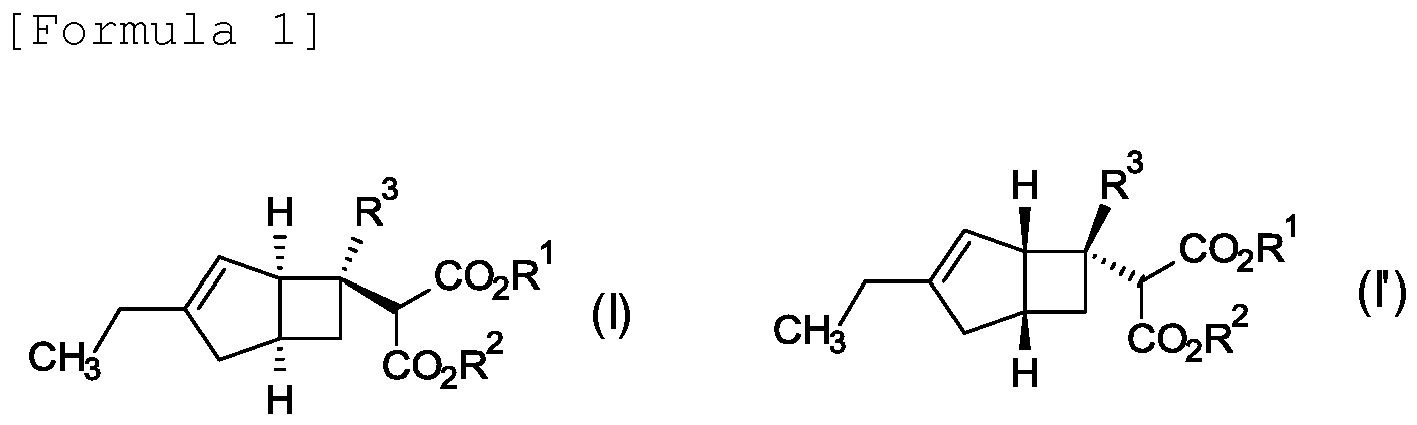
- [1] A mixture of compounds represented by the general formulas (I) and (I'):

- [2] A compound having the configuration of only one of the compounds represented by the general formulas (I) and (I'):

- [3] A method for producing a compound represented by the general formula (Ia) (and/or an enantiomer thereof), comprising mixing a compound represented by the general formula (II) (and/or an enantiomer thereof) with an alkali metal salt of hydrogen cyanide in a solvent to produce the compound represented by the general formula (Ia) (and/or an enantiomer thereof):

- [4] A method for producing a compound represented by the general formula (Ib) (and/or an enantiomer thereof), comprising mixing a compound represented by the general formula (II) (and/or an enantiomer thereof) with nitromethane in the presence of a base in a solvent to produce the compound represented by the general formula (Ib) (and/or an enantiomer thereof):


- [5] A method for producing a compound represented by the general formula (Ia) or (Ib) (and/or an enantiomer thereof), comprising producing a compound represented by the general formula (II) (and/or an enantiomer thereof) from a compound represented by the general formula (III) (and/or an enantiomer thereof) and a compound represented by the general formula (IV) using a Lewis acid, and then producing the compound represented by the general formula (Ia) or (Ib) (and/or an enantiomer thereof) by a method according to [3] or [4]:


- [6] A method for producing a compound represented by the general formula (V) (and/or an enantiomer thereof), comprising treating a compound represented by the general formula (I) (and/or an enantiomer thereof) with a base in a solvent:

- [7] A method for separating a compound represented by the general formula (V) and a compound represented by the general formula (V'), comprising allowing a mixture of the compound represented by the general formula (V) and the compound represented by the general formula (V') to form a salt with an optically active organic amine:

- [8] A method for producing a compound represented by the general formula (VI), comprising allowing a compound represented by the general formula (V) to form a salt with an organic amine in the presence of a solvent;

- [9] The method for producing a compound represented by the general formula (VI) according to [8], wherein R3 is a nitromethyl group, the organic amine used is an optically active organic amine, and a racemic mixture of the compound represented by the general formula (V) is optically resolved.
- [10] A method for producing a compound represented by the formula (VII) from a compound represented by the general formula (V) or (VI), comprising
- (1) reducing the compound represented by the general formula (V) in the presence of a metal catalyst in a solvent under a hydrogen atmosphere, or
- (2) subjecting a solution of the compound represented by the general formula (V) obtained through the salt dissociation of the compound represented by the general formula (VI) to reduction reaction in the presence of a metal catalyst under a hydrogen atmosphere to produce the compound represented by the formula (VII):


- [11] The method for producing a compound represented by the formula (VII) according to [10], wherein the metal catalyst is a sponge nickel catalyst or a sponge cobalt catalyst.
- [12] The method for producing a compound represented by the formula (VII) according to [11], wherein R3 is a cyano group.
- [13] The method for producing a compound represented by the formula (VII) according to [11] or [12], wherein the solvent is water, and the reduction reaction is performed under basic conditions by the addition of a hydroxide of an alkali metal.
- [14] A method for producing a compound represented by the general formula (VIII), comprising allowing a compound represented by the formula (VII) produced by a method according to any one of [10] to [13] to form a salt with an organic acid in the presence of a solvent:

- [15] The method for producing a compound represented by the general formula (VIII) according to [14], wherein the organic acid is benzenesulfonic acid.
- [16] A compound represented by the formula (IX), wherein the amounts of contaminating impurities are as follows:
- content of a diastereomer represented by the formula (X): less than 0.1%,
- content of an enantiomer represented by the formula (XI): less than 1.0%, and
- total content of positional isomers of the double bond represented by the formulas (XII) and (XIII): less than 0.5%, wherein
- each content is calculated from area normalization with respect to the free form (VII) in the formula (IX) in a test by high-performance liquid chromatography:


- The present invention is useful because the present invention provides a method for producing an optically active bicyclic compound, particularly, a bicyclic γ-amino acid derivative, or a pharmacologically acceptable salt thereof, or an intermediate for the synthesis of the compound or the salt in a high purity in a stereospecific manner.
- The C1-C6 alkyl group refers to a linear or branched alkyl group having 1 to 6 carbon atoms. Examples thereof include a methyl group, an ethyl group, a propyl group, an isopropyl group, a butyl group, an isobutyl group, a sec-butyl group, a t-butyl group, a pentyl group, and a hexyl group. The C1-C6 alkyl group is preferably a methyl group, an ethyl group, a propyl group, or a t-butyl group.
- Hereinafter, each production step according to the present invention will be described.
- Main abbreviations used in the description of the present specification are as listed below.
- CPME: cyclopentyl methyl ether
- THF: tetrahydrofuran
- Me-THF: 2-methyltetrahydrofuran
- DME: 1,2-dimethoxyethane
- DCM: methylene chloride
- AlCl3: aluminum chloride
- TiCl4: titanium tetrachloride
- Ti(Oi-Pr)4: titanium tetraisopropoxide
- DMAc: N,N-dimethylacetamide
- DMF: N,N-dimethylformamide
- CH3CN: acetonitrile
- MeOH: methanol
- EtOH: ethanol
- DBU: 1,8-diazabicyclo[5.4.0]undec-7-ene
- DBN: 1,5-diazabicyclo[4.3.0]non-5-ene
- DMSO: dimethyl sulfoxide
- MTBE: tert-butyl methyl ether
- BsOH: benzenesulfonic acid
- EPE: ethyl (diethoxyphosphoryl)acetate
- CyNH2: cyclohexylamine
- BnNH2: benzylamine
- t-BuNH2: t-butylamine
- PTLC: preparative thin-layer chromatography
- This step involves producing a compound represented by the general formula (II) (and/or an enantiomer thereof) from a compound represented by the general formula (III) (and/or an enantiomer thereof) and a compound represented by the general formula (IV) using a Lewis acid.

- The solvent used in this step includes: ethers such as CPME, THF, Me-THF, and DME; halogenated hydrocarbons such as DCM; and aromatic hydrocarbons such as toluene. Ether solvents such as CPME, THF, Me-THF, and DME are preferred. CPME or Me-THF is more preferred.
- The Lewis acid used in this step is preferably a Lewis acid containing titanium or aluminum as a central metal, more preferably TiCl4, isopropoxytitanium trichloride, diisopropoxytitanium dichloride, a TiCl4-2THF complex, a mixture of TiCl4 and Ti(Oi-Pr)4 (approximately 3:1), or AlCl3, or the like, particularly preferably isopropoxytitanium trichloride or a mixture of TiCl4 and Ti(Oi-Pr)4 (approximately 3:1).
- Although this step does not necessarily require additives other than those described above, an amine compound may be added to the reaction system. The amine compound is preferably pyridine or the like.
- This step is carried out at a reaction temperature of usually 50°C or lower, preferably in the range of 0 to 40°C.
- The reaction time of this step is not particularly limited as long as the starting materials are almost completely consumed within the reaction time. The reaction time is usually of the order of 2 hours to 6 hours.
- This step provides a method for producing a compound represented by the general formula (Ia) (and/or an enantiomer thereof), comprising mixing a compound represented by the general formula (II) (and/or an enantiomer thereof) with an alkali metal salt of hydrogen cyanide in a solvent to produce the compound represented by the general formula (Ia) (and/or an enantiomer thereof).
- A feature of this step is that a substantially single diastereomer can be produced by virtue of the addition of a cyano group with very high stereoselectivity.

- The alkali metal salt of hydrogen cyanide used in this step is sodium cyanide or potassium cyanide.
- The solvent in this step is preferably a C1-C4 alcohol solvent or a nitrogen-containing solvent (e.g., DMAc and CH3CN), more preferably MeOH or EtOH. Alternatively, such a solvent may be mixed with an ether solvent such as Me-THF or CPME.
- The reaction temperature of this step is preferably on the order of 0 to 50°C, more preferably of the order of 20 to 40°C.
- The reaction time of this step is not particularly limited as long as the starting materials are almost completely consumed within the reaction time. The reaction time is usually of the order of 2 to 8 hours.
- This step provides a method for producing a compound represented by the general formula (Ib) (and/or an enantiomer thereof), comprising mixing a compound represented by the general formula (II) (and/or an enantiomer thereof) with nitromethane in the presence of a base in a solvent to produce the compound represented by the general formula (Ib) (and/or an enantiomer thereof).
- A feature of this step is that a substantially single diastereomer can be produced by virtue of the addition of a nitromethyl group with very high stereoselectivity.

- The base used in this step can be any of organic and inorganic bases and is preferably DBU, DBN, tetra-n-butylammonium fluoride, or the like, particularly preferably DBU.
- The solvent used in this step is preferably an aromatic hydrocarbon solvent (e.g., toluene), a halogenated hydrocarbon solvent (e.g., DCM), a nitrogen-containing solvent (e.g., DMAc and CH3CN), an ester solvent (e.g., ethyl acetate), an ether solvent (e.g., THF), DMSO, or the like, particularly preferably toluene or THF.
- The reaction temperature of this step is of the order of 0 to 60°C, more preferably of the order of 20 to 40°C.
- The reaction time of this step is not particularly limited as long as the starting materials are almost completely consumed within the reaction time. The reaction time is usually of the order of 2 to 16 hours.
- This step provides a method for producing a compound represented by the general formula (V) (and/or an enantiomer thereof), comprising (1) heating a compound represented by the general formula (I) (and/or an enantiomer thereof) in the presence of a base in a solvent to produce a compound represented by the general formula (IV) (and/or an enantiomer thereof) (decarboxylation step), and subsequently (2) hydrolyzing the compound represented by the general formula (IV) (and/or an enantiomer thereof) to produce the compound represented by the general formula (V) (hydrolysis step).
- The compound represented by the general formula (IV) (and/or an enantiomer thereof) may be isolated. Typically, the decarboxylation step and the hydrolysis step can be continuously carried out without isolation of the compound represented by the general formula (IV) (and/or an enantiomer thereof) to produce the compound represented by the general formula (V) (and/or an enantiomer thereof).

- The reaction in this step is preferably carried out by dissolution of a compound represented by the general formula (I) (and/or an enantiomer thereof) in a solvent and gradual addition of a solution containing a base under heating. The base used in this step is preferably lithium hydroxide, sodium hydroxide, potassium hydroxide, sodium methoxide, sodium ethoxide, sodium tert-butoxide, potassium methoxide, potassium ethoxide, potassium tert-butoxide, or the like, more preferably sodium hydroxide or potassium hydroxide, particularly preferably potassium hydroxide.
- The solvent in this step is preferably a C1-C4 alcohol solvent, more preferably MeOH, EtOH, or n-propanol, particularly preferably EtOH. Alternatively, such an alcohol solvent may be supplemented with a small amount of water for the reaction.
- The reaction temperature of this step is of the order of 60 to 100°C, preferably of the order of 70 to 80°C.
- The reaction time of this step is not particularly limited as long as the starting materials are almost completely consumed within the reaction time. The reaction time is usually of the order of 2 to 20 hours, preferably of the order of 4 to 10 hours.
- This step is carried out by dissolution of the compound represented by the general formula (IV) (and/or an enantiomer thereof) in a solvent and hydrolysis of the ester site in the presence of a base and water. Typically, this step is carried out sequentially from the decarboxylation step using a solution containing the compound represented by the general formula (IV) (and/or an enantiomer thereof) obtained by the decarboxylation step.
- The base used in this step is preferably a hydroxide of an alkali metal such as lithium hydroxide, sodium hydroxide, or potassium hydroxide.
- Preferred examples of the solvent in this step include: C1-C4 alcohols; ethers such as THF, DME, and 1,4-dioxane; nitrogen-containing solvents such as CH3CN, DMF, and DMAc; and DMSO. The solvent is more preferably MeOH, EtOH, or n-propanol, particularly preferably EtOH.
- The reaction temperature of this step is of the order of 0 to 60°C, preferably of the order of 20 to 40°C.
- The reaction time of this step is not particularly limited as long as the starting materials are almost completely consumed within the reaction time. The reaction time is usually of the order of 1 to 10 hours, preferably of the order of 1 to 5 hours.
- This step provides a method for producing a compound represented by the general formula (VI) (and/or an enantiomer thereof), comprising allowing a compound represented by the general formula (V) (and/or an enantiomer thereof) to form a salt with an organic amine in the presence of a solvent. The compound represented by the general formula (VI) (and/or an enantiomer thereof) can be obtained as crystals to thereby efficiently remove by-products into a filtrate and obtain a highly pure product.

- Examples of the solvent used in this step include: ethers such as MTBE, CPME, and THF; aromatic hydrocarbons such as toluene; esters such as ethyl acetate; alcohols such as EtOH and diisopropyl alcohol; nitriles such as CH3CN; ketones such as acetone; and mixed solvents of these solvents with water. The solvent is preferably toluene, ethyl acetate, CH3CN, or MTBE, more preferably toluene or MTBE.
- When the substituent represented by R3 is a cyano group, the organic amine used in this step is preferably benzylamine, cyclohexylamine, dicyclohexylamine, (R)-1-phenylethylamine, tert-butylamine, or the like, more preferably cyclohexylamine, benzylamine, or tert-butylamine. When the substituent represented by R3 is a nitromethyl group, the organic amine is benzylamine or (R)-1-phenylethylamine.
- The organic amine is used at approximately 0.9 to 1.5 equivalents with respect to the compound represented by the general formula (V) (and/or an enantiomer thereof). The reaction temperature of this step is of the order of, for example, 0 to 50°C, preferably of the order of 0 to 30°C (more preferably 0 to 5°C) for aging of the crystals. Then, the compound represented by the general formula (VI) is obtained by filtration.
- The time required for the salt formation in this step is not particularly limited and is usually of the order of 2 to 24 hours.
- This step provides a method for producing a compound represented by the general formula (VIa), comprising allowing a compound represented by the formula (Va) (and/or an enantiomer thereof) to form a salt with an optically active organic amine to thereby carry out optical resolution.

- Examples of the solvent used in this step include: ethers such as MTBE, CPME, and THF; aromatic hydrocarbons such as toluene; esters such as ethyl acetate; alcohols such as EtOH and diisopropyl alcohol; nitriles such as CH3CN; ketones such as acetone; and mixed solvents of these solvents with water. The solvent is preferably toluene, ethyl acetate, CH3CN, or MTBE, more preferably toluene or MTBE.
- The optically active organic amine used in this step is preferably (1R,2R)-trans-1-amino-2-indanol, (S)-2-phenylglycinol, (R)-1-(p-toluyl)ethylamine, (1R,2S)-2-amino-1,2-diphenylethanol, (S)-1-(2-naphthyl)ethylamine, (R)-1-(4-bromophenyl)ethylamine, (1S,2R)-(+)-1-amino-2-indanol, L-phenylalaninol, or the like, more preferably (1R,2R)-trans-1-amino-2-indanol or (S)-2-phenylglycinol.
- The optically active organic amine is used at 0.5 to 1.1 equivalents with respect to the compound represented by the general formula (Va) (and/or an enantiomer thereof).
- The reaction temperature of this step is of the order of, for example, 0 to 50°C, preferably of the order of 10 to 30°C for aging of the crystals. Then, the compound represented by the formula (VIa) is obtained by filtration.
- The time required for the salt formation in this step is not particularly limited and is usually of the order of 4 to 48 hours.
- This step employs any of the following methods:
- (1) a method of allowing the optically active amine mentioned above to act on the compound represented by the formula (Va) (and/or an enantiomer thereof) to directly obtain a compound represented by the formula (VIa) having the desired configuration; and
- (2) a method of first allowing an optically active amine such as kinin, (1S,2S)-trans-1-amino-2-indanol, or (R)-2-phenylglycinol to act on the compound represented by the formula (Va) (and/or an enantiomer thereof) to temporarily deposit enantiomers having an unnecessary configuration, filtering off the deposits, subsequently allowing an optically active amine such as (1R,2R)-trans-1-amino-2-indanol or (S)-2-phenylglycinol to act on a compound obtained from the filtrate to deposit and obtain a salt of a compound represented by the formula (VIa) having the desired configuration.
- The compound represented by the general formula (Va) used in step D-1 or step D-2 can be produced according to step A-C or may be produced by other methods known in the art as shown in Patent Literature 5 (scheme given below).

- A specific production method based on this method will be described later in the Reference Examples.
- This step provides a method for producing a compound represented by the formula (VII) (and/or an enantiomer thereof) from a compound represented by the general formula (V) or (VI) (and/or an enantiomer thereof), comprising reducing the compound represented by the general formula (V) (and/or an enantiomer thereof) in the presence of a metal catalyst in a solvent under a hydrogen atmosphere, or subjecting a solution of the compound represented by the general formula (V) (and/or an enantiomer thereof) obtained through the salt dissociation of the compound represented by the general formula (VI) (and/or an enantiomer thereof) to reduction reaction in the presence of a metal catalyst under a hydrogen atmosphere to produce the compound represented by the formula (VII).

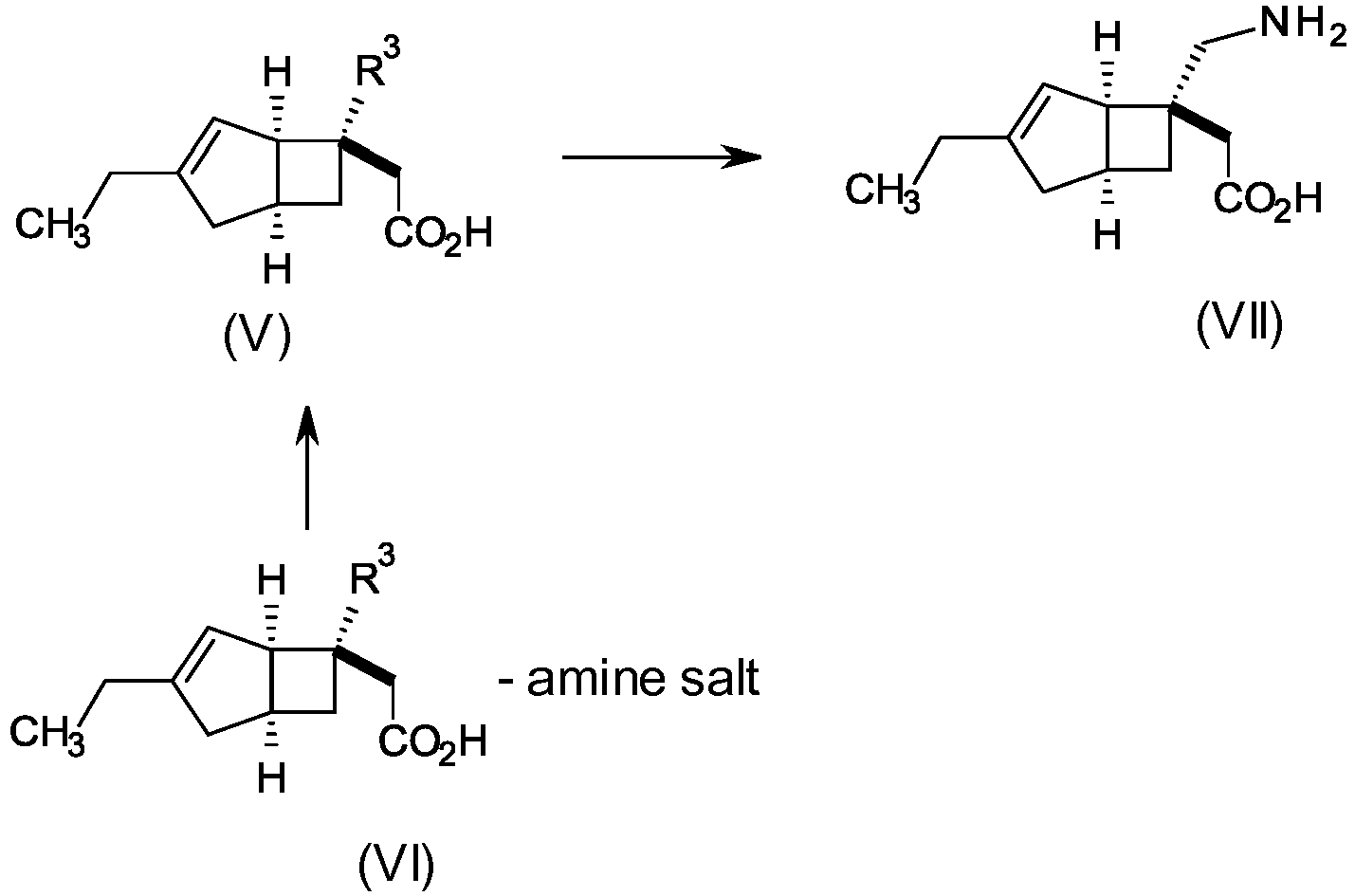
- The compound represented by the general formula (VI) (and/or an enantiomer thereof) is suspended in an organic solvent. The suspension is washed with an aqueous solution supplemented with an acid. An organic layer can be separated to obtain a solution containing a compound represented by the general formula (V) (and/or an enantiomer thereof).
- Examples of the solvent used in this step include: aromatic hydrocarbons such as toluene; ethers such as MTBE; and esters such as ethyl acetate. The solvent is preferably toluene or MTBE.
- The acid used in this step is not particularly limited, and hydrochloric acid, sulfuric acid, phosphoric acid, citric acid, malonic acid, or the like can be used.
- This step involves reducing the compound represented by the general formula (V) (and/or an enantiomer thereof) in the presence of a metal catalyst in a solvent under a hydrogen atmosphere to convert the cyano group (or the nitro group) to an amino group, thereby producing a compound represented by the formula (VII). This reaction is usually carried out under neutral or basic conditions.
- The solvent used in this step includes: aromatic hydrocarbons such as toluene; ethers such as MTBE and THF; C1-C4 alcohols; and water. The solvent is preferably toluene, MTBE, or water, particularly preferably water.
- The metal catalyst used in this step is sponge nickel, sponge cobalt, or palladium-carbon, preferably sponge nickel (e.g., PL-9T, NDT-65, NDT-90, NDHT-90M, NDHT-M3, etc. manufactured by Kawaken Fine Chemicals Co., Ltd., or R-100, R-200, R-205, R-211, R-2311, etc. manufactured by Nikko Rica Corp.) or sponge cobalt (e.g., ODHT-60, OFT-55, etc. manufactured by Kawaken Fine Chemicals Co., Ltd., R-400, R-400K, R-401, R-455, etc. manufactured by Nikko Rica Corp., or A-8B46, etc. manufactured by Johnson Matthey).
- When this step is carried out with water as a solvent, a base is usually added to the reaction system. The base used is preferably an inorganic base, particularly preferably a hydroxide of an alkali metal such as lithium hydroxide, sodium hydroxide, or potassium hydroxide.
- The yield of this step can be improved by the addition of ammonia water, although addition of ammonia water is not necessarily required.
- In this step, the addition of dimethylpolysiloxane can prevent the reaction solution from foaming, although addition of dimethylpolysiloxane is not necessarily required.
- The reaction temperature of this step is of the order of 20 to 60°C, preferably of the order of 30 to 50°C.
- The reaction time of this step is not particularly limited as long as the starting materials are almost completely consumed within the reaction time. The reaction time is usually of the order of 2 to 12 hours.
- In this step, the catalyst is filtered off after the completion of the reaction. The compound represented by the formula (VII) is crystallized by the addition of an acid to the filtrate. The deposits can be filtered and washed to obtain a highly pure product.
- This step provides a method for producing a compound represented by the formula (VIII) (and/or an enantiomer thereof), comprising allowing a compound represented by the formula (VII) (and/or an enantiomer thereof) to form a salt with an organic acid in the presence of a solvent.

- The solvent used in this step is a single or mixed solvent such as water, anisole, aqueous acetone, aqueous CH3CN, MTBE-water-acetone, anisole-acetic acid, anisole-acetone, anisole-acetic acid-acetone, or acetone-water-CH3CN, preferably water or anisole.
- The organic acid used in this step is a pharmacologically acceptable organic acid, preferably benzenesulfonic acid.
- The organic acid is preferably used in this step at approximately 1.00 to 1.10 equivalents with respect to the compound represented by the formula (VII) (and/or an enantiomer thereof).
- Typically, this step is carried out in a temperature range of approximately -15 to 50°C. Preferably, the crystals are aged at a temperature of the order of -10 to 30°C, then filtered, and washed to obtain a compound represented by the general formula (VIII) (and/or an enantiomer thereof).
- The time required for the salt formation in this step is not particularly limited and is usually of the order of 1 to 24 hours.
- In the present invention, the compound represented by the formula (IX) (and/or an enantiomer thereof) produced through steps A to F can be produced as a very highly pure compound. The compound represented by the formula (IX), which can be obtained according to the present invention, usually has the following quality:
- content of a diastereomer represented by the formula (X): less than 0.1%,
- content of an enantiomer represented by the formula (XI): less than 1.0%, and
- total content of positional isomers of the double bond represented by the formulas (XII) and (XIII): less than 0.5%, wherein
- each content is calculated from area normalization with respect to the free form (VII) in the formula (IX) in a test by high-performance liquid chromatography.



- Next, the present invention will be described in detail with reference to the Examples. However, the present invention is not intended to be limited in any way by these Examples.
- Tetramethylsilane was used as an internal standard for nuclear magnetic resonance (NMR) spectra. Abbreviations indicating multiplicity are as follows: s = singlet, d = doublet, t = triplet, q = quartet, m = multiplet, and brs = broad singlet.
- "R" and "S" in the name of each compound represent the absolute configuration at an asymmetric carbon. Also, "RS" and "SR" represent racemates based on an asymmetric carbon. For example, "(1RS,5SR)-" represents relative configuration at the 1-position and the 5-position indicating only one of the diastereomers and shows that the diastereomer is a racemate.
- "E" and "Z" in the name of each compound represent the configurations of positional isomers in the structures of compounds having positional isomerization. Also, "EZ" and "ZE" represent mixtures of positional isomers. The nomenclature follows typical indications in this field.
- Abbreviations such as Me, Et, and t-Bu are usually used in this field and represent a methyl group, an ethyl group, and a t-butyl group, respectively.
-

- To a solution of malonic acid monoethyl ester (2.9 g, 22.0 mmol) in THF (20 mL), AlCl3 (3.9 g, 29.4 mmol) was added at -10°C, then (1R,5S)-3-ethylbicyclo[3.2.0]hept-3-en-6-one (2.0 g, 14.7 mmol) was added, and the mixture was stirred at -10°C for 25 hours. Under ice cooling, water (10 mL) and CPME (10 mL) were added thereto, and the mixture was stirred. Then, an organic layer 1 and an aqueous layer 1 were separated therefrom at 25°C.
- Aqueous layer 1 was subjected to extraction with CPME (20 mL) to separate an organic layer 2, which was then combined with organic layer 1 to prepare an organic layer. The combined organic layer was washed with 1 N hydrochloric acid (6 mL) and then concentrated under reduced pressure at an external temperature of 40°C to obtain the title compound (4.8 g) as a crude product. 1H NMR (CDCl3) (400 MHz): δ = 1.07 (3H, t, J = 7.6 Hz), 1.35 (1.5H, t, 7.2 Hz), 1.41 (1.5H, t, 7.2 Hz), 2.08-2.16 (2H, m), 2.23-2.31 (1H, m), 2.67-2.75 (1H, m), 2.83-3.05 (2H, m), 3.40-3.48 (0.5H, m), 3.57-3.64 (0.5H, m), 4.27-4.41 (3H, m), 5.29 (0.5H, s), 5.50 (0.5H, s)
-

- To THF (3.2 mL), TiCl4 (0.175 mL, 1.60 mmol) was added at 0°C, and the mixture was stirred for 20 minutes. Subsequently, (1RS,5SR)-3-ethylbicyclo[3.2.0]hept-3-en-6-one (112 mg, 0.819 mmol) and dimethyl malonate (113 µL, 0.989 mmol) were added thereto, and the mixture was stirred for 50 minutes, followed by the addition of pyridine (265 µL, 3.28 mmol). The mixture was stirred at 0°C for 1 hour, then heated to room temperature, and stirred overnight. The reaction was terminated by the addition of water (6 mL), followed by extraction with toluene (6 mL) three times.
- The toluene layer was washed with a saturated aqueous solution of sodium bicarbonate (6 mL) and saturated saline (6 mL). The solvent was distilled off, and the residue was then purified by PTLC (hexane:ethyl acetate = 5:1) to obtain the title compound as a colorless oil (135 mg, 65%).
1H NMR (CDCl3) (400 MHz): δ = 1.05 (3H, d, J = 7.6 Hz), 2.09 (2H, q, J = 7.6 Hz), 2.21 (1H, dd, J = 16.8, 3.2 Hz), 2.60-2.76 (2H, m), 2.91 (1H, quint, J = 7.2 Hz), 3.30 (1H, ddd, J = 19.1, 8.4, 3.6 Hz), 3.73 (3H, s), 3.78 (3H, s), 4.29 (1H, m), 5.34 (1H, s).
13C NMR (CDCl3) (100 MHz) : δ = 12.2, 24.2, 32.6, 39.8, 42.7, 51.6, 51.7, 117.5, 120.9, 148.9, 164.6, 164.9, 177.6. -

- To THF (300 mL), TiCl4 (16.0 mL, 146 mmol) was added at 0°C, and the mixture was stirred for 20 minutes. Subsequently, (1R,5S)-3-ethylbicyclo[3.2.0]hept-3-en-6-one (10.04 g, 73.7 mmol) and dimethyl malonate (11.64 g, 88.1 mmol) were added thereto, and the mixture was stirred for 2 hours, followed by the addition of pyridine (23.4 g, 296 mmol). The mixture was stirred at 0°C for 1.5 hours, then heated to room temperature, and stirred overnight. The reaction was terminated by the addition of water (100 mL), followed by extraction with toluene (100 mL) twice. The toluene layer was washed with saturated saline (100 mL) and concentrated under reduced pressure to obtain a crude product of the title compound as a red-brown oil (22.89 g).
-

- To THF (450 mL), TiCl4 (24 mL, 221 mmol) was added at 0°C, and the mixture was stirred for 20 minutes. Subsequently, (1R,5S)-3-ethylbicyclo[3.2.0]hept-3-en-6-one (15.02 g, 110 mmol) and diethyl malonate (19.43 g, 121 mmol) were added thereto, and the mixture was stirred for 2 hours, followed by the addition of pyridine (35.0 g, 442 mmol). The mixture was stirred at 0°C for 2 hours, then heated to room temperature, and stirred overnight. The reaction was terminated by the addition of water (150 mL), followed by extraction with toluene (150 mL) twice. The toluene layer was washed with saturated saline (90 mL) and concentrated under reduced pressure to obtain a crude product of the title compound as a red-brown oil (43.87 g).
1H NMR (CDCl3) (400 MHz): δ = 1.06 (3H, t, J = 7.6 Hz), 1.24-1.35 (6H, m), 2.10 (2H, q, J = 7.6 Hz), 2.16-2.26 (1H, m), 2.60-2.76 (2H, m), 2.91 (1H, quint, J = 7.2 Hz), 3.31 (1H, ddd, J = 18.8, 8.4, 3.6 Hz), 4.16-4.30 (1H, m), 5.35 (1H, s).
13C NMR (CDCl3) (100 MHz): δ = 12.1, 14.18, 14.20, 24.2, 32.7, 39.7, 42.7, 58.3, 60.5, 60.6, 118.2, 121.1, 148.8, 164.2, 164.5, 176.0. -
- Column: Cadenza CW-C18 (Imtakt, 3 µm, 4.6 mm x 150 mm)
- Column temperature: 40°C
- Detection wavelength: UV 205 nm
- Mobile phase: MeCN:0.1% aqueous AcOH solution = 10:90 - 80:20 (gradient)
- (0-2 min: MeCN 10%, 2-17 min: MeCN 10 → 80%, 17-25 min: MeCN 80%, 25-30 min: MeCN 80 → 10%, 40 min: STOP)
- Measurement time: 40 min
- Flow rate: 1.0 mL/min
- Retention time:
- (1R,5S)-3-Ethylbicyclo[3.2.0]hept-3-en-6-one: 15.0 min
- Diethyl [(1R,5S)-3-ethylbicyclo[3.2.0]hept-3-en-6-ylidene]propanedioate: 19.7 min
-

- To Me-THF (8.1 mL), Ti(Oi-Pr)4 (0.87 mL, 2.97 mmol) was added at 0°C, then TiCl4 (0.98 mL, 8.94 mmol) was added dropwise over 10 minutes, and the mixture was stirred at 0°C for 1 hour. Subsequently, diethyl malonate (1.00 mL, 6.59 mmol) and (1RS,5SR)-3-ethylbicyclo[3.2.0]hept-3-en-6-one (813 mg, 5.97 mmol) were added thereto, and the mixture was stirred at 20 to 30°C for 45 hours. The reaction was terminated by the addition of water (10 mL), followed by extraction with toluene (10 mL) twice. After dilution of the organic layer with CH3CN, the title compound was quantified by HPLC (85%).
-

- To THF (3.1 mL), TiCl4·2THF (509 mg, 1.52 mmol), (1RS,5SR)-3-ethylbicyclo[3.2.0]hept-3-en-6-one (104.2 mg, 0.765 mmol), and diethyl malonate (128 µL, 0.843 mmol) were added at 0°C, and the mixture was stirred for 1.5 hours, followed by the addition of pyridine (248 mL, 3.07 mmol). The mixture was stirred at 0°C for 1.5 hours, then heated to room temperature, and stirred overnight. The reaction was terminated by the addition of water (6 mL), followed by extraction with toluene (6 mL) three times. The toluene layer was washed with saturated saline (6 mL), and the solvent was distilled off. The title compound in the obtained crude product was quantified by HPLC (230 mg, 86%).
-


- To CPME (159 mL), Ti(Oi-Pr)4 (16.0 mL, 54.6 mmol) was added at 0°C, then TiCl4 (18.0 mL, 164 mmol) was added dropwise over 8 minutes, and the mixture was stirred at 0°C for 1 hour. Subsequently, diethyl malonate (25.72 g, 161 mmol) and (1R,5S)-3-ethylbicyclo[3.2.0]hept-3-en-6-one (19.87 g, 146 mmol) were added thereto, and the mixture was stirred at 30 to 40°C for 4 hours. The reaction was terminated by the addition of water (100 mL), followed by extraction with toluene (40 mL). The organic layer was concentrated under reduced pressure to obtain a crude product of the title compound as a yellow oil (43.61 g).
-

- To THF (30 mL), TiCl4 (1.6 mL, 14.7 mmol) was added at 0°C, and the mixture was stirred for 30 minutes. Subsequently, (1RS,5SR)-3-ethylbicyclo[3.2.0]hept-3-en-6-one (1.00 g, 7.34 mmol) and di-tert-butyl malonate (1.91 g, 8.81 mmol) were added thereto, and the mixture was stirred for 1.5 hours, followed by the addition of pyridine (2.2 mL, 29.4 mmol). The mixture was stirred at 0°C for 3.5 hours, then heated to room temperature, and stirred overnight. The reaction was terminated by the addition of water (10 mL), followed by extraction with toluene (10 mL) twice. The organic layer was washed with saturated saline (10 mL), and the solvent was then distilled off under reduced pressure. The residue was purified by silica gel column chromatography (hexane:ethyl acetate = 20:1) to obtain the title compound (2.26 g, 92%).
1H NMR (CDCl3) (500 MHz): δ = 1.07 (3H, t, J = 7.5 Hz), 1.47 (9H, s), 1.52 (9H, s), 2.06-2.14 (2H, m), 2.16-2.24 (1H, m), 2.60-2.69 (2H, m), 2.90 (1H, quint, J = 7.0 Hz), 3.25 (1H, ddd, J = 18.6, 8.5, 3.5 Hz), 4.12-4.23 (1H, m), 5.36 (1H, s). -
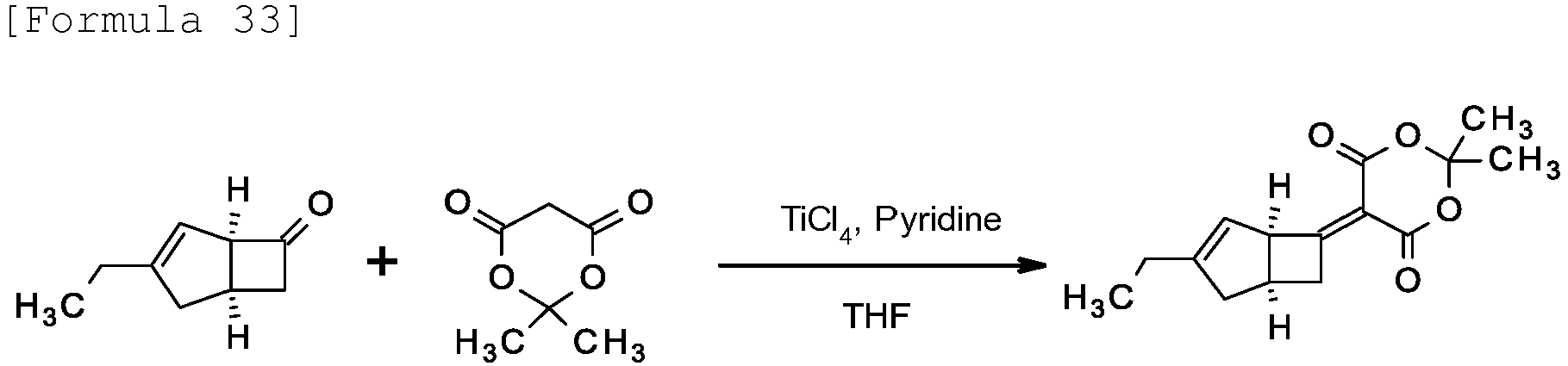
- To THF (80 mL), TiCl4 (4.5 mL, 41 mmol) was added at 0°C, and the mixture was stirred for 10 minutes. Subsequently, (1RS,5SR)-3-ethylbicyclo[3.2.0]hept-3-en-6-one (2.81 g, 20.6 mmol) and Meldrum's acid (3.57 g, 24.8 mmol) were added thereto, and the mixture was stirred for 50 minutes, followed by the addition of pyridine (6.53 g, 82.6 mmol). The mixture was stirred at 0°C for 1.5 hours, then heated to room temperature, and stirred overnight. The reaction was terminated by the addition of water (80 mL), followed by extraction with toluene (50 mL) three times. The organic layer was washed with saturated saline (50 mL) and 1 M hydrochloric acid (10 mL), and the solvent was distilled off. Then, the residue was purified by silica gel column chromatography (hexane:ethyl acetate = 9:1 - 6:1) to obtain the title compound as a white solid (4.51 g, 83.2%).
1H NMR (CDCl3) (400 MHz): δ = 1.05 (3H, t, J = 7.6 Hz), 1.69 (3H, s), 1.71 (3H, s), 2.11 (2H, q, J = 7.6 Hz), 2.20-2.35 (1H, m), 2.65-2.85 (1H, m), 2.92-3.13 (2H, m), 3.47-3.63 (1H, m), 4.45-4.59 (1H, m), 5.43 (1H, s).
13C NMR (CDCl3) (100 MHz): δ = 12.1, 24.3, 27.59, 27.64, 34.1, 42.3, 42.8, 60.7, 104.4, 108.5, 119.4, 150.3, 160.1, 160.7. -

- Dimethyl [(1R,5S)-3-ethylbicyclo[3.2.0]hept-3-en-6-ylidene]propanedioate (517 mg, 1.66 mmol) was dissolved in MeOH (5.2 mL). To the solution, sodium cyanide (90 mg, 1.84 mmol) was added at room temperature, and the mixture was stirred at room temperature for 2 hours. The reaction was terminated by the addition of a 10% aqueous acetic acid solution (5 mL), followed by extraction with ethyl acetate (5 mL) three times. The solvent was distilled off under reduced pressure to obtain the title compound as an oil (667 mg).
1H NMR (CDCl3) (400 MHz): δ = 1.08 (3H, t, J = 7.6 Hz), 1.80 (1H, dd, J = 12.4, 8.0 Hz), 2.01-2.22 (3H, m), 2.54 (1H, dd, J = 16.8, 7.6 Hz), 2.73 (1H, ddd, J = 12.8, 8.8, 2.8 Hz), 3.18 (1H, quint, J = 7.6 Hz), 3.67 (1H, s), 3.78 (3H, s), 3.82 (3H, s), 5.16-5.28 (1H, m).
13C NMR (CDCl3) (100 MHz): δ = 12.2, 24.4, 32.1, 37.5, 39.2, 42.5, 52.9, 53.0, 54.6, 55.0, 118.8, 123.2, 153.9, 166.62, 166.63. -


- The crude product of diethyl [(1R,5S)-3-ethylbicyclo[3.2.0]hept-3-en-6-ylidene]propanedioate (43.61 g, 146 mmol) obtained by the method shown in Example 7 was dissolved in EtOH (262 mL). To the solution, sodium cyanide (7.15 g, 146 mmol) was added at room temperature, and the mixture was stirred at room temperature for 4 hours. The reaction was terminated by the addition of acetic acid (8.76 g) and water (180 mL). Then, approximately 340 mL of the solvent was concentrated under reduced pressure. To the residue, water (80 mL) was added, followed by extraction with ethyl acetate (150 mL) three times. Then, the solvent was distilled off under reduced pressure to obtain the title compound as an oil (HPLC quantification value: 44.29 g, 96.3% (yield from (1R,5S)-3-ethylbicyclo[3.2.0]hept-3-en-6-one)).
1H NMR (CDCl3) (400 MHz): δ = 1.07 (3H, t, J = 7.6 Hz), 1.28 (3H, t, J = 7.2 Hz), 1.31 (3H, t, J = 7.2 Hz), 1.80 (1H, dd, J = 12.6, 7.6 Hz), 2.01-2.19 (3H, m), 2.53 (1H, dd, J = 16.8, 7.6 Hz), 2.72 (1H, ddd, J = 12.6, 9.2, 2.8 Hz), 3.16 (1H, quint, J = 7.6 Hz), 3.61 (1H, s), 3.67-3.82 (1H, m), 4.15-4.33 (4H, m), 5.21-5.26 (1H, m).
13C NMR (CDCl3) (100 MHz): δ = 12.2, 14.0, 24.4, 32.2, 37.7, 39.3, 42.5, 55.0, 55.2, 62.00, 62.02, 119.0, 123.3, 153.7, 166.21, 166.23. -
- Column: Cadenza CW-C18 (Imtakt, 3 µm, 4.6 mm x 150 mm), 40°C
- Detection wavelength: UV 205 nm
- Mobile phase: MeCN:0.1% aqueous AcOH solution = 10:90 - 80:20 (gradient)
- (0-2 min: MeCN 10%, 2-17 min: MeCN 10 → 80%, 17-25 min: MeCN 80%, 25-30 min: MeCN 80 → 10%, 40 min: STOP)
- Measurement time: 40 min
- Flow rate: 1.0 mL/min
- Retention time:
- Diethyl [(1R,5S,6R)-6-cyano-3-ethylbicyclo[3.2.0]hept-3-en-6-yl]propanedioate: 18.6 min,
- Diethyl [(1R,5S)-3-ethylbicyclo[3.2.0]hept-3-en-6-ylidene]propanedioate: 19.7 min
-


- Ti(Oi-Pr)4 (25.1 g, 88.11 mmol) was added to CPME (210 mL) under a nitrogen atmosphere, and TiCl4 (29.0 mL, 264 mmol) was added dropwise thereto at 10 to 30°C over 1 hour. After mixing at 25 to 30°C for 30 minutes, diethyl malonate (38.8 g, 242 mmol) was added thereto at 3 to 4°C, and the mixture was stirred at 1 to 4°C for 30 minutes. (1R,5S)-3-Ethylbicyclo-[3.2.0]hept-3-en-6-one (30.0 g, 220 mmol) was added thereto at 1 to 4°C, and the mixture was stirred at 32 to 33°C for 2.5 hours. Then, cold water (150 mL) was added thereto under ice cooling, and the aqueous layer was removed at room temperature. The organic layer was washed with 1 N hydrochloric acid (60 mL) and then concentrated into 120 mL under reduced pressure at an external temperature of 40 to 45°C to obtain a CPME solution of diethyl [(1R,5S)-3-ethylbicyclo[3.2.0]hept-3-en-6-ylidene]propanedioate.
- To the solution, EtOH (150 mL) was added under a nitrogen atmosphere, then sodium cyanide (10.8 g, 220 mmol) was added, and the mixture was stirred at 27 to 29°C for 4.5 hours. After cooling to 14°C, a solution containing concentrated sulfuric acid (10.8 g) diluted with water (60 mL) was added to the mixture, and water (150 mL) was further added thereto. The reaction mixture was concentrated into 240 mL under reduced pressure at an external temperature of 35 to 45°C. CPME (60 mL) was added thereto, and the aqueous layer was removed. Then, the organic layer was washed with 20% saline (60 mL) to obtain a CPME solution of the title compound (91.4%, HPLC quantification value).
-

- Di-tert-butyl [(1RS,5SR)-3-ethylbicyclo[3.2.0]hept-3-en-6-ylidene]propanedioate (5.00 g, 14.9 mmol) was dissolved in DMAc (50 mL). To the solution, sodium cyanide (586 mg, 12.0 mmol) was added at room temperature, and the mixture was stirred at room temperature for 1 hour. The reaction was terminated by the addition of 1 M hydrochloric acid (30 mL), followed by extraction with ethyl acetate (50 mL) three times. The solvent was distilled off under reduced pressure. The residue was purified by silica gel column chromatography (hexane:ethyl acetate = 20:1) to obtain the title compound as an oil (5.10 g, 94%).
1H NMR (CDCl3) (400 MHz): δ = 1.06 (3H, t, J = 7.5 Hz), 1.46 (9H, s), 1.50 (9H, s), 1.78 (1H, dd, J = 12.3, 8.0 Hz), 2.00-2.18 (3H, m), 2.51 (1H, dd, J = 17.0, 7.5 Hz), 2.68 (1H, ddd, J = 12.6, 8.5, 3.0 Hz), 3.13 (1H, quint, J = 7.5 Hz), 3.40 (1H, s), 3.65-3.73 (1H, m), 5.24 (1H, s). -
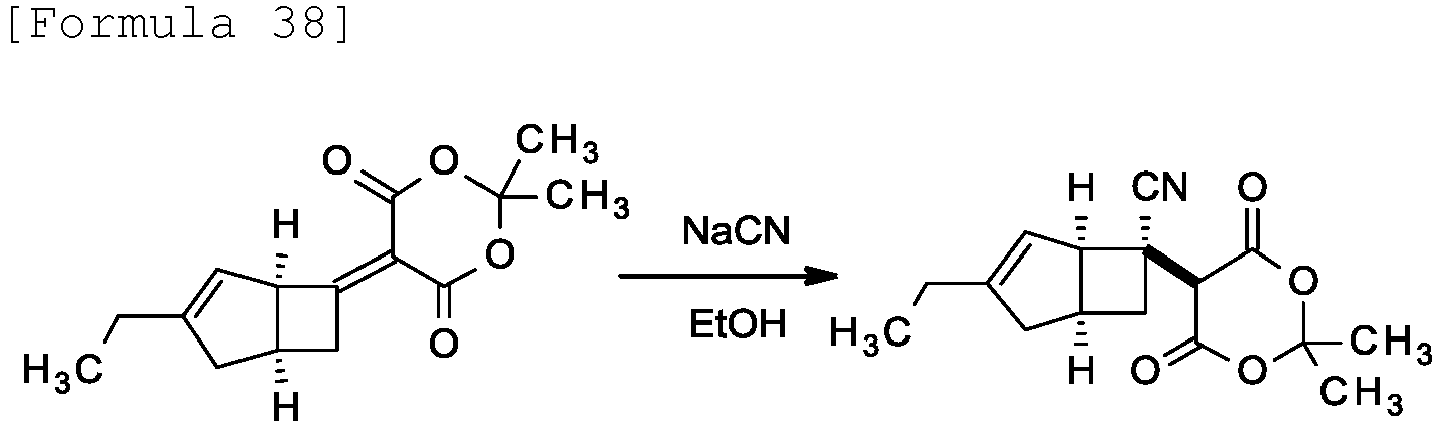
- 5-[(1RS,5SR)-3-Ethylbicyclo[3.2.0]hept-3-en-6-ylidene]-2,2-dimethyl-1,3-dioxane-4,6-dione (100.8 mg, 0.384 mmol) was dissolved in EtOH (1.0 mL). To the solution, sodium cyanide (22.0 mg, 0.449 mmol) was added at room temperature, and the mixture was stirred at room temperature for 3 hours. The reaction was terminated by the addition of a phosphate buffer solution (pH 7) (5 mL), followed by extraction with ethyl acetate (5 mL) three times. The solvent was distilled off under reduced pressure to obtain the title compound as a white solid (23.6 mg, 21.2%).
1H NMR (CD3OD) (400 MHz): δ = 1.03 (3H, t, J = 7.6 Hz), 1.61 (3H, s), 1.92-2.25 (4H, m), 2.45 (1H, dd, J = 16.8, 7.2 Hz), 2.66-2.80 (1H, m), 3.00 (1H, quint, J = 7.6 Hz), 3.72-3.87 (1H, m), 4.85 (1H, s), 5.23-5.33 (1H, m).
13C NMR (CD3OD) (100 MHz) : δ = 12.66, 12.69, 25.3, 34.1, 38.8, 39.4, 43.3, 57.0, 75.8, 102.9, 123.67, 123.70, 127.9, 150.5, 167.9. -

- Diethyl [(1RS,5SR)-3-ethylbicyclo[3.2.0]hept-3-en-6-ylidene]propanedioate (256.0 mg, 0.920 mmol) was dissolved in toluene (2.5 mL). To the solution, DBU (152 mL) and nitromethane (55 mL) were added, and the mixture was stirred at room temperature for 17 hours. The reaction was terminated by the addition of 1 M hydrochloric acid (5 mL), followed by extraction with ethyl acetate (5 mL) three times. The obtained ethyl acetate solution was washed with saturated saline (5 mL). The solvent was distilled off under reduced pressure to obtain diethyl [(1RS,5SR,6SR)-3-ethyl-6-(nitromethyl)bicyclo-[3.2.0]hept-3-en-6-yl]propanedioate as a pale yellow oil (336.9 mg).
- The obtained diethyl [(1RS,5SR,6SR)-3-ethyl-6-(nitromethyl)bicyclo[3.2.0]hept-3-en-6-yl]-propanedioate (336.9 mg) was dissolved in DMSO (3.4 mL). To the solution, water (50 µL, 2.78 mmol) and sodium chloride (64.8 mg, 1.11 mmol) were added, and the mixture was stirred under heating at 140°C for 10 hours. After cooling to room temperature, the reaction was terminated by the addition of 1 M hydrochloric acid (5 mL), followed by extraction with ethyl acetate (5 mL) three times. Then, the obtained ethyl acetate solution was washed with saturated saline (5 mL). The solvent was distilled off under reduced pressure to obtain the title compound as a brown oil (261.6 mg, yield through two steps: 72.4%). Diethyl [(1RS,5SR,6SR)-3-ethyl-6-(nitromethyl)bicyclo[3.2.0]hept-3-en-6-yl]propanedioate 1H NMR (CDCl3) (400 MHz): δ = 1.08 (3H, t, J = 7.6 Hz), 1.17-1.35 (6H, m), 1.73 (1H, dd, J = 13.2, 7.6 Hz), 2.05 (1H, d, J = 16.4 Hz), 2.05-2.22 (2H, m), 2.42-2.58 (2H, m), 2.75 (1H, quint, J = 7.6 Hz), 3.46 (1H, brs), 3.79 (1H, s), 4.09-4.27 (4H, m), 4.96 (2H, s), 5.27 (1H, s). 13C NMR (CDCl3) (100 MHz): δ = 12.3, 13.97, 14.04, 24.4, 31.6, 36.1, 42.5, 45.6, 53.6, 55.5, 61.49, 61.53, 80.1, 120.7, 152.0, 167.7, 167.8.
Ethyl [(1RS,5SR,6SR)-3-ethyl-6-(nitromethyl)bicyclo[3.2.0]hept-3-en-6-yl]acetate 1H NMR (CDCl3) (400 MHz): δ = 1.07 (3H, t, J = 7.6 Hz), 1.25 (3H, t, J = 7.6 Hz), 1.52 (1H, dd, J = 12.6, 7.2 Hz), 2.04 (1H, d, J = 16.4 Hz), 2.05-2.19 (2H, m), 2.23-2.35 (1H, m), 2.50 (1H, dd, J = 15.8, 7.6 Hz), 2.62 (2H, s), 2.86 (1H, quint, J = 7.6 Hz), 3.21 (1H, brs), 4.12 (4H, q, J = 7.6 Hz), 4.76 (2H, d, J = 11.6 Hz), 4.83 (2H, d, J = 11.6 Hz), 5.24 (1H, s). -

- Di-tert-butyl [(1RS,5SR)-3-ethylbicyclo[3.2.0]hept-3-en-6-ylidene]propanedioate (2.55 g) was dissolved in toluene (26 mL). To the solution, DBU (1.45 mL) and nitromethane (1.05 mL) were added, and the mixture was stirred at room temperature for 49 hours. The reaction was terminated by the addition of 1 M hydrochloric acid (50 mL), followed by extraction with ethyl acetate (50 mL) three times. The obtained ethyl acetate solution was washed with saturated saline (50 mL). The solvent was distilled off under reduced pressure to obtain the title compound as a pale yellow oil (2.36 g, yield: 78%).
1H NMR (CDCl3) (500 MHz): δ = 1.09 (t, 3H, J = 7.4 Hz), 1,45 (s, 9H), 1.49 (s, 9H), 1.71 (dd, 1H, J = 12.9, 7.4 Hz), 2.03 (d, 1H, 16.7 Hz), 2.09-2.19 (m, 2H), 2.47 (dd, 2H, J = 16.7, 7.9 Hz), 2.59 (ddd, 1H, J =11.7, 8.9, 2.7 Hz), 2.67 (quint, 1H, J = 7.4 Hz), 3.52 (brs, 1H), 3.64 (s, 1H), 4.88 (d, 1H, J = 10.9 Hz), 4.95 (d, 1H, J = 10.9 Hz), 5.28 (m, 1H). -

- [(1RS,5SR,6SR)-3-Ethyl-6-(nitromethyl)bicyclo[3.2.0]hept-3-en-6-yl]acetic acid (0.2 g, 0.84 mmol) was dissolved in CH3CN (3.0 mL). To the solution, each optically active organic amine (0.42 mmol) shown in the table given below was added, and the mixture was stirred at room temperature. The deposited crystals were filtered and dried. Selectivity and yields were determined. The results are shown in the table given below.
[Table 1] Entry Optically active organic amine Selectivity (%ee) Yield (%) 1 (1S,2S)-(+)-trans-1-Amino-2-indanol -83.1* 14.3 2 (R)-(-)-2-Phenylglycinol -69.2* 30.7 3 Quinine -62.0* 44.2 4 (R)-(+)-1-(p-Tolyl)ethylamine 47.6** 33.1 * (1S, 5R, 6R) -form is main product
** (1R,5S,6S)-form is main product -
- Column: CHIRALPAK AD-RH 4.6 x 250 mm
- Mobile phase: 10 mM phosphate buffer (pH 2.0)/MeCN = 25/75 (isocratic)
- Flow rate: 1.0 mL/min
- Column temperature: 40°C
- Detection wavelength: UV 210 nm
- Analysis time: 80 min
- Retention time: (1S, 5R, 6R) -form: 35.2 min, (1R, 5S, 6S)-form: 42.1 min
-

- Kinin (5.97 g, 18.4 mmol) was dissolved in acetone (300 mL). To the solution, [(1RS,5SR,6SR)-3-ethyl-6-(nitromethyl)-bicyclo[3.2.0]hept-3-en-6-yl]acetic acid (10.0 g, 33.4 mmol) was added. The mixture was stirred at room temperature for 20 hours, then cooled to 0°C, and stirred for 5 hours. The solid was filtered off and then washed with cold acetone. Then, the filtrate and the washes were concentrated under reduced pressure. To the residue, CH3CN was further added, and the mixture was concentrated again to obtain a concentrated residue (6.4 g, 65.2% ee).
- The obtained residue (6.4 g, 65.2% ee) was dissolved in CH3CN (43 mL). To the solution, (S) - (+)-phenylglycinol (1.37 g, 1 equivalent) was added. The mixture was stirred at room temperature for 20 hours, then cooled to 0°C, and stirred for 5 hours. The deposited crystals were collected by filtration and dissolved and separated into aqueous and organic layers by the addition of dilute hydrochloric acid and ethyl acetate. The organic layer was concentrated and then dried under reduced pressure to obtain the title compound (1.39 g, 14%, 92.0% ee).
1H NMR (400 MHz, CDCl3) : δ = 1.09 (t, 3H, J = 7.6 Hz), 1.47-1.57 (m 2H), 2.06-2.17 (m, 3H), 2.27-2.33 (m, 1H), 2.49-2.55 (m, 1H), 2.66 (s, 2H), , 2.88 (quint, 1H, J = 7.6 Hz), 3.17 (bs, 1H), 4.78 (d, 1H, J = 11.5 Hz), 4.86 (d, 1H, J = 11.5Hz), 5.27-5.28 (m, 1H) -

- To ethyl [(1R,5S,6S)-3-ethyl-6-(nitromethyl)bicyclo[3.2.0]hept-3-en-6-yl]acetate (44.5 g (net), 167 mmol, 74% de) obtained by the method shown in Reference Example 1, a 5 mol/L aqueous sodium hydroxide solution (180 mL) was added, and the mixture was stirred at room temperature for 2 hours. To this reaction solution, toluene (300 mL) was added, and the mixture was cooled to 10°C or lower, followed by the addition of a 30% (w/v) aqueous citric acid solution (600 mL). The aqueous layer was removed, and the organic layer was then washed with water (300 mL). Each aqueous layer was subjected to re-extraction with toluene (300 mL). The organic layers were mixed and concentrated, and MTBE (675 mL) and (R)-phenethylamine (17.6 g, 145 mmol) were then added to the residue. The mixture was stirred at room temperature for approximately 1 hour and then further stirred at 60°C for 1.5 hours. Then, the reaction mixture was cooled to 0°C over 1.5 hours and stirred for 1 hour, followed by the filtration of crystals. The crystals were washed with cold MTBE (90 mL) and then dried under reduced pressure at 40°C to obtain the title compound (49.3 g, 82%, 95.7% de).
1H NMR (500 MHz, CD3OD): δ = 1.09 (t, 3H, J = 7.4 Hz), 1.49 (dd, 1H, J =1 2.6, 7.4 Hz), 1.60 (d, 3H, J = 6.9 Hz), 2.04 (d, 1H, 16.6 Hz), 2.14 (dd, 2H, J = 14.9, 7.4 Hz), 2.28 (ddd, 1H, J = 11.5, 9.2, 2.9 Hz), 2.34 (d, 1H, J = 16.6 Hz), 2.39 (d, 1H, J = 16.6 Hz), 2.48 (dd, 1H, J = 16.6, 8.0 Hz), 2.81 (quint, 1H, J = 7.4 Hz), 3.22 (bs, 1H), 4.40 (dd, 1H, J = 13.7, 6.9 Hz), 4.94 (s, 2H), 5.37 (bs, 1H), 7.36-7.46 (m 5H) -
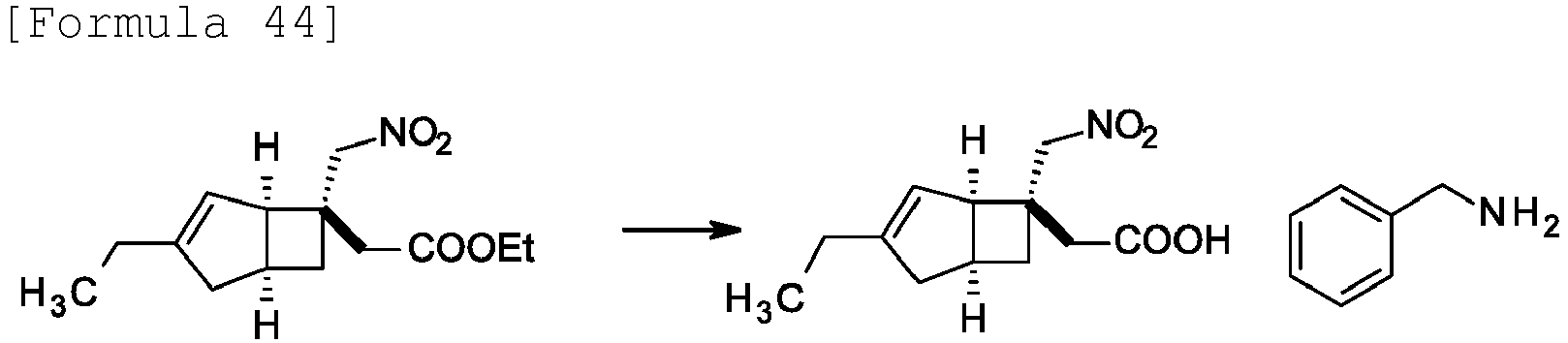
- To ethyl [(1R,5S,6S)-3-ethyl-6-(nitromethyl)bicyclo[3.2.0]hept-3-en-6-yl]acetate (5.19 g (net), 19.4 mmol, 74% de) obtained by the method shown in Reference Example 1, a 5 mol/L aqueous sodium hydroxide solution (35 mL) was added, and the mixture was stirred at room temperature for 2 hours. This reaction solution was cooled to 0°C, and 6 mol/L hydrochloric acid (32 mL) and ethyl acetate (56 mL) were then added thereto. The aqueous layer was removed, and the organic layer was then washed with saturated saline (14 mL) twice. Each aqueous layer was subjected to re-extraction with ethyl acetate (56 mL). The organic layers were mixed and concentrated, and MTBE (75 mL) and benzylamine (1.6 mL) were then added to the residue. The mixture was stirred overnight at room temperature and then further stirred at 0°C for 3 hours, followed by the filtration of crystals. The crystals were washed with cold MTBE (14 mL) and then dried under reduced pressure at 40°C to obtain the title compound (4.01 g, 62%, 98.5% de, 99.8% ee).
1H NMR (500 MHz, CD3OD): δ = 1.09 (t, 3H, J = 7.4 Hz), 1.49 (dd, 1H, J = 12.6, 7.4 Hz), 2.04 (d, 1H, J = 16.6 Hz), 2.14 (dd, 2H, J = 14.9, 7.4 Hz), 2.28 (ddd, 1H, J = 11.5, 9.2, 2.9 Hz), 2.34 (d, 1H, J = 16.6 Hz), 2.39 (d, 1H, J = 16.6 Hz), 2.48 (dd, 1H, J = 16.6, 8.0 Hz), 2.81 (quint, 1H, J = 7.4 Hz), 3.22 (bs, 1H), 4.08 (s, 2H), 4.94 (s, 2H), 5.37 (bs, 1H), 7.37-7.46 (m 5H) -

- Diethyl [(1RS,5SR,6RS)-6-cyano-3-ethylbicyclo[3.2.0]hept-3-en-6-yl]propanedioate (63.9 mg, 0.209 mmol) was dissolved in EtOH (0.8 mL). To the solution, a 2.0 M solution of potassium hydroxide in EtOH (210 µL, 0.420 mmol) was added. The mixture was stirred under heating at 70°C for 6 hours, and the reaction was then terminated by the addition of 1 M hydrochloric acid (5 mL), followed by extraction with DCM (5 mL) three times. The solvent was distilled off under reduced pressure, and the residue was then purified by PTLC (hexane:ethyl acetate = 5:1) to obtain the title compound as a clear colorless oil (10.0 mg, 21%).
1H NMR (CDCl3) (400 MHz): δ = 1.08 (3H, t, J = 7.6 Hz), 1.28 (3H, t, J = 7.2 Hz), 1.73 (1H, dd, J = 12.2, 7.6 Hz), 2.05 (1H, d, J = 16.8 Hz), 2.14 (2H, q, J = 7.6 Hz), 2.52 (1H, dd, J = 16.6, 7.6 Hz), 2.61 (2H, s), 2.66-2.79 (1H, m), 3.14 (1H, quint, J = 7.6 Hz), 3.65-3.77 (1H, m), 4.18 (2H, q, J = 7.2 Hz), 5.25 (1H, s).
13C NMR (CDCl3) (100 MHz): δ = 12.3, 14.1, 24.4, 32.3, 36.2, 38.1, 38.6, 42.5, 54.5, 61.0, 119.2, 125.0, 152.8, 169.6. -

- Dimethyl [(1RS,5SR,6RS)-6-cyano-3-ethylbicyclo[3.2.0]hept-3-en-6-yl]propanedioate (502.5 mg, 1.81 mmol) was dissolved in EtOH (1.0 mL). To the solution, a 1.5 M solution of potassium hydroxide in EtOH (1.21 mL, 1.82 mmol) was added, and the mixture was heated to reflux for 4 hours. After cooling to room temperature, a 2 M aqueous potassium hydroxide solution (1.81 mL) was added thereto, and the mixture was stirred at room temperature for 3 hours. EtOH was distilled off under reduced pressure, followed by extraction with DCM (5 mL) and then extraction with a 1 M aqueous sodium hydroxide solution. The obtained aqueous layer was neutralized until acidic by the addition of concentrated hydrochloric acid, followed by extraction with DCM (5 mL) three times. The solvent was distilled off under reduced pressure to obtain a product as a yellow oil (350.6 mg). The product was confirmed by 1H NMR and HPLC to be a mixture of [(1RS,5SR,6SR)-6-cyano-3-ethylbicyclo[3.2.0]hept-3-en-6-yl]acetic acid and [(1RS,5SR,6RS)-6-cyano-3-ethylbicyclo[3.2.0]hept-3-en-6-yl]propanedioic acid (84:16).
- 1H NMR (CDCl3) (400 MHz): δ = 1.07 (3H, t, J = 7.6 Hz), 1.73 (1H, dd, J = 12.6, 7.6 Hz), 2.05 (1H, d, J = 17.2 Hz), 2.14 (2H, q, J = 7.2 Hz), 2.52 (1H, dd, J = 16.8, 7.6 Hz), 2.69 (2H, s), 2.69-2.80 (1H, m), 3.15 (1H, quint, J = 7.6 Hz), 3.65-3.79 (1H, m), 5.27 (1H, s), 11.17 (1H, brs).
- 1H NMR (CDCl3) (400 MHz): δ = 1.08 (3H, t, J = 7.6 Hz), 1.86 (1H, dd, J = 12.6, 8.0 Hz), 2.00-2.23 (3H, m), 2.53 (1H, dd, J = 16.8, 7.6 Hz), 2.66-2.83 (1H, m), 3.17 (1H, quint, J = 7.6 Hz), 3.73 (1H, s), 3.73-3.82 (1H, m), 5.31 (1H, s), 11.57 (2H, brs).
-

- Diethyl [(1R,5S,6R)-6-cyano-3-ethylbicyclo[3.2.0]hept-3-en-6-yl]propanedioate (34.16 g, 103.7 mmol) was dissolved in EtOH (95 mL). To the solution, a 0.5 M solution of potassium hydroxide in EtOH (275 mL, 138 mmol) was added dropwise over 8 hours under heating to reflux. After cooling to room temperature, insoluble matter was filtered and washed with EtOH (95 mL). To the obtained solution, a 1 M aqueous potassium hydroxide solution (95 mL) was added, and the mixture was stirred at room temperature for 20 hours. Approximately 480 mL of EtOH was distilled off under reduced pressure. After addition of water (160 mL), the mixture was washed with toluene (160 mL). To the obtained aqueous layer, toluene (160 mL) and concentrated hydrochloric acid (20 mL) were added at 0°C for separation into aqueous and organic layers and extraction. The aqueous layer was subjected to re-extraction by the addition of toluene (160 mL). The organic layers were combined and washed with saturated saline (160 mL), and the solvent was then distilled off under reduced pressure. The obtained oil (22.92 g) was dissolved in toluene (470 mL). To the solution, CyNH2 (10.29 g, 103.7 mmol) was added. The mixture was stirred overnight at room temperature, and the resulting crystals were then filtered, washed with toluene (80 mL), and dried in vacuum at 40°C to obtain the title compound (28.89 g, 92%, 97.4% ee).
1H NMR (CDCl3) (400 MHz): δ = 1.06 (3H, t, J = 7.6 Hz), 1.08-1.47 (6H, m), 1.62 (1H, d, J = 12.0 Hz), 1.69 (1H, dd, J = 12.6, 7.6 Hz), 1.69-1.86 (2H, m), 1.93-2.20 (5H, m), 2.45 (2H, s), 2.39-2.56 (1H, m), 2.66 (1H, ddd, J = 13.7, 9.0, 2.4 Hz), 2.92-3.16 (2H, m), 3.57-3.72 (1H, m), 5.28 (1H, s), 7.30 (2H, brs). -
- Column: CHIRALPAK AS-RH (Daicel, 5 µm, 4.6 mm x 150 mm), 40°C
- Detection wavelength: UV 210 nm
- Mobile phase: MeCN:10 mM phosphate buffer solution (prepared at pH 2 with phosphate) = 22:78
- Measurement time: 30 min
- Flow rate: 1.0 mL/min
- Retention time:
- [(1R,5S,6S)-6-Cyano-3-ethylbicyclo[3.2.0]hept-3-en-6-yl]acetic acid: 21.8 min
- [(1S,5R,6R)-6-Cyano-3-ethylbicyclo[3.2.0]hept-3-en-6-yl]acetic acid: 19.1 min
-

- Diethyl [(1R,5S,6R)-6-cyano-3-ethylbicyclo[3.2.0]hept-3-en-6-yl]propanedioate (1.309 g, 4.153 mmol, 97.4% ee) was dissolved in EtOH (3.9 mL). To the solution, a 0.5 M solution of potassium hydroxide in EtOH (10.8 mL, 5.40 mmol) was added dropwise over 7.5 hours under heating to reflux. After cooling to room temperature, insoluble matter was filtered and washed with EtOH (4 mL). To the obtained solution, a 1 M aqueous potassium hydroxide solution (4.0 mL) was added, and the mixture was stirred at room temperature for 2 hours.
- EtOH was distilled off under reduced pressure, and the residue was washed with toluene (8 mL). To the obtained aqueous layer, toluene (8 mL) and concentrated hydrochloric acid (1 mL) were added at 0°C for separation into aqueous and organic layers and extraction. The aqueous layer was subjected to re-extraction by the addition of toluene (8 mL). The organic layers were combined and washed with saturated saline (8 mL). Then, 15.8124 g of the obtained solution (31.6992 g) was used in the subsequent procedures. The solvent was distilled off under reduced pressure, and the obtained oil was dissolved in CH3CN (15 mL). To the solution, (R)-phenethylamine (264 µL, 2.07 mmol) was added. The mixture was stirred overnight at room temperature and then cooled to 0°C, and the resulting crystals were filtered, washed with CH3CN (5 mL), and dried in vacuum at 40°C to obtain the title compound (520.6 mg, 77%, 98.2% ee).
-

- To a solution of [(1R,5S,6S)-6-cyano-3-ethylbicyclo[3.2.0]hept-3-en-6-yl]acetic acid (100 mg, 0.487 mmol, 90% ee) in toluene (1 mL), t-butylamine (52 µL, 0.495 mmol) was added, and the mixture was stirred overnight at room temperature. The resulting crystals were filtered to obtain the title compound (64.9%, 97.8% ee).
-

- A solution of diethyl [(1R,5S,6R)-6-cyano-3-ethylbicyclo[3.2.0]hept-3-en-6-yl]propanedioate (22.0 mmol) in EtOH (16 vol.) was heated to reflux, and an 8 M aqueous potassium hydroxide solution (3.44 mL) was added thereto every 1 hour in 5 portions. Then, the mixture was heated to reflux for 8 hours and cooled to room temperature. Then, an 8 M aqueous potassium hydroxide solution (2.1 mL) was added thereto, and the mixture was stirred at room temperature for 1 hour. The solvent was concentrated into 18 mL under reduced pressure, and water (18 mL) and toluene (18 mL) were added to the residue. The mixture was cooled to 0°C and then neutralized until pH 2.5 by the addition of concentrated hydrochloric acid (4.56 g), followed by separation into aqueous and organic layers and extraction. To the obtained organic layer, toluene (24 mL) was added, and the mixture was cooled to 10°C or lower, followed by the addition of benzylamine (2.36 g). The solvent was concentrated into 18 mL under reduced pressure. Then, toluene (12 mL) was added to the residue, and the mixture was stirred overnight at room temperature. The resulting crystals were filtered, washed with toluene (15 mL), and then dried in vacuum at 40°C to obtain the title compound (5.27 g, 76.6%, 98.6% ee).
1H NMR (CD3OD) (400 MHz): δ = 1.09 (3H, t, J = 7.6 hz), 1.73 (1H, dd, J = 12.2, 8.0 Hz), 2.07 (1H, d, J = 16.8 Hz), 2.15 (2H, q, J = 7.6 Hz), 2.41-2.55 (3H, m), 2.58-2.67 (1H, m), 3.06 (1H, quint, J = 7.6 Hz), 3.57-3.62 (1H, m), 4.09 (2H, s), 5.36 (1H, s), 7.28-7.50 (5H, m). -


- To the crude product of (2EZ)-3-ethoxy-2-[(1R,5S)-3-ethylbicyclo[3.2.0]hept-3-en-6-ylidene]-3-oxopropanoic acid (4.7 g) obtained by the method shown in Example 1, EtOH (30 mL) and sodium cyanide (1.4 g, 14.54 mmol) were added, and the mixture was stirred at 25°C for 46 hours and then refluxed for 5 hours. A 1 N aqueous potassium hydroxide solution (21.8 mL) was added thereto, and the mixture was stirred at room temperature for 2 hours. The solvent was distilled off by concentration under reduced pressure. Water (12 mL) and toluene (8 mL) were added to the residue for separation into aqueous and organic layers, and the organic layer was removed. Then, toluene (10 mL) was added to the aqueous layer, and the mixture was cooled and adjusted to pH 2.5 by the addition of 6 N hydrochloric acid. After separation into aqueous and organic layers, the aqueous layer was removed, and the solvent was distilled off by concentration under reduced pressure. Then, toluene (16 mL) and benzylamine (1.6 g, 14.54 mmol) were added to the residue. After mixing at room temperature for 5 hours, the crystals were filtered. Then, the crystals were dried under reduced pressure at 40°C to obtain the title compound as white crystals (2.8 g, 58.9%).
-

- To a CPME solution of diethyl [(1RS,5SR,6RS)-6-cyano-3-ethylbicyclo[3.2.0]hept-3-en-6-yl]propanedioate obtained by the method of Example 12, EtOH (390 mL) was added, then an 8 N aqueous potassium hydroxide solution (6.9 mL, 55.07 mmol) was added a total of 5 times every 1 hour under heating to reflux, and the mixture was then refluxed for 5 hours and brought back to room temperature.
- To the EtOH solution, water (60 mL) and an 8 N aqueous potassium hydroxide solution (24 mL) were added, and the mixture was stirred at 26 to 27°C for 2 hours and then concentrated into 150 mL under reduced pressure at an external temperature of 40 to 45°C. To the residue, water (180 mL) and toluene (90 mL) were added for separation into aqueous and organic layers, and the organic layer was removed.
- To the obtained aqueous solution, toluene (150 mL) was added, and the mixture was cooled and adjusted to pH 1.4 by the addition of concentrated hydrochloric acid (42.5 mL) at 2 to 9°C. After separation into aqueous and organic layers, the aqueous layer was removed, and toluene (300 mL) and benzylamine (23.6 g, 220.28 mmol) were added to the residue. After inoculation, the mixture was stirred at 44 to 46°C for 30 minutes and then concentrated into 300 mL under reduced pressure at 44 to 46°C. After stirring overnight at 22 to 23°C, the crystals were filtered. The crystals were dried under reduced pressure at 40°C to obtain the title compound as white crystals (54.4 g, 79.2% from (1R,5S)-3-ethylbicyclo[3.2.0]hept-3-en-6-one).
-

- Cyclohexylammonium [(1R,5S,6S)-6-cyano-3-ethylbicyclo[3.2.0]hept-3-en-6-yl]acetate (6.00 g, 19.7 mmol) was dissolved in toluene (30 mL) and 1 M hydrochloric acid (30 mL) for separation into aqueous and organic layers and extraction. The obtained organic layer was washed with saturated saline (30 mL), and the solvent was then distilled off under reduced pressure to obtain [(1R,5S,6S)-6-cyano-3-ethylbicyclo[3.2.0]hept-3-en-6-yl]acetic acid as a red-brown oil (4.86 g). An 8 M aqueous potassium hydroxide solution (3.7 mL, 29.6 mmol), 28% ammonia water (16.6 mL), and sponge nickel (Kawaken NDHT-M3, 2.05 g) were added thereto, and the mixture was stirred under heating at 40°C for 15 hours at a hydrogen pressure of 4 bar. After cooling to room temperature, nitrogen substitution was performed, and the sponge nickel was filtered and washed with a 1 M aqueous potassium hydroxide solution (9 mL). To 16.51 g (corresponding to 9.83 mmol of cyclohexylammonium [(1R,5S,6S)-6-cyano-3-ethylbicyclo[3.2.0]hept-3-en-6-yl]acetate) of the obtained solution (33.08 g), active carbon (Purified Shirasagi, 0.300 g) was added, and the mixture was stirred at room temperature for 4 hours. The active carbon was filtered and washed with a 1 M aqueous potassium hydroxide solution (4.0 mL). Then, the obtained solution was cooled to 0°C, adjusted to pH 6.6 by the addition of concentrated hydrochloric acid (3.2 mL), and stirred. The resulting crystals were filtered, washed with water (4.0 mL), and then dried in vacuum at 50°C to obtain the title compound as white crystals (1.72 g, 77%).
- Various spectral data of the obtained title compound were almost (structurally identifiably) consistent with public information (described in Patent Literatures 5 and 6).
-

- To di-tert-butyl [(1RS,5SR,6RS)-3-ethyl-6-(nitromethyl)bicyclo[3.2.0]hept-3-en-6-yl]propanedioate (20.6 g), EtOH (85 mL) and sponge nickel (6.18 g) were added, and the mixture was heated to 35°C under application of hydrogen gas pressure (0.45 MPa) and stirred for 10 hours. Then, the reaction solution was cooled to room temperature and filtered to remove the sponge nickel. The sponge nickel on the filter was washed with EtOH (60 mL), and the washes were combined with the reaction solution.
- After concentration of this solution, toluene (170 mL) was added to the residue, and the mixture was further concentrated. To the residue, diisopropyl ether (100 mL) and BsOH (7.35 g) were added, and the mixture was stirred at room temperature for approximately 2 hours, followed by the addition of heptane (100 mL). The mixture was stirred at room temperature for 1 hour, then cooled to 0°C, and further stirred for 1 hour. The deposited crystals were filtered and dried to obtain the title compound (17.36 g, 64%).
1H NMR (CDCl3) (500 MHz): δ = 1.07 (t, 3H, J = 7.4 Hz), 1.40 (s, 9H), 1.44 (s, 9H), 1.95 (d, 1H, J = 16.6 Hz), 2.05-2.17 (m, 3H), 2.25 (ddd, 1H, J = 11.5, 8.0, 2.3 Hz), 2.39 (dd, 1H, J = 16.6, 7.4 Hz), 2.84 (quint, 1H, J = 7.4 Hz), 3.20 (brs, 1H), 3.36 (d, 1H, J = 11.5 Hz), 3.37 (d, 1H, J = 11.5 Hz), 3.67 (s, 1H), 5.18 (brs, 1H), 7.33-7.38 (m, 3H), 7.89-7.93 (m, 2H), 8.27 (s, 3H). -

- Benzylammonium [(1R,5S,6S)-6-cyano-3-ethylbicyclo[3.2.0]hept-3-en-6-yl]acetate (60 g) was dissolved by the addition of MTBE (300 mL), water (127 mL), and concentrated hydrochloric acid (23 mL) at room temperature. The solution was left standing, and the aqueous layer was removed to obtain an organic layer. A 1.75 mol/L aqueous lithium hydroxide solution (approximately 336 mL) was added thereto until the pH of the reaction solution became 10.0. The mixture was left standing, and the organic layer was then removed. To the obtained aqueous solution, sponge cobalt (16 g), 25% ammonia water (21.6 mL), and a 20% solution of dimethylpolysiloxane in MTBE (0.3 mL) were added, and the mixture was heated to 40°C under application of hydrogen gas pressure (0.45 MPa) and stirred for 7.5 hours. Then, the reaction solution was cooled to room temperature and filtered to remove the sponge cobalt. The sponge cobalt on the filter was washed with purified water (90 mL).
- To the obtained solution, active carbon (1.5 g) was added, and the mixture was stirred for 0.5 hours and filtered to remove the active carbon. The active carbon on the filter was washed with water (90 mL). This solution was cooled to approximately 0°C and adjusted to approximately pH 6.0 by the dropwise addition of a 50% aqueous malonic acid solution (approximately 42 mL) over 2.5 hours. The resulting crystals were filtered, washed with water (120 mL) cooled to approximately 0°C, and dried in vacuum overnight at 50°C to obtain the title solid as white crystals (36.19 g, 90.0%). Various spectral data of the obtained title compound were almost (structurally identifiably) consistent with public information (described in Patent Literatures 5 and 6).
-

- Benzylammonium [(1R,5S,6S)-6-cyano-3-ethylbicyclo[3.2.0]hept-3-en-6-yl]acetate (5.0 g) was dissolved by the addition of MTBE (25 mL), water (10 mL), and concentrated hydrochloric acid (1.94 mL) at room temperature. The solution was left standing, and the aqueous layer was removed to obtain an organic layer. A 4 mol/L aqueous lithium hydroxide solution (approximately 6.0 mL) and water (3 mL) were added thereto. The mixture was stirred and left standing, and the organic layer was then removed. To the obtained aqueous solution, sponge nickel (1.25 g), 25% ammonia water (3.6 mL), and a 20% solution of dimethylpolysiloxane in MTBE (0.025 mL) were added, and the mixture was heated to 40°C under application of hydrogen gas pressure (0.45 MPa) and stirred for 4 hours. Then, the reaction solution was cooled to room temperature and filtered to remove the sponge nickel. The sponge nickel on the filter was washed with water (7.5 mL).
- To the obtained solution, active carbon (0.125 g) was added, and the mixture was stirred for 0.5 hours and filtered to remove the active carbon. The active carbon on the filter was washed with water (7.5 mL). This solution was cooled to approximately 0°C and adjusted to approximately pH 6.0 by the dropwise addition of a 50% aqueous citric acid solution (approximately 7.5 mL) over 3 hours. The resulting crystals were filtered, washed with water (10 mL) cooled to approximately 0°C, and dried in vacuum overnight at 50°C to obtain the title compound as white crystals (2.90 g, 86.6%).
-

- Benzylammonium [(1R,5S,6S)-6-cyano-3-ethylbicyclo[3.2.0]hept-3-en-6-yl]acetate (40.0 g) was dissolved by the addition of toluene (200 mL) and 2 mol/L hydrochloric acid (100 mL) at room temperature. The solution was left standing, and the aqueous layer was removed to obtain an organic layer. 10% saline (approximately 100 mL) was added thereto. The mixture was stirred and left standing, and the aqueous layer was then removed. To this solution, water (100 mL) was added, and the mixture was then adjusted to pH 10.0 by the addition of an 8 mol/L aqueous potassium hydroxide solution (approximately 15.7 mL) and left standing. Then, the organic layer was removed.
- To this solution, sponge cobalt (10 g), 28% ammonia water (13 mL), and a 2% solution of dimethylpolysiloxane in toluene (2 mL) were added, and the mixture was heated to 40°C under application of hydrogen gas pressure (0.45 MPa) and stirred for 8 hours. Then, the reaction solution was cooled to room temperature and filtered to remove the sponge cobalt. The sponge cobalt on the filter was washed with water (80 mL). To the obtained solution, active carbon (4 g) was added, and the mixture was stirred for 0.5 hours and filtered to remove the active carbon. The active carbon on the filter was washed with water (60 mL). This solution was adjusted to approximately pH 6.0 by the addition of concentrated hydrochloric acid (approximately 32.7 g). Then, potassium chloride (55.0 g) was added thereto, and the mixture was stirred for 0.5 hours and then cooled to 0°C. The resulting crystals were filtered, washed with 20% saline (80 mL) cooled to approximately 0°C, and dried in vacuum overnight at 50°C to obtain the title compound as white crystals (26.9 g, content: 88.3%, content-based yield: 88.7%).
-

- To (R)-phenylethanaminium [(1R,5S,6S)-6-cyano-3-ethylbicyclo[3.2.0]hept-3-en-6-yl]acetate (35.9 g, 99.2 mmol, 95.7% de, 99.2% ee), toluene (120 mL) and 1 mol/L hydrochloric acid (150 mL) were added, and the mixture was stirred. The aqueous layer was removed, and the organic layer was then washed with water (120 mL) twice and concentrated. To the obtained residue, MTBE (150 mL) and sponge nickel (10.1 g) were added, and the mixture was stirred at room temperature for 3 hours under application of hydrogen pressure (approximately 4 atm). To this reaction solution, a 2 mol/L aqueous potassium hydroxide solution (72 mL) was added, and the mixture was stirred for 30 minutes. Then, the sponge nickel was filtered off. The filtered sponge nickel was washed with a 2 mol/L aqueous potassium hydroxide solution (12 mL). The filtrate and the washes were combined, and the organic layer was then removed to obtain an aqueous layer. The organic layer was subjected to re-extraction with a 2 M aqueous potassium hydroxide solution. Combined aqueous layers were cooled, adjusted to pH 7.5 by the addition of concentrated hydrochloric acid (approximately 12 mL), and then stirred at 0°C for approximately 3 hours. The deposited crystals were filtered, washed with ice-cold water (24 mL), and then dried under reduced pressure at 50°C to obtain the title compound (18.3 g, 88%, 99.8% de).
-

- To a mixed solution of MTBE (83 mL), acetone (4.0 mL), and water (0.98 mL), [(1R,5S,6S)-6-(aminomethyl)-3-ethylbicyclo[3.2.0]hept-3-en-6-yl]acetic acid (4.07 g, 19.5 mmol) was added at 0°C, and the mixture was stirred to prepare a slurry. A solution of BsOH (3.08 g, 19.5 mmol) in acetone (10.1 mL) was added thereto. The mixture was stirred at 0°C for 1 hour, then heated to room temperature, and stirred for 2 hours. The reaction mixture was slowly cooled to -10°C over 1 hour and stirred for 2.5 hours. The resulting crystals were filtered, washed with acetone (12 mL) cooled to 0°C, and then dried in vacuum at 40°C to obtain the title compound as white crystals (6.44 g, 90.1%). Various spectral data of the obtained title compound were almost (structurally identifiably) consistent with public information (described in Patent Literatures 5 and 6).
-
- Column: Cadenza CW-C18 (Imtakt, 3 µm, 4.6 mm x 150 mm), 40°C
- Detection wavelength: UV 205 nm
- Mobile phase: MeCN:5 mM aqueous ammonium bicarbonate solution = 10:90 - 80:20 (gradient)
- (0-12 min: MeCN 10%, 12-27 min: MeCN 10 → 80%, 27-45 min: MeCN 80%, 45-50 min: MeCN 80 → 10%, 50-60 min: MeCN 10%, 60 min: STOP)
- Measurement time: 60 min
- Flow rate: 1.0 mL/min
- Concentration of injected sample: 5 mg/mL
- Amount of sample injected: 2 µL
- Retention time:
- Title compound (in terms of free form): 12.5 min Diastereomer (compound X): 13.5 min
- Positional isomers of double bond (compound XII or XIII): 9.4 min, 9.6 min, 11.4 min
-
- Column: TSKgel ODS-100V (Tosoh, 3 µm, 4.6 mm x 150 mm), 40°C
- Detection wavelength: UV 215 nm
- Mobile phase: MeCN:10 mM phosphate buffer solution (pH 6.4)/MeCN mixed solution (2:8) = 0:100 - 94:6 (gradient)
- (0-40 min: MeCN 0 → 55%, 40-40.1 min: MeCN 55 → 94%, 40.1-50 min: MeCN 94%, 50 min: STOP)
- Measurement time: 50 min
- Flow rate: 1.0 mL/min
- Concentration of injected sample: 5 mg/mL
- Amount of sample injected: 10 µL
- Retention time:
- Title compound (in terms of free form): 22.6 min Diastereomer (compound X): 22.9 min
- Positional isomers of double bond (compound XII or XIII): 21.3 min, 21.4 min, 22.2 min
-

- To a solution of BsOH (5.29 g) in water (35 mL), [(1R,5S,6S)-6-(aminomethyl)-3-ethylbicyclo[3.2.0]hept-3-en-6-yl]acetic acid (7.00 g) was added at approximately 25°C, and the mixture was heated to approximately 50°C. After confirmation of the dissolution of crystals, the mixture was cooled to approximately 0°C over 2.5 hours. The crystals were filtered, washed with cold water (21 mL), and then dried in vacuum at 55°C to obtain the title compound as white crystals (10.50 g, 85.4%).
-

- To [(1R, 5S, 6S) -6-(aminomethyl)-3-ethylbicyclo[3.2.0]hept-3-en-6-yl]acetic acid (13.00 g), CH3CN (195 mL) and water (2.6 mL) were added, and the temperature of the mixture was adjusted to approximately 20°C. Then, a solution of BsOH (9.83 g) in CH3CN (39 mL) was added dropwise thereto over approximately 20 minutes. After addition of CH3CN (23.4 mL), the mixture was cooled to approximately 0°C over 2 hours. The crystals were filtered, washed with cold CH3CN (39 mL), and then dried in vacuum at 55°C to obtain the title compound as white crystals (21.64 g, 94.8%).
-

- To [(1R,5S,6S)-6-(aminomethyl)-3-ethylbicyclo[3.2.0]hept-3-en-6-yl]acetic acid (13.00 g), anisole (130 mL) was added, and the temperature of the mixture was adjusted to 20 to 25°C. Then, a solution of BsOH (9.83 g) in anisole (26 mL) was added dropwise thereto over 27 minutes. After addition of anisole (26 mL), the mixture was stirred at 20 to 25°C for 2 hours and cooled to 3°C over 2 hours. The crystals were filtered, washed with acetone (39 mL) cooled to 0°C, and then dried in vacuum at 55°C to obtain the title compound as white crystals (21.88 g, 95.9%).
-


- To [(1R,5S,6S)-6-(aminomethyl)-3-ethylbicyclo[3.2.0]hept-3-en-6-yl]acetic acid (13.00 g), anisole (130 mL) was added, and the temperature of the mixture was adjusted to 20 to 25°C. Then, acetic acid (10.66 mL) was added thereto, and insoluble matter was filtered and washed with a 3% solution of acetic acid in anisole (10.66 mL). To the obtained solution, a solution of BsOH (9.83 g) in anisole (26 mL) was added dropwise over 40 minutes. After addition of anisole (6.5 mL), the mixture was stirred at 20 to 25°C for 1 hour and cooled to 3°C over 2 hours. The crystals were filtered, washed with acetone (39 mL) cooled to 0°C, and then dried in vacuum at 55°C to obtain the title compound as white crystals (21.58 g, 94.5%).
[Table 2] Production method Compound IX (compound of interest)* Compound X (diastereomer)* Compounds XII and XIII (double bond positional isomers)* (total) Compound XI (enantiomer)** Patent Literature 6 98.03% 0.04% 1.54% 1.47% Example 35 99.84% Not detected 0.07% 0.84% Example 36 99.98% Not detected 0.01% 0.00% Example 37 99.90% Not detected 0.03% 0.08% Example 38 99.92% Not detected 0.06% 0.09% Example 39 99.96% Not detected 0.02% 0.02% * Based on purity measurement method described in Example 35
** Analysis value obtained using chiral column -

- Sodium t-butoxide (7.41 g, 77.1 mmol) was dissolved in THF (50 mL). The solution was cooled to 10°C or lower. Then, EPE (17.3 g, 77.1 mmol) and (1R,5S)-3-ethyl-bicyclo[3.2.0]hept-3-en-6-one (10.0 g, 73.4 mmol) were each added dropwise thereto. The mixture was stirred at room temperature for 3 hours, and toluene (85 mL) and water (40 mL) were then added thereto. The aqueous layer was removed, and the organic layer was then washed with water (20 mL) twice and concentrated to obtain ethyl [(1R,5S)-3-ethyl-bicyclo[3.2.0]hept-3-en-6-ylidene]acetate (14.4 g, 95%, E/Z = 7/3) as an oil.
- The oil (13.0 g) was dissolved in DMSO (60 mL). To the solution, DBU (8.96 g, 110 mmol) and nitromethane (8.96 g, 147 mmol) were added at room temperature. The mixture was stirred at 60°C for 3 hours, and water (60 mL) and toluene (120 mL) were then added thereto. The aqueous layer was removed, and the organic layer was then washed with water (60 mL) twice and concentrated to obtain the title compound (6.4 g, 97%, diastereomeric ratio: 87:13).
1H NMR (500 MHz, CDCl3)): δ = 1.08 (t, 2.6H, J = 7.4 Hz), 1.09 (t, 0.39H, J = 7.4 Hz), 1.27 (t, 2.6H, J = 7.4 Hz), 1.27 (t, 0.39H, J = 7.4 Hz), 1.54 (dd, 0.87H, J = 12.6, 7.4 Hz), 1.56 (s, 0.26H), 1.63 (dd, 0.13H, J = 12.6, 7.4 Hz), 2.06 (d, 1H, J = 16.6 Hz), 2.12-2.16 (m, 2H), 2.30 (ddd, 0.87H, J = 11.5, 9.2, 2.9 Hz), 2.49-2.54 (m, 1H), 2.57 (s, 1.7H), 2.77 (d, 0.26H, J = 4.6 Hz), 2.88 (quint, 0.87H, J = 7.4 Hz), 3.17 (bs, 0.13H), 3.23 (bs, 0.87H), 4.11-4.18 (m, 2H), 4.57 (d, 0.13H, J = 12.6 Hz), 4.65 (d, 0.13H, J = 12.6 Hz), 4.78 (d, 0.87H, J = 11.5 Hz), 4.85 (d, 0.87H, J = 11.5Hz), 5.25-5.26 (m, 0.87H), 5.36-5.37 (m, 0.13H). -

- Sodium hydride (16.2 g, 407 mmol) was added to THF (500 mL), and the mixture was cooled to 10°C or lower. EPE (90.5 g, 407 mmol) and (1RS,5SR)-3-ethyl-bicyclo[3.2.0]hept-3-en-6-one (50.0 g, 370 mmol) were each added dropwise thereto. After the completion of the dropwise addition, the mixture was stirred at room temperature for 19 hours, and water (150 mL) was then added thereto. The aqueous layer was removed, and the organic layer was then washed with saturated saline (100 mL) and concentrated. DMSO (200 mL) was further added to the residue, and the mixture was dehydrated and concentrated to obtain a crude product of ethyl [(1RS,5SR)-3-ethyl-bicyclo[3.2.0]hept-3-en-6-ylidene]acetate (308.9 g, E/Z = 75/25) as a DMSO solution.
- To the DMSO solution, DBU (111.8 g, 740 mmol) and nitromethane (89.6 g, 1480 mmol) were added at room temperature. The mixture was stirred under heating at 60°C for 5 hours and then allowed to cool, and water (300 mL) and ethyl acetate (300 mL) were added thereto. The aqueous layer was removed, and the organic layer was then washed with water (300 mL) and concentrated to obtain ethyl [(1RS,5SR,6SR)-3-ethyl-6-(nitromethyl)bicyclo[3.2.0]hept-3-en-6-yl]acetate (104.3 g, 71% de) as an oil.
- The oil was dissolved in EtOH (100 mL). To the solution, a 5 mol/L aqueous sodium hydroxide solution (250 mL) was added, and the mixture was stirred at 30°C for 2 hours. To this reaction solution, toluene (150 mL) was added for separation into aqueous and organic layers. To the separated aqueous layer, 6 mol/L hydrochloric acid (220 mL) and ethyl acetate (200 mL) were added. After separation into aqueous and organic layers, the aqueous layer was further subjected to re-extraction with ethyl acetate (200 mL). The organic layers were mixed, dehydrated by the addition of magnesium sulfate, filtered, and then concentrated. The concentrated residue was crystallized at 5°C to obtain a crude product of the title compound (89.2 g). A 40.0 g aliquot of the obtained crude product was suspended in a mixed solution of hexane:ethyl acetate = 10:1 (200 mL) at room temperature, and the suspension was then stirred at 0°C. After 1 hour, the suspension was filtered and washed with a cold mixed solution of hexane:ethyl acetate = 10:1 (40 mL). The obtained crystals were dried to obtain a single diastereomer of the title compound (22.4 g) as crystals.
1H NMR (400 MHz, CDCl3): δ = 1.09 (t, 3H, J = 7.6 Hz), 1.47-1.57 (m 2H), 2.06-2.17 (m, 3H), 2.27-2.33 (m, 1H), 2.49-2.55 (m, 1H), 2.66 (s, 2H), , 2.88 (quint, 1H, J = 7.6 Hz), 3.17 (bs, 1H), 4.78 (d, 1H, J = 11.5 Hz), 4.86 (d, 1H, J = 11.5Hz), 5.27-5.28 (m, 1H).
Claims (20)
- A mixture of compounds represented by the general formulas (I) and (I'):

- A compound having the configuration of only one of the compounds represented by the general formulas (I) and (I'):

- A method for producing a compound represented by the general formula (Ia) (and/or an enantiomer thereof), comprising
mixing a compound represented by the general formula (II) (and/or an enantiomer thereof) with an alkali metal salt of hydrogen cyanide in a solvent to produce the compound represented by the general formula (Ia) (and/or an enantiomer thereof):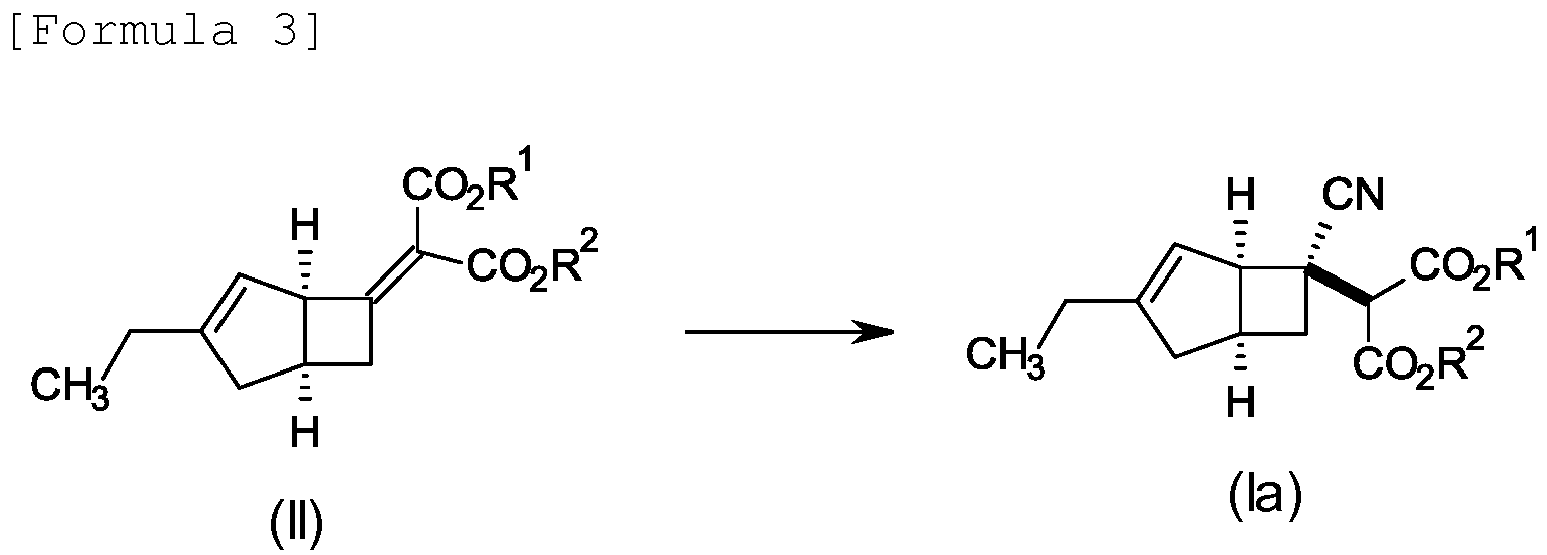
- A method for producing a compound represented by the general formula (Ib) (and/or an enantiomer thereof), comprising
mixing a compound represented by the general formula (II) (and/or an enantiomer thereof) with nitromethane in the presence of a base in a solvent to produce the compound represented by the general formula (Ib) (and/or an enantiomer thereof):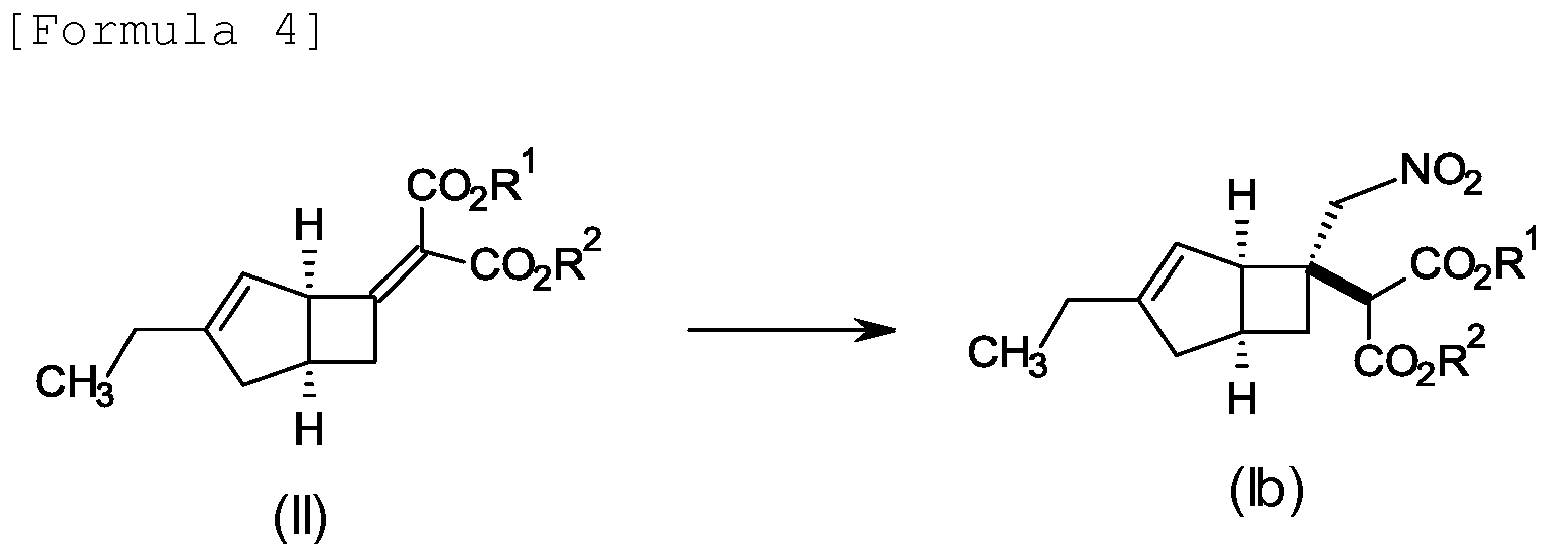
- A method for producing a compound represented by the general formula (Ia) or (Ib) (and/or an enantiomer thereof), comprising
producing a compound represented by the general formula (II) (and/or an enantiomer thereof) from a compound represented by the general formula (III) (and/or an enantiomer thereof) and a compound represented by the general formula (IV) using a Lewis acid, and then producing the compound represented by the general formula (Ia) or (Ib) (and/or an enantiomer thereof) from the compound represented by the general formula (II) (and/or an enantiomer thereof) by a method according to claim 3 or 4:
- A method for producing a compound represented by the general formula (V) (and/or an enantiomer thereof), comprising treating a compound represented by the general formula (I) (and/or an enantiomer thereof) with a base in a solvent:

- A method for separating a compound represented by the general formula (V) and a compound represented by the general formula (V'), comprising allowing a mixture of the compound represented by the general formula (V) and the compound represented by the general formula (V') to form a salt with an optically active organic amine:

- A method for producing a compound represented by the general formula (VI), comprising allowing a compound represented by the general formula (V) to form a salt with an organic amine in the presence of a solvent;


- The method for producing a compound represented by the general formula (VI) according to claim 8, wherein R3 is a nitromethyl group, the organic amine used is an optically active organic amine, and a racemic mixture of the compound represented by the general formula (V) is optically resolved.
- A method for producing a compound represented by the formula (VII) from a compound represented by the general formula (V) or (VI), comprising(1) reducing the compound represented by the general formula (V) in the presence of a metal catalyst in a solvent under a hydrogen atmosphere, or(2) subjecting a solution of the compound represented by the general formula (V) obtained through the salt dissociation of the compound represented by the general formula (VI) to reduction reaction in the presence of a metal catalyst under a hydrogen atmosphere to produce the compound represented by the formula (VII):wherein R3 represents a cyano group or a nitromethyl group.

- The method according to claim 10 for producing a compound represented by the formula (VII) from a compound represented by the general formula (VI), comprising converting the compound represented by the general formula (VI) to a compound represented by the general formula (V) through salt dissociation, and then subjecting the compound represented by the general formula (V) to reduction reaction in the presence of a metal catalyst in a solvent under a hydrogen atmosphere to produce the compound represented by the formula (VII).
- The method for producing a compound represented by the formula (VII) according to claim 10 or 11, wherein the metal catalyst is a sponge nickel catalyst or a sponge cobalt catalyst.
- The method for producing a compound represented by the formula (VII) according to any one of claims 10 to 12, wherein
R3 is a cyano group. - The method for producing a compound represented by the formula (VII) according to any one of claims 10 to 13, wherein the solvent is water, and the reduction reaction is performed under basic conditions by the addition of a hydroxide of an alkali metal.
- The method for producing a compound represented by the formula (VII) according to claim 11, wherein
the metal catalyst is a sponge nickel catalyst or a sponge cobalt catalyst,
R3 is a cyano group,
the solvent is water, and
the reduction reaction is performed under basic conditions by the addition of a hydroxide of an alkali metal. - A method for producing a compound represented by the general formula (VIII), comprising allowing a compound represented by the formula (VII) produced by a method according to any one of claims 10 to 15 to form a salt with an organic acid in the presence of a solvent:

- The method for producing a compound represented by the general formula (VIII) according to claim 16, wherein the organic acid is benzenesulfonic acid.
- The method according to claim 16, comprising allowing a compound represented by the formula (VII) produced by a method according to claim 15 to form a salt with benzenesulfonic acid in the presence of a solvent to thereby produce a compound represented by the general formula (VIII-a):

- A compound represented by the formula (IX), wherein the amounts of contaminating impurities are as follows:content of a diastereomer represented by the formula (X): less than 0.1%,content of an enantiomer represented by the formula (XI): less than 1.0%, andtotal content of positional isomers of the double bond represented by the formulas (XII) and (XIII): less than 0.5%, whereineach content is calculated from area normalization with respect to the free form (VII) in the formula (IX) in a test by high-performance liquid chromatography:


- The compound represented by the formula (IX) according to claim 19, wherein the compound represented by the formula (IX) is a compound produced by the same method as that for a compound represented by the general formula (VIII-a) produced according to claim 18.
Applications Claiming Priority (2)
| Application Number | Priority Date | Filing Date | Title |
|---|---|---|---|
| JP2013143052 | 2013-07-08 | ||
| PCT/JP2014/068101 WO2015005298A1 (en) | 2013-07-08 | 2014-07-08 | METHOD FOR PRODUCING OPTICALLY ACTIVE BICYCLIC γ-AMINO ACID DERIVATIVE |
Publications (3)
| Publication Number | Publication Date |
|---|---|
| EP2871176A1 true EP2871176A1 (en) | 2015-05-13 |
| EP2871176A4 EP2871176A4 (en) | 2015-06-24 |
| EP2871176B1 EP2871176B1 (en) | 2016-08-31 |
Family
ID=52279978
Family Applications (1)
| Application Number | Title | Priority Date | Filing Date |
|---|---|---|---|
| EP14823864.5A Active EP2871176B1 (en) | 2013-07-08 | 2014-07-08 | Preparation method for optically active bicyclic gamma-amino acid derivative |
Country Status (12)
| Country | Link |
|---|---|
| US (1) | US9469623B2 (en) |
| EP (1) | EP2871176B1 (en) |
| JP (2) | JP5683761B1 (en) |
| KR (1) | KR102213954B1 (en) |
| CN (1) | CN104755456B (en) |
| BR (1) | BR112015002737B1 (en) |
| CA (1) | CA2881471C (en) |
| ES (1) | ES2611947T3 (en) |
| HU (1) | HUE030165T2 (en) |
| IL (1) | IL237109A (en) |
| TW (1) | TWI635071B (en) |
| WO (1) | WO2015005298A1 (en) |
Families Citing this family (13)
| Publication number | Priority date | Publication date | Assignee | Title |
|---|---|---|---|---|
| JP6491213B2 (en) * | 2013-12-18 | 2019-03-27 | ノヴァッセイ エスエー | Gamma-aminobutyric acid (GABA) analogs for the treatment of pain and other disorders |
| CN107848953B (en) * | 2015-12-25 | 2021-05-18 | 四川海思科制药有限公司 | Condensed ring γ-amino acid derivative, preparation method and medical application thereof |
| TW201806928A (en) * | 2016-07-01 | 2018-03-01 | 第一三共股份有限公司 | Crystals of aminocarboxylic acid acid addition salts and the synthetic method thereof |
| CN110818582B (en) * | 2019-11-20 | 2023-06-09 | 合肥拓锐生物科技有限公司 | GABA analogue and salt thereof, and synthetic method, application and medicine thereof |
| CN111116345A (en) * | 2019-12-30 | 2020-05-08 | 上海华理生物医药股份有限公司 | Novel method for preparing Mirogabalin |
| CN114195661B (en) * | 2021-12-21 | 2023-12-22 | 苏州楚凯药业有限公司 | Preparation method of milobalin benzenesulfonate |
| CN114264751B (en) * | 2021-12-28 | 2024-02-27 | 江苏威凯尔医药科技有限公司 | A method for separating milopalin intermediates and their enantiomers by high performance liquid chromatography |
| CN117623957A (en) * | 2023-12-04 | 2024-03-01 | 中国药科大学 | A diastereoisomer of milopaline besylate [(1R,5S,6R)-6-(aminomethyl)-3-ethylbicyclo[3.2.0]hept-3-ene-6- Synthetic method of benzenesulfonate acetate |
| CN117658841A (en) * | 2023-12-05 | 2024-03-08 | 迪嘉药业集团股份有限公司 | A kind of preparation method of milopaline diastereomeric impurities |
| WO2025118134A1 (en) | 2023-12-05 | 2025-06-12 | 浙江天宇药业股份有限公司 | Method for synthesizing mirogabalin besilate |
| CN117886708B (en) * | 2023-12-05 | 2026-06-30 | 浙江天宇药业股份有限公司 | Synthesis method of milbelin benzenesulfonate |
| CN118420477B (en) * | 2024-07-01 | 2024-10-29 | 中节能万润股份有限公司 | Preparation method of milobalin benzenesulfonate |
| WO2026034064A1 (en) * | 2024-08-09 | 2026-02-12 | 株式会社カネカ | Bicycloheptene compound and method for producing bicycloheptene compound |
Family Cites Families (13)
| Publication number | Priority date | Publication date | Assignee | Title |
|---|---|---|---|---|
| ATE323067T1 (en) | 1997-10-27 | 2006-04-15 | Warner Lambert Co | CYCLIC AMINO ACIDS AND THEIR DERIVATIVES AS MEDICINAL PRODUCTS |
| HN2000000224A (en) | 1999-10-20 | 2001-04-11 | Warner Lambert Co | BICYCLE AMINO ACIDS AS PHARMACEUTICAL AGENTS |
| CA2444053C (en) | 2001-04-19 | 2008-06-17 | Warner-Lambert Company Llc | Fused bicyclic or tricyclic amino acids |
| JP2005536507A (en) | 2002-07-11 | 2005-12-02 | メルク エンド カムパニー インコーポレーテッド | Treatment of neuropathic pain with 6H-pyrrolo [3,4-d] pyridazine compounds |
| KR101335784B1 (en) | 2007-09-28 | 2013-12-05 | 다이이찌 산쿄 가부시키가이샤 | BICYCLIC γ-AMINO ACID DERIVATIVE |
| JP2010241796A (en) * | 2009-03-17 | 2010-10-28 | Daiichi Sankyo Co Ltd | Bicyclic γ-amino acid derivative-containing pharmaceutical composition |
| WO2010110361A1 (en) * | 2009-03-26 | 2010-09-30 | 第一三共株式会社 | Method for producing bicyclic γ-amino acid derivative |
| US20110130454A1 (en) * | 2009-11-24 | 2011-06-02 | Xenoport, Inc. | Prodrugs of gamma-amino acid, alpha-2-delta ligands, pharmaceutical compositions and uses thereof |
| BR112013031360B1 (en) * | 2011-06-08 | 2022-01-25 | Daiichi Sankyo Company, Limited | Method to make a compound |
| ES2649968T3 (en) * | 2011-06-08 | 2018-01-16 | Daiichi Sankyo Company, Limited | Production procedure of a bicyclic compound via Claisen transposition |
| HUE040225T2 (en) | 2011-12-15 | 2019-02-28 | Daiichi Sankyo Co Ltd | Optical resolution method for bicyclic compound using asymmetric catalyst |
| HUE033397T2 (en) | 2012-04-10 | 2017-12-28 | Daiichi Sankyo Co Ltd | Optical resolution method for bicyclic compound using enzyme |
| JP2013245215A (en) * | 2012-05-29 | 2013-12-09 | Daiichi Sankyo Co Ltd | Method for producing optically active bicyclic compound based on asymmetric cyclization reaction |
-
2014
- 2014-07-07 TW TW103123253A patent/TWI635071B/en active
- 2014-07-08 KR KR1020157002876A patent/KR102213954B1/en active Active
- 2014-07-08 ES ES14823864.5T patent/ES2611947T3/en active Active
- 2014-07-08 WO PCT/JP2014/068101 patent/WO2015005298A1/en not_active Ceased
- 2014-07-08 EP EP14823864.5A patent/EP2871176B1/en active Active
- 2014-07-08 CA CA2881471A patent/CA2881471C/en active Active
- 2014-07-08 JP JP2014548802A patent/JP5683761B1/en active Active
- 2014-07-08 HU HUE14823864A patent/HUE030165T2/en unknown
- 2014-07-08 CN CN201480002091.0A patent/CN104755456B/en active Active
- 2014-07-08 BR BR112015002737-7A patent/BR112015002737B1/en active IP Right Grant
- 2014-12-05 JP JP2014246712A patent/JP2015063547A/en active Pending
-
2015
- 2015-02-05 IL IL237109A patent/IL237109A/en active IP Right Grant
- 2015-02-06 US US14/615,972 patent/US9469623B2/en active Active
Also Published As
| Publication number | Publication date |
|---|---|
| CN104755456A (en) | 2015-07-01 |
| TWI635071B (en) | 2018-09-11 |
| HUE030165T2 (en) | 2017-04-28 |
| WO2015005298A1 (en) | 2015-01-15 |
| EP2871176B1 (en) | 2016-08-31 |
| EP2871176A4 (en) | 2015-06-24 |
| IL237109A (en) | 2017-07-31 |
| CA2881471C (en) | 2017-03-21 |
| KR20160030064A (en) | 2016-03-16 |
| CN104755456B (en) | 2016-10-12 |
| TW201536724A (en) | 2015-10-01 |
| ES2611947T3 (en) | 2017-05-11 |
| BR112015002737B1 (en) | 2020-12-01 |
| HK1209101A1 (en) | 2016-03-24 |
| US20150218123A1 (en) | 2015-08-06 |
| BR112015002737A2 (en) | 2017-07-04 |
| JP5683761B1 (en) | 2015-03-11 |
| KR102213954B1 (en) | 2021-02-08 |
| JP2015063547A (en) | 2015-04-09 |
| CA2881471A1 (en) | 2015-01-15 |
| US9469623B2 (en) | 2016-10-18 |
| JPWO2015005298A1 (en) | 2017-03-02 |
Similar Documents
| Publication | Publication Date | Title |
|---|---|---|
| EP2871176B1 (en) | Preparation method for optically active bicyclic gamma-amino acid derivative | |
| EP2719677B1 (en) | Method for producing bicyclic compound via claisen rearrangement | |
| EP2978748B1 (en) | Process and intermediates for the preparation of pregabalin | |
| EP2792664B1 (en) | Optical resolution method for bicyclic compound using asymmetric catalyst | |
| EP2368870A1 (en) | Process for producing optically active carboxylic acid | |
| AU2007260267B2 (en) | New chiral intermediate, process for producing the same and its use in the manufacture of tolterodine, fesoterodine, or the active metabolite thereof | |
| JP6023794B2 (en) | Method for optical resolution of bicyclic compounds using enzymes | |
| EP3357901A1 (en) | Method for producing optically active 2-(2-fluorobiphenyl-4-yl) propanoic acid | |
| HK1209101B (en) | Preparation method for optically active bicyclic gamma-amino acid derivative | |
| BG64673B1 (en) | Method for the preparation of (1r, 2s, 4r)-(-)-2-[(2'-{n,n-dimethylamino}-ethoxy)]-2-[phenyl]-1,7,7-tri-[methyl]-bicyclo[2.2.1]heptane and its pharmaceutically acceptable with acid salts | |
| KR101304640B1 (en) | Novel n-methylbenzylamine salt of rosuvastatin and process for the preparation thereof | |
| EP3230258B1 (en) | Process for the preparation of (1s,2r)-milnacipran | |
| RU2529996C2 (en) | Method for enantioselective synthesis of (s)-pregabalin | |
| Sanders et al. | Nicotine chemistry. 5'-Cyanonicotine | |
| EP3247697B1 (en) | Process for the racemization of enantiomerically enriched 1-aminoindane | |
| KR20040035568A (en) | Process for Racemate Resolution of 3-Aminopentanenitrile | |
| EP1484314A1 (en) | Process for production of optically active beta-phenylalanine derivatives | |
| JP2012508780A (en) | Enantioselective synthesis of γ-amino-α, β-unsaturated carboxylic acid derivatives | |
| EP3323808A1 (en) | Novel method for producing 1-(acyloxy)alkyl carbamate derivative | |
| HK1199017B (en) | Optical resolution method for bicyclic compound using asymmetric catalyst | |
| JP2005120020A (en) | Optically active mandelamide derivative and method for producing optically active phenylethanolamine derivative | |
| ITMI992061A1 (en) | PROCESS FOR THE PREPARATION OF CIS 5-FLUORO -2-METHYL-1- / P-METHYLENE BENZYLIDEN / INDEN-3ACETIC ACID | |
| HK1160105A (en) | Process for producing optically active carboxylic acid | |
| HK1196599B (en) | Method for producing bicyclic compound via claisen rearrangement | |
| FR2935141A1 (en) | PROCESS FOR PREPARING THE ETHYL ESTER OF 4- [TRANS-4 - [(PHENYLMETHYL) -AMINO] CYCLOHEXYL] BENZOIC ACID AND ITS SALT HEMIFUMARATE |
Legal Events
| Date | Code | Title | Description |
|---|---|---|---|
| PUAI | Public reference made under article 153(3) epc to a published international application that has entered the european phase |
Free format text: ORIGINAL CODE: 0009012 |
|
| 17P | Request for examination filed |
Effective date: 20150203 |
|
| AK | Designated contracting states |
Kind code of ref document: A1 Designated state(s): AL AT BE BG CH CY CZ DE DK EE ES FI FR GB GR HR HU IE IS IT LI LT LU LV MC MK MT NL NO PL PT RO RS SE SI SK SM TR |
|
| AX | Request for extension of the european patent |
Extension state: BA ME |
|
| RA4 | Supplementary search report drawn up and despatched (corrected) |
Effective date: 20150528 |
|
| RIC1 | Information provided on ipc code assigned before grant |
Ipc: C07C 253/10 20060101ALI20150521BHEP Ipc: C07B 61/00 20060101ALI20150521BHEP Ipc: C07B 57/00 20060101ALI20150521BHEP Ipc: C07C 205/50 20060101AFI20150521BHEP Ipc: C07C 253/30 20060101ALI20150521BHEP Ipc: C07C 201/12 20060101ALI20150521BHEP Ipc: C07C 253/34 20060101ALI20150521BHEP Ipc: C07C 227/00 20060101ALI20150521BHEP Ipc: C07C 227/42 20060101ALI20150521BHEP Ipc: C07C 201/16 20060101ALI20150521BHEP Ipc: C07C 255/47 20060101ALI20150521BHEP Ipc: C07C 229/32 20060101ALI20150521BHEP |
|
| GRAP | Despatch of communication of intention to grant a patent |
Free format text: ORIGINAL CODE: EPIDOSNIGR1 |
|
| INTG | Intention to grant announced |
Effective date: 20151028 |
|
| GRAS | Grant fee paid |
Free format text: ORIGINAL CODE: EPIDOSNIGR3 |
|
| REG | Reference to a national code |
Ref country code: HK Ref legal event code: DE Ref document number: 1209101 Country of ref document: HK |
|
| GRAA | (expected) grant |
Free format text: ORIGINAL CODE: 0009210 |
|
| DAX | Request for extension of the european patent (deleted) | ||
| AK | Designated contracting states |
Kind code of ref document: B1 Designated state(s): AL AT BE BG CH CY CZ DE DK EE ES FI FR GB GR HR HU IE IS IT LI LT LU LV MC MK MT NL NO PL PT RO RS SE SI SK SM TR |
|
| REG | Reference to a national code |
Ref country code: CH Ref legal event code: EP Ref country code: GB Ref legal event code: FG4D |
|
| REG | Reference to a national code |
Ref country code: IE Ref legal event code: FG4D |
|
| REG | Reference to a national code |
Ref country code: DE Ref legal event code: R096 Ref document number: 602014003421 Country of ref document: DE |
|
| REG | Reference to a national code |
Ref country code: AT Ref legal event code: REF Ref document number: 824855 Country of ref document: AT Kind code of ref document: T Effective date: 20161015 |
|
| REG | Reference to a national code |
Ref country code: CH Ref legal event code: NV Representative=s name: SERVOPATENT GMBH, CH |
|
| REG | Reference to a national code |
Ref country code: LT Ref legal event code: MG4D |
|
| REG | Reference to a national code |
Ref country code: NL Ref legal event code: MP Effective date: 20160831 |
|
| REG | Reference to a national code |
Ref country code: AT Ref legal event code: MK05 Ref document number: 824855 Country of ref document: AT Kind code of ref document: T Effective date: 20160831 |
|
| PG25 | Lapsed in a contracting state [announced via postgrant information from national office to epo] |
Ref country code: NO Free format text: LAPSE BECAUSE OF FAILURE TO SUBMIT A TRANSLATION OF THE DESCRIPTION OR TO PAY THE FEE WITHIN THE PRESCRIBED TIME-LIMIT Effective date: 20161130 Ref country code: FI Free format text: LAPSE BECAUSE OF FAILURE TO SUBMIT A TRANSLATION OF THE DESCRIPTION OR TO PAY THE FEE WITHIN THE PRESCRIBED TIME-LIMIT Effective date: 20160831 Ref country code: RS Free format text: LAPSE BECAUSE OF FAILURE TO SUBMIT A TRANSLATION OF THE DESCRIPTION OR TO PAY THE FEE WITHIN THE PRESCRIBED TIME-LIMIT Effective date: 20160831 Ref country code: LT Free format text: LAPSE BECAUSE OF FAILURE TO SUBMIT A TRANSLATION OF THE DESCRIPTION OR TO PAY THE FEE WITHIN THE PRESCRIBED TIME-LIMIT Effective date: 20160831 Ref country code: HR Free format text: LAPSE BECAUSE OF FAILURE TO SUBMIT A TRANSLATION OF THE DESCRIPTION OR TO PAY THE FEE WITHIN THE PRESCRIBED TIME-LIMIT Effective date: 20160831 |
|
| PG25 | Lapsed in a contracting state [announced via postgrant information from national office to epo] |
Ref country code: AT Free format text: LAPSE BECAUSE OF FAILURE TO SUBMIT A TRANSLATION OF THE DESCRIPTION OR TO PAY THE FEE WITHIN THE PRESCRIBED TIME-LIMIT Effective date: 20160831 Ref country code: NL Free format text: LAPSE BECAUSE OF FAILURE TO SUBMIT A TRANSLATION OF THE DESCRIPTION OR TO PAY THE FEE WITHIN THE PRESCRIBED TIME-LIMIT Effective date: 20160831 Ref country code: SE Free format text: LAPSE BECAUSE OF FAILURE TO SUBMIT A TRANSLATION OF THE DESCRIPTION OR TO PAY THE FEE WITHIN THE PRESCRIBED TIME-LIMIT Effective date: 20160831 Ref country code: LV Free format text: LAPSE BECAUSE OF FAILURE TO SUBMIT A TRANSLATION OF THE DESCRIPTION OR TO PAY THE FEE WITHIN THE PRESCRIBED TIME-LIMIT Effective date: 20160831 Ref country code: GR Free format text: LAPSE BECAUSE OF FAILURE TO SUBMIT A TRANSLATION OF THE DESCRIPTION OR TO PAY THE FEE WITHIN THE PRESCRIBED TIME-LIMIT Effective date: 20161201 |
|
| PG25 | Lapsed in a contracting state [announced via postgrant information from national office to epo] |
Ref country code: RO Free format text: LAPSE BECAUSE OF FAILURE TO SUBMIT A TRANSLATION OF THE DESCRIPTION OR TO PAY THE FEE WITHIN THE PRESCRIBED TIME-LIMIT Effective date: 20160831 Ref country code: EE Free format text: LAPSE BECAUSE OF FAILURE TO SUBMIT A TRANSLATION OF THE DESCRIPTION OR TO PAY THE FEE WITHIN THE PRESCRIBED TIME-LIMIT Effective date: 20160831 |
|
| REG | Reference to a national code |
Ref country code: HU Ref legal event code: AG4A Ref document number: E030165 Country of ref document: HU |
|
| REG | Reference to a national code |
Ref country code: ES Ref legal event code: FG2A Ref document number: 2611947 Country of ref document: ES Kind code of ref document: T3 Effective date: 20170511 |
|
| REG | Reference to a national code |
Ref country code: HK Ref legal event code: GR Ref document number: 1209101 Country of ref document: HK |
|
| PG25 | Lapsed in a contracting state [announced via postgrant information from national office to epo] |
Ref country code: PL Free format text: LAPSE BECAUSE OF FAILURE TO SUBMIT A TRANSLATION OF THE DESCRIPTION OR TO PAY THE FEE WITHIN THE PRESCRIBED TIME-LIMIT Effective date: 20160831 Ref country code: CZ Free format text: LAPSE BECAUSE OF FAILURE TO SUBMIT A TRANSLATION OF THE DESCRIPTION OR TO PAY THE FEE WITHIN THE PRESCRIBED TIME-LIMIT Effective date: 20160831 Ref country code: BE Free format text: LAPSE BECAUSE OF FAILURE TO SUBMIT A TRANSLATION OF THE DESCRIPTION OR TO PAY THE FEE WITHIN THE PRESCRIBED TIME-LIMIT Effective date: 20160831 Ref country code: PT Free format text: LAPSE BECAUSE OF FAILURE TO SUBMIT A TRANSLATION OF THE DESCRIPTION OR TO PAY THE FEE WITHIN THE PRESCRIBED TIME-LIMIT Effective date: 20170102 Ref country code: BG Free format text: LAPSE BECAUSE OF FAILURE TO SUBMIT A TRANSLATION OF THE DESCRIPTION OR TO PAY THE FEE WITHIN THE PRESCRIBED TIME-LIMIT Effective date: 20161130 Ref country code: DK Free format text: LAPSE BECAUSE OF FAILURE TO SUBMIT A TRANSLATION OF THE DESCRIPTION OR TO PAY THE FEE WITHIN THE PRESCRIBED TIME-LIMIT Effective date: 20160831 Ref country code: SM Free format text: LAPSE BECAUSE OF FAILURE TO SUBMIT A TRANSLATION OF THE DESCRIPTION OR TO PAY THE FEE WITHIN THE PRESCRIBED TIME-LIMIT Effective date: 20160831 Ref country code: SK Free format text: LAPSE BECAUSE OF FAILURE TO SUBMIT A TRANSLATION OF THE DESCRIPTION OR TO PAY THE FEE WITHIN THE PRESCRIBED TIME-LIMIT Effective date: 20160831 |
|
| REG | Reference to a national code |
Ref country code: DE Ref legal event code: R097 Ref document number: 602014003421 Country of ref document: DE |
|
| REG | Reference to a national code |
Ref country code: FR Ref legal event code: PLFP Year of fee payment: 4 |
|
| PLBE | No opposition filed within time limit |
Free format text: ORIGINAL CODE: 0009261 |
|
| STAA | Information on the status of an ep patent application or granted ep patent |
Free format text: STATUS: NO OPPOSITION FILED WITHIN TIME LIMIT |
|
| 26N | No opposition filed |
Effective date: 20170601 |
|
| PG25 | Lapsed in a contracting state [announced via postgrant information from national office to epo] |
Ref country code: SI Free format text: LAPSE BECAUSE OF FAILURE TO SUBMIT A TRANSLATION OF THE DESCRIPTION OR TO PAY THE FEE WITHIN THE PRESCRIBED TIME-LIMIT Effective date: 20160831 |
|
| REG | Reference to a national code |
Ref country code: FR Ref legal event code: PLFP Year of fee payment: 5 |
|
| PG25 | Lapsed in a contracting state [announced via postgrant information from national office to epo] |
Ref country code: LU Free format text: LAPSE BECAUSE OF NON-PAYMENT OF DUE FEES Effective date: 20170708 |
|
| PG25 | Lapsed in a contracting state [announced via postgrant information from national office to epo] |
Ref country code: MT Free format text: LAPSE BECAUSE OF NON-PAYMENT OF DUE FEES Effective date: 20170708 |
|
| PG25 | Lapsed in a contracting state [announced via postgrant information from national office to epo] |
Ref country code: AL Free format text: LAPSE BECAUSE OF FAILURE TO SUBMIT A TRANSLATION OF THE DESCRIPTION OR TO PAY THE FEE WITHIN THE PRESCRIBED TIME-LIMIT Effective date: 20160831 |
|
| PG25 | Lapsed in a contracting state [announced via postgrant information from national office to epo] |
Ref country code: MC Free format text: LAPSE BECAUSE OF FAILURE TO SUBMIT A TRANSLATION OF THE DESCRIPTION OR TO PAY THE FEE WITHIN THE PRESCRIBED TIME-LIMIT Effective date: 20160831 |
|
| PG25 | Lapsed in a contracting state [announced via postgrant information from national office to epo] |
Ref country code: CY Free format text: LAPSE BECAUSE OF FAILURE TO SUBMIT A TRANSLATION OF THE DESCRIPTION OR TO PAY THE FEE WITHIN THE PRESCRIBED TIME-LIMIT Effective date: 20160831 |
|
| PG25 | Lapsed in a contracting state [announced via postgrant information from national office to epo] |
Ref country code: MK Free format text: LAPSE BECAUSE OF FAILURE TO SUBMIT A TRANSLATION OF THE DESCRIPTION OR TO PAY THE FEE WITHIN THE PRESCRIBED TIME-LIMIT Effective date: 20160831 |
|
| PG25 | Lapsed in a contracting state [announced via postgrant information from national office to epo] |
Ref country code: TR Free format text: LAPSE BECAUSE OF FAILURE TO SUBMIT A TRANSLATION OF THE DESCRIPTION OR TO PAY THE FEE WITHIN THE PRESCRIBED TIME-LIMIT Effective date: 20160831 |
|
| REG | Reference to a national code |
Ref country code: CH Ref legal event code: PCAR Free format text: NEW ADDRESS: WANNERSTRASSE 9/1, 8045 ZUERICH (CH) |
|
| PG25 | Lapsed in a contracting state [announced via postgrant information from national office to epo] |
Ref country code: IS Free format text: LAPSE BECAUSE OF FAILURE TO SUBMIT A TRANSLATION OF THE DESCRIPTION OR TO PAY THE FEE WITHIN THE PRESCRIBED TIME-LIMIT Effective date: 20161231 |
|
| P01 | Opt-out of the competence of the unified patent court (upc) registered |
Effective date: 20230502 |
|
| PGFP | Annual fee paid to national office [announced via postgrant information from national office to epo] |
Ref country code: GB Payment date: 20250529 Year of fee payment: 12 |
|
| PGFP | Annual fee paid to national office [announced via postgrant information from national office to epo] |
Ref country code: FR Payment date: 20250610 Year of fee payment: 12 |
|
| PGFP | Annual fee paid to national office [announced via postgrant information from national office to epo] |
Ref country code: IE Payment date: 20250610 Year of fee payment: 12 |
|
| PGFP | Annual fee paid to national office [announced via postgrant information from national office to epo] |
Ref country code: HU Payment date: 20250630 Year of fee payment: 12 |
|
| PGFP | Annual fee paid to national office [announced via postgrant information from national office to epo] |
Ref country code: ES Payment date: 20250801 Year of fee payment: 12 |
|
| PGFP | Annual fee paid to national office [announced via postgrant information from national office to epo] |
Ref country code: DE Payment date: 20250528 Year of fee payment: 12 |
|
| PGFP | Annual fee paid to national office [announced via postgrant information from national office to epo] |
Ref country code: IT Payment date: 20250623 Year of fee payment: 12 |
|
| PGFP | Annual fee paid to national office [announced via postgrant information from national office to epo] |
Ref country code: CH Payment date: 20250801 Year of fee payment: 12 |