EP2871175A1 - Polymerizable compound, liquid crystal composition, and liquid crystal display element - Google Patents
Polymerizable compound, liquid crystal composition, and liquid crystal display element Download PDFInfo
- Publication number
- EP2871175A1 EP2871175A1 EP20130813966 EP13813966A EP2871175A1 EP 2871175 A1 EP2871175 A1 EP 2871175A1 EP 20130813966 EP20130813966 EP 20130813966 EP 13813966 A EP13813966 A EP 13813966A EP 2871175 A1 EP2871175 A1 EP 2871175A1
- Authority
- EP
- European Patent Office
- Prior art keywords
- compound
- liquid crystal
- formula
- diyl
- independently
- Prior art date
- Legal status (The legal status is an assumption and is not a legal conclusion. Google has not performed a legal analysis and makes no representation as to the accuracy of the status listed.)
- Granted
Links
- 150000001875 compounds Chemical class 0.000 title claims abstract description 349
- 239000004973 liquid crystal related substance Substances 0.000 title claims abstract description 155
- 239000000203 mixture Substances 0.000 title claims abstract description 138
- 229910052739 hydrogen Inorganic materials 0.000 claims abstract description 65
- 239000001257 hydrogen Substances 0.000 claims abstract description 65
- UFHFLCQGNIYNRP-UHFFFAOYSA-N Hydrogen Chemical compound [H][H] UFHFLCQGNIYNRP-UHFFFAOYSA-N 0.000 claims abstract description 46
- 125000002496 methyl group Chemical group [H]C([H])([H])* 0.000 claims abstract description 34
- 238000006116 polymerization reaction Methods 0.000 claims abstract description 27
- 125000002947 alkylene group Chemical group 0.000 claims abstract description 21
- 125000001140 1,4-phenylene group Chemical group [H]C1=C([H])C([*:2])=C([H])C([H])=C1[*:1] 0.000 claims abstract description 14
- 229910052731 fluorine Inorganic materials 0.000 claims description 111
- -1 1,4-phenylene, naphthalene-1,2-diyl Chemical group 0.000 claims description 89
- 239000011737 fluorine Substances 0.000 claims description 41
- 229920000642 polymer Polymers 0.000 claims description 31
- 125000002023 trifluoromethyl group Chemical group FC(F)(F)* 0.000 claims description 31
- 125000000217 alkyl group Chemical group 0.000 claims description 25
- 150000002431 hydrogen Chemical class 0.000 claims description 19
- 125000000876 trifluoromethoxy group Chemical group FC(F)(F)O* 0.000 claims description 14
- 229910052736 halogen Inorganic materials 0.000 claims description 11
- 150000002367 halogens Chemical class 0.000 claims description 11
- 125000005714 2,5- (1,3-dioxanylene) group Chemical group [H]C1([H])OC([H])([*:1])OC([H])([H])C1([H])[*:2] 0.000 claims description 8
- 125000004955 1,4-cyclohexylene group Chemical group [H]C1([H])C([H])([H])C([H])([*:1])C([H])([H])C([H])([H])C1([H])[*:2] 0.000 claims description 7
- 125000003342 alkenyl group Chemical group 0.000 claims description 7
- ZAMOUSCENKQFHK-UHFFFAOYSA-N Chlorine atom Chemical compound [Cl] ZAMOUSCENKQFHK-UHFFFAOYSA-N 0.000 claims description 5
- 239000000460 chlorine Substances 0.000 claims description 5
- 229910052801 chlorine Inorganic materials 0.000 claims description 5
- 125000005453 2,5-difluoro-1,4-phenylene group Chemical group [H]C1=C([*:1])C(F)=C([H])C([*:2])=C1F 0.000 claims description 2
- 125000001153 fluoro group Chemical group F* 0.000 claims description 2
- PXGOKWXKJXAPGV-UHFFFAOYSA-N Fluorine Chemical compound FF PXGOKWXKJXAPGV-UHFFFAOYSA-N 0.000 claims 12
- 238000006243 chemical reaction Methods 0.000 abstract description 24
- 230000000704 physical effect Effects 0.000 abstract description 21
- 230000003287 optical effect Effects 0.000 abstract description 17
- 230000009257 reactivity Effects 0.000 abstract description 9
- 238000000034 method Methods 0.000 description 39
- YCKRFDGAMUMZLT-UHFFFAOYSA-N Fluorine atom Chemical compound [F] YCKRFDGAMUMZLT-UHFFFAOYSA-N 0.000 description 27
- 0 CCS(C)C(C(ONc(c(*)c(*)c(-c1c(*)c(I*)c(CCNOC(C(*)=C)=O)c(C(C)*)c1*)c1I*)c1N)=O)=C Chemical compound CCS(C)C(C(ONc(c(*)c(*)c(-c1c(*)c(I*)c(CCNOC(C(*)=C)=O)c(C(C)*)c1*)c1I*)c1N)=O)=C 0.000 description 20
- 230000015572 biosynthetic process Effects 0.000 description 19
- 238000005259 measurement Methods 0.000 description 16
- 150000001732 carboxylic acid derivatives Chemical class 0.000 description 15
- 125000005647 linker group Chemical group 0.000 description 13
- XEKOWRVHYACXOJ-UHFFFAOYSA-N Ethyl acetate Chemical compound CCOC(C)=O XEKOWRVHYACXOJ-UHFFFAOYSA-N 0.000 description 12
- HEDRZPFGACZZDS-MICDWDOJSA-N Trichloro(2H)methane Chemical compound [2H]C(Cl)(Cl)Cl HEDRZPFGACZZDS-MICDWDOJSA-N 0.000 description 12
- BWHMMNNQKKPAPP-UHFFFAOYSA-L potassium carbonate Chemical compound [K+].[K+].[O-]C([O-])=O BWHMMNNQKKPAPP-UHFFFAOYSA-L 0.000 description 12
- 230000007704 transition Effects 0.000 description 12
- 238000002834 transmittance Methods 0.000 description 11
- 239000004990 Smectic liquid crystal Substances 0.000 description 10
- VHYFNPMBLIVWCW-UHFFFAOYSA-N 4-Dimethylaminopyridine Chemical compound CN(C)C1=CC=NC=C1 VHYFNPMBLIVWCW-UHFFFAOYSA-N 0.000 description 9
- WEVYAHXRMPXWCK-UHFFFAOYSA-N Acetonitrile Chemical compound CC#N WEVYAHXRMPXWCK-UHFFFAOYSA-N 0.000 description 9
- ZMXDDKWLCZADIW-UHFFFAOYSA-N N,N-Dimethylformamide Chemical compound CN(C)C=O ZMXDDKWLCZADIW-UHFFFAOYSA-N 0.000 description 9
- YXFVVABEGXRONW-UHFFFAOYSA-N Toluene Chemical compound CC1=CC=CC=C1 YXFVVABEGXRONW-UHFFFAOYSA-N 0.000 description 9
- 239000013078 crystal Substances 0.000 description 9
- 238000002844 melting Methods 0.000 description 9
- 230000008018 melting Effects 0.000 description 9
- 238000002360 preparation method Methods 0.000 description 9
- 239000003054 catalyst Substances 0.000 description 8
- 239000000758 substrate Substances 0.000 description 8
- 238000005160 1H NMR spectroscopy Methods 0.000 description 7
- 230000000052 comparative effect Effects 0.000 description 7
- 230000000694 effects Effects 0.000 description 7
- 230000005684 electric field Effects 0.000 description 7
- 239000011521 glass Substances 0.000 description 7
- 150000004714 phosphonium salts Chemical class 0.000 description 7
- 230000004044 response Effects 0.000 description 7
- MZRVEZGGRBJDDB-UHFFFAOYSA-N N-Butyllithium Chemical compound [Li]CCCC MZRVEZGGRBJDDB-UHFFFAOYSA-N 0.000 description 6
- IMNFDUFMRHMDMM-UHFFFAOYSA-N N-Heptane Chemical compound CCCCCCC IMNFDUFMRHMDMM-UHFFFAOYSA-N 0.000 description 6
- 239000000654 additive Substances 0.000 description 6
- 238000009833 condensation Methods 0.000 description 6
- 230000005494 condensation Effects 0.000 description 6
- 230000018044 dehydration Effects 0.000 description 6
- 238000006297 dehydration reaction Methods 0.000 description 6
- 125000002485 formyl group Chemical class [H]C(*)=O 0.000 description 6
- 230000001965 increasing effect Effects 0.000 description 6
- 229910000027 potassium carbonate Inorganic materials 0.000 description 6
- QUJIDNSQCMTYNG-UHFFFAOYSA-N 5-[4-(4-butylphenyl)-2-fluorophenyl]-2-[difluoro-(3,4,5-trifluorophenoxy)methyl]-1,3-difluorobenzene Chemical compound C1=CC(CCCC)=CC=C1C1=CC=C(C=2C=C(F)C(=C(F)C=2)C(F)(F)OC=2C=C(F)C(F)=C(F)C=2)C(F)=C1 QUJIDNSQCMTYNG-UHFFFAOYSA-N 0.000 description 5
- 230000000996 additive effect Effects 0.000 description 5
- 230000008901 benefit Effects 0.000 description 5
- 230000008859 change Effects 0.000 description 5
- 239000000126 substance Substances 0.000 description 5
- 229960000549 4-dimethylaminophenol Drugs 0.000 description 4
- QOSSAOTZNIDXMA-UHFFFAOYSA-N Dicylcohexylcarbodiimide Chemical compound C1CCCCC1N=C=NC1CCCCC1 QOSSAOTZNIDXMA-UHFFFAOYSA-N 0.000 description 4
- KDLHZDBZIXYQEI-UHFFFAOYSA-N Palladium Chemical compound [Pd] KDLHZDBZIXYQEI-UHFFFAOYSA-N 0.000 description 4
- DTQVDTLACAAQTR-UHFFFAOYSA-N Trifluoroacetic acid Chemical compound OC(=O)C(F)(F)F DTQVDTLACAAQTR-UHFFFAOYSA-N 0.000 description 4
- 239000002518 antifoaming agent Substances 0.000 description 4
- 239000003963 antioxidant agent Substances 0.000 description 4
- 230000003078 antioxidant effect Effects 0.000 description 4
- 230000007423 decrease Effects 0.000 description 4
- 230000003247 decreasing effect Effects 0.000 description 4
- 125000003700 epoxy group Chemical group 0.000 description 4
- 239000004611 light stabiliser Substances 0.000 description 4
- 239000007788 liquid Substances 0.000 description 4
- 125000000962 organic group Chemical group 0.000 description 4
- 239000003505 polymerization initiator Substances 0.000 description 4
- 239000000243 solution Substances 0.000 description 4
- 229940124543 ultraviolet light absorber Drugs 0.000 description 4
- 239000006097 ultraviolet radiation absorber Substances 0.000 description 4
- OAICVXFJPJFONN-UHFFFAOYSA-N Phosphorus Chemical compound [P] OAICVXFJPJFONN-UHFFFAOYSA-N 0.000 description 3
- ZVQOOHYFBIDMTQ-UHFFFAOYSA-N [methyl(oxido){1-[6-(trifluoromethyl)pyridin-3-yl]ethyl}-lambda(6)-sulfanylidene]cyanamide Chemical compound N#CN=S(C)(=O)C(C)C1=CC=C(C(F)(F)F)N=C1 ZVQOOHYFBIDMTQ-UHFFFAOYSA-N 0.000 description 3
- INLLPKCGLOXCIV-UHFFFAOYSA-N bromoethene Chemical compound BrC=C INLLPKCGLOXCIV-UHFFFAOYSA-N 0.000 description 3
- 239000010408 film Substances 0.000 description 3
- 239000011159 matrix material Substances 0.000 description 3
- 229910052698 phosphorus Inorganic materials 0.000 description 3
- 239000011574 phosphorus Substances 0.000 description 3
- LPNYRYFBWFDTMA-UHFFFAOYSA-N potassium tert-butoxide Chemical compound [K+].CC(C)(C)[O-] LPNYRYFBWFDTMA-UHFFFAOYSA-N 0.000 description 3
- 239000007870 radical polymerization initiator Substances 0.000 description 3
- 239000011541 reaction mixture Substances 0.000 description 3
- 238000010189 synthetic method Methods 0.000 description 3
- 239000003017 thermal stabilizer Substances 0.000 description 3
- 125000000391 vinyl group Chemical group [H]C([*])=C([H])[H] 0.000 description 3
- XLYOFNOQVPJJNP-UHFFFAOYSA-N water Substances O XLYOFNOQVPJJNP-UHFFFAOYSA-N 0.000 description 3
- NHQDETIJWKXCTC-UHFFFAOYSA-N 3-chloroperbenzoic acid Chemical compound OOC(=O)C1=CC=CC(Cl)=C1 NHQDETIJWKXCTC-UHFFFAOYSA-N 0.000 description 2
- VVBLNCFGVYUYGU-UHFFFAOYSA-N 4,4'-Bis(dimethylamino)benzophenone Chemical compound C1=CC(N(C)C)=CC=C1C(=O)C1=CC=C(N(C)C)C=C1 VVBLNCFGVYUYGU-UHFFFAOYSA-N 0.000 description 2
- CURLTUGMZLYLDI-UHFFFAOYSA-N Carbon dioxide Chemical compound O=C=O CURLTUGMZLYLDI-UHFFFAOYSA-N 0.000 description 2
- HEDRZPFGACZZDS-UHFFFAOYSA-N Chloroform Chemical compound ClC(Cl)Cl HEDRZPFGACZZDS-UHFFFAOYSA-N 0.000 description 2
- ZHNUHDYFZUAESO-UHFFFAOYSA-N Formamide Chemical compound NC=O ZHNUHDYFZUAESO-UHFFFAOYSA-N 0.000 description 2
- CSNNHWWHGAXBCP-UHFFFAOYSA-L Magnesium sulfate Chemical compound [Mg+2].[O-][S+2]([O-])([O-])[O-] CSNNHWWHGAXBCP-UHFFFAOYSA-L 0.000 description 2
- 238000005481 NMR spectroscopy Methods 0.000 description 2
- UIIMBOGNXHQVGW-UHFFFAOYSA-M Sodium bicarbonate Chemical compound [Na+].OC([O-])=O UIIMBOGNXHQVGW-UHFFFAOYSA-M 0.000 description 2
- 238000009825 accumulation Methods 0.000 description 2
- 150000008065 acid anhydrides Chemical class 0.000 description 2
- 150000001252 acrylic acid derivatives Chemical class 0.000 description 2
- 125000003545 alkoxy group Chemical group 0.000 description 2
- 125000005742 alkyl ethenyl group Chemical group 0.000 description 2
- 150000001543 aryl boronic acids Chemical class 0.000 description 2
- RWCCWEUUXYIKHB-UHFFFAOYSA-N benzophenone Chemical compound C=1C=CC=CC=1C(=O)C1=CC=CC=C1 RWCCWEUUXYIKHB-UHFFFAOYSA-N 0.000 description 2
- 239000012965 benzophenone Substances 0.000 description 2
- 230000005540 biological transmission Effects 0.000 description 2
- VCCBEIPGXKNHFW-UHFFFAOYSA-N biphenyl-4,4'-diol Chemical compound C1=CC(O)=CC=C1C1=CC=C(O)C=C1 VCCBEIPGXKNHFW-UHFFFAOYSA-N 0.000 description 2
- 239000012267 brine Substances 0.000 description 2
- 229910052799 carbon Inorganic materials 0.000 description 2
- 239000003638 chemical reducing agent Substances 0.000 description 2
- 229910052802 copper Inorganic materials 0.000 description 2
- 239000010949 copper Substances 0.000 description 2
- GBRBMTNGQBKBQE-UHFFFAOYSA-L copper;diiodide Chemical compound I[Cu]I GBRBMTNGQBKBQE-UHFFFAOYSA-L 0.000 description 2
- 238000006735 epoxidation reaction Methods 0.000 description 2
- 238000011156 evaluation Methods 0.000 description 2
- 238000013213 extrapolation Methods 0.000 description 2
- 238000005984 hydrogenation reaction Methods 0.000 description 2
- 230000001939 inductive effect Effects 0.000 description 2
- LULAYUGMBFYYEX-UHFFFAOYSA-N metachloroperbenzoic acid Natural products OC(=O)C1=CC=CC(Cl)=C1 LULAYUGMBFYYEX-UHFFFAOYSA-N 0.000 description 2
- 150000002734 metacrylic acid derivatives Chemical class 0.000 description 2
- 125000001160 methoxycarbonyl group Chemical group [H]C([H])([H])OC(*)=O 0.000 description 2
- GQJCAQADCPTHKN-UHFFFAOYSA-N methyl 2,2-difluoro-2-fluorosulfonylacetate Chemical compound COC(=O)C(F)(F)S(F)(=O)=O GQJCAQADCPTHKN-UHFFFAOYSA-N 0.000 description 2
- PIBWKRNGBLPSSY-UHFFFAOYSA-L palladium(II) chloride Chemical compound Cl[Pd]Cl PIBWKRNGBLPSSY-UHFFFAOYSA-L 0.000 description 2
- NFHFRUOZVGFOOS-UHFFFAOYSA-N palladium;triphenylphosphane Chemical compound [Pd].C1=CC=CC=C1P(C=1C=CC=CC=1)C1=CC=CC=C1.C1=CC=CC=C1P(C=1C=CC=CC=1)C1=CC=CC=C1.C1=CC=CC=C1P(C=1C=CC=CC=1)C1=CC=CC=C1.C1=CC=CC=C1P(C=1C=CC=CC=1)C1=CC=CC=C1 NFHFRUOZVGFOOS-UHFFFAOYSA-N 0.000 description 2
- 238000010992 reflux Methods 0.000 description 2
- 238000010898 silica gel chromatography Methods 0.000 description 2
- VYPSYNLAJGMNEJ-UHFFFAOYSA-N silicon dioxide Inorganic materials O=[Si]=O VYPSYNLAJGMNEJ-UHFFFAOYSA-N 0.000 description 2
- 239000011734 sodium Substances 0.000 description 2
- 229910052708 sodium Inorganic materials 0.000 description 2
- HPALAKNZSZLMCH-UHFFFAOYSA-M sodium;chloride;hydrate Chemical compound O.[Na+].[Cl-] HPALAKNZSZLMCH-UHFFFAOYSA-M 0.000 description 2
- 239000007787 solid Substances 0.000 description 2
- 239000007858 starting material Substances 0.000 description 2
- 238000003786 synthesis reaction Methods 0.000 description 2
- JIAARYAFYJHUJI-UHFFFAOYSA-L zinc dichloride Chemical compound [Cl-].[Cl-].[Zn+2] JIAARYAFYJHUJI-UHFFFAOYSA-L 0.000 description 2
- DYLIWHYUXAJDOJ-OWOJBTEDSA-N (e)-4-(6-aminopurin-9-yl)but-2-en-1-ol Chemical compound NC1=NC=NC2=C1N=CN2C\C=C\CO DYLIWHYUXAJDOJ-OWOJBTEDSA-N 0.000 description 1
- VNQNXQYZMPJLQX-UHFFFAOYSA-N 1,3,5-tris[(3,5-ditert-butyl-4-hydroxyphenyl)methyl]-1,3,5-triazinane-2,4,6-trione Chemical compound CC(C)(C)C1=C(O)C(C(C)(C)C)=CC(CN2C(N(CC=3C=C(C(O)=C(C=3)C(C)(C)C)C(C)(C)C)C(=O)N(CC=3C=C(C(O)=C(C=3)C(C)(C)C)C(C)(C)C)C2=O)=O)=C1 VNQNXQYZMPJLQX-UHFFFAOYSA-N 0.000 description 1
- YHMYGUUIMTVXNW-UHFFFAOYSA-N 1,3-dihydrobenzimidazole-2-thione Chemical compound C1=CC=C2NC(S)=NC2=C1 YHMYGUUIMTVXNW-UHFFFAOYSA-N 0.000 description 1
- PQUXFUBNSYCQAL-UHFFFAOYSA-N 1-(2,3-difluorophenyl)ethanone Chemical compound CC(=O)C1=CC=CC(F)=C1F PQUXFUBNSYCQAL-UHFFFAOYSA-N 0.000 description 1
- ZKJNETINGMOHJG-UHFFFAOYSA-N 1-prop-1-enoxyprop-1-ene Chemical class CC=COC=CC ZKJNETINGMOHJG-UHFFFAOYSA-N 0.000 description 1
- 238000004293 19F NMR spectroscopy Methods 0.000 description 1
- MEKOFIRRDATTAG-UHFFFAOYSA-N 2,2,5,8-tetramethyl-3,4-dihydrochromen-6-ol Chemical compound C1CC(C)(C)OC2=C1C(C)=C(O)C=C2C MEKOFIRRDATTAG-UHFFFAOYSA-N 0.000 description 1
- KODNTHAUOGOFJY-UHFFFAOYSA-N 2,4-diethylxanthen-9-one Chemical compound C1=CC=C2C(=O)C3=CC(CC)=CC(CC)=C3OC2=C1 KODNTHAUOGOFJY-UHFFFAOYSA-N 0.000 description 1
- OLFNXLXEGXRUOI-UHFFFAOYSA-N 2-(benzotriazol-2-yl)-4,6-bis(2-phenylpropan-2-yl)phenol Chemical compound C=1C(N2N=C3C=CC=CC3=N2)=C(O)C(C(C)(C)C=2C=CC=CC=2)=CC=1C(C)(C)C1=CC=CC=C1 OLFNXLXEGXRUOI-UHFFFAOYSA-N 0.000 description 1
- IYAZLDLPUNDVAG-UHFFFAOYSA-N 2-(benzotriazol-2-yl)-4-(2,4,4-trimethylpentan-2-yl)phenol Chemical compound CC(C)(C)CC(C)(C)C1=CC=C(O)C(N2N=C3C=CC=CC3=N2)=C1 IYAZLDLPUNDVAG-UHFFFAOYSA-N 0.000 description 1
- IJXPXNZUSXLSTF-UHFFFAOYSA-N 2-[2-(4-butoxyphenyl)ethenyl]-5-(trichloromethyl)-1,3,4-oxadiazole Chemical compound C1=CC(OCCCC)=CC=C1C=CC1=NN=C(C(Cl)(Cl)Cl)O1 IJXPXNZUSXLSTF-UHFFFAOYSA-N 0.000 description 1
- VFBJXXJYHWLXRM-UHFFFAOYSA-N 2-[2-[3-(3,5-ditert-butyl-4-hydroxyphenyl)propanoyloxy]ethylsulfanyl]ethyl 3-(3,5-ditert-butyl-4-hydroxyphenyl)propanoate Chemical compound CC(C)(C)C1=C(O)C(C(C)(C)C)=CC(CCC(=O)OCCSCCOC(=O)CCC=2C=C(C(O)=C(C=2)C(C)(C)C)C(C)(C)C)=C1 VFBJXXJYHWLXRM-UHFFFAOYSA-N 0.000 description 1
- SITYOOWCYAYOKL-UHFFFAOYSA-N 2-[4,6-bis(2,4-dimethylphenyl)-1,3,5-triazin-2-yl]-5-(3-dodecoxy-2-hydroxypropoxy)phenol Chemical compound OC1=CC(OCC(O)COCCCCCCCCCCCC)=CC=C1C1=NC(C=2C(=CC(C)=CC=2)C)=NC(C=2C(=CC(C)=CC=2)C)=N1 SITYOOWCYAYOKL-UHFFFAOYSA-N 0.000 description 1
- KOFASFPAZGQDKP-UHFFFAOYSA-N 2-[difluoro-(3,4,5-trifluorophenoxy)methyl]-1,3-difluoro-5-[2-fluoro-4-(4-pentylphenyl)phenyl]benzene Chemical compound C1=CC(CCCCC)=CC=C1C1=CC=C(C=2C=C(F)C(=C(F)C=2)C(F)(F)OC=2C=C(F)C(F)=C(F)C=2)C(F)=C1 KOFASFPAZGQDKP-UHFFFAOYSA-N 0.000 description 1
- LILXDMFJXYAKMK-UHFFFAOYSA-N 2-bromo-1,1-diethoxyethane Chemical compound CCOC(CBr)OCC LILXDMFJXYAKMK-UHFFFAOYSA-N 0.000 description 1
- 125000005449 2-fluoro-1,4-phenylene group Chemical group [H]C1=C([*:2])C([H])=C(F)C([*:1])=C1[H] 0.000 description 1
- QPXVRLXJHPTCPW-UHFFFAOYSA-N 2-hydroxy-2-methyl-1-(4-propan-2-ylphenyl)propan-1-one Chemical compound CC(C)C1=CC=C(C(=O)C(C)(C)O)C=C1 QPXVRLXJHPTCPW-UHFFFAOYSA-N 0.000 description 1
- CEBKHWWANWSNTI-UHFFFAOYSA-N 2-methylbut-3-yn-2-ol Chemical compound CC(C)(O)C#C CEBKHWWANWSNTI-UHFFFAOYSA-N 0.000 description 1
- BMYNFMYTOJXKLE-UHFFFAOYSA-N 3-azaniumyl-2-hydroxypropanoate Chemical compound NCC(O)C(O)=O BMYNFMYTOJXKLE-UHFFFAOYSA-N 0.000 description 1
- QRLSTWVLSWCGBT-UHFFFAOYSA-N 4-((4,6-bis(octylthio)-1,3,5-triazin-2-yl)amino)-2,6-di-tert-butylphenol Chemical compound CCCCCCCCSC1=NC(SCCCCCCCC)=NC(NC=2C=C(C(O)=C(C=2)C(C)(C)C)C(C)(C)C)=N1 QRLSTWVLSWCGBT-UHFFFAOYSA-N 0.000 description 1
- MZWDAEVXPZRJTQ-WUXMJOGZSA-N 4-[(e)-(4-fluorophenyl)methylideneamino]-3-methyl-1h-1,2,4-triazole-5-thione Chemical compound CC1=NNC(=S)N1\N=C\C1=CC=C(F)C=C1 MZWDAEVXPZRJTQ-WUXMJOGZSA-N 0.000 description 1
- MTRFEWTWIPAXLG-UHFFFAOYSA-N 9-phenylacridine Chemical compound C1=CC=CC=C1C1=C(C=CC=C2)C2=NC2=CC=CC=C12 MTRFEWTWIPAXLG-UHFFFAOYSA-N 0.000 description 1
- BNBCOKQMKAXKSD-DVBYDIFHSA-N C/C=C/C(O/C=C\Oc(cc1)ccc1-c(cc1)ccc1O/C=C\OC(/C=C/C)=O)=O Chemical compound C/C=C/C(O/C=C\Oc(cc1)ccc1-c(cc1)ccc1O/C=C\OC(/C=C/C)=O)=O BNBCOKQMKAXKSD-DVBYDIFHSA-N 0.000 description 1
- QMOZWCWDXRCRSU-IZEYCACRSA-N CC(C(O/C=C\Oc(cc1)ccc1-c(cc1)ccc1-c(cc1)cc(C(F)(F)F)c1O/C=C\OC(C=C)=O)=O)=C Chemical compound CC(C(O/C=C\Oc(cc1)ccc1-c(cc1)ccc1-c(cc1)cc(C(F)(F)F)c1O/C=C\OC(C=C)=O)=O)=C QMOZWCWDXRCRSU-IZEYCACRSA-N 0.000 description 1
- CFYVJGXYAHRHKN-HWAYABPNSA-N CC(C(O/C=C\Oc(cc1)ccc1O/C=C\OC(C(C)=C)=O)=O)=C Chemical compound CC(C(O/C=C\Oc(cc1)ccc1O/C=C\OC(C(C)=C)=O)=O)=C CFYVJGXYAHRHKN-HWAYABPNSA-N 0.000 description 1
- AKIPUPZGUIWVIK-YAXRCOADSA-N CC(C(OCCCOc(cc1)ccc1-c(cc1)ccc1OC/C=C/OC(C(C)=C)=O)=O)=C Chemical compound CC(C(OCCCOc(cc1)ccc1-c(cc1)ccc1OC/C=C/OC(C(C)=C)=O)=O)=C AKIPUPZGUIWVIK-YAXRCOADSA-N 0.000 description 1
- WKTHAXDSOKTGIB-XSYHWHKQSA-N CCC(O/C=C\Oc(cc1)ccc1-c(cc1C(F)(F)F)ccc1O/C=C\OC(C(C)=C)=O)=O Chemical compound CCC(O/C=C\Oc(cc1)ccc1-c(cc1C(F)(F)F)ccc1O/C=C\OC(C(C)=C)=O)=O WKTHAXDSOKTGIB-XSYHWHKQSA-N 0.000 description 1
- DIJCWEAQRJWIQM-UHFFFAOYSA-N COC1=CC=C(C=C1)C=1C(=NN(NC1)C(Cl)(Cl)Cl)C(Cl)(Cl)Cl Chemical compound COC1=CC=C(C=C1)C=1C(=NN(NC1)C(Cl)(Cl)Cl)C(Cl)(Cl)Cl DIJCWEAQRJWIQM-UHFFFAOYSA-N 0.000 description 1
- BVKZGUZCCUSVTD-UHFFFAOYSA-L Carbonate Chemical compound [O-]C([O-])=O BVKZGUZCCUSVTD-UHFFFAOYSA-L 0.000 description 1
- YZCKVEUIGOORGS-OUBTZVSYSA-N Deuterium Chemical compound [2H] YZCKVEUIGOORGS-OUBTZVSYSA-N 0.000 description 1
- 239000004593 Epoxy Chemical class 0.000 description 1
- DGAQECJNVWCQMB-PUAWFVPOSA-M Ilexoside XXIX Chemical compound C[C@@H]1CC[C@@]2(CC[C@@]3(C(=CC[C@H]4[C@]3(CC[C@@H]5[C@@]4(CC[C@@H](C5(C)C)OS(=O)(=O)[O-])C)C)[C@@H]2[C@]1(C)O)C)C(=O)O[C@H]6[C@@H]([C@H]([C@@H]([C@H](O6)CO)O)O)O.[Na+] DGAQECJNVWCQMB-PUAWFVPOSA-M 0.000 description 1
- OKOBUGCCXMIKDM-UHFFFAOYSA-N Irganox 1098 Chemical compound CC(C)(C)C1=C(O)C(C(C)(C)C)=CC(CCC(=O)NCCCCCCNC(=O)CCC=2C=C(C(O)=C(C=2)C(C)(C)C)C(C)(C)C)=C1 OKOBUGCCXMIKDM-UHFFFAOYSA-N 0.000 description 1
- ISWSIDIOOBJBQZ-UHFFFAOYSA-N Phenol Chemical compound OC1=CC=CC=C1 ISWSIDIOOBJBQZ-UHFFFAOYSA-N 0.000 description 1
- JKIJEFPNVSHHEI-UHFFFAOYSA-N Phenol, 2,4-bis(1,1-dimethylethyl)-, phosphite (3:1) Chemical compound CC(C)(C)C1=CC(C(C)(C)C)=CC=C1OP(OC=1C(=CC(=CC=1)C(C)(C)C)C(C)(C)C)OC1=CC=C(C(C)(C)C)C=C1C(C)(C)C JKIJEFPNVSHHEI-UHFFFAOYSA-N 0.000 description 1
- LFMFPKKYRXFHHZ-UHFFFAOYSA-N R24 Chemical group C1=C(Cl)C(C)=CC=C1NC1=NC(N)=C(C=CC=C2)C2=N1 LFMFPKKYRXFHHZ-UHFFFAOYSA-N 0.000 description 1
- BGYHLZZASRKEJE-UHFFFAOYSA-N [3-[3-(3,5-ditert-butyl-4-hydroxyphenyl)propanoyloxy]-2,2-bis[3-(3,5-ditert-butyl-4-hydroxyphenyl)propanoyloxymethyl]propyl] 3-(3,5-ditert-butyl-4-hydroxyphenyl)propanoate Chemical compound CC(C)(C)C1=C(O)C(C(C)(C)C)=CC(CCC(=O)OCC(COC(=O)CCC=2C=C(C(O)=C(C=2)C(C)(C)C)C(C)(C)C)(COC(=O)CCC=2C=C(C(O)=C(C=2)C(C)(C)C)C(C)(C)C)COC(=O)CCC=2C=C(C(O)=C(C=2)C(C)(C)C)C(C)(C)C)=C1 BGYHLZZASRKEJE-UHFFFAOYSA-N 0.000 description 1
- PQLVXDKIJBQVDF-UHFFFAOYSA-N acetic acid;hydrate Chemical compound O.CC(O)=O PQLVXDKIJBQVDF-UHFFFAOYSA-N 0.000 description 1
- 239000000853 adhesive Substances 0.000 description 1
- 230000001070 adhesive effect Effects 0.000 description 1
- 150000001298 alcohols Chemical class 0.000 description 1
- 125000005452 alkenyloxyalkyl group Chemical group 0.000 description 1
- 125000004183 alkoxy alkyl group Chemical group 0.000 description 1
- 125000005082 alkoxyalkenyl group Chemical group 0.000 description 1
- 150000001412 amines Chemical class 0.000 description 1
- 239000007864 aqueous solution Substances 0.000 description 1
- 150000001558 benzoic acid derivatives Chemical class 0.000 description 1
- 150000008366 benzophenones Chemical class 0.000 description 1
- FLPKSBDJMLUTEX-UHFFFAOYSA-N bis(1,2,2,6,6-pentamethylpiperidin-4-yl) 2-butyl-2-[(3,5-ditert-butyl-4-hydroxyphenyl)methyl]propanedioate Chemical compound C1C(C)(C)N(C)C(C)(C)CC1OC(=O)C(C(=O)OC1CC(C)(C)N(C)C(C)(C)C1)(CCCC)CC1=CC(C(C)(C)C)=C(O)C(C(C)(C)C)=C1 FLPKSBDJMLUTEX-UHFFFAOYSA-N 0.000 description 1
- XITRBUPOXXBIJN-UHFFFAOYSA-N bis(2,2,6,6-tetramethylpiperidin-4-yl) decanedioate Chemical compound C1C(C)(C)NC(C)(C)CC1OC(=O)CCCCCCCCC(=O)OC1CC(C)(C)NC(C)(C)C1 XITRBUPOXXBIJN-UHFFFAOYSA-N 0.000 description 1
- YNHIGQDRGKUECZ-UHFFFAOYSA-L bis(triphenylphosphine)palladium(ii) dichloride Chemical compound [Cl-].[Cl-].[Pd+2].C1=CC=CC=C1P(C=1C=CC=CC=1)C1=CC=CC=C1.C1=CC=CC=C1P(C=1C=CC=CC=1)C1=CC=CC=C1 YNHIGQDRGKUECZ-UHFFFAOYSA-L 0.000 description 1
- OCWYEMOEOGEQAN-UHFFFAOYSA-N bumetrizole Chemical compound CC(C)(C)C1=CC(C)=CC(N2N=C3C=C(Cl)C=CC3=N2)=C1O OCWYEMOEOGEQAN-UHFFFAOYSA-N 0.000 description 1
- 238000004364 calculation method Methods 0.000 description 1
- 239000001569 carbon dioxide Substances 0.000 description 1
- 229910002092 carbon dioxide Inorganic materials 0.000 description 1
- 238000009903 catalytic hydrogenation reaction Methods 0.000 description 1
- 239000007857 degradation product Substances 0.000 description 1
- 238000010511 deprotection reaction Methods 0.000 description 1
- NKLCNNUWBJBICK-UHFFFAOYSA-N dess–martin periodinane Chemical compound C1=CC=C2I(OC(=O)C)(OC(C)=O)(OC(C)=O)OC(=O)C2=C1 NKLCNNUWBJBICK-UHFFFAOYSA-N 0.000 description 1
- 238000001514 detection method Methods 0.000 description 1
- 239000011903 deuterated solvents Substances 0.000 description 1
- 229910052805 deuterium Inorganic materials 0.000 description 1
- 239000010432 diamond Substances 0.000 description 1
- CSJLBAMHHLJAAS-UHFFFAOYSA-N diethylaminosulfur trifluoride Substances CCN(CC)S(F)(F)F CSJLBAMHHLJAAS-UHFFFAOYSA-N 0.000 description 1
- 125000005675 difluoroethenyl group Chemical group [H]C(*)=C(F)F 0.000 description 1
- 125000004786 difluoromethoxy group Chemical group [H]C(F)(F)O* 0.000 description 1
- 125000000118 dimethyl group Chemical group [H]C([H])([H])* 0.000 description 1
- 238000004090 dissolution Methods 0.000 description 1
- MCPKSFINULVDNX-UHFFFAOYSA-N drometrizole Chemical compound CC1=CC=C(O)C(N2N=C3C=CC=CC3=N2)=C1 MCPKSFINULVDNX-UHFFFAOYSA-N 0.000 description 1
- 239000003480 eluent Substances 0.000 description 1
- 238000005516 engineering process Methods 0.000 description 1
- 125000005670 ethenylalkyl group Chemical group 0.000 description 1
- 239000012025 fluorinating agent Substances 0.000 description 1
- 239000006260 foam Substances 0.000 description 1
- 238000010438 heat treatment Methods 0.000 description 1
- 238000004128 high performance liquid chromatography Methods 0.000 description 1
- 230000006872 improvement Effects 0.000 description 1
- 239000012280 lithium aluminium hydride Substances 0.000 description 1
- 238000000691 measurement method Methods 0.000 description 1
- DCUFMVPCXCSVNP-UHFFFAOYSA-N methacrylic anhydride Chemical compound CC(=C)C(=O)OC(=O)C(C)=C DCUFMVPCXCSVNP-UHFFFAOYSA-N 0.000 description 1
- DBQGARDMYOMOOS-UHFFFAOYSA-N methyl 4-(dimethylamino)benzoate Chemical compound COC(=O)C1=CC=C(N(C)C)C=C1 DBQGARDMYOMOOS-UHFFFAOYSA-N 0.000 description 1
- LSEFCHWGJNHZNT-UHFFFAOYSA-M methyl(triphenyl)phosphanium;bromide Chemical compound [Br-].C=1C=CC=CC=1[P+](C=1C=CC=CC=1)(C)C1=CC=CC=C1 LSEFCHWGJNHZNT-UHFFFAOYSA-M 0.000 description 1
- NGAVKPIEGZEJAO-UHFFFAOYSA-N naphtho[1,2-g]phthalazine Chemical compound N1=NC=C2C=C3C4=CC=CC=C4C=CC3=CC2=C1 NGAVKPIEGZEJAO-UHFFFAOYSA-N 0.000 description 1
- 230000007935 neutral effect Effects 0.000 description 1
- 229910052757 nitrogen Inorganic materials 0.000 description 1
- 238000000655 nuclear magnetic resonance spectrum Methods 0.000 description 1
- 238000005457 optimization Methods 0.000 description 1
- 238000006053 organic reaction Methods 0.000 description 1
- 150000002921 oxetanes Chemical class 0.000 description 1
- 239000007800 oxidant agent Substances 0.000 description 1
- 230000003647 oxidation Effects 0.000 description 1
- 238000007254 oxidation reaction Methods 0.000 description 1
- 150000002924 oxiranes Chemical class 0.000 description 1
- 229910052760 oxygen Inorganic materials 0.000 description 1
- 239000001301 oxygen Substances 0.000 description 1
- 239000002245 particle Substances 0.000 description 1
- UCUUFSAXZMGPGH-UHFFFAOYSA-N penta-1,4-dien-3-one Chemical class C=CC(=O)C=C UCUUFSAXZMGPGH-UHFFFAOYSA-N 0.000 description 1
- 125000001997 phenyl group Chemical group [H]C1=C([H])C([H])=C(*)C([H])=C1[H] 0.000 description 1
- 229920003216 poly(methylphenylsiloxane) Polymers 0.000 description 1
- 239000000047 product Substances 0.000 description 1
- ARJOQCYCJMAIFR-UHFFFAOYSA-N prop-2-enoyl prop-2-enoate Chemical compound C=CC(=O)OC(=O)C=C ARJOQCYCJMAIFR-UHFFFAOYSA-N 0.000 description 1
- 239000010453 quartz Substances 0.000 description 1
- 238000010526 radical polymerization reaction Methods 0.000 description 1
- 238000001953 recrystallisation Methods 0.000 description 1
- 230000002441 reversible effect Effects 0.000 description 1
- 230000035945 sensitivity Effects 0.000 description 1
- 229920002545 silicone oil Polymers 0.000 description 1
- 229940047670 sodium acrylate Drugs 0.000 description 1
- 235000017557 sodium bicarbonate Nutrition 0.000 description 1
- 229910000030 sodium bicarbonate Inorganic materials 0.000 description 1
- 239000012279 sodium borohydride Substances 0.000 description 1
- 229910000033 sodium borohydride Inorganic materials 0.000 description 1
- 238000002798 spectrophotometry method Methods 0.000 description 1
- 125000001424 substituent group Chemical group 0.000 description 1
- 229910052717 sulfur Inorganic materials 0.000 description 1
- 230000002459 sustained effect Effects 0.000 description 1
- 230000002194 synthesizing effect Effects 0.000 description 1
- JRMUNVKIHCOMHV-UHFFFAOYSA-M tetrabutylammonium bromide Chemical compound [Br-].CCCC[N+](CCCC)(CCCC)CCCC JRMUNVKIHCOMHV-UHFFFAOYSA-M 0.000 description 1
- CZDYPVPMEAXLPK-UHFFFAOYSA-N tetramethylsilane Chemical compound C[Si](C)(C)C CZDYPVPMEAXLPK-UHFFFAOYSA-N 0.000 description 1
- 238000012719 thermal polymerization Methods 0.000 description 1
- 239000010409 thin film Substances 0.000 description 1
- 230000001052 transient effect Effects 0.000 description 1
- CYRMSUTZVYGINF-UHFFFAOYSA-N trichlorofluoromethane Chemical compound FC(Cl)(Cl)Cl CYRMSUTZVYGINF-UHFFFAOYSA-N 0.000 description 1
- IMNIMPAHZVJRPE-UHFFFAOYSA-N triethylenediamine Chemical compound C1CN2CCN1CC2 IMNIMPAHZVJRPE-UHFFFAOYSA-N 0.000 description 1
- 229920002554 vinyl polymer Polymers 0.000 description 1
- 235000005074 zinc chloride Nutrition 0.000 description 1
- 239000011592 zinc chloride Substances 0.000 description 1
Classifications
-
- C—CHEMISTRY; METALLURGY
- C07—ORGANIC CHEMISTRY
- C07C—ACYCLIC OR CARBOCYCLIC COMPOUNDS
- C07C69/00—Esters of carboxylic acids; Esters of carbonic or haloformic acids
- C07C69/52—Esters of acyclic unsaturated carboxylic acids having the esterified carboxyl group bound to an acyclic carbon atom
- C07C69/533—Monocarboxylic acid esters having only one carbon-to-carbon double bond
- C07C69/54—Acrylic acid esters; Methacrylic acid esters
-
- C—CHEMISTRY; METALLURGY
- C09—DYES; PAINTS; POLISHES; NATURAL RESINS; ADHESIVES; COMPOSITIONS NOT OTHERWISE PROVIDED FOR; APPLICATIONS OF MATERIALS NOT OTHERWISE PROVIDED FOR
- C09K—MATERIALS FOR MISCELLANEOUS APPLICATIONS, NOT PROVIDED FOR ELSEWHERE
- C09K19/00—Liquid crystal materials
- C09K19/04—Liquid crystal materials characterised by the chemical structure of the liquid crystal components, e.g. by a specific unit
- C09K19/38—Polymers
- C09K19/3833—Polymers with mesogenic groups in the side chain
- C09K19/3838—Polyesters; Polyester derivatives
-
- C—CHEMISTRY; METALLURGY
- C07—ORGANIC CHEMISTRY
- C07C—ACYCLIC OR CARBOCYCLIC COMPOUNDS
- C07C69/00—Esters of carboxylic acids; Esters of carbonic or haloformic acids
- C07C69/62—Halogen-containing esters
- C07C69/65—Halogen-containing esters of unsaturated acids
- C07C69/653—Acrylic acid esters; Methacrylic acid esters; Haloacrylic acid esters; Halomethacrylic acid esters
-
- C—CHEMISTRY; METALLURGY
- C09—DYES; PAINTS; POLISHES; NATURAL RESINS; ADHESIVES; COMPOSITIONS NOT OTHERWISE PROVIDED FOR; APPLICATIONS OF MATERIALS NOT OTHERWISE PROVIDED FOR
- C09K—MATERIALS FOR MISCELLANEOUS APPLICATIONS, NOT PROVIDED FOR ELSEWHERE
- C09K19/00—Liquid crystal materials
- C09K19/04—Liquid crystal materials characterised by the chemical structure of the liquid crystal components, e.g. by a specific unit
- C09K19/06—Non-steroidal liquid crystal compounds
- C09K19/08—Non-steroidal liquid crystal compounds containing at least two non-condensed rings
- C09K19/10—Non-steroidal liquid crystal compounds containing at least two non-condensed rings containing at least two benzene rings
- C09K19/12—Non-steroidal liquid crystal compounds containing at least two non-condensed rings containing at least two benzene rings at least two benzene rings directly linked, e.g. biphenyls
-
- C—CHEMISTRY; METALLURGY
- C09—DYES; PAINTS; POLISHES; NATURAL RESINS; ADHESIVES; COMPOSITIONS NOT OTHERWISE PROVIDED FOR; APPLICATIONS OF MATERIALS NOT OTHERWISE PROVIDED FOR
- C09K—MATERIALS FOR MISCELLANEOUS APPLICATIONS, NOT PROVIDED FOR ELSEWHERE
- C09K19/00—Liquid crystal materials
- C09K19/04—Liquid crystal materials characterised by the chemical structure of the liquid crystal components, e.g. by a specific unit
- C09K19/06—Non-steroidal liquid crystal compounds
- C09K19/32—Non-steroidal liquid crystal compounds containing condensed ring systems, i.e. fused, bridged or spiro ring systems
- C09K19/322—Compounds containing a naphthalene ring or a completely or partially hydrogenated naphthalene ring
-
- C—CHEMISTRY; METALLURGY
- C09—DYES; PAINTS; POLISHES; NATURAL RESINS; ADHESIVES; COMPOSITIONS NOT OTHERWISE PROVIDED FOR; APPLICATIONS OF MATERIALS NOT OTHERWISE PROVIDED FOR
- C09K—MATERIALS FOR MISCELLANEOUS APPLICATIONS, NOT PROVIDED FOR ELSEWHERE
- C09K19/00—Liquid crystal materials
- C09K19/04—Liquid crystal materials characterised by the chemical structure of the liquid crystal components, e.g. by a specific unit
- C09K19/38—Polymers
- C09K19/3833—Polymers with mesogenic groups in the side chain
- C09K19/3842—Polyvinyl derivatives
- C09K19/3852—Poly(meth)acrylate derivatives
-
- G—PHYSICS
- G02—OPTICS
- G02F—OPTICAL DEVICES OR ARRANGEMENTS FOR THE CONTROL OF LIGHT BY MODIFICATION OF THE OPTICAL PROPERTIES OF THE MEDIA OF THE ELEMENTS INVOLVED THEREIN; NON-LINEAR OPTICS; FREQUENCY-CHANGING OF LIGHT; OPTICAL LOGIC ELEMENTS; OPTICAL ANALOGUE/DIGITAL CONVERTERS
- G02F1/00—Devices or arrangements for the control of the intensity, colour, phase, polarisation or direction of light arriving from an independent light source, e.g. switching, gating or modulating; Non-linear optics
- G02F1/01—Devices or arrangements for the control of the intensity, colour, phase, polarisation or direction of light arriving from an independent light source, e.g. switching, gating or modulating; Non-linear optics for the control of the intensity, phase, polarisation or colour
- G02F1/13—Devices or arrangements for the control of the intensity, colour, phase, polarisation or direction of light arriving from an independent light source, e.g. switching, gating or modulating; Non-linear optics for the control of the intensity, phase, polarisation or colour based on liquid crystals, e.g. single liquid crystal display cells
-
- G—PHYSICS
- G02—OPTICS
- G02F—OPTICAL DEVICES OR ARRANGEMENTS FOR THE CONTROL OF LIGHT BY MODIFICATION OF THE OPTICAL PROPERTIES OF THE MEDIA OF THE ELEMENTS INVOLVED THEREIN; NON-LINEAR OPTICS; FREQUENCY-CHANGING OF LIGHT; OPTICAL LOGIC ELEMENTS; OPTICAL ANALOGUE/DIGITAL CONVERTERS
- G02F1/00—Devices or arrangements for the control of the intensity, colour, phase, polarisation or direction of light arriving from an independent light source, e.g. switching, gating or modulating; Non-linear optics
- G02F1/01—Devices or arrangements for the control of the intensity, colour, phase, polarisation or direction of light arriving from an independent light source, e.g. switching, gating or modulating; Non-linear optics for the control of the intensity, phase, polarisation or colour
- G02F1/13—Devices or arrangements for the control of the intensity, colour, phase, polarisation or direction of light arriving from an independent light source, e.g. switching, gating or modulating; Non-linear optics for the control of the intensity, phase, polarisation or colour based on liquid crystals, e.g. single liquid crystal display cells
- G02F1/133—Constructional arrangements; Operation of liquid crystal cells; Circuit arrangements
- G02F1/1333—Constructional arrangements; Manufacturing methods
-
- C—CHEMISTRY; METALLURGY
- C09—DYES; PAINTS; POLISHES; NATURAL RESINS; ADHESIVES; COMPOSITIONS NOT OTHERWISE PROVIDED FOR; APPLICATIONS OF MATERIALS NOT OTHERWISE PROVIDED FOR
- C09K—MATERIALS FOR MISCELLANEOUS APPLICATIONS, NOT PROVIDED FOR ELSEWHERE
- C09K19/00—Liquid crystal materials
- C09K19/04—Liquid crystal materials characterised by the chemical structure of the liquid crystal components, e.g. by a specific unit
- C09K2019/0444—Liquid crystal materials characterised by the chemical structure of the liquid crystal components, e.g. by a specific unit characterized by a linking chain between rings or ring systems, a bridging chain between extensive mesogenic moieties or an end chain group
- C09K2019/0448—Liquid crystal materials characterised by the chemical structure of the liquid crystal components, e.g. by a specific unit characterized by a linking chain between rings or ring systems, a bridging chain between extensive mesogenic moieties or an end chain group the end chain group being a polymerizable end group, e.g. -Sp-P or acrylate
-
- C—CHEMISTRY; METALLURGY
- C09—DYES; PAINTS; POLISHES; NATURAL RESINS; ADHESIVES; COMPOSITIONS NOT OTHERWISE PROVIDED FOR; APPLICATIONS OF MATERIALS NOT OTHERWISE PROVIDED FOR
- C09K—MATERIALS FOR MISCELLANEOUS APPLICATIONS, NOT PROVIDED FOR ELSEWHERE
- C09K19/00—Liquid crystal materials
- C09K19/04—Liquid crystal materials characterised by the chemical structure of the liquid crystal components, e.g. by a specific unit
- C09K19/06—Non-steroidal liquid crystal compounds
- C09K19/08—Non-steroidal liquid crystal compounds containing at least two non-condensed rings
- C09K19/10—Non-steroidal liquid crystal compounds containing at least two non-condensed rings containing at least two benzene rings
- C09K19/12—Non-steroidal liquid crystal compounds containing at least two non-condensed rings containing at least two benzene rings at least two benzene rings directly linked, e.g. biphenyls
- C09K2019/121—Compounds containing phenylene-1,4-diyl (-Ph-)
- C09K2019/122—Ph-Ph
-
- C—CHEMISTRY; METALLURGY
- C09—DYES; PAINTS; POLISHES; NATURAL RESINS; ADHESIVES; COMPOSITIONS NOT OTHERWISE PROVIDED FOR; APPLICATIONS OF MATERIALS NOT OTHERWISE PROVIDED FOR
- C09K—MATERIALS FOR MISCELLANEOUS APPLICATIONS, NOT PROVIDED FOR ELSEWHERE
- C09K19/00—Liquid crystal materials
- C09K19/04—Liquid crystal materials characterised by the chemical structure of the liquid crystal components, e.g. by a specific unit
- C09K19/06—Non-steroidal liquid crystal compounds
- C09K19/08—Non-steroidal liquid crystal compounds containing at least two non-condensed rings
- C09K19/10—Non-steroidal liquid crystal compounds containing at least two non-condensed rings containing at least two benzene rings
- C09K19/12—Non-steroidal liquid crystal compounds containing at least two non-condensed rings containing at least two benzene rings at least two benzene rings directly linked, e.g. biphenyls
- C09K2019/121—Compounds containing phenylene-1,4-diyl (-Ph-)
- C09K2019/123—Ph-Ph-Ph
-
- C—CHEMISTRY; METALLURGY
- C09—DYES; PAINTS; POLISHES; NATURAL RESINS; ADHESIVES; COMPOSITIONS NOT OTHERWISE PROVIDED FOR; APPLICATIONS OF MATERIALS NOT OTHERWISE PROVIDED FOR
- C09K—MATERIALS FOR MISCELLANEOUS APPLICATIONS, NOT PROVIDED FOR ELSEWHERE
- C09K2323/00—Functional layers of liquid crystal optical display excluding electroactive liquid crystal layer characterised by chemical composition
-
- C—CHEMISTRY; METALLURGY
- C09—DYES; PAINTS; POLISHES; NATURAL RESINS; ADHESIVES; COMPOSITIONS NOT OTHERWISE PROVIDED FOR; APPLICATIONS OF MATERIALS NOT OTHERWISE PROVIDED FOR
- C09K—MATERIALS FOR MISCELLANEOUS APPLICATIONS, NOT PROVIDED FOR ELSEWHERE
- C09K2323/00—Functional layers of liquid crystal optical display excluding electroactive liquid crystal layer characterised by chemical composition
- C09K2323/03—Viewing layer characterised by chemical composition
Definitions
- the invention relates to a polymerizable compound having two groups, a polymer obtained from the polymerizable compound, a liquid crystal composition including the polymerizable compound or the polymer, and a liquid crystal display device containing the composition. It also relates to a liquid crystal display device in which the liquid crystal composition is sealed between the substrates of a device, a polymerizable compound is polymerized while a voltage is applied to the device, and the orientation of liquid crystal molecules is adjusted by the effect of the resulting polymer.
- the invention also relates mainly to a liquid crystal composition suitable for an AM (active matrix) device and so forth, and to the AM device containing the composition.
- a liquid crystal display device utilizes optical anisotropy, dielectric anisotropy and so forth possessed by liquid crystal molecules in a liquid crystal composition.
- a classification based on an operating mode for the liquid crystal molecules includes a phase change (PC) mode, a twisted nematic (TN) mode, a super twisted nematic (STN) mode, a bistable twisted nematic (BTN) mode, an electrically controlled birefringence (ECB) mode, an optically compensated bend (OCB) mode, an in-plane switching (IPS) mode, a fringe field switching (FFS) mode and a vertical alignment (VA) mode.
- PC phase change
- TN twisted nematic
- STN super twisted nematic
- BTN bistable twisted nematic
- ECB electrically controlled birefringence
- OCB optically compensated bend
- IPS in-plane switching
- FFS fringe field switching
- VA vertical alignment
- a liquid crystal display device having a mode in which a polymer is used in combination with a liquid crystal composition This is, for example, a polymer sustained alignment (PSA) mode or a polymer stabilized (PS) mode.
- PSA polymer sustained alignment
- PS polymer stabilized
- a liquid crystal display device having this mode a liquid crystal composition to which a polymerizable compound is added is poured into a display device.
- a polymer is formed in the liquid crystal composition by the irradiation with ultraviolet light under the conditions of applied voltage between electrodes and by the polymerization of the polymerizable compound. According to this method, a liquid crystal display device is obtained in which the response time is decreased and the image burn-in is improved.
- This method can be applied to a variety of operating modes of a liquid crystal display device, and modes such as PS-TN, PS-IPS, PS-FFS, PSA-VA and PSA-OCB are known.
- a polymerizable compound used for these kinds of modes seems to have a high ability to orient liquid crystal molecules, however, it is not said that the solubility in a liquid crystal composition is high.
- An improvement of the solubility in a liquid crystal composition has been tried until now, and there is a tendency that as the solubility increases, the polymerization reactivity is decreased.
- the development of a polymerizable compound having a suitable balance between the solubility and the polymerization reactivity has been expected.
- the first subject of the invention is to provide a polymerizable compound having a suitable polymerization reactivity, a high conversion yield and a high solubility in a liquid crystal composition.
- the second subject is to provide a liquid crystal composition including the polymerizable compound or a polymer obtained from the polymerizable compound and having physical properties such as a high maximum temperature of a nematic phase, a low minimum temperature of a nematic phase, a small viscosity, a suitable optical anisotropy, a large dielectric anisotropy, a suitable elastic constant, a large specific resistance and a suitable pretilt.
- the subject is to provide a liquid crystal composition having a suitable balance between at least two of the physical properties.
- the third subject is to provide a liquid crystal display device containing the composition and having a wide temperature range in which the device can be used, a short response time, a large voltage holding ratio, a low threshold voltage, a large contrast ratio and a long service life.
- the invention concerns a compound represented by formula (1), a polymer obtained from the compound, a liquid crystal composition including the compound or the polymer, and a liquid crystal display device containing the composition: wherein the ring A 1 , the ring A 2 , the ring A 3 and the ring A 4 are independently 1,4-cyclohexylene, 1,4-cyclohexenylene, 1,4-phenylene, naphthalene-1,2-diyl, naphthalene-1,3-diyl, naphthalene-1,4-diyl, naphthalene-1,5-diyl, naphthalene-1,6-diyl, naphthalene-1,7-diyl, naphthalene-1,8-diyl, naphthalene-2,3-diyl, naphthalene-2,6-diyl, naphthalene-2,7-diyl, te
- the first advantage of the invention is that the polymerizable compound of the invention has a suitable polymerization reactivity, a high conversion yield and a high solubility in a liquid crystal composition.
- the second advantage is that the liquid crystal composition including the polymerizable compound or the polymer obtained from the polymerizable compound has physical properties such as a high maximum temperature of a nematic phase, a low minimum temperature of a nematic phase, a small viscosity, a suitable optical anisotropy, a large dielectric anisotropy, a suitable elastic constant, a large specific resistance and a suitable pretilt.
- the advantage is that the composition has a suitable balance between at least two of the physical properties.
- the third advantage is that the liquid crystal display device containing the composition has a wide temperature range in which the device can be used, a short response time, a large voltage holding ratio, a low threshold voltage, a large contrast ratio and a long service life.
- a liquid crystal compound is a generic term for a compound having a liquid crystal phase such as a nematic phase or a smectic phase, and also for a compound having no liquid crystal phases but useful as a component of a liquid crystal composition.
- a polymerizable compound is a compound that gives a polymer by polymerization.
- a liquid crystal compound, a polymerizable compound, a liquid crystal composition and a liquid crystal display device may be abbreviated to a compound, a compound, a composition and a device, respectively.
- a liquid crystal display device is a generic term for a liquid crystal display panel and a liquid crystal display module.
- a clearing point is the transition temperature between a liquid crystal phase and an isotropic phase in a liquid crystal compound.
- the minimum temperature of a liquid crystal phase is the transition temperature between solids and a liquid crystal phase (a smectic phase, a nematic phase or the like) in a liquid crystal compound.
- the maximum temperature of a nematic phase is the transition temperature between a nematic phase and an isotropic phase in a liquid crystal composition, and may be abbreviated to the maximum temperature.
- the minimum temperature of a nematic phase may be abbreviated to the minimum temperature.
- a compound represented by formula (1) may be abbreviated to the compound (1).
- the same abbreviation applies to a compound represented by formula (2) or the like.
- the compound (1) means one compound or at least two compounds represented by formula (1).
- the symbol A 1 , B 1 , C 1 or the like surrounded by a hexagonal shape corresponds to the ring A 1 , the ring B 1 , the ring C 1 or the like, respectively.
- the symbol R 3 is used in a plurality of formulas such as formula (2) and formula (3). Two terminal groups represented by arbitrary two of R 3 may be the same or different in these compounds. Two of the ring C 2 are present in one formula when q is 2 in formula (5).
- Two rings represented by two of the ring C 2 may be the same or different in this compound.
- the same rule applies to symbols such as R 7 and W 4 .
- the content of a liquid crystal compound in a liquid crystal composition is expressed as a weight percentage (% by weight) based on the total weight of the liquid crystal compounds (namely, the weight of the liquid crystal composition in which a polymerizable compound and an additive are excluded).
- the expression "at least one 'A' may be replaced by 'B'” means that the position of 'A' is arbitrary when the number of 'A' is one, and that the positions of 'A' can be selected without any restriction also when the numbers of 'A' are two or more.
- the expression "at least one A may be replaced by B, C or D” includes cases where arbitrary A has been replaced by B, and arbitrary A has been replaced by C, and arbitrary A has been replaced by D, and also cases where a plurality of A are replaced by at least two of B, C and/or D.
- two successive -CH 2 - should be replaced by -0- to give -0-0-.
- -CH 2 - in a methyl moiety (-CH 2 -H) of alkyl or the like should be replaced by -0- to give -0-H.
- 2-Fluoro-1,4-phenylene means the following two divalent groups. Fluorine may be facing left or facing right in a structural formula. The same rule applies to an asymmetric divalent group such as tetrahydropyran-2,5-diyl.
- the bonding groups Z 1 , Z 2 , L 1 , L 2 and L 3 are not limited to the direction of the definition described and include its mirror image.
- the bonding group in the case of -COO-, the bonding group may be -COO- or may be -OCO-.
- the invention includes the contents described in the following items 1 to 20.
- the invention includes the following items (1) to (7): (1) The composition described above, further including an optically active compound. (2) The composition described above, further including an additive such as an antioxidant, an ultraviolet light absorber, a light stabilizer, a thermal stabilizer and/or an antifoaming agent. (3) An AM device containing the composition described above. (4) A device containing the composition described above and having a mode of PS-TN, PS-IPS, PS-FFS, PSA-VA or PSA-OCB. (5) A transmission type device containing the composition described above. (6) Use of the composition described above as a composition having a nematic phase. (7) Use as an optically active composition by the addition of an optically active compound to the composition described above.
- Desirable examples of the compound (1) of the invention will be explained. Desirable examples of the terminal group, the ring structure, the bonding group and the substituent in the compound (1) can be applied to the sub-formulas of the compound (1). Physical properties such as a clearing point, optical anisotropy and dielectric anisotropy can be arbitrarily adjusted by a suitable combination of the kinds of the ring A 1 , the ring A 2 , the ring A 3 , the ring A 4 , Z 1 , Z 2 , L 1 , L 2 , L 3 , G 1 , G 2 , P 1 and P 2 in the compound (1).
- the compound (1) may include isotopes such as 2 H (deuterium) and 13 C in a larger amount than the amount of the natural abundance, since there are no major differences in physical properties of the compound. Main effects of the kinds of Z 1 and so forth on the physical properties of the compound (1) will be explained below.
- the ring A 1 , the ring A 2 , the ring A 3 and the ring A 4 are independently 1,4-cyclohexylene, 1,4-cyclohexenylene, 1,4-phenylene, naphthalene-1,2-diyl, naphthalene-1,3-diyl, naphthalene-1,4-diyl, naphthalene-1,5-diyl, naphthalene-1,6-diyl, naphthalene-1,7-diyl, naphthalene-1,8-diyl, naphthalene-2,3-diyl, naphthalene-2,6-diyl, naphthalene-2,7-diyl, tetrahydropyran-2,5-diyl, 1,3-dioxane-2,5-diyl, pyrimidine-2,5-diyl
- Desirable ring A 1 to ring A 4 are 1,4-phenylene, naphthalene-2,6-diyl, naphthalene-1,4-diyl or naphthalene-1,5-diyl, and in these groups at least one hydrogen may be replaced by fluorine, chlorine, alkyl having 1 to 4 carbons or alkyl having 1 to 4 carbons in which at least one hydrogen has been replaced by fluorine.
- More desirable ring A 1 to ring A 4 are 1,4-phenylene, 2-fluoro-1,4-phenylene, naphthalene-2,6-diyl or naphthalene-1,5-diyl, the most desirable ring A 1 to ring A 4 is 1,4-phenylene.
- the chemical stability is high when Z 1 or Z 2 is a single bond, -CH 2 -, -(CH 2 ) 2 -, -(CH 2 ) 2 O-, -(CH 2 ) 4 - or -(CH 2 ) 3 O-.
- G 1 and G 2 are independently a single bond or -0-.
- the viscosity is small and the chemical stability is high when G 1 or G 2 is a single bond.
- the temperature range of a liquid crystal phase is wide and the solubility in a liquid crystal composition is high when G 1 or G 2 is -0-.
- the most desirable L 1 , L 2 or L 3 is a single bond.
- the viscosity is small and the chemical stability is high when L 1 , L 2 or L 3 is a single bond.
- P 1 and P 2 are independently the group (P-1), the group (P-2) or the group (P-3).
- M 1 and M 2 are independently hydrogen, fluorine, methyl or trifluoromethyl.
- Desirable P 1 or P 2 is the group (P-1). More desirable P 1 or P 2 is the group (P-1) where M 1 is hydrogen or methyl.
- the most desirable P 1 or P 2 is the group (P-1) where M 1 is hydrogen or methyl and M 2 is hydrogen.
- the configuration of the double bond part in the group (P-1) may be a cis-form or may be a trans-form.
- s, t and u are independently 0 or 1.
- the viscosity is small when the sum of s, t and u is 1.
- the maximum temperature is high when the sum of s, t and u is 2 or 3.
- the compound (1) is useful as the component of a liquid crystal composition for use in a liquid crystal display device having a mode such as PS-TN, PS-IPS, PS-FFS, PSA-VA or PSA-OCB.
- Desirable examples of the compound (1) are compounds represented by sub-formulas that will be described below.
- the first example was described in item 3. That is to say, it is the compound according to item 1 wherein the compound is represented by formula (1-1) or (1-2). In these compounds, the compound (1-1) is preferable. In these compounds, the definitions of symbols such as Z 1 are just the same as described in item 3.
- the fourth example is the compound according to item 1, wherein the compound is represented by formula (1-1-2), formula (1-2-2) or formula (1-3-1): in formula (1-1-2), formula (1-2-2) and formula (1-3-1), Y 1 to Y 12 or Y 13 to Y 18 are independently hydrogen, fluorine, methyl or trifluoromethyl; and M 3 is hydrogen or methyl.
- the fifth example is the compound according to item 1, wherein the compound is represented by formula (1-1-2), formula (1-2-2) or formula (1-3-1), and in these formulas, Y 1 to Y 12 or Y 13 to Y 18 are independently hydrogen or fluorine; and M 3 is hydrogen or methyl.
- the method for synthesizing the compound (1) will be explained.
- the compound (1) can be prepared by a suitable combination of methods in synthetic organic chemistry. Methods of introducing objective terminal groups, rings and bonding groups into starting materials are described in books as Houben-Wyle, Methoden der Organische Chemie (Georg-Thieme Verlag, Stuttgart ), Organic Syntheses (John Wily & Sons, Inc. ), Organic Reactions (John Wily & Sons Inc. ), Comprehensive Organic Synthesis (Pergamon Press ) and Shin Jikken Kagaku Kouza (New Experimental Chemistry Course, in English; Maruzen Co., Ltd., Japan ).
- MSG 1 is a monovalent organic group having at least one ring.
- Monovalent organic groups represented by a plurality of the MSG 1 (or MSG 2 ) may be the same or different.
- the compounds (1A) to (1K) correspond to the compound (1).
- the compound (1A) is prepared by the reaction of the arylboronic acid (21) with the compound (22) prepared by known methods in the presence of a catalyst such as tetrakis(triphenylphosphine)palladium in an aqueous solution of a carbonate.
- This compound (1A) can also be prepared by the reaction of the compound (23) prepared by known methods with n-butyllithium, and further with zinc chloride, and then by the reaction with the compound (22) in the presence of a catalyst such as dichlorobis(triphenylphosphine)palladium.
- the carboxylic acid (24) is prepared by the reaction of the compound (23) with n-butyllithium and then with carbon dioxide.
- the dehydration condensation of the compound (24) and the phenol (25) prepared by known methods, in the presence of DDC (1,3-dicyclohexylcarbodiimide) and DMAP (N,N-dimethyl-4-aminopyridine) gives the compound (1B).
- the compound (22) is treated with n-butyllithium, and then reacted with a formamide such as N,N-dimethylformamide (DMF) to give the aldehyde (28).
- a formamide such as N,N-dimethylformamide (DMF)
- the phosphonium salt (27) prepared by known methods is treated with a base such as potassium tert-butoxide, and the resulting phosphorus ylide is allowed to react with the aldehyde (28) to give the compound (1D). Since the cis-isomer is formed depending on the reaction conditions, the cis-isomer is isomerized to the trans-isomer by known methods as requested.
- the compound (1E) is prepared by the hydrogenation of the compound (1D) in the presence of a catalyst such as palladium on carbon.
- the compound (1F) is prepared by the catalytic hydrogenation of this compound.
- the compound (1G) is prepared by the reaction of the compound (30) with the compound (22) in the presence of a catalyst of dichloropalladium and a copper halide.
- the compound (28) is reduced with a reducing agent such as sodium borohydride to give the compound (32).
- the compound (32) is halogenated with hydrobromic acid or the like, giving the compound (33).
- the compound (33) is allowed to react with the compound (31) in the presence of potassium carbonate or the like, giving the compound (1J).
- the compound (1K) is prepared according to the procedure described in item (VII) except for the replacement of the compound (28) with the compound (34).
- MSG 1 is a monovalent organic group having at least one ring.
- the compounds (1S) to (1X) correspond to the compound (1).
- the carboxylic acid (51) shown in the above scheme, where both M 1 and M 2 are not -CF 3 , where M 1 is fluorine and M 2 is not -CF 3 , or where M 1 is -CF 3 and M 2 is not fluorine, is commercially available.
- the dehydration condensation of this carboxylic acid (51) and the compound (31) in the presence of DCC and DMAP gives the compound (1S).
- the compound (1V) is prepared according to the method described above, using the carboxylic acid (57) as a starting material.
- the compound (1W) is prepared by the reaction of the compound (31) with vinyl bromide in the presence of potassium carbonate or the like.
- the compound (1X) is prepared by the oxidation of the vinyl compound (58) prepared by known methods with meta-chloroperbenzoic acid (mCPBA) or the like.
- MSG 1 is a monovalent organic group having at least one ring.
- the compound (1Y) corresponds to the compound (1).
- the compound (60) is reduced with a reducing agent such as lithium aluminum hydride to give the compound (61).
- the compound (61) is oxidized with an oxidizing agent such as the Dess-Martin reagent to give the aldehyde (62).
- a phosphorus ylide generated by the treatment of methyltriphenylphosphonium bromide with a base such as potassium tert-butoxide is allowed to react with the aldehyde (62) to give the compound (63).
- a phosphorus ylide generated by the treatment of the phosphonium salt (64) prepared by known methods with a base such as potassium tert-butoxide is allowed to react with the aldehyde (38) to give the compound (65).
- the dehydration condensation of the compound (65) and the compound (51) is carried out according to the method described above.
- a vinyloxy group is introduced to the compound (65)
- the reaction of the compound (65) with vinyl bromide is carried out according to the method described above.
- the compound (1Y) is prepared by the reaction of the aldehyde (66) prepared by known methods and the acid anhydride (67) and the sodium carboxylate (68) in the presence of potassium carbonate or the like.
- the compound (69) is prepared by the hydrogenation of the compound (65) in the presence of a catalyst such as palladium on carbon.
- a catalyst such as palladium on carbon.
- the compound (1) has a suitable polymerization reactivity, a high conversion yield and a high solubility in a liquid crystal composition in comparison with a similar compound, and has a suitable balance regarding to these physical properties.
- the compound (1) is moderately stable physically and chemically under the conditions that a liquid crystal display device is usually used, and can suitably be used as a component of a liquid crystal composition for use in a PSA mode.
- the liquid crystal composition of the invention includes at least one of the compound (1) as a component.
- the composition may further include a polymerizable compound that is different from the compound (1) (namely, any other polymerizable compound).
- Desirable examples of any other polymerizable compound are acrylates, methacrylates, vinyl compounds, vinyloxy compounds, propenyl ethers, epoxy compounds (oxiranes, oxetanes) and vinyl ketones. More desirable examples are a compound having at least one acryloyloxy and a compound having at least one methacryloyloxy. More desirable examples also include a compound having both acryloyloxy and methacryloyloxy.
- any other polymerizable compound are the compounds (M-1) to (M-12).
- R 20 is hydrogen or methyl; s is 0 or 1; and t and u are independently an integer from 1 to 10.
- the symbol F in parentheses means hydrogen or fluorine.
- the liquid crystal composition includes at least one of the compound (1), and may further include a liquid crystal compound.
- a liquid crystal display device for use in a mode such as PS-TN, PS-IPS, PS-FFS, PSA-VA or PSA-OCB
- the composition should include the compound (1) as a component A, and should further include compounds selected from the components B, C and E that will be shown below.
- the component B is the compounds (2) to (4).
- the component C is the compound (5).
- the component E is the compounds (6) to (8). It is desirable that the components B, C and E should be selected in consideration of positive or negative dielectric anisotropy, the magnitude of dielectric anisotropy and so forth when this kind of composition is prepared.
- composition in which the component is suitably selected has a high maximum temperature, a low minimum temperature, a small viscosity, a suitable (a large or a small) optical anisotropy, a large positive or negative dielectric anisotropy and a suitable (a large or a small) elastic constant.
- the added amount of the compound (1) (namely, the component A) is in the range of 0.05% by weight to 20% by weight based on the total weight of the liquid crystal compounds.
- a more desirable added amount is in the range of 0.1% by weight to 10% by weight.
- the most desirable added amount is in the range of 0.2% by weight to 1% by weight.
- At least one of polymerizable compounds that are different from the compound (1) may further be added. In this case, it is desirable that the total added amount of the compound (1) and any other polymerizable compound should be within the range described above.
- the desirable examples also include the compounds (M-1) to (M-12).
- the component B is a compound having halogen or a fluorine-containing group in the right terminal. Desirable examples of the component B include the compounds (2-1) to (2-16), the compounds (3-1) to (3-118) and the compounds (4-1) to (4-56).
- the component B is used for the preparation of a composition for use in modes of PS-IPS, PS-FFS, PSA-OCB and so forth, since the dielectric anisotropy is positive and the stability to heat, light or the like is quite excellent.
- the content of the component B is suitably in the range of 1% by weight to 99% by weight, preferably in the range of 10% by weight to 97% by weight, more preferably in the range of 40% by weight to 95% by weight, based on the total weight of the liquid crystal compounds.
- the viscosity can be adjusted by further addition of the compounds (6) to (8) (the component E).
- the content of the component B should be 30% by weight or less based on the total weight of the liquid crystal compounds when the component B is added to a composition having negative dielectric anisotropy.
- the elastic constant of the composition can be adjusted and the voltage-transmittance curve of the device can be adjusted by the addition of the component B.
- the component C is the compound (5) where the right-terminal group is -C ⁇ N or -C ⁇ C-C ⁇ N. Desirable examples of the component C include the compounds (5-1) to (5-64).
- the component C is mainly used for the preparation of a composition for use in a PS-TN mode and so forth, since the dielectric anisotropy is positive and its value is large.
- the dielectric anisotropy of the composition can be increased by the addition of the component C.
- the component C has the effect of increasing the temperature range of a liquid crystal phase, adjusting the viscosity and adjusting the optical anisotropy.
- the component C is useful for adjusting the voltage-transmittance curve of the device.
- the content of the component C is suitably in the range of 1% by weight to 99% by weight, preferably in the range of 10% by weight to 97% by weight, more preferably 40% by weight to 95% by weight, based on the total weight of the liquid crystal compounds, in the preparation of a composition for use in a mode of PS-TN or the like.
- the temperature range of a liquid crystal phase, the viscosity, the optical anisotropy, the dielectric anisotropy or the like can be adjusted by the addition of the component E. It is desirable that the content of the component C should be 30% by weight or less based on the total weight of the liquid crystal compounds when the component C is added to a composition having negative dielectric anisotropy.
- the elastic constant of the composition can be adjusted and the voltage-transmittance curve of the device can be adjusted by the addition of the component C.
- the component E is a compound where two terminal groups are alkyl or the like. Desirable examples of the component E include the compounds (6-1) to (6-11), the compounds (7-1) to (7-19) and the compounds (8-1) to (8-6).
- the component E is close to neutral, since the absolute value of the dielectric anisotropy is small.
- the compound (6) is mainly effective in adjusting the viscosity or adjusting the optical anisotropy.
- the compounds (7) and (8) are effective in increasing the temperature range of a nematic phase that is caused by an increase in the maximum temperature, or adjusting the optical anisotropy.
- the content of the component E is preferably 30% by weight or more, and more preferably 40% by weight or more based on the total weight of the liquid crystal compounds, in the preparation of a composition for use in modes of PS-IPS, PSA-VA and so forth.
- the preparation of the liquid crystal composition is carried out according to known methods such as the mutual dissolution of necessary components at higher temperatures than room temperature.
- An additive may be added to the composition depending on its intended use.
- the additive are an optically active compound, an antioxidant, an ultraviolet light absorber, a light stabilizer, a thermal stabilizer, an antifoaming agent and so forth. These kinds of additives are well known to a person skilled in the art, and have been described in the literature.
- An optically active compound is effective in inducing a helical structure in liquid crystal molecules, giving a necessary twist angle and thus preventing a reverse twist.
- a helical pitch can be adjusted by the addition of the optically active compound.
- Two or more optically active compounds may be added for the purpose of adjusting the temperature dependence of the helical pitch.
- Desirable examples of the optically active compound include the following compounds (Op-1) to (Op-18).
- the ring J is 1,4-cyclohexylene or 1,4-phenylene
- R 24 is alkyl having 1 to 10 carbons.
- An antioxidant is effective in maintaining a large voltage holding ratio. Desirable examples of the antioxidant include the compounds (AO-1) and (AO-2) described below; Irganox 415, Irganox 565, Irganox 1010, Irganox 1035, Irganox 3114 and Irganox 1098 (trade name: BASF).
- An ultraviolet light absorber is effective for preventing a decrease in the maximum temperature. Desirable examples of the ultraviolet light absorber include a benzophenone derivative, a benzoate derivative and a triazole derivative.
- AO-3 and (AO-4) described below; Tinuvin 329, Tinuvin P, Tinuvin 326, Tinuvin 234, Tinuvin 213, Tinuvin 400, Tinuvin 328 and Tinuvin 99-2 (trade name: BASF); and 1,4-diazabicyclo[2.2.2]octane (DABCO).
- a light stabilizer such as an amine with steric hindrance is desirable for maintaining a large voltage holding ratio.
- Desirable examples of the light stabilizer include the compounds (AO-5) and (AO-6) described below; Tinuvin 144, Tinuvin 765 and Tinuvin 770DF (trade name: BASF).
- a thermal stabilizer is also effective in maintaining a large voltage holding ratio, and a desirable example includes Irgafos 168 (trade name: BASF).
- An antifoaming agent is effective in preventing foam formation. Desirable examples of the antifoaming agent include dimethyl silicone oil and methyl phenyl silicone oil.
- R 25 is alkyl having 1 to 20 carbons, alkoxy having 1 to 20 carbons, -COOR 26 or -CH 2 CH 2 COOR 26 ; and R 26 is alkyl having 1 to 20 carbons.
- R 27 is alkyl having 1 to 20 carbons.
- the ring K and the ring L are independently 1,4-cyclohexylene or 1,4-phenylene; v is 0, 1 or 2; and R 28 is hydrogen, methyl or O ⁇ (oxygen radical).
- the compound (1) has a suitable polymerization reactivity, a high conversion yield and a high solubility in a liquid crystal composition.
- a liquid crystal composition including a polymer is formed by the polymerization of a liquid crystal composition including the compound (1) and liquid crystal compounds. This is because the compound (1) gives the polymer in the liquid crystal composition by the polymerization.
- the polymer is effective in inducing pretilt in liquid crystal molecules. It is desirable that the polymerization is carried out at a temperature in which the liquid crystal composition exhibits a liquid crystal phase. The polymerization proceeds on heating or on irradiation with light, for instance.
- a desirable reaction is the photopolymerization. It is desirable that the photopolymerization should be carried out at 100 °C or less to avoid the thermal polymerization that occurs simultaneously.
- the polymerization may be carried out under the conditions of an applied electric or magnetic field.
- the polymerization reactivity and the conversion yield of the compound (1) can be adjusted.
- the compound (1) is suitable for radical polymerization.
- the compound (1) can smoothly be polymerized by the addition of a polymerization initiator.
- the amount of the compound (1) remained can be reduced by the optimization of the reaction temperature.
- Examples of a photo-radical polymerization initiator are TPO, 1173 and 4265 of Darocur series, and 184, 369, 500, 651, 784, 819, 907, 1300, 1700, 1800, 1850 and 2959 of Irgacure series, at Ciba Specialty Chemicals.
- photo-radical polymerization initiators are 4-methoxyphenyl-2,4-bis(trichloromethyl)triazine, 2-(4-butoxystyryl)-5-trichloromethyl-1,3,4-oxadiazole, 9-phenylacridine, 9,10-benzphenazine, a mixture of benzophenone/Michler's ketone, a mixture of hexaarylbiimidazole/mercaptobenzimidazole, 1-(4-isopropylphenyl)-2-hydroxy-2-methylpropan-1-one, benzyldimethylketal, 2-methyl-1-[4-(methylthio)phenyl]-2-morphorinopropan-1-one, a mixture of 2,4-diethylxanthone/methyl p-dimethylaminobenzoate and a mixture of benzophenone/methyltriethanolamine.
- the polymerization can be carried out by irradiation with ultraviolet light under the conditions of an applied electric field, after a photo-radical polymerization initiator has been added to a liquid crystal composition.
- a photo-radical polymerization initiator may cause a poor display such as image burn-in to the device.
- the photopolymerization may be carried out without the polymerization initiator to avoid it.
- a desirable wavelength of irradiation light is in the range of 150 nm to 500 nm.
- a more desirable wavelength is in the range of 250 nm to 450 nm, and the most desirable wavelength is in the range of 300 nm to 400 nm.
- a liquid crystal composition is a mixture of liquid crystal compounds, a polymerizable compound and so forth.
- the liquid crystal molecules are aligned in the direction of an electric field by applying the electric field to the liquid crystal composition.
- the polymerizable compound is also aligned similarly according to this alignment. Under these conditions, the polymerizable compound is polymerized by irradiation of the liquid crystal composition with ultraviolet light, as a result of which the network of the polymer is formed in the liquid crystal composition.
- the liquid crystal molecules are stabilized in conditions of alignment in the direction of the electric field by the effect of the network. The effect is maintained even when the electric field is removed. The response time of the device is decreased accordingly.
- a display device having two glass substrates equipped with transparent electrodes and alignment films is prepared.
- a liquid crystal composition in which the compound (1), a liquid crystal compound, an additive and so forth are components is prepared.
- the composition is poured into the display device.
- the compound (1) is polymerized by irradiation of the display device with ultraviolet light while an electric field is applied.
- the polymerization gives a liquid crystal composition including a polymer.
- a liquid crystal display device having a PSA mode can easily made by this method. Rubbing treatment for the alignment film may be eliminated in this method.
- a method in which liquid crystal molecules are stabilized without an electric field may be employed.
- a liquid crystal display device having a PSA mode is made when the added amount of the polymerizable compound is in the range of 0.1% by weight to 2% by weight based on the total weight of the liquid crystal compounds.
- the device having a PSA mode can be driven by means of a driving mode such as an active matrix (AM) or a passive matrix (PM). This kind of device can be applied to any type of a reflection type, a transmission type and a semi-transmission type.
- a device having a polymer dispersed mode can also be made by increasing the added amount of the polymerizable compound.
- the compound (1) was prepared by the procedures described in Example 1 and so forth. Compounds prepared herein were identified by means of NMR analysis and so forth. The physical properties of the compounds were measured by the methods described below.
- a model DRX-500 apparatus (made by Bruker BioSpin Corporation) was used for measurement.
- 1 H-NMR a sample was dissolved in a deuterated solvent such as CDCl 3 , and measured under the conditions of room temperature, 500 MHz and the accumulation of 16 scans.
- Tetramethylsilane (TMS) was used as the internal standard.
- CFCl 3 was used as the internal standard, and the accumulation of 24 scans was performed.
- the symbols s, d, t, q, quin, sex, m and br stand for a singlet, a doublet, a triplet, a quartet, a quintet, a sextet, a multiplet and line-broadening, respectively.
- Model Prominence made by Shimadzu Corporation was used for measurement.
- a column YMC-Pack ODS-A (length 150 mm, bore 4.6 mm, particle size 5 ⁇ m) made by YMC Co., Ltd. was used.
- Acetonitrile and water were suitably mixed and used as eluent.
- a UV detector, a RI detector, a Corona detector and so forth were suitably used as a detector.
- a wavelength for the UV detector was 254 nm.
- a sample was dissolved in acetonitrile to give a 0.1% by weight solution, and then 1 microliter of the solution was injected into the sample injector.
- Model C-R7Aplus made by Shimadzu Corporation was used as a recorder.
- Model PharmaSpec UV-1700 made by Shimadzu Corporation was used for measurement. Wavelengths in the range of 190 nm to 700 nm were used for the detection. A sample was dissolved in acetonitrile, giving a 0.01 mmol/L solution, which was placed in a quartz cell (optical path length: 1 cm) and measured.
- a compound itself was used as a sample when the phase structure and the transition temperature (a clearing point, a melting point, a starting temperature of polymerization, and so forth) were measured.
- a mixture of the compound and mother liquid crystals was used as a sample when physical properties such as the maximum temperature of a nematic phase, viscosity, optical anisotropy and dielectric
- a sample was placed on a hot plate of a melting point apparatus (Hot Stage Model FP-52 made by Mettler Toledo International Inc.) equipped with a polarizing microscope, and the phase conditions and their changes were observed with the polarizing microscope while the sample was heated at the rate of 3 °C per minute, and the kinds of phases were specified.
- a melting point apparatus Hot Stage Model FP-52 made by Mettler Toledo International Inc.
- a sample was heated and then cooled at the rate of 3 °C per minute, and the starting point of an endothermic peak or an exothermic peak caused by the phase change of the sample was obtained by means of the extrapolation, and thus the transition temperature was determined.
- the transition temperature of a compound, from solid to a liquid crystal phase such as a smectic phase or a nematic phase may be abbreviated to "the minimum temperature of a liquid crystal phase”.
- the transition temperature of a compound from a liquid crystal phase to liquid may be abbreviated to "a clearing point”.
- a melting point and a starting temperature of polymerization of a compound were also measured by use of this apparatus.
- the symbol C stood for crystals. When the kinds of crystals were distinguishable, each was expressed as C 1 and C 2 .
- a smectic A phase, a smectic B phase, a smectic C phase or a smectic F was distinguishable in the smectic phases, it was expressed as S A , S B , S C or S F , respectively.
- Transition temperatures were expressed as, for example, "C 50.0 N 100.0 Iso", which means that the transition temperature from crystals to a nematic phase was 50.0 °C, and the transition temperature from the nematic phase to a liquid was 100.0 °C.
- a sample was placed on a hot plate in a melting point apparatus equipped with a polarizing microscope and was heated at the rate of 1 °C per minute. The temperature was measured when part of the sample began to change from a nematic phase to an isotropic liquid. A higher limit of the temperature range of a nematic phase may be abbreviated to "the maximum temperature.”
- T NI means that the sample was a mixture of a compound and mother liquid crystals.
- the symbol NI means that the sample was a mixture of a compound and the component B, C or E.
- a sample having a nematic phase was kept in freezers at temperatures of 0 °C, -10 °C, -20 °C, -30 °C and -40 °C for 10 days, and then the liquid crystal phases were observed.
- T C was expressed as ⁇ -20 °C.
- a lower limit of the temperature range of a nematic phase may be abbreviated to "the minimum temperature.”
- Viscosity Bulk viscosity; q; measured at 20 °C; mPa ⁇ s
- the measurement was carried out on an Abbe refractometer in which the ocular was equipped with a polarizing plate, using light at a wavelength of 589 nanometers.
- the surface of the main prism was rubbed in one direction, and then a sample was placed on the main prism.
- ) was measured when the direction of the polarized light was parallel to that of the rubbing.
- the refractive index (n ⁇ ) was measured when the direction of polarized light was perpendicular to that of the rubbing.
- VHR-1 Voltage Holding Ratio
- a TN device used for measurement had a polyimide-alignment film, and the distance between the two glass substrates (cell gap) was 5 micrometers.
- a sample was poured into the device, and then the device was sealed with an adhesive curable on irradiation with ultraviolet light.
- a pulse voltage 60 microseconds at 5 V was applied to the device and the device was charged.
- a decreasing voltage was measured for 16.7 milliseconds with a high-speed voltmeter, and the area A between a voltage curve and a horizontal axis in a unit cycle was obtained.
- the area B was an area without the decrease.
- the voltage holding ratio was a percentage of the area A to the area B.
- the voltage holding ratio was measured in the same way except for the replacement of 25 °C with 80 °C and the results were shown using the symbol VHR-2.
- Viscosity (rotational viscosity; ⁇ 1 ; measured at 25 °C; mPa ⁇ s)
- the measurement was performed according to the method described in M. Imai, et al., Molecular Crystals and Liquid Crystals, Vol. 259, 37 (1995 ).
- a sample was poured into a TN device in which the twist angle was 0 degrees and the distance between the two glass substrates (cell gap) was 5 micrometers.
- Voltages were applied stepwise to the device in the range of 16 to 19.5 volts, with increments of 0.5 volt. After a period of 0.2 second with no voltage, a voltage was applied repeatedly under the conditions of only one rectangular wave (rectangular pulse; 0.2 second) and of no voltage (2 seconds). The peak current and the peak time of the transient current generated by the applied voltage were measured.
- a sample was poured into a TN device in which the distance between the two glass substrates (cell gap) was 9 micrometers and the twist angle was 80 degrees.
- Sine waves (10 V, 1 kHz) were applied to this device, and the dielectric constant ( ⁇
- Sine waves (0.5 V, 1 kHz) were applied to the device and the dielectric constant ( ⁇ ) in the minor axis direction of the liquid crystal molecules was measured after 2 seconds.
- a sample was poured into a homogeneous device in which the distance between the two glass substrates (cell gap) was 20 micrometers. Electric charges of 0 volts to 20 volts were applied to the device, and the electrostatic capacity and the applied voltage were measured.
- the measured values of the electric capacity (C) and the applied voltage (V) were fitted to the equation (2.98) and the equation (2.101) in page 75 of "Ekisho Debaisu Handobukku” (Liquid Crystal Device Handbook, in English; The Nikkan Kogyo Shimbun, Ltd., Japan) and the values of K 11 and K 33 were obtained from the equation (2.99).
- the value of K 22 was calculated from the equation (3.18) in page 171 and the values of K 11 and K 33 thus obtained.
- the elastic constant K was an average value of K 11 , K 22 and K 33 .
- Threshold voltage (Vth; measured at 25 °C; V)
- An LCD evaluation system Model LCD-5100 made by Otsuka Electronics Co., Ltd. was used for measurement.
- the light source was a halogen lamp.
- a sample was poured into a TN device having a normally white mode, in which the distance between the two glass substrates (cell gap) was about 4.45/ ⁇ n (micrometers) and the twist angle was 80 degrees.
- Voltages applied to the device (32 Hz, rectangular waves) were increased stepwise from 0 V to 10 V, with increments of 0.02 V. During the increase, the device was irradiated with light in the perpendicular direction, and the amount of light passing through the device was measured.
- a voltage-transmittance curve was drawn, in which the maximum amount of light corresponded to 100% transmittance and the minimum amount of light corresponded to 0% transmittance.
- the threshold voltage was voltage at 90% transmittance.
- An LCD evaluation system Model LCD-5100 made by Otsuka Electronics Co., Ltd. was used for measurement.
- the light source was a halogen lamp.
- the low-pass filter was set at 5 kHz.
- a sample was poured into a TN device having a normally white mode, in which the cell gap between the two glass substrates was 5.0 micrometers and the twist angle was 80 degrees. Rectangular waves (60 Hz, 5 V, 0.5 second) were applied to this device.
- the device was simultaneously irradiated with light in the perpendicular direction, and the amount of light passing through the device was measured. The maximum amount of light corresponded to 100% transmittance, and the minimum amount of light corresponded to 0% transmittance.
- T-1 (1,1'-Biphenyl)-4,4'-diol (T-1) (200 g, 1.07 mol) was dissolved in DMF (2000 ml), and tetrabutylammonium bromide (34.49 g, 0.107 mol), potassium carbonate (355 g, 2.57 mol) and 2-bromo-1,1-diethoxyethane (506 g, 2.57 mol) were added, and then the mixture was heated to reflux for 5 hours. After the reaction mixture had been allowed to cool to room temperature, it was poured into water (1000 ml), and the mixture was extracted with toluene (500 ml ⁇ 3).
- the compound (T-2) (434 g, 1.07 mol) was dissolved in chloroform (4000 ml), and then trifluoroacetic acid (918 ml, 12.36 mol) was added dropwise at room temperature. After 16 hours, the reaction mixture was poured into water, and trifluoroacetic acid was treated by the addition of sodium bicarbonate. The mixture was extracted with ethyl acetate (500 ml ⁇ 3). The extract was washed with brine (1000 ml), dried over anhydrous magnesium sulfate, and concentrated under reduced pressure to give the compound (T-3) (224 g, 0.828 mol, 81%).
- the compound (T-3) (224 g, 0.828 mol) was dissolved in toluene (1000 ml), and methacrylic anhydride (1279 g, 8.3 mol), sodium metacrylate (17.93 g, 0.166 mol), potassium carbonate (573.5 g, 415 mol) and DMF (100 ml) were added, and then the mixture was heated to reflux for 21 hours. After the reaction mixture had been allowed to cool to room temperature, it was filtrated through Celite, and then concentrated under reduced pressure.
- the physical properties of the compound No. 26 were as follows: Melting point, 98.2 °C; starting temperature of polymerization, 236 °C.
- the compound No. 1 was obtained in the same manner as in Example 1, except that acrylic anhydride and sodium acrylate were used in the third step.
- Phase transition temperature C 117.9 N 123.3 I. 1 H-NMR (CDCl 3 ; ⁇ ppm): 7.58(t, 4H), 7.46(t, 1H), 7.41(dd, 1H), 7.35(dd, 1H), 7.15 (d, 4H), 6.97(dd, 2H), 6.30(d, 2H), 6.21(t, 2H), 5.72 (s, 2H) and 2.01(s, 6H).
- the compounds described in Examples were expressed in terms of symbols according to the definition in Table 1 described below.
- Table 1 the configuration of 1,4-cyclohexylene is trans.
- the parenthesized number next to the symbols in Example indicates the number of the compound.
- the symbol (-) means any other liquid crystal compound.
- the contents (percentage) of liquid crystal compounds mean the percentages by weight (% by weight) based on the total weight of the liquid crystal compounds.
- Last, the values of physical properties of the liquid crystal composition were summarized. The physical properties were measured according to the method described above, and measured values themselves were reported (without extrapolation). Table 1.
- the following compound was added in the ratio of 0.3% by weight based on the preceding composition.
- the following compound was added in the ratio of 0.3% by weight based on the preceding composition.
- the following compound was added in the ratio of 0.3% by weight based on the preceding composition.
- the following compound was added in the ratio of 0.3% by weight based on the preceding composition.
- the following compound was added in the ratio of 0.15% by weight based on the preceding composition, and the following compound was further added in the ratio of 0.15% by weight.
- the physical properties of the comparative compound (R-1) were as follows: Melting point, 150 °C, starting temperature of polymerization, 152 °C.
- the polymerizable compound of the invention has a suitable polymerization reactivity, a high conversion yield and a high solubility in a liquid crystal composition.
- the liquid crystal composition of the invention includes this compound and has physical properties such as a high maximum temperature of a nematic phase, a low minimum temperature of a nematic phase, a small viscosity, a suitable optical anisotropy, a large dielectric anisotropy, a suitable elastic constant, a large specific resistance and a suitable pretilt.
- the composition has a suitable balance between at least two of the physical properties.
- the polymerizable compound gives a polymer in the composition.
- the composition is suitable for a liquid crystal display device having a PSA mode.
- a liquid crystal display device containing the composition has a wide temperature range in which the device can be used, a short response time, a large voltage holding ratio, a low threshold voltage, a large contrast ratio and a long service life. Accordingly, the device can widely be utilized for the display of personal computers, televisions and so forth.
Landscapes
- Chemical & Material Sciences (AREA)
- Organic Chemistry (AREA)
- Crystallography & Structural Chemistry (AREA)
- Engineering & Computer Science (AREA)
- Materials Engineering (AREA)
- Physics & Mathematics (AREA)
- Nonlinear Science (AREA)
- General Physics & Mathematics (AREA)
- Optics & Photonics (AREA)
- Mathematical Physics (AREA)
- Liquid Crystal Substances (AREA)
- Organic Low-Molecular-Weight Compounds And Preparation Thereof (AREA)
Abstract


Description
- This application claims the priority benefit of Japan application serial no.
2012-151718, filed on July 5, 2012 - The invention relates to a polymerizable compound having two groups, a polymer obtained from the polymerizable compound, a liquid crystal composition including the polymerizable compound or the polymer, and a liquid crystal display device containing the composition. It also relates to a liquid crystal display device in which the liquid crystal composition is sealed between the substrates of a device, a polymerizable compound is polymerized while a voltage is applied to the device, and the orientation of liquid crystal molecules is adjusted by the effect of the resulting polymer. The invention also relates mainly to a liquid crystal composition suitable for an AM (active matrix) device and so forth, and to the AM device containing the composition.
- A liquid crystal display device utilizes optical anisotropy, dielectric anisotropy and so forth possessed by liquid crystal molecules in a liquid crystal composition. A classification based on an operating mode for the liquid crystal molecules includes a phase change (PC) mode, a twisted nematic (TN) mode, a super twisted nematic (STN) mode, a bistable twisted nematic (BTN) mode, an electrically controlled birefringence (ECB) mode, an optically compensated bend (OCB) mode, an in-plane switching (IPS) mode, a fringe field switching (FFS) mode and a vertical alignment (VA) mode.
- A liquid crystal display device having a mode in which a polymer is used in combination with a liquid crystal composition. This is, for example, a polymer sustained alignment (PSA) mode or a polymer stabilized (PS) mode. In a liquid crystal display device having this mode, a liquid crystal composition to which a polymerizable compound is added is poured into a display device. A polymer is formed in the liquid crystal composition by the irradiation with ultraviolet light under the conditions of applied voltage between electrodes and by the polymerization of the polymerizable compound. According to this method, a liquid crystal display device is obtained in which the response time is decreased and the image burn-in is improved.
- This method can be applied to a variety of operating modes of a liquid crystal display device, and modes such as PS-TN, PS-IPS, PS-FFS, PSA-VA and PSA-OCB are known. A polymerizable compound used for these kinds of modes seems to have a high ability to orient liquid crystal molecules, however, it is not said that the solubility in a liquid crystal composition is high. An improvement of the solubility in a liquid crystal composition has been tried until now, and there is a tendency that as the solubility increases, the polymerization reactivity is decreased. Thus, the development of a polymerizable compound having a suitable balance between the solubility and the polymerization reactivity has been expected.
-
- Patent document No. 1:
JP 2003-307720 A - Patent document No. 2:
JP 2004-131704 A - Patent document No. 3:
CN 101,671,252 A . - Patent document No. 4:
EP 1,498,468 B . - Patent document No. 5:
US 5,622,648 B . - Patent document No. 6:
JP H10-186330 A (1998 - The first subject of the invention is to provide a polymerizable compound having a suitable polymerization reactivity, a high conversion yield and a high solubility in a liquid crystal composition. The second subject is to provide a liquid crystal composition including the polymerizable compound or a polymer obtained from the polymerizable compound and having physical properties such as a high maximum temperature of a nematic phase, a low minimum temperature of a nematic phase, a small viscosity, a suitable optical anisotropy, a large dielectric anisotropy, a suitable elastic constant, a large specific resistance and a suitable pretilt. The subject is to provide a liquid crystal composition having a suitable balance between at least two of the physical properties. The third subject is to provide a liquid crystal display device containing the composition and having a wide temperature range in which the device can be used, a short response time, a large voltage holding ratio, a low threshold voltage, a large contrast ratio and a long service life.
- The invention concerns a compound represented by formula (1), a polymer obtained from the compound, a liquid crystal composition including the compound or the polymer, and a liquid crystal display device containing the composition:

the ring A1, the ring A2, the ring A3 and the ring A4 are independently 1,4-cyclohexylene, 1,4-cyclohexenylene, 1,4-phenylene, naphthalene-1,2-diyl, naphthalene-1,3-diyl, naphthalene-1,4-diyl, naphthalene-1,5-diyl, naphthalene-1,6-diyl, naphthalene-1,7-diyl, naphthalene-1,8-diyl, naphthalene-2,3-diyl, naphthalene-2,6-diyl, naphthalene-2,7-diyl, tetrahydropyran-2,5-diyl, 1,3-dioxane-2,5-diyl, pyrimidine-2,5-diyl or pyridine-2,5-diyl, and in these groups at least one hydrogen may be replaced by halogen, alkyl having 1 to 12 carbons or alkyl having 1 to 12 carbons in which at least one hydrogen has been replaced by halogen;
Z1 and Z2 are independently alkylene having 1 to 10 carbons, and in the alkylene at least one -CH2 - may be replaced by -0-, -COO- or -OCOO- and at least one -CH2-CH2- may be replaced by -CH=CH- or -C ≡C-;
G1 and G2 are independently a single bond or -0-;
L1 , L2 and L3 are independently a single bond, -COO- or -CH=CH-;
s, t and u are independently 0 or 1; and
P1 and P2 are independently a group selected from groups represented by formulas (P-1), (P-2) and (P-3):
- The first advantage of the invention is that the polymerizable compound of the invention has a suitable polymerization reactivity, a high conversion yield and a high solubility in a liquid crystal composition. The second advantage is that the liquid crystal composition including the polymerizable compound or the polymer obtained from the polymerizable compound has physical properties such as a high maximum temperature of a nematic phase, a low minimum temperature of a nematic phase, a small viscosity, a suitable optical anisotropy, a large dielectric anisotropy, a suitable elastic constant, a large specific resistance and a suitable pretilt. The advantage is that the composition has a suitable balance between at least two of the physical properties. The third advantage is that the liquid crystal display device containing the composition has a wide temperature range in which the device can be used, a short response time, a large voltage holding ratio, a low threshold voltage, a large contrast ratio and a long service life.
- Usage of the terms in this specification is as follows. A liquid crystal compound is a generic term for a compound having a liquid crystal phase such as a nematic phase or a smectic phase, and also for a compound having no liquid crystal phases but useful as a component of a liquid crystal composition. A polymerizable compound is a compound that gives a polymer by polymerization. A liquid crystal compound, a polymerizable compound, a liquid crystal composition and a liquid crystal display device may be abbreviated to a compound, a compound, a composition and a device, respectively. A liquid crystal display device is a generic term for a liquid crystal display panel and a liquid crystal display module. A clearing point is the transition temperature between a liquid crystal phase and an isotropic phase in a liquid crystal compound. The minimum temperature of a liquid crystal phase is the transition temperature between solids and a liquid crystal phase (a smectic phase, a nematic phase or the like) in a liquid crystal compound. The maximum temperature of a nematic phase is the transition temperature between a nematic phase and an isotropic phase in a liquid crystal composition, and may be abbreviated to the maximum temperature. The minimum temperature of a nematic phase may be abbreviated to the minimum temperature.
- A compound represented by formula (1) may be abbreviated to the compound (1). The same abbreviation applies to a compound represented by formula (2) or the like. The compound (1) means one compound or at least two compounds represented by formula (1). In formulas (1) to (8), the symbol A1 , B1 , C1 or the like surrounded by a hexagonal shape corresponds to the ring A1, the ring B1, the ring C1 or the like, respectively. The symbol R3 is used in a plurality of formulas such as formula (2) and formula (3). Two terminal groups represented by arbitrary two of R3 may be the same or different in these compounds. Two of the ring C2 are present in one formula when q is 2 in formula (5). Two rings represented by two of the ring C2 may be the same or different in this compound. The same rule applies to symbols such as R7 and W4. The content of a liquid crystal compound in a liquid crystal composition is expressed as a weight percentage (% by weight) based on the total weight of the liquid crystal compounds (namely, the weight of the liquid crystal composition in which a polymerizable compound and an additive are excluded).
- The expression "at least one 'A' may be replaced by 'B'" means that the position of 'A' is arbitrary when the number of 'A' is one, and that the positions of 'A' can be selected without any restriction also when the numbers of 'A' are two or more. The expression "at least one A may be replaced by B, C or D" includes cases where arbitrary A has been replaced by B, and arbitrary A has been replaced by C, and arbitrary A has been replaced by D, and also cases where a plurality of A are replaced by at least two of B, C and/or D. For example, "alkyl in which at least one -CH2- may be replaced by -0- or -CH=CH-" includes alkyl, alkenyl, alkoxy, alkoxyalkyl, alkoxyalkenyl and alkenyloxyalkyl. Incidentally, it is undesirable that two successive -CH2- should be replaced by -0- to give -0-0-. It is also undesirable that -CH2- in a methyl moiety (-CH2-H) of alkyl or the like should be replaced by -0- to give -0-H.
- 2-Fluoro-1,4-phenylene means the following two divalent groups. Fluorine may be facing left or facing right in a structural formula. The same rule applies to an asymmetric divalent group such as tetrahydropyran-2,5-diyl.

- In the compound (1) or its sub-formulas, the bonding groups Z1, Z2, L1 , L2 and L3 are not limited to the direction of the definition described and include its mirror image. For example, in the case of -COO-, the bonding group may be -COO- or may be -OCO-. In the case of -CH=CH-O-, the bonding group may be -CH=CH-0- or may be -0-CH=CH-.
- An unsaturated bond means a group including -CH=CH-, -C≡C- or -C(=O)-.
- The invention includes the contents described in the following items 1 to 20.
-
- Item 1. A compound represented by formula (1):

the ring A1, the ring A2, the ring A3 and the ring A4 are independently 1,4-cyclohexylene, 1,4-cyclohexenylene, 1,4-phenylene, naphthalene-1,2-diyl, naphthalene-1,3-diyl, naphthalene-1,4-diyl, naphthalene-1,5-diyl, naphthalene-1,6-diyl, naphthalene-1,7-diyl, naphthalene-1,8-diyl, naphthalene-2,3-diyl, naphthalene-2,6-diyl, naphthalene-2,7-diyl, tetrahydropyran-2,5-diyl, 1,3-dioxane-2,5-diyl, pyrimidine-2,5-diyl or pyridine-2,5-diyl, and in these groups at least one hydrogen may be replaced by halogen, alkyl having 1 to 12 carbons or alkyl having 1 to 12 carbons in which at least one hydrogen has been replaced by halogen;
Z1 and Z2 are independently alkylene having 1 to 10 carbons, and in the alkylene at least one -CH2- may be replaced by -0-, -COO- or -OCOO- and at least one -CH2-CH2- may be replaced by -CH=CH- or -C ≡C-;
G1 and G2 are independently a single bond or -0-;
L1 , L2 and L3 are independently a single bond, -COO- or -CH=CH-;
s, t and u are independently 0 or 1;
P1 and P2 are independently a group selected from groups represented by formulas (P-1), (P-2) and (P-3):
at least one of Z1 and Z2 has an unsaturated bond when G1 and G2 are -0-, and P1 and P2 are a group represented by formula (P-1) ;
at least one of Z1 and Z2 has the unsaturated bond when s and t are 1, u is 0, G1 and G2 are -0-, the ring A1 and the ring A4 are 1,4-phenylene, the ring A2 is 1,4-phenylene in which at least one hydrogen has been replaced by chlorine, methyl or trifluoromethyl, and P1 and P2 a group represented by formula (P-2);
at least one of Z1 and Z2 has the unsaturated bond when L1, L2 and L3 are -COO-; and
at least one of Z1 and Z2 has the unsaturated bond when s is 1, t and u are 0, the ring A1 and the ring A4 are 1, 4-phenylene, G1 and G2 are a single bond, and P1 and P2 are a group represented by formula (P-1). - Item 2. The compound according to item 1, wherein at least one of Z1 and Z2 has an unsaturated bond.
- Item 3. The compound according to item 1 or 2, the compound is represented by formula (1-1) or (1-2):


Z1 and Z2 are independently alkylene having 1 to 10 carbons, and in the alkylene at least one -CH2- may be replaced by -0-, -COO- or -OCOO- and at least one -CH2-CH2- may be replaced by -CH=CH- or -C ≡C-;
G1 and G2 are independently a single bond or -0-;
Y1 to Y12 are independently hydrogen, fluorine, methyl or trifluoromethyl;
P1 and P2 are independently a group selected from groups represented by formulas (P-1), (P-2) and (P-3):
in formulas (1-1) and (1-2), at least one of Z1 and Z2 has an unsaturated bond when G1 and G2 are -0-, and P1 and P2 are a group represented by formula (P-1);
in formula (1-1), at least one of Z1 and Z2 has the unsaturated bond when all of Y1 to Y8 is hydrogen, G1 and G2 are a single bond, and P1 and P2 are a group represented by formula (P-1); and
in formula (1-2), at least one of Z1 and Z2 has the unsaturated bond when G1 and G2 are -0-, all of Y1 , Y2 and Y5 to Y12 are hydrogen, at least one of Y3 or Y4 is methyl or trifluoromethyl, and P1 and P2 is a group represented by formula (P-2). - Item 4. The compound according to item 3, wherein at least one of Z1 and Z2 has an unsaturated bond.
- Item 5. The compound according to item 3, wherein both Z1 and Z2 have an unsaturated bond.
- Item 6. The compound according to item 4 or 5, wherein P1 and P2 are a group represented by formula (P-1), M1 is hydrogen or methyl, and M2 is hydrogen.
- Item 7. The compound according to item 1, wherein the compound is represented by formula (1-1-1), formula (1-2-1) or formula (1-3) :



- Item 8. The compound according to item 1, wherein the compound is represented by formula (1-1-2), formula (1-2-2) or formula (1-3-1):


- Item 9. A polymer obtained by the polymerization of a compound according to any one of items 1 to 8.
- Item 10. A liquid crystal composition including at least one selected from the group of compounds according to any one of items 1 to 8 and polymers according to item 9.
- Item 11. A liquid crystal composition including at least two selected from the group of compounds according to any one of items 1 to 8 and polymers according to item 9.
- Item 12. A liquid crystal composition, wherein a first component is at least one compound selected from the group of compounds represented by formula (1) according to item 1, and the composition further includes a polymerizable compound excluding formula (1) according to item 1.
- Item 13. The liquid crystal composition according to any one of items 10 to 12, further including at least one compound selected from the group of compounds represented by formulas (2), (3) and (4):


R3 is alkyl having 1 to 10 carbons or alkenyl having 2 to 10 carbons, and in these groups at least one hydrogen may be replaced by fluorine and at least one -CH2- may be replaced by -0-;
X1 is fluorine, chlorine, -OCF3, -OCHF2, -CHF3, -CHF2, -CH2F, -OCF2CHF2 or -OCF2CHFCF3;
the ring B1, the ring B2 and the ring B3 are independently 1,4-cyclohexenylene, 1,3-dioxane-2,5-diyl, pyrimidine-2,5-diyl, tetrahydropyran-2,5-diyl or 1,4-phenylene in which at least one hydrogen may be replaced by fluorine;
W1 and W2 are independently -(CH2)2-, -(CH2)4-, -COO-, -CF2O-, -OCF2-, -CH=CH-, -C≡C-, -CH2O- or a single bond; and
Q1 and Q2 are independently hydrogen or fluorine. - Item 14. The liquid crystal composition according to any one of items 10 to 12, further including at least one compound selected from the group of compounds represented by formula (5):

R4 is alkyl having 1 to 10 carbons or alkenyl having 2 to 10 carbons, and in these groups at least one hydrogen may be replaced by fluorine and at least one -CH2- may be replaced by -0-;
X2 is -C≡N or -C≡C-C≡N;
the ring C1, the ring C2 and the ring C3 are independently 1,4-cyclohexenylene, 1,4-phenylene in which at least one hydrogen may be replaced by fluorine, 1,3-dioxane-2,5-diyl, tetrahydropyran-2,5-diyl or pyrimidine-2,5-diyl;
W3 is -(CH2)2-, -COO-, -CF2O-, -OCF2-, -C≡C-, -CH2O- or a single bond;
Q3 and Q4 are independently hydrogen or fluorine; and
q is 0, 1 or 2, and r is 0 or 1. - Item 15. The liquid crystal composition according to any one of items 10 to 12, further including at least one compound selected from the group of compounds represented by formulas (6), (7) and (8):


R7 and R8 are independently alkyl having 1 to 10 carbons or alkenyl having 2 to 10 carbons, and in these groups at least one hydrogen may be replaced by fluorine and at least one -CH2- may be replaced by -0-;
the ring E1, the ring E2 and the ring E3 are independently 1,4-cyclohexenylene, pyrimidine-2,5-diyl, 1,4-phenylene, 2-fluoro-1,4-phenylene or 2,5-difluoro-1,4-phenylene; and
W4 and W5 are independently -C≡C-, -COO-, -(CH2)2-, -CH=CH- or a single bond. - Item 16. The liquid crystal composition according to item 13, further including at least one compound selected from the group of compounds represented by formulas (6), (7) and (8) according to item 15.
- Item 17. The liquid crystal composition according to item 14, further including at least one compound selected from the group of compounds represented by formulas (6), (7) and (8) according to item 15.
- Item 18. A liquid crystal display device containing at least one selected from the group of compounds according to any one of items 1 to 8 and polymers according to item 9.
- Item 19. A liquid crystal display device containing the liquid crystal composition according to any one of items 10 to 17.
- Item 20. Use of at least one selected from the group of compounds according to any one of items 1 to 8, polymers according to item 9 and liquid crystal compositions according to any one of items 10 to 17, in a liquid crystal display device.
- The invention includes the following items (1) to (7): (1) The composition described above, further including an optically active compound. (2) The composition described above, further including an additive such as an antioxidant, an ultraviolet light absorber, a light stabilizer, a thermal stabilizer and/or an antifoaming agent. (3) An AM device containing the composition described above. (4) A device containing the composition described above and having a mode of PS-TN, PS-IPS, PS-FFS, PSA-VA or PSA-OCB. (5) A transmission type device containing the composition described above. (6) Use of the composition described above as a composition having a nematic phase. (7) Use as an optically active composition by the addition of an optically active compound to the composition described above.
- Compounds, synthetic methods, liquid crystal compositions, polymerization and liquid crystal display devices in the invention will be explained in this order.
- Desirable examples of the compound (1) of the invention will be explained. Desirable examples of the terminal group, the ring structure, the bonding group and the substituent in the compound (1) can be applied to the sub-formulas of the compound (1). Physical properties such as a clearing point, optical anisotropy and dielectric anisotropy can be arbitrarily adjusted by a suitable combination of the kinds of the ring A1 , the ring A2 , the ring A3, the ring A4, Z1, Z2, L1 , L2, L3, G1, G2, P1 and P2 in the compound (1). The compound (1) may include isotopes such as 2H (deuterium) and 13C in a larger amount than the amount of the natural abundance, since there are no major differences in physical properties of the compound. Main effects of the kinds of Z1 and so forth on the physical properties of the compound (1) will be explained below.

- In formula (1), the ring A1, the ring A2, the ring A3 and the ring A4 are independently 1,4-cyclohexylene, 1,4-cyclohexenylene, 1,4-phenylene, naphthalene-1,2-diyl, naphthalene-1,3-diyl, naphthalene-1,4-diyl, naphthalene-1,5-diyl, naphthalene-1,6-diyl, naphthalene-1,7-diyl, naphthalene-1,8-diyl, naphthalene-2,3-diyl, naphthalene-2,6-diyl, naphthalene-2,7-diyl, tetrahydropyran-2,5-diyl, 1,3-dioxane-2,5-diyl, pyrimidine-2,5-diyl or pyridine-2,5-diyl, and in these groups at least one hydrogen may be replaced by halogen, alkyl having 1 to 12 carbons or alkyl having 1 to 12 carbons in which at least one hydrogen has been replaced by halogen.
- Desirable ring A1 to ring A4 are 1,4-phenylene, naphthalene-2,6-diyl, naphthalene-1,4-diyl or naphthalene-1,5-diyl, and in these groups at least one hydrogen may be replaced by fluorine, chlorine, alkyl having 1 to 4 carbons or alkyl having 1 to 4 carbons in which at least one hydrogen has been replaced by fluorine. More desirable ring A1 to ring A4 are 1,4-phenylene, 2-fluoro-1,4-phenylene, naphthalene-2,6-diyl or naphthalene-1,5-diyl, the most desirable ring A1 to ring A4 is 1,4-phenylene.
- In formula (1), Z1 and Z2 are independently alkylene having 1 to 10 carbons, and in the alkylene at least one -CH2- may be replaced by -0-, -COO- or -OCOO- and at least one -CH2-CH2- may be replaced by -CH=CH- or -C≡C-.
- A desirable examples of Z1 or Z2 is -CH=CH-, -COO- or -CH=CH-O-. A more desirable example of Z1 or Z2 is -CH=CH- or -CH=CH-O-, and the most desirable example of Z1 or Z2 is -CH=CH-O-.
- The viscosity is small when Z1 and Z2 are a single bond, -CH2-, -(CH2)2-, -(CH2)4-, -CH=CH-, -CH=CH-O-, -CH2O-, -(CH2)2O-, -(CH2)3O-or - (CH2)4O-. The viscosity is smaller when Z1 or Z2 is a single bond, -(CH2)2-, -(CH2)2O-, -CH=CH- or -CH=CH-O-. The temperature range of a liquid crystal phase is wide and the elastic constant (K) is large when the bonding group is -CH=CH- or -CH=CH-O-. The optical anisotropy is large when the bonding group is -CH=CH-, -CH=CH-0- or -C≡C-. The chemical stability is high when Z1 or Z2 is a single bond, -CH2-, -(CH2)2-, -(CH2)2O-, -(CH2)4- or -(CH2)3O-. When Z1 or Z2 is a group having a double bond such as -CH=CH-, the configuration may be a cis-form or may be a trans-form.
- In formula (1), G1 and G2 are independently a single bond or -0-.
- The viscosity is small and the chemical stability is high when G1 or G2 is a single bond. The temperature range of a liquid crystal phase is wide and the solubility in a liquid crystal composition is high when G1 or G2 is -0-.
- In formula (1), L1, L2 and L3 are independently a single bond, -COO- or -CH=CH-.
- Desirable L1, L2 or L3 is a single bond or -CH=CH-. The most desirable L1, L2 or L3 is a single bond.
- The viscosity is small and the chemical stability is high when L1, L2 or L3 is a single bond. The temperature range of a liquid crystal phase is wide and the elastic constant (K) is large when L1, L2 or L3 is -CH=CH-. The optical anisotropy is large when L1 , L2 or L3 is -CH=CH- or -COO-. When L1 , L2 or L3 has -CH=CH-, the configuration may be a cis-form or may be a trans-form.
- In formula (1), P1 and P2 are independently the group (P-1), the group (P-2) or the group (P-3).

- In the group (P-1), M1 and M2 are independently hydrogen, fluorine, methyl or trifluoromethyl. Desirable P1 or P2 is the group (P-1). More desirable P1 or P2 is the group (P-1) where M1 is hydrogen or methyl. The most desirable P1 or P2 is the group (P-1) where M1 is hydrogen or methyl and M2 is hydrogen. The configuration of the double bond part in the group (P-1) may be a cis-form or may be a trans-form.
- In formula (1), s, t and u are independently 0 or 1. The viscosity is small when the sum of s, t and u is 1. The maximum temperature is high when the sum of s, t and u is 2 or 3.
- As described above, a compound having objective physical properties can be obtained by a suitable selection of the kinds of ring structures, terminal groups, bonding groups and so forth. Accordingly, the compound (1) is useful as the component of a liquid crystal composition for use in a liquid crystal display device having a mode such as PS-TN, PS-IPS, PS-FFS, PSA-VA or PSA-OCB.
- Desirable examples of the compound (1) are compounds represented by sub-formulas that will be described below. The first example was described in item 3. That is to say, it is the compound according to item 1 wherein the compound is represented by formula (1-1) or (1-2). In these compounds, the compound (1-1) is preferable. In these compounds, the definitions of symbols such as Z1 are just the same as described in item 3.


- The second example is the compound according to item 1, wherein the compound is represented by formula (1-1-1), formula (1-2-1) or formula (1-3):



- The third example is the compound according to item 1, wherein the compound is represented by formula (1-1-1), formula (1-2-1) or formula (1-3), and in these formulas, Z1 and Z2 are independently alkylene having 1 to 10 carbons, and in the alkylene at least one -CH2- may be replaced by -0-, and one -CH2-CH2- has been replaced by -CH=CH-; Y1 to Y12 or Y13 to Y18 are independently hydrogen or fluorine; and M3 is hydrogen or methyl.
- The fourth example is the compound according to item 1, wherein the compound is represented by formula (1-1-2), formula (1-2-2) or formula (1-3-1):



- The fifth example is the compound according to item 1, wherein the compound is represented by formula (1-1-2), formula (1-2-2) or formula (1-3-1), and in these formulas, Y1 to Y12 or Y13 to Y18 are independently hydrogen or fluorine; and M3 is hydrogen or methyl.
- The method for synthesizing the compound (1) will be explained. The compound (1) can be prepared by a suitable combination of methods in synthetic organic chemistry. Methods of introducing objective terminal groups, rings and bonding groups into starting materials are described in books as Houben-Wyle, Methoden der Organische Chemie (Georg-Thieme Verlag, Stuttgart), Organic Syntheses (John Wily & Sons, Inc.), Organic Reactions (John Wily & Sons Inc.), Comprehensive Organic Synthesis (Pergamon Press) and Shin Jikken Kagaku Kouza (New Experimental Chemistry Course, in English; Maruzen Co., Ltd., Japan).
- Examples of the formation of the bonding group L1 , L2 and L3 in the compound (1) are shown in the following schemes. In these schemes, MSG1 (or MSG2) is a monovalent organic group having at least one ring. Monovalent organic groups represented by a plurality of the MSG1 (or MSG2) may be the same or different. The compounds (1A) to (1K) correspond to the compound (1).


- The compound (1A) is prepared by the reaction of the arylboronic acid (21) with the compound (22) prepared by known methods in the presence of a catalyst such as tetrakis(triphenylphosphine)palladium in an aqueous solution of a carbonate. This compound (1A) can also be prepared by the reaction of the compound (23) prepared by known methods with n-butyllithium, and further with zinc chloride, and then by the reaction with the compound (22) in the presence of a catalyst such as dichlorobis(triphenylphosphine)palladium.
- The carboxylic acid (24) is prepared by the reaction of the compound (23) with n-butyllithium and then with carbon dioxide. The dehydration condensation of the compound (24) and the phenol (25) prepared by known methods, in the presence of DDC (1,3-dicyclohexylcarbodiimide) and DMAP (N,N-dimethyl-4-aminopyridine) gives the compound (1B).
- The compound (22) is treated with n-butyllithium, and then reacted with a formamide such as N,N-dimethylformamide (DMF) to give the aldehyde (28). The phosphonium salt (27) prepared by known methods is treated with a base such as potassium tert-butoxide, and the resulting phosphorus ylide is allowed to react with the aldehyde (28) to give the compound (1D). Since the cis-isomer is formed depending on the reaction conditions, the cis-isomer is isomerized to the trans-isomer by known methods as requested.
- The compound (1E) is prepared by the hydrogenation of the compound (1D) in the presence of a catalyst such as palladium on carbon.
- The compound having -(CH2)2-CH=CH- is obtained according to the procedure described in item (III) except for the replacement of the phosphonium salt (27) with the phosphonium salt (29). The compound (1F) is prepared by the catalytic hydrogenation of this compound.
- The reaction of the compound (23) with 2-methyl-3-butyn-2-ol in the presence of a catalyst of dichloropalladium and a copper halide, followed by the deprotection of the product under basic conditions gives the compound (30). The compound (1G) is prepared by the reaction of the compound (30) with the compound (22) in the presence of a catalyst of dichloropalladium and a copper halide.
- The compound (28) is reduced with a reducing agent such as sodium borohydride to give the compound (32). The compound (32) is halogenated with hydrobromic acid or the like, giving the compound (33). The compound (33) is allowed to react with the compound (31) in the presence of potassium carbonate or the like, giving the compound (1J).
- The compound (1K) is prepared according to the procedure described in item (VII) except for the replacement of the compound (28) with the compound (34).
- Examples of the method for forming the polymerizable groups described below are shown in the schemes described below. In these schemes, MSG1 is a monovalent organic group having at least one ring. The compounds (1S) to (1X) correspond to the compound (1).





- The carboxylic acid (51) shown in the above scheme, where both M1 and M2 are not -CF3, where M1 is fluorine and M2 is not -CF3, or where M1 is -CF3 and M2 is not fluorine, is commercially available. The dehydration condensation of this carboxylic acid (51) and the compound (31) in the presence of DCC and DMAP gives the compound (1S).
- When both M1 and M2 are -CF3, the dehydration condensation of the carboxylic acid (52) and the compound (31) in the presence of DCC and DMAP gives the compound (53). The compound (53) is allowed to react with methyl 2,2-difluoro-2-(fluorosulfonyl)acetate in the presence of a catalyst of copper iodide to give the compound (1T).
- When M1 is fluorine and M2 is -CF3, the dehydration condensation of the carboxylic acid (54) and the compound (31) in the presence of DCC and DMAP gives the compound (55). The compound (55) is fluorinated with a fluorinating agent such as DAST to give the compound (56). The compound (1U) is prepared by the reaction of the compound (56) with methyl 2,2-difluoro-2-(fluorosulfonyl)acetate in the presence of a catalyst of copper iodide.
- When M1 is -CF3 and M2 is fluorine, the compound (1V) is prepared according to the method described above, using the carboxylic acid (57) as a starting material.
- The compound (1W) is prepared by the reaction of the compound (31) with vinyl bromide in the presence of potassium carbonate or the like.
- The compound (1X) is prepared by the oxidation of the vinyl compound (58) prepared by known methods with meta-chloroperbenzoic acid (mCPBA) or the like.
- Examples of the method for forming the bonding groups Z1 and Z2 in the compound (1) are shown in the following schemes. In these schemes, MSG1 is a monovalent organic group having at least one ring. The compound (1Y) corresponds to the compound (1).


- The reaction of the compound (59) prepared by known methods with the compound (31) in the presence of potassium carbonate or the like gives the compound (60). The compound (60) is reduced with a reducing agent such as lithium aluminum hydride to give the compound (61). The compound (61) is oxidized with an oxidizing agent such as the Dess-Martin reagent to give the aldehyde (62). A phosphorus ylide generated by the treatment of methyltriphenylphosphonium bromide with a base such as potassium tert-butoxide is allowed to react with the aldehyde (62) to give the compound (63).
- When M2CH=CM1-COO- is introduced to the compound (61), the dehydration condensation of the compound (61) and the compound (51) is carried out according to the method described above. When a vinyloxy group is introduced to the compound (61), the reaction of the compound (61) with vinyl bromide is carried out according to the method described above. When an epoxy group is introduced to the compound (63), the epoxidation of the compound (63) is carried out according to the method described above.
- A phosphorus ylide generated by the treatment of the phosphonium salt (64) prepared by known methods with a base such as potassium tert-butoxide is allowed to react with the aldehyde (38) to give the compound (65). When M2CH=CM1-COO- is introduced to the compound (65), the dehydration condensation of the compound (65) and the compound (51) is carried out according to the method described above. When a vinyloxy group is introduced to the compound (65), the reaction of the compound (65) with vinyl bromide is carried out according to the method described above. When an epoxy group is introduced to the compound (65), the conversion of -CH2OH to -CH=CH2 and then the epoxidation are carried out according to the method described above.
- Introduction of M2CH=CM1-COO- may be carried out as follows: The compound (1Y) is prepared by the reaction of the aldehyde (66) prepared by known methods and the acid anhydride (67) and the sodium carboxylate (68) in the presence of potassium carbonate or the like.
- The compound (69) is prepared by the hydrogenation of the compound (65) in the presence of a catalyst such as palladium on carbon. The method for introducing M2CH=CM1-COO-, a vinyloxy group or an epoxy group to this alcohol is described above.
- The compound (1) has a suitable polymerization reactivity, a high conversion yield and a high solubility in a liquid crystal composition in comparison with a similar compound, and has a suitable balance regarding to these physical properties. The compound (1) is moderately stable physically and chemically under the conditions that a liquid crystal display device is usually used, and can suitably be used as a component of a liquid crystal composition for use in a PSA mode.
- The liquid crystal composition of the invention includes at least one of the compound (1) as a component. The composition may further include a polymerizable compound that is different from the compound (1) (namely, any other polymerizable compound). Desirable examples of any other polymerizable compound are acrylates, methacrylates, vinyl compounds, vinyloxy compounds, propenyl ethers, epoxy compounds (oxiranes, oxetanes) and vinyl ketones. More desirable examples are a compound having at least one acryloyloxy and a compound having at least one methacryloyloxy. More desirable examples also include a compound having both acryloyloxy and methacryloyloxy.
- Additional examples of any other polymerizable compound are the compounds (M-1) to (M-12). In the compounds (M-1) to (M-12), R20 is hydrogen or methyl; s is 0 or 1; and t and u are independently an integer from 1 to 10. The symbol F in parentheses means hydrogen or fluorine.


- The liquid crystal composition includes at least one of the compound (1), and may further include a liquid crystal compound. When a liquid crystal display device for use in a mode such as PS-TN, PS-IPS, PS-FFS, PSA-VA or PSA-OCB is targeted, it is desirable that the composition should include the compound (1) as a component A, and should further include compounds selected from the components B, C and E that will be shown below. The component B is the compounds (2) to (4). The component C is the compound (5). The component E is the compounds (6) to (8). It is desirable that the components B, C and E should be selected in consideration of positive or negative dielectric anisotropy, the magnitude of dielectric anisotropy and so forth when this kind of composition is prepared. The composition in which the component is suitably selected has a high maximum temperature, a low minimum temperature, a small viscosity, a suitable (a large or a small) optical anisotropy, a large positive or negative dielectric anisotropy and a suitable (a large or a small) elastic constant.
- In such a composition, the added amount of the compound (1) (namely, the component A) is in the range of 0.05% by weight to 20% by weight based on the total weight of the liquid crystal compounds. A more desirable added amount is in the range of 0.1% by weight to 10% by weight. The most desirable added amount is in the range of 0.2% by weight to 1% by weight. At least one of polymerizable compounds that are different from the compound (1) (namely, any other polymerizable compounds) may further be added. In this case, it is desirable that the total added amount of the compound (1) and any other polymerizable compound should be within the range described above. The physical properties of the resulting polymer can be adjusted by a suitable selection of any other polymerizable compound. Desirable examples of any other polymerizable compound are acrylates, methacrylates and so forth, as have been explained previously. The desirable examples also include the compounds (M-1) to (M-12).
- The component B is a compound having halogen or a fluorine-containing group in the right terminal. Desirable examples of the component B include the compounds (2-1) to (2-16), the compounds (3-1) to (3-118) and the compounds (4-1) to (4-56).


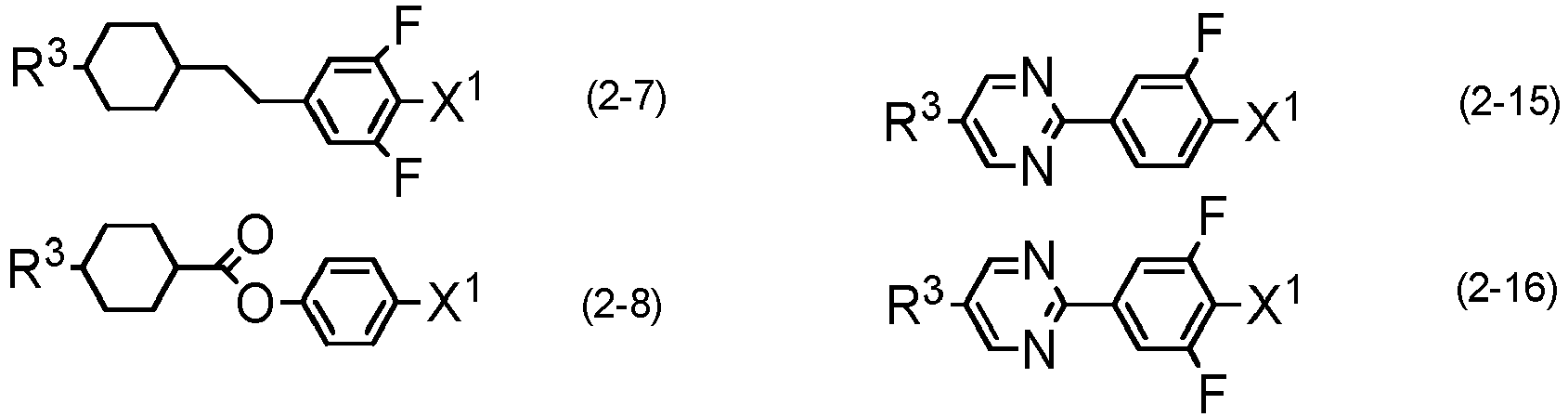


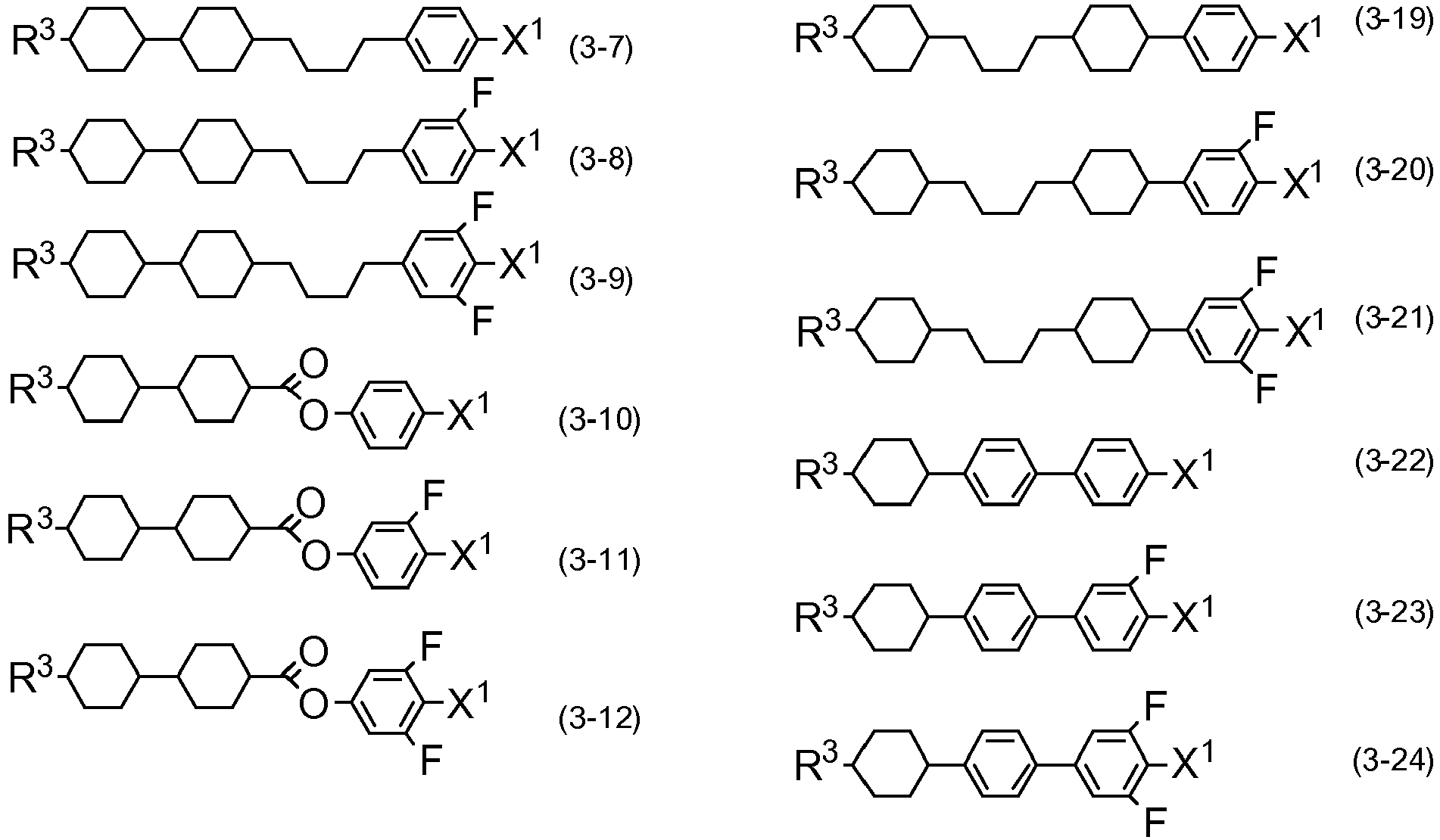


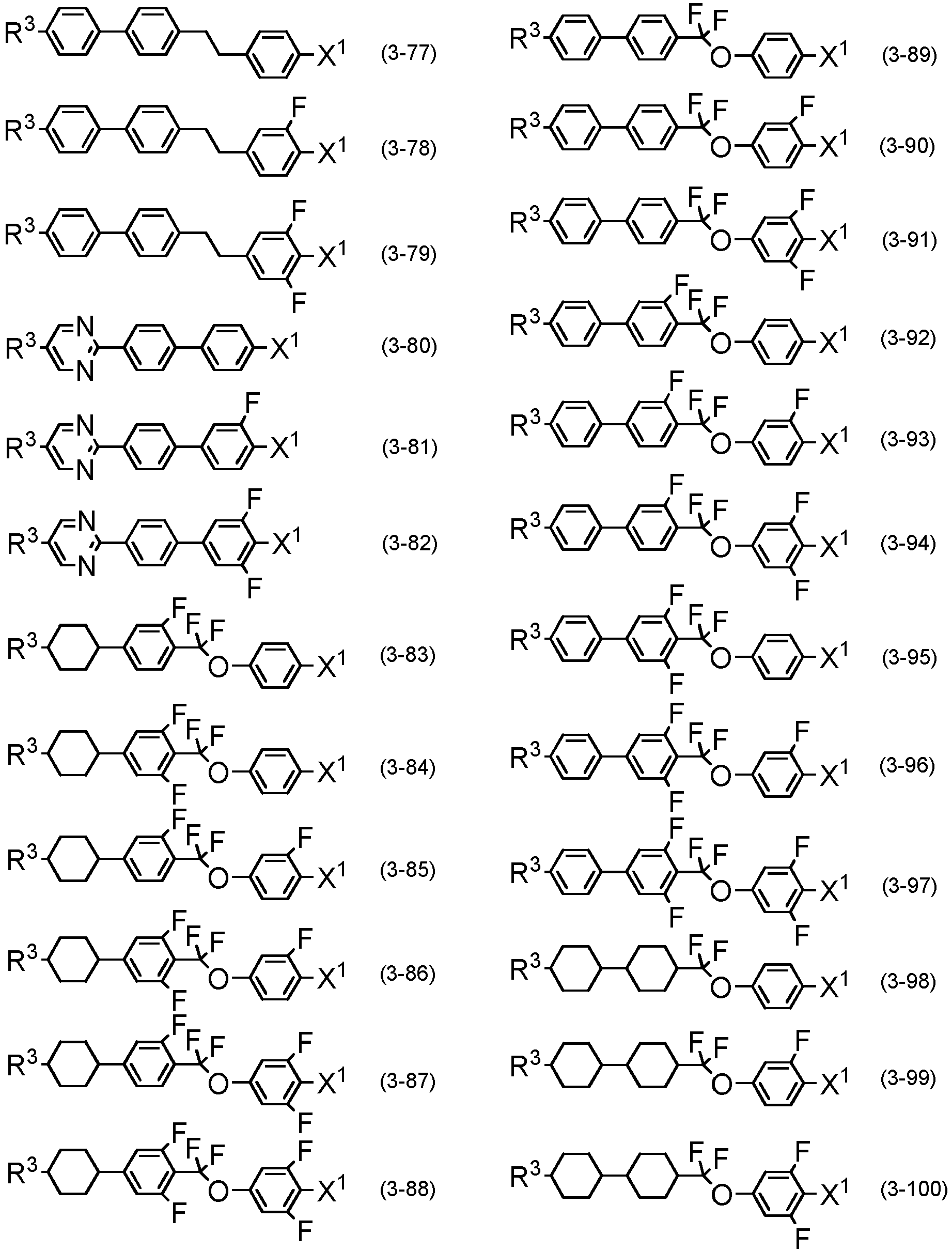


- In these compounds (the component B), the definitions of R3 and X1 are just the same as described previously.
- The component B is used for the preparation of a composition for use in modes of PS-IPS, PS-FFS, PSA-OCB and so forth, since the dielectric anisotropy is positive and the stability to heat, light or the like is quite excellent. The content of the component B is suitably in the range of 1% by weight to 99% by weight, preferably in the range of 10% by weight to 97% by weight, more preferably in the range of 40% by weight to 95% by weight, based on the total weight of the liquid crystal compounds. In this composition, the viscosity can be adjusted by further addition of the compounds (6) to (8) (the component E). It is desirable that the content of the component B should be 30% by weight or less based on the total weight of the liquid crystal compounds when the component B is added to a composition having negative dielectric anisotropy. The elastic constant of the composition can be adjusted and the voltage-transmittance curve of the device can be adjusted by the addition of the component B.
- The component C is the compound (5) where the right-terminal group is -C≡N or -C≡C-C≡N. Desirable examples of the component C include the compounds (5-1) to (5-64).


- In these compounds (the component C), the definitions of R4 and X2 are just the same as described previously.
- The component C is mainly used for the preparation of a composition for use in a PS-TN mode and so forth, since the dielectric anisotropy is positive and its value is large. The dielectric anisotropy of the composition can be increased by the addition of the component C. The component C has the effect of increasing the temperature range of a liquid crystal phase, adjusting the viscosity and adjusting the optical anisotropy. The component C is useful for adjusting the voltage-transmittance curve of the device.
- The content of the component C is suitably in the range of 1% by weight to 99% by weight, preferably in the range of 10% by weight to 97% by weight, more preferably 40% by weight to 95% by weight, based on the total weight of the liquid crystal compounds, in the preparation of a composition for use in a mode of PS-TN or the like. In this composition, the temperature range of a liquid crystal phase, the viscosity, the optical anisotropy, the dielectric anisotropy or the like can be adjusted by the addition of the component E. It is desirable that the content of the component C should be 30% by weight or less based on the total weight of the liquid crystal compounds when the component C is added to a composition having negative dielectric anisotropy. The elastic constant of the composition can be adjusted and the voltage-transmittance curve of the device can be adjusted by the addition of the component C.
- The component E is a compound where two terminal groups are alkyl or the like. Desirable examples of the component E include the compounds (6-1) to (6-11), the compounds (7-1) to (7-19) and the compounds (8-1) to (8-6).









- In these compounds (component E), the definitions of R7 and R8 are just the same as described previously.
- The component E is close to neutral, since the absolute value of the dielectric anisotropy is small. The compound (6) is mainly effective in adjusting the viscosity or adjusting the optical anisotropy. The compounds (7) and (8) are effective in increasing the temperature range of a nematic phase that is caused by an increase in the maximum temperature, or adjusting the optical anisotropy.
- As the content of the component E is increased, the viscosity of the composition decreases. However, the dielectric anisotropy decreases. Thus, it is desirable that the content should increase as long as the required value of the threshold voltage of a device is safisfied. Accordingly, the content of the component E is preferably 30% by weight or more, and more preferably 40% by weight or more based on the total weight of the liquid crystal compounds, in the preparation of a composition for use in modes of PS-IPS, PSA-VA and so forth.
- The preparation of the liquid crystal composition is carried out according to known methods such as the mutual dissolution of necessary components at higher temperatures than room temperature. An additive may be added to the composition depending on its intended use. Examples of the additive are an optically active compound, an antioxidant, an ultraviolet light absorber, a light stabilizer, a thermal stabilizer, an antifoaming agent and so forth. These kinds of additives are well known to a person skilled in the art, and have been described in the literature.
- An optically active compound is effective in inducing a helical structure in liquid crystal molecules, giving a necessary twist angle and thus preventing a reverse twist. A helical pitch can be adjusted by the addition of the optically active compound. Two or more optically active compounds may be added for the purpose of adjusting the temperature dependence of the helical pitch. Desirable examples of the optically active compound include the following compounds (Op-1) to (Op-18). In the compound (Op-18), the ring J is 1,4-cyclohexylene or 1,4-phenylene, and R24 is alkyl having 1 to 10 carbons.





- An antioxidant is effective in maintaining a large voltage holding ratio. Desirable examples of the antioxidant include the compounds (AO-1) and (AO-2) described below; Irganox 415, Irganox 565, Irganox 1010, Irganox 1035, Irganox 3114 and Irganox 1098 (trade name: BASF). An ultraviolet light absorber is effective for preventing a decrease in the maximum temperature. Desirable examples of the ultraviolet light absorber include a benzophenone derivative, a benzoate derivative and a triazole derivative. Specific examples include the compounds (AO-3) and (AO-4) described below; Tinuvin 329, Tinuvin P, Tinuvin 326, Tinuvin 234, Tinuvin 213, Tinuvin 400, Tinuvin 328 and Tinuvin 99-2 (trade name: BASF); and 1,4-diazabicyclo[2.2.2]octane (DABCO).
- A light stabilizer such as an amine with steric hindrance is desirable for maintaining a large voltage holding ratio. Desirable examples of the light stabilizer include the compounds (AO-5) and (AO-6) described below; Tinuvin 144, Tinuvin 765 and Tinuvin 770DF (trade name: BASF). A thermal stabilizer is also effective in maintaining a large voltage holding ratio, and a desirable example includes Irgafos 168 (trade name: BASF). An antifoaming agent is effective in preventing foam formation. Desirable examples of the antifoaming agent include dimethyl silicone oil and methyl phenyl silicone oil.


- In the compound (AO-1) , R25 is alkyl having 1 to 20 carbons, alkoxy having 1 to 20 carbons, -COOR26 or -CH2CH2COOR26; and R26 is alkyl having 1 to 20 carbons. In the compounds (AO-2) and (AO-5), R27 is alkyl having 1 to 20 carbons. In the compound (AO-5), the ring K and the ring L are independently 1,4-cyclohexylene or 1,4-phenylene; v is 0, 1 or 2; and R28 is hydrogen, methyl or O · (oxygen radical).
- The compound (1) has a suitable polymerization reactivity, a high conversion yield and a high solubility in a liquid crystal composition. A liquid crystal composition including a polymer is formed by the polymerization of a liquid crystal composition including the compound (1) and liquid crystal compounds. This is because the compound (1) gives the polymer in the liquid crystal composition by the polymerization. The polymer is effective in inducing pretilt in liquid crystal molecules. It is desirable that the polymerization is carried out at a temperature in which the liquid crystal composition exhibits a liquid crystal phase. The polymerization proceeds on heating or on irradiation with light, for instance. A desirable reaction is the photopolymerization. It is desirable that the photopolymerization should be carried out at 100 °C or less to avoid the thermal polymerization that occurs simultaneously. The polymerization may be carried out under the conditions of an applied electric or magnetic field.
- The polymerization reactivity and the conversion yield of the compound (1) can be adjusted. The compound (1) is suitable for radical polymerization. The compound (1) can smoothly be polymerized by the addition of a polymerization initiator. The amount of the compound (1) remained can be reduced by the optimization of the reaction temperature. Examples of a photo-radical polymerization initiator are TPO, 1173 and 4265 of Darocur series, and 184, 369, 500, 651, 784, 819, 907, 1300, 1700, 1800, 1850 and 2959 of Irgacure series, at Ciba Specialty Chemicals.
- Additional examples of the photo-radical polymerization initiators are 4-methoxyphenyl-2,4-bis(trichloromethyl)triazine, 2-(4-butoxystyryl)-5-trichloromethyl-1,3,4-oxadiazole, 9-phenylacridine, 9,10-benzphenazine, a mixture of benzophenone/Michler's ketone, a mixture of hexaarylbiimidazole/mercaptobenzimidazole, 1-(4-isopropylphenyl)-2-hydroxy-2-methylpropan-1-one, benzyldimethylketal, 2-methyl-1-[4-(methylthio)phenyl]-2-morphorinopropan-1-one, a mixture of 2,4-diethylxanthone/methyl p-dimethylaminobenzoate and a mixture of benzophenone/methyltriethanolamine.
- The polymerization can be carried out by irradiation with ultraviolet light under the conditions of an applied electric field, after a photo-radical polymerization initiator has been added to a liquid crystal composition. However, the unreacted polymerization initiator or degradation products of the polymerization initiator may cause a poor display such as image burn-in to the device. The photopolymerization may be carried out without the polymerization initiator to avoid it. A desirable wavelength of irradiation light is in the range of 150 nm to 500 nm. A more desirable wavelength is in the range of 250 nm to 450 nm, and the most desirable wavelength is in the range of 300 nm to 400 nm.
- The effect of a polymer in a liquid crystal display device is interpreted as follows: A liquid crystal composition is a mixture of liquid crystal compounds, a polymerizable compound and so forth. The liquid crystal molecules are aligned in the direction of an electric field by applying the electric field to the liquid crystal composition. The polymerizable compound is also aligned similarly according to this alignment. Under these conditions, the polymerizable compound is polymerized by irradiation of the liquid crystal composition with ultraviolet light, as a result of which the network of the polymer is formed in the liquid crystal composition. The liquid crystal molecules are stabilized in conditions of alignment in the direction of the electric field by the effect of the network. The effect is maintained even when the electric field is removed. The response time of the device is decreased accordingly.
- It is desirable that the polymerization of the liquid crystal composition should be carried out in a display device. One example is as follows: A display device having two glass substrates equipped with transparent electrodes and alignment films is prepared. A liquid crystal composition in which the compound (1), a liquid crystal compound, an additive and so forth are components is prepared. The composition is poured into the display device. The compound (1) is polymerized by irradiation of the display device with ultraviolet light while an electric field is applied. The polymerization gives a liquid crystal composition including a polymer. A liquid crystal display device having a PSA mode can easily made by this method. Rubbing treatment for the alignment film may be eliminated in this method. Incidentally, a method in which liquid crystal molecules are stabilized without an electric field may be employed.
- A liquid crystal display device having a PSA mode is made when the added amount of the polymerizable compound is in the range of 0.1% by weight to 2% by weight based on the total weight of the liquid crystal compounds. The device having a PSA mode can be driven by means of a driving mode such as an active matrix (AM) or a passive matrix (PM). This kind of device can be applied to any type of a reflection type, a transmission type and a semi-transmission type. A device having a polymer dispersed mode can also be made by increasing the added amount of the polymerizable compound.
- The invention will be explained in more detail based on examples. The invention is not limited by these examples.
- The compound (1) was prepared by the procedures described in Example 1 and so forth. Compounds prepared herein were identified by means of NMR analysis and so forth. The physical properties of the compounds were measured by the methods described below.
- A model DRX-500 apparatus (made by Bruker BioSpin Corporation) was used for measurement. In the measurement of 1 H-NMR, a sample was dissolved in a deuterated solvent such as CDCl3, and measured under the conditions of room temperature, 500 MHz and the accumulation of 16 scans. Tetramethylsilane (TMS) was used as the internal standard. In the measurement of 19F-NMR, CFCl3 was used as the internal standard, and the accumulation of 24 scans was performed. In the explanation of the nuclear magnetic resonance spectra, the symbols s, d, t, q, quin, sex, m and br stand for a singlet, a doublet, a triplet, a quartet, a quintet, a sextet, a multiplet and line-broadening, respectively.
- Model Prominence (LC-20AD; SPD-20A) made by Shimadzu Corporation was used for measurement. A column YMC-Pack ODS-A (length 150 mm, bore 4.6 mm, particle size 5 µm) made by YMC Co., Ltd. was used. Acetonitrile and water were suitably mixed and used as eluent. A UV detector, a RI detector, a Corona detector and so forth were suitably used as a detector. A wavelength for the UV detector was 254 nm. A sample was dissolved in acetonitrile to give a 0.1% by weight solution, and then 1 microliter of the solution was injected into the sample injector. Model C-R7Aplus made by Shimadzu Corporation was used as a recorder.
- Model PharmaSpec UV-1700 made by Shimadzu Corporation was used for measurement. Wavelengths in the range of 190 nm to 700 nm were used for the detection. A sample was dissolved in acetonitrile, giving a 0.01 mmol/L solution, which was placed in a quartz cell (optical path length: 1 cm) and measured.
- A compound itself was used as a sample when the phase structure and the transition temperature (a clearing point, a melting point, a starting temperature of polymerization, and so forth) were measured. A mixture of the compound and mother liquid crystals was used as a sample when physical properties such as the maximum temperature of a nematic phase, viscosity, optical anisotropy and dielectric
- Physical properties were measured according to the following methods. Most were methods described in the JEITA standards (JEITA-ED-2521B) which was deliberated and established by Japan Electronics and Information Technology Industries Association (abbreviated to JEITA), or the modified methods. No thin film transistor (TFT) was attached to a TN device used for measurement.
- A sample was placed on a hot plate of a melting point apparatus (Hot Stage Model FP-52 made by Mettler Toledo International Inc.) equipped with a polarizing microscope, and the phase conditions and their changes were observed with the polarizing microscope while the sample was heated at the rate of 3 °C per minute, and the kinds of phases were specified.
- A Perkin-Elmer differential scanning calorimeter, a Diamond DSC system or a X-DSC7000 high sensitivity differential scanning analyzer made by SII NanoTechnology Inc. was used for measurement. A sample was heated and then cooled at the rate of 3 °C per minute, and the starting point of an endothermic peak or an exothermic peak caused by the phase change of the sample was obtained by means of the extrapolation, and thus the transition temperature was determined. The transition temperature of a compound, from solid to a liquid crystal phase such as a smectic phase or a nematic phase, may be abbreviated to "the minimum temperature of a liquid crystal phase". The transition temperature of a compound from a liquid crystal phase to liquid may be abbreviated to "a clearing point". A melting point and a starting temperature of polymerization of a compound were also measured by use of this apparatus.
- The symbol C stood for crystals. When the kinds of crystals were distinguishable, each was expressed as C1 and C2. The symbols S and N stood for a smectic phase and a nematic phase, respectively. When a smectic A phase, a smectic B phase, a smectic C phase or a smectic F was distinguishable in the smectic phases, it was expressed as SA, SB, SC or SF, respectively. The symbol I stood for a liquid (isotropic). Transition temperatures were expressed as, for example, "C 50.0 N 100.0 Iso", which means that the transition temperature from crystals to a nematic phase was 50.0 °C, and the transition temperature from the nematic phase to a liquid was 100.0 °C.
- A sample was placed on a hot plate in a melting point apparatus equipped with a polarizing microscope and was heated at the rate of 1 °C per minute. The temperature was measured when part of the sample began to change from a nematic phase to an isotropic liquid. A higher limit of the temperature range of a nematic phase may be abbreviated to "the maximum temperature." The symbol TNI means that the sample was a mixture of a compound and mother liquid crystals. The symbol NI means that the sample was a mixture of a compound and the component B, C or E.
- A sample having a nematic phase was kept in freezers at temperatures of 0 °C, -10 °C, -20 °C, -30 °C and -40 °C for 10 days, and then the liquid crystal phases were observed. For example, when the sample maintained the nematic phase at -20 °C and changed to crystals or a smectic phase at -30 °C, TC was expressed as ≤ -20 °C. A lower limit of the temperature range of a nematic phase may be abbreviated to "the minimum temperature."
- An E-type viscometer was used for measurement.
- The measurement was carried out on an Abbe refractometer in which the ocular was equipped with a polarizing plate, using light at a wavelength of 589 nanometers. The surface of the main prism was rubbed in one direction, and then a sample was placed on the main prism. The refractive index (n||) was measured when the direction of the polarized light was parallel to that of the rubbing. The refractive index (n⊥) was measured when the direction of polarized light was perpendicular to that of the rubbing. The value of the optical anisotropy (Δn) was calculated from the equation: Δn = n|| - n⊥.
- A sample of 1.0 milliliter was poured into a vessel equipped with electrodes. DC voltage (10 V) was applied to the vessel, and the DC current was measured after 10 seconds. The specific resistance was calculated from the following equation: (specific resistance) =[(voltage) × (electric capacity of vessel)] /[(DC current) × (dielectric constant in vacuum)].
- A TN device used for measurement had a polyimide-alignment film, and the distance between the two glass substrates (cell gap) was 5 micrometers. A sample was poured into the device, and then the device was sealed with an adhesive curable on irradiation with ultraviolet light. A pulse voltage (60 microseconds at 5 V) was applied to the device and the device was charged. A decreasing voltage was measured for 16.7 milliseconds with a high-speed voltmeter, and the area A between a voltage curve and a horizontal axis in a unit cycle was obtained. The area B was an area without the decrease. The voltage holding ratio was a percentage of the area A to the area B.
- The voltage holding ratio was measured in the same way except for the replacement of 25 °C with 80 °C and the results were shown using the symbol VHR-2.
- The measurement was performed according to the method described in M. Imai, et al., Molecular Crystals and Liquid Crystals, Vol. 259, 37 (1995). A sample was poured into a TN device in which the twist angle was 0 degrees and the distance between the two glass substrates (cell gap) was 5 micrometers. Voltages were applied stepwise to the device in the range of 16 to 19.5 volts, with increments of 0.5 volt. After a period of 0.2 second with no voltage, a voltage was applied repeatedly under the conditions of only one rectangular wave (rectangular pulse; 0.2 second) and of no voltage (2 seconds). The peak current and the peak time of the transient current generated by the applied voltage were measured. The value of rotational viscosity was obtained from the measured values and the calculating equation (8) on page 40 of the paper presented by M. Imai, et al. The value of dielectric anisotropy necessary for this calculation was obtained by use of the device that had been used for the measurement of rotational viscosity, according to the method described below.
- A sample was poured into a TN device in which the distance between the two glass substrates (cell gap) was 9 micrometers and the twist angle was 80 degrees. Sine waves (10 V, 1 kHz) were applied to this device, and the dielectric constant (ε||) in the major axis direction of liquid crystal molecules was measured after 2 seconds. Sine waves (0.5 V, 1 kHz) were applied to the device and the dielectric constant (ε⊥) in the minor axis direction of the liquid crystal molecules was measured after 2 seconds. The value of dielectric anisotropy was calculated from the equation: Δε = ε|| - ε⊥.
- A LCR meter Model HP 4284-A made by Yokokawa Hewlett-Packard, Ltd. was used for measurement. A sample was poured into a homogeneous device in which the distance between the two glass substrates (cell gap) was 20 micrometers. Electric charges of 0 volts to 20 volts were applied to the device, and the electrostatic capacity and the applied voltage were measured. The measured values of the electric capacity (C) and the applied voltage (V) were fitted to the equation (2.98) and the equation (2.101) in page 75 of "Ekisho Debaisu Handobukku" (Liquid Crystal Device Handbook, in English; The Nikkan Kogyo Shimbun, Ltd., Japan) and the values of K11 and K33 were obtained from the equation (2.99). Next, the value of K22 was calculated from the equation (3.18) in page 171 and the values of K11 and K33 thus obtained. The elastic constant K was an average value of K11, K22 and K33.
- An LCD evaluation system Model LCD-5100 made by Otsuka Electronics Co., Ltd. was used for measurement. The light source was a halogen lamp. A sample was poured into a TN device having a normally white mode, in which the distance between the two glass substrates (cell gap) was about 4.45/Δn (micrometers) and the twist angle was 80 degrees. Voltages applied to the device (32 Hz, rectangular waves) were increased stepwise from 0 V to 10 V, with increments of 0.02 V. During the increase, the device was irradiated with light in the perpendicular direction, and the amount of light passing through the device was measured. A voltage-transmittance curve was drawn, in which the maximum amount of light corresponded to 100% transmittance and the minimum amount of light corresponded to 0% transmittance. The threshold voltage was voltage at 90% transmittance.
- An LCD evaluation system Model LCD-5100 made by Otsuka Electronics Co., Ltd. was used for measurement. The light source was a halogen lamp. The low-pass filter was set at 5 kHz. A sample was poured into a TN device having a normally white mode, in which the cell gap between the two glass substrates was 5.0 micrometers and the twist angle was 80 degrees. Rectangular waves (60 Hz, 5 V, 0.5 second) were applied to this device. The device was simultaneously irradiated with light in the perpendicular direction, and the amount of light passing through the device was measured. The maximum amount of light corresponded to 100% transmittance, and the minimum amount of light corresponded to 0% transmittance. Rise time (τr; millisecond) was the time required for a change from 90% to 10% transmittance. Fall time (τf; millisecond) was the time required for a change from 10% to 90% transmittance. The response time was the sum of the rise time and the fall time thus obtained.
-

- (1,1'-Biphenyl)-4,4'-diol (T-1) (200 g, 1.07 mol) was dissolved in DMF (2000 ml), and tetrabutylammonium bromide (34.49 g, 0.107 mol), potassium carbonate (355 g, 2.57 mol) and 2-bromo-1,1-diethoxyethane (506 g, 2.57 mol) were added, and then the mixture was heated to reflux for 5 hours. After the reaction mixture had been allowed to cool to room temperature, it was poured into water (1000 ml), and the mixture was extracted with toluene (500 ml×3). The extract was washed with brine (500 ml×3), dried over anhydrous magnesium sulfate, and concentrated under reduced pressure. The residue was purified by silica gel chromatography (toluene: ethyl acetate= 19:1, by volume), and then recrystallized from heptane to give the compound (T-2) (434 g, 1.07 mol, 100%).
- The compound (T-2) (434 g, 1.07 mol) was dissolved in chloroform (4000 ml), and then trifluoroacetic acid (918 ml, 12.36 mol) was added dropwise at room temperature. After 16 hours, the reaction mixture was poured into water, and trifluoroacetic acid was treated by the addition of sodium bicarbonate. The mixture was extracted with ethyl acetate (500 ml×3). The extract was washed with brine (1000 ml), dried over anhydrous magnesium sulfate, and concentrated under reduced pressure to give the compound (T-3) (224 g, 0.828 mol, 81%).
- The compound (T-3) (224 g, 0.828 mol) was dissolved in toluene (1000 ml), and methacrylic anhydride (1279 g, 8.3 mol), sodium metacrylate (17.93 g, 0.166 mol), potassium carbonate (573.5 g, 415 mol) and DMF (100 ml) were added, and then the mixture was heated to reflux for 21 hours. After the reaction mixture had been allowed to cool to room temperature, it was filtrated through Celite, and then concentrated under reduced pressure. The residue was purified by silica gel chromatography (heptane: ethyl acetate= 6: 1, by volume), and by recrystallization (heptane: ethyl acetate= 6:1) to give the compound No. 26 (67.5 g, 0.166 mol, 20%).
- 1H-NMR (CDCl3; δ ppm): 7.50(d, 4H), 7.12(d, 4H), 6.95(d, 2H), 6.29(s, 2H), 6.18(d, 2H), 5.70 (s, 2H) and 2.01(s, 6H).
- The physical properties of the compound No. 26 were as follows: Melting point, 98.2 °C; starting temperature of polymerization, 236 °C.
-

- The compound No. 1 was obtained in the same manner as in Example 1, except that acrylic anhydride and sodium acrylate were used in the third step.
- 1H-NMR (CDCl3; δ ppm): 7.52(d, 4H), 7.12(d, 4H), 6.98(d, 2H), 6.58 (dd, 2H), 6.26(dd, 2H), 6.19(d, 2H) and 5.97 (dd, 2H).
- The physical properties of the compound No. 1 were as follows: Melting point, 121.1 °C.
-

- Melting point: 106.8 °C.
1H-NMR (CDCl3; δ ppm): 7.59 (t, 4H), 7.47 (t, 1H), 7.40(dd, 1H), 7.35 (dd, 1H), 7.15 (d, 4H), 6.99(dd, 2H), 6.58 (dt, 2H), 6.26(dd, 2H), 6.21(t, 2H) and 5.98 (d, 2H). -

- Phase transition temperature: C 117.9 N 123.3 I.
1H-NMR (CDCl3; δ ppm): 7.58(t, 4H), 7.46(t, 1H), 7.41(dd, 1H), 7.35(dd, 1H), 7.15 (d, 4H), 6.97(dd, 2H), 6.30(d, 2H), 6.21(t, 2H), 5.72 (s, 2H) and 2.01(s, 6H). -

- Melting point: 101.0 °C
1H-NMR (CDCl3; δ ppm): 8.05(d, 2H), 7.47(t, 2H), 7.12(d, 2H), 7.08 (d, 2H), 6.63(d, 1H), 6.59 (d, 1H), 6.33(d, 2H), 6.29(dd, 2H) and 6.00 (dd, 2H). - The compounds No. 1 to No. 195 that will be described below can be prepared by synthetic methods similar to those described in Example 1.









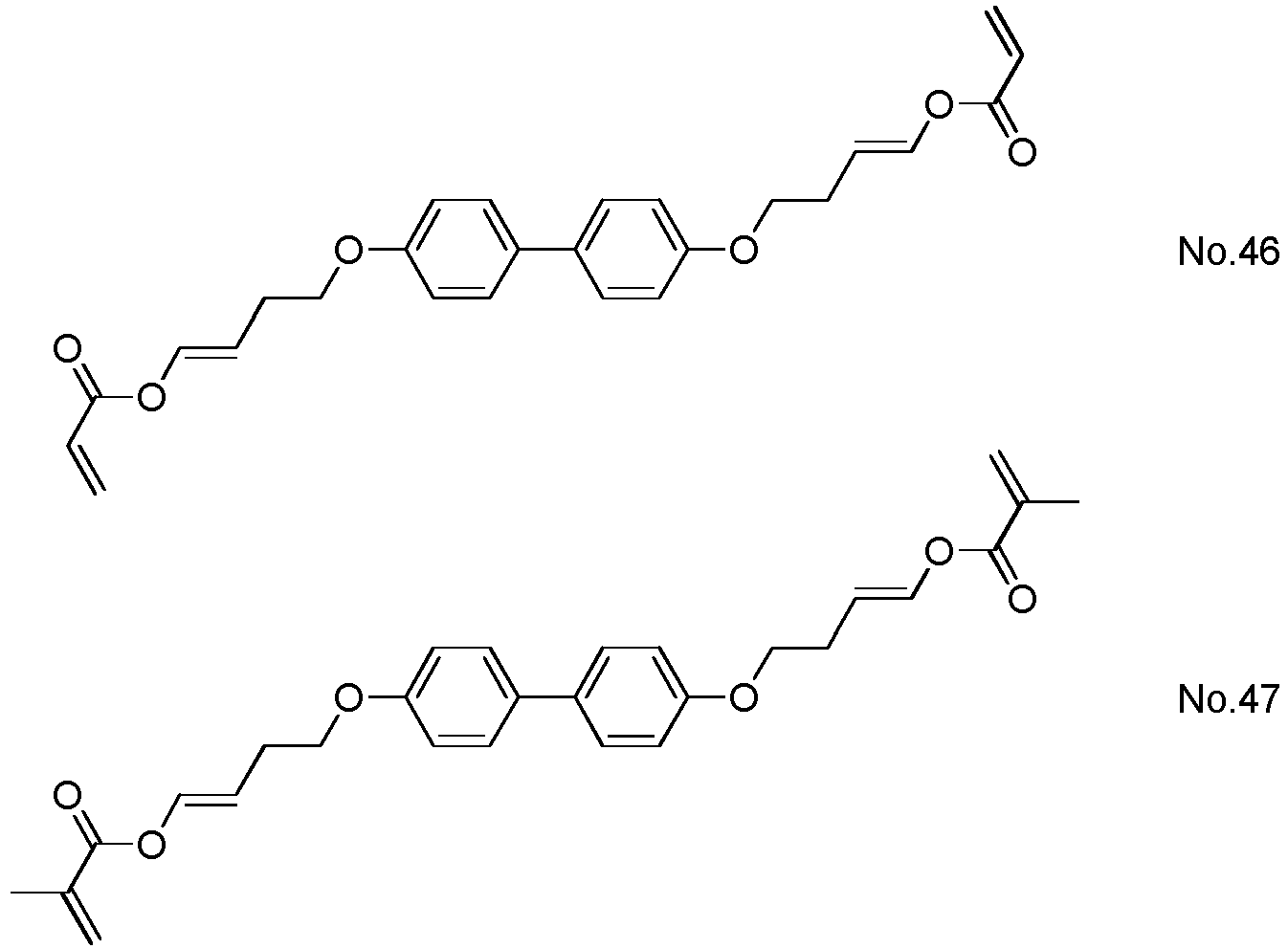


















- The compounds described in Examples were expressed in terms of symbols according to the definition in Table 1 described below. In Table 1, the configuration of 1,4-cyclohexylene is trans. The parenthesized number next to the symbols in Example indicates the number of the compound. The symbol (-) means any other liquid crystal compound. The contents (percentage) of liquid crystal compounds mean the percentages by weight (% by weight) based on the total weight of the liquid crystal compounds. Last, the values of physical properties of the liquid crystal composition were summarized. The physical properties were measured according to the method described above, and measured values themselves were reported (without extrapolation).
Table 1. Method of Description of Compound using Symbols R-(A1)-Z1-.....-Zn-(An)-R' 1) Left-terminal Group R- Symbol 4) Ring Structure -An- Symbol CnH2n+1- n- 
H CnH2n+1O- nO- CmH2m+1OCnH2n- mOn- 
B CH2=CH- V- CnH2n+1-CH=CH- nV- 
B(F) CH2=CH-CnH2n- Vn- CmH2m+1-CH=CH-CnH2n- mVn- CF2=CH- VFF- 
B(2F) CF2=CH-CnH2n- VFFn- 2) Right-terminal Group -R' Symbol -CnH2n+1 -n 
B(F,F) OCnH2n+1 -COOCH3 -On -COOCH3 -EMe -CH=CH2 -V 
B(2F,5F) -CH=CH-CnH2n+1 -Vn -CnH2n-CH=CH2 -nV -CmH2m -CH=CH-CnH2n+1 -mVn 
B(2F,3F) -CH=CF2 -VFF -F -F -Cl -CL 
B(2F,3CL) -OCF3 -OCF3 -OCF2H -OCF2H -CF3 -CF3 
G -CF=CH-CF3 -FVCF3 -C≡N -C 3) Bonding Group -Zn- Symbol 
dh -CnH2n- n -COO- E 
Dh -CH=CH- V -CH2O- 1O -OCH2- O1 
Cro(7F,8F) -CF2O- X -C≡C- T 5) Examples of Description Example 1. 3-BB(F,F)XB(F,F)-F Example 2. 3HBB(2F,3F)-O2 

Example 3. 3-HH-4 Example 4. 3HBB(F,F)-F 

-
5-HB-CL (2-2) 16% 3-HH-4 (6-1) 12% 3-HH-5 (6-1) 4% 3-HHB-F (3-1) 4% 3-HHB-CL (3-1) 3% 4-HHB-CL (3-1) 4% 3-HHB(F)-F (3-2) 10% 4-HHB(F)-F (3-2) 9% 5-HHB(F)-F (3-2) 9% 7-HHB(F)-F (3-2) 8% 5-HBB(F)-F (3-23) 4% 1O1-HBBH-5 (8-1) 3% 3-HHBB(F,F)-F (4-6) 2% 4-HHBB(F,F)-F (4-6) 3% 5-HHBB(F,F)-F (4-6) 3% 3-HH2BB(F,F)-F (4-15) 3% 4-HH2BB(F,F)-F (4-15) 3% - The following compound was added in the ratio of 0.3% by weight based on the preceding composition.

-
3-HHB(F,F)-F (3-3) 9% 3-H2HB(F,F)-F (3-15) 8% 4-H2HB(F,F)-F (3-15) 8% 5-H2HB(F,F)-F (3-15) 8% 3-HBB(F,F)-F (3-24) 21% 5-HBB(F,F)-F (3-24) 20% 3-H2BB(F,F)-F (3-27) 10% 5-HHBB(F,F)-F (4-6) 3% 5-HHEBB-F (4-17) 2% 3-HH2BB(F,F)-F (4-15) 3% 1O1-HBBH-4 (8-1) 4% 1O1-HBBH-5 (8-1) 4% - The following compound was added in the ratio of 0.3% by weight based on the preceding composition.

-
5-HB-F (2-2) 12% 6-HB-F (2-2) 9% 7-HB-F (2-2) 7% 2-HHB-OCF3 (3-1) 7% 3-HHB-OCF3 (3-1) 7% 4-HHB-OCF3 (3-1) 7% 5-HHB-OCF3 (3-1) 5% 3-HH2B-OCF3 (3-4) 4% 5-HH2B-OCF3 (3-4) 4% 3-HHB(F,F)-OCF2H (3-3) 4% 3-HHB(F,F)-OCF3 (3-3) 5% 3-HH2B(F)-F (3-5) 3% 3-HBB(F)-F (3-23) 10% 5-HBB(F)-F (3-23) 10% 5-HBBH-3 (8-1) 3% 3-HB(F)BH-3 (8-2) 3% - The following compound was added in the ratio of 0.3% by weight based on the preceding composition.

-
5-HB-CL (2-2) 11% 3-HH-4 (6-1) 8% 3-HHB-1 (7-1) 5% 3-HHB(F,F)-F (3-23) 8% 3-HBB(F,F)-F (3-24) 20% 5-HBB(F,F)-F (3-24) 15% 3-HHEB(F,F)-F (3-12) 10% 4-HHEB(F,F)-F (3-12) 3% 5-HHEB(F,F)-F (3-12) 3% 2-HBEB(F,F)-F (3-39) 3% 3-HBEB(F,F)-F (3-39) 5% 5-HBEB(F,F)-F (3-39) 3% 3-HHBB(F,F)-F (4-6) 6% - The following compound was added in the ratio of 0.3% by weight based on the preceding composition.

-
3-HB-CL (2-2) 6% 5-HB-CL (2-2) 4% 3-HHB-OCF3 (3-1) 5% 3-H2HB-OCF3 (3-13) 5% 5-H4HB-OCF3 (3-19) 15% V-HHB(F)-F (3-2) 5% 3-HHB(F)-F (3-2) 5% 5-HHB(F)-F (3-2) 5% 3-H4HB(F,F)-CF3 (3-21) 8% 5-H4HB(F,F)-CF3 (3-21) 10% 5-H2HB(F,F)-F (3-15) 5% 5-H4HB(F,F)-F (3-21) 7% 2-H2BB(F)-F (3-26) 5% 3-H2BB(F)-F (3-26) 10% 3-HBEB(F,F)-F (3-29) 5% - The following compound was added in the ratio of 0.3% by weight based on the preceding composition.

-
5-HB-CL (2-2) 17% 7-HB(F,F)-F (2-4) 3% 3-HH-4 (6-1) 10% 3-HH-5 (6-1) 5% 3-HB-O2 (6-5) 15% 3-HHB-1 (7-1) 8% 3-HHB-O1 (7-1) 5% 2-HHB(F)-F (3-2) 7% 3-HHB(F)-F (3-2) 7% 5-HHB(F)-F (3-2) 7% 3-HHB(F,F)-F (3-3) 6% 3-H2HB(F,F)-F (3-15) 5% 4-H2HB(F,F)-F (3-15) 5% - The following compound was added in the ratio of 0.3% by weight based on the preceding composition.

-
5-HB-CL (2-2) 3% 7-HB(F)-F (2-3) 7% 3-HH-4 (6-1) 9% 3-HH-EMe (6-2) 23% 3-HHEB-F (3-10) 8% 5-HHEB-F (3-10) 8% 3-HHEB(F,F)-F (3-12) 10% 4-HHEB(F,F)-F (3-12) 5% 5-HGB(F,F)-F (3-103) 6% 3-H2GB(F,F)-F (3-106) 5% 5-GHB(F,F)-F (3-109) 7% 3-GB(F,F)XB(F,F)-F (3-118) 4% 5-GB(F)B(F,F)XB(F,F)-F (4-56) 5% - The following compound was added in the ratio of 0.15% by weight based on the preceding composition, and


-
3-HB-02 (6-5) 10% 5-HB-02 (6-5) 6% 5-HB-CL (2-2) 13% 3-HBB(F,F)-F (3-24) 7% 3-PyB(F)-F (5-9) 10% 5-PyB(F)-F (5-9) 10% 3-PyBB-F (7-11) 10% 4-PyBB-F (7-11) 10% 5-PyBB-F (7-11) 10% 5-HBB(F)B-2 (7-6) 7% 5-HBB(F)B-3 (7-6) 7% - The following compound was added in the ratio of 0.3% by weight based on the preceding composition.

-
3-HB-C (5-1) 5% 3-BEB(F)-C (5-14) 4% 1V2-BEB(F)-C (5-14) 12% 3-HHB-C (5-28) 6% 3-HHB(F)-C (5-29) 6% 3-HB-O2 (6-5) 11% 5-HB-O2 (6-5) 7% 2-HH-3 (6-1) 11% 3-HH-4 (6-1) 10% 3-HHB-1 (7-1) 8% 3-HHB-O1 (7-1) 4% 3-H2BTB-2 (7-17) 4% 3-H2BTB-3 (7-17) 4% 3-H2BTB-4 (7-17) 4% 3-HB(F)TB-2 (7-18) 4% - The following compound was added in the ratio of 0.3% by weight based on the preceding composition.

-
3-HBB(F,F)XB(F,F)-F (4-38) 10% 4-BB(F)B(F,F)XB(F,F)-F (4-47) 8% 5-BB(F)B(F,F)XB(F,F)-F (4-47) 3% 3-HH-O1 (6-1) 3% V-HH-3 (6-1) 39% 1V-HH-3 (6-1) 6% V-HHB-1 (7-1) 5% 1-BB(F)B-2V (7-6) 5% 5-HBB(F)B-2 (8-5) 4% 3-HXB(F,F)-F (2-13) 4% 3-HHXB(F,F)-CF3 (3-100) 6% 3-BB(F,F)XB(F,F)-F (3-97) 7% - The following compound was added in the ratio of 0.15% by weight based on the preceding composition, and


-
3-HH-V (6-1) 23% 3-HH-V1 (6-1) 3% 3-HB-O2 (6-5) 8% 3-HHB-1 (7-1) 10% 3-BB (F) B-5 (7-6) 8% 3-HHXB (F, F) -F (3-100) 10% 3-BB(F,F)XB(F,F)-F (3-97) 6% 3-GB(F,F)XB(F,F)-F (3-118) 7% 3-HBBXB (F, F) -F (4-32) 5% 3-HBB (F, F) XB (F, F) -F (4-38) 6% 4-GB(F)B(F,F)XB(F,F)-F (4-56) 5% 3-BB(F)B(F,F)XB(F)-F (4-46) 3% 4-BB(F)B(F,F)XB(F,F)-F (4-47) 6% - The following compound was added in the ratio of 0.15% by weight based on the preceding composition, and


-

- Colorless crystals of the comparative compound (R-1) were obtained by the preparation according to the reaction formula described above.
- 1H-NMR (DMSO-d; δ ppm): 7.24(d, 4H), 6.96(d, 4H), 6.41(d, 2H), 6.26(d, 2H) and 1.98 (s, 6H).
- The physical properties of the comparative compound (R-1) were as follows: Melting point, 150 °C, starting temperature of polymerization, 152 °C.
- The compound No. 26 was added to the liquid crystal composition A in the ratio of 0.3% by weight, which was heated to 50 °C for 30 minutes. The resulting solution was allowed to stand at room temperature for 2 days. It was then observed visually whether or not the crystals were deposited. On the other hand, the comparative compound (R-1) was observed in the same way. Table 2 shows the results. in the symbols in Table 2, "○" shows that no crystals were deposited, and "×" shows that crystals were deposited. From Table 2, it is found that the polymerizable compound of the invention is excellent in solubility in the liquid crystal composition A. Incidentally, the component and ratio of the liquid crystal composition A were as follows.
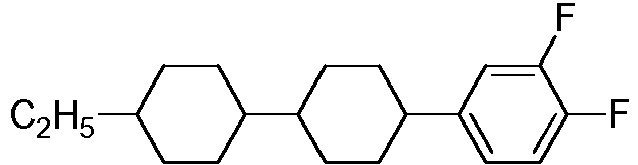
33.3% 
33.3% 
33.4% Table 2. Comparison of solubility in a liquid crystal composition Compound Chemical formula Solubility at room temperature for 2 days Compound No.26 
○ Comparative compound (R-1) 
× - The polymerizable compound of the invention has a suitable polymerization reactivity, a high conversion yield and a high solubility in a liquid crystal composition. The liquid crystal composition of the invention includes this compound and has physical properties such as a high maximum temperature of a nematic phase, a low minimum temperature of a nematic phase, a small viscosity, a suitable optical anisotropy, a large dielectric anisotropy, a suitable elastic constant, a large specific resistance and a suitable pretilt. The composition has a suitable balance between at least two of the physical properties. The polymerizable compound gives a polymer in the composition. The composition is suitable for a liquid crystal display device having a PSA mode. A liquid crystal display device containing the composition has a wide temperature range in which the device can be used, a short response time, a large voltage holding ratio, a low threshold voltage, a large contrast ratio and a long service life. Accordingly, the device can widely be utilized for the display of personal computers, televisions and so forth.
Claims (20)
- A compound represented by formula (1):

the ring A1, the ring A2, the ring A3 and the ring A4 are independently 1,4-cyclohexylene, 1,4-cyclohexenylene, 1,4-phenylene, naphthalene-1,2-diyl, naphthalene-1,3-diyl, naphthalene-1,4-diyl, naphthalene-1,5-diyl, naphthalene-1,6-diyl, naphthalene-1,7-diyl, naphthalene-1,8-diyl, naphthalene-2,3-diyl, naphthalene-2,6-diyl, naphthalene-2,7-diyl, tetrahydropyran-2,5-diyl, 1,3-dioxane-2,5-diyl, pyrimidine-2,5-diyl or pyridine-2,5-diyl, and in these groups at least one hydrogen may be replaced by halogen, alkyl having 1 to 12 carbons or alkyl having 1 to 12 carbons in which at least one hydrogen has been replaced by halogen;
Z1 and Z2 are independently alkylene having 1 to 10 carbons, and in the alkylene at least one -CH2 - may be replaced by -0-, -COO- or -OCOO- and at least one -CH2-CH2- may be replaced by -CH=CH- or -C ≡C-;
G1 and G2 are independently a single bond or -0-;
L1 , L2 and L3 are independently a single bond, -COO- or -CH=CH-; s, t and u are independently 0 or 1;
P1 and P2 are independently a group selected from groups represented by formulas (P-1), (P-2) and (P-3):
at least one of Z1 and Z2 has an unsaturated bond when G1 and G2 are -0-, and P1 and P2 are a group represented by formula (P-1) ;
at least one of Z1 and Z2 has the unsaturated bond when s and t are 1, u is 0, G1 and G2 are -0-, the ring A1 and the ring A4 are 1,4-phenylene, the ring A2 is 1,4-phenylene in which at least one hydrogen has been replaced by chlorine, methyl or trifluoromethyl, and P1 and P2 a group represented by formula (P-2);
at least one of Z1 and Z2 has the unsaturated bond when L1, L2 and L3 are -COO-; and
at least one of Z1 and Z2 has the unsaturated bond when s is 1, t and u are 0, the ring A1 and the ring A4 are 1, 4-phenylene, G1 and G2 are a single bond, and P1 and P2 are a group represented by formula (P-1). - The compound according to claim 1, wherein at least one of Z1 and Z2 has an unsaturated bond.
- The compound according to claim 1 or 2, the compound is represented by formula (1-1) or (1-2):
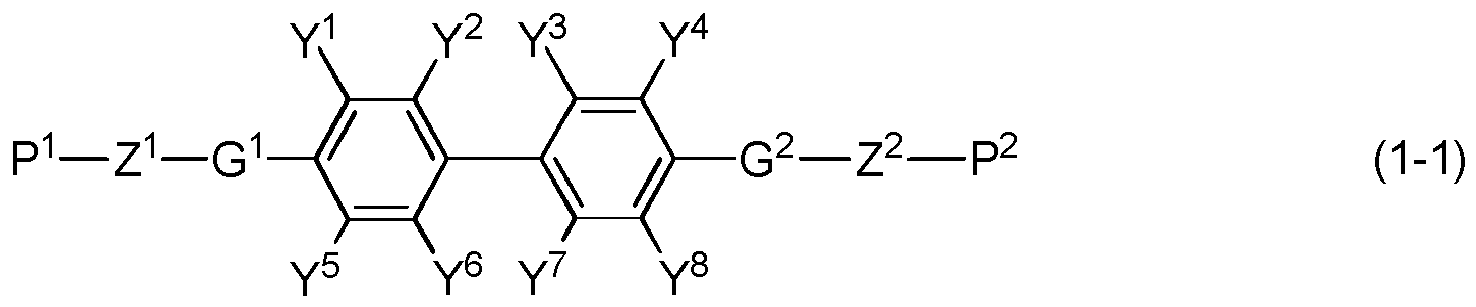

Z1 and Z2 are independently alkylene having 1 to 10 carbons, and in the alkylene at least one -CH2- may be replaced by -0-, -COO- or -OCOO- and at least one -CH2-CH2- may be replaced by -CH=CH- or -C ≡C-;
G1 and G2 are independently a single bond or -0-;
Y1 to Y12 are independently hydrogen, fluorine, methyl or trifluoromethyl;
P1 and P2 are independently a group selected from groups represented by formulas (P-1), (P-2) and (P-3):
in formulas (1-1) and (1-2), at least one of Z1 and Z2 has an unsaturated bond when G1 and G2 are -0-, and P1 and P2 are a group represented by formula (P-1);
in formula (1-1), at least one of Z1 and Z2 has the unsaturated bond when all of Y1 to Y8 is hydrogen, G1 and G2 are a single bond, and P1 and P2 are a group represented by formula (P-1); and
in formula (1-2), at least one of Z1 and Z2 has the unsaturated bond when G1 and G2 are -0-, all of Y1 , Y2 and Y5 to Y1 are hydrogen, at least one of Y3 or Y4 is methyl or trifluoromethyl, and P1 and P2 is a group represented by formula (P-2). - The compound according to claim 3, wherein at least one of Z1 and Z2 has an unsaturated bond.
- The compound according to claim 3, wherein both Z1 and Z2 have an unsaturated bond.
- The compound according to claim 4 or 5, wherein P1 and P2 are a group represented by formula (P-1), M1 is hydrogen or methyl, and M2 is hydrogen.
- The compound according to claim 1, wherein the compound is represented by formula (1-1-1), formula (1-2-1) or formula (1-3):



- The compound according to claim 1, wherein the compound is represented by formula (1-1-2), formula (1-2-2) or formula (1-3-1):


- A polymer obtained by the polymerization of a compound according to any one of claims 1 to 8.
- A liquid crystal composition including at least one selected from the group of compounds according to any one of claims 1 to 8 and polymers according to claim 9.
- A liquid crystal composition including at least two selected from the group of compounds according to any one of claims 1 to 8 and polymers according to claim 9.
- A liquid crystal composition, wherein a first component is at least one compound selected from the group of compounds represented by formula (1) according to claim 1, and the composition further includes a polymerizable compound excluding formula (1) according to claim 1.
- The liquid crystal composition according to any one of claims 10 to 12, further including at least one compound selected from the group of compounds represented by formulas (2), (3) and (4):


R3 is alkyl having 1 to 10 carbons or alkenyl having 2 to 10 carbons, and in these groups at least one hydrogen may be replaced by fluorine and at least one -CH2- may be replaced by -0-;
X1 is fluorine, chlorine, -OCF3, -OCHF2, -CF3, -CHF2, -CH2 F, -OCF2CHF2 or -OCF2CHFCF3;
the ring B1, the ring B2 and the ring B3 are independently 1,4-cyclohexenylene, 1,3-dioxane-2,5-diyl, pyrimidine-2,5-diyl, tetrahydropyran-2,5-diyl or 1,4-phenylene in which at least one hydrogen may be replaced by fluorine;
W1 and W2 are independently -(CH2)2-, - (CH2)4 -, -COO-, -CF2O-, -OCF2-, -CH=CH-, -C≡C-, -CH2O- or a single bond; and
Q1 and Q2 are independently hydrogen or fluorine. - The liquid crystal composition according to any one of claims 10 to 12, further including at least one compound selected from the group of compounds represented by formula (5):

R4 is alkyl having 1 to 10 carbons or alkenyl having 2 to 10 carbons, and in these groups at least one hydrogen may be replaced by fluorine and at least one -CH2- may be replaced by -0-;
X2 is -C≡N or -C≡C-C≡N;
the ring C1, the ring C2 and the ring C3 are independently 1,4-cyclohexenylene, 1,4-phenylene in which at least one hydrogen may be replaced by fluorine, 1,3-dioxane-2,5-diyl, tetrahydropyran-2,5-diyl or pyrimidine-2,5-diyl;
W3 is -(CH2)2-, -COO-, -CF2O-, -OCF2-, -C≡C-, -CH2O- or a single bond;
Q3 and Q4 are independently hydrogen or fluorine; and
q is 0, 1 or 2, and r is 0 or 1. - The liquid crystal composition according to any one of claims 10 to 12, further including at least one compound selected from the group of compounds represented by formulas (6), (7) and (8):


R7 and R8 are independently alkyl having 1 to 10 carbons or alkenyl having 2 to 10 carbons, and in these groups at least one hydrogen may be replaced by fluorine and at least one -CH2- may be replaced by -0-;
the ring E1, the ring E2 and the ring E3 are independently 1,4-cyclohexenylene, pyrimidine-2,5-diyl, 1,4-phenylene, 2-fluoro-1,4-phenylene or 2,5-difluoro-1,4-phenylene; and
W4 and W5 are independently -C≡C-, -COO-, -(CH2)2-, -CH=CH- or a single bond. - The liquid crystal composition according to claim 13, further including at least one compound selected from the group of compounds represented by formulas (6), (7) and (8) according to claim 15.
- The liquid crystal composition according to claim 14, further including at least one compound selected from the group of compounds represented by formulas (6), (7) and (8) according to claim 15.
- A liquid crystal display device containing at least one selected from the group of compounds according to any one of claims 1 to 8 and polymers according to claim 9.
- A liquid crystal display device containing the liquid crystal composition according to any one of claims 10 to 17.
- Use of at least one selected from the group of compounds according to any one of claims 1 to 8, polymers according to claim 9 and liquid crystal compositions according to any one of claims 10 to 17, in a liquid crystal display device.
Applications Claiming Priority (3)
| Application Number | Priority Date | Filing Date | Title |
|---|---|---|---|
| JP2012151718 | 2012-07-05 | ||
| JP2012257245 | 2012-11-26 | ||
| PCT/JP2013/062233 WO2014006962A1 (en) | 2012-07-05 | 2013-04-25 | Polymerizable compound, liquid crystal composition, and liquid crystal display element |
Publications (3)
| Publication Number | Publication Date |
|---|---|
| EP2871175A1 true EP2871175A1 (en) | 2015-05-13 |
| EP2871175A4 EP2871175A4 (en) | 2016-03-09 |
| EP2871175B1 EP2871175B1 (en) | 2017-11-08 |
Family
ID=49877822
Family Applications (1)
| Application Number | Title | Priority Date | Filing Date |
|---|---|---|---|
| EP13813966.2A Not-in-force EP2871175B1 (en) | 2012-07-05 | 2013-04-25 | Polymerizable compound, liquid crystal composition, and liquid crystal display device |
Country Status (7)
| Country | Link |
|---|---|
| US (1) | US8961823B2 (en) |
| EP (1) | EP2871175B1 (en) |
| JP (1) | JP6146412B2 (en) |
| KR (1) | KR102008308B1 (en) |
| CN (1) | CN104379554B (en) |
| TW (1) | TWI583777B (en) |
| WO (1) | WO2014006962A1 (en) |
Cited By (1)
| Publication number | Priority date | Publication date | Assignee | Title |
|---|---|---|---|---|
| TWI749118B (en) * | 2016-12-08 | 2021-12-11 | 德商馬克專利公司 | Polymerisable compounds and the use thereof in liquid-crystal displays |
Families Citing this family (29)
| Publication number | Priority date | Publication date | Assignee | Title |
|---|---|---|---|---|
| TWI550072B (en) * | 2012-04-02 | 2016-09-21 | 捷恩智股份有限公司 | Liquid crystal composition and usage thereof, and liquid crystal display element |
| US9150787B2 (en) * | 2012-07-06 | 2015-10-06 | Jnc Corporation | Liquid crystal composition and liquid crystal display device |
| WO2014194920A1 (en) * | 2013-06-04 | 2014-12-11 | Danmarks Tekniske Universitet | An optical device capable of providing a structural color, and a corresponding method of manufacturing such a device |
| KR101621161B1 (en) | 2013-09-30 | 2016-05-13 | 주식회사 엘지화학 | Preparing method for thin polarizer, thin polarizer and polarizing plate comprising the same |
| CN105683831B (en) | 2013-10-30 | 2018-12-28 | Dic株式会社 | Liquid crystal display element |
| JP5850286B2 (en) * | 2013-11-12 | 2016-02-03 | Dic株式会社 | Liquid crystal display element |
| JP6337497B2 (en) * | 2014-02-18 | 2018-06-06 | Dic株式会社 | Polymerizable compound and optical anisotropic body |
| KR20150109543A (en) * | 2014-03-19 | 2015-10-02 | 삼성디스플레이 주식회사 | Liquid crystal composition and liquid crystal display device comprising the same |
| US10414980B2 (en) | 2014-07-29 | 2019-09-17 | Dic Corporation | Liquid-crystal display |
| JP6103333B2 (en) | 2014-07-29 | 2017-03-29 | Dic株式会社 | Liquid crystal display element |
| JP6451549B2 (en) | 2014-08-11 | 2019-01-16 | Jnc株式会社 | Polymerizable compound and liquid crystal display device |
| KR102539268B1 (en) * | 2015-02-10 | 2023-06-07 | 메르크 파텐트 게엠베하 | Liquid crystal medium |
| WO2016177445A1 (en) * | 2015-05-04 | 2016-11-10 | Merck Patent Gmbh | Liquid-crystal medium |
| JP6809459B2 (en) * | 2015-07-23 | 2021-01-06 | Jnc株式会社 | Liquid crystal composition and liquid crystal display element |
| KR20170074178A (en) * | 2015-12-21 | 2017-06-29 | 제이엔씨 주식회사 | Polymerizable liquid crystal compound, composition, liquid crystal polymerized film-kinds thereof and use thereof |
| CN107286947B (en) * | 2016-04-11 | 2020-08-07 | 江苏和成显示科技有限公司 | Polymerizable liquid crystal composition and liquid crystal display device |
| CN107286957B (en) * | 2016-04-11 | 2023-01-17 | 江苏和成显示科技有限公司 | Polymerizable liquid crystal composition and liquid crystal display device thereof |
| TWI744302B (en) * | 2016-05-19 | 2021-11-01 | 日商捷恩智股份有限公司 | Polymerizable composition, liquid crystal composite, optical anisotropic body, liquid crystal display and use thereof |
| CN107699252B (en) * | 2016-08-08 | 2021-09-07 | 北京八亿时空液晶科技股份有限公司 | A kind of polymerizable liquid crystal compound and its preparation method and application |
| JP6308414B1 (en) * | 2016-10-25 | 2018-04-11 | Dic株式会社 | Liquid crystal composition and liquid crystal display element |
| TWI724197B (en) * | 2016-10-25 | 2021-04-11 | 日商迪愛生股份有限公司 | Liquid crystal composition and liquid crystal display element |
| US11718791B2 (en) | 2017-03-09 | 2023-08-08 | Merck Patent Gmbh | Polymerisable compounds and the use thereof in liquid-crystal displays |
| CN109096104A (en) * | 2017-06-21 | 2018-12-28 | 江苏和成显示科技有限公司 | Polymerizable compounds and their applications |
| KR20200088309A (en) * | 2017-11-17 | 2020-07-22 | 디아이씨 가부시끼가이샤 | Polymerizable compound and liquid crystal composition and liquid crystal display device using same |
| JP7313153B2 (en) * | 2018-02-01 | 2023-07-24 | 住友化学株式会社 | Polymerizable liquid crystal composition, polarizing film and manufacturing method thereof, polarizing plate and display device |
| CN109970562B (en) * | 2019-04-30 | 2022-08-09 | 西安晶奥量新材料有限公司 | Polymerizable compounds and liquid-crystalline media and use thereof |
| EP4239000A4 (en) * | 2020-10-30 | 2024-09-25 | JNC Corporation | COMPOSITION FOR PRODUCING A LOW DIELECTRICITY RESIN, LOW DIELECTRICITY ELEMENT AND ELECTRONIC DEVICE THEREOF |
| JP7767804B2 (en) * | 2021-09-27 | 2025-11-12 | Jnc株式会社 | Low dielectric constant resin forming composition, low dielectric member, and electronic device using same |
| CN114507159B (en) * | 2022-04-06 | 2024-05-03 | 中节能万润股份有限公司 | Preparation method of 4- [3 (E) -pentene-1-yl ] benzoate liquid crystal monomer |
Family Cites Families (12)
| Publication number | Priority date | Publication date | Assignee | Title |
|---|---|---|---|---|
| DE69422256D1 (en) | 1993-10-15 | 2000-01-27 | Merck Patent Gmbh | Reactive liquid crystal compounds |
| JP3395877B2 (en) | 1996-12-20 | 2003-04-14 | シャープ株式会社 | Liquid crystal display device and manufacturing method thereof |
| JP4175826B2 (en) | 2002-04-16 | 2008-11-05 | シャープ株式会社 | Liquid crystal display |
| EP1378557B1 (en) | 2002-07-06 | 2007-02-21 | MERCK PATENT GmbH | Liquid crystalline medium |
| KR101649086B1 (en) * | 2007-08-30 | 2016-08-17 | 메르크 파텐트 게엠베하 | Liquid crystal display |
| US8475887B2 (en) * | 2008-05-15 | 2013-07-02 | Jnc Corporation | Optically isotropic liquid crystal medium, and optical device |
| JP5526762B2 (en) * | 2009-02-17 | 2014-06-18 | Jnc株式会社 | Liquid crystalline compound having negative dielectric anisotropy, liquid crystal composition using the same, and liquid crystal display device |
| US8603358B2 (en) * | 2009-04-14 | 2013-12-10 | Dic Corporation | Liquid crystal composition containing polymerizable compound and liquid crystal display element using the same |
| DE102010035730A1 (en) * | 2009-09-28 | 2011-04-07 | Merck Patent Gmbh | Polymerizable compounds and their use in liquid crystal displays |
| CN101671252A (en) | 2009-10-20 | 2010-03-17 | 友达光电股份有限公司 | Polymerisable monomer applied to display panel and liquid crystal material |
| DE102011015546A1 (en) * | 2010-04-26 | 2012-01-26 | Merck Patent Gmbh | Polymerizable compounds and their use in liquid crystal media and liquid crystal displays |
| TWI586645B (en) * | 2011-10-12 | 2017-06-11 | Jnc Corp | Polymerizable compound, liquid crystal composition, and liquid crystal display element |
-
2012
- 2012-12-20 US US13/721,024 patent/US8961823B2/en not_active Expired - Fee Related
-
2013
- 2013-04-25 EP EP13813966.2A patent/EP2871175B1/en not_active Not-in-force
- 2013-04-25 CN CN201380032544.XA patent/CN104379554B/en active Active
- 2013-04-25 WO PCT/JP2013/062233 patent/WO2014006962A1/en not_active Ceased
- 2013-04-25 KR KR1020147033743A patent/KR102008308B1/en not_active Expired - Fee Related
- 2013-04-25 JP JP2014523628A patent/JP6146412B2/en not_active Expired - Fee Related
- 2013-05-30 TW TW102119032A patent/TWI583777B/en active
Cited By (1)
| Publication number | Priority date | Publication date | Assignee | Title |
|---|---|---|---|---|
| TWI749118B (en) * | 2016-12-08 | 2021-12-11 | 德商馬克專利公司 | Polymerisable compounds and the use thereof in liquid-crystal displays |
Also Published As
| Publication number | Publication date |
|---|---|
| EP2871175B1 (en) | 2017-11-08 |
| US20140008572A1 (en) | 2014-01-09 |
| US8961823B2 (en) | 2015-02-24 |
| KR20150035563A (en) | 2015-04-06 |
| KR102008308B1 (en) | 2019-08-07 |
| TWI583777B (en) | 2017-05-21 |
| CN104379554A (en) | 2015-02-25 |
| EP2871175A4 (en) | 2016-03-09 |
| WO2014006962A1 (en) | 2014-01-09 |
| CN104379554B (en) | 2017-05-24 |
| JP6146412B2 (en) | 2017-06-14 |
| TW201402788A (en) | 2014-01-16 |
| JPWO2014006962A1 (en) | 2016-06-02 |
Similar Documents
| Publication | Publication Date | Title |
|---|---|---|
| EP2871175B1 (en) | Polymerizable compound, liquid crystal composition, and liquid crystal display device | |
| EP2842974B1 (en) | Compound having four polymerizable groups, liquid crystal composition, and liquid crystal display element | |
| EP2735599B1 (en) | Liquid crystal compound having CF2OCF3 at terminal, liquid crystal composition and liquid crystal display device | |
| JP6850410B2 (en) | Liquid crystal compounds, liquid crystal compositions and liquid crystal display devices with benzothiophene | |
| JP6566031B2 (en) | Liquid crystalline compound having benzothiophene, liquid crystal composition, and liquid crystal display device | |
| JP7127295B2 (en) | Compound having fluorodibenzofuran ring, liquid crystal composition and liquid crystal display element | |
| US20160280996A1 (en) | Alkenyl dioxane compound, liquid crystal composition and liquid crystal display device | |
| JPWO2019116979A1 (en) | Polymerizable compounds with methoxymethylacrylic groups, liquid crystal compositions, and liquid crystal display devices | |
| US9546181B2 (en) | Compound having perfluoroalkyl terminal group and CF2O bonding group, liquid crystal composition and liquid crystal display device | |
| EP3459934A1 (en) | Polymerizable compound and composition, liquid crystal composite, optically anisotropic body, liquid crystal display element, and use therefor | |
| JP7597021B2 (en) | Compound, liquid crystal composition, and liquid crystal display device | |
| JP2016175886A (en) | Liquid crystal compound having halogenated alkyl, liquid crystal composition, and liquid crystal display device | |
| JP6699126B2 (en) | Compound having tetrahydropyran ring, liquid crystal composition and liquid crystal display device | |
| JPWO2017014013A1 (en) | Polymerizable polar compound, liquid crystal composition, and liquid crystal display device | |
| JP6930429B2 (en) | A tetracyclic liquid crystal compound having a diatomic bonding group and 2,3-difluorophenylene, a liquid crystal composition, and a liquid crystal display element. | |
| JP6638814B2 (en) | Polymerizable polar compound, liquid crystal composition and liquid crystal display device | |
| JP2017137240A (en) | Liquid crystal compound, liquid crystal composition, and liquid crystal display device | |
| JPWO2018168205A1 (en) | Polymerizable compound and liquid crystal display device | |
| US10100251B2 (en) | Compounds having a difluorocyclohexane ring, liquid crystal compositions and liquid crystal display devices | |
| WO2020026583A1 (en) | Liquid crystal compound comprising benzothiazole ring and cf2o ligand, liquid crystal composition, and liquid crystal display element | |
| JP2020002039A (en) | Polymerizable polar compound, liquid crystal composition, and liquid crystal display element | |
| EP3299439A1 (en) | Liquid crystal compound, liquid crystal composition and liquid crystal display device | |
| JP6863406B2 (en) | Liquid crystal compounds, liquid crystal compositions and liquid crystal display devices with halogenated alkyl | |
| EP3495450B1 (en) | Compound, liquid crystal composition, and liquid crystal display element | |
| JP6642260B2 (en) | Liquid crystal compound having four rings, liquid crystal composition and liquid crystal display device |
Legal Events
| Date | Code | Title | Description |
|---|---|---|---|
| PUAI | Public reference made under article 153(3) epc to a published international application that has entered the european phase |
Free format text: ORIGINAL CODE: 0009012 |
|
| 17P | Request for examination filed |
Effective date: 20150116 |
|
| AK | Designated contracting states |
Kind code of ref document: A1 Designated state(s): AL AT BE BG CH CY CZ DE DK EE ES FI FR GB GR HR HU IE IS IT LI LT LU LV MC MK MT NL NO PL PT RO RS SE SI SK SM TR |
|
| AX | Request for extension of the european patent |
Extension state: BA ME |
|
| DAX | Request for extension of the european patent (deleted) | ||
| RA4 | Supplementary search report drawn up and despatched (corrected) |
Effective date: 20160208 |
|
| RIC1 | Information provided on ipc code assigned before grant |
Ipc: C09K 19/18 20060101ALI20160202BHEP Ipc: G02F 1/13 20060101ALI20160202BHEP Ipc: C09K 19/34 20060101ALI20160202BHEP Ipc: C09K 19/12 20060101ALI20160202BHEP Ipc: G02F 1/1337 20060101ALI20160202BHEP Ipc: C09K 19/38 20060101ALI20160202BHEP Ipc: C09K 19/42 20060101ALI20160202BHEP Ipc: C09K 19/20 20060101ALI20160202BHEP Ipc: C09K 19/32 20060101ALI20160202BHEP Ipc: C09K 19/30 20060101ALI20160202BHEP Ipc: C09K 19/14 20060101ALI20160202BHEP Ipc: C07C 69/653 20060101ALI20160202BHEP Ipc: C09K 19/04 20060101ALI20160202BHEP Ipc: C07C 69/54 20060101AFI20160202BHEP |
|
| STAA | Information on the status of an ep patent application or granted ep patent |
Free format text: STATUS: EXAMINATION IS IN PROGRESS |
|
| 17Q | First examination report despatched |
Effective date: 20161215 |
|
| GRAP | Despatch of communication of intention to grant a patent |
Free format text: ORIGINAL CODE: EPIDOSNIGR1 |
|
| STAA | Information on the status of an ep patent application or granted ep patent |
Free format text: STATUS: GRANT OF PATENT IS INTENDED |
|
| INTG | Intention to grant announced |
Effective date: 20170707 |
|
| GRAS | Grant fee paid |
Free format text: ORIGINAL CODE: EPIDOSNIGR3 |
|
| GRAA | (expected) grant |
Free format text: ORIGINAL CODE: 0009210 |
|
| STAA | Information on the status of an ep patent application or granted ep patent |
Free format text: STATUS: THE PATENT HAS BEEN GRANTED |
|
| AK | Designated contracting states |
Kind code of ref document: B1 Designated state(s): AL AT BE BG CH CY CZ DE DK EE ES FI FR GB GR HR HU IE IS IT LI LT LU LV MC MK MT NL NO PL PT RO RS SE SI SK SM TR |
|
| REG | Reference to a national code |
Ref country code: GB Ref legal event code: FG4D |
|
| REG | Reference to a national code |
Ref country code: CH Ref legal event code: EP Ref country code: AT Ref legal event code: REF Ref document number: 943999 Country of ref document: AT Kind code of ref document: T Effective date: 20171115 |
|
| REG | Reference to a national code |
Ref country code: IE Ref legal event code: FG4D |
|
| REG | Reference to a national code |
Ref country code: DE Ref legal event code: R096 Ref document number: 602013029217 Country of ref document: DE |
|
| REG | Reference to a national code |
Ref country code: NL Ref legal event code: MP Effective date: 20171108 |
|
| REG | Reference to a national code |
Ref country code: LT Ref legal event code: MG4D |
|
| REG | Reference to a national code |
Ref country code: AT Ref legal event code: MK05 Ref document number: 943999 Country of ref document: AT Kind code of ref document: T Effective date: 20171108 |
|
| PG25 | Lapsed in a contracting state [announced via postgrant information from national office to epo] |
Ref country code: LT Free format text: LAPSE BECAUSE OF FAILURE TO SUBMIT A TRANSLATION OF THE DESCRIPTION OR TO PAY THE FEE WITHIN THE PRESCRIBED TIME-LIMIT Effective date: 20171108 Ref country code: FI Free format text: LAPSE BECAUSE OF FAILURE TO SUBMIT A TRANSLATION OF THE DESCRIPTION OR TO PAY THE FEE WITHIN THE PRESCRIBED TIME-LIMIT Effective date: 20171108 Ref country code: SE Free format text: LAPSE BECAUSE OF FAILURE TO SUBMIT A TRANSLATION OF THE DESCRIPTION OR TO PAY THE FEE WITHIN THE PRESCRIBED TIME-LIMIT Effective date: 20171108 Ref country code: NO Free format text: LAPSE BECAUSE OF FAILURE TO SUBMIT A TRANSLATION OF THE DESCRIPTION OR TO PAY THE FEE WITHIN THE PRESCRIBED TIME-LIMIT Effective date: 20180208 Ref country code: NL Free format text: LAPSE BECAUSE OF FAILURE TO SUBMIT A TRANSLATION OF THE DESCRIPTION OR TO PAY THE FEE WITHIN THE PRESCRIBED TIME-LIMIT Effective date: 20171108 |
|
| PG25 | Lapsed in a contracting state [announced via postgrant information from national office to epo] |
Ref country code: IS Free format text: LAPSE BECAUSE OF FAILURE TO SUBMIT A TRANSLATION OF THE DESCRIPTION OR TO PAY THE FEE WITHIN THE PRESCRIBED TIME-LIMIT Effective date: 20180308 Ref country code: RS Free format text: LAPSE BECAUSE OF FAILURE TO SUBMIT A TRANSLATION OF THE DESCRIPTION OR TO PAY THE FEE WITHIN THE PRESCRIBED TIME-LIMIT Effective date: 20171108 Ref country code: BG Free format text: LAPSE BECAUSE OF FAILURE TO SUBMIT A TRANSLATION OF THE DESCRIPTION OR TO PAY THE FEE WITHIN THE PRESCRIBED TIME-LIMIT Effective date: 20180208 Ref country code: LV Free format text: LAPSE BECAUSE OF FAILURE TO SUBMIT A TRANSLATION OF THE DESCRIPTION OR TO PAY THE FEE WITHIN THE PRESCRIBED TIME-LIMIT Effective date: 20171108 Ref country code: AT Free format text: LAPSE BECAUSE OF FAILURE TO SUBMIT A TRANSLATION OF THE DESCRIPTION OR TO PAY THE FEE WITHIN THE PRESCRIBED TIME-LIMIT Effective date: 20171108 Ref country code: HR Free format text: LAPSE BECAUSE OF FAILURE TO SUBMIT A TRANSLATION OF THE DESCRIPTION OR TO PAY THE FEE WITHIN THE PRESCRIBED TIME-LIMIT Effective date: 20171108 Ref country code: GR Free format text: LAPSE BECAUSE OF FAILURE TO SUBMIT A TRANSLATION OF THE DESCRIPTION OR TO PAY THE FEE WITHIN THE PRESCRIBED TIME-LIMIT Effective date: 20180209 |
|
| PG25 | Lapsed in a contracting state [announced via postgrant information from national office to epo] |
Ref country code: SK Free format text: LAPSE BECAUSE OF FAILURE TO SUBMIT A TRANSLATION OF THE DESCRIPTION OR TO PAY THE FEE WITHIN THE PRESCRIBED TIME-LIMIT Effective date: 20171108 Ref country code: CZ Free format text: LAPSE BECAUSE OF FAILURE TO SUBMIT A TRANSLATION OF THE DESCRIPTION OR TO PAY THE FEE WITHIN THE PRESCRIBED TIME-LIMIT Effective date: 20171108 Ref country code: EE Free format text: LAPSE BECAUSE OF FAILURE TO SUBMIT A TRANSLATION OF THE DESCRIPTION OR TO PAY THE FEE WITHIN THE PRESCRIBED TIME-LIMIT Effective date: 20171108 Ref country code: CY Free format text: LAPSE BECAUSE OF FAILURE TO SUBMIT A TRANSLATION OF THE DESCRIPTION OR TO PAY THE FEE WITHIN THE PRESCRIBED TIME-LIMIT Effective date: 20171108 Ref country code: DK Free format text: LAPSE BECAUSE OF FAILURE TO SUBMIT A TRANSLATION OF THE DESCRIPTION OR TO PAY THE FEE WITHIN THE PRESCRIBED TIME-LIMIT Effective date: 20171108 |
|
| REG | Reference to a national code |
Ref country code: DE Ref legal event code: R097 Ref document number: 602013029217 Country of ref document: DE |
|
| PG25 | Lapsed in a contracting state [announced via postgrant information from national office to epo] |
Ref country code: RO Free format text: LAPSE BECAUSE OF FAILURE TO SUBMIT A TRANSLATION OF THE DESCRIPTION OR TO PAY THE FEE WITHIN THE PRESCRIBED TIME-LIMIT Effective date: 20171108 Ref country code: PL Free format text: LAPSE BECAUSE OF FAILURE TO SUBMIT A TRANSLATION OF THE DESCRIPTION OR TO PAY THE FEE WITHIN THE PRESCRIBED TIME-LIMIT Effective date: 20171108 Ref country code: IT Free format text: LAPSE BECAUSE OF FAILURE TO SUBMIT A TRANSLATION OF THE DESCRIPTION OR TO PAY THE FEE WITHIN THE PRESCRIBED TIME-LIMIT Effective date: 20171108 Ref country code: SM Free format text: LAPSE BECAUSE OF FAILURE TO SUBMIT A TRANSLATION OF THE DESCRIPTION OR TO PAY THE FEE WITHIN THE PRESCRIBED TIME-LIMIT Effective date: 20171108 |
|
| PLBE | No opposition filed within time limit |
Free format text: ORIGINAL CODE: 0009261 |
|
| STAA | Information on the status of an ep patent application or granted ep patent |
Free format text: STATUS: NO OPPOSITION FILED WITHIN TIME LIMIT |
|
| 26N | No opposition filed |
Effective date: 20180809 |
|
| REG | Reference to a national code |
Ref country code: DE Ref legal event code: R119 Ref document number: 602013029217 Country of ref document: DE |
|
| PG25 | Lapsed in a contracting state [announced via postgrant information from national office to epo] |
Ref country code: SI Free format text: LAPSE BECAUSE OF FAILURE TO SUBMIT A TRANSLATION OF THE DESCRIPTION OR TO PAY THE FEE WITHIN THE PRESCRIBED TIME-LIMIT Effective date: 20171108 Ref country code: MC Free format text: LAPSE BECAUSE OF FAILURE TO SUBMIT A TRANSLATION OF THE DESCRIPTION OR TO PAY THE FEE WITHIN THE PRESCRIBED TIME-LIMIT Effective date: 20171108 |
|
| REG | Reference to a national code |
Ref country code: CH Ref legal event code: PL |
|
| REG | Reference to a national code |
Ref country code: BE Ref legal event code: MM Effective date: 20180430 |
|
| REG | Reference to a national code |
Ref country code: IE Ref legal event code: MM4A |
|
| PG25 | Lapsed in a contracting state [announced via postgrant information from national office to epo] |
Ref country code: LU Free format text: LAPSE BECAUSE OF NON-PAYMENT OF DUE FEES Effective date: 20180425 Ref country code: DE Free format text: LAPSE BECAUSE OF NON-PAYMENT OF DUE FEES Effective date: 20181101 |
|
| PG25 | Lapsed in a contracting state [announced via postgrant information from national office to epo] |
Ref country code: CH Free format text: LAPSE BECAUSE OF NON-PAYMENT OF DUE FEES Effective date: 20180430 Ref country code: LI Free format text: LAPSE BECAUSE OF NON-PAYMENT OF DUE FEES Effective date: 20180430 Ref country code: BE Free format text: LAPSE BECAUSE OF NON-PAYMENT OF DUE FEES Effective date: 20180430 |
|
| PG25 | Lapsed in a contracting state [announced via postgrant information from national office to epo] |
Ref country code: FR Free format text: LAPSE BECAUSE OF NON-PAYMENT OF DUE FEES Effective date: 20180430 Ref country code: IE Free format text: LAPSE BECAUSE OF NON-PAYMENT OF DUE FEES Effective date: 20180425 |
|
| PG25 | Lapsed in a contracting state [announced via postgrant information from national office to epo] |
Ref country code: ES Free format text: LAPSE BECAUSE OF FAILURE TO SUBMIT A TRANSLATION OF THE DESCRIPTION OR TO PAY THE FEE WITHIN THE PRESCRIBED TIME-LIMIT Effective date: 20171108 |
|
| PG25 | Lapsed in a contracting state [announced via postgrant information from national office to epo] |
Ref country code: MT Free format text: LAPSE BECAUSE OF NON-PAYMENT OF DUE FEES Effective date: 20180425 |
|
| PG25 | Lapsed in a contracting state [announced via postgrant information from national office to epo] |
Ref country code: TR Free format text: LAPSE BECAUSE OF FAILURE TO SUBMIT A TRANSLATION OF THE DESCRIPTION OR TO PAY THE FEE WITHIN THE PRESCRIBED TIME-LIMIT Effective date: 20171108 |
|
| PG25 | Lapsed in a contracting state [announced via postgrant information from national office to epo] |
Ref country code: PT Free format text: LAPSE BECAUSE OF FAILURE TO SUBMIT A TRANSLATION OF THE DESCRIPTION OR TO PAY THE FEE WITHIN THE PRESCRIBED TIME-LIMIT Effective date: 20171108 |
|
| PG25 | Lapsed in a contracting state [announced via postgrant information from national office to epo] |
Ref country code: MK Free format text: LAPSE BECAUSE OF NON-PAYMENT OF DUE FEES Effective date: 20171108 Ref country code: HU Free format text: LAPSE BECAUSE OF FAILURE TO SUBMIT A TRANSLATION OF THE DESCRIPTION OR TO PAY THE FEE WITHIN THE PRESCRIBED TIME-LIMIT; INVALID AB INITIO Effective date: 20130425 |
|
| PG25 | Lapsed in a contracting state [announced via postgrant information from national office to epo] |
Ref country code: AL Free format text: LAPSE BECAUSE OF FAILURE TO SUBMIT A TRANSLATION OF THE DESCRIPTION OR TO PAY THE FEE WITHIN THE PRESCRIBED TIME-LIMIT Effective date: 20171108 |
|
| PGFP | Annual fee paid to national office [announced via postgrant information from national office to epo] |
Ref country code: GB Payment date: 20210331 Year of fee payment: 9 |
|
| GBPC | Gb: european patent ceased through non-payment of renewal fee |
Effective date: 20220425 |
|
| PG25 | Lapsed in a contracting state [announced via postgrant information from national office to epo] |
Ref country code: GB Free format text: LAPSE BECAUSE OF NON-PAYMENT OF DUE FEES Effective date: 20220425 |