EP2869199A2 - Verteilte Reservierungssysteme und Verfahren - Google Patents
Verteilte Reservierungssysteme und Verfahren Download PDFInfo
- Publication number
- EP2869199A2 EP2869199A2 EP20140191664 EP14191664A EP2869199A2 EP 2869199 A2 EP2869199 A2 EP 2869199A2 EP 20140191664 EP20140191664 EP 20140191664 EP 14191664 A EP14191664 A EP 14191664A EP 2869199 A2 EP2869199 A2 EP 2869199A2
- Authority
- EP
- European Patent Office
- Prior art keywords
- storage nodes
- management server
- reservation
- nodes
- storage
- Prior art date
- Legal status (The legal status is an assumption and is not a legal conclusion. Google has not performed a legal analysis and makes no representation as to the accuracy of the status listed.)
- Withdrawn
Links
Images
Classifications
-
- G—PHYSICS
- G06—COMPUTING OR CALCULATING; COUNTING
- G06F—ELECTRIC DIGITAL DATA PROCESSING
- G06F16/00—Information retrieval; Database structures therefor; File system structures therefor
- G06F16/20—Information retrieval; Database structures therefor; File system structures therefor of structured data, e.g. relational data
- G06F16/23—Updating
- G06F16/2308—Concurrency control
- G06F16/2336—Pessimistic concurrency control approaches, e.g. locking or multiple versions without time stamps
- G06F16/2343—Locking methods, e.g. distributed locking or locking implementation details
-
- G—PHYSICS
- G06—COMPUTING OR CALCULATING; COUNTING
- G06F—ELECTRIC DIGITAL DATA PROCESSING
- G06F12/00—Accessing, addressing or allocating within memory systems or architectures
- G06F12/14—Protection against unauthorised use of memory or access to memory
- G06F12/1458—Protection against unauthorised use of memory or access to memory by checking the subject access rights
- G06F12/1466—Key-lock mechanism
- G06F12/1475—Key-lock mechanism in a virtual system, e.g. with translation means
-
- G—PHYSICS
- G06—COMPUTING OR CALCULATING; COUNTING
- G06F—ELECTRIC DIGITAL DATA PROCESSING
- G06F3/00—Input arrangements for transferring data to be processed into a form capable of being handled by the computer; Output arrangements for transferring data from processing unit to output unit, e.g. interface arrangements
- G06F3/06—Digital input from, or digital output to, record carriers, e.g. RAID, emulated record carriers or networked record carriers
- G06F3/0601—Interfaces specially adapted for storage systems
- G06F3/0602—Interfaces specially adapted for storage systems specifically adapted to achieve a particular effect
- G06F3/062—Securing storage systems
-
- G—PHYSICS
- G06—COMPUTING OR CALCULATING; COUNTING
- G06F—ELECTRIC DIGITAL DATA PROCESSING
- G06F3/00—Input arrangements for transferring data to be processed into a form capable of being handled by the computer; Output arrangements for transferring data from processing unit to output unit, e.g. interface arrangements
- G06F3/06—Digital input from, or digital output to, record carriers, e.g. RAID, emulated record carriers or networked record carriers
- G06F3/0601—Interfaces specially adapted for storage systems
- G06F3/0628—Interfaces specially adapted for storage systems making use of a particular technique
- G06F3/0629—Configuration or reconfiguration of storage systems
- G06F3/0637—Permissions
-
- G—PHYSICS
- G06—COMPUTING OR CALCULATING; COUNTING
- G06F—ELECTRIC DIGITAL DATA PROCESSING
- G06F3/00—Input arrangements for transferring data to be processed into a form capable of being handled by the computer; Output arrangements for transferring data from processing unit to output unit, e.g. interface arrangements
- G06F3/06—Digital input from, or digital output to, record carriers, e.g. RAID, emulated record carriers or networked record carriers
- G06F3/0601—Interfaces specially adapted for storage systems
- G06F3/0668—Interfaces specially adapted for storage systems adopting a particular infrastructure
- G06F3/067—Distributed or networked storage systems, e.g. storage area networks [SAN], network attached storage [NAS]
-
- G—PHYSICS
- G06—COMPUTING OR CALCULATING; COUNTING
- G06F—ELECTRIC DIGITAL DATA PROCESSING
- G06F9/00—Arrangements for program control, e.g. control units
- G06F9/06—Arrangements for program control, e.g. control units using stored programs, i.e. using an internal store of processing equipment to receive or retain programs
- G06F9/46—Multiprogramming arrangements
- G06F9/52—Program synchronisation; Mutual exclusion, e.g. by means of semaphores
- G06F9/526—Mutual exclusion algorithms
Definitions
- the present disclosure relates to distributed reservation systems and methods that support access to shared storage devices.
- Data processing systems use various techniques to allow multiple devices to access blocks of data storage at the same time.
- Many existing systems include a single storage server with multiple storage disks attached to the storage server. In these systems, all clients are connected to a single point (e.g., the storage server) and access data through that single point.
- some systems utilize an architecture that includes multiple storage nodes such that data is distributed across the multiple storage nodes. In these systems, multiple clients access the data from the multiple storage nodes. This architecture needs an improved reservation system that allows the multiple clients to access data on the multiple storage nodes.
- Embodiments in accordance with the present disclosure may be embodied as an apparatus, method, or computer program product. Accordingly, the present disclosure may take the form of an entirely hardware-comprised embodiment, an entirely software-comprised embodiment (including firmware, resident software, micro-code, etc.), or an embodiment combining software and hardware aspects that may all generally be referred to herein as a "circuit," "module,” or “system.” Furthermore, embodiments of the present disclosure may take the form of a computer program product embodied in any tangible medium of expression having computer-usable program code embodied in the medium.
- a computer-readable medium may include one or more of a portable computer diskette, a hard disk, a random access memory (RAM) device, a read-only memory (ROM) device, an erasable programmable read-only memory (EPROM or Flash memory) device, a portable compact disc read-only memory (CDROM), an optical storage device, and a magnetic storage device.
- Computer program code for carrying out operations of the present disclosure may be written in any combination of one or more programming languages. Such code may be compiled from source code to computer-readable assembly language or machine code suitable for the device or computer on which the code will be executed.
- Embodiments may also be implemented in cloud computing environments.
- cloud computing may be defined as a model for enabling ubiquitous, convenient, on-demand network access to a shared pool of configurable computing resources (e.g., networks, servers, storage, applications, and services) that can be rapidly provisioned via virtualization and released with minimal management effort or service provider interaction and then scaled accordingly.
- configurable computing resources e.g., networks, servers, storage, applications, and services
- a cloud model can be composed of various characteristics (e.g., on-demand self-service, broad network access, resource pooling, rapid elasticity, and measured service), service models (e.g., Software as a Service (“SaaS”), Platform as a Service (“PaaS”), and Infrastructure as a Service (“IaaS”)), and deployment models (e.g., private cloud, community cloud, public cloud, and hybrid cloud).
- service models e.g., Software as a Service (“SaaS”), Platform as a Service (“PaaS”), and Infrastructure as a Service (“IaaS”)
- deployment models e.g., private cloud, community cloud, public cloud, and hybrid cloud.
- each block in the flow diagrams or block diagrams may represent a module, segment, or portion of code, which comprises one or more executable instructions for implementing the specified logical function(s).
- each block of the block diagrams and/or flow diagrams, and combinations of blocks in the block diagrams and/or flow diagrams may be implemented by special purpose hardware-based systems that perform the specified functions or acts, or combinations of special purpose hardware and computer instructions.
- These computer program instructions may also be stored in a computer-readable medium that can direct a computer or other programmable data processing apparatus to function in a particular manner, such that the instructions stored in the computer-readable medium produce an article of manufacture including instruction means which implement the function/act specified in the flow diagram and/or block diagram block or blocks.
- the systems and methods described herein provide data consistency, reliability, and redundancy for a single client as well as multiple clients writing data to the same shared volume.
- the architecture described herein includes multiple storage nodes acting as one server and the data is distributed across those multiple storage nodes.
- distributed reservations such as SCSI-3 reservations
- a reservation table exists on all storage nodes and is always in sync with other storage node reservation tables.
- the described systems and methods also solve the problem of reservation table inconsistency between the storage nodes by constantly checking for any issues based on a generation number.
- clients can register themselves to one or more storage device servers and later can take reservations on the LUN (Logical Unit Number) to access the storage device for writes or reads.
- LUN Logical Unit Number
- a persistent reservation table is maintained on the device server (also referred to as a management server) that contains the registrations and reservations as well as the type of access granted to the reservation holder.
- Clients can read/write the persistent reservation table using, for example, a SCSI3 Persistent Reservation protocol to read or update reservations.
- Data is distributed across the storage nodes which provides data redundancy.
- the management server communicates with the storage nodes and the clients to update changes done to the environment and collect performance data.
- the challenge is that multiple clients need to access multiple data servers which store the distributed data.
- the distributed SCSI-3 persistent reservation protocol maintains a reservation table on all the storage nodes.
- the reservation table itself is not distributed, but all the storage nodes have the same reservation table providing high reliability and redundancy.
- the distributed SCSI-3 persistent reservation protocol first tries to take a lock on all storage nodes and, if it is not successful, either gives up or tries again to get a lock. Once a lock is obtained, all the tables on storage nodes are checked for consistency of data based on an internal check. If the tables are not in sync between storage nodes, a sync up is performed among the storage nodes. Once the sync up is completed, SCSI-3 Persistent reservations are sent over the wire to all of the storage nodes. Based on the SCSI-3 Reservation IN or ReservationOUT commands (also referred to as ReserveIN and ReserveOUT commands), the table is either updated or a response is sent over to the client on all the nodes. In some embodiments, the reservations table is implemented on storage node using SQLite database. Although particular examples discussed herein utilize SCSI or SCSI-3, alternate embodiments may use any type of interface and any communication protocol.
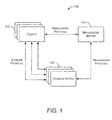
- FIG. 1 is a block diagram depicting an environment 100 within which an example embodiment may be implemented.
- a management server 104 communicates with multiple clients 102 and multiple storage nodes 106 using a management protocol. Multiple clients 102 communicate with multiple storage nodes 106 using a storage protocol.
- management server 104 performs various functions associated with retrieving data from storage nodes 106 and writing data to storage nodes 106. Additionally, management server 104 performs various functions associated with the operation of clients 102. In particular embodiments, management server 104 performs functions related to reserving storage nodes, locking access to storage nodes, assigning storage node access to particular hosts, and the like.
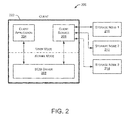
- FIG. 2 is a block diagram depicting an embodiment of an example architecture 200 to implement at least a portion of the distributed reservation systems and methods discussed herein.
- Client 202 shown in FIG. 2 includes one or more client applications 204 and one or more client services 206, which communicate with multiple storage nodes. Additionally, the client includes a SCSI driver 208.
- SCSI driver 208 is a kernel component that resides on the client system and provides a virtual SCSI disk device. SCSI driver 208 takes requests (e.g., data storage requests and data access requests) from client application 204, such as the File System, Cluster, or any other application that uses the file system or the block device, and wants to use the SCSI reservation framework. SCSI driver 208 converts and sends the requests to client service 206.
- Client 202 is coupled to any number of storage nodes. In the example of FIG. 2 , three storage nodes 210, 212, and 214 are coupled to client 202.
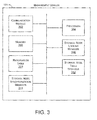
- FIG. 3 is a block diagram depicting an embodiment of management server 104.
- management server 104 performs various functions related to retrieving data from storage nodes and writing data to storage nodes.
- Management server 104 includes a communication module 302, a processor 304, and a memory 306.
- Communication module 302 allows management server 104 to communicate with other systems, such as communication networks, clients, storage nodes, other management servers, and the like.
- Processor 304 executes various instructions to implement the functionality provided by management server 104.
- Memory 306 stores these instructions as well as other data used by processor 304 and other modules contained in management server 104.
- Management server 104 also includes a storage node locking manager 308 that manages the locking of (or reservation of) one or more storage nodes as discussed herein.
- a reservation table 310 maintains a list of current reservations (e.g., the reservation of one or more storage nodes by one or more hosts).
- a storage node table manager 312 performs various functions to manage one or more tables contained in any number of storage nodes.
- Management server 104 also includes a storage node synchronization manager 314, which manages the synchronization of data between multiple storage nodes, as discussed herein.
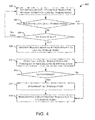
- FIG. 4 is a flow diagram depicting an embodiment of a method 400 for managing the access of data by a plurality of clients from a plurality of storage nodes.
- a distributed SCSI-3 persistent reservation protocol attempts to lock all storage nodes at 402.
- Method 400 determines whether all storage nodes were successfully locked at 404. If all storage nodes were not successfully locked (e.g., the attempted lock failed), method 400 determines whether to try to lock all storage nodes again or quit at 406. If method 400 decides to try again, the method returns to 402 and again attempts to lock all storage nodes. If all storage nodes were not successfully locked at 406, and method 400 does not try to lock the storage nodes again, a message is generated at 408 indicating a failed attempt to lock all storage nodes.
- method 400 checks the tables on all storage nodes for consistency of data based on an internal check at 410. This checking of the storage node tables may identify inconsistencies between two or more storage nodes. If one or more inconsistencies are identified at 412, method 400 synchronizes all of the storage nodes at 414 to maintain consistency across all storage nodes. After all storage nodes are synchronized, the method 400 begins sending SCSI-3 persistent reservations to the storage nodes at 416.
- one or more storage nodes can get into a situation where a client or host can establish a lock on the distributed reservation tables on one or more storage nodes, but the client or host dies (e.g., fails to operate correctly, experiences a device failure or loses communication with one or more of the storage nodes).
- the systems and methods discussed herein may use a heartbeat thread running on a host or a client. The heartbeat thread is started as soon as a lock is taken and continues until the ReservationOUT command is completed. In some embodiments, the heartbeat thread runs every few seconds and updates a timestamp on the locking table on each storage node.
- the first host i.e., the host that failed
- SCSI-3 PR which stands for Persistent Reservation, supports multiple nodes accessing a device while at the same time blocking access to other nodes.
- SCSI-3 PR reservations are persistent across SCSI bus resets or node reboots and also support multiple paths from host to disk.
- SCSI-3 PR uses a concept of registration and reservation. Systems that participate, register a key with the SCSI-3 device. Each system registers its own key. Registered systems can then establish a reservation and write to the storage device blocking or sharing with other clients.
- SCSI reservations are used by Windows host in a cluster, CSV, etc. environments to provide access to cluster nodes to write data to the storage device. Embodiments may use Windows Hyper-V, Linux SCSI storage stack, VMWare, KVM or any Unix variant storage stack that uses SCSI-3 reservations to share storage among hosts.
- the systems and methods implement the reservation as a two-step process.
- the systems and methods take a lock on all current live storage nodes that are part of a shared volume that satisfy the redundancy requirements.
- the systems and methods send the reservation request to each of the storage nodes and do a ReserveIN or ReserveOUT request.
- the reservation requests from the SCSI device are marshalled into the protocol to provide the redundancy and solving inconsistency issues among the storage nodes. Changes are done in the driver, the client, and on the server side to accommodate this design.
- the systems and methods add new operations to an existing storage protocol.
- the SCSI driver is modified to support the following SCSI3 persistent reservation commands:
- the SCSI Command Descriptor Block (CDB), and data buffer associated with the reservation commands, are sent to the user mode client service, which in turn sends them to the server nodes for further processing.
- the details of client side and server side changes are discussed herein.
- the request Once the request is processed from the server, it sends the reply to the client which in turn sends the reply with the appropriate SCSI status and associated data buffer to the driver through an IOCtl.
- the driver completes the SCSI3 reservation request based on the SCSI status.
- the driver primarily acts as a pass-through component, which receives the requests from user mode applications and sends them to the Client side service, which has most of the intelligence about processing the request by communication with the server nodes.
- the client service gets the requests from the driver through an event mechanism.
- the driver receives a command, it signals an event that the client service is waiting.
- the client service pulls the request from the driver along with the associated data for that request.
- the client service performs a series of operations, which involves locking the reservation tables on the server or syncing the database if the storage nodes are not in Sync, and once the lock has been taken, sending the ReserveIN or ReserveOUT command as requested by the driver.
- the following operations are introduced in the Client Server protocol to implement client changes for locking of the reservation table.
- NDBL_FUNCTION_LCK_RSRV_TBL LOCK
- NDBL_FUNCTION_LCK_RSRV _RDNT_TBL RDNT_LOCK
- NDBL_FUNCTION_LCK_RSRV _TBL_SYNC SYNC
- NDBL_FUNCTION_LCK_RSRV_TBL_GIVEUP GIVEUP
- NDBL_FUNCTION_LCK_RSRV_TBL_UNLCK UNLOCK
- NDBL_FUNCTION_SCSI_RSRV_PIN (ReserveIN)
- NDBL_FUNCTION_SCSI_RSRV_POUT (ReserveOUT)
- a client wanting to send a SCSI ReserveIN / ReserveOUT command first needs to get a lock on the storage nodes. Each storage node has the exact copy of the table. Once the lock is obtained on the table on all storage nodes, the systems and methods send the SCSI commands IN/OUT to get reservation status or update the reservation table.
- a Generation ID is associated with the table that can tell if the table is the same or not on all the storage nodes. This is the sequence of calls which should be made prior to calling ReserveIN/ReserveOUT commands:
- This call is made when the systems and methods won the majority of nodes and still some nodes are locked by another Host. This should be sent giving enough time to nodes to give up their reservations.
- the server side has two major components:
- the server service which listens to the requests from the client and passes the requests to the SCSI 3 Reservation Library.
- the server fulfills all the requests for locking the reservation table, fulfilling the ReserveIN and ReserveOUT requests, and serving the read and write requests based on the current reservation state.
- SCSI 3 Reservation Library This is another core of the reservation process. It contains the database of current reservation and current locking state. It serves all the reservation requests conforming to the SCSI3 specification revision spc3r23
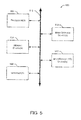
- FIG. 5 is a block diagram depicting an example computing device 500.
- Computing device 500 may interface, for example, with a VMBot as if it were another standard computing system. Further, standard computing devices, such as those depicted in FIG. 5 , can be configured to hold one or more VMs for use as VMBots. Computing device 500 may be used to perform various procedures, such as those discussed herein.
- Computing device 500 can function as a server, a client or any other computing entity.
- Computing device 500 can be any of a wide variety of computing devices, such as a desktop computer, a notebook computer, a server computer, a handheld computer, a tablet, and the like.
- Computing device 500 includes one or more processor(s) 502, one or more memory device(s) 504, one or more interface(s) 506, one or more mass storage device(s) 508, and one or more Input/Output (I/O) device(s) 510, all of which are coupled to a bus 512.
- Processor(s) 502 include one or more processors or controllers that execute instructions stored in memory device(s) 504 and/or mass storage device(s) 508.
- Processor(s) 502 may also include various types of computer-readable media, such as cache memory.
- Memory device(s) 504 include various computer-readable media, such as volatile memory (e.g., random access memory (RAM)) and/or nonvolatile memory (e.g., read-only memory (ROM)). Memory device(s) 504 may also include rewritable ROM, such as Flash memory.
- volatile memory e.g., random access memory (RAM)
- ROM read-only memory
- Memory device(s) 504 may also include rewritable ROM, such as Flash memory.
- Mass storage device(s) 508 include various computer readable media, such as magnetic tapes, magnetic disks, optical disks, solid state memory (e.g., Flash memory), and so forth. Various drives may also be included in mass storage device(s) 508 to enable reading from and/or writing to the various computer readable media. Mass storage device(s) 508 include removable media and/or non-removable media.
- I/O device(s) 510 include various devices that allow data and/or other information to be input to or retrieved from computing device 500.
- Example I/O device(s) 510 include cursor control devices, keyboards, keypads, microphones, monitors or other display devices, speakers, printers, network interface cards, modems, lenses, CCDs or other image capture devices, and the like.
- Interface(s) 506 include various interfaces that allow computing device 500 to interact with other systems, devices, or computing environments.
- Example interface(s) 506 include any number of different network interfaces, such as interfaces to local area networks (LANs), wide area networks (WANs), wireless networks, and the Internet.
- LANs local area networks
- WANs wide area networks
- wireless networks and the Internet.
- Bus 512 allows processor(s) 502, memory device(s) 504, interface(s) 506, mass storage device(s) 508, and I/O device(s) 510 to communicate with one another, as well as other devices or components coupled to bus 512.
- Bus 512 represents one or more of several types of bus structures, such as a system bus, PCI bus, IEEE 1394 bus, USB bus, and so forth.
- programs and other executable program components are shown herein as discrete blocks, although it is understood that such programs and components may reside at various times in different storage components of computing device 500, and are executed by processor(s) 502.
- the systems and procedures described herein can be implemented in hardware, or a combination of hardware, software, and/or firmware.
- one or more application specific integrated circuits (ASICs) can be programmed to carry out one or more of the systems and procedures described herein.
Landscapes
- Engineering & Computer Science (AREA)
- Theoretical Computer Science (AREA)
- Physics & Mathematics (AREA)
- General Engineering & Computer Science (AREA)
- General Physics & Mathematics (AREA)
- Human Computer Interaction (AREA)
- Software Systems (AREA)
- Data Mining & Analysis (AREA)
- Databases & Information Systems (AREA)
- Computer Security & Cryptography (AREA)
- Information Retrieval, Db Structures And Fs Structures Therefor (AREA)
- Multi Processors (AREA)
Applications Claiming Priority (1)
| Application Number | Priority Date | Filing Date | Title |
|---|---|---|---|
| US201361899767P | 2013-11-04 | 2013-11-04 |
Publications (2)
| Publication Number | Publication Date |
|---|---|
| EP2869199A2 true EP2869199A2 (de) | 2015-05-06 |
| EP2869199A3 EP2869199A3 (de) | 2016-06-29 |
Family
ID=51900132
Family Applications (1)
| Application Number | Title | Priority Date | Filing Date |
|---|---|---|---|
| EP14191664.3A Withdrawn EP2869199A3 (de) | 2013-11-04 | 2014-11-04 | Verteilte Reservierungssysteme und Verfahren |
Country Status (2)
| Country | Link |
|---|---|
| US (2) | US9959309B2 (de) |
| EP (1) | EP2869199A3 (de) |
Cited By (1)
| Publication number | Priority date | Publication date | Assignee | Title |
|---|---|---|---|---|
| WO2021048649A1 (en) * | 2019-09-11 | 2021-03-18 | International Business Machines Corporation | Re-dispatching tasks on associated processors to reduce lock contention |
Families Citing this family (7)
| Publication number | Priority date | Publication date | Assignee | Title |
|---|---|---|---|---|
| CN107168642B (zh) * | 2017-03-30 | 2020-05-01 | 北京奇艺世纪科技有限公司 | 一种数据存储方法及系统 |
| US10901621B2 (en) | 2017-12-13 | 2021-01-26 | Red Hat, Inc. | Dual-level storage device reservation |
| CN110008031B (zh) * | 2018-01-05 | 2022-04-15 | 北京金山云网络技术有限公司 | 设备操作方法、集群系统、电子设备及可读取存储介质 |
| US10733066B2 (en) | 2018-03-09 | 2020-08-04 | Hewlett Packard Enterprise Development Lp | Persistent reservation commands in a distributed storage system |
| US11625180B1 (en) | 2020-12-10 | 2023-04-11 | Amazon Technologies, Inc. | Fault tolerant reservation state distribution for multi-partition logical volumes |
| US11397545B1 (en) | 2021-01-20 | 2022-07-26 | Pure Storage, Inc. | Emulating persistent reservations in a cloud-based storage system |
| CN116055494B (zh) * | 2022-11-30 | 2025-09-05 | 天翼云科技有限公司 | 分布式块存储网关的资源共享方法及系统 |
Family Cites Families (12)
| Publication number | Priority date | Publication date | Assignee | Title |
|---|---|---|---|---|
| US6393539B1 (en) * | 2000-05-04 | 2002-05-21 | Dell Products, L.P. | System and method for reliably assigning and protecting data in a centralizes storage system |
| US6996672B2 (en) * | 2002-03-26 | 2006-02-07 | Hewlett-Packard Development, L.P. | System and method for active-active data replication |
| BR0201115A (pt) * | 2002-04-02 | 2005-02-22 | Coppe Ufrj | Memória cooperativa distribuìda colapsada para sistemas de mìdia-sob-demanda interativa e escalável |
| US7543301B2 (en) * | 2003-10-21 | 2009-06-02 | Gemstone Systems, Inc. | Shared queues in shared object space |
| FR2880485B1 (fr) * | 2005-01-06 | 2007-03-16 | Canon Europa Nv Naamlooze Venn | Procedes de stockage et de lecture d'un contenu, du type mettant en oeuvre un protocole de protection de contenu, dispositifs source, de stockage et recepteur correspondants. |
| US8001580B1 (en) * | 2005-07-25 | 2011-08-16 | Netapp, Inc. | System and method for revoking soft locks in a distributed storage system environment |
| US20080082647A1 (en) * | 2006-09-29 | 2008-04-03 | Dennis Baker | Connection reservation in dynamic node allocation computing environments |
| US7890555B2 (en) | 2007-07-10 | 2011-02-15 | International Business Machines Corporation | File system mounting in a clustered file system |
| US8380852B2 (en) | 2009-12-23 | 2013-02-19 | International Business Machines Corporation | Clearing SCSI reservations for non-detectable initiators for extended duration |
| GB2484086A (en) * | 2010-09-28 | 2012-04-04 | Metaswitch Networks Ltd | Reliability and performance modes in a distributed storage system |
| US20120102561A1 (en) | 2010-10-26 | 2012-04-26 | International Business Machines Corporation | Token-based reservations for scsi architectures |
| US20120151095A1 (en) * | 2010-12-09 | 2012-06-14 | Ibm Corporation | Enforcing logical unit (lu) persistent reservations upon a shared virtual storage device |
-
2014
- 2014-11-04 EP EP14191664.3A patent/EP2869199A3/de not_active Withdrawn
- 2014-11-04 US US14/532,850 patent/US9959309B2/en not_active Expired - Fee Related
-
2018
- 2018-03-27 US US15/937,688 patent/US10515067B2/en not_active Expired - Fee Related
Non-Patent Citations (1)
| Title |
|---|
| None |
Cited By (1)
| Publication number | Priority date | Publication date | Assignee | Title |
|---|---|---|---|---|
| WO2021048649A1 (en) * | 2019-09-11 | 2021-03-18 | International Business Machines Corporation | Re-dispatching tasks on associated processors to reduce lock contention |
Also Published As
| Publication number | Publication date |
|---|---|
| US20180218024A1 (en) | 2018-08-02 |
| EP2869199A3 (de) | 2016-06-29 |
| US9959309B2 (en) | 2018-05-01 |
| US10515067B2 (en) | 2019-12-24 |
| US20150127917A1 (en) | 2015-05-07 |
Similar Documents
| Publication | Publication Date | Title |
|---|---|---|
| US10515067B2 (en) | Distributed reservations systems and methods | |
| US11340672B2 (en) | Persistent reservations for virtual disk using multiple targets | |
| US10193963B2 (en) | Container virtual machines for hadoop | |
| US11048538B2 (en) | Autonomous cell-based control plane for scalable virtualized computing | |
| CN106843749B (zh) | 写入请求处理方法、装置及设备 | |
| US10372384B2 (en) | Method and system for managing storage system using first and second communication areas | |
| CN105892943B (zh) | 一种分布式存储系统中块存储数据的访问方法及系统 | |
| US10430217B2 (en) | High availability using dynamic quorum-based arbitration | |
| US20160378713A1 (en) | System and method for persistence of application data using replication over remote direct memory access | |
| US20150234857A1 (en) | Configuration-less network locking infrastructure for shared file systems | |
| CN110971700A (zh) | 分布式锁的实现方法及装置 | |
| US20180157570A1 (en) | Integrating external services with a clustered file system | |
| CN106777394A (zh) | 一种集群文件系统 | |
| CN110633046A (zh) | 一种分布式系统的存储方法、装置、存储设备及存储介质 | |
| CN110612510B (zh) | 无需专用仲裁器的输入/输出(i/o)隔离 | |
| US10324811B2 (en) | Opportunistic failover in a high availability cluster | |
| US20190278524A1 (en) | Persistent reservation emulation in shared virtual storage environments | |
| US11960510B2 (en) | Data movement from data storage clusters | |
| US11422715B1 (en) | Direct read in clustered file systems | |
| US10223402B1 (en) | Multi-site block level write consistency | |
| US11188522B2 (en) | Streamlined database commit for synchronized nodes | |
| CN117218773B (zh) | 一种硬盘柜控制方法、装置、介质 | |
| CN113031852A (zh) | 数据处理方法、装置、电子设备及存储介质 | |
| US11586466B2 (en) | Centralized high-availability flows execution framework | |
| US11947516B1 (en) | Multi-tier definition management for distributed data stores |
Legal Events
| Date | Code | Title | Description |
|---|---|---|---|
| PUAI | Public reference made under article 153(3) epc to a published international application that has entered the european phase |
Free format text: ORIGINAL CODE: 0009012 |
|
| 17P | Request for examination filed |
Effective date: 20141104 |
|
| AK | Designated contracting states |
Kind code of ref document: A2 Designated state(s): AL AT BE BG CH CY CZ DE DK EE ES FI FR GB GR HR HU IE IS IT LI LT LU LV MC MK MT NL NO PL PT RO RS SE SI SK SM TR |
|
| AX | Request for extension of the european patent |
Extension state: BA ME |
|
| PUAL | Search report despatched |
Free format text: ORIGINAL CODE: 0009013 |
|
| RIC1 | Information provided on ipc code assigned before grant |
Ipc: G06F 3/06 20060101ALN20160429BHEP Ipc: H04L 9/32 20060101ALI20160429BHEP Ipc: G06F 17/30 20060101ALI20160429BHEP Ipc: G06F 12/14 20060101ALI20160429BHEP Ipc: G06F 9/52 20060101AFI20160429BHEP |
|
| AK | Designated contracting states |
Kind code of ref document: A3 Designated state(s): AL AT BE BG CH CY CZ DE DK EE ES FI FR GB GR HR HU IE IS IT LI LT LU LV MC MK MT NL NO PL PT RO RS SE SI SK SM TR |
|
| AX | Request for extension of the european patent |
Extension state: BA ME |
|
| R17P | Request for examination filed (corrected) |
Effective date: 20170102 |
|
| RBV | Designated contracting states (corrected) |
Designated state(s): AL AT BE BG CH CY CZ DE DK EE ES FI FR GB GR HR HU IE IS IT LI LT LU LV MC MK MT NL NO PL PT RO RS SE SI SK SM TR |
|
| 17Q | First examination report despatched |
Effective date: 20190401 |
|
| STAA | Information on the status of an ep patent application or granted ep patent |
Free format text: STATUS: THE APPLICATION IS DEEMED TO BE WITHDRAWN |
|
| 18D | Application deemed to be withdrawn |
Effective date: 20190813 |