EP2869123A1 - Developing solution composition for lithographic printing plate precursor and method for manufacturing lithographic printing plate - Google Patents
Developing solution composition for lithographic printing plate precursor and method for manufacturing lithographic printing plate Download PDFInfo
- Publication number
- EP2869123A1 EP2869123A1 EP20130808667 EP13808667A EP2869123A1 EP 2869123 A1 EP2869123 A1 EP 2869123A1 EP 20130808667 EP20130808667 EP 20130808667 EP 13808667 A EP13808667 A EP 13808667A EP 2869123 A1 EP2869123 A1 EP 2869123A1
- Authority
- EP
- European Patent Office
- Prior art keywords
- developing solution
- group
- alkali
- printing plate
- solution composition
- Prior art date
- Legal status (The legal status is an assumption and is not a legal conclusion. Google has not performed a legal analysis and makes no representation as to the accuracy of the status listed.)
- Withdrawn
Links
- 239000000203 mixture Substances 0.000 title claims abstract description 83
- 238000007639 printing Methods 0.000 title claims abstract description 55
- 239000002243 precursor Substances 0.000 title claims description 43
- 238000004519 manufacturing process Methods 0.000 title claims description 4
- 238000000034 method Methods 0.000 title description 8
- 239000003513 alkali Substances 0.000 claims abstract description 67
- 150000003839 salts Chemical class 0.000 claims abstract description 52
- 150000001875 compounds Chemical class 0.000 claims abstract description 47
- 229920000642 polymer Polymers 0.000 claims abstract description 38
- 229910052751 metal Inorganic materials 0.000 claims abstract description 34
- 239000002184 metal Substances 0.000 claims abstract description 34
- 239000003795 chemical substances by application Substances 0.000 claims abstract description 32
- 230000000737 periodic effect Effects 0.000 claims abstract description 21
- 229910052784 alkaline earth metal Inorganic materials 0.000 claims abstract description 14
- -1 ethyleneoxy group Chemical group 0.000 claims description 27
- 229920005989 resin Polymers 0.000 claims description 25
- 239000011347 resin Substances 0.000 claims description 25
- 229920001577 copolymer Polymers 0.000 claims description 24
- 239000000463 material Substances 0.000 claims description 20
- 239000000758 substrate Substances 0.000 claims description 18
- 239000004094 surface-active agent Substances 0.000 claims description 13
- 125000003118 aryl group Chemical group 0.000 claims description 11
- 229910052783 alkali metal Inorganic materials 0.000 claims description 10
- 125000000217 alkyl group Chemical group 0.000 claims description 10
- 125000004435 hydrogen atom Chemical group [H]* 0.000 claims description 10
- 238000006243 chemical reaction Methods 0.000 claims description 9
- 125000001424 substituent group Chemical group 0.000 claims description 8
- 125000004432 carbon atom Chemical group C* 0.000 claims description 6
- BVKZGUZCCUSVTD-UHFFFAOYSA-L Carbonate Chemical compound [O-]C([O-])=O BVKZGUZCCUSVTD-UHFFFAOYSA-L 0.000 claims description 5
- 125000003342 alkenyl group Chemical group 0.000 claims description 5
- 125000000304 alkynyl group Chemical group 0.000 claims description 5
- 125000003178 carboxy group Chemical group [H]OC(*)=O 0.000 claims description 5
- 239000003960 organic solvent Substances 0.000 claims description 5
- 229910019142 PO4 Inorganic materials 0.000 claims description 4
- 150000001340 alkali metals Chemical group 0.000 claims description 4
- 125000002947 alkylene group Chemical group 0.000 claims description 4
- 150000001412 amines Chemical class 0.000 claims description 4
- 125000005647 linker group Chemical group 0.000 claims description 4
- QTBSBXVTEAMEQO-UHFFFAOYSA-M Acetate Chemical compound CC([O-])=O QTBSBXVTEAMEQO-UHFFFAOYSA-M 0.000 claims description 3
- 229910002651 NO3 Inorganic materials 0.000 claims description 3
- NHNBFGGVMKEFGY-UHFFFAOYSA-N Nitrate Chemical compound [O-][N+]([O-])=O NHNBFGGVMKEFGY-UHFFFAOYSA-N 0.000 claims description 3
- QAOWNCQODCNURD-UHFFFAOYSA-L Sulfate Chemical compound [O-]S([O-])(=O)=O QAOWNCQODCNURD-UHFFFAOYSA-L 0.000 claims description 3
- 125000004453 alkoxycarbonyl group Chemical group 0.000 claims description 3
- 125000003917 carbamoyl group Chemical group [H]N([H])C(*)=O 0.000 claims description 3
- NBIIXXVUZAFLBC-UHFFFAOYSA-K phosphate Chemical compound [O-]P([O-])([O-])=O NBIIXXVUZAFLBC-UHFFFAOYSA-K 0.000 claims description 3
- 239000010452 phosphate Substances 0.000 claims description 3
- OYPRJOBELJOOCE-UHFFFAOYSA-N Calcium Chemical compound [Ca] OYPRJOBELJOOCE-UHFFFAOYSA-N 0.000 claims description 2
- FYYHWMGAXLPEAU-UHFFFAOYSA-N Magnesium Chemical compound [Mg] FYYHWMGAXLPEAU-UHFFFAOYSA-N 0.000 claims description 2
- 125000003277 amino group Chemical group 0.000 claims description 2
- 229910052788 barium Inorganic materials 0.000 claims description 2
- DSAJWYNOEDNPEQ-UHFFFAOYSA-N barium atom Chemical compound [Ba] DSAJWYNOEDNPEQ-UHFFFAOYSA-N 0.000 claims description 2
- 229910052791 calcium Inorganic materials 0.000 claims description 2
- 239000011575 calcium Substances 0.000 claims description 2
- 230000005660 hydrophilic surface Effects 0.000 claims description 2
- 229910052749 magnesium Inorganic materials 0.000 claims description 2
- 239000011777 magnesium Substances 0.000 claims description 2
- 125000001453 quaternary ammonium group Chemical group 0.000 claims description 2
- 229910052712 strontium Inorganic materials 0.000 claims description 2
- CIOAGBVUUVVLOB-UHFFFAOYSA-N strontium atom Chemical compound [Sr] CIOAGBVUUVVLOB-UHFFFAOYSA-N 0.000 claims description 2
- 150000001735 carboxylic acids Chemical class 0.000 claims 2
- VEXZGXHMUGYJMC-UHFFFAOYSA-M Chloride anion Chemical compound [Cl-] VEXZGXHMUGYJMC-UHFFFAOYSA-M 0.000 claims 1
- 150000001732 carboxylic acid derivatives Chemical class 0.000 abstract description 40
- 239000000243 solution Substances 0.000 description 255
- 238000011282 treatment Methods 0.000 description 46
- 230000000052 comparative effect Effects 0.000 description 35
- 239000004721 Polyphenylene oxide Substances 0.000 description 27
- 239000000049 pigment Substances 0.000 description 27
- 229920000570 polyether Polymers 0.000 description 27
- 239000000975 dye Substances 0.000 description 26
- 238000011161 development Methods 0.000 description 20
- WVDDGKGOMKODPV-UHFFFAOYSA-N Benzyl alcohol Chemical compound OCC1=CC=CC=C1 WVDDGKGOMKODPV-UHFFFAOYSA-N 0.000 description 15
- XLYOFNOQVPJJNP-UHFFFAOYSA-N water Substances O XLYOFNOQVPJJNP-UHFFFAOYSA-N 0.000 description 15
- 229910021645 metal ion Inorganic materials 0.000 description 14
- 239000011248 coating agent Substances 0.000 description 13
- 238000000576 coating method Methods 0.000 description 13
- 239000000047 product Substances 0.000 description 13
- 239000007864 aqueous solution Substances 0.000 description 12
- 239000000178 monomer Substances 0.000 description 11
- 230000000694 effects Effects 0.000 description 10
- 230000001965 increasing effect Effects 0.000 description 10
- KDYFGRWQOYBRFD-UHFFFAOYSA-N succinic acid Chemical compound OC(=O)CCC(O)=O KDYFGRWQOYBRFD-UHFFFAOYSA-N 0.000 description 10
- ZWEHNKRNPOVVGH-UHFFFAOYSA-N 2-Butanone Chemical compound CCC(C)=O ZWEHNKRNPOVVGH-UHFFFAOYSA-N 0.000 description 9
- HEMHJVSKTPXQMS-UHFFFAOYSA-M Sodium hydroxide Chemical compound [OH-].[Na+] HEMHJVSKTPXQMS-UHFFFAOYSA-M 0.000 description 9
- 125000004805 propylene group Chemical group [H]C([H])([H])C([H])([*:1])C([H])([H])[*:2] 0.000 description 9
- 159000000000 sodium salts Chemical class 0.000 description 9
- PEDCQBHIVMGVHV-UHFFFAOYSA-N Glycerine Chemical compound OCC(O)CO PEDCQBHIVMGVHV-UHFFFAOYSA-N 0.000 description 8
- 230000035515 penetration Effects 0.000 description 8
- QQONPFPTGQHPMA-UHFFFAOYSA-N propylene Natural products CC=C QQONPFPTGQHPMA-UHFFFAOYSA-N 0.000 description 8
- GIAFURWZWWWBQT-UHFFFAOYSA-N 2-(2-aminoethoxy)ethanol Chemical compound NCCOCCO GIAFURWZWWWBQT-UHFFFAOYSA-N 0.000 description 7
- 239000002253 acid Substances 0.000 description 7
- 125000000816 ethylene group Chemical group [H]C([H])([*:1])C([H])([H])[*:2] 0.000 description 7
- LFQSCWFLJHTTHZ-UHFFFAOYSA-N Ethanol Chemical compound CCO LFQSCWFLJHTTHZ-UHFFFAOYSA-N 0.000 description 6
- KWYUFKZDYYNOTN-UHFFFAOYSA-M Potassium hydroxide Chemical compound [OH-].[K+] KWYUFKZDYYNOTN-UHFFFAOYSA-M 0.000 description 6
- FAPWRFPIFSIZLT-UHFFFAOYSA-M Sodium chloride Chemical compound [Na+].[Cl-] FAPWRFPIFSIZLT-UHFFFAOYSA-M 0.000 description 6
- 229910052782 aluminium Inorganic materials 0.000 description 6
- XAGFODPZIPBFFR-UHFFFAOYSA-N aluminium Chemical compound [Al] XAGFODPZIPBFFR-UHFFFAOYSA-N 0.000 description 6
- 239000000987 azo dye Substances 0.000 description 6
- 238000002360 preparation method Methods 0.000 description 6
- QGKMIGUHVLGJBR-UHFFFAOYSA-M (4z)-1-(3-methylbutyl)-4-[[1-(3-methylbutyl)quinolin-1-ium-4-yl]methylidene]quinoline;iodide Chemical compound [I-].C12=CC=CC=C2N(CCC(C)C)C=CC1=CC1=CC=[N+](CCC(C)C)C2=CC=CC=C12 QGKMIGUHVLGJBR-UHFFFAOYSA-M 0.000 description 5
- 239000004375 Dextrin Substances 0.000 description 5
- 229920001353 Dextrin Polymers 0.000 description 5
- 235000019445 benzyl alcohol Nutrition 0.000 description 5
- LLSDKQJKOVVTOJ-UHFFFAOYSA-L calcium chloride dihydrate Chemical compound O.O.[Cl-].[Cl-].[Ca+2] LLSDKQJKOVVTOJ-UHFFFAOYSA-L 0.000 description 5
- 229940052299 calcium chloride dihydrate Drugs 0.000 description 5
- 239000008367 deionised water Substances 0.000 description 5
- 229910021641 deionized water Inorganic materials 0.000 description 5
- 235000019425 dextrin Nutrition 0.000 description 5
- 239000000126 substance Substances 0.000 description 5
- 239000001384 succinic acid Substances 0.000 description 5
- LWMWZNOCSCPBCH-UHFFFAOYSA-N 1-[bis[2-[bis(2-hydroxypropyl)amino]ethyl]amino]propan-2-ol Chemical compound CC(O)CN(CC(C)O)CCN(CC(O)C)CCN(CC(C)O)CC(C)O LWMWZNOCSCPBCH-UHFFFAOYSA-N 0.000 description 4
- 229920002873 Polyethylenimine Polymers 0.000 description 4
- JUJWROOIHBZHMG-UHFFFAOYSA-N Pyridine Chemical compound C1=CC=NC=C1 JUJWROOIHBZHMG-UHFFFAOYSA-N 0.000 description 4
- CDBYLPFSWZWCQE-UHFFFAOYSA-L Sodium Carbonate Chemical compound [Na+].[Na+].[O-]C([O-])=O CDBYLPFSWZWCQE-UHFFFAOYSA-L 0.000 description 4
- 125000002843 carboxylic acid group Chemical group 0.000 description 4
- JHIVVAPYMSGYDF-UHFFFAOYSA-N cyclohexanone Chemical compound O=C1CCCCC1 JHIVVAPYMSGYDF-UHFFFAOYSA-N 0.000 description 4
- 125000002887 hydroxy group Chemical group [H]O* 0.000 description 4
- 125000001434 methanylylidene group Chemical group [H]C#[*] 0.000 description 4
- 150000003013 phosphoric acid derivatives Chemical class 0.000 description 4
- 239000010802 sludge Substances 0.000 description 4
- 238000013519 translation Methods 0.000 description 4
- HZAXFHJVJLSVMW-UHFFFAOYSA-N 2-Aminoethan-1-ol Chemical compound NCCO HZAXFHJVJLSVMW-UHFFFAOYSA-N 0.000 description 3
- QUKRIOLKOHUUBM-UHFFFAOYSA-N 3,3,4,4,5,5,6,6,7,7,8,8,9,9,10,10,10-heptadecafluorodecyl prop-2-enoate Chemical compound FC(F)(F)C(F)(F)C(F)(F)C(F)(F)C(F)(F)C(F)(F)C(F)(F)C(F)(F)CCOC(=O)C=C QUKRIOLKOHUUBM-UHFFFAOYSA-N 0.000 description 3
- UXVMQQNJUSDDNG-UHFFFAOYSA-L Calcium chloride Chemical compound [Cl-].[Cl-].[Ca+2] UXVMQQNJUSDDNG-UHFFFAOYSA-L 0.000 description 3
- RPNUMPOLZDHAAY-UHFFFAOYSA-N Diethylenetriamine Chemical compound NCCNCCN RPNUMPOLZDHAAY-UHFFFAOYSA-N 0.000 description 3
- KCXVZYZYPLLWCC-UHFFFAOYSA-N EDTA Chemical compound OC(=O)CN(CC(O)=O)CCN(CC(O)=O)CC(O)=O KCXVZYZYPLLWCC-UHFFFAOYSA-N 0.000 description 3
- XEKOWRVHYACXOJ-UHFFFAOYSA-N Ethyl acetate Chemical compound CCOC(C)=O XEKOWRVHYACXOJ-UHFFFAOYSA-N 0.000 description 3
- DGAQECJNVWCQMB-PUAWFVPOSA-M Ilexoside XXIX Chemical compound C[C@@H]1CC[C@@]2(CC[C@@]3(C(=CC[C@H]4[C@]3(CC[C@@H]5[C@@]4(CC[C@@H](C5(C)C)OS(=O)(=O)[O-])C)C)[C@@H]2[C@]1(C)O)C)C(=O)O[C@H]6[C@@H]([C@H]([C@@H]([C@H](O6)CO)O)O)O.[Na+] DGAQECJNVWCQMB-PUAWFVPOSA-M 0.000 description 3
- CERQOIWHTDAKMF-UHFFFAOYSA-N Methacrylic acid Chemical compound CC(=C)C(O)=O CERQOIWHTDAKMF-UHFFFAOYSA-N 0.000 description 3
- 239000004115 Sodium Silicate Substances 0.000 description 3
- ZMANZCXQSJIPKH-UHFFFAOYSA-N Triethylamine Chemical compound CCN(CC)CC ZMANZCXQSJIPKH-UHFFFAOYSA-N 0.000 description 3
- 239000001110 calcium chloride Substances 0.000 description 3
- 229960002713 calcium chloride Drugs 0.000 description 3
- 229910001628 calcium chloride Inorganic materials 0.000 description 3
- 150000001244 carboxylic acid anhydrides Chemical class 0.000 description 3
- UAOMVDZJSHZZME-UHFFFAOYSA-N diisopropylamine Chemical compound CC(C)NC(C)C UAOMVDZJSHZZME-UHFFFAOYSA-N 0.000 description 3
- BNIILDVGGAEEIG-UHFFFAOYSA-L disodium hydrogen phosphate Chemical compound [Na+].[Na+].OP([O-])([O-])=O BNIILDVGGAEEIG-UHFFFAOYSA-L 0.000 description 3
- 235000011187 glycerol Nutrition 0.000 description 3
- 235000021317 phosphate Nutrition 0.000 description 3
- 239000011734 sodium Substances 0.000 description 3
- 229910052708 sodium Inorganic materials 0.000 description 3
- 239000011780 sodium chloride Substances 0.000 description 3
- NTHWMYGWWRZVTN-UHFFFAOYSA-N sodium silicate Chemical compound [Na+].[Na+].[O-][Si]([O-])=O NTHWMYGWWRZVTN-UHFFFAOYSA-N 0.000 description 3
- 229910052911 sodium silicate Inorganic materials 0.000 description 3
- 238000004381 surface treatment Methods 0.000 description 3
- VZCYOOQTPOCHFL-UHFFFAOYSA-N trans-butenedioic acid Natural products OC(=O)C=CC(O)=O VZCYOOQTPOCHFL-UHFFFAOYSA-N 0.000 description 3
- RYFMWSXOAZQYPI-UHFFFAOYSA-K trisodium phosphate Chemical compound [Na+].[Na+].[Na+].[O-]P([O-])([O-])=O RYFMWSXOAZQYPI-UHFFFAOYSA-K 0.000 description 3
- ZTWTYVWXUKTLCP-UHFFFAOYSA-N vinylphosphonic acid Chemical compound OP(O)(=O)C=C ZTWTYVWXUKTLCP-UHFFFAOYSA-N 0.000 description 3
- 125000004178 (C1-C4) alkyl group Chemical group 0.000 description 2
- HXKKHQJGJAFBHI-UHFFFAOYSA-N 1-aminopropan-2-ol Chemical compound CC(O)CN HXKKHQJGJAFBHI-UHFFFAOYSA-N 0.000 description 2
- ARXJGSRGQADJSQ-UHFFFAOYSA-N 1-methoxypropan-2-ol Chemical compound COCC(C)O ARXJGSRGQADJSQ-UHFFFAOYSA-N 0.000 description 2
- PTBDIHRZYDMNKB-UHFFFAOYSA-N 2,2-Bis(hydroxymethyl)propionic acid Chemical compound OCC(C)(CO)C(O)=O PTBDIHRZYDMNKB-UHFFFAOYSA-N 0.000 description 2
- SMZOUWXMTYCWNB-UHFFFAOYSA-N 2-(2-methoxy-5-methylphenyl)ethanamine Chemical compound COC1=CC=C(C)C=C1CCN SMZOUWXMTYCWNB-UHFFFAOYSA-N 0.000 description 2
- NIXOWILDQLNWCW-UHFFFAOYSA-N 2-Propenoic acid Natural products OC(=O)C=C NIXOWILDQLNWCW-UHFFFAOYSA-N 0.000 description 2
- UTNSTOOXQPHXJQ-UHFFFAOYSA-N 2-[4-[4-(2-hydroxyethoxy)phenyl]sulfonylphenoxy]ethanol Chemical compound C1=CC(OCCO)=CC=C1S(=O)(=O)C1=CC=C(OCCO)C=C1 UTNSTOOXQPHXJQ-UHFFFAOYSA-N 0.000 description 2
- QCDWFXQBSFUVSP-UHFFFAOYSA-N 2-phenoxyethanol Chemical compound OCCOC1=CC=CC=C1 QCDWFXQBSFUVSP-UHFFFAOYSA-N 0.000 description 2
- UPMLOUAZCHDJJD-UHFFFAOYSA-N 4,4'-Diphenylmethane Diisocyanate Chemical compound C1=CC(N=C=O)=CC=C1CC1=CC=C(N=C=O)C=C1 UPMLOUAZCHDJJD-UHFFFAOYSA-N 0.000 description 2
- YDIYEOMDOWUDTJ-UHFFFAOYSA-N 4-(dimethylamino)benzoic acid Chemical compound CN(C)C1=CC=C(C(O)=O)C=C1 YDIYEOMDOWUDTJ-UHFFFAOYSA-N 0.000 description 2
- YEJRWHAVMIAJKC-UHFFFAOYSA-N 4-Butyrolactone Chemical compound O=C1CCCO1 YEJRWHAVMIAJKC-UHFFFAOYSA-N 0.000 description 2
- NIXOWILDQLNWCW-UHFFFAOYSA-M Acrylate Chemical compound [O-]C(=O)C=C NIXOWILDQLNWCW-UHFFFAOYSA-M 0.000 description 2
- NLHHRLWOUZZQLW-UHFFFAOYSA-N Acrylonitrile Chemical compound C=CC#N NLHHRLWOUZZQLW-UHFFFAOYSA-N 0.000 description 2
- QGZKDVFQNNGYKY-UHFFFAOYSA-N Ammonia Chemical group N QGZKDVFQNNGYKY-UHFFFAOYSA-N 0.000 description 2
- CURLTUGMZLYLDI-UHFFFAOYSA-N Carbon dioxide Chemical compound O=C=O CURLTUGMZLYLDI-UHFFFAOYSA-N 0.000 description 2
- YMWUJEATGCHHMB-UHFFFAOYSA-N Dichloromethane Chemical compound ClCCl YMWUJEATGCHHMB-UHFFFAOYSA-N 0.000 description 2
- ROSDSFDQCJNGOL-UHFFFAOYSA-N Dimethylamine Chemical compound CNC ROSDSFDQCJNGOL-UHFFFAOYSA-N 0.000 description 2
- VGGSQFUCUMXWEO-UHFFFAOYSA-N Ethene Chemical compound C=C VGGSQFUCUMXWEO-UHFFFAOYSA-N 0.000 description 2
- QUSNBJAOOMFDIB-UHFFFAOYSA-N Ethylamine Chemical compound CCN QUSNBJAOOMFDIB-UHFFFAOYSA-N 0.000 description 2
- 239000005977 Ethylene Substances 0.000 description 2
- VEXZGXHMUGYJMC-UHFFFAOYSA-N Hydrochloric acid Chemical compound Cl VEXZGXHMUGYJMC-UHFFFAOYSA-N 0.000 description 2
- XEEYBQQBJWHFJM-UHFFFAOYSA-N Iron Chemical compound [Fe] XEEYBQQBJWHFJM-UHFFFAOYSA-N 0.000 description 2
- TWRXJAOTZQYOKJ-UHFFFAOYSA-L Magnesium chloride Chemical compound [Mg+2].[Cl-].[Cl-] TWRXJAOTZQYOKJ-UHFFFAOYSA-L 0.000 description 2
- NTIZESTWPVYFNL-UHFFFAOYSA-N Methyl isobutyl ketone Chemical compound CC(C)CC(C)=O NTIZESTWPVYFNL-UHFFFAOYSA-N 0.000 description 2
- UIHCLUNTQKBZGK-UHFFFAOYSA-N Methyl isobutyl ketone Natural products CCC(C)C(C)=O UIHCLUNTQKBZGK-UHFFFAOYSA-N 0.000 description 2
- BAVYZALUXZFZLV-UHFFFAOYSA-N Methylamine Chemical compound NC BAVYZALUXZFZLV-UHFFFAOYSA-N 0.000 description 2
- AMQJEAYHLZJPGS-UHFFFAOYSA-N N-Pentanol Chemical compound CCCCCO AMQJEAYHLZJPGS-UHFFFAOYSA-N 0.000 description 2
- NBIIXXVUZAFLBC-UHFFFAOYSA-N Phosphoric acid Chemical group OP(O)(O)=O NBIIXXVUZAFLBC-UHFFFAOYSA-N 0.000 description 2
- SMWDFEZZVXVKRB-UHFFFAOYSA-N Quinoline Chemical compound N1=CC=CC2=CC=CC=C21 SMWDFEZZVXVKRB-UHFFFAOYSA-N 0.000 description 2
- 229910006074 SO2NH2 Inorganic materials 0.000 description 2
- PPBRXRYQALVLMV-UHFFFAOYSA-N Styrene Chemical compound C=CC1=CC=CC=C1 PPBRXRYQALVLMV-UHFFFAOYSA-N 0.000 description 2
- QAOWNCQODCNURD-UHFFFAOYSA-N Sulfuric acid Chemical compound OS(O)(=O)=O QAOWNCQODCNURD-UHFFFAOYSA-N 0.000 description 2
- GSEJCLTVZPLZKY-UHFFFAOYSA-N Triethanolamine Chemical compound OCCN(CCO)CCO GSEJCLTVZPLZKY-UHFFFAOYSA-N 0.000 description 2
- 238000010521 absorption reaction Methods 0.000 description 2
- 229940022663 acetate Drugs 0.000 description 2
- 150000007513 acids Chemical class 0.000 description 2
- 125000003545 alkoxy group Chemical group 0.000 description 2
- LHIJANUOQQMGNT-UHFFFAOYSA-N aminoethylethanolamine Chemical compound NCCNCCO LHIJANUOQQMGNT-UHFFFAOYSA-N 0.000 description 2
- 239000001000 anthraquinone dye Substances 0.000 description 2
- QUKGYYKBILRGFE-UHFFFAOYSA-N benzyl acetate Chemical compound CC(=O)OCC1=CC=CC=C1 QUKGYYKBILRGFE-UHFFFAOYSA-N 0.000 description 2
- WGQKYBSKWIADBV-UHFFFAOYSA-N benzylamine Chemical compound NCC1=CC=CC=C1 WGQKYBSKWIADBV-UHFFFAOYSA-N 0.000 description 2
- 230000015572 biosynthetic process Effects 0.000 description 2
- 239000007853 buffer solution Substances 0.000 description 2
- 125000005626 carbonium group Chemical group 0.000 description 2
- 239000002131 composite material Substances 0.000 description 2
- 150000004696 coordination complex Chemical class 0.000 description 2
- 125000004093 cyano group Chemical group *C#N 0.000 description 2
- 125000006165 cyclic alkyl group Chemical group 0.000 description 2
- 125000004122 cyclic group Chemical group 0.000 description 2
- 229940061607 dibasic sodium phosphate Drugs 0.000 description 2
- ZBCBWPMODOFKDW-UHFFFAOYSA-N diethanolamine Chemical compound OCCNCCO ZBCBWPMODOFKDW-UHFFFAOYSA-N 0.000 description 2
- 238000000866 electrolytic etching Methods 0.000 description 2
- 238000005516 engineering process Methods 0.000 description 2
- 125000004185 ester group Chemical group 0.000 description 2
- 238000011156 evaluation Methods 0.000 description 2
- 125000000524 functional group Chemical group 0.000 description 2
- 150000004820 halides Chemical class 0.000 description 2
- 125000005843 halogen group Chemical group 0.000 description 2
- NGAZZOYFWWSOGK-UHFFFAOYSA-N heptan-3-one Chemical compound CCCCC(=O)CC NGAZZOYFWWSOGK-UHFFFAOYSA-N 0.000 description 2
- QNVRIHYSUZMSGM-UHFFFAOYSA-N hexan-2-ol Chemical compound CCCCC(C)O QNVRIHYSUZMSGM-UHFFFAOYSA-N 0.000 description 2
- 125000001841 imino group Chemical group [H]N=* 0.000 description 2
- 125000000468 ketone group Chemical group 0.000 description 2
- GKQPCPXONLDCMU-CCEZHUSRSA-N lacidipine Chemical compound CCOC(=O)C1=C(C)NC(C)=C(C(=O)OCC)C1C1=CC=CC=C1\C=C\C(=O)OC(C)(C)C GKQPCPXONLDCMU-CCEZHUSRSA-N 0.000 description 2
- VZCYOOQTPOCHFL-UPHRSURJSA-N maleic acid Chemical compound OC(=O)\C=C/C(O)=O VZCYOOQTPOCHFL-UPHRSURJSA-N 0.000 description 2
- FPYJFEHAWHCUMM-UHFFFAOYSA-N maleic anhydride Chemical compound O=C1OC(=O)C=C1 FPYJFEHAWHCUMM-UHFFFAOYSA-N 0.000 description 2
- 125000000449 nitro group Chemical group [O-][N+](*)=O 0.000 description 2
- 229960005323 phenoxyethanol Drugs 0.000 description 2
- 125000001997 phenyl group Chemical group [H]C1=C([H])C([H])=C(*)C([H])=C1[H] 0.000 description 2
- ABLZXFCXXLZCGV-UHFFFAOYSA-N phosphonic acid group Chemical group P(O)(O)=O ABLZXFCXXLZCGV-UHFFFAOYSA-N 0.000 description 2
- 239000001007 phthalocyanine dye Substances 0.000 description 2
- 239000002985 plastic film Substances 0.000 description 2
- 229920006255 plastic film Polymers 0.000 description 2
- 230000000379 polymerizing effect Effects 0.000 description 2
- 229920001296 polysiloxane Polymers 0.000 description 2
- SCVFZCLFOSHCOH-UHFFFAOYSA-M potassium acetate Chemical compound [K+].CC([O-])=O SCVFZCLFOSHCOH-UHFFFAOYSA-M 0.000 description 2
- BWHMMNNQKKPAPP-UHFFFAOYSA-L potassium carbonate Chemical compound [K+].[K+].[O-]C([O-])=O BWHMMNNQKKPAPP-UHFFFAOYSA-L 0.000 description 2
- 229910052913 potassium silicate Inorganic materials 0.000 description 2
- 235000019353 potassium silicate Nutrition 0.000 description 2
- 239000002244 precipitate Substances 0.000 description 2
- OSFBJERFMQCEQY-UHFFFAOYSA-N propylidene Chemical compound [CH]CC OSFBJERFMQCEQY-UHFFFAOYSA-N 0.000 description 2
- JEXVQSWXXUJEMA-UHFFFAOYSA-N pyrazol-3-one Chemical compound O=C1C=CN=N1 JEXVQSWXXUJEMA-UHFFFAOYSA-N 0.000 description 2
- 238000007788 roughening Methods 0.000 description 2
- 229910000029 sodium carbonate Inorganic materials 0.000 description 2
- 235000019795 sodium metasilicate Nutrition 0.000 description 2
- GEHJYWRUCIMESM-UHFFFAOYSA-L sodium sulfite Chemical compound [Na+].[Na+].[O-]S([O-])=O GEHJYWRUCIMESM-UHFFFAOYSA-L 0.000 description 2
- 125000000547 substituted alkyl group Chemical group 0.000 description 2
- 125000003107 substituted aryl group Chemical group 0.000 description 2
- 125000000565 sulfonamide group Chemical group 0.000 description 2
- 125000000542 sulfonic acid group Chemical group 0.000 description 2
- 238000003786 synthesis reaction Methods 0.000 description 2
- 229920003002 synthetic resin Polymers 0.000 description 2
- 239000000057 synthetic resin Substances 0.000 description 2
- 229940001496 tribasic sodium phosphate Drugs 0.000 description 2
- GETQZCLCWQTVFV-UHFFFAOYSA-N trimethylamine Chemical compound CN(C)C GETQZCLCWQTVFV-UHFFFAOYSA-N 0.000 description 2
- WSLDOOZREJYCGB-UHFFFAOYSA-N 1,2-Dichloroethane Chemical compound ClCCCl WSLDOOZREJYCGB-UHFFFAOYSA-N 0.000 description 1
- GDXHBFHOEYVPED-UHFFFAOYSA-N 1-(2-butoxyethoxy)butane Chemical compound CCCCOCCOCCCC GDXHBFHOEYVPED-UHFFFAOYSA-N 0.000 description 1
- HIDBROSJWZYGSZ-UHFFFAOYSA-N 1-phenylpyrrole-2,5-dione Chemical compound O=C1C=CC(=O)N1C1=CC=CC=C1 HIDBROSJWZYGSZ-UHFFFAOYSA-N 0.000 description 1
- VILCJCGEZXAXTO-UHFFFAOYSA-N 2,2,2-tetramine Chemical compound NCCNCCNCCN VILCJCGEZXAXTO-UHFFFAOYSA-N 0.000 description 1
- OZAIFHULBGXAKX-UHFFFAOYSA-N 2-(2-cyanopropan-2-yldiazenyl)-2-methylpropanenitrile Chemical compound N#CC(C)(C)N=NC(C)(C)C#N OZAIFHULBGXAKX-UHFFFAOYSA-N 0.000 description 1
- JAHNSTQSQJOJLO-UHFFFAOYSA-N 2-(3-fluorophenyl)-1h-imidazole Chemical compound FC1=CC=CC(C=2NC=CN=2)=C1 JAHNSTQSQJOJLO-UHFFFAOYSA-N 0.000 description 1
- FVXCTHJRLASLPG-UHFFFAOYSA-N 2-[(4-hydroxyphenyl)carbamoylamino]ethyl 2-methylprop-2-enoate Chemical compound CC(=C)C(=O)OCCNC(=O)NC1=CC=C(O)C=C1 FVXCTHJRLASLPG-UHFFFAOYSA-N 0.000 description 1
- POAOYUHQDCAZBD-UHFFFAOYSA-N 2-butoxyethanol Chemical compound CCCCOCCO POAOYUHQDCAZBD-UHFFFAOYSA-N 0.000 description 1
- CUZKCNWZBXLAJX-UHFFFAOYSA-N 2-phenylmethoxyethanol Chemical compound OCCOCC1=CC=CC=C1 CUZKCNWZBXLAJX-UHFFFAOYSA-N 0.000 description 1
- BCHZICNRHXRCHY-UHFFFAOYSA-N 2h-oxazine Chemical compound N1OC=CC=C1 BCHZICNRHXRCHY-UHFFFAOYSA-N 0.000 description 1
- AGIJRRREJXSQJR-UHFFFAOYSA-N 2h-thiazine Chemical compound N1SC=CC=C1 AGIJRRREJXSQJR-UHFFFAOYSA-N 0.000 description 1
- OFNISBHGPNMTMS-UHFFFAOYSA-N 3-methylideneoxolane-2,5-dione Chemical compound C=C1CC(=O)OC1=O OFNISBHGPNMTMS-UHFFFAOYSA-N 0.000 description 1
- IRQWEODKXLDORP-UHFFFAOYSA-N 4-ethenylbenzoic acid Chemical compound OC(=O)C1=CC=C(C=C)C=C1 IRQWEODKXLDORP-UHFFFAOYSA-N 0.000 description 1
- MQWCXKGKQLNYQG-UHFFFAOYSA-N 4-methylcyclohexan-1-ol Chemical compound CC1CCC(O)CC1 MQWCXKGKQLNYQG-UHFFFAOYSA-N 0.000 description 1
- VGVHNLRUAMRIEW-UHFFFAOYSA-N 4-methylcyclohexan-1-one Chemical compound CC1CCC(=O)CC1 VGVHNLRUAMRIEW-UHFFFAOYSA-N 0.000 description 1
- JOOXCMJARBKPKM-UHFFFAOYSA-M 4-oxopentanoate Chemical compound CC(=O)CCC([O-])=O JOOXCMJARBKPKM-UHFFFAOYSA-M 0.000 description 1
- GJCOSYZMQJWQCA-UHFFFAOYSA-N 9H-xanthene Chemical compound C1=CC=C2CC3=CC=CC=C3OC2=C1 GJCOSYZMQJWQCA-UHFFFAOYSA-N 0.000 description 1
- OZAIFHULBGXAKX-VAWYXSNFSA-N AIBN Substances N#CC(C)(C)\N=N\C(C)(C)C#N OZAIFHULBGXAKX-VAWYXSNFSA-N 0.000 description 1
- HRPVXLWXLXDGHG-UHFFFAOYSA-N Acrylamide Chemical compound NC(=O)C=C HRPVXLWXLXDGHG-UHFFFAOYSA-N 0.000 description 1
- NOWKCMXCCJGMRR-UHFFFAOYSA-N Aziridine Chemical compound C1CN1 NOWKCMXCCJGMRR-UHFFFAOYSA-N 0.000 description 1
- LSNNMFCWUKXFEE-UHFFFAOYSA-M Bisulfite Chemical compound OS([O-])=O LSNNMFCWUKXFEE-UHFFFAOYSA-M 0.000 description 1
- BTBUEUYNUDRHOZ-UHFFFAOYSA-N Borate Chemical compound [O-]B([O-])[O-] BTBUEUYNUDRHOZ-UHFFFAOYSA-N 0.000 description 1
- DKPFZGUDAPQIHT-UHFFFAOYSA-N Butyl acetate Natural products CCCCOC(C)=O DKPFZGUDAPQIHT-UHFFFAOYSA-N 0.000 description 1
- MRABAEUHTLLEML-UHFFFAOYSA-N Butyl lactate Chemical compound CCCCOC(=O)C(C)O MRABAEUHTLLEML-UHFFFAOYSA-N 0.000 description 1
- ISBWNEKJSSLXOD-UHFFFAOYSA-N Butyl levulinate Chemical compound CCCCOC(=O)CCC(C)=O ISBWNEKJSSLXOD-UHFFFAOYSA-N 0.000 description 1
- RYGMFSIKBFXOCR-UHFFFAOYSA-N Copper Chemical compound [Cu] RYGMFSIKBFXOCR-UHFFFAOYSA-N 0.000 description 1
- PIICEJLVQHRZGT-UHFFFAOYSA-N Ethylenediamine Chemical compound NCCN PIICEJLVQHRZGT-UHFFFAOYSA-N 0.000 description 1
- BDAGIHXWWSANSR-UHFFFAOYSA-M Formate Chemical compound [O-]C=O BDAGIHXWWSANSR-UHFFFAOYSA-M 0.000 description 1
- VZCYOOQTPOCHFL-OWOJBTEDSA-N Fumaric acid Chemical compound OC(=O)\C=C\C(O)=O VZCYOOQTPOCHFL-OWOJBTEDSA-N 0.000 description 1
- WOBHKFSMXKNTIM-UHFFFAOYSA-N Hydroxyethyl methacrylate Chemical compound CC(=C)C(=O)OCCO WOBHKFSMXKNTIM-UHFFFAOYSA-N 0.000 description 1
- 235000000177 Indigofera tinctoria Nutrition 0.000 description 1
- JVTAAEKCZFNVCJ-UHFFFAOYSA-M Lactate Chemical compound CC(O)C([O-])=O JVTAAEKCZFNVCJ-UHFFFAOYSA-M 0.000 description 1
- OFOBLEOULBTSOW-UHFFFAOYSA-L Malonate Chemical compound [O-]C(=O)CC([O-])=O OFOBLEOULBTSOW-UHFFFAOYSA-L 0.000 description 1
- 229930192627 Naphthoquinone Natural products 0.000 description 1
- CTQNGGLPUBDAKN-UHFFFAOYSA-N O-Xylene Chemical compound CC1=CC=CC=C1C CTQNGGLPUBDAKN-UHFFFAOYSA-N 0.000 description 1
- 229910018828 PO3H2 Inorganic materials 0.000 description 1
- 229920003171 Poly (ethylene oxide) Polymers 0.000 description 1
- 229920002845 Poly(methacrylic acid) Polymers 0.000 description 1
- 239000004698 Polyethylene Substances 0.000 description 1
- 229920000388 Polyphosphate Polymers 0.000 description 1
- 239000004111 Potassium silicate Substances 0.000 description 1
- OFOBLEOULBTSOW-UHFFFAOYSA-N Propanedioic acid Natural products OC(=O)CC(O)=O OFOBLEOULBTSOW-UHFFFAOYSA-N 0.000 description 1
- XBDQKXXYIPTUBI-UHFFFAOYSA-M Propionate Chemical compound CCC([O-])=O XBDQKXXYIPTUBI-UHFFFAOYSA-M 0.000 description 1
- NRCMAYZCPIVABH-UHFFFAOYSA-N Quinacridone Chemical compound N1C2=CC=CC=C2C(=O)C2=C1C=C1C(=O)C3=CC=CC=C3NC1=C2 NRCMAYZCPIVABH-UHFFFAOYSA-N 0.000 description 1
- VMHLLURERBWHNL-UHFFFAOYSA-M Sodium acetate Chemical compound [Na+].CC([O-])=O VMHLLURERBWHNL-UHFFFAOYSA-M 0.000 description 1
- 229920002125 Sokalan® Polymers 0.000 description 1
- 229920002472 Starch Polymers 0.000 description 1
- LSNNMFCWUKXFEE-UHFFFAOYSA-N Sulfurous acid Chemical compound OS(O)=O LSNNMFCWUKXFEE-UHFFFAOYSA-N 0.000 description 1
- SLINHMUFWFWBMU-UHFFFAOYSA-N Triisopropanolamine Chemical compound CC(O)CN(CC(C)O)CC(C)O SLINHMUFWFWBMU-UHFFFAOYSA-N 0.000 description 1
- HCHKCACWOHOZIP-UHFFFAOYSA-N Zinc Chemical compound [Zn] HCHKCACWOHOZIP-UHFFFAOYSA-N 0.000 description 1
- DHKHKXVYLBGOIT-UHFFFAOYSA-N acetaldehyde Diethyl Acetal Natural products CCOC(C)OCC DHKHKXVYLBGOIT-UHFFFAOYSA-N 0.000 description 1
- 125000002777 acetyl group Chemical class [H]C([H])([H])C(*)=O 0.000 description 1
- 125000004018 acid anhydride group Chemical group 0.000 description 1
- 230000002378 acidificating effect Effects 0.000 description 1
- 229920006322 acrylamide copolymer Polymers 0.000 description 1
- 239000000654 additive Substances 0.000 description 1
- 230000000996 additive effect Effects 0.000 description 1
- WNLRTRBMVRJNCN-UHFFFAOYSA-L adipate(2-) Chemical compound [O-]C(=O)CCCCC([O-])=O WNLRTRBMVRJNCN-UHFFFAOYSA-L 0.000 description 1
- 230000002411 adverse Effects 0.000 description 1
- 150000001298 alcohols Chemical group 0.000 description 1
- 229910021529 ammonia Inorganic materials 0.000 description 1
- 229940072049 amyl acetate Drugs 0.000 description 1
- PGMYKACGEOXYJE-UHFFFAOYSA-N anhydrous amyl acetate Natural products CCCCCOC(C)=O PGMYKACGEOXYJE-UHFFFAOYSA-N 0.000 description 1
- 239000010407 anodic oxide Substances 0.000 description 1
- 238000007743 anodising Methods 0.000 description 1
- PYKYMHQGRFAEBM-UHFFFAOYSA-N anthraquinone Natural products CCC(=O)c1c(O)c2C(=O)C3C(C=CC=C3O)C(=O)c2cc1CC(=O)OC PYKYMHQGRFAEBM-UHFFFAOYSA-N 0.000 description 1
- 150000004056 anthraquinones Chemical class 0.000 description 1
- SRSXLGNVWSONIS-UHFFFAOYSA-N benzenesulfonic acid Chemical compound OS(=O)(=O)C1=CC=CC=C1 SRSXLGNVWSONIS-UHFFFAOYSA-N 0.000 description 1
- 229940092714 benzenesulfonic acid Drugs 0.000 description 1
- AOJOEFVRHOZDFN-UHFFFAOYSA-N benzyl 2-methylprop-2-enoate Chemical compound CC(=C)C(=O)OCC1=CC=CC=C1 AOJOEFVRHOZDFN-UHFFFAOYSA-N 0.000 description 1
- 229940007550 benzyl acetate Drugs 0.000 description 1
- 229910052790 beryllium Inorganic materials 0.000 description 1
- ATBAMAFKBVZNFJ-UHFFFAOYSA-N beryllium atom Chemical compound [Be] ATBAMAFKBVZNFJ-UHFFFAOYSA-N 0.000 description 1
- 125000002619 bicyclic group Chemical group 0.000 description 1
- KGBXLFKZBHKPEV-UHFFFAOYSA-N boric acid Chemical compound OB(O)O KGBXLFKZBHKPEV-UHFFFAOYSA-N 0.000 description 1
- 239000004327 boric acid Substances 0.000 description 1
- 239000000872 buffer Substances 0.000 description 1
- HQABUPZFAYXKJW-UHFFFAOYSA-N butan-1-amine Chemical compound CCCCN HQABUPZFAYXKJW-UHFFFAOYSA-N 0.000 description 1
- 239000001191 butyl (2R)-2-hydroxypropanoate Substances 0.000 description 1
- 229940043232 butyl acetate Drugs 0.000 description 1
- HJZGNWSIJASHMX-UHFFFAOYSA-N butyl acetate;ethane-1,2-diol Chemical compound OCCO.CCCCOC(C)=O HJZGNWSIJASHMX-UHFFFAOYSA-N 0.000 description 1
- 229940005460 butyl levulinate Drugs 0.000 description 1
- 229960005069 calcium Drugs 0.000 description 1
- 239000003990 capacitor Substances 0.000 description 1
- 239000006229 carbon black Substances 0.000 description 1
- 239000001569 carbon dioxide Substances 0.000 description 1
- 229910002092 carbon dioxide Inorganic materials 0.000 description 1
- 150000004649 carbonic acid derivatives Chemical class 0.000 description 1
- 238000003486 chemical etching Methods 0.000 description 1
- MVPPADPHJFYWMZ-UHFFFAOYSA-N chlorobenzene Chemical compound ClC1=CC=CC=C1 MVPPADPHJFYWMZ-UHFFFAOYSA-N 0.000 description 1
- 230000003750 conditioning effect Effects 0.000 description 1
- 238000010276 construction Methods 0.000 description 1
- 238000001816 cooling Methods 0.000 description 1
- 229910052802 copper Inorganic materials 0.000 description 1
- 239000010949 copper Substances 0.000 description 1
- HPXRVTGHNJAIIH-UHFFFAOYSA-N cyclohexanol Chemical compound OC1CCCCC1 HPXRVTGHNJAIIH-UHFFFAOYSA-N 0.000 description 1
- FOTKYAAJKYLFFN-UHFFFAOYSA-N decane-1,10-diol Chemical compound OCCCCCCCCCCO FOTKYAAJKYLFFN-UHFFFAOYSA-N 0.000 description 1
- 230000003247 decreasing effect Effects 0.000 description 1
- 230000007547 defect Effects 0.000 description 1
- 230000003111 delayed effect Effects 0.000 description 1
- 238000000151 deposition Methods 0.000 description 1
- 230000006866 deterioration Effects 0.000 description 1
- 238000011981 development test Methods 0.000 description 1
- HPNMFZURTQLUMO-UHFFFAOYSA-N diethylamine Chemical compound CCNCC HPNMFZURTQLUMO-UHFFFAOYSA-N 0.000 description 1
- LVTYICIALWPMFW-UHFFFAOYSA-N diisopropanolamine Chemical compound CC(O)CNCC(C)O LVTYICIALWPMFW-UHFFFAOYSA-N 0.000 description 1
- 229940043276 diisopropanolamine Drugs 0.000 description 1
- 229940043279 diisopropylamine Drugs 0.000 description 1
- BBLSYMNDKUHQAG-UHFFFAOYSA-L dilithium;sulfite Chemical compound [Li+].[Li+].[O-]S([O-])=O BBLSYMNDKUHQAG-UHFFFAOYSA-L 0.000 description 1
- 238000007865 diluting Methods 0.000 description 1
- PPSZHCXTGRHULJ-UHFFFAOYSA-N dioxazine Chemical compound O1ON=CC=C1 PPSZHCXTGRHULJ-UHFFFAOYSA-N 0.000 description 1
- WPUMTJGUQUYPIV-JIZZDEOASA-L disodium (S)-malate Chemical compound [Na+].[Na+].[O-]C(=O)[C@@H](O)CC([O-])=O WPUMTJGUQUYPIV-JIZZDEOASA-L 0.000 description 1
- 229910000397 disodium phosphate Inorganic materials 0.000 description 1
- 238000004090 dissolution Methods 0.000 description 1
- 238000001035 drying Methods 0.000 description 1
- 230000002708 enhancing effect Effects 0.000 description 1
- 229940093499 ethyl acetate Drugs 0.000 description 1
- 125000001495 ethyl group Chemical group [H]C([H])([H])C([H])([H])* 0.000 description 1
- 238000001914 filtration Methods 0.000 description 1
- 239000001056 green pigment Substances 0.000 description 1
- 238000010438 heat treatment Methods 0.000 description 1
- MNWFXJYAOYHMED-UHFFFAOYSA-M heptanoate Chemical compound CCCCCCC([O-])=O MNWFXJYAOYHMED-UHFFFAOYSA-M 0.000 description 1
- FUZZWVXGSFPDMH-UHFFFAOYSA-N hexanoic acid Chemical compound CCCCCC(O)=O FUZZWVXGSFPDMH-UHFFFAOYSA-N 0.000 description 1
- 229920001519 homopolymer Polymers 0.000 description 1
- 229910052739 hydrogen Inorganic materials 0.000 description 1
- 239000001257 hydrogen Substances 0.000 description 1
- 150000004679 hydroxides Chemical class 0.000 description 1
- 229940097275 indigo Drugs 0.000 description 1
- COHYTHOBJLSHDF-UHFFFAOYSA-N indigo powder Natural products N1C2=CC=CC=C2C(=O)C1=C1C(=O)C2=CC=CC=C2N1 COHYTHOBJLSHDF-UHFFFAOYSA-N 0.000 description 1
- 239000001023 inorganic pigment Substances 0.000 description 1
- 229910052742 iron Inorganic materials 0.000 description 1
- PXZQEOJJUGGUIB-UHFFFAOYSA-N isoindolin-1-one Chemical compound C1=CC=C2C(=O)NCC2=C1 PXZQEOJJUGGUIB-UHFFFAOYSA-N 0.000 description 1
- JJWLVOIRVHMVIS-UHFFFAOYSA-N isopropylamine Chemical compound CC(C)N JJWLVOIRVHMVIS-UHFFFAOYSA-N 0.000 description 1
- 238000010030 laminating Methods 0.000 description 1
- 229940058352 levulinate Drugs 0.000 description 1
- QDLAGTHXVHQKRE-UHFFFAOYSA-N lichenxanthone Natural products COC1=CC(O)=C2C(=O)C3=C(C)C=C(OC)C=C3OC2=C1 QDLAGTHXVHQKRE-UHFFFAOYSA-N 0.000 description 1
- 239000007788 liquid Substances 0.000 description 1
- SXQCTESRRZBPHJ-UHFFFAOYSA-M lissamine rhodamine Chemical compound [Na+].C=12C=CC(=[N+](CC)CC)C=C2OC2=CC(N(CC)CC)=CC=C2C=1C1=CC=C(S([O-])(=O)=O)C=C1S([O-])(=O)=O SXQCTESRRZBPHJ-UHFFFAOYSA-M 0.000 description 1
- 229910001629 magnesium chloride Inorganic materials 0.000 description 1
- JESHZQPNPCJVNG-UHFFFAOYSA-L magnesium;sulfite Chemical compound [Mg+2].[O-]S([O-])=O JESHZQPNPCJVNG-UHFFFAOYSA-L 0.000 description 1
- 239000011976 maleic acid Substances 0.000 description 1
- 239000006224 matting agent Substances 0.000 description 1
- LVHBHZANLOWSRM-UHFFFAOYSA-N methylenebutanedioic acid Natural products OC(=O)CC(=C)C(O)=O LVHBHZANLOWSRM-UHFFFAOYSA-N 0.000 description 1
- 125000002950 monocyclic group Chemical group 0.000 description 1
- PSZYNBSKGUBXEH-UHFFFAOYSA-M naphthalene-1-sulfonate Chemical compound C1=CC=C2C(S(=O)(=O)[O-])=CC=CC2=C1 PSZYNBSKGUBXEH-UHFFFAOYSA-M 0.000 description 1
- 150000002791 naphthoquinones Chemical class 0.000 description 1
- 229910052759 nickel Inorganic materials 0.000 description 1
- PXHVJJICTQNCMI-UHFFFAOYSA-N nickel Substances [Ni] PXHVJJICTQNCMI-UHFFFAOYSA-N 0.000 description 1
- 125000000018 nitroso group Chemical group N(=O)* 0.000 description 1
- 229920003986 novolac Polymers 0.000 description 1
- 230000003287 optical effect Effects 0.000 description 1
- 229910052760 oxygen Inorganic materials 0.000 description 1
- DGBWPZSGHAXYGK-UHFFFAOYSA-N perinone Chemical compound C12=NC3=CC=CC=C3N2C(=O)C2=CC=C3C4=C2C1=CC=C4C(=O)N1C2=CC=CC=C2N=C13 DGBWPZSGHAXYGK-UHFFFAOYSA-N 0.000 description 1
- 125000002080 perylenyl group Chemical group C1(=CC=C2C=CC=C3C4=CC=CC5=CC=CC(C1=C23)=C45)* 0.000 description 1
- CSHWQDPOILHKBI-UHFFFAOYSA-N peryrene Natural products C1=CC(C2=CC=CC=3C2=C2C=CC=3)=C3C2=CC=CC3=C1 CSHWQDPOILHKBI-UHFFFAOYSA-N 0.000 description 1
- ISWSIDIOOBJBQZ-UHFFFAOYSA-N phenol group Chemical group C1(=CC=CC=C1)O ISWSIDIOOBJBQZ-UHFFFAOYSA-N 0.000 description 1
- 239000005011 phenolic resin Substances 0.000 description 1
- IEQIEDJGQAUEQZ-UHFFFAOYSA-N phthalocyanine Chemical compound N1C(N=C2C3=CC=CC=C3C(N=C3C4=CC=CC=C4C(=N4)N3)=N2)=C(C=CC=C2)C2=C1N=C1C2=CC=CC=C2C4=N1 IEQIEDJGQAUEQZ-UHFFFAOYSA-N 0.000 description 1
- 239000004033 plastic Substances 0.000 description 1
- 229920003023 plastic Polymers 0.000 description 1
- 229920001495 poly(sodium acrylate) polymer Polymers 0.000 description 1
- 239000004584 polyacrylic acid Substances 0.000 description 1
- 229920000515 polycarbonate Polymers 0.000 description 1
- 239000004417 polycarbonate Substances 0.000 description 1
- 229920000573 polyethylene Polymers 0.000 description 1
- 229940068886 polyethylene glycol 300 Drugs 0.000 description 1
- 229920000139 polyethylene terephthalate Polymers 0.000 description 1
- 239000005020 polyethylene terephthalate Substances 0.000 description 1
- 229920001444 polymaleic acid Polymers 0.000 description 1
- 229920000098 polyolefin Polymers 0.000 description 1
- 239000001205 polyphosphate Substances 0.000 description 1
- 235000011176 polyphosphates Nutrition 0.000 description 1
- 229920002635 polyurethane Polymers 0.000 description 1
- 239000004814 polyurethane Substances 0.000 description 1
- 239000011148 porous material Substances 0.000 description 1
- 235000011056 potassium acetate Nutrition 0.000 description 1
- 229910000027 potassium carbonate Inorganic materials 0.000 description 1
- 239000001508 potassium citrate Substances 0.000 description 1
- 229960002635 potassium citrate Drugs 0.000 description 1
- QEEAPRPFLLJWCF-UHFFFAOYSA-K potassium citrate (anhydrous) Chemical compound [K+].[K+].[K+].[O-]C(=O)CC(O)(CC([O-])=O)C([O-])=O QEEAPRPFLLJWCF-UHFFFAOYSA-K 0.000 description 1
- 235000011082 potassium citrates Nutrition 0.000 description 1
- NNHHDJVEYQHLHG-UHFFFAOYSA-N potassium silicate Chemical compound [K+].[K+].[O-][Si]([O-])=O NNHHDJVEYQHLHG-UHFFFAOYSA-N 0.000 description 1
- BHZRJJOHZFYXTO-UHFFFAOYSA-L potassium sulfite Chemical compound [K+].[K+].[O-]S([O-])=O BHZRJJOHZFYXTO-UHFFFAOYSA-L 0.000 description 1
- 235000019252 potassium sulphite Nutrition 0.000 description 1
- 239000000843 powder Substances 0.000 description 1
- 238000001556 precipitation Methods 0.000 description 1
- 238000012545 processing Methods 0.000 description 1
- LLHKCFNBLRBOGN-UHFFFAOYSA-N propylene glycol methyl ether acetate Chemical compound COCC(C)OC(C)=O LLHKCFNBLRBOGN-UHFFFAOYSA-N 0.000 description 1
- 230000001681 protective effect Effects 0.000 description 1
- UMJSCPRVCHMLSP-UHFFFAOYSA-N pyridine Natural products COC1=CC=CN=C1 UMJSCPRVCHMLSP-UHFFFAOYSA-N 0.000 description 1
- WVIICGIFSIBFOG-UHFFFAOYSA-N pyrylium Chemical class C1=CC=[O+]C=C1 WVIICGIFSIBFOG-UHFFFAOYSA-N 0.000 description 1
- IZMJMCDDWKSTTK-UHFFFAOYSA-N quinoline yellow Chemical compound C1=CC=CC2=NC(C3C(C4=CC=CC=C4C3=O)=O)=CC=C21 IZMJMCDDWKSTTK-UHFFFAOYSA-N 0.000 description 1
- 239000001008 quinone-imine dye Substances 0.000 description 1
- 238000005488 sandblasting Methods 0.000 description 1
- 150000004760 silicates Chemical class 0.000 description 1
- 235000019265 sodium DL-malate Nutrition 0.000 description 1
- HELHAJAZNSDZJO-OLXYHTOASA-L sodium L-tartrate Chemical compound [Na+].[Na+].[O-]C(=O)[C@H](O)[C@@H](O)C([O-])=O HELHAJAZNSDZJO-OLXYHTOASA-L 0.000 description 1
- 239000001632 sodium acetate Substances 0.000 description 1
- 235000017281 sodium acetate Nutrition 0.000 description 1
- 239000001509 sodium citrate Substances 0.000 description 1
- NLJMYIDDQXHKNR-UHFFFAOYSA-K sodium citrate Chemical compound O.O.[Na+].[Na+].[Na+].[O-]C(=O)CC(O)(CC([O-])=O)C([O-])=O NLJMYIDDQXHKNR-UHFFFAOYSA-K 0.000 description 1
- 235000011083 sodium citrates Nutrition 0.000 description 1
- 239000001394 sodium malate Substances 0.000 description 1
- NNMHYFLPFNGQFZ-UHFFFAOYSA-M sodium polyacrylate Chemical compound [Na+].[O-]C(=O)C=C NNMHYFLPFNGQFZ-UHFFFAOYSA-M 0.000 description 1
- 235000010265 sodium sulphite Nutrition 0.000 description 1
- 239000001433 sodium tartrate Substances 0.000 description 1
- 229960002167 sodium tartrate Drugs 0.000 description 1
- 235000011004 sodium tartrates Nutrition 0.000 description 1
- 239000007787 solid Substances 0.000 description 1
- 239000002904 solvent Substances 0.000 description 1
- 229910001220 stainless steel Inorganic materials 0.000 description 1
- 239000010935 stainless steel Substances 0.000 description 1
- 235000019698 starch Nutrition 0.000 description 1
- 239000008107 starch Substances 0.000 description 1
- 150000003871 sulfonates Chemical class 0.000 description 1
- 150000003460 sulfonic acids Chemical class 0.000 description 1
- 229910052717 sulfur Inorganic materials 0.000 description 1
- 150000003470 sulfuric acid monoesters Chemical class 0.000 description 1
- 238000012360 testing method Methods 0.000 description 1
- FAGUFWYHJQFNRV-UHFFFAOYSA-N tetraethylenepentamine Chemical compound NCCNCCNCCNCCN FAGUFWYHJQFNRV-UHFFFAOYSA-N 0.000 description 1
- JOUDBUYBGJYFFP-FOCLMDBBSA-N thioindigo Chemical compound S\1C2=CC=CC=C2C(=O)C/1=C1/C(=O)C2=CC=CC=C2S1 JOUDBUYBGJYFFP-FOCLMDBBSA-N 0.000 description 1
- 150000007944 thiolates Chemical class 0.000 description 1
- DVKJHBMWWAPEIU-UHFFFAOYSA-N toluene 2,4-diisocyanate Chemical compound CC1=CC=C(N=C=O)C=C1N=C=O DVKJHBMWWAPEIU-UHFFFAOYSA-N 0.000 description 1
- JOXIMZWYDAKGHI-UHFFFAOYSA-N toluene-4-sulfonic acid Chemical compound CC1=CC=C(S(O)(=O)=O)C=C1 JOXIMZWYDAKGHI-UHFFFAOYSA-N 0.000 description 1
- RKBCYCFRFCNLTO-UHFFFAOYSA-N triisopropylamine Chemical compound CC(C)N(C(C)C)C(C)C RKBCYCFRFCNLTO-UHFFFAOYSA-N 0.000 description 1
- YFTHZRPMJXBUME-UHFFFAOYSA-N tripropylamine Chemical compound CCCN(CCC)CCC YFTHZRPMJXBUME-UHFFFAOYSA-N 0.000 description 1
- 229910000406 trisodium phosphate Inorganic materials 0.000 description 1
- 229920002554 vinyl polymer Polymers 0.000 description 1
- 238000005406 washing Methods 0.000 description 1
- 239000008096 xylene Substances 0.000 description 1
- 229910052725 zinc Inorganic materials 0.000 description 1
- 239000011701 zinc Substances 0.000 description 1
Classifications
-
- G—PHYSICS
- G03—PHOTOGRAPHY; CINEMATOGRAPHY; ANALOGOUS TECHNIQUES USING WAVES OTHER THAN OPTICAL WAVES; ELECTROGRAPHY; HOLOGRAPHY
- G03F—PHOTOMECHANICAL PRODUCTION OF TEXTURED OR PATTERNED SURFACES, e.g. FOR PRINTING, FOR PROCESSING OF SEMICONDUCTOR DEVICES; MATERIALS THEREFOR; ORIGINALS THEREFOR; APPARATUS SPECIALLY ADAPTED THEREFOR
- G03F7/00—Photomechanical, e.g. photolithographic, production of textured or patterned surfaces, e.g. printing surfaces; Materials therefor, e.g. comprising photoresists; Apparatus specially adapted therefor
- G03F7/26—Processing photosensitive materials; Apparatus therefor
- G03F7/30—Imagewise removal using liquid means
- G03F7/32—Liquid compositions therefor, e.g. developers
- G03F7/325—Non-aqueous compositions
- G03F7/327—Non-aqueous alkaline compositions, e.g. anhydrous quaternary ammonium salts
-
- B—PERFORMING OPERATIONS; TRANSPORTING
- B41—PRINTING; LINING MACHINES; TYPEWRITERS; STAMPS
- B41C—PROCESSES FOR THE MANUFACTURE OR REPRODUCTION OF PRINTING SURFACES
- B41C1/00—Forme preparation
- B41C1/10—Forme preparation for lithographic printing; Master sheets for transferring a lithographic image to the forme
-
- G—PHYSICS
- G03—PHOTOGRAPHY; CINEMATOGRAPHY; ANALOGOUS TECHNIQUES USING WAVES OTHER THAN OPTICAL WAVES; ELECTROGRAPHY; HOLOGRAPHY
- G03F—PHOTOMECHANICAL PRODUCTION OF TEXTURED OR PATTERNED SURFACES, e.g. FOR PRINTING, FOR PROCESSING OF SEMICONDUCTOR DEVICES; MATERIALS THEREFOR; ORIGINALS THEREFOR; APPARATUS SPECIALLY ADAPTED THEREFOR
- G03F7/00—Photomechanical, e.g. photolithographic, production of textured or patterned surfaces, e.g. printing surfaces; Materials therefor, e.g. comprising photoresists; Apparatus specially adapted therefor
-
- G—PHYSICS
- G03—PHOTOGRAPHY; CINEMATOGRAPHY; ANALOGOUS TECHNIQUES USING WAVES OTHER THAN OPTICAL WAVES; ELECTROGRAPHY; HOLOGRAPHY
- G03F—PHOTOMECHANICAL PRODUCTION OF TEXTURED OR PATTERNED SURFACES, e.g. FOR PRINTING, FOR PROCESSING OF SEMICONDUCTOR DEVICES; MATERIALS THEREFOR; ORIGINALS THEREFOR; APPARATUS SPECIALLY ADAPTED THEREFOR
- G03F7/00—Photomechanical, e.g. photolithographic, production of textured or patterned surfaces, e.g. printing surfaces; Materials therefor, e.g. comprising photoresists; Apparatus specially adapted therefor
- G03F7/004—Photosensitive materials
-
- G—PHYSICS
- G03—PHOTOGRAPHY; CINEMATOGRAPHY; ANALOGOUS TECHNIQUES USING WAVES OTHER THAN OPTICAL WAVES; ELECTROGRAPHY; HOLOGRAPHY
- G03F—PHOTOMECHANICAL PRODUCTION OF TEXTURED OR PATTERNED SURFACES, e.g. FOR PRINTING, FOR PROCESSING OF SEMICONDUCTOR DEVICES; MATERIALS THEREFOR; ORIGINALS THEREFOR; APPARATUS SPECIALLY ADAPTED THEREFOR
- G03F7/00—Photomechanical, e.g. photolithographic, production of textured or patterned surfaces, e.g. printing surfaces; Materials therefor, e.g. comprising photoresists; Apparatus specially adapted therefor
- G03F7/004—Photosensitive materials
- G03F7/039—Macromolecular compounds which are photodegradable, e.g. positive electron resists
-
- G—PHYSICS
- G03—PHOTOGRAPHY; CINEMATOGRAPHY; ANALOGOUS TECHNIQUES USING WAVES OTHER THAN OPTICAL WAVES; ELECTROGRAPHY; HOLOGRAPHY
- G03F—PHOTOMECHANICAL PRODUCTION OF TEXTURED OR PATTERNED SURFACES, e.g. FOR PRINTING, FOR PROCESSING OF SEMICONDUCTOR DEVICES; MATERIALS THEREFOR; ORIGINALS THEREFOR; APPARATUS SPECIALLY ADAPTED THEREFOR
- G03F7/00—Photomechanical, e.g. photolithographic, production of textured or patterned surfaces, e.g. printing surfaces; Materials therefor, e.g. comprising photoresists; Apparatus specially adapted therefor
- G03F7/26—Processing photosensitive materials; Apparatus therefor
- G03F7/30—Imagewise removal using liquid means
- G03F7/32—Liquid compositions therefor, e.g. developers
-
- G—PHYSICS
- G03—PHOTOGRAPHY; CINEMATOGRAPHY; ANALOGOUS TECHNIQUES USING WAVES OTHER THAN OPTICAL WAVES; ELECTROGRAPHY; HOLOGRAPHY
- G03F—PHOTOMECHANICAL PRODUCTION OF TEXTURED OR PATTERNED SURFACES, e.g. FOR PRINTING, FOR PROCESSING OF SEMICONDUCTOR DEVICES; MATERIALS THEREFOR; ORIGINALS THEREFOR; APPARATUS SPECIALLY ADAPTED THEREFOR
- G03F7/00—Photomechanical, e.g. photolithographic, production of textured or patterned surfaces, e.g. printing surfaces; Materials therefor, e.g. comprising photoresists; Apparatus specially adapted therefor
- G03F7/26—Processing photosensitive materials; Apparatus therefor
- G03F7/30—Imagewise removal using liquid means
- G03F7/32—Liquid compositions therefor, e.g. developers
- G03F7/322—Aqueous alkaline compositions
Definitions
- the present invention usually relates to a novel developing solution composition for developing a lithographic printing plate precursor.
- the present invention also relates to a method for preparing a lithographic printing plate using a novel developing solution composition.
- a lithographic printing plate precursor including a photosensitive image forming layer (PS plate).
- the PS plate basically includes two types of a negative working plate and a positive working plate.
- a negative working plate a negative film is used upon exposure and then developed with a developing solution for a negative working plate.
- a photosensitive layer of an unexposed area is removed by this developing treatment to form a non-image area, and thus an area (exposed area) cured and insolubilized by exposure remains as an image area.
- the positive working plate a positive film is used upon exposure and then developed with a developing solution for a positive working plate.
- a photosensitive layer of an area (exposed area) solubilized by exposure is removed to form a non-image area, and thus the unexposed area, which is not solubilized, remains as an image to form an image area.
- the developing solution for a positive working plate usually contains inorganic strong alkali components, for example, hydroxides, carbonates, silicates, and phosphates of alkali metals, such as sodium hydroxide, potassium hydroxide, sodium carbonate, sodium silicate, potassium silicate, sodium metasilicate, and tertiary sodium phosphate, and is a high pH aqueous solution.
- the developing solution for a negative plate usually contains, as a main component, water and contains a small amount of an organic solvent, and also contains organic amines and a surfactant, although it varies depending on the composition of the image forming layer of the negative working plate.
- the developing solution for a negative working plate does not contain an inorganic strong alkali component and is a relatively low pH (7 to 11.5) aqueous solution.
- lithographic printing plate precursors improved so as to be able to be treated with a low pH developing solution having a pH of 12 or lower are lithographic printing plate precursors improved so as to be able to be treated with a low pH developing solution having a pH of 12 or lower.
- An image forming layer of these lithographic printing plate precursors contains no or few resin having a phenolic OH group in a structure of a phenol resin or a novolak resin.
- the composition of the image forming layer of the lithographic printing plate precursor has been improved.
- a low pH alkali developing solution having satisfactory developability is still required regardless of whether it is a conventional developing solution for a positive working plate or developing solution for a negative plate.
- the lithographic printing plate precursors comprising an image forming layer having improved composition disclosed in the above publications usually have a property, which enables easy penetration of a developing solution and also easier dissolution in the developing solution than before, so as to be able to be treated with a low pH developing solution.
- these lithographic printing plate precursors comprising an image forming layer having improved composition are likely to cause film thinning due to penetration of the developing solution into the image area when they have narrow development latitude and high development activity, and thus ink receptivity may sometimes deteriorate during printing.
- lithographic printing plate precursors also have such a drawback that, if scratches exist on a surface of the lithographic printing plate before a developing treatment, the developing solution easily penetrates from the scratches and thus omission is likely to occur in the image area.
- These lithographic printing plate precursors also have various drawbacks that they exhibit narrower development latitude to the used developing solution after treatment of a lot of printing plate precursors (i.e. degraded developing solution), leading to decreased development speed of the exposed area and easy penetration of the developing solution into the unexposed area.
- An object of the present invention is to provide a novel low pH developing solution containing no inorganic strong alkali component to thereby overcome the above drawbacks from the viewpoint of the developing solution.
- the present inventors have intensively studied a low pH alkali developing solution which has hitherto been used, and found that it is possible to provide a novel low pH alkali developing solution composition for the development of a lithographic printing plate, capable of achieving the above object, by using an alkali agent, a specific compound, a specific metal salt, and a specific polymer in combination.
- the present invention provides an alkali developing solution composition for producing a lithographic printing plate, comprising (A) an alkali agent, (B) a compound represented by the formula (I) shown below, (C) a metal salt of Group 2 elements of the Periodic Table of the Elements, and (D) a polymer comprising carboxylic acid or a salt thereof.
- the present invention also provides:
- the developing solution composition of the present invention enables a developing treatment which is stable over a long period. Sludge does not accumulate in a developing tank of an automatic processor and it is easy to wash the developing tank in the case of replacing a developing solution, thus enabling construction of a development system which is excellent in maintainability.
- the alkali agent (A) used in the developing solution composition of the present invention may be either an inorganic alkali agent or an organic alkali agent. It is also possible to use an inorganic alkali agent together with the organic alkali agent. When using any one of them as the alkali agent of the developing solution composition of the present invention, an inorganic alkali agent of a strong alkali is not preferably used, but an organic alkali agent is preferably used. An inorganic alkali agent with low alkalinity can be used alone as the alkali agent of the developing solution composition of the present invention.
- the organic alkali agent usable in the developing solution composition of the present invention includes, for example, monomethylamine, dimethylamine, trimethylamine, monoethylamine, diethylamine, triethylamine, monoisopropylamine, diisopropylamine, triisopropylamine, n-butylamine, monoethanolamine, diethanolamine, triethanolamine, monoisopropanolamine, diisopropanolamine, triisopropanolamine, ethyleneimine, ethylenediamine, pyridine, N-2-hydroxyethylenediamine, benzylamine, 2-(2-aminoethylamino)ethanol, 2-(2-aminoethoxy)ethanol, sodium citrate, potassium citrate, sodium acetate, potassium acetate, sodium malate, sodium tartrate, and the like. Two or more kinds of these organic alkali agents may be used in combination. Of these, monoethanolamine, monoisopropanolamine, 2-(2-aminoethy
- the amount of the organic alkali agent in the developing solution composition is preferably from 0.05 to 90% by mass based on the total mass of the developing solution composition.
- the amount of the alkali agent is not preferred to be less than 0.05% by mass as failing to sufficiently develop the non-image area.
- the amount of the alkali agent is not preferred to be more than 90% by mass as increasing film loss of the image area.
- the amount of the organic alkali agent is more preferably from 0.1 to 50% by mass, and particularly preferably from 1 to 20% by mass, based on the total mass of the developing solution composition.
- an inorganic alkali agent with low alkalinity for example, dibasic sodium phosphate (Na 2 HPO 4 ) , tribasic sodium phosphate (Na 3 PO 4 ), or the like can be used alone as the alkali agent of the developing solution composition of the present invention.
- the inorganic alkali agent together with the organic alkali agent.
- the total amount is at most 10% by mass based on the total mass of the developing solution composition.
- the total amount is not preferred to be more than 10% by mass as increasing film loss of the image area.
- the inorganic alkali agent usable together with the organic alkali agent includes, for example, sodium hydroxide, potassium hydroxide, sodium carbonate, potassium carbonate, sodium metasilicate, potassium metasilicate, dibasic sodium phosphate, tribasic sodium phosphate, and the like.
- Another compound used in the developing solution composition of the present invention is (B) a compound represented by the formula (I) shown below.
- the compound as the component (B) has the effect of accelerating the development of the exposed area, and also suppressing the penetration of a developing solution into the unexposed area by using in combination with (C) a metal salt of Group 2 elements of the Periodic Table of the Elements. This effect is exerted particularly in the case of the used developing solution composition containing an image forming layer component dissolved therein. It has been found that, when the component (C) is absent, only the development accelerating effect to the exposed area is provided without exerting the effect of suppressing penetration of a developing solution into the unexposed area.
- R 1 to R 4 each independently represents H, R 8 OH, or -(AO) a (BO) b R 9 .
- AO and BO are selected from an ethyleneoxy group and a propyleneoxy group, in which a and b represent an integer of from 0 to 300, but (a + b) ⁇ 0.
- R 8 represents a divalent linking group
- R 9 represents H, CH 3 , COR 10 , or CONHR 11
- R 10 and R 11 represent an alkyl group, an aryl group, an alkenyl group, or an alkynyl group.
- the alkyl group represented by R 10 and R 11 is preferably a linear or branched alkyl group having 1 to 25 carbon atoms, for example, CH 3 -, CH 3 CH 2 -, CH 3 (CH 2 ) 2 -, CH 3 (CH 2 ) 3 -, CH 3 (CH 2 ) 4 -, (CH 3 ) 2 CH(CH 2 ) 2 -, CH 3 CH 2 CH(CH 3 )-CH 2 -, CH 3 (CH 2 ) 2 CH(CH 3 ) -, CH 3 (CH 2 ) 7 -, CH 3 (CH 2 ) 8 -, CH 3 (CH 2 ) 10 -, CH 3 (CH 2 ) 12 -, CH 3 (CH 2 ) 14 -, CH 3 (CH 2 ) 16 -, CH 3 (CH 2 ) 18 -, CH 3 (CH 2 ) 20 -, CH 3 (CH 2 ) 22 -, CH 3 (CH 2 ) 24 -, or the like.
- R 5 and R 6 each independently represents a divalent linking group and may be the same or different.
- R 5 and R 6 include an alkylene group such as an ethylene group or a propylene group.
- R 7 can be selected from groups defined in aforementioned R 1 to R 4 Alternatively, R 7 can be selected from the substituent group represented by the following formula (II):
- n in the formulas (I) and (II) represents an integer of 0 to 20 and, when n is 2 or more, R 7 and R 7 ' each can be independently selected.
- the compound represented by the general formula (I) is, for example, a compound represented by the following formula (I-1).
- R 1 to R 8 may be the same or different and represent H or CH 3
- R 9 to R 12 may be the same or different and represent H, CH 3 , COR 13 , or CONHR 14
- R 13 and R 14 represent an alkyl group, an aryl group, an alkenyl group, or an alkynyl group
- a represents an integer of 2 to 12
- b, c, d, e, f, g, h, and i may be the same or different and represent an integer of 0 to 300
- particularly preferred compound is a compound in which R 1 to R 8 represent H or CH 3 and the end is a hydroxyl group, namely, R 9 , R 10 , R 11 , and R 12 entirely represent H, and an average molecular weight is from 280 to 1,100.
- R 13 and R 14 in aforementioned general formula (I-1) can be selected from groups listed in R 10 and R 11 of the formula (I).
- the compound represented by the general formula (I) can be a compound represented by the following formula (I-2).
- R 1 to R 10 may be the same or different and represent H or CH 3
- R 11 to R 15 may be the same or different and represent H, CH 3 , COR 16 , or CONHR 17 , in which R 16 and R 17 and represent an alkyl group, an aryl group, an alkenyl group, or an alkynyl group, a and b and represent an integer of 2 to 12, and c, d, e, f, g, h, i, j, k, and 1 may be the same or different and represent an integer of 0 to 300 and (c + h) (d + i) (e + j) (f + k) (g + 1) ⁇ 0.
- particularly preferred compound is a compound in which R 1 to R 10 represent H or CH 3 and the end is a hydroxyl group, namely, R 11 , R 12 , R 13 , R 14 , and R 15 entirely represent H, and an average molecular weight is from 320 to 1,300.
- R 16 and R 17 in aforementioned general formula (I-1) can be selected from groups listed in R 10 and R 11 of the formula (I).
- Specific examples of the compound represented by the general formula (I) include Adeka Polyether EDP-300 (manufactured by ADEKA CORPORATION, ethylenediaminepropylene oxide-modified product: molecular weight of 300), EDP-450 (manufactured by ADEKA CORPORATION, ethylenediaminepropylene oxide-modified product: molecular weight of 450), and Adeka Polyether BM-34 (manufactured by ADEKA CORPORATION, ethylenediamineethylene oxide-modified product: molecular weight of 280).
- Adeka Polyether EDP-300 manufactured by ADEKA CORPORATION, ethylenediaminepropylene oxide-modified product: molecular weight of 300
- EDP-450 manufactured by ADEKA CORPORATION, ethylenediaminepropylene oxide-modified product: molecular weight of 450
- Adeka Polyether BM-34 manufactured by ADEKA CORPORATION, ethylenediamineethylene oxide-modified
- propylene oxide-modified products of diethylenetriamine such as N,N,N',N",N"-pentakis(2-hydroxypropyl)diethylenetriamine, an ethylene oxide-modified product of diethylenetriamine, a propylene oxide-modified product of dipropylenetriamine, and an ethylene oxide-modified product of dipropylenetriamine.
- Examples of the compound of the general formula (I) in which n is 4 or more include propylene oxide-modified polyethyleneimine, a propylene oxide-modified product of triethylenetetramine, and a propylene oxide-modified product of tetraethylenepentamine.
- polyethyleneimine propylene oxide-modified polyethyleneimine, manufactured by Nippon Shokubai Co., Ltd.
- polyethyleneimine is represented by the following formula.
- the compound represented by the general formula (I) can also include a compound having a branched structure as shown below.
- n is 21 or more.
- n is up to 20 in the developing solution composition of the present invention since the obtained developing solution composition has high viscosity and may exhibit insufficient solubility in water depending on the modified type compound.
- the use amount of the compound represented by the general formula (I) as the component (B) is preferably from 0.001 to 10% by mass, and more preferably from 0.01 to 5% by mass, based on the entire amount of the developing solution composition.
- the use amount of the component (B) is not preferred to be less than 0.001% by mass as failing to obtain aforementioned effect.
- the use amount of the component (B) is not preferred to be more than 10% by mass as exerting an adverse influence on compatibility with other components.
- Still another component used in the developing solution composition of the present invention is (C) a metal salt of Group 2 elements of the Periodic Table of the Elements.
- the metal salt as the component (C) can suppress the penetration of a developing solution into the image area.
- Group 2 elements are beryllium, magnesium, calcium, strontium, and barium. In the developing solution composition of the present invention, these elements are used in the form of a metal salt.
- the metal salt is, for example, a halide, a carbonate, a sulfate, a nitrate, a phosphate, a formate, an acetate, a propionate, a maleate, a lactate, a levulinate, a malonate, an adipate, or a fumarate.
- a halide, a carbonate, a sulfate, a nitrate, a phosphate, and an acetate are preferred, and particularly preferred metal salts are calcium chloride and magnesium chloride.
- the use amount of the metal salt of Group 2 elements is preferably from 0.01 to 5% by mass, and more preferably from 0.05 to 1% by mass, based on the entire amount of the developing solution composition.
- the use amount of the metal salt of Group 2 elements is not preferred to be more than 5% by mass as causing drastic deterioration of developability of the exposed area.
- Yet another component used in the developing solution composition of the present invention is (D) a polymer comprising carboxylic acid or a salt thereof.
- metal ions as the component (C) are likely to be combined with carbon dioxide in air in an aqueous alkali solution to thereby precipitate as a carbonate.
- Coexistence of the polymer comprising carboxylic acid or a salt thereof suppresses the precipitation of the component (C), thus enabling the existence of the component (C) stably in the alkali developing solution.
- the component (D) can accelerate the development to the exposed area delayed by the addition of the component (C) to the developing solution composition.
- the polymer comprising carboxylic acid or a salt thereof usable in the developing solution composition of the present invention is a compound comprising a structural unit represented by the following formula (III).
- B represents a hydrogen atom, an alkyl group having 1 to 3 carbon atoms, or an -R a -COOX group, in which R a represents an alkylene group which may have a substituent, A represents a hydrogen atom, a carbamoyl group, an alkoxycarbonyl group, a carboxyl group, or a salt thereof, and X represents a hydrogen atom, an alkali metal atom, a protonated organic amine group, or a quaternary ammonium group.
- the polymer comprising carboxylic acid or a salt thereof usable in the present invention includes, for example, a homopolymer of a monomer having an acid group, or a copolymer with other monomers, such as a polyacrylic acid (salt), a polymethacrylic acid (salt), an acrylic acid-maleic acid copolymer (salt), a polyitaconic acid (salt), a polymaleic acid (salt), or a styrene-acrylic acid copolymer (salt).
- Examples of the polymer in which A in the formula (III) is a carbamoyl group or an alkoxycarbonyl group include polymers in which a (co)polymer comprising maleic anhydride has been modified with ammonia, amine, or alcohols. Of these, particularly preferred polymer is an acrylic acid-maleic acid copolymer sodium or a sodium polyacrylate.
- the use amount of (D) the polymer comprising carboxylic acid or a salt thereof is preferably from 0.01 to 20% by mass, and more preferably from 0.1 to 10% by mass, based on the entire amount of the developing solution composition.
- the use amount of (D) the polymer comprising carboxylic acid or a salt thereof is not preferred to be less than 0.01% by mass as failing to obtain aforementioned effect.
- the use amount thereof is not preferred to be more than 20% by mass since a developing solution may penetrate into the image area, thus causing increase of film loss.
- a molar ratio of metal ions as the component (C) to carboxylic acid as the component (D) is preferably from 1:2 to 1:40, and more preferably from 1:3 to 1:20.
- the ratio is not preferred to be less than 1:2 since developability of the non-image area deteriorates to cause development residue in the non-image area, and also the metal salt (C) is likely to precipitate as an insoluble substance like a carbonate in a developing solution.
- the ratio is not preferred to be more than 1:40 since the effect of suppressing the penetration of a developing solution into the image area of the component (C) deteriorates and a developing solution penetrates into the image area, thus causing increase of film loss.
- a surfactant an organic solvent, and the like can be added, in addition to aforementioned essential components (A) to (D).
- Preferred surfactant includes alkali metal salts of alkylnaphthalene sulfonates, alkali metal salts of alkylbenzene sulfonates, alkali metal salts of alkyldiphenylether disulfonates, alkali metal salts of dialkylsulfosuccinic acids, alkali metal salts of sulfuric acid monoesters of aliphatic alcohols having typically 6 to 9 carbon atoms, and alkali metal salts of sulfonic acids having typically 6 to 9 carbon atoms.
- Preferred alkali metal is sodium.
- the surfactant or a mixture of the surfactant is typically included in the amount of about 0.5% by mass to about 15% by mass, and preferably about 3% by mass to about 8% by mass, based on the mass of the developing solution composition.
- most surfactants are supplied in the form of an aqueous surfactant solution. Percentage of these surfactants is based on the amount of the surfactant in the developing solution (i.e. mass of an active component, namely, components except water in the aqueous surfactant solution and other inert materials).
- the organic solvent which can be added to the developing solution composition of the present invention includes, for example, ethyl acetate, butyl acetate, amyl acetate, benzyl acetate, ethylene glycol monobutyl acetate, butyl lactate, butyl levulinate, methyl ethyl ketone, ethyl butyl ketone, methyl isobutyl ketone, cyclohexanone, ethylene glycol monobutyl ether, ethylene glycol monobenzyl ether, ethylene glycol monophenyl ether, benzyl alcohol, methyl phenyl carbitol, n-amyl alcohol, methylamyl alcohol, xylene, methylene dichloride, ethylene dichloride, monochlorobenzene, 2-phenoxyethanol, methylcyclohexanol, cyclohexanol, ethylene glycol dibutyl ether, cyclohexanone,
- the developing solution composition can also contain a buffer system which comparatively constantly maintains the pH.
- a buffer system which comparatively constantly maintains the pH.
- Typical buffer system contains, for example, a combination of a water-soluble amine such as monoethanolamine, diethanolamine, triethanolamine, or tri-i-propylamine, and sulfonic acid such as benzenesulfonic acid or 4-toluenesulfonic acid; a mixture of a tetrasodium salt of ethylenediaminetetraacetic acid (EDTA) and EDTA; a mixture of a phosphate salt, such as a mixture of a monoalkyl phosphate salt and a trialkyl phosphate salt; and a mixture of an alkali borate and boric acid.
- a water-soluble amine such as monoethanolamine, diethanolamine, triethanolamine, or tri-i-propylamine
- sulfonic acid such as benzenesulfonic acid or 4-
- a water-soluble sulfite such as lithium sulfite, sodium sulfite, potassium sulfite, or magnesium sulfite
- a hydroxyaromatic compound such as an alkali-soluble pyrazolone compound, an alkali-soluble thiol compound, or methylresorcine
- water softeners and various defoamers such as polyphosphate and aminopolycarboxylic acids.
- the developing solution composition of the present invention has a pH of at most about 12, and preferably at most about 11.
- a lithographic printing plate precursor treatable with the developing solution composition of the present invention will be described.
- the treatable lithographic printing plate precursor includes, on a substrate, a lower layer, and includes an upper layer on the lower layer.
- the lower layer and the upper layer constitute an image forming layer of the lithographic printing plate precursor.
- An intermediate layer may be optionally formed between the substrate and the lower layer, and it is preferred that the intermediate layer does not exist between the lower layer and the upper layer.
- a backcoat layer may be optionally formed on a back surface of the substrate.
- the lower layer constituting the lithographic printing plate precursor contains a resin which is soluble or dispersible in an aqueous alkali solution.
- the resin preferably has at least a functional group such as a carboxyl group, a sulfonic acid group, a phosphoric acid group, a phosphonic acid group, an active imino group, or a sulfonamide group.
- the resin soluble or dispersible in an aqueous alkali solution used in the lower layer can be suitably formed by polymerizing a monomer mixture comprising one or more ethylenically unsaturated monomers having a functional group such as a carboxyl group, a sulfonic acid group, a phosphoric acid group, a phosphonic acid group, an active imino group, a sulfonamide group, and a combination thereof.
- a functional group such as a carboxyl group, a sulfonic acid group, a phosphoric acid group, a phosphonic acid group, an active imino group, a sulfonamide group, and a combination thereof.
- the ethylenically unsaturated monomer can be a compound represented by the following formula: wherein R 1 represents a hydrogen atom, a C 1-22 linear, branched, or cyclic alkyl group, a C 1-22 linear, branched, or cyclic substituted alkyl group, a C 6-24 aryl group, or a substituted aryl group, the substituent being selected from a C 1-4 alkyl group, an aryl group, a halogen atom, a keto group, an ester group, an alkoxy group, or a cyano group;
- X is O, S, and NR 2 , in which R 2 is hydrogen, a C 1-22 linear, branched, or cyclic alkyl group, a C 1-22 linear, branched, or cyclic substituted alkyl group, a C 6-24 aryl group, or a substituted aryl group, the substituent being selected from a C 1-4 alkyl group, an ary
- Examples of the unsaturated ethylene monomer include, in addition to acrylic acid and methacrylic acid, compounds represented by the following formulas, and a mixture thereof.
- the weight average molecular weight of the resin which is water-insoluble and alkali-soluble or alkali-dispersible is preferably within a range from 20,000 to 100,000.
- the weight average molecular weight of the water resin which is water-insoluble and alkali-soluble or alkali-dispersible is less than 20,000, the resin may be inferior in solvent resistance and durability.
- the weight average molecular weight of the resin which is water-insoluble and alkali-soluble or alkali-dispersible is more than 100,000, the resin may be inferior in alkali developability.
- the content of the resin soluble or dispersible in an aqueous alkali solution in the lower layer is preferably within a range from 20 to 95% by mass based on the solid content of the layer.
- the content of the resin soluble or dispersible in an aqueous alkali solution is disadvantageous to be less than 20% by mass in view of chemical resistance.
- the content of the resin soluble or dispersible in an aqueous alkali solution is not preferred to be more than 95% by mass in view of an exposure speed. It is also possible to optionally use two or more resins soluble or dispersible in an aqueous alkali solution in combination.
- the upper layer constituting the lithographic printing plate precursor contains an alkali-soluble or alkali-dispersible resin.
- the alkali-soluble or alkali-dispersible resin usable in the upper layer is preferably a resin having a carboxylic acid or acid anhydride group, and examples thereof include a copolymer obtained by polymerizing a monomer mixture comprising either of an unsaturated carboxylic acid and an unsaturated carboxylic anhydride, or both an unsaturated carboxylic acid and an unsaturated carboxylic anhydride, a polyurethane having an acidic hydrogen atom-containing substituent, and the like.
- Examples of the unsaturated carboxylic acid include acrylic acid, methacrylic acid, maleic acid, itaconic acid, and the like
- examples of the unsaturated carboxylic anhydride include maleic anhydride, itaconic anhydride, and the like.
- examples of the copolymerizable unsaturated ethylene monomer unit include other unsaturated ethylene comonomers.
- At least one of the lower layer and the upper layer contains a photothermal conversion material. It is considered that, if the lower layer of the lithographic printing plate precursor contains a photothermal conversion material and the upper layer does not contain a photothermal conversion material, when an image is written on the lithographic printing plate precursor by a laser, the photothermal conversion material of the lower layer converts laser light into heat and heat is transferred to the upper layer, and thus a partial molecular structure of the alkali-soluble or alkali-dispersible resin of the uppermost layer is collapsed to form pores in the upper layer, thus enabling penetration of the developing solution into the lower layer.
- the photothermal conversion material means any material capable of converting an electromagnetic wave into thermal energy, and is a material having a maximum absorption wavelength in a near infrared to infrared region, specifically a material having a maximum absorption wavelength within a range from 760 to 1,200 nm. Examples of such a material include various pigments and dyes.
- pigments commercially available pigments disclosed, for example, in Color Index Handbook, "Latest Pigment Handbook” (edited by Nihon Pigment Technique Society, published in 1977 ), “ Latest Pigment Application Technique” (published by CMC in 1986 ), “ Printing Ink Technique” (published by CMC in 1984 ), and the like.
- Applicable types of pigments include black, yellow, orange, brown, red, violet, blue, green pigments, fluorescent pigments, polymer-grafted pigments, and the like.
- insoluble azo pigments azo lake pigments, condensed azo pigments, chelated azo pigments, phthalocyanine pigments, anthraquinone pigments, perylene and perinone pigments, thioindigo pigments, quinacridone pigments, dioxazine pigments, isoindolinone pigments, quinophthalone pigments, lake pigments, azine pigments, nitroso pigments, nitro pigments, natural pigments, fluorescent pigments, inorganic pigments, carbon black, and the like.
- dyes conventionally known commercially available dyes disclosed, for example, in " Dye Handbook” (edited by the Association of Organic Synthesis Chemistry, published in 1970 ), “ Handbook of Color Material Engineering” (edited by the Japan Society of Color Material, Asakura Shoten K. K., published in 1989 ), “ Technologies and Markets of Industrial Dyes” (published by CMC in 1983 ), “ Chemical Handbook, Applied Chemistry Edition” (edited by The Chemical Society of Japan, Maruzen Shoten K. K., published in 1986 ), and the like.
- dyes include azo dyes, metal complex azo dyes, pyrazolone azo dyes, anthraquinone dyes, phthalocyanine dyes, carbonium dyes, quinonimine dyes, methine dyes, cyanine dyes, indigo dyes, quinoline dyes, nitro-based dyes, xanthene-based dyes, thiazine-based dyes, azine dyes, oxazine dyes, and the like.
- azo dyes capable of efficiently absorbing near infrared rays or infrared rays
- metal complex azo dyes pyrazolone azo dyes, naphthoquinone dyes, anthraquinone dyes, phthalocyanine dyes, carbonium dyes, quinoneimine dyes, methine dyes, cyanine dyes, squalirium dyes, pyrylium salts, metal thiolate complexes (for example, nickel thiolate complex), and the like.
- cyanine dyes are preferred, and cyanine dyes represented by the general formula (I) of Japanese Unexamined Patent Publication (Kokai) No. 2001-305722 and compounds disclosed in paragraphs [0096] to [0103] of Japanese Unexamined Patent Publication (Kokai) No. 2002-079772 can be exemplified.
- the photothermal conversion material is particularly preferably a dye represented by the following formula: wherein Ph represents a phenyl group.
- the lithographic printing plate precursor of the present invention may contain a matting agent in the uppermost layer or a mat layer may be formed on the uppermost layer for the purpose of improving deinterleaving paper property and improving a plate transportation property of an automatic plate loader.
- the substrate examples include metal plates such as aluminum, zinc, copper, stainless steel, and iron plates; plastic films such as polyethylene terephthalate, polycarbonate, polyvinyl acetal, and polyethylene films; composite materials obtained by vacuum-depositing or laminating a metal layer on papers or plastic films on which a synthetic resin is melt-coated or a synthetic resin solution is coated; and materials used as the substrate of the printing plate.
- metal plates such as aluminum, zinc, copper, stainless steel, and iron plates
- plastic films such as polyethylene terephthalate, polycarbonate, polyvinyl acetal, and polyethylene films
- composite materials obtained by vacuum-depositing or laminating a metal layer on papers or plastic films on which a synthetic resin is melt-coated or a synthetic resin solution is coated and materials used as the substrate of the printing plate.
- aluminum and composite substrates coated with aluminum are preferably used.
- the surface of the aluminum substrate is preferably subjected to a surface treatment for the purpose of enhancing water retentivity and improving adhesion with the lower layer or the intermediate layer formed optionally.
- a surface treatment for the purpose of enhancing water retentivity and improving adhesion with the lower layer or the intermediate layer formed optionally.
- the surface treatment include surface roughening treatments such as brush graining, ball graining, electrolytic etching, chemical etching, liquid honing, sand blasting, and a combination thereof. Of these surface treatments, a surface roughening treatment including the use of electrolytic etching is preferred.
- Vinylphosphonic acid/acrylamide copolymer (molar ratio of 1:9)
- a 0.24 mm thick aluminum plate was degreased in an aqueous sodium hydroxide solution and then subjected to an electrolytic graining treatment in a 2% hydrochloric acid bath to obtain a grained plate having a center line average roughness (Ra) of 0.5 ⁇ m. Then, the grained plate was subjected to an anodizing treatment in a 20% sulfuric acid bath at a current density of 2 A/dm 2 to form an anodic oxide film (2.7 g/m 2 ). After washing with water and drying, an aluminum substrate was obtained. The substrate thus obtained was immersed in an aqueous 0.5 g/L solution of a polymer 1 heated to 60°C for 10 seconds, washed with water and then dried. Thus, a substrate for lithographic printing plate precursor was obtained.
- Table 1 A coating solution for lower layer shown in Table 1 below was prepared.
- a coating solution for upper layer shown in Table 2 was prepared.
- the coating solution for lower layer (B-1) prepared according to the composition shown in Table 1 was coated on the substrate obtained by the above method for the preparation of a substrate, and then dried at 100°C for 2 minutes to obtain a first image forming layer. At this time, the amount of a dry coating film was 1.5 g/m 2 .
- the coating solution for upper layer (T-1) prepared according to the composition shown in Table 2 was coated on this first image forming layer, and then dried at 100°C for 2 minutes to obtain a two-layered lithographic printing plate precursor.
- the amount of the dry coating film the image forming layer of the upper layer was determined. At this time, the amount of the dry coating film the image forming layer of the upper layer was 0.5 g/m 2 .
- a protective material moisture content of 2.5%, material: natural pulp paper, thickness of 70 ⁇ m, weight of 45 g/m 2
- a protective material moisture content of 2.5%, material: natural pulp paper, thickness of 70 ⁇ m, weight of 45 g/m 2
- the developing solution 1 calcium chloride dehydrate as (C) a metal salt of elements belonging to Group 2 of the Periodic Table of the Elements, a sodium salt (40% aqueous solution) of an acrylic acid-maleic acid copolymer (molar ratio of 40:60) as (D) a polymer comprising carboxylic acid or a salt thereof, and Adeka Polyether EDP-300 as (B) a compound represented by the general formula (I) were respectively added.
- the developing solution 2 was prepared in accordance with the same composition as in the developing solution 1, except that Adeka Polyether EDP-300 of the developing solution 1 was replaced by N,N,N',N",N"-pentakis(2-hydroxypropyl)diethylenetriamine.
- the developing solution 3 was prepared in accordance with the same composition as in the developing solution 1, except that Adeka Polyether EDP-300 of the developing solution 1 was replaced by EPOMIN PP-061.
- the developing solution 4 was prepared in accordance with the same composition as in the developing solution 1, except that Adeka Polyether EDP-300 of the developing solution 1 was replaced by Adeka Polyether EDP-450.
- the developing solution 5 was prepared in accordance with the same composition as in the developing solution 1, except that Adeka Polyether EDP-300 of the developing solution 1 was replaced by Adeka Polyether BM-34.
- developing solution components were adjusted so that a molar ratio of metal ions of the component (C) to carboxylic acid (D) becomes 1:2.3.
- developing solutions 8 to 14 were prepared as developing solutions for Comparative Examples.
- Table 5 Developing solution composition examples 8 to 14 (Comparative Examples) Components Developing solution 8 Developing solution 9 Developing solution 10 Developing solution 11 Developing solution 12 Developing solution 13 Developing solution 14
- Deionized water 641.25 641.25 641.25 641.25 641.25 641.25 641.25 641.25 Calcium chloride dihydrate - 3.75 3.75 3.75 - - - 40%
- developing solutions were prepared as developing solutions 15 to 17 for Comparative Examples in accordance with the composition shown in Table 7.
- the developing solution 15 was prepared in accordance with the same composition as in the developing solution 1, except that calcium chloride of the developing solution 1 was replaced by sodium chloride.
- the developing solution 16 was prepared in accordance with the same composition as in the developing solution 1, except that a sodium salt (40% aqueous solution) of an acrylic acid-maleic acid copolymer (molar ratio of 40:60) of the developing solution 1 was replaced by Dextrin ND-S which is a water-soluble resin containing no carboxylic acid.
- the developing solution 17 was prepared in accordance with the same composition as in the developing solution 1, except that Adeka Polyether EDP-300 of the developing solution 1 was replaced by Adeka Polyether C-300 which is a propylene oxide-modified product of glycerol.
- Table 7 Developing solution composition examples 15 to 17 (Comparative Examples) Components Developing solution 15 Developing solution 16 Developing solution 17 Deionized water 641.25 641.25 641.25 Calcium chloride dihydrate - 3.75 3.75 Sodium chloride 3.75 - - 40% Aqueous solution of sodium salt of acrylic acid-maleic acid copolymer (molar ratio of 40:60) 25.0 - 25.0 Dextrin ND-S - 10.0 - Adeka Polyether EDP-300 50.0 50.0 - Adeka Polyether G-300 - - 50.0 PELEX NBL 140.0 140.0 140.0 Benzyl alcohol 30.0 30.0 30.0 2-(2-Aminoethoxy)ethanol 75.0 75.0 75.0 Trisiopropanolamine 30.0 30.0 30.0 Succinic acid 5.0 5.0 5.0 Developing solution 15 Comparative Example Developing solution 16 Comparative Example Developing solution 17 Comparative Example (C) Metal salt of Group 2 elements NA A A (D) Polymer comprising carboxyic acid A NA A
- developing solutions were prepared as developing solutions 18 to 19 for Inventive Examples in accordance with the composition shown in Table 8.
- components of the developing solution 18 are the same as those of the developing solution 6, a developing solution composition was prepared so that a molar ratio of metal ions as the component (C) to carboxylic acid as the component (D) becomes 1:1.5.
- components of the developing solution 19 are the same as those of the developing solution 7, a developing solution composition was prepared so that a molar ratio of metal ions as the component (C) to carboxylic acid as the component (D) becomes 1:45.1.
- Table 8 Developing solution composition examples 18 to 19 Components Developing solution 18 Developing solution 19 Deionized water 641.25 641.25 Calcium chloride dihydrate 3.75 3.75 40% Aqueous solution of sodium salt of acrylic acid-maleic acid copolymer (molar ratio of 40:60) 8.00 - 40% Aqueous solution of sodium salt of styrene-acrylic acid copolymer (molar ratio of 70.1:20.9) - 333.43
- the two-layered lithographic printing plate precursor A thus produced was exposed at 150 mJ/cm 2 .
- an automatic processor P-940X manufactured by Kodak Japan Ltd.
- a developing solution prepared by diluting the developing solution, obtained in accordance with the composition of Table 4 four times with water, a developing treatment was performed at 30°C for 15 seconds.
- gum coating was performed using a finishing gum PF2 (manufactured by Kodak Japan Ltd.).
- a developing treatment of 2,000 m 2 of the lithographic printing plate precursor A was continuously performed while replenishing the developing solution diluted 2.5 times in the amount of 20 ml per 1 m 2 treatment of the lithographic printing plate precursor A.
- the non-image area was observed by a 25 times magnification loupe and then it was evaluated whether or not the development residue of an image forming layer exists. Evaluation was performed in accordance with the following criteria.
- Inventive Examples 1 to 7 in which a developing treatment of a lithographic printing plate precursor A was performed using developing solutions 1 to 7 each containing, as developing solution components, (C) elements belonging to Group 2 of the Periodic Table of the Elements, (B) a compound represented by the general formula (I), and (D) a polymer comprising carboxylic acid, a molar ratio of (C) metal ions to (D) carboxylic acid being within a range from 1:2 to 1:40, even if a treatment area increased, the non-image area was sufficiently developed, and also image area maintained a state of remaining ratio of 95% or more. After completion of a 2,000 m 2 treatment, sludge did not accumulate on the bottom of a developing solution tank and thus it was easy to wash the developing solution tank.
- any of (D) a polymer comprising carboxylic acid, (B) a compound represented by the general formula (I), (C) a metal salt of elements belonging to Group 2 of the Periodic Table of the Elements was not added.
- the non-image area was developed and the image area was in a satisfactory state with less film loss when the developing solution was fresh, right after 0 m 2 treatment. After a 500 m 2 treatment, film loss increased and, after a 1,000 m 2 treatment, the development residue became possible to be observed in the non-image area, in addition to film loss increase (Comparative Example 7).
- the developing solution 18 is an example in which a molar ratio of metal ions as the component (C) to a carboxylic acid group as the component (D) of the developing solution 6 (Inventive Example 6) was changed. All of (B) a compound represented by the general formula (I), (C) a metal salt of elements belonging to Group 2 of the Periodic Table of the Elements, and (D) a polymer having a carboxylic acid were added, and the molar ratio of metal ions as the component (C) to a carboxylic acid group as the component (D) was 1:1.5. In the case of this developing solution, the development residue became possible to be observed in the non-image area when the developing solution was fresh right after 0 m 2 treatment, and film loss was satisfactory up to 2,000 m 2 treatment (Inventive Example 8).
- the developing solution 19 is an example in which a molar ratio of metal ions as the component (C) to carboxylic acid as the component (D) of the developing solution 7 (Inventive Example 7) was changed. All of (B) a compound represented by the general formula (I), (C) a metal salt of elements belonging to Group 2 of the Periodic Table of the Elements, and (D) a polymer having a carboxylic acid group were added, and the molar ratio of metal ions as the component (C) to a carboxylic acid group as the component (D) was 1:45.1. In the case of this developing solution, the non-image area was satisfactory developed up to 2,000 m 2 treatment, while film loss was slightly observed in the image area when the developing solution was fresh right after 0 m 2 treatment (Inventive Example 9).
Landscapes
- Physics & Mathematics (AREA)
- General Physics & Mathematics (AREA)
- Engineering & Computer Science (AREA)
- Manufacturing & Machinery (AREA)
- Spectroscopy & Molecular Physics (AREA)
- Photosensitive Polymer And Photoresist Processing (AREA)
- Materials For Photolithography (AREA)
Abstract
Description
- The present invention usually relates to a novel developing solution composition for developing a lithographic printing plate precursor. The present invention also relates to a method for preparing a lithographic printing plate using a novel developing solution composition.
- There has hitherto been known, as a lithographic printing plate precursor, a lithographic printing plate precursor including a photosensitive image forming layer (PS plate). The PS plate basically includes two types of a negative working plate and a positive working plate. In the case of the negative working plate, a negative film is used upon exposure and then developed with a developing solution for a negative working plate. A photosensitive layer of an unexposed area is removed by this developing treatment to form a non-image area, and thus an area (exposed area) cured and insolubilized by exposure remains as an image area. In the case of the positive working plate, a positive film is used upon exposure and then developed with a developing solution for a positive working plate. A photosensitive layer of an area (exposed area) solubilized by exposure is removed to form a non-image area, and thus the unexposed area, which is not solubilized, remains as an image to form an image area.
- With the progress of a computer image processing technology, there has recently been developed a method in which an image is directly written on an image forming layer by light irradiation corresponding to digital signals. An intense interest has been shown towards a CTP system in which an image is directly formed on a lithographic printing plate precursor using this method for a lithographic printing plate precursor. In a CTP plate, when the area irradiated with laser light (exposed area) is cured and becomes insoluble in an alkali developing solution to form an image area, such printing plate precursor is called a negative working plate. In contrast, when the exposed area becomes alkali-soluble and, after a developing treatment, a non-image area is formed, such printing plate precursor is called a positive working plate.
- The developing solution for a positive working plate usually contains inorganic strong alkali components, for example, hydroxides, carbonates, silicates, and phosphates of alkali metals, such as sodium hydroxide, potassium hydroxide, sodium carbonate, sodium silicate, potassium silicate, sodium metasilicate, and tertiary sodium phosphate, and is a high pH aqueous solution. In contrast, the developing solution for a negative plate usually contains, as a main component, water and contains a small amount of an organic solvent, and also contains organic amines and a surfactant, although it varies depending on the composition of the image forming layer of the negative working plate. The developing solution for a negative working plate does not contain an inorganic strong alkali component and is a relatively low pH (7 to 11.5) aqueous solution.
- From the viewpoint of an influence exerted on the environment, various problems have recently been pointed out regarding the use of a high pH developing solution using a strong alkali agent, thus increasing needs for a low pH developing solution using no strong alkali agent. Responding to increasing needs for the low pH developing solution, the composition of an image forming layer of a lithographic printing plate precursor has been improved so that it also dissolves in the low pH alkali developing solution. Lithographic printing plate precursors disclosed, for example, in Japanese Unexamined Patent Publication (Kokai) No.
2007-17913 2009-524110 2009-98368 2010-511202 - The lithographic printing plate precursors comprising an image forming layer having improved composition disclosed in the above publications usually have a property, which enables easy penetration of a developing solution and also easier dissolution in the developing solution than before, so as to be able to be treated with a low pH developing solution. However, these lithographic printing plate precursors comprising an image forming layer having improved composition are likely to cause film thinning due to penetration of the developing solution into the image area when they have narrow development latitude and high development activity, and thus ink receptivity may sometimes deteriorate during printing. These lithographic printing plate precursors also have such a drawback that, if scratches exist on a surface of the lithographic printing plate before a developing treatment, the developing solution easily penetrates from the scratches and thus omission is likely to occur in the image area. These lithographic printing plate precursors also have various drawbacks that they exhibit narrower development latitude to the used developing solution after treatment of a lot of printing plate precursors (i.e. degraded developing solution), leading to decreased development speed of the exposed area and easy penetration of the developing solution into the unexposed area.
-
- [Patent Literature 1]
Published Japanese Translation of PCT International Publication for Patent Application (Kohyo) No.2004-512555 - [Patent Literature 2]
Published Japanese Translation of PCT International Publication for Patent Application (Kohyo) No.2006-520935 - [Patent Literature 3]
Japanese Unexamined Patent Publication (Kokai) No.2004-271985 - An object of the present invention is to provide a novel low pH developing solution containing no inorganic strong alkali component to thereby overcome the above drawbacks from the viewpoint of the developing solution.
- The present inventors have intensively studied a low pH alkali developing solution which has hitherto been used, and found that it is possible to provide a novel low pH alkali developing solution composition for the development of a lithographic printing plate, capable of achieving the above object, by using an alkali agent, a specific compound, a specific metal salt, and a specific polymer in combination.
- Namely, the present invention provides an alkali developing solution composition for producing a lithographic printing plate, comprising (A) an alkali agent, (B) a compound represented by the formula (I) shown below, (C) a metal salt of Group 2 elements of the Periodic Table of the Elements, and (D) a polymer comprising carboxylic acid or a salt thereof.
- The present invention also provides:
- a method for producing a lithographic printing plate, comprising the steps of:
- imagewise exposing a positive working lithographic printing plate precursor comprising, on a substrate having a hydrophilic surface, a lower layer comprising a resin which is water-insoluble and alkali-soluble or alkali-dispersible and an upper layer comprising a resin which is water-insoluble and alkali-soluble or alkali-dispersible formed on the lower layer, at least one of the lower layer and the upper layer comprising a photothermal conversion material, using an infrared laser; and
- developing the exposed lithographic printing plate precursor with the alkali developing solution composition according to any one of claims 1 to 8 to remove the exposed area, to form the image area and the non-image area.
- Use of the developing solution composition of the present invention enables a developing treatment which is stable over a long period. Sludge does not accumulate in a developing tank of an automatic processor and it is easy to wash the developing tank in the case of replacing a developing solution, thus enabling construction of a development system which is excellent in maintainability.
- The developing solution composition of the present invention will be described in detail below. The alkali agent (A) used in the developing solution composition of the present invention may be either an inorganic alkali agent or an organic alkali agent. It is also possible to use an inorganic alkali agent together with the organic alkali agent. When using any one of them as the alkali agent of the developing solution composition of the present invention, an inorganic alkali agent of a strong alkali is not preferably used, but an organic alkali agent is preferably used. An inorganic alkali agent with low alkalinity can be used alone as the alkali agent of the developing solution composition of the present invention.
- The organic alkali agent usable in the developing solution composition of the present invention includes, for example, monomethylamine, dimethylamine, trimethylamine, monoethylamine, diethylamine, triethylamine, monoisopropylamine, diisopropylamine, triisopropylamine, n-butylamine, monoethanolamine, diethanolamine, triethanolamine, monoisopropanolamine, diisopropanolamine, triisopropanolamine, ethyleneimine, ethylenediamine, pyridine, N-2-hydroxyethylenediamine, benzylamine, 2-(2-aminoethylamino)ethanol, 2-(2-aminoethoxy)ethanol, sodium citrate, potassium citrate, sodium acetate, potassium acetate, sodium malate, sodium tartrate, and the like. Two or more kinds of these organic alkali agents may be used in combination. Of these, monoethanolamine, monoisopropanolamine, 2-(2-aminoethylamino)ethanol, and 2-(2-aminoethoxy)ethanol are preferred.
- The amount of the organic alkali agent in the developing solution composition is preferably from 0.05 to 90% by mass based on the total mass of the developing solution composition. The amount of the alkali agent is not preferred to be less than 0.05% by mass as failing to sufficiently develop the non-image area. The amount of the alkali agent is not preferred to be more than 90% by mass as increasing film loss of the image area. The amount of the organic alkali agent is more preferably from 0.1 to 50% by mass, and particularly preferably from 1 to 20% by mass, based on the total mass of the developing solution composition.
- Although the strong alkali inorganic alkali agent is not preferred as mentioned above, an inorganic alkali agent with low alkalinity, for example, dibasic sodium phosphate (Na2HPO4) , tribasic sodium phosphate (Na3PO4), or the like can be used alone as the alkali agent of the developing solution composition of the present invention.
- It is also possible to use the inorganic alkali agent together with the organic alkali agent. When using the inorganic alkali agent together with the organic alkali agent, the total amount is at most 10% by mass based on the total mass of the developing solution composition. The total amount is not preferred to be more than 10% by mass as increasing film loss of the image area. The inorganic alkali agent usable together with the organic alkali agent includes, for example, sodium hydroxide, potassium hydroxide, sodium carbonate, potassium carbonate, sodium metasilicate, potassium metasilicate, dibasic sodium phosphate, tribasic sodium phosphate, and the like.
- Another compound used in the developing solution composition of the present invention is (B) a compound represented by the formula (I) shown below. The compound as the component (B) has the effect of accelerating the development of the exposed area, and also suppressing the penetration of a developing solution into the unexposed area by using in combination with (C) a metal salt of Group 2 elements of the Periodic Table of the Elements. This effect is exerted particularly in the case of the used developing solution composition containing an image forming layer component dissolved therein. It has been found that, when the component (C) is absent, only the development accelerating effect to the exposed area is provided without exerting the effect of suppressing penetration of a developing solution into the unexposed area.

- In the above formula, R1 to R4 each independently represents H, R8OH, or -(AO)a(BO)bR9. AO and BO are selected from an ethyleneoxy group and a propyleneoxy group, in which a and b represent an integer of from 0 to 300, but (a + b) ≠ 0. R8 represents a divalent linking group, R9 represents H, CH3, COR10, or CONHR11, and R10 and R11 represent an alkyl group, an aryl group, an alkenyl group, or an alkynyl group.
- The alkyl group represented by R10 and R11 is preferably a linear or branched alkyl group having 1 to 25 carbon atoms, for example, CH3-, CH3CH2-, CH3(CH2)2-, CH3(CH2)3-, CH3(CH2)4-, (CH3)2CH(CH2)2-, CH3CH2CH(CH3)-CH2-, CH3(CH2)2CH(CH3) -, CH3(CH2)7-, CH3(CH2)8-, CH3(CH2)10-, CH3(CH2)12-, CH3(CH2)14-, CH3(CH2)16-, CH3(CH2)18-, CH3(CH2)20-, CH3(CH2)22-, CH3(CH2)24-, or the like. The aryl group represented by R10 and R11 includes, for example, a monocyclic or bicyclic aryl group such as phenyl,


- The alkenyl group or alkynyl group represented by R10 and R11 includes, for example, those having 9 to 24 carbon atoms, such as CH2=CH(CH2)7-, CH2CH2CH=CH(CH2)7-, CH3(CH2)5CH=CH-, CH3(CH2)7CH=CH-CH3(CH2)5CH(OH) CH2CH2CH=CH (CH2) 7-, CH3(CH2)10CH=CH (CH2) 4-, CH3(CH2) 5CH=CH (CH2)9-, CH3 (CH2)4CH=CHCH2CH=CH (CH2) 7-, CH3CH2CH=CHCH2CH=CHCH2CH=CH (CH2) 7-, CH3 (CH2) 3 (CH=CH)3 (CH2)7-, CH3(CH2)8(CH=CH)3(CH2)4CO(CH2)2-, CH3(CH2)7C≡C(CH2)7-, and CH3(CH2)9CH=CH(CH2)7-.
- R5 and R6 each independently represents a divalent linking group and may be the same or different. Examples of R5 and R6 include an alkylene group such as an ethylene group or a propylene group.
- R7 can be selected from groups defined in aforementioned R1 to R 4 Alternatively, R7 can be selected from the substituent group represented by the following formula (II):

- wherein R3' is the same as R3 defined in the formula (I),
- R4' is the same as R4 defined in the formula (I),
- R5' is the same as R5 defined in the formula (I),
- R6' is the same as R6 defined in the formula (I), and
- R7' is the same as R7 defined in the formula (I).
- n in the formulas (I) and (II) represents an integer of 0 to 20 and, when n is 2 or more, R7 and R7' each can be independently selected.
- Specifically, the compound represented by the general formula (I) is, for example, a compound represented by the following formula (I-1).

- In the above formula, R1 to R8 may be the same or different and represent H or CH3, and R9 to R12 may be the same or different and represent H, CH3, COR13, or CONHR14, in which R13 and R14 represent an alkyl group, an aryl group, an alkenyl group, or an alkynyl group, a represents an integer of 2 to 12, b, c, d, e, f, g, h, and i may be the same or different and represent an integer of 0 to 300, and (b + f)(c + g)(d + h)(e + i) ≠ 0.
- Of the compounds represented by aforementioned general formula (I-1), particularly preferred compound is a compound in which R1 to R8 represent H or CH3 and the end is a hydroxyl group, namely, R9, R10, R11, and R12 entirely represent H, and an average molecular weight is from 280 to 1,100.
- The group represented by R13 and R14 in aforementioned general formula (I-1) can be selected from groups listed in R10 and R11 of the formula (I).
- Specifically, the compound represented by the general formula (I) can be a compound represented by the following formula (I-2).
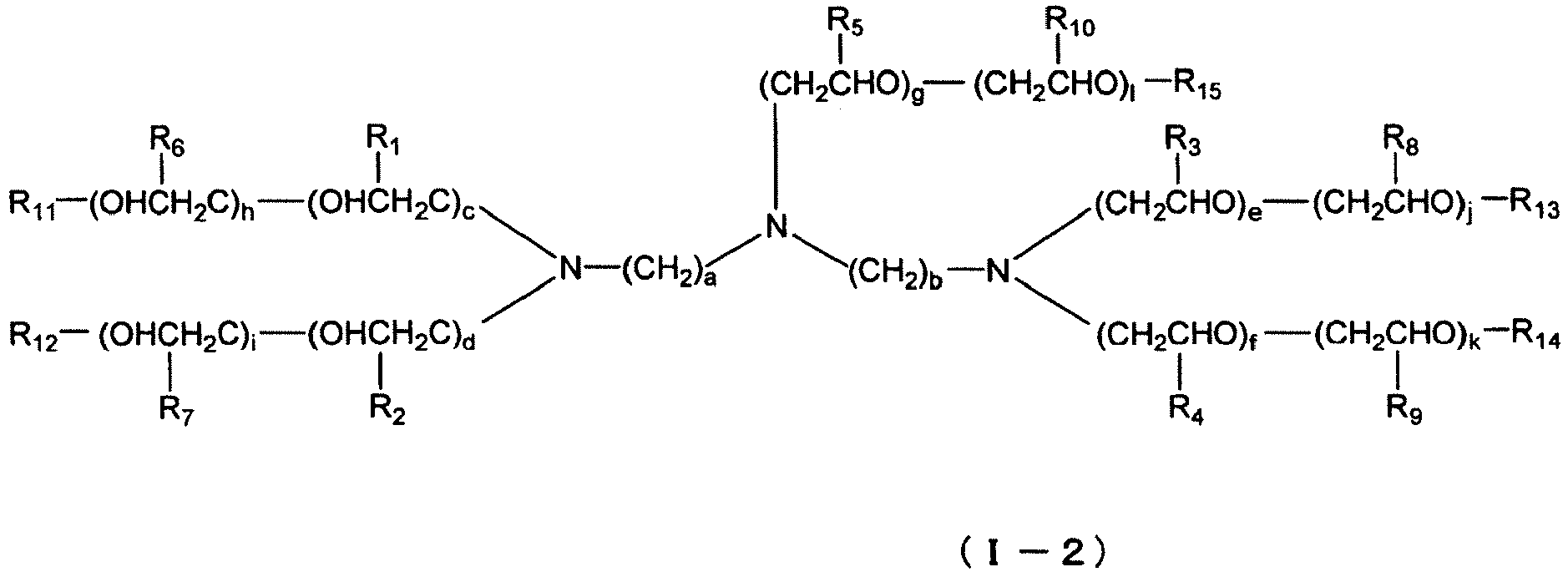
- In the above formula, R1 to R10 may be the same or different and represent H or CH3, R11 to R15 may be the same or different and represent H, CH3, COR16, or CONHR17, in which R16 and R17 and represent an alkyl group, an aryl group, an alkenyl group, or an alkynyl group, a and b and represent an integer of 2 to 12, and c, d, e, f, g, h, i, j, k, and 1 may be the same or different and represent an integer of 0 to 300 and (c + h) (d + i) (e + j) (f + k) (g + 1) ≠ 0.
- Of the above compounds represented by the general formula (I-2), particularly preferred compound is a compound in which R1 to R10 represent H or CH3 and the end is a hydroxyl group, namely, R11, R12, R13, R14, and R15 entirely represent H, and an average molecular weight is from 320 to 1,300.
- The group represented by R16 and R17 in aforementioned general formula (I-1) can be selected from groups listed in R10 and R11 of the formula (I).
- Specific examples of the compound represented by the general formula (I) include Adeka Polyether EDP-300 (manufactured by ADEKA CORPORATION, ethylenediaminepropylene oxide-modified product: molecular weight of 300), EDP-450 (manufactured by ADEKA CORPORATION, ethylenediaminepropylene oxide-modified product: molecular weight of 450), and Adeka Polyether BM-34 (manufactured by ADEKA CORPORATION, ethylenediamineethylene oxide-modified product: molecular weight of 280). It is also possible to exemplify propylene oxide-modified products of diethylenetriamine, such as N,N,N',N",N"-pentakis(2-hydroxypropyl)diethylenetriamine, an ethylene oxide-modified product of diethylenetriamine, a propylene oxide-modified product of dipropylenetriamine, and an ethylene oxide-modified product of dipropylenetriamine.
- Examples of the compound of the general formula (I) in which n is 4 or more include propylene oxide-modified polyethyleneimine, a propylene oxide-modified product of triethylenetetramine, and a propylene oxide-modified product of tetraethylenepentamine.
- For example, polyethyleneimine (propylene oxide-modified polyethyleneimine, manufactured by Nippon Shokubai Co., Ltd.) is represented by the following formula.

- The compound represented by the general formula (I) can also include a compound having a branched structure as shown below.


- It is also possible to use a compound of the general formula (I) in which n is 21 or more. However, it is preferred to use a compound of the general formula (I) in which n is up to 20 in the developing solution composition of the present invention since the obtained developing solution composition has high viscosity and may exhibit insufficient solubility in water depending on the modified type compound.
- The use amount of the compound represented by the general formula (I) as the component (B) is preferably from 0.001 to 10% by mass, and more preferably from 0.01 to 5% by mass, based on the entire amount of the developing solution composition. The use amount of the component (B) is not preferred to be less than 0.001% by mass as failing to obtain aforementioned effect. The use amount of the component (B) is not preferred to be more than 10% by mass as exerting an adverse influence on compatibility with other components.
- Still another component used in the developing solution composition of the present invention is (C) a metal salt of Group 2 elements of the Periodic Table of the Elements. The metal salt as the component (C) can suppress the penetration of a developing solution into the image area. Group 2 elements are beryllium, magnesium, calcium, strontium, and barium. In the developing solution composition of the present invention, these elements are used in the form of a metal salt. Specifically, the metal salt is, for example, a halide, a carbonate, a sulfate, a nitrate, a phosphate, a formate, an acetate, a propionate, a maleate, a lactate, a levulinate, a malonate, an adipate, or a fumarate. Of these, a halide, a carbonate, a sulfate, a nitrate, a phosphate, and an acetate are preferred, and particularly preferred metal salts are calcium chloride and magnesium chloride.
- The use amount of the metal salt of Group 2 elements is preferably from 0.01 to 5% by mass, and more preferably from 0.05 to 1% by mass, based on the entire amount of the developing solution composition. The use amount of the metal salt of Group 2 elements is not preferred to be more than 5% by mass as causing drastic deterioration of developability of the exposed area.
- Yet another component used in the developing solution composition of the present invention is (D) a polymer comprising carboxylic acid or a salt thereof. Usually, metal ions as the component (C) are likely to be combined with carbon dioxide in air in an aqueous alkali solution to thereby precipitate as a carbonate. Coexistence of the polymer comprising carboxylic acid or a salt thereof suppresses the precipitation of the component (C), thus enabling the existence of the component (C) stably in the alkali developing solution. The component (D) can accelerate the development to the exposed area delayed by the addition of the component (C) to the developing solution composition. Specifically, the polymer comprising carboxylic acid or a salt thereof usable in the developing solution composition of the present invention is a compound comprising a structural unit represented by the following formula (III).

- In the above formula, B represents a hydrogen atom, an alkyl group having 1 to 3 carbon atoms, or an -Ra-COOX group, in which Ra represents an alkylene group which may have a substituent, A represents a hydrogen atom, a carbamoyl group, an alkoxycarbonyl group, a carboxyl group, or a salt thereof, and X represents a hydrogen atom, an alkali metal atom, a protonated organic amine group, or a quaternary ammonium group.
- The polymer comprising carboxylic acid or a salt thereof usable in the present invention includes, for example, a homopolymer of a monomer having an acid group, or a copolymer with other monomers, such as a polyacrylic acid (salt), a polymethacrylic acid (salt), an acrylic acid-maleic acid copolymer (salt), a polyitaconic acid (salt), a polymaleic acid (salt), or a styrene-acrylic acid copolymer (salt). Examples of the polymer in which A in the formula (III) is a carbamoyl group or an alkoxycarbonyl group include polymers in which a (co)polymer comprising maleic anhydride has been modified with ammonia, amine, or alcohols. Of these, particularly preferred polymer is an acrylic acid-maleic acid copolymer sodium or a sodium polyacrylate.
- The use amount of (D) the polymer comprising carboxylic acid or a salt thereof is preferably from 0.01 to 20% by mass, and more preferably from 0.1 to 10% by mass, based on the entire amount of the developing solution composition. The use amount of (D) the polymer comprising carboxylic acid or a salt thereof is not preferred to be less than 0.01% by mass as failing to obtain aforementioned effect. The use amount thereof is not preferred to be more than 20% by mass since a developing solution may penetrate into the image area, thus causing increase of film loss.
- Regarding (C) the metal salt of Group 2 elements of the Periodic Table of the Elements and (D) the polymer comprising carboxylic acid or a salt thereof, a molar ratio of metal ions as the component (C) to carboxylic acid as the component (D) is preferably from 1:2 to 1:40, and more preferably from 1:3 to 1:20. The ratio is not preferred to be less than 1:2 since developability of the non-image area deteriorates to cause development residue in the non-image area, and also the metal salt (C) is likely to precipitate as an insoluble substance like a carbonate in a developing solution. The ratio is not preferred to be more than 1:40 since the effect of suppressing the penetration of a developing solution into the image area of the component (C) deteriorates and a developing solution penetrates into the image area, thus causing increase of film loss.
- To the developing solution composition of the present invention, a surfactant, an organic solvent, and the like can be added, in addition to aforementioned essential components (A) to (D).
- Preferred surfactant includes alkali metal salts of alkylnaphthalene sulfonates, alkali metal salts of alkylbenzene sulfonates, alkali metal salts of alkyldiphenylether disulfonates, alkali metal salts of dialkylsulfosuccinic acids, alkali metal salts of sulfuric acid monoesters of aliphatic alcohols having typically 6 to 9 carbon atoms, and alkali metal salts of sulfonic acids having typically 6 to 9 carbon atoms. Preferred alkali metal is sodium. The surfactant or a mixture of the surfactant is typically included in the amount of about 0.5% by mass to about 15% by mass, and preferably about 3% by mass to about 8% by mass, based on the mass of the developing solution composition. As is well known to those skilled in the art, most surfactants are supplied in the form of an aqueous surfactant solution. Percentage of these surfactants is based on the amount of the surfactant in the developing solution (i.e. mass of an active component, namely, components except water in the aqueous surfactant solution and other inert materials).
- The organic solvent which can be added to the developing solution composition of the present invention includes, for example, ethyl acetate, butyl acetate, amyl acetate, benzyl acetate, ethylene glycol monobutyl acetate, butyl lactate, butyl levulinate, methyl ethyl ketone, ethyl butyl ketone, methyl isobutyl ketone, cyclohexanone, ethylene glycol monobutyl ether, ethylene glycol monobenzyl ether, ethylene glycol monophenyl ether, benzyl alcohol, methyl phenyl carbitol, n-amyl alcohol, methylamyl alcohol, xylene, methylene dichloride, ethylene dichloride, monochlorobenzene, 2-phenoxyethanol, methylcyclohexanol, cyclohexanol, ethylene glycol dibutyl ether, cyclohexanone, methylcyclohexanone, n-butyl ethyl ketone, and the like. The amount of the organic solvent to be added to the developing solution composition is preferably 20% by mass or less, and particularly preferably 10% by mass or less.
- The developing solution composition can also contain a buffer system which comparatively constantly maintains the pH. A lot of buffer systems are known to those skilled in the art. Typical buffer system contains, for example, a combination of a water-soluble amine such as monoethanolamine, diethanolamine, triethanolamine, or tri-i-propylamine, and sulfonic acid such as benzenesulfonic acid or 4-toluenesulfonic acid; a mixture of a tetrasodium salt of ethylenediaminetetraacetic acid (EDTA) and EDTA; a mixture of a phosphate salt, such as a mixture of a monoalkyl phosphate salt and a trialkyl phosphate salt; and a mixture of an alkali borate and boric acid.
- It is also possible to optionally add, to the developing solution composition, a water-soluble sulfite such as lithium sulfite, sodium sulfite, potassium sulfite, or magnesium sulfite; a hydroxyaromatic compound such as an alkali-soluble pyrazolone compound, an alkali-soluble thiol compound, or methylresorcine; and water softeners and various defoamers, such as polyphosphate and aminopolycarboxylic acids.
- The developing solution composition of the present invention has a pH of at most about 12, and preferably at most about 11.
- A lithographic printing plate precursor treatable with the developing solution composition of the present invention will be described.
- The treatable lithographic printing plate precursor includes, on a substrate, a lower layer, and includes an upper layer on the lower layer. The lower layer and the upper layer constitute an image forming layer of the lithographic printing plate precursor. An intermediate layer may be optionally formed between the substrate and the lower layer, and it is preferred that the intermediate layer does not exist between the lower layer and the upper layer. A backcoat layer may be optionally formed on a back surface of the substrate.
- The lower layer constituting the lithographic printing plate precursor contains a resin which is soluble or dispersible in an aqueous alkali solution. In order to be soluble or dispersible in an aqueous alkali solution, the resin preferably has at least a functional group such as a carboxyl group, a sulfonic acid group, a phosphoric acid group, a phosphonic acid group, an active imino group, or a sulfonamide group. Therefore, the resin soluble or dispersible in an aqueous alkali solution used in the lower layer can be suitably formed by polymerizing a monomer mixture comprising one or more ethylenically unsaturated monomers having a functional group such as a carboxyl group, a sulfonic acid group, a phosphoric acid group, a phosphonic acid group, an active imino group, a sulfonamide group, and a combination thereof.
- The ethylenically unsaturated monomer can be a compound represented by the following formula:


- Examples of the unsaturated ethylene monomer include, in addition to acrylic acid and methacrylic acid, compounds represented by the following formulas, and a mixture thereof.


- The weight average molecular weight of the resin which is water-insoluble and alkali-soluble or alkali-dispersible is preferably within a range from 20,000 to 100,000. When the weight average molecular weight of the water resin which is water-insoluble and alkali-soluble or alkali-dispersible is less than 20,000, the resin may be inferior in solvent resistance and durability. In contrast, when the weight average molecular weight of the resin which is water-insoluble and alkali-soluble or alkali-dispersible is more than 100,000, the resin may be inferior in alkali developability.
- The content of the resin soluble or dispersible in an aqueous alkali solution in the lower layer is preferably within a range from 20 to 95% by mass based on the solid content of the layer. The content of the resin soluble or dispersible in an aqueous alkali solution is disadvantageous to be less than 20% by mass in view of chemical resistance. The content of the resin soluble or dispersible in an aqueous alkali solution is not preferred to be more than 95% by mass in view of an exposure speed. It is also possible to optionally use two or more resins soluble or dispersible in an aqueous alkali solution in combination.
- The upper layer constituting the lithographic printing plate precursor contains an alkali-soluble or alkali-dispersible resin. The alkali-soluble or alkali-dispersible resin usable in the upper layer is preferably a resin having a carboxylic acid or acid anhydride group, and examples thereof include a copolymer obtained by polymerizing a monomer mixture comprising either of an unsaturated carboxylic acid and an unsaturated carboxylic anhydride, or both an unsaturated carboxylic acid and an unsaturated carboxylic anhydride, a polyurethane having an acidic hydrogen atom-containing substituent, and the like. Examples of the unsaturated carboxylic acid include acrylic acid, methacrylic acid, maleic acid, itaconic acid, and the like, and examples of the unsaturated carboxylic anhydride include maleic anhydride, itaconic anhydride, and the like. Examples of the copolymerizable unsaturated ethylene monomer unit include other unsaturated ethylene comonomers.
- At least one of the lower layer and the upper layer contains a photothermal conversion material. It is considered that, if the lower layer of the lithographic printing plate precursor contains a photothermal conversion material and the upper layer does not contain a photothermal conversion material, when an image is written on the lithographic printing plate precursor by a laser, the photothermal conversion material of the lower layer converts laser light into heat and heat is transferred to the upper layer, and thus a partial molecular structure of the alkali-soluble or alkali-dispersible resin of the uppermost layer is collapsed to form pores in the upper layer, thus enabling penetration of the developing solution into the lower layer.
- The photothermal conversion material means any material capable of converting an electromagnetic wave into thermal energy, and is a material having a maximum absorption wavelength in a near infrared to infrared region, specifically a material having a maximum absorption wavelength within a range from 760 to 1,200 nm. Examples of such a material include various pigments and dyes.
- It is possible to use, as the pigments, commercially available pigments disclosed, for example, in Color Index Handbook, "Latest Pigment Handbook" (edited by Nihon Pigment Technique Society, published in 1977), "Latest Pigment Application Technique" (published by CMC in 1986), "Printing Ink Technique" (published by CMC in 1984), and the like. Applicable types of pigments include black, yellow, orange, brown, red, violet, blue, green pigments, fluorescent pigments, polymer-grafted pigments, and the like. Specifically, it is possible to use insoluble azo pigments, azo lake pigments, condensed azo pigments, chelated azo pigments, phthalocyanine pigments, anthraquinone pigments, perylene and perinone pigments, thioindigo pigments, quinacridone pigments, dioxazine pigments, isoindolinone pigments, quinophthalone pigments, lake pigments, azine pigments, nitroso pigments, nitro pigments, natural pigments, fluorescent pigments, inorganic pigments, carbon black, and the like.
- It is possible to use, as the dyes, conventionally known commercially available dyes disclosed, for example, in "Dye Handbook" (edited by the Association of Organic Synthesis Chemistry, published in 1970), "Handbook of Color Material Engineering" (edited by the Japan Society of Color Material, Asakura Shoten K. K., published in 1989), "Technologies and Markets of Industrial Dyes" (published by CMC in 1983), "Chemical Handbook, Applied Chemistry Edition" (edited by The Chemical Society of Japan, Maruzen Shoten K. K., published in 1986), and the like. More specific examples of dyes include azo dyes, metal complex azo dyes, pyrazolone azo dyes, anthraquinone dyes, phthalocyanine dyes, carbonium dyes, quinonimine dyes, methine dyes, cyanine dyes, indigo dyes, quinoline dyes, nitro-based dyes, xanthene-based dyes, thiazine-based dyes, azine dyes, oxazine dyes, and the like.
- It is possible to use, as the dyes capable of efficiently absorbing near infrared rays or infrared rays, azo dyes, metal complex azo dyes, pyrazolone azo dyes, naphthoquinone dyes, anthraquinone dyes, phthalocyanine dyes, carbonium dyes, quinoneimine dyes, methine dyes, cyanine dyes, squalirium dyes, pyrylium salts, metal thiolate complexes (for example, nickel thiolate complex), and the like. Of these, cyanine dyes are preferred, and cyanine dyes represented by the general formula (I) of Japanese Unexamined Patent Publication (Kokai) No.
2001-305722 2002-079772 - The photothermal conversion material is particularly preferably a dye represented by the following formula:


- The lithographic printing plate precursor of the present invention may contain a matting agent in the uppermost layer or a mat layer may be formed on the uppermost layer for the purpose of improving deinterleaving paper property and improving a plate transportation property of an automatic plate loader.
- Examples of the substrate include metal plates such as aluminum, zinc, copper, stainless steel, and iron plates; plastic films such as polyethylene terephthalate, polycarbonate, polyvinyl acetal, and polyethylene films; composite materials obtained by vacuum-depositing or laminating a metal layer on papers or plastic films on which a synthetic resin is melt-coated or a synthetic resin solution is coated; and materials used as the substrate of the printing plate. Of these substrates, aluminum and composite substrates coated with aluminum are preferably used.
- The surface of the aluminum substrate is preferably subjected to a surface treatment for the purpose of enhancing water retentivity and improving adhesion with the lower layer or the intermediate layer formed optionally. Examples of the surface treatment include surface roughening treatments such as brush graining, ball graining, electrolytic etching, chemical etching, liquid honing, sand blasting, and a combination thereof. Of these surface treatments, a surface roughening treatment including the use of electrolytic etching is preferred.
- The present invention will be described in more detail below by way of Examples. However, the present invention is not limited to these Examples.
- In a 10 liter flask equipped with a stirrer, a capacitor, and a dropping device, 3,500 g of ethanol was charged and then heated to 70°C. After dissolving 231.1 g (2.14 mol) of a vinylphosphonic acid monomer, 1368.9 g (19.26 mol) of acrylamide, and 52 g of AIBN in 1,000 g of ethanol, this solution was added dropwise in a reactor over 4 hours. During dropwise addition of the monomer solution, a white precipitate was formed. While maintaining at 70°C, the monomer solution was heated and stirred for 2 hours, followed by stopping of heating and further cooling to room temperature. The precipitated white powder was separated by filtration, washed with 1,000 g of ethanol and then dried.
- A 0.24 mm thick aluminum plate was degreased in an aqueous sodium hydroxide solution and then subjected to an electrolytic graining treatment in a 2% hydrochloric acid bath to obtain a grained plate having a center line average roughness (Ra) of 0.5 µm. Then, the grained plate was subjected to an anodizing treatment in a 20% sulfuric acid bath at a current density of 2 A/dm2 to form an anodic oxide film (2.7 g/m2). After washing with water and drying, an aluminum substrate was obtained. The substrate thus obtained was immersed in an aqueous 0.5 g/L solution of a polymer 1 heated to 60°C for 10 seconds, washed with water and then dried. Thus, a substrate for lithographic printing plate precursor was obtained.
- A coating solution for lower layer shown in Table 1 below was prepared.
Table 1: Coating solution B-1 for lower layer Components Unit: g Methyl ethyl ketone 47.50 Propylene glycol monomethyl ether 28.50 γ-Butyrolactone 9.50 Water 9.50 Copolymer of acrylonitrile/methactylamide/methacrylic acid/styrene/vinylphosphonic acid/p-vinylbenzoic acid (weight ratio: 50/10/10/10/10/10, Mw = 50,000) 2.50 Copolymer of acrylonitrile/methactylamide/2-(N'-(4-hydroxyphenyl)ureido)ethyl methacrylate (weight ratio: 40/20/40, Mw = 20,000) 0.50 Copolymer of dimethylolpropionic acid/bis(4-(2-hydroxyethoxy)phenylsulfone/diphenylmethane diisocyanate (weight ratio: 22.5/22.5/55, Mw = 6,000) 0.50 ARASTAR-700*1 0.50 4-Dimethylaminobenzoic acid 0.10 PS210CNE*2 0.50 Brilliant Green 0.05 Polyethylene Glycol 300 0.10 Fuluorinated polymer 1*3 0.05 Fuluorinated polymer 2*4 0.10 DOW CORNING TORAY 8019 ADDITIVE*5 0.05 Total 100.00 *1: Styrene-maleic acid ester resin (manufactured by Arakawa Chemical Industries, Ltd.)
*2: IR Dye (manufactured by Nippon Kayaku Co., Ltd.)
*3: Copolymer of perfluorooctylethyl acrylate/poly(oxypropylene) acrylate (n = 6) (molar ratio: 35/65)
*4: Copolymer of perfluorooctylethyl acrylate/2-hydroxyethyl methacrylate/benzyl methacrylate/N-phenylmaleimide (molar ratio: 30/20/10/40))
*5: Polyether-modified silicone-based surfactant (manufactured by Dow Corning Toray Co., Ltd.) - A coating solution for upper layer shown in Table 2 was prepared.
Table 2: Coating solution T-1 for upper layer Components Unit: g Methyl ethyl ketone 45.00 Propylene glycol monomethyl ether 45.00 Propylene glycol monomethyl ether acetate 9.50 Copolymer of dimethylolpropionic acid/bis(4-(2-hydroxyethoxy)phenylsulfone/1,10-decanediol/*6 PF-6320/diphenylmethane diisocyanate/2,4-tolylene diisocyanate (weight ratio: 20/17/5/10/40/8, Mw = 16,000) 2.94 Ammonia-modified product (Mw = 9,000) of styrene/maleic anhydride copolymer (molar ratio: 3/1) 0.40 4-Dimethylaminobenzoic acid 0.24 Cyanine IR Dye 0.12 Acid Red 52 0.20 Fuluorinated polymer 1*3 0.05 DOW CORNING TORAY 8019 ADDITTVE*5 0.05 Total 100.00 *3: Copolymer of perfluorooctylethyl acrylate/poly(oxypropylene) acrylate (n = 6) (molar ratio: 35/65)
*5: Polyether-modified silicone-based surfactant (manufactured by Dow Corning Toray Co., Ltd.)
*6: Hydroxy-terminated fluorinated polyether manufactured by OMNOVA Solutions Inc.
- Using a roll coater, the coating solution for lower layer (B-1) prepared according to the composition shown in Table 1 was coated on the substrate obtained by the above method for the preparation of a substrate, and then dried at 100°C for 2 minutes to obtain a first image forming layer. At this time, the amount of a dry coating film was 1.5 g/m2. Using a roll coater, the coating solution for upper layer (T-1) prepared according to the composition shown in Table 2 was coated on this first image forming layer, and then dried at 100°C for 2 minutes to obtain a two-layered lithographic printing plate precursor. Only the image forming layer of the upper layer was peeled by methyl isobutyl ketone, and then the amount of the dry coating film the image forming layer of the upper layer was determined. At this time, the amount of the dry coating film the image forming layer of the upper layer was 0.5 g/m2.
- Furthermore, a protective material (moisture content of 2.5%, material: natural pulp paper, thickness of 70 µm, weight of 45 g/m2) was supplied on a photosensitive layer surface of the two-layered lithographic printing plate precursor obtained above, and then 30 sheets of the printing plate precursor and the papers were alternately stacked on a plastic pallet. Thereafter, side and top surfaces were surrounded by a particular polyolefin film so as not to contain air, followed by a conditioning treatment at 60°C for 24 hours. Thus, a two-layered lithographic printing plate precursor A was produced.
- In accordance with each composition shown in Tables 3 and 4, various developing solutions were prepared.
- In the developing solution 1, calcium chloride dehydrate as (C) a metal salt of elements belonging to Group 2 of the Periodic Table of the Elements, a sodium salt (40% aqueous solution) of an acrylic acid-maleic acid copolymer (molar ratio of 40:60) as (D) a polymer comprising carboxylic acid or a salt thereof, and Adeka Polyether EDP-300 as (B) a compound represented by the general formula (I) were respectively added. The developing solution 2 was prepared in accordance with the same composition as in the developing solution 1, except that Adeka Polyether EDP-300 of the developing solution 1 was replaced by N,N,N',N",N"-pentakis(2-hydroxypropyl)diethylenetriamine. The developing solution 3 was prepared in accordance with the same composition as in the developing solution 1, except that Adeka Polyether EDP-300 of the developing solution 1 was replaced by EPOMIN PP-061. The developing solution 4 was prepared in accordance with the same composition as in the developing solution 1, except that Adeka Polyether EDP-300 of the developing solution 1 was replaced by Adeka Polyether EDP-450. The developing solution 5 was prepared in accordance with the same composition as in the developing solution 1, except that Adeka Polyether EDP-300 of the developing solution 1 was replaced by Adeka Polyether BM-34. In the developing solution 6, developing solution components were adjusted so that a molar ratio of metal ions of the component (C) to carboxylic acid (D) becomes 1:2.3. In the developing solution 7, developing solution components were adjusted so that a molar ratio of metal ions of the component (C) to carboxylic acid (D) becomes 1:18.8.
Table 3: Developing solution composition examples 1 to 5 Components Developing solution 1 Developing solution 2 Developing solution 3 Developing solution 4 Developing solution 5 Deionized water 641.25 641.25 641.25 641.25 641.25 Calcium chloride dihydrate 3.75 3.75 3.75 3.75 3.75 40% Aqueous solution of sodium salt of acrylic acid-maleic acid copolymer (molar ratio of 40:60) 25.0 25.0 25.0 25.0 25.0 Adeka Polyether EDP-300 50.0 - - - - N,N,N',N",N"-pentakis(2-hydroxypropyl)diethylenet riamine - 50.0 - - - EPOMIN PP-061 - - 50.0 - - Adeka Polyether EDP-450 - - - 50.0 - Adeka Polyether BM-34 - - - - 50.0 PELEX NBL 140.0 140.0 140.0 140.0 140.0 Benzyl alcohol 30.0 30.0 30.0 30.0 30.0 2-(2-Aminoethoxy)ethanol 75.0 75.0 75.0 75.0 75.0 Trisiopropanolamine 30.0 30.0 30.0 30.0 30.0 Succinic acid 5.0 5.0 5.0 5.0 5.0 (C): (D) Carboxylic acid (molar ratio) 1:4.7 1:4.7 1:4.7 1:4.7 1:4.7 EPOMIN PP-061: 50% Aqueous solution of propylene oxide-modified polyethyleneimine (manufactured by Nippon Shokubai Co., Ltd.)
Adeka Polyether EDP-450 (manufactured by ADEKA CORPORATION): Ethylenediaminepropylene oxide-modified product
Adeka Polyether BM-34 (manufactured by ADEKA CORPORATION): Ethylenediamineethylene oxide-modified product
PELEX NBL (manufactured by Kao Corporation): Sodium alkyl naphthalene sulfonateTable 4: Developing solution composition examples 6 to 7 Components Developing solution 6 Developing solution 7 Deionized water 654.25 527.32 Calcium chloride dihydrate 3.75 3.75 40% Aqueous solution of sodium salt of acrylic acid-maleic acid copolymer (molar ratio of 40:60) 12.0 - 40% Aqueous solution of sodium salt of styrene-acrylic acid copolymer (molar ratio of 70.1:20.9) - 138.93 Adeka Polyether EDP-300 50.0 50.0 N,N,N',N",N"-pentakis(2-hydroxypropyl)diethylenetriamine - - EPOMIN PP-061 - - Adeka Polyether EDP-450 - - Adeka Polyether BM-34 - - PELEX NBL 140.0 140.0 Benzyl alcohol 30.0 30.0 2-(2-Aminoethoxy)ethanol 75.0 75.0 Trisiopropanolamine 30.0 30.0 Succinic acid 5.0 5.0 (C): (D) Carboxylic acid (molar ratio) 1:2.3 1:18.8 - In accordance with the composition shown in Table 5, developing solutions 8 to 14 were prepared as developing solutions for Comparative Examples.
Table 5: Developing solution composition examples 8 to 14 (Comparative Examples) Components Developing solution 8 Developing solution 9 Developing solution 10 Developing solution 11 Developing solution 12 Developing solution 13 Developing solution 14 Deionized water 641.25 641.25 641.25 641.25 641.25 641.25 641.25 Calcium chloride dihydrate - 3.75 3.75 3.75 - - - 40% Aqueous solution of sodium salt of acrylic acid-maleic acid copolymer (molar ratio of 40:60) 25.0 - 25.0 - - 25.0 - Adeka Polyether EDP-300 50.0 50.0 - - 50.0 - - N,N,N',N",N"-pentakis(2-hydroxypropyl)diethylenetriamine - - - - - - - EPOMIN PP-061 - - - - - - - PELEX NBL 140.0 140.0 140.0 140.0 140.0 140.0 140.0 Benzyl alcohol 30.0 30.0 30.0 30.0 30.0 30.0 30.0 2-(2-Aminoethoxy)ethanol 75.0 75.0 75.0 75.0 75.0 75.0 75.0 Trisiopropanolamine 30.0 30.0 30.0 30.0 30.0 30.0 30.0 Succinic acid 5.0 5.0 5.0 5.0 5.0 5.0 5.0 - It is shown in Table 6 whether or not these three kinds of components are added in a developing solution for Inventive Example and developing solutions for Comparative Examples.
Table 6 Developing solutions 1 to 7 Developing solution 8 Developing solution 9 Developing solution 10 Developing solution 11 Developing solution 12 Developing solution 13 Developing solution 14 Inventive Example Comparative Example Comparative Example Comparative Example Comparative Example Comparative Example Comparative Example Comparative Example (C) Metal salt of Group 2 elements A NA A A A NA NA NA (D) Polymer comprising carboxyic acid A A NA A NA NA A NA (B) Compound represented by the general formula (I) A A A NA NA A NA NA A: added
NA: not added - In the same manner, developing solutions were prepared as developing solutions 15 to 17 for Comparative Examples in accordance with the composition shown in Table 7. The developing solution 15 was prepared in accordance with the same composition as in the developing solution 1, except that calcium chloride of the developing solution 1 was replaced by sodium chloride. The developing solution 16 was prepared in accordance with the same composition as in the developing solution 1, except that a sodium salt (40% aqueous solution) of an acrylic acid-maleic acid copolymer (molar ratio of 40:60) of the developing solution 1 was replaced by Dextrin ND-S which is a water-soluble resin containing no carboxylic acid. The developing solution 17 was prepared in accordance with the same composition as in the developing solution 1, except that Adeka Polyether EDP-300 of the developing solution 1 was replaced by Adeka Polyether C-300 which is a propylene oxide-modified product of glycerol.
Table 7: Developing solution composition examples 15 to 17 (Comparative Examples) Components Developing solution 15 Developing solution 16 Developing solution 17 Deionized water 641.25 641.25 641.25 Calcium chloride dihydrate - 3.75 3.75 Sodium chloride 3.75 - - 40% Aqueous solution of sodium salt of acrylic acid-maleic acid copolymer (molar ratio of 40:60) 25.0 - 25.0 Dextrin ND-S - 10.0 - Adeka Polyether EDP-300 50.0 50.0 - Adeka Polyether G-300 - - 50.0 PELEX NBL 140.0 140.0 140.0 Benzyl alcohol 30.0 30.0 30.0 2-(2-Aminoethoxy)ethanol 75.0 75.0 75.0 Trisiopropanolamine 30.0 30.0 30.0 Succinic acid 5.0 5.0 5.0 Developing solution 15 Comparative Example Developing solution 16 Comparative Example Developing solution 17 Comparative Example (C) Metal salt of Group 2 elements NA A A (D) Polymer comprising carboxyic acid A NA A (B) Compound represented by the general formula (I) A A NA Dextrin ND-S (manufactured by NIPPON STARCH CHEMICAL CO.,
LTD.): Dextrin
Adeka Polyether G-300 (manufactured by ADEKA CORPORATION): Glycerin PO adduct
A: added
NA: not added - In order to examine an influence of a molar ratio of metal ions as the component (C) to carboxylic acid as the component (D) exerted on the effects of the present invention, the following test was performed.
- In the same manner, except that a molar ratio of metal ions as the component (C) to carboxylic acid as the component (D) was changed, developing solutions were prepared as developing solutions 18 to 19 for Inventive Examples in accordance with the composition shown in Table 8. Although components of the developing solution 18 are the same as those of the developing solution 6, a developing solution composition was prepared so that a molar ratio of metal ions as the component (C) to carboxylic acid as the component (D) becomes 1:1.5. Although components of the developing solution 19 are the same as those of the developing solution 7, a developing solution composition was prepared so that a molar ratio of metal ions as the component (C) to carboxylic acid as the component (D) becomes 1:45.1.
Table 8: Developing solution composition examples 18 to 19 Components Developing solution 18 Developing solution 19 Deionized water 641.25 641.25 Calcium chloride dihydrate 3.75 3.75 40% Aqueous solution of sodium salt of acrylic acid-maleic acid copolymer (molar ratio of 40:60) 8.00 - 40% Aqueous solution of sodium salt of styrene-acrylic acid copolymer (molar ratio of 70.1:20.9) - 333.43 Adeka Polyether EDP-300 50.0 50.0 N,N,N',N",N"-pentakis(2-hydroxypropyl)diethylenetriamine - - EPOMIN PP-061 - - Adeka Polyether EDP-450 - - Adeka Polyether BM-34 - - PELEX NBL 140.0 140.0 Benzyl alcohol 30.0 30.0 2-(2-Aminoethoxy)ethanol 75.0 75.0 Trisiopropanolamine 30.0 30.0 Succinic acid 5.0 5.0 (C): (D) Carboxylic acid (molar ratio) 1:1.5 1:45.1 Developing solution 18 Inventive Example Developing solution 19 Inventive Example (C) Metal salt of Group 2 elements A A (D) Polymer comprising carboxyic acid A A (B) Compound represented by the general formula (I) A A A: added
NA: not added - Using a plate setter PT-R4300 (manufactured by Dainippon Screen Mfg. Co., Ltd.), the two-layered lithographic printing plate precursor A thus produced was exposed at 150 mJ/cm2. Using an automatic processor P-940X (manufactured by Kodak Japan Ltd.) and a developing solution prepared by diluting the developing solution, obtained in accordance with the composition of Table 4, four times with water, a developing treatment was performed at 30°C for 15 seconds. Thereafter, gum coating was performed using a finishing gum PF2 (manufactured by Kodak Japan Ltd.). Furthermore, a developing treatment of 2,000 m2 of the lithographic printing plate precursor A was continuously performed while replenishing the developing solution diluted 2.5 times in the amount of 20 ml per 1 m2 treatment of the lithographic printing plate precursor A.
- The results are shown in Table 9.
- Developability of the non-image area and film loss of the image area of the lithographic printing plate precursor A were observed at the time of 0 m2 treatment, 500 m2 treatment, 1,000 m2 treatment, and 2,000 m2 treatment of the lithographic printing plate precursor A.
- With regard to developability of the non-image area, the non-image area was observed by a 25 times magnification loupe and then it was evaluated whether or not the development residue of an image forming layer exists. Evaluation was performed in accordance with the following criteria.
- A: Development was sufficiently performed, and the residue of an image recording layer is not observed in the non-image area.
- B: The residue of an image recording layer is slightly observed on the non-image area.
- C: Development defect is observed on the non-image area and an image recording layer obviously remains.
- Using a densitometer (x-rite), the density of a film surface before and after development was measured in terms of an optical density (OD), and then film loss was judged by a remaining ratio (= OD after development/OD before development). Evaluation was performed using the following criteria.
- A: Remaining ratio is 95% or more.
- B: Remaining ratio is 90% or more and less than 95%.
- C: Remaining ratio is less than 90%.
- After completion of the developing treatment of 2,000 m2 of a lithographic printing plate precursor A, power was turned off. After being left to stand for 12 hours, a developing solution was drained from a developing solution tank and then it was observed whether or not sludge exists on the bottom of the developing solution tank.
Table 9: Results of development test Example No. Developing solution * (C) : (D) 0 m2 treatment 500 m2 treatment 1,000 m2 treatment 2,000 m2 treatment Developability Film loss Developability Film loss Developability film loss Developability Film loss Sludge Inventive Example 1 Developing solution 1 1:4.7 A A A A A A A A None Inventive Example 2 Developing solution 2 1:4.7 A A A A A A A A None Inventive Example 3 Developing solution 3 1:4.7 A A A A A A A A None Inventive Example 4 Developing solution 4 1:4.7 A A A A A A A A None Inventive Example 5 Developing solution 5 1:4.7 A A A A A A A A None Inventive Example 6 Developing solution 6 1:2.3 A A A A A A A A None Inventive Example 7 Developing solution 7 1:18.8 A A A A A A A A None Comparative Example 1 Developing solution 8 - A C A C A C A C None Comparative Example 2 Developing solution 9 - Undevelopable Comparative Example 3 Developing solution 10 1:4.7 A A A B B B B C None Comparative Example 4 Developing solution 11 - Undevelopable Comparative Example 5 Developing solution 12 - A A A B A C A C None Comparative Example 6 Developing solution 13 - A C A C A C A C None Comparative Example 7 Developing solution 14 - A A A C B C B C None Comparative Example 8 Developing solution 15 - A C A C A C A C None Comparative Example 9 Developing solution 16 - Undevelopable Comparative Example 10 Developing solution 17 1:4.7 A A A B B B B C None Inventive Example 8 Developing solution 18 1:1.5 B A B A B A B A None Inventive Example 9 Developing solution 19 1:45.5 A B A B A C A C None *(C):(D) indicates a molar ratio of (C) metal ions to (D) carboxylic acid - Inventive Examples 1 to 7 in which a developing treatment of a lithographic printing plate precursor A was performed using developing solutions 1 to 7 each containing, as developing solution components, (C) elements belonging to Group 2 of the Periodic Table of the Elements, (B) a compound represented by the general formula (I), and (D) a polymer comprising carboxylic acid, a molar ratio of (C) metal ions to (D) carboxylic acid being within a range from 1:2 to 1:40, even if a treatment area increased, the non-image area was sufficiently developed, and also image area maintained a state of remaining ratio of 95% or more. After completion of a 2,000 m2 treatment, sludge did not accumulate on the bottom of a developing solution tank and thus it was easy to wash the developing solution tank.
- In the developing solution 8, (B) a compound represented by the general formula (I) and (D) a polymer comprising carboxylic acid were added, while (C) elements belonging to Group 2 of the Periodic Table of the Elements were not added. In the case of this developing solution, the developing solution penetrated into the image area and film loss of the image area became larger when the developing solution in a developing solution tank was fresh, right after 0 m2 treatment (Comparative Example 1).
- In the developing solution 9, (C) a metal salt of elements belonging to Group 2 of the Periodic Table of the Elements and (B) a compound represented by the general formula (I) were added, while (D) a polymer comprising carboxylic acid was not added. In the case of this developing solution, it was impossible to develop when the developing solution in a developing solution tank was fresh, right after 0 m2 treatment(Comparative
- In the developing solution 10, (C) a metal salt of elements belonging to Group 2 of the Periodic Table of the Elements and (D) a polymer comprising carboxylic acid were added, while (B) a compound represented by the general formula (I) was not added. In the case of this developing solution, the non-image area was developed and the image area was in a satisfactory state with less film loss when the developing solution was fresh, right after 0 m2 treatment. After a 500 m2 treatment, film loss increased and, after a 1,000 m2 treatment, the development residue became possible to be observed in the non-image area (Comparative Example 3).
- In the developing solution 11, (C) a metal salt of elements belonging to Group 2 of the Periodic Table of the Elements was added, while (B) a compound represented by the general formula (I) and (D) a polymer comprising carboxylic acid were not added. In the case of this developing solution, it was impossible to develop when the developing solution in a developing solution tank was fresh, right after0 m2 treatment (Comparative Example 4).
- In the developing solution 12, (B) a compound represented by the general formula (I) was added, while (C) a metal salt of elements belonging to Group 2 of the Periodic Table of the Elements and (D) a polymer comprising carboxylic acid were not added. In the case of this developing solution, the non-image area was developed and film loss was observed when the developing solution was fresh, right after 0 m2 treatment. After a 1,000 m2 treatment, film loss further increased (Comparative Example 5).
- In the developing solution 13, (D) a polymer comprising carboxylic acid was added, while (C) a metal salt of elements belonging to Group 2 of the Periodic Table of the Elements and (B) a compound represented by the general formula (I) were not added. In the case of this developing solution, the developing solution penetrated into the image area immediately after charging the developing solution in a developing solution tank (0 m2 treatment), thus increasing film thinning of the image area (Comparative Example 6).
- In the developing solution 14, any of (D) a polymer comprising carboxylic acid, (B) a compound represented by the general formula (I), (C) a metal salt of elements belonging to Group 2 of the Periodic Table of the Elements was not added. In the case of this developing solution, the non-image area was developed and the image area was in a satisfactory state with less film loss when the developing solution was fresh, right after 0 m2 treatment. After a 500 m2 treatment, film loss increased and, after a 1,000 m2 treatment, the development residue became possible to be observed in the non-image area, in addition to film loss increase (Comparative Example 7).
- In the developing solution 15, (D) a polymer comprising carboxylic acid and (B) a compound represented by the general formula (I) were added, and sodium chloride was added as a metal salt of elements belonging to Group 1 in place of (C) a metal salt of elements belonging to Group 2 of the Periodic Table of the Elements. In the case of this developing solution, the developing solution penetrated into the image area and film loss of the image area became larger when the developing solution in a developing solution tank was fresh, right after 0 m2 treatment (Comparative Example 8).
- In the developing solution 16, (B) a compound represented by the general formula (I) and (C) a metal salt of elements belonging to Group 2 of the Periodic Table of the Elements were added, and dextrin which is a water-soluble resin was added in place of (D) a polymer comprising carboxylic acid. In the case of this developing solution, it was impossible to develop when the developing solution in a developing solution tank was fresh, right after 0 m2 treatment (Comparative Example 9).
- In the developing solution 17, (C) a metal salt of elements belonging to Group 2 of the Periodic Table of the Elements and (D) a polymer comprising carboxylic acid were added, and an glycerol polyoxyethylene adduct was added in place of (B) a compound represented by the general formula (I). In the case of this developing solution, the non-image area was developed and the image area was in a satisfactory state with less film loss when the developing solution was fresh, right after 0 m2 treatment. After a 500 m2 treatment, film loss increased and, after a 1,000 m2 treatment, the development residue became possible to be observed in the non-image area, in addition to film loss increase (Comparative Example 10).
- The developing solution 18 is an example in which a molar ratio of metal ions as the component (C) to a carboxylic acid group as the component (D) of the developing solution 6 (Inventive Example 6) was changed. All of (B) a compound represented by the general formula (I), (C) a metal salt of elements belonging to Group 2 of the Periodic Table of the Elements, and (D) a polymer having a carboxylic acid were added, and the molar ratio of metal ions as the component (C) to a carboxylic acid group as the component (D) was 1:1.5. In the case of this developing solution, the development residue became possible to be observed in the non-image area when the developing solution was fresh right after 0 m2 treatment, and film loss was satisfactory up to 2,000 m2 treatment (Inventive Example 8).
- The developing solution 19 is an example in which a molar ratio of metal ions as the component (C) to carboxylic acid as the component (D) of the developing solution 7 (Inventive Example 7) was changed. All of (B) a compound represented by the general formula (I), (C) a metal salt of elements belonging to Group 2 of the Periodic Table of the Elements, and (D) a polymer having a carboxylic acid group were added, and the molar ratio of metal ions as the component (C) to a carboxylic acid group as the component (D) was 1:45.1. In the case of this developing solution, the non-image area was satisfactory developed up to 2,000 m2 treatment, while film loss was slightly observed in the image area when the developing solution was fresh right after 0 m2 treatment (Inventive Example 9).
Claims (9)
- An alkali developing solution composition for producing a lithographic printing plate, comprising:(A) an alkali agent,(B) a compound represented by the formula (I) shown below,(C) a metal salt of Group 2 elements of the Periodic Table of the Elements, and(D) a polymer comprising carboxylic acid or a salt thereof:
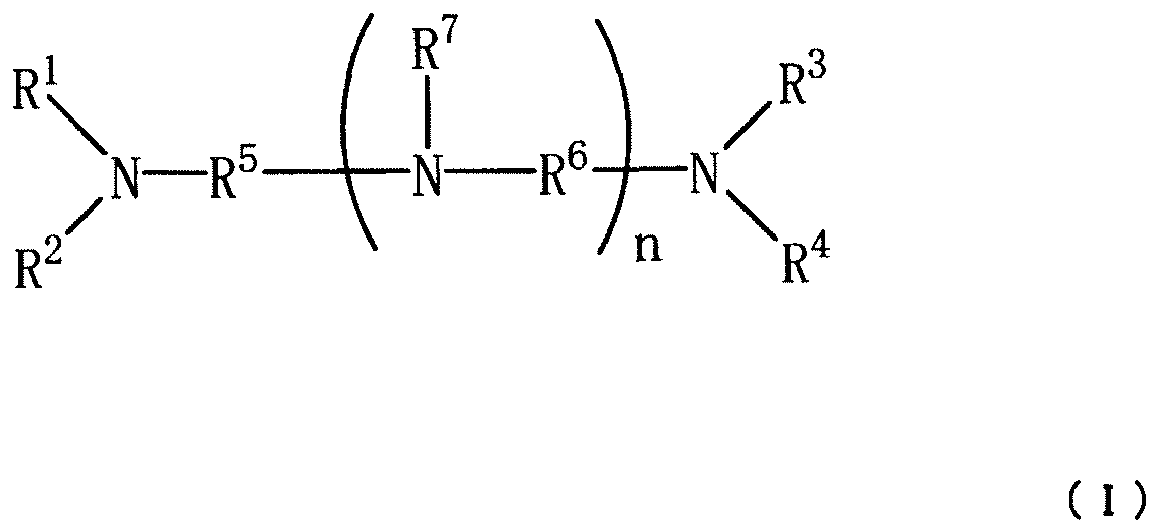 wherein R1 to R4 each independently represents H, R8OH, or -(AO)a(BO)bR9, AO and BO are selected from an ethyleneoxy group and a propyleneoxy group, wherein a and b represent an integer of from 0 to 300, but (a + b) ≠ 0, R8 represents a divalent linking group, R9 represents H, CH3, COR10, or CONHR11, and R10 and R11 represent an alkyl group, an aryl group, an alkenyl group, or an alkynyl group;R5 and R6 each independently represents a divalent linking group and may be the same or different;R7 can be selected from groups defined in aforementioned R1 to R4, or can be selected from the substituent group represented by the following formula (II):
 wherein R3' is the same as R3 defined in the formula (I),R4' is the same as R4 defined in the formula (I),R5' is the same as R5 defined in the formula (I),R6' is the same as R6 defined in the formula (I), andR7' is the same as R7 defined in the formula (I); andn in the formulas (I) and (II) represents an integer of 0 to 20 and, when n is 2 or more, R7 and R7' each can be independently selected.
 - The alkali developing solution composition according to claim 1, wherein Group 2 elements of the Periodic Table of the Elements (C) are selected from the group consisting of magnesium, calcium, strontium, and barium.
- The alkali developing solution composition according to claim 1 or 2, wherein (C) the metal salt of Group 2 elements is selected from the group consisting of a chloride, a carbonate, an acetate, a sulfate, a nitrate, and a phosphate.
- The alkali developing solution composition according to any one of claims 1 to 3, wherein (D) the polymer comprising carboxylic acid or a salt thereof is a polymer or copolymer comprising a structural unit represented by the general formula (III):

- The alkali developing solution composition according to any one of claims 1 to 4, wherein (A) the alkali agent comprises organic amines.
- The alkali developing solution composition according to any one of claims 1 to 5, further comprising an organic solvent.
- The alkali developing solution composition according to any one of claims 1 to 6, further comprising a surfactant.
- The alkali developing solution composition according to any one of claims 1 to 7, wherein the alkali developing solution composition has a pH of 12 or lower.
- A method for producing a lithographic printing plate, comprising the steps of:imagewise exposing a positive working lithographic printing plate precursor comprising, a substrate having a hydrophilic surface having thereon, a lower layer comprising a resin which is water-insoluble and alkali-soluble and an upper layer comprising a resin which is water-insoluble and alkali-soluble formed on the lower layer, at least one of the lower layer and the upper layer comprising a photothermal conversion material, using an infrared laser; anddeveloping the exposed lithographic printing plate precursor with the alkali developing solution composition according to any one of claims 1 to 8 to remove the exposed area, and to form the image area and the non-image area.
Applications Claiming Priority (2)
| Application Number | Priority Date | Filing Date | Title |
|---|---|---|---|
| JP2012147310 | 2012-06-29 | ||
| PCT/JP2013/067696 WO2014003134A1 (en) | 2012-06-29 | 2013-06-27 | Developing solution composition for lithographic printing plate precursor and method for manufacturing lithographic printing plate |
Publications (2)
| Publication Number | Publication Date |
|---|---|
| EP2869123A1 true EP2869123A1 (en) | 2015-05-06 |
| EP2869123A4 EP2869123A4 (en) | 2016-03-09 |
Family
ID=49783269
Family Applications (1)
| Application Number | Title | Priority Date | Filing Date |
|---|---|---|---|
| EP13808667.3A Withdrawn EP2869123A4 (en) | 2012-06-29 | 2013-06-27 | Developing solution composition for lithographic printing plate precursor and method for manufacturing lithographic printing plate |
Country Status (5)
| Country | Link |
|---|---|
| US (1) | US9201307B2 (en) |
| EP (1) | EP2869123A4 (en) |
| JP (1) | JP6189838B2 (en) |
| CN (1) | CN104395835A (en) |
| WO (1) | WO2014003134A1 (en) |
Families Citing this family (1)
| Publication number | Priority date | Publication date | Assignee | Title |
|---|---|---|---|---|
| US20210364924A1 (en) * | 2020-05-21 | 2021-11-25 | Taiwan Semiconductor Manufacturing Company, Ltd. | Photoresist developer and method of manufacturing a semiconductor device |
Family Cites Families (30)
| Publication number | Priority date | Publication date | Assignee | Title |
|---|---|---|---|---|
| US6399279B1 (en) * | 1998-01-16 | 2002-06-04 | Mitsubishi Chemical Corporation | Method for forming a positive image |
| JP3611715B2 (en) * | 1998-04-14 | 2005-01-19 | 三菱製紙株式会社 | Development method of planographic printing plate |
| JP3763705B2 (en) * | 1999-07-07 | 2006-04-05 | 三菱製紙株式会社 | Planographic printing plate making method |
| US6162575A (en) * | 1998-10-27 | 2000-12-19 | Mitsubishi Paper Mills Limited | Process for making lithographic printing plate |
| JP4013367B2 (en) * | 1998-11-10 | 2007-11-28 | Jsr株式会社 | Radiation sensitive resin composition |
| JP2001305722A (en) | 2000-04-18 | 2001-11-02 | Fuji Photo Film Co Ltd | Original plate of planographic printing plate |
| US6649324B1 (en) | 2000-08-14 | 2003-11-18 | Kodak Polychrome Graphics Llc | Aqueous developer for lithographic printing plates |
| JP2002079772A (en) | 2000-09-05 | 2002-03-19 | Fuji Photo Film Co Ltd | Original film for lithographic printing plate, method of making lithographic printing plate using the same and method of printing |
| JP2003091078A (en) * | 2001-07-12 | 2003-03-28 | Fuji Photo Film Co Ltd | Alkali developing solution for photosensitive planographic printing plate and method for making planographic printing plate |
| JP2003029426A (en) * | 2001-07-13 | 2003-01-29 | Fuji Photo Film Co Ltd | Alkali developing solution for photosensitive planographic printing plate and plate making method for planographic printing plate |
| JP2003043694A (en) * | 2001-08-03 | 2003-02-13 | Fuji Photo Film Co Ltd | Lithographic printing master plate |
| JP2003107715A (en) * | 2001-09-28 | 2003-04-09 | Mitsubishi Paper Mills Ltd | Lithographic printing processing method |
| JP2003195517A (en) * | 2001-12-14 | 2003-07-09 | Shipley Co Llc | Photoresist developer |
| JP2004077590A (en) * | 2002-08-12 | 2004-03-11 | Konica Minolta Holdings Inc | Liquid developer for photosensitive lithographic printing plate and processing method |
| JP2004271985A (en) | 2003-03-10 | 2004-09-30 | Fuji Photo Film Co Ltd | Developing solution for photosensitive lithographic printing plate and platemaking method for lithographic printing plate |
| US7229744B2 (en) | 2003-03-21 | 2007-06-12 | Eastman Kodak Company | Method for preparing lithographic printing plates |
| JP2004294987A (en) * | 2003-03-28 | 2004-10-21 | Fuji Photo Film Co Ltd | Developing solution for photosensitive lithographic printing plate and platemaking method for lithographic printing plate |
| JP2005242241A (en) * | 2004-02-27 | 2005-09-08 | Fuji Photo Film Co Ltd | Lithographic printing original plate |
| JP5059303B2 (en) | 2005-07-11 | 2012-10-24 | イーストマン コダック カンパニー | Planographic printing plate precursor and image forming method using the same |
| US7163770B1 (en) | 2006-01-23 | 2007-01-16 | Eastman Kodak Company | Multilayer imageable element containing sulfonamido resin |
| WO2007131951A2 (en) * | 2006-05-12 | 2007-11-22 | Agfa Graphics Nv | Method for making a lithographic printing plate |
| KR100905901B1 (en) * | 2006-09-07 | 2009-07-02 | 웅진코웨이주식회사 | Amine aqueous solution for forming an active layer of polyamide reverse osmosis composite membrane, polyamide reverse osmosis composite membrane prepared thereby, and preparation method thereof |
| JP5038434B2 (en) | 2006-11-28 | 2012-10-03 | イーストマン コダック カンパニー | Multilayer imageable element with good solvent resistance |
| JP5319097B2 (en) | 2007-10-16 | 2013-10-16 | イーストマン コダック カンパニー | Positive lithographic printing plate precursor and its plate making method |
| JP2009251221A (en) * | 2008-04-04 | 2009-10-29 | Konica Minolta Medical & Graphic Inc | Method for treating photosensitive lithographic printing plate material |
| CN101750909A (en) * | 2008-12-16 | 2010-06-23 | 京东方科技集团股份有限公司 | Developer solution component |
| EP2365389B1 (en) * | 2010-03-08 | 2013-01-16 | Fujifilm Corporation | Positive-working lithographic printing plate precursor for infrared laser and process for making lithographic printing plate |
| US8530143B2 (en) * | 2010-11-18 | 2013-09-10 | Eastman Kodak Company | Silicate-free developer compositions |
| JP5933950B2 (en) * | 2011-09-30 | 2016-06-15 | アドバンスド テクノロジー マテリアルズ,インコーポレイテッド | Etching solution for copper or copper alloy |
| JP5554362B2 (en) * | 2012-03-30 | 2014-07-23 | 富士フイルム株式会社 | Planographic printing plate making method |
-
2013
- 2013-06-27 CN CN201380034525.0A patent/CN104395835A/en active Pending
- 2013-06-27 EP EP13808667.3A patent/EP2869123A4/en not_active Withdrawn
- 2013-06-27 WO PCT/JP2013/067696 patent/WO2014003134A1/en not_active Ceased
- 2013-06-27 JP JP2014522687A patent/JP6189838B2/en not_active Expired - Fee Related
- 2013-06-27 US US14/400,894 patent/US9201307B2/en not_active Expired - Fee Related
Also Published As
| Publication number | Publication date |
|---|---|
| US9201307B2 (en) | 2015-12-01 |
| EP2869123A4 (en) | 2016-03-09 |
| US20150125795A1 (en) | 2015-05-07 |
| WO2014003134A1 (en) | 2014-01-03 |
| CN104395835A (en) | 2015-03-04 |
| JP6189838B2 (en) | 2017-08-30 |
| JPWO2014003134A1 (en) | 2016-06-02 |
Similar Documents
| Publication | Publication Date | Title |
|---|---|---|
| US7507526B2 (en) | Developer regenerators | |
| WO2007007557A1 (en) | Lithographic printing original plate and image forming method employing it | |
| EP2641131B1 (en) | Silicate-free developer compositions | |
| JP5319097B2 (en) | Positive lithographic printing plate precursor and its plate making method | |
| JP5260095B2 (en) | Making a planographic printing plate | |
| JP5443060B2 (en) | Lithographic printing plate precursor | |
| US9201307B2 (en) | Developing solution composition for lithographic printing plate precursor and method for producing lithographic printing plate | |
| EP3858636B1 (en) | Printing plate precursor, and method for making a printing plate | |
| EP3858629A1 (en) | Original plate for printing, laminate of original plate for printing, method for manufacturing printing plate, and printing method | |
| JP2009265262A (en) | Planographic printing precursor | |
| US20200223216A1 (en) | Lithographic printing plate precursor and method of producing lithographic printing plate | |
| JP5866179B2 (en) | Lithographic printing plate precursor and method for producing a lithographic printing plate | |
| JP2010237303A (en) | Negative type planographic printing plate precursor | |
| EP2757416B1 (en) | Process for producing lithographic printing plate and lithographic printing plate | |
| JP2003057823A (en) | Photosensitive composition | |
| JP5466720B2 (en) | Planographic printing plate precursor and method for producing the same | |
| JP5705675B2 (en) | Planographic printing plate precursor, lithographic printing plate and lithographic printing plate preparation method | |
| JP2004212649A (en) | Platemaking method of planographic printing plate |
Legal Events
| Date | Code | Title | Description |
|---|---|---|---|
| PUAI | Public reference made under article 153(3) epc to a published international application that has entered the european phase |
Free format text: ORIGINAL CODE: 0009012 |
|
| 17P | Request for examination filed |
Effective date: 20141230 |
|
| AK | Designated contracting states |
Kind code of ref document: A1 Designated state(s): AL AT BE BG CH CY CZ DE DK EE ES FI FR GB GR HR HU IE IS IT LI LT LU LV MC MK MT NL NO PL PT RO RS SE SI SK SM TR |
|
| AX | Request for extension of the european patent |
Extension state: BA ME |
|
| DAX | Request for extension of the european patent (deleted) | ||
| RA4 | Supplementary search report drawn up and despatched (corrected) |
Effective date: 20160204 |
|
| RIC1 | Information provided on ipc code assigned before grant |
Ipc: G03F 7/00 20060101ALI20160129BHEP Ipc: G03F 7/32 20060101AFI20160129BHEP Ipc: G03F 7/039 20060101ALI20160129BHEP Ipc: G03F 7/004 20060101ALI20160129BHEP |
|
| STAA | Information on the status of an ep patent application or granted ep patent |
Free format text: STATUS: THE APPLICATION IS DEEMED TO BE WITHDRAWN |
|
| 18D | Application deemed to be withdrawn |
Effective date: 20160906 |