EP2868403B1 - Robot system and method for producing to-be-processed material - Google Patents
Robot system and method for producing to-be-processed material Download PDFInfo
- Publication number
- EP2868403B1 EP2868403B1 EP14188736.4A EP14188736A EP2868403B1 EP 2868403 B1 EP2868403 B1 EP 2868403B1 EP 14188736 A EP14188736 A EP 14188736A EP 2868403 B1 EP2868403 B1 EP 2868403B1
- Authority
- EP
- European Patent Office
- Prior art keywords
- pressure roller
- linear motion
- pressed surface
- motion mechanism
- servomotor
- Prior art date
- Legal status (The legal status is an assumption and is not a legal conclusion. Google has not performed a legal analysis and makes no representation as to the accuracy of the status listed.)
- Active
Links
Images





Classifications
-
- B—PERFORMING OPERATIONS; TRANSPORTING
- B21—MECHANICAL METAL-WORKING WITHOUT ESSENTIALLY REMOVING MATERIAL; PUNCHING METAL
- B21D—WORKING OR PROCESSING OF SHEET METAL OR METAL TUBES, RODS OR PROFILES WITHOUT ESSENTIALLY REMOVING MATERIAL; PUNCHING METAL
- B21D39/00—Application of procedures in order to connect objects or parts, e.g. coating with sheet metal otherwise than by plating; Tube expanders
- B21D39/02—Application of procedures in order to connect objects or parts, e.g. coating with sheet metal otherwise than by plating; Tube expanders of sheet metal by folding, e.g. connecting edges of a sheet to form a cylinder
- B21D39/021—Application of procedures in order to connect objects or parts, e.g. coating with sheet metal otherwise than by plating; Tube expanders of sheet metal by folding, e.g. connecting edges of a sheet to form a cylinder for panels, e.g. vehicle doors
-
- B—PERFORMING OPERATIONS; TRANSPORTING
- B21—MECHANICAL METAL-WORKING WITHOUT ESSENTIALLY REMOVING MATERIAL; PUNCHING METAL
- B21B—ROLLING OF METAL
- B21B31/00—Rolling stand structures; Mounting, adjusting, or interchanging rolls, roll mountings, or stand frames
- B21B31/16—Adjusting or positioning rolls
-
- B—PERFORMING OPERATIONS; TRANSPORTING
- B21—MECHANICAL METAL-WORKING WITHOUT ESSENTIALLY REMOVING MATERIAL; PUNCHING METAL
- B21B—ROLLING OF METAL
- B21B37/00—Control devices or methods specially adapted for metal-rolling mills or the work produced thereby
- B21B37/58—Roll-force control; Roll-gap control
-
- B—PERFORMING OPERATIONS; TRANSPORTING
- B21—MECHANICAL METAL-WORKING WITHOUT ESSENTIALLY REMOVING MATERIAL; PUNCHING METAL
- B21D—WORKING OR PROCESSING OF SHEET METAL OR METAL TUBES, RODS OR PROFILES WITHOUT ESSENTIALLY REMOVING MATERIAL; PUNCHING METAL
- B21D19/00—Flanging or other edge treatment, e.g. of tubes
- B21D19/02—Flanging or other edge treatment, e.g. of tubes by continuously-acting tools moving along the edge
- B21D19/04—Flanging or other edge treatment, e.g. of tubes by continuously-acting tools moving along the edge shaped as rollers
- B21D19/043—Flanging or other edge treatment, e.g. of tubes by continuously-acting tools moving along the edge shaped as rollers for flanging edges of plates
-
- B—PERFORMING OPERATIONS; TRANSPORTING
- B21—MECHANICAL METAL-WORKING WITHOUT ESSENTIALLY REMOVING MATERIAL; PUNCHING METAL
- B21D—WORKING OR PROCESSING OF SHEET METAL OR METAL TUBES, RODS OR PROFILES WITHOUT ESSENTIALLY REMOVING MATERIAL; PUNCHING METAL
- B21D39/00—Application of procedures in order to connect objects or parts, e.g. coating with sheet metal otherwise than by plating; Tube expanders
- B21D39/02—Application of procedures in order to connect objects or parts, e.g. coating with sheet metal otherwise than by plating; Tube expanders of sheet metal by folding, e.g. connecting edges of a sheet to form a cylinder
- B21D39/021—Application of procedures in order to connect objects or parts, e.g. coating with sheet metal otherwise than by plating; Tube expanders of sheet metal by folding, e.g. connecting edges of a sheet to form a cylinder for panels, e.g. vehicle doors
- B21D39/023—Application of procedures in order to connect objects or parts, e.g. coating with sheet metal otherwise than by plating; Tube expanders of sheet metal by folding, e.g. connecting edges of a sheet to form a cylinder for panels, e.g. vehicle doors using rollers
-
- B—PERFORMING OPERATIONS; TRANSPORTING
- B25—HAND TOOLS; PORTABLE POWER-DRIVEN TOOLS; MANIPULATORS
- B25J—MANIPULATORS; CHAMBERS PROVIDED WITH MANIPULATION DEVICES
- B25J9/00—Programme-controlled manipulators
- B25J9/16—Programme controls
- B25J9/1628—Programme controls characterised by the control loop
- B25J9/1633—Programme controls characterised by the control loop compliant, force, torque control, e.g. combined with position control
-
- B—PERFORMING OPERATIONS; TRANSPORTING
- B25—HAND TOOLS; PORTABLE POWER-DRIVEN TOOLS; MANIPULATORS
- B25J—MANIPULATORS; CHAMBERS PROVIDED WITH MANIPULATION DEVICES
- B25J9/00—Programme-controlled manipulators
- B25J9/16—Programme controls
- B25J9/1679—Programme controls characterised by the tasks executed
-
- B—PERFORMING OPERATIONS; TRANSPORTING
- B21—MECHANICAL METAL-WORKING WITHOUT ESSENTIALLY REMOVING MATERIAL; PUNCHING METAL
- B21D—WORKING OR PROCESSING OF SHEET METAL OR METAL TUBES, RODS OR PROFILES WITHOUT ESSENTIALLY REMOVING MATERIAL; PUNCHING METAL
- B21D5/00—Bending sheet metal along straight lines, e.g. to form simple curves
- B21D5/16—Folding; Pleating
-
- G—PHYSICS
- G05—CONTROLLING; REGULATING
- G05B—CONTROL OR REGULATING SYSTEMS IN GENERAL; FUNCTIONAL ELEMENTS OF SUCH SYSTEMS; MONITORING OR TESTING ARRANGEMENTS FOR SUCH SYSTEMS OR ELEMENTS
- G05B2219/00—Program-control systems
- G05B2219/30—Nc systems
- G05B2219/39—Robotics, robotics to robotics hand
- G05B2219/39329—Adaptive force and position control
-
- G—PHYSICS
- G05—CONTROLLING; REGULATING
- G05B—CONTROL OR REGULATING SYSTEMS IN GENERAL; FUNCTIONAL ELEMENTS OF SUCH SYSTEMS; MONITORING OR TESTING ARRANGEMENTS FOR SUCH SYSTEMS OR ELEMENTS
- G05B2219/00—Program-control systems
- G05B2219/30—Nc systems
- G05B2219/40—Robotics, robotics mapping to robotics vision
- G05B2219/40052—Deform, bend flexible material
-
- Y—GENERAL TAGGING OF NEW TECHNOLOGICAL DEVELOPMENTS; GENERAL TAGGING OF CROSS-SECTIONAL TECHNOLOGIES SPANNING OVER SEVERAL SECTIONS OF THE IPC; TECHNICAL SUBJECTS COVERED BY FORMER USPC CROSS-REFERENCE ART COLLECTIONS [XRACs] AND DIGESTS
- Y10—TECHNICAL SUBJECTS COVERED BY FORMER USPC
- Y10S—TECHNICAL SUBJECTS COVERED BY FORMER USPC CROSS-REFERENCE ART COLLECTIONS [XRACs] AND DIGESTS
- Y10S901/00—Robots
- Y10S901/02—Arm motion controller
-
- Y—GENERAL TAGGING OF NEW TECHNOLOGICAL DEVELOPMENTS; GENERAL TAGGING OF CROSS-SECTIONAL TECHNOLOGIES SPANNING OVER SEVERAL SECTIONS OF THE IPC; TECHNICAL SUBJECTS COVERED BY FORMER USPC CROSS-REFERENCE ART COLLECTIONS [XRACs] AND DIGESTS
- Y10—TECHNICAL SUBJECTS COVERED BY FORMER USPC
- Y10S—TECHNICAL SUBJECTS COVERED BY FORMER USPC CROSS-REFERENCE ART COLLECTIONS [XRACs] AND DIGESTS
- Y10S901/00—Robots
- Y10S901/14—Arm movement, spatial
- Y10S901/15—Jointed arm
-
- Y—GENERAL TAGGING OF NEW TECHNOLOGICAL DEVELOPMENTS; GENERAL TAGGING OF CROSS-SECTIONAL TECHNOLOGIES SPANNING OVER SEVERAL SECTIONS OF THE IPC; TECHNICAL SUBJECTS COVERED BY FORMER USPC CROSS-REFERENCE ART COLLECTIONS [XRACs] AND DIGESTS
- Y10—TECHNICAL SUBJECTS COVERED BY FORMER USPC
- Y10S—TECHNICAL SUBJECTS COVERED BY FORMER USPC CROSS-REFERENCE ART COLLECTIONS [XRACs] AND DIGESTS
- Y10S901/00—Robots
- Y10S901/30—End effector
- Y10S901/41—Tool
-
- Y—GENERAL TAGGING OF NEW TECHNOLOGICAL DEVELOPMENTS; GENERAL TAGGING OF CROSS-SECTIONAL TECHNOLOGIES SPANNING OVER SEVERAL SECTIONS OF THE IPC; TECHNICAL SUBJECTS COVERED BY FORMER USPC CROSS-REFERENCE ART COLLECTIONS [XRACs] AND DIGESTS
- Y10—TECHNICAL SUBJECTS COVERED BY FORMER USPC
- Y10T—TECHNICAL SUBJECTS COVERED BY FORMER US CLASSIFICATION
- Y10T29/00—Metal working
- Y10T29/49—Method of mechanical manufacture
- Y10T29/49826—Assembling or joining
- Y10T29/49908—Joining by deforming
Definitions
- the present invention relates to a robot system and a method for producing a to-be-processed material.
- Japanese Unexamined Patent Application Publication No. 2002-263756 discloses "roll hemming method".
- a robot having an end effector with a pressure roller is used to perform hemming processing of bending a circumferential flange of an outer panel of a vehicle body into an approximately U shape.
- the pressing force of the pressure roller is attributed to a linear motion mechanism disposed in the end effector or another element.
- the linear motion mechanism moves the pressure roller up and down with respect to a pressed surface.
- General linear motion mechanisms are made of components including a fluid cylinder, which utilizes fluid to implement hydraulic pressure or pneumatic pressure.
- the conventional technique leaves room for improvement in terms of readiness and quality of the hemming processing.
- the robot arm may be largely deflected as the pressure is applied. This may make the pressing force of the pressure roller insufficient for the pressed surface.
- the conventional technique leaves room for improvement in terms of quality of the hemming processing.
- the amount of the deflection varies depending on the posture of the robot, which requires numerous trials and errors before teaching to the robot, resulting in a complicated procedure.
- EP 1 389 498 A1 discloses that two thin metal plates such as might be used for a car door are placed on a die and a robot with arm and head joins them at the edges.
- the head consists of an arm, roller and means to pull or push the roller evenly which use an electric motor with a mechanical or hydraulic transmission.
- the edge of the lower plate is bent over the edge of the second plate and the two are then crimped by the same roller and robot.
- FR 2 895 690 A1 discloses a device for assembling parts by means of bending, in which an edge of a first panel is bent onto at least a second panel.
- the device includes means which are shaped to bend and subsequently apply the edge of the first panel onto the edge(s) of the other panels.
- Said means include an arm bearing a tool which is mounted such that it is biased by an elastic element.
- One aspect of the present disclosure has been made in view of the above-described circumstances, and it is an object of the present disclosure to provide a robot system and a method for producing a to-be-processed material that ensure readiness and higher quality in the pressure processing.
- a robot system includes the features of claim 1. Additional features for advantageous embodiments of the present invention are recited in the dependent claims. According to another aspect of the present invention a method for hemming processing includes the features of claim 6.
- the present invention ensures readiness and higher quality in pressure application.
- the to-be-processed material which is a target of the hemming processing, will be referred to as "workpiece".
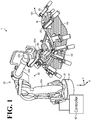
- FIG. 1 is a diagram schematically illustrating a general arrangement of a robot system 1 according to an embodiment.
- FIG. 1 shows a three-dimensional orthogonal coordinate system including a Z axis with its vertically upward direction being assumed the positive direction and the vertically downward direction being assumed the negative direction.
- This orthogonal coordinate system may also be illustrated in some other drawings referred to in the following description.
- a plurality of identical components may occasionally be described by providing a reference numeral to only some of the plurality of identical components, and providing no reference numeral to the rest of the plurality of identical components.
- the some of the plurality of identical components denoted with a reference numeral have the same configuration as the configuration of the rest of the plurality of identical components without a reference numeral.
- a robot system 1 includes a work table 10, a plurality of workpiece supports 20, a robot 30, and a controller 40.
- a workpiece W is placed on the work table 10.
- the workpiece supports 20 are provided in plural to support the workpiece W at a plurality of points on an outer edge of the workpiece W, thereby securing the workpiece W on the work table 10.
- Each of the workpiece supports 20 is movable individually to make a withdrawal so as to avoid contact with a pressure roller 53, described later, while the pressure roller 53 is moving on a motion path along the outer edge of the workpiece W (see an arrow 101 shown in FIG. 1 ). This withdrawal operation is controlled by the controller 40, for example.
- the robot 30 includes a base 31, a rotation base 32, and a robot arm 33.
- the robot arm 33 includes a lower arm 33a, an upper arm 33b, a wrist 33c, and a flange 33d.
- base end side The side of the surface on which the base 31 of the robot 30 is installed will be referred to as "base end side”. A portion of each of the components around the base end side will be referred to as “base end portion”.
- base end portion The flange 33d side of the robot 30 will be referred to as “distal end side”. A portion of each of the components around the distal end side will be referred to as “distal end portion”.
- the base 31 is a supporting base secured on a floor or another surface.
- the rotation base 32 is rotatably disposed on the base 31.
- the lower arm 33a is rotatable relative to the rotation base 32.
- the upper arm 33b is rotatable relative to the lower arm 33a.
- the wrist 33c disposed at the distal end portion of the upper arm 33b in a swingable manner.
- the flange 33d is rotatable relative to the wrist 33c.
- an end effector 50 is mounted to the flange 33d.
- the end effector 50 includes the pressure roller 53.
- the robot arm 33 supports the end effector 50.
- FIG. 2 is a schematic side view of a configuration of the robot 30.
- the robot 30 is what is called a vertical articulated robot.
- the rotation base 32 is coupled to the base 31 in a rotatable manner about a rotation axis S (see an arrow 201 shown in FIG. 2 ).
- the lower arm 33a has a base end portion coupled to the rotation base 32 in a rotatable manner about an axis L, which is approximately perpendicular to the rotation axis S (including a twisted position) (see an arrow 202 shown in FIG. 2 ).
- the upper arm 33b has a base end portion coupled to the distal end portion of the lower arm 33a in a rotatable manner about an axis U, which is approximately parallel to the axis L (see an arrow 203 shown in FIG. 2 ).
- the wrist 33c has a base end portion coupled to the distal end portion of the upper arm 33b in a rotatable manner about an axis R, which is approximately perpendicular to the rotation axis U (including a twisted position) (see an arrow 204 shown in FIG. 2 ).
- the wrist 33c is swingable about an axis B, which is approximately perpendicular to the axis R (see an arrow 205 shown in FIG. 2 ).
- the flange 33d is coupled to the wrist 33c in a rotatable manner about an axis T, which is approximately perpendicular to the axis B (see an arrow 206 shown in FIG. 2 ).
- the robot arm 33 includes joints each having a built-in servomotor, not shown.
- the robot 30 is able to take various postures by controlling the rotation position of the servomotor of each joint.
- the end effector 50 is mounted to the flange 33d. A configuration of the end effector 50 will be described in detail below.
- FIG. 3A is a perspective schematic view of a configuration of the end effector 50.
- FIG. 3B is a schematic view from a direction of the arrow A shown in FIG. 3A .
- the end effector 50 is shown more simply than in FIG. 3A .
- the end effector 50 includes a servomotor 51, a linear motion mechanism 52, and the pressure roller 53.
- the servomotor 51 is a driving source to drive the linear motion mechanism 52 into linear motion.
- the linear motion mechanism 52 is driven by the servomotor 51 to move the pressure roller 53 up and down with respect to the pressed surface of the workpiece W (see an arrow 301 shown in FIG. 3B ).
- the linear motion mechanism 52 preferably includes a ball screw or another element for such considerations as pressure responsiveness.
- the pressure roller 53 is coupled to a linear motion shaft 52a, which is a movable part of the linear motion mechanism 52, in a rotatable manner about an axis AXr.
- the linear motion mechanism 52 brings the pressure roller 53 into contact with the pressed surface of the workpiece W.
- the pressure roller 53 makes rolling movement over the pressed surface while applying the pressing force from the servomotor 51 to the pressed surface.
- the pressed surface is subjected to the pressure processing.
- FIG. 3C is a schematic diagram illustrating an embodiment of the hemming processing.
- Reference numeral W1 shown in FIG. 3C denotes an outer edge portion of an outer panel of a vehicle body.
- Reference numeral W2 shown in FIG. 3C denotes an inner panel of the vehicle body.
- the to-be-processed material will not be limited to a vehicle body; other possible examples include a household appliance.
- the hemming processing starts from "pre-processing" state, proceeds to preliminary bending processing referred to as “pre-hemming”, and proceeds to main bending processing referred to as "hemming".
- pre-hemming preliminary bending processing
- hemming main bending processing
- the outer edge portion W1 of the outer panel is bent by approximately 45° in the pre-hemming, and is bent into an approximately U shape in the hemming and thus joined with the inner panel W2.
- the pressing direction of the pressure roller 53 differs between the "pre-hemming” and "hemming".
- the pressing direction is determined by changing the posture of the robot 30.
- the posture of the robot 30 is changed by controlling the rotation position of each servomotor installed in the robot arm 33, as described above.
- the controller 40 (see FIG. 1 ) performs the operation control of changing the posture of the robot 30.
- the controller 40 not only controls the pressing direction but also controls the pressing force against the pressed surface at the time of "pre-hemming" and "hemming". Specifically, the controller 40 controls the servomotor 51 to make the pressing force of the pressure roller 53 against the pressed surface suitable for the shape of the pressed surface, regardless of a change in shape of the workpiece W. Various kinds of control performed by the controller 40 will be described in detail later by referring to FIG. 5 .
- the linear motion mechanism 52 is controlled through the servomotor 51, as described above. This ensures an elongated stroke length of the linear motion mechanism 52 as compared with the comparative practice to use a fluid cylinder or a similar device.
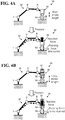
- FIG. 4A schematically illustrates a disadvantage involved in comparative pressure processing.
- FIG. 4B schematically illustrates an advantage involved in the pressure processing according to this embodiment.
- the robot 30 and a robot 30' and their respective components are shown simply using the axes L, U, and B.
- FIG. 4A which shows a comparative technique using an end effector 50' provided with a fluid cylinder or a similar device
- the stroke length is short which can cause the pressure roller 53 to come off the pressed surface, attenuating the pressing force when the robot arm 33' is deflected by reaction force against the pressing force.
- the servomotor 51 drive the linear motion mechanism 52, as shown in FIG. 4B . This ensures a longer stroke length, which prevents the pressure roller 53 from coming off the pressed surface even though the robot arm 33 is deflected by reaction force against the pressing force.
- this embodiment provides an advantage in that the pressing force is maintained at a suitable level, contributing to improving the quality of the hemming processing.
- the use of the servomotor 51 ensures monitoring of the stroke position based on a position detector such as an encoder.
- the servomotor 51 may be controlled to make the pressing force of the pressure roller 53 against the pressed surface of the workpiece W approximately uniform while monitoring the stroke position. This also improves the quality of the hemming processing.
- the controller 40 is coupled in an information transmittable manner to various devices such as the workpiece support 20 and the robot 30. It is noted that any form of connection, wired or wireless, may be employed.
- the controller 40 is a controller to control various operations of the various devices coupled to the controller 40, and includes various control-related devices, a processing unit, and a storage device.
- the controller 40 performs the operation control of changing the posture of the robot 30 based on a "job", which is a predetermined program to bring the robot 30 into operation.
- the job is registered in the storage device or a similar device of the controller 40 through an input device (such as a programming pendant), not shown.
- the controller 40 Based on the "job", the controller 40 generates an operation signal to bring the robot 30 into operation, and outputs the signal to the robot 30.
- the operation signal is generated in the form of a pulse signal to the servomotor installed in each joint.
- FIG. 5 is a block diagram illustrating a configuration of the robot system 1 according to this embodiment. It is noted that FIG. 5 only shows those components necessary for description of the robot system 1, omitting those components of general nature.
- FIG. 5 may occasionally simplify or omit those components already described by referring to FIGs. 1 to 4B .
- the controller 40 includes a control section 41 and a storage section 42.
- the control section 41 includes a program editing section 41a,, an inverse kinematics calculation section 41b, a torque control section 41c, and a position control section 41d.
- the storage section 42 is a storage device such as a hard disk drive and a nonvolatile memory, and stores teaching information 42a.
- the teaching information 42a defines the motion path of the robot arm 33, and is an example of the program storage section.
- the controller 40 shown in FIG. 5 may not necessarily have all its components arranged within the controller 40.
- the teaching information 42a may be stored in the storage section 42, the teaching information 42a may be stored in an internal memory of the robot 30.
- the teaching information 42a may be stored in an upper level device of the controller 40, and may be acquired by the controller 40 from the upper level device as necessary.
- the control section 41 is in charge of overall control of the controller 40. Specifically, the control section 41 controls the linear motion mechanism 52 to move the pressure roller 53 up and down with respect to the pressed surface of the workpiece W so as to make the pressing force of the pressure roller 53 against the pressed surface approximately uniform.
- the program editing section 41a receives settings related to the hemming processing through an input device 60 such as a personal computer (PC) and a programming pendant.
- the settings related to the hemming processing include a setting of starting the operation control of the linear motion mechanism 52 of the end effector 50, and a setting of ending the operation control of the linear motion mechanism 52 of the end effector 50.
- the program editing section 41a reflects the content of the received setting in the program included in the teaching information 42a.
- an operator of the input device 60 may use a macro command to define the setting related to the hemming processing at any timing (step position) on the program. That is, the program editing section 41a includes a preprocessor function that converts the macro command into a program.
- the macro command related to the hemming processing will be hereinafter referred to as "hemming command”.
- FIG. 6 is a diagram illustrating exemplary hemming commands.
- the hemming commands are defined in advance as macro commands related to the torque control and the position control of the servomotor 51.
- No. 1 to No. 3 in FIG. 6 indicate hemming commands related to the torque control for the servomotor 51.
- the command "HEM_ON" at No. 1 is a command for an instruction to start applying pressure at a predetermined torque.
- the command "HEM_OFF” at No. 2 is a command for an instruction to stop applying pressure.
- the command "HEM_CH” at No. 3 is a command to change the pressing force along the motion path.
- the hemming command to change the pressing force may be used in the following exemplary case.
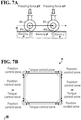
- FIG. 7A is a diagram illustrating the hemming command to change the pressing force.
- the workpiece W may not be uniform throughout the pressed surface in terms of shape, property, or other respects. Assume the example shown in FIG. 7A , where portions of different elasticities exist along the motion path of the pressure roller 53 (see “elasticity ⁇ " and “elasticity ⁇ " shown in FIG. 7A ). Points P1 and P2 shown in FIG. 7A indicate target points on the motion path.
- the command "HEM_CH” may be used to define the program to, for example, make the pressing force suitable for the elasticity of interest. This makes the pressing force applied to the pressed surface approximately uniform.
- the operator uses the command "HEM_CH” to define the program in such a manner that at the timing when the pressure roller 53 is at target point P1, the servomotor 51 effects pressing force ⁇ 1 , which is suitable for elasticity ⁇ .
- the operator uses the command "HEM_CH” to define the program in such a manner that the servomotor 51 effects pressing force ⁇ 1, which is suitable for elasticity ⁇ .
- the command "HEM_PL" at No. 4 is a command for an instruction to switch the torque control to the position control.
- the command “HEM_KP” at No. 5 is a command for maintaining the stroke position of the linear motion mechanism 52.
- FIG. 7B is a diagram illustrating a hemming command related to the position control.
- FIG. 7B there is a workpiece W having a rectangular shape in plan view.
- the workpiece W undergoes the hemming processing on the outer edge of the workpiece W.
- the corners and adjacent portions of the workpiece W which are circled by broken lines in FIG. 7B , are soft and susceptible to elastic deformation.
- the program is preferably defined to perform the position control using the command "HEM_PL". This improves the quality of the hemming processing.
- pre-hemming For the sides of the rectangular workpiece W, excluding the corners, it is preferable in terms of processing quality to maintain the stroke position during pressure application in, for example, "pre-hemming" (see FIG. 3C ).
- the program is preferably defined to maintain the stroke position using the command "HEM_KP".
- HEM_KP the command which is the main bending
- the torque control and the position control are defined at step positions of the program suitable for the shape and property of a portion of the workpiece W or the type of the processing. This improves the quality of the hemming processing.
- the operator is able to recognize the content of the setting related to the hemming processing simply in the form of macro commands, and readily define the hemming commands at any step positions of the program through the input device 60. Thus, the hemming processing is facilitated.
- the inverse kinematics calculation section 41b controls the rotation position of each joint of the robot arm 33 based on the motion path of the robot arm 33, which is taught in advance as the teaching information 42a.
- the inverse kinematics calculation section 41b is in charge of the step of bringing the robot arm 33 into operation.
- the inverse kinematics calculation section 41b regards a coordinate value of a target point on the motion path as the position of a representative point of the end effector 50, and regards the pressing direction at this position as the posture of the end effector 50. Then, the inverse kinematics calculation section 41b generates an operation signal to bring the robot 30 into operation.
- the operation signal is generated as, for example, a pulse signal to the servomotor installed in each joint of the robot arm 33.
- the torque control section 41c controls the torque of the servomotor 51 of the end effector 50 so as to perform the control of making the pressing force of the pressure roller 53 against the pressed surface of the workpiece W approximately uniform. Specifically, the torque control section 41c performs the torque control of the servomotor 51 based on the hemming commands reflected in the teaching information 42a by the program editing section 41a.
- the position control section 41 controls the amount by which the pressure roller 53 protrudes, that is, controls the stroke position of the linear motion mechanism 52. Specifically, the position control section 41d controls the stroke position of the linear motion mechanism 52 by performing the position control of the servomotor 51 based on the hemming commands reflected in the teaching information 42a by the program editing section 41a.
- the position control section 41d monitors the stroke position of the linear motion mechanism 52 based on a detection result obtained by the encoder of the servomotor 51. When the position control section 41d detects an abnormality through the monitoring, the position control section 41d performs predetermined error processing. Thus, the torque control section 41c and the position control section 41d are in charge of the step of the pressure roller 53's control to make the linear motion mechanism 52 move up and down.
- FIG. 8 is a flowchart of a procedure for the processing executed by the robot system 1 according to this embodiment.
- FIG. 8 shows a state in which the program editing section 41a has already reflected in the teaching information 42a the program in which the hemming commands are defined.
- step S101 the teaching information 42a is loaded (step S101).
- the program contained in the teaching information 42a is loaded on a one-step basis.
- the inverse kinematics calculation section 41b controls the rotation position of each joint of the robot arm 33 based on the teaching information 42a (step S102).
- step S103 a determination is made as to whether a hemming command has been issued.
- step S104 the type of the hemming command is determined (step S104).
- the torque control section 41c controls the servomotor 51 to start applying pressure (step S105).
- the torque control section 41c controls the servomotor 51 to stop applying pressure (step S106).
- the torque control section 41c controls the servomotor 51 to change the pressing force (step S107).
- the position control section 41d switches the torque control to the position control (step S108).
- the position control section 41d maintains the stroke position of the linear motion mechanism 52 (step S109).
- step S103 When the determination condition at step S103 is not satisfied (No at step S103), the control proceeds to step S110.
- step S110 a determination is made as to whether the position control section 41d has detected an abnormality through monitoring of the stroke position (step S110).
- a determination is made as to whether the teaching information 42a contains a next program step (step S111).
- step S111 When the teaching information 42a contains the next program step (Yes at step S111), the processing from step S101 on is repeated. When the teaching information 42a does not contain the next program step (No at step S111), the processing ends.
- step S110 When at step S110 an abnormality is detected in the monitoring (Yes at step S110), predetermined error processing is performed (step S 112), and then the processing ends.
- the robot system includes the end effector, the robot arm, and the controller.
- the end effector includes the pressure roller and the linear motion mechanism.
- the linear motion mechanism moves the pressure roller up and down with respect to a pressed surface.
- the robot arm supports the end effector.
- the controller controls the linear motion mechanism to move the pressure roller up and down so as to make the pressing force of the pressure roller against the pressed surface approximately uniform.
- the robot system according to this embodiment ensures readiness and higher quality in the pressure processing.
- the linear motion mechanism is driven by a servomotor.
- a servomotor This facilitates the wiring work in that thinner outfitting cables and other cables may be used as compared with the comparative practice to use a fluid cylinder or a similar cylinder. This, in turn, improves maintenance efficiency and provides no or minimal restriction on the operation of the robot, resulting in improved mobility of the robot.
- the workpiece supports support the workpiece at a plurality of points on the outer edge of workpiece, thereby securing the workpiece on the work table.
- a suction device which is capable of vacuum suction, to secure the workpiece on the work table using the suction device.
- the robot has a single arm with six axes. This, however, should not be construed as limiting the number of axes and the number of arms. Other possible examples include, but are not limited to, a seven-axis robot and a two-arm robot.
Landscapes
- Engineering & Computer Science (AREA)
- Mechanical Engineering (AREA)
- Robotics (AREA)
- Manipulator (AREA)
Description
- The present invention relates to a robot system and a method for producing a to-be-processed material.
- In recent years, various kinds of robot systems have been proposed to apply pressure on a to-be-processed material using a robot having a pressure roller on an end effector of the robot.
- For example, Japanese Unexamined Patent Application Publication No.
2002-263756 - The pressing force of the pressure roller is attributed to a linear motion mechanism disposed in the end effector or another element. The linear motion mechanism moves the pressure roller up and down with respect to a pressed surface. General linear motion mechanisms are made of components including a fluid cylinder, which utilizes fluid to implement hydraulic pressure or pneumatic pressure.
- The conventional technique leaves room for improvement in terms of readiness and quality of the hemming processing.
- Specifically, with a fluid cylinder, depending on the posture of the robot, the robot arm may be largely deflected as the pressure is applied. This may make the pressing force of the pressure roller insufficient for the pressed surface. Thus, the conventional technique leaves room for improvement in terms of quality of the hemming processing.
- Additionally, the amount of the deflection varies depending on the posture of the robot, which requires numerous trials and errors before teaching to the robot, resulting in a complicated procedure.
- These considerations not only apply in the hemming processing but also apply throughout the pressure processing, which includes the hemming processing.
-
EP 1 389 498 A1 -
FR 2 895 690 A1 - One aspect of the present disclosure has been made in view of the above-described circumstances, and it is an object of the present disclosure to provide a robot system and a method for producing a to-be-processed material that ensure readiness and higher quality in the pressure processing.
- According to one aspect of the present invention, a robot system includes the features of
claim 1. Additional features for advantageous embodiments of the present invention are recited in the dependent claims. According to another aspect of the present invention a method for hemming processing includes the features of claim 6. - The present invention ensures readiness and higher quality in pressure application.
- A more complete appreciation of the present disclosure and many of the attendant advantages thereof will be readily obtained as the same becomes better understood by reference to the following detailed description when considered in connection with the accompanying drawings, wherein:
-
FIG. 1 is a diagram schematically illustrating a general arrangement of a robot system according to an embodiment; -
FIG. 2 is a schematic side view of a configuration of a robot; -
FIG. 3A is a perspective schematic view of a configuration of an end effector; -
FIG. 3B is a schematic view from a direction of an arrow A shown inFIG. 3A ; -
FIG. 3C is a schematic diagram illustrating an embodiment of hemming processing; -
FIG. 4A schematically illustrates a disadvantage involved in pressure processing according to a comparative example; -
FIG. 4B schematically illustrates an advantage involved in pressure processing according to the embodiment; -
FIG. 5 is a block diagram illustrating a configuration of the robot system according to the embodiment; -
FIG. 6 is a diagram illustrating exemplary hemming commands; -
FIG. 7A is a diagram illustrating a hemming command to change pressing force; -
FIG. 7B is a diagram illustrating a hemming command related to position control; and -
FIG. 8 is a flowchart of a procedure for processing executed by the robot system according to the embodiment. - A robot system and a method for producing a to-be-processed material according to an embodiment will be described in detail by referring to the accompanying drawings. The following embodiment is provided for exemplary purposes only and is not intended to limit the present disclosure.
- While the robot system is described as performing hemming processing, this should not be construed in a limiting sense. Other possible examples of the pressure processing other than the hemming processing include bending processing and metal-plate hammering processing.
- The to-be-processed material, which is a target of the hemming processing, will be referred to as "workpiece".
-
FIG. 1 is a diagram schematically illustrating a general arrangement of arobot system 1 according to an embodiment. For ease of description,FIG. 1 shows a three-dimensional orthogonal coordinate system including a Z axis with its vertically upward direction being assumed the positive direction and the vertically downward direction being assumed the negative direction. This orthogonal coordinate system may also be illustrated in some other drawings referred to in the following description. - In the following description, a plurality of identical components may occasionally be described by providing a reference numeral to only some of the plurality of identical components, and providing no reference numeral to the rest of the plurality of identical components. In this case, the some of the plurality of identical components denoted with a reference numeral have the same configuration as the configuration of the rest of the plurality of identical components without a reference numeral.
- As shown in
FIG. 1 , arobot system 1 includes a work table 10, a plurality of workpiece supports 20, arobot 30, and acontroller 40. - A workpiece W is placed on the work table 10. The workpiece supports 20 are provided in plural to support the workpiece W at a plurality of points on an outer edge of the workpiece W, thereby securing the workpiece W on the work table 10. Each of the workpiece supports 20 is movable individually to make a withdrawal so as to avoid contact with a
pressure roller 53, described later, while thepressure roller 53 is moving on a motion path along the outer edge of the workpiece W (see anarrow 101 shown inFIG. 1 ). This withdrawal operation is controlled by thecontroller 40, for example. - The
robot 30 includes abase 31, arotation base 32, and arobot arm 33. Therobot arm 33 includes alower arm 33a, anupper arm 33b, awrist 33c, and aflange 33d. - The side of the surface on which the
base 31 of therobot 30 is installed will be referred to as "base end side". A portion of each of the components around the base end side will be referred to as "base end portion". Theflange 33d side of therobot 30 will be referred to as "distal end side". A portion of each of the components around the distal end side will be referred to as "distal end portion". - The
base 31 is a supporting base secured on a floor or another surface. Therotation base 32 is rotatably disposed on thebase 31. Thelower arm 33a is rotatable relative to therotation base 32. - The
upper arm 33b is rotatable relative to thelower arm 33a. Thewrist 33c disposed at the distal end portion of theupper arm 33b in a swingable manner. Theflange 33d is rotatable relative to thewrist 33c. - To the
flange 33d, anend effector 50 is mounted. Theend effector 50 includes thepressure roller 53. Thus, therobot arm 33 supports theend effector 50. - A configuration of the
robot 30 will be described in more detail by referring toFIG. 2. FIG. 2 is a schematic side view of a configuration of therobot 30. - As shown in
FIG. 2 , therobot 30 is what is called a vertical articulated robot. - The
rotation base 32 is coupled to the base 31 in a rotatable manner about a rotation axis S (see anarrow 201 shown inFIG. 2 ). Thelower arm 33a has a base end portion coupled to therotation base 32 in a rotatable manner about an axis L, which is approximately perpendicular to the rotation axis S (including a twisted position) (see anarrow 202 shown inFIG. 2 ). - The
upper arm 33b has a base end portion coupled to the distal end portion of thelower arm 33a in a rotatable manner about an axis U, which is approximately parallel to the axis L (see anarrow 203 shown inFIG. 2 ). Thewrist 33c has a base end portion coupled to the distal end portion of theupper arm 33b in a rotatable manner about an axis R, which is approximately perpendicular to the rotation axis U (including a twisted position) (see anarrow 204 shown inFIG. 2 ). - The
wrist 33c is swingable about an axis B, which is approximately perpendicular to the axis R (see anarrow 205 shown inFIG. 2 ). Theflange 33d is coupled to thewrist 33c in a rotatable manner about an axis T, which is approximately perpendicular to the axis B (see anarrow 206 shown inFIG. 2 ). - The
robot arm 33 includes joints each having a built-in servomotor, not shown. Therobot 30 is able to take various postures by controlling the rotation position of the servomotor of each joint. - As described above, the
end effector 50 is mounted to theflange 33d. A configuration of theend effector 50 will be described in detail below. -
FIG. 3A is a perspective schematic view of a configuration of theend effector 50.FIG. 3B is a schematic view from a direction of the arrow A shown inFIG. 3A . InFIG. 3B , theend effector 50 is shown more simply than inFIG. 3A . - As shown in
FIGs. 3A and 3B , theend effector 50 includes aservomotor 51, alinear motion mechanism 52, and thepressure roller 53. Theservomotor 51 is a driving source to drive thelinear motion mechanism 52 into linear motion. - The
linear motion mechanism 52 is driven by theservomotor 51 to move thepressure roller 53 up and down with respect to the pressed surface of the workpiece W (see anarrow 301 shown inFIG. 3B ). Thelinear motion mechanism 52 preferably includes a ball screw or another element for such considerations as pressure responsiveness. - The
pressure roller 53 is coupled to alinear motion shaft 52a, which is a movable part of thelinear motion mechanism 52, in a rotatable manner about an axis AXr. Thelinear motion mechanism 52 brings thepressure roller 53 into contact with the pressed surface of the workpiece W. Thepressure roller 53 makes rolling movement over the pressed surface while applying the pressing force from theservomotor 51 to the pressed surface. Thus, the pressed surface is subjected to the pressure processing. - As an example of the pressure processing, an embodiment of hemming processing will be described.
FIG. 3C is a schematic diagram illustrating an embodiment of the hemming processing. Reference numeral W1 shown inFIG. 3C denotes an outer edge portion of an outer panel of a vehicle body. Reference numeral W2 shown inFIG. 3C denotes an inner panel of the vehicle body. The to-be-processed material will not be limited to a vehicle body; other possible examples include a household appliance. - As shown in
FIG. 3C , the hemming processing starts from "pre-processing" state, proceeds to preliminary bending processing referred to as "pre-hemming", and proceeds to main bending processing referred to as "hemming". Specifically, the outer edge portion W1 of the outer panel is bent by approximately 45° in the pre-hemming, and is bent into an approximately U shape in the hemming and thus joined with the inner panel W2. - Thus, as indicated by
arrows FIG. 3C , the pressing direction of thepressure roller 53 differs between the "pre-hemming" and "hemming". - The pressing direction is determined by changing the posture of the
robot 30. The posture of therobot 30 is changed by controlling the rotation position of each servomotor installed in therobot arm 33, as described above. The controller 40 (seeFIG. 1 ) performs the operation control of changing the posture of therobot 30. - The
controller 40 not only controls the pressing direction but also controls the pressing force against the pressed surface at the time of "pre-hemming" and "hemming". Specifically, thecontroller 40 controls theservomotor 51 to make the pressing force of thepressure roller 53 against the pressed surface suitable for the shape of the pressed surface, regardless of a change in shape of the workpiece W. Various kinds of control performed by thecontroller 40 will be described in detail later by referring toFIG. 5 . - In this embodiment, the
linear motion mechanism 52 is controlled through theservomotor 51, as described above. This ensures an elongated stroke length of thelinear motion mechanism 52 as compared with the comparative practice to use a fluid cylinder or a similar device. - This provides the following advantages.
FIG. 4A schematically illustrates a disadvantage involved in comparative pressure processing.FIG. 4B schematically illustrates an advantage involved in the pressure processing according to this embodiment. For the sake of description, inFIGs. 4A and 4B , therobot 30 and a robot 30' and their respective components are shown simply using the axes L, U, and B. - As shown in
FIG. 4A , which shows a comparative technique using an end effector 50' provided with a fluid cylinder or a similar device, the stroke length is short which can cause thepressure roller 53 to come off the pressed surface, attenuating the pressing force when the robot arm 33' is deflected by reaction force against the pressing force. Thus, there has been a disadvantage in that it is impossible or difficult to maintain the pressing force at a suitable level. - In contrast, in this embodiment, the
servomotor 51 drive thelinear motion mechanism 52, as shown inFIG. 4B . This ensures a longer stroke length, which prevents thepressure roller 53 from coming off the pressed surface even though therobot arm 33 is deflected by reaction force against the pressing force. - Additionally, even though the
robot arm 33 is deflected, keeping theservomotor 51 driving ensures a balance between the pressing force and the reaction force. Thus, this embodiment provides an advantage in that the pressing force is maintained at a suitable level, contributing to improving the quality of the hemming processing. - The use of the
servomotor 51 ensures monitoring of the stroke position based on a position detector such as an encoder. Thus, theservomotor 51 may be controlled to make the pressing force of thepressure roller 53 against the pressed surface of the workpiece W approximately uniform while monitoring the stroke position. This also improves the quality of the hemming processing. - Referring back to
FIG. 1 , thecontroller 40 will be described. Thecontroller 40 is coupled in an information transmittable manner to various devices such as theworkpiece support 20 and therobot 30. It is noted that any form of connection, wired or wireless, may be employed. - The
controller 40 is a controller to control various operations of the various devices coupled to thecontroller 40, and includes various control-related devices, a processing unit, and a storage device. - For example, the
controller 40 performs the operation control of changing the posture of therobot 30 based on a "job", which is a predetermined program to bring therobot 30 into operation. The job is registered in the storage device or a similar device of thecontroller 40 through an input device (such as a programming pendant), not shown. - Based on the "job", the
controller 40 generates an operation signal to bring therobot 30 into operation, and outputs the signal to therobot 30. The operation signal is generated in the form of a pulse signal to the servomotor installed in each joint. - Next, a block configuration of the
robot system 1 according to this embodiment will be described by referring toFIG. 5 , focusing mainly on an inner configuration of thecontroller 40.FIG. 5 is a block diagram illustrating a configuration of therobot system 1 according to this embodiment. It is noted thatFIG. 5 only shows those components necessary for description of therobot system 1, omitting those components of general nature. - The description by referring to
FIG. 5 may occasionally simplify or omit those components already described by referring toFIGs. 1 to 4B . - As shown in
FIG. 5 , thecontroller 40 includes acontrol section 41 and astorage section 42. Thecontrol section 41 includes aprogram editing section 41a,, an inversekinematics calculation section 41b, atorque control section 41c, and aposition control section 41d. - The
storage section 42 is a storage device such as a hard disk drive and a nonvolatile memory, and stores teaching information 42a. The teaching information 42a defines the motion path of therobot arm 33, and is an example of the program storage section. - The
controller 40 shown inFIG. 5 may not necessarily have all its components arranged within thecontroller 40. For example, while the teaching information 42a is stored in thestorage section 42, the teaching information 42a may be stored in an internal memory of therobot 30. Alternatively, the teaching information 42a may be stored in an upper level device of thecontroller 40, and may be acquired by thecontroller 40 from the upper level device as necessary. - The
control section 41 is in charge of overall control of thecontroller 40. Specifically, thecontrol section 41 controls thelinear motion mechanism 52 to move thepressure roller 53 up and down with respect to the pressed surface of the workpiece W so as to make the pressing force of thepressure roller 53 against the pressed surface approximately uniform. - The
program editing section 41a receives settings related to the hemming processing through aninput device 60 such as a personal computer (PC) and a programming pendant. The settings related to the hemming processing include a setting of starting the operation control of thelinear motion mechanism 52 of theend effector 50, and a setting of ending the operation control of thelinear motion mechanism 52 of theend effector 50. Theprogram editing section 41a reflects the content of the received setting in the program included in the teaching information 42a. - Through the
program editing section 41a, an operator of theinput device 60 may use a macro command to define the setting related to the hemming processing at any timing (step position) on the program. That is, theprogram editing section 41a includes a preprocessor function that converts the macro command into a program. The macro command related to the hemming processing will be hereinafter referred to as "hemming command". - Exemplary hemming commands will be described by referring to
FIG. 6. FIG. 6 is a diagram illustrating exemplary hemming commands. - As shown in
FIG. 6 , the hemming commands are defined in advance as macro commands related to the torque control and the position control of theservomotor 51. - For example, No. 1 to No. 3 in
FIG. 6 indicate hemming commands related to the torque control for theservomotor 51. The command "HEM_ON" at No. 1 is a command for an instruction to start applying pressure at a predetermined torque. The command "HEM_OFF" at No. 2 is a command for an instruction to stop applying pressure. - The command "HEM_CH" at No. 3 is a command to change the pressing force along the motion path. The hemming command to change the pressing force may be used in the following exemplary case.
FIG. 7A is a diagram illustrating the hemming command to change the pressing force. - First, the workpiece W may not be uniform throughout the pressed surface in terms of shape, property, or other respects. Assume the example shown in
FIG. 7A , where portions of different elasticities exist along the motion path of the pressure roller 53 (see "elasticity α" and "elasticity β" shown inFIG. 7A ). Points P1 and P2 shown inFIG. 7A indicate target points on the motion path. - In this case, pressing the portion of "elasticity α" and the portion of "elasticity β" at the same torque may not result in an approximately uniform pressing force from the
pressure roller 53 against the pressedsurface 53. In view of this, the command "HEM_CH" may be used to define the program to, for example, make the pressing force suitable for the elasticity of interest. This makes the pressing force applied to the pressed surface approximately uniform. - In the example shown in
FIG. 7A , the operator uses the command "HEM_CH" to define the program in such a manner that at the timing when thepressure roller 53 is at target point P1, theservomotor 51 effects pressing force β1, which is suitable for elasticity β. - At the timing when the
pressure roller 53 is at target point P2, the operator uses the command "HEM_CH" to define the program in such a manner that theservomotor 51 effects pressing force α1, which is suitable for elasticity α. - While this example is concerning a difference in "elasticity", it is also possible to use the command "HEM_CH" in a difference in any other property. It will be readily appreciated that the command "HEM_CH" may be used in accordance with the shape of the workpiece W.
- Referring back to
FIG. 6 , the hemming commands related to the position control will be described. As shown inFIG. 6 , No. 4 and No. 5 indicate hemming commands related to the position control of theservomotor 51. The command "HEM_PL" at No. 4 is a command for an instruction to switch the torque control to the position control. The command "HEM_KP" at No. 5 is a command for maintaining the stroke position of thelinear motion mechanism 52. - The hemming commands related to the position control may be used in the following exemplary case.
FIG. 7B is a diagram illustrating a hemming command related to the position control. - As shown in
FIG. 7B , there is a workpiece W having a rectangular shape in plan view. The workpiece W undergoes the hemming processing on the outer edge of the workpiece W. - The corners and adjacent portions of the workpiece W, which are circled by broken lines in
FIG. 7B , are soft and susceptible to elastic deformation. In this case, it is more preferable in terms of processing quality to use the position control than the torque control in that under the position control, pressure is applied on the corners and adjacent portions while the stroke position is being adjusted. - Thus, for the corners and adjacent portions of the workpiece W, the program is preferably defined to perform the position control using the command "HEM_PL". This improves the quality of the hemming processing.
- For the sides of the rectangular workpiece W, excluding the corners, it is preferable in terms of processing quality to maintain the stroke position during pressure application in, for example, "pre-hemming" (see
FIG. 3C ). - Thus, in "pre-hemming", the program is preferably defined to maintain the stroke position using the command "HEM_KP". In "hemming", which is the main bending, it is possible to perform the torque control for the sides of the rectangular workpiece W. Thus, the torque control and the position control are defined at step positions of the program suitable for the shape and property of a portion of the workpiece W or the type of the processing. This improves the quality of the hemming processing.
- The operator is able to recognize the content of the setting related to the hemming processing simply in the form of macro commands, and readily define the hemming commands at any step positions of the program through the
input device 60. Thus, the hemming processing is facilitated. - Referring back to
FIG. 5 , the inversekinematics calculation section 41b will be described. The inversekinematics calculation section 41b controls the rotation position of each joint of therobot arm 33 based on the motion path of therobot arm 33, which is taught in advance as the teaching information 42a. Thus, the inversekinematics calculation section 41b is in charge of the step of bringing therobot arm 33 into operation. - Specifically, for example, the inverse
kinematics calculation section 41b regards a coordinate value of a target point on the motion path as the position of a representative point of theend effector 50, and regards the pressing direction at this position as the posture of theend effector 50. Then, the inversekinematics calculation section 41b generates an operation signal to bring therobot 30 into operation. The operation signal is generated as, for example, a pulse signal to the servomotor installed in each joint of therobot arm 33. - The
torque control section 41c controls the torque of theservomotor 51 of theend effector 50 so as to perform the control of making the pressing force of thepressure roller 53 against the pressed surface of the workpiece W approximately uniform. Specifically, thetorque control section 41c performs the torque control of theservomotor 51 based on the hemming commands reflected in the teaching information 42a by theprogram editing section 41a. - The
position control section 41 controls the amount by which thepressure roller 53 protrudes, that is, controls the stroke position of thelinear motion mechanism 52. Specifically, theposition control section 41d controls the stroke position of thelinear motion mechanism 52 by performing the position control of theservomotor 51 based on the hemming commands reflected in the teaching information 42a by theprogram editing section 41a. - The
position control section 41d monitors the stroke position of thelinear motion mechanism 52 based on a detection result obtained by the encoder of theservomotor 51. When theposition control section 41d detects an abnormality through the monitoring, theposition control section 41d performs predetermined error processing. Thus, thetorque control section 41c and theposition control section 41d are in charge of the step of thepressure roller 53's control to make thelinear motion mechanism 52 move up and down. - Next, a procedure for the processing executed by the
robot system 1 according to this embodiment will be described by referring toFIG. 8. FIG. 8 is a flowchart of a procedure for the processing executed by therobot system 1 according to this embodiment.FIG. 8 shows a state in which theprogram editing section 41a has already reflected in the teaching information 42a the program in which the hemming commands are defined. - As shown in
FIG. 8 , first, the teaching information 42a is loaded (step S101). Here, the program contained in the teaching information 42a is loaded on a one-step basis. - Then, the inverse
kinematics calculation section 41b controls the rotation position of each joint of therobot arm 33 based on the teaching information 42a (step S102). - When the posture of the
robot arm 33 changes, a determination is made as to whether a hemming command has been issued (step S103). When a determination is made to the effect that a hemming command has been issued (Yes in step S103), the type of the hemming command is determined (step S104). - When the hemming command is "HEM_ON", the
torque control section 41c controls theservomotor 51 to start applying pressure (step S105). When the hemming command is "HEM_OFF", thetorque control section 41c controls theservomotor 51 to stop applying pressure (step S106). - When the hemming command is "HEM_CH", the
torque control section 41c controls theservomotor 51 to change the pressing force (step S107). - When the hemming command is "HEM_ PL", the
position control section 41d switches the torque control to the position control (step S108). When the hemming command is "HEM_KP", theposition control section 41d maintains the stroke position of the linear motion mechanism 52 (step S109). - When the determination condition at step S103 is not satisfied (No at step S103), the control proceeds to step S110.
- At step S110, a determination is made as to whether the
position control section 41d has detected an abnormality through monitoring of the stroke position (step S110). When no abnormality is detected in the monitoring (No at step S110), a determination is made as to whether the teaching information 42a contains a next program step (step S111). - When the teaching information 42a contains the next program step (Yes at step S111), the processing from step S101 on is repeated. When the teaching information 42a does not contain the next program step (No at step S111), the processing ends.
- When at step S110 an abnormality is detected in the monitoring (Yes at step S110), predetermined error processing is performed (step S 112), and then the processing ends.
- As has been described hereinbefore, the robot system according to this embodiment includes the end effector, the robot arm, and the controller. The end effector includes the pressure roller and the linear motion mechanism. The linear motion mechanism moves the pressure roller up and down with respect to a pressed surface.
- The robot arm supports the end effector. The controller controls the linear motion mechanism to move the pressure roller up and down so as to make the pressing force of the pressure roller against the pressed surface approximately uniform.
- Thus, the robot system according to this embodiment ensures readiness and higher quality in the pressure processing.
- In this embodiment, the linear motion mechanism is driven by a servomotor. This facilitates the wiring work in that thinner outfitting cables and other cables may be used as compared with the comparative practice to use a fluid cylinder or a similar cylinder. This, in turn, improves maintenance efficiency and provides no or minimal restriction on the operation of the robot, resulting in improved mobility of the robot.
- In this embodiment, the workpiece supports support the workpiece at a plurality of points on the outer edge of workpiece, thereby securing the workpiece on the work table. This, however, should not be construed as limiting the method of securing the workpiece. Another possible example is to provide the work table with a suction device, which is capable of vacuum suction, to secure the workpiece on the work table using the suction device.
- In this embodiment, the robot has a single arm with six axes. This, however, should not be construed as limiting the number of axes and the number of arms. Other possible examples include, but are not limited to, a seven-axis robot and a two-arm robot.
-
- 1
- Robot system
- 10
- Work table
- 20
- Workpiece support
- 30, 30'
- Robot
- 31
- Base
- 32
- Rotation base
- 33, 33'
- Robot arm
- 33a
- Lower arm
- 33b
- Upper arm
- 33c
- Wrist
- 33d
- Flange
- 40
- Controller
- 41
- Control section
- 41a
- Program editing section
- 41b
- Inverse kinematics calculation section
- 41c
- Torque control section
- 41d
- Position control section
- 42
- Storage section
- 42a
- Teaching information
- 50, 50'
- End effector
- 51
- Servomotor
- 52
- Linear motion mechanism
- 52a
- Linear motion shaft
- 53
- Pressure roller
- 60
- Input device
- AXr
- Axis
- B
- Axis
- L
- Axis
- P1, P2
- Target point
- R
- Axis
- S
- Rotation axis
- T
- Axis
- U
- Axis
- W
- Workpiece
- W1
- Outer edge portion of outer panel
- W2
- Inner panel
- α, β
- Elasticity
- α1, β1
- Pressing force
Claims (6)
- A robot system for hemming processing (1), comprising an end effector (50) comprising:a pressure roller (53); anda linear motion mechanism (52) configured to move the pressure roller (53) with respect to a pressed surface;a robot arm (33) configured to support the end effector (50), such that the pressure roller (53) makes a rolling movement over the pressed surface while applying a pressing force to the pressed surface; and
a controller (41) configured to control the linear motion mechanism (52) to move the pressure roller (53) to make a pressing force of the pressure roller (53) against the pressed surface approximately uniform,
characterized in that
the end effector (50) comprises a servomotor (51) configured to drive the linear motion mechanism (52) into linear motion;
wherein the controller (41) is configured to control a torque of the servomotor (51) so as to make the pressing force approximately uniform;
wherein the controller (41) is configured to control a stroke position as an amount by which the pressure roller (53) protrudes, wherein the linear motion mechanism (52) is configured to move the pressure roller up and down with respect to the pressed surface;
wherein the torque control and the position control are defined at step positions of a program suitable for at least one of a shape and a property of the pressed surface or a type of processing, wherein the controller (41) is configured to maintain the stroke position at a predetermined position and to change the pressing force in accordance with at least one of a shape and a property of the pressed surface. - The robot system (1) according to any one of claims 1, wherein the pressed surface comprises a hemming surface subjected to bending processing by the pressure roller (53).
- The robot system (1) according to any one of claims 1 or 2,
wherein the robot arm (33) comprises a plurality of joints driven by the servomotor (51), and
wherein the controller (41) comprises an inverse kinematics calculation section (41b) configured to control rotation positions of the plurality of joints based on a motion path of the robot arm (33) taught in advance. - The robot system (1) according to any one of claims 1 to 3, further comprising a program storage section (42a) configured to store a program defining a motion path of the robot arm (33),
wherein the controller (41) comprises a program editing section (41a) configured to receive in the program a setting of starting operation control of the linear motion mechanism (52) of the end effector (50), and configured to receive in the program a setting of ending the operation control of the linear motion mechanism (52) of the end effector (50). - The robot system (1) according to claim 4, wherein the program editing section (41a) is configured to, at a desired timing in the program, define a command to control the torque of the servomotor (51) and a command to control the stroke position of the linear motion mechanism (52).
- A method for hemming processing, characterized by:operating a robot arm (33) configured to support an end effector (50), the end effector (50) comprising a servomotor (51), a pressure roller (53) and a linear motion mechanism (52), the linear motion mechanism (52) being configured to move the pressure roller (53) up and down with respect to a pressed surface, wherein the servomotor (51) is a driving source to drive the linear motion mechanism (52) into linear motion;controlling the linear motion mechanism (52) to move the pressure roller (53) up and down so as to make a pressing force of the pressure roller (53) against the pressed surface approximately uniform and so as to make a stroke position as an amount by which the pressure roller (53) protrudes; anddefining a torque control and a position control of the servomotor (51) at step positions of a program suitable for at least one of a shape and a property of the pressed surface or a type of processing, wherein the controls include maintaining the stroke position at a predetermined position and changing the pressing force in accordance with at least one of a shape and a property of the pressed surface.
Applications Claiming Priority (1)
| Application Number | Priority Date | Filing Date | Title |
|---|---|---|---|
| JP2013228184A JP5971226B2 (en) | 2013-11-01 | 2013-11-01 | Robot system and method of manufacturing workpiece |
Publications (2)
| Publication Number | Publication Date |
|---|---|
| EP2868403A1 EP2868403A1 (en) | 2015-05-06 |
| EP2868403B1 true EP2868403B1 (en) | 2021-02-17 |
Family
ID=51753019
Family Applications (1)
| Application Number | Title | Priority Date | Filing Date |
|---|---|---|---|
| EP14188736.4A Active EP2868403B1 (en) | 2013-11-01 | 2014-10-14 | Robot system and method for producing to-be-processed material |
Country Status (4)
| Country | Link |
|---|---|
| US (1) | US9908160B2 (en) |
| EP (1) | EP2868403B1 (en) |
| JP (1) | JP5971226B2 (en) |
| CN (1) | CN104608114B (en) |
Families Citing this family (13)
| Publication number | Priority date | Publication date | Assignee | Title |
|---|---|---|---|---|
| JP6237520B2 (en) * | 2014-07-24 | 2017-11-29 | 株式会社安川電機 | robot |
| JP2016022571A (en) * | 2014-07-24 | 2016-02-08 | 株式会社安川電機 | Joint mechanism of robot and robot |
| JP6587698B2 (en) * | 2016-02-02 | 2019-10-09 | 本田技研工業株式会社 | Work bending method and work bending apparatus |
| US20180171448A1 (en) * | 2016-12-20 | 2018-06-21 | United Technologies Corporation | Deep rolling tool and method |
| US20180171447A1 (en) * | 2016-12-20 | 2018-06-21 | United Technologies Corporation | Deep rolling tool and method |
| US10786883B2 (en) | 2016-12-20 | 2020-09-29 | United Technologies Corporation | Deep rolling tool and method |
| JP6734522B2 (en) * | 2017-05-08 | 2020-08-05 | トライエンジニアリング株式会社 | Robot equipment |
| CN107413876B (en) * | 2017-09-26 | 2023-07-07 | 辽宁忠旺集团有限公司 | An aluminum profile pressing device |
| CN108115706A (en) * | 2017-12-31 | 2018-06-05 | 芜湖哈特机器人产业技术研究院有限公司 | A kind of control system of multiaxis aircraft cleaning machine device people |
| JP7300663B2 (en) * | 2019-10-11 | 2023-06-30 | トライエンジニアリング株式会社 | Terminal processing device and terminal processing method |
| CN113715308B (en) * | 2021-09-02 | 2022-08-09 | 上海交通大学 | Adjustable multi-point progressive flanging forming device and method |
| CN113714359B (en) * | 2021-09-02 | 2022-07-22 | 上海交通大学 | Multi-pass robot flexible flanging full-mold forming method |
| US20230415356A1 (en) * | 2022-01-25 | 2023-12-28 | Divergent Technologies, Inc. | Low deflection tooling apparatus |
Citations (1)
| Publication number | Priority date | Publication date | Assignee | Title |
|---|---|---|---|---|
| FR2895690A1 (en) * | 2006-01-05 | 2007-07-06 | Process Conception Ing Sa | Device for assembling components by folding, notably for use in the automobile industry for the assembly of sheets and panels by crimping |
Family Cites Families (19)
| Publication number | Priority date | Publication date | Assignee | Title |
|---|---|---|---|---|
| JPH0716730B2 (en) * | 1989-01-10 | 1995-03-01 | 日産自動車株式会社 | Hemming machine |
| JP2693282B2 (en) * | 1991-03-20 | 1997-12-24 | トライエンジニアリング株式会社 | Roller type hemming device and roller type hemming method using the device |
| EP0577876B1 (en) * | 1992-07-09 | 1996-09-04 | TRIENGINEERING Co., Ltd. | Roller type hemming apparatus |
| JPH0954608A (en) * | 1995-08-16 | 1997-02-25 | Kawasaki Heavy Ind Ltd | Robot simulation method |
| JP3215086B2 (en) * | 1998-07-09 | 2001-10-02 | ファナック株式会社 | Robot controller |
| US6442451B1 (en) * | 2000-12-28 | 2002-08-27 | Robotic Workspace Technologies, Inc. | Versatile robot control system |
| JP3664089B2 (en) | 2001-03-13 | 2005-06-22 | トヨタ車体株式会社 | Roll hemming method |
| JP3687559B2 (en) * | 2001-04-06 | 2005-08-24 | トヨタ車体株式会社 | Roll hemming device |
| JP2003103325A (en) * | 2001-09-26 | 2003-04-08 | Nissan Motor Co Ltd | Roll hemming apparatus and roll hemming method |
| JP3623474B2 (en) * | 2001-10-31 | 2005-02-23 | トライエンジニアリング株式会社 | Hemming apparatus and hemming method |
| FR2843549B1 (en) * | 2002-08-13 | 2005-05-27 | Process Conception Ing Sa | METHOD AND DEVICE FOR ASSEMBLING WORKPIECES BY CRIMPING A PERIPHERAL EDGE |
| US7152447B2 (en) * | 2004-03-30 | 2006-12-26 | Tesco Engineering, Inc. | Roller type hemming apparatus |
| JP2006088217A (en) * | 2004-09-27 | 2006-04-06 | Fuji Heavy Ind Ltd | Roll hem processing equipment |
| US8015688B2 (en) * | 2006-06-30 | 2011-09-13 | GM Global Technology Operations LLC | Method and apparatus for hemming and sealing a joint |
| JP5111911B2 (en) * | 2007-03-23 | 2013-01-09 | 本田技研工業株式会社 | Hemming processing method and panel assembly manufacturing method |
| JP5215946B2 (en) * | 2009-06-12 | 2013-06-19 | 本田技研工業株式会社 | Roller hemming apparatus and roller hemming method |
| JP4795462B2 (en) * | 2009-11-12 | 2011-10-19 | ファナック株式会社 | Roll hem processing equipment using robot manipulator with force sensor |
| JP4927927B2 (en) * | 2009-11-26 | 2012-05-09 | ファナック株式会社 | Spot welding system |
| US8640320B2 (en) * | 2011-02-10 | 2014-02-04 | GM Global Technology Operations LLC | Method of joining by roller hemming and solid state welding and system for same |
-
2013
- 2013-11-01 JP JP2013228184A patent/JP5971226B2/en active Active
-
2014
- 2014-10-14 EP EP14188736.4A patent/EP2868403B1/en active Active
- 2014-10-30 CN CN201410599393.2A patent/CN104608114B/en active Active
- 2014-10-31 US US14/529,209 patent/US9908160B2/en active Active
Patent Citations (1)
| Publication number | Priority date | Publication date | Assignee | Title |
|---|---|---|---|---|
| FR2895690A1 (en) * | 2006-01-05 | 2007-07-06 | Process Conception Ing Sa | Device for assembling components by folding, notably for use in the automobile industry for the assembly of sheets and panels by crimping |
Also Published As
| Publication number | Publication date |
|---|---|
| CN104608114B (en) | 2017-04-12 |
| JP2015085485A (en) | 2015-05-07 |
| US9908160B2 (en) | 2018-03-06 |
| CN104608114A (en) | 2015-05-13 |
| US20150121983A1 (en) | 2015-05-07 |
| EP2868403A1 (en) | 2015-05-06 |
| JP5971226B2 (en) | 2016-08-17 |
Similar Documents
| Publication | Publication Date | Title |
|---|---|---|
| EP2868403B1 (en) | Robot system and method for producing to-be-processed material | |
| JP5382359B2 (en) | Robot system | |
| US8783078B2 (en) | Method to improve geometrical accuracy of an incrementally formed workpiece | |
| JP5913435B2 (en) | Fastening method and fastening device | |
| US8321054B2 (en) | Industrial robot and a method for adjusting a robot program | |
| JP6055014B2 (en) | Robot control device having function of detecting contact with object or person | |
| JP7340536B2 (en) | Control of rotation speed in robot-assisted grinding | |
| JP7122821B2 (en) | Robot system and robot control method | |
| CN102059295A (en) | Roller hemming device using robot manipulator with force sensor | |
| TW201641239A (en) | Bending processing device | |
| CA2205162A1 (en) | An operating method for a working area comprising a robot enslaved to a bending press for working metal sheets | |
| US11833687B2 (en) | Robot apparatus, control method for the robot apparatus, assembly method using the robot apparatus, and recording medium | |
| JP7015267B2 (en) | Robot control device and robot system | |
| CN107813078A (en) | Numerical control four-axis welding manipulator | |
| KR20200125727A (en) | Friction bonding device and its operation method | |
| US20150336201A1 (en) | Spot welding system and spot welding method | |
| JP2021065944A (en) | robot | |
| US20210283774A1 (en) | Robot, control device, and information processing device | |
| JP2014151385A (en) | Robot control device, and robot control method | |
| JP7596088B2 (en) | Friction stir spot welding apparatus and friction stir spot welding method | |
| CN113858189A (en) | Robot control method and robot system | |
| JP2009255193A (en) | Parallel mechanism, and method of returning to origin for the same | |
| JP5545322B2 (en) | Robot system and fitting manufacturing method | |
| JP2017127932A (en) | Robot device, method for controlling robot, method for manufacturing component, program and recording medium | |
| JP2010110801A (en) | Roll hemming apparatus |
Legal Events
| Date | Code | Title | Description |
|---|---|---|---|
| PUAI | Public reference made under article 153(3) epc to a published international application that has entered the european phase |
Free format text: ORIGINAL CODE: 0009012 |
|
| 17P | Request for examination filed |
Effective date: 20141014 |
|
| AK | Designated contracting states |
Kind code of ref document: A1 Designated state(s): AL AT BE BG CH CY CZ DE DK EE ES FI FR GB GR HR HU IE IS IT LI LT LU LV MC MK MT NL NO PL PT RO RS SE SI SK SM TR |
|
| AX | Request for extension of the european patent |
Extension state: BA ME |
|
| R17P | Request for examination filed (corrected) |
Effective date: 20151106 |
|
| RBV | Designated contracting states (corrected) |
Designated state(s): AL AT BE BG CH CY CZ DE DK EE ES FI FR GB GR HR HU IE IS IT LI LT LU LV MC MK MT NL NO PL PT RO RS SE SI SK SM TR |
|
| STAA | Information on the status of an ep patent application or granted ep patent |
Free format text: STATUS: EXAMINATION IS IN PROGRESS |
|
| 17Q | First examination report despatched |
Effective date: 20170105 |
|
| GRAP | Despatch of communication of intention to grant a patent |
Free format text: ORIGINAL CODE: EPIDOSNIGR1 |
|
| STAA | Information on the status of an ep patent application or granted ep patent |
Free format text: STATUS: GRANT OF PATENT IS INTENDED |
|
| INTG | Intention to grant announced |
Effective date: 20200831 |
|
| GRAS | Grant fee paid |
Free format text: ORIGINAL CODE: EPIDOSNIGR3 |
|
| GRAA | (expected) grant |
Free format text: ORIGINAL CODE: 0009210 |
|
| STAA | Information on the status of an ep patent application or granted ep patent |
Free format text: STATUS: THE PATENT HAS BEEN GRANTED |
|
| AK | Designated contracting states |
Kind code of ref document: B1 Designated state(s): AL AT BE BG CH CY CZ DE DK EE ES FI FR GB GR HR HU IE IS IT LI LT LU LV MC MK MT NL NO PL PT RO RS SE SI SK SM TR |
|
| REG | Reference to a national code |
Ref country code: GB Ref legal event code: FG4D |
|
| REG | Reference to a national code |
Ref country code: CH Ref legal event code: EP |
|
| REG | Reference to a national code |
Ref country code: DE Ref legal event code: R096 Ref document number: 602014074783 Country of ref document: DE |
|
| REG | Reference to a national code |
Ref country code: AT Ref legal event code: REF Ref document number: 1360808 Country of ref document: AT Kind code of ref document: T Effective date: 20210315 |
|
| REG | Reference to a national code |
Ref country code: IE Ref legal event code: FG4D |
|
| REG | Reference to a national code |
Ref country code: LT Ref legal event code: MG9D |
|
| REG | Reference to a national code |
Ref country code: NL Ref legal event code: MP Effective date: 20210217 |
|
| PG25 | Lapsed in a contracting state [announced via postgrant information from national office to epo] |
Ref country code: PT Free format text: LAPSE BECAUSE OF FAILURE TO SUBMIT A TRANSLATION OF THE DESCRIPTION OR TO PAY THE FEE WITHIN THE PRESCRIBED TIME-LIMIT Effective date: 20210617 Ref country code: LT Free format text: LAPSE BECAUSE OF FAILURE TO SUBMIT A TRANSLATION OF THE DESCRIPTION OR TO PAY THE FEE WITHIN THE PRESCRIBED TIME-LIMIT Effective date: 20210217 Ref country code: FI Free format text: LAPSE BECAUSE OF FAILURE TO SUBMIT A TRANSLATION OF THE DESCRIPTION OR TO PAY THE FEE WITHIN THE PRESCRIBED TIME-LIMIT Effective date: 20210217 Ref country code: HR Free format text: LAPSE BECAUSE OF FAILURE TO SUBMIT A TRANSLATION OF THE DESCRIPTION OR TO PAY THE FEE WITHIN THE PRESCRIBED TIME-LIMIT Effective date: 20210217 Ref country code: GR Free format text: LAPSE BECAUSE OF FAILURE TO SUBMIT A TRANSLATION OF THE DESCRIPTION OR TO PAY THE FEE WITHIN THE PRESCRIBED TIME-LIMIT Effective date: 20210518 Ref country code: BG Free format text: LAPSE BECAUSE OF FAILURE TO SUBMIT A TRANSLATION OF THE DESCRIPTION OR TO PAY THE FEE WITHIN THE PRESCRIBED TIME-LIMIT Effective date: 20210517 Ref country code: NO Free format text: LAPSE BECAUSE OF FAILURE TO SUBMIT A TRANSLATION OF THE DESCRIPTION OR TO PAY THE FEE WITHIN THE PRESCRIBED TIME-LIMIT Effective date: 20210517 |
|
| REG | Reference to a national code |
Ref country code: AT Ref legal event code: MK05 Ref document number: 1360808 Country of ref document: AT Kind code of ref document: T Effective date: 20210217 |
|
| PG25 | Lapsed in a contracting state [announced via postgrant information from national office to epo] |
Ref country code: PL Free format text: LAPSE BECAUSE OF FAILURE TO SUBMIT A TRANSLATION OF THE DESCRIPTION OR TO PAY THE FEE WITHIN THE PRESCRIBED TIME-LIMIT Effective date: 20210217 Ref country code: NL Free format text: LAPSE BECAUSE OF FAILURE TO SUBMIT A TRANSLATION OF THE DESCRIPTION OR TO PAY THE FEE WITHIN THE PRESCRIBED TIME-LIMIT Effective date: 20210217 Ref country code: RS Free format text: LAPSE BECAUSE OF FAILURE TO SUBMIT A TRANSLATION OF THE DESCRIPTION OR TO PAY THE FEE WITHIN THE PRESCRIBED TIME-LIMIT Effective date: 20210217 Ref country code: LV Free format text: LAPSE BECAUSE OF FAILURE TO SUBMIT A TRANSLATION OF THE DESCRIPTION OR TO PAY THE FEE WITHIN THE PRESCRIBED TIME-LIMIT Effective date: 20210217 Ref country code: SE Free format text: LAPSE BECAUSE OF FAILURE TO SUBMIT A TRANSLATION OF THE DESCRIPTION OR TO PAY THE FEE WITHIN THE PRESCRIBED TIME-LIMIT Effective date: 20210217 |
|
| PG25 | Lapsed in a contracting state [announced via postgrant information from national office to epo] |
Ref country code: IS Free format text: LAPSE BECAUSE OF FAILURE TO SUBMIT A TRANSLATION OF THE DESCRIPTION OR TO PAY THE FEE WITHIN THE PRESCRIBED TIME-LIMIT Effective date: 20210617 |
|
| PG25 | Lapsed in a contracting state [announced via postgrant information from national office to epo] |
Ref country code: SM Free format text: LAPSE BECAUSE OF FAILURE TO SUBMIT A TRANSLATION OF THE DESCRIPTION OR TO PAY THE FEE WITHIN THE PRESCRIBED TIME-LIMIT Effective date: 20210217 Ref country code: EE Free format text: LAPSE BECAUSE OF FAILURE TO SUBMIT A TRANSLATION OF THE DESCRIPTION OR TO PAY THE FEE WITHIN THE PRESCRIBED TIME-LIMIT Effective date: 20210217 Ref country code: CZ Free format text: LAPSE BECAUSE OF FAILURE TO SUBMIT A TRANSLATION OF THE DESCRIPTION OR TO PAY THE FEE WITHIN THE PRESCRIBED TIME-LIMIT Effective date: 20210217 Ref country code: AT Free format text: LAPSE BECAUSE OF FAILURE TO SUBMIT A TRANSLATION OF THE DESCRIPTION OR TO PAY THE FEE WITHIN THE PRESCRIBED TIME-LIMIT Effective date: 20210217 |
|
| REG | Reference to a national code |
Ref country code: DE Ref legal event code: R097 Ref document number: 602014074783 Country of ref document: DE |
|
| PG25 | Lapsed in a contracting state [announced via postgrant information from national office to epo] |
Ref country code: ES Free format text: LAPSE BECAUSE OF FAILURE TO SUBMIT A TRANSLATION OF THE DESCRIPTION OR TO PAY THE FEE WITHIN THE PRESCRIBED TIME-LIMIT Effective date: 20210217 Ref country code: DK Free format text: LAPSE BECAUSE OF FAILURE TO SUBMIT A TRANSLATION OF THE DESCRIPTION OR TO PAY THE FEE WITHIN THE PRESCRIBED TIME-LIMIT Effective date: 20210217 Ref country code: RO Free format text: LAPSE BECAUSE OF FAILURE TO SUBMIT A TRANSLATION OF THE DESCRIPTION OR TO PAY THE FEE WITHIN THE PRESCRIBED TIME-LIMIT Effective date: 20210217 Ref country code: SK Free format text: LAPSE BECAUSE OF FAILURE TO SUBMIT A TRANSLATION OF THE DESCRIPTION OR TO PAY THE FEE WITHIN THE PRESCRIBED TIME-LIMIT Effective date: 20210217 |
|
| PLBE | No opposition filed within time limit |
Free format text: ORIGINAL CODE: 0009261 |
|
| STAA | Information on the status of an ep patent application or granted ep patent |
Free format text: STATUS: NO OPPOSITION FILED WITHIN TIME LIMIT |
|
| 26N | No opposition filed |
Effective date: 20211118 |
|
| PG25 | Lapsed in a contracting state [announced via postgrant information from national office to epo] |
Ref country code: AL Free format text: LAPSE BECAUSE OF FAILURE TO SUBMIT A TRANSLATION OF THE DESCRIPTION OR TO PAY THE FEE WITHIN THE PRESCRIBED TIME-LIMIT Effective date: 20210217 |
|
| PG25 | Lapsed in a contracting state [announced via postgrant information from national office to epo] |
Ref country code: SI Free format text: LAPSE BECAUSE OF FAILURE TO SUBMIT A TRANSLATION OF THE DESCRIPTION OR TO PAY THE FEE WITHIN THE PRESCRIBED TIME-LIMIT Effective date: 20210217 |
|
| PG25 | Lapsed in a contracting state [announced via postgrant information from national office to epo] |
Ref country code: IT Free format text: LAPSE BECAUSE OF FAILURE TO SUBMIT A TRANSLATION OF THE DESCRIPTION OR TO PAY THE FEE WITHIN THE PRESCRIBED TIME-LIMIT Effective date: 20210217 |
|
| REG | Reference to a national code |
Ref country code: CH Ref legal event code: PL |
|
| PG25 | Lapsed in a contracting state [announced via postgrant information from national office to epo] |
Ref country code: IS Free format text: LAPSE BECAUSE OF FAILURE TO SUBMIT A TRANSLATION OF THE DESCRIPTION OR TO PAY THE FEE WITHIN THE PRESCRIBED TIME-LIMIT Effective date: 20210617 |
|
| REG | Reference to a national code |
Ref country code: BE Ref legal event code: MM Effective date: 20211031 |
|
| GBPC | Gb: european patent ceased through non-payment of renewal fee |
Effective date: 20211014 |
|
| PG25 | Lapsed in a contracting state [announced via postgrant information from national office to epo] |
Ref country code: MC Free format text: LAPSE BECAUSE OF FAILURE TO SUBMIT A TRANSLATION OF THE DESCRIPTION OR TO PAY THE FEE WITHIN THE PRESCRIBED TIME-LIMIT Effective date: 20210217 |
|
| PG25 | Lapsed in a contracting state [announced via postgrant information from national office to epo] |
Ref country code: LU Free format text: LAPSE BECAUSE OF NON-PAYMENT OF DUE FEES Effective date: 20211014 Ref country code: GB Free format text: LAPSE BECAUSE OF NON-PAYMENT OF DUE FEES Effective date: 20211014 Ref country code: BE Free format text: LAPSE BECAUSE OF NON-PAYMENT OF DUE FEES Effective date: 20211031 |
|
| PG25 | Lapsed in a contracting state [announced via postgrant information from national office to epo] |
Ref country code: LI Free format text: LAPSE BECAUSE OF NON-PAYMENT OF DUE FEES Effective date: 20211031 Ref country code: CH Free format text: LAPSE BECAUSE OF NON-PAYMENT OF DUE FEES Effective date: 20211031 |
|
| PG25 | Lapsed in a contracting state [announced via postgrant information from national office to epo] |
Ref country code: FR Free format text: LAPSE BECAUSE OF NON-PAYMENT OF DUE FEES Effective date: 20211031 |
|
| PG25 | Lapsed in a contracting state [announced via postgrant information from national office to epo] |
Ref country code: IE Free format text: LAPSE BECAUSE OF NON-PAYMENT OF DUE FEES Effective date: 20211014 |
|
| PG25 | Lapsed in a contracting state [announced via postgrant information from national office to epo] |
Ref country code: HU Free format text: LAPSE BECAUSE OF FAILURE TO SUBMIT A TRANSLATION OF THE DESCRIPTION OR TO PAY THE FEE WITHIN THE PRESCRIBED TIME-LIMIT; INVALID AB INITIO Effective date: 20141014 |
|
| PG25 | Lapsed in a contracting state [announced via postgrant information from national office to epo] |
Ref country code: CY Free format text: LAPSE BECAUSE OF FAILURE TO SUBMIT A TRANSLATION OF THE DESCRIPTION OR TO PAY THE FEE WITHIN THE PRESCRIBED TIME-LIMIT Effective date: 20210217 |
|
| PG25 | Lapsed in a contracting state [announced via postgrant information from national office to epo] |
Ref country code: MK Free format text: LAPSE BECAUSE OF FAILURE TO SUBMIT A TRANSLATION OF THE DESCRIPTION OR TO PAY THE FEE WITHIN THE PRESCRIBED TIME-LIMIT Effective date: 20210217 |
|
| PG25 | Lapsed in a contracting state [announced via postgrant information from national office to epo] |
Ref country code: MT Free format text: LAPSE BECAUSE OF FAILURE TO SUBMIT A TRANSLATION OF THE DESCRIPTION OR TO PAY THE FEE WITHIN THE PRESCRIBED TIME-LIMIT Effective date: 20210217 |
|
| PG25 | Lapsed in a contracting state [announced via postgrant information from national office to epo] |
Ref country code: TR Free format text: LAPSE BECAUSE OF FAILURE TO SUBMIT A TRANSLATION OF THE DESCRIPTION OR TO PAY THE FEE WITHIN THE PRESCRIBED TIME-LIMIT Effective date: 20210217 |
|
| PGFP | Annual fee paid to national office [announced via postgrant information from national office to epo] |
Ref country code: DE Payment date: 20250902 Year of fee payment: 12 |