EP2867280B1 - Utilisation d'un alliage d'amidon thermoplastique et de pof pour la fabrication d'un film ultra-fin imper-respirant adhesif - Google Patents
Utilisation d'un alliage d'amidon thermoplastique et de pof pour la fabrication d'un film ultra-fin imper-respirant adhesif Download PDFInfo
- Publication number
- EP2867280B1 EP2867280B1 EP13731399.5A EP13731399A EP2867280B1 EP 2867280 B1 EP2867280 B1 EP 2867280B1 EP 13731399 A EP13731399 A EP 13731399A EP 2867280 B1 EP2867280 B1 EP 2867280B1
- Authority
- EP
- European Patent Office
- Prior art keywords
- weight
- film
- polyolefin
- blocks
- textile
- Prior art date
- Legal status (The legal status is an assumption and is not a legal conclusion. Google has not performed a legal analysis and makes no representation as to the accuracy of the status listed.)
- Not-in-force
Links
- 239000000956 alloy Substances 0.000 title claims description 39
- 229910045601 alloy Inorganic materials 0.000 title claims description 39
- XLYOFNOQVPJJNP-UHFFFAOYSA-N water Substances O XLYOFNOQVPJJNP-UHFFFAOYSA-N 0.000 title claims description 22
- 229920008262 Thermoplastic starch Polymers 0.000 title claims description 20
- 239000004628 starch-based polymer Substances 0.000 title claims description 20
- 238000004519 manufacturing process Methods 0.000 title claims description 9
- 239000002313 adhesive film Substances 0.000 title description 2
- 239000004753 textile Substances 0.000 claims description 85
- 239000000203 mixture Substances 0.000 claims description 71
- 229920001577 copolymer Polymers 0.000 claims description 66
- -1 polyethylene unit Polymers 0.000 claims description 61
- 229920000098 polyolefin Polymers 0.000 claims description 57
- VGGSQFUCUMXWEO-UHFFFAOYSA-N Ethene Chemical compound C=C VGGSQFUCUMXWEO-UHFFFAOYSA-N 0.000 claims description 50
- 239000005977 Ethylene Substances 0.000 claims description 37
- 239000004952 Polyamide Substances 0.000 claims description 37
- 229920002647 polyamide Polymers 0.000 claims description 37
- 229920001223 polyethylene glycol Polymers 0.000 claims description 37
- 239000002202 Polyethylene glycol Substances 0.000 claims description 36
- 229920002472 Starch Polymers 0.000 claims description 35
- 239000008107 starch Substances 0.000 claims description 35
- 235000019698 starch Nutrition 0.000 claims description 35
- 239000000463 material Substances 0.000 claims description 33
- 239000000178 monomer Substances 0.000 claims description 25
- 238000001125 extrusion Methods 0.000 claims description 24
- 238000000034 method Methods 0.000 claims description 24
- 150000003839 salts Chemical class 0.000 claims description 22
- 229910052751 metal Inorganic materials 0.000 claims description 16
- 239000002184 metal Substances 0.000 claims description 16
- 229920000728 polyester Polymers 0.000 claims description 16
- 230000008569 process Effects 0.000 claims description 15
- NIXOWILDQLNWCW-UHFFFAOYSA-N acrylic acid group Chemical group C(C=C)(=O)O NIXOWILDQLNWCW-UHFFFAOYSA-N 0.000 claims description 13
- 229920002994 synthetic fiber Polymers 0.000 claims description 11
- 239000004014 plasticizer Substances 0.000 claims description 10
- 239000004744 fabric Substances 0.000 claims description 9
- 230000001070 adhesive effect Effects 0.000 claims description 8
- 238000007334 copolymerization reaction Methods 0.000 claims description 8
- 229920002635 polyurethane Polymers 0.000 claims description 8
- 239000004814 polyurethane Substances 0.000 claims description 8
- 239000000853 adhesive Substances 0.000 claims description 7
- 229920002803 thermoplastic polyurethane Polymers 0.000 claims description 7
- 150000001735 carboxylic acids Chemical class 0.000 claims description 6
- 239000012528 membrane Substances 0.000 claims description 6
- 125000000391 vinyl group Chemical group [H]C([*])=C([H])[H] 0.000 claims description 5
- 150000001244 carboxylic acid anhydrides Chemical class 0.000 claims description 4
- 238000001914 filtration Methods 0.000 claims description 4
- 229920002725 thermoplastic elastomer Polymers 0.000 claims description 4
- 239000004746 geotextile Substances 0.000 claims description 3
- 229920002554 vinyl polymer Polymers 0.000 claims description 2
- 239000007858 starting material Substances 0.000 claims 2
- 238000000071 blow moulding Methods 0.000 claims 1
- 238000010276 construction Methods 0.000 claims 1
- 229910052500 inorganic mineral Inorganic materials 0.000 claims 1
- 239000011707 mineral Substances 0.000 claims 1
- 239000010408 film Substances 0.000 description 91
- 229920000570 polyether Polymers 0.000 description 48
- 239000004721 Polyphenylene oxide Substances 0.000 description 44
- LYCAIKOWRPUZTN-UHFFFAOYSA-N Ethylene glycol Chemical compound OCCO LYCAIKOWRPUZTN-UHFFFAOYSA-N 0.000 description 43
- 125000004432 carbon atom Chemical group C* 0.000 description 28
- 239000002253 acid Substances 0.000 description 26
- 229920000554 ionomer Polymers 0.000 description 23
- 150000007524 organic acids Chemical class 0.000 description 20
- PPBRXRYQALVLMV-UHFFFAOYSA-N Styrene Chemical compound C=CC1=CC=CC=C1 PPBRXRYQALVLMV-UHFFFAOYSA-N 0.000 description 18
- 238000009833 condensation Methods 0.000 description 18
- 230000005494 condensation Effects 0.000 description 18
- WGCNASOHLSPBMP-UHFFFAOYSA-N hydroxyacetaldehyde Natural products OCC=O WGCNASOHLSPBMP-UHFFFAOYSA-N 0.000 description 18
- NIXOWILDQLNWCW-UHFFFAOYSA-M Acrylate Chemical compound [O-]C(=O)C=C NIXOWILDQLNWCW-UHFFFAOYSA-M 0.000 description 17
- CERQOIWHTDAKMF-UHFFFAOYSA-N Methacrylic acid Chemical class CC(=C)C(O)=O CERQOIWHTDAKMF-UHFFFAOYSA-N 0.000 description 16
- 239000000835 fiber Substances 0.000 description 16
- 229920000642 polymer Polymers 0.000 description 16
- 239000002994 raw material Substances 0.000 description 16
- 229920001400 block copolymer Polymers 0.000 description 15
- 239000004698 Polyethylene Substances 0.000 description 13
- 150000004985 diamines Chemical class 0.000 description 13
- 150000002009 diols Chemical class 0.000 description 13
- OFOBLEOULBTSOW-UHFFFAOYSA-N Propanedioic acid Natural products OC(=O)CC(O)=O OFOBLEOULBTSOW-UHFFFAOYSA-N 0.000 description 12
- 125000004429 atom Chemical group 0.000 description 12
- 235000005985 organic acids Nutrition 0.000 description 12
- 125000000217 alkyl group Chemical group 0.000 description 11
- 230000035699 permeability Effects 0.000 description 11
- 229920001451 polypropylene glycol Polymers 0.000 description 11
- SMZOUWXMTYCWNB-UHFFFAOYSA-N 2-(2-methoxy-5-methylphenyl)ethanamine Chemical compound COC1=CC=C(C)C=C1CCN SMZOUWXMTYCWNB-UHFFFAOYSA-N 0.000 description 10
- 229920000945 Amylopectin Polymers 0.000 description 10
- 229920000856 Amylose Polymers 0.000 description 10
- 125000001931 aliphatic group Chemical group 0.000 description 10
- 150000002334 glycols Chemical class 0.000 description 10
- NAQMVNRVTILPCV-UHFFFAOYSA-N hexane-1,6-diamine Chemical compound NCCCCCCN NAQMVNRVTILPCV-UHFFFAOYSA-N 0.000 description 10
- 229910052700 potassium Inorganic materials 0.000 description 10
- 239000011591 potassium Substances 0.000 description 10
- OKTJSMMVPCPJKN-UHFFFAOYSA-N Carbon Chemical compound [C] OKTJSMMVPCPJKN-UHFFFAOYSA-N 0.000 description 9
- 229920000181 Ethylene propylene rubber Polymers 0.000 description 9
- 229920002614 Polyether block amide Polymers 0.000 description 9
- 229910052799 carbon Inorganic materials 0.000 description 9
- 229920001169 thermoplastic Polymers 0.000 description 9
- 150000007513 acids Chemical class 0.000 description 8
- WNLRTRBMVRJNCN-UHFFFAOYSA-N adipic acid Chemical compound OC(=O)CCCCC(O)=O WNLRTRBMVRJNCN-UHFFFAOYSA-N 0.000 description 8
- 150000008064 anhydrides Chemical class 0.000 description 8
- 238000002844 melting Methods 0.000 description 8
- 230000008018 melting Effects 0.000 description 8
- 239000004416 thermosoftening plastic Substances 0.000 description 8
- 229920002943 EPDM rubber Polymers 0.000 description 7
- ZLMJMSJWJFRBEC-UHFFFAOYSA-N Potassium Chemical compound [K] ZLMJMSJWJFRBEC-UHFFFAOYSA-N 0.000 description 7
- 150000001252 acrylic acid derivatives Chemical class 0.000 description 7
- 150000001732 carboxylic acid derivatives Chemical class 0.000 description 7
- 150000002148 esters Chemical class 0.000 description 7
- 238000010438 heat treatment Methods 0.000 description 7
- 150000003951 lactams Chemical class 0.000 description 7
- 238000002156 mixing Methods 0.000 description 7
- 239000004711 α-olefin Substances 0.000 description 7
- VXNZUUAINFGPBY-UHFFFAOYSA-N 1-Butene Chemical compound CCC=C VXNZUUAINFGPBY-UHFFFAOYSA-N 0.000 description 6
- KXDHJXZQYSOELW-UHFFFAOYSA-N Carbamic acid Chemical compound NC(O)=O KXDHJXZQYSOELW-UHFFFAOYSA-N 0.000 description 6
- PEDCQBHIVMGVHV-UHFFFAOYSA-N Glycerine Chemical compound OCC(O)CO PEDCQBHIVMGVHV-UHFFFAOYSA-N 0.000 description 6
- 229920000571 Nylon 11 Polymers 0.000 description 6
- XTXRWKRVRITETP-UHFFFAOYSA-N Vinyl acetate Chemical compound CC(=O)OC=C XTXRWKRVRITETP-UHFFFAOYSA-N 0.000 description 6
- 125000005442 diisocyanate group Chemical group 0.000 description 6
- JBKVHLHDHHXQEQ-UHFFFAOYSA-N epsilon-caprolactam Chemical compound O=C1CCCCCN1 JBKVHLHDHHXQEQ-UHFFFAOYSA-N 0.000 description 6
- FPYJFEHAWHCUMM-UHFFFAOYSA-N maleic anhydride Chemical compound O=C1OC(=O)C=C1 FPYJFEHAWHCUMM-UHFFFAOYSA-N 0.000 description 6
- 238000006386 neutralization reaction Methods 0.000 description 6
- RTZKZFJDLAIYFH-UHFFFAOYSA-N Diethyl ether Chemical compound CCOCC RTZKZFJDLAIYFH-UHFFFAOYSA-N 0.000 description 5
- VYPSYNLAJGMNEJ-UHFFFAOYSA-N Silicium dioxide Chemical compound O=[Si]=O VYPSYNLAJGMNEJ-UHFFFAOYSA-N 0.000 description 5
- 239000004433 Thermoplastic polyurethane Substances 0.000 description 5
- 150000001768 cations Chemical class 0.000 description 5
- 238000006243 chemical reaction Methods 0.000 description 5
- 230000004927 fusion Effects 0.000 description 5
- 229920000573 polyethylene Polymers 0.000 description 5
- 239000012209 synthetic fiber Substances 0.000 description 5
- 229920001897 terpolymer Polymers 0.000 description 5
- LIKMAJRDDDTEIG-UHFFFAOYSA-N 1-hexene Chemical compound CCCCC=C LIKMAJRDDDTEIG-UHFFFAOYSA-N 0.000 description 4
- KWKAKUADMBZCLK-UHFFFAOYSA-N 1-octene Chemical compound CCCCCCC=C KWKAKUADMBZCLK-UHFFFAOYSA-N 0.000 description 4
- RNLHGQLZWXBQNY-UHFFFAOYSA-N 3-(aminomethyl)-3,5,5-trimethylcyclohexan-1-amine Chemical compound CC1(C)CC(N)CC(C)(CN)C1 RNLHGQLZWXBQNY-UHFFFAOYSA-N 0.000 description 4
- DZIHTWJGPDVSGE-UHFFFAOYSA-N 4-[(4-aminocyclohexyl)methyl]cyclohexan-1-amine Chemical compound C1CC(N)CCC1CC1CCC(N)CC1 DZIHTWJGPDVSGE-UHFFFAOYSA-N 0.000 description 4
- IAYPIBMASNFSPL-UHFFFAOYSA-N Ethylene oxide Chemical compound C1CO1 IAYPIBMASNFSPL-UHFFFAOYSA-N 0.000 description 4
- 241000861223 Issus Species 0.000 description 4
- CERQOIWHTDAKMF-UHFFFAOYSA-M Methacrylate Chemical compound CC(=C)C([O-])=O CERQOIWHTDAKMF-UHFFFAOYSA-M 0.000 description 4
- GLUUGHFHXGJENI-UHFFFAOYSA-N Piperazine Chemical compound C1CNCCN1 GLUUGHFHXGJENI-UHFFFAOYSA-N 0.000 description 4
- GOOHAUXETOMSMM-UHFFFAOYSA-N Propylene oxide Chemical compound CC1CO1 GOOHAUXETOMSMM-UHFFFAOYSA-N 0.000 description 4
- 235000021355 Stearic acid Nutrition 0.000 description 4
- KKEYFWRCBNTPAC-UHFFFAOYSA-N Terephthalic acid Chemical compound OC(=O)C1=CC=C(C(O)=O)C=C1 KKEYFWRCBNTPAC-UHFFFAOYSA-N 0.000 description 4
- HCHKCACWOHOZIP-UHFFFAOYSA-N Zinc Chemical compound [Zn] HCHKCACWOHOZIP-UHFFFAOYSA-N 0.000 description 4
- 239000000654 additive Substances 0.000 description 4
- CDQSJQSWAWPGKG-UHFFFAOYSA-N butane-1,1-diol Chemical compound CCCC(O)O CDQSJQSWAWPGKG-UHFFFAOYSA-N 0.000 description 4
- WERYXYBDKMZEQL-UHFFFAOYSA-N butane-1,4-diol Chemical compound OCCCCO WERYXYBDKMZEQL-UHFFFAOYSA-N 0.000 description 4
- ZSWFCLXCOIISFI-UHFFFAOYSA-N cyclopentadiene Chemical compound C1C=CC=C1 ZSWFCLXCOIISFI-UHFFFAOYSA-N 0.000 description 4
- 150000001991 dicarboxylic acids Chemical class 0.000 description 4
- 229920001971 elastomer Polymers 0.000 description 4
- 150000002118 epoxides Chemical group 0.000 description 4
- 238000007765 extrusion coating Methods 0.000 description 4
- DNIAPMSPPWPWGF-UHFFFAOYSA-N monopropylene glycol Natural products CC(O)CO DNIAPMSPPWPWGF-UHFFFAOYSA-N 0.000 description 4
- 239000002243 precursor Substances 0.000 description 4
- QQONPFPTGQHPMA-UHFFFAOYSA-N propylene Natural products CC=C QQONPFPTGQHPMA-UHFFFAOYSA-N 0.000 description 4
- CXMXRPHRNRROMY-UHFFFAOYSA-N sebacic acid Chemical compound OC(=O)CCCCCCCCC(O)=O CXMXRPHRNRROMY-UHFFFAOYSA-N 0.000 description 4
- 238000012360 testing method Methods 0.000 description 4
- 229920005992 thermoplastic resin Polymers 0.000 description 4
- VZCYOOQTPOCHFL-UHFFFAOYSA-N trans-butenedioic acid Natural products OC(=O)C=CC(O)=O VZCYOOQTPOCHFL-UHFFFAOYSA-N 0.000 description 4
- 229910052723 transition metal Inorganic materials 0.000 description 4
- 150000003624 transition metals Chemical class 0.000 description 4
- 229910052725 zinc Inorganic materials 0.000 description 4
- 239000011701 zinc Substances 0.000 description 4
- JJRUAPNVLBABCN-UHFFFAOYSA-N 2-(ethenoxymethyl)oxirane Chemical compound C=COCC1CO1 JJRUAPNVLBABCN-UHFFFAOYSA-N 0.000 description 3
- VSKJLJHPAFKHBX-UHFFFAOYSA-N 2-methylbuta-1,3-diene;styrene Chemical compound CC(=C)C=C.C=CC1=CC=CC=C1.C=CC1=CC=CC=C1 VSKJLJHPAFKHBX-UHFFFAOYSA-N 0.000 description 3
- QTBSBXVTEAMEQO-UHFFFAOYSA-M Acetate Chemical compound CC([O-])=O QTBSBXVTEAMEQO-UHFFFAOYSA-M 0.000 description 3
- 239000005057 Hexamethylene diisocyanate Substances 0.000 description 3
- JHWNWJKBPDFINM-UHFFFAOYSA-N Laurolactam Chemical compound O=C1CCCCCCCCCCCN1 JHWNWJKBPDFINM-UHFFFAOYSA-N 0.000 description 3
- FYYHWMGAXLPEAU-UHFFFAOYSA-N Magnesium Chemical compound [Mg] FYYHWMGAXLPEAU-UHFFFAOYSA-N 0.000 description 3
- 239000004743 Polypropylene Substances 0.000 description 3
- 241001080024 Telles Species 0.000 description 3
- 230000002378 acidificating effect Effects 0.000 description 3
- 239000001361 adipic acid Substances 0.000 description 3
- 235000011037 adipic acid Nutrition 0.000 description 3
- 229910052783 alkali metal Inorganic materials 0.000 description 3
- 150000001340 alkali metals Chemical class 0.000 description 3
- 229910052784 alkaline earth metal Inorganic materials 0.000 description 3
- 125000005250 alkyl acrylate group Chemical group 0.000 description 3
- 150000001412 amines Chemical class 0.000 description 3
- 125000003118 aryl group Chemical group 0.000 description 3
- 150000001875 compounds Chemical class 0.000 description 3
- 125000004427 diamine group Chemical group 0.000 description 3
- 150000001993 dienes Chemical class 0.000 description 3
- 235000014113 dietary fatty acids Nutrition 0.000 description 3
- UKMSUNONTOPOIO-UHFFFAOYSA-N docosanoic acid Chemical class CCCCCCCCCCCCCCCCCCCCCC(O)=O UKMSUNONTOPOIO-UHFFFAOYSA-N 0.000 description 3
- HQQADJVZYDDRJT-UHFFFAOYSA-N ethene;prop-1-ene Chemical group C=C.CC=C HQQADJVZYDDRJT-UHFFFAOYSA-N 0.000 description 3
- 238000010101 extrusion blow moulding Methods 0.000 description 3
- 239000000194 fatty acid Substances 0.000 description 3
- 229930195729 fatty acid Natural products 0.000 description 3
- 150000004665 fatty acids Chemical class 0.000 description 3
- 239000003292 glue Substances 0.000 description 3
- 229920001903 high density polyethylene Polymers 0.000 description 3
- 239000004700 high-density polyethylene Substances 0.000 description 3
- 229920001519 homopolymer Polymers 0.000 description 3
- LVHBHZANLOWSRM-UHFFFAOYSA-N itaconic acid Chemical compound OC(=O)CC(=C)C(O)=O LVHBHZANLOWSRM-UHFFFAOYSA-N 0.000 description 3
- 238000003475 lamination Methods 0.000 description 3
- 229920001684 low density polyethylene Polymers 0.000 description 3
- 239000004702 low-density polyethylene Substances 0.000 description 3
- 229910052749 magnesium Inorganic materials 0.000 description 3
- 239000011777 magnesium Substances 0.000 description 3
- VZCYOOQTPOCHFL-UPHRSURJSA-N maleic acid Chemical compound OC(=O)\C=C/C(O)=O VZCYOOQTPOCHFL-UPHRSURJSA-N 0.000 description 3
- 239000011159 matrix material Substances 0.000 description 3
- CPOFMOWDMVWCLF-UHFFFAOYSA-N methyl(oxo)alumane Chemical compound C[Al]=O CPOFMOWDMVWCLF-UHFFFAOYSA-N 0.000 description 3
- 239000002557 mineral fiber Substances 0.000 description 3
- BDJRBEYXGGNYIS-UHFFFAOYSA-N nonanedioic acid Chemical compound OC(=O)CCCCCCCC(O)=O BDJRBEYXGGNYIS-UHFFFAOYSA-N 0.000 description 3
- QIQXTHQIDYTFRH-UHFFFAOYSA-N octadecanoic acid Chemical compound CCCCCCCCCCCCCCCCCC(O)=O QIQXTHQIDYTFRH-UHFFFAOYSA-N 0.000 description 3
- OQCDKBAXFALNLD-UHFFFAOYSA-N octadecanoic acid Natural products CCCCCCCC(C)CCCCCCCCC(O)=O OQCDKBAXFALNLD-UHFFFAOYSA-N 0.000 description 3
- 235000021313 oleic acid Nutrition 0.000 description 3
- ZQPPMHVWECSIRJ-KTKRTIGZSA-N oleic acid group Chemical group C(CCCCCCC\C=C/CCCCCCCC)(=O)O ZQPPMHVWECSIRJ-KTKRTIGZSA-N 0.000 description 3
- 238000006068 polycondensation reaction Methods 0.000 description 3
- 238000002360 preparation method Methods 0.000 description 3
- YPFDHNVEDLHUCE-UHFFFAOYSA-N propane-1,3-diol Chemical compound OCCCO YPFDHNVEDLHUCE-UHFFFAOYSA-N 0.000 description 3
- 229920006395 saturated elastomer Polymers 0.000 description 3
- 239000000243 solution Substances 0.000 description 3
- 239000008117 stearic acid Substances 0.000 description 3
- 229920006132 styrene block copolymer Polymers 0.000 description 3
- 229920001059 synthetic polymer Polymers 0.000 description 3
- 229920001567 vinyl ester resin Polymers 0.000 description 3
- WRIDQFICGBMAFQ-UHFFFAOYSA-N (E)-8-Octadecenoic acid Natural products CCCCCCCCCC=CCCCCCCC(O)=O WRIDQFICGBMAFQ-UHFFFAOYSA-N 0.000 description 2
- AFFLGGQVNFXPEV-UHFFFAOYSA-N 1-decene Chemical compound CCCCCCCCC=C AFFLGGQVNFXPEV-UHFFFAOYSA-N 0.000 description 2
- CRSBERNSMYQZNG-UHFFFAOYSA-N 1-dodecene Chemical compound CCCCCCCCCCC=C CRSBERNSMYQZNG-UHFFFAOYSA-N 0.000 description 2
- GQEZCXVZFLOKMC-UHFFFAOYSA-N 1-hexadecene Chemical compound CCCCCCCCCCCCCCC=C GQEZCXVZFLOKMC-UHFFFAOYSA-N 0.000 description 2
- HFDVRLIODXPAHB-UHFFFAOYSA-N 1-tetradecene Chemical compound CCCCCCCCCCCCC=C HFDVRLIODXPAHB-UHFFFAOYSA-N 0.000 description 2
- PBLZLIFKVPJDCO-UHFFFAOYSA-N 12-aminododecanoic acid Chemical compound NCCCCCCCCCCCC(O)=O PBLZLIFKVPJDCO-UHFFFAOYSA-N 0.000 description 2
- ULQISTXYYBZJSJ-UHFFFAOYSA-N 12-hydroxyoctadecanoic acid Chemical compound CCCCCCC(O)CCCCCCCCCCC(O)=O ULQISTXYYBZJSJ-UHFFFAOYSA-N 0.000 description 2
- CFVWNXQPGQOHRJ-UHFFFAOYSA-N 2-methylpropyl prop-2-enoate Chemical compound CC(C)COC(=O)C=C CFVWNXQPGQOHRJ-UHFFFAOYSA-N 0.000 description 2
- WMRCTEPOPAZMMN-UHFFFAOYSA-N 2-undecylpropanedioic acid Chemical compound CCCCCCCCCCCC(C(O)=O)C(O)=O WMRCTEPOPAZMMN-UHFFFAOYSA-N 0.000 description 2
- LQJBNNIYVWPHFW-UHFFFAOYSA-N 20:1omega9c fatty acid Natural products CCCCCCCCCCC=CCCCCCCCC(O)=O LQJBNNIYVWPHFW-UHFFFAOYSA-N 0.000 description 2
- IGSBHTZEJMPDSZ-UHFFFAOYSA-N 4-[(4-amino-3-methylcyclohexyl)methyl]-2-methylcyclohexan-1-amine Chemical compound C1CC(N)C(C)CC1CC1CC(C)C(N)CC1 IGSBHTZEJMPDSZ-UHFFFAOYSA-N 0.000 description 2
- WSSSPWUEQFSQQG-UHFFFAOYSA-N 4-methyl-1-pentene Chemical compound CC(C)CC=C WSSSPWUEQFSQQG-UHFFFAOYSA-N 0.000 description 2
- SLXKOJJOQWFEFD-UHFFFAOYSA-N 6-aminohexanoic acid Chemical compound NCCCCCC(O)=O SLXKOJJOQWFEFD-UHFFFAOYSA-N 0.000 description 2
- QSBYPNXLFMSGKH-UHFFFAOYSA-N 9-Heptadecensaeure Natural products CCCCCCCC=CCCCCCCCC(O)=O QSBYPNXLFMSGKH-UHFFFAOYSA-N 0.000 description 2
- 235000021357 Behenic acid Nutrition 0.000 description 2
- KAKZBPTYRLMSJV-UHFFFAOYSA-N Butadiene Chemical compound C=CC=C KAKZBPTYRLMSJV-UHFFFAOYSA-N 0.000 description 2
- 229920000742 Cotton Polymers 0.000 description 2
- JIGUQPWFLRLWPJ-UHFFFAOYSA-N Ethyl acrylate Chemical compound CCOC(=O)C=C JIGUQPWFLRLWPJ-UHFFFAOYSA-N 0.000 description 2
- VZCYOOQTPOCHFL-OWOJBTEDSA-N Fumaric acid Chemical compound OC(=O)\C=C\C(O)=O VZCYOOQTPOCHFL-OWOJBTEDSA-N 0.000 description 2
- DGAQECJNVWCQMB-PUAWFVPOSA-M Ilexoside XXIX Chemical compound C[C@@H]1CC[C@@]2(CC[C@@]3(C(=CC[C@H]4[C@]3(CC[C@@H]5[C@@]4(CC[C@@H](C5(C)C)OS(=O)(=O)[O-])C)C)[C@@H]2[C@]1(C)O)C)C(=O)O[C@H]6[C@@H]([C@H]([C@@H]([C@H](O6)CO)O)O)O.[Na+] DGAQECJNVWCQMB-PUAWFVPOSA-M 0.000 description 2
- BAPJBEWLBFYGME-UHFFFAOYSA-N Methyl acrylate Chemical compound COC(=O)C=C BAPJBEWLBFYGME-UHFFFAOYSA-N 0.000 description 2
- VVQNEPGJFQJSBK-UHFFFAOYSA-N Methyl methacrylate Chemical compound COC(=O)C(C)=C VVQNEPGJFQJSBK-UHFFFAOYSA-N 0.000 description 2
- 229920000299 Nylon 12 Polymers 0.000 description 2
- 229920002292 Nylon 6 Polymers 0.000 description 2
- 239000005642 Oleic acid Substances 0.000 description 2
- ZQPPMHVWECSIRJ-UHFFFAOYSA-N Oleic acid Natural products CCCCCCCCC=CCCCCCCCC(O)=O ZQPPMHVWECSIRJ-UHFFFAOYSA-N 0.000 description 2
- RTAQQCXQSZGOHL-UHFFFAOYSA-N Titanium Chemical compound [Ti] RTAQQCXQSZGOHL-UHFFFAOYSA-N 0.000 description 2
- 239000004708 Very-low-density polyethylene Substances 0.000 description 2
- QCWXUUIWCKQGHC-UHFFFAOYSA-N Zirconium Chemical compound [Zr] QCWXUUIWCKQGHC-UHFFFAOYSA-N 0.000 description 2
- ORLQHILJRHBSAY-UHFFFAOYSA-N [1-(hydroxymethyl)cyclohexyl]methanol Chemical compound OCC1(CO)CCCCC1 ORLQHILJRHBSAY-UHFFFAOYSA-N 0.000 description 2
- YMUAXKYTHNCMAS-UHFFFAOYSA-N [butyl(nitroso)amino]methyl acetate Chemical compound CCCCN(N=O)COC(C)=O YMUAXKYTHNCMAS-UHFFFAOYSA-N 0.000 description 2
- 230000000996 additive effect Effects 0.000 description 2
- 150000001336 alkenes Chemical class 0.000 description 2
- 150000001408 amides Chemical class 0.000 description 2
- CJYXCQLOZNIMFP-UHFFFAOYSA-N azocan-2-one Chemical compound O=C1CCCCCCN1 CJYXCQLOZNIMFP-UHFFFAOYSA-N 0.000 description 2
- 230000004888 barrier function Effects 0.000 description 2
- IAQRGUVFOMOMEM-UHFFFAOYSA-N butene Natural products CC=CC IAQRGUVFOMOMEM-UHFFFAOYSA-N 0.000 description 2
- 150000001733 carboxylic acid esters Chemical class 0.000 description 2
- 238000006555 catalytic reaction Methods 0.000 description 2
- 235000013339 cereals Nutrition 0.000 description 2
- 230000000052 comparative effect Effects 0.000 description 2
- 238000013329 compounding Methods 0.000 description 2
- 229920006147 copolyamide elastomer Polymers 0.000 description 2
- GHVNFZFCNZKVNT-UHFFFAOYSA-N decanoic acid Chemical compound CCCCCCCCCC(O)=O GHVNFZFCNZKVNT-UHFFFAOYSA-N 0.000 description 2
- 230000007423 decrease Effects 0.000 description 2
- QFTYSVGGYOXFRQ-UHFFFAOYSA-N dodecane-1,12-diamine Chemical compound NCCCCCCCCCCCCN QFTYSVGGYOXFRQ-UHFFFAOYSA-N 0.000 description 2
- POULHZVOKOAJMA-UHFFFAOYSA-N dodecanoic acid Chemical compound CCCCCCCCCCCC(O)=O POULHZVOKOAJMA-UHFFFAOYSA-N 0.000 description 2
- 239000000806 elastomer Substances 0.000 description 2
- 229940082150 encore Drugs 0.000 description 2
- UIWXSTHGICQLQT-UHFFFAOYSA-N ethenyl propanoate Chemical compound CCC(=O)OC=C UIWXSTHGICQLQT-UHFFFAOYSA-N 0.000 description 2
- 150000002170 ethers Chemical class 0.000 description 2
- 229920006242 ethylene acrylic acid copolymer Polymers 0.000 description 2
- 229920001038 ethylene copolymer Polymers 0.000 description 2
- VOZRXNHHFUQHIL-UHFFFAOYSA-N glycidyl methacrylate Chemical compound CC(=C)C(=O)OCC1CO1 VOZRXNHHFUQHIL-UHFFFAOYSA-N 0.000 description 2
- 229910052735 hafnium Inorganic materials 0.000 description 2
- VBJZVLUMGGDVMO-UHFFFAOYSA-N hafnium atom Chemical compound [Hf] VBJZVLUMGGDVMO-UHFFFAOYSA-N 0.000 description 2
- RRAMGCGOFNQTLD-UHFFFAOYSA-N hexamethylene diisocyanate Chemical compound O=C=NCCCCCCN=C=O RRAMGCGOFNQTLD-UHFFFAOYSA-N 0.000 description 2
- FUZZWVXGSFPDMH-UHFFFAOYSA-N hexanoic acid Chemical compound CCCCCC(O)=O FUZZWVXGSFPDMH-UHFFFAOYSA-N 0.000 description 2
- 239000008240 homogeneous mixture Substances 0.000 description 2
- 230000002209 hydrophobic effect Effects 0.000 description 2
- 238000011065 in-situ storage Methods 0.000 description 2
- 239000004615 ingredient Substances 0.000 description 2
- QXJSBBXBKPUZAA-UHFFFAOYSA-N isooleic acid Natural products CCCCCCCC=CCCCCCCCCC(O)=O QXJSBBXBKPUZAA-UHFFFAOYSA-N 0.000 description 2
- QQVIHTHCMHWDBS-UHFFFAOYSA-N isophthalic acid Chemical compound OC(=O)C1=CC=CC(C(O)=O)=C1 QQVIHTHCMHWDBS-UHFFFAOYSA-N 0.000 description 2
- 230000000155 isotopic effect Effects 0.000 description 2
- HQKMJHAJHXVSDF-UHFFFAOYSA-L magnesium stearate Chemical compound [Mg+2].CCCCCCCCCCCCCCCCCC([O-])=O.CCCCCCCCCCCCCCCCCC([O-])=O HQKMJHAJHXVSDF-UHFFFAOYSA-L 0.000 description 2
- 239000000155 melt Substances 0.000 description 2
- ZETYUTMSJWMKNQ-UHFFFAOYSA-N n,n',n'-trimethylhexane-1,6-diamine Chemical compound CNCCCCCCN(C)C ZETYUTMSJWMKNQ-UHFFFAOYSA-N 0.000 description 2
- 125000004108 n-butyl group Chemical group [H]C([H])([H])C([H])([H])C([H])([H])C([H])([H])* 0.000 description 2
- 239000005445 natural material Substances 0.000 description 2
- SLCVBVWXLSEKPL-UHFFFAOYSA-N neopentyl glycol Chemical compound OCC(C)(C)CO SLCVBVWXLSEKPL-UHFFFAOYSA-N 0.000 description 2
- 229940117969 neopentyl glycol Drugs 0.000 description 2
- 239000004745 nonwoven fabric Substances 0.000 description 2
- CCCMONHAUSKTEQ-UHFFFAOYSA-N octadec-1-ene Chemical compound CCCCCCCCCCCCCCCCC=C CCCMONHAUSKTEQ-UHFFFAOYSA-N 0.000 description 2
- WWZKQHOCKIZLMA-UHFFFAOYSA-N octanoic acid Chemical compound CCCCCCCC(O)=O WWZKQHOCKIZLMA-UHFFFAOYSA-N 0.000 description 2
- JRZJOMJEPLMPRA-UHFFFAOYSA-N olefin Natural products CCCCCCCC=C JRZJOMJEPLMPRA-UHFFFAOYSA-N 0.000 description 2
- 238000004806 packaging method and process Methods 0.000 description 2
- 239000000123 paper Substances 0.000 description 2
- YWAKXRMUMFPDSH-UHFFFAOYSA-N pentene Chemical compound CCCC=C YWAKXRMUMFPDSH-UHFFFAOYSA-N 0.000 description 2
- PNJWIWWMYCMZRO-UHFFFAOYSA-N pent‐4‐en‐2‐one Natural products CC(=O)CC=C PNJWIWWMYCMZRO-UHFFFAOYSA-N 0.000 description 2
- 229920003023 plastic Polymers 0.000 description 2
- 239000004033 plastic Substances 0.000 description 2
- 229920001155 polypropylene Polymers 0.000 description 2
- 159000000001 potassium salts Chemical class 0.000 description 2
- 150000003141 primary amines Chemical class 0.000 description 2
- 229960004063 propylene glycol Drugs 0.000 description 2
- 235000013772 propylene glycol Nutrition 0.000 description 2
- 125000004805 propylene group Chemical group [H]C([H])([H])C([H])([*:1])C([H])([H])[*:2] 0.000 description 2
- KIDHWZJUCRJVML-UHFFFAOYSA-N putrescine Chemical compound NCCCCN KIDHWZJUCRJVML-UHFFFAOYSA-N 0.000 description 2
- 239000005060 rubber Substances 0.000 description 2
- 238000007493 shaping process Methods 0.000 description 2
- 239000000377 silicon dioxide Substances 0.000 description 2
- 229910052708 sodium Inorganic materials 0.000 description 2
- 239000011734 sodium Substances 0.000 description 2
- TYFQFVWCELRYAO-UHFFFAOYSA-N suberic acid Chemical compound OC(=O)CCCCCCC(O)=O TYFQFVWCELRYAO-UHFFFAOYSA-N 0.000 description 2
- KDYFGRWQOYBRFD-UHFFFAOYSA-N succinic acid Chemical compound OC(=O)CCC(O)=O KDYFGRWQOYBRFD-UHFFFAOYSA-N 0.000 description 2
- 239000000725 suspension Substances 0.000 description 2
- 239000010409 thin film Substances 0.000 description 2
- 230000009466 transformation Effects 0.000 description 2
- WMZHDICSCDKPFS-UHFFFAOYSA-N triacont-1-ene Chemical compound CCCCCCCCCCCCCCCCCCCCCCCCCCCCC=C WMZHDICSCDKPFS-UHFFFAOYSA-N 0.000 description 2
- 238000009423 ventilation Methods 0.000 description 2
- 229920001866 very low density polyethylene Polymers 0.000 description 2
- 239000002759 woven fabric Substances 0.000 description 2
- 229910052727 yttrium Inorganic materials 0.000 description 2
- 229910052726 zirconium Inorganic materials 0.000 description 2
- 150000007934 α,β-unsaturated carboxylic acids Chemical class 0.000 description 2
- KMOUUZVZFBCRAM-OLQVQODUSA-N (3as,7ar)-3a,4,7,7a-tetrahydro-2-benzofuran-1,3-dione Chemical compound C1C=CC[C@@H]2C(=O)OC(=O)[C@@H]21 KMOUUZVZFBCRAM-OLQVQODUSA-N 0.000 description 1
- PRBHEGAFLDMLAL-GQCTYLIASA-N (4e)-hexa-1,4-diene Chemical compound C\C=C\CC=C PRBHEGAFLDMLAL-GQCTYLIASA-N 0.000 description 1
- DNIAPMSPPWPWGF-GSVOUGTGSA-N (R)-(-)-Propylene glycol Chemical compound C[C@@H](O)CO DNIAPMSPPWPWGF-GSVOUGTGSA-N 0.000 description 1
- JUUBMADBGZQVFT-KHPPLWFESA-N (z)-2-methyloctadec-9-enoic acid Chemical compound CCCCCCCC\C=C/CCCCCCC(C)C(O)=O JUUBMADBGZQVFT-KHPPLWFESA-N 0.000 description 1
- GUOSQNAUYHMCRU-UHFFFAOYSA-N 11-Aminoundecanoic acid Chemical compound NCCCCCCCCCCC(O)=O GUOSQNAUYHMCRU-UHFFFAOYSA-N 0.000 description 1
- 229940114072 12-hydroxystearic acid Drugs 0.000 description 1
- GOXQRTZXKQZDDN-UHFFFAOYSA-N 2-Ethylhexyl acrylate Chemical compound CCCCC(CC)COC(=O)C=C GOXQRTZXKQZDDN-UHFFFAOYSA-N 0.000 description 1
- HASUJDLTAYUWCO-UHFFFAOYSA-N 2-aminoundecanoic acid Chemical compound CCCCCCCCCC(N)C(O)=O HASUJDLTAYUWCO-UHFFFAOYSA-N 0.000 description 1
- XDRAKJQFCQVBMP-UHFFFAOYSA-N 2-but-2-enyl-3-methylbutanedioic acid Chemical compound CC=CCC(C(O)=O)C(C)C(O)=O XDRAKJQFCQVBMP-UHFFFAOYSA-N 0.000 description 1
- WECIKJKLCDCIMY-UHFFFAOYSA-N 2-chloro-n-(2-cyanoethyl)acetamide Chemical compound ClCC(=O)NCCC#N WECIKJKLCDCIMY-UHFFFAOYSA-N 0.000 description 1
- BTBJCTWMARHHQD-UHFFFAOYSA-N 2-heptadecylpropanedioic acid Chemical class CCCCCCCCCCCCCCCCCC(C(O)=O)C(O)=O BTBJCTWMARHHQD-UHFFFAOYSA-N 0.000 description 1
- OETYJMFIQOKCMB-UHFFFAOYSA-N 2-methyl-2-pent-3-enylpropanedioic acid Chemical compound CC(CCC=CC)(C(=O)O)C(=O)O OETYJMFIQOKCMB-UHFFFAOYSA-N 0.000 description 1
- GBZDALHFANHWOF-UHFFFAOYSA-N 2-methyloctadecanoic acid Chemical compound CCCCCCCCCCCCCCCCC(C)C(O)=O GBZDALHFANHWOF-UHFFFAOYSA-N 0.000 description 1
- YHQXBTXEYZIYOV-UHFFFAOYSA-N 3-methylbut-1-ene Chemical compound CC(C)C=C YHQXBTXEYZIYOV-UHFFFAOYSA-N 0.000 description 1
- AYKYXWQEBUNJCN-UHFFFAOYSA-N 3-methylfuran-2,5-dione Chemical compound CC1=CC(=O)OC1=O AYKYXWQEBUNJCN-UHFFFAOYSA-N 0.000 description 1
- OFNISBHGPNMTMS-UHFFFAOYSA-N 3-methylideneoxolane-2,5-dione Chemical compound C=C1CC(=O)OC1=O OFNISBHGPNMTMS-UHFFFAOYSA-N 0.000 description 1
- LDTAOIUHUHHCMU-UHFFFAOYSA-N 3-methylpent-1-ene Chemical compound CCC(C)C=C LDTAOIUHUHHCMU-UHFFFAOYSA-N 0.000 description 1
- VTDMBRAUHKUOON-UHFFFAOYSA-N 4-[(4-carboxyphenyl)methyl]benzoic acid Chemical compound C1=CC(C(=O)O)=CC=C1CC1=CC=C(C(O)=O)C=C1 VTDMBRAUHKUOON-UHFFFAOYSA-N 0.000 description 1
- QRDZSRWEULKVNW-UHFFFAOYSA-N 6-hydroxy-2-oxo-1h-quinoline-4-carboxylic acid Chemical compound C1=C(O)C=C2C(C(=O)O)=CC(=O)NC2=C1 QRDZSRWEULKVNW-UHFFFAOYSA-N 0.000 description 1
- DXPPIEDUBFUSEZ-UHFFFAOYSA-N 6-methylheptyl prop-2-enoate Chemical compound CC(C)CCCCCOC(=O)C=C DXPPIEDUBFUSEZ-UHFFFAOYSA-N 0.000 description 1
- XDOLZJYETYVRKV-UHFFFAOYSA-N 7-Aminoheptanoic acid Chemical compound NCCCCCCC(O)=O XDOLZJYETYVRKV-UHFFFAOYSA-N 0.000 description 1
- 239000005711 Benzoic acid Substances 0.000 description 1
- DPUOLQHDNGRHBS-UHFFFAOYSA-N Brassidinsaeure Natural products CCCCCCCCC=CCCCCCCCCCCCC(O)=O DPUOLQHDNGRHBS-UHFFFAOYSA-N 0.000 description 1
- OYPRJOBELJOOCE-UHFFFAOYSA-N Calcium Chemical compound [Ca] OYPRJOBELJOOCE-UHFFFAOYSA-N 0.000 description 1
- 239000005632 Capric acid (CAS 334-48-5) Substances 0.000 description 1
- 239000005635 Caprylic acid (CAS 124-07-2) Substances 0.000 description 1
- UGFAIRIUMAVXCW-UHFFFAOYSA-N Carbon monoxide Chemical compound [O+]#[C-] UGFAIRIUMAVXCW-UHFFFAOYSA-N 0.000 description 1
- 229920000089 Cyclic olefin copolymer Polymers 0.000 description 1
- IEPRKVQEAMIZSS-UHFFFAOYSA-N Di-Et ester-Fumaric acid Natural products CCOC(=O)C=CC(=O)OCC IEPRKVQEAMIZSS-UHFFFAOYSA-N 0.000 description 1
- IEPRKVQEAMIZSS-WAYWQWQTSA-N Diethyl maleate Chemical compound CCOC(=O)\C=C/C(=O)OCC IEPRKVQEAMIZSS-WAYWQWQTSA-N 0.000 description 1
- 244000024675 Eruca sativa Species 0.000 description 1
- 235000014755 Eruca sativa Nutrition 0.000 description 1
- URXZXNYJPAJJOQ-UHFFFAOYSA-N Erucic acid Natural products CCCCCCC=CCCCCCCCCCCCC(O)=O URXZXNYJPAJJOQ-UHFFFAOYSA-N 0.000 description 1
- LFQSCWFLJHTTHZ-UHFFFAOYSA-N Ethanol Chemical compound CCO LFQSCWFLJHTTHZ-UHFFFAOYSA-N 0.000 description 1
- IMROMDMJAWUWLK-UHFFFAOYSA-N Ethenol Chemical compound OC=C IMROMDMJAWUWLK-UHFFFAOYSA-N 0.000 description 1
- XLYMOEINVGRTEX-ARJAWSKDSA-N Ethyl hydrogen fumarate Chemical compound CCOC(=O)\C=C/C(O)=O XLYMOEINVGRTEX-ARJAWSKDSA-N 0.000 description 1
- 238000005033 Fourier transform infrared spectroscopy Methods 0.000 description 1
- RRHGJUQNOFWUDK-UHFFFAOYSA-N Isoprene Chemical compound CC(=C)C=C RRHGJUQNOFWUDK-UHFFFAOYSA-N 0.000 description 1
- 239000005639 Lauric acid Substances 0.000 description 1
- 229920010126 Linear Low Density Polyethylene (LLDPE) Polymers 0.000 description 1
- OYHQOLUKZRVURQ-HZJYTTRNSA-N Linoleic acid Chemical compound CCCCC\C=C/C\C=C/CCCCCCCC(O)=O OYHQOLUKZRVURQ-HZJYTTRNSA-N 0.000 description 1
- WHXSMMKQMYFTQS-UHFFFAOYSA-N Lithium Chemical compound [Li] WHXSMMKQMYFTQS-UHFFFAOYSA-N 0.000 description 1
- 240000003183 Manihot esculenta Species 0.000 description 1
- 235000016735 Manihot esculenta subsp esculenta Nutrition 0.000 description 1
- 229920000881 Modified starch Polymers 0.000 description 1
- 239000004368 Modified starch Substances 0.000 description 1
- 229920000305 Nylon 6,10 Polymers 0.000 description 1
- 229920000572 Nylon 6/12 Polymers 0.000 description 1
- 240000004713 Pisum sativum Species 0.000 description 1
- 235000010582 Pisum sativum Nutrition 0.000 description 1
- 229920003171 Poly (ethylene oxide) Polymers 0.000 description 1
- XBDQKXXYIPTUBI-UHFFFAOYSA-M Propionate Chemical compound CCC([O-])=O XBDQKXXYIPTUBI-UHFFFAOYSA-M 0.000 description 1
- 244000061456 Solanum tuberosum Species 0.000 description 1
- 235000002595 Solanum tuberosum Nutrition 0.000 description 1
- 229920003182 Surlyn® Polymers 0.000 description 1
- 239000005035 Surlyn® Substances 0.000 description 1
- WYURNTSHIVDZCO-UHFFFAOYSA-N Tetrahydrofuran Chemical group C1CCOC1 WYURNTSHIVDZCO-UHFFFAOYSA-N 0.000 description 1
- 241000209140 Triticum Species 0.000 description 1
- 235000021307 Triticum Nutrition 0.000 description 1
- 229920006099 Vestamid® Polymers 0.000 description 1
- 240000008042 Zea mays Species 0.000 description 1
- 235000005824 Zea mays ssp. parviglumis Nutrition 0.000 description 1
- 235000002017 Zea mays subsp mays Nutrition 0.000 description 1
- OTKFKCIRTBTDKK-UHFFFAOYSA-N [3-(aminomethyl)-5-bicyclo[2.2.1]heptanyl]methanamine Chemical compound C1C(CN)C2C(CN)CC1C2 OTKFKCIRTBTDKK-UHFFFAOYSA-N 0.000 description 1
- 239000012190 activator Substances 0.000 description 1
- 230000032683 aging Effects 0.000 description 1
- OFHCOWSQAMBJIW-AVJTYSNKSA-N alfacalcidol Chemical compound C1(/[C@@H]2CC[C@@H]([C@]2(CCC1)C)[C@H](C)CCCC(C)C)=C\C=C1\C[C@@H](O)C[C@H](O)C1=C OFHCOWSQAMBJIW-AVJTYSNKSA-N 0.000 description 1
- 150000001342 alkaline earth metals Chemical class 0.000 description 1
- 125000002947 alkylene group Chemical group 0.000 description 1
- 238000005576 amination reaction Methods 0.000 description 1
- 229960002684 aminocaproic acid Drugs 0.000 description 1
- 125000004202 aminomethyl group Chemical group [H]N([H])C([H])([H])* 0.000 description 1
- 238000004458 analytical method Methods 0.000 description 1
- 239000003963 antioxidant agent Substances 0.000 description 1
- 239000012736 aqueous medium Substances 0.000 description 1
- 239000007864 aqueous solution Substances 0.000 description 1
- 150000004984 aromatic diamines Chemical class 0.000 description 1
- 229940116226 behenic acid Drugs 0.000 description 1
- 239000011173 biocomposite Substances 0.000 description 1
- 230000005540 biological transmission Effects 0.000 description 1
- 230000015572 biosynthetic process Effects 0.000 description 1
- WXCZUWHSJWOTRV-UHFFFAOYSA-N but-1-ene;ethene Chemical compound C=C.CCC=C WXCZUWHSJWOTRV-UHFFFAOYSA-N 0.000 description 1
- FACXGONDLDSNOE-UHFFFAOYSA-N buta-1,3-diene;styrene Chemical compound C=CC=C.C=CC1=CC=CC=C1.C=CC1=CC=CC=C1 FACXGONDLDSNOE-UHFFFAOYSA-N 0.000 description 1
- MTAZNLWOLGHBHU-UHFFFAOYSA-N butadiene-styrene rubber Chemical compound C=CC=C.C=CC1=CC=CC=C1 MTAZNLWOLGHBHU-UHFFFAOYSA-N 0.000 description 1
- BMRWNKZVCUKKSR-UHFFFAOYSA-N butane-1,2-diol Chemical compound CCC(O)CO BMRWNKZVCUKKSR-UHFFFAOYSA-N 0.000 description 1
- CQEYYJKEWSMYFG-UHFFFAOYSA-N butyl acrylate Chemical compound CCCCOC(=O)C=C CQEYYJKEWSMYFG-UHFFFAOYSA-N 0.000 description 1
- 125000000484 butyl group Chemical group [H]C([*])([H])C([H])([H])C([H])([H])C([H])([H])[H] 0.000 description 1
- 229910052791 calcium Inorganic materials 0.000 description 1
- 239000011575 calcium Substances 0.000 description 1
- CJZGTCYPCWQAJB-UHFFFAOYSA-L calcium stearate Chemical compound [Ca+2].CCCCCCCCCCCCCCCCCC([O-])=O.CCCCCCCCCCCCCCCCCC([O-])=O CJZGTCYPCWQAJB-UHFFFAOYSA-L 0.000 description 1
- 239000008116 calcium stearate Substances 0.000 description 1
- 235000013539 calcium stearate Nutrition 0.000 description 1
- 238000003490 calendering Methods 0.000 description 1
- 239000004202 carbamide Substances 0.000 description 1
- 229910002091 carbon monoxide Inorganic materials 0.000 description 1
- 150000001734 carboxylic acid salts Chemical class 0.000 description 1
- 230000015556 catabolic process Effects 0.000 description 1
- 239000003054 catalyst Substances 0.000 description 1
- 210000004534 cecum Anatomy 0.000 description 1
- 125000003636 chemical group Chemical group 0.000 description 1
- 239000003795 chemical substances by application Substances 0.000 description 1
- 238000004140 cleaning Methods 0.000 description 1
- 238000000576 coating method Methods 0.000 description 1
- 238000004040 coloring Methods 0.000 description 1
- 238000005056 compaction Methods 0.000 description 1
- 239000000470 constituent Substances 0.000 description 1
- 235000005822 corn Nutrition 0.000 description 1
- 239000013078 crystal Substances 0.000 description 1
- 238000005520 cutting process Methods 0.000 description 1
- 238000007278 cyanoethylation reaction Methods 0.000 description 1
- 150000004292 cyclic ethers Chemical class 0.000 description 1
- ILUAAIDVFMVTAU-UHFFFAOYSA-N cyclohex-4-ene-1,2-dicarboxylic acid Chemical compound OC(=O)C1CC=CCC1C(O)=O ILUAAIDVFMVTAU-UHFFFAOYSA-N 0.000 description 1
- YQLZOAVZWJBZSY-UHFFFAOYSA-N decane-1,10-diamine Chemical compound NCCCCCCCCCCN YQLZOAVZWJBZSY-UHFFFAOYSA-N 0.000 description 1
- FOTKYAAJKYLFFN-UHFFFAOYSA-N decane-1,10-diol Chemical compound OCCCCCCCCCCO FOTKYAAJKYLFFN-UHFFFAOYSA-N 0.000 description 1
- 238000005034 decoration Methods 0.000 description 1
- 238000006731 degradation reaction Methods 0.000 description 1
- 238000000280 densification Methods 0.000 description 1
- 150000001990 dicarboxylic acid derivatives Chemical class 0.000 description 1
- 125000001142 dicarboxylic acid group Chemical group 0.000 description 1
- ZBCBWPMODOFKDW-UHFFFAOYSA-N diethanolamine Chemical compound OCCNCCO ZBCBWPMODOFKDW-UHFFFAOYSA-N 0.000 description 1
- 239000000539 dimer Substances 0.000 description 1
- LDCRTTXIJACKKU-ARJAWSKDSA-N dimethyl maleate Chemical compound COC(=O)\C=C/C(=O)OC LDCRTTXIJACKKU-ARJAWSKDSA-N 0.000 description 1
- 229940069096 dodecene Drugs 0.000 description 1
- 239000000428 dust Substances 0.000 description 1
- 230000000694 effects Effects 0.000 description 1
- 238000006735 epoxidation reaction Methods 0.000 description 1
- DPUOLQHDNGRHBS-KTKRTIGZSA-N erucic acid Chemical compound CCCCCCCC\C=C/CCCCCCCCCCCC(O)=O DPUOLQHDNGRHBS-KTKRTIGZSA-N 0.000 description 1
- 125000001033 ether group Chemical group 0.000 description 1
- 125000001495 ethyl group Chemical group [H]C([H])([H])C([H])([H])* 0.000 description 1
- 238000000605 extraction Methods 0.000 description 1
- 239000002657 fibrous material Substances 0.000 description 1
- 238000009472 formulation Methods 0.000 description 1
- 239000001530 fumaric acid Substances 0.000 description 1
- XLYMOEINVGRTEX-UHFFFAOYSA-N fumaric acid monoethyl ester Natural products CCOC(=O)C=CC(O)=O XLYMOEINVGRTEX-UHFFFAOYSA-N 0.000 description 1
- NKHAVTQWNUWKEO-UHFFFAOYSA-N fumaric acid monomethyl ester Natural products COC(=O)C=CC(O)=O NKHAVTQWNUWKEO-UHFFFAOYSA-N 0.000 description 1
- 238000003304 gavage Methods 0.000 description 1
- 239000000499 gel Substances 0.000 description 1
- 238000007429 general method Methods 0.000 description 1
- 239000011521 glass Substances 0.000 description 1
- 125000003827 glycol group Chemical group 0.000 description 1
- 229920000578 graft copolymer Polymers 0.000 description 1
- 229920001112 grafted polyolefin Polymers 0.000 description 1
- PRBHEGAFLDMLAL-UHFFFAOYSA-N hexa-1,4-diene Chemical compound CC=CCC=C PRBHEGAFLDMLAL-UHFFFAOYSA-N 0.000 description 1
- LNMQRPPRQDGUDR-UHFFFAOYSA-N hexyl prop-2-enoate Chemical compound CCCCCCOC(=O)C=C LNMQRPPRQDGUDR-UHFFFAOYSA-N 0.000 description 1
- 238000007731 hot pressing Methods 0.000 description 1
- 150000004677 hydrates Chemical class 0.000 description 1
- 238000005984 hydrogenation reaction Methods 0.000 description 1
- 150000003949 imides Chemical class 0.000 description 1
- 230000001771 impaired effect Effects 0.000 description 1
- 238000010348 incorporation Methods 0.000 description 1
- 150000007529 inorganic bases Chemical class 0.000 description 1
- 238000009413 insulation Methods 0.000 description 1
- 239000011872 intimate mixture Substances 0.000 description 1
- 239000012948 isocyanate Substances 0.000 description 1
- IQPQWNKOIGAROB-UHFFFAOYSA-N isocyanate group Chemical group [N-]=C=O IQPQWNKOIGAROB-UHFFFAOYSA-N 0.000 description 1
- 150000002513 isocyanates Chemical class 0.000 description 1
- 150000002531 isophthalic acids Chemical class 0.000 description 1
- 238000004898 kneading Methods 0.000 description 1
- 238000009940 knitting Methods 0.000 description 1
- 229920000092 linear low density polyethylene Polymers 0.000 description 1
- 239000004707 linear low-density polyethylene Substances 0.000 description 1
- 235000020778 linoleic acid Nutrition 0.000 description 1
- OYHQOLUKZRVURQ-IXWMQOLASA-N linoleic acid Natural products CCCCC\C=C/C\C=C\CCCCCCCC(O)=O OYHQOLUKZRVURQ-IXWMQOLASA-N 0.000 description 1
- 229910052744 lithium Inorganic materials 0.000 description 1
- 235000019359 magnesium stearate Nutrition 0.000 description 1
- 239000011976 maleic acid Substances 0.000 description 1
- 238000005259 measurement Methods 0.000 description 1
- 150000002734 metacrylic acid derivatives Chemical class 0.000 description 1
- 239000012968 metallocene catalyst Substances 0.000 description 1
- 150000002739 metals Chemical class 0.000 description 1
- 125000005395 methacrylic acid group Chemical group 0.000 description 1
- 125000002496 methyl group Chemical group [H]C([H])([H])* 0.000 description 1
- NKHAVTQWNUWKEO-IHWYPQMZSA-N methyl hydrogen fumarate Chemical compound COC(=O)\C=C/C(O)=O NKHAVTQWNUWKEO-IHWYPQMZSA-N 0.000 description 1
- 239000012764 mineral filler Substances 0.000 description 1
- 235000019426 modified starch Nutrition 0.000 description 1
- TVMXDCGIABBOFY-UHFFFAOYSA-N n-Octanol Natural products CCCCCCCC TVMXDCGIABBOFY-UHFFFAOYSA-N 0.000 description 1
- KYTZHLUVELPASH-UHFFFAOYSA-N naphthalene-1,2-dicarboxylic acid Chemical compound C1=CC=CC2=C(C(O)=O)C(C(=O)O)=CC=C21 KYTZHLUVELPASH-UHFFFAOYSA-N 0.000 description 1
- 230000003472 neutralizing effect Effects 0.000 description 1
- OEIJHBUUFURJLI-UHFFFAOYSA-N octane-1,8-diol Chemical compound OCCCCCCCCO OEIJHBUUFURJLI-UHFFFAOYSA-N 0.000 description 1
- 229960002446 octanoic acid Drugs 0.000 description 1
- 150000002889 oleic acids Chemical class 0.000 description 1
- 150000002894 organic compounds Chemical class 0.000 description 1
- 230000008520 organization Effects 0.000 description 1
- RPQRDASANLAFCM-UHFFFAOYSA-N oxiran-2-ylmethyl prop-2-enoate Chemical compound C=CC(=O)OCC1CO1 RPQRDASANLAFCM-UHFFFAOYSA-N 0.000 description 1
- 239000011087 paperboard Substances 0.000 description 1
- WXZMFSXDPGVJKK-UHFFFAOYSA-N pentaerythritol Chemical compound OCC(CO)(CO)CO WXZMFSXDPGVJKK-UHFFFAOYSA-N 0.000 description 1
- 239000000049 pigment Substances 0.000 description 1
- 239000013308 plastic optical fiber Substances 0.000 description 1
- 229920000768 polyamine Polymers 0.000 description 1
- 229920006146 polyetheresteramide block copolymer Polymers 0.000 description 1
- 238000006116 polymerization reaction Methods 0.000 description 1
- 229920005606 polypropylene copolymer Polymers 0.000 description 1
- 229920000909 polytetrahydrofuran Polymers 0.000 description 1
- 229920002451 polyvinyl alcohol Polymers 0.000 description 1
- 235000019422 polyvinyl alcohol Nutrition 0.000 description 1
- 239000013309 porous organic framework Substances 0.000 description 1
- 229940114930 potassium stearate Drugs 0.000 description 1
- ANBFRLKBEIFNQU-UHFFFAOYSA-M potassium;octadecanoate Chemical compound [K+].CCCCCCCCCCCCCCCCCC([O-])=O ANBFRLKBEIFNQU-UHFFFAOYSA-M 0.000 description 1
- 230000002035 prolonged effect Effects 0.000 description 1
- LYBIZMNPXTXVMV-UHFFFAOYSA-N propan-2-yl prop-2-enoate Chemical compound CC(C)OC(=O)C=C LYBIZMNPXTXVMV-UHFFFAOYSA-N 0.000 description 1
- 230000001681 protective effect Effects 0.000 description 1
- 238000010526 radical polymerization reaction Methods 0.000 description 1
- 229920005989 resin Polymers 0.000 description 1
- 239000011347 resin Substances 0.000 description 1
- 239000004576 sand Substances 0.000 description 1
- 230000035945 sensitivity Effects 0.000 description 1
- 238000009958 sewing Methods 0.000 description 1
- 239000012748 slip agent Substances 0.000 description 1
- 239000002904 solvent Substances 0.000 description 1
- 230000000087 stabilizing effect Effects 0.000 description 1
- 229920000468 styrene butadiene styrene block copolymer Polymers 0.000 description 1
- 239000000126 substance Substances 0.000 description 1
- 239000000758 substrate Substances 0.000 description 1
- 229960005137 succinic acid Drugs 0.000 description 1
- 150000003504 terephthalic acids Chemical class 0.000 description 1
- 125000000383 tetramethylene group Chemical group [H]C([H])([*:1])C([H])([H])C([H])([H])C([H])([H])[*:2] 0.000 description 1
- 229910052719 titanium Inorganic materials 0.000 description 1
- 239000010936 titanium Substances 0.000 description 1
- 230000007704 transition Effects 0.000 description 1
- 238000009941 weaving Methods 0.000 description 1
- 210000002268 wool Anatomy 0.000 description 1
Classifications
-
- B—PERFORMING OPERATIONS; TRANSPORTING
- B32—LAYERED PRODUCTS
- B32B—LAYERED PRODUCTS, i.e. PRODUCTS BUILT-UP OF STRATA OF FLAT OR NON-FLAT, e.g. CELLULAR OR HONEYCOMB, FORM
- B32B27/00—Layered products comprising a layer of synthetic resin
- B32B27/12—Layered products comprising a layer of synthetic resin next to a fibrous or filamentary layer
-
- B—PERFORMING OPERATIONS; TRANSPORTING
- B29—WORKING OF PLASTICS; WORKING OF SUBSTANCES IN A PLASTIC STATE IN GENERAL
- B29C—SHAPING OR JOINING OF PLASTICS; SHAPING OF MATERIAL IN A PLASTIC STATE, NOT OTHERWISE PROVIDED FOR; AFTER-TREATMENT OF THE SHAPED PRODUCTS, e.g. REPAIRING
- B29C48/00—Extrusion moulding, i.e. expressing the moulding material through a die or nozzle which imparts the desired form; Apparatus therefor
- B29C48/03—Extrusion moulding, i.e. expressing the moulding material through a die or nozzle which imparts the desired form; Apparatus therefor characterised by the shape of the extruded material at extrusion
- B29C48/09—Articles with cross-sections having partially or fully enclosed cavities, e.g. pipes or channels
- B29C48/10—Articles with cross-sections having partially or fully enclosed cavities, e.g. pipes or channels flexible, e.g. blown foils
-
- B—PERFORMING OPERATIONS; TRANSPORTING
- B29—WORKING OF PLASTICS; WORKING OF SUBSTANCES IN A PLASTIC STATE IN GENERAL
- B29C—SHAPING OR JOINING OF PLASTICS; SHAPING OF MATERIAL IN A PLASTIC STATE, NOT OTHERWISE PROVIDED FOR; AFTER-TREATMENT OF THE SHAPED PRODUCTS, e.g. REPAIRING
- B29C48/00—Extrusion moulding, i.e. expressing the moulding material through a die or nozzle which imparts the desired form; Apparatus therefor
- B29C48/25—Component parts, details or accessories; Auxiliary operations
- B29C48/285—Feeding the extrusion material to the extruder
- B29C48/288—Feeding the extrusion material to the extruder in solid form, e.g. powder or granules
- B29C48/2886—Feeding the extrusion material to the extruder in solid form, e.g. powder or granules of fillers or of fibrous materials, e.g. short-fibre reinforcements
-
- B—PERFORMING OPERATIONS; TRANSPORTING
- B29—WORKING OF PLASTICS; WORKING OF SUBSTANCES IN A PLASTIC STATE IN GENERAL
- B29C—SHAPING OR JOINING OF PLASTICS; SHAPING OF MATERIAL IN A PLASTIC STATE, NOT OTHERWISE PROVIDED FOR; AFTER-TREATMENT OF THE SHAPED PRODUCTS, e.g. REPAIRING
- B29C48/00—Extrusion moulding, i.e. expressing the moulding material through a die or nozzle which imparts the desired form; Apparatus therefor
- B29C48/25—Component parts, details or accessories; Auxiliary operations
- B29C48/92—Measuring, controlling or regulating
-
- B—PERFORMING OPERATIONS; TRANSPORTING
- B32—LAYERED PRODUCTS
- B32B—LAYERED PRODUCTS, i.e. PRODUCTS BUILT-UP OF STRATA OF FLAT OR NON-FLAT, e.g. CELLULAR OR HONEYCOMB, FORM
- B32B27/00—Layered products comprising a layer of synthetic resin
- B32B27/18—Layered products comprising a layer of synthetic resin characterised by the use of special additives
- B32B27/22—Layered products comprising a layer of synthetic resin characterised by the use of special additives using plasticisers
-
- B—PERFORMING OPERATIONS; TRANSPORTING
- B32—LAYERED PRODUCTS
- B32B—LAYERED PRODUCTS, i.e. PRODUCTS BUILT-UP OF STRATA OF FLAT OR NON-FLAT, e.g. CELLULAR OR HONEYCOMB, FORM
- B32B27/00—Layered products comprising a layer of synthetic resin
- B32B27/32—Layered products comprising a layer of synthetic resin comprising polyolefins
-
- B—PERFORMING OPERATIONS; TRANSPORTING
- B32—LAYERED PRODUCTS
- B32B—LAYERED PRODUCTS, i.e. PRODUCTS BUILT-UP OF STRATA OF FLAT OR NON-FLAT, e.g. CELLULAR OR HONEYCOMB, FORM
- B32B5/00—Layered products characterised by the non- homogeneity or physical structure, i.e. comprising a fibrous, filamentary, particulate or foam layer; Layered products characterised by having a layer differing constitutionally or physically in different parts
- B32B5/02—Layered products characterised by the non- homogeneity or physical structure, i.e. comprising a fibrous, filamentary, particulate or foam layer; Layered products characterised by having a layer differing constitutionally or physically in different parts characterised by structural features of a fibrous or filamentary layer
- B32B5/022—Non-woven fabric
-
- B—PERFORMING OPERATIONS; TRANSPORTING
- B32—LAYERED PRODUCTS
- B32B—LAYERED PRODUCTS, i.e. PRODUCTS BUILT-UP OF STRATA OF FLAT OR NON-FLAT, e.g. CELLULAR OR HONEYCOMB, FORM
- B32B5/00—Layered products characterised by the non- homogeneity or physical structure, i.e. comprising a fibrous, filamentary, particulate or foam layer; Layered products characterised by having a layer differing constitutionally or physically in different parts
- B32B5/02—Layered products characterised by the non- homogeneity or physical structure, i.e. comprising a fibrous, filamentary, particulate or foam layer; Layered products characterised by having a layer differing constitutionally or physically in different parts characterised by structural features of a fibrous or filamentary layer
- B32B5/024—Woven fabric
-
- B—PERFORMING OPERATIONS; TRANSPORTING
- B32—LAYERED PRODUCTS
- B32B—LAYERED PRODUCTS, i.e. PRODUCTS BUILT-UP OF STRATA OF FLAT OR NON-FLAT, e.g. CELLULAR OR HONEYCOMB, FORM
- B32B7/00—Layered products characterised by the relation between layers; Layered products characterised by the relative orientation of features between layers, or by the relative values of a measurable parameter between layers, i.e. products comprising layers having different physical, chemical or physicochemical properties; Layered products characterised by the interconnection of layers
- B32B7/04—Interconnection of layers
- B32B7/12—Interconnection of layers using interposed adhesives or interposed materials with bonding properties
-
- C—CHEMISTRY; METALLURGY
- C08—ORGANIC MACROMOLECULAR COMPOUNDS; THEIR PREPARATION OR CHEMICAL WORKING-UP; COMPOSITIONS BASED THEREON
- C08J—WORKING-UP; GENERAL PROCESSES OF COMPOUNDING; AFTER-TREATMENT NOT COVERED BY SUBCLASSES C08B, C08C, C08F, C08G or C08H
- C08J5/00—Manufacture of articles or shaped materials containing macromolecular substances
- C08J5/18—Manufacture of films or sheets
-
- C—CHEMISTRY; METALLURGY
- C09—DYES; PAINTS; POLISHES; NATURAL RESINS; ADHESIVES; COMPOSITIONS NOT OTHERWISE PROVIDED FOR; APPLICATIONS OF MATERIALS NOT OTHERWISE PROVIDED FOR
- C09J—ADHESIVES; NON-MECHANICAL ASPECTS OF ADHESIVE PROCESSES IN GENERAL; ADHESIVE PROCESSES NOT PROVIDED FOR ELSEWHERE; USE OF MATERIALS AS ADHESIVES
- C09J133/00—Adhesives based on homopolymers or copolymers of compounds having one or more unsaturated aliphatic radicals, each having only one carbon-to-carbon double bond, and at least one being terminated by only one carboxyl radical, or of salts, anhydrides, esters, amides, imides, or nitriles thereof; Adhesives based on derivatives of such polymers
- C09J133/04—Homopolymers or copolymers of esters
- C09J133/06—Homopolymers or copolymers of esters of esters containing only carbon, hydrogen and oxygen, the oxygen atom being present only as part of the carboxyl radical
- C09J133/08—Homopolymers or copolymers of acrylic acid esters
-
- C—CHEMISTRY; METALLURGY
- C09—DYES; PAINTS; POLISHES; NATURAL RESINS; ADHESIVES; COMPOSITIONS NOT OTHERWISE PROVIDED FOR; APPLICATIONS OF MATERIALS NOT OTHERWISE PROVIDED FOR
- C09J—ADHESIVES; NON-MECHANICAL ASPECTS OF ADHESIVE PROCESSES IN GENERAL; ADHESIVE PROCESSES NOT PROVIDED FOR ELSEWHERE; USE OF MATERIALS AS ADHESIVES
- C09J133/00—Adhesives based on homopolymers or copolymers of compounds having one or more unsaturated aliphatic radicals, each having only one carbon-to-carbon double bond, and at least one being terminated by only one carboxyl radical, or of salts, anhydrides, esters, amides, imides, or nitriles thereof; Adhesives based on derivatives of such polymers
- C09J133/04—Homopolymers or copolymers of esters
- C09J133/14—Homopolymers or copolymers of esters of esters containing halogen, nitrogen, sulfur or oxygen atoms in addition to the carboxy oxygen
-
- C—CHEMISTRY; METALLURGY
- C09—DYES; PAINTS; POLISHES; NATURAL RESINS; ADHESIVES; COMPOSITIONS NOT OTHERWISE PROVIDED FOR; APPLICATIONS OF MATERIALS NOT OTHERWISE PROVIDED FOR
- C09J—ADHESIVES; NON-MECHANICAL ASPECTS OF ADHESIVE PROCESSES IN GENERAL; ADHESIVE PROCESSES NOT PROVIDED FOR ELSEWHERE; USE OF MATERIALS AS ADHESIVES
- C09J135/00—Adhesives based on homopolymers or copolymers of compounds having one or more unsaturated aliphatic radicals, each having only one carbon-to-carbon double bond, and at least one being terminated by a carboxyl radical, and containing at least another carboxyl radical in the molecule, or of salts, anhydrides, esters, amides, imides or nitriles thereof; Adhesives based on derivatives of such polymers
- C09J135/02—Homopolymers or copolymers of esters
-
- B—PERFORMING OPERATIONS; TRANSPORTING
- B29—WORKING OF PLASTICS; WORKING OF SUBSTANCES IN A PLASTIC STATE IN GENERAL
- B29C—SHAPING OR JOINING OF PLASTICS; SHAPING OF MATERIAL IN A PLASTIC STATE, NOT OTHERWISE PROVIDED FOR; AFTER-TREATMENT OF THE SHAPED PRODUCTS, e.g. REPAIRING
- B29C2948/00—Indexing scheme relating to extrusion moulding
- B29C2948/92—Measuring, controlling or regulating
- B29C2948/92504—Controlled parameter
- B29C2948/92704—Temperature
-
- B—PERFORMING OPERATIONS; TRANSPORTING
- B29—WORKING OF PLASTICS; WORKING OF SUBSTANCES IN A PLASTIC STATE IN GENERAL
- B29C—SHAPING OR JOINING OF PLASTICS; SHAPING OF MATERIAL IN A PLASTIC STATE, NOT OTHERWISE PROVIDED FOR; AFTER-TREATMENT OF THE SHAPED PRODUCTS, e.g. REPAIRING
- B29C55/00—Shaping by stretching, e.g. drawing through a die; Apparatus therefor
- B29C55/28—Shaping by stretching, e.g. drawing through a die; Apparatus therefor of blown tubular films, e.g. by inflation
-
- B—PERFORMING OPERATIONS; TRANSPORTING
- B29—WORKING OF PLASTICS; WORKING OF SUBSTANCES IN A PLASTIC STATE IN GENERAL
- B29K—INDEXING SCHEME ASSOCIATED WITH SUBCLASSES B29B, B29C OR B29D, RELATING TO MOULDING MATERIALS OR TO MATERIALS FOR MOULDS, REINFORCEMENTS, FILLERS OR PREFORMED PARTS, e.g. INSERTS
- B29K2995/00—Properties of moulding materials, reinforcements, fillers, preformed parts or moulds
- B29K2995/0037—Other properties
- B29K2995/0092—Other properties hydrophilic
-
- B—PERFORMING OPERATIONS; TRANSPORTING
- B32—LAYERED PRODUCTS
- B32B—LAYERED PRODUCTS, i.e. PRODUCTS BUILT-UP OF STRATA OF FLAT OR NON-FLAT, e.g. CELLULAR OR HONEYCOMB, FORM
- B32B2307/00—Properties of the layers or laminate
- B32B2307/70—Other properties
- B32B2307/724—Permeability to gases, adsorption
-
- B—PERFORMING OPERATIONS; TRANSPORTING
- B32—LAYERED PRODUCTS
- B32B—LAYERED PRODUCTS, i.e. PRODUCTS BUILT-UP OF STRATA OF FLAT OR NON-FLAT, e.g. CELLULAR OR HONEYCOMB, FORM
- B32B2307/00—Properties of the layers or laminate
- B32B2307/70—Other properties
- B32B2307/728—Hydrophilic
-
- B—PERFORMING OPERATIONS; TRANSPORTING
- B32—LAYERED PRODUCTS
- B32B—LAYERED PRODUCTS, i.e. PRODUCTS BUILT-UP OF STRATA OF FLAT OR NON-FLAT, e.g. CELLULAR OR HONEYCOMB, FORM
- B32B2307/00—Properties of the layers or laminate
- B32B2307/70—Other properties
- B32B2307/73—Hydrophobic
-
- B—PERFORMING OPERATIONS; TRANSPORTING
- B32—LAYERED PRODUCTS
- B32B—LAYERED PRODUCTS, i.e. PRODUCTS BUILT-UP OF STRATA OF FLAT OR NON-FLAT, e.g. CELLULAR OR HONEYCOMB, FORM
- B32B2410/00—Agriculture-related articles
-
- B—PERFORMING OPERATIONS; TRANSPORTING
- B32—LAYERED PRODUCTS
- B32B—LAYERED PRODUCTS, i.e. PRODUCTS BUILT-UP OF STRATA OF FLAT OR NON-FLAT, e.g. CELLULAR OR HONEYCOMB, FORM
- B32B2437/00—Clothing
-
- B—PERFORMING OPERATIONS; TRANSPORTING
- B32—LAYERED PRODUCTS
- B32B—LAYERED PRODUCTS, i.e. PRODUCTS BUILT-UP OF STRATA OF FLAT OR NON-FLAT, e.g. CELLULAR OR HONEYCOMB, FORM
- B32B2479/00—Furniture
-
- B—PERFORMING OPERATIONS; TRANSPORTING
- B32—LAYERED PRODUCTS
- B32B—LAYERED PRODUCTS, i.e. PRODUCTS BUILT-UP OF STRATA OF FLAT OR NON-FLAT, e.g. CELLULAR OR HONEYCOMB, FORM
- B32B2605/00—Vehicles
-
- C—CHEMISTRY; METALLURGY
- C08—ORGANIC MACROMOLECULAR COMPOUNDS; THEIR PREPARATION OR CHEMICAL WORKING-UP; COMPOSITIONS BASED THEREON
- C08J—WORKING-UP; GENERAL PROCESSES OF COMPOUNDING; AFTER-TREATMENT NOT COVERED BY SUBCLASSES C08B, C08C, C08F, C08G or C08H
- C08J2303/00—Characterised by the use of starch, amylose or amylopectin or of their derivatives or degradation products
- C08J2303/02—Starch; Degradation products thereof, e.g. dextrin
-
- C—CHEMISTRY; METALLURGY
- C08—ORGANIC MACROMOLECULAR COMPOUNDS; THEIR PREPARATION OR CHEMICAL WORKING-UP; COMPOSITIONS BASED THEREON
- C08J—WORKING-UP; GENERAL PROCESSES OF COMPOUNDING; AFTER-TREATMENT NOT COVERED BY SUBCLASSES C08B, C08C, C08F, C08G or C08H
- C08J2323/00—Characterised by the use of homopolymers or copolymers of unsaturated aliphatic hydrocarbons having only one carbon-to-carbon double bond; Derivatives of such polymers
- C08J2323/02—Characterised by the use of homopolymers or copolymers of unsaturated aliphatic hydrocarbons having only one carbon-to-carbon double bond; Derivatives of such polymers not modified by chemical after treatment
- C08J2323/04—Homopolymers or copolymers of ethene
- C08J2323/08—Copolymers of ethene
-
- C—CHEMISTRY; METALLURGY
- C08—ORGANIC MACROMOLECULAR COMPOUNDS; THEIR PREPARATION OR CHEMICAL WORKING-UP; COMPOSITIONS BASED THEREON
- C08J—WORKING-UP; GENERAL PROCESSES OF COMPOUNDING; AFTER-TREATMENT NOT COVERED BY SUBCLASSES C08B, C08C, C08F, C08G or C08H
- C08J2351/00—Characterised by the use of graft polymers in which the grafted component is obtained by reactions only involving carbon-to-carbon unsaturated bonds; Derivatives of such polymers
- C08J2351/06—Characterised by the use of graft polymers in which the grafted component is obtained by reactions only involving carbon-to-carbon unsaturated bonds; Derivatives of such polymers grafted on to homopolymers or copolymers of aliphatic hydrocarbons containing only one carbon-to-carbon double bond
-
- C—CHEMISTRY; METALLURGY
- C08—ORGANIC MACROMOLECULAR COMPOUNDS; THEIR PREPARATION OR CHEMICAL WORKING-UP; COMPOSITIONS BASED THEREON
- C08J—WORKING-UP; GENERAL PROCESSES OF COMPOUNDING; AFTER-TREATMENT NOT COVERED BY SUBCLASSES C08B, C08C, C08F, C08G or C08H
- C08J2387/00—Characterised by the use of unspecified macromolecular compounds, obtained otherwise than by polymerisation reactions only involving unsaturated carbon-to-carbon bonds
-
- Y—GENERAL TAGGING OF NEW TECHNOLOGICAL DEVELOPMENTS; GENERAL TAGGING OF CROSS-SECTIONAL TECHNOLOGIES SPANNING OVER SEVERAL SECTIONS OF THE IPC; TECHNICAL SUBJECTS COVERED BY FORMER USPC CROSS-REFERENCE ART COLLECTIONS [XRACs] AND DIGESTS
- Y10—TECHNICAL SUBJECTS COVERED BY FORMER USPC
- Y10T—TECHNICAL SUBJECTS COVERED BY FORMER US CLASSIFICATION
- Y10T428/00—Stock material or miscellaneous articles
- Y10T428/249921—Web or sheet containing structurally defined element or component
- Y10T428/249953—Composite having voids in a component [e.g., porous, cellular, etc.]
- Y10T428/249982—With component specified as adhesive or bonding agent
- Y10T428/249985—Composition of adhesive or bonding component specified
-
- Y—GENERAL TAGGING OF NEW TECHNOLOGICAL DEVELOPMENTS; GENERAL TAGGING OF CROSS-SECTIONAL TECHNOLOGIES SPANNING OVER SEVERAL SECTIONS OF THE IPC; TECHNICAL SUBJECTS COVERED BY FORMER USPC CROSS-REFERENCE ART COLLECTIONS [XRACs] AND DIGESTS
- Y10—TECHNICAL SUBJECTS COVERED BY FORMER USPC
- Y10T—TECHNICAL SUBJECTS COVERED BY FORMER US CLASSIFICATION
- Y10T442/00—Fabric [woven, knitted, or nonwoven textile or cloth, etc.]
- Y10T442/30—Woven fabric [i.e., woven strand or strip material]
- Y10T442/3854—Woven fabric with a preformed polymeric film or sheet
- Y10T442/3886—Olefin polymer or copolymer sheet or film [e.g., polypropylene, polyethylene, ethylene-butylene copolymer, etc.]
-
- Y—GENERAL TAGGING OF NEW TECHNOLOGICAL DEVELOPMENTS; GENERAL TAGGING OF CROSS-SECTIONAL TECHNOLOGIES SPANNING OVER SEVERAL SECTIONS OF THE IPC; TECHNICAL SUBJECTS COVERED BY FORMER USPC CROSS-REFERENCE ART COLLECTIONS [XRACs] AND DIGESTS
- Y10—TECHNICAL SUBJECTS COVERED BY FORMER USPC
- Y10T—TECHNICAL SUBJECTS COVERED BY FORMER US CLASSIFICATION
- Y10T442/00—Fabric [woven, knitted, or nonwoven textile or cloth, etc.]
- Y10T442/40—Knit fabric [i.e., knit strand or strip material]
-
- Y—GENERAL TAGGING OF NEW TECHNOLOGICAL DEVELOPMENTS; GENERAL TAGGING OF CROSS-SECTIONAL TECHNOLOGIES SPANNING OVER SEVERAL SECTIONS OF THE IPC; TECHNICAL SUBJECTS COVERED BY FORMER USPC CROSS-REFERENCE ART COLLECTIONS [XRACs] AND DIGESTS
- Y10—TECHNICAL SUBJECTS COVERED BY FORMER USPC
- Y10T—TECHNICAL SUBJECTS COVERED BY FORMER US CLASSIFICATION
- Y10T442/00—Fabric [woven, knitted, or nonwoven textile or cloth, etc.]
- Y10T442/50—FELT FABRIC
-
- Y—GENERAL TAGGING OF NEW TECHNOLOGICAL DEVELOPMENTS; GENERAL TAGGING OF CROSS-SECTIONAL TECHNOLOGIES SPANNING OVER SEVERAL SECTIONS OF THE IPC; TECHNICAL SUBJECTS COVERED BY FORMER USPC CROSS-REFERENCE ART COLLECTIONS [XRACs] AND DIGESTS
- Y10—TECHNICAL SUBJECTS COVERED BY FORMER USPC
- Y10T—TECHNICAL SUBJECTS COVERED BY FORMER US CLASSIFICATION
- Y10T442/00—Fabric [woven, knitted, or nonwoven textile or cloth, etc.]
- Y10T442/60—Nonwoven fabric [i.e., nonwoven strand or fiber material]
- Y10T442/674—Nonwoven fabric with a preformed polymeric film or sheet
- Y10T442/678—Olefin polymer or copolymer sheet or film [e.g., polypropylene, polyethylene, ethylene-butylene copolymer, etc.]
Definitions
- breathable waterproof films used in the textile field is both water vapor permeable and waterproof.
- a waterproof-breathable film is a flexible film whose role is, on the one hand, to prevent external elements such as dust, pollen, sand, rain and snow from infiltrating through the textile and on the other hand to prevent the moisture produced, for example by human activity, from accumulating in the textile.
- This film allows the evacuation of water vapor out of the textile.
- the use of a breathable waterproof film makes it possible to have a textile that breathes and is therefore healthy for those who use it.
- the permeability to water vapor is evaluated using the MVTR (Moisture Vapor Transmission Rate) parameter.
- MVTR Magnetic Vapor Transmission Rate
- the minimum permeability be at least 350 g / m 2 under the same measurement conditions, when the film used adheres to the surface of a textile.
- the adhesion of the film to the textile is not impaired as and when the textile is used, especially when the amount of water vapor to be evacuated is greater in the event of a significant increase in temperature.
- a waterproof breathable textile product that is not easily degraded by prolonged exposure to moisture.
- the increase in breathable waterproof properties and the adhesion of the film to the textile should not be at the expense of flexibility or the fineness (thickness) of the textile.
- a textile product hereinafter treated textile or laminated product
- breathable waterproof with a high permeability to water vapor and a good shelf life to ensure its durability, while having the appearance of a "bare" textile without specific treatment.
- Known films are made from synthetic polymers.
- synthetic polymers are made from non-renewable raw materials. We try to limit their quantity in the manufacture of a waterproof breathable film.
- a film obtained at least partially from natural (or bio-resourced) raw materials is therefore sought and which has a permeability at least as good as that of a film obtained from synthetic polymers.
- the document US 5,407,979 discloses a semi-permeable film based on ethylene-acrylic acid copolymer (EAA) and gelled starch, but the thickness of the film is greater than 25 microns.
- EAA ethylene-acrylic acid copolymer
- the films of the prior art are obtained by shaping a mixture comprising various polymers known for their breathable properties.
- the shaping can be carried out according to any known extrusion process, such as extrusion calendering flat, extrusion plaxage, extrusion blow molding.
- extrusion calendering flat such as extrusion calendering flat
- extrusion plaxage such as extrusion plaxage
- extrusion blow molding In general, despite a high heating power, it is not possible to obtain films with a thickness of less than 25 ⁇ m.
- a breathable waterproof film is thus sought that can easily be manufactured with conventional thermoplastic film manufacturing devices and at a heating or extrusion temperature in the range of 100 to 300 ° C, preferably in the range of 150 to 150 ° C. ° C to 250 ° C.
- thermoplastic starch for the manufacture of an ultra-thin film mac, that is to say of thickness less than or equal to 25 microns, breathable and adhesive, in particular on the surface of at least one textile material, said thermoplastic starch being in the form of an alloy with at least one hydrophilic functionalized polyolefin obtained either by copolymerization or by grafting of a polyolefin trunk with an unsaturated monomer, said unsaturated monomer being grafted with PEG and / or forming a metal salt.
- the percentage of thermoplastic starch represents from 10% to 90% by weight of the alloy, preferably from 30% to 80%, more preferably from 40% to 70% by weight, more preferably from 50% to 70% by weight. of the alloy.
- the hydrophilic polyolefin comprises at least 10%, preferably at least 20%, preferably at least 30%, by weight of polyethylene glycol (PEG) and / or metal salt, based on the weight of polyolefin.
- PEG polyethylene glycol
- the alloy further comprises at least one hydrophilic TPE selected from polyamide block copolymers and PEG blocks (PEBA), block copolymers with polyesters and PEG blocks (COPE), copolymers in blocks polyurethanes and PEG blocks (TPU) and mixtures thereof, said hydrophilic TPE preferably representing a content of 1 to 99%, preferably 20 to 80% of the weight of the alloy.
- PEBA polyamide block copolymers and PEG blocks
- COPE block copolymers with polyesters and PEG blocks
- TPU polyurethanes and PEG blocks
- the present invention also relates to an ultra thin, breathable and adhesive waterproof film, characterized in that it comprises an alloy of thermoplastic starch and hydrophilic polyolefin, said polyolefin comprising at least one polyethylene unit and at least one unsaturated monomer on which is grafted with a content of at least 10%, preferably at least 20%, preferably at least 30%, preferably at least 40%, by weight of polyethylene glycol (PEG) and / or metal salt, on the weight of the polyolefin.
- PEG polyethylene glycol
- the percentage of thermoplastic starch is from 10% to 90%, and the percentage of hydrophilic polyolefin is from 90% to 10%, by weight of the alloy.
- said functionalized polyolefin comprises a grafting with a monomer chosen from the group comprising unsaturated carboxylic acids, unsaturated carboxylic anhydrides, vinyl monomers, acrylic monomers, or a mixture thereof.
- the functionalized polyolefin is selected from the group comprising ethylene-acrylic ester copolymers, ethylene-acrylic ester-maleic anhydride copolymers, ethylene-acrylic ester-glycidyl methacrylate copolymers.
- the film according to the invention has a thickness less than or equal to 25 ⁇ m, preferably in the range of 5 to 25 ⁇ m.
- the step of stretching the mixture is carried out by extrusion blow molding.
- the step of stretching the mixture is carried out by flat extrusion.
- step c) is carried out at a temperature in the range of 100 ° C to 300 ° C, preferably 150 to 250 ° C.
- the subject of the present invention is also a laminated product comprising at least one textile material and at least one breathable waterproof film according to the invention, said adhering film on at least one surface of the textile material with a peel force in the range of 0.5 to 50 N, preferably 0.5 to 10 N.
- said at least one textile material is in the form of a porous membrane, a woven fabric or a nonwoven fabric.
- said at least one textile material comprises synthetic fibers, in particular synthetic fibers obtained from bio-resourced raw materials, natural fibers, artificial fibers made from natural raw materials, mineral fibers, and / or metal fibers.
- Said at least one textile material is for example a felt, a filter, a film, a gauze, a cloth, a bandage, a diaper, a fabric, a knit, an article of clothing, a garment, an article of bedding, an article of furniture, a curtain, a cockpit liner, a functional technical textile, a geotextile, and / or an agrotextile.
- the present invention also relates to the use of a film according to the invention in the medical field, hygiene, luggage, clothing, clothing, household equipment or home, furniture, carpets, automobiles, industry, especially industrial filtration, agriculture and / or building.
- the film according to the invention may especially be used in the medical field, hygiene, luggage, clothing, clothing, household or household equipment, furniture, carpets, automobile, car industry, including industrial filtration, agriculture and / or building.
- Such a film has both good durability and better permeability to water vapor.
- the film retains over time its barrier property against external elements that could infiltrate the textile. Improving the permeability of the film with water vapor promotes ventilation through the textile.
- the hydrophilic functionalized polyolefin used in the alloy according to the invention is obtained either by copolymerization or by grafting, of a polyolefin trunk with an unsaturated monomer, comprising an anhydride, acid or epoxide functional group, this hydrophilic functionalized polyolefin being grafted with polyether units, generally with an amine end, in particular polyoxyethylene glycols (PEG) units and / or said unsaturated monomer forming a metal salt, so that the polyolefin is an ionomer.
- PEG polyoxyethylene glycols
- trunk polyolefin in the sense of the invention a polyolefin homopolymer or copolymer of alpha olefins or diolefins, such as for example, ethylene, propylene, butene-1, octene-1, butadiene.
- alpha-olefins having 3 to 30 carbon atoms as optional comonomers include propylene, 1-butene, 1-pentene, 3-methyl-1-butene, 1-hexene, 4-methyl-1-pentene, 3-methyl-1-pentene, 1-octene, 1-decene, 1-dodecene, 1-tetradecene, 1-hexadecene, 1-octadecene, 1-eicocene, 1-dococene, 1-tetracocene, 1-hexacocene, 1-octacocene, and 1-triacontene.
- These alpha-olefins can be used alone or in a mixture of two or more than two.
- copolymers of ethylene such as copolymers obtained by high-pressure radical formation of ethylene with vinyl acetate, (meth) acrylic acid esters of (meth) acrylic acid and an alcohol having 1 to 24 carbon atoms and preferably 1 to 9, the radical terpolymers also using a third monomer chosen by the unsaturated monomers copolymerizable with ethylene such as acrylic acid, anhydride maleic, the glycidyl methacrylate.
- These flexible copolymers can also be copolymers of ethylene with alpha-olefins of 3 to 8 carbon atoms such as EPR, ethylene very low density copolymers with butene of hexene or of octene density between 0.860 and 0.910 g / cm3 obtained by metallocene catalysis or Ziegler - Natta.
- EPR alpha-olefins of 3 to 8 carbon atoms
- ethylene very low density copolymers with butene of hexene or of octene density between 0.860 and 0.910 g / cm3 obtained by metallocene catalysis or Ziegler - Natta.
- flexible polyolefins we also mean mixtures of two or more flexible polyolefins.
- the invention is particularly useful for copolymers of ethylene and alkyl (meth) acrylates.
- the alkyl can have up to 24 carbon atoms.
- the (meth) acrylates are chosen from those mentioned above.
- These copolymers advantageously comprise up to 40% by weight of (meth) acrylate and preferably 3 to 35%.
- Their MFI is advantageously between 0.1 and 50 (at 190 ° C. - 2.16 kg).
- the unsaturated monomer X may be, for example, an unsaturated carboxylic acid anhydride.
- the unsaturated carboxylic acid anhydride may be chosen for example from maleic, itaconic, citraconic, allylsuccinic, cyclohex-4-ene-1,2-dicarboxylic, 4-methylenecyclohex-4-ene-1,2-dicarboxylic anhydrides, bicyclo (2,2,1) hept-5-ene-2,3-dicarboxylic acid, and x-methylbicyclo (2,2,1) hept-5-ene-2,2-dicarboxylic acid,.
- Maleic anhydride is advantageously used. It would not be outside the scope of the invention to replace all or part of the anhydride with an unsaturated carboxylic acid such as, for example, (meth) acrylic acid.
- the monomer may also be an unsaturated epoxide of the aliphatic glycidyl ester or ether type, such as glycidyl allyl glycidyl ether, vinyl glycidyl ether, maleate and itaconate, acrylate and glycidyl methacrylate.
- unsaturated epoxide of the aliphatic glycidyl ester or ether type such as glycidyl allyl glycidyl ether, vinyl glycidyl ether, maleate and itaconate, acrylate and glycidyl methacrylate.
- the polyolefin trunks to which the X residues are attached are X-grafted polyethylenes or copolymers of ethylene and X which are obtained, for example, by radical polymerization.
- the ethylene-maleic anhydride and ethylene-alkyl (meth) acrylate-maleic anhydride copolymers are used. These copolymers comprise from 0.2 to 10% by weight of maleic anhydride, from 0 to 40% and preferably from 5 to 40% by weight of alkyl (meth) acrylate. Their MFI is between 5 and 100 (190 ° C - 2.16 kg). The alkyl (meth) acrylates have already been described above. The melting temperature is between 60 and 100 ° C.
- the amine-end polyether units, or polyetheramines it is preferably monoamines, but also polyamines, having a molecular mass of between about 100 and 12,000 g / mol; the polyether blocks of these polyetheramines are adducts of cyclic ethers such as ethylene oxide (EO), propylene oxide (PO) or their mixtures with selected glycols especially from the group consisting of ethylene glycol, glycerol, 1,2-propane diol, and pentaerythritol.
- EO ethylene oxide
- PO propylene oxide
- Polyethylene glycol (PEG) type polyether blocks according to the invention optionally combined with polypropylene glycol (PPG), copolymers of polyethylene glycol and of polypropylene glycol, poly (1,2-butylene glycol) and poly (tetramethylene glycol) are used. ) (PTMG).
- PPG polypropylene glycol
- copolymers of polyethylene glycol and of polypropylene glycol, poly (1,2-butylene glycol) and poly (tetramethylene glycol) are used.
- PTMG polypropylene glycol
- the polyetheramines used according to the invention can be obtained according to well known amination processes, as described in particular in the US Pat. US 3,653,370 , US 4,152,353 , US 4,618,717 and US5,557,147 .
- Polyethylene glycol mono-amine copolymer units or blocks are preferably used in the form of short segments (Mn between 100 and 10,000 g / mol and preferably between 250 and 5000 g / mol); such polyether monoamine compounds are described in particular in the patents WO 98/51742 and US 6,465,606 .
- polyethers such as polypropylene glycol (PPG) or polytetramethylene glycol (PTMG) or their copolymers or mixtures thereof can also be used.
- PPG polypropylene glycol
- PTMG polytetramethylene glycol
- the addition of the mono-amine polyether units to the polyolefin trunk containing X is carried out by reacting an amine function of the polyether with X.
- X bears an anhydride or acid function, imide or amide junctions are thus created.
- Addition of the amine-terminated polyether to the polyolefin trunk containing X preferably in the molten state is carried out. It is thus possible, in an extruder, to mix the polyether and the trunk at a temperature generally between 150 and 300 ° C.
- the weight ratios of the amounts of polyether amine end and functionalized polyolefin introduced as a mixture are between 1/99 and 80/20, and preferably between 20/80 and 50/50.
- the polyolefin may be mixed with the functionalized polyolefin grafted with polyether units of the invention; any type of polyolefin as described above for the polyolefin trunk may be used; in particular copolymers of ethylene and alkyl (meth) acrylate are particularly suitable.
- compositions of the invention can be prepared by melt blending in extruders (single or double screw), BUSS co-kneaders, internal mixers and in general the usual mixing devices for thermoplastics and preferably extruders. co-rotating twin screw.
- compositions of the invention may be prepared in one step in an extruder.
- the functionalized polyolefin for example an ethylene-alkyl (meth) acrylate-maleic anhydride copolymer
- the amine-terminated polyether is introduced in the first zones.
- the average residence time of the melt in the extruder can be between 5 seconds and 10 minutes, and preferably between 10 and 60 seconds.
- the yield of this addition is evaluated by selective extraction of the free polyethers that is to say those which have not reacted to form the final polyether block graft copolymer.
- the proportion of graft polyether blocks is approximately 50% of the quantity introduced.
- compositions of the invention may also comprise various additives, in particular slip agents such as silica, N, N'-ethylene-bisamide, calcium stearate or magnesium stearate. They may also include antioxidants, anti-U.V., mineral fillers, coloring pigments.
- slip agents such as silica, N, N'-ethylene-bisamide, calcium stearate or magnesium stearate. They may also include antioxidants, anti-U.V., mineral fillers, coloring pigments.
- the hydrophilic functionalized polyolefin used in the alloy according to the invention is chosen from ionomeric hydrophilic polyolefins (hereinafter "ionomers").
- ionomers is meant in the sense of the invention ionic copolymers of an olefin such as ethylene with a metal salt of an unsaturated carboxylic acid, such as acrylic acid, methacrylic acid, or maleic acid and optionally other comonomers.
- At least one alkali metal, transition metal, or alkaline earth metal cation such as lithium, sodium, potassium, magnesium, calcium, or zinc, or a combination of these cations, is used (e) to neutralize a portion of the acid groups in the copolymer, resulting in a thermoplastic resin having improved properties.
- ethylene / (meth) acrylic acid (abbreviated to E / (M) AA) refers to a copolymer of ethylene (abbreviated to E) and acrylic acid (AA) and / or ethylene / and methacrylic acid (MAA), which can then be at least partially neutralized with one or more alkali metals, transition metals, or alkaline earth metal cations to form an ionomer. Mention may in particular be made of ionomers at least partially neutralized with potassium cations.
- Terpolymers can also be made from an olefin such as ethylene, an unsaturated carboxylic acid and other comonomers such as alkyl (meth) acrylates (providing softer resins) which can be neutralized to form ionomers (soft).
- an olefin such as ethylene
- unsaturated carboxylic acid such as ethylene
- other comonomers such as alkyl (meth) acrylates (providing softer resins) which can be neutralized to form ionomers (soft).
- Particularly preferred ionomers in the present invention include E / (M) AA dipolymers having from 2 to 30% by weight of (M) AA of average molecular weight in the range of 80,000 to 500,000, at least partially neutralized with potassium .
- the neutralization can be carried out by first producing the E / (M) AA copolymer and then treating the copolymer with an inorganic base (s) of alkali metal, alkaline earth metal or cation (s) ( s) transition metal.
- the ionomeric polyolefins according to the invention are at least partially neutralized with potassium, but other cations (for example sodium, magnesium or zinc) may also be present in the ionomer polyolefin compositions of the invention.
- copolymer ionomers are well known to those skilled in the art. For example, copolymers of ethylene and C3-C8 alpha, beta unsaturated carboxylic acid are melt, then at least partially neutralized.
- the ethylene acid ionomers may be melt-blended with other ionomers or polymers and / or modified by incorporation of organic acids or their salts.
- the above copolymers are melt blended with organic acids or their salts, in particular aliphatic, organic acid (s) mono-functional (s) having from 6 to 36 carbon atoms or their salts.
- the at least partially neutralized organic acids are aliphatic, mono-functional acids having less than 36 carbon atoms or salts thereof.
- more than 80% of all the acid components in the mixture are neutralized, preferably more than 90% are neutralized. More preferably, 100% of the acidic components in the polyolefin ionomer are neutralized with potassium.
- the acidic components in the composition of the invention are at least partially neutralized with potassium.
- the organic acids or salts of these acids used in the present invention are preferably chosen from stearic, oleic, erucic and behenic acids. Stearic acid and oleic acid are preferred.
- the organic acids or their salts are added in an amount of at least 5% (by weight) of the total amount of copolymer and organic acid. More preferably, the organic acids or their salts are added in an amount of at least 15%, more preferably at least 30%. Preferably, the organic acid (s) is added in an amount of up to 50% (by weight) to the total amount of copolymer and organic acid. Polyolefin compositions in which the organic acids or their salts are added in an amount of up to 45% are preferred.
- the ionomers may optionally contain a third monomer which disrupts the crystallinity of the polymer.
- These acid copolymers where the alpha-olefin is ethylene, are denoted E / X / Y, wherein E is ethylene, X is the alpha, beta unsaturated carboxylic acid, in particular acrylic acid. or methacrylic, and Y is the comonomer.
- the preferred comonomers in this case are C1 to C8, such as an alkyl acrylate or methacrylate esters.
- X typically represents up to 35% by weight of the copolymer and Y typically up to 50% by weight of the copolymer.
- the copolymers based on ethylene and acid are especially terpolymers: ethylene / (meth) acrylic acid / n-butyl (meth) acrylate, ethylene / (meth) acrylic acid / iso- (meth) acrylate butyl, ethylene / (meth) acrylic acid / methyl (meth) acrylate, ethylene / (meth) acrylic acid / ethyl (meth) acrylate and in particular the ethylene / (meth) acrylic acid / (meth) acrylate copolymers. butyl.
- the ionomers of the invention can be produced by: (a) mixing in melt (1) ethylene and unsaturated C 3 -C 8 alpha, beta acid, (b) adding a sufficient amount cation source (preferably at least partially consisting of potassium cations) in the presence of water to obtain the desired level of neutralization of all acidic groups.
- a sufficient amount cation source preferably at least partially consisting of potassium cations
- the mixture of ionomer (s) and organic acid (s) of the particular embodiment of the invention may be made by melt blending the organic acid (or salt thereof) with an ionomer in the molten state manufactured separately, then optionally neutralizing the mixture with identical or different cations to achieve the desired levels of neutralization of the resulting mixture of ionomer and organic acid.
- the unneutralized terpolymers and the acids Organic compounds are mixed in the melt and neutralized in situ. In this case, the desired level of neutralization can be achieved in one step.
- ethylene copolymers containing (meth) acrylic acid may be blended with either potassium stearate (or potassium salts of other organic acids); or alternatively, with stearic acid (or other organic acids), then neutralized in situ with a source of potassium cations to convert the modified copolymers in the organic acid to potassium-modified acid ionomers according to different degrees of neutralization, including 100%.
- Organic acids used in the present invention include aliphatic, mono-functional (saturated, unsaturated, or multi-unsaturated) acids, particularly those having 6 to 36 carbon atoms.
- Preferred organic acids in the present invention include caproic acid, caprylic acid, capric acid, lauric acid, stearic acid, behenic acid, erucic acid, oleic acid, and linoleic acid.
- branched isomers of stearic and / or oleic acids such as 2-methyl stearic acid and its salts and 2-methyl oleic acid and salts thereof in the present invention.
- Hydroxylated acids such as 12-hydroxy stearic acid are preferred.
- the potassium salts of these acids are used.
- Examples of preferred unsaturated carboxylic acids for hydrophilic ionomeric polyolefins include: acrylic acid, methacrylic acid, fumaric acid, maleic anhydride, monomethyl maleate, monoethyl maleate, etc. acrylic acid and / or methacrylic acid.
- Examples of polar monomers that can serve as copolymerization components include vinyl esters such as vinyl acetate and vinyl propionate; unsaturated carboxylic acid esters such as methyl acrylate, ethyl acrylate, isopropyl acrylate, n-butyl, isobutyl acrylate, n-hexyl acrylate, acrylate isooctyl acrylate, methyl methacrylate, dimethyl maleate and diethyl maleate, carbon monoxide; etc., especially unsaturated carboxylic acid esters, are suitable copolymerization components.
- vinyl esters such as vinyl acetate and vinyl propionate
- unsaturated carboxylic acid esters such as methyl acrylate, ethyl acrylate, isopropyl acrylate, n-butyl, isobutyl acrylate, n-hexyl acrylate, acrylate isooctyl acrylate, methyl methacryl
- Ethylene-unsaturated carboxylic acid copolymers which are ionomers of zinc, and in particular those having an unsaturated carboxylic acid content of 1 to 25% by weight, in particular 5 to 20% by weight, may also be mentioned.
- the content of the polar monomer that can be copolymerized is, for example, 40% by weight or less, preferably 30% or less.
- the zinc ionomer preferably has a degree of neutralization of about 10 to 90%, particularly about 15 to 80%.
- the copolymer may be further blended with one or more conventional ionomeric copolymers (eg, di-ter-etc) and / or the copolymer may be blended with one or more conventional, preferably hydrophilic, thermoplastic resins.
- Nonionic thermoplastic resins include thermoplastic elastomers, such as polyurethane, poly-ether-ester, poly-amide-ether, polyether-urea, PEBAX (a family of block copolymers based on polyether-block- amide, commercially supplied by Arkema); styrene-butadiene-styrene, block copolymers (SBS); styrene (ethylene-butylene block copolymers) -styrene, etc., polyamides (oligomer and polymer) polyesters, polyvinyl alcohols; polyolefins comprising PE, PP, E / P copolymers, etc .; copolymers of ethylene with different comonomers, such as vinyl acetate, (meth) acrylates, (meth) acrylic acid, epoxy-functionalized monomer, CO, vinyl
- the alloy used in the invention further comprises at least one hydrophilic TPE chosen from polyamide block and PEG block copolymers (PEBA), block copolymers with polyesters and PEG blocks (COPE), polyurethane block copolymers and PEG blocks (TPU) and mixtures thereof, said hydrophilic TPE preferably having a content of 1 to 99%, preferably 20 to 80% of the weight of the alloy.
- PEBA polyamide block and PEG block copolymers
- COPE block copolymers with polyesters and PEG blocks
- TPU polyurethane block copolymers and PEG blocks
- the polyamide blocks with dicarboxylic chain ends come, for example, from the condensation of polyamide precursors in the presence of a chain-limiting dicarboxylic acid.
- the polyamide blocks with diamine chain ends come for example from the condensation of polyamide precursors in the presence of a chain-limiting diamine.
- the molar mass in number Mn of the polyamide blocks is between 400 and 20000 g / mol and preferably between 500 and 10000 g / mol.
- Polymers with polyamide blocks and polyether blocks may also comprise randomly distributed units.
- Three types of polyamide blocks can advantageously be used.
- the polyamide blocks come from the condensation of a dicarboxylic acid, in particular those having from 4 to 20 carbon atoms, preferably those having from 6 to 18 carbon atoms and an aliphatic or aromatic diamine, in particular those having 2 to 20 carbon atoms, preferably those having 6 to 14 carbon atoms.
- dicarboxylic acids examples include 1,4-cyclohexyldicarboxylic acid, butanedioic, adipic, azelaic, suberic, sebacic, dodecanedicarboxylic, octadecanedicarboxylic acids and terephthalic and isophthalic acids, but also dimerized fatty acids. .
- diamines examples include tetramethylenediamine, hexamethylenediamine, 1,10-decamethylenediamine, dodecamethylenediamine, trimethylhexamethylenediamine, the isomers of bis (4-aminocyclohexyl) methane (BACM), bis- (3-methyl-4-aminocyclohexyl) methane (BMACM), and 2-2-bis- (3-methyl-4-aminocyclohexyl) propane (BMACP), and para-amino-di-cyclo hexyl-methane (PACM), and isophoronediamine (IPDA), 2,6-bis (aminomethyl) -norbornane (BAMN) and piperazine (Pip).
- BCM bis (4-aminocyclohexyl) methane
- BMACM bis- (3-methyl-4-aminocyclohexyl) methane
- BMACP 2-2-bis- (3-methyl-4
- PA4.12, PA4.14, PA4.18, PA6.10, PA6.12, PA6.14, PA6.18, PA9.12, PA10.10, PA10.12, and PA10.14 blocks are used.
- the polyamide blocks result from the condensation of one or more alpha omega-aminocarboxylic acids and / or one or more lactams having from 6 to 12 carbon atoms in the presence of a dicarboxylic acid having from 4 to 12 carbon atoms or a diamine.
- lactams include caprolactam, oenantholactam and lauryllactam.
- alpha omega amino carboxylic acid there may be mentioned aminocaproic acid, amino-7-heptanoic acid, amino-11-undecanoic acid and amino-12-dodecanoic acid.
- the polyamide blocks of the second type are made of polyamide 11, polyamide 12 or polyamide 6.
- the polyamide blocks result from the condensation of at least one alpha omega aminocarboxylic acid (or a lactam), at least one diamine and at least one dicarboxylic acid.
- the dicarboxylic acid having Y carbon atoms which is introduced in excess relative to the stoichiometry of the diamine (s), is used as chain limiter.
- the polyamide blocks result from the condensation of at least two alpha omega aminocarboxylic acids or at least two lactams having from 6 to 12 carbon atoms or a lactam and an aminocarboxylic acid. not having the same number of carbon atoms in the possible presence of a chain limiter.
- alpha omega amino carboxylic acid mention may be made of aminocaproic, amino-7-heptanoic, amino-11-undecanoic and amino-12-dodecanoic acids.
- lactam mention may be made of caprolactam, oenantholactam and lauryllactam.
- aliphatic diamines there may be mentioned hexamethylenediamine, dodecamethylenediamine and trimethylhexamethylenediamine.
- cycloaliphatic diacids mention may be made of 1,4-cyclohexyldicarboxylic acid.
- aliphatic diacids By way of example of aliphatic diacids, mention may be made of butanedioic acid, adipic acid, azelaic acid, suberic acid, sebacic acid, dodecanedicarboxylic acid or dimerized fatty acid (these dimerized fatty acids preferably have a dimer content of at least 98% preferably they are hydrogenated, they are marketed under the trademark PRIPOL® by the company UNICHEMA, or under the trademark EMPOL® by the company HENKEL) and the polyoxyalkylenes - alpha, omega diacids.
- aromatic diacids mention may be made of terephthalic (T) and isophthalic (I) acids.
- cycloaliphatic diamines By way of example of cycloaliphatic diamines, mention may be made of the isomers of bis- (4-aminocyclohexyl) -methane (BACM), bis (3-methyl-4-aminocyclohexyl) methane (BMACM), and 2-2-bis - (3-methyl-4-aminocyclohexyl) propane (BMACP), and para-amino-di-cyclohexyl methane (PACM).
- BMACP bis-methyl-4-aminocyclohexyl methane
- PAMN para-amino-di-cyclohexyl methane
- IPDA isophoronediamine
- BAMN 2,6-bis (aminomethyl) -norbarnane
- the polymer comprises from 1 to 80% by weight of polyether blocks and from 20 to 99% by weight of polyamide blocks, preferably from 4 to 80% by weight of polyether blocks and from 20 to 96% by weight of polyamide blocks. more preferably 30 to 60% by weight of polyether blocks and 40 to 70% by weight of polyamide blocks.
- the mass Mn of the polyether blocks is between 100 and 6000 g / mol and preferably between 200 and 3000 g / mol.
- the polyether blocks consist of alkylene oxide units. These units may be, for example, ethylene oxide units, propylene oxide or tetrahydrofuran units (which leads to polytetramethylene glycol linkages).
- PEG polyethylene glycol
- PPG propylene glycol
- PO3G (polytrimethylene glycol) blocks that is to say those consisting of glycol polytrimethylene ether units (such copolymers with polytrimethylene ether blocks are described in document US 6590065 ), and PTMG blocks that is to say those consisting of tetramethylene glycol units also called polytetrahydrofuran.
- the PEBA copolymers may comprise in their chain several types of polyethers, the copolyethers may be block or statistical.
- the water vapor permeability of the PEBA copolymer increases with the amount of polyether blocks and varies depending on the nature of these blocks. It is preferred to use a polyether glycol polyether block which makes it possible to obtain a PEBA having a good permeability.
- the polyether blocks may also consist of ethoxylated primary amines.
- ethoxylated primary amines By way of example of ethoxylated primary amines, mention may be made of the products of formula: in which m and n are between 1 and 20 and x between 8 and 18. These products are commercially available under the trademark Noramox® from the company CECA and under the brand Genamin® from the company Clariant.
- the flexible polyether blocks may comprise polyoxyalkylene blocks with NH 2 chain ends, such blocks being obtainable by cyanoacetylation of aliphatic polyoxyalkylene aliphatic alpha-omega dihydroxy blocks called polyether diols. More particularly, it is possible to use Jeffamines (for example Jeffamine® D400, D2000, ED 2003, XTJ 542, Huntsman's commercial products, also described in patent documents. JP2004346274 , JP2004352794 and EP1482011 ).
- Jeffamines for example Jeffamine® D400, D2000, ED 2003, XTJ 542, Huntsman's commercial products, also described in patent documents. JP2004346274 , JP2004352794 and EP1482011 ).
- the polyetherdiol blocks are either used as such and copolycondensed with polyamide blocks having carboxylic ends, or they are aminated to be converted into polyether diamines and condensed with polyamide blocks having carboxylic ends.
- the general two-step preparation method for PEBA copolymers having ester bonds between PA blocks and PE blocks is known and is described, for example, in the French patent. FR2846332 .
- the general method of preparation of PEBA copolymers of the invention having amide bonds between PA blocks and PE blocks is known and described, for example in the European patent EP1482011 .
- the polyether blocks can also be mixed with polyamide precursors and a diacid chain limiter to make the polyamide block and polyether block polymers having statistically distributed units (one-step process).
- PEBA designation in the present description of the invention relates as well to PEBAX® marketed by Arkema, to Vestamid® marketed by Evonik®, to Grilamid® marketed by EMS, to Kellaflex® marketed by DSM or to any other PEBA from other suppliers.
- the PEBA copolymers have PA blocks in PA 6, PA 11, PA 12, PA 6.12, PA 6.6 / 6, PA 10.10 and / or PA 6.14, preferably PA 11 and / or PA blocks. 12; and PE blocks made of PTMG, PPG and / or PO3G.
- PEBAs based on PE blocks consisting mainly of PEG are to be included in the range of PEBA hydrophilic.
- PEBAs based on PE blocks consisting mainly of PTMG are to be included in the range of hydrophobic PEBA.
- said PEBA used in the composition according to the invention is obtained at least partially from bio-resourced raw materials.
- Raw materials of renewable origin or bio-resourced raw materials are materials that include bio-based carbon or carbon of renewable origin.
- materials made from renewable raw materials contain 14 C.
- the "carbon content of renewable origin” or “bio-resourced carbon content” is determined according to the standards ASTM D 6866 (ASTM D 6866-06) and ASTM D 7026 (ASTM D 7026-04).
- PEBAs based on polyamide 11 come at least partly from bio-resourced raw materials and have a bio-resourced carbon content of at least 1%, which corresponds to an isotopic ratio of 12 C / 14 C of at least 1.2 x 10 -14 .
- the PEBAs according to the invention comprise at least 50% by mass of bio-resourced carbon on the total mass of carbon, which corresponds to a 12 C / 14 C isotope ratio of at least 0.6 ⁇ 10 -12 .
- This content is advantageously higher, especially up to 100%, which corresponds to a 12 C / 14 C isotopic ratio of 1.2 ⁇ 10 -12 , in the case of PEBA with PA 11 blocks and PE blocks comprising PO3G, PTMG and / or PPG from raw materials of renewable origin.
- polyolefin polymers prepared at least partially from bio-resourced raw materials makes it possible to further increase the amount of natural materials in the film according to the invention.
- the alloy according to the invention may be prepared by any method, which makes it possible to obtain an intimate or homogeneous mixture containing the thermoplastic starch and said at least one hydrophilic functional polyolefin (hereinafter POF) according to the invention , and optionally additive (s) and / or compatibilizer (s), such as melt compounding, extrusion, compaction, or roll kneader . More particularly, the alloy according to the invention is prepared by melt blending all the ingredients (starch, plasticizer, water, POF, and any compatibilizer (s) and additive (s)) in a process known as direct ".
- POF hydrophilic functional polyolefin
- the alloy can also be prepared by a process two steps, the first consisting of a concentrated mixture of the starch, plasticizer and water, to form a TPS matrix, then dilute the TPS by mixing with the POF matrix in a second step.
- the usual mixing and kneading devices of the thermoplastics industry such as extruders, twin-screw extruders, especially co-rotating self-cleaning twin-screw extruders, and kneaders, for example, are advantageously used.
- the ingredients may be either dry blended and fed to the feed hopper or the hydrophilic POF may be fed by lateral gavage into the TPS or into a previously melted starch + plasticizer + water mixture.
- the preparation of alloys of the invention compounding
- their implementation be made under the mildest possible conditions in terms of temperature and shear rate.
- the alloys according to the invention have an excellent performance / cost ratio for obtaining new waterproof-breathable materials. Depending on the ratios used POF / TPS we obtain different performances. In order to improve the compatibility of the mixture the addition of compatibilizers.
- the alloys according to the invention do not have problems with interfacial instabilities due in particular to the differences in the chemical and rheological behavior of the materials used in the die.
- the alloys according to the invention do not have the problems of reducing the hydrophilic properties generally encountered with biocomposites.
- the introduction of lignocellulosic fibers into biopolyesters or into a plasticized starch matrix leads to a decrease in the hydrophilic properties associated with the presence of the more hydrophobic fibers.
- the present invention also relates to an ultra thin, breathable and adhesive waterproof film, characterized in that it comprises a thermoplastic starch alloy and hydrophilic POF, said POF comprising at least 10%, preferably at least 20%, preferably at least 30%, preferably at least 40%, preferably at least 50%, by weight of polyethylene glycol (PEG) and / or metal salt on the weight of POF.
- the percentage of thermoplastic starch is 10% to 90%
- the percentage of hydrophilic POF is 90% to 10%, of the weight of the alloy in the film.
- the breathable waterproof film of the invention is prepared directly after the manufacture of the alloy according to the following steps: preparing a mixture of the POF (s) with thermoplastic starch (or starch and a plasticizer), and then melt the mixture by heating at a temperature above melting temperature of the polymer (s) and the melting temperature of the starch, so as to form a homogeneous mixture in the form of alloy.
- the resulting thermoplastic alloy is then stretched to form a film.
- the heating of the POF (s) can be carried out separately from the starch heating step, wherein the molten POF (s) and the starch are then mixed.
- said textile comprises synthetic fibers obtained from bio-resourced raw materials, such as polyamide fibers, in particular polyamide 11.
- said textile further comprises natural fibers, such as cotton, wool and or silk, artificial fibers made from natural raw materials, mineral fibers, such as carbon, glass, silica and / or magnesium fibers.
- said textile material is made from at least one of the following materials: polypropylene, polyether, polyester and / or cotton.
- the textile is especially chosen from fabrics or textile surfaces, such as woven, knitted, non-woven or carpet surfaces.
- Such items may include, for example, carpets, rugs, upholstery, surface coatings, sofas, curtains, bedding, mattresses and pillows, clothing and medical textile materials.
- the textile according to the invention advantageously constitutes a felt, a filter, a film, a gauze, a cloth, a bandage, a diaper, a fabric, a knit, an article of clothing, a garment, an article of bedding, a article of furniture, a curtain, a cockpit liner, a functional technical textile, a geotextile and / or an agrotextile.
- Said textile is advantageously used in the medical field, hygiene, luggage, clothing, clothing, household or household equipment, furniture, carpets, automotive, industry, especially the industrial filtration, agriculture and / or building.
- Such a film has both good durability and better permeability to water vapor.
- the film retains over time its barrier property against external elements that could infiltrate the textile. Improving the permeability of the film with water vapor promotes ventilation through the textile.
- Breathable waterproof films were prepared from blends comprising various proportions of hydrophilic POF, PEBA amide block copolymer, other functionalized polyolefin and thermoplastic starch.
- the POF used in the examples below is a POF grafted PEG (27% PEG), here ethylene terpolymer (79.9%) - butylacrylate (17%) - maleic anhydride (3.1%) grafted PEG (Lotader BX3460 ) or a POF ionomer from the Du Pont Surlyn® range.
- the TPE used in the examples below belongs to the range of hydrophilic PEBAs marketed by Arkema, and in particular those whose polyether block derives from polyethylene glycol. This is the Pebax® MV3000.
- the other functionalized polyolefin optionally used in certain examples is Lotryl® 28MA07, which is a copolymer of ethylene with n-methyl acrylate at a weight content of 28% acrylate.
- the starch used is modified starch (TPS 3947) sold by Roquette.
- the waterproof breathability (or MVTR) of the various films of compositions A to M is measured according to ASTM E96, method BW 38 ° C / 50% relative humidity, relative to a film of 25 microns.
- the adhesion of the substrates is directly related to the values of peel forces.
- the peel tests are preferably carried out within 2 hours to 48 hours after the manufacture of a laminate comprising a 25 ⁇ m adhesive film, after extrusion coating, on a nonwoven polypropylene fabric.
- a peel test (according to ISO 11339) was carried out on a strip of laminate 15 mm wide, the film and the textile were broken by a cutting object. then the breathable film and the textile are simultaneously pulled at a speed of 200 mm / minute.
- Table 1 summarizes the compositions of the different mixtures
- the AG examples are comparative.
- Examples H to M are according to the invention.
- Imperfilability MVTR (g / m2 / day) for 25 ⁇ m Comparative examples AT 100 0 0 0 25 420 B 80 0 20 0 25 320 VS 70 0 30 0 25 280 D 30 0 70 0 25 120 E 20 0 80 0 25 105 F 0 0 100 0 25 80 BOY WUT 0 100 0 0 25 500
Landscapes
- Engineering & Computer Science (AREA)
- Chemical & Material Sciences (AREA)
- Mechanical Engineering (AREA)
- Organic Chemistry (AREA)
- Textile Engineering (AREA)
- Manufacturing & Machinery (AREA)
- Chemical Kinetics & Catalysis (AREA)
- Health & Medical Sciences (AREA)
- Materials Engineering (AREA)
- Medicinal Chemistry (AREA)
- Polymers & Plastics (AREA)
- Laminated Bodies (AREA)
- Compositions Of Macromolecular Compounds (AREA)
- Extrusion Moulding Of Plastics Or The Like (AREA)
- Manufacture Of Macromolecular Shaped Articles (AREA)
- Adhesives Or Adhesive Processes (AREA)
Description
- Le domaine technique auquel se rapporte l'invention est celui des films imper respirants utilisés dans le domaine textile.
Un tel film imper respirant, est à la fois perméable à la vapeur d'eau et imperméable à l'eau. - De nombreux domaines techniques requièrent des textiles aux propriétés imper-respirantes améliorées et prolongées. On peut citer notamment le domaine médical, l'équipement médical, les blouses chirurgicales, tapis, matelas, pansements, les vêtements de protection ; l'agriculture, les films agricoles ; l'emballage, le packaging ; l'équipement militaire, l'équipement maritime, notamment les couvertures marines ; le transport, l'aéronautique, l'automobile ; le sport ; les loisirs ; l'informatique, l'électronique, l'ameublement ; la décoration ; l'équipement pour bébé ou pour enfant ; l'équipement d'extérieur ; l'isolation des murs d'un bâtiment, les films sous-toiture.
- Un film imper-respirant est un film souple qui a pour rôle d'une part d'empêcher que des éléments extérieurs tels que les poussières, les pollens, le sable, la pluie et la neige ne s'infiltrent à travers le textile et d'autre part d'éviter que l'humidité produite, par exemple par l'activité humaine, ne s'accumule dans le textile. Ce film permet l'évacuation de la vapeur d'eau hors du textile. L'utilisation d'un film imper respirant permet d'avoir un textile qui respire et qui est donc sain pour ceux qui l'utilisent.
- La perméabilité à la vapeur d'eau est évaluée à l'aide du paramètre MVTR (Moisture Vapor Transmission Rate). En particulier, il est souhaitable qu'un film imper-respirant présente une valeur de MVTR mesurée par la norme ASTM E96, d'au moins 70 g/m2 pendant 24 heures à 23°C pour un taux d'humidité relative de 50% et une épaisseur de film de 25 µm. Pour les applications précitées, il est en particulier souhaitable que la perméabilité minimum soit d'au moins 350 g/m2 dans les mêmes conditions de mesure, lorsque le film utilisé adhère sur la surface d'un textile. Il est également souhaitable que l'adhérence du film sur le textile ne soit pas altérée au fur et à mesure de l'utilisation du textile, notamment lorsque la quantité de vapeur d'eau à évacuer est plus importante en cas d'augmentation importante de la température. Autrement dit, on cherche un produit textile imper respirant qui ne soit pas facilement dégradé par une exposition prolongée à l'humidité. D'autre part, l'augmentation des propriétés imper respirantes et l'adhérence du film sur le textile ne doivent pas se faire au détriment de la souplesse ni de la finesse (épaisseur) du textile. On recherche donc un produit textile (ci-après textile traité ou produit stratifié) imper respirant présentant une forte perméabilité à la vapeur d'eau ainsi qu'une bonne durée de vie afin de garantir sa pérennité, tout en ayant l'aspect d'un textile « nu » sans traitement spécifique.
- Les films connus sont fabriqués à partir de polymères synthétiques. Or, les polymères synthétiques sont fabriqués à partir de matières premières non-renouvelables. On cherche à limiter leur quantité dans la fabrication d'un film imper respirant. On recherche donc un film obtenu au moins partiellement à partir de matières premières naturelles (ou bio-ressourcées) et qui présente une perméabilité au moins aussi bonne que celle d'un film obtenu à partir de polymères synthétiques. En particulier, on cherche un film obtenu au moins partiellement à partir de matières premières naturelles, qui satisfasse aux exigences de perméabilité indiquées ci-dessus.
- Par exemple, le document
US 5 407 979 décrit un film semi-perméable à base de copolymère éthylène-acide acrylique (EAA) et d'amidon gélifié, mais l'épaisseur du film est supérieure à 25 µm. - Enfin, les films de l'art antérieur sont obtenus par mise en forme d'un mélange comprenant différents polymères connus pour leurs propriétés imper respirantes. La mise en forme peut s'effectuer selon tout procédé d'extrusion connu, tel que l'extrusion calandrage à plat, l'extrusion plaxage, l'extrusion soufflage. En général, malgré une forte puissance de chauffage, il n'est pas possible d'obtenir des films d'épaisseur inférieure à 25 µm. On recherche donc un film imper respirant qui puisse être fabriqué facilement avec les dispositifs classiques de fabrication de films thermoplastiques et à une température de chauffage ou d'extrusion comprise dans la gamme de 100 à 300°C, de préférence comprise dans la gamme de 150°C à 250°C.
- A cet effet, l'invention propose l'utilisation d'amidon thermoplastique pour la fabrication d'un film ultra-fin imper, c'est-à-dire d'épaisseur inférieure - ou égale à 25 µm, respirant et adhésif, notamment sur la surface d'au moins un matériau textile, ledit amidon thermoplastique se présentant sous la forme d'un alliage avec au moins une polyoléfine fonctionnalisée hydrophile obtenue soit par copolymérisation, soit par greffage, d'un tronc en polyoléfine par un monomère insaturé, ledit monomère insaturé étant greffé par des PEG et/ou formant un sel métallique.
- De préférence, le pourcentage d'amidon thermoplastique représente de 10% à 90% du poids de l'alliage, de préférence de 30 à 80%, de préférence encore de 40 à 70 %, de préférence encore de 50 à 70 % du poids de l'alliage.
- De préférence, la polyoléfine hydrophile comprend au moins 10%, de préférence au moins 20%, de préférence au moins 30%, en poids de polyéthylène glycol (PEG) et/ou de sel métallique, sur le poids de polyoléfine.
- Selon un mode de réalisation particulier de l'invention, l'alliage comprend en outre au moins un TPE hydrophile choisi parmi les copolymères à blocs polyamide et blocs PEG (PEBA), les copolymères à blocs polyesters et blocs PEG (COPE), les copolymères à blocs polyuréthanes et blocs PEG (TPU) et leurs mélanges, ledit TPE hydrophile représentant de préférence une teneur de 1 à 99 %, de préférence de 20 à 80% du poids de l'alliage.
- La présente invention a également pour objet un film ultra fin, imper respirant et adhésif, caractérisé en ce qu'il comprend un alliage d'amidon thermoplastique et de polyoléfine hydrophile, ladite polyoléfine comprenant au moins un motif polyéthylène et au moins un monomère insaturé sur lequel est greffée une teneur d'au moins 10%, de préférence au moins 20%, de préférence au moins 30%, de préférence au moins 40%, en poids de polyéthylène glycol (PEG) et/ou de sel métallique, sur le poids de la polyoléfine.
- De préférence, le pourcentage d'amidon thermoplastique représente 10% à 90%, et le pourcentage de polyoléfine hydrophile représente de 90% à 10%, du poids de l'alliage.
- Selon un mode de réalisation, ladite polyoléfine fonctionnalisée comporte un greffage par un monomère choisi dans le groupe comprenant les acides carboxyliques insaturés, les anhydrides carboxyliques insaturés, les monomères vinyliques, les monomères acryliques, ou un mélange de ceux-ci.
- Selon un mode de réalisation particulier, la polyoléfine fonctionnalisée est choisie dans le groupe comprenant les copolymères éthylène-ester acrylique, les copolymères éthylène-ester acrylique-anhydride maléique, les copolymères éthylène-ester acrylique-méthacrylate de glycidyle.
- Le film selon l'invention a une épaisseur inférieure ou égale à 25 µm, de préférence comprise dans la gamme de 5 à 25 µm.
- La présente invention a également pour objet un procédé de fabrication du film selon l'invention, comprenant les étapes de :
- a) mise à disposition d'un mélange d'amidon, de plastifiant et d'eau ;
- b) mise à disposition de la polyoléfine hydrophile telle que définie par l'une quelconque des revendications 1 ou 3
- c) extrusion du mélange de l'étape a) puis ajout de la polyoléfine de l'étape b) au mélange en fin d'extrusion, notamment à une température supérieure à la température de fusion du ou des polymère(s) de l'étape a) et à la température de fusion de l'amidon) ;
- d) étirement du mélange pour former un film.
- Selon un mode de réalisation du procédé de l'invention, l'étape d'étirement du mélange est effectuée par extrusion soufflage.
- Selon un autre mode de réalisation du procédé de l'invention, l'étape d'étirement du mélange est effectuée par extrusion à plat.
- De préférence, l'étape c) est effectuée à une température comprise dans la gamme de 100°C à 300°C, de préférence de 150 à 250°C.
- La présente invention a également pour objet un produit stratifié comprenant au moins un matériau textile et au moins un film imper respirant selon l'invention, ledit film adhérent sur au moins une surface du matériau textile avec une force de pelage comprise dans la gamme de 0,5 à 50 N, de préférence de 0,5 à 10 N.
- De préférence, ledit au moins un matériau textile se présente sous la forme d'une membrane poreuse, d'un textile tissé ou d'un textile non tissé.
- De préférence, ledit au moins un matériau textile comprend des fibres synthétiques, notamment des fibres synthétiques obtenues à partir de matières premières bio-ressourcées, des fibres naturelles, des fibres artificielles fabriquées à partir de matières premières naturelles, des fibres minérales, et/ou des fibres métalliques.
- Ledit au moins un matériau textile constitue par exemple un feutre, un filtre, un film, une gaze, une toile, un pansement, une couche, un tissu, un tricot, un article d'habillement, un vêtement, un article de literie, un article d'ameublement, un rideau, un revêtement d'habitacle, un textile technique fonctionnel, un géotextile, et/ou un agrotextile.
- La présente invention a également pour objet l'utilisation d'un film selon l'invention dans le domaine médical, l'hygiène, la bagagerie, la confection, l'habillement, l'équipement ménager ou de la maison, l'ameublement, les moquettes, l'automobile, l'industrie, notamment la filtration industrielle, l'agriculture et/ou le bâtiment.
- Le film selon l'invention peut notamment être utilisé dans le domaine médical, l'hygiène, la bagagerie, la confection, l'habillement, l'équipement ménager ou de la maison, l'ameublement, les moquettes, l'automobile, l'industrie, notamment la filtration industrielle, l'agriculture et/ou le bâtiment. Un tel film présente à la fois une bonne durabilité ainsi qu'une meilleure perméabilité à la vapeur d'eau. Le film conserve au cours du temps sa propriété de barrière contre les éléments extérieurs qui pourraient s'infiltrer dans le textile. L'amélioration de la perméabilité du film à la vapeur d'eau favorise la ventilation à travers le textile.
- L'invention est maintenant décrite plus en détail et de façon non limitative dans la description qui suit.
- La polyoléfine fonctionnalisée hydrophile utilisée dans l'alliage selon l'invention est obtenue soit par copolymérisation, soit par greffage, d'un tronc en polyoléfine par un monomère insaturé, comportant une fonction anhydride, acide ou époxyde, cette polyoléfine fonctionnalisée hydrophile étant greffée par des motifs polyéthers, généralement à extrémité amine, en particulier des motifs polyoxyéthylène glycols (PEG) et/ou ledit monomère insaturé formant un sel métallique de sorte que la polyoléfine est un ionomère.
- Par tronc en polyoléfine, on entend au sens de l'invention une polyoléfine homo polymère ou copolymère d'alpha oléfines ou de dioléfines, telles que par exemple, éthylène, propylène, butène-1, octène-1, butadiène. Des exemples d'alpha-oléfines ayant 3 à 30 atomes de carbone comme comonomères éventuels comprennent le propylène, 1-butène, 1-pentène, 3-méthyl-1-butène, 1-hexène, 4-méthyl-1-pentène, 3-méthyl-1-pentène, 1-octène, 1-décène, 1-dodécène, 1-tétradécène, 1-hexadécène, 1-octadécène, 1-eicocène, 1-dococène, 1-tétracocène, 1-hexacocène, 1-octacocène, et 1-triacontène. Ces alpha-oléfines peuvent être utilisées seules ou en mélange de deux ou de plus de deux.
- A titre d'exemples de polyoléfine, on peut citer :
- les homo polymères et copolymères de l'éthylène, en particulier à titre d'exemple de polyéthylènes on peut citer : le polyéthylène basse densité (LDPE), le polyéthylène haute densité (HDPE), le polyéthylène linéaire basse densité (LLDPE), le polyéthylène très basse densité (VLDPE), le polyéthylène obtenu par catalyse métallocène, c'est-à-dire les polymères obtenus par copolymérisation d'éthylène et d'alphaoléfine telle que propylène, butène, héxène ou octène en présence d'un catalyseur mono-site constitué généralement d'un atome de zirconium ou de titane et de deux molécules cycliques alkyles liées au métal. Plus spécifiquement, les catalyseurs métallocènes sont habituellement composés de deux cycles cyclopentadiéniques liés au métal. Ces catalyseurs sont fréquemment utilisés avec des aluminoxanes comme cocatalyseurs ou activateurs, de préférence le méthylaluminoxane (MAO). Le hafnium peut aussi être utilisé comme métal auquel le cyclopentadiène est fixé. D'autres métallocènes peuvent inclure des métaux de transition des groupes IV A, V A, et VI A. Des métaux de la série des lanthamides peuvent aussi être utilisés.
- les homopolymères ou copolymères du propylène.
- les copolymères éthylène/alpha-oléfine tels qu'éthylène/propylène, les EPR (abréviation d'éthylène-propylene-rubber) et éthylène/propylène/diène (EPDM).
- les copolymères blocs styrène/éthylène-butène/styrène (SEBS), styrène/butadiène/styrène (SBS), styrène/isoprène/ styrène (SIS), styrène/éthylène-propylène/styrène (SEPS).
- les copolymères de l'éthylène avec au moins un produit choisi parmi les sels ou les esters d'acides carboxyliques insaturés tels que par exemple les (méth)acrylates d'alkyle, les alkyles pouvant avoir jusqu'à 24 atomes de carbone.
- Des exemples d'acrylate ou méthacrylate d'alkyle sont notamment le méthacrylate de méthyle, l'acrylate d'éthyle, l'acrylate de n-butyle, l'acrylate d'isobutyle, l'acrylate de 2-éthylhexyle.
- les esters vinyliques d'acides carboxyliques saturés tels que par exemple l'acétate ou le propionate de vinyle.
- les époxydes insaturés.
- Des exemples d'époxydes insaturés sont notamment :
- les esters et éthers de glycidyle aliphatiques tels que l'allylglycidyléther, le vinylglycidyléther, le maléate et l'itaconate de glycidyle, l'acrylate et le méthacrylate de glycidyle, et
- les esters et éthers de glycidyle alicycliques tels que le 2-cyclohexène-1-glycidyléther, le cyclohexène-4,5-diglycidylcarboxylate, le cyclohexène-4-glycidyl carboxylate, le 5-norbomène-2-méthyl-2-glycidyl carboxylate et l'endocis-bicyclo(2,2,1)-5-heptène-2,3-diglycidyl dicarboxylate.
- les acides carboxyliques insaturés, leurs sels, leurs anhydrides.
- Des exemples d'anhydrides d'acide dicarboxylique insaturé sont notamment l'anhydride maléique, l'anhydride itaconique, l'anhydride citraconique, l'anhydride tétrahydrophtalique.
- les diènes tels que par exemple le 1,4-hexadiène.
- les élastomères EPR (éthylène - propylène - rubber)
- les élastomères EPDM (éthylène - propylène - diène)
- les mélanges de polyéthylène avec un EPR ou un EPDM
- les copolymères éthylène-(méth)acrylate d'alkyle pouvant contenir jusqu'à 60 % en poids de (méth)acrylate et de préférence 2 à 40 %
- les copolymères éthylène (méth)acrylate d'alkyle-anhydride maléique obtenus par copolymérisation des trois monomères, les proportions de (méth)acrylate étant comme les copolymères ci-dessus, la quantité d'anhydride maléique étant jusqu'à 10 % et de préférence 0,2 à 6 % en poids.
- les copolymères éthylène-acétate de vinyle-anhydride maléique obtenus par copolymérisation des trois monomères, les proportions étant les mêmes que dans le copolymère précédent.
- A titre d'exemple on peut citer les copolymères de l'éthylène tels que les copolymères obtenus par voie radicalaire sous haute pression de l'éthylène avec de l'acétate de vinyle, des esters (meth)acryliques de l'acide (meth)acrylique et d'un alcool ayant de 1 à 24 atomes de carbone et avantageusement de 1 à 9, les terpolymères radicalaires utilisant en plus un troisième monomère choisi par les monomères insaturés copolymérisables avec l'éthylène tels que l'acide acrylique, l'anhydride maléique, le méthacrylate de glycidyle. Ces copolymères souples peuvent aussi être des copolymères de l'éthylène avec des alpha-oléfines de 3 à 8 atomes de carbone tels que les EPR, les copolymères de très basse densité de l'éthylène avec du butène de l'hexène ou de l'octène de densité comprise entre 0.860 et 0.910 g/cm3 obtenues par catalyse metallocène ou Ziegler - Natta. Par polyoléfines souples, nous entendons également les mélanges de 2 ou plusieurs polyoléfines souples.
- L'invention est particulièrement utile pour les copolymères de l'éthylène et des (méth)acrylates d'alkyle. L'alkyle peut avoir jusqu'à 24 atomes de carbone. De préférence les (méth)acrylates sont choisis parmi ceux cités plus haut. Ces copolymères comprennent avantageusement jusqu'à 40 % en poids de (méth)acrylate et de préférence 3 à 35 %. Leur MFI est avantageusement compris entre 0,1 et 50 (à 190°C - 2,16 kg).
- S'agissant du monomère insaturé X, il peut être par exemple un anhydride d'acide carboxylique insaturé. L'anhydride d'acide carboxylique insaturé peut être choisi par exemple parmi les anhydrides maléique, itaconique, citraconique, allylsuccinique, cyclohex-4-ène-1,2-dicarboxylique, 4-méthylènecyclohex-4-ène-1,2-dicarboxylique, bicyclo(2,2,1)hept-5-ène-2,3-dicarboxylique, et x-méthylbicyclo(2,2,1)hept-5-ène-2,2-dicarboxylique, . On utilise avantageusement l'anhydride maléique. On ne sortirait pas du cadre de l'invention en remplaçant tout ou partie de l'anhydride par un acide carboxylique insaturé tel que par exemple l'acide (méth)acrylique.
- Le monomère peut être aussi un époxyde insaturé du type ester ou éther de glycidyle aliphatique, tel que l'allylglycidyléther, le vinylglycidyléther, le maléate et l'itaconate de glycidyle, l'acrylate et le méthacrylate de glycidyle.
- Avantageusement les troncs en polyoléfine sur lesquels sont attachés les restes de X sont des polyéthylènes greffés par X ou des copolymères de l'éthylène et de X qu'on obtient par exemple par polymérisation radicalaire.
- On utilise avantageusement les copolymères éthylène-anhydride maléique et éthylène - (méth)acrylate d'alkyle - anhydride maléique. Ces copolymères comprennent de 0,2 à 10 % en poids d'anhydride maléique, de 0 à 40 % et de préférence 5 à 40 % en poids de (méth)acrylate d'alkyle. Leur MFI est compris entre 5 et 100 (190°C - 2,16 kg). Les (méth)acrylates d'alkyle ont déjà été décrits plus haut. La température de fusion est comprise entre 60 et 100°C.
S'agissant des motifs polyéthers à extrémité amine, ou polyétheramines, il s'agit de préférence de monoamines, mais aussi de polyamines, ayant une masse moléculaire comprise entre environ 100 et 12 000 g/mol ; les blocs polyéthers de ces polyétheramines, sont des produits d'addition d'éthers cycliques tels que l'oxyde d'éthylène (EO), l'oxyde de propylène (PO) ou leurs mélanges à des glycols choisis notamment parmi le groupe constitué de l'éthylène glycol, le glycérol, le 1,2-propane diol, et le pentaérythritol. On utilise des blocs polyéthers de type polyéthylène glycol (PEG) selon l'invention, éventuellement associés à du polypropylène glycol (PPG), copolymères de polyéthylène glycol et de polypropylène glycol, poly(1,2-butylène glycol) et poly(tétraméthylène glycol) (PTMG). Les polyétheramines utilisées, selon l'invention, peuvent être obtenues selon des procédés d'amination bien connus, tels que décrits notamment dans les brevetsUS 3.654.370 ,US 4.152.353 ,US 4.618.717 etUS 5.457.147 . - On utilise de préférence des motifs ou blocs polyéther du type copolymères de polyéthylène glycol mono-amine, sous forme de segments courts (Mn comprise entre 100 et 10 000 g/mole et de préférence entre 250 et 5000 g/mole) ; de tels composés polyéther mono-amines sont décrits en particulier dans les brevets
WO 98/51742 US 6.465.606 . - Toutefois, d'autres polyéthers tels que le polypropylène glycol (PPG) ou le polytétraméthylène glycol (PTMG) ou leurs copolymères ou leurs mélanges, peuvent aussi être utilisés. L'addition des motifs de polyéther monoaminé sur le tronc de polyoléfine contenant X s'effectue par réaction d'une fonction amine du polyéther avec X. Avantageusement lorsque X porte une fonction anhydride ou acide, on crée ainsi des jonctions imides ou amides.
- Avantageusement il y a en moyenne entre 0.1 et 25 % en poids de X par chaîne attachés sur le tronc en polyoléfine. L'homme de métier peut déterminer facilement par analyse IRTF ces quantités.
- On réalise l'addition du polyéther à extrémité amine sur le tronc de polyoléfine contenant X de préférence à l'état fondu. On peut ainsi, dans une extrudeuse, malaxer le polyéther et le tronc à une température généralement comprise entre 150 et 300°C.
- Les rapports en poids des quantités de polyéther à extrémité amine et de polyoléfine fonctionnalisée introduites en mélange, sont compris entre 1/99 et 80/20, et de préférence entre 20/80 et 50/50.
- La polyoléfine peut être mélangée à la polyoléfine fonctionnalisée greffée par des motifs polyéthers de l'invention, on peut utiliser tout type de polyoléfine tel que décrit ci-dessus pour le tronc en polyoléfine ; en particulier des copolymères d'éthylène et de (méth)acrylate d'alkyle sont particulièrement appropriés.
- Les compositions de l'invention peuvent être préparées par mélange à l'état fondu dans des extrudeuses (mono ou bi vis), des co-malaxeurs BUSS, des mélangeurs internes et en général les dispositifs habituels de mélange des thermoplastiques et de préférence les extrudeuses bivis co-rotatives.
- Les compositions de l'invention peuvent être préparées en une étape dans une extrudeuse. Dans les premières zones on introduit la polyoléfine fonctionnalisée (par exemple un copolymère éthylène-(meth)acrylate d'alkyle-anhydride maleique), puis le polyéther à extrémité amine.
- Le temps de séjour moyen de la matière fondue dans l'extrudeuse peut être compris entre 5 secondes et 10 minutes, et de préférence entre 10 et 60 secondes. Le rendement de cette addition est évalué par extraction sélective des polyéthers libres c'est-à-dire ceux qui n'ont pas réagi pour former le copolymère greffé à blocs polyéthers final.
- Avantageusement la proportion de blocs polyéthers greffés est d'environ 50 % de la quantité introduite.
- Les compositions de l'invention peuvent comprendre aussi divers additifs, en particulier des agents glissants tels que de la silice, de l'N,N'-éthylène-bis amide, du stéarate de calcium ou du stéarate de magnésium. Ils peuvent aussi comprendre des antioxydants, des anti- U.V., des charges minérales, des pigments de coloration.
- Selon un autre mode de réalisation, la polyoléfine fonctionnalisée hydrophile utilisée dans l'alliage selon l'invention est choisie parmi les polyoléfines hydrophiles ionomères (ci-après "ionomères"). Par ionomères, on entend au sens de l'invention des copolymères ioniques d'une oléfine comme l'éthylène avec un sel métallique d'un acide carboxylique insaturé, tel que l'acide acrylique, l'acide méthacrylique, ou l'acide maléique, et optionnellement d'autres co-monomères. Au moins un cation de métal alcalin, de métal de transition, ou de métal alcalino-terreux, tel que le lithium, le sodium, le potassium, le magnésium, le calcium, ou le zinc, ou une combinaison de ces cations, est utilisé(e) pour neutraliser une partie des groupes acides dans le copolymère, résultant en une résine thermoplastique présentant des propriétés améliorées.
- Par exemple, "éthylène / acide (méth)acrylique (abrégé E / (M) AA)" désigne un copolymère d'éthylène (en abrégé E) et d'acide acrylique (AA) et /ou de l'éthylène / et de l'acide méthacrylique (MAA), qui peut ensuite être au moins partiellement neutralisé par un ou plusieurs métaux alcalins, de métaux de transition, ou cations de métaux alcalino-terreux pour former un ionomère. On peut citer notamment les ionomères au moins partiellement neutralisés par des cations de potassium.
- Des terpolymères peuvent également être fabriqués à partir d'une oléfine comme l'éthylène, un acide carboxylique insaturé et d'autres comonomères tels que les (méth)acrylates d'alkyl (fournissant des résines plus souples) qui peuvent être neutralisés pour former des ionomères (souples).
- Selon un mode de réalisation avantageux, la polyoléfine ionomère utilisée dans l'alliage selon l'invention comprend :
- (i) au moins un E / X / Y où E est un copolymère d'éthylène, X est un acide carboxylique en C3 à C8 alpha bêta insaturé, et Y est un comonomère choisi parmi un acrylate d'alkyle et méthacrylate d'alkyle dans lequel les groupes alkyle ont de un à huit atomes de carbone, dans lequel X représente environ 2-30 % en poids du copolymère E / X / Y et Y représente environ 0 à 40 % en poids du copolymère E / X / Y, et
- (ii) un ou plusieurs acides organiques ou leurs sels, où les fonctionnalités acide carboxylique sont au moins partiellement neutralisées par du potassium.
- Des ionomères particulièrement préférés dans la présente invention comprennent des dipolymères E / (M) AA ayant de 2 à 30 % en poids de (M) AA de poids moléculaire moyen compris dans la gamme de 80.000 à 500.000, au moins partiellement neutralisé par du potassium.
- La neutralisation peut être effectuée en fabriquant d'abord le copolymère d'E / (M) AA puis en traitant le copolymère avec une(des) base inorganique(s) de métal alcalin, métal alcalino-terreux ou un(des) cation(s) de métal de transition.
- Les polyoléfines ionomères selon l'invention sont au moins partiellement neutralisées par du potassium, mais d'autres cations (par exemple de sodium, de magnésium ou de zinc) peuvent également être présents dans les compositions de polyoléfines ionomères de l'invention.
- Les méthodes de préparation des ionomères de copolymères sont bien connues de l'homme du métier. Par exemple, les copolymères d'éthylène et d'acide carboxylique en C3 à C8 alpha, bêta insaturé sont mis à l'état fondu, puis au moins partiellement neutralisés.
- Comme indiqué ci-dessus, les ionomères acide éthylène peuvent être mélangés en masse à l'état fondu avec d'autres ionomères ou polymères et / ou modifiés par l'incorporation d'acides organiques ou leurs sels. Les copolymères ci-dessus sont mélangés à l'état fondu avec des acides organiques ou leurs sels, en particulier aliphatiques, acide(s) organique(s) mono-fonctionnel(s) ayant de 6 à 36 atomes de carbone ou leurs sels. De préférence, les acides organiques au moins partiellement neutralisés, sont des acides aliphatiques, mono-fonctionnels ayant moins de 36 atomes de carbone ou des sels de ceux-ci. De préférence, plus de 80% de tous les composants acides dans le mélange sont neutralisés, de préférence plus de 90% sont neutralisés. Plus préférablement, 100% des composants acides dans la polyoléfine ionomère sont neutralisés par du potassium.
- Selon ce mode de réalisation particulier de l'invention, les composants acides dans la composition de l'invention sont au moins partiellement neutralisés par du potassium. Les acides organiques ou les sels de ces acides utilisés dans la présente invention sont choisis de préférence parmi les acides gras stéarique, oléique, acides érucique et béhénique. L'acide stéarique et l'acide oléique sont préférés.
- De préférence, les acides organiques ou leurs sels sont ajoutés en une quantité d'au moins 5 % (en poids) de la quantité totale de copolymère et d'acide organique. Plus préférentiellement, les acides organiques ou leurs sels sont ajoutés en une quantité d'au moins 15 %, encore plus préférentiellement au moins 30%. De préférence, l' (les) acide(s) organique(s) sont ajoutés en une quantité allant jusqu'à 50% (en poids) sur la quantité totale de copolymère et d'acide organique. On préfère des compositions de polyoléfines dans lesquelles les acides organiques ou leurs sels sont ajoutés en une quantité allant jusqu'à 45%.
- Les ionomères peuvent éventuellement contenir un troisième monomère qui perturbe la cristallinité du polymère. Ces copolymères d'acide, où l'alpha-oléfine est l'éthylène, sont notés E / X / Y, dans lequel E est l'éthylène, X est l'alpha, bêta acide carboxylique insaturé, en particulier l'acide acrylique ou méthacrylique, et Y est le comonomère. Les co-monomères préférés dans ce cas sont en C1 à C8, tels qu'un acrylate d'alkyle ou les esters de méthacrylate. X représente typiquement jusqu'à 35 % en poids du copolymère et Y typiquement jusqu'à 50% en poids du copolymère.
- Les copolymères à base d'éthylène et d'acide, sont notamment les terpolymères : éthylène / acid (méth)acrylique/ (méth)acrylate de n-butyl, éthylène / acide (méth)acrylique / (méth)acrylate d'iso-butyl, éthylène / acide (méth)acrylique / (méth) acrylate de méthyl, éthylène / acide (méth)acrylique / (méth)acrylate d'éthyle et en particulier les copolymères éthylène / acide (méth)acrylique / (méth)acrylate de butyle.
- Les ionomères de l'invention cette invention peuvent être produits par : (a) mélange en milieu fondu (1) d'éthylène et d'acide alpha, bêta insaturé en C 3 à C 8, (b) ajout d'une quantité suffisante de source de cations (de préférence au moins partiellement constituée de cations potassium) en présence d'eau pour obtenir le niveau désiré de neutralisation de tous les groupements acides.
- Le mélange de ionomère(s) et d'acide(s) organique(s) du mode de réalisation particulier de l'invention peut être réalisé par mélange en fusion de l'acide organique (ou sel de celui-ci) avec un ionomère à l'état fondu fabriqué séparément, puis éventuellement en neutralisant le mélange avec des cations identiques ou différents pour atteindre les niveaux souhaités de neutralisation du mélange obtenu de ionomère et d'acide organique. De préférence les terpolymères non neutralisés et les acides organiques sont mélangés en masse fondue, puis neutralisés in situ. Dans ce cas, le niveau souhaité de neutralisation peut être atteint en une seule étape.
- Par exemple, des copolymères d'éthylène contenant de l'acide (méth) acrylique peuvent être mélangés fondus avec soit le stéarate de potassium (ou des sels de potassium d'autres acides organiques); ou en variante, avec de l'acide stéarique (ou d'autres acides organiques), puis neutralisés in situ avec une source de cations potassium pour convertir les copolymères modifiés dans l'acide organique en ionomères acides modifiés par le potassium selon différents degrés de neutralisation, y compris 100%.
- Les acides organiques utilisés dans la présente invention incluent les acides aliphatiques, mono-fonctionnels (saturés, insaturés, ou multi-insaturés), en particulier ceux ayant de 6 à 36 atomes de carbone. Des acides organiques préférés dans la présente invention comprennent l'acide caproïque, acide caprylique, acide caprique, acide laurique, l'acide stéarique, l'acide béhénique, l'acide érucique, l'acide oléique, et de l'acide linoléique. A noter également l'utilisation d'isomères ramifiés de stéarique et / ou des acides oléiques, comme le 2-méthyl acide stéarique et ses sels et 2-méthyl acide oléique et les sels de celui-ci dans la présente invention. Les acides hydroxylés tels que l'acide 12-hydroxy stéarique sont préférés. De préférence, les sels de potassium de ces acides sont utilisés.
- Des exemples d'acide carboxylique insaturé préférés pour les polyoléfines hydrophiles ionomères sont notamment : l'acide acrylique, l'acide méthacrylique, l'acide fumarique, l'anhydride maléique, le maléate de monométhyle, le maléate de monoéthyle, etc particulièrement préférés sont l'acide acrylique et / ou d'acide méthacrylique. Des exemples de monomères polaires qui peuvent servir en tant que composants de copolymérisation comprennent des esters vinyliques comme l'acétate de vinyle et propionate de vinyle; esters d'acides carboxyliques insaturés tels que l'acrylate de méthyle, l'acrylate d'éthyle, l'acrylate d'isopropyle, n-butyle, l'acrylate d'isobutyle, l'acrylate de n-hexyle, l'acrylate d'isooctyle acrylate, méthacrylate de méthyle, le maléate de diméthyle et le maléate de diéthyle, le monoxyde de carbone; etc en particulier esters d'acides carboxyliques insaturés sont des composants de copolymérisation appropriés.
- On peut également citer les copolymères éthylène-acide carboxylique insaturé ionomères de zinc, et en particulier ceux ayant une teneur en acide carboxylique insaturé d'1 à 25 % en poids, en particulier de 5 à 20 % en poids . La teneur du monomère polaire pouvant être copolymérisée est, par exemple, 40 % en poids ou moins, de préférence 30 % ou moins. L'ionomère de zinc a de préférence un degré de neutralisation d'environ 10 à 90 %, en particulier d'environ 15 à 80 %.
Le copolymère peut être en outre mélangé avec un ou plusieurs copolymères ionomères classiques (par exemple, di-, ter-etc) et/ou le copolymère peut être mélangé avec une ou plusieurs résines thermoplastiques classiques, de préférence hydrophiles. En effet, les ionomères de la présente invention peuvent être mélangés avec des résines thermoplastiques non-ioniques pour adapter les propriétés du produit. Les résines thermoplastiques non ioniques incluent notamment les élastomères thermoplastiques, tels que le polyuréthane, le poly-éther-ester, le poly-amide-éther, polyéther-urée, PEBAX (une famille de copolymères à blocs sur la base de polyéther-bloc-amide, commercialement fourni par Arkema) ; styrène-butadiène-styrène, les copolymères bloc (SBS) ; styrène (éthylène-butylène copolymères séquencés)-styrène, etc, les polyamides (oligomère et polymère) les polyesters, les alcools de polyvinyle ; polyoléfines comprenant en PE, PP, E / P copolymères, etc; copolymères d'éthylène avec des comonomères différents, tels que l'acétate de vinyle, (méth) acrylates, l'acide (méth) acrylique, époxy-fonctionnalisé monomère, CO, l'alcool vinylique, etc, les polymères fonctionnalisés avec greffage d'anhydride maléique, etc époxydation, élastomères, tel que l'EPDM, catalysé par un métallocène et un copolymère PE, etc. - Avantageusement, l'alliage utilisé dans l'invention comprend en outre au moins un TPE hydrophile choisi parmi les copolymères à blocs polyamide et blocs PEG (PEBA), les copolymères à blocs polyesters et blocs PEG (COPE), les copolymères à blocs polyuréthanes et blocs PEG (TPU) et leurs mélanges, ledit TPE hydrophile représentant de préférence une teneur de 1 à 99 %, de préférence de 20 à 80% du poids de l'alliage.
- Par polymère thermoplastique élastomère (TPE), on entend un copolymère à blocs comprenant, en alternance, des blocs ou segments dits durs ou rigides (au comportement plutôt thermoplastique) et des blocs ou segments dits souples ou flexibles (au comportement plutôt élastomère). A titre d'exemple de copolymère à blocs durs et à blocs souples, on peut citer respectivement (a) les copolymères à blocs polyesters et blocs polyéthers (ci-après COPE ou copolyétheresters), (b) les copolymères à blocs polyuréthanes et blocs polyéthers ou polyesters (appelés aussi TPU abréviation de polyuréthanes thermoplastiques) et (c) les copolymères à blocs polyamide et blocs polyéther (appelés aussi PEBA selon l'IUPAC).
- (a) S'agissant des COPE ou copolyétheresters, ce sont des copolymères à blocs polyesters et blocs polyéthers. Ils sont constitués de blocs polyéthers souples issus de polyétherdiols et de blocs polyesters rigides qui résultent de la réaction d'au moins un diacide carboxylique avec au moins un motif diol court allongeur de chaîne. Les blocs polyesters et les blocs polyéthers sont reliés par des liaisons esters résultant de la réaction des fonctions acides de l'acide dicarboxylique avec les fonctions OH du polyétherdiol. L'enchaînement des polyéthers et des diacides forme les blocs souples alors que l'enchaînement du glycol ou du butane diol avec les diacides forme les blocs rigides du copolyétherester. Le diol court allongeur de chaîne peut être choisi dans le groupe constitué du neopentylglycol, du cyclohexanediméthanol et des glycols aliphatiques de formule HO(CH2)nOH dans laquelle n est un entier valant de 2 à 10.
Avantageusement, les diacides sont des acides dicarboxyliques aromatiques ayant de 8 à 14 atomes de carbone. Jusqu'à 50 % en mole de l'acide aromatique dicarboxylique peut être remplacé par au moins un autre acide aromatique dicarboxylique ayant de 8 à 14 atomes de carbone, et/ou jusqu'à 20 % en mole peut être remplacé par un acide aliphatique dicarboxylique ayant de 2 à 14 atomes de carbone.
A titre d'exemple d'acides aromatiques dicarboxyliques, on peut citer l'acide téréphtalique, isophtalique, bibenzoïque, naphtalène dicarboxylique, l'acide 4,4'-diphénylenedicarboxylique, l'acide bis(p-carboxyphényl) méthane, l'éthylène bis p-benzoïque acide, l'acide 1-4 tétraméthylène bis(p-oxybenzoïque), l'acide éthylène bis (p-oxybenzoïque), l'acide 1,3-triméthylène bis (p-oxybenzoique).
A titre d'exemple de glycols, on peut citer l'éthylène glycol, le 1,3-triméthylène glycol, le 1,4-tétraméthylèneglycol, le 1,6-hexaméthylène glycol, le 1,3 propylène glycol, le 1,8 octaméthylèneglycol, le 1,10-décaméthylène glycol et le 1,4-cyclohexylène diméthanol. Les copolymères à blocs polyesters et blocs polyéther sont, par exemple, des copolymères ayant des motifs polyéthers dérivés de polyétherdiols tels que le polyéthylène glycol (PEG), le polypropylène glycol (PPG), le polytriméthylène glycol (PO3G) ou le polytétraméthylène glycol (PTMG), des motifs diacide carboxylique tels que l'acide téréphtalique et des motifs glycol (éthane diol) ou butane diol, 1-4. De tels copolyétheresters sont décrits dans les brevetsEP 402 883 EP 405 227 - (b) S'agissant des TPU, on peut citer les polyétheruréthanes qui résultent de la condensation de blocs polyéthers souples qui sont des polyétherdiols et de blocs rigides polyuréthanes issus de la réaction d'au moins un diisocyanate pouvant être choisi parmi les diisocyanate aromatiques (ex : MDI, TDI) et les diisocyanates aliphatiques (ex : HDI ou hexaméthylènediisocyanate) avec au moins un diol court. Le diol court allongeur de chaîne peut être choisi parmi les glycols cités plus haut dans la description des copolyétheresters. Les blocs polyuréthanes et les blocs polyéthers sont reliés par des liaisons résultant de la réaction des fonctions isocyanates avec les fonctions OH du polyétherdiol.
On peut encore citer les polyesteruréthanes qui résultent de la condensation de blocs polyesters souples qui sont des polyesterdiols et de blocs rigides polyuréthanes issus de la réaction d'au moins un diisocyanate avec au moins un diol court. Les polyesterdiols résultent de la condensation de diacides carboxyliques avantageusement choisis parmi les diacides aliphatiques dicarboxyliques ayant de 2 à 14 atomes de carbone et de glycols qui sont des diols courts allongeurs de chaîne choisis parmi les glycols cités plus haut dans la description des copolyétheresters. Ils peuvent contenir des plastifiants. - (c) S'agissant des « PEBA », ou copolymères à blocs polyéther et blocs polyamide, ils résultent de la polycondensation de blocs polyamides à extrémités réactives avec des blocs polyéthers à extrémités réactives, telles que, entre autres :
- 1) blocs polyamides à bouts de chaîne diamines avec des blocs polyoxyalkylènes à bouts de chaînes dicarboxyliques ;
- 2) blocs polyamides à bouts de chaînes dicarboxyliques avec des blocs polyoxyalkylènes à bouts de chaînes diamines, obtenues par cyanoéthylation et hydrogénation de blocs polyoxyalkylène alpha-oméga dihydroxylées aliphatiques appelées polyétherdiols ;
- 3) blocs polyamides à bouts de chaînes dicarboxyliques avec des polyétherdiols, les produits obtenus étant, dans ce cas particulier, des polyétheresteramides.
- Les blocs polyamides à bouts de chaînes dicarboxyliques proviennent, par exemple, de la condensation de précurseurs de polyamides en présence d'un diacide carboxylique limiteur de chaîne. Les blocs polyamides à bouts de chaînes diamines proviennent par exemple de la condensation de précurseurs de polyamides en présence d'une diamine limiteur de chaîne.
- La masse molaire en nombre Mn des blocs polyamides est comprise entre 400 et 20000 g/mole et de préférence entre 500 et 10000 g/mole.
- Les polymères à blocs polyamides et blocs polyéthers peuvent aussi comprendre des motifs répartis de façon aléatoire.
- On peut utiliser avantageusement trois types de blocs polyamides.
- Selon un premier type, les blocs polyamides proviennent de la condensation d'un diacide carboxylique, en particulier ceux ayant de 4 à 20 atomes de carbone, de préférence ceux ayant de 6 à 18 atomes de carbone et d'une diamine aliphatique ou aromatique, en particulier celles ayant de 2 à 20 atomes de carbone, de préférence celles ayant de 6 à 14 atomes de carbone.
- A titre d'exemples d'acides dicarboxyliques, on peut citer l'acide 1,4-cyclohexyldicarboxylique, les acides butanedioïque, adipique, azélaïque, subérique, sébacique, dodécanedicarboxylique, octadécanedicarboxylique et les acides téréphtalique et isophtalique, mais aussi les acides gras dimérisés.
- A titre d'exemples de diamines, on peut citer la tétraméthylène diamine, l'hexaméthylènediamine, la 1,10-décaméthylènediamine, la dodécaméthylènediamine, la triméthylhexaméthylène diamine, les isomères des bis-(4-aminocyclohexyl)-méthane (BACM), bis-(3-méthyl-4-aminocyclohexyl)méthane (BMACM), et 2-2-bis-(3-méthyl-4-aminocyclohexyl)-propane (BMACP), et para-amino-di-cyclo-hexyl-méthane (PACM), et l'isophoronediamine (IPDA), la 2,6-bis-(aminométhyl)-norbornane (BAMN) et la pipérazine (Pip).
- Avantageusement, on a des blocs PA4.12, PA4.14, PA4.18, PA6.10, PA6.12, PA6.14, PA6.18, PA9.12, PA10.10, PA10.12, PA10.14 et PA10.18, le premier chiffre indiquant le nombre d'atomes de carbone de la diamine et le second chiffre, le nombre d'atomes de carbone de l'acide carboxylique.
- Selon un deuxième type, les blocs polyamides résultent de la condensation d'un ou plusieurs acides alpha oméga aminocarboxyliques et/ou d'un ou plusieurs lactames ayant de 6 à 12 atomes de carbone en présence d'un diacide carboxylique ayant de 4 à 12 atomes de carbone ou d'une diamine. A titre d'exemples de lactames, on peut citer le caprolactame, l'oenantholactame et le lauryllactame. A titre d'exemples d'acide alpha oméga amino carboxylique, on peut citer les acides aminocaproïque, amino-7-heptanoïque, amino-11-undécanoïque et amino-12-dodécanoique.
- Avantageusement les blocs polyamides du deuxième type sont en polyamide 11, en polyamide 12 ou en polyamide 6.
- Selon un troisième type, les blocs polyamides résultent de la condensation d'au moins un acide alpha oméga aminocarboxylique (ou un lactame), au moins une diamine et au moins un diacide carboxylique.
- Dans ce cas, on prépare, les blocs polyamide PA par polycondensation :
- de la ou des diamines aliphatiques linéaires ou aromatiques ayant X atomes de carbone ;
- du ou des diacides carboxyliques ayant Y atomes de carbone ; et
- du ou des comonomères {Z}, choisis parmi les lactames et les acides alpha-oméga aminocarboxyliques ayant Z atomes de carbone et les mélanges équimolaires d'au moins une diamine ayant X1 atomes de carbone et d'au moins un diacide carboxylique ayant Y1 atomes de carbones, (X1, Y1) étant différent de (X, Y),
- ledit ou lesdits comonomères {Z} étant introduits dans une proportion pondérale allant jusqu'à 50%, de préférence jusqu'à 20%, encore plus avantageusement jusqu'à 10% par rapport à l'ensemble des monomères précurseurs de polyamide ;
- en présence d'un limiteur de chaîne choisi parmi les diacides carboxyliques ;
- Avantageusement, on utilise comme limiteur de chaîne le diacide carboxylique ayant Y atomes de carbone, que l'on introduit en excès par rapport à la stoechiométrie de la ou des diamines.
- Selon une variante de ce troisième type, les blocs polyamides résultent de la condensation d'au moins deux acides alpha oméga aminocarboxyliques ou d'au moins deux lactames ayant de 6 à 12 atomes de carbone ou d'un lactame et d'un acide aminocarboxylique n'ayant pas le même nombre d'atomes de carbone en présence éventuelle d'un limiteur de chaîne. A titre d'exemple d'acide alpha oméga amino carboxylique aliphatique, on peut citer les acides aminocaproïques, amino-7-heptanoïque, amino-11-undécanoïque et amino-12-dodécanoïque. A titre d'exemple de lactame, on peut citer le caprolactame, l'oenantholactame et le lauryllactame. A titre d'exemple de diamines aliphatiques, on peut citer l'hexaméthylènediamine, la dodécaméthylènediamine et la triméthylhexaméthylène diamine. A titre d'exemple de diacides cycloaliphatiques, on peut citer l'acide 1,4-cyclohexyldicarboxylique. A titre d'exemple de diacides aliphatiques, on peut citer les acides butane-dioïque, adipique, azélaïque, subérique, sébacique, dodécanedicarboxylique, les acides gras dimérisés (ces acides gras dimérisés ont de préférence une teneur en dimère d'au moins 98%; de préférence ils sont hydrogénés; ils sont commercialisés sous la marque PRIPOL® par la société UNICHEMA, ou sous la marque EMPOL® par la société HENKEL) et les Polyoxyalkylènes - alpha, oméga diacides. A titre d'exemple de diacides aromatiques, on peut citer les acides téréphtalique (T) et isophtalique (I). A titre d'exemple de diamines cycloaliphatiques, on peut citer les isomères des bis-(4-aminocyclohexyl)-méthane (BACM), bis-(3-méthyl-4-aminocyclohexyl)méthane (BMACM), et 2-2-bis-(3-méthyl-4-aminocyclohexyl)-propane(BMACP), et para-amino-di-cyclo-hexyl-méthane (PACM). Les autres diamines couramment utilisées peuvent être l'isophoronediamine (IPDA), la 2,6-bis-(aminométhyl)-norbarnane (BAMN) et la pipérazine.
- A titre d'exemples de blocs polyamides du troisième type, on peut citer les suivantes :
- 6.6/6 dans laquelle 6.6 désigne des motifs hexaméthylènediamine condensés avec l'acide adipique. 6 désigne des motifs résultant de la condensation du caprolactame.
- 6.6/6.10/11/12 dans laquelle 6.6 désigne l'hexaméthylènediamine condensée avec l'acide adipique. 6.10 désigne l'hexaméthylènediamine condensée avec l'acide sébacique. 11 désigne des motifs résultant de la condensation de l'acide aminoundécanoïque. 12 désigne des motifs résultant de la condensation du lauryllactame.
- De préférence, le polymère comprend de 1 à 80 % en masse de blocs polyéther et de 20 à 99 % en masse de blocs polyamide, de préférence de 4 à 80 % en masse de blocs polyéther et 20 à 96 % en masse de blocs polyamide, de préférence encore de 30 à 60% en masse de blocs polyéther et de 40 à 70% en masse de blocs polyamide. La masse Mn des blocs polyéther est comprise entre 100 et 6 000 g/mole et de préférence entre 200 et 3 000 g/mole.
- Les blocs polyéthers sont constitués de motifs oxyde d'alkylène. Ces motifs peuvent être par exemple des motifs oxyde d'éthylène, des motifs oxyde de propylène ou tétrahydrofurane (qui conduit aux enchaînements polytétraméthylène glycol). On utilise ainsi des blocs PEG (polyéthylène glycol), c'est-à-dire ceux constitués de motifs oxyde d'éthylène, des blocs PPG (propylène glycol), c'est-à-dire ceux constitués de motifs oxyde de propylène, des blocs PO3G (polytriméthylène glycol), c'est-à-dire ceux constitués de motifs polytriméthylène ether de glycol (de tels copolymères avec des blocs polytriméthylene ether sont décrits dans le document
US 6590065 ), et des blocs PTMG c'est-à-dire ceux constitués de motifs tétraméthylène glycols appelés aussi polytétrahydrofurane. Les copolymères PEBA peuvent comprendre dans leur chaîne plusieurs types de polyéthers, les copolyéthers pouvant être à blocs ou statistiques. La perméabilité à la vapeur d'eau du copolymère PEBA augmente avec la quantité de blocs polyéther et varie en fonction de la nature de ces blocs. On préfère utiliser un bloc polyéther de polyéthylène glycol qui permet d'obtenir un PEBA présentant une bonne perméabilité. - Les blocs polyéthers peuvent aussi être constitués d'amines primaires éthoxylées. A titre d'exemple d'amines primaires éthoxylées on peut citer les produits de formule :
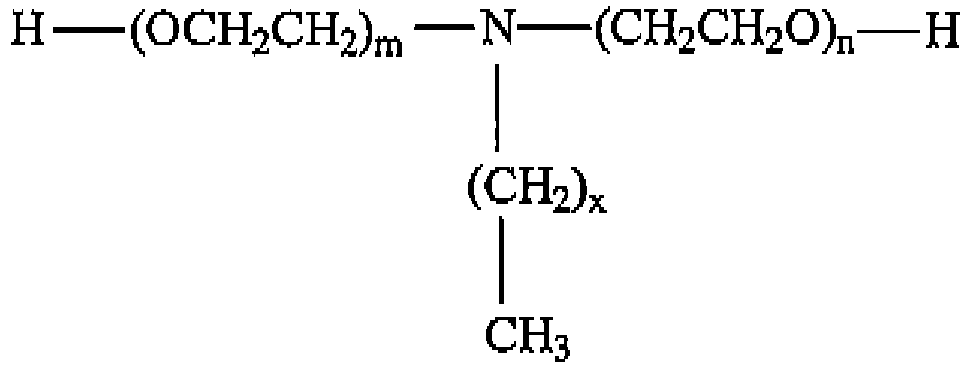
- Les blocs souples polyéthers peuvent comprendre des blocs polyoxyalkylène à bouts de chaînes NH2, de tels blocs pouvant être obtenus par cyanoacétylation de blocs polyoxyalkylène alpha-oméga dihydroxylés aliphatiques appelées polyétherdiols. Plus particulièrement, on pourra utiliser les Jeffamines (Par exemple Jeffamine® D400, D2000, ED 2003, XTJ 542, produits commerciaux de la société Huntsman, également décrites dans les documents de brevets
JP2004346274 JP2004352794 EP1482011 ). - Les blocs polyétherdiols sont soit utilisés tels quels et copolycondensés avec des blocs polyamides à extrémités carboxyliques, soit ils sont aminés pour être transformés en polyéther diamines et condensés avec des blocs polyamides à extrémités carboxyliques. La méthode générale de préparation en deux étapes des copolymères PEBA ayant des liaisons ester entre les blocs PA et les blocs PE est connue et est décrite, par exemple, dans le brevet français
FR2846332 EP1482011 . Les blocs polyéther peuvent être aussi mélangés avec des précurseurs de polyamide et un limiteur de chaîne diacide pour faire les polymères à blocs polyamides et blocs polyéthers ayant des motifs répartis de façon statistique (procédé en une étape). - Bien entendu, la désignation PEBA dans la présente description de l'invention se rapporte aussi bien aux PEBAX® commercialisés par Arkema, aux Vestamid® commercialisés par Evonik®, aux Grilamid® commercialisés par EMS, qu'aux Kellaflex® commercialisés par DSM ou à tout autre PEBA d'autres fournisseurs.
- Avantageusement, les copolymères PEBA ont des blocs PA en PA 6, en PA 11, en PA 12, PA 6.12, en PA 6.6/6, en PA 10.10 et/ou en PA 6.14, de préférence des blocs PA 11 et/ou PA 12; et des blocs PE en PTMG, en PPG et/ou en PO3G. Les PEBA à base de blocs PE constitués majoritairement de PEG sont à ranger dans la gamme des PEBA hydrophiles. Les PEBA à base de blocs PE constitués majoritairement de PTMG sont à ranger dans la gamme des PEBA hydrophobes.
- Avantageusement, ledit PEBA utilisé dans la composition selon l'invention est obtenu au moins partiellement à partir de matières premières bio-ressourcées. Par matières premières d'origine renouvelable ou matières premières bio-ressourcées, on entend des matériaux qui comprennent du carbone bio-ressourcé ou carbone d'origine renouvelable. En effet, à la différence des matériaux issus de matières fossiles, les matériaux composés de matières premières renouvelables contiennent du 14C. La « teneur en carbone d'origine renouvelable » ou « teneur en carbone bio-ressourcé » est déterminée en application des normes ASTM D 6866 (ASTM D 6866-06) et ASTM D 7026 (ASTM D 7026-04). A titre d'exemple, les PEBA à base de polyamide 11 proviennent au moins en partie de matières premières bio-ressourcées et présentent une teneur en carbone bio-ressourcé d'au moins 1%, ce qui correspond à un ratio isotopique de 12C/14C d'au moins 1,2 x 10⁻¹⁴. De préférence, les PEBA selon l'invention comprennent au moins 50% en masse de carbone bio-ressourcé sur la masse totale de carbone, ce qui correspond à un ratio isotopique 12C/14C d'au moins 0,6x10⁻¹². Cette teneur est avantageusement plus élevée, notamment jusqu'à 100%, qui correspond à un ratio isotopique 12C/14C de 1,2 x 10⁻¹², dans le cas de PEBA à blocs PA 11 et blocs PE comprenant du PO3G, PTMG et/ou PPG issus de matières premières d'origine renouvelable.
- Par amidon thermoplastique, ci-après nommé « TPS », on entend de l'amidon natif transformé en matériau processable par plastification en présence d'une faible quantité d'eau. L'amidon plastifié appelé «amidon thermoplastique» est obtenu notamment avec un plastifiant non volatil tel que le glycérol. Ce matériau a de nombreux avantages tels que son prix, son caractère biodégradable et son origine issue de ressources renouvelables abondantes. Il peut être mis en oeuvre par des outils conventionnels de la plasturgie. L'amidon plastifié possède quelques limites importantes telles que sa forte sensibilité à l'eau, des propriétés mécaniques et des propriétés adhésives limitées par rapport à un thermoplastique classique et un vieillissement très long, après sa mise en oeuvre, avant une stabilisation de ses propriétés (phénomènes de rétrogradation ou de densification). Son utilisation sous forme d'alliage selon l'invention permet de pallier ces inconvénients grâce à la formulation de l'amidon avec d'autres composés et l'utilisation du procédé selon l'invention. Selon un mode de réalisation préféré, le pourcentage d'amidon thermoplastique dans l'alliage utilisé représente de 10% à 90% du poids de l'alliage, de préférence de 30 à 80%, de préférence encore de 40 à 70 %, de préférence encore de 50 à 70 % du poids de l'alliage.
Tout type d'amidon peut être utilisé dans l'invention. Ce peut être de l'amidon de maïs, de pomme de terre, de blé, de tapioca, de pois. L'amidon peut être modifié par greffage de groupements chimiques. Il peut être employé dans les différentes formes suivantes : - l'amidon natif (non modifié): les grains d'amidon sont le siège de l'organisation semi-cristalline des deux polymères constitutifs que sont l'amylose et l'amylopectine. Le degré de polymérisation et la proportion d'amylose varient selon l'origine botanique de l'amidon.
- l'amidon gélatinisé : lors d'un chauffage voisin de 80°C en milieu aqueux, l'amidon s'hydrate et gonfle. Une partie de l'amylose, puis de l'amylopectine passe en solution (empesage). La suspension devient alors visqueuse, l'amidon devient plus facilement hydrolysable.
- l'amidon gélifié - l'amidon rétrogradé : lorsque la température de la solution aqueuse diminue, le système se gélifie puis se réorganise en une structure semi-cristalline (rétrogradation). Ces molécules réorganisées sont formées d'amylose, d'amylopectine et de cristaux mixtes amylose-amylopectine.
- l'amidon destructuré, forme dans laquelle les polymères d'amylose et d'amylopectine sont dispersés.
- En plus de l'utilisation d'amidon qui est une matière naturelle, l'utilisation de polymères polyoléfines préparées au moins partiellement à partir de matières premières bio-ressourcées permet d'augmenter davantage la quantité de matières naturelles dans le film selon l'invention.
- L'alliage selon l'invention peut être préparé par toute méthode, qui rend possible l'obtention d'un mélange intime ou homogène contenant l'amidon thermoplastique et ladite au moins une polyoléfine fonctionnelle (ci-après POF) hydrophile selon l'invention, et éventuellement un(des) additif(s) et/ou un(des) agent(s) compatibilisant(s), telle que le compoundage à l'état fondu, l'extrusion, le compactage, ou encore le malaxeur à rouleau. Plus particulièrement, l'alliage selon l'invention est préparé par mélange à l'état fondu de tous les ingrédients (amidon, plastifiant, eau, POF, et éventuels compatibilisant(s) et additif (s)) dans un procédé dit « en direct ». On peut aussi préparer l'alliage selon un procédé en deux étapes, la première consistant en un mélange concentré de l'amidon, plastifiant et eau, pour former une matrice TPS, puis diluer le TPS par mélange avec la matrice POF dans une seconde étape.
On utilise avantageusement les dispositifs habituels de mélange et de malaxage de l'industrie des thermoplastiques tels que les extrudeuses, les extrudeuses de type bi-vis, notamment les extrudeuses bi-vis co-rotatives engrenantes auto-nettoyantes, et les malaxeurs, par exemple les co-malaxeurs de marque BUSS ou les mélangeurs internes. Dans ce procédé, les ingrédients peuvent être soit mélangés à sec et introduits dans la trémie d'alimentation ou alors la POF hydrophile peut être introduite par gavage latéral dans le TPS ou dans un mélange amidon+plastifiant+eau préalablement fondu.
Il est recommandé que la préparation des alliages de l'invention (le compoundage) et leur mise en oeuvre soient faites dans les conditions les plus douces possibles en terme de température et de taux de cisaillement. Pour ce faire, on peut se reporter à la référence : O. Schacker, Plastics Additives and Compounding, April 2002, pages 28-33.
Les alliages selon l'invention présentent un excellent rapport performance/coût pour obtenir de nouveaux matériaux imper-respirants. Selon les ratios utilisés POF/TPS on obtient des performances différentes. Afin d'améliorer la compatibilité du mélange l'ajout de compatibilisants. Cette dernière est préférée dans la présente invention.
Contrairement aux multicouches fabriqués par coextrusion d'amidon plastifié et de polymères thermoplastiques, les alliages selon l'invention n'ont pas de problèmes d'instabilités interfaciales dus notamment aux différences de comportement chimique et rhéologique des matériaux mis en présence dans la filière. De plus, les alliages selon l'invention n'ont pas les problèmes de diminution des propriétés d'hydrophilie généralement rencontrés avec les biocomposites. En effet, l'introduction de fibres ligno-cellulosiques dans des biopolyesters ou dans une matrice d'amidon plastifié entraine une diminution des propriétés d'hydrophilie liée à la présence des fibres plus hydrophobes. - La présente invention a également pour objet un film ultra fin, imper respirant et adhésif, caractérisé en ce qu'il comprend un alliage d'amidon thermoplastique et de POF hydrophile, ladite POF comprenant au moins 10%, de préférence au moins 20%, de préférence au moins 30%, de préférence au moins 40%, de préférence au moins 50%, en poids de polyéthylène glycol (PEG) et/ou de sel métallique sur le poids de la POF. Avantageusement, le pourcentage d'amidon thermoplastique représente 10% à 90%, et le pourcentage de POF hydrophile représente de 90% à 10%, du poids de l'alliage dans le film.
- Selon un mode de réalisation, le film imper respirant de l'invention est préparé directement après la fabrication de l'alliage selon les étapes suivantes : préparer un mélange de la ou des POF(s) avec de l'amidon thermoplastique (ou de l'amidon de l'eau et un plastifiant), puis faire fondre le mélange par chauffage à une température supérieure à la température de fusion du ou des polymère(s) et à la température de fusion de l'amidon, de façon à former un mélange homogène sous forme d'alliage. Puis, on étire l'alliage thermoplastique obtenu pour former un film. Le chauffage de la ou des POF peut être effectué séparément de l'étape de chauffage de l'amidon, la ou les POF fondue(s) et l'amidon étant ensuite mélangés.
- Selon un mode de réalisation préféré du procédé de l'invention, on réalise les étapes suivantes :
- a) mise à disposition d'un mélange d'amidon, de plastifiant et d'eau ;
- b) mise à disposition de POF hydrophile tel que défini ci-dessus ;
- c) extrusion du mélange de l'étape a) puis ajout de la POF de l'étape b) au mélange en fin d'extrusion, généralement à une température supérieure à la température de fusion du ou des polymère(s) de l'étape a) et à la température de fusion de l'amidon ;
- d) étirement du mélange pour former un film.
- Par « matériau textile » ou « textile », tout matériau réalisé à partir de fibres ou de filaments ainsi que tout matériau, y-compris le papier et le carton, formant une membrane poreuse caractérisée par un rapport longueur/épaisseur d'au moins 300 ;
- Par « fibre », toute matière synthétique ou naturelle, caractérisée par un rapport longueur/diamètre d'au moins 300 ;
- Par « filament », toute fibre de longueur infinie ;
- Avantageusement, ledit textile comprend des fibres synthétiques obtenues à partir de matières premières bio-ressourcées, telles que des fibres de polyamide, notamment de polyamide 11. Avantageusement, ledit textile comprend en outre des fibres naturelles, telles que du coton, de la laine et/ou de la soie, des fibres artificielles fabriquées à partir de matières premières naturelles, des fibres minérales, telles que des fibres de carbone, de verre, de silice et/ou de magnésium.
- De préférence, ledit matériau textile, quelle que soit sa forme, est fabriqué à partir d'au moins une des matières suivantes : du polypropylène, du polyéther, du polyester et/ou du coton.
- Le textile est notamment choisi parmi des étoffes ou des surfaces textiles, telles que des surfaces tissées, tricotées, non-tissées ou tapis. Ces articles peuvent être par exemple des moquettes, des tapis, des revêtements d'ameublement, des revêtements de surface, les canapés, des rideaux, de la literie, des matelas et oreillers, des vêtements et des matériaux textiles médicaux.
- Le textile selon l'invention constitue avantageusement un feutre, un filtre, un film, une gaze, une toile, un pansement, une couche, un tissu, un tricot, un article d'habillement, un vêtement, un article de literie, un article d'ameublement, un rideau, un revêtement d'habitacle, un textile technique fonctionnel, un géotextile et/ou un agrotextile.
Ledit textile est avantageusement utilisé dans le domaine médical, l'hygiène, la bagagerie, la confection, l'habillement, l'équipement ménager ou de la maison, l'ameublement, les moquettes, l'automobile, l'industrie, notamment la filtration industrielle, l'agriculture et/ou le bâtiment. - Un tel film présente à la fois une bonne durabilité ainsi qu'une meilleure perméabilité à la vapeur d'eau. Le film conserve au cours du temps sa propriété de barrière contre les éléments extérieurs qui pourraient s'infiltrer dans le textile. L'amélioration de la perméabilité du film à la vapeur d'eau favorise la ventilation à travers le textile.
- Des films imper respirants ont été préparés à partir de mélanges comprenant diverses proportions d'une POF hydrophile, d'un copolyéther bloc amide PEBA, d'une autre polyoléfine fonctionnalisée et d'amidon thermoplastique. La POF utilisée dans les exemples ci-dessous est une POF greffée PEG (27% de PEG), ici terpolymère éthylène (79,9%) - butylacrylate (17%) - anhydride maléïque (3,1%) greffé PEG (Lotader BX3460) ou une POF ionomère de la gamme Surlyn® de Du Pont.
- Le TPE utilisé dans les exemples ci-dessous appartient à la gamme des PEBA hydrophiles commercialisés par Arkema, et en particulier ceux dont le bloc polyéther dérive du polyéthylène glycol. Il s'agit ici du Pebax® MV3000.
- L'autre polyoléfine fonctionnalisée éventuellement utilisée dans certains exemples est le Lotryl® 28MA07 qui est un copolymère d'éthylène avec de l'acrylate de n-methyle à une teneur pondérale d'acrylate de 28%. L'amidon utilisé est de l'amidon modifié (TPS 3947) commercialisé par la Société Roquette.
- L'imper-respirabilité (ou MVTR) des différents films de compositions A à M est mesurée selon la norme ASTM E96, méthode BW 38°C / 50 % Humidité Relative, rapportée à un film de 25 µm.
- L'adhérence des substrats est directement liée aux valeurs de forces de pelage. Les essais de pelage sont faits de préférence dans un délai compris entre 2 heures et 48 heures après la fabrication d'un stratifié comprenant un film de 25 µm adhésif, après extrusion couchage, sur un textile non tissé de polypropylène. On a effectué sur les stratifiés de chacun des essais A à I un essai de pelage (selon la norme ISO11339), sur une bande de stratifiée de 15 mm de large, on initie la rupture entre le film et le textile par un objet tranchant, puis on tire simultanément sur le film imper respirant et le textile à une vitesse de 200 mm/minute.
Le Tableau 1 ci-dessous récapitule les compositions des différents mélanges - Les exemples A-G sont comparatifs. Les exemples H à M sont selon l'invention.
Tableau 1 Essais % en poids de polyolefine greffée PEG (Lotader BX3460) % en poids de POF ionomère % en poids de polyoléfine fonctionnalisée (Lotryl 28MA07) % en poids d'amidon thermoplastique épaisseur du film (µm) Imperrespirabilité MVTR (g/m2/jour) pour 25 µm Exemples comparatifs A 100 0 0 0 25 420 B 80 0 20 0 25 320 C 70 0 30 0 25 280 D 30 0 70 0 25 120 E 20 0 80 0 25 105 F 0 0 100 0 25 80 G 0 100 0 0 25 500 Exemples selon Invention H 50 0 0 50 25 1200 I 40 0 40 20 25 600 J 10 0 80 10 25 200 K 0 50 0 50 25 1400 L 0 40 40 20 25 725 M 0 10 80 10 25 180
Selon un mode de réalisation, l'étape d'étirement du mélange est effectuée par extrusion soufflage. Selon un mode de réalisation alternatif, l'étape d'étirement du mélange est effectuée par extrusion à plat.
Le procédé de l'invention permet de maintenir la POF à une température suffisamment élevée, supérieure au point de fusion de la POF hydrophile pour obtenir des films ultra-fins c'est-à-dire d'épaisseur inférieure ou égale à 25 µm, tout en limitant le risque de dégradation de l'amidon et du ou des POF(s). De préférence, la température de chauffage ou d'extrusion avant étirement du film est comprise dans la gamme de 100°C à 300°C, de préférence de 150 à 250°C.
Le film imper respirant selon l'invention a une épaisseur inférieure ou égale à 25 µm, de préférence comprise dans la gamme de 5 à 25 µm.
L'invention a également pour objet un produit stratifié (ci-après stratifié) comprenant au moins un matériau textile et au moins un film imper respirant selon l'invention, ledit film adhérent sur au moins une surface du matériau textile avec une force de pelage comprise dans la gamme de 0,5 à 50 N.
Avantageusement, le film selon l'invention est notamment appliqué sur un matériau textile par tout procédé connu, de préférence sans utiliser de colle entre le film et le textile. On peut citer à titre d'exemple l'extrusion couchage d'un film de l'alliage sur le textile, ou bien le pressage à chaud (thermo-lamination) du film sur un textile ou entre deux textiles, à une température suffisante pour que le film s'imprègne et emprisonne les fibres du textile. Selon un mode de réalisation alternatif ou combiné au(x) précédent(s), on peut également citer le collage à l'aide d'un joint de colle, de préférence un joint de colle aqueux, c'est-à-dire comprenant moins de 5% en poids de solvant sur la composition de joint de colle. Il s'avère que les films utilisant un alliage selon l'invention présentent une meilleure adhérence sur textile, même sans colle, par rapport aux films imper respirants existants. Selon un mode de réalisation préféré, le procédé de mise en oeuvre des alliages utilisés pour l'obtention de matériaux imper-respirants et des stratifiés selon l'invention, se caractérise en ce que les compositions sont appliquées sur une ligne d'extrusion-cast ou d'extrusion blown, à l'état fondu, à une température d'au moins 120°C pour former un film ayant une épaisseur minimale de 5 µm. Ce type de procédé permet aussi d'optimiser les conditions de transformation pour préparer des films les plus fins possible, d'épaisseur comprise dans la gamme de 5 à 25 µm, issus de mélanges en ligne des matériaux selon l'invention dilués en proportions variées et sans avoir de micro-perforations. En jouant avec les paramètres température et vitesse de tirage de la ligne, on peut contrôler l'épaisseur des films. Selon un autre mode de réalisation préféré, le procédé de mise en oeuvre des compositions utilisées pour l'obtention de films et stratifiés imper-respirants selon l'invention, se caractérise en ce que les compositions sont appliquées à l'état fondu sur une ligne d'extrusion-couchage sur un textile, ou d'extrusion-lamination entre deux textiles, tel qu'un non-tissé en matériau fibreux et/ou tout autre matériau textile, y-compris le papier, pour former un complexe de grammage d'au moins 5 g/m2. Selon un procédé connu, le film selon l'invention est extrudé puis couché à l'état fondu sur le textile. De préférence, le film présente une épaisseur comprise entre 5 et 50 µm, et de préférence entre environ 5 et 10 µm. Avantageusement, dans le cadre d'une application par extrusion-couchage, on dépose de 10 à 50 g/m2 de film thermoplastique sur le textile.
Dans la présente description de l'invention, on entend :
Avantageusement, ledit au moins un matériau textile comprend des fibres synthétiques, notamment des fibres synthétiques obtenues à partir de matières premières bio-ressourcées, des fibres naturelles, des fibres artificielles fabriquées à partir de matières premières naturelles, des fibres minérales, et/ou des fibres métalliques.
Claims (18)
- Utilisation d'amidon thermoplastique pour la fabrication d'un film ultra-fin, c'est-à-dire d'épaisseur inférieure ou égale à 25 µm, imper respirant et adhésif,
ledit amidon thermoplastique se présentant sous la forme d'un alliage avec au moins une polyoléfine fonctionnalisée hydrophile obtenue soit par copolymérisation, soit par greffage, d'un tronc en polyoléfine par un monomère insaturé, ledit monomère insaturé étant greffé par des PEG et/ou formant un sel métallique. - Utilisation selon la revendication 1, dans lequel le pourcentage d'amidon thermoplastique représente de 10% à 90% du poids de l'alliage, de préférence de 30 à 80%, de préférence encore de 40 à 70 %, de préférence encore de 50 à 70 % du poids de l'alliage.
- Utilisation selon l'une des revendications précédentes, dans laquelle la polyoléfine hydrophile comprend au moins 10%, de préférence au moins 20%, de préférence au moins 30%, en poids de polyéthylène glycol (PEG) et/ou de sel métallique, sur le poids de polyoléfine.
- Utilisation selon l'une des revendications précédentes, dans laquelle l'alliage comprend en outre au moins un TPE hydrophile choisi parmi les copolymères à blocs polyamide et blocs PEG (PEBA), les copolymères à blocs polyesters et blocs PEG (COPE), les copolymères à blocs polyuréthanes et blocs PEG (TPU) et leurs mélanges, ledit TPE hydrophile représentant de préférence une teneur de 1 à 99 %, de préférence de 20 à 80% du poids de l'alliage.
- Film ultra fin, d'épaisseur inférieure ou égale à 25 µm, imper respirant et adhésif, caractérisé en ce qu'il comprend un alliage d'amidon thermoplastique et de polyoléfine hydrophile, ladite polyoléfine comprenant au moins un motif polyéthylène et au moins un monomère insaturé sur lequel est greffée une teneur d'au moins 10%, de préférence au moins 20%, de préférence au moins 30%, de préférence au moins 40%, en poids de polyéthylène glycol (PEG) et/ou de sel métallique, sur le poids de la polyoléfine.
- Film selon la revendication 5, dans lequel :- le pourcentage d'amidon thermoplastique représente 10% à 90%,- le pourcentage de polyoléfine hydrophile représente de 90% à 10%,du poids de l'alliage.
- Film selon l'une quelconque des revendications 5 ou 6, comprenant en outre une polyoléfine fonctionnalisée comportant un greffage par un monomère choisi dans le groupe comprenant les acides carboxyliques insaturés, les anhydrides carboxyliques insaturés, les monomères vinyliques, les monomères acryliques, ou un mélange de ceux-ci.
- Film imper respirant selon la revendication 7, dans lequel la polyoléfine fonctionnalisée est choisie dans le groupe comprenant les copolymères éthylène-ester acrylique, les copolymères éthylène-ester acrylique-anhydride maléique, les copolymères éthylène-ester acrylique-méthacrylate de glycidyle.
- Film imper respirant selon l'une des revendications 5 à 8, dans lequel le film a une épaisseur comprise dans la gamme de 5 à 25 µm.
- Procédé de fabrication du film selon l'une des revendications 5 à 9, comprenant les étapes de :a) mise à disposition d'un mélange d'amidon, de plastifiant et d'eau ;b) mise à disposition de la polyoléfine hydrophile telle que définie par l'une quelconque des revendications 1 ou 3c) extrusion du mélange de l'étape a) puis ajout de la polyoléfine de l'étape b) au mélange en fin d'extrusion,d) étirement du mélange pour former un film.
- Procédé selon la revendication 10, dans lequel l'étape d'étirement du mélange est effectuée par extrusion soufflage.
- Procédé selon la revendication 10, dans lequel l'étape d'étirement du mélange est effectuée par extrusion à plat.
- Procédé selon l'une quelconque des revendications 10 à 12, dans lequel l'étape c) est effectuée à une température comprise dans la gamme de 100°C à 300°C, de préférence de 150 à 250°C.
- Produit stratifié comprenant au moins un matériau textile et au moins un film imper respirant selon l'une des revendications 5 à 9, ledit film adhérent sur au moins une surface du matériau textile avec une force de pelage comprise dans la gamme de 0,5 à 50 N, de préférence de 0,5 à 10 N.
- Stratifié selon la revendication 14, dans lequel ledit au moins un matériau textile se présente sous la forme d'une membrane poreuse, d'un textile tissé ou d'un textile non tissé.
- Stratifié selon la revendication 14 ou 15, dans lequel ledit au moins un matériau textile comprend des fibres synthétiques, notamment des fibres synthétiques obtenues à partir de matières premières bio-ressourcées, des fibres naturelles, des fibres artificielles fabriquées à partir de matières premières naturelles, des fibres minérales, et/ou des fibres métalliques.
- Stratifié selon l'une quelconque des revendications 14 à 16, dans lequel ledit au moins un matériau textile constitue un feutre, un filtre, un film, une gaze, une toile, un pansement, une couche, un tissu, un tricot, un article d'habillement, un vêtement, un article de literie, un article d'ameublement, un rideau, un revêtement d'habitacle, un textile technique fonctionnel, un géotextile, et/ou un agrotextile.
- Utilisation d'un film selon l'une quelconque des revendications 5 à 9 dans le domaine médical, l'hygiène, la bagagerie, la confection, l'habillement, l'équipement ménager ou de la maison, l'ameublement, les moquettes, l'automobile, l'industrie, notamment la filtration industrielle, l'agriculture et/ou le bâtiment.
Applications Claiming Priority (2)
| Application Number | Priority Date | Filing Date | Title |
|---|---|---|---|
| FR1256142A FR2992651B1 (fr) | 2012-06-27 | 2012-06-27 | Utilisation d'un alliage d'amidon thermoplastique et de pof pour la fabrication d'un film ultra-fin imper-respirant adhesif. |
| PCT/FR2013/051326 WO2014001675A1 (fr) | 2012-06-27 | 2013-06-07 | Utilisation d'un alliage d'amidon thermoplastique et de pof pour la fabrication d'un film ultra-fin imper-respirant adhesif |
Publications (2)
| Publication Number | Publication Date |
|---|---|
| EP2867280A1 EP2867280A1 (fr) | 2015-05-06 |
| EP2867280B1 true EP2867280B1 (fr) | 2018-07-25 |
Family
ID=47137820
Family Applications (1)
| Application Number | Title | Priority Date | Filing Date |
|---|---|---|---|
| EP13731399.5A Not-in-force EP2867280B1 (fr) | 2012-06-27 | 2013-06-07 | Utilisation d'un alliage d'amidon thermoplastique et de pof pour la fabrication d'un film ultra-fin imper-respirant adhesif |
Country Status (8)
| Country | Link |
|---|---|
| US (1) | US20150147551A1 (fr) |
| EP (1) | EP2867280B1 (fr) |
| JP (1) | JP6189947B2 (fr) |
| CN (1) | CN104379641A (fr) |
| CA (1) | CA2873388A1 (fr) |
| FR (1) | FR2992651B1 (fr) |
| MX (1) | MX2014015153A (fr) |
| WO (1) | WO2014001675A1 (fr) |
Families Citing this family (3)
| Publication number | Priority date | Publication date | Assignee | Title |
|---|---|---|---|---|
| EP3044277B1 (fr) | 2013-09-10 | 2024-08-21 | Arkema Inc. | Alliages d'amidon thermoplastique antistatiques |
| WO2016204733A1 (fr) * | 2015-06-16 | 2016-12-22 | Multisorb Technologies, Inc. | Film solide absorbeur d'oxygène |
| FR3048151B1 (fr) * | 2016-02-19 | 2018-02-23 | Gerflor | Structure multicouche pour la realisation d'un revetement de sol ou de mur chauffant |
Citations (1)
| Publication number | Priority date | Publication date | Assignee | Title |
|---|---|---|---|---|
| WO2012089977A1 (fr) * | 2010-12-27 | 2012-07-05 | Arkema France | Compositions a base de copolyether bloc amides, de copolyether bloc esters, de polyolefines fonctionnalisees et d'amidon pour des applications de film imper respirants |
Family Cites Families (28)
| Publication number | Priority date | Publication date | Assignee | Title |
|---|---|---|---|---|
| US3654370A (en) | 1970-08-28 | 1972-04-04 | Jefferson Chem Co Inc | Process for preparing polyoxyalkylene polyamines |
| US4152353A (en) | 1977-08-29 | 1979-05-01 | The Dow Chemical Company | Method of producing amines from alcohols, aldehydes, ketones and mixtures thereof |
| US4454268A (en) * | 1983-06-23 | 1984-06-12 | The United States Of America As Represented By The Secretary Of Agriculture | Starch-based semipermeable films |
| US4618717A (en) | 1984-09-17 | 1986-10-21 | Texaco Inc. | Catalytic process for the production of primary amines from oxyethylene glycol monoalkyl ethers |
| US5095054A (en) * | 1988-02-03 | 1992-03-10 | Warner-Lambert Company | Polymer compositions containing destructurized starch |
| US4988740A (en) | 1989-06-15 | 1991-01-29 | E. I. Du Pont De Nemours And Company | Low density foamed thermoplastic elastomers |
| US4984376A (en) | 1989-06-15 | 1991-01-15 | E. I. Du Pont De Nemours And Company | Midsole for footwear |
| PL286051A1 (en) * | 1989-07-20 | 1991-03-11 | Warner Lambert Co | Polymer mixture, method for manufacturing a thermoplastic product and a method for manufacturing a thermoplastic alloy |
| ATE156172T1 (de) * | 1990-06-01 | 1997-08-15 | Atochem Elf Sa | Zusammensetzungen thermoplastischer elastomere auf der basis von polyamiden und modifizierten polyolefinen, geformte oder extrudierte körper, filme und verbundmaterialien hergestellt aus diesen |
| IT1245485B (it) * | 1991-05-03 | 1994-09-20 | Butterfly Srl | Membrane permselettive e loro impiego |
| ATE161281T1 (de) * | 1991-08-07 | 1998-01-15 | Clopay Corp | Bioabbaubare folie und verfahren zu deren herstellung |
| BE1005694A3 (fr) * | 1992-02-07 | 1993-12-21 | Solvay | Composition a base d'amidon. |
| DE69316861T2 (de) | 1992-12-14 | 1998-09-10 | Monsanto Co | Sekundäre Polyamine mit kontrollierter funktioneller Dichte und Verfahren zu ihrer Herstellung |
| US5959032A (en) | 1993-07-13 | 1999-09-28 | Huntsman Petrochemical Corporation | Polyether amine modification of polypropylene |
| DE4339475A1 (de) * | 1993-11-19 | 1995-05-24 | Wolff Walsrode Ag | Knisterfreie, antistatische Polyurethanfolie mit hoher Atmungsaktivität sowie ihre Verwendung |
| US6096809A (en) * | 1995-04-07 | 2000-08-01 | Bio-Tec Biologische Naturverpackungen Gmbh & Co. Kg | Biologically degradable polymer mixture |
| CN1255151A (zh) | 1997-05-12 | 2000-05-31 | 胡茨曼石油化学公司 | 含有聚醚胺改性的功能化聚烯烃的聚烯烃 |
| BE1011215A3 (fr) * | 1997-06-13 | 1999-06-01 | Solvay | Composition comprenant une matiere thermoplastique et une phase amylacee. |
| US6528586B2 (en) * | 2000-05-16 | 2003-03-04 | Gordon Mark Cohen | Compositions of elastomeric ethylene/(meth)acrylic (acid) ester copolymer and polylactone or polyether |
| US6590065B1 (en) | 2001-12-10 | 2003-07-08 | E. I. Du Pont De Nemours And Company | Polytrimethylene ether ester amide and use thereof |
| FR2846332B1 (fr) | 2002-10-23 | 2004-12-03 | Atofina | Copolymeres transparents a blocs polyamides et blocs polyethers |
| JP4193588B2 (ja) | 2003-05-26 | 2008-12-10 | 宇部興産株式会社 | ポリアミド系エラストマー |
| JP4161802B2 (ja) | 2003-05-27 | 2008-10-08 | 宇部興産株式会社 | ポリアミド組成物 |
| US7056975B2 (en) | 2003-05-27 | 2006-06-06 | Ube Industries, Ltd. | Thermoplastic resin composition having improved resistance to hydrolysis |
| FR2897356B1 (fr) * | 2006-02-16 | 2012-07-13 | Arkema | Utilisation de compositions thermoplastiques a base de polyolefines fonctionnalisees greffees par des motifs polyethers pour realiser des materiaux imper-respirants et leurs applications |
| WO2009068928A1 (fr) * | 2007-11-26 | 2009-06-04 | Nuova Pansac S.P.A. | Vêtement perméable à l'air et imperméable à l'eau |
| TW201121783A (en) * | 2009-07-23 | 2011-07-01 | Setec Pty Ltd | Multilayer film |
| CN102115576B (zh) * | 2009-12-31 | 2014-09-17 | 金伯利-克拉克环球有限公司 | 天然生物聚合物热塑性膜 |
-
2012
- 2012-06-27 FR FR1256142A patent/FR2992651B1/fr not_active Expired - Fee Related
-
2013
- 2013-06-07 JP JP2015519282A patent/JP6189947B2/ja not_active Expired - Fee Related
- 2013-06-07 WO PCT/FR2013/051326 patent/WO2014001675A1/fr not_active Ceased
- 2013-06-07 EP EP13731399.5A patent/EP2867280B1/fr not_active Not-in-force
- 2013-06-07 CA CA2873388A patent/CA2873388A1/fr not_active Abandoned
- 2013-06-07 MX MX2014015153A patent/MX2014015153A/es unknown
- 2013-06-07 US US14/411,762 patent/US20150147551A1/en not_active Abandoned
- 2013-06-07 CN CN201380033731.XA patent/CN104379641A/zh active Pending
Patent Citations (1)
| Publication number | Priority date | Publication date | Assignee | Title |
|---|---|---|---|---|
| WO2012089977A1 (fr) * | 2010-12-27 | 2012-07-05 | Arkema France | Compositions a base de copolyether bloc amides, de copolyether bloc esters, de polyolefines fonctionnalisees et d'amidon pour des applications de film imper respirants |
Also Published As
| Publication number | Publication date |
|---|---|
| CN104379641A (zh) | 2015-02-25 |
| JP2015527434A (ja) | 2015-09-17 |
| CA2873388A1 (fr) | 2014-01-03 |
| US20150147551A1 (en) | 2015-05-28 |
| JP6189947B2 (ja) | 2017-08-30 |
| WO2014001675A1 (fr) | 2014-01-03 |
| MX2014015153A (es) | 2015-03-05 |
| FR2992651B1 (fr) | 2015-07-17 |
| EP2867280A1 (fr) | 2015-05-06 |
| FR2992651A1 (fr) | 2014-01-03 |
Similar Documents
| Publication | Publication Date | Title |
|---|---|---|
| EP2867279B1 (fr) | Utilisation d'un alliage d'amidon thermoplastique et de tpe pour la fabrication d'un film ultra-fin imper-respirant adhesif | |
| EP0688826B1 (fr) | Film imper-respirant | |
| EP1311592B1 (fr) | Film imper-respirant | |
| EP3710518B1 (fr) | Film imper-respirant souple et étirable a base de copolymère a blocs | |
| EP2658901B1 (fr) | Compositions a base de copolyether bloc amides, de copolyether bloc esters, de polyolefines fonctionnalisees et d'amidon pour des applications de film imper respirants | |
| EP2867280A1 (fr) | Utilisation d'un alliage d'amidon thermoplastique et de pof pour la fabrication d'un film ultra-fin imper-respirant adhesif | |
| CA2188058A1 (fr) | Stratifie comprenant un non-tisse en association avec un film thermoplastique et son procede de preparation | |
| EP4237240A1 (fr) | Structure multicouche imper-respirante | |
| WO2021069843A1 (fr) | Composition de polymère thermoplastique pour construction d'articles 3d | |
| CN115397918B (zh) | 用于防水透气膜的聚合物组合物 | |
| EP4133011A1 (fr) | Composition de polymères pour films imper-respirants |
Legal Events
| Date | Code | Title | Description |
|---|---|---|---|
| PUAI | Public reference made under article 153(3) epc to a published international application that has entered the european phase |
Free format text: ORIGINAL CODE: 0009012 |
|
| 17P | Request for examination filed |
Effective date: 20141106 |
|
| AK | Designated contracting states |
Kind code of ref document: A1 Designated state(s): AL AT BE BG CH CY CZ DE DK EE ES FI FR GB GR HR HU IE IS IT LI LT LU LV MC MK MT NL NO PL PT RO RS SE SI SK SM TR |
|
| AX | Request for extension of the european patent |
Extension state: BA ME |
|
| DAX | Request for extension of the european patent (deleted) | ||
| RIN1 | Information on inventor provided before grant (corrected) |
Inventor name: BABIN, PERRINE Inventor name: CARTIER, LAURENT B. Inventor name: BRULE, BENOIT Inventor name: MALET, FREDERIC Inventor name: LE, GUILLAUME |
|
| 17Q | First examination report despatched |
Effective date: 20160210 |
|
| STAA | Information on the status of an ep patent application or granted ep patent |
Free format text: STATUS: EXAMINATION IS IN PROGRESS |
|
| REG | Reference to a national code |
Ref country code: DE Ref legal event code: R079 Ref document number: 602013040811 Country of ref document: DE Free format text: PREVIOUS MAIN CLASS: C08J0005180000 Ipc: B32B0007120000 |
|
| GRAP | Despatch of communication of intention to grant a patent |
Free format text: ORIGINAL CODE: EPIDOSNIGR1 |
|
| STAA | Information on the status of an ep patent application or granted ep patent |
Free format text: STATUS: GRANT OF PATENT IS INTENDED |
|
| RIC1 | Information provided on ipc code assigned before grant |
Ipc: B29C 47/00 20060101ALI20180307BHEP Ipc: B32B 27/32 20060101ALI20180307BHEP Ipc: C09J 133/08 20060101ALI20180307BHEP Ipc: B32B 7/12 20060101AFI20180307BHEP Ipc: B32B 27/12 20060101ALI20180307BHEP Ipc: C09J 133/14 20060101ALI20180307BHEP Ipc: B32B 5/02 20060101ALI20180307BHEP Ipc: C09J 135/02 20060101ALI20180307BHEP Ipc: B29C 47/10 20060101ALI20180307BHEP Ipc: C08J 5/18 20060101ALI20180307BHEP Ipc: B29C 55/28 20060101ALI20180307BHEP Ipc: B32B 27/22 20060101ALI20180307BHEP Ipc: B29C 47/92 20060101ALI20180307BHEP |
|
| INTG | Intention to grant announced |
Effective date: 20180328 |
|
| GRAS | Grant fee paid |
Free format text: ORIGINAL CODE: EPIDOSNIGR3 |
|
| GRAA | (expected) grant |
Free format text: ORIGINAL CODE: 0009210 |
|
| STAA | Information on the status of an ep patent application or granted ep patent |
Free format text: STATUS: THE PATENT HAS BEEN GRANTED |
|
| AK | Designated contracting states |
Kind code of ref document: B1 Designated state(s): AL AT BE BG CH CY CZ DE DK EE ES FI FR GB GR HR HU IE IS IT LI LT LU LV MC MK MT NL NO PL PT RO RS SE SI SK SM TR |
|
| REG | Reference to a national code |
Ref country code: GB Ref legal event code: FG4D Free format text: NOT ENGLISH |
|
| REG | Reference to a national code |
Ref country code: CH Ref legal event code: EP |
|
| REG | Reference to a national code |
Ref country code: AT Ref legal event code: REF Ref document number: 1021305 Country of ref document: AT Kind code of ref document: T Effective date: 20180815 |
|
| REG | Reference to a national code |
Ref country code: IE Ref legal event code: FG4D Free format text: LANGUAGE OF EP DOCUMENT: FRENCH |
|
| REG | Reference to a national code |
Ref country code: DE Ref legal event code: R096 Ref document number: 602013040811 Country of ref document: DE |
|
| REG | Reference to a national code |
Ref country code: NL Ref legal event code: MP Effective date: 20180725 |
|
| REG | Reference to a national code |
Ref country code: LT Ref legal event code: MG4D |
|
| PG25 | Lapsed in a contracting state [announced via postgrant information from national office to epo] |
Ref country code: NL Free format text: LAPSE BECAUSE OF FAILURE TO SUBMIT A TRANSLATION OF THE DESCRIPTION OR TO PAY THE FEE WITHIN THE PRESCRIBED TIME-LIMIT Effective date: 20180725 |
|
| REG | Reference to a national code |
Ref country code: AT Ref legal event code: MK05 Ref document number: 1021305 Country of ref document: AT Kind code of ref document: T Effective date: 20180725 |
|
| PG25 | Lapsed in a contracting state [announced via postgrant information from national office to epo] |
Ref country code: NO Free format text: LAPSE BECAUSE OF FAILURE TO SUBMIT A TRANSLATION OF THE DESCRIPTION OR TO PAY THE FEE WITHIN THE PRESCRIBED TIME-LIMIT Effective date: 20181025 Ref country code: GR Free format text: LAPSE BECAUSE OF FAILURE TO SUBMIT A TRANSLATION OF THE DESCRIPTION OR TO PAY THE FEE WITHIN THE PRESCRIBED TIME-LIMIT Effective date: 20181026 Ref country code: AT Free format text: LAPSE BECAUSE OF FAILURE TO SUBMIT A TRANSLATION OF THE DESCRIPTION OR TO PAY THE FEE WITHIN THE PRESCRIBED TIME-LIMIT Effective date: 20180725 Ref country code: IS Free format text: LAPSE BECAUSE OF FAILURE TO SUBMIT A TRANSLATION OF THE DESCRIPTION OR TO PAY THE FEE WITHIN THE PRESCRIBED TIME-LIMIT Effective date: 20181125 Ref country code: BG Free format text: LAPSE BECAUSE OF FAILURE TO SUBMIT A TRANSLATION OF THE DESCRIPTION OR TO PAY THE FEE WITHIN THE PRESCRIBED TIME-LIMIT Effective date: 20181025 Ref country code: FI Free format text: LAPSE BECAUSE OF FAILURE TO SUBMIT A TRANSLATION OF THE DESCRIPTION OR TO PAY THE FEE WITHIN THE PRESCRIBED TIME-LIMIT Effective date: 20180725 Ref country code: LT Free format text: LAPSE BECAUSE OF FAILURE TO SUBMIT A TRANSLATION OF THE DESCRIPTION OR TO PAY THE FEE WITHIN THE PRESCRIBED TIME-LIMIT Effective date: 20180725 Ref country code: RS Free format text: LAPSE BECAUSE OF FAILURE TO SUBMIT A TRANSLATION OF THE DESCRIPTION OR TO PAY THE FEE WITHIN THE PRESCRIBED TIME-LIMIT Effective date: 20180725 Ref country code: PL Free format text: LAPSE BECAUSE OF FAILURE TO SUBMIT A TRANSLATION OF THE DESCRIPTION OR TO PAY THE FEE WITHIN THE PRESCRIBED TIME-LIMIT Effective date: 20180725 Ref country code: SE Free format text: LAPSE BECAUSE OF FAILURE TO SUBMIT A TRANSLATION OF THE DESCRIPTION OR TO PAY THE FEE WITHIN THE PRESCRIBED TIME-LIMIT Effective date: 20180725 |
|
| PG25 | Lapsed in a contracting state [announced via postgrant information from national office to epo] |
Ref country code: LV Free format text: LAPSE BECAUSE OF FAILURE TO SUBMIT A TRANSLATION OF THE DESCRIPTION OR TO PAY THE FEE WITHIN THE PRESCRIBED TIME-LIMIT Effective date: 20180725 Ref country code: AL Free format text: LAPSE BECAUSE OF FAILURE TO SUBMIT A TRANSLATION OF THE DESCRIPTION OR TO PAY THE FEE WITHIN THE PRESCRIBED TIME-LIMIT Effective date: 20180725 Ref country code: HR Free format text: LAPSE BECAUSE OF FAILURE TO SUBMIT A TRANSLATION OF THE DESCRIPTION OR TO PAY THE FEE WITHIN THE PRESCRIBED TIME-LIMIT Effective date: 20180725 |
|
| REG | Reference to a national code |
Ref country code: DE Ref legal event code: R097 Ref document number: 602013040811 Country of ref document: DE |
|
| PG25 | Lapsed in a contracting state [announced via postgrant information from national office to epo] |
Ref country code: EE Free format text: LAPSE BECAUSE OF FAILURE TO SUBMIT A TRANSLATION OF THE DESCRIPTION OR TO PAY THE FEE WITHIN THE PRESCRIBED TIME-LIMIT Effective date: 20180725 Ref country code: IT Free format text: LAPSE BECAUSE OF FAILURE TO SUBMIT A TRANSLATION OF THE DESCRIPTION OR TO PAY THE FEE WITHIN THE PRESCRIBED TIME-LIMIT Effective date: 20180725 Ref country code: ES Free format text: LAPSE BECAUSE OF FAILURE TO SUBMIT A TRANSLATION OF THE DESCRIPTION OR TO PAY THE FEE WITHIN THE PRESCRIBED TIME-LIMIT Effective date: 20180725 Ref country code: CZ Free format text: LAPSE BECAUSE OF FAILURE TO SUBMIT A TRANSLATION OF THE DESCRIPTION OR TO PAY THE FEE WITHIN THE PRESCRIBED TIME-LIMIT Effective date: 20180725 Ref country code: RO Free format text: LAPSE BECAUSE OF FAILURE TO SUBMIT A TRANSLATION OF THE DESCRIPTION OR TO PAY THE FEE WITHIN THE PRESCRIBED TIME-LIMIT Effective date: 20180725 |
|
| PG25 | Lapsed in a contracting state [announced via postgrant information from national office to epo] |
Ref country code: SK Free format text: LAPSE BECAUSE OF FAILURE TO SUBMIT A TRANSLATION OF THE DESCRIPTION OR TO PAY THE FEE WITHIN THE PRESCRIBED TIME-LIMIT Effective date: 20180725 Ref country code: SM Free format text: LAPSE BECAUSE OF FAILURE TO SUBMIT A TRANSLATION OF THE DESCRIPTION OR TO PAY THE FEE WITHIN THE PRESCRIBED TIME-LIMIT Effective date: 20180725 Ref country code: DK Free format text: LAPSE BECAUSE OF FAILURE TO SUBMIT A TRANSLATION OF THE DESCRIPTION OR TO PAY THE FEE WITHIN THE PRESCRIBED TIME-LIMIT Effective date: 20180725 |
|
| PLBE | No opposition filed within time limit |
Free format text: ORIGINAL CODE: 0009261 |
|
| STAA | Information on the status of an ep patent application or granted ep patent |
Free format text: STATUS: NO OPPOSITION FILED WITHIN TIME LIMIT |
|
| 26N | No opposition filed |
Effective date: 20190426 |
|
| PG25 | Lapsed in a contracting state [announced via postgrant information from national office to epo] |
Ref country code: SI Free format text: LAPSE BECAUSE OF FAILURE TO SUBMIT A TRANSLATION OF THE DESCRIPTION OR TO PAY THE FEE WITHIN THE PRESCRIBED TIME-LIMIT Effective date: 20180725 |
|
| REG | Reference to a national code |
Ref country code: DE Ref legal event code: R119 Ref document number: 602013040811 Country of ref document: DE |
|
| PG25 | Lapsed in a contracting state [announced via postgrant information from national office to epo] |
Ref country code: MC Free format text: LAPSE BECAUSE OF FAILURE TO SUBMIT A TRANSLATION OF THE DESCRIPTION OR TO PAY THE FEE WITHIN THE PRESCRIBED TIME-LIMIT Effective date: 20180725 |
|
| REG | Reference to a national code |
Ref country code: CH Ref legal event code: PL |
|
| GBPC | Gb: european patent ceased through non-payment of renewal fee |
Effective date: 20190607 |
|
| REG | Reference to a national code |
Ref country code: BE Ref legal event code: MM Effective date: 20190630 |
|
| PG25 | Lapsed in a contracting state [announced via postgrant information from national office to epo] |
Ref country code: TR Free format text: LAPSE BECAUSE OF FAILURE TO SUBMIT A TRANSLATION OF THE DESCRIPTION OR TO PAY THE FEE WITHIN THE PRESCRIBED TIME-LIMIT Effective date: 20180725 |
|
| PG25 | Lapsed in a contracting state [announced via postgrant information from national office to epo] |
Ref country code: DE Free format text: LAPSE BECAUSE OF NON-PAYMENT OF DUE FEES Effective date: 20200101 Ref country code: GB Free format text: LAPSE BECAUSE OF NON-PAYMENT OF DUE FEES Effective date: 20190607 Ref country code: IE Free format text: LAPSE BECAUSE OF NON-PAYMENT OF DUE FEES Effective date: 20190607 |
|
| PG25 | Lapsed in a contracting state [announced via postgrant information from national office to epo] |
Ref country code: BE Free format text: LAPSE BECAUSE OF NON-PAYMENT OF DUE FEES Effective date: 20190630 Ref country code: LI Free format text: LAPSE BECAUSE OF NON-PAYMENT OF DUE FEES Effective date: 20190630 Ref country code: CH Free format text: LAPSE BECAUSE OF NON-PAYMENT OF DUE FEES Effective date: 20190630 Ref country code: LU Free format text: LAPSE BECAUSE OF NON-PAYMENT OF DUE FEES Effective date: 20190607 |
|
| PG25 | Lapsed in a contracting state [announced via postgrant information from national office to epo] |
Ref country code: FR Free format text: LAPSE BECAUSE OF NON-PAYMENT OF DUE FEES Effective date: 20190630 Ref country code: PT Free format text: LAPSE BECAUSE OF FAILURE TO SUBMIT A TRANSLATION OF THE DESCRIPTION OR TO PAY THE FEE WITHIN THE PRESCRIBED TIME-LIMIT Effective date: 20181125 |
|
| PG25 | Lapsed in a contracting state [announced via postgrant information from national office to epo] |
Ref country code: CY Free format text: LAPSE BECAUSE OF FAILURE TO SUBMIT A TRANSLATION OF THE DESCRIPTION OR TO PAY THE FEE WITHIN THE PRESCRIBED TIME-LIMIT Effective date: 20180725 |
|
| PG25 | Lapsed in a contracting state [announced via postgrant information from national office to epo] |
Ref country code: HU Free format text: LAPSE BECAUSE OF FAILURE TO SUBMIT A TRANSLATION OF THE DESCRIPTION OR TO PAY THE FEE WITHIN THE PRESCRIBED TIME-LIMIT; INVALID AB INITIO Effective date: 20130607 Ref country code: MT Free format text: LAPSE BECAUSE OF FAILURE TO SUBMIT A TRANSLATION OF THE DESCRIPTION OR TO PAY THE FEE WITHIN THE PRESCRIBED TIME-LIMIT Effective date: 20180725 |
|
| PG25 | Lapsed in a contracting state [announced via postgrant information from national office to epo] |
Ref country code: MK Free format text: LAPSE BECAUSE OF FAILURE TO SUBMIT A TRANSLATION OF THE DESCRIPTION OR TO PAY THE FEE WITHIN THE PRESCRIBED TIME-LIMIT Effective date: 20180725 |