EP2867230B1 - Process for the preparation of 3,5-disubstituted-1,2,4-oxadiazoles - Google Patents
Process for the preparation of 3,5-disubstituted-1,2,4-oxadiazoles Download PDFInfo
- Publication number
- EP2867230B1 EP2867230B1 EP13813965.4A EP13813965A EP2867230B1 EP 2867230 B1 EP2867230 B1 EP 2867230B1 EP 13813965 A EP13813965 A EP 13813965A EP 2867230 B1 EP2867230 B1 EP 2867230B1
- Authority
- EP
- European Patent Office
- Prior art keywords
- formula
- oxadiazole
- water
- disubstituted
- reaction mixture
- Prior art date
- Legal status (The legal status is an assumption and is not a legal conclusion. Google has not performed a legal analysis and makes no representation as to the accuracy of the status listed.)
- Active
Links
- 0 *C(*1)=C(*)C(*)=C1c1nc(-c2c(*)c(*)c(*)c(*)c2*)n[o]1 Chemical compound *C(*1)=C(*)C(*)=C1c1nc(-c2c(*)c(*)c(*)c(*)c2*)n[o]1 0.000 description 1
- VSIMYYKDZCUPGO-UHFFFAOYSA-N Cc(cc(cc1)Cl)c1-c1n[o]c(-c2ccc[o]2)n1 Chemical compound Cc(cc(cc1)Cl)c1-c1n[o]c(-c2ccc[o]2)n1 VSIMYYKDZCUPGO-UHFFFAOYSA-N 0.000 description 1
Classifications
-
- C—CHEMISTRY; METALLURGY
- C07—ORGANIC CHEMISTRY
- C07D—HETEROCYCLIC COMPOUNDS
- C07D413/00—Heterocyclic compounds containing two or more hetero rings, at least one ring having nitrogen and oxygen atoms as the only ring hetero atoms
- C07D413/02—Heterocyclic compounds containing two or more hetero rings, at least one ring having nitrogen and oxygen atoms as the only ring hetero atoms containing two hetero rings
- C07D413/04—Heterocyclic compounds containing two or more hetero rings, at least one ring having nitrogen and oxygen atoms as the only ring hetero atoms containing two hetero rings directly linked by a ring-member-to-ring-member bond
-
- C—CHEMISTRY; METALLURGY
- C07—ORGANIC CHEMISTRY
- C07D—HETEROCYCLIC COMPOUNDS
- C07D271/00—Heterocyclic compounds containing five-membered rings having two nitrogen atoms and one oxygen atom as the only ring hetero atoms
- C07D271/02—Heterocyclic compounds containing five-membered rings having two nitrogen atoms and one oxygen atom as the only ring hetero atoms not condensed with other rings
- C07D271/06—1,2,4-Oxadiazoles; Hydrogenated 1,2,4-oxadiazoles
Definitions
- 1,2,4-Oxadiazoles and in particular, 3,5-disubstituted-1,2,4-oxadiazoles, have been shown to have biological activity in pharmaceutical and agricultural fields.
- 3,5-disubstituted-1,2,4-oxadiazoles are disclosed as disease suppression and treatment agents ( U.S. Pat. No. 6,992,096 ), as therapeutic agents for hepatitis C (Pub. No. US 2005/0075375 A1 ), and for nematode control in agriculture (Pub. No. US 2009/0048311 A1 ).
- 3,5-Disubstituted-1,2,4-oxadiazoles can be prepared in a number of ways.
- Another method for preparation of 3,5-disubstituted-1,2,4-oxadiazoles is reaction of a benzamide oxime or propionamidoxime with a carboxylic acid or ester ( WO 2011/141326 , WO 2012/012477 , and WO 2011/085406 ).
- Other routes to 3,5-disubsituted-1,2,4-oxadiazoles include reaction of a benzamide with a Weinreb amide (Pub. No. US 2010/0048648 A1 ) and reaction of a hydroxyamyl halide and a nitrile ( U.S. Pat. No. 3,211,742 ).
- Other references include Zhang, H.-Z. et al., J.
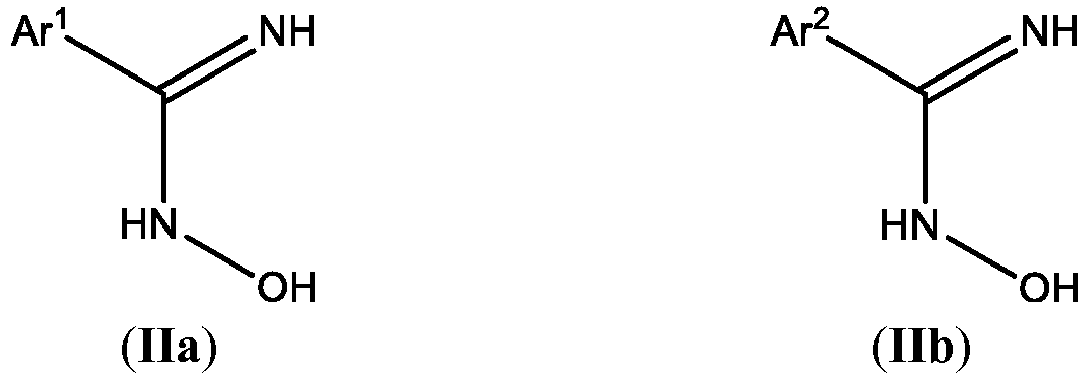
- the process comprises reacting a N-hydroxyamidine of Formula ( IIa ) or ( IIb ), respectively, or a tautomeric form thereof, wherein Ar 1 and Ar 2 are defined as above, with an acyl chloride of Formula ( IIIa ) or ( IIIb ), respectively, wherein Ar 1 and Ar 2 are defined as above, in a reaction mixture comprising a water-immiscible organic solvent and an aqueous base and the temperature of the reaction mixture is no greater than about 85°C.
- the present disclosure is directed to improved processes for the preparation of 3,5-disubstituted-1,2,4-oxadiazoles and salts thereof.
- Various embodiments of the process enable greater ease of production, milder reaction conditions, reduced reaction time cycles, fewer reaction intermediates, and/or significantly reduced capital equipment requirements.
- the processes described herein are useful for preparing a 3,5-disubstituted-1,2,4-oxadiazole of Formula ( Ia ) or ( Ib ) or a salt thereof, wherein Ar 1 is selected from the group consisting of phenyl, pyridyl, pyrazyl, oxazolyl and isoxazolyl, each of which can be optionally independently substituted with one or more substituents selected from the group consisting of halogen, CF 3 , CH 3 , OCF 3 , OCH 3 , CN and C(H)O.
- Ar 2 is selected from the group consisting of thienyl, furanyl, oxazolyl, and isoxazolyl, each of which can be optionally independently substituted with one or more substituents selected from the group consisting of fluorine, chlorine, CH 3 , and OCF 3 .
- Ar 1 is unsubstituted phenyl. In other embodiments, Ar 1 is monosubstituted phenyl wherein the substituent is a halogen. In some embodiments, Ar 2 is substituted thienyl or substituted furanyl. In some embodiments, Ar 2 is unsubstituted thienyl or unsubstituted furanyl.
- the 3,5-disubstituted-1,2,4-oxadiazole is a compound of Formula (Ia-i ) or a salt thereof, wherein R 1 and R 5 are independently selected from hydrogen, CH 3 , F, Cl, Br, CF 3 and OCF 3 ; R 2 and R 4 are independently selected from hydrogen, F, Cl, Br, and CF 3 ; R 3 is selected from hydrogen, CH 3 , CF 3 , F, Cl, Br, OCF 3 , OCH 3 , CN, and C(H)O; R 7 and R 8 are independently selected from hydrogen and fluorine; R 9 is selected from hydrogen, F, Cl, CH 3 , and OCF 3 ; and E is O or S.
- R 1 and R 5 are independently selected from hydrogen, CH 3 , F, Cl, Br, CF 3 and OCF 3 ;
- R 2 and R 4 are independently selected from hydrogen, F, Cl, Br, and CF 3 ;
- R 3 is selected from hydrogen, CH 3 , CF 3 ,
- Non-limiting examples of 3,5-disubstituted-1,2,4-oxadiazoles that can be prepared in accordance with the present disclosure include 3-phenyl-5-(2-thienyl)-1,2,4-oxadiazole of Formula ( Ia-ii ), 3-(4-chlorophenyl)-5-(2-furanyl)-1,2,4-oxadiazole of Formula ( Ia-iii ), 3-(4-chloro-2-methylphenyl)-5-(2-furanyl)-1,2,4-oxadiazole of Formula ( Ia-iv ), 3-phenyl-5-(2-furanyl)-1,2,4-oxadiazole of Formula ( Ia-v ), 3-(4-bromophenyl)-5-(furan-3-yl)-1,2,4-oxadiazole of Formula ( Ia-vi ) and, 3-(2,4-difluorophenyl)-(thiophen-3-yl)-1,2,4-
- the 3,5-disubstituted-1,2,4-oxadiazole is a compound of Formula (Ib-i) or a salt thereof, wherein R 1 through R 5 , R 7 through R 9 and E are defined as above.
- 3,5-disubstituted-1,2,4-oxadiazoles that can be prepared in accordance with the present disclosure include 3-(thiophen-2-yl)-5-(p-tolyl)-1,2,4-oxadiazole of Formula ( Ib-ii) , 5-(3-chlorophenyl)-3-(thiophen-2-yl)-1,2,4-oxadiazole of Formula ( Ib-ii ) and, 5-(4-chloro-2-methylphenyl)-3-(furan-2-yl)-1,2,4-oxadiazole of Formula ( Ib-iv ).
- the process comprises reacting a N-hydroxyamidine of Formula ( IIa ) or ( IIb ), or a tautomeric form thereof, wherein Ar 1 and Ar 2 are defined as above, with an acyl chloride of Formula ( IIIa ) or ( IIIb ), respectively, wherein Ar 1 and Ar 2 are defined as above.
- the condensation reaction of the N-hydroxyamidine with the acyl chloride is conducted in a reaction mixture comprising an organic solvent and an aqueous base.
- the reaction of the N-hydroxyamidine and the acyl chloride is believed to produce an oxime ester intermediate of Formula ( IVa ) or ( IVb ), a salt thereof, or a tautomeric form thereof, wherein Ar 1 and Ar 2 are defined as above.
- an aqueous base facilitates cyclization of the oxime ester at relatively low temperatures to produce the 3,5-disubstituted-1,2,4-oxadiazole product.
- the condensation and/or cyclization reaction is allowed to proceed directly to the final 3,5-disubstituted-1,2,4-oxadiazole product, without isolation or purification of the oxime ester intermediate.
- the oxime ester intermediate, or a portion thereof may be isolated and/or purified prior to formation of the 3,5-disubstituted-1,2,4-oxadiazole product.
- solvents used to form the reaction mixture are selected on the basis of one or more criteria, to facilitate simplification and overall economics of the process.
- the organic solvent employed is capable of solubilizing the N-hydroxyamidine of Formula ( IIa ) or ( IIb ) and the 3,5-disubstituted-1,2,4-oxadiazole product of Formula ( Ia ) or ( Ib ).
- the organic solvent is capable of solubilizing the intermediate oxime ester of Formula ( IVa ) or ( IVb ) as well.
- an organic solvent to solubilize the N-hydroxyamidine starting material as well as the oxime ester intermediate and the 3,5-disubstituted-1,2,4-oxadiazole product reduces or eliminates the need for isolation of the N-hydroxyamidine and/or the oxime ester, and reduces or eliminates the need for a solvent switch prior to cyclization to form the 3,5-disubstituted-1,2,4-oxadiazole product.
- the organic solvent may advantageously be used to transfer the N-hydroxyamidine reactant from one reaction vessel to another.
- a water-immiscible organic solvent is used for isolation of the N-hydroxyamidine of Formula ( IIa ) or ( IIb ) and production of the 3,5-disubstituted-1,2,4-oxadiazole product.
- the use of a water-immiscible organic solvent allows for separation of the aqueous and organic phases of the reaction mixture, which enables a more expedient transfer of the N-hydroxyamidine reactant from one vessel to another and facilitates the recovery of the final 3,5-disubstituted-1,2,4-oxadiazole product, as set forth in greater detail below.
- the water-immiscible organic solvent forms an azeotrope with water.
- an azeotrope facilitates removal, via e.g. evaporation or distillation, of the solvent for purposes of isolation of the intermediate oxime ester or the 3,5-disubstituted-1,2,4-oxadiazole product.
- the organic solvent is butyl acetate or 2-methyltetrahydrofuran.
- the aqueous base comprises a chemical reagent which reacts with the acid by-product of the condensation reaction between the N-hydroxyamidine and acyl chloride. Furthermore, without being bound to any particular theory, it is believed that the aqueous base catalyzes the cyclization of the oxime ester of Formula ( IVa ) or ( IVb ) to produce the 3,5-disubstituted-1,2,4-oxadiazole of Formula ( Ia ) or ( Ib ).
- Aqueous base is defined herein as a strong base or a base that completely or almost completely dissociates in water.
- the use of a strong base may advantageously result in faster reaction times.
- the aqueous base is an alkali base comprising an alkali metal or alkaline earth metal, and which dissociates to form hydroxide ions in aqueous solution.
- the aqueous base is selected from the group consisting of sodium hydroxide, potassium hydroxide, lithium hydroxide, calcium hydroxide, and mixtures thereof.
- the aqueous base solution added to the reaction mixture comprises the base reagent in a concentration of from about 5% to about 60% by weight.
- the aqueous base reacts with the acid by-product of the condensation reaction between N-hydroxyamidine and acyl chloride to form water (water forms only from the hydroxide base) and a salt.
- the reaction mixture optionally comprises a phase transfer catalyst.
- a phase transfer catalyst is a chemical reagent that facilitates the migration of a reactant from the aqueous phase into the organic phase, or vice versa. Accordingly, the use of a phase transfer catalyst may advantageously result in faster reaction times and higher conversions or yields.
- the phase transfer catalyst is a quaternary ammonium salt, a phosphonium salt, or a crown ether.
- suitable phase transfer catalysts include tetrabutylammonium hydroxide, benzyltrimethylammonium hydroxide, tetrabutylammonium bromide, tetrabutylammonium chloride, tetrabutylammonium iodide, tetrabutylphosphonium bromide, and tetrabutylphosphonium chloride.
- the phase transfer catalyst is tetrabutylammonium hydroxide.
- the phase transfer catalyst is added to the reaction mixture in the form of an aqueous solution (e.g., a 40% by weight aqueous solution of the phase transfer catalyst) such that the final concentration is about 0.5-3 mol% based on acyl chloride, more preferably in a range of about 0.5-1.5 mol% or of about 1.5-2 mol% based on acyl chloride.
- an aqueous solution e.g., a 40% by weight aqueous solution of the phase transfer catalyst
- the N-hydroxyamidine of Formula ( IIa ) or (IIb) is dissolved in a water-immiscible organic solvent and the solution is introduced into a reaction vessel.
- Water, at least a portion of the aqueous base, and the optional phase transfer catalyst are added to the reaction vessel. This may be simultaneous and/or sequentially. This results in the formation of a two-phase reaction mixture, in which the N-hydroxyamidine remains dissolved in the organic phase comprising a water-immiscible organic solvent.
- the acyl chloride reactant of Formula ( IIIa ) or ( IIIb ) and any remaining portion of the aqueous base are added to the reaction vessel.
- the acyl chloride and the remaining portion of the aqueous base may be added simultaneously or sequentially.
- the N-hydroxyamidine is added to the reaction mixture in an amount equal to or in excess of the acyl chloride on a molar basis. Additional water may be added to the reaction mixture at any time during the course of the reaction.
- the mixture may be agitated.
- the reaction could be conducted continuously, for example, in a continuous stirred-tank reactor.
- the concentration of base in the aqueous phase of the reaction mixture is preferably sufficient to achieve a pH of at least about 8, at least about 9, or at least about 10 with higher pH resulting in increased reaction rate.
- a pH of from about 12 to about 13 is a pH range resulting in an increased reaction rate.
- the pH of the aqueous phase may be maintained or increased during the process by addition of additional aqueous base to the reaction mixture.
- the temperature of the reaction mixture is from 25°C to 85°C.
- the temperature of the reaction mixture is in some embodiments allowed to rise as a result of the reaction exotherm, and is preferably from 55°C to 75°C.
- the reaction may be allowed to proceed in the absence of external heat applied to the reaction mixture, although heat from an extraneous source may be supplied as needed to maintain the desired reaction temperature and rate.
- the rate of addition of the acyl chloride and the remaining aqueous base is dependent on reaction scale and ability to control the temperature.
- the rate of addition of acyl chloride may be between 30 min and 4 hours.
- the reaction mixture is advantageously allowed to heat as a result of the reaction exotherm, as described above, and may be maintained at from about 55°C to about 75°C for about 30 minutes to about 2 hours to allow the reaction to proceed to completion.
- the aqueous and organic phases are typically allowed to separate while hot.
- the aqueous phase may be optionally neutralized to a lower pH (e.g., pH lowered to less than about 9) to assist in subsequent formulation of the 3,5-disubstituted-1,2,4-oxadiazole product.
- a portion of the aqueous phase is removed from the reaction mixture and the organic solvent is removed by evaporation or distillation.
- the azeotrope, or pairing of the water and solvent assists in driving out traces of solvent.
- the distillation may be conducted at atmospheric pressure, or under vacuum. Additional water may be added to the reaction mixture in a volume sufficient to replace the distilled solvent and to facilitate the isolation of the final product.
- the 3,5-disubstituted-1,2,4-oxadiazole product is precipitated in the aqueous layer, resulting in a slurry of solids in the aqueous layer.
- the solid 3,5-disubstituted-1,2,4-oxadiazole product may be recovered by filtration, centrifugation, and/or decanting.
- the 3,5-disubstituted-1,2,4-oxadiazole product may not consistently precipitate as a fine crystalline solid and may form beads (e.g., several mm in diameter), large irregular hard lumps, or encrusted solids on the reactor walls and agitator, which is a problem for discharging from the reactor and subsequent processing.
- One solution is to not remove the byproduct salt aqueous phase.
- high residual salt (e.g., NaCl) levels in the 3,5-disubstituted-1,2,4-oxadiazole product may cause problems in formulating the product.
- An alternative embodiment is to use a surfactant to stabilize droplets of product (possibly a metastable melt or a very concentrated solution) and allow the droplets to solidify as a precipitate in the aqueous layer without coalescing into larger droplets which otherwise ultimately may "crash out” as the large lumps and/or encrusted solids.
- Suitable surfactants may be selected from the group consisting of anionic or nonionic dispersants, anionic or nonionic detergents, anionic or nonionic surfactants, and combinations thereof.
- Non-limiting examples of suitable surfactants include Morwet D-425 (an anionic dispersant, an alkyl naphthalene sulfonate condensate sodium salt, from AkzoNobel), Morwet D-425 and Greenworks (sodium lauryl sulfate (anionic detergent), alkyl polyglucoside (nonionic surfactant), lauramine oxide (nonionic detergent), and glycerine), Morwet D-425 and Pluronic L-35 (a surfactant, a PEG-PPG-PEG block copolymer of polyethylene glycol-polypropylene glycol-polyethylene glycol, Mn ⁇ 1900), Pluronic L-35, and Triton X-100 (a nonionic detergent, an octylphenol ethoxylate (n ⁇ 10)).
- the surfactant is added to the reaction mixture after the reaction is substantially complete and prior to removal of at least a portion of the water-immiscible organic solvent
- the solvent may be recovered and recycled for re-use in the process (e.g., for use in dissolving the N-hydroxyamidine in a subsequent cycle of the process).
- N-hydroxyamidine of Formula ( IIa ) or ( IIb ) used in the preparation of 3,5-disubstituted-1,2,4-oxadiazole as described above can be obtained from commercial sources, or may be prepared using methods known to one skilled in the art.
- an arylamide oxime e.g. benzamide oxime
- optionally independently substituted arylamide oxime may be prepared by reacting the corresponding aryl nitrile with hydroxylamine hydrochloride and an aqueous base.
- aqueous base for this purpose is sodium hydroxide.
- hydroxylamine hydrochloride is slurried in an alcoholic solvent, such as methanol or ethanol and is combined with an equivalent molar amount of the aqueous base.
- the aryl nitrile is added in an amount such that the hydroxylamine is in excess, for example, from about 1.01 to about 1.25 molar equivalents.
- the resulting reaction is mildly exothermic, and the resulting reaction mixture is heated to a temperature of from 20°C to 75°C, from 20°C to 65°C, from 50°C to 75°C, or from 50°C to 60°C.
- the aryl nitrile is added.
- the reaction mixture is then in some embodiments allowed to continue heating until the reaction is complete.
- the arylamide oxime product may be isolated for use in the process of the present disclosure.
- the alcoholic solvent may be removed by distillation, leaving a reaction mixture comprising a product melt phase and an aqueous phase. While the reaction mixture is still hot, an organic solvent as described above is added to dissolve the arylamide oxime product in an organic phase. The aqueous phase may then be separated and removed.
- the organic solvent satisfies the criteria for the organic solvent used in the production of the 3,5-disubstituted-1,2,4-oxadiazole, as set forth in detail above.
- the organic solvent phase comprising the dissolved arylamide oxime product may be forwarded directly to the condensation/cyclization reaction for production of the 3,5-disubstituted-1,2,4-oxadiazole without further processing.
- the methods described herein may be readily adapted to produce other N-hydroxyamidine compounds of Formula ( IIa ) or (IIb).
- an arylamide oxime starting material e.g., benzamide oxime
- aqueous hydroxylamine includes but is not limited to aqueous hydroxylamine free base or aqueous hydroxylamine generated from the hydrochloride.
- a solvent can be used including an alcoholic solvent, such as methanol or ethanol.
- the solvent used may be a water-immiscible organic solvent or combination of solvents selected on the basis of one or more of the criteria as set forth in detail above.
- the organic solvent may be butyl acetate or 2-methyltetrahydrofuran.
- the arylamide oxime starting material is prepared by combining and reacting the corresponding aryl nitrile with aqueous hydroxylamine in the absence of a solvent, after the reaction is complete, the resulting product may be dissolved in an organic solvent as described above for further processing.
- the acyl chloride of Formula ( IIIa ) or ( IIIb ) (e.g., 2-thiophenecarbonyl chloride or 2-furancarbonyl chloride), used in the processes for production of 3,5-disubstituted-1,2,4-oxadiazole as described above, can be obtained from commercial sources, or may be prepared using methods known to one skilled in the art.
- thiophene may be used to produce either 2-acetylthiophene or 2-thiophenecarboxaldehyde. Each of these may be used to produce a 2-thiophene carboxylic acid and, subsequently, 2-thiophenecarbonyl chloride.
- Other methods may be suitably employed to produce other acyl chloride compounds within the scope of Formula ( III ) or ( IIIb ).
- Benzamide oxime (5.00 g, 36.7 mmol) was dissolved in acetone (50 mL) at 0°C. The solution was stirred and 50% aqueous sodium hydroxide (4.5 mL) added. An exotherm was noted and a precipitate formed in the reaction mixture. The exotherm lasted for about 15 minutes and the slurry became thick. The solution was warmed to 20°C and external cooling was added. The 2-thiophenecarbonyl chloride (5.36, 36.7 mmol) was added over 15 minutes maintaining the reaction mixture below 30°C. The reaction was maintained at 30°C for 15 minutes and the slurry became thinner. The reaction mixture was cooled to room temperature and stirred for 20 additional minutes.
- Benzonitrile (25.0 g, 242 mmol) was added to a 250 mL flask and heated to 50°C.
- Aqueous hydroxylamine (50%, 20.4 g, 309 mmol) was added via a syringe pump at 0.17 mL/min (2 hours addition time).
- the reaction was stirred an additional 1 hour 30 minutes at 50°C.
- the reaction was complete and 80 mL of 2-methyltetrahydrofuran and 25 mL of water were added.
- the solution was mixed for 10 minutes and the layers were separated.
- the water white organic layer (96.3 g) was collected.
- the organic layer contained 29.48 w/w % of the benzamide oxime product (28.4 g, 208 mmol).
- the yield was 86 %.
- Benzonitrile (50.0 g, 0.485 mol) was added to a 250 mL flask and heated to 70°C with stirring.
- Deionized water (1.0 g) was added and the temperature was lined out at 70°C.
- Aqueous hydroxylamine (50%, 37.50 g, 34.8 ml, assay was 53.3%, 0.605 moles) was added via a syringe pump over 1.5 hours while maintaining the temperature at 70° ⁇ 2°C. HPLC analysis indicated that the conversion of benzonitrile was >99% after about 2.5 hours of reaction time.
- the batch was heated for a total of 3.5 hours at 70°C, then was cooled to 60°C.
- the batch was transferred to a 500 mL flask with 2-methyltetrahydrofuran (208.98 g), followed by 20 wt % aqueous NaCl (40.0 g).
- the mixture was heated to 60°C, and the phases were separated at 60°C to give a solution of benzamide oxime in 2-methyltetrahydrofuran (281.80 g) and aqueous waste (44.61 g).
- the 2-methyltetrahydrofuran solution assayed for 21.73 wt% benzamide oxime.
- Hot deionized water (10 mL) was added to dissolve salts, followed by separation, washing with 10 mL of hot water and separation.
- Deionized water (50 mL) was added and the butyl acetate was removed by azeotropic distillation at 66-75°C and 300 torr. The 3-phenyl-5-(thiophen-2-yl)-1,2,4-oxadiazole precipitated during the distillation.
- the 4-chlorobenzamidoxime (1.00 g, 5.8 mmol) was dissolved in 2-methyltetrahydrofuran (10.0 mL) and water (1.0 mL). A 40% aqueous solution of benzyltrimethylammonium hydroxide (100 uL) was added and the solution heated to 50°C. A 50% aqueous solution of sodium hydroxide (720 mg, 9.00 mmol) and 2-thiophenecarbonyl chloride (939.0 mg, 6.4 mmol) were added dropwise simultaneously over 15 minutes. The temperature of the mixture warmed to 70°C. The mixture was cooled to room temperature and water (40 mL) added. Solids formed and the 2-methyltetrahydrofuran was removed at reduced pressure.
- the 4-chlorobenzamidoxime (1.24 g, 7.25 mmol) was dissolved in 2-methyltetrahydrofuran (10.0 mL) and water (1.0 mL). A 40% aqueous solution of benzyltrimethylammonium hydroxide (100 uL) and 50% aqueous solution of sodium hydroxide (736 mg, 9.20 mmol) were added. The mixture was stirred and a precipitate formed. Furoyl chloride (1.24 g, 7.25 mmol) was added dropwise and an exotherm was noted. The mixture was stirred at 70°C for 1 hour and cooled to room temperature. The solution was poured into water (25 mL) and the 2-methyltetrahydrofuran removed at reduced pressure.
- Benzamide oxime (2.00 g, 14.7 mmol) and a 40% aqueous solution of benzyltrimethylammonium hydroxide (100 uL) were combined in 2-methyltetrahydrofuran (20 mL) and water (2 mL).
- the solution was warmed to 50°C and 50% aqueous solution of sodium hydroxide (1.52 g, 19.1 mmol) and 2-furoyl chloride (2.00 g, 15.3 mmol) were added dropwise simultaneously over 10 min.
- the mixture was stirred at 60°C for 48 hours and the solids dissolved.
- the mixture was cooled to room temperature and poured into water (25 mL).
- the temperature was reduced to 60°C, and the pH of the aqueous phase was neutralized to 7.61, and was drained off to waste.
- a hot solution of 1.25 g of Morwet D-425 in 100 ml DI water was added to the mixture, and the 2-phase mixture was heated to distill off the 2-methyltetrahydrofuran /water azeotrope (boiling point 71°C). Additional water (150 ml) was pumped into the reactor flask over about 15 minutes, once the 2-methyltetrahydrofuran began to distill out. While maintaining good agitation, the pot temperature reached 100.5°C (vapor temperature 97°C). The slurry was cooled and filtered using a coarse glass frit.
- the scale was scraped off the agitator and combined with the wet cake; the scale was only about 3% of total product.
- the combined wet cake was washed with hot DI water (3 x 50 ml) and suction-dried for 5 minutes to give a 3-phenyl-5-(thiophen-2-yl)-1,2,4-oxadiazole wet cake, 34.80 g.
- the loss on drying of the wet cake was 20.13%.
- the assay of the dried 3-phenyl-5-(thiophen-2-yl)-1,2,4-oxadiazole was 96.12%, and the residual chloride was ⁇ 200 ppm.
Landscapes
- Chemical & Material Sciences (AREA)
- Organic Chemistry (AREA)
- Heterocyclic Carbon Compounds Containing A Hetero Ring Having Nitrogen And Oxygen As The Only Ring Hetero Atoms (AREA)
- Plural Heterocyclic Compounds (AREA)
- Organic Low-Molecular-Weight Compounds And Preparation Thereof (AREA)
Description
- Provided herein are processes for the preparation of biologically active 3,5-disubstituted-1,2,4-oxadiazoles or salts thereof that are useful, for example, in the control of nematodes.
- 1,2,4-Oxadiazoles, and in particular, 3,5-disubstituted-1,2,4-oxadiazoles, have been shown to have biological activity in pharmaceutical and agricultural fields. For example, 3,5-disubstituted-1,2,4-oxadiazoles are disclosed as disease suppression and treatment agents (
U.S. Pat. No. 6,992,096 ), as therapeutic agents for hepatitis C (Pub. No.US 2005/0075375 A1 ), and for nematode control in agriculture (Pub. No.US 2009/0048311 A1 ). 3,5-Disubstituted-1,2,4-oxadiazoles can be prepared in a number of ways. One is preparation of 3,5-disubstituted-1,2,4-oxadiazoles via reaction of an aryl amide oxime and an acyl chloride (Pub. No.US 2008/0269236 A1 ,U.S. Pat. No. 7,678,922 , Pub. No.US 2008/0113961 A1 ,JP 2008120794 WO 2011/141326 ,WO 2012/012477 , andWO 2011/085406 ). Other routes to 3,5-disubsituted-1,2,4-oxadiazoles include reaction of a benzamide with a Weinreb amide (Pub. No.US 2010/0048648 A1 ) and reaction of a hydroxyamyl halide and a nitrile (U.S. Pat. No. 3,211,742 ). Other references include Zhang, H.-Z. et al., J. Med. Chem., vol. 48, no. 16 (2005), p. 5215-5223, Lukyanov, S.M. et al., ARKIVOC, vol. IV (2009), p. 21-45,US 7,041,685 ,US 2012/022109 ,US 2003/055085 , andWO 2009/148452 . - While methods for preparing 3,5-disubstituted-1,2,4-oxadiazoles exist, alternative routes that may result in a more efficient synthesis are highly desirable. In particular, synthetic processes with fewer isolation steps and/or solvents can be more efficient and less expensive. In addition, processes that reduce and/or eliminate solids handling, reduce reaction time and/or use fewer reaction intermediates can significantly reduce capital equipment expenditures in large scale manufacturing. Finally, the use of milder reaction conditions (e.g. lower temperatures) may prevent degradation of desired intermediates and products resulting in fewer unwanted side products and ultimately a better product purity profile.
- Citation of any reference above is not to be construed as an admission that such reference is prior art to the present application.
- Provided herein are processes for the preparation of 3,5-disubstituted-1,2,4-oxadiazoles and salts thereof. For example, the processes described herein are useful for preparing a 3,5-disubstituted-1,2,4-oxadiazole of Formula (Ia) or (Ib),


- The present disclosure is directed to improved processes for the preparation of 3,5-disubstituted-1,2,4-oxadiazoles and salts thereof. Various embodiments of the process enable greater ease of production, milder reaction conditions, reduced reaction time cycles, fewer reaction intermediates, and/or significantly reduced capital equipment requirements.
- Generally, the processes described herein are useful for preparing a 3,5-disubstituted-1,2,4-oxadiazole of Formula (Ia) or (Ib) or a salt thereof,

- For example, in some embodiments, Ar1 is unsubstituted phenyl. In other embodiments, Ar1 is monosubstituted phenyl wherein the substituent is a halogen. In some embodiments, Ar2 is substituted thienyl or substituted furanyl. In some embodiments, Ar2 is unsubstituted thienyl or unsubstituted furanyl.
- In some embodiments, the 3,5-disubstituted-1,2,4-oxadiazole is a compound of Formula (Ia-i) or a salt thereof,

- Non-limiting examples of 3,5-disubstituted-1,2,4-oxadiazoles that can be prepared in accordance with the present disclosure include 3-phenyl-5-(2-thienyl)-1,2,4-oxadiazole of Formula (Ia-ii),


- In further embodiments, the 3,5-disubstituted-1,2,4-oxadiazole is a compound of Formula (Ib-i) or a salt thereof,

- Additional examples of 3,5-disubstituted-1,2,4-oxadiazoles that can be prepared in accordance with the present disclosure include 3-(thiophen-2-yl)-5-(p-tolyl)-1,2,4-oxadiazole of Formula (Ib-ii),


- Further representative 3,5-disubstituted-1,2,4-oxadiazoles that can be prepared in accordance with the present disclosure are described in Pub. No.
US 2009/0048311 A1 . - In various embodiments, the process comprises reacting a N-hydroxyamidine of Formula (IIa) or (IIb), or a tautomeric form thereof,


- In accordance with various embodiments, solvents used to form the reaction mixture are selected on the basis of one or more criteria, to facilitate simplification and overall economics of the process. In some embodiments, the organic solvent employed is capable of solubilizing the N-hydroxyamidine of Formula (IIa) or (IIb) and the 3,5-disubstituted-1,2,4-oxadiazole product of Formula (Ia) or (Ib). In some embodiments the organic solvent is capable of solubilizing the intermediate oxime ester of Formula (IVa) or (IVb) as well. Use of an organic solvent to solubilize the N-hydroxyamidine starting material as well as the oxime ester intermediate and the 3,5-disubstituted-1,2,4-oxadiazole product reduces or eliminates the need for isolation of the N-hydroxyamidine and/or the oxime ester, and reduces or eliminates the need for a solvent switch prior to cyclization to form the 3,5-disubstituted-1,2,4-oxadiazole product. In various embodiments, the organic solvent may advantageously be used to transfer the N-hydroxyamidine reactant from one reaction vessel to another. A water-immiscible organic solvent is used for isolation of the N-hydroxyamidine of Formula (IIa) or (IIb) and production of the 3,5-disubstituted-1,2,4-oxadiazole product. The use of a water-immiscible organic solvent allows for separation of the aqueous and organic phases of the reaction mixture, which enables a more expedient transfer of the N-hydroxyamidine reactant from one vessel to another and facilitates the recovery of the final 3,5-disubstituted-1,2,4-oxadiazole product, as set forth in greater detail below. Furthermore, in one embodiment, the water-immiscible organic solvent forms an azeotrope with water. The formation of an azeotrope facilitates removal, via e.g. evaporation or distillation, of the solvent for purposes of isolation of the intermediate oxime ester or the 3,5-disubstituted-1,2,4-oxadiazole product. Alternatively, more than one organic solvent can be used. In one embodiment, the organic solvent is butyl acetate or 2-methyltetrahydrofuran.
- The aqueous base comprises a chemical reagent which reacts with the acid by-product of the condensation reaction between the N-hydroxyamidine and acyl chloride. Furthermore, without being bound to any particular theory, it is believed that the aqueous base catalyzes the cyclization of the oxime ester of Formula (IVa) or (IVb) to produce the 3,5-disubstituted-1,2,4-oxadiazole of Formula (Ia) or (Ib).
- "Aqueous base" is defined herein as a strong base or a base that completely or almost completely dissociates in water. The use of a strong base may advantageously result in faster reaction times. The aqueous base is an alkali base comprising an alkali metal or alkaline earth metal, and which dissociates to form hydroxide ions in aqueous solution. The aqueous base is selected from the group consisting of sodium hydroxide, potassium hydroxide, lithium hydroxide, calcium hydroxide, and mixtures thereof. In one embodiment, the aqueous base solution added to the reaction mixture comprises the base reagent in a concentration of from about 5% to about 60% by weight. The aqueous base reacts with the acid by-product of the condensation reaction between N-hydroxyamidine and acyl chloride to form water (water forms only from the hydroxide base) and a salt.
- In accordance with one embodiment, the reaction mixture optionally comprises a phase transfer catalyst. A phase transfer catalyst is a chemical reagent that facilitates the migration of a reactant from the aqueous phase into the organic phase, or vice versa. Accordingly, the use of a phase transfer catalyst may advantageously result in faster reaction times and higher conversions or yields.
- In various embodiments, the phase transfer catalyst is a quaternary ammonium salt, a phosphonium salt, or a crown ether. Non-limiting examples of suitable phase transfer catalysts include tetrabutylammonium hydroxide, benzyltrimethylammonium hydroxide, tetrabutylammonium bromide, tetrabutylammonium chloride, tetrabutylammonium iodide, tetrabutylphosphonium bromide, and tetrabutylphosphonium chloride. In one embodiment, the phase transfer catalyst is tetrabutylammonium hydroxide. In one embodiment, the phase transfer catalyst is added to the reaction mixture in the form of an aqueous solution (e.g., a 40% by weight aqueous solution of the phase transfer catalyst) such that the final concentration is about 0.5-3 mol% based on acyl chloride, more preferably in a range of about 0.5-1.5 mol% or of about 1.5-2 mol% based on acyl chloride.
- In one embodiment of the process, the N-hydroxyamidine of Formula (IIa) or (IIb) is dissolved in a water-immiscible organic solvent and the solution is introduced into a reaction vessel. Water, at least a portion of the aqueous base, and the optional phase transfer catalyst are added to the reaction vessel. This may be simultaneous and/or sequentially. This results in the formation of a two-phase reaction mixture, in which the N-hydroxyamidine remains dissolved in the organic phase comprising a water-immiscible organic solvent. The acyl chloride reactant of Formula (IIIa) or (IIIb) and any remaining portion of the aqueous base are added to the reaction vessel. The acyl chloride and the remaining portion of the aqueous base may be added simultaneously or sequentially. In one embodiment, the N-hydroxyamidine is added to the reaction mixture in an amount equal to or in excess of the acyl chloride on a molar basis. Additional water may be added to the reaction mixture at any time during the course of the reaction.
- In some embodiments, the mixture may be agitated. In additional embodiments, the reaction could be conducted continuously, for example, in a continuous stirred-tank reactor.
- In order to enhance the reaction rate and achieve acceptable reaction times, the concentration of base in the aqueous phase of the reaction mixture is preferably sufficient to achieve a pH of at least about 8, at least about 9, or at least about 10 with higher pH resulting in increased reaction rate. For example, in one embodiment, a pH of from about 12 to about 13 is a pH range resulting in an increased reaction rate. The pH of the aqueous phase may be maintained or increased during the process by addition of additional aqueous base to the reaction mixture.
- The temperature of the reaction mixture is from 25°C to 85°C. The temperature of the reaction mixture is in some embodiments allowed to rise as a result of the reaction exotherm, and is preferably from 55°C to 75°C. The reaction may be allowed to proceed in the absence of external heat applied to the reaction mixture, although heat from an extraneous source may be supplied as needed to maintain the desired reaction temperature and rate.
- The rate of addition of the acyl chloride and the remaining aqueous base is dependent on reaction scale and ability to control the temperature. For example, the rate of addition of acyl chloride may be between 30 min and 4 hours. The reaction mixture is advantageously allowed to heat as a result of the reaction exotherm, as described above, and may be maintained at from about 55°C to about 75°C for about 30 minutes to about 2 hours to allow the reaction to proceed to completion. Upon completion of the reaction, the aqueous and organic phases are typically allowed to separate while hot. In some embodiments, the aqueous phase may be optionally neutralized to a lower pH (e.g., pH lowered to less than about 9) to assist in subsequent formulation of the 3,5-disubstituted-1,2,4-oxadiazole product. In some embodiments, a portion of the aqueous phase is removed from the reaction mixture and the organic solvent is removed by evaporation or distillation. When the solvent level is low, the azeotrope, or pairing of the water and solvent, assists in driving out traces of solvent. The distillation may be conducted at atmospheric pressure, or under vacuum. Additional water may be added to the reaction mixture in a volume sufficient to replace the distilled solvent and to facilitate the isolation of the final product. As the solvent evaporates, the 3,5-disubstituted-1,2,4-oxadiazole product is precipitated in the aqueous layer, resulting in a slurry of solids in the aqueous layer. When substantially all of the solvent has been removed, the solid 3,5-disubstituted-1,2,4-oxadiazole product may be recovered by filtration, centrifugation, and/or decanting.
- The 3,5-disubstituted-1,2,4-oxadiazole product may not consistently precipitate as a fine crystalline solid and may form beads (e.g., several mm in diameter), large irregular hard lumps, or encrusted solids on the reactor walls and agitator, which is a problem for discharging from the reactor and subsequent processing. One solution is to not remove the byproduct salt aqueous phase. However, high residual salt (e.g., NaCl) levels in the 3,5-disubstituted-1,2,4-oxadiazole product may cause problems in formulating the product.
- An alternative embodiment is to use a surfactant to stabilize droplets of product (possibly a metastable melt or a very concentrated solution) and allow the droplets to solidify as a precipitate in the aqueous layer without coalescing into larger droplets which otherwise ultimately may "crash out" as the large lumps and/or encrusted solids. Suitable surfactants may be selected from the group consisting of anionic or nonionic dispersants, anionic or nonionic detergents, anionic or nonionic surfactants, and combinations thereof. Non-limiting examples of suitable surfactants include Morwet D-425 (an anionic dispersant, an alkyl naphthalene sulfonate condensate sodium salt, from AkzoNobel), Morwet D-425 and Greenworks (sodium lauryl sulfate (anionic detergent), alkyl polyglucoside (nonionic surfactant), lauramine oxide (nonionic detergent), and glycerine), Morwet D-425 and Pluronic L-35 (a surfactant, a PEG-PPG-PEG block copolymer of polyethylene glycol-polypropylene glycol-polyethylene glycol, Mn ≈ 1900), Pluronic L-35, and Triton X-100 (a nonionic detergent, an octylphenol ethoxylate (n≈10)). In one embodiment, the surfactant is added to the reaction mixture after the reaction is substantially complete and prior to removal of at least a portion of the water-immiscible organic solvent from the reaction mixture.
- In some embodiments, particularly in large scale processes or manufacturing settings with large volumes of solvent, the solvent may be recovered and recycled for re-use in the process (e.g., for use in dissolving the N-hydroxyamidine in a subsequent cycle of the process).
- The N-hydroxyamidine of Formula (IIa) or (IIb) used in the preparation of 3,5-disubstituted-1,2,4-oxadiazole as described above, can be obtained from commercial sources, or may be prepared using methods known to one skilled in the art. For example, an arylamide oxime (e.g. benzamide oxime) or optionally independently substituted arylamide oxime may be prepared by reacting the corresponding aryl nitrile with hydroxylamine hydrochloride and an aqueous base. One exemplary aqueous base for this purpose is sodium hydroxide.
- In some cases, to prepare an arylamide oxime starting material, hydroxylamine hydrochloride is slurried in an alcoholic solvent, such as methanol or ethanol and is combined with an equivalent molar amount of the aqueous base. In one embodiment, the aryl nitrile is added in an amount such that the hydroxylamine is in excess, for example, from about 1.01 to about 1.25 molar equivalents. The resulting reaction is mildly exothermic, and the resulting reaction mixture is heated to a temperature of from 20°C to 75°C, from 20°C to 65°C, from 50°C to 75°C, or from 50°C to 60°C. As the reaction mixture is heated, the aryl nitrile is added. The reaction mixture is then in some embodiments allowed to continue heating until the reaction is complete.
- Upon completion of the reaction, the arylamide oxime product may be isolated for use in the process of the present disclosure. For example, the alcoholic solvent may be removed by distillation, leaving a reaction mixture comprising a product melt phase and an aqueous phase. While the reaction mixture is still hot, an organic solvent as described above is added to dissolve the arylamide oxime product in an organic phase. The aqueous phase may then be separated and removed. In various embodiments, the organic solvent satisfies the criteria for the organic solvent used in the production of the 3,5-disubstituted-1,2,4-oxadiazole, as set forth in detail above. Thus, the organic solvent phase comprising the dissolved arylamide oxime product may be forwarded directly to the condensation/cyclization reaction for production of the 3,5-disubstituted-1,2,4-oxadiazole without further processing. The methods described herein may be readily adapted to produce other N-hydroxyamidine compounds of Formula (IIa) or (IIb).
- In an alternative embodiment, an arylamide oxime starting material (e.g., benzamide oxime) is prepared by combining and reacting the corresponding aryl nitrile with aqueous hydroxylamine (e.g., aqueous hydroxylamine includes but is not limited to aqueous hydroxylamine free base or aqueous hydroxylamine generated from the hydrochloride). By utilizing aqueous hydroxylamine, the step of neutralizing the hydroxylamine hydrochloride reactant with an aqueous base is eliminated along with the requirement of an alcoholic solvent. This provides significant capital and material savings in large-scale production processes due to the absence of an aqueous base, alcohol storage and distillation equipment and other advantages such as simplifying treatment of the aqueous waste by avoiding the production of salt in the neutralization step. In an embodiment where the arylamide oxime starting material is prepared utilizing aqueous hydroxylamine, no solvent is required. However, a solvent can be used including an alcoholic solvent, such as methanol or ethanol. In order to facilitate subsequent processing, the solvent used may be a water-immiscible organic solvent or combination of solvents selected on the basis of one or more of the criteria as set forth in detail above. For example, the organic solvent may be butyl acetate or 2-methyltetrahydrofuran. Alternatively, if the arylamide oxime starting material is prepared by combining and reacting the corresponding aryl nitrile with aqueous hydroxylamine in the absence of a solvent, after the reaction is complete, the resulting product may be dissolved in an organic solvent as described above for further processing.
- The acyl chloride of Formula (IIIa) or (IIIb) (e.g., 2-thiophenecarbonyl chloride or 2-furancarbonyl chloride), used in the processes for production of 3,5-disubstituted-1,2,4-oxadiazole as described above, can be obtained from commercial sources, or may be prepared using methods known to one skilled in the art. For example, thiophene may be used to produce either 2-acetylthiophene or 2-thiophenecarboxaldehyde. Each of these may be used to produce a 2-thiophene carboxylic acid and, subsequently, 2-thiophenecarbonyl chloride. Other methods may be suitably employed to produce other acyl chloride compounds within the scope of Formula (III) or (IIIb).
- The following examples illustrate the invention.
- Hydroxylamine hydrochloride (8.85 g, 0.126 moles) and methanol (45 mL) were charged to a 100 mL flask, followed by 51% sodium hydroxide (9.82 g, 0.125 moles). To this mixture was added benzonitrile (10.32 g, 0.100 moles), and the reaction was heated to 55-60°C and held for 2 hours. HPLC showed that the reaction was complete by the disappearance of benzonitrile. A portion of the methanol (30 mL) was removed by distillation, deionized (DI) water was added (22 mL), and the remaining methanol was distilled at 300 torr to give two liquid phases (benzamide oxime melt and salt water). 2-Methyltetrahydrofuran (20.0 g) was added, and the aqueous salt phase was drained off to give 33.34 g of a solution of benzamide oxime in 2-methyltetrahydrofuran, 39.45% by loss on drying and HPLC. The yield of benzamide oxime was 96.5%.
- A 39.45% solution of benzamide oxime in 2-methyltetrahydrofuran (33.34 g) was charged to a 100 mL flask, followed by water (9.0 g), 40% aqueous solution of tetrabutylammonium hydroxide (1.02g), and 51% sodium hydroxide (3.52 g, 0.045 moles). To this mixture was added 2-thiophenecarbonyl chloride (13.83 g, 0.0936 moles) and 51% sodium hydroxide (7.33 g, 0.0935 moles) simultaneously over a 30 minute period while heating to about 70°C. The reaction was complete in less than 80 minutes. The aqueous salt phase was removed, water was added (30 g), and the 2-methyltetrahydrofuran partly removed by atmospheric distillation (13.5 mL). An additional amount (32 g) of hot water was added, and the remainder of the 2-methyltetrahydrofuran was distilled out, during which time the product, 3-phenyl-5-(2-thienyl)-1,2,4-oxadiazole, precipitated. The aqueous slurry of 3-phenyl-5-(2-thienyl)-1,2,4-oxadiazole was filtered, washed with water and dried overnight in a vacuum oven to yield 3-phenyl-5-(2-thienyl)-1,2,4-oxadiazole, 20.47 g, 99.1% pure, 95.0% yield.
- Benzamide oxime (5.00 g, 36.7 mmol) was dissolved in acetone (50 mL) at 0°C. The solution was stirred and 50% aqueous sodium hydroxide (4.5 mL) added. An exotherm was noted and a precipitate formed in the reaction mixture. The exotherm lasted for about 15 minutes and the slurry became thick. The solution was warmed to 20°C and external cooling was added. The 2-thiophenecarbonyl chloride (5.36, 36.7 mmol) was added over 15 minutes maintaining the reaction mixture below 30°C. The reaction was maintained at 30°C for 15 minutes and the slurry became thinner. The reaction mixture was cooled to room temperature and stirred for 20 additional minutes. Water (50 mL) was added and the resulting solids were stirred for 1 hour. The solids were collected by vacuum filtration, washed with water (2 x 50 mL) and dried on a Buchner funnel with air flow from vacuum overnight. 3-Phenyl-5-(2-thienyl)-1,2,4-oxadiazole (6.94 g, 30.4 mmol) was obtained as a white solid (83% yield).
- Hydroxylamine hydrochloride (88.5 g, 1.26 moles) and methanol (450 mL) were charged to a 1000 mL flask, followed by 51% sodium hydroxide (97.7 g, 1.25 moles). Benzonitrile (103.1 g, 1.00 moles) was added and the reaction was heated to 65-71°C for 4 hours. HPLC showed that the reaction was complete by the disappearance of benzonitrile. A portion of the methanol (366 mL) was removed by distillation, DI water was added (200 mL), and the remaining methanol was distilled at 200 torr to give two liquid phases (benzamide oxime melt and salt water). Butyl acetate (650 mL) and DI water (100 mL) were added, and the aqueous salt phase was drained off. The butyl acetate solution was washed once with 100 mL of water to give 715.04 g of a blue-tinted cloudy solution of benzamide oxime in butyl acetate, 18.1% by loss on drying. Yield of benzamide oxime was 95.1% with a 3.4% yield of benzamide by-product.
- Benzonitrile (25.0 g, 242 mmol) was added to a 250 mL flask and heated to 50°C. Aqueous hydroxylamine (50%, 20.4 g, 309 mmol) was added via a syringe pump at 0.17 mL/min (2 hours addition time). Upon completion of the addition of the 50% aqueous hydroxylamine solution, the reaction was stirred an additional 1 hour 30 minutes at 50°C. The reaction was complete and 80 mL of 2-methyltetrahydrofuran and 25 mL of water were added. The solution was mixed for 10 minutes and the layers were separated. The water white organic layer (96.3 g) was collected. Upon analysis, the organic layer contained 29.48 w/w % of the benzamide oxime product (28.4 g, 208 mmol). The yield was 86 %.
- Benzonitrile (50.0 g, 0.485 mol) was added to a 250 mL flask and heated to 70°C with stirring. Deionized water (1.0 g) was added and the temperature was lined out at 70°C. Aqueous hydroxylamine (50%, 37.50 g, 34.8 ml, assay was 53.3%, 0.605 moles) was added via a syringe pump over 1.5 hours while maintaining the temperature at 70° ± 2°C. HPLC analysis indicated that the conversion of benzonitrile was >99% after about 2.5 hours of reaction time. The batch was heated for a total of 3.5 hours at 70°C, then was cooled to 60°C. The batch was transferred to a 500 mL flask with 2-methyltetrahydrofuran (208.98 g), followed by 20 wt % aqueous NaCl (40.0 g). The mixture was heated to 60°C, and the phases were separated at 60°C to give a solution of benzamide oxime in 2-methyltetrahydrofuran (281.80 g) and aqueous waste (44.61 g). The 2-methyltetrahydrofuran solution assayed for 21.73 wt% benzamide oxime.
- A solution of benzamide oxime (18.3%) in butyl acetate (27.30 g, 36.7 mmol) was charged to a 100 mL flask, followed by 40% aqueous tetrabutylammonium hydroxide (0.40 g), and 51% sodium hydroxide (0.86 g, 11.0 mmol). To this mixture was added 2-thiophenecarbonyl chloride (5.44g, 36.8 mmol) and 51% sodium hydroxide (2.88 g, 36.7 mmol) simultaneously over 30 minutes while heating to about 70°C. An additional 0.66 g of 51% sodium hydroxide was added to raise the pH to 9.75. The reaction was complete in less than 2.5 hours (HPLC analysis). Hot deionized water (10 mL) was added to dissolve salts, followed by separation, washing with 10 mL of hot water and separation. Deionized water (50 mL) was added and the butyl acetate was removed by azeotropic distillation at 66-75°C and 300 torr. The 3-phenyl-5-(thiophen-2-yl)-1,2,4-oxadiazole precipitated during the distillation. The product was discharged, filtered through a coarse glass frit, washed with water (2 x 15 mL), and dried overnight in a vacuum oven to give 3-phenyl-5-(thiopheny-2-yl)-1,2,4-oxadiazole (7.50 g, 88.2%); 98.6% purity.
- A solution of 50% aqueous sodium hydroxide (2.8 g, 36.34 mmol) was mixed in methanol (20.0 mL). Hydroxylamine hydrochloride (2.55 g, 36.34 mmol) was added and the mixture stirred for 5 minutes. 4-Chlorobenzonitrile (4.0 g, 29.08 mmol) was added and the mixture heated to 60°C. The heterogeneous mixture was stirred at 60°C for 3 hours. The mixture was poured into water (30 mL) and solids dissolved and a precipitate appeared. The methanol was removed at reduced pressure and remaining solids collected by vacuum filtration. The solids were washed with water (2 x 10 mL). The 4-chlorobenzamidoxime (4.38 g, 25.6 mmol) was obtained as a white solid. (88% yield).
- The 4-chlorobenzamidoxime (1.00 g, 5.8 mmol) was dissolved in 2-methyltetrahydrofuran (10.0 mL) and water (1.0 mL). A 40% aqueous solution of benzyltrimethylammonium hydroxide (100 uL) was added and the solution heated to 50°C. A 50% aqueous solution of sodium hydroxide (720 mg, 9.00 mmol) and 2-thiophenecarbonyl chloride (939.0 mg, 6.4 mmol) were added dropwise simultaneously over 15 minutes. The temperature of the mixture warmed to 70°C. The mixture was cooled to room temperature and water (40 mL) added. Solids formed and the 2-methyltetrahydrofuran was removed at reduced pressure. The solids were isolated by vacuum filtration. The 3-(4-chlorophenyl)-5-(2-thienyl)-1,2,4-oxadiazole (1.32 g, 5.0 mmol) was obtained as a white solid. (86% yield).
- The 4-chlorobenzamidoxime (1.24 g, 7.25 mmol) was dissolved in 2-methyltetrahydrofuran (10.0 mL) and water (1.0 mL). A 40% aqueous solution of benzyltrimethylammonium hydroxide (100 uL) and 50% aqueous solution of sodium hydroxide (736 mg, 9.20 mmol) were added. The mixture was stirred and a precipitate formed. Furoyl chloride (1.24 g, 7.25 mmol) was added dropwise and an exotherm was noted. The mixture was stirred at 70°C for 1 hour and cooled to room temperature. The solution was poured into water (25 mL) and the 2-methyltetrahydrofuran removed at reduced pressure. The resulting solids were isolated by vacuum filtration. The 3-(4-chlorophenyl)-5-(2-furanyl)-1,2,4-oxadiazole (1.22 g, 4.94 mmol) was obtained as a white solid. (68% yield).
- Benzamide oxime (2.00 g, 14.7 mmol) and a 40% aqueous solution of benzyltrimethylammonium hydroxide (100 uL) were combined in 2-methyltetrahydrofuran (20 mL) and water (2 mL). The solution was warmed to 50°C and 50% aqueous solution of sodium hydroxide (1.52 g, 19.1 mmol) and 2-furoyl chloride (2.00 g, 15.3 mmol) were added dropwise simultaneously over 10 min. The pot temperature rose to 74°C. The mixture was stirred at 60°C for 48 hours and the solids dissolved. The mixture was cooled to room temperature and poured into water (25 mL). The 2-methyltetrahydrofuran was removed at reduced pressure and solids formed in the aqueous solution. The solids were collected by vacuum filtration. 3-phenyl-5-(2-furanyl)-1,2,4-oxadiazole (2.33 g, 9.5 mmol) was obtained as a white solid. (64% yield).
- A solution of benzamide oxime (24.92%) in 2-methyl THF (67.53g, 124 mmoles) was charged to a 500 mL flask, followed by DI water (20.0g), 55% aqueous tetrabutylammonium hydroxide (0.94g), and 50% sodium hydroxide (0.96g, 12 mmoles). To this mixture was added 2-thiophenecarbonyl chloride (17.77g, 120 mmoles) and 50% sodium hydroxide (9.60g, 120 mmoles) simultaneously over 30 minutes while heating to about 70°C. The reaction was complete is less than one hour. The temperature was reduced to 60°C, and the pH of the aqueous phase was neutralized to 7.61, and was drained off to waste. A hot solution of 1.25 g of Morwet D-425 in 100 ml DI water was added to the mixture, and the 2-phase mixture was heated to distill off the 2-methyltetrahydrofuran /water azeotrope (boiling point 71°C). Additional water (150 ml) was pumped into the reactor flask over about 15 minutes, once the 2-methyltetrahydrofuran began to distill out. While maintaining good agitation, the pot temperature reached 100.5°C (vapor temperature 97°C). The slurry was cooled and filtered using a coarse glass frit. The scale was scraped off the agitator and combined with the wet cake; the scale was only about 3% of total product. The combined wet cake was washed with hot DI water (3 x 50 ml) and suction-dried for 5 minutes to give a 3-phenyl-5-(thiophen-2-yl)-1,2,4-oxadiazole wet cake, 34.80 g. The loss on drying of the wet cake was 20.13%. The assay of the dried 3-phenyl-5-(thiophen-2-yl)-1,2,4-oxadiazole was 96.12%, and the residual chloride was <200 ppm.
Claims (20)
- A process for preparing a 3,5-disubstituted 1,2,4-oxadiazole of Formula (Ia) or (Ib), or a salt thereof,


 wherein the reaction mixture comprises a water-immiscible organic solvent and an aqueous base selected from the group consisting of sodium hydroxide, potassium hydroxide, lithium hydroxide, calcium hydroxide, and mixtures thereof,wherein the temperature of the reaction mixture is no greater than 85°C;and wherein Ar1 is selected from the group consisting of phenyl, pyridyl, pyrazyl, oxazolyl and isoxazolyl, each of which can be optionally independently substituted with one or more substituents selected from the group consisting of halogen, CF3, CH3, OCF3, OCH3, CN and C(H)O; andAr2 is selected from the group consisting of thienyl, furanyl, oxazolyl and isoxazolyl, each of which can be optionally independently substituted with one or more substituents selected from the group consisting of fluorine, chlorine, CH3, and OCF3.
 - The process of claim 1 wherein the process comprises reacting an N-hydroxyamidine of Formula (IIa), or a tautomeric form thereof, with an acyl chloride of Formula (IIIa) to form a 3,5-disubstituted 1,2,4-oxadiazole of Formula (Ia), or a salt thereof.
- The process of claim 1 wherein the process comprises reacting an N-hydroxyamidine of Formula (IIb), or a tautomeric form thereof, with an acyl chloride of Formula (IIIb) to form a 3,5-disubstituted 1,2,4-oxadiazole of Formula (Ib), or a salt thereof.
- The process of any one of claims 1 to 3 wherein the reaction mixture further comprises a phase transfer catalyst.
- The process of any one of claims 1 to 4 wherein the water-immiscible organic solvent solubilizes the N-hydroxyamidine and the 3,5-disubstituted-1,2,4-oxadiazole.
- The process of any one of claims 1 to 5 wherein the water-immiscible organic solvent forms an azeotrope with water.
- The process of any one of claims 1 to 6 wherein the water-immiscible organic solvent is selected from the group consisting of 2-methyltetrahydrofuran and butyl acetate.
- The process of any one of claims 1 to 7 wherein the N-hydroxyamidine is dissolved in the water-immiscible organic solvent prior to adding the acyl chloride to form the reaction mixture.
- The process of any one of claims 1 to 8 further comprising recovering the 3,5-disubstituted-1,2,4-oxadiazole from the reaction mixture as a precipitate from an aqueous layer after removal of at least a portion of the water-immiscible organic solvent from the reaction mixture.
- The process of any one of claims 1 to 9 wherein the reaction of the N-hydroxyamidine and the acyl chloride produces an oxime ester intermediate of Formula (IVa) or (IVb), a salt thereof, or a tautomeric form thereof,

- The process of claim 10 wherein the oxime ester intermediate is isolated prior to formation of the 3,5-disubstituted 1,2,4-oxadiazole.
- The process of any one of claims 1 to 11 wherein the N-hydroxyamidine is a benzamide oxime formed by reacting a substituted or unsubstituted benzonitrile and hydroxylamine and the formed benzamide oxime is dissolved in a solvent selected from the group consisting of 2-methyltetrahydrofuran and butyl acetate.
- The process of claim 12 wherein the reaction to form the benzamide oxime is carried out at a temperature of from 20°C to 75°C.
- The process of any one of claims 1 to 13 wherein the process comprises:(1) introducing the N-hydroxyamidine into a reaction vessel as a solution dissolved in the water-immiscible organic solvent;(2) adding a portion of the aqueous base, and optionally a phase transfer catalyst, to the reaction vessel;(3) adding the acyl chloride to the reaction vessel to form the reaction mixture; and(4) adding additional aqueous base to the reaction mixture in the reaction vessel.
- The process of any one of claims 1 to 14 wherein the pH of the aqueous phase is at least 9.
- The process of claim 2 wherein the acyl chloride of Formula (IIIa) is 2-thiophenecarbonyl chloride.
- The process of claim 16 comprising in a further step the production of the 2-thiophenecarbonyl chloride from 2-thiophenecarboxylic acid.
- The process of claim 17 comprising in a further step the production of the 2-thiophenecarboxylic acid from 2-acetylthiophene or 2-thiophenecarboxaldehyde.
- The process of claim 18 comprising in a further step the production of the 2-acetylthiophene or the 2-thiophenecarboxaldehyde from thiophene.
- The process of any one of claims 1, 2, or 4 to 19 wherein the 3,5-disubstituted-1,2,4-oxadiazole of Formula (Ia) is 3-phenyl-5-(2-thienyl)-1,2,4-oxadiazole, or a salt thereof.
Applications Claiming Priority (4)
| Application Number | Priority Date | Filing Date | Title |
|---|---|---|---|
| US201261667361P | 2012-07-02 | 2012-07-02 | |
| US201361777210P | 2013-03-12 | 2013-03-12 | |
| US201361783466P | 2013-03-14 | 2013-03-14 | |
| PCT/US2013/049060 WO2014008257A2 (en) | 2012-07-02 | 2013-07-02 | Processes for the preparation of 3,5-disubstituted-1,2,4-oxadiazoles |
Publications (3)
| Publication Number | Publication Date |
|---|---|
| EP2867230A2 EP2867230A2 (en) | 2015-05-06 |
| EP2867230A4 EP2867230A4 (en) | 2016-04-13 |
| EP2867230B1 true EP2867230B1 (en) | 2020-02-12 |
Family
ID=49882590
Family Applications (1)
| Application Number | Title | Priority Date | Filing Date |
|---|---|---|---|
| EP13813965.4A Active EP2867230B1 (en) | 2012-07-02 | 2013-07-02 | Process for the preparation of 3,5-disubstituted-1,2,4-oxadiazoles |
Country Status (13)
| Country | Link |
|---|---|
| US (2) | US9040711B2 (en) |
| EP (1) | EP2867230B1 (en) |
| CN (1) | CN104428296B (en) |
| AR (1) | AR091655A1 (en) |
| AU (1) | AU2013286860B2 (en) |
| BR (1) | BR112014032956B1 (en) |
| CA (1) | CA2876215A1 (en) |
| DK (1) | DK2867230T3 (en) |
| ES (1) | ES2782509T3 (en) |
| MX (1) | MX352351B (en) |
| UA (1) | UA114915C2 (en) |
| WO (1) | WO2014008257A2 (en) |
| ZA (1) | ZA201409000B (en) |
Families Citing this family (14)
| Publication number | Priority date | Publication date | Assignee | Title |
|---|---|---|---|---|
| HUE036519T2 (en) | 2007-08-13 | 2018-07-30 | Monsanto Technology Llc | Compositions and methods for controlling nematodes |
| UA118254C2 (en) | 2012-12-04 | 2018-12-26 | Монсанто Текнолоджи Ллс | NEMATOCIDAL WATER COMPOSITIONS OF SUSPENSION CONCENTRATE |
| UY35435A (en) | 2013-03-15 | 2014-10-31 | Monsanto Technology Llc | ? 1,3,4-OXADIAZOL-2 (3H) -ONON 3,5-DISPOSED AND COMPOSITIONS AND METHODS TO CONTROL PESTS OF NE MATODOS ?. |
| US9173401B2 (en) | 2013-03-15 | 2015-11-03 | Monsanto Technology Llc | N-,C-disubstituted azoles and compositions and methods for controlling nematode pests |
| CN103980265A (en) * | 2014-05-14 | 2014-08-13 | 武汉工程大学 | Synthetic technology for 3-phenyl-5-(thiophene-2-yl)-1,2,4-oxadiazole |
| WO2015179378A2 (en) | 2014-05-20 | 2015-11-26 | Monsanto Technology Llc | Methods for improving plant resistance to soybean cyst nematode and compositions thereof |
| WO2016100766A1 (en) * | 2014-12-19 | 2016-06-23 | Monsanto Technology Llc | Compositions and methods for improving agronomic characteristics of plants |
| MX393708B (en) | 2015-03-06 | 2025-03-24 | Agc Inc | METHOD FOR PRODUCING 1,2,4-OXADIAZOLE DERIVATIVE. |
| WO2016143654A1 (en) * | 2015-03-06 | 2016-09-15 | 旭硝子株式会社 | Production method for 1,2,4-oxadiazole derivative |
| WO2016150937A1 (en) | 2015-03-25 | 2016-09-29 | Lonza Ltd | Method for preparation of thiophenecarbonyl chlorides |
| BR112017020718A2 (en) * | 2015-03-31 | 2018-06-26 | Monsanto Technology Llc | processes for the preparation of 2-thiophenocarbonyl chloride |
| CN108290877A (en) * | 2015-11-04 | 2018-07-17 | 隆萨有限公司 | The method for preparing thiophene -2- formyl chlorides with oxalyl chloride |
| TW201736360A (en) * | 2016-03-24 | 2017-10-16 | 孟山都科技有限責任公司 | Processes for the preparation of heteroaryl carboxylic acids |
| CN111675672A (en) * | 2020-05-12 | 2020-09-18 | 石家庄市度智医药科技有限公司 | Method for preparing astallurens |
Family Cites Families (36)
| Publication number | Priority date | Publication date | Assignee | Title |
|---|---|---|---|---|
| NL256329A (en) | 1959-09-29 | |||
| US3218331A (en) | 1962-04-17 | 1965-11-16 | Union Carbide Corp | Preparation of substituted oxadiazoles |
| NL291628A (en) | 1962-04-17 | |||
| US3227725A (en) | 1962-04-17 | 1966-01-04 | Union Carbide Corp | Certain 3,5-disubstituted 1,2,4-oxadiazole compounds |
| US3211742A (en) | 1962-04-17 | 1965-10-12 | Union Carbide Corp | Process for preparing oxadiazoles |
| US3264318A (en) | 1964-04-29 | 1966-08-02 | Union Carbide Corp | Process for the production of substituted oxadiazoles |
| JPS62241946A (en) | 1986-04-14 | 1987-10-22 | Tonen Sekiyukagaku Kk | Thermoplastic resin composition |
| JPH03258779A (en) | 1990-03-06 | 1991-11-19 | Mitsui Toatsu Chem Inc | Imidazole derivative and anticonvulsant containing the same imidazole derivative as active ingredient |
| DE19725450A1 (en) | 1997-06-16 | 1998-12-17 | Hoechst Schering Agrevo Gmbh | 4-Haloalkyl-3-heterocyclylpyridines and 4-haloalkyl-5-heterocyclylpyrimidines, processes for their preparation, compositions containing them and their use as pesticides |
| US6660753B2 (en) * | 1999-08-19 | 2003-12-09 | Nps Pharmaceuticals, Inc. | Heteropolycyclic compounds and their use as metabotropic glutamate receptor antagonists |
| CA2449544A1 (en) * | 2001-06-08 | 2002-12-19 | Cytovia, Inc. | Substituted 3-aryl-5-aryl-[1,2,4]-oxadiazoles and analogs |
| AU2003303373B8 (en) | 2002-12-18 | 2010-06-10 | Cytovia, Inc. | 3,5-disubstituted-[1,2,4]-oxadiazoles and analogs as activators of caspases and inducers of apoptosis and the use thereof |
| ES2887054T3 (en) | 2003-04-11 | 2021-12-21 | Ptc Therapeutics Inc | 1,2,4-oxadiazole benzoic acid compound and its use for nonsense suppression and disease treatment |
| WO2004110351A2 (en) | 2003-05-14 | 2004-12-23 | Anadys Pharmaceuticals, Inc. | Heterocyclic compounds for treating hepatitis c virus |
| WO2006017409A2 (en) * | 2004-08-03 | 2006-02-16 | Merck & Co., Inc. | 1,3-disubstituted heteroaryl nmda/nr2b antagonists |
| CN101203512A (en) | 2005-04-22 | 2008-06-18 | 第一三共株式会社 | Heterocyclic compounds |
| GB0601744D0 (en) | 2006-01-27 | 2006-03-08 | Novartis Ag | Organic compounds |
| AR061841A1 (en) | 2006-09-07 | 2008-09-24 | Actelion Pharmaceuticals Ltd | DERIVATIVES OF THIOFEN-OXADIAZOLS, AGONISTS OF THE S1P1 / EDG1 RECEPTOR, PHARMACEUTICAL COMPOSITIONS CONTAINING THEM AND USES AS IMMUNOMODULATING AGENTS. |
| PT2059513E (en) | 2006-09-08 | 2013-04-30 | Ptc Therapeutics Inc | Process for the preparation of 1,2,4-oxadiazole benzoic acids |
| JP2008120794A (en) | 2006-10-16 | 2008-05-29 | Daiichi Sankyo Co Ltd | Pharmaceutical composition containing a heterocyclic compound |
| US8486979B2 (en) | 2006-12-12 | 2013-07-16 | Abbvie Inc. | 1,2,4 oxadiazole compounds and methods of use thereof |
| HUE036519T2 (en) * | 2007-08-13 | 2018-07-30 | Monsanto Technology Llc | Compositions and methods for controlling nematodes |
| WO2009041972A1 (en) | 2007-09-27 | 2009-04-02 | University Of Notre Dame Du Lac | Antibacterial compounds and methods of using same |
| GB0725102D0 (en) | 2007-12-21 | 2008-01-30 | Glaxo Group Ltd | Compounds |
| JP2011522818A (en) * | 2008-06-06 | 2011-08-04 | アボット・ラボラトリーズ | Novel 1,2,4 oxadiazole compounds and methods for their use |
| HRP20150341T1 (en) | 2008-11-14 | 2015-05-08 | Bayer Intellectual Property Gmbh | Heterocyclically substituted aryl compounds as hif inhibitors |
| EP2202232A1 (en) | 2008-12-26 | 2010-06-30 | Laboratorios Almirall, S.A. | 1,2,4-oxadiazole derivatives and their therapeutic use |
| HUE025314T2 (en) | 2009-02-10 | 2016-02-29 | Monsanto Technology Llc | Compositions and methods for controlling nematodes |
| EP2241558A1 (en) * | 2009-04-03 | 2010-10-20 | Merck Serono SA | Oxadiazole derivatives |
| WO2010138600A2 (en) | 2009-05-29 | 2010-12-02 | Abbott Laboratories | Pharmaceutical compositions for the treatment of pain |
| AR076984A1 (en) | 2009-06-08 | 2011-07-20 | Merck Serono Sa | DERIVATIVES OF PIRAZOL OXADIAZOL |
| JP2013516497A (en) | 2010-01-11 | 2013-05-13 | ミスリィディオン,インク. | COMPOUNDS AND COMPOSITIONS FOR COGNITIVE ENHANCEMENT, PRODUCTION METHODS, AND TREATMENT METHODS |
| BR112012028651A2 (en) | 2010-05-08 | 2016-08-09 | Bayer Ip Gmbh | substituted heterocyclylbenzylpyrazoles and use thereof |
| CN102947299B (en) | 2010-06-22 | 2015-07-15 | 奇斯药制品公司 | Alkaloid amino ester derivatives and pharmaceutical composition thereof |
| CN103124727B (en) | 2010-07-20 | 2015-03-25 | 百时美施贵宝公司 | Substituted 3-phenyl-1,2,4-oxadiazole compounds |
| MX343930B (en) | 2010-09-02 | 2016-11-28 | Monsanto Technology Llc | New compositions and methods for controlling nematode pests. |
-
2013
- 2013-07-02 CA CA2876215A patent/CA2876215A1/en not_active Abandoned
- 2013-07-02 WO PCT/US2013/049060 patent/WO2014008257A2/en not_active Ceased
- 2013-07-02 UA UAA201500768A patent/UA114915C2/en unknown
- 2013-07-02 MX MX2014015794A patent/MX352351B/en active IP Right Grant
- 2013-07-02 US US13/933,616 patent/US9040711B2/en not_active Expired - Fee Related
- 2013-07-02 BR BR112014032956-7A patent/BR112014032956B1/en not_active IP Right Cessation
- 2013-07-02 ES ES13813965T patent/ES2782509T3/en active Active
- 2013-07-02 AU AU2013286860A patent/AU2013286860B2/en not_active Ceased
- 2013-07-02 DK DK13813965.4T patent/DK2867230T3/en active
- 2013-07-02 EP EP13813965.4A patent/EP2867230B1/en active Active
- 2013-07-02 CN CN201380033222.7A patent/CN104428296B/en not_active Expired - Fee Related
- 2013-07-02 AR ARP130102359 patent/AR091655A1/en active IP Right Grant
-
2014
- 2014-12-08 ZA ZA2014/09000A patent/ZA201409000B/en unknown
-
2015
- 2015-04-20 US US14/690,537 patent/US9273037B2/en not_active Expired - Fee Related
Non-Patent Citations (1)
| Title |
|---|
| None * |
Also Published As
| Publication number | Publication date |
|---|---|
| US9273037B2 (en) | 2016-03-01 |
| AU2013286860A1 (en) | 2015-01-22 |
| DK2867230T3 (en) | 2020-04-14 |
| ZA201409000B (en) | 2017-04-26 |
| US20150225382A1 (en) | 2015-08-13 |
| EP2867230A2 (en) | 2015-05-06 |
| BR112014032956A2 (en) | 2017-06-27 |
| BR112014032956B1 (en) | 2020-02-27 |
| UA114915C2 (en) | 2017-08-28 |
| CN104428296B (en) | 2017-11-14 |
| US20140039197A1 (en) | 2014-02-06 |
| AR091655A1 (en) | 2015-02-18 |
| MX352351B (en) | 2017-11-21 |
| CA2876215A1 (en) | 2014-01-09 |
| ES2782509T3 (en) | 2020-09-15 |
| CN104428296A (en) | 2015-03-18 |
| US9040711B2 (en) | 2015-05-26 |
| EP2867230A4 (en) | 2016-04-13 |
| WO2014008257A3 (en) | 2014-02-27 |
| AU2013286860B2 (en) | 2017-10-26 |
| MX2014015794A (en) | 2015-03-10 |
| WO2014008257A2 (en) | 2014-01-09 |
Similar Documents
| Publication | Publication Date | Title |
|---|---|---|
| US9273037B2 (en) | Processes for the preparation of 3,5-disubstituted-1,2,4-oxadiazoles | |
| EP2747560A1 (en) | Compounds and methods | |
| KR100491318B1 (en) | Method for preparing oltipraz | |
| JP6559798B2 (en) | Process for preparing 2-thiophenecarbonyl chloride | |
| KR20010092799A (en) | Method for the preparation of citalopram | |
| CN107936006B (en) | Synthetic method of rivaroxaban | |
| KR100837582B1 (en) | Method for preparing thiazole derivatives having pesticide activity | |
| JP2003531146A (en) | Method for producing thiazolidinedione derivative and intermediate | |
| KR850000096B1 (en) | Process for preparing 5-substituted dialuric acid | |
| HU197003B (en) | Process for producing new isoxazole derivatives and pharmaceuticals comprising same | |
| US20160311810A1 (en) | Synthesis of raltegravir | |
| Kumar et al. | Synthesis of novel 1, 3, 4-oxadiazole analogues with expected antibacterial activity | |
| EP2699560B1 (en) | 5-carbamoyl-adamantan-2-yl amide derivatives, pharmaceutically acceptable salts thereof and preparation process thereof | |
| KR102713340B1 (en) | Method for producing pyrrolo[1,2-a]quinoline using a cascade reaction of cycloaddition reaction and ring contraction reaction | |
| JP5582682B2 (en) | Method for producing substituted 4-alkoxycarbonyl-3-aminothiophenes | |
| US7259176B2 (en) | Process for the preparation of the insulin sensitizer | |
| CN103987705B (en) | Method for preparing statin sulfur-containing precursor | |
| US3391154A (en) | Process for producing 5-methylisoxazole | |
| CN103974946B (en) | The method for preparing statin precursor | |
| WO2025022637A1 (en) | Method for producing cyclized product by cyclization reaction involving dehydration condensation of carboxylic acid ester derivative, and method for producing 1,3,4-substituted-pyrazole-5-carboxylic acid ester | |
| TW200824694A (en) | Regulator of aldosterone receptor | |
| JP2004018480A (en) | Method for producing 5-substituted-1,2,4-triazole-3-carboxylic acid ester derivative | |
| US20090221834A1 (en) | Synthesis of 5-Beta-Keto-1,2,4-Oxadiazoles and Conversion of 5-Beta-Keto-1,2,4 Oxadiazoles to N-Pyrazolyl Amidoximes |
Legal Events
| Date | Code | Title | Description |
|---|---|---|---|
| PUAI | Public reference made under article 153(3) epc to a published international application that has entered the european phase |
Free format text: ORIGINAL CODE: 0009012 |
|
| 17P | Request for examination filed |
Effective date: 20141230 |
|
| AK | Designated contracting states |
Kind code of ref document: A2 Designated state(s): AL AT BE BG CH CY CZ DE DK EE ES FI FR GB GR HR HU IE IS IT LI LT LU LV MC MK MT NL NO PL PT RO RS SE SI SK SM TR |
|
| AX | Request for extension of the european patent |
Extension state: BA ME |
|
| DAX | Request for extension of the european patent (deleted) | ||
| REG | Reference to a national code |
Ref country code: DE Ref legal event code: R079 Ref document number: 602013065772 Country of ref document: DE Free format text: PREVIOUS MAIN CLASS: C07D0413040000 Ipc: C07D0271060000 |
|
| A4 | Supplementary search report drawn up and despatched |
Effective date: 20160314 |
|
| RIC1 | Information provided on ipc code assigned before grant |
Ipc: C07D 413/04 20060101ALI20160308BHEP Ipc: C07D 271/06 20060101AFI20160308BHEP |
|
| STAA | Information on the status of an ep patent application or granted ep patent |
Free format text: STATUS: EXAMINATION IS IN PROGRESS |
|
| 17Q | First examination report despatched |
Effective date: 20170828 |
|
| GRAP | Despatch of communication of intention to grant a patent |
Free format text: ORIGINAL CODE: EPIDOSNIGR1 |
|
| STAA | Information on the status of an ep patent application or granted ep patent |
Free format text: STATUS: GRANT OF PATENT IS INTENDED |
|
| INTG | Intention to grant announced |
Effective date: 20190925 |
|
| GRAS | Grant fee paid |
Free format text: ORIGINAL CODE: EPIDOSNIGR3 |
|
| GRAA | (expected) grant |
Free format text: ORIGINAL CODE: 0009210 |
|
| STAA | Information on the status of an ep patent application or granted ep patent |
Free format text: STATUS: THE PATENT HAS BEEN GRANTED |
|
| AK | Designated contracting states |
Kind code of ref document: B1 Designated state(s): AL AT BE BG CH CY CZ DE DK EE ES FI FR GB GR HR HU IE IS IT LI LT LU LV MC MK MT NL NO PL PT RO RS SE SI SK SM TR |
|
| REG | Reference to a national code |
Ref country code: GB Ref legal event code: FG4D |
|
| REG | Reference to a national code |
Ref country code: CH Ref legal event code: EP |
|
| REG | Reference to a national code |
Ref country code: AT Ref legal event code: REF Ref document number: 1231941 Country of ref document: AT Kind code of ref document: T Effective date: 20200215 |
|
| REG | Reference to a national code |
Ref country code: DE Ref legal event code: R096 Ref document number: 602013065772 Country of ref document: DE |
|
| REG | Reference to a national code |
Ref country code: IE Ref legal event code: FG4D |
|
| REG | Reference to a national code |
Ref country code: DK Ref legal event code: T3 Effective date: 20200411 |
|
| REG | Reference to a national code |
Ref country code: FI Ref legal event code: FGE |
|
| REG | Reference to a national code |
Ref country code: NL Ref legal event code: FP |
|
| PG25 | Lapsed in a contracting state [announced via postgrant information from national office to epo] |
Ref country code: RS Free format text: LAPSE BECAUSE OF FAILURE TO SUBMIT A TRANSLATION OF THE DESCRIPTION OR TO PAY THE FEE WITHIN THE PRESCRIBED TIME-LIMIT Effective date: 20200212 Ref country code: NO Free format text: LAPSE BECAUSE OF FAILURE TO SUBMIT A TRANSLATION OF THE DESCRIPTION OR TO PAY THE FEE WITHIN THE PRESCRIBED TIME-LIMIT Effective date: 20200512 |
|
| PGFP | Annual fee paid to national office [announced via postgrant information from national office to epo] |
Ref country code: FR Payment date: 20200625 Year of fee payment: 8 |
|
| REG | Reference to a national code |
Ref country code: LT Ref legal event code: MG4D |
|
| PG25 | Lapsed in a contracting state [announced via postgrant information from national office to epo] |
Ref country code: HR Free format text: LAPSE BECAUSE OF FAILURE TO SUBMIT A TRANSLATION OF THE DESCRIPTION OR TO PAY THE FEE WITHIN THE PRESCRIBED TIME-LIMIT Effective date: 20200212 Ref country code: BG Free format text: LAPSE BECAUSE OF FAILURE TO SUBMIT A TRANSLATION OF THE DESCRIPTION OR TO PAY THE FEE WITHIN THE PRESCRIBED TIME-LIMIT Effective date: 20200512 Ref country code: SE Free format text: LAPSE BECAUSE OF FAILURE TO SUBMIT A TRANSLATION OF THE DESCRIPTION OR TO PAY THE FEE WITHIN THE PRESCRIBED TIME-LIMIT Effective date: 20200212 Ref country code: IS Free format text: LAPSE BECAUSE OF FAILURE TO SUBMIT A TRANSLATION OF THE DESCRIPTION OR TO PAY THE FEE WITHIN THE PRESCRIBED TIME-LIMIT Effective date: 20200612 Ref country code: LV Free format text: LAPSE BECAUSE OF FAILURE TO SUBMIT A TRANSLATION OF THE DESCRIPTION OR TO PAY THE FEE WITHIN THE PRESCRIBED TIME-LIMIT Effective date: 20200212 Ref country code: GR Free format text: LAPSE BECAUSE OF FAILURE TO SUBMIT A TRANSLATION OF THE DESCRIPTION OR TO PAY THE FEE WITHIN THE PRESCRIBED TIME-LIMIT Effective date: 20200513 |
|
| PGFP | Annual fee paid to national office [announced via postgrant information from national office to epo] |
Ref country code: NL Payment date: 20200625 Year of fee payment: 8 Ref country code: GB Payment date: 20200624 Year of fee payment: 8 |
|
| REG | Reference to a national code |
Ref country code: ES Ref legal event code: FG2A Ref document number: 2782509 Country of ref document: ES Kind code of ref document: T3 Effective date: 20200915 |
|
| PG25 | Lapsed in a contracting state [announced via postgrant information from national office to epo] |
Ref country code: CZ Free format text: LAPSE BECAUSE OF FAILURE TO SUBMIT A TRANSLATION OF THE DESCRIPTION OR TO PAY THE FEE WITHIN THE PRESCRIBED TIME-LIMIT Effective date: 20200212 Ref country code: RO Free format text: LAPSE BECAUSE OF FAILURE TO SUBMIT A TRANSLATION OF THE DESCRIPTION OR TO PAY THE FEE WITHIN THE PRESCRIBED TIME-LIMIT Effective date: 20200212 Ref country code: SK Free format text: LAPSE BECAUSE OF FAILURE TO SUBMIT A TRANSLATION OF THE DESCRIPTION OR TO PAY THE FEE WITHIN THE PRESCRIBED TIME-LIMIT Effective date: 20200212 Ref country code: SM Free format text: LAPSE BECAUSE OF FAILURE TO SUBMIT A TRANSLATION OF THE DESCRIPTION OR TO PAY THE FEE WITHIN THE PRESCRIBED TIME-LIMIT Effective date: 20200212 Ref country code: EE Free format text: LAPSE BECAUSE OF FAILURE TO SUBMIT A TRANSLATION OF THE DESCRIPTION OR TO PAY THE FEE WITHIN THE PRESCRIBED TIME-LIMIT Effective date: 20200212 Ref country code: LT Free format text: LAPSE BECAUSE OF FAILURE TO SUBMIT A TRANSLATION OF THE DESCRIPTION OR TO PAY THE FEE WITHIN THE PRESCRIBED TIME-LIMIT Effective date: 20200212 Ref country code: PT Free format text: LAPSE BECAUSE OF FAILURE TO SUBMIT A TRANSLATION OF THE DESCRIPTION OR TO PAY THE FEE WITHIN THE PRESCRIBED TIME-LIMIT Effective date: 20200705 |
|
| PGFP | Annual fee paid to national office [announced via postgrant information from national office to epo] |
Ref country code: FI Payment date: 20200709 Year of fee payment: 8 Ref country code: DE Payment date: 20200617 Year of fee payment: 8 Ref country code: DK Payment date: 20200710 Year of fee payment: 8 Ref country code: ES Payment date: 20200803 Year of fee payment: 8 |
|
| REG | Reference to a national code |
Ref country code: DE Ref legal event code: R097 Ref document number: 602013065772 Country of ref document: DE |
|
| REG | Reference to a national code |
Ref country code: AT Ref legal event code: MK05 Ref document number: 1231941 Country of ref document: AT Kind code of ref document: T Effective date: 20200212 |
|
| PGFP | Annual fee paid to national office [announced via postgrant information from national office to epo] |
Ref country code: IT Payment date: 20200625 Year of fee payment: 8 Ref country code: CH Payment date: 20200716 Year of fee payment: 8 |
|
| PLBE | No opposition filed within time limit |
Free format text: ORIGINAL CODE: 0009261 |
|
| STAA | Information on the status of an ep patent application or granted ep patent |
Free format text: STATUS: NO OPPOSITION FILED WITHIN TIME LIMIT |
|
| 26N | No opposition filed |
Effective date: 20201113 |
|
| PG25 | Lapsed in a contracting state [announced via postgrant information from national office to epo] |
Ref country code: AT Free format text: LAPSE BECAUSE OF FAILURE TO SUBMIT A TRANSLATION OF THE DESCRIPTION OR TO PAY THE FEE WITHIN THE PRESCRIBED TIME-LIMIT Effective date: 20200212 |
|
| PG25 | Lapsed in a contracting state [announced via postgrant information from national office to epo] |
Ref country code: PL Free format text: LAPSE BECAUSE OF FAILURE TO SUBMIT A TRANSLATION OF THE DESCRIPTION OR TO PAY THE FEE WITHIN THE PRESCRIBED TIME-LIMIT Effective date: 20200212 Ref country code: MC Free format text: LAPSE BECAUSE OF FAILURE TO SUBMIT A TRANSLATION OF THE DESCRIPTION OR TO PAY THE FEE WITHIN THE PRESCRIBED TIME-LIMIT Effective date: 20200212 Ref country code: SI Free format text: LAPSE BECAUSE OF FAILURE TO SUBMIT A TRANSLATION OF THE DESCRIPTION OR TO PAY THE FEE WITHIN THE PRESCRIBED TIME-LIMIT Effective date: 20200212 |
|
| REG | Reference to a national code |
Ref country code: BE Ref legal event code: MM Effective date: 20200731 |
|
| PG25 | Lapsed in a contracting state [announced via postgrant information from national office to epo] |
Ref country code: LU Free format text: LAPSE BECAUSE OF NON-PAYMENT OF DUE FEES Effective date: 20200702 Ref country code: IE Free format text: LAPSE BECAUSE OF NON-PAYMENT OF DUE FEES Effective date: 20200702 |
|
| PG25 | Lapsed in a contracting state [announced via postgrant information from national office to epo] |
Ref country code: BE Free format text: LAPSE BECAUSE OF NON-PAYMENT OF DUE FEES Effective date: 20200731 |
|
| REG | Reference to a national code |
Ref country code: DE Ref legal event code: R119 Ref document number: 602013065772 Country of ref document: DE |
|
| REG | Reference to a national code |
Ref country code: DK Ref legal event code: EBP Effective date: 20210731 |
|
| REG | Reference to a national code |
Ref country code: FI Ref legal event code: MAE Ref country code: CH Ref legal event code: PL |
|
| REG | Reference to a national code |
Ref country code: NL Ref legal event code: MM Effective date: 20210801 |
|
| GBPC | Gb: european patent ceased through non-payment of renewal fee |
Effective date: 20210702 |
|
| PG25 | Lapsed in a contracting state [announced via postgrant information from national office to epo] |
Ref country code: LI Free format text: LAPSE BECAUSE OF NON-PAYMENT OF DUE FEES Effective date: 20210731 Ref country code: GB Free format text: LAPSE BECAUSE OF NON-PAYMENT OF DUE FEES Effective date: 20210702 Ref country code: FI Free format text: LAPSE BECAUSE OF NON-PAYMENT OF DUE FEES Effective date: 20210702 Ref country code: DE Free format text: LAPSE BECAUSE OF NON-PAYMENT OF DUE FEES Effective date: 20220201 Ref country code: CH Free format text: LAPSE BECAUSE OF NON-PAYMENT OF DUE FEES Effective date: 20210731 |
|
| PG25 | Lapsed in a contracting state [announced via postgrant information from national office to epo] |
Ref country code: TR Free format text: LAPSE BECAUSE OF FAILURE TO SUBMIT A TRANSLATION OF THE DESCRIPTION OR TO PAY THE FEE WITHIN THE PRESCRIBED TIME-LIMIT Effective date: 20200212 Ref country code: NL Free format text: LAPSE BECAUSE OF NON-PAYMENT OF DUE FEES Effective date: 20210801 Ref country code: MT Free format text: LAPSE BECAUSE OF FAILURE TO SUBMIT A TRANSLATION OF THE DESCRIPTION OR TO PAY THE FEE WITHIN THE PRESCRIBED TIME-LIMIT Effective date: 20200212 Ref country code: FR Free format text: LAPSE BECAUSE OF NON-PAYMENT OF DUE FEES Effective date: 20210731 Ref country code: CY Free format text: LAPSE BECAUSE OF FAILURE TO SUBMIT A TRANSLATION OF THE DESCRIPTION OR TO PAY THE FEE WITHIN THE PRESCRIBED TIME-LIMIT Effective date: 20200212 |
|
| PG25 | Lapsed in a contracting state [announced via postgrant information from national office to epo] |
Ref country code: MK Free format text: LAPSE BECAUSE OF FAILURE TO SUBMIT A TRANSLATION OF THE DESCRIPTION OR TO PAY THE FEE WITHIN THE PRESCRIBED TIME-LIMIT Effective date: 20200212 Ref country code: AL Free format text: LAPSE BECAUSE OF FAILURE TO SUBMIT A TRANSLATION OF THE DESCRIPTION OR TO PAY THE FEE WITHIN THE PRESCRIBED TIME-LIMIT Effective date: 20200212 |
|
| PG25 | Lapsed in a contracting state [announced via postgrant information from national office to epo] |
Ref country code: IT Free format text: LAPSE BECAUSE OF NON-PAYMENT OF DUE FEES Effective date: 20210702 Ref country code: DK Free format text: LAPSE BECAUSE OF NON-PAYMENT OF DUE FEES Effective date: 20210731 |
|
| REG | Reference to a national code |
Ref country code: ES Ref legal event code: FD2A Effective date: 20220929 |
|
| PG25 | Lapsed in a contracting state [announced via postgrant information from national office to epo] |
Ref country code: ES Free format text: LAPSE BECAUSE OF NON-PAYMENT OF DUE FEES Effective date: 20210703 |