EP2866397B1 - Verfahren zur Übertragung eines MPLS-Headers, Verfahren zur Einrichtung eines MPLS-Pfades und Weiterleitungsverfahren für einen MPLS-Pfad - Google Patents
Verfahren zur Übertragung eines MPLS-Headers, Verfahren zur Einrichtung eines MPLS-Pfades und Weiterleitungsverfahren für einen MPLS-Pfad Download PDFInfo
- Publication number
- EP2866397B1 EP2866397B1 EP14195957.7A EP14195957A EP2866397B1 EP 2866397 B1 EP2866397 B1 EP 2866397B1 EP 14195957 A EP14195957 A EP 14195957A EP 2866397 B1 EP2866397 B1 EP 2866397B1
- Authority
- EP
- European Patent Office
- Prior art keywords
- node
- mpls
- switch router
- path
- label switch
- Prior art date
- Legal status (The legal status is an assumption and is not a legal conclusion. Google has not performed a legal analysis and makes no representation as to the accuracy of the status listed.)
- Active
Links
Images


Classifications
-
- H—ELECTRICITY
- H04—ELECTRIC COMMUNICATION TECHNIQUE
- H04W—WIRELESS COMMUNICATION NETWORKS
- H04W36/00—Hand-off or reselection arrangements
- H04W36/12—Reselecting a serving backbone network switching or routing node
-
- F—MECHANICAL ENGINEERING; LIGHTING; HEATING; WEAPONS; BLASTING
- F42—AMMUNITION; BLASTING
- F42B—EXPLOSIVE CHARGES, e.g. FOR BLASTING, FIREWORKS, AMMUNITION
- F42B1/00—Explosive charges characterised by form or shape but not dependent on shape of container
- F42B1/02—Shaped or hollow charges
- F42B1/032—Shaped or hollow charges characterised by the material of the liner
-
- H—ELECTRICITY
- H04—ELECTRIC COMMUNICATION TECHNIQUE
- H04L—TRANSMISSION OF DIGITAL INFORMATION, e.g. TELEGRAPHIC COMMUNICATION
- H04L45/00—Routing or path finding of packets in data switching networks
- H04L45/22—Alternate routing
-
- H—ELECTRICITY
- H04—ELECTRIC COMMUNICATION TECHNIQUE
- H04L—TRANSMISSION OF DIGITAL INFORMATION, e.g. TELEGRAPHIC COMMUNICATION
- H04L45/00—Routing or path finding of packets in data switching networks
- H04L45/50—Routing or path finding of packets in data switching networks using label swapping, e.g. multi-protocol label switch [MPLS]
-
- H—ELECTRICITY
- H04—ELECTRIC COMMUNICATION TECHNIQUE
- H04W—WIRELESS COMMUNICATION NETWORKS
- H04W28/00—Network traffic management; Network resource management
- H04W28/02—Traffic management, e.g. flow control or congestion control
- H04W28/06—Optimizing the usage of the radio link, e.g. header compression, information sizing, discarding information
- H04W28/065—Optimizing the usage of the radio link, e.g. header compression, information sizing, discarding information using assembly or disassembly of packets
-
- H—ELECTRICITY
- H04—ELECTRIC COMMUNICATION TECHNIQUE
- H04W—WIRELESS COMMUNICATION NETWORKS
- H04W36/00—Hand-off or reselection arrangements
- H04W36/0005—Control or signalling for completing the hand-off
- H04W36/0055—Transmission or use of information for re-establishing the radio link
- H04W36/0079—Transmission or use of information for re-establishing the radio link in case of hand-off failure or rejection
-
- H—ELECTRICITY
- H04—ELECTRIC COMMUNICATION TECHNIQUE
- H04W—WIRELESS COMMUNICATION NETWORKS
- H04W40/00—Communication routing or communication path finding
- H04W40/34—Modification of an existing route
- H04W40/36—Modification of an existing route due to handover
Definitions
- the present invention relates to a method for transmitting a Multi-Protocol Switching (MPLS) header from a first nodal point to a second nodal point via a radio communication network, in particular a Long Term Evolution (LTE) network. Furthermore, the present invention relates to methods for establishing a Multi-Protocol Switching (MPLS) path between a first node and a second node through a wired part of a mobile network by means of Multi-Protocol Switching (MPLS) and through a radio network part of the mobile network by means of a Long Term Evolution (LTE) network radio bearer.
- MPLS Multi-Protocol Switching
- a further subject of the present invention is a method for performing a handover of an Multi-Protocol Label Switching (MPLS) path established between a first node (A1) and a second node (A3) through a wired part of a mobile network by means of Multi-Protocol Switching (MPLS) and through a radio network part of the mobile network by means of a Long Term Evolution (LTE) network radio bearer.
- MPLS Multi-Protocol Label Switching
- MPLS networks form the basis of data networks of wireline network operators. These MPLS networks are used for many purposes as transport of IP traffic, transport of Ethernet traffic, etc... In recent years, MPLS networks have been extended to present high resilience grades, and be able to recover from a failure situation in times of less than 50 milliseconds. MPLS Fast Reroute, RSVP-TE extensions for MPLS re-route is an example for such extensions.
- LTE networks are currently focusing on IP traffic only.
- a wireless network one of the main characteristics of such networks is the capability to handle mobility, where a remote note, i.e. a node connected via a radio interface is not bound to a specific antenna but can move from one antenna to another without losing its connectivity to the rest of the network.
- a remote note i.e. a node connected via a radio interface is not bound to a specific antenna but can move from one antenna to another without losing its connectivity to the rest of the network.
- Another important aspect is the handover capability where an active data connection can be moved from one antenna to another without interruption of the data flow.
- networks There are a set of factors that are pushing both networks (MPLS and LTE) closer to each other.
- MPLS bandwidth that can be achieved with LTE, although not as high as for MPLS, is sufficient to provide MPLS connectivity services to a remote node.
- networks are converging from pure wireline and pure wireless to convergent networks. The use of a convergent network able to deliver connectivity services making use of MPLS and LTE allows for new market opportunities, particularly if aligned with a mobility scheme that can simplify the deployment of MPLS networks at remote sites.
- One object of the present invention is to provide a method for efficiently transmitting a Multi-Protocol Switching (MPLS) header from a first nodal point to a second nodal point via a radio communication network, in particular a Long Term Evolution (LTE) network which takes a reduced data transmitting capacity of radio communication networks compared to wired communication networks into account.
- MPLS Multi-Protocol Switching
- the object of the present invention is achieved by a method for transmitting a Multi-Protocol Label Switching (MPLS) header from a first nodal point to a second nodal point via a radio communication network, in particular a Long Term Evolution (LTE) network, comprising the steps of modifying the Multi-Protocol Label Switching header by reducing the size of the Multi-Protocol Label Switching header and transmitting the modified Multi-Protocol Label Switching header from the first nodal point to the second nodal point by means of an air interface using a dedicated radio bearer.
- MPLS Multi-Protocol Label Switching
- the size of the Multi-Protocol Label Switching header can be reduced by removing a MPLS bit label of the Multi-Protocol Label Switching header because the MPLS bit label is not required for the transmission via the air interface as the air interface uses a one-to-one correspondence via a radio bearer.
- the Multi-Protocol Label Switching header is modified by adding a sequence number to the Multi-Protocol Label Switching header. It is hereby advantageously possible that the receiving entity is capable of verifying the integrity of the received MPLS data by analyzing the sequence number. Preferably, the received data can be re-ordered by the receiving entity in dependency of the sequence numbers.
- a ciphering mechanism is applied to the Multi-Protocol Label Switching layer in order to protect the transmitted data.
- the transferred data are de-modified at the receiving nodal point, e.g. by adding a MPLS bit label to the Multi-Protocol Label Switching header which is configured in dependency of a control layer of the modified Multi-Protocol Label Switching header, by re-ordering the MLPS data in dependency of the sequence number, by removing the sequence number and/or by applying a deciphering mechanism to the received Multi-Protocol Label Switching header, in order to recover the initial MPLS header.
- One of the first nodal point or the second nodal point preferably comprises a mobile node (e.g.
- the LTE network preferably comprises a generic 4 th generation network.
- Another object or another embodiment of the present invention is a method for establishing an Multi-Protocol Label Switching (MPLS) path between a first node and a second node through a wired part of a mobile network by means of Multi-Protocol Label Switching (MPLS) and through a radio network part of the mobile network by means of a Long Term Evolution (LTE) radio bearer comprising the steps of establishing a LTE radio bearer between a first mobile node directly or indirectly connected to the first node and a first Label Switch Router directly or indirectly connected to the second node, transmitting an identifier from the first Label Switch Router to a mobile network controller of the radio network part, wherein the identifier contains information about the air interface bearer to be used for the MPLS path between the first mobile node and the first Label Switch Router and establishing the MPLS path between the first node and the second node partly via the LTE radio bearer by using the identifier information.
- MPLS Multi-Protocol Label Switching
- the mobile network controller informs a MPLS Label Edge Router (LER) or a MPLS Label Switch Router (LSR) embedded into the wired part of the network about the air interface bearer which should be used in order to forward the MPLS request over the radio network via the air interface, so that the MPLS path/request on the one hand and the radio bearer on the other hand are unambiguously allocated to each other.
- the mobile network controller is informed by the first Label Switch Router that the MPLS path identified by the identifier information has been established, so that the mobile network controller is capable of verifying that the MPLS path has been established by using the allocated radio bearer.
- the MPLS path request is initially generated by the first node and wherein the second node confirms the MPLS path to the first node after the MPLS path between the first node and the second node has been established.
- Another object or another embodiment of the present invention is a method for establishing an MPLS path between a first node and a second node through a wired part of a mobile network by means of Multi-Protocol Label Switching (MPLS) and through a radio network part of the mobile network by means of a Long Term Evolution (LTE) radio bearer comprising the steps of establishing a LTE radio bearer between a first mobile node directly or indirectly connected to the first node and a first Label Switch Router, transmitting an identifier from the first Label Switch Router via a mobile network controller of the radio network part to a further Label Switch Router directly or indirectly connected to the second node, establishing an MPLS path between a first node and a second node via the further Label Switch Router, the first Label Switch Router and the first mobile node by using the identifier, wherein the identifier indicates that the MPLS path has to be established via the first Label Switch Router and wherein the identifier contains information about the air interface bearer to be used for the
- the further Label Switch Router e.g. a MPLS Label Edge Router (LER) or a MPLS Label Switch Router (LSR) embedded into the wired part of the network
- the MPLS request should be routed about the first Label Switch Router in order to establish an air interface towards the first node (or the first mobile node) over the radio network.
- LER MPLS Label Edge Router
- LSR MPLS Label Switch Router
- a MPLS path request is transmitted from the further Label Switch Router to the first Label Switch Router and wherein the first Label Switch Router associates the incoming MPLS path request with the established MPLS bearer and forwards the MPLS path request to the first mobile node, so that the MPLS path/request on the one hand and the radio bearer on the other hand are unambiguously allocated to each other.
- the mobile network controller is preferably informed by the first Label Switch Router that the MPLS path identified by the identifier information has been established.
- the MPLS path request is initially generated by the second node, wherein the first node confirms the MPLS path to the second node after the MPLS path between the first node and the second node has been established.
- Another object or another embodiment of the present invention is a method for performing a handover of an Multi-Protocol Label Switching (MPLS) path established between a first node and a second node comprising the steps of measuring radio signals by a first mobile node directly or indirectly connected to the first node and providing a first Label Switch Router indirectly connected to the second node via a further Label Switch Router with information about the measured radio signals, transmitting a handover command from the first Label Switch Router via a mobile network controller of the radio network part to the further Label Switch Router, if the first Label Switch Router determines on the basis of the measured radio signals that a handover is required, wherein the handover command contains information that the MPLS path has to be redirected via a second Label Switch Router, transmitting a MPLS request to the second Label Switch Router from the further Label Switch Router in dependency of the received handover command, transmitting handover parameters from the first Label Switch Router to the second Label Switch Router, establishing a LTE radio bearer between the first mobile no
- a MPLS handover is provided by primarily establishing an air interface between the first mobile node and the second Label Switch Router and subsequently informing the further Label Switch Router by the mobile network controller that the MPLS path should be routed via the second Label Switch Router instead of the first Label Switch Router.
- the further Label Switch Router afterwards deletes the MPLS path to the first Label Switch Router in dependency of the received identifier update command.
- a Multi-Protocol Label Switching (MPLS) header is transmitted via the established MPLS path between the first mobile node and the first Label Switch Router and/or between the first mobile node and the second Label Switch Router by said method for transmitting a Multi-Protocol Label Switching (MPLS) header from a first node to a second node in accordance with the present invention.
- MPLS Multi-Protocol Label Switching
- Figure 1 shows schematically a network combining MLPS technology with wireless connections like LTE networks by using methods according to the present invention.
- the method for establishing an MPLS path between a first node A1 and a second node A3 is used to establish MPLS connectivity between two end systems (also referred to as first node A1 and second node A3) of the network by using MPLS technology to connect to each other.
- End systems A1, A3 communicating via a MPLS connection can be located at a first or second mobile node B1, B2 connected via a mobile device, or connected via a fixed device (shown as F) (A1-A3-MPLS connection case).
- the method according to the present invention can also be used to connect two nodes via mobile devices only (shown as A1 and A2). Each of these nodes would make use of its own mobile device B1, B2 to connect to the network operator. This behavior is similar to said A1-A3-MPLS connection case, however node E being connected to D2 instead of F.
- the first and second mobile nodes B1, B2 behave from end node A1, A2 perspective as an MPLS Label Edge Routers (LER) or as MPLS Label Switch Routers (LSR) depending on the functionality expected by nodes A1, A2.
- LER MPLS Label Edge Routers
- LSR MPLS Label Switch Routers
- A1 (or A2) acts as a LER
- the nodes B1 (or B2) act as LSR.
- the LER functionality is provided by the nodes B1 (or B2).
- the mobile nodes B1, B2 connect to mobile base stations C1, C2 via a mobile communication network 1 and in particular via a radio network part 2 of the mobile communication network 1.
- This mobile network 1 can be e.g. a network similar to LTE.
- the mobile network is preferably capable of encapsulating MPLS packets and transmits them over the air interface.
- the method of transmitting a MPLS header from a first node N1 (N1 complies with B1 in the present example) to a second node N2 (N2 complies with C1 in the present example) according to the present invention defines an encapsulation of MPLS packets over LTE networks. See description of figure 2 below.
- the MPLS packets transferred over the air interface are received by the nodes C1 (or C2). These nodes are able to de-encapsulate MPLS packets and forwarded them to nodes D1 (or D2).
- Nodes C1 (and C2) act as LSR routers.
- Nodes D1 (and D2) act as traditional MPLS LSR nodes. Many D1 nodes can be cascaded.
- the node E is a MPLS LSR node where the nodes C1-D1 and C2-D2 come together for the first time.
- the node chain C1-D1-E is usually based on optical fibre to achieve large bandwidth and low transmission delay.
- the node E plays an important role in case of mobility scenarios where the MPLS connection is transferred from one node like C1 to a node like C2.
- the node F is either a MPLS LER or a LSR. This node acts as the interface towards the node A3. If the node A3 is an MPLS enabled node, the node F acts as a LSR. In case the node A3 is not MPLS enabled, the node F acts as a LER.
- nodes described in this patent should be understood as logical nodes that can be combined in integrated physical nodes. Several combinations are possible:
- Node H is responsible for the mobility case when a node like B1 has to move its wireless connectivity from C1 to C2, and keep the MPLS connection between A1 and A2 or A3.
- the node H acts as a mobility controller indicating to the involved nodes when the MPLS connections across the nodes have to be modified.
- the transfer of active MPLS connection is described in section MPLS handover.
- FIG. 2 shows schematically a diagram of the protocol stack of MPLS frames and a method for transmitting the MPLS header 24 according to the present invention.
- the method of transmitting the MPLS header 24 comprises steps of modifying and de-modifying the MPLS header 24. In the following these steps are also referred to as encapsulating and de-encapsulating the MPLS header 24.
- the diagram illustrated in figure 2 shows an MPLS frame 21 and data 22 flowing from a mobile node B (first node N1 in the present example) through the radio network part 2 of the mobile network 1 to a mobile base station C1 which is a Label Switching Router (second node N2 in the present invention).
- a flow direction from the second node N2 (C) to the first node N1 (B) would be in analogue form, where node C would perform the MPLS PDPC layer 28 functions shown as of node B and vice-versa.
- the main objective for the MPLS encapsulation is to save bandwidth at the air interface by reducing the MPLS header 24, to establish a mechanism based on sequence number 26 to detect losses at the air interface, and to protect the data integrity.
- Bandwidth is saved at the air interface by reducing the MPLS header size.
- the present invention makes use of the fact that the MPLS path 30 established via the air interface makes use of a dedicated radio bearer.
- This radio bearer can be of unidirectional 22 (uplink or downlink) or bidirectional 23 (both directions) form.
- the MPLS header 24 has 4 basic fields: a 20 bit label, a 4 bit control sequence and an 8 Time-to-live field.
- the MPLS header 24 can be reduced in the MPLS PDPC layer 28 functions performed by the first Node N1 by eliminating the MPLS 20 bit labels in a modifying step of label reduction 25 as there is a one-to-one correspondence between bearers 22, 23 and MPLS paths 30. This generates a reduced MPLS header 24 of 12 bits length consisting of the 4 control bits and the 8 bits with Time-to-live.
- a 4 bit sequence number 26 is added to the reduced MPLS header (12 bits). This sequence number 26 is 0 on the first MPLS frame to be sent over a bearer and incremented by one at each subsequent MPLS frame. This results in a new MLPS header 24 of 16 bits where: 4 bits are used for sequence numbering 26, 4 bits are used to carry the original MPLS control bits, and 8 bits are used to carry the original TTL field.
- the sequence number 26 can be used by the receiving MPLS PDPC entity to detect losses, and re-order received data.
- the sequence number 26 can also be used for the management of timers and acknowledgement mechanisms of underlying layers (RLC layer 29 in the LTE case).
- the ciphering mechanism 27 applied to the MPLS PDPC layer is the same as the ciphering specified by 3GPP for the LTE case. This is state-of-the-art and not described in more details here.
- the usage of the MPLS header reduction mechanism and the encryption mechanism are controlled by the node B and node C. Both can be configured not to be used. In case of not use, only the sequence numbers 26 are added to the original MPLS frame 24, and no header reduction or ciphering takes place.
- mobile devices like B encapsulate MPLS frames in order to transfer them to node C.
- the encapsulation is performed by removing the MPLS label, adding the sequence number 26 and applying the ciphering 27 if configured to do so.
- These encapsulated MPLS frames 24 can then be mapped to both LTE logical and physical channels.
- the encapsulated MPLS frames 24 are de-encapsulated in a de-modifying step 35. If configured to check for integrity, the received frames are subjected to an integrity check 37 by verifying the ciphering integrity. By checking the sequence number 26, MPLS frames out of order are reordered, to be delivered in ordered sequence to the upper layer.
- the node C constructs 35 a MPLS label by adding the appropriate MPLS label. This label is configured by the control layers during bearer establishment phase. After the header construction the MPLS frame can be forwarded according to MPLS procedures like label switching.
- packets sent from node C to node B are encapsulated at node C and de-encapsulated at node B.
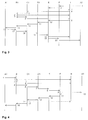
- FIG. 3 shows schematically flow diagrams of a method for establishing an MPLS path according to a first embodiment of the present invention.
- An MPLS path between nodes A1 (first node) and A3 (second node) can be initiated by either A1 or A3.
- a label distribution protocol like LDP or RSVP-TE is used to request the allocation of an MPLS path along all involved nodes.
- LDP or RSVP-TE is used to request the allocation of an MPLS path along all involved nodes.
- a special role for the setup of an MPLS connection is performed by the node E of the reference diagram of figure 1 .
- the node E anchors the mobility aspects of the MPLS path, and the fast re-route protection of the MPLS protocol. All MPLS connection to be established via the LTE air interface must pass through node E. There can be multiple nodes E in the overall network. However, a node of type E must always be involved.
- the MPLS path is setup in two separate paths.
- One path covers the mobile part from node B1 to node E and another path covers the part from node E to node F.
- the node E brings the two paths together.
- Connection establishment from node A3 to node A1 is performed as described by the information flow diagrams of Figure 3 .
- the text below describes the individual steps:
- Figure 4 shows schematically flow diagrams of a method for establishing an MPLS path according to a second embodiment of the present invention.
- connection is initiated by A1 instead of A3, there is a change in the information flow compared to figure 3 .
- This flow is described in Figure 4 .
- the text below describes the individual steps:
- FIG. 5 shows schematically flow diagrams of a method for performing a handover of an MPLS path according to a third embodiment of the present invention.
- Mobility is the capability of the remote node B1 or B2 to be connected to the wireless network even when moving from one site to another.
- the procedures required to provide mobility are provided by the LTE mobility. The only exception is in case of an active bearer for an MPLS path. In this case the MPLS specific procedures in accordance with the present invention are described below.
- the mobile node continuously scans the LTE radio spectrum to detect which LTE radio signals are being detected, and reports these signals to the base station. These reports are used to decide that a handover from one cell to another should take place.
- An LTE radio signal might degrade because either the mobile node has moved physically, or because the resources available in a cell have become scarce.
- the MPLS handover procedure is aligned with the procedures used by LTE for the handover of IP packets.
- LTE Long Term Evolution
- Figure 5 describes the information flow involved with an MPLS handover.
- the MPLS Handover there is a transfer of MPLS frames from node A1 to node B1, from B1 to node C1 via air interface, an MPLS path between nodes C1 and D1 and between nodes D1 and E, E and F and F and A3.
- the MPLS handover there is a transfer of MPLS frames from node A1 to node B1, from B1 to node C2 via air interface, an MPLS path between nodes C2 and D2 and between nodes D2 and E, E and F and F and A3.
Landscapes
- Engineering & Computer Science (AREA)
- Computer Networks & Wireless Communication (AREA)
- Signal Processing (AREA)
- General Engineering & Computer Science (AREA)
- Mobile Radio Communication Systems (AREA)
Claims (3)
- Verfahren zum Ausführen einer Übergabe eines Multi-Protocol Label Switching (MPLS)-Pfades, der zwischen einem ersten Knoten (A1) und einem zweiten Knoten (A3) aufgebaut wurde, durch einen leitungsgebundenen Teil (3) eines Mobilfunknetzes (1) mittels Multi-Protocol Label Switching (MPLS) und durch einen Funknetzteil (2) des Mobilfunknetzes (1) mittels eines Long Term Evolution (LTE)-Funkträgers, wobei das Verfahren folgende Schritte umfasst:- Messen von Funksignalen durch einen ersten Mobilfunkknoten (B1), der direkt oder indirekt mit dem ersten Knoten (A1) verbunden ist, und Übermitteln, an einen ersten Label-Switch-Router (C1), der indirekt mit dem zweiten Knoten (A3) über einen weiteren Label-Switch-Router (E) verbunden ist, von Informationen über die gemessenen Funksignale,- Senden eines Übergabebefehls von dem ersten Label-Switch-Router (C1) über einen Mobilfunknetz-Controller (H) des Funknetzteils an den weiteren Label-Switch-Router (E), falls der erste Label-Switch-Router (C1) auf der Basis der gemessenen Funksignale bestimmt, dass eine Übergabe erforderlich ist, wobei der Übergabebefehl Informationen enthält, dass der MPLS-Pfad über einen zweiten Label-Switch-Router (C2) umgeleitet werden muss,- Senden einer MPLS-Anforderung an den zweiten Label-Switch-Router (C2) von dem weiteren Label-Switch-Router (E) in Abhängigkeit von dem empfangenen Übergabebefehl,- Senden von Übergabeparametern von dem ersten Label-Switch-Router (C1) an den zweiten Label-Switch-Router (C2),- Herstellen eines LTE-Funkträgers zwischen dem ersten Mobilfunkknoten (B1) und dem zweiten Label-Switch-Router (C2),- Senden eines Identifikatoraktualisierungsbefehls von dem zweiten Label-Switch-Router (C2) über den Mobilfunknetz-Controller (H) an den weiteren Label-Switch-Router (E) und- Aufbauen eines MPLS-Pfades zwischen dem ersten Knoten (A1) und dem zweiten Knoten (A3) über den weiteren Label-Switch-Router (E), den zweiten Label-Switch-Router (C2) und den ersten Mobilfunkknoten (B1).
- Verfahren nach Anspruch 1, wobei der weitere Label-Switch-Router (E) den MPLS-Pfad zu dem ersten Label-Switch-Router (C1) in Abhängigkeit von dem empfangenen Identifikatoraktualisierungsbefehl löscht.
- Verfahren nach einem der Ansprüche 1 oder 2, wobei ein Multi-Protocol Label Switching (MPLS)-Header über den MPLS-Pfad zwischen dem Mobilfunkknoten (B1) und dem ersten oder zweiten Label-Switch-Router (C1, C2) gesendet wird.
Priority Applications (1)
| Application Number | Priority Date | Filing Date | Title |
|---|---|---|---|
| EP14195957.7A EP2866397B1 (de) | 2011-04-13 | 2011-04-13 | Verfahren zur Übertragung eines MPLS-Headers, Verfahren zur Einrichtung eines MPLS-Pfades und Weiterleitungsverfahren für einen MPLS-Pfad |
Applications Claiming Priority (3)
| Application Number | Priority Date | Filing Date | Title |
|---|---|---|---|
| EP14195957.7A EP2866397B1 (de) | 2011-04-13 | 2011-04-13 | Verfahren zur Übertragung eines MPLS-Headers, Verfahren zur Einrichtung eines MPLS-Pfades und Weiterleitungsverfahren für einen MPLS-Pfad |
| EP11717482.1A EP2697941A1 (de) | 2011-04-13 | 2011-04-13 | Verfahren zur übertragung eines mpls-headers, verfahren zur einrichtung eines mpls-pfades und weiterleitungsverfahren für einen mpls-pfad |
| PCT/EP2011/001867 WO2012139597A1 (en) | 2011-04-13 | 2011-04-13 | Method for transmitting a mpls header, method for establishing a mpls path and method for performing a handover of an mpls path |
Related Parent Applications (1)
| Application Number | Title | Priority Date | Filing Date |
|---|---|---|---|
| EP11717482.1A Division EP2697941A1 (de) | 2011-04-13 | 2011-04-13 | Verfahren zur übertragung eines mpls-headers, verfahren zur einrichtung eines mpls-pfades und weiterleitungsverfahren für einen mpls-pfad |
Publications (3)
| Publication Number | Publication Date |
|---|---|
| EP2866397A2 EP2866397A2 (de) | 2015-04-29 |
| EP2866397A3 EP2866397A3 (de) | 2015-08-05 |
| EP2866397B1 true EP2866397B1 (de) | 2016-08-31 |
Family
ID=43987519
Family Applications (3)
| Application Number | Title | Priority Date | Filing Date |
|---|---|---|---|
| EP14195957.7A Active EP2866397B1 (de) | 2011-04-13 | 2011-04-13 | Verfahren zur Übertragung eines MPLS-Headers, Verfahren zur Einrichtung eines MPLS-Pfades und Weiterleitungsverfahren für einen MPLS-Pfad |
| EP14195956.9A Active EP2858417B1 (de) | 2011-04-13 | 2011-04-13 | Verfahren zur übertragung eines mpls-headers, verfahren zur einrichtung eines mpls-pfades und weiterleitungsverfahren für einen mpls-pfad |
| EP11717482.1A Withdrawn EP2697941A1 (de) | 2011-04-13 | 2011-04-13 | Verfahren zur übertragung eines mpls-headers, verfahren zur einrichtung eines mpls-pfades und weiterleitungsverfahren für einen mpls-pfad |
Family Applications After (2)
| Application Number | Title | Priority Date | Filing Date |
|---|---|---|---|
| EP14195956.9A Active EP2858417B1 (de) | 2011-04-13 | 2011-04-13 | Verfahren zur übertragung eines mpls-headers, verfahren zur einrichtung eines mpls-pfades und weiterleitungsverfahren für einen mpls-pfad |
| EP11717482.1A Withdrawn EP2697941A1 (de) | 2011-04-13 | 2011-04-13 | Verfahren zur übertragung eines mpls-headers, verfahren zur einrichtung eines mpls-pfades und weiterleitungsverfahren für einen mpls-pfad |
Country Status (8)
| Country | Link |
|---|---|
| US (2) | US20140029581A1 (de) |
| EP (3) | EP2866397B1 (de) |
| CN (1) | CN103503387A (de) |
| ES (2) | ES2600139T3 (de) |
| HU (2) | HUE036370T2 (de) |
| IN (1) | IN2014DN10353A (de) |
| PL (2) | PL2858417T3 (de) |
| WO (1) | WO2012139597A1 (de) |
Families Citing this family (4)
| Publication number | Priority date | Publication date | Assignee | Title |
|---|---|---|---|---|
| US8886195B2 (en) * | 2012-03-02 | 2014-11-11 | Seven Networks, Inc. | Mobile device which hands over connectivity from one network connection to another network connection without interruption in application data flow and methods therefor |
| US9497682B2 (en) | 2013-06-07 | 2016-11-15 | Intel Corporation | Central processing unit and methods for supporting coordinated multipoint transmission in an LTE network |
| US10469365B2 (en) | 2014-10-27 | 2019-11-05 | Juniper Networks, Inc. | Label switched path node failure management for label switched paths having refresh interval independent fast reroute facility protection |
| WO2020011143A1 (en) * | 2018-07-13 | 2020-01-16 | Huawei Technologies Co., Ltd. | Mpls extension headers for in-network services |
Family Cites Families (18)
| Publication number | Priority date | Publication date | Assignee | Title |
|---|---|---|---|---|
| EP1220508A1 (de) * | 2000-12-29 | 2002-07-03 | TELEFONAKTIEBOLAGET LM ERICSSON (publ) | Verfahren um Datenpakete in einem Mobilfunknetz zu übertragen |
| US6798757B2 (en) * | 2001-01-11 | 2004-09-28 | Hitachi, Ltd. | Establishing a route with a level of quality of service in a mobile network |
| DE10147755B4 (de) * | 2001-09-27 | 2004-06-17 | Siemens Ag | Verfahren und Vorrichtungen zur Header-Kompression in paketorientierten Netzwerken |
| US7352747B2 (en) * | 2002-07-31 | 2008-04-01 | Lucent Technologies Inc. | System and method of network traffic assignment on multiple parallel links between IP/MPLS routers |
| US7433963B2 (en) * | 2003-12-29 | 2008-10-07 | At&T Intellectual Property I, Lp | Methods, systems, and computer program products for using a translation/instruction system to redirect a multiprotocol label switching (MPLS) packet |
| US20050147096A1 (en) * | 2003-12-29 | 2005-07-07 | Anschutz Thomas A. | Methods, systems, and computer program products for using multiprotocol label switching (MPLS) to allocate network resources according to traffic type |
| US8149832B2 (en) * | 2004-07-12 | 2012-04-03 | At&T Intellectual Property I, L.P. | Methods, systems, and computer program products for pushing and/or popping multiple multiprotocol label switching (MPLS) labels/shim headers at a single node |
| EP1653675A1 (de) * | 2004-10-29 | 2006-05-03 | Matsushita Electric Industrial Co., Ltd. | Verfahren und Etikettvermittlungsrouter zur Unterstützung der Mobilität eines mobilen Endgeräts in einem MPLS (Multi-protocol Label Switching) Mobilfunknetz |
| US20060120361A1 (en) * | 2004-12-03 | 2006-06-08 | Utstarcom, Inc. | Method and system for providing packet data services |
| CN1881908A (zh) * | 2005-06-13 | 2006-12-20 | 华为技术有限公司 | 测量mpls网络性能参数的方法 |
| US20090016334A1 (en) * | 2007-07-09 | 2009-01-15 | Nokia Corporation | Secured transmission with low overhead |
| US8000251B2 (en) * | 2007-11-14 | 2011-08-16 | Cisco Technology, Inc. | Instrumenting packet flows |
| US20090168779A1 (en) * | 2007-12-31 | 2009-07-02 | Nguyen Loc Q | Integration of multi-protocol label switching (MPLS) |
| US7848329B2 (en) * | 2008-09-30 | 2010-12-07 | Verizon Patent And Licensing Inc. | Handoffs in hierarchical mobility label-based network |
| JP5320618B2 (ja) * | 2008-10-02 | 2013-10-23 | 株式会社日立製作所 | 経路制御方法及びアクセスゲートウェイ装置 |
| US8411691B2 (en) * | 2009-01-12 | 2013-04-02 | Juniper Networks, Inc. | Transfer of mobile subscriber context in cellular networks using extended routing protocol |
| US8743696B2 (en) * | 2009-08-07 | 2014-06-03 | Cisco Technology, Inc. | Mobile transport solution for offloading to an alternate network |
| US9071927B2 (en) * | 2011-12-05 | 2015-06-30 | Verizon Patent And Licensing Inc. | Collapsed mobile architecture |
-
2011
- 2011-04-13 PL PL14195956T patent/PL2858417T3/pl unknown
- 2011-04-13 EP EP14195957.7A patent/EP2866397B1/de active Active
- 2011-04-13 WO PCT/EP2011/001867 patent/WO2012139597A1/en not_active Ceased
- 2011-04-13 ES ES14195957.7T patent/ES2600139T3/es active Active
- 2011-04-13 EP EP14195956.9A patent/EP2858417B1/de active Active
- 2011-04-13 PL PL14195957T patent/PL2866397T3/pl unknown
- 2011-04-13 HU HUE14195956A patent/HUE036370T2/hu unknown
- 2011-04-13 ES ES14195956.9T patent/ES2656310T3/es active Active
- 2011-04-13 US US14/110,742 patent/US20140029581A1/en not_active Abandoned
- 2011-04-13 CN CN201180070518.7A patent/CN103503387A/zh active Pending
- 2011-04-13 EP EP11717482.1A patent/EP2697941A1/de not_active Withdrawn
- 2011-04-13 HU HUE14195957A patent/HUE029897T2/en unknown
-
2014
- 2014-12-04 IN IN10353DEN2014 patent/IN2014DN10353A/en unknown
- 2014-12-16 US US14/571,331 patent/US20150098450A1/en not_active Abandoned
Also Published As
| Publication number | Publication date |
|---|---|
| PL2858417T3 (pl) | 2018-05-30 |
| CN103503387A (zh) | 2014-01-08 |
| ES2600139T3 (es) | 2017-02-07 |
| EP2858417A3 (de) | 2015-07-29 |
| ES2656310T3 (es) | 2018-02-26 |
| PL2866397T3 (pl) | 2017-07-31 |
| IN2014DN10353A (de) | 2015-08-07 |
| US20150098450A1 (en) | 2015-04-09 |
| EP2697941A1 (de) | 2014-02-19 |
| HUE036370T2 (hu) | 2018-07-30 |
| EP2866397A2 (de) | 2015-04-29 |
| HUE029897T2 (en) | 2017-04-28 |
| EP2866397A3 (de) | 2015-08-05 |
| EP2858417B1 (de) | 2017-12-27 |
| EP2858417A2 (de) | 2015-04-08 |
| US20140029581A1 (en) | 2014-01-30 |
| WO2012139597A1 (en) | 2012-10-18 |
Similar Documents
| Publication | Publication Date | Title |
|---|---|---|
| US12231945B2 (en) | Integrated backhaul transport for 5Gs | |
| JP7503625B2 (ja) | ルーティングおよびベアラマッピング構成のための方法およびデバイス | |
| JP5910107B2 (ja) | ネットワークシステム,オフロード装置,及びオフロードトラフィックの制御方法 | |
| US20230403617A1 (en) | Managing integrated access and backhaul mobility | |
| CN112237028B (zh) | 集成的接入和回程移动性 | |
| US8259677B2 (en) | Method and system for intra E-utran handover | |
| EP2846498B1 (de) | Verfahren und vorrichtung zur verteilung von etiketten | |
| US20200100102A1 (en) | Method and apparatus for supporting security for cu-cp and cu-up separation in wireless communication system | |
| US20150023176A1 (en) | Data forwarding in a mobile communications network system with centralized gateway apparatus controlling distributed gateway elements | |
| US20110110354A1 (en) | Node, method, and system for high-rate access to public network from mobile network | |
| WO2022150339A1 (en) | Managing ue connections after network topology change | |
| CN108141743A (zh) | 用于电信网络与至少一个用户装备之间的至少一个通信交换的改进的处置的方法、电信网络、用户装备、系统、程序和计算机程序产品 | |
| EP2866397B1 (de) | Verfahren zur Übertragung eines MPLS-Headers, Verfahren zur Einrichtung eines MPLS-Pfades und Weiterleitungsverfahren für einen MPLS-Pfad | |
| EP2627037A1 (de) | Netzwerkkonfigurationsverfahren, ringnetzwerksystem und knoten dafür | |
| EP3189631B1 (de) | Automatische erkennung von paketinseln über gmpls-uni | |
| WO2018098630A1 (zh) | 一种x2业务传输方法及网络设备 | |
| CN112585910A (zh) | 在广域网中建立安全、低延迟、优化路径的方法和装置 | |
| CN115842696B (zh) | 通信方法、装置和计算机可读存储介质 | |
| EP3694252B1 (de) | Verfahren und vorrichtung zur zellumschaltung | |
| CN104735746B (zh) | 用于传输mpls报头的方法、用于建立mpls路径的方法以及用于执行mpls路径切换的方法 | |
| CN104661279B (zh) | 用于传输mpls报头的方法、用于建立mpls路径的方法以及用于执行mpls路径切换的方法 | |
| KR102932745B1 (ko) | 라우팅 및 베어러 매핑 구성을 위한 방법 및 디바이스 | |
| CN102238061B (zh) | 一种建立物理链路的方法、路由器以及网络系统 | |
| WO2024092399A1 (zh) | 一种数据传输方法及通信装置 |
Legal Events
| Date | Code | Title | Description |
|---|---|---|---|
| PUAI | Public reference made under article 153(3) epc to a published international application that has entered the european phase |
Free format text: ORIGINAL CODE: 0009012 |
|
| 17P | Request for examination filed |
Effective date: 20141202 |
|
| AC | Divisional application: reference to earlier application |
Ref document number: 2697941 Country of ref document: EP Kind code of ref document: P |
|
| AK | Designated contracting states |
Kind code of ref document: A2 Designated state(s): AL AT BE BG CH CY CZ DE DK EE ES FI FR GB GR HR HU IE IS IT LI LT LU LV MC MK MT NL NO PL PT RO RS SE SI SK SM TR |
|
| PUAL | Search report despatched |
Free format text: ORIGINAL CODE: 0009013 |
|
| AK | Designated contracting states |
Kind code of ref document: A3 Designated state(s): AL AT BE BG CH CY CZ DE DK EE ES FI FR GB GR HR HU IE IS IT LI LT LU LV MC MK MT NL NO PL PT RO RS SE SI SK SM TR |
|
| R17P | Request for examination filed (corrected) |
Effective date: 20160205 |
|
| RBV | Designated contracting states (corrected) |
Designated state(s): AL AT BE BG CH CY CZ DE DK EE ES FI FR GB GR HR HU IE IS IT LI LT LU LV MC MK MT NL NO PL PT RO RS SE SI SK SM TR |
|
| GRAP | Despatch of communication of intention to grant a patent |
Free format text: ORIGINAL CODE: EPIDOSNIGR1 |
|
| INTG | Intention to grant announced |
Effective date: 20160331 |
|
| GRAS | Grant fee paid |
Free format text: ORIGINAL CODE: EPIDOSNIGR3 |
|
| GRAA | (expected) grant |
Free format text: ORIGINAL CODE: 0009210 |
|
| AC | Divisional application: reference to earlier application |
Ref document number: 2697941 Country of ref document: EP Kind code of ref document: P |
|
| AK | Designated contracting states |
Kind code of ref document: B1 Designated state(s): AL AT BE BG CH CY CZ DE DK EE ES FI FR GB GR HR HU IE IS IT LI LT LU LV MC MK MT NL NO PL PT RO RS SE SI SK SM TR |
|
| REG | Reference to a national code |
Ref country code: CH Ref legal event code: EP Ref country code: GB Ref legal event code: FG4D |
|
| REG | Reference to a national code |
Ref country code: IE Ref legal event code: FG4D |
|
| REG | Reference to a national code |
Ref country code: DE Ref legal event code: R096 Ref document number: 602011029999 Country of ref document: DE |
|
| REG | Reference to a national code |
Ref country code: AT Ref legal event code: REF Ref document number: 825825 Country of ref document: AT Kind code of ref document: T Effective date: 20161015 |
|
| REG | Reference to a national code |
Ref country code: NL Ref legal event code: FP |
|
| REG | Reference to a national code |
Ref country code: RO Ref legal event code: EPE |
|
| REG | Reference to a national code |
Ref country code: LT Ref legal event code: MG4D |
|
| REG | Reference to a national code |
Ref country code: AT Ref legal event code: MK05 Ref document number: 825825 Country of ref document: AT Kind code of ref document: T Effective date: 20160831 |
|
| PG25 | Lapsed in a contracting state [announced via postgrant information from national office to epo] |
Ref country code: NO Free format text: LAPSE BECAUSE OF FAILURE TO SUBMIT A TRANSLATION OF THE DESCRIPTION OR TO PAY THE FEE WITHIN THE PRESCRIBED TIME-LIMIT Effective date: 20161130 Ref country code: FI Free format text: LAPSE BECAUSE OF FAILURE TO SUBMIT A TRANSLATION OF THE DESCRIPTION OR TO PAY THE FEE WITHIN THE PRESCRIBED TIME-LIMIT Effective date: 20160831 Ref country code: HR Free format text: LAPSE BECAUSE OF FAILURE TO SUBMIT A TRANSLATION OF THE DESCRIPTION OR TO PAY THE FEE WITHIN THE PRESCRIBED TIME-LIMIT Effective date: 20160831 Ref country code: LT Free format text: LAPSE BECAUSE OF FAILURE TO SUBMIT A TRANSLATION OF THE DESCRIPTION OR TO PAY THE FEE WITHIN THE PRESCRIBED TIME-LIMIT Effective date: 20160831 Ref country code: RS Free format text: LAPSE BECAUSE OF FAILURE TO SUBMIT A TRANSLATION OF THE DESCRIPTION OR TO PAY THE FEE WITHIN THE PRESCRIBED TIME-LIMIT Effective date: 20160831 |
|
| REG | Reference to a national code |
Ref country code: ES Ref legal event code: FG2A Ref document number: 2600139 Country of ref document: ES Kind code of ref document: T3 Effective date: 20170207 |
|
| PG25 | Lapsed in a contracting state [announced via postgrant information from national office to epo] |
Ref country code: LV Free format text: LAPSE BECAUSE OF FAILURE TO SUBMIT A TRANSLATION OF THE DESCRIPTION OR TO PAY THE FEE WITHIN THE PRESCRIBED TIME-LIMIT Effective date: 20160831 Ref country code: AT Free format text: LAPSE BECAUSE OF FAILURE TO SUBMIT A TRANSLATION OF THE DESCRIPTION OR TO PAY THE FEE WITHIN THE PRESCRIBED TIME-LIMIT Effective date: 20160831 Ref country code: SE Free format text: LAPSE BECAUSE OF FAILURE TO SUBMIT A TRANSLATION OF THE DESCRIPTION OR TO PAY THE FEE WITHIN THE PRESCRIBED TIME-LIMIT Effective date: 20160831 |
|
| REG | Reference to a national code |
Ref country code: FR Ref legal event code: PLFP Year of fee payment: 7 |
|
| PG25 | Lapsed in a contracting state [announced via postgrant information from national office to epo] |
Ref country code: EE Free format text: LAPSE BECAUSE OF FAILURE TO SUBMIT A TRANSLATION OF THE DESCRIPTION OR TO PAY THE FEE WITHIN THE PRESCRIBED TIME-LIMIT Effective date: 20160831 |
|
| REG | Reference to a national code |
Ref country code: HU Ref legal event code: AG4A Ref document number: E029897 Country of ref document: HU |
|
| PG25 | Lapsed in a contracting state [announced via postgrant information from national office to epo] |
Ref country code: PT Free format text: LAPSE BECAUSE OF FAILURE TO SUBMIT A TRANSLATION OF THE DESCRIPTION OR TO PAY THE FEE WITHIN THE PRESCRIBED TIME-LIMIT Effective date: 20170102 Ref country code: SK Free format text: LAPSE BECAUSE OF FAILURE TO SUBMIT A TRANSLATION OF THE DESCRIPTION OR TO PAY THE FEE WITHIN THE PRESCRIBED TIME-LIMIT Effective date: 20160831 Ref country code: BE Free format text: LAPSE BECAUSE OF FAILURE TO SUBMIT A TRANSLATION OF THE DESCRIPTION OR TO PAY THE FEE WITHIN THE PRESCRIBED TIME-LIMIT Effective date: 20160831 Ref country code: SM Free format text: LAPSE BECAUSE OF FAILURE TO SUBMIT A TRANSLATION OF THE DESCRIPTION OR TO PAY THE FEE WITHIN THE PRESCRIBED TIME-LIMIT Effective date: 20160831 Ref country code: DK Free format text: LAPSE BECAUSE OF FAILURE TO SUBMIT A TRANSLATION OF THE DESCRIPTION OR TO PAY THE FEE WITHIN THE PRESCRIBED TIME-LIMIT Effective date: 20160831 |
|
| REG | Reference to a national code |
Ref country code: DE Ref legal event code: R097 Ref document number: 602011029999 Country of ref document: DE |
|
| REG | Reference to a national code |
Ref country code: GR Ref legal event code: EP Ref document number: 20160402967 Country of ref document: GR Effective date: 20170410 |
|
| PLBE | No opposition filed within time limit |
Free format text: ORIGINAL CODE: 0009261 |
|
| STAA | Information on the status of an ep patent application or granted ep patent |
Free format text: STATUS: NO OPPOSITION FILED WITHIN TIME LIMIT |
|
| 26N | No opposition filed |
Effective date: 20170601 |
|
| PG25 | Lapsed in a contracting state [announced via postgrant information from national office to epo] |
Ref country code: SI Free format text: LAPSE BECAUSE OF FAILURE TO SUBMIT A TRANSLATION OF THE DESCRIPTION OR TO PAY THE FEE WITHIN THE PRESCRIBED TIME-LIMIT Effective date: 20160831 |
|
| REG | Reference to a national code |
Ref country code: CH Ref legal event code: PL |
|
| REG | Reference to a national code |
Ref country code: IE Ref legal event code: MM4A |
|
| PG25 | Lapsed in a contracting state [announced via postgrant information from national office to epo] |
Ref country code: MC Free format text: LAPSE BECAUSE OF FAILURE TO SUBMIT A TRANSLATION OF THE DESCRIPTION OR TO PAY THE FEE WITHIN THE PRESCRIBED TIME-LIMIT Effective date: 20160831 |
|
| PG25 | Lapsed in a contracting state [announced via postgrant information from national office to epo] |
Ref country code: LU Free format text: LAPSE BECAUSE OF NON-PAYMENT OF DUE FEES Effective date: 20170413 Ref country code: CH Free format text: LAPSE BECAUSE OF NON-PAYMENT OF DUE FEES Effective date: 20170430 Ref country code: LI Free format text: LAPSE BECAUSE OF NON-PAYMENT OF DUE FEES Effective date: 20170430 |
|
| REG | Reference to a national code |
Ref country code: FR Ref legal event code: PLFP Year of fee payment: 8 |
|
| PG25 | Lapsed in a contracting state [announced via postgrant information from national office to epo] |
Ref country code: IE Free format text: LAPSE BECAUSE OF NON-PAYMENT OF DUE FEES Effective date: 20170413 |
|
| PG25 | Lapsed in a contracting state [announced via postgrant information from national office to epo] |
Ref country code: MT Free format text: LAPSE BECAUSE OF NON-PAYMENT OF DUE FEES Effective date: 20170413 |
|
| PG25 | Lapsed in a contracting state [announced via postgrant information from national office to epo] |
Ref country code: AL Free format text: LAPSE BECAUSE OF FAILURE TO SUBMIT A TRANSLATION OF THE DESCRIPTION OR TO PAY THE FEE WITHIN THE PRESCRIBED TIME-LIMIT Effective date: 20160831 |
|
| PG25 | Lapsed in a contracting state [announced via postgrant information from national office to epo] |
Ref country code: CY Free format text: LAPSE BECAUSE OF FAILURE TO SUBMIT A TRANSLATION OF THE DESCRIPTION OR TO PAY THE FEE WITHIN THE PRESCRIBED TIME-LIMIT Effective date: 20160831 |
|
| PG25 | Lapsed in a contracting state [announced via postgrant information from national office to epo] |
Ref country code: MK Free format text: LAPSE BECAUSE OF FAILURE TO SUBMIT A TRANSLATION OF THE DESCRIPTION OR TO PAY THE FEE WITHIN THE PRESCRIBED TIME-LIMIT Effective date: 20160831 |
|
| PG25 | Lapsed in a contracting state [announced via postgrant information from national office to epo] |
Ref country code: IS Free format text: LAPSE BECAUSE OF FAILURE TO SUBMIT A TRANSLATION OF THE DESCRIPTION OR TO PAY THE FEE WITHIN THE PRESCRIBED TIME-LIMIT Effective date: 20161231 |
|
| REG | Reference to a national code |
Ref country code: DE Ref legal event code: R079 Ref document number: 602011029999 Country of ref document: DE Free format text: PREVIOUS MAIN CLASS: H04L0012801000 Ipc: H04L0047100000 |
|
| PGFP | Annual fee paid to national office [announced via postgrant information from national office to epo] |
Ref country code: CZ Payment date: 20250328 Year of fee payment: 15 Ref country code: PL Payment date: 20250328 Year of fee payment: 15 |
|
| PGFP | Annual fee paid to national office [announced via postgrant information from national office to epo] |
Ref country code: NL Payment date: 20250422 Year of fee payment: 15 |
|
| PGFP | Annual fee paid to national office [announced via postgrant information from national office to epo] |
Ref country code: DE Payment date: 20250417 Year of fee payment: 15 |
|
| PGFP | Annual fee paid to national office [announced via postgrant information from national office to epo] |
Ref country code: GB Payment date: 20250423 Year of fee payment: 15 Ref country code: ES Payment date: 20250519 Year of fee payment: 15 |
|
| PGFP | Annual fee paid to national office [announced via postgrant information from national office to epo] |
Ref country code: HU Payment date: 20250507 Year of fee payment: 15 |
|
| PGFP | Annual fee paid to national office [announced via postgrant information from national office to epo] |
Ref country code: IT Payment date: 20250430 Year of fee payment: 15 |
|
| PGFP | Annual fee paid to national office [announced via postgrant information from national office to epo] |
Ref country code: FR Payment date: 20250422 Year of fee payment: 15 |
|
| PGFP | Annual fee paid to national office [announced via postgrant information from national office to epo] |
Ref country code: GR Payment date: 20250416 Year of fee payment: 15 Ref country code: BG Payment date: 20250415 Year of fee payment: 15 |
|
| PGFP | Annual fee paid to national office [announced via postgrant information from national office to epo] |
Ref country code: RO Payment date: 20250331 Year of fee payment: 15 |
|
| PGFP | Annual fee paid to national office [announced via postgrant information from national office to epo] |
Ref country code: TR Payment date: 20250404 Year of fee payment: 15 |