EP2865664B1 - Novel compound having ability to inhibit 11b-hsd1 enzyme or pharmaceutically acceptable salt thereof, method for producing same, and pharmaceutical composition containing same as active ingredient - Google Patents
Novel compound having ability to inhibit 11b-hsd1 enzyme or pharmaceutically acceptable salt thereof, method for producing same, and pharmaceutical composition containing same as active ingredient Download PDFInfo
- Publication number
- EP2865664B1 EP2865664B1 EP13806654.3A EP13806654A EP2865664B1 EP 2865664 B1 EP2865664 B1 EP 2865664B1 EP 13806654 A EP13806654 A EP 13806654A EP 2865664 B1 EP2865664 B1 EP 2865664B1
- Authority
- EP
- European Patent Office
- Prior art keywords
- adamantan
- carboxylic acid
- followed
- compound
- mmol
- Prior art date
- Legal status (The legal status is an assumption and is not a legal conclusion. Google has not performed a legal analysis and makes no representation as to the accuracy of the status listed.)
- Not-in-force
Links
- UYJLXBJDKDCLFL-UHFFFAOYSA-N COC(C1(CC2CC(C3)C1)CC3C2NC(C1(CC1)NS(c1cccc(Cl)c1)(=O)=O)=O)=O Chemical compound COC(C1(CC2CC(C3)C1)CC3C2NC(C1(CC1)NS(c1cccc(Cl)c1)(=O)=O)=O)=O UYJLXBJDKDCLFL-UHFFFAOYSA-N 0.000 description 1
Classifications
-
- C—CHEMISTRY; METALLURGY
- C07—ORGANIC CHEMISTRY
- C07C—ACYCLIC OR CARBOCYCLIC COMPOUNDS
- C07C311/00—Amides of sulfonic acids, i.e. compounds having singly-bound oxygen atoms of sulfo groups replaced by nitrogen atoms, not being part of nitro or nitroso groups
- C07C311/15—Sulfonamides having sulfur atoms of sulfonamide groups bound to carbon atoms of six-membered aromatic rings
- C07C311/21—Sulfonamides having sulfur atoms of sulfonamide groups bound to carbon atoms of six-membered aromatic rings having the nitrogen atom of at least one of the sulfonamide groups bound to a carbon atom of a six-membered aromatic ring
-
- C—CHEMISTRY; METALLURGY
- C07—ORGANIC CHEMISTRY
- C07C—ACYCLIC OR CARBOCYCLIC COMPOUNDS
- C07C311/00—Amides of sulfonic acids, i.e. compounds having singly-bound oxygen atoms of sulfo groups replaced by nitrogen atoms, not being part of nitro or nitroso groups
- C07C311/01—Sulfonamides having sulfur atoms of sulfonamide groups bound to acyclic carbon atoms
- C07C311/12—Sulfonamides having sulfur atoms of sulfonamide groups bound to acyclic carbon atoms of an unsaturated carbon skeleton containing rings
-
- A—HUMAN NECESSITIES
- A61—MEDICAL OR VETERINARY SCIENCE; HYGIENE
- A61K—PREPARATIONS FOR MEDICAL, DENTAL OR TOILETRY PURPOSES
- A61K31/00—Medicinal preparations containing organic active ingredients
- A61K31/16—Amides, e.g. hydroxamic acids
- A61K31/18—Sulfonamides
-
- A—HUMAN NECESSITIES
- A61—MEDICAL OR VETERINARY SCIENCE; HYGIENE
- A61P—SPECIFIC THERAPEUTIC ACTIVITY OF CHEMICAL COMPOUNDS OR MEDICINAL PREPARATIONS
- A61P3/00—Drugs for disorders of the metabolism
- A61P3/04—Anorexiants; Antiobesity agents
-
- A—HUMAN NECESSITIES
- A61—MEDICAL OR VETERINARY SCIENCE; HYGIENE
- A61P—SPECIFIC THERAPEUTIC ACTIVITY OF CHEMICAL COMPOUNDS OR MEDICINAL PREPARATIONS
- A61P3/00—Drugs for disorders of the metabolism
- A61P3/06—Antihyperlipidemics
-
- A—HUMAN NECESSITIES
- A61—MEDICAL OR VETERINARY SCIENCE; HYGIENE
- A61P—SPECIFIC THERAPEUTIC ACTIVITY OF CHEMICAL COMPOUNDS OR MEDICINAL PREPARATIONS
- A61P3/00—Drugs for disorders of the metabolism
- A61P3/08—Drugs for disorders of the metabolism for glucose homeostasis
- A61P3/10—Drugs for disorders of the metabolism for glucose homeostasis for hyperglycaemia, e.g. antidiabetics
-
- A—HUMAN NECESSITIES
- A61—MEDICAL OR VETERINARY SCIENCE; HYGIENE
- A61P—SPECIFIC THERAPEUTIC ACTIVITY OF CHEMICAL COMPOUNDS OR MEDICINAL PREPARATIONS
- A61P43/00—Drugs for specific purposes, not provided for in groups A61P1/00-A61P41/00
-
- C—CHEMISTRY; METALLURGY
- C07—ORGANIC CHEMISTRY
- C07C—ACYCLIC OR CARBOCYCLIC COMPOUNDS
- C07C237/00—Carboxylic acid amides, the carbon skeleton of the acid part being further substituted by amino groups
- C07C237/24—Carboxylic acid amides, the carbon skeleton of the acid part being further substituted by amino groups having the carbon atom of at least one of the carboxamide groups bound to a carbon atom of a ring other than a six-membered aromatic ring of the carbon skeleton
-
- C—CHEMISTRY; METALLURGY
- C07—ORGANIC CHEMISTRY
- C07C—ACYCLIC OR CARBOCYCLIC COMPOUNDS
- C07C275/00—Derivatives of urea, i.e. compounds containing any of the groups, the nitrogen atoms not being part of nitro or nitroso groups
- C07C275/28—Derivatives of urea, i.e. compounds containing any of the groups, the nitrogen atoms not being part of nitro or nitroso groups having nitrogen atoms of urea groups bound to carbon atoms of six-membered aromatic rings of a carbon skeleton
-
- C—CHEMISTRY; METALLURGY
- C07—ORGANIC CHEMISTRY
- C07C—ACYCLIC OR CARBOCYCLIC COMPOUNDS
- C07C311/00—Amides of sulfonic acids, i.e. compounds having singly-bound oxygen atoms of sulfo groups replaced by nitrogen atoms, not being part of nitro or nitroso groups
- C07C311/01—Sulfonamides having sulfur atoms of sulfonamide groups bound to acyclic carbon atoms
- C07C311/02—Sulfonamides having sulfur atoms of sulfonamide groups bound to acyclic carbon atoms of an acyclic saturated carbon skeleton
- C07C311/08—Sulfonamides having sulfur atoms of sulfonamide groups bound to acyclic carbon atoms of an acyclic saturated carbon skeleton having the nitrogen atom of at least one of the sulfonamide groups bound to a carbon atom of a six-membered aromatic ring
-
- C—CHEMISTRY; METALLURGY
- C07—ORGANIC CHEMISTRY
- C07C—ACYCLIC OR CARBOCYCLIC COMPOUNDS
- C07C311/00—Amides of sulfonic acids, i.e. compounds having singly-bound oxygen atoms of sulfo groups replaced by nitrogen atoms, not being part of nitro or nitroso groups
- C07C311/14—Sulfonamides having sulfur atoms of sulfonamide groups bound to carbon atoms of rings other than six-membered aromatic rings
-
- C—CHEMISTRY; METALLURGY
- C07—ORGANIC CHEMISTRY
- C07C—ACYCLIC OR CARBOCYCLIC COMPOUNDS
- C07C311/00—Amides of sulfonic acids, i.e. compounds having singly-bound oxygen atoms of sulfo groups replaced by nitrogen atoms, not being part of nitro or nitroso groups
- C07C311/15—Sulfonamides having sulfur atoms of sulfonamide groups bound to carbon atoms of six-membered aromatic rings
- C07C311/16—Sulfonamides having sulfur atoms of sulfonamide groups bound to carbon atoms of six-membered aromatic rings having the nitrogen atom of at least one of the sulfonamide groups bound to hydrogen atoms or to an acyclic carbon atom
- C07C311/19—Sulfonamides having sulfur atoms of sulfonamide groups bound to carbon atoms of six-membered aromatic rings having the nitrogen atom of at least one of the sulfonamide groups bound to hydrogen atoms or to an acyclic carbon atom to an acyclic carbon atom of a hydrocarbon radical substituted by carboxyl groups
-
- C—CHEMISTRY; METALLURGY
- C07—ORGANIC CHEMISTRY
- C07C—ACYCLIC OR CARBOCYCLIC COMPOUNDS
- C07C311/00—Amides of sulfonic acids, i.e. compounds having singly-bound oxygen atoms of sulfo groups replaced by nitrogen atoms, not being part of nitro or nitroso groups
- C07C311/22—Sulfonamides, the carbon skeleton of the acid part being further substituted by singly-bound oxygen atoms
- C07C311/29—Sulfonamides, the carbon skeleton of the acid part being further substituted by singly-bound oxygen atoms having the sulfur atom of at least one of the sulfonamide groups bound to a carbon atom of a six-membered aromatic ring
-
- C—CHEMISTRY; METALLURGY
- C07—ORGANIC CHEMISTRY
- C07D—HETEROCYCLIC COMPOUNDS
- C07D209/00—Heterocyclic compounds containing five-membered rings, condensed with other rings, with one nitrogen atom as the only ring hetero atom
- C07D209/02—Heterocyclic compounds containing five-membered rings, condensed with other rings, with one nitrogen atom as the only ring hetero atom condensed with one carbocyclic ring
- C07D209/04—Indoles; Hydrogenated indoles
- C07D209/08—Indoles; Hydrogenated indoles with only hydrogen atoms or radicals containing only hydrogen and carbon atoms, directly attached to carbon atoms of the hetero ring
-
- C—CHEMISTRY; METALLURGY
- C07—ORGANIC CHEMISTRY
- C07D—HETEROCYCLIC COMPOUNDS
- C07D213/00—Heterocyclic compounds containing six-membered rings, not condensed with other rings, with one nitrogen atom as the only ring hetero atom and three or more double bonds between ring members or between ring members and non-ring members
- C07D213/02—Heterocyclic compounds containing six-membered rings, not condensed with other rings, with one nitrogen atom as the only ring hetero atom and three or more double bonds between ring members or between ring members and non-ring members having three double bonds between ring members or between ring members and non-ring members
- C07D213/04—Heterocyclic compounds containing six-membered rings, not condensed with other rings, with one nitrogen atom as the only ring hetero atom and three or more double bonds between ring members or between ring members and non-ring members having three double bonds between ring members or between ring members and non-ring members having no bond between the ring nitrogen atom and a non-ring member or having only hydrogen or carbon atoms directly attached to the ring nitrogen atom
- C07D213/60—Heterocyclic compounds containing six-membered rings, not condensed with other rings, with one nitrogen atom as the only ring hetero atom and three or more double bonds between ring members or between ring members and non-ring members having three double bonds between ring members or between ring members and non-ring members having no bond between the ring nitrogen atom and a non-ring member or having only hydrogen or carbon atoms directly attached to the ring nitrogen atom with hetero atoms or with carbon atoms having three bonds to hetero atoms with at the most one bond to halogen, e.g. ester or nitrile radicals, directly attached to ring carbon atoms
- C07D213/62—Oxygen or sulfur atoms
- C07D213/70—Sulfur atoms
-
- C—CHEMISTRY; METALLURGY
- C07—ORGANIC CHEMISTRY
- C07D—HETEROCYCLIC COMPOUNDS
- C07D213/00—Heterocyclic compounds containing six-membered rings, not condensed with other rings, with one nitrogen atom as the only ring hetero atom and three or more double bonds between ring members or between ring members and non-ring members
- C07D213/02—Heterocyclic compounds containing six-membered rings, not condensed with other rings, with one nitrogen atom as the only ring hetero atom and three or more double bonds between ring members or between ring members and non-ring members having three double bonds between ring members or between ring members and non-ring members
- C07D213/04—Heterocyclic compounds containing six-membered rings, not condensed with other rings, with one nitrogen atom as the only ring hetero atom and three or more double bonds between ring members or between ring members and non-ring members having three double bonds between ring members or between ring members and non-ring members having no bond between the ring nitrogen atom and a non-ring member or having only hydrogen or carbon atoms directly attached to the ring nitrogen atom
- C07D213/60—Heterocyclic compounds containing six-membered rings, not condensed with other rings, with one nitrogen atom as the only ring hetero atom and three or more double bonds between ring members or between ring members and non-ring members having three double bonds between ring members or between ring members and non-ring members having no bond between the ring nitrogen atom and a non-ring member or having only hydrogen or carbon atoms directly attached to the ring nitrogen atom with hetero atoms or with carbon atoms having three bonds to hetero atoms with at the most one bond to halogen, e.g. ester or nitrile radicals, directly attached to ring carbon atoms
- C07D213/78—Carbon atoms having three bonds to hetero atoms, with at the most one bond to halogen, e.g. ester or nitrile radicals
- C07D213/81—Amides; Imides
- C07D213/82—Amides; Imides in position 3
-
- C—CHEMISTRY; METALLURGY
- C07—ORGANIC CHEMISTRY
- C07D—HETEROCYCLIC COMPOUNDS
- C07D215/00—Heterocyclic compounds containing quinoline or hydrogenated quinoline ring systems
- C07D215/02—Heterocyclic compounds containing quinoline or hydrogenated quinoline ring systems having no bond between the ring nitrogen atom and a non-ring member or having only hydrogen atoms or carbon atoms directly attached to the ring nitrogen atom
- C07D215/04—Heterocyclic compounds containing quinoline or hydrogenated quinoline ring systems having no bond between the ring nitrogen atom and a non-ring member or having only hydrogen atoms or carbon atoms directly attached to the ring nitrogen atom with only hydrogen atoms or radicals containing only hydrogen and carbon atoms, directly attached to the ring carbon atoms
- C07D215/08—Heterocyclic compounds containing quinoline or hydrogenated quinoline ring systems having no bond between the ring nitrogen atom and a non-ring member or having only hydrogen atoms or carbon atoms directly attached to the ring nitrogen atom with only hydrogen atoms or radicals containing only hydrogen and carbon atoms, directly attached to the ring carbon atoms with acylated ring nitrogen atom
-
- C—CHEMISTRY; METALLURGY
- C07—ORGANIC CHEMISTRY
- C07D—HETEROCYCLIC COMPOUNDS
- C07D217/00—Heterocyclic compounds containing isoquinoline or hydrogenated isoquinoline ring systems
- C07D217/02—Heterocyclic compounds containing isoquinoline or hydrogenated isoquinoline ring systems with only hydrogen atoms or radicals containing only carbon and hydrogen atoms, directly attached to carbon atoms of the nitrogen-containing ring; Alkylene-bis-isoquinolines
- C07D217/06—Heterocyclic compounds containing isoquinoline or hydrogenated isoquinoline ring systems with only hydrogen atoms or radicals containing only carbon and hydrogen atoms, directly attached to carbon atoms of the nitrogen-containing ring; Alkylene-bis-isoquinolines with the ring nitrogen atom acylated by carboxylic or carbonic acids, or with sulfur or nitrogen analogues thereof, e.g. carbamates
-
- C—CHEMISTRY; METALLURGY
- C07—ORGANIC CHEMISTRY
- C07D—HETEROCYCLIC COMPOUNDS
- C07D231/00—Heterocyclic compounds containing 1,2-diazole or hydrogenated 1,2-diazole rings
- C07D231/02—Heterocyclic compounds containing 1,2-diazole or hydrogenated 1,2-diazole rings not condensed with other rings
- C07D231/10—Heterocyclic compounds containing 1,2-diazole or hydrogenated 1,2-diazole rings not condensed with other rings having two or three double bonds between ring members or between ring members and non-ring members
- C07D231/14—Heterocyclic compounds containing 1,2-diazole or hydrogenated 1,2-diazole rings not condensed with other rings having two or three double bonds between ring members or between ring members and non-ring members with hetero atoms or with carbon atoms having three bonds to hetero atoms with at the most one bond to halogen, e.g. ester or nitrile radicals, directly attached to ring carbon atoms
- C07D231/18—One oxygen or sulfur atom
-
- C—CHEMISTRY; METALLURGY
- C07—ORGANIC CHEMISTRY
- C07D—HETEROCYCLIC COMPOUNDS
- C07D239/00—Heterocyclic compounds containing 1,3-diazine or hydrogenated 1,3-diazine rings
- C07D239/02—Heterocyclic compounds containing 1,3-diazine or hydrogenated 1,3-diazine rings not condensed with other rings
- C07D239/24—Heterocyclic compounds containing 1,3-diazine or hydrogenated 1,3-diazine rings not condensed with other rings having three or more double bonds between ring members or between ring members and non-ring members
- C07D239/28—Heterocyclic compounds containing 1,3-diazine or hydrogenated 1,3-diazine rings not condensed with other rings having three or more double bonds between ring members or between ring members and non-ring members with hetero atoms or with carbon atoms having three bonds to hetero atoms with at the most one bond to halogen, directly attached to ring carbon atoms
- C07D239/32—One oxygen, sulfur or nitrogen atom
- C07D239/42—One nitrogen atom
-
- C—CHEMISTRY; METALLURGY
- C07—ORGANIC CHEMISTRY
- C07D—HETEROCYCLIC COMPOUNDS
- C07D241/00—Heterocyclic compounds containing 1,4-diazine or hydrogenated 1,4-diazine rings
- C07D241/36—Heterocyclic compounds containing 1,4-diazine or hydrogenated 1,4-diazine rings condensed with carbocyclic rings or ring systems
- C07D241/38—Heterocyclic compounds containing 1,4-diazine or hydrogenated 1,4-diazine rings condensed with carbocyclic rings or ring systems with only hydrogen or carbon atoms directly attached to the ring nitrogen atoms
- C07D241/40—Benzopyrazines
- C07D241/42—Benzopyrazines with only hydrogen atoms, hydrocarbon or substituted hydrocarbon radicals, directly attached to carbon atoms of the hetero ring
-
- C—CHEMISTRY; METALLURGY
- C07—ORGANIC CHEMISTRY
- C07D—HETEROCYCLIC COMPOUNDS
- C07D275/00—Heterocyclic compounds containing 1,2-thiazole or hydrogenated 1,2-thiazole rings
- C07D275/04—Heterocyclic compounds containing 1,2-thiazole or hydrogenated 1,2-thiazole rings condensed with carbocyclic rings or ring systems
- C07D275/06—Heterocyclic compounds containing 1,2-thiazole or hydrogenated 1,2-thiazole rings condensed with carbocyclic rings or ring systems with hetero atoms directly attached to the ring sulfur atom
-
- C—CHEMISTRY; METALLURGY
- C07—ORGANIC CHEMISTRY
- C07D—HETEROCYCLIC COMPOUNDS
- C07D277/00—Heterocyclic compounds containing 1,3-thiazole or hydrogenated 1,3-thiazole rings
- C07D277/02—Heterocyclic compounds containing 1,3-thiazole or hydrogenated 1,3-thiazole rings not condensed with other rings
- C07D277/20—Heterocyclic compounds containing 1,3-thiazole or hydrogenated 1,3-thiazole rings not condensed with other rings having two or three double bonds between ring members or between ring members and non-ring members
- C07D277/32—Heterocyclic compounds containing 1,3-thiazole or hydrogenated 1,3-thiazole rings not condensed with other rings having two or three double bonds between ring members or between ring members and non-ring members with hetero atoms or with carbon atoms having three bonds to hetero atoms with at the most one bond to halogen, e.g. ester or nitrile radicals, directly attached to ring carbon atoms
- C07D277/36—Sulfur atoms
-
- C—CHEMISTRY; METALLURGY
- C07—ORGANIC CHEMISTRY
- C07D—HETEROCYCLIC COMPOUNDS
- C07D277/00—Heterocyclic compounds containing 1,3-thiazole or hydrogenated 1,3-thiazole rings
- C07D277/02—Heterocyclic compounds containing 1,3-thiazole or hydrogenated 1,3-thiazole rings not condensed with other rings
- C07D277/20—Heterocyclic compounds containing 1,3-thiazole or hydrogenated 1,3-thiazole rings not condensed with other rings having two or three double bonds between ring members or between ring members and non-ring members
- C07D277/32—Heterocyclic compounds containing 1,3-thiazole or hydrogenated 1,3-thiazole rings not condensed with other rings having two or three double bonds between ring members or between ring members and non-ring members with hetero atoms or with carbon atoms having three bonds to hetero atoms with at the most one bond to halogen, e.g. ester or nitrile radicals, directly attached to ring carbon atoms
- C07D277/56—Carbon atoms having three bonds to hetero atoms with at the most one bond to halogen
-
- C—CHEMISTRY; METALLURGY
- C07—ORGANIC CHEMISTRY
- C07D—HETEROCYCLIC COMPOUNDS
- C07D295/00—Heterocyclic compounds containing polymethylene-imine rings with at least five ring members, 3-azabicyclo [3.2.2] nonane, piperazine, morpholine or thiomorpholine rings, having only hydrogen atoms directly attached to the ring carbon atoms
- C07D295/16—Heterocyclic compounds containing polymethylene-imine rings with at least five ring members, 3-azabicyclo [3.2.2] nonane, piperazine, morpholine or thiomorpholine rings, having only hydrogen atoms directly attached to the ring carbon atoms acylated on ring nitrogen atoms
- C07D295/20—Heterocyclic compounds containing polymethylene-imine rings with at least five ring members, 3-azabicyclo [3.2.2] nonane, piperazine, morpholine or thiomorpholine rings, having only hydrogen atoms directly attached to the ring carbon atoms acylated on ring nitrogen atoms by radicals derived from carbonic acid, or sulfur or nitrogen analogues thereof
- C07D295/215—Radicals derived from nitrogen analogues of carbonic acid
-
- C—CHEMISTRY; METALLURGY
- C07—ORGANIC CHEMISTRY
- C07D—HETEROCYCLIC COMPOUNDS
- C07D307/00—Heterocyclic compounds containing five-membered rings having one oxygen atom as the only ring hetero atom
- C07D307/02—Heterocyclic compounds containing five-membered rings having one oxygen atom as the only ring hetero atom not condensed with other rings
- C07D307/34—Heterocyclic compounds containing five-membered rings having one oxygen atom as the only ring hetero atom not condensed with other rings having two or three double bonds between ring members or between ring members and non-ring members
- C07D307/56—Heterocyclic compounds containing five-membered rings having one oxygen atom as the only ring hetero atom not condensed with other rings having two or three double bonds between ring members or between ring members and non-ring members with hetero atoms or with carbon atoms having three bonds to hetero atoms with at the most one bond to halogen, e.g. ester or nitrile radicals, directly attached to ring carbon atoms
- C07D307/64—Sulfur atoms
-
- C—CHEMISTRY; METALLURGY
- C07—ORGANIC CHEMISTRY
- C07D—HETEROCYCLIC COMPOUNDS
- C07D333/00—Heterocyclic compounds containing five-membered rings having one sulfur atom as the only ring hetero atom
- C07D333/02—Heterocyclic compounds containing five-membered rings having one sulfur atom as the only ring hetero atom not condensed with other rings
- C07D333/04—Heterocyclic compounds containing five-membered rings having one sulfur atom as the only ring hetero atom not condensed with other rings not substituted on the ring sulphur atom
- C07D333/26—Heterocyclic compounds containing five-membered rings having one sulfur atom as the only ring hetero atom not condensed with other rings not substituted on the ring sulphur atom with hetero atoms or with carbon atoms having three bonds to hetero atoms with at the most one bond to halogen, e.g. ester or nitrile radicals, directly attached to ring carbon atoms
- C07D333/30—Hetero atoms other than halogen
- C07D333/34—Sulfur atoms
-
- C—CHEMISTRY; METALLURGY
- C07—ORGANIC CHEMISTRY
- C07D—HETEROCYCLIC COMPOUNDS
- C07D417/00—Heterocyclic compounds containing two or more hetero rings, at least one ring having nitrogen and sulfur atoms as the only ring hetero atoms, not provided for by group C07D415/00
- C07D417/02—Heterocyclic compounds containing two or more hetero rings, at least one ring having nitrogen and sulfur atoms as the only ring hetero atoms, not provided for by group C07D415/00 containing two hetero rings
- C07D417/12—Heterocyclic compounds containing two or more hetero rings, at least one ring having nitrogen and sulfur atoms as the only ring hetero atoms, not provided for by group C07D415/00 containing two hetero rings linked by a chain containing hetero atoms as chain links
-
- C—CHEMISTRY; METALLURGY
- C07—ORGANIC CHEMISTRY
- C07C—ACYCLIC OR CARBOCYCLIC COMPOUNDS
- C07C2601/00—Systems containing only non-condensed rings
- C07C2601/02—Systems containing only non-condensed rings with a three-membered ring
-
- C—CHEMISTRY; METALLURGY
- C07—ORGANIC CHEMISTRY
- C07C—ACYCLIC OR CARBOCYCLIC COMPOUNDS
- C07C2601/00—Systems containing only non-condensed rings
- C07C2601/18—Systems containing only non-condensed rings with a ring being at least seven-membered
-
- C—CHEMISTRY; METALLURGY
- C07—ORGANIC CHEMISTRY
- C07C—ACYCLIC OR CARBOCYCLIC COMPOUNDS
- C07C2602/00—Systems containing two condensed rings
- C07C2602/36—Systems containing two condensed rings the rings having more than two atoms in common
- C07C2602/42—Systems containing two condensed rings the rings having more than two atoms in common the bicyclo ring system containing seven carbon atoms
-
- C—CHEMISTRY; METALLURGY
- C07—ORGANIC CHEMISTRY
- C07C—ACYCLIC OR CARBOCYCLIC COMPOUNDS
- C07C2603/00—Systems containing at least three condensed rings
- C07C2603/56—Ring systems containing bridged rings
- C07C2603/58—Ring systems containing bridged rings containing three rings
- C07C2603/70—Ring systems containing bridged rings containing three rings containing only six-membered rings
- C07C2603/74—Adamantanes
Definitions
- the present invention relates to a novel compound or a pharmaceutically acceptable salt thereof inhibiting 11 ⁇ -HSD1 enzyme activity, a preparation method of the same, and a pharmaceutical composition comprising the same as an active ingredient.
- Metabolic syndrome is the disease in increase particularly in advanced countries, in Asia, and in developing countries. This disease is characterized by obesity, type II diabetes, hyperlipidemia, hypertension, arteriosclerosis, coronary heart disease, and chronic renal failure ( C. T. Montague et al.(2000), Diabetes, 49,883-888 ).
- Glucocorticoid cortisol in human, and corticosterone in rat and mouse binding to glucocorticoid receptor is a steroid hormone found in almost every vertebrate ( Dallman MF, Strack AM, Akana SF et al. 1993; Front Neuroendocrinol 14, 303-347 ).
- glucocorticoid plays an important role in the differentiation of adipocyte precursors into mature adipocytes that can store triglyceride ( Bujalska IJ et al. 1999; Endocrinology 140, 3188-3196 ). This implies that the glucocorticoid induced by "stress" is deeply involved in the disease caused by abdominal obesity which is a major risk factor causing type II diabetes, hypertension, and coronary artery disease ( Bjorntorp P & Rosmond R 2000; Int. J. Obesity 24, S80-S85 ).
- glucocorticoid could be controlled in tissue level not only by the secretion of cortisol but also by the intracellular interconversion between active cortisol and inactive cortisol mediated by 11 ⁇ -HSD1 (11 ⁇ -Hydroxysteroid dehydrogenase type 1) and 11 ⁇ -HSD2 (11 ⁇ -Hydroxysteroid dehydrogenase type 2) ( Sandeep TC & Walker BR 2001 Trends in Endocrinol & Metab. 12, 446-453 ).
- 11 ⁇ -HSD1 11 ⁇ -Hydroxysteroid dehydrogenase type 1
- 11 ⁇ -HSD2 11 ⁇ -Hydroxysteroid dehydrogenase type 2
- Glucocorticoid and 11 ⁇ -HSD1 are known as important factors for the differentiation of adipocytes.
- the 11 ⁇ -HSD1 mRNA level is increased in the visceral fat tissue of an obesity patient, compared with that in the subcutaneous tissue.
- the over-expression of 11 ⁇ -HSD1 in the fat tissue of a transgenic mouse is related to the up-regulation of corticosterone in the fat tissue, visceral obesity, insulin sensitivity, type II diabetes, hyperlipidemia, and hyperphagia ( H. Masuzaki et al(2001), Science, 294, 2166-2170 ).
- 11 ⁇ -HSD1 is mainly involved in visceral obesity and metabolic syndrome.
- 11 ⁇ -HSD1 converts the inactive glucocorticoid to the active form, suggesting that it plays an important role in activating glucocorticoid receptor in target tissues and in regulating the concentrations of glucocorticoid in there.
- the above mechanism can be favorably used for the treatment of diabetes and obesity.
- the treatment effect was confirmed when the antiulcerative agent carbenoxolone that can inhibit both 11 ⁇ -HSD1 and 11 ⁇ -HSD2 was used for the treatment.
- This treatment increased insulin sensitivity, and the suppressed 11 ⁇ -HSD1 reduced intracellular cortisol level, suggesting that the insulin effect could be controlled ( Walker BR et al. 1995; J. Clin. Endocrinol. Metab. 80, 3155-3159 ).
- the inhibition of 11 ⁇ -HSD1 in the 11 ⁇ -HSD1 knock-out mouse weakened the activity of gluconeogenesis enzyme to induce glucocorticoid and reduced the level of plasma glucose responding stress or obesity ( Kotelevtsev Y. et al., Proc Natl Acad Sci USA. 1997 Dec 23; 94(26):14924-14929 ), indicating that the inhibition of 11 ⁇ -HSD1 was effective in lowering plasma glucose and hepatic glucose in type II diabetes.
- the inhibition of 11 ⁇ -HSD1 not only reduces the typical diabetes related symptoms but also does not carry any significant side effect.
- 11 ⁇ -HSD1 exists in human osteoclasts and osteoblasts. When a healthy volunteer was treated with carbenoxolone, the bone formation marker showed no changes but the bone resorption marker was reduced ( Cooper MS et al 2000; Bone 27, 375-381 ). The inhibition of 11 ⁇ -HSD1 activity in bone can be used as a protective mechanism in the treatment of osteoporosis.
- 11 ⁇ -HSD1 has been known to affect the intraocular pressure in human, and thus the inhibition of 11 ⁇ -HSD1 is expected to alleviate the increased intraocular pressure in relation to glaucoma ( Rauz S et al. 2001; Investigative Ophthalmology & Visual Science 42, 2037-2042 ).
- US 2009/176783 A1 and US 2009/192141 A1 disclose inhibitors of 11-beta-hydroxysteroid dehydrogenase Type 1 enzyme and their use in treatment of non-insulin dependent type 2 diabetes, insulin resistance, obesity, lipid disorders, metabolic syndrome, central nervous system disorders, and diseases and conditions that are related to excessive glucocorticoids.
- the present inventors succeeded in synthesizing novel compounds which showed excellent activity to inhibit 11 ⁇ -HSD1 and to have plasma glucose lowering effect dose-dependently, which were confirmed by in vivo animal study.
- the present inventors completed this invention by confirming that the novel compounds synthesized by the inventors could be effectively used in the treatment of the following diseases or conditions; non-insulin dependent type II diabetes, insulin resistance, obesity, lipid disorder, metabolic syndrome, and other diseases mediated by the excessive activity of glucocorticoid.
- It is also an object of the present invention to provide a pharmaceutical composition comprising the said compound or the pharmaceutically acceptable salt thereof as an active ingredient.
- the present invention provides:
- the compounds of the present invention can be efficiently used as a therapeutic agent for the treatment of the disease or condition mediated by the over-activation of 11 ⁇ -HSD1, such as non-insulin dependent type II diabetes, insulin resistance, obesity, lipid disorder, metabolic syndrome, and other diseases mediated by the excessive activity of glucocorticoid by selectively inhibiting the activity of 11 ⁇ -HSD1 (11 ⁇ -Hydroxysteroid dehydrogenase type 1).
- 11 ⁇ -HSD1 such as non-insulin dependent type II diabetes, insulin resistance, obesity, lipid disorder, metabolic syndrome, and other diseases mediated by the excessive activity of glucocorticoid by selectively inhibiting the activity of 11 ⁇ -HSD1 (11 ⁇ -Hydroxysteroid dehydrogenase type 1).
- the present invention provides a compound having the activity of inhibiting 11 ⁇ -HSD1 enzyme or a pharmaceutically acceptable salt thereof, wherein the compound of the present invention is selected from the group consisting of the following compounds:
- the compound of the present invention can be used as a form of a pharmaceutically acceptable salt, in which the salt is preferably acid addition salt formed by pharmaceutically acceptable free acids.
- the pharmaceutically acceptable salt indicates any organic or inorganic addition salt of the base compound that is relatively nontoxic to a patient and has non-harmful activity whose side effect cannot reduce any positive effect of the said base compound.
- the acid addition salt herein can be obtained from inorganic acids such as hydrochloric acid, bromic acid, nitric acid, sulfuric acid, perchloric acid, and phosphoric acid; or organic acids such as citric acid, acetic acid, lactic acid, maleic acid, fumaric acid, gluconic acid, methanesulfonic acid, glyconic acid, succinic acid, tartaric acid, galacturonic acid, embonic acid, glutamic acid, aspartic acid, oxalic acid, (D) or (L) malic acid, methanesulfonic acid, ethanesulfonic acid, 4-toluenesulfonic acid, salicilic acid, citric acid, benzoic acid, and malonic acid.
- inorganic acids such as hydrochloric acid, bromic acid, nitric acid, sulfuric acid, perchloric acid, and phosphoric acid
- organic acids such as citric acid, acetic acid, lactic acid, maleic acid,
- the salt herein includes alkali metal salt (sodium salt, potassium salt) and alkali earth metal salt (calcium salt, magnesium salt).
- the acid addition salt is exemplified by acetate, aspartate, benzoate, besylate, bicarbonate/carbonate, bisulfate/sulfate, borate, camcilate, citrate, edisylate, ethylate, formate, fumarate, gluceptate, gluconate, glucuronate, hexafluorophosphate, hibenzate, hydrochloride/chloride, hydrobromide/bromide, hydroiodide/iodide, isethionate, lactate, malate, maleate, malonate, methylate, methylsulfate, naphthalate, 2-naphthylate, nicotinate, nitrate, orotate, oxalate, palmitate, pamoate, phosphate/hydrogen phosphate
- the compound of the present invention not only includes the pharmaceutically acceptable salts but also includes every possible salts, isomers, hydrates, and solvates constructed from the same by the conventional method.
- the acid addition salt in this invention can be prepared by the conventional method known to those in the art.
- the compound of the present invention is dissolved in a water-miscible organic solvent such as acetone, methanol, ethanol, or acetonitrile, to which excessive organic acid or acid aqueous solution of inorganic acid is added to induce precipitation or crystallization.
- a water-miscible organic solvent such as acetone, methanol, ethanol, or acetonitrile
- the solvent or the excessive acid is evaporated from the mixture, followed by drying the mixture to give addition salt or suction-filtering the precipitated salt to give the same.
- Some compounds of the present invention contain chiral center or geometrical isomer center (E and Z isomers). It is understood that the present invention includes all the optical isomers, diastereomers, and geometrical isomers having the activity of inhibiting 11 ⁇ -HSD1.
- the present invention also provides a preparation method of the compound according to [1] above, which contains the step of reacting the compound represented by formula 2 with the compound represented by formula 3 in the presence of an organic solvent to prepare the compound of formula 1, as represented in the following reaction formula 1.
- R 1 - R 4 , X and A are as defined in [2] above.
- the compounds of formula 2 and formula 3 can be the commercial compounds on the market or can be synthesized by those of knowledge in the art, considering the substituents therein.
- the compound of the present invention can be easily prepared by reacting the amine derivative compound represented by formula 3 with the sulfonylhalide derivative represented by formula 2 in the presence of a general organic solvent like dichloromethane with the addition of a proper amount of diisopropylethylamine.
- the reaction temperature and the reaction time can vary with the chemical reactivity of the sulfonylhalide derivative represented by formula 2, but the reaction for 1 - 24 hours at room temperature is preferred, but not always limited thereto.
- the present invention provides a pharmaceutical composition for the prevention or treatment of diseases caused by the over-activation of 11 ⁇ -HSD1 enzyme which comprises the compound of the invention or the pharmaceutically acceptable salt thereof as an active ingredient.
- IC 50 of the compound which was the concentration of the compound to inhibit the 11 ⁇ -HSD1 activity 50%, was 0.02 - 6.2 nM.
- the compound of the present invention since the compound of the present invention has excellent 11 ⁇ -HSD1 inhibiting activity, it can be effectively used for the prevention or treatment of diseases mediated by abnormally activated 11 ⁇ -HSD1, such as non-insulin dependent type II diabetes, insulin resistance, obesity, lipid disorder, metabolic syndrome, and other diseases mediated by the excessive activity of glucocorticoid.
- diseases mediated by abnormally activated 11 ⁇ -HSD1 such as non-insulin dependent type II diabetes, insulin resistance, obesity, lipid disorder, metabolic syndrome, and other diseases mediated by the excessive activity of glucocorticoid.
- composition of the present invention comprising the compound of the invention or the pharmaceutically acceptable salt thereof as an active ingredient can be administered orally or parenterally and be used in general forms of pharmaceutical formulation, but not always limited thereto
- the formulations for oral administration are exemplified by tablets, pills, hard/soft capsules, solutions, suspensions, emulsions, syrups, granules, and elixirs.
- These formulations can include diluents (for example, lactose, dextrose, sucrose, mannitol, sorbitol, cellulose, and/or glycine) and lubricants (for example, silica, talc, stearate and its magnesium or calcium salt, and/or polyethylene glycol) in addition to the active ingredient.
- Tablets can include binding agents such as magnesium aluminum silicate, starch paste, gelatin, methylcellulose, sodium carboxymethylcellulose and/or polyvinylpyrolidone, and if necessary disintegrating agents such as starch, agarose, alginic acid or its sodium salt or azeotropic mixtures and/or absorbents, coloring agents, flavors, and sweeteners can be additionally included thereto.
- binding agents such as magnesium aluminum silicate, starch paste, gelatin, methylcellulose, sodium carboxymethylcellulose and/or polyvinylpyrolidone
- disintegrating agents such as starch, agarose, alginic acid or its sodium salt or azeotropic mixtures and/or absorbents, coloring agents, flavors, and sweeteners can be additionally included thereto.
- the effective dosage of the compound of the present invention can be determined according to age, weight, gender, administration method, health condition, and severity of disease.
- the dose for an adult in 70 kg of body weight is 0.1 - 1,000 mg/day and preferably 1 - 500 mg/day.
- This administration can be performed once a day - several times a day according to the decision of a doctor or a pharmacist.
- NMR 400 MHz, CDCl 3
- d 7.86-7.90 m, 1H
- 7.61-7.66 m, 1H
- 7.23-7.26 m, 2H
- reaction product was dissolved in 5 ml of 7.4% NaOH/H 2 O, followed by stirring at 40 °C for 20 minutes.
- Example Compound Name Structure NMR data 11 3 E-sodium[3-((5-carbamoylad amantan-2-yl)carbamoy l)phenyl]-2-fluoro-3-chloro-benzenesulf onylamide 1 H NMR (400 MHz, DMSO) d 7.69-7.65 (m, 1H), 7.54-7.51 (m, 2H), 7.17-7.13 (m, 2H), 7.03 (brs, 1H), 6.97-6.92 (m, 3H), 6.73 (brs, 1H), 3.90 (brs, 1H) 2.09-2.01 (m, 4H), 1.99-1.73 (m, 7H), 1.43-1.40 (m, 2H) 11 9 E-4-[3-(3,5-dichloro-benzenesulf onylamino)-benzamid
- the inhibiting activity of 11 ⁇ -HSD1 derived from microsomal fractions was measured using the HTRF assay (62CO2PEB, Cisbio). Different concentrations of compounds were added to 96-well plates, followed by the addition of TE buffer (20 mM Tris buffer and 5 mM EDTA, pH 6.0) containing 200 ⁇ M NADPH(N1630, Sigma) and 160 nM cortisone (C2755, Sigma). The reactions were initiated by the addition of human microsomal fractions (M0317, Sigma), and were allowed to incubate for 2 h at 37 °C.
- IC 50 of the example compounds to 11 ⁇ -HSD1 was 0.02-6.2 nM, indicating the compounds had a significant 11 ⁇ -HSD1 inhibiting activity.
- IC 50 of those compounds prepared in Examples 22, 71, 84, and 119 were all less than 1.0 nM, indicating they had an excellent 11 ⁇ -HSD1 inhibiting activity.
- the compound of the present invention can be effectively used for the prevention or treatment of diseases caused by abnormal activation of 11 ⁇ -HSD1 such as non-insulin dependent type II diabetes, insulin resistance, obesity, lipid disorder, metabolic syndrome, and other diseases mediated by the excessive activity of glucocorticoid.
- 11 ⁇ -HSD1 such as non-insulin dependent type II diabetes, insulin resistance, obesity, lipid disorder, metabolic syndrome, and other diseases mediated by the excessive activity of glucocorticoid.
- Ay gene was introduced into KK mice to induce severe obesity and hyperglycemia.
- the male KKAy mice (9-week old, DaehanBioLink, Korea) having severe obesity and hyperglycemia prepared thereby were administered orally with the compounds prepared in Examples 3, 22, 71, 84, 113, and 119 at the concentrations of 50 mg/kg and 100 mg/kg. After 4 hour-fasting, the levels of plasma glucose and insulin were measured. The test continued for 3 weeks.
- KKAy mice were administered orally with the compounds prepared in Examples 3, 22, 71, and 113 at the concentration of 100 mg/kg for 3 weeks. Thereafter, the level of plasma glucose after fasting was measured. As a result, the plasma glucose lowering effect was approximately 9% in the group treated with the compound of Example 3. In the group treated with the compound of Example 22, the level of plasma glucose was decreased approximately 32%. In the groups treated with the compounds of Examples 71 and 113, the plasma glucose lowering effect was respectively 27% and 28%.
- KKAy mice were administered orally with the compounds prepared in Examples 22, 71, and 113 at the concentration of 100 mg/kg for 3 weeks. Thereafter, the level of plasma insulin after fasting was measured. As a result, the plasma insulin lowering effect was approximately 53% in the group treated with the compound of Example 22. In the groups treated with the compounds of Examples 71 and 113, the plasma insulin lowering effect was respectively 40% and 60%.
- the compound of the present invention can be effectively used for the prevention or treatment of diseases caused by the abnormal activation of 11 ⁇ -HSD1 such as non-insulin dependent type II diabetes, insulin resistance, obesity, lipid disorder, metabolic syndrome, and other diseases mediated by the excessive activity of glucocorticoid.
- 11 ⁇ -HSD1 such as non-insulin dependent type II diabetes, insulin resistance, obesity, lipid disorder, metabolic syndrome, and other diseases mediated by the excessive activity of glucocorticoid.
- the compound of the present invention can be formulated in various forms according to the purpose of use.
- the followings are the examples of formulations comprising the compound of the present invention as an active ingredient, but these cannot limit the present invention thereto.
- the compound of the invention 2 g Lactose 1 g
- Powders were prepared by mixing all the above components, which were filled in airtight packs according to the conventional method for preparing powders.
- the compound of the invention 100 mg Corn starch 100 mg Lactose 100 mg Magnesium stearate 2 mg
- Tablets were prepared by mixing all the above components by the conventional method for preparing tablets.
- the compound of the invention 100 mg Corn starch 100 mg Lactose 100 mg Magnesium stearate 2 mg
- Capsules were prepared by mixing all the above components, which were filled in gelatin capsules according to the conventional method for preparing capsules.
- the compound of the invention 100 mg Mannitol 180 mg Na 2 HPO 4 • 2H 2 O 26 mg Distilled water 2974 mg
- Injectable solutions were prepared by mixing all the above components by the conventional method for preparing injectable solutions.
- the compound of the present invention selectively inhibits the activity of 11 ⁇ -HSD1 (11 ⁇ -Hydroxysteroid dehydrogenase type 1)
- the compound of the invention can be effectively used as a therapeutic agent for the treatment of diseases caused by the over-activation of 11 ⁇ -HSD1 such as non-insulin dependent type II diabetes, insulin resistance, obesity, lipid disorder, metabolic syndrome, and other diseases or condition mediated by the excessive activity of glucocorticoid.
Landscapes
- Chemical & Material Sciences (AREA)
- Organic Chemistry (AREA)
- Health & Medical Sciences (AREA)
- Medicinal Chemistry (AREA)
- Diabetes (AREA)
- Veterinary Medicine (AREA)
- Public Health (AREA)
- Animal Behavior & Ethology (AREA)
- Life Sciences & Earth Sciences (AREA)
- General Health & Medical Sciences (AREA)
- Pharmacology & Pharmacy (AREA)
- Engineering & Computer Science (AREA)
- Nuclear Medicine, Radiotherapy & Molecular Imaging (AREA)
- General Chemical & Material Sciences (AREA)
- Chemical Kinetics & Catalysis (AREA)
- Bioinformatics & Cheminformatics (AREA)
- Obesity (AREA)
- Hematology (AREA)
- Endocrinology (AREA)
- Emergency Medicine (AREA)
- Child & Adolescent Psychology (AREA)
- Epidemiology (AREA)
- Pharmaceuticals Containing Other Organic And Inorganic Compounds (AREA)
- Organic Low-Molecular-Weight Compounds And Preparation Thereof (AREA)
- Acyclic And Carbocyclic Compounds In Medicinal Compositions (AREA)
- Steroid Compounds (AREA)
- Other In-Based Heterocyclic Compounds (AREA)
- Plural Heterocyclic Compounds (AREA)
- Indole Compounds (AREA)
- Thiazole And Isothizaole Compounds (AREA)
Description
- The present invention relates to a novel compound or a pharmaceutically acceptable salt thereof inhibiting 11β-HSD1 enzyme activity, a preparation method of the same, and a pharmaceutical composition comprising the same as an active ingredient.
- Metabolic syndrome is the disease in increase particularly in advanced countries, in Asia, and in developing countries. This disease is characterized by obesity, type II diabetes, hyperlipidemia, hypertension, arteriosclerosis, coronary heart disease, and chronic renal failure (C. T. Montague et al.(2000), Diabetes, 49,883-888).
- Glucocorticoid (cortisol in human, and corticosterone in rat and mouse) binding to glucocorticoid receptor is a steroid hormone found in almost every vertebrate (Dallman MF, Strack AM, Akana SF et al. 1993; Front Neuroendocrinol 14, 303-347).
- This hormone regulates the expressions of liver enzymes involved in gluconeogenesis so as to release glycerol from adipocytes and amino acid from muscle, resulting in the increase of substrate supplement. It has also been reported that glucocorticoid plays an important role in the differentiation of adipocyte precursors into mature adipocytes that can store triglyceride (Bujalska IJ et al. 1999; Endocrinology 140, 3188-3196). This implies that the glucocorticoid induced by "stress" is deeply involved in the disease caused by abdominal obesity which is a major risk factor causing type II diabetes, hypertension, and coronary artery disease (Bjorntorp P & Rosmond R 2000; Int. J. Obesity 24, S80-S85).
- It was experimentally confirmed that the activity of glucocorticoid could be controlled in tissue level not only by the secretion of cortisol but also by the intracellular interconversion between active cortisol and inactive cortisol mediated by 11β-HSD1 (11β-Hydroxysteroid dehydrogenase type 1) and 11β-HSD2 (11β-Hydroxysteroid dehydrogenase type 2) (Sandeep TC & Walker BR 2001 Trends in Endocrinol & Metab. 12, 446-453).
- Glucocorticoid and 11β-HSD1 are known as important factors for the differentiation of adipocytes. The 11β-HSD1 mRNA level is increased in the visceral fat tissue of an obesity patient, compared with that in the subcutaneous tissue. The over-expression of 11β-HSD1 in the fat tissue of a transgenic mouse is related to the up-regulation of corticosterone in the fat tissue, visceral obesity, insulin sensitivity, type II diabetes, hyperlipidemia, and hyperphagia (H. Masuzaki et al(2001), Science, 294, 2166-2170). Thus, it can be said that 11β-HSD1 is mainly involved in visceral obesity and metabolic syndrome.
- At this time, 11β-HSD1 converts the inactive glucocorticoid to the active form, suggesting that it plays an important role in activating glucocorticoid receptor in target tissues and in regulating the concentrations of glucocorticoid in there.
- It has been confirmed that the above mechanism can be favorably used for the treatment of diabetes and obesity. Particularly, the treatment effect was confirmed when the antiulcerative agent carbenoxolone that can inhibit both 11β-HSD1 and 11β-HSD2 was used for the treatment. This treatment increased insulin sensitivity, and the suppressed 11β-HSD1 reduced intracellular cortisol level, suggesting that the insulin effect could be controlled (Walker BR et al. 1995; J. Clin. Endocrinol. Metab. 80, 3155-3159). The inhibition of 11β-HSD1 in the 11β-HSD1 knock-out mouse weakened the activity of gluconeogenesis enzyme to induce glucocorticoid and reduced the level of plasma glucose responding stress or obesity (Kotelevtsev Y. et al., Proc Natl Acad Sci USA. 1997 Dec 23; 94(26):14924-14929), indicating that the inhibition of 11β-HSD1 was effective in lowering plasma glucose and hepatic glucose in type II diabetes. The inhibition of 11β-HSD1 not only reduces the typical diabetes related symptoms but also does not carry any significant side effect.
- In the course of study using the non-specific inhibitor carbenoxolone however, a side effect such as blood pressure increase was observed when 11β-HSD2 was inhibited. So, it is necessary to develop an inhibitor that has selectivity to 11β-HSD1.
- Osteological development and bone function are also regulated by glucocorticoid. 11β-HSD1 exists in human osteoclasts and osteoblasts. When a healthy volunteer was treated with carbenoxolone, the bone formation marker showed no changes but the bone resorption marker was reduced (Cooper MS et al 2000; Bone 27, 375-381). The inhibition of 11β-HSD1 activity in bone can be used as a protective mechanism in the treatment of osteoporosis.
- Further, glucocorticoid is also involved in eye disease like glaucoma. 11β-HSD1 has been known to affect the intraocular pressure in human, and thus the inhibition of 11β-HSD1 is expected to alleviate the increased intraocular pressure in relation to glaucoma (Rauz S et al. 2001; Investigative Ophthalmology & Visual Science 42, 2037-2042).
-
US 2009/176783 A1 andUS 2009/192141 A1 disclose inhibitors of 11-beta-hydroxysteroid dehydrogenase Type 1 enzyme and their use in treatment of non-insulin dependent type 2 diabetes, insulin resistance, obesity, lipid disorders, metabolic syndrome, central nervous system disorders, and diseases and conditions that are related to excessive glucocorticoids. - In the course of study to prepare compounds that can selectively inhibit 11β-HSD1, the present inventors succeeded in synthesizing novel compounds which showed excellent activity to inhibit 11β-HSD1 and to have plasma glucose lowering effect dose-dependently, which were confirmed by in vivo animal study. The present inventors completed this invention by confirming that the novel compounds synthesized by the inventors could be effectively used in the treatment of the following diseases or conditions; non-insulin dependent type II diabetes, insulin resistance, obesity, lipid disorder, metabolic syndrome, and other diseases mediated by the excessive activity of glucocorticoid.
- It is an object of the present invention to provide a compound or a pharmaceutically acceptable salt thereof having the activity of inhibiting 11β-HSD1 enzyme.
- It is another object of the present invention to provide a preparation method of the said compound.
- It is also an object of the present invention to provide a pharmaceutical composition comprising the said compound or the pharmaceutically acceptable salt thereof as an active ingredient.
- To achieve the above objects, the present invention provides:
- [1] A compound or pharmaceutically acceptable salt thereof, wherein the compound is selected from the group consisting of the following compounds:
- (3) E-4-[1-((2-fluoro-benzenesulfonylamino)methyl)cyclopropanecarboxamido]-adamantan-1-carboxylic acid amide;
- (22) E-4-[1-((2-fluoro-N-methyl-benzenesulfonylamino)methyl)cyclopropanecarboxamido]-adamantan-1-carboxylic acid amide;
- (71) E-4-[2-(2-fluoro-benzenesulfonylamino)-2-methylpropanamido]-adamantan-1-carboxylic acid amide;
- (84) E-4-[2-(2,6-difluoro-benzenesulfonylamino)-2-methylpropanamido]adamantan-1-carboxylic acid amide;
- (113) E-sodium[3-((5-carbamoyladamantan-2-yl)carbamoyl)phenyl]-2-fluoro-3-chloro-benzenesulfonylamide; and
- (119) E-4-[3-(3,5-dichloro-benzenesulfonylamino)-benzamido]-adamantan-1-carboxylic acid amide;
- [2] A preparation method of the compound of [1] containing the step of reacting the compound represented by formula 2 with the compound represented by formula 3 in the presence of an organic solvent to prepare the compound of formula 1:

- X is sulfonyl,
- R1 is
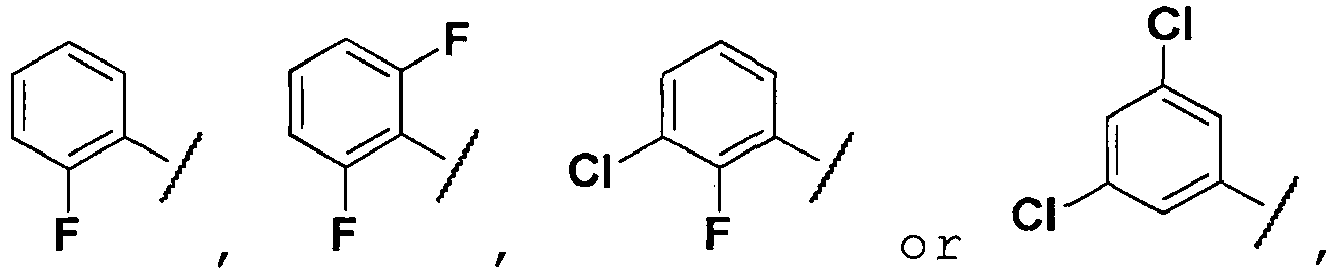
- R2 is -H,
- R3 is

- R4 is -H, -CH3 or -Na,
- A is

- [3] A pharmaceutical composition for the prevention or treatment of disease comprising a compound or a pharmaceutically acceptable salt thereof as an active ingredient, as presented in [1] above, wherein the disease is non-insulin dependent type II diabetes, insulin resistance, obesity, lipid disorder or metabolic syndrome.
- As explained hereinbefore, the compounds of the present invention can be efficiently used as a therapeutic agent for the treatment of the disease or condition mediated by the over-activation of 11β-HSD1, such as non-insulin dependent type II diabetes, insulin resistance, obesity, lipid disorder, metabolic syndrome, and other diseases mediated by the excessive activity of glucocorticoid by selectively inhibiting the activity of 11β-HSD1 (11β-Hydroxysteroid dehydrogenase type 1).
- Hereinafter, the present invention is described in detail.
- The present invention provides a compound having the activity of inhibiting 11β-HSD1 enzyme or a pharmaceutically acceptable salt thereof, wherein the compound of the present invention is selected from the group consisting of the following compounds:
- (3) E-4-[1-((2-fluoro-benzenesulfonylamino)methyl)cyclopropanecarboxamido]-adamantan-1-carboxylic acid amide;
- (22) E-4-[1-((2-fluoro-N-methyl-benzenesulfonylamino)methyl)cyclopropanecarboxamido]-adamantan-1-carboxylic acid amide;
- (71) E-4-[2-(2-fluoro-benzenesulfonylamino)-2-methylpropanamido]-adamantan-1-carboxylic acid amide;
- (84) E-4-[2-(2,6-difluoro-benzenesulfonylamino)-2-methylpropanamido]adamantan-1-carboxylic acid amide;
- (113) E-sodium[3-((5-carbamoyladamantan-2-yl)carbamoyl)phenyl]-2-fluoro-3-chloro-benzenesulfonylamide; and
- (119) E-4-[3-(3,5-dichloro-benzenesulfonylamino)-benzamido]-adamantan-1-carboxylic acid amide.
- The compound of the present invention can be used as a form of a pharmaceutically acceptable salt, in which the salt is preferably acid addition salt formed by pharmaceutically acceptable free acids. Herein, the pharmaceutically acceptable salt indicates any organic or inorganic addition salt of the base compound that is relatively nontoxic to a patient and has non-harmful activity whose side effect cannot reduce any positive effect of the said base compound. The acid addition salt herein can be obtained from inorganic acids such as hydrochloric acid, bromic acid, nitric acid, sulfuric acid, perchloric acid, and phosphoric acid; or organic acids such as citric acid, acetic acid, lactic acid, maleic acid, fumaric acid, gluconic acid, methanesulfonic acid, glyconic acid, succinic acid, tartaric acid, galacturonic acid, embonic acid, glutamic acid, aspartic acid, oxalic acid, (D) or (L)
malic acid, methanesulfonic acid, ethanesulfonic acid, 4-toluenesulfonic acid, salicilic acid, citric acid, benzoic acid, and malonic acid. The salt herein includes alkali metal salt (sodium salt, potassium salt) and alkali earth metal salt (calcium salt, magnesium salt). For example, the acid addition salt is exemplified by acetate, aspartate, benzoate, besylate, bicarbonate/carbonate, bisulfate/sulfate, borate, camcilate, citrate, edisylate, ethylate, formate, fumarate, gluceptate, gluconate, glucuronate, hexafluorophosphate, hibenzate, hydrochloride/chloride, hydrobromide/bromide, hydroiodide/iodide, isethionate, lactate, malate, maleate, malonate, methylate, methylsulfate, naphthalate, 2-naphthylate, nicotinate, nitrate, orotate, oxalate, palmitate, pamoate, phosphate/hydrogen phosphate/dihydrogen phosphate, saccharate, stearate, succinate, tartrate, tosylate, trifluoroacetate, aluminum, arginine, benzathine, calcium, choline, diethylamine, diolamine, glycine, lysine, magnesium, meglumine, olamine, potassium, sodium, tromethamine, and zinc salt. Among them, hydrochloride or trifluoroacetate is preferred. - The compound of the present invention not only includes the pharmaceutically acceptable salts but also includes every possible salts, isomers, hydrates, and solvates constructed from the same by the conventional method.
- The acid addition salt in this invention can be prepared by the conventional method known to those in the art. For example, the compound of the present invention is dissolved in a water-miscible organic solvent such as acetone, methanol, ethanol, or acetonitrile, to which excessive organic acid or acid aqueous solution of inorganic acid is added to induce precipitation or crystallization. Then, the solvent or the excessive acid is evaporated from the mixture, followed by drying the mixture to give addition salt or suction-filtering the precipitated salt to give the same.
- Some compounds of the present invention contain chiral center or geometrical isomer center (E and Z isomers). It is understood that the present invention includes all the optical isomers, diastereomers, and geometrical isomers having the activity of inhibiting 11β-HSD1.
- The present invention also provides a preparation method of the compound according to [1] above, which contains the step of reacting the compound represented by formula 2 with the compound represented by formula 3 in the presence of an organic solvent to prepare the compound of formula 1, as represented in the following reaction formula 1.

- In reaction formula 1,
R1 - R4, X and A are as defined in [2] above. - The compounds of formula 2 and formula 3 can be the commercial compounds on the market or can be synthesized by those of knowledge in the art, considering the substituents therein.
- Particularly, the compound of the present invention can be easily prepared by reacting the amine derivative compound represented by formula 3 with the sulfonylhalide derivative represented by formula 2 in the presence of a general organic solvent like dichloromethane with the addition of a proper amount of diisopropylethylamine. At this time, the reaction temperature and the reaction time can vary with the chemical reactivity of the sulfonylhalide derivative represented by formula 2, but the reaction for 1 - 24 hours at room temperature is preferred, but not always limited thereto.
- After the compound of formula 1 was prepared by the method described above, the molecular structure of the compound was confirmed by infrared spectroscopy (IR), nuclear magnetic resonance spectrum (NMR), mass spectrometry (Mass), liquid chromatography, X-ray crystallography, polarimetry, and the comparison of the estimated data and the analyzed data of the representative compound.
- In addition, the present invention provides a pharmaceutical composition for the prevention or treatment of diseases caused by the over-activation of 11β-HSD1 enzyme which comprises the compound of the invention or the pharmaceutically acceptable salt thereof as an active ingredient.
- The compound of the invention was confirmed to have excellent 11β-HSD1 inhibiting activity. Precisely, IC50 of the compound, which was the concentration of the compound to inhibit the 11β-HSD1 activity 50%, was 0.02 - 6.2 nM.
- Therefore, since the compound of the present invention has excellent 11β-HSD1 inhibiting activity, it can be effectively used for the prevention or treatment of diseases mediated by abnormally activated 11β-HSD1, such as non-insulin dependent type II diabetes, insulin resistance, obesity, lipid disorder, metabolic syndrome, and other diseases mediated by the excessive activity of glucocorticoid.
- The pharmaceutical composition of the present invention comprising the compound of the invention or the pharmaceutically acceptable salt thereof as an active ingredient can be administered orally or parenterally and be used in general forms of pharmaceutical formulation, but not always limited thereto
- The formulations for oral administration are exemplified by tablets, pills, hard/soft capsules, solutions, suspensions, emulsions, syrups, granules, and elixirs. These formulations can include diluents (for example, lactose, dextrose, sucrose, mannitol, sorbitol, cellulose, and/or glycine) and lubricants (for example, silica, talc, stearate and its magnesium or calcium salt, and/or polyethylene glycol) in addition to the active ingredient. Tablets can include binding agents such as magnesium aluminum silicate, starch paste, gelatin, methylcellulose, sodium carboxymethylcellulose and/or polyvinylpyrolidone, and if necessary disintegrating agents such as starch, agarose, alginic acid or its sodium salt or azeotropic mixtures and/or absorbents, coloring agents, flavors, and sweeteners can be additionally included thereto.
- The effective dosage of the compound of the present invention can be determined according to age, weight, gender, administration method, health condition, and severity of disease. For example, the dose for an adult in 70 kg of body weight is 0.1 - 1,000 mg/day and preferably 1 - 500 mg/day. This administration can be performed once a day - several times a day according to the decision of a doctor or a pharmacist.
- Practical embodiments of the present invention are shown in the following Examples.
-

- 200 mg (1.75 mmol) of 1-cyano-1-cyclopropylacetic acid was dissolved in 10 ml of methanol, to which 40 mg (20 wt%) of platinum oxide was added. 0.3 ml of concentrated hydrochloric acid solution was loaded thereto, and the mixture was stirred at room temperature for 4 hours in hydrogen stream. Upon completion of the reaction, the mixture was filtered to eliminate platinum oxide. The solvent was evaporated under reduced pressure to give 256 mg of 1-(aminomethyl)-cyclopropylacetic acid hydrochloride (yield: 97%).
- 1H NMR (400 MHz, MeOD) δ 3.13 (s, 2H), 1.36-1.38 (m, 2H), 1.16-1.18 (m, 2H)
-

- 273 mg (1.8 mmol) of the 1-(aminomethyl)-cyclopropylacetic acid hydrochloride prepared in Preparational Example 1 was dissolved in 6 ml of methanol, to which 0.26 ml (3.6 mmol) of thionyl chloride was added, followed by stirring at room temperature for 3 hours. Upon completion of the reaction, the solvent was evaporated under reduced pressure to give 291 mg of 1-(aminomethyl)-cyclopropylcarboxylic acid methylester hydrochloride (yield: 98%).
- 1H NMR (400 MHz, D2O) δ 3.60 (s, 3H), 3.06 (s, 2H), 1.28-1.31 (m, 2H), 0.97-0.99 (m, 2H)
-

- 150 (0.91 mmol) mg of the 1-(aminomethyl)-cyclopropylcarboxylic acid methylester hydrochloride prepared in Preparational Example 2 was dissolved in 3 ml of methylene chloride, to which 0.25 ml of TEA was added, followed by stirring at room temperature for 5 minutes. 194 mg (1.0 mmol) of 2-fluorosulfonylchloride was added to the reactant, followed by stirring at room temperature for 3 hours, followed by evaporationunder reduced pressure to eliminate the reaction solvent. The residue was dissolved in 5 ml of water, followed by extraction with 310 ml of ethyl acetate. The extract was dried over anhydrous magnesium sulfate, and evaporated under reduced pressure, followed by column chromatography to give 215 mg of 1-[(2-fluoro-benzenesulfonylamino)methyl]-cyclopropylcarboxylic acid methyl ester (yield: 83%).
- 1H NMR (400 MHz, CDCl3) δ 7.86-7.92 (m, 1H), 7.56-7.60 (m, 1H), 7.20-7.32 (m, 2H), 5.67 (d, J = 5.2 Hz, 1H), 3.64-3.72 (m, 3H), 3.14-3.21 (m, 2H), 1.17-1.21 (m, 2H), 0.84-0.91 (m, 2H)
-

- 215 mg (0.75 mmol) of the 1-[(2-fluoro-benzenesulfonylamino)methyl]-cyclopropylcarboxylic acid methyl ester prepared in Preparational Example 3 was dissolved in 7.5 ml of the mixed solvent of distilled water and THF (1:2), to which 94 mg (2.25 mmol) of lithium hydroxide monohydrate was added, followed by stirring at room temperature for 16 hours. Upon completion of the reaction, the reaction solvent was eliminated by evaporation under reduced pressure and the residue was acidized with 1 N HCl to be pH 3, followed by extraction with 320 ml of ethyl acetate. The extract was dried over anhydrous magnesium sulfate, followed by evaporation under reduced pressure to give 200 mg of 1-[(2-fluoro-benzenesulfonylamino)methyl]-cyclopropylcarboxylic acid (yield: 98%).
- 1H NMR (400 MHz, CDCl3) δ 7.85-7.90 (m, 1H), 7.56-7.61 (m, 1H), 6.98-7.31 (m, 2H), 5.90 (t, J = 6.2 Hz, 1H), 3.15-3.17 (m, 2H), 1.29-1.32 (m, 2H), 0.93-0.97 (m, 2H)
-

- 256 mg (1.69 mmol) of the 1-(aminomethyl)-cyclopropylacetic acid hydrochloride prepared in Preparational Example 1 was dissolved in 3 ml of methylene chloride, to which 0.26 ml (1.86 mmol) of TEA was added, followed by stirring for 10 minutes. Methylene chloride was eliminated by evaporation under reduced pressure. The reactant was dissolved in 2 ml of 1.0 N NaOH and 6 ml of 1,4-dioxane, and then 443 mg (2.0 mmol) of Boc2O was added thereto. After stirring the reaction mixture at room temperature for 16 hours, 1,4-dioxane was eliminated by evaporation under reduced pressure. The residue was acidized with 1 N HCl to be pH 3, followed by extraction with 320 ml of ethyl acetate. The extract was dried over anhydrous magnesium sulfate, followed by evaporation under reduced pressure to give 345 mg of 1-[(t-butoxycarbonylamino)methyl]cyclopropyl acetic acid (yield: 95%).
- 1H NMR (400 MHz, MeOD) δ 1.51 (s, 2H), 1.43 (s, 9H), 1.13-1.16 (m, 2H), 0.89-0.91 (m, 2H)
-
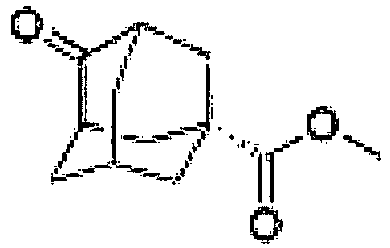
- 30% fuming sulfuric acid solution was heated at 60°C, to which 1 g (6.02 mmol) of 5-hydroxy-2-adamantanone dissolved in 6 ml of 99% formic acid was slowly added over 1 hour. After adding 6 ml of 99% formic acid slowly for 1 hour, the mixture was stirred at 60°C for 1 hour. The reaction solution was slowly added to 50 ml of methanol cooled down to 0 °C, followed by stirring at room temperature for 2 hours. Then, the reaction solution was evaporated under reduced pressure. 15 g of ice and 50 ml of methylene chloride were added thereto, followed by extraction with methylene chloride twice. After washing with brine, the extract was dried over anhydrous magnesium sulfate, followed by evaporation under reduced pressure to give 1.09 g of 4-oxo-adamantan-1-carboxylic acid methyl ester (yield: 87%).
- 1H NMR (400 MHz, CDCl3) δ 3.69 (s, 3H), 2.19 (m, 2H), 1.98-2.24 (m, 11H)
-

- 1.09 g (5.234 mmol) of the 4-oxo-adamantan-1-carboxylic acid methyl ester prepared in Preparational Example 6 and 0.5 g of 4 A molecular sieves were dissolved in 9.3 ml of methanolic ammonia (7N). The mixture was stirred at room temperature overnight, followed by cooling down to 0°C. NaBH4 was slowly added thereto, followed by stirring at room temperature for 2 hours. The floating materials generated therein were eliminated by filtering. The solvent was eliminated by evaporation under reduced pressure. The residue was dissolved in 100 ml of methylene chloride, followed by acidization with 10% citric acid. Then, the reactant was neutralized with NaHCO3 solution, followed by washing with brine. The reactant was extracted twice with methylene chloride. The extract was dried over anhydrous magnesium sulfate, followed by evaporation under reduced pressure to give 800 mg of 4-amino-adamantan-1-carboxylic acid methyl ester (yield: 73%).
- 1H NMR (400 MHz, CDCl3) δ 3. 67 (s, 3H), 3.03 (m, 1H), 1.48-2.02 (m, 13H)
-

- 33 mg (0.15 mmol) of the 1-[(t-butoxycarbonylamino)methyl]cyclopropyl acetic acid prepared in Preparational Example 5 and 32 mg (0.17 mmol) of 2-admantaneamine hydrochloride were dissolved in 1.5 ml of methylene chloride, to which 44 mg (0.17 mmol) of BOP-Cl was added. 0.04 ml (0.31 mmol) of TEA was also added thereto. The reaction mixture was stirred at room temperature for 16 hours, followed by evaporation under reduced pressure to eliminate methylene chloride. The residue was dissolved in 5 ml of water, followed by extraction with 310 ml of methylene chloride. The extract was dried over anhydrous magnesium sulfate, and evaporated under reduced pressure, followed by column chromatography to give 34 mg of t-butyl[(1-(adamantan-2-ylcarbamoyl)cyclopropyl)methyl]carbamate (yield: 64%).
- 1H NMR (400 MHz, CDCl3) δ 7.02 (brs, 1H), 4.89 (s, 1H), 4.03 (d, J = 7.2 Hz, 1H), 3.37 (d, J = 6.8 Hz, 2H), 1.49-2.05 (m, 14 H), 1.44 (s, 9H), 1.23-1.26 (m, 2H). 0.60-0.66 (m, 2H)
-

- 391 mg (1.82 mmol) of the 1-[(t-butoxycarbonylamino)methyl]cyclopropyl acetic acid prepared in Preparational Example 5 and 492 mg (2.00 mmol) of the 4-amino-adamantan-1-carboxylic acid methyl ester prepared in Preparational Example 7 were dissolved in 6.0 ml of methylene chloride, to which 525 mg (2.00 mmol) of BOP-Cl was added. 0.5 ml (3.64 mmol) of TEA was also added thereto. The reaction mixture was stirred at room temperature for 16 hours, followed by evaporation under reduced pressure to eliminate methylene chloride. The residue was dissolved in 10 ml of water, followed by extraction with 320 ml of ethyl acetate. The extract was dried over anhydrous magnesium sulfate, and evaporated under reduced pressure, followed by column chromatography to give 400 mg of 4-[1-(t-butoxycarbonylamino)methyl-cyclopropanecarboxamido]-adamantan-1-carboxylic acid methyl ester (yield: 54%).
- 1H NMR (400 MHz, CDCl3) δ 7.16 (brs, 1H), 4.87 (t, J = 5.8 Hz, 1H), 4.01 (d, J = 6.8 Hz, 1H), 3.65 (s, 3H), 3.37 (d, J = 6.4 Hz, 2H), 1.94-2.05 (m, 9H), 1.89 (s, 2H), 1.54 (s, J = 12.4 Hz, 2H), 1.42 (s, 9H), 1.25-1.28 (m, 2H). 0.63-0.65 (m, 2H)
-

- 4.0 g (9.8 mmol) of the 4-[1-(t-butoxycarbonylamino)methyl-cyclopropanecarboxamido]-adamantan-1-carboxylic acid methyl ester prepared in Preparational Example 9 was dissolved in 33 ml of ethyl acetate, to which 25 ml of 4 M HCl 1,4-dioxane solution was added. The reaction mixture was stirred at room temperature for 6 hours. Upon completion of the reaction, the reaction solvent was eliminated by evaporation under reduced pressure. The residue was dissolved in 50 ml of ethylene acetate and the precipitated solid compound was filtered. As a result, 3.2 g of 4-[1-(aminomethyl)cyclopropanylcarboxamido]-adamantan-1-carboxylic acid methyl ester hydrochloride was obtained (yield: 92%).
- 1H NMR (400 MHz, MeOD) δ 3.90 (s, 1H), 3.64 (s, 3H), 3.08 (s, 2H), 1.90-2.05 (m, 11H), 1.55 (s, J= 12.4 Hz, 2H), 1.35-1.38 (s, 2H), 1.05-1.11 (m, 2H)
-

- 1.0 g (3.2 mmol) of the 4-[1-(aminomethyl)cyclopropanylcarboxamido]-adamantan-1-carboxylic acid methyl ester hydrochloride prepared in Preparational Example 10 was dissolved in 10 ml of methylene chloride, to which 0.8 ml of TEA was added, followed by stirring at room temperature for 5 minutes. 624 mg (3.2 mmol) of 2-fluorosulfonylchloride was added to the reaction mixture, followed by stirring at room temperature for 6 hours. The reaction solvent was eliminated by evaporation under reduced pressure. The residue was dissolved in 20 ml of water, followed by extraction with 350 ml of ethyl acetate. The extract was dried over anhydrous magnesium sulfate, and evaporated under reduced pressure, followed by column chromatography to give 1.5 g of 4-[1-((2-fluoro-benzenesulfonylamino)methyl)cyclopropanecarboxamido]-adamantan-1-carboxylic acid methyl ester (yield: 99%).
- 1H NMR (400 MHz, CDCl3) δ 7.90 (dt, J = 7.6, 1.7 Hz, 1H), 7.59-7.64(m, 1H), 7.32 (dt, J = 7.6, 1.0 Hz, 1H), 7.21-7.24 (m, 1H), 6.53 (d, J = 7.6 Hz, 1H), 5.28 (t, J = 6.6 Hz, 1H), 4.05 (d, J = 7.2 Hz, 1H), 3.66 (s, 3H), 3.12 (d, J = 6.4 Hz, 2H), 1.91-2.05 (m, 11H), 1.47 (d, J = 12.0 Hz, 2H), 1.21-1.23 (m, 2H), 0.67-0.70 (m, 2H)
-

- 1.5 g (3.23 mmol) of the 4-[1-((2-fluoro-benzenesulfonylamino)methyl)cyclopropanecarboxamido]-adamantan-1-carboxylic acid methyl ester prepared in Preparational Example 11 was dissolved in 20 ml of THF/ethanol mixed solution (1:1), to which 8.0 ml of 2N NaOH solution was added, followed by stirring at room temperature overnight. The residue was acidized with 1 N HCl, followed by extraction with ethyl acetate. The extract was dried over anhydrous magnesium sulfate, followed by evaporation under reduced pressure to give 1.44 g of 4-[1-((2-fluoro-benzenesulfonylamino)methyl)cyclopropanecarboxamido]-adamantan-1-carboxylic acid (yield: 99%).
- 1H NMR (400 MHz, MeOD) δ 7.89 (dt, J = 7.4, 1.6 Hz, 1H), 7.65-7.70 (m, 1H), 7.46 (d, J = 7.2 Hz, 1H), 7.31-7.39 (m, 2H), 4.00 (d, J = 7.6 Hz, 1H), 3.15 (s, 2H), 2.16 (d, J = 13.2 Hz, 2H), 1.98-2.03 (m, 7H), 1.94 (s, 2H), 1.60 (d, J = 13.2 Hz, 2H), 1.13-1.16 (m, 2H), 0.69-0.72 (m, 2H)
-

- 1.44 g (3.20 mmol) of the 4-[1-((2-fluoro-benzenesulfonylamino)methyl)cyclopropanecarboxamido]-adamantan-1-carboxylic acid prepared in Preparational Example 12 was dissolved in 107 ml of methylene chloride, to which 533 mg (3.84 mmol) of HOBt and 736 mg (3.84 mmol) of EDCI were added. The mixture was stirred at room temperature for 10 minutes and then 107 ml of 35% ammonia water was added thereto. The mixture was stirred at room temperature for 20 hours. Upon completion of the reaction, extraction was performed with methylene chloride. After washing with brine, the extract was dried over anhydrous magnesium sulfate, followed by column chromatography to give 1.09 g of E-4-[1-((2-fluoro-benzenesulfonylamino)methyl)cyclopropanecarboxamido]-adamantan-1-carboxylic acid amide (yield: 76%).
- 1H NMR (400 MHz, CDCl3) δ 7.88-7.92 (m, 1H), 7.59-7.64 (m, 1H), 7.31-7.33 (m, 1H), 7.24 (t, J = 8.8 Hz, 1H), 6.61 (d, J = 7.2 Hz, 1H), 5.61 (brs, 1H), 5.45 (t, J = 6.6 Hz, 1H), 5.33 (brs, 1H), 4.06 (t, J = 3.8 Hz, 1H), 3.13 (d, J = 6.4 Hz, 2H), 1.91-2.09 (m, 11H), 1.63 (d, J = 12.0 Hz, 2H), 1.22-1.24 (m, 2H), 0.67-0.69 (m, 2H)
- The compound of Example 22 was prepared by the preparation method described in Example 3.
[Table 1] Example Compound Name Structure NMR data 22 E-4-[1-((2-fluoro-N-methyl-benzenesul fonylamino )methyl)cy clopropane carboxamid o]-adamantan-1-carboxylic acid amide 
1H NMR (400 MHz, CDCl3) d 7.86-7.90 (m, 1H), 7.61-7.66 (m, 1H), 7.34 (t, J = 7.6 Hz, 1H), 7.23-7.26 (m, 2H), 6.05 (brs, 1H), 6.83 (brs, 1H), 4.10 (d, J = 7.2 Hz, 1H), 3.31 (s, 2H), 2.90 (d, J = 2.0 Hz, 3H), 1.90-2.12 (m, 11H), 1.61 (d, J = 12.0 Hz, 2H), 1.36-1.38 (m, 2H), 0.57-0.60 (m, 2H) -

- After reducing pressure in the reaction vessel, the vessel was filled with nitrogen gas, to which 6.8 ml of 7 N NH3 in MeOH was loaded. 1.0 g (6.30 mmol) of dimethylcyclopropane-1,1-dicarboxylate was dissolved in 63 ml of MeOH, which was also loaded into the reaction vessel. If the starting material still remained, NH3 gas could be provided for bubbling for 15 minutes. Upon completion of the reaction, the reaction solvent was eliminated by evaporation under reduced pressure and the precipitated solid compound was filtered and washed with 0°C methanol, followed by vacuum drying. The obtained reaction product was dissolved in 5 ml of 7.4% NaOH/H2O, followed by stirring at 40 °C for 20 minutes. Then, the temperature was lowered to room temperature (Reactant A). 7 ml of 12.3% NaOCl and 2 ml of 30% NaOH/H2O were stirred together at room temperature for 1 hour (Reactant B). These reactants A and B were mixed and stirred at 80 °C for 4 minutes. After lowering the temperature thereof, 4 ml of hydrochloric acid was slowly added thereto carefully not to increase the temperature more than 60°C. The solvent was eliminated by evaporation under reduced pressure and the reactant was dissolved in ethanol. The precipitated solid compound was filtered. The remaining solution was evaporated under reduced pressure and then dissolved in hot acetone. The generated solid compound was filtered and dried to give 0.5 g of 1-aminocyclopropyl acetic acid hydrochloride (yield: 58%).
- 1H NMR (400 MHz, D2O) δ 1.40-1.43 (m, 2H), 1.22-1.25 (m, 2H)
-

- 4.18 g (30.37 mmol) of the 1-aminocyclopropyl acetic acid hydrochloride prepared in Preparational Example 13 was dissolved in 61 ml of methylene chloride, to which 4.7 ml (33.40 mmol) of TEA was added. The mixture was stirred for 10 minutes and then methylene chloride was evaporated under reduced pressure. The reactant was dissolved in 36.5 ml of 1N NaOH solution and 101 ml of 1,4-dioxane, to which 8.4 ml (36.44 mmol) of Boc2O was added. The reaction mixture was stirred at room temperature for 16 hours, and then 1,4-dioxane was evaporated under reduced pressure. The residue was acidized with 1 N HCl to be pH 3, followed by extraction with 3100 ml of ethyl acetate. The extract was dried over anhydrous magnesium sulfate, followed by evaporation under reduced pressure to give 3.59 g of 1-(t-butoxycarbonylamino)cyclopropyl acetic acid (yield: 59%).
- 1H NMR (400 MHz, MeOD) δ 1.51 (s, 2H), 1.51 (s, 9H), 1.44 (s, 4H)
-

- 3.59 g (17.85 mmol) of the 1-(t-butoxycarbonylamino)cyclopropyl acetic acid prepared in Preparational Example 14 and 4.83 g (19.64 mmol) of the 4-amino-adamantan-1-carboxylic acid methyl ester prepared in Preparational Example 7 were dissolved in 60 ml of methylene chloride, to which 5.15 g (19.64 mmol) of BOP-Cl was added. 4.98 ml (35.70 mmol) of TEA was also added thereto. The mixture was stirred at room temperature for 16 hours and methylene chloride was evaporated under reduced pressure. The residue was dissolved in 50 ml of water, followed by extraction with 3100 ml of ethyl acetate. The extract was dried over anhydrous magnesium sulfate, and evaporated under reduced pressure, followed by column chromatography to give 4.95 g of 4-[1-(t-butoxycarbonylamino)-cyclopropanecarboxamido]-adamantan-1-carboxylic acid methyl ester (yield: 71%).
- 1H NMR (400 MHz, CDCl3) δ 7.27 (brs, 1H), 5.10 (brs, 1H), 4.00 (d, J = 6.8 Hz, 1H), 3.66 (s, 3H), 1.90-2.05 (m, 9H), 1.80 (d, J = 12.8 Hz, 2H), 1.60 (d, J = 13.6 Hz, 2H), 1.53-1.56 (m, 2H), 1.47 (s, 9H). 0.98-1.01 (m, 2H)
-

- 4.95 g (14.42 mmol) of the 4-[1-(t-butoxycarbonylamino)-cyclopropanecarboxamido]-adamantan-1-carboxylic acid methyl ester prepared in Preparational Example 15 was dissolved in 48 ml of ethyl acetate, to which 36 ml of 4M HCl 1,4-dioxane was added, followed by stirring at room temperature for 6 hours. Upon completion of the reaction, the reaction solvent was eliminated by evaporation under reduced pressure. The residue was dissolved in 50 ml of ethylene acetate and the precipitated solid compound was filtered. As a result, 4.1 g of 4-(1-aminocyclopropanylcarboxamido)-adamantan-1-carboxylic acid methyl ester hydrochloride was obtained (yield: 86%).
- 1H NMR (400 MHz, D2O) δ 3.79 (s, 1H), 3.56 (s, 3H), 3.08 (s, 2H), 1.86-1.95 (m, 7H), 1.71 (d, J= 13.6 Hz, 2H), 1.40-1.46 (m, 4H), 1.30-1.33 (m, 2H)
-

- 200 mg (0.61 mmol) of the 4-(1-aminocyclopropanylcarboxamido)-adamantan-1-carboxylic acid methyl ester hydrochloride prepared in Preparational Example 16 was dissolved in 2 ml of methylene chloride, to which 0.17 ml of TEA was added, followed by stirring at room temperature for 5 minutes. 142 mg (0.67 mmol) of 2-chlorosulfonylchloride was added to the reactant, which was then stirred at room temperature for 6 hours. The reaction solvent was eliminated by evaporation under reduced pressure. The residue was dissolved in 10 ml of water, followed by extraction with 330 ml of ethyl acetate. The extract was dried over anhydrous magnesium sulfate, and evaporated under reduced pressure, followed by column chromatography to give 108 g of 4-[1-(3-chloro-benzenesulfonylamino)cyclopropanecarboxamido]-adamantan-1-carboxylic acid methyl ester (yield: 38%).
- 1H NMR (400 MHz, CDCl3) δ 7.85 (t, J = 1.8 Hz, 1H), 7.75 (d, J = 7.8 Hz, 1H), 7.60 (d, J = 8.0 Hz, 1H), 7.49 (t, J = 8.0 Hz, 1H), 7.18 (d, J = 7.6 Hz, 1H), 5.44 (d, J = 10.4 Hz, 1H), 3.98 (d, J = 7.6 Hz, 1H), 3.66 (s, 3H), 1.89-2.05 (m, 10H), 1.64 (s, 1H), 1.59 (d, J = 10.4 Hz, 2H), 1.44-1.48 (m, 2H), 0.82-0.85 (m, 2H)
-

- 100 mg (0.21 mmol) of the 4-[1-(3-chloro-benzenesulfonylamino)cyclopropanecarboxamido]-adamantan-1-carboxylic acid methyl ester prepared in Preparational Example 17 was dissolved in 1.5 ml of THF/ethanol mixed solution, to which 1.5 ml of 2N NaOH solution was added, followed by stirring at room temperature overnight. The residue was acidized with 1 N HCl, followed by extraction with ethyl acetate. The extract was dried over anhydrous magnesium sulfate, followed by evaporation under reduced pressure to give 96 mg of 4-[1-(3-chloro-benzenesulfonylamino)cyclopropanecarboxamido]-adamantan-1-carboxylic acid (yield: 98%).
- 1H NMR (400 MHz, MeOD) δ 8.98 (s, 1H), 7.72-7.78 (m, 3H), 7.62-7.66 (m, 1H), 7.14 (d, J = 7.6 Hz, 1H), 3.61 (d, J = 6.8 Hz, 1H), 1.75-2.01 (m, 11H), 1.47 (d, J = 12.8 Hz, 2H), 1.16-1.19 (m, 2H), 0.88-0.91 (m, 11H)
-

- 1 g (7.32 mmol) of 3-chloro-2,2-dimethylpropanoic acid was dissolved in 15.0 ml of water, to which 4.8 g (73.22 mmol) of NaN3 was added, followed by stirring for 18 hours with high temperature reflux. The reaction mixture was acidized with conc. HCl to be pH 3, followed by extraction with 320 ml of ethyl acetate. The extract was dried over anhydrous magnesium sulfate, followed by evaporation under reduced pressure to give 1 g of 3-azido-2,2-dimethylpropanoic acid (yield: 95%).
- 1H NMR (400 MHz, CDCl3) δ 3.48(s, 2H), 1.31 (s, 6H)
-

- 1 g (6.99 mmol) of the 3-azido-2,2-dimethylpropanoic acid prepared in Preparational Example 19 was dissolved in 100 ml of MeOH, to which 695 mg of 10% Pd/C was added, followed by stirring for 3 hours in the presence of hydrogen. 100 ml of water was added to the reaction mixture, followed by stirring for 30 minutes. The mixture was filtered by using celite filter and the resultant solution was evaporated under reduced pressure to give 753 mg of 3-amino-2,2-dimethylpropanoic acid (yield: 92%).
- 1H NMR (400 MHz, DMSO) δ 2.65 (s, 2H), 1.30 (s, 2H), 1.01 (s, 6H)
-

- 256 mg (2.22 mmol) of the -amino-2,2-dimethylpropanoic acid prepared in Preparational Example 20 was dissolved in 2.0 ml of water and 3.0 ml of t-BuOH, to which 4.0 ml of 1.0 N NaOH solution and 725 mg (3.32 mmol) of Boc2O were added. The mixture was stirred at room temperature for 16 hours, followed by evaporation under reduced pressure to eliminate the solvent. The residue was acidized with 1 N HCl to be pH 3, followed by extraction with 320 ml of ethyl acetate. The extract was dried over anhydrous magnesium sulfate, followed by evaporation under reduced pressure to give 305 mg of 3-(t-butoxycarbonylamino)-2,2-dimethylpropanoic acid (yield: 63%).
- 1H NMR (400 MHz, CDCl3) δ 3.25 (s, 2H), 1.44 (s, 9H), 1.18 (s, 6H)
-

- 305 mg (1.40 mmol) of the 3-(t-butoxycarbonylamino)-2,2-dimethylpropanoic acid prepared in Preparational Example 21 and 379 mg (1.54 mmol) of the 4-amino-adamantane-1-carboxylic acid methyl ester prepared in Preparational Example 7 were dissolved in 5.0 ml of methylene chloride, to which 323 mg (1.38 mmol) of EDCI and 227 mg (1.68 mmol) of HOBt were added. 0.6 ml (4.21 mmol) of TEA was also added thereto. The reaction mixture was stirred at room temperature for 16 hours, followed by evaporation under reduced pressure to eliminate methylene chloride. The residue was dissolved in 10 ml of water, followed by extraction with 320 ml of ethyl acetate. The extract was dried over anhydrous magnesium sulfate, and evaporated under reduced pressure, followed by column chromatography to give 466 mg of 4-(3-(t-butoxycarbonyl)amido)-2,2-dimethylpropanamido)adamantan-1-carboxylic acid methyl ester (yield: 95%).
- 1H NMR (400 MHz, CDCl3) δ 6.11 (brs, 1H), 5.12 (brs, 1H), 3.98 (m, 1H), 3.67 (s, 3H), 3.24 (d, J = 6.4 Hz, 1H), 2.05-1.74 (m, 10H), 1.63 (s, 3H), 1.43 (s, 9H), 1.21 (s, 6H)
-

- 466 mg (1.33 mmol) of the 4-(3-(t-butoxycarbonyl)amido)-2,2-dimethylpropanamido)adamantan-1-carboxylic acid methyl ester prepared in Preparational Example 22 was dissolved in 6 ml of ethyl acetate, to which 3.32 ml of 4 M HCl 1,4-dioxane solution was added, followed by stirring at room temperature for 16 hours. Upon completion of the reaction the reaction solvent was eliminated by evaporation under reduced pressure to give 422 mg of 4-(3-amido-2,2-dimethylpropanamido)adamantan-1-carboxylic acid methyl ester hydrochloride (yield: 92%).
- 1H NMR (400 MHz, CDCl3) δ 8.73 (brs, 2H), 5.98 (m, 1H), 3.96 (m, 1H), 3.72 (s, 2H), 3.66 (s, 3H), 2.04-1.91 (m, 9H), 1.66 (s, 4H), 1.39 (s, 6H)
-

- 80 mg (0.23 mmol) of the 4-(3-amido-2,2-dimethylpropanamido)adamantan-1-carboxylic acid methyl ester hydrochloride prepared in Preparational Example 23 was dissolved in 1 ml of methylene chloride, to which 0.1 ml of TEA was added, followed by stirring at room temperature for 5 minutes. 59 mg (0.28 mmol) of 3-chlorosulfonylchloride was added to the reactant, followed by stirring at room temperature for 16 hours. The reaction solvent was eliminated by evaporation under reduced pressure. The residue was dissolved in 20 ml of water, followed by extraction with 350 ml of ethyl acetate. The extract was dried over anhydrous magnesium sulfate, and evaporated under reduced pressure, followed by column chromatography to give 101 g of 4-(3-(3-chloro-benzenesulfonylamino)-2,2-dimethylpropanamido)adamantan-1-carboxylic acid methyl ester (yield: 91%).
- 1H NMR (400 MHz, CDCl3) δ 7.83 (s, 1H), 7.72 (d, J = 7.6 Hz, 1H), 7.53 (d, J = 8.4 Hz, 1H), 7.45 (t, J = 8.0 Hz, 1H), 5.88 (m, 1H), 5.57 (t, J = 6.4 Hz, 1H), 3.92 (m, 1H), 3.66 (s, 3H), 2.95 (d, J = 6.4 Hz, 2H), 1.99 (s, 8H), 1.85 (s, 2H), 1.65 (m, 3H), 1.26 (s, 6H)
-

- 100 mg (0.21 mmol) of the 4-(3-(3-chloro-benzenesulfonylamino)-2,2-dimethylpropanamido)adamantan-1-carboxylic acid methyl ester prepared in Preparational Example 24 was dissolved in 1.0 ml of THF/ethanol mixed solution (1:1), to which 1.0 ml of 2 N NaOH solution was added, followed by stirring at room temperature overnight. The reactant was acidized with 1 N HCl, followed by extraction with ethyl acetate. The extract was dried over anhydrous magnesium sulfate, followed by evaporation under reduced pressure to give 98 mg of 4-(3-(3-chloro-benzenesulfonylamino)-2,2-dimethylpropanamido)adamantan-1-carboxylic acid (yield: 99%).
- 1H NMR (400 MHz, CDCl3) δ 7.85 (t, J = 1.6 Hz, 1H), 7.73 (m, 1H), 7.54 (m, 1H), 7.43 (m, 1H), 6.00 (m, 2H), 3.92 (d, J = 6.8 Hz, 1H), 2.95 (d, J = 6.0 Hz, 1H), 2.00 (s, 7H), 1.93 (s, 2H), 1.66 (m, 4H), 1.26 (s, 6H)
-

- 200 mg (1.94 mmol) of 2-amino-2-methylpropanoic acid was dissolved in 8.0 ml of 1.0 N NaOH solution and 8.0 ml of 1,4-dioxane solution, to which 846 mg (3.88 mmol) of Boc2O was added. The mixture was stirred at room temperature for 16 hours, and then 1,4-dioxane was eliminated by evaporation under reduced pressure. The residue was acidized with 1 N HCl to be pH 3, and followed by extraction with 320 ml of ethyl acetate. The extract was dried over anhydrous magnesium sulfate, followed by evaporation under reduced pressure to give 315 mg of 2-(t-butoxycarbonylamino)-2-methylpropanoic acid (yield: 80%).
- 1H NMR (400 MHz, CDCl3) δ 5.07 (brs, 1H), 1.54 (s, 6H), 1.45 (s, 9H)
-

- 380 mg (1.87 mmol) of the 2-(t-butoxycarbonylamino)-2-methylpropanoic acid prepared in Preparational Example 26 and 505 mg (2.06 mmol) of the 4-amino-adamantan-1-carboxylic acid methyl ester prepared in Preparational Example 7 were dissolved in 10.0 ml of methylene chloride, to which 430 mg (2.24 mmol) of EDCI and 303 mg (2.24 mmol) of HOBt were added. 0.8 ml (5.61 mmol) of TEA was also added thereto. The reaction mixture was stirred at room temperature for 16 hours, followed by evaporation under reduced pressure to eliminate methylene chloride. The residue was dissolved in 10 ml of water, followed by extraction with 320 ml of ethyl acetate. The extract was dried over anhydrous magnesium sulfate, and evaporated under reduced pressure, followed by column chromatography to give 580 mg of 4-(2-((t-butoxycarbonyl)amino)-2-methylpropanamido)adamantan-1-carboxylic acid methyl ester (yield: 92%).
- 1H NMR (400 MHz, CDCl3) δ 5.30 (s, 1H), 4.84 (brs, 1H), 3.98 (brs, 1H), 3.66 (s, 3H), 2.02-1.44 (m, 28H)
-

- 580 mg (1.72 mmol) of the 4-(2-((t-butoxycarbonyl)amino)-2-methylpropanamido)adamantan-1-carboxylic acid methyl ester prepared in Preparational Example 27 was dissolved in 6 ml of ethyl acetate, to which 4.31 ml of 4 M HCl 1,4-dioxane was added. The mixture was stirred at room temperature for 16 hours. Upon completion of the reaction, the reaction solvent was eliminated by evaporation under reduced pressure to give 495 mg of 4-(2-amino-2-methylpropanamido)adamantan-1-carboxylic acid methyl ester hydrochloride (yield: 87%).
- 1H NMR (400 MHz, CDCl3) δ 8.80 (brs, 2H), 6.48 (brs, 1H), 4.01 (brs, 1H), 3.66 (s, 3H), 2.09-1.60 (m, 19H)
-

- 100 mg (0.3 mmol) of the 4-(2-amino-2-methylpropanamido)adamantan-1-carboxylic acid methyl ester hydrochloride prepared in Preparational Example 28 was dissolved in 1 ml of methylene chloride, to which 0.13 ml of TEA was added, followed by stirring at room temperature for 5 minutes. 70 mg (0.36 mmol) of 3-chlorosulfonylchloride was added to the reactant, followed by stirring at room temperature for 16 hours. The reaction solvent was eliminated by evaporation under reduced pressure. The residue was dissolved in 20 ml of water, followed by extraction with 350 ml of ethyl acetate. The extract was dried over anhydrous magnesium sulfate, and evaporated under reduced pressure, followed by column chromatography to give 107 g of 4-[2-(2-fluoro-benzenesulfonylamino)-2-methylpropanamido]-adamantan-1-carboxylic acid methyl ester (yield: 78%).
- 1H NMR (400 MHz, CDCl3) δ 7.89 (td, J1 = 1.6 Hz, J2 = 6.0 Hz, 1H), 7.60 (m, 1H), 7.28 (m, 2H), 7.00 (d, J = 9.2 Hz, 1H), 3.97 (m, 1H), 3.66 (s, 3H), 2.03 (m, 7H), 1.88 (m, 4H), 1.62 (d, J = 13.2 Hz, 2H), 1.39 (s, 6H)
-

- 105 mg (0.23 mmol) of the 4-[2-(2-fluoro-benzenesulfonylamino)-2-methylpropanamido]-adamantan-1-carboxylic acid methyl ester prepared in Preparational Example 29 was dissolved in 1.0 ml of THF/ethanol mixed solution (1:1), to which 1.0 ml of 2 N NaOH solution was added, followed by stirring at room temperature overnight. The reactant was acidized with 1 N HCl, followed by extraction with ethyl acetate. The extract was dried over anhydrous magnesium sulfate, followed by evaporation under reduced pressure to give 100 mg of 4-[2-(2-fluoro-benzenesulfonylamino)-2-methylpropanamido]-adamantan-1-carboxylic acid (yield: 99%).
- 1H NMR (400 MHz, CDCl3) δ 7.89 (td, J1 = 2.0 Hz, J2 = 6.0 Hz, 1H), 7.60 (m, 1H), 7.28 (m, 2H), 7.03 (d, J = 8.0 Hz, 1H), 3.98 (d, J = 8.0 Hz, 1H), 2.05 (m, 7H), 1.95 (s, 2H), 1.88 (d, J = 12.8 Hz, 2H), 1.45 (d, J = 12.0 Hz, 2H), 1.39 (s, 6H)
-

- 100 mg (0.23 mmol) of the 4-[2-(2-fluoro-benzenesulfonylamino)-2-methylpropanamido]-adamantan-1-carboxylic acid prepared in Preparational Example 30 was dissolved in 7.0 ml of methylene chloride, to which 34 mg (0.25 mmol) of HOBt and 48 mg (0.25 mmol) of EDCI were added. The mixture was stirred at room temperature for 10 minutes and then 7.0 ml of 35% ammonia water was added thereto. The mixture was stirred at room temperature for 20 hours. Upon completion of the reaction, extraction was performed with methylene chloride. After washing with brine, the extract was dried over anhydrous magnesium sulfate, followed by column chromatography to give 15 mg of 4-[2-(2-fluoro-benzenesulfonylamino)-2-methylpropanamido]-adamantan-1-carboxylic acid amide (yield: 15%).
- 1H NMR (400 MHz, CDCl3) δ 7.89 (td, J1 = 1.6 Hz, J2 = 6.0 Hz, 1H), 7.61 (m, 1H), 7.36 (d, J = 4.8 Hz, 1H), 7.30 (m, 1H), 7.24 (m, 1H), 7.03 (d, J = 7.6 Hz, 1H), 5.57 (brs, 1H), 3.97 (d, J = 7.6 Hz, 1H), 2.09 (s, 3H), 2.00 (m, 4H), 1.89 (m, 4H), 1.63 (d, J = 12.4 Hz, 2H), 1.39 (s, 6H)
- The compound of Example 84 was prepared by the preparation method described in Example 71.
[Table 4] Example Compound Name Structure NMR data 84 E-4-[2-(2,6-difluoro-benzenesulf onylamino)-2-methylpropa-namido]adam antan-1-carboxylic acid amide 
1H NMR (400 MHz, CDCl3) d 7.58-7.51 (m, 1H), 7.06 (t, 2H), 6.95 (d, J = 8.0 Hz, 1H), 5.88 (s, 1H), 5.62 (s, 1H), 5.42 (s, 1H), 3.98 (d, J = 8.0 Hz, 1H), 2.09 (s, 3H), 1.09-1.86 (m, 8H), 1.65 (d, J = 11.6 Hz, 3H), 1.53 (s, 3H) -

- 33 mg (0.2 mmol) of 3-nitrobenzoic acid and 50 mg (0.2 mmol) of 4-amino-adamantane-1-carboxylic acid methyl ester were dissolved in 5.0 ml of methylene chloride, to which 60 mg (0.3 mmol) of EDC and 40 mg (0.3 mmol) of HOBt were added. 0.3 ml of TEA was also added thereto. The reaction mixture was stirred at room temperature for 12 hours, followed by evaporation under reduced pressure to eliminate methylene chloride. The residue was dissolved in 10 ml of water, followed by extraction with 320 ml of ethyl acetate. The extract was dried over anhydrous magnesium sulfate, and evaporated under reduced pressure, followed by column chromatography to give 70 mg of 4-(3-nitro-benzamido)-adamantan-1-carboxylic acid methyl ester (yield: 97%).
- 1H NMR (400 MHz, CDCl3) δ 8.56 (s, 1H), 8.37-8.35 (m, 1H), 8.16-8.14 (m, 1H) 7.66 (t, J = 8.0 Hz, 1H), 6.46 (d, J = 4.0 Hz, 1H), 4.27 -4.26 (m, 1H), 3.96 (s, 3H), 2.21 (s, 2H), 2.12-2.03 (m, 5H), 1.96 (s, 2H), 1.89-1.85 (m, 2H), 1.68-1.66 (m, 2H).
-

- 30 mg (0.08 mmol) of the 4-(3-nitro-benzamido)-adamantan-1-carboxylic acid methyl ester prepared in Preparational Example 31 was dissolved in 10 ml of methanol, to which 3 mg of Pd/C was added. The mixture was stirred at room temperature for 12 hours in the presence of hydrogen, which was then filtered. Methanol was eliminated by evaporation under reduced pressure. The obtained compound proceeded to the next reaction without purification.
- 1H NMR (400 MHz, CDCl3) δ 7.40 (t, J = 4.0 Hz, 1H), 7.15 (s, 1H), 7.09-7.07 (m, 2H), 6.84-6.81 (m, 1H), 6.36-6.35 (m, 1H), 4.24 (s, 1H), 3.70 (s, 1H), 2.18-1.85 (m, 9H), 1.88-1.85 (m, 2H) 1.69-1.61 (m, 2H).
-

- 30 mg (0.09 mmol) of the 4-(3-amino-benzamido)-adamantan-1-carboxylic acid methyl ester prepared in Preparational Example 32 was dissolved in 5.0 ml of methylene chloride, to which 14 mg (0.18 mmol) of pyridine was added. 20 mg (0.11 mmol) of 2-fluoro-benzenesulfonylchloride was also added thereto. The mixture was stirred at room temperature for 12 hours, followed by evaporation under reduced pressure to eliminate methylene chloride. The residue was dissolved in 10 ml of water, followed by extraction with 320 ml of ethyl acetate. The extract was dried over anhydrous magnesium sulfate, and evaporated under reduced pressure, followed by column chromatography to give 30 mg of 4-[3-(2-fluoro-benzenesulfonylamino)-benzamido]-adamantan-1-carboxylic acid methyl ester (yield: 70%).
- 1H NMR (400 MHz, CDCl3) δ 7.85 (s, 1H), 7.60-7.46 (m, 3H), 7.22 -7.09 (m, 2H) 7.01 (s, 1H), 6.33-6.28 (m, 2H), 4.19 (s, 1H), 3.68 (s, 3H), 2.14- 1.93 (m 9H), 1.78-1.65 (m, 4H).
-

- 30 mg (0.06 mmol) of the 4-[3-(2-fluoro-benzenesulfonylamino)-benzamido]-adamantan-1-carboxylic acid methyl ester prepared in Preparational Example 33 was dissolved in 1.0 ml of methanol and 1.0 ml of water, to which 24 mg (0.6 mmol) of sodium hydroxide was added. The mixture was stirred at room temperature for 12 hours, followed by evaporation under reduced pressure to eliminate methanol. The residue was acidized with 1 N HCl, followed by extraction with 320 ml of chloroform. The extract was dried over anhydrous magnesium sulfate, followed by evaporation under reduced pressure. The obtained compound proceeded to the next reaction without purification.
- 1H NMR (400 MHz, CDCl3) δ 7.85-7.80 (m, 1H), 7.60 (s, 1H), 7.50 -7.45 (m, 1H) 7.35-7.21 (m, 4H), 7.11 (s, 1H), 6.30 (d, J = 4.0 Hz, 1H), 4.20 (s, 1H), 2.20-2.00 (m 9H), 1.89-1.82 (m, 2H), 1.72-1.69 (m, 2H).
-

- 15 mg (0. 03 mmol) of the 4-[3-(2-fluoro-benzenesulfonylamino)-benzamido]-adamantan-1-carboxylic acid prepared in Preparational Example 34 was dissolved in 5.0 ml of methylene chloride, to which 9 mg (0.045 mmol) of EDC and 6 mg (0.045 mmol) of HOBt were added. Then, ammonia water was also added thereto. The mixture was stirred at room temperature for 12 hours, followed by evaporation under reduced pressure to eliminate methylene chloride. The residue was dissolved in 10 ml of water, followed by extraction with 320 ml of methylene chloride. The extract was dried over anhydrous magnesium sulfate, and evaporated under reduced pressure, followed by column chromatography to give 6 mg of 4-[3-(2-fluoro-benzenesulfonylamino)-benzamido]-adamantan-1-carboxylic acid amide (yield: 43%).
- 1H NMR (400 MHz, CDCl3) δ 8.53 (s, 1H), 7.89-7.80 (m, 2H), 7.50 (s, 1H) 7.46-7.32 (m, 2H), 7.28-7.12 (m, 3H), 6.42 (s, 1H), 5.75 (s, 1H), 5.30 (s, 1H), 4.12 (s, 1H), 2.17-1.94 (m, 9H), 1.84-1.81 (m, 2H), 1.69-1.66 (m, 2H).
- The compounds of Example 113 and Example 119 were prepared by the preparation method described in Preparational Example 91.
[Table 5] Example Compound Name Structure NMR data 11 3 E-sodium[3-((5-carbamoylad amantan-2-yl)carbamoy l)phenyl]-2-fluoro-3-chloro-benzenesulf onylamide 
1H NMR (400 MHz, DMSO) d 7.69-7.65 (m, 1H), 7.54-7.51 (m, 2H), 7.17-7.13 (m, 2H), 7.03 (brs, 1H), 6.97-6.92 (m, 3H), 6.73 (brs, 1H), 3.90 (brs, 1H) 2.09-2.01 (m, 4H), 1.99-1.73 (m, 7H), 1.43-1.40 (m, 2H) 11 9 E-4-[3-(3,5-dichloro-benzenesulf onylamino)-benzamido]-adamantan-1-carboxylic acid amide 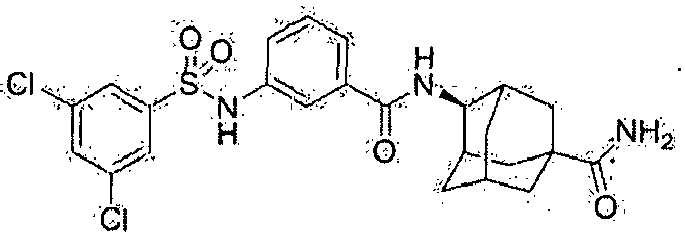
1H NMR (400 MHz, DMSO) d 7.89 (s, 2H), 7.70(s, 2H), 7.41 (s, 2H), 7.31 (s, 1H), 7.21 (d, J = 7.2 Hz, 1H), 7.03 (s, 1H), 6.74 (s, 1H), 4.14 (d, J = 6.4 Hz, 1H), 2.06 (d, J = 27.6 Hz, 7H), 1.91 (s 3H), 1.43 (d, J = 11.6 Hz, 3H) - To investigate 11β-HSD1 inhibiting activity of the compounds prepared in the examples of the present invention, the following experiment was performed.
- The inhibiting activity of 11β-HSD1 derived from microsomal fractions was measured using the HTRF assay (62CO2PEB, Cisbio). Different concentrations of compounds were added to 96-well plates, followed by the addition of TE buffer (20 mM Tris buffer and 5 mM EDTA, pH 6.0) containing 200 µM NADPH(N1630, Sigma) and 160 nM cortisone (C2755, Sigma). The reactions were initiated by the addition of human microsomal fractions (M0317, Sigma), and were allowed to incubate for 2 h at 37 °C. Europium (Eu3+) cryptate and XL665-conjugated cortisol were then added to each well and incubated for an additional 2 h at room temperature. The cortisol concentration was calculated using a calibration curve. The IC50 values were calculated from dose response curves using GraphPad Prism software.IC50 of the example compound to 11β-HSD1 was obtained. The results are shown in Table 7.
[Table 7] Example human IC50 (nM) Example human IC50 (nM) 3 6.2 22 0.02 71 0.6 84 0.36 91 (Prep. Example) - 113 2.7 119 0.9 - As shown in Table 7, IC50 of the example compounds to 11β-HSD1 was 0.02-6.2 nM, indicating the compounds had a significant 11β-HSD1 inhibiting activity. In particular, IC50 of those compounds prepared in Examples 22, 71, 84, and 119 were all less than 1.0 nM, indicating they had an excellent 11β-HSD1 inhibiting activity.
- Therefore, the compound of the present invention can be effectively used for the prevention or treatment of diseases caused by abnormal activation of 11β-HSD1 such as non-insulin dependent type II diabetes, insulin resistance, obesity, lipid disorder, metabolic syndrome, and other diseases mediated by the excessive activity of glucocorticoid.
- The inhibitory effect on plasma glucose of the compounds prepared in Examples of the present invention and showed an excellent 11β-HSD1 activity was investigated in vivo.
- Ay gene was introduced into KK mice to induce severe obesity and hyperglycemia. The male KKAy mice (9-week old, DaehanBioLink, Korea) having severe obesity and hyperglycemia prepared thereby were administered orally with the compounds prepared in Examples 3, 22, 71, 84, 113, and 119 at the concentrations of 50 mg/kg and 100 mg/kg. After 4 hour-fasting, the levels of plasma glucose and insulin were measured. The test continued for 3 weeks.
- KKAy mice were administered orally with the compounds prepared in Examples 3, 22, 71, and 113 at the concentration of 100 mg/kg for 3 weeks. Thereafter, the level of plasma glucose after fasting was measured. As a result, the plasma glucose lowering effect was approximately 9% in the group treated with the compound of Example 3. In the group treated with the compound of Example 22, the level of plasma glucose was decreased approximately 32%. In the groups treated with the compounds of Examples 71 and 113, the plasma glucose lowering effect was respectively 27% and 28%.
- In the group treated with the compound of Example 84 at the concentration of 50 mg/kg, the plasma glucose lowering effect was 19%. In the group treated with the compound of Example 119 at the concentration of 50 mg/kg, the plasma glucose lowering effect was 47%. The results are shown in Table 8.
[Table 8] Plasma glucose lowering effect Example 3 Example 22 Example 71 Example 84 Example 113 Example 119 100 mg/kg 9% 32% 27% 28% 50 mg/kg 19% 47% - KKAy mice were administered orally with the compounds prepared in Examples 22, 71, and 113 at the concentration of 100 mg/kg for 3 weeks. Thereafter, the level of plasma insulin after fasting was measured. As a result, the plasma insulin lowering effect was approximately 53% in the group treated with the compound of Example 22. In the groups treated with the compounds of Examples 71 and 113, the plasma insulin lowering effect was respectively 40% and 60%.
- In the group treated with the compound of Example 84 at the concentration of 50 mg/kg, the plasma insulin lowering effect was 43%. In the group treated with the compound of Example 119 at the concentration of 50 mg/kg, the plasma insulin lowering effect was 52%. The results are shown in Table 9.
[Table 9] Plasma insulin lowering effect Example 22 Example 71 Example 84 Example 113 Example 119 100 mg/kg 53% 40% 60% 50 mg/kg 43% 52% - As shown in Table 8 and Table 9, when the compounds prepared in Examples 3, 22, 71, 84, 113, and 119 were treated to KKAy mice at the concentration of either 100 mg/kg or 50 mg/kg, the levels of plasma glucose and plasma insulin were significantly reduced. These results suggest that the compounds have an excellent anti-diabetic effect.
- Therefore, the compound of the present invention can be effectively used for the prevention or treatment of diseases caused by the abnormal activation of 11β-HSD1 such as non-insulin dependent type II diabetes, insulin resistance, obesity, lipid disorder, metabolic syndrome, and other diseases mediated by the excessive activity of glucocorticoid.
- The compound of the present invention can be formulated in various forms according to the purpose of use. The followings are the examples of formulations comprising the compound of the present invention as an active ingredient, but these cannot limit the present invention thereto.
-
The compound of the invention 2 g Lactose 1 g - Powders were prepared by mixing all the above components, which were filled in airtight packs according to the conventional method for preparing powders.
-
The compound of the invention 100 mg Corn starch 100 mg Lactose 100 mg Magnesium stearate 2 mg - Tablets were prepared by mixing all the above components by the conventional method for preparing tablets.
-
The compound of the invention 100 mg Corn starch 100 mg Lactose 100 mg Magnesium stearate 2 mg - Capsules were prepared by mixing all the above components, which were filled in gelatin capsules according to the conventional method for preparing capsules.
-
The compound of the invention 100 mg Mannitol 180 mg Na2HPO4 • 2H2O 26 mg Distilled water 2974 mg - Injectable solutions were prepared by mixing all the above components by the conventional method for preparing injectable solutions.
- Since the compound of the present invention selectively inhibits the activity of 11β-HSD1 (11β-Hydroxysteroid dehydrogenase type 1), the compound of the invention can be effectively used as a therapeutic agent for the treatment of diseases caused by the over-activation of 11β-HSD1 such as non-insulin dependent type II diabetes, insulin resistance, obesity, lipid disorder, metabolic syndrome, and other diseases or condition mediated by the excessive activity of glucocorticoid.
- Those skilled in the art will appreciate that the conceptions and specific embodiments disclosed in the foregoing description may be readily utilized as a basis for designing embodiments
as set forth in the appended Claims.
Claims (3)
- A compound or pharmaceutically acceptable salt thereof, wherein the compound is selected from the group consisting of the following compounds:(3) E-4-[1-((2-fluoro-benzenesulfonylamino)methyl)cyclopropanecarboxamido]-adamantan-1-carboxylic acid amide;(22) E-4-[1-((2-fluoro-N-methyl-benzenesulfonylamino)methyl)cyclopropanecarboxamido]-adamantan-1-carboxylic acid amide;(71) E-4-[2-(2-fluoro-benzenesulfonylamino)-2-methylpropanamido]-adamantan-1-carboxylic acid amide;(84) E-4-[2-(2,6-difluoro-benzenesulfonylamino)-2-methylpropanamido]adamantan-1-carboxylic acid amide;(113) E-sodium[3-((5-carbamoyladamantan-2-yl)carbamoyl)phenyl]-2-fluoro-3-chloro-benzenesulfonylamide; and(119) E-4-[3-(3,5-dichloro-benzenesulfonylamino)-benzamido]-adamantan-1-carboxylic acid amide.
- A preparation method of the compound of claim 1 containing the step of reacting the compound represented by formula 2 with the compound represented by formula 3 in the presence of an organic solvent to prepare the compound of formula 1:
 X is sulfonyl,R1 is
 R2 is -H,R3 is
 R4 is -H, -CH3 or -Na,A is
- A pharmaceutical composition for the prevention or treatment of disease comprising a compound or a pharmaceutically acceptable salt thereof as an active ingredient, as claimed in claim 1, wherein the disease is non-insulin dependent type II diabetes, insulin resistance, obesity, lipid disorder or metabolic syndrome.
Priority Applications (1)
| Application Number | Priority Date | Filing Date | Title |
|---|---|---|---|
| PL13806654T PL2865664T3 (en) | 2012-06-20 | 2013-06-04 | Novel compound having ability to inhibit 11b-hsd1 enzyme or pharmaceutically acceptable salt thereof, method for producing same, and pharmaceutical composition containing same as active ingredient |
Applications Claiming Priority (2)
| Application Number | Priority Date | Filing Date | Title |
|---|---|---|---|
| KR20120066333A KR20130142801A (en) | 2012-06-20 | 2012-06-20 | NOVEL COMPOUNDS OR PHARMACEUTICALLY ACCEPTABLE SALTS THEREOF INHIBITING ACTIVITY OF 11β-HSD1 (11β-HYDROXYSTEROID DEHYDROGENASE TYPE 1) ENZYME, PREPARATION METHOD THEREOF AND PHARMACEUTICAL COMPOSITION CONTAINING THE SAME AS AN ACTIVE INGREDIENT |
| PCT/KR2013/004913 WO2013191396A1 (en) | 2012-06-20 | 2013-06-04 | Novel compound having ability to inhibit 11β-hsd1 enzyme or pharmaceutically acceptable salt thereof, method for producing same, and pharmaceutical composition containing same as active ingredient |
Publications (3)
| Publication Number | Publication Date |
|---|---|
| EP2865664A1 EP2865664A1 (en) | 2015-04-29 |
| EP2865664A4 EP2865664A4 (en) | 2016-05-11 |
| EP2865664B1 true EP2865664B1 (en) | 2017-11-01 |
Family
ID=49768954
Family Applications (1)
| Application Number | Title | Priority Date | Filing Date |
|---|---|---|---|
| EP13806654.3A Not-in-force EP2865664B1 (en) | 2012-06-20 | 2013-06-04 | Novel compound having ability to inhibit 11b-hsd1 enzyme or pharmaceutically acceptable salt thereof, method for producing same, and pharmaceutical composition containing same as active ingredient |
Country Status (20)
| Country | Link |
|---|---|
| US (1) | US9464044B2 (en) |
| EP (1) | EP2865664B1 (en) |
| JP (1) | JP5775649B2 (en) |
| KR (1) | KR20130142801A (en) |
| CN (1) | CN104903290B (en) |
| AU (1) | AU2013278234B2 (en) |
| BR (1) | BR112014031649A2 (en) |
| CA (1) | CA2876584C (en) |
| CL (1) | CL2014003436A1 (en) |
| CO (1) | CO7170176A2 (en) |
| EA (1) | EA026005B1 (en) |
| ES (1) | ES2652185T3 (en) |
| HU (1) | HUE035928T2 (en) |
| IN (1) | IN2014MN02622A (en) |
| MX (1) | MX336945B (en) |
| PE (1) | PE20150345A1 (en) |
| PH (1) | PH12014502802B1 (en) |
| PL (1) | PL2865664T3 (en) |
| WO (1) | WO2013191396A1 (en) |
| ZA (1) | ZA201500362B (en) |
Families Citing this family (7)
| Publication number | Priority date | Publication date | Assignee | Title |
|---|---|---|---|---|
| CN104230766B (en) * | 2013-06-17 | 2017-06-23 | 上海医药集团股份有限公司 | Carboxamides derivatives, intermediate, preparation method, pharmaceutical composition and application |
| WO2017153235A1 (en) | 2016-03-09 | 2017-09-14 | Bayer Pharma Aktiengesellschaft | Substituted n-cyclo-3-aryl-1-naphthamides and use thereof |
| DK3796975T3 (en) * | 2018-05-22 | 2023-12-04 | Orsobio Inc | SULFONYLAMINOBENZAMIDE DERIVATIVES |
| TWI748194B (en) | 2018-06-28 | 2021-12-01 | 德商菲尼克斯 Fxr有限責任公司 | Novel lxr modulators with bicyclic core moiety |
| CN109593061B (en) * | 2018-12-03 | 2021-09-14 | 昆明积大制药股份有限公司 | Androgen receptor antagonist, preparation method and application thereof |
| CN109438297B (en) * | 2018-12-03 | 2021-05-14 | 昆明积大制药股份有限公司 | Androgen receptor antagonist, preparation method and application thereof |
| CN113527536B (en) * | 2020-04-21 | 2024-03-22 | 杭州德柯医疗科技有限公司 | Fluorine-containing polysaccharide high molecular compound and preparation method thereof |
Family Cites Families (8)
| Publication number | Priority date | Publication date | Assignee | Title |
|---|---|---|---|---|
| WO2004056744A1 (en) * | 2002-12-23 | 2004-07-08 | Janssen Pharmaceutica N.V. | Adamantyl acetamides as hydroxysteroid dehydrogenase inhibitors |
| US8415354B2 (en) * | 2004-04-29 | 2013-04-09 | Abbott Laboratories | Methods of use of inhibitors of the 11-beta-hydroxysteroid dehydrogenase type 1 enzyme |
| WO2006046916A1 (en) * | 2004-10-29 | 2006-05-04 | Astrazeneca Ab | Novel sulphonamide derivatives as glucocorticoid receptor modulators for the treatment of inflammatory diseases |
| US8198331B2 (en) * | 2005-01-05 | 2012-06-12 | Abbott Laboratories | Inhibitors of the 11-beta-hydroxysteroid dehydrogenase type 1 enzyme |
| KR20110062797A (en) * | 2009-12-04 | 2011-06-10 | 현대약품 주식회사 | Compound for inhibiting soluble epoxide hydrolase and human 11-beta-hydroxysteroid dehydrogenase type 1, preparation method thereof, and pharmaceutical composition for inhibiting soluble epoxide hydrolase comprising the same |
| WO2011149213A2 (en) * | 2010-05-25 | 2011-12-01 | 주식회사 이큐스앤자루 | Novel derivative having inhibitory activity against 11β-hsd1, preparation method thereof, and pharmaceutical composition containing same as active ingredient |
| KR101853818B1 (en) * | 2011-07-29 | 2018-06-15 | 삼성전자주식회사 | Method for processing audio signal and apparatus for processing audio signal thereof |
| KR101409847B1 (en) * | 2011-08-04 | 2014-06-27 | 현대약품 주식회사 | A COMPOUND FOR INHIBITING 11β-HYDROXY STEROID DEHYDROGENASE 1, AND A PHARMACEUTICAL COMPOSITION COMPRISING THE SAME |
-
2012
- 2012-06-20 KR KR20120066333A patent/KR20130142801A/en not_active Ceased
-
2013
- 2013-06-04 AU AU2013278234A patent/AU2013278234B2/en not_active Ceased
- 2013-06-04 MX MX2014015191A patent/MX336945B/en active IP Right Grant
- 2013-06-04 CA CA2876584A patent/CA2876584C/en not_active Expired - Fee Related
- 2013-06-04 IN IN2622MUN2014 patent/IN2014MN02622A/en unknown
- 2013-06-04 EA EA201590051A patent/EA026005B1/en not_active IP Right Cessation
- 2013-06-04 CN CN201380044468.4A patent/CN104903290B/en not_active Expired - Fee Related
- 2013-06-04 US US14/409,414 patent/US9464044B2/en not_active Expired - Fee Related
- 2013-06-04 BR BR112014031649A patent/BR112014031649A2/en not_active IP Right Cessation
- 2013-06-04 EP EP13806654.3A patent/EP2865664B1/en not_active Not-in-force
- 2013-06-04 PL PL13806654T patent/PL2865664T3/en unknown
- 2013-06-04 WO PCT/KR2013/004913 patent/WO2013191396A1/en not_active Ceased
- 2013-06-04 HU HUE13806654A patent/HUE035928T2/en unknown
- 2013-06-04 ES ES13806654.3T patent/ES2652185T3/en active Active
- 2013-06-04 PE PE2014002503A patent/PE20150345A1/en active IP Right Grant
- 2013-06-04 JP JP2015518324A patent/JP5775649B2/en not_active Expired - Fee Related
-
2014
- 2014-12-16 PH PH12014502802A patent/PH12014502802B1/en unknown
- 2014-12-18 CL CL2014003436A patent/CL2014003436A1/en unknown
-
2015
- 2015-01-16 CO CO15008435A patent/CO7170176A2/en unknown
- 2015-01-19 ZA ZA2015/00362A patent/ZA201500362B/en unknown
Non-Patent Citations (1)
| Title |
|---|
| None * |
Also Published As
| Publication number | Publication date |
|---|---|
| AU2013278234A1 (en) | 2015-01-22 |
| WO2013191396A1 (en) | 2013-12-27 |
| EP2865664A1 (en) | 2015-04-29 |
| CL2014003436A1 (en) | 2015-08-07 |
| ES2652185T3 (en) | 2018-01-31 |
| PE20150345A1 (en) | 2015-03-10 |
| ZA201500362B (en) | 2016-01-27 |
| PH12014502802A1 (en) | 2015-02-09 |
| EP2865664A4 (en) | 2016-05-11 |
| PL2865664T3 (en) | 2018-03-30 |
| MX336945B (en) | 2016-02-08 |
| CA2876584A1 (en) | 2013-12-27 |
| HUE035928T2 (en) | 2018-05-28 |
| US20150210635A1 (en) | 2015-07-30 |
| CN104903290B (en) | 2017-04-26 |
| IN2014MN02622A (en) | 2015-07-10 |
| BR112014031649A8 (en) | 2021-03-16 |
| JP2015525238A (en) | 2015-09-03 |
| PH12014502802B1 (en) | 2015-02-09 |
| MX2014015191A (en) | 2015-04-09 |
| CO7170176A2 (en) | 2015-01-28 |
| EA026005B1 (en) | 2017-02-28 |
| EA201590051A1 (en) | 2015-05-29 |
| JP5775649B2 (en) | 2015-09-09 |
| KR20130142801A (en) | 2013-12-30 |
| BR112014031649A2 (en) | 2017-06-27 |
| CA2876584C (en) | 2015-11-17 |
| AU2013278234B2 (en) | 2015-05-21 |
| US9464044B2 (en) | 2016-10-11 |
| CN104903290A (en) | 2015-09-09 |
Similar Documents
| Publication | Publication Date | Title |
|---|---|---|
| EP3765439B1 (en) | Novel calcium salt polymorphs as anti-inflammatory, immunomodulatory and anti-proliferatory agents | |
| US9464044B2 (en) | Compound having ability to inhibit 11Beta-HSD1 enzyme or pharmaceutically acceptable salt thereof, method for producing same, and pharmaceutical composition containing same as active ingredient | |
| US6703379B2 (en) | Benzene derivatives and pharmaceutical use thereof | |
| US5872115A (en) | 2-ureido-benzamide derivatives | |
| JPWO2000015603A1 (en) | Benzene derivatives and their medicinal uses | |
| AU2015246114A1 (en) | N-substituted hydroxylamine derivatives with carbon-based leaving groups | |
| CN102361853A (en) | Toluidine sulfonamide and its use | |
| KR101409847B1 (en) | A COMPOUND FOR INHIBITING 11β-HYDROXY STEROID DEHYDROGENASE 1, AND A PHARMACEUTICAL COMPOSITION COMPRISING THE SAME | |
| HK1045692A1 (en) | Aminothiazole derivatives and their use as crf receptor ligands | |
| JP2000053649A (en) | Sulfonylureidopyrazole derivatives | |
| EP2940003A1 (en) | Cinnamic acid amide derivative | |
| KR101377419B1 (en) | Novel derivatives inhibiting activity of 11beta-HSD1 (11β-Hydroxysteroid dehydrogenase type 1) enzyme, preparation method thereof and pharmaceutical composition containing the same as an active ingredient | |
| KR101456628B1 (en) | A novel compound having inhibitory activity against 11? -HSD1 enzyme or a pharmaceutically acceptable salt thereof, a process for producing the same, and a pharmaceutical composition containing the compound as an active ingredient | |
| CN101855200A (en) | Novel polymorphs of N-[4-(trifluoromethyl)benzyl]-4-methoxybutanamide | |
| JP2010514705A (en) | Derivatives of substituted tartaric acid and uses for preparing β-secretase inhibitors | |
| JPH0442385B2 (en) | ||
| KR20140026598A (en) | Novel compounds or pharmaceutically acceptable salts thereof inhibiting activity of 11β-HSD1 (11β-Hydroxysteroid dehydrogenase type 1) enzyme, preparation method thereof and pharmaceutical composition containing the same as an active ingredient | |
| JP3930081B2 (en) | 2-Ureido-benzamide derivatives | |
| WO2012004549A1 (en) | Phenoxypropanol derivatives and their use in treating cardiac and cardiovascular diseases | |
| HK40035594B (en) | Novel calcium salt polymorphs as anti-inflammatory, immunomodulatory and anti-proliferatory agents | |
| HK40035594A (en) | Novel calcium salt polymorphs as anti-inflammatory, immunomodulatory and anti-proliferatory agents | |
| JPH06211770A (en) | Cyanoamidine derivative |
Legal Events
| Date | Code | Title | Description |
|---|---|---|---|
| PUAI | Public reference made under article 153(3) epc to a published international application that has entered the european phase |
Free format text: ORIGINAL CODE: 0009012 |
|
| 17P | Request for examination filed |
Effective date: 20150120 |
|
| AK | Designated contracting states |
Kind code of ref document: A1 Designated state(s): AL AT BE BG CH CY CZ DE DK EE ES FI FR GB GR HR HU IE IS IT LI LT LU LV MC MK MT NL NO PL PT RO RS SE SI SK SM TR |
|
| AX | Request for extension of the european patent |
Extension state: BA ME |
|
| DAX | Request for extension of the european patent (deleted) | ||
| REG | Reference to a national code |
Ref country code: DE Ref legal event code: R079 Ref document number: 602013028849 Country of ref document: DE Free format text: PREVIOUS MAIN CLASS: C07C0311120000 Ipc: C07C0311290000 |
|
| RA4 | Supplementary search report drawn up and despatched (corrected) |
Effective date: 20160411 |
|
| RIC1 | Information provided on ipc code assigned before grant |
Ipc: A61K 31/18 20060101ALI20160405BHEP Ipc: A61P 3/10 20060101ALI20160405BHEP Ipc: C07C 311/29 20060101AFI20160405BHEP |
|
| STAA | Information on the status of an ep patent application or granted ep patent |
Free format text: STATUS: EXAMINATION IS IN PROGRESS |
|
| 17Q | First examination report despatched |
Effective date: 20170120 |
|
| GRAP | Despatch of communication of intention to grant a patent |
Free format text: ORIGINAL CODE: EPIDOSNIGR1 |
|
| STAA | Information on the status of an ep patent application or granted ep patent |
Free format text: STATUS: GRANT OF PATENT IS INTENDED |
|
| INTG | Intention to grant announced |
Effective date: 20170713 |
|
| GRAS | Grant fee paid |
Free format text: ORIGINAL CODE: EPIDOSNIGR3 |
|
| GRAA | (expected) grant |
Free format text: ORIGINAL CODE: 0009210 |
|
| STAA | Information on the status of an ep patent application or granted ep patent |
Free format text: STATUS: THE PATENT HAS BEEN GRANTED |
|
| AK | Designated contracting states |
Kind code of ref document: B1 Designated state(s): AL AT BE BG CH CY CZ DE DK EE ES FI FR GB GR HR HU IE IS IT LI LT LU LV MC MK MT NL NO PL PT RO RS SE SI SK SM TR |
|
| REG | Reference to a national code |
Ref country code: GB Ref legal event code: FG4D |
|
| REG | Reference to a national code |
Ref country code: CH Ref legal event code: EP Ref country code: AT Ref legal event code: REF Ref document number: 941864 Country of ref document: AT Kind code of ref document: T Effective date: 20171115 |
|
| REG | Reference to a national code |
Ref country code: IE Ref legal event code: FG4D |
|
| REG | Reference to a national code |
Ref country code: DE Ref legal event code: R096 Ref document number: 602013028849 Country of ref document: DE |
|
| REG | Reference to a national code |
Ref country code: ES Ref legal event code: FG2A Ref document number: 2652185 Country of ref document: ES Kind code of ref document: T3 Effective date: 20180131 |
|
| REG | Reference to a national code |
Ref country code: NL Ref legal event code: MP Effective date: 20171101 |
|
| REG | Reference to a national code |
Ref country code: LT Ref legal event code: MG4D |
|
| REG | Reference to a national code |
Ref country code: AT Ref legal event code: MK05 Ref document number: 941864 Country of ref document: AT Kind code of ref document: T Effective date: 20171101 |
|
| PG25 | Lapsed in a contracting state [announced via postgrant information from national office to epo] |
Ref country code: NO Free format text: LAPSE BECAUSE OF FAILURE TO SUBMIT A TRANSLATION OF THE DESCRIPTION OR TO PAY THE FEE WITHIN THE PRESCRIBED TIME-LIMIT Effective date: 20180201 Ref country code: FI Free format text: LAPSE BECAUSE OF FAILURE TO SUBMIT A TRANSLATION OF THE DESCRIPTION OR TO PAY THE FEE WITHIN THE PRESCRIBED TIME-LIMIT Effective date: 20171101 Ref country code: LT Free format text: LAPSE BECAUSE OF FAILURE TO SUBMIT A TRANSLATION OF THE DESCRIPTION OR TO PAY THE FEE WITHIN THE PRESCRIBED TIME-LIMIT Effective date: 20171101 Ref country code: NL Free format text: LAPSE BECAUSE OF FAILURE TO SUBMIT A TRANSLATION OF THE DESCRIPTION OR TO PAY THE FEE WITHIN THE PRESCRIBED TIME-LIMIT Effective date: 20171101 Ref country code: SE Free format text: LAPSE BECAUSE OF FAILURE TO SUBMIT A TRANSLATION OF THE DESCRIPTION OR TO PAY THE FEE WITHIN THE PRESCRIBED TIME-LIMIT Effective date: 20171101 |
|
| REG | Reference to a national code |
Ref country code: HU Ref legal event code: AG4A Ref document number: E035928 Country of ref document: HU |
|
| REG | Reference to a national code |
Ref country code: FR Ref legal event code: PLFP Year of fee payment: 6 |
|
| PG25 | Lapsed in a contracting state [announced via postgrant information from national office to epo] |
Ref country code: BG Free format text: LAPSE BECAUSE OF FAILURE TO SUBMIT A TRANSLATION OF THE DESCRIPTION OR TO PAY THE FEE WITHIN THE PRESCRIBED TIME-LIMIT Effective date: 20180201 Ref country code: HR Free format text: LAPSE BECAUSE OF FAILURE TO SUBMIT A TRANSLATION OF THE DESCRIPTION OR TO PAY THE FEE WITHIN THE PRESCRIBED TIME-LIMIT Effective date: 20171101 Ref country code: AT Free format text: LAPSE BECAUSE OF FAILURE TO SUBMIT A TRANSLATION OF THE DESCRIPTION OR TO PAY THE FEE WITHIN THE PRESCRIBED TIME-LIMIT Effective date: 20171101 Ref country code: GR Free format text: LAPSE BECAUSE OF FAILURE TO SUBMIT A TRANSLATION OF THE DESCRIPTION OR TO PAY THE FEE WITHIN THE PRESCRIBED TIME-LIMIT Effective date: 20180202 Ref country code: LV Free format text: LAPSE BECAUSE OF FAILURE TO SUBMIT A TRANSLATION OF THE DESCRIPTION OR TO PAY THE FEE WITHIN THE PRESCRIBED TIME-LIMIT Effective date: 20171101 Ref country code: IS Free format text: LAPSE BECAUSE OF FAILURE TO SUBMIT A TRANSLATION OF THE DESCRIPTION OR TO PAY THE FEE WITHIN THE PRESCRIBED TIME-LIMIT Effective date: 20180301 Ref country code: RS Free format text: LAPSE BECAUSE OF FAILURE TO SUBMIT A TRANSLATION OF THE DESCRIPTION OR TO PAY THE FEE WITHIN THE PRESCRIBED TIME-LIMIT Effective date: 20171101 |
|
| PG25 | Lapsed in a contracting state [announced via postgrant information from national office to epo] |
Ref country code: CZ Free format text: LAPSE BECAUSE OF FAILURE TO SUBMIT A TRANSLATION OF THE DESCRIPTION OR TO PAY THE FEE WITHIN THE PRESCRIBED TIME-LIMIT Effective date: 20171101 Ref country code: SK Free format text: LAPSE BECAUSE OF FAILURE TO SUBMIT A TRANSLATION OF THE DESCRIPTION OR TO PAY THE FEE WITHIN THE PRESCRIBED TIME-LIMIT Effective date: 20171101 Ref country code: DK Free format text: LAPSE BECAUSE OF FAILURE TO SUBMIT A TRANSLATION OF THE DESCRIPTION OR TO PAY THE FEE WITHIN THE PRESCRIBED TIME-LIMIT Effective date: 20171101 Ref country code: CY Free format text: LAPSE BECAUSE OF FAILURE TO SUBMIT A TRANSLATION OF THE DESCRIPTION OR TO PAY THE FEE WITHIN THE PRESCRIBED TIME-LIMIT Effective date: 20171101 Ref country code: EE Free format text: LAPSE BECAUSE OF FAILURE TO SUBMIT A TRANSLATION OF THE DESCRIPTION OR TO PAY THE FEE WITHIN THE PRESCRIBED TIME-LIMIT Effective date: 20171101 |
|
| REG | Reference to a national code |
Ref country code: DE Ref legal event code: R097 Ref document number: 602013028849 Country of ref document: DE |
|
| PG25 | Lapsed in a contracting state [announced via postgrant information from national office to epo] |
Ref country code: RO Free format text: LAPSE BECAUSE OF FAILURE TO SUBMIT A TRANSLATION OF THE DESCRIPTION OR TO PAY THE FEE WITHIN THE PRESCRIBED TIME-LIMIT Effective date: 20171101 Ref country code: SM Free format text: LAPSE BECAUSE OF FAILURE TO SUBMIT A TRANSLATION OF THE DESCRIPTION OR TO PAY THE FEE WITHIN THE PRESCRIBED TIME-LIMIT Effective date: 20171101 |
|
| PLBE | No opposition filed within time limit |
Free format text: ORIGINAL CODE: 0009261 |
|
| STAA | Information on the status of an ep patent application or granted ep patent |
Free format text: STATUS: NO OPPOSITION FILED WITHIN TIME LIMIT |
|
| 26N | No opposition filed |
Effective date: 20180802 |
|
| PG25 | Lapsed in a contracting state [announced via postgrant information from national office to epo] |
Ref country code: SI Free format text: LAPSE BECAUSE OF FAILURE TO SUBMIT A TRANSLATION OF THE DESCRIPTION OR TO PAY THE FEE WITHIN THE PRESCRIBED TIME-LIMIT Effective date: 20171101 |
|
| REG | Reference to a national code |
Ref country code: CH Ref legal event code: PL |
|
| REG | Reference to a national code |
Ref country code: BE Ref legal event code: MM Effective date: 20180630 |
|
| REG | Reference to a national code |
Ref country code: IE Ref legal event code: MM4A |
|
| PG25 | Lapsed in a contracting state [announced via postgrant information from national office to epo] |
Ref country code: LU Free format text: LAPSE BECAUSE OF NON-PAYMENT OF DUE FEES Effective date: 20180604 Ref country code: MC Free format text: LAPSE BECAUSE OF FAILURE TO SUBMIT A TRANSLATION OF THE DESCRIPTION OR TO PAY THE FEE WITHIN THE PRESCRIBED TIME-LIMIT Effective date: 20171101 |
|
| PG25 | Lapsed in a contracting state [announced via postgrant information from national office to epo] |
Ref country code: LI Free format text: LAPSE BECAUSE OF NON-PAYMENT OF DUE FEES Effective date: 20180630 Ref country code: CH Free format text: LAPSE BECAUSE OF NON-PAYMENT OF DUE FEES Effective date: 20180630 Ref country code: IE Free format text: LAPSE BECAUSE OF NON-PAYMENT OF DUE FEES Effective date: 20180604 |
|
| PG25 | Lapsed in a contracting state [announced via postgrant information from national office to epo] |
Ref country code: BE Free format text: LAPSE BECAUSE OF NON-PAYMENT OF DUE FEES Effective date: 20180630 |
|
| PGFP | Annual fee paid to national office [announced via postgrant information from national office to epo] |
Ref country code: IT Payment date: 20190620 Year of fee payment: 7 Ref country code: PL Payment date: 20190531 Year of fee payment: 7 Ref country code: DE Payment date: 20190521 Year of fee payment: 7 |
|
| PGFP | Annual fee paid to national office [announced via postgrant information from national office to epo] |
Ref country code: FR Payment date: 20190604 Year of fee payment: 7 Ref country code: TR Payment date: 20190528 Year of fee payment: 7 Ref country code: HU Payment date: 20190604 Year of fee payment: 7 |
|
| PGFP | Annual fee paid to national office [announced via postgrant information from national office to epo] |
Ref country code: ES Payment date: 20190701 Year of fee payment: 7 Ref country code: GB Payment date: 20190529 Year of fee payment: 7 |
|
| PG25 | Lapsed in a contracting state [announced via postgrant information from national office to epo] |
Ref country code: MT Free format text: LAPSE BECAUSE OF NON-PAYMENT OF DUE FEES Effective date: 20180604 |
|
| PG25 | Lapsed in a contracting state [announced via postgrant information from national office to epo] |
Ref country code: PT Free format text: LAPSE BECAUSE OF FAILURE TO SUBMIT A TRANSLATION OF THE DESCRIPTION OR TO PAY THE FEE WITHIN THE PRESCRIBED TIME-LIMIT Effective date: 20171101 |
|
| PG25 | Lapsed in a contracting state [announced via postgrant information from national office to epo] |
Ref country code: MK Free format text: LAPSE BECAUSE OF NON-PAYMENT OF DUE FEES Effective date: 20171101 |
|
| PG25 | Lapsed in a contracting state [announced via postgrant information from national office to epo] |
Ref country code: AL Free format text: LAPSE BECAUSE OF FAILURE TO SUBMIT A TRANSLATION OF THE DESCRIPTION OR TO PAY THE FEE WITHIN THE PRESCRIBED TIME-LIMIT Effective date: 20171101 |
|
| REG | Reference to a national code |
Ref country code: DE Ref legal event code: R119 Ref document number: 602013028849 Country of ref document: DE |
|
| GBPC | Gb: european patent ceased through non-payment of renewal fee |
Effective date: 20200604 |
|
| PG25 | Lapsed in a contracting state [announced via postgrant information from national office to epo] |
Ref country code: FR Free format text: LAPSE BECAUSE OF NON-PAYMENT OF DUE FEES Effective date: 20200630 Ref country code: GB Free format text: LAPSE BECAUSE OF NON-PAYMENT OF DUE FEES Effective date: 20200604 Ref country code: HU Free format text: LAPSE BECAUSE OF NON-PAYMENT OF DUE FEES Effective date: 20200605 |
|
| PG25 | Lapsed in a contracting state [announced via postgrant information from national office to epo] |
Ref country code: DE Free format text: LAPSE BECAUSE OF NON-PAYMENT OF DUE FEES Effective date: 20210101 |
|
| REG | Reference to a national code |
Ref country code: ES Ref legal event code: FD2A Effective date: 20211026 |
|
| PG25 | Lapsed in a contracting state [announced via postgrant information from national office to epo] |
Ref country code: IT Free format text: LAPSE BECAUSE OF NON-PAYMENT OF DUE FEES Effective date: 20200604 |
|
| PG25 | Lapsed in a contracting state [announced via postgrant information from national office to epo] |
Ref country code: ES Free format text: LAPSE BECAUSE OF NON-PAYMENT OF DUE FEES Effective date: 20200605 |
|
| PG25 | Lapsed in a contracting state [announced via postgrant information from national office to epo] |
Ref country code: TR Free format text: LAPSE BECAUSE OF NON-PAYMENT OF DUE FEES Effective date: 20200604 |
|
| PG25 | Lapsed in a contracting state [announced via postgrant information from national office to epo] |
Ref country code: PL Free format text: LAPSE BECAUSE OF NON-PAYMENT OF DUE FEES Effective date: 20200604 |