EP2865368A1 - Dye composition for hair dyeing and production method for composition - Google Patents
Dye composition for hair dyeing and production method for composition Download PDFInfo
- Publication number
- EP2865368A1 EP2865368A1 EP13806861.4A EP13806861A EP2865368A1 EP 2865368 A1 EP2865368 A1 EP 2865368A1 EP 13806861 A EP13806861 A EP 13806861A EP 2865368 A1 EP2865368 A1 EP 2865368A1
- Authority
- EP
- European Patent Office
- Prior art keywords
- hair dyeing
- carbon atoms
- substituent
- dye composition
- integer
- Prior art date
- Legal status (The legal status is an assumption and is not a legal conclusion. Google has not performed a legal analysis and makes no representation as to the accuracy of the status listed.)
- Granted
Links
- ZNMMTKQUKWTKNX-QZQOTICOSA-N CN(C)c(cc1)cc2c1ccc(O)c2/N=N/c(cc1)ccc1N Chemical compound CN(C)c(cc1)cc2c1ccc(O)c2/N=N/c(cc1)ccc1N ZNMMTKQUKWTKNX-QZQOTICOSA-N 0.000 description 1
- FDWBUGCBGXWJLC-ZCXUNETKSA-N c(cc1)ccc1/N=N\c1cccc2c1cccc2 Chemical compound c(cc1)ccc1/N=N\c1cccc2c1cccc2 FDWBUGCBGXWJLC-ZCXUNETKSA-N 0.000 description 1
Classifications
-
- A—HUMAN NECESSITIES
- A61—MEDICAL OR VETERINARY SCIENCE; HYGIENE
- A61K—PREPARATIONS FOR MEDICAL, DENTAL OR TOILETRY PURPOSES
- A61K8/00—Cosmetics or similar toiletry preparations
- A61K8/18—Cosmetics or similar toiletry preparations characterised by the composition
- A61K8/30—Cosmetics or similar toiletry preparations characterised by the composition containing organic compounds
- A61K8/40—Cosmetics or similar toiletry preparations characterised by the composition containing organic compounds containing nitrogen
- A61K8/41—Amines
- A61K8/411—Aromatic amines, i.e. where the amino group is directly linked to the aromatic nucleus
-
- A—HUMAN NECESSITIES
- A61—MEDICAL OR VETERINARY SCIENCE; HYGIENE
- A61K—PREPARATIONS FOR MEDICAL, DENTAL OR TOILETRY PURPOSES
- A61K8/00—Cosmetics or similar toiletry preparations
- A61K8/18—Cosmetics or similar toiletry preparations characterised by the composition
- A61K8/30—Cosmetics or similar toiletry preparations characterised by the composition containing organic compounds
- A61K8/40—Cosmetics or similar toiletry preparations characterised by the composition containing organic compounds containing nitrogen
- A61K8/41—Amines
- A61K8/416—Quaternary ammonium compounds
-
- A—HUMAN NECESSITIES
- A61—MEDICAL OR VETERINARY SCIENCE; HYGIENE
- A61K—PREPARATIONS FOR MEDICAL, DENTAL OR TOILETRY PURPOSES
- A61K8/00—Cosmetics or similar toiletry preparations
- A61K8/18—Cosmetics or similar toiletry preparations characterised by the composition
- A61K8/30—Cosmetics or similar toiletry preparations characterised by the composition containing organic compounds
- A61K8/40—Cosmetics or similar toiletry preparations characterised by the composition containing organic compounds containing nitrogen
- A61K8/43—Guanidines
-
- A—HUMAN NECESSITIES
- A61—MEDICAL OR VETERINARY SCIENCE; HYGIENE
- A61Q—SPECIFIC USE OF COSMETICS OR SIMILAR TOILETRY PREPARATIONS
- A61Q5/00—Preparations for care of the hair
- A61Q5/06—Preparations for styling the hair, e.g. by temporary shaping or colouring
- A61Q5/065—Preparations for temporary colouring the hair, e.g. direct dyes
-
- A—HUMAN NECESSITIES
- A61—MEDICAL OR VETERINARY SCIENCE; HYGIENE
- A61Q—SPECIFIC USE OF COSMETICS OR SIMILAR TOILETRY PREPARATIONS
- A61Q5/00—Preparations for care of the hair
- A61Q5/10—Preparations for permanently dyeing the hair
-
- C—CHEMISTRY; METALLURGY
- C09—DYES; PAINTS; POLISHES; NATURAL RESINS; ADHESIVES; COMPOSITIONS NOT OTHERWISE PROVIDED FOR; APPLICATIONS OF MATERIALS NOT OTHERWISE PROVIDED FOR
- C09B—ORGANIC DYES OR CLOSELY-RELATED COMPOUNDS FOR PRODUCING DYES, e.g. PIGMENTS; MORDANTS; LAKES
- C09B44/00—Azo dyes containing onium groups
- C09B44/02—Azo dyes containing onium groups containing ammonium groups not directly attached to an azo group
-
- A—HUMAN NECESSITIES
- A61—MEDICAL OR VETERINARY SCIENCE; HYGIENE
- A61K—PREPARATIONS FOR MEDICAL, DENTAL OR TOILETRY PURPOSES
- A61K2800/00—Properties of cosmetic compositions or active ingredients thereof or formulation aids used therein and process related aspects
- A61K2800/40—Chemical, physico-chemical or functional or structural properties of particular ingredients
- A61K2800/42—Colour properties
- A61K2800/43—Pigments; Dyes
-
- A—HUMAN NECESSITIES
- A61—MEDICAL OR VETERINARY SCIENCE; HYGIENE
- A61K—PREPARATIONS FOR MEDICAL, DENTAL OR TOILETRY PURPOSES
- A61K2800/00—Properties of cosmetic compositions or active ingredients thereof or formulation aids used therein and process related aspects
- A61K2800/40—Chemical, physico-chemical or functional or structural properties of particular ingredients
- A61K2800/42—Colour properties
- A61K2800/43—Pigments; Dyes
- A61K2800/432—Direct dyes
Definitions
- the present invention relates to an azo dye composition for hair dyeing that has an excellent performance as a dye for hair dyeing and proves negative in the Ames test, and also relates to a method for producing the composition.
- Basic Brown 16 represented by the following structural formula (I) is a useful azo dye having an excellent performance as a dye for hair dyeing.
- Basic Brown 16 is known to indicate positive in the Ames test (refer to, for example, Non-Patent Document 1), and a safety problem still remains in its practical application.
- R represents substituted or unsubstituted alkyl, alkenyl, or phenyl.
- Patent Document 1 which can be applied in the case of the anthraquinone dye, cannot be applied to dyes such as an azo dye (refer to, for example, Patent Document 1).
- Patent Document 1 Japanese Unexamined Patent Application Publication No. 11-124510
- An object of the present invention is to develop a purification method for a dye composition for hair dyeing containing an azo dye as a main component and proving negative in the Ames test, and to provide the dye composition for hair dyeing that is produced by applying the purification method and indicates negative in the Ames test.
- the present invention was completed by specifying impurities that indicate positive in the Ames test among impurities in the azo dye contained in the dye composition for hair dyeing containing the azo dye as a main component, by analyzing a variety of purification methods for the purpose of removing the impurities, and by carrying out the purification by a specific method to find that the dye composition for hair dyeing containing the azo dye as a main component indicates negative in the Ames test. That is, a summary of the present invention is as follows.
- substituted in the "linear or branched alkyl of 1 to 10 carbon atoms that has a substituent” or the "cycloalkyl of 3 to 10 carbon atoms that has a substituent” represented by R 1 to R 3 in the general formulae (1) and (2) can be a deuterium atom; trifluoromethyl; cyano; nitro; hydroxyl; halogen atoms such as a fluorine atom, a chlorine atom, a bromine atom, and an iodine atom; linear or branched alkyls of 1 to 10 carbon atoms such as methyl, ethyl, n-propyl, isopropyl, n-butyl, isobutyl, tert-butyl, n-pentyl, isopentyl, neopentyl, n-hexyl, n-heptyl, isoheptyl, n-oct
- substituted or branched alkyloxy of 1 to 10 carbon atoms that has a substituent” or the "cycloalkyloxy of 3 to 10 carbon atoms that has a substituent” represented by R 1 to R 3 in the general formulae (1) and (2) can be a deuterium atom; trifluoromethyl; cyano; nitro; hydroxyl; halogen atoms such as a fluorine atom, a chlorine atom, a bromine atom, and an iodine atom; linear or branched alkyls of 1 to 10 carbon atoms such as methyl, ethyl, n-propyl, isopropyl, n-butyl, isobutyl, tert-butyl, n-pentyl, isopentyl, neopentyl, n-hexyl, n-heptyl, isoheptyl, n-o
- heterocyclic group in the "substituted or unsubstituted heterocyclic group” represented by R 1 to R 3 in the general formulae (1) and (2) include pyridyl, furyl, pyranyl, thienyl, pyrrolidinyl, imidazolyl, imidazolinyl, imidazolidinyl, pyrazolyl, pyrazolinyl, pyrazolidinyl, pyridazinyl, pyrazinyl, piperidinyl, piperazinyl, thiolanyl, thianyl, quinolyl, isoquinolyl, benzofuranyl, benzothienyl, indolyl, carbazolyl, benzooxazolyl, benzothiazolyl, quinoxalyl, benzoimidazolyl, pyrazolyl, dibenzofuranyl, dibenzothienyl, and carbolinyl.
- substituted heterocyclic group represented by R 1 to R 3 in the general formulae (1) and (2)
- substituents can be a deuterium atom; trifluoromethyl; cyano; nitro; hydroxyl; halogen atoms such as a fluorine atom, a chlorine atom, a bromine atom, and an iodine atom; linear or branched alkyls of 1 to 10 carbon atoms such as methyl, ethyl, n-propyl, isopropyl, n-butyl, isobutyl, tert-butyl, n-pentyl, isopentyl, neopentyl, n-hexyl, n-heptyl, isoheptyl, n-octyl, isooctyl, n-nonyl, isononyl, n-decyl, and isode
- anion represented by A - in the general formula (1)
- halide ions such as a fluorine ion, a chlorine ion, a bromine ion, and an iodine ion
- a sulfonate ion such as a methylsulfate ion
- alkylsulfate ions such as a methylsulfate ion
- perchlorate ion such as a fluorine ion, a chlorine ion, a bromine ion, and an iodine ion
- alkylsulfate ions such as a methylsulfate ion
- a perchlorate ion such as a fluorine ion, a chlorine ion, a bromine ion, and an iodine ion
- alkylsulfate ions such as a methylsulfate ion
- perchlorate ion
- a dye composition for hair dyeing containing, as a main component, an azo dye indicating negative in the result of the Ames test and having high safety, can be provided by carrying out a simple purification operation for the purpose of removing specific impurities without requiring a complicated operation.
- the azo dye having trimethylammonio which is used in the present invention, can be produced by a known method (refer to, for example, Non-Patent Document 2).
- the Ames test is a test system for detecting a phenomenon that a histidine-requiring strain, which cannot grow without a specific amino acid (for example, histidine), is returned to a histidine-nonrequiring strain by a gene mutation due to a mutational substance.
- the Ames test is also called a reverse mutation test because a strain regains its original nature by a gene mutation.
- a metabolic activation test a test substance, a test strain, and an enzyme for activating metabolism of drugs (S-9Mix) are mixed, and the mixture is cultured for 48 hours at 37°C using an agar medium after preincubation for 20 minutes at 37°C.
- the number of induced revertant colonies is counted, and it is determined to be positive in the case where the ratio (MR value) of the number of the induced revertant colonies to the number of revertant colonies appearing in a negative control is 2 or more (refer to, for example, Non-Patent Document 3).
- the metabolic activation test is a test carried out by adding an enzyme for activating metabolism of drugs (that is, S-9Mix) which is obtained from a liver of a rat or the like in order to bring a metabolic system of drugs for microbes close to that of mammals.
- an enzyme for activating metabolism of drugs that is, S-9Mix
- Salmonella typhimurium (TA1535 strain, TA1537 strain, TA100 strain, and TA98 strain) or Escherichia coli (WP2 uvrA strain) is generally used at present.
- Basic Brown 16 represented by the structural formula (I) is known to indicate positive in the Ames test using TA1537 strain and/or TA98 strain among the strains (refer to Non-Patent Document 1).
- the content of the component contained in the purified dye composition for hair dyeing and represented by the structural formula (III) is 0.3 wt.% or less.
- the more preferable content is 0.25 wt.% or less, and the particularly preferable content is 0.2 wt.% or less.
- the purification method for the dye composition for hair dyeing in the present invention is a method which was analyzed for the purpose of removing the component represented by the structural formula (III), and the purification method is characterized in that a dye composition for hair dyeing, which indicates positive in the Ames test, proves negative in the Ames test by performing the purification method.
- the purification method for the dye composition for hair dyeing in the present invention is a method performed by treatment with activated carbon after dissolving the composition in a solvent. This treatment with activated carbon (adsorption purification) may be repeated.
- a solvent used in the purification method for the dye composition for hair dyeing in the present invention need not be restricted if the objective dye composition for hair dyeing can be dissolved. However, it is particularly preferable to use a mixed solvent of water and a water-soluble organic solvent.
- the purification method of the present invention can be used in combination with a generally used purification method.
- Examples of the purification method which can be used in combination with the purification method for the dye composition for hair dyeing in the present invention can be recrystallization, salting-out, activated carbon adsorption, column chromatography, and a sublimation purification method. These purification methods may be repeated and may be performed in combination with a different purification method.
- the water-soluble organic solvent used in the purification method for the dye composition for hair dyeing in the present invention is not particularly restricted.
- an aliphatic alcohol and an aliphatic ketone are preferable, and the aliphatic ketone is particularly preferable as the water-soluble organic solvent.
- an aliphatic alcohol it is preferable to use aliphatic alcohols of 1 to 5 carbon atoms such as methanol, ethanol, 1-propanol, 2-propanol, 1-butanol, isobutanol, tertiary butanol, and isoamyl alcohol, and it is particularly preferable to use an aliphatic alcohol of 3 to 4 carbon atoms.
- an aliphatic ketone it is preferable to use aliphatic ketones of 3 to 8 carbon atoms such as acetone, methyl ethyl ketone, methyl isopropyl ketone, methyl isobutyl ketone, diethyl ketone, ethyl isopropyl ketone, and ethyl isobutyl ketone, and it is more preferable to use an aliphatic ketone of 4 to 6 carbon atoms.
- the mixing ratio (the volume ratio) between water and a water-soluble organic solvent is preferably 25/75 to 99.9/0.1, more preferably 40/60 to 80/20, and particularly preferably 50/50 to 70/30.
- the temperature when performing activated carbon adsorption depends on the boiling point of a used solvent, the temperature is preferably 20°C to 100°C, more preferably 40°C to 80°C, and particularly preferably 50°C to 75°C.
- the additive amount of the activated carbon is preferably 10 wt. % or more with respect to a dye composition for hair dyeing before purification.
- the additive amount of the activated carbon may be further decreased. It is preferable to repeat activated carbon adsorption until the content of the component represented by the general formula (2) becomes 0. 3 wt. % or less.
- a method for removing activated carbon after activated carbon adsorption is not particularly restricted if it is a usually used method. However, it is preferable to use a method of filtration in view of convenience and facility of its treatment method on the site of producing industrial products.
- a method for taking out a dye composition for hair dyeing from a solution after activated carbon adsorption is not particularly restricted if it is a usually used method.
- Basic Brown 16 in the following Examples means a dye composition for hair dyeing containing Basic Brown 16 as a main component.
- Example 2 The Ames test was carried out on the same condition used in Example 2 also with respect to the component indicating positive in the Ames test and represented by the structural formula (III) among impurities contained in Basic Brown 16. Table 1 summarizes the result.
- the dye composition for hair dyeing before purification indicated the result of positive in both of the Ames tests using TA98 strain and TA1537 strain.
- the dye composition for hair dyeing after purification using the purification method in the present invention was proved to be negative in both of the cases.
- a dye composition for hair dyeing containing, as a main component, an azo dye indicating negative in the result of the Ames test and having high safety, can be provided by carrying out a convenient and easy purification method especially on an industrial producing site without requiring a complicated operation.
Landscapes
- Health & Medical Sciences (AREA)
- Life Sciences & Earth Sciences (AREA)
- Animal Behavior & Ethology (AREA)
- General Health & Medical Sciences (AREA)
- Public Health (AREA)
- Veterinary Medicine (AREA)
- Birds (AREA)
- Epidemiology (AREA)
- Chemical & Material Sciences (AREA)
- Organic Chemistry (AREA)
- Cosmetics (AREA)
- Coloring (AREA)
Abstract
Description
- The present invention relates to an azo dye composition for hair dyeing that has an excellent performance as a dye for hair dyeing and proves negative in the Ames test, and also relates to a method for producing the composition.
- In recent years, there has been an increasing interest in the safety of chemical substances. Measures of strict legal regulation are taken particularly against production and sale of a carcinogenic substance, and it is mandatorily required to confirm that there is no carcinogenicity when developing a novel chemical substance. Although a long period and a huge cost are required for a test to determine the presence of carcinogenicity in a substance, a mutagenicity test is carried out as a test to determine in a short period and at a low cost the presence of carcinogenicity in a chemical substance. Particularly, the Ames test is broadly carried out as a method for allowing an effective screening of carcinogenicity of a chemical substance in a very simple detecting principle.
- Basic Brown 16 represented by the following structural formula (I) is a useful azo dye having an excellent performance as a dye for hair dyeing. However, Basic Brown 16 is known to indicate positive in the Ames test (refer to, for example, Non-Patent Document 1), and a safety problem still remains in its practical application.

- On the other hand, with respect to the anthraquinone dye represented by the following general formula (II), there is a known method for obtaining a dye that proves negative in the Ames test by performing a purification operation with column chromatography (refer to, for example, Patent Document 1).

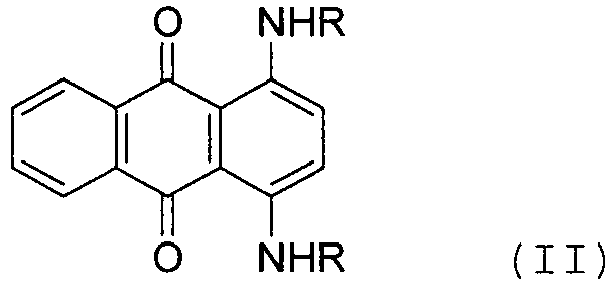
- In the formula, R represents substituted or unsubstituted alkyl, alkenyl, or phenyl.
- However, the purification method described in Patent Document 1, which can be applied in the case of the anthraquinone dye, cannot be applied to dyes such as an azo dye (refer to, for example, Patent Document 1).
- Patent Document 1: Japanese Unexamined Patent Application Publication No.
11-124510 -
- Non-Patent Document 1: Scientific Committee on Consumer Products. "Opinion on Basic Brown 16." September 30, 2008
- Non-Patent Document 2: Hosoda, Yutaka. Riron Seizo Senryo Kagaku, fifth edition, GIHODO SHUPPAN Co., Ltd., 1968
- Non-Patent Document 3: "Bacterial Reverse Mutation Test." OECD GUIDELINE FOR TESTING OF CHEMICALS, no. 471, Adopted: 21st July, 1997
- An object of the present invention is to develop a purification method for a dye composition for hair dyeing containing an azo dye as a main component and proving negative in the Ames test, and to provide the dye composition for hair dyeing that is produced by applying the purification method and indicates negative in the Ames test.
- As a result of a thorough analysis made by the present inventors in order to solve the foregoing problems, the present invention was completed by specifying impurities that indicate positive in the Ames test among impurities in the azo dye contained in the dye composition for hair dyeing containing the azo dye as a main component, by analyzing a variety of purification methods for the purpose of removing the impurities, and by carrying out the purification by a specific method to find that the dye composition for hair dyeing containing the azo dye as a main component indicates negative in the Ames test. That is, a summary of the present invention is as follows.
- 1. The dye composition for hair dyeing containing, as a main component, an azo dye having trimethylammonio, the dye composition for hair dyeing being characterized in that the result of the Ames test is negative.
- 2. The dye composition for hair dyeing described in said 1., characterized in that the azo dye having trimethylammonio is represented by the following general formula (1).

- 3. The dye composition for hair dyeing described in said 1., characterized in that the result of the Ames test using Salmonella typhimurium TA98 strain and/or Salmonella typhimurium TA1537 strain is negative.
- 4. The dye composition for hair dyeing described in said 1., characterized in that the result of the Ames test using Escherichia coli WP2 uvrA strain is negative.
- 5. The dye composition for hair dyeing described in said 1. , characterized in that the content of the compound contained in the dye composition for hair dyeing and represented by the following general formula (2) is 0.3 wt.% or less.

- 6. The dye composition for hair dyeing described in said 1., characterized in that the azo dye having trimethylammonio is Basic Brown 16 represented by the following structural formula (I).

- 7. A purification method for the dye composition for hair dyeing containing, as a main component, the azo dye having trimethylammonio, the purification method for the dye composition for hair dyeing being characterized in that the result of the Ames test in the dye composition for hair dyeing is negative.
- 8. The purification method for the dye composition for hair dyeing described in said 7., containing, as a main component, the azo dye having trimethylammonio, the purification method being characterized in that the purification is performed using activated carbon in a mixed solution of water and a water-soluble organic solvent.
- 9. The purification method described in said 7., characterized in that the azo dye having trimethylammonio is represented by the following general formula (1).

- 10. The purification method described in said 7., characterized in that the result of the Ames test using Salmonella typhimurium TA98 strain and/or Salmonella typhimurium TA1537 strain is negative.
- 11. The purification method described in said 8., characterized in that a water-soluble organic solvent is one or more selected from aliphatic alcohols and aliphatic ketones.
- 12. The purification method described in said 7., characterized in that the content of the compound contained in the dye composition for hair dyeing and represented by the following general formula (2) is removed to 0.3 wt.% or less.


- 13. The purification method described in said 7., characterized in that the azo dye having trimethylammonio is Basic Brown 16 represented by the following structural formula (I).


- 14. A producing method of the dye composition for hair dyeing containing, as a main component, the azo dye having trimethylammonio, the producing method of the dye composition for hair dyeing being characterized in that the result of the Ames test in the dye composition for hair dyeing is negative.
- Specific examples of the "linear or branched alkyl of 1 to 10 carbon atoms" or the "cycloalkyl of 3 to 10 carbon atoms" in the "linear or branched alkyl of 1 to 10 carbon atoms that may have a substituent" or the "cycloalkyl of 3 to 10 carbon atoms that may have a substituent" represented by R1 to R3 in the general formulae (1) and (2) include methyl, ethyl, n-propyl, isopropyl, n-butyl, isobutyl, tert-butyl, n-pentyl, isopentyl, neopentyl, n-hexyl, n-heptyl, isoheptyl, n-octyl, isooctyl, n-nonyl, isononyl, n-decyl, isodecyl, cyclopropyl, cyclopentyl, cyclohexyl, 1-adamantyl, and 2-adamantyl.
- Specific examples of the "substituent" in the "linear or branched alkyl of 1 to 10 carbon atoms that has a substituent" or the "cycloalkyl of 3 to 10 carbon atoms that has a substituent" represented by R1 to R3 in the general formulae (1) and (2) can be a deuterium atom; trifluoromethyl; cyano; nitro; hydroxyl; halogen atoms such as a fluorine atom, a chlorine atom, a bromine atom, and an iodine atom; linear or branched alkyls of 1 to 10 carbon atoms such as methyl, ethyl, n-propyl, isopropyl, n-butyl, isobutyl, tert-butyl, n-pentyl, isopentyl, neopentyl, n-hexyl, n-heptyl, isoheptyl, n-octyl, isooctyl, n-nonyl, isononyl, n-decyl, and isodecyl; linear or branched alkoxys of 1 to 10 carbon atoms such as methyloxy, ethyloxy, and propyloxy; alkenyls such as allyl; aralkyls such as benzyl, naphthylmethyl, and phenethyl; aryloxys such as phenyloxy and tolyloxy; arylalkyloxys such as benzyloxy and phenethyloxy; aromatic hydrocarbon groups or condensed polycyclic aromatic groups such as phenyl, biphenylyl, terphenylyl, naphthyl, anthracenyl, phenanthryl, fluorenyl, indenyl, pyrenyl, perylenyl, fluoranthenyl, and triphenylenyl; heterocyclic groups such as pyridyl, furyl, pyranyl, thienyl, , pyrrolyl, pyrrolidinyl, imidazolyl, imidazolinyl, imidazolidinyl, pyrazolyl, pyrazolinyl, pyrazolidinyl, pyridazinyl, pyrazinyl, piperidinyl, piperazinyl, thiolanyl, thianyl, quinolyl, isoquinolyl, benzofuranyl, benzothienyl, indolyl, carbazolyl, benzooxazolyl, benzothiazolyl, quinoxalyl, benzoimidazolyl, pyrazolyl, dibenzofuranyl, dibenzothienyl, and carbolinyl; arylvinyls such as styryl and naphthylvinyl; acyls such as acetyl and benzoyl; dialkylamino groups such as dimethylamino and diethylamino; disubstituted amino groups such as diphenylamino and dinaphthylamino, substituted with aromatic hydrocarbon groups or condensed polycyclic aromatic groups; diaralkylamino groups such as dibenzylamino and diphenethylamino; disubstituted amino groups such as dipyridylamino, dithienylamino, and dipiperidinylamino, substituted with heterocyclic groups; dialkenylamino groups such as diallylamino; and disubstituted amino groups substituted with a substituent selected from alkyl, an aromatic hydrocarbon group, a condensed polycyclic aromatic group, aralkyl, a heterocyclic group, and alkenyl. These substituents may be further substituted with other substituents.
- Specific examples of the "linear or branched alkyloxy of 1 to 10 carbon atoms" or the "cycloalkyloxy of 3 to 10 carbon atoms" in the "linear or branched alkyloxy of 1 to 10 carbon atoms that may have a substituent" or the "cycloalkyloxy of 3 to 10 carbon atoms that may have a substituent" represented by R1 to R3 in the general formulae (1) and (2) can be methyloxy, ethyloxy, n-propyloxy, isopropyloxy, n-butyloxy, tert-butyloxy, n-pentyloxy, n-hexyloxy, n-heptyloxy, isoheptyloxy, n-octyloxy, isooctyloxy, n-nonyloxy, isononyloxy, n-decyloxy, isodecyloxy, cyclopropyloxy, cyclopentyloxy, cyclohexyloxy, cycloheptyloxy, cyclooctyloxy, 1-adamantyloxy, and 2-adamantyloxy.
- Specific examples of the "substituent" in the "linear or branched alkyloxy of 1 to 10 carbon atoms that has a substituent" or the "cycloalkyloxy of 3 to 10 carbon atoms that has a substituent" represented by R1 to R3 in the general formulae (1) and (2) can be a deuterium atom; trifluoromethyl; cyano; nitro; hydroxyl; halogen atoms such as a fluorine atom, a chlorine atom, a bromine atom, and an iodine atom; linear or branched alkyls of 1 to 10 carbon atoms such as methyl, ethyl, n-propyl, isopropyl, n-butyl, isobutyl, tert-butyl, n-pentyl, isopentyl, neopentyl, n-hexyl, n-heptyl, isoheptyl, n-octyl, isooctyl, n-nonyl, isononyl, n-decyl, and isodecyl; linear or branched alkoxys of 1 to 10 carbon atoms such as methyloxy, ethyloxy, and propyloxy; alkenyls such as allyl; aralkyls such as benzyl, naphthylmethyl, and phenethyl; aryloxys such as phenyloxy and tolyloxy; arylalkyloxys such as benzyloxy and phenethyloxy; aromatic hydrocarbon groups or condensed polycyclic aromatic groups such as phenyl, biphenylyl, terphenylyl, naphthyl, anthracenyl, phenanthryl, fluorenyl, indenyl, pyrenyl, perylenyl, fluoranthenyl, and triphenylenyl; heterocyclic groups such as pyridyl, furyl, pyranyl, thienyl, pyrrolyl, pyrrolidinyl, imidazolyl, imidazolinyl, imidazolidinyl, pyrazolyl, pyrazolinyl, pyrazolidinyl, pyridazinyl, pyrazinyl, piperidinyl, piperazinyl, thiolanyl, thianyl, quinolyl, isoquinolyl, benzofuranyl, benzothienyl, indolyl, carbazolyl, benzooxazolyl, benzothiazolyl, quinoxalyl, benzoimidazolyl, pyrazolyl, dibenzofuranyl, dibenzothienyl, and carbolinyl; arylvinyls such as styryl and naphthylvinyl; acyls such as acetyl and benzoyl; dialkylamino groups such as dimethylamino and diethylamino; disubstituted amino groups such as diphenylamino and dinaphthylamino, substituted with aromatic hydrocarbon groups or condensed polycyclic aromatic groups; diaralkylamino groups such as dibenzylamino and diphenethylamino; disubstituted amino groups such as dipyridylamino, dithienylamino, and dipiperidinylamino, substituted with heterocyclic groups; dialkenylamino groups such as diallylamino; and disubstituted amino groups substituted with a substituent selected from alkyl, an aromatic hydrocarbon group, a condensed polycyclic aromatic group, aralkyl, a heterocyclic group, and alkenyl. These substituents may be further substituted with other substituents.
- Specific examples of the "heterocyclic group" in the "substituted or unsubstituted heterocyclic group" represented by R1 to R3 in the general formulae (1) and (2) include pyridyl, furyl, pyranyl, thienyl, pyrrolidinyl, imidazolyl, imidazolinyl, imidazolidinyl, pyrazolyl, pyrazolinyl, pyrazolidinyl, pyridazinyl, pyrazinyl, piperidinyl, piperazinyl, thiolanyl, thianyl, quinolyl, isoquinolyl, benzofuranyl, benzothienyl, indolyl, carbazolyl, benzooxazolyl, benzothiazolyl, quinoxalyl, benzoimidazolyl, pyrazolyl, dibenzofuranyl, dibenzothienyl, and carbolinyl.
- Specific examples of the "substituent" in the "substituted heterocyclic group" represented by R1 to R3 in the general formulae (1) and (2) can be a deuterium atom; trifluoromethyl; cyano; nitro; hydroxyl; halogen atoms such as a fluorine atom, a chlorine atom, a bromine atom, and an iodine atom; linear or branched alkyls of 1 to 10 carbon atoms such as methyl, ethyl, n-propyl, isopropyl, n-butyl, isobutyl, tert-butyl, n-pentyl, isopentyl, neopentyl, n-hexyl, n-heptyl, isoheptyl, n-octyl, isooctyl, n-nonyl, isononyl, n-decyl, and isodecyl; linear or branched alkoxys of 1 to 10 carbon atoms such as methyloxy, ethyloxy, and propyloxy; alkenyls such as allyl; aralkyls such as benzyl, naphthylmethyl, and phenethyl; aryloxys such as phenyloxy and tolyloxy; arylalkyloxys such as benzyloxy and phenethyloxy; aromatic hydrocarbon groups or condensed polycyclic aromatic groups such as phenyl, biphenylyl, terphenylyl, naphthyl, anthracenyl, phenanthryl, fluorenyl, indenyl, pyrenyl, perylenyl, fluoranthenyl, and triphenylenyl; heterocyclic groups such as pyridyl, furyl, pyranyl, thienyl, pyrrolyl, pyrrolidinyl, imidazolyl, imidazolinyl, imidazolidinyl, pyrazolyl, pyrazolinyl, pyrazolidinyl, pyridazinyl, pyrazinyl, piperidinyl, piperazinyl, thiolanyl, thianyl, quinolyl, isoquinolyl, benzofuranyl, benzothienyl, indolyl, carbazolyl, benzooxazolyl, benzothiazolyl, quinoxalyl, benzoimidazolyl, pyrazolyl, dibenzofuranyl, dibenzothienyl, and carbolinyl; arylvinyls such as styryl and naphthylvinyl; acyls such as acetyl and benzoyl; dialkylamino groups such as dimethylamino and diethylamino; disubstituted amino groups such as diphenylamino and dinaphthylamino, substituted with aromatic hydrocarbon groups or condensed polycyclic aromatic groups; diaralkylamino groups such as dibenzylamino and diphenethylamino; disubstituted amino groups such as dipyridylamino, dithienylamino, and dipiperidinylamino, substituted with heterocyclic groups; dialkenylamino groups such as diallylamino; and disubstituted amino groups substituted with a substituent selected from alkyl, an aromatic hydrocarbon group, a condensed polycyclic aromatic group, aralkyl, a heterocyclic group, and alkenyl. These substituents may be further substituted with other substituents.
- Specific examples of the "anion" represented by A- in the general formula (1) include halide ions such as a fluorine ion, a chlorine ion, a bromine ion, and an iodine ion; a sulfonate ion; alkylsulfate ions such as a methylsulfate ion; and a perchlorate ion.
- According to the present invention, a dye composition for hair dyeing containing, as a main component, an azo dye indicating negative in the result of the Ames test and having high safety, can be provided by carrying out a simple purification operation for the purpose of removing specific impurities without requiring a complicated operation.
- The azo dye having trimethylammonio, which is used in the present invention, can be produced by a known method (refer to, for example, Non-Patent Document 2).
- The following presents compounds as the azo dye having trimethylammonio, which is used in the present invention. The present invention, however, is not restricted to these compounds.


- The Ames test is a test system for detecting a phenomenon that a histidine-requiring strain, which cannot grow without a specific amino acid (for example, histidine), is returned to a histidine-nonrequiring strain by a gene mutation due to a mutational substance. The Ames test is also called a reverse mutation test because a strain regains its original nature by a gene mutation. In the case of a metabolic activation test, a test substance, a test strain, and an enzyme for activating metabolism of drugs (S-9Mix) are mixed, and the mixture is cultured for 48 hours at 37°C using an agar medium after preincubation for 20 minutes at 37°C. The number of induced revertant colonies is counted, and it is determined to be positive in the case where the ratio (MR value) of the number of the induced revertant colonies to the number of revertant colonies appearing in a negative control is 2 or more (refer to, for example, Non-Patent Document 3).
- The metabolic activation test is a test carried out by adding an enzyme for activating metabolism of drugs (that is, S-9Mix) which is obtained from a liver of a rat or the like in order to bring a metabolic system of drugs for microbes close to that of mammals.
- Among the strains, Salmonella typhimurium (TA1535 strain, TA1537 strain, TA100 strain, and TA98 strain) or Escherichia coli (WP2 uvrA strain) is generally used at present.
- Basic Brown 16 represented by the structural formula (I) is known to indicate positive in the Ames test using TA1537 strain and/or TA98 strain among the strains (refer to Non-Patent Document 1).
- Among impurities contained in Basic Brown 16, a component represented by the following structural formula (III), which indicates positive in the Ames test (especially, TA1537 strain and/or TA98 strain), was confirmed when separation and purification of components indicating positive in the Ames test were performed.

- In the case of purifying a dye composition for hair dyeing which is positive in the result of the Ames test in the present invention, it is preferable to perform the purification so that the content of the component contained in the purified dye composition for hair dyeing and represented by the structural formula (III) is 0.3 wt.% or less. The more preferable content is 0.25 wt.% or less, and the particularly preferable content is 0.2 wt.% or less.
- The purification method for the dye composition for hair dyeing in the present invention is a method which was analyzed for the purpose of removing the component represented by the structural formula (III), and the purification method is characterized in that a dye composition for hair dyeing, which indicates positive in the Ames test, proves negative in the Ames test by performing the purification method.
- The purification method for the dye composition for hair dyeing in the present invention is a method performed by treatment with activated carbon after dissolving the composition in a solvent. This treatment with activated carbon (adsorption purification) may be repeated.
- A solvent used in the purification method for the dye composition for hair dyeing in the present invention need not be restricted if the objective dye composition for hair dyeing can be dissolved. However, it is particularly preferable to use a mixed solvent of water and a water-soluble organic solvent.
- In the purification method for the dye composition for hair dyeing, the purification method of the present invention can be used in combination with a generally used purification method.
- Examples of the purification method which can be used in combination with the purification method for the dye composition for hair dyeing in the present invention can be recrystallization, salting-out, activated carbon adsorption, column chromatography, and a sublimation purification method. These purification methods may be repeated and may be performed in combination with a different purification method.
- The water-soluble organic solvent used in the purification method for the dye composition for hair dyeing in the present invention is not particularly restricted. However, an aliphatic alcohol and an aliphatic ketone are preferable, and the aliphatic ketone is particularly preferable as the water-soluble organic solvent. As an aliphatic alcohol, it is preferable to use aliphatic alcohols of 1 to 5 carbon atoms such as methanol, ethanol, 1-propanol, 2-propanol, 1-butanol, isobutanol, tertiary butanol, and isoamyl alcohol, and it is particularly preferable to use an aliphatic alcohol of 3 to 4 carbon atoms. As an aliphatic ketone, it is preferable to use aliphatic ketones of 3 to 8 carbon atoms such as acetone, methyl ethyl ketone, methyl isopropyl ketone, methyl isobutyl ketone, diethyl ketone, ethyl isopropyl ketone, and ethyl isobutyl ketone, and it is more preferable to use an aliphatic ketone of 4 to 6 carbon atoms.
- In the purification method for the dye composition for hair dyeing in the present invention, the mixing ratio (the volume ratio) between water and a water-soluble organic solvent is preferably 25/75 to 99.9/0.1, more preferably 40/60 to 80/20, and particularly preferably 50/50 to 70/30.
- In the purification method for the dye composition for hair dyeing in the present invention, although a temperature when performing activated carbon adsorption depends on the boiling point of a used solvent, the temperature is preferably 20°C to 100°C, more preferably 40°C to 80°C, and particularly preferably 50°C to 75°C.
- In the purification method for the dye composition for hair dyeing in the present invention, the additive amount of the activated carbon is preferably 10 wt. % or more with respect to a dye composition for hair dyeing before purification. However, in the case where the content of the component contained in the dye composition for hair dyeing before purification and represented by the general formula (2) is less than 0.3 wt.%, the additive amount of the activated carbon may be further decreased. It is preferable to repeat activated carbon adsorption until the content of the component represented by the general formula (2) becomes 0. 3 wt. % or less.
- In the purification method for the dye composition for hair dyeing in the present invention, a method for removing activated carbon after activated carbon adsorption, is not particularly restricted if it is a usually used method. However, it is preferable to use a method of filtration in view of convenience and facility of its treatment method on the site of producing industrial products.
- In the purification method for the dye composition for hair dyeing in the present invention, a method for taking out a dye composition for hair dyeing from a solution after activated carbon adsorption, is not particularly restricted if it is a usually used method. However, it is preferable to use salting-out as a method for taking out the dye composition for hair dyeing in view of convenience and facility of its treatment method on the site of producing industrial products.
- The following describes an embodiment of the present invention in more detail based on Examples. The present invention, however, is not restricted to the following Examples. Both of the purity and the content of the component represented by the structural formula (III) were determined by HPLC measurement. Basic Brown 16 in the following Examples means a dye composition for hair dyeing containing Basic Brown 16 as a main component.
- 139 kg of Basic Brown 16 produced by a publicly known method (HPLC purity: 88.0%; content of component represented by the structural formula (III): 0.6%), 869 L of water, and 521 L of methyl ethyl ketone were added to a reaction vessel and dissolved by heating up to 65°C. 13.9 kg of activated carbon was added to the obtained solution, and the activated carbon was removed by filtration after stirring at 65°C for 2 hours. After this operation was repeated twice, the obtained filtrate was heated up to 55°C, and 270 kg of sodium chloride was added to perform salting-out. After cooled to a room temperature and filtrated, the product was washed using 209 kg of 18% salt solution and dried to obtain 100 kg of a purified product (yield: 72%). The HPLC purity of the purified product was 97.8%, and the content of the component represented by the structural formula (III) was 0.23%.
- With respect to Basic Brown 16 before and after purification, the Ames test was carried out using Salmonella typhimurium TA98 strain and Salmonella typhimurium TA1537 strain with and without an enzyme for activating metabolism of drugs (S-9Mix) in each strain. Table 1 summarizes the result (MR value).
[Table 1] TA98 TA1537 -S9 +S9 -S9 +S9 Before purification 2.3 42.6 2.6 6.3 After purification 1.5 1.5 1.7 1.2 Component of structural formula (III) 0.9 53.0 1.2 10.5 - The Ames test was carried out on the same condition used in Example 2 also with respect to the component indicating positive in the Ames test and represented by the structural formula (III) among impurities contained in Basic Brown 16. Table 1 summarizes the result.
- With respect to Basic Brown 16 after purification, the Ames test was carried out using Salmonella typhimurium TA100 strain, Salmonella typhimurium TA1535 strain, and Escherichia coli WP2 uvrA strain with and without an enzyme for activating metabolism of drugs (S-9Mix) in each strain. All of the results were negative.
- In order to confirm repeatability, as examples 5-9, purification of Basic Brown 16 was repeated five times on the same condition used in Example 1, and each content of the component represented by the structural formula (III) was determined by HPLC measurement. Further, with respect to Basic Brown 16 after purification, the Ames test was carried out on the same condition used in Example 2. Table 2 summarizes the result.
- The purification of Basic Brown 16 was performed on the same condition used in Example 1, except that tetrahydrofuran was used as a solvent for Basic Brown 16, instead of using methyl ethyl ketone. And the content of the component represented by the structural formula (III) was determined by HPLC measurement. Further, with respect to Basic Brown 16 after purification, the Ames test was carried out on the same condition used in Example 2. Table 2 summarizes the result.
- The purification of Basic Brown 16 was performed on the same condition used in Example 1, except that dioxane was used as a solvent for Basic Brown 16, instead of using methyl ethyl ketone. And the content of the component represented by the structural formula (III) was determined by HPLC measurement. Further, with respect to Basic Brown 16 after purification, the Ames test was carried out on the same condition used in Example 2. Table 2 summarizes the result.
[Table 2] TA98 TA1537 Content of the component represented by the structural formula (III)(%) -S9 +S9 -S9 +S9 Example 5 1.2 1.3 1.2 1.1 0.19 Example 6 1.1 1.5 1.2 1.2 0.24 Example 7 1.2 1.8 1.2 1.5 0.11 Example 8 1.8 1.3 1.9 1.8 0.26 Example 9 1.9 1.3 1.4 1.6 0.20 Comparative Example 1 2.9 3.1 5.5 2.0 0.51 Comparative Example 2 2.3 2.2 3.0 2.1 0.31 - As shown in Tables 1 and 2, the dye composition for hair dyeing before purification indicated the result of positive in both of the Ames tests using TA98 strain and TA1537 strain. However, the dye composition for hair dyeing after purification using the purification method in the present invention was proved to be negative in both of the cases. The component, which is contained as an impurity in the dye composition for hair dyeing before purification and represented by the structural formula (III), indicated positive in metabolic activation tests of TA98 strain and TA1537 strain, and it was proved that the dye composition for hair dyeing proving negative in the Ames test can be obtained by performing purification to decrease the content of the component represented by the structural formula (III) to 0.3 wt.% or less.
- According to the present invention, a dye composition for hair dyeing containing, as a main component, an azo dye indicating negative in the result of the Ames test and having high safety, can be provided by carrying out a convenient and easy purification method especially on an industrial producing site without requiring a complicated operation.
Claims (14)
- A dye composition for hair dyeing comprising, as a main component, an azo dye having trimethylammonio, wherein the result of the Ames test is negative.
- The dye composition for hair dyeing according to claim 1, wherein the azo dye having trimethylammonio is represented by the following general formula (1):

- The dye composition for hair dyeing according to claim 1, wherein the result of the Ames test using Salmonella typhimurium TA98 strain and/or Salmonella typhimurium TA1537 strain is negative.
- The dye composition for hair dyeing according to claim 1, wherein the result of the Ames test using Escherichia coli WP2 uvrA strain is negative.
- The dye composition for hair dyeing according to claim 1, wherein the content of the compound contained in the dye composition for hair dyeing and represented by the following general formula (2) is 0.3 wt.% or less,

- The dye composition for hair dyeing according to claim 1, wherein the azo dye having trimethylammonio is Basic Brown 16 represented by the following structural formula (I):

- A purification method for a dye composition for hair dyeing containing, as a main component, an azo dye having trimethylammonio, wherein the result of the Ames test in the dye composition for hair dyeing is negative.
- The purification method for the dye composition for hair dyeing according to claim 7, containing, as a main component, the azo dye having trimethylammonio, wherein the purification is performed using activated carbon in a mixed solution of water and a water-soluble organic solvent.
- The purification method according to claim 7, wherein the azo dye having trimethylammonio is represented by the following general formula (1):

- The purification method according to claim 7, wherein the result of the Ames test using Salmonella typhimurium TA98 strain and/or Salmonella typhimurium TA1537 strain is negative.
- The purification method according to claim 8, wherein a water-soluble organic solvent is one or more selected from aliphatic alcohols and aliphatic ketones.
- The purification method according to claim 7, wherein the content of the compound contained in the dye composition for hair dyeing and represented by the following general formula (2) is removed to 0.3 wt.% or less,

- The purification method according to claim 7, wherein the azo dye having trimethylammonio is Basic Brown 16 represented by the following structural formula (I):

- A producing method of a dye composition for hair dyeing containing, as a main component, an azo dye having trimethylammonio, wherein the result of the Ames test in the dye composition for hair dyeing is negative.
Applications Claiming Priority (2)
| Application Number | Priority Date | Filing Date | Title |
|---|---|---|---|
| US201261663212P | 2012-06-22 | 2012-06-22 | |
| PCT/JP2013/003339 WO2013190774A1 (en) | 2012-06-22 | 2013-05-27 | Dye composition for hair dyeing and production method for composition |
Publications (3)
| Publication Number | Publication Date |
|---|---|
| EP2865368A1 true EP2865368A1 (en) | 2015-04-29 |
| EP2865368A4 EP2865368A4 (en) | 2016-03-09 |
| EP2865368B1 EP2865368B1 (en) | 2019-09-25 |
Family
ID=49768389
Family Applications (1)
| Application Number | Title | Priority Date | Filing Date |
|---|---|---|---|
| EP13806861.4A Active EP2865368B1 (en) | 2012-06-22 | 2013-05-27 | Dye composition for hair dyeing and method for producing the same |
Country Status (8)
| Country | Link |
|---|---|
| US (1) | US8834579B2 (en) |
| EP (1) | EP2865368B1 (en) |
| JP (1) | JP6446266B2 (en) |
| KR (1) | KR102023229B1 (en) |
| CN (2) | CN104379119B (en) |
| HK (1) | HK1204264A1 (en) |
| TW (1) | TWI603744B (en) |
| WO (1) | WO2013190774A1 (en) |
Families Citing this family (2)
| Publication number | Priority date | Publication date | Assignee | Title |
|---|---|---|---|---|
| JP2020033495A (en) | 2018-08-31 | 2020-03-05 | 保土谷化学工業株式会社 | Compound containing basic dye and amino acid, hair dyeing dye, and hair dyeing composition |
| JP7784232B2 (en) * | 2020-02-27 | 2025-12-11 | 保土谷化学工業株式会社 | Hair dye, hair dye composition containing the dye, and method for producing the dye |
Family Cites Families (11)
| Publication number | Priority date | Publication date | Assignee | Title |
|---|---|---|---|---|
| US3524842A (en) * | 1967-08-04 | 1970-08-18 | Durand & Huguenin Ag | Water-soluble cationic phenylazo-naphthol dyestuffs containing a quaternary ammonium group |
| DE4129926C1 (en) * | 1991-09-09 | 1992-07-23 | Kao Corporation Gmbh, 4000 Duesseldorf, De | |
| DE19618595A1 (en) * | 1996-05-09 | 1997-11-13 | Wella Ag | dye |
| JPH11124510A (en) | 1997-10-22 | 1999-05-11 | Mitsubishi Chemical Corp | Anthraquinone dye and method for producing the dye |
| GB0114372D0 (en) * | 2001-06-13 | 2001-08-08 | Huntsman Int Llc | Hair colourants |
| DE10347242A1 (en) | 2003-10-10 | 2005-05-04 | Wella Ag | Dye-containing pellets for dyeing keratin fibers |
| WO2006057214A1 (en) | 2004-11-24 | 2006-06-01 | Nippon Kayaku Kabushiki Kaisha | Azo compounds and dye-type polarizing films or plates containing the same |
| JP5134794B2 (en) | 2006-08-22 | 2013-01-30 | 東京色材工業株式会社 | Naphthol azo pigment composition with reduced mutagenicity and method for producing the same |
| WO2009041095A1 (en) * | 2007-09-26 | 2009-04-02 | Hodogaya Chemical Co., Ltd. | Hair dying dye and hair dying composition |
| TWI406907B (en) | 2007-11-02 | 2013-09-01 | Nippon Kayaku Kk | Azo compounds and dye-containing polarizing films containing the same |
| JP2010195909A (en) | 2009-02-25 | 2010-09-09 | Toyo Ink Mfg Co Ltd | Pigment composition and inkjet printing ink |
-
2013
- 2013-03-12 US US13/796,140 patent/US8834579B2/en active Active
- 2013-05-27 EP EP13806861.4A patent/EP2865368B1/en active Active
- 2013-05-27 CN CN201380033146.XA patent/CN104379119B/en active Active
- 2013-05-27 HK HK15104722.0A patent/HK1204264A1/en unknown
- 2013-05-27 WO PCT/JP2013/003339 patent/WO2013190774A1/en not_active Ceased
- 2013-05-27 CN CN201910098733.6A patent/CN109966165A/en active Pending
- 2013-05-27 JP JP2014520896A patent/JP6446266B2/en active Active
- 2013-05-27 KR KR1020147037115A patent/KR102023229B1/en active Active
- 2013-06-18 TW TW102121567A patent/TWI603744B/en active
Also Published As
| Publication number | Publication date |
|---|---|
| TWI603744B (en) | 2017-11-01 |
| JP6446266B2 (en) | 2018-12-26 |
| CN109966165A (en) | 2019-07-05 |
| KR102023229B1 (en) | 2019-09-19 |
| JPWO2013190774A1 (en) | 2016-02-08 |
| EP2865368B1 (en) | 2019-09-25 |
| CN104379119B (en) | 2020-02-18 |
| HK1204264A1 (en) | 2015-11-13 |
| WO2013190774A1 (en) | 2013-12-27 |
| TW201404407A (en) | 2014-02-01 |
| US8834579B2 (en) | 2014-09-16 |
| CN104379119A (en) | 2015-02-25 |
| EP2865368A4 (en) | 2016-03-09 |
| US20130340182A1 (en) | 2013-12-26 |
| KR20150023568A (en) | 2015-03-05 |
Similar Documents
| Publication | Publication Date | Title |
|---|---|---|
| EP2964220B1 (en) | Compounds inhibiting leucine-rich repeat kinase enzyme activity | |
| Liang et al. | Photochemistry of 3-and 4-nitrophenyl azide: detection and characterization of reactive intermediates | |
| CN106831787B (en) | Compound and its preparation method and application as bruton's tyrosine kinase inhibitor | |
| US4789678A (en) | Memory enhancing α-alkyl-4-amino-3-quinolinemethanols and 1-(4-aralkylamino-3-quinolinyl)alkanones and related compounds | |
| CN107406453B (en) | A kind of crystal form and preparation method thereof of BTK kinase inhibitor | |
| EA021084B1 (en) | Anticancer compound and pharmaceutical composition containing the same | |
| HK1243419A1 (en) | Crystalline form of btk kinase inhibitor and preparation method thereof | |
| CN107176927B (en) | Histone demethylase LSD1 inhibitors | |
| US8834579B2 (en) | Dye composition for hair dyeing and method for producing the same | |
| Crawley et al. | Neighboring group participation in cyclodehydration. A regiospecific isoxazole synthesis | |
| Liu et al. | Facile syntheses of disubstituted bis (vinylquinolinium) benzene derivatives as G-quadruplex DNA binders | |
| Jakusová et al. | Effect of reactants’ concentration on the ratio and yield of E, Z isomers of isatin-3-(4-phenyl) semicarbazone and N-methylisatin-3-(4-phenyl) semicarbazone | |
| Dunina et al. | Competition between sp3 and sp2 C H bonds in cyclopalladation of N-methyl-α-tert-butylbenzylamine | |
| Ibrahim et al. | Convenient synthesis, spectroscopy characterization, biological evaluation, and computational studies of Azo-chalcone for DNA detection | |
| Yuan et al. | Binding properties of ruthenium (II) complexes [Ru (phen) 2 (7-R-dppz)] 2+(R= methyl or bromine) toward poly (U)• poly (A) RNA duplex | |
| EP4089082B1 (en) | Quinoline compounds | |
| Adhikari et al. | Synthesis of N-substituted γ-methylene γ-lactams | |
| TR201808406A2 (en) | NEW COMPOUNDS INHIBITING EF2-KINASE ENZYME | |
| Kevill et al. | Perchlorate esters. 4. Kinetics and mechanism of the reactions of alkyl perchlorates with N, N-dimethylanilines in benzene | |
| Nelsen et al. | Single-electron oxidation equilibriums of tetraalkylhydrazines. 2. Tetraalkyl-2-tetrazenes as models for steric effects, and the importance of alkyl group charge delocalization anisotropy | |
| Albini et al. | The photochemistry of some methoxy and dimethylamino derivatives of azoxybenzene | |
| CA3258114A1 (en) | Polymorph of benzo[c]chroman compound, preparation method therefore and use thereof | |
| CA3206066A1 (en) | Tricyclic compounds as anticancer agents | |
| Stetinova et al. | Synthesis and Spectral Properties of 1-(6-Methoxy-2-benzothiazolyl)-2-pyridones | |
| CN118126043B (en) | A highly selective PLK4 inhibitor and its preparation method and application |
Legal Events
| Date | Code | Title | Description |
|---|---|---|---|
| PUAI | Public reference made under article 153(3) epc to a published international application that has entered the european phase |
Free format text: ORIGINAL CODE: 0009012 |
|
| 17P | Request for examination filed |
Effective date: 20141218 |
|
| AK | Designated contracting states |
Kind code of ref document: A1 Designated state(s): AL AT BE BG CH CY CZ DE DK EE ES FI FR GB GR HR HU IE IS IT LI LT LU LV MC MK MT NL NO PL PT RO RS SE SI SK SM TR |
|
| AX | Request for extension of the european patent |
Extension state: BA ME |
|
| RIN1 | Information on inventor provided before grant (corrected) |
Inventor name: SUZUKI, KENICHIRO Inventor name: ISOBE, MASATOSHI Inventor name: AKIBA, MITSUHIRO |
|
| DAX | Request for extension of the european patent (deleted) | ||
| RA4 | Supplementary search report drawn up and despatched (corrected) |
Effective date: 20160204 |
|
| RIC1 | Information provided on ipc code assigned before grant |
Ipc: C09B 67/42 20060101ALI20160129BHEP Ipc: A61Q 5/10 20060101ALI20160129BHEP Ipc: D06P 3/24 20060101ALI20160129BHEP Ipc: D06P 1/08 20060101ALI20160129BHEP Ipc: A61K 8/41 20060101AFI20160129BHEP |
|
| STAA | Information on the status of an ep patent application or granted ep patent |
Free format text: STATUS: EXAMINATION IS IN PROGRESS |
|
| 17Q | First examination report despatched |
Effective date: 20170719 |
|
| GRAP | Despatch of communication of intention to grant a patent |
Free format text: ORIGINAL CODE: EPIDOSNIGR1 |
|
| STAA | Information on the status of an ep patent application or granted ep patent |
Free format text: STATUS: GRANT OF PATENT IS INTENDED |
|
| RIC1 | Information provided on ipc code assigned before grant |
Ipc: A61Q 5/06 20060101ALI20190307BHEP Ipc: C09B 44/02 20060101ALI20190307BHEP Ipc: A61K 8/43 20060101ALI20190307BHEP Ipc: A61Q 5/10 20060101ALI20190307BHEP Ipc: A61K 8/41 20060101AFI20190307BHEP |
|
| INTG | Intention to grant announced |
Effective date: 20190409 |
|
| GRAS | Grant fee paid |
Free format text: ORIGINAL CODE: EPIDOSNIGR3 |
|
| GRAA | (expected) grant |
Free format text: ORIGINAL CODE: 0009210 |
|
| STAA | Information on the status of an ep patent application or granted ep patent |
Free format text: STATUS: THE PATENT HAS BEEN GRANTED |
|
| RIN1 | Information on inventor provided before grant (corrected) |
Inventor name: SUZUKI, KENICHIRO Inventor name: AKIBA, MITSUHIRO Inventor name: ISOBE, MASATOSHI |
|
| AK | Designated contracting states |
Kind code of ref document: B1 Designated state(s): AL AT BE BG CH CY CZ DE DK EE ES FI FR GB GR HR HU IE IS IT LI LT LU LV MC MK MT NL NO PL PT RO RS SE SI SK SM TR |
|
| REG | Reference to a national code |
Ref country code: GB Ref legal event code: FG4D |
|
| REG | Reference to a national code |
Ref country code: CH Ref legal event code: EP |
|
| REG | Reference to a national code |
Ref country code: DE Ref legal event code: R096 Ref document number: 602013061021 Country of ref document: DE |
|
| REG | Reference to a national code |
Ref country code: AT Ref legal event code: REF Ref document number: 1183111 Country of ref document: AT Kind code of ref document: T Effective date: 20191015 |
|
| REG | Reference to a national code |
Ref country code: IE Ref legal event code: FG4D |
|
| REG | Reference to a national code |
Ref country code: NL Ref legal event code: MP Effective date: 20190925 |
|
| PG25 | Lapsed in a contracting state [announced via postgrant information from national office to epo] |
Ref country code: FI Free format text: LAPSE BECAUSE OF FAILURE TO SUBMIT A TRANSLATION OF THE DESCRIPTION OR TO PAY THE FEE WITHIN THE PRESCRIBED TIME-LIMIT Effective date: 20190925 Ref country code: BG Free format text: LAPSE BECAUSE OF FAILURE TO SUBMIT A TRANSLATION OF THE DESCRIPTION OR TO PAY THE FEE WITHIN THE PRESCRIBED TIME-LIMIT Effective date: 20191225 Ref country code: SE Free format text: LAPSE BECAUSE OF FAILURE TO SUBMIT A TRANSLATION OF THE DESCRIPTION OR TO PAY THE FEE WITHIN THE PRESCRIBED TIME-LIMIT Effective date: 20190925 Ref country code: NO Free format text: LAPSE BECAUSE OF FAILURE TO SUBMIT A TRANSLATION OF THE DESCRIPTION OR TO PAY THE FEE WITHIN THE PRESCRIBED TIME-LIMIT Effective date: 20191225 Ref country code: LT Free format text: LAPSE BECAUSE OF FAILURE TO SUBMIT A TRANSLATION OF THE DESCRIPTION OR TO PAY THE FEE WITHIN THE PRESCRIBED TIME-LIMIT Effective date: 20190925 Ref country code: HR Free format text: LAPSE BECAUSE OF FAILURE TO SUBMIT A TRANSLATION OF THE DESCRIPTION OR TO PAY THE FEE WITHIN THE PRESCRIBED TIME-LIMIT Effective date: 20190925 |
|
| REG | Reference to a national code |
Ref country code: LT Ref legal event code: MG4D |
|
| PG25 | Lapsed in a contracting state [announced via postgrant information from national office to epo] |
Ref country code: RS Free format text: LAPSE BECAUSE OF FAILURE TO SUBMIT A TRANSLATION OF THE DESCRIPTION OR TO PAY THE FEE WITHIN THE PRESCRIBED TIME-LIMIT Effective date: 20190925 Ref country code: LV Free format text: LAPSE BECAUSE OF FAILURE TO SUBMIT A TRANSLATION OF THE DESCRIPTION OR TO PAY THE FEE WITHIN THE PRESCRIBED TIME-LIMIT Effective date: 20190925 Ref country code: GR Free format text: LAPSE BECAUSE OF FAILURE TO SUBMIT A TRANSLATION OF THE DESCRIPTION OR TO PAY THE FEE WITHIN THE PRESCRIBED TIME-LIMIT Effective date: 20191226 |
|
| REG | Reference to a national code |
Ref country code: AT Ref legal event code: MK05 Ref document number: 1183111 Country of ref document: AT Kind code of ref document: T Effective date: 20190925 |
|
| PG25 | Lapsed in a contracting state [announced via postgrant information from national office to epo] |
Ref country code: NL Free format text: LAPSE BECAUSE OF FAILURE TO SUBMIT A TRANSLATION OF THE DESCRIPTION OR TO PAY THE FEE WITHIN THE PRESCRIBED TIME-LIMIT Effective date: 20190925 Ref country code: PL Free format text: LAPSE BECAUSE OF FAILURE TO SUBMIT A TRANSLATION OF THE DESCRIPTION OR TO PAY THE FEE WITHIN THE PRESCRIBED TIME-LIMIT Effective date: 20190925 Ref country code: AL Free format text: LAPSE BECAUSE OF FAILURE TO SUBMIT A TRANSLATION OF THE DESCRIPTION OR TO PAY THE FEE WITHIN THE PRESCRIBED TIME-LIMIT Effective date: 20190925 Ref country code: PT Free format text: LAPSE BECAUSE OF FAILURE TO SUBMIT A TRANSLATION OF THE DESCRIPTION OR TO PAY THE FEE WITHIN THE PRESCRIBED TIME-LIMIT Effective date: 20200127 Ref country code: ES Free format text: LAPSE BECAUSE OF FAILURE TO SUBMIT A TRANSLATION OF THE DESCRIPTION OR TO PAY THE FEE WITHIN THE PRESCRIBED TIME-LIMIT Effective date: 20190925 Ref country code: IT Free format text: LAPSE BECAUSE OF FAILURE TO SUBMIT A TRANSLATION OF THE DESCRIPTION OR TO PAY THE FEE WITHIN THE PRESCRIBED TIME-LIMIT Effective date: 20190925 Ref country code: AT Free format text: LAPSE BECAUSE OF FAILURE TO SUBMIT A TRANSLATION OF THE DESCRIPTION OR TO PAY THE FEE WITHIN THE PRESCRIBED TIME-LIMIT Effective date: 20190925 Ref country code: RO Free format text: LAPSE BECAUSE OF FAILURE TO SUBMIT A TRANSLATION OF THE DESCRIPTION OR TO PAY THE FEE WITHIN THE PRESCRIBED TIME-LIMIT Effective date: 20190925 Ref country code: EE Free format text: LAPSE BECAUSE OF FAILURE TO SUBMIT A TRANSLATION OF THE DESCRIPTION OR TO PAY THE FEE WITHIN THE PRESCRIBED TIME-LIMIT Effective date: 20190925 |
|
| PG25 | Lapsed in a contracting state [announced via postgrant information from national office to epo] |
Ref country code: SK Free format text: LAPSE BECAUSE OF FAILURE TO SUBMIT A TRANSLATION OF THE DESCRIPTION OR TO PAY THE FEE WITHIN THE PRESCRIBED TIME-LIMIT Effective date: 20190925 Ref country code: SM Free format text: LAPSE BECAUSE OF FAILURE TO SUBMIT A TRANSLATION OF THE DESCRIPTION OR TO PAY THE FEE WITHIN THE PRESCRIBED TIME-LIMIT Effective date: 20190925 Ref country code: CZ Free format text: LAPSE BECAUSE OF FAILURE TO SUBMIT A TRANSLATION OF THE DESCRIPTION OR TO PAY THE FEE WITHIN THE PRESCRIBED TIME-LIMIT Effective date: 20190925 Ref country code: IS Free format text: LAPSE BECAUSE OF FAILURE TO SUBMIT A TRANSLATION OF THE DESCRIPTION OR TO PAY THE FEE WITHIN THE PRESCRIBED TIME-LIMIT Effective date: 20200224 |
|
| REG | Reference to a national code |
Ref country code: DE Ref legal event code: R097 Ref document number: 602013061021 Country of ref document: DE |
|
| PG2D | Information on lapse in contracting state deleted |
Ref country code: IS |
|
| PG25 | Lapsed in a contracting state [announced via postgrant information from national office to epo] |
Ref country code: DK Free format text: LAPSE BECAUSE OF FAILURE TO SUBMIT A TRANSLATION OF THE DESCRIPTION OR TO PAY THE FEE WITHIN THE PRESCRIBED TIME-LIMIT Effective date: 20190925 Ref country code: IS Free format text: LAPSE BECAUSE OF FAILURE TO SUBMIT A TRANSLATION OF THE DESCRIPTION OR TO PAY THE FEE WITHIN THE PRESCRIBED TIME-LIMIT Effective date: 20200126 |
|
| PLBE | No opposition filed within time limit |
Free format text: ORIGINAL CODE: 0009261 |
|
| STAA | Information on the status of an ep patent application or granted ep patent |
Free format text: STATUS: NO OPPOSITION FILED WITHIN TIME LIMIT |
|
| 26N | No opposition filed |
Effective date: 20200626 |
|
| PG25 | Lapsed in a contracting state [announced via postgrant information from national office to epo] |
Ref country code: SI Free format text: LAPSE BECAUSE OF FAILURE TO SUBMIT A TRANSLATION OF THE DESCRIPTION OR TO PAY THE FEE WITHIN THE PRESCRIBED TIME-LIMIT Effective date: 20190925 |
|
| PG25 | Lapsed in a contracting state [announced via postgrant information from national office to epo] |
Ref country code: CH Free format text: LAPSE BECAUSE OF NON-PAYMENT OF DUE FEES Effective date: 20200531 Ref country code: MC Free format text: LAPSE BECAUSE OF FAILURE TO SUBMIT A TRANSLATION OF THE DESCRIPTION OR TO PAY THE FEE WITHIN THE PRESCRIBED TIME-LIMIT Effective date: 20190925 Ref country code: LI Free format text: LAPSE BECAUSE OF NON-PAYMENT OF DUE FEES Effective date: 20200531 |
|
| REG | Reference to a national code |
Ref country code: BE Ref legal event code: MM Effective date: 20200531 |
|
| GBPC | Gb: european patent ceased through non-payment of renewal fee |
Effective date: 20200527 |
|
| PG25 | Lapsed in a contracting state [announced via postgrant information from national office to epo] |
Ref country code: LU Free format text: LAPSE BECAUSE OF NON-PAYMENT OF DUE FEES Effective date: 20200527 |
|
| PG25 | Lapsed in a contracting state [announced via postgrant information from national office to epo] |
Ref country code: IE Free format text: LAPSE BECAUSE OF NON-PAYMENT OF DUE FEES Effective date: 20200527 Ref country code: GB Free format text: LAPSE BECAUSE OF NON-PAYMENT OF DUE FEES Effective date: 20200527 Ref country code: FR Free format text: LAPSE BECAUSE OF NON-PAYMENT OF DUE FEES Effective date: 20200531 |
|
| PG25 | Lapsed in a contracting state [announced via postgrant information from national office to epo] |
Ref country code: BE Free format text: LAPSE BECAUSE OF NON-PAYMENT OF DUE FEES Effective date: 20200531 |
|
| PG25 | Lapsed in a contracting state [announced via postgrant information from national office to epo] |
Ref country code: TR Free format text: LAPSE BECAUSE OF FAILURE TO SUBMIT A TRANSLATION OF THE DESCRIPTION OR TO PAY THE FEE WITHIN THE PRESCRIBED TIME-LIMIT Effective date: 20190925 Ref country code: MT Free format text: LAPSE BECAUSE OF FAILURE TO SUBMIT A TRANSLATION OF THE DESCRIPTION OR TO PAY THE FEE WITHIN THE PRESCRIBED TIME-LIMIT Effective date: 20190925 Ref country code: CY Free format text: LAPSE BECAUSE OF FAILURE TO SUBMIT A TRANSLATION OF THE DESCRIPTION OR TO PAY THE FEE WITHIN THE PRESCRIBED TIME-LIMIT Effective date: 20190925 |
|
| PG25 | Lapsed in a contracting state [announced via postgrant information from national office to epo] |
Ref country code: MK Free format text: LAPSE BECAUSE OF FAILURE TO SUBMIT A TRANSLATION OF THE DESCRIPTION OR TO PAY THE FEE WITHIN THE PRESCRIBED TIME-LIMIT Effective date: 20190925 |
|
| PGFP | Annual fee paid to national office [announced via postgrant information from national office to epo] |
Ref country code: DE Payment date: 20250521 Year of fee payment: 13 |