EP2863672A1 - Communication device, and communication control method - Google Patents
Communication device, and communication control method Download PDFInfo
- Publication number
- EP2863672A1 EP2863672A1 EP20120878662 EP12878662A EP2863672A1 EP 2863672 A1 EP2863672 A1 EP 2863672A1 EP 20120878662 EP20120878662 EP 20120878662 EP 12878662 A EP12878662 A EP 12878662A EP 2863672 A1 EP2863672 A1 EP 2863672A1
- Authority
- EP
- European Patent Office
- Prior art keywords
- frequency
- information
- point
- route
- list
- Prior art date
- Legal status (The legal status is an assumption and is not a legal conclusion. Google has not performed a legal analysis and makes no representation as to the accuracy of the status listed.)
- Granted
Links
- 238000004891 communication Methods 0.000 title claims description 79
- 238000000034 method Methods 0.000 title claims description 15
- 230000010365 information processing Effects 0.000 claims description 10
- 230000000717 retained effect Effects 0.000 claims description 9
- 238000010586 diagram Methods 0.000 description 3
- 230000005540 biological transmission Effects 0.000 description 2
- 230000001149 cognitive effect Effects 0.000 description 2
- 230000000694 effects Effects 0.000 description 2
- 238000012986 modification Methods 0.000 description 1
- 230000004048 modification Effects 0.000 description 1
- 238000001228 spectrum Methods 0.000 description 1
- 238000006467 substitution reaction Methods 0.000 description 1
- 238000012876 topography Methods 0.000 description 1
Images


Classifications
-
- H—ELECTRICITY
- H04—ELECTRIC COMMUNICATION TECHNIQUE
- H04W—WIRELESS COMMUNICATION NETWORKS
- H04W4/00—Services specially adapted for wireless communication networks; Facilities therefor
- H04W4/02—Services making use of location information
-
- H—ELECTRICITY
- H04—ELECTRIC COMMUNICATION TECHNIQUE
- H04W—WIRELESS COMMUNICATION NETWORKS
- H04W72/00—Local resource management
- H04W72/50—Allocation or scheduling criteria for wireless resources
- H04W72/51—Allocation or scheduling criteria for wireless resources based on terminal or device properties
-
- H—ELECTRICITY
- H04—ELECTRIC COMMUNICATION TECHNIQUE
- H04W—WIRELESS COMMUNICATION NETWORKS
- H04W16/00—Network planning, e.g. coverage or traffic planning tools; Network deployment, e.g. resource partitioning or cells structures
- H04W16/14—Spectrum sharing arrangements between different networks
-
- H—ELECTRICITY
- H04—ELECTRIC COMMUNICATION TECHNIQUE
- H04W—WIRELESS COMMUNICATION NETWORKS
- H04W28/00—Network traffic management; Network resource management
- H04W28/16—Central resource management; Negotiation of resources or communication parameters, e.g. negotiating bandwidth or QoS [Quality of Service]
-
- H—ELECTRICITY
- H04—ELECTRIC COMMUNICATION TECHNIQUE
- H04W—WIRELESS COMMUNICATION NETWORKS
- H04W4/00—Services specially adapted for wireless communication networks; Facilities therefor
- H04W4/02—Services making use of location information
- H04W4/024—Guidance services
-
- H—ELECTRICITY
- H04—ELECTRIC COMMUNICATION TECHNIQUE
- H04W—WIRELESS COMMUNICATION NETWORKS
- H04W72/00—Local resource management
- H04W72/04—Wireless resource allocation
- H04W72/044—Wireless resource allocation based on the type of the allocated resource
- H04W72/0453—Resources in frequency domain, e.g. a carrier in FDMA
Definitions
- the present invention relates to a communication device which is a terminal configured to operate under a television white space (TVWS) environment and to a communication control method in the same, and in particular, relates to a communication device which is usable on the premise that it moves at a high speed to a certain degree or more, and to a communication control method in the same.
- TVWS television white space
- Wireless communication standards which use the same frequency band as that of a television broadcast being a licensed business and can be operated with no such a license, have been investigated.
- a communication device used by the secondary user under such an environment inquires of a database specialized for this purpose about a TV channel, for instance. Specifically, current position information of the communication device is transmitted to the database, and a list of frequencies available (effective) at this position is obtained from the database. Then, a frequency to be used is selected from the frequencies in the list, and a wireless communication is operated as the secondary user.
- the frequency for the secondary user thus selected is based only on the current position at the time of the inquiry to the database, and when the communication device of the secondary user moves, this frequency is not always a frequency available in a destination area especially when the device moves at a high speed. In such a case, it is necessary to change the frequencies to be used through mutual communications with the database during the movement, and the more frequently they are changed, the more disadvantageous in stably operating the communication.
- a communication device being one aspect of the present invention is a communication device which has a communication function unit, the communication device including: a means which specifies a first position being a geographical position where the host device exists at a first point in time and a second position being a geographical position where the host device exists at a second point in time later than the first point in time; a means which stores and retains route information being a planned moving route of the host device starting from the first position; a means which stores and retains an option list having options corresponding to different viewpoints regarding frequency selection policies being viewpoints in selecting a frequency to be used; a means which transmits the route information and the option list to a database; a means which receives an effective frequency information list sent from the database as information corresponding to the route information and the option list, the effective frequency information list indicating available frequencies listed in correspondence to respective points on the route indicated by the route information and the respective options; a means which determines to which point out of the points given from the database the second position is
- This communication device is capable of storing and retaining the route information being the planned moving route of the device. Further, regarding the frequency selection policies being the viewpoints in selecting the frequency to be used, it is capable of storing and retaining the option list having the options corresponding to the different viewpoints. Then, it sends the inquiry about the available frequency to the database together with the route information and the option list, and obtains, from the database, the effective frequency information list indicating the available frequencies listed in correspondence to the respective points on the route indicated by the route information and the respective options.
- this communication device determines to which point out of the points given from the database the position at this time (second position) is close, and further selects the appropriate option from the option list, as the policy to be applied, based on the nature of the information processing performed by the device. Consequently, it is possible to select the frequency listed in correspondence to the point close to the second position out of the points given from the database and the policy to be applied, as the use frequency from the effective frequency information list. That is, it is configured such that a frequency is selected according to the pre-obtained information on the frequencies available at the respective points so that it becomes possible to cope with the case where the device is moving at a high speed to a certain degree or more, and in addition, this becomes a selection of an advantageous use frequency appropriate for the nature of the information processing.
- a communication control method being another aspect of the present invention is a communication control method in a communication device having a communication function unit, the method including: specifying a first position being a geographical position where the host device exists at a first point in time and a second position being a geographical position where the host device exists at a second point in time later than the first point in time; storing and retaining route information being a planned moving route of the host device starting from the first position; storing and retaining an option list having options corresponding to different viewpoints regarding frequency selection policies being viewpoints in selecting a frequency to be used; transmitting the route information and the option list to a database; receiving an effective frequency information list sent from the database as information corresponding to the route information and the option list, the effective frequency information list indicating available frequencies listed in correspondence to respective points on the route indicated by the route information and the respective options; determining to which point out of the points given from the database the second position is close; selecting an appropriate option from the option list as a policy to be applied, based on a nature of information processing performed by
- This communication control method is a control method conforming to the above-described communication device.
- a communication device which is a terminal configured to operate under a television white space environment and a communication control method in the same, the communication device and the communication control method in the same being capable of advantageously selecting a use efficiency even when the device is moving at a high speed to a certain degree or more.
- the present invention it is also possible to further include a means which receives information indicating the first position for the purpose of specifying the first position.
- the first position is a position corresponding to a starting point of the planned moving route of the host device.
- a GPS (global positioning system) satellite is usable, for instance.
- an input unit user interface capable of accepting a manual input by a user may be provided.
- a mode it is possible to further include a means which obtains the route information from another device for the purpose of making the route information stored and retained.
- this enables to create the planned moving route by using, for example, a navigation device, and to select a frequency appropriate as the communication device in linkage with the created planned moving route.
- a movement transportation means such as an expressway or a rapid-transit railway
- the option list has at least one or both of an option corresponding to a viewpoint to give a higher priority to reducing the number of times the frequency to be used is changed as much as possible and an option corresponding to a viewpoint to give a higher priority to increasing a communication speed as much as possible.
- an option corresponding to a viewpoint to give a higher priority to reducing the number of times the frequency to be used is changed as much as possible
- an option corresponding to a viewpoint to give a higher priority to increasing a communication speed as much as possible.
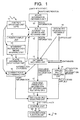
- FIG. 1 is a functional block diagram illustrating the configuration of a communication device being one embodiment of the present invention.
- this communication device has a position specifying unit 11, a route information storing and retaining unit 12, an option list storing and retaining unit 13, a database inquiring 14, a current point determining unit 15, an applied policy selecting unit 16, an effective frequency information list storing and retaining unit 17, a use frequency selecting unit 18, a control unit 19, a position input unit 21, a route information obtaining unit 22, a movement transportation means inferring unit 23, a route information generating unit 24, and a communication function unit 30.
- FIG. 1 illustrates the functional block diagram, but in the following description of the operations of the respective units of the configuration in this drawing, FIG. 2 to FIG. 6 will be referred to when necessary.
- the position specifying unit 11 specifies a current position of the host device by using, for example, a GPS satellite.
- the specified current position is given to the route information storing and retaining unit 12, the movement transportation means inferring unit 23, and the current point determining unit 15.
- the route information storing and retaining unit 12 is a storage unit for storing and retaining route information being a planned moving route of the host device, and is capable of utilizing the current position which is given from the position specifying unit 11 as information on a starting point of the planned moving route. The utilization of the current position in the movement transportation means inferring unit 23 and the current point determining unit 15 will be described later.
- the route information storing and retaining unit 12 stores and retains the route information being the planned moving route of the host device as descried above. As one method for this purpose, it is possible to obtain the route information from another device via the route information obtaining unit 22, or it is possible to use the route information generated by the route information generating unit 24. Functions and operations of the route information obtaining unit 22 and the route information generating unit 24 will be described later.
- the route information is given to the database inquiring unit 14 from the route information storing and retaining unit 12.
- FIG. 2 is an explanatory view illustrating an example of the route information that the route information storing and retaining unit 12 illustrated in FIG. 1 can store and retain.
- the route information storing and retaining unit 12 information on the geographically specified planned moving route of the host device is retained. More concretely, the information can be retained as, for example, a set of pieces of sequential information on longitude and latitude (in addition, altitude).
- the option list storing and retaining unit 13 stores and retains an option list having options corresponding to different viewpoints regarding frequency selection policies which are viewpoints in selecting a frequency to be used.
- FIG. 3 illustrates an example of the option list that the option list storing and retaining unit 13 can store and retain.
- possible options are, for example, an option to "give a higher priority to reducing the number of times the frequency to be used is changed as much as possible” and an option to give a higher priority to "increasing a communication speed as much as possible”. In addition to one or both of these, other options may of course be further provided.
- the option list can be given from the option list storing and retaining unit 13 to the database inquiring unit 14 and the applied policy selecting unit 16.
- the database inquiring unit 14 transmits the route information given from the route information storing and retaining unit 12 and the option list given from the option list storing and retaining unit 13 to the database to inquire about an available frequency (in addition, its maximum transmission power and various other use conditions).
- This database is a server provided on the Internet so as to provide at least information regarding frequencies which are available without affecting a primary user, to the communication device (secondary user) operable under a TVWS environment.
- FIG. 4 is an explanatory view illustrating an example of a relation between the route information and frequencies available in respective areas including the route.
- the database checks the frequencies available in the areas including the route based on the transmitted route information. For example, when the route information in FIG. 2 and the option list in FIG. 3 are transmitted, areas and frequencies are picked up in the database, such as "area A, available frequency a", “area B, available frequency b", “area C, available frequency c", “area D, available frequency d", “area E, available frequency e”, “area F, available frequency f", and "area G, available frequency g", as illustrated in FIG. 4 .
- the number of the available frequencies a and so on is not necessarily one, but a case where the number is plural is also common.
- the shapes of the areas A to G can be generally more complicated shapes than the illustrated ones because of a mutual relation with the primary user, especially an influence of topography or the like.
- the shapes of the areas A to G are schematically illustrated for convenience of the description.
- corresponding points on the route indicated by the route information are next decided based on, for example, nominal center points (refer to FIG. 4 ) in the respective areas A to G.
- the corresponding points can be, for example, points on the route whose distances to the center points are the shortest. This is illustrated in FIG. 5.
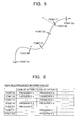
- FIG. 5 is an explanatory view illustrating an example of a relation between the route information and the points on the route. The points are decided as a point AA to a point GG as illustrated in FIG. 5 .
- FIG. 6 is an explanatory view illustrating an example of an effective frequency information list indicating the available frequencies listed in correspondence to the respective points on the route indicated by the route information and the respective options in the option list.
- “case of option 1” is an option to "give a higher priority to reducing the number of times the frequency to be used is changed as much as possible” as in the option list illustrated in FIG. 3 .
- the database decides the points on the route and the frequencies available there, such as "point AA, frequency a”, “point BB, frequency b", “point DD, frequency d", and "EE, frequency e”.
- deciding the points and the frequencies can reduce the number of times the frequency is changed (three times in this case) under a condition that the communication is not interrupted on the route.
- FIG. 4 can be referred to again.
- case of option 2 is an option to "give a higher priority to increasing the communication speed as much as possible” as in the option list illustrated in FIG. 3 .
- the database decides the points on the route and the frequencies available there, such as "point AA, frequency a”, “point BB, frequency b", “point CC, frequency c", “point DD, frequency d", “point FF, frequency f", and "point GG, frequency g".
- FIG. 4 can be referred to again.
- the database decides points on the route and frequencies available there in consideration of the meanings of the options.
- the effective frequency information list is transmitted to the database inquiring unit 14 from the database as a response to the inquiry.
- the database inquiring unit 14 receives this to make the effective frequency information list storing and retaining unit 17 store this and also gives the information indicating the points in the list to the current point determining unit 15.
- the current point determining unit 15 determines to which point out of the aforesaid points given originally from the database, the current position given from the position specifying unit 11 is close. Concretely, for example, an operation of citing several candidates in order from the closest point can be adopted. The candidates thus cited as the point information are given to the use frequency selecting unit 18.
- the applied policy selecting unit 16 refers to the option list ( FIG. 3 ) given from the option list storing and retaining unit 13 and selects an appropriate one from the option list as the policy to be applied, based on the nature of information processing performed by the host device.
- the information processing performed by the host device is, plainly speaking, processing based on application, and it is thought that applying an appropriate policy so as to conform to the nature of the processing of each application is advantageous for the operation of the application.
- the selected policy to be applied is given to the use frequency selecting unit 18.
- the use frequency selecting unit 18 selects, as the use frequency, a frequency listed in correspondence to the point close to the current position out of the points given originally from the database and the policy to be applied. Regarding the point close to the current position, there is a possibility that the effective frequency information list does not have a frequency corresponding to the closest point, depending on the kind of the option, and therefore, in this case, a frequency corresponding to the next closest point is selected. Information on the selected use frequency is given to the control unit 19.
- the control unit 19 controls the communication function unit 30 based on the information on the use frequency given from the use frequency selecting unit 18. That is, the communication function unit 30 performs wireless transmission/reception by using the use frequency.
- the communication function unit 30 is a function unit responsible for the original communication function.
- this communication device there is provided the configuration in which the frequency is selected according to the pre-obtained information on the frequencies available at the respective points, and in addition, this selection becomes a selection of an advantageous frequency appropriate for the nature of the information processing. Therefore, even at the time of the movement at a high speed to a certain degree or more, it is possible to make the number of times the inquiry is sent to the database very small (in the case of the smallest number of times, once at the beginning), and to select an advantageous frequency so as to conform to the kind of the application, while the communication device is moving on the route.
- the position input unit 21 is an input unit (user interface) provided so that a user can manually input the current position thereto.
- the input current position can be given to the route information storing and retaining unit 12.
- the route information storing and retaining unit 12 can use the current position given from the position input unit 21 instead of the current position from the position specifying unit 11, as information of the starting point of the planned moving route, depending on the circumstances. For example, in such a case where the position information can be prepared in advance like that of a station of a rapid-transit railway or an interchange of an expressway, a user can select the name of the station or the name of the interchange from an interface and give the corresponding position information to the route information storing and retaining unit 12 through the position input unit 21.
- the route information obtaining unit 22 is an interface for obtaining the route information from another device or apparatus for the purpose of making the route information stored and retained in the route information storing and retaining unit 12.
- the other device or apparatus are a navigation system (especially a car navigation system), a device capable of route search using a google map, a smartphone provided with route guide application, and so on.
- the route information obtaining unit 22 is used, the user can easily create the planned moving route by using the other device or apparatus, and an appropriate frequency as the communication device can be selected in linkage with the created planned moving route.
- the movement transportation means infecting unit 23 infers a movement transportation means used for the current movement of the host device, based on information on a change of a geographical position given from the position specifying unit 11. For example, when a specific rapid-transit railway or a specific expressway is a current movement transportation means, such an inference is possible from the initial position of the planned moving route and a movement destination position shortly thereafter which positions are specified by the position specifying unit 11. This is because the position information of the specific rapid-transit railway and expressway can be stored and registered in advance.
- the information on the inferred movement transportation means is given from the movement transportation means inferring unit 23 to the route information generating unit 24.
- the route information generating unit 24 generates the route information being the planned moving route of the host device based on the information on the movement transportation means given from the movement transportation means inferring unit 23.
- Such route information may be information on, for example, a route up to a terminal of the specific rapid-transit railway or the specific expressway, or may be information on a route up to a point on the way. This is because, when the actual movement is not up to the terminal, a route outside the movement turns out not to be used, and when the movement is beyond a point on the way, handling the point on the way as a starting point again enables the same operation.
- the generated route information is given from the route information generating unit 24 to the route information storing and retaining unit 12 to be stored and retained therein.
Landscapes
- Engineering & Computer Science (AREA)
- Computer Networks & Wireless Communication (AREA)
- Signal Processing (AREA)
- Quality & Reliability (AREA)
- Mobile Radio Communication Systems (AREA)
Abstract
Description
- The present invention relates to a communication device which is a terminal configured to operate under a television white space (TVWS) environment and to a communication control method in the same, and in particular, relates to a communication device which is usable on the premise that it moves at a high speed to a certain degree or more, and to a communication control method in the same.
- Wireless communication standards which use the same frequency band as that of a television broadcast being a licensed business and can be operated with no such a license, have been investigated. In these standards, a television broadcaster is a primary user, and only when a licensed frequency band of the primary user is not used, a secondary user is allowed to operate a wireless communication in the frequency band (licensed frequency band which is not used = white space).
- In order to confirm that a TV signal does not exist, a communication device used by the secondary user under such an environment inquires of a database specialized for this purpose about a TV channel, for instance. Specifically, current position information of the communication device is transmitted to the database, and a list of frequencies available (effective) at this position is obtained from the database. Then, a frequency to be used is selected from the frequencies in the list, and a wireless communication is operated as the secondary user.
- The frequency for the secondary user thus selected is based only on the current position at the time of the inquiry to the database, and when the communication device of the secondary user moves, this frequency is not always a frequency available in a destination area especially when the device moves at a high speed. In such a case, it is necessary to change the frequencies to be used through mutual communications with the database during the movement, and the more frequently they are changed, the more disadvantageous in stably operating the communication.
-
- Non-patent Document 1: IEEE802.11af Task Group, http://mentor.ieee.org/802.11/
- Non-patent Document 2: IEEE802.22 Working Group, http://mentor.ieee.org/22/
- Non-patent Document 3: IEEE802.19.1 Task Group, http://mentor.ieee.org/802.802.19/documents
- Non-patent Document 4: Federal Communications Commission, Unlicensed Operation in the TV Broadcast Bands, Second Memorandum Opinion and Order, FCC, 10-17-4, Sept. 23, 2010.
- Non-patent Document 5: Ofcom, Digital Dividend: Cognitive Access, Consultation on License Exempting Cognitive Devices using Interleaved Spectrum, July 2009.
- It is an object of the present invention to provide a communication device which is a terminal configured to operate under a television white space environment and a communication control method in the same, the communication device and the communication control method in the same being capable of advantageously selecting a use frequency even when the communication device moves at a high speed to a certain degree or more.
- In order to solve the aforesaid problem, a communication device being one aspect of the present invention is a communication device which has a communication function unit, the communication device including: a means which specifies a first position being a geographical position where the host device exists at a first point in time and a second position being a geographical position where the host device exists at a second point in time later than the first point in time; a means which stores and retains route information being a planned moving route of the host device starting from the first position; a means which stores and retains an option list having options corresponding to different viewpoints regarding frequency selection policies being viewpoints in selecting a frequency to be used; a means which transmits the route information and the option list to a database; a means which receives an effective frequency information list sent from the database as information corresponding to the route information and the option list, the effective frequency information list indicating available frequencies listed in correspondence to respective points on the route indicated by the route information and the respective options; a means which determines to which point out of the points given from the database the second position is close; a means which selects an appropriate option from the option list as a policy to be applied, based on a nature of information processing performed by the host device; a means which selects a frequency listed in correspondence to the point close to the second position out of the points given from the database and the policy to be applied, as a use frequency from the effective frequency information list; and a means which controls the communication function unit to make the communication function unit use the use frequency.
- This communication device is capable of storing and retaining the route information being the planned moving route of the device. Further, regarding the frequency selection policies being the viewpoints in selecting the frequency to be used, it is capable of storing and retaining the option list having the options corresponding to the different viewpoints. Then, it sends the inquiry about the available frequency to the database together with the route information and the option list, and obtains, from the database, the effective frequency information list indicating the available frequencies listed in correspondence to the respective points on the route indicated by the route information and the respective options.
- Next, this communication device determines to which point out of the points given from the database the position at this time (second position) is close, and further selects the appropriate option from the option list, as the policy to be applied, based on the nature of the information processing performed by the device. Consequently, it is possible to select the frequency listed in correspondence to the point close to the second position out of the points given from the database and the policy to be applied, as the use frequency from the effective frequency information list. That is, it is configured such that a frequency is selected according to the pre-obtained information on the frequencies available at the respective points so that it becomes possible to cope with the case where the device is moving at a high speed to a certain degree or more, and in addition, this becomes a selection of an advantageous use frequency appropriate for the nature of the information processing.
- Further, a communication control method being another aspect of the present invention is a communication control method in a communication device having a communication function unit, the method including: specifying a first position being a geographical position where the host device exists at a first point in time and a second position being a geographical position where the host device exists at a second point in time later than the first point in time; storing and retaining route information being a planned moving route of the host device starting from the first position; storing and retaining an option list having options corresponding to different viewpoints regarding frequency selection policies being viewpoints in selecting a frequency to be used; transmitting the route information and the option list to a database; receiving an effective frequency information list sent from the database as information corresponding to the route information and the option list, the effective frequency information list indicating available frequencies listed in correspondence to respective points on the route indicated by the route information and the respective options; determining to which point out of the points given from the database the second position is close; selecting an appropriate option from the option list as a policy to be applied, based on a nature of information processing performed by the host device; selecting a frequency listed in correspondence to the point close to the second position out of the points given from the database and the policy to be applied, as a use frequency from the effective frequency information list; and controlling the communication function unit to make the communication function unit use the use frequency.
- This communication control method is a control method conforming to the above-described communication device.
- According to the present invention, it is possible to provide a communication device which is a terminal configured to operate under a television white space environment and a communication control method in the same, the communication device and the communication control method in the same being capable of advantageously selecting a use efficiency even when the device is moving at a high speed to a certain degree or more.
-
-
FIG. 1 is a functional block diagram illustrating the configuration of a wireless device being one embodiment of the present invention. -
FIG. 2 is an explanatory view illustrating an example of route information that a route information storing and retainingunit 12 illustrated inFIG. 1 can store and retain. -
FIG. 3 is an explanatory view illustrating an example of an option list that an option list storing and retainingunit 13 illustrated inFIG. 1 can store and retain. -
FIG. 4 is an explanatory view illustrating an example of a relation between the route information and frequencies available in respective areas including the route (processing by a database side). -
FIG. 5 is an explanatory view illustrating an example of a relation between the route information and points on the route (processing by the database side). -
FIG. 6 is an explanatory view illustrating an example of an effective frequency information list indicating available frequencies listed in correspondence to the respective points on the route indicated by the route information and respective options in the option list (processing by the database side). - As a mode of the present invention, it is also possible to further include a means which receives information indicating the first position for the purpose of specifying the first position. The first position is a position corresponding to a starting point of the planned moving route of the host device. In order to specify this position, a GPS (global positioning system) satellite is usable, for instance. Besides, an input unit (user interface) capable of accepting a manual input by a user may be provided.
- Further, as a mode, it is possible to further include a means which obtains the route information from another device for the purpose of making the route information stored and retained. In short, this enables to create the planned moving route by using, for example, a navigation device, and to select a frequency appropriate as the communication device in linkage with the created planned moving route.
- Further, as a mode, it is also possible to further include: a means which infers a movement transportation means used for the movement of the host device based on a third position and the first position, the third position being a geographical position where the host device exists at a third point in time later than the first point in time and earlier than the second point in time; and a means which generates the route information based on the movement transportation means for the purpose of making the route information stored and retained.
- This is intended to automatically create the route information by inferring the planned moving route, without a user side intentionally creating the planned moving route. For example, when the communication device moves by a movement transportation means such as an expressway or a rapid-transit railway, it is possible to relatively easily infer the movement transportation means based on the initial position (first position) of the communication device and, for example, its position at a point in time immediately thereafter (third position). If the movement transportation means can be inferred, the route information being the planned moving route can naturally be generated.
- Further, as a mode, it is also possible that the option list has at least one or both of an option corresponding to a viewpoint to give a higher priority to reducing the number of times the frequency to be used is changed as much as possible and an option corresponding to a viewpoint to give a higher priority to increasing a communication speed as much as possible. This means that it is possible to, for example, select a frequency, with a higher priority given to stable communication or select a frequency, with a higher priority given to high-speed communication, according to the nature of the information processing (application) performed by the host device. Thus taking such a priority into consideration often works in favor of the operation of various kinds of application, and this is enabled.
- Based on the above, an embodiment of the present invention will be hereinafter described with reference to the drawings.
FIG. 1 is a functional block diagram illustrating the configuration of a communication device being one embodiment of the present invention. As illustrated in this drawing, this communication device has a position specifying unit 11, a route information storing and retainingunit 12, an option list storing and retainingunit 13, a database inquiring 14, a current point determining unit 15, an appliedpolicy selecting unit 16, an effective frequency information list storing and retainingunit 17, a usefrequency selecting unit 18, a control unit 19, aposition input unit 21, a routeinformation obtaining unit 22, a movement transportation means inferringunit 23, a routeinformation generating unit 24, and acommunication function unit 30. -
FIG. 1 illustrates the functional block diagram, but in the following description of the operations of the respective units of the configuration in this drawing,FIG. 2 to FIG. 6 will be referred to when necessary. - The position specifying unit 11 specifies a current position of the host device by using, for example, a GPS satellite. The specified current position is given to the route information storing and retaining
unit 12, the movement transportation means inferringunit 23, and the current point determining unit 15. The route information storing and retainingunit 12 is a storage unit for storing and retaining route information being a planned moving route of the host device, and is capable of utilizing the current position which is given from the position specifying unit 11 as information on a starting point of the planned moving route. The utilization of the current position in the movement transportation means inferringunit 23 and the current point determining unit 15 will be described later. - The route information storing and retaining
unit 12 stores and retains the route information being the planned moving route of the host device as descried above. As one method for this purpose, it is possible to obtain the route information from another device via the routeinformation obtaining unit 22, or it is possible to use the route information generated by the routeinformation generating unit 24. Functions and operations of the routeinformation obtaining unit 22 and the routeinformation generating unit 24 will be described later. The route information is given to thedatabase inquiring unit 14 from the route information storing and retainingunit 12. -
FIG. 2 is an explanatory view illustrating an example of the route information that the route information storing and retainingunit 12 illustrated inFIG. 1 can store and retain. As illustrated inFIG. 2 , in the route information storing and retainingunit 12, information on the geographically specified planned moving route of the host device is retained. More concretely, the information can be retained as, for example, a set of pieces of sequential information on longitude and latitude (in addition, altitude). - The option list storing and retaining
unit 13 stores and retains an option list having options corresponding to different viewpoints regarding frequency selection policies which are viewpoints in selecting a frequency to be used.FIG. 3 illustrates an example of the option list that the option list storing and retainingunit 13 can store and retain. As illustrated inFIG. 3 , possible options are, for example, an option to "give a higher priority to reducing the number of times the frequency to be used is changed as much as possible" and an option to give a higher priority to "increasing a communication speed as much as possible". In addition to one or both of these, other options may of course be further provided. The option list can be given from the option list storing and retainingunit 13 to thedatabase inquiring unit 14 and the appliedpolicy selecting unit 16. - Incidentally, when a frequency selected based on the frequency selection policy corresponding to the viewpoint to "give a higher priority to reducing the number of times the frequency to be used is changed as much as possible" is used, it is possible to expect stability by eliminating a possibility that the communication is interrupted, and when a frequency selected based on the frequency selection policy corresponding to the viewpoint to "give a higher priority to increasing a communication speed as much as possible" is used, it is possible to cope with a communication with a larger data amount. Giving a higher priority to any of these often works in favor of the operation of various kinds of application.
- The
database inquiring unit 14 transmits the route information given from the route information storing and retainingunit 12 and the option list given from the option list storing and retainingunit 13 to the database to inquire about an available frequency (in addition, its maximum transmission power and various other use conditions). This database is a server provided on the Internet so as to provide at least information regarding frequencies which are available without affecting a primary user, to the communication device (secondary user) operable under a TVWS environment. -
FIG. 4 is an explanatory view illustrating an example of a relation between the route information and frequencies available in respective areas including the route. The database checks the frequencies available in the areas including the route based on the transmitted route information. For example, when the route information inFIG. 2 and the option list inFIG. 3 are transmitted, areas and frequencies are picked up in the database, such as "area A, available frequency a", "area B, available frequency b", "area C, available frequency c", "area D, available frequency d", "area E, available frequency e", "area F, available frequency f", and "area G, available frequency g", as illustrated inFIG. 4 . - Note that the number of the available frequencies a and so on is not necessarily one, but a case where the number is plural is also common. Further, the shapes of the areas A to G can be generally more complicated shapes than the illustrated ones because of a mutual relation with the primary user, especially an influence of topography or the like. The shapes of the areas A to G are schematically illustrated for convenience of the description.
- In the database, corresponding points on the route indicated by the route information are next decided based on, for example, nominal center points (refer to
FIG. 4 ) in the respective areas A to G. The corresponding points can be, for example, points on the route whose distances to the center points are the shortest. This is illustrated inFIG. 5. FIG. 5 is an explanatory view illustrating an example of a relation between the route information and the points on the route. The points are decided as a point AA to a point GG as illustrated inFIG. 5 . - In the database, recommended frequencies available at the aforesaid points are next decided based on the sent option list, in consideration of the meanings of the options. This will be described with reference to
FIG. 6. FIG. 6 is an explanatory view illustrating an example of an effective frequency information list indicating the available frequencies listed in correspondence to the respective points on the route indicated by the route information and the respective options in the option list. - In
FIG. 6 , "case ofoption 1" is an option to "give a higher priority to reducing the number of times the frequency to be used is changed as much as possible" as in the option list illustrated inFIG. 3 . In the case of this option, the database decides the points on the route and the frequencies available there, such as "point AA, frequency a", "point BB, frequency b", "point DD, frequency d", and "EE, frequency e". Thus deciding the points and the frequencies can reduce the number of times the frequency is changed (three times in this case) under a condition that the communication is not interrupted on the route. Regarding this,FIG. 4 can be referred to again. - Further, in
FIG. 6 "case ofoption 2" is an option to "give a higher priority to increasing the communication speed as much as possible" as in the option list illustrated inFIG. 3 . In the case of this option, the database decides the points on the route and the frequencies available there, such as "point AA, frequency a", "point BB, frequency b", "point CC, frequency c", "point DD, frequency d", "point FF, frequency f", and "point GG, frequency g". Thus deciding the points and the frequencies makes it possible to cope with a higher-speed communication since the route stays at a place closer to the center of each of the areas. Regarding that the route stays at the place closer to the center of each of the areas,FIG. 4 can be referred to again. - When there are other options, the database decides points on the route and frequencies available there in consideration of the meanings of the options. By the above-described operation of the database, it is possible to create the effective frequency information list indicating the available frequencies listed in correspondence to the respective points on the route indicated by the route information and the respective options as illustrated in
FIG. 6 . The effective frequency information list is transmitted to thedatabase inquiring unit 14 from the database as a response to the inquiry. Thedatabase inquiring unit 14 receives this to make the effective frequency information list storing and retainingunit 17 store this and also gives the information indicating the points in the list to the current point determining unit 15. - The current point determining unit 15 determines to which point out of the aforesaid points given originally from the database, the current position given from the position specifying unit 11 is close. Concretely, for example, an operation of citing several candidates in order from the closest point can be adopted. The candidates thus cited as the point information are given to the use
frequency selecting unit 18. - The applied
policy selecting unit 16 refers to the option list (FIG. 3 ) given from the option list storing and retainingunit 13 and selects an appropriate one from the option list as the policy to be applied, based on the nature of information processing performed by the host device. The information processing performed by the host device is, plainly speaking, processing based on application, and it is thought that applying an appropriate policy so as to conform to the nature of the processing of each application is advantageous for the operation of the application. The selected policy to be applied is given to the usefrequency selecting unit 18. - From the effective frequency information list retained by the effective frequency information list storing and retaining
unit 17, the usefrequency selecting unit 18 selects, as the use frequency, a frequency listed in correspondence to the point close to the current position out of the points given originally from the database and the policy to be applied. Regarding the point close to the current position, there is a possibility that the effective frequency information list does not have a frequency corresponding to the closest point, depending on the kind of the option, and therefore, in this case, a frequency corresponding to the next closest point is selected. Information on the selected use frequency is given to the control unit 19. - The control unit 19 controls the
communication function unit 30 based on the information on the use frequency given from the usefrequency selecting unit 18. That is, thecommunication function unit 30 performs wireless transmission/reception by using the use frequency. Thecommunication function unit 30 is a function unit responsible for the original communication function. - In the foregoing, the configuration of one embodiment and the basic operation thereof are described. According to this communication device, there is provided the configuration in which the frequency is selected according to the pre-obtained information on the frequencies available at the respective points, and in addition, this selection becomes a selection of an advantageous frequency appropriate for the nature of the information processing. Therefore, even at the time of the movement at a high speed to a certain degree or more, it is possible to make the number of times the inquiry is sent to the database very small (in the case of the smallest number of times, once at the beginning), and to select an advantageous frequency so as to conform to the kind of the application, while the communication device is moving on the route.
- Next, operations and effects of the blocks whose description is omitted or only brief in the above description, out of the blocks illustrated in
FIG. 1 , will be hereinafter supplementarily described. It is arbitrary whether to provide these blocks or not. - The
position input unit 21 is an input unit (user interface) provided so that a user can manually input the current position thereto. The input current position can be given to the route information storing and retainingunit 12. The route information storing and retainingunit 12 can use the current position given from theposition input unit 21 instead of the current position from the position specifying unit 11, as information of the starting point of the planned moving route, depending on the circumstances. For example, in such a case where the position information can be prepared in advance like that of a station of a rapid-transit railway or an interchange of an expressway, a user can select the name of the station or the name of the interchange from an interface and give the corresponding position information to the route information storing and retainingunit 12 through theposition input unit 21. - The route
information obtaining unit 22 is an interface for obtaining the route information from another device or apparatus for the purpose of making the route information stored and retained in the route information storing and retainingunit 12. Examples of the other device or apparatus are a navigation system (especially a car navigation system), a device capable of route search using a google map, a smartphone provided with route guide application, and so on. When the routeinformation obtaining unit 22 is used, the user can easily create the planned moving route by using the other device or apparatus, and an appropriate frequency as the communication device can be selected in linkage with the created planned moving route. - The movement transportation means infecting
unit 23 infers a movement transportation means used for the current movement of the host device, based on information on a change of a geographical position given from the position specifying unit 11. For example, when a specific rapid-transit railway or a specific expressway is a current movement transportation means, such an inference is possible from the initial position of the planned moving route and a movement destination position shortly thereafter which positions are specified by the position specifying unit 11. This is because the position information of the specific rapid-transit railway and expressway can be stored and registered in advance. The information on the inferred movement transportation means is given from the movement transportation means inferringunit 23 to the routeinformation generating unit 24. - The route
information generating unit 24 generates the route information being the planned moving route of the host device based on the information on the movement transportation means given from the movement transportation means inferringunit 23. Such route information may be information on, for example, a route up to a terminal of the specific rapid-transit railway or the specific expressway, or may be information on a route up to a point on the way. This is because, when the actual movement is not up to the terminal, a route outside the movement turns out not to be used, and when the movement is beyond a point on the way, handling the point on the way as a starting point again enables the same operation. The generated route information is given from the routeinformation generating unit 24 to the route information storing and retainingunit 12 to be stored and retained therein. - By providing the above-described movement transportation means inferring
unit 23 and routeinformation generating unit 24, it is possible to automatically create the route information by inferring the planned moving route without a user side intentionally creating the planned moving route, which is user-friendly. - While certain embodiments have been described, these embodiments have been presented by way of example only, and are not intended to limit the scope of the inventions. These novel embodiments may be embodied in a variety of other forms, and various omissions, substitutions and changes may be made without departing from the spirit of the inventions. Such embodiments or modifications are included in the scope and spirit of the inventions and included in the inventions described in the claims and their equivalents.
Claims (6)
- A communication device which has a communication function unit, the communication device comprising:a means which specifies a first position being a geographical position where the host device exists at a first point in time and a second position being a geographical position where the host device exists at a second point in time later than the first point in time;a means which stores and retains route information being a planned moving route of the host device starting from the first position;a means which stores and retains an option list having options corresponding to different viewpoints regarding frequency selection policies being viewpoints in selecting a frequency to be used;a means which transmits the route information and the option list to a database;a means which receives an effective frequency information list sent from the database as information corresponding to the route information and the option list, the effective frequency information list indicating available frequencies listed in correspondence to respective points on the route indicated by the route information and the respective options;a means which determines to which point out of the points given from the database the second position is close;a means which selects an appropriate option from the option list as a policy to be applied, based on a nature of information processing performed by the host device;a means which selects a frequency listed in correspondence to the point close to the second position out of the points given from the database and the policy to be applied, as a use frequency from the effective frequency information list; anda means which controls the communication function unit to make the communication function unit use the use frequency.
- The communication device according to claim 1, further comprising a means which receives information indicating the first position for the purpose of specifying the first position.
- The communication device according to claim 1, further comprising a means which obtains the route information from another device for the purpose of making the route information stored and retained.
- The communication device according to claim 1, further comprising:a means which infers a movement transportation means used for the movement of the host device based on a third position and the first position, the third position being a geographical position where the host device exists at a third point in time later than the first point in time and earlier than the second point in time; anda means which generates the route information based on the movement transportation means for the purpose of making the route information stored and retained.
- The communication device according to claim 1, wherein the option list has at least one or both of an option corresponding to a viewpoint to give a higher priority to reducing the number of times the frequency to be used is changed as much as possible and an option corresponding to a viewpoint to give a higher priority to increasing a communication speed as much as possible.
- A communication control method in a communication device having a communication function unit, the method comprising:specifying a first position being a geographical position where the host device exists at a first point in time and a second position being a geographical position where the host device exists at a second point in time later than the first point in time;storing and retaining route information being a planned moving route of the host device starting from the first position;storing and retaining an option list having options corresponding to different viewpoints regarding frequency selection policies being viewpoints in selecting a frequency to be used;transmitting the route information and the option list to a database;receiving an effective frequency information list sent from the database as information corresponding to the route information and the option list, the effective frequency information list indicating available frequencies listed in correspondence to respective points on the route indicated by the route information and the respective options;determining to which point out of the points given from the database the second position is close;selecting an appropriate option from the option list as a policy to be applied, based on a nature of information processing performed by the host device;selecting a frequency listed in correspondence to the point close to the second position out of the points given from the database and the policy to be applied, as a use frequency from the effective frequency information list; andcontrolling the communication function unit to make the communication function unit use the use frequency.
Applications Claiming Priority (2)
| Application Number | Priority Date | Filing Date | Title |
|---|---|---|---|
| JP2012134399A JP5958747B2 (en) | 2012-06-14 | 2012-06-14 | Communication device and communication control method |
| PCT/JP2012/007363 WO2013186824A1 (en) | 2012-06-14 | 2012-11-16 | Communication device, and communication control method |
Publications (3)
| Publication Number | Publication Date |
|---|---|
| EP2863672A1 true EP2863672A1 (en) | 2015-04-22 |
| EP2863672A4 EP2863672A4 (en) | 2016-03-09 |
| EP2863672B1 EP2863672B1 (en) | 2019-08-14 |
Family
ID=49757691
Family Applications (1)
| Application Number | Title | Priority Date | Filing Date |
|---|---|---|---|
| EP12878662.1A Not-in-force EP2863672B1 (en) | 2012-06-14 | 2012-11-16 | Communication device, and communication control method for frequency selection |
Country Status (6)
| Country | Link |
|---|---|
| US (1) | US20150289250A1 (en) |
| EP (1) | EP2863672B1 (en) |
| JP (1) | JP5958747B2 (en) |
| CA (1) | CA2876561A1 (en) |
| SG (1) | SG11201408348XA (en) |
| WO (1) | WO2013186824A1 (en) |
Families Citing this family (4)
| Publication number | Priority date | Publication date | Assignee | Title |
|---|---|---|---|---|
| US10123251B2 (en) * | 2014-01-20 | 2018-11-06 | Telefonaktiebolaget Lm Ericsson (Publ) | Internetworking between radio resource management and spectrum controller |
| JP6510969B2 (en) * | 2015-12-22 | 2019-05-08 | 本田技研工業株式会社 | Server and server client system |
| JP7284487B2 (en) | 2018-03-29 | 2023-05-31 | 国立研究開発法人情報通信研究機構 | Communication network system and communication network method |
| CN109041153B (en) * | 2018-08-13 | 2021-06-25 | 四川飞天联合系统技术有限公司 | Intelligent wireless network access method |
Family Cites Families (13)
| Publication number | Priority date | Publication date | Assignee | Title |
|---|---|---|---|---|
| JP2000207679A (en) * | 1999-01-19 | 2000-07-28 | Equos Research Co Ltd | Information communication equipment for traveling object |
| JP2006203786A (en) * | 2005-01-24 | 2006-08-03 | Pioneer Electronic Corp | Modulator, its method, modulation system, program for them and recording medium with the program recorded thereon |
| US8428584B2 (en) * | 2005-07-01 | 2013-04-23 | Research In Motion Limited | System and method for accelerating network selection by a wireless user equipment (UE) device |
| JP2009188883A (en) * | 2008-02-08 | 2009-08-20 | Toyota Motor Corp | Vehicle communication device, communication system, and communication control method |
| JP5059649B2 (en) * | 2008-02-18 | 2012-10-24 | 日立オートモティブシステムズ株式会社 | Mobile radio communication control apparatus and radio communication control method |
| JP4512143B2 (en) * | 2008-02-21 | 2010-07-28 | 株式会社トヨタIt開発センター | Mobile radio communication system and radio communication method |
| WO2009156554A1 (en) * | 2008-06-27 | 2009-12-30 | Elektrobit Wireless Communications Oy | Vehicle route selection |
| US20100121977A1 (en) * | 2008-11-10 | 2010-05-13 | Nokia Corporation | Predictive Bit-Rate Modification of Content Delivery in a Wireless Network |
| US8824382B2 (en) * | 2009-10-02 | 2014-09-02 | Nokia Corporation | Reservation of spectrum resources in white spaces |
| US10172114B2 (en) * | 2009-12-11 | 2019-01-01 | Nokia Technologies Oy | Apparatus and associated methods for determining available channels based on predicted movement |
| US8594061B2 (en) * | 2010-06-22 | 2013-11-26 | Blackberry Limited | Methods and apparatus to access network connectivity information using predicted locations |
| US20110310867A1 (en) * | 2010-06-22 | 2011-12-22 | Richard Howard Kennedy | Methods and apparatus to predict routing to maintain connectivity over a geographic area |
| JP5729629B2 (en) * | 2010-09-09 | 2015-06-03 | 国立研究開発法人情報通信研究機構 | Wireless device and communication method |
-
2012
- 2012-06-14 JP JP2012134399A patent/JP5958747B2/en active Active
- 2012-11-16 US US14/407,821 patent/US20150289250A1/en not_active Abandoned
- 2012-11-16 SG SG11201408348XA patent/SG11201408348XA/en unknown
- 2012-11-16 WO PCT/JP2012/007363 patent/WO2013186824A1/en not_active Ceased
- 2012-11-16 CA CA2876561A patent/CA2876561A1/en not_active Abandoned
- 2012-11-16 EP EP12878662.1A patent/EP2863672B1/en not_active Not-in-force
Also Published As
| Publication number | Publication date |
|---|---|
| JP5958747B2 (en) | 2016-08-02 |
| SG11201408348XA (en) | 2015-02-27 |
| WO2013186824A1 (en) | 2013-12-19 |
| CA2876561A1 (en) | 2013-12-19 |
| EP2863672B1 (en) | 2019-08-14 |
| JP2013258618A (en) | 2013-12-26 |
| EP2863672A4 (en) | 2016-03-09 |
| US20150289250A1 (en) | 2015-10-08 |
Similar Documents
| Publication | Publication Date | Title |
|---|---|---|
| CN103081525B (en) | Method and apparatus for accessing network connection information using predicted location | |
| US11330412B2 (en) | Vehicle communication system | |
| CN110475200B (en) | Method and device for locating terminal equipment | |
| US20110310867A1 (en) | Methods and apparatus to predict routing to maintain connectivity over a geographic area | |
| US20110310840A1 (en) | Methods and apparatus to reduce network configuration changes | |
| US20110310866A1 (en) | Methods and apparatus to access network connectivity information associated with predicted times | |
| US9392603B2 (en) | Radio communication system, radio communication apparatus, and radio communication method for radio communication system | |
| JP2018506235A (en) | Method and apparatus for managing coexistence of a GNSS receiver and one or more RAT transceivers | |
| EP2863672B1 (en) | Communication device, and communication control method for frequency selection | |
| US9179322B2 (en) | System and method for allocating spectrum using dynamically adjusted separation distances for mitigating interference | |
| EP2887722A1 (en) | Communication device, communication control method, database, and database control method | |
| US9775104B2 (en) | Management device, terminal device, management method, channel scanning method, and memory medium that carry out channel scanning processing of wireless circuit | |
| CN105208522A (en) | Method for automatically selecting a communication channel in an area and its mobile electronic device | |
| JP2015216483A (en) | Terminal device, control method therefor and program | |
| US9445277B2 (en) | Systems and methods for determining and specifying spectrum availability for a predetermined travel route | |
| CN108781370B (en) | Server apparatus, information processing apparatus, and method | |
| WO2019003798A1 (en) | Radio communication device and method of avoiding radio frequency interference | |
| US10298695B2 (en) | Cognitive connectivity management | |
| JP5581976B2 (en) | Coexistence system between wireless communication networks | |
| WO2016199295A1 (en) | Local area wireless communication apparatus and local area wireless communication apparatus setting method | |
| US9775047B2 (en) | Communication device and communication control method | |
| JP5904539B2 (en) | Communication device and communication control method | |
| EP3516832A1 (en) | Methods and apparatus for routing of data packets over a network |
Legal Events
| Date | Code | Title | Description |
|---|---|---|---|
| PUAI | Public reference made under article 153(3) epc to a published international application that has entered the european phase |
Free format text: ORIGINAL CODE: 0009012 |
|
| 17P | Request for examination filed |
Effective date: 20141229 |
|
| AK | Designated contracting states |
Kind code of ref document: A1 Designated state(s): AL AT BE BG CH CY CZ DE DK EE ES FI FR GB GR HR HU IE IS IT LI LT LU LV MC MK MT NL NO PL PT RO RS SE SI SK SM TR |
|
| AX | Request for extension of the european patent |
Extension state: BA ME |
|
| DAX | Request for extension of the european patent (deleted) | ||
| RA4 | Supplementary search report drawn up and despatched (corrected) |
Effective date: 20160204 |
|
| RIC1 | Information provided on ipc code assigned before grant |
Ipc: H04W 16/14 20090101AFI20160129BHEP Ipc: H04W 4/02 20090101ALI20160129BHEP Ipc: H04W 28/16 20090101ALI20160129BHEP |
|
| RAP1 | Party data changed (applicant data changed or rights of an application transferred) |
Owner name: NATIONAL INSTITUTE OF INFORMATION AND COMMUNICATIO |
|
| REG | Reference to a national code |
Ref country code: DE Ref legal event code: R079 Ref document number: 602012063031 Country of ref document: DE Free format text: PREVIOUS MAIN CLASS: H04W0016140000 Ipc: H04W0004020000 |
|
| GRAP | Despatch of communication of intention to grant a patent |
Free format text: ORIGINAL CODE: EPIDOSNIGR1 |
|
| STAA | Information on the status of an ep patent application or granted ep patent |
Free format text: STATUS: GRANT OF PATENT IS INTENDED |
|
| RIC1 | Information provided on ipc code assigned before grant |
Ipc: H04W 4/02 20180101AFI20190131BHEP Ipc: H04W 28/16 20090101ALI20190131BHEP Ipc: H04W 16/14 20090101ALI20190131BHEP |
|
| INTG | Intention to grant announced |
Effective date: 20190222 |
|
| GRAS | Grant fee paid |
Free format text: ORIGINAL CODE: EPIDOSNIGR3 |
|
| GRAA | (expected) grant |
Free format text: ORIGINAL CODE: 0009210 |
|
| STAA | Information on the status of an ep patent application or granted ep patent |
Free format text: STATUS: THE PATENT HAS BEEN GRANTED |
|
| AK | Designated contracting states |
Kind code of ref document: B1 Designated state(s): AL AT BE BG CH CY CZ DE DK EE ES FI FR GB GR HR HU IE IS IT LI LT LU LV MC MK MT NL NO PL PT RO RS SE SI SK SM TR |
|
| REG | Reference to a national code |
Ref country code: GB Ref legal event code: FG4D |
|
| REG | Reference to a national code |
Ref country code: CH Ref legal event code: EP Ref country code: AT Ref legal event code: REF Ref document number: 1168477 Country of ref document: AT Kind code of ref document: T Effective date: 20190815 |
|
| REG | Reference to a national code |
Ref country code: IE Ref legal event code: FG4D |
|
| REG | Reference to a national code |
Ref country code: DE Ref legal event code: R096 Ref document number: 602012063031 Country of ref document: DE |
|
| REG | Reference to a national code |
Ref country code: NL Ref legal event code: MP Effective date: 20190814 |
|
| REG | Reference to a national code |
Ref country code: LT Ref legal event code: MG4D |
|
| PG25 | Lapsed in a contracting state [announced via postgrant information from national office to epo] |
Ref country code: LT Free format text: LAPSE BECAUSE OF FAILURE TO SUBMIT A TRANSLATION OF THE DESCRIPTION OR TO PAY THE FEE WITHIN THE PRESCRIBED TIME-LIMIT Effective date: 20190814 Ref country code: NL Free format text: LAPSE BECAUSE OF FAILURE TO SUBMIT A TRANSLATION OF THE DESCRIPTION OR TO PAY THE FEE WITHIN THE PRESCRIBED TIME-LIMIT Effective date: 20190814 Ref country code: HR Free format text: LAPSE BECAUSE OF FAILURE TO SUBMIT A TRANSLATION OF THE DESCRIPTION OR TO PAY THE FEE WITHIN THE PRESCRIBED TIME-LIMIT Effective date: 20190814 Ref country code: NO Free format text: LAPSE BECAUSE OF FAILURE TO SUBMIT A TRANSLATION OF THE DESCRIPTION OR TO PAY THE FEE WITHIN THE PRESCRIBED TIME-LIMIT Effective date: 20191114 Ref country code: FI Free format text: LAPSE BECAUSE OF FAILURE TO SUBMIT A TRANSLATION OF THE DESCRIPTION OR TO PAY THE FEE WITHIN THE PRESCRIBED TIME-LIMIT Effective date: 20190814 Ref country code: PT Free format text: LAPSE BECAUSE OF FAILURE TO SUBMIT A TRANSLATION OF THE DESCRIPTION OR TO PAY THE FEE WITHIN THE PRESCRIBED TIME-LIMIT Effective date: 20191216 Ref country code: SE Free format text: LAPSE BECAUSE OF FAILURE TO SUBMIT A TRANSLATION OF THE DESCRIPTION OR TO PAY THE FEE WITHIN THE PRESCRIBED TIME-LIMIT Effective date: 20190814 Ref country code: BG Free format text: LAPSE BECAUSE OF FAILURE TO SUBMIT A TRANSLATION OF THE DESCRIPTION OR TO PAY THE FEE WITHIN THE PRESCRIBED TIME-LIMIT Effective date: 20191114 |
|
| REG | Reference to a national code |
Ref country code: AT Ref legal event code: MK05 Ref document number: 1168477 Country of ref document: AT Kind code of ref document: T Effective date: 20190814 |
|
| PG25 | Lapsed in a contracting state [announced via postgrant information from national office to epo] |
Ref country code: RS Free format text: LAPSE BECAUSE OF FAILURE TO SUBMIT A TRANSLATION OF THE DESCRIPTION OR TO PAY THE FEE WITHIN THE PRESCRIBED TIME-LIMIT Effective date: 20190814 Ref country code: LV Free format text: LAPSE BECAUSE OF FAILURE TO SUBMIT A TRANSLATION OF THE DESCRIPTION OR TO PAY THE FEE WITHIN THE PRESCRIBED TIME-LIMIT Effective date: 20190814 Ref country code: ES Free format text: LAPSE BECAUSE OF FAILURE TO SUBMIT A TRANSLATION OF THE DESCRIPTION OR TO PAY THE FEE WITHIN THE PRESCRIBED TIME-LIMIT Effective date: 20190814 Ref country code: AL Free format text: LAPSE BECAUSE OF FAILURE TO SUBMIT A TRANSLATION OF THE DESCRIPTION OR TO PAY THE FEE WITHIN THE PRESCRIBED TIME-LIMIT Effective date: 20190814 Ref country code: GR Free format text: LAPSE BECAUSE OF FAILURE TO SUBMIT A TRANSLATION OF THE DESCRIPTION OR TO PAY THE FEE WITHIN THE PRESCRIBED TIME-LIMIT Effective date: 20191115 Ref country code: IS Free format text: LAPSE BECAUSE OF FAILURE TO SUBMIT A TRANSLATION OF THE DESCRIPTION OR TO PAY THE FEE WITHIN THE PRESCRIBED TIME-LIMIT Effective date: 20191214 |
|
| PG25 | Lapsed in a contracting state [announced via postgrant information from national office to epo] |
Ref country code: TR Free format text: LAPSE BECAUSE OF FAILURE TO SUBMIT A TRANSLATION OF THE DESCRIPTION OR TO PAY THE FEE WITHIN THE PRESCRIBED TIME-LIMIT Effective date: 20190814 |
|
| PG25 | Lapsed in a contracting state [announced via postgrant information from national office to epo] |
Ref country code: AT Free format text: LAPSE BECAUSE OF FAILURE TO SUBMIT A TRANSLATION OF THE DESCRIPTION OR TO PAY THE FEE WITHIN THE PRESCRIBED TIME-LIMIT Effective date: 20190814 Ref country code: PL Free format text: LAPSE BECAUSE OF FAILURE TO SUBMIT A TRANSLATION OF THE DESCRIPTION OR TO PAY THE FEE WITHIN THE PRESCRIBED TIME-LIMIT Effective date: 20190814 Ref country code: IT Free format text: LAPSE BECAUSE OF FAILURE TO SUBMIT A TRANSLATION OF THE DESCRIPTION OR TO PAY THE FEE WITHIN THE PRESCRIBED TIME-LIMIT Effective date: 20190814 Ref country code: RO Free format text: LAPSE BECAUSE OF FAILURE TO SUBMIT A TRANSLATION OF THE DESCRIPTION OR TO PAY THE FEE WITHIN THE PRESCRIBED TIME-LIMIT Effective date: 20190814 Ref country code: EE Free format text: LAPSE BECAUSE OF FAILURE TO SUBMIT A TRANSLATION OF THE DESCRIPTION OR TO PAY THE FEE WITHIN THE PRESCRIBED TIME-LIMIT Effective date: 20190814 Ref country code: DK Free format text: LAPSE BECAUSE OF FAILURE TO SUBMIT A TRANSLATION OF THE DESCRIPTION OR TO PAY THE FEE WITHIN THE PRESCRIBED TIME-LIMIT Effective date: 20190814 |
|
| PG25 | Lapsed in a contracting state [announced via postgrant information from national office to epo] |
Ref country code: IS Free format text: LAPSE BECAUSE OF FAILURE TO SUBMIT A TRANSLATION OF THE DESCRIPTION OR TO PAY THE FEE WITHIN THE PRESCRIBED TIME-LIMIT Effective date: 20200224 Ref country code: SM Free format text: LAPSE BECAUSE OF FAILURE TO SUBMIT A TRANSLATION OF THE DESCRIPTION OR TO PAY THE FEE WITHIN THE PRESCRIBED TIME-LIMIT Effective date: 20190814 Ref country code: SK Free format text: LAPSE BECAUSE OF FAILURE TO SUBMIT A TRANSLATION OF THE DESCRIPTION OR TO PAY THE FEE WITHIN THE PRESCRIBED TIME-LIMIT Effective date: 20190814 Ref country code: CZ Free format text: LAPSE BECAUSE OF FAILURE TO SUBMIT A TRANSLATION OF THE DESCRIPTION OR TO PAY THE FEE WITHIN THE PRESCRIBED TIME-LIMIT Effective date: 20190814 |
|
| REG | Reference to a national code |
Ref country code: DE Ref legal event code: R097 Ref document number: 602012063031 Country of ref document: DE Ref country code: DE Ref legal event code: R119 Ref document number: 602012063031 Country of ref document: DE |
|
| REG | Reference to a national code |
Ref country code: CH Ref legal event code: PL |
|
| PLBE | No opposition filed within time limit |
Free format text: ORIGINAL CODE: 0009261 |
|
| STAA | Information on the status of an ep patent application or granted ep patent |
Free format text: STATUS: NO OPPOSITION FILED WITHIN TIME LIMIT |
|
| PG2D | Information on lapse in contracting state deleted |
Ref country code: IS |
|
| PG25 | Lapsed in a contracting state [announced via postgrant information from national office to epo] |
Ref country code: LI Free format text: LAPSE BECAUSE OF NON-PAYMENT OF DUE FEES Effective date: 20191130 Ref country code: LU Free format text: LAPSE BECAUSE OF NON-PAYMENT OF DUE FEES Effective date: 20191116 Ref country code: CH Free format text: LAPSE BECAUSE OF NON-PAYMENT OF DUE FEES Effective date: 20191130 Ref country code: MC Free format text: LAPSE BECAUSE OF FAILURE TO SUBMIT A TRANSLATION OF THE DESCRIPTION OR TO PAY THE FEE WITHIN THE PRESCRIBED TIME-LIMIT Effective date: 20190814 |
|
| 26N | No opposition filed |
Effective date: 20200603 |
|
| REG | Reference to a national code |
Ref country code: BE Ref legal event code: MM Effective date: 20191130 |
|
| PG25 | Lapsed in a contracting state [announced via postgrant information from national office to epo] |
Ref country code: SI Free format text: LAPSE BECAUSE OF FAILURE TO SUBMIT A TRANSLATION OF THE DESCRIPTION OR TO PAY THE FEE WITHIN THE PRESCRIBED TIME-LIMIT Effective date: 20190814 |
|
| GBPC | Gb: european patent ceased through non-payment of renewal fee |
Effective date: 20191116 |
|
| PG25 | Lapsed in a contracting state [announced via postgrant information from national office to epo] |
Ref country code: IE Free format text: LAPSE BECAUSE OF NON-PAYMENT OF DUE FEES Effective date: 20191116 Ref country code: FR Free format text: LAPSE BECAUSE OF NON-PAYMENT OF DUE FEES Effective date: 20191130 Ref country code: GB Free format text: LAPSE BECAUSE OF NON-PAYMENT OF DUE FEES Effective date: 20191116 Ref country code: DE Free format text: LAPSE BECAUSE OF NON-PAYMENT OF DUE FEES Effective date: 20200603 |
|
| PG25 | Lapsed in a contracting state [announced via postgrant information from national office to epo] |
Ref country code: BE Free format text: LAPSE BECAUSE OF NON-PAYMENT OF DUE FEES Effective date: 20191130 |
|
| PG25 | Lapsed in a contracting state [announced via postgrant information from national office to epo] |
Ref country code: CY Free format text: LAPSE BECAUSE OF FAILURE TO SUBMIT A TRANSLATION OF THE DESCRIPTION OR TO PAY THE FEE WITHIN THE PRESCRIBED TIME-LIMIT Effective date: 20190814 |
|
| PG25 | Lapsed in a contracting state [announced via postgrant information from national office to epo] |
Ref country code: HU Free format text: LAPSE BECAUSE OF FAILURE TO SUBMIT A TRANSLATION OF THE DESCRIPTION OR TO PAY THE FEE WITHIN THE PRESCRIBED TIME-LIMIT; INVALID AB INITIO Effective date: 20121116 Ref country code: MT Free format text: LAPSE BECAUSE OF FAILURE TO SUBMIT A TRANSLATION OF THE DESCRIPTION OR TO PAY THE FEE WITHIN THE PRESCRIBED TIME-LIMIT Effective date: 20190814 |
|
| PG25 | Lapsed in a contracting state [announced via postgrant information from national office to epo] |
Ref country code: MK Free format text: LAPSE BECAUSE OF FAILURE TO SUBMIT A TRANSLATION OF THE DESCRIPTION OR TO PAY THE FEE WITHIN THE PRESCRIBED TIME-LIMIT Effective date: 20190814 |