EP2863584A1 - Verfahren und Vorrichtung zur Zuweisung von Softwareaufgaben - Google Patents
Verfahren und Vorrichtung zur Zuweisung von Softwareaufgaben Download PDFInfo
- Publication number
- EP2863584A1 EP2863584A1 EP20130290249 EP13290249A EP2863584A1 EP 2863584 A1 EP2863584 A1 EP 2863584A1 EP 20130290249 EP20130290249 EP 20130290249 EP 13290249 A EP13290249 A EP 13290249A EP 2863584 A1 EP2863584 A1 EP 2863584A1
- Authority
- EP
- European Patent Office
- Prior art keywords
- client device
- server
- software
- resource usage
- client
- Prior art date
- Legal status (The legal status is an assumption and is not a legal conclusion. Google has not performed a legal analysis and makes no representation as to the accuracy of the status listed.)
- Withdrawn
Links
Images


Classifications
-
- H—ELECTRICITY
- H04—ELECTRIC COMMUNICATION TECHNIQUE
- H04L—TRANSMISSION OF DIGITAL INFORMATION, e.g. TELEGRAPHIC COMMUNICATION
- H04L43/00—Arrangements for monitoring or testing data switching networks
- H04L43/08—Monitoring or testing based on specific metrics, e.g. QoS, energy consumption or environmental parameters
- H04L43/0876—Network utilisation, e.g. volume of load or congestion level
- H04L43/0888—Throughput
-
- G—PHYSICS
- G06—COMPUTING OR CALCULATING; COUNTING
- G06F—ELECTRIC DIGITAL DATA PROCESSING
- G06F9/00—Arrangements for program control, e.g. control units
- G06F9/06—Arrangements for program control, e.g. control units using stored programs, i.e. using an internal store of processing equipment to receive or retain programs
- G06F9/46—Multiprogramming arrangements
- G06F9/50—Allocation of resources, e.g. of the central processing unit [CPU]
- G06F9/5083—Techniques for rebalancing the load in a distributed system
- G06F9/5088—Techniques for rebalancing the load in a distributed system involving task migration
-
- G—PHYSICS
- G06—COMPUTING OR CALCULATING; COUNTING
- G06F—ELECTRIC DIGITAL DATA PROCESSING
- G06F9/00—Arrangements for program control, e.g. control units
- G06F9/06—Arrangements for program control, e.g. control units using stored programs, i.e. using an internal store of processing equipment to receive or retain programs
- G06F9/46—Multiprogramming arrangements
- G06F9/50—Allocation of resources, e.g. of the central processing unit [CPU]
- G06F9/5094—Allocation of resources, e.g. of the central processing unit [CPU] where the allocation takes into account power or heat criteria
-
- G—PHYSICS
- G06—COMPUTING OR CALCULATING; COUNTING
- G06Q—INFORMATION AND COMMUNICATION TECHNOLOGY [ICT] SPECIALLY ADAPTED FOR ADMINISTRATIVE, COMMERCIAL, FINANCIAL, MANAGERIAL OR SUPERVISORY PURPOSES; SYSTEMS OR METHODS SPECIALLY ADAPTED FOR ADMINISTRATIVE, COMMERCIAL, FINANCIAL, MANAGERIAL OR SUPERVISORY PURPOSES, NOT OTHERWISE PROVIDED FOR
- G06Q30/00—Commerce
- G06Q30/02—Marketing; Price estimation or determination; Fundraising
- G06Q30/0207—Discounts or incentives, e.g. coupons or rebates
-
- G—PHYSICS
- G06—COMPUTING OR CALCULATING; COUNTING
- G06F—ELECTRIC DIGITAL DATA PROCESSING
- G06F2209/00—Indexing scheme relating to G06F9/00
- G06F2209/50—Indexing scheme relating to G06F9/50
- G06F2209/509—Offload
-
- Y—GENERAL TAGGING OF NEW TECHNOLOGICAL DEVELOPMENTS; GENERAL TAGGING OF CROSS-SECTIONAL TECHNOLOGIES SPANNING OVER SEVERAL SECTIONS OF THE IPC; TECHNICAL SUBJECTS COVERED BY FORMER USPC CROSS-REFERENCE ART COLLECTIONS [XRACs] AND DIGESTS
- Y02—TECHNOLOGIES OR APPLICATIONS FOR MITIGATION OR ADAPTATION AGAINST CLIMATE CHANGE
- Y02D—CLIMATE CHANGE MITIGATION TECHNOLOGIES IN INFORMATION AND COMMUNICATION TECHNOLOGIES [ICT], I.E. INFORMATION AND COMMUNICATION TECHNOLOGIES AIMING AT THE REDUCTION OF THEIR OWN ENERGY USE
- Y02D10/00—Energy efficient computing, e.g. low power processors, power management or thermal management
Definitions
- the present invention generally relates to the allocation of software tasks of a software application to a cloud service.
- Cloud computing penetrates into almost all application domains. It offers computing resources as a service over a network. End users access cloud-based applications through a web browser, a light weight desktop or a mobile application while the software and user's data are stored on servers at a remote location. Putting services in the cloud has certain advantages like limited requirement to the client side and better/easy maintenance of the services.
- a mobile handheld device may comprise a multi-core processor and more than 2GB of memory. And its computing capabilities are still increasing. In fact, having all services running in the cloud and leaving those powerful end devices in an idle status is an underuse of the computation resources of the mobile device.
- this is achieved by a method for allocating a software task of a software application.
- the task is runnable on both a client device and a server and the method further comprises the following steps:
- the above method thus allows allocating and reallocating software tasks between a server and a client device where the server is capable to run the software task as a service for the client device.
- the client device may have requested the server to run the software application or some software tasks of the software application as a service.
- the advantage is applicable in two directions. First, a server may reallocated a task to a client device, if possible depending on the resources used by the client device, in order to free resources in the server itself. Second, a server may also reallocate a task from the client to the server if the client is short in resources allowing to keep the Quality of Service at the client device to an optimal level.
- the client device has resources available to perform the software task and the resource usage policy is then indicative for how these resources may be used for performing the software task. As the client device reports both the resources that are actually used at a given moment and how the resources may be used for the allocation of software tasks, the available resources for running one of the software tasks can be derived. The resource usage profile is then indicative for how much of the resources would be used when performing the software task on the client device.
- the resources comprise at least one of the group of:
- the client device runs on battery power, specifying the profile and usage as battery power allows to control how long the client device should still run on its battery without recharging.
- processing power By specifying processing power, memory capacity and storage capacity within the resource usage profile, within the actual resource usage and within the resource usage policy it can be determined if the software task could actually run on the client device as required, i.e. according to its profile.
- the network bandwidth can still be a reason not to reallocate the software task to the client device as the network between the client and server may not have the needed bandwidth for the exchange of data between the software task on the client and other software tasks on the server.
- reward information about a reward receivable by the client when performing the software task is available.
- the allocating of the software task is then only performed if the client device agrees on the reward.
- the client device may then receive the reward after completion of the software task.
- the invention also relates to a device adapted to perform the method according to the first aspect. This is achieved by a device for allocating a software task of a software application. The task being runnable on both a client device and a server.
- the device further comprising a dynamic service allocator adapted to:
- a software application is then the assembly of software tasks running on both the server and the client.
- a client device is connected to a server over a network, for example the internet or a local network such as a Local Area Network (LAN).
- a software application is then the assembly of software tasks running on both the server and the client.
- client For example, in a video conferencing software application, several clients run software tasks to capture the video and upload the video to a central server.
- the server runs software tasks to process the captured videos from the clients and to distribute the processed videos to the clients.
- the clients then run other software tasks to play back the videos received from the server.
- clients may be referred to as thin clients, fat clients or hybrid clients.
- Some software tasks may be specific for the client device such as for example, the capturing of a video, the display of a graphical user interface, the interaction with a user by an input device such as a mouse or a keyboard.
- Other software tasks may be specific for the server, such as for example the serving of web pages by a web server or the reception of emails by a mail server.
- Some software tasks may also be runnable by both a server and a client. For example, a client may run a word processing application locally or from a server by a remote desktop connection.
- a server may also refer to an assembly of servers interconnected by a network such as the internet or a local network such as a LAN.
- a network such as the internet or a local network such as a LAN.
- software tasks on a server they may thus also run on different physical servers.
- running a software task on a server may also be referred as running a software task in the cloud where the cloud refers to an assembly of server capable of running the software task.
- Fig. 1 illustrates a system according to embodiments of the present invention.
- the system comprises a client device 2 connected over a network 4 with a server 1 and a server 3.
- the client device 2 comprises a Client Application Management (CAM) service 5.
- the CAM 5 is capable of launching, turning off or resuming software processes or software tasks on the client device on instruction of the server 1.
- the client device 2 further comprises a Client Resource Monitoring service CRM 6 for the monitoring of usage of resources of the client 2.
- the CRM 6 reports the resource usage back to the CAM service 5.
- the CRM service 6 may for example give an indication of the remaining battery power of a battery powering the client device if it is battery powered. If the software tasks managed the CAM service 5 are to be run on processor accessing a memory such as for example a Random Access Memory (RAM), the resources may comprise the processing power of the processor or the memory capacity of the memory. The resources may further also comprise the network capacity of the network connection connecting the client 2 with the network 4.
- a memory such as for example a Random Access Memory (RAM)
- the resources may comprise the processing power of the processor or the memory capacity of the memory.
- the resources may further also comprise the network capacity of the network connection connecting the client 2 with the network 4.
- the client 2 further comprises a Resource Usage Policy (RUP) 9 where some general of specific rules are defined about the usage of the above resources for the allocation of software processes by the server 1. Examples of such rules may be:
- the RUP 9 may be chosen by the user of the client 2, for example through a user interface.
- the client device 2 or the user of the client device 2 decides to run a software application.
- the software application comprises software tasks that are to be executed as a service by the server 3
- the CAM 5 receives this request to run the software tasks on the server 3.
- the CAM 5 checks the RUP 9 whether dynamic service allocation may be applied or not. For example, if the battery power is too low or the processor is already above a certain usage threshold, the RUP may forbid to allocate the software tasks to the client itself. If the RUP allows dynamic allocation of the software tasks, the CAM 5 decides to apply dynamic service allocation and sends its RUP 9 to the Dynamic Service Allocator (DSA) 7 in the server 1.
- the DSA 7 in the server 1 is responsible for carrying out the dynamic service allocation and thus for allocating the software tasks to either the client 2 or the server 3.
- Fig. 2 shows a flow diagram illustrating the performing of the dynamic service allocation by the DSA 7 in the server 1 within the system of Fig. 1 according to an embodiment of the invention.
- the DSA 7 receives the resource usage obtained from the CRM 6 and the RUP 9 respectively from the client 2. Then, in the step 23, it receives the resource usage profile form the server 3.
- This resource usage profile lists the software tasks that could either be run on the client 2 or the server 3 and how much resources each of the tasks need to be ran. This may be specified in some absolute or relative measures. For example the memory usage may be specified as 100 megabytes (MB) which is an absolute value or as 20% of the total capacity which is a relative value.
- MB megabytes
- the DSA 7 determines, in a next step 24, the available resources on the client device 2. Then, in a last step 25, by comparing the available resources with the resource usage profile of the software tasks, the DSA 7 allocates the tasks to either the client 2 or the server 3.
- the CAM 5 in the client 2 will thus receive an indication of the software tasks that it should run and the software tasks it should request from the server 3. At that point, the CAM 5 starts the execution of the software tasks on the client device 2 and requests the other software tasks as a service to the server 3.
- rewards are used to encourage a user of a client device to run software tasks on its device instead of on the server 3.
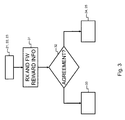
- a flow diagram illustrating this embodiment is shown in Fig. 3 .
- the DSA 7 receives reward information from the server 3 and sends this information to the CAM in the client device 2. This information specifies rewards that a user of the device 2 receives when running one or more of the software tasks on his device 2. The user then sends a confirmation to the DSA 7 whether he agrees or not with the proposed rewards. If he agrees, the DSA 7 continuous with the allocation of the tasks by steps 24 and 25 as described above. If the user does not agree with the offered rewards, the DSA 7 will allocate the tasks to the server 3 in a further step 33.
- the user may give his agreement on the offered rewards in several ways. This may for example be done by a graphical user interface, but may also be automated in the CAM 5 based on predetermined preferences specified by the user.
- a user is joining a video conference.
- a local webcam captures the video footage on the user's device 2 and streams it, as a local software task, to a central server 3, which is responsible for editing, composing and distributing videos of all users and thus responsible for executing a subset of the software tasks that are part of the complete video conferencing application.
- Video editing e.g. detects the contour of the figure and removes the background
- composition e.g. put figures together to form a new video footage
- QoE Quality of Experience
- the video conferencing service provider offers rewards (e.g.
- the client 2 if possible, performs the contour detection and the figure extraction.
- the server only performs the video composition software task. In such the server's load will be reduced and the client will be benefit from his contribution.
- a user is playing a virtual world application on his tablet device 2.
- a virtual world application i.e. the software application
- the CAM 5 application installed on the user's tablet device 2 requests the DSA 7 to reallocate the software tasks of the client application in order to have the scene rendering performed by a cloud service, i.e. on the server 3.
- the server 3 will render the scene for the client 2 and stream the rendered video back to the client as part of the software application. As such it lowers the battery consumption of the tablet device at the expense of increasing the network throughput, which is assumed to be affordable in this case.
- the same video conferencing software application as in the above use case is used and it is assumed that there are two users, a user A and a user B from the same company, that join the video conference.
- User A is using his mobile handheld device 2 and user B is using a powerful desktop.
- the DSA 7 may decide to stream the user A's video footage to the powerful desktop of user B, which is then responsible for preprocessing the video footages of user A and user B.
- user B will benefit more as it takes care of not only his own video processing, but also user A's counterpart tasks.
- the servers 2 and 3 were shown as two separate entities. It will be apparent that the functions performed by these server according to the invention may also be performed on a single server, i.e. the server performing the DSA 7 is then also running the software tasks allocated by the DSA 7.
- the server 3 has been referred to as a single server for running the software tasks.
- the software tasks may also be performed by a plurality of servers located in different geographical area and connected over a network or located in a single server farm.
- the server 3 may thus also act as a cloud service to the client 2.
- top, bottom, over, under, and the like are introduced for descriptive purposes and not necessarily to denote relative positions. It is to be understood that the terms so used are interchangeable under appropriate circumstances and embodiments of the invention are capable of operating according to the present invention in other sequences, or in orientations different from the one(s) described or illustrated above.
Landscapes
- Engineering & Computer Science (AREA)
- Theoretical Computer Science (AREA)
- Software Systems (AREA)
- Business, Economics & Management (AREA)
- Physics & Mathematics (AREA)
- General Physics & Mathematics (AREA)
- Accounting & Taxation (AREA)
- Finance (AREA)
- Strategic Management (AREA)
- Development Economics (AREA)
- General Engineering & Computer Science (AREA)
- Environmental & Geological Engineering (AREA)
- Entrepreneurship & Innovation (AREA)
- Computer Networks & Wireless Communication (AREA)
- Game Theory and Decision Science (AREA)
- Signal Processing (AREA)
- Economics (AREA)
- Marketing (AREA)
- General Business, Economics & Management (AREA)
- Information Transfer Between Computers (AREA)
- Computer And Data Communications (AREA)
Priority Applications (1)
| Application Number | Priority Date | Filing Date | Title |
|---|---|---|---|
| EP20130290249 EP2863584A1 (de) | 2013-10-17 | 2013-10-17 | Verfahren und Vorrichtung zur Zuweisung von Softwareaufgaben |
Applications Claiming Priority (1)
| Application Number | Priority Date | Filing Date | Title |
|---|---|---|---|
| EP20130290249 EP2863584A1 (de) | 2013-10-17 | 2013-10-17 | Verfahren und Vorrichtung zur Zuweisung von Softwareaufgaben |
Publications (1)
| Publication Number | Publication Date |
|---|---|
| EP2863584A1 true EP2863584A1 (de) | 2015-04-22 |
Family
ID=49518883
Family Applications (1)
| Application Number | Title | Priority Date | Filing Date |
|---|---|---|---|
| EP20130290249 Withdrawn EP2863584A1 (de) | 2013-10-17 | 2013-10-17 | Verfahren und Vorrichtung zur Zuweisung von Softwareaufgaben |
Country Status (1)
| Country | Link |
|---|---|
| EP (1) | EP2863584A1 (de) |
Cited By (1)
| Publication number | Priority date | Publication date | Assignee | Title |
|---|---|---|---|---|
| CN114996117A (zh) * | 2022-03-28 | 2022-09-02 | 湖南智擎科技有限公司 | 面向SaaS模式的客户端GPU应用评测系统及方法 |
Citations (4)
| Publication number | Priority date | Publication date | Assignee | Title |
|---|---|---|---|---|
| US20020198769A1 (en) * | 2001-05-11 | 2002-12-26 | Hemisphere Ii | Method and apparatus for providing a reward for the use of a processor in a parallel processing environment |
| US20060184626A1 (en) * | 2005-02-11 | 2006-08-17 | International Business Machines Corporation | Client / server application task allocation based upon client resources |
| WO2009155178A1 (en) * | 2008-06-16 | 2009-12-23 | International Business Machines Corporation | System and method for dynamic partitioning of applications in client-server environments |
| US20120124193A1 (en) | 2010-11-12 | 2012-05-17 | International Business Machines Corporation | Identification of Critical Web Services and their Dynamic Optimal Relocation |
-
2013
- 2013-10-17 EP EP20130290249 patent/EP2863584A1/de not_active Withdrawn
Patent Citations (4)
| Publication number | Priority date | Publication date | Assignee | Title |
|---|---|---|---|---|
| US20020198769A1 (en) * | 2001-05-11 | 2002-12-26 | Hemisphere Ii | Method and apparatus for providing a reward for the use of a processor in a parallel processing environment |
| US20060184626A1 (en) * | 2005-02-11 | 2006-08-17 | International Business Machines Corporation | Client / server application task allocation based upon client resources |
| WO2009155178A1 (en) * | 2008-06-16 | 2009-12-23 | International Business Machines Corporation | System and method for dynamic partitioning of applications in client-server environments |
| US20120124193A1 (en) | 2010-11-12 | 2012-05-17 | International Business Machines Corporation | Identification of Critical Web Services and their Dynamic Optimal Relocation |
Cited By (2)
| Publication number | Priority date | Publication date | Assignee | Title |
|---|---|---|---|---|
| CN114996117A (zh) * | 2022-03-28 | 2022-09-02 | 湖南智擎科技有限公司 | 面向SaaS模式的客户端GPU应用评测系统及方法 |
| CN114996117B (zh) * | 2022-03-28 | 2024-02-06 | 湖南智擎科技有限公司 | 面向SaaS模式的客户端GPU应用评测系统及方法 |
Similar Documents
| Publication | Publication Date | Title |
|---|---|---|
| US9413680B1 (en) | Multi-tenant throttling approaches | |
| TWI747092B (zh) | 資源調度方法、設備、系統及中心伺服器 | |
| CN104519119B (zh) | 用于节流在虚拟化的云计算环境中同时运行并且共享相同资源集合的多个异构迁移会话的方法及系统 | |
| JP2014527221A (ja) | クラウド上のアプリケーション・リソース・マネージャ | |
| US20150133214A1 (en) | Video encoding based on areas of interest | |
| CN112559182B (zh) | 资源分配方法、装置、设备及存储介质 | |
| JP2014505913A (ja) | 汎用プロセッサとグラフィックスプロセッサとの間の負荷平衡化 | |
| US20200379813A1 (en) | Allocation of cloud computing resources | |
| CN112181613A (zh) | 异构资源分布式计算平台批量任务调度方法及存储介质 | |
| CN105577727A (zh) | 一种云计算虚拟机管理平台系统 | |
| US9851988B1 (en) | Recommending computer sizes for automatically scalable computer groups | |
| US8468530B2 (en) | Determining and describing available resources and capabilities to match jobs to endpoints | |
| WO2020259208A1 (zh) | 内存调度方法、装置、设备及存储介质 | |
| CN108241535A (zh) | 资源管理的方法、装置及服务器设备 | |
| US10681398B1 (en) | Video encoding based on viewer feedback | |
| CN103488538B (zh) | 云计算系统中的应用扩展装置和应用扩展方法 | |
| US10270847B2 (en) | Method for distributing heavy task loads across a multiple-computer network by sending a task-available message over the computer network to all other server computers connected to the network | |
| Ibrahim et al. | Resource allocation algorithm for GPUs in a private cloud | |
| CN106789421B (zh) | 协同设计的方法和装置 | |
| CN116708303A (zh) | 流量分配方法、装置、计算机设备及存储介质 | |
| EP2863584A1 (de) | Verfahren und Vorrichtung zur Zuweisung von Softwareaufgaben | |
| US20120324095A1 (en) | Image processing in a computer network | |
| CN106412075A (zh) | 一种基于云计算的资源配置方法及装置 | |
| Oppong et al. | Cloud computing: resource management and service allocation | |
| CN119166364A (zh) | 视频流数据处理系统及方法 |
Legal Events
| Date | Code | Title | Description |
|---|---|---|---|
| PUAI | Public reference made under article 153(3) epc to a published international application that has entered the european phase |
Free format text: ORIGINAL CODE: 0009012 |
|
| 17P | Request for examination filed |
Effective date: 20131017 |
|
| AK | Designated contracting states |
Kind code of ref document: A1 Designated state(s): AL AT BE BG CH CY CZ DE DK EE ES FI FR GB GR HR HU IE IS IT LI LT LU LV MC MK MT NL NO PL PT RO RS SE SI SK SM TR |
|
| AX | Request for extension of the european patent |
Extension state: BA ME |
|
| STAA | Information on the status of an ep patent application or granted ep patent |
Free format text: STATUS: THE APPLICATION IS DEEMED TO BE WITHDRAWN |
|
| 18D | Application deemed to be withdrawn |
Effective date: 20151023 |