EP2863306A2 - Prädiktiver automatischer Skalierungsmotor - Google Patents
Prädiktiver automatischer Skalierungsmotor Download PDFInfo
- Publication number
- EP2863306A2 EP2863306A2 EP20140187822 EP14187822A EP2863306A2 EP 2863306 A2 EP2863306 A2 EP 2863306A2 EP 20140187822 EP20140187822 EP 20140187822 EP 14187822 A EP14187822 A EP 14187822A EP 2863306 A2 EP2863306 A2 EP 2863306A2
- Authority
- EP
- European Patent Office
- Prior art keywords
- application
- workload
- scaling
- instances
- determining
- Prior art date
- Legal status (The legal status is an assumption and is not a legal conclusion. Google has not performed a legal analysis and makes no representation as to the accuracy of the status listed.)
- Granted
Links
Images
Classifications
-
- G—PHYSICS
- G06—COMPUTING OR CALCULATING; COUNTING
- G06F—ELECTRIC DIGITAL DATA PROCESSING
- G06F9/00—Arrangements for program control, e.g. control units
- G06F9/06—Arrangements for program control, e.g. control units using stored programs, i.e. using an internal store of processing equipment to receive or retain programs
- G06F9/46—Multiprogramming arrangements
- G06F9/50—Allocation of resources, e.g. of the central processing unit [CPU]
- G06F9/5083—Techniques for rebalancing the load in a distributed system
- G06F9/5088—Techniques for rebalancing the load in a distributed system involving task migration
-
- G—PHYSICS
- G06—COMPUTING OR CALCULATING; COUNTING
- G06N—COMPUTING ARRANGEMENTS BASED ON SPECIFIC COMPUTATIONAL MODELS
- G06N5/00—Computing arrangements using knowledge-based models
- G06N5/04—Inference or reasoning models
-
- H—ELECTRICITY
- H04—ELECTRIC COMMUNICATION TECHNIQUE
- H04L—TRANSMISSION OF DIGITAL INFORMATION, e.g. TELEGRAPHIC COMMUNICATION
- H04L43/00—Arrangements for monitoring or testing data switching networks
- H04L43/08—Monitoring or testing based on specific metrics, e.g. QoS, energy consumption or environmental parameters
- H04L43/0805—Monitoring or testing based on specific metrics, e.g. QoS, energy consumption or environmental parameters by checking availability
- H04L43/0817—Monitoring or testing based on specific metrics, e.g. QoS, energy consumption or environmental parameters by checking availability by checking functioning
-
- H—ELECTRICITY
- H04—ELECTRIC COMMUNICATION TECHNIQUE
- H04L—TRANSMISSION OF DIGITAL INFORMATION, e.g. TELEGRAPHIC COMMUNICATION
- H04L47/00—Traffic control in data switching networks
- H04L47/70—Admission control; Resource allocation
- H04L47/83—Admission control; Resource allocation based on usage prediction
Definitions
- Embodiments generally relate to workload management, and more specifically to predictively scaling a number of instances of an application executing within a cloud computing environment in anticipation of the application's future workload.
- Efficient resource allocation is a constant challenge for modern cloud computing environments.
- a particular application may require 100 application instances in order to process its peak workload, but could require only 40 application instances for processing its average workload.
- the application could be configured to operate using 40 application instances, but such a configuration would fail to accommodate the application's peak workload.
- the application could be configured to operate using 100 application instances all of the time, but such a configuration would lead to an efficient use of resources, as application instances may sit idle or are underutilized during times of non-peak workload.
- cloud solutions may attempt to reactively scale the number of application instances in order to meet the fluctuating workload.
- logic could determine when the application resources are sitting idle or when the application is unable to keep up with its current workload, and could scale the number of application instances down or up accordingly.
- the application's workload is almost certainly dynamic in practice, it can be challenging to scale the number of application instances in order to accommodate the increasing or decreasing workload.
- the start-up process of many applications may require a substantial amount of time.
- the additional application instances are not created until the system detects the application is underperforming relative to the current workload, and the application instances take a substantial amount of time to initialize, the application may fall further behind relative to its current workload while waiting on the application instances to initialize.
- Such a scenario can lead to further underperformance by the application, and in some circumstances can lead to the system reactively spawning even more additional application instances in order to address the underperformance, resulting in an excessive number of application instances.
- the system may fail to catch up altogether, potentially resulting in interruptions, errors or even a complete system failure.
- One embodiment disclosed herein provides a method that includes monitoring performance of an application within a cloud computing environment over a first window of time to collect historical performance data.
- the application includes a plurality of application instances.
- the method also includes monitoring a workload of the application over a second window of time to collect historical workload data.
- the method includes analyzing both the historical performance data and the historical workload data to determine one or more scaling patterns for the application.
- the method further includes, upon determining a present state of the application matches one of the one or more scaling patterns, determining a plan for predictively scaling the application.
- the method includes predictively scaling the plurality of application instances, based on the determined plan, and monitoring the performance of the application with the scaled plurality of application instances over a second window of time to collect at least one of additional performance data and additional workload data, wherein the at least one of additional performance data and additional workload data is used to influence future scaling events.
- inventions include, without limitation, a computer-readable medium that includes instructions that enable a processing unit to implement one or more aspects of the disclosed methods as well as a system configured to implement one or more aspects of the disclosed methods.
- many large-scale applications comprise a number of different application instances.
- the application's workload can be distributed throughout these application instances through the use of a load balancing algorithm(s).
- a load balancing algorithm (s)
- application instances can be added or removed in order to dynamically scale the size of the application, allowing for the application to handle an increased workload ( i.e., by adding instances) or to free-up idle or underutilized computing resources ( i.e., by removing instance).
- the remaining application instances can take on the failing instance's workload, providing redundancy for the application.
- a large-scale application e.g., a video streaming service and its supporting applications
- the workload of such an application can vary dramatically over time.
- a video streaming service may experience its peak workload in the evenings during peak television viewing hours, yet the same streaming service could experience a much lighter workload in the early morning hours when viewer demand is not as great.
- the peak workload on a given night of the week could increase substantially on a week-over-week basis, in accordance with the growth in viewers. This may be particularly pronounced during times of rapid growth in viewership, e.g., during a promotional period for the video streaming service.
- cloud computing environments may be configured to reactively scale the number of application instances, based on the application's current workload at a given point in time. For example, the cloud computing environment could detect that the currently instantiated application instances are unable to keep up with the number of incoming requests, and thus could determine that additional application instances should be instantiated in order to help meet the application's current workload.
- Embodiments provide techniques for predictively scaling a number of application instances for an application in a cloud computing environment.
- Embodiments may monitor performance of an application within a cloud computing environment over a first window of time to collect historical performance data. For example, embodiments could collect performance information such as how many requests per unit of time an application instance can process and an average start-up time for creating a new application instance. Additionally, embodiments may monitor a workload of the application over a second window of time to collect historical workload data. Here, embodiments could collect information as to how the application's workload varies throughout the day, as well as how the workload varies on individual days of the week.
- Embodiments could then analyze both the historical performance data and the historical workload data to determine one or more scaling patterns for the application. For example, embodiments could perform a statistical analysis of the collected data in order to determine one or more patterns that are indicative of an increase or decrease in the application's workload. Additionally, embodiments could determine that a present state of the application matches one of the one or more scaling patterns, and in response, could determine a plan for predictively scaling the application. For example, embodiments could determine a number of application instances that are likely to be needed at a future point in time, and could establish a timeline for scaling the current number of application instances in order to achieve the determined number of application instances by the future point in time. Embodiments could then predictively scale the plurality of application instances, based on the determined plan. Advantageously, doing so provides a predictive scaling solution that can anticipate fluctuations in the application's workload and can scale the number of application instance's accordingly.
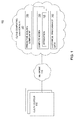
- FIG. 1 illustrates a computing infrastructure configured with a predictive scaling component, according to one embodiment described herein.
- the system 100 includes a plurality of client devices 110 and a cloud computing environment, connected via a network 115.
- Cloud computing generally refers to the provision of scalable computing resources as a service over a network. More formally, cloud computing may be defined as a computing capability that provides an abstraction between the computing resource and its underlying technical architecture (e.g., servers, storage, networks), enabling convenient, on-demand network access to a shared pool of configurable computing resources that can be rapidly provisioned and released with minimal management effort or service provider interaction.
- technical architecture e.g., servers, storage, networks
- cloud computing allows a user to access virtual computing resources (e.g., storage, data, applications, and even complete virtualized computing systems) in "the cloud," without regard for the underlying physical systems (or locations of those systems) used to provide the computing resources.
- virtual computing resources e.g., storage, data, applications, and even complete virtualized computing systems
- cloud computing resources are provided to a user on a pay-per-use basis, where users are charged only for the computing resources actually used (e.g. an amount of storage space consumed by a user or a number of virtualized systems instantiated by the user).
- a user can access the resources that reside in the cloud at any time, and from anywhere across the Internet.
- the cloud computing environment 120 includes a predictive scaling component 125, a plurality of compute nodes 130 and historical performance data 140.
- the compute nodes 130 reflect computing systems (e.g ., virtual machines) within the cloud computing environment 120.
- each of the compute nodes 130 includes an application instance 135 of a distributed application.
- the application instances 135 hosted on the compute nodes 130 all correspond to a single distributed application (e.g ., a video streaming service).
- a single application instance 135 is shown within each of the compute nodes 130, such a depiction is for illustrative purposes only, and other embodiments may instantiate 2 or more application instances 135 on a compute node 130. More generally, embodiments described herein may be configured for use with any configuration for hosting the application instances 135 within the cloud computing environment 120.
- the predictive scaling component 125 could monitor the execution of the application instances 135 over a period of time to collect the historical performance data 140.
- the historical performance data 140 comprises data relating to the performance of the application instances 135, such as how many incoming requests a particular application instance processes on average during a unit of time ( e.g ., processed requests per minute) as well as the latencies of those requests ( e.g ., how long, on average, a single request takes to process).
- the predictive scaling component 125 could monitor the workload of the distributed application over a period of time. For example, the predictive scaling component 125 could monitor a number of incoming requests from the client devices 110 to collect historical workload data for the distributed application. The predictive scaling component 125 could then perform a statistical analysis of the workload data (and potentially the historical performance data 140 as well) in order to determine one or more scaling patterns.
- the scaling patterns represent a pattern or trend in the incoming workload of the application that is indicative of a future workload of the application.
- a statistical analysis can also consider factors such as the time of day, the day of the week, a related application's workload, and so on in determining the scaling patterns.
- the predictive scaling component 125 could determine that the rate of increase of the incoming workload during the hours leading up to the hours of peak workload is indicative of the amount of peak workload for a given day.
- the predictive scaling component 125 could determine that a relatively large rate of increase in the application's workload during the hours leading up to the time of historically peak workload (e.g ., evening hours when the demand for video streaming services are greatest), indicates that the peak workload for that particular day will be relatively high.
- the predictive scaling component 125 determines that the rate of increase in the application's workload is relatively low, the predictive scaling component 125 could determine that the peak workload will also be relatively low for that particular day.
- these examples of scaling patterns are provided without limitation and for illustrative purposes only, and more generally any pattern determined from statistically analyzing the collected workload data can be used, consistent with the functionality described herein.
- the predictive scaling component 125 Upon determining the scaling patterns, the predictive scaling component 125 could monitor the application's current workload to determine when the current workload matches one of the determined scaling patterns. Continuing the above example, the predictive scaling component 125 could determine that, for a given day, the application's rate of increase in workload is relatively high during the hours leading up to the time period of historically peak workload. The predictive scaling component 125 could then determine an anticipated future workload of the application, based on the scaling pattern and the application's current workload. In one embodiment, the predictive scaling component 125 is configured to determine the application's future workload, at a future point in time based on the application's start-up time.
- the predictive scaling component 125 could determine the application's future workload 1 hour from the current time.
- the future point in time is determine based on the application's average start-up time plus some predefined period of time (e.g ., 10 minutes), to help ensure the application instances will be started in advance of the future workload.
- the predictive scaling component 125 could then determine a number of application instances needed to satisfy the estimated future workload. Generally, if the future workload is greater than the application's current workload, a number of additional applications may need to be instantiated in order to accommodate the increased workload. On the other hand, if the estimated future workload is less than the current workload, some number of application instances could be shutdown in order to avoid idle or underutilized computing resources.
- the predictive scaling component 125 could then determine a plan for predictively scaling the application, based on the determined number of application instances needed to satisfy the estimated future workload and an average start-up time for the application instances. For example, the predictive scaling component 125 could determine that 10 additional application instances will be needed to accommodate the estimated future workload 1 hour from now, and could further determine that 20 additional application instances will be needed to accommodate the estimated future workload 2 hours from now.
- the predictive scaling component 125 could determine a plan to instantiate 10 additional application instances 15 minutes from now ( i.e., to satisfy the estimated workload 1 hour into the future), and to instantiate 10 additional application instances 75 minutes from now ( i.e., to satisfy the estimated workload 2 hours into the future).
- the predictive scaling component 125 could determine a plan to instantiate 10 additional application instances 15 minutes from now ( i.e., to satisfy the estimated workload 1 hour into the future), and to instantiate 10 additional application instances 75 minutes from now ( i.e., to satisfy the estimated workload 2 hours into the future).
- the predictive scaling component 125 could determine a plan to instantiate 10 additional application instances 15 minutes from now ( i.e., to satisfy the estimated workload 1 hour into the future), and to instantiate 10 additional application instances 75 minutes from now ( i.e., to satisfy the estimated workload 2 hours into the future).
- the predictive scaling component 125 could predictively scale the distributed cloud application based on the application's estimated future workload, allowing the application to more smoothly
- the predictive scaling component 125 determines that the future workload is less than the current workload and that 10 fewer application instances will be needed to process the future workload, the predictive scaling component 125 then determine a plan for shutting down particular application instances over a window of time. In doing so, the predictive scaling component 125 could consider an average shutdown time of an application instance. By reducing the number of application instances in response to a predicted decrease in future workload, the predictive scaling component 125 helps to avoid underutilized application instances, thereby reducing the cost of running the application. Moreover, doing so also frees up the computing resources associated with the shutdown application instances, thereby freeing these resources up for other purposes as needed.
- the predictive scaling component 125 may be combined with other scaling and load management techniques as well, in order to ensure the system health, availability and optimization of the application.
- the predictive scaling component 125 is configured to operate in conjunction with a reactive scaling component that is configured to add or remove application instances in response to changes in workload (e.g., incoming request volume).
- the predictive scaling component 125 could be configured to provide a minimum number of active application instances based on an estimated future workload of the application, while the reactive scaling component could instantiate additional application instances in response to an unanticipated workload.
- traditional reactive scaling techniques could reduce the number of active application instances in response to a temporary drop in request volume, doing so could lead to a failure of the service when the normal request volume for the application resumes.
- the predictive scaling component 125 could prevent the number of application instances from falling below a threshold number of application instances, based on the application's predicted workload at a future point in time, thereby avoiding the failure of the service when the normal request volume resumes.
- combining the predictive scaling component 125 with other scaling techniques, such as a reactive scaling component may improve the performance of the system, allowing the reactive scaling component to respond to fluctuations in workload while ensuring a minimum number of application instances remain instantiated based on a predicted future workload of the application.
- the predictive scaling component 125 may work in conjunction with a variety of other scaling and more general workload management techniques, in order to improve the performance and efficiency of the system.
- the predictive scaling component 125 could work in conjunction with a hardware scaling component configured to scale the resources (e.g., memory, processors, etc.) executing the application instances, based on the application's workload.
- the predictive scaling component 125 could work in conjunction with a component configured to scale a downstream resource (e.g ., a number of database instances, hardware resources on which the database instances are executing, etc.), in response to the application's current workload and/or predictive future workload.
- a downstream resource e.g ., a number of database instances, hardware resources on which the database instances are executing, etc.
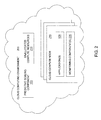
- FIG. 2 illustrates a computing infrastructure configured with a predictive scaling component, according to one embodiment described herein.
- the cloud computing environment 200 includes the predictive scaling component 125, unallocated compute resources 210, and a plurality of compute nodes 215.
- each of the compute nodes 215 is configured with one or more application instances 135 and one or more monitoring components 225.
- the monitoring components 225 could monitor their respective application instance 135 in order to collect performance and workload data.
- the monitoring components 225 could then transmit the collected data to the predictive scaling component 125, and the predictive scaling component 125 could use such data to predictively scale the number of application instances 135 and the number of compute nodes 215.
- the predictive scaling component 125 could determine that the present workload of the application instances 135 matches a particular scaling pattern, indicating that the application's workload will substantially increase within some period of time. In response to such a determination, the predictive scaling component 125 could allocate a number of additional compute nodes 215 using the unallocated compute resources 210, and could initialize a number of new application instances 135 on these additional compute nodes. Generally, it is preferable for the predictive scaling component 125 to determine the application's future workload at some point in the future that is at least as long as the application instances' average start-up time, in order to assure that the application instances can be fully operational and ready to process the future workload at the future point in time.
- the predictive scaling component 125 may be configured to predict the future workload 75 minutes into the future and to create a number of additional application instances sufficient to process this estimated future workload, so that the application instances will be initialized and operational in advance of the future workload.
- the predictive scaling component 125 is configured to monitor the growth in application traffic over time and to adjust its application scaling accordingly. For example, a video streaming service could continue to increase its subscriber base over time, and the number of subscribers using the video streaming service may increase month-over-month. As a result, the number of application instances needed to process the incoming workload at a given point in time during the week may continue to increase proportionately to the change in the subscription base. For example, if the subscriber base increases 20% within a one year period, the incoming workload on an average Tuesday evening at 5:00pm may be approximately 20% higher today than it was a year ago. As such, the predictive scaling component 125 could be configured to take the growth (or decrease) in users into account when generating a plan for scaling the application instances. Of course, such an example is provided without limitation and for illustrative purposes only.
- the predictive scaling component 125 may alter the scaling plan based on the growth in users, such growth may not always relate in a proportionate manner. For example, while the growth in subscriptions in a one year period may increase slightly, the average workload at a particular day and time may increase substantially over the same one year period due to other factors. For instance, as more content is added to the video streaming service over the course of the year, the viewing patterns of the subscribers may also change as a result. As a result, the predictive scaling component 125 may consider the growth in subscribers as one of many factors in predicting the future workload of the application and in determining the plan for scaling the number of application instances accordingly.
- the predictive scaling component 125 may consider known events in predicting the application's future workload. Examples of such events include daylight savings time, the availability of particular content (e.g., a live stream of a particular sporting event), holidays, and so on. Such events may be specified to the predictive scaling component 125 programmatically (e.g., events that happen each year such as holidays, daylight savings time, etc.) or could be manually specified by a user (e.g., a live stream of a particular event). More generally, however, the predictive scaling component 125 may consider any event having any correlation to the workload of the application. Moreover, different events may have a different correlation to the application, depending on the type of the application.
- the predictive scaling component 125 can more accurately and reliability predict the future workload of the application and scale the application instances accordingly.
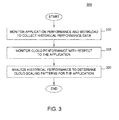
- Figure 3 is a flow diagram illustrating a method for determining performance patterns of a cloud application, according to one embodiment described herein.
- the method 300 begins at block 310, where the predictive scaling component 125 monitors the performance and workload of an application instance(s) in order to collect historical performance data.
- data may include, without limitation, a number of incoming requests per unit of time, a number of requests processed by a given application instance per unit of time, a start-up time of a new application instance, a shutdown time of an application instance, and so on.
- the predictive scaling component 125 monitors the performance of the cloud computing environment with respect to the application (block 315). For example, in addition to the start-up time of the application instances, there may be an additional start-up time of configuring and initializing a new cloud compute node on which to run the new application instance.
- the predictive scaling component 125 then analyzes the collected performance data in order to determine scaling patterns for the application (block 320), and the method 300 ends. For example, the predictive scaling component 125 could determine that the historical workload data indicates that the application's workload increases dramatically leading up to 5:00pm each day, and that the amount of peak workload is proportional to the rate of increase around this time. The predictive scaling component 125 could then use such a scaling pattern in order to predictively scale a number of application instances, in order to accommodate the predicted future workload.
- the predictive scaling component 125 is configured to operate in a feedback loop, where data is continually fed back to the predictive scaling component 125 in order to improve future scaling operations.
- data may include, for example, data describing a workload of the application, data describing one or more scaling patterns for the application, data describing an impact of scaling operations on the system as a whole, and so on.
- embodiments can more accurately predict when future scaling operations are needed and can optimize such future scaling operations as well. For example, such data could be used to determine that a particular scaling plan in which a substantial number of additional application instances were provisioned caused unintended side effects, e.g., placing sudden pressure on one or more downstream components.
- the predictive scaling component 125 could learn from the historical scaling operations and related data, and the predictive scaling component 125 could optimize future scaling operations (e.g ., by restricting the number of additional application instances instantiated, by evenly distributing optimal sized scaling operations over a period of time, etc.) to minimize unintended side effects in the future.
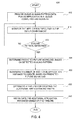
- FIG. 4 is a flow diagram illustrating a method for predictively scaling instances of a cloud application, according to one embodiment described herein.
- the method 400 begins at block 410, where the predictive scaling component 125 provides scaling pattern data for an application hosted in a cloud computing environment. Such pattern data could be determined, for example, using the method 300 shown in Figure 3 and discussed above.
- the predictive scaling component 125 then monitors the application executing in the cloud environment (block 414), in order to detect when one of the scaling patterns is satisfied (block 420).
- the method 400 returns to block 414, where the predictive scaling component 125 continues monitoring the application.
- the method 400 proceeds to block 425, where the predictive scaling component 125 determines a predicted future workload of the application based on the scaling pattern. For instance, continuing the example given above where the historical workload data indicates that the application's workload increases dramatically leading up to 5:00pm each day, and that the amount of peak workload is proportional to the rate of increase around this time, the predictive scaling component 125 could determine an estimated future workload of the application, based on the application's current rate of increase in workload leading up to 5:00pm. As discussed above, the predictive scaling component 125 may be configured to estimate the future workload at some point in the future at least as long as the application instance's average start-up time, so as to ensure that the application instances can be fully initialized in advance of the future workload.
- the predictive scaling component 125 determines a number of additional application instances to create based on the estimated future workload (block 430).
- this example assumes that the estimated future workload is greater than the application's current workload. However, in other examples where the future workload is less than the application's current workload, the predictive scaling component 125 could determine a number of application instances that are no longer needed to satisfy the estimated future workload.
- the predictive scaling component 125 also determines a timeline for creating the additional application instances (block 435).
- the predictive scaling component 125 may be configured to consider the average start-up of an application instance in creating the timeline, in order to ensure that the additional application instances will be fully initialized in anticipation of the increased future workload.
- the predictive scaling component 125 then instantiates the additional application instances based on the determined timeline (block 440), and the method 400 ends.
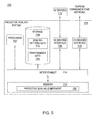
- FIG. 5 illustrates a computing infrastructure configured with a predictive scaling component, according to one embodiment described herein.
- the environment 700 includes a predictive scaling system 705 which includes, without limitation, a central processing unit (CPU) 702, a network interface 708, an interconnect 710, and a system memory 712.
- the CPU 702 retrieves and executes programming instructions stored in the system memory 712. Similarly, the CPU 702 stores and retrieves application data residing in the system memory 712.
- the interconnect 710 facilitates transmission, such as of programming instructions and application data, between the CPU 702, input/output (I/O) devices interface 706, storage 704, network interface 708, and system memory 712.
- the I/O devices interface 706 is configured to receive input data from user I/O devices 722.
- Examples of user I/O devices 722 may include one of more buttons, a keyboard, and a mouse or other pointing device.
- the I/O device interface 706 may also include an audio output unit configured to generate an electrical audio output signal, and user I/O devices may further includes a speaker configured to generate an acoustic output in response to the electrical audio output signal.
- Another example of an I/O device is a display device that generally represents any technically feasible means for generating an image for display.
- the display device may be a liquid crystal display (LCD) display, CRT display, or DLP display.
- the display device may be a TV that includes a broadcast or cable tuner for receiving digital or analog television signals.
- the CPU 702 is included to be representative of a single CPU, multiple CPUs, a single CPU having multiple processing cores, and the like.
- the system memory 712 is generally included to be representative of a random access memory.
- the storage 704 may be a disk drive storage device. Although shown as a single unit, the storage 704 may be a combination of fixed and/or removable storage devices, such as fixed disc drives, floppy disc drives, tape drives, removable memory cards, or optical storage, network attached storage (NAS), or a storage area-network (SAN).
- the network interface 708 is configured to transmit data via the communications network, e.g., to transmit context tokens and localized digital assets from client devices as well as to return a assembled variation of digital content generated by the dynamic context-based assembler to the client devices.
- the system memory 712 stores a predictive scaling component 125 that is configured to monitor an application's performance and workload over time, for use in predictively scaling a number of instances of the application in anticipation of future workloads.
- the predictive scaling component 125 could monitor performance of an application within a cloud computing environment over a first window of time to collect historical performance data, where the application comprises a plurality of application instances. Additionally, the predictive scaling component 125 could monitor a workload of the application over a second window of time to collect historical workload data. The predictive scaling component 125 could then analyze both the historical performance data and the historical workload data to determine one or more scaling patterns for the application. Upon determining a present state of the application matches one of the one or more scaling patterns, the predictive scaling component 125 could determine a plan for predictively scaling the application, and could use the plan to predictively scale the plurality of application instances.
- embodiments may be implemented in hardware or software or in a combination of hardware and software.
- One embodiment may be implemented as a program product for use with a computer system.
- the program(s) of the program product define functions of the embodiments (including the methods described herein) and can be contained on a variety of computer-readable storage media.
- Illustrative computer-readable storage media include, but are not limited to: (i) non-writable storage media (e.g ., read-only memory devices within a computer such as CD-ROM disks readable by a CD-ROM drive, flash memory, ROM chips or any type of solid-state non-volatile semiconductor memory) on which information is permanently stored; and (ii) writable storage media (e.g ., floppy disks within a diskette drive or hard-disk drive or any type of solid-state random-access semiconductor memory) on which alterable information is stored.
- non-writable storage media e.g ., read-only memory devices within a computer such as CD-ROM disks readable by a CD-ROM drive, flash memory, ROM chips or any type of solid-state non-volatile semiconductor memory
- writable storage media e.g ., floppy disks within a diskette drive or hard-disk drive or any type of solid-state random-access semiconductor memory
Landscapes
- Engineering & Computer Science (AREA)
- Theoretical Computer Science (AREA)
- Software Systems (AREA)
- Signal Processing (AREA)
- Computer Networks & Wireless Communication (AREA)
- Physics & Mathematics (AREA)
- General Engineering & Computer Science (AREA)
- General Physics & Mathematics (AREA)
- Artificial Intelligence (AREA)
- Computational Linguistics (AREA)
- Data Mining & Analysis (AREA)
- Evolutionary Computation (AREA)
- Computing Systems (AREA)
- Mathematical Physics (AREA)
- Environmental & Geological Engineering (AREA)
- Debugging And Monitoring (AREA)
- Testing Of Engines (AREA)
- Management, Administration, Business Operations System, And Electronic Commerce (AREA)
Applications Claiming Priority (1)
| Application Number | Priority Date | Filing Date | Title |
|---|---|---|---|
| US14/057,898 US10552745B2 (en) | 2013-10-18 | 2013-10-18 | Predictive auto scaling engine |
Publications (3)
| Publication Number | Publication Date |
|---|---|
| EP2863306A2 true EP2863306A2 (de) | 2015-04-22 |
| EP2863306A3 EP2863306A3 (de) | 2016-06-08 |
| EP2863306B1 EP2863306B1 (de) | 2021-05-12 |
Family
ID=51751908
Family Applications (1)
| Application Number | Title | Priority Date | Filing Date |
|---|---|---|---|
| EP14187822.3A Active EP2863306B1 (de) | 2013-10-18 | 2014-10-06 | Prädiktiver automatischer Skalierungsmotor |
Country Status (4)
| Country | Link |
|---|---|
| US (1) | US10552745B2 (de) |
| EP (1) | EP2863306B1 (de) |
| CN (1) | CN104572294B (de) |
| DK (1) | DK2863306T3 (de) |
Families Citing this family (46)
| Publication number | Priority date | Publication date | Assignee | Title |
|---|---|---|---|---|
| US9727332B2 (en) * | 2013-11-22 | 2017-08-08 | International Business Machines Corporation | Information technology resource management |
| US9729466B2 (en) * | 2013-11-22 | 2017-08-08 | International Business Machines Corporation | Information technology resource management |
| US10366102B2 (en) | 2014-02-19 | 2019-07-30 | Snowflake Inc. | Resource management systems and methods |
| US20150244645A1 (en) * | 2014-02-26 | 2015-08-27 | Ca, Inc. | Intelligent infrastructure capacity management |
| US9722945B2 (en) | 2014-03-31 | 2017-08-01 | Microsoft Technology Licensing, Llc | Dynamically identifying target capacity when scaling cloud resources |
| US9842039B2 (en) * | 2014-03-31 | 2017-12-12 | Microsoft Technology Licensing, Llc | Predictive load scaling for services |
| US10469329B1 (en) * | 2014-09-10 | 2019-11-05 | Amazon Technologies, Inc. | Computing service capacity management |
| US9871745B2 (en) * | 2014-11-12 | 2018-01-16 | International Business Machines Corporation | Automatic scaling of at least one user application to external clouds |
| US10411960B1 (en) * | 2014-11-12 | 2019-09-10 | Amazon Technologies, Inc. | Detaching instances from auto-scaling group |
| US9647889B1 (en) | 2014-11-12 | 2017-05-09 | Amazon Technologies, Inc. | Standby instances for auto-scaling groups |
| CN106708621B (zh) | 2015-11-16 | 2020-10-27 | 阿里巴巴集团控股有限公司 | 一种获得应用集群容量的方法和装置 |
| EP3842943A1 (de) * | 2016-01-18 | 2021-06-30 | Huawei Technologies Co., Ltd. | System und verfahren für bereitstellung einer cloud-arbeitslast |
| US20170214634A1 (en) * | 2016-01-26 | 2017-07-27 | Futurewei Technologies, Inc. | Joint autoscaling of cloud applications |
| US20170373938A1 (en) * | 2016-06-27 | 2017-12-28 | Alcatel-Lucent Usa Inc. | Predictive auto-scaling of virtualized network functions for a network |
| EP3560146B1 (de) * | 2016-12-26 | 2022-03-02 | Morgan Stanley Services Group Inc. | Prädiktive bestandsoptimierung für computerressourcen |
| US11171854B2 (en) * | 2017-01-13 | 2021-11-09 | International Business Machines Corporation | Application workload prediction |
| US10476949B2 (en) | 2017-02-21 | 2019-11-12 | Microsoft Technology Licensing, Llc | Predictive autoscaling in computing systems |
| EP3460597A1 (de) * | 2017-09-21 | 2019-03-27 | Siemens Aktiengesellschaft | Erstellen einer konfiguration zur einrichtung einer konfigurationsspezifischen web-basierten applikation und generieren einer solchen konfigurationsspezifischen web-basierten applikation |
| US10893000B2 (en) | 2017-11-21 | 2021-01-12 | International Business Machines Corporation | Diagonal scaling of resource allocations and application instances in a distributed computing environment |
| US10812407B2 (en) | 2017-11-21 | 2020-10-20 | International Business Machines Corporation | Automatic diagonal scaling of workloads in a distributed computing environment |
| US10721179B2 (en) | 2017-11-21 | 2020-07-21 | International Business Machines Corporation | Adaptive resource allocation operations based on historical data in a distributed computing environment |
| US10733015B2 (en) | 2017-11-21 | 2020-08-04 | International Business Machines Corporation | Prioritizing applications for diagonal scaling in a distributed computing environment |
| US10887250B2 (en) | 2017-11-21 | 2021-01-05 | International Business Machines Corporation | Reducing resource allocations and application instances in diagonal scaling in a distributed computing environment |
| US10635501B2 (en) | 2017-11-21 | 2020-04-28 | International Business Machines Corporation | Adaptive scaling of workloads in a distributed computing environment |
| GB2570149B (en) * | 2018-01-12 | 2020-05-06 | Metaswitch Networks Ltd | Scaling network functions |
| US10705885B2 (en) | 2018-01-31 | 2020-07-07 | Palo Alto Networks, Inc. | Autoscaling of data processing computing systems based on predictive queue length |
| US10891016B2 (en) * | 2018-06-05 | 2021-01-12 | Viacom International Inc. | Graphical representation showing information to a user |
| US10761875B1 (en) * | 2018-12-13 | 2020-09-01 | Amazon Technologies, Inc. | Large scale compute instance launching |
| CN112000457B (zh) * | 2019-05-27 | 2024-07-30 | 伊姆西Ip控股有限责任公司 | 管理处理系统中的任务的方法、设备和计算机程序产品 |
| US11228643B2 (en) * | 2019-06-04 | 2022-01-18 | Capital One Services, Llc | System and method for fast application auto-scaling |
| US11036608B2 (en) | 2019-09-27 | 2021-06-15 | Appnomic Systems Private Limited | Identifying differences in resource usage across different versions of a software application |
| US11057315B1 (en) | 2020-01-06 | 2021-07-06 | International Business Machines Corporation | Generating a scaling plan for external systems during cloud tenant onboarding/offboarding |
| US11374823B2 (en) * | 2020-01-09 | 2022-06-28 | Mitel Networks Corp. | Telemetry-based method and system for predictive resource scaling |
| US11762709B2 (en) | 2020-11-11 | 2023-09-19 | International Business Machines Corporation | Predictive auto-scaler for a hierarchical computing infrastructure |
| WO2022253417A1 (en) * | 2021-06-01 | 2022-12-08 | Telefonaktiebolaget Lm Ericsson (Publ) | A computer software module arrangement, a circuitry arrangement, an arrangement and a method for improved autonomous adaptation of software monitoring of realtime systems |
| US20230007092A1 (en) * | 2021-07-01 | 2023-01-05 | Citrix Systems, Inc. | Prediction-based resource provisioning in a cloud environment |
| US12321788B2 (en) | 2021-10-19 | 2025-06-03 | Red Hat, Inc. | Systems and methods to reserve resources for workloads |
| US11811676B2 (en) * | 2022-03-30 | 2023-11-07 | International Business Machines Corporation | Proactive auto-scaling |
| CN115061702B (zh) * | 2022-08-19 | 2024-06-14 | 荣耀终端有限公司 | 一种ide管理方法及电子设备 |
| US20240202042A1 (en) * | 2022-12-15 | 2024-06-20 | Tangoe Us, Inc. | Cloud application resource utilization tool |
| CN116166427A (zh) * | 2022-12-29 | 2023-05-26 | 中国联合网络通信集团有限公司 | 自动扩缩容方法、装置、设备及存储介质 |
| US11875196B1 (en) * | 2023-03-07 | 2024-01-16 | Appian Corporation | Systems and methods for execution in dynamic application runtime environments |
| US12141595B1 (en) | 2023-03-07 | 2024-11-12 | Appian Corporation | Systems and methods for execution in dynamic application runtime environments |
| US11822937B1 (en) | 2023-03-21 | 2023-11-21 | Appian Corporation | Systems and methods for execution in dynamic application runtime environments |
| WO2024216454A1 (en) * | 2023-04-17 | 2024-10-24 | Huawei Technologies Co., Ltd. | Pod autoscaling recommendations for workloads in container orchestration platforms |
| US12530355B1 (en) * | 2023-11-24 | 2026-01-20 | Amazon Technologies, Inc | Predicting a future workload for scaling database processing resources for satisfying a performance objective |
Family Cites Families (17)
| Publication number | Priority date | Publication date | Assignee | Title |
|---|---|---|---|---|
| US20030055969A1 (en) * | 2001-09-17 | 2003-03-20 | International Business Machines Corporation | System and method for performing power management on a distributed system |
| US8041807B2 (en) * | 2006-11-02 | 2011-10-18 | International Business Machines Corporation | Method, system and program product for determining a number of concurrent users accessing a system |
| US9274847B2 (en) * | 2007-05-04 | 2016-03-01 | Microsoft Technology Licensing, Llc | Resource management platform |
| US8793363B2 (en) * | 2008-01-15 | 2014-07-29 | At&T Mobility Ii Llc | Systems and methods for real-time service assurance |
| JP5671484B2 (ja) * | 2009-03-02 | 2015-02-18 | トゥイリオ インコーポレイテッドTwilio Inc. | マルチテナント電話ネットワークのための方法およびシステム |
| US8572612B2 (en) | 2010-04-14 | 2013-10-29 | International Business Machines Corporation | Autonomic scaling of virtual machines in a cloud computing environment |
| US8504689B2 (en) * | 2010-05-28 | 2013-08-06 | Red Hat, Inc. | Methods and systems for cloud deployment analysis featuring relative cloud resource importance |
| US8874642B2 (en) | 2011-04-07 | 2014-10-28 | Infosys Limited | System and method for managing the performance of an enterprise application |
| US8997107B2 (en) * | 2011-06-28 | 2015-03-31 | Microsoft Technology Licensing, Llc | Elastic scaling for cloud-hosted batch applications |
| US9251033B2 (en) | 2011-07-07 | 2016-02-02 | Vce Company, Llc | Automatic monitoring and just-in-time resource provisioning system |
| US8612599B2 (en) * | 2011-09-07 | 2013-12-17 | Accenture Global Services Limited | Cloud service monitoring system |
| US9442769B2 (en) * | 2011-09-30 | 2016-09-13 | Red Hat, Inc. | Generating cloud deployment targets based on predictive workload estimation |
| CN103959242A (zh) * | 2011-10-10 | 2014-07-30 | 惠普发展公司,有限责任合伙企业 | 用于在云计算系统中规划应用的执行的方法和系统 |
| US8756609B2 (en) | 2011-12-30 | 2014-06-17 | International Business Machines Corporation | Dynamically scaling multi-tier applications vertically and horizontally in a cloud environment |
| US9467355B2 (en) * | 2012-09-07 | 2016-10-11 | Oracle International Corporation | Service association model |
| SE537197C2 (sv) * | 2012-10-05 | 2015-03-03 | Elastisys Ab | Metod, nod och datorprogram för möjliggörande av automatiskanpassning av resursenheter |
| CN103220337B (zh) | 2013-03-22 | 2015-10-21 | 合肥工业大学 | 基于自适应弹性控制的云计算资源优化配置方法 |
-
2013
- 2013-10-18 US US14/057,898 patent/US10552745B2/en active Active
-
2014
- 2014-10-06 DK DK14187822.3T patent/DK2863306T3/da active
- 2014-10-06 EP EP14187822.3A patent/EP2863306B1/de active Active
- 2014-10-20 CN CN201410558606.7A patent/CN104572294B/zh active Active
Non-Patent Citations (1)
| Title |
|---|
| None |
Also Published As
| Publication number | Publication date |
|---|---|
| EP2863306A3 (de) | 2016-06-08 |
| US10552745B2 (en) | 2020-02-04 |
| US20150113120A1 (en) | 2015-04-23 |
| DK2863306T3 (da) | 2021-07-26 |
| CN104572294A (zh) | 2015-04-29 |
| CN104572294B (zh) | 2018-09-21 |
| EP2863306B1 (de) | 2021-05-12 |
Similar Documents
| Publication | Publication Date | Title |
|---|---|---|
| US10552745B2 (en) | Predictive auto scaling engine | |
| US11689466B2 (en) | Distributed processing system throttling using a timestamp | |
| US9665294B2 (en) | Dynamic feedback-based throughput control for black-box storage systems | |
| US10642653B2 (en) | Dynamically modifying program execution capacity | |
| US9870269B1 (en) | Job allocation in a clustered environment | |
| US9405572B2 (en) | Optimized resource allocation and management in a virtualized computing environment | |
| Reddy et al. | Qos-Aware Video Streaming Based Admission Control And Scheduling For Video Transcoding In Cloud Computing | |
| EP3048774A1 (de) | Dienstverarbeitungsverfahren, system und vorrichtung | |
| Jonathan et al. | WASP: Wide-area adaptive stream processing | |
| CN112579304A (zh) | 基于分布式平台的资源调度方法、装置、设备及介质 | |
| JP2017201791A (ja) | ビデオエンコードシステムおよび方法 | |
| GB2533017A (en) | A method and system for scalable job processing | |
| US20120324000A1 (en) | System and method for flow control in a messaging subsystem based on message-in/out rates | |
| US10135751B2 (en) | Automated split of work in a cloud environment | |
| US9851988B1 (en) | Recommending computer sizes for automatically scalable computer groups | |
| US10893015B2 (en) | Priority topic messaging | |
| US8032636B2 (en) | Dynamically provisioning clusters of middleware appliances | |
| US20170208121A1 (en) | Server pool management | |
| CN113079062A (zh) | 一种资源调整方法、装置、计算机设备和存储介质 | |
| US20160246349A1 (en) | Rack space power utilization | |
| Zafeirakopoulos et al. | HYAS: hybrid autoscaler agent for apache Flink | |
| TWI579691B (zh) | Method and System of IDC Computer Room Entity and Virtual Host Integration Management | |
| WO2018088992A1 (en) | System, method of real-time processing under resource constraint at edge | |
| Zhang et al. | Towards transparent and distributed workload management for large scale web servers | |
| US12566678B2 (en) | Adaptive service level agreement for a recovery data objective |
Legal Events
| Date | Code | Title | Description |
|---|---|---|---|
| PUAI | Public reference made under article 153(3) epc to a published international application that has entered the european phase |
Free format text: ORIGINAL CODE: 0009012 |
|
| 17P | Request for examination filed |
Effective date: 20141006 |
|
| AK | Designated contracting states |
Kind code of ref document: A2 Designated state(s): AL AT BE BG CH CY CZ DE DK EE ES FI FR GB GR HR HU IE IS IT LI LT LU LV MC MK MT NL NO PL PT RO RS SE SI SK SM TR |
|
| AX | Request for extension of the european patent |
Extension state: BA ME |
|
| PUAL | Search report despatched |
Free format text: ORIGINAL CODE: 0009013 |
|
| AK | Designated contracting states |
Kind code of ref document: A3 Designated state(s): AL AT BE BG CH CY CZ DE DK EE ES FI FR GB GR HR HU IE IS IT LI LT LU LV MC MK MT NL NO PL PT RO RS SE SI SK SM TR |
|
| AX | Request for extension of the european patent |
Extension state: BA ME |
|
| RIC1 | Information provided on ipc code assigned before grant |
Ipc: G06N 5/04 20060101ALI20160429BHEP Ipc: G06F 9/50 20060101AFI20160429BHEP Ipc: H04L 12/911 20130101ALI20160429BHEP |
|
| STAA | Information on the status of an ep patent application or granted ep patent |
Free format text: STATUS: REQUEST FOR EXAMINATION WAS MADE |
|
| R17P | Request for examination filed (corrected) |
Effective date: 20161208 |
|
| RBV | Designated contracting states (corrected) |
Designated state(s): AL AT BE BG CH CY CZ DE DK EE ES FI FR GB GR HR HU IE IS IT LI LT LU LV MC MK MT NL NO PL PT RO RS SE SI SK SM TR |
|
| STAA | Information on the status of an ep patent application or granted ep patent |
Free format text: STATUS: EXAMINATION IS IN PROGRESS |
|
| 17Q | First examination report despatched |
Effective date: 20180413 |
|
| GRAP | Despatch of communication of intention to grant a patent |
Free format text: ORIGINAL CODE: EPIDOSNIGR1 |
|
| STAA | Information on the status of an ep patent application or granted ep patent |
Free format text: STATUS: GRANT OF PATENT IS INTENDED |
|
| INTG | Intention to grant announced |
Effective date: 20201218 |
|
| GRAS | Grant fee paid |
Free format text: ORIGINAL CODE: EPIDOSNIGR3 |
|
| GRAA | (expected) grant |
Free format text: ORIGINAL CODE: 0009210 |
|
| STAA | Information on the status of an ep patent application or granted ep patent |
Free format text: STATUS: THE PATENT HAS BEEN GRANTED |
|
| AK | Designated contracting states |
Kind code of ref document: B1 Designated state(s): AL AT BE BG CH CY CZ DE DK EE ES FI FR GB GR HR HU IE IS IT LI LT LU LV MC MK MT NL NO PL PT RO RS SE SI SK SM TR |
|
| REG | Reference to a national code |
Ref country code: GB Ref legal event code: FG4D |
|
| REG | Reference to a national code |
Ref country code: CH Ref legal event code: EP |
|
| REG | Reference to a national code |
Ref country code: DE Ref legal event code: R096 Ref document number: 602014077372 Country of ref document: DE |
|
| REG | Reference to a national code |
Ref country code: IE Ref legal event code: FG4D |
|
| REG | Reference to a national code |
Ref country code: AT Ref legal event code: REF Ref document number: 1392633 Country of ref document: AT Kind code of ref document: T Effective date: 20210615 |
|
| REG | Reference to a national code |
Ref country code: NL Ref legal event code: FP |
|
| REG | Reference to a national code |
Ref country code: DK Ref legal event code: T3 Effective date: 20210722 |
|
| REG | Reference to a national code |
Ref country code: SE Ref legal event code: TRGR |
|
| REG | Reference to a national code |
Ref country code: LT Ref legal event code: MG9D |
|
| REG | Reference to a national code |
Ref country code: NO Ref legal event code: T2 Effective date: 20210512 |
|
| REG | Reference to a national code |
Ref country code: AT Ref legal event code: MK05 Ref document number: 1392633 Country of ref document: AT Kind code of ref document: T Effective date: 20210512 |
|
| PG25 | Lapsed in a contracting state [announced via postgrant information from national office to epo] |
Ref country code: FI Free format text: LAPSE BECAUSE OF FAILURE TO SUBMIT A TRANSLATION OF THE DESCRIPTION OR TO PAY THE FEE WITHIN THE PRESCRIBED TIME-LIMIT Effective date: 20210512 Ref country code: LT Free format text: LAPSE BECAUSE OF FAILURE TO SUBMIT A TRANSLATION OF THE DESCRIPTION OR TO PAY THE FEE WITHIN THE PRESCRIBED TIME-LIMIT Effective date: 20210512 Ref country code: BG Free format text: LAPSE BECAUSE OF FAILURE TO SUBMIT A TRANSLATION OF THE DESCRIPTION OR TO PAY THE FEE WITHIN THE PRESCRIBED TIME-LIMIT Effective date: 20210812 Ref country code: AT Free format text: LAPSE BECAUSE OF FAILURE TO SUBMIT A TRANSLATION OF THE DESCRIPTION OR TO PAY THE FEE WITHIN THE PRESCRIBED TIME-LIMIT Effective date: 20210512 Ref country code: HR Free format text: LAPSE BECAUSE OF FAILURE TO SUBMIT A TRANSLATION OF THE DESCRIPTION OR TO PAY THE FEE WITHIN THE PRESCRIBED TIME-LIMIT Effective date: 20210512 |
|
| PG25 | Lapsed in a contracting state [announced via postgrant information from national office to epo] |
Ref country code: IS Free format text: LAPSE BECAUSE OF FAILURE TO SUBMIT A TRANSLATION OF THE DESCRIPTION OR TO PAY THE FEE WITHIN THE PRESCRIBED TIME-LIMIT Effective date: 20210912 Ref country code: GR Free format text: LAPSE BECAUSE OF FAILURE TO SUBMIT A TRANSLATION OF THE DESCRIPTION OR TO PAY THE FEE WITHIN THE PRESCRIBED TIME-LIMIT Effective date: 20210813 Ref country code: LV Free format text: LAPSE BECAUSE OF FAILURE TO SUBMIT A TRANSLATION OF THE DESCRIPTION OR TO PAY THE FEE WITHIN THE PRESCRIBED TIME-LIMIT Effective date: 20210512 Ref country code: RS Free format text: LAPSE BECAUSE OF FAILURE TO SUBMIT A TRANSLATION OF THE DESCRIPTION OR TO PAY THE FEE WITHIN THE PRESCRIBED TIME-LIMIT Effective date: 20210512 Ref country code: PL Free format text: LAPSE BECAUSE OF FAILURE TO SUBMIT A TRANSLATION OF THE DESCRIPTION OR TO PAY THE FEE WITHIN THE PRESCRIBED TIME-LIMIT Effective date: 20210512 Ref country code: PT Free format text: LAPSE BECAUSE OF FAILURE TO SUBMIT A TRANSLATION OF THE DESCRIPTION OR TO PAY THE FEE WITHIN THE PRESCRIBED TIME-LIMIT Effective date: 20210913 Ref country code: ES Free format text: LAPSE BECAUSE OF FAILURE TO SUBMIT A TRANSLATION OF THE DESCRIPTION OR TO PAY THE FEE WITHIN THE PRESCRIBED TIME-LIMIT Effective date: 20210512 |
|
| PG25 | Lapsed in a contracting state [announced via postgrant information from national office to epo] |
Ref country code: RO Free format text: LAPSE BECAUSE OF FAILURE TO SUBMIT A TRANSLATION OF THE DESCRIPTION OR TO PAY THE FEE WITHIN THE PRESCRIBED TIME-LIMIT Effective date: 20210512 Ref country code: SK Free format text: LAPSE BECAUSE OF FAILURE TO SUBMIT A TRANSLATION OF THE DESCRIPTION OR TO PAY THE FEE WITHIN THE PRESCRIBED TIME-LIMIT Effective date: 20210512 Ref country code: SM Free format text: LAPSE BECAUSE OF FAILURE TO SUBMIT A TRANSLATION OF THE DESCRIPTION OR TO PAY THE FEE WITHIN THE PRESCRIBED TIME-LIMIT Effective date: 20210512 Ref country code: EE Free format text: LAPSE BECAUSE OF FAILURE TO SUBMIT A TRANSLATION OF THE DESCRIPTION OR TO PAY THE FEE WITHIN THE PRESCRIBED TIME-LIMIT Effective date: 20210512 Ref country code: CZ Free format text: LAPSE BECAUSE OF FAILURE TO SUBMIT A TRANSLATION OF THE DESCRIPTION OR TO PAY THE FEE WITHIN THE PRESCRIBED TIME-LIMIT Effective date: 20210512 |
|
| REG | Reference to a national code |
Ref country code: DE Ref legal event code: R097 Ref document number: 602014077372 Country of ref document: DE |
|
| PLBE | No opposition filed within time limit |
Free format text: ORIGINAL CODE: 0009261 |
|
| STAA | Information on the status of an ep patent application or granted ep patent |
Free format text: STATUS: NO OPPOSITION FILED WITHIN TIME LIMIT |
|
| 26N | No opposition filed |
Effective date: 20220215 |
|
| PG25 | Lapsed in a contracting state [announced via postgrant information from national office to epo] |
Ref country code: IS Free format text: LAPSE BECAUSE OF FAILURE TO SUBMIT A TRANSLATION OF THE DESCRIPTION OR TO PAY THE FEE WITHIN THE PRESCRIBED TIME-LIMIT Effective date: 20210912 Ref country code: AL Free format text: LAPSE BECAUSE OF FAILURE TO SUBMIT A TRANSLATION OF THE DESCRIPTION OR TO PAY THE FEE WITHIN THE PRESCRIBED TIME-LIMIT Effective date: 20210512 |
|
| REG | Reference to a national code |
Ref country code: BE Ref legal event code: MM Effective date: 20211031 |
|
| PG25 | Lapsed in a contracting state [announced via postgrant information from national office to epo] |
Ref country code: MC Free format text: LAPSE BECAUSE OF FAILURE TO SUBMIT A TRANSLATION OF THE DESCRIPTION OR TO PAY THE FEE WITHIN THE PRESCRIBED TIME-LIMIT Effective date: 20210512 |
|
| PG25 | Lapsed in a contracting state [announced via postgrant information from national office to epo] |
Ref country code: LU Free format text: LAPSE BECAUSE OF NON-PAYMENT OF DUE FEES Effective date: 20211006 Ref country code: IT Free format text: LAPSE BECAUSE OF FAILURE TO SUBMIT A TRANSLATION OF THE DESCRIPTION OR TO PAY THE FEE WITHIN THE PRESCRIBED TIME-LIMIT Effective date: 20210512 Ref country code: BE Free format text: LAPSE BECAUSE OF NON-PAYMENT OF DUE FEES Effective date: 20211031 |
|
| PG25 | Lapsed in a contracting state [announced via postgrant information from national office to epo] |
Ref country code: HU Free format text: LAPSE BECAUSE OF FAILURE TO SUBMIT A TRANSLATION OF THE DESCRIPTION OR TO PAY THE FEE WITHIN THE PRESCRIBED TIME-LIMIT; INVALID AB INITIO Effective date: 20141006 |
|
| P01 | Opt-out of the competence of the unified patent court (upc) registered |
Effective date: 20230519 |
|
| PG25 | Lapsed in a contracting state [announced via postgrant information from national office to epo] |
Ref country code: CY Free format text: LAPSE BECAUSE OF FAILURE TO SUBMIT A TRANSLATION OF THE DESCRIPTION OR TO PAY THE FEE WITHIN THE PRESCRIBED TIME-LIMIT Effective date: 20210512 |
|
| PG25 | Lapsed in a contracting state [announced via postgrant information from national office to epo] |
Ref country code: MK Free format text: LAPSE BECAUSE OF FAILURE TO SUBMIT A TRANSLATION OF THE DESCRIPTION OR TO PAY THE FEE WITHIN THE PRESCRIBED TIME-LIMIT Effective date: 20210512 |
|
| PG25 | Lapsed in a contracting state [announced via postgrant information from national office to epo] |
Ref country code: MT Free format text: LAPSE BECAUSE OF FAILURE TO SUBMIT A TRANSLATION OF THE DESCRIPTION OR TO PAY THE FEE WITHIN THE PRESCRIBED TIME-LIMIT Effective date: 20210512 |
|
| PGFP | Annual fee paid to national office [announced via postgrant information from national office to epo] |
Ref country code: TR Payment date: 20250922 Year of fee payment: 12 |
|
| REG | Reference to a national code |
Ref country code: CH Ref legal event code: U11 Free format text: ST27 STATUS EVENT CODE: U-0-0-U10-U11 (AS PROVIDED BY THE NATIONAL OFFICE) Effective date: 20251101 |
|
| PGFP | Annual fee paid to national office [announced via postgrant information from national office to epo] |
Ref country code: NL Payment date: 20251024 Year of fee payment: 12 |
|
| PGFP | Annual fee paid to national office [announced via postgrant information from national office to epo] |
Ref country code: DE Payment date: 20251028 Year of fee payment: 12 |
|
| PGFP | Annual fee paid to national office [announced via postgrant information from national office to epo] |
Ref country code: GB Payment date: 20251023 Year of fee payment: 12 |
|
| PGFP | Annual fee paid to national office [announced via postgrant information from national office to epo] |
Ref country code: NO Payment date: 20251022 Year of fee payment: 12 |
|
| PGFP | Annual fee paid to national office [announced via postgrant information from national office to epo] |
Ref country code: DK Payment date: 20251024 Year of fee payment: 12 |
|
| PGFP | Annual fee paid to national office [announced via postgrant information from national office to epo] |
Ref country code: FR Payment date: 20251027 Year of fee payment: 12 |
|
| PGFP | Annual fee paid to national office [announced via postgrant information from national office to epo] |
Ref country code: CH Payment date: 20251101 Year of fee payment: 12 Ref country code: SE Payment date: 20251024 Year of fee payment: 12 |
|
| PGFP | Annual fee paid to national office [announced via postgrant information from national office to epo] |
Ref country code: IE Payment date: 20251020 Year of fee payment: 12 |