EP2862840A1 - Method for producing high-purity polycrystalline silicon - Google Patents
Method for producing high-purity polycrystalline silicon Download PDFInfo
- Publication number
- EP2862840A1 EP2862840A1 EP20130804452 EP13804452A EP2862840A1 EP 2862840 A1 EP2862840 A1 EP 2862840A1 EP 20130804452 EP20130804452 EP 20130804452 EP 13804452 A EP13804452 A EP 13804452A EP 2862840 A1 EP2862840 A1 EP 2862840A1
- Authority
- EP
- European Patent Office
- Prior art keywords
- polycrystalline silicon
- carbon
- trichlorosilane
- sim
- ppmw
- Prior art date
- Legal status (The legal status is an assumption and is not a legal conclusion. Google has not performed a legal analysis and makes no representation as to the accuracy of the status listed.)
- Granted
Links
Images







Classifications
-
- C—CHEMISTRY; METALLURGY
- C01—INORGANIC CHEMISTRY
- C01B—NON-METALLIC ELEMENTS; COMPOUNDS THEREOF; METALLOIDS OR COMPOUNDS THEREOF NOT COVERED BY SUBCLASS C01C
- C01B33/00—Silicon; Compounds thereof
- C01B33/02—Silicon
- C01B33/021—Preparation
- C01B33/027—Preparation by decomposition or reduction of gaseous or vaporised silicon compounds other than silica or silica-containing material
- C01B33/03—Preparation by decomposition or reduction of gaseous or vaporised silicon compounds other than silica or silica-containing material by decomposition of silicon halides or halosilanes or reduction thereof with hydrogen as the only reducing agent
-
- H—ELECTRICITY
- H10—SEMICONDUCTOR DEVICES; ELECTRIC SOLID-STATE DEVICES NOT OTHERWISE PROVIDED FOR
- H10P—GENERIC PROCESSES OR APPARATUS FOR THE MANUFACTURE OR TREATMENT OF DEVICES COVERED BY CLASS H10
- H10P74/00—Testing or measuring during manufacture or treatment of wafers, substrates or devices
- H10P74/20—Testing or measuring during manufacture or treatment of wafers, substrates or devices characterised by the properties tested or measured, e.g. structural or electrical properties
-
- C—CHEMISTRY; METALLURGY
- C01—INORGANIC CHEMISTRY
- C01B—NON-METALLIC ELEMENTS; COMPOUNDS THEREOF; METALLOIDS OR COMPOUNDS THEREOF NOT COVERED BY SUBCLASS C01C
- C01B33/00—Silicon; Compounds thereof
- C01B33/02—Silicon
- C01B33/021—Preparation
- C01B33/027—Preparation by decomposition or reduction of gaseous or vaporised silicon compounds other than silica or silica-containing material
- C01B33/035—Preparation by decomposition or reduction of gaseous or vaporised silicon compounds other than silica or silica-containing material by decomposition or reduction of gaseous or vaporised silicon compounds in the presence of heated filaments of silicon, carbon or a refractory metal, e.g. tantalum or tungsten, or in the presence of heated silicon rods on which the formed silicon is deposited, a silicon rod being obtained, e.g. Siemens process
-
- G—PHYSICS
- G01—MEASURING; TESTING
- G01N—INVESTIGATING OR ANALYSING MATERIALS BY DETERMINING THEIR CHEMICAL OR PHYSICAL PROPERTIES
- G01N33/00—Investigating or analysing materials by specific methods not covered by groups G01N1/00 - G01N31/00
-
- H—ELECTRICITY
- H10—SEMICONDUCTOR DEVICES; ELECTRIC SOLID-STATE DEVICES NOT OTHERWISE PROVIDED FOR
- H10P—GENERIC PROCESSES OR APPARATUS FOR THE MANUFACTURE OR TREATMENT OF DEVICES COVERED BY CLASS H10
- H10P14/00—Formation of materials, e.g. in the shape of layers or pillars
- H10P14/20—Formation of materials, e.g. in the shape of layers or pillars of semiconductor materials
- H10P14/24—Formation of materials, e.g. in the shape of layers or pillars of semiconductor materials using chemical vapour deposition [CVD]
-
- H—ELECTRICITY
- H10—SEMICONDUCTOR DEVICES; ELECTRIC SOLID-STATE DEVICES NOT OTHERWISE PROVIDED FOR
- H10P—GENERIC PROCESSES OR APPARATUS FOR THE MANUFACTURE OR TREATMENT OF DEVICES COVERED BY CLASS H10
- H10P14/00—Formation of materials, e.g. in the shape of layers or pillars
- H10P14/20—Formation of materials, e.g. in the shape of layers or pillars of semiconductor materials
- H10P14/34—Deposited materials, e.g. layers
- H10P14/3402—Deposited materials, e.g. layers characterised by the chemical composition
- H10P14/3404—Deposited materials, e.g. layers characterised by the chemical composition being Group IVA materials
- H10P14/3411—Silicon, silicon germanium or germanium
-
- H—ELECTRICITY
- H10—SEMICONDUCTOR DEVICES; ELECTRIC SOLID-STATE DEVICES NOT OTHERWISE PROVIDED FOR
- H10P—GENERIC PROCESSES OR APPARATUS FOR THE MANUFACTURE OR TREATMENT OF DEVICES COVERED BY CLASS H10
- H10P14/00—Formation of materials, e.g. in the shape of layers or pillars
- H10P14/20—Formation of materials, e.g. in the shape of layers or pillars of semiconductor materials
- H10P14/34—Deposited materials, e.g. layers
- H10P14/3451—Structure
- H10P14/3452—Microstructure
- H10P14/3456—Polycrystalline
-
- C—CHEMISTRY; METALLURGY
- C01—INORGANIC CHEMISTRY
- C01P—INDEXING SCHEME RELATING TO STRUCTURAL AND PHYSICAL ASPECTS OF SOLID INORGANIC COMPOUNDS
- C01P2006/00—Physical properties of inorganic compounds
- C01P2006/80—Compositional purity
-
- G—PHYSICS
- G01—MEASURING; TESTING
- G01N—INVESTIGATING OR ANALYSING MATERIALS BY DETERMINING THEIR CHEMICAL OR PHYSICAL PROPERTIES
- G01N33/00—Investigating or analysing materials by specific methods not covered by groups G01N1/00 - G01N31/00
- G01N33/0095—Semiconductive materials
Definitions
- the present invention relates to a technology for producing a high-purity polycrystalline silicon. More specifically, the present invention relates to a technology for realizing the higher purification of a polycrystalline silicon by using a raw material gas having a low concentration of carbon-containing impurities.
- a high-purity polycrystalline silicon of a semiconductor grade is usually produced by CVD method called "Siemens method” using chlorosilanes gas mainly composed of trichlorosilane in the presence of hydrogen as a raw material (refer to, for example, Patent Literature 1: Japanese Patent Laid-Open No. 56-73617 ).
- chlorosilanes for manufacturing a polycrystalline silicon are synthesized by the reaction of a metallurgical grade silicon with hydrogen chloride (refer to, for example, Patent Literature 2: Japanese Patent Laid-Open No. 2-208217 and Patent Literature 3: Japanese Patent Laid-Open No. 9-169514 ) or the reduction of tetrachlorosilane by hydrogen (refer to, for example, Patent Literature 4: Japanese Patent Laid-Open No. 60-36318 and Patent Literature 5: Japanese Patent Laid-Open No. 10-29813 ).
- the synthesized chlorosilanes contain impurities derived from the metallurgical grade silicon, etc. used as a raw material
- the synthesized chlorosilanes after having been subjected to a chemical treatment for high purification (refer to, for example, Patent Literature 6: Japanese Patent Laid-Open No. 2009-62213 ) or a high precision distillation, is used as a raw material for producing a polycrystalline silicon.
- carbon impurities form, in a silicon crystal, an impurity level in the band gap to act as a carrier trap, or accelerate the formation of precipitation nuclei of oxygen in the crystal to induce crystal defects during the process of manufacturing a semiconductor device. Therefore, the content of carbon impurities also becomes problematic in a polycrystalline silicon of a semiconductor grade.
- carbon-containing impurities such as alkyl chlorosilanes and hydrocarbons can be considered which are generated during the production of trichlorosilane and which are mixed into trichlorosilane or hydrogen.
- These carbon-containing impurities may be some times mixed into at about several tens of ppm by weight ratio when producing trichlorosilane.
- methyldichlorosilane which is the main component of methylchlorosilanes, has a boiling point (41°C) close to that (32°C) of trichlorosilane which is the subject of a distillation purification, and its removal is therefore difficult.
- Patent Literatures 7-9 a number of methods for removing methyldichlorosilane have been proposed (for example, Patent Literatures 7-9).
- Non Patent Literature 1 New Approaches to the Development of GC/MS Selected Ion Monitoring Acquisition and Quantitation Methods Nov. 14, 2001, 5988-4188EN Agilent Technologies, Inc. (Technical Reference)
- Patent Literature 10 if carbon impurities are brought in the form of methylchlorosilanes into the generation reaction system of a polycrystalline silicon, the carbon impurities are not incorporated directly into the polycrystalline silicon at so high rate, but easy to be contained and stored in the reaction system as methane and, as a result, may deteriorate the quality of the resultant polycrystalline silicon.
- GC-FID method has been used particularly as a standard high-sensitivity analytical method for analyzing methyldichlorosilane which is a main carbon impurity in trichlorosilane, but ⁇ the detection limit is about 0.1 ppmw for general organic compounds, and about 0.1 ppmw for methylsilanes.
- An FID detector (hydrogen ionization detector) uses combustion by oxyhydrogen gas for the detection of components, and therefore the detection sensitivity is destabilized due to SiO 2 generated in the detection part, resulting in a problem that the continuous use is difficult.
- the present invention has been made in view of these problems, and an object of the present invention is to provide a technology for realizing higher purification of a polycrystalline silicon by using a raw material gas having a low concentration of carbon-containing impurities.
- a method for producing a high-purity polycrystalline silicon according to the present invention is to produce a high-purity polycrystalline silicon using chlorosilanes by CVD method, and is characterized by performing a quality determination by analyzing the content of carbon-containing impurities including methyldichlorosilane and isopentane by GC/MS-SIM method, and using, as the chlorosilanes, trichlorosilane satisfying conditions which are quality determination criteria set based on permissible values of the content of carbon-containing impurities whose values are provided on the basis of a permissible value of the content of carbon in an objective polycrystalline silicon.
- the carbon-containing impurities to be analyzed by the GC/MS-SIM method are methyldichlorosilane and isopentane.
- the quality determination criteria are that methylsilanes as the carbon-containing impurities are 0.01 ppmw or lower, and hydrocarbons as the carbon-containing impurities are 0.05 ppmw or lower.
- the analysis of the impurities by the GC/MS-SIM method separates the components using, as a separation column, a column having a non-polar column and a medium-polar column connected in series with each other.
- chlorosilanes whose content of carbon-containing impurities exceeds the quality determination criteria are excluded from the raw material, and higher purification of a polycrystalline silicon can be therefore achieved.
- both of the separation of chlorosilanes and hydrocarbons and the separation of chlorosilanes and methylsilanes can be simultaneously performed according to GC/MS-SIM method.
- Chlorosilanes may be obtained by, for example, a direct method using a metallurgical grade silicon and hydrogen chloride (refer to Patent Literatures 2 and 3).
- tetrachlorosilane When a polycrystalline silicon is produced using, as a raw material, tetrachlorosilane or trichlorosilane which is a by-product in obtaining chlorosilanes by the direct method, tetrachlorosilane is also obtained from an exhaust gas generated in the direct method, and the reduction of the tetrachlorosilane by reacting with hydrogen in the presence of a metallurgical grade silicon may also produce chlorosilanes (refer to Patent Literatures 4 and 5).
- GC-FID method is generally used to measure impurities in the obtained trichlorosilane, but if the purification process of trichlorosilane is appropriate, the content of the impurities contained is the lower detection limit of GC-FID method or lower, specifically, is 0.1 ppmw or lower for general organic compounds, and 0.1 ppmw or lower for methylsilanes.
- impurities of which content is these values or lower cannot be detected by GC-FID method, and such impurities may be therefore obstacles in realizing the higher purification of a polycrystalline silicon.
- GC/MS refers to a gas chromatograph mass spectrometer
- SIM refers to selected ion monitoring.
- the lower detection limit of carbon-containing impurities in trichlorosilane becomes 0.01 ppmw for methylsilanes, and 0.05 ppmw for general carbon-containing compounds, which enables an analysis with sensitivity of about 10-fold as compared to GC-FID method. That is, the analysis of carbon-containing impurities in trichlorosilane according to GC/MS-SIM method makes it possible to produce a polycrystalline silicon using, as a raw material, trichlorosilane guaranteed with 0.01 ppmw or lower for methylsilanes, and 0.05 ppmw or lower for general carbon-containing compounds (hydrocarbons).
- the above 135.45 is the molecular weight of trichlorosilane
- the above 12.0 is the atomic weight of C.
- a method for producing a high-purity polycrystalline silicon according to the present invention is to produce a high-purity polycrystalline silicon using chlorosilanes by CVD method, and uses, as a raw material, trichlorosilane which is subjected to a quality determination by analyzing the content of the carbon-containing impurities by GC/MS-SIM method and which satisfies conditions of quality determination criteria.
- the quality determination criteria are that methylsilanes as the carbon-containing impurities are 0.01 ppmw or lower, and hydrocarbons as the carbon-containing impurities are 0.05 ppmw or lower, for the reasons as described above.
- Non-Patent Literature 1 The procedures of a quantitative analysis by GC/MS-SIM method are introduced by Non-Patent Literature 1, etc., and conditions for the analysis of carbon-containing impurities in trichlorosilane in the present invention are, for example, described in the following.
- a medium-polar capillary column is preferred for methylsilanes
- a non-polar capillary column is preferred for hydrocarbons.
- a column having a non-polar column and a medium-polar column e connected in series with each other is used.
- non-polar column and medium-polar column there are no particular limitations on the non-polar column and medium-polar column, and the known columns may be appropriately selected and used.
- Such columns include products from Agilent Technologies, Inc., Varian Inc., Supelco, Inc., Restek Corp., and GL Sciences, Inc.
- DB-1, DB-5, VF-1, VF-5, SPB-1, SPB-5, Rtx-1, Rtx-5, TC-1, TC-5, etc. may be suitably used.
- DB-17, DB-200, DB-210, DB-225, VF-17, VF-23, VF-200, VF-1701, Select Silane, SBP-17, SP-2331, Rtx-225, Rtx-1701, TC-17, etc. may be suitably used.
- An oven temperature in performing the separation is in the range of about 20 to 150°C, and assembling a heating program in this temperature range may obtain a good separation.
- an electron impact ionization method (EI) may be adopted and, for example, gas molecule may be changed into a positive monovalent ion by applying thereto an electron beam bombardment of 70 eV.
- EI electron impact ionization method
- the ionization current of about 34 to 35 ⁇ A, the ionization chamber temperature of 200 to 250°C, the transfer line temperature of 200 to 250°C and the detector voltage of 1000 to 2000 V may be made as guides.
- the content of carbon-containing impurities in the trichlorosilane are in advance analyzed by GC/MS-SIM method to determine the trichlorosilane satisfying the conditions of quality determination criteria as a good material, and this good material determined is used as the raw material.
- the method for producing a polycrystalline silicon by Siemens method is widely known and, for example, is performed as described in the following.
- a silicon core which will become a seed crystal for a polycrystalline silicon is placed in CVD reactor, followed by energization for heating the silicon core. Further, while maintaining the surface temperature of the silicon core at 900 to 1200°C, trichlorosilane which has been determined as a good material by GC/MS-SIM method is supplied together with hydrogen as a carrier gas. The trichlorosilane is decomposed on the silicon core, and a polycrystalline silicon is grown on the silicon core.
- chlorosilanes such as unreacted trichlorosilane and tetrachlorosilane are discharged together with hydrogen as exhaust gases, and the hydrogen and trichlorosilane may be recovered and reused.
- chlorosilanes such as tetrachlorosilane are converted into trichlorosilane and reused (refer to Patent Literatures 4 and 5).
- use of GC/MS-SIM method can increase the detection sensitivity of carbon-containing impurities by about 10-fold as compared to that obtained using conventional GC-FID method, and the purity of trichlorosilane, which is a raw material for producing a polycrystalline silicon, can be therefore easily increased and, as a result, the higher purification of a polycrystalline silicon can be achieved.
- Sample A which contained 2 ppmw of each of supposed impurities and which was for trichlorosilane GC analysis was prepared as a highly purified trichlorosilane, and analyzed under the following conditions.
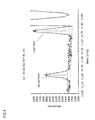
- Figure 1 is a measurement chart of mass number of 43
- Figure 2 is a measurement chart of mass number of 93
- Figure 3 is a measurement chart of mass number of 113.
- Sample B which contained 0.1 ppmw of each of supposed impurities and which was for trichlorosilane GC analysis was prepared as a highly purified trichlorosilane, and analyzed under the same conditions as described above.
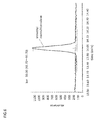
- Figures 4 to 9 Charts obtained by the GC/MS-SIM analysis are shown in Figures 4 to 9 .
- Figure 4 is a measurement chart of mass number of 43
- Figures 5 and 6 are measurement charts of mass number of 93
- Figures 7 to 9 are measurement charts of mass number of 113. From these charts, the width of base line noise and the height of peak abundance were determined, and further the measurement limit was determined. Then, the detection limit of each component was determined. The results are shown below.
- samples 1 - 3 Three kinds of trichlorosilane samples (Samples 1 - 3) different from each other in the distillation accuracy were prepared, and analyzed by GC/MS-SIM method and GC-FID method to compare with each other in the detection sensitivity of peaks caused by impurities. The analysis was performed under the conditions as described above, and each component was quantified by an absolute calibration curve method.
- Figures 10 to 12 are charts obtained by the GC/MS-SIM analysis of Sample 1; Figures 13 to 15 are charts obtained by the GC/MS-SIM analysis of Sample 2; and Figures 16 to 18 are charts obtained by the GC/MS-SIM analysis of Sample 3.
- Table 1 The quantitative analysis results obtained from these charts are summarized in Table 1 (the concentration is ppmw).
- GC-FID method was not able to detect any of methyldichlorosilane and hydrocarbons for all samples, but GC/MS-SIM method was able to detect carbon-containing impurities with high sensitivity, except that methyldichlorosilane of Sample 1 was lower than the detection limit ( ⁇ 0.01 ppmw).
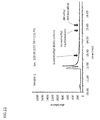
- Figure 19 is a chart obtained by the GC-FID analysis of Sample 2.
- this chart is compared with charts of Figures 13 to 15 obtained by the GC/MS-SIM analysis, it is revealed that the GC-FID analysis was not able to detect the peaks (methyldichlorosilane and isopentane) which were able to be detected by the GC/MS-SIM analysis.
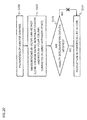
- Figure 20 is a flow scheme of a method for producing a polycrystalline silicon according to the present invention.
- This example is a flow scheme of the production of a polycrystalline silicon using Sample 1 described above as a raw material according to Siemens method.
- Sample 1 which is trichlorosilane is prepared (S101), and the content of carbon-containing impurities in Sample 1 is analyzed by GC/MS-SIM method (S102).
- a quality determination is made on the basis of the analysis results (S103) and, in case that the sample is determined to be a good material (S103: Yes), the sample is used as a raw material for producing a high-purity polycrystalline silicon by CVD method (S104).
- S103: No the sample is not used as the raw material for producing a polycrystalline silicon.
- the analysis of the impurities by GC/MS-SIM method was performed using, as a separation column, a column having a non-polar column and a medium-polar column connected in series with each other.
- methylsilanes as the carbon-containing impurities were 0.01 ppmw or lower, and hydrocarbons as the carbon-containing impurities were 0.05 ppmw or lower.
- Sample 1 was therefore determined to be a good material.
- a polycrystalline silicon was produced using Sample 1 by Siemens method (refer to Patent Literature 1).
- a polycrystalline silicon was produced according to the steps described above, and the concentration of carbon in the produced polycrystalline silicon was analyzed by a cryogenic FT-IR method (using BRUKER Optics Corporation, FT-IR, VERTEX80V, liquid nitrogen) to be a low concentration and less than 0.05 ppma.
- chlorosilanes containing carbon-containing impurities of which content exceeds the quality determination criteria are excluded from the raw material, and the higher purification of a polycrystalline silicon can be therefore achieved.
Landscapes
- Chemical & Material Sciences (AREA)
- Organic Chemistry (AREA)
- Inorganic Chemistry (AREA)
- Health & Medical Sciences (AREA)
- Life Sciences & Earth Sciences (AREA)
- Engineering & Computer Science (AREA)
- Physics & Mathematics (AREA)
- Medicinal Chemistry (AREA)
- Food Science & Technology (AREA)
- Analytical Chemistry (AREA)
- Biochemistry (AREA)
- General Health & Medical Sciences (AREA)
- General Physics & Mathematics (AREA)
- Immunology (AREA)
- Pathology (AREA)
- Silicon Compounds (AREA)
- Manufacturing & Machinery (AREA)
Abstract
Description
- The present invention relates to a technology for producing a high-purity polycrystalline silicon. More specifically, the present invention relates to a technology for realizing the higher purification of a polycrystalline silicon by using a raw material gas having a low concentration of carbon-containing impurities.
- A high-purity polycrystalline silicon of a semiconductor grade is usually produced by CVD method called "Siemens method" using chlorosilanes gas mainly composed of trichlorosilane in the presence of hydrogen as a raw material (refer to, for example, Patent Literature 1: Japanese Patent Laid-Open No.
56-73617 - In general, chlorosilanes for manufacturing a polycrystalline silicon are synthesized by the reaction of a metallurgical grade silicon with hydrogen chloride (refer to, for example, Patent Literature 2: Japanese Patent Laid-Open No.
2-208217 9-169514 60-36318 10-29813 - However, since the synthesized chlorosilanes contain impurities derived from the metallurgical grade silicon, etc. used as a raw material, the synthesized chlorosilanes, after having been subjected to a chemical treatment for high purification (refer to, for example, Patent Literature 6: Japanese Patent Laid-Open No.
2009-62213 - These high purifications (i.e., the removal of impurities) are critically important especially in a polycrystalline silicon of a semiconductor grade. This is because, in case of the impurities contained being phosphorus or arsenic serving as a donor in a silicon crystal, or boron or aluminum serving as an acceptor in a silicon crystal, the impurities significantly affect the electrical properties (resistivity) of a polycrystalline silicon when incorporated thereinto even at a trace amount. Thus, the donor and acceptor impurities contained in chlorosilanes as a raw material are removed by various methods (for example, chemical treatments as described in Patent Literature 6).
- Further, carbon impurities form, in a silicon crystal, an impurity level in the band gap to act as a carrier trap, or accelerate the formation of precipitation nuclei of oxygen in the crystal to induce crystal defects during the process of manufacturing a semiconductor device. Therefore, the content of carbon impurities also becomes problematic in a polycrystalline silicon of a semiconductor grade.
- As one of the causes of the contamination of carbon impurities into a polycrystalline silicon, carbon-containing impurities such as alkyl chlorosilanes and hydrocarbons can be considered which are generated during the production of trichlorosilane and which are mixed into trichlorosilane or hydrogen. These carbon-containing impurities may be some times mixed into at about several tens of ppm by weight ratio when producing trichlorosilane.
- In particular, methyldichlorosilane, which is the main component of methylchlorosilanes, has a boiling point (41°C) close to that (32°C) of trichlorosilane which is the subject of a distillation purification, and its removal is therefore difficult. For this reason, a number of methods for removing methyldichlorosilane have been proposed (for example, Patent Literatures 7-9).
-
- Patent Literature 1: Japanese Patent Laid-Open No.
56-73617 - Patent Literature 2: Japanese Patent Laid-Open No.
2-208217 - Patent Literature 3: Japanese Patent Laid-Open No.
9-169514 - Patent Literature 4: Japanese Patent Laid-Open No.
60-36318 - Patent Literature 5: Japanese Patent Laid-Open No.
10-29813 - Patent Literature 6: Japanese Patent Laid-Open No.
2009-62213 - Patent Literature 7: Japanese Patent Laid-Open No.
2004-149351 - Patent Literature 8: Japanese Patent Laid-Open No.
2011-184255 - Patent Literature 9: Japanese Patent Laid-Open No.
2009-62212 - Patent Literature 10: Japanese Patent Laid-Open No.
11-49509 - Non Patent Literature 1: New Approaches to the Development of GC/MS Selected Ion Monitoring Acquisition and Quantitation Methods Nov. 14, 2001, 5988-4188EN Agilent Technologies, Inc. (Technical Reference)
- According to Japanese Patent Laid-Open No.
11-49509 - Therefore, in order to produce a high-purity polycrystalline silicon, it is necessary to reduce as much as possible the amount of carbon impurities in the chlorosilanes to be supplied as a raw material.
- To that end, measurement of the amount of carbon impurities contained in chlorosilanes in advance is needed, and, in the analysis for that, GC-FID method (gas chromatography/hydrogen ionization detector) has been typically used hitherto.
- GC-FID method has been used particularly as a standard high-sensitivity analytical method for analyzing methyldichlorosilane which is a main carbon impurity in trichlorosilane, but‗the detection limit is about 0.1 ppmw for general organic compounds, and about 0.1 ppmw for methylsilanes.
- An FID detector (hydrogen ionization detector) uses combustion by oxyhydrogen gas for the detection of components, and therefore the detection sensitivity is destabilized due to SiO2 generated in the detection part, resulting in a problem that the continuous use is difficult.
- Furthermore, there is a method in which a carrier gas is switched, for preventing the generation of a large amount of SiO2, by a rotary valve after the separation of trichlorosilane as the main component, thereby not introducing the component into the FID detector. In that method, however, shock at the time of switching a rotary valve causes baseline drift or affects the chromatographic shape of component peaks, resulting also in a problem that it is difficult to perform a quantitative analysis of a trace amount with high accuracy.
- In addition to these problems, there is no column available which can simultaneously perform both of the separation of chlorosilanes and hydrocarbons and the separation of chlorosilanes and methylsilanes, when impurities in trichlorosilane are to be analyzed by GC-FID method. Therefore, the analyses are needed to be performed depending on individual separation conditions, resulting also in a problem that the analytical work must be performed separately twice.
- Thus, there has been a need for more highly purifying a polycrystalline silicon of a semiconductor grade, but the conventional approaches have not fully met this need under the present circumstances.
- The present invention has been made in view of these problems, and an object of the present invention is to provide a technology for realizing higher purification of a polycrystalline silicon by using a raw material gas having a low concentration of carbon-containing impurities.
- In order to solve the above problems, a method for producing a high-purity polycrystalline silicon according to the present invention is to produce a high-purity polycrystalline silicon using chlorosilanes by CVD method, and is characterized by performing a quality determination by analyzing the content of carbon-containing impurities including methyldichlorosilane and isopentane by GC/MS-SIM method, and using, as the chlorosilanes, trichlorosilane satisfying conditions which are quality determination criteria set based on permissible values of the content of carbon-containing impurities whose values are provided on the basis of a permissible value of the content of carbon in an objective polycrystalline silicon.
- More conveniently, the carbon-containing impurities to be analyzed by the GC/MS-SIM method are methyldichlorosilane and isopentane.
- Preferably, the quality determination criteria are that methylsilanes as the carbon-containing impurities are 0.01 ppmw or lower, and hydrocarbons as the carbon-containing impurities are 0.05 ppmw or lower.
- Furthermore, preferably, the analysis of the impurities by the GC/MS-SIM method separates the components using, as a separation column, a column having a non-polar column and a medium-polar column connected in series with each other.
- According to the method for producing a polycrystalline silicon of the present invention, chlorosilanes whose content of carbon-containing impurities exceeds the quality determination criteria are excluded from the raw material, and higher purification of a polycrystalline silicon can be therefore achieved.
- By using, as a separation column, a column having a non-polar column and a medium-polar column connected in series with each other, both of the separation of chlorosilanes and hydrocarbons and the separation of chlorosilanes and methylsilanes can be simultaneously performed according to GC/MS-SIM method.
-
- [
Figure 1] Figure 1 is a chart (measurement chart of mass number of 43) obtained by GC/MS-SIM analysis of Sample A. - [
Figure 2] Figure 2 is a chart (measurement chart of mass number of 93) obtained by GC/MS-SIM analysis of Sample A. - [
Figure 3] Figure 3 is a chart (measurement chart of mass number of 113) obtained by GC/MS-SIM analysis of Sample A. - [
Figure 4] Figure 4 is a chart (measurement chart of mass number of 43) obtained by GC/MS-SIM analysis of Sample B. - [
Figure 5] Figure 5 is a chart (measurement chart of mass number of 93) obtained by GC/MS-SIM analysis of Sample B. - [
Figure 6] Figure 6 is a chart (measurement chart of mass number of 93) obtained by GC/MS-SIM analysis of Sample B. - [
Figure 7] Figure 7 is a chart (measurement chart of mass number of 113) obtained by GC/MS-SIM analysis of Sample B. - [
Figure 8] Figure 8 is a chart (measurement chart of mass number of 113) obtained by GC/MS-SIM analysis of Sample B. - [
Figure 9] Figure 9 is a chart (measurement chart of mass number of 113) obtained by GC/MS-SIM analysis of Sample B. - [
Figure 10] Figure 10 is a chart (mass number of 43) obtained by GC/MS-SIM analysis ofSample 1. - [
Figure 11] Figure 11 is a chart (mass number of 93) obtained by GC/MS-SIM analysis ofSample 1. - [
Figure 12] Figure 12 is a chart (mass number of 113) obtained by GC/MS-SIM analysis ofSample 1. - [
Figure 13] Figure 13 is a chart (mass number of 43) obtained by GC/MS-SIM analysis ofSample 2. - [
Figure 14] Figure 14 is a chart (mass number of 93) obtained by GC/MS-SIM analysis ofSample 2. - [
Figure 15] Figure 15 is a chart (mass number of 113) obtained by GC/MS-SIM analysis ofSample 2. - [
Figure 16] Figure 16 is a chart (mass number of 43) obtained by GC/MS-SIM analysis ofSample 3. - [
Figure 17] Figure 17 is a chart (mass number of 93) obtained by GC/MS-SIM analysis ofSample 3. - [
Figure 18] Figure 18 is a chart (mass number of 113) obtained by GC/MS-SIM analysis ofSample 3. - [
Figure 19] Figure 19 is a chart obtained by GC-FID analysis ofSample 2. - [
Figure 20] Figure 20 is a flow scheme of a method for producing a polycrystalline silicon according to the present invention. - In the following, a method for producing a polycrystalline silicon according to the present invention will be described in detail with reference to the accompanying drawings.
- As described above, many proposals and industrializations have been already made for a method of synthesizing trichlorosilane with high purity by a distillation separation of chlorosilanes. Chlorosilanes may be obtained by, for example, a direct method using a metallurgical grade silicon and hydrogen chloride (refer to
Patent Literatures 2 and 3). When a polycrystalline silicon is produced using, as a raw material, tetrachlorosilane or trichlorosilane which is a by-product in obtaining chlorosilanes by the direct method, tetrachlorosilane is also obtained from an exhaust gas generated in the direct method, and the reduction of the tetrachlorosilane by reacting with hydrogen in the presence of a metallurgical grade silicon may also produce chlorosilanes (refer toPatent Literatures 4 and 5). - Then, after obtaining trichlorosilane fractions by distillation separation of the produced chlorosilanes, the fractions are subjected to a chemical treatment (refer to Patent Literature 6), etc. to remove impurities that become acceptors or donors such as boron or phosphorus, followed by a precision distillation to obtain a high-purity trichlorosilane.
- GC-FID method is generally used to measure impurities in the obtained trichlorosilane, but if the purification process of trichlorosilane is appropriate, the content of the impurities contained is the lower detection limit of GC-FID method or lower, specifically, is 0.1 ppmw or lower for general organic compounds, and 0.1 ppmw or lower for methylsilanes.
- However, impurities of which content is these values or lower cannot be detected by GC-FID method, and such impurities may be therefore obstacles in realizing the higher purification of a polycrystalline silicon.
- Thus, the present inventors have investigated a method for detecting carbon-containing impurities in trichlorosilane with high sensitivity and, as a result, found that use of GC/MS-SIM method can increase the detection sensitivity of the carbon-containing impurities by about 10-fold as compared to GC-FID method, to lead to the completion of the present invention. Here, GC/MS refers to a gas chromatograph mass spectrometer, and SIM refers to selected ion monitoring.
- By using GC/MS-SIM method, the lower detection limit of carbon-containing impurities in trichlorosilane becomes 0.01 ppmw for methylsilanes, and 0.05 ppmw for general carbon-containing compounds, which enables an analysis with sensitivity of about 10-fold as compared to GC-FID method. That is, the analysis of carbon-containing impurities in trichlorosilane according to GC/MS-SIM method makes it possible to produce a polycrystalline silicon using, as a raw material, trichlorosilane guaranteed with 0.01 ppmw or lower for methylsilanes, and 0.05 ppmw or lower for general carbon-containing compounds (hydrocarbons).
- This is because the rate at which the carbon-containing impurities as described above is transferred as carbon into the produced polycrystalline silicon, namely the transfer rate, has been found to be in the range of about 1 - 10% from the results of investigations according to the present inventors.
- In this range, even if the production of a polycrystalline silicon is performed in an environment where the maximum amount of the impurities is transferred, when trichlorosilane is selected as a raw material based on quality determination criteria of 0.01 ppmw or lower and 0.05 ppmw or lower, respectively, for the contents of methyldichlorosilane and isopentane which are likely to be mixed into the product even when highly purified, it can be assumed that methyldichlorosilane and isopentane are individually transferred as carbon of 10% of the total amount, resulting in the concentration of carbon in the synthesized polycrystalline silicon of 0.048 ppma or lower.
- That is, use of that criteria enable the production of a high-purity polycrystalline silicon containing carbon of lower than 0.05 ppma of the lower quantification limit of a cryogenic FT-IR method which has at present the highest sensitivity when measuring the concentration of carbon in a single crystal silicon.
- Here, describing the basis for the above carbon concentration of "0.048 ppma", when isopentane in trichlorosilane is 0.05 ppmw, the carbon content becomes 0.05 x (12 x 5) /72 = 0.042 ppmw, and the carbon content of trichlorosilane therefore becomes C(ppma) = (0.042 x 135.45) /12.0=0.47.
- Here, the above 135.45 is the molecular weight of trichlorosilane, the above 12.0 is the atomic weight of C.
- Similarly, when CH3-SiH-Cl2 in trichlorosilane is 0.01 ppmw, the carbon content becomes 0.01 x (12 x 1) /114 = 0.0011 ppmw, and the carbon content in trichlorosilane therefore becomes C(ppma) = (0.0011 x 135.45) /12.0=0.012.
- In addition, from the results of the investigation according to the present inventors, the actual transfer rate is 1 to 10% and, when calculated with 10% of the maximum value, the content of carbon transferred to (incorporated into) the synthesized polycrystalline silicon becomes 0.047 + 0.0012 = 0.048 ppma.
- That is, a method for producing a high-purity polycrystalline silicon according to the present invention is to produce a high-purity polycrystalline silicon using chlorosilanes by CVD method, and uses, as a raw material, trichlorosilane which is subjected to a quality determination by analyzing the content of the carbon-containing impurities by GC/MS-SIM method and which satisfies conditions of quality determination criteria.
- The quality determination criteria are that methylsilanes as the carbon-containing impurities are 0.01 ppmw or lower, and hydrocarbons as the carbon-containing impurities are 0.05 ppmw or lower, for the reasons as described above.
- The procedures of a quantitative analysis by GC/MS-SIM method are introduced by
Non-Patent Literature 1, etc., and conditions for the analysis of carbon-containing impurities in trichlorosilane in the present invention are, for example, described in the following. - For the gas chromatography conditions, ordinary analysis conditions for chlorosilanes may be applied as they are and, for example, hydrogen, helium, nitrogen, etc. are used as a carrier gas.
- As the separation column, a medium-polar capillary column is preferred for methylsilanes, and a non-polar capillary column is preferred for hydrocarbons. In a preferred aspect of the present invention, a column having a non-polar column and a medium-polar column e connected in series with each other is used. By using such a column, both of the separation of chlorosilanes and hydrocarbons and the separation of chlorosilanes and methylsilanes can be simultaneously performed by GC/MS-SIM method.
- There are no particular limitations on the non-polar column and medium-polar column, and the known columns may be appropriately selected and used. Such columns include products from Agilent Technologies, Inc., Varian Inc., Supelco, Inc., Restek Corp., and GL Sciences, Inc.
- As the commercially available non-polar capillary column, DB-1, DB-5, VF-1, VF-5, SPB-1, SPB-5, Rtx-1, Rtx-5, TC-1, TC-5, etc. may be suitably used.
- As the commercially available medium-polar capillary column, DB-17, DB-200, DB-210, DB-225, VF-17, VF-23, VF-200, VF-1701, Select Silane, SBP-17, SP-2331, Rtx-225, Rtx-1701, TC-17, etc. may be suitably used.
- An oven temperature in performing the separation is in the range of about 20 to 150°C, and assembling a heating program in this temperature range may obtain a good separation.
- As an ionization method for MS, an electron impact ionization method (EI) may be adopted and, for example, gas molecule may be changed into a positive monovalent ion by applying thereto an electron beam bombardment of 70 eV. In this case, the ionization current of about 34 to 35 µA, the ionization chamber temperature of 200 to 250°C, the transfer line temperature of 200 to 250°C and the detector voltage of 1000 to 2000 V may be made as guides.
- Further, analysis results with high accuracy may be obtained by setting monitor ions in the SIM (m/z) in detection order, as follows: isopentane (m/z = 43, m/z = 57, m/z = 72), n-pentane (m/z = 43, m/z = 57, m/z = 72), tetramethylsilane (m/z = 43, m/z = 45, m/z = 73), dimethylchlorosilane (m/z = 59, m/z = 79, m/z = 93), methyldichlorosilane as the main impurities (m/z = 79, m/z = 99, m/z = 113), trimethylchlorosilane (m/z = 65, m/z = 73, m/z = 93), methyltrichlorosilane (m/z = 148, m/z = 113, m/z = 133), and dimethyldichlorosilane (m/z = 128, m/z = 93, m/z = 113), and setting a cycle time of 4.0 - 5.0 cycles/sec.
- In the present invention, when producing a high-purity polycrystalline silicon using trichlorosilane as a raw material by CVD method, more specifically, by Siemens method, the content of carbon-containing impurities in the trichlorosilane are in advance analyzed by GC/MS-SIM method to determine the trichlorosilane satisfying the conditions of quality determination criteria as a good material, and this good material determined is used as the raw material.
- The method for producing a polycrystalline silicon by Siemens method is widely known and, for example, is performed as described in the following.
- First, a silicon core which will become a seed crystal for a polycrystalline silicon is placed in CVD reactor, followed by energization for heating the silicon core. Further, while maintaining the surface temperature of the silicon core at 900 to 1200°C, trichlorosilane which has been determined as a good material by GC/MS-SIM method is supplied together with hydrogen as a carrier gas. The trichlorosilane is decomposed on the silicon core, and a polycrystalline silicon is grown on the silicon core.
- At this time, chlorosilanes such as unreacted trichlorosilane and tetrachlorosilane are discharged together with hydrogen as exhaust gases, and the hydrogen and trichlorosilane may be recovered and reused. In addition, chlorosilanes such as tetrachlorosilane are converted into trichlorosilane and reused (refer to
Patent Literatures 4 and 5). - According to the present invention, use of GC/MS-SIM method can increase the detection sensitivity of carbon-containing impurities by about 10-fold as compared to that obtained using conventional GC-FID method, and the purity of trichlorosilane, which is a raw material for producing a polycrystalline silicon, can be therefore easily increased and, as a result, the higher purification of a polycrystalline silicon can be achieved.
- The present invention will be specifically described below with reference to examples.
- Sample A which contained 2 ppmw of each of supposed impurities and which was for trichlorosilane GC analysis was prepared as a highly purified trichlorosilane, and analyzed under the following conditions.
-
- Carrier gas: He (1 ml/min)
- Column: VF-200 manufactured by Varian Inc. was further connected in series with the outlet side of DB-1 manufactured by Agilent Technologies, Inc. and used as a column
- Injection: Split (0.6 µL), 23.4 psi, 150°C
- Oven temperature: 20 to 150°C (The temperature was increased at a rate of 10°C/min, and maintained at 150°C)
-
- Ionization energy: 70 eV
- Ionization current: 34 µA
- Ion source temperature: 230°C
- Transfer line temperature: 230°C
- Detector voltage: 1000 to 2000 V
- Monitor ions: isopentane, n-pentane, tetramethylsilane, dimethyl monochlorosilane, trimethyl monochlorosilane, methyltrichlorosilane, dimethyldichlorosilane
- Cycle time: 4.3 cycles/sec.
- Charts obtained by the GC/MS-SIM analysis described above are shown in
Figures 1 to 3 .Figure 1 is a measurement chart of mass number of 43,Figure 2 is a measurement chart of mass number of 93, andFigure 3 is a measurement chart of mass number of 113. It was confirmed that the measurements of mass numbers of 43, 93 and 113 in GC/MS-SIM method enabled, by comparing with each of the gas chromatography charts previously obtained by GC-FID method, the detections of peaks derived from trimethylsilane, isopentane and n-pentane; the detections of peaks derived from dimethyl monochlorosilane and trimethyl monochlorosilane; and the detections of peaks derived from monomethyldichlorosilane, monomethyltrichlorosilane and dimethyldichlorosilane, respectively. - Sample B which contained 0.1 ppmw of each of supposed impurities and which was for trichlorosilane GC analysis was prepared as a highly purified trichlorosilane, and analyzed under the same conditions as described above.
- Charts obtained by the GC/MS-SIM analysis are shown in
Figures 4 to 9 .Figure 4 is a measurement chart of mass number of 43,Figures 5 and6 are measurement charts of mass number of 93, andFigures 7 to 9 are measurement charts of mass number of 113. From these charts, the width of base line noise and the height of peak abundance were determined, and further the measurement limit was determined. Then, the detection limit of each component was determined. The results are shown below. The detection limit (SN2) was determined by the following equation.
-
- iso-pentane: SN2 = 2(3.5 mm) x (0.1 ppmw/28 mm) = < 0.03 ppmw
- n-pentane: SN2 = 2(3.5 mm) x (0.1 ppmw/43 mm) = < 0.02 ppmw
- dichloromonochlorosilane: SN2 = 2(2.0 mm) x (0.1 ppmw/26 mm) = < 0.02 ppmw
- trimethylmonochlorosilane: SN2 = 2(2.0 mm) x (0.1 ppmw/46 mm) = < 0.01 ppmw
- monomethyldichlorosilane: SN2 = 2(1.5 mm) x (0.1 ppmw/42 mm) = < 0.01 ppmw
- monomethyltrichlorosilane: SN2 = 2(1.0 mm) x (0.1 ppmw/50 mm) = < 0.01 ppmw
- dimethyldichlorosilane: SN2 = 2(1.5 mm) x (0.1 ppmw/45 mm) = < 0.01 ppmw
- These results reveal that use of GC/MS-SIM method enables the analysis of carbon-containing impurities with very high sensitivity.
- Three kinds of trichlorosilane samples (Samples 1 - 3) different from each other in the distillation accuracy were prepared, and analyzed by GC/MS-SIM method and GC-FID method to compare with each other in the detection sensitivity of peaks caused by impurities. The analysis was performed under the conditions as described above, and each component was quantified by an absolute calibration curve method.
-
Figures 10 to 12 are charts obtained by the GC/MS-SIM analysis ofSample 1;Figures 13 to 15 are charts obtained by the GC/MS-SIM analysis ofSample 2; andFigures 16 to 18 are charts obtained by the GC/MS-SIM analysis ofSample 3. The quantitative analysis results obtained from these charts are summarized in Table 1 (the concentration is ppmw).[Table 1] Detection method Analyzed sample Concentration of methyldichlorosilane Concentration of hydrocarbon Example 1 GC/MS- SIM Sample 1 <0.01 0.05 Comparative Example A1 GC/MS- SIM Sample 2 0.01 0.06 Comparative Example A2 GC/MS- SIM Sample 3 0.08 0.03 Comparative Example B1 GC- FID Sample 1 <0.1 <0.5 Comparative Example B2 GC- FID Sample 2 <0.1 <0.5 Comparative Example B3 GC- FID Sample 3 <0.1 <0.5 - In these analyses, only methyldichlorosilane as alkylchlorosilanes was detected to be a significant impurity. Only isopentane as hydrocarbons was also detected to be a significant impurity.
- GC-FID method was not able to detect any of methyldichlorosilane and hydrocarbons for all samples, but GC/MS-SIM method was able to detect carbon-containing impurities with high sensitivity, except that methyldichlorosilane of
Sample 1 was lower than the detection limit (< 0.01 ppmw). -
Figure 19 is a chart obtained by the GC-FID analysis ofSample 2. When this chart is compared with charts ofFigures 13 to 15 obtained by the GC/MS-SIM analysis, it is revealed that the GC-FID analysis was not able to detect the peaks (methyldichlorosilane and isopentane) which were able to be detected by the GC/MS-SIM analysis. -
Figure 20 is a flow scheme of a method for producing a polycrystalline silicon according to the present invention. This example is a flow scheme of the production of a polycrystallinesilicon using Sample 1 described above as a raw material according to Siemens method. - First,
Sample 1 which is trichlorosilane is prepared (S101), and the content of carbon-containing impurities inSample 1 is analyzed by GC/MS-SIM method (S102). A quality determination is made on the basis of the analysis results (S103) and, in case that the sample is determined to be a good material (S103: Yes), the sample is used as a raw material for producing a high-purity polycrystalline silicon by CVD method (S104). On the other hand, in case that the sample is determined to be a bad material (S103: No), the sample is not used as the raw material for producing a polycrystalline silicon. As described above, the analysis of the impurities by GC/MS-SIM method was performed using, as a separation column, a column having a non-polar column and a medium-polar column connected in series with each other. - The criteria of the above quality determination were that methylsilanes as the carbon-containing impurities were 0.01 ppmw or lower, and hydrocarbons as the carbon-containing impurities were 0.05 ppmw or lower.
Sample 1 was therefore determined to be a good material. Thus, a polycrystalline silicon was produced usingSample 1 by Siemens method (refer to Patent Literature 1). - A polycrystalline silicon was produced according to the steps described above, and the concentration of carbon in the produced polycrystalline silicon was analyzed by a cryogenic FT-IR method (using BRUKER Optics Corporation, FT-IR, VERTEX80V, liquid nitrogen) to be a low concentration and less than 0.05 ppma.
- As described herein above, according to the method for producing a polycrystalline silicon of the present invention, chlorosilanes containing carbon-containing impurities of which content exceeds the quality determination criteria are excluded from the raw material, and the higher purification of a polycrystalline silicon can be therefore achieved.
- Further, there is also an advantage that both of the separation of chlorosilanes and hydrocarbons and the separation of chlorosilanes and methylsilanes can be simultaneously performed according to GC/MS-SIM method by using, as a separation column, a column having a non-polar column and a medium-polar column connected in series with each other.
Claims (4)
- A method for producing a high-purity polycrystalline silicon using chlorosilanes by CVD method, wherein a quality determination is performed by analyzing a content of carbon-containing impurities including methyldichlorosilane and isopentane by GC/MS-SIM method, and trichlorosilane satisfying conditions which are quality determination criteria set based on permissible values of the content of carbon-containing impurities whose values are provided on the basis of a permissible value of the content of carbon in an objective polycrystalline silicon is used as the chlorosilanes.
- The method for producing a high-purity polycrystalline silicon according to claim 1, wherein the carbon-containing impurities to be analyzed by the GC/MS-SIM method are methyldichlorosilane and isopentane.
- The method for producing a high-purity polycrystalline silicon according to claim 1 or 2, wherein the quality determination criteria are that methylsilanes as the carbon-containing impurities are 0.01 ppmw or lower, and hydrocarbons as the carbon-containing impurities are 0.05 ppmw or lower.
- The method for producing a high-purity polycrystalline silicon according to claim 1 or 2, wherein the analysis of the impurities by the GC/MS-SIM method separates the components using, as the separation column, a column having a non-polar column and a medium-polar column connected in series with each other.
Priority Applications (1)
| Application Number | Priority Date | Filing Date | Title |
|---|---|---|---|
| EP16202542.3A EP3170791A1 (en) | 2012-06-14 | 2013-06-13 | Method for producing high-purity polycrystalline silicon |
Applications Claiming Priority (2)
| Application Number | Priority Date | Filing Date | Title |
|---|---|---|---|
| JP2012134863A JP5909153B2 (en) | 2012-06-14 | 2012-06-14 | Method for producing high-purity polycrystalline silicon |
| PCT/JP2013/003729 WO2013187070A1 (en) | 2012-06-14 | 2013-06-13 | Method for producing high-purity polycrystalline silicon |
Related Child Applications (2)
| Application Number | Title | Priority Date | Filing Date |
|---|---|---|---|
| EP16202542.3A Division EP3170791A1 (en) | 2012-06-14 | 2013-06-13 | Method for producing high-purity polycrystalline silicon |
| EP16202542.3A Division-Into EP3170791A1 (en) | 2012-06-14 | 2013-06-13 | Method for producing high-purity polycrystalline silicon |
Publications (3)
| Publication Number | Publication Date |
|---|---|
| EP2862840A1 true EP2862840A1 (en) | 2015-04-22 |
| EP2862840A4 EP2862840A4 (en) | 2015-11-11 |
| EP2862840B1 EP2862840B1 (en) | 2017-01-25 |
Family
ID=49757914
Family Applications (2)
| Application Number | Title | Priority Date | Filing Date |
|---|---|---|---|
| EP13804452.4A Active EP2862840B1 (en) | 2012-06-14 | 2013-06-13 | Method for producing high-purity polycrystalline silicon |
| EP16202542.3A Withdrawn EP3170791A1 (en) | 2012-06-14 | 2013-06-13 | Method for producing high-purity polycrystalline silicon |
Family Applications After (1)
| Application Number | Title | Priority Date | Filing Date |
|---|---|---|---|
| EP16202542.3A Withdrawn EP3170791A1 (en) | 2012-06-14 | 2013-06-13 | Method for producing high-purity polycrystalline silicon |
Country Status (7)
| Country | Link |
|---|---|
| US (1) | US9355918B2 (en) |
| EP (2) | EP2862840B1 (en) |
| JP (1) | JP5909153B2 (en) |
| KR (1) | KR20150032859A (en) |
| CN (2) | CN106966395B (en) |
| MY (1) | MY170224A (en) |
| WO (1) | WO2013187070A1 (en) |
Families Citing this family (10)
| Publication number | Priority date | Publication date | Assignee | Title |
|---|---|---|---|---|
| JP6292164B2 (en) * | 2015-04-30 | 2018-03-14 | 信越半導体株式会社 | Method for producing silicon single crystal |
| CN104849366B (en) * | 2015-05-11 | 2017-12-19 | 中国恩菲工程技术有限公司 | Detecting system and detection method |
| JP6343592B2 (en) | 2015-07-28 | 2018-06-13 | 信越化学工業株式会社 | Reactor for producing polycrystalline silicon and method for producing polycrystalline silicon |
| JP6702325B2 (en) * | 2015-08-05 | 2020-06-03 | 東亞合成株式会社 | Carbon analysis method |
| JP6586405B2 (en) * | 2016-09-28 | 2019-10-02 | 信越化学工業株式会社 | Trichlorosilane purification system and method for producing polycrystalline silicon |
| WO2019154502A1 (en) | 2018-02-08 | 2019-08-15 | Wacker Chemie Ag | Process for classification of metallurgical silicon |
| JP6694002B2 (en) * | 2018-05-21 | 2020-05-13 | 信越化学工業株式会社 | Method for producing polycrystalline silicon |
| JP6919633B2 (en) | 2018-08-29 | 2021-08-18 | 信越半導体株式会社 | Single crystal growth method |
| CN111289689A (en) * | 2018-12-07 | 2020-06-16 | 新疆新特新能材料检测中心有限公司 | Method and system for detecting content of each component in tail gas in polycrystalline silicon production |
| CN117310033A (en) * | 2023-09-27 | 2023-12-29 | 内蒙古新特硅材料有限公司 | A method for detecting carbon impurities in chlorosilane |
Family Cites Families (26)
| Publication number | Priority date | Publication date | Assignee | Title |
|---|---|---|---|---|
| JPS5673617A (en) | 1979-11-17 | 1981-06-18 | Osaka Titanium Seizo Kk | Manufacture of trichlorosilane |
| US4374110A (en) * | 1981-06-15 | 1983-02-15 | Motorola, Inc. | Purification of silicon source materials |
| US4526769A (en) | 1983-07-18 | 1985-07-02 | Motorola, Inc. | Trichlorosilane production process |
| NO166032C (en) | 1988-12-08 | 1991-05-22 | Elkem As | PROCEDURE FOR THE PREPARATION OF TRICHLORMONOSILAN. |
| US5444246A (en) * | 1992-09-30 | 1995-08-22 | Shin-Etsu Handotai Co., Ltd. | Determining carbon concentration in silicon single crystal by FT-IR |
| US5445679A (en) * | 1992-12-23 | 1995-08-29 | Memc Electronic Materials, Inc. | Cleaning of polycrystalline silicon for charging into a Czochralski growing process |
| JP3324922B2 (en) | 1995-12-22 | 2002-09-17 | 株式会社トクヤマ | Method for producing silicon trichloride |
| JP3708648B2 (en) | 1995-12-25 | 2005-10-19 | 株式会社トクヤマ | Method for producing trichlorosilane |
| JP3727470B2 (en) | 1997-06-03 | 2005-12-14 | 株式会社トクヤマ | Method for producing polycrystalline silicon with low carbon content |
| JP3506599B2 (en) * | 1998-02-04 | 2004-03-15 | Necエレクトロニクス株式会社 | Analysis method |
| JP2003172726A (en) * | 2001-12-07 | 2003-06-20 | Shimadzu Corp | Chromatographic mass spectrometer |
| JP3892794B2 (en) * | 2002-09-04 | 2007-03-14 | 住友チタニウム株式会社 | Chlorosilane and its purification method |
| EP1647046A2 (en) * | 2003-07-23 | 2006-04-19 | ASM America, Inc. | DEPOSITION OF SiGE ON SILICON-ON-INSULATOR STRUCTURES AND BULK SUBSTRATES |
| DE102005046703A1 (en) * | 2005-09-29 | 2007-04-05 | Wacker Chemie Ag | Hydrogenation of chlorosilane comprises contacting silicon-containing compound and hydrogen with surface of reaction chamber and surface of heater such that silicon carbide coating is formed in situ on the surfaces in first process step |
| JP4714197B2 (en) * | 2007-09-05 | 2011-06-29 | 信越化学工業株式会社 | Method for producing trichlorosilane and method for producing polycrystalline silicon |
| JP4714198B2 (en) | 2007-09-05 | 2011-06-29 | 信越化学工業株式会社 | Purification method of chlorosilanes |
| DE102007049930B4 (en) * | 2007-10-18 | 2011-04-28 | Universität Hamburg | Surface-modified cavity structures, processes for their preparation and their use |
| EP2322478B1 (en) * | 2008-08-22 | 2013-01-02 | JNC Corporation | Method for the purification of silicon tetrachloride |
| KR20110069770A (en) * | 2008-09-09 | 2011-06-23 | 칫소가부시키가이샤 | High Purity Crystalline Silicon, High Purity Silicon Tetrachloride, and Methods for Making the Same |
| JP2010217440A (en) * | 2009-03-16 | 2010-09-30 | Powdertech Co Ltd | Carrier for two-component electrophotographic developer and electrophotographic developer using the carrier |
| CN101531674B (en) * | 2009-04-23 | 2012-02-15 | 嘉兴学院 | Preparation method of methyl chlorosilane |
| JP2010281699A (en) * | 2009-06-04 | 2010-12-16 | Canon Anelva Corp | Method for quantifying unseparated peak using ion attachment mass spectrometer (IAMS) |
| JP5337749B2 (en) | 2010-03-10 | 2013-11-06 | 信越化学工業株式会社 | Method for producing trichlorosilane |
| DE102010040293A1 (en) * | 2010-09-06 | 2012-03-08 | Wacker Chemie Ag | Process for producing polycrystalline silicon |
| CN102351195A (en) * | 2011-07-15 | 2012-02-15 | 中国科学院过程工程研究所 | Process for closed circulation production of polysilicon |
| CN102286016A (en) * | 2011-09-15 | 2011-12-21 | 江苏弘博新材料有限公司 | Method for preparing methyl chlorosilane |
-
2012
- 2012-06-14 JP JP2012134863A patent/JP5909153B2/en active Active
-
2013
- 2013-06-13 CN CN201610890923.8A patent/CN106966395B/en active Active
- 2013-06-13 KR KR20157000531A patent/KR20150032859A/en not_active Withdrawn
- 2013-06-13 US US14/407,255 patent/US9355918B2/en active Active
- 2013-06-13 MY MYPI2014703617A patent/MY170224A/en unknown
- 2013-06-13 EP EP13804452.4A patent/EP2862840B1/en active Active
- 2013-06-13 EP EP16202542.3A patent/EP3170791A1/en not_active Withdrawn
- 2013-06-13 CN CN201380031327.9A patent/CN104395236B/en active Active
- 2013-06-13 WO PCT/JP2013/003729 patent/WO2013187070A1/en not_active Ceased
Also Published As
| Publication number | Publication date |
|---|---|
| US20150170976A1 (en) | 2015-06-18 |
| US9355918B2 (en) | 2016-05-31 |
| JP5909153B2 (en) | 2016-04-26 |
| MY170224A (en) | 2019-07-10 |
| CN106966395B (en) | 2019-11-01 |
| CN106966395A (en) | 2017-07-21 |
| WO2013187070A1 (en) | 2013-12-19 |
| KR20150032859A (en) | 2015-03-30 |
| CN104395236A (en) | 2015-03-04 |
| EP2862840A4 (en) | 2015-11-11 |
| EP3170791A1 (en) | 2017-05-24 |
| CN104395236B (en) | 2016-11-16 |
| JP2013256431A (en) | 2013-12-26 |
| EP2862840B1 (en) | 2017-01-25 |
Similar Documents
| Publication | Publication Date | Title |
|---|---|---|
| EP2862840B1 (en) | Method for producing high-purity polycrystalline silicon | |
| AU2011225614B2 (en) | Method for producing trichlorosilane | |
| US20170369325A1 (en) | Method for producing trichlorosilane | |
| KR101529769B1 (en) | Use of specific resistance measurement to indirectly determine the purity of silanes and germanes, and corresponding method | |
| DE102007007874A1 (en) | Process for the preparation of higher silanes | |
| Shah et al. | Ultra-microscale (5–25 μg C) analysis of individual lipids by 14C AMS: assessment and correction for sample processing blanks | |
| TWI582044B (en) | Preparation of hexachlorodisilane by splitting higher polychlorosilanes such as octachlorotrisilane | |
| DE102008000052A1 (en) | Method of depositing polycrystalline silicon | |
| EP2465819B1 (en) | Method for purifying chlorosilanes | |
| Kozerski et al. | Investigation of trialkoxysilane hydrolysis kinetics using liquid chromatography with inductively coupled plasma atomic emission spectrometric detection and non-linear regression modeling | |
| JP3878278B2 (en) | Method for producing polycrystalline silicon with low phosphorus content | |
| EP1951929B1 (en) | Composition for chemical vapor deposition film-formation and method for production of low dielectric constant film | |
| JP7506836B2 (en) | Method for producing purified trichlorosilane | |
| Müller et al. | Boron suppression with a gas ionization chamber at very low energies (E< 1 MeV) | |
| Swenton et al. | Rates of hydrogen atom abstraction from benzyltrimethylsilanes by bromine and tert-butoxy radical. the question of the stability of the. alpha.-(trimethylsilyl) benzyl radical | |
| Operti et al. | Gas-phase ion chemistry in silane/propyne mixtures | |
| TW202609296A (en) | Method of detecting and quantifying compounds of boron and/or aluminum | |
| Wyller et al. | Exploring thermal pyrolysis of monosilane through gas chromatography-mass spectrometry measurements of higher order silanes | |
| TW202507268A (en) | Degradable gas quantitative analysis method | |
| CN112748204A (en) | Method for detecting content of solvent in alkyl bromobenzene products | |
| CN111024856A (en) | Method for measuring contents of components of high-boiling-point substance in R142b production process by using phase chromatography | |
| de Meijere et al. | Vibrational spectra and ab initio analysis of tert-butyl, trimethylsilyl, trimethylgermyl, trimethylstannyl and trimethylplumbyl derivatives of 3, 3-dimethylcyclopropene. XII. 1, 2-Di-tert-butyl-3, 3-dimethylcyclopropene |
Legal Events
| Date | Code | Title | Description |
|---|---|---|---|
| PUAI | Public reference made under article 153(3) epc to a published international application that has entered the european phase |
Free format text: ORIGINAL CODE: 0009012 |
|
| 17P | Request for examination filed |
Effective date: 20141201 |
|
| AK | Designated contracting states |
Kind code of ref document: A1 Designated state(s): AL AT BE BG CH CY CZ DE DK EE ES FI FR GB GR HR HU IE IS IT LI LT LU LV MC MK MT NL NO PL PT RO RS SE SI SK SM TR |
|
| AX | Request for extension of the european patent |
Extension state: BA ME |
|
| DAX | Request for extension of the european patent (deleted) | ||
| RIC1 | Information provided on ipc code assigned before grant |
Ipc: H01L 21/02 20060101ALI20150929BHEP Ipc: H01L 21/66 20060101ALI20150929BHEP Ipc: C01B 33/03 20060101AFI20150929BHEP Ipc: C01B 33/035 20060101ALI20150929BHEP Ipc: G01N 33/00 20060101ALI20150929BHEP |
|
| RA4 | Supplementary search report drawn up and despatched (corrected) |
Effective date: 20151008 |
|
| 17Q | First examination report despatched |
Effective date: 20160613 |
|
| GRAP | Despatch of communication of intention to grant a patent |
Free format text: ORIGINAL CODE: EPIDOSNIGR1 |
|
| INTG | Intention to grant announced |
Effective date: 20160825 |
|
| GRAS | Grant fee paid |
Free format text: ORIGINAL CODE: EPIDOSNIGR3 |
|
| GRAA | (expected) grant |
Free format text: ORIGINAL CODE: 0009210 |
|
| AK | Designated contracting states |
Kind code of ref document: B1 Designated state(s): AL AT BE BG CH CY CZ DE DK EE ES FI FR GB GR HR HU IE IS IT LI LT LU LV MC MK MT NL NO PL PT RO RS SE SI SK SM TR |
|
| REG | Reference to a national code |
Ref country code: GB Ref legal event code: FG4D |
|
| REG | Reference to a national code |
Ref country code: CH Ref legal event code: EP |
|
| REG | Reference to a national code |
Ref country code: AT Ref legal event code: REF Ref document number: 863988 Country of ref document: AT Kind code of ref document: T Effective date: 20170215 |
|
| REG | Reference to a national code |
Ref country code: IE Ref legal event code: FG4D |
|
| REG | Reference to a national code |
Ref country code: DE Ref legal event code: R096 Ref document number: 602013016817 Country of ref document: DE |
|
| REG | Reference to a national code |
Ref country code: LT Ref legal event code: MG4D |
|
| REG | Reference to a national code |
Ref country code: NL Ref legal event code: MP Effective date: 20170125 |
|
| REG | Reference to a national code |
Ref country code: AT Ref legal event code: MK05 Ref document number: 863988 Country of ref document: AT Kind code of ref document: T Effective date: 20170125 |
|
| PG25 | Lapsed in a contracting state [announced via postgrant information from national office to epo] |
Ref country code: NL Free format text: LAPSE BECAUSE OF FAILURE TO SUBMIT A TRANSLATION OF THE DESCRIPTION OR TO PAY THE FEE WITHIN THE PRESCRIBED TIME-LIMIT Effective date: 20170125 |
|
| PG25 | Lapsed in a contracting state [announced via postgrant information from national office to epo] |
Ref country code: HR Free format text: LAPSE BECAUSE OF FAILURE TO SUBMIT A TRANSLATION OF THE DESCRIPTION OR TO PAY THE FEE WITHIN THE PRESCRIBED TIME-LIMIT Effective date: 20170125 Ref country code: LT Free format text: LAPSE BECAUSE OF FAILURE TO SUBMIT A TRANSLATION OF THE DESCRIPTION OR TO PAY THE FEE WITHIN THE PRESCRIBED TIME-LIMIT Effective date: 20170125 Ref country code: FI Free format text: LAPSE BECAUSE OF FAILURE TO SUBMIT A TRANSLATION OF THE DESCRIPTION OR TO PAY THE FEE WITHIN THE PRESCRIBED TIME-LIMIT Effective date: 20170125 Ref country code: IS Free format text: LAPSE BECAUSE OF FAILURE TO SUBMIT A TRANSLATION OF THE DESCRIPTION OR TO PAY THE FEE WITHIN THE PRESCRIBED TIME-LIMIT Effective date: 20170525 Ref country code: NO Free format text: LAPSE BECAUSE OF FAILURE TO SUBMIT A TRANSLATION OF THE DESCRIPTION OR TO PAY THE FEE WITHIN THE PRESCRIBED TIME-LIMIT Effective date: 20170425 Ref country code: GR Free format text: LAPSE BECAUSE OF FAILURE TO SUBMIT A TRANSLATION OF THE DESCRIPTION OR TO PAY THE FEE WITHIN THE PRESCRIBED TIME-LIMIT Effective date: 20170426 |
|
| PG25 | Lapsed in a contracting state [announced via postgrant information from national office to epo] |
Ref country code: ES Free format text: LAPSE BECAUSE OF FAILURE TO SUBMIT A TRANSLATION OF THE DESCRIPTION OR TO PAY THE FEE WITHIN THE PRESCRIBED TIME-LIMIT Effective date: 20170125 Ref country code: LV Free format text: LAPSE BECAUSE OF FAILURE TO SUBMIT A TRANSLATION OF THE DESCRIPTION OR TO PAY THE FEE WITHIN THE PRESCRIBED TIME-LIMIT Effective date: 20170125 Ref country code: PL Free format text: LAPSE BECAUSE OF FAILURE TO SUBMIT A TRANSLATION OF THE DESCRIPTION OR TO PAY THE FEE WITHIN THE PRESCRIBED TIME-LIMIT Effective date: 20170125 Ref country code: RS Free format text: LAPSE BECAUSE OF FAILURE TO SUBMIT A TRANSLATION OF THE DESCRIPTION OR TO PAY THE FEE WITHIN THE PRESCRIBED TIME-LIMIT Effective date: 20170125 Ref country code: SE Free format text: LAPSE BECAUSE OF FAILURE TO SUBMIT A TRANSLATION OF THE DESCRIPTION OR TO PAY THE FEE WITHIN THE PRESCRIBED TIME-LIMIT Effective date: 20170125 Ref country code: BG Free format text: LAPSE BECAUSE OF FAILURE TO SUBMIT A TRANSLATION OF THE DESCRIPTION OR TO PAY THE FEE WITHIN THE PRESCRIBED TIME-LIMIT Effective date: 20170425 Ref country code: AT Free format text: LAPSE BECAUSE OF FAILURE TO SUBMIT A TRANSLATION OF THE DESCRIPTION OR TO PAY THE FEE WITHIN THE PRESCRIBED TIME-LIMIT Effective date: 20170125 Ref country code: PT Free format text: LAPSE BECAUSE OF FAILURE TO SUBMIT A TRANSLATION OF THE DESCRIPTION OR TO PAY THE FEE WITHIN THE PRESCRIBED TIME-LIMIT Effective date: 20170525 |
|
| PGFP | Annual fee paid to national office [announced via postgrant information from national office to epo] |
Ref country code: IT Payment date: 20170619 Year of fee payment: 5 |
|
| REG | Reference to a national code |
Ref country code: DE Ref legal event code: R097 Ref document number: 602013016817 Country of ref document: DE |
|
| PG25 | Lapsed in a contracting state [announced via postgrant information from national office to epo] |
Ref country code: CZ Free format text: LAPSE BECAUSE OF FAILURE TO SUBMIT A TRANSLATION OF THE DESCRIPTION OR TO PAY THE FEE WITHIN THE PRESCRIBED TIME-LIMIT Effective date: 20170125 Ref country code: RO Free format text: LAPSE BECAUSE OF FAILURE TO SUBMIT A TRANSLATION OF THE DESCRIPTION OR TO PAY THE FEE WITHIN THE PRESCRIBED TIME-LIMIT Effective date: 20170125 Ref country code: EE Free format text: LAPSE BECAUSE OF FAILURE TO SUBMIT A TRANSLATION OF THE DESCRIPTION OR TO PAY THE FEE WITHIN THE PRESCRIBED TIME-LIMIT Effective date: 20170125 Ref country code: SK Free format text: LAPSE BECAUSE OF FAILURE TO SUBMIT A TRANSLATION OF THE DESCRIPTION OR TO PAY THE FEE WITHIN THE PRESCRIBED TIME-LIMIT Effective date: 20170125 |
|
| PG25 | Lapsed in a contracting state [announced via postgrant information from national office to epo] |
Ref country code: DK Free format text: LAPSE BECAUSE OF FAILURE TO SUBMIT A TRANSLATION OF THE DESCRIPTION OR TO PAY THE FEE WITHIN THE PRESCRIBED TIME-LIMIT Effective date: 20170125 Ref country code: SM Free format text: LAPSE BECAUSE OF FAILURE TO SUBMIT A TRANSLATION OF THE DESCRIPTION OR TO PAY THE FEE WITHIN THE PRESCRIBED TIME-LIMIT Effective date: 20170125 |
|
| PLBE | No opposition filed within time limit |
Free format text: ORIGINAL CODE: 0009261 |
|
| STAA | Information on the status of an ep patent application or granted ep patent |
Free format text: STATUS: NO OPPOSITION FILED WITHIN TIME LIMIT |
|
| 26N | No opposition filed |
Effective date: 20171026 |
|
| PG25 | Lapsed in a contracting state [announced via postgrant information from national office to epo] |
Ref country code: MC Free format text: LAPSE BECAUSE OF FAILURE TO SUBMIT A TRANSLATION OF THE DESCRIPTION OR TO PAY THE FEE WITHIN THE PRESCRIBED TIME-LIMIT Effective date: 20170125 |
|
| REG | Reference to a national code |
Ref country code: CH Ref legal event code: PL |
|
| GBPC | Gb: european patent ceased through non-payment of renewal fee |
Effective date: 20170613 |
|
| PG25 | Lapsed in a contracting state [announced via postgrant information from national office to epo] |
Ref country code: SI Free format text: LAPSE BECAUSE OF FAILURE TO SUBMIT A TRANSLATION OF THE DESCRIPTION OR TO PAY THE FEE WITHIN THE PRESCRIBED TIME-LIMIT Effective date: 20170125 |
|
| REG | Reference to a national code |
Ref country code: IE Ref legal event code: MM4A |
|
| REG | Reference to a national code |
Ref country code: FR Ref legal event code: ST Effective date: 20180228 |
|
| PG25 | Lapsed in a contracting state [announced via postgrant information from national office to epo] |
Ref country code: CH Free format text: LAPSE BECAUSE OF NON-PAYMENT OF DUE FEES Effective date: 20170630 Ref country code: GB Free format text: LAPSE BECAUSE OF NON-PAYMENT OF DUE FEES Effective date: 20170613 Ref country code: LU Free format text: LAPSE BECAUSE OF NON-PAYMENT OF DUE FEES Effective date: 20170613 Ref country code: LI Free format text: LAPSE BECAUSE OF NON-PAYMENT OF DUE FEES Effective date: 20170630 Ref country code: IE Free format text: LAPSE BECAUSE OF NON-PAYMENT OF DUE FEES Effective date: 20170613 |
|
| PG25 | Lapsed in a contracting state [announced via postgrant information from national office to epo] |
Ref country code: FR Free format text: LAPSE BECAUSE OF NON-PAYMENT OF DUE FEES Effective date: 20170630 |
|
| REG | Reference to a national code |
Ref country code: BE Ref legal event code: MM Effective date: 20170630 |
|
| PG25 | Lapsed in a contracting state [announced via postgrant information from national office to epo] |
Ref country code: BE Free format text: LAPSE BECAUSE OF NON-PAYMENT OF DUE FEES Effective date: 20170630 |
|
| PG25 | Lapsed in a contracting state [announced via postgrant information from national office to epo] |
Ref country code: MT Free format text: LAPSE BECAUSE OF NON-PAYMENT OF DUE FEES Effective date: 20170613 |
|
| PG25 | Lapsed in a contracting state [announced via postgrant information from national office to epo] |
Ref country code: IT Free format text: LAPSE BECAUSE OF NON-PAYMENT OF DUE FEES Effective date: 20180613 |
|
| PG25 | Lapsed in a contracting state [announced via postgrant information from national office to epo] |
Ref country code: HU Free format text: LAPSE BECAUSE OF FAILURE TO SUBMIT A TRANSLATION OF THE DESCRIPTION OR TO PAY THE FEE WITHIN THE PRESCRIBED TIME-LIMIT; INVALID AB INITIO Effective date: 20130613 |
|
| PG25 | Lapsed in a contracting state [announced via postgrant information from national office to epo] |
Ref country code: CY Free format text: LAPSE BECAUSE OF FAILURE TO SUBMIT A TRANSLATION OF THE DESCRIPTION OR TO PAY THE FEE WITHIN THE PRESCRIBED TIME-LIMIT Effective date: 20170125 |
|
| PG25 | Lapsed in a contracting state [announced via postgrant information from national office to epo] |
Ref country code: MK Free format text: LAPSE BECAUSE OF FAILURE TO SUBMIT A TRANSLATION OF THE DESCRIPTION OR TO PAY THE FEE WITHIN THE PRESCRIBED TIME-LIMIT Effective date: 20170125 |
|
| REG | Reference to a national code |
Ref country code: DE Ref legal event code: R082 Ref document number: 602013016817 Country of ref document: DE Representative=s name: WITTHOFF JAEKEL STEINECKE PATENTANWAELTE PARTG, DE |
|
| PG25 | Lapsed in a contracting state [announced via postgrant information from national office to epo] |
Ref country code: TR Free format text: LAPSE BECAUSE OF FAILURE TO SUBMIT A TRANSLATION OF THE DESCRIPTION OR TO PAY THE FEE WITHIN THE PRESCRIBED TIME-LIMIT Effective date: 20170125 |
|
| PG25 | Lapsed in a contracting state [announced via postgrant information from national office to epo] |
Ref country code: AL Free format text: LAPSE BECAUSE OF FAILURE TO SUBMIT A TRANSLATION OF THE DESCRIPTION OR TO PAY THE FEE WITHIN THE PRESCRIBED TIME-LIMIT Effective date: 20170125 |
|
| PGFP | Annual fee paid to national office [announced via postgrant information from national office to epo] |
Ref country code: DE Payment date: 20250429 Year of fee payment: 13 |