EP2861658B1 - Biologisch abbaubare zusammensetzungen - Google Patents
Biologisch abbaubare zusammensetzungen Download PDFInfo
- Publication number
- EP2861658B1 EP2861658B1 EP13730064.6A EP13730064A EP2861658B1 EP 2861658 B1 EP2861658 B1 EP 2861658B1 EP 13730064 A EP13730064 A EP 13730064A EP 2861658 B1 EP2861658 B1 EP 2861658B1
- Authority
- EP
- European Patent Office
- Prior art keywords
- biopolymer
- calcined
- particulate
- film
- kaolin
- Prior art date
- Legal status (The legal status is an assumption and is not a legal conclusion. Google has not performed a legal analysis and makes no representation as to the accuracy of the status listed.)
- Active
Links
Images


Classifications
-
- C—CHEMISTRY; METALLURGY
- C08—ORGANIC MACROMOLECULAR COMPOUNDS; THEIR PREPARATION OR CHEMICAL WORKING-UP; COMPOSITIONS BASED THEREON
- C08K—Use of inorganic or non-macromolecular organic substances as compounding ingredients
- C08K3/00—Use of inorganic substances as compounding ingredients
- C08K3/34—Silicon-containing compounds
- C08K3/346—Clay
Definitions
- the present invention relates to compositions which are suitable for use in the production of biopolymer products or articles, for example biopolymer films. More particularly, the present invention relates to compositions and biopolymer products, e.g. films, comprising a polymer and a particulate mineral filler comprising a particulate calcined clay which is calcined kaolin. The present invention also relates to methods of producing said compositions and biopolymer products and uses thereof. For example, the present invention relates to the use of said biopolymer products for packaging, particularly food packaging. The present invention also relates to the use of a calcined clay which is calcined kaolin, as a composting additive in said compositions and products.
- additives may also be used as illustrated in US2005203208 .
- additives may include pigments to improve the aesthetics, fillers to enhance the mechanical properties, or stabilisers to prevent degradation of the polymer and loss of performance.
- the addition of a mineral is generally considered desirable given their low cost when compared to the polymer which is to be filled.
- the stability of a filled polymer can affect its 'fitness for use' in an application if a required performance lifetime is required. However, in other applications such as packaging, it can sometimes be beneficial to have accelerated degradation in order to remove the material from the environment.
- Biodegradable plastics can be broadly placed into two categories, namely biodegradable polymers and biopolymers.
- Biodegradable polymers are synthetic oil-based polymers that have a certain degree of inherent biodegradability, while biopolymers are either naturally occurring or derived from natural polymers.
- Biopolymers unlike biodegradable polymers, can be decomposed into natural metabolic products by fungal or bacterial activity.
- Biopolymer production is still relatively small and expensive when compared with the production of oil based polymers. Apart from issues relating to availability and cost, biopolymers do not yet fully meet manufacturers' requirements. There remain challenges in connection with the associated processing and material performance. In addition, there appears to have been very little research carried out on the effect a mineral has on the rate of compostability of a biopolymer.
- An object of the present invention is the provision of filled biopolymers which address at least some of the issues described herein.
- an object of the present invention is the provision of filled biopolymers with good or improved biodegradability (e.g. compostability) which is preferably achieved without significantly compromising mechanical properties.
- a further objective of the present invention is to provide filled biopolymers with good or improved processability when compared with the unfilled biopolymer or known filled biopolymers.
- the present invention provides a composition comprising a biopolymer and a particulate mineral filler wherein the particulate mineral filler comprises a particulate calcined clay, wherein the particulate calcined clay is calcined kaolin.
- the composition may comprise at least one biopolymer, which may be referred to as a biopolymer resin.
- the term "resin” means a polymeric material, either solid or liquid, prior to shaping into a plastic article such as a polymer film. Accordingly, certain embodiments of the present invention provide a composition comprising a biopolymer resin and a particulate mineral filler wherein the particulate mineral filler comprises a particulate calcined clay wherein the particulate calcined clay is calcined kaolin.
- biopolymers for use in accordance with certain embodiments of the present invention are capable of being molded or shaped into final articles or products such as packaging, including films and the like.
- the composition in accordance with certain embodiments of the present invention may be referred to as a bioplastic composition.
- Biopolymers can be decomposed into natural metabolic products by fungal or bacterial activity.
- biopolymers for use in the present invention are given by one or more of the following: polylactic acid (PLA); polyglyconate; poly(dioxanone); polyhydroxyalkanoate (PHA), for example polyhydroxybutyrate (PHB), poly-3-hydroxybutyrate (P3HB), polyhydroxyvalarate (PHV), poly (3-hydroxybutyrate-co-3-hydroxyvalerate).
- PLA polylactic acid
- PAG polyglyconate
- P3HB poly-3-hydroxybutyrate
- PV polyhydroxyvalarate
- PVA polylactic acid
- PDA polyglyconate
- P3HB poly-3-hydroxybutyrate
- PV polyhydroxyvalarate
- PVA polyhydroxybutyrate-co-3-hydroxyvalerate
- the present invention provides a composition
- a composition comprising one or more of: polylactic acid (PLA); polyglyconate; poly(dioxanone); polyhydroxyalkanoate (PHA), for example polyhydroxybutyrate (PHB), poly-3-hydroxybutyrate (P3HB), polyhydroxyvalarate (PHV), poly (3-hydroxybutyrate-co-3-hydroxyvalerate); and a particulate mineral filler, wherein the particulate mineral filler comprises, or consists of, or consists essentially of a particulate calcined clay which is a particulate calcined kaolin, for example a particulate flash calcined kaolin.
- the present invention provides a composition comprising polyhydroxyalkanoate (PHA) and a particulate mineral filler wherein the particulate mineral filler comprises, or consists of, or consists essentially of a particulate calcined clay which is a particulate calcined kaolin, for example a particulate flash calcined kaolin.
- PHA polyhydroxyalkanoate
- the particulate mineral filler comprises, or consists of, or consists essentially of a particulate calcined clay which is a particulate calcined kaolin, for example a particulate flash calcined kaolin.
- the composition may be formable or formed into a product or article, for example a biopolymer product or article.
- a suitable example of a product or article is a film or biopolymer film. Accordingly, certain embodiments of the present invention provide a (biopolymer) product or article, for example a (biopolymer) film, formed from or formable from a composition in accordance with the present invention.
- certain embodiments of the present invention provide a (biopolymer) product or article, for example a (biopolymer) film, formed from or formable from a biopolymer, or biopolymer resin, and a particulate mineral filler, wherein the particulate mineral filler comprises, or consists of, or consists essentially of a particulate calcined clay, which is a particulate calcined kaolin, for example a particulate flash calcined kaolin.
- a (biopolymer) product or article for example a (biopolymer) film, formed from or formable from a biopolymer, or biopolymer resin, and a particulate mineral filler, wherein the particulate mineral filler comprises, or consists of, or consists essentially of a particulate calcined clay, which is a particulate calcined kaolin, for example a particulate flash calcined kaolin.
- compositions and products or articles in accordance with the invention comprising blending a biopolymer (for example a biopolymer resin) or a precursor of a biopolymer with a particulate mineral filler wherein the particulate mineral filler comprises, or consists of, or consists essentially of particulate calcined clay wherein the particulate calcined clay is calcined kaolin.
- a biopolymer for example a biopolymer resin
- precursor of a biopolymer with a particulate mineral filler
- the particulate mineral filler comprises, or consists of, or consists essentially of particulate calcined clay wherein the particulate calcined clay is calcined kaolin.
- composition may then be formed in to a biopolymer product or article, for example a biopolymer film.
- the biopolymer film can be suitably used in packaging products, including food packaging products and consumer packaging products.
- a biopolymer product or a composition in accordance with the present invention for packaging one or more items.
- the one or more items may be perishable, for example the one or more items may be foodstuff.
- Certain embodiments of the present invention also extend to the packaged products.
- suitable precursors may include one or more of: monomers, cross-linking agents, curing systems comprising cross-linking agents and promoters, or any combination thereof.
- the particulate mineral filler is mixed with precursors of the biopolymer, the biopolymer composition may subsequently be formed by curing and/or polymerising the precursor components to form the desired polymer.
- the calcined clay is calcined kaolin.
- the calcined kaolin may be partially calcined (e.g. to form metakaolin) or fully calcined.
- the calcined kaolin may be soak calcined or flash calcined.
- the calcined kaolin may be surface treated, for example surface treated with an organo-silane or a propylene glycol.
- the particulate mineral filler may have a mean equivalent particle diameter (d 50 ) ranging from about 0.2 ⁇ m to about 15 ⁇ m, for example about 0.6 ⁇ m to about 7 ⁇ m, for example about 0.6 ⁇ m to about 3 ⁇ m or about 1.5 ⁇ m or about 2 ⁇ m to about 7 ⁇ m, or about 1.5 ⁇ m or about 2 ⁇ m to about 3 ⁇ m.
- d 50 mean equivalent particle diameter
- a calcined clay as a composting additive in a composition or a product comprising a biopolymer.
- the calcined clay is calcined kaolin.
- the calcined kaolin may be soak calcined or flash calcined.
- the present invention provides filled biopolymers with good or improved biodegradability (e.g. compostability) which is achieved without significantly compromising mechanical properties (e.g. tensile strength).
- Certain embodiments of the present invention also provide good or improved processability when compared with the corresponding unfilled biopolymer or known filled biopolymers.
- production of the filled biopolymers in connection with certain embodiments of the present invention is typically facilitated by increased melt strength and reduced polymer stickiness or tackiness
- the particulate mineral filler may be a processed particulate mineral filler.
- the particulate mineral filler may consist of, or consist essentially of the particulate calcined clay, wherein the particulate calcined clay is calcined kaolin.
- the calcined material may be soak calcined or flash calcined.
- the particulate mineral filler may consist of, or consist essentially of flash calcined kaolin.
- Biopolymers are either naturally occurring or derived from naturally occurring polymers. Biopolymers may be produced by living organisms and can be decomposed into natural metabolic products by fungal or bacterial activity. The biopolymer products in accordance with the invention are biodegradable in accordance with industrial standard EN 13432.
- the biopolymer may be a homopolymer or a copolymer.
- the biopolymer may be present in an amount of about 10wt% to about 80wt% based on the total weight of the composition, for example about 20wt% to about 50wt%.
- biopolymers for use in the present invention are given by one or more of the following: polylactic acid (PLA); polyglyconate; poly(dioxanone); polyhydroxyalkanoate (PHA), for example polyhydroxybutyrate (PHB), poly-3-hydroxybutyrate (P3HB), polyhydroxyvalarate (PHV), poly (3-hydroxybutyrate-co-3-hydroxyvalerate).
- PVA polylactic acid
- PEG polyglyconate
- P3HB poly-3-hydroxybutyrate
- P3HB polyhydroxyvalarate
- PVA polyhydroxybutyrate-co-3-hydroxyvalerate
- the afore-mentioned biopolymers may be combined in any combination to form a blend.
- the biopolymer to be filled in accordance with the present invention may be a homopolymer or a copolymer. Any of the afore-mentioned biopolymers may be provided in the form of a homopolymer or present in a copolymer
- the composition and/or product/article may have a mass loss over time of at least about 10wt% after about 4 weeks in accordance with EN 13432.
- the present invention provides a composition or product (or article) comprising a polyhydroxyalkanoate and about 20wt% particulate mineral filler, wherein the particulate mineral filler comprises, or consists of, or consists essentially of a flash calcined kaolin, said composition or product or article having a mass loss over time of at least about 10wt% after about 4 weeks in accordance with EN 13432; and/or said composition or product may have a linear carbonyl index value (ester link) of about 8.5 or less after about 4 weeks and optionally a linear carbonyl index value (carboxylic acid) of at least about 1.5 after about 4 weeks and/or said composition or product may have a tensile strength of at least about 20MPa, for example at least about 25MPa.
- PHAs are a suitable example of a biopolymer.
- a culture of a micro-organism is placed in a suitable medium and fed appropriate nutrients. Once the population has reached a substantial level, the nutrient composition is changed to force the microorganism to synthesise PHA.
- Suitable particulate mineral fillers may comprise, consist of, or consist essentially of a calcined clay which is calcined kaolin.
- Calcined clays find use in a variety of application compositions including compositions for making paints, plastics, rubbers, inks, sealants, ceramics, cementitious products, paper and coatings. In these applications, they impart to the finished products a number of desirable properties such as brightness, opacity, hiding power, strength (in plastics) and friction (in paper).
- the calcined clay is calcined kaolin.
- the calcined kaolin may be partially calcined (e.g. metakaolin) or fully calcined.
- the calcined kaolin may be soak calcined or flash calcined.
- the calcined kaolin may be treated with an organo-silane or a propylene glycol.
- the particulate mineral filler comprises, consists of, or consists essentially of flash calcined kaolin which provides particularly good compostability when used in the biopolymer compositions and products in accordance with the present invention.
- Calcined kaolin is particularly suitable for use in accordance with the present invention.
- the major constituent of kaolin is kaolinite, which has the general formula Al 2 (OH) 4 Si 2 O 5 .
- Calcined kaolins are kaolins that have been converted from the corresponding (naturally occurring) hydrous kaolin to the dehydroxylated form by thermal methods. Depending on the conditions used, the chemical change may be partial or total. Calcination changes the kaolin structure from crystalline to amorphous. The degree to which hydrous kaolin undergoes changes in crystalline form may depend on the amount of heat to which it is subjected. Initially, dehydroxylation of the hydrous kaolin occurs on exposure to heat.
- the product is considered to be virtually but not completely dehydroxylated with the resultant amorphous structure commonly being referred to as being a metakaolin.
- calcination at this temperature is referred to as partial calcination and the product may also be referred to as a partially calcined kaolin.
- the metakaolin state can be conveniently ascertained by acid solubility testing because the alumina in the clay (from Al 2 O 3 .2SiO 2 ) is virtually completely soluble in strong mineral acid. Further heating to temperatures above about 900-950°C results in further structural changes such as densification. Calcination at these higher temperatures is commonly referred to as being full calcination and the product is commonly referred to as fully calcined kaolin. Additional calcination may cause formation of mullite which is a very stable aluminium silicate.
- the furnace, kiln or other heating apparatus used to effect calcining of the hydrous kaolin may be of any known kind.
- a typical procedure involves heating kaolin in a kiln, for example a conventional rotary kiln.
- the kaolin may be introduced into the kiln as an extrudate from a pug mill or a lump feed from a drier.
- the typical starting moisture content may be between 10% to 25% by weight to facilitate the extrusion of the kaolin or bind the lump feed.
- the extrudate breaks down into pellets as a result of the calcination process.
- a small amount of a binder (such as alum) may be added to the kaolin to provide "green strength" to the kaolin so as to prevent the kaolin from completely breaking down into powder form during the calcination process.
- the temperature within the kiln should be within a specified range, and will, to a certain extent depend on whether it is desired to make fully calcined or partially calcined kaolin. A relatively low temperature of about 800°C may be used resulting in metakaolin. A higher temperature, for example, in the range of from about 900°C to about 1200°C, for example about 1050°C to about 1150°C, will result in fully calcined kaolin.
- the period of time for calcination of kaolin to produce metakaolin is based upon the temperature in the kiln to which the kaolin is subjected. Generally, the higher the temperature, the shorter the calcination time, and conversely, the lower the temperature, the higher the calcination time.
- Any type of metakaolin is suitable for use in accordance with the present invention.
- Particular examples of metakaolins suitable for use in the present invention include commercially available (from Imerys), Metastar 501 TM, Opacilite TM, Argical M1000 TM, Argical M1200 S TM, Polestar 450 TM.
- the metakaolin may advantageously possess 12 to 18wt% of alumina as ascertained by acid solubility testing.
- a suitable method involves the extraction of soluble aluminium into concentrated nitric acid (Analar grade) and the concentration of aluminium in solution is determined by Inductively Coupled Plasma Atomic Emission Spectroscopy (ICP-AES) using a Thermo Electron Iris-AP Emission Spectrometer and 1000ppm Al Merck BDH Spectrosol standard solution.
- ICP-AES Inductively Coupled Plasma Atomic Emission Spectroscopy
- Particular examples of fully calcined kaolins suitable for use in the present invention include commercially available (from Imerys) Polestar 200R TM, Polestar 200P TM , Gloma TM, Glomax LLTM, Argical 88RTM.
- the calcination process used may be soak calcining, i.e. wherein the hydrous kaolin or clay is calcined for a period of time during which the chemistry of the material is gradually changed by the effect of heating.
- the calcining may, for example, be for a period of at least 1 minute, in many cases at least 10 minutes, e.g. from 30 minutes to five or more hours.
- Known devices suitable for carrying out soak calcining include high temperature ovens, rotary kilns and vertical kilns.
- the calcination process may be flash calcining, wherein typically, hydrous clay or kaolin is rapidly heated over a period of less than one second, e.g. less than 0.5 second.
- Flash calcination refers to heating a material at an extremely fast rate, almost instantaneously.
- the heating rate in a flash calciner may be of the order of 56,000°C per second or greater.
- the calcined kaolin is prepared by flash calcination, wherein the clay may, for example, be exposed to a temperature greater than 500°C for a time not more than 5 seconds.
- the clay may be calcined to a temperature in the range of from 550°C to 1200°C; for microsecond periods the temperature may be as high as 1500°C.
- the clay may be calcined to a temperature in the range of from 800°C to 1100°C; for example a temperature in the range of from 900°C to 1050°C; for example a temperature in the range of from 950°C to 1000°C.
- the clay may be calcined for a time less than 5 seconds; e.g. for less than 1 second; e.g. for less than 0.5 seconds; e.g. for less than 0.1 second. Flash calcination of kaolin particles gives rise to relatively rapid blistering of the particles caused by relatively rapid dehydroxylation of the kaolin.
- Water vapour is generated during calcination which may expand extremely rapidly, in fact generally faster than the water vapour can diffuse through the crystal structure of the particles.
- the pressures generated are sufficient to produce sealed voids as the interlayer hydroxyl groups are driven off, and it is the swollen interlayer spaces, voids, or blisters between the kaolin platelets which typify flash calcined kaolins and give them characteristic properties.
- the flash calcination process may be carried out by injecting the (kaolin) clay into a combustion chamber or furnace wherein a vortex may be established to rapidly remove the calcined clay from the combustion chamber.
- a suitable furnace would be one in which a toroidal fluid flow heating zone is established such as the device described in WO 99/24360 and corresponding applications US 6334894 and US 6136740 .
- the particulate mineral filler prior to calcination may be prepared by light comminution, e.g. grinding or milling, of a coarse mineral to give suitable delamination thereof and in order to provide the desired fineness and particle size distribution (psd) .
- the comminution may be carried out by use of beads or granules of a plastic, e.g. nylon, grinding or milling aid. Ceramic media, silica or sand may also be used.
- jet-milling or fluid energy milling may be used; see US 6145765 and US 3932194 for more details.
- the coarse mineral may be refined to remove impurities and improve physical properties using well-known procedures.
- the mineral may be treated by a known particle size classification procedure, e.g. screening and/or centrifuging, to obtain particles having a desired dso value and/or steepness.
- the particulate mineral filler may be filtered and dried.
- the calcined clay may be comminuted to the desired fineness and particle size distribution.
- a commercially available fine calcined particulate kaolin (which may, for example, have a particle size distribution such that about 79% by volume of the particles have a particle diameter less than 5 ⁇ m and/or about 57% by volume of the particles have a particle diameter less than 2 ⁇ m) is comminuted to the desired fineness and particle size distribution.
- a particulate calcined kaolin starting material may, for example, be the fines recovered from the hot exhaust gases which exit the calciner during the normal calcining process.
- Comminution is preferably achieved by use of conventional processing techniques such as sand grinding (e.g. wet sand grinding in suspension), milling (e.g. dry ball milling or fluid energy milling), centrifugation, particle size classification, filtration, drying and the like.
- sand grinding e.g. wet sand grinding in suspension
- milling e.g. dry ball milling or fluid energy milling
- centrifugation particle size classification
- particle size classification e.g. dry ball milling or fluid energy milling
- filtration filtration, drying and the like.
- Wet sand grinding is preferred, in which case the desired particle size reduction is typically achieved after a work input of about 110 kilowatt-hours per tonne, and the kaolin is then preferably filtered, dried at 80°C and milled to provide the final product.
- hydrous kaolin may be flash calcined by being heated rapidly for a short period (e.g. about one second), cooled and then wet s
- the flash calcined kaolin, for use in the compositions and (biopolymer) products, e.g. films, according to the present invention may typically have a specific gravity lower than hydrous kaolin, and sometimes also lower than soak calcined kaolin, such as, for example, less than or equal to about 2.4, for example, less than or equal to about 2.2.
- the particles of the particulate mineral filler for use in the present invention may have a specific surface area (as measured by the BET liquid nitrogen absorption method ISO 5794/1) of at least about 5m 2 g -1 , e.g. at least about 7m 2 g -1 , at least about 10mg 2 g -1 or at least about 12m 2 g -1 .
- the particulate mineral filler may be dried prior to inclusion in the composition.
- the filler may be dried before being combined with a biopolymer resin.
- the filler may be dried in a conventional oven at about 80°C.
- the biopolymer may be dried in a vacuum oven at approximately 80°C.
- the particulate filler may be dried to an extent such that the particulate filler has and maintains an adsorbed water (or moisture) content not greater than about 0.5wt%, for example and particularly advantageously, not greater than about 0.1wt% based on the dry weight of the particulate filler. This includes both uncoated and coated particulate mineral fillers. Low levels of adsorbed water are particularly beneficial when the filler is used to form breathable films.
- the particulate mineral filler including when either coated or uncoated, is not susceptible to further substantial moisture pick-up.
- the particulate mineral filler may, for example, have a moisture level not greater than about 0.5wt%, for example not greater than about 0.1wt% after exposure to an atmosphere of 80% or more relative humidity for 40 hours at a temperature of 20°C.
- the particulate mineral filler may be free or substantially free of hygroscopic or hydrophilic compounds.
- the grinding may be carried out in the absence of added hygroscopic or hydrophilic compounds, or if wet ground, any dispersant employed may be minimised and/or subsequently removed from the filler in a known manner.
- not greater than about 0.05wt% of a hydrophilic component may be present on the particulate mineral filler based on the dry weight of the particulate mineral filler.
- a dispersant for example, a hydrophilic dispersant
- a dispersant for example, sodium polyacrylate.
- the moisture level may be measured in a known manner, e.g. by a Karl Fischer (KF) titration apparatus. In this method, the water may be driven off from the sample by heating and then measured using the quantitative reaction of water with iodine. In coulometric KF titration, the sample is added to a pyridine-methanol solution (with iodine and sulphur dioxide as principal components). The iodine generated electrolytically at the anode, reacts with water. The amount of water can be directly determined from the quantity of electric charge required for electrolysis.
- the particulate mineral filler may have a mean particle size (d 50 ) ranging from about 0.2 ⁇ m to about 15 ⁇ m, for example about 0.6 ⁇ m to about 7 ⁇ m, for example about 0.6 ⁇ m to about 3 ⁇ m or about 2 ⁇ m, or about 1.5 ⁇ m or about 2 ⁇ m to about 7 ⁇ m, or about 1.5 ⁇ m or about 2 ⁇ m to about 3 ⁇ m.
- particle size properties referred to herein for the particulate mineral filler or specified fillers are as measured in a well known manner by sedimentation of the particulate mineral filler or material in a fully dispersed condition in an aqueous medium using a Sedigraph 5100 machine as supplied by Micromeritics Instruments Corporation, Norcross, Georgia, USA (telephone: +17706623620; web-site: www.micromeritics.com ), referred to herein as a "Micromeritics Sedigraph 5100 unit".
- Such a machine provides measurements and a plot of the cumulative percentage by weight of particles having a size, referred to in the art as the 'equivalent spherical diameter' (e.s.d), less than given e.s.d values.
- the mean particle size d 50 is the value determined in this way of the particle e.s.d at which there are 50% by weight of the particles which have an equivalent spherical diameter less than that d 50 value.
- the d 98 and the d 90 are the values determined in this way of the particle e.s.d. at which there are 98% and 90% respectively by weight of the particles which have an equivalent spherical diameter less than that d 98 or d 90 value.
- the particulate mineral fillers in accordance with the present invention may be incorporated in compositions which may be formable or formed into biopolymer products.
- the biopolymer products may be suitable for use in packaging, for example food packaging.
- the biopolymer product may be in the form of a film which may be breathable or non-breathable.
- the biopolymer product comprises a biopolymer and a particulate mineral filler wherein the filler comprises or consists of, or consists essentially of a particulate calcined clay which is calcined kaolin.
- the biopolymer product is formed or formable from a polymer composition comprising a biopolymer resin and a particulate mineral filler wherein the filler comprises or consists of, or consists essentially of a particulate calcined clay.
- resin means a polymer material, either solid or liquid, prior to shaping into an article such as a polymer film.
- Suitable biopolymer resins include thermoplastic biopolymer resins such as one or more of the following: polylactic acid (PLA); polyglyconate; poly(dioxanone); polyhydroxyalkanoate (PHA), for example polyhydroxybutyrate (PHB), poly-3-hydroxybutyrate (P3HB), polyhydroxyvalarate (PHV), poly (3-hydroxybutyrate-co-3-hydroxyvalerate).
- the afore-mentioned biopolymers may be combined in any combination to form a blend.
- the biopolymer to be filled in accordance with the present invention may be a homopolymer or a copolymer. Any of the afore-mentioned biopolymers may be provided in the form of a homopolymer or present in a copolymer.
- the biopolymer resin Before use, the biopolymer resin may be dried until a required level of dryness is attained.
- the polymer product e.g. the polymer film may further comprise one or more additives.
- useful additives include, but are not limited to, opacifying agents, pigments, colorants, slip agents, antioxidants, anti-fog agents, anti-static agents, anti-block agents, moisture barrier additives, gas barrier additives, hydrocarbon resins or hydrocarbon waxes.
- the particulate mineral filler which may or may not have been surface treated, may typically be present at a concentration of about 2wt% or about 10wt% to about 60wt% or about 80wt%, by weight of the final polymer product, or of the filled composition, for example, about 20wt% to about 50wt%, for example, about 20wt% to about 40wt% or about 5wt% to about 20wt%.
- the particulate filler which may or may not have been surface treated, may be incorporated in polymer compositions and is typically present at a concentration of about 30wt% to about 55wt% by weight of the final polymer film, for example, about 45wt% to about 55wt%.
- the biopolymer resin and filler material may be independently dried prior to mixing.
- the biopolymer resin may be melted (or otherwise softened) prior to formation of the polymer product, and the polymer will not normally be subjected to any further chemical transformations. After formation of the biopolymer product, the biopolymer resin is cooled and allowed to harden.
- compositions according to the present invention can be processed to form, or to be incorporated in, products in any suitable way.
- the composition may be made by methods which are well known in the art generally in which a particulate mineral filler and a biopolymer resin are mixed together in suitable ratios to form a blend (so-called "compounding").
- the biopolymer resin may be in a liquid form to enable the particles of the filler to be dispersed therein. Where the biopolymer resins are solid at ambient temperatures, the biopolymer resin may need to be melted before the compounding can be accomplished.
- the particulate mineral filler may be dry blended with particles of the biopolymer resin, dispersion of the particles in the resin then being accomplished when the melt is obtained prior to forming a product such as a film from the melt, for example in an extruder itself.
- the biopolymer resin and the particulate mineral filler and, if necessary, any other optional additives may be formed into a suitable masterbatch by the use of a suitable compounder/mixer in a manner known per se, and may be pelletized, e.g. by the use of a single screw extruder or a twin-screw extruder which forms strands which may be cut or broken into pellets.
- the compounder may have a single inlet for introducing the filler and the biopolymer resin together. Alternatively, separate inlets may be provided for the filler and the biopolymer resin.
- Suitable compounders are available commercially, for example from Coperion (formerly Werner & Pfleiderer).
- compositions according to the present invention can be processed to form, or to be incorporated in, products such as films in any suitable way.
- Methods of making (bio)polymer films are well known to those of ordinary skill in the art and may be prepared in a conventional manner. Known methods include the use of casting, extruding and blowing processes. For example, extrusion blown film lines may be used. For those instances where combinations of polymers are used, then co-extrusion techniques may be used. Methods of co-extrusion are well known to the person of ordinary skill. Typically, two or more streams of molten polymer resin are joined into a single extrudate stream in such a way that the resins bond together but do not mix.
- extruders are linked so that the extrudates can flow together in an appropriate manner for the desired application.
- extruders may be used in combination and fed together into a complex die that will merge each of the resin streams into a layered film or sandwich material.
- the films made according to the present invention may be of a size and thickness appropriate to the final application.
- the mean thickness of the film may be less than about 250 ⁇ m, for example, about 5 ⁇ m to less than about 250 ⁇ m, for example about 30 ⁇ m to 50 ⁇ m.
- the thickness of the film may be about 5 ⁇ m to about 25 ⁇ m, for example about 8 ⁇ m to about 18 ⁇ m for example about 10 ⁇ m to about 15 ⁇ m.
- a blend or masterbatch of the resin and the filler may first be produced by mixing and compounding prior to the film production stages.
- the mixture of ingredients to be blended by compounding may include, in addition to the resin and the particulate mineral filler, other known optional ingredients employed in thermoplastic films, e.g. one or more of bonding agents, plasticisers, lubricants, anti-oxidants, ultraviolet absorbers, dyes, colourants.
- a bonding or tackifying agent where employed may facilitate bonding of the film after formation to another member, e.g. a nonwoven fibrous layer, or one or more non porous layers.
- the resin, the filler and, if necessary, other optional additives may be mixed by the use of a suitable compounder/mixer e.g. a Henschel mixer, a super mixer, a tumbler type mixer or the like, and kneaded and may be pelletized, e.g. by the use of a single screw extruder or a twin-screw extruder which forms strands which may be cut or broken into pellets.
- the masterbatch or blend e.g. in the form of pellets, may be melted and moulded or shaped into a film by the use of a known moulding and film forming machine.
- the film may be a blown film, cast film or extruded film.
- the film as initially formed may be generally too thick and too noisy as it tends to make a rattling sound when shaken and the film may not yet have a sufficient degree of breathability as measured by its water vapour transmission rate. Consequently, the film may be heated, e.g. to a temperature of about 5°C less than the melting point of the thermoplastic polymer or more, and then stretched to at least about 1.2 times, for example at least about 2.5 times, its original length to thin the film and make it porous.
- An additional feature of the thinning process is the change in opacity of the film.
- the film As formed, the film is relatively transparent but after stretching, it becomes opaque. In addition, while the film becomes orientated during the stretching process, it also becomes softer and it does not have the degree of rattle that it does prior to stretching. Taking all these factors into consideration, and the desire to have a water vapour transmission rate of, for example, at least 100 grams per square metre per 24 hours, the film may, for example, be thinned to such an extent that it has a weight per unit area of less than about 35 grams per square metre for personal care absorbent article applications and a weight per unit area of less than about 18 grams per square metre for certain other applications.
- the moulding and film forming machine may, for example, comprise an extruder equipped with a T-die or the like or an inflation moulding machine equipped with a circular die.
- the film production may be carried out at some time after the masterbatch production, possibly at a different manufacturing plant. In some cases, the masterbatch can directly be formed into the film without producing an intermediate product, e.g. by pelletizing.
- the film can be stretched in at least a uniaxial direction at a temperature of from room temperature to the softening point of the resin in a known manner such as a roll method or a tenter method to bring about the interfacial separation of the resin and the particulate mineral filler from each other, whereby a porous film can be prepared.
- the stretching may be carried out by one step or by several steps.
- Stretch magnification determines film breakage at high stretching as well as breathability and the moisture vapour transmission of the obtained film, and so excessively high stretch magnification and excessively low stretch magnification are desirably avoided.
- the stretch magnification is preferably in the range of about 1.2 to 5 times, for example about 1.2 to 4 times in at least a uniaxial direction.
- biaxial stretching it is possible that, for example, stretching in a first direction is applied in the machine direction or a direction perpendicular thereto, and stretching in a second direction is then applied at right angles to the first direction.
- the biaxial stretching may be carried out simultaneously in the machine direction and the direction perpendicular thereto.
- the heat setting treatment may be, for example, a heat setting treatment at a temperature in the range of from the softening point of the resin to a temperature less than the melting point of the resin for a period of about 0.1 to about 100 seconds.
- the thickness should preferably be such as to obtain film unlikely to tear or break and which has appropriate softness and good feel.
- a film is breathable if it has a water vapour transmission rate of at least 100g/m 2 /24 hours as calculated using the test method described in US-A-5695868 .
- the breathable film may have a water vapour transmission rate of at least 3000g/m 2 /24 hours as calculated in accordance with ASTM E96/E96M-05.
- ASTM E96/E96M-05 ASTM E96/E96M-05.
- the film will have a weight per unit area of less than about 100 grams per square metre and after stretching and thinning its weight per unit area will be less than about 35 grams per square metre and more desirably less than about 18 grams per square metre.
- the porous film can be suitably utilised in applications requiring softness, for example, as the backing sheet of disposable diapers.
- the porous, or breathable, film prepared in accordance with the present invention may have a suitable breathability, moisture vapour transmission and feeling as well as excellent mechanical properties and long-term adhesive properties. Therefore, the breathable film can be suitably used in products such as disposable diapers, body fluid absorbing pads and bed sheets; medical materials such as surgical gowns and base materials for hot compress; clothing materials such as jumpers, rainwear; building materials such as wallpapers and waterproof materials for roofs and house wraps; packaging materials for packaging desiccants, dehumidifying agents, deoxidizers, insecticides, disposable body warmers; packaging materials for keeping the freshness of various articles and foods; separators for the cells; and the like.
- the breathable film is particularly desirable as a material used in products such as disposable diapers and body fluid absorbing pads.
- the breathable film may in such products be formed into a composite or laminate with one or more other layers, e.g. a nonwoven fibrous layer, e.g. by an adhesive or bonding agent.
- the polyhydroxyalkanoate (PHA) Ecomann PHA EM40010 semi-crystalline aliphatic bio-polyester resin was obtained from Bioresins.eu, a division of A&O FilmPAC Limited, UK. The sample obtained was dried for 4 hours at 80°C in a dry air Conair Churchill desiccant dryer.
- the tensile strength of the films was measured following the method described in American Standard Test Method (ASTM) D822-91. The measurements were made on a Tinius Olsen H10KS tensometer fitted with a 1KN load cell with a separation rate of 50mm/min. Elongation was calculated from the cross head movement with the clamps set to a gauge length of 50mm. The tensile strength is quoted as the maximum in the stress versus strain curve for each specimen. The results are typically quoted as the average of six specimens.
- Sample colour (CIEL* a* b*) was measured on a film stack of 10mm thickness in order to minimise any errors associated by not achieving sufficient opacity from the layering of the films.
- Film colour was measured utilising a Datacolor 600 Spectrophotometer, using the method described in International Standards Organisition Test Method (ISO) 7724/2, with a primary illuminant of 6500 K radiation and an observation angle of 10°.
- the minerals in Table 1, (kaolin, flash calcined kaolin, soak calcined kaolin and coated calcium carbonate), were dried at 80°C in a forced-draft oven overnight.
- the minerals were preblended with the PHA at the required ratios of filler to polymer. Masterbatches containing 10wt%, 20wt% and 30wt% mineral were prepared using a Baker Perkins twin screw extruder compounder with a die temperature of 100°C.
- the compounder was run at 300rpm and the feed rate adjusted to maintain a relatively constant torque of approximately 50%. After compounding, the masterbatches were dried at 60°C for 12 hours in a Conair Churchill desiccant dryer. A sample of the virgin PHA was also subjected to the same compounding regime to ensure a comparable thermal history for the reference material.
- the compounder heater zones 1 (feed) to 5 (feed) were set to 105°C and zone 6 (die) to 100°C. Full compounding conditions are set out in Table 1a for the 20wt% loading.
- Cast films of 50 ⁇ m gauge of the PHA masterbatches containing 10wt%, 20wt% and 30 wt% mineral were produced on a Collin E30M extruder fitted to a 150mm slot die with a 1.0mm die gap.
- the films were extruded onto a cast-roll set to approximately 70°C and then passed through a series of rollers to further cool the film prior to collection as a cylindrical roll.
- the temperature profile was set to 160°C at the die, and 160°C, 155°C, 150°C, 140°C, 135°C, 130°C in the barrel.
- the screw speed was 40rpm with a haul-off of 9.5m min -1 with a layflat of approximately 100mm.
- a reference unfilled PHA film was also produced under the same processing conditions. Full blown and cast film conditions are given in Table 1b.
- Table 1a Home Compostable 20wt% Masterbatch Compounding Conditions. Home Compostable Films Compounding conditions to produce 20 wt% masterbatches Sample Temperature profile (°C) Process conditions t1 t2 t3 t4 t5 Die Drive Speed (r/min) Feed Rate Drive Torque (%) Out Put (kg/hr) Set Conditions 105 105 105 105 105 100 300 - - - Unfilled PHA 109 107 101 98 111 137 300 120 50 4.6 Hydrous Kaolin filled PHA 104 106 95 101 102 132 300 120 50 5.2 Flash Calcined Kaolin filled PHA 108 105 93 102 109 135 300 120 50 5.2 Soak Calcined filled PHA 103 106 99 103 101 125 300 120 50 5.2 Calcium Carbonate filled PHA 102 106 98 103 138 300 120 50 5.4 Table 1
- Biodegradable waste was added to four 330 litre Blackwell home composting bins which had removable lids and sliding hatches fitted at ground level to permit access to the compost at the base of the bin. Each bin sat upon a perforated base which raised the compost approximately 75mm above the ground to help the maintenance of aerobic conditions within the compost.
- Three types of biodegradable waste were added to the compost bins, multi-purpose compost obtained from a garden centre, food waste and mature garden compost.
- a compost activator was also added, which contained 'friendly' bacteria to speed up the composting process.
- the multi-purpose compost was peat based designed as an all purpose compost for general outdoor use.
- the food waste was locally obtained from a green grocer and was typically made up of fruit and vegetables which had passed their use by dates.
- the garden waste primarily consisted of tree leaves and grass cuttings obtained from a mature compost heap, which provided a further culture of micro-organisms. The three waste products were mixed and an equal amount added to each composting bin.
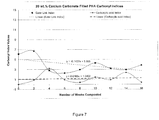
- Circular samples of 3cm diameter were cut from each of the 50 ⁇ m gauge PHA films. Each sample was weighed and placed within a separate 50 ⁇ m nylon mesh bag. These specimen bags were then placed between two large screens, with a mesh size of 2cm, and inserted approximately 150mm below the surface of the compost. Specimens were removed every two weeks, washed with deionised water to remove any surface contaminants, dried in a forced air oven set to 38°C and reweighed. Degradation was monitored for 112 days and was assessed by mass loss of the specimens. Degradation of the mass loss specimens was also assessed by Fourier transform infrared spectroscopy looking at the conversion of the ester linkage peak at 1700cm -1 .
- the decomposition reaction is the hydrolysis of the ester linkages to produce hydroxyl and carboxylic terminals.
- a small proportion of unsaturated side chain fragments undergo oxidative cleavage of the carbon to carbon linkages, producing small amounts of low-molecular weight esters and acids.
- Flash calcined kaolins are produced by rapid heating of a powdered clay feed to a suitably high temperature. The water contained within the structure results in a controlled expansion, within the kaolin structure, resulting in the formation of sealed and broken voids. Without wishing to be bound by theory, during composting the voids present within the flash calcined kaolin may result in a less torturous path for the ingress of moisture into the polymer structure.
- Polyhydroxyalkanoate is a hydrolysable polymer which is susceptible to biodegradation due to the highly reactive nature of its ester link within its polymer backbone.
- the initial degradation of PHA occurs by the hydrolysis of its ester link when subjected to an aqueous environment. The result is chain scission breakage of its polymer backbone leading to the formation of shorter chain lengths.
- the smaller chains are increasingly susceptible to attack from bacteria and other biological organisms.
- the secondary degradation steps can include the assimilation of the smaller fragments by flora and fauna within the compost.
- a significant limitation of biopolymers is their poor melt strength and tendency to stick to processing equipment.
- the inclusion of the particulate mineral filler in accordance with the present invention resulted in increased melt strength and reduced stickiness of the biopolymer.
Landscapes
- Chemical & Material Sciences (AREA)
- Dispersion Chemistry (AREA)
- Health & Medical Sciences (AREA)
- Chemical Kinetics & Catalysis (AREA)
- Medicinal Chemistry (AREA)
- Polymers & Plastics (AREA)
- Organic Chemistry (AREA)
- Compositions Of Macromolecular Compounds (AREA)
- Biological Depolymerization Polymers (AREA)
- Materials For Medical Uses (AREA)
Claims (14)
- Zusammensetzung, umfassend ein Biopolymer und einen teilchenförmigen mineralischen Füllstoff, wobei der teilchenförmige mineralische Füllstoff einen teilchenförmigen kalzinierten Ton umfasst, wobei der teilchenförmige kalzinierte Ton kalziniertes Kaolin ist.
- Zusammensetzung gemäß Anspruch 1, wobei der teilchenförmige kalzinierte Ton vollständig kalziniert ist.
- Zusammensetzung gemäß Anspruch 1, wobei der teilchenförmige kalzinierte Ton teilweise kalziniert ist.
- Zusammensetzung gemäß einem der vorherigen Ansprüche, wobei der kalzinierte Ton weichkalziniert ist.
- Zusammensetzung gemäß einem der vorherigen Ansprüche, wobei der teilchenförmige mineralische Füllstoff in einer Menge von etwa 2 Gew.-% bis etwa 80 Gew.-% oder etwa 60 Gew.-% der Gesamtzusammensetzung, zum Beispiel etwa 5 Gew.-% bis etwa 20 Gew.-%, vorhanden ist.
- Zusammensetzung gemäß einem der vorherigen Ansprüche, wobei das Biopolymer aus einem oder mehreren der Folgenden ausgewählt ist: Polymilchsäure (PLA); Polyglyconat; Poly(dioxanon); Polyhydroxyalkanoat (PHA), zum Beispiel Polyhydroxybutyrat (PHB), Poly-3-hydroxybutyrat (P3HB), Polyhydroxyvalarat (PHV) oder Poly(3-hydroxybutyrat-co-3-hydroxyvalerat).
- Herstellungsverfahren für die Zusammensetzung gemäß einem der Ansprüche 1 bis 6, umfassend ein Mischen eines Biopolymers oder eines Vorläufers eines Biopolymers mit einem teilchenförmigen mineralischen Füllstoff, wobei der teilchenförmige mineralische Füllstoff einen teilchenförmigen kalzinierten Ton, bei dem es sich um kalziniertes Kaolin handelt, umfasst oder daraus besteht oder im Wesentlichen daraus besteht, wobei das Verfahren optional ferner ein Mischen zusätzlicher Komponenten umfasst und optional ferner ein Formen der Zusammensetzung zu einem Biopolymerprodukt oder -gegenstand umfasst.
- Biopolymer-Produkt oder -Gegenstand, gebildet aus oder formbar aus einer Zusammensetzung gemäß einem der Ansprüche 1 bis 6.
- Biopolymerprodukt oder -gegenstand gemäß Anspruch 8, wobei das Produkt oder der Gegenstand zum Verpacken geeignet, zum Beispiel ein Beutel, oder zum Verpacken von Konsumgütern oder Lebensmitteln, ist.
- Biopolymerprodukt oder -gegenstand gemäß einem der Ansprüche 8 oder 9, wobei das Produkt oder der Gegenstand ein Film ist.
- Biopolymerprodukt oder -gegenstand gemäß Anspruch 10, wobei der Film ein atmungsaktiver Film ist und wobei der Film eine mittlere Stärke von 5 µm bis 25 µm, beispielsweise 8 µm bis 18 µm, beispielsweise 10 µm bis 15 µm, aufweisen kann.
- Verwendung eines Biopolymerprodukts oder -gegenstands oder eines atmungsaktiven Films gemäß einem der Ansprüche 8 bis 11 zum Verpacken eines oder mehrerer Elemente, beispielsweise zum Verpacken von Lebensmitteln oder Konsumgütern.
- Verwendung eines teilchenförmigen kalzinierten Tons als Kompostierungsadditiv in einer Zusammensetzung oder einem Produkt, das ein Biopolymer umfasst, wobei der teilchenförmige kalzinierte Ton gemäß Anspruch 1 ist.
- Verwendung gemäß Anspruch 13, wobei das Biopolymer ausgewählt ist aus einem oder mehreren der Folgenden Polymilchsäure (PLA); Polyglyconat; Poly(dioxanon); Polyhydroxyalkanoat (PHA), zum Beispiel Polyhydroxybutyrat (PHB), Poly-3-hydroxybutyrat (P3HB), Polyhydroxyvalarat (PHV) oder Poly(3-hydroxybutyrat-co-3-hydroxyvalerat).
Applications Claiming Priority (2)
| Application Number | Priority Date | Filing Date | Title |
|---|---|---|---|
| GBGB1210800.7A GB201210800D0 (en) | 2012-06-18 | 2012-06-18 | Compositions |
| PCT/GB2013/051569 WO2013190274A2 (en) | 2012-06-18 | 2013-06-17 | Compositions |
Publications (2)
| Publication Number | Publication Date |
|---|---|
| EP2861658A2 EP2861658A2 (de) | 2015-04-22 |
| EP2861658B1 true EP2861658B1 (de) | 2021-04-21 |
Family
ID=46641110
Family Applications (1)
| Application Number | Title | Priority Date | Filing Date |
|---|---|---|---|
| EP13730064.6A Active EP2861658B1 (de) | 2012-06-18 | 2013-06-17 | Biologisch abbaubare zusammensetzungen |
Country Status (4)
| Country | Link |
|---|---|
| EP (1) | EP2861658B1 (de) |
| ES (1) | ES2887934T3 (de) |
| GB (1) | GB201210800D0 (de) |
| WO (1) | WO2013190274A2 (de) |
Families Citing this family (7)
| Publication number | Priority date | Publication date | Assignee | Title |
|---|---|---|---|---|
| EP2722368B1 (de) | 2012-10-16 | 2016-07-13 | Omya International AG | Verfahren für die kontrollierte chemische Reaktion einer festen Füllstoffmaterialoberfläche und Zusatzstoffen zur Herstellung eines oberflächenbehandelten Füllstoffmaterialprodukts |
| EP2952543B1 (de) | 2014-06-05 | 2017-11-01 | Omya International AG | Mit einem anorganischen Füllmaterial gefüllte Polymerzusammensetzung |
| EP3176204A1 (de) | 2015-12-02 | 2017-06-07 | Omya International AG | Oberflächenbehandelte füllstoffe für ultradünne atmungsaktive folien |
| EP3272799A1 (de) | 2016-07-19 | 2018-01-24 | Omya International AG | Verwendung von monosubstituiertem bernsteinsäureanhydrid in polymilchsäure-verbundwerkstoffen gefüllt mit calciumcarbonat |
| EP3318599A1 (de) | 2016-11-07 | 2018-05-09 | Omya International AG | Verwendung von monosubstituiertem bernsteinsäureanhydrid |
| US20200122380A1 (en) * | 2017-05-15 | 2020-04-23 | Stora Enso Oyj | Improved process for extrusion coating of fiber-based substrates |
| EP3693407A1 (de) | 2019-02-11 | 2020-08-12 | Omya International AG | Oberflächenbehandeltes füllstoffprodukt mit verbesserter uv-stabilität für polymerartikel |
Citations (2)
| Publication number | Priority date | Publication date | Assignee | Title |
|---|---|---|---|---|
| WO2002078944A1 (en) * | 2001-03-28 | 2002-10-10 | E. Khashoggi Industries, Llc | Biodegradable polymer blends for use in making films, sheets and other articles of manufacture |
| WO2011146484A2 (en) * | 2010-05-17 | 2011-11-24 | Metabolix, Inc. | Toughening polylactic acid with polyhydroxyalkanoates |
Family Cites Families (2)
| Publication number | Priority date | Publication date | Assignee | Title |
|---|---|---|---|---|
| US5713998A (en) * | 1995-02-14 | 1998-02-03 | Ecc International Inc. | Method for producing high opacifying kaolin pigment |
| US20050203208A1 (en) * | 2004-03-15 | 2005-09-15 | Ruiz Frank A. | Biologically and photochemically degradable polymeric compositions and film |
-
2012
- 2012-06-18 GB GBGB1210800.7A patent/GB201210800D0/en not_active Ceased
-
2013
- 2013-06-17 ES ES13730064T patent/ES2887934T3/es active Active
- 2013-06-17 EP EP13730064.6A patent/EP2861658B1/de active Active
- 2013-06-17 WO PCT/GB2013/051569 patent/WO2013190274A2/en not_active Ceased
Patent Citations (2)
| Publication number | Priority date | Publication date | Assignee | Title |
|---|---|---|---|---|
| WO2002078944A1 (en) * | 2001-03-28 | 2002-10-10 | E. Khashoggi Industries, Llc | Biodegradable polymer blends for use in making films, sheets and other articles of manufacture |
| WO2011146484A2 (en) * | 2010-05-17 | 2011-11-24 | Metabolix, Inc. | Toughening polylactic acid with polyhydroxyalkanoates |
Also Published As
| Publication number | Publication date |
|---|---|
| ES2887934T3 (es) | 2021-12-29 |
| WO2013190274A2 (en) | 2013-12-27 |
| GB201210800D0 (en) | 2012-08-01 |
| WO2013190274A3 (en) | 2014-04-03 |
| EP2861658A2 (de) | 2015-04-22 |
Similar Documents
| Publication | Publication Date | Title |
|---|---|---|
| Pelissari et al. | Nanocomposites based on banana starch reinforced with cellulose nanofibers isolated from banana peels | |
| WO2013190274A2 (en) | Compositions | |
| Florez et al. | Preparation and characterization of thermoplastic starch composite reinforced by plasma-treated poly (hydroxybutyrate) PHB | |
| Yee et al. | Preparation and characterization of poly (lactic acid)-based composite reinforced with oil palm empty fruit bunch fiber and nanosilica | |
| Avolio et al. | PLA-based plasticized nanocomposites: Effect of polymer/plasticizer/filler interactions on the time evolution of properties | |
| Klapiszewski et al. | A high-density polyethylene container based on ZnO/lignin dual fillers with potential antimicrobial activity | |
| Xie et al. | Scale-up fabrication of biodegradable poly (butylene adipate-co-terephthalate)/organophilic–clay nanocomposite films for potential packaging applications | |
| JP6138166B2 (ja) | 高分散能力を有する鉱物材料粉末および前記鉱物材料粉末の使用 | |
| EP3953127B1 (de) | Verfahren zur herstellung von aus biologischen quellen stammenden und biologisch abbaubaren kunststoffgranulaten | |
| EP1985585A1 (de) | Verfahren zur herstellung von nanoverbundwerkstoffen für multisektorielle anwendungen | |
| EP3066053B1 (de) | Verfahren zur verbesserung der partikelgrössenverteilung eines calciumcarbonathaltigen materials | |
| WO2007022080A2 (en) | Biodegradable polymeric nanocomposite compositions particularly for packaging | |
| CA2303812A1 (en) | Particulate carbonates and their preparation and use in thermoplastic film compositions | |
| JP7672109B2 (ja) | 生分解性バイオ複合材料及びその調製方法 | |
| JP2012148905A (ja) | 表面処理重質炭酸カルシウム、その製造方法、及び該炭酸カルシウムを配合した樹脂組成物 | |
| EP1456283A1 (de) | Atmungsfähiger film | |
| US20120129999A1 (en) | Nanocomposite including heat-treated clay and polymer | |
| EP4230702A1 (de) | Talkpartikel mit besonders niedrigem migrationsfaktor für die verwendung als füllstoff in lebensmittelkontaktmaterialien | |
| CN117362760A (zh) | 一种淀粉基生物降解薄膜及其制备方法 | |
| WO2021148938A1 (en) | Ceramic-based composites materials methods and uses thereof | |
| EP4460540A1 (de) | Talkpartikel mit besonders niedrigem migrationsfaktor zur verwendung als füllstoffe in lebensmittelkontaktmaterialien | |
| Kumar et al. | Effect of chemically modified nano zirconia addition on properties of LLDPE/LDPE/PLA/MA-g-PE bio-nanocomposite blown films for packaging applications | |
| Elbaz et al. | Enhancement of Polylactic Acid Packaging Sheet by Adding Three Bio-composites and Evaluating Them as Bioplastic | |
| Genovesi et al. | Polyhydroxyalkanoates-based cast film as marine biodegradable packaging for fresh fruit and vegetables: manufacturing and characterization | |
| KR102235585B1 (ko) | 폴리우레탄용 하이브리드 복합분해제의 제조방법 및 그 방법에 의해 제조된 복합분해제를 함유하는 복합분해성 폴리우레탄 조성물 |
Legal Events
| Date | Code | Title | Description |
|---|---|---|---|
| PUAI | Public reference made under article 153(3) epc to a published international application that has entered the european phase |
Free format text: ORIGINAL CODE: 0009012 |
|
| 17P | Request for examination filed |
Effective date: 20150116 |
|
| AK | Designated contracting states |
Kind code of ref document: A2 Designated state(s): AL AT BE BG CH CY CZ DE DK EE ES FI FR GB GR HR HU IE IS IT LI LT LU LV MC MK MT NL NO PL PT RO RS SE SI SK SM TR |
|
| AX | Request for extension of the european patent |
Extension state: BA ME |
|
| DAX | Request for extension of the european patent (deleted) | ||
| STAA | Information on the status of an ep patent application or granted ep patent |
Free format text: STATUS: EXAMINATION IS IN PROGRESS |
|
| 17Q | First examination report despatched |
Effective date: 20180507 |
|
| RAP1 | Party data changed (applicant data changed or rights of an application transferred) |
Owner name: IMERTECH SAS |
|
| GRAP | Despatch of communication of intention to grant a patent |
Free format text: ORIGINAL CODE: EPIDOSNIGR1 |
|
| STAA | Information on the status of an ep patent application or granted ep patent |
Free format text: STATUS: GRANT OF PATENT IS INTENDED |
|
| INTG | Intention to grant announced |
Effective date: 20201105 |
|
| GRAS | Grant fee paid |
Free format text: ORIGINAL CODE: EPIDOSNIGR3 |
|
| GRAA | (expected) grant |
Free format text: ORIGINAL CODE: 0009210 |
|
| STAA | Information on the status of an ep patent application or granted ep patent |
Free format text: STATUS: THE PATENT HAS BEEN GRANTED |
|
| AK | Designated contracting states |
Kind code of ref document: B1 Designated state(s): AL AT BE BG CH CY CZ DE DK EE ES FI FR GB GR HR HU IE IS IT LI LT LU LV MC MK MT NL NO PL PT RO RS SE SI SK SM TR |
|
| REG | Reference to a national code |
Ref country code: GB Ref legal event code: FG4D |
|
| REG | Reference to a national code |
Ref country code: CH Ref legal event code: EP |
|
| REG | Reference to a national code |
Ref country code: DE Ref legal event code: R096 Ref document number: 602013077009 Country of ref document: DE |
|
| REG | Reference to a national code |
Ref country code: IE Ref legal event code: FG4D |
|
| REG | Reference to a national code |
Ref country code: AT Ref legal event code: REF Ref document number: 1384597 Country of ref document: AT Kind code of ref document: T Effective date: 20210515 |
|
| REG | Reference to a national code |
Ref country code: NL Ref legal event code: FP |
|
| REG | Reference to a national code |
Ref country code: LT Ref legal event code: MG9D |
|
| REG | Reference to a national code |
Ref country code: AT Ref legal event code: MK05 Ref document number: 1384597 Country of ref document: AT Kind code of ref document: T Effective date: 20210421 |
|
| PG25 | Lapsed in a contracting state [announced via postgrant information from national office to epo] |
Ref country code: LT Free format text: LAPSE BECAUSE OF FAILURE TO SUBMIT A TRANSLATION OF THE DESCRIPTION OR TO PAY THE FEE WITHIN THE PRESCRIBED TIME-LIMIT Effective date: 20210421 Ref country code: FI Free format text: LAPSE BECAUSE OF FAILURE TO SUBMIT A TRANSLATION OF THE DESCRIPTION OR TO PAY THE FEE WITHIN THE PRESCRIBED TIME-LIMIT Effective date: 20210421 Ref country code: HR Free format text: LAPSE BECAUSE OF FAILURE TO SUBMIT A TRANSLATION OF THE DESCRIPTION OR TO PAY THE FEE WITHIN THE PRESCRIBED TIME-LIMIT Effective date: 20210421 Ref country code: AT Free format text: LAPSE BECAUSE OF FAILURE TO SUBMIT A TRANSLATION OF THE DESCRIPTION OR TO PAY THE FEE WITHIN THE PRESCRIBED TIME-LIMIT Effective date: 20210421 Ref country code: BG Free format text: LAPSE BECAUSE OF FAILURE TO SUBMIT A TRANSLATION OF THE DESCRIPTION OR TO PAY THE FEE WITHIN THE PRESCRIBED TIME-LIMIT Effective date: 20210721 |
|
| PG25 | Lapsed in a contracting state [announced via postgrant information from national office to epo] |
Ref country code: SE Free format text: LAPSE BECAUSE OF FAILURE TO SUBMIT A TRANSLATION OF THE DESCRIPTION OR TO PAY THE FEE WITHIN THE PRESCRIBED TIME-LIMIT Effective date: 20210421 Ref country code: RS Free format text: LAPSE BECAUSE OF FAILURE TO SUBMIT A TRANSLATION OF THE DESCRIPTION OR TO PAY THE FEE WITHIN THE PRESCRIBED TIME-LIMIT Effective date: 20210421 Ref country code: IS Free format text: LAPSE BECAUSE OF FAILURE TO SUBMIT A TRANSLATION OF THE DESCRIPTION OR TO PAY THE FEE WITHIN THE PRESCRIBED TIME-LIMIT Effective date: 20210821 Ref country code: LV Free format text: LAPSE BECAUSE OF FAILURE TO SUBMIT A TRANSLATION OF THE DESCRIPTION OR TO PAY THE FEE WITHIN THE PRESCRIBED TIME-LIMIT Effective date: 20210421 Ref country code: GR Free format text: LAPSE BECAUSE OF FAILURE TO SUBMIT A TRANSLATION OF THE DESCRIPTION OR TO PAY THE FEE WITHIN THE PRESCRIBED TIME-LIMIT Effective date: 20210722 Ref country code: NO Free format text: LAPSE BECAUSE OF FAILURE TO SUBMIT A TRANSLATION OF THE DESCRIPTION OR TO PAY THE FEE WITHIN THE PRESCRIBED TIME-LIMIT Effective date: 20210721 Ref country code: PL Free format text: LAPSE BECAUSE OF FAILURE TO SUBMIT A TRANSLATION OF THE DESCRIPTION OR TO PAY THE FEE WITHIN THE PRESCRIBED TIME-LIMIT Effective date: 20210421 Ref country code: PT Free format text: LAPSE BECAUSE OF FAILURE TO SUBMIT A TRANSLATION OF THE DESCRIPTION OR TO PAY THE FEE WITHIN THE PRESCRIBED TIME-LIMIT Effective date: 20210823 |
|
| REG | Reference to a national code |
Ref country code: ES Ref legal event code: FG2A Ref document number: 2887934 Country of ref document: ES Kind code of ref document: T3 Effective date: 20211229 |
|
| REG | Reference to a national code |
Ref country code: DE Ref legal event code: R097 Ref document number: 602013077009 Country of ref document: DE |
|
| PG25 | Lapsed in a contracting state [announced via postgrant information from national office to epo] |
Ref country code: MC Free format text: LAPSE BECAUSE OF FAILURE TO SUBMIT A TRANSLATION OF THE DESCRIPTION OR TO PAY THE FEE WITHIN THE PRESCRIBED TIME-LIMIT Effective date: 20210421 Ref country code: RO Free format text: LAPSE BECAUSE OF FAILURE TO SUBMIT A TRANSLATION OF THE DESCRIPTION OR TO PAY THE FEE WITHIN THE PRESCRIBED TIME-LIMIT Effective date: 20210421 Ref country code: CZ Free format text: LAPSE BECAUSE OF FAILURE TO SUBMIT A TRANSLATION OF THE DESCRIPTION OR TO PAY THE FEE WITHIN THE PRESCRIBED TIME-LIMIT Effective date: 20210421 Ref country code: EE Free format text: LAPSE BECAUSE OF FAILURE TO SUBMIT A TRANSLATION OF THE DESCRIPTION OR TO PAY THE FEE WITHIN THE PRESCRIBED TIME-LIMIT Effective date: 20210421 Ref country code: DK Free format text: LAPSE BECAUSE OF FAILURE TO SUBMIT A TRANSLATION OF THE DESCRIPTION OR TO PAY THE FEE WITHIN THE PRESCRIBED TIME-LIMIT Effective date: 20210421 Ref country code: SK Free format text: LAPSE BECAUSE OF FAILURE TO SUBMIT A TRANSLATION OF THE DESCRIPTION OR TO PAY THE FEE WITHIN THE PRESCRIBED TIME-LIMIT Effective date: 20210421 Ref country code: SM Free format text: LAPSE BECAUSE OF FAILURE TO SUBMIT A TRANSLATION OF THE DESCRIPTION OR TO PAY THE FEE WITHIN THE PRESCRIBED TIME-LIMIT Effective date: 20210421 |
|
| REG | Reference to a national code |
Ref country code: CH Ref legal event code: PL |
|
| PLBE | No opposition filed within time limit |
Free format text: ORIGINAL CODE: 0009261 |
|
| STAA | Information on the status of an ep patent application or granted ep patent |
Free format text: STATUS: NO OPPOSITION FILED WITHIN TIME LIMIT |
|
| REG | Reference to a national code |
Ref country code: BE Ref legal event code: MM Effective date: 20210630 |
|
| 26N | No opposition filed |
Effective date: 20220124 |
|
| PG25 | Lapsed in a contracting state [announced via postgrant information from national office to epo] |
Ref country code: LU Free format text: LAPSE BECAUSE OF NON-PAYMENT OF DUE FEES Effective date: 20210617 |
|
| PG25 | Lapsed in a contracting state [announced via postgrant information from national office to epo] |
Ref country code: LI Free format text: LAPSE BECAUSE OF NON-PAYMENT OF DUE FEES Effective date: 20210630 Ref country code: IE Free format text: LAPSE BECAUSE OF NON-PAYMENT OF DUE FEES Effective date: 20210617 Ref country code: CH Free format text: LAPSE BECAUSE OF NON-PAYMENT OF DUE FEES Effective date: 20210630 |
|
| PG25 | Lapsed in a contracting state [announced via postgrant information from national office to epo] |
Ref country code: IS Free format text: LAPSE BECAUSE OF FAILURE TO SUBMIT A TRANSLATION OF THE DESCRIPTION OR TO PAY THE FEE WITHIN THE PRESCRIBED TIME-LIMIT Effective date: 20210821 Ref country code: AL Free format text: LAPSE BECAUSE OF FAILURE TO SUBMIT A TRANSLATION OF THE DESCRIPTION OR TO PAY THE FEE WITHIN THE PRESCRIBED TIME-LIMIT Effective date: 20210421 |
|
| PG25 | Lapsed in a contracting state [announced via postgrant information from national office to epo] |
Ref country code: BE Free format text: LAPSE BECAUSE OF NON-PAYMENT OF DUE FEES Effective date: 20210630 |
|
| PG25 | Lapsed in a contracting state [announced via postgrant information from national office to epo] |
Ref country code: HU Free format text: LAPSE BECAUSE OF FAILURE TO SUBMIT A TRANSLATION OF THE DESCRIPTION OR TO PAY THE FEE WITHIN THE PRESCRIBED TIME-LIMIT; INVALID AB INITIO Effective date: 20130617 |
|
| PG25 | Lapsed in a contracting state [announced via postgrant information from national office to epo] |
Ref country code: CY Free format text: LAPSE BECAUSE OF FAILURE TO SUBMIT A TRANSLATION OF THE DESCRIPTION OR TO PAY THE FEE WITHIN THE PRESCRIBED TIME-LIMIT Effective date: 20210421 |
|
| P01 | Opt-out of the competence of the unified patent court (upc) registered |
Effective date: 20230526 |
|
| PG25 | Lapsed in a contracting state [announced via postgrant information from national office to epo] |
Ref country code: MK Free format text: LAPSE BECAUSE OF FAILURE TO SUBMIT A TRANSLATION OF THE DESCRIPTION OR TO PAY THE FEE WITHIN THE PRESCRIBED TIME-LIMIT Effective date: 20210421 |
|
| PG25 | Lapsed in a contracting state [announced via postgrant information from national office to epo] |
Ref country code: TR Free format text: LAPSE BECAUSE OF FAILURE TO SUBMIT A TRANSLATION OF THE DESCRIPTION OR TO PAY THE FEE WITHIN THE PRESCRIBED TIME-LIMIT Effective date: 20210421 |
|
| PG25 | Lapsed in a contracting state [announced via postgrant information from national office to epo] |
Ref country code: MT Free format text: LAPSE BECAUSE OF FAILURE TO SUBMIT A TRANSLATION OF THE DESCRIPTION OR TO PAY THE FEE WITHIN THE PRESCRIBED TIME-LIMIT Effective date: 20210421 |
|
| PGFP | Annual fee paid to national office [announced via postgrant information from national office to epo] |
Ref country code: NL Payment date: 20250520 Year of fee payment: 13 |
|
| PGFP | Annual fee paid to national office [announced via postgrant information from national office to epo] |
Ref country code: DE Payment date: 20250520 Year of fee payment: 13 |
|
| PGFP | Annual fee paid to national office [announced via postgrant information from national office to epo] |
Ref country code: GB Payment date: 20250520 Year of fee payment: 13 |
|
| PGFP | Annual fee paid to national office [announced via postgrant information from national office to epo] |
Ref country code: IT Payment date: 20250520 Year of fee payment: 13 |
|
| PGFP | Annual fee paid to national office [announced via postgrant information from national office to epo] |
Ref country code: FR Payment date: 20250521 Year of fee payment: 13 |
|
| PGFP | Annual fee paid to national office [announced via postgrant information from national office to epo] |
Ref country code: ES Payment date: 20250701 Year of fee payment: 13 |