EP2860764A1 - Solar battery rear face protection sheet - Google Patents
Solar battery rear face protection sheet Download PDFInfo
- Publication number
- EP2860764A1 EP2860764A1 EP13801218.2A EP13801218A EP2860764A1 EP 2860764 A1 EP2860764 A1 EP 2860764A1 EP 13801218 A EP13801218 A EP 13801218A EP 2860764 A1 EP2860764 A1 EP 2860764A1
- Authority
- EP
- European Patent Office
- Prior art keywords
- solar cell
- rear face
- resin layer
- protection sheet
- face protection
- Prior art date
- Legal status (The legal status is an assumption and is not a legal conclusion. Google has not performed a legal analysis and makes no representation as to the accuracy of the status listed.)
- Granted
Links
Images

Classifications
-
- B—PERFORMING OPERATIONS; TRANSPORTING
- B32—LAYERED PRODUCTS
- B32B—LAYERED PRODUCTS, i.e. PRODUCTS BUILT-UP OF STRATA OF FLAT OR NON-FLAT, e.g. CELLULAR OR HONEYCOMB, FORM
- B32B27/00—Layered products comprising a layer of synthetic resin
- B32B27/36—Layered products comprising a layer of synthetic resin comprising polyesters
-
- B—PERFORMING OPERATIONS; TRANSPORTING
- B32—LAYERED PRODUCTS
- B32B—LAYERED PRODUCTS, i.e. PRODUCTS BUILT-UP OF STRATA OF FLAT OR NON-FLAT, e.g. CELLULAR OR HONEYCOMB, FORM
- B32B27/00—Layered products comprising a layer of synthetic resin
- B32B27/06—Layered products comprising a layer of synthetic resin as the main or only constituent of a layer, which is next to another layer of the same or of a different material
- B32B27/08—Layered products comprising a layer of synthetic resin as the main or only constituent of a layer, which is next to another layer of the same or of a different material of synthetic resin
-
- B—PERFORMING OPERATIONS; TRANSPORTING
- B32—LAYERED PRODUCTS
- B32B—LAYERED PRODUCTS, i.e. PRODUCTS BUILT-UP OF STRATA OF FLAT OR NON-FLAT, e.g. CELLULAR OR HONEYCOMB, FORM
- B32B27/00—Layered products comprising a layer of synthetic resin
- B32B27/18—Layered products comprising a layer of synthetic resin characterised by the use of special additives
- B32B27/20—Layered products comprising a layer of synthetic resin characterised by the use of special additives using fillers, pigments, thixotroping agents
-
- B—PERFORMING OPERATIONS; TRANSPORTING
- B32—LAYERED PRODUCTS
- B32B—LAYERED PRODUCTS, i.e. PRODUCTS BUILT-UP OF STRATA OF FLAT OR NON-FLAT, e.g. CELLULAR OR HONEYCOMB, FORM
- B32B27/00—Layered products comprising a layer of synthetic resin
- B32B27/30—Layered products comprising a layer of synthetic resin comprising vinyl (co)polymers; comprising acrylic (co)polymers
- B32B27/304—Layered products comprising a layer of synthetic resin comprising vinyl (co)polymers; comprising acrylic (co)polymers comprising vinyl halide (co)polymers, e.g. PVC, PVDC, PVF, PVDF
-
- B—PERFORMING OPERATIONS; TRANSPORTING
- B32—LAYERED PRODUCTS
- B32B—LAYERED PRODUCTS, i.e. PRODUCTS BUILT-UP OF STRATA OF FLAT OR NON-FLAT, e.g. CELLULAR OR HONEYCOMB, FORM
- B32B27/00—Layered products comprising a layer of synthetic resin
- B32B27/32—Layered products comprising a layer of synthetic resin comprising polyolefins
-
- B—PERFORMING OPERATIONS; TRANSPORTING
- B32—LAYERED PRODUCTS
- B32B—LAYERED PRODUCTS, i.e. PRODUCTS BUILT-UP OF STRATA OF FLAT OR NON-FLAT, e.g. CELLULAR OR HONEYCOMB, FORM
- B32B27/00—Layered products comprising a layer of synthetic resin
- B32B27/32—Layered products comprising a layer of synthetic resin comprising polyolefins
- B32B27/322—Layered products comprising a layer of synthetic resin comprising polyolefins comprising halogenated polyolefins, e.g. PTFE
-
- B—PERFORMING OPERATIONS; TRANSPORTING
- B32—LAYERED PRODUCTS
- B32B—LAYERED PRODUCTS, i.e. PRODUCTS BUILT-UP OF STRATA OF FLAT OR NON-FLAT, e.g. CELLULAR OR HONEYCOMB, FORM
- B32B7/00—Layered products characterised by the relation between layers; Layered products characterised by the relative orientation of features between layers, or by the relative values of a measurable parameter between layers, i.e. products comprising layers having different physical, chemical or physicochemical properties; Layered products characterised by the interconnection of layers
- B32B7/04—Interconnection of layers
- B32B7/12—Interconnection of layers using interposed adhesives or interposed materials with bonding properties
-
- H—ELECTRICITY
- H10—SEMICONDUCTOR DEVICES; ELECTRIC SOLID-STATE DEVICES NOT OTHERWISE PROVIDED FOR
- H10F—INORGANIC SEMICONDUCTOR DEVICES SENSITIVE TO INFRARED RADIATION, LIGHT, ELECTROMAGNETIC RADIATION OF SHORTER WAVELENGTH OR CORPUSCULAR RADIATION
- H10F19/00—Integrated devices, or assemblies of multiple devices, comprising at least one photovoltaic cell covered by group H10F10/00, e.g. photovoltaic modules
- H10F19/80—Encapsulations or containers for integrated devices, or assemblies of multiple devices, having photovoltaic cells
- H10F19/804—Materials of encapsulations
-
- H—ELECTRICITY
- H10—SEMICONDUCTOR DEVICES; ELECTRIC SOLID-STATE DEVICES NOT OTHERWISE PROVIDED FOR
- H10F—INORGANIC SEMICONDUCTOR DEVICES SENSITIVE TO INFRARED RADIATION, LIGHT, ELECTROMAGNETIC RADIATION OF SHORTER WAVELENGTH OR CORPUSCULAR RADIATION
- H10F19/00—Integrated devices, or assemblies of multiple devices, comprising at least one photovoltaic cell covered by group H10F10/00, e.g. photovoltaic modules
- H10F19/80—Encapsulations or containers for integrated devices, or assemblies of multiple devices, having photovoltaic cells
- H10F19/85—Protective back sheets
-
- B—PERFORMING OPERATIONS; TRANSPORTING
- B32—LAYERED PRODUCTS
- B32B—LAYERED PRODUCTS, i.e. PRODUCTS BUILT-UP OF STRATA OF FLAT OR NON-FLAT, e.g. CELLULAR OR HONEYCOMB, FORM
- B32B2307/00—Properties of the layers or laminate
- B32B2307/40—Properties of the layers or laminate having particular optical properties
- B32B2307/402—Coloured
- B32B2307/4026—Coloured within the layer by addition of a colorant, e.g. pigments, dyes
-
- B—PERFORMING OPERATIONS; TRANSPORTING
- B32—LAYERED PRODUCTS
- B32B—LAYERED PRODUCTS, i.e. PRODUCTS BUILT-UP OF STRATA OF FLAT OR NON-FLAT, e.g. CELLULAR OR HONEYCOMB, FORM
- B32B2307/00—Properties of the layers or laminate
- B32B2307/40—Properties of the layers or laminate having particular optical properties
- B32B2307/416—Reflective
-
- B—PERFORMING OPERATIONS; TRANSPORTING
- B32—LAYERED PRODUCTS
- B32B—LAYERED PRODUCTS, i.e. PRODUCTS BUILT-UP OF STRATA OF FLAT OR NON-FLAT, e.g. CELLULAR OR HONEYCOMB, FORM
- B32B2457/00—Electrical equipment
- B32B2457/12—Photovoltaic modules
-
- Y—GENERAL TAGGING OF NEW TECHNOLOGICAL DEVELOPMENTS; GENERAL TAGGING OF CROSS-SECTIONAL TECHNOLOGIES SPANNING OVER SEVERAL SECTIONS OF THE IPC; TECHNICAL SUBJECTS COVERED BY FORMER USPC CROSS-REFERENCE ART COLLECTIONS [XRACs] AND DIGESTS
- Y02—TECHNOLOGIES OR APPLICATIONS FOR MITIGATION OR ADAPTATION AGAINST CLIMATE CHANGE
- Y02B—CLIMATE CHANGE MITIGATION TECHNOLOGIES RELATED TO BUILDINGS, e.g. HOUSING, HOUSE APPLIANCES OR RELATED END-USER APPLICATIONS
- Y02B10/00—Integration of renewable energy sources in buildings
- Y02B10/10—Photovoltaic [PV]
-
- Y—GENERAL TAGGING OF NEW TECHNOLOGICAL DEVELOPMENTS; GENERAL TAGGING OF CROSS-SECTIONAL TECHNOLOGIES SPANNING OVER SEVERAL SECTIONS OF THE IPC; TECHNICAL SUBJECTS COVERED BY FORMER USPC CROSS-REFERENCE ART COLLECTIONS [XRACs] AND DIGESTS
- Y02—TECHNOLOGIES OR APPLICATIONS FOR MITIGATION OR ADAPTATION AGAINST CLIMATE CHANGE
- Y02D—CLIMATE CHANGE MITIGATION TECHNOLOGIES IN INFORMATION AND COMMUNICATION TECHNOLOGIES [ICT], I.E. INFORMATION AND COMMUNICATION TECHNOLOGIES AIMING AT THE REDUCTION OF THEIR OWN ENERGY USE
- Y02D30/00—Reducing energy consumption in communication networks
- Y02D30/70—Reducing energy consumption in communication networks in wireless communication networks
-
- Y—GENERAL TAGGING OF NEW TECHNOLOGICAL DEVELOPMENTS; GENERAL TAGGING OF CROSS-SECTIONAL TECHNOLOGIES SPANNING OVER SEVERAL SECTIONS OF THE IPC; TECHNICAL SUBJECTS COVERED BY FORMER USPC CROSS-REFERENCE ART COLLECTIONS [XRACs] AND DIGESTS
- Y02—TECHNOLOGIES OR APPLICATIONS FOR MITIGATION OR ADAPTATION AGAINST CLIMATE CHANGE
- Y02E—REDUCTION OF GREENHOUSE GAS [GHG] EMISSIONS, RELATED TO ENERGY GENERATION, TRANSMISSION OR DISTRIBUTION
- Y02E10/00—Energy generation through renewable energy sources
- Y02E10/50—Photovoltaic [PV] energy
Definitions
- the present invention relates to a solar cell rear face protection sheet that is disposed on the rear face side of a solar cell.
- a solar cell typically has a solar cell rear face protection sheet laminated on its rear side, and a laminate composed of a solar cell and a protection sheet is generally referred to as a solar cell module.
- the solar cell rear face protection sheet of the module may be required to be black in view of appearance and design characteristics.
- black solar cell rear face protection sheets there have been proposed, for example, an embodiment using a black resin film comprising a black pigment such as carbon black, an embodiment applying a black coating as a base resin film (e.g., a polyethylene terephthalate film), and an embodiment incorporating a black pigment, such as carbon black, into an adhesive layer for bonding resin films together (see, for example, PTL 1 and 2).
- An object of the present invention is to provide a black solar cell rear face protection sheet that inhibits absorption of sunlight in the near-infrared and infrared regions.
- the present inventors conducted extensive research to achieve the above object. As a result, the inventors found that when a solar cell rear face protection sheet is formed of a stack of two or more layers including a black layer, and has a light reflectivity within a specific range, the above object can be achieved. The present invention has been accomplished based on this finding.
- the present invention provides the following solar cell rear face protection sheet.
- the solar cell rear face protection sheet according to the present invention and the solar cell module according to the present invention comprising the solar cell rear face protection sheet disposed on the rear face side of a solar cell are described below in detail.
- the solar cell rear face protection sheet according to the present invention has features in that the sheet is disposed on the rear face side of a solar cell, wherein:
- the solar cell rear face protection sheet of the present invention having the above features is black particularly because the first resin layer comprises two or more types of organic pigments, and has an average reflectivity of 15% or less in the wavelength range of 380 to 780 nm. Accordingly, when the solar cell rear face protection sheet of the solar cell module is viewed from the solar cell side, the sheet is black.
- the solar cell rear face protection sheet of the present invention has an average reflectivity of 30% or more in the wavelength range of 780 to 2,000 nm (near-infrared and infrared ranges), light in the near-infrared and infrared regions transmitted through the first resin layer is efficiently reflected by other layers, thus inhibiting the reduction of power generation efficiency due to temperature rise. More specifically, particularly because the average reflectivity in the wavelength range of 780 to 1,200 nm is 30% or more, an effect of enhancing power generation efficiency by effective use of light is obtained. Particularly because the average reflectivity in the wavelength range of 1,200 to 2,000 nm is 30% or more, an effect of inhibiting temperature rise of the solar cell module is obtained.
- the layer structure of the solar cell rear face protection sheet of the present invention is not limited as long as the sheet is composed of a stack of two or more layers including a first resin layer, and both the first resin layer and the entire sheet have an average reflectivity that meets the aforementioned requirements.
- Examples of the layer structure include a two-layer structure as illustrated in Fig. 1 (the adhesive layer not being counted as a layer), a three-layer structure as illustrated in Fig. 2 (the adhesive layers not being counted as layers), and a four-layer structure as illustrated in Fig. 3 (the adhesive layers not being counted as layers).
- the solar cell rear face protection sheet 10 illustrated in Fig. 1 comprises: a first resin layer 11, which is nearest the rear face of the solar cell; and a second resin layer 12 bonded to the first layer via an adhesive layer 14.
- the solar cell rear face protection sheet 10 illustrated in Fig. 2 comprises: a first resin layer 11, which is nearest the rear face of the solar cell; a second resin layer 12; and a third resin layer 13, each of the layers being bonded together via an adhesive layer 14.
- first resin layer 11-1 and a fourth resin layer 11-2 laminated by multilayer extrusion the first resin layer being nearest the rear face of the solar cell, and further comprises a second resin layer 12 and a third resin layer 13, each of the fourth resin layer 11-2, second resin layer 12, and a third resin layer 13 being bonded together via an adhesive layer 14.
- first and fourth layers are different layers, these layers are simultaneously laminated by multilayer extrusion. Accordingly, as indicated by "11-1" and "11-2,” these layers are explained together as a whole.
- the resin component of the first resin layer is not particularly limited.
- the following resins can be used to form a film or sheet: polyolefin resins such as polyethylene (PE) (e.g., high-density polyethylene, low-density polyethylene, and linear low-density polyethylene (LLDPE)), polypropylene (PP), polybutene; (meth)acrylic resins, polyvinyl chloride resins, polystyrene resins, polyvinylidene chloride resins, ethylene-vinyl acetate copolymer saponification products, polyvinyl alcohols, polycarbonate resins, fluororesins (e.g., polyvinylidene fluoride, polyvinyl fluoride, and ethylenetetrafluoroethylene), polyvinyl acetate resins, acetal resins, polyester resins (e.g., polyethylene terephthalate (PET), polybutylene terephthalate, and polyethylene na
- a solar cell typically comprises a sealing member as the bottom layer.
- a widely used material for sealing members is an ethylene-vinyl acetate copolymer (EVA).
- EVA ethylene-vinyl acetate copolymer
- the adhesion between the sealing member and the solar cell rear face protection sheet affects long-term reliability of a solar cell module.
- the type of resin component of the first resin layer is preferably selected from the viewpoint of adhesion in consideration of the material of the sealing member.
- polyethylene e.g., high-density polyethylene, low-density polyethylene, or linear low-density polyethylene (LLDPE)
- LLDPE linear low-density polyethylene
- LLDPE having a density of 0.900 to 0.935 g/cm 3 is preferably used as a resin component of the first resin layer so that the first resin layer has a density of about 0.910 to 0.990 g/cm 3 .
- the first resin layer is black because the layer comprises two or more types of organic pigments, and has an average reflectivity of 15% or less in the wavelength range of 380 to 780 nm. More specifically, the first resin layer preferably has an average reflectivity of 10% or less in the wavelength range of 380 to 780 nm. When the average reflectivity of the first resin layer in the wavelength range of 380 to 780 nm is more than 10%, the first resin layer is black but has a slight green tint. In contrast, when the average reflectivity of the first resin layer in the wavelength range of 380 to 780 nm is 10% or less, the first resin layer is deep black and has improved design characteristics as the solar cell rear face protection sheet.
- the solar cell rear face protection sheet has an average reflectivity of 30% or more in the wavelength range of 780 to 2,000 nm, light in the near-infrared and infrared regions transmitted through the first resin layer are efficiently reflected by other layers, thus inhibiting reduction of power generation efficiency due to temperature rise. More specifically, particularly because the average reflectivity in the wavelength range of 780 to 2,000 nm is 30% or more, an effect of enhancing power generation efficiency by effective use of light is obtained. Particularly because the average reflectivity in the wavelength range of 1,200 to 2,000 nm is 30% or more, an effect of inhibiting temperature rise of the solar cell module is obtained.
- the aforementioned reflectivity characteristics are obtained for the following reason. If the first resin layer contains only one type of black pigment such as carbon black, light in all the visible, near-infrared, and infrared wavelengths is absorbed, and very little light is allowed to pass through the first resin layer. In contrast, when the first resin layer is made black by incorporating (mixing) two or more types of organic pigments, visible wavelength light is absorbed, whereas near-infrared and infrared wavelength light is hardly absorbed and is transmitted through the first resin layer. Accordingly, the transmitted near infrared and infrared light is reflected by other layers and allowed to re-enter the solar cell module, thereby inhibiting temperature rise of the solar cell and enhancing power generation efficiency by effective use of light.
- black pigment such as carbon black
- organic pigments examples include azo pigments, phthalocyanine pigments, condensed polycyclic pigments, and other organic pigments.
- azo pigments include soluble azo pigments, insoluble azo pigments, condensed azo pigments, and the like.
- phthalocyanine pigments include copper phthalocyanine pigments, metal-free phthalocyanine pigments, copper naphthalocyanine pigments, silicon naphthalocyanine pigments, and germanium naphthalocyanine pigments.
- condensed polycyclic pigments include anthraquinone-based pigments, threne-perinone-based pigments, pyrylene-based pigments, quinacridone-based pigments, dioxazine-based pigments, isoindolinone-based pigments, and quinophthalone-based pigments.
- other organic pigments include diketopyrrolopyrrole pigments, benzimidazolone pigments, triphenylmethane pigments, and metal complex pigments.
- soluble azo pigments include acetoacetanilide-based pigments, pyrazolone-based pigments, ⁇ -naphthol-based pigments, ⁇ -oxynaphthoic acid-based pigments, and ⁇ -oxynaphthoic acid anilide-based pigments.
- insoluble azo pigments include (monoazo or disazo)acetoacetanilide-based pigments, (monoazo or disazo)pyrazolone-based pigments, ⁇ -naphthol-based pigments, and (monoazo or disazo) ⁇ -oxynaphthoic acid anilide-based pigments.
- Examples of condensed azo pigments include acetoacetanilide-based pigments and ⁇ -oxynaphthoic acid anilide-based pigments.
- Examples of copper phthalocyanine pigments include copper phthalocyanine (blue), copper halide phthalocyanine (blue, green) pigments, and sulfonated copper phthalocyanine lake pigments.
- Examples of anthraquinone-based pigments include aminoanthraquinone pigments, anthrapyrimidine (yellow), flavanthrone pigments, anthanthrone pigments, indanthrone pigments, pyranthrone pigments, and violanthrone pigments.
- Examples of threne-perinone-based pigments include perinone pigments.
- Examples of perylene-based pigments include perylene pigments and perylene maroon pigments.
- Examples of quinacridone pigments include quinacridone red pigments, quinacridone maroon pigments, and quinacridone gold pigments.
- Examples of dioxazine-based pigments include dioxazine pigments and dioxazine violet pigments.
- Examples of isoindolinone-based pigments include isoindolinone pigments, isoindolinone yellow pigments, isoindolinone orange pigments, and indanthrone pigments.
- Examples of quinophthalone-based pigments include quinophthalone pigments.
- Examples of diketopyrrolopyrrole-based pigments include diketopyrrolopyrrole pigments.
- Examples of benzimidazolone-based pigments include benzimidazolone yellow pigments and benzimidazolone yellow pigments.
- Examples of triphenylmethane-based pigments include triphenylmethane pigments.
- Examples of metal complex pigments include azomethine copper complex pigments.
- the combination of such organic pigments is not particularly limited as long as black is created by mixing two or more types of organic pigments.
- black in the present invention means that the average reflectivity in the wavelength range of 380 to 780 nm is 15% or less (preferably 10% or less).
- average reflectivity as used herein means the average value determined by measuring the reflectivity of the first resin layer in the wavelength range of 380 to 780 nm at intervals of 2 nm using a spectrophotometer (product name "V-570,” produced by Jasco Corporation). When the average reflectivity is 15% or less, the black design characteristic requirement can be satisfied. The average reflectivity in other wavelength ranges was also measured in the same manner.
- the method for forming the first resin layer may be, for example, a film formation method, such as T-die extrusion molding or inflation molding.
- the first resin layer may be formed by simultaneous multilayer extrusion of the first resin layer with the second, third, and fourth resin layers described below.
- the method of adding two or more types of organic pigments is preferably a method comprising first preparing a master batch comprising one or more types of organic pigments, and then mixing a predetermined amount of the master batch with a matrix resin for the first resin layer.
- the thickness of the first resin layer is not limited, and can be suitably set according to the desired properties of the final product.
- the thickness is preferably 10 to 200 ⁇ m, and more preferably 30 to 150 ⁇ m.
- the second resin layer preferably has excellent weatherability and excellent electrical insulation.
- the resin component of the second resin layer for example, the following resins can be used to form a film or sheet: polyolefin resins such as polyethylene (PE) (e.g., high-density polyethylene, low-density polyethylene, and linear low-density polyethylene (LLDPE)), polypropylene (PP), and polybutene, (meth)acrylic resins, polyvinyl chloride resins, polystyrene resins, polyvinylidene chloride resins, ethylene-vinyl acetate copolymer saponification products, polyvinyl alcohols, polycarbonate resins, fluororesins (e.g., polyvinylidene fluoride, polyvinyl fluoride, and ethylenetetrafluoroethylene), polyvinyl acetate resins, acetal resins, polyester resins (e.g., polyethylene terephthalate (PET), polybut
- the thickness is preferably 50 to 300 ⁇ m, and more preferably 75 to 250 ⁇ m.
- the second resin layer is formed of a laminate of films
- a laminate composed of a film having excellent weatherability and a film having excellent electrical insulation is preferable.
- the films are arranged so that the film having excellent electrical insulation is disposed on the first resin layer side.
- the film having excellent weatherability is preferably a fluorine-based film having a thickness of 10 to 150 ⁇ m (at least one member selected from polyvinylidene fluoride, polyvinyl fluoride, and ethylene tetrafluoroethylene).
- the film having excellent electrical insulation is particularly preferably a PET film having a thickness of 50 to 250 ⁇ m.
- the second resin layer may contain a white pigment, such as titanium dioxide or barium sulfate, in order to absorb or reflect UV light, and reflect the near-infrared and infrared light transmitted through the first resin layer.
- a white pigment such as titanium dioxide or barium sulfate
- the amount of white pigment to be added can be suitably set according to the type of white pigment and the desired reflectivity characteristics. Addition of the white pigment allows near-infrared and infrared light to be reflected and re-enter the solar cell, thus inhibiting temperature rise and resulting in enhanced power generation efficiency. Because the first resin layer is black in the present invention, the addition of a white pigment to the second resin layer does not affect black design characteristics as is viewed from the solar cell side.
- additives other than color pigments such as UV absorbers, water absorbents (desiccants), and antioxidants may be added not only to the second resin layer, but also to the first resin layer and/or the third resin layer described below.
- the solar cell rear face protection sheet must have a feature such that the average reflectivity in the wavelength range of 780 to 2,000 nm is 30% or more, and preferably 35% or more. Particularly because the average reflectivity in the wavelength range of 780 to 1,200 nm is 30% or more, an effect of enhancing power generation efficiency based on effective use of light can be obtained. Particularly because the average reflectivity in the wavelength range of 1,200 to 2,000 nm is 30% or more, an effect of inhibiting temperature rise of the solar cell module can be obtained.
- a white pigment is preferably added to the second resin layer to meet the above requirement of the average reflectivity. However, if necessary, it is also possible to add a white pigment not to the second resin layer but to the third resin layer described below.
- the third resin layer preferably has a particularly high weatherability.
- the resin component of the third resin layer for example, the following resins can be used to form a film or sheet: polyesters such as polyethylene naphthalate (PEN) and polyethylene terephthalate (PET); fluororesins such as polyvinylidene fluoride (PVDF), polyvinyl fluoride (PVF), and ethylene tetrafluoroethylene (ETFE); polyolefins such as polyethylene and polypropylene; polystyrene; polyvinyl chloride; polyacrylonitrile; polyimide; and engineering plastics.
- a film or sheet may comprise one or more types of resin components, and may be stretched uniaxially or biaxially.
- At least one of PET, fluororesins, and engineering plastics is particularly preferable.
- hydrolysis-resistant PET is preferable in consideration of durability of the solar cell rear face protection sheet in outdoor use.
- the engineering plastics include polyacetal (POM), polyamide (PA), polycarbonate (PC), modified polyphenylene ether (m-PPE), polybutylene terephthalate (PBT), GF-reinforced polyethylene terephthalate (GF-PET), ultra-high-molecular-weight polyethylene (UHPE), syndiotactic polystyrene (SPS), amorphous polyarylate (PAR), polysulfone (PSF), polyether sulfone (PES), polyphenylene sulfide (PPS), polyether ether ketone (PEEK), polyimide (PI), polyether imide (PEI), polyphenylene ether (PPE), and liquid crystal polymers (LCP).
- POM polyacetal
- PA polyamide
- PC polycarbonate
- m-PPE polybutylene terephthalate
- GF-PET GF-reinforced polyethylene terephthalate
- UHPE ultra-high
- the second resin layer does not contain a white pigment such as titanium dioxide and barium sulfate
- a white pigment such as titanium dioxide and barium sulfate
- the third resin layer may be a monolayer or multilayer.
- the third resin layer preferably has a thickness of 5 to 50 ⁇ m, and more preferably 10 to 25 ⁇ m.
- addition of a white pigment, such as titanium dioxide or barium sulfate, to the second resin layer and/or the third resin layer allows for reflection of near-infrared and infrared light transmitted through the first resin layers.
- a white pigment such as titanium dioxide or barium sulfate
- a fourth resin layer comprising a white pigment can be formed between the first and second resin layers to enhance temperature rise inhibition and power generation efficiency. This is particularly effective in embodiments in which a white pigment is added only to the third resin layer, and is not added to the second resin layer.
- the fourth resin layer can be formed by a film formation method, such as T-die extrusion molding and inflation molding. Forming the fourth resin layer by subjecting the first and fourth resin layers to multilayer extrusion molding using a T-die is particularly preferable. To facilitate the film formation by multilayer extrusion, the resin of the fourth resin layer is preferably the same as the resin of the first resin layer. The resin as explained above in the section of the first resin layer can also be used in the fourth resin layer.
- the first resin layer is black in the present invention
- addition of a white pigment to the fourth resin layer does not affect black design characteristics as is viewed from the solar cell side.
- the white pigment include titanium dioxide and barium sulfate.
- the amount of white pigment to be added can be suitably set according to the type of white pigment and the desired reflectivity characteristics.
- the fourth resin layer may contain known additives, such as water absorbents (dessicants), oxygen absorbers, and antioxidants.
- the thickness of the first resin layer is not limited, and can be suitably set according to the desired properties of the final product.
- the thickness is preferably 10 to 150 ⁇ m, and more preferably 30 to 90 ⁇ m.
- the thickness of the first resin layer is preferably set to 30 to 90 ⁇ m.
- An adhesive layer may be provided between each of the first, second, third, and fourth resin layers.
- first, second, third, and fourth resin layers are laminated by extrusion coating, dry lamination, heat lamination, and like methods, forming an adhesive layer between the layers is preferable.
- the adhesive layer examples include two-component curable urethane adhesives, polyether urethane adhesives, polyester adhesives, polyester polyol adhesives, and polyester polyurethane polyol adhesives.
- a dry lamination method using a urethane adhesive comprising at least one of aromatic isocyanates and aliphatic isocyanates can be preferably used.
- the thickness of the adhesive layer is preferably 3 to 15 ⁇ m, and more preferably 5 to 10 ⁇ m.
- the solar cell rear face protection sheet of the present invention is disposed on the rear face side of a solar cell to form a solar cell module.
- the structure of the solar cell is not limited, the solar cell is typically configured in such a manner that toughened glass for solar cells, EVA, a crystalline Si cell, and EVA (sealing member) are layered in this order from the front face side.
- the solar cell rear face protection sheet of the present invention is black particularly because the sheet comprises two or more types of organic pigments in the first resin layer, and has an average reflectivity of 15% or less in the wavelength range of 380 to 780 nm. Accordingly, a solar cell module comprising the protection sheet is black when the solar cell rear face protection sheet is viewed from the solar cell side. Because the solar cell rear face protection sheet of the present invention has an average reflectivity of 30% or more in the wavelength range of 780 to 2,000 nm (near-infrared and infrared regions), light in the near-infrared and infrared regions transmitted through the first resin layer is efficiently reflected by other layers, thus inhibiting reduction of power generation efficiency due to temperature rise.
- a white PET film with a thickness of 188 ⁇ m (produced by Teijin Ltd.) was prepared as a second resin layer.
- a dry lamination adhesive was used to bond the second resin layer to the first resin layer by a dry lamination method.
- a black solar cell rear face protection sheet was thus produced.
- the white PET film comprised titanium dioxide as a white pigment.
- a polyurethane adhesive produced by mixing 100 parts by mass of "Takelac A315" (trade name, produced by Mitsui Chemicals, Inc.) and 10 parts by mass of "Takenate A50” was applied to a coating thickness of 5 g/m 2 , on a solids basis.
- a transparent PET film (produced by Teijin Ltd.) having a thickness of 250 ⁇ m was prepared as a second resin layer.
- a white polyvinyl fluoride (PVF) film (Tedlar, produced by DuPont) having a thickness of 38 ⁇ m was prepared as a third resin layer.
- the white PVF film comprised titanium dioxide as a white pigment.
- a dry lamination adhesive was applied to one side of the second resin layer to bond the first resin layer (a black LLDPE film having a thickness of 50 ⁇ m) of Example 1 thereto.
- the dry lamination adhesive was also applied to the opposite side of the second resin layer to bond a PVF film of the third resin layer thereto.
- a black solar cell rear face protection sheet was thus produced.
- the dry lamination adhesive was the same as used in Example 1.
- each of the materials for the first layer and the material for fourth layer were co-extruded using a T-die extruder to form a multilayer film, thus obtaining a laminate of each first resin layer (black, 50 ⁇ m) and the fourth resin layer (white, 50 ⁇ m).
- a transparent PET film (produced by Teijin Ltd.) having a thickness of 250 ⁇ m was prepared as a second resin layer, which was bonded to the fourth resin layer. Further, a white polyvinyl fluoride (PVF) film (Tedlar, produced by DuPont) having a thickness of 38 ⁇ m was prepared as a third resin layer, which was bonded to the opposite side of the second resin layer.
- the white PVF film comprised titanium dioxide as a white pigment.
- a black solar cell rear face protection sheet was thus produced.
- the dry lamination adhesive used was the same as in Example 1.
- each of the materials for the first layer and the material for the fourth layer were co-extruded using a T-die extruder to form a multilayer film, thus obtaining a laminate of each first resin layer (black, 50 ⁇ m) and the fourth resin layer (white, 50 ⁇ m).
- a transparent PET film (produced by Teijin Ltd.) having a thickness of 125 ⁇ m was prepared as a second resin layer, which was bonded to the fourth resin layer.
- a white weather-resistant PET film (Shine Beam, produced by Toyobo Co., Ltd.) having a thickness of 50 ⁇ m was prepared as a third resin layer, which was bonded to the opposite side of the second resin layer.
- the white weather-resistant PET film of the third resin layer comprised titanium dioxide as a white pigment.
- a black solar cell rear face protection sheet was thus produced.
- the dry lamination adhesive used was the same as in Example 1.
- a transparent PE film (produced by Tohcello Inc.) having a thickness of 50 ⁇ m was prepared as a first resin layer.
- a transparent PET film (produced by Teijin Ltd.) having a thickness of 250 ⁇ m was prepared as a second resin layer.
- a black ethylene tetrafluoroethylene (ETFE) film (produced by Asahi Kasei Corporation) having a thickness of 25 ⁇ m was prepared as a third resin layer.
- Each of the layers was bonded together using a dry lamination adhesive to produce a black solar cell rear face protection sheet.
- the dry lamination adhesive was the same as used in Example 1.
- a black solar cell rear face protection sheet was produced in the same manner as in Example 2, except that a black pigment (only carbon black) was used as the pigment of the first resin layer.
- the average reflectivity of the black solar cell rear face protection sheets obtained in the Examples and Comparative Examples was determined.
- Solar cell modules were produced using the black solar cell rear face protection sheets to investigate power output characteristics and temperature-rise comparisons.
- the average reflectivity of each of the solar cell rear face protection sheets in the wavelength ranges of 380 to 780 nm, 780 to 1,200 nm, 1,200 to 2,000 nm, and 780 to 2,000 nm was measured using a spectrophotometer (product name "V-570," produced by Jasco Corporation).
- the average reflectivity in the wavelength range of 380 to 780 nm refers to the average reflectivity of the first resin layer.
- the average reflectivity in the wavelength range of 780 to 2,000 nm refers to the average reflectivity of the entire solar cell rear face protection sheet.
- a solar cell was produced by using a vacuum laminator (LM-140X200S, produced by NPC Corporation) to laminate a toughened glass for solar cells, EVA, a crystalline Si cell, and EVA (sealing member) in this order.
- the rear face of the solar cell was EVA as the sealing member.
- the power output characteristics of the solar cell were measured in this state using a solar simulator (PXSS4K-1P, produced by Iwasaki Electric Co., Ltd.), and the obtained value was defined as an initial value (before bonding of BS).
- solar cell modules were produced by bonding each of the solar cell rear face protection sheets to the rear face side of each solar cell using a vacuum laminator.
- the power output characteristics were determined again using the solar simulator to obtain measurement values (after bonding of BS).
- BS back sheet
- back sheet refers to a solar cell rear face protection sheet.
- Table 1 shows the measurement results.
- Example 1 Mixed color black LLDPE: 50 ⁇ m/adhesive layer/white PET: 188 ⁇ m 5.9 6.8 71.6 54.9 60.6 5.6
- Example 2 Mixed color black LLDPE: 50 ⁇ m/adhesive layer/transparent PET: 250 ⁇ m/adhesive layer/white PVF: 38 ⁇ m 5.9 6.7 54.5 39.4 44.6 4.4
- Example 3 Mixed color black LLDPE: 50 ⁇ m/white LLDPE: 50 ⁇ m/adhesive layer/transparent PET: 250 ⁇ m/adhesive layer/white PVF: 38 ⁇ m 5.9 7.8 72.4 54.0 60.3 6.2
- Example 4 Mixed color black LLDPE: 50 ⁇ m/white LLDPE: 50 ⁇ m/adhesive layer/transparent PET: 125 ⁇ m/
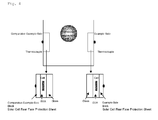
- the solar cell modules obtained in Examples 1 to 4 and those obtained in Comparative Example 1 and 2 were compared in temperature rise. More specifically, a black solar cell rear face protection sheet as an example and a black solar cell rear face protection sheet as a comparative example were disposed at predetermined positions of the temperature-rise comparison device (wooden box) shown in Fig. 3 . Black solar cell rear face protection sheets of an Example and a Comparative Example were disposed at the same distance from a heat source (incandescent bulb). A thermocouple was attached to each black solar cell rear face protection sheet side. A heat source (incandescent bulb) was turned on to compare temperature rise values in time series and compare the maximum temperature differences. Table 2 shows the results.
- Comparative Example 1 and 2 were repeatedly performed when measurement of each of Examples 1 to 4 was performed. Table 2 thus shows the measurement results of Examples 1 to 4 versus the measurement results of Comparative Examples 1 to 2. Table 2 Example 1 Comparative Example 1 Comparative Example 2 Example 2 Comparative Example 1 Comparative Example 2 Example 3 Comparative Example 1 Comparative Example 2 Example 4 Comparative Example 1 Comparative Example 2 Maximum temperature (°C) 80.9 92.6 88.8 83.0 92.6 88.8 80.4 92.6 88.8 80.6 92.6 88.8 Temperature difference (°C) - 11.7 7.9 - 9.6 5.8 - 12.2 8.4 - 12.0 8.2
Landscapes
- Photovoltaic Devices (AREA)
- Laminated Bodies (AREA)
- Mobile Radio Communication Systems (AREA)
Abstract
Description
- The present invention relates to a solar cell rear face protection sheet that is disposed on the rear face side of a solar cell.
- A solar cell typically has a solar cell rear face protection sheet laminated on its rear side, and a laminate composed of a solar cell and a protection sheet is generally referred to as a solar cell module.
- When a solar cell module is disposed on a roof or on a rooftop, the solar cell rear face protection sheet of the module may be required to be black in view of appearance and design characteristics. Accordingly, for black solar cell rear face protection sheets, there have been proposed, for example, an embodiment using a black resin film comprising a black pigment such as carbon black, an embodiment applying a black coating as a base resin film (e.g., a polyethylene terephthalate film), and an embodiment incorporating a black pigment, such as carbon black, into an adhesive layer for bonding resin films together (see, for example, PTL 1 and 2).
- However, conventional solar cell rear face protection sheets comprising carbon black as a black pigment have been criticized for their poor electrical insulation and reduced power generation efficiency due to absorption of sunlight in the near-infrared and infrared regions, which tends to increase the temperature of the solar cell. In particular, the power generation efficiency of crystalline silicon-based solar cells is said to decrease by about 0.4%/°C as the temperature increases.
- Therefore, the development of a black solar cell rear face protection sheet that inhibits absorption of sunlight in the near-infrared and infrared regions is desired.
-
- PTL 1:
JP2009-249421A - PTL 2:
JP2008-053470A - An object of the present invention is to provide a black solar cell rear face protection sheet that inhibits absorption of sunlight in the near-infrared and infrared regions. Solution to Problem
- The present inventors conducted extensive research to achieve the above object. As a result, the inventors found that when a solar cell rear face protection sheet is formed of a stack of two or more layers including a black layer, and has a light reflectivity within a specific range, the above object can be achieved. The present invention has been accomplished based on this finding.
- The present invention provides the following solar cell rear face protection sheet.
- 1. A solar cell rear face protection sheet that is disposed on the rear face side of a solar cell, wherein: (1) the solar cell rear face protection sheet is composed of a stack of two or more layers; (2) the layer that is nearest the rear face of the solar cell among the layers constituting the stack comprises two or more types of organic pigments, has an average reflectivity of 15% or less in the wavelength range of 380 to 780 nm, and is black; and (3) the solar cell rear face protection sheet has an average reflectivity of 30% or more in the wavelength range of 780 to 2,000 nm.
- 2. The solar cell rear face protection sheet according to Item 1, wherein the layer that is nearest the rear face of the solar cell comprises polyethylene having a density of 0.900 to 0.935 g/cm3.
- 3. A solar cell module comprising a solar cell, and the solar cell rear face protection sheet according to Item 1 or 2 disposed on the rear face side of the solar cell.
- The solar cell rear face protection sheet according to the present invention, and the solar cell module according to the present invention comprising the solar cell rear face protection sheet disposed on the rear face side of a solar cell are described below in detail.
- The solar cell rear face protection sheet according to the present invention has features in that the sheet is disposed on the rear face side of a solar cell, wherein:
- (1) the solar cell rear face protection sheet is composed of a stack of two or more layers;
- (2) the layer that is nearest the rear face of the solar cell (hereinafter sometimes referred to as "the first resin layer") among the layers constituting the stack comprises two or more types of organic pigments, has an average reflectivity of 15% or less in the wavelength range of 380 to 780 nm, and is black; and (3) the solar cell rear face protection sheet has an average reflectivity of 30% or more in the wavelength range of 780 to 2,000 nm.
- The solar cell rear face protection sheet of the present invention having the above features is black particularly because the first resin layer comprises two or more types of organic pigments, and has an average reflectivity of 15% or less in the wavelength range of 380 to 780 nm. Accordingly, when the solar cell rear face protection sheet of the solar cell module is viewed from the solar cell side, the sheet is black.
- Furthermore, because the solar cell rear face protection sheet of the present invention has an average reflectivity of 30% or more in the wavelength range of 780 to 2,000 nm (near-infrared and infrared ranges), light in the near-infrared and infrared regions transmitted through the first resin layer is efficiently reflected by other layers, thus inhibiting the reduction of power generation efficiency due to temperature rise. More specifically, particularly because the average reflectivity in the wavelength range of 780 to 1,200 nm is 30% or more, an effect of enhancing power generation efficiency by effective use of light is obtained. Particularly because the average reflectivity in the wavelength range of 1,200 to 2,000 nm is 30% or more, an effect of inhibiting temperature rise of the solar cell module is obtained.
- The layer structure of the solar cell rear face protection sheet of the present invention is not limited as long as the sheet is composed of a stack of two or more layers including a first resin layer, and both the first resin layer and the entire sheet have an average reflectivity that meets the aforementioned requirements. Examples of the layer structure include a two-layer structure as illustrated in
Fig. 1 (the adhesive layer not being counted as a layer), a three-layer structure as illustrated inFig. 2 (the adhesive layers not being counted as layers), and a four-layer structure as illustrated inFig. 3 (the adhesive layers not being counted as layers). - The layer structures are explained below with reference to
Figs. 1, 2, and 3 . - The solar cell rear
face protection sheet 10 illustrated inFig. 1 comprises: afirst resin layer 11, which is nearest the rear face of the solar cell; and asecond resin layer 12 bonded to the first layer via anadhesive layer 14. The solar cell rearface protection sheet 10 illustrated inFig. 2 comprises: afirst resin layer 11, which is nearest the rear face of the solar cell; asecond resin layer 12; and athird resin layer 13, each of the layers being bonded together via anadhesive layer 14. The solar cell rearface protection sheet 10 illustrated inFig. 3 comprises a first resin layer 11-1 and a fourth resin layer 11-2 laminated by multilayer extrusion, the first resin layer being nearest the rear face of the solar cell, and further comprises asecond resin layer 12 and athird resin layer 13, each of the fourth resin layer 11-2,second resin layer 12, and athird resin layer 13 being bonded together via anadhesive layer 14. Although the first and fourth layers are different layers, these layers are simultaneously laminated by multilayer extrusion. Accordingly, as indicated by "11-1" and "11-2," these layers are explained together as a whole. - The resin component of the first resin layer is not particularly limited. For example, the following resins can be used to form a film or sheet: polyolefin resins such as polyethylene (PE) (e.g., high-density polyethylene, low-density polyethylene, and linear low-density polyethylene (LLDPE)), polypropylene (PP), polybutene; (meth)acrylic resins, polyvinyl chloride resins, polystyrene resins, polyvinylidene chloride resins, ethylene-vinyl acetate copolymer saponification products, polyvinyl alcohols, polycarbonate resins, fluororesins (e.g., polyvinylidene fluoride, polyvinyl fluoride, and ethylenetetrafluoroethylene), polyvinyl acetate resins, acetal resins, polyester resins (e.g., polyethylene terephthalate (PET), polybutylene terephthalate, and polyethylene naphthalate), polyamide resins, and polyphenylene ether resins. Such a film or sheet may comprise one or more types of resin components, and may be stretched uniaxially or biaxially.
- A solar cell typically comprises a sealing member as the bottom layer. A widely used material for sealing members is an ethylene-vinyl acetate copolymer (EVA). The adhesion between the sealing member and the solar cell rear face protection sheet affects long-term reliability of a solar cell module. Accordingly, the type of resin component of the first resin layer is preferably selected from the viewpoint of adhesion in consideration of the material of the sealing member.
- For example, when the material of the sealing member is EVA, polyethylene (PE) (e.g., high-density polyethylene, low-density polyethylene, or linear low-density polyethylene (LLDPE)) is preferable as the resin component. Among these, LLDPE is more preferable. In the present invention, LLDPE having a density of 0.900 to 0.935 g/cm3 is preferably used as a resin component of the first resin layer so that the first resin layer has a density of about 0.910 to 0.990 g/cm3.
- In the present invention, the first resin layer is black because the layer comprises two or more types of organic pigments, and has an average reflectivity of 15% or less in the wavelength range of 380 to 780 nm. More specifically, the first resin layer preferably has an average reflectivity of 10% or less in the wavelength range of 380 to 780 nm. When the average reflectivity of the first resin layer in the wavelength range of 380 to 780 nm is more than 10%, the first resin layer is black but has a slight green tint. In contrast, when the average reflectivity of the first resin layer in the wavelength range of 380 to 780 nm is 10% or less, the first resin layer is deep black and has improved design characteristics as the solar cell rear face protection sheet.
- Because black is created in this manner by incorporating (mixing) two or more types of organic pigments, absorption of sunlight in the near-infrared and infrared regions can be more effectively inhibited compared to the case of using a monochromatic black pigment (e.g., carbon black). Because the solar cell rear face protection sheet has an average reflectivity of 30% or more in the wavelength range of 780 to 2,000 nm, light in the near-infrared and infrared regions transmitted through the first resin layer are efficiently reflected by other layers, thus inhibiting reduction of power generation efficiency due to temperature rise. More specifically, particularly because the average reflectivity in the wavelength range of 780 to 2,000 nm is 30% or more, an effect of enhancing power generation efficiency by effective use of light is obtained. Particularly because the average reflectivity in the wavelength range of 1,200 to 2,000 nm is 30% or more, an effect of inhibiting temperature rise of the solar cell module is obtained.
- In the present invention, the aforementioned reflectivity characteristics are obtained for the following reason. If the first resin layer contains only one type of black pigment such as carbon black, light in all the visible, near-infrared, and infrared wavelengths is absorbed, and very little light is allowed to pass through the first resin layer. In contrast, when the first resin layer is made black by incorporating (mixing) two or more types of organic pigments, visible wavelength light is absorbed, whereas near-infrared and infrared wavelength light is hardly absorbed and is transmitted through the first resin layer. Accordingly, the transmitted near infrared and infrared light is reflected by other layers and allowed to re-enter the solar cell module, thereby inhibiting temperature rise of the solar cell and enhancing power generation efficiency by effective use of light.
- Examples of organic pigments that can be used in the present invention include azo pigments, phthalocyanine pigments, condensed polycyclic pigments, and other organic pigments.
- Specific examples of azo pigments include soluble azo pigments, insoluble azo pigments, condensed azo pigments, and the like. Examples of phthalocyanine pigments include copper phthalocyanine pigments, metal-free phthalocyanine pigments, copper naphthalocyanine pigments, silicon naphthalocyanine pigments, and germanium naphthalocyanine pigments. Examples of condensed polycyclic pigments include anthraquinone-based pigments, threne-perinone-based pigments, pyrylene-based pigments, quinacridone-based pigments, dioxazine-based pigments, isoindolinone-based pigments, and quinophthalone-based pigments. Examples of other organic pigments include diketopyrrolopyrrole pigments, benzimidazolone pigments, triphenylmethane pigments, and metal complex pigments.
- Specific examples of soluble azo pigments include acetoacetanilide-based pigments, pyrazolone-based pigments, β-naphthol-based pigments, β-oxynaphthoic acid-based pigments, and β-oxynaphthoic acid anilide-based pigments. Examples of insoluble azo pigments include (monoazo or disazo)acetoacetanilide-based pigments, (monoazo or disazo)pyrazolone-based pigments, β-naphthol-based pigments, and (monoazo or disazo) β-oxynaphthoic acid anilide-based pigments. Examples of condensed azo pigments include acetoacetanilide-based pigments and β-oxynaphthoic acid anilide-based pigments. Examples of copper phthalocyanine pigments include copper phthalocyanine (blue), copper halide phthalocyanine (blue, green) pigments, and sulfonated copper phthalocyanine lake pigments. Examples of anthraquinone-based pigments include aminoanthraquinone pigments, anthrapyrimidine (yellow), flavanthrone pigments, anthanthrone pigments, indanthrone pigments, pyranthrone pigments, and violanthrone pigments. Examples of threne-perinone-based pigments include perinone pigments. Examples of perylene-based pigments include perylene pigments and perylene maroon pigments. Examples of quinacridone pigments include quinacridone red pigments, quinacridone maroon pigments, and quinacridone gold pigments. Examples of dioxazine-based pigments include dioxazine pigments and dioxazine violet pigments. Examples of isoindolinone-based pigments include isoindolinone pigments, isoindolinone yellow pigments, isoindolinone orange pigments, and indanthrone pigments. Examples of quinophthalone-based pigments include quinophthalone pigments. Examples of diketopyrrolopyrrole-based pigments include diketopyrrolopyrrole pigments. Examples of benzimidazolone-based pigments include benzimidazolone yellow pigments and benzimidazolone yellow pigments. Examples of triphenylmethane-based pigments include triphenylmethane pigments. Examples of metal complex pigments include azomethine copper complex pigments.
- In the present invention, the combination of such organic pigments is not particularly limited as long as black is created by mixing two or more types of organic pigments. For example, a combination of copper phthalocyanine pigment, quinacridone red pigment, and benzimidazolone yellow pigment is preferable. The term "black" in the present invention means that the average reflectivity in the wavelength range of 380 to 780 nm is 15% or less (preferably 10% or less). The term "average reflectivity" as used herein means the average value determined by measuring the reflectivity of the first resin layer in the wavelength range of 380 to 780 nm at intervals of 2 nm using a spectrophotometer (product name "V-570," produced by Jasco Corporation). When the average reflectivity is 15% or less, the black design characteristic requirement can be satisfied. The average reflectivity in other wavelength ranges was also measured in the same manner.
- The method for forming the first resin layer may be, for example, a film formation method, such as T-die extrusion molding or inflation molding. Alternatively, the first resin layer may be formed by simultaneous multilayer extrusion of the first resin layer with the second, third, and fourth resin layers described below. The method of adding two or more types of organic pigments is preferably a method comprising first preparing a master batch comprising one or more types of organic pigments, and then mixing a predetermined amount of the master batch with a matrix resin for the first resin layer.
- The thickness of the first resin layer is not limited, and can be suitably set according to the desired properties of the final product. The thickness is preferably 10 to 200 µm, and more preferably 30 to 150 µm.
- The second resin layer preferably has excellent weatherability and excellent electrical insulation. As the resin component of the second resin layer, for example, the following resins can be used to form a film or sheet: polyolefin resins such as polyethylene (PE) (e.g., high-density polyethylene, low-density polyethylene, and linear low-density polyethylene (LLDPE)), polypropylene (PP), and polybutene, (meth)acrylic resins, polyvinyl chloride resins, polystyrene resins, polyvinylidene chloride resins, ethylene-vinyl acetate copolymer saponification products, polyvinyl alcohols, polycarbonate resins, fluororesins (e.g., polyvinylidene fluoride, polyvinyl fluoride, and ethylenetetrafluoroethylene), polyvinyl acetate resins, acetal resins, polyester resins (e.g., polyethylene terephthalate (PET), polybutylene terephthalate, and polyethylene naphthalate), polyamide resins, and polyphenylene ether resins. Such a film or sheet may comprise one or more types of resin components, and may be stretched uniaxially or biaxially.
- When the second resin layer is composed of a single layer film, the thickness is preferably 50 to 300 µm, and more preferably 75 to 250 µm.
- When the second resin layer is formed of a laminate of films, a laminate composed of a film having excellent weatherability and a film having excellent electrical insulation is preferable. In this case, the films are arranged so that the film having excellent electrical insulation is disposed on the first resin layer side. The film having excellent weatherability is preferably a fluorine-based film having a thickness of 10 to 150 µm (at least one member selected from polyvinylidene fluoride, polyvinyl fluoride, and ethylene tetrafluoroethylene). The film having excellent electrical insulation is particularly preferably a PET film having a thickness of 50 to 250 µm.
- The second resin layer may contain a white pigment, such as titanium dioxide or barium sulfate, in order to absorb or reflect UV light, and reflect the near-infrared and infrared light transmitted through the first resin layer. The amount of white pigment to be added can be suitably set according to the type of white pigment and the desired reflectivity characteristics. Addition of the white pigment allows near-infrared and infrared light to be reflected and re-enter the solar cell, thus inhibiting temperature rise and resulting in enhanced power generation efficiency. Because the first resin layer is black in the present invention, the addition of a white pigment to the second resin layer does not affect black design characteristics as is viewed from the solar cell side.
- Further, known additives other than color pigments, such as UV absorbers, water absorbents (desiccants), and antioxidants may be added not only to the second resin layer, but also to the first resin layer and/or the third resin layer described below.
- According to the present invention, the solar cell rear face protection sheet must have a feature such that the average reflectivity in the wavelength range of 780 to 2,000 nm is 30% or more, and preferably 35% or more. Particularly because the average reflectivity in the wavelength range of 780 to 1,200 nm is 30% or more, an effect of enhancing power generation efficiency based on effective use of light can be obtained. Particularly because the average reflectivity in the wavelength range of 1,200 to 2,000 nm is 30% or more, an effect of inhibiting temperature rise of the solar cell module can be obtained. In the present invention, a white pigment is preferably added to the second resin layer to meet the above requirement of the average reflectivity. However, if necessary, it is also possible to add a white pigment not to the second resin layer but to the third resin layer described below.
- When a third resin layer is provided, the third resin layer preferably has a particularly high weatherability. As the resin component of the third resin layer, for example, the following resins can be used to form a film or sheet: polyesters such as polyethylene naphthalate (PEN) and polyethylene terephthalate (PET); fluororesins such as polyvinylidene fluoride (PVDF), polyvinyl fluoride (PVF), and ethylene tetrafluoroethylene (ETFE); polyolefins such as polyethylene and polypropylene; polystyrene; polyvinyl chloride; polyacrylonitrile; polyimide; and engineering plastics. Such a film or sheet may comprise one or more types of resin components, and may be stretched uniaxially or biaxially.
- Among these resin components, at least one of PET, fluororesins, and engineering plastics is particularly preferable.
- As the PET, hydrolysis-resistant PET is preferable in consideration of durability of the solar cell rear face protection sheet in outdoor use.
- Specific examples of the engineering plastics include polyacetal (POM), polyamide (PA), polycarbonate (PC), modified polyphenylene ether (m-PPE), polybutylene terephthalate (PBT), GF-reinforced polyethylene terephthalate (GF-PET), ultra-high-molecular-weight polyethylene (UHPE), syndiotactic polystyrene (SPS), amorphous polyarylate (PAR), polysulfone (PSF), polyether sulfone (PES), polyphenylene sulfide (PPS), polyether ether ketone (PEEK), polyimide (PI), polyether imide (PEI), polyphenylene ether (PPE), and liquid crystal polymers (LCP).
- In the present invention, when the second resin layer does not contain a white pigment such as titanium dioxide and barium sulfate, such a white pigment is added to the third resin layer. This allows near-infrared and infrared light transmitted through the first and second resin layers to be reflected and re-enter the solar cell, thus inhibiting temperature rise and further enhancing power generation efficiency.
- The third resin layer may be a monolayer or multilayer. The third resin layer preferably has a thickness of 5 to 50 µm, and more preferably 10 to 25 µm.
- In the present invention, addition of a white pigment, such as titanium dioxide or barium sulfate, to the second resin layer and/or the third resin layer allows for reflection of near-infrared and infrared light transmitted through the first resin layers. However, if near-infrared and infrared light is reflected at a position closer to the solar cell, inhibition of temperature rise of the solar cell and power generation efficiency can be further enhanced.
- More specifically, a fourth resin layer comprising a white pigment can be formed between the first and second resin layers to enhance temperature rise inhibition and power generation efficiency. This is particularly effective in embodiments in which a white pigment is added only to the third resin layer, and is not added to the second resin layer.
- The fourth resin layer can be formed by a film formation method, such as T-die extrusion molding and inflation molding. Forming the fourth resin layer by subjecting the first and fourth resin layers to multilayer extrusion molding using a T-die is particularly preferable. To facilitate the film formation by multilayer extrusion, the resin of the fourth resin layer is preferably the same as the resin of the first resin layer. The resin as explained above in the section of the first resin layer can also be used in the fourth resin layer.
- Because the first resin layer is black in the present invention, addition of a white pigment to the fourth resin layer does not affect black design characteristics as is viewed from the solar cell side. Examples of the white pigment include titanium dioxide and barium sulfate. The amount of white pigment to be added can be suitably set according to the type of white pigment and the desired reflectivity characteristics. The fourth resin layer may contain known additives, such as water absorbents (dessicants), oxygen absorbers, and antioxidants.
- The thickness of the first resin layer is not limited, and can be suitably set according to the desired properties of the final product. The thickness is preferably 10 to 150 µm, and more preferably 30 to 90 µm. When the fourth resin layer is formed, the thickness of the first resin layer is preferably set to 30 to 90 µm.
- An adhesive layer may be provided between each of the first, second, third, and fourth resin layers. For example, when the first, second, third, and fourth resin layers are laminated by extrusion coating, dry lamination, heat lamination, and like methods, forming an adhesive layer between the layers is preferable.
- Examples of the adhesive layer include two-component curable urethane adhesives, polyether urethane adhesives, polyester adhesives, polyester polyol adhesives, and polyester polyurethane polyol adhesives. In particular, a dry lamination method using a urethane adhesive comprising at least one of aromatic isocyanates and aliphatic isocyanates can be preferably used.
- The thickness of the adhesive layer is preferably 3 to 15 µm, and more preferably 5 to 10 µm.
- The solar cell rear face protection sheet of the present invention is disposed on the rear face side of a solar cell to form a solar cell module. Although the structure of the solar cell is not limited, the solar cell is typically configured in such a manner that toughened glass for solar cells, EVA, a crystalline Si cell, and EVA (sealing member) are layered in this order from the front face side.
- The solar cell rear face protection sheet of the present invention is black particularly because the sheet comprises two or more types of organic pigments in the first resin layer, and has an average reflectivity of 15% or less in the wavelength range of 380 to 780 nm. Accordingly, a solar cell module comprising the protection sheet is black when the solar cell rear face protection sheet is viewed from the solar cell side. Because the solar cell rear face protection sheet of the present invention has an average reflectivity of 30% or more in the wavelength range of 780 to 2,000 nm (near-infrared and infrared regions), light in the near-infrared and infrared regions transmitted through the first resin layer is efficiently reflected by other layers, thus inhibiting reduction of power generation efficiency due to temperature rise. More specifically, particularly because the average reflectivity in the wavelength range of 780 to 1,200 nm is 30% or more, an effect of enhancing power generation efficiency by effective use of light is obtained. Particularly because the average reflectivity in the wavelength range of 1,200 to 2,000 nm is 30% or more, an effect of inhibiting temperature rise of the solar cell module is obtained. Brief Description of Drawings
-
-
Fig. 1 is a diagram illustrating the layer structure of the solar cell rear face protection sheet according to one embodiment of the present invention. -
Fig. 2 is a diagram illustrating the layer structure of the solar cell rear face protection sheet according to another embodiment of the present invention. -
Fig. 3 is a diagram illustrating the layer structure of the solar cell rear face protection sheet according to yet another embodiment of the present invention. -
Fig. 4 is a schematic diagram of a temperature-rise comparison device (wooden box) for investigating comparisons between the solar cell modules in temperature rise. - The present invention is described in detail below with reference to Examples and Comparative Examples. However, the present invention is not limited to the Examples.
- 50 parts by mass of copper phthalocyanine was kneaded into 100 parts by mass of LLDPE having a density of 0.913 g/cm3 (Evolue; produced by Mitsui Chemicals, Inc.) to prepare a color master batch. Color master batches comprising quinacridone red and benzimidazolone yellow were also prepared in a similar manner.
- Five parts by mass of each of the color master batches (copper phthalocyanine, quinacridone red, and benzimidazolone yellow) was mixed with 100 parts by mass of LLDPE having a density of 0.922 g/cm3 (Evolue; produced by Mitsui Chemicals, Inc.). Each of the resulting mixtures was extruded using a T-die extruder to obtain a black LLDPE film with a thickness of 50 µm as a first resin layer.
- A white PET film with a thickness of 188 µm (produced by Teijin Ltd.) was prepared as a second resin layer. A dry lamination adhesive was used to bond the second resin layer to the first resin layer by a dry lamination method. A black solar cell rear face protection sheet was thus produced. The white PET film comprised titanium dioxide as a white pigment.
- As the dry lamination adhesive, a polyurethane adhesive produced by mixing 100 parts by mass of "Takelac A315" (trade name, produced by Mitsui Chemicals, Inc.) and 10 parts by mass of "Takenate A50" was applied to a coating thickness of 5 g/m2, on a solids basis.
- A transparent PET film (produced by Teijin Ltd.) having a thickness of 250 µm was prepared as a second resin layer. A white polyvinyl fluoride (PVF) film (Tedlar, produced by DuPont) having a thickness of 38 µm was prepared as a third resin layer. The white PVF film comprised titanium dioxide as a white pigment.
- A dry lamination adhesive was applied to one side of the second resin layer to bond the first resin layer (a black LLDPE film having a thickness of 50 µm) of Example 1 thereto. The dry lamination adhesive was also applied to the opposite side of the second resin layer to bond a PVF film of the third resin layer thereto. A black solar cell rear face protection sheet was thus produced.
- The dry lamination adhesive was the same as used in Example 1.
- 50 parts by mass of copper phthalocyanine was kneaded into 100 parts by mass of LLDPE having a density of 0.913 g/cm3 (Evolue; produced by Mitsui Chemicals, Inc.) to prepare a color master batch. Color master batches comprising quinacridone red and benzimidazolone yellow were also prepared in a similar manner.
- Similarly, 50 parts by mass of titanium dioxide was kneaded into 100 parts by mass of LLDPE having a density of 0.913 g/cm3 (Evolue; produced by Mitsui Chemicals, Inc.) to prepare a white master batch.
- Five parts by mass of each of the color master batches (copper phthalocyanine, quinacridone red, and benzimidazolone yellow) was mixed with 100 parts by mass of LLDPE having a density of 0.922 g/cm3 (Evolue; produced by Mitsui Chemicals, Inc.) to prepare materials for the first resin layer. Twenty parts by mass of a white master batch was mixed with 100 parts by mass of LLDPE having a density of 0.922 g/cm3 (Evolue; produced by Mitsui Chemicals, Inc.) to prepare a material for the fourth resin layer. Each of the materials for the first layer and the material for fourth layer were co-extruded using a T-die extruder to form a multilayer film, thus obtaining a laminate of each first resin layer (black, 50 µm) and the fourth resin layer (white, 50 µm).
- A transparent PET film (produced by Teijin Ltd.) having a thickness of 250 µm was prepared as a second resin layer, which was bonded to the fourth resin layer. Further, a white polyvinyl fluoride (PVF) film (Tedlar, produced by DuPont) having a thickness of 38 µm was prepared as a third resin layer, which was bonded to the opposite side of the second resin layer. The white PVF film comprised titanium dioxide as a white pigment. A black solar cell rear face protection sheet was thus produced.
- The dry lamination adhesive used was the same as in Example 1.
- 50 parts by mass of copper phthalocyanine was kneaded into 100 parts by mass of LLDPE having a density of 0.913 g/cm3 (Evolue; produced by Mitsui Chemicals, Inc.) to prepare a color master batch. Color master batches comprising quinacridone red and benzimidazolone yellow were also prepared in a similar manner.
- Similarly, 50 parts by mass of titanium dioxide was kneaded into 100 parts by mass of LLDPE having a density of 0.913 g/cm3 (Evolue; produced by Mitsui Chemicals, Inc.) to prepare a white master batch.
- Five parts by mass of each of the color master batches (copper phthalocyanine, quinacridone red, and benzimidazolone yellow) was mixed with 100 parts by mass of LLDPE having a density of 0.922 g/cm3 (Evolue; produced by Mitsui Chemicals, Inc.) (to prepare materials for the first resin layer). Twenty parts by mass of a white master batch was mixed with 100 parts by mass of LLDPE having a density of 0.922 g/cm3 (Evolue; produced by Mitsui Chemicals, Inc.)(to prepare a material for the fourth resin layer). Each of the materials for the first layer and the material for the fourth layer were co-extruded using a T-die extruder to form a multilayer film, thus obtaining a laminate of each first resin layer (black, 50 µm) and the fourth resin layer (white, 50 µm).
- A transparent PET film (produced by Teijin Ltd.) having a thickness of 125 µm was prepared as a second resin layer, which was bonded to the fourth resin layer. A white weather-resistant PET film (Shine Beam, produced by Toyobo Co., Ltd.) having a thickness of 50 µm was prepared as a third resin layer, which was bonded to the opposite side of the second resin layer. The white weather-resistant PET film of the third resin layer comprised titanium dioxide as a white pigment. A black solar cell rear face protection sheet was thus produced.
- The dry lamination adhesive used was the same as in Example 1.
- A transparent PE film (produced by Tohcello Inc.) having a thickness of 50 µm was prepared as a first resin layer. A transparent PET film (produced by Teijin Ltd.) having a thickness of 250 µm was prepared as a second resin layer. A black ethylene tetrafluoroethylene (ETFE) film (produced by Asahi Kasei Corporation) having a thickness of 25 µm was prepared as a third resin layer.
- Each of the layers was bonded together using a dry lamination adhesive to produce a black solar cell rear face protection sheet.
- The dry lamination adhesive was the same as used in Example 1.
- A black solar cell rear face protection sheet was produced in the same manner as in Example 2, except that a black pigment (only carbon black) was used as the pigment of the first resin layer.
- The average reflectivity of the black solar cell rear face protection sheets obtained in the Examples and Comparative Examples was determined. Solar cell modules were produced using the black solar cell rear face protection sheets to investigate power output characteristics and temperature-rise comparisons.
- The average reflectivity of each of the solar cell rear face protection sheets in the wavelength ranges of 380 to 780 nm, 780 to 1,200 nm, 1,200 to 2,000 nm, and 780 to 2,000 nm was measured using a spectrophotometer (product name "V-570," produced by Jasco Corporation). The average reflectivity in the wavelength range of 380 to 780 nm refers to the average reflectivity of the first resin layer. The average reflectivity in the wavelength range of 780 to 2,000 nm refers to the average reflectivity of the entire solar cell rear face protection sheet.
- Table 1 below shows the measurement results.
- A solar cell was produced by using a vacuum laminator (LM-140X200S, produced by NPC Corporation) to laminate a toughened glass for solar cells, EVA, a crystalline Si cell, and EVA (sealing member) in this order. The rear face of the solar cell was EVA as the sealing member. The power output characteristics of the solar cell were measured in this state using a solar simulator (PXSS4K-1P, produced by Iwasaki Electric Co., Ltd.), and the obtained value was defined as an initial value (before bonding of BS).
- Subsequently, solar cell modules were produced by bonding each of the solar cell rear face protection sheets to the rear face side of each solar cell using a vacuum laminator. The power output characteristics were determined again using the solar simulator to obtain measurement values (after bonding of BS). The term "BS" (back sheet) as used herein refers to a solar cell rear face protection sheet.
- The change (%) in power output (Eff change rate) of each solar cell module before and after bonding of BS was calculated.

- Table 1 shows the measurement results.
- The results clearly show that the black solar cell rear face protection sheet obtained in the Examples contributes to power output enhancement, whereas the black solar cell rear face protection sheet obtained in the Comparative Examples does not contribute to power output enhancement at all.
Table 1 Average reflectivity (%) Power output of the solar cell module Structure of the solar cell rear face protection sheet First resin layer alone Entire solar cell rear face protection sheet "/" indicates the interface between each layer. 380 to 780 nm 380 to 780 nm 780 to 1,200 nm 1200 to 2000nm 780 to 2,000 nm Eff change rate from the initial value (%) Example 1 Mixed color black LLDPE: 50 µm/adhesive layer/white PET: 188 µm 5.9 6.8 71.6 54.9 60.6 5.6 Example 2 Mixed color black LLDPE: 50 µm/adhesive layer/transparent PET: 250 µm/adhesive layer/white PVF: 38 µm 5.9 6.7 54.5 39.4 44.6 4.4 Example 3 Mixed color black LLDPE: 50 µm/white LLDPE: 50 µm/adhesive layer/transparent PET: 250 µm/adhesive layer/white PVF: 38 µm 5.9 7.8 72.4 54.0 60.3 6.2 Example 4 Mixed color black LLDPE: 50 µm/white LLDPE: 50 µm/adhesive layer/transparent PET: 125 µm/adhesive layer/white PET: 50 µm 5.9 7.7 69.4 49.3 56.2 5.8 Comparative Example 1 Transparent LLDPE: 50 µm/adhesive layer/transparent PET: 250 µm/adhesive layer/black ETFE: 25 µm - (transparent) 5.8 5.6 5.3 5.4 -1.1 Comparative Example 2 Monochromatic black (carbon black) LLDPE: 50 µm/adhesive layer/transparent PET: 250 µm/adhesive layer/white PET: 38 µm 4.5 4.7 4.6 4.4 4.4 -2.0 - The solar cell modules obtained in Examples 1 to 4 and those obtained in Comparative Example 1 and 2 were compared in temperature rise. More specifically, a black solar cell rear face protection sheet as an example and a black solar cell rear face protection sheet as a comparative example were disposed at predetermined positions of the temperature-rise comparison device (wooden box) shown in
Fig. 3 . Black solar cell rear face protection sheets of an Example and a Comparative Example were disposed at the same distance from a heat source (incandescent bulb). A thermocouple was attached to each black solar cell rear face protection sheet side. A heat source (incandescent bulb) was turned on to compare temperature rise values in time series and compare the maximum temperature differences. Table 2 shows the results. - The measurements of Comparative Example 1 and 2 were repeatedly performed when measurement of each of Examples 1 to 4 was performed. Table 2 thus shows the measurement results of Examples 1 to 4 versus the measurement results of Comparative Examples 1 to 2.
Table 2 Example 1 Comparative Example 1 Comparative Example 2 Example 2 Comparative Example 1 Comparative Example 2 Example 3 Comparative Example 1 Comparative Example 2 Example 4 Comparative Example 1 Comparative Example 2 Maximum temperature (°C) 80.9 92.6 88.8 83.0 92.6 88.8 80.4 92.6 88.8 80.6 92.6 88.8 Temperature difference (°C) - 11.7 7.9 - 9.6 5.8 - 12.2 8.4 - 12.0 8.2 - As is clear from the results shown in Table 2, the solar cell modules of Examples 1 to 4 were significantly inhibited from temperature rise compared to the solar cell modules of Comparative Examples 1 and 2.
-
- 10.
- Solar Cell Rear Face Protection Sheet
- 11.
- First Resin Layer
- 11-1.
- First Resin Layer
- 11-2.
- Fourth Resin Layer
- 12.
- Second Resin Layer
- 13.
- Third Resin Layer
- 14.
- Adhesive Layer
Claims (3)
- A solar cell rear face protection sheet that is disposed on the rear face side of a solar cell, wherein:(1) the solar cell rear face protection sheet is composed of a stack of two or more layers;(2) the layer that is nearest the rear face of the solar cell among the layers constituting the stack comprises two or more types of organic pigments, has an average reflectivity of 15% or less in the wavelength range of 380 to 780 nm, and is black; and(3) the solar cell rear face protection sheet has an average reflectivity of 30% or more in the wavelength range of 780 to 2,000 nm.
- The solar cell rear face protection sheet according to claim 1, wherein the layer that is nearest the rear face of the solar cell comprises polyethylene having a density of 0.900 to 0.935 g/cm3.
- A solar cell module comprising a solar cell, and the solar cell rear face protection sheet according to claim 1 or 2 disposed on the rear face side of the solar cell.
Applications Claiming Priority (2)
| Application Number | Priority Date | Filing Date | Title |
|---|---|---|---|
| JP2012130256 | 2012-06-07 | ||
| PCT/JP2013/065543 WO2013183658A1 (en) | 2012-06-07 | 2013-06-05 | Solar battery rear face protection sheet |
Publications (3)
| Publication Number | Publication Date |
|---|---|
| EP2860764A1 true EP2860764A1 (en) | 2015-04-15 |
| EP2860764A4 EP2860764A4 (en) | 2016-01-27 |
| EP2860764B1 EP2860764B1 (en) | 2019-07-24 |
Family
ID=49712047
Family Applications (1)
| Application Number | Title | Priority Date | Filing Date |
|---|---|---|---|
| EP13801218.2A Active EP2860764B1 (en) | 2012-06-07 | 2013-06-05 | Solar battery rear face protection sheet |
Country Status (6)
| Country | Link |
|---|---|
| EP (1) | EP2860764B1 (en) |
| JP (3) | JP6238893B2 (en) |
| CN (1) | CN104335362B (en) |
| ES (1) | ES2749202T3 (en) |
| TW (1) | TWI569460B (en) |
| WO (1) | WO2013183658A1 (en) |
Cited By (3)
| Publication number | Priority date | Publication date | Assignee | Title |
|---|---|---|---|---|
| US10407579B2 (en) | 2014-09-30 | 2019-09-10 | Dai Nippon Printing Co., Ltd. | Infrared-light-transmitting ink of dark color, and infrared-light-reflecting sheet obtained using same |
| US10493739B2 (en) | 2015-03-03 | 2019-12-03 | Bischof + Klein Se & Co. Kg | Rear-side film for solar modules |
| WO2020011709A1 (en) | 2018-07-10 | 2020-01-16 | Dsm Ip Assets B.V. | Nir-reflective multi-layer material sheet |
Families Citing this family (12)
| Publication number | Priority date | Publication date | Assignee | Title |
|---|---|---|---|---|
| US20060090658A1 (en) | 2004-11-01 | 2006-05-04 | Michael Phillips | Tissue marking system |
| JP6464890B2 (en) * | 2015-03-31 | 2019-02-06 | 大日本印刷株式会社 | Back protection sheet for solar cell module |
| CA2989996C (en) * | 2015-06-19 | 2020-04-21 | Vector Surgical, Llc | Ink for marking a tissue specimen |
| JP2017045812A (en) * | 2015-08-25 | 2017-03-02 | 富士フイルム株式会社 | Back surface protective sheet for solar cell, and solar cell module |
| JP6917123B2 (en) * | 2015-09-30 | 2021-08-11 | 大日本印刷株式会社 | Protective sheet for solar cell module and solar cell module using it |
| KR20180119572A (en) * | 2016-03-04 | 2018-11-02 | 도레이 카부시키가이샤 | Sheet and solar cell module for solar cell module |
| CN106384788A (en) * | 2016-10-21 | 2017-02-08 | 纳晶科技股份有限公司 | Electroluminescent device and liquid desiccant for electroluminescence device |
| JP7234564B2 (en) * | 2018-10-09 | 2023-03-08 | 大日本印刷株式会社 | Back protection sheet for solar cell modules |
| CN111421935B (en) * | 2020-05-07 | 2022-03-22 | 上海紫江彩印包装有限公司 | A kind of infrared reflective polyolefin film and its preparation method and application |
| JP2020141145A (en) * | 2020-05-18 | 2020-09-03 | 大日本印刷株式会社 | Protective sheet for solar cell module and solar cell module using it |
| JP2022125016A (en) * | 2021-02-16 | 2022-08-26 | 積水化学工業株式会社 | laminated sheet |
| CN115995499A (en) * | 2021-11-10 | 2023-04-21 | 天合光能股份有限公司 | A kind of black photovoltaic backplane and its preparation method and application |
Family Cites Families (15)
| Publication number | Priority date | Publication date | Assignee | Title |
|---|---|---|---|---|
| JPH08248408A (en) * | 1995-03-06 | 1996-09-27 | Sekisui Chem Co Ltd | Liquid crystal display |
| JP3475733B2 (en) * | 1997-08-11 | 2003-12-08 | 東洋インキ製造株式会社 | Image forming method using two-component developer for electrophotography |
| JP5127123B2 (en) * | 2005-07-22 | 2013-01-23 | ダイキン工業株式会社 | Solar cell backsheet |
| CN101472738B (en) * | 2006-06-16 | 2013-11-06 | 阿基里斯株式会社 | Dark colored flakes with light reflective properties in the near infrared region |
| JP2008053470A (en) | 2006-08-24 | 2008-03-06 | Toyo Aluminium Kk | Rear face protection sheet for solar battery module and solar battery module equipped therewith |
| JP5237569B2 (en) * | 2007-02-27 | 2013-07-17 | 東洋アルミニウム株式会社 | Solar cell back surface protection sheet and solar cell module including the same |
| JP5066455B2 (en) * | 2008-01-28 | 2012-11-07 | Kddi株式会社 | Wireless communication path determination device and wireless communication path determination method |
| JP2009249421A (en) | 2008-04-02 | 2009-10-29 | Teijin Dupont Films Japan Ltd | Polyester film for solar cell rear surface protective film |
| JP2010089281A (en) * | 2008-10-03 | 2010-04-22 | Achilles Corp | Dark color sheet-like article having near infrared region light reflective performance |
| JP2011009392A (en) * | 2009-06-25 | 2011-01-13 | Toyo Aluminium Kk | Backside protecting sheet for solar cell module |
| JP2011238817A (en) * | 2010-05-12 | 2011-11-24 | Toyo Aluminium Kk | Rear surface protective sheet for solar cell and solar cell module comprising the same |
| JP5276052B2 (en) * | 2010-05-28 | 2013-08-28 | テクノポリマー株式会社 | Solar cell back surface protective film, method for producing the same, and solar cell module |
| JP5668344B2 (en) * | 2010-07-09 | 2015-02-12 | 大日本印刷株式会社 | Back protection sheet for solar cell module |
| JP2012069835A (en) * | 2010-09-27 | 2012-04-05 | Mitsubishi Plastics Inc | Polyester film for backside protective material of solar cell |
| JP5576432B2 (en) * | 2012-06-08 | 2014-08-20 | 京セラ株式会社 | System and equipment |
-
2013
- 2013-06-05 JP JP2014520021A patent/JP6238893B2/en not_active Expired - Fee Related
- 2013-06-05 CN CN201380029519.6A patent/CN104335362B/en not_active Expired - Fee Related
- 2013-06-05 EP EP13801218.2A patent/EP2860764B1/en active Active
- 2013-06-05 ES ES13801218T patent/ES2749202T3/en active Active
- 2013-06-05 WO PCT/JP2013/065543 patent/WO2013183658A1/en not_active Ceased
- 2013-06-06 TW TW102120110A patent/TWI569460B/en not_active IP Right Cessation
-
2017
- 2017-09-13 JP JP2017175342A patent/JP2018014520A/en active Pending
-
2021
- 2021-11-06 JP JP2021181538A patent/JP2022010120A/en active Pending
Cited By (7)
| Publication number | Priority date | Publication date | Assignee | Title |
|---|---|---|---|---|
| US10407579B2 (en) | 2014-09-30 | 2019-09-10 | Dai Nippon Printing Co., Ltd. | Infrared-light-transmitting ink of dark color, and infrared-light-reflecting sheet obtained using same |
| US11078373B2 (en) | 2014-09-30 | 2021-08-03 | Dai Nippon Printing Co., Ltd. | Infrared-light-transmitting ink of dark color, and infrared-light-reflecting sheet obtained using same |
| US12297359B2 (en) | 2014-09-30 | 2025-05-13 | Dai Nippon Printing Co., Ltd. | Infrared-light-transmitting ink of dark color, and infrared-light-reflecting sheet obtained using same |
| US10493739B2 (en) | 2015-03-03 | 2019-12-03 | Bischof + Klein Se & Co. Kg | Rear-side film for solar modules |
| WO2020011709A1 (en) | 2018-07-10 | 2020-01-16 | Dsm Ip Assets B.V. | Nir-reflective multi-layer material sheet |
| CN112385050A (en) * | 2018-07-10 | 2021-02-19 | 帝斯曼知识产权资产管理有限公司 | Near infrared reflective multilayer material sheet |
| CN112385050B (en) * | 2018-07-10 | 2025-05-09 | 赢润太阳能解决方案有限公司 | Near infrared reflective multilayer material sheet |
Also Published As
| Publication number | Publication date |
|---|---|
| JP6238893B2 (en) | 2017-11-29 |
| EP2860764A4 (en) | 2016-01-27 |
| TWI569460B (en) | 2017-02-01 |
| CN104335362B (en) | 2017-03-08 |
| JPWO2013183658A1 (en) | 2016-02-01 |
| EP2860764B1 (en) | 2019-07-24 |
| JP2022010120A (en) | 2022-01-14 |
| TW201405845A (en) | 2014-02-01 |
| JP2018014520A (en) | 2018-01-25 |
| CN104335362A (en) | 2015-02-04 |
| ES2749202T3 (en) | 2020-03-19 |
| WO2013183658A1 (en) | 2013-12-12 |
Similar Documents
| Publication | Publication Date | Title |
|---|---|---|
| EP2860764B1 (en) | Solar battery rear face protection sheet | |
| EP3782201B1 (en) | Method of manufacturing photovoltaic modules | |
| ES2922547T3 (en) | Infrared light transmitting dark color ink, and infrared light transmitting sheet obtained by using the same | |
| EP2839512B1 (en) | A backsheet for a photovoltaic module using infrared reflective pigments | |
| EP2743081A1 (en) | Laminated sheet and method for producing same | |
| KR20180119572A (en) | Sheet and solar cell module for solar cell module | |
| JP6008620B2 (en) | Back protection sheet for solar cells | |
| TWI535045B (en) | Solar cell back protective sheet and solar battery module therewith | |
| JP2018026376A (en) | Sheet for solar battery module and solar battery module | |
| US12364025B2 (en) | Backside protective sheet for solar cell modules and solar cell module | |
| JP6604456B1 (en) | Back surface protection sheet for solar cell module and solar cell module | |
| KR102083603B1 (en) | Back sheet for solar cells and solar cell module comprising same | |
| JP2016068478A (en) | Rear face protective sheet | |
| JP2020072160A (en) | Back protective sheet for solar cell module |
Legal Events
| Date | Code | Title | Description |
|---|---|---|---|
| PUAI | Public reference made under article 153(3) epc to a published international application that has entered the european phase |
Free format text: ORIGINAL CODE: 0009012 |
|
| 17P | Request for examination filed |
Effective date: 20141219 |
|
| AK | Designated contracting states |
Kind code of ref document: A1 Designated state(s): AL AT BE BG CH CY CZ DE DK EE ES FI FR GB GR HR HU IE IS IT LI LT LU LV MC MK MT NL NO PL PT RO RS SE SI SK SM TR |
|
| AX | Request for extension of the european patent |
Extension state: BA ME |
|
| DAX | Request for extension of the european patent (deleted) | ||
| RA4 | Supplementary search report drawn up and despatched (corrected) |
Effective date: 20160105 |
|
| RIC1 | Information provided on ipc code assigned before grant |
Ipc: H01L 31/042 20060101AFI20151221BHEP |
|
| STAA | Information on the status of an ep patent application or granted ep patent |
Free format text: STATUS: EXAMINATION IS IN PROGRESS |
|
| 17Q | First examination report despatched |
Effective date: 20170328 |
|
| REG | Reference to a national code |
Ref country code: DE Ref legal event code: R079 Ref document number: 602013058260 Country of ref document: DE Free format text: PREVIOUS MAIN CLASS: H01L0031042000 Ipc: H01L0031049000 |
|
| GRAP | Despatch of communication of intention to grant a patent |
Free format text: ORIGINAL CODE: EPIDOSNIGR1 |
|
| STAA | Information on the status of an ep patent application or granted ep patent |
Free format text: STATUS: GRANT OF PATENT IS INTENDED |
|
| RIC1 | Information provided on ipc code assigned before grant |
Ipc: H01L 31/049 20140101AFI20181210BHEP |
|
| INTG | Intention to grant announced |
Effective date: 20190104 |
|
| GRAS | Grant fee paid |
Free format text: ORIGINAL CODE: EPIDOSNIGR3 |
|
| GRAA | (expected) grant |
Free format text: ORIGINAL CODE: 0009210 |
|
| STAA | Information on the status of an ep patent application or granted ep patent |
Free format text: STATUS: THE PATENT HAS BEEN GRANTED |
|
| AK | Designated contracting states |
Kind code of ref document: B1 Designated state(s): AL AT BE BG CH CY CZ DE DK EE ES FI FR GB GR HR HU IE IS IT LI LT LU LV MC MK MT NL NO PL PT RO RS SE SI SK SM TR |
|
| REG | Reference to a national code |
Ref country code: GB Ref legal event code: FG4D |
|
| REG | Reference to a national code |
Ref country code: CH Ref legal event code: EP |
|
| REG | Reference to a national code |
Ref country code: DE Ref legal event code: R096 Ref document number: 602013058260 Country of ref document: DE |
|
| REG | Reference to a national code |
Ref country code: AT Ref legal event code: REF Ref document number: 1159245 Country of ref document: AT Kind code of ref document: T Effective date: 20190815 |
|
| REG | Reference to a national code |
Ref country code: IE Ref legal event code: FG4D |
|
| REG | Reference to a national code |
Ref country code: NL Ref legal event code: MP Effective date: 20190724 |
|
| REG | Reference to a national code |
Ref country code: LT Ref legal event code: MG4D |
|
| PG25 | Lapsed in a contracting state [announced via postgrant information from national office to epo] |
Ref country code: NL Free format text: LAPSE BECAUSE OF FAILURE TO SUBMIT A TRANSLATION OF THE DESCRIPTION OR TO PAY THE FEE WITHIN THE PRESCRIBED TIME-LIMIT Effective date: 20190724 Ref country code: BG Free format text: LAPSE BECAUSE OF FAILURE TO SUBMIT A TRANSLATION OF THE DESCRIPTION OR TO PAY THE FEE WITHIN THE PRESCRIBED TIME-LIMIT Effective date: 20191024 Ref country code: SE Free format text: LAPSE BECAUSE OF FAILURE TO SUBMIT A TRANSLATION OF THE DESCRIPTION OR TO PAY THE FEE WITHIN THE PRESCRIBED TIME-LIMIT Effective date: 20190724 Ref country code: LT Free format text: LAPSE BECAUSE OF FAILURE TO SUBMIT A TRANSLATION OF THE DESCRIPTION OR TO PAY THE FEE WITHIN THE PRESCRIBED TIME-LIMIT Effective date: 20190724 Ref country code: PT Free format text: LAPSE BECAUSE OF FAILURE TO SUBMIT A TRANSLATION OF THE DESCRIPTION OR TO PAY THE FEE WITHIN THE PRESCRIBED TIME-LIMIT Effective date: 20191125 Ref country code: HR Free format text: LAPSE BECAUSE OF FAILURE TO SUBMIT A TRANSLATION OF THE DESCRIPTION OR TO PAY THE FEE WITHIN THE PRESCRIBED TIME-LIMIT Effective date: 20190724 Ref country code: FI Free format text: LAPSE BECAUSE OF FAILURE TO SUBMIT A TRANSLATION OF THE DESCRIPTION OR TO PAY THE FEE WITHIN THE PRESCRIBED TIME-LIMIT Effective date: 20190724 Ref country code: NO Free format text: LAPSE BECAUSE OF FAILURE TO SUBMIT A TRANSLATION OF THE DESCRIPTION OR TO PAY THE FEE WITHIN THE PRESCRIBED TIME-LIMIT Effective date: 20191024 |
|
| PG25 | Lapsed in a contracting state [announced via postgrant information from national office to epo] |
Ref country code: LV Free format text: LAPSE BECAUSE OF FAILURE TO SUBMIT A TRANSLATION OF THE DESCRIPTION OR TO PAY THE FEE WITHIN THE PRESCRIBED TIME-LIMIT Effective date: 20190724 Ref country code: IS Free format text: LAPSE BECAUSE OF FAILURE TO SUBMIT A TRANSLATION OF THE DESCRIPTION OR TO PAY THE FEE WITHIN THE PRESCRIBED TIME-LIMIT Effective date: 20191124 Ref country code: AL Free format text: LAPSE BECAUSE OF FAILURE TO SUBMIT A TRANSLATION OF THE DESCRIPTION OR TO PAY THE FEE WITHIN THE PRESCRIBED TIME-LIMIT Effective date: 20190724 Ref country code: RS Free format text: LAPSE BECAUSE OF FAILURE TO SUBMIT A TRANSLATION OF THE DESCRIPTION OR TO PAY THE FEE WITHIN THE PRESCRIBED TIME-LIMIT Effective date: 20190724 Ref country code: GR Free format text: LAPSE BECAUSE OF FAILURE TO SUBMIT A TRANSLATION OF THE DESCRIPTION OR TO PAY THE FEE WITHIN THE PRESCRIBED TIME-LIMIT Effective date: 20191025 |
|
| REG | Reference to a national code |
Ref country code: ES Ref legal event code: FG2A Ref document number: 2749202 Country of ref document: ES Kind code of ref document: T3 Effective date: 20200319 |
|
| PG25 | Lapsed in a contracting state [announced via postgrant information from national office to epo] |
Ref country code: TR Free format text: LAPSE BECAUSE OF FAILURE TO SUBMIT A TRANSLATION OF THE DESCRIPTION OR TO PAY THE FEE WITHIN THE PRESCRIBED TIME-LIMIT Effective date: 20190724 |
|
| PG25 | Lapsed in a contracting state [announced via postgrant information from national office to epo] |
Ref country code: DK Free format text: LAPSE BECAUSE OF FAILURE TO SUBMIT A TRANSLATION OF THE DESCRIPTION OR TO PAY THE FEE WITHIN THE PRESCRIBED TIME-LIMIT Effective date: 20190724 Ref country code: EE Free format text: LAPSE BECAUSE OF FAILURE TO SUBMIT A TRANSLATION OF THE DESCRIPTION OR TO PAY THE FEE WITHIN THE PRESCRIBED TIME-LIMIT Effective date: 20190724 Ref country code: RO Free format text: LAPSE BECAUSE OF FAILURE TO SUBMIT A TRANSLATION OF THE DESCRIPTION OR TO PAY THE FEE WITHIN THE PRESCRIBED TIME-LIMIT Effective date: 20190724 Ref country code: PL Free format text: LAPSE BECAUSE OF FAILURE TO SUBMIT A TRANSLATION OF THE DESCRIPTION OR TO PAY THE FEE WITHIN THE PRESCRIBED TIME-LIMIT Effective date: 20190724 |
|
| PG25 | Lapsed in a contracting state [announced via postgrant information from national office to epo] |
Ref country code: SM Free format text: LAPSE BECAUSE OF FAILURE TO SUBMIT A TRANSLATION OF THE DESCRIPTION OR TO PAY THE FEE WITHIN THE PRESCRIBED TIME-LIMIT Effective date: 20190724 Ref country code: IS Free format text: LAPSE BECAUSE OF FAILURE TO SUBMIT A TRANSLATION OF THE DESCRIPTION OR TO PAY THE FEE WITHIN THE PRESCRIBED TIME-LIMIT Effective date: 20200224 Ref country code: CZ Free format text: LAPSE BECAUSE OF FAILURE TO SUBMIT A TRANSLATION OF THE DESCRIPTION OR TO PAY THE FEE WITHIN THE PRESCRIBED TIME-LIMIT Effective date: 20190724 Ref country code: SK Free format text: LAPSE BECAUSE OF FAILURE TO SUBMIT A TRANSLATION OF THE DESCRIPTION OR TO PAY THE FEE WITHIN THE PRESCRIBED TIME-LIMIT Effective date: 20190724 |
|
| REG | Reference to a national code |
Ref country code: DE Ref legal event code: R097 Ref document number: 602013058260 Country of ref document: DE |
|
| PLBE | No opposition filed within time limit |
Free format text: ORIGINAL CODE: 0009261 |
|
| STAA | Information on the status of an ep patent application or granted ep patent |
Free format text: STATUS: NO OPPOSITION FILED WITHIN TIME LIMIT |
|
| REG | Reference to a national code |
Ref country code: AT Ref legal event code: UEP Ref document number: 1159245 Country of ref document: AT Kind code of ref document: T Effective date: 20190724 |
|
| PG2D | Information on lapse in contracting state deleted |
Ref country code: IS |
|
| 26N | No opposition filed |
Effective date: 20200603 |
|
| PG25 | Lapsed in a contracting state [announced via postgrant information from national office to epo] |
Ref country code: SI Free format text: LAPSE BECAUSE OF FAILURE TO SUBMIT A TRANSLATION OF THE DESCRIPTION OR TO PAY THE FEE WITHIN THE PRESCRIBED TIME-LIMIT Effective date: 20190724 |
|
| PG25 | Lapsed in a contracting state [announced via postgrant information from national office to epo] |
Ref country code: MC Free format text: LAPSE BECAUSE OF FAILURE TO SUBMIT A TRANSLATION OF THE DESCRIPTION OR TO PAY THE FEE WITHIN THE PRESCRIBED TIME-LIMIT Effective date: 20190724 |
|
| REG | Reference to a national code |
Ref country code: CH Ref legal event code: PL |
|
| PG25 | Lapsed in a contracting state [announced via postgrant information from national office to epo] |
Ref country code: LU Free format text: LAPSE BECAUSE OF NON-PAYMENT OF DUE FEES Effective date: 20200605 |
|
| REG | Reference to a national code |
Ref country code: BE Ref legal event code: MM Effective date: 20200630 |
|
| PG25 | Lapsed in a contracting state [announced via postgrant information from national office to epo] |
Ref country code: FR Free format text: LAPSE BECAUSE OF NON-PAYMENT OF DUE FEES Effective date: 20200630 Ref country code: CH Free format text: LAPSE BECAUSE OF NON-PAYMENT OF DUE FEES Effective date: 20200630 Ref country code: IE Free format text: LAPSE BECAUSE OF NON-PAYMENT OF DUE FEES Effective date: 20200605 Ref country code: LI Free format text: LAPSE BECAUSE OF NON-PAYMENT OF DUE FEES Effective date: 20200630 |
|
| PG25 | Lapsed in a contracting state [announced via postgrant information from national office to epo] |
Ref country code: BE Free format text: LAPSE BECAUSE OF NON-PAYMENT OF DUE FEES Effective date: 20200630 |
|
| PG25 | Lapsed in a contracting state [announced via postgrant information from national office to epo] |
Ref country code: MT Free format text: LAPSE BECAUSE OF FAILURE TO SUBMIT A TRANSLATION OF THE DESCRIPTION OR TO PAY THE FEE WITHIN THE PRESCRIBED TIME-LIMIT Effective date: 20190724 Ref country code: CY Free format text: LAPSE BECAUSE OF FAILURE TO SUBMIT A TRANSLATION OF THE DESCRIPTION OR TO PAY THE FEE WITHIN THE PRESCRIBED TIME-LIMIT Effective date: 20190724 |
|
| PG25 | Lapsed in a contracting state [announced via postgrant information from national office to epo] |
Ref country code: MK Free format text: LAPSE BECAUSE OF FAILURE TO SUBMIT A TRANSLATION OF THE DESCRIPTION OR TO PAY THE FEE WITHIN THE PRESCRIBED TIME-LIMIT Effective date: 20190724 |
|
| PGFP | Annual fee paid to national office [announced via postgrant information from national office to epo] |
Ref country code: DE Payment date: 20220914 Year of fee payment: 11 |
|
| PGFP | Annual fee paid to national office [announced via postgrant information from national office to epo] |
Ref country code: AT Payment date: 20230621 Year of fee payment: 11 |
|
| PGFP | Annual fee paid to national office [announced via postgrant information from national office to epo] |
Ref country code: IT Payment date: 20230623 Year of fee payment: 11 Ref country code: GB Payment date: 20230622 Year of fee payment: 11 Ref country code: ES Payment date: 20230829 Year of fee payment: 11 |
|
| REG | Reference to a national code |
Ref country code: DE Ref legal event code: R079 Ref document number: 602013058260 Country of ref document: DE Free format text: PREVIOUS MAIN CLASS: H01L0031049000 Ipc: H10F0019850000 |
|
| REG | Reference to a national code |
Ref country code: DE Ref legal event code: R119 Ref document number: 602013058260 Country of ref document: DE |
|
| REG | Reference to a national code |
Ref country code: AT Ref legal event code: MM01 Ref document number: 1159245 Country of ref document: AT Kind code of ref document: T Effective date: 20240605 |
|
| GBPC | Gb: european patent ceased through non-payment of renewal fee |
Effective date: 20240605 |
|
| PG25 | Lapsed in a contracting state [announced via postgrant information from national office to epo] |
Ref country code: DE Free format text: LAPSE BECAUSE OF NON-PAYMENT OF DUE FEES Effective date: 20250101 |
|
| PG25 | Lapsed in a contracting state [announced via postgrant information from national office to epo] |
Ref country code: AT Free format text: LAPSE BECAUSE OF NON-PAYMENT OF DUE FEES Effective date: 20240605 |
|
| PG25 | Lapsed in a contracting state [announced via postgrant information from national office to epo] |
Ref country code: GB Free format text: LAPSE BECAUSE OF NON-PAYMENT OF DUE FEES Effective date: 20240605 Ref country code: IT Free format text: LAPSE BECAUSE OF NON-PAYMENT OF DUE FEES Effective date: 20240605 |
|
| REG | Reference to a national code |
Ref country code: ES Ref legal event code: FD2A Effective date: 20250728 |
|
| PG25 | Lapsed in a contracting state [announced via postgrant information from national office to epo] |
Ref country code: ES Free format text: LAPSE BECAUSE OF NON-PAYMENT OF DUE FEES Effective date: 20240606 |