EP2860199A2 - Funktionalisiertes Polymer, Reifengummizusammensetzung und Luftreifen - Google Patents
Funktionalisiertes Polymer, Reifengummizusammensetzung und Luftreifen Download PDFInfo
- Publication number
- EP2860199A2 EP2860199A2 EP20140182064 EP14182064A EP2860199A2 EP 2860199 A2 EP2860199 A2 EP 2860199A2 EP 20140182064 EP20140182064 EP 20140182064 EP 14182064 A EP14182064 A EP 14182064A EP 2860199 A2 EP2860199 A2 EP 2860199A2
- Authority
- EP
- European Patent Office
- Prior art keywords
- polymer
- rubber
- divinylbenzene
- terminator
- functionalized elastomer
- Prior art date
- Legal status (The legal status is an assumption and is not a legal conclusion. Google has not performed a legal analysis and makes no representation as to the accuracy of the status listed.)
- Granted
Links
- 229920001971 elastomer Polymers 0.000 title claims abstract description 116
- 229920000642 polymer Polymers 0.000 title claims abstract description 85
- 239000005060 rubber Substances 0.000 title claims description 67
- 239000000203 mixture Substances 0.000 title claims description 33
- MYRTYDVEIRVNKP-UHFFFAOYSA-N 1,2-Divinylbenzene Chemical compound C=CC1=CC=CC=C1C=C MYRTYDVEIRVNKP-UHFFFAOYSA-N 0.000 claims abstract description 78
- 239000000178 monomer Substances 0.000 claims abstract description 35
- 239000000806 elastomer Substances 0.000 claims abstract description 30
- RRHGJUQNOFWUDK-UHFFFAOYSA-N Isoprene Chemical compound CC(=C)C=C RRHGJUQNOFWUDK-UHFFFAOYSA-N 0.000 claims abstract description 20
- 238000006116 polymerization reaction Methods 0.000 claims abstract description 18
- 125000004432 carbon atom Chemical group C* 0.000 claims abstract description 16
- 125000003118 aryl group Chemical group 0.000 claims abstract description 9
- 125000000217 alkyl group Chemical group 0.000 claims abstract description 6
- 125000000129 anionic group Chemical group 0.000 claims abstract description 4
- 125000003903 2-propenyl group Chemical group [H]C([*])([H])C([H])=C([H])[H] 0.000 claims abstract description 3
- 239000007795 chemical reaction product Substances 0.000 claims abstract description 3
- 125000000753 cycloalkyl group Chemical group 0.000 claims abstract description 3
- 125000001072 heteroaryl group Chemical group 0.000 claims abstract description 3
- 125000000623 heterocyclic group Chemical group 0.000 claims abstract description 3
- 125000003107 substituted aryl group Chemical group 0.000 claims abstract description 3
- PPBRXRYQALVLMV-UHFFFAOYSA-N Styrene Chemical compound C=CC1=CC=CC=C1 PPBRXRYQALVLMV-UHFFFAOYSA-N 0.000 claims description 27
- VYPSYNLAJGMNEJ-UHFFFAOYSA-N Silicium dioxide Chemical compound O=[Si]=O VYPSYNLAJGMNEJ-UHFFFAOYSA-N 0.000 claims description 25
- KAKZBPTYRLMSJV-UHFFFAOYSA-N Butadiene Chemical compound C=CC=C KAKZBPTYRLMSJV-UHFFFAOYSA-N 0.000 claims description 22
- 239000000377 silicon dioxide Substances 0.000 claims description 12
- 125000001495 ethyl group Chemical group [H]C([H])([H])C([H])([H])* 0.000 claims description 2
- 125000001997 phenyl group Chemical group [H]C1=C([H])C([H])=C(*)C([H])=C1[H] 0.000 claims description 2
- 239000003999 initiator Substances 0.000 description 26
- 239000000945 filler Substances 0.000 description 18
- 229910052751 metal Inorganic materials 0.000 description 18
- 239000002184 metal Substances 0.000 description 18
- 238000006243 chemical reaction Methods 0.000 description 17
- NINIDFKCEFEMDL-UHFFFAOYSA-N Sulfur Chemical compound [S] NINIDFKCEFEMDL-UHFFFAOYSA-N 0.000 description 15
- 239000006229 carbon black Substances 0.000 description 15
- 235000019241 carbon black Nutrition 0.000 description 15
- 238000000034 method Methods 0.000 description 14
- 229910052717 sulfur Inorganic materials 0.000 description 14
- 239000011593 sulfur Substances 0.000 description 14
- 239000003921 oil Substances 0.000 description 13
- 235000019198 oils Nutrition 0.000 description 13
- KFZMGEQAYNKOFK-UHFFFAOYSA-N Isopropanol Chemical compound CC(C)O KFZMGEQAYNKOFK-UHFFFAOYSA-N 0.000 description 12
- 230000015572 biosynthetic process Effects 0.000 description 11
- -1 organo monolithium compounds Chemical class 0.000 description 11
- WHXSMMKQMYFTQS-UHFFFAOYSA-N Lithium Chemical compound [Li] WHXSMMKQMYFTQS-UHFFFAOYSA-N 0.000 description 10
- 150000001993 dienes Chemical class 0.000 description 10
- 229910052744 lithium Inorganic materials 0.000 description 10
- 229920003048 styrene butadiene rubber Polymers 0.000 description 10
- 150000001875 compounds Chemical class 0.000 description 9
- 230000008878 coupling Effects 0.000 description 9
- 238000010168 coupling process Methods 0.000 description 9
- 238000005859 coupling reaction Methods 0.000 description 9
- 238000007306 functionalization reaction Methods 0.000 description 9
- 230000003993 interaction Effects 0.000 description 9
- 239000005062 Polybutadiene Substances 0.000 description 8
- 239000002174 Styrene-butadiene Substances 0.000 description 8
- 150000003961 organosilicon compounds Chemical class 0.000 description 8
- 238000010528 free radical solution polymerization reaction Methods 0.000 description 7
- 229920002857 polybutadiene Polymers 0.000 description 7
- 238000003786 synthesis reaction Methods 0.000 description 7
- 241001441571 Hiodontidae Species 0.000 description 6
- 238000002156 mixing Methods 0.000 description 6
- 125000001979 organolithium group Chemical group 0.000 description 6
- 238000012545 processing Methods 0.000 description 6
- 238000004073 vulcanization Methods 0.000 description 6
- NLHHRLWOUZZQLW-UHFFFAOYSA-N Acrylonitrile Chemical compound C=CC#N NLHHRLWOUZZQLW-UHFFFAOYSA-N 0.000 description 5
- 239000003795 chemical substances by application Substances 0.000 description 5
- 229920001577 copolymer Polymers 0.000 description 5
- 238000007720 emulsion polymerization reaction Methods 0.000 description 5
- 150000002900 organolithium compounds Chemical class 0.000 description 5
- 238000005096 rolling process Methods 0.000 description 5
- 238000010058 rubber compounding Methods 0.000 description 5
- 229920003051 synthetic elastomer Polymers 0.000 description 5
- MZRVEZGGRBJDDB-UHFFFAOYSA-N N-Butyllithium Chemical compound [Li]CCCC MZRVEZGGRBJDDB-UHFFFAOYSA-N 0.000 description 4
- XLOMVQKBTHCTTD-UHFFFAOYSA-N Zinc monoxide Chemical compound [Zn]=O XLOMVQKBTHCTTD-UHFFFAOYSA-N 0.000 description 4
- 239000000654 additive Substances 0.000 description 4
- 239000000463 material Substances 0.000 description 4
- VLKZOEOYAKHREP-UHFFFAOYSA-N n-Hexane Chemical compound CCCCCC VLKZOEOYAKHREP-UHFFFAOYSA-N 0.000 description 4
- 239000000049 pigment Substances 0.000 description 4
- 229920001897 terpolymer Polymers 0.000 description 4
- 230000000930 thermomechanical effect Effects 0.000 description 4
- SDJHPPZKZZWAKF-UHFFFAOYSA-N 2,3-dimethylbuta-1,3-diene Chemical compound CC(=C)C(C)=C SDJHPPZKZZWAKF-UHFFFAOYSA-N 0.000 description 3
- UHOVQNZJYSORNB-UHFFFAOYSA-N Benzene Chemical compound C1=CC=CC=C1 UHOVQNZJYSORNB-UHFFFAOYSA-N 0.000 description 3
- LFQSCWFLJHTTHZ-UHFFFAOYSA-N Ethanol Chemical compound CCO LFQSCWFLJHTTHZ-UHFFFAOYSA-N 0.000 description 3
- FYYHWMGAXLPEAU-UHFFFAOYSA-N Magnesium Chemical compound [Mg] FYYHWMGAXLPEAU-UHFFFAOYSA-N 0.000 description 3
- OKKJLVBELUTLKV-UHFFFAOYSA-N Methanol Chemical compound OC OKKJLVBELUTLKV-UHFFFAOYSA-N 0.000 description 3
- YXFVVABEGXRONW-UHFFFAOYSA-N Toluene Chemical compound CC1=CC=CC=C1 YXFVVABEGXRONW-UHFFFAOYSA-N 0.000 description 3
- 239000003963 antioxidant agent Substances 0.000 description 3
- MTAZNLWOLGHBHU-UHFFFAOYSA-N butadiene-styrene rubber Chemical compound C=CC=C.C=CC1=CC=CC=C1 MTAZNLWOLGHBHU-UHFFFAOYSA-N 0.000 description 3
- 229920003193 cis-1,4-polybutadiene polymer Polymers 0.000 description 3
- 229920006037 cross link polymer Polymers 0.000 description 3
- HQQADJVZYDDRJT-UHFFFAOYSA-N ethene;prop-1-ene Chemical group C=C.CC=C HQQADJVZYDDRJT-UHFFFAOYSA-N 0.000 description 3
- 125000000524 functional group Chemical group 0.000 description 3
- 239000000499 gel Substances 0.000 description 3
- 239000011777 magnesium Substances 0.000 description 3
- 229910052749 magnesium Inorganic materials 0.000 description 3
- 150000002739 metals Chemical class 0.000 description 3
- 150000002902 organometallic compounds Chemical class 0.000 description 3
- 229920001195 polyisoprene Polymers 0.000 description 3
- 239000005077 polysulfide Substances 0.000 description 3
- 229920001021 polysulfide Polymers 0.000 description 3
- 150000008117 polysulfides Polymers 0.000 description 3
- 230000008569 process Effects 0.000 description 3
- 239000000047 product Substances 0.000 description 3
- 239000011347 resin Substances 0.000 description 3
- 229920005989 resin Polymers 0.000 description 3
- 239000002904 solvent Substances 0.000 description 3
- PMJHHCWVYXUKFD-SNAWJCMRSA-N (E)-1,3-pentadiene Chemical compound C\C=C\C=C PMJHHCWVYXUKFD-SNAWJCMRSA-N 0.000 description 2
- RCJMVGJKROQDCB-UHFFFAOYSA-N 2-methylpenta-1,3-diene Chemical compound CC=CC(C)=C RCJMVGJKROQDCB-UHFFFAOYSA-N 0.000 description 2
- ZGHFDIIVVIFNPS-UHFFFAOYSA-N 3-Methyl-3-buten-2-one Chemical compound CC(=C)C(C)=O ZGHFDIIVVIFNPS-UHFFFAOYSA-N 0.000 description 2
- HGINCPLSRVDWNT-UHFFFAOYSA-N Acrolein Chemical compound C=CC=O HGINCPLSRVDWNT-UHFFFAOYSA-N 0.000 description 2
- OKTJSMMVPCPJKN-UHFFFAOYSA-N Carbon Chemical compound [C] OKTJSMMVPCPJKN-UHFFFAOYSA-N 0.000 description 2
- YNQLUTRBYVCPMQ-UHFFFAOYSA-N Ethylbenzene Chemical compound CCC1=CC=CC=C1 YNQLUTRBYVCPMQ-UHFFFAOYSA-N 0.000 description 2
- ZRALSGWEFCBTJO-UHFFFAOYSA-N Guanidine Chemical compound NC(N)=N ZRALSGWEFCBTJO-UHFFFAOYSA-N 0.000 description 2
- DGAQECJNVWCQMB-PUAWFVPOSA-M Ilexoside XXIX Chemical compound C[C@@H]1CC[C@@]2(CC[C@@]3(C(=CC[C@H]4[C@]3(CC[C@@H]5[C@@]4(CC[C@@H](C5(C)C)OS(=O)(=O)[O-])C)C)[C@@H]2[C@]1(C)O)C)C(=O)O[C@H]6[C@@H]([C@H]([C@@H]([C@H](O6)CO)O)O)O.[Na+] DGAQECJNVWCQMB-PUAWFVPOSA-M 0.000 description 2
- OFBQJSOFQDEBGM-UHFFFAOYSA-N Pentane Chemical compound CCCCC OFBQJSOFQDEBGM-UHFFFAOYSA-N 0.000 description 2
- ZLMJMSJWJFRBEC-UHFFFAOYSA-N Potassium Chemical compound [K] ZLMJMSJWJFRBEC-UHFFFAOYSA-N 0.000 description 2
- 229920006978 SSBR Polymers 0.000 description 2
- 229910003910 SiCl4 Inorganic materials 0.000 description 2
- 229920002472 Starch Polymers 0.000 description 2
- WYURNTSHIVDZCO-UHFFFAOYSA-N Tetrahydrofuran Chemical compound C1CCOC1 WYURNTSHIVDZCO-UHFFFAOYSA-N 0.000 description 2
- ATJFFYVFTNAWJD-UHFFFAOYSA-N Tin Chemical compound [Sn] ATJFFYVFTNAWJD-UHFFFAOYSA-N 0.000 description 2
- 229910021627 Tin(IV) chloride Inorganic materials 0.000 description 2
- 230000009102 absorption Effects 0.000 description 2
- 238000010521 absorption reaction Methods 0.000 description 2
- QVGXLLKOCUKJST-UHFFFAOYSA-N atomic oxygen Chemical compound [O] QVGXLLKOCUKJST-UHFFFAOYSA-N 0.000 description 2
- 229910052788 barium Inorganic materials 0.000 description 2
- DSAJWYNOEDNPEQ-UHFFFAOYSA-N barium atom Chemical compound [Ba] DSAJWYNOEDNPEQ-UHFFFAOYSA-N 0.000 description 2
- RTACIUYXLGWTAE-UHFFFAOYSA-N buta-1,3-diene;2-methylbuta-1,3-diene;styrene Chemical compound C=CC=C.CC(=C)C=C.C=CC1=CC=CC=C1 RTACIUYXLGWTAE-UHFFFAOYSA-N 0.000 description 2
- 229920005549 butyl rubber Polymers 0.000 description 2
- 229920003211 cis-1,4-polyisoprene Polymers 0.000 description 2
- 238000004132 cross linking Methods 0.000 description 2
- 235000014113 dietary fatty acids Nutrition 0.000 description 2
- 239000012990 dithiocarbamate Substances 0.000 description 2
- 239000000839 emulsion Substances 0.000 description 2
- FJKIXWOMBXYWOQ-UHFFFAOYSA-N ethenoxyethane Chemical compound CCOC=C FJKIXWOMBXYWOQ-UHFFFAOYSA-N 0.000 description 2
- 150000002170 ethers Chemical class 0.000 description 2
- 239000000194 fatty acid Substances 0.000 description 2
- 229930195729 fatty acid Natural products 0.000 description 2
- 150000004665 fatty acids Chemical class 0.000 description 2
- 238000009472 formulation Methods 0.000 description 2
- 238000010438 heat treatment Methods 0.000 description 2
- 239000004615 ingredient Substances 0.000 description 2
- AFRJJFRNGGLMDW-UHFFFAOYSA-N lithium amide Chemical class [Li+].[NH2-] AFRJJFRNGGLMDW-UHFFFAOYSA-N 0.000 description 2
- WGOPGODQLGJZGL-UHFFFAOYSA-N lithium;butane Chemical compound [Li+].CC[CH-]C WGOPGODQLGJZGL-UHFFFAOYSA-N 0.000 description 2
- 239000003960 organic solvent Substances 0.000 description 2
- 229910052760 oxygen Inorganic materials 0.000 description 2
- 239000001301 oxygen Substances 0.000 description 2
- 239000002245 particle Substances 0.000 description 2
- 230000000737 periodic effect Effects 0.000 description 2
- PMJHHCWVYXUKFD-UHFFFAOYSA-N piperylene Natural products CC=CC=C PMJHHCWVYXUKFD-UHFFFAOYSA-N 0.000 description 2
- 229920001084 poly(chloroprene) Polymers 0.000 description 2
- 239000011414 polymer cement Substances 0.000 description 2
- 230000000379 polymerizing effect Effects 0.000 description 2
- 229910052700 potassium Inorganic materials 0.000 description 2
- 239000011591 potassium Substances 0.000 description 2
- 239000010734 process oil Substances 0.000 description 2
- 230000035484 reaction time Effects 0.000 description 2
- 238000010074 rubber mixing Methods 0.000 description 2
- FDNAPBUWERUEDA-UHFFFAOYSA-N silicon tetrachloride Chemical compound Cl[Si](Cl)(Cl)Cl FDNAPBUWERUEDA-UHFFFAOYSA-N 0.000 description 2
- 229910052708 sodium Inorganic materials 0.000 description 2
- 239000011734 sodium Substances 0.000 description 2
- 238000010561 standard procedure Methods 0.000 description 2
- 239000008107 starch Substances 0.000 description 2
- 235000019698 starch Nutrition 0.000 description 2
- 239000005061 synthetic rubber Substances 0.000 description 2
- HPGGPRDJHPYFRM-UHFFFAOYSA-J tin(iv) chloride Chemical compound Cl[Sn](Cl)(Cl)Cl HPGGPRDJHPYFRM-UHFFFAOYSA-J 0.000 description 2
- 125000000391 vinyl group Chemical group [H]C([*])=C([H])[H] 0.000 description 2
- 239000001993 wax Substances 0.000 description 2
- 239000011787 zinc oxide Substances 0.000 description 2
- MAOBFOXLCJIFLV-UHFFFAOYSA-N (2-aminophenyl)-phenylmethanone Chemical group NC1=CC=CC=C1C(=O)C1=CC=CC=C1 MAOBFOXLCJIFLV-UHFFFAOYSA-N 0.000 description 1
- PCCCQOGUVCNYOI-FNORWQNLSA-N (3e)-2,3-dimethylpenta-1,3-diene Chemical compound C\C=C(/C)C(C)=C PCCCQOGUVCNYOI-FNORWQNLSA-N 0.000 description 1
- 0 *SCCCC=CNC* Chemical compound *SCCCC=CNC* 0.000 description 1
- CORMBJOFDGICKF-UHFFFAOYSA-N 1,3,5-trimethoxy 2-vinyl benzene Natural products COC1=CC(OC)=C(C=C)C(OC)=C1 CORMBJOFDGICKF-UHFFFAOYSA-N 0.000 description 1
- WJNKJKGZKFOLOJ-UHFFFAOYSA-N 1-dodecyl-4-ethenylbenzene Chemical compound CCCCCCCCCCCCC1=CC=C(C=C)C=C1 WJNKJKGZKFOLOJ-UHFFFAOYSA-N 0.000 description 1
- YHOMZMOAUNOPCN-UHFFFAOYSA-N 1-ethenyl-2,3,4,5-tetraethylbenzene Chemical compound CCC1=CC(C=C)=C(CC)C(CC)=C1CC YHOMZMOAUNOPCN-UHFFFAOYSA-N 0.000 description 1
- HVOKBODBWQEEGI-UHFFFAOYSA-N 1-ethenyl-3,5-diethylbenzene Chemical compound CCC1=CC(CC)=CC(C=C)=C1 HVOKBODBWQEEGI-UHFFFAOYSA-N 0.000 description 1
- XSHXURIGVYRXAD-UHFFFAOYSA-N 1-ethenyl-3,5-diphenylbenzene Chemical compound C=1C(C=C)=CC(C=2C=CC=CC=2)=CC=1C1=CC=CC=C1 XSHXURIGVYRXAD-UHFFFAOYSA-N 0.000 description 1
- XTUJFEHBYGQMFD-UHFFFAOYSA-N 1-ethenyl-3-hexyl-5-methylbenzene Chemical compound CCCCCCC1=CC(C)=CC(C=C)=C1 XTUJFEHBYGQMFD-UHFFFAOYSA-N 0.000 description 1
- JZHGRUMIRATHIU-UHFFFAOYSA-N 1-ethenyl-3-methylbenzene Chemical compound CC1=CC=CC(C=C)=C1 JZHGRUMIRATHIU-UHFFFAOYSA-N 0.000 description 1
- VVTGQMLRTKFKAM-UHFFFAOYSA-N 1-ethenyl-4-propylbenzene Chemical compound CCCC1=CC=C(C=C)C=C1 VVTGQMLRTKFKAM-UHFFFAOYSA-N 0.000 description 1
- CBXRMKZFYQISIV-UHFFFAOYSA-N 1-n,1-n,1-n',1-n',2-n,2-n,2-n',2-n'-octamethylethene-1,1,2,2-tetramine Chemical compound CN(C)C(N(C)C)=C(N(C)C)N(C)C CBXRMKZFYQISIV-UHFFFAOYSA-N 0.000 description 1
- HECLRDQVFMWTQS-RGOKHQFPSA-N 1755-01-7 Chemical compound C1[C@H]2[C@@H]3CC=C[C@@H]3[C@@H]1C=C2 HECLRDQVFMWTQS-RGOKHQFPSA-N 0.000 description 1
- LLMLGZUZTFMXSA-UHFFFAOYSA-N 2,3,4,5,6-pentachlorobenzenethiol Chemical compound SC1=C(Cl)C(Cl)=C(Cl)C(Cl)=C1Cl LLMLGZUZTFMXSA-UHFFFAOYSA-N 0.000 description 1
- OVSKIKFHRZPJSS-UHFFFAOYSA-N 2,4-D Chemical compound OC(=O)COC1=CC=C(Cl)C=C1Cl OVSKIKFHRZPJSS-UHFFFAOYSA-N 0.000 description 1
- SMZOUWXMTYCWNB-UHFFFAOYSA-N 2-(2-methoxy-5-methylphenyl)ethanamine Chemical compound COC1=CC=C(C)C=C1CCN SMZOUWXMTYCWNB-UHFFFAOYSA-N 0.000 description 1
- NIXOWILDQLNWCW-UHFFFAOYSA-N 2-Propenoic acid Natural products OC(=O)C=C NIXOWILDQLNWCW-UHFFFAOYSA-N 0.000 description 1
- PDELBHCVXBSVPJ-UHFFFAOYSA-N 2-ethenyl-1,3,5-trimethylbenzene Chemical compound CC1=CC(C)=C(C=C)C(C)=C1 PDELBHCVXBSVPJ-UHFFFAOYSA-N 0.000 description 1
- OCTVDLUSQOJZEK-UHFFFAOYSA-N 4,5-diethylocta-1,3-diene Chemical compound CCCC(CC)C(CC)=CC=C OCTVDLUSQOJZEK-UHFFFAOYSA-N 0.000 description 1
- DXFURPHVJQITAC-UHFFFAOYSA-N 4-benzyl-1-ethenyl-2-ethylbenzene Chemical compound C1=C(C=C)C(CC)=CC(CC=2C=CC=CC=2)=C1 DXFURPHVJQITAC-UHFFFAOYSA-N 0.000 description 1
- ZCYVEMRRCGMTRW-UHFFFAOYSA-N 7553-56-2 Chemical compound [I] ZCYVEMRRCGMTRW-UHFFFAOYSA-N 0.000 description 1
- ZATOFRITFRPYBT-UHFFFAOYSA-N C1=CC=C2C([Li])=CC=CC2=C1 Chemical compound C1=CC=C2C([Li])=CC=CC2=C1 ZATOFRITFRPYBT-UHFFFAOYSA-N 0.000 description 1
- 239000004215 Carbon black (E152) Substances 0.000 description 1
- XDTMQSROBMDMFD-UHFFFAOYSA-N Cyclohexane Chemical compound C1CCCCC1 XDTMQSROBMDMFD-UHFFFAOYSA-N 0.000 description 1
- BWGNESOTFCXPMA-UHFFFAOYSA-N Dihydrogen disulfide Chemical compound SS BWGNESOTFCXPMA-UHFFFAOYSA-N 0.000 description 1
- 244000043261 Hevea brasiliensis Species 0.000 description 1
- VQTUBCCKSQIDNK-UHFFFAOYSA-N Isobutene Chemical group CC(C)=C VQTUBCCKSQIDNK-UHFFFAOYSA-N 0.000 description 1
- NHTMVDHEPJAVLT-UHFFFAOYSA-N Isooctane Chemical compound CC(C)CC(C)(C)C NHTMVDHEPJAVLT-UHFFFAOYSA-N 0.000 description 1
- 241000254043 Melolonthinae Species 0.000 description 1
- CERQOIWHTDAKMF-UHFFFAOYSA-N Methacrylic acid Chemical compound CC(=C)C(O)=O CERQOIWHTDAKMF-UHFFFAOYSA-N 0.000 description 1
- VVQNEPGJFQJSBK-UHFFFAOYSA-N Methyl methacrylate Chemical compound COC(=O)C(C)=C VVQNEPGJFQJSBK-UHFFFAOYSA-N 0.000 description 1
- UTGQNNCQYDRXCH-UHFFFAOYSA-N N,N'-diphenyl-1,4-phenylenediamine Chemical compound C=1C=C(NC=2C=CC=CC=2)C=CC=1NC1=CC=CC=C1 UTGQNNCQYDRXCH-UHFFFAOYSA-N 0.000 description 1
- CHJJGSNFBQVOTG-UHFFFAOYSA-N N-methyl-guanidine Natural products CNC(N)=N CHJJGSNFBQVOTG-UHFFFAOYSA-N 0.000 description 1
- 239000006057 Non-nutritive feed additive Substances 0.000 description 1
- CTQNGGLPUBDAKN-UHFFFAOYSA-N O-Xylene Chemical compound CC1=CC=CC=C1C CTQNGGLPUBDAKN-UHFFFAOYSA-N 0.000 description 1
- BPQQTUXANYXVAA-UHFFFAOYSA-N Orthosilicate Chemical compound [O-][Si]([O-])([O-])[O-] BPQQTUXANYXVAA-UHFFFAOYSA-N 0.000 description 1
- 229920005683 SIBR Polymers 0.000 description 1
- 229920000026 Si 363 Polymers 0.000 description 1
- BLRPTPMANUNPDV-UHFFFAOYSA-N Silane Chemical compound [SiH4] BLRPTPMANUNPDV-UHFFFAOYSA-N 0.000 description 1
- XUIMIQQOPSSXEZ-UHFFFAOYSA-N Silicon Chemical compound [Si] XUIMIQQOPSSXEZ-UHFFFAOYSA-N 0.000 description 1
- 239000004115 Sodium Silicate Substances 0.000 description 1
- 235000021355 Stearic acid Nutrition 0.000 description 1
- 229920010741 Ultra High Molecular Weight Polyethylene (UHMWPE) Polymers 0.000 description 1
- 238000005411 Van der Waals force Methods 0.000 description 1
- 230000009471 action Effects 0.000 description 1
- 239000012190 activator Substances 0.000 description 1
- 230000000996 additive effect Effects 0.000 description 1
- 230000002776 aggregation Effects 0.000 description 1
- 238000004220 aggregation Methods 0.000 description 1
- 150000001299 aldehydes Chemical class 0.000 description 1
- 150000001338 aliphatic hydrocarbons Chemical class 0.000 description 1
- 150000001336 alkenes Chemical class 0.000 description 1
- 125000005370 alkoxysilyl group Chemical group 0.000 description 1
- XYLMUPLGERFSHI-UHFFFAOYSA-N alpha-Methylstyrene Chemical compound CC(=C)C1=CC=CC=C1 XYLMUPLGERFSHI-UHFFFAOYSA-N 0.000 description 1
- 150000001412 amines Chemical class 0.000 description 1
- 238000004458 analytical method Methods 0.000 description 1
- 238000010539 anionic addition polymerization reaction Methods 0.000 description 1
- 150000004945 aromatic hydrocarbons Chemical class 0.000 description 1
- 230000009286 beneficial effect Effects 0.000 description 1
- 230000005540 biological transmission Effects 0.000 description 1
- 229920005557 bromobutyl Polymers 0.000 description 1
- IMJGQTCMUZMLRZ-UHFFFAOYSA-N buta-1,3-dien-2-ylbenzene Chemical compound C=CC(=C)C1=CC=CC=C1 IMJGQTCMUZMLRZ-UHFFFAOYSA-N 0.000 description 1
- WFYPICNXBKQZGB-UHFFFAOYSA-N butenyne Chemical group C=CC#C WFYPICNXBKQZGB-UHFFFAOYSA-N 0.000 description 1
- DKVNPHBNOWQYFE-UHFFFAOYSA-N carbamodithioic acid Chemical compound NC(S)=S DKVNPHBNOWQYFE-UHFFFAOYSA-N 0.000 description 1
- 239000011203 carbon fibre reinforced carbon Substances 0.000 description 1
- 239000003054 catalyst Substances 0.000 description 1
- 239000004568 cement Substances 0.000 description 1
- 238000007385 chemical modification Methods 0.000 description 1
- 229920005556 chlorobutyl Polymers 0.000 description 1
- 239000002131 composite material Substances 0.000 description 1
- 238000013329 compounding Methods 0.000 description 1
- 239000000470 constituent Substances 0.000 description 1
- 238000007334 copolymerization reaction Methods 0.000 description 1
- 239000007822 coupling agent Substances 0.000 description 1
- 230000003111 delayed effect Effects 0.000 description 1
- 230000001419 dependent effect Effects 0.000 description 1
- CJSBUWDGPXGFGA-UHFFFAOYSA-N dimethyl-butadiene Natural products CC(C)=CC=C CJSBUWDGPXGFGA-UHFFFAOYSA-N 0.000 description 1
- JVSWJIKNEAIKJW-UHFFFAOYSA-N dimethyl-hexane Natural products CCCCCC(C)C JVSWJIKNEAIKJW-UHFFFAOYSA-N 0.000 description 1
- SWSQBOPZIKWTGO-UHFFFAOYSA-N dimethylaminoamidine Natural products CN(C)C(N)=N SWSQBOPZIKWTGO-UHFFFAOYSA-N 0.000 description 1
- 239000006185 dispersion Substances 0.000 description 1
- 150000002019 disulfides Chemical class 0.000 description 1
- 150000004659 dithiocarbamates Chemical class 0.000 description 1
- 230000000694 effects Effects 0.000 description 1
- 125000002534 ethynyl group Chemical class [H]C#C* 0.000 description 1
- 229920001002 functional polymer Polymers 0.000 description 1
- 230000009477 glass transition Effects 0.000 description 1
- 150000002357 guanidines Chemical class 0.000 description 1
- 229920005555 halobutyl Polymers 0.000 description 1
- 125000004968 halobutyl group Chemical group 0.000 description 1
- 229930195733 hydrocarbon Natural products 0.000 description 1
- 150000002430 hydrocarbons Chemical class 0.000 description 1
- 229910052740 iodine Inorganic materials 0.000 description 1
- 239000011630 iodine Substances 0.000 description 1
- 150000002576 ketones Chemical class 0.000 description 1
- 239000007788 liquid Substances 0.000 description 1
- CETVQRFGPOGIQJ-UHFFFAOYSA-N lithium;hexane Chemical compound [Li+].CCCCC[CH2-] CETVQRFGPOGIQJ-UHFFFAOYSA-N 0.000 description 1
- IQIWJEAPUNWDLC-UHFFFAOYSA-N lithium;octane Chemical compound [Li+].CCCCCCC[CH2-] IQIWJEAPUNWDLC-UHFFFAOYSA-N 0.000 description 1
- 238000010550 living polymerization reaction Methods 0.000 description 1
- 238000004519 manufacturing process Methods 0.000 description 1
- 238000005259 measurement Methods 0.000 description 1
- 239000004200 microcrystalline wax Substances 0.000 description 1
- 235000019808 microcrystalline wax Nutrition 0.000 description 1
- 238000002715 modification method Methods 0.000 description 1
- 239000003607 modifier Substances 0.000 description 1
- 229920003052 natural elastomer Polymers 0.000 description 1
- 229920001194 natural rubber Polymers 0.000 description 1
- QIQXTHQIDYTFRH-UHFFFAOYSA-N octadecanoic acid Chemical compound CCCCCCCCCCCCCCCCCC(O)=O QIQXTHQIDYTFRH-UHFFFAOYSA-N 0.000 description 1
- OQCDKBAXFALNLD-UHFFFAOYSA-N octadecanoic acid Natural products CCCCCCCC(C)CCCCCCCCC(O)=O OQCDKBAXFALNLD-UHFFFAOYSA-N 0.000 description 1
- JRZJOMJEPLMPRA-UHFFFAOYSA-N olefin Natural products CCCCCCCC=C JRZJOMJEPLMPRA-UHFFFAOYSA-N 0.000 description 1
- HDBWAWNLGGMZRQ-UHFFFAOYSA-N p-Vinylbiphenyl Chemical compound C1=CC(C=C)=CC=C1C1=CC=CC=C1 HDBWAWNLGGMZRQ-UHFFFAOYSA-N 0.000 description 1
- 230000020477 pH reduction Effects 0.000 description 1
- 239000013500 performance material Substances 0.000 description 1
- 239000003208 petroleum Substances 0.000 description 1
- NHKJPPKXDNZFBJ-UHFFFAOYSA-N phenyllithium Chemical compound [Li]C1=CC=CC=C1 NHKJPPKXDNZFBJ-UHFFFAOYSA-N 0.000 description 1
- 230000000704 physical effect Effects 0.000 description 1
- 239000004014 plasticizer Substances 0.000 description 1
- 230000001698 pyrogenic effect Effects 0.000 description 1
- 125000004151 quinonyl group Chemical group 0.000 description 1
- JPPLPDOXWBVPCW-UHFFFAOYSA-N s-(3-triethoxysilylpropyl) octanethioate Chemical compound CCCCCCCC(=O)SCCC[Si](OCC)(OCC)OCC JPPLPDOXWBVPCW-UHFFFAOYSA-N 0.000 description 1
- 229920006395 saturated elastomer Polymers 0.000 description 1
- 229910000077 silane Inorganic materials 0.000 description 1
- 229910052710 silicon Inorganic materials 0.000 description 1
- 239000010703 silicon Substances 0.000 description 1
- NTHWMYGWWRZVTN-UHFFFAOYSA-N sodium silicate Chemical compound [Na+].[Na+].[O-][Si]([O-])=O NTHWMYGWWRZVTN-UHFFFAOYSA-N 0.000 description 1
- 229910052911 sodium silicate Inorganic materials 0.000 description 1
- 239000008117 stearic acid Substances 0.000 description 1
- 239000000126 substance Substances 0.000 description 1
- QAZLUNIWYYOJPC-UHFFFAOYSA-M sulfenamide Chemical group [Cl-].COC1=C(C)C=[N+]2C3=NC4=CC=C(OC)C=C4N3SCC2=C1C QAZLUNIWYYOJPC-UHFFFAOYSA-M 0.000 description 1
- 230000002195 synergetic effect Effects 0.000 description 1
- 230000002194 synthesizing effect Effects 0.000 description 1
- 229920001059 synthetic polymer Polymers 0.000 description 1
- 238000012360 testing method Methods 0.000 description 1
- YLQBMQCUIZJEEH-UHFFFAOYSA-N tetrahydrofuran Natural products C=1C=COC=1 YLQBMQCUIZJEEH-UHFFFAOYSA-N 0.000 description 1
- 150000003557 thiazoles Chemical class 0.000 description 1
- 150000003585 thioureas Chemical class 0.000 description 1
- 229960002447 thiram Drugs 0.000 description 1
- VTHOKNTVYKTUPI-UHFFFAOYSA-N triethoxy-[3-(3-triethoxysilylpropyltetrasulfanyl)propyl]silane Chemical compound CCO[Si](OCC)(OCC)CCCSSSSCCC[Si](OCC)(OCC)OCC VTHOKNTVYKTUPI-UHFFFAOYSA-N 0.000 description 1
- 235000015112 vegetable and seed oil Nutrition 0.000 description 1
- 239000008158 vegetable oil Substances 0.000 description 1
- 229920001567 vinyl ester resin Polymers 0.000 description 1
- 239000012991 xanthate Substances 0.000 description 1
- 239000008096 xylene Substances 0.000 description 1
Images

Classifications
-
- C—CHEMISTRY; METALLURGY
- C08—ORGANIC MACROMOLECULAR COMPOUNDS; THEIR PREPARATION OR CHEMICAL WORKING-UP; COMPOSITIONS BASED THEREON
- C08F—MACROMOLECULAR COMPOUNDS OBTAINED BY REACTIONS ONLY INVOLVING CARBON-TO-CARBON UNSATURATED BONDS
- C08F236/00—Copolymers of compounds having one or more unsaturated aliphatic radicals, at least one having two or more carbon-to-carbon double bonds
- C08F236/02—Copolymers of compounds having one or more unsaturated aliphatic radicals, at least one having two or more carbon-to-carbon double bonds the radical having only two carbon-to-carbon double bonds
- C08F236/04—Copolymers of compounds having one or more unsaturated aliphatic radicals, at least one having two or more carbon-to-carbon double bonds the radical having only two carbon-to-carbon double bonds conjugated
- C08F236/10—Copolymers of compounds having one or more unsaturated aliphatic radicals, at least one having two or more carbon-to-carbon double bonds the radical having only two carbon-to-carbon double bonds conjugated with vinyl-aromatic monomers
-
- B—PERFORMING OPERATIONS; TRANSPORTING
- B60—VEHICLES IN GENERAL
- B60C—VEHICLE TYRES; TYRE INFLATION; TYRE CHANGING; CONNECTING VALVES TO INFLATABLE ELASTIC BODIES IN GENERAL; DEVICES OR ARRANGEMENTS RELATED TO TYRES
- B60C1/00—Tyres characterised by the chemical composition or the physical arrangement or mixture of the composition
- B60C1/0016—Compositions of the tread
-
- C—CHEMISTRY; METALLURGY
- C08—ORGANIC MACROMOLECULAR COMPOUNDS; THEIR PREPARATION OR CHEMICAL WORKING-UP; COMPOSITIONS BASED THEREON
- C08C—TREATMENT OR CHEMICAL MODIFICATION OF RUBBERS
- C08C19/00—Chemical modification of rubber
- C08C19/25—Incorporating silicon atoms into the molecule
-
- C—CHEMISTRY; METALLURGY
- C08—ORGANIC MACROMOLECULAR COMPOUNDS; THEIR PREPARATION OR CHEMICAL WORKING-UP; COMPOSITIONS BASED THEREON
- C08C—TREATMENT OR CHEMICAL MODIFICATION OF RUBBERS
- C08C19/00—Chemical modification of rubber
- C08C19/30—Addition of a reagent which reacts with a hetero atom or a group containing hetero atoms of the macromolecule
- C08C19/42—Addition of a reagent which reacts with a hetero atom or a group containing hetero atoms of the macromolecule reacting with metals or metal-containing groups
- C08C19/44—Addition of a reagent which reacts with a hetero atom or a group containing hetero atoms of the macromolecule reacting with metals or metal-containing groups of polymers containing metal atoms exclusively at one or both ends of the skeleton
-
- C—CHEMISTRY; METALLURGY
- C08—ORGANIC MACROMOLECULAR COMPOUNDS; THEIR PREPARATION OR CHEMICAL WORKING-UP; COMPOSITIONS BASED THEREON
- C08F—MACROMOLECULAR COMPOUNDS OBTAINED BY REACTIONS ONLY INVOLVING CARBON-TO-CARBON UNSATURATED BONDS
- C08F236/00—Copolymers of compounds having one or more unsaturated aliphatic radicals, at least one having two or more carbon-to-carbon double bonds
- C08F236/02—Copolymers of compounds having one or more unsaturated aliphatic radicals, at least one having two or more carbon-to-carbon double bonds the radical having only two carbon-to-carbon double bonds
- C08F236/04—Copolymers of compounds having one or more unsaturated aliphatic radicals, at least one having two or more carbon-to-carbon double bonds the radical having only two carbon-to-carbon double bonds conjugated
- C08F236/08—Isoprene
-
- C—CHEMISTRY; METALLURGY
- C08—ORGANIC MACROMOLECULAR COMPOUNDS; THEIR PREPARATION OR CHEMICAL WORKING-UP; COMPOSITIONS BASED THEREON
- C08K—Use of inorganic or non-macromolecular organic substances as compounding ingredients
- C08K3/00—Use of inorganic substances as compounding ingredients
- C08K3/34—Silicon-containing compounds
- C08K3/36—Silica
-
- C—CHEMISTRY; METALLURGY
- C08—ORGANIC MACROMOLECULAR COMPOUNDS; THEIR PREPARATION OR CHEMICAL WORKING-UP; COMPOSITIONS BASED THEREON
- C08F—MACROMOLECULAR COMPOUNDS OBTAINED BY REACTIONS ONLY INVOLVING CARBON-TO-CARBON UNSATURATED BONDS
- C08F112/00—Homopolymers of compounds having one or more unsaturated aliphatic radicals, each having only one carbon-to-carbon double bond, and at least one being terminated by an aromatic carbocyclic ring
- C08F112/02—Monomers containing only one unsaturated aliphatic radical
- C08F112/04—Monomers containing only one unsaturated aliphatic radical containing one ring
- C08F112/06—Hydrocarbons
- C08F112/08—Styrene
-
- C—CHEMISTRY; METALLURGY
- C08—ORGANIC MACROMOLECULAR COMPOUNDS; THEIR PREPARATION OR CHEMICAL WORKING-UP; COMPOSITIONS BASED THEREON
- C08F—MACROMOLECULAR COMPOUNDS OBTAINED BY REACTIONS ONLY INVOLVING CARBON-TO-CARBON UNSATURATED BONDS
- C08F36/00—Homopolymers and copolymers of compounds having one or more unsaturated aliphatic radicals, at least one having two or more carbon-to-carbon double bonds
- C08F36/02—Homopolymers and copolymers of compounds having one or more unsaturated aliphatic radicals, at least one having two or more carbon-to-carbon double bonds the radical having only two carbon-to-carbon double bonds
- C08F36/04—Homopolymers and copolymers of compounds having one or more unsaturated aliphatic radicals, at least one having two or more carbon-to-carbon double bonds the radical having only two carbon-to-carbon double bonds conjugated
-
- Y—GENERAL TAGGING OF NEW TECHNOLOGICAL DEVELOPMENTS; GENERAL TAGGING OF CROSS-SECTIONAL TECHNOLOGIES SPANNING OVER SEVERAL SECTIONS OF THE IPC; TECHNICAL SUBJECTS COVERED BY FORMER USPC CROSS-REFERENCE ART COLLECTIONS [XRACs] AND DIGESTS
- Y02—TECHNOLOGIES OR APPLICATIONS FOR MITIGATION OR ADAPTATION AGAINST CLIMATE CHANGE
- Y02T—CLIMATE CHANGE MITIGATION TECHNOLOGIES RELATED TO TRANSPORTATION
- Y02T10/00—Road transport of goods or passengers
- Y02T10/80—Technologies aiming to reduce greenhouse gasses emissions common to all road transportation technologies
- Y02T10/86—Optimisation of rolling resistance, e.g. weight reduction
Definitions
- Metals from Groups I and II of the periodic table are commonly used to initiate the polymerization of monomers into polymers.
- lithium, barium, magnesium, sodium, and potassium are metals that are frequently utilized in such polymerizations.
- Initiator systems of this type are of commercial importance because they can be used to produce polymers with different polymer micro-structures, hence, glass transition temperature (Tg) and polymer composition .
- lithium initiators can be utilized to initiate the anionic polymerization of isoprene into synthetic polyisoprene rubber or to initiate the polymerization of 1,3-butadiene into polybutadiene rubber having the desired microstructure.
- the polymers formed in such polymerizations have the metal used to initiate the polymerization at the growing end of their polymer chains and are sometimes referred to as living polymers. They are referred to as living polymers because their polymer chains which contain the terminal metal initiator continue to grow or live until all of the available monomer is exhausted. Polymers that are prepared by utilizing such metal initiators normally have structures which are essentially linear and normally do not contain appreciable amounts of branching.
- Rubbery polymers made by living polymerization techniques are typically compounded with sulfur, accelerators, antidegradants, a filler, such as carbon black, silica or starch, and other desired rubber chemicals and are then subsequently vulcanized or cured into the form of a useful article, such as a tire or a power transmission belt. It has been established that the physical properties of such cured rubbers depend upon the degree to which the filler is homogeneously dispersed throughout the rubber. This is in turn related to the level of affinity that filler has for the particular rubbery polymer. This can be of practical importance in improving the physical characteristics of rubber articles which are made utilizing such rubber compositions.
- the rolling resistance and traction characteristics of tires can be improved by improving the affinity of carbon black and/or silica to the rubbery polymer utilized therein. Therefore, it would be highly desirable to improve the affinity of a given rubbery polymer for fillers, such as carbon black and silica.
- the solution rubber chain end is modified with aminobenzophenone. This greatly improves the interaction between the polymer and the oxygen-containing groups on the carbon black surface (see N. Nagata, Nippon Gomu Kyokaishi, 62, 630 (1989 )).
- Tin coupling of anionic solution polymers is another commonly used chain end modification method that aids polymer-filler interaction supposedly through increased reaction with the quinone groups on the carbon black surface. The effect of this interaction is to reduce the aggregation between carbon black particles which in turn, improves dispersion and ultimately reduces hysteresis.
- the invention relates to a functionalized elastomer in accordance with claim 1, to a rubber composition in accordance with claim 9 and to a tire in accordance with claim 11.
- the subject invention provides a low cost means for the end-group functionalization of rubbery living polymers to improve their affinity for fillers, such as carbon black and/or silica.
- Such functionalized polymers can be beneficially used in manufacturing tires and other rubber products where improved polymer/filler interaction is desirable. In tire tread compounds this can result in lower polymer hysteresis which in turn can provide a lower level of tire rolling resistance.
- the subject invention provides for the functionalization of rubbery living polymers to improve their affinity for fillers, such as carbon black and/or silica.
- the process of the present invention can be used to functionalize any living polymer with an active end having a metal of group I or II of the periodic table.
- These polymers can be produced utilizing techniques that are well known to persons skilled in the art.
- the living polymers that can be functionalized with a terminator of formula I in accordance with this invention can be made utilizing monofunctional initiators and have the general structural formula P*, wherein P represents a polymer chain and wherein * represent an active site, for example resulting from an initiator containing a metal of group I or II.
- the metal initiators utilized in the synthesis of such living polymers can also be multifunctional organometallic compounds.
- difunctional organometallic compounds can be utilized to initiate such polymerizations.
- the utilization of such difunctional organometallic compounds as initiators generally results in the formation of living polymers having the general structural formula *P*.
- Such polymers which are active at both of their chain ends with a metal from group I or II also can be reacted with terminator of formula I to functionalize both of their chain ends. It is believed that utilizing difunctional initiators so that both ends of the polymers chain can be functionalized with the terminator of formula I can further improve interaction with fillers, such as carbon black and silica.
- Such living polymers are sometimes coupled via either SnCl 4 or SiCl 4 coupling agents.
- This class of coupling terminates the active chain ends, eliminating the possibility of easily modifying the chain ends, precluding the option of further functionalization via a functional terminator.
- reaction of divinylbenzene (DVB) with a living polymer preserves active chain ends thus allowing further functionalization with a functional terminator.
- Scheme 1 illustrates this conceptual sequence of living polymer coupling with divinylbenzene followed by termination with a functional terminator.
- P* represents the living polymer comprising units of monomer including isoprene.
- the living polymer P* reacts with divinylbenzene (show as ⁇ - ⁇ - ⁇ ) sequentially to form a coupled living polymer, which upon termination of the active sites (*) with a functional terminator results in the final coupled functional polymer with functional groups F.
- High monomer conversion to produce the living polymer P* prior to reaction with divinylbenzene is necessary to minimize random cross-linking which can result in gel formation and a significant increase in the Mooney viscosity of the resulting polymer.
- the degree of divinylbenzene coupling is theoretically unlimited. As a consequence, a much higher degree of functionalization is possible compared to the linear equivalent. In other words, the number of functional groups per polymer molecule can be substantially higher than for a linear polymer.
- the initiator used to initiate the polymerization employed in synthesizing the living rubbery polymer that is functionalized in accordance with this invention is typically selected from the group consisting of barium, lithium, magnesium, sodium, and potassium. Lithium and magnesium are the metals that are most commonly utilized in the synthesis of such metal terminated polymers (living polymers). Normally, lithium initiators are more preferred.
- Organolithium compounds are the preferred initiators for utilization in such polymerizations.
- the organolithium compounds which are utilized as initiators are normally organo monolithium compounds.
- the organolithium compounds which are preferred as initiators are monofunctional compounds which can be represented by the formula: R-Li, wherein R represents a hydrocarbyl radical containing from 1 to 20 carbon atoms. Generally, such monofunctional organolithium compounds will contain from 1 to 10 carbon atoms.
- butyllithium secbutyllithium, n-hexyllithium, n-octyllithium, tertoctyllithium, n-decyllithium, phenyllithium, 1-naphthyllithium, 4-butylphenyllithium, p-tolyllithium, 4-phenylbutyllithium, cyclohexyllithium, 4-butylcyclohexyllithium, and 4-cyclohexylbutyllithium.
- Secondary-butyllithium is a highly preferred organolithium initiator.
- Very finely divided lithium having an average particle diameter of less than 2 microns can also be employed as the initiator for the synthesis of living rubbery polymers that can be functionalized with a terminator of formula I in accordance with this invention.
- US-A- 4,048,420 describes the synthesis of lithium terminated living polymers utilizing finely divided lithium as the initiator.
- Lithium amides can also be used as the initiator in the synthesis of living polydiene rubbers (see US-A- 4,935,471 the teaching of which are incorporated herein by reference with respect to lithium amides that can be used as initiators in the synthesis of living rubbery polymer).
- organolithium initiator utilized will vary depending upon the molecular weight which is desired for the rubbery polymer being synthesized as well as the precise polymerization temperature which will be employed. The precise amount of organolithium compound required to produce a polymer of a desired molecular weight can be easily ascertained by persons skilled in the art. However, as a general rule from 0.01 to 1 phm (parts per 100 parts by weight of monomer) of an organolithium initiator will be utilized. In most cases, from 0.01 to 0.1 phm of an organolithium initiator will be utilized with it being preferred to utilize 0.025 to 0.07 phm of the organolithium initiator.
- Elastomeric or rubbery polymers can be synthesized by polymerizing diene monomers utilizing this type of metal initiator system.
- the diene monomers that can be polymerized into synthetic rubbery polymers can be either conjugated or nonconjugated diolefins. Conjugated diolefin monomers containing from 4 to 8 carbon atoms are generally preferred.
- Vinyl-substituted aromatic monomers can also be copolymerized with one or more diene monomers into rubbery polymers, for example styrene-butadiene rubber (SBR).
- SBR styrene-butadiene rubber
- vinyl-substituted aromatic monomers that can be utilized in the synthesis of rubbery polymers include styrene, 1-vinylnapthalene, 3-methylstyrene, 3,5-diethylstyrene, 4-propylstyrene, 2,4,6-trimethylstyrene, 4-dodecylstyrene, 3-methyl-5-normal-hexylstyrene, 4-phenylstyrene, 2-ethyl-4-benzylstyrene, 3,5-diphenylstyrene, 2,3,4,5-tetraethylstyrene, 3-ethyl-1-vinylnapthalene, 6-isopropyl-1-vinylnapthalene, 6-cyclohexyl-1-vinylnapthalene, 7-dodecyl-2-vinylnapthalene, ⁇ -methylstyrene, and the like.
- the living polymers that are functionalized with a terminator of formula I in accordance with this invention are generally prepared by solution polymerizations that utilize inert organic solvents, such as saturated aliphatic hydrocarbons, aromatic hydrocarbons, or ethers.
- the solvents used in such solution polymerizations will normally contain from 4 to 10 carbon atoms per molecule and will be liquids under the conditions of the polymerization.
- suitable organic solvents include pentane, isooctane, cyclohexane, normal-hexane, benzene, toluene, xylene, ethylbenzene, tetrahydrofuran, and the like, alone or in admixture.
- the solvent can be a mixture of different hexane isomers.
- Such solution polymerizations result in the formation of a polymer cement (a highly viscous solution of the polymer).
- the living polymers utilized in the practice of this invention can be of virtually any molecular weight.
- the number average molecular weight of the living rubbery polymer will typically be within the range of 50,000 to 500,000. It is more typical for such living rubbery polymers to have number average molecular weights within the range of 100,000 to 250,000.
- the living polymer derived from the utilitized unsaturated monomers is reacted with divinylbenzene.
- High monomer conversion to produce the living polymer P* prior to reaction with divinylbenzene is necessary to minimize random cross-linking which can result in gel formation and a significant increase in the Mooney viscosity of the resulting polymer.
- the polymerization is carried out to a monomer conversion of greater than 95 percent measured as unreacted monomer amount per initial monomer amount.
- sufficient divinylbenzene is added to the polymerization medium to induce coupling of the living polymer with divinylbenzene as illustrated in Scheme 1.
- the amount of divinylbenzene added depends on the desired level of coupling.
- the amount of divinylbenzene incorporated into the finished functionalized elastomer ranges from 0.04 to 0.4 parts by weight, per 100 parts by weight of the finished functionalized elastomer (phr).
- the divinylbenzene is added to a living polymer adjacent to the active site, as illustrated in Scheme 1. It is understood that some deminimus amount of residual monomer may be present to react with the active site of a living polymer subsequent to addition of divinylbenzene, thus moving the active site away from the divinylbenzene. Generally however, the divinylbenzene unit is present in the living polymer adjacent to the active site.
- the active polymer is terminated with a terminator of formula I to produce the functionalized elastomer.
- Termination of the living polymer after coupling the living polymer with divinylbenzene ensures that in the functionalized elastomer, substantially all of the units derived from the terminator are disposed adjacent to units derived from the divinylbenzene. That is, units derived from the terminator are covalently bond to units derived from the divinylbenzene. In the ideal case of zero residual monomer, all units derived from the terminator are exclusively disposed adjacent to units derived from the divinylbenzene. Recognizing however that some residual monomer may be present during coupling with divinylbenzene, in one embodiment, at least 90 percent of units derived from the terminator are adjacent to units derived from divinylbenzene in the functionalized elastomer.
- the divinylbenzene-coupled living polymer can be functionalized by simply adding a stoichiometric amount of a terminator of formula I to a solution of the rubbery polymer (a rubber cement of the living polymer).
- a stoichiometric amount of a terminator of formula I to a solution of the rubbery polymer (a rubber cement of the living polymer).
- approximately one mole of the terminator of formula I is added per mole of active metal groups (active sites) in the living rubbery polymer.
- the number of moles of metal groups in such polymers is assumed to be the number of moles of the metal utilized in the initiator. It is, of course, possible to add greater than a stoichiometric amount of the terminator of formula I. However, the utilization of greater amounts is not beneficial to final polymer properties.
- the terminator of formula I will react with the living polymer over a very wide temperature range.
- the functionalization of such living polymers will normally be carried out at a temperature within the range of 0°C to 150°C.
- the capping reaction is very rapid and only very short reaction times within the range of 0.5 to 4 hours are normally required. However, in some cases reaction times of up to 24 hours may be employed to insure maximum conversions.
- the functionalized polymer may be compounded into a rubber composition.
- the rubber composition may optionally include, in addition to the functionalized polymer, one or more rubbers or elastomers containing olefinic unsaturation.
- the phrases "rubber or elastomer containing olefinic unsaturation” or “diene based elastomer” are intended to include both natural rubber and its various raw and reclaim forms as well as various synthetic rubbers. In the description of this invention, the terms “rubber” and “elastomer” may be used interchangeably, unless otherwise prescribed.
- the terms “rubber composition,” “compounded rubber” and “rubber compound” are used interchangeably to refer to rubber which has been blended or mixed with various ingredients and materials and such terms are well known to those having skill in the rubber mixing or rubber compounding art.
- Representative synthetic polymers are the homopolymerization products of butadiene and its homologues and derivatives, for example, methyl butadiene, dimethylbutadiene and pentadiene as well as copolymers such as those formed from butadiene or its homologues or derivatives with other unsaturated monomers.
- acetylenes for example, vinyl acetylene
- olefins for example, isobutylene, which copolymerizes with isoprene to form butyl rubber
- vinyl compounds for example, acrylic acid, acrylonitrile (which polymerize with butadiene to form NBR), methacrylic acid and styrene, the latter compound polymerizing with butadiene to form SBR, as well as vinyl esters and various unsaturated aldehydes, ketones and ethers, e.g., acrolein, methyl isopropenyl ketone and vinylethyl ether.
- synthetic rubbers include neoprene (polychloroprene), polybutadiene (including cis-1,4-polybutadiene), polyisoprene (including cis-1,4-polyisoprene), butyl rubber, halobutyl rubber such as chlorobutyl rubber or bromobutyl rubber, styrene/isoprene/butadiene rubber, copolymers of 1,3-butadiene or isoprene with monomers such as styrene, acrylonitrile and methyl methacrylate, as well as ethylene/propylene terpolymers, also known as ethylene/propylene/diene monomer (EPDM), and in particular, ethylene/propylene/ dicyclopentadiene terpolymers.
- neoprene polychloroprene
- polybutadiene including cis-1,4-polybutadiene
- rubbers which may be used include alkoxy-silyl end functionalized solution polymerized polymers (SBR, PBR, IBR and SIBR), silicon-coupled and tin-coupled star-branched polymers.
- SBR alkoxy-silyl end functionalized solution polymerized polymers
- PBR polybutadiene
- SIBR silicon-coupled and tin-coupled star-branched polymers.
- the preferred rubber or elastomers are polyisoprene (natural or synthetic), polybutadiene and SBR.
- the at least one additional rubber is preferably of at least two of diene based rubbers.
- a combination of two or more rubbers is preferred such as cis 1,4-polyisoprene rubber (natural or synthetic, although natural is preferred), 3,4-polyisoprene rubber, styrene/isoprene/butadiene rubber, emulsion and solution polymerization derived styrene/butadiene rubbers, cis 1,4-polybutadiene rubbers and emulsion polymerization prepared butadiene/acrylonitrile copolymers.
- an emulsion polymerization derived styrene/butadiene might be used having a relatively conventional styrene content of 20 to 28 percent bound styrene or, for some applications, an E-SBR having a medium to relatively high bound styrene content, namely, a bound styrene content of 30 to 45 percent.
- E-SBR emulsion polymerization prepared E-SBR
- styrene and 1,3-butadiene are copolymerized as an aqueous emulsion.
- the bound styrene content can vary, for example, from 5 to 50 percent.
- the E-SBR may also contain acrylonitrile to form a terpolymer rubber, as E-SBAR, in amounts, for example, of 2 to 30 weight percent bound acrylonitrile in the terpolymer.
- Emulsion polymerization prepared styrene/butadiene/acrylonitrile copolymer rubbers containing 2 to 40 weight percent bound acrylonitrile in the copolymer are also contemplated as diene based rubbers for use in this invention.
- S-SBR solution polymerization prepared SBR
- S-SBR typically has a bound styrene content in a range of 5 to 50, preferably 9 to 36, percent.
- the S-SBR can be conveniently prepared, for example, by organo lithium catalyzation in the presence of an organic hydrocarbon solvent.
- cis 1,4-polybutadiene rubber may be used.
- BR cis 1,4-polybutadiene rubber
- Such BR can be prepared, for example, by organic solution polymerization of 1,3-butadiene.
- the BR may be conveniently characterized, for example, by having at least a 90 percent cis 1,4-content.
- the rubber composition may also include up to 70 phr of processing oil.
- Processing oil may be included in the rubber composition as extending oil typically used to extend elastomers. Processing oil may also be included in the rubber composition by addition of the oil directly during rubber compounding.
- the processing oil used may include both extending oil present in the elastomers, and process oil added during compounding.
- Suitable process oils include various oils as are known in the art, including aromatic, paraffinic, naphthenic, vegetable oils, and low PCA oils, such as MES, TDAE, SRAE and heavy naphthenic oils.
- Suitable low PCA oils include those having a polycyclic aromatic content of less than 3 percent by weight as determined by the IP346 method. Procedures for the IP346 method may be found in Standard Methods for Analysis & Testing of Petroleum and Related Products and British Standard 2000 Parts, 2003, 62nd edition, published by the Institute of Petroleum, United Kingdom .
- the rubber composition may include from 10 to 150 phr of silica. In another embodiment, from 20 to 80 phr of silica may be used.
- the commonly employed siliceous pigments which may be used in the rubber compound include conventional pyrogenic and precipitated siliceous pigments (silica).
- precipitated silica is used.
- the conventional siliceous pigments employed in this invention are precipitated silicas such as, for example, those obtained by the acidification of a soluble silicate, e.g., sodium silicate.
- silicas such as, only for example herein, and without limitation, silicas commercially available from PPG Industries under the Hi-Sil trademark with designations 210 and 243, silicas available from Rhodia, with, for example, designations of Z1165MP and Z165GR and silicas available from Degussa AG with, for example, designations VN2 and VN3.
- Commonly employed carbon blacks can be used as a conventional filler in an amount ranging from 10 to 150 phr. In another embodiment, from 20 to 80 phr of carbon black may be used.
- Representative examples of such carbon blacks include N110, N121, N134, N220, N231, N234, N242, N293, N299, N315, N326, N330, N332, N339, N343, N347, N351, N358, N375, N539, N550, N582, N630, N642, N650, N683, N754, N762, N765, N774, N787, N907, N908, N990 and N991.
- These carbon blacks have iodine absorptions ranging from 9 to 145 g/kg and DBP number ranging from 34 to 150 cm 3 /100 g.
- fillers may be used in the rubber composition including, but not limited to, particulate fillers including ultra high molecular weight polyethylene (UHMWPE), crosslinked particulate polymer gels including but not limited to those disclosed in US-A- 6,242,534 ; US-A- 6,207,757 ; US-A- 6,133,364 ; US-A- 6,372,857 ; US-A- 5,395,891 ; or US-A- 6,127,488 , and plasticized starch composite filler including that disclosed in US-A- 5,672,639 .
- UHMWPE ultra high molecular weight polyethylene
- crosslinked particulate polymer gels including but not limited to those disclosed in US-A- 6,242,534 ; US-A- 6,207,757 ; US-A- 6,133,364 ; US-A- 6,372,857 ; US-A- 5,395,891 ; or US-A- 6,127,488
- plasticized starch composite filler including that disclosed in
- the rubber composition may contain a conventional sulfur containing organosilicon compound.
- the sulfur containing organosilicon compounds are the 3,3'-bis(trimethoxy or triethoxy silylpropyl) polysulfides.
- the sulfur containing organosilicon compounds are 3,3'-bis(triethoxysilylpropyl) disulfide and/or 3,3'-bis(triethoxysilylpropyl) tetrasulfide.
- suitable sulfur containing organosilicon compounds include compounds disclosed in US-A- 6,608,125 .
- suitable sulfur containing organosilicon compounds include those disclosed in U.S. Patent Publication No. 2003/0130535 .
- the sulfur containing organosilicon compound is Si-363 from Degussa.
- the amount of the sulfur containing organosilicon compound in a rubber composition will vary depending on the level of other additives that are used. Generally speaking, the amount of the compound will range from 0.5 to 20 phr. In one embodiment, the amount will range from 1 to 10 phr.
- the rubber composition would be compounded by methods generally known in the rubber compounding art, such as mixing the various sulfur-vulcanizable constituent rubbers with various commonly used additive materials such as, for example, sulfur donors, curing aids, such as activators and retarders and processing additives, such as oils, resins including tackifying resins and plasticizers, fillers, pigments, fatty acid, zinc oxide, waxes, antioxidants and antiozonants and peptizing agents.
- additives mentioned above are selected and commonly used in conventional amounts.
- sulfur donors include elemental sulfur (free sulfur), an amine disulfide, polymeric polysulfide and sulfur olefin adducts.
- the sulfur-vulcanizing agent is elemental sulfur.
- the sulfur-vulcanizing agent may be used in an amount ranging from 0.5 to 8 phr, alternatively with a range of from 1.5 to 6 phr.
- Typical amounts of tackifier resins, if used, comprise 0.5 to 10 phr, usually 1 to 5 phr.
- processing aids comprise 1 to 50 phr.
- Typical amounts of antioxidants comprise 1 to 5 phr.
- antioxidants may be, for example, diphenyl-p-phenylenediamine and others, such as, for example, those disclosed in The Vanderbilt Rubber Handbook (1978), Pages 344 through 346.
- Typical amounts of antiozonants comprise 1 to 5 phr.
- Typical amounts of fatty acids, if used, which can include stearic acid comprise 0.5 to 3 phr.
- Typical amounts of zinc oxide comprise 2 to 5 phr.
- waxes comprise 1 to 5 phr. Often microcrystalline waxes are used.
- peptizers comprise 0.1 to 1 phr.
- Typical peptizers may be, for example, pentachlorothiophenol and dibenzamidodiphenyl disulfide.
- Accelerators are used to control the time and/or temperature required for vulcanization and to improve the properties of the vulcanizate.
- a single accelerator system may be used, i.e., primary accelerator.
- the primary accelerator(s) may be used in total amounts ranging from 0.5 to 4, alternatively 0.8 to 1.5, phr.
- combinations of a primary and a secondary accelerator might be used with the secondary accelerator being used in smaller amounts, such as from 0.05 to 3 phr, in order to activate and to improve the properties of the vulcanizate. Combinations of these accelerators might be expected to produce a synergistic effect on the final properties and are somewhat better than those produced by use of either accelerator alone.
- delayed action accelerators may be used which are not affected by normal processing temperatures but produce a satisfactory cure at ordinary vulcanization temperatures.
- Vulcanization retarders might also be used.
- Suitable types of accelerators that may be used in the present invention are amines, disulfides, guanidines, thioureas, thiazoles, thiurams, sulfenamides, dithiocarbamates and xanthates.
- the primary accelerator is a sulfenamide. If a second accelerator is used, the secondary accelerator may be a guanidine, dithiocarbamate or thiuram compound.
- the mixing of the rubber composition can be accomplished by methods known to those having skill in the rubber mixing art.
- the ingredients are typically mixed in at least two stages, namely, at least one non-productive stage followed by a productive mix stage.
- the final curatives including sulfur-vulcanizing agents are typically mixed in the final stage which is conventionally called the "productive" mix stage in which the mixing typically occurs at a temperature, or ultimate temperature, lower than the mix temperature(s) than the preceding non-productive mix stage(s).
- the rubber composition may be subjected to a thermomechanical mixing step.
- the thermomechanical mixing step generally comprises a mechanical working in a mixer or extruder for a period of time suitable in order to produce a rubber temperature between 140°C and 190°C.
- the appropriate duration of the thermomechanical working varies as a function of the operating conditions, and the volume and nature of the components.
- the thermomechanical working may be from 1 to 20 minutes.
- the rubber composition may be incorporated in a variety of rubber components of the tire.
- the rubber component may be a tread (including tread cap and tread base), sidewall, apex, chafer, sidewall insert, wirecoat or innerliner.
- the component is a tread.
- the pneumatic tire of the present invention may be a race tire, passenger tire, aircraft tire, agricultural, earthmover, off-the-road, or truck tire.
- the tire is a passenger or truck tire.
- the tire may also be a radial or bias.
- Vulcanization of the pneumatic tire of the present invention is generally carried out at conventional temperatures ranging from 100°C to 200°C. In one embodiment, the vulcanization is conducted at temperatures ranging from 110°C to 180°C. Any of the usual vulcanization processes may be used such as heating in a press or mold, heating with superheated steam or hot air. Such tires can be built, shaped, molded and cured by various methods which are known and will be readily apparent to those having skill in such art.
- Polymerizations were done in a 3.79 liter reactor at 65 °C. Monomer premix of isoprene (90 percent) and styrene (10 percent) was charged into reactor containing hexanes followed by addition of modifier (DTP, ditetrahydrofurylpropane) and initiator (n-butyl lithium). When conversion of the monomer was above 98%, divinylbenzene was added to the polymerization medium after conversion of the monomer but prior to termination. The ratio of divinylbenzene to lithium was 1.0 eq.
- Samples 1, 2, 7 and 8 also included 0.25 percent by weight of pyrolidinoethylstyrene (PES) in the monomer premix.
- PES pyrolidinoethylstyrene
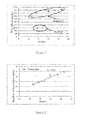
- Figure 1 shows the data of Table 1 for Mw versus Mooney viscosity.
- Mooney value for linear polymer generally follows a linear relationship with molecular weight.
- the molecular weight is typically in the range of 175K to 350K.
- a linear polymer with molecular weight near 1,000K would have extremely high Mooney value such that it would be difficult to process.
- DVB cross-linked polymers show reasonable Mooney values, hence processability, even though the molecular weights are substantially higher than the linear polymers with similar Mooney values.
- Figure 2 shows the data of Table 1 for radius of gyration versus Mooney viscosity.
- the dependency of Mooney and molecular weight is different for the DVB cross-linked polymers and linear polymers and the correlation between Mooney and the radius of gyration is quite good.
- the implication is that DVB cross-linked polymers are much more compact for their molecular weight.
- Example 2 Four polymers from Example 1 were mixed into rubber compositions in a multi step mixing procedure, following the recipe shown in Table 2.
- the rubber compositions also included standard amounts of curatives.
- the rubber compositions were cured using standard cure conditions and tested for viscoelastic properties with results as shown in Figure 3 . Properties are shown indexed to a control compound sample 9.
- Samples 11 and 13 containing the imine-TEOS/DVB polymer showed a lower tan delta than for sample 10 and 12 containing the isopropanol terminated polymer.
- a lower tan delta is indicative of better rolling resistance in a tire compound.
Landscapes
- Chemical & Material Sciences (AREA)
- Health & Medical Sciences (AREA)
- Chemical Kinetics & Catalysis (AREA)
- Medicinal Chemistry (AREA)
- Polymers & Plastics (AREA)
- Organic Chemistry (AREA)
- General Chemical & Material Sciences (AREA)
- Engineering & Computer Science (AREA)
- Mechanical Engineering (AREA)
- Compositions Of Macromolecular Compounds (AREA)
- Addition Polymer Or Copolymer, Post-Treatments, Or Chemical Modifications (AREA)
- Tires In General (AREA)
Applications Claiming Priority (1)
| Application Number | Priority Date | Filing Date | Title |
|---|---|---|---|
| US201361870924P | 2013-08-28 | 2013-08-28 |
Publications (3)
| Publication Number | Publication Date |
|---|---|
| EP2860199A2 true EP2860199A2 (de) | 2015-04-15 |
| EP2860199A3 EP2860199A3 (de) | 2015-10-07 |
| EP2860199B1 EP2860199B1 (de) | 2016-12-21 |
Family
ID=51429043
Family Applications (1)
| Application Number | Title | Priority Date | Filing Date |
|---|---|---|---|
| EP14182064.7A Not-in-force EP2860199B1 (de) | 2013-08-28 | 2014-08-25 | Funktionalisiertes Polymer, Reifengummizusammensetzung und Luftreifen |
Country Status (5)
| Country | Link |
|---|---|
| US (1) | US20150065647A1 (de) |
| EP (1) | EP2860199B1 (de) |
| JP (1) | JP6576621B2 (de) |
| CN (1) | CN104672380B (de) |
| BR (1) | BR102014021366A2 (de) |
Cited By (1)
| Publication number | Priority date | Publication date | Assignee | Title |
|---|---|---|---|---|
| EP2995628A3 (de) * | 2014-08-19 | 2016-06-08 | The Goodyear Tire & Rubber Company | Kautschukzusammensetzung und luftreifen |
Families Citing this family (3)
| Publication number | Priority date | Publication date | Assignee | Title |
|---|---|---|---|---|
| US11117997B2 (en) * | 2018-12-07 | 2021-09-14 | The Goodyear Tire & Rubber Company | Functionalized polymer, rubber composition and pneumatic tire |
| US11208518B2 (en) * | 2018-12-11 | 2021-12-28 | The Goodyear Tire & Rubber Company | Functionalized polymer, rubber composition and pneumatic tire |
| PL4011921T3 (pl) * | 2020-12-09 | 2026-05-18 | G-3 Chickadee Purchaser LLC | Kauczuk o funkcjonalizacji szkieletu i grup końcowych oraz sposób jego wytwarzania i zastosowanie w oponie |
Citations (11)
| Publication number | Priority date | Publication date | Assignee | Title |
|---|---|---|---|---|
| US4048420A (en) | 1975-02-07 | 1977-09-13 | Agence Nationale De Valorisation De La Recherche (Anvar) | Polymerizations catalyzed by very finely divided lithium |
| US4935471A (en) | 1987-10-15 | 1990-06-19 | The Goodyear Tire & Rubber Company | Capped polydienes |
| US5395891A (en) | 1992-06-24 | 1995-03-07 | Bayer Aktiengesellschaft | Rubber mixtures containing polybutadiene gel |
| US5672639A (en) | 1996-03-12 | 1997-09-30 | The Goodyear Tire & Rubber Company | Starch composite reinforced rubber composition and tire with at least one component thereof |
| US6127488A (en) | 1997-01-17 | 2000-10-03 | Bayer Ag | Rubber mixtures which contain SBR rubber gels |
| US6133364A (en) | 1998-08-01 | 2000-10-17 | Continental Aktiengesellschaft | Rubber composition, method of formulating the composition and vehicle tire made from the composition |
| US6207757B1 (en) | 1998-08-01 | 2001-03-27 | Continental Aktiengesellschaft | Rubber composition, method of adding and blending the composition and vehicle tire made from the composition |
| US6242534B1 (en) | 1998-08-01 | 2001-06-05 | Continental Aktiengesellschaft | Rubber composition, method of formulating and blending the same and article and tires made therefrom |
| US6372857B1 (en) | 1999-09-07 | 2002-04-16 | Bayer Aktiengesellschaft | Microgel-containing rubber mixtures with masked bi-functional mercaptans and vulcanization products produced therefrom |
| US20030130535A1 (en) | 2001-08-06 | 2003-07-10 | Degussa Ag, | Organosilicon compounds |
| US6608125B2 (en) | 1997-08-21 | 2003-08-19 | Crompton Corporation | Blocked mercaptosilane coupling agents for filled rubbers |
Family Cites Families (12)
| Publication number | Priority date | Publication date | Assignee | Title |
|---|---|---|---|---|
| US5272220A (en) * | 1992-09-14 | 1993-12-21 | The Goodyear Tire & Rubber Company | Process for preparing styrene-isoprene-butadiene rubber |
| US5276095A (en) * | 1992-12-23 | 1994-01-04 | Shell Oil Company | Star block copolymers of vinyl aromatic hydrocarbons and polydimethylsiloxane and method of synthesis |
| US5798418A (en) * | 1995-07-31 | 1998-08-25 | Fmc Corporation | Star polymers from mixed initiators |
| US5919870A (en) * | 1995-07-31 | 1999-07-06 | Fmc Corporation | Functional telechelic star polymers |
| US6107408A (en) * | 1998-02-26 | 2000-08-22 | Fmc Corporation | Processes for improving linking efficiencies in the synthesis of star polymers |
| JP4111590B2 (ja) * | 1998-06-04 | 2008-07-02 | 株式会社ブリヂストン | 重合体の製造方法、得られた重合体、及びそれを用いたゴム組成物 |
| JP2003155381A (ja) * | 2001-11-22 | 2003-05-27 | Bridgestone Corp | 重合体混合物及びそれを用いたゴム組成物 |
| JP2005290355A (ja) * | 2004-03-11 | 2005-10-20 | Sumitomo Chemical Co Ltd | 変性ジエン系重合体ゴム及びその製造方法 |
| JP4736416B2 (ja) * | 2004-12-16 | 2011-07-27 | Jsr株式会社 | 共役ジエン系共重合ゴムの製造方法 |
| CN100390213C (zh) * | 2005-01-31 | 2008-05-28 | 中国石化北京燕化石油化工股份有限公司 | 星型高乙烯基含量的溶聚共轭二烯烃/单乙烯基芳烃共聚物橡胶及其制备方法 |
| US20090203826A1 (en) * | 2008-02-13 | 2009-08-13 | Michael Joseph Rachita | Methods of making siloxy-imine functionalized rubbery polymers and uses thereof in rubber compositions for tires |
| US8022159B2 (en) * | 2008-11-24 | 2011-09-20 | The Goodyear Tire & Rubber Company | Terminating compounds, polymers, and their uses in rubber compositions and tires |
-
2014
- 2014-08-12 US US14/457,823 patent/US20150065647A1/en not_active Abandoned
- 2014-08-25 EP EP14182064.7A patent/EP2860199B1/de not_active Not-in-force
- 2014-08-28 BR BR102014021366A patent/BR102014021366A2/pt not_active Application Discontinuation
- 2014-08-28 JP JP2014173417A patent/JP6576621B2/ja not_active Expired - Fee Related
- 2014-08-28 CN CN201410433189.3A patent/CN104672380B/zh not_active Expired - Fee Related
Patent Citations (11)
| Publication number | Priority date | Publication date | Assignee | Title |
|---|---|---|---|---|
| US4048420A (en) | 1975-02-07 | 1977-09-13 | Agence Nationale De Valorisation De La Recherche (Anvar) | Polymerizations catalyzed by very finely divided lithium |
| US4935471A (en) | 1987-10-15 | 1990-06-19 | The Goodyear Tire & Rubber Company | Capped polydienes |
| US5395891A (en) | 1992-06-24 | 1995-03-07 | Bayer Aktiengesellschaft | Rubber mixtures containing polybutadiene gel |
| US5672639A (en) | 1996-03-12 | 1997-09-30 | The Goodyear Tire & Rubber Company | Starch composite reinforced rubber composition and tire with at least one component thereof |
| US6127488A (en) | 1997-01-17 | 2000-10-03 | Bayer Ag | Rubber mixtures which contain SBR rubber gels |
| US6608125B2 (en) | 1997-08-21 | 2003-08-19 | Crompton Corporation | Blocked mercaptosilane coupling agents for filled rubbers |
| US6133364A (en) | 1998-08-01 | 2000-10-17 | Continental Aktiengesellschaft | Rubber composition, method of formulating the composition and vehicle tire made from the composition |
| US6207757B1 (en) | 1998-08-01 | 2001-03-27 | Continental Aktiengesellschaft | Rubber composition, method of adding and blending the composition and vehicle tire made from the composition |
| US6242534B1 (en) | 1998-08-01 | 2001-06-05 | Continental Aktiengesellschaft | Rubber composition, method of formulating and blending the same and article and tires made therefrom |
| US6372857B1 (en) | 1999-09-07 | 2002-04-16 | Bayer Aktiengesellschaft | Microgel-containing rubber mixtures with masked bi-functional mercaptans and vulcanization products produced therefrom |
| US20030130535A1 (en) | 2001-08-06 | 2003-07-10 | Degussa Ag, | Organosilicon compounds |
Non-Patent Citations (5)
| Title |
|---|
| "Standard Methods for Analysis & Testinq of Petroleum and Related Products and British Standard 2000 Parts", 2003, INSTITUTE OF PETROLEUM |
| "The Vanderbilt Rubber Handbook", 1978, pages: 344 - 346 |
| A. GESSLER; W. HESS; A MEDALIA, PLAST. RUBBER PROCESS, vol. 3, 1968, pages 141 |
| D. RIVIN; J. ARON; A. MEDALIA, RUBBER CHEM. & TECHNOL., vol. 41, 1968, pages 330 |
| N. NAGATA, NIPPON GOMU KYOKAISHI, vol. 62, 1989, pages 630 |
Cited By (1)
| Publication number | Priority date | Publication date | Assignee | Title |
|---|---|---|---|---|
| EP2995628A3 (de) * | 2014-08-19 | 2016-06-08 | The Goodyear Tire & Rubber Company | Kautschukzusammensetzung und luftreifen |
Also Published As
| Publication number | Publication date |
|---|---|
| EP2860199A3 (de) | 2015-10-07 |
| JP2015044996A (ja) | 2015-03-12 |
| US20150065647A1 (en) | 2015-03-05 |
| EP2860199B1 (de) | 2016-12-21 |
| CN104672380B (zh) | 2017-08-25 |
| JP6576621B2 (ja) | 2019-09-18 |
| CN104672380A (zh) | 2015-06-03 |
| BR102014021366A2 (pt) | 2015-12-22 |
Similar Documents
| Publication | Publication Date | Title |
|---|---|---|
| EP2596963B1 (de) | Funktionalisiertes Polymer, Gummizusammensetzung mit einem solchen Polymer, und pneumatischer Reifen | |
| EP2875967B1 (de) | Funktionalisiertes Elastomer und Kautschukzusammensetzung mit solch einem Elastomer | |
| EP2719549B1 (de) | Funktionalisiertes Polymer, Reifengummizusammensetzung und Luftreifen | |
| EP2644610B1 (de) | Funktionalisiertes Polymer, Reifengummizusammensetzung und Luftreifen | |
| US9045627B2 (en) | Rubber composition and pneumatic tire | |
| EP2987812B1 (de) | Funktionalisiertes polymer, reifengummizusammensetzung und luftreifen | |
| US9688837B2 (en) | Functionalized polymer, rubber composition and pneumatic tire | |
| EP2860199B1 (de) | Funktionalisiertes Polymer, Reifengummizusammensetzung und Luftreifen | |
| EP3663101B1 (de) | Funktionalisiertes polymer, kautschukzusammensetzung und luftreifen | |
| EP3666801B1 (de) | Funktionalisiertes polymer, reifengummizusammensetzung und luftreifen | |
| US20230312792A1 (en) | Hydrogenated polymers with siloxytrithiocarbanate termination | |
| EP3733726B1 (de) | In-chain-funktionalisiertes elastomer, verfahren zu seiner herstellung, kautschukzusammensetzung und luftreifen | |
| EP3666800A1 (de) | Funktionalisiertes polymer, reifengummizusammensetzung und luftreifen | |
| US12258474B2 (en) | Functionalized polymer, rubber composition and pneumatic tire | |
| EP3670542B1 (de) | Funktionalisiertes polymer, reifengummizusammensetzung und luftreifen | |
| US11352458B2 (en) | Functionalized polymer, rubber composition and pneumatic tire | |
| EP3670207A1 (de) | Funktionalisiertes polymer, kautschukzusammensetzung und luftreifen | |
| EP3915808A1 (de) | Funktionalisierter initiator, verfahren zur herstellung eines initiators und funktionalisiertes elastomer |
Legal Events
| Date | Code | Title | Description |
|---|---|---|---|
| PUAI | Public reference made under article 153(3) epc to a published international application that has entered the european phase |
Free format text: ORIGINAL CODE: 0009012 |
|
| 17P | Request for examination filed |
Effective date: 20140825 |
|
| AK | Designated contracting states |
Kind code of ref document: A2 Designated state(s): AL AT BE BG CH CY CZ DE DK EE ES FI FR GB GR HR HU IE IS IT LI LT LU LV MC MK MT NL NO PL PT RO RS SE SI SK SM TR |
|
| AX | Request for extension of the european patent |
Extension state: BA ME |
|
| PUAL | Search report despatched |
Free format text: ORIGINAL CODE: 0009013 |
|
| AK | Designated contracting states |
Kind code of ref document: A3 Designated state(s): AL AT BE BG CH CY CZ DE DK EE ES FI FR GB GR HR HU IE IS IT LI LT LU LV MC MK MT NL NO PL PT RO RS SE SI SK SM TR |
|
| AX | Request for extension of the european patent |
Extension state: BA ME |
|
| RIC1 | Information provided on ipc code assigned before grant |
Ipc: C08K 3/36 20060101ALI20150828BHEP Ipc: C08F 236/10 20060101ALI20150828BHEP Ipc: C08C 19/25 20060101ALI20150828BHEP Ipc: C08F 236/08 20060101ALI20150828BHEP Ipc: C08C 19/44 20060101AFI20150828BHEP |
|
| R17P | Request for examination filed (corrected) |
Effective date: 20160407 |
|
| RBV | Designated contracting states (corrected) |
Designated state(s): AL AT BE BG CH CY CZ DE DK EE ES FI FR GB GR HR HU IE IS IT LI LT LU LV MC MK MT NL NO PL PT RO RS SE SI SK SM TR |
|
| GRAP | Despatch of communication of intention to grant a patent |
Free format text: ORIGINAL CODE: EPIDOSNIGR1 |
|
| INTG | Intention to grant announced |
Effective date: 20160719 |
|
| GRAS | Grant fee paid |
Free format text: ORIGINAL CODE: EPIDOSNIGR3 |
|
| GRAA | (expected) grant |
Free format text: ORIGINAL CODE: 0009210 |
|
| AK | Designated contracting states |
Kind code of ref document: B1 Designated state(s): AL AT BE BG CH CY CZ DE DK EE ES FI FR GB GR HR HU IE IS IT LI LT LU LV MC MK MT NL NO PL PT RO RS SE SI SK SM TR |
|
| REG | Reference to a national code |
Ref country code: GB Ref legal event code: FG4D |
|
| REG | Reference to a national code |
Ref country code: CH Ref legal event code: EP |
|
| REG | Reference to a national code |
Ref country code: IE Ref legal event code: FG4D |
|
| REG | Reference to a national code |
Ref country code: AT Ref legal event code: REF Ref document number: 855422 Country of ref document: AT Kind code of ref document: T Effective date: 20170115 |
|
| REG | Reference to a national code |
Ref country code: DE Ref legal event code: R096 Ref document number: 602014005611 Country of ref document: DE |
|
| PG25 | Lapsed in a contracting state [announced via postgrant information from national office to epo] |
Ref country code: LV Free format text: LAPSE BECAUSE OF FAILURE TO SUBMIT A TRANSLATION OF THE DESCRIPTION OR TO PAY THE FEE WITHIN THE PRESCRIBED TIME-LIMIT Effective date: 20161221 |
|
| REG | Reference to a national code |
Ref country code: LT Ref legal event code: MG4D |
|
| REG | Reference to a national code |
Ref country code: NL Ref legal event code: MP Effective date: 20161221 |
|
| PG25 | Lapsed in a contracting state [announced via postgrant information from national office to epo] |
Ref country code: SE Free format text: LAPSE BECAUSE OF FAILURE TO SUBMIT A TRANSLATION OF THE DESCRIPTION OR TO PAY THE FEE WITHIN THE PRESCRIBED TIME-LIMIT Effective date: 20161221 Ref country code: GR Free format text: LAPSE BECAUSE OF FAILURE TO SUBMIT A TRANSLATION OF THE DESCRIPTION OR TO PAY THE FEE WITHIN THE PRESCRIBED TIME-LIMIT Effective date: 20170322 Ref country code: NO Free format text: LAPSE BECAUSE OF FAILURE TO SUBMIT A TRANSLATION OF THE DESCRIPTION OR TO PAY THE FEE WITHIN THE PRESCRIBED TIME-LIMIT Effective date: 20170321 Ref country code: LT Free format text: LAPSE BECAUSE OF FAILURE TO SUBMIT A TRANSLATION OF THE DESCRIPTION OR TO PAY THE FEE WITHIN THE PRESCRIBED TIME-LIMIT Effective date: 20161221 |
|
| REG | Reference to a national code |
Ref country code: AT Ref legal event code: MK05 Ref document number: 855422 Country of ref document: AT Kind code of ref document: T Effective date: 20161221 |
|
| PG25 | Lapsed in a contracting state [announced via postgrant information from national office to epo] |
Ref country code: RS Free format text: LAPSE BECAUSE OF FAILURE TO SUBMIT A TRANSLATION OF THE DESCRIPTION OR TO PAY THE FEE WITHIN THE PRESCRIBED TIME-LIMIT Effective date: 20161221 Ref country code: FI Free format text: LAPSE BECAUSE OF FAILURE TO SUBMIT A TRANSLATION OF THE DESCRIPTION OR TO PAY THE FEE WITHIN THE PRESCRIBED TIME-LIMIT Effective date: 20161221 Ref country code: HR Free format text: LAPSE BECAUSE OF FAILURE TO SUBMIT A TRANSLATION OF THE DESCRIPTION OR TO PAY THE FEE WITHIN THE PRESCRIBED TIME-LIMIT Effective date: 20161221 |
|
| PG25 | Lapsed in a contracting state [announced via postgrant information from national office to epo] |
Ref country code: NL Free format text: LAPSE BECAUSE OF FAILURE TO SUBMIT A TRANSLATION OF THE DESCRIPTION OR TO PAY THE FEE WITHIN THE PRESCRIBED TIME-LIMIT Effective date: 20161221 |
|
| REG | Reference to a national code |
Ref country code: FR Ref legal event code: PLFP Year of fee payment: 4 |
|
| PG25 | Lapsed in a contracting state [announced via postgrant information from national office to epo] |
Ref country code: SK Free format text: LAPSE BECAUSE OF FAILURE TO SUBMIT A TRANSLATION OF THE DESCRIPTION OR TO PAY THE FEE WITHIN THE PRESCRIBED TIME-LIMIT Effective date: 20161221 Ref country code: EE Free format text: LAPSE BECAUSE OF FAILURE TO SUBMIT A TRANSLATION OF THE DESCRIPTION OR TO PAY THE FEE WITHIN THE PRESCRIBED TIME-LIMIT Effective date: 20161221 Ref country code: RO Free format text: LAPSE BECAUSE OF FAILURE TO SUBMIT A TRANSLATION OF THE DESCRIPTION OR TO PAY THE FEE WITHIN THE PRESCRIBED TIME-LIMIT Effective date: 20161221 Ref country code: CZ Free format text: LAPSE BECAUSE OF FAILURE TO SUBMIT A TRANSLATION OF THE DESCRIPTION OR TO PAY THE FEE WITHIN THE PRESCRIBED TIME-LIMIT Effective date: 20161221 Ref country code: IS Free format text: LAPSE BECAUSE OF FAILURE TO SUBMIT A TRANSLATION OF THE DESCRIPTION OR TO PAY THE FEE WITHIN THE PRESCRIBED TIME-LIMIT Effective date: 20170421 |
|
| PG25 | Lapsed in a contracting state [announced via postgrant information from national office to epo] |
Ref country code: ES Free format text: LAPSE BECAUSE OF FAILURE TO SUBMIT A TRANSLATION OF THE DESCRIPTION OR TO PAY THE FEE WITHIN THE PRESCRIBED TIME-LIMIT Effective date: 20161221 Ref country code: AT Free format text: LAPSE BECAUSE OF FAILURE TO SUBMIT A TRANSLATION OF THE DESCRIPTION OR TO PAY THE FEE WITHIN THE PRESCRIBED TIME-LIMIT Effective date: 20161221 Ref country code: SM Free format text: LAPSE BECAUSE OF FAILURE TO SUBMIT A TRANSLATION OF THE DESCRIPTION OR TO PAY THE FEE WITHIN THE PRESCRIBED TIME-LIMIT Effective date: 20161221 Ref country code: PL Free format text: LAPSE BECAUSE OF FAILURE TO SUBMIT A TRANSLATION OF THE DESCRIPTION OR TO PAY THE FEE WITHIN THE PRESCRIBED TIME-LIMIT Effective date: 20161221 Ref country code: BG Free format text: LAPSE BECAUSE OF FAILURE TO SUBMIT A TRANSLATION OF THE DESCRIPTION OR TO PAY THE FEE WITHIN THE PRESCRIBED TIME-LIMIT Effective date: 20170321 Ref country code: PT Free format text: LAPSE BECAUSE OF FAILURE TO SUBMIT A TRANSLATION OF THE DESCRIPTION OR TO PAY THE FEE WITHIN THE PRESCRIBED TIME-LIMIT Effective date: 20170421 Ref country code: BE Free format text: LAPSE BECAUSE OF FAILURE TO SUBMIT A TRANSLATION OF THE DESCRIPTION OR TO PAY THE FEE WITHIN THE PRESCRIBED TIME-LIMIT Effective date: 20161221 |
|
| REG | Reference to a national code |
Ref country code: DE Ref legal event code: R097 Ref document number: 602014005611 Country of ref document: DE |
|
| PLBE | No opposition filed within time limit |
Free format text: ORIGINAL CODE: 0009261 |
|
| STAA | Information on the status of an ep patent application or granted ep patent |
Free format text: STATUS: NO OPPOSITION FILED WITHIN TIME LIMIT |
|
| 26N | No opposition filed |
Effective date: 20170922 |
|
| PG25 | Lapsed in a contracting state [announced via postgrant information from national office to epo] |
Ref country code: DK Free format text: LAPSE BECAUSE OF FAILURE TO SUBMIT A TRANSLATION OF THE DESCRIPTION OR TO PAY THE FEE WITHIN THE PRESCRIBED TIME-LIMIT Effective date: 20161221 |
|
| PG25 | Lapsed in a contracting state [announced via postgrant information from national office to epo] |
Ref country code: SI Free format text: LAPSE BECAUSE OF FAILURE TO SUBMIT A TRANSLATION OF THE DESCRIPTION OR TO PAY THE FEE WITHIN THE PRESCRIBED TIME-LIMIT Effective date: 20161221 |
|
| REG | Reference to a national code |
Ref country code: CH Ref legal event code: PL |
|
| PG25 | Lapsed in a contracting state [announced via postgrant information from national office to epo] |
Ref country code: MC Free format text: LAPSE BECAUSE OF FAILURE TO SUBMIT A TRANSLATION OF THE DESCRIPTION OR TO PAY THE FEE WITHIN THE PRESCRIBED TIME-LIMIT Effective date: 20161221 |
|
| PG25 | Lapsed in a contracting state [announced via postgrant information from national office to epo] |
Ref country code: LI Free format text: LAPSE BECAUSE OF NON-PAYMENT OF DUE FEES Effective date: 20170831 Ref country code: CH Free format text: LAPSE BECAUSE OF NON-PAYMENT OF DUE FEES Effective date: 20170831 |
|
| REG | Reference to a national code |
Ref country code: IE Ref legal event code: MM4A |
|
| PG25 | Lapsed in a contracting state [announced via postgrant information from national office to epo] |
Ref country code: LU Free format text: LAPSE BECAUSE OF NON-PAYMENT OF DUE FEES Effective date: 20170825 |
|
| REG | Reference to a national code |
Ref country code: FR Ref legal event code: PLFP Year of fee payment: 5 |
|
| PG25 | Lapsed in a contracting state [announced via postgrant information from national office to epo] |
Ref country code: IE Free format text: LAPSE BECAUSE OF NON-PAYMENT OF DUE FEES Effective date: 20170825 |
|
| PG25 | Lapsed in a contracting state [announced via postgrant information from national office to epo] |
Ref country code: MT Free format text: LAPSE BECAUSE OF NON-PAYMENT OF DUE FEES Effective date: 20170825 |
|
| GBPC | Gb: european patent ceased through non-payment of renewal fee |
Effective date: 20180825 |
|
| PG25 | Lapsed in a contracting state [announced via postgrant information from national office to epo] |
Ref country code: HU Free format text: LAPSE BECAUSE OF FAILURE TO SUBMIT A TRANSLATION OF THE DESCRIPTION OR TO PAY THE FEE WITHIN THE PRESCRIBED TIME-LIMIT; INVALID AB INITIO Effective date: 20140825 |
|
| PG25 | Lapsed in a contracting state [announced via postgrant information from national office to epo] |
Ref country code: CY Free format text: LAPSE BECAUSE OF FAILURE TO SUBMIT A TRANSLATION OF THE DESCRIPTION OR TO PAY THE FEE WITHIN THE PRESCRIBED TIME-LIMIT Effective date: 20161221 Ref country code: GB Free format text: LAPSE BECAUSE OF NON-PAYMENT OF DUE FEES Effective date: 20180825 |
|
| PG25 | Lapsed in a contracting state [announced via postgrant information from national office to epo] |
Ref country code: MK Free format text: LAPSE BECAUSE OF FAILURE TO SUBMIT A TRANSLATION OF THE DESCRIPTION OR TO PAY THE FEE WITHIN THE PRESCRIBED TIME-LIMIT Effective date: 20161221 |
|
| PG25 | Lapsed in a contracting state [announced via postgrant information from national office to epo] |
Ref country code: TR Free format text: LAPSE BECAUSE OF FAILURE TO SUBMIT A TRANSLATION OF THE DESCRIPTION OR TO PAY THE FEE WITHIN THE PRESCRIBED TIME-LIMIT Effective date: 20161221 |
|
| PG25 | Lapsed in a contracting state [announced via postgrant information from national office to epo] |
Ref country code: AL Free format text: LAPSE BECAUSE OF FAILURE TO SUBMIT A TRANSLATION OF THE DESCRIPTION OR TO PAY THE FEE WITHIN THE PRESCRIBED TIME-LIMIT Effective date: 20161221 |
|
| PGFP | Annual fee paid to national office [announced via postgrant information from national office to epo] |
Ref country code: FR Payment date: 20210714 Year of fee payment: 8 Ref country code: IT Payment date: 20210712 Year of fee payment: 8 |
|
| PGFP | Annual fee paid to national office [announced via postgrant information from national office to epo] |
Ref country code: DE Payment date: 20210713 Year of fee payment: 8 |
|
| REG | Reference to a national code |
Ref country code: DE Ref legal event code: R119 Ref document number: 602014005611 Country of ref document: DE |
|
| PG25 | Lapsed in a contracting state [announced via postgrant information from national office to epo] |
Ref country code: IT Free format text: LAPSE BECAUSE OF NON-PAYMENT OF DUE FEES Effective date: 20220825 Ref country code: FR Free format text: LAPSE BECAUSE OF NON-PAYMENT OF DUE FEES Effective date: 20220831 Ref country code: DE Free format text: LAPSE BECAUSE OF NON-PAYMENT OF DUE FEES Effective date: 20230301 |