EP2858817B1 - Document de securite a haute durabilite - Google Patents
Document de securite a haute durabilite Download PDFInfo
- Publication number
- EP2858817B1 EP2858817B1 EP13729932.7A EP13729932A EP2858817B1 EP 2858817 B1 EP2858817 B1 EP 2858817B1 EP 13729932 A EP13729932 A EP 13729932A EP 2858817 B1 EP2858817 B1 EP 2858817B1
- Authority
- EP
- European Patent Office
- Prior art keywords
- paper substrate
- polymer material
- face
- film
- films
- Prior art date
- Legal status (The legal status is an assumption and is not a legal conclusion. Google has not performed a legal analysis and makes no representation as to the accuracy of the status listed.)
- Active
Links
Images


Classifications
-
- B—PERFORMING OPERATIONS; TRANSPORTING
- B32—LAYERED PRODUCTS
- B32B—LAYERED PRODUCTS, i.e. PRODUCTS BUILT-UP OF STRATA OF FLAT OR NON-FLAT, e.g. CELLULAR OR HONEYCOMB, FORM
- B32B7/00—Layered products characterised by the relation between layers; Layered products characterised by the relative orientation of features between layers, or by the relative values of a measurable parameter between layers, i.e. products comprising layers having different physical, chemical or physicochemical properties; Layered products characterised by the interconnection of layers
- B32B7/04—Interconnection of layers
- B32B7/12—Interconnection of layers using interposed adhesives or interposed materials with bonding properties
-
- B—PERFORMING OPERATIONS; TRANSPORTING
- B32—LAYERED PRODUCTS
- B32B—LAYERED PRODUCTS, i.e. PRODUCTS BUILT-UP OF STRATA OF FLAT OR NON-FLAT, e.g. CELLULAR OR HONEYCOMB, FORM
- B32B27/00—Layered products comprising a layer of synthetic resin
- B32B27/06—Layered products comprising a layer of synthetic resin as the main or only constituent of a layer, which is next to another layer of the same or of a different material
- B32B27/10—Layered products comprising a layer of synthetic resin as the main or only constituent of a layer, which is next to another layer of the same or of a different material of paper or cardboard
-
- B—PERFORMING OPERATIONS; TRANSPORTING
- B32—LAYERED PRODUCTS
- B32B—LAYERED PRODUCTS, i.e. PRODUCTS BUILT-UP OF STRATA OF FLAT OR NON-FLAT, e.g. CELLULAR OR HONEYCOMB, FORM
- B32B27/00—Layered products comprising a layer of synthetic resin
- B32B27/32—Layered products comprising a layer of synthetic resin comprising polyolefins
-
- B—PERFORMING OPERATIONS; TRANSPORTING
- B42—BOOKBINDING; ALBUMS; FILES; SPECIAL PRINTED MATTER
- B42D—BOOKS; BOOK COVERS; LOOSE LEAVES; PRINTED MATTER CHARACTERISED BY IDENTIFICATION OR SECURITY FEATURES; PRINTED MATTER OF SPECIAL FORMAT OR STYLE NOT OTHERWISE PROVIDED FOR; DEVICES FOR USE THEREWITH AND NOT OTHERWISE PROVIDED FOR; MOVABLE-STRIP WRITING OR READING APPARATUS
- B42D25/00—Information-bearing cards or sheet-like structures characterised by identification or security features; Manufacture thereof
- B42D25/20—Information-bearing cards or sheet-like structures characterised by identification or security features; Manufacture thereof characterised by a particular use or purpose
- B42D25/29—Securities; Bank notes
-
- B—PERFORMING OPERATIONS; TRANSPORTING
- B42—BOOKBINDING; ALBUMS; FILES; SPECIAL PRINTED MATTER
- B42D—BOOKS; BOOK COVERS; LOOSE LEAVES; PRINTED MATTER CHARACTERISED BY IDENTIFICATION OR SECURITY FEATURES; PRINTED MATTER OF SPECIAL FORMAT OR STYLE NOT OTHERWISE PROVIDED FOR; DEVICES FOR USE THEREWITH AND NOT OTHERWISE PROVIDED FOR; MOVABLE-STRIP WRITING OR READING APPARATUS
- B42D25/00—Information-bearing cards or sheet-like structures characterised by identification or security features; Manufacture thereof
- B42D25/30—Identification or security features, e.g. for preventing forgery
- B42D25/355—Security threads
-
- B—PERFORMING OPERATIONS; TRANSPORTING
- B42—BOOKBINDING; ALBUMS; FILES; SPECIAL PRINTED MATTER
- B42D—BOOKS; BOOK COVERS; LOOSE LEAVES; PRINTED MATTER CHARACTERISED BY IDENTIFICATION OR SECURITY FEATURES; PRINTED MATTER OF SPECIAL FORMAT OR STYLE NOT OTHERWISE PROVIDED FOR; DEVICES FOR USE THEREWITH AND NOT OTHERWISE PROVIDED FOR; MOVABLE-STRIP WRITING OR READING APPARATUS
- B42D25/00—Information-bearing cards or sheet-like structures characterised by identification or security features; Manufacture thereof
- B42D25/30—Identification or security features, e.g. for preventing forgery
- B42D25/36—Identification or security features, e.g. for preventing forgery comprising special materials
-
- B—PERFORMING OPERATIONS; TRANSPORTING
- B42—BOOKBINDING; ALBUMS; FILES; SPECIAL PRINTED MATTER
- B42D—BOOKS; BOOK COVERS; LOOSE LEAVES; PRINTED MATTER CHARACTERISED BY IDENTIFICATION OR SECURITY FEATURES; PRINTED MATTER OF SPECIAL FORMAT OR STYLE NOT OTHERWISE PROVIDED FOR; DEVICES FOR USE THEREWITH AND NOT OTHERWISE PROVIDED FOR; MOVABLE-STRIP WRITING OR READING APPARATUS
- B42D25/00—Information-bearing cards or sheet-like structures characterised by identification or security features; Manufacture thereof
- B42D25/40—Manufacture
- B42D25/45—Associating two or more layers
- B42D25/455—Associating two or more layers using heat
-
- B—PERFORMING OPERATIONS; TRANSPORTING
- B42—BOOKBINDING; ALBUMS; FILES; SPECIAL PRINTED MATTER
- B42D—BOOKS; BOOK COVERS; LOOSE LEAVES; PRINTED MATTER CHARACTERISED BY IDENTIFICATION OR SECURITY FEATURES; PRINTED MATTER OF SPECIAL FORMAT OR STYLE NOT OTHERWISE PROVIDED FOR; DEVICES FOR USE THEREWITH AND NOT OTHERWISE PROVIDED FOR; MOVABLE-STRIP WRITING OR READING APPARATUS
- B42D25/00—Information-bearing cards or sheet-like structures characterised by identification or security features; Manufacture thereof
- B42D25/40—Manufacture
- B42D25/45—Associating two or more layers
- B42D25/465—Associating two or more layers using chemicals or adhesives
- B42D25/47—Associating two or more layers using chemicals or adhesives using adhesives
-
- B—PERFORMING OPERATIONS; TRANSPORTING
- B32—LAYERED PRODUCTS
- B32B—LAYERED PRODUCTS, i.e. PRODUCTS BUILT-UP OF STRATA OF FLAT OR NON-FLAT, e.g. CELLULAR OR HONEYCOMB, FORM
- B32B2260/00—Layered product comprising an impregnated, embedded, or bonded layer wherein the layer comprises an impregnation, embedding, or binder material
- B32B2260/02—Composition of the impregnated, bonded or embedded layer
- B32B2260/028—Paper layer
-
- B—PERFORMING OPERATIONS; TRANSPORTING
- B32—LAYERED PRODUCTS
- B32B—LAYERED PRODUCTS, i.e. PRODUCTS BUILT-UP OF STRATA OF FLAT OR NON-FLAT, e.g. CELLULAR OR HONEYCOMB, FORM
- B32B2260/00—Layered product comprising an impregnated, embedded, or bonded layer wherein the layer comprises an impregnation, embedding, or binder material
- B32B2260/04—Impregnation, embedding, or binder material
- B32B2260/046—Synthetic resin
-
- B—PERFORMING OPERATIONS; TRANSPORTING
- B32—LAYERED PRODUCTS
- B32B—LAYERED PRODUCTS, i.e. PRODUCTS BUILT-UP OF STRATA OF FLAT OR NON-FLAT, e.g. CELLULAR OR HONEYCOMB, FORM
- B32B2554/00—Paper of special types, e.g. banknotes
Definitions
- the invention relates to a security document or of value, in particular of the banknote type having a printed paper substrate, not printed or partially printed, the document having a durable structure and able to preserve the quality and the specificity of the document , in order to extend its useful life, especially when this document is subjected to an aggressive traffic environment.
- the invention also relates to a method of manufacturing such a document.
- banknotes comprising a paper substrate formed from cotton fibers and including security signs.
- the limited duration of the notes may be due to the deterioration (mechanical, dirt) of the paper substrate.
- WO 2009/150117 discloses a secured paper-type paper treated against soiling by application of a composition based on polyurethanes.
- WO 91/12362 discloses a printable paper-like sheet treated with a composition comprising at least one filler and at least one elastomeric binder.
- elastomers are aqueous polyurethane dispersions. These types of treatments essentially act on the resistance to soiling, thereby increasing the life of the documents in circulation, but do not significantly modify the mechanical characteristics of the documents.
- WO 98/15418 discloses a bank note made from a substrate made entirely of polymeric material.
- a ticket does not allow the use of certain security signs.
- such a note is made in a material more common than the fiduciary paper, and incompatible with certain usual safety signs (watermark, security thread, ...), which reduces the difficulty to falsify.
- the durability of the note is greater than that of the ink printed on its surface, resulting in notes in circulation more difficult to identify over time.
- WO 2004/028825 discloses a security paper formed from a substrate comprising a paper layer sandwiched between two film layers, the film having at least one security sign. Such notes present a risk of separability of the polymer films or the paper itself. Such banknotes, whose graphic security and printing are mainly on the films containing a printing primer, also have durability limits related to the strength of inks, as well as tickets to substrate consisting entirely of polymer. Therefore, it is very often necessary to provide a layer of protective varnish on the surface of these two types of documents, to enhance the ink holding on the document in circulation.
- WO 2010/146065 discloses a similar security document further comprising impregnating the paper surface with a polyurethane-containing composition. Such documents also have durability limits related to ink holding.
- An object of the invention is to provide a security document with greater durability to extend its life, even when this document is subjected to multiple manipulations, and / or an aggressive traffic environment.
- the method of manufacturing security documents comprises a first step 101 for manufacturing a paper substrate 2 in the form of a sheet having a first face and a second face.
- the paper substrate 2 is formed from plant fibers, for example wood fibers, fibers of annual plants, for example cotton, optionally supplemented with fibers of synthetic materials.
- this first step 101 includes the addition of at least one bulk bonding agent 5 to a fibrous suspension.
- the bulk sizing agent may comprise alkenyl succinic anhydride and / or a derivative thereof.
- the bulk bonding agent may comprise an alkyl ketene dimer and / or one of its derivatives.
- the bulk bonding agent may comprise rosin and / or one of its derivatives. The tranches of the ticket are thus advantageously protected.
- the method comprises a second step 102 for impregnating the faces of the paper substrate 2 before printing with a composition comprising polyurethane 23.
- This impregnation is carried out continuously on a paper machine, on the dry sheet. Continuous devices of the type of impregnation tank or "size press" are particularly suitable for performing this impregnation on a paper machine.
- the method comprises a third step 103 for printing the paper substrate 2 and / or films of polymer material 3 and 4.
- This printing step can take place before and / or after a filming step.
- Perform the print step before the filming step to protect the inks applied during this step vis-à-vis the constraints inherent in the circulation of documents made by the process.
- An impression thus produced has the same durability as the associated paper substrate 2, which increases the life of the security document.
- the paper substrate 2 can also be secured by security signs 24 and made before the filming step 104, that is to say during the papermaking 101, impregnating 102 and possibly printing 103 , in the case where the printing step 103 is performed before the filming step.
- the method comprises a fourth filming step 104 during which the impregnated and optionally printed paper substrate 2 undergoes an application of a first film of polymer material 3 and a second film of polymer material 4 respectively on the first face and the second face of the paper substrate sheet 2, by a so-called laminating process, in which the films are laminated on the paper, and thus bonded with an adhesive at the paper / film interfaces.
- the film may be dry or wet.
- the "front” and “back” films can be applied simultaneously, on the same filming group, in a single pass, or one after the other on two separate filming groups in a single pass, or in two passes, one application per film.
- the first polymeric material film and the second polymeric material film may comprise polypropylene.
- the filming comprises a bonding step 104 'by means of an adhesive layer 6, respectively 7, comprising an ethylene-vinyl acetate copolymer between the impregnated and optionally printed paper substrate 2 and one of the films made of polymer material 3, respectively 4.
- the ethylene-vinyl acetate copolymer has a mass percentage of vinyl acetate greater than 23%.
- the mass percentage of vinyl acetate is preferably between 23% and 33%.
- the mass percentage of vinyl acetate is preferably between 26% and 33%.
- the adhesive layer 6, respectively 7, may be pre-coated on a surface of the film of polymer material 3, respectively 4, before coating, and reactivated by the combined action of temperature and pressure. Such a filming process is called “dry”. Typically, the temperatures employed during the filming called “dry” range from 90 to 150 ° C.
- the adhesive layer 6, respectively 7 can be used from the liquid state to form a rolled adhesive film during the filming between the film of polymer material 3, respectively 4, and the paper substrate 2. This filming process is called "wet".
- the method may comprise a fifth step 105 of forming a gloss contrast pattern 33 as shown figure 2 on the film of polymer material 3.
- the forming step 105 may be carried out after the filming step 104, or on a film of polymeric material before the filming step 104.
- the film of polymer material 3 thus has a matt zone 31 at the level of certain printed patterns 25, 26 and 27 of the printed paper substrate 2 in order not to disturb, by excess of brilliance, the optical reading of the document in the machine. This is particularly useful in the case of banknote sorting and authentication machines.
- a matt zone can be defined as having a gloss (measured at an angle of about 60 °) of less than 20 gloss units, and preferably less than 10 units of gloss. shine.
- the brightness unit represents the proportion of light reflected specularly from incident light at an angle of 60 °.
- the film of polymeric material 3 further has a glossy area 32 at certain printed patterns of the paper substrate 2, and / or at certain security signs to allow visual readability of the printed patterns.
- the method then comprises a sixth cutting step 106, wherein the laminated complex is cut to form a plurality of security documents.
- a paper banknote security document 1 comprising a printed paper substrate 2 and films made of polymer material 3 and 4.
- the document can be produced by the security document manufacturing method described above. .
- the printed paper substrate 2 comprises a paper substrate 2 in the form of a sheet having a first face and a second face and having undergone printing and on which there are security signs.
- the sheet comprises a fibrous web.
- the printed paper substrate 2 comprises plant fibers, for example wood or annual plants such as cotton.
- the printed paper substrate 2 may comprise a plant fiber structure reinforced with synthetic fibers. It is for example made from cotton fibers and polyamide.
- the printed paper substrate 2 may be composed of several layers.
- the printed paper substrate 2 has printed patterns such as patterns 25, 26, 27.
- the patterns are made on the paper substrate before the filming step. Thus, the printing is easier and the printing inks benefit from the protection of the films made of polymer material.
- Printing techniques can be offset, screen, intaglio, flexographic, gravure, letterpress, inkjet, sheet-fed or continuous printing, color-changing inks, holograms, micro-printing, or any other known printing technique of security printing.
- Signs of security such as the security signs 24 and 24 'make it possible to guarantee the authenticity of the security document 1. They can be incorporated into the paper substrate, but also be printed signs.
- sign 24 may be a watermark.
- the sign 24 ' represents a wire integrated in the thickness of the paper.
- Other security features may be implemented, such as fluorescent layer, strip or metallized zone with diffraction effect, color-changing ink, colorless ink, iridescent printing, micro-printing, hologram, latent image, intaglio printing, fluorescent fibrettes, fluorescent printing, infra-red torque, optically variable color printing, transvision, magnetism or any other security sign realization technique for security documents.
- the security document 1 comprises a first film of polymer material 3 extending on the first face of the printed paper substrate 2, and a second film of polymer material 4 extending on the second face of the printed paper substrate 2.
- the films of polymer material 3 and 4 may be supplemented by several other superposed polymer material films.
- the films made of polymeric material 3 and 4 make it possible to protect the two faces of the printed paper substrate 2.
- the films made of polymer material 3 and 4 make it possible to increase the strength of the security document 1, in particular the resistance to liquids, to the abrasion, staining, and mechanical strength.
- Films made of material Polymers 3 and 4 are transparent, i.e., in a wavelength range from near ultraviolet to near infrared, the light transmission rate is greater than 85%.
- the thicknesses of the films 3 and 4 made of polymer material typically range from 4 to 30 ⁇ m.
- the polymer film 3 and 4 can be composed of BOPP ( "Biaxially Oriented Polypropylene", polypropylene film bioriented in English terminology) or PET ( “PolyEthylene Terephtalate” in English terminology). Other transparent polymers can also be envisaged.
- the films of polymer material 3 and 4 are deposited by a process of laminating the printed paper substrate 2.
- the document 1 has a first layer of adhesive 6, respectively a second layer of adhesive 7, between the printed paper substrate 2 and the first film of polymer material 3, respectively the second film of polymer material 4.
- the layers of adhesive comprise an ethylene-vinyl acetate copolymer which has a mass percentage of vinyl acetate greater than 23%, preferably between 23% and 33%, preferably between 26% and 33%.
- These adhesive layers 6 and 7 allow the films of polymer material 3 and 4 to be bonded to the faces of the printed paper substrate 2.
- the film-coating 104 is produced after impregnation 102 and printing 103 of the paper substrate 2 and before the unitary cutting of the documents. 1.
- a possible variant is to print all or part of the security document on the film laminating.
- a first example of a so-called wet laminating technique consists in using a machine which adheres the polymer material films 3 and 4 of an adhesive from its liquid state. The laminating is then carried out by laminating the films of polymer material 3 and 4 on the printed paper substrate 2 by a system of rollers, during which the combined action of the pressure and the temperature allow bonding of the polymer films 3 and 4 on each side of the sheet by the layers of adhesive 6 and 7.
- a second example of a so-called dry film coating technique consists in applying the polymer films 3 and 4 already coated with a heat-reactive adhesive.
- the glue is re-activated by rolling as described above.
- the films of polymeric material 3 and 4 are composed of a polymeric material, for example polypropylene, which may be in rolls, with or without a pre-bonded adhesive layer, and is laminated during the filming.
- the film is produced before unitary cutting of security documents 1, on a sheet comprising several security documents 1.
- the film coating covers a maximum of the surface of both sides of the security document 1. It provides increased resistance to aging of the faces of the security document 1, especially with respect to soiling and tearing.
- the adhesive layers comprise an ethylene-vinyl acetate copolymer which has a mass percentage of vinyl acetate greater than 23%, preferably between 23% and 33%, preferably between 26% and 33%.
- composition of the adhesive layers according to the invention is substantially different from that of the adhesives comprising the ethylene-vinyl acetate copolymer, used in conventional film coating, which contain a mass percentage of vinyl acetate of about 20%, lower than at 21%.
- compositional characteristics can be measured by Fourier Transform Infra-Red Spectroscopy (FTIR) analysis.
- FTIR Fourier Transform Infra-Red Spectroscopy
- composition characteristics can also be obtained more accurately by thermal analysis, especially differential scanning calorimetry (DSC "Differential Scanning Calorimetry" in English terminology).
- DSC differential scanning calorimetry
- the second sample is obtained in the same manner as the first sample, with the difference that the adhesive layer comprises an EVA polymer having a mass percentage of vinyl acetate of about 28%.
- the cycle is repeated until the delamination of the BOPP films is noted, within a limit of seven cycles.
- the first and second samples have a delamination of 5 to 10 mm on all edges of the notes.
- the ticket according to the third sample has an increased durability since a delamination of 2 mm is observed in the first cycle, the delamination reaching 5 to 8 mm after five cycles.
- the fourth sample shows no delamination after seven cycles.
- composition of the adhesive layer makes it possible to avoid even partial delamination of the laminated polymer films on the faces of the impregnated paper substrate.
- the paper substrate of document 1 is impregnated with a composition containing polyurethane 23.
- the polyurethane impregnation gives on the one hand a good adhesion with the high-vinyl acetate EVA adhesive, and on the other hand, a resistance to the penetration of liquid in the slices 21 and 22 of the document 1, which allows to significantly increase the delamination resistance.
- the impregnation is carried out, once the sheet is formed and dried in a paper machine, by dipping in a bath containing polyurethane.
- a possible variant is to carry out the application of the composition containing polyurethane 23 by "size press".
- the document 1 may comprise at least one mass-bonding agent in the paper substrate 2.
- the mass-bonding agent is incorporated in the fibrous suspension, before forming the sheet on a machine paper.
- Document 1 may include several bulk bonding agents.
- the bonding agent may comprise alkenyl succinic anhydride (ASA) or a derivative thereof.
- ASA alkenyl succinic anhydride
- the gluing agent may comprise rosin or one of its derivatives.
- the bonding agent may comprise an alkyl ketene dimer (AKD) or a derivative thereof.
- the polymer films 3 and 4 have a matte zone 31 at certain printed patterns, for example 25, 26 and 27 of the printed paper substrate 2 to enable the analysis of the document in an optical sorting sorting machine. Indeed a film too bright polymer is not readable by the sensors of such sorting machines. It is considered that a zone is matt if its gloss is less than 20 units of brightness measured at an angle of 60 °, preferably less than 10 gloss units.
- the polymer films 3 and 4 may have a glossy zone 32 at certain printed patterns of the printed paper substrate 2 in order to ensure better readability and / or better aesthetic rendering.
- the bright area 32 may correspond to an area on which one wishes to attract attention.
- Polymeric films 3 and 4 may have controlled gloss areas having gloss contrast patterns alternating between matt and glossy areas.
- the polymer films 3 and 4 may have an aesthetic pattern with contrast of brightness 33.
- the glossy areas can be generated by covering areas of the matte films 3 and 4 with a varnish that revives the surface condition of the films in question.
- Polymer 3 and 4. Conversely, a matte varnish can be applied to glossy films to reduce the gloss of the films in certain areas.
Landscapes
- Engineering & Computer Science (AREA)
- Manufacturing & Machinery (AREA)
- Chemical & Material Sciences (AREA)
- Finance (AREA)
- Accounting & Taxation (AREA)
- Health & Medical Sciences (AREA)
- Business, Economics & Management (AREA)
- Chemical Kinetics & Catalysis (AREA)
- General Chemical & Material Sciences (AREA)
- General Health & Medical Sciences (AREA)
- Toxicology (AREA)
- Paper (AREA)
- Laminated Bodies (AREA)
Description
- L'invention concerne un document de sécurité ou de valeur, en particulier de type billet de banque présentant un substrat en papier fiduciaire imprimé, non imprimé ou partiellement imprimé, le document présentant une structure durable et apte à préserver la qualité et la spécificité du document, afin de prolonger sa durée d'utilisation, en particulier lorsque ce document est soumis à un environnement de circulation agressif.
- L'invention concerne également un procédé de fabrication d'un tel document.
- Il existe des billets de banque comprenant un substrat papier formé à partir de fibres de coton et comprenant des signes de sécurité. La durée limitée des billets peut être due à la détérioration (mécanique, salissure) du substrat papier.
-
WO 2009/150117 décrit un papier sécurisé de type papier fiduciaire traité contre la salissure par application d'une composition à base de polyuréthanes.WO 91/12362 -
WO 98/15418 -
WO 2004/028825 décrit un papier de sécurité formé à partir d'un substrat comprenant une couche de papier prise en sandwich entre deux couches de film, le film présentant au moins un signe de sécurité. De tels billets présentent un risque de séparabilité des films polymères ou du papier lui-même. De tels billets, dont les sécurités graphiques et les impressions se situent essentiellement sur les films contenant un primaire d'impression, présentent également des limites de durabilité liées à la tenue des encres, au même titre que les billets à substrat entièrement constitué de polymère. De ce fait, il est très souvent rendu nécessaire de prévoir de déposer une couche de vernis de protection à la surface de ces deux types de documents, afin de renforcer la tenue des encres sur le document en circulation. -
WO 2010/146065 décrit un document de sécurité similaire comprenant en outre une imprégnation de la surface du papier par une composition contenant du polyuréthane. De tels documents présentent également des limites de durabilité liées à la tenue des encres. - Un but de l'invention est de fournir un document de sécurité présentant une plus grande durabilité afin de prolonger sa durée d'utilisation, même lorsque ce document est soumis à de multiples manipulations, et/ou à un environnement de circulation agressif.
- A cet effet, il est prévu un document de sécurité comprenant :
- un substrat papier comprenant une feuille présentant une première face et une deuxième face,
- un premier film en matériau polymère s'étendant sur la première face du substrat papier, et
- un deuxième film en matériau polymère s'étendant sur la deuxième face du substrat papier,
- L'invention est avantageusement complétée par les caractéristiques suivantes, prises seules ou en une quelconque de leurs combinaisons techniquement possibles :
- le pourcentage massique d'acétate de vinyle est compris entre 23 % et 33 %,
- le pourcentage massique d'acétate de vinyle est compris entre 26 % et 33 %,
- le premier film en matériau polymère et le deuxième film en matériau polymère comprennent du polypropylène,
- le substrat papier présente sur au moins une de ses faces au moins une impression, chaque au moins une impression étant recouverte par le premier ou deuxième film en matériau polymère,
- le document de sécurité est un billet de banque.
- L'invention concerne également un procédé de fabrication de documents de sécurité, comprenant des étapes de :
- imprégnation d'un substrat papier sous la forme d'une feuille présentant une première face et une deuxième face, la première face et la deuxième face étant imprégnées par une composition comprenant un polyuréthane,
- pelliculage du substrat papier par application d'un premier film en matériau polymère et d'un deuxième film en matériau polymère respectivement sur la première face et la deuxième face du substrat papier, par laminage du complexe formé du substrat papier et des films
- découpage du complexe pelliculé pour former plusieurs documents de sécurité,
- L'invention est avantageusement complétée par les caractéristiques suivantes, prises seules ou en une quelconque de leurs combinaisons techniquement possibles :
- une étape d'impression du substrat papier et/ou d'au moins un des films,
- l'étape de collage est réalisée par activation lors du laminage, le laminage étant un laminage à chaud, de la couche d'adhésif préencollée sur une surface du film en matériau polymère,
- la couche d'adhésif est réalisée à partir d'un adhésif à l'état liquide, laminé entre chacun des films en matériau polymère et le substrat papier,
- le substrat papier comprend au moins un signe de sécurité réalisé immédiatement avant l'étape d'imprégnation ou avant l'étape de pelliculage,
- une étape de formation d'un motif à contraste de brillance sur l'un des films en matériau polymère.
- D'autres caractéristiques et avantages de l'invention apparaitront lors de la description ci-après d'un mode de réalisation. Aux dessins annexés :
- La
figure 1 représente schématiquement des étapes d'un procédé conforme à un mode de mise en oeuvre de l'invention ; - la
figure 2 représente schématiquement une face illustrant un exemple de mode de réalisation d'un document de sécurité de type billet de banque selon l'invention ; - la
figure 3 représente schématiquement une vue en coupe du document de lafigure 2 selon le plan I-II. - En référence aux
figures 1 et3 , le procédé de fabrication de documents de sécurité comprend une première étape 101 de fabrication d'un substrat papier 2 sous la forme d'une feuille présentant une première face et une deuxième face. Le substrat papier 2 est formé à partir de fibres végétales, par exemple de fibres de bois, de fibres de plantes annuelles, par exemple de coton, complétées éventuellement par des fibres en matières synthétiques. - Selon un mode de réalisation possible, cette première étape 101 inclut l'ajout d'au moins un agent de collage en masse 5 à une suspension fibreuse. L'agent de collage en masse 5 peut comprendre de l'anhydride alkénylesuccinique et/ou l'un de ses dérivés. Alternativement ou en complément, l'agent de collage en masse 5 peut comprendre un dimère d'alkylcétène et/ou l'un de ses dérivés. Alternativement ou en complément, l'agent de collage en masse 5 peut comprendre de la colophane et/ou l'un de ses dérivés. Les tranches du billet sont ainsi avantageusement protégées.
- Le procédé comprend une deuxième étape 102 d'imprégnation des faces du substrat papier 2 avant impression par une composition comprenant du polyuréthane 23. Cette imprégnation est réalisée en continu sur une machine à papier, sur la feuille sèche. Des dispositifs en continu de type bac d'imprégnation ou « size press » sont particulièrement adaptés pour réaliser cette imprégnation sur une machine à papier.
- Le procédé comprend une troisième étape 103 d'impression du substrat papier 2 et/ou de films en matériau polymère 3 et 4. Cette étape d'impression peut avoir lieu avant et/ou après une étape de pelliculage. Réaliser l'étape d'impression avant l'étape de pelliculage permet de protéger les encres appliquées lors de cette étape vis-à-vis des contraintes inhérentes à la circulation des documents réalisés par le procédé. Une impression ainsi réalisée présente la même durabilité que le substrat papier 2 associé, ce qui augmente la durée de vie du document de sécurité.
- Le substrat papier 2 peut également être sécurisé par des signes de sécurité 24 et réalisés avant l'étape 104 de pelliculage, c'est-à-dire lors des étapes de fabrication du papier 101, d'imprégnation 102 et éventuellement d'impression 103, dans le cas où l'étape 103 d'impression est réalisée avant l'étape de pelliculage.
- Le procédé comprend une quatrième étape 104 de pelliculage au cours de laquelle le substrat papier 2 imprégné et éventuellement imprimé subit une application d'un premier film en matériau polymère 3 et d'un deuxième film en matériau polymère 4 respectivement sur la première face et la deuxième face de la feuille de substrat papier 2, par un procédé dit de pelliculage, au cours duquel les films sont laminés sur le papier, et ainsi collés à l'aide d'un adhésif situé aux interfaces papier / film. Le pelliculage peut être sec ou humide. Les films « recto » et « verso » peuvent être appliqués simultanément, sur un même groupe de pelliculage, en une seule passe, ou l'un après l'autre sur deux groupes distincts de pelliculage en une seule passe, ou en deux passes, à raison d'une application d'un film par passe.
- Le premier film en matériau polymère et le deuxième film en matériau polymère peuvent comprendre du polypropylène.
- Le pelliculage comprend une étape de collage 104' au moyen d'une couche d'adhésif 6, respectivement 7, comprenant un copolymère éthylène-acétate de vinyle entre le substrat papier 2 imprégné et éventuellement imprimé, et l'un des films en matériau polymère 3, respectivement 4.
- Une formule de copolymère éthylène-acétate de vinyle, où n est le nombre de comonomère d'éthylène, et m le nombre de comonomères d'acétate de vinyle est donnée ci-après :
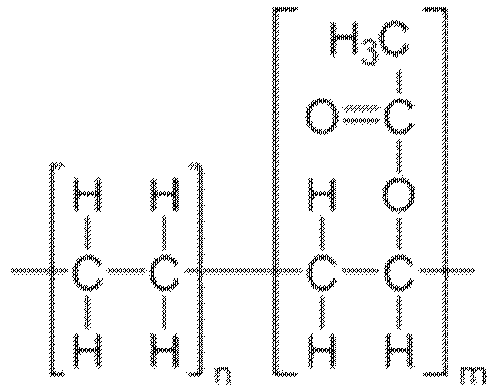
- Le copolymère éthylène-acétate de vinyle présente un pourcentage massique d'acétate de vinyle supérieur à 23%. Le pourcentage massique d'acétate de vinyle est de préférence compris entre 23 % et 33 %. Le pourcentage massique d'acétate de vinyle est de préférence compris entre 26 % et 33 %.
- La couche d'adhésif 6, respectivement 7, peut être préencollée sur une surface du film en matériau polymère 3, respectivement 4, avant pelliculage, et réactivée par l'action conjointe de la température et de la pression. Un tel procédé de pelliculage est dit « sec ». Typiquement, les températures employées lors du pelliculage dit « sec » s'étendent de 90 à 150°C.
- Alternativement, la couche d'adhésif 6, respectivement 7 peut être utilisée à partir de l'état liquide pour former un film d'adhésif laminé lors du pelliculage entre le film en matériau polymère 3, respectivement 4, et le substrat papier 2. Ce procédé de pelliculage est dit « humide ».
- Le procédé peut comprendre une cinquième étape de formation 105 d'un motif à contraste de brillance 33 tel que représenté
figure 2 , sur le film en matériau polymère 3. - L'étape de formation 105 peut être réalisée après l'étape de pelliculage 104, ou sur un film en matériau polymère avant l'étape de pelliculage 104.
- Le film en matériau polymère 3 présente ainsi une zone mate 31 au niveau de certains motifs imprimés 25, 26 et 27 du substrat papier imprimé 2 afin de ne pas perturber, par excès de brillance, la lecture optique du document en machine. Ceci est particulièrement utile dans le cas des machines de tri et d'authentification des billets de banque. Typiquement, une zone mate peut être définie comme présentant une brillance (mesurée à un angle d'environ 60°) inférieure à 20 unités de brillance, et préférentiellement inférieure à 10 unités de brillance. L'unité de brillance représente la proportion de lumière réfléchie spéculairement, par rapport à la lumière incidente à un angle de 60°. Le film en matériau polymère 3 présente de plus une zone brillante 32 au niveau de certains motifs imprimés du substrat papier 2, et / ou au niveau de certains signes de sécurité afin de permettre une lisibilité visuelle des motifs imprimés.
- Le procédé comprend ensuite une sixième étape 106 de découpage, selon laquelle le complexe laminé est découpé pour former plusieurs documents de sécurité.
- En référence aux
figures 2 et3 , il est décrit un document de sécurité 1 de type billet de banque en papier comprenant un substrat papier imprimé 2 et des films en matériau polymère 3 et 4. Le document peut être réalisé par le procédé de fabrication de documents de sécurité décrit ci-avant. - Le substrat papier imprimé 2 comprend un substrat papier 2 sous la forme d'une feuille présentant une première face et une deuxième face et ayant subi une impression et sur lequel se trouvent des signes de sécurité.
- La feuille comprend une trame fibreuse. Le substrat papier imprimé 2 comprend des fibres végétales, par exemple de bois ou de plantes annuelles telles que le coton. Alternativement, le substrat papier imprimé 2 peut comprendre une structure de fibres de plantes renforcée par des fibres en matière synthétiques. Il est par exemple réalisé à partir de fibres de coton et de polyamide. Le substrat papier imprimé 2 peut être composé de plusieurs couches.
- Le substrat papier imprimé 2 présente des motifs imprimés tels que les motifs 25, 26, 27.
- Les motifs correspondent aux informations portées par le document, par exemple la valeur faciale du billet de banque, ou une illustration. Les motifs sont réalisés sur le substrat papier avant l'étape de pelliculage. Ainsi l'impression est plus aisée et les encres d'impression bénéficient de la protection des films en matériau polymère.
- Les techniques d'impression peuvent être de type offset, sérigraphie, taille-douce, flexographie, héliographie, typographie, jet d'encre, en procédé feuille à feuille ou continu, encres à couleur changeante, hologrammes, micro-impression, ou toute autre technique d'impression connue de l'impression de sécurité.
- Des signes de sécurité tels que les signes de sécurité 24 et 24' permettent de garantir l'authenticité du document de sécurité 1. Ils peuvent être incorporés dans le substrat papier, mais aussi être des signes imprimés. Par exemple le signe 24 peut être un filigrane. Le signe 24' représente un fil intégré dans l'épaisseur du papier. D'autres signes de sécurité peuvent être mis en oeuvre, II peut s'agir de couche fluorescente, de bande ou de zone métallisée à effet de diffraction, d'encre à couleur changeante, d'encre incolore, d'impression iridescente, de micro-impression, d'hologramme, d'image latente, d'impression taille-douce, de fibrettes fluorescentes, d'impression fluorescente, de couple infra-rouge, d'impression à couleur optiquement variable, de transvision, de magnétisme ou de toute autre technique de réalisation de signe de sécurité pour documents de sécurité.
- Le document de sécurité 1 comprend un premier film en matériau polymère 3 s'étendant sur la première face du substrat papier imprimé 2, et un deuxième film en matériau polymère 4 s'étendant sur la deuxième face du substrat papier imprimé 2.
- Les films en matériau polymère 3 et 4 peuvent être complétés par plusieurs autres films en matériau polymère superposés. Les films en matériau polymère 3 et 4 permettent de protéger les deux faces du substrat papier imprimé 2. Les films en matériau polymère 3 et 4 permettent d'augmenter la résistance du document de sécurité 1, en particulier la résistance aux liquides, à l'abrasion, à la salissure, et la résistance mécanique. Les films en matériau polymère 3 et 4 sont transparents, c'est-à-dire que dans un spectre de longueur d'onde allant du proche ultraviolet au proche infrarouge, le taux de transmission de la lumière est supérieur à 85%. Les épaisseurs des films 3 et 4 en matériau polymère s'étendent typiquement de 4 à 30 µm. Les films polymère 3 et 4 peuvent être composées de BOPP (« Biaxially Oriented PolyPropylene », film de polypropylène bi-orienté en terminologie anglo-saxonne) ou de PET (« PolyEthylene Terephtalate » en terminologie anglo-saxonne). D'autres polymères transparents peuvent également être envisagés. Les films en matériau polymère 3 et 4 sont déposés par un procédé de pelliculage du substrat papier imprimé 2.
- Le document 1 présente une première couche d'adhésif 6, respectivement une deuxième couche d'adhésif 7, entre le substrat papier imprimé 2 et le premier film en matériau polymère 3, respectivement le deuxième film en matériau polymère 4. Les couches d'adhésif comprennent un copolymère éthylène-acétate de vinyle qui présente un pourcentage massique d'acétate de vinyle supérieur à 23 %, de préférence entre 23 % et 33 %, préférentiellement entre 26 % et 33 %. Ces couches d'adhésif 6 et 7 permettent le collage des films en matériau polymère 3 et 4 sur les faces du substrat papier imprimé 2. Le pelliculage 104 est réalisé après imprégnation 102 et impression 103 du substrat papier 2 et avant la découpe unitaire des documents de sécurité 1. Une variante possible consiste à imprimer tout ou partie du document de sécurité sur le film de pelliculage.
- Un premier exemple de technique de pelliculage, dite humide, consiste à utiliser une machine qui encolle les films en matériau polymère 3 et 4 d'un adhésif à partir de son état liquide. Le pelliculage est alors réalisé par laminage des films en matériau polymère 3 et 4 sur le substrat papier imprimé 2 par un système de rouleaux, durant lequel l'action conjointe de la pression et de la température permettent collage des films en polymère 3 et 4 sur chaque face de la feuille par les couches d'adhésif 6 et 7.
- Un deuxième exemple de technique pelliculage, dite sèche, consiste à appliquer les films en polymère 3 et 4 déjà enduits d'un adhésif ré-activable à chaud. La colle est ré-activée par un laminage tel que décrit ci-avant.
- Les films en matériau polymère 3 et 4 sont composés d'un matériau polymère, par exemple du polypropylène, qui peut se présenter en bobine, avec ou sans couche d'adhésif pré-encollée, et est contrecollé durant le pelliculage. Le pelliculage est réalisé avant découpe unitaire des documents de sécurité 1, sur une feuille comprenant plusieurs documents de sécurité 1.
- Le pelliculage couvre un maximum de la surface des deux faces du document de sécurité 1. Il assure une résistance accrue au vieillissement des faces du document de sécurité 1, notamment vis-à-vis de la salissure et du déchirement.
- Les couches d'adhésif comprennent un copolymère éthylène-acétate de vinyle qui présente un pourcentage massique d'acétate de vinyle supérieur à 23 %, de préférence entre 23 % et 33 %, préférentiellement entre 26 % et 33 %.
- La composition des couches d'adhésif selon l'invention est sensiblement différente de celle des adhésifs comprenant le copolymère éthylène - acétate de vinyle, utilisé dans le pelliculage traditionnel, qui contiennent un pourcentage massique d'acétate de vinyle d'environ 20 %, inférieur à 21 %.
- De telles caractéristiques de composition peuvent être mesurées par une analyse par spectroscopie infrarouge à transformée de Fourier (FTIR, « Fourier Transform Infra-Red Spectroscopy » en terminologie anglo-saxonne). Le pourcentage massique est obtenu par mesure du rapport entre l'intensité du pic à 1737 cm-1 du spectre obtenu, caractéristique de l'acétate de vinyle, et l'intensité du pic à 721 cm-1 du spectre obtenu, caractéristique de l'éthylène.
- Ces caractéristiques de composition peuvent par ailleurs être obtenues de manière plus précise par analyse thermique, en particulier par calorimétrie différentielle à balayage (DSC, « Differential Scanning Calorimetry » en terminologie anglo-saxonne). La température de fusion de l'EVA (copolymère Ethylène - Acétate de Vinyle en terminologie anglo-saxonne) ainsi mesurée est fonction de son taux d'acétate de vinyle.
- L'intérêt d'un document de sécurité présentant une telle structure est mis en évidence par un test de durabilité cyclique réalisé sur quatre échantillons.
- Le premier échantillon est obtenu à partir d'une feuille de sécurité produite sur une machine à papier à forme ronde, à partir d'une suspension aqueuse contenant :
- des fibres de coton,
- un agent de résistance à l'état humide tel qu'une résine polyamide amine cationique à 2 % par rapport à la masse de fibres,
- des charges de dioxyde de titane, par exemple concentrées à environ 2 % par rapport à la masse de fibres).
- après séchage de la feuille ainsi formée, une étape de passage dans un bain d'enduction comprenant une solution d'alcool polyvinylique, afin de former une imprégnation de 3 g / m2 d'alcool polyvinylique, pour un grammage final de 85 g / m2 ; des feuilles de sécurité ainsi produites constituent des substrats courants de billets de banque ;
- une étape d'impression en offset et en taille douce (d'autres techniques d'impression pouvant être employées en complément),
- une étape de pelliculage de la feuille par contre-collage à 110 °C sous une pression de 3 bars d'un premier film en BOPP et d'un deuxième film en BOPP respectivement sur la première face et la deuxième face de la feuille imprimée, les deux films étant appliqués sur un même groupe de pelliculage, et les films en BOPP présentant une couche d'adhésif comprenant un polymère EVA présentant un pourcentage massique d'acétate de vinyle d'environ 20% ;
- une étape de découpage de la feuille en plusieurs billets, chaque billet constituant un premier échantillon.
- Le deuxième échantillon est obtenu de la même manière que le premier échantillon, à la différence près que la couche d'adhésif comprend un polymère EVA présentant un pourcentage massique d'acétate de vinyle d'environ 28 %.
- Le troisième échantillon est obtenu de la même manière que le premier échantillon, à la différence près que le bain d'enduction comprend, à la place de la solution d'alcool polyvinylique, une dispersion de polyuréthane, comprenant de l'Esacote FB42 (Lamberti) et un réticulant de type Fissativo 05 (Lamberti). La dispersion est composée de :
- 90% en masse d'eau
- 10 % en masse sec d'Esacote FB42 + Fissativo 05, la part relative de Fissativo 05 par rapport à l'Esacote FB42 représentant 5% en masse sec/sec.
- Le quatrième échantillon, correspondant à l'invention, est obtenu de la même manière que le troisième échantillon, à la différence près que la couche d'adhésif comprend un polymère EVA présentant un pourcentage massique d'acétate de vinyle d'environ 28 %. Les quatre échantillons sont soumis à un essai de durabilité cyclique, chaque cycle présentant des étapes successives de :
- plongement dans une eau déminéralisée à 70 °C durant trois minutes,
- retrait de l'excès d'eau en surface du document entre des buvards,
- froissage manuel,
- dégradation par deux sessions de cinquante tours dans une machine de dégradation de papier présentant une enceinte balayée par une hélice souple tournant à une vitesse de 3000 tours par minute,
- analyse visuelle des échantillons.
- Le cycle est répété jusqu'à constatation du délaminage des films en BOPP, dans une limite de sept cycles.
- Dès le premier cycle, les premier et deuxième échantillons présentent un délaminage de 5 à 10 mm sur tous les bords des billets. Le billet selon le troisième échantillon présente une durabilité accrue puisqu'un délaminage de 2 mm est constaté au premier cycle, le délaminage atteignant 5 à 8 mm au bout de cinq cycles. Le quatrième échantillon ne présente aucun délaminage après sept cycles.
- Ainsi l'association d'un substrat papier présentant une imprégnation de polyuréthane et de films de polymère collés au substrat papier imprégné par des couches d'adhésif présentant un pourcentage massique d'acétate de vinyle élevé présente-t-elle une durabilité élevée par rapport aux documents selon l'art antérieur.
- En effet, la composition de la couche d'adhésif permet d'éviter un délaminage, même partiel des films de polymères laminés sur les faces du substrat papier imprégné.
- Le substrat papier du document 1 est imprégné d'une composition contenant du polyuréthane 23. L'imprégnation polyuréthane confère d'une part une bonne adhésion avec l'adhésif EVA à fort taux d'acétate de vinyle, et apporte d'autre part, une résistance à la pénétration de liquide au niveau des tranches 21 et 22 du document 1, ce qui permet d'accroitre considérablement la résistance au délaminage.
- L'imprégnation est réalisée, une fois la feuille formée et séchée en machine à papier, par trempage dans un bain contenant du polyuréthane. Une variante possible est de réaliser l'application de la composition contenant du polyuréthane 23 par « size press ».
- De manière complémentaire à l'imprégnation de polyuréthane, le document 1 peut comprendre au moins un agent de collage en masse dans le substrat papier 2. L'agent de collage en masse est incorporé à la suspension fibreuse, avant formation de la feuille sur machine à papier.
- Le document 1 peut comprendre plusieurs agents de collage en masse.
- L'agent de collage peut comprendre de l'anhydride alkénylesuccinique (ASA) ou l'un de ses dérivés. L'agent de collage peut comprendre de la colophane ou l'un de ses dérivés. L'agent de collage peut comprendre un dimère d'alkylcétène (AKD) ou l'un de ses dérivés. Ces agents hydrophobes se fixent aux fibres de papier. Ils confèrent au substrat papier imprimé 2 pelliculé une haute résistance à la pénétration de liquide au niveau des tranches 21 et 22, et ainsi, conjointement à l'imprégnation polyuréthane, contribuent à la haute résistance au délaminage du complexe.
- Les films en polymère 3 et 4 présentent une zone mate 31 au niveau de certains motifs imprimés, par exemple 25, 26 et 27 du substrat papier imprimé 2 afin de permettre l'analyse du document en machine de tri par lecture optique. En effet un film en polymère trop brillant n'est pas lisible par les capteurs de telles machines de tri. II est considéré qu'une zone est mate si sa brillance est inférieure à 20 unités de brillance mesurée à un angle de 60°, préférentiellement inférieure à 10 unités de brillance.
- Les films en polymère 3 et 4 peuvent présenter une zone brillante 32 au niveau de certains motifs imprimés du substrat papier imprimé 2 afin d'en assurer une meilleure lisibilité et/ou un meilleur rendu esthétique. La zone brillante 32 peut correspondre à une zone sur laquelle on souhaite attirer l'attention.
- Les films en polymère 3 et 4 peuvent présenter des zones de brillance contrôlée présentant des motifs à contraste de brillance par alternance de zones mates et brillantes. Par exemple, les films en polymère 3 et 4 peuvent présenter un motif esthétique à contraste de brillance 33. Les zones brillantes peuvent être générées en recouvrant des zones des films mates 3 et 4 par un vernis qui ravive l'état de surface des films en polymère 3 et 4. A l'inverse, un vernis matifiant peut être appliqué sur des films brillants pour diminuer la brillance des films dans certaines zones.
Claims (13)
- Document de sécurité (1) comprenant :- un substrat papier (2) comprenant une feuille présentant une première face et une deuxième face,- un premier film en matériau polymère (3) s'étendant sur la première face du substrat papier (2), et- un deuxième film en matériau polymère (4) s'étendant sur la deuxième face du substrat papier (2),dans lequel le substrat papier (2) est imprégné sur au moins une de ses faces d'une composition formant une imprégnation de polyuréthane (23), et
dans lequel le substrat papier est collé à au moins l'un des films en matériau polymère au moyen d'une couche d'adhésif (6, 7) comprenant un copolymère éthylène-acétate de vinyle qui présente un pourcentage massique d'acétate de vinyle supérieur à 23 %. - Document de sécurité (1) selon la revendication 1, caractérisé en ce que le pourcentage d'acétate de vinyle est compris entre 23 % et 33 %.
- Document de sécurité (1) selon la revendication 2, caractérisé en ce que le pourcentage massique d'acétate de vinyle est compris entre 26 % et 33 %.
- Document de sécurité (1) selon l'une quelconque des revendications précédentes, caractérisé en ce que le premier film en matériau polymère (3) et le deuxième film en matériau polymère (4) comprennent du polypropylène.
- Document de sécurité (1) selon l'une quelconque des revendications précédentes, caractérisé en ce que le substrat papier (2) présente sur au moins une de ses faces au moins une impression, chaque au moins une impression étant recouverte par le premier (3) ou deuxième (4) film en matériau polymère.
- Document de sécurité (1) selon quelconque l'une des revendications, caractérisé en ce que le document de sécurité est un billet de banque.
- Procédé de fabrication de documents de sécurité (1), comprenant des étapes de :- imprégnation (102) d'un substrat papier (2) comprenant une feuille présentant une première face et une deuxième face, la première face et la deuxième face étant imprégnées par une composition comprenant du polyuréthane (23),- pelliculage (104) du substrat papier (2) par application d'un premier film en matériau polymère (3) et d'un deuxième film en matériau polymère (4) respectivement sur la première face et la deuxième face du substrat papier (2), par laminage du complexe formé du substrat papier (2) et des films (3, 4),- découpage (106) du complexe pelliculé pour former plusieurs documents de sécurité,l'étape de pelliculage comprenant une étape de collage au moyen d'une couche d'adhésif (6, 7) comprenant un copolymère éthylène-acétate de vinyle qui présente un pourcentage massique d'acétate de vinyle supérieur à 23 %.
- Procédé selon la revendication 7 comprenant une étape d'impression (103) du substrat papier (2) et/ou d'au moins un des films (3, 4).
- Procédé selon l'une des revendications 7 et 8, caractérisé en ce que l'étape de collage est réalisée par activation lors du laminage, le laminage étant un laminage à chaud, de la couche d'adhésif (6, 7) préencollée sur une surface du film en matériau polymère (3, 4).
- Procédé selon l'une des revendications 7 et 8, caractérisé en ce que la couche d'adhésif (6, 7) est réalisée à partir d'un adhésif à l'état liquide, laminé entre chacun des films (3, 4) en matériau polymère et le substrat papier (2).
- Procédé selon l'une quelconque des revendications 7 à 10, caractérisée en ce qu'il comprend une étape de collage en masse du substrat papier (2).
- Procédé selon l'une quelconque des revendications 7 à 11, dans lequel le substrat papier (2) comprend au moins un signe de sécurité (24, 24') réalisé immédiatement avant l'étape d'imprégnation (102) ou avant l'étape de pelliculage (104).
- Procédé selon l'une des revendications 7 à 12, comprenant une étape de formation (105) d'un motif à contraste de brillance (33) sur l'un des films en matériau polymère (3, 4).
Priority Applications (1)
| Application Number | Priority Date | Filing Date | Title |
|---|---|---|---|
| PL13729932T PL2858817T3 (pl) | 2012-06-07 | 2013-06-07 | Dokument bezpieczeństwa o wysokiej trwałości |
Applications Claiming Priority (2)
| Application Number | Priority Date | Filing Date | Title |
|---|---|---|---|
| FR1255323A FR2991627B1 (fr) | 2012-06-07 | 2012-06-07 | Document de securite a haute durabilite |
| PCT/EP2013/061833 WO2013182692A1 (fr) | 2012-06-07 | 2013-06-07 | Document de securite a haute durabilite |
Publications (2)
| Publication Number | Publication Date |
|---|---|
| EP2858817A1 EP2858817A1 (fr) | 2015-04-15 |
| EP2858817B1 true EP2858817B1 (fr) | 2017-09-27 |
Family
ID=48656027
Family Applications (1)
| Application Number | Title | Priority Date | Filing Date |
|---|---|---|---|
| EP13729932.7A Active EP2858817B1 (fr) | 2012-06-07 | 2013-06-07 | Document de securite a haute durabilite |
Country Status (6)
| Country | Link |
|---|---|
| EP (1) | EP2858817B1 (fr) |
| ES (1) | ES2650803T3 (fr) |
| FR (1) | FR2991627B1 (fr) |
| PL (1) | PL2858817T3 (fr) |
| PT (1) | PT2858817T (fr) |
| WO (1) | WO2013182692A1 (fr) |
Families Citing this family (7)
| Publication number | Priority date | Publication date | Assignee | Title |
|---|---|---|---|---|
| FR3012075B1 (fr) * | 2013-10-18 | 2016-04-15 | Banque De France | Procede de fabrication d'un document de securite, tel qu'un billet de banque |
| DE102014110585A1 (de) * | 2014-07-28 | 2016-01-28 | Bundesdruckerei Gmbh | Datenblatt und Verfahren zu dessen Herstellung sowie ein Wert- und/oder Sicherheitsdokument |
| FR3049895B1 (fr) * | 2016-04-07 | 2018-05-04 | Oberthur Fiduciaire Sas | Procede de fabrication d'un document de securite recouvert d'un film de protection et document ainsi obtenu |
| DE102016015378A1 (de) | 2016-12-22 | 2018-06-28 | Giesecke+Devrient Currency Technology Gmbh | Verfahren zur Herstellung eines Wertdokuments |
| FR3107470B1 (fr) * | 2020-02-26 | 2022-02-11 | Banque De France | Procede de fabrication d’un billet de banque |
| FR3116022B1 (fr) | 2020-11-06 | 2023-03-10 | Banque De France | procede de fabrication d’UN DOCUMENT DE SECURITE |
| CN118814520B (zh) * | 2024-07-19 | 2025-10-03 | 陕西师范大学 | 一种古旧画修复中破碎画心喷浆助托工艺 |
Family Cites Families (8)
| Publication number | Priority date | Publication date | Assignee | Title |
|---|---|---|---|---|
| CS25891A2 (en) | 1990-02-09 | 1991-09-15 | Donald Richardson | Braided reinforcement of pipe lines especially hoses and method and equipment for its production |
| AUPO289296A0 (en) | 1996-10-10 | 1996-10-31 | Securency Pty Ltd | Self-verifying security documents |
| GB2385298B (en) * | 2002-02-19 | 2004-04-28 | Rue De Int Ltd | Method of preparing a security document |
| DE10243653A1 (de) | 2002-09-19 | 2004-04-01 | Giesecke & Devrient Gmbh | Sicherheitspapier |
| DE10327083A1 (de) * | 2003-02-11 | 2004-08-19 | Giesecke & Devrient Gmbh | Sicherheitspapier und Verfahren zur Herstellung desselben |
| ITVR20080065A1 (it) | 2008-06-10 | 2009-12-11 | Cartiere Fedrigoni & C Spa | Procedimento per il trattamento antisporco di banconote e/o di carta di sicurezza in generale |
| DE102009024987A1 (de) | 2009-06-16 | 2010-12-23 | Giesecke & Devrient Gmbh | Folienverbundbanknote |
| DE102010054852A1 (de) * | 2010-12-17 | 2012-06-21 | Giesecke & Devrient Gmbh | Mehrschichtiges Substrat, Verfahren zum Herstellen desselben und Wertdokument |
-
2012
- 2012-06-07 FR FR1255323A patent/FR2991627B1/fr active Active
-
2013
- 2013-06-07 ES ES13729932.7T patent/ES2650803T3/es active Active
- 2013-06-07 PL PL13729932T patent/PL2858817T3/pl unknown
- 2013-06-07 PT PT137299327T patent/PT2858817T/pt unknown
- 2013-06-07 EP EP13729932.7A patent/EP2858817B1/fr active Active
- 2013-06-07 WO PCT/EP2013/061833 patent/WO2013182692A1/fr not_active Ceased
Non-Patent Citations (1)
| Title |
|---|
| None * |
Also Published As
| Publication number | Publication date |
|---|---|
| FR2991627B1 (fr) | 2014-11-21 |
| PL2858817T3 (pl) | 2018-02-28 |
| WO2013182692A1 (fr) | 2013-12-12 |
| PT2858817T (pt) | 2017-12-29 |
| ES2650803T3 (es) | 2018-01-22 |
| FR2991627A1 (fr) | 2013-12-13 |
| EP2858817A1 (fr) | 2015-04-15 |
Similar Documents
| Publication | Publication Date | Title |
|---|---|---|
| EP2516741B1 (fr) | Feuille imprimable ultra lisse et recyclable et son procédé de fabrication | |
| EP2858817A1 (fr) | Document de securite a haute durabilite | |
| EP2794284B1 (fr) | Structure multicouche comportant au moins une couche diffusante et procédé de fabrication associé | |
| FR2942169A1 (fr) | Feuille imprimable multicouche a toucher doux ou soyeux et son procede de fabrication | |
| FR2929962A1 (fr) | Procede de fabrication d'une feuille comportant une sous- epaisseur ou une sur-epaisseur au niveau d'un ruban et feuille associee. | |
| CA2672752A1 (fr) | Feuille de securite comprenant un substrat fibreux | |
| EP3083263B1 (fr) | Procede de traitement de surface d'un document de securite et document de securite associe | |
| EP2914440A1 (fr) | Carte securisee personnalisable par impression par transfert thermique | |
| EP3058135A1 (fr) | Procédé de fabrication d'un document de sécurité, tél qu'un billét de banque | |
| EP4240595B1 (fr) | Procede de fabrication d'un document de securite | |
| EP3058136B1 (fr) | Document de securite, tel qu'un billet de banque, et procede de fabrication associe | |
| OA17228A (fr) | Document de sécurité à haute durabilité. | |
| EP3083244A1 (fr) | Substrat synthetique multicouche | |
| WO2018069216A1 (fr) | Procede de fabrication d'un element de securite | |
| WO2011077403A1 (fr) | Procédé de fabrication d'une feuille par densification pour former une zone rendue transparente | |
| EP3439865B1 (fr) | Procede de fabrication d'un document de securite recouvert d'un film de protection et document ainsi obtenu | |
| WO2021170964A1 (fr) | Procede de fabrication d'un billet de banque | |
| EP3558692B1 (fr) | Document securise | |
| EP3478493B1 (fr) | Procede de fabrication d'un document de securite presentant un signe de securite a contraste de brillance | |
| EP3233514B1 (fr) | Procede de traitement d'un element de securite | |
| OA21257A (fr) | Procédé de fabrication d'un document de sécurité. | |
| OA17688A (fr) | Document de sécurité, tel qu'un billet de banque, et procédé de fabrication associé. |
Legal Events
| Date | Code | Title | Description |
|---|---|---|---|
| PUAI | Public reference made under article 153(3) epc to a published international application that has entered the european phase |
Free format text: ORIGINAL CODE: 0009012 |
|
| 17P | Request for examination filed |
Effective date: 20150106 |
|
| AK | Designated contracting states |
Kind code of ref document: A1 Designated state(s): AL AT BE BG CH CY CZ DE DK EE ES FI FR GB GR HR HU IE IS IT LI LT LU LV MC MK MT NL NO PL PT RO RS SE SI SK SM TR |
|
| AX | Request for extension of the european patent |
Extension state: BA ME |
|
| RIN1 | Information on inventor provided before grant (corrected) |
Inventor name: BARATS, MICHEL Inventor name: GUTKNECHT, DAN |
|
| DAX | Request for extension of the european patent (deleted) | ||
| GRAP | Despatch of communication of intention to grant a patent |
Free format text: ORIGINAL CODE: EPIDOSNIGR1 |
|
| INTG | Intention to grant announced |
Effective date: 20170515 |
|
| GRAS | Grant fee paid |
Free format text: ORIGINAL CODE: EPIDOSNIGR3 |
|
| GRAA | (expected) grant |
Free format text: ORIGINAL CODE: 0009210 |
|
| AK | Designated contracting states |
Kind code of ref document: B1 Designated state(s): AL AT BE BG CH CY CZ DE DK EE ES FI FR GB GR HR HU IE IS IT LI LT LU LV MC MK MT NL NO PL PT RO RS SE SI SK SM TR |
|
| REG | Reference to a national code |
Ref country code: GB Ref legal event code: FG4D Free format text: NOT ENGLISH |
|
| REG | Reference to a national code |
Ref country code: CH Ref legal event code: EP |
|
| REG | Reference to a national code |
Ref country code: AT Ref legal event code: REF Ref document number: 931589 Country of ref document: AT Kind code of ref document: T Effective date: 20171015 |
|
| REG | Reference to a national code |
Ref country code: IE Ref legal event code: FG4D Free format text: LANGUAGE OF EP DOCUMENT: FRENCH |
|
| REG | Reference to a national code |
Ref country code: CH Ref legal event code: NV Representative=s name: MICHELI AND CIE SA, CH |
|
| REG | Reference to a national code |
Ref country code: DE Ref legal event code: R096 Ref document number: 602013027122 Country of ref document: DE |
|
| REG | Reference to a national code |
Ref country code: SE Ref legal event code: TRGR |
|
| REG | Reference to a national code |
Ref country code: NL Ref legal event code: FP |
|
| REG | Reference to a national code |
Ref country code: PT Ref legal event code: SC4A Ref document number: 2858817 Country of ref document: PT Date of ref document: 20171229 Kind code of ref document: T Free format text: AVAILABILITY OF NATIONAL TRANSLATION Effective date: 20171220 |
|
| REG | Reference to a national code |
Ref country code: ES Ref legal event code: FG2A Ref document number: 2650803 Country of ref document: ES Kind code of ref document: T3 Effective date: 20180122 |
|
| PG25 | Lapsed in a contracting state [announced via postgrant information from national office to epo] |
Ref country code: HR Free format text: LAPSE BECAUSE OF FAILURE TO SUBMIT A TRANSLATION OF THE DESCRIPTION OR TO PAY THE FEE WITHIN THE PRESCRIBED TIME-LIMIT Effective date: 20170927 Ref country code: FI Free format text: LAPSE BECAUSE OF FAILURE TO SUBMIT A TRANSLATION OF THE DESCRIPTION OR TO PAY THE FEE WITHIN THE PRESCRIBED TIME-LIMIT Effective date: 20170927 Ref country code: NO Free format text: LAPSE BECAUSE OF FAILURE TO SUBMIT A TRANSLATION OF THE DESCRIPTION OR TO PAY THE FEE WITHIN THE PRESCRIBED TIME-LIMIT Effective date: 20171227 Ref country code: LT Free format text: LAPSE BECAUSE OF FAILURE TO SUBMIT A TRANSLATION OF THE DESCRIPTION OR TO PAY THE FEE WITHIN THE PRESCRIBED TIME-LIMIT Effective date: 20170927 |
|
| REG | Reference to a national code |
Ref country code: LT Ref legal event code: MG4D |
|
| PG25 | Lapsed in a contracting state [announced via postgrant information from national office to epo] |
Ref country code: RS Free format text: LAPSE BECAUSE OF FAILURE TO SUBMIT A TRANSLATION OF THE DESCRIPTION OR TO PAY THE FEE WITHIN THE PRESCRIBED TIME-LIMIT Effective date: 20170927 Ref country code: GR Free format text: LAPSE BECAUSE OF FAILURE TO SUBMIT A TRANSLATION OF THE DESCRIPTION OR TO PAY THE FEE WITHIN THE PRESCRIBED TIME-LIMIT Effective date: 20171228 Ref country code: LV Free format text: LAPSE BECAUSE OF FAILURE TO SUBMIT A TRANSLATION OF THE DESCRIPTION OR TO PAY THE FEE WITHIN THE PRESCRIBED TIME-LIMIT Effective date: 20170927 |
|
| PG25 | Lapsed in a contracting state [announced via postgrant information from national office to epo] |
Ref country code: RO Free format text: LAPSE BECAUSE OF FAILURE TO SUBMIT A TRANSLATION OF THE DESCRIPTION OR TO PAY THE FEE WITHIN THE PRESCRIBED TIME-LIMIT Effective date: 20170927 Ref country code: CZ Free format text: LAPSE BECAUSE OF FAILURE TO SUBMIT A TRANSLATION OF THE DESCRIPTION OR TO PAY THE FEE WITHIN THE PRESCRIBED TIME-LIMIT Effective date: 20170927 |
|
| PG25 | Lapsed in a contracting state [announced via postgrant information from national office to epo] |
Ref country code: SM Free format text: LAPSE BECAUSE OF FAILURE TO SUBMIT A TRANSLATION OF THE DESCRIPTION OR TO PAY THE FEE WITHIN THE PRESCRIBED TIME-LIMIT Effective date: 20170927 Ref country code: EE Free format text: LAPSE BECAUSE OF FAILURE TO SUBMIT A TRANSLATION OF THE DESCRIPTION OR TO PAY THE FEE WITHIN THE PRESCRIBED TIME-LIMIT Effective date: 20170927 Ref country code: SK Free format text: LAPSE BECAUSE OF FAILURE TO SUBMIT A TRANSLATION OF THE DESCRIPTION OR TO PAY THE FEE WITHIN THE PRESCRIBED TIME-LIMIT Effective date: 20170927 Ref country code: IS Free format text: LAPSE BECAUSE OF FAILURE TO SUBMIT A TRANSLATION OF THE DESCRIPTION OR TO PAY THE FEE WITHIN THE PRESCRIBED TIME-LIMIT Effective date: 20180127 |
|
| REG | Reference to a national code |
Ref country code: FR Ref legal event code: PLFP Year of fee payment: 6 |
|
| REG | Reference to a national code |
Ref country code: DE Ref legal event code: R097 Ref document number: 602013027122 Country of ref document: DE |
|
| PG25 | Lapsed in a contracting state [announced via postgrant information from national office to epo] |
Ref country code: DK Free format text: LAPSE BECAUSE OF FAILURE TO SUBMIT A TRANSLATION OF THE DESCRIPTION OR TO PAY THE FEE WITHIN THE PRESCRIBED TIME-LIMIT Effective date: 20170927 |
|
| PLBE | No opposition filed within time limit |
Free format text: ORIGINAL CODE: 0009261 |
|
| STAA | Information on the status of an ep patent application or granted ep patent |
Free format text: STATUS: NO OPPOSITION FILED WITHIN TIME LIMIT |
|
| 26N | No opposition filed |
Effective date: 20180628 |
|
| PG25 | Lapsed in a contracting state [announced via postgrant information from national office to epo] |
Ref country code: SI Free format text: LAPSE BECAUSE OF FAILURE TO SUBMIT A TRANSLATION OF THE DESCRIPTION OR TO PAY THE FEE WITHIN THE PRESCRIBED TIME-LIMIT Effective date: 20170927 |
|
| REG | Reference to a national code |
Ref country code: BE Ref legal event code: MM Effective date: 20180630 |
|
| REG | Reference to a national code |
Ref country code: IE Ref legal event code: MM4A |
|
| PG25 | Lapsed in a contracting state [announced via postgrant information from national office to epo] |
Ref country code: LU Free format text: LAPSE BECAUSE OF NON-PAYMENT OF DUE FEES Effective date: 20180607 Ref country code: MC Free format text: LAPSE BECAUSE OF FAILURE TO SUBMIT A TRANSLATION OF THE DESCRIPTION OR TO PAY THE FEE WITHIN THE PRESCRIBED TIME-LIMIT Effective date: 20170927 |
|
| REG | Reference to a national code |
Ref country code: AT Ref legal event code: UEP Ref document number: 931589 Country of ref document: AT Kind code of ref document: T Effective date: 20170927 |
|
| PG25 | Lapsed in a contracting state [announced via postgrant information from national office to epo] |
Ref country code: IE Free format text: LAPSE BECAUSE OF NON-PAYMENT OF DUE FEES Effective date: 20180607 |
|
| PG25 | Lapsed in a contracting state [announced via postgrant information from national office to epo] |
Ref country code: BE Free format text: LAPSE BECAUSE OF NON-PAYMENT OF DUE FEES Effective date: 20180630 |
|
| PG25 | Lapsed in a contracting state [announced via postgrant information from national office to epo] |
Ref country code: TR Free format text: LAPSE BECAUSE OF FAILURE TO SUBMIT A TRANSLATION OF THE DESCRIPTION OR TO PAY THE FEE WITHIN THE PRESCRIBED TIME-LIMIT Effective date: 20170927 |
|
| PG25 | Lapsed in a contracting state [announced via postgrant information from national office to epo] |
Ref country code: HU Free format text: LAPSE BECAUSE OF FAILURE TO SUBMIT A TRANSLATION OF THE DESCRIPTION OR TO PAY THE FEE WITHIN THE PRESCRIBED TIME-LIMIT; INVALID AB INITIO Effective date: 20130607 Ref country code: MK Free format text: LAPSE BECAUSE OF NON-PAYMENT OF DUE FEES Effective date: 20170927 Ref country code: CY Free format text: LAPSE BECAUSE OF FAILURE TO SUBMIT A TRANSLATION OF THE DESCRIPTION OR TO PAY THE FEE WITHIN THE PRESCRIBED TIME-LIMIT Effective date: 20170927 |
|
| PG25 | Lapsed in a contracting state [announced via postgrant information from national office to epo] |
Ref country code: AL Free format text: LAPSE BECAUSE OF FAILURE TO SUBMIT A TRANSLATION OF THE DESCRIPTION OR TO PAY THE FEE WITHIN THE PRESCRIBED TIME-LIMIT Effective date: 20170927 |
|
| P01 | Opt-out of the competence of the unified patent court (upc) registered |
Effective date: 20230525 |
|
| PGFP | Annual fee paid to national office [announced via postgrant information from national office to epo] |
Ref country code: NL Payment date: 20250528 Year of fee payment: 13 |
|
| PGFP | Annual fee paid to national office [announced via postgrant information from national office to epo] |
Ref country code: PL Payment date: 20250523 Year of fee payment: 13 Ref country code: DE Payment date: 20250617 Year of fee payment: 13 |
|
| PGFP | Annual fee paid to national office [announced via postgrant information from national office to epo] |
Ref country code: GB Payment date: 20250625 Year of fee payment: 13 |
|
| PGFP | Annual fee paid to national office [announced via postgrant information from national office to epo] |
Ref country code: PT Payment date: 20250523 Year of fee payment: 13 |
|
| PGFP | Annual fee paid to national office [announced via postgrant information from national office to epo] |
Ref country code: FR Payment date: 20250513 Year of fee payment: 13 |
|
| PGFP | Annual fee paid to national office [announced via postgrant information from national office to epo] |
Ref country code: MT Payment date: 20250530 Year of fee payment: 13 Ref country code: BG Payment date: 20250523 Year of fee payment: 13 |
|
| PGFP | Annual fee paid to national office [announced via postgrant information from national office to epo] |
Ref country code: AT Payment date: 20250522 Year of fee payment: 13 |
|
| PGFP | Annual fee paid to national office [announced via postgrant information from national office to epo] |
Ref country code: SE Payment date: 20250619 Year of fee payment: 13 |
|
| PGFP | Annual fee paid to national office [announced via postgrant information from national office to epo] |
Ref country code: ES Payment date: 20250710 Year of fee payment: 13 |
|
| PGFP | Annual fee paid to national office [announced via postgrant information from national office to epo] |
Ref country code: IT Payment date: 20250606 Year of fee payment: 13 |
|
| PGFP | Annual fee paid to national office [announced via postgrant information from national office to epo] |
Ref country code: CH Payment date: 20250701 Year of fee payment: 13 |