EP2857510A1 - Method for producing 3-acetylamino-4-hydroxybenzoic acid - Google Patents
Method for producing 3-acetylamino-4-hydroxybenzoic acid Download PDFInfo
- Publication number
- EP2857510A1 EP2857510A1 EP13796758.4A EP13796758A EP2857510A1 EP 2857510 A1 EP2857510 A1 EP 2857510A1 EP 13796758 A EP13796758 A EP 13796758A EP 2857510 A1 EP2857510 A1 EP 2857510A1
- Authority
- EP
- European Patent Office
- Prior art keywords
- amino
- protein
- hydroxybenzoic acid
- seq
- activity
- Prior art date
- Legal status (The legal status is an assumption and is not a legal conclusion. Google has not performed a legal analysis and makes no representation as to the accuracy of the status listed.)
- Withdrawn
Links
- 238000004519 manufacturing process Methods 0.000 title claims abstract description 22
- BXBFVCYLJXGOGI-UHFFFAOYSA-N 3-acetamido-4-hydroxybenzoic acid Chemical compound CC(=O)NC1=CC(C(O)=O)=CC=C1O BXBFVCYLJXGOGI-UHFFFAOYSA-N 0.000 title description 8
- 230000000694 effects Effects 0.000 claims abstract description 95
- 150000001875 compounds Chemical class 0.000 claims abstract description 94
- 244000005700 microbiome Species 0.000 claims abstract description 94
- 108010071726 N-hydroxyarylamine O-acetyltransferase Proteins 0.000 claims abstract description 56
- 238000000034 method Methods 0.000 claims abstract description 53
- GNGACRATGGDKBX-UHFFFAOYSA-N dihydroxyacetone phosphate Chemical compound OCC(=O)COP(O)(O)=O GNGACRATGGDKBX-UHFFFAOYSA-N 0.000 claims abstract description 48
- BWKDAAFSXYPQOS-UHFFFAOYSA-N Benzaldehyde glyceryl acetal Chemical compound O1CC(O)COC1C1=CC=CC=C1 BWKDAAFSXYPQOS-UHFFFAOYSA-N 0.000 claims abstract description 26
- JGGLZQUGOKVDGS-VYTIMWRQSA-N aspartate semialdehyde Chemical compound O[C@@H]1[C@@H](NC(=O)C)CO[C@H](CO)[C@H]1O[C@@H]1[C@@H](NC(C)=O)[C@H](O)[C@H](O[C@@H]2[C@H]([C@@H](O[C@@H]3[C@@H]([C@H](O)[C@@H](O)[C@H](CO)O3)O[C@@H]3[C@@H]([C@H](O)[C@@H](O)[C@H](CO)O3)O[C@@H]3[C@H]([C@H](O)[C@@H](O)[C@H](CO)O3)O)[C@@H](O)[C@H](CO[C@@H]3[C@H]([C@H](O[C@@H]4[C@H]([C@H](O)[C@@H](O)[C@H](CO)O4)O)[C@@H](O)[C@H](CO)O3)O)O2)O)[C@H](CO)O1 JGGLZQUGOKVDGS-VYTIMWRQSA-N 0.000 claims abstract description 24
- 108090000623 proteins and genes Proteins 0.000 claims description 150
- 102000004169 proteins and genes Human genes 0.000 claims description 86
- 125000003275 alpha amino acid group Chemical group 0.000 claims description 73
- 239000002773 nucleotide Substances 0.000 claims description 52
- 125000003729 nucleotide group Chemical group 0.000 claims description 52
- 101150063601 griH gene Proteins 0.000 claims description 47
- 241000588724 Escherichia coli Species 0.000 claims description 40
- 238000006467 substitution reaction Methods 0.000 claims description 40
- 241000186226 Corynebacterium glutamicum Species 0.000 claims description 24
- 102000001390 Fructose-Bisphosphate Aldolase Human genes 0.000 claims description 21
- 108010068561 Fructose-Bisphosphate Aldolase Proteins 0.000 claims description 21
- 239000013598 vector Substances 0.000 claims description 21
- 229920000642 polymer Polymers 0.000 claims description 15
- 101710187067 3-amino-4-hydroxybenzoic acid synthase Proteins 0.000 claims description 14
- 238000007792 addition Methods 0.000 claims description 14
- 241000186216 Corynebacterium Species 0.000 claims description 12
- 238000012217 deletion Methods 0.000 claims description 12
- 230000037430 deletion Effects 0.000 claims description 12
- 238000003780 insertion Methods 0.000 claims description 12
- 230000037431 insertion Effects 0.000 claims description 12
- 241000588696 Pantoea ananatis Species 0.000 claims description 11
- 241000520272 Pantoea Species 0.000 claims description 10
- 230000000295 complement effect Effects 0.000 claims description 9
- 229920002577 polybenzoxazole Polymers 0.000 claims description 9
- 230000009466 transformation Effects 0.000 claims description 9
- 241000588722 Escherichia Species 0.000 claims description 6
- 238000012258 culturing Methods 0.000 claims description 5
- 230000000379 polymerizing effect Effects 0.000 claims description 4
- 230000000850 deacetylating effect Effects 0.000 claims description 3
- 230000008569 process Effects 0.000 abstract description 4
- MRBKRZAPGUCWOS-UHFFFAOYSA-N 3-amino-4-hydroxybenzoic acid Chemical compound NC1=CC(C(O)=O)=CC=C1O MRBKRZAPGUCWOS-UHFFFAOYSA-N 0.000 description 81
- 235000018102 proteins Nutrition 0.000 description 65
- 101150010778 griI gene Proteins 0.000 description 45
- 108020004414 DNA Proteins 0.000 description 34
- 210000004027 cell Anatomy 0.000 description 32
- 101150071732 nhoA gene Proteins 0.000 description 32
- 241000894006 Bacteria Species 0.000 description 28
- 239000012228 culture supernatant Substances 0.000 description 25
- 230000035772 mutation Effects 0.000 description 23
- 229960005091 chloramphenicol Drugs 0.000 description 22
- WIIZWVCIJKGZOK-RKDXNWHRSA-N chloramphenicol Chemical compound ClC(Cl)C(=O)N[C@H](CO)[C@H](O)C1=CC=C([N+]([O-])=O)C=C1 WIIZWVCIJKGZOK-RKDXNWHRSA-N 0.000 description 22
- 239000003463 adsorbent Substances 0.000 description 20
- 239000001963 growth medium Substances 0.000 description 19
- 108010055400 Aspartate kinase Proteins 0.000 description 18
- 108010064711 Homoserine dehydrogenase Proteins 0.000 description 18
- 239000012634 fragment Substances 0.000 description 17
- 235000001014 amino acid Nutrition 0.000 description 16
- 230000005764 inhibitory process Effects 0.000 description 16
- 239000013612 plasmid Substances 0.000 description 16
- 241000187392 Streptomyces griseus Species 0.000 description 15
- 230000000813 microbial effect Effects 0.000 description 15
- 108091008146 restriction endonucleases Proteins 0.000 description 15
- CKLJMWTZIZZHCS-REOHCLBHSA-N L-aspartic acid Chemical compound OC(=O)[C@@H](N)CC(O)=O CKLJMWTZIZZHCS-REOHCLBHSA-N 0.000 description 14
- 238000010276 construction Methods 0.000 description 14
- 239000002609 medium Substances 0.000 description 14
- KDXKERNSBIXSRK-UHFFFAOYSA-N Lysine Natural products NCCCCC(N)C(O)=O KDXKERNSBIXSRK-UHFFFAOYSA-N 0.000 description 13
- 239000000203 mixture Substances 0.000 description 13
- 239000000047 product Substances 0.000 description 13
- 102000004190 Enzymes Human genes 0.000 description 12
- 108090000790 Enzymes Proteins 0.000 description 12
- KWYUFKZDYYNOTN-UHFFFAOYSA-M Potassium hydroxide Chemical compound [OH-].[K+] KWYUFKZDYYNOTN-UHFFFAOYSA-M 0.000 description 12
- 125000000217 alkyl group Chemical group 0.000 description 12
- WQZGKKKJIJFFOK-GASJEMHNSA-N Glucose Natural products OC[C@H]1OC(O)[C@H](O)[C@@H](O)[C@@H]1O WQZGKKKJIJFFOK-GASJEMHNSA-N 0.000 description 11
- 125000000539 amino acid group Chemical group 0.000 description 11
- 230000015572 biosynthetic process Effects 0.000 description 11
- 238000006243 chemical reaction Methods 0.000 description 11
- 239000000306 component Substances 0.000 description 11
- 239000008103 glucose Substances 0.000 description 11
- OKTJSMMVPCPJKN-UHFFFAOYSA-N Carbon Chemical compound [C] OKTJSMMVPCPJKN-UHFFFAOYSA-N 0.000 description 10
- 108090000364 Ligases Proteins 0.000 description 10
- 108091034117 Oligonucleotide Proteins 0.000 description 10
- 125000003178 carboxy group Chemical group [H]OC(*)=O 0.000 description 10
- 229930027917 kanamycin Natural products 0.000 description 10
- 229960000318 kanamycin Drugs 0.000 description 10
- SBUJHOSQTJFQJX-NOAMYHISSA-N kanamycin Chemical compound O[C@@H]1[C@@H](O)[C@H](O)[C@@H](CN)O[C@@H]1O[C@H]1[C@H](O)[C@@H](O[C@@H]2[C@@H]([C@@H](N)[C@H](O)[C@@H](CO)O2)O)[C@H](N)C[C@@H]1N SBUJHOSQTJFQJX-NOAMYHISSA-N 0.000 description 10
- 229930182823 kanamycin A Natural products 0.000 description 10
- 241001013691 Escherichia coli BW25113 Species 0.000 description 9
- 239000002253 acid Substances 0.000 description 9
- 229940024606 amino acid Drugs 0.000 description 9
- 238000004520 electroporation Methods 0.000 description 9
- 230000001747 exhibiting effect Effects 0.000 description 9
- 125000002887 hydroxy group Chemical group [H]O* 0.000 description 9
- VTYYLEPIZMXCLO-UHFFFAOYSA-L Calcium carbonate Chemical compound [Ca+2].[O-]C([O-])=O VTYYLEPIZMXCLO-UHFFFAOYSA-L 0.000 description 8
- ZSLZBFCDCINBPY-ZSJPKINUSA-N acetyl-CoA Chemical compound O[C@@H]1[C@H](OP(O)(O)=O)[C@@H](COP(O)(=O)OP(O)(=O)OCC(C)(C)[C@@H](O)C(=O)NCCC(=O)NCCSC(=O)C)O[C@H]1N1C2=NC=NC(N)=C2N=C1 ZSLZBFCDCINBPY-ZSJPKINUSA-N 0.000 description 8
- 150000001413 amino acids Chemical class 0.000 description 8
- 229960000723 ampicillin Drugs 0.000 description 8
- AVKUERGKIZMTKX-NJBDSQKTSA-N ampicillin Chemical compound C1([C@@H](N)C(=O)N[C@H]2[C@H]3SC([C@@H](N3C2=O)C(O)=O)(C)C)=CC=CC=C1 AVKUERGKIZMTKX-NJBDSQKTSA-N 0.000 description 8
- 238000004458 analytical method Methods 0.000 description 8
- 125000003118 aryl group Chemical group 0.000 description 8
- 150000003839 salts Chemical class 0.000 description 8
- WHUUTDBJXJRKMK-UHFFFAOYSA-N Glutamic acid Natural products OC(=O)C(N)CCC(O)=O WHUUTDBJXJRKMK-UHFFFAOYSA-N 0.000 description 7
- AGPKZVBTJJNPAG-WHFBIAKZSA-N L-isoleucine Chemical compound CC[C@H](C)[C@H](N)C(O)=O AGPKZVBTJJNPAG-WHFBIAKZSA-N 0.000 description 7
- 125000003277 amino group Chemical group 0.000 description 7
- 238000011156 evaluation Methods 0.000 description 7
- 239000013613 expression plasmid Substances 0.000 description 7
- 230000004048 modification Effects 0.000 description 7
- 238000012986 modification Methods 0.000 description 7
- 238000011282 treatment Methods 0.000 description 7
- 108050006180 3-dehydroquinate synthase Proteins 0.000 description 6
- IJGRMHOSHXDMSA-UHFFFAOYSA-N Atomic nitrogen Chemical compound N#N IJGRMHOSHXDMSA-UHFFFAOYSA-N 0.000 description 6
- ROHFNLRQFUQHCH-YFKPBYRVSA-N L-leucine Chemical compound CC(C)C[C@H](N)C(O)=O ROHFNLRQFUQHCH-YFKPBYRVSA-N 0.000 description 6
- 239000004472 Lysine Substances 0.000 description 6
- 101100079427 Mycobacterium tuberculosis (strain ATCC 25618 / H37Rv) nat gene Proteins 0.000 description 6
- 241001602876 Nata Species 0.000 description 6
- 108091028043 Nucleic acid sequence Proteins 0.000 description 6
- 108050008280 Shikimate dehydrogenase Proteins 0.000 description 6
- 241000273376 Streptomyces murayamaensis Species 0.000 description 6
- 239000002585 base Substances 0.000 description 6
- 239000006227 byproduct Substances 0.000 description 6
- 238000004440 column chromatography Methods 0.000 description 6
- 239000002994 raw material Substances 0.000 description 6
- 239000011347 resin Substances 0.000 description 6
- 229920005989 resin Polymers 0.000 description 6
- 125000000341 threoninyl group Chemical group [H]OC([H])(C([H])([H])[H])C([H])(N([H])[H])C(*)=O 0.000 description 6
- PIHXIYNNRYFAAC-UHFFFAOYSA-N 8-amino-7-oxophenoxazine-2-carboxylic acid Chemical compound OC(=O)C1=CC=C2OC3=CC(=O)C(N)=CC3=NC2=C1 PIHXIYNNRYFAAC-UHFFFAOYSA-N 0.000 description 5
- 241000186146 Brevibacterium Species 0.000 description 5
- AYFVYJQAPQTCCC-GBXIJSLDSA-N L-threonine Chemical compound C[C@@H](O)[C@H](N)C(O)=O AYFVYJQAPQTCCC-GBXIJSLDSA-N 0.000 description 5
- 125000002777 acetyl group Chemical group [H]C([H])([H])C(*)=O 0.000 description 5
- 238000006640 acetylation reaction Methods 0.000 description 5
- 125000003295 alanine group Chemical group N[C@@H](C)C(=O)* 0.000 description 5
- 239000011203 carbon fibre reinforced carbon Substances 0.000 description 5
- 241000186254 coryneform bacterium Species 0.000 description 5
- 238000003381 deacetylation reaction Methods 0.000 description 5
- 230000002209 hydrophobic effect Effects 0.000 description 5
- 239000003495 polar organic solvent Substances 0.000 description 5
- 238000003786 synthesis reaction Methods 0.000 description 5
- YBJHBAHKTGYVGT-ZKWXMUAHSA-N (+)-Biotin Chemical compound N1C(=O)N[C@@H]2[C@H](CCCCC(=O)O)SC[C@@H]21 YBJHBAHKTGYVGT-ZKWXMUAHSA-N 0.000 description 4
- 101150075693 AK gene Proteins 0.000 description 4
- 241000186361 Actinobacteria <class> Species 0.000 description 4
- 101000779368 Bacillus subtilis (strain 168) Aspartokinase 3 Proteins 0.000 description 4
- 108700010070 Codon Usage Proteins 0.000 description 4
- 241000588912 Pantoea agglomerans Species 0.000 description 4
- KKEYFWRCBNTPAC-UHFFFAOYSA-N Terephthalic acid Chemical compound OC(=O)C1=CC=C(C(O)=O)C=C1 KKEYFWRCBNTPAC-UHFFFAOYSA-N 0.000 description 4
- -1 aromatic amino acid Chemical class 0.000 description 4
- 125000004429 atom Chemical group 0.000 description 4
- 230000001580 bacterial effect Effects 0.000 description 4
- 229910000019 calcium carbonate Inorganic materials 0.000 description 4
- 125000004432 carbon atom Chemical group C* 0.000 description 4
- 210000000349 chromosome Anatomy 0.000 description 4
- 229910052564 epsomite Inorganic materials 0.000 description 4
- 239000013604 expression vector Substances 0.000 description 4
- 239000012535 impurity Substances 0.000 description 4
- BDAGIHXWWSANSR-UHFFFAOYSA-N methanoic acid Natural products OC=O BDAGIHXWWSANSR-UHFFFAOYSA-N 0.000 description 4
- 125000001360 methionine group Chemical group N[C@@H](CCSC)C(=O)* 0.000 description 4
- 238000011084 recovery Methods 0.000 description 4
- 238000007363 ring formation reaction Methods 0.000 description 4
- 239000002904 solvent Substances 0.000 description 4
- 239000000758 substrate Substances 0.000 description 4
- 238000012360 testing method Methods 0.000 description 4
- 230000001131 transforming effect Effects 0.000 description 4
- WEVYAHXRMPXWCK-UHFFFAOYSA-N Acetonitrile Chemical compound CC#N WEVYAHXRMPXWCK-UHFFFAOYSA-N 0.000 description 3
- 239000007836 KH2PO4 Substances 0.000 description 3
- COLNVLDHVKWLRT-QMMMGPOBSA-N L-phenylalanine Chemical compound OC(=O)[C@@H](N)CC1=CC=CC=C1 COLNVLDHVKWLRT-QMMMGPOBSA-N 0.000 description 3
- WMFOQBRAJBCJND-UHFFFAOYSA-M Lithium hydroxide Chemical compound [Li+].[OH-] WMFOQBRAJBCJND-UHFFFAOYSA-M 0.000 description 3
- 108010052285 Membrane Proteins Proteins 0.000 description 3
- HEMHJVSKTPXQMS-UHFFFAOYSA-M Sodium hydroxide Chemical compound [OH-].[Na+] HEMHJVSKTPXQMS-UHFFFAOYSA-M 0.000 description 3
- 241000187181 Streptomyces scabiei Species 0.000 description 3
- AYFVYJQAPQTCCC-UHFFFAOYSA-N Threonine Natural products CC(O)C(N)C(O)=O AYFVYJQAPQTCCC-UHFFFAOYSA-N 0.000 description 3
- 239000004473 Threonine Substances 0.000 description 3
- KZSNJWFQEVHDMF-UHFFFAOYSA-N Valine Chemical compound CC(C)C(N)C(O)=O KZSNJWFQEVHDMF-UHFFFAOYSA-N 0.000 description 3
- 238000009825 accumulation Methods 0.000 description 3
- 125000000738 acetamido group Chemical group [H]C([H])([H])C(=O)N([H])[*] 0.000 description 3
- 230000003190 augmentative effect Effects 0.000 description 3
- 229910052799 carbon Inorganic materials 0.000 description 3
- 238000010367 cloning Methods 0.000 description 3
- 125000000741 isoleucyl group Chemical group [H]N([H])C(C(C([H])([H])[H])C([H])([H])C([H])([H])[H])C(=O)O* 0.000 description 3
- SQQMAOCOWKFBNP-UHFFFAOYSA-L manganese(II) sulfate Chemical compound [Mn+2].[O-]S([O-])(=O)=O SQQMAOCOWKFBNP-UHFFFAOYSA-L 0.000 description 3
- 229910000357 manganese(II) sulfate Inorganic materials 0.000 description 3
- 229910052603 melanterite Inorganic materials 0.000 description 3
- 229910000402 monopotassium phosphate Inorganic materials 0.000 description 3
- 229910052757 nitrogen Inorganic materials 0.000 description 3
- GNSKLFRGEWLPPA-UHFFFAOYSA-M potassium dihydrogen phosphate Chemical compound [K+].OP(O)([O-])=O GNSKLFRGEWLPPA-UHFFFAOYSA-M 0.000 description 3
- 238000001556 precipitation Methods 0.000 description 3
- 238000000746 purification Methods 0.000 description 3
- 241000894007 species Species 0.000 description 3
- 239000000126 substance Substances 0.000 description 3
- 108020004465 16S ribosomal RNA Proteins 0.000 description 2
- LMGGPKYAWHDOLR-UHFFFAOYSA-N 3-amino-4-hydroxybenzaldehyde Chemical compound NC1=CC(C=O)=CC=C1O LMGGPKYAWHDOLR-UHFFFAOYSA-N 0.000 description 2
- OSWFIVFLDKOXQC-UHFFFAOYSA-N 4-(3-methoxyphenyl)aniline Chemical compound COC1=CC=CC(C=2C=CC(N)=CC=2)=C1 OSWFIVFLDKOXQC-UHFFFAOYSA-N 0.000 description 2
- 229940090248 4-hydroxybenzoic acid Drugs 0.000 description 2
- ZCYVEMRRCGMTRW-UHFFFAOYSA-N 7553-56-2 Chemical group [I] ZCYVEMRRCGMTRW-UHFFFAOYSA-N 0.000 description 2
- 206010063409 Acarodermatitis Diseases 0.000 description 2
- 229920001817 Agar Polymers 0.000 description 2
- 102000006809 Arylamine N-Acetyltransferase Human genes 0.000 description 2
- 108020005224 Arylamine N-acetyltransferase Proteins 0.000 description 2
- WKBOTKDWSSQWDR-UHFFFAOYSA-N Bromine atom Chemical group [Br] WKBOTKDWSSQWDR-UHFFFAOYSA-N 0.000 description 2
- 241001508395 Burkholderia sp. Species 0.000 description 2
- OYPRJOBELJOOCE-UHFFFAOYSA-N Calcium Chemical compound [Ca] OYPRJOBELJOOCE-UHFFFAOYSA-N 0.000 description 2
- 108020004705 Codon Proteins 0.000 description 2
- 241000186031 Corynebacteriaceae Species 0.000 description 2
- 241001646716 Escherichia coli K-12 Species 0.000 description 2
- PLUBXMRUUVWRLT-UHFFFAOYSA-N Ethyl methanesulfonate Chemical compound CCOS(C)(=O)=O PLUBXMRUUVWRLT-UHFFFAOYSA-N 0.000 description 2
- 241000187808 Frankia sp. Species 0.000 description 2
- 235000010469 Glycine max Nutrition 0.000 description 2
- 244000068988 Glycine max Species 0.000 description 2
- 101001095815 Homo sapiens E3 ubiquitin-protein ligase RING2 Proteins 0.000 description 2
- 101001057193 Homo sapiens Membrane-associated guanylate kinase, WW and PDZ domain-containing protein 1 Proteins 0.000 description 2
- 101000740048 Homo sapiens Ubiquitin carboxyl-terminal hydrolase BAP1 Proteins 0.000 description 2
- VEXZGXHMUGYJMC-UHFFFAOYSA-N Hydrochloric acid Chemical compound Cl VEXZGXHMUGYJMC-UHFFFAOYSA-N 0.000 description 2
- DGAQECJNVWCQMB-PUAWFVPOSA-M Ilexoside XXIX Chemical compound C[C@@H]1CC[C@@]2(CC[C@@]3(C(=CC[C@H]4[C@]3(CC[C@@H]5[C@@]4(CC[C@@H](C5(C)C)OS(=O)(=O)[O-])C)C)[C@@H]2[C@]1(C)O)C)C(=O)O[C@H]6[C@@H]([C@H]([C@@H]([C@H](O6)CO)O)O)O.[Na+] DGAQECJNVWCQMB-PUAWFVPOSA-M 0.000 description 2
- 101000740049 Latilactobacillus curvatus Bioactive peptide 1 Proteins 0.000 description 2
- CPLXHLVBOLITMK-UHFFFAOYSA-N Magnesium oxide Chemical compound [Mg]=O CPLXHLVBOLITMK-UHFFFAOYSA-N 0.000 description 2
- CSNNHWWHGAXBCP-UHFFFAOYSA-L Magnesium sulfate Chemical compound [Mg+2].[O-][S+2]([O-])([O-])[O-] CSNNHWWHGAXBCP-UHFFFAOYSA-L 0.000 description 2
- 102000018697 Membrane Proteins Human genes 0.000 description 2
- 102100027240 Membrane-associated guanylate kinase, WW and PDZ domain-containing protein 1 Human genes 0.000 description 2
- AFVFQIVMOAPDHO-UHFFFAOYSA-N Methanesulfonic acid Chemical compound CS(O)(=O)=O AFVFQIVMOAPDHO-UHFFFAOYSA-N 0.000 description 2
- 241000203407 Methanocaldococcus jannaschii Species 0.000 description 2
- VZUNGTLZRAYYDE-UHFFFAOYSA-N N-methyl-N'-nitro-N-nitrosoguanidine Chemical compound O=NN(C)C(=N)N[N+]([O-])=O VZUNGTLZRAYYDE-UHFFFAOYSA-N 0.000 description 2
- 241000932831 Pantoea stewartii Species 0.000 description 2
- NBIIXXVUZAFLBC-UHFFFAOYSA-N Phosphoric acid Chemical compound OP(O)(O)=O NBIIXXVUZAFLBC-UHFFFAOYSA-N 0.000 description 2
- ZLMJMSJWJFRBEC-UHFFFAOYSA-N Potassium Chemical compound [K] ZLMJMSJWJFRBEC-UHFFFAOYSA-N 0.000 description 2
- FAPWRFPIFSIZLT-UHFFFAOYSA-M Sodium chloride Chemical compound [Na+].[Cl-] FAPWRFPIFSIZLT-UHFFFAOYSA-M 0.000 description 2
- 241000187747 Streptomyces Species 0.000 description 2
- QAOWNCQODCNURD-UHFFFAOYSA-N Sulfuric acid Chemical compound OS(O)(=O)=O QAOWNCQODCNURD-UHFFFAOYSA-N 0.000 description 2
- XSQUKJJJFZCRTK-UHFFFAOYSA-N Urea Chemical compound NC(N)=O XSQUKJJJFZCRTK-UHFFFAOYSA-N 0.000 description 2
- 230000021736 acetylation Effects 0.000 description 2
- 230000002378 acidificating effect Effects 0.000 description 2
- 239000008272 agar Substances 0.000 description 2
- 239000003905 agrochemical Substances 0.000 description 2
- 229910052783 alkali metal Inorganic materials 0.000 description 2
- 150000001340 alkali metals Chemical class 0.000 description 2
- 229910052784 alkaline earth metal Inorganic materials 0.000 description 2
- 125000003545 alkoxy group Chemical group 0.000 description 2
- 235000003704 aspartic acid Nutrition 0.000 description 2
- QVGXLLKOCUKJST-UHFFFAOYSA-N atomic oxygen Chemical compound [O] QVGXLLKOCUKJST-UHFFFAOYSA-N 0.000 description 2
- WQZGKKKJIJFFOK-VFUOTHLCSA-N beta-D-glucose Chemical compound OC[C@H]1O[C@@H](O)[C@H](O)[C@@H](O)[C@@H]1O WQZGKKKJIJFFOK-VFUOTHLCSA-N 0.000 description 2
- OQFSQFPPLPISGP-UHFFFAOYSA-N beta-carboxyaspartic acid Natural products OC(=O)C(N)C(C(O)=O)C(O)=O OQFSQFPPLPISGP-UHFFFAOYSA-N 0.000 description 2
- 229960002685 biotin Drugs 0.000 description 2
- 235000020958 biotin Nutrition 0.000 description 2
- 239000011616 biotin Substances 0.000 description 2
- IISBACLAFKSPIT-UHFFFAOYSA-N bisphenol A Chemical compound C=1C=C(O)C=CC=1C(C)(C)C1=CC=C(O)C=C1 IISBACLAFKSPIT-UHFFFAOYSA-N 0.000 description 2
- 125000000484 butyl group Chemical group [H]C([*])([H])C([H])([H])C([H])([H])C([H])([H])[H] 0.000 description 2
- 210000004899 c-terminal region Anatomy 0.000 description 2
- 229910052791 calcium Inorganic materials 0.000 description 2
- 239000011575 calcium Substances 0.000 description 2
- 229940041514 candida albicans extract Drugs 0.000 description 2
- 150000001721 carbon Chemical group 0.000 description 2
- 150000001732 carboxylic acid derivatives Chemical class 0.000 description 2
- 238000005119 centrifugation Methods 0.000 description 2
- 229910052801 chlorine Inorganic materials 0.000 description 2
- 125000001309 chloro group Chemical group Cl* 0.000 description 2
- 239000003245 coal Substances 0.000 description 2
- 230000002153 concerted effect Effects 0.000 description 2
- 239000000470 constituent Substances 0.000 description 2
- 239000013078 crystal Substances 0.000 description 2
- 238000002425 crystallisation Methods 0.000 description 2
- 230000008025 crystallization Effects 0.000 description 2
- 125000004093 cyano group Chemical group *C#N 0.000 description 2
- 230000006196 deacetylation Effects 0.000 description 2
- 239000003814 drug Substances 0.000 description 2
- 239000000975 dye Substances 0.000 description 2
- 125000001495 ethyl group Chemical group [H]C([H])([H])C([H])([H])* 0.000 description 2
- 229910052731 fluorine Inorganic materials 0.000 description 2
- 125000001153 fluoro group Chemical group F* 0.000 description 2
- 235000019253 formic acid Nutrition 0.000 description 2
- 125000003630 glycyl group Chemical group [H]N([H])C([H])([H])C(*)=O 0.000 description 2
- 125000005843 halogen group Chemical group 0.000 description 2
- 125000004051 hexyl group Chemical group [H]C([H])([H])C([H])([H])C([H])([H])C([H])([H])C([H])([H])C([H])([H])* 0.000 description 2
- 150000003840 hydrochlorides Chemical class 0.000 description 2
- 125000004435 hydrogen atom Chemical group [H]* 0.000 description 2
- 239000000543 intermediate Substances 0.000 description 2
- 229910052740 iodine Inorganic materials 0.000 description 2
- 229960000310 isoleucine Drugs 0.000 description 2
- AGPKZVBTJJNPAG-UHFFFAOYSA-N isoleucine Natural products CCC(C)C(N)C(O)=O AGPKZVBTJJNPAG-UHFFFAOYSA-N 0.000 description 2
- RLJMLMKIBZAXJO-UHFFFAOYSA-N lead nitrate Chemical compound [O-][N+](=O)O[Pb]O[N+]([O-])=O RLJMLMKIBZAXJO-UHFFFAOYSA-N 0.000 description 2
- 238000004895 liquid chromatography mass spectrometry Methods 0.000 description 2
- 150000002641 lithium Chemical class 0.000 description 2
- 150000002680 magnesium Chemical class 0.000 description 2
- 229930182817 methionine Natural products 0.000 description 2
- 125000002496 methyl group Chemical group [H]C([H])([H])* 0.000 description 2
- 239000000178 monomer Substances 0.000 description 2
- 238000002703 mutagenesis Methods 0.000 description 2
- 231100000350 mutagenesis Toxicity 0.000 description 2
- 230000007935 neutral effect Effects 0.000 description 2
- 125000000449 nitro group Chemical group [O-][N+](*)=O 0.000 description 2
- 239000001301 oxygen Substances 0.000 description 2
- 229910052760 oxygen Inorganic materials 0.000 description 2
- 125000001147 pentyl group Chemical group C(CCCC)* 0.000 description 2
- 150000003013 phosphoric acid derivatives Chemical class 0.000 description 2
- 108091033319 polynucleotide Proteins 0.000 description 2
- 102000040430 polynucleotide Human genes 0.000 description 2
- 239000002157 polynucleotide Substances 0.000 description 2
- 229910052700 potassium Inorganic materials 0.000 description 2
- 239000011591 potassium Substances 0.000 description 2
- 239000000843 powder Substances 0.000 description 2
- 239000002244 precipitate Substances 0.000 description 2
- 125000001436 propyl group Chemical group [H]C([*])([H])C([H])([H])C([H])([H])[H] 0.000 description 2
- 230000001105 regulatory effect Effects 0.000 description 2
- 230000003362 replicative effect Effects 0.000 description 2
- 208000005687 scabies Diseases 0.000 description 2
- 238000002864 sequence alignment Methods 0.000 description 2
- 125000003607 serino group Chemical group [H]N([H])[C@]([H])(C(=O)[*])C(O[H])([H])[H] 0.000 description 2
- 238000002741 site-directed mutagenesis Methods 0.000 description 2
- 229910052708 sodium Inorganic materials 0.000 description 2
- 239000011734 sodium Substances 0.000 description 2
- 230000001954 sterilising effect Effects 0.000 description 2
- 238000004659 sterilization and disinfection Methods 0.000 description 2
- 125000000472 sulfonyl group Chemical group *S(*)(=O)=O 0.000 description 2
- 150000003467 sulfuric acid derivatives Chemical class 0.000 description 2
- 239000006228 supernatant Substances 0.000 description 2
- 239000012138 yeast extract Substances 0.000 description 2
- CHRJZRDFSQHIFI-UHFFFAOYSA-N 1,2-bis(ethenyl)benzene;styrene Chemical compound C=CC1=CC=CC=C1.C=CC1=CC=CC=C1C=C CHRJZRDFSQHIFI-UHFFFAOYSA-N 0.000 description 1
- CBCKQZAAMUWICA-UHFFFAOYSA-N 1,4-phenylenediamine Chemical compound NC1=CC=C(N)C=C1 CBCKQZAAMUWICA-UHFFFAOYSA-N 0.000 description 1
- QPEJHSFTZVMSJH-UHFFFAOYSA-N 3-amino-5-hydroxybenzoic acid Chemical compound NC1=CC(O)=CC(C(O)=O)=C1 QPEJHSFTZVMSJH-UHFFFAOYSA-N 0.000 description 1
- 239000004925 Acrylic resin Substances 0.000 description 1
- 229920000178 Acrylic resin Polymers 0.000 description 1
- 241001025270 Brevibacterium album Species 0.000 description 1
- 108091026890 Coding region Proteins 0.000 description 1
- 241000909293 Corynebacterium alkanolyticum Species 0.000 description 1
- 241000186248 Corynebacterium callunae Species 0.000 description 1
- 241000133018 Corynebacterium melassecola Species 0.000 description 1
- 241000337023 Corynebacterium thermoaminogenes Species 0.000 description 1
- 102000012410 DNA Ligases Human genes 0.000 description 1
- 108010061982 DNA Ligases Proteins 0.000 description 1
- 241000196324 Embryophyta Species 0.000 description 1
- 101100378798 Escherichia coli (strain K12) fbaB gene Proteins 0.000 description 1
- 241000701959 Escherichia virus Lambda Species 0.000 description 1
- 241000233866 Fungi Species 0.000 description 1
- 108700007698 Genetic Terminator Regions Proteins 0.000 description 1
- 101001094545 Homo sapiens Retrotransposon-like protein 1 Proteins 0.000 description 1
- AVXURJPOCDRRFD-UHFFFAOYSA-N Hydroxylamine Chemical compound ON AVXURJPOCDRRFD-UHFFFAOYSA-N 0.000 description 1
- FFEARJCKVFRZRR-BYPYZUCNSA-N L-methionine Chemical compound CSCC[C@H](N)C(O)=O FFEARJCKVFRZRR-BYPYZUCNSA-N 0.000 description 1
- GHSJKUNUIHUPDF-BYPYZUCNSA-N L-thialysine Chemical compound NCCSC[C@H](N)C(O)=O GHSJKUNUIHUPDF-BYPYZUCNSA-N 0.000 description 1
- QIVBCDIJIAJPQS-VIFPVBQESA-N L-tryptophane Chemical compound C1=CC=C2C(C[C@H](N)C(O)=O)=CNC2=C1 QIVBCDIJIAJPQS-VIFPVBQESA-N 0.000 description 1
- 125000000510 L-tryptophano group Chemical group [H]C1=C([H])C([H])=C2N([H])C([H])=C(C([H])([H])[C@@]([H])(C(O[H])=O)N([H])[*])C2=C1[H] 0.000 description 1
- OUYCCCASQSFEME-QMMMGPOBSA-N L-tyrosine Chemical compound OC(=O)[C@@H](N)CC1=CC=C(O)C=C1 OUYCCCASQSFEME-QMMMGPOBSA-N 0.000 description 1
- ROHFNLRQFUQHCH-UHFFFAOYSA-N Leucine Natural products CC(C)CC(N)C(O)=O ROHFNLRQFUQHCH-UHFFFAOYSA-N 0.000 description 1
- 241000144155 Microbacterium ammoniaphilum Species 0.000 description 1
- DFPAKSUCGFBDDF-UHFFFAOYSA-N Nicotinamide Chemical compound NC(=O)C1=CC=CN=C1 DFPAKSUCGFBDDF-UHFFFAOYSA-N 0.000 description 1
- GRYLNZFGIOXLOG-UHFFFAOYSA-N Nitric acid Chemical compound O[N+]([O-])=O GRYLNZFGIOXLOG-UHFFFAOYSA-N 0.000 description 1
- 101000689689 Oryzias latipes Alpha-1A adrenergic receptor Proteins 0.000 description 1
- 241000256658 Pantoea ananatis AJ13355 Species 0.000 description 1
- 239000004952 Polyamide Substances 0.000 description 1
- 108010053763 Pyruvate Carboxylase Proteins 0.000 description 1
- 102100035123 Retrotransposon-like protein 1 Human genes 0.000 description 1
- 241000607142 Salmonella Species 0.000 description 1
- MTCFGRXMJLQNBG-UHFFFAOYSA-N Serine Natural products OCC(N)C(O)=O MTCFGRXMJLQNBG-UHFFFAOYSA-N 0.000 description 1
- 241000607715 Serratia marcescens Species 0.000 description 1
- VYPSYNLAJGMNEJ-UHFFFAOYSA-N Silicium dioxide Chemical compound O=[Si]=O VYPSYNLAJGMNEJ-UHFFFAOYSA-N 0.000 description 1
- 101100393597 Streptomyces griseus subsp. griseus (strain JCM 4626 / NBRC 13350) griH gene Proteins 0.000 description 1
- 101100393599 Streptomyces griseus subsp. griseus (strain JCM 4626 / NBRC 13350) griI gene Proteins 0.000 description 1
- 241000187398 Streptomyces lividans Species 0.000 description 1
- 241000520244 Tatumella citrea Species 0.000 description 1
- QIVBCDIJIAJPQS-UHFFFAOYSA-N Tryptophan Natural products C1=CC=C2C(CC(N)C(O)=O)=CNC2=C1 QIVBCDIJIAJPQS-UHFFFAOYSA-N 0.000 description 1
- 229910021536 Zeolite Inorganic materials 0.000 description 1
- 241000319304 [Brevibacterium] flavum Species 0.000 description 1
- 238000002835 absorbance Methods 0.000 description 1
- NIXOWILDQLNWCW-UHFFFAOYSA-N acrylic acid group Chemical group C(C=C)(=O)O NIXOWILDQLNWCW-UHFFFAOYSA-N 0.000 description 1
- GZCGUPFRVQAUEE-SLPGGIOYSA-N aldehydo-D-glucose Chemical compound OC[C@@H](O)[C@@H](O)[C@H](O)[C@@H](O)C=O GZCGUPFRVQAUEE-SLPGGIOYSA-N 0.000 description 1
- PNEYBMLMFCGWSK-UHFFFAOYSA-N aluminium oxide Inorganic materials [O-2].[O-2].[O-2].[Al+3].[Al+3] PNEYBMLMFCGWSK-UHFFFAOYSA-N 0.000 description 1
- 229910000147 aluminium phosphate Inorganic materials 0.000 description 1
- BFNBIHQBYMNNAN-UHFFFAOYSA-N ammonium sulfate Chemical compound N.N.OS(O)(=O)=O BFNBIHQBYMNNAN-UHFFFAOYSA-N 0.000 description 1
- 229910052921 ammonium sulfate Inorganic materials 0.000 description 1
- 230000003698 anagen phase Effects 0.000 description 1
- 125000000637 arginyl group Chemical group N[C@@H](CCCNC(N)=N)C(=O)* 0.000 description 1
- 150000001491 aromatic compounds Chemical class 0.000 description 1
- RQPZNWPYLFFXCP-UHFFFAOYSA-L barium dihydroxide Chemical compound [OH-].[OH-].[Ba+2] RQPZNWPYLFFXCP-UHFFFAOYSA-L 0.000 description 1
- 229910001863 barium hydroxide Inorganic materials 0.000 description 1
- 229910001570 bauxite Inorganic materials 0.000 description 1
- 238000009739 binding Methods 0.000 description 1
- AXCZMVOFGPJBDE-UHFFFAOYSA-L calcium dihydroxide Chemical compound [OH-].[OH-].[Ca+2] AXCZMVOFGPJBDE-UHFFFAOYSA-L 0.000 description 1
- 239000000920 calcium hydroxide Substances 0.000 description 1
- 229910001861 calcium hydroxide Inorganic materials 0.000 description 1
- 238000004364 calculation method Methods 0.000 description 1
- 239000004202 carbamide Substances 0.000 description 1
- CREMABGTGYGIQB-UHFFFAOYSA-N carbon carbon Chemical compound C.C CREMABGTGYGIQB-UHFFFAOYSA-N 0.000 description 1
- 230000001413 cellular effect Effects 0.000 description 1
- 230000008859 change Effects 0.000 description 1
- 239000003610 charcoal Substances 0.000 description 1
- 239000003795 chemical substances by application Substances 0.000 description 1
- 239000012141 concentrate Substances 0.000 description 1
- 238000006114 decarboxylation reaction Methods 0.000 description 1
- 238000001514 detection method Methods 0.000 description 1
- 238000011161 development Methods 0.000 description 1
- 230000018109 developmental process Effects 0.000 description 1
- HNPSIPDUKPIQMN-UHFFFAOYSA-N dioxosilane;oxo(oxoalumanyloxy)alumane Chemical compound O=[Si]=O.O=[Al]O[Al]=O HNPSIPDUKPIQMN-UHFFFAOYSA-N 0.000 description 1
- 238000005516 engineering process Methods 0.000 description 1
- 230000007613 environmental effect Effects 0.000 description 1
- 239000003822 epoxy resin Substances 0.000 description 1
- 238000001704 evaporation Methods 0.000 description 1
- 239000000284 extract Substances 0.000 description 1
- 239000000835 fiber Substances 0.000 description 1
- 238000001914 filtration Methods 0.000 description 1
- 230000002068 genetic effect Effects 0.000 description 1
- 235000013922 glutamic acid Nutrition 0.000 description 1
- 239000004220 glutamic acid Substances 0.000 description 1
- 125000000291 glutamic acid group Chemical group N[C@@H](CCC(O)=O)C(=O)* 0.000 description 1
- 230000012010 growth Effects 0.000 description 1
- LNEPOXFFQSENCJ-UHFFFAOYSA-N haloperidol Chemical compound C1CC(O)(C=2C=CC(Cl)=CC=2)CCN1CCCC(=O)C1=CC=C(F)C=C1 LNEPOXFFQSENCJ-UHFFFAOYSA-N 0.000 description 1
- 238000002744 homologous recombination Methods 0.000 description 1
- 230000006801 homologous recombination Effects 0.000 description 1
- 238000009396 hybridization Methods 0.000 description 1
- 230000007062 hydrolysis Effects 0.000 description 1
- 238000006460 hydrolysis reaction Methods 0.000 description 1
- 238000000338 in vitro Methods 0.000 description 1
- 229910001410 inorganic ion Inorganic materials 0.000 description 1
- 239000000395 magnesium oxide Substances 0.000 description 1
- 229910052943 magnesium sulfate Inorganic materials 0.000 description 1
- 230000014759 maintenance of location Effects 0.000 description 1
- 239000012533 medium component Substances 0.000 description 1
- 238000005374 membrane filtration Methods 0.000 description 1
- 229940098779 methanesulfonic acid Drugs 0.000 description 1
- 239000003471 mutagenic agent Substances 0.000 description 1
- 101150087123 nat gene Proteins 0.000 description 1
- 229910017604 nitric acid Inorganic materials 0.000 description 1
- 108020004707 nucleic acids Proteins 0.000 description 1
- 102000039446 nucleic acids Human genes 0.000 description 1
- 150000007523 nucleic acids Chemical class 0.000 description 1
- 235000015097 nutrients Nutrition 0.000 description 1
- 230000003287 optical effect Effects 0.000 description 1
- 239000003960 organic solvent Substances 0.000 description 1
- 230000003647 oxidation Effects 0.000 description 1
- 238000007254 oxidation reaction Methods 0.000 description 1
- 230000001590 oxidative effect Effects 0.000 description 1
- 239000003208 petroleum Substances 0.000 description 1
- 239000002006 petroleum coke Substances 0.000 description 1
- 239000011301 petroleum pitch Substances 0.000 description 1
- 239000005011 phenolic resin Substances 0.000 description 1
- 229920002647 polyamide Polymers 0.000 description 1
- 238000012643 polycondensation polymerization Methods 0.000 description 1
- 229920000647 polyepoxide Polymers 0.000 description 1
- 229920000728 polyester Polymers 0.000 description 1
- 229920001225 polyester resin Polymers 0.000 description 1
- 239000004645 polyester resin Substances 0.000 description 1
- 229920001184 polypeptide Polymers 0.000 description 1
- 229920000137 polyphosphoric acid Polymers 0.000 description 1
- 238000002360 preparation method Methods 0.000 description 1
- 102000004196 processed proteins & peptides Human genes 0.000 description 1
- 108090000765 processed proteins & peptides Proteins 0.000 description 1
- 230000035755 proliferation Effects 0.000 description 1
- 210000001938 protoplast Anatomy 0.000 description 1
- 238000011002 quantification Methods 0.000 description 1
- 230000009257 reactivity Effects 0.000 description 1
- 230000006798 recombination Effects 0.000 description 1
- 238000005215 recombination Methods 0.000 description 1
- 238000004366 reverse phase liquid chromatography Methods 0.000 description 1
- 239000000741 silica gel Substances 0.000 description 1
- 229910002027 silica gel Inorganic materials 0.000 description 1
- 239000011780 sodium chloride Substances 0.000 description 1
- 239000001509 sodium citrate Substances 0.000 description 1
- NLJMYIDDQXHKNR-UHFFFAOYSA-K sodium citrate Chemical compound O.O.[Na+].[Na+].[Na+].[O-]C(=O)CC(O)(CC([O-])=O)C([O-])=O NLJMYIDDQXHKNR-UHFFFAOYSA-K 0.000 description 1
- 239000007787 solid Substances 0.000 description 1
- 125000006850 spacer group Chemical group 0.000 description 1
- 125000001424 substituent group Chemical group 0.000 description 1
- 239000000057 synthetic resin Substances 0.000 description 1
- 229920003002 synthetic resin Polymers 0.000 description 1
- DPJRMOMPQZCRJU-UHFFFAOYSA-M thiamine hydrochloride Chemical compound Cl.[Cl-].CC1=C(CCO)SC=[N+]1CC1=CN=C(C)N=C1N DPJRMOMPQZCRJU-UHFFFAOYSA-M 0.000 description 1
- 229960000344 thiamine hydrochloride Drugs 0.000 description 1
- 235000019190 thiamine hydrochloride Nutrition 0.000 description 1
- 239000011747 thiamine hydrochloride Substances 0.000 description 1
- 125000001493 tyrosinyl group Chemical group [H]OC1=C([H])C([H])=C(C([H])=C1[H])C([H])([H])C([H])(N([H])[H])C(*)=O 0.000 description 1
- 235000013311 vegetables Nutrition 0.000 description 1
- 239000011782 vitamin Substances 0.000 description 1
- 235000013343 vitamin Nutrition 0.000 description 1
- 229940088594 vitamin Drugs 0.000 description 1
- 229930003231 vitamin Natural products 0.000 description 1
- 238000005406 washing Methods 0.000 description 1
- 239000002023 wood Substances 0.000 description 1
- 239000010457 zeolite Substances 0.000 description 1
Images

Classifications
-
- C—CHEMISTRY; METALLURGY
- C12—BIOCHEMISTRY; BEER; SPIRITS; WINE; VINEGAR; MICROBIOLOGY; ENZYMOLOGY; MUTATION OR GENETIC ENGINEERING
- C12P—FERMENTATION OR ENZYME-USING PROCESSES TO SYNTHESISE A DESIRED CHEMICAL COMPOUND OR COMPOSITION OR TO SEPARATE OPTICAL ISOMERS FROM A RACEMIC MIXTURE
- C12P13/00—Preparation of nitrogen-containing organic compounds
- C12P13/02—Amides, e.g. chloramphenicol or polyamides; Imides or polyimides; Urethanes, i.e. compounds comprising N-C=O structural element or polyurethanes
-
- C—CHEMISTRY; METALLURGY
- C08—ORGANIC MACROMOLECULAR COMPOUNDS; THEIR PREPARATION OR CHEMICAL WORKING-UP; COMPOSITIONS BASED THEREON
- C08G—MACROMOLECULAR COMPOUNDS OBTAINED OTHERWISE THAN BY REACTIONS ONLY INVOLVING UNSATURATED CARBON-TO-CARBON BONDS
- C08G73/00—Macromolecular compounds obtained by reactions forming a linkage containing nitrogen with or without oxygen or carbon in the main chain of the macromolecule, not provided for in groups C08G12/00 - C08G71/00
- C08G73/06—Polycondensates having nitrogen-containing heterocyclic rings in the main chain of the macromolecule
- C08G73/22—Polybenzoxazoles
-
- C—CHEMISTRY; METALLURGY
- C12—BIOCHEMISTRY; BEER; SPIRITS; WINE; VINEGAR; MICROBIOLOGY; ENZYMOLOGY; MUTATION OR GENETIC ENGINEERING
- C12N—MICROORGANISMS OR ENZYMES; COMPOSITIONS THEREOF; PROPAGATING, PRESERVING, OR MAINTAINING MICROORGANISMS; MUTATION OR GENETIC ENGINEERING; CULTURE MEDIA
- C12N9/00—Enzymes; Proenzymes; Compositions thereof; Processes for preparing, activating, inhibiting, separating or purifying enzymes
- C12N9/10—Transferases (2.)
- C12N9/1025—Acyltransferases (2.3)
- C12N9/104—Aminoacyltransferases (2.3.2)
-
- C—CHEMISTRY; METALLURGY
- C12—BIOCHEMISTRY; BEER; SPIRITS; WINE; VINEGAR; MICROBIOLOGY; ENZYMOLOGY; MUTATION OR GENETIC ENGINEERING
- C12P—FERMENTATION OR ENZYME-USING PROCESSES TO SYNTHESISE A DESIRED CHEMICAL COMPOUND OR COMPOSITION OR TO SEPARATE OPTICAL ISOMERS FROM A RACEMIC MIXTURE
- C12P13/00—Preparation of nitrogen-containing organic compounds
- C12P13/005—Amino acids other than alpha- or beta amino acids, e.g. gamma amino acids
-
- Y—GENERAL TAGGING OF NEW TECHNOLOGICAL DEVELOPMENTS; GENERAL TAGGING OF CROSS-SECTIONAL TECHNOLOGIES SPANNING OVER SEVERAL SECTIONS OF THE IPC; TECHNICAL SUBJECTS COVERED BY FORMER USPC CROSS-REFERENCE ART COLLECTIONS [XRACs] AND DIGESTS
- Y02—TECHNOLOGIES OR APPLICATIONS FOR MITIGATION OR ADAPTATION AGAINST CLIMATE CHANGE
- Y02P—CLIMATE CHANGE MITIGATION TECHNOLOGIES IN THE PRODUCTION OR PROCESSING OF GOODS
- Y02P20/00—Technologies relating to chemical industry
- Y02P20/50—Improvements relating to the production of bulk chemicals
- Y02P20/52—Improvements relating to the production of bulk chemicals using catalysts, e.g. selective catalysts
Definitions
- the present invention relates to a method for producing 3-acetylamino-4-hydroxybenzoic acid, and the like.
- Amino-hydroxybenzoic acid-type compounds are useful as intermediates of dyes, agricultural chemicals, pharmaceuticals and other organic synthesized products and as a monomer for polymer polybenzoxazole with high performance and heat resistant.
- 3-Amino-4-hydroxybenzoic acid (3,4-AHBA) is biosynthesized in two steps by both GriI that is an enzyme that catalyzes a carbon-carbon binding reaction between a C4 compound having an amino group and a C3 or C4 compound and GriH that is an enzyme that catalyzes cyclization of a C7 compound or cyclization of a C8 compound with decarboxylation using dihydroxyacetone phosphate (DHAP) and aspartate semialdehyde (ASA) as substrates.
- GriI is an enzyme that catalyzes a carbon-carbon binding reaction between a C4 compound having an amino group and a C3 or C4 compound
- GriH that is an enzyme that catalyzes cyclization of
- Patent Literature 1 describes that 3,4-AHBA formed as a byproduct is converted into APOC with time in culture medium in production of 3-acetylamino-4-hydroxybenzoic acid (3,4-AcAHBA).
- 3,4-AcAHBA is more stable than 3,4-AHBA.
- a reason for this is that 3,4-AcAHBA is stabilized by acetylation and can avoid the above oxidation.
- 3,4-AcAHBA can easily be converted into 3,4-AHBA by treating with an acid, a base or the like.
- 3,4-AcAHBA can be handled more easily than 3,4-AHBA that is oxidized to form APOC and thus is unstable. Therefore, development of an excellent method for producing 3,4-AcAHBA has been required.
- the present invention has been made in the light of such an actual circumstance of the prior art, and it is an object of the present invention to provide a method for conveniently and efficiently producing a 3-acetylamino-4-hydroxybenzoic acid-type compound that is a stable compound by a process using a microorganism.
- nhoA is involved in production of 3,4-AcAHBA as a byproduct from 3,4-AHBA in Escherichia coli.
- the present inventors have also found that AcAHBA can be formed without production of AHBA as a byproduct by the use of a microorganism modified so as to increase an NhoA activity, and the like, and have completed the present invention.
- the present invention is as follows.
- FIG. 1 shows analysis results of (a) culture supernatant of Escherichia coli BW25113/pSTV28-EcGri/pUC19 strain, (b) culture supernatant of Escherichia coli BW25113/pSTV28-EcGri/pUC19-NhoA strain, and (c) a 3,4-AHBA standard product, by reverse phase column chromatography.
- the present invention provides a microorganism having an ability to produce 3-acetylamino-4-hydroxybenzoic acid.
- the formation of 3-acetylamino-4-hydroxybenzoic acid (3,4-AcAHBA) is facilitated, and consequently accumulation of 3-amino-4-hydroxybenzoic acid (3,4-AHBA) that is an unacetylated product can be suppressed in culture medium.
- the production of 3,4-AcAHBA can be facilitated by modifying the microorganism of the present invention so as to increase an activity of N-hydroxyarylamine O-acetyltransferase (NhoA), and consequently accumulation of 3,4-AHBA can be suppressed in culture medium.
- the NhoA activity is an N-hydroxyarylamine O-acetyltransferase activity, and refers to an activity to form 3-acetylamino-4-hydroxybenzoic acid (3,4-AcAHBA) from 3-amino-4-hydroxybenzoic acid (3,4-AHBA) in relationship with 3,4-AHBA.
- Modified so as to increase an NhoA activity means that an NhoA activity became higher than the specific activity of an unmodified strain, e.g., a wild-type strain of the microorganism.
- the NhoA activity is preferably increased to 150% or more per microbial cell, preferably 180% or more and more preferably 200% or more per microbial cell, as compared with that of the unmodified strain.
- the microorganism of the present invention has only to have more increased NhoA activity than the wild-type strain or the unmodified strain, but it is more desirable that the accumulation of 3,4-AcAHBA in the microorganism of the present invention is enhanced compared with these strains.
- Modified so as to increase an NhoA activity also corresponds to a case where a molecular number of NhoA per cell increases and a case where the NhoA activity per molecule increases, and the other cases.
- the modification to increase the NhoA activity may be introduced by ordinary mutagenesis or gene engineering treatment.
- the mutagenesis include X ray and ultraviolet ray irradiations, and treatments with mutagenic agents such as N-methyl-N'-nitro-N-nitrosoguanidine.
- modification may include introduction of a mutation into a nhoA gene (including an expression regulating region) on a chromosome so that the NhoA activity can be increased compared with that of non-mutant strains.
- such modification can be accomplished by transforming a desired microorganism with a recombinant vector comprising a DNA that encodes a protein having the NhoA activity.
- An activity and a degree of an increase of the activity in a target enzyme can be confirmed by measuring an enzyme activity using a cell extract obtained from a candidate microbial strain or a purified fraction therefrom, and comparing it with an activity in the wild-type strain or the unmodified strain.
- the NhoA activity can be measured by a method described in Biochim. Biophys. Acta. 1475 (2000), 10-16 .
- a microorganism modified so as to increase the NhoA activity may include a microorganism inherently having an ability to produce 3,4-AHBA and a microorganism to which the ability to produce 3,4-AHBA has been imparted although inherently not having the ability to produce 3,4-AHBA.
- the ability to produce 3,4-AHBA can be imparted by a method described later.
- Examples of the microorganism used in the present invention may include, but are not limited to, bacteria, actinomycetes and fungi.
- the microorganisms are preferably bacteria belonging to genus Escherichia, bacteria belonging to the genus Pantoea, or coryneform bacteria.
- the bacteria belonging to the genus Escherichia which can be used in the present invention are not particularly limited, and include those of strains described in, for example, a book written by Neidhardt et al. ( Neidhardt, F. C. Ed. 1996. Escherichia coli and Salmonella: Cellular and Molecular Biology/Second Edition pp. 2477-2483. Table 1. American Society for Microbiology Press, Washington, D.C .).
- Escherichia coli may include K12 strain (ATCC10798) or its substrains (e.g., BW25113 (CGSC7630), DH1 (ATCC33747), MG1655 (ATCC700926), W3110 (ATCC27325)), B strain or its substrains (e.g., BL21 (ATCC BAA-1025), REL606 (CGSC12149)) or the like.
- K12 strain ATCC10798
- DH1 ATCC33747
- MG1655 ATCC700926)
- W3110 ATCC27325
- B strain or its substrains e.g., BL21 (ATCC BAA-1025), REL606 (CGSC12149)
- Those having a CGSC number in the above bacterial strains are available from The Coli Genetic Stock Center (http://cgsc.biology.yale.edu/).
- Those having an ATCC number in the above bacterial strains are available from American
- Bacteria belonging to the genus Pantoea means that the bacteria have been classified into the genus Pantoea by classification known by professionals in microbiology. Some species of Enterobacter agglomerans have been recently reclassified into Pantoea agglomerans, Pantoea ananatis, Pantoea stewartii, and the like, based on analysis of nucleotide sequences of 16S rRNA and the like ( Int. J. Syst. Bacteriol. 1993. 43: 162-173 ). In the present invention, the bacteria belonging to the genus Pantoea also include such bacteria reclassified into the genus Pantoea.
- Pantoea ananatis may include Pantoea ananatis, Pantoea stewartii, Pantoea agglomerans, and Pantoea citrea. Specific examples thereof may include Pantoea ananatis AJ13355 strain (FERM BP-6614) (Europe Patent Application Publication No. 0952221 ), Pantoea ananatis AJ13356 strain (FERM BP-6615) (Europe Patent Application Publication No. 0952221 ), and the like. These bacterial strains are described as bacteria belonging to Enterobacter agglomerans in Europe Patent Application Publication No. 0952221 , but have been currently reclassified into Pantoea ananatis based on the analysis of the nucleotide sequences of 16S rRNA and the like as described above.
- the group of coryneform bacteria includes bacteria that were conventionally classified into the genus Brevibacterium but have been currently integrated into the genus Corynebacterium ( Int. J. Syst. Bacteriol., 41, 255(1991 )), also includes bacteria belonging to the genus Brevibacterium that are closely related to bacteria belonging to the genus Corynebacterium, and following ones are specifically exemplified (International Publication WO2010/005099 ):
- NhoA may include a protein comprising an amino acid sequence having 70% or more, preferably 80% or more, more preferably 90% or more, still more preferably 95% or more, particularly preferably 98% or 99% or more identity to the amino acid sequence of SEQ ID NO:2 and having the NhoA activity.
- the nhoA gene may include one comprising a nucleotide sequence having 70% or more, preferably 80% or more, more preferably 90% or more, still more preferably 95% or more, particularly preferably 98% or 99% or more identity to the nucleotide sequence of SEQ ID NO:3 and encoding the protein having the NhoA activity.
- Homology e.g., identity or similarity
- homology between the amino acid sequences or between the nucleotide sequences can be determined, for example, by using algorithm BLAST by Karlin and Altschul ( Pro. Natl. Acad. Sci. USA, 90, 5873 (1993 )) and FASTA by Pearson (Methods Enzymol., 183, 63 (1990 )).
- Programs termed BLASTP and BLASTN were developed based on this algorithm BLAST (see http://www.ncbi.nlm.nih.gov).
- the homology between the amino acid sequences and between the nucleotide sequences may be calculated using these programs using the default settings.
- the lowest value in the values derived from these calculations may be employed as the homology between the amino acid sequences and between the nucleotide sequences.
- the nucleotide sequence of the nhoA gene is sometimes different depending on the strain of the microorganism.
- the protein encoded by the nhoA gene may include proteins comprising an amino acid sequence having one or several amino acid substitutions, deletions, insertions or additions at one or multiple positions in the amino acid sequence of SEQ ID NO:2 and having the NhoA activity.
- "several” varies depending on locations of the amino acid residues in a three-dimensional structure of a protein or types of the amino acid residues, but refer to preferably 1 to 100, more preferably 1 to 50, still more preferably 1 to 30, most preferably 1 to 20 or 1 to 10(for example, 1, 2, 3, 4, or 5).
- Such a substitution, deletion, insertion, addition or the like includes those due to a naturally occurring mutation (mutant or variant) based on individual difference of a microorganism having the nhoA gene.
- the above substitution may be a conservative substitution that is a neutral mutation that causes no functional change.
- the conservative mutation is a mutation in which the substitution occurs mutually between Phe, Trp and Tyr when a site to be substituted is an aromatic amino acid, between Leu, Ile and Val when a site to be substituted is a hydrophobic amino acid, between Gln and Asn when a site to be substituted is a polar amino acid, between Lys, Arg and His when a site to be substituted is a basic amino acid, between Asp and Glu when a site to be substituted is an acidic amino acid, and between Ser and Thr when a site to be substituted is an amino acid having a hydroxyl group.
- the conservative substitution may include the substitution from Ala to Ser or Thr, the substitution from Arg to Gln, His or Lys, the substitution from Asn to Glu, Gln, Lys, His or Asp, the substitution from Asp to Asn, Glu or Gln, the substitution from Cys to Ser or Ala, the substitution from Gln to Asn, Glu, Lys, His, Asp or Arg, the substitution from Glu to Gly, Asn, Gln, Lys or Asp, the substitution from Gly to Pro, the substitution from His to Asn, Lys, Gln, Arg or Tyr, the substitution from Ile to Leu, Met, Val or Phe, the substitution from Leu to Ile, Met, Val or Phe, the substitution from Lys to Asn, Glu, Gln, His or Arg, the substitution from Met to Ile, Leu, Val or Phe, the substitution from Phe to Trp, Tyr, Met, Ile or Leu, the substitution from Ser to Thr or Ala,
- the nhoA gene may also be a DNA that hybridizes with the nucleotide sequence complementary to the nucleotide sequence of SEQ ID NO:3 under a stringent condition and encodes the protein having the NhoA activity.
- stringent condition refers to a condition where a so-called specific hybrid is formed while a non-specific hybrid is not formed.
- polynucleotides having high homology e.g., identity or similarity
- 70% or more preferably 80% or more, more preferably 90% or more, still more preferably 95% or more, and particularly preferably 98% or more homology hybridize each other while polynucleotides having lower homology than that do not hybridize each other.
- such a condition may include hybridization in 6xSSC (sodium chloride/sodium citrate) at about 45°C followed by one or two or more washings in 0.2xSSC and 0.1% SDS at 50 to 65°C.
- the microorganism of the present invention may be a microorganism modified so as to increase the activity to form 3-amino-4-hydroxybenzoic acid (3,4-AHBA) from dihydroxyacetone phosphate (DHAP) and aspartate semialdehyde (ASA).
- modification can be accomplished by, for example, transforming a desired microorganism with a recombinant vector comprising a DNA encoding a protein having the activity to form 3,4-AHBA from DHAP and ASA.
- the protein having the activity to form 3,4-AHBA from DHAP and ASA is not particularly limited as long as the protein contributes to the formation of 3,4-AHBA from DHAP and ASA, and includes, for example, proteins having an enzyme activity to catalyze formation of a carbon-carbon bond between DHAP and ASA (hereinafter sometimes abbreviated as an "aldolase activity") and proteins having an enzyme activity to catalyze cyclization of a C7 compound obtained by forming the carbon-carbon bond between DHAP and ASA (hereinafter sometimes abbreviated as a 3-amino-4-hydroxybenzoic acid synthase activity).
- aldolase activity proteins having an enzyme activity to catalyze formation of a carbon-carbon bond between DHAP and ASA
- a 3-amino-4-hydroxybenzoic acid synthase activity hereinafter, both
- a gene encoding the protein having the enzyme activity to catalyze the formation of the carbon-carbon bond between DHAP and ASA may include a griI gene or a griI gene homolog (both the griI gene and the griI gene homolog are sometimes simply referred to as the griI gene) derived from Streptomyces griseus.
- the griI gene homolog refers to a gene that is derived from another microorganism, exhibits high homology to the above gene derived from Streptomyces griseus, and encodes a protein having the aldolase activity. Such a gene can be searched by BLAST search.
- Example thereof may include an nspI gene derived from Streptomyces murayamaensis (SEQ ID NO:18 and 19), fructose-bisphosphate aldolase (Accession no. YP_483282) and Fructose-bisphosphate aldolase (Accession no.YP_481172) derived from Frankia sp., Fructose-bisphosphate aldolase (http://www.sanger.ac.uk/cgi-bin/blast/submitblast/s_scabies) derived from Streptomyces scabies, fructose-bisphosphate aldolase (Accession no. Q39NQ9) derived from Burkholderia sp.
- fructose-bisphosphate aldolase (Accession no. NP_247374) derived from Methanococcus jannaschii, and a dhnA gene (Accession no. NC_000913) derived from Escherichia coli ( Journal of Biochemistry vol. 281, NO. 48, pp.36944-36951 , supplementary data).
- the gene encoding the protein having the enzyme activity to catalyze the cyclization of the C7 compound obtained by forming the carbon-carbon bond between DHAP and ASA may include a griH gene or a griH gene homolog (both the griH gene and the griH gene homolog are sometimes simply referred to as the griH gene) derived from Streptomyces griseus.
- the griH gene homolog refers to a gene that is derived from another microorganism, exhibits the high homology to the above gene derived from Streptomyces griseus, and encodes a protein having the 3-amino-4-hydrosybenzoic acid synthase activity. Such a gene can be searched by BLAST search.
- Examples thereof may include an nspH gene derived from Streptomyces murayamaensis (SEQ ID NO:20 and 21), 3-dehydroquinate synthase (Accession no. YP_483283) and 3-dehydroquinate synthase (Accession no. YP_481171) derived from Frankia sp., 3-dehydroquinate synthase (Accession no. YP_366552) and 3-dehydroquinate synthase (Accession no. YP_366553) derived from Burkholderia sp.
- 3-dehydroquinate synthase ( ⁇ http://www.sanger.ac.uk/cgi-bin/blast/submitblast/s_scabies>) derived from Streptomyces scabies, and 3-dehydroquinate synthase (Accession no. NP_248244) derived from Methanococcus jannaschii ( Journal of Biochemistry vol. 281, NO. 48, pp.36944-36951 , supplementary data).
- GriI and GriH or the griI gene and the griH gene derived from any organism can be used in the present invention.
- they may be derived from microorganisms such as the bacteria or actinomycetes described above, and may preferably be derived from actinomycetes.
- actinomycetes may include microorganisms belonging to the genus Streptomyces.
- the microorganisms belonging to the genus Streptomyces may include Streptomyces griseus, Streptomyces murayamaensis, Streptomyces lividans, and Streptomyces scabies.
- GriI and GriH or the griI gene and the griH gene may be derived from the same microorganism or different microorganisms.
- a protein comprising an amino acid sequence having 70% or more, preferably 80% or more, more preferably 90% or more, still more preferably 95% or more, particularly preferably 98% or 99% or more identity to SEQ ID NO:9 or 18 that is an amino acid sequence of a protein encoded by the above griI gene and having the aldolase activity is desirable as the GriI homolog.
- Examples thereof may include SEQ ID NOS:9, 11, 13, 15, 17, 19, and 21 in the international Publication WO2010/005099 .
- nucleotide sequence having 70% or more, preferably 80% or more, more preferably 90% or more, still more preferably 95% or more, particularly preferably 98% or 99% or more identity to SEQ ID NO:10 or 19 that is a nucleotide sequence of the griI gene and encoding the protein having the aldolase activity is desirable as the griI gene homolog.
- Examples thereof may include SEQ ID NOS:8, 10, 12, 14, 16, 18 and 20in the international Publication WO2010/005099 .
- a protein comprising an amino acid sequence having 70% or more, preferably 80% or more, more preferably 90% or more, still more preferably 95% or more, particularly preferably 98% or 99% or more identity to SEQ ID NO:11 or 20 that is an amino acid sequence of a protein encoded by the above griH gene and having the 3-amino-4-hydroxybenzoic acid synthase activity is desirable as the GriH homolog. Examples thereof may include SEQ ID NOS:23, 25, 27, 29, 31, 33, and 35 in the international Publication WO2010/005099 .
- nucleotide sequence having 70% or more, preferably 80% or more, more preferably 90% or more, still more preferably 95% or more, particularly preferably 98% or 99% or more identity to SEQ ID NO:12 or 21 that is a nucleotide sequence of the above griH gene and encoding a protein having the 3-amino-4-hydroxybenzoiic acid synthase activity is desirable as the griH gene homolog.
- Examples thereof may include SEQ ID NOS:22, 24, 26, 28, 30, 32, and 34 in the international Publication WO2010/005099 .
- a position or positions of an amino acid residue which is not influence on an activity due to its mutation in an amino acid sequence is evident for those skilled in the art, and a protein mutant may be made further with reference to a sequence alignment.
- those skilled in the art can (1) compare amino acid sequences of a plurality of homolog proteins, (2) determine relatively conserved region(s) and relatively non-conserved region(s), then (3) predict region(s) capable of playing an important role for its function and region(s) incapable of playing an important role for its function from the relatively conserved region(s) and the relatively non-conserved region(s), respectively, and thus recognize correlativity of its structure/function.
- the international Publication WO2010/005099 discloses the alignment of the amino acid sequences of the above griI gene homologs ( FIGS. 1 and 2 in International Publication WO2010/005099 ), the alignment of the amino acid sequences of the above griH gene homologs (FIGS. 3 and 4 in International Publication WO2010/005099 ), and their consensus (common) sequences (SEQ ID NOS:36 and 37 in International Publication WO2010/005099 ).
- the homologs of the griI gene include a gene encoding the amino acid sequence of SEQ ID NO:36 in International Publication WO2010/005099
- the homologs of the griH gene include a gene encoding the amino acid sequence of SEQ ID NO:37 in International Publication WO2010/005099 ).
- the homology e.g., identity or similarity
- the homology e.g., identity or similarity between the amino acid sequences and between the nucleotide sequences can be determined as described above.
- the nucleotide sequence of the griI gene or the griH gene may be different depending on species and microbial strain of the microorganism.
- the griI gene and the griH gene are only necessary to be able to enhance the ability to produce 3,4-AHBA in Escherichia coli by expressing them in Escherichia coli, e.g., augmenting their expression.
- a protein comprising an amino acid sequence having one or several amino acid substitutions, deletions, insertions, additions or the like at one or multiple positions in the amino acid sequence of the protein encoded by the griI gene (SEQ ID NO:9 or 18) and having the aldolase activity is desirable as the protein encoded by the griI gene.
- Examples thereof may include SEQ ID NOS:9, 11, 13, 15, 17, 19, and 21 in the international Publication WO2010/005099 .
- a protein comprising an amino acid sequence having one or several amino acid substitutions, deletions, insertions additions or the like at one or multiple positions in the amino acid sequence of the protein encoded by the griH gene (for example, SEQ ID NO:11 or 20) and having the 3-amino-4-hydroxybenzoic acid synthase activity is desirable as the protein encoded by the griH gene.
- Examples thereof may include SEQ ID NOS:23, 25, 27, 29. 31, 33, and 35 in the international Publication WO2010/005099 .
- “several” varies depending on locations of the amino acid residues in a three-dimensional structure of a protein or types of the amino acid residues, but refer to preferably 1 to 50, more preferably 1 to 20, still more preferably 1 to 10 and particularly preferably 1 to 5.
- Such an amino acid substitution, deletion, insertion, addition or the like includes those due to a naturally occurring mutation (mutant or variant) based on individual difference or species difference of the microorganism having the the griI gene or the griH gene, or the like.
- the substitution is preferably the conservative substitution that is neutral substitution in which a function is not changed. The conservative substitution is as described above.
- the griI gene and the griH gene may be genes encoding proteins that are extended or truncated on an N terminal side and/or a C terminal side as long as the gene has a function to enhance the ability to produce 3,4-AHBA in a microorganism.
- a length of extended or truncated residues is 50 or less, preferably 20 or less, more preferably 10 or less and particularly preferably 5 or less of amino acid residues.
- the gene may be a gene encoding a protein in which 50 to 5 amino acid residues on the N terminal side or 50 to 5 amino acid residues on the C terminal side have been extended or truncated.
- Such a gene that is homologous to the griI gene or the griH gene can be acquired by, for example, modifying the gene encoding an amino acid sequence by site-specific mutagenesis so that an amino acid residue at a particular position of the encoded protein can comprise the substitution, deletion, insertion or addition.
- Such a homologous gene can also be acquired by conventionally known mutation treatments as follows.
- a mutating agent such as N-methyl-N'-nitro-N-nitrosoguan
- the griI gene can also be a DNA that hybridizes under a stringent condition with a nucleotide sequence complementary to a nucleotide sequence of the griI gene or its homolog gene (e.g., SEQ ID NO:10 or 19, or SEQ IDS NO:8, 10, 12, 14, 16, 18 or 20 in the international Publication WO2010/005099 ) and encodes a protein having the aldolase activity.
- a nucleotide sequence complementary to a nucleotide sequence of the griI gene or its homolog gene e.g., SEQ ID NO:10 or 19, or SEQ IDS NO:8, 10, 12, 14, 16, 18 or 20 in the international Publication WO2010/005099
- the griH gene can also be a DNA that hybridizes under a stringent condition with a nucleotide sequence complementary to a nucleotide sequence of the griH gene or its homolog gene (e.g., SEQ ID NO:12 or 21, or SEQ ID NOS:22, 24, 26, 28, 30, 32 or 34 in the international Publication WO2010/005099 ) and encodes a protein having the 3-amino-4-hydroxybenzoic acid synthase activity.
- the "stringent condition" is the same as described above.
- these griI gene and griH gene and the homolog genes thereof encode or do not encode the protein that enhances the ability to produce 3,4-AHBA can be confirmed by introducing these genes into a bacterium and the like having a gene encoding mutated aspartokinase in which feedback inhibition is canceled and examining whether the activity of forming 3,4-AHBA is enhanced or not. In such a case, the effect can be verified more clearly by quantifying 3,4-AHBA using reverse phase chromatography according to, for example, Suzuki, et al.'s method [J. Bio. Chem., 281, 823-833 (2006 )].
- a recombinant vector that can be used in the present invention can be obtained by introducing a desired gene into an expression vector.
- the nhoA, the griI and the griH may be each carried on a separate recombinant vectorto use for transformation, or the nhoA, the griI and the griH may be linked via an appropriate spacer and carried on the same recombinant vector to use for the transformation, as long as they are each contained in a transformant in an expressible state.
- the griI gene and the griH gene may be derived from the same microorganism or different microorganisms. When the griI gene and the griH gene are derived from the same microorganism and located in close proximity on a chromosome, a DNA fragment including both griI and griH may be cut out and carried on a vector.
- the recombinant vector used in the present invention generally has a promoter, the aforementioned DNA of the present invention, e.g., nhoA, griI and griH, and regulatory regions (operator and terminator) necessary for expression of the genes in the recombinant microorganism at appropriate positions so that they can function.
- An expression vector that can be used as a recombinant vector is not particularly limited, has only to be a vector that can function in a desired microorganism, and may be one such as a plasmid that autonomously replicates out of a chromosome or may be one integrated into the chromosome in a bacterium.
- examples of the expression vector may include pBR322, pHSG299, pHSG298, pHSG399, pHSG398, pSTV28, pSTV29 (pHSG and pSTV are available from Takara Bio Inc.), pMW119, pMW118, pMW219, MW218 (pMW series are available from Nippon Gene Co., Ltd.), and the like, which are plasmids capable of autonomously replicating in bacteria belonging to enteric bacteria groups when introduced into a bacterium belonging to the genus Escherichia or Pantoea.
- a phage DNA may be used as the vector in place of the plasmid.
- examples of the expression vector may include pCRY30 (described in JP 3-210184-A ), pCRY21, pCRY2KE, pCRY2KX, pCRY31, pCRY3KE and pCRY3KX (described in JP 2-72876-A and US Patent No.
- a promoter that can be used in the present invention is not particularly limited, and a promoter generally used for production of a foreign protein in a desired microorganism can be used.
- a T7 promoter, a lac promoter, a trp promoter, a trc promoter, a tac promoter, a PR promoter and PL promoter of a lambda phage, a T5 promoter and the like are known in the use for the genus Escherichia or Pantoea.
- Strong promoters such as promoters for genes encoding PS1 and PS2 that are cell surface proteins derived from the genus Corynebacterium (described in JP 6-502548-A ) and a promoter for a gene encoding SlpA that is a cell surface protein derived from the genus Corynebacterium (described in JP 10-108675-A ) may be included in the use for the genus Corynebacterium.
- the microorganism of the present invention is not particularly limited as long as the microorganism has the ability to produce 3-amino-4-hydroxybenzoic acid and is modified so as to increase the activity of N-hydroxyarylamine O-acetyltransferase (NhoA), but is preferably a transformant.
- the transformant of the present invention is preferably obtained by transforming with a recombinant vector comprising a DNA that encodes a protein having an activity to form 3-amino-4-hydroxybenzoic acid from dihydroxyacetone phosphate and aspartate semialdehyde.
- a microorganism used as a host is preferably a microorganism that can efficiently supply dihydroxyacetone phosphate, aspartate semialdehyde and an acetyl group donor (e.g., acetyl CoA) that are substrates for biosynthesis of 3-acetylamino-4-hydroxybenzoic acid-type compounds.
- Aspartokinase (AK) in microorganisms is originally subjected to concerted feedback inhibition by an amino acid such as lysine.
- Escherichia coli has aspartokinase III (AKIII) that is a non-conjugated enzyme and functions alone.
- AKIII in Escherichia coli is originally subjected to feedback inhibition by lysine.
- AK in a coryneform bacterium is a heteroprotein composed of an ⁇ -subunit and a ⁇ -subunit and coding regions of the ⁇ -subunit gene and the ⁇ -subunit gene are partially overlapped.
- AK in a coryneform bacterium is originally subjected to concerted feedback inhibition by lysine and threonine.
- a microorganism having an AK gene with a mutation that substantially cancels the feedback inhibition is particularly preferable as the microorganism.
- the mutations capable of canceling the feedback inhibition by an amino acid such as lysine have been reported for aspartokinase derived from various microorganisms such as Escherichia coli, Corynebacterium glutamicum, Serratia marcescens and the like.
- the mutation of glutamic acid at position 250 to lysine (E250K), the mutation of methionine at position 318 to isoleucine (M318I), the mutation of threonine at position 344 to methionine (T344M), the mutation of serine at position 345 to leucine (S345L), the mutation of threonine at position 352 to isoleucine (T352I) have been reported as the mutation capable of canceling the feedback inhibition by lysine in AKIII from Escherichia coli (see, e.g., Kikuchi et al., FEMS Microbiology Letters 173, 211-215 (1999 ), and Falco et al., BioTechnology 13, 577-582 (1995 )).
- the mutation capable of canceling the feedback inhibition in AK from a coryneform bacterium is explained by taking an ⁇ -subunit of wild-type AK derived from Corynebacterium glutamicum ( Brevibacterium lactofermentum ) ATCC 13869 (see, e.g., SEQ ID NO:38 in the international Publication WO2010/005099 ) as an example.
- Cancel of the feedback inhibition in AK is accomplished by introducing a mutation into which an alanine residue at position 279 from the N terminus on the ⁇ -subunit is substituted with a threonine residue, or a threonine residue at position 311 from the N terminus is substituted with an isoleucine residue, or a serine residue at position 301 from the N terminus is substituted with a tyrosine residue, or a threonine residue at position 380 from the N terminus is substituted with an isoleucine residue, or a threonine residue at position 308 from the N terminus is substituted with an isoleucine residue, or an arginine residue at position 320 from the N terminus is substituted with a glycine residue, or a glycine residue at position 345 from the N terminus is substituted with an aspartic acid (the international Publication WO94/25605 , the international Publication WO00/63388 , US Patent No
- AK even derived from the wild type is different in several amino acid residues from the amino acid sequence of SEQ ID NO:38 in the international Publication WO2010/005099 , depending on type and strain of the coryneform bacterium from which the AK is derived.
- AK may be such an allelic variant.
- the definition of such mutations is the same as that described for aforementioned griI and griH.
- the microorganism having the AK gene in which the mutation as described above has been introduced can be used.
- the amino acid sequence of AK even derived from the wild type is different in several amino acid residues depending on the type and the strain of the coryneform bacterium from which the AK is derived.
- Such an allelic variant may be used.
- the position to be modified for canceling the feedback inhibition in the allelic variant can be identified by performing the sequence alignment publicly known to those skilled in the art.
- the modification for canceling the feedback inhibition in AK can be accomplished by a method publicly known to those skilled in the art, for example, acquisition of a mutant strain having resistance to a lysine analog such as 2-aminoethylcysteine or introduction of site-specific mutagenesis by gene replacement utilizing homologous recombination.
- a microorganism with an augmented activity of a mutated AK in which the feedback inhibition was canceled can also be obtained by transforming the microorganism with a plasmid comprising a mutated AK gene in which the feedback inhibition was canceled.
- a pyruvate carboxylase gene may further be augmented in the microorganism having the mutated AK gene in which the feedback inhibition was canceled.
- the microorganism can be transformed with a recombinant vector comprising a DNA encoding a protein having the activity of forming 3-amino-4-hydroxybenzoic acid from dihydroxyacetone phosphate and aspartate semialdehyde.
- a protoplast method Gene, 39, 281-286 (1985 )
- an electroporation method Bio/Technology, 7, 1067-1070 (1989 )
- transformation for canceling the feedback inhibition in AK either the transformation for conferring the activity of forming 3,4-AHBA or the transformation for canceling the feedback inhibition in AK may be performed in first.
- the present invention provides a method for producing a 3-acetylamino-4-hydroxybenzoic acid-type compound, comprising culturing the microorganism of the present invention to form the 3-acetylamino-4-hydroxybenzoic acid-type compound.
- the 3-acetylamino-4-hydroxybenzoic acid-type compound can be biosynthesized from dihydroxyacetone phosphate, aspartate semialdehyde and an acetyl group donor (e.g., acetyl CoA).
- the microorganism is a microorganism that can efficiently supply the dihydroxyacetone phosphate, the aspartate semialdehyde and the acetyl group donor (e.g., acetyl CoA), which are substrates in biosynthesis of the 3-acetylamino-4-hydroxybenzoic acid-type compound.
- the microorganism may be cultured in a medium containing the dihydroxyacetone phosphate, the aspartate semialdehyde and the acetyl group donor in large amounts.
- the 3-acetyamino-4-hydroxybenzoic acid-type compound in the present invention includes 3-acetyamino-4-hydroxybenzoic acid (hereinafter sometimes abbreviated as "3,4-AcAHBA") having the following structure as well as a derivative and a salt thereof.
- 3,4-AcAHBA 3-acetyamino-4-hydroxybenzoic acid
- the derivative of the 3-acetylamino-4-hydroxybenzoic acid-type compound (1) at least one group selected from the group consisting of the carboxyl group at position 1, the acetylamino group at position 3 and the hydroxyl group at position 4 is derivatized, (2) the carboxyl group at position 1, the acetylamino group at position 3 and the hydroxyl group at position 4 are kept and a hydrogen atom on at least one carbon atom selected from carbon atoms at positions 2, 5 and 6 is substituted with other atom or group, or (3) (1) and (2) are combined.
- Examples of the other atom or group in (2) above may include halogen atoms (e.g., a fluorine atom, a bromine atom, a chlorine atom, an iodine atom), alkyl groups (e.g., alkyl groups having 1 to 6 carbon atoms such as methyl, ethyl, propyl, butyl, pentyl, and hexyl), a hydroxyl group, an alkyloxy group (the alkyl moiety is the same as described above), an amino group, a mono- or di-alkylamino group (the alkyl moiety is the same as described above), a cyano group, a nitro group, a sulfonyl group, and a carboxyl group.
- halogen atoms e.g., a fluorine atom, a bromine atom, a chlorine atom, an iodine atom
- alkyl groups e.g., al
- examples of the derivative in (1) above may include derivatives in which the carboxyl group at position 1 is derivatized (e.g., 3-amino-4-hydroxybenzaldehyde in which the carboxyl group in 3-acetylamino-4-hydroxybenzoic acid is aldehydated), derivatives in which the acetylamino group at position 3 is derivatized with the group such as the above alkyl group (e.g., 3- acetylalkylamino derivatives), and derivatives in which the hydroxyl group at position 4 is derivatized with the group such as the above alkyl group (e.g., 4-alkyloxy derivatives).
- Base salts such as alkali metal (e.g., sodium, potassium, lithium) salts and alkali earth metal (e.g., calcium, magnesium) salts of carboxylic acid, and acid addition salts such as hydrochloride salts, sulfate salts, lead nitrate and phosphate salts are exemplified as salts.
- alkali metal e.g., sodium, potassium, lithium
- alkali earth metal e.g., calcium, magnesium
- acid addition salts such as hydrochloride salts, sulfate salts, lead nitrate and phosphate salts are exemplified as salts.
- the 3-acetylamino -4-hydroxybenzoic acid-type compound can be produced by culturing the microorganism of the present invention and recovering the 3-acetylamino-4-hydroxybenzoic acid-type compound produced in the medium.
- the medium for culturing the microorganism of the present invention is not particularly limited as long as the desired microorganism is grown, and the microorganism can be cultured according to methods publicly known in the art.
- the microorganism can be cultured in an ordinary medium containing a carbon source, a nitrogen source, and inorganic ions.
- Organic trace nutrients such as vitamins and amino acids may be added if necessary in order to obtain higher proliferation.
- a cultivation temperature is generally 25 to 42°C, and it is desirable to control pH to 5 to 8.
- a cultivation time period is generally 20 to 90 hours.
- a recovery method used in steps of recovering and purifying the 3-acetylamino-4-hydroxybenzoic acid-type compound from the culture medium may be appropriately selected from publicly known methods. For example, it is preferable to recover from a culture medium supernatant obtained by removing microbial cells by centrifugation or membrane filtration after adjusting pH of the culture medium to an acidic pH at which solubility of the 3-acetylamino-4-hydroxybenzoic acid-type compound is high.
- the recovery method of 3-acetylamino-4-hydroxybenzoic acid from the culture medium supernatant in which the microbial cells have been removed may include purification by a porous adsorbent, crystallization and precipitation.
- the porous adsorbent used in the present invention is a porous solid adsorbent having a large surface area, and specifically includes hydrophilic adsorbents typified by silica gel, alumina, zeolite, bauxite, magnesia, activated white earth, acrylic synthetic adsorbents, and the like, and hydrophobic adsorbents typified by vegetable charcoal, bone charcoal, activated charcoal and aromatic synthetic adsorbents, and the like.
- any adsorbent can be used without particular limitation as long as the purity of the 3-acetylamino-4-hydroxybenzoic acid-type compound can be enhanced by adsorbing the impurities.
- the impurities adsorbed by the porous adsorbent abundantly contain aromatic compounds mainly produced in the process of biochemical synthesis.
- the hydrophobic adsorbent typified by the activated charcoal and the aromatic synthetic adsorbent to which these compounds easily adsorb is suitably used in the present invention.
- These hydrophobic adsorbents may be used alone or in combination of two or more.
- the activated charcoal When used, its raw material is not particularly limited, and may include, but is not particularly limited to, plant raw materials such as wood powder and palm shell, coal/petroleum-based raw materials such as smokeless coal, petroleum pitch and cokes, synthetic resin-based raw materials such as acrylic resins, phenol resins, epoxy resins and polyester resins. Shapes of the activated charcoal are powder, grain and fibrous, and secondary processed articles such as filters and cartridges, and that easily handled may be appropriately selected.
- plant raw materials such as wood powder and palm shell
- coal/petroleum-based raw materials such as smokeless coal, petroleum pitch and cokes
- synthetic resin-based raw materials such as acrylic resins, phenol resins, epoxy resins and polyester resins.
- Shapes of the activated charcoal are powder, grain and fibrous, and secondary processed articles such as filters and cartridges, and that easily handled may be appropriately selected.
- the raw material thereof is not particularly limited, and for example, the porous resins such as 1) unsubstituted aromatic resins, 2) aromatic resins having a hydrophobic substituent(s), and 3) aromatic resins obtained by giving a special treatment to the unsubstituted aromatic resins can be used.
- the porous resins such as 1) unsubstituted aromatic resins, 2) aromatic resins having a hydrophobic substituent(s), and 3) aromatic resins obtained by giving a special treatment to the unsubstituted aromatic resins can be used.
- Specific compounds may include, for example, styrene- and divinylbenzene-based resins.
- an objective of contacting the 3-acetylamino-4-hydroxybenzoic acid-type compound in the culture medium with the porous adsorbent is to adsorb the impurities to the porous adsorbent and to improve the purity of the 3-acetylamino-4-hydroxybenzoic acid-type compound.
- the 3-acetylamino-4-hydroxybenzoic acid-type compound which is an objective product is sometimes adsorbed together in no small part with the impurities to the porous adsorbent.
- the polar organic solvent used in the present invention refers to the organic solvent composed of polar molecules having a high dielectric constant, and can be used without particular limitation as long as the 3-acetylamino-4-hydroxybenzoic acid-type compound can be detached from the porous adsorbent and the 3-acetylamino-4-hydroxybenzoic acid-type compound can be dissolved in the polar organic solvent.
- the polar organic solvent may be used alone or in combination with two or more at a desired combination ratio.
- the crystallization or the precipitation in the present invention refers to a manipulation to produce a crystal or a precipitate by evaporating the solvent in which an objective substance is dissolved to concentrate, or lowering the temperature, or keeping the concentration higher than a saturation solubility by adding a poor solvent to the solvent in which an objective substance is dissolved, and is not particularly limited including conventionally and publicly known methods.
- the produced crystal or precipitate can be separated by precipitation, filtration, centrifugation or the like.
- the present invention also provides a method for producing a 3-amino-4-hydroxybenzoic acid-type compound.
- This method includes the following (1) and (2):
- the 3-amino-4-hydroxybenzoic acid-type compound in the present invention includes 3-amino-4-hydroxybenzoic acid (hereinafter sometimes abbreviated as "3,4-AHBA") having the following structure as well as a derivative and a salt thereof.
- 3,4-AHBA 3-amino-4-hydroxybenzoic acid
- Examples of the other atom or group in (2) above may include halogen atoms (e.g., a fluorine atom, a bromine atom, a chlorine atom, an iodine atom), alkyl groups (e.g., alkyl groups having 1 to 6 carbon atoms such as methyl, ethyl, propyl, butyl, pentyl, hexyl and the like), a hydroxyl group, an alkyloxy group (the alkyl moiety is the same as described above), an amino group, a mono- or di-alkylamino group (the alkyl moiety is the same as described above), a cyano group, a nitro group, a sulfonyl group, and a carboxyl group.
- halogen atoms e.g., a fluorine atom, a bromine atom, a chlorine atom, an iodine atom
- alkyl groups e.g.
- examples of the derivative in (1) above may include derivatives in which the carboxyl group at position 1 is derivatized (e.g., 3-amino-4-hydroxybenzaldehyde in which the carboxyl group in 3-amino-4-hydroxybenzoic acid is aldehydated), derivatives in which the amino group at position 3 is derivatized with the group such as the above alkyl group (e.g., 3-alkylamino derivatives), and derivatives in which the hydroxyl group at position 4 is derivatized with the group such as the above alkyl group (e.g., 4-alkyloxy derivatives).
- the carboxyl group at position 1 is derivatized
- derivatives in which the amino group at position 3 is derivatized with the group such as the above alkyl group
- derivatives in which the hydroxyl group at position 4 is derivatized with the group such as the above alkyl group (e.g., 4-alkyloxy derivatives).
- Base salts such as alkali metal (e.g., sodium, potassium, lithium) salts and alkali earth metal (e.g., calcium, magnesium) salts of carboxylic acid, and acid addition salts such as hydrochloride salts, sulfate salts, lead nitrate and phosphate salts are exemplified as salts.
- alkali metal e.g., sodium, potassium, lithium
- alkali earth metal e.g., calcium, magnesium
- acid addition salts such as hydrochloride salts, sulfate salts, lead nitrate and phosphate salts are exemplified as salts.
- the step (1) in the above method of the present invention can be carried out in the same manner as in the aforementioned method for producing the 3-acetylamino-4-hydroxybenzoic acid-type compound.
- the deacetylation in the step (2) in the above method of the present invention can be carried out in any method known in the art.
- the deacetylation can be carried out by hydrolysis utilizing an acid or a base.
- the acid is not particularly limited as long as a deacetylation reaction of Ac-AHBA-type compounds progresses, and is preferably a strong acid such as hydrochloric acid, sulfuric acid, nitric acid, phosphoric acid and the like.
- the base is not particularly limited as long as the deacetylation reaction of Ac-AHBA-type compounds progresses, and it is preferable in terms of capable of increasing the reactivity of the deacetylation reaction to use a strong base such as sodium hydroxide, potassium hydroxide, calcium hydroxide, barium hydroxide, lithium hydroxide, and the like.
- a strong base such as sodium hydroxide, potassium hydroxide, calcium hydroxide, barium hydroxide, lithium hydroxide, and the like.
- the present invention also provides a method for producing a polymer comprising a 3-amino-4-hydroxybenzoic acid-type compound as a component.
- This method includes the following (1') and (2'):
- step (1') in the above method of the present invention can be carried out in the same manner as in the aforementioned method for producing the 3-amino-4-hydroxybenzoic acid-type compound.
- the step (2') in the above method of the present invention can be carried out in any method known in the art.
- the 3-amino-4-hydroxybenzoic acid-type compound obtained by the aforementioned method can be polymerized by condensation polymerization in a non-oxidizing solvent acid such as methanesulfonic acid or polyphosphoric acid at high temperature (see, e.g., WO91/01304 ).
- the 3-amino-4-hydroxybenzoic acid-type compound may be polymerized with other constituents of a polymer. Examples of the other constituents include terephthalic acid and bisphenol A, or terephthalic acid and p-phenylenediamine.
- Polymerizing method can be practiced by utilizing various known methods ( US Patent Nos. 5,142,021 , 5,219,981 and 5,422,416 , and Kricheldorf et. al., (1992) Makromol. Chem., 193, 2467-2476 , and Marcos-Fernandez et. al., (2001) Polymer, 42, 7933-7941 ).
- Examples of the polymer comprising a 3-amino-4-hydroxybenzoic acid-type compound as a component which is produced by the method of the present invention include polybenzoxazole polymers, polyesters and polyamides.
- Microorganisms used as the host in Examples are microorganisms that can efficiently supply dihydroxyacetone phosphate, aspartate semialdehyde, and acetyl CoA that is the acetyl group donor, which are substrates in biosynthesis of a 3-acetylamino-4-hydroxybenzoic acid-type compound.
- Example 1 Construction of 3,4-AcAHBA-producing bacterium by introducing 3,4-AHBA synthetase gene group derived from Streptomyces griseus and nhoA gene derived from Escherichia coli into Escherichia coli, and evaluation of amount of accumulated 3,4-AcAHBA
- arylamine N-acetyltransferase catalyzes an N-acetylation reaction of 3,4-AHBA in Streptomyces griseus IFO13350 strain ( Suzuki et. al., (2007) J. Bacteriol., 189, 2155-2159 ).
- An amino acid sequence of NatA is shown as SEQ ID NO:1.
- sequences exhibiting homology to NatA were searched from genomic information of Escherichia coli K-12 strain.
- NhoA amino acid sequence of NhoA and a nucleotide sequence of a gene encoding NhoA (convertible term: nhoA: GenBank accession No.: NC_000913.2, nucleotides 1532048 to 1532893, GI: 947251) are shown as SEQ ID NO:2 and SEQ ID NO:3, respectively.
- An expression plasmid for expressing the nhoA gene in Escherichia coli was constructed by the following procedure. PCR with genomic DNA from Escherichia coli BW25113 strain as a template was carried out using the synthesized oligonucleotide having a restriction enzyme recognition sequence for HindIII at the 3' terminus and shown as SEQ ID NO:4 and further the synthesized oligonucleotide having a restriction enzyme recognition sequence for EcoRI at the 3' terminus and shown as SEQ ID NO:5 as primers and using PrimeStar GXL polymerase (supplied from Takara).
- a reaction solution was prepared according to a composition attached to the kit, and 30 cycles of the reaction at 98°C for 10 seconds, 55°C for 15 seconds and 68°C for 60 seconds were carried out.
- a PCR product of about 1.1 kbp comprising a native promoter of the nhoA gene and a nhoA gene fragment was obtained.
- This fragment was digested with EcoRI and HindIII, and subsequently cloned into pUC19 (supplied from Takara) digested with the same restriction enzymes.
- the resulting vector was designated as pUC19-NhoA.
- the full length sequence of pUC19-NhoA is shown as SEQ ID NO:6.
- An expression plasmid pSTV28-Ptac-Trp was constructed to impart an ability to produce 3,4-AHBA to Escherichia coli.
- a DNA fragment comprising a tac promoter (convertible term: Ptac) region ( deBoer, et al., (1983) Proc. Natl. Acad. Sci. U.S.A., 80, 21-25 ) and a terminator region of a tryptophan operon (convertible term: Ttrp) derived from Escherichia coli ( Wu et al., (1978) Proc. Natl. Acad. Sci.
- the resulting plasmid was designated as pSTV28-Ptac-Ttrp (the nucleotide sequence is shown as SEQ ID NO:8).
- An objective gene can be expressed and amplified by cloning the objective gene downstream of Ptac of this plasmid.
- 3,4-AHBA is catalyzed by a 3,4-AHBA synthetase gene group consisting of aldolase (convertible term: SGR_4249, GriI) and 3,4-AHBA synthase (convertible term: SGR_4248, GriH) in Streptomyces griseus IFO13350 strain ( Suzuki et. al., (2006) J. Biol. Chem., 281, 36944-36951 ).
- GriI is encoded by the griI gene (GenBank accession no. AB259663.1, nucleotides 13956 to 14780; GI: 117676060).
- the amino acid sequence of the GriI protein and a nucleotide sequence of the griI gene are shown as SEQ ID NO:9 and SEQ ID NO:10, respectively.
- GriH is encoded by the griH gene (GenBank accession no. AB259663.1, nucleotides 12690 to 13880; GI: 117676059).
- the amino acid sequence of the GriH protein and a nucleotide sequence of the griH gene are shown as SEQ ID NO:11 and SEQ ID NO:12, respectively.
- EcGriIH the sequences of the griI gene and the griH gene were changed so as to correspond to codon usage in Escherichia coli, designed so as to express as an operon, and this was designated as EcGriIH. Restriction enzyme recognition sequences for EcoRI and HindIII were added to the 5' terminus and the 3' terminus of EcGriIH, respectively, and this fragment was chemically synthesized (shown as SEQ ID NO:13).
- EcGriIH both termini of which the restriction enzyme recognition sequence had been added to, was digested with EcoRI and HindIII, and subsequently cloned into pUC57 (supplied from Genscript) which had been digested with the same restriction enzymes.
- the resulting vector was designated as pUC57-EcGri.
- the full length sequence of pUC57-EcGri is shown as SEQ ID NO:14.
- An expression plasmid for expressing the griI gene and the griH gene in Escherichia coli was constructed using the following procedure. PCR with pUC57-EcGri as a template was carried out using the synthesized oligonucleotide represented by SEQ ID NO:15 and further the synthesized oligonucleotide represented by SEQ ID NO:16 as primers and using PrimeStar GXL polymerase (supplied from Takara). A reaction solution was prepared according to a composition attached to the kit, and 30 cycles of the reaction at 98°C for 10 seconds, 55°C for 15 seconds and 68°C for 150 seconds were carried out.
- a PCR product of about 2.1 kbp comprising an EcGriIH gene fragment was obtained.
- the purified EcGriIH gene fragment was ligated to pSTV28-Ptac-Ttrp digested with SmaI using In-Fusion HD Cloning Kit (supplied from Clontech).
- the resulting plasmid for expressing the griIH gene was designated as pSTV28-EcGri.
- the full length sequence of pSTV28-EcGri is shown as SEQ ID NO:17.
- Competent cells of Escherichia coli BW25113 strain were prepared, and then pSTV28-EcGri was introduced thereto by electroporation. Subsequently the cells were uniformly applied onto an LB plate containing 30 mg/L of chloramphenicol, and cultured at 37°C for 18 hours. A transformant exhibiting resistance to chloramphenicol was obtained from the resulting plate.
- a strain in which pSTV28-EcGri had been introduced into Escherichia coli BW25113 strain was designated as BW25113/pSTV28-EcGri strain.
- competent cells of BW25113/pSTV28-EcGri strain were prepared, and then pUC19 or pUC19-NhoA was introduced by the electroporation.
- the cells were uniformly applied onto an LB plate containing 30 mg/L of chloramphenicol and 100 mg/L of ampicillin, and cultured at 37°C for 18 hours. A transformant exhibiting resistance to both chloramphenicol and ampicillin was obtained from the resulting plate.
- a strain in which pUC19 had been introduced into BW25113/pSTV28-EcGri strain was designated as BW25113/pSTV28-EcGri/pUC19 strain.
- a strain in which pUC19-NhoA had been introduced into BW25113/pSTV28-EcGri strain was designated as BW25113/pSTV28-EcGri/pUC19-NhoA strain.
- Microbial cells from BW25113/pSTV28-EcGri/pUC19 strain and BW25113/pSTV28-EcGri/pUC19-NhoA strain were uniformly applied onto an LB plate containing 30 mg/L of chloramphenicol and 100 mg/L of ampicillin, and cultured at 37°C for 18 hours.
- One loopful of microbial cells obtained from the resulting plate was inoculated to 4 mL of MS glucose/Asp medium containing 30 mg/L of chloramphenicol and 100 mg/L of ampicillin in a test tube, and cultured on a reciprocal shaking cultivation apparatus at 30°C for 48 hours.
- a composition of the MS glucose/Asp medium is as described in the following Table 1.
- Table 1 Composition of MS glucose/Asp medium Component Final concentration Glucose 40 (g/L) (NH 4 ) 2 SO 4 24 (g/L) Aspartic acid 5 (g/L) KH 2 PO4 1 (g/L) MgSO 4 ⁇ 7H 2 1 (g/L) FeSO 4 ⁇ 7H 2 O 10 (mg/L) MnSO 4 ⁇ 7H 2 O 8.2 (mg/L) Bacto-yeast extract 2 (g/L) CaCO 3 50 (g/L)
- the medium was adjusted to pH 7.0 with KOH, and autoclaved at 121°C for 20 minutes. But, glucose and MgSO4 ⁇ 7H 2 O were mixed and separately sterilized. CaCO 3 was added after dry-heat sterilization.
- the molecular weight of the compound (R.T., 9.5 minutes) converted from 3,4-AHBA which was contained in the culture supernatant after the cultivation of cells from BW25113/pSTV28-EcGri/pUC19-NhoA strain was analyzed by LC/MS.
- the analysis condition is as follows.
- the m/z value of the converted compound was 195.1, and matched with the calculated m/s value of acetylated 3,4-AHBA (195.1).
- the converted compound is referred to as 3,4-AcAHBA.
- Optical density (OD) values of culture media of cells from BW25113/pSTV28-EcGri/pUC19 strain and BW25113/pSTV28-EcGri/pUC19-NhoA strain described in Example 1 (7) at 600 nm were measured using a spectrophotometer (HITACHI U-2900). 3,4-AHBA and 3,4-AcAHBA accumulated in a culture supernatant were separated by reverse phase column chromatography and their accumulated amounts were quantified ( Suzuki et. al., (2006) J. Biol. Chem., 281, 36944-36951 ).
- the OD values of the culture media at 600 nm, the amount of accumulated 3,4-AHBA, and the amount of accumulated 3,4-AcAHBA were shown in Table 2. No 3,4-AHBA was detected and the amount of accumulated 3,4-AcAHBA increased in the culture supernatant of BW25113/pSTV28-EcGri/pUC19-NhoA strain compared with the culture supernatant of BW25113/pSTV28-EcGri/pUC19 strain that was the control.
- Table 2 Accumulated amounts of 3,4-AHBA and 3,4-AcAHBA and their summation in culture supernatant of Escherichia coli transformed with 3,4-AHBA synthetase gene group derived from Streptomyces griseus and nhoA gene derived from Escherichia coli Strain name OD (600 nm) Amount of accumulated 3,4-AHBA (g/L) Amount of accumulated 3,4-AcAHBA (g/L) Sum of accu mulated 3,4 -AHBA and accumulated 3,4-AcAHBA (g/L) BW25113/ pSTV28-EcGri/ pUC19 30.3 ⁇ 1.3 0.08 ⁇ 0.01 0.43 ⁇ 0.01 0.51 ⁇ 0.01 BW25113/ pSTV28-EcGri/ pUC19-NhoA 24.5 ⁇ 0.6 N. D. 0.85 ⁇ 0.03 0.85 ⁇ 0.03 N.D.: not detected
- Each value is represented as a mean value obtained from cultivations in triplicate.
- Example 2 Construction of 3,4-AHBA producing bacterium by introducing 3,4-AHBA synthetase gene group derived from Streptomyces murayamaensis and nhoA gene derived from Escherichia coli into Escherichia coli, and evaluation of amount of accumulated 3,4-AcAHBA
- 3,4-AHBA is catalyzed by the 3,4-AHBA synthetase gene group consisting of aldolase (convertible term: NspI; NCBI accession ID:BAJ08171.1) and 3,4-AHBA synthase (convertible term: NspH; NCBI accession ID:BAJ08172.1) in Streptomyces murayamaensis ( Noguchi et. al., (2010) Nat. Chem. Biol., 6,641-643 ).
- NspI is encoded by the nspI gene (GenBank accession No. AB530136, nucleotides 8730 to 9584; GI: 296784943).
- NspI protein and the nucleotide sequence of the nspI gene are shown as SEQ ID NO:18 and SEQ ID NO:19, respectively.
- NspH is encoded by the nspH gene (GenBank accession No. AB530136, nucleotides 9599 to 10702; GI: 296784944).
- the amino acid sequence of the NspH protein and The nucleotide sequence of the nspH gene are shown as SEQ ID NO:20 and SEQ ID NO:21, respectively.
- the sequences of the nspI gene and the nspH gene were changed so as to correspond to codon usage in Escherichia coli, designed so as to express as an operon, and this was designated as EcNspIH.
- Restriction enzyme recognition sequences for EcoRI and HindIII were added to the 5' terminus and the 3' terminus of EcNspIH, respectively, and this fragment was chemically synthesized (shown as SEQ ID NO:22).
- EcNspIH both termini of which the restriction enzyme recognition sequence had been added to, was digested with EcoRI and HindIII, and then cloned into pUC57 (supplied from Genscript) digested with the same restriction enzymes.
- the resulting vector was designated as pUC57-EcNsp.
- the full length sequence of pUC57-EcNsp is shown as SEQ ID NO:23.
- An expression plasmid for expressing the nspI gene and the nspH gene in Escherichia coli was constructed using the following procedure. PCR with pUC57-EcNsp as a template was carried out using the synthesized oligonucleotide represented by SEQ ID NO:24 and further the synthesized oligonucleotide represented by SEQ ID NO:25 as primers and using PrimeStar GXL polymerase (supplied from Takara). A reaction solution was prepared according to a composition attached to the kit, and 30 cycles of the reaction at 98°C for 10 seconds, 55°C for 15 seconds and 68°C for 150 seconds were carried out.
- a PCR product of about 2.1 kbp comprising an EcNspIH gene fragment was obtained.
- the purified EcNspIH gene fragment was ligated to pSTV28-Ptac-Ttrp [described in Example 1 (3)] digested with SmaI using In-Fusion HD Cloning Kit (supplied from Clontech).
- the resulting plasmid for expressing the nspIH gene was designated as pSTV28-EcNsp.
- the full length sequence of pSTV28-EcNsp is shown as SEQ ID NO:26.
- Competent cells of Escherichia coli BW25113 strain were prepared, and then pSTV28-EcNsp was introduced thereto by electroporation.
- the cells were uniformly applied onto an LB plate containing 30 mg/L of chloramphenicol, and cultured at 37°C for 18 hours.
- a transformant exhibiting resistance to chloramphenicol was obtained from the resulting plate.
- a strain in which pSTV28-EcNsp had been introduced into Escherichia coli BW25113 strain was designated as BW25113/pSTV28-EcNsp strain.
- BW25113/pSTV28-EcNsp strain competent cells of BW25113/pSTV28-EcNsp strain were prepared, and pUC19 or pUC19-NhoA [described in Example 1 (2)] was introduced by electroporation.
- the cells were uniformly applied onto an LB plate containing 30 mg/L of chloramphenicol and 100 mg/L of ampicillin, and cultured at 37°C for 18 hours. A transformant exhibiting resistance to both chloramphenicol and ampicillin was obtained from the resulting plate.
- a strain in which pUC19 had been introduced into BW25113/pSTV28-EcNsp strain was designated as BW25113/pSTV28-EcNsp/pUC19 strain.
- a strain in which pUC19-NhoA had been introduced into BW25113/pSTV28-EcNsp strain was designated as BW25113/pSTV28-EcNsp/pUC19-NhoA
- Microbial cells from BW25113/pSTV28-EcNsp/pUC19 strain and BW25113/pSTV28-EcNsp/pUC19-NhoA strain were uniformly applied onto an LB plate containing 30 mg/L of chloramphenicol and 100 mg/L of ampicillin, and cultured at 37°C for 18 hours.
- One loopful of microbial cells obtained from the resulting plate was inoculated to 4 mL of MS glucose/Asp medium containing 30 mg/L of chloramphenicol and 100 mg/L of ampicillin in a test tube, and cultured on the reciprocal shaking cultivation apparatus at 30°C for 48 hours.
- the composition of the MS glucose/Asp medium is as described in Table 1.
- OD values of the culture media at 600 nm were measured using the spectrophotometer (HITACHI U-2900). Also, 3,4-AHBA and 3,4-AcAHBA accumulated in the culture supernatant were separated by reverse phase column chromatography and their amounts were measured in the same manner as in Example 1. The OD values of the culture media at 600 nm, the amount of accumulated 3,4-AHBA, and the amount of accumulated 3,4-AcAHBA were shown in Table 3.
- Table 3 Accumulated amounts of 3,4-AHBA and 3,4-AcAHBA and their summation in culture supernatant of Escherichia coli transformed with 3,4-AHBA synthetase gene group derived from Streptomyces murayamaensis and nhoA gene derived from Escherichia coli Strain name OD (600 nm) Amount of accumulated 3 ,4-AHBA (g/L) Amount of accumulated 3,4-AcAHBA (g/L) Sum of Accumulated 3,4-AHBA and accumulated 3,4-AcAHBA (g/L) BW25113/ pSTV28-EcNsp/ pUC19 32.4 ⁇ 2.2 0.24 ⁇ 0.02 0.43 ⁇ 0.03 0.67 ⁇ 0.03 BW25113/ pSTV28-EcNsp/ pUC19-NhoA 25.1 ⁇ 1.4 N. D. 1.13 ⁇ 0.08 1.13 ⁇ 0.08 N.
- Each value is represented as a mean value obtained from cultivations in triplicate.
- Example 3 Construction of 3,4-AcAHBA producing bacterium by introducing 3,4-AHBA synthetase gene group derived from Streptomyces griseus and nhoA gene derived from Escherichia coli into Pantoea ananatis, and evaluation of amount of accumulated 3,4-AcAHBA
- An expression plasmid for expressing the nhoA gene in Pantoea ananatis was constructed using the following procedure. PCR with genomic DNA from Escherichia coli BW25113 strain as a template was carried out using the synthesized oligonucleotide having a restriction enzyme recognition sequence for HindIII at the 3' terminus and represented by SEQ ID NO:4 and further the synthesized oligonucleotide having a restriction enzyme recognition sequence for EcoRI at the 3' terminus and represented by SEQ ID NO:5 as primers and using PrimeStar GXL polymerase (supplied from Takara).
- a reaction solution was prepared according to a composition attached to the kit, and 30 cycles of the reaction at 98°C for 10 seconds, 55°C for 15 seconds and 68°C for 60 seconds were carried out.
- a PCR product of about 1.1 kbp comprising a native promoter of the nhoA gene and an nhoA gene fragment was obtained.
- This fragment was digested with EcoRI and HindIII, and then cloned into pMW219 (supplied from Takara) digested with the same restriction enzymes.
- the resulting vector was designated as pMW219-NhoA.
- the full length sequence of pMW219-NhoA is shown as SEQ ID NO:27.
- Competent cells of Pantoea ananatis SC17 strain (described in JP 2006-230202-A ) were prepared, and then pSTV28-EcGri was introduced thereto by electroporation.
- the cells were uniformly applied onto an LB plate containing 30 mg/L of chloramphenicol, and cultured at 30°C for 24 hours. A transformant exhibiting resistance to chloramphenicol was obtained from the resulting plate.
- a strain in which pSTV28-EcGri had been introduced into Pantoea ananatis SC17 strain was designated as SC17/pSTV28-EcGri strain. Subsequently, competent cells of SC17/pSTV28-EcGri strain were prepared, and then pMW219 or pMW219-NhoA was introduced by electroporation.
- the cells were uniformly applied onto an LB plate containing 30 mg/L of chloramphenicol and 50 mg/L of kanamycin, and cultured at 30°C for 24 hours. A transformant exhibiting resistance to both chloramphenicol and kanamycin was obtained from the resulting plate.
- a strain in which pMW219 had been introduced into SC17/pSTV28-EcGri strain was designated as SC17/pSTV28-EcNsp/pMW219 strain.
- a strain in which pMW219-NhoA had been introduced into SC17/pSTV28-EcGri strain was designated as SC17/pSTV28-EcGri/ pMW219-NhoA strain.
- OD values at 600 nm of the culture media were measured using the spectrophotometer (HITACHI U-2900). Also, 3,4-AHBA and 3,4-AcAHBA accumulated in the culture supernatant were separated by reverse phase column chromatography and their amounts were measured in the same manner as in Example 1 (9). The OD values at 600 nm of the culture media, the amount of accumulated 3,4-AHBA, and the amount of accumulated 3,4-AcAHBA were shown in Table 4.
- Table 4 Accumulated amounts of 3,4-AHBA and 3,4-AcAHBA and their summation in culture supernatant of Pantoea ananatis transformed with 3, 4-AHBA synthetase gene group derived from Streptomyces griseus and nhoA gene derived from Escherichia coli Strain name OD (600 nm) Amount of accumulated 3,4-AHBA (g/L) Amount of accumulated 3,4-AcAHBA (g/L) Sum of accum ulated 3,4-AHBA and accumulated 3,4-AcAHBA (g/L) SC17/ pSTV28-EcGri/ pMW219 15.2 ⁇ 0.6 0.39 ⁇ 0.00 N. D. 0.39 ⁇ 0.00 SC17/ pSTV28-EcGri/ pMW219-NhoA 16.8 ⁇ 1.0 N. D. 0.96 ⁇ 0.05 0.96 ⁇ 0.05 N.D.: not detected
- Each value is represented as a mean value obtained from cultivations in triplicate.
- Example 4 Construction of 3,4-AcAHBA-producing bacterium by introducing 3,4-AHBA synthetase gene group derived from Streptomyces griseus and nhoA gene derived from Escherichia coli into Corynebacterium glutamicum, and evaluation of amount of accumulated 3,4-AcAHBA
- An expression plasmid for expressing the nhoA gene in Corynebacterium glutamicum was constructed using the following procedure. PCR with genomic DNA from Escherichia coli BW25113 strain as a template was carried out using the synthesized oligonucleotide having a restriction enzyme recognition sequence for HindIII at the 3' terminus and represented by SEQ ID NO:4 and further the synthesized oligonucleotide having a restriction enzyme recognition sequence for EcoRI at the 3' terminus and represented by SEQ ID NO:5 as primers and using PrimeStar GXL polymerase (supplied from Takara).
- a reaction solution was prepared according to a composition attached to the kit, and 30 cycles of the reaction at 98°C for 10 seconds, 55°C for 15 seconds and 68°C for 60 seconds were carried out.
- a PCR product of about 1.1 kbp comprising a native promoter of the nhoA gene and an nhoA gene fragment was obtained.
- This fragment was digested with EcoRI and HindIII, and then cloned into pVC7 (described in JP 9-070291-A ) digested with the same restriction enzymes.
- the resulting vector was designated as pVC7-NhoA.
- the full length sequence of pVC7-NhoA is shown as SEQ ID NO:28.
- pPK4griIH described in JP 2010-005099-A was used in order to express the griI gene and the griH gene in Corynebacterium glutamicum.
- pPK4griIH comprises a sequence connecting the griI gene and the griH gene downstream of a promoter sequence of a cell surface protein gene derived from Corynebacterium glutamicum ATCC 13869 strain ( Peyret et al., (1993) Mol. Microbiol., 9, 97-109 ), and is a plasmid capable of efficiently expressing the griI gene and the griH gene in Corynebacterium glutamicum.
- Competent cells of Corynebacterium glutamicum ATCC 13869 strain were prepared, and then pPK4griIH was introduced thereto by electroporation. The cells were then applied uniformly onto a CMDex plate containing 25 mg/L of kanamycin, and cultured at 30°C for 24 hours.
- the composition of the CMDex plate is shown in following Table 5.
- the pH value was adjusted to 7.5 with KOH.
- the components were autoclaved at 121°C for 20 minutes, but agar was added after adjusting the pH value.
- a transformant exhibiting resistance to kanamycin was obtained from the resulting plate.
- a strain in which pPK4griIH had been introduced into Corynebacterium glutamicum ATCC 13869 strain was designated as ATCC13869/ pPK4griIH strain.
- competent cells of ATCC13869/pPK4griIH strain were prepared, and then pCV7 or pCV7-NhoA was introduced by electroporation. The cells were then applied uniformly onto a CMDex plate containing 20 mg/L of kanamycin and 5 mg/L of chloramphenicol, and cultured at 30°C for 24 hours.
- a transformant exhibiting resistance to both kanamycin and chloramphenicol was obtained from the resulting plate.
- a strain in which pVC7 had been introduced into ATCC13869/pPK4griIH strain was designated as ATCC13869/pPK4griIH/pVC7 strain.
- a strain in which pVC7-NhoA had been introduced into ATCC13869/pPK4griIH strain was designated as ATCC13869/pPK4griIH/pVC7-NhoA strain.
- Microbial cells from ATCC13869/pPK4griIH/pVC7 strain and ATCC13869/pPK4griIH/pVC7-NhoA strain were uniformly applied onto a CMDex plate containing 20 mg/L of kanamycin and 5 mg/L of chloramphenicol, and cultured at 30°C for 24 hours.
- One loopful of microbial cells obtained from the resulting plate was inoculated to 4 mL of a medium for producing 3,4-AcAHBA and containing 20 mg/L of kanamycin and 5 mg/L of chloramphenicol in a test tube, and cultured on the reciprocal shaking cultivation apparatus at 30°C for 56 hours.
- the composition of the medium for producing 3,4-AcAHBA is as described in following Table 6.
- the pH value was adjusted to 7.5 with KOH.
- the components were autoclaved at 121°C for 20 minutes, but glucose and MgSO 4 ⁇ 7H 2 O were mixed and sterilized separately.
- CaCO 3 was added after dry-heat sterilization.
- OD values at 600 nm of the culture media were measured using the spectrophotometer (HITACHI U-2900). Also, 3,4-AHBA and 3,4-AcAHBA accumulated in the culture supernatant were separated by reverse phase column chromatography and their amounts were measured in the same manner as in Example 1 (9). The OD values at 600 nm of the culture media, the amount of accumulated 3,4-AHBA, and the amount of accumulated 3,4-AcAHBA were shown in Table 7.
- Table 7 Accumulated amounts of 3,4-AHBA and 3,4-AcAHBA and their summation in culture supernatant of Corynebacterium glutamicum transformed with 3,4-AHBA synthetase gene group derived from Streptomyces griseus and nhoA gene derived from Escherichia coli Strain name OD (600 nm) Amount of accumulated 3,4-AHBA (g/L) Amount of accumulated 3,4-AcAHBA (g/L) Sum of Amount of accumulated 3,4-AHBA and accumulated 3,4-AcAHBA (g/L) ATCC13869/pPK4griIH/pVC7 95.5 ⁇ 2.4 0.40 ⁇ 0.00 N. D. 0.40 ⁇ 0.00 ATCC13869/pPK4griIH/pVC7-NhoA 97.5 ⁇ 3.4 N. D. 0.40 ⁇ 0.00 0.40 ⁇ 0.00 N.D.: not detected
- Each value is represented as a mean value obtained from cultivations in triplicate.
- acetylamino-hydroxybenzoic acid-type compounds that can easily be converted to amino-hydroxybenzoic acid-type compounds that are useful as intermediates for dyes, agricultural chemicals, pharmaceuticals and other organic synthesized products and as monomers of polybenzoxazoles. Therefore, for example, 3-acetylamono-4-hydroxybenzoic acid obtained by the present invention is converted to 3-amino-4-hydroxybenzoic acid and then the converted 3-amino-4-hydroxybenzoic acid is polymerized to yield polybenzoxazole (PBO), thereby being capable of inexpensively providing PBO fibers and PBO films having high intensity, high elastic modulus and high heat resistance.
- PBO polybenzoxazole
- the 3-acetylamino-4-hydroxybenzoic acid-type compound that is a stable compound and can easily be converted to the 3-amino-4-hydroxybenzoic acid-type compound that is a raw material can be produced by biosynthesis.
- the method of the present invention is a process with low environmental load and is friendly for the global environment.
Landscapes
- Chemical & Material Sciences (AREA)
- Organic Chemistry (AREA)
- Life Sciences & Earth Sciences (AREA)
- Engineering & Computer Science (AREA)
- Health & Medical Sciences (AREA)
- Zoology (AREA)
- Wood Science & Technology (AREA)
- Genetics & Genomics (AREA)
- Bioinformatics & Cheminformatics (AREA)
- Chemical Kinetics & Catalysis (AREA)
- General Health & Medical Sciences (AREA)
- Biochemistry (AREA)
- General Engineering & Computer Science (AREA)
- Microbiology (AREA)
- Biotechnology (AREA)
- General Chemical & Material Sciences (AREA)
- Medicinal Chemistry (AREA)
- Polymers & Plastics (AREA)
- Molecular Biology (AREA)
- Biomedical Technology (AREA)
- Preparation Of Compounds By Using Micro-Organisms (AREA)
- Micro-Organisms Or Cultivation Processes Thereof (AREA)
Abstract
Description
- The present invention relates to a method for producing 3-acetylamino-4-hydroxybenzoic acid, and the like.
- Amino-hydroxybenzoic acid-type compounds are useful as intermediates of dyes, agricultural chemicals, pharmaceuticals and other organic synthesized products and as a monomer for polymer polybenzoxazole with high performance and heat resistant. 3-Amino-4-hydroxybenzoic acid (3,4-AHBA) is biosynthesized in two steps by both GriI that is an enzyme that catalyzes a carbon-carbon binding reaction between a C4 compound having an amino group and a C3 or C4 compound and GriH that is an enzyme that catalyzes cyclization of a C7 compound or cyclization of a C8 compound with decarboxylation using dihydroxyacetone phosphate (DHAP) and aspartate semialdehyde (ASA) as substrates.


- In the meantime, 3,4-AHBA is unstable, and easily oxidized to form 2-aminophenoxazin-3-one-8-carboxylic acid (APOC) (see below). Patent Literature 1 describes that 3,4-AHBA formed as a byproduct is converted into APOC with time in culture medium in production of 3-acetylamino-4-hydroxybenzoic acid (3,4-AcAHBA). On the other hand, 3,4-AcAHBA is more stable than 3,4-AHBA. A reason for this is that 3,4-AcAHBA is stabilized by acetylation and can avoid the above oxidation. 3,4-AcAHBA can easily be converted into 3,4-AHBA by treating with an acid, a base or the like. 3,4-AcAHBA can be handled more easily than 3,4-AHBA that is oxidized to form APOC and thus is unstable. Therefore, development of an excellent method for producing 3,4-AcAHBA has been required.


- The followings are available as prior art in association with the present invention.
- Patent Literature 1 describes that 3,4-AHBA formed as a byproduct is converted into APOC with time in culture medium in production of 3,4-AcAHBA. Patent Literature 1 also discloses that 3,4-AcAHBA is deacetylated to form 3,4-AHBA.
- Patent Literature 2 discloses that 3,4-AHBA is formed by using Corynebacterium glutamicum into which griI and griH were introduced.
- Non-patent Literature 1 discloses that 3,4-AHBA and 3,4-AcAHBA are formed by introducing griI and griH into Escherichia coli.
- Non-patent Literature 2 discloses that 3,4-AcAHBA is not formed in culture by deleting arylamine N-acetyltransferase (natA) gene in Streptomyces griseus.
- Non-patent Literature 3 discloses that N-hydroxyarylamine O-acetyltransferase (nhoA) gene derived from Escherichia coli works to catalyze acetylation for an aromatic amino group. Meanwhile, Non-patent Literature 4 discloses that E. coli BAP1 strain forms an N-acetylated product (3,5-AcAHBA) as a byproduct of 3,5-AHBA (a structural isomer of 3,4-AHBA), and also discloses that it is conceivable that NhoA is not a major factor for N-acetylation of 3,5-AHBA because 3,4-AcAHBA is also formed as a byproduct in an NhoA gene-deleted strain (MAR1 strain) of E. coli BAP1.
-
- Patent Literature 1:
JP 2004-283163-A - Patent Literature 2: International Publication
WO2010/005099 -
- Non-patent Literature 1: J. Biol. Chem. 281 (2006), 36944-36951
- Non-patent Literature 2: J. Bacteriol. 189 (2007), 2155-2159
- Non-patent Literature 3: Biochim. Biophys. Acta. 1475 (2000), 10-16
- Non-patent Literature 4: J. Antibiot., vol. 59 (2006), p.464
- The present invention has been made in the light of such an actual circumstance of the prior art, and it is an object of the present invention to provide a method for conveniently and efficiently producing a 3-acetylamino-4-hydroxybenzoic acid-type compound that is a stable compound by a process using a microorganism.
- As a result of an extensive study, the present inventors have found that nhoA is involved in production of 3,4-AcAHBA as a byproduct from 3,4-AHBA in Escherichia coli. The present inventors have also found that AcAHBA can be formed without production of AHBA as a byproduct by the use of a microorganism modified so as to increase an NhoA activity, and the like, and have completed the present invention.
- That is, the present invention is as follows.
- [1] A microorganism having an ability to produce 3-amino-4-hydroxybenzoic acid, that is modified so as to increase an activity to form 3-amino-4-hydroxybenzoic acid from dihydroxyacetone phosphate and aspartate semialdehyde, wherein the microorganism is modified so as to increase an N-hydroxyarylamine O-acetyltransferase (NhoA) activity.
- [2] The microorganism according to [1], wherein the increase of the N-hydroxyarylamine O-acetyltransferase activity is imparted by transformation with a recombinant vector comprising a DNA encoding the NhoA.
- [3] The microorganism according to [2], wherein the NhoA is a protein of any one of the following (I) to (III):
- (I) a protein comprising the amino acid sequence of SEQ ID NO:2;
- (II) a protein comprising an amino acid sequence having one or several amino acid substitutions, deletions, insertions or additions in the amino acid sequence of SEQ ID NO:2 and having an N-hydroxyarylamine O-acetyltransferase activity; or
- (III) a protein comprising an amino acid sequence having 70% or more identity to the amino acid sequence of SEQ ID NO:2 and having an N-hydroxyarylamine O-acetyltransferase activity.
- [4] The microorganism according to [2], wherein the DNA encoding the NhoA is a DNA of any one of the following (i) to (iii):
- (i) a DNA comprising the nucleotide sequence of SEQ ID NO:3;
- (ii) a DNA that hybridizes under a stringent condition with the nucleotide sequence complementary to the nucleotide sequence of SEQ ID NO:3 and encodes a protein having an N-hydroxyarylamine O-acetyltransferase activity; or
- (iii) a DNA comprising a nucleotide sequence having 70% or more identity to the nucleotide sequence of SEQ ID NO:3 and encoding a protein having an N-hydroxyarylamine O-acetyltransferase activity.
- [5] The microorganism according to any one of [1] to [4], wherein the microorganism belongs to the genus Escherichia, the genus Pantoea or the genus Corynebacterium.
- [6] The microorganism according to any one of [1] to [5], wherein the microorganism belongs to Escherichia coli, Pantoea ananatis or Corynebacterium glutamicum.
- [7] The microorganism according to any one of [1] to [6], wherein the ability to produce 3-amino-4-hydroxybenzoic acid is imparted by transformation with a recombinant vector comprising a DNA encoding a protein having an activity to form the 3-amino-4-hydroxybenzoic acid from the dihydroxyacetone phosphate and the aspartate semialdehyde.
- [8] The microorganism according to [7], wherein the proteins having the activity to form 3-amino-4-hydroxybenzoic acid are GriI and GriH.
- [9] The microorganism according to [8], wherein the GriI is a protein of any one of the following (A) to (C) and the GriH is a protein of any one of the following (D) to (F):
- (A) a protein comprising an amino acid sequence of SEQ ID NO:9 or SEQ ID NO:18;
- (B) a protein comprising an amino acid sequence having one or several amino acid substitutions, deletions, insertions or additions in the amino acid sequence shown in (A) above and having an aldolase activity;
- (C) a protein comprising an amino acid sequence having 70% or more identity to the amino acid sequence shown in (A) above and having an aldolase activity;
- (D) a protein comprising an amino acid sequence of SEQ ID NO:11 or SEQ ID NO:20;
- (E) a protein comprising an amino acid sequence having one or several amino acid substitutions, deletions, insertions or additions in the amino acid sequence shown in (D) above and having a 3-amino-4-hydroxybenzoic acid synthase activity; and
- (F) a protein comprising an amino acid sequence having 70% or more identity to the amino acid sequence shown in (D) above and having a 3-amino-4-hydroxybenzoic acid synthase activity.
- [10] The microorganism according to [7], wherein the DNA encoding the protein having the activity to form 3-amino-4-hydroxybenzoic acid is a DNA of any one of the following (a) to (c) and the griH gene is a DNA of any one of following (d) to (f):
- (a) a DNA comprising a nucleotide sequence of SEQ ID NO:10 or SEQ ID NO:19;
- (b) a DNA that hybridizes under a stringent condition with a nucleotide sequence complementary to the nucleotide sequence shown in (a) above and encodes a protein having an aldolase activity;
- (c) a DNA that has 70% or more identity to the nucleotide sequence shown in (a) above and encodes a protein having an aldolase activity;
- (d) a DNA comprising a nucleotide sequence of SEQ ID NO:12 or SEQ ID NO:21;
- (e) a DNA that hybridizes under a stringent condition with a nucleotide sequence complementary to the nucleotide sequence shown in (d) above and encodes a protein having a 3-amino-4-hydroxybenzoic acid synthase activity; and
- (f) a DNA that has 70% or more identity to the nucleotide sequence shown in (d) above and encodes a protein having a 3-amino-4-hydroxybenzoic acid synthase activity.
- [11] A method for producing a 3-acetylamino-4-hydroxybenzoic acid-type compound, comprising culturing the microorganism according to any one of [1] to [10] to form the 3-acetylamino-4-hydroxybenzoic acid-type compound.
- [12] A method for producing a 3-amino-4-hydroxybenzoic acid-type compound, comprising the following (1) and (2):
- (1) forming a 3-acetylamino-4-hydroxybenzoic acid-type compound by the method according to [11]; and
- (2) deacetylating the 3-acetylamino-4-hydroxybenzoic acid-type compound to form the 3-amino-4-hydroxybenzoic acid-type compound.
- [13] A method for producing a polymer containing a 3-amino-4-hydroxybenzoic acid-type compound as a component, comprising following (1') and (2'):
- (1') forming the 3-amino-4-hydroxybenzoic acid-type compound by the method according to [12]; and
- (2') polymerizing the 3-amino-4-hydroxybenzoic acid-type compound to obtain a polymer containing the 3-amino-4-hydroxybenzoic acid-type compound as a component.
- [14] The method according to [13], wherein the polymer is a polybenzoxazole polymer.
- According to the present invention, it is possible to conveniently and efficiently produce a 3-acetylamino-4-hydroxybenzoic acid-type compound that is the stable compound.
-
FIG. 1 shows analysis results of (a) culture supernatant of Escherichia coli BW25113/pSTV28-EcGri/pUC19 strain, (b) culture supernatant of Escherichia coli BW25113/pSTV28-EcGri/pUC19-NhoA strain, and (c) a 3,4-AHBA standard product, by reverse phase column chromatography. - The present invention provides a microorganism having an ability to produce 3-acetylamino-4-hydroxybenzoic acid. When the microorganism of the present invention is used, the formation of 3-acetylamino-4-hydroxybenzoic acid (3,4-AcAHBA) is facilitated, and consequently accumulation of 3-amino-4-hydroxybenzoic acid (3,4-AHBA) that is an unacetylated product can be suppressed in culture medium.
- The production of 3,4-AcAHBA can be facilitated by modifying the microorganism of the present invention so as to increase an activity of N-hydroxyarylamine O-acetyltransferase (NhoA), and consequently accumulation of 3,4-AHBA can be suppressed in culture medium. The NhoA activity is an N-hydroxyarylamine O-acetyltransferase activity, and refers to an activity to form 3-acetylamino-4-hydroxybenzoic acid (3,4-AcAHBA) from 3-amino-4-hydroxybenzoic acid (3,4-AHBA) in relationship with 3,4-AHBA.
- "Modified so as to increase an NhoA activity" means that an NhoA activity became higher than the specific activity of an unmodified strain, e.g., a wild-type strain of the microorganism. The NhoA activity is preferably increased to 150% or more per microbial cell, preferably 180% or more and more preferably 200% or more per microbial cell, as compared with that of the unmodified strain. The microorganism of the present invention has only to have more increased NhoA activity than the wild-type strain or the unmodified strain, but it is more desirable that the accumulation of 3,4-AcAHBA in the microorganism of the present invention is enhanced compared with these strains. "Modified so as to increase an NhoA activity" also corresponds to a case where a molecular number of NhoA per cell increases and a case where the NhoA activity per molecule increases, and the other cases. Specifically, the modification to increase the NhoA activity may be introduced by ordinary mutagenesis or gene engineering treatment. Examples of the mutagenesis include X ray and ultraviolet ray irradiations, and treatments with mutagenic agents such as N-methyl-N'-nitro-N-nitrosoguanidine. Examples of such modification may include introduction of a mutation into a nhoA gene (including an expression regulating region) on a chromosome so that the NhoA activity can be increased compared with that of non-mutant strains. Preferably, such modification can be accomplished by transforming a desired microorganism with a recombinant vector comprising a DNA that encodes a protein having the NhoA activity.
- An activity and a degree of an increase of the activity in a target enzyme can be confirmed by measuring an enzyme activity using a cell extract obtained from a candidate microbial strain or a purified fraction therefrom, and comparing it with an activity in the wild-type strain or the unmodified strain. For example, the NhoA activity can be measured by a method described in Biochim. Biophys. Acta. 1475 (2000), 10-16.
- A microorganism modified so as to increase the NhoA activity may include a microorganism inherently having an ability to produce 3,4-AHBA and a microorganism to which the ability to produce 3,4-AHBA has been imparted although inherently not having the ability to produce 3,4-AHBA. The ability to produce 3,4-AHBA can be imparted by a method described later. Examples of the microorganism used in the present invention may include, but are not limited to, bacteria, actinomycetes and fungi. The microorganisms are preferably bacteria belonging to genus Escherichia, bacteria belonging to the genus Pantoea, or coryneform bacteria.
- The bacteria belonging to the genus Escherichia, which can be used in the present invention are not particularly limited, and include those of strains described in, for example, a book written by Neidhardt et al. (Neidhardt, F. C. Ed. 1996. Escherichia coli and Salmonella: Cellular and Molecular Biology/Second Edition pp. 2477-2483. Table 1. American Society for Microbiology Press, Washington, D.C.). Examples of Escherichia coli may include K12 strain (ATCC10798) or its substrains (e.g., BW25113 (CGSC7630), DH1 (ATCC33747), MG1655 (ATCC700926), W3110 (ATCC27325)), B strain or its substrains (e.g., BL21 (ATCC BAA-1025), REL606 (CGSC12149)) or the like. Those having a CGSC number in the above bacterial strains are available from The Coli Genetic Stock Center (http://cgsc.biology.yale.edu/). Those having an ATCC number in the above bacterial strains are available from American Type Culture Collection (http://www.atcc.org/).
- Bacteria belonging to the genus Pantoea means that the bacteria have been classified into the genus Pantoea by classification known by professionals in microbiology. Some species of Enterobacter agglomerans have been recently reclassified into Pantoea agglomerans, Pantoea ananatis, Pantoea stewartii, and the like, based on analysis of nucleotide sequences of 16S rRNA and the like (Int. J. Syst. Bacteriol. 1993. 43: 162-173). In the present invention, the bacteria belonging to the genus Pantoea also include such bacteria reclassified into the genus Pantoea. Representative bacterial strains in the genus Pantoea may include Pantoea ananatis, Pantoea stewartii, Pantoea agglomerans, and Pantoea citrea. Specific examples thereof may include Pantoea ananatis AJ13355 strain (FERM BP-6614) (Europe Patent Application Publication No.
0952221 ), Pantoea ananatis AJ13356 strain (FERM BP-6615) (Europe Patent Application Publication No.0952221 ), and the like. These bacterial strains are described as bacteria belonging to Enterobacter agglomerans in Europe Patent Application Publication No.0952221 , but have been currently reclassified into Pantoea ananatis based on the analysis of the nucleotide sequences of 16S rRNA and the like as described above. - The group of coryneform bacteria includes bacteria that were conventionally classified into the genus Brevibacterium but have been currently integrated into the genus Corynebacterium (Int. J. Syst. Bacteriol., 41, 255(1991)), also includes bacteria belonging to the genus Brevibacterium that are closely related to bacteria belonging to the genus Corynebacterium, and following ones are specifically exemplified (International Publication
WO2010/005099 ): - Corynebacterium acetoacidphilum,
- Corynebacterium acetoglutamicum,
- Corynebacterium alkanolyticum,
- Corynebacterium callunae,
- Corynebacterium glutamicum,
- Corynebacterium lilium (Corynebacterium glutamicum),
- Corynebacterium melassecola,
- Corynebacterium thermoaminogenes,
- Corynebacterium herculis,
- Brevibacterium divaricatum (Corynebacterium glutamicum),
- Brevibacterium flavum (Corynebacterium glutamicum),
- Brevibacterium immariophilum,
- Brevibacterium lactofermentum (Corynebacterium glutamicum),
- Brevibacterium roseum,
- Brevibacterium saccharolyticum,
- Brevibacterium thiogenitalis,
- Brevibacterium album,
- Brevibacterium cerinum, and
- Microbacterium ammoniaphilum.
- NhoA may include a protein comprising an amino acid sequence having 70% or more, preferably 80% or more, more preferably 90% or more, still more preferably 95% or more, particularly preferably 98% or 99% or more identity to the amino acid sequence of SEQ ID NO:2 and having the NhoA activity. Also the nhoA gene may include one comprising a nucleotide sequence having 70% or more, preferably 80% or more, more preferably 90% or more, still more preferably 95% or more, particularly preferably 98% or 99% or more identity to the nucleotide sequence of SEQ ID NO:3 and encoding the protein having the NhoA activity.
- Homology (e.g., identity or similarity) between the amino acid sequences or between the nucleotide sequences can be determined, for example, by using algorithm BLAST by Karlin and Altschul (Pro. Natl. Acad. Sci. USA, 90, 5873 (1993)) and FASTA by Pearson (Methods Enzymol., 183, 63 (1990)). Programs termed BLASTP and BLASTN were developed based on this algorithm BLAST (see http://www.ncbi.nlm.nih.gov). Thus, the homology between the amino acid sequences and between the nucleotide sequences may be calculated using these programs using the default settings. Also, for example, a numerical value obtained by calculating as a percentage using a full length portion of a polypeptide encoded in ORF using software GENETYX Ver. 7.0.9 with a setting of Unit Size to Compare=2, which is available from Genetyx Corporation employing Lipman-Pearson method may be used as the homology between the amino acid sequences. The lowest value in the values derived from these calculations may be employed as the homology between the amino acid sequences and between the nucleotide sequences.
- The nucleotide sequence of the nhoA gene is sometimes different depending on the strain of the microorganism. Examples of the protein encoded by the nhoA gene may include proteins comprising an amino acid sequence having one or several amino acid substitutions, deletions, insertions or additions at one or multiple positions in the amino acid sequence of SEQ ID NO:2 and having the NhoA activity. Here, "several" varies depending on locations of the amino acid residues in a three-dimensional structure of a protein or types of the amino acid residues, but refer to preferably 1 to 100, more preferably 1 to 50, still more preferably 1 to 30, most preferably 1 to 20 or 1 to 10(for example, 1, 2, 3, 4, or 5). Such a substitution, deletion, insertion, addition or the like includes those due to a naturally occurring mutation (mutant or variant) based on individual difference of a microorganism having the nhoA gene.
- The above substitution may be a conservative substitution that is a neutral mutation that causes no functional change. The conservative mutation is a mutation in which the substitution occurs mutually between Phe, Trp and Tyr when a site to be substituted is an aromatic amino acid, between Leu, Ile and Val when a site to be substituted is a hydrophobic amino acid, between Gln and Asn when a site to be substituted is a polar amino acid, between Lys, Arg and His when a site to be substituted is a basic amino acid, between Asp and Glu when a site to be substituted is an acidic amino acid, and between Ser and Thr when a site to be substituted is an amino acid having a hydroxyl group. More specifically, the conservative substitution may include the substitution from Ala to Ser or Thr, the substitution from Arg to Gln, His or Lys, the substitution from Asn to Glu, Gln, Lys, His or Asp, the substitution from Asp to Asn, Glu or Gln, the substitution from Cys to Ser or Ala, the substitution from Gln to Asn, Glu, Lys, His, Asp or Arg, the substitution from Glu to Gly, Asn, Gln, Lys or Asp, the substitution from Gly to Pro, the substitution from His to Asn, Lys, Gln, Arg or Tyr, the substitution from Ile to Leu, Met, Val or Phe, the substitution from Leu to Ile, Met, Val or Phe, the substitution from Lys to Asn, Glu, Gln, His or Arg, the substitution from Met to Ile, Leu, Val or Phe, the substitution from Phe to Trp, Tyr, Met, Ile or Leu, the substitution from Ser to Thr or Ala, the substitution from Thr to Ser or Ala, the substitution from Trp to Phe or Tyr, the substitution from Tyr to His, Phe or Trp, and the substitution from Val to Met, Ile or Leu.
- The nhoA gene may also be a DNA that hybridizes with the nucleotide sequence complementary to the nucleotide sequence of SEQ ID NO:3 under a stringent condition and encodes the protein having the NhoA activity. Here, "stringent condition" refers to a condition where a so-called specific hybrid is formed while a non-specific hybrid is not formed. One example is a condition where polynucleotides having high homology (e.g., identity or similarity), for example, 70% or more, preferably 80% or more, more preferably 90% or more, still more preferably 95% or more, and particularly preferably 98% or more homology hybridize each other while polynucleotides having lower homology than that do not hybridize each other. Specifically, such a condition may include hybridization in 6xSSC (sodium chloride/sodium citrate) at about 45°C followed by one or two or more washings in 0.2xSSC and 0.1% SDS at 50 to 65°C.
- The microorganism of the present invention may be a microorganism modified so as to increase the activity to form 3-amino-4-hydroxybenzoic acid (3,4-AHBA) from dihydroxyacetone phosphate (DHAP) and aspartate semialdehyde (ASA). Such modification can be accomplished by, for example, transforming a desired microorganism with a recombinant vector comprising a DNA encoding a protein having the activity to form 3,4-AHBA from DHAP and ASA. The protein having the activity to form 3,4-AHBA from DHAP and ASA is not particularly limited as long as the protein contributes to the formation of 3,4-AHBA from DHAP and ASA, and includes, for example, proteins having an enzyme activity to catalyze formation of a carbon-carbon bond between DHAP and ASA (hereinafter sometimes abbreviated as an "aldolase activity") and proteins having an enzyme activity to catalyze cyclization of a C7 compound obtained by forming the carbon-carbon bond between DHAP and ASA (hereinafter sometimes abbreviated as a 3-amino-4-hydroxybenzoic acid synthase activity). Hereinafter, both the above activities are sometimes referred to as the ability to biosynthesize 3,4-AHBA.
- A gene encoding the protein having the enzyme activity to catalyze the formation of the carbon-carbon bond between DHAP and ASA may include a griI gene or a griI gene homolog (both the griI gene and the griI gene homolog are sometimes simply referred to as the griI gene) derived from Streptomyces griseus. The griI gene homolog refers to a gene that is derived from another microorganism, exhibits high homology to the above gene derived from Streptomyces griseus, and encodes a protein having the aldolase activity. Such a gene can be searched by BLAST search. Example thereof may include an nspI gene derived from Streptomyces murayamaensis (SEQ ID NO:18 and 19), fructose-bisphosphate aldolase (Accession no. YP_483282) and Fructose-bisphosphate aldolase (Accession no.YP_481172) derived from Frankia sp., Fructose-bisphosphate aldolase (http://www.sanger.ac.uk/cgi-bin/blast/submitblast/s_scabies) derived from Streptomyces scabies, fructose-bisphosphate aldolase (Accession no. Q39NQ9) derived from Burkholderia sp. 383, fructose-bisphosphate aldolase (Accession no. NP_247374) derived from Methanococcus jannaschii, and a dhnA gene (Accession no. NC_000913) derived from Escherichia coli (Journal of Biochemistry vol. 281, NO. 48, pp.36944-36951, supplementary data).
- The gene encoding the protein having the enzyme activity to catalyze the cyclization of the C7 compound obtained by forming the carbon-carbon bond between DHAP and ASA may include a griH gene or a griH gene homolog (both the griH gene and the griH gene homolog are sometimes simply referred to as the griH gene) derived from Streptomyces griseus. The griH gene homolog refers to a gene that is derived from another microorganism, exhibits the high homology to the above gene derived from Streptomyces griseus, and encodes a protein having the 3-amino-4-hydrosybenzoic acid synthase activity. Such a gene can be searched by BLAST search. Examples thereof may include an nspH gene derived from Streptomyces murayamaensis (SEQ ID NO:20 and 21), 3-dehydroquinate synthase (Accession no. YP_483283) and 3-dehydroquinate synthase (Accession no. YP_481171) derived from Frankia sp., 3-dehydroquinate synthase (Accession no. YP_366552) and 3-dehydroquinate synthase (Accession no. YP_366553) derived from Burkholderia sp. 383, 3-dehydroquinate synthase (<http://www.sanger.ac.uk/cgi-bin/blast/submitblast/s_scabies>) derived from Streptomyces scabies, and 3-dehydroquinate synthase (Accession no. NP_248244) derived from Methanococcus jannaschii (Journal of Biochemistry vol. 281, NO. 48, pp.36944-36951, supplementary data).
- GriI and GriH or the griI gene and the griH gene derived from any organism can be used in the present invention. For example, they may be derived from microorganisms such as the bacteria or actinomycetes described above, and may preferably be derived from actinomycetes. Examples of actinomycetes may include microorganisms belonging to the genus Streptomyces. Examples of the microorganisms belonging to the genus Streptomyces may include Streptomyces griseus, Streptomyces murayamaensis, Streptomyces lividans, and Streptomyces scabies. GriI and GriH or the griI gene and the griH gene may be derived from the same microorganism or different microorganisms.
- A protein comprising an amino acid sequence having 70% or more, preferably 80% or more, more preferably 90% or more, still more preferably 95% or more, particularly preferably 98% or 99% or more identity to SEQ ID NO:9 or 18 that is an amino acid sequence of a protein encoded by the above griI gene and having the aldolase activity is desirable as the GriI homolog. Examples thereof may include SEQ ID NOS:9, 11, 13, 15, 17, 19, and 21 in the international Publication
WO2010/005099 . Also one comprising a nucleotide sequence having 70% or more, preferably 80% or more, more preferably 90% or more, still more preferably 95% or more, particularly preferably 98% or 99% or more identity to SEQ ID NO:10 or 19 that is a nucleotide sequence of the griI gene and encoding the protein having the aldolase activity is desirable as the griI gene homolog. Examples thereof may include SEQ ID NOS:8, 10, 12, 14, 16, 18 and 20in the international PublicationWO2010/005099 . - A protein comprising an amino acid sequence having 70% or more, preferably 80% or more, more preferably 90% or more, still more preferably 95% or more, particularly preferably 98% or 99% or more identity to SEQ ID NO:11 or 20 that is an amino acid sequence of a protein encoded by the above griH gene and having the 3-amino-4-hydroxybenzoic acid synthase activity is desirable as the GriH homolog. Examples thereof may include SEQ ID NOS:23, 25, 27, 29, 31, 33, and 35 in the international Publication
WO2010/005099 . Also one comprising a nucleotide sequence having 70% or more, preferably 80% or more, more preferably 90% or more, still more preferably 95% or more, particularly preferably 98% or 99% or more identity to SEQ ID NO:12 or 21 that is a nucleotide sequence of the above griH gene and encoding a protein having the 3-amino-4-hydroxybenzoiic acid synthase activity is desirable as the griH gene homolog. Examples thereof may include SEQ ID NOS:22, 24, 26, 28, 30, 32, and 34 in the international PublicationWO2010/005099 . - A position or positions of an amino acid residue which is not influence on an activity due to its mutation in an amino acid sequence is evident for those skilled in the art, and a protein mutant may be made further with reference to a sequence alignment. Specifically, those skilled in the art can (1) compare amino acid sequences of a plurality of homolog proteins, (2) determine relatively conserved region(s) and relatively non-conserved region(s), then (3) predict region(s) capable of playing an important role for its function and region(s) incapable of playing an important role for its function from the relatively conserved region(s) and the relatively non-conserved region(s), respectively, and thus recognize correlativity of its structure/function. The international Publication
WO2010/005099 discloses the alignment of the amino acid sequences of the above griI gene homologs (FIGS. 1 and 2 in International PublicationWO2010/005099 ), the alignment of the amino acid sequences of the above griH gene homologs (FIGS. 3 and 4 in International PublicationWO2010/005099 ), and their consensus (common) sequences (SEQ ID NOS:36 and 37 in International PublicationWO2010/005099 ). The homologs of the griI gene include a gene encoding the amino acid sequence of SEQ ID NO:36 in International PublicationWO2010/005099 , and the homologs of the griH gene include a gene encoding the amino acid sequence of SEQ ID NO:37 in International PublicationWO2010/005099 ). - The homology (e.g., identity or similarity) between the amino acid sequences and between the nucleotide sequences can be determined as described above.
- The nucleotide sequence of the griI gene or the griH gene may be different depending on species and microbial strain of the microorganism. Thus, the griI gene and the griH gene are only necessary to be able to enhance the ability to produce 3,4-AHBA in Escherichia coli by expressing them in Escherichia coli, e.g., augmenting their expression. For example, a protein comprising an amino acid sequence having one or several amino acid substitutions, deletions, insertions, additions or the like at one or multiple positions in the amino acid sequence of the protein encoded by the griI gene (SEQ ID NO:9 or 18) and having the aldolase activity is desirable as the protein encoded by the griI gene. Examples thereof may include SEQ ID NOS:9, 11, 13, 15, 17, 19, and 21 in the international Publication
WO2010/005099 . A protein comprising an amino acid sequence having one or several amino acid substitutions, deletions, insertions additions or the like at one or multiple positions in the amino acid sequence of the protein encoded by the griH gene (for example, SEQ ID NO:11 or 20) and having the 3-amino-4-hydroxybenzoic acid synthase activity is desirable as the protein encoded by the griH gene. Examples thereof may include SEQ ID NOS:23, 25, 27, 29. 31, 33, and 35 in the international PublicationWO2010/005099 . Here, "several" varies depending on locations of the amino acid residues in a three-dimensional structure of a protein or types of the amino acid residues, but refer to preferably 1 to 50, more preferably 1 to 20, still more preferably 1 to 10 and particularly preferably 1 to 5. Such an amino acid substitution, deletion, insertion, addition or the like includes those due to a naturally occurring mutation (mutant or variant) based on individual difference or species difference of the microorganism having the the griI gene or the griH gene, or the like. The substitution is preferably the conservative substitution that is neutral substitution in which a function is not changed. The conservative substitution is as described above. - Furthermore, degeneracy of the griI gene and the griH gene varies depending on a host to which such a gene is introduced. Thus, codons may be replaced with codons available in a desired microorganism. Likewise, the griI gene and the griH gene may be genes encoding proteins that are extended or truncated on an N terminal side and/or a C terminal side as long as the gene has a function to enhance the ability to produce 3,4-AHBA in a microorganism. For example, a length of extended or truncated residues is 50 or less, preferably 20 or less, more preferably 10 or less and particularly preferably 5 or less of amino acid residues. More specifically, the gene may be a gene encoding a protein in which 50 to 5 amino acid residues on the N terminal side or 50 to 5 amino acid residues on the C terminal side have been extended or truncated.
- Such a gene that is homologous to the griI gene or the griH gene can be acquired by, for example, modifying the gene encoding an amino acid sequence by site-specific mutagenesis so that an amino acid residue at a particular position of the encoded protein can comprise the substitution, deletion, insertion or addition. Such a homologous gene can also be acquired by conventionally known mutation treatments as follows. A method of treating the griI gene or the griH gene with hydroxylamine and the like in vitro and a method of treating a microorganism carrying the gene with ultraviolet ray or a mutating agent such as N-methyl-N'-nitro-N-nitrosoguanidine (NTG) or ethyl methanesulfonate (EMS) generally used for the mutation treatment, error prone PCR (Cadwell, R. C. PCR Meth. Appl. 2, 28(1992)), DNA shuffling (Stemmer, W. P. Nature 370, 389 (1994)), and StEP-PCR (Zhao, H. Nature Biotechnol. 16, 258 (1998)) are available as mutation treatments. Utilizing these treatments, a mutation can be artificially introduced into the griI gene or the griH gene by gene recombination to acquire a gene encoding an enzyme with high activity.
- The griI gene can also be a DNA that hybridizes under a stringent condition with a nucleotide sequence complementary to a nucleotide sequence of the griI gene or its homolog gene (e.g., SEQ ID NO:10 or 19, or SEQ IDS NO:8, 10, 12, 14, 16, 18 or 20 in the international Publication
WO2010/005099 ) and encodes a protein having the aldolase activity. The griH gene can also be a DNA that hybridizes under a stringent condition with a nucleotide sequence complementary to a nucleotide sequence of the griH gene or its homolog gene (e.g., SEQ ID NO:12 or 21, or SEQ ID NOS:22, 24, 26, 28, 30, 32 or 34 in the international PublicationWO2010/005099 ) and encodes a protein having the 3-amino-4-hydroxybenzoic acid synthase activity. The "stringent condition" is the same as described above. - The descriptions concerning the above gene homologs and the conservative substitution are applied to the other genes described herein in the same manner.
- Whether these griI gene and griH gene and the homolog genes thereof encode or do not encode the protein that enhances the ability to produce 3,4-AHBA can be confirmed by introducing these genes into a bacterium and the like having a gene encoding mutated aspartokinase in which feedback inhibition is canceled and examining whether the activity of forming 3,4-AHBA is enhanced or not. In such a case, the effect can be verified more clearly by quantifying 3,4-AHBA using reverse phase chromatography according to, for example, Suzuki, et al.'s method [J. Bio. Chem., 281, 823-833 (2006)].
- A recombinant vector that can be used in the present invention can be obtained by introducing a desired gene into an expression vector. For example, when all of the nhoA, the griI and the griH are used, they may be each carried on a separate recombinant vectorto use for transformation, or the nhoA, the griI and the griH may be linked via an appropriate spacer and carried on the same recombinant vector to use for the transformation, as long as they are each contained in a transformant in an expressible state. The griI gene and the griH gene may be derived from the same microorganism or different microorganisms. When the griI gene and the griH gene are derived from the same microorganism and located in close proximity on a chromosome, a DNA fragment including both griI and griH may be cut out and carried on a vector.
- The recombinant vector used in the present invention generally has a promoter, the aforementioned DNA of the present invention, e.g., nhoA, griI and griH, and regulatory regions (operator and terminator) necessary for expression of the genes in the recombinant microorganism at appropriate positions so that they can function.
- An expression vector that can be used as a recombinant vector is not particularly limited, has only to be a vector that can function in a desired microorganism, and may be one such as a plasmid that autonomously replicates out of a chromosome or may be one integrated into the chromosome in a bacterium. Specifically, examples of the expression vector may include pBR322, pHSG299, pHSG298, pHSG399, pHSG398, pSTV28, pSTV29 (pHSG and pSTV are available from Takara Bio Inc.), pMW119, pMW118, pMW219, MW218 (pMW series are available from Nippon Gene Co., Ltd.), and the like, which are plasmids capable of autonomously replicating in bacteria belonging to enteric bacteria groups when introduced into a bacterium belonging to the genus Escherichia or Pantoea. A phage DNA may be used as the vector in place of the plasmid. When introduced into a bacterium belonging to the genus Corynebacterium, examples of the expression vector may include pCRY30 (described in
JP 3-210184-A JP 2-72876-A US Patent No. 5,185,262 ), pCRY2 and pCRY3 (described inJP 1-191686-A JP 58-67679-A JP 58-77895-A JP 58-192900-A JP 57-134500-A JP 58-35197-A JP 57-183799-A JP 9-070291-A JP 10-215883-A - A promoter that can be used in the present invention is not particularly limited, and a promoter generally used for production of a foreign protein in a desired microorganism can be used. For example, a T7 promoter, a lac promoter, a trp promoter, a trc promoter, a tac promoter, a PR promoter and PL promoter of a lambda phage, a T5 promoter and the like are known in the use for the genus Escherichia or Pantoea. Strong promoters such as promoters for genes encoding PS1 and PS2 that are cell surface proteins derived from the genus Corynebacterium (described in
JP 6-502548-A JP 10-108675-A - The microorganism of the present invention is not particularly limited as long as the microorganism has the ability to produce 3-amino-4-hydroxybenzoic acid and is modified so as to increase the activity of N-hydroxyarylamine O-acetyltransferase (NhoA), but is preferably a transformant. The transformant of the present invention is preferably obtained by transforming with a recombinant vector comprising a DNA that encodes a protein having an activity to form 3-amino-4-hydroxybenzoic acid from dihydroxyacetone phosphate and aspartate semialdehyde.
- A microorganism used as a host is preferably a microorganism that can efficiently supply dihydroxyacetone phosphate, aspartate semialdehyde and an acetyl group donor (e.g., acetyl CoA) that are substrates for biosynthesis of 3-acetylamino-4-hydroxybenzoic acid-type compounds. Aspartokinase (AK) in microorganisms is originally subjected to concerted feedback inhibition by an amino acid such as lysine. For example, Escherichia coli has aspartokinase III (AKIII) that is a non-conjugated enzyme and functions alone. AKIII in Escherichia coli is originally subjected to feedback inhibition by lysine. On the other hand, it is known that AK in a coryneform bacterium is a heteroprotein composed of an α-subunit and a β-subunit and coding regions of the α-subunit gene and the β-subunit gene are partially overlapped. AK in a coryneform bacterium is originally subjected to concerted feedback inhibition by lysine and threonine. A microorganism having an AK gene with a mutation that substantially cancels the feedback inhibition is particularly preferable as the microorganism.
- The mutations capable of canceling the feedback inhibition by an amino acid such as lysine have been reported for aspartokinase derived from various microorganisms such as Escherichia coli, Corynebacterium glutamicum, Serratia marcescens and the like. For example, the mutation of glutamic acid at position 250 to lysine (E250K), the mutation of methionine at position 318 to isoleucine (M318I), the mutation of threonine at position 344 to methionine (T344M), the mutation of serine at position 345 to leucine (S345L), the mutation of threonine at position 352 to isoleucine (T352I) have been reported as the mutation capable of canceling the feedback inhibition by lysine in AKIII from Escherichia coli (see, e.g., Kikuchi et al., FEMS Microbiology Letters 173, 211-215 (1999), and Falco et al., BioTechnology 13, 577-582 (1995)). The mutation capable of canceling the feedback inhibition in AK from a coryneform bacterium is explained by taking an α-subunit of wild-type AK derived from Corynebacterium glutamicum (Brevibacterium lactofermentum) ATCC 13869 (see, e.g., SEQ ID NO:38 in the international Publication
WO2010/005099 ) as an example. Cancel of the feedback inhibition in AK is accomplished by introducing a mutation into which an alanine residue at position 279 from the N terminus on the α-subunit is substituted with a threonine residue, or a threonine residue at position 311 from the N terminus is substituted with an isoleucine residue, or a serine residue at position 301 from the N terminus is substituted with a tyrosine residue, or a threonine residue at position 380 from the N terminus is substituted with an isoleucine residue, or a threonine residue at position 308 from the N terminus is substituted with an isoleucine residue, or an arginine residue at position 320 from the N terminus is substituted with a glycine residue, or a glycine residue at position 345 from the N terminus is substituted with an aspartic acid (the international PublicationWO94/25605 WO00/63388 US Patent No. 6,844,176 , International PublicationWO01/049854 WO2010/005099 , depending on type and strain of the coryneform bacterium from which the AK is derived. AK may be such an allelic variant. The definition of such mutations is the same as that described for aforementioned griI and griH. - In the present invention, the microorganism having the AK gene in which the mutation as described above has been introduced can be used. The amino acid sequence of AK even derived from the wild type is different in several amino acid residues depending on the type and the strain of the coryneform bacterium from which the AK is derived. Such an allelic variant may be used. The position to be modified for canceling the feedback inhibition in the allelic variant can be identified by performing the sequence alignment publicly known to those skilled in the art. The modification for canceling the feedback inhibition in AK can be accomplished by a method publicly known to those skilled in the art, for example, acquisition of a mutant strain having resistance to a lysine analog such as 2-aminoethylcysteine or introduction of site-specific mutagenesis by gene replacement utilizing homologous recombination. Also, a microorganism with an augmented activity of a mutated AK in which the feedback inhibition was canceled can also be obtained by transforming the microorganism with a plasmid comprising a mutated AK gene in which the feedback inhibition was canceled.
- The expression of a pyruvate carboxylase gene may further be augmented in the microorganism having the mutated AK gene in which the feedback inhibition was canceled.
- According to methods known in the art, the microorganism can be transformed with a recombinant vector comprising a DNA encoding a protein having the activity of forming 3-amino-4-hydroxybenzoic acid from dihydroxyacetone phosphate and aspartate semialdehyde. For example, a protoplast method (Gene, 39, 281-286 (1985)), an electroporation method (Bio/Technology, 7, 1067-1070 (1989)), and the like can be used. When transformation for canceling the feedback inhibition in AK is performed, either the transformation for conferring the activity of forming 3,4-AHBA or the transformation for canceling the feedback inhibition in AK may be performed in first.
- The present invention provides a method for producing a 3-acetylamino-4-hydroxybenzoic acid-type compound, comprising culturing the microorganism of the present invention to form the 3-acetylamino-4-hydroxybenzoic acid-type compound. The 3-acetylamino-4-hydroxybenzoic acid-type compound can be biosynthesized from dihydroxyacetone phosphate, aspartate semialdehyde and an acetyl group donor (e.g., acetyl CoA). Therefore, it is preferred that the microorganism is a microorganism that can efficiently supply the dihydroxyacetone phosphate, the aspartate semialdehyde and the acetyl group donor (e.g., acetyl CoA), which are substrates in biosynthesis of the 3-acetylamino-4-hydroxybenzoic acid-type compound. Also, the microorganism may be cultured in a medium containing the dihydroxyacetone phosphate, the aspartate semialdehyde and the acetyl group donor in large amounts.
- The 3-acetyamino-4-hydroxybenzoic acid-type compound in the present invention includes 3-acetyamino-4-hydroxybenzoic acid (hereinafter sometimes abbreviated as "3,4-AcAHBA") having the following structure as well as a derivative and a salt thereof.

- In the derivative of the 3-acetylamino-4-hydroxybenzoic acid-type compound, (1) at least one group selected from the group consisting of the carboxyl group at position 1, the acetylamino group at position 3 and the hydroxyl group at position 4 is derivatized, (2) the carboxyl group at position 1, the acetylamino group at position 3 and the hydroxyl group at position 4 are kept and a hydrogen atom on at least one carbon atom selected from carbon atoms at positions 2, 5 and 6 is substituted with other atom or group, or (3) (1) and (2) are combined. Examples of the other atom or group in (2) above may include halogen atoms (e.g., a fluorine atom, a bromine atom, a chlorine atom, an iodine atom), alkyl groups (e.g., alkyl groups having 1 to 6 carbon atoms such as methyl, ethyl, propyl, butyl, pentyl, and hexyl), a hydroxyl group, an alkyloxy group (the alkyl moiety is the same as described above), an amino group, a mono- or di-alkylamino group (the alkyl moiety is the same as described above), a cyano group, a nitro group, a sulfonyl group, and a carboxyl group. Specifically, examples of the derivative in (1) above may include derivatives in which the carboxyl group at position 1 is derivatized (e.g., 3-amino-4-hydroxybenzaldehyde in which the carboxyl group in 3-acetylamino-4-hydroxybenzoic acid is aldehydated), derivatives in which the acetylamino group at position 3 is derivatized with the group such as the above alkyl group (e.g., 3- acetylalkylamino derivatives), and derivatives in which the hydroxyl group at position 4 is derivatized with the group such as the above alkyl group (e.g., 4-alkyloxy derivatives).
- Base salts such as alkali metal (e.g., sodium, potassium, lithium) salts and alkali earth metal (e.g., calcium, magnesium) salts of carboxylic acid, and acid addition salts such as hydrochloride salts, sulfate salts, lead nitrate and phosphate salts are exemplified as salts.
- The 3-acetylamino -4-hydroxybenzoic acid-type compound can be produced by culturing the microorganism of the present invention and recovering the 3-acetylamino-4-hydroxybenzoic acid-type compound produced in the medium.
- The medium for culturing the microorganism of the present invention is not particularly limited as long as the desired microorganism is grown, and the microorganism can be cultured according to methods publicly known in the art. For example, the microorganism can be cultured in an ordinary medium containing a carbon source, a nitrogen source, and inorganic ions. Organic trace nutrients such as vitamins and amino acids may be added if necessary in order to obtain higher proliferation. A cultivation temperature is generally 25 to 42°C, and it is desirable to control pH to 5 to 8. A cultivation time period is generally 20 to 90 hours.
- It is desirable to perform the cultivation of the microorganism of the present invention under a condition that controls oxygen supply. Specifically, it is desirable to keep oxygen at 2.0 ppm or less when microbial growth enters the logarithmic growth phase.
- A recovery method used in steps of recovering and purifying the 3-acetylamino-4-hydroxybenzoic acid-type compound from the culture medium may be appropriately selected from publicly known methods. For example, it is preferable to recover from a culture medium supernatant obtained by removing microbial cells by centrifugation or membrane filtration after adjusting pH of the culture medium to an acidic pH at which solubility of the 3-acetylamino-4-hydroxybenzoic acid-type compound is high. The recovery method of 3-acetylamino-4-hydroxybenzoic acid from the culture medium supernatant in which the microbial cells have been removed may include purification by a porous adsorbent, crystallization and precipitation.
- The porous adsorbent used in the present invention is a porous solid adsorbent having a large surface area, and specifically includes hydrophilic adsorbents typified by silica gel, alumina, zeolite, bauxite, magnesia, activated white earth, acrylic synthetic adsorbents, and the like, and hydrophobic adsorbents typified by vegetable charcoal, bone charcoal, activated charcoal and aromatic synthetic adsorbents, and the like. In the present invention, any adsorbent can be used without particular limitation as long as the purity of the 3-acetylamino-4-hydroxybenzoic acid-type compound can be enhanced by adsorbing the impurities. In this regard, however, the impurities adsorbed by the porous adsorbent abundantly contain aromatic compounds mainly produced in the process of biochemical synthesis. Thus, the hydrophobic adsorbent typified by the activated charcoal and the aromatic synthetic adsorbent to which these compounds easily adsorb is suitably used in the present invention. These hydrophobic adsorbents may be used alone or in combination of two or more.
- When the activated charcoal is used, its raw material is not particularly limited, and may include, but is not particularly limited to, plant raw materials such as wood powder and palm shell, coal/petroleum-based raw materials such as smokeless coal, petroleum pitch and cokes, synthetic resin-based raw materials such as acrylic resins, phenol resins, epoxy resins and polyester resins. Shapes of the activated charcoal are powder, grain and fibrous, and secondary processed articles such as filters and cartridges, and that easily handled may be appropriately selected.
- Meanwhile, when an aromatic synthetic adsorbent is used, the raw material thereof is not particularly limited, and for example, the porous resins such as 1) unsubstituted aromatic resins, 2) aromatic resins having a hydrophobic substituent(s), and 3) aromatic resins obtained by giving a special treatment to the unsubstituted aromatic resins can be used. Specific compounds may include, for example, styrene- and divinylbenzene-based resins.
- As mentioned above, an objective of contacting the 3-acetylamino-4-hydroxybenzoic acid-type compound in the culture medium with the porous adsorbent is to adsorb the impurities to the porous adsorbent and to improve the purity of the 3-acetylamino-4-hydroxybenzoic acid-type compound. However, the 3-acetylamino-4-hydroxybenzoic acid-type compound which is an objective product is sometimes adsorbed together in no small part with the impurities to the porous adsorbent. Thus, it is also possible to isolate and recover the 3-acetylamino-4-hydroxybenzoic acid-type compound by contacting the 3-acetylamino-4-hydroxybenzoic acid-type compound in the culture medium to the porous adsorbent, then contacting the porous adsorbent with a polar organic solvent to detach the 3-acetylamino-4-hydroxybenzoic acid-type compound from the porous adsorbent and dissolve the 3-acetylamino-4-hydroxybenzoic acid-type compound in the polar organic solvent. The polar organic solvent used in the present invention refers to the organic solvent composed of polar molecules having a high dielectric constant, and can be used without particular limitation as long as the 3-acetylamino-4-hydroxybenzoic acid-type compound can be detached from the porous adsorbent and the 3-acetylamino-4-hydroxybenzoic acid-type compound can be dissolved in the polar organic solvent. The polar organic solvent may be used alone or in combination with two or more at a desired combination ratio.
- The crystallization or the precipitation in the present invention refers to a manipulation to produce a crystal or a precipitate by evaporating the solvent in which an objective substance is dissolved to concentrate, or lowering the temperature, or keeping the concentration higher than a saturation solubility by adding a poor solvent to the solvent in which an objective substance is dissolved, and is not particularly limited including conventionally and publicly known methods. The produced crystal or precipitate can be separated by precipitation, filtration, centrifugation or the like.
- The present invention also provides a method for producing a 3-amino-4-hydroxybenzoic acid-type compound. This method includes the following (1) and (2):
- (1) forming a 3-acetylamino-4-hydroxybenzoic acid-type compound by the aforementioned method ; and
- (2) deacetylating the 3-acetylamino-4-hydroxybenzoic acid-type compound to form the 3-amino-4-hydroxybenzoic acid-type compound.
- The 3-amino-4-hydroxybenzoic acid-type compound in the present invention includes 3-amino-4-hydroxybenzoic acid (hereinafter sometimes abbreviated as "3,4-AHBA") having the following structure as well as a derivative and a salt thereof.

- In the derivative of the 3-amino-4-hydroxybenzoic acid-type compound, (1) at least one group selected from the group consisting of the carboxyl group at position 1, the amino group at position 3 and the hydroxyl group at position 4 is derivatized, (2) the carboxyl group at position 1, the amino group at position 3 and the hydroxyl group at position 4 are kept and a hydrogen atom on at least one carbon atom selected from carbon atoms at positions 2, 5 and 6 is substituted with other atom or group, or (3) (1) and (2) are combined. Examples of the other atom or group in (2) above may include halogen atoms (e.g., a fluorine atom, a bromine atom, a chlorine atom, an iodine atom), alkyl groups (e.g., alkyl groups having 1 to 6 carbon atoms such as methyl, ethyl, propyl, butyl, pentyl, hexyl and the like), a hydroxyl group, an alkyloxy group (the alkyl moiety is the same as described above), an amino group, a mono- or di-alkylamino group (the alkyl moiety is the same as described above), a cyano group, a nitro group, a sulfonyl group, and a carboxyl group. Specifically, examples of the derivative in (1) above may include derivatives in which the carboxyl group at position 1 is derivatized (e.g., 3-amino-4-hydroxybenzaldehyde in which the carboxyl group in 3-amino-4-hydroxybenzoic acid is aldehydated), derivatives in which the amino group at position 3 is derivatized with the group such as the above alkyl group (e.g., 3-alkylamino derivatives), and derivatives in which the hydroxyl group at position 4 is derivatized with the group such as the above alkyl group (e.g., 4-alkyloxy derivatives).
- Base salts such as alkali metal (e.g., sodium, potassium, lithium) salts and alkali earth metal (e.g., calcium, magnesium) salts of carboxylic acid, and acid addition salts such as hydrochloride salts, sulfate salts, lead nitrate and phosphate salts are exemplified as salts.
- The step (1) in the above method of the present invention can be carried out in the same manner as in the aforementioned method for producing the 3-acetylamino-4-hydroxybenzoic acid-type compound.
- The deacetylation in the step (2) in the above method of the present invention can be carried out in any method known in the art. For example, the deacetylation can be carried out by hydrolysis utilizing an acid or a base. The acid is not particularly limited as long as a deacetylation reaction of Ac-AHBA-type compounds progresses, and is preferably a strong acid such as hydrochloric acid, sulfuric acid, nitric acid, phosphoric acid and the like. The base is not particularly limited as long as the deacetylation reaction of Ac-AHBA-type compounds progresses, and it is preferable in terms of capable of increasing the reactivity of the deacetylation reaction to use a strong base such as sodium hydroxide, potassium hydroxide, calcium hydroxide, barium hydroxide, lithium hydroxide, and the like. The obtained 3-amino-4-hydroxybenzoic acid-type compound may be recovered and purified. The recovery and the purification of the 3-amino-4-hydroxybenzoic acid-type compound can be carried out in the same manner as in the recovery and the purification of the 3-acetylmino-4-hydroxybenzoic acid-type compound as described above.
- The present invention also provides a method for producing a polymer comprising a 3-amino-4-hydroxybenzoic acid-type compound as a component. This method includes the following (1') and (2'):
- (1') forming the 3-amino-4-hydroxybenzoic acid-type compound by the aforementioned method; and
- (2') polymerizing the 3-amino-4-hydroxybenzoic acid-type compound to obtain a polymer containing the 3-amino-4-hydroxybenzoic acid-type compound as a component.
- The step (1') in the above method of the present invention can be carried out in the same manner as in the aforementioned method for producing the 3-amino-4-hydroxybenzoic acid-type compound.
- The step (2') in the above method of the present invention can be carried out in any method known in the art. For example, the 3-amino-4-hydroxybenzoic acid-type compound obtained by the aforementioned method can be polymerized by condensation polymerization in a non-oxidizing solvent acid such as methanesulfonic acid or polyphosphoric acid at high temperature (see, e.g.,
WO91/01304 US Patent Nos. 5,142,021 ,5,219,981 and5,422,416 , and Kricheldorf et. al., (1992) Makromol. Chem., 193, 2467-2476, and Marcos-Fernandez et. al., (2001) Polymer, 42, 7933-7941). Examples of the polymer comprising a 3-amino-4-hydroxybenzoic acid-type compound as a component which is produced by the method of the present invention include polybenzoxazole polymers, polyesters and polyamides. - The present invention will be described below with reference to the following Examples, but the present invention is not limited by these Examples. Microorganisms used as the host in Examples are microorganisms that can efficiently supply dihydroxyacetone phosphate, aspartate semialdehyde, and acetyl CoA that is the acetyl group donor, which are substrates in biosynthesis of a 3-acetylamino-4-hydroxybenzoic acid-type compound.
- It has been reported that arylamine N-acetyltransferase (convertible term: NatA; NCBI accession ID: BAF46971.1) catalyzes an N-acetylation reaction of 3,4-AHBA in Streptomyces griseus IFO13350 strain (Suzuki et. al., (2007) J. Bacteriol., 189, 2155-2159). An amino acid sequence of NatA is shown as SEQ ID NO:1. In order to search an enzyme having the same function as that in NatA, sequences exhibiting homology to NatA were searched from genomic information of Escherichia coli K-12 strain. As a result of searching utilizing published database (EcoCyc, http://ecocyc.org/, Keseler et al., (2005) Nucleic Acids Res., 33, 334-337) and using BLASTP, N-hydroxyarylamine O-acetyltransferase from Escherichia coli K-12 strain (convertible term: NhoA, EC: 2.3.1.118, NCBI accession ID: NP_415980.1) was found to exhibit 49% homology to NatA derived from Streptomyces griseus IFO13350 strain. An amino acid sequence of NhoA and a nucleotide sequence of a gene encoding NhoA (convertible term: nhoA: GenBank accession No.: NC_000913.2, nucleotides 1532048 to 1532893, GI: 947251) are shown as SEQ ID NO:2 and SEQ ID NO:3, respectively.
- An expression plasmid for expressing the nhoA gene in Escherichia coli was constructed by the following procedure. PCR with genomic DNA from Escherichia coli BW25113 strain as a template was carried out using the synthesized oligonucleotide having a restriction enzyme recognition sequence for HindIII at the 3' terminus and shown as SEQ ID NO:4 and further the synthesized oligonucleotide having a restriction enzyme recognition sequence for EcoRI at the 3' terminus and shown as SEQ ID NO:5 as primers and using PrimeStar GXL polymerase (supplied from Takara). A reaction solution was prepared according to a composition attached to the kit, and 30 cycles of the reaction at 98°C for 10 seconds, 55°C for 15 seconds and 68°C for 60 seconds were carried out. As a result, a PCR product of about 1.1 kbp comprising a native promoter of the nhoA gene and a nhoA gene fragment was obtained. This fragment was digested with EcoRI and HindIII, and subsequently cloned into pUC19 (supplied from Takara) digested with the same restriction enzymes. The resulting vector was designated as pUC19-NhoA. The full length sequence of pUC19-NhoA is shown as SEQ ID NO:6.
- An expression plasmid pSTV28-Ptac-Trp was constructed to impart an ability to produce 3,4-AHBA to Escherichia coli. First, a DNA fragment comprising a tac promoter (convertible term: Ptac) region (deBoer, et al., (1983) Proc. Natl. Acad. Sci. U.S.A., 80, 21-25) and a terminator region of a tryptophan operon (convertible term: Ttrp) derived from Escherichia coli (Wu et al., (1978) Proc. Natl. Acad. Sci. U.S.A., 75, 5442-5446) and having a KpnI site at the 5' terminus and a BamHI site at the 3' terminus was chemically synthesized (the nucleotide sequence is shown as SEQ ID NO:7). The resulting DNA fragment was digested with KpnI and BamHI to obtain a DNA fragment comprising Ptac and Ttrp. The purified DNA fragment was ligated to pSTV28 (supplied from Takara Bio Inc.) digested with KpnI and BamHI by a ligation reaction with DNA ligase. The resulting plasmid was designated as pSTV28-Ptac-Ttrp (the nucleotide sequence is shown as SEQ ID NO:8). An objective gene can be expressed and amplified by cloning the objective gene downstream of Ptac of this plasmid.
- It has been already known that the synthesis of 3,4-AHBA is catalyzed by a 3,4-AHBA synthetase gene group consisting of aldolase (convertible term: SGR_4249, GriI) and 3,4-AHBA synthase (convertible term: SGR_4248, GriH) in Streptomyces griseus IFO13350 strain (Suzuki et. al., (2006) J. Biol. Chem., 281, 36944-36951). GriI is encoded by the griI gene (GenBank accession no. AB259663.1, nucleotides 13956 to 14780; GI: 117676060). The amino acid sequence of the GriI protein and a nucleotide sequence of the griI gene are shown as SEQ ID NO:9 and SEQ ID NO:10, respectively. Also, GriH is encoded by the griH gene (GenBank accession no. AB259663.1, nucleotides 12690 to 13880; GI: 117676059). The amino acid sequence of the GriH protein and a nucleotide sequence of the griH gene are shown as SEQ ID NO:11 and SEQ ID NO:12, respectively.
- In order to efficiently express the griI gene and griH gene in Escherichia coli, the sequences of the griI gene and the griH gene were changed so as to correspond to codon usage in Escherichia coli, designed so as to express as an operon, and this was designated as EcGriIH. Restriction enzyme recognition sequences for EcoRI and HindIII were added to the 5' terminus and the 3' terminus of EcGriIH, respectively, and this fragment was chemically synthesized (shown as SEQ ID NO:13). EcGriIH, both termini of which the restriction enzyme recognition sequence had been added to, was digested with EcoRI and HindIII, and subsequently cloned into pUC57 (supplied from Genscript) which had been digested with the same restriction enzymes. The resulting vector was designated as pUC57-EcGri. The full length sequence of pUC57-EcGri is shown as SEQ ID NO:14.
- An expression plasmid for expressing the griI gene and the griH gene in Escherichia coli was constructed using the following procedure. PCR with pUC57-EcGri as a template was carried out using the synthesized oligonucleotide represented by SEQ ID NO:15 and further the synthesized oligonucleotide represented by SEQ ID NO:16 as primers and using PrimeStar GXL polymerase (supplied from Takara). A reaction solution was prepared according to a composition attached to the kit, and 30 cycles of the reaction at 98°C for 10 seconds, 55°C for 15 seconds and 68°C for 150 seconds were carried out. As a result, a PCR product of about 2.1 kbp comprising an EcGriIH gene fragment was obtained. Subsequently, the purified EcGriIH gene fragment was ligated to pSTV28-Ptac-Ttrp digested with SmaI using In-Fusion HD Cloning Kit (supplied from Clontech). The resulting plasmid for expressing the griIH gene was designated as pSTV28-EcGri. The full length sequence of pSTV28-EcGri is shown as SEQ ID NO:17.
- Competent cells of Escherichia coli BW25113 strain were prepared, and then pSTV28-EcGri was introduced thereto by electroporation. Subsequently the cells were uniformly applied onto an LB plate containing 30 mg/L of chloramphenicol, and cultured at 37°C for 18 hours. A transformant exhibiting resistance to chloramphenicol was obtained from the resulting plate. A strain in which pSTV28-EcGri had been introduced into Escherichia coli BW25113 strain was designated as BW25113/pSTV28-EcGri strain. Subsequently, competent cells of BW25113/pSTV28-EcGri strain were prepared, and then pUC19 or pUC19-NhoA was introduced by the electroporation. The cells were uniformly applied onto an LB plate containing 30 mg/L of chloramphenicol and 100 mg/L of ampicillin, and cultured at 37°C for 18 hours. A transformant exhibiting resistance to both chloramphenicol and ampicillin was obtained from the resulting plate. A strain in which pUC19 had been introduced into BW25113/pSTV28-EcGri strain was designated as BW25113/pSTV28-EcGri/pUC19 strain. A strain in which pUC19-NhoA had been introduced into BW25113/pSTV28-EcGri strain was designated as BW25113/pSTV28-EcGri/pUC19-NhoA strain.
- Microbial cells from BW25113/pSTV28-EcGri/pUC19 strain and BW25113/pSTV28-EcGri/pUC19-NhoA strain were uniformly applied onto an LB plate containing 30 mg/L of chloramphenicol and 100 mg/L of ampicillin, and cultured at 37°C for 18 hours. One loopful of microbial cells obtained from the resulting plate was inoculated to 4 mL of MS glucose/Asp medium containing 30 mg/L of chloramphenicol and 100 mg/L of ampicillin in a test tube, and cultured on a reciprocal shaking cultivation apparatus at 30°C for 48 hours. A composition of the MS glucose/Asp medium is as described in the following Table 1.
- [Table 1]
Table 1. Composition of MS glucose/Asp medium Component Final concentration Glucose 40 (g/L) (NH4)2SO4 24 (g/L) Aspartic acid 5 (g/L) KH2PO4 1 (g/L) MgSO4·7H2 1 (g/L) FeSO4·7H2O 10 (mg/L) MnSO4·7H2O 8.2 (mg/L) Bacto-yeast extract 2 (g/L) CaCO3 50 (g/L) - The medium was adjusted to pH 7.0 with KOH, and autoclaved at 121°C for 20 minutes. But, glucose and MgSO4·7H2O were mixed and separately sterilized. CaCO3 was added after dry-heat sterilization.
- (8) Analysis of molecular weight of compound (R.T., 9.5 minutes) converted from 3,4-AHBA Charts obtained from reverse phase column chromatography for culture supernatants of BW25113/pSTV28-EcGri/pUC19 strain and BW25113/pSTV28-EcGri/pUC19-NhoA strain described in Example 1 (7) and a 3,4-AHBA standard preparation (Cat No. A0859 supplied from Tokyo Chemical Industry Co., Ltd.) were shown in
FIG. 1 (The analysis condition was described in Suzuki et. al., (2006) J. Biol. Chem., 281, 36944-36951). No 3,4-AHBA was detected in the culture supernatant of BW25113/pSTV28-EcGri/pUC19-NhoA strain, and the height of a peak detected at retention time (R.T.) of 9.5 minutes was found to increase compared with that of BW25113/pSTV28-EcGri/pUC19 that was a control. This suggested that 3,4-AHBA was converted into a compound detected at R.T. of 9.5 minutes by overexpressed NhoA. - The molecular weight of the compound (R.T., 9.5 minutes) converted from 3,4-AHBA which was contained in the culture supernatant after the cultivation of cells from BW25113/pSTV28-EcGri/pUC19-NhoA strain was analyzed by LC/MS. The analysis condition is as follows.
- Column: Inertsil ODS-3 2 µm, 2.1x75 mm (supplied from GL Science)
- Mobile phase:
- A=0.1% formic acid/H2O
B=0.1% formic acid/acetonitrile - As a result of the analysis, the m/z value of the converted compound (R.T., 9.5 minutes) was 195.1, and matched with the calculated m/s value of acetylated 3,4-AHBA (195.1). Hereinafter, the converted compound (R.T., 9.5 minutes) is referred to as 3,4-AcAHBA.
- Optical density (OD) values of culture media of cells from BW25113/pSTV28-EcGri/pUC19 strain and BW25113/pSTV28-EcGri/pUC19-NhoA strain described in Example 1 (7) at 600 nm were measured using a spectrophotometer (HITACHI U-2900). 3,4-AHBA and 3,4-AcAHBA accumulated in a culture supernatant were separated by reverse phase column chromatography and their accumulated amounts were quantified (Suzuki et. al., (2006) J. Biol. Chem., 281, 36944-36951). The OD values of the culture media at 600 nm, the amount of accumulated 3,4-AHBA, and the amount of accumulated 3,4-AcAHBA were shown in Table 2. No 3,4-AHBA was detected and the amount of accumulated 3,4-AcAHBA increased in the culture supernatant of BW25113/pSTV28-EcGri/pUC19-NhoA strain compared with the culture supernatant of BW25113/pSTV28-EcGri/pUC19 strain that was the control. The sum of the concentration of 3,4-AHBA and the concentration of 3,4-AcAHBA in the culture supernatant of BW25113/pSTV28-EcGri/pUC19-NhoA strain was 1.67 times larger than that of BW25113/pSTV28-EcGri/pUC19 strain.
- [Table 2]
Table 2. Accumulated amounts of 3,4-AHBA and 3,4-AcAHBA and their summation in culture supernatant of Escherichia coli transformed with 3,4-AHBA synthetase gene group derived from Streptomyces griseus and nhoA gene derived from Escherichia coli Strain name OD (600 nm) Amount of accumulated 3,4-AHBA (g/L) Amount of accumulated 3,4-AcAHBA (g/L) Sum of accu mulated 3,4 -AHBA and accumulated 3,4-AcAHBA (g/L) BW25113/ pSTV28-EcGri/ pUC19 30.3 ± 1.3 0.08 ± 0.01 0.43 ± 0.01 0.51 ± 0.01 BW25113/ pSTV28-EcGri/ pUC19-NhoA 24.5 ± 0.6 N. D. 0.85 ± 0.03 0.85 ± 0.03 N.D.: not detected - Each value is represented as a mean value obtained from cultivations in triplicate.
- It has been already known that the synthesis of 3,4-AHBA is catalyzed by the 3,4-AHBA synthetase gene group consisting of aldolase (convertible term: NspI; NCBI accession ID:BAJ08171.1) and 3,4-AHBA synthase (convertible term: NspH; NCBI accession ID:BAJ08172.1) in Streptomyces murayamaensis (Noguchi et. al., (2010) Nat. Chem. Biol., 6,641-643). NspI is encoded by the nspI gene (GenBank accession No. AB530136, nucleotides 8730 to 9584; GI: 296784943). The amino acid sequence of the NspI protein and the nucleotide sequence of the nspI gene are shown as SEQ ID NO:18 and SEQ ID NO:19, respectively. Also, NspH is encoded by the nspH gene (GenBank accession No. AB530136, nucleotides 9599 to 10702; GI: 296784944). The amino acid sequence of the NspH protein and The nucleotide sequence of the nspH gene are shown as SEQ ID NO:20 and SEQ ID NO:21, respectively.
- In order to efficiently express the nspI gene and nspH gene in Escherichia coli, the sequences of the nspI gene and the nspH gene were changed so as to correspond to codon usage in Escherichia coli, designed so as to express as an operon, and this was designated as EcNspIH. Restriction enzyme recognition sequences for EcoRI and HindIII were added to the 5' terminus and the 3' terminus of EcNspIH, respectively, and this fragment was chemically synthesized (shown as SEQ ID NO:22). EcNspIH, both termini of which the restriction enzyme recognition sequence had been added to, was digested with EcoRI and HindIII, and then cloned into pUC57 (supplied from Genscript) digested with the same restriction enzymes. The resulting vector was designated as pUC57-EcNsp. The full length sequence of pUC57-EcNsp is shown as SEQ ID NO:23.
- An expression plasmid for expressing the nspI gene and the nspH gene in Escherichia coli was constructed using the following procedure. PCR with pUC57-EcNsp as a template was carried out using the synthesized oligonucleotide represented by SEQ ID NO:24 and further the synthesized oligonucleotide represented by SEQ ID NO:25 as primers and using PrimeStar GXL polymerase (supplied from Takara). A reaction solution was prepared according to a composition attached to the kit, and 30 cycles of the reaction at 98°C for 10 seconds, 55°C for 15 seconds and 68°C for 150 seconds were carried out. As a result, a PCR product of about 2.1 kbp comprising an EcNspIH gene fragment was obtained. Subsequently, the purified EcNspIH gene fragment was ligated to pSTV28-Ptac-Ttrp [described in Example 1 (3)] digested with SmaI using In-Fusion HD Cloning Kit (supplied from Clontech). The resulting plasmid for expressing the nspIH gene was designated as pSTV28-EcNsp. The full length sequence of pSTV28-EcNsp is shown as SEQ ID NO:26.
- Competent cells of Escherichia coli BW25113 strain were prepared, and then pSTV28-EcNsp was introduced thereto by electroporation. The cells were uniformly applied onto an LB plate containing 30 mg/L of chloramphenicol, and cultured at 37°C for 18 hours. A transformant exhibiting resistance to chloramphenicol was obtained from the resulting plate. A strain in which pSTV28-EcNsp had been introduced into Escherichia coli BW25113 strain was designated as BW25113/pSTV28-EcNsp strain. Subsequently, competent cells of BW25113/pSTV28-EcNsp strain were prepared, and pUC19 or pUC19-NhoA [described in Example 1 (2)] was introduced by electroporation. The cells were uniformly applied onto an LB plate containing 30 mg/L of chloramphenicol and 100 mg/L of ampicillin, and cultured at 37°C for 18 hours. A transformant exhibiting resistance to both chloramphenicol and ampicillin was obtained from the resulting plate. A strain in which pUC19 had been introduced into BW25113/pSTV28-EcNsp strain was designated as BW25113/pSTV28-EcNsp/pUC19 strain. A strain in which pUC19-NhoA had been introduced into BW25113/pSTV28-EcNsp strain was designated as BW25113/pSTV28-EcNsp/pUC19-NhoA strain.
- Microbial cells from BW25113/pSTV28-EcNsp/pUC19 strain and BW25113/pSTV28-EcNsp/pUC19-NhoA strain were uniformly applied onto an LB plate containing 30 mg/L of chloramphenicol and 100 mg/L of ampicillin, and cultured at 37°C for 18 hours. One loopful of microbial cells obtained from the resulting plate was inoculated to 4 mL of MS glucose/Asp medium containing 30 mg/L of chloramphenicol and 100 mg/L of ampicillin in a test tube, and cultured on the reciprocal shaking cultivation apparatus at 30°C for 48 hours. The composition of the MS glucose/Asp medium is as described in Table 1.
- After the cultivation, OD values of the culture media at 600 nm were measured using the spectrophotometer (HITACHI U-2900). Also, 3,4-AHBA and 3,4-AcAHBA accumulated in the culture supernatant were separated by reverse phase column chromatography and their amounts were measured in the same manner as in Example 1. The OD values of the culture media at 600 nm, the amount of accumulated 3,4-AHBA, and the amount of accumulated 3,4-AcAHBA were shown in Table 3. No 3,4-AHBA was detected and the amount of accumulated 3,4-AcAHBA increased in the culture supernatant of BW25113/pSTV28-EcNsp/pUC19-NhoA strain compared with the culture supernatant of BW25113/pSTV28-EcNsp/pUC19 strain that was the control. The sum of the concentration of 3,4-AHBA and the concentration of 3,4-AcAHBA in the culture supernatant of BW25113/pSTV28-EcNsp/pUC19-NhoA strain was 1.69 times larger than that of BW25113/pSTV28-EcNsp/pUC19 strain.
- [Table 3]
Table 3. Accumulated amounts of 3,4-AHBA and 3,4-AcAHBA and their summation in culture supernatant of Escherichia coli transformed with 3,4-AHBA synthetase gene group derived from Streptomyces murayamaensis and nhoA gene derived from Escherichia coli Strain name OD (600 nm) Amount of accumulated 3 ,4-AHBA (g/L) Amount of accumulated 3,4-AcAHBA (g/L) Sum of Accumulated 3,4-AHBA and accumulated 3,4-AcAHBA (g/L) BW25113/ pSTV28-EcNsp/ pUC19 32.4 ± 2.2 0.24 ± 0.02 0.43 ± 0.03 0.67 ± 0.03 BW25113/ pSTV28-EcNsp/ pUC19-NhoA 25.1 ± 1.4 N. D. 1.13± 0.08 1.13 ± 0.08 N.D.: not detected - Each value is represented as a mean value obtained from cultivations in triplicate.
- An expression plasmid for expressing the nhoA gene in Pantoea ananatis was constructed using the following procedure. PCR with genomic DNA from Escherichia coli BW25113 strain as a template was carried out using the synthesized oligonucleotide having a restriction enzyme recognition sequence for HindIII at the 3' terminus and represented by SEQ ID NO:4 and further the synthesized oligonucleotide having a restriction enzyme recognition sequence for EcoRI at the 3' terminus and represented by SEQ ID NO:5 as primers and using PrimeStar GXL polymerase (supplied from Takara). A reaction solution was prepared according to a composition attached to the kit, and 30 cycles of the reaction at 98°C for 10 seconds, 55°C for 15 seconds and 68°C for 60 seconds were carried out. As a result, a PCR product of about 1.1 kbp comprising a native promoter of the nhoA gene and an nhoA gene fragment was obtained. This fragment was digested with EcoRI and HindIII, and then cloned into pMW219 (supplied from Takara) digested with the same restriction enzymes. The resulting vector was designated as pMW219-NhoA. The full length sequence of pMW219-NhoA is shown as SEQ ID NO:27.
- Competent cells of Pantoea ananatis SC17 strain (described in
JP 2006-230202-A - The cells were uniformly applied onto an LB plate containing 30 mg/L of chloramphenicol, and cultured at 30°C for 24 hours. A transformant exhibiting resistance to chloramphenicol was obtained from the resulting plate. A strain in which pSTV28-EcGri had been introduced into Pantoea ananatis SC17 strain was designated as SC17/pSTV28-EcGri strain. Subsequently, competent cells of SC17/pSTV28-EcGri strain were prepared, and then pMW219 or pMW219-NhoA was introduced by electroporation. The cells were uniformly applied onto an LB plate containing 30 mg/L of chloramphenicol and 50 mg/L of kanamycin, and cultured at 30°C for 24 hours. A transformant exhibiting resistance to both chloramphenicol and kanamycin was obtained from the resulting plate. A strain in which pMW219 had been introduced into SC17/pSTV28-EcGri strain was designated as SC17/pSTV28-EcNsp/pMW219 strain. A strain in which pMW219-NhoA had been introduced into SC17/pSTV28-EcGri strain was designated as SC17/pSTV28-EcGri/ pMW219-NhoA strain.
- (3) Evaluation of 3,4-AcAHBA-producing culture Microbial cells from SC17/pSTV28-EcGri/pMW219 strain and SC17/pSTV28-EcGri/pMW219-NhoA strain were uniformly applied onto an LB plate containing 30 mg/L of chloramphenicol and 50 mg/L of kanamycin, and cultured at 30°C for 24 hours. One loopful of microbial cells obtained from the resulting plate was inoculated to 4 mL of MS glucose/Asp medium containing 30 mg/L of chloramphenicol and 50 mg/L of kanamycin in a test tube, and cultured on the reciprocal shaking cultivation apparatus at 30°C for 32 hours. The composition of the MS glucose/Asp medium is as described in Table 1.
- After the cultivation, OD values at 600 nm of the culture media were measured using the spectrophotometer (HITACHI U-2900). Also, 3,4-AHBA and 3,4-AcAHBA accumulated in the culture supernatant were separated by reverse phase column chromatography and their amounts were measured in the same manner as in Example 1 (9). The OD values at 600 nm of the culture media, the amount of accumulated 3,4-AHBA, and the amount of accumulated 3,4-AcAHBA were shown in Table 4. No 3,4-AHBA was detected and the amount of accumulated 3,4-AcAHBA increased in the culture supernatant of SC17/pSTV28-EcGri/pMW219-NhoA strain compared with that in the culture supernatant of SC17/pSTV28-EcGri/pMW219 strain that was the control. The sum of the concentration of 3,4-AHBA and the concentration of 3,4-AcAHBA in the culture supernatant of SC17/pSTV28-EcGri/pMW219-NhoA strain was 2.46 times larger than that of SC17/pSTV28-EcGri/pMW219 strain.
- [Table 4]
Table 4. Accumulated amounts of 3,4-AHBA and 3,4-AcAHBA and their summation in culture supernatant of Pantoea ananatis transformed with 3, 4-AHBA synthetase gene group derived from Streptomyces griseus and nhoA gene derived from Escherichia coli Strain name OD (600 nm) Amount of accumulated 3,4-AHBA (g/L) Amount of accumulated 3,4-AcAHBA (g/L) Sum of accum ulated 3,4-AHBA and accumulated 3,4-AcAHBA (g/L) SC17/ pSTV28-EcGri/ pMW219 15.2 ± 0.6 0.39 ± 0.00 N. D. 0.39 ± 0.00 SC17/ pSTV28-EcGri/ pMW219-NhoA 16.8 ± 1.0 N. D. 0.96 ± 0.05 0.96 ± 0.05 N.D.: not detected - Each value is represented as a mean value obtained from cultivations in triplicate.
- An expression plasmid for expressing the nhoA gene in Corynebacterium glutamicum was constructed using the following procedure. PCR with genomic DNA from Escherichia coli BW25113 strain as a template was carried out using the synthesized oligonucleotide having a restriction enzyme recognition sequence for HindIII at the 3' terminus and represented by SEQ ID NO:4 and further the synthesized oligonucleotide having a restriction enzyme recognition sequence for EcoRI at the 3' terminus and represented by SEQ ID NO:5 as primers and using PrimeStar GXL polymerase (supplied from Takara). A reaction solution was prepared according to a composition attached to the kit, and 30 cycles of the reaction at 98°C for 10 seconds, 55°C for 15 seconds and 68°C for 60 seconds were carried out. As a result, a PCR product of about 1.1 kbp comprising a native promoter of the nhoA gene and an nhoA gene fragment was obtained. This fragment was digested with EcoRI and HindIII, and then cloned into pVC7 (described in
JP 9-070291-A - A plasmid pPK4griIH described in
JP 2010-005099-A - [Table 5]
Table 5. Composition of CMDex Component Final concentration Glucose 5 (g/L) KH2PO4 1 (g/L) MgSO4·7H2O 0.4 (g/L) FeSO4·7H2O 10 (mg/L) MnSO4·5H2O 10 (mg/L) Polypeptone 10 (g/L) Bacto-yeast extract 10 (g/L) Urea 3 (g/L) Hydrolyzed soybean product (as total nitrogen content) 1.2 (g/L) Biotin 10 (µg/L) Agar 20 (g/L) - The pH value was adjusted to 7.5 with KOH. The components were autoclaved at 121°C for 20 minutes, but agar was added after adjusting the pH value.
- A transformant exhibiting resistance to kanamycin was obtained from the resulting plate. A strain in which pPK4griIH had been introduced into Corynebacterium glutamicum ATCC 13869 strain was designated as ATCC13869/ pPK4griIH strain. Subsequently, competent cells of ATCC13869/pPK4griIH strain were prepared, and then pCV7 or pCV7-NhoA was introduced by electroporation. The cells were then applied uniformly onto a CMDex plate containing 20 mg/L of kanamycin and 5 mg/L of chloramphenicol, and cultured at 30°C for 24 hours. A transformant exhibiting resistance to both kanamycin and chloramphenicol was obtained from the resulting plate. A strain in which pVC7 had been introduced into ATCC13869/pPK4griIH strain was designated as ATCC13869/pPK4griIH/pVC7 strain. A strain in which pVC7-NhoA had been introduced into ATCC13869/pPK4griIH strain was designated as ATCC13869/pPK4griIH/pVC7-NhoA strain.
- Microbial cells from ATCC13869/pPK4griIH/pVC7 strain and ATCC13869/pPK4griIH/pVC7-NhoA strain were uniformly applied onto a CMDex plate containing 20 mg/L of kanamycin and 5 mg/L of chloramphenicol, and cultured at 30°C for 24 hours. One loopful of microbial cells obtained from the resulting plate was inoculated to 4 mL of a medium for producing 3,4-AcAHBA and containing 20 mg/L of kanamycin and 5 mg/L of chloramphenicol in a test tube, and cultured on the reciprocal shaking cultivation apparatus at 30°C for 56 hours. The composition of the medium for producing 3,4-AcAHBA is as described in following Table 6.
- [Table 6]
Table 6. Composition of medium for producing 3,4-AcAHBA Component Final concentration Glucose 100 (g/L) (NH4) 2SO4 55 (g/L) KH2PO4 1 (g/L) MgSO4·7H2O 1 (g/L) FeSO4·7H2O 10 (mg/L) MnSO4·7H2O 10 (mg/L) Hydrolyzed soybean product (as total nitrogen content) 1.05 (g/L) Nicotine amide 5 (mg/L) Thiamine hydrochloride 2 (mg/L) Biotin 0.5 (mg/L) CaCO3 50 (g/L) - The pH value was adjusted to 7.5 with KOH. The components were autoclaved at 121°C for 20 minutes, but glucose and MgSO4·7H2O were mixed and sterilized separately. CaCO3 was added after dry-heat sterilization.
- After the cultivation, OD values at 600 nm of the culture media were measured using the spectrophotometer (HITACHI U-2900). Also, 3,4-AHBA and 3,4-AcAHBA accumulated in the culture supernatant were separated by reverse phase column chromatography and their amounts were measured in the same manner as in Example 1 (9). The OD values at 600 nm of the culture media, the amount of accumulated 3,4-AHBA, and the amount of accumulated 3,4-AcAHBA were shown in Table 7. No 3,4-AHBA was accumulated and the amount of accumulated 3,4-AcAHBA increased in the culture supernatant of ATCC13869/pPK4griIH/pVC7-NhoA strain compared with that in the culture supernatant of ATCC13869/pPK4griIH/pVC7 strain that was the control.
- [Table 7]
Table 7. Accumulated amounts of 3,4-AHBA and 3,4-AcAHBA and their summation in culture supernatant of Corynebacterium glutamicum transformed with 3,4-AHBA synthetase gene group derived from Streptomyces griseus and nhoA gene derived from Escherichia coli Strain name OD (600 nm) Amount of accumulated 3,4-AHBA (g/L) Amount of accumulated 3,4-AcAHBA (g/L) Sum of Amount of accumulated 3,4-AHBA and accumulated 3,4-AcAHBA (g/L) ATCC13869/pPK4griIH/pVC7 95.5 ± 2.4 0.40 ± 0.00 N. D. 0.40 ± 0.00 ATCC13869/pPK4griIH/pVC7-NhoA 97.5 ± 3.4 N. D. 0.40 ± 0.00 0.40 ± 0.00 N.D.: not detected - Each value is represented as a mean value obtained from cultivations in triplicate.
- According to the present invention, it is possible to conveniently and efficiently produce acetylamino-hydroxybenzoic acid-type compounds that can easily be converted to amino-hydroxybenzoic acid-type compounds that are useful as intermediates for dyes, agricultural chemicals, pharmaceuticals and other organic synthesized products and as monomers of polybenzoxazoles. Therefore, for example, 3-acetylamono-4-hydroxybenzoic acid obtained by the present invention is converted to 3-amino-4-hydroxybenzoic acid and then the converted 3-amino-4-hydroxybenzoic acid is polymerized to yield polybenzoxazole (PBO), thereby being capable of inexpensively providing PBO fibers and PBO films having high intensity, high elastic modulus and high heat resistance. The 3-acetylamino-4-hydroxybenzoic acid-type compound that is a stable compound and can easily be converted to the 3-amino-4-hydroxybenzoic acid-type compound that is a raw material can be produced by biosynthesis. Thus, the method of the present invention is a process with low environmental load and is friendly for the global environment.


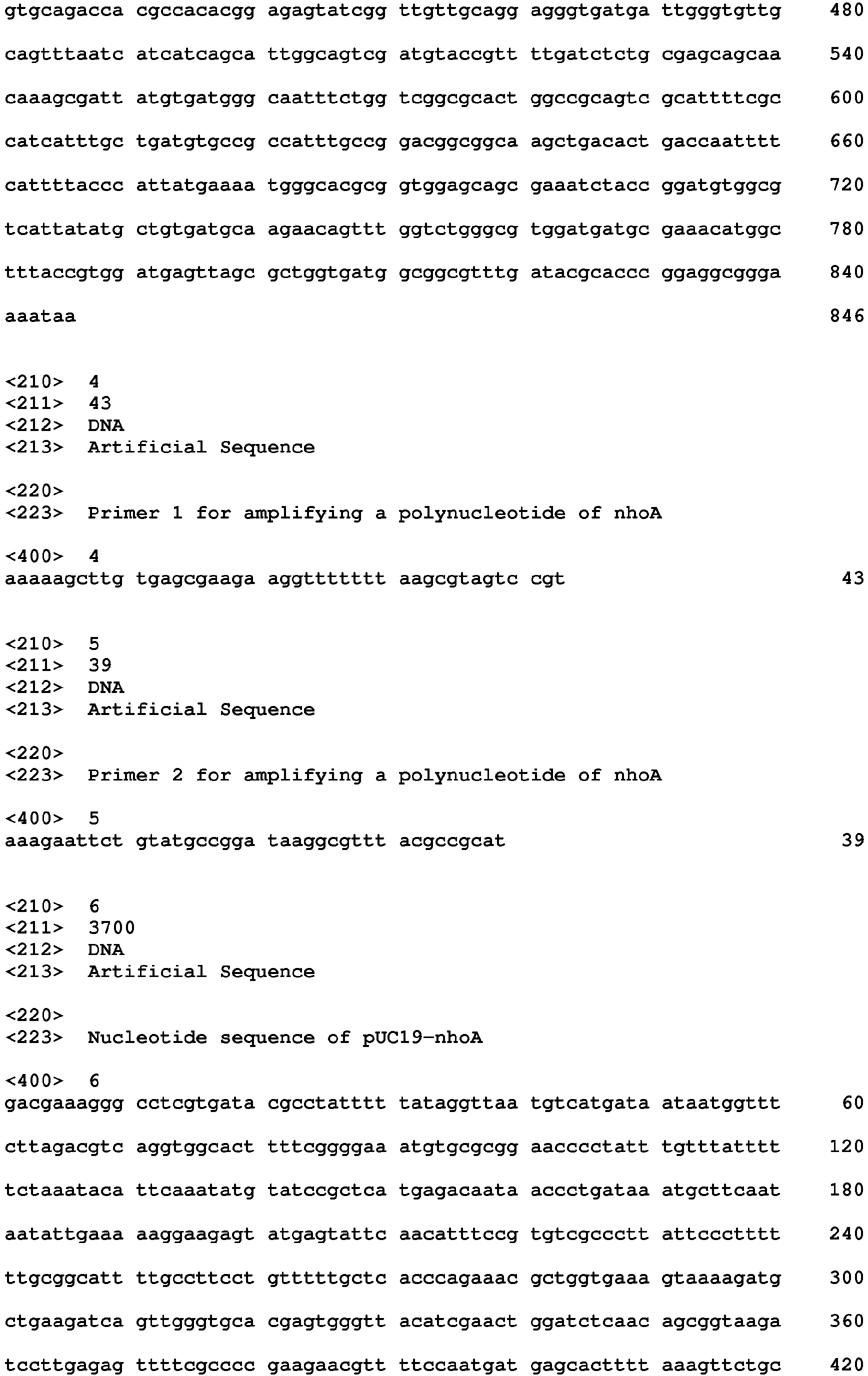


| Gradient program | |
| 0 minute | A/B=100/0 |
| 3 minutes | A/B=100/0 |
| 23 minutes | A/B=20/80 |
| 25 minutes | A/B=20/80 |
Column temperature: Room temperature (25°C)
Detection wavelength: 254 nm (PDA)
MS ionization mode: ESI
Analysis machines: Agilent Infinity 1290 (LC)
Agilent Quadrupole LC/MS 6130 (MS)
Claims (14)
- A microorganism having an ability to produce 3-amino-4-hydroxybenzoic acid, that is modified so as to increase an activity to form 3-amino-4-hydroxybenzoic acid from dihydroxyacetone phosphate and aspartate semialdehyde, wherein the microorganism is modified so as to increase an N-hydroxyarylamine O-acetyltransferase (NhoA) activity.
- The microorganism according to claim 1, wherein the increase of the N-hydroxyarylamine O-acetyltransferase activity is imparted by transformation with a recombinant vector comprising a DNA encoding the NhoA.
- The microorganism according to claim 2, wherein the NhoA is a protein of any one of the following (I) to (III):(I) a protein comprising the amino acid sequence of SEQ ID NO:2;(II) a protein comprising an amino acid sequence having one or several amino acid substitutions, deletions, insertions or additions in the amino acid sequence of SEQ ID NO:2 and having an N-hydroxyarylamine O-acetyltransferase activity; or(III) a protein comprising an amino acid sequence having 70% or more identity to the amino acid sequence of SEQ ID NO:2 and having an N-hydroxyarylamine O-acetyltransferase activity.
- The microorganism according to claim 2, wherein the DNA encoding the NhoA is a DNA of any one of the following (i) to (iii) :(i) a DNA comprising the nucleotide sequence of SEQ ID NO:3;(ii) a DNA that hybridizes under a stringent condition with the nucleotide sequence complementary to the nucleotide sequence of SEQ ID NO:3 and encodes a protein having an N-hydroxyarylamine O-acetyltransferase activity; or(iii) a DNA comprising a nucleotide sequence having 70% or more identity to the nucleotide sequence of SEQ ID NO:3 and encoding a protein having an N-hydroxyarylamine O-acetyltransferase activity.
- The microorganism according to any one of claims 1 to 4, wherein the microorganism belongs to the genus Escherichia, the genus Pantoea or the genus Corynebacterium.
- The microorganism according to any one of claims 1 to 5, wherein the microorganism belongs to Escherichia coli, Pantoea ananatis or Corynebacterium glutamicum.
- The microorganism according to any one of claims 1 to 6, wherein the ability to produce 3-amino-4-hydroxybenzoic acid is imparted by transformation with a recombinant vector comprising a DNA encoding a protein having an activity to form the 3-amino-4-hydroxybenzoic acid from the dihydroxyacetone phosphate and the aspartate semialdehyde.
- The microorganism according to claim 7, wherein the proteins having the activity to form 3-amino-4-hydroxybenzoic acid are GriI and GriH.
- The microorganism according to claim 8, wherein the GriI is a protein of any one of the following (A) to (C) and the GriH is a protein of any one of the following (D) to (F):(A) a protein comprising an amino acid sequence of SEQ ID NO:9 or SEQ ID NO:18;(B) a protein comprising an amino acid sequence having one or several amino acid substitutions, deletions, insertions or additions in the amino acid sequence shown in (A) above and having an aldolase activity;(C) a protein comprising an amino acid sequence having 70% or more identity to the amino acid sequence shown in (A) above and having an aldolase activity;(D) a protein comprising an amino acid sequence of SEQ ID NO:11 or SEQ ID NO:20;(E) a protein comprising an amino acid sequence having one or several amino acid substitutions, deletions, insertions or additions in the amino acid sequence shown in (D) above and having a 3-amino-4-hydroxybenzoic acid synthase activity; and(F) a protein comprising an amino acid sequence having 70% or more identity to the amino acid sequence shown in (D) above and having a 3-amino-4-hydroxybenzoic acid synthase activity.
- The microorganism according to claim 7, wherein the DNA encoding the protein having the activity to form 3-amino-4-hydroxybenzoic acid is a DNA of any one of the following (a) to (c) and the griH gene is a DNA of any one of the following (d) to (f):(a) a DNA comprising a nucleotide sequence of SEQ ID NO:10 or SEQ ID NO:19;(b) a DNA that hybridizes under a stringent condition with a nucleotide sequence complementary to the nucleotide sequence shown in (a) above and encodes a protein having an aldolase activity;(c) a DNA that has 70% or more identity to the nucleotide sequence shown in (a) above and encodes a protein having an aldolase activity;(d) a DNA comprising a nucleotide sequence of SEQ ID NO:12 or SEQ ID NO:21;(e) a DNA that hybridizes under a stringent condition with a nucleotide sequence complementary to the nucleotide sequence shown in (d) above and encodes a protein having a 3-amino-4-hydroxybenzoic acid synthase activity; and(f) a DNA that has 70% or more identity to the nucleotide sequence shown in (d) above and encodes a protein having a 3-amino-4-hydroxybenzoic acid synthase activity.
- A method for producing a 3-acetylamino-4-hydroxybenzoic acid-type compound, comprising culturing the microorganism according to any one of claims 1 to 10 to form the 3-acetylamino-4-hydroxybenzoic acid-type compound.
- A method for producing a 3-amino-4-hydroxybenzoic acid-type compound, comprising the following (1) and (2):(1) forming a 3-acetylamino-4-hydroxybenzoic acid-type compound by the method according to claim 11; and(2) deacetylating the 3-acetylamino-4-hydroxybenzoic acid-type compound to form the 3-amino-4-hydroxybenzoic acid-type compound.
- A method for producing a polymer containing a 3-amino-4-hydroxybenzoic acid-type compound as a component, comprising following (1') and (2'):(1') forming the 3-amino-4-hydroxybenzoic acid-type compound by the method according to claim 12; and(2') polymerizing the 3-amino-4-hydroxybenzoic acid-type compound to obtain a polymer containing the 3-amino-4-hydroxybenzoic acid-type compound as a component.
- The method according to claim 13, wherein the polymer is a polybenzoxazole polymer.
Applications Claiming Priority (2)
| Application Number | Priority Date | Filing Date | Title |
|---|---|---|---|
| JP2012122388 | 2012-05-29 | ||
| PCT/JP2013/056025 WO2013179711A1 (en) | 2012-05-29 | 2013-03-05 | Method for producing 3-acetylamino-4-hydroxybenzoic acid |
Publications (2)
| Publication Number | Publication Date |
|---|---|
| EP2857510A1 true EP2857510A1 (en) | 2015-04-08 |
| EP2857510A4 EP2857510A4 (en) | 2016-02-10 |
Family
ID=49672924
Family Applications (1)
| Application Number | Title | Priority Date | Filing Date |
|---|---|---|---|
| EP13796758.4A Withdrawn EP2857510A4 (en) | 2012-05-29 | 2013-03-05 | PROCESS FOR PRODUCING 3-ACETYLAMINO-4-HYDROXYBENZOIC ACID |
Country Status (5)
| Country | Link |
|---|---|
| US (1) | US9447443B2 (en) |
| EP (1) | EP2857510A4 (en) |
| JP (1) | JP6183358B2 (en) |
| CN (1) | CN104379742A (en) |
| WO (1) | WO2013179711A1 (en) |
Cited By (1)
| Publication number | Priority date | Publication date | Assignee | Title |
|---|---|---|---|---|
| EP2821479A4 (en) * | 2012-02-29 | 2015-09-02 | Ajinomoto Kk | ESCHERICHIA COLI CAPABLE OF PRODUCING 3-AMINO-4-HYDROXYBENZOIC ACID |
Families Citing this family (3)
| Publication number | Priority date | Publication date | Assignee | Title |
|---|---|---|---|---|
| US20170260555A1 (en) * | 2014-09-29 | 2017-09-14 | The Regents Of The University Of California | Method for biosynthesis of acetaminophen |
| WO2021030835A1 (en) * | 2019-08-12 | 2021-02-18 | Zymergen Inc. | Engineered biosynthetic pathways for production of 3-amino-4-hydroxybenzoic acid by fermentation |
| WO2024161513A1 (en) * | 2023-01-31 | 2024-08-08 | 花王株式会社 | Method for producing 4-acetylamino-3-hydroxy benzoic acid |
Family Cites Families (36)
| Publication number | Priority date | Publication date | Assignee | Title |
|---|---|---|---|---|
| JPS57134500A (en) | 1981-02-12 | 1982-08-19 | Kyowa Hakko Kogyo Co Ltd | Plasmid pcg1 |
| JPS57183799A (en) | 1981-04-17 | 1982-11-12 | Kyowa Hakko Kogyo Co Ltd | Novel plasmid |
| JPS5835197A (en) | 1981-08-26 | 1983-03-01 | Kyowa Hakko Kogyo Co Ltd | Plamid pcg 2 |
| JPS5867679A (en) | 1981-09-30 | 1983-04-22 | アメリカン・サイアナミド・カンパニ− | Manufacture of cyanuric acid by trimerizing isocyanic acid |
| JPS5877895A (en) | 1981-11-02 | 1983-05-11 | Ajinomoto Co Inc | Plasmid phm1519 |
| JPS58192900A (en) | 1982-05-04 | 1983-11-10 | Ajinomoto Co Inc | Complex plasmid |
| JPH01191686A (en) | 1988-01-26 | 1989-08-01 | Mitsubishi Petrochem Co Ltd | Composite plasmid |
| JP2678995B2 (en) | 1988-09-08 | 1997-11-19 | 三菱化学株式会社 | Method for producing tryptophan synthase |
| US5185262A (en) | 1988-07-27 | 1993-02-09 | Mitsubishi Petrochemical Co., Ltd. | DNA fragment containing gene which encodes the function of stabilizing plasmid in host microorganism |
| US4959492A (en) | 1989-07-14 | 1990-09-25 | The Dow Chemical Company | Process to synthesize AB-PBO monomer and phosphate salts thereof |
| JP2973446B2 (en) | 1990-01-11 | 1999-11-08 | 三菱化学株式会社 | New plasmid vector |
| US5142021A (en) | 1990-10-19 | 1992-08-25 | The Dow Chemical Company | Use of reducing agents in polybenzazole synthesis |
| US5219981A (en) | 1991-03-01 | 1993-06-15 | The Dow Chemical Company | Semi-continuous process for synthesis of polybenzazole polymers |
| WO1993003158A1 (en) | 1991-07-30 | 1993-02-18 | Orsan | System for protein expression and secretion especially in corynebacteria |
| JP3473042B2 (en) | 1992-04-28 | 2003-12-02 | 味の素株式会社 | Mutant aspartokinase gene |
| US5422416A (en) | 1993-06-30 | 1995-06-06 | The Dow Chemical Company | Process for the synthesis of polybenzazole polymers |
| JPH0970291A (en) | 1995-06-30 | 1997-03-18 | Ajinomoto Co Inc | Gene amplification method using artificial transposon |
| JP3711658B2 (en) | 1996-10-07 | 2005-11-02 | 味の素株式会社 | A novel cell surface protein derived from Corynebacterium ammoniagenes |
| JP4168463B2 (en) | 1996-12-05 | 2008-10-22 | 味の素株式会社 | Method for producing L-lysine |
| AU756507B2 (en) | 1998-03-18 | 2003-01-16 | Ajinomoto Co., Inc. | L-glutamic acid-producing bacterium and method for producing L-glutamic acid |
| HK1042321B (en) | 1999-04-19 | 2012-02-24 | 协和发酵工业株式会社 | Novel desensitized aspartokinase |
| US6927046B1 (en) | 1999-12-30 | 2005-08-09 | Archer-Daniels-Midland Company | Increased lysine production by gene amplification using coryneform bacteria |
| US6844176B1 (en) | 2001-10-16 | 2005-01-18 | Degussa Ag | Alleles of the lysC gene from corynebacteria |
| JP4381132B2 (en) * | 2003-03-03 | 2009-12-09 | 東洋紡績株式会社 | Genes involved in the production of aminohydroxy aromatic carboxylic acids and method for producing aminohydroxybenzoic acids |
| CA2518049C (en) | 2003-03-07 | 2013-05-07 | Ajinomoto Co., Inc. | Method of producing microbial transglutaminase |
| JP2006230202A (en) | 2003-06-23 | 2006-09-07 | Ajinomoto Co Inc | Method for producing l-glutamic acid |
| JP5109460B2 (en) * | 2006-07-04 | 2012-12-26 | 国立大学法人 東京大学 | Novel microorganism used for production of 3-amino-4-hydroxybenzaldehyde, method for producing 3-amino-4-hydroxybenzaldehyde using the microorganism, and polymer obtained by the 3-amino-4-hydroxybenzaldehyde |
| JP2010017081A (en) | 2006-10-10 | 2010-01-28 | Ajinomoto Co Inc | Method for producing l-amino acid |
| JPWO2008099898A1 (en) | 2007-02-15 | 2010-05-27 | 味の素株式会社 | Disulfide bond-introduced transglutaminase |
| EP2149608A4 (en) | 2007-04-16 | 2013-02-20 | Ajinomoto Kk | PROCESS FOR PRODUCING AN ORGANIC ACID |
| EP2147970B1 (en) | 2007-04-17 | 2014-12-31 | Ajinomoto Co., Inc. | A method for producing an acidic substance having a carboxyl group |
| EP2241630B1 (en) | 2007-12-06 | 2016-06-01 | Ajinomoto Co., Inc. | A method for producing an organic acid |
| JP2010005099A (en) | 2008-06-26 | 2010-01-14 | Taiyo Elec Co Ltd | Game machine |
| WO2010005099A1 (en) | 2008-07-09 | 2010-01-14 | 味の素株式会社 | Method for producing aminohydroxybenzoic acid |
| WO2010101256A1 (en) | 2009-03-06 | 2010-09-10 | 味の素株式会社 | Thermotolerant transglutaminase originating in actinomyces |
| WO2010137130A1 (en) | 2009-05-27 | 2010-12-02 | 味の素株式会社 | Manufacturing method for an organic acid |
-
2013
- 2013-03-05 JP JP2014518304A patent/JP6183358B2/en not_active Expired - Fee Related
- 2013-03-05 EP EP13796758.4A patent/EP2857510A4/en not_active Withdrawn
- 2013-03-05 CN CN201380027849.1A patent/CN104379742A/en active Pending
- 2013-03-05 WO PCT/JP2013/056025 patent/WO2013179711A1/en not_active Ceased
-
2014
- 2014-11-19 US US14/547,481 patent/US9447443B2/en not_active Expired - Fee Related
Cited By (2)
| Publication number | Priority date | Publication date | Assignee | Title |
|---|---|---|---|---|
| EP2821479A4 (en) * | 2012-02-29 | 2015-09-02 | Ajinomoto Kk | ESCHERICHIA COLI CAPABLE OF PRODUCING 3-AMINO-4-HYDROXYBENZOIC ACID |
| US9587259B2 (en) | 2012-02-29 | 2017-03-07 | Ajinomoto Co., Inc. | Escherichia coli capable of producing 3-amino-4-hydroxybenzoic acid |
Also Published As
| Publication number | Publication date |
|---|---|
| JPWO2013179711A1 (en) | 2016-01-18 |
| US9447443B2 (en) | 2016-09-20 |
| EP2857510A4 (en) | 2016-02-10 |
| US20150079644A1 (en) | 2015-03-19 |
| JP6183358B2 (en) | 2017-08-23 |
| WO2013179711A1 (en) | 2013-12-05 |
| CN104379742A (en) | 2015-02-25 |
Similar Documents
| Publication | Publication Date | Title |
|---|---|---|
| US8093346B2 (en) | Method for producing an aminohydroxybenzoic acid-type compound | |
| US12275979B2 (en) | Gene-modified microorganism for producing 3-hydroxyadipic acid, alpha-hydromuconic acid, and/or adipic acid, and production method for said chemical products | |
| KR101922742B1 (en) | Processes and recombinant microorganisms for the production of cadaverine | |
| JP2022140514A (en) | Aldehyde production method | |
| US9447443B2 (en) | Method for producing 3-acetylamino-4-hydroxybenzoic acid | |
| US9587259B2 (en) | Escherichia coli capable of producing 3-amino-4-hydroxybenzoic acid | |
| KR20220110412A (en) | Novel protein variant and a method for producing L-lysine using the same | |
| CN114375332A (en) | Modified polypeptide of glutamine synthetase and method for producing L-glutamine using same | |
| KR102727407B1 (en) | Microorganisms for producing l-isoleucine and process for producing l-isoleucine using the same | |
| EP3470512A1 (en) | Mutant phosphoserine aminotransferase for the conversion of homoserine into 4-hydroxy-2-ketobutyrate | |
| JP7214952B2 (en) | Ornithine decarboxylase mutant and method for producing putrescine using the same | |
| KR20220110413A (en) | Novel protein variant and a method for producing L-lysine using the same | |
| KR102931740B1 (en) | Variant of anion symporter derived from Corynebacterium Stationis and microorganisms including the same | |
| KR102922479B1 (en) | A microorganism for producing l-tryptophan and method for producing l- tryptophan using the same | |
| JP2021182882A (en) | Method for producing sarcosine | |
| KR102806935B1 (en) | Novel BBD29_RS02010 variant and a method for producing L-arginine using the same | |
| JP7802832B2 (en) | Novel method for producing poly-4-hydroxybutyrate and 1,4-butanediol | |
| KR20250001930A (en) | A microorganism expressing threonine export protein RhtC and a use for producing L-isoleucine thereof | |
| JP2025160327A (en) | Novel MdtH mutant and method for producing O-phosphoserine, cysteine and their derivatives using the same | |
| KR20240143214A (en) | A microorganism having Threonine/homoserine exporter variant and a method for producing L-amino acid using the same | |
| JP2022130759A (en) | Ornithine decarboxylase mutant and production method of putrescine using the same |
Legal Events
| Date | Code | Title | Description |
|---|---|---|---|
| PUAI | Public reference made under article 153(3) epc to a published international application that has entered the european phase |
Free format text: ORIGINAL CODE: 0009012 |
|
| 17P | Request for examination filed |
Effective date: 20141229 |
|
| AK | Designated contracting states |
Kind code of ref document: A1 Designated state(s): AL AT BE BG CH CY CZ DE DK EE ES FI FR GB GR HR HU IE IS IT LI LT LU LV MC MK MT NL NO PL PT RO RS SE SI SK SM TR |
|
| AX | Request for extension of the european patent |
Extension state: BA ME |
|
| DAX | Request for extension of the european patent (deleted) | ||
| RA4 | Supplementary search report drawn up and despatched (corrected) |
Effective date: 20160112 |
|
| RIC1 | Information provided on ipc code assigned before grant |
Ipc: C12N 15/09 20060101AFI20160105BHEP Ipc: C12P 13/00 20060101ALI20160105BHEP Ipc: C12N 1/15 20060101ALI20160105BHEP Ipc: C12N 1/21 20060101ALI20160105BHEP Ipc: C12N 1/19 20060101ALI20160105BHEP Ipc: C12N 5/10 20060101ALI20160105BHEP |
|
| STAA | Information on the status of an ep patent application or granted ep patent |
Free format text: STATUS: EXAMINATION IS IN PROGRESS |
|
| 17Q | First examination report despatched |
Effective date: 20170510 |
|
| STAA | Information on the status of an ep patent application or granted ep patent |
Free format text: STATUS: THE APPLICATION IS DEEMED TO BE WITHDRAWN |
|
| 18D | Application deemed to be withdrawn |
Effective date: 20180807 |