EP2856990A1 - Method for producing disposable underwear-type diaper - Google Patents
Method for producing disposable underwear-type diaper Download PDFInfo
- Publication number
- EP2856990A1 EP2856990A1 EP13797506.6A EP13797506A EP2856990A1 EP 2856990 A1 EP2856990 A1 EP 2856990A1 EP 13797506 A EP13797506 A EP 13797506A EP 2856990 A1 EP2856990 A1 EP 2856990A1
- Authority
- EP
- European Patent Office
- Prior art keywords
- continuous body
- region
- fasteners
- main surface
- pair
- Prior art date
- Legal status (The legal status is an assumption and is not a legal conclusion. Google has not performed a legal analysis and makes no representation as to the accuracy of the status listed.)
- Granted
Links
Images


Classifications
-
- A—HUMAN NECESSITIES
- A61—MEDICAL OR VETERINARY SCIENCE; HYGIENE
- A61F—FILTERS IMPLANTABLE INTO BLOOD VESSELS; PROSTHESES; DEVICES PROVIDING PATENCY TO, OR PREVENTING COLLAPSING OF, TUBULAR STRUCTURES OF THE BODY, e.g. STENTS; ORTHOPAEDIC, NURSING OR CONTRACEPTIVE DEVICES; FOMENTATION; TREATMENT OR PROTECTION OF EYES OR EARS; BANDAGES, DRESSINGS OR ABSORBENT PADS; FIRST-AID KITS
- A61F13/00—Bandages or dressings; Absorbent pads
- A61F13/15—Absorbent pads, e.g. sanitary towels, swabs or tampons for external or internal application to the body; Supporting or fastening means therefor; Tampon applicators
- A61F13/15577—Apparatus or processes for manufacturing
- A61F13/15756—Applying tabs, strips, tapes, loops; Knotting the ends of pads
-
- A—HUMAN NECESSITIES
- A61—MEDICAL OR VETERINARY SCIENCE; HYGIENE
- A61F—FILTERS IMPLANTABLE INTO BLOOD VESSELS; PROSTHESES; DEVICES PROVIDING PATENCY TO, OR PREVENTING COLLAPSING OF, TUBULAR STRUCTURES OF THE BODY, e.g. STENTS; ORTHOPAEDIC, NURSING OR CONTRACEPTIVE DEVICES; FOMENTATION; TREATMENT OR PROTECTION OF EYES OR EARS; BANDAGES, DRESSINGS OR ABSORBENT PADS; FIRST-AID KITS
- A61F13/00—Bandages or dressings; Absorbent pads
- A61F13/15—Absorbent pads, e.g. sanitary towels, swabs or tampons for external or internal application to the body; Supporting or fastening means therefor; Tampon applicators
- A61F13/15577—Apparatus or processes for manufacturing
- A61F13/15699—Forming webs by bringing together several webs, e.g. by laminating or folding several webs, with or without additional treatment of the webs
-
- A—HUMAN NECESSITIES
- A61—MEDICAL OR VETERINARY SCIENCE; HYGIENE
- A61F—FILTERS IMPLANTABLE INTO BLOOD VESSELS; PROSTHESES; DEVICES PROVIDING PATENCY TO, OR PREVENTING COLLAPSING OF, TUBULAR STRUCTURES OF THE BODY, e.g. STENTS; ORTHOPAEDIC, NURSING OR CONTRACEPTIVE DEVICES; FOMENTATION; TREATMENT OR PROTECTION OF EYES OR EARS; BANDAGES, DRESSINGS OR ABSORBENT PADS; FIRST-AID KITS
- A61F13/00—Bandages or dressings; Absorbent pads
- A61F13/15—Absorbent pads, e.g. sanitary towels, swabs or tampons for external or internal application to the body; Supporting or fastening means therefor; Tampon applicators
- A61F13/15577—Apparatus or processes for manufacturing
- A61F13/15707—Mechanical treatment, e.g. notching, twisting, compressing, shaping
- A61F13/15723—Partitioning batts; Cutting
-
- A—HUMAN NECESSITIES
- A61—MEDICAL OR VETERINARY SCIENCE; HYGIENE
- A61F—FILTERS IMPLANTABLE INTO BLOOD VESSELS; PROSTHESES; DEVICES PROVIDING PATENCY TO, OR PREVENTING COLLAPSING OF, TUBULAR STRUCTURES OF THE BODY, e.g. STENTS; ORTHOPAEDIC, NURSING OR CONTRACEPTIVE DEVICES; FOMENTATION; TREATMENT OR PROTECTION OF EYES OR EARS; BANDAGES, DRESSINGS OR ABSORBENT PADS; FIRST-AID KITS
- A61F13/00—Bandages or dressings; Absorbent pads
- A61F13/15—Absorbent pads, e.g. sanitary towels, swabs or tampons for external or internal application to the body; Supporting or fastening means therefor; Tampon applicators
- A61F13/15577—Apparatus or processes for manufacturing
- A61F13/15707—Mechanical treatment, e.g. notching, twisting, compressing, shaping
- A61F13/15747—Folding; Pleating; Coiling; Stacking; Packaging
-
- A—HUMAN NECESSITIES
- A61—MEDICAL OR VETERINARY SCIENCE; HYGIENE
- A61F—FILTERS IMPLANTABLE INTO BLOOD VESSELS; PROSTHESES; DEVICES PROVIDING PATENCY TO, OR PREVENTING COLLAPSING OF, TUBULAR STRUCTURES OF THE BODY, e.g. STENTS; ORTHOPAEDIC, NURSING OR CONTRACEPTIVE DEVICES; FOMENTATION; TREATMENT OR PROTECTION OF EYES OR EARS; BANDAGES, DRESSINGS OR ABSORBENT PADS; FIRST-AID KITS
- A61F13/00—Bandages or dressings; Absorbent pads
- A61F13/15—Absorbent pads, e.g. sanitary towels, swabs or tampons for external or internal application to the body; Supporting or fastening means therefor; Tampon applicators
- A61F13/15577—Apparatus or processes for manufacturing
- A61F13/15804—Plant, e.g. involving several steps
-
- A—HUMAN NECESSITIES
- A61—MEDICAL OR VETERINARY SCIENCE; HYGIENE
- A61F—FILTERS IMPLANTABLE INTO BLOOD VESSELS; PROSTHESES; DEVICES PROVIDING PATENCY TO, OR PREVENTING COLLAPSING OF, TUBULAR STRUCTURES OF THE BODY, e.g. STENTS; ORTHOPAEDIC, NURSING OR CONTRACEPTIVE DEVICES; FOMENTATION; TREATMENT OR PROTECTION OF EYES OR EARS; BANDAGES, DRESSINGS OR ABSORBENT PADS; FIRST-AID KITS
- A61F13/00—Bandages or dressings; Absorbent pads
- A61F13/15—Absorbent pads, e.g. sanitary towels, swabs or tampons for external or internal application to the body; Supporting or fastening means therefor; Tampon applicators
- A61F13/45—Absorbent pads, e.g. sanitary towels, swabs or tampons for external or internal application to the body; Supporting or fastening means therefor; Tampon applicators characterised by the shape
- A61F13/49—Absorbent pads, e.g. sanitary towels, swabs or tampons for external or internal application to the body; Supporting or fastening means therefor; Tampon applicators characterised by the shape specially adapted to be worn around the waist, e.g. diapers, nappies
- A61F13/496—Absorbent pads, e.g. sanitary towels, swabs or tampons for external or internal application to the body; Supporting or fastening means therefor; Tampon applicators characterised by the shape specially adapted to be worn around the waist, e.g. diapers, nappies in the form of pants or briefs
-
- A—HUMAN NECESSITIES
- A61—MEDICAL OR VETERINARY SCIENCE; HYGIENE
- A61F—FILTERS IMPLANTABLE INTO BLOOD VESSELS; PROSTHESES; DEVICES PROVIDING PATENCY TO, OR PREVENTING COLLAPSING OF, TUBULAR STRUCTURES OF THE BODY, e.g. STENTS; ORTHOPAEDIC, NURSING OR CONTRACEPTIVE DEVICES; FOMENTATION; TREATMENT OR PROTECTION OF EYES OR EARS; BANDAGES, DRESSINGS OR ABSORBENT PADS; FIRST-AID KITS
- A61F13/00—Bandages or dressings; Absorbent pads
- A61F13/15—Absorbent pads, e.g. sanitary towels, swabs or tampons for external or internal application to the body; Supporting or fastening means therefor; Tampon applicators
- A61F13/56—Supporting or fastening means
- A61F13/5622—Supporting or fastening means specially adapted for diapers or the like
- A61F13/5633—Supporting or fastening means specially adapted for diapers or the like open type diaper
-
- A—HUMAN NECESSITIES
- A61—MEDICAL OR VETERINARY SCIENCE; HYGIENE
- A61F—FILTERS IMPLANTABLE INTO BLOOD VESSELS; PROSTHESES; DEVICES PROVIDING PATENCY TO, OR PREVENTING COLLAPSING OF, TUBULAR STRUCTURES OF THE BODY, e.g. STENTS; ORTHOPAEDIC, NURSING OR CONTRACEPTIVE DEVICES; FOMENTATION; TREATMENT OR PROTECTION OF EYES OR EARS; BANDAGES, DRESSINGS OR ABSORBENT PADS; FIRST-AID KITS
- A61F13/00—Bandages or dressings; Absorbent pads
- A61F13/15—Absorbent pads, e.g. sanitary towels, swabs or tampons for external or internal application to the body; Supporting or fastening means therefor; Tampon applicators
- A61F13/56—Supporting or fastening means
- A61F13/5622—Supporting or fastening means specially adapted for diapers or the like
- A61F13/565—Supporting or fastening means specially adapted for diapers or the like pants type diaper
-
- A—HUMAN NECESSITIES
- A61—MEDICAL OR VETERINARY SCIENCE; HYGIENE
- A61F—FILTERS IMPLANTABLE INTO BLOOD VESSELS; PROSTHESES; DEVICES PROVIDING PATENCY TO, OR PREVENTING COLLAPSING OF, TUBULAR STRUCTURES OF THE BODY, e.g. STENTS; ORTHOPAEDIC, NURSING OR CONTRACEPTIVE DEVICES; FOMENTATION; TREATMENT OR PROTECTION OF EYES OR EARS; BANDAGES, DRESSINGS OR ABSORBENT PADS; FIRST-AID KITS
- A61F13/00—Bandages or dressings; Absorbent pads
- A61F13/15—Absorbent pads, e.g. sanitary towels, swabs or tampons for external or internal application to the body; Supporting or fastening means therefor; Tampon applicators
- A61F13/56—Supporting or fastening means
- A61F13/62—Mechanical fastening means ; Fabric strip fastener elements, e.g. hook and loop
- A61F13/622—Fabric strip fastener elements, e.g. hook and loop
-
- B—PERFORMING OPERATIONS; TRANSPORTING
- B32—LAYERED PRODUCTS
- B32B—LAYERED PRODUCTS, i.e. PRODUCTS BUILT-UP OF STRATA OF FLAT OR NON-FLAT, e.g. CELLULAR OR HONEYCOMB, FORM
- B32B37/00—Methods or apparatus for laminating, e.g. by curing or by ultrasonic bonding
- B32B37/14—Methods or apparatus for laminating, e.g. by curing or by ultrasonic bonding characterised by the properties of the layers
- B32B37/16—Methods or apparatus for laminating, e.g. by curing or by ultrasonic bonding characterised by the properties of the layers with all layers existing as coherent layers before laminating
- B32B37/18—Methods or apparatus for laminating, e.g. by curing or by ultrasonic bonding characterised by the properties of the layers with all layers existing as coherent layers before laminating involving the assembly of discrete sheets or panels only
-
- B—PERFORMING OPERATIONS; TRANSPORTING
- B32—LAYERED PRODUCTS
- B32B—LAYERED PRODUCTS, i.e. PRODUCTS BUILT-UP OF STRATA OF FLAT OR NON-FLAT, e.g. CELLULAR OR HONEYCOMB, FORM
- B32B38/00—Ancillary operations in connection with laminating processes
- B32B38/0004—Cutting, tearing or severing, e.g. bursting; Cutter details
-
- B—PERFORMING OPERATIONS; TRANSPORTING
- B32—LAYERED PRODUCTS
- B32B—LAYERED PRODUCTS, i.e. PRODUCTS BUILT-UP OF STRATA OF FLAT OR NON-FLAT, e.g. CELLULAR OR HONEYCOMB, FORM
- B32B38/00—Ancillary operations in connection with laminating processes
- B32B38/0012—Mechanical treatment, e.g. roughening, deforming, stretching
-
- B—PERFORMING OPERATIONS; TRANSPORTING
- B32—LAYERED PRODUCTS
- B32B—LAYERED PRODUCTS, i.e. PRODUCTS BUILT-UP OF STRATA OF FLAT OR NON-FLAT, e.g. CELLULAR OR HONEYCOMB, FORM
- B32B2307/00—Properties of the layers or laminate
- B32B2307/70—Other properties
- B32B2307/726—Permeability to liquids, absorption
-
- B—PERFORMING OPERATIONS; TRANSPORTING
- B32—LAYERED PRODUCTS
- B32B—LAYERED PRODUCTS, i.e. PRODUCTS BUILT-UP OF STRATA OF FLAT OR NON-FLAT, e.g. CELLULAR OR HONEYCOMB, FORM
- B32B2307/00—Properties of the layers or laminate
- B32B2307/70—Other properties
- B32B2307/726—Permeability to liquids, absorption
- B32B2307/7265—Non-permeable
-
- B—PERFORMING OPERATIONS; TRANSPORTING
- B32—LAYERED PRODUCTS
- B32B—LAYERED PRODUCTS, i.e. PRODUCTS BUILT-UP OF STRATA OF FLAT OR NON-FLAT, e.g. CELLULAR OR HONEYCOMB, FORM
- B32B2555/00—Personal care
- B32B2555/02—Diapers or napkins
Definitions
- the present invention relates to a method for producing a disposable underwear-type diaper, and more specifically, to a method for producing a disposable underwear-type diaper having a fastener.
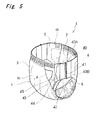
- FIG. 5 is a partially broken perspective view of a disposable underwear-type diaper 1.
- the underwear-type diaper 1 is formed in an underwear shape where the upper parts of an abdomen side 8A and a back side 8B of a body 8 are connected by a pair of fasteners 40, and has a waist opening 5 and a pair of leg openings 6.
- the body 8 includes a liquid transmitting top sheet 2 that is in contact with the skin of the wearer, a liquid non-transmitting back sheet 3, and an absorber 4 disposed between the top sheet 2 and the back sheet 3.
- the absorber 4 is disposed on the wearer's abdomen side and back side.
- an abdomen side fastening piece 40A and a back side fastening pieces 40B are bonded together at a joint 41.
- the abdomen side fastening piece 40A includes a body 42 and a tape portion 43 where a tab 45 for nipping is formed.
- the tape portion 43 is detachably fixed to a target zone 44 fixed to the back sheet 3.
- the disposable underwear-type diapers 1 are continuously produced, for example, by production steps schematically shown in FIG. 6 , the abdomen side fastening piece 40A and the back side fastening pieces 40B are bonded together at the joint 41.
- fastening piece members 40A' and 40B' for forming the fastening pieces 40A and 40B are alternately fixed in the conveyance direction. Specifically, after a target zone member 44' for forming the target zone 44 is fixed to the surface of the back sheet continuous body 53, the tape portion 43 of the fastening piece member 40A' is pasted to the target zone member 44'. To a predetermined position of the top sheet continuous body 52, the fastening piece member 40B' is fixed.
- the diaper web continuous body 51 is cut in the direction of the width at a position where the fastening piece members 40A' and 40B' are divided in two, thereby forming a diaper web 50 to which the fastening pieces 40A and 40B are fixed.
- the diaper web 50 is folded in two along an imaginary line in a direction orthogonal to the direction of the flow thereof, and the side edges of the fastening pieces 40A and 40B facing each other are bonded together to form the joint 41.
- Patent Document 1 Japanese Patent Publication No. 3373611
- a seam is formed on the fastener. Since the texture and softness are different between the neighborhood of the seam and other parts of the fastener, this can give a sense of discomfort to the wearer. It is desirable that the fastener be uniform in texture and softness by eliminating the seam in the middle portion.
- the present invention intends to provide a method for producing a disposable underwear-type diaper by which disposable underwear-type diapers provided with a fastener having no seam in a middle portion can be continuously produced.
- the present invention provides a method for producing a disposable underwear-type diaper structured as follows:
- a method for producing a disposable underwear-type diaper is provided with a first to fourth steps.
- Sheet-like fasteners folded in two are arranged on one main surface of a belt-like first continuous body having a pair of side edges.
- the fasteners are arranged at intervals along the pair of side edges of the first continuous body so that a main surface of each fasteners is in contact with the one main surface, that both ends of the fasteners are disposed on the outside of the one main surface of the first continuous body when viewed from the direction of the normal to the one main surface and that a pair of the fasteners face each other in a direction in which the side edges of the first continuous body face each other.
- a composite continuous body is formed by laying a belt-like second continuous body over an other main surface of the first continuous body in a state where one ends, on the first continuous body side, of the both ends of the fasteners are bent so as to be laid over the other main surface of the first continuous body so that the first continuous body and the second continuous body are bonded together and that the one ends of the fasteners are fixed.
- the composite continuous body is cut to thereby form an individual piece divided by an imaginary line in two parts of a first region including the pair of fasteners facing each other and a second region not including the fasteners.
- the one ends of the fasteners are bent by the time the second continuous body is laid over the other main surface of the first main surface in the second step.
- the one ends of the fasteners may be bent when the fasteners are arranged on the one main surface of the first continuous body in the first step or therebefore.
- the one ends of the fasteners are fixed to some part of the composite continuous body during the period to when the composite continuous body is formed by the second step.
- the one ends of the fasteners may be bent and fixed to the first continuous body after the fasteners are arranged on the one main surface of the first continuous body before the second continuous body is laid over the other main surface of the first continuous body in the second step.
- the one ends of the fasteners having already been bent may be fixed to the first continuous body and/or the second continuous body when the first and second continuous bodies are bonded together.
- the first continuous body and the second continuous body are bonded together at the same time when the second continuous body is laid over the other main surface of the first continuous body, or thereafter by the time when the individual piece is formed.
- the other end of the fastener may be bent halfway before the overlaying of the first region and the second region of the individual piece is completed. In that case, after the overlaying of the first region and the second region of the individual piece is completed, the other end of the fastener is completely bent and laid over the second region, and the other end of the fastener is fixed to the second region.
- the disposable underwear-type diapers can be continuously produced, for example, while the first continuous body and the second continuous body are being conveyed.
- the fastener can be made so that no seam is formed in the middle portion, for example, by forming it of one or more than one member that is continuous at least in the middle portion.
- the middle portion of the fastener may be disposed on the outside of the individual piece.
- the other ends of the fasteners are bent to a side opposite to the one ends and laid over the second region, and the other ends are fixed to the second region.
- the inner main surfaces, facing each other, of the first and second regions of the individual piece folded in two are formed of the one main surface of the first continuous body.
- the middle portion of the fastener is sandwiched between the first region and the second region of the individual piece. If the middle portion of the fastener is sandwiched between the first region and the second region of the individual piece, the handling of the individual piece thereafter is easy compared with a case where the middle portion of the fastener is disposed on the outside of the individual piece.
- the present invention may be carried out in various modes as follows:
- the first continuous body includes a liquid transmitting top sheet forming the one main surface of the first continuous body.
- the second continuous body includes a liquid non-transmitting back sheet. In the second step, the first continuous body and the second continuous body are bonded together in a state where an absorber is disposed between the first continuous body and the second continuous body.
- it may be performed to dispose the absorber on the first continuous body simultaneously with the first step, or before or after the first step and then, bond the first and second continuous bodies together. Or it may be performed to dispose the absorber on the second continuous body and then, bond the first and second continuous bodies together. Or it may be performed to dispose the absorber between the first and second continuous bodies immediately before the first and second continuous bodies are bonded together and then, bond the first and second continuous bodies.
- the first continuous body includes a liquid transmitting top sheet forming the one main surface of the first continuous body, a liquid non-transmitting back sheet forming the other main surface of the first continuous body, and an absorber disposed between the top sheet and the back sheet.
- the second continuous body includes a liquid transmitting or liquid non-transmitting cover sheet.
- the absorber is disposed on the first continuous body.
- the present invention provides a disposable underwear-type diaper structured as follows:
- the underwear-type diaper is provided with a body and a pair of fasteners.
- the body has a pair of end edges facing each other and a pair of side edges extending between the pair of end edges and facing each other.
- the body is divided into two parts of a first and second regions by an imaginary line extending between the pair of end edges, and folded in two along the imaginary line so that the first region and the second region are laid one over the other.
- the pair of fasteners are arranged along the pair of side edges at an interval from the imaginary line, one ends are fixed to the first region, and the other ends are fixed to the second region.
- the body includes an inner member forming inner main surfaces, facing each other, of the first and second regions and an outer member forming outer main surfaces on the opposite side of the inner main surfaces of the first and second regions.
- the one end is fixed to the first region in a state of being disposed between the inner member and the outer member
- the other end is fixed to the outer main surface of the second region
- a middle portion between the one end and the other end is continuous without a seam.
- the one end of the fastener is fixed to the inner member and/or the outer member. Since no seam is formed in the middle portion of the fastener, a sense of discomfort is never given to the wearer by a seam in the middle portion.
- the disposable underwear-type diaper of the above-described structure can be continuously produced.
- a disposable underwear-type diaper provided with a fastener having no seam in the middle portion can be continuously produced.
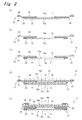
- FIGS. 1(a) to 1(d) are schematic views showing the method for producing the disposable underwear-type diaper 10.
- FIG. 2(a) is a schematic view of a cross section taken along line A-A of FIG. 1(a) .
- FIG. 2(b) is a schematic view of a cross section taken along line B-B of FIG. 1(a) .
- FIG. 2(c) is a schematic view of a cross section taken along line C-C of FIG. 1(a) .
- FIG. 2(d) is a schematic view of a cross section taken along line D-D of FIG. 1(c) .
- FIG. 2(e) is a schematic view of a cross section taken along line E-E of FIG. 1(d) .
- the disposable underwear-type diaper 10 is produced, briefly, by bonding a first continuous body 12 and a second continuous body 14 together to form a composite continuous body 16, cutting it into an individual piece 18 and then, folding the individual piece 18 in two.
- the method for producing the disposable underwear-type diaper 10 will be described.
- fasteners 20 are arranged in predetermined positions of one main surface 12a of the first continuous body 12.
- the first continuous body 12 is a belt-like member having a pair of side edges 12s and 12t parallel to each other.
- the first continuous body 12 is conveyed in a direction parallel to the side edges 12s and 12t as shown by the arrow 12x.
- the fastener 20 is a sheet-like member folded in two so that a first portion 22 and a second portion 24 are laid one over the other.
- the fasteners 20 are arranged at intervals along the pair of side edges 12s and 12t of the first continuous body 12 so that the main surface of the first portion 22 is in contact with the one main surface 12a of the first continuous body 12 and when viewed from the direction of the normal to the one main surface 12a of the first continuous body 12 (in FIG. 1 , the direction vertical to the plane of the figure and in FIG. 2 , the up-down direction of the plane of the figure), both ends 23 and 25 are disposed on the outside of the one main surface 12a of the first continuous body 12.
- a pair of fasteners 20 are arranged in the same position, in the conveyance direction 12x, of the first continuous body 12.
- the fastener 20 disposed along the one side edge 12s of the first continuous body 12 and the fastener 20 disposed along the other side edge 12t thereof are arranged on the one main surface 12a of the first continuous body 12 so as to face each other in a direction in which the side edges 12s and 12t face each other, that is, a direction 12y perpendicular to the conveyance direction 12x.
- an adhesive agent for temporary bonding may be provided between the first portion 22 and the second portion 24 facing each other, or the first portion 22 and the second portion 24 may be temporarily bonded by embossing.
- the fasteners 20 are conveyed together with the first continuous body 12 while being held in a state of being arranged on the first continuous body 12. If necessary, in order that the positions of the fasteners 20 with respect to the first continuous body 12 are not shifted during the conveyance, the fasteners 20 are temporarily fixed with an adhesive agent or by embossing, the fasteners 20 are conveyed in a state of being pinned so as to be temporarily fixed to the first continuous body 12, or the fasteners 20 and the first continuous body 12 are sandwiched between belts or rollers so that they are conveyed in synchronism.
- the one end 23 of the fastener 20, that is, the end 23 of the first portion 22 disposed on the side of the first continuous body 12 is bent so as to be laid over the other main surface 12b of the first continuous body 12.
- the one end 23 of the fastener 20 may be bent so as to be laid over the other main surface 12b of the first continuous body 12 when the fastener 20 is disposed on the one main surface 12a of the first continuous body 12 or therebefore.
- the belt-like second continuous body 14 is laid over the other main surface 12b of the first continuous body 12 while being conveyed as shown by the arrow 14x, and the one ends 23 of the fasteners 20 are sandwiched between the first continuous body 12 and the second continuous body 14. Then, the first continuous body 12 and the second continuous body 14 are bonded together and the one ends 23 of the fasteners 20 are fixed by bonding them to at least one of the first continuous body 12 and the second continuous body 14, thereby forming the composite continuous body 16.
- the composite continuous body 16 is formed so as to include an absorber 13.
- the bonding of the first continuous body 12 and the second continuous body 14 and the bonding of the one end 23 of the fastener 20 and the first continuous body 12 and/or the second continuous body 14 may be performed in any order; these may be performed simultaneously or in tandem.
- an adhesive agent, thermal fusion bonding, ultrasonic bonding or the like is selected as appropriate.
- the composite continuous body 16 is cut in the direction 12y perpendicular to the pair of side edges 12s and 12t of the first continuous body 12 as shown by the chain line 17 in FIG. 1(a) , thereby forming the individual piece 18 including a pair of fasteners 20 as shown in FIG. 1(b) .
- the pair of fasteners 20 are included in one region 18a (first region 18a) of the individual piece 18 divided in two by an imaginary line 18x, and are not included in the other region 18b (second region 18b).
- the imaginary line 18x dividing the individual piece 18 in two extends between end edges 18p and 18q of the individual piece 18 formed by cutting the composite continuous body 16 parallel to the end edges 18p and 18q.
- concave portions 18s and 18t are formed in the vicinity of the intersections with the imaginary line 18x.
- the pair of concave portions 18s and 18t may be formed by removing the parts corresponding to the concave portions 18s and 18t by cutting them simultaneously, in advance or subsequently when the composite continuous body 16 is cut in the perpendicular direction 12y.
- the pair of concave portions 18s and 18t may be formed by bonding the first continuous body 12 and the second continuous body 14 together after removing the parts corresponding to the concave portions 18s and 18t by cutting them for each of the first continuous body 12 and the second continuous body 14.
- the individual piece 18 is formed so that the first continuous body 12 and the second continuous body 14 are bonded together at least along the end edges 18p and 18q and the side edges 18y and 18z extending between the end edges 18p and 18q.
- the individual piece 18 is folded in two along the imaginary line 18x so that the fasteners 20 are sandwiched between the first region 18a and the second region 18b.
- Inner main surfaces 18h and 18i, facing each other, of the first region 18a and the second region 18b are formed of the first continuous body 12, and outer main surfaces 18j and 18k on the opposite side of the inner main surfaces 18h and 18i are formed of the second continuous body 14.
- FIG. 1 and FIG. 2 illustrate a case where the other end 25 is detachably fixed to the second region 18b through a hook and loop fastener 28 previously fixed to the other end 25 of the fastener 20.
- the outer main surface 18k to which the hook and loop fastener 28 is fixed is made of, for example, nonwoven cloth.
- the other end 25 may be fixed to the second region 18b by welding, thermal fusion bonding and other appropriate methods.
- the other end 25 may be detachably fixed to the second region 18b by using a tape portion and a target zone as shown in FIG. 5 and FIG. 6 .
- the other end 25 of the fastener 20 may be bent halfway before the overlaying of the first region 18a and the second region 18b of the individual piece 18 is completed. In that case, after the overlaying of the first region 18a and the second region 18b of the individual piece 18 is completed, the other end 25 of the fastener 20 is completely bent and laid over the second region 18b, and the other end 25 of the fastener 20 is fixed to the second region 18b.
- the disposable underwear-type diapers 10 can be continuously produced while the first continuous body 12 and the second continuous body 14 are being conveyed.
- the produced disposable underwear-type diaper 10 is provided with a body 19 including an inner member formed of the first continuous body 12 and an outer member formed of the second continuous body 14, and the fasteners 20.
- the body 19 has the pair of end edges 18p and 18q facing each other and the pair of side edges 18y and 18z extending between the end edges 18p and 18q and facing each other.
- the body 19 is divided into two parts of the first region 18a and the second region 18b by the imaginary line 18x.
- the one end 23 of the fastener 20 is fixed to the body 19 in a state of being disposed between the first continuous body 12 and the second continuous body 14, that is, between the inner member and the outer member.
- the other end 25 of the fastener 20 is fixed to the outer main surface 18k of the second region 18b of the body 19.
- a waist opening is formed between the pair of end edges 18p and 18q of the body 19.
- a pair of leg openings are formed along the concave portions 18s and 18t formed on the side edges 18y and 18z of the body 19.
- the body 19 includes a liquid transmitting top sheet, a liquid non-transmitting back sheet and the absorber 13 disposed between the top sheet and the back sheet, and the inner main surfaces 18h and 18i of the first region 18a and the second region 18b of the body 19 are formed of the top sheet.
- the outer main surfaces 18 j and 18k of the first region 18a and the second region 18b of the body 19 may be formed of the back sheet.
- the body 19 may further include a liquid transmitting or liquid non-transmitting cover sheet so that the outer main surfaces 18j and 18k of the first region 18a and the second region 18b of the body 19 are formed of the cover sheet.
- an elastic member for providing elasticity may be provided along the waist opening and the leg openings, and three-dimensional gathers standing at the wearer's crotch and in close contact with the skin may be formed on the top sheet.
- the fastener 20 can be formed so that the softness and texture of the middle portion are uniform.
- the fastener 20 is formed so that at least one or more than one member is continuous in the middle portion.
- the first continuous body 12 and the second continuous body 14 can be made in various modes as follows:
- the first continuous body 12 includes a top sheet continuous body which is a belt-like sheet member for forming a liquid transmitting top sheet.
- the one main surface 12a of the first continuous body 12, that is, the inner main surfaces 18h and 18i of the first region 18a and the second region 18b are formed of the top sheet continuous body.
- the second continuous body 14 includes a back sheet continuous body which is a belt-like sheet member for forming a liquid non-transmitting back sheet. The first continuous body 12 and the second continuous body 14 are bonded together in a state where the absorber 13 is disposed between the first continuous body 12 and the second continuous body 14.
- the absorber 13 may be disposed between the first continuous body 12 and the second continuous body 14 immediately before the first continuous body 12 and the second continuous body 14 are bonded together. Or it may be performed to dispose the absorber 13 on the side of the other main surface 12b of the first continuous body 12 simultaneously with, or before or after the step of arranging the fasteners 20 on the one main surface 12a of the first continuous body 12 and then, bond the first continuous body 12 and the second continuous body 14 together. Or it may be performed to dispose the absorber 13 on the second continuous body 14 and then, bond the first continuous body 12 and the second continuous body 14 together.
- the first continuous body 12 includes a liquid transmitting top sheet continuous body forming the one main surface 12a of the first continuous body 12, a liquid non-transmitting back sheet continuous body forming the other main surface 12b of the first continuous body 12, and the absorber 13 disposed between the top sheet continuous body and the back sheet continuous body.
- the second continuous body 14 includes a cover sheet continuous body which is a belt-like sheet member for forming a liquid transmitting or liquid non-transmitting cover sheet. In this case, when the fasteners 20 are arranged on the one main surface of the first continuous body 12, the absorber 13 is already disposed on the first continuous body 12.
- the first continuous body 12 includes a top sheet continuous body.
- the one main surface 12a of the first continuous body 12 is formed of the top sheet continuous body.
- the second continuous body 14 includes a liquid non-transmitting back sheet continuous body and a liquid transmitting or liquid non-transmitting cover sheet continuous body.
- the main surface 14a on the side of the first continuous body 12 is formed of the back sheet continuous body.
- the first continuous body 12 and the second continuous body 14 are bonded together in a state where the absorber 13 is disposed between the first continuous body 12 and the second continuous body 14.
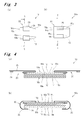
- FIGS. 3 (a) and 3(b) are plan views schematically showing production steps.
- FIG. 4(a) is a schematic view of a cross section taken along line S-S of FIG. 3(a).
- FIG. 4 (b) is a schematic view of a cross section taken along line T-T of FIG. 3(b) .
- the first continuous body 12 and the second continuous body 14 are bonded together to form the composite continuous body 16, and the composite continuous body 16 is cut to form the individual piece 18 divided into two parts of the first region 18a and the second region 18b by the imaginary line 18x.
- the individual piece 18 is folded in two along the imaginary line 18x to the side opposite to that in the first embodiment.
- inner main surfaces 18m and 18n, facing each other, of the first region 18a and the second region 18b are formed of the second continuous body 14, and outer main surfaces 18u and 18v on the opposite side of the inner main surfaces 18m and 18n are formed of the first continuous body 12.
- the middle portion between the one end 23 and the other end 25 of the fastener 20 is disposed on the outer main surface 18u of the first region 18a of the individual piece 18.
- the other end 25 of the fastener 20 is bent to the same side as the one end 23, and fixed to the second region 18b of the individual piece 18.
- the hook and loop fastener 28 is provided on the side opposite to that in the first embodiment at the other end 25 of the fastener 20.
- disposable underwear-type diapers 10a can be continuously produced while the first continuous body 12 and the second continuous body 14 are being conveyed.
- the produced disposable underwear-type diaper 10a is provided with a body 19 including an inner member formed of the second continuous body 14 and an outer member formed of the first continuous body 12, and the fasteners 20.
- the body 19 has the pair of end edges 18p and 18q facing each other and the pair of side edges 18y and 18z extending between the end edges 18p and 18q and facing each other.
- the body 19 is divided into two parts of the first region 18a and the second region 18b by the imaginary line 18x.
- the one end 23 of the fastener 20 is fixed to the body 19 in a state of being disposed between the first continuous body 12 and the second continuous body 14, that is, between the inner member and the outer member.
- the other end 25 of the fastener 20 is fixed to the outer main surface 18v of the second region 18b of the body 19.
- a waist opening is formed between the pair of end edges 18p and 18q of the body 19.
- a pair of leg openings are formed along the concave portions 18s and 18t formed on the side edges 18y and 18z of the body.
- the fastener 20 can be formed so that the softness and texture of the middle portion are uniform.
- the fastener 20 is formed so that at least one or more than one member is continuous in the middle portion.
- the first continuous body 12 and the second continuous body 14 can be made in various modes as follows:
- the first continuous body 12 includes a back sheet continuous body which is a belt-like sheet member for forming a liquid non-transmitting back sheet.
- the second continuous body 14 includes a top sheet continuous body which is a belt-like sheet member for forming a liquid transmitting top sheet.
- the main surface 14b on the opposite side of the first continuous body 12 that is, the inner main surfaces 18m and 18n of the first region 18a and the second region 18b are formed of the top sheet continuous body.
- the first continuous body 12 and the second continuous body 14 are bonded together in a state where the absorber 13 is disposed between the first continuous body 12 and the second continuous body 14.
- the first continuous body 12 includes a cover sheet continuous body which is a liquid transmitting or liquid non-transmitting belt-like sheet member for forming a cover sheet, and a back sheet continuous body.
- the main surface 12a and 12b of the first continuous body 12 is formed of the back sheet continuous body.
- the second continuous body 14 includes a liquid transmitting top sheet continuous body.
- the main surface 14a and 14b of the second continuous body 14 is formed of the top sheet continuous body.
- the first continuous body 12 and the second continuous body 14 are bonded together in a state where the absorber 13 is disposed between the first continuous body 12 and the second continuous body 14.
- the first continuous body 12 includes a liquid transmitting or liquid non-transmitting cover sheet continuous body.
- the second continuous body 14 includes a top sheet continuous body, a back sheet continuous body, and the absorber 13 disposed between the top sheet continuous body and the back sheet continuous body.
- the main surface 14b on the opposite side of the first continuous body 12 is formed of the top sheet continuous body.
- the disposable underwear-type diapers 10 and 10a provided with the fastener 20 having no seam in the middle portion can be continuously produced by using the fastener 20 folded in two.
- the present invention is not limited to the above embodiments but may be carried out with various changes being added thereto.
Landscapes
- Health & Medical Sciences (AREA)
- Engineering & Computer Science (AREA)
- Life Sciences & Earth Sciences (AREA)
- General Health & Medical Sciences (AREA)
- Heart & Thoracic Surgery (AREA)
- Vascular Medicine (AREA)
- Biomedical Technology (AREA)
- Animal Behavior & Ethology (AREA)
- Epidemiology (AREA)
- Public Health (AREA)
- Veterinary Medicine (AREA)
- Manufacturing & Machinery (AREA)
- Mechanical Engineering (AREA)
- Botany (AREA)
- Absorbent Articles And Supports Therefor (AREA)
- Orthopedics, Nursing, And Contraception (AREA)
Abstract
Description
- The present invention relates to a method for producing a disposable underwear-type diaper, and more specifically, to a method for producing a disposable underwear-type diaper having a fastener.
- Conventionally, various types of so-called "underwear-type diapers" formed in a shape of briefs in advance have been proposed.
- For example,
FIG. 5 is a partially broken perspective view of a disposable underwear-type diaper 1. As shown inFIG. 5 , the underwear-type diaper 1 is formed in an underwear shape where the upper parts of anabdomen side 8A and aback side 8B of a body 8 are connected by a pair offasteners 40, and has a waist opening 5 and a pair ofleg openings 6. - The body 8 includes a liquid transmitting
top sheet 2 that is in contact with the skin of the wearer, a liquidnon-transmitting back sheet 3, and anabsorber 4 disposed between thetop sheet 2 and theback sheet 3. Theabsorber 4 is disposed on the wearer's abdomen side and back side. - In the
fastener 40, an abdomen side fasteningpiece 40A and a back side fasteningpieces 40B are bonded together at ajoint 41. The abdomen side fasteningpiece 40A includes abody 42 and atape portion 43 where atab 45 for nipping is formed. Thetape portion 43 is detachably fixed to atarget zone 44 fixed to theback sheet 3. - Since the disposable underwear-
type diapers 1 are continuously produced, for example, by production steps schematically shown inFIG. 6 , the abdomenside fastening piece 40A and the back side fasteningpieces 40B are bonded together at thejoint 41. - That is, as shown in
FIG. 6 , while a belt-like top sheetcontinuous body 52 for forming thetop sheet 2 and a belt-like back sheetcontinuous body 53 for forming theback sheet 3 are conveyed in the directions of the lengths thereof as shown by the arrows, theabsorber 4 conveyed in synchronism is disposed between the top sheetcontinuous body 52 and the back sheetcontinuous body 53, thereby forming a diaper webcontinuous body 51. - To the diaper web
continuous body 51, fasteningpiece members 40A' and 40B' for forming thefastening pieces target zone 44 is fixed to the surface of the back sheetcontinuous body 53, thetape portion 43 of thefastening piece member 40A' is pasted to the target zone member 44'. To a predetermined position of the top sheetcontinuous body 52, thefastening piece member 40B' is fixed. - Then, as shown at reference designation c, the diaper web
continuous body 51 is cut in the direction of the width at a position where thefastening piece members 40A' and 40B' are divided in two, thereby forming adiaper web 50 to which thefastening pieces - Then, as shown at reference designation d, the
diaper web 50 is folded in two along an imaginary line in a direction orthogonal to the direction of the flow thereof, and the side edges of thefastening pieces joint 41. - Patent Document 1: Japanese Patent Publication No.
3373611 - When a fastener is formed by bonding two members together, a seam is formed on the fastener. Since the texture and softness are different between the neighborhood of the seam and other parts of the fastener, this can give a sense of discomfort to the wearer. It is desirable that the fastener be uniform in texture and softness by eliminating the seam in the middle portion.
- However, when disposable underwear-type diapers are continuously produced, a joint is formed in the middle portion of the fastener.
- In view of such circumstances, the present invention intends to provide a method for producing a disposable underwear-type diaper by which disposable underwear-type diapers provided with a fastener having no seam in a middle portion can be continuously produced.
- To solve the above-mentioned problem, the present invention provides a method for producing a disposable underwear-type diaper structured as follows:
- A method for producing a disposable underwear-type diaper is provided with a first to fourth steps. (i) Sheet-like fasteners folded in two are arranged on one main surface of a belt-like first continuous body having a pair of side edges. At this time, the fasteners are arranged at intervals along the pair of side edges of the first continuous body so that a main surface of each fasteners is in contact with the one main surface, that both ends of the fasteners are disposed on the outside of the one main surface of the first continuous body when viewed from the direction of the normal to the one main surface and that a pair of the fasteners face each other in a direction in which the side edges of the first continuous body face each other. (ii) In the second step, a composite continuous body is formed by laying a belt-like second continuous body over an other main surface of the first continuous body in a state where one ends, on the first continuous body side, of the both ends of the fasteners are bent so as to be laid over the other main surface of the first continuous body so that the first continuous body and the second continuous body are bonded together and that the one ends of the fasteners are fixed. (iii) In the third step, the composite continuous body is cut to thereby form an individual piece divided by an imaginary line in two parts of a first region including the pair of fasteners facing each other and a second region not including the fasteners. (iv) In the fourth step, after the individual piece is folded in two along the imaginary line so that the first region and the second region are laid one over the other, the other ends of the fasteners are bent so as to be laid over the second region, and the other ends are fixed to the second region.
- In the above-described method, the one ends of the fasteners are bent by the time the second continuous body is laid over the other main surface of the first main surface in the second step. The one ends of the fasteners may be bent when the fasteners are arranged on the one main surface of the first continuous body in the first step or therebefore.
- Moreover, the one ends of the fasteners are fixed to some part of the composite continuous body during the period to when the composite continuous body is formed by the second step. For example, the one ends of the fasteners may be bent and fixed to the first continuous body after the fasteners are arranged on the one main surface of the first continuous body before the second continuous body is laid over the other main surface of the first continuous body in the second step. Alternatively, the one ends of the fasteners having already been bent may be fixed to the first continuous body and/or the second continuous body when the first and second continuous bodies are bonded together.
- The first continuous body and the second continuous body are bonded together at the same time when the second continuous body is laid over the other main surface of the first continuous body, or thereafter by the time when the individual piece is formed.
- The other end of the fastener may be bent halfway before the overlaying of the first region and the second region of the individual piece is completed. In that case, after the overlaying of the first region and the second region of the individual piece is completed, the other end of the fastener is completely bent and laid over the second region, and the other end of the fastener is fixed to the second region.
- By the above-described method, the disposable underwear-type diapers can be continuously produced, for example, while the first continuous body and the second continuous body are being conveyed. The fastener can be made so that no seam is formed in the middle portion, for example, by forming it of one or more than one member that is continuous at least in the middle portion.
- In the disposable underwear-type diaper produced by the above-described method, when the space between the first region and the second region of the individual piece folded in two is increased, a waist opening is formed between the cutting-plane lines of the individual piece, and a pair of leg openings are formed between the pair of fasteners and the imaginary line (bend line). By eliminating the seam in the middle portion between the one end and the other end of the fastener, the texture and softness can be made uniform.
- When the individual piece is folded in two along the imaginary line so as to be laid one over the other in the above-described forth step, the middle portion of the fastener may be disposed on the outside of the individual piece.
- Preferably, in the above-described fourth step, after the individual piece is folded in two along the imaginary line so that the fasteners are sandwiched between the first region and the second region, the other ends of the fasteners are bent to a side opposite to the one ends and laid over the second region, and the other ends are fixed to the second region.
- In this case, the inner main surfaces, facing each other, of the first and second regions of the individual piece folded in two are formed of the one main surface of the first continuous body. When the individual piece is folded in two, the middle portion of the fastener is sandwiched between the first region and the second region of the individual piece. If the middle portion of the fastener is sandwiched between the first region and the second region of the individual piece, the handling of the individual piece thereafter is easy compared with a case where the middle portion of the fastener is disposed on the outside of the individual piece.
- Specifically, the present invention may be carried out in various modes as follows:
- In a preferred mode, the first continuous body includes a liquid transmitting top sheet forming the one main surface of the first continuous body. The second continuous body includes a liquid non-transmitting back sheet. In the second step, the first continuous body and the second continuous body are bonded together in a state where an absorber is disposed between the first continuous body and the second continuous body.
- In this case, it may be performed to dispose the absorber on the first continuous body simultaneously with the first step, or before or after the first step and then, bond the first and second continuous bodies together. Or it may be performed to dispose the absorber on the second continuous body and then, bond the first and second continuous bodies together. Or it may be performed to dispose the absorber between the first and second continuous bodies immediately before the first and second continuous bodies are bonded together and then, bond the first and second continuous bodies.
- In another preferred mode, the first continuous body includes a liquid transmitting top sheet forming the one main surface of the first continuous body, a liquid non-transmitting back sheet forming the other main surface of the first continuous body, and an absorber disposed between the top sheet and the back sheet. The second continuous body includes a liquid transmitting or liquid non-transmitting cover sheet.
- In this case, in the first step, the absorber is disposed on the first continuous body.
- Moreover, the present invention provides a disposable underwear-type diaper structured as follows:
- The underwear-type diaper is provided with a body and a pair of fasteners. The body has a pair of end edges facing each other and a pair of side edges extending between the pair of end edges and facing each other. The body is divided into two parts of a first and second regions by an imaginary line extending between the pair of end edges, and folded in two along the imaginary line so that the first region and the second region are laid one over the other. The pair of fasteners are arranged along the pair of side edges at an interval from the imaginary line, one ends are fixed to the first region, and the other ends are fixed to the second region. When a space between the first and second regions is increased, a waist opening is formed between the end edges, and a pair of leg openings are formed between the pair of fasteners and the imaginary line. The body includes an inner member forming inner main surfaces, facing each other, of the first and second regions and an outer member forming outer main surfaces on the opposite side of the inner main surfaces of the first and second regions. In each of the fasteners, (a) the one end is fixed to the first region in a state of being disposed between the inner member and the outer member, (b) the other end is fixed to the outer main surface of the second region, and (c) a middle portion between the one end and the other end is continuous without a seam.
- In the above-described structure, the one end of the fastener is fixed to the inner member and/or the outer member. Since no seam is formed in the middle portion of the fastener, a sense of discomfort is never given to the wearer by a seam in the middle portion. The disposable underwear-type diaper of the above-described structure can be continuously produced.
- According to the present invention, a disposable underwear-type diaper provided with a fastener having no seam in the middle portion can be continuously produced.
-
- [
FIG. 1 ] Schematic views showing production steps (first embodiment). - [
FIG. 2 ] Schematic views of cross sections in the production steps (first embodiment). - [
FIG. 3 ] Schematic views showing production steps (second embodiment). - [
FIG. 4 ] Schematic views of cross sections in the production steps (second embodiment). - [
FIG. 5 ] A partially broken perspective view of a disposable underwear-type diaper (first conventional example). - [
FIG. 6 ] A schematic view of production steps of the disposable underwear-type diaper (first conventional example). - Hereinafter, embodiments of the present invention will be described with reference to
FIG. 1 to FIG. 4 . - <First Embodiment> A method for producing a disposable underwear-
type diaper 10 of a first embodiment will be described with reference toFIG. 1 andFIG. 2 . -
FIGS. 1(a) to 1(d) are schematic views showing the method for producing the disposable underwear-type diaper 10.FIG. 2(a) is a schematic view of a cross section taken along line A-A ofFIG. 1(a) .FIG. 2(b) is a schematic view of a cross section taken along line B-B ofFIG. 1(a) .FIG. 2(c) is a schematic view of a cross section taken along line C-C ofFIG. 1(a) .FIG. 2(d) is a schematic view of a cross section taken along line D-D ofFIG. 1(c) .FIG. 2(e) is a schematic view of a cross section taken along line E-E ofFIG. 1(d) . - As schematically shown in
FIG. 1 andFIG. 2 , the disposable underwear-type diaper 10 is produced, briefly, by bonding a firstcontinuous body 12 and a secondcontinuous body 14 together to form a compositecontinuous body 16, cutting it into anindividual piece 18 and then, folding theindividual piece 18 in two. Hereinafter, the method for producing the disposable underwear-type diaper 10 will be described. - (1) As shown in
FIG. 1(a) andFIG. 2(a) ,fasteners 20 are arranged in predetermined positions of onemain surface 12a of the firstcontinuous body 12. - The first
continuous body 12 is a belt-like member having a pair of side edges 12s and 12t parallel to each other. The firstcontinuous body 12 is conveyed in a direction parallel to the side edges 12s and 12t as shown by thearrow 12x. - 1 The
fastener 20 is a sheet-like member folded in two so that afirst portion 22 and asecond portion 24 are laid one over the other. Thefasteners 20 are arranged at intervals along the pair of side edges 12s and 12t of the firstcontinuous body 12 so that the main surface of thefirst portion 22 is in contact with the onemain surface 12a of the firstcontinuous body 12 and when viewed from the direction of the normal to the onemain surface 12a of the first continuous body 12 (inFIG. 1 , the direction vertical to the plane of the figure and inFIG. 2 , the up-down direction of the plane of the figure), both ends 23 and 25 are disposed on the outside of the onemain surface 12a of the firstcontinuous body 12. A pair offasteners 20 are arranged in the same position, in theconveyance direction 12x, of the firstcontinuous body 12. Thefastener 20 disposed along the oneside edge 12s of the firstcontinuous body 12 and thefastener 20 disposed along theother side edge 12t thereof are arranged on the onemain surface 12a of the firstcontinuous body 12 so as to face each other in a direction in which the side edges 12s and 12t face each other, that is, adirection 12y perpendicular to theconveyance direction 12x. - In the
fastener 20, in order that the state where it is folded in two is maintained, an adhesive agent for temporary bonding may be provided between thefirst portion 22 and thesecond portion 24 facing each other, or thefirst portion 22 and thesecond portion 24 may be temporarily bonded by embossing. - The
fasteners 20 are conveyed together with the firstcontinuous body 12 while being held in a state of being arranged on the firstcontinuous body 12. If necessary, in order that the positions of thefasteners 20 with respect to the firstcontinuous body 12 are not shifted during the conveyance, thefasteners 20 are temporarily fixed with an adhesive agent or by embossing, thefasteners 20 are conveyed in a state of being pinned so as to be temporarily fixed to the firstcontinuous body 12, or thefasteners 20 and the firstcontinuous body 12 are sandwiched between belts or rollers so that they are conveyed in synchronism. - (2) Then, as shown in
FIG. 1(a) andFIG. 2(b) , the oneend 23 of thefastener 20, that is, theend 23 of thefirst portion 22 disposed on the side of the firstcontinuous body 12 is bent so as to be laid over the othermain surface 12b of the firstcontinuous body 12. - The one
end 23 of thefastener 20 may be bent so as to be laid over the othermain surface 12b of the firstcontinuous body 12 when thefastener 20 is disposed on the onemain surface 12a of the firstcontinuous body 12 or therebefore. - (3) Then, as shown in
FIG. 1(a) andFIG. 2(c) , in a state where the one ends 23 of thefasteners 20 are bent so as to be laid over the othermain surface 12b of the firstcontinuous body 12, the belt-like secondcontinuous body 14 is laid over the othermain surface 12b of the firstcontinuous body 12 while being conveyed as shown by thearrow 14x, and the one ends 23 of thefasteners 20 are sandwiched between the firstcontinuous body 12 and the secondcontinuous body 14. Then, the firstcontinuous body 12 and the secondcontinuous body 14 are bonded together and the one ends 23 of thefasteners 20 are fixed by bonding them to at least one of the firstcontinuous body 12 and the secondcontinuous body 14, thereby forming the compositecontinuous body 16. Although details will be described later, the compositecontinuous body 16 is formed so as to include anabsorber 13. - The bonding of the first
continuous body 12 and the secondcontinuous body 14 and the bonding of the oneend 23 of thefastener 20 and the firstcontinuous body 12 and/or the secondcontinuous body 14 may be performed in any order; these may be performed simultaneously or in tandem. As the bonding method, an adhesive agent, thermal fusion bonding, ultrasonic bonding or the like is selected as appropriate. - (4) Then, the composite
continuous body 16 is cut in thedirection 12y perpendicular to the pair of side edges 12s and 12t of the firstcontinuous body 12 as shown by thechain line 17 inFIG. 1(a) , thereby forming theindividual piece 18 including a pair offasteners 20 as shown inFIG. 1(b) . As shown inFIG. 1(b) , the pair offasteners 20 are included in oneregion 18a (first region 18a) of theindividual piece 18 divided in two by animaginary line 18x, and are not included in theother region 18b (second region 18b). Theimaginary line 18x dividing theindividual piece 18 in two extends betweenend edges individual piece 18 formed by cutting the compositecontinuous body 16 parallel to the end edges 18p and 18q. - On side edges 18y and 18z,
concave portions imaginary line 18x. For example, the pair ofconcave portions concave portions continuous body 16 is cut in theperpendicular direction 12y. The pair ofconcave portions continuous body 12 and the secondcontinuous body 14 together after removing the parts corresponding to theconcave portions continuous body 12 and the secondcontinuous body 14. - The
individual piece 18 is formed so that the firstcontinuous body 12 and the secondcontinuous body 14 are bonded together at least along the end edges 18p and 18q and the side edges 18y and 18z extending between the end edges 18p and 18q. - (5) Then, as shown in
FIG. 1(c) andFIG. 2(d) , theindividual piece 18 is folded in two along theimaginary line 18x so that thefasteners 20 are sandwiched between thefirst region 18a and thesecond region 18b. Innermain surfaces first region 18a and thesecond region 18b are formed of the firstcontinuous body 12, and outermain surfaces main surfaces continuous body 14. - (6) Then, as shown in
FIG. 1(d) andFIG. 2(e) , the end 25 (that is, the other end 25) of thesecond portion 24 of thefastener 20 is bent to the side opposite to the oneend 23 of thefastener 20, and theother end 25 of thefastener 20 is fixed to thesecond region 18b of theindividual piece 18. -
FIG. 1 andFIG. 2 illustrate a case where theother end 25 is detachably fixed to thesecond region 18b through a hook andloop fastener 28 previously fixed to theother end 25 of thefastener 20. The outermain surface 18k to which the hook andloop fastener 28 is fixed is made of, for example, nonwoven cloth. - Not only by this method but the
other end 25 may be fixed to thesecond region 18b by welding, thermal fusion bonding and other appropriate methods. Theother end 25 may be detachably fixed to thesecond region 18b by using a tape portion and a target zone as shown inFIG. 5 andFIG. 6 . - In the
individual piece 18 folded in two, a middle portion between the oneend 23 and theother end 25 of thefastener 20 is sandwiched between thefirst region 18a and thesecond region 18b. Consequently, the handling of theindividual piece 18 thereafter is easy compared with a case where the middle portion of thefastener 20 is disposed on the outside of theindividual piece 18 as in a second embodiment described later. - The
other end 25 of thefastener 20 may be bent halfway before the overlaying of thefirst region 18a and thesecond region 18b of theindividual piece 18 is completed. In that case, after the overlaying of thefirst region 18a and thesecond region 18b of theindividual piece 18 is completed, theother end 25 of thefastener 20 is completely bent and laid over thesecond region 18b, and theother end 25 of thefastener 20 is fixed to thesecond region 18b. - By the above-described steps of (1) to (6), the disposable underwear-
type diapers 10 can be continuously produced while the firstcontinuous body 12 and the secondcontinuous body 14 are being conveyed. - The produced disposable underwear-
type diaper 10 is provided with abody 19 including an inner member formed of the firstcontinuous body 12 and an outer member formed of the secondcontinuous body 14, and thefasteners 20. Thebody 19 has the pair ofend edges side edges body 19 is divided into two parts of thefirst region 18a and thesecond region 18b by theimaginary line 18x. The oneend 23 of thefastener 20 is fixed to thebody 19 in a state of being disposed between the firstcontinuous body 12 and the secondcontinuous body 14, that is, between the inner member and the outer member. Theother end 25 of thefastener 20 is fixed to the outermain surface 18k of thesecond region 18b of thebody 19. - When the
first region 18a and thesecond region 18b of thebody 19 are separated from each other to increase the space between thefirst region 18a and thesecond region 18b, a waist opening is formed between the pair ofend edges body 19. Moreover, between a pair offasteners 20 and theimaginary line 18x (bend line), a pair of leg openings are formed along theconcave portions body 19. - The
body 19 includes a liquid transmitting top sheet, a liquid non-transmitting back sheet and theabsorber 13 disposed between the top sheet and the back sheet, and the innermain surfaces first region 18a and thesecond region 18b of thebody 19 are formed of the top sheet. The outermain surfaces first region 18a and thesecond region 18b of thebody 19 may be formed of the back sheet. Alternatively, thebody 19 may further include a liquid transmitting or liquid non-transmitting cover sheet so that the outermain surfaces first region 18a and thesecond region 18b of thebody 19 are formed of the cover sheet. - Although not shown, an elastic member for providing elasticity may be provided along the waist opening and the leg openings, and three-dimensional gathers standing at the wearer's crotch and in close contact with the skin may be formed on the top sheet.
- Since it is unnecessary to form a seam in the middle portion between the one
end 23 and theother end 25 of thefastener 20, the seam can be eliminated from the middle portion so that a sense of discomfort by the seam is not given to the wearer. That is, thefastener 20 can be formed so that the softness and texture of the middle portion are uniform. For example, thefastener 20 is formed so that at least one or more than one member is continuous in the middle portion. - The first
continuous body 12 and the secondcontinuous body 14 can be made in various modes as follows: - In a first mode, the first
continuous body 12 includes a top sheet continuous body which is a belt-like sheet member for forming a liquid transmitting top sheet. The onemain surface 12a of the firstcontinuous body 12, that is, the innermain surfaces first region 18a and thesecond region 18b are formed of the top sheet continuous body. The secondcontinuous body 14 includes a back sheet continuous body which is a belt-like sheet member for forming a liquid non-transmitting back sheet. The firstcontinuous body 12 and the secondcontinuous body 14 are bonded together in a state where theabsorber 13 is disposed between the firstcontinuous body 12 and the secondcontinuous body 14. - The
absorber 13 may be disposed between the firstcontinuous body 12 and the secondcontinuous body 14 immediately before the firstcontinuous body 12 and the secondcontinuous body 14 are bonded together. Or it may be performed to dispose theabsorber 13 on the side of the othermain surface 12b of the firstcontinuous body 12 simultaneously with, or before or after the step of arranging thefasteners 20 on the onemain surface 12a of the firstcontinuous body 12 and then, bond the firstcontinuous body 12 and the secondcontinuous body 14 together. Or it may be performed to dispose theabsorber 13 on the secondcontinuous body 14 and then, bond the firstcontinuous body 12 and the secondcontinuous body 14 together. - In a second mode, the first
continuous body 12 includes a liquid transmitting top sheet continuous body forming the onemain surface 12a of the firstcontinuous body 12, a liquid non-transmitting back sheet continuous body forming the othermain surface 12b of the firstcontinuous body 12, and theabsorber 13 disposed between the top sheet continuous body and the back sheet continuous body. The secondcontinuous body 14 includes a cover sheet continuous body which is a belt-like sheet member for forming a liquid transmitting or liquid non-transmitting cover sheet. In this case, when thefasteners 20 are arranged on the one main surface of the firstcontinuous body 12, theabsorber 13 is already disposed on the firstcontinuous body 12. - In a third mode, the first
continuous body 12 includes a top sheet continuous body. The onemain surface 12a of the firstcontinuous body 12 is formed of the top sheet continuous body. The secondcontinuous body 14 includes a liquid non-transmitting back sheet continuous body and a liquid transmitting or liquid non-transmitting cover sheet continuous body. Of themain surfaces continuous body 14, themain surface 14a on the side of the firstcontinuous body 12 is formed of the back sheet continuous body. The firstcontinuous body 12 and the secondcontinuous body 14 are bonded together in a state where theabsorber 13 is disposed between the firstcontinuous body 12 and the secondcontinuous body 14. - <Second Embodiment> The second embodiment will be described with reference to
FIG. 3 and FIG. 4 . In the following, differences from the first embodiment will be mainly described, and the same parts as those of the first embodiment are denoted by the same reference designations. -
FIGS. 3 (a) and 3(b) are plan views schematically showing production steps.FIG. 4(a) is a schematic view of a cross section taken along line S-S ofFIG. 3(a). FIG. 4 (b) is a schematic view of a cross section taken along line T-T ofFIG. 3(b) . - As in the first embodiment, the first
continuous body 12 and the secondcontinuous body 14 are bonded together to form the compositecontinuous body 16, and the compositecontinuous body 16 is cut to form theindividual piece 18 divided into two parts of thefirst region 18a and thesecond region 18b by theimaginary line 18x. - Then, as shown in
FIG. 3 (a) and FIG. 4(a) , theindividual piece 18 is folded in two along theimaginary line 18x to the side opposite to that in the first embodiment. In theindividual piece 18 folded in two, innermain surfaces first region 18a and thesecond region 18b are formed of the secondcontinuous body 14, and outermain surfaces main surfaces continuous body 12. The middle portion between the oneend 23 and theother end 25 of thefastener 20 is disposed on the outermain surface 18u of thefirst region 18a of theindividual piece 18. - Then, as shown in
FIG. 4(a) and 4(b) , theother end 25 of thefastener 20 is bent to the same side as the oneend 23, and fixed to thesecond region 18b of theindividual piece 18. When fixing is performed by using the hook andloop fastener 28, the hook andloop fastener 28 is provided on the side opposite to that in the first embodiment at theother end 25 of thefastener 20. - By the above-described steps, disposable underwear-
type diapers 10a can be continuously produced while the firstcontinuous body 12 and the secondcontinuous body 14 are being conveyed. - The produced disposable underwear-
type diaper 10a is provided with abody 19 including an inner member formed of the secondcontinuous body 14 and an outer member formed of the firstcontinuous body 12, and thefasteners 20. As in the first embodiment, thebody 19 has the pair ofend edges side edges body 19 is divided into two parts of thefirst region 18a and thesecond region 18b by theimaginary line 18x. The oneend 23 of thefastener 20 is fixed to thebody 19 in a state of being disposed between the firstcontinuous body 12 and the secondcontinuous body 14, that is, between the inner member and the outer member. Theother end 25 of thefastener 20 is fixed to the outermain surface 18v of thesecond region 18b of thebody 19. - When the
first region 18a and thesecond region 18b of thebody 19 are separated from each other to increase the space between thefirst region 18a and thesecond region 18b, a waist opening is formed between the pair ofend edges body 19. Moreover, between a pair offasteners 20 and theimaginary line 18x, a pair of leg openings are formed along theconcave portions - Since it is unnecessary to form a seam in the middle portion between the one
end 23 and theother end 25 of thefastener 20, the seam can be eliminated from the middle portion so that a sense of discomfort by the seam is not given to the wearer. That is, thefastener 20 can be formed so that the softness and texture of the middle portion are uniform. For example, thefastener 20 is formed so that at least one or more than one member is continuous in the middle portion. - The first
continuous body 12 and the secondcontinuous body 14 can be made in various modes as follows: - In a first mode, the first
continuous body 12 includes a back sheet continuous body which is a belt-like sheet member for forming a liquid non-transmitting back sheet. The secondcontinuous body 14 includes a top sheet continuous body which is a belt-like sheet member for forming a liquid transmitting top sheet. Of themain surfaces continuous body 14, themain surface 14b on the opposite side of the firstcontinuous body 12, that is, the innermain surfaces first region 18a and thesecond region 18b are formed of the top sheet continuous body. The firstcontinuous body 12 and the secondcontinuous body 14 are bonded together in a state where theabsorber 13 is disposed between the firstcontinuous body 12 and the secondcontinuous body 14. - In a second mode, the first
continuous body 12 includes a cover sheet continuous body which is a liquid transmitting or liquid non-transmitting belt-like sheet member for forming a cover sheet, and a back sheet continuous body. Of themain surfaces continuous body 12, themain surface 12b on the side of the secondcontinuous body 14 is formed of the back sheet continuous body. The secondcontinuous body 14 includes a liquid transmitting top sheet continuous body. Of themain surfaces continuous body 14, themain surface 14b on the opposite side of the firstcontinuous body 12 is formed of the top sheet continuous body. The firstcontinuous body 12 and the secondcontinuous body 14 are bonded together in a state where theabsorber 13 is disposed between the firstcontinuous body 12 and the secondcontinuous body 14. - In a third mode, the first
continuous body 12 includes a liquid transmitting or liquid non-transmitting cover sheet continuous body. The secondcontinuous body 14 includes a top sheet continuous body, a back sheet continuous body, and theabsorber 13 disposed between the top sheet continuous body and the back sheet continuous body. Of themain surfaces continuous body 14, themain surface 14b on the opposite side of the firstcontinuous body 12 is formed of the top sheet continuous body. In this case, when thefasteners 20 are arranged on the one main surface of the firstcontinuous body 12, theabsorber 13 is already disposed on the firstcontinuous body 12. - <Summary> As described above, the disposable underwear-
type diapers fastener 20 having no seam in the middle portion can be continuously produced by using thefastener 20 folded in two. - The present invention is not limited to the above embodiments but may be carried out with various changes being added thereto.
-
- 10, 10a
- Disposable underwear-type diaper
- 12
- First continuous body (inner member; outer member)
- 12a
- One main surface
- 12b
- The other main surface
- 12s, 12t
- Side edge
- 12x
- Conveyance direction
- 12y
- Perpendicular direction
- 13
- Absorber
- 14
- Second continuous body (outer member; inner member)
- 14a, 14b
- Main surface
- 16
- Composite continuous body
- 18
- Individual piece
- 18a
- First region
- 18b
- Second region
- 18h, 18i
- Inner main surface
- 18j, 18k
- Outer main surface
- 18m, 18n
- Inner main surface
- 18p, 18q
- End edge
- 18s, 18t
- Concave portion
- 18u, 18t
- Outer main surface
- 18x
- Imaginary line
- 18y, 18z
- Side edge
- 19
- Body
- 20
- Fastener
- 22
- First portion
- 23
- End (one end)
- 24
- Second portion
- 25
- End (the other end)
- 28
- Hook and loop fastener
Claims (5)
- A method for producing a disposable underwear-type diaper characterized by comprising:a first step of arranging sheet-like fasteners folded in two, on one main surface of a belt-like first continuous body having a pair of side edges, at intervals along the pair of side edges of the first continuous body so that a main surface of each fasteners is in contact with the one main surface, that both ends of the fasteners are disposed on the outside of the one main surface of the first continuous body when viewed from a direction of a normal to the one main surface and that a pair of the fasteners face each other in a direction in which the side edges of the first continuous body face each other;a second step of forming a composite continuous body by laying a belt-like second continuous body over an other main surface of the first continuous body in a state where one ends, on the first continuous body side, of the both ends of the fasteners are bent so as to be laid over the other main surface of the first continuous body so that the first continuous body and the second continuous body are bonded together and that the one ends of the fasteners are fixed;a third step of cutting the composite continuous body to thereby form an individual piece divided by an imaginary line in two parts of a first region including the pair of fasteners facing each other and a second region not including the fasteners; anda fourth step of folding the individual piece in two along the imaginary line so that the first region and the second region are laid one over the other, bending other ends of the fasteners so as to be laid over the second region, and then, fixing the other ends to the second region.
- The method for producing the disposable underwear-type diaper according to claim 1, characterized in that in the fourth step, after the individual piece is folded in two along the imaginary line so that the fasteners are sandwiched between the first region and the second region, the other ends of the fasteners are bent to a side opposite to the one ends and laid over the second region, and the other ends are fixed to the second region.
- The method for producing the disposable underwear-type diaper according to claim 2, characterized in that the first continuous body includes a liquid transmitting top sheet forming the one main surface of the first continuous body,
that the second continuous body includes a liquid non-transmitting back sheet, and
that in the second step, the first continuous body and the second continuous body are bonded together in a state where an absorber is disposed between the first continuous body and the second continuous body. - The method for producing the disposable underwear-type diaper according to claim 2, characterized in that the first continuous body includes a liquid transmitting top sheet forming the one main surface of the first continuous body, a liquid non-transmitting back sheet forming the other main surface of the first continuous body, and an absorber disposed between the top sheet and the back sheet, and
that the second continuous body includes a liquid transmitting or liquid non-transmitting cover sheet. - A disposable underwear-type diaper comprising:a body having a pair of end edges facing each other and a pair of side edges extending between the pair of end edges and facing each other, divided into two parts of a first and second regions by an imaginary line extending between the pair of end edges, and folded in two along the imaginary line so that the first region and the second region are laid one over the other; anda pair of fasteners arranged along the pair of side edges at an interval from the imaginary line, one ends of which are fixed to the first region and the other ends of which are fixed to the second region, andin which when a space between the first and second regions is increased, a waist opening is formed between the end edges, and a pair of leg openings are formed between the pair of fasteners and the imaginary line,characterized in that the body includes an inner member forming inner main surfaces, facing each other, of the first and second regions and an outer member forming outer main surfaces on the opposite side of the inner main surfaces of the first and second regions, andthat in each of the fasteners,the one end is fixed to the first region in a state of being disposed between the inner member and the outer member,the other end is fixed to the outer main surface of the second region, anda middle portion between the one end and the other end is continuous without a seam.
Applications Claiming Priority (2)
| Application Number | Priority Date | Filing Date | Title |
|---|---|---|---|
| JP2012121583 | 2012-05-29 | ||
| PCT/JP2013/060796 WO2013179779A1 (en) | 2012-05-29 | 2013-04-10 | Method for producing disposable underwear-type diaper |
Publications (3)
| Publication Number | Publication Date |
|---|---|
| EP2856990A1 true EP2856990A1 (en) | 2015-04-08 |
| EP2856990A4 EP2856990A4 (en) | 2016-01-06 |
| EP2856990B1 EP2856990B1 (en) | 2017-05-31 |
Family
ID=49672987
Family Applications (1)
| Application Number | Title | Priority Date | Filing Date |
|---|---|---|---|
| EP13797506.6A Not-in-force EP2856990B1 (en) | 2012-05-29 | 2013-04-10 | Method for producing disposable underwear-type diaper |
Country Status (6)
| Country | Link |
|---|---|
| US (1) | US10070996B2 (en) |
| EP (1) | EP2856990B1 (en) |
| JP (1) | JP5847935B2 (en) |
| CN (1) | CN104363867B (en) |
| MY (1) | MY167647A (en) |
| WO (1) | WO2013179779A1 (en) |
Families Citing this family (4)
| Publication number | Priority date | Publication date | Assignee | Title |
|---|---|---|---|---|
| CN113556995B (en) * | 2019-04-10 | 2022-11-29 | 株式会社瑞光 | Apparatus and method for manufacturing absorbent core of disposable wearing article |
| EP4096606B1 (en) | 2020-01-27 | 2026-05-06 | Curt G. Joa, Inc. | Elasticized waistband for use in an absorbent garment and method of making same |
| USD1103380S1 (en) * | 2023-04-13 | 2025-11-25 | Kuver Designs Pty Ltd | Babies' nappy cover |
| US20250000713A1 (en) * | 2023-06-29 | 2025-01-02 | The Procter & Gamble Company | Methods and apparatuses for manufacturing a joined resealable absorbent article |
Family Cites Families (10)
| Publication number | Priority date | Publication date | Assignee | Title |
|---|---|---|---|---|
| JP3373611B2 (en) | 1993-09-20 | 2003-02-04 | 花王株式会社 | Manufacturing method of disposable pants-type diapers |
| JP3401627B2 (en) * | 1994-08-24 | 2003-04-28 | 株式会社日本吸収体技術研究所 | Absorbent product and method for producing the same |
| BR9508770A (en) | 1994-08-24 | 1998-06-02 | Paragon Trade Brands Inc | Absorbent article and method of making an absorbent article |
| US6878223B2 (en) * | 2001-03-23 | 2005-04-12 | Kimberly-Clark Worldwide, Inc. | Refastenable absorbent product with Z-folded side panels and method of making same in the machine direction |
| DE602005019684D1 (en) | 2005-03-16 | 2010-04-15 | Fameccanica Data Spa | A method of making a pre-attached absorbent sanitary article |
| US8235964B2 (en) | 2006-04-25 | 2012-08-07 | Sca Hygiene Products Ab | Pant-like absorbent article and a method for making it |
| US20080082074A1 (en) * | 2006-09-29 | 2008-04-03 | Arginnys Soto | Absorbent article with refastenable and adjustable side panels |
| DE602007008257D1 (en) * | 2007-11-12 | 2010-09-16 | Fameccanica Data Spa | Method of making a sanitary absorbent article closure, absorbent sanitary product and method of manufacture |
| CN102149357B (en) | 2008-09-19 | 2013-09-25 | 株式会社瑞光 | Method for manufacturing underpants-style diapers |
| JP5369285B2 (en) | 2009-02-12 | 2013-12-18 | 株式会社瑞光 | Method for producing disposable wearing article |
-
2013
- 2013-04-10 WO PCT/JP2013/060796 patent/WO2013179779A1/en not_active Ceased
- 2013-04-10 EP EP13797506.6A patent/EP2856990B1/en not_active Not-in-force
- 2013-04-10 JP JP2014518328A patent/JP5847935B2/en not_active Expired - Fee Related
- 2013-04-10 MY MYPI2014703526A patent/MY167647A/en unknown
- 2013-04-10 CN CN201380027434.4A patent/CN104363867B/en active Active
- 2013-04-10 US US14/401,746 patent/US10070996B2/en active Active
Also Published As
| Publication number | Publication date |
|---|---|
| WO2013179779A1 (en) | 2013-12-05 |
| JP5847935B2 (en) | 2016-01-27 |
| JPWO2013179779A1 (en) | 2016-01-18 |
| MY167647A (en) | 2018-09-21 |
| EP2856990A4 (en) | 2016-01-06 |
| US20150297417A1 (en) | 2015-10-22 |
| CN104363867B (en) | 2017-03-29 |
| CN104363867A (en) | 2015-02-18 |
| EP2856990B1 (en) | 2017-05-31 |
| US10070996B2 (en) | 2018-09-11 |
Similar Documents
| Publication | Publication Date | Title |
|---|---|---|
| CN102264330B (en) | Manufacturing method of disposable wearing article | |
| JP4694569B2 (en) | Diaper manufacturing method | |
| CN100333705C (en) | Manufacturing method of disposable clothing | |
| JP4693530B2 (en) | Disposable diaper and method for producing the same | |
| US8287512B2 (en) | Method for producing a closure element for absorbent sanitary products, absorbent sanitary product, and respective manufacturing method | |
| CN101803975B (en) | Method of manufacturing disposable wearing article | |
| EP2856990B1 (en) | Method for producing disposable underwear-type diaper | |
| JP5896913B2 (en) | Disposable wearing article manufacturing method and manufacturing apparatus | |
| CN1933797B (en) | Wearing article and method of manufacturing the same | |
| CN101484113A (en) | Adult diaper | |
| JP3865546B2 (en) | Method for manufacturing absorbent article | |
| JP5586661B2 (en) | Disposable wearing articles | |
| CN106456387B (en) | Manufacturing method of disposable wearing article | |
| JP6116143B2 (en) | Disposable wearing articles | |
| CN105208985B (en) | Absorbent commodity with alar part and its manufacturing method | |
| CN116322590A (en) | Manufacturing method of wearing article and wearing article manufactured by the method | |
| JP5986271B1 (en) | Disposable underwear and manufacturing method of disposable underwear | |
| JP2025022672A (en) | Disposable wearable article and method of manufacturing same | |
| JP4908078B2 (en) | Method for manufacturing worn article | |
| JPWO2016104752A1 (en) | Disposable diapers | |
| JP2023094943A (en) | Method for manufacturing elastic laminate | |
| CN119868060A (en) | Disposable wearing article and manufacturing method thereof | |
| JP5395289B2 (en) | Disposable wearing articles | |
| JP2006197976A (en) | Diaper manufacturing method | |
| JP2014004334A (en) | Disposable clothing article |
Legal Events
| Date | Code | Title | Description |
|---|---|---|---|
| PUAI | Public reference made under article 153(3) epc to a published international application that has entered the european phase |
Free format text: ORIGINAL CODE: 0009012 |
|
| 17P | Request for examination filed |
Effective date: 20141118 |
|
| AK | Designated contracting states |
Kind code of ref document: A1 Designated state(s): AL AT BE BG CH CY CZ DE DK EE ES FI FR GB GR HR HU IE IS IT LI LT LU LV MC MK MT NL NO PL PT RO RS SE SI SK SM TR |
|
| AX | Request for extension of the european patent |
Extension state: BA ME |
|
| DAX | Request for extension of the european patent (deleted) | ||
| RA4 | Supplementary search report drawn up and despatched (corrected) |
Effective date: 20151208 |
|
| RIC1 | Information provided on ipc code assigned before grant |
Ipc: A61F 13/15 20060101AFI20151202BHEP Ipc: A61F 13/496 20060101ALI20151202BHEP Ipc: A61F 13/49 20060101ALI20151202BHEP |
|
| 17Q | First examination report despatched |
Effective date: 20160714 |
|
| GRAP | Despatch of communication of intention to grant a patent |
Free format text: ORIGINAL CODE: EPIDOSNIGR1 |
|
| INTG | Intention to grant announced |
Effective date: 20170119 |
|
| GRAS | Grant fee paid |
Free format text: ORIGINAL CODE: EPIDOSNIGR3 |
|
| GRAA | (expected) grant |
Free format text: ORIGINAL CODE: 0009210 |
|
| AK | Designated contracting states |
Kind code of ref document: B1 Designated state(s): AL AT BE BG CH CY CZ DE DK EE ES FI FR GB GR HR HU IE IS IT LI LT LU LV MC MK MT NL NO PL PT RO RS SE SI SK SM TR |
|
| REG | Reference to a national code |
Ref country code: CH Ref legal event code: EP Ref country code: GB Ref legal event code: FG4D |
|
| REG | Reference to a national code |
Ref country code: AT Ref legal event code: REF Ref document number: 896770 Country of ref document: AT Kind code of ref document: T Effective date: 20170615 |
|
| REG | Reference to a national code |
Ref country code: IE Ref legal event code: FG4D |
|
| REG | Reference to a national code |
Ref country code: DE Ref legal event code: R096 Ref document number: 602013021791 Country of ref document: DE |
|
| REG | Reference to a national code |
Ref country code: NL Ref legal event code: FP |
|
| REG | Reference to a national code |
Ref country code: LT Ref legal event code: MG4D |
|
| REG | Reference to a national code |
Ref country code: AT Ref legal event code: MK05 Ref document number: 896770 Country of ref document: AT Kind code of ref document: T Effective date: 20170531 |
|
| PG25 | Lapsed in a contracting state [announced via postgrant information from national office to epo] |
Ref country code: HR Free format text: LAPSE BECAUSE OF FAILURE TO SUBMIT A TRANSLATION OF THE DESCRIPTION OR TO PAY THE FEE WITHIN THE PRESCRIBED TIME-LIMIT Effective date: 20170531 Ref country code: GR Free format text: LAPSE BECAUSE OF FAILURE TO SUBMIT A TRANSLATION OF THE DESCRIPTION OR TO PAY THE FEE WITHIN THE PRESCRIBED TIME-LIMIT Effective date: 20170901 Ref country code: LT Free format text: LAPSE BECAUSE OF FAILURE TO SUBMIT A TRANSLATION OF THE DESCRIPTION OR TO PAY THE FEE WITHIN THE PRESCRIBED TIME-LIMIT Effective date: 20170531 Ref country code: FI Free format text: LAPSE BECAUSE OF FAILURE TO SUBMIT A TRANSLATION OF THE DESCRIPTION OR TO PAY THE FEE WITHIN THE PRESCRIBED TIME-LIMIT Effective date: 20170531 Ref country code: NO Free format text: LAPSE BECAUSE OF FAILURE TO SUBMIT A TRANSLATION OF THE DESCRIPTION OR TO PAY THE FEE WITHIN THE PRESCRIBED TIME-LIMIT Effective date: 20170831 Ref country code: ES Free format text: LAPSE BECAUSE OF FAILURE TO SUBMIT A TRANSLATION OF THE DESCRIPTION OR TO PAY THE FEE WITHIN THE PRESCRIBED TIME-LIMIT Effective date: 20170531 Ref country code: AT Free format text: LAPSE BECAUSE OF FAILURE TO SUBMIT A TRANSLATION OF THE DESCRIPTION OR TO PAY THE FEE WITHIN THE PRESCRIBED TIME-LIMIT Effective date: 20170531 |
|
| PG25 | Lapsed in a contracting state [announced via postgrant information from national office to epo] |
Ref country code: SE Free format text: LAPSE BECAUSE OF FAILURE TO SUBMIT A TRANSLATION OF THE DESCRIPTION OR TO PAY THE FEE WITHIN THE PRESCRIBED TIME-LIMIT Effective date: 20170531 Ref country code: IS Free format text: LAPSE BECAUSE OF FAILURE TO SUBMIT A TRANSLATION OF THE DESCRIPTION OR TO PAY THE FEE WITHIN THE PRESCRIBED TIME-LIMIT Effective date: 20170930 Ref country code: BG Free format text: LAPSE BECAUSE OF FAILURE TO SUBMIT A TRANSLATION OF THE DESCRIPTION OR TO PAY THE FEE WITHIN THE PRESCRIBED TIME-LIMIT Effective date: 20170831 Ref country code: RS Free format text: LAPSE BECAUSE OF FAILURE TO SUBMIT A TRANSLATION OF THE DESCRIPTION OR TO PAY THE FEE WITHIN THE PRESCRIBED TIME-LIMIT Effective date: 20170531 Ref country code: LV Free format text: LAPSE BECAUSE OF FAILURE TO SUBMIT A TRANSLATION OF THE DESCRIPTION OR TO PAY THE FEE WITHIN THE PRESCRIBED TIME-LIMIT Effective date: 20170531 |
|
| PG25 | Lapsed in a contracting state [announced via postgrant information from national office to epo] |
Ref country code: RO Free format text: LAPSE BECAUSE OF FAILURE TO SUBMIT A TRANSLATION OF THE DESCRIPTION OR TO PAY THE FEE WITHIN THE PRESCRIBED TIME-LIMIT Effective date: 20170531 Ref country code: CZ Free format text: LAPSE BECAUSE OF FAILURE TO SUBMIT A TRANSLATION OF THE DESCRIPTION OR TO PAY THE FEE WITHIN THE PRESCRIBED TIME-LIMIT Effective date: 20170531 Ref country code: SK Free format text: LAPSE BECAUSE OF FAILURE TO SUBMIT A TRANSLATION OF THE DESCRIPTION OR TO PAY THE FEE WITHIN THE PRESCRIBED TIME-LIMIT Effective date: 20170531 Ref country code: EE Free format text: LAPSE BECAUSE OF FAILURE TO SUBMIT A TRANSLATION OF THE DESCRIPTION OR TO PAY THE FEE WITHIN THE PRESCRIBED TIME-LIMIT Effective date: 20170531 Ref country code: DK Free format text: LAPSE BECAUSE OF FAILURE TO SUBMIT A TRANSLATION OF THE DESCRIPTION OR TO PAY THE FEE WITHIN THE PRESCRIBED TIME-LIMIT Effective date: 20170531 |
|
| PG25 | Lapsed in a contracting state [announced via postgrant information from national office to epo] |
Ref country code: PL Free format text: LAPSE BECAUSE OF FAILURE TO SUBMIT A TRANSLATION OF THE DESCRIPTION OR TO PAY THE FEE WITHIN THE PRESCRIBED TIME-LIMIT Effective date: 20170531 Ref country code: SM Free format text: LAPSE BECAUSE OF FAILURE TO SUBMIT A TRANSLATION OF THE DESCRIPTION OR TO PAY THE FEE WITHIN THE PRESCRIBED TIME-LIMIT Effective date: 20170531 |
|
| REG | Reference to a national code |
Ref country code: DE Ref legal event code: R097 Ref document number: 602013021791 Country of ref document: DE |
|
| PLBE | No opposition filed within time limit |
Free format text: ORIGINAL CODE: 0009261 |
|
| STAA | Information on the status of an ep patent application or granted ep patent |
Free format text: STATUS: NO OPPOSITION FILED WITHIN TIME LIMIT |
|
| REG | Reference to a national code |
Ref country code: FR Ref legal event code: PLFP Year of fee payment: 6 |
|
| 26N | No opposition filed |
Effective date: 20180301 |
|
| PG25 | Lapsed in a contracting state [announced via postgrant information from national office to epo] |
Ref country code: SI Free format text: LAPSE BECAUSE OF FAILURE TO SUBMIT A TRANSLATION OF THE DESCRIPTION OR TO PAY THE FEE WITHIN THE PRESCRIBED TIME-LIMIT Effective date: 20170531 |
|
| PG25 | Lapsed in a contracting state [announced via postgrant information from national office to epo] |
Ref country code: MC Free format text: LAPSE BECAUSE OF FAILURE TO SUBMIT A TRANSLATION OF THE DESCRIPTION OR TO PAY THE FEE WITHIN THE PRESCRIBED TIME-LIMIT Effective date: 20170531 |
|
| REG | Reference to a national code |
Ref country code: CH Ref legal event code: PL |
|
| REG | Reference to a national code |
Ref country code: BE Ref legal event code: MM Effective date: 20180430 |
|
| GBPC | Gb: european patent ceased through non-payment of renewal fee |
Effective date: 20180410 |
|
| REG | Reference to a national code |
Ref country code: IE Ref legal event code: MM4A |
|
| PG25 | Lapsed in a contracting state [announced via postgrant information from national office to epo] |
Ref country code: LU Free format text: LAPSE BECAUSE OF NON-PAYMENT OF DUE FEES Effective date: 20180410 |
|
| PG25 | Lapsed in a contracting state [announced via postgrant information from national office to epo] |
Ref country code: CH Free format text: LAPSE BECAUSE OF NON-PAYMENT OF DUE FEES Effective date: 20180430 Ref country code: LI Free format text: LAPSE BECAUSE OF NON-PAYMENT OF DUE FEES Effective date: 20180430 Ref country code: BE Free format text: LAPSE BECAUSE OF NON-PAYMENT OF DUE FEES Effective date: 20180430 Ref country code: GB Free format text: LAPSE BECAUSE OF NON-PAYMENT OF DUE FEES Effective date: 20180410 |
|
| PG25 | Lapsed in a contracting state [announced via postgrant information from national office to epo] |
Ref country code: IE Free format text: LAPSE BECAUSE OF NON-PAYMENT OF DUE FEES Effective date: 20180410 |
|
| PG25 | Lapsed in a contracting state [announced via postgrant information from national office to epo] |
Ref country code: MT Free format text: LAPSE BECAUSE OF NON-PAYMENT OF DUE FEES Effective date: 20180410 |
|
| PG25 | Lapsed in a contracting state [announced via postgrant information from national office to epo] |
Ref country code: TR Free format text: LAPSE BECAUSE OF FAILURE TO SUBMIT A TRANSLATION OF THE DESCRIPTION OR TO PAY THE FEE WITHIN THE PRESCRIBED TIME-LIMIT Effective date: 20170531 |
|
| PG25 | Lapsed in a contracting state [announced via postgrant information from national office to epo] |
Ref country code: PT Free format text: LAPSE BECAUSE OF FAILURE TO SUBMIT A TRANSLATION OF THE DESCRIPTION OR TO PAY THE FEE WITHIN THE PRESCRIBED TIME-LIMIT Effective date: 20170531 |
|
| PG25 | Lapsed in a contracting state [announced via postgrant information from national office to epo] |
Ref country code: HU Free format text: LAPSE BECAUSE OF FAILURE TO SUBMIT A TRANSLATION OF THE DESCRIPTION OR TO PAY THE FEE WITHIN THE PRESCRIBED TIME-LIMIT; INVALID AB INITIO Effective date: 20130410 Ref country code: CY Free format text: LAPSE BECAUSE OF FAILURE TO SUBMIT A TRANSLATION OF THE DESCRIPTION OR TO PAY THE FEE WITHIN THE PRESCRIBED TIME-LIMIT Effective date: 20170531 Ref country code: MK Free format text: LAPSE BECAUSE OF NON-PAYMENT OF DUE FEES Effective date: 20170531 |
|
| PG25 | Lapsed in a contracting state [announced via postgrant information from national office to epo] |
Ref country code: AL Free format text: LAPSE BECAUSE OF FAILURE TO SUBMIT A TRANSLATION OF THE DESCRIPTION OR TO PAY THE FEE WITHIN THE PRESCRIBED TIME-LIMIT Effective date: 20170531 |
|
| PGFP | Annual fee paid to national office [announced via postgrant information from national office to epo] |
Ref country code: NL Payment date: 20220420 Year of fee payment: 10 |
|
| PGFP | Annual fee paid to national office [announced via postgrant information from national office to epo] |
Ref country code: IT Payment date: 20220420 Year of fee payment: 10 |
|
| P01 | Opt-out of the competence of the unified patent court (upc) registered |
Effective date: 20230621 |
|
| REG | Reference to a national code |
Ref country code: NL Ref legal event code: MM Effective date: 20230501 |
|
| PG25 | Lapsed in a contracting state [announced via postgrant information from national office to epo] |
Ref country code: NL Free format text: LAPSE BECAUSE OF NON-PAYMENT OF DUE FEES Effective date: 20230501 |
|
| PG25 | Lapsed in a contracting state [announced via postgrant information from national office to epo] |
Ref country code: IT Free format text: LAPSE BECAUSE OF NON-PAYMENT OF DUE FEES Effective date: 20230410 |
|
| PGFP | Annual fee paid to national office [announced via postgrant information from national office to epo] |
Ref country code: DE Payment date: 20240418 Year of fee payment: 12 |
|
| PGFP | Annual fee paid to national office [announced via postgrant information from national office to epo] |
Ref country code: FR Payment date: 20240425 Year of fee payment: 12 |
|
| REG | Reference to a national code |
Ref country code: DE Ref legal event code: R119 Ref document number: 602013021791 Country of ref document: DE |
|
| PG25 | Lapsed in a contracting state [announced via postgrant information from national office to epo] |
Ref country code: DE Free format text: LAPSE BECAUSE OF NON-PAYMENT OF DUE FEES Effective date: 20251104 |
|
| PG25 | Lapsed in a contracting state [announced via postgrant information from national office to epo] |
Ref country code: FR Free format text: LAPSE BECAUSE OF NON-PAYMENT OF DUE FEES Effective date: 20250430 |