EP2856793B1 - Method for configuration of a wireless network - Google Patents
Method for configuration of a wireless network Download PDFInfo
- Publication number
- EP2856793B1 EP2856793B1 EP13726154.1A EP13726154A EP2856793B1 EP 2856793 B1 EP2856793 B1 EP 2856793B1 EP 13726154 A EP13726154 A EP 13726154A EP 2856793 B1 EP2856793 B1 EP 2856793B1
- Authority
- EP
- European Patent Office
- Prior art keywords
- channel
- access point
- low power
- access points
- power
- Prior art date
- Legal status (The legal status is an assumption and is not a legal conclusion. Google has not performed a legal analysis and makes no representation as to the accuracy of the status listed.)
- Not-in-force
Links
- 238000000034 method Methods 0.000 title claims description 25
- 230000005540 biological transmission Effects 0.000 claims description 38
- 238000004891 communication Methods 0.000 description 22
- 230000015654 memory Effects 0.000 description 16
- 101000588924 Anthopleura elegantissima Delta-actitoxin-Ael1a Proteins 0.000 description 12
- 238000001228 spectrum Methods 0.000 description 9
- 230000008901 benefit Effects 0.000 description 6
- 238000001514 detection method Methods 0.000 description 4
- 230000032258 transport Effects 0.000 description 3
- 238000005516 engineering process Methods 0.000 description 2
- 230000006870 function Effects 0.000 description 2
- 239000000969 carrier Substances 0.000 description 1
- 230000008859 change Effects 0.000 description 1
- 230000003247 decreasing effect Effects 0.000 description 1
- 230000006866 deterioration Effects 0.000 description 1
- 230000000694 effects Effects 0.000 description 1
- 230000005670 electromagnetic radiation Effects 0.000 description 1
- 239000000284 extract Substances 0.000 description 1
- 230000002452 interceptive effect Effects 0.000 description 1
- 230000007774 longterm Effects 0.000 description 1
- 238000004519 manufacturing process Methods 0.000 description 1
- 238000007639 printing Methods 0.000 description 1
- 230000002035 prolonged effect Effects 0.000 description 1
- 230000005180 public health Effects 0.000 description 1
- 230000008054 signal transmission Effects 0.000 description 1
- 230000002123 temporal effect Effects 0.000 description 1
Images

Classifications
-
- H—ELECTRICITY
- H04—ELECTRIC COMMUNICATION TECHNIQUE
- H04W—WIRELESS COMMUNICATION NETWORKS
- H04W52/00—Power management, e.g. Transmission Power Control [TPC] or power classes
- H04W52/02—Power saving arrangements
- H04W52/0203—Power saving arrangements in the radio access network or backbone network of wireless communication networks
- H04W52/0206—Power saving arrangements in the radio access network or backbone network of wireless communication networks in access points, e.g. base stations
-
- H—ELECTRICITY
- H04—ELECTRIC COMMUNICATION TECHNIQUE
- H04W—WIRELESS COMMUNICATION NETWORKS
- H04W24/00—Supervisory, monitoring or testing arrangements
- H04W24/02—Arrangements for optimising operational condition
-
- H—ELECTRICITY
- H04—ELECTRIC COMMUNICATION TECHNIQUE
- H04W—WIRELESS COMMUNICATION NETWORKS
- H04W84/00—Network topologies
- H04W84/02—Hierarchically pre-organised networks, e.g. paging networks, cellular networks, WLAN [Wireless Local Area Network] or WLL [Wireless Local Loop]
- H04W84/04—Large scale networks; Deep hierarchical networks
- H04W84/042—Public Land Mobile systems, e.g. cellular systems
- H04W84/045—Public Land Mobile systems, e.g. cellular systems using private Base Stations, e.g. femto Base Stations, home Node B
-
- Y—GENERAL TAGGING OF NEW TECHNOLOGICAL DEVELOPMENTS; GENERAL TAGGING OF CROSS-SECTIONAL TECHNOLOGIES SPANNING OVER SEVERAL SECTIONS OF THE IPC; TECHNICAL SUBJECTS COVERED BY FORMER USPC CROSS-REFERENCE ART COLLECTIONS [XRACs] AND DIGESTS
- Y02—TECHNOLOGIES OR APPLICATIONS FOR MITIGATION OR ADAPTATION AGAINST CLIMATE CHANGE
- Y02D—CLIMATE CHANGE MITIGATION TECHNOLOGIES IN INFORMATION AND COMMUNICATION TECHNOLOGIES [ICT], I.E. INFORMATION AND COMMUNICATION TECHNOLOGIES AIMING AT THE REDUCTION OF THEIR OWN ENERGY USE
- Y02D30/00—Reducing energy consumption in communication networks
- Y02D30/70—Reducing energy consumption in communication networks in wireless communication networks
Definitions
- Such architectures based on a single access point present the disadvantage of producing a high level of interferences with respect to the neighbouring area and the risk of not covering the entire space to be covered, particularly in some zones separated from the access point by physical obstacles, such as walls causing strong attenuations of the signal transmitted. Moreover, the use of a heightened transmission power raises questions of public health relating to the risks linked to prolonged exposure to electromagnetic radiation.
- Other wireless local network architectures use several access points, with a weaker transmission power than in the single access point architectures, spread within the space to be covered and connected together for example by a wired backbone.
- Such architectures are however complicated to configure. In fact it is difficult to correctly configure the parameters of each of the access points (for example the frequency channel and the transmission power) to ensure a total coverage of the space to be covered with a minimum of interferences. If the level of the transmission power is too weak, some zones of the space risk not being covered and if the transmission power is too strong, the interferences between the different access points risk being too high.
- Document US- A1-2010/111022 discloses a self-configuring method of a femtocell base station, wherein the femtocell base station extracts preambles from signals received from adjacent macrocells and femtocells. Transmission power of the femtocell base station is then set using the extracted macrocell preambles. In addition, the preambles of the femtocell base station are selected using the correlation values between the macrocell preambles and the pre-stored femtocell preambles. Moreover, the resources for data transmission of the femtocell base station are allocated considering the adjacent macrocells and the femtocells.
- no low power channel is selected when the reception power of a signal transmitted by the neighbouring access points on each of the at least one low power channel is greater than said second threshold.
- no low power channel is selected when the number of neighbouring access points on each of the at least one low power channel is greater than said third threshold.
- the emission step by the first access point of the indication representative of the membership of the at least one access point to the low power set comprises the emission of beacon frames, the beacon frames comprising the indication representative of the membership to the low power set.
- the invention relates to an access point device implementing the methods according to one of the variants previously described.
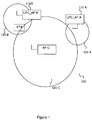
- FIG. 1 shows a wireless communications system implementing a wireless network 100.
- the network 100 comprises three access points LPC_AP A, LPC_AP B and AP C.
- the access point LPC_AP A covers by means of an antenna a space corresponding to the circular area 120A.
- the access point LPC_AP B covers by means of an antenna a space corresponding to the circular zone 120B.
- the access point AP C covers by means of an antenna a space corresponding to the circular zone 120C.
- the network 100 further comprises a client or several STA clients connecting to one of the access points of the network via a wireless link.
- the network thus described advantageously forms a Wi-Fi® network and uses one or more channel frequencies belonging to the 5GHz frequency band.
- the access points LPC_AP A, LPC_AP B and AP C are of the SISO ('Single Input Single Output') type and only have a single antenna.
- SISO Single Input Single Output'
- all of the STA clients are of the SISO type.
- all the access points LPC_AP A, LPC_AP B and AP C are of the MIMO type and have several antennas transmitting a MIMO signal.
- all of the STA clients 130 are of the MIMO type.
- some access points LPC_AP A, LPC_AP B and AP C are of the MIMO type and the others are of the SISO type.
- a low power frequency space is reserved for the access points belonging to a low power set, that is whose power on emission of the signals carrying the wireless communications is limited in particular on this reserved space.
- the power of the signals transmitted by an access point belonging to a low power set is less than a first threshold. Consequently, the power of the signals transmitted by this access point and received by a neighbouring access point is less than a second threshold.
- one way for two wireless access points LPC_AP A and LPC_AP B transmitting on the same frequency band not to interfere is to reduce their emission power thus limiting their coverage zone.
- an access point LPC_AP A decided unilaterally to reduce its emission power, this access point alone would support the disturbances or interferences of the other access points LPC_AP B and AP C.
- One idea of the invention is thus to define a low power policy common to the access points such that collectively these access points limit their emission power.
- a plurality of frequency bands called low power channels noted LPC in the rest of the description, are reserved for the communications of the access points applying the limitation policy of the power.
- the access points LPC_AP A and LPC_AP B applying the low power policy are called low power channel access point noted LPC_AP.
- a low power channel at 5GHz has a reception power level less than a second threshold for example fixed between 0dBm and 5dBm, whereas a normal power channel (or, by opposition, a high power channel) has a power level greater than this second threshold.
- a normal power channel (or, by opposition, a high power channel) has a high power level greater than a third threshold, generally between 20dBm and 25dBm.
- a low power channel at 5GHz is at a power level of approximately 20dB below the normal power.
- Each access point sends a signal comprising information representative of an identifier (BSSID from Basic Service Set IDentifier) of the access point transmitting the signal.
- This signal is called a beacon frame.
- a beacon frame also comprises information representative of its characteristics and is membership with a network, the network also being represented by an identifier.
- the clients or access points, receiving a signal transmitted by a neighbouring access point advantageously estimate the RSSI (Received Signal Strength Indicator) of the signal received and decode the signal to extract from it the identifier of the neighbouring access point transmitting the signal.
- the RSSI can define interference levels between the different access points.
- the access points LPC_AP A and LPC_AP B are located so close to one another that a signal transmitted from the neighbouring access point LPC_AP A, on the same channel on which LPC_AP B sends, is received with an RSSI level above a second threshold (reception power threshold), for example the CCA threshold (Clear Channel Assessment), by the access point LPC_AP B.
- the access points LPC_AP A and LPC_AP B are constrained to share the frequency resource over time by reserving for example temporal spaces.
- the CCA threshold is typically - 82dBm in 20MHz channels.
- the access points LPC_AP A and LPC_AP B are located close enough so that signal transmitted from the neighbouring access point LPC_AP A is received with an RSSI level above the CCA level but still below the detection level of the beacon.
- This beacon is, indeed, transmitted by using a robust modulation mode, and the level of detection associated with the beacon frame is typically -100dBm. In this case, the transmission can be done simultaneously by the two wireless access points on the same channel without significant deterioration.
- the access points LPC_AP A and LPC_AP B are located fairly distant from each other such that they only contribute by increasing the noise level of the other. The impact is only significant if a large number of channels at the same frequency interfere with each other. The impact is limited for 5GHz networks comprising 19 frequency channels.
- some access points do not apply the power limitation policy for many reasons: these access points are not adapted, these access points cannot reach the distant clients without transmitting with high power.
- the access points LPC_AP A and LPC_AP B apply the low power policy, these access points are called collaborative.
- the access point AP C does not apply the limitation policy, AP C is called non-collaborative. If it occupies the same channel as LPC_AP A and LPC_AP B, the non-collaborative access point AP C thus disturbs the communications of the collaborative access points LPC_AP A and LPC_AP B.
- the collaborative access points if they occupy, in number, an LPC channel, will lead a non-collaborative access point to use a different channel from the one used by the collaborative access points.
- the configuration of the access points LPC_AP A, LPC_AP B, AP C and STA clients in the space are a combination of at least two of the previously described configurations.
- other types of signals disturb the wireless communications such as for example the radar signals which, during their transmission, do not take into account the existence of wireless communications.
- the LPC_AP A and LPC_AP B access points transmit a beacon frame signal with a higher power than for the other signals.
- This embodiment leads to a fifth configuration particularly well adapted to the implementation of a low power policy.
- This embodiment uses the characteristic according to which the beacon frame signals advantageously use a robust modulation mode adapted to an optimum configuration of the power amplifier enabling a higher power level to be synthesised for the beacon frames.
- the coverage zone of the beacon frame is more extended than the coverage zone of a communication signal.
- the emission power level of the beacon frame reaches 10dBm according to a variant of this embodiment.
- this level exceeds 20dBm or even 25dBm according to other variants so as to widen the reception zone of the beacon frame.
- the respective beacon frames of the two access points LPC_AP A and LPC_AP B are received at a higher power level than their respective CCA threshold, whereas the communications of the access points with their respective clients are received at a lower power level than their respective CCA threshold.
- the access points thus advantageously do not have to support the interference of each other in their communications with clients located in their coverage zone.
- the beacon frames have a limited duration, the interferences possibly generated by beacon frames of an access point will be negligible with respect to communications from other access points.
- this embodiment is particularly well adapted to the implementation of a low power policy as it can combine a coverage zone for the reduced communications and a detection zone of neighbours in the wide network.
- a limited transmission power for the communications that is less than the first threshold, is compatible with a more extended coverage zone of the access point for the beacon frames.
- a low power access point will therefore have the information that its neighbour or neighbours are also LPC, that they transmit on the same channel as it, that they will not disturb its communications and that by sending on the same channel as its neighbours it increases the LPC community.
- figure 1 can also illustrate an advantage of the invention according to which a multiple occupation of a channel by different collaborative access points LPC_AP A and LPC_AP B can prevent the presence on this channel of a non-collaborative access point AP C. If LPC_AP A and LPC_AP B use the same channel, they are not disturbed by mutual interference as the power level of the beacon frame signal of LPC_AP A received by LPC_AP B is below the CCA threshold of LPC_AP B and reciprocally. This occupation of the same channel will lead to a non-collaborative access point AP C, seeking to use a channel frequency, to select a channel frequency separate from the one shared by LPC_AP A and LPC_AP B as this channel frequency will be occupied in a multiple manner.
- the access points for example linked to access gateways of a communications network, are controlled by an access operator to the network.
- This variant has the advantage of being able to define a limitation policy of the common power and centralised in all the access points at the level of the operator. Several operators can also commit together.
- the access points are located in electronic devices complying with for example the Wi-Fi direct® policy.
- the definition of a common policy of power limitation is possible at the level of the manufacturers of the devices.
- Most of access points are wireless routers, meaning converged devices that include the AP, a router, and, often, an Ethernet switch. Many also include a gateway or broadband modem. Access point may also being implemented in a personal computer (PCs).
- PCs personal computer
- the power received from neighbouring access points on a low power channel is defined by the power of any signal received by the access point, whether this signal transports a beacon frame or communication data to a client. This means that the maximum of the RSSI of the signals received on this channel is less than a threshold, for example the CCA threshold.
- the power received from the neighbouring access points on a low power channel is defined by the average power of any signal received by the access point. This means that the sum of the RSSI of the signals received on this channel related to the activity time of the signals is less than a threshold, for example the CCA threshold.
- the power received from neighbouring access points on a low power channel is defined by the power of any signal received by the access point transporting communication data to a client.
- the reception power of an access point on a low power channel does not take into account signals relative to beacon frames.
- This characteristic is particularly well adapted in the embodiment according to which the power level of the signals transporting beacon frames is greater than the one of signals transporting communication data. This is seen in a maximum of the RSSI of the signals received carrying on this channel communication data to the clients at a threshold, for example the CCA threshold.
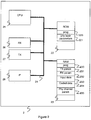
- Figure 2 diagrammatically shows a hardware embodiment of an access point 2 corresponding for example to the access points LPC_AP A or LPC_AP B of figure 1 .
- the access point 2 comprises the following elements, connected to each other by a bus 24 of addresses and data that also transports a clock signal:
- register used in the description of the memories 22 and 23 designates, in each of the memories mentioned, a memory zone of low capacity (some binary data) as well as a memory zone of large capacity (enabling a whole programme to be stored or all or part of the data representative of data received or to be broadcast).
- the memory ROM 22 comprises in particular:
- the algorithms implementing the steps of the method specific to the invention and described below are stored in the ROM 22 memory associated with the access point 2 implementing these steps.
- the microprocessor 21 loads and runs the instructions of these algorithms.
- the random access memory 23 comprises in particular:
- the radio interface 26 is adapted for the reception of signals if necessary by one or more clients or access points shown in figure 1 .
- the interface 27 is a transmitter, adapted for the transmission of signals, particularly an element of information representative of the membership of the LPC set, if necessary to one or more clients or access points shown in figure 1
- FIG 3 diagrammatically shows a hardware embodiment of a client 3 corresponding for example to the STA client of figure 1 .
- STA clients may include any type of electronic devices that are able to connect to WI-FI network such as mobiles phones, smartphones, PCs, tablets, cameras, or printing device. Most of these devices are portable devices.
- the client 3 comprises the following elements, connected together by an address and data bus 34 which also transports a clock signal:
- register used in the description of the memories 32 and 33 designates, in each of the memories mentioned, a memory zone of low capacity (some binary data) as well as a memory zone of large capacity (enabling a whole programme to be stored or all or part of the data representative of data received or to be broadcast).
- the memory ROM 32 comprises in particular:
- the algorithms implementing the steps of the method specific to the invention and described below are stored in the ROM 32 memory associated with the client 3 implementing these steps.
- the microprocessor 31 loads and runs the instructions of these algorithms.
- the random access memory 33 comprises in particular:
- the radio interface 36 is adapted for the reception of signals if necessary by one or more other access points AP or LPC_AP of the network 100 of figure 1 .
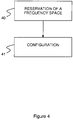
- Figure 4 shows a method for configuration of a wireless network 100 of figure 1 , according to a particularly advantageous non-restrictive embodiment of the invention.
- the different operators and/or constructors define a frequency space reserved for the access points applying the limitation policy of the power.
- This space comprises a set of generally contiguous channels, whose frequency band possibly depends on the country in which the local wireless network is deployed and on the wireless communication standard.
- a channel is defined as a low power channel for all the collaborative access points, that is for the access points that have decided to apply a joint allocation policy of frequency and power.
- a low power channel for a collaborative access point will be any channel for a non-collaborative access point.
- an access point although not transmitting on a low power channel, is collaborative.
- an access point can not transmit on an LPC channel while complying with the low power policy (it transmits on a non-reserved channel so as not to disturb the others): this point of access is collaborative.
- this step it is necessary to determine the parameters of this space among which can be cited the number of low power channels, the occupied frequency band in the spectrum.
- the number of low power channels is high (that is greater than a first defined threshold), for example greater than 10.
- This embodiment has the advantage of limiting the interferences in the house, that is in the space close to the different access points.
- This embodiment is also particularly well adapted when the number of access points applying the low power policy is high.
- the number of low power channels is low (that is less than a second defined threshold), for example limited to 2.
- This embodiment has the advantage of reducing the probability of being disturbed by a non-collaborative access point as this probability increases with the width of the spectrum occupied by the low power access points. For example, if among the 20 access points mentioned above, 16 access points are collaborative and occupy 16 separate LPC channels, it is probable that some of them will have to bear the presence of non-collaborative access points in their transmission channel as the 4 non-collaborative access points will not have a sufficient number of separate channels to transmit without interfering and will place themselves on some LPC channels.
- the access points defined as collaborative and transmitting on the low power channels by complying with the power limitation are configured.
- one or more parameters of at least one low power access point of the network for example a Wi-Fi network using the 5GHz band of frequencies, is configured.
- the parameters to configure can inform the access point on its membership with the low power set i.e. its collaborative character, on the reservation of the frequency space for the collaborative access points and on the channel allocation method.
- the parameters to be configured belong to a group comprising:
- the group of parameters only comprises a single or two of the parameters listed above.
- the first parameter to be configured is a combination of at least two parameters of the group of parameters defined above, for example a combination associating a parameter representative of the LPC character with a physical layer parameter.
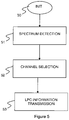
- Figure 5 shows a channel allocation method according to a non-restrictive particularly advantageous embodiment of the invention in a low power access point.
- the various parameters of the access point are configured.
- the parameters corresponding to the information of the LPC character of the access point, to the power level of the signals to transmit, if necessary to the low power channels, are initialised in any manner.
- the initialisation step follows the reception of configuration messages transmitted by a server of a wireless communication system, or even by commands from an operator.
- This variant has the advantage of being able to configure or update an existing configuration for a set of access points already deployed.
- this step is realised during the manufacture of the electronic devices integrating an access point.
- each access point determines, according notably to configured parameters but also to the occupation of the spectrum, a channel on which the access point can transmit.
- the access point detects the signals received on the frequencies of its reception band, notably the beacon frames transmitted by the possible other access points present in the network.
- the access point estimates the reception power of the different beacon frame signals transmitted by the neighbouring access points on these channels.
- the access point adjusts the reception power level according to an element of information of the transmission level of the beacon frame signals of the neighbouring access points.
- the access point estimates the reception power of the different signals transmitted by the neighbouring access points on these channels.
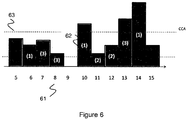
- the access point receives an element of information representative of the reception power of the different signals transmitted by the neighbouring access points on these channels. The access point thus establishes the spectrum of the channels used, the list of collaborative and non-collaborative access points present, the list of the low power channels used and the reception powers of the different neighbouring access points on these channels as shown in figure 6 .
- a low power access point selects a channel to transmit from among the reserved channels.
- the LPC access point selects a channel from among the LPC channels randomly.
- the LPC access point selects the LPC channel on which the greatest number of LPC access points transmit.
- An access point at a high reception power level is, for example, either by a non-collaborative access point, or by a neighbouring collaborative access point located in a very close space, and whose power received by the LPC access point looking to select a channel, is greater than a threshold, for example the CCA threshold.
- a threshold for example the CCA threshold.
- a maximum number of LPC access points per channel is determined. The LPC access point selects the channel from the LPC channels on which the greatest number of LPC access points are transmitting, this number of LPC access points being less than the maximum number determined.
- the LPC access point selects another LPC channel in decreasing order of the number of LPC access points present on this channel, this number must be less than the maximum number determined, In case of equality of the number of LPC access points present on 2 separate channels, the LPC access point advantageously selects the LPC channel with the average power of the signals on this weakest channel.
- the LPC access point advantageously selects a channel that is not LPC, i.e. outside the reserved frequency space. For this, the access point selects a channel according to a method known by those skilled in the art.
- the access point that selected a channel transmits a basic element of information representative of its membership to a limitation policy of the power.
- the access point transmits a beacon frame signal comprising this basic element of information.
- the beacon frame is advantageously compliant with the standard IEEE 802.11-2007 or IEEE 802.11-2012.
- the implementation of the transmission of the LPC information of an access point is realised via an information element (noted IE) available in the standard.
- IE information element
- This element, transmitted by the beacon frame advantageously enables a collaborative access point to provide the neighbouring access point and the clients in its coverage zone with information on its membership of the set of collaborative access points in terms of limitation of the power.
- the set of collaborative access points will recognise each other.
- a collaborative access point can change channel, that is reiterate the allocation step, if a non-collaborative access point or a source of interference (such as a radar source) emerges on this channel.
- a collaborative access point can go from the low power collaborative mode to the non-collaborative mode dynamically so as to adapt its transmission channel and its power level to its environment.
- This embodiment is well adapted to the example where one of the STA clients of the collaborative access point is mobile and moves away from the zone covered with a limited power. In this case, the access point consequently modifies the information of the beacon frame.
- Figure 6 shows an example of detected spectrum according to a particular embodiment.
- the different channels 61 of the spectrum numbered from 5 to 15, are shown.
- the channels numbered 6-14 belong to the reserved frequency space comprising the LPC channels.
- 6 LPC channels only, (that is the channels 6 to 9, 11 and 12) receive on these frequencies communications with a power level below the CCA threshold 63.
- Out of these 6 remaining LPC channels only 5 are actually occupied by a collaborative access point.
- the one of LPC channels 7 or 8 will be selected by an access point during the IPC channel allocation step as these LPC channels comprise the greatest number 62 of access points (that is 3). It is further assumed that the number 3 is below the maximum number determined of LPC access points per LPC channel.
- an LPC access point advantageously selects an LPC channel from the channel 7 and the channel 8 on RSSI average power criteria.
- the invention is not limited to the network comprising two collaborative access points as shown in figure 1 .
- the invention is well adapted to unlicensed band communications.
- the network is not limited to a Wi-Fi® network using a 5GHz frequency band but extends to any WLAN type wireless network, such as for example HiperLAN2 or Femtocell using LTE (Long Term Evolution) or using HSDPA (High Speed Downlink Packet Access).
- the network extends to any wireless network of type WLAN or WPAN (Wireless Personal Area Network), such as for example a W-Fi network using the 2.4GHz frequency band (standards IEEE 802.11b or IEEE 802.11g), a Bluetooth type network (standard IEEE 802.15.1), WiMax (standard IEEE 802.16), RAN (Regional Access Network, standard IEEE 802.22) or a ETSI HiperPAN network.
- the invention is not limited to a type of network but extends to any set of coexisting networks and that can extend in such a manner to cooperate with regard to joint configuration of frequency and power.
- the invention is not limited either to the frequency allocation step described. Any existing allocation procedure is compatible with the invention as soon as the transmission power of an LPC access point on this LPC channel meets the limitation criteria of the power.
Landscapes
- Engineering & Computer Science (AREA)
- Computer Networks & Wireless Communication (AREA)
- Signal Processing (AREA)
- Mobile Radio Communication Systems (AREA)
- Small-Scale Networks (AREA)
Applications Claiming Priority (2)
| Application Number | Priority Date | Filing Date | Title |
|---|---|---|---|
| FR1254791A FR2991123A1 (fr) | 2012-05-24 | 2012-05-24 | Procede de configuration d'un reseau sans fil |
| PCT/EP2013/060681 WO2013174953A1 (en) | 2012-05-24 | 2013-05-23 | Method for configuration of a wireless network |
Publications (2)
| Publication Number | Publication Date |
|---|---|
| EP2856793A1 EP2856793A1 (en) | 2015-04-08 |
| EP2856793B1 true EP2856793B1 (en) | 2016-04-27 |
Family
ID=47137802
Family Applications (1)
| Application Number | Title | Priority Date | Filing Date |
|---|---|---|---|
| EP13726154.1A Not-in-force EP2856793B1 (en) | 2012-05-24 | 2013-05-23 | Method for configuration of a wireless network |
Country Status (8)
| Country | Link |
|---|---|
| US (1) | US9949206B2 (enExample) |
| EP (1) | EP2856793B1 (enExample) |
| JP (1) | JP6139668B2 (enExample) |
| KR (1) | KR20150022881A (enExample) |
| CN (1) | CN104380784B (enExample) |
| BR (1) | BR112014028714A2 (enExample) |
| FR (1) | FR2991123A1 (enExample) |
| WO (1) | WO2013174953A1 (enExample) |
Families Citing this family (9)
| Publication number | Priority date | Publication date | Assignee | Title |
|---|---|---|---|---|
| US9729299B2 (en) * | 2013-05-03 | 2017-08-08 | Qualcomm, Incorporated | Methods and systems for communication in dense wireless environments |
| EP3261387B1 (en) * | 2014-02-07 | 2021-05-12 | Sony Corporation | Communications devices and methods for selecting a wireless access interface |
| US10075333B2 (en) | 2014-08-12 | 2018-09-11 | Maxlinear, Inc. | Method and apparatus for admission to a MoCA network |
| US9813999B2 (en) * | 2014-08-12 | 2017-11-07 | Maxlinear, Inc. | Method and apparatus for determining MoCA beacon transmit power |
| EP2996425A1 (en) | 2014-09-10 | 2016-03-16 | Thomson Licensing | Method for operating a first wireless node communicating with a second wireless node, and device performing the method |
| US9629181B1 (en) * | 2014-09-29 | 2017-04-18 | Cisco Technology, Inc. | Link aware clear channel assessment |
| JP6727189B2 (ja) * | 2015-03-11 | 2020-07-22 | シャープ株式会社 | 端末装置および通信方法 |
| WO2023000273A1 (zh) * | 2021-07-22 | 2023-01-26 | Oppo广东移动通信有限公司 | 网络接入方法、参数配置方法、装置、设备及存储介质 |
| WO2024181825A1 (ko) * | 2023-03-02 | 2024-09-06 | 엘지전자 주식회사 | 무선랜 시스템에서 ap의 파워 세이빙 방법 및 장치 |
Family Cites Families (19)
| Publication number | Priority date | Publication date | Assignee | Title |
|---|---|---|---|---|
| US5805995A (en) * | 1996-10-28 | 1998-09-08 | Northern Telecom Limited | Channel reservation and power control for improved handoff performance |
| CN1778124A (zh) | 2003-02-24 | 2006-05-24 | 奥托塞尔实验室公司 | 无线网络中的信道选择系统和方法 |
| US7565149B2 (en) * | 2003-09-23 | 2009-07-21 | British Telecommunications Public Limited Company | Channel selection |
| US7346356B2 (en) | 2004-07-07 | 2008-03-18 | Motorola, Inc. | Method and communication unit for use in a wideband wireless communications system |
| WO2007072111A1 (en) | 2005-12-22 | 2007-06-28 | Nokia Corporation | A low power radio device with reduced interference |
| US7483700B2 (en) | 2006-08-14 | 2009-01-27 | Motorola, Inc. | Method and apparatus for determining appropriate channels for communication |
| US7809012B2 (en) | 2007-02-16 | 2010-10-05 | Nokia Corporation | Managing low-power wireless mediums in multiradio devices |
| JP5001024B2 (ja) | 2007-02-19 | 2012-08-15 | シャープ株式会社 | 無線通信システムおよびその制御方法 |
| CN101018082B (zh) | 2007-03-12 | 2010-05-26 | 杭州华三通信技术有限公司 | 接入点的功率控制方法及设备 |
| US8467304B2 (en) * | 2008-06-19 | 2013-06-18 | Qualcomm Incorporated | Self-configuration for femtocells |
| UA99537C2 (en) * | 2008-07-01 | 2012-08-27 | Квелкомм Инкорпорейтед | Network element configuration scheme |
| JP5366464B2 (ja) * | 2008-07-28 | 2013-12-11 | 京セラ株式会社 | 基地局、サーバ及び通信システム |
| US8374138B2 (en) * | 2008-10-31 | 2013-02-12 | Samsung Electronics Co., Ltd. | Femtocell base station apparatus and self-configuring method thereof |
| KR101346110B1 (ko) | 2009-01-09 | 2013-12-31 | 닛본 덴끼 가부시끼가이샤 | 기지국 장치, 이동국 장치, 통신 시스템, 기지국 장치의 제어 방법, 이동국 장치의 제어 방법, 및 프로그램이 저장된 기록 매체 |
| US8644273B2 (en) * | 2009-07-01 | 2014-02-04 | Apple Inc. | Methods and apparatus for optimization of femtocell network management |
| US20110045835A1 (en) * | 2009-08-21 | 2011-02-24 | Joey Chou | Self-configuration of femtocell access points (fap) |
| EP2302979B1 (en) | 2009-09-24 | 2012-08-01 | Mitsubishi Electric R&D Centre Europe B.V. | Method for enabling home base stations to collaborate in a wireless cellular telecommunication network |
| EP2543223B1 (en) * | 2010-03-04 | 2017-10-11 | Nec Corporation | Method and femtocell base station for supporting wireless connectivity of a mobile station to a cellular network |
| KR20120070297A (ko) | 2010-12-21 | 2012-06-29 | 한국전자통신연구원 | 펨토셀 기지국 탐색 시스템 및 방법 |
-
2012
- 2012-05-24 FR FR1254791A patent/FR2991123A1/fr active Pending
-
2013
- 2013-05-23 KR KR1020147036051A patent/KR20150022881A/ko not_active Abandoned
- 2013-05-23 US US14/403,174 patent/US9949206B2/en not_active Expired - Fee Related
- 2013-05-23 CN CN201380027053.6A patent/CN104380784B/zh not_active Expired - Fee Related
- 2013-05-23 EP EP13726154.1A patent/EP2856793B1/en not_active Not-in-force
- 2013-05-23 WO PCT/EP2013/060681 patent/WO2013174953A1/en not_active Ceased
- 2013-05-23 JP JP2015513196A patent/JP6139668B2/ja not_active Expired - Fee Related
- 2013-05-23 BR BR112014028714A patent/BR112014028714A2/pt not_active Application Discontinuation
Also Published As
| Publication number | Publication date |
|---|---|
| BR112014028714A2 (pt) | 2017-06-27 |
| JP6139668B2 (ja) | 2017-05-31 |
| US9949206B2 (en) | 2018-04-17 |
| WO2013174953A1 (en) | 2013-11-28 |
| JP2015521002A (ja) | 2015-07-23 |
| US20150098378A1 (en) | 2015-04-09 |
| KR20150022881A (ko) | 2015-03-04 |
| CN104380784A (zh) | 2015-02-25 |
| FR2991123A1 (fr) | 2013-11-29 |
| EP2856793A1 (en) | 2015-04-08 |
| CN104380784B (zh) | 2018-04-17 |
Similar Documents
| Publication | Publication Date | Title |
|---|---|---|
| EP2856793B1 (en) | Method for configuration of a wireless network | |
| CN112438072B (zh) | 用于随机接入过程的先听后说(lbt)模式 | |
| US8326309B2 (en) | Resource allocation in co-existence mode | |
| US10165596B2 (en) | Method and apparatus for transmitting frame in wireless local area network | |
| US9107089B2 (en) | Method, apparatus, and computer program product for location based query for interferer discovery in coexistence management system | |
| US20150256323A1 (en) | Method and system for creating two independent wireless networks with an access point | |
| US20200314954A1 (en) | Data transmission method, access point and station | |
| US9008581B2 (en) | Radio devices and methods for controlling radio devices | |
| KR20160005059A (ko) | 피어-투-피어 및 ap 트래픽 멀티플렉싱을 위한 시스템들 및 방법들 | |
| US20150264593A1 (en) | Method for managing heterogeneous base stations in a wireless network | |
| EP3017642A1 (en) | Performing measurements in wireless network | |
| EP4410016A1 (en) | Intelligent interference mitigation for time division duplexing broadband networks | |
| EP4305899B1 (en) | Techniques for sidelink resource reservation | |
| US20170041955A1 (en) | Techniques for using traffic monitoring for co-existence with unlicensed networks | |
| US9936503B2 (en) | Method and device for determining WLAN channel | |
| WO2022047450A1 (en) | Cell selection techniques for dual-connectivity operation | |
| US20240259958A1 (en) | METHODS AND APPARATUS FOR OPERATION IN 6 GHz AND COEXISTENCE WITH INCUMBENTS | |
| US9826551B2 (en) | Method and apparatus for bandwidth dependent access coordination to a shared transmission medium | |
| CN116326071B (zh) | 高频波束切换 | |
| US20260006454A1 (en) | Techniques for determining an updated maximum supported bandwidth |
Legal Events
| Date | Code | Title | Description |
|---|---|---|---|
| PUAI | Public reference made under article 153(3) epc to a published international application that has entered the european phase |
Free format text: ORIGINAL CODE: 0009012 |
|
| 17P | Request for examination filed |
Effective date: 20141202 |
|
| AK | Designated contracting states |
Kind code of ref document: A1 Designated state(s): AL AT BE BG CH CY CZ DE DK EE ES FI FR GB GR HR HU IE IS IT LI LT LU LV MC MK MT NL NO PL PT RO RS SE SI SK SM TR |
|
| AX | Request for extension of the european patent |
Extension state: BA ME |
|
| DAX | Request for extension of the european patent (deleted) | ||
| RIC1 | Information provided on ipc code assigned before grant |
Ipc: H04W 52/02 20090101ALI20151008BHEP Ipc: H04W 24/02 20090101AFI20151008BHEP |
|
| GRAP | Despatch of communication of intention to grant a patent |
Free format text: ORIGINAL CODE: EPIDOSNIGR1 |
|
| INTG | Intention to grant announced |
Effective date: 20151125 |
|
| RIN1 | Information on inventor provided before grant (corrected) |
Inventor name: DORE, RENAUD Inventor name: BARON, FRANCOIS Inventor name: CHAMBELIN, PHILIPPE |
|
| GRAS | Grant fee paid |
Free format text: ORIGINAL CODE: EPIDOSNIGR3 |
|
| GRAA | (expected) grant |
Free format text: ORIGINAL CODE: 0009210 |
|
| AK | Designated contracting states |
Kind code of ref document: B1 Designated state(s): AL AT BE BG CH CY CZ DE DK EE ES FI FR GB GR HR HU IE IS IT LI LT LU LV MC MK MT NL NO PL PT RO RS SE SI SK SM TR |
|
| REG | Reference to a national code |
Ref country code: GB Ref legal event code: FG4D |
|
| REG | Reference to a national code |
Ref country code: CH Ref legal event code: EP |
|
| REG | Reference to a national code |
Ref country code: AT Ref legal event code: REF Ref document number: 795952 Country of ref document: AT Kind code of ref document: T Effective date: 20160515 |
|
| REG | Reference to a national code |
Ref country code: IE Ref legal event code: FG4D |
|
| REG | Reference to a national code |
Ref country code: FR Ref legal event code: PLFP Year of fee payment: 4 |
|
| REG | Reference to a national code |
Ref country code: GB Ref legal event code: 746 Effective date: 20160513 |
|
| REG | Reference to a national code |
Ref country code: DE Ref legal event code: R096 Ref document number: 602013007076 Country of ref document: DE |
|
| PGFP | Annual fee paid to national office [announced via postgrant information from national office to epo] |
Ref country code: DE Payment date: 20160512 Year of fee payment: 4 |
|
| REG | Reference to a national code |
Ref country code: LT Ref legal event code: MG4D |
|
| PG25 | Lapsed in a contracting state [announced via postgrant information from national office to epo] |
Ref country code: BE Free format text: LAPSE BECAUSE OF NON-PAYMENT OF DUE FEES Effective date: 20160531 |
|
| REG | Reference to a national code |
Ref country code: NL Ref legal event code: MP Effective date: 20160427 |
|
| REG | Reference to a national code |
Ref country code: AT Ref legal event code: MK05 Ref document number: 795952 Country of ref document: AT Kind code of ref document: T Effective date: 20160427 |
|
| PG25 | Lapsed in a contracting state [announced via postgrant information from national office to epo] |
Ref country code: NL Free format text: LAPSE BECAUSE OF FAILURE TO SUBMIT A TRANSLATION OF THE DESCRIPTION OR TO PAY THE FEE WITHIN THE PRESCRIBED TIME-LIMIT Effective date: 20160427 |
|
| PG25 | Lapsed in a contracting state [announced via postgrant information from national office to epo] |
Ref country code: FI Free format text: LAPSE BECAUSE OF FAILURE TO SUBMIT A TRANSLATION OF THE DESCRIPTION OR TO PAY THE FEE WITHIN THE PRESCRIBED TIME-LIMIT Effective date: 20160427 Ref country code: PL Free format text: LAPSE BECAUSE OF FAILURE TO SUBMIT A TRANSLATION OF THE DESCRIPTION OR TO PAY THE FEE WITHIN THE PRESCRIBED TIME-LIMIT Effective date: 20160427 Ref country code: LT Free format text: LAPSE BECAUSE OF FAILURE TO SUBMIT A TRANSLATION OF THE DESCRIPTION OR TO PAY THE FEE WITHIN THE PRESCRIBED TIME-LIMIT Effective date: 20160427 Ref country code: NO Free format text: LAPSE BECAUSE OF FAILURE TO SUBMIT A TRANSLATION OF THE DESCRIPTION OR TO PAY THE FEE WITHIN THE PRESCRIBED TIME-LIMIT Effective date: 20160727 |
|
| PG25 | Lapsed in a contracting state [announced via postgrant information from national office to epo] |
Ref country code: LV Free format text: LAPSE BECAUSE OF FAILURE TO SUBMIT A TRANSLATION OF THE DESCRIPTION OR TO PAY THE FEE WITHIN THE PRESCRIBED TIME-LIMIT Effective date: 20160427 Ref country code: AT Free format text: LAPSE BECAUSE OF FAILURE TO SUBMIT A TRANSLATION OF THE DESCRIPTION OR TO PAY THE FEE WITHIN THE PRESCRIBED TIME-LIMIT Effective date: 20160427 Ref country code: PT Free format text: LAPSE BECAUSE OF FAILURE TO SUBMIT A TRANSLATION OF THE DESCRIPTION OR TO PAY THE FEE WITHIN THE PRESCRIBED TIME-LIMIT Effective date: 20160829 Ref country code: SE Free format text: LAPSE BECAUSE OF FAILURE TO SUBMIT A TRANSLATION OF THE DESCRIPTION OR TO PAY THE FEE WITHIN THE PRESCRIBED TIME-LIMIT Effective date: 20160427 Ref country code: ES Free format text: LAPSE BECAUSE OF FAILURE TO SUBMIT A TRANSLATION OF THE DESCRIPTION OR TO PAY THE FEE WITHIN THE PRESCRIBED TIME-LIMIT Effective date: 20160427 Ref country code: HR Free format text: LAPSE BECAUSE OF FAILURE TO SUBMIT A TRANSLATION OF THE DESCRIPTION OR TO PAY THE FEE WITHIN THE PRESCRIBED TIME-LIMIT Effective date: 20160427 Ref country code: GR Free format text: LAPSE BECAUSE OF FAILURE TO SUBMIT A TRANSLATION OF THE DESCRIPTION OR TO PAY THE FEE WITHIN THE PRESCRIBED TIME-LIMIT Effective date: 20160728 Ref country code: RS Free format text: LAPSE BECAUSE OF FAILURE TO SUBMIT A TRANSLATION OF THE DESCRIPTION OR TO PAY THE FEE WITHIN THE PRESCRIBED TIME-LIMIT Effective date: 20160427 |
|
| PG25 | Lapsed in a contracting state [announced via postgrant information from national office to epo] |
Ref country code: IT Free format text: LAPSE BECAUSE OF FAILURE TO SUBMIT A TRANSLATION OF THE DESCRIPTION OR TO PAY THE FEE WITHIN THE PRESCRIBED TIME-LIMIT Effective date: 20160427 Ref country code: BE Free format text: LAPSE BECAUSE OF FAILURE TO SUBMIT A TRANSLATION OF THE DESCRIPTION OR TO PAY THE FEE WITHIN THE PRESCRIBED TIME-LIMIT Effective date: 20160427 |
|
| REG | Reference to a national code |
Ref country code: CH Ref legal event code: PL |
|
| REG | Reference to a national code |
Ref country code: DE Ref legal event code: R097 Ref document number: 602013007076 Country of ref document: DE |
|
| PG25 | Lapsed in a contracting state [announced via postgrant information from national office to epo] |
Ref country code: SK Free format text: LAPSE BECAUSE OF FAILURE TO SUBMIT A TRANSLATION OF THE DESCRIPTION OR TO PAY THE FEE WITHIN THE PRESCRIBED TIME-LIMIT Effective date: 20160427 Ref country code: EE Free format text: LAPSE BECAUSE OF FAILURE TO SUBMIT A TRANSLATION OF THE DESCRIPTION OR TO PAY THE FEE WITHIN THE PRESCRIBED TIME-LIMIT Effective date: 20160427 Ref country code: DK Free format text: LAPSE BECAUSE OF FAILURE TO SUBMIT A TRANSLATION OF THE DESCRIPTION OR TO PAY THE FEE WITHIN THE PRESCRIBED TIME-LIMIT Effective date: 20160427 Ref country code: MC Free format text: LAPSE BECAUSE OF FAILURE TO SUBMIT A TRANSLATION OF THE DESCRIPTION OR TO PAY THE FEE WITHIN THE PRESCRIBED TIME-LIMIT Effective date: 20160427 Ref country code: CZ Free format text: LAPSE BECAUSE OF FAILURE TO SUBMIT A TRANSLATION OF THE DESCRIPTION OR TO PAY THE FEE WITHIN THE PRESCRIBED TIME-LIMIT Effective date: 20160427 Ref country code: RO Free format text: LAPSE BECAUSE OF FAILURE TO SUBMIT A TRANSLATION OF THE DESCRIPTION OR TO PAY THE FEE WITHIN THE PRESCRIBED TIME-LIMIT Effective date: 20160427 Ref country code: CH Free format text: LAPSE BECAUSE OF NON-PAYMENT OF DUE FEES Effective date: 20160531 Ref country code: LI Free format text: LAPSE BECAUSE OF NON-PAYMENT OF DUE FEES Effective date: 20160531 |
|
| REG | Reference to a national code |
Ref country code: DE Ref legal event code: R084 Ref document number: 602013007076 Country of ref document: DE |
|
| REG | Reference to a national code |
Ref country code: IE Ref legal event code: MM4A |
|
| PG25 | Lapsed in a contracting state [announced via postgrant information from national office to epo] |
Ref country code: SM Free format text: LAPSE BECAUSE OF FAILURE TO SUBMIT A TRANSLATION OF THE DESCRIPTION OR TO PAY THE FEE WITHIN THE PRESCRIBED TIME-LIMIT Effective date: 20160427 |
|
| PLBE | No opposition filed within time limit |
Free format text: ORIGINAL CODE: 0009261 |
|
| STAA | Information on the status of an ep patent application or granted ep patent |
Free format text: STATUS: NO OPPOSITION FILED WITHIN TIME LIMIT |
|
| 26N | No opposition filed |
Effective date: 20170130 |
|
| REG | Reference to a national code |
Ref country code: FR Ref legal event code: PLFP Year of fee payment: 5 |
|
| PG25 | Lapsed in a contracting state [announced via postgrant information from national office to epo] |
Ref country code: IE Free format text: LAPSE BECAUSE OF NON-PAYMENT OF DUE FEES Effective date: 20160523 Ref country code: SI Free format text: LAPSE BECAUSE OF FAILURE TO SUBMIT A TRANSLATION OF THE DESCRIPTION OR TO PAY THE FEE WITHIN THE PRESCRIBED TIME-LIMIT Effective date: 20160427 |
|
| REG | Reference to a national code |
Ref country code: DE Ref legal event code: R119 Ref document number: 602013007076 Country of ref document: DE |
|
| PG25 | Lapsed in a contracting state [announced via postgrant information from national office to epo] |
Ref country code: DE Free format text: LAPSE BECAUSE OF NON-PAYMENT OF DUE FEES Effective date: 20171201 |
|
| REG | Reference to a national code |
Ref country code: FR Ref legal event code: PLFP Year of fee payment: 6 |
|
| PG25 | Lapsed in a contracting state [announced via postgrant information from national office to epo] |
Ref country code: HU Free format text: LAPSE BECAUSE OF FAILURE TO SUBMIT A TRANSLATION OF THE DESCRIPTION OR TO PAY THE FEE WITHIN THE PRESCRIBED TIME-LIMIT; INVALID AB INITIO Effective date: 20130523 |
|
| PG25 | Lapsed in a contracting state [announced via postgrant information from national office to epo] |
Ref country code: LU Free format text: LAPSE BECAUSE OF NON-PAYMENT OF DUE FEES Effective date: 20160523 Ref country code: MT Free format text: LAPSE BECAUSE OF NON-PAYMENT OF DUE FEES Effective date: 20160531 Ref country code: IS Free format text: LAPSE BECAUSE OF FAILURE TO SUBMIT A TRANSLATION OF THE DESCRIPTION OR TO PAY THE FEE WITHIN THE PRESCRIBED TIME-LIMIT Effective date: 20160427 Ref country code: MK Free format text: LAPSE BECAUSE OF FAILURE TO SUBMIT A TRANSLATION OF THE DESCRIPTION OR TO PAY THE FEE WITHIN THE PRESCRIBED TIME-LIMIT Effective date: 20160427 Ref country code: CY Free format text: LAPSE BECAUSE OF FAILURE TO SUBMIT A TRANSLATION OF THE DESCRIPTION OR TO PAY THE FEE WITHIN THE PRESCRIBED TIME-LIMIT Effective date: 20160427 |
|
| PG25 | Lapsed in a contracting state [announced via postgrant information from national office to epo] |
Ref country code: BG Free format text: LAPSE BECAUSE OF FAILURE TO SUBMIT A TRANSLATION OF THE DESCRIPTION OR TO PAY THE FEE WITHIN THE PRESCRIBED TIME-LIMIT Effective date: 20160427 |
|
| PG25 | Lapsed in a contracting state [announced via postgrant information from national office to epo] |
Ref country code: TR Free format text: LAPSE BECAUSE OF FAILURE TO SUBMIT A TRANSLATION OF THE DESCRIPTION OR TO PAY THE FEE WITHIN THE PRESCRIBED TIME-LIMIT Effective date: 20160427 Ref country code: AL Free format text: LAPSE BECAUSE OF FAILURE TO SUBMIT A TRANSLATION OF THE DESCRIPTION OR TO PAY THE FEE WITHIN THE PRESCRIBED TIME-LIMIT Effective date: 20160427 |
|
| REG | Reference to a national code |
Ref country code: GB Ref legal event code: 732E Free format text: REGISTERED BETWEEN 20190822 AND 20190828 |
|
| PGFP | Annual fee paid to national office [announced via postgrant information from national office to epo] |
Ref country code: FR Payment date: 20200527 Year of fee payment: 8 |
|
| PGFP | Annual fee paid to national office [announced via postgrant information from national office to epo] |
Ref country code: GB Payment date: 20200528 Year of fee payment: 8 |
|
| GBPC | Gb: european patent ceased through non-payment of renewal fee |
Effective date: 20210523 |
|
| PG25 | Lapsed in a contracting state [announced via postgrant information from national office to epo] |
Ref country code: GB Free format text: LAPSE BECAUSE OF NON-PAYMENT OF DUE FEES Effective date: 20210523 |
|
| PG25 | Lapsed in a contracting state [announced via postgrant information from national office to epo] |
Ref country code: FR Free format text: LAPSE BECAUSE OF NON-PAYMENT OF DUE FEES Effective date: 20210531 |