EP2855371B2 - A water softening composition - Google Patents
A water softening composition Download PDFInfo
- Publication number
- EP2855371B2 EP2855371B2 EP13774470.2A EP13774470A EP2855371B2 EP 2855371 B2 EP2855371 B2 EP 2855371B2 EP 13774470 A EP13774470 A EP 13774470A EP 2855371 B2 EP2855371 B2 EP 2855371B2
- Authority
- EP
- European Patent Office
- Prior art keywords
- agent
- water
- polymer
- agents
- water softening
- Prior art date
- Legal status (The legal status is an assumption and is not a legal conclusion. Google has not performed a legal analysis and makes no representation as to the accuracy of the status listed.)
- Active
Links
Images
Classifications
-
- C—CHEMISTRY; METALLURGY
- C02—TREATMENT OF WATER, WASTE WATER, SEWAGE, OR SLUDGE
- C02F—TREATMENT OF WATER, WASTE WATER, SEWAGE, OR SLUDGE
- C02F5/00—Softening water; Preventing scale; Adding scale preventatives or scale removers to water, e.g. adding sequestering agents
- C02F5/08—Treatment of water with complexing chemicals or other solubilising agents for softening, scale prevention or scale removal, e.g. adding sequestering agents
- C02F5/10—Treatment of water with complexing chemicals or other solubilising agents for softening, scale prevention or scale removal, e.g. adding sequestering agents using organic substances
-
- C—CHEMISTRY; METALLURGY
- C11—ANIMAL OR VEGETABLE OILS, FATS, FATTY SUBSTANCES OR WAXES; FATTY ACIDS THEREFROM; DETERGENTS; CANDLES
- C11D—DETERGENT COMPOSITIONS; USE OF SINGLE SUBSTANCES AS DETERGENTS; SOAP OR SOAP-MAKING; RESIN SOAPS; RECOVERY OF GLYCEROL
- C11D3/00—Other compounding ingredients of detergent compositions covered in group C11D1/00
- C11D3/16—Organic compounds
- C11D3/37—Polymers
- C11D3/3746—Macromolecular compounds obtained by reactions only involving carbon-to-carbon unsaturated bonds
- C11D3/3757—(Co)polymerised carboxylic acids, -anhydrides, -esters in solid and liquid compositions
-
- C—CHEMISTRY; METALLURGY
- C02—TREATMENT OF WATER, WASTE WATER, SEWAGE, OR SLUDGE
- C02F—TREATMENT OF WATER, WASTE WATER, SEWAGE, OR SLUDGE
- C02F2303/00—Specific treatment goals
- C02F2303/22—Eliminating or preventing deposits, scale removal, scale prevention
-
- C—CHEMISTRY; METALLURGY
- C02—TREATMENT OF WATER, WASTE WATER, SEWAGE, OR SLUDGE
- C02F—TREATMENT OF WATER, WASTE WATER, SEWAGE, OR SLUDGE
- C02F2307/00—Location of water treatment or water treatment device
- C02F2307/12—Location of water treatment or water treatment device as part of household appliances such as dishwashers, laundry washing machines or vacuum cleaners
Definitions
- Document EP 1 935 852 describes a water softener composition
- a water softener composition comprising a) one or more polycarboxylic acid homopolymer(s) or salt(s) thereof in an amount of 1 to 90 wt.%, b) one or more low molecular polycarboxylic acid(s) or salt(s) thereof in an amount of 1 to 90 wt.%, and c) one or more copolymer(s) based on maleic acid or (meth)acrylic acid or salt(s) thereof in an amount of 0.1 to 25 wt.%, wherein the one or more comonomer(s) is/are selected from the group comprising i) hydrophobic monomers, ii) hydrophobic monomers with one or more hydrophilic groups, and iii) hydrophilic monomers with hydrophilic groups.
- compositions which are "built” which provide a water softening effect and an increase to the efficiency of the detergent used therein.
- such compositions are not effective for softening the water in the rinse cycle of ware washing machines since such compositions are pumped out of the machine along with the dirty water prior to the rinse cycle. Therefore, scale deposits may build up on the hard surfaces of the washing machine such as the heating element, as well as the fabric of the items being worked.
- a water softening composition comprising a combination of polymeric water softening agents; the first agent comprising a polymer of an unsaturated carboxylic acid and the second agent comprising a co-polymer of an unsaturated poly-carboxylic acid.
- Both agents may be fully, partially or non-neutralised.
- composition displays high efficacy in providing a water softening function and a soap scum removal function.
- the composition will be used for providing a water softening function in a clothes washing machine.
- a method according to claim 1 by providing a water softening composition comprising a combination of polymeric water softening agents; the first agent comprising a polymer of an unsaturated carboxylic acid and the second agent comprising a co-polymer of an unsaturated poly-carboxylic acid and an unsaturated carboxylic acid.
- the reason for the high efficacy of the method of the invention is that the particle size of potentially problematic deposit forming agents (such as one or more metal cations associated with hard water (e.g. Ca 2+ , Mg 2+ ) complexing with other agents (e.g. fatty acid anions from detergent agents) is greatly reduced. This means that they ate much more readily suspended in solution and hence removed from a washing machine, e.g. by suspension in rinse / drain water.
- potentially problematic deposit forming agents such as one or more metal cations associated with hard water (e.g. Ca 2+ , Mg 2+ ) complexing with other agents (e.g. fatty acid anions from detergent agents) is greatly reduced. This means that they ate much more readily suspended in solution and hence removed from a washing machine, e.g. by suspension in rinse / drain water.
- the first agent comprises a polyacrylate, i.e. a polymer of acrylic acid / acrylate.
- the polyacrylate has a molecular weight of from 4000 to 8000.
- a preferred example is Acusol 445N (available from Dow) ( CAS REG Nr. 66019-18-9 ).
- the unsaturated poly-carboxylic acid comprises a copolymer.
- the copolymer includes maleic acid and an olefin (e.g. such as ethylene, propylene, butene, butadiene)
- the copolymer has a molecular weight of 5000 to 15000.
- a preferred example is Acusol 460NK (available from Dow).
- a further preferred example is SOKALAN CP9 (available from BASF).
- the weight ratio of the first agent to the second agent is preferably from 15:1 to 1:1, more preferably from 10:1 to 1:1, more preferably from 7:1 to 1:1, most preferably about 4:1.
- composition comprises from 8 to 12wt% of the first agent and about 0.5 to 2wt% of the second agent.
- An acid may be present in an amount of up to 20%, more preferably up to 15%, more preferably up to 10%, more preferably up to 7%, and most preferably around 5%.
- the acid is preferably present in an amount of more than 1%, more preferably more than 2%, more preferably more than 3%, more preferably more than 4%, and most preferably around 5%.
- Suitable acids are citric, phosphoric, sulphamic, acetic, formic, glycolic and oxalic acid.
- the acid is citric acid.
- the water softening agent may also act as an acid - examples of such "acidic” water softening agents include polycarboxylate polymers (see below)).
- An alkali may be present in an amount of up to 20%, more preferably up to 15%, and most preferably around 10%.
- the alkali may be present in an amount of more than 1%, more preferably more than 3%, more preferably more than 5%, more preferably more than 7%, and most preferably around 10%.
- the alkali is preferably a sodium / potassium carbonate / salt of a carboxylic acid such as sodium bicarbonate.
- Sodium silicate may be used as an alkali, either in addition to or as an alternative to the carbonate / salt of a carboxylic acid. Where present the sodium silicate may be present in an amount of 1 -3%.
- the composition has a pH of (at 1% solution) of from 5.5 to 9.5, more preferably 7 (+ / - 0.5).
- composition may contain one or more detergent adjuncts such as dye transfer inhibitor, enzyme, optical brightener, soil suspending agent.
- detergent adjuncts such as dye transfer inhibitor, enzyme, optical brightener, soil suspending agent.
- an auxiliary water softening agent is also present. Preferred amounts present are from 5 to 80% wt.
- Preferred organic water-soluble water softening agents which may be present include polycarboxylate polymers, such as polyacrylates, acrylic/maleic copolymers, and acrylic phosphonates, monomeric polycarboxylates such as citrates, gluconates, oxydisuccinates, glycerol mono- di- and trisuccinates, carboxymethyloxysuccinates, carboxymethyloxymalonates, dipicolinates, hydroxyethyliminodiacetates, phosphonates, iminodisuccinates, polyaspartic acids, BHT, phosphonatestabilisers such as, diethylenetriaminepenta (methylene phosphonic acid and its corresponding pentasodium salt) available under the trade names Dequest 2060 and Dequest 2066 Monsanto Chemical Co), DTPMP and DTPMA (Dequest 2010) and HEDP.
- polycarboxylate polymers such as polyacrylates, acrylic/maleic copolymers, and acrylic phosphonates
- This method is an adaptation of the Hampshire test of the calcium carbonate dispersing capacity of polymers.
- solutions to be titrated are prepared by adding to a 150mL beaker 10mL of the soap solution and different volumes of the polymer solution. The total volume is then made up to 100mL with deionised water, and the obtained solution is titrated with the calcium solution. Following the same procedure, solutions containing different blends of the two polymers are prepared and titrated.
- a Mettler Toledo automatic titrator equipped with a phototrode has been employed.
- the equivalence point of the titration i.e. hard water solution volume
- the equivalence point of the titration was taken as a measure of the calcium soap dispersing capacity of the polymer, or of the blends of polymers, bigger volumes indicating better dispersing capacity.
- the analyses of the resulting surface shows a synergy in the activity of Acusol 445 and Acusol 460 in the addressing of calcium based soap scum / limescale.
- the water hardness was 20°fH and the final pH was adjusted to pH 10.50.
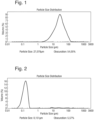
- the initial solution (without polymer) and the final solution (with polymer) was analysed for particle size (using a Malvern Mastersize 2000).
- Graph 1 shows that oleate in presence of Calcium (20°fH) has a large peak at 27 mm.
- Graph 2 shows that oleate in presence of the polymers, at the same hardness has a different peak, centered at 0.15 mm.
- the smaller particle size achieved using the formulation of the invention is significant. Such particles make up "scum forming" agents which are can be deposited in washing machines and, once deposited are hard to remove.
- Two different beakers with tap water (28°fH) were prepared: one with TEAsoap and 1mL of the composition from Example 2 (beaker A), the other one with TEAsoap.
- the formulations showed excellent water softening performance when used in a ware washing machine.
- composition reduced of 95% the limescale incrustation on the heating element of a washing machine after 25 washes with water at 43°fH.
Landscapes
- Chemical & Material Sciences (AREA)
- Engineering & Computer Science (AREA)
- Chemical Kinetics & Catalysis (AREA)
- Organic Chemistry (AREA)
- Life Sciences & Earth Sciences (AREA)
- Environmental & Geological Engineering (AREA)
- Hydrology & Water Resources (AREA)
- Water Supply & Treatment (AREA)
- General Chemical & Material Sciences (AREA)
- Oil, Petroleum & Natural Gas (AREA)
- Wood Science & Technology (AREA)
- Detergent Compositions (AREA)
- Compositions Of Macromolecular Compounds (AREA)
Description
- This invention relates to a method of removing and preventing the deposit of limescale and soap scum in a clothes washing machine.
- It is well known that certain metal compounds, notably calcium compounds, when present in water, have a significant effect on the properties of the water. For example, "hard" water containing a significant loading of soluble calcium and magnesium compounds may require a large amount of soap or detergent in order to form a lather. Scale deposits can readily form from such water, for example on heating or pH change or evaporation. These can be incrustations, which are left on a surface that has come into contact with the hard water. Particular issues arise in ware washing machines, such as dish and clothes washing machines. In particular scale incrustations may be left on the surfaces of the machines as well as the items washed therein. In particular issues arise with incrustation of heating elements, which reduces their life span and efficiency. A further issue arises in that scale incrustation can be found on the surface of clothes washed in the clothes washing machines which are perceptible to the wearer as feeling harsh to the touch.
- There have been many proposals for removal of metal ions from aqueous solutions. In the industrial context proposals have included filter beds and polymeric filters for capturing heavy metal ions from an aqueous solution flowing within a passageway. Examples are given in
EP992238A GB20869564A EP892040A -
Document EP 1 935 852 describes a water softener composition comprising a) one or more polycarboxylic acid homopolymer(s) or salt(s) thereof in an amount of 1 to 90 wt.%, b) one or more low molecular polycarboxylic acid(s) or salt(s) thereof in an amount of 1 to 90 wt.%, and c) one or more copolymer(s) based on maleic acid or (meth)acrylic acid or salt(s) thereof in an amount of 0.1 to 25 wt.%, wherein the one or more comonomer(s) is/are selected from the group comprising i) hydrophobic monomers, ii) hydrophobic monomers with one or more hydrophilic groups, and iii) hydrophilic monomers with hydrophilic groups. - Typically in ware washing machines cleaning compositions are provided which are "built" which provide a water softening effect and an increase to the efficiency of the detergent used therein. However, such compositions are not effective for softening the water in the rinse cycle of ware washing machines since such compositions are pumped out of the machine along with the dirty water prior to the rinse cycle. Therefore, scale deposits may build up on the hard surfaces of the washing machine such as the heating element, as well as the fabric of the items being worked.
- Moreover it has recently been found that the scale deposits do not simple comprise an inorganic based matrix but also typically include other "organic" elements of detergents and / or washing products. Typically these organic components comprise mainly fatty acid based soap type moieties. These agents are in themselves not hugely problematic since after all they are usually an element of the washing agent which is used. However, since they are organic they can present a source of nutrition of various microbial life forms. These can build up over time causing a disadvantageous washing and / or bad odours to develop.
- It is an object of the present invention to obviate and / or mitigate one or more of the issues highlighted above.
- There is provided a water softening composition comprising a combination of polymeric water softening agents; the first agent comprising a polymer of an unsaturated carboxylic acid and the second agent comprising a co-polymer of an unsaturated poly-carboxylic acid.
- Both agents may be fully, partially or non-neutralised.
- Surprisingly it has been found that the composition displays high efficacy in providing a water softening function and a soap scum removal function.
- The composition will be used for providing a water softening function in a clothes washing machine. Hence according to the invention there provided a method according to
claim 1 by providing a water softening composition comprising a combination of polymeric water softening agents; the first agent comprising a polymer of an unsaturated carboxylic acid and the second agent comprising a co-polymer of an unsaturated poly-carboxylic acid and an unsaturated carboxylic acid. - Without wising to be bound by theory it is postulated that the reason for the high efficacy of the method of the invention is that the particle size of potentially problematic deposit forming agents (such as one or more metal cations associated with hard water (e.g. Ca2+, Mg2+) complexing with other agents (e.g. fatty acid anions from detergent agents) is greatly reduced. This means that they ate much more readily suspended in solution and hence removed from a washing machine, e.g. by suspension in rinse / drain water.
- The first agent comprises a polyacrylate, i.e. a polymer of acrylic acid / acrylate.
- The polyacrylate has a molecular weight of from 4000 to 8000. A preferred example is Acusol 445N (available from Dow) (CAS REG Nr. 66019-18-9).
- In the second agent the unsaturated poly-carboxylic acid comprises a copolymer. The copolymer includes maleic acid and an olefin (e.g. such as ethylene, propylene, butene, butadiene)
- The copolymer has a molecular weight of 5000 to 15000. A preferred example is Acusol 460NK (available from Dow).
- A further preferred example is SOKALAN CP9 (available from BASF).
- The weight ratio of the first agent to the second agent is preferably from 15:1 to 1:1, more preferably from 10:1 to 1:1, more preferably from 7:1 to 1:1, most preferably about 4:1.
- The composition comprises from 8 to 12wt% of the first agent and about 0.5 to 2wt% of the second agent.
- An acid may be present in an amount of up to 20%, more preferably up to 15%, more preferably up to 10%, more preferably up to 7%, and most preferably around 5%. The acid is preferably present in an amount of more than 1%, more preferably more than 2%, more preferably more than 3%, more preferably more than 4%, and most preferably around 5%.
- Suitable acids are citric, phosphoric, sulphamic, acetic, formic, glycolic and oxalic acid. Preferably the acid is citric acid. (The water softening agent may also act as an acid - examples of such "acidic" water softening agents include polycarboxylate polymers (see below)).
- An alkali may be present in an amount of up to 20%, more preferably up to 15%, and most preferably around 10%. The alkali may be present in an amount of more than 1%, more preferably more than 3%, more preferably more than 5%, more preferably more than 7%, and most preferably around 10%.
- The alkali is preferably a sodium / potassium carbonate / salt of a carboxylic acid such as sodium bicarbonate. Sodium silicate may be used as an alkali, either in addition to or as an alternative to the carbonate / salt of a carboxylic acid. Where present the sodium silicate may be present in an amount of 1 -3%.
- Generally the composition has a pH of (at 1% solution) of from 5.5 to 9.5, more preferably 7 (+ / - 0.5).
- Preferably the composition is substantially free from any fabric softening actives, surfactant, and/or bleach. By substantially free we mean <15% wt, <12% wt, <10% wt, <8% wt, <6% wt, <4% wt, <2% wt, <1% wt, <0.5% wt, <0.1% wt, <0.01% wt of each and any combination or all of the ingredients listed above.
- The composition may contain one or more detergent adjuncts such as dye transfer inhibitor, enzyme, optical brightener, soil suspending agent.
- Ideally, an auxiliary water softening agent is also present. Preferred amounts present are from 5 to 80% wt.
- There are two main types of method of action for water-softening agents, described below.
- 1) Ion capture agents - agents which prevent metal ions from forming insoluble salts or reacting with surfactants, such as polyphosphate, monomeric polycarboxylates, such as citric acid or salts thereof, polycarboxylate polymers, such as polyacrylates, acrylic/maleic copolymers, and acrylic phosphonates, EDTA, algins, alginates.
- 2) Anti-nucleating agents - agents that prevent seed crystal growth, such as polycarboxylate polymers, such as polyacrylates, acrylic/maleic copolymers, and acrylic phosphonates, and sulfonates. Such polymers may also act as ion capture agents as well.
- Preferred organic water-soluble water softening agents which may be present include polycarboxylate polymers, such as polyacrylates, acrylic/maleic copolymers, and acrylic phosphonates, monomeric polycarboxylates such as citrates, gluconates, oxydisuccinates, glycerol mono- di- and trisuccinates, carboxymethyloxysuccinates, carboxymethyloxymalonates, dipicolinates, hydroxyethyliminodiacetates, phosphonates, iminodisuccinates, polyaspartic acids, BHT, phosphonatestabilisers such as, diethylenetriaminepenta (methylene phosphonic acid and its corresponding pentasodium salt) available under the trade names Dequest 2060 and Dequest 2066 Monsanto Chemical Co), DTPMP and DTPMA (Dequest 2010) and HEDP.
- Calcium soap dispersing capacity of the composition has been tested with a design of experiment with two factors (the two polymers) and one response (the volume of the calcium solution).
-
- 150 mL beaker;
- 0.5% sodium oleate solution in deionised water;
- 1% polymer (as active matter) solution in deionised water;
- 100 ppm calcium solution in deionised water.
- This method is an adaptation of the Hampshire test of the calcium carbonate dispersing capacity of polymers.
- The solutions to be titrated are prepared by adding to a 150mL beaker 10mL of the soap solution and different volumes of the polymer solution. The total volume is then made up to 100mL with deionised water, and the obtained solution is titrated with the calcium solution. Following the same procedure, solutions containing different blends of the two polymers are prepared and titrated.
- For the titrations, a Mettler Toledo automatic titrator equipped with a phototrode has been employed. The equivalence point of the titration (i.e. hard water solution volume) was taken as a measure of the calcium soap dispersing capacity of the polymer, or of the blends of polymers, bigger volumes indicating better dispersing capacity.
- Using this test the following results were obtained for the agents.
V 460NK sol (mL) V 445N sol (mL) V Ca2+ sol (mL) 0.00 3.00 1.05 0.00 3.00 1.05 0.00 3.00 1.15 0.00 4.00 2.05 0.00 4.00 2.40 0.00 4.00 2.60 0.00 5.00 2.80 0.00 5.00 2.80 0.00 5.00 2.90 0.13 3.50 1.35 0.13 3.50 1.55 0.25 3.00 1.55 0.25 3.00 1.70 0.25 3.00 1.95 0.25 4.00 2.25 0.25 4.00 2.65 0.25 4.00 2.55 0.25 5.00 2.50 0.25 5.00 2.35 0.25 5.00 2.70 0.25 3.50 2.05 0.25 3.50 2.05 0.38 3.50 1.90 0.38 3.50 2.25 0.50 3.00 1.95 0.50 3.00 1.35 0.50 3.00 1.55 0.50 4.00 2.55 0.50 4.00 2.60 0.50 4.00 2.45 0.50 5.00 2.65 0.50 5.00 2.65 0.50 5.00 2.70 - The analyses of the resulting surface shows a synergy in the activity of Acusol 445 and Acusol 460 in the addressing of calcium based soap scum / limescale.
- Calcium soap dispersing capacity of the composition was tested.
- 6.5mL of 0.5% w/w solution of sodium oleate was added into a beaker with 100mL of demineralized water. Then 1mL of 1% w/w solution of dispersant polymer (Acusol 445N / Acusol 460NK in a weight ratio of 4:1).
- The water hardness was 20°fH and the final pH was adjusted to pH 10.50.
- The initial solution (without polymer) and the final solution (with polymer)was analysed for particle size (using a Malvern Mastersize 2000).
- The results are shown in
graphs -
Graph 1 shows that oleate in presence of Calcium (20°fH) has a large peak at 27 mm. -
Graph 2 shows that oleate in presence of the polymers, at the same hardness has a different peak, centered at 0.15 mm. - The smaller particle size achieved using the formulation of the invention is significant. Such particles make up "scum forming" agents which are can be deposited in washing machines and, once deposited are hard to remove.
- The fact that the particle size of these agents is considerable smaller in the presence of the formulation of the invention means that these problematic agents are much more easily suspended and removed from the washing machine before deposits can form. Thus the problem of deposit formation in washing machines is greatly alleviated.
- Two different beakers with tap water (28°fH) were prepared: one with TEAsoap and 1mL of the composition from Example 2 (beaker A), the other one with TEAsoap.
- After 1 week, there is a white solid at the bottom of beaker B. There isno solid in beaker A. After filtration, chemical analyses confirmed that the white solid is Calcium soap (Soap scum).
- The formulations showed excellent water softening performance when used in a ware washing machine.
- Tested against leading laundry powder detergent, composition reduced of 95% the limescale incrustation on the heating element of a washing machine after 25 washes with water at 43°fH.
Claims (1)
- A method of removing and preventing the deposit of limescale and soap scum in a clothes washing machine by providing a composition substantially free from any fabric softening actives, surfactant and bleach comprising a combination of polymeric water softening agents; the first agent comprising a polyacrylate having a molecular weight of from 4,000 to 8,000; and the second agent comprising a co-polymer of an unsaturated poly-carboxylic acid comprising maleic acid, and the co-polymer further comprising an olefin, wherein the co-polymer has a molecular weight of from 5,000 to 15,000, wherein the composition comprises from 8 to 12wt% of the first agent and about 0.5 to 2wt% of the second agent.
Applications Claiming Priority (3)
| Application Number | Priority Date | Filing Date | Title |
|---|---|---|---|
| GB1209604.6A GB2502558A (en) | 2012-05-30 | 2012-05-30 | Water softening composition |
| GBGB1220838.5A GB201220838D0 (en) | 2012-11-20 | 2012-11-20 | Composition |
| PCT/GB2013/051314 WO2013178990A2 (en) | 2012-05-30 | 2013-05-21 | Composition |
Publications (3)
| Publication Number | Publication Date |
|---|---|
| EP2855371A2 EP2855371A2 (en) | 2015-04-08 |
| EP2855371B1 EP2855371B1 (en) | 2021-12-01 |
| EP2855371B2 true EP2855371B2 (en) | 2025-03-26 |
Family
ID=49326785
Family Applications (1)
| Application Number | Title | Priority Date | Filing Date |
|---|---|---|---|
| EP13774470.2A Active EP2855371B2 (en) | 2012-05-30 | 2013-05-21 | A water softening composition |
Country Status (3)
| Country | Link |
|---|---|
| EP (1) | EP2855371B2 (en) |
| RU (1) | RU2635250C2 (en) |
| WO (1) | WO2013178990A2 (en) |
Families Citing this family (1)
| Publication number | Priority date | Publication date | Assignee | Title |
|---|---|---|---|---|
| GB2547458A (en) * | 2016-02-19 | 2017-08-23 | Reckitt Benckiser Calgon Bv | Composition |
Citations (4)
| Publication number | Priority date | Publication date | Assignee | Title |
|---|---|---|---|---|
| US5281352A (en) † | 1992-08-27 | 1994-01-25 | Church & Dwight Co., Inc. | Low-phosphate machine dishwashing detergents |
| US20070253926A1 (en) † | 2006-04-28 | 2007-11-01 | Tadrowski Tami J | Packaged cleaning composition concentrate and method and system for forming a cleaning composition |
| US20080287335A1 (en) † | 2007-05-04 | 2008-11-20 | Smith Kim R | Compositions including hardness ion and threshold agent and methods employing them to reduce corrosion and etch |
| US20110021403A1 (en) † | 2009-07-27 | 2011-01-27 | Ecolab Usa Inc. | Novel formulation of a ware washing solid controlling hardness |
Family Cites Families (4)
| Publication number | Priority date | Publication date | Assignee | Title |
|---|---|---|---|---|
| EP0124913B1 (en) * | 1983-04-08 | 1986-06-18 | THE PROCTER & GAMBLE COMPANY | Granular detergent compositions containing mixed polymer additive system |
| EP0791049B1 (en) * | 1994-11-15 | 2001-10-17 | Colgate-Palmolive Company | Microemulsion all purpose liquid cleaning compositions |
| EP1935852A1 (en) * | 2006-12-18 | 2008-06-25 | Dalli-Werke GmbH & Co. KG | Water softener composition |
| DE602007005925D1 (en) * | 2007-02-14 | 2010-05-27 | Electrolux Home Prod Corp | Washing machine with liquid detergent dispenser |
-
2013
- 2013-05-21 EP EP13774470.2A patent/EP2855371B2/en active Active
- 2013-05-21 WO PCT/GB2013/051314 patent/WO2013178990A2/en not_active Ceased
- 2013-05-21 RU RU2014152677A patent/RU2635250C2/en active
Patent Citations (5)
| Publication number | Priority date | Publication date | Assignee | Title |
|---|---|---|---|---|
| US5281352A (en) † | 1992-08-27 | 1994-01-25 | Church & Dwight Co., Inc. | Low-phosphate machine dishwashing detergents |
| US20070253926A1 (en) † | 2006-04-28 | 2007-11-01 | Tadrowski Tami J | Packaged cleaning composition concentrate and method and system for forming a cleaning composition |
| US20080287335A1 (en) † | 2007-05-04 | 2008-11-20 | Smith Kim R | Compositions including hardness ion and threshold agent and methods employing them to reduce corrosion and etch |
| US20110160114A1 (en) † | 2007-05-04 | 2011-06-30 | Ecolab Usa Inc. | Cleaning compositions containing water soluble magnesium compounds and methods of using them |
| US20110021403A1 (en) † | 2009-07-27 | 2011-01-27 | Ecolab Usa Inc. | Novel formulation of a ware washing solid controlling hardness |
Also Published As
| Publication number | Publication date |
|---|---|
| RU2014152677A (en) | 2016-07-20 |
| WO2013178990A3 (en) | 2014-01-30 |
| RU2635250C2 (en) | 2017-11-09 |
| EP2855371A2 (en) | 2015-04-08 |
| WO2013178990A2 (en) | 2013-12-05 |
| EP2855371B1 (en) | 2021-12-01 |
Similar Documents
| Publication | Publication Date | Title |
|---|---|---|
| AU2005325830B2 (en) | Water softening device and method | |
| MX2007010038A (en) | Method for treating feedwater, feedwater treatment composition containing a scale inhibitor, and apparatus for treating feedwater. | |
| EP2519623B2 (en) | Phosphate substitutes for membrane-compatible cleaning and/or detergent compositions | |
| EP2366768B1 (en) | Scale-reducing additive for automatic dishwashing systems | |
| US20060185697A1 (en) | Method of cleaning a washing machine or a dishwasher | |
| EP0812808A1 (en) | Water softening tablets | |
| EP4118041B1 (en) | Composition for the removal and prevention of deposition of limescale | |
| EP1499775B1 (en) | Cleaning method | |
| US20080045431A1 (en) | Method of Removing Laundry Ash | |
| EP2855371B1 (en) | A water softening composition | |
| US20080287330A1 (en) | Method of Removing Laundry Ash | |
| AU2007306086B2 (en) | Composition | |
| WO2016012080A1 (en) | Washing and cleaning agents containing manganese oxalate, dishwashing method and use thereof | |
| GB2502558A (en) | Water softening composition |
Legal Events
| Date | Code | Title | Description |
|---|---|---|---|
| PUAI | Public reference made under article 153(3) epc to a published international application that has entered the european phase |
Free format text: ORIGINAL CODE: 0009012 |
|
| 17P | Request for examination filed |
Effective date: 20141114 |
|
| AK | Designated contracting states |
Kind code of ref document: A2 Designated state(s): AL AT BE BG CH CY CZ DE DK EE ES FI FR GB GR HR HU IE IS IT LI LT LU LV MC MK MT NL NO PL PT RO RS SE SI SK SM TR |
|
| AX | Request for extension of the european patent |
Extension state: BA ME |
|
| DAX | Request for extension of the european patent (deleted) | ||
| RAP1 | Party data changed (applicant data changed or rights of an application transferred) |
Owner name: RECKITT BENCKISER CALGON BV |
|
| STAA | Information on the status of an ep patent application or granted ep patent |
Free format text: STATUS: EXAMINATION IS IN PROGRESS |
|
| 17Q | First examination report despatched |
Effective date: 20170919 |
|
| REG | Reference to a national code |
Ref country code: DE Ref legal event code: R079 Ref document number: 602013080271 Country of ref document: DE Free format text: PREVIOUS MAIN CLASS: C02F0005080000 Ipc: C11D0003370000 |
|
| RIC1 | Information provided on ipc code assigned before grant |
Ipc: C11D 3/37 20060101AFI20210604BHEP Ipc: C02F 5/10 20060101ALI20210604BHEP |
|
| GRAP | Despatch of communication of intention to grant a patent |
Free format text: ORIGINAL CODE: EPIDOSNIGR1 |
|
| STAA | Information on the status of an ep patent application or granted ep patent |
Free format text: STATUS: GRANT OF PATENT IS INTENDED |
|
| INTG | Intention to grant announced |
Effective date: 20210804 |
|
| GRAS | Grant fee paid |
Free format text: ORIGINAL CODE: EPIDOSNIGR3 |
|
| GRAA | (expected) grant |
Free format text: ORIGINAL CODE: 0009210 |
|
| STAA | Information on the status of an ep patent application or granted ep patent |
Free format text: STATUS: THE PATENT HAS BEEN GRANTED |
|
| AK | Designated contracting states |
Kind code of ref document: B1 Designated state(s): AL AT BE BG CH CY CZ DE DK EE ES FI FR GB GR HR HU IE IS IT LI LT LU LV MC MK MT NL NO PL PT RO RS SE SI SK SM TR |
|
| REG | Reference to a national code |
Ref country code: GB Ref legal event code: FG4D |
|
| REG | Reference to a national code |
Ref country code: AT Ref legal event code: REF Ref document number: 1451776 Country of ref document: AT Kind code of ref document: T Effective date: 20211215 Ref country code: CH Ref legal event code: EP |
|
| REG | Reference to a national code |
Ref country code: IE Ref legal event code: FG4D |
|
| REG | Reference to a national code |
Ref country code: DE Ref legal event code: R096 Ref document number: 602013080271 Country of ref document: DE |
|
| REG | Reference to a national code |
Ref country code: LT Ref legal event code: MG9D |
|
| REG | Reference to a national code |
Ref country code: NL Ref legal event code: MP Effective date: 20211201 |
|
| REG | Reference to a national code |
Ref country code: AT Ref legal event code: MK05 Ref document number: 1451776 Country of ref document: AT Kind code of ref document: T Effective date: 20211201 |
|
| PG25 | Lapsed in a contracting state [announced via postgrant information from national office to epo] |
Ref country code: RS Free format text: LAPSE BECAUSE OF FAILURE TO SUBMIT A TRANSLATION OF THE DESCRIPTION OR TO PAY THE FEE WITHIN THE PRESCRIBED TIME-LIMIT Effective date: 20211201 Ref country code: LT Free format text: LAPSE BECAUSE OF FAILURE TO SUBMIT A TRANSLATION OF THE DESCRIPTION OR TO PAY THE FEE WITHIN THE PRESCRIBED TIME-LIMIT Effective date: 20211201 Ref country code: FI Free format text: LAPSE BECAUSE OF FAILURE TO SUBMIT A TRANSLATION OF THE DESCRIPTION OR TO PAY THE FEE WITHIN THE PRESCRIBED TIME-LIMIT Effective date: 20211201 Ref country code: BG Free format text: LAPSE BECAUSE OF FAILURE TO SUBMIT A TRANSLATION OF THE DESCRIPTION OR TO PAY THE FEE WITHIN THE PRESCRIBED TIME-LIMIT Effective date: 20220301 Ref country code: AT Free format text: LAPSE BECAUSE OF FAILURE TO SUBMIT A TRANSLATION OF THE DESCRIPTION OR TO PAY THE FEE WITHIN THE PRESCRIBED TIME-LIMIT Effective date: 20211201 |
|
| PG25 | Lapsed in a contracting state [announced via postgrant information from national office to epo] |
Ref country code: SE Free format text: LAPSE BECAUSE OF FAILURE TO SUBMIT A TRANSLATION OF THE DESCRIPTION OR TO PAY THE FEE WITHIN THE PRESCRIBED TIME-LIMIT Effective date: 20211201 Ref country code: PL Free format text: LAPSE BECAUSE OF FAILURE TO SUBMIT A TRANSLATION OF THE DESCRIPTION OR TO PAY THE FEE WITHIN THE PRESCRIBED TIME-LIMIT Effective date: 20211201 Ref country code: NO Free format text: LAPSE BECAUSE OF FAILURE TO SUBMIT A TRANSLATION OF THE DESCRIPTION OR TO PAY THE FEE WITHIN THE PRESCRIBED TIME-LIMIT Effective date: 20220301 Ref country code: LV Free format text: LAPSE BECAUSE OF FAILURE TO SUBMIT A TRANSLATION OF THE DESCRIPTION OR TO PAY THE FEE WITHIN THE PRESCRIBED TIME-LIMIT Effective date: 20211201 Ref country code: HR Free format text: LAPSE BECAUSE OF FAILURE TO SUBMIT A TRANSLATION OF THE DESCRIPTION OR TO PAY THE FEE WITHIN THE PRESCRIBED TIME-LIMIT Effective date: 20211201 Ref country code: GR Free format text: LAPSE BECAUSE OF FAILURE TO SUBMIT A TRANSLATION OF THE DESCRIPTION OR TO PAY THE FEE WITHIN THE PRESCRIBED TIME-LIMIT Effective date: 20220302 Ref country code: ES Free format text: LAPSE BECAUSE OF FAILURE TO SUBMIT A TRANSLATION OF THE DESCRIPTION OR TO PAY THE FEE WITHIN THE PRESCRIBED TIME-LIMIT Effective date: 20211201 |
|
| PG25 | Lapsed in a contracting state [announced via postgrant information from national office to epo] |
Ref country code: NL Free format text: LAPSE BECAUSE OF FAILURE TO SUBMIT A TRANSLATION OF THE DESCRIPTION OR TO PAY THE FEE WITHIN THE PRESCRIBED TIME-LIMIT Effective date: 20211201 |
|
| PG25 | Lapsed in a contracting state [announced via postgrant information from national office to epo] |
Ref country code: SM Free format text: LAPSE BECAUSE OF FAILURE TO SUBMIT A TRANSLATION OF THE DESCRIPTION OR TO PAY THE FEE WITHIN THE PRESCRIBED TIME-LIMIT Effective date: 20211201 Ref country code: SK Free format text: LAPSE BECAUSE OF FAILURE TO SUBMIT A TRANSLATION OF THE DESCRIPTION OR TO PAY THE FEE WITHIN THE PRESCRIBED TIME-LIMIT Effective date: 20211201 Ref country code: RO Free format text: LAPSE BECAUSE OF FAILURE TO SUBMIT A TRANSLATION OF THE DESCRIPTION OR TO PAY THE FEE WITHIN THE PRESCRIBED TIME-LIMIT Effective date: 20211201 Ref country code: PT Free format text: LAPSE BECAUSE OF FAILURE TO SUBMIT A TRANSLATION OF THE DESCRIPTION OR TO PAY THE FEE WITHIN THE PRESCRIBED TIME-LIMIT Effective date: 20220401 Ref country code: EE Free format text: LAPSE BECAUSE OF FAILURE TO SUBMIT A TRANSLATION OF THE DESCRIPTION OR TO PAY THE FEE WITHIN THE PRESCRIBED TIME-LIMIT Effective date: 20211201 Ref country code: CZ Free format text: LAPSE BECAUSE OF FAILURE TO SUBMIT A TRANSLATION OF THE DESCRIPTION OR TO PAY THE FEE WITHIN THE PRESCRIBED TIME-LIMIT Effective date: 20211201 |
|
| REG | Reference to a national code |
Ref country code: DE Ref legal event code: R026 Ref document number: 602013080271 Country of ref document: DE |
|
| PLBI | Opposition filed |
Free format text: ORIGINAL CODE: 0009260 |
|
| PLAX | Notice of opposition and request to file observation + time limit sent |
Free format text: ORIGINAL CODE: EPIDOSNOBS2 |
|
| PG25 | Lapsed in a contracting state [announced via postgrant information from national office to epo] |
Ref country code: IS Free format text: LAPSE BECAUSE OF FAILURE TO SUBMIT A TRANSLATION OF THE DESCRIPTION OR TO PAY THE FEE WITHIN THE PRESCRIBED TIME-LIMIT Effective date: 20220401 |
|
| 26 | Opposition filed |
Opponent name: HENKEL AG & CO. KGAA Effective date: 20220830 |
|
| PG25 | Lapsed in a contracting state [announced via postgrant information from national office to epo] |
Ref country code: DK Free format text: LAPSE BECAUSE OF FAILURE TO SUBMIT A TRANSLATION OF THE DESCRIPTION OR TO PAY THE FEE WITHIN THE PRESCRIBED TIME-LIMIT Effective date: 20211201 Ref country code: AL Free format text: LAPSE BECAUSE OF FAILURE TO SUBMIT A TRANSLATION OF THE DESCRIPTION OR TO PAY THE FEE WITHIN THE PRESCRIBED TIME-LIMIT Effective date: 20211201 |
|
| PG25 | Lapsed in a contracting state [announced via postgrant information from national office to epo] |
Ref country code: SI Free format text: LAPSE BECAUSE OF FAILURE TO SUBMIT A TRANSLATION OF THE DESCRIPTION OR TO PAY THE FEE WITHIN THE PRESCRIBED TIME-LIMIT Effective date: 20211201 |
|
| REG | Reference to a national code |
Ref country code: CH Ref legal event code: PL |
|
| PLBB | Reply of patent proprietor to notice(s) of opposition received |
Free format text: ORIGINAL CODE: EPIDOSNOBS3 |
|
| REG | Reference to a national code |
Ref country code: BE Ref legal event code: MM Effective date: 20220531 |
|
| PG25 | Lapsed in a contracting state [announced via postgrant information from national office to epo] |
Ref country code: MC Free format text: LAPSE BECAUSE OF FAILURE TO SUBMIT A TRANSLATION OF THE DESCRIPTION OR TO PAY THE FEE WITHIN THE PRESCRIBED TIME-LIMIT Effective date: 20211201 Ref country code: LU Free format text: LAPSE BECAUSE OF NON-PAYMENT OF DUE FEES Effective date: 20220521 Ref country code: LI Free format text: LAPSE BECAUSE OF NON-PAYMENT OF DUE FEES Effective date: 20220531 Ref country code: CH Free format text: LAPSE BECAUSE OF NON-PAYMENT OF DUE FEES Effective date: 20220531 |
|
| REG | Reference to a national code |
Ref country code: FR Ref legal event code: PLFP Year of fee payment: 11 |
|
| PG25 | Lapsed in a contracting state [announced via postgrant information from national office to epo] |
Ref country code: IE Free format text: LAPSE BECAUSE OF NON-PAYMENT OF DUE FEES Effective date: 20220521 |
|
| PG25 | Lapsed in a contracting state [announced via postgrant information from national office to epo] |
Ref country code: IT Free format text: LAPSE BECAUSE OF FAILURE TO SUBMIT A TRANSLATION OF THE DESCRIPTION OR TO PAY THE FEE WITHIN THE PRESCRIBED TIME-LIMIT Effective date: 20211201 Ref country code: BE Free format text: LAPSE BECAUSE OF NON-PAYMENT OF DUE FEES Effective date: 20220531 |
|
| P01 | Opt-out of the competence of the unified patent court (upc) registered |
Effective date: 20230513 |
|
| PG25 | Lapsed in a contracting state [announced via postgrant information from national office to epo] |
Ref country code: HU Free format text: LAPSE BECAUSE OF FAILURE TO SUBMIT A TRANSLATION OF THE DESCRIPTION OR TO PAY THE FEE WITHIN THE PRESCRIBED TIME-LIMIT; INVALID AB INITIO Effective date: 20130521 |
|
| PG25 | Lapsed in a contracting state [announced via postgrant information from national office to epo] |
Ref country code: MK Free format text: LAPSE BECAUSE OF FAILURE TO SUBMIT A TRANSLATION OF THE DESCRIPTION OR TO PAY THE FEE WITHIN THE PRESCRIBED TIME-LIMIT Effective date: 20211201 Ref country code: CY Free format text: LAPSE BECAUSE OF FAILURE TO SUBMIT A TRANSLATION OF THE DESCRIPTION OR TO PAY THE FEE WITHIN THE PRESCRIBED TIME-LIMIT Effective date: 20211201 |
|
| PLAB | Opposition data, opponent's data or that of the opponent's representative modified |
Free format text: ORIGINAL CODE: 0009299OPPO |
|
| APAH | Appeal reference modified |
Free format text: ORIGINAL CODE: EPIDOSCREFNO |
|
| APBP | Date of receipt of notice of appeal recorded |
Free format text: ORIGINAL CODE: EPIDOSNNOA2O |
|
| R26 | Opposition filed (corrected) |
Opponent name: HENKEL AG & CO. KGAA Effective date: 20220830 |
|
| APBU | Appeal procedure closed |
Free format text: ORIGINAL CODE: EPIDOSNNOA9O |
|
| PG25 | Lapsed in a contracting state [announced via postgrant information from national office to epo] |
Ref country code: MT Free format text: LAPSE BECAUSE OF FAILURE TO SUBMIT A TRANSLATION OF THE DESCRIPTION OR TO PAY THE FEE WITHIN THE PRESCRIBED TIME-LIMIT Effective date: 20211201 |
|
| PUAH | Patent maintained in amended form |
Free format text: ORIGINAL CODE: 0009272 |
|
| STAA | Information on the status of an ep patent application or granted ep patent |
Free format text: STATUS: PATENT MAINTAINED AS AMENDED |
|
| 27A | Patent maintained in amended form |
Effective date: 20250326 |
|
| AK | Designated contracting states |
Kind code of ref document: B2 Designated state(s): AL AT BE BG CH CY CZ DE DK EE ES FI FR GB GR HR HU IE IS IT LI LT LU LV MC MK MT NL NO PL PT RO RS SE SI SK SM TR |
|
| REG | Reference to a national code |
Ref country code: DE Ref legal event code: R102 Ref document number: 602013080271 Country of ref document: DE |
|
| PG25 | Lapsed in a contracting state [announced via postgrant information from national office to epo] |
Ref country code: TR Free format text: LAPSE BECAUSE OF FAILURE TO SUBMIT A TRANSLATION OF THE DESCRIPTION OR TO PAY THE FEE WITHIN THE PRESCRIBED TIME-LIMIT Effective date: 20211201 |
|
| PGFP | Annual fee paid to national office [announced via postgrant information from national office to epo] |
Ref country code: GB Payment date: 20260312 Year of fee payment: 14 |
|
| PGFP | Annual fee paid to national office [announced via postgrant information from national office to epo] |
Ref country code: FR Payment date: 20260309 Year of fee payment: 14 |
|
| PGFP | Annual fee paid to national office [announced via postgrant information from national office to epo] |
Ref country code: DE Payment date: 20260324 Year of fee payment: 14 |