EP2854040A2 - Informationsverarbeitungsvorrichtung, Informationsverarbeitungssystem und Programm - Google Patents
Informationsverarbeitungsvorrichtung, Informationsverarbeitungssystem und Programm Download PDFInfo
- Publication number
- EP2854040A2 EP2854040A2 EP20140181378 EP14181378A EP2854040A2 EP 2854040 A2 EP2854040 A2 EP 2854040A2 EP 20140181378 EP20140181378 EP 20140181378 EP 14181378 A EP14181378 A EP 14181378A EP 2854040 A2 EP2854040 A2 EP 2854040A2
- Authority
- EP
- European Patent Office
- Prior art keywords
- units
- unit
- information processing
- processing apparatus
- packet
- Prior art date
- Legal status (The legal status is an assumption and is not a legal conclusion. Google has not performed a legal analysis and makes no representation as to the accuracy of the status listed.)
- Withdrawn
Links
Images




Classifications
-
- H—ELECTRICITY
- H04—ELECTRIC COMMUNICATION TECHNIQUE
- H04L—TRANSMISSION OF DIGITAL INFORMATION, e.g. TELEGRAPHIC COMMUNICATION
- H04L61/00—Network arrangements, protocols or services for addressing or naming
- H04L61/50—Address allocation
- H04L61/5046—Resolving address allocation conflicts; Testing of addresses
-
- G—PHYSICS
- G06—COMPUTING OR CALCULATING; COUNTING
- G06F—ELECTRIC DIGITAL DATA PROCESSING
- G06F13/00—Interconnection of, or transfer of information or other signals between, memories, input/output devices or central processing units
- G06F13/38—Information transfer, e.g. on bus
- G06F13/382—Information transfer, e.g. on bus using universal interface adapter
- G06F13/385—Information transfer, e.g. on bus using universal interface adapter for adaptation of a particular data processing system to different peripheral devices
-
- H—ELECTRICITY
- H04—ELECTRIC COMMUNICATION TECHNIQUE
- H04L—TRANSMISSION OF DIGITAL INFORMATION, e.g. TELEGRAPHIC COMMUNICATION
- H04L61/00—Network arrangements, protocols or services for addressing or naming
- H04L61/09—Mapping addresses
- H04L61/25—Mapping addresses of the same type
- H04L61/2503—Translation of Internet protocol [IP] addresses
- H04L61/2514—Translation of Internet protocol [IP] addresses between local and global IP addresses
-
- H—ELECTRICITY
- H04—ELECTRIC COMMUNICATION TECHNIQUE
- H04L—TRANSMISSION OF DIGITAL INFORMATION, e.g. TELEGRAPHIC COMMUNICATION
- H04L61/00—Network arrangements, protocols or services for addressing or naming
- H04L61/09—Mapping addresses
- H04L61/25—Mapping addresses of the same type
- H04L61/2503—Translation of Internet protocol [IP] addresses
- H04L61/2521—Translation architectures other than single NAT servers
- H04L61/2525—Translation at a client
-
- G—PHYSICS
- G06—COMPUTING OR CALCULATING; COUNTING
- G06F—ELECTRIC DIGITAL DATA PROCESSING
- G06F2213/00—Indexing scheme relating to interconnection of, or transfer of information or other signals between, memories, input/output devices or central processing units
- G06F2213/38—Universal adapter
- G06F2213/3808—Network interface controller
-
- H—ELECTRICITY
- H04—ELECTRIC COMMUNICATION TECHNIQUE
- H04L—TRANSMISSION OF DIGITAL INFORMATION, e.g. TELEGRAPHIC COMMUNICATION
- H04L61/00—Network arrangements, protocols or services for addressing or naming
- H04L61/50—Address allocation
- H04L61/5007—Internet protocol [IP] addresses
-
- H—ELECTRICITY
- H04—ELECTRIC COMMUNICATION TECHNIQUE
- H04L—TRANSMISSION OF DIGITAL INFORMATION, e.g. TELEGRAPHIC COMMUNICATION
- H04L61/00—Network arrangements, protocols or services for addressing or naming
- H04L61/50—Address allocation
- H04L61/5038—Address allocation for local use, e.g. in LAN or USB networks, or in a controller area network [CAN]
Definitions
- the embodiments discussed herein are directed to an information processing apparatus, an information processing system, and a program.
- an information processing apparatus which includes a server apparatus and a storage apparatus is improved in maintenance and availability (verbosity) by dividing various internal functions into a plurality of units.
- Ethernet registered trademark
- the information processing apparatus can use various application software which utilizes Ethernet. Therefore, it is possible to improve productivity of the information processing apparatus.
- Ethernet is introduced as an internal network
- a process of changing the address system of the internal network in cooperation with the address setting and address change of the external network is implemented. In this way, during a period while the process of changing the address system of the internal network, it is difficult to keeping the cooperation between the units.
- a terminal 400 is communicably connected to an information processing apparatus 100 through an external network 200 and a gateway 300. Further, the information processing apparatus 100, for example, includes five units 101 to 105. These units 101 to 105 are communicably connected through an internal network 106.
- the external network 200 is Ethernet which is managed by a user who uses the information processing apparatus 100.
- the information processing apparatus 100 is an interface which provides an Ethernet service.
- the internal network 106 of the information processing apparatus 100 is Ethernet which connects the units 101 to 105 in the information processing apparatus 100.
- the units 101 to 105 cooperate to each other through the internal network 106.
- the respective units 101 to 105 are components included in the information processing apparatus 100, and divided according to certain functions in order to improve maintenance and availability (verbosity) of the information processing apparatus 100.
- a general-purpose OS is loaded to use Ethernet applications.
- the unit 101 includes an external network interface 110 which is connected to the external network 200 and conducts communication with the external terminal 400.
- the unit 101 includes an internal network interface 111 which is connected to the internal network 106 and conducts communication with the other units 102 to 105.
- the units 102 to 105 include internal network interfaces 121 to 151, respectively, which are connected to the internal network 106 and conduct communication with the unit 101.
- the units 101 to 105 may be denoted by Units #1 to #5, respectively.
- the Internet Protocol (IP) address 192.168.1.1 for the external network 200 is assigned to the information processing apparatus 100 (the external network interface 110). Further, the IP address 172.16.0.10 is assigned to the terminal 400. Then, the IP addresses 172.16.0.1 to 172.16.0.5 for the internal network 106 are assigned to the units 101 to 105 (the internal network interfaces 111 to 151) in the information processing apparatus 100, respectively.
- IP Internet Protocol
- the unit 101 loses its ability to conduct communication with the external terminal 400. This is because the IP address of the terminal 400 is 172.16.0.10 and belongs to the address system of the internal network 106 of the information processing apparatus 100. In this case, even when the unit 101 tries to conduct communication with the terminal 400, a packet addressed to the terminal 400 flows into the internal network 106.
- an object thereof is to make an internal network established without any influence on an external network.
- An information processing apparatus is connectable to an external network, and includes a plurality of units, an external network interface, and an internal network interface.
- the external network interface is provided in at least one of the plurality of units, and connected to the external network.
- the internal network interface is provided in each of the plurality of units, and is connected to an internal network which is established by a second address system independent from a first address system of the external network connected to the external network interface. Then, the internal network interface each of the plurality of units conducts communication between the plurality of units using the second address system.
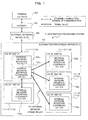
- FIG. 1 is a block diagram illustrating the hardware configuration and the functional configuration.
- a terminal (external unit) 40 is communicably connected to the information processing apparatus 10 through an external network 20 and a gateway 30.
- the information processing apparatus 10 for example, includes five units 11-1 to 11-5, and these units 11-1 to 11-5 are communicably connected to one another through an internal network 12.
- the symbols 11-1 to 11-5 when there is a need to specify one of a plurality of units, the symbols 11-1 to 11-5 will be used, and when any unit is indicated, the symbol 11 will be used.
- the information processing apparatus 10, for example is assumed to include a server apparatus, a unified storage device, and the like.
- the information processing apparatus 10 of the embodiment is connectable to the external network 20, and as to be described below includes at least the plurality of units 11, an external network interface 20a, and an internal network interface 12a.
- the external network interface 20a is provided in at least one unit 11-1 of the plurality of units 11, and is connected to the external network 20.
- the internal network interface 12a is provided in each unit 11, and connected to the internal network 12 which is established by a second address system independent from a first address system of the external network 20 connected to the external network interface 20a. Then, the internal network interface 12a of each unit 11 conducts communication between the plurality of units 11 using the second address system.
- the external network 20 is Ethernet which is managed by a user who uses the information processing apparatus 10.
- the information processing apparatus 10 is an interface which provides an Ethernet service.
- the internal network 12 of the information processing apparatus 10 is Ethernet which connects the units 11 in the information processing apparatus 10. The units 11 cooperate with each other through the internal network 12.
- the respective units 11 are components included in the information processing apparatus 10, and various functions are divided and assigned to the units in the information processing apparatus 10. Therefore, maintenance and availability (verbosity) are improved by dividing such functions and assigning them to the plurality of units 11.
- a general-purpose OS 11A is loaded in order to use an Ethernet application.
- each unit 11 includes a loopback device 14 (see FIG. 2 ) which conducts communication between processes (applications) in the OS 11A.
- the unit 11-1 which is one of the plurality of units 11 includes the external network interface 20a which is connected to the external network 200 and conducts communication with the terminal (external Step) 40. Further, the unit 11-1 includes the internal network interface 12a which is connected to the internal network 12 and conducts communication with the other units 11-2 to 11-5. Similarly, each of the units 11-2 to 11-5 includes the internal network interface 12a which is connected to the internal network 12 and conducts communication with the unit 11. In addition, the units 11-1 to 11-5 may be denoted as Units #1 to #5, respectively.
- the second address system independent from the first address system (192.168.1.0/24) of the external network 20 is established in the internal network 12. Therefore, in the embodiment, the address system of inter-process communication conducted by the loopback device 14 is used as the second address system.
- FIG. 3 illustrates an example of conducting inter-process communication on the unit 11-1, and Processes #1 and #2 are assigned with addresses 127.1.0.1 and 127.1.0.2, respectively.
- FIG. 4 the packet addressed to the loopback device 14 can be transmitted even when there is no transmission destination (see arrows A3 and A4 of FIG. 4 ). In other words, it is possible to transmit the packet without causing an error even when there is no transmission destination. In this case, the packet having no transmission destination will be discarded after being transmitted to the loopback device 14.
- FIGs. 3 and 4 are diagrams for describing the inter-process communication conducted by the loopback device 14.
- the address system in the inter-process communication conducted by the loopback device 14 is 127.0.0.0/8, and it is possible to secure about 16.77 million addresses.
- IP addresses on the loopback device 14 are assigned not to cause conflicts in the units 11-1 to 11-5 which are included in the information processing apparatus 10. For example, in FIG. 1 , addresses 127.1.0.1 to 127.1.0.5 of the address system for looping back are assigned to the units 11-1 to 11-5 as the IP addresses.
- the internal network interface 12a is established by the second address system independent from the first address system of the external network 20, and conducts communication between the units 11 using the address system in the inter-process communication conducted by the loopback device 14.
- the packet flowing to the loopback device 14 does not flow out of the OS 11A which uses the packet due to the characteristics of the loopback device 14.
- an IP network using the loopback device 14 is established by using the functional configuration of each unit 11 which will be described with reference to FIG. 2 .
- the second address system IP addresses of the respective units 11
- the firmware of each unit 11 automatically generates and sets its own address based on location information (slot number) of the hardware.
- a dynamic host configuration protocol (DHCP) function is included in the OS 11A of Unit #1 or a control unit such as a CPU 11a to automatically deliver setting information to the other units 11, so that each unit 11 may receive the setting information for its own setting.
- DHCP dynamic host configuration protocol
- the connection can be immediately performed using appropriate setting even though the network setting is not made manually. Therefore, a user who does not have enough knowledge of the network setting can simply make connection.
- a general-purpose communication line for example, a frame relay communication line (such as a serial line and Ethernet using no IP) can be used.
- the frame relay communication line is used as the internal network 12. Therefore, the internal network interface 12a of each unit 11 has functions as a frame relay transmission unit and a frame relay reception unit. With the use of relays and the like in the unit 11, it is possible to establish a network environment which enables
- a shared memory (not illustrated) may be provided as the internal network 12 between the plurality of units 11 instead of the general-purpose communication line. Therefore, the communication may be conducted between the units 11 through the shared memory.
- the IP address 192.168.1.1 for the external network 20 is assigned to the information processing apparatus 10 (the external network interface 20a), and the IP address 172.16.0.10 is assigned to the terminal 40.
- the plurality of units 11 serving as various divided functions of the information processing apparatus 10 may be physically independent from each other, and communicably connected to each other through the internal network 12. Further, some of the plurality of units 11 serving as various divided functions of the information processing apparatus 10 may be a plurality of virtual machines (not illustrated) which are established on a hypervisor (virtualized OS; not illustrated) executed by the CPU 11a of each unit 11 (see FIG. 2 ). Different types of OSs 11A are operated in parallel on the plurality of virtual machines (the units 11).
- a unified storage device for example, a storage area network (SAN) OS and a network attached storage (NAS) OS are operated on the hypervisor.
- SAN storage area network
- NAS network attached storage
- the SAN OS for example, VxWorks (registered trademark) made by Wind River is used
- the NAS OS for example, Linux (registered trademark) is used.
- the unit (virtual machine) 11 which operates the SAN OS can conduct communication using the internal network interface 12a with other units 11 outside the CPU 11a through the internal network 12.
- the unit (virtual machine) 11 which operates the NAS OS can conduct communication with the unit 11 which is mounted on the same hypervisor as the NAS OS and operates the SAN OS, it is generally not allowed to conduct communication with other units 11 which are outside the CPU 11a and not directly connected to the NAS OS.
- FIG. 2 is a block diagram illustrating the hardware configuration and the functional configuration.
- Each unit 11 includes at least the CPU (processing unit) 11a and the memory (storage unit) 11b.
- the CPU 11a and the memory 11b are shared by the plurality of virtual machines (the units 11) on the same hypervisor.
- the memory 11b for example, is a random access memory (RAM), a read only memory (ROM), a hard disk drive (HDD), a solid state drive (SSD), or the like.
- the memory lib stores various types of information necessary for the processes in the units 11, for example, software relating to the OS 11A, the hypervisor, and the like described above, and an application program for realizing various functions (see symbols 12a, 14 to 18, and 20a).
- the CPU 11a of the unit 11-1 which is connected to the external network 20 functions as the internal network interface 12a, a capturing unit 15, a sending unit 16, a blocking unit 17, a converting unit 18, and the external network interface 20a by executing the application program stored in the memory 11b.
- the CPUs 11a of the units 11-2 to 11-5 which are connected to the unit 11-1 through the internal network 12 function as the internal network interface 12a, the capturing unit 15, the sending unit 16, and the blocking unit 17 by executing the application program stored in the memory 11b.
- the external network interface 20a in the unit 11-1 is connected to the external network 20 by the first address system (192.168.1.0/24) of the external network (Ethernet) 20, and conducts communication with the terminal 40.
- the internal network interface 12a in each unit 11 conducts communication between the units 11 by the address system (127.1.0.1/5) of the inter-process communication conducted by the loopback device 14.
- the internal network interface 12a has a function of selecting a packet addressed to its own unit, transferring the packet to the sending unit 16 (to be described below), and transferring other packets except the packet addressed to its own unit to the other units.
- the function for example, is effectively used in a case where the plurality of units 11 of each unified storage device described above are a plurality of virtual machines established on the hypervisor. In other words, in a case where a packet addressed to the unit 11 which operates the NAS OS is received by the unit 11 which operates the SAN OS, the packet is transferred according to the function from the unit 11 which operates the SAN OS to the unit 11 which operates the NAS OS through the hypervisor.
- the capturing unit 15 captures a packet P1 (see FIGs. 6 to 10 ) which is generated by a process at a transmission source (see Process #1 in FIGs. 6 to 10 ) and passes through the loopback device 14.
- the function as the capturing unit 15 can be realized using a capture function which is originally provided in the OS 11A.
- the capture function is to capture a packet in order to monitor a network state, and the capturing unit 15 captures the packet P1, which passes through the loopback device 14, using the capture function.
- the internal network interface 12a outputs the packet P1 captured by the capturing unit 15 to the internal network 12, and transmits the packet to the unit 11 at the transmission destination according to the address system in the inter-process communication conducted by the loopback device 14.
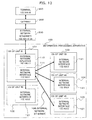
- the capturing unit 15 captures a response packet P2 (see FIGs. 11 and 12 ), which is generated by a process at the transmission destination (see Process #2 in FIGs. 8 , 11 , and 12 ) and passes through the loopback device 14, to a process at the transmission source of the other unit 11 (see Process #1 above).
- the capturing unit 15 captures the response packet P2 which passes through the loopback device 14 using the above capture function.
- the internal network interface 12a outputs the response packet P2 captured by the capturing unit 15 to the internal network 12, and transmits the packet to the other unit 11 at the transmission source according to the address system in the inter-process communication conducted by the loopback device 14.
- the sending unit 16 When the internal network interface 12a receives the packet addressed to its own unit from the other unit according to the address system in the inter-process communication conducted by the loopback device 14, the sending unit 16 starts up. When starting up, the sending unit 16 sends the packet (PI or P2) addressed to its own unit received by the internal network interface 12a to the process (Process #2 or #1) at the transmission destination through the loopback device 14.
- the function as the sending unit 16 can be realized using a send function which is originally provided in the OS 11A.
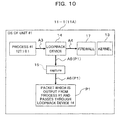
- the blocking unit (firewall) 17 blocks the packet P1, which passes through the loopback device 14, between the loopback device 14 and a kernel 13 of the OS 11A. Further, the blocking unit 17 blocks the response packet P2, which passes through the loopback device 14, between the loopback device 14 and the kernel 13 of the OS 11A. In addition, the blocking function of the blocking unit 17 will be described below with reference to FIGs. 9 to 12 .
- the kernel 13 is software which provides basic functions as the OS such as monitoring application software and peripheral devices, managing resources such as disks and memories, an interrupt process, and the inter-process communication.
- the converting unit 18 performs address conversion between the first address system of the external network 20 and the second address system of the internal network 12.
- the function as the converting unit 18 can be realized using a network address port translation (NAPT) mechanism.
- NAPT network address port translation
- FIG. 5 is a flowchart for describing a basic communication procedure between the units in the embodiment
- FIGs. 6 to 12 are diagrams for describing the communication operation between the units according to the embodiment.
- the communication operation between the unit 11-1 and the unit 11-2 is described in which only the main components in the unit 11 are illustrated.
- the IP addresses 127.1.0.1 and 127.1.0.2 of the address system in the inter-process communication conducted by the loopback device 14 are assigned to the units 11-1 and 11-2, respectively.
- the same symbols as those described above indicate the identical or similar portions, and thus the descriptions thereof will not be repeated.
- Steps S1 to S8 the basic communication procedure between the units will be described according to a flowchart (Steps S1 to S8) illustrated in FIG. 5 with reference to FIGs. 6 to 8 .
- Process (Process at the transmission source) #1 of the unit 11-1 at the transmission source generates a packet to Process (Process at the transmission destination) #2 of the unit 11-2 at the transmission destination and outputs the packet to the loopback device 14 (Step S1; see arrows A3 and A4 of FIG. 6 ).
- the capturing unit (capture) 15 puts a packet capture on the loopback device 14, and extracts the packet P1 addressed to Process #2 at the transmission destination (Step S2; see arrows A5 and A6 of FIG. 6 ). Then, the packet P1 extracted by the capturing unit 15 is output to an appropriate frame relay 12 according to the IP address of Process #2 at the transmission destination using a function as the frame relay transmission unit of the internal network interface 12a (see arrow A7 of FIGs. 7 and 8 ). Therefore, the packet P1 is transmitted to the unit 11-2 at the transmission destination (Step S3).
- the packet P1 transmitted by the frame relay 12 is received using a function as the frame relay reception unit of the internal network interface 12a of the unit 11-2 at the transmission destination (Step S4; see arrow A8 of FIG. 8 ).
- the internal network interface 12a which has received the packet P1 determines whether the packet P1 is addressed to its own unit 11-2 (Step S5).
- the internal network interface 12a transfers the packet P1 to the sending unit (send) 16 (Step S6; see arrow A9 of FIG. 8 ). Then, the sending unit (send) 16 sends the packet P1 to Process #2 at the transmission destination through the loopback device 14 (Step S7; see arrows A10 and A11 of FIG. 8 ).
- Step S5 the internal network interface 12a transfers the packet P1 to another OS 11A (another unit 11) on the hypervisor on which the OS 11A of its own unit 11-2 is established (Step S8). Thereafter, the same processes as Steps S6 and S7 are performed in the other units 11 at the transfer destination.
- TCP transmission control protocol
- the communication between the units may not be allowed depending on types of OSs as illustrated in FIGs. 9 and 11 .
- the packet transmitted from Process #1 is illustrated to disappear after passing through the loopback device 14.
- the types of OSs for example, Linux
- the packet which has passed through the loopback device 14 may be received by the kernel 13 (see arrow A4 of FIG. 9 ).
- the kernel 13 When receiving such a packet, the kernel 13 considers the communication by the packet as the TCP communication for a non-existent service (Process #2), and replies to Process #1 at the transmission source with a communication end signal, that is, a TCP reset signal (RST) (see arrows A12 and A13 of FIG. 9 ).
- a communication end signal that is, a TCP reset signal (RST)
- RST TCP reset signal
- the connection of the TCP communication is cut off, and the communication relating to the packet P1 from Process #1 at the transmission source is stopped. Therefore, as illustrated in FIGs. 6 to 8 , even when there is a reply to the captured packet P1 from the unit 11-2 at the transmission destination, it is not possible to handle the reply, and thus the communication between the units is ended without being established.
- the packet P1 which is addressed to the unit 11-2 at the transmission destination and has passed through the loopback device 14 is blocked and discarded by the blocking unit 17 before the packet is transferred to the kernel 13 (see arrow A4 of FIG. 10 ). Therefore, since the kernel 13 does not receive the packet P1, the reset signal is not replied from the kernel 13 to Process #1 at the transmission source, and thus it is possible to suppress that the communication between the units is ended without being established.
- the service (Process #2) in its own OS 11A replies instead of the service (Process #2) of the other unit 11-2.
- all the packets addressed to the units within a loopback address range are received in the unit 11-1 at the transmission source.
- the packet P1 is transmitted to the unit at the address 127.1.0.2.
- the packet P1 comes to be received by the service in the OS 11A of the unit 11-1 which makes a reply. Even such a situation is solved since the firewall serving as the blocking unit 17 is set to discard the packet addressed to the unit at the address 127.1.0.2.
- the response packet P2 which has passed through the loopback device 14 may be received by the kernel 13 (see arrow A15 of FIG. 11 ).
- the kernel 13 considers the communication by the packet P2 as the TCP communication for a non-existent service (Process #1), and replies to Process #2 with the TCP reset signal (see arrows A19 and A20 of FIG. 11 ).
- the reset signal By the reset signal, the connection of the TCP communication is cut off, and the communication relating to the response packet P2 from Process #2 is stopped. Therefore, even when there is a reply to the response packet P2 from the unit 11-1 at the transmission source, it is not possible to handle the reply, and thus the communication between the units is ended without being established.
- the response packet P2 which is addressed to the unit 11-1 at the transmission source and has passed through the loopback device 14 is blocked and discarded by the blocking unit 17 before the packet is transferred to the kernel 13 (see arrow A4 of FIG. 10 ). Therefore, since the kernel 13 does not receive the response packet P2, the reset signal is not replied from the kernel 13 to Process #2, and thus it is possible to suppress that the communication between the units is ended without being established.
- a port number at the transmission source is automatically assigned by the OS 11A.
- the application program itself may designate the port number at the transmission source, but it is an exception. Since the loopback address is present in every OS, the port number at the transmission source which is assigned by the OS of Unit #1 may be the same as the port number which is automatically assigned by the OS of Unit #2. However, in the embodiment, since the port number at the transmission source is managed for every IP address, the loopback address is assigned as an address exclusively for each unit 11 (for example, 127.1.0.2 is exclusively used for the OS of Unit #2). Therefore, it is restrained that the same port number at the transmission source is redundantly assigned.
- the loopback address it is possible to establish the second address system, which is independent from the first address system of the external network 20, in the internal network 12 between the units 11 included in the information processing apparatus 10. Accordingly, the internal network 12 can be established without any influence on the external network 20.
- the internal network 12 can be established regardless of the setting of the external network 20.
- the address system of the internal network 12 can be established using the loopback address.
- the case where an address for the internal network 12 is not possible to be secured for example, includes a case where all the private addresses are suppressed to make connection to a global space.
- the respective units 11 in the information processing apparatus 10 can conduct communication with an external mechanism (for example, the terminal 40) which is connected to the external network 20.
- the packet P1 and the response packet P2 which have passed through the loopback device 14 are blocked and discarded by the blocking unit 17 before being transferred to the kernel 13. Therefore, since the kernel 13 does not receive the packets P1 and P2, the reset signal is not replied from the kernel 13 to the process from which the packets P1 and P2 are issued. Accordingly, it is possible to suppress that the communication between the units is ended without being established.
- the internal network interface 12a has a function of transferring the other packet except the packet addressed to its own unit to the other unit while selecting and transferring the packet addressed to its own unit to the sending unit 16.
- the function for example, in a case where the plurality of units 11 of each unified storage device described above are a plurality of virtual machines established on the hypervisor, it is possible to conduct communication between the units 11 which are directly connected to the other units 11 through the internal network 12.
- Some or all of the functions as the internal network interface 12a, the capturing unit 15, the sending unit 16, the blocking unit 17, the converting unit 18, and the external network interface 20a described above may be realized by a predetermined program executed by a computer (including a micro-processing unit (MPU), a CPU, various types of terminals).
- a computer including a micro-processing unit (MPU), a CPU, various types of terminals).
- the program may be provided in types of being recorded in a computer-readable recording medium such as a flexible disk, a CD (a CD-ROM, a CD-R, a CD-RW, and the like), a DVD (a DVD-ROM, a DVD-RAM, a DVD-R, a DVD-RW, a DVD+R, a DVD+RW, and the like), and a Blu-ray disk.
- a computer-readable recording medium such as a flexible disk, a CD (a CD-ROM, a CD-R, a CD-RW, and the like), a DVD (a DVD-ROM, a DVD-RAM, a DVD-R, a DVD-RW, a DVD+R, a DVD+RW, and the like), and a Blu-ray disk.
- the computer reads the program from the recording medium, and transfers and stores the program into an inner storage unit or an external storage unit for use.
Landscapes
- Engineering & Computer Science (AREA)
- Computer Networks & Wireless Communication (AREA)
- Signal Processing (AREA)
- Theoretical Computer Science (AREA)
- Physics & Mathematics (AREA)
- General Engineering & Computer Science (AREA)
- General Physics & Mathematics (AREA)
- Small-Scale Networks (AREA)
- Data Exchanges In Wide-Area Networks (AREA)
Applications Claiming Priority (1)
| Application Number | Priority Date | Filing Date | Title |
|---|---|---|---|
| JP2013204656A JP6337437B2 (ja) | 2013-09-30 | 2013-09-30 | 情報処理装置、情報処理システム、及びプログラム |
Publications (2)
| Publication Number | Publication Date |
|---|---|
| EP2854040A2 true EP2854040A2 (de) | 2015-04-01 |
| EP2854040A3 EP2854040A3 (de) | 2015-05-13 |
Family
ID=51492802
Family Applications (1)
| Application Number | Title | Priority Date | Filing Date |
|---|---|---|---|
| EP20140181378 Withdrawn EP2854040A3 (de) | 2013-09-30 | 2014-08-19 | Informationsverarbeitungsvorrichtung, Informationsverarbeitungssystem und Programm |
Country Status (3)
| Country | Link |
|---|---|
| US (1) | US9584469B2 (de) |
| EP (1) | EP2854040A3 (de) |
| JP (1) | JP6337437B2 (de) |
Cited By (1)
| Publication number | Priority date | Publication date | Assignee | Title |
|---|---|---|---|---|
| CN105657868A (zh) * | 2016-01-29 | 2016-06-08 | 努比亚技术有限公司 | 移动终端及其接口控制方法 |
Families Citing this family (3)
| Publication number | Priority date | Publication date | Assignee | Title |
|---|---|---|---|---|
| JP6933535B2 (ja) * | 2017-09-21 | 2021-09-08 | 株式会社東芝 | 通信装置、通信方法及びプログラム |
| CN112995762B (zh) * | 2019-12-02 | 2024-08-09 | 海信视像科技股份有限公司 | 显示设备及网络状态同步方法 |
| CN111385620A (zh) * | 2020-03-05 | 2020-07-07 | 海信视像科技股份有限公司 | 一种显示设备、有线网口控制方法及存储介质 |
Citations (2)
| Publication number | Priority date | Publication date | Assignee | Title |
|---|---|---|---|---|
| JP2009151744A (ja) | 2007-11-26 | 2009-07-09 | Ricoh Co Ltd | 情報処理装置、情報処理方法およびプログラム |
| JP2010049676A (ja) | 2008-08-20 | 2010-03-04 | Sharp Corp | ソケットapiコール・エミュレーションの方法およびシステム |
Family Cites Families (10)
| Publication number | Priority date | Publication date | Assignee | Title |
|---|---|---|---|---|
| US7760729B2 (en) * | 2003-05-28 | 2010-07-20 | Citrix Systems, Inc. | Policy based network address translation |
| JP2006338415A (ja) * | 2005-06-02 | 2006-12-14 | Warevalley Co Ltd | データベースシステムに接続せずにデータベースシステムをモニタリングする方法 |
| US7802000B1 (en) * | 2005-08-01 | 2010-09-21 | Vmware | Virtual network in server farm |
| JP4883979B2 (ja) * | 2005-10-11 | 2012-02-22 | 株式会社ソニー・コンピュータエンタテインメント | 情報処理装置および通信制御方法 |
| US7873701B2 (en) * | 2007-11-27 | 2011-01-18 | International Business Machines Corporation | Network on chip with partitions |
| US8194674B1 (en) * | 2007-12-20 | 2012-06-05 | Quest Software, Inc. | System and method for aggregating communications and for translating between overlapping internal network addresses and unique external network addresses |
| JP4633837B2 (ja) * | 2008-01-22 | 2011-02-16 | 富士通株式会社 | アドレス配信システム、方法およびそのためのプログラム |
| US9167020B2 (en) * | 2011-06-10 | 2015-10-20 | Microsoft Technology Licensing, Llc | Web-browser based desktop and application remoting solution |
| US9094302B2 (en) * | 2012-04-16 | 2015-07-28 | Dell Products, Lp | System and method to discover virtual machine instantiations and configure network service level agreements |
| US8913507B2 (en) * | 2012-06-21 | 2014-12-16 | Breakingpoint Systems, Inc. | Virtual data loopback and/or data capture in a computing system |
-
2013
- 2013-09-30 JP JP2013204656A patent/JP6337437B2/ja active Active
-
2014
- 2014-08-19 EP EP20140181378 patent/EP2854040A3/de not_active Withdrawn
- 2014-09-05 US US14/477,916 patent/US9584469B2/en active Active
Patent Citations (2)
| Publication number | Priority date | Publication date | Assignee | Title |
|---|---|---|---|---|
| JP2009151744A (ja) | 2007-11-26 | 2009-07-09 | Ricoh Co Ltd | 情報処理装置、情報処理方法およびプログラム |
| JP2010049676A (ja) | 2008-08-20 | 2010-03-04 | Sharp Corp | ソケットapiコール・エミュレーションの方法およびシステム |
Cited By (1)
| Publication number | Priority date | Publication date | Assignee | Title |
|---|---|---|---|---|
| CN105657868A (zh) * | 2016-01-29 | 2016-06-08 | 努比亚技术有限公司 | 移动终端及其接口控制方法 |
Also Published As
| Publication number | Publication date |
|---|---|
| JP2015070522A (ja) | 2015-04-13 |
| JP6337437B2 (ja) | 2018-06-06 |
| EP2854040A3 (de) | 2015-05-13 |
| US20150092600A1 (en) | 2015-04-02 |
| US9584469B2 (en) | 2017-02-28 |
Similar Documents
| Publication | Publication Date | Title |
|---|---|---|
| US9219640B2 (en) | Performing failover in a redundancy group | |
| CN109120746B (zh) | 网络地址转换方法、装置及地址转换设备 | |
| US20150256622A1 (en) | Connection management device, communication system, connection management method, and computer program product | |
| CN112367257B (zh) | 路由通告方法及装置 | |
| US9584469B2 (en) | Information processing apparatus, information processing system, and computer-readable recording medium having stored program | |
| JP5255035B2 (ja) | フェイルオーバシステム、記憶処理装置及びフェイルオーバ制御方法 | |
| US11375441B2 (en) | Systems and methods for connecting wireless clients to preferred edge devices in active-active deployments | |
| US8948020B2 (en) | Detecting and isolating dropped or out-of-order packets in communication networks | |
| CN104202212A (zh) | 一种获取分布式集群系统告警的系统和方法 | |
| JP6183931B2 (ja) | クラスタシステム、サーバ装置、クラスタシステムの管理方法、及びプログラム。 | |
| US10972337B2 (en) | Method and apparatus for split-brain avoidance in sub-secondary high availability systems | |
| EP2614614B1 (de) | Dynamische konfiguration von miteinander verbundenen vorrichtung zur messung der leistungseigenschaften in einem netzwerk | |
| US20170311224A1 (en) | Method and apparatus for implementing network sharing | |
| JP6365280B2 (ja) | 情報処理装置、情報処理システム、及びプログラム | |
| CN113098904B (zh) | 网络设备的通信方法及装置 | |
| US20180288075A1 (en) | Communication destination determination device, communication destination determination method, and recording medium | |
| JP6919461B2 (ja) | ノード装置及びフェイルオーバ制御方法 | |
| JP6488600B2 (ja) | 情報処理システム、プログラム及び情報処理装置 | |
| CN105610619B (zh) | 一种网元设备管理方法和装置 | |
| CN110830305B (zh) | 无线设备接入wifi网络的方法、装置、电子设备及存储介质 | |
| CN104426699B (zh) | 通信方法、服务器及通信系统 | |
| CN107360037A (zh) | 一种错误信息获取方法及网络管理设备 | |
| CN104113449A (zh) | 一种链路检测方法及装置 | |
| JP5421410B2 (ja) | 監視装置、ネットワーク監視システム、ネットワーク監視方法及びプローブ装置 | |
| JP5763030B2 (ja) | 二重化ネットワーク制御システムおよび二重化ネットワーク制御方法 |
Legal Events
| Date | Code | Title | Description |
|---|---|---|---|
| PUAI | Public reference made under article 153(3) epc to a published international application that has entered the european phase |
Free format text: ORIGINAL CODE: 0009012 |
|
| 17P | Request for examination filed |
Effective date: 20140819 |
|
| AK | Designated contracting states |
Kind code of ref document: A2 Designated state(s): AL AT BE BG CH CY CZ DE DK EE ES FI FR GB GR HR HU IE IS IT LI LT LU LV MC MK MT NL NO PL PT RO RS SE SI SK SM TR |
|
| AX | Request for extension of the european patent |
Extension state: BA ME |
|
| PUAL | Search report despatched |
Free format text: ORIGINAL CODE: 0009013 |
|
| AK | Designated contracting states |
Kind code of ref document: A3 Designated state(s): AL AT BE BG CH CY CZ DE DK EE ES FI FR GB GR HR HU IE IS IT LI LT LU LV MC MK MT NL NO PL PT RO RS SE SI SK SM TR |
|
| AX | Request for extension of the european patent |
Extension state: BA ME |
|
| RIC1 | Information provided on ipc code assigned before grant |
Ipc: H04L 12/70 20130101ALI20150409BHEP Ipc: G06F 13/38 20060101AFI20150409BHEP Ipc: G06F 15/16 20060101ALI20150409BHEP |
|
| STAA | Information on the status of an ep patent application or granted ep patent |
Free format text: STATUS: THE APPLICATION HAS BEEN WITHDRAWN |
|
| R17P | Request for examination filed (corrected) |
Effective date: 20151015 |
|
| RBV | Designated contracting states (corrected) |
Designated state(s): AL AT BE BG CH CY CZ DE DK EE ES FI FR GB GR HR HU IE IS IT LI LT LU LV MC MK MT NL NO PL PT RO RS SE SI SK SM TR |
|
| 18W | Application withdrawn |
Effective date: 20151112 |