EP2853993A1 - Procédé de codage d'un flux de données et de transmission d'une séquence d'événements entre un premier et un second dispositif comprenant un écran tactile capacitif - Google Patents
Procédé de codage d'un flux de données et de transmission d'une séquence d'événements entre un premier et un second dispositif comprenant un écran tactile capacitif Download PDFInfo
- Publication number
- EP2853993A1 EP2853993A1 EP13306315.6A EP13306315A EP2853993A1 EP 2853993 A1 EP2853993 A1 EP 2853993A1 EP 13306315 A EP13306315 A EP 13306315A EP 2853993 A1 EP2853993 A1 EP 2853993A1
- Authority
- EP
- European Patent Office
- Prior art keywords
- duration
- sequence
- touchscreen
- transmitting
- scan
- Prior art date
- Legal status (The legal status is an assumption and is not a legal conclusion. Google has not performed a legal analysis and makes no representation as to the accuracy of the status listed.)
- Withdrawn
Links
Images



Classifications
-
- G—PHYSICS
- G06—COMPUTING OR CALCULATING; COUNTING
- G06F—ELECTRIC DIGITAL DATA PROCESSING
- G06F3/00—Input arrangements for transferring data to be processed into a form capable of being handled by the computer; Output arrangements for transferring data from processing unit to output unit, e.g. interface arrangements
- G06F3/01—Input arrangements or combined input and output arrangements for interaction between user and computer
- G06F3/03—Arrangements for converting the position or the displacement of a member into a coded form
- G06F3/033—Pointing devices displaced or positioned by the user, e.g. mice, trackballs, pens or joysticks; Accessories therefor
- G06F3/039—Accessories therefor, e.g. mouse pads
- G06F3/0393—Accessories for touch pads or touch screens, e.g. mechanical guides added to touch screens for drawing straight lines, hard keys overlaying touch screens or touch pads
-
- G—PHYSICS
- G06—COMPUTING OR CALCULATING; COUNTING
- G06F—ELECTRIC DIGITAL DATA PROCESSING
- G06F3/00—Input arrangements for transferring data to be processed into a form capable of being handled by the computer; Output arrangements for transferring data from processing unit to output unit, e.g. interface arrangements
- G06F3/01—Input arrangements or combined input and output arrangements for interaction between user and computer
- G06F3/03—Arrangements for converting the position or the displacement of a member into a coded form
- G06F3/041—Digitisers, e.g. for touch screens or touch pads, characterised by the transducing means
- G06F3/0416—Control or interface arrangements specially adapted for digitisers
- G06F3/04166—Details of scanning methods, e.g. sampling time, grouping of sub areas or time sharing with display driving
-
- G—PHYSICS
- G06—COMPUTING OR CALCULATING; COUNTING
- G06F—ELECTRIC DIGITAL DATA PROCESSING
- G06F3/00—Input arrangements for transferring data to be processed into a form capable of being handled by the computer; Output arrangements for transferring data from processing unit to output unit, e.g. interface arrangements
- G06F3/01—Input arrangements or combined input and output arrangements for interaction between user and computer
- G06F3/03—Arrangements for converting the position or the displacement of a member into a coded form
- G06F3/041—Digitisers, e.g. for touch screens or touch pads, characterised by the transducing means
- G06F3/0416—Control or interface arrangements specially adapted for digitisers
- G06F3/04162—Control or interface arrangements specially adapted for digitisers for exchanging data with external devices, e.g. smart pens, via the digitiser sensing hardware
-
- G—PHYSICS
- G06—COMPUTING OR CALCULATING; COUNTING
- G06F—ELECTRIC DIGITAL DATA PROCESSING
- G06F3/00—Input arrangements for transferring data to be processed into a form capable of being handled by the computer; Output arrangements for transferring data from processing unit to output unit, e.g. interface arrangements
- G06F3/01—Input arrangements or combined input and output arrangements for interaction between user and computer
- G06F3/03—Arrangements for converting the position or the displacement of a member into a coded form
- G06F3/041—Digitisers, e.g. for touch screens or touch pads, characterised by the transducing means
- G06F3/044—Digitisers, e.g. for touch screens or touch pads, characterised by the transducing means by capacitive means
- G06F3/0441—Digitisers, e.g. for touch screens or touch pads, characterised by the transducing means by capacitive means using active external devices, e.g. active pens, for receiving changes in electrical potential transmitted by the digitiser, e.g. tablet driving signals
-
- G—PHYSICS
- G06—COMPUTING OR CALCULATING; COUNTING
- G06F—ELECTRIC DIGITAL DATA PROCESSING
- G06F3/00—Input arrangements for transferring data to be processed into a form capable of being handled by the computer; Output arrangements for transferring data from processing unit to output unit, e.g. interface arrangements
- G06F3/01—Input arrangements or combined input and output arrangements for interaction between user and computer
- G06F3/03—Arrangements for converting the position or the displacement of a member into a coded form
- G06F3/041—Digitisers, e.g. for touch screens or touch pads, characterised by the transducing means
- G06F3/044—Digitisers, e.g. for touch screens or touch pads, characterised by the transducing means by capacitive means
- G06F3/0442—Digitisers, e.g. for touch screens or touch pads, characterised by the transducing means by capacitive means using active external devices, e.g. active pens, for transmitting changes in electrical potential to be received by the digitiser
-
- H—ELECTRICITY
- H04—ELECTRIC COMMUNICATION TECHNIQUE
- H04B—TRANSMISSION
- H04B5/00—Near-field transmission systems, e.g. inductive or capacitive transmission systems
- H04B5/20—Near-field transmission systems, e.g. inductive or capacitive transmission systems characterised by the transmission technique; characterised by the transmission medium
- H04B5/22—Capacitive coupling
Definitions
- This invention involves the methods for encoding a data stream which is transmitted from a first device to a second device through a capacitive touchscreen, as for example a smartphone or a tablet.
- Some solutions allow activating a capacitive touchscreen by an actuator from a first device. These solutions suffer from a lack of definition of an efficient coding allowing the data transmission through capacitive touch screens. On the one hand, the need to establish an asynchronous link between two devices and on the other hand, the diversity of architectures facilities including a touch screen makes it difficult to implement a solution of efficient coding.
- the invention overcomes the aforementioned disadvantages.
- the method comprises:
- This solution allows defining interoperability between two devices through the touch screen without implying a specific connection for transmitting a data stream.
- the method comprises:
- This solution allows configuring the threshold with the definition of the first and the second durations.
- the detection of state transitions allowing the generation of events is realized by sampling at a scanning period the capacitive state of the first area of the touchscreen.
- the first device is able to emulate simultaneously different sequences of touches and touch releases on a set of different areas of the touchscreen of the second device.
- the first duration is greater than the scanning period.
- the first duration is equal or less than twice the scanning period.
- the second duration is equal or more than twice the scanning period value. This solution ensures a better detection of the modification of the capacitive state of the touchscreen of the second device.
- the second duration is equal or more than three times the scanning period.
- One advantage of the invention is to optimize the recognition of a data bits sequence. This relation between the first duration and the second duration of a data bit ensure that objective.
- the method comprises a preliminary step comprising transmitting the scanning period from the second device to the first device.
- transmitting the scanning period from the second device comprises a detection of the presence of a first device set on the touchscreen.
- transmitting the scanning period from the second device to the first device comprises generating a flashing of an area of the touchscreen at the scanning frequency.
- the method comprises calculating the first duration and the second duration by the first device according to the value of scanning period received from the second device, ensuring that the first duration is greater than the scanning period.
- the method comprises a preliminary step comprising:
- the first device comprises at least one actuator able to emulate a sequence of touches and touch releases on a capacitive touchscreen of a second device, the actuator being controlled by a calculator, a sequence of touches and touch releases defining a sequence of state transitions on an area of the touchscreen of the second device, a first value of bit being encoded by a first duration defined between two state transitions and a second value of bit being encoded by a second duration defined between two state transitions.
- the first device comprises a light sensor able to retrieve the frequency of a flashing light emitted by the second device.
- the first device comprises a calculator able to calculate the first duration and the second duration depending of the value of the frequency of a flashing light retrieved.
- a modification of the capacitive state on a touch screen detected by the second device raises an event.
- An event is meaningful only for the second device.
- an event is at least a touch, where something (a finger, an object, etc.) touches the touchscreen, and a touch release, where something (a finger, an object, etc.) which is already touching the touchscreen leaves this touchscreen.
- an event is raised by the second device when a modification of the capacitive state of the screen of the second device is detected.
- a touch or a touch release received on the screen of the second device may be emulated by the first device.
- the touch and the touch release generate a modification of the capacitive state of an area of the touchscreen.
- Figure 1 illustrates an encoding scheme according to the invention which defines different sequences of touches and touches releases.
- Each sequence 10, 11, 12 and 13 illustrates a coding sequence of a data bit.
- a touch on a capacitive touchscreen of a second device is noted in the figure 1 : "TS".
- a touch release on the capacitive touchscreen of a second device is noted in the figure 1 : “R”.
- the touch TS and the touch release R may be activated by an actuator of a first device.
- the actuator can be for example a plate drove to a potential corresponding to the touch or to the touch release.
- the first device may be placed on an area of the touchscreen of the second device in such a way that the actuator is in contact with the screen.
- the first parameter is noted t a and represents a first duration between two state transitions of the touchscreen of the second device.
- the state transitions may occur on a predefined area of the touchscreen.
- the first duration is defined between two successive states transitions. The method of the invention ensures to not miss any state transitions at the detection level in the second device.
- Each duration t a and t b is affected to a bit value 1 or 0.
- the first bit value ('1' or '0', depending on the implementation) is encoded, for instance, with the first duration.
- a touch TS occurs at t 0 and a touch released R occurs at t 0 +t a .
- a touch release R occurs at t 0 and a touch TS occurs at t 0 +t a .
- t a represents the first duration and corresponds for instance to a first bit value.
- the second parameter is noted t b and represents a second duration between two state transitions of the touchscreen.
- a second bit value ('0' or '1' depending on the implementation), corresponds to the second duration.
- V the value of the transmitted bit
- the sequence comprises a touch at t 0 and a touch release R occurs at t 0 +t b .
- t b represents the duration between the two state transitions of the touchscreen of the second device.
- the touch occurring at t 0 is a continuous touch maintained during the period t b .
- the sequence comprises a touch release starting at t 0 and maintained until t 0 +t b.
- a touch occurs at t 0 +t b .
- the second device reads a value equal to "0" of the transmitted bit.
- Both parameters t a and t b are defined in the first device.
- the method of the invention allows defining a data bit transmission depending of a sequence of touches and touch releases and the durations of the first and the second parameters.
- the configuration of the first and second parameters may be used for optimizing data rate between the first and the second devices, improving discrimination of the data received.
- the second device comprising a touchscreen has a scanning function allowing determining periodically each event occurring on the touchscreen.
- a capacitive matrix on the screen may be coupled to a calculator in order to activate the scanning function periodically.
- the scanning frequency is comprised in the range [25Hz; 65Hz]. For instance a possible value may be substantially equal to 30 Hz.
- the second device scans periodically the screen to measure a possible change in local capacitance.
- T scan This parameter is defined by the manufacturer of the second device.
- a calculator of the second device raises an event containing some information among which the event type, a position on the screen and a timestamp.
- the event may be generated at the hardware level and/or at the application level depending of the second device.
- the data coding and the transmission of such data between the first device and the second device is based on an asynchronous communication.
- Each sequence defined in figure 1 comprises a touch or a touch release at the beginning of each bit to transmit.
- Each transmitted bit is sent during a first period t a or a second period t b depending of the data bit sequence to send.
- the measures of the event timestamps at the second device level allow retrieve the sequence of data bit.
- parameters t a and t b shall be constrained.
- the method of the invention allows defining relations between these parameters and with the scanning period T scan of the second device.
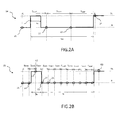
- Figure 2A represents a first sequence 14 of touches and touch releases comprising a touch TS and a touch released R which succeeds to the touch TS.
- the two first state transitions are spaced of the duration t a as defined in figure 1 .
- the second device is able to scan the capacitive state on its touchscreen every T scan period thanks to a calculator.
- the calculator polls the screen state periodically every moment 21, 22, 23, 24. If the result of this polling is different from the previous one, an event is raised in the second device.
- Figure 2A represents a case where T scan exceeds the first duration of t a .
- t -> S(t) is the function giving the capacitive state of the touchscreen at different period given by the scanning period.
- the second device may miss the event corresponding to a touch TS being activated continuously during t a , as it is represented in figure 2A .
- t a is defined, or reciprocally T scan , in order to obtain the following relation:
- the method of the invention allows determining a period t a long enough to raise an event in the second device as a touch TS if the sequence is a transmitted sequence 10 or a touch released R is the sequence is a transmitted sequence 11.
- the method is based on relative timings between events. To get these timings, timestamps from events need to be analyzed.
- the touch maintained during t a seconds by the first device will raise two events in the second device:
- i -> T Ei is a function giving the time interval after detecting two successive events: E i and E i-1 at the second device level.
- the time interval is defined by the duration between two timestamps of both successive events generated by the second device.
- the calculation of T Ei+1 allows comparing the result with a predefined threshold which enables determining if the duration of the received bit is closer from t a or t b .
- a duration seen by the second device will always be a multiple of T scan .
- the first and the second durations t a , t b defined in the first device are seen by the second device as multiples of T scan .
- t a and t b can be written like the following:
- r a and r b are integers strictly positive because t a > T scan and t b > T scan and where q a and q b are belonging to [0 ; T scan [.
- a figure 3 illustrates a sequence 16 received by the second device.
- a calculator of the second device allows scanning the state of the screen.
- an event is raised.
- the sequence 16 shows 5 events raised after receiving the sequence of touches and touch releases.
- the calculator of the second device is able to determinate a first timestamp: T E2 .
- Figure 4 illustrates an example of a sequence 18 where:
- the sequence 18 shows:
- sequence 18 begins at t 0 and the scanning frequency is represented in the sequence 18.
- This configuration allows defining an interval of time between two timestamps of two successive events equal either to the first duration either to the second duration.
- a preliminary step of the method allows the first device to retrieve the scanning period T scan or the scanning frequency 1/T scan from the second device. Once the scanning period T scan was acquired by the first device, the said first device may adapt and configure the value of the first duration t a and the second duration t b in order to optimize the data transmission between the first device and the second device.
- An advantage of this solution is to ensure an adaptable and flexible solution which may be used independently of the technology used by the touchscreen of the second device. Indeed, the scanning frequency of capacitive matrix may be different from a device to another.
- the scanning frequency may be sent from the second device to the first device by:
- the scanning period may be sent by any interface of the second device: audio signal, light emitter, wifi, Bluetooth.
- the scanning period is sent by generating a flashing by the calculator of the second device and transmitted by the screen of the said second device.
- the flashing is set to the frequency of the scanning frequency in order to allow the first device acquire the frequency value of the flashing.
- the values of t a and t b may be configured to be compliant according to a predefined scanning period during a predefined duration at the beginning of the communication between both devices.
- the predefined scanning period may be chosen in order to be a large enough period to work with all possible devices.
- the scanning frequency may be adapted during the transmission between both devices in order to improve data rate transmission.
- the invention concerns a device, call first device, for transmitting a sequence of events, the events being generated according to the method of the invention, the device comprising an actuator allowing the emulation of a touch on a capacitive touchscreen.
- the first device comprises also a surface intended to cooperate with an area of a touchscreen for activating the actuator on the area.
- the first device may comprise a calculator and a screen.
- Figure 5A illustrates a first device 40 comprising a calculator K1 and actuator 41.
- the actuator 41 allows generating a sequence of touches and touch releases on the touchscreen of the second device 30.
- the calculator K1 allows encoding the bit stream sequence and piloting the actuator 41.
- the second device 30 comprises a calculator K2 and a touchscreen 31.
- the touchscreen 31 is able to manage modifications of the capacitive state of at least a first area.
- the first area may be the whole surface of the touchscreen or a part of the touchscreen.
- the second device 30 generates a sequence of events, each event corresponding to the detection of a state transition of the first area of the touchscreen.
- the second device 30 comprises a calculator K2 able to retrieve the transmitted bit sequence from the first device by analyzing the measured duration between two successive events generated.
- Both first and second devices may be paired mechanically by positioning mean 42.
- the positioning mean 42 allows the actuator of the first device to transmit a sequence of touches and touch releases in the same area. The advantage is to stabilize both devices during the transmission.
- the figure 5B illustrates a first device 40 as a smart card comprising a first actuator 41.
- the first device may comprise a set of actuators 41, 42.
- the first device is able to emulate simultaneously different sequences of touches and touch releases with different actuators on a set of different areas of the touchscreen 31 of the second device 30.
- the first device 40 comprises a light sensor 43 for receiving a flashing light.
- the second device is able to generate a flashing of an area of the touchscreen at the scanning frequency.
- the first device 40 is capable to detect the frequency of the flashing light and to retrieve the scanning period.
Landscapes
- Engineering & Computer Science (AREA)
- General Engineering & Computer Science (AREA)
- Theoretical Computer Science (AREA)
- Human Computer Interaction (AREA)
- Physics & Mathematics (AREA)
- General Physics & Mathematics (AREA)
- Computer Networks & Wireless Communication (AREA)
- Signal Processing (AREA)
- User Interface Of Digital Computer (AREA)
Priority Applications (2)
| Application Number | Priority Date | Filing Date | Title |
|---|---|---|---|
| EP13306315.6A EP2853993A1 (fr) | 2013-09-26 | 2013-09-26 | Procédé de codage d'un flux de données et de transmission d'une séquence d'événements entre un premier et un second dispositif comprenant un écran tactile capacitif |
| PCT/EP2014/066853 WO2015043809A1 (fr) | 2013-09-26 | 2014-08-05 | Procédé de codage d'un flux de données et de transmission d'une séquence d'événements entre un premier dispositif et un second dispositif comprenant un écran tactile capacitif |
Applications Claiming Priority (1)
| Application Number | Priority Date | Filing Date | Title |
|---|---|---|---|
| EP13306315.6A EP2853993A1 (fr) | 2013-09-26 | 2013-09-26 | Procédé de codage d'un flux de données et de transmission d'une séquence d'événements entre un premier et un second dispositif comprenant un écran tactile capacitif |
Publications (1)
| Publication Number | Publication Date |
|---|---|
| EP2853993A1 true EP2853993A1 (fr) | 2015-04-01 |
Family
ID=49322306
Family Applications (1)
| Application Number | Title | Priority Date | Filing Date |
|---|---|---|---|
| EP13306315.6A Withdrawn EP2853993A1 (fr) | 2013-09-26 | 2013-09-26 | Procédé de codage d'un flux de données et de transmission d'une séquence d'événements entre un premier et un second dispositif comprenant un écran tactile capacitif |
Country Status (2)
| Country | Link |
|---|---|
| EP (1) | EP2853993A1 (fr) |
| WO (1) | WO2015043809A1 (fr) |
Cited By (1)
| Publication number | Priority date | Publication date | Assignee | Title |
|---|---|---|---|---|
| WO2024220008A1 (fr) * | 2023-04-20 | 2024-10-24 | Telefonaktiebolaget Lm Ericsson (Publ) | Procédé et dispositif de communication sécurisée de dispositif à dispositif |
Citations (4)
| Publication number | Priority date | Publication date | Assignee | Title |
|---|---|---|---|---|
| US20100277435A1 (en) * | 2007-11-20 | 2010-11-04 | Samsung Electronics Co., Ltd. | External device identification method and apparatus in a device including a touch spot, and computer-readable recording mediums having recorded thereon programs for executing the external device identification method in a device including a touch spot |
| US20110304583A1 (en) * | 2010-06-10 | 2011-12-15 | Empire Technology Development Llc | Communication Between Touch-Panel Devices |
| WO2013037599A1 (fr) * | 2011-09-16 | 2013-03-21 | Gemalto S.A. | Procédé pour la transmission d'une trame de données au moyen d'une modulation de largeur d'impulsions adaptative |
| US20130120291A1 (en) * | 2011-11-11 | 2013-05-16 | International Business Machines Corporation | Mobile touch-generating device as secure loupe for touchscreen devices |
-
2013
- 2013-09-26 EP EP13306315.6A patent/EP2853993A1/fr not_active Withdrawn
-
2014
- 2014-08-05 WO PCT/EP2014/066853 patent/WO2015043809A1/fr not_active Ceased
Patent Citations (4)
| Publication number | Priority date | Publication date | Assignee | Title |
|---|---|---|---|---|
| US20100277435A1 (en) * | 2007-11-20 | 2010-11-04 | Samsung Electronics Co., Ltd. | External device identification method and apparatus in a device including a touch spot, and computer-readable recording mediums having recorded thereon programs for executing the external device identification method in a device including a touch spot |
| US20110304583A1 (en) * | 2010-06-10 | 2011-12-15 | Empire Technology Development Llc | Communication Between Touch-Panel Devices |
| WO2013037599A1 (fr) * | 2011-09-16 | 2013-03-21 | Gemalto S.A. | Procédé pour la transmission d'une trame de données au moyen d'une modulation de largeur d'impulsions adaptative |
| US20130120291A1 (en) * | 2011-11-11 | 2013-05-16 | International Business Machines Corporation | Mobile touch-generating device as secure loupe for touchscreen devices |
Cited By (1)
| Publication number | Priority date | Publication date | Assignee | Title |
|---|---|---|---|---|
| WO2024220008A1 (fr) * | 2023-04-20 | 2024-10-24 | Telefonaktiebolaget Lm Ericsson (Publ) | Procédé et dispositif de communication sécurisée de dispositif à dispositif |
Also Published As
| Publication number | Publication date |
|---|---|
| WO2015043809A1 (fr) | 2015-04-02 |
Similar Documents
| Publication | Publication Date | Title |
|---|---|---|
| US11204655B2 (en) | Active stylus communication with a digitizer | |
| US9772697B2 (en) | Touch down detection with a stylus | |
| US9747433B2 (en) | Wearable electronic device and method for securing same | |
| US10921942B2 (en) | Touch system, its touch device and input device, and its signal transmission method | |
| US9013403B2 (en) | Remote controlling of mouse cursor functions of a computer device | |
| KR102366685B1 (ko) | 터치 인에이블 디바이스에 의한 데이터 송신을 위한 방법 및 시스템 | |
| CN106228796B (zh) | 红外遥控的学习方法及装置 | |
| CN106815546B (zh) | 指纹识别方法及装置 | |
| RU2661794C2 (ru) | Способ обработки сигнала прикосновения и устройство терминала | |
| CN102164009A (zh) | 在近场通信中使用的接收系统及其模式检测方法 | |
| CN102916729A (zh) | 一种触摸屏终端的近场通信方法、系统及触摸屏终端 | |
| CN112558798A (zh) | 主动笔的通信方法、装置、终端和存储介质 | |
| US10705627B2 (en) | Method and active stylus for generating signal, method and touch screen for analyzing signal | |
| CN113425269A (zh) | 生物特征信息的测量方法、装置和电子设备 | |
| CN112558797B (zh) | 主动笔及其控制方法、装置以及计算机可读存储介质 | |
| CN105630384A (zh) | 通过多击事件打开应用的方法及其控制系统 | |
| CN105306848B (zh) | 一种频道切换方法、装置和系统 | |
| WO2015043809A1 (fr) | Procédé de codage d'un flux de données et de transmission d'une séquence d'événements entre un premier dispositif et un second dispositif comprenant un écran tactile capacitif | |
| CN105243316A (zh) | 一种移动终端解锁的方法及装置 | |
| KR101847517B1 (ko) | 터치스크린 단말기 및 이의 근거리 통신 방법, 장치와 시스템 | |
| CN111913574B (zh) | 用于控制设备的方法、装置、电子设备和计算机可读介质 | |
| TWI667596B (zh) | Active stylus and wireless signal generating method thereof | |
| CN102664910B (zh) | 修正远程应用用户操作的方法、客户端和服务端 | |
| CN102721917B (zh) | 用于无时钟电路的标签芯片的测试方法及测试装置 | |
| EP2879024A1 (fr) | Procédé de communication pour transmettre un flux de données codées entre un dispositif de communication et un dispositif tactile comprenant une surface tactile capacitive |
Legal Events
| Date | Code | Title | Description |
|---|---|---|---|
| PUAI | Public reference made under article 153(3) epc to a published international application that has entered the european phase |
Free format text: ORIGINAL CODE: 0009012 |
|
| 17P | Request for examination filed |
Effective date: 20130926 |
|
| AK | Designated contracting states |
Kind code of ref document: A1 Designated state(s): AL AT BE BG CH CY CZ DE DK EE ES FI FR GB GR HR HU IE IS IT LI LT LU LV MC MK MT NL NO PL PT RO RS SE SI SK SM TR |
|
| AX | Request for extension of the european patent |
Extension state: BA ME |
|
| STAA | Information on the status of an ep patent application or granted ep patent |
Free format text: STATUS: THE APPLICATION IS DEEMED TO BE WITHDRAWN |
|
| 18D | Application deemed to be withdrawn |
Effective date: 20151002 |