EP2853524B1 - Reaction system and process for preparing polymethoxy dimethyl ether - Google Patents
Reaction system and process for preparing polymethoxy dimethyl ether Download PDFInfo
- Publication number
- EP2853524B1 EP2853524B1 EP14160886.9A EP14160886A EP2853524B1 EP 2853524 B1 EP2853524 B1 EP 2853524B1 EP 14160886 A EP14160886 A EP 14160886A EP 2853524 B1 EP2853524 B1 EP 2853524B1
- Authority
- EP
- European Patent Office
- Prior art keywords
- formaldehyde
- catalyst
- tower
- reaction
- unit
- Prior art date
- Legal status (The legal status is an assumption and is not a legal conclusion. Google has not performed a legal analysis and makes no representation as to the accuracy of the status listed.)
- Not-in-force
Links
- 238000006243 chemical reaction Methods 0.000 title claims description 77
- LCGLNKUTAGEVQW-UHFFFAOYSA-N Dimethyl ether Chemical compound COC LCGLNKUTAGEVQW-UHFFFAOYSA-N 0.000 title claims description 38
- 238000004519 manufacturing process Methods 0.000 title description 3
- WSFSSNUMVMOOMR-UHFFFAOYSA-N Formaldehyde Chemical compound O=C WSFSSNUMVMOOMR-UHFFFAOYSA-N 0.000 claims description 292
- OKKJLVBELUTLKV-UHFFFAOYSA-N Methanol Chemical compound OC OKKJLVBELUTLKV-UHFFFAOYSA-N 0.000 claims description 129
- 239000003054 catalyst Substances 0.000 claims description 88
- 238000000605 extraction Methods 0.000 claims description 78
- 238000000034 method Methods 0.000 claims description 58
- 230000008569 process Effects 0.000 claims description 54
- 238000006359 acetalization reaction Methods 0.000 claims description 53
- 239000007788 liquid Substances 0.000 claims description 49
- 239000003795 chemical substances by application Substances 0.000 claims description 47
- 229920002866 paraformaldehyde Polymers 0.000 claims description 42
- 229930040373 Paraformaldehyde Natural products 0.000 claims description 41
- 239000008098 formaldehyde solution Substances 0.000 claims description 41
- 239000000047 product Substances 0.000 claims description 38
- XLYOFNOQVPJJNP-UHFFFAOYSA-N water Substances O XLYOFNOQVPJJNP-UHFFFAOYSA-N 0.000 claims description 30
- 239000002994 raw material Substances 0.000 claims description 28
- UHOVQNZJYSORNB-UHFFFAOYSA-N Benzene Chemical compound C1=CC=CC=C1 UHOVQNZJYSORNB-UHFFFAOYSA-N 0.000 claims description 27
- 239000000463 material Substances 0.000 claims description 26
- -1 amine cation Chemical class 0.000 claims description 24
- 239000011831 acidic ionic liquid Substances 0.000 claims description 22
- WSFSSNUMVMOOMR-NJFSPNSNSA-N methanone Chemical compound O=[14CH2] WSFSSNUMVMOOMR-NJFSPNSNSA-N 0.000 claims description 20
- YXFVVABEGXRONW-UHFFFAOYSA-N Toluene Chemical compound CC1=CC=CC=C1 YXFVVABEGXRONW-UHFFFAOYSA-N 0.000 claims description 18
- 238000005406 washing Methods 0.000 claims description 18
- 238000001291 vacuum drying Methods 0.000 claims description 14
- 239000012043 crude product Substances 0.000 claims description 12
- 238000006116 polymerization reaction Methods 0.000 claims description 11
- 239000012530 fluid Substances 0.000 claims description 10
- 239000010409 thin film Substances 0.000 claims description 10
- XEKOWRVHYACXOJ-UHFFFAOYSA-N Ethyl acetate Chemical compound CCOC(C)=O XEKOWRVHYACXOJ-UHFFFAOYSA-N 0.000 claims description 9
- RAXXELZNTBOGNW-UHFFFAOYSA-N imidazole Natural products C1=CNC=N1 RAXXELZNTBOGNW-UHFFFAOYSA-N 0.000 claims description 8
- HEDRZPFGACZZDS-UHFFFAOYSA-N Chloroform Chemical compound ClC(Cl)Cl HEDRZPFGACZZDS-UHFFFAOYSA-N 0.000 claims description 6
- RTZKZFJDLAIYFH-UHFFFAOYSA-N Diethyl ether Chemical compound CCOCC RTZKZFJDLAIYFH-UHFFFAOYSA-N 0.000 claims description 6
- 238000001704 evaporation Methods 0.000 claims description 6
- VLKZOEOYAKHREP-UHFFFAOYSA-N n-Hexane Chemical compound CCCCCC VLKZOEOYAKHREP-UHFFFAOYSA-N 0.000 claims description 6
- XDTMQSROBMDMFD-UHFFFAOYSA-N Cyclohexane Chemical compound C1CCCCC1 XDTMQSROBMDMFD-UHFFFAOYSA-N 0.000 claims description 5
- XYFCBTPGUUZFHI-UHFFFAOYSA-N Phosphine Natural products P XYFCBTPGUUZFHI-UHFFFAOYSA-N 0.000 claims description 4
- 150000001450 anions Chemical group 0.000 claims description 4
- 239000007864 aqueous solution Substances 0.000 claims description 4
- 229910000073 phosphorus hydride Inorganic materials 0.000 claims description 4
- JUJWROOIHBZHMG-UHFFFAOYSA-N pyridine Substances C1=CC=NC=C1 JUJWROOIHBZHMG-UHFFFAOYSA-N 0.000 claims description 4
- UMJSCPRVCHMLSP-UHFFFAOYSA-N pyridine Natural products COC1=CC=CN=C1 UMJSCPRVCHMLSP-UHFFFAOYSA-N 0.000 claims description 4
- AFVFQIVMOAPDHO-UHFFFAOYSA-M Methanesulfonate Chemical compound CS([O-])(=O)=O AFVFQIVMOAPDHO-UHFFFAOYSA-M 0.000 claims description 3
- CTQNGGLPUBDAKN-UHFFFAOYSA-N O-Xylene Chemical compound CC1=CC=CC=C1C CTQNGGLPUBDAKN-UHFFFAOYSA-N 0.000 claims description 3
- DTQVDTLACAAQTR-UHFFFAOYSA-M Trifluoroacetate Chemical compound [O-]C(=O)C(F)(F)F DTQVDTLACAAQTR-UHFFFAOYSA-M 0.000 claims description 3
- 150000001768 cations Chemical group 0.000 claims description 3
- QAOWNCQODCNURD-UHFFFAOYSA-M hydrogensulfate Chemical compound OS([O-])(=O)=O QAOWNCQODCNURD-UHFFFAOYSA-M 0.000 claims description 3
- 239000003208 petroleum Substances 0.000 claims description 3
- 230000000379 polymerizing effect Effects 0.000 claims description 3
- 239000008096 xylene Substances 0.000 claims description 3
- 239000012071 phase Substances 0.000 description 49
- 239000007789 gas Substances 0.000 description 21
- 239000012295 chemical reaction liquid Substances 0.000 description 15
- 238000003860 storage Methods 0.000 description 13
- 239000000243 solution Substances 0.000 description 9
- BGJSXRVXTHVRSN-UHFFFAOYSA-N 1,3,5-trioxane Chemical group C1OCOCO1 BGJSXRVXTHVRSN-UHFFFAOYSA-N 0.000 description 5
- IJGRMHOSHXDMSA-UHFFFAOYSA-N Atomic nitrogen Chemical compound N#N IJGRMHOSHXDMSA-UHFFFAOYSA-N 0.000 description 5
- OKTJSMMVPCPJKN-UHFFFAOYSA-N Carbon Chemical compound [C] OKTJSMMVPCPJKN-UHFFFAOYSA-N 0.000 description 5
- 238000007630 basic procedure Methods 0.000 description 5
- 229910052799 carbon Inorganic materials 0.000 description 5
- 239000002608 ionic liquid Substances 0.000 description 5
- 239000007791 liquid phase Substances 0.000 description 5
- 238000000926 separation method Methods 0.000 description 5
- 229910006069 SO3H Inorganic materials 0.000 description 4
- 239000006227 byproduct Substances 0.000 description 4
- 125000003178 carboxy group Chemical group [H]OC(*)=O 0.000 description 4
- 239000002283 diesel fuel Substances 0.000 description 4
- 238000012360 testing method Methods 0.000 description 4
- 239000012808 vapor phase Substances 0.000 description 4
- QVGXLLKOCUKJST-UHFFFAOYSA-N atomic oxygen Chemical compound [O] QVGXLLKOCUKJST-UHFFFAOYSA-N 0.000 description 3
- 238000010586 diagram Methods 0.000 description 3
- 230000008020 evaporation Effects 0.000 description 3
- 239000010408 film Substances 0.000 description 3
- 125000002496 methyl group Chemical group [H]C([H])([H])* 0.000 description 3
- 239000001301 oxygen Substances 0.000 description 3
- 229910052760 oxygen Inorganic materials 0.000 description 3
- 238000005191 phase separation Methods 0.000 description 3
- VYPSYNLAJGMNEJ-UHFFFAOYSA-N Silicium dioxide Chemical compound O=[Si]=O VYPSYNLAJGMNEJ-UHFFFAOYSA-N 0.000 description 2
- 239000002253 acid Substances 0.000 description 2
- 150000001335 aliphatic alkanes Chemical class 0.000 description 2
- 125000000217 alkyl group Chemical group 0.000 description 2
- 125000003118 aryl group Chemical group 0.000 description 2
- 150000001875 compounds Chemical class 0.000 description 2
- 230000018044 dehydration Effects 0.000 description 2
- 238000006297 dehydration reaction Methods 0.000 description 2
- 238000007599 discharging Methods 0.000 description 2
- 238000009826 distribution Methods 0.000 description 2
- 238000005265 energy consumption Methods 0.000 description 2
- 229910052757 nitrogen Inorganic materials 0.000 description 2
- 125000001997 phenyl group Chemical group [H]C1=C([H])C([H])=C(*)C([H])=C1[H] 0.000 description 2
- 238000010926 purge Methods 0.000 description 2
- 238000004445 quantitative analysis Methods 0.000 description 2
- 238000011084 recovery Methods 0.000 description 2
- 238000005070 sampling Methods 0.000 description 2
- 239000000741 silica gel Substances 0.000 description 2
- 229910002027 silica gel Inorganic materials 0.000 description 2
- 238000001179 sorption measurement Methods 0.000 description 2
- 229910001220 stainless steel Inorganic materials 0.000 description 2
- 239000010935 stainless steel Substances 0.000 description 2
- 239000007858 starting material Substances 0.000 description 2
- 230000002194 synthesizing effect Effects 0.000 description 2
- CIWBSHSKHKDKBQ-JLAZNSOCSA-N Ascorbic acid Chemical compound OC[C@H](O)[C@H]1OC(=O)C(O)=C1O CIWBSHSKHKDKBQ-JLAZNSOCSA-N 0.000 description 1
- QAOWNCQODCNURD-UHFFFAOYSA-N Sulfuric acid Chemical compound OS(O)(=O)=O QAOWNCQODCNURD-UHFFFAOYSA-N 0.000 description 1
- 230000002378 acidificating effect Effects 0.000 description 1
- 239000003463 adsorbent Substances 0.000 description 1
- 239000003957 anion exchange resin Substances 0.000 description 1
- 238000006555 catalytic reaction Methods 0.000 description 1
- 238000002485 combustion reaction Methods 0.000 description 1
- 230000006837 decompression Effects 0.000 description 1
- NKDDWNXOKDWJAK-UHFFFAOYSA-N dimethoxymethane Chemical compound COCOC NKDDWNXOKDWJAK-UHFFFAOYSA-N 0.000 description 1
- 150000005218 dimethyl ethers Chemical class 0.000 description 1
- 229910001873 dinitrogen Inorganic materials 0.000 description 1
- 239000002270 dispersing agent Substances 0.000 description 1
- 238000004821 distillation Methods 0.000 description 1
- 239000011552 falling film Substances 0.000 description 1
- 238000007701 flash-distillation Methods 0.000 description 1
- 229930195733 hydrocarbon Natural products 0.000 description 1
- 150000002430 hydrocarbons Chemical class 0.000 description 1
- 239000004434 industrial solvent Substances 0.000 description 1
- GRVDJDISBSALJP-UHFFFAOYSA-N methyloxidanyl Chemical compound [O]C GRVDJDISBSALJP-UHFFFAOYSA-N 0.000 description 1
- 238000002156 mixing Methods 0.000 description 1
- 239000000203 mixture Substances 0.000 description 1
- 230000004048 modification Effects 0.000 description 1
- 238000012986 modification Methods 0.000 description 1
- 239000003960 organic solvent Substances 0.000 description 1
- 230000035699 permeability Effects 0.000 description 1
- 239000000049 pigment Substances 0.000 description 1
- 238000002360 preparation method Methods 0.000 description 1
- 238000012545 processing Methods 0.000 description 1
- 238000000746 purification Methods 0.000 description 1
- 238000004064 recycling Methods 0.000 description 1
- 238000007670 refining Methods 0.000 description 1
- 239000011347 resin Substances 0.000 description 1
- 229920005989 resin Polymers 0.000 description 1
- 239000011973 solid acid Substances 0.000 description 1
- 239000004071 soot Substances 0.000 description 1
- ITMCEJHCFYSIIV-UHFFFAOYSA-N triflic acid Chemical compound OS(=O)(=O)C(F)(F)F ITMCEJHCFYSIIV-UHFFFAOYSA-N 0.000 description 1
Images

Classifications
-
- C—CHEMISTRY; METALLURGY
- C07—ORGANIC CHEMISTRY
- C07C—ACYCLIC OR CARBOCYCLIC COMPOUNDS
- C07C41/00—Preparation of ethers; Preparation of compounds having groups, groups or groups
- C07C41/48—Preparation of compounds having groups
- C07C41/50—Preparation of compounds having groups by reactions producing groups
- C07C41/56—Preparation of compounds having groups by reactions producing groups by condensation of aldehydes, paraformaldehyde, or ketones
-
- B—PERFORMING OPERATIONS; TRANSPORTING
- B01—PHYSICAL OR CHEMICAL PROCESSES OR APPARATUS IN GENERAL
- B01J—CHEMICAL OR PHYSICAL PROCESSES, e.g. CATALYSIS OR COLLOID CHEMISTRY; THEIR RELEVANT APPARATUS
- B01J14/00—Chemical processes in general for reacting liquids with liquids; Apparatus specially adapted therefor
-
- B—PERFORMING OPERATIONS; TRANSPORTING
- B01—PHYSICAL OR CHEMICAL PROCESSES OR APPARATUS IN GENERAL
- B01D—SEPARATION
- B01D3/00—Distillation or related exchange processes in which liquids are contacted with gaseous media, e.g. stripping
- B01D3/009—Distillation or related exchange processes in which liquids are contacted with gaseous media, e.g. stripping in combination with chemical reactions
-
- B—PERFORMING OPERATIONS; TRANSPORTING
- B01—PHYSICAL OR CHEMICAL PROCESSES OR APPARATUS IN GENERAL
- B01J—CHEMICAL OR PHYSICAL PROCESSES, e.g. CATALYSIS OR COLLOID CHEMISTRY; THEIR RELEVANT APPARATUS
- B01J31/00—Catalysts comprising hydrides, coordination complexes or organic compounds
- B01J31/02—Catalysts comprising hydrides, coordination complexes or organic compounds containing organic compounds or metal hydrides
- B01J31/0277—Catalysts comprising hydrides, coordination complexes or organic compounds containing organic compounds or metal hydrides comprising ionic liquids, as components in catalyst systems or catalysts per se, the ionic liquid compounds being used in the molten state at the respective reaction temperature
- B01J31/0278—Catalysts comprising hydrides, coordination complexes or organic compounds containing organic compounds or metal hydrides comprising ionic liquids, as components in catalyst systems or catalysts per se, the ionic liquid compounds being used in the molten state at the respective reaction temperature containing nitrogen as cationic centre
- B01J31/0285—Catalysts comprising hydrides, coordination complexes or organic compounds containing organic compounds or metal hydrides comprising ionic liquids, as components in catalyst systems or catalysts per se, the ionic liquid compounds being used in the molten state at the respective reaction temperature containing nitrogen as cationic centre also containing elements or functional groups covered by B01J31/0201 - B01J31/0274
-
- B—PERFORMING OPERATIONS; TRANSPORTING
- B01—PHYSICAL OR CHEMICAL PROCESSES OR APPARATUS IN GENERAL
- B01J—CHEMICAL OR PHYSICAL PROCESSES, e.g. CATALYSIS OR COLLOID CHEMISTRY; THEIR RELEVANT APPARATUS
- B01J31/00—Catalysts comprising hydrides, coordination complexes or organic compounds
- B01J31/02—Catalysts comprising hydrides, coordination complexes or organic compounds containing organic compounds or metal hydrides
- B01J31/0277—Catalysts comprising hydrides, coordination complexes or organic compounds containing organic compounds or metal hydrides comprising ionic liquids, as components in catalyst systems or catalysts per se, the ionic liquid compounds being used in the molten state at the respective reaction temperature
- B01J31/0287—Catalysts comprising hydrides, coordination complexes or organic compounds containing organic compounds or metal hydrides comprising ionic liquids, as components in catalyst systems or catalysts per se, the ionic liquid compounds being used in the molten state at the respective reaction temperature containing atoms other than nitrogen as cationic centre
- B01J31/0291—Catalysts comprising hydrides, coordination complexes or organic compounds containing organic compounds or metal hydrides comprising ionic liquids, as components in catalyst systems or catalysts per se, the ionic liquid compounds being used in the molten state at the respective reaction temperature containing atoms other than nitrogen as cationic centre also containing elements or functional groups covered by B01J31/0201 - B01J31/0274
-
- C—CHEMISTRY; METALLURGY
- C07—ORGANIC CHEMISTRY
- C07C—ACYCLIC OR CARBOCYCLIC COMPOUNDS
- C07C41/00—Preparation of ethers; Preparation of compounds having groups, groups or groups
- C07C41/01—Preparation of ethers
-
- C—CHEMISTRY; METALLURGY
- C07—ORGANIC CHEMISTRY
- C07C—ACYCLIC OR CARBOCYCLIC COMPOUNDS
- C07C41/00—Preparation of ethers; Preparation of compounds having groups, groups or groups
- C07C41/48—Preparation of compounds having groups
- C07C41/58—Separation; Purification; Stabilisation; Use of additives
-
- C—CHEMISTRY; METALLURGY
- C08—ORGANIC MACROMOLECULAR COMPOUNDS; THEIR PREPARATION OR CHEMICAL WORKING-UP; COMPOSITIONS BASED THEREON
- C08G—MACROMOLECULAR COMPOUNDS OBTAINED OTHERWISE THAN BY REACTIONS ONLY INVOLVING UNSATURATED CARBON-TO-CARBON BONDS
- C08G2/00—Addition polymers of aldehydes or cyclic oligomers thereof or of ketones; Addition copolymers thereof with less than 50 molar percent of other substances
- C08G2/06—Catalysts
-
- C—CHEMISTRY; METALLURGY
- C08—ORGANIC MACROMOLECULAR COMPOUNDS; THEIR PREPARATION OR CHEMICAL WORKING-UP; COMPOSITIONS BASED THEREON
- C08G—MACROMOLECULAR COMPOUNDS OBTAINED OTHERWISE THAN BY REACTIONS ONLY INVOLVING UNSATURATED CARBON-TO-CARBON BONDS
- C08G2/00—Addition polymers of aldehydes or cyclic oligomers thereof or of ketones; Addition copolymers thereof with less than 50 molar percent of other substances
- C08G2/08—Polymerisation of formaldehyde
-
- C—CHEMISTRY; METALLURGY
- C08—ORGANIC MACROMOLECULAR COMPOUNDS; THEIR PREPARATION OR CHEMICAL WORKING-UP; COMPOSITIONS BASED THEREON
- C08G—MACROMOLECULAR COMPOUNDS OBTAINED OTHERWISE THAN BY REACTIONS ONLY INVOLVING UNSATURATED CARBON-TO-CARBON BONDS
- C08G2/00—Addition polymers of aldehydes or cyclic oligomers thereof or of ketones; Addition copolymers thereof with less than 50 molar percent of other substances
- C08G2/30—Chemical modification by after-treatment
- C08G2/34—Chemical modification by after-treatment by etherification
-
- B—PERFORMING OPERATIONS; TRANSPORTING
- B01—PHYSICAL OR CHEMICAL PROCESSES OR APPARATUS IN GENERAL
- B01J—CHEMICAL OR PHYSICAL PROCESSES, e.g. CATALYSIS OR COLLOID CHEMISTRY; THEIR RELEVANT APPARATUS
- B01J2219/00—Chemical, physical or physico-chemical processes in general; Their relevant apparatus
- B01J2219/00002—Chemical plants
- B01J2219/00004—Scale aspects
- B01J2219/00006—Large-scale industrial plants
-
- Y—GENERAL TAGGING OF NEW TECHNOLOGICAL DEVELOPMENTS; GENERAL TAGGING OF CROSS-SECTIONAL TECHNOLOGIES SPANNING OVER SEVERAL SECTIONS OF THE IPC; TECHNICAL SUBJECTS COVERED BY FORMER USPC CROSS-REFERENCE ART COLLECTIONS [XRACs] AND DIGESTS
- Y02—TECHNOLOGIES OR APPLICATIONS FOR MITIGATION OR ADAPTATION AGAINST CLIMATE CHANGE
- Y02P—CLIMATE CHANGE MITIGATION TECHNOLOGIES IN THE PRODUCTION OR PROCESSING OF GOODS
- Y02P20/00—Technologies relating to chemical industry
- Y02P20/50—Improvements relating to the production of bulk chemicals
- Y02P20/584—Recycling of catalysts
Definitions
- the present invention relates to a novel reaction system and process for continuously preparing polymethoxy dimethyl ether, more particularly, to a novel reaction system and process for continuously preparing polymethoxy dimethyl ether by a continuous acetalization reaction between an aqueous formaldehyde solution or paraformaldehyde and methanol in the presence of a functionalized acidic ionic liquid as a catalyst.
- DMM n wherein n is ⁇ 5, has excellent solubility and very high permeability, is miscible with water and many organic solvents, and can be widely used in industrial solvents, pigment dispersants, or the like.
- DMM n is also an oxygen-containing blending component with great potential for diesel fuel, which has high cetane numbers (DMM 2 : 63, DMM 3 : 78, DMM 4 : 90, DMM 5 : 100) and high oxygen contents (42%-49%).
- Addition of DMM n in a amount of 10-20 v/v% to diesel fuel can improve the combustion characteristics of the diesel fuel significantly, increase the thermal efficiency effectively, and reduce the emission of NO x and carbon soot greatly. It was reported ( US 7235113 ) that the emission of the NO x , particulates and hydrocarbons in the exhaust gas can satisfy the Euro V criteria by adding 15 v/v% of DMM 3-6 to diesel fuel.
- a conventional process for synthesizing DMM n is by the acetalization reaction between a compound providing paraformaldehyde and a compound providing methyl groups for termination in the presence of an acidic catalyst. Since 2001, Snamprogetti S.P.A.
- BASF AG US 20080207954 A1 . investigated a process for preparing DMM 1-5 by the reaction between formaldehyde and methanol in an aqueous solution, in which a liquid acid or a solid acid is used as a catalyst; the reaction liquids (DMM 1-5 , unreacted raw materials and water) are distilled out from the top of the rectification tower by the reaction rectification technique; then the light components (DMM 1-2 and unreacted raw materials), the crude product (DMM 3-4 and water) and the heavy components (DMM n>4 ) are separated by a multi-stage rectification process.
- DMM 3-4 and water are separated by a phase separation technique from the crude product, and the light components and the heavy components are recycled to the reaction unit for reuse.
- methanol, water and DMM n tend to form an azeotrope, so it is difficult to separate methanol from DMM 3-4 , and methanol has good miscibility with water together with DMM 3-4 , which renders the phase separation to be difficult.
- the crude product still contains a small amount of water and the catalyst, which need to be removed by adsorption with silica gel or an anion exchange resin in order to realize the refining of the product DMM 3-8 .
- the recovery rate of the catalyst is relatively low, the cost of the raw materials of the reaction is high, and the process flow is long.
- GB2489534A as another application of the present applicant, disclosed a method for preparing polymethoxy dimethyl ethers, which comprises performing continuous acetalization reaction of trioxymethylene and methanol or methylal by ionic liquid catalysis.
- the recovery rate of the catalyst is relatively low, the cost of the raw materials of the reaction is high, and the process flow is long.
- An object of the invention is to provide a system and process for preparing polymethoxy dimethyl ether DMM 3-8 by a continuous acetalization reaction between an aqueous formaldehyde solution or paraformaldehyde and methanol in the presence of a functionalized acidic ionic liquid as a catalyst.
- reaction system for continuously preparing polymethoxy dimethyl ether with an aqueous formaldehyde solution or paraformaldehyde as raw material, which comprises:
- the formaldehyde-concentrating unit comprises a formaldehyde heater, a formaldehyde concentrator, a dilute-aldehyde condenser, a column washer and a washing liquor tank, wherein the aqueous formaldehyde solution is evaporated in the formaldehyde heater to give a vapor-liquid mixed fluid; the vapor-liquid mixed fluid is fed into the formaldehyde concentrator to give a (liquid) concentrated formaldehyde of 50 ⁇ 80 wt.%; and the gas generated during this process is fed into the dilute-aldehyde condenser to recover formaldehyde, and the non-condensable gases coming out from the dilute-aldehyde condenser are fed into the column washer to be absorbed by the washing liquor and fed into the washing liquor tank.
- the vacuum-drying unit is a continuous vacuum dryer, and under conditions of 60 ⁇ 80°C and a gauge pressure of -0.1 ⁇ -0.05 MPa, the liquid concentrated formaldehyde obtained from step 1) is polymerized to a paraformaldehyde having a polymerization degree of 8 ⁇ 16.
- the acetalization unit comprises a single-stage or multi-stage reactor and a vapor condenser.
- the single-stage or multi-stage reactor is a single-stage or multi-stage shell and tube reactor or an overflow kettle.
- the reaction system further comprises a catalyst-regenerating unit, which comprises a thin film evaporator, and is used to receive the heavy phase separated from the product-separating unit and recycle the catalyst in the heavy phase back to the acetalization reaction unit after the catalyst is dehydrated.
- a catalyst-regenerating unit which comprises a thin film evaporator
- the product-separating unit comprises an extraction tower and a single-stage or multi-stage rectification tower, and the extraction tower and the single-stage or multi-stage rectification tower are connected with each other in series; and the extraction tower separates the crude product DMM 1-8 into a light phase and a heavy phase, wherein the heavy phase comprises the acidic ionic liquid catalyst, formaldehyde and water, and the light phase comprises unreacted methanol and formaldehyde, DMM 1-8 as well as an extraction agent.
- the light phase is continuously flowed into a rectification unit from the top of the extraction tower, so that the recycled material (formaldehyde, methanol and DMM 1-2 ), the extraction agent and the desired product DMM 3-8 are separated; the recycled material is fed back to the acetalization reactor; the extraction agent is fed back to the extraction tower for reuse; the heavy phase is flowed into the catalyst-regenerating unit from the tower bottom.
- the recycled material formaldehyde, methanol and DMM 1-2
- the extraction agent and the desired product DMM 3-8 are separated
- the recycled material is fed back to the acetalization reactor
- the extraction agent is fed back to the extraction tower for reuse
- the heavy phase is flowed into the catalyst-regenerating unit from the tower bottom.
- the rectification tower comprises a light component rectification tower, an extraction agent rectification tower and a product rectification tower.
- the rectification tower is a tray tower or a packed tower, and the number of tower tray is 3 ⁇ 10.
- the process further comprises: in the catalyst-regenerating unit, evaporating the aqueous solution of the catalyst from step 4) so as to separating most of water, and feeding the recovered catalyst back to step 3) for reuse.
- the molar ratio of the concentrated formaldehyde or the paraformaldehyde to methanol is 0.5-3.0.
- the reaction temperature is 100 ⁇ 130°C
- the reaction pressure is 2.0 ⁇ 5.0 MPa
- the reaction resident time is 60 ⁇ 180 min.
- the extraction agent in step 4) is one or more selected from n-hexane, cyclohexane, petroleum ether, chloroform, benzene, toluene, xylene, and ethyl acetate.
- the extraction agent in step 4) is cyclohexane, benzene or toluene.
- the cation moiety of the functionalized acidic ionic liquid catalyst is one selected from an acid-functionalized quaternary amine cation, an acid-functionalized quaternary phosphine cation, an acid-functionalized imidazole cation or an acid-functionalized pyridine cation, and the anion moiety thereof is one selected from p -toluenesulfonate anion, trifluoromethanesulfonate anion, methylsulfonate anion, bisulfate anion, or trifluoroacetate anion.
- the invention includes, but is not limited to, the following advantages:
- the invention can prepare polymethoxy dimethyl ether DMM 3-8 with an aqueous formaldehyde solution of 37 ⁇ 40 wt.% as the starting material via continuous concentration, vacuum drying and acetalization reaction, or the invention prepares polymethoxy dimethyl ether DMM 3-8 by using paraformaldehyde as the starting material directly via acetalization reaction.
- a reaction system of the invention for preparing DMM 3-8 with an aqueous formaldehyde solution as the raw material comprises:
- the formaldehyde-concentrating unit and the vacuum-drying unit are necessary only when the raw material used is an aqueous dilute formaldehyde solution, whereas they are not necessary when a liquid concentrated formaldehyde (e.g. having a concentration of 50 ⁇ 80 wt.%) or paraformaldehyde from the exterior (for example, purchased) is directly used as the raw material.
- a liquid concentrated formaldehyde e.g. having a concentration of 50 ⁇ 80 wt.% or paraformaldehyde from the exterior (for example, purchased) is directly used as the raw material.
- reaction system further comprises:
- the acetalization reactor is a single-stage or multi-stage shell and tube reactor or an overflow kettle.
- the 316L stainless steel can be selected as the material of the acetalization reactor.
- the rectification tower of the product-separating unit is a tray tower or a packed tower, and the number of tower tray is 3 ⁇ 10.
- the thin film evaporator in the catalyst-regenerating unit is selected from a falling film evaporator, a scraper type or a non-scraper type thin film evaporator.
- the formaldehyde-concentrating unit comprises a formaldehyde concentrator, a formaldehyde heater, a dilute-aldehyde condenser, a column washer and a washing liquor tank;
- the formaldehyde concentrator is provided with an inlet, a liquid outlet and a gas outlet, wherein the liquid outlet is provided at the bottom of the formaldehyde concentrator and the gas outlet is provided at the upper portion of the formaldehyde concentrator.
- a feasible configuration mode is that: the outlet of the formaldehyde heater and the inlet of the formaldehyde concentrator are communicated with each other via a pipe; the liquid outlet of the formaldehyde concentrator and the inlet of the vacuum drier or the formaldehyde inlet of the acetalization reactor are communicated with each other via a pipe; the gas outlet of the formaldehyde concentrator and the inlet of the dilute-aldehyde condenser are communicated with each other via a pipe; the gas outlet of the dilute-aldehyde condenser and the gas inlet of the column washer are communicated with each other via a pipe; the liquid outlet of the column washer and the inlet of the washing liquor tank are communicated with each other via a pipe; the outlet of the washing liquor tank and the washing liquor inlet of the column washer are communicated with each other via a pipe.
- the outlet of the single-stage or multi-stage reactor and the inlet of the vapor condenser within the acetalization unit are communicated with each other via a pipe.
- the rectification tower comprises a light component rectification tower, an extraction agent rectification tower and a product rectification tower.
- an feasible configuration mode is that: the reaction liquid inlet of the extraction tower and the outlet of the vapor condenser of the acetalization unit are communicated with each other via a pipeline; the light phase outlet of the extraction tower and the inlet of the light component rectification tower are communicated with each other via a pipeline; the heavy phase outlet of the extraction tower and the inlet of the thin film evaporator are communicated with each other via a pipeline; the liquid phase outlet of light component rectification tower and the inlet of the extraction agent rectification tower are communicated with each other via a pipeline; the liquid phase outlet of the extraction agent rectification tower and the inlet of the product rectification tower are communicated with each other via a pipeline; the gas phase outlets of the light component rectification tower and the product rectification tower and the inlet of the acetalization reactor are communicated
- the configuration mode of the thin film evaporator is that the heavy phase outlet and the inlet of the catalyst storage tank are communicated with each other via a pipeline.
- a process of the invention for preparing polymethoxy dimethyl ether with an aqueous formaldehyde solution or paraformaldehyde as the raw material comprises the following steps:
- the process of the invention further comprises: 5) evaporating the aqueous solution of the catalyst from step 4) so as to separate most of the water, and feeding the recovered catalyst back to step 3) for reuse.
- the cation moiety of the functionalized acidic ionic liquid is one selected form an acid-functionalized quaternary amine cation, an acid-functionalized quaternary phosphine cation, an acid-functionalized imidazole cation or an acid-functionalized pyridine cation, and the anion moiety thereof can be one independently selected from p -toluenesulfonate anion, trifluoromethanesulfonate anion, methylsulfonate anion, bisulfate anion, or trifluoroacetate anion.
- step 3 the molar ratio of formaldehyde to methanol is 0.5-3.0.
- reaction is carried out under nitrogen gas protection.
- the reaction temperature is 100 ⁇ 130°C
- the reaction pressure is 2.0 ⁇ 5.0 MPa
- the reaction resident time is 60 ⁇ 180 min.
- the catalyst accounts for 1 ⁇ 6 wt.% of the total reaction raw materials.
- the extraction agent in step 4) is one or more selected from n-hexane, cyclohexane, petroleum ether, chloroform, benzene, toluene, xylene, and ethyl acetate, preferably, cyclohexane, benzene or toluene.
- the used amount of the extraction agent is 1 ⁇ 3 folds more than the reaction liquid in terms of volume.
- the temperature for the extraction in step 4) is 20 ⁇ 40°C.
- the evaporation temperature is 60 ⁇ 70°C
- the gauge pressure is -0.1 ⁇ -0.05 MPa.
- reaction formulae employed in the process of the invention are as follows:
- n is an integer from 1 to 8
- m is an integer from 8 to 16
- IL represents a functionalized acidic ionic liquid catalyst.
- the functionalized acidic ionic liquid catalyst can be selected with reference to the preferred examples below.
- the structural formula of an example of the acid-functionalized quaternary amine cation of the functionalized acidic ionic liquid catalyst used in the invention can be:
- the structural formula of an example of the acid-functionalized quaternary phosphine cation of the functionalized acidic ionic liquid catalyst used in the invention can be:
- the structural formula of an example of the acid-functionalized imidazole cation of the functionalized acidic ionic liquid catalyst used in the invention can be:
- the structural formula of an example of the acid-functionalized pyridine cation of the functionalized acidic ionic liquid catalyst used in the invention can be:
- Examples of anions of the acidic ionic liquid catalyst used in the invention include: CH 3 (C 6 H 4 )SO 3 - , CF 3 SO 3 - , CH 3 SO 3 - , HSO 4 - , CF 3 COO - etc..
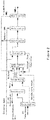
- Fig. 1 Specific preparation examples are provided below. With reference to the configuration in Fig. 1 , the invention will be further explained by means of the Examples. For the direction of the materials during the whole process flow, Fig. 2 may be referred.
- the reactor R1 was a shell and tube reactor.
- the reactor R1 and the reactor heat exchanger were communicated with each other circularly, the reaction liquid was circulated in the reactor and the heat exchanger, and the volume was 500 mL.
- the air in the system was replaced by purging with high-purity nitrogen.
- an aqueous formaldehyde solution having a concentration of 37 wt.% was continuously added at a feeding speed of 135 mL/h.
- the temperature of the concentrator S1 was controlled at 80 ⁇ 90°C, and the vacuum degree thereof was controlled at -0.05 ⁇ -0.06 MPa.
- the vapor phase was fed into the dilute-aldehyde condenser E2 through the pipeline 3, and condensed to form liquid dilute formaldehyde, which was fed into the dilute-aldehyde receiving tank V3 through the pipeline 7 at a flow rate of 65 mL/h.
- the liquid phase was a formaldehyde solution of 60 wt.%, and delivered into the acetalization reactor R1 in C zone through the pipeline 5 at a flow rate of 70 mL/h.
- the ionic liquid catalyst IL1 was added at a feeding speed of 9.8 g/h.
- the feeding was stopped, and the concentration of the catalyst was kept to be not less than 4 wt.%.
- the initial feeding speeds of the concentrated formaldehyde and methanol were 170 mL/h and 68 mL/h, respectively.
- the feeding speed of the formaldehyde was 70 mL/h.
- the operation conditions of the reactor R1 were controlled as 125 ⁇ 130°C and 3.5-4.0 MPa.
- the reactor effluent liquid was fed into the extraction tower C2.
- the feeding speed of the extraction agent, benzene was 250 mL/h (being 1 fold more than the volume of the reaction liquid).
- the heavy phase (the catalyst and aqueous formaldehyde solution) was continuously fed into the film evaporator S2 from the tower bottom, where most of water was removed at 65°C/-0.085 MPa, after that the heavy phase was fed into the reactor for reuse.
- the light phase (the product phase) was continuously fed into the rectification tower C3 from the tower top.
- the light component, DMM 1 , methanol and formaldehyde was continuously distilled from the tower top at 40 ⁇ 65°C, and was fed back into the reaction unit for reuse, while the tower bottom liquid was fed into the rectification tower C4.
- the extraction agent, benzene, distilled from the tower top at 78 ⁇ 80°C was fed back into the storage tank V1 for reuse, while the tower bottom liquid was fed into the rectification tower C5.
- DMM 2 and trioxymethylene (the by-product) distilled from the tower top at 98 ⁇ 110°C were fed back to the reaction unit for reuse, while the product, DMM 3-8 , flowing out from the tower bottom was fed into the product storage tank.
- the reaction effluent liquid (21) comprised 4% of the catalyst.
- the aqueous catalyst solution (24) comprised 8.6% of the catalyst after extraction.
- the catalyst phase (31) comprised 13.7% of the catalyst after dehydration.
- Example 2 The basic procedure and the equipments were same as in Example 1, except that the catalyst was the ionic liquid IL2 and the concentration of the formaldehyde solution is 80 wt.%. After running for 100 h continuously, DMM 3-8 product was obtained at 24.0 mL/h (from the pipeline 30).
- Example 2 The basic procedure and the equipments as well as the parameters thereof were same as in Example 1, except that toluene was used as the extraction agent at a flow rate of 490 mL/h. After running for 100 h continuously, DMM 3-8 product was obtained at 23.0 mL/h (from the pipeline 33).
- the reactor R1 was a shell and tube reactor.
- the reactor R1 and the reboiler were communicated with each other circularly.
- the reaction liquid was circulated in the reactor and the heat exchanger, and the volume was 500 mL.
- the air in the system was replaced by purging with high-purity nitrogen.
- an aqueous formaldehyde solution having a concentration of 37 wt.% was continuously added at a feeding speed of 105 mL/h.
- the temperature of the concentrator S1 was controlled at 80 ⁇ 90°C, and the vacuum degree thereof was controlled at -0.05 ⁇ -0.06 MPa.
- the vapor phase was fed into the dilute-aldehyde condenser E2 through the pipeline 3, and condensed to form liquid dilute formaldehyde, which was fed into the dilute-aldehyde receiving tank V3 through the pipeline 7 at a flow rate of 63 mL/h.
- the liquid phase was a formaldehyde solution of 80 wt.%, delivered into vacuum drier E3 in zone B through the pipeline 4 at a flow rate of 42 mL/h, and vacuum-dried under the conditions of 60 ⁇ 80°C and -0.1 ⁇ -0.05 MPa, so as to obtain paraformaldehyde having a polymerization degree of 8 ⁇ 16.
- the paraformaldehyde may be fed into the acetalization reactor R1 through the pipeline 12 (at 34 g/h).
- the ionic liquid catalyst IL1 was added at a feeding speed of 9.8 g/h.
- the initial feeding speeds of paraformaldehyde and methanol were 72 g/h and 47.5 mL/h, respectively.
- the feeding speeds of the formaldehyde and methanol were 34 g/h and 36 mL/h, respectively.
- the operation conditions of the reactor R1 were controlled as 125 ⁇ 130°C and 3.5 ⁇ 4.0 MPa.
- the reactor effluent liquid was fed into the extraction tower C2.
- the feeding speed of the extraction agent, benzene was 245 mL/h (being 1 fold more than the volume of the reaction liquid).
- the heavy phase (the catalyst, aqueous formaldehyde solution) was continuously fed into the film evaporator S2 from the tower bottom, where most of water was removed at 65°C/-0.085 MPa, was after that the heavy phase was fed into the reactor for reuse.
- the light phase (the product phase) was continuously fed into the rectification tower C3 from the tower top.
- the light components, DMM 1 , formaldehyde and methanol were continuously distilled from the tower top at 40 ⁇ 65°C, and fed back into the reaction unit for reuse, while the tower bottom liquid was fed into the rectification tower C4.
- the extraction agent, benzene, distilled from the tower top at 78 ⁇ 80°C was fed back into the storage tank V1 for reuse, while the tower bottom liquid was fed into the rectification tower C5.
- DMM 2 and trioxymethylene (the by-product) distilled from the tower top at 98 ⁇ 110°C were fed back to the reaction unit for reuse, while the product DMM 3-8 flowing out from the tower bottom was fed into the product storage tank.
- the aqueous catalyst solution (24) comprised 18.5% of the catalyst after extraction.
- Example 4 The basic procedure and the equipments were same as in Example 4, except that the catalyst was IL4 and the used amount thereof is 6 wt.% of the total feeding materials. After running for 100 h continuously, DMM 3-8 product was obtained at 53.5 mL/h (from the pipeline 30).
- Example 4 The basic procedure and the equipments were same as in Example 4, except that the catalyst was IL5 and the used amount thereof is 2 wt.% of the total feeding materials. After running for 100 h continuously, DMM 3-8 product was obtained at 42.5 mL/h (from the pipeline 30).
- Example 4 The basic procedure and the equipments were same as in Example 4, except that the molar ratio between formaldehyde and methanol was 1:1. After running for 100 h continuously, DMM 3-8 product was obtained at 40.5 mL/h (from the pipeline 30).
Landscapes
- Chemical & Material Sciences (AREA)
- Organic Chemistry (AREA)
- Chemical Kinetics & Catalysis (AREA)
- Health & Medical Sciences (AREA)
- Medicinal Chemistry (AREA)
- Polymers & Plastics (AREA)
- Engineering & Computer Science (AREA)
- Materials Engineering (AREA)
- General Chemical & Material Sciences (AREA)
- Organic Low-Molecular-Weight Compounds And Preparation Thereof (AREA)
- Catalysts (AREA)
- Low-Molecular Organic Synthesis Reactions Using Catalysts (AREA)
Description
- The present invention relates to a novel reaction system and process for continuously preparing polymethoxy dimethyl ether, more particularly, to a novel reaction system and process for continuously preparing polymethoxy dimethyl ether by a continuous acetalization reaction between an aqueous formaldehyde solution or paraformaldehyde and methanol in the presence of a functionalized acidic ionic liquid as a catalyst.
- The middle part of polymethoxy dimethyl ether (CH3O(CH2O)nCH3, DMMn, n=1-8) is paraformaldehyde, and the both ends thereof are terminated by methyl groups. DMMn, wherein n is ≤5, has excellent solubility and very high permeability, is miscible with water and many organic solvents, and can be widely used in industrial solvents, pigment dispersants, or the like. DMMn is also an oxygen-containing blending component with great potential for diesel fuel, which has high cetane numbers (DMM2: 63, DMM3: 78, DMM4: 90, DMM5: 100) and high oxygen contents (42%-49%). Addition of DMMn in a amount of 10-20 v/v% to diesel fuel can improve the combustion characteristics of the diesel fuel significantly, increase the thermal efficiency effectively, and reduce the emission of NOx and carbon soot greatly. It was reported (
US 7235113 ) that the emission of the NOx, particulates and hydrocarbons in the exhaust gas can satisfy the Euro V criteria by adding 15 v/v% of DMM3-6 to diesel fuel. - A conventional process for synthesizing DMMn is by the acetalization reaction between a compound providing paraformaldehyde and a compound providing methyl groups for termination in the presence of an acidic catalyst. Since 2001, Snamprogetti S.P.A. (
EP 1505049 A1 ,US 6534685 ), BASF (WO 2006/045506 A1 ,CA 2581502 A1 ,US 20070260094 A1 ) and the like successively developed the processes for continuously preparing DMMn by the reaction between paraform or trioxymethylene and methanol, in which a liquid acid such as H2SO4 or CF3SO3H is employed as the catalyst; after the completion of the reaction, the catalyst and the by-product water were removed from the reaction liquid by adsorption with a silica gel or resin; then a two-stage rectification process is used to separate the unreacted raw materials, light components (DMM1-2), products (DMM3-5) and heavy components (DMMn≥5); and the raw materials of the reaction, the light components and the heavy components are recycled to the reactor for reuse. In the above-mentioned separation process, a great amount of adsorbents are used, the energy consumption is large, the catalyst cannot be recycled, and the cost of the raw materials is relatively high. - In 2008, BASF AG (
US 20080207954 A1 ) investigated a process for preparing DMM1-5 by the reaction between formaldehyde and methanol in an aqueous solution, in which a liquid acid or a solid acid is used as a catalyst; the reaction liquids (DMM1-5, unreacted raw materials and water) are distilled out from the top of the rectification tower by the reaction rectification technique; then the light components (DMM1-2 and unreacted raw materials), the crude product (DMM3-4 and water) and the heavy components (DMMn>4) are separated by a multi-stage rectification process. DMM3-4 and water are separated by a phase separation technique from the crude product, and the light components and the heavy components are recycled to the reaction unit for reuse. During the practical operation, however, methanol, water and DMMn tend to form an azeotrope, so it is difficult to separate methanol from DMM3-4, and methanol has good miscibility with water together with DMM3-4, which renders the phase separation to be difficult. - In recent years, Lanzhou Institute of Chemical Physics, Chinese Academy of Sciences reported (
US 20110288343 ,US 20110313202 ) a process for synthesizing DMMn by catalyzing the reaction between trioxymethylene and methanol with an ionic liquid, in which the reaction liquids were sequentially subjected to the following processes: flash distillation, thin film evaporation separation and phase separation, and thus the separation of the light components (DMM1-2, a portion of water, unreacted raw materials), the crude product DMM3-8, and the catalyst, are achieved. However, the crude product still contains a small amount of water and the catalyst, which need to be removed by adsorption with silica gel or an anion exchange resin in order to realize the refining of the product DMM3-8. In this process, the recovery rate of the catalyst is relatively low, the cost of the raw materials of the reaction is high, and the process flow is long. In addition,GB2489534A - An object of the invention is to provide a system and process for preparing polymethoxy dimethyl ether DMM3-8 by a continuous acetalization reaction between an aqueous formaldehyde solution or paraformaldehyde and methanol in the presence of a functionalized acidic ionic liquid as a catalyst.
- Thus, in one aspect, there provided a reaction system for continuously preparing polymethoxy dimethyl ether with an aqueous formaldehyde solution or paraformaldehyde as raw material, which comprises:
- 1) an formaldehyde-concentrating unit, which is configured for concentrating an aqueous formaldehyde solution of 37∼40 wt.% to obtain a concentrated formaldehyde of 50~ wt.%;
- 2) an vacuum-drying unit, which is configured for polymerizing the concentrated formaldehyde obtained from the formaldehyde-concentrating unit to paraformaldehyde (preferably, the polymerization degree is 8∼16);
- 3) an acetalization reaction unit, which is configured for subjecting the concentrated formaldehyde obtained from the formaldehyde-concentrating unit, the paraformaldehyde obtained from the vacuum-drying unit or paraformaldehyde added directly from the exterior to an acetalization reaction with methanol in the presence of an acidic ionic liquid as a catalyst, so as to obtain a crude product, DMM1-8; and
- 4) a product-separating unit, which is configured for separating the desired product, DMM3-8 from the crude product obtained from the acetalization reaction unit.
- In a preferred embodiment, the formaldehyde-concentrating unit comprises a formaldehyde heater, a formaldehyde concentrator, a dilute-aldehyde condenser, a column washer and a washing liquor tank, wherein the aqueous formaldehyde solution is evaporated in the formaldehyde heater to give a vapor-liquid mixed fluid; the vapor-liquid mixed fluid is fed into the formaldehyde concentrator to give a (liquid) concentrated formaldehyde of 50∼80 wt.%; and the gas generated during this process is fed into the dilute-aldehyde condenser to recover formaldehyde, and the non-condensable gases coming out from the dilute-aldehyde condenser are fed into the column washer to be absorbed by the washing liquor and fed into the washing liquor tank.
- In a preferred embodiment, the vacuum-drying unit is a continuous vacuum dryer, and under conditions of 60∼80°C and a gauge pressure of -0.1∼-0.05 MPa, the liquid concentrated formaldehyde obtained from step 1) is polymerized to a paraformaldehyde having a polymerization degree of 8∼16.
- In a preferred embodiment, the acetalization unit comprises a single-stage or multi-stage reactor and a vapor condenser.
- In a preferred embodiment, the single-stage or multi-stage reactor is a single-stage or multi-stage shell and tube reactor or an overflow kettle.
- In a preferred embodiment, the reaction system further comprises a catalyst-regenerating unit, which comprises a thin film evaporator, and is used to receive the heavy phase separated from the product-separating unit and recycle the catalyst in the heavy phase back to the acetalization reaction unit after the catalyst is dehydrated.
- In a preferred embodiment, the product-separating unit comprises an extraction tower and a single-stage or multi-stage rectification tower, and the extraction tower and the single-stage or multi-stage rectification tower are connected with each other in series; and the extraction tower separates the crude product DMM1-8 into a light phase and a heavy phase, wherein the heavy phase comprises the acidic ionic liquid catalyst, formaldehyde and water, and the light phase comprises unreacted methanol and formaldehyde, DMM1-8 as well as an extraction agent. Preferably, the light phase is continuously flowed into a rectification unit from the top of the extraction tower, so that the recycled material (formaldehyde, methanol and DMM1-2), the extraction agent and the desired product DMM3-8 are separated; the recycled material is fed back to the acetalization reactor; the extraction agent is fed back to the extraction tower for reuse; the heavy phase is flowed into the catalyst-regenerating unit from the tower bottom.
- In a preferred embodiment, the rectification tower comprises a light component rectification tower, an extraction agent rectification tower and a product rectification tower.
- In a preferred embodiment, the rectification tower is a tray tower or a packed tower, and the number of tower tray is 3∼10.
- In another aspect, there provided a process for continuously preparing polymethoxy dimethyl ether with an aqueous formaldehyde solution or paraformaldehyde as raw material, which comprises the following steps:
- 1) in a formaldehyde concentrator, under conditions of 50∼90°C and a gauge pressure of -0.1∼-0.05 MPa, concentrating an aqueous formaldehyde solution of 37∼40 wt.% to obtain a concentrated formaldehyde having a concentration of 50∼80 wt.%; further feeding the gas generated during this process into a dilute-aldehyde condenser, washing and recovering formaldehyde;
- 2) feeding the concentrated formaldehyde obtained from step 1) into a vacuum drier, and under conditions of 60∼80°C and a gauge pressure of -0.1∼-0.05 MPa, and obtaining paraformaldehyde (preferably, the polymerization degree is 8∼16) by polymerization;
- 3) in an acetalization reactor, subjecting the concentrated formaldehyde from step 1), the paraformaldehyde from step 2) or paraformaldehyde added directly from the exterior to a continuous acetalization reaction with methanol by using functionalized acidic ionic liquid as a catalyst, so as to form a reaction effluent liquid, which comprises polymethoxy dimethyl ether DMM1-8, water, unreacted raw materials and the catalyst; and
- 4) in an extraction tower, extracting the reaction effluent liquid obtained from step 3) with an extraction agent to give a light phase and a heavy phase, wherein the light phase comprises the extraction agent, DMM1-8, parts of methanol and formaldehyde, while the heavy phase comprises the catalyst and an aqueous formaldehyde solution; separating the recycled material comprising formaldehyde, methanol and DMM1-2, the extraction agent and the desired product DMM3-8 by rectifying the light phase; feeding the recycled material back to an acetalization reactor; feeding the extraction agent back to an extraction tower for reuse; continuously flowing the heavy phase into a catalyst-regenerating unit from the tower bottom.
- In a preferred embodiment, the process further comprises: in the catalyst-regenerating unit, evaporating the aqueous solution of the catalyst from step 4) so as to separating most of water, and feeding the recovered catalyst back to step 3) for reuse.
- In a preferred embodiment, in step 3), the molar ratio of the concentrated formaldehyde or the paraformaldehyde to methanol is 0.5-3.0.
- In a preferred embodiment, in step 3), the reaction temperature is 100∼130°C, the reaction pressure is 2.0∼5.0 MPa, and the reaction resident time is 60∼180 min.
- In a preferred embodiment, the extraction agent in step 4) is one or more selected from n-hexane, cyclohexane, petroleum ether, chloroform, benzene, toluene, xylene, and ethyl acetate.
- In a preferred embodiment, the extraction agent in step 4) is cyclohexane, benzene or toluene.
- In a preferred embodiment, the cation moiety of the functionalized acidic ionic liquid catalyst is one selected from an acid-functionalized quaternary amine cation, an acid-functionalized quaternary phosphine cation, an acid-functionalized imidazole cation or an acid-functionalized pyridine cation, and the anion moiety thereof is one selected from p-toluenesulfonate anion, trifluoromethanesulfonate anion, methylsulfonate anion, bisulfate anion, or trifluoroacetate anion.
- The invention includes, but is not limited to, the following advantages:
- 1. The invention prepares polymethoxy dimethyl ether by using the aqueous formaldehyde solution or paraformaldehyde as raw material, thus such raw materials are cheap and available easily.
- 2. The invention prepares polymethoxy dimethyl ether by continuous concentration and acetalization reaction process of formaldehyde, thus the process is simple and the process flow is short, which extremely saves the equipment costs and the energy consumption.
- 3. The corrosivity of the catalyst is low, so the 316L stainless steel can be used as the material of the reactor, thus the cost of the device is low. Furthermore, the acetalization reaction realizes the reuse of the catalyst, which further reduces the cost.
- 4. The separation of the by-product water of the acetalization reaction unit from the DMMn as well as the raw materials is realized, which destroys the azeotropy of water and DMMn, methanol, formaldehyde, and thus the separation of the desired product DMM3-8 and the recycle of materials are realized effectively.
-
-
Fig. 1 is a schematic diagram of a reaction system for continuously preparing polymethoxy dimethyl ether of the invention. -
Fig. 2 is a diagram of the flowing direction of the reaction materials in the process of the invention. - It should be appreciated that these drawings are only schematic flow charts for illustrating the technical solutions of the invention, wherein only the equipments necessary for illustrating the process are shown. For conciseness and clarity, other necessary devices, such as meters, gas confluence devices, valves, intermediate tanks and the like, are omitted.
- The invention can prepare polymethoxy dimethyl ether DMM3-8 with an aqueous formaldehyde solution of 37∼40 wt.% as the starting material via continuous concentration, vacuum drying and acetalization reaction, or the invention prepares polymethoxy dimethyl ether DMM3-8 by using paraformaldehyde as the starting material directly via acetalization reaction.
- In one specific embodiment, a reaction system of the invention for preparing DMM3-8 with an aqueous formaldehyde solution as the raw material (hereinafter, referred to as "the reaction system of the invention") comprises:
- 1) a formaldehyde-concentrating unit, which is configured for concentrating an aqueous dilute formaldehyde solution to a liquid concentrated formaldehyde having a concentration of 50∼80 wt.%. Preferably, the formaldehyde-concentrating unit comprises a formaldehyde concentrator, a formaldehyde heater, a dilute-aldehyde condenser, a column washer and a washing liquor tank, wherein the aqueous formaldehyde solution of 37∼40 wt.% is evaporated in the formaldehyde heater to give a vapor-liquid mixed fluid; the vapor-liquid mixed fluid is fed into the formaldehyde concentrator, and preferably concentrated under the conditions of 50∼90°C and -0.1∼-0.05 MPa (gauge pressure), so that a liquid concentrated formaldehyde having a concentration of 50∼80 wt.% is obtained; the gas generated during this process is fed into a dilute-aldehyde condenser, so as to wash and recover formaldehyde;
- 2) a vacuum-drying unit, which is configured for polymerizing the concentrated formaldehyde obtained from the formaldehyde-concentrating unit 1) to give paraformaldehyde. Preferably, the vacuum-drying unit is a continuous vacuum drier. Preferably, a paraformaldehyde having the polymerization degree of 8∼16 is obtained under the conditions of 60∼80°C and -0.1∼-0.05 MPa (gauge pressure);
- 3) an acetalization reaction unit, which is configured for subjecting the concentrated formaldehyde obtained in the formaldehyde-concentrating unit or the paraformaldehyde obtained from the vacuum-drying unit to an acetalization reaction with methanol in the presence of an acidic ionic liquid catalyst, so as to give a crude product DMM1-8. Preferably, this acetalization reaction unit comprises a single-stage or multi-stage reactor or a vapor condenser; and
- 4) a product-separating unit, which is configured for separating the desired product from the crude polymethoxy dimethyl ether obtained in the acetalization reaction unit. Preferably, this product-separating unit comprises an extraction tower and a single-stage or multi-stage rectification tower, the extraction tower and the single-stage or multi-stage rectification tower are connected with each other in series; wherein in the extraction tower, the crude DMM1-8 is separated into a light phase and a heavy phase, and wherein the heavy phase comprises the functionalized acidic ionic liquid catalyst, formaldehyde and water, the light phase comprises unreacted methanol and formaldehyde, DMM1, DMM2, DMM3-8, extraction agent. The light phase is continuously flowed into a rectification unit from the top of the extraction tower, so that the recycled material (formaldehyde, methanol and DMM1-2), the extraction agent and the desired product DMM3-8 are separated; the recycled material is fed back to the acetalization reactor; the extraction agent is fed back to the extraction tower for reuse; the heavy phase is flowed into the catalyst-regenerating unit from the tower bottom.
- It is necessary to indicate that, in the reaction system of the invention, the formaldehyde-concentrating unit and the vacuum-drying unit are necessary only when the raw material used is an aqueous dilute formaldehyde solution, whereas they are not necessary when a liquid concentrated formaldehyde (e.g. having a concentration of 50∼80 wt.%) or paraformaldehyde from the exterior (for example, purchased) is directly used as the raw material.
- Preferably, the reaction system further comprises:
- 5) a catalyst-regenerating unit, which comprises a thin film evaporator; wherein the catalyst-regenerating unit receives the separated heavy phase from the product-separating unit, and the catalyst in the heavy phase is recycled back to the acetalization reaction unit after the catalyst is dehydrated.
- In one embodiment of the reaction system of the invention, the acetalization reactor is a single-stage or multi-stage shell and tube reactor or an overflow kettle.
- In one preferred embodiment of the reaction system of the invention, the 316L stainless steel can be selected as the material of the acetalization reactor.
- In one embodiment of the reaction system of the invention, the rectification tower of the product-separating unit is a tray tower or a packed tower, and the number of tower tray is 3∼10.
- In one embodiment of the reaction system of the invention, the thin film evaporator in the catalyst-regenerating unit is selected from a falling film evaporator, a scraper type or a non-scraper type thin film evaporator.
- In one preferred embodiment of the reaction system of the invention, the formaldehyde-concentrating unit comprises a formaldehyde concentrator, a formaldehyde heater, a dilute-aldehyde condenser, a column washer and a washing liquor tank; the formaldehyde concentrator is provided with an inlet, a liquid outlet and a gas outlet, wherein the liquid outlet is provided at the bottom of the formaldehyde concentrator and the gas outlet is provided at the upper portion of the formaldehyde concentrator. In this case, a feasible configuration mode is that: the outlet of the formaldehyde heater and the inlet of the formaldehyde concentrator are communicated with each other via a pipe; the liquid outlet of the formaldehyde concentrator and the inlet of the vacuum drier or the formaldehyde inlet of the acetalization reactor are communicated with each other via a pipe; the gas outlet of the formaldehyde concentrator and the inlet of the dilute-aldehyde condenser are communicated with each other via a pipe; the gas outlet of the dilute-aldehyde condenser and the gas inlet of the column washer are communicated with each other via a pipe; the liquid outlet of the column washer and the inlet of the washing liquor tank are communicated with each other via a pipe; the outlet of the washing liquor tank and the washing liquor inlet of the column washer are communicated with each other via a pipe.
- In one preferred embodiment of the reaction system of the invention, in the acetalization unit, the outlet of the single-stage or multi-stage reactor and the inlet of the vapor condenser within the acetalization unit are communicated with each other via a pipe.
- In one preferred embodiment of the reaction system of the invention, the rectification tower comprises a light component rectification tower, an extraction agent rectification tower and a product rectification tower. In this case, an feasible configuration mode is that: the reaction liquid inlet of the extraction tower and the outlet of the vapor condenser of the acetalization unit are communicated with each other via a pipeline; the light phase outlet of the extraction tower and the inlet of the light component rectification tower are communicated with each other via a pipeline; the heavy phase outlet of the extraction tower and the inlet of the thin film evaporator are communicated with each other via a pipeline; the liquid phase outlet of light component rectification tower and the inlet of the extraction agent rectification tower are communicated with each other via a pipeline; the liquid phase outlet of the extraction agent rectification tower and the inlet of the product rectification tower are communicated with each other via a pipeline; the gas phase outlets of the light component rectification tower and the product rectification tower and the inlet of the acetalization reactor are communicated with each other via a pipeline; the gas outlet of the extraction agent rectification tower and the inlet of the extraction agent storage tank are communicated with each other via a pipeline.
- In one embodiment of the reaction system of the invention, the configuration mode of the thin film evaporator is that the heavy phase outlet and the inlet of the catalyst storage tank are communicated with each other via a pipeline.
- In another specific embodiment, a process of the invention for preparing polymethoxy dimethyl ether with an aqueous formaldehyde solution or paraformaldehyde as the raw material (hereinafter, referred to as "the process of the invention") comprises the following steps:
- 1) in a formaldehyde concentrator, using an aqueous formaldehyde solution of 37∼40 wt.% as raw material, preferably under the conditions of 50∼90°C and -0.1∼-0.05 MPa (gauge pressure), obtaining a liquid formaldehyde having a concentration of 50∼80 wt.%; feeding the gas generated during this process into a dilute-aldehyde condenser, washing and recovering formaldehyde;
- 2) feeding the liquid formaldehyde obtained from step 1) into a vacuum drier, preferably under the conditions of 60∼80°C and -0.1∼-0.05 MPa (gauge pressure), to obtain paraformaldehyde, which for example has a polymerization degree of 8∼16;
- 3) subjecting the concentrated formaldehyde from step 1) or the paraformaldehyde from step 2) to a continuous acetalization reaction with methanol by using functionalized acidic ionic liquid as a catalyst, so as to form a reaction effluent liquid which comprises resultant crude product DMM1-8, water, unreacted raw materials and the catalyst; and
- 4) extracting the reaction effluent liquid obtained from step 3) with an extraction agent to give a light phase and a heavy phase, wherein the light phase comprises the extraction agent, DMM1-8, unreacted parts of formaldehyde and methanol, and the heavy phase is the catalyst and an aqueous formaldehyde solution; the light phase is continuously flowed into a rectification unit from the tower top, so that the recycled material (formaldehyde, methanol and DMM1-2), the extraction agent and the product DMM3-8 are separated; the recycled material is fed back to the acetalization reactor; the extraction agent is fed back to the extraction tower for reuse; the heavy phase is flowed into the catalyst-regenerating unit from the tower bottom.
- Preferably, the process of the invention further comprises: 5) evaporating the aqueous solution of the catalyst from step 4) so as to separate most of the water, and feeding the recovered catalyst back to step 3) for reuse.
- In the process of the invention, the cation moiety of the functionalized acidic ionic liquid is one selected form an acid-functionalized quaternary amine cation, an acid-functionalized quaternary phosphine cation, an acid-functionalized imidazole cation or an acid-functionalized pyridine cation, and the anion moiety thereof can be one independently selected from p-toluenesulfonate anion, trifluoromethanesulfonate anion, methylsulfonate anion, bisulfate anion, or trifluoroacetate anion.
- In one embodiment of the process of the invention, in step 3), the molar ratio of formaldehyde to methanol is 0.5-3.0.
- In another preferred embodiment of the process of the invention, the reaction is carried out under nitrogen gas protection.
- In one embodiment of the process of the invention, in step 3), the reaction temperature is 100∼130°C, the reaction pressure is 2.0∼5.0 MPa, and the reaction resident time is 60∼180 min.
- In another preferred embodiment of the process of the invention, in step 3), the catalyst accounts for 1∼6 wt.% of the total reaction raw materials.
- In one embodiment of the process of the invention, the extraction agent in step 4) is one or more selected from n-hexane, cyclohexane, petroleum ether, chloroform, benzene, toluene, xylene, and ethyl acetate, preferably, cyclohexane, benzene or toluene.
- In another preferred embodiment of the process of the invention, in step 4), the used amount of the extraction agent is 1∼3 folds more than the reaction liquid in terms of volume.
- In one embodiment of the process of the invention, the temperature for the extraction in step 4) is 20∼40°C.
- In one embodiment of the process of the invention, in step 5), the evaporation temperature is 60∼70°C, and the gauge pressure is -0.1∼-0.05 MPa.
- It should be indicated here that the above-mentioned process parameters and reaction materials, such as the raw materials, extraction agent, catalyst and the like, which are used in the process of the invention, also can be used in the reaction system of the invention.
- The process flow and process equipments will be described in detail with reference to the drawings (the A, B, C, D and E zones mentioned below correspond to the zones indicated by the reference signs A, B, C, D and E in
Fig. 1 , respectively): - A. In the formaldehyde-concentrating zone A (corresponding to the "formaldehyde-concentrating unit" in the reaction system of the invention), an aqueous formaldehyde solution (for example, 37∼40 wt.%) is evaporated in the formaldehyde heater, so as to obtain a vapor-liquid mixed fluid. The vapor-liquid mixed fluid is fed into the formaldehyde concentrator. Under the conditions of 50∼90°C and -0.1∼-0.05 MPa (gauge pressure), a liquid formaldehyde having a high concentration and a vapor formaldehyde having a low concentration are separated quickly, and a formaldehyde solution of 50 - 80 wt.% is obtained and fed to the vacuum drier in B zone via a concentrated-aldehyde pump, or to the acetalization reactor in C zone directly. The vapor phase is fed into the dilute-aldehyde condenser, where it is condensed to form a liquid dilute formaldehyde, which is fed into the dilute-aldehyde receiving tank. The non-condensable gas withdrawn out from the dilute-aldehyde condenser is fed into the column washer to be absorbed by washing liquor (desalinized water), and the gas is drawn by a vacuum pump and emitted to the atmosphere.
- B. In the vacuum drying zone B (corresponding to the "vacuum-drying unit" in the reaction system of the invention), the aqueous formaldehyde solution of 50∼80 wt.% from A zone is vacuum dried (for example, under the conditions of 60∼80°C and -0.1∼-0.05 MPa (gauge pressure)) by using a continuous vacuum dryer, so as to obtain paraformaldehyde having a polymerization degree of 8∼16.
- C. In the acetalization reaction zone C (corresponding to the "acetalization reaction unit" in the reaction system of the invention), in a single-stage or multi-stage reactor, the aqueous formaldehyde solution of 50∼80 wt.% from A zone or the paraformaldehyde from B zone is subjected to a continuous acetalization reaction with methanol by using a functionalized acidic ionic liquid as a catalyst (for example, under the conditions of 100∼130°C and 2.0∼5.0 MPa (gauge pressure)). The reactor effluent liquid flowing out continuously comprises the above-mentioned unreacted raw materials and the catalyst in addition to the DMM1-8 formed.
- D. In the product-separating zone D (corresponding to the "product-separating unit" in the reaction system of the invention), the reactor effluent liquid flowing out from the above-mentioned C zone is decompressed and continuously flowed into the extraction tower. DMM1-8 and raw materials of the reaction are extracted by using an extraction agent. The light phase is the product phase, and is flowed into the rectification unit from the tower top continuously. The recycled material, extraction agent and the desired product DMM3-8 are separated. The heavy phase is the catalyst and an aqueous formaldehyde solution, and is flowed into the catalyst-regenerating zone.
- E. In the catalyst-regenerating zone E (corresponding to the "catalyst-regenerating unit" in the reaction system of the invention), the catalyst and the aqueous formaldehyde solution from D zone are fed into the thin film evaporator continuously. Most of the water is separated. The recovered catalyst is continuously flowed into C zone for reuse.
- The process flow of the invention is described in detail below.
- The reaction formulae employed in the process of the invention are as follows:


- In the reaction formulae, n is an integer from 1 to 8, m is an integer from 8 to 16, IL represents a functionalized acidic ionic liquid catalyst.
- The functionalized acidic ionic liquid catalyst can be selected with reference to the preferred examples below.
- The structural formula of an example of the acid-functionalized quaternary amine cation of the functionalized acidic ionic liquid catalyst used in the invention can be:

- wherein n is an integer of 1∼6; R, R1, and R2 are linear alkanes having a carbon number of 1∼16, or a benzene ring;
- X is -SO3H, -COOH or -SO3CH3.
- The structural formula of an example of the acid-functionalized quaternary phosphine cation of the functionalized acidic ionic liquid catalyst used in the invention can be:

- wherein n is an integer of 1∼6; R, R1, and R2 are linear alkanes having a carbon number of 1∼16, or a benzene ring;
- X is -SO3H, -COOH or -SO3CH3.
- The structural formula of an example of the acid-functionalized imidazole cation of the functionalized acidic ionic liquid catalyst used in the invention can be:

- wherein n is an integer of 1∼6; R is alkyl having a carbon number of 1∼16, or aryl, or H;
- X is -SO3H, -COOH or -SO3CH3.
- The structural formula of an example of the acid-functionalized pyridine cation of the functionalized acidic ionic liquid catalyst used in the invention can be:

- wherein n is an integer of 1∼6; R is alkyl having a carbon number of 1∼16, or aryl, or H;
- X is -SO3H, -COOH or -SO3CH3.
- Examples of anions of the acidic ionic liquid catalyst used in the invention include: CH3(C6H4)SO3 -, CF3SO3 -, CH3SO3 -, HSO4 -, CF3COO- etc..
- It should be indicated here that all of the pressures used herein are in terms of gauge pressure, unless otherwise indicated. Additionally, in the following description of the process and method, some equipments, which are not shown in the drawings, may be referred. As mentioned above, these equipments are omitted only for the purpose that the main equipments of the invention can be described and showed concisely and conveniently, which does not mean that these equipments are absent or unnecessary.
- Furthermore, it should be understood that the description and examples below are only preferred embodiments for illustrating the invention, and are not intended to limit the scope of the invention. Therefore, the equipments used in the reaction system of the invention are not merely limited to the specific equipments mentioned below. Based on the teaching of the invention, those skilled in the art can choose appropriate equipments having similar functions according to the specific situations.
- The process flow of the invention will be described with reference to the specific configuration of the processing equipments shown in
Fig. 1 and the diagram of the flow direction of the materials shown inFig. 2 . - (1) When the reaction is started or the catalyst is supplemented, the catalyst is transported to the reactor R1 (corresponding to the single-stage or multi-stage reactor of the reaction system of the invention) through the pipeline 14 via the pump from the fresh catalyst storage tank V6;
- (2) Concentrating Formaldehyde
The aqueous formaldehyde solution having a concentration of 37∼40 wt.% in the formaldehyde storage tank V2 is fed into the formaldehyde heater E1 via the formaldehyde pump P1. Evaporation is carried out to give the vapor-liquid mixed fluid. The vapor-liquid mixed fluid is fed into the formaldehyde concentrator S1 through thepipeline 2. Under the conditions of 50∼90°C and -0.1∼-0.05 MPa, the liquid formaldehyde having a high concentration and the vapor formaldehyde having a low concentration are separated quickly. The vapor phase is fed into the dilute-aldehyde condenser E2 through thepipeline 3, and condensed to form a liquid dilute formaldehyde, which is fed into the dilute-aldehyde receiving tank V3 throughpipeline 7. The non-condensable gas withdrawn from E2 is fed into the column washer C1 through thepipeline 6, and absorbed by the washing liquor (desalinized water). The gas is drawn through thepipeline 10 via the vacuum pump P3 and emitted to atmosphere. The liquid is fed into the washing liquor tank V4 through the pipeline 8, and then, together with the washing liquor, fed into the column washer again for reuse through the washing liquor-recycling pump P2 and the pipeline 9. The resultant liquid phase is formaldehyde solution of 50∼80 wt.%, which is transported to the vacuum drier E3 in B zone through thepipeline 4, or to the acetalization reactor R1 in C zone directly through thepipeline 5. - (3) Vacuum Drying Formaldehyde
The aqueous formaldehyde solution of 50∼80 wt.% is fed into the vacuum drier E3 through thepipeline 4, and vacuum dried under the conditions of 60∼80°C and -0.1∼-0.05 MPa, so as to give paraformaldehyde having a polymerization degree of 8∼16. The water is drawn via the vacuum pump P4 through the pipeline 11 and emitted to atmosphere. The paraformaldehyde may be continuously fed into the acetalization reactor R1 through thepipeline 12. - (4) Acetalization Reaction
The whole system is replaced with N2, and the oxygen content measured by the measuring system for the emitted exhaust gas is lower than 10 ppm. The raw material of the concentrated formaldehyde through thepipeline 5 or paraformaldehyde through thepipeline 12, methanol (methanol storage tank V5) through thepipeline 13, recycled stocks through thepipeline 16, recycled catalyst through the pipeline 15, are respectively fed into the acetalization reactor R1 continuously in a dosing mode. N2 is purified by a purification unit, and fed into the reactor R1 through thepipeline 19 in a dosing mode. The acetalization reaction is occurred at a certain temperature and a certain pressure. The reaction liquid flowing out from the bottom of the reactor R1 is fed into the heat exchanger E4 through thepipeline 17 via the pump P5, and fed back to the reactor R1 through thepipeline 18 again. The reactor and the heat exchanger are communicated with each other circularly. The reaction liquid is circulated in the reactor and the heat exchanger. The reaction liquid discharged from the top of the reactor R1 comprises the catalyst, DMM1-8, water, unreacted methanol and formaldehyde. - (5) Separating DMMn by Extraction
The effluent liquid of the reactor R1 is transported to the heat exchanger E5 through thepipeline 20, cooled in the decompressor V9, and fed into the extraction tower C2 through the pipeline 21 after decompression. The extraction agent is delivered from the storage tank V1 into the extraction tower C2 through thepipeline 22. The reaction liquid is counter-contacted with the extraction agent sufficiently. The light phase (the product phase) is continuously fed from the tower top into the rectification tower C3 through thepipeline 23. The heavy phase (the catalyst, aqueous formaldehyde solution) is continuously fed from the tower bottom into the film evaporator S2 through thepipeline 24 - (6) Separating DMMn by Rectification
The composition of the product phase is DMM1-8, the extraction agent, unreacted methanol and formaldehyde. The product phase is rectified in the rectification tower C3. The light component (mainly comprising methanol, DMM1 and formaldehyde) is continuously distilled from the tower top, and fed back to the reaction system and cooled through thepipeline 25, while the tower bottom liquid is delivered into the rectification tower C4 through thepipeline 26. The extraction agent distilled from the tower top is fed back to the extraction agent storage tank V1 through thepipeline 27 for reuse, while the tower bottom liquid is fed into the rectification tower C5 through thepipeline 28. The DMM2 distilled from the tower top is fed back to the reaction unit through thepipeline 29 for reuse, while the product DMM3-8 flowing out from the tower bottom is fed into the storage tank V8 through thepipeline 30. - (7) Dehydration of the Catalyst
The aqueous catalyst solution is continuously fed into the thin film evaporator S2 from the bottom of the extraction tower C2. Most of water is removed by rapid distillation at 60∼70°C/-0.08∼-0.09 MPa, while the catalyst and the aqueous formaldehyde solution are recycled to the catalyst storage tank V7 through thepipeline 31. - Specific preparation examples are provided below. With reference to the configuration in
Fig. 1 , the invention will be further explained by means of the Examples. For the direction of the materials during the whole process flow,Fig. 2 may be referred. - The catalysts used in the Examples below are represented as following:

- In the process shown in
Fig. 1 , the reactor R1 was a shell and tube reactor. The reactor R1 and the reactor heat exchanger were communicated with each other circularly, the reaction liquid was circulated in the reactor and the heat exchanger, and the volume was 500 mL. - The air in the system was replaced by purging with high-purity nitrogen. To the formaldehyde concentrator S1, an aqueous formaldehyde solution having a concentration of 37 wt.% was continuously added at a feeding speed of 135 mL/h. The temperature of the concentrator S1 was controlled at 80∼90°C, and the vacuum degree thereof was controlled at -0.05∼-0.06 MPa. The vapor phase was fed into the dilute-aldehyde condenser E2 through the
pipeline 3, and condensed to form liquid dilute formaldehyde, which was fed into the dilute-aldehyde receiving tank V3 through thepipeline 7 at a flow rate of 65 mL/h. The liquid phase was a formaldehyde solution of 60 wt.%, and delivered into the acetalization reactor R1 in C zone through thepipeline 5 at a flow rate of 70 mL/h. - To the reactor R1, the ionic liquid catalyst IL1 was added at a feeding speed of 9.8 g/h. When the catalyst solution began to circulate, the feeding was stopped, and the concentration of the catalyst was kept to be not less than 4 wt.%. The initial feeding speeds of the concentrated formaldehyde and methanol were 170 mL/h and 68 mL/h, respectively. When the reaction materials began to circulate, the feeding speed of the formaldehyde was 70 mL/h. The operation conditions of the reactor R1 were controlled as 125∼130°C and 3.5-4.0 MPa. The reactor effluent liquid was fed into the extraction tower C2. The feeding speed of the extraction agent, benzene, was 250 mL/h (being 1 fold more than the volume of the reaction liquid). The heavy phase (the catalyst and aqueous formaldehyde solution) was continuously fed into the film evaporator S2 from the tower bottom, where most of water was removed at 65°C/-0.085 MPa, after that the heavy phase was fed into the reactor for reuse. The light phase (the product phase) was continuously fed into the rectification tower C3 from the tower top. The light component, DMM1, methanol and formaldehyde, was continuously distilled from the tower top at 40∼65°C, and was fed back into the reaction unit for reuse, while the tower bottom liquid was fed into the rectification tower C4. The extraction agent, benzene, distilled from the tower top at 78∼80°C was fed back into the storage tank V1 for reuse, while the tower bottom liquid was fed into the rectification tower C5. DMM2 and trioxymethylene (the by-product) distilled from the tower top at 98∼110°C were fed back to the reaction unit for reuse, while the product, DMM3-8, flowing out from the tower bottom was fed into the product storage tank.
- Quantitative analysis of the samples taken from the reaction liquid, the extract, the aqueous catalyst solution, the recycled material and the product at certain interval was carried out by using the gas chromatograph. The test was run for 100 h totally. The average values of the test result were listed in Table 1.
Table 1 pipeline of sampling point discharging speed mL/h product distribution (%) benzene methanol formaldehyde trioxymethylene water DMMn n = 1 2 3 4 5 6 7 8 5 70.0 0 0.1 60.0 0 39.9 0 0 0 0 0 0 0 0 21 245.0 0 8.9 15.0 0.6 28.4 21.1 12.5 5.2 2.6 1.5 0.2 0.01 0 23 380.5 60.5 6.2 0.5 0.5 0.4 15.6 9.2 3.8 2.0 1.1 0.2 0.01 0 24 115.5 1.3 1.1 31.0 0 56.6 1.2 0.2 0 0 0 0 0 0 25 73.5 0.4 27.8 1.4 0 0.1 70.0 0.2 0 0 0 0 0 0 29 32.0 0.3 0 0 4.5 0.5 0 94.5 0.2 0 0 0 0 0 30 23.5 0 0 0 0 0 0 1.1 54.1 27.0 15.6 2.1 0.1 0 31 70.0 0 0.1 55.7 0 30.5 0 0 0 0 0 0 0 0 - The reaction effluent liquid (21) comprised 4% of the catalyst.
- The aqueous catalyst solution (24) comprised 8.6% of the catalyst after extraction.
- The catalyst phase (31) comprised 13.7% of the catalyst after dehydration.
- The basic procedure and the equipments were same as in Example 1, except that the catalyst was the ionic liquid IL2 and the concentration of the formaldehyde solution is 80 wt.%. After running for 100 h continuously, DMM3-8 product was obtained at 24.0 mL/h (from the pipeline 30).
- The basic procedure and the equipments as well as the parameters thereof were same as in Example 1, except that toluene was used as the extraction agent at a flow rate of 490 mL/h. After running for 100 h continuously, DMM3-8 product was obtained at 23.0 mL/h (from the pipeline 33).
- In the process shown in
Fig. 1 , the reactor R1 was a shell and tube reactor. The reactor R1 and the reboiler were communicated with each other circularly. The reaction liquid was circulated in the reactor and the heat exchanger, and the volume was 500 mL. - The air in the system was replaced by purging with high-purity nitrogen. To the formaldehyde concentrator S1, an aqueous formaldehyde solution having a concentration of 37 wt.% was continuously added at a feeding speed of 105 mL/h. The temperature of the concentrator S1 was controlled at 80∼90°C, and the vacuum degree thereof was controlled at -0.05∼-0.06 MPa. The vapor phase was fed into the dilute-aldehyde condenser E2 through the
pipeline 3, and condensed to form liquid dilute formaldehyde, which was fed into the dilute-aldehyde receiving tank V3 through thepipeline 7 at a flow rate of 63 mL/h. The liquid phase was a formaldehyde solution of 80 wt.%, delivered into vacuum drier E3 in zone B through thepipeline 4 at a flow rate of 42 mL/h, and vacuum-dried under the conditions of 60∼80°C and -0.1∼-0.05 MPa, so as to obtain paraformaldehyde having a polymerization degree of 8∼16. The paraformaldehyde may be fed into the acetalization reactor R1 through the pipeline 12 (at 34 g/h). - To the reactor R1, the ionic liquid catalyst IL1 was added at a feeding speed of 9.8 g/h. When the catalyst solution began to circulate, the feeding was stopped, and the concentration of the catalyst was kept to be not less than 4 wt.%. The initial feeding speeds of paraformaldehyde and methanol were 72 g/h and 47.5 mL/h, respectively. When the reaction materials began to circulate, the feeding speeds of the formaldehyde and methanol were 34 g/h and 36 mL/h, respectively. The operation conditions of the reactor R1 were controlled as 125∼130°C and 3.5∼4.0 MPa. The reactor effluent liquid was fed into the extraction tower C2. The feeding speed of the extraction agent, benzene, was 245 mL/h (being 1 fold more than the volume of the reaction liquid). The heavy phase (the catalyst, aqueous formaldehyde solution) was continuously fed into the film evaporator S2 from the tower bottom, where most of water was removed at 65°C/-0.085 MPa, was after that the heavy phase was fed into the reactor for reuse. The light phase (the product phase) was continuously fed into the rectification tower C3 from the tower top. The light components, DMM1, formaldehyde and methanol were continuously distilled from the tower top at 40∼65°C, and fed back into the reaction unit for reuse, while the tower bottom liquid was fed into the rectification tower C4. The extraction agent, benzene, distilled from the tower top at 78∼80°C was fed back into the storage tank V1 for reuse, while the tower bottom liquid was fed into the rectification tower C5. DMM2 and trioxymethylene (the by-product) distilled from the tower top at 98∼110°C were fed back to the reaction unit for reuse, while the product DMM3-8 flowing out from the tower bottom was fed into the product storage tank.
- Quantitative analysis of the samples taken from the reaction liquid, the extract, the aqueous catalyst solution, the recycled material and the product at certain interval was carried out by using the gas chromatograph. The test was run for 100 h totally. The average values of the test result were listed in Table 2.
Table 2 pipeline of sampling point discharging speed mL/h product distribution (%) benzene methanol formaldehyde trioxymethylene water DMMn, n = 1 2 3 4 5 6 7 8 4 42.0 0 0.01 80.0 0 20 0 0 0 0 0 0 0 0 12 34.0 0 0 98.0 0 2 0 0 0 0 0 0 0 0 21 245.0 0 3.8 27.7 1.6 15.7 15.6 14.2 10.8 6.4 2.8 1.0 0.3 0.1 23 383.0 58.7 2.7 0.5 1.1 0.1 11.4 10.4 7.9 4.7 2.0 0.7 0.2 0 24 107.0 0.5 0.3 46.2 0 33.6 0.8 0.1 0 0 0 0 0 0 25 47.5 0.4 17.7 1.5 0 0.1 80.4 0.1 0 0 0 0 0 0 29 38.0 0.3 0 0 10.0 0.5 0 89.0 0.2 0 0 0 0 0 30 52.5 0.2 0 0 0 0 0 1.1 49.5 29.6 13.0 4.6 1.4 0.03 - The aqueous catalyst solution (24) comprised 18.5% of the catalyst after extraction.
- The basic procedure and the equipments were same as in Example 4, except that the catalyst was IL4 and the used amount thereof is 6 wt.% of the total feeding materials. After running for 100 h continuously, DMM3-8 product was obtained at 53.5 mL/h (from the pipeline 30).
- The basic procedure and the equipments were same as in Example 4, except that the catalyst was IL5 and the used amount thereof is 2 wt.% of the total feeding materials. After running for 100 h continuously, DMM3-8 product was obtained at 42.5 mL/h (from the pipeline 30).
- The basic procedure and the equipments were same as in Example 4, except that the molar ratio between formaldehyde and methanol was 1:1. After running for 100 h continuously, DMM3-8 product was obtained at 40.5 mL/h (from the pipeline 30).
- The above-mentioned Examples merely describe the preferred embodiments of the invention, and do not limit the scope of the invention. Various modifications and changes can be made by those skilled in the art on the technical solutions of the invention without departing from the scope of the invention, all of which are fallen into the protection scope of the invention defined by the claims.
Claims (15)
- A reaction system for continuously preparing polymethoxy dimethyl ether with an aqueous formaldehyde solution or paraformaldehyde as raw material, which comprises:1) a formaldehyde-concentrating unit, which is configured for concentrating an aqueous formaldehyde solution of 37∼40 wt.% to obtain a concentrated formaldehyde of 50∼80 wt.%;2) a vacuum-drying unit, which is configured for polymerizing the concentrated formaldehyde obtained from the formaldehyde-concentrating unit to paraformaldehyde;3) an acetalization reaction unit, which is configured for subjecting the concentrated formaldehyde obtained from the formaldehyde-concentrating unit, the paraformaldehyde obtained from the vacuum-drying unit or paraformaldehyde added directly from the exterior to an acetalization reaction with methanol in the presence of an acidic ionic liquid catalyst, so as to obtain a crude product DMM1-8; and4) a product-separating unit, which is configured for separating the desired product polymethoxy dimethyl ether DMM3-8 from the crude product obtained from the acetalization reaction unit.
- The reaction system according to claim 1, characterized in that the formaldehyde-concentrating unit comprises a formaldehyde heater, a formaldehyde concentrator, a dilute-aldehyde condenser, a column washer and a washing liquor tank, wherein the aqueous formaldehyde solution is evaporated in the formaldehyde heater to give a vapor-liquid mixed fluid; the vapor-liquid mixed fluid is fed into the formaldehyde concentrator to give a liquid concentrated formaldehyde having a concentration of 50∼80 wt.%, and the gas generated during this process is fed into the dilute-aldehyde condenser to recover formaldehyde, the non-condensable gas out from the dilute-aldehyde condenser is fed into the column washer to be absorbed by the washing liquor and entered into the washing liquor tank.
- The reaction system according to claim 1, characterized in that the vacuum-drying unit is a continuous vacuum dryer, and under the conditions of 60∼80°C and a gauge pressure of -0.1∼-0.05 MPa, the concentrated formaldehyde obtained from the formaldehyde-concentrating unit is polymerized into a paraformaldehyde having a polymerization degree of 8∼16.
- The reaction system according to any one of claims 1∼3, characterized in that the acetalization unit comprises a single-stage or multi-stage reactor and a vapor condenser.
- The reaction system according to claim 4, characterized in that the single-stage or multi-stage reactor is a single-stage or multi-stage shell and tube reactor or an overflow kettle.
- The reaction system according to any one of claims 1∼3, characterized in that the reaction system further comprises a catalyst-regenerating unit, which comprises a thin film evaporator and is used to receive the heavy phase separated from the product-separating unit and to recycle the catalyst in the heavy phase back to the acetalization reaction unit after the catalyst is dehydrated.
- The reaction system according to claim 6, characterized in that the product-separating unit comprises an extraction tower and a single-stage or multi-stage rectification tower, the extraction tower and the single-stage or multi-stage rectification tower are connected with each other in series; and the extraction tower separates the crude product into a light phase and a heavy phase, wherein the heavy phase comprises the acidic ionic liquid catalyst, formaldehyde and water, and the light phase comprises unreacted methanol and formaldehyde, DMM1-8 as well as an extraction agent; the light phase is continuously flowed into a rectification unit from the top of the extraction tower, so that the recycled material comprising formaldehyde, methanol and DMM1-2, the extraction agent and the desired product DMM3-8 are separated; the recycled material is fed back to the acetalization reaction unit; the extraction agent is fed back to the extraction tower for reuse; the heavy phase is flowed into the catalyst-regenerating unit from the tower bottom.
- The reaction system according to claim 7, characterized in that the rectification tower comprises a light component rectification tower, an extraction agent rectification tower and a product rectification tower.
- The reaction system according to claim 7, characterized in that the rectification tower is a tray tower or a packed tower, and the number of tower tray is 3∼10.
- A process for continuously preparing polymethoxy dimethyl ether with an aqueous formaldehyde solution or paraformaldehyde as raw material, which comprises the following steps:1) concentrating an aqueous formaldehyde solution of 37∼40 wt.% to obtain a concentrated formaldehyde having a concentration of 50∼80 wt.% under the conditions of 50∼90°C and a gauge pressure of -0.1∼-0.05 MPa in a formaldehyde concentrator;2) feeding the concentrated formaldehyde obtained from step 1) into a vacuum drier, and obtaining paraformaldehyde by polymerization under the conditions of 60∼80°C and a gauge pressure of -0.1∼-0.05 MPa;3) subjecting the concentrated formaldehyde from step 1), the paraformaldehyde from step 2) or paraformaldehyde added directly from the exterior to a continuous acetalization reaction with methanol in the presence a functionalized acidic ionic liquid as a catalyst in an acetalization reactor, so as to form a reaction effluent liquid comprising polymethoxy dimethyl ether DMM1-8, water, unreacted raw materials and the catalyst; and4) extracting the reaction effluent liquid obtained from step 3) with an extraction agent to give a light phase and a heavy phase in a product-separating unit, wherein the light phase comprises the extraction agent, DMM1-8, part of methanol and formaldehyde, and the heavy phase comprises the catalyst and an aqueous formaldehyde solution; separating the recycled material comprising formaldehyde, methanol and DMM1-2, the extraction agent and the desired product DMM3-8 by rectifying the light phase; feeding the recycled material back to an acetalization reactor; feeding the extraction agent back to an extraction tower for reuse; and flowing the heavy phase into a catalyst-regenerating unit from the tower bottom.
- The process according to claim 10, characterized in that the process further comprises the step: 5) in a catalyst-regenerating unit, evaporating the aqueous solution of the catalyst from step 4) to separate most of water, and feeding the recovered catalyst back to step 3) for reuse.
- The process according to claim 10, characterized in that the molar ratio of the concentrated formaldehyde or the paraformaldehyde to methanol is 0.5-3.0 in step 3).
- The process according to claim 10, characterized in that the reaction temperature is 100∼130°C, the reaction pressure is 2.0-5.0 MPa, and the reaction resident time is 60∼180 min in step 3).
- The process of claim 10, characterized in that the extraction agent in step 4) is one or more selected from n-hexane, cyclohexane, petroleum ether, chloroform, benzene, toluene, xylene, and ethyl acetate.
- The process according to claim 10, characterized in that the cation moiety of the functionalized acidic ionic liquid catalyst is one selected from an acid-functionalized quaternary amine cation, an acid-functionalized quaternary phosphine cation, an acid-functionalized imidazole cation or an acid-functionalized pyridine cation, and the anion moiety thereof is one selected from p-toluenesulfonate anion, trifluoromethanesulfonate anion, methylsulfonate anion, bisulfate anion, or trifluoroacetate anion.
Applications Claiming Priority (1)
| Application Number | Priority Date | Filing Date | Title |
|---|---|---|---|
| CN201310455313.1A CN104513141A (en) | 2013-09-29 | 2013-09-29 | Reaction system and method for preparing polyoxymethylene dimethyl ether |
Publications (2)
| Publication Number | Publication Date |
|---|---|
| EP2853524A1 EP2853524A1 (en) | 2015-04-01 |
| EP2853524B1 true EP2853524B1 (en) | 2017-08-02 |
Family
ID=50382248
Family Applications (1)
| Application Number | Title | Priority Date | Filing Date |
|---|---|---|---|
| EP14160886.9A Not-in-force EP2853524B1 (en) | 2013-09-29 | 2014-03-20 | Reaction system and process for preparing polymethoxy dimethyl ether |
Country Status (5)
| Country | Link |
|---|---|
| US (1) | US9168503B2 (en) |
| EP (1) | EP2853524B1 (en) |
| JP (1) | JP5959557B2 (en) |
| CN (1) | CN104513141A (en) |
| CA (1) | CA2847372C (en) |
Cited By (1)
| Publication number | Priority date | Publication date | Assignee | Title |
|---|---|---|---|---|
| CN107011130A (en) * | 2017-04-19 | 2017-08-04 | 天津大学 | The device and operating method of a kind of synthesizing polymethoxy methylal |
Families Citing this family (18)
| Publication number | Priority date | Publication date | Assignee | Title |
|---|---|---|---|---|
| CN103772163B (en) * | 2012-10-18 | 2016-04-13 | 中国科学院兰州化学物理研究所 | The reactive system of continuous production polymethoxy dimethyl ether and processing method |
| CN105399612A (en) * | 2015-11-19 | 2016-03-16 | 安徽中源化工有限公司 | Technology for producing paraformaldehyde from formaldehyde with concentration of 37% |
| CN105348084A (en) * | 2015-11-25 | 2016-02-24 | 华南理工大学 | Energy-saving and environment-friendly device and method for producing amphiphobic fluorinated raw material |
| CN106278836A (en) * | 2016-08-16 | 2017-01-04 | 鄂尔多斯市易臻石化科技有限公司 | Intermediate concentration formaldehyde and the apparatus and method of methylal synthesis polymethoxy dimethyl ether |
| US10377689B2 (en) | 2016-11-17 | 2019-08-13 | OME Technologies GmbH | Process for preparing polyoxymethylene dimethyl ethers from formaldehyde and methanol in aqueous solutions |
| DE102016222657A1 (en) | 2016-11-17 | 2018-05-17 | OME Technologies GmbH | Process for the preparation of polyoxymethylene dimethyl ethers from formaldehyde and methanol in aqueous solutions |
| CN108101756B (en) * | 2016-11-25 | 2021-12-03 | 中国科学院兰州化学物理研究所 | A kind of method for recovering polymethoxydimethyl ether from aqueous waste |
| CN107652169A (en) * | 2017-11-08 | 2018-02-02 | 江苏道尔顿石化科技有限公司 | A kind of preparation technology of polymethoxy dimethyl ether production formaldehyde alcoholic solution |
| CN107793300B (en) * | 2017-11-08 | 2020-05-08 | 无锡赫利邦化工科技有限公司 | Separation process of reaction liquid of polymethoxy dimethyl ether |
| DE102018101216A1 (en) * | 2018-01-19 | 2019-07-25 | Rheinisch-Westfälische Technische Hochschule (Rwth) Aachen | Process for the separation of oxymethylene ethers |
| CN111454134A (en) * | 2019-01-21 | 2020-07-28 | 中信国安化工有限公司 | A kind of device and method for regulating the yield of polymethoxydimethyl ether purpose product |
| CN109761770A (en) * | 2019-01-25 | 2019-05-17 | 中石化广州工程有限公司 | The technique of polymerizable raw material is reduced in a kind of preparation of polymethoxy dimethyl ether |
| CN109761771A (en) * | 2019-01-25 | 2019-05-17 | 中石化广州工程有限公司 | The method of polymerizable raw material is reduced in a kind of preparation of polymethoxy dimethyl ether |
| CN109776289B (en) * | 2019-01-31 | 2022-07-19 | 北洋国家精馏技术工程发展有限公司 | Method and device for separating and refining polymethoxy dimethyl ether |
| CN109884245B (en) * | 2019-03-28 | 2021-06-08 | 湖北泰盛化工有限公司 | Method for detecting polymerization degree of paraformaldehyde |
| CN111440311B (en) * | 2020-05-06 | 2023-03-14 | 李同军 | Process method for producing polyphenyl ether |
| CN112898102B (en) * | 2021-01-21 | 2022-07-29 | 军事科学院系统工程研究院军事新能源技术研究所 | Oxygen-containing type non-toxic high-energy cloud blasting agent |
| CN115850034B (en) * | 2022-12-05 | 2023-11-24 | 中国人民解放军军事科学院系统工程研究院 | Preparation method of low-polymerization-degree polymethoxy dialkyl ether |
Family Cites Families (15)
| Publication number | Priority date | Publication date | Assignee | Title |
|---|---|---|---|---|
| DE1127339B (en) * | 1960-11-22 | 1962-04-12 | Wacker Chemie Gmbh | Process for the production of alcohol-free and water-free acetals by extractive distillation |
| FR2119600A5 (en) * | 1970-12-23 | 1972-08-04 | Mitsui Toatsu Chemicals | Polyoxymethylenedialkyl ether continuous prodn - from lower alcohols and formaldehyde forming cpds |
| ITMI991614A1 (en) | 1999-07-22 | 2001-01-22 | Snam Progetti | LIQUID MIXTURE CONSTITUTED BY DIESEL DIESEL AND OXYGEN COMPOUNDS |
| ITMI20022481A1 (en) | 2002-11-22 | 2004-05-23 | Enitecnologie Spa | USE OF OXYGENATED PRODUCT AS DIESEL REPLACEMENT IN DIESEL ENGINES |
| DE10309289A1 (en) * | 2003-03-04 | 2004-09-16 | Basf Ag | Process for the production of highly concentrated formaldehyde solutions |
| JP2008517960A (en) | 2004-10-25 | 2008-05-29 | ビーエーエスエフ ソシエタス・ヨーロピア | Process for producing polyoxymethylene dimethyl ether |
| DE102005027701A1 (en) * | 2005-06-15 | 2006-12-21 | Basf Ag | Process for the preparation of polyoxymethylene dimethyl ethers from methanol and formaldehyde |
| CN101182367A (en) * | 2007-07-31 | 2008-05-21 | 中国科学院兰州化学物理研究所 | The preparation method of polymethoxy formal |
| CN102249868A (en) * | 2010-05-18 | 2011-11-23 | 中国科学院兰州化学物理研究所 | Technical process for preparing polymethoxy dimethyl ether by subjecting formaldehyde and methanol to acetalation reaction |
| CN102249869A (en) * | 2010-05-18 | 2011-11-23 | 中国科学院兰州化学物理研究所 | Technical process for catalytically synthesizing polymethoxy dimethyl ether by ionic liquid |
| CN102443121A (en) * | 2011-10-31 | 2012-05-09 | 江苏恒茂机械制造有限公司 | Paraformaldehyde production process |
| CN102701923B (en) * | 2012-06-11 | 2014-09-24 | 北京科尔帝美工程技术有限公司 | System device and process for preparing polymethoxy dimethyl ether |
| CN102786395B (en) * | 2012-07-18 | 2014-10-29 | 常州大学 | Method for preparation of polyoxymethylene dimethyl ethers through catalysis of pyrrolidone ionic liquid |
| CN103772164A (en) * | 2012-10-18 | 2014-05-07 | 中国科学院兰州化学物理研究所 | Reaction system for continuously preparing polyoxymethylene dialkyl ether, and process thereof |
| CN103772163B (en) * | 2012-10-18 | 2016-04-13 | 中国科学院兰州化学物理研究所 | The reactive system of continuous production polymethoxy dimethyl ether and processing method |
-
2013
- 2013-09-29 CN CN201310455313.1A patent/CN104513141A/en active Pending
-
2014
- 2014-03-13 JP JP2014050382A patent/JP5959557B2/en not_active Expired - Fee Related
- 2014-03-18 US US14/218,552 patent/US9168503B2/en not_active Expired - Fee Related
- 2014-03-18 CA CA2847372A patent/CA2847372C/en not_active Expired - Fee Related
- 2014-03-20 EP EP14160886.9A patent/EP2853524B1/en not_active Not-in-force
Non-Patent Citations (1)
| Title |
|---|
| None * |
Cited By (1)
| Publication number | Priority date | Publication date | Assignee | Title |
|---|---|---|---|---|
| CN107011130A (en) * | 2017-04-19 | 2017-08-04 | 天津大学 | The device and operating method of a kind of synthesizing polymethoxy methylal |
Also Published As
| Publication number | Publication date |
|---|---|
| CA2847372A1 (en) | 2015-03-29 |
| JP2015067610A (en) | 2015-04-13 |
| US20150094497A1 (en) | 2015-04-02 |
| CN104513141A (en) | 2015-04-15 |
| EP2853524A1 (en) | 2015-04-01 |
| JP5959557B2 (en) | 2016-08-02 |
| CA2847372C (en) | 2016-05-10 |
| US9168503B2 (en) | 2015-10-27 |
Similar Documents
| Publication | Publication Date | Title |
|---|---|---|
| EP2853524A1 (en) | Reaction system and process for preparing polymethoxy dimethyl ether | |
| CN103772163B (en) | The reactive system of continuous production polymethoxy dimethyl ether and processing method | |
| US8816131B2 (en) | Method for synthesizing polyoxymethylene dimethyl ethers catalyzed by an ionic liquid | |
| CN103772164A (en) | Reaction system for continuously preparing polyoxymethylene dialkyl ether, and process thereof | |
| US8987521B2 (en) | Method for preparing polyoxymethylene dimethyl ethers by acetalation reaction of formaldehyde with methanol | |
| CN104098441B (en) | Commercial syngas mesohigh carbonylation produces dimethyl oxalate and the technique of Hydrogenation ethylene glycol and apparatus system | |
| CN101633600A (en) | Method and device for enriching and recovering methyl chloride by membrane separation method | |
| CN104926655A (en) | Technology and device for diethyl oxalate synthesis through vapor permeation dehydration process | |
| CN112225650A (en) | Refining method for obtaining high-purity methylal by purifying industrial-grade methylal | |
| CN108947774B (en) | Method and device for separating isopropanol | |
| CN114315546B (en) | Method for treating waste electronic solvent containing water, propylene glycol methyl ether and cyclopentanone | |
| CN102887816B (en) | Method for preparing dichloropropanol with chemical reaction-pervaporation coupling method | |
| CN105541553B (en) | A kind of high-efficient liquid phase chromatogram HPLC solvent prepares purification process and device | |
| CN223439797U (en) | High-purity methylal production equipment | |
| CN221433021U (en) | Alkoxy alkali metal compound preparation facilities | |
| CN117339527A (en) | Alkoxy alkali metal compound preparation facilities | |
| CN103483149B (en) | Method for preparing anhydrous ethanol based on property of magnesium chloride dihydrate | |
| CN121103067A (en) | A full-temperature liquid-phase temperature-switching adsorption process for deep dehydration and impurity removal of dioxolane | |
| CN109776289A (en) | A kind of method and device for separating and refining polymethoxydimethyl ether | |
| CN119425530A (en) | Preparation process of high purity methylal | |
| CN118724679A (en) | A method and device for separating methanol and dichloromethane | |
| CN1101258C (en) | Method for recovering catalyst used for preparing dihydric alcohol | |
| CN106146269A (en) | A kind of sec-butyl alcohol gas-phase dehydrogenation produces technique and the device of butanone |
Legal Events
| Date | Code | Title | Description |
|---|---|---|---|
| PUAI | Public reference made under article 153(3) epc to a published international application that has entered the european phase |
Free format text: ORIGINAL CODE: 0009012 |
|
| 17P | Request for examination filed |
Effective date: 20140320 |
|
| AK | Designated contracting states |
Kind code of ref document: A1 Designated state(s): AL AT BE BG CH CY CZ DE DK EE ES FI FR GB GR HR HU IE IS IT LI LT LU LV MC MK MT NL NO PL PT RO RS SE SI SK SM TR |
|
| AX | Request for extension of the european patent |
Extension state: BA ME |
|
| R17P | Request for examination filed (corrected) |
Effective date: 20151001 |
|
| RBV | Designated contracting states (corrected) |
Designated state(s): AL AT BE BG CH CY CZ DE DK EE ES FI FR GB GR HR HU IE IS IT LI LT LU LV MC MK MT NL NO PL PT RO RS SE SI SK SM TR |
|
| GRAP | Despatch of communication of intention to grant a patent |
Free format text: ORIGINAL CODE: EPIDOSNIGR1 |
|
| STAA | Information on the status of an ep patent application or granted ep patent |
Free format text: STATUS: GRANT OF PATENT IS INTENDED |
|
| INTG | Intention to grant announced |
Effective date: 20170308 |
|
| GRAS | Grant fee paid |
Free format text: ORIGINAL CODE: EPIDOSNIGR3 |
|
| GRAA | (expected) grant |
Free format text: ORIGINAL CODE: 0009210 |
|
| STAA | Information on the status of an ep patent application or granted ep patent |
Free format text: STATUS: THE PATENT HAS BEEN GRANTED |
|
| AK | Designated contracting states |
Kind code of ref document: B1 Designated state(s): AL AT BE BG CH CY CZ DE DK EE ES FI FR GB GR HR HU IE IS IT LI LT LU LV MC MK MT NL NO PL PT RO RS SE SI SK SM TR |
|
| REG | Reference to a national code |
Ref country code: CH Ref legal event code: EP Ref country code: AT Ref legal event code: REF Ref document number: 914265 Country of ref document: AT Kind code of ref document: T Effective date: 20170815 |
|
| REG | Reference to a national code |
Ref country code: IE Ref legal event code: FG4D |
|
| REG | Reference to a national code |
Ref country code: DE Ref legal event code: R096 Ref document number: 602014012414 Country of ref document: DE |
|
| REG | Reference to a national code |
Ref country code: NL Ref legal event code: MP Effective date: 20170802 |
|
| REG | Reference to a national code |
Ref country code: AT Ref legal event code: MK05 Ref document number: 914265 Country of ref document: AT Kind code of ref document: T Effective date: 20170802 |
|
| REG | Reference to a national code |
Ref country code: LT Ref legal event code: MG4D |
|
| PG25 | Lapsed in a contracting state [announced via postgrant information from national office to epo] |
Ref country code: NO Free format text: LAPSE BECAUSE OF FAILURE TO SUBMIT A TRANSLATION OF THE DESCRIPTION OR TO PAY THE FEE WITHIN THE PRESCRIBED TIME-LIMIT Effective date: 20171102 Ref country code: SE Free format text: LAPSE BECAUSE OF FAILURE TO SUBMIT A TRANSLATION OF THE DESCRIPTION OR TO PAY THE FEE WITHIN THE PRESCRIBED TIME-LIMIT Effective date: 20170802 Ref country code: LT Free format text: LAPSE BECAUSE OF FAILURE TO SUBMIT A TRANSLATION OF THE DESCRIPTION OR TO PAY THE FEE WITHIN THE PRESCRIBED TIME-LIMIT Effective date: 20170802 Ref country code: FI Free format text: LAPSE BECAUSE OF FAILURE TO SUBMIT A TRANSLATION OF THE DESCRIPTION OR TO PAY THE FEE WITHIN THE PRESCRIBED TIME-LIMIT Effective date: 20170802 Ref country code: AT Free format text: LAPSE BECAUSE OF FAILURE TO SUBMIT A TRANSLATION OF THE DESCRIPTION OR TO PAY THE FEE WITHIN THE PRESCRIBED TIME-LIMIT Effective date: 20170802 Ref country code: HR Free format text: LAPSE BECAUSE OF FAILURE TO SUBMIT A TRANSLATION OF THE DESCRIPTION OR TO PAY THE FEE WITHIN THE PRESCRIBED TIME-LIMIT Effective date: 20170802 Ref country code: NL Free format text: LAPSE BECAUSE OF FAILURE TO SUBMIT A TRANSLATION OF THE DESCRIPTION OR TO PAY THE FEE WITHIN THE PRESCRIBED TIME-LIMIT Effective date: 20170802 |
|
| PG25 | Lapsed in a contracting state [announced via postgrant information from national office to epo] |
Ref country code: RS Free format text: LAPSE BECAUSE OF FAILURE TO SUBMIT A TRANSLATION OF THE DESCRIPTION OR TO PAY THE FEE WITHIN THE PRESCRIBED TIME-LIMIT Effective date: 20170802 Ref country code: GR Free format text: LAPSE BECAUSE OF FAILURE TO SUBMIT A TRANSLATION OF THE DESCRIPTION OR TO PAY THE FEE WITHIN THE PRESCRIBED TIME-LIMIT Effective date: 20171103 Ref country code: LV Free format text: LAPSE BECAUSE OF FAILURE TO SUBMIT A TRANSLATION OF THE DESCRIPTION OR TO PAY THE FEE WITHIN THE PRESCRIBED TIME-LIMIT Effective date: 20170802 Ref country code: ES Free format text: LAPSE BECAUSE OF FAILURE TO SUBMIT A TRANSLATION OF THE DESCRIPTION OR TO PAY THE FEE WITHIN THE PRESCRIBED TIME-LIMIT Effective date: 20170802 Ref country code: IS Free format text: LAPSE BECAUSE OF FAILURE TO SUBMIT A TRANSLATION OF THE DESCRIPTION OR TO PAY THE FEE WITHIN THE PRESCRIBED TIME-LIMIT Effective date: 20171202 Ref country code: BG Free format text: LAPSE BECAUSE OF FAILURE TO SUBMIT A TRANSLATION OF THE DESCRIPTION OR TO PAY THE FEE WITHIN THE PRESCRIBED TIME-LIMIT Effective date: 20171102 Ref country code: PL Free format text: LAPSE BECAUSE OF FAILURE TO SUBMIT A TRANSLATION OF THE DESCRIPTION OR TO PAY THE FEE WITHIN THE PRESCRIBED TIME-LIMIT Effective date: 20170802 |
|
| PG25 | Lapsed in a contracting state [announced via postgrant information from national office to epo] |
Ref country code: DK Free format text: LAPSE BECAUSE OF FAILURE TO SUBMIT A TRANSLATION OF THE DESCRIPTION OR TO PAY THE FEE WITHIN THE PRESCRIBED TIME-LIMIT Effective date: 20170802 Ref country code: CZ Free format text: LAPSE BECAUSE OF FAILURE TO SUBMIT A TRANSLATION OF THE DESCRIPTION OR TO PAY THE FEE WITHIN THE PRESCRIBED TIME-LIMIT Effective date: 20170802 |
|
| REG | Reference to a national code |
Ref country code: DE Ref legal event code: R097 Ref document number: 602014012414 Country of ref document: DE |
|
| PG25 | Lapsed in a contracting state [announced via postgrant information from national office to epo] |
Ref country code: IT Free format text: LAPSE BECAUSE OF FAILURE TO SUBMIT A TRANSLATION OF THE DESCRIPTION OR TO PAY THE FEE WITHIN THE PRESCRIBED TIME-LIMIT Effective date: 20170802 Ref country code: EE Free format text: LAPSE BECAUSE OF FAILURE TO SUBMIT A TRANSLATION OF THE DESCRIPTION OR TO PAY THE FEE WITHIN THE PRESCRIBED TIME-LIMIT Effective date: 20170802 Ref country code: SM Free format text: LAPSE BECAUSE OF FAILURE TO SUBMIT A TRANSLATION OF THE DESCRIPTION OR TO PAY THE FEE WITHIN THE PRESCRIBED TIME-LIMIT Effective date: 20170802 Ref country code: SK Free format text: LAPSE BECAUSE OF FAILURE TO SUBMIT A TRANSLATION OF THE DESCRIPTION OR TO PAY THE FEE WITHIN THE PRESCRIBED TIME-LIMIT Effective date: 20170802 |
|
| PLBE | No opposition filed within time limit |
Free format text: ORIGINAL CODE: 0009261 |
|
| STAA | Information on the status of an ep patent application or granted ep patent |
Free format text: STATUS: NO OPPOSITION FILED WITHIN TIME LIMIT |
|
| 26N | No opposition filed |
Effective date: 20180503 |
|
| PG25 | Lapsed in a contracting state [announced via postgrant information from national office to epo] |
Ref country code: SI Free format text: LAPSE BECAUSE OF FAILURE TO SUBMIT A TRANSLATION OF THE DESCRIPTION OR TO PAY THE FEE WITHIN THE PRESCRIBED TIME-LIMIT Effective date: 20170802 |
|
| REG | Reference to a national code |
Ref country code: DE Ref legal event code: R119 Ref document number: 602014012414 Country of ref document: DE |
|
| REG | Reference to a national code |
Ref country code: CH Ref legal event code: PL |
|
| GBPC | Gb: european patent ceased through non-payment of renewal fee |
Effective date: 20180320 |
|
| PG25 | Lapsed in a contracting state [announced via postgrant information from national office to epo] |
Ref country code: MC Free format text: LAPSE BECAUSE OF FAILURE TO SUBMIT A TRANSLATION OF THE DESCRIPTION OR TO PAY THE FEE WITHIN THE PRESCRIBED TIME-LIMIT Effective date: 20170802 |
|
| REG | Reference to a national code |
Ref country code: BE Ref legal event code: MM Effective date: 20180331 |
|
| REG | Reference to a national code |
Ref country code: IE Ref legal event code: MM4A |
|
| PG25 | Lapsed in a contracting state [announced via postgrant information from national office to epo] |
Ref country code: LU Free format text: LAPSE BECAUSE OF NON-PAYMENT OF DUE FEES Effective date: 20180320 |
|
| PG25 | Lapsed in a contracting state [announced via postgrant information from national office to epo] |
Ref country code: IE Free format text: LAPSE BECAUSE OF NON-PAYMENT OF DUE FEES Effective date: 20180320 Ref country code: DE Free format text: LAPSE BECAUSE OF NON-PAYMENT OF DUE FEES Effective date: 20181002 |
|
| PG25 | Lapsed in a contracting state [announced via postgrant information from national office to epo] |
Ref country code: LI Free format text: LAPSE BECAUSE OF NON-PAYMENT OF DUE FEES Effective date: 20180331 Ref country code: CH Free format text: LAPSE BECAUSE OF NON-PAYMENT OF DUE FEES Effective date: 20180331 Ref country code: GB Free format text: LAPSE BECAUSE OF NON-PAYMENT OF DUE FEES Effective date: 20180320 Ref country code: BE Free format text: LAPSE BECAUSE OF NON-PAYMENT OF DUE FEES Effective date: 20180331 |
|
| PG25 | Lapsed in a contracting state [announced via postgrant information from national office to epo] |
Ref country code: FR Free format text: LAPSE BECAUSE OF NON-PAYMENT OF DUE FEES Effective date: 20180331 |
|
| PG25 | Lapsed in a contracting state [announced via postgrant information from national office to epo] |
Ref country code: MT Free format text: LAPSE BECAUSE OF NON-PAYMENT OF DUE FEES Effective date: 20180320 |
|
| PG25 | Lapsed in a contracting state [announced via postgrant information from national office to epo] |
Ref country code: TR Free format text: LAPSE BECAUSE OF FAILURE TO SUBMIT A TRANSLATION OF THE DESCRIPTION OR TO PAY THE FEE WITHIN THE PRESCRIBED TIME-LIMIT Effective date: 20170802 |
|
| PG25 | Lapsed in a contracting state [announced via postgrant information from national office to epo] |
Ref country code: PT Free format text: LAPSE BECAUSE OF FAILURE TO SUBMIT A TRANSLATION OF THE DESCRIPTION OR TO PAY THE FEE WITHIN THE PRESCRIBED TIME-LIMIT Effective date: 20170802 |
|
| PG25 | Lapsed in a contracting state [announced via postgrant information from national office to epo] |
Ref country code: HU Free format text: LAPSE BECAUSE OF FAILURE TO SUBMIT A TRANSLATION OF THE DESCRIPTION OR TO PAY THE FEE WITHIN THE PRESCRIBED TIME-LIMIT; INVALID AB INITIO Effective date: 20140320 Ref country code: CY Free format text: LAPSE BECAUSE OF FAILURE TO SUBMIT A TRANSLATION OF THE DESCRIPTION OR TO PAY THE FEE WITHIN THE PRESCRIBED TIME-LIMIT Effective date: 20170802 Ref country code: RO Free format text: LAPSE BECAUSE OF FAILURE TO SUBMIT A TRANSLATION OF THE DESCRIPTION OR TO PAY THE FEE WITHIN THE PRESCRIBED TIME-LIMIT Effective date: 20170802 Ref country code: MK Free format text: LAPSE BECAUSE OF NON-PAYMENT OF DUE FEES Effective date: 20170802 |
|
| PG25 | Lapsed in a contracting state [announced via postgrant information from national office to epo] |
Ref country code: AL Free format text: LAPSE BECAUSE OF FAILURE TO SUBMIT A TRANSLATION OF THE DESCRIPTION OR TO PAY THE FEE WITHIN THE PRESCRIBED TIME-LIMIT Effective date: 20170802 |